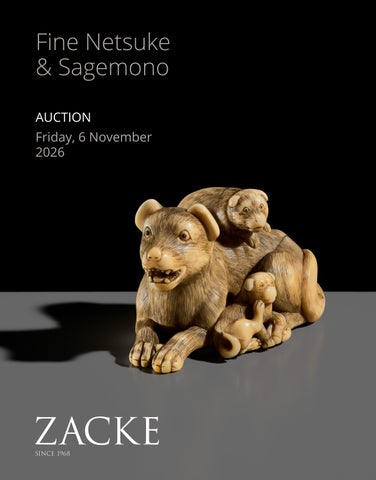
Fine Netsuke & Sagemono AUCTION Friday, 6 November 2026
Fine Netsuke & Sagemono AUCTION Friday, 6 November 2026, 1 pm CET
CATALOG NE1126
EXHIBITION IN OUR SHOWROOM 2-5 November 10 am – 6 pm 6 November 10 am – 12 pm as well as by appointment
GALERIE ZACKE Zelinkagasse 6 1010 VIENNA AUSTRIA
Tel +43 1 532 04 52 E-mail office@zacke.at www.zacke.at
IMPORTANT INFORMATION
According to the general terms and conditions of business of Galerie Zacke Vienna, Founded 1968, SZA Versteigerungen & Vertriebs GmbH, 1010 Wien, online at www.zacke.at ABSENTEE BIDDING Absentee bids are carried out under the regulations of the terms of business of Galerie Zacke, SZA Versteigerungen & Vertriebs GmbH, which requires written submission of your purchase limit. Orders without purchase limits cannot be processed. Only the submitted lot number of the auction lot is binding for the processing of the absentee bid. The place of jurisdiction is Vienna, Austrian Law and Austrian jurisdiction are exclusively applicable for all legal questions arising from the business relationship. Absentee bids for this auction will be accepted until the day of auction by 10:00 a.m. We regret that absentee bids received after the time stated above will not be processed until after the auction. PLEASE SEND ABSENTEE BIDS FOR THIS AUCTION TO: Fax: +43 1 532 04 52 20 or Email: office@zacke.at or Mail: Galerie Zacke, Zelinkagasse 6, 1010 Wien, Austria, Europe WE ACCEPT THE FOLLOWING METHODS OF PAYMENTS: • Cash • Certified or personal check • Bank transfer (please inquire to receive our bank account information) • Credit card (Visa, MasterCard, Amex) up to EUR 5.000 - higher amounts require prior approval and are subject to service fees TELEPHONE BIDDING It is generally possible to bid by telephone during the auction. Please fill out the absentee bidding form enclosed in this catalog and include your telephone number at which you can be reached during the auction. In the “bid in euro” column please write “TEL” and then send us the completed absentee bidding form. Galerie Zacke will call you on the day of the auction, on the telephone number provided, 5 lots before the lot you are bidding on and the bidding will commence at the starting price, as stated in the catalog. If Galerie Zacke cannot reach you during the auction, Galerie Zacke will bid the starting price on your behalf. ESTIMATES AND STARTING PRICES The auction will begin with the starting price and written bids will be accepted only with a minimum amount equivalent to the starting price.
COLOR AND CONDITION Auction lots will be exhibited for viewing prior to the auction, thus offering all interested customers the opportunity to examine the quality and condition of the works exhibited. The catalog illustrations are intended to assist customers during such preview. In illustrations, printed colors do not correspond exactly to the originals. The printed catalog images are not representative for the condition of the illustrated pieces. Hidden flaws and damages are indicated in the condition report. The illustrations in our online catalogs can be strongly magnified, so that most damages and restorations are well recognizable. ENDANGERED SPECIES / CITES INFORMATION Some items in this catalog may for example consist of ivory, rhinoceros-horn, tortoise shell, or some types of tropical wood, and are subject to the Convention on International Trade in Endangered Species of Wild Fauna and Flora [CITES]. Such items are marked with the symbol Ɏ on www.zacke.at and may only be exported outside the European Union after an export permit in accordance with CITES has been granted by the Austrian authorities. We would like to inform you that such licenses are typically not granted. COMPLAINTS At its auctions, Galerie Zacke sells consigned lots on behalf of third-party consignors. For this reason, any complaints related to purchased lots must be in accordance with §32-48 of the general terms and conditions of business of Galerie Zacke, which can be found on www.zacke.at IMPORTANT INFORMATION Whenever making a bid, whether personally or via an agent, in writing, online, telephone, or in any other way, the bidder fully and unconditionally accepts the Terms of Auction, the ‘Important Information’ section in the auction catalog, the Terms and Conditions (AGB) of Galerie Zacke, §1-50, the Fee Tariff, and the Bidding Increments table, all as published on www.zacke.at on the day of the auction THE ART LOSS REGISTER All items starting above EUR 2,000 have been checked by the Art Loss register.
SHIPPING AND TRANSPORT INSURANCE For domestic shipping Galerie Zacke (hereinafter called “the company”) charges in average Eur 15,- to Eur 50,- per item, depending on size and weight. These fees cover the costs of packing and shipping. Fees for bulky or fragile items, or international shipping will be quoted upon request. The purchased goods are transported at the risk of the customer following handover of the packaged item to the post office or another carrier which the customer agrees to through his/her submission of the purchase order. According to the specific wish of the customer, the auctioned goods may be insured for the value of the purchase price (highest bid and all surcharges). This insurance fee is 3% of the purchase price. For any lots with a purchase prices exceeding EUR 350,- the transport insurance will be automatically arranged by the company if it does not expressively receive the purchaser’s written denial of this service and signed waiver of claims. Payments due to the company under the insurance contract will be charged to the customer. The company is also entitled to assign claims under the insurance contract to the customer providing the terms of the insurance contract do not prevent this. In any case, the company is only required to make payment to the customer specifically if payment has effectively been received from the insurance company.
PEFC Certified This product is from sustainably managed forests and controlled sources PEFC/06-39-10
www.pefc.at
produced according to guideline Uz24 Austrian Ecolabel, Print Alliance HAV Produktions GmbH, UW-Nr. 715
ABSENTEE BIDDING FORM
FOR THE AUCTION Fine Netsuke & Sagemono NE1126 ON DATE 6 NOVEMBER 2026
LOT NR.
LOT TITLE
BID IN EURO
PLEASE RAISE MY BID BY ONE BIDDING INCREMENT (ca. 10%) IF NECESSARY IMPORTANT NOTICE: Bids do not include buyer’s premium and VAT. Margin taxation applies. Items with added VAT are marked in the online catalog.
PLEASE CALL ME WHEN A HIGHER BID THAN MINE HAS BEEN RECEIVED MY PHONE NUMBER
TELEPHONE BIDS: If you like to bid by telephone, please state ‘TEL’ in the ‘BID IN EURO’ column instead of a Euro amount. Galerie Zacke will call you on the day of the auction, on the telephone number provided, 5 lots before the lot you are bidding on and the bidding will commence at the starting price, as stated in the catalog. If Galerie Zacke cannot reach you during the auction, Galerie Zacke will bid the starting price on your behalf. TERMS OF PAYMENT, SHIPPING AND COLLECTION:
NAME
ADRESS CITY, COUNTRY
With the signature on this form, the client instructs the auctioneer to bid on his behalf. The Euro amount up to which the auctioneer shall bid on behalf of the client is either stated in this form or will be communicated to the auctioneer via telephone during the auction. All absentee bidding shall be governed by the terms and conditions [AGB] of Galerie Zacke.
POSTCODE
The client agrees with his signature that he has read, understood and fully accepted the AGB of Galerie Zacke. Galerie Zacke, founded 1968, is a registered brand of SZA Versteigerungen & Vertriebs GmbH, Vienna, Austria.
PHONE NUMBER
DATE & SIGNATURE
CREDIT CARD PAYMENT PLEASE CHECK THE DESIRED CARD COLLECTION BY CLIENT WITH PAYMENT ON THE PREMISES IN CASH, BY CERTIFIED CHEQUE OR CREDIT CARD INVOICE PAYMENT VIA BANK WIRE AFTER RECEIPT OF INVOICE SHIPPING AFTER RECEIPT OF PAYMENT EXPRESS PARCEL SERVICE REQUIRED (ACCORDING TO TERMS AND CONDITIONS OF GALERIE ZACKE) SHIPPING INSURANCE REQUIRED (ACCORDING TO TERMS AND CONDITIONS OF GALERIE ZACKE)
GALERIE ZACKE Zelinkagasse 6, 1010 Vienna, Austria Email: office@zacke.at Tel: +43-1-532 04 52 Fax: +43-1-532 04 52 20
AMEX
MASTERCARD
VISA
NAME ADDRESS CARD NUMBER EXPIRY DATE
SECURITY CODE
IMPORTANT NOTICE: Whenever making a bid, whether personally or via an agent, in writing, online, telephone, or in any other way, the bidder fully and unconditionally accepts the Terms of Auction, the ‘Important Information’ section in the auction catalog, the Terms and Conditions (AGB) of Galerie Zacke, §1-48, the Fee Tariff, and the Bidding Increments table, all as published on www.zacke.at on the day of the auction.
HOW TO FIND OUR AUCTION & SHOWROOM AT ZELINKAGASSE 6
In the heart of Vienna’s first district, our showroom spans 6,000-square-foot and has been specially designed to provide a seamless auction and exhibition experience.
U2
S
E
SS
GA
KA
IN EL
U4
Z
-KA I
SS E
O
RU
DO
SAL
ZG
ZELINKAGASSE 6
AL
EFS
GA D
Starting 2 November you’ll be able to explore the exceptional pieces featured in this auction at Zelinkagasse 6, 1010 Vienna.
AN
UK
NA
JOS
OR RU
LF
JOIN US LIVE
DO
SE
NZ-
AS
FRA
AG
AG
NZ
GO
UT
NE
Located at Zelinkagasse 6, 1010 Vienna, our auction and preview space is just a seven-minute walk from our longstanding, 10,000-square-foot office, photography, video, and cataloging hub at Sterngasse 13. Both locations are open to the public, and we warmly invite you to visit.
NG
RI
EN
TT
O CH
LF
PL
SP
AT
K
Z
RIE
S
STERNGASSE 13
6 November 2026 at 1 pm CET Attend in person in our auction room at Zelinkagasse 6 or participate online via Zacke Live – and enjoy premium buyer’s terms with no additional online bidding fees. Register now: www.zacke.at.
4
E
CK
RÜ
RB
O ZT
L
SA
AR
FISCHERSTIEGE
VISIT US IN VIENNA
Easily accessible by public transport or car (a parking garage is located nearby). By Public Transport: SCHOTTENRING station (U2, U4, tram lines 1, 31, 71, D, and bus 3A)
SC
H
W
ED
EN
PL
AT
U1
Z U4
IMPRINT Publisher Galerie Zacke founded 1968 © SZA Versteigerungen & Vertriebs GmbH 1010 Wien Zelinkagasse 6, Austria, Europe Tel (0043-1) 532 04 52 Email: office@zacke.at Editors Lukas Zacke Marion Schor Expert Lukas Zacke Catalogers Tatjana Borodin Daniel Gonzalez-Gracia Iris Horwath
Assistance Mieko Gray Hiroshi Matsumura Anna-Maria Pollmann Photography Georg Bodenstein David Lindengrün Cesilio Cesar Garcia Loreen Sasse Vladimir Ramljak Design Hermann Kienesberger Printing Print Alliance HAV Produktions GmbH Website www.zacke.at © GALERIE ZACKE Reproduction forbidden
5
1 A SUPERB TWO-CASE INLAID LACQUER ‘FISH AMID WATERWEEDS’ INRO, ATTRIBUTED TO NOMURA CHOHEI Attributed to Nomura Chohei, unsigned Japan, late 18th century, Edo period (1615-1868) Of wide rectangular form and oval section, bearing a lustrous roiro ground, exquisitely decorated in gold takamaki-e and hiramaki-e with luxuriant waterweeds surrounding a large hobo (gurnard) to one side and a tai (sea bream) to the reverse. The gurnard is boldly inlaid in shimmering mother-of-pearl, while the tai is rendered in warm golden-brown horn, the contrasting materials lending each side a distinct character. The scales, fins, and gills are finely engraved, the eyes delicately inlaid, and the surrounding aquatic plants rendered in richly textured gold lacquer, partially overlapping and engulfing the fish to create a sophisticated interplay of surface and relief. The composition is built up through successive layers of roiro ground, hiramaki-e, takamaki-e, inlay, and further raised lacquer applied over the inlays, producing a particularly rich and striking sense of depth. The interior cases are finished with gold fundame rims and the top case fitted with a removable compartment. HEIGHT 6.9 cm, LENGTH 7.3 cm Provenance: From the private collection of Alan and Simone Hartman, New York, United States. Condition: Good condition with minor wear and traces of handling and use, typical minute nibbling to the edges of the cases, a fine hairline crack to the top case, a few small dents and a loss to the top and bottom sections of the inro. Still presenting Alan and Simone Hartman beautifully.
6
AUCTION COMPARISON Compare a closely related threecase inlaid lacquer inro depicting fish among waterweeds, by Nomura Chohei, signed Seishuken Chohei with seal, at Bonhams, Fine Japanese Art, 10 November 2011, London, lot 80 (sold for GBP 4,750 or approx. EUR 8,500 converted and adjusted for inflation at the time of writing). Estimate EUR 4,000 Starting price EUR 2,000
2 A SUPERB SINGLE-CASE INLAID LACQUER ‘OWL AND WHITE-HEADED BLACK BULBUL’ INRO, ATTRIBUTED TO NOMURA CHOHEI Attributed to Nomura Chohei, unsigned Japan, late 18th century, Edo period (1615-1868) Of broad rectangular form and oval section, bearing a lustrous roiro ground decorated in gold, black, and red takamaki-e and boldly inlaid in mother-of-pearl. One side depicts a large owl perched upon a gnarled pine branch, its broad body superbly rendered in translucent mother-of-pearl, the finely painted and incised featherwork beneath shimmering through the nacreous surface to remarkable effect. The reverse shows a white-headed black bulbul (shirogashira-kurohiyodori) perched on a slender leafy branch, its contrasting white head boldly inlaid in motherof-pearl, the dark plumage finely incised, and the beak picked out in brilliant red lacquer. Particularly striking are the prominent eyes of both birds, ingeniously set beneath glass and painted with vivid pupils, lending them an unusually intense and lifelike expression. The richly worked branches in raised gold lacquer provide an elegant The white-headed sculptural counterpoint to the smooth, black bulbul luminous inlays.
AUCTION COMPARISON Compare a closely related two-case shell-inlaid lacquer inro depicting an owl and bird, by Nomura Chohei, signed Choheisai, at Bonhams, The Edward Wrangham Collection of Japanese Art, Part III, 15 May 2012, London, lot 301 (sold for GBP 2,375 or approx. EUR 4,100 converted and adjusted for inflation at the time of writing). Estimate EUR 4,000 Starting price EUR 2,000
HEIGTH 5.7 cm, LENGTH 8.2 cm Provenance: From the private collection of Alan and Simone Hartman, New York, United States. Condition: Very good condition with minor typical wear mostly limited to the edges including a few tiny nicks and dents to the top surface.
7
3 AN IMPRESSIVE AND VERY LARGE TWO-CASE INLAID LACQUER ‘QUAILS AND OWL IN A CAGE’ INRO Unsigned Japan, 18th-19th century, Edo period (1615-1868)
HEIGHT 11.8 cm, LENGTH 11.5 cm (inro) LENGTH 4.6 cm (netsuke)
Of exceptionally large, broad rectangular form and oval section, ingeniously conceived as a birdcage, bearing a black-lacquered ground finely decorated in gold, silver, and iro-e takamaki-e and hiramaki-e, richly inlaid with mother-of-pearl and enriched with gold foil. The shimmering vertical cage bars divide the decoration into narrow registers, enclosing on one side a large owl with staring inlaid eyes and finely delineated plumage, while the reverse depicts a pair of quails nestled closely together, their feathers meticulously worked in contrasting textures. The lower section is encircled by a broad gold-lacquer band finely decorated with scrolling foliage and scattered aogai flowerheads, while the red-lacquered uprights and latticework across the top complete the illusion of an elaborate birdcage. The interior cases are finished in nashiji with gold fundame rims, the lower compartment notably much deeper than the upper.
Provenance: The Dorothy Ann Stevens Collection of Fine Netsuke & Inro, formed between the 1940s and 1960s. With an old handwritten collector label affixed to the interior of the top case, inscribed with the collection number 513 and indicating a purchase date of 2 June 1950 from Glendining & Co, London. Dorothy Ann Stevens was a collector of Japanese art active during the mid-twentieth century. The wife of the chemist, artist, and collector Henry Potter Stevens (1875–1965), she formed an extensive collection of netsuke, inro, and smoking accessories. Each acquisition was carefully documented, assigned an individual inventory number, and subjected to scholarly study. Many objects in the collection were acquired on the London art market during the 1940s and 1950s, including works with distinguished earlier provenances. Dorothy and Henry maintained closely related but distinct collections and occasionally exchanged objects between them, Henry’s interests being particularly associated with inro and hers with netsuke. Preserved within the Stevens family for more than half a century, her collection constitutes a significant and well-documented record of the collecting and study of Japanese miniature arts during this period. Condition: Very good condition, with expected wear, traces of handling and use, minuscule losses to gold foil and inlays, and light rubbing to lacquer. The netsuke with age cracks and losses to the tsuishu bowl.
The inro is accompanied by an unusually large tsuishu lacquer ojime deeply carved with pomegranates amid dense foliage, and a large tsuishu lacquer kagamibuta netsuke carved with figural decoration and inset with a silver plate depicting Hotei holding a fan. The generously proportioned fittings are particularly well suited to the monumental scale of the inro.
The ingenious birdcage design of the present inro reflects the widespread culture of birdkeeping in Edo-period Japan. Birds were kept both for their appearance and their song, with elaborately fashioned cages becoming decorative objects in their own right. The inclusion of an owl is particularly unusual: owls are rarely encountered in the context of Japanese birdcage imagery, which more commonly features quails and smaller songbirds. Its large staring eyes and imposing form lend the composition a strikingly unexpected character, contrasting with the pair of diminutive quails nestled together on the reverse. The artist has cleverly transformed the entire inro into the cage itself, the shimmering mother-of-pearl bars extending across both faces and visually enclosing the birds within. The exceptional scale of the present work further distinguishes it from conventional inro. At 11.8 cm high and 10.8 cm wide, with a markedly deeper lower compartment, it was likely conceived as a storage inro, capable of accommodating substantially more than an ordinary portable medicine case. Its unusually large ojime and kagamibuta netsuke were evidently selected to complement these monumental proportions, resulting in a remarkably imposing and visually coherent ensemble. AUCTION COMPARISON Compare a related three-case inlaid lacquer inro in the form of a bird cage, probably by Shunsho IX, 8.6 cm high, at Bonhams, Fine Japanese Art, 10 November 2016, London, lot 157 (sold for GBP 11,250 or approx. EUR 18,000 converted and adjusted for inflation at the time of writing). Estimate EUR 8,000 Starting price EUR 4,000
8
9
4 A FINE AND RARE FOUR-CASE SOMADA SCHOOL INLAID AND TOGIDASHI LACQUER ‘FISHING SCENE’ SAYA (SHEATH) INRO Unsigned Japan, 18th-19th century, Edo period (1615-1868) Of upright rectangular form with rounded sides, the saya finely embellished worked in Somada-style mother-of-pearl inlays arranged in intricate floral and geometric diaper patterns, punctuated at the four corners by larger shippo emblems. Each side is centered by a mokko-shaped aperture revealing the fitted four-case inro, its lustrous roiro ground decorated in finely polished gold and aokin togidashi maki-e with kirigane details, forming a continuous coastal landscape with a fisherman beneath pine trees, a sailboat navigating rolling waters, and distant mountains beyond. The interiors are finished in nashiji with gold fundame rims. With a carved globular ojime. HEIGHT 7.9 cm, LENGTH 5.2 cm Provenance: From the private collection of Alan and Simone Hartman, New York, United States. Condition: Good condition with typical old wear. The sheath with some minor agerelated crackling to the underlying frame and small, scattered losses to the motherof-pearl and gold-foil inlays. The insert with typical rubbing from repeated insertion into and removal from the sheath, as well as minor nibbling to the case edges. Alan and Simone Presenting beautifully. Hartman Estimate EUR 4,000 Starting price EUR 2,000
10
5 A FINE TWO-CASE SOMADA SCHOOL INLAID LACQUER ‘CRABS AMONG REEDS’ INRO Unsigned Japan, 19th century, Edo period (1615-1868) Of wide rectangular form with lenticular section, bearing a lustrous roiro ground finely decorated in the Somada style with minute mother-of-pearl inlays. Both sides show crabs among windblown reeds beside tranquil waters, framed by richly patterned geometric and floral borders extending along the cord runners and across the top and bottom of the case. The intricate shellwork is further enriched with minute gold foil inlays. The interior cases are finished in gold fundame. With a globular glass ojime. HEIGHT 6.3 cm, LENGTH 7.3 cm Provenance: From the private collection of Alan and Simone Hartman, New York, United States. Condition: Restorations and repairs to a few mother-of-pearl inlays, with typical scattered losses to the gold foil inlays. Minor general wear, including a few small bruises to the lacquer along the edges, as well as some light surface scratches throughout. Presenting well. The ‘Somada’ technique was originally introduced from China and named after the Somada family of lacquer workers who made it popular in Japan. It is extremely demanding. Tiny slivers of iridescent shell are inlaid into black lacquer, often in complex geometric designs. During the late Edo and Meiji periods, the technique also included tiny inlays of gold foil, as seen on this example.
LITERATURE COMPARISON Compare a closely related Somada school three-case inlaid lacquer inro depicting crabs among reeds, unsigned, dated c. 1850, 7.7 cm high, illustrated in Max Rutherson Ltd., Inro: Including some from the Arlette Katchen Collection, 2017, no. 20, and reproduced on the cover of the catalogue. Estimate EUR 4,000 Starting price EUR 2,000
11
6 KAJIKAWA: A FINE THREE-CASE RITSUO-STYLE INLAID LACQUER ‘AUSPICIOUS ELEPHANT’ INRO By a member of the Kajikawa family, signed Kajikawa 梶川 saku 作 with a red pot seal Ei 榮 Japan, 18th-19th century, Edo period (1615-1868) Of upright rectangular form with lenticular section and gently rounded edges, bearing a lustrous roiro ground, finely decorated in gold, silver, and colored takamaki-e and hiramaki-e and richly inlaid with mother-of-pearl, ivory, pewter, and carved red lacquer (tsuishu), the design taken from an old Chinese ink cake. One side depicts a richly caparisoned elephant standing in profile, its elaborate trappings picked out in varied relief and contrasting materials. The reverse is centered by a square gold panel inscribed with the four Chinese characters 太平有象 [In an age of great peace, auspicious signs appear,], the final character 象, meaning both ‘image/sign’ and ‘elephant,’ forming an auspicious pictorial pun with the subject on the obverse. The interior cases are lacquered roiro with gold fundame rims. The underside signed in gold lacquer KAJIKAWA saku [made by Kajikawa] with a red pot seal EI. HEIGHT 8.3 cm, LENGTH 6.2 cm
Provenance: From the private collection of Alan and Simone Hartman, New York, United States. Condition: Good condition with minor expected wear and occasional small bruises to the lacquered ground, a small area of discoloration beside the tusks, a tiny loss to the mother-of-pearl inlay, and minor chips to the cord holes. Presenting beautifully. The design of the present inro belongs to the distinctive tradition associated with Ogawa Haritsu, better known by his sobriquet Ritsuo (1663-1747), whose work transformed Japanese lacquer through the imaginative combination of traditional maki-e with an extraordinary range of inlaid materials. MUSEUM COMPARISON Compare a closely related inro depicting a caparisoned elephant on the obverse and a panel of Chinese characters on the reverse, similarly executed in lacquer with ceramic inlay, dated to the 18th-19th century, 7.5 cm high, in the Metropolitan Museum of Art, New York, accession number 29.100.755. The museum catalogues the design under Fangshi Mopu, reflecting its derivation from the celebrated Chinese compendium of ink-cake designs.
AUCTION COMPARISON Compare a related three-case lacquered and ceramic-inlaid wood inro depicting a caparisoned elephant, by Ogawa Haritsu, dated to the 18th century, 8 cm high, at Bonhams, The Harriet Szechenyi Sale of Japanese Art, 8 November 2011, London, lot 274 (sold for GBP 10,000 or approx. EUR 18,000 converted and adjusted for inflation at the time of writing). Estimate EUR 3,000 Starting price EUR 1,500
12
7 A FINE FOUR-CASE LACQUER ‘HAWK AND KARAMONO’ INRO Unsigned Japan, 18th century, Edo period (1615-1868) Of upright rectangular form with oval section, bearing a lustrous roiro ground, finely decorated in gold, silver, and brown takamaki-e, red hiramaki-e, kirigane, and black lacquer details. One side depicts a tethered hawk with wings dramatically spread, perched on an elaborately decorated stand supported on the back of a recumbent karashishi, with trailing red cords. The reverse depicts a Chinese deer-form joss-stick holder displayed upon an ornate low table, the stag standing on a square platform with a slender cylindrical receptacle rising from its back, its body accented with gold kirigane. The interior cases are lacquered in fine nashiji with gold fundame rims. With a carved wood ojime. HEIGHT 7.4 cm, LENGTH 5.4 cm Provenance: Ex-collection Robert ‘Bob’ Moore. Christie’s, The Bob Moore Collection of Japanese Art & Design, 7 November 2007, London, lot 300. From the private collection of Alan and Simone Hartman, New York, United States, acquired from the above. Condition: Good condition with expected Alan and Simone wear, including a few light scratches, a Hartman small loss to the lacquer of the hawk’s plumage, small chips to the lacquer at the top and bottom sections, a few minor bruises to the top, and slight rubbing to the edges of the cases consistent with age and handling.
The decoration ingeniously combines two distinct aspects of elite Edo-period taste. The tethered hawk evokes takagari (falconry), a pursuit closely associated with the shogun, daimyo, and samurai class, while the karashishi support and the Chinese deerform joss-stick holder displayed on a low table reflect the Japanese fascination with karamono, precious Chinese and Chineseinspired objects. The juxtaposition of martial imagery with Chinese decorative taste gives the design its unusual and sophisticated character. AUCTION COMPARISON Compare a closely related four-case lacquer inro of similar design, by the Kajikawa family, 8.5 cm high, at Bonhams, The Edward Wrangham Collection of Japanese Art, 9 November 2010, Part I, London, lot 244 (sold for GBP 4,200 or approx. EUR 7,800 converted and adjusted for inflation at the time of writing). Estimate EUR 3,000 Starting price EUR 1,500
13
8 JOKASAI: A RARE THREE-CASE INLAID LACQUER ‘SARUBOBO’ INRO By Yamada Jokasai, signed Jokasai 常嘉斎 with kakihan Japan, 18th century, Edo period (1615-1868) Of broad rectangular form and lenticular section, bearing a lustrous roiro ground richly mottled with irregular clouds of mura-nashiji, dense gold dust, and scattered gold flakes, creating a remarkably deep and variegated surface. Finely decorated in gold, silver, aged pewter, and iridescent mother-of-pearl with a scattered group of sarubobo, their simple rounded and folded forms boldly abstracted and rendered in contrasting materials. The subdued silver and pewter tones and luminous shell stand out dramatically against the richly textured, smoky ground, lending the deceptively simple design exceptional refinement. The interior cases are finished in fine nashiji with gold fundame rims. Signed to the underside in gold lacquer JOKASAI with a red kakihan. HEIGHT 6.8 cm, LENGTH 8.4 cm Sarubobo, literally “monkey baby”, are traditional stuffed cloth dolls which served both as children’s toys and as protective charms. The name is today particularly associated with the Hida region, where bobo is the local word for a baby, but the underlying type belongs to the much broader Japanese tradition of soft protective dolls descended from Sarubobo doll from the hōko and related forms. Historical Edo period, early 19th accounts of the Hida tradition century record that sarubobo were made domestically from cloth, stuffed with cotton, and used as toys and protective substitutes for children; smaller examples could even be tied together and worn at the waist.
14
Provenance: Collection of Henry Charles Clifford, London, thence by descent. Glendining & Co. London, 15 December 1947, lot 120. The Dorothy Ann Stevens Collection of Fine Netsuke & Inro, formed between the 1940s and 1960s, acquired from the above. A copy of the corresponding entry in the collector’s register, recording the present lot as no. 279, accompanies the lot. With two old handwritten collector’s labels contained within the top case, one inscribed ‘Signed Jokasai, c. 1700. Toy Monkeys on a mura-nashiji ground’, and the other bearing an old collector’s number and indicating the Glending & Co sale date. Condition: Excellent condition with only very minor wear. Estimate EUR 6,000 Starting price EUR 3,000
9 JOKASAI: A FINE FIVE-CASE GLASS-INLAID LACQUER ‘DAYFLOWERS IN MOONLIGHT’ INRO Lineage of Yamada Jokasai, signed Jokasai 常嘉斎 Japan, 18th-19th century, Edo period (1615-1868) Of upright rectangular form and oval section, bearing a lustrous roiro ground enlivened with scattered gold flakes, exquisitely decorated in gold and silver takamaki-e and hiramaki-e with sprays of flowering dayflowers (tsuyukusa). The delicate blue blossoms are unusually inlaid in turquoise-blue glass, while the slender stems and lanceolate leaves are richly worked in contrasting tones of gold and silver and further embellished with kirigane, all illuminated by the soft glow of a crescent moon. The cool translucence of the glass is particularly effective in capturing the characteristic blue of the tsuyukusa blossoms against the deep-black lacquer ground. The interior cases are finished in nashiji with gold fundame rims. Signed to the underside in gold hiramaki-e JOKASAI. Of particular note are the rare glass inlays used for the blossoms. Their cool, luminous blue is especially well suited to tsuyukusa, a flower celebrated in Japan for its intense yet fleeting color, and creates a striking contrast with the moonlit roiro ground and warm gold lacquer.
With a beautifully matching turquoise-blue porcelain globular ojime. HEIGHT 8.9 cm, LENGTH 4.7 cm Condition: Excellent condition with only very light rubbing to edges. The signature Jokasai was used by successive generations of the Yamada family of lacquer artists, whose workshop flourished for more than two centuries. The first Yamada Jokasai worked in Edo in the late 17th century and is traditionally associated with the Kajikawa school; later generations continued to produce inro and other lacquerwares of consistently high quality. The signature occurs in numerous variants. For further reference, see Edward A. Wrangham and Joe Earle (eds.), The Index of Inro Artists (1995), p. 98. AUCTION COMPARISON Compare a related two-case inlaid lacquer inro depicting fruiting plants, lineage of Yamada Jokasai, signed Jokasai, 7.8 cm long, at Zacke, Fine Netsuke & Sagemono, 8 November 2024, Vienna, lot 26 (sold for EUR 5,200).
Surimono of dayflowers by Nakajima Raisho
Estimate EUR 4,000 Starting price EUR 2,000
15
10 A FINE FOUR-CASE LACQUER ‘BLOSSOMING CHRYSANTHEMUMS’ INRO Unsigned Japan, 19th century, Edo period (1615-1868) Of upright rectangular form with oval section, bearing a fine red-lacquered ground sprinkled with minute gold flakes, finely decorated in silver and gold takamaki-e with a continuous scene of chrysanthemums in full bloom behind a thick, gold-lacquered fence. The interiors finished in nashiji with gold fundame rims. With a large, finely polished agate ojime.
16
HEIGHT 9.2 cm, LENGTH 4.6 cm Provenance: From the private collection of Alan and Simone Hartman, New York, United States. Condition: Very good condition with typical wear, a small chip to one upper cord hole, and a tiny nick to the edge of the bottom case, next to the fence. Typical minuscule nibbling to the edges of the cases. Estimate EUR 2,000 Starting price EUR 1,000
Alan and Simone Hartman
11 A FINE FOUR-CASE TOGIDASHI LACQUER ‘BLOSSOMING CHRYSANTHEMUMS’ INRO Unsigned Japan, 18th century, Edo period (1615-1868) Of upright rectangular form and oval section, bearing a fine roiro ground enlivened with clouds of e-nashij, decorated in gold togidashi maki-e, depicting clusters of flowering chrysanthemums, celebrating the fullness of autumn and heralding the approach of winter. The interior cases finished in nashiji with gold fundame rims. HEIGHT 8.8 cm, LENGTH 5.9 cm
Provenance: From the private collection of Alan and Simone Hartman, New York, United States. Condition: Good condition with minor expected wear, an old loss to one chrysanthemum petal, and a small chip to the second lowest case near the riser. The interior with losses to lacquer and remnants of medicine. AUCTION COMPARISON Compare a related four-case lacquer togidashi inro depicting autumnal flowers, unsigned, dated to the 18th-19th century, 9 cm high, at Bonhams, Fine Japanese Works of Art, 22 March 2011, New York, lot 3055 (sold for USD 2,196 or approx. EUR 2,800 converted and adjusted for inflation at the time of writing). Estimate EUR 3,000 Starting price EUR 1,500
17
12 A FINE THREE-CASE TOGIDASHI LACQUER ‘MOON HARE POUNDING MOCHI’ INRO, AFTER A DESIGN BY HANABUSA ITCHO Unsigned Japan, 18th-19th century, Edo period (1615-1868) Of upright rectangular form with lenticular section and rounded edges, bearing a rare dark green ground, finely decorated in gold and iro-e togidashi maki-e. One side depicts a standing lunar hare pounding glutinous rice in a mortar to make mochi, after a design by the celebrated painter Hanabusa Itcho (1652-1724), whose signature is incorporated beside the figure. The reverse is decorated with two gold auspicious characters 長生 (chōsei, “long life”), accompanied by a five-character Chinese-style inscription rendered in black lacquer: 曾因搖蘭而長生, which may be translated as “Through the swaying orchids, long life was attained.” The interior cases are finished in nashiji with gold fundame rims. With a small green glass ojime. HEIGHT 6.9 cm, LENGTH 5.2 cm Provenance: From the private collection of Alan and Simone Hartman, New York, United States. Condition: Excellent condition, with only minor wear and tiny nibbling to case edges.
18
Alan and Simone Hartman
The moon hare (tsuki no usagi), also known as the jade hare, is one of the most enduring lunar motifs in East Asian art. Derived from the Chinese legend of the rabbit who prepares the elixir of immortality on the moon, the subject was reinterpreted in Japan as a hare pounding glutinous rice to make mochi. The motif was further enriched by a celebrated wordplay between 望月 (mochizuki, “full moon”) and 餅搗き (mochitsuki, “mochi pounding”), making the lunar hare an especially popular subject in Japanese painting and decorative arts.
Lunar hare pounding mochi by Hanabusa Itcho (1652–1724)
Hanabusa Itcho (1652-1724) ranks among the most original painters of the Edo period. Trained in the Kanō tradition before establishing his own distinctive manner, he became renowned for his lively brushwork, imaginative compositions, and humorous yet highly observant depictions of animals and everyday subjects. His designs circulated widely and inspired generations of craftsmen working across different media. The present inro demonstrates the enduring appeal of Itcho’s imagery, faithfully translating his expressive portrayal of the moon hare into the refined vocabulary of togidashi lacquer. Estimate EUR 3,000 Starting price EUR 1,500
13 SHIOMI MASANARI: A FINE FOUR-CASE INLAID TOGIDASHI LACQUER ‘ROSEI’S DREAM’ INRO Lineage of Shiomi Masanari (1647-1722), signed Shiomi Masanari 鹽見 政誠 Japan, 18th century, Edo period (1615-1868) Of upright rectangular form and lenticular section, the ground graduating from lustrous reddish-brown lacquer above to richly sprinkled gold nashiji below. One side is finely decorated in gold, silver, and iro-e takamaki-e and hiramaki-e with Rosei reclining asleep upon a low Chinese table, enveloped in voluminous robes and holding a fan delicately inlaid in mother-of-pearl, his face subtly visible through the translucent shell. Two long peacock feathers rise beside him, while a small writing set rests nearby. The reverse reveals Rosei’s dream with remarkable restraint, worked in fine sumi togidashi-e as a distant procession with attendants and a palanquin, seemingly floating against the dark lacquer ground. Signed next to the tsuishu table within the typical red-lacquered reserve SHIOMI MASANARI. The interior cases are finished in tortoiseshell lacquer with gold fundame rims. With a carved and lacquered ojime.
HEIGHT 8.8 cm, LENGTH 5.4 cm Provenance: Collection of the Moller family, Aptos, California, United States, thence by descent. A private collection in United States, acquired from the above in 2011. Condition: Very good condition with only minor wear to case edges and light rubbing to lacquer as visible in the images provided. In the original eighth-century Chinese tale, Rosei (Lu Sheng) leaves his village in pursuit of worldly success. The story later inspired the fifteenth-century Japanese Noh play Kantan, in which Rosei falls asleep at an inn while awaiting his meal and dreams of attaining immense wealth and power, his imagined life unfolding over fifty years. Awakened to discover that only a brief moment has passed, he recognizes the transience of worldly ambition and returns home enlightened. The present inro captures the pivotal contrast between the sleeping Rosei and the splendid procession unfolding only within his dream. AUCTION COMPARISON Compare a closely related four-case lacquer inro depicting Rosei’s dream, by Koma Kyuhaku, 8.5 cm high, at Bonhams, The Edward Wrangham Collection of Japanese Art, Part I, 9 November 2010, London, lot 269 (sold for GBP 8,160 or approx. EUR 15,000 converted and adjusted for inflation at the time of writing). Estimate EUR 5,000 Starting price EUR 2,400
19
14 KOMA KANSAI: A SUPERB FOUR-CASE TOGIDASHI LACQUER ‘SHICHIFUKUJIN’ INRO Lineage of Koma Kansai, signed Koma Kansai 古滿 寛哉 saku 作 Japan, late 18th to early 19th century, Edo period (1615-1868)
Of upright rectangular form and oval section, bearing a luminous kinji ground finely decorated in gold, silver, and iro-e togidashi maki-e with seven circular medallions, each depicting one of the Seven Gods of Good Fortune (Shichifukujin), dressed in voluminous robes and accompanied by their respective attributes. The figures are rendered with remarkable delicacy. The interior cases are finished in nashiji with gold fundame rims. Signed to the underside in gold KOMA KANSAI saku [made by Koma Kansai]. With a finely carved marine ivory ojime depicting Daruma and a spiderweb. HEIGHT 8.8 cm, LENGTH 5.7 cm Condition: Very good condition with only minor wear and few typical light scratches to the kinji ground. The Koma family was one of the most distinguished dynasties of Japanese lacquer artists, founded by Koma Kyui (1600-1663), who was appointed goyo makie-shi, lacquerer to the shogun, by Tokugawa Iemitsu. Successive generations of the family worked for the Tokugawa shogunate and Imperial court, producing lacquer objects of exceptional refinement, with inro forming an important part of their output. AUCTION COMPARISON Compare a related four-case lacquer inro depicting the Seven Lucky Gods, by Kokasai, dated to the 19th century, 8.3 cm high, at Christie’s, Arts of Asia, 26 September 2024, New York, lot 45 (sold for USD 4,410 or approx. EUR 4,000 converted and adjusted for inflation at the time of writing). Estimate EUR 5,000 Starting price EUR 2,400
20
15 TATSUKE TOSHIHIDE II: A SUPERB FOUR-CASE TOGIDASHI LACQUER ‘WOMEN GATHERING SHELLFISH’ INRO, AFTER A DESIGN BY UTAGAWA HIROSHIGE By Tatsuke Toshihide II (1771-circa 1842), signed Hiroshige 廣重 hitsu 筆 and Toshihide 壽秀 saku 作 Japan, first half of the 19th century, Edo period (1615-1868)
With a globular turquoise-green glass ojime.
Of upright rectangular form and oval section, bearing a lustrous roiro ground exquisitely decorated in gold, silver, and iro-e togidashi maki-e with two women gathering shellfish along a rocky shore. On one side, a young woman crouches beside the foaming waves, reaching toward the water while holding a shell in one hand, her voluminous robes and large patterned obi rendered with remarkable delicacy. On the reverse, her standing companion adjusts a cloth over her head beside a wicker basket filled with gathered shellfish and a small octopus. The figures are set against vigorously rendered curling waves and scattered shells, the fine painterly togidashi contrasting beautifully with the deep black ground. The interior cases are finished in nashiji with gold fundame rims. The underside inscribed in gold HIROSHIGE hitsu [painted/ designed by Hiroshige] and TOSHIHIDE saku [made by Toshihide].
Condition: Excellent condition.
The inscription Hiroshige hitsu identifies the composition as deriving from a design by Utagawa Hiroshige. For a closely related treatment of the same popular Edoperiod pastime, compare Utagawa Hiroshige II’s Shellfish Gathering at Low Tide in the Victoria and Albert Museum, London.
HEIGHT 9.6 cm, LENGTH 5.3 cm
AUCTION COMPARISON Compare a related four-case lacquer inro by Kanshosai Toju, similarly worked in brilliant gold and iro-e togidashi on a lustrous roiro ground with finely rendered figures, at Zacke, Fine Netsuke & Sagemono, 4 November 2022, Vienna, lot 183 (sold for EUR 5,850 or approx. EUR 6,700 adjusted for inflation at the time of writing.) Particularly relevant is the close relationship between lacquer decoration and graphic design: the composition of the Toju inro is reproduced in Kobayashi Eitaku’s Banbutsu hinagata gafu (An Album of Designs for Everything), published in 1880-1882. Compare also a four-case roiro lacquer inro by the same artist Tatsuke Toshihide, finely worked in togidashi with a bird among flowers, at Bonhams, London, The Edward Wrangham Collection of Japanese Art, Part III, 15 May 2012, lot 227 (sold for GBP 16,250 or approx. EUR 28,500 converted and adjusted for inflation at the time of writing). Estimate EUR 5,000 Starting price EUR 2,400
21
16 KOMA KANSAI II: A FOUR-CASE LACQUER ‘CROWS AND WINTER MOON’ INRO, AFTER A DESIGN BY SAKAI HOITSU By Koma Kansai II (1767-1835), signed Koma Kansai 古滿 寛哉 utsusu 寫 Japan, early 19th century, Edo period (1615-1868) Of upright rectangular form with oval section, bearing a fine rogin ground and masterfully decorated in gold, silver, and black sumi togidashi maki-e. The exterior depicts a poetic Rinpa-inspired winter scene: on one side, two crows perch upon a snow-laden pine branch silhouetted against the glow of the partially obscured, golden moon, while the reverse shows two further crows in flight across a silver sky. The restrained palette and atmospheric composition reflect the refined natural imagery associated with Sakai Hoitsu. The interior cases are finished in brilliant nashiji with gold fundame rims. The first scene bears the signature Hoitsu hitsu [painted by Hoitsu] with seal, positioned at the lower right in the manner of a painter’s inscription on an original hanging scroll or album leaf. The underside is signed in gold hiramaki-e KANSAI utsusu [copied by Kansai], explicitly identifying the lacquer artist’s role as a faithful transcription of Hoitsu’s design. With a marbled glass ojime. HEIGHT 9.7 cm, LENGTH 5.4 cm Condition: Excellent condition, some very light rubbing to lacquer, particularly to the signature underneath. With an associated wood storage box. Koma Kansai II (1767-1835) is renowned as one of the most distinguished masters of the Koma family, many of whom were official lacquerers to the shogunate. Kansai II was celebrated for his versatility across various lacquer techniques and media, often collaborating with leading metalworkers to produce works of exceptional refinement. He also served as the master of the famous lacquer artist Shibata Zeshin. Sakai Hoitsu (1761-1828) was one of the greatest masters of the Rinpa school and the leading figure in its Edo revival. Born into the powerful Sakai samurai family, he devoted himself to painting and became deeply engaged with the legacy of Ogata Korin, whose style he studied, revived, and disseminated through publications and his own works. Hoitsu was especially celebrated for refined depictions of birds, flowers, and seasonal landscapes, characterized by elegant compositions and a poetic sensitivity toward nature. AUCTION COMPARISON Compare a closely related four-case silver lacquer inro depicting crows perched on a snow-laden branch against the setting sun, by Koma Kansai, dated to the 19th century, 10.2 cm high, at Bonhams, The Edward Wrangham Collection of Japanese Art, Part III, 15 May 2012, London, lot 261 (sold for GBP 85,250 or approx. EUR 148,000 converted and adjusted for inflation at the time of writing). This lot was also featured on the cover of the sale. Estimate EUR 30,000 Starting price EUR 15,000
22
Crows in the Moonlight, By Sakai Hoitsu, After Ogata Korin
23
24
17 KOMA KANSAI: A SUPERB FOUR-CASE INLAID GOLD LACQUER ‘DOVE AMID FLOWERING PLUM’ INRO Lineage of Koma Kansai, signed Kansai 寛哉 saku 作 with kakihan Japan, 19th century, Edo period (1615-1868) Of upright rectangular form with oval section, bearing a luminous kinji ground, finely decorated in gold, silver, and iro-e takamaki-e and hiramaki-e, and enriched with mother-of-pearl inlays. The five cases are decorated with a continuous composition depicting a dove perched upon a flowering plum branch, its plumage finely rendered in colored lacquer and mother-of-pearl inlays, while delicate blossoms and buds emerge from the twisting branches, further embellished with minute gold kirigane flakes. The interior cases are finished in nashiji with gold fundame rims. The underside signed in gold lacquer KANSAI saku [made by Kansai] with a red kakihan. With a coral ojime. HEIGHT 8.5 cm, LENGTH 6.2 cm Condition: Excellent condition, with only minor wear and traces of handling and use. The Koma family was one of the most distinguished lineages of Japanese lacquer artists. Founded in Edo in the seventeenth century by Koma Kyui I (d. 1663), who is recorded as having produced lacquer objects for the shogun Tokugawa Iemitsu, the family maintained a prestigious workshop serving the Tokugawa elite throughout the Edo period. The present signature belongs to the Koma Kansai lineage, established by Koma Kansai I (17351808), a highly accomplished lacquer artist celebrated for his refined gold lacquer and elegant pictorial compositions. His legacy was continued by his adopted son Koma Kansai II (1767-1835), one of the most renowned masters of the family, who excelled in a wide range of lacquer techniques and frequently collaborated with leading metalworkers. Kansai II was also the teacher of Shibata Zeshin (1807-1891), the greatest lacquer artist of the late Edo and Meiji periods. The present inro exemplifies the refined workmanship, technical virtuosity, and sophisticated naturalism associated with this important lacquer tradition. AUCTION COMPARISON Compare a closely related four-case inlaid gold lacquer inro of near-identical design, signed Jokasai saku, 8.7 cm high, at Koller, Asiatica: Japan, India, Southeast Asia, Islamic Art, 29 November 2022, Zurich, lot 445 (sold for CHF 5,000 or approx. EUR 5,500 converted and adjusted for inflation at the time of writing). Estimate EUR 6,000 Starting price EUR 3,000
25
18 A RARE FIVE-CASE INLAID LACQUER ‘SHOKI AND WILD DUCK’ INRO Unsigned Japan, 18th century, Edo period (1615-1868) Of upright rectangular form with oval section, bearing a finely textured rogin ground, delicately decorated in gold takamaki-e and hiramaki-e and enriched with mother-of-pearl inlays and gold kirigane. One side depicts Shoki striding forward in voluminous robes, a sword at his waist and his head shaded by a broadbrimmed hat, while the reverse is decorated with a large wild duck crouching among windswept reeds. The interior cases are lacquered in nashiji with gold fundame rims. With a fine colored glass ojime. HEIGHT 8.7 cm, LENGTH 5.7 cm Provenance: Offered at Bonhams, Fine Japanese Works of Art, 22 March 2011, New York, lot 3066 (mid-estimate at USD 10,000 or approx. EUR 13,000 converted and adjusted for inflation at the time of writing).
26
Condition: Good condition with typical old wear, minor rubbing to lacquer, few shallow bruises to the top from contact with an ojime, minuscule losses with associated repairs to inlays. Presenting beautifully. The legend of Shoki, the demon queller, derives from the Chinese figure Zhong Kui. According to tradition, Zhong Kui took his own life after failing to attain the official recognition he believed he deserved in the imperial examinations. The emperor nevertheless ordered that he receive an honorable burial, and in gratitude his spirit vowed to protect the sovereign and rid the realm of demons. In Japan, Shoki became an especially popular protective figure, celebrated for his formidable appearance and power to ward off evil. The wild duck (kamo) on the reverse provides a more subtle counterpoint to the imposing figure of Shoki. In Chinese decorative symbolism, ducks shown among aquatic plants could carry auspicious associations with scholarly success and advancement, themes that resonate with the examination legend surrounding Zhong Kui. The juxtaposition thus creates an elegant play between Shoki’s failed examination and imagery associated with achievement and good fortune. Estimate EUR 4,000 Starting price EUR 2,000
19 KAJIKAWA BUNRUYSAI: A FINE FIVE-CASE TOGIDASHI LACQUER ‘ROOSTER AND HEN AMONG BLOSSOMING CHRYSANTEMUMS’ INRO, AFTER A DESIGN BY FUJIWARA MICHINOBU By Kajikawa Bunryusai, signed Bunryu 文龍 sha kore 寫之 with kakihan Japan, 18th century, Edo period (1615-1868) Of upright rectangular form and oval section, bearing a fine dark brown lacquer ground subtly enlivened with e-nashiji, exquisitely decorated in gold, silver, and iro-e takamaki-e, hiramaki-e, and togidashi maki-e with a rooster and hen accompanied by several chicks among luxuriant chrysanthemums in full bloom. The plumage is meticulously articulated in contrasting tones and textures, while the blossoms and leafy stems are rendered with equal delicacy. Particularly striking is the sophisticated layering of the decoration, the softly polished togidashi-e passages appearing beneath areas of raised takamaki-e to create a remarkable sense of depth and pictorial richness. The interior cases are finished in fine nashiji with gold fundame rims. The underside is inscribed in gold lacquer Eisen Fujiwara Michinobu hitsu 栄川藤原典信筆 [painted/designed by Eisen Fujiwara Michinobu], with a circular red seal, and BUNRYU sha kore 文龍寫之 [Bunryu rendered/copied this], with the artist’s kakihan in red. With a coral ojime. HEIGHT 8.7 cm, LENGTH 4.8 cm Provenance: From the private collection of Alan and Simone Hartman, New York, United States. Condition: Good condition with minuscule nibbling and losses along the case edges, a few small lacquer bruises, the largest to the top, and expected general wear with light surface scratches. Presenting beautifully.
Bunryusai I was an accomplished lacquer artist and the third master of the Kajikawa family, active in the service of the shogunate in the late seventeenth century. Kano Eisen’in Michinobu (1730-1790) was the sixth head of the influential Kobikicho branch of the Kano school and served the Tokugawa shogunate as an official painter. His designs were also translated into lacquer by leading maki-e artists. AUCTION COMPARISON Compare a closely related four-case lacquer inro depicting a cockerel, hen, and chicks among stems of bamboo, by the same artist, signed Bunryusai utsusu and bearing the same kakihan, also worked in togidashi-e, dated to the 18th century, 7.1 cm high, at Bonhams, The Edward Wrangham Collection of Japanese Art, 9 November 2010, Part I, London, lot 246 (sold for GBP 5,400 or approx. EUR 10,000 converted and adjusted for inflation at the time of writing). Estimate EUR 2,500 Starting price EUR 1,200
27
PROVENANCE The present lot at Bonhams, The Harriet Szechenyi Sale of Japanese Art, 8 November 2011, London, lot 250, sold for GBP 4,750 or approx. EUR 8,500
Provenance: Collection of Harriet Szechenyi, Zurich, Switzerland,
thence by descent. Bonhams, The Harriet Szechenyi Sale of Japanese Art, 8 November 2011, London, lot 250 (sold for GBP 4,750 or approx. EUR 8,500 converted and adjusted for inflation at the time of writing). Harriet Szechenyi (1922-2009) was a distinguished collector of Japanese art, particularly noted for her discerning collection of netsuke and sagemono. Condition: Excellent condition with only very minor nibbling to case edges.
Iizuka (Kanshosai) Toyo was a distinguished lacquerer and inro decorator active in Edo during the second half of the 18th century. He attracted a considerable number of followers and employed an unusually broad range of lacquer techniques and materials. Toyo’s oeuvre includes works of strikingly different character, from finely detailed pictorial decoration to compositions of bold formal simplicity. For further reference, see Edward A. Wrangham and Joe Earle (eds.), The Index of Inro Artists, 1995, pp. 312-313. Christie’s identifies Iizuka Toyo I as active in the 18th century and gives his dates as circa 1725-1790. Estimate EUR 8,000 Starting price EUR 4,000
20 KANSHOSAI TOYO: A SUPERB TWO-CASE LACQUERED WOOD ‘LUNAR HARES’ INRO By Kansoshai Toyo, signed Toyo 桃葉 with kakihan Japan, late 18th century, Edo period (1615-1868) Of broad upright rectangular form and lenticular section, finely crafted from tagayasan wood and covered in translucent lacquer. One side is boldly decorated in thick, textured silver takamaki-e with two lunar hares seated closely side by side, their eyes picked out in brilliant red lacquer. The reverse shows a large full moon rendered in densely scattered silver with sparse gold highlights, above a cluster of reeds in gold lacquer. The restrained composition, exposed wood grain, and bold contrast of metallic relief give the piece a distinctly Rinpa-inspired character. The interior cases are finished in black lacquer. Signed to the underside in gold lacquer TOYO with kakihan. With a fine coral ojime. HEIGHT 7.1 cm, LENGTH 6.2 cm
28
21 A FOUR-CASE GOLD LACQUER ‘BOAR AMID MOONLIT AUTUMN GRASSES’ INRO Unsigned Japan, 19th century, Edo period (1615-1868) Of rounded form, bearing a luminous kinji ground, finely decorated in gold, silver, and black takamaki-e and hiramaki-e, richly enlivened with e-nashiji. The continuous composition depicts a wild boar emerging dynamically amid autumn grasses and flowering plants beneath a slender crescent moon, its powerful body modeled in subtly contrasting tones of lacquer. The interior cases are finished in nashiji with gold fundame rims. HEIGHT 8.6 cm, LENGTH 5.8 cm Condition: Good condition, with minor wear, typical traces of handling and use, light rubbing and few minuscule losses to lacquer along the edges of the cases and to the cord holes. AUCTION COMPARISON Compare a related four-case gold lacquer inro depicting a boar resting amongst autumn leaves and flowers, unsigned, 9.6 cm high, at Zacke, Fine Netsuke & Sagemono, 7 November 2025, Vienna, lot 27 (sold for EUR 2,860). Estimate EUR 3,000 Starting price EUR 1,500
The composition recalls the established painterly theme Akikusa ni fusuru inoshishi (‘A Wild Boar Lying Amidst Autumn Plants’), famously illustrated by Tachibana Morikuni in an instructional picture book published in 1720. The present artist, however, has transformed the traditionally recumbent animal into a far more animated figure: the boar appears to surge forward through the autumn grasses, lending striking movement to an otherwise serene moonlit scene.
29
22 KOSAI: A FINE FOUR-CASE LACQUER ‘TWELVE ANIMALS OF THE ZODIAC’ INRO By Kosai, signed Kosai 幸齋 saku 作 with a red pot seal Japan, 19th century, Edo period (1615-1868) Of upright rectangular form with lenticular section, bearing a luminous kinji ground, finely decorated in gold, silver, and iro-e takamaki-e, hiramaki-e, richly enlivened with gold foil and kirigane inlays. The twelve animals of the zodiac (junishi) are distributed throughout a continuous landscape traversed by a winding stream, several signs - the tiger, goat, rabbit, rat, monkey, and rooster playfully represented by pairs, while the snake, dog, ox, horse, and boar appear singly. Above, the dragon emerges dramatically from billowing clouds, rendered in sumi togidashi maki-e in the manner of a Kano-school ink painting. The interior cases are finished in rich nashiji with gold fundame rims. Signed to the underside in gold lacquer KOSAI saku [made by Kosai] and with a red tsubo-shaped seal of the type associated with the Kajikawa family. HEIGHT 8.7 cm, LENGTH 5.3 cm Provenance: From the collection of Mrs. Frederica (Freda) Cook (1856-1925), and thence by descent. Condition: Good condition with typical losses to the kirigane flakes, minute nibbling along the case edges, tiny nicks to the cord holes, a small area of gold touchup to the lacquer ground near the top on the tiger side, Mrs. Frederica (Freda) Cook and general wear consistent with age and (1856-1925) handling, largely confined to the edges.
30
AUCTION COMPARISON Compare a related five-case lacquer inro depicting the twelve animals of the zodiac, by Koma Yasutoshi, at Bonhams, The Edward Wrangham Collection of Japanese Art, Part III, 15 May 2012, London, lot 257 (sold for GBP 3,750 or approx. EUR 6,200 converted and adjusted for inflation at the time of writing). Compare also a gold lacquer four-case inro by Kajikawa Tomohide, incorporating a closely related treatment of the dragon, at Bonhams, The Edward Wrangham Collection of Japanese Art, Part II, 10 May 2011, London, lot 201 (sold for GBP 3,840 or approx. EUR 6,900 converted and adjusted for inflation at the time of writing). Estimate EUR 3,000 Starting price EUR 1,500
23 KAJIKAWA: A FINE FOUR-CASE GOLD LACQUER ‘WATERFALL AMONG YOUNG PINES’ INRO By a member of the Kajikawa family, signed Kajikawa 梶川 saku 作 with a red pot seal Ei 榮 Japan, 19th century, Edo period (1615-1868) Of upright rectangular form and oval section, bearing a luminous kinji ground, finely decorated in gold and silver takamaki-e and hiramaki-e and enriched with kirigane, with a continuous rocky landscape depicting a waterfall cascading in successive tiers among craggy outcrops and clusters of young pines. The finely graduated gold grounds and scattered kirigane highlights lend the landscape considerable depth and brilliance. The interior cases are finished in rich nashiji with gold fundame rims. Signed to the underside in gold hiramaki-e KAJIKAWA saku [made by Kajikawa] with a red pot seal Ei. With a lacquered wood ojime. HEIGHT 9.2 cm, LENGTH 4.8 cm
Condition: Excellent condition with a tiny dent to the top of the inro and some very minor general wear including a few typical scattered losses to the kirigane flakes. AUCTION COMPARISON Compare a related four-case gold lacquer inro by the Kajikawa family, decorated with a continuous landscape of undulating hills, maple trees, a meandering river, and figures harvesting rice, signed Kajikawa saku with pot seal Ei, at Bonhams, London, Fine Japanese Art, 16 May 2013, lot 202 (sold for GBP 3,125 or approx. EUR 5,300 converted and adjusted for inflation at the time of writing). Estimate EUR 2,000 Starting price EUR 1,000
31
24 KOGYOKUSAI: A FOUR-CASE INLAID GOLD LACQUER ‘NABE KABURI’ INRO By Kogyokusai, signed Kogyokusai 光玉齋 with kakihan Japan, 19th century Of rounded form, bearing a luminous kinji ground subtly enriched with e-nashiji, finely decorated in gold and iro-e takamaki-e and hiramaki-e, and embellished with gold kirigane. Depicted are three elegantly robed women participating in the celebrated nabekaburi festival, each balancing iron cooking pots upon her head, the vessels boldly inlaid in dark horn and the faces and hands delicately inlaid in stained bone. The continuous landscape is completed by distant low mountains on one side and the roofs of a wooden pavilion on the reverse, obscured by thick takamaki clouds embellished with kirigane flakes. The interior cases are finished in fine nashiji with gold fundame rims. Signed to the underside in gold lacquer KOGYOKUSAI with kakihan.
Provenance: From the collection of Mrs. Frederica (Freda) Cook (18561925), and thence by descent. Condition: Excellent condition, with only minor wear and only very few typical, minuscule losses to the kirigane flakes.
32
Women Carrying Pots for the Tsukuma Festival, After Katsushika Hokusai, early 1880s
AUCTION COMPARISON Compare a closely related four-case inlaid gold lacquer inro depicting performers in the play Okina, by Kogyokusai, 8.5 cm high, at Bonhams, Fine Japanese Works of Art from the Edward Wrangham Collection, 9 July 2018, London, lot 112 (sold for GBP 2,125 or approx. EUR 3,300 converted and adjusted for inflation at the time of writing).
HEIGHT 8.1 cm, LENGTH 5.3 cm
Kogyukusai is listed in Edward A. Wrangham and Joe Earl (eds.), The Index of Inro Artists, 1995, p. 137.
The curious subject is the celebrated nabe-kaburi, or “pot-crown,” festival of Tsukuma Shrine in Omi Province, present-day Shiga Prefecture. The custom was already famous by the Heian period and is mentioned in the Ise monogatari. According to a long-standing popular interpretation, women wore on their heads a number of cooking pots corresponding to the number of men with whom they had had relations, with humorous literature adding that divine punishment awaited anyone who falsified the count.
Mrs. Frederica (Freda) Cook (1856-1925)
Estimate EUR 2,000 Starting price EUR 1,000
25 KOMA KANSAI: A FOUR-CASE GOLD LACQUER ‘ONNA SAN-NO-MIYA WITH HER CAT’ INRO Lineage of Koma Kansai, signed Kansai 寛哉 saku 作 Japan, 19th century, Edo period (1615-1868) Of upright rectangular form with lenticular section, bearing a luminous kinji ground finely decorated in gold, silver, and iro-e takamaki-e and hiramaki-e, enriched with gold kirigane. One side shows Onna San-no-Miya elegantly dressed in richly patterned, voluminous court robes and holding a fan, her figure surrounded by delicately scattered cherry blossoms. The reverse continues the scene with a playful cat wearing a red collar and tugging at the long trailing cords of an elaborate kusudama, further cherry blossoms scattered across the gold ground. The interior cases are finished in nashiji with gold fundame rims. Signed underneath in gold hiramaki-e KANSAI saku [made by Kansai]. With a carved globular ojime. HEIGHT 8.9 cm, LENGTH 5.9 cm Provenance: From the private collection of Alan and Simone Hartman, New York, United States. Condition: Good condition. With a crack to the bottom edge and some losses, as well as minor repairs to the cord runners along the edges. The image itself is well preserved, with only light rubbing and a few minor surface scratches.
Alan and Simone Hartman
The subject of the present inro alludes to the celebrated episode of Onna San-noMiya, the Third Princess, in Chapter 34, ‘Young Herbs I’, of The Tale of Genji. While the princess is concealed behind a bamboo blind, her cat runs out and inadvertently lifts the blind, allowing the courtier Kashiwagi to catch sight of her. He immediately falls in love, setting in motion one of the principal tragic episodes of the latter part of the narrative. The Third Princess with her cat, attributed to Matsuno Chikanobu, dated to the 18th century, in The Metropolitan Museum of Art, object no. 2015.300.41
AUCTION COMPARISON Compare a related four-case gold lacquer inro with a traveler being attacked by a large eel, signed Koma Kansai, 7.8 cm high, at Sotheby’s London, 7 November 2019, lot 83 (sold for GBP 3,000 or approx. EUR 4,600 converted and adjusted for inflation at the time of writing). Compare the closely related treatment of the female figure, particularly the sensitively rendered face, richly patterned voluminous robes, and refined gold lacquer work. Estimate EUR 2,000 Starting price EUR 1,000
33
distinctly foreign features, each raising the emblem of his suit, while on either side the partially overlapping reverse of a second card is decorated with an intricate silver diaper pattern. The interior cases are finished in fine nashiji with gold fundame rims. Signed to the underside in gold lacquer INAGAWA saku [made by Inagawa] with a red pot seal. With a lacquer ojime and a matching hako netsuke showing game counters. HEIGHT 8.3 cm, LENGTH 6.5 cm Provenance: Christie’s New York, Japanese Art, 24 April 1997, lot 148 (sold for USD 5,520 or approx. EUR 10,000 converted and adjusted for inflation at the time of writing). From the private collection of Alan and Simone Hartman, New York, United States, acquired from the above. Condition: Excellent condition, with only very minor wear along the case edges. With an associated wood storage box. European playing cards were introduced to Japan by Portuguese seafarers in the mid-16th century, particularly through the ports of southern Japan, and were being produced locally by the end of the century. The earliest Japanese examples are conventionally known as Tensho karuta, a term combining the name of the Tensho era (1573-1592) with karuta, derived from the Portuguese carta, meaning “card.” Closely modeled on their Portuguese prototypes, these early Japanese packs, like related Spanish and northern Italian cards, comprised four suits - swords, clubs, cups, and coins - each with three court cards: king, knight, and knave. The figures depicted on the present inro bear striking similarities to those found on one of the earliest surviving Japanese playing cards of this type, preserved in the Tekisui Museum. Woodblock-printed Tensho Karuta playing card depicting the King of Clubs, dated to the 16th century, in the Tekisui Museum, Hyogo Prefecture, Japan
26 INAGAWA: AN EXCEEDINGLY RARE THREE-CASE GOLD LACQUER ‘TENSHO KARUTA’ INRO By a member of the Inagawa family, signed Inagawa 稲川 saku 作 with a red pot seal. Japan, 18th-19th century, Edo period (1615-1868) Ingeniously constructed in the form of two overlapping playing cards, bearing a radiant nashiji ground and exquisitely decorated in gold, silver, and iro-e takamaki-e and hiramaki-e, enriched with hirame and applied gold foil. One side depicts the King of Clubs, while the reverse shows the King of Coins, both derived from early European-style playing cards introduced to Japan and subsequently adapted as karuta. The richly attired kings are rendered with
34
Estimate EUR 4,000 Starting price EUR 2,000
27 KANSHOSAI TOYO: AN UNUSUAL THREE-CASE TSUISHU AND SHIRO URUSHI LACQUER ‘HO-O ABOVE PINE-SHADED PAVILIONS’ INRO By Kanshosai Toyo, signed Kanshosai 観松斎 and kakihan Japan, 18th century, Edo period (1615-1868) Of unusual rectangular form and section, bearing a rich, shimmering gyobu-nashiji ground, finely decorated in gold, silver, and iro-e takamaki-e and hiramaki-e, with applied carved tsuishu lacquer and enriched with gold kirigane. One side depicts two imposing pavilions nestled among craggy rocks and luxuriant pine trees, while the reverse is dominated by a majestic ho-o bird in flight, executed in the rarely encountered technique of shiro urushi (white relief lacquer), its sweeping wings and elaborate plumage rendered with exceptional precision. The interior cases are finished in fine nashiji with gold fundame rims. Signed to the underside in gold lacquer KANSHOSAI with kakihan. With a fine coral ojime. HEIGHT 7.7 cm, LENGTH 5.2 cm Provenance: From the private collection of Alan and Simone Hartman, New York, United States. Condition: Excellent condition with only very minor wear and scattered typical losses to gyobu nashiji and kirigane flakes.
Alan and Simone Hartman
Iizuka (Kanshosai) Toyo was a distinguished lacquerer and inro decorator active in Edo during the second half of the 18th century. He attracted a considerable number of followers and employed an unusually broad range of lacquer techniques and materials. Toyo’s oeuvre includes works of strikingly different character, from finely detailed pictorial decoration to compositions of bold formal simplicity. For further reference, see Edward A. Wrangham and Joe Earle (eds.), The Index of Inro Artists, 1995, pp. 312-313. Christie’s identifies Iizuka Toyo I as active in the 18th century and gives his dates as circa 1725-1790.
LITERATURE COMPARISON For another example of the use of shiro-urushi see an inro by Koma Kyuhaku illustrated in Paul Moss, Lac Lacquer Lacquest, 2014, p. 158-159, no. 49.
Estimate EUR 3,000 Starting price EUR 1,500
35
28 SHUNSHOSAI: A LARGE AND MASTERFUL FIVE-CASE GOLD LACQUER ‘EIKANDO TEMPLE BELL’ INRO By Shunshosai, signed Shunshosai 春松齋 with the tsubo-shaped seal Shun 春 Japan, Meiji period (1868-1912) Masterfully crafted in the form of the celebrated bonsho of Eikando (Zenrinji) Temple in Kyoto, of lenticular section and bearing a luminous kinji ground. The monumental bronze bell is exquisitely reinterpreted in gold, silver, and iro-e takamaki-e and hiramaki-e, with rows of raised nyu bosses, broad vertical and horizontal bands, and a large lotus-form striking boss (tsukiza) to each side. The panels are richly decorated with flying tennin and writhing dragons, while extensive vertical inscriptions record the bell’s dedication, patronage, clergy, and casting history. The interior compartments are finished in gold-splashed black lacquer with gold fundame rims and fitted with an additional aperture housing a finely incised silver spoon. Surmounted by a silver cord fitting in the form of a dragon, ingeniously echoing the ryuzu suspension fitting of a temple bell. The base is inscribed in gold lacquer: 洛東永観堂名鐘、春松齋寫, Rakuto Eikando meisho, Shunshosai utsusu [The Famous Bell of Eikando in Eastern Kyoto, copied by Shunshosai,’ together with the tsubo-shaped seal Shun 春] HEIGHT 11.7 cm, LENGTH 7.6 cm
The present inro is an extraordinary lacquer interpretation of the celebrated bonsho at Eikando (Zenrinji) Temple in Kyoto, explicitly identified by the inscription to its base. Shunshosai has translated the monumental temple bell into the compact format of an inro while preserving its distinctive architectural and decorative features with exceptional precision, from the rows of nyu bosses and lotus-form tsukiza to the dragons, The bonsho of Eikando (Zenrinji) celestial beings, and Temple, Kyoto, which served as extensive dedicatory the model for the present inro inscriptions. The surviving bell remains one of Eikando’s celebrated treasures and continues to be sounded at the temple today. Provenance: From the private collection of Alan and Simone Hartman, New York, United States. Alan Hartman (1930-2023) was an influential American art dealer, who took over his parents’ antique business in Manhattan and established the legendary Rare Art Gallery on Madison Avenue, with further Alan and Simone locations in Dallas and Palm Beach. His Hartman wife Simone (née Horowitz) already served as assistant manager of the New York gallery before the couple were married in 1975, and together they built a renowned collection for over half a century and became noted art patrons, enriching the collections of important museums including the Museum of Fine Arts, Boston, which opened the Alan and Simone Hartman Galleries in 2013, as well as the Metropolitan Museum of Art and Brooklyn Museum in New York. Notably, they assembled an impressive collection of Japanese art, focusing on fine netsuke, inro, and lacquer. Condition: Excellent condition with only minimal wear. Some light tarnishing to the silver spoon. The artist Shunshosai is only rarely recorded, though the red pot seal found on the present inro suggests a connection to the Kajikawa school. Edward A. Wrangham records an artist of this name in connection with another inro in the form of a bell; see Edward A. Wrangham and Joe Earle (eds.), The Index of Inro Artists (1995), p. 265. AUCTION COMPARISON Compare a related four-case lacquer inro designed as the Dojoji bell, 13.3 cm high, at Bonhams, Fine Japanese and Korean Art, 21 March 2018, New York, lot 2135 (sold for USD 7,500 or approx. EUR 8,600 converted and adjusted for inflation at the time of writing). Estimate EUR 8,000 Starting price EUR 4,000
36
37
29 A MAGNIFICENT THREE-CASE GOLD LACQUER INRO IN THE FORM OF A COMPLETE SUIT OF ARMOR (GUSOKU) Unsigned Japan, Meiji period (1868-1912) Superbly conceived and executed as a complete suit of samurai armor formally displayed upon its storage chest (yoroi-bitsu), the entire surface bearing a luminous kinji ground and meticulously decorated in gold, silver, and iro-e takamaki-e and hiramaki-e. The armor is rendered with extraordinary attention to its individual components: the kabuto helmet surmounted by broad kuwagata and a circular maedate bearing a mon, above the layered shikoro neck guard and fierce dark-lacquered menpo mask; broad sode protect the shoulders, flanking the richly ornamented do cuirass, while the arms are covered by articulated kote terminating in finely detailed tekko hand guards. Below, the overlapping kusazuri and paired haidate are carefully reproduced, their lacing, plates, textile patterns, and fittings individually delineated. Virtually every visible element of a formally displayed suit of armor is thus translated into miniature lacquer with remarkable precision. The armor rests upon its yoroi-bitsu, the traditional chest in which the disassembled suit was stored and transported and upon which it could be displayed, the front embellished with the character 前 (mae, “front”) in mother-of-pearl. The interiors are finished in fine nashiji with gold fundame rims. The sculptural modeling, minute textile patterns, simulated metal fittings, and contrasting lacquer surfaces lend the diminutive ensemble an extraordinary sense of realism and monumentality.
38
With a crackled amber ojime. HEIGHT 11.2 cm, LENGTH 6.1 cm Provenance: From the private collection of Alan and Simone Hartman, New York, United States. Condition: Good condition, with minor wear, a visible crack between the cord holes on the top case, and light rubbing to lacquer.
AUCTION COMPARISON Compare a closely related three-case lacquer inro in the form of an armor, by Shokasai, 15 cm high, at Christie’s, Japanese Art and Design, 14 November 2001, London, lot 188 (sold for GBP 14,100 or approx. EUR 31,500 converted and adjusted for inflation at the time of writing).
Estimate EUR 8,000 Starting price EUR 4,000
Alan and Simone Hartman
39
30 A RARE TALL FOUR-CASE METAL-INLAID LACQUER ‘SHOKI AND ONI’ INRO Unsigned Japan, 18th century, Edo period (1615-1868) Of tall form, bearing a lustrous roiro ground, finely decorated in gold takamaki-e and hiramaki-e and boldly inlaid in gilt-splashed bronze with Shoki, the demon queller, standing in voluminous robes, his sword thrust through his sash as he gazes upward in pursuit. The reverse shows a terrified oni, inlaid in gold, fleeing through swirling clouds above crashing waves and rockwork, the figure dramatically rendered in high relief and surrounded by scattered gold kirigane. The richly worked surfaces combine the sculptural presence of the metal inlay with the painterly effects of the gold lacquer, creating an unusually powerful and dynamic composition. The interior cases are finished with gold fundame rims.
40
HEIGHT 12.3 cm, LENGTH 4.2 cm Condition: Excellent condition, with only very minor wear, traces of handling and use, light rubbing to lacquer. The legend of Shoki, the demon queller, derives from that of the Chinese mythological figure Zhong Kui, who is said to have taken his own life after failing the imperial civil service examinations. He was nevertheless accorded an honorable burial by the emperor and, in gratitude, his spirit vowed to protect the sovereign and rid the empire of demons. Estimate EUR 3,000 Starting price EUR 1,500
31 TOBE KOFU: A LARGE AND SUPERB FIVE-CASE GOLD-INLAID GOLD LACQUER ‘MARISHITEN AND BISHAMONTEN’ INRO By Tobe Kofu (1888-1965), signed Kofu 公風 saku 作 Japan, first half of the 20th century, Showa period (1926-1989) Of broad upright rectangular form and oval section, bearing a luminous kinji ground finely decorated in gold, silver, and iro-e takamaki-e and hiramaki-e, richly accented with e-nashiji and gold kirigane. One side depicts the warrior-protecting deity Marishiten, rendered in applied gold, riding a wild boar borne upon swirling clouds, firing an arrow with the principal hands while brandishing swords in the others. The reverse shows Bishamonten seated formally upon a curtained dais, holding a pagoda, with a naginata resting to one side. The elaborate armor, flowing draperies, cloud scrolls, and architectural details are rendered with exceptional precision against the brilliant gold ground. The interior cases are finished in fine nashiji with gold fundame rims. Signed to the underside in gold lacquer KOFU saku [made by Kofu]. The inro is accompanied by a globular jadeite ojime and a lobed square hako netsuke, finely decorated in gold takamaki-e and applied gold foil with a pair of fluttering butterflies on a radiant kinji ground. HEIGHT 9.8 cm, LENGTH 7.3 cm LENGTH 4 cm (the netsuke) Provenance: From the private collection of Alan and Simone Hartman, New York, United States. Condition: Excellent condition, with only very minimal wear and a few scattered tiny losses to kirigane flakes. The pairing of Marishiten and Bishamonten creates a powerful martial and protective program. Marishiten, derived from the Buddhist deity Marici, was especially revered in Japan by warriors as a protector in battle, associated with invisibility, martial success, and protection from danger. Bishamonten, guardian of the north and one of the Four Heavenly Kings (Shitenno), likewise became closely associated with warriors and military protection. Together, the two deities form an emphatic image of protection, martial strength, and triumph over adversity.
AUCTION COMPARISON Compare a related five-case gold-inlaid lacquer inro depicting sumo wrestlers by the same artist, also signed Kofu saku, 9.7 cm high, at Bonhams, Fine Japanese Art including two masterpieces by Kitaoji Rosanjin, 7 November 2013, London, lot 126 (sold for GBP 5,000 or approx. EUR 8,500 converted and adjusted for inflation at the time of writing). Estimate EUR 5,000 Starting price EUR 2,400
41
32 NAOTSUGU: A FINE TWO-CASE SHIBUICHI ‘IMMORTAL’ INRO WITH AN 18K GOLD AND BAMBOO KAGAMIBUTA NETSUKE By Naotsugu, signed Naotsugu 直次 Japan, 19th century, Edo period (1615-1868) Of upright rectangular form and oval section, finely decorated in katakiribori with gold and silver inlays on a shibuichi ground. One side depicts an immortal striding across swirling clouds and carrying a large peach delicately picked out in gold and copper. Above, sparse branches and leaves are rendered in gold, while the reverse depicts a craggy landscape with flowering or fruiting sprays issuing from the rocks and peaches inlaid in copper, silver, and gold. Signed NAOTSUGU on a silver plaque. With a metal ojime and a kagamibuta netsuke, the latter comprising an 18K gold plate set into a bamboo bowl and finely decorated in takabori with a tiger, its muscular body and fur finely incised. HEIGHT 6.5 cm (inro) DIAMETER 3.2 cm (netsuke) WEIGHT 86 g (total)
42
Condition: Very good condition, minor wear and a few tiny nicks here and there. Gold testing indicates a minimum purity of 18K for the gold plate (weight 6.2 g). There were several metalworkers named Naotsugu signing with the present kanji. The work shows affinities with that produced by the Hamano school of sword-fitting makers. AUCTION COMPARISON Compare a closely related shibuichi and metal-inlaid two-case inro by the same artist, signed Naotsugu, 6.4 cm high, at Bonhams, The Edward Wrangham Collection of Japanese Art, part II, 10 May 2011, London, lot 329 (sold for GBP 2,400 or approx. EUR 4,500 converted and adjusted for inflation at the time of writing). Estimate EUR 4,000 Starting price EUR 2,000
33 HAMANO SHOZUI: A FINE THREE-CASE MIXED-METAL ‘FISHERMAN POINTING AT THE MOON’ INRO Lineage of Hamano Shozui, signed Shozui (Masayuki) 政随 Japan, 18th-19th century, Edo period (1615-1868) Of upright rectangular form with oval section, exquisitely crafted in shibuichi of ishime-textured ground, finely incised in katakiribori, and inlaid in gold and shibuichi takazogan. One side depicts a young fisherman carrying a large wicker basket over his shoulders and holding a rake beside a narrow stream, the bank highlighted with scattered bamboo and fallen leaves, while he points with one arm raised toward the moon, shown on the reverse emerging through drifting mist. The interiors of the cases are of silver. The top and underside are divided between textured and polished shibuichi grounds, the underside signed SHOZUI on the polished section. The inro is accompanied by a small disc-shaped shibuichi ojime, one side applied with a shakudo plate incised in katakiribori depicting crashing waves, the other with an additional gold plate engraved in kebori with a minogame, signed on the edge SHUNKO 春弘 with kakihan; and by a fine shibuichi hako netsuke, inlaid in shakudo and suaka hirazogan, to depict swallows flying through rain, signed within an oval reserve ISHIGURO MASATSUNE 石黒政常.
HEIGHT 5.3 cm (inro) LENGTH 3.3 cm (netsuke) WEIGHT 100 g Provenance: Offered at Bonhams, Fine Japanese Works of Art, 22 March 2011, New York, lot 3056 (mid-estimate at USD 10,000 or approx. EUR 12,500 converted and adjusted for inflation at the time of writing). Condition: Excellent condition, minor expected wear. AUCTION COMPARISON Compare a related two-case mixed-metal inro depicting quail and millet beneath a full moon, by Hamano Nobuchika, dated to the first half of the 19th century, 6.7 cm high, at Bonhams, Japanese Works of Art, 19 September 2008, New York, lot 5031 (sold for USD 5,400 or approx. EUR 7,100 converted and adjusted for inflation at the time of writing). Estimate EUR 3,000 Starting price EUR 1,500
43
34 KAZUO MIZUTANI: A FINE INLAID WOOD ‘OWL’ SAGEMONO SET By Kazuo Mizutani (b. 1932), signed Kazuo 一小 Japan, c. 1990s Comprising a tonkotsu (tobacco box), ojime, and manju netsuke, each finely carved in wood and richly embellished with contrasting inlays of bone, horn, and antler. The tonkotsu is carved in the form of a large owl perched upon a rocky base, its plumage meticulously rendered with overlapping feathers, the rounded eyes, hooked beak, and talons finely inlaid. The accompanying ojime is carved as a smaller owl, while the circular wood manju netsuke is decorated in relief with a further owl, its eyes double inlaid and its beak and claws accentuated with contrasting inlays. Signed to the netsuke and inro KAZUO. HEIGHT 6.5 cm (tonkotsu) HEIGHT 1.9 cm (ojime) DIAMETER 3.2 cm (netsuke)
Kazuo Mizutani (b. 1932) is a highly regarded contemporary Japanese netsuke artist celebrated for his finely carved wood works and sophisticated use of inlay. Working within the tradition of Japanese miniature sculpture while introducing a distinctly modern sensibility, Mizutani often explored natural subjects with exceptional attention to texture, anatomy, and surface detail. His works are represented in the Kazuo Mizutani prestigious Prince Takamado Collection (b. 1932) at the Tokyo National Museum, including a tobacco-pouch netsuke dated 1990 and a complete tonkotsu, netsuke, and ojime ensemble dated 1995.
LITERATURE COMPARISON Compare a related wood netsuke of an owl by the same artist, illustrated in the International Netsuke Society Journal (1987) vol. 7, no. 2, p. 8, fig. 10.
Condition: Excellent condition. Estimate EUR 4,000 Starting price EUR 2,000
44
35 MASAKAZU: A FINE ‘THREE WISE MONKEYS’ SAGEMONO SET
HEIGHT 7.2 cm, LENGTH 8.9 cm (tonkotsu) HEIGHT 2.3 cm (ojime) HEIGHT 3.8 cm (netsuke)
By Masakazu, signed Masakazu 正一 Japan, Osaka, late 19th century, Meiji period (1868-1912)
Provenance: From a private collection in Hesse, Germany. With various old notes, some handwritten, preserved inside the tonkotsu. Condition: Good condition with minor expected wear and some light chipping to the cover. Two inlays to the cover have been restored. Presenting beautifully.
The group comprising a tonkotsu (tobacco box), ojime, and netsuke, finely carved in kiri (paulownia) wood and inlaid with boxwood, horn, and bone. The tonkotsu is decorated on one side with a lively scene of two monkeys among peaches, one carrying a fruiting peach branch while another reaches towards the hanging fruit, while the reverse depicts the hear-no-evil monkey. The cover is further decorated with peaches and foliage. The wood ojime is carved as the see-no-evil monkey, while the netsuke depicts the speak-no-evil monkey, its eyes inlaid. Signed within an inlaid reserve to the underside of the tonkotsu MASAKAZU
The present set combines the popular Edo-period subject of the Three Wise Monkeys (mizaru, kikazaru, iwazaru - “see no evil, hear no evil, speak no evil”) with the traditional symbolism of peaches, associated in East Asian culture with longevity and auspiciousness. AUCTION COMPARISON Compare a closely related complete wood tonkotsu, netsuke, and ojime sagemono set by the Osaka carver Hidemasa, at Bonhams, The Arno Ziesnitz Collection, 21 March 2018, New York, lot 1044 (sold for USD 4,375 or approx. EUR 4,900 converted and adjusted for inflation at the time of writing). Compare a closely related wood netsuke of two monkeys by the same artist, signed Masakazu, at Bonhams, Fine Japanese Art, 15 May 2014, London, lot 9 (sold for GBP 4,000 or approx. EUR 6,700 converted and adjusted for inflation at the time of writing). Estimate EUR 4,000 Starting price EUR 2,000
45
36 KAIGETSU: A FINE ANTLER ‘LEAPING CARP’ KISERUZUTSU (PIPE CASE) By Kaigetsu, signed Kaigetsu 快月 Japan, 19th century Of otoshi-zutsu form, boldly carved with a monumental carp surging upward through vigorously curling waves, its powerful body occupying almost the entire length of the case. The broad head and overlapping scales are crisply delineated, while the fins and sweeping tail merge dynamically with the surrounding water. The waves are rendered in deeply cut, rhythmic scrolls, their foaming crests rising around the fish and cleverly incorporating the cord attachment. Signed KAIGETSU within a double-ingot reserve. LENGTH 20.5 cm Condition: Excellent condition with minor wear, a few natural age cracks, and very light nibbling to the mouth. The carp battling its way through turbulent waters is a celebrated symbol of perseverance, ambition, and success. The imagery ultimately derives from the Chinese legend of the carp that ascends the rapids of the Dragon Gate and, having overcome the current, transforms into a dragon. Here, the familiar subject is treated with exceptional boldness: the enormous fish dominates the narrow surface of the pipe case, its upward thrust amplified by the sweeping movement of the surrounding waves. Estimate EUR 1,500 Starting price EUR 800
46
37 JOSO: A SUPERB GOLD-INLAID ANTLER ‘OKAME AT ONI-YARAI’ KISERUZUTSU (PIPE CASE) By Miyazaki Joso (1855-1910), signed Joso 如藻 Japan, Tokyo, late 19th century, Meiji period (1868-1912) Of muso-zutsu form, exquisitely carved in shishiaibori (sunken relief) and finely embellished with gold inlay, depicting a scene of oni-yarai during Setsubun. An oni wrapped in a mino raincoat scurries past a thatched cottage, while Okame peers out from within, watching his retreat. A blossoming plum tree sweeps poetically across the composition. The landscape is partly veiled in mist, lending considerable depth and atmosphere. The cord attachment is finely carved in the form of a reishi fungus. Signed JOSO within a raised oval reserve. LENGTH 21.5 cm Condition: Good condition overall with expected wear, natural imperfections including small age cracks, and traces of handling and use. A visible loss to one side. The gilt-silver rim fitting replaced. Miyazaki Joso (1855-1910) was an important Tokyo carver and founder of the So school. Pipe cases by Joso are extremely rare, as indeed they are among members of the So school generally, with only very few examples recorded. Morita Soko (1879-1942), one of Joso’s most important pupils, is likewise known to have produced kiseruzutsu (see auction comparison). The subject provides a particularly charming visualization of the Setsubun refrain oni wa soto, fuku wa uchi (‘Demons out, fortune in’). The fleeing oni personifies the misfortune being expelled from the household, while Okame, or Otafuku, an embodiment of happiness and good fortune, represents the fuku welcomed within. The blossoming plum, among the earliest flowers to appear at the end of winter, further reinforces the themes of approaching spring, renewal, and auspicious beginnings. Setsubun is observed on the day before Risshun, the traditional beginning of spring, and incorporates elements derived from the ancient Chinese exorcistic rite of tsuina. The custom of driving away malevolent spirits through the scattering of roasted beans became established in Japan during the medieval period and remains one of the festival’s defining rituals.
Okame and Oni at Setsubun, by Hanabusa Itcho (1652-1724)
Estimate EUR 2,000 Starting price EUR 1,000
47
38 NAGASHIGE: A RARE AND LARGE BAMBOO ‘KIYOHIME AT THE HIDAKA RIVER’ KISERUZUTSU Nagashige, signed Nagashige 長重 Japan, late 19th century Of senryu-zutsu form, skillfully carved with a highly unusual and dramatic rendition of Kiyohime in the midst of her transformation into a serpent, her youthful face framed by long, flowing hair and merging seamlessly into an immense scaly body that coils sinuously across the length of the case. The serpent writhes amid swirling clouds and scattered cherry blossoms, while stylized waves below evoke the Hidaka River, where Kiyohime assumed her serpentine form while pursuing the monk Anchin. One side fitted with a large carved bone cord attachment. Signed above in seal script NAGASHIGE. LENGTH 25.6 cm Provenance: Ex-collection Frank Lapisch, Kassel, Germany. Frank Lapisch (1934-2002) was a German entrepreneur and dedicated netsuke collector who first traveled to Japan in 1960 as a German judo champion. Condition: Good condition with expected wear, minor imperfections, and age cracks. One larger crack restored near the bottom. The subject derives from the celebrated legend of Anchin and Kiyohime. Consumed by jealousy after the monk Anchin rejected and fled from her, Kiyohime pursued him to the Hidaka River, where her passion transformed her into a great serpent. She ultimately followed him to Dojoji temple, where Anchin sought refuge beneath the temple bell. Tsukioka Yoshitoshi, The image of Kiyohime Kiyohime, Emerging with a woman’s head from the Hidaka and flowing hair joined River, Turning into a to a vast serpentine Serpent, 1865 body became one of the most dramatic visualizations of the legend in nineteenth-century Japanese art. Estimate EUR 2,000 Starting price EUR 1,000
48
39 YOZAN: A FINE AND RARE WOOD ‘RAKAN AND KIRIN’ KISERUZUTSU (PIPE CASE) By Yozan, signed Yozan 晹山 with seal Yozan 晹山 Japan, late 19th century Of muso-zutsu form, finely engraved in kebori and katakiribori with an elderly rakan (arhat) standing beside a powerful kirin, dramatically brandishing a long hossu (fly whisk) as though it were a whip while grasping the beast’s horn with his other hand. The rakan is dressed in voluminous robes, his bald head and expressive features rendered with delicate linework. The kirin is powerfully depicted with a horned head, flowing mane, and densely scaled body, while a small attendant at its side holds a lance; together, the figures appear to be subduing the mythical beast. The rim lined in shibuichi, with the cord attachment carved immediately below. Signed YOZAN with a square seal also reading YOZAN. LENGTH 21.2 cm Provenance: Ex-collection Frank Lapisch, Kassel, Germany. The interior containing an old collector’s handwritten note, dated November 1986, providing a brief description of the subject depicted and a reading of the signature. Frank Lapisch (1934-2002) was a German entrepreneur and dedicated netsuke collector who first traveled to Japan in 1960 as a German judo champion. Condition: Very good condition with minor wear, traces of handling and use, and light surface scratches.
Arhat with a Qilin, Ming Dynasty, National Palace Museum, Taipei
Estimate EUR 1,500 Starting price EUR 800
49
40 IKEDA TAISHIN: A FINE LACQUER ‘HYOTAN AMONG WINDBLOWN LEAVES’ KISERUZUTSU (PIPE CASE) By Ikeda Taishin (1825-1903), signed Taishin 泰真 Japan, Tokyo, late 19th century, Meiji period (1868-1912) Of muso-zutsu form, finely decorated in subtly graduated layers of dark translucent lacquer with a double gourd (hyotan) suspended from slender trailing stems amid large windblown leaves. The beautifully polished wood is covered with a thin translucent lacquer, deliberately allowing the natural grain to remain visible beneath the surface, where its softly shifting patterns evoke the silhouettes of trees emerging through distant mist. The restrained decoration and atmospheric treatment of the ground lend the composition remarkable depth and refinement. The rim mounted with a shibuichi fitting incorporating the cord attachment. Signed to the side TAISHIN. LENGTH 20.3 cm Condition: Very good condition, with only minor wear including a few light surface scratches throughout. Ikeda Taishin (1825-1903) was the leading pupil of Shibata Zeshin and one of the most accomplished lacquer artists of the Meiji period. Born in Edo, he entered Zeshin’s workshop in 1835 at the age of eleven and remained under his tutelage for several decades before establishing himself independently around 1870. In 1896, together with Kawanobe Itcho (Genjiro, 1830–1910), he was appointed Artist to the Imperial Household (Teishitsu gigeiin). Among his pupils was Umezawa Ryushin, later associated with the Imperial Fine Arts Academy. AUCTION COMPARISON Compare a related lacquered rattan kiseruzutsu depicting a hyotan-shaped flask below a maple branch, by Ikeda Taishin, at Zacke, Fine Netsuke & Sagemono, 7 November 2025, Vienna, lot 59 (sold for EUR 4,940). Compare a related lacquered wood kiseruzutsu depicting a sake gourd in a carrying net and maple leaves, by Ikeda Taishin, at Bonhams, Fine Japanese Works of Art, 20 March 2012, New York, lot 2191 (sold for USD 4,750 or approx. EUR 5,900 converted and adjusted for inflation at the time of writing). Estimate EUR 3,000 Starting price EUR 1,500
50
41 SHIBATA ZESHIN: A LARGE AND FINE LACQUERED WOOD ‘NATAMAME AND SNAIL’ INCENSE CONTAINER By Shibata Zeshin (1807-1891), signed Zeshin 是眞 with seal Shin 眞 Japan, Tokyo, late 19th century, Meiji period (1868-1912) Published: Resonance of Wa - The Japanese Spirit. Casal Collection, 2025, p. 165. Naturalistically carved in the form of an elongated sword bean (natamame), the smoothly polished wood preserving the irregular contours and subtle surface character of the pod. The detachable central section forms the lid and is applied in high relief with a snail, its shell finely inlaid in mother-of-pearl and its body rendered in masterful gold takamaki-e. The rim finished in gold fundame. Signed to the reverse ZESHIN with seal Shin. LENGTH 43.3 cm Provenance: Ex-Collection of Ugo Alfons Casal, acquired from the above. Osaka City Museum of Fine Arts, bequeathed from the above and subsequently de-accessioned in 2021. With a collection label Ugo Alfons Casal Osaka Fine Arts ‘1460’ to the interior. Museum Condition: Excellent condition with old wear and typical natural flaws to the material. Few natural age cracks. The mid-section is removable. With a wood tomobako (storage box) inscribed ‘Zeshin makie kodutsu, chinto’ [An incense container in the shape of a rare sword, made by Zeshin].
The treatment of the snail was likely inspired by Jikan Ganbun, whose naturalistic compositions of humble creatures such as snails and insects, usually enriched with mixed-media inlays, clearly resonated with Zeshin. AUCTION COMPARISON Compare a related bamboo hako netsuke by Shibata Zeshin, after Jikan Ganbun, similarly decorated with a snail in gold takamaki-e and metal inlay, signed Narau Ganbun, Zeshin, 3.8 cm long, at Bonhams, The Edward Wrangham Collection of Japanese Art: Part III, 15 May 2012, London, lot 140 (sold for GBP 10,625 or approx. EUR 18,500 converted and adjusted for inflation at the time of writing). Estimate EUR 4,000 Starting price EUR 2,000
51
42 AN IMPRESSIVE WOOD ‘KANO SCHOOL DRAGON’ BOKUTO (DOCTOR’S SWORD) Unsigned Japan, 18th-19th century, Edo period (1615-1868) The dragon is rendered in a style closely associated with the Kano school, Japan’s most influential painting academy from the Muromachi period onward. Particularly notable is the unusual treatment of the head, turned sharply backwards with both eyes presented in profile, recalling the dramatic compositions of Kano dragon paintings.
52
Kano Motonobu (1476-1559), Dragon, one of the earliest Kano school dragon paintings
Unusually large and gently curved in form, one end finely carved as the head of a dragon turning dramatically backwards, its fierce expression accentuated by large eyes inlaid in mother-of-pearl, a gaping mouth revealing sharp fangs, and finely rendered curling whiskers. The elongated body is covered with meticulously carved scales and emerges from swirling clouds that extend along the remainder of the shaft. The wood displays an attractive grain and a rich, lustrous patina. The dragon’s claw forms the attachment point for the sword cord, while a further himo-ana (cord hole) is pierced at the opposite end for the attachment of a tassel or suspension cord. LENGTH 52 cm Condition: Excellent condition, with only minor wear, small age cracks and few tiny nicks here and there. Estimate EUR 2,500 Starting price EUR 1,200
43 A FINE WOOD ‘SCHACHIHOKO’ BOKUTO (DOCTOR’S SWORD) Unsigned Japan, 18th-19th century, Edo period (1615-1868) Boldly carved in the form of a dragonfish, its fierce expression defined by large, rounded eyes with horn-inlaid pupils and an upturned snout flanked by flowing whiskers, while the elongated body is finely incised with stylized wings and fins. The wood displaying an attractive grain and a fine, lustrous patina. LENGTH 42.6 cm Condition: Excellent condition, with only minor wear, small age cracks and few tiny nicks here and there. The shachihoko is a mythical creature combining the head of a dragon with the body of a carp and was traditionally believed to control water and protect buildings against fire. Best known as an architectural ornament placed on the roofs of Japanese castles, temples, and important structures, shachihoko were also occasionally represented in decorative arts.
During the Edo period, following the establishment of peace under the Tokugawa shogunate, the practical need for carrying weapons diminished. Wooden sword substitutes known as bokuto became fashionable among physicians, artists, scholars, and other members of the professional classes as symbols of refinement and social status. During the eighteenth and nineteenth centuries, these objects increasingly departed from the proportions and appearance of functional swords, evolving into highly imaginative works of decorative sculpture, often carved with auspicious, mythological, or natural subjects. AUCTION COMPARISON Compare a related wood bokuto depicting a Shachihoko, unsigned, 42.7 cm long, at Zacke, Fine Netsuke & Sagemono, 7 November 2025, Vienna, lot 50 (sold for EUR 3,380). Estimate EUR 2,500 Starting price EUR 1,200
53
Fine Netsuke Lots 44-285
54
55
44 A VERY RARE IVORY NETSUKE OF TWO KUMOSUKE (TOKAIDO ROAD PORTERS) Unsigned Japan, 18th century, Edo period (1615-1868) Amusingly carved as two stout Tokaido road porters striding closely side by side, their bodies leaning companionably together as they break into a lively dance, fists swinging with animated movement. Their jovial faces are sensitively modeled with plump cheeks, narrowed eyes, and broad smiles. Both wear short open jackets exposing their rounded bellies, loose breeches, and cloth mantles falling in deeply carved folds over their backs, while their broad woven hats are finely incised with radiating lines. Good himotoshi to the back.
HEIGHT 5.8 cm Provenance: Ex-collection René Vassal. François de Ricqlès, Paris, 13 April 1994. French private collection, acquired from the above. Condition: Very good condition with minor wear and expected age cracks. Kumosuke were porters employed along the great highways of Edo-period Japan, particularly the Tokaido connecting Edo with Kyoto. Carrying luggage and travelers in palanquins, they became familiar figures of life on the road and were known for their physical strength and boisterous character. The subject is rare in netsuke, and depictions of two kumosuke together are rarer still, with only one other recorded example known to the present author. LITERATURE COMPARISON Compare the only other recorded ivory netsuke depicting two kumosuke together, unsigned and dated to the 18th century, 4.8 cm high, formerly in the Gabor Wilhelm Collection and illustrated in Netsuke That Never Left Japan, Sagemonoya, 2001, no. 40.
AUCTION COMPARISON Compare a related ivory netsuke of a single kumosuke, 7.4 cm high, at Zacke, Fine Netsuke & Sagemono, 25 September 2020, Vienna, lot 25 (sold for EUR 10,112 or approximately EUR 13,500 adjusted for inflation at the time of writing). Estimate EUR 5,000 Starting price EUR 2,400
56
45 A RARE TALL IVORY NETSUKE OF A CALENDAR SELLER (KOYOMI-URI) Unsigned Japan, 18th century, Edo period (1615-1868) Finely carved standing with a mischievous expression, carrying a bundle tied across his shoulders and wearing his robe hitched up and tucked into the belt at the back. In his right hand he holds a cord strung with coins, while in his left he carries a tablet inscribed with numbers arranged in two columns, recording the long and short months of a daisho-reki calendar. Suspended from his belt behind is a small booklet inscribed daikyoshi, possibly referring to a local calendar. The sequence of long and short months recorded on the tablet corresponds to the years 1706, 1715, and 1768. Large asymmetrical himotoshi pierce the back, the ivory bearing a superb, lustrous patina. HEIGHT 9.3 cm Provenance: Ex-collection Frank Lapisch. Frank Lapisch (19342002) was a German entrepreneur and dedicated netsuke collector who first traveled to Japan in 1960 as a German judo champion. He later founded the Tokyo-based electronics firm Alltec in 1972 while deepening his engagement with Japanese art and craftsmanship. From the late 1970s onward, he pursued the study and acquisition of netsuke with increasing discernment, carefully documenting purchases made at auction houses such as Lempertz and Klefisch. He showed a particular preference for early ‘ur-netsuke,’ prized for their expressive carving and richly developed, glossy wear patina. Condition: Good condition with old wear, expected age cracks, the right foot with an old chip.
The present netsuke depicts the exceptionally rare subject of a koyomi-uri, or calendar seller. Such vendors were familiar figures around the Japanese New Year, when calendars for the coming year were distributed and sold, yet they are seldom represented in netsuke. The tablet records a daisho-reki, indicating the sequence of thirty-day ‘large’ months and twenty-nine-day ‘small’ months under Japan’s lunisolar calendar. The particular arrangement shown here corresponds to 1706, 1715, and 1768, with the latter the most plausible date on stylistic grounds. This provides an unusually precise chronological anchor for an unsigned 18th-century netsuke.
Calendar sellers in the Illustrated Guide to the Customs of Edo City, by Kiichiro Kikuchi
Estimate EUR 4,000 Starting price EUR 2,000
57
46 AN IMPRESSIVELY LARGE AND POWERFUL IVORY NETSUKE OF SHOKI SUBDUING AN ONI, EX BEHRENS COLLECTION Unsigned Japan, late 17th to early 18th century, Edo period (1615-1868) Published: Joly, Henri L. (1912) The W. L. Behrens Collection, Part 1, Netsuke, no. 3217, illustrated on pl. XXXLX. Boldly carved in the powerful manner of early sankaku (triangular) netsuke, depicting the demon queller Shoki seated triumphantly upon a subdued oni. Shoki reaches one hand behind his head while the other grips the hilt of his long sword, its blade extending emphatically across the composition. His ferocious expression is rendered with tremendous vigor, with sharply arched brows, glaring eyes, flaring nostrils, and an open mouth revealing individually carved teeth, the face framed by a finely incised beard and hair gathered into a high topknot. He wears voluminous robes beneath elaborately detailed lamellar armor, the broad folds and deeply cut surfaces enhancing the monumentality of the carving. Beneath him, the terrified oni is violently compressed upside down, its head forced to the ground between its hands, the face contorted with bulging eyes and bared fangs. Generously excavated, asymmetrical himotoshi to the back. The ivory bearing a superb, deep patina.
HEIGHT 8.5 cm, WIDTH 6 cm Provenance: Ex-collection W. L. Behrens (1861-1913). Thereafter in a noted French private collection. Condition: Very good condition with old wear and expected age cracks. The present netsuke belongs to that rare group of early carvings whose Portrait of Walter sheer scale, physicality, and sculptural Lionel Behrens force transcend the conventional (1861-1913) notion of netsuke as miniature art. The portrayal of Shoki is itself highly unusual, the demon queller shown in elaborate armor and with an almost martial, heroic presence rather than in the more familiar scholarly or robed guise; combined with the massive triangular composition and vigorous modeling, this gives the carving the bold, uncompromising energy particularly associated with the kind of early netsuke admired and championed by Joe Kurstin (see literature comparison). LITERATURE COMPARISON Compare a related early ivory netsuke of Shoki and an oni, likewise unsigned, dated 17th-early 18th century and measuring an imposing 10.5 cm high, illustrated in Kurstin, Joe (1999), Masterworks of Netsuke and Other Japanese Miniature Art from American Collections, p. 17, no. 1. While differing in composition, the comparison is particularly apt for its similarly monumental scale, extraordinary vigor, and powerful sculptural presence. Estimate EUR 10,000 Starting price EUR 5,000
58
59
60
47 AN EXCEPTIONALLY LARGE (13 CM) WOOD NETSUKE OF AN ONI HOLDING A ROSARY Unsigned Japan, early 18th century, Edo period (1615-1868) Published: Katchen, Arlette (2010) Netsuke 7, vol. 2, p. 413, no. K794. Boldly carved and remarkably three-dimensional, the muscular oni standing in a jaunty, almost swaggering pose, one hand holding a long loop of Buddhist prayer beads across his loincloth while the other is raised to his ear as if listening intently. The figure is conceived almost fully in the round, with a broad torso, swelling belly, massive limbs, and strongly projecting musculature that give the carving an extraordinary sense of physical volume and sculptural presence. His face is animated by a broad mischievous grin, with bulging eyes beneath arched brows, a broad nose, sharp fangs, and two prominent horns, while the hair falls in thick locks down the back. The anatomy is vigorously observed throughout, particularly in the pronounced backbone and the carefully articulated clawed hands and feet. Large himotoshi to the back. The contrast between the demon’s fearsome appearance and his solemn handling of a Buddhist rosary lends the monumental figure a distinctly humorous and irreverent character.
The incongruous image of an oni engaged with Buddhist prayer beads belongs to a broader tradition of comic religious inversion in Edo-period art. Its closest pictorial parallel is the popular Otsu-e subject Oni no Nenbutsu, in which a demon adopts the outward trappings of Buddhist devotion. Such imagery combined satire with talismanic meaning: the praying oni became one of the best-known Otsu-e subjects and was traditionally believed to protect against evil and to stop children crying at night. At an extraordinary 13 cm high, this masterful netsuke is conceived with the mass and volume of a small sculpture, the body projecting boldly in every direction and the deeply modeled anatomy inviting appreciation from all sides. The combination of exceptional scale, almost sculptural bulk, vigorous carving, and wonderfully comic expression gives this early netsuke a commanding presence rarely encountered in the medium.
LITERATURE COMPARISON Compare a related large wood netsuke of an oni nembutsu with a rosary, illustrated in Joly, Henri L. (1912) The W. L. Behrens Collection, Part 1, Netsuke, pl. LVII, no. 4431.
HEIGHT 13 cm Provenance: Ex-collection Julius & Arlette Katchen Paris. Bonhams, The Julius and Arlette Katchen Collection of Fine Netsuke Part III, 6 November 2018, London, lot 18. Condition: Old restoration to the edge of one foot. Otherwise, good condition with old wear and expected age cracks. The lacquer is attractively worn, with only traces of the original surface remaining.
AUCTION COMPARISON Compare a related large wood netsuke of an oni, dated 18th century, 15.9 cm high, at Christie’s, Arts of Asia Online, 2 April 2026, New York, lot 244 (sold for USD 13,970 or approx. EUR 12,000 converted at the time of writing). Julius Katchen in 1956 Estimate EUR 15,000 Starting price EUR 7,500
61
48 AN EXCEPTIONAL AND RARE MARINE TUSK NETSUKE OF AN UBUME WITH CHILD Unsigned Japan, 18th-19th century, Edo period (1615-1868) Boldly carved from a dense, heavy section of marine tusk as Ubume, the ghostly mother, standing in flowing robes and clutching a grotesque infant tightly to her breast. Her long hair falls in thick strands over the shoulders, framing a broad, unsettling smile and deeply cut features. The child is rendered with bulging eyes, a gaping mouth, and exposed teeth, its limbs wrapped around the mother’s body to form a tightly interlocked composition. Very large, asymmetrical himotoshi. The pronounced natural grain and warm honey tone of the marine tusk are skillfully incorporated into the carving, while the unusual scale and considerable weight lend the netsuke a striking presence in the hand. HEIGHT 10.5 cm WEIGHT 102.3 g Provenance: From a noted German private collection, Munich, Germany. Condition: Very good condition with old wear and several materialinherent age cracks. The ubume is one of the most enduring maternal ghosts of Japanese folklore. Her legend reaches back at least to the late Heian-period Konjaku monogatari shu, which recounts an encounter between Urabe no Suetake and an ubume who asks him to carry her child. By the Edo period, the image had become graphically fixed in illustrated yokai compendia, most famously Toriyama Sekien’s Gazu hyakki yagyo of 1776, where the disheveled ghost appears clutching an Ubume by Toriyama Sekien infant to her breast. The present carving gives this established mother-and-child image an unusually visceral form: the monumental scale, heavy marine tusk, and demon-like physiognomy of the infant transform a familiar ghost story into a particularly arresting netsuke.
LITERATURE COMPARISON Compare a related wood netsuke of the same unusual subject by Yosui, likely carved from the same source image, dated to the 19th century, 5.3 cm high, illustrated in Jirka-Schmitz, Patrizia, The World of Netsuke - The Werdelmann Collection at the Museum Kunstpalast Düsseldorf, no. 286. Estimate EUR 6,000 Starting price EUR 3,000
62
63
49 A RARE IVORY NETSUKE OF A FOREIGN DEVIL, SOKEN KISHO TYPE Unsigned Japan, 18th century, Edo period (1615-1868) Published: Misao Mikoshiba and Raymond Bushell (1980), Netsuke and The Soken Kisho, Arts of Asia, p. 105. Finely carved from the tip of the tusk, the design derived from a Malayan kris handle, depicting a foreign devil seated upon a circular crosshatched base, his knees drawn sharply upward and his bare feet splayed beneath a long cloth falling between the legs. The striking face is modeled with large staring eyes, sharply arched brows, a broad upturned nose, pierced ears, and a grinning mouth revealing teeth, all framed by long, straight locks of hair and a pointed beard. One hand is raised to his ear while the other grasps the end of his beard, lending the figure a wonderfully animated and enigmatic expression. Large himotoshi through the back and underside. The ivory bearing an attractive warm patina. HEIGHT 6.4 cm Provenance: Ex-collection Cornelius V. S. Roosevelt. Sotheby’s, The Cornelius V. S. Roosevelt Collection of Netsuke, 2 June 1992, lot 127. Ex-collection Raymond and Frances Bushell, acquired from the above. Sotheby’s, Netsuke from the Collection of Raymond and Frances Bushell, 18 November 1999, London, lot 104. From a noted French private collection, acquired from the above. Cornelius Van Schaack Roosevelt III Cornelius Van (1915–1991), grandson of President Theodore Schaack Roosevelt Roosevelt, was an American intelligence III (1915–1991) officer and business executive, educated at Harvard and MIT, and later served in the CIA. A keen collector, he amassed an important collection of Japanese netsuke. Condition: Excellent condition with minor wear.
64
The present netsuke represents a fascinating and rare instance of the transmission of Southeast Asian imagery into Japanese netsuke carving. Its unusual figure derives from the figural handles of the kris, the characteristic dagger of the MalayIndonesian world. Such handles evidently reached Japan and provided models for a small and distinctive group of early netsuke depicting strange foreign demons and fantastic beings. Related designs were subsequently absorbed into the Japanese netsuke repertoire and appear among the carvings associated with Yoshimura Shuzan in the Soken Kisho of 1781.
LITERATURE COMPARISON Compare a closely related whale tooth netsuke in Bushell, Raymond (1975) Netsuke Familiar & Unfamiliar, no. 667.
Estimate EUR 3,000 Starting price EUR 1,500
A design for a foreign devil that is very similar to the present netsuke is illustrated in the Soken Kisho
50 A POWERFUL IVORY NETSUKE OF RYUJIN’S OCTOPUS-HEADED ATTENDANT Unsigned Japan, 18th century, Edo period (1615-1868)
A powerful ivory netsuke, dynamic and bold in its execution, depicting one of the two attendants of Ryujin - the Dragon King of the Sea and Ruler of Seas and Tides. The attendant is shown standing upright, raising one leg, his face expressively carved with furrowed brows and a square jaw, wearing only a tied loincloth, his exposed muscular arms and ribcage powerfully sculpted. An octopus sits plump on his head, as the attendant firmly grips a sacred jewel. The ivory bearing a rich, honey-gold patina. Asymmetrical himotoshi to the back. HEIGHT 8.2 cm Provenance: Ex-collection Frank Lapisch. Frank Lapisch (1934-2002) was a German entrepreneur and dedicated netsuke collector who first traveled to Japan in 1960 as a German judo champion. Condition: Very good condition with old wear and expected age cracks. AUCTION COMPARISON Compare a related ivory netsuke depicting Ryujin, also unsigned but likely carved by the same studio, 9.3 cm high, at Bonhams, The James A. Rose Collection of Netsuke and Sagemono, 17 September 2013, New York, lot 2081, (sold for USD 50,000 or approx. EUR 61,000 converted and adjusted for inflation at the time of writing). Also compare a closely related ivory netsuke depicting Ryujin’s attendant, also unsigned but likely carved from the same studio, 8.4 cm high, Fine Netsuke & Sagemono, 9 May 2025, Vienna, lot 111 (sold for EUR 3,120). Estimate EUR 4,000 Starting price EUR 2,000
65
66
51 AN EXCEEDINGLY RARE EBONY WOOD NETSUKE OF A JAPANESE SEA LION Unsigned Japan, 18th century, Edo period (1615-1868) Published: 1. Bushell, Raymond (1971) Collector’s Netsuke, (back cover). 2. Bushell, Raymond (1975) Netsuke Familiar & Unfamiliar, p. 180, no. 498. Boldly carved from dense, lustrous ebony as a Japanese sea lion resting on its belly, the smooth, torpedo-shaped body tapering gently toward the hind flippers. The rounded head is modeled with a short, blunt snout, small alert eyes, carved ear flaps, and a slightly open mouth, the features rendered with remarkable economy but remarkably effective nonetheless. The broad foreflippers curve backward along either side of the body, their inner surfaces crisply incised with radiating lines. The highly polished surface and restrained carving emphasize the sleek, streamlined form of the animal. Very generously excavated and asymmetrical himotoshi underneath. LENGTH 7.2 cm Provenance: Ex-Collection Yoshimatsu Tsuruki. Ex-collection Raymond and Frances Bushell. Condition: Excellent condition with minor wear. No other early netsuke depicting a seal or Japanese sea lion appears to have been recorded, making the present work an exceptionally rare subject within historic netsuke carving. The animal most likely represents the Japanese sea lion, Nihon ashika (Zalophus japonicus), formerly widespread along the coasts of the Japanese archipelago and neighboring waters. Its long familiarity in Japan is attested by archaeological remains dating back to the Jomon period and by its inclusion in Terajima Ryoan’s early 18th-century encyclopedia, the Wakan Sansai Zue. Once abundant, the species declined dramatically through intensive hunting during the late 19th and early 20th centuries and is now regarded as extinct. The exceptional rarity of the subject, together with its early date and distinguished Bushell provenance and publication history, gives the present netsuke particular importance. Estimate EUR 6,000 Starting price EUR 3,000
67
68
52 A CHARMING AND RARE EBONY WOOD NETSUKE OF A STYLIZED HARE, SOKEN KISHO TYPE Unsigned Japan, 18th century, Edo period (1615-1868) Boldly and sensitively carved from dense, lustrous ebony as a seated hare of highly stylized form, its compact body composed of broad, smoothly rounded volumes, the hindquarters tucked beneath it and the forepaws placed delicately together. The head is raised with a wonderfully alert expression, the long ears falling gracefully to either side, while the animal nibbles at a flowering sprig. The details are deliberately restrained yet remarkably effective, with finely incised hairwork concentrated around the head and chest, contrasting with the almost unadorned, highly polished surface of the rounded body. The eyes are inlaid in translucent amber, providing a striking accent against the deep black wood. Large asymmetrical himotoshi underneath. LENGTH 4.3 cm Condition: The forepaws are re-attached. Otherwise very good condition with old wear including light scratches and an old nick to the back. The present netsuke is a particularly compelling example of the bold and highly stylized character of early netsuke carving. Its economy of detail is deceptive: the sweeping contour of the back, elongated pendant ears, compact arrangement of the limbs, and delicately raised head combine to create an extraordinarily effective and immediately recognizable image of a hare. The lustrous ebony, used here to particularly striking effect, further emphasizes the almost sculptural purity of the form.
The distinctive subject of a seated hare eating a leafy sprig is recorded in the Soken Kisho, published in 1781, providing an important contemporary precedent for this unusual composition. The present netsuke closely follows this early type in its compact posture and characteristic floral attribute. Recent study has further suggested that this distinctive manner of carving may be associated with Ogasawara Issai or a closely related hand. Issai was already singled out in the Soken Kisho as one of the outstanding carvers of his day, his work renowned for its refinement and technical accomplishment. The remarkable assurance of the present carving - stylized to an almost extreme degree yet wholly convincing in its expression and movement - would certainly be consistent with an accomplished early master.
LITERATURE COMPARISON Compare a related stylized and early ivory netsuke of a hare, with similar features, illustrated in Davey, Neil K. (1974) Netsuke: A Comprehensive Study Based on the M.T. Hindson Collection, no. 942.
Estimate EUR 4,000 Starting price EUR 2,000
69
53 AN IMPRESSIVE, LARGE AND RARE MALACHITE-INLAID WOOD NETSUKE OF A MONKEY AMONG LEAFY FRUITING VINES Unsigned Japan, late 18th century, Edo period (1615-1868) Boldly carved as a large monkey seated amid a dense arrangement of leafy vines, clusters of fruit gathered around one foot, its powerful body hunched forward. One long arm reaches down toward the fruiting vine below, while the other is bent upward in an amusingly awkward posture against the rock from which the vines emerge. The animal is sensitively modeled, its expressive face set with large painted eyes and framed by finely incised hairwork, the dense fur continuing in flowing strokes across the limbs and body. The sprawling vines weave naturally around the monkey and across the base, their leaves finely veined and selectively embellished with vivid green malachite and green-stained antler inlays, providing a striking contrast to the richly patinated wood. Large himotoshi underneath. HEIGHT 4.5 cm, LENGTH 4.9 cm Condition: Very good condition with minor expected wear.
70
The use of malachite in early netsuke is exceptionally rare. Fuld’s Netsuke and Ojime Database records only seven wood netsuke incorporating malachite inlays. Here, the brilliant green stone is used sparingly and with great effect to pick out individual leaves among the twisting vines, creating a vivid contrast with the dark, richly patinated wood. The rarity of the material is all the more striking in an 18th-century netsuke, making the present work an important early example of this unusual decorative technique. MUSEUM COMPARISON Compare a closely related malachite-inlaid wood netsuke of two kappa by Kotekisai Rakumin, dated to the 18th-19th century, 4.1 cm long, in the British Museum, registration number F.748. The distinctive use of malachite inlay, together with the closely related carving style and treatment of the surface, suggests that the present netsuke may well be by the same hand. Estimate EUR 6,000 Starting price EUR 3,000
71
54 OGASAWARA ISSAI: AN IMPORTANT AND MAGNIFICENT INLAID WOOD NETSUKE OF KAPPA, EX BEHRENS COLLECTION By Ogasawara Issai, signed Issai 一齋 Japan, Wakayama, Kii Province, mid-late 18th century, Edo period (1615-1868) Published: 1. Joly, Henri L. (1912), The W.L. Behrens Collection, Part I, Netsuke, London, 1913, p. 190, no. 5336 (unillustrated). 2. Douglas J. K. Wright (1976), Netsuke Panorama, p. 20, no. 87. Powerfully carved in a compact and highly tactile form, the kappa seated with its knees drawn tightly to its chest and its long webbed hands placed quietly across its shins. The mythical water creature displays a remarkably serene, almost meditative expression, with heavy-lidded inlaid eyes beneath prominently arched brows, a broad flattened nose, and gently pursed lips. Its slender limbs are covered with neatly incised scales, contrasting with the smoothly polished face and the deeply carved hexagonal scutes of the domed carapace. The characteristic shallow dish (sara) at the crown is superbly inlaid with iridescent mother-of-pearl. The conspicuous use of mother-of-pearl as a major compositional element appears to be highly unusual within Issai’s recorded oeuvre; characteristically, however, it is employed with striking force, the broad luminous inset crowning and visually anchoring the compact composition. Himotoshi to the underside and signed ISSAI, the character sai rendered in a distinctive, highly cursive sosho form closely corresponding to the recorded signature of Ogasawara Issai in the MCI. HEIGHT 4 cm, LENGTH 4.5 cm Provenance: Ex-collection W. L. Behrens (1861-1913). The Dorothy Ann Stevens Collection of Fine Netsuke & Inro, formed between the 1940s and 1960s. Condition: Excellent condition, minimal wear and light traces of use.
72
Portrait of Walter Lionel Behrens (1861-1913)
73
Ogasawara Issai was one of the most distinguished netsuke carvers of the 18th century, active in Wakayama in Kii Province and recorded in the Soken Kisho of 1781. Celebrated for his powerful sculptural approach, Issai transformed traditional netsuke subjects through bold volumes, strongly characterized faces, and an exceptional sensitivity to the natural qualities of his chosen materials. Although relatively few signed examples by him are known, his works are immediately recognizable for their commanding presence and highly individual treatment of form. The present netsuke is a particularly remarkable example of Issai’s artistic vision, presenting the kappa in an unusually introspective and humanized manner. Rather than the mischievous or grotesque water sprite often encountered in Japanese art, Issai renders the creature as a quiet, brooding presence. The exceptionally broad face, heavy-lidded eyes, deeply furrowed brows, and subtle, almost knowing expression give the kappa an extraordinary psychological depth, while the compact seated pose reinforces the impression of a creature absorbed in contemplation. The powerful contrast between the smooth, expressive face and the densely worked scaly limbs and carapace demonstrates Issai’s mastery of carving, creating a work that is at once naturalistic, imaginative, and deeply sculptural. The mother-of-pearl inlay to the sara, although unusual within Issai’s known oeuvre, is employed with remarkable confidence and restraint. Rather than functioning as a decorative accent alone, the luminous inset draws attention to the crown of the head and enhances the unusual, almost portrait-like character of the figure. This combination of technical refinement and forceful modeling is entirely consistent with Issai’s most accomplished works, in which bold carving and carefully considered details are brought together to create objects of exceptional vitality.
LITERATURE COMPARISON Compare a related wood netsuke of a fox priest, By Issai, unsigned, illustrated in Meinertzhagen, Frederick / Lazarnick, George (1986) MCI, Part A, p. 234.
74
fig. 1 Estimate EUR 30,000 Starting price EUR 15,000
fig. 2
Comparison of the recorded Issai signature listed in MCI p. 234 (fig. 1) and the present piece (fig. 2).
55 A SUPERB WOOD NETSUKE OF A RONIN LYING IN WAIT, ATTRIBUTED TO OGASAWARA ISSAI Attributed to Ogasawara Issai, unsigned Japan, Wakayama, Kii Province, mid-late 18th century, Edo period (1615-1868) Superbly carved as a ronin crouching low in concealment, his body almost entirely enveloped by a voluminous straw raincoat (mino) and broad kasa hat. The compact composition is charged with tension: beneath the sweeping brim, the warrior’s face is sharply focused and alert, while both hands close firmly around the long sword at his side, poised to draw at an instant. The deeply layered strands of the mino are rendered with vigorous, finely incised strokes. The folds and projecting edges are boldly undercut, creating a striking play of light and shadow and emphasizing the sense of compressed movement. The underside is equally carefully finished with attractively hollowed asymmetrical himotoshi.
LENGTH 4.9 cm Provenance: Old French Collection Jules Cherki. Tessier & Sarrou et Associés, Paris, 14 June 2021, lot 32 (sold for EUR 11,776 or approx. EUR 14,000 adjusted for inflation at the time of writing). French private collection, acquired from the above. Condition: Restorations to the edge of the hat and to the edge of the straw coat at the back. Presenting beautifully.
75
The revenge of the forty-seven ronin is an 18th-century historical event in Japan in which a band of ronin (leaderless samurai) avenged the death of their master. The incident has since become legendary. The story tells of a group of samurai who were left leaderless after their daimyo (feudal lord) Asano Naganori was compelled to perform seppuku (ritual suicide) for assaulting a court official named Kira Yoshinaka, whose title was Kozuke no suke. After waiting and planning for a year, the ronin avenged their master’s honor by killing Kira on the night of December 14th, in the year of 1702. They were then obliged to commit seppuku for the crime of murder. This true story was popularized in Japanese culture as emblematic of the loyalty, sacrifice, persistence, and honor that people should display in their daily lives. LITERATURE COMPARISON Compare a closely related wood netsuke of a ronin lying in wait, also unsigned attributed to Ogasawara Issai, 5.4 cm long, illustrated in Barker & Smith (1976) Netsuke: The Miniature Sculpture of Japan, p. 116, no. 222.
MUSEUM COMPARISON Compare a related narwhal tusk netsuke of a ronin lying in wait, also unsigned and attributed to Ogasawara Issai, 5.6 cm long, in the Los Angeles County Museum of Art, reference number M.91.250.289.
AUCTION COMPARISON Compare a related wood netsuke of a ronin disguised as a peasant, unsigned, 6.5 cm long, at Lempertz, Auction 1249, 19 June 2024, Cologne, lot 403 (sold for EUR 30,240). Compare a closely related wood netsuke of a ronin lying in wait, unsigned, 6.2 cm long, at Zacke, Fine Netsuke & Sagemono, 7 November 2025, Vienna, lot 95 (sold for EUR 16,900). Estimate EUR 15,000 Starting price EUR 7,500
76
77
56 A SUPERB IVORY NETSUKE OF SEIOBO, ATTRIBUTED TO SANKO Attributed to Sanko, unsigned Japan, Osaka, late 18th century, Edo period (1615-1868) Superbly carved as Seiobo (Xiwangmu), the Queen Mother of the West, standing in an elegant and commanding pose, one arm raised gracefully above her head and the other lowered before the body. Her long robes fall in deeply undercut, voluminous folds and are richly embellished with scrolling and geometric borders and finely incised textile patterns. Two peaches of immortality hang prominently at the front, identifying the deity. Her serene face is sensitively modeled with downcast eyes and a composed expression, framed by large earrings and an elaborate coiffure surmounted by a finely carved headdress. The reverse is worked with equal refinement, the cascading sleeves and layered garments deeply carved and extensively detailed with sumi-stained incision work, while the hair is arranged in prominent coils at the back of the head. Asymmetrical himotoshi to the reverse. The ivory of an attractive warm yellow to honey tone with a fine patina. HEIGHT 8.5 cm Provenance: From a noted German private collection, Munich, Germany. Condition: Excellent condition with minor expected wear and a few natural age cracks. Sanko (三小) was one of the most distinguished Osaka netsuke carvers of the 18th century and is among the artists recorded in Inaba Tsuryu’s Soken Kisho, published in 1781, where his exceptional technical ability is specifically praised. His signature is comparatively rare, and several of the most celebrated netsuke associated with his style are unsigned. Foremost among them is the legendary ‘Meinertzhagen Kirin,’ one of the best-known netsuke in the history of the field, famously illustrated as the color frontispiece to the Meinertzhagen Card Index and later the subject of dedicated scholarship. Equally indicative of the stature accorded to Sanko is the unsigned wood netsuke of a kirin riding a cloud from the Joseph and Elena Kurstin Collection, regarded by specialist consensus as a work by Sanko and sold at Bonhams New York in 2022 for USD 441,375, at the time establishing a world record for a netsuke.
78
Seiobo, the Japanese name for the Chinese Xiwangmu, Queen Mother of the West, was a popular subject in premodern Japanese art. She was believed to inhabit the mythical paradise of Mount Kunlun, where the peaches of immortality ripened only once every three thousand years and bestowed longevity or immortality upon those permitted to eat them. LITERATURE COMPARISON Compare a closely related ivory netsuke of Seiobo by the same artist, signed Sanko, illustrated in Davey, Neil K. (1974), Netsuke: A Comprehensive Study Based on the M.T. Hindson Collection, p. 18, no. 9.
MUSEUM COMPARISON Compare a closely related ivory netsuke of Seiobo by the same artist, signed Sanko, 7.6 cm high, formerly in the Raymond and Frances Bushell Collection and now in the Los Angeles County Museum of Art, accession no. M.91.250.117.
AUCTION COMPARISON Compare a closely related ivory netsuke of Seiobo by the same artist, inscribed Tametaka and attributed to Sanko, 8 cm high, at Bonhams, The Julius and Arlette Katchen Collection of Fine Netsuke, Part I, 8 November 2016, London, lot 16 (sold for GBP 6,875 or approx. EUR 10,000 converted and adjusted for inflation at the time of writing). Estimate EUR 6,000 Starting price EUR 3,000
79
57 A FINE AN UNUSUAL IVORY NETSUKE OF A EUROPEAN GENTLEMAN, EX BEHRENS COLLECTION Unsigned Japan, 18th century, Edo period (1615-1868) Published: Joly, Henri L. (1912), The W.L. Behrens Collection, Part I, Netsuke, London, 1913, p. 190, no. 448, illustrated on pl. X. Exquisitely carved as an unusually tall and slender European gentleman standing in a pronounced, almost theatrical contrapposto, his body gently swaying to one side as both hands grasp the turned-back lapels of a long coat. The unusual costume is fastened by prominent buttons at the shoulders, sweeping folds around a close-fitting undergarment terminating in rounded shoes. The elongated figure is imbued with remarkable animation, the narrow shoulders, attenuated limbs, and expressive pose lending it an almost caricatural elegance. Particularly striking is the vividly modeled face, framed by short, tousled hair and a pointed beard, with narrowed eyes, raised brows, and the mouth open as though caught in animated speech. Excellent himotoshi to the back, the larger hole of oval shape. The ivory bearing a fine, warm yellowtoned patina. HEIGHT 8.3 cm Provenance: Ex-collection W. L. Behrens (1861-1913). Ex-collection Madelyn Hickmott. Sotheby’s, Fine Netsuke, Inro and Lacquer from the Estate of Madlyn Hickmott, 8 February 1989, New York, lot 154 (sold for GBP 2,310 or approx. EUR 7,500 converted and adjusted Portrait of Walter for inflation at the time of writing). Lionel Behrens From a noted French private (1861-1913) collection, acquired from the above. Condition: Very good condition with only minor wear and expected age cracks. One button inlay is lost.
80
Joly intriguingly suggested that the figure may represent a specific European resident in Japan, rather than a generalized foreigner type. LITERATURE COMPARISON Compare a related unusual wood netsuke of a bearded foreigner in Davey, Neil K. (1974) Netsuke: A Comprehensive Study Based on the M.T. Hindson Collection, p. 399, no. 1187.
Estimate EUR 5,000 Starting price EUR 2,400
58 A FINE AND LARGE IVORY NETSUKE OF A LAUGHING CHINESE MAN WITH A BASKET, CIRCLE OF INSAI Unsigned Japan, Osaka, 18th century, Edo period (1615-1868) Finely carved in a tall, elongated form, the Chinese man standing with his weight shifted to one side, the gentle sway of his body and hearty laughter lending the figure a striking theatrical presence. He raises one hand to playfully grasp his long queue, drawn into an elaborate coil behind his head, while the other holds the cords of a neatly woven basket suspended at his side. He wears a long coat fastened with a row of rounded buttons and cut with a broad collar and wide cuffs, its surface richly decorated with finely incised and darkly stained spiral medallions, over loose trousers and rounded shoes. The strongly characterized face is powerfully modeled with narrowed eyes, fleshy cheeks, a short beard, and the mouth open in laughter revealing a characteristic upper row of teeth. Large, asymmetrical himotoshi to the back. The ivory bearing a fine, warm patina. HEIGHT 8.9 cm Provenance: From a noted French private collection. Condition: Excellent condition with typical wear and natural age cracks. One inlaid coat button possibly replaced.
LITERATURE COMPARISON Compare an unsigned 18th-century ivory netsuke of a Portuguese, 11.5 cm high, with a closely related swaying stance, long buttoned coat, and treatment of the drapery, illustrated in Kurstin, Joe (1999), Masterworks of Netsuke and Other Japanese Miniature Art from American Collections, no. 27.
AUCTION COMPARISON Compare a rare painted wood netsuke of a Chinese man seated in a chair, by Insai, 5.2 cm high, at Bonhams, Fine Japanese Works of Art, 13 September 2011, New York, lot 2018 (sold for USD 11,875 including buyer’s premium, or approx. EUR 15,000 converted and adjusted for inflation at the time of writing). Estimate EUR 5,000 Starting price EUR 2,400
81
59 A RARE TALL IVORY NETSUKE OF A CHINESE DOCTOR, CIRCLE OF GECHU Circle of Gechu, unsigned Japan, 18th century, Edo period (1615-1868) Superbly carved as a slender Chinese physician standing with the body gently inclined, the face animated by a broad, open-mouthed smile beneath a long pointed beard, the unusually large pupils inlaid in dark horn. He wears a broad circular hat and long flowing robes finely incised with flowering sprays and scrolling clouds, the parted hems revealing narrow trousers and soft shoes. One hand supports a long faceted case over the shoulder, probably representing a bamboo or wood marquetry container and intricately decorated with geometric bands, while the other holds a broad, deeply veined leaf. Large asymmetrical himotoshi to the back. The ivory bears a beautiful lustrous honey-yellow patina, deepening to amber at the back. HEIGHT 11.3 cm Provenance: From a noted French private collection. Condition: Very good condition with old wear, tiny nicks to the edges of the hat and robe, a small abrasion to one shoe, and expected natural age cracks. Gechu remains one of the most enigmatic carvers of 18th-century netsuke. Traditionally associated with Osaka, he has more recently been linked by Alain Ducros with Satsuma Province in Kyushu. Ducros argues that a distinctive group of tall, usually unsigned ivory figures was carved in Kagoshima and subsequently transported to Kyoto for sale, explaining both their anonymity and their marked stylistic separation from conventional Kyoto work. He identifies enlarged faces and eyes, foreign physiognomies, unusual costume, and non-Japanese accessories as characteristic features of this group.
82
The present figure belongs compellingly to this remarkable Satsuma milieu. Its Chinese-style robes and physiognomy are combined with a broad foreign-looking hat, an unusual faceted case, and a large leaf, creating precisely the kind of cosmopolitan assemblage of costume and attributes described by Ducros. Rather than representing a strictly ethnographic portrait, such figures appear to embody the diverse foreign cultures encountered through Satsuma’s extensive contacts with China, Ryukyu, Southeast Asia, and the wider maritime world. Ducros further suggests that several closely related carvers were active in Kagoshima, some probably working in the immediate circle of Gechu. LITERATURE COMPARISON Compare a related tall ivory netsuke of a sarumawashi, with beard and curly hair identified by Ducros as characteristic of Gechu, illustrated in Ducros, Alain (Summer 2016) “Satsuma Ivory Netsuke,” International Netsuke Society Journal, Vol. 36, No. 2, p. 26, fig. 13.
AUCTION COMPARISON Compare a related tall ivory netsuke of a Chinese doctor, 12.1 cm high, at Bonhams, The James A. Rose Collection of Netsuke and Sagemono, 17 September 2013, New York, lot 2080 (sold for USD 11,875 or approx. EUR 15,000 converted and adjusted for inflation at the time of writing). Estimate EUR 8,000 Starting price EUR 4,000
83
84
60 A SUPERB AND LARGE IVORY NETSUKE OF A RECUMBENT DOG PLAYING WITH A BALL, ATTRIBUTED TO GECHU, EX BEHRENS COLLECTION Attributed to Gechu, unsigned Japan, 18th century, Edo period (1615-1868) Published: Joly, Henri L. (1912), The W.L. Behrens Collection, Part I, Netsuke, London, 1913, no. 1570, illustrated on pl. XXIX. Superbly carved as a dog reclining on its side in a relaxed yet playfully contorted pose, its supple body wrapped into a compact composition around a large smooth ball. One forepaw rests possessively upon the sphere while the opposing paw clasps its lower edge, the animal turning its head toward the ball with an engaging expression as one hind paw scratches the side of its face, which is sensitively modeled with rounded, floppy ears, a characteristically broad and gently protruding muzzle, two prominently carved nostrils, a subtly delineated mouth, and alert eyes inlaid in dark horn. The paws are particularly finely articulated, while the long tail curls into a tight spiral against the flank. Very large and wonderfully asymmetrical himotoshi underneath. The ivory bearing an attractive warm yellow patina, particularly to the underside. LENGTH 6 cm, WIDTH 5 cm Provenance: Ex-collection W. L. Behrens (1861-1913). Ex-André Lichtenberger Collection (1870-1940), acquired from the above and thence by descent. Ader Picard Tajan, February 19 1979, Paris, lot 143. Condition: Excellent condition with minor expected wear and typical age cracks.
Portrait of Walter Lionel Behrens (1861-1913)
Gechu is a somewhat enigmatic carver of netsuke, in that little is known of him, including his residence. For many years he was thought to have worked in Osaka, principally on account of the stylistic relationship between his carvings and those of Risuke Garaku. More recently, Alain Ducros has proposed that Gechu may instead have been active in Kagoshima in Satsuma Province on the island of Kyushu (see Alain Ducros, Satsuma Ivory Netsuke, INSJ, vol. 36, no. 2, 2016, pp. 20-29).
The principal difference is the smooth treatment of the coat. Gechu’s best-known independent dogs are generally characterized by luxuriantly carved, shaggy fur, whereas smoother animals associated with his hand more commonly occur as subsidiary figures within larger figural compositions. A particularly pertinent example is the recently identified ivory netsuke of a Chinese lady with a dog, attributed to the circle of Gechu, in which the small dog is similarly modeled with a smooth polished body and, notably, the same tightly curled tail pressed against the flank as on the present work (see Zacke, Fine Netsuke & Sagemono, 8 May 2026, Vienna, lot 140). This distinction makes the present carving especially significant: it appears to represent a rare instance in which the smoother type of dog has been conceived as an independent netsuke. The rediscovery and close examination of the present netsuke mark an important addition to the small group of works associated with Gechu. Although the carving has been known since its publication in the Behrens collection in 1913, the early illustration did not allow the remarkably close correspondence with Gechu’s documented dogs to be fully appreciated. Comparison with the celebrated signed dog and puppy from the Katchen collection reveals striking similarities in the broad projecting muzzle with its two carved nostrils, the form of the mouth and ears, and particularly the distinctive treatment of the paws. The scale is likewise remarkably close, the present work measuring 5.7 cm compared with 6.5 cm for the signed Katchen example. Estimate EUR 15,000 Starting price EUR 7,500
85
Detail of the head on the present netsuke.
Detail of the head on the signed Gechu netsuke from the Katchen Collection, showing the closely related broad projecting muzzle, prominently carved nostrils, subtly delineated mouth, facial wrinkles, and rounded floppy ears.
86
Detail of the paw on the present netsuke.
Detail of the paw on the signed ivory netsuke of a shaggy dog and pup by Gechu from the Katchen Collection, showing the closely comparable broad, rounded toes and deeply delineated divisions between the claws.
AUCTION COMPARISON Compare a closely related ivory netsuke of a shaggy dog with a puppy, by Gechu, 6.5 cm high, at Bonhams, The Julius and Arlette Katchen Collection of Fine Netsuke, Part I, 8 November 2016, London, lot 120 (sold for GBP 221,000 or approx. EUR 370,000 converted and adjusted for inflation at the time of writing).
61 A FINE IVORY NETSUKE OF A FOX PRIEST (HAKUZOSU) Unsigned Japan, 18th century, Edo period (1615-1868) Finely carved as Hakuzosu, the fox priest, caught in a lively dancing step, the slender body swaying beneath voluminous robes, the paws folded before the chest and the head inclined forward. The elongated vulpine face is particularly striking, the forehead and muzzle covered in dense flowing incisions of fur, deeply heightened with sumi; similar darkened engraving animates the broad folds of the robe. Himotoshi to the back. The ivory bearing a warm yellow tone. HEIGHT 8.3 cm Provenance: Ex-Collection Kati and Marc Wilwers, Luxembourg. Thereafter in a noted German private collection, Munich, Germany, acquired from the above.
Condition: Good condition with old wear, age cracks, and a tiny chip to the left ear. The fox may have previously held a staff but there is no evidence of losses. AUCTION COMPARISON Compare a related ivory netsuke of a fox priest, 9 cm high, at Zacke, Fine Netsuke & Sagemono, 3 November 2023, Vienna, lot 112 (sold for EUR 2,860 or approx. EUR 3,200 adjusted for inflation at the time of writing). Compare a related ivory netsuke of a fox priest in a similarly animated pose, 6.8 cm high, at Zacke, Fine Netsuke & Sagemono, 9 May 2025, Vienna, lot 116 (sold for EUR 6,500). Estimate EUR 2,500 Starting price EUR 1,200
87
88
62 A SUPERB TALL IVORY NETSUKE OF A FOX PRIEST (HAKUZOSU) Unsigned Japan, 18th century, Edo period (1615-1868) Published: Eskenazi (1998) Japanese Netsuke, Ojime and Inro from a Private European Collection, no. 21. Superbly carved, the sly creature standing upright in the guise of a Buddhist priest, enveloped in long flowing robes and wearing a large cowl drawn over the head. The shapeshifting fox clasps a tall bamboo staff with both distinctly human hands, the slender cane extending neatly between the feet, with the ears pricked beneath the hood. The robes are richly worked throughout with dense, finely sumi-stained incision. The fox bears a wonderfully knowing expression, with narrow incised eyes, pointed features, and a slightly open mouth revealing a minute row of teeth. Asymmetrical himotoshi to the back, the larger hole generously excavated to accommodate the cord knot. The ivory has acquired a beautiful warm honey-yellow patina. Provenance: Ex-collection Emile Veranneman. With Eskenazi Ltd., London, 1998. From a noted French private collection, acquired from the above. Condition: Very good condition with only minor typical wear and expected age cracks. Old restoration to the big toe of the left foot. HEIGHT 10.2 cm Hakuzosu is the name of the fox-priest character associated with the Kyogen play Tsurigitsune. In the story, a fox assumes the form of a Buddhist priest in order to deceive a hunter, exploiting the animal’s traditional reputation for supernatural intelligence and shapeshifting. Kitsune were among the most enduring creatures of Japanese folklore, believed capable of assuming human form and frequently portrayed as cunning, mischievous, and ambiguous beings moving between the human and supernatural worlds. The present netsuke captures this duality particularly well: beneath the solemn robes and devotional guise, the fox’s sly expression immediately betrays its true nature. The subject was especially well suited to tall-form netsuke, and the present example is notable not only for its substantial height but also for the elegance and refinement of its execution. At over 10 cm high, the figure has an unusually commanding sculptural presence while retaining the intimacy and wit characteristic of the finest early netsuke. Its tall, tapering triangular form is also characteristic of early ivory carving, ingeniously adapted to the natural shape of the tusk and allowing the costly material to be used with remarkable economy.
MUSEUM COMPARISON Compare a closely related ivory netsuke of a fox priest, 9.37 cm high, formerly in the Ex-Collection Raymond and Frances Bushell, now in the Los Angeles County Museum of Art, accession number M.87.263.7.
AUCTION COMPARISON Compare a closely related ivory netsuke of a fox priest, 9.5 cm high, at Zacke, Fine Netsuke & Sagemono, 4 November 2022, Vienna, lot 6 (sold for EUR 7,150).
Estimate EUR 6,000 Starting price EUR 3,000
89
63 BOKUSAI: AN IMPORTANT AND LARGE WOOD NETSUKE OF A BATO DANCER, SOKEN KISHO TYPE, EX COLLECTION LOUIS GONSE By Bokusai, signed Bokusai 樸斎 with kakihan Japan, late 18th century, Edo period (1615-1868) Published: 1. Gonse, Louis (1883) L’Art japonais, Paris, A. Quantin, p. 90. 2. Migeon, Gaston (1905) Chefs-d’Œuvre d’Art Japonais, Paris, no. 896, pl. 85. 3. Brockhaus, Albert (1909) Netsuke. Versuch einer Geschichte der japanischen Schnitzkunst, Leipzig, p. 37, no. 71. 4. Meinertzhagen, Frederick / Lazarnick, George (1986) MCI, Part A, p. 16. Boldly carved in remarkably substantial and sculptural proportions as the masked bugaku dancer Bato standing in a dynamic pose, his arms raised beside his head and the hands engaging with cords associated with the grotesque mask. The fierce face is powerfully rendered with large staring eyes, a prominent nose, deeply furrowed features, and a cavernous open mouth exposing rows of teeth, all framed by finely carved locks of hair and beard. He wears voluminous pantaloons and an elaborate fringed ryoto, the breast and apron panels superbly carved with dense scrolling designs and tomoe motifs, the elaborate decoration continuing to the back. Particularly striking is the contrast between the bold, almost monumental modeling of the figure and the remarkably intricate carving and pierced ornament of the costume. The smoothly polished wood is of a warm golden-brown tone with a fine, naturally developed patina. Large asymmetrical himotoshi cleverly incorporated into the decoration at the back and signed BOKUSAI with kakihan. HEIGHT 8.8 cm, WIDTH (at the arms) 6.6 cm Provenance: The private collection of Louis Gonse (1846-1921). Hôtel Drouot, Paris, Collection Louis Gonse (première vente): Œuvres d’art du Japon, 5-10 May 1924, lot 552. The first Gonse sale was devoted to Japanese works of art and was conducted by F. Lair-Dubreuil and Henri Baudoin, with Charles Vignier and André Portier as experts. Louis Gonse (1846-1921) was one of the formative European scholars and Louis Gonse collectors of Japanese art and editor-in-chief of (1846-1921) the Gazette des Beaux-Arts.
Condition: Very good condition with minor expected wear and a few natural age cracks. A small plug to the wood in the facial area is original to the carving and further demonstrates the carver’s meticulous workmanship and careful use of the material. According to Ueda Reikichi, Bokusai was an early carver of human figures and sennin, active in both Edo and Kyoto, whose work he described as sensitive and fine. The present netsuke demonstrates this refinement while also revealing Bokusai’s remarkable command of bold, large-scale figural carving: the massive silhouette and emphatic modeling are balanced by minute surface detail and elaborate openwork, producing a work that is at once powerful and exceptionally intricate. Gonse further counted Bokusai among the distinguished carvers of the late 18th century and later singled out Bokusai, together with Minkoku, Sensai, and Masanao, for their admirable figural carvings. The composition is of particular importance as it closely follows a design illustrated in the Soken Kisho of 1781 and credited there to Yoshimura Shuzan (d. 1776). fig. 1 fig. 2 Shuzan’s celebrated figural carvings Compare the design, illustrated in provided an important the Soken Kisho of 1781 (fig. 1) and repertoire of models credited to Yoshimura Shuzan (d. for subsequent 1776), with the present netsuke generations of (fig. 2), illustrated by Louis Gonse in netsuke carvers, and L’Art japonais Bokusai evidently belonged among those early artists who engaged closely with these designs. In the present work, however, the prototype is translated into an exceptionally bold and individual carving, characterized by unusually substantial proportions, deep modeling, and an extraordinary wealth of ornamental detail. Estimate EUR 8,000 Starting price EUR 4,000
90
91
64 A SUPERB TALL NEGORO LACQUER NETSUKE OF DARUMA, EX COLLECTION ALBERT BROCKHAUS Unsigned Japan, 18th century, Edo period (1615-1868) Powerfully carved, depicting Daruma standing with his body slightly hunched beneath voluminous robes. His bald head and expressive face are left in polished natural wood, the stern countenance marked by deeply set eyes beneath heavy brows, a broad nose, prominent cheeks, and a slightly open mouth revealing teeth. The elongated robe falls in bold, deeply carved folds and is covered in lustrous red Negoro lacquer, extensively worn through to the black underlayer and, in places, the wood beneath, creating a richly varied surface and powerful contrast with the exposed face. Asymmetrical himotoshi to the back, the larger hole generously excavated to accommodate the knot. HEIGHT 10.7 cm
Provenance: Inaba Nanaho, Kyoto, 2 December 1913. Ex-collection Albert Brockhaus, acquired from the above. Klefisch, 12 September 1992, Cologne, lot 297. Ex-collection Frank Lapisch, acquired from the above. Albert Brockhaus (1855-1921) was a prominent Leipzig publisher, scholar, and collector who directed the celebrated F. A. Brockhaus publishing house together with his brother. He assembled one of the most important early European collections of netsuke Albert Brockhaus and authored ‘Netsuke: Versuch einer (1855-1921) Geschichte der japanischen Schnitzkunst,’ first published in 1905 and long regarded as a foundational work in the field. Formed with characteristic encyclopedic ambition, his collection encompassed the full range of netsuke subjects, materials, and regional schools. Frank Lapisch (1934-2002) was a German entrepreneur and dedicated netsuke collector who first traveled to Japan in 1960 as a German judo champion. He later founded the Tokyo-based electronics firm Alltec in 1972 while deepening his engagement with Japanese art and craftsmanship. From the late 1970s onward, he pursued the study and acquisition of netsuke with increasing discernment, carefully documenting purchases made at auction houses such as Lempertz and Klefisch. He showed a particular preference for early ‘ur-netsuke,’ prized for their expressive carving and richly developed, glossy wear patina. Condition: A small repair to the hem of the robe in the back. Otherwise excellent condition with typical old wear. The present netsuke belongs to a distinctive group of early, unusually tall figural netsuke in which the dramatic sculptural form is enhanced by the selective application of red-over-black lacquer, most notably to the voluminous garments. The richly worn lacquer contrasts strikingly with the exposed natural wood of the face and other details, heightening the expressive character of the carving (see auction comparison for another work belonging to this group, likely made by the same studio as the present piece). Negoro ware is characterized by the application of red lacquer over an underlying layer of black, the upper surface gradually wearing through with prolonged handling and use to reveal the darker layer beneath. The name derives from Negoro-ji in present-day Wakayama Prefecture, a major Buddhist monastic complex historically associated with the production and use of such lacquerware. The irregular patterns of wear that develop over time came to be especially admired for the richness and individuality they impart to the surface. AUCTION COMPARISON Compare a related early lacquered wood netsuke of a Tokaido road porter, likely from the same studio, 5.7 cm high, at Bonhams, Netsuke from the Collection of Joseph and Elena Kurstin, 16 December 2022, New York, lot 1 (sold for USD 21,675 or approx. EUR 21,000 converted and adjusted for inflation at the time of writing). Estimate EUR 6,000 Starting price EUR 3,000
92
93
65 A RARE RED LACQUER NETSUKE OF A LAUGHING STORYTELLER, EX-COLLECTION FREDERICK MEINERTZHAGEN Unsigned Japan, 18th century, Edo period (1615-1868) Boldly carved and lacquered in a rich red as a seated storyteller caught in a moment of uproarious laughter, his exaggerated, oversized bald head thrust forward over the compact body. His face is wonderfully animated, the eyes tightly squeezed shut beneath deeply furrowed brows, the cheeks raised and broad mouth thrown wide open to reveal individually carved teeth and tongue, suggesting a particularly boisterous moment in his recitation.
Sparse tufts of hair frame the temples and chin. He sits with his legs folded before him, one hand resting upon his knee while the other braces the body from behind, the loose robe slipping from one shoulder to expose the chest and gathering in broad, sweeping folds around the figure. The richly worn red lacquer emphasizes the deeply carved features and lends the figure a wonderfully lively character. Asymmetrical himotoshi underneath, the larger generously excavated to accommodate the knot. LENGTH 4.1 cm Provenance: Ex-collections Isobel Sharpe and Frederick Meinertzhagen. The Dorothy Ann Stevens Collection of Fine Netsuke & Inro, formed between the 1940s and 1960s. Purchased from F. Meinertzhagen on 28 November 1951. A copy of the corresponding entry in the collector’s register, recording the present lot as no. 381, accompanies the lot. Frederick Meinertzhagen (1881-1962) was one of the most influential collectors and scholars in the history of netsuke studies. Educated at Harrow, he initially studied engineering and medicine before devoting himself to art. For ten years he operated a London dealership specializing in Oriental art, during which his interests became increasingly concentrated on netsuke. Over several decades, he assembled, studied, bought, and sold an immense number of examples, carefully recording every piece that passed through his hands. These records formed the celebrated Meinertzhagen Card Index on Netsuke, comprising more than 5,000 extensively annotated entries, many accompanied by his remarkably accurate drawings. Bequeathed to the British Museum and published in two volumes in 1986, the index remains an indispensable reference for collectors and scholars. Meinertzhagen was also the author of The Art of the Netsuke Carver, published in 1956, one of the foundational critical studies of netsuke artists, schools, materials, and techniques. Condition: Very good condition with minor wear, rubbing to lacquer and light surface scratches. Estimate EUR 4,000 Starting price EUR 2,000
94
66 A CHARMING SAISHIKI NETSUKE OF GAMA SENNIN WITH A TOAD, STYLE OF YOSHIMURA SHUZAN Style of Yoshimura Shuzan, unsigned Japan, late 18th century, Edo period (1615-1868) Published: Barry Davies Oriental Art (1994), The Netsuke Collection of W. G. Bosshard, Part 1, no. 95. Boldly carved from hinoki (cypress) wood and painted in gesso with polychrome pigments, depicting Gama Sennin seated with his large toad crawling into his lap. The immortal is rendered with a broad, jovial grin, his features boldly modeled, and his short hair neatly incised in parallel strands. One arm is raised beside his head while the other is bent forward, his voluminous robes gathering in deeply carved folds around the bent legs. Himotoshi through the back and underside. HEIGHT 4 cm Provenance: W. G. Bosshard Collection, Switzerland. With Barry Davies Oriental Art, London, November 1994. From a noted French private collection, acquired from the above. Condition: Good condition with expected wear, obvious flaking to pigments and tiny nicks here and there. LITERATURE COMPARISON Compare a closely related saishiki netsuke of a toad sennin, by Yoshimura Shuzan, in the Tokyo National Museum, illustrated in Arakawa, Hirokazu (1983) The Go Collection of Netsuke, p. 24-25, no. 22-23. Estimate EUR 3,000 Starting price EUR 1,500
95
96
67 A POWERFUL SAISHIKI NETSUKE OF KINKO SENNIN, ATTRIBUTED TO YOSHIMURA SHUZAN, EX-COLLECTION LOUIS GONSE Published: 1. Gonse, Louis (1883) L’Art japonais, Paris, A. Quantin, vol. II, p. 85. 2. Migeon, Gaston (1905) Chefs-d’Œuvre d’Art Japonais, Paris, no. 878, pl. 85. Attributed to Yoshimura Shuzan, unsigned Japan, Osaka, 18th century, Edo period (1615-1868) Boldly carved from hinoki (cypress) wood and painted in gesso with polychrome pigments, portraying Kinko Sennin seated astride a giant carp in a remarkably dynamic, almost vertical composition. The immortal twists his upper body slightly to one side and raises one hand with the index finger extended in an animated gesture, while the other rests beside him. His powerfully modeled face is set with a forceful expression, marked by deeply furrowed brows, narrow eyes, prominent cheekbones, and an open mouth, the features framed by a long, finely incised beard and flowing hair. He wears a loosely draped robe falling in deeply carved, voluminous folds around his body. The massive carp is equally boldly rendered, its broad head with large rounded eyes, pronounced gills, and fleshy closed mouth, the powerful body covered in neatly arranged overlapping scales and terminating in a dramatically curling tail. The broad fins are deeply carved and sensitively modeled, reinforcing the vigorous movement of the composition. Excellent himotoshi through the body of the carp. HEIGHT 8.5 cm
Provenance: The private collection of Louis Gonse (1846-1921). Hôtel Drouot, Paris, Collection Louis Gonse (première vente): Œuvres d’art du Japon, 5-10 May 1924, lot 553. The first Gonse sale was devoted to Japanese works of art and was conducted by F. LairDubreuil and Henri Baudoin, with Charles Vignier and André Portier as experts. Louis Gonse (1846-1921) was one of the formative European scholars and collectors of Japanese art and editor-inchief of the Gazette des Beaux-Arts. His monumental L’Art japonais, published in 1883 in connection with the celebrated retrospective of Japanese art he organized in Paris, played an important role in establishing the serious study of Japanese art in Europe. By 1883 his collection included no fewer than 172 netsuke, and the present carving was among the works he chose to illustrate in L’Art japonais. It remained in his collection until its posthumous sale in 1924. Condition: Excellent condition with minor old wear and expected losses to pigments. Yoshimura Shuzan (d. 1776) was a Kano school painter who received the honorary title hogen and is particularly celebrated for his distinctive saishiki netsuke, generally carved from hinoki wood, covered with gesso, and painted in rich polychrome pigments. His netsuke are characteristically unsigned and often of unusually large size, with strongly sculptural compositions and highly expressive, almost theatrical facial types. AUCTION COMPARISON Compare a closely related saishiki netsuke of Ryujin, attributed to Yoshimura Shuzan, dated to the 18th century, 10.2 cm high, at Bonhams, Fine Japanese Art, 6 November 2012, London, lot 160 (sold for GBP 9,375 or approx. EUR 16,000 converted and adjusted for inflation at the time of writing). Again, note the remarkably similar physiognomy, particularly the furrowed brow, narrow eyes, strongly projecting cheeks, open mouth, and long incised beard, as well as the similarly powerful and animated sculptural treatment. Estimate EUR 6,000 Starting price EUR 3,000
97
98
68 A POWERFUL AND LARGE SAISHIKI NETSUKE OF AN EMACIATED FOREIGNER, ATTRIBUTED TO YOSHIMURA SHUZAN Attributed to Yoshimura Shuzan (d. 1776), unsigned Japan, Osaka, 18th century, Edo period (1615-1868) Published: Noetzel, Otto Heinrich (2001) Netsuke. Geschichte, Meister, Motive, Wilhelmshaven, no. 121. Boldly carved from hinoki (cypress) wood and painted in gesso with polychrome pigments, depicting a tall, dramatically emaciated foreigner, whom Noetzel tentatively identified as from the Sunda Islands, standing with his shod feet closely set together, the attenuated body subtly twisted and the head turned sharply to the left. His gaunt face is contorted into an extraordinary grimace, with deeply furrowed brows, prominent cheekbones, and a broad nose above the wide-open mouth revealing individually carved teeth and a red-painted tongue. The emaciation is carried through the partly exposed torso, with the ribs and musculature boldly delineated beneath the skin. A loose robe envelops the lower body in deeply carved, sweeping folds, retaining extensive traces of the original polychrome decoration. Slung diagonally across the back is a sword in a finely carved fish-shaped scabbard. Large himotoshi to the back, connected by a long, deeply excavated cord channel. HEIGHT 10.8 cm Provenance: Collection Otto Heinrich Noetzel, Wilhelmshaven, the Netherlands, and thence by descent in the family. Otto Heinrich Noetzel (1909-1987) was a German publisher, netsuke collector, and author. Condition: Repairs to the feet. Otherwise in good condition with expected old wear, losses and flaking to the gesso and Otto Heinrich polychrome pigments, and minor age-related Noetzel (1909-1987) surface wear, as well as some tiny old losses along the edges. Areas of the original coloring remain remarkably well preserved. The present netsuke displays many of the characteristics traditionally associated with Shuzan’s finest saishiki figures: the unusually large scale, elongated proportions, dramatic bodily movement, exaggerated physiognomy, deeply modeled drapery, and vigorous treatment of the exposed anatomy. Particularly striking is the preservation of substantial areas of the original
polychromy, which heightens the theatrical intensity of the figure. The fish-shaped sword scabbard provides a further distinctive parallel with other Shuzan-type representations of immortals and Ryujin.
MUSEUM COMPARISON Compare a closely related wood saishiki netsuke, also attributed to Yoshiumura Shuzan, 11 cm high, dated 18th century, in the Smithsonian National Museum of Asian Art, Freer Gallery of Art Collection, accession no. F1904.409.
AUCTION COMPARISON Compare a closely related saishiki netsuke of Ryujin, in the style of Yoshimura Shuzan, similarly standing with the head sharply turned and with a sword in a fish-shaped scabbard slung across the back, 10.8 cm high, at Bonhams, Fine Japanese Art, 16 May 2013, London, lot 40 (sold for GBP 5,000 or approx. EUR 8,500 converted and adjusted for inflation at the time of writing). Estimate EUR 5,000 Starting price EUR 2,400
99
100
69 A REMARKABLE AND RARE TALL WOOD NETSUKE OF AN EXOTIC FOREIGN MUSICIAN Unsigned Japan, 18th century, Edo period (1615-1868) Boldly carved, depicting an exotic foreign musician standing upright and holding a long-necked stringed instrument vertically before him. The instrument, with its pronounced curved body, extended neck, and carefully rendered central openings, is held in playing position, the musician’s hands placed naturally across the surface as if performing. His strongly individualized foreign features are strikingly rendered, with large double-inlaid eyes beneath dramatically arched brows, a wide-open mouth, flowing beard, and long hair falling in thick strands over his shoulders. The figure wears an elaborate robe richly carved with overlapping scale-like and feather-like patterns, creating a fantastical costume that further emphasizes his foreign character. Rather than representing a specific known Japanese subject, the present netsuke appears to belong to the Edo-period tradition of imaginative depictions of foreigners and musicians from distant lands, combining elements inspired by Chinese, Central Asian, and mythical figures. The unusual instrument, expressive physiognomy, and imposing scale make this a particularly remarkable example of the fascination with the exotic within Edo-period netsuke carving. Asymmetrical himotoshi through the back, the larger hole generously excavated to accommodate the knot.
HEIGHT 12.5 cm Condition: Excellent condition with only minor expected wear and occasional small nicks here and there. MUSEUM COMPARISON The present netsuke belongs to the same broader group of large and imaginative foreign figures as the celebrated wood netsuke of a Melanesian drummer by Ryukei I in the Los Angeles County Museum of Art, Raymond and Frances Bushell Collection (accession no. AC1998.249.142). Like the present work, the LACMA figure is characterized by an unusually tall format, exotic appearance, expressive double inlaid eyes, and a fascination with non-Japanese musicians rendered through an Edo-period imaginative vocabulary. Estimate EUR 15,000 Starting price EUR 7,500
101
102
70 A MASTERFUL AND LARGE WOOD NETSUKE OF GAMA SENNIN Unsigned Japan, 19th century, Edo period (1615-1868) Not only exceptionally large, but remarkably sculptural and substantial in conception, the netsuke is superbly carved as Gama Sennin striding forward beneath the considerable weight of his enormous toad companion, which sprawls dramatically across his shoulders and back. The immortal is depicted with a wonderfully animated, jovial expression, his broad face framed by tousled hair, the smiling, red-lacquered mouth open to reveal individually carved teeth. One hand is raised to support the creature above, while his voluminous robes are gathered at the waist and fall in deeply carved folds around the advancing figure, opening below to reveal his bare legs and finely articulated feet. The massive toad is powerfully modeled, with gold- and black-lacquered eyes, its broad body dominating the upper part of the composition and its three legs hanging naturally over the sennin’s shoulders and sides. Natural himotoshi.
AUCTION COMPARISON Compare a closely related ivory netsuke of a Hotei with a similarly carved face, by Anraku, 4.1 cm high, at Zacke, Fine Netsuke & Sagemono, 3 May 2024, Vienna, lot 66 (sold for EUR 26,000 or approx. EUR 28,000 adjusted for inflation at the time of writing). Estimate EUR 8,000 Starting price EUR 4,000
Despite its imposing scale and pronounced sculptural volume, the netsuke is exceptionally well balanced, standing securely on a single foot and demonstrating the carver’s remarkable command of weight, proportion, and composition. HEIGHT 11.5 cm Provenance: From a noted German private collection, Munich, Germany. Condition: Excellent condition with only minor wear. The distinctive treatment of Gama Sennin’s broad, smiling face, particularly the red-lacquered mouth and individually carved teeth, shows compelling stylistic affinities with the work of Anraku; compare the Hotei cited in the auction comparison.
103
71 A SUPERB WOOD NETSUKE OF ASHINAGA AND TENAGA WITH AN OCTOPUS Unsigned Japan, late 18th to early 19th century, Edo period (1615-1868) Published: Douglas J. K. Wright (1976), Netsuke Panorama, no. 122. Superbly carved as the legendary pair of fishermen, the exceedingly long-legged Ashinaga striding forward while carrying Tenaga on his back. Tenaga leans dramatically over his companion, his elongated arms reaching down toward an intricately carved openwork bamboo basket containing their catch, a wonderfully detailed octopus visible within. Even the basket is enlivened with minute details, including a tiny barnacle attached to the underside. Despite the pronounced movement of the composition, the group is remarkably well balanced and stands securely on its own. Both figures wear shaggy loincloths, their lean bodies smoothly polished. The warm reddishbrown tone of the wood, expressive physiognomies, and vigorous treatment are characteristic of early Edo-school figure carving. Good, asymmetrical himotoshi to the back.
HEIGHT 7.5 cm Provenance: The Dorothy Ann Stevens Collection of Fine Netsuke & Inro, formed between the 1940s and 1960s. Acquired from Norton, November 1956. A copy of the corresponding entry in the collector’s register, recording the present lot as no. 351, accompanies the lot. Condition: Very good condition, minor expected wear, a small loss to the basket. Ashinaga and Tenaga, literally ‘Long Legs’ and ‘Long Arms’, are legendary figures who overcome their respective physical peculiarities through cooperation: Ashinaga wades into deep water while carrying Tenaga, whose long arms enable him to reach the fish and other sea creatures below. The subject, which entered Japanese mythology from China, became particularly popular among netsuke carvers and is often interpreted as an image of mutual assistance. While numerous unsigned versions of the pair are known, the present example is distinguished by the unusually animated physiognomies and by the elaborate openwork basket, with the captured octopus meticulously carved within. AUCTION COMPARISON Compare a related wood netsuke of Ashinaga and Tenaga with an octopus, dated to the early 19th century, at Bonhams, The Harriet Szechenyi Sale of Japanese Art, 8 November 2011, London, lot 91 (sold for GBP 8,750 or approx. EUR 15,000 converted and adjusted for inflation at the time of writing). Estimate EUR 5,000 Starting price EUR 2,400
104
105
72 MASANOBU: AN AMUSING HIDEMASA SCHOOL WOOD NETSUKE OF A BLIND MASSEUR AND FUGU By Masanobu, signed Masanobu 正信 to 刀 Japan, Osaka, first half of the 19th century, Edo period (1615-1868)
Finely carved and stained, humorously depicting a blind masseur (anma) clinging to an enormous fugu, his sightless eyes tightly shut and his face contorted in a comical grimace as both hands feel their way across the fish’s broad back. The bulbous fugu is finely rendered with densely stippled skin, neatly incised fins and tail, and inlaid eyes. The compact, rounded composition is particularly tactile in conception. Two asymmetrical himotoshi underneath, the larger hole generously excavated to accommodate the knot, and signed MASANOBU to [carved by Masanobu]. LENGTH 4.2 cm Provenance: The Dorothy Ann Stevens Collection of Fine Netsuke & Inro, formed between the 1940s and 1960s. Purchased from Glendining & Co on 6 June 1952. A copy of the corresponding entry in the collector’s register, recording the present lot as no. 71, accompanies the lot. Condition: Very good condition with only minor wear. The subject is remarkably rare and inventive. The conceit recalls the ancient parable of the blind men examining an elephant, in which each understands the animal solely through touch; here, however, the elephant is replaced by an enormous fugu, a fish celebrated as much for its delicacy as for its potentially deadly poison. AUCTION COMPARISON Compare a closely related wood netsuke of Ebisu on a fugu, attributed to Hidemasa, dated early 19th century, at Zacke, Fine Netsuke & Sagemono, 3 November 2023, Vienna, lot 166 (sold for EUR 3,120). Estimate EUR 2,500 Starting price EUR 1,200
106
73 A RARE WOOD NETSUKE OF OKAME AND FUGU Unsigned Japan, 19th century, Edo period (1615-1868) Finely carved standing, the mirthful Okame holding a large fugu suspended from a cord in her right hand while raising her left hand toward her ear in a playful gesture. Her characteristically full face is animated by plump cheeks, narrowed eyes with dark inlaid pupils, and a puckered smile. Her neatly combed hair is gathered into two loops at the back. She wears a voluminous robe falling open at the chest and richly decorated with finely incised geometric patchwork motifs, its deeply carved folds gathered around the waist and descending to a pair of carefully detailed woven sandals. The plump fugu is naturalistically rendered with double-inlaid eyes of pale and dark horn. Himotoshi to the back, one ringed in dark horn. HEIGHT 6.5 cm Provenance: British private collection, the back with two inscribed collection nos. ‘955’ & ‘956’. Condition: Excellent condition with minor expected wear. The pairing of Okame with a fugu is particularly witty and auspicious. The pufferfish was known in parts of Japan as fuku, a name readily associated with 福, ‘good fortune,’ while Otafuku herself embodied happiness, fertility, and abundance. A further playful erotic undertone may also have been intended: Okame carried strong associations with fertility and sensual humor, while the milt of the fugu was traditionally prized as an aphrodisiac. Estimate EUR 2,500 Starting price EUR 1,200
107
74 GARAKU: A POWERFUL WOOD NETSUKE OF A BOY ON A RECUMBENT OX By Risuke Garaku, signed Tomotada 友忠 Japan, Osaka, late 18th century, Edo period (1615-1868) Superbly carved as a boy reclining upon a massive recumbent ox, the animal resting heavily with its legs tucked beneath its powerful body. The boy is wrapped in voluminous robes and holding the rope halter, his softly modeled face conveying a calm expression. The intimate relationship between the young herder and his ox recalls the Zen Buddhist ox-herding parable, in which the search for and taming of the ox serves as an allegory for the attainment of enlightenment. The underside reveals neatly tucked legs and generously excavated asymmetrical himotoshi. Signed to the haunch within an oval reserve TOMOTADA — a signature used by Garaku during his early period while still under the tutelage of Tomotada; the oval reserve and overall carving style are characteristic of Garaku. Beautiful, deep patina. LENGTH 6 cm Condition: Repair to the left horn and ear. Otherwise excellent condiiton with typical surface wear and few tiny nicks.
LITERATURE COMPARISON Compare a closely related wood netsuke of an ox and child by the same artist, signed Garaku, 5.1 cm long, illustrated in Galerie Gemini & Ichimonji Art (2004), p. 11, no. 29.
AUCTION COMPARISON Compare a related ivory netsuke of an oxherd and ox by the same artist, signed Garaku within an oval reserve, 5.4 cm wide, at Bonhams, The Edward Wrangham Collection of Japanese Art Part IV, 6 November 2013, London, lot 60 (sold for GBP 4,375 or approx. EUR 7,200 converted and adjusted for inflation at the time of writing). Compare a related wood netsuke of a recumbent ox licking its nose by Garaku, signed Tomotada within an oval reserve, 5.8 cm long, at Zacke, Fine Netsuke & Sagemono, 8 May 2026, Vienna, lot 125 (sold for EUR 4,420). Estimate EUR 5,000 Starting price EUR 2,400
108
75 A RARE KYOTO SCHOOL IVORY NETSUKE OF A SEATED BOY HOLDING A GOURD Unsigned Japan, Kyoto, 18th century, Edo period (1615-1868) Finely carved as a seated boy with his legs folded before him, holding a large, elongated gourd against his shoulder with both hands and pressing it playfully to his cheek. His plump body and rounded face are sensitively modeled, the latter with full cheeks, a gently smiling mouth, and pupils inlaid in dark horn. The neatly combed hair is delicately incised and darkly stained, while his short apron is finely engraved with pine sprays and tied at the back. The gourd is embellished with finely incised floral scrolls. The ivory bearing a fine, warm honey tone. Large asymmetrical himotoshi to the back and underside, the larger hole of distinct oval shape. HEIGHT 3.9 cm Condition: Restorations to both feet. Otherwise very good condition with old wear and few expected age cracks. The carving displays notable affinities with the restrained early ivory netsuke of Masanao of Kyoto, particularly in the gently animated pose, compact modeling, oval himotoshi, and treatment of the decorated garment. The finely engraved ornamentation adorning the boy’s robe and gourd was likely added at a later date by an accomplished engraver, possibly Hidemasa of Osaka.
LITERATURE COMPARISON Compare related ivory netsuke of a boy and tub, signed Masanao (Kyoto), 3.5 cm long, illustrated in Sagemonoya (2000) Netsuke: The French Connection, pp. 56-57, no. 41.
AUCTION COMPARISON Compare a related Kyoto school ivory netsuke of a carpenter sleeping on a plank, 3.5 cm long, at Zacke, Fine Netsuke & Sagemono, 8 November 2024, Vienna, lot 80 (sold for EUR 3,900). Compare a related ivory netsuke of Hotei with a bag, by Masanao, note the similarly incised garments, 6.2 cm high, at Zacke, Fine Netsuke & Sagemono, 3 November 2023, Vienna, lot 124 (sold for EUR 12,280). Estimate EUR 4,000 Starting price EUR 2,000
109
76 HIDEMASA: AN IVORY NETSUKE OF ROKUSONNO TSUNEMOTO KILLING THE BIG DEER By Hidemasa, inscribed Masanao 正直 and Yoshitomo 吉友 Japan, Osaka, early 19th century, Edo period (1615-1868) Finely carved as a deer hunter standing in dynamic posture, holding a long bow in one hand while looking downwards toward a stag captured at his feet. The wounded animal writhes beneath him, an arrow embedded in its side, its antlers and contorted body rendered with remarkable naturalism and expressive detail. The hunter is dressed in richly carved robes, finely engraved with scrolling karakusa motifs, while his quiver and bow are carefully articulated. Large asymmetrical himotoshi and inscribed Yoshitomo and Masanao, the former within an oval reserve. HEIGHT 4.6 cm Provenance: Bonhams, Fine Japanese Art, 16 May 2013, London, lot 96. Condition: Excellent condition. Shuosai Hidemasa is known to have made a number of netsuke inscribed with the names of famous Kyoto masters such as Masanao and Yoshitomo. The subject of Rokusonno Tsunemoto (10th century) killing a great deer derives from the celebrated traditions surrounding one of Japan’s earliest warrior ancestors and founder of the Seiwa Genji lineage. Renowned for his exceptional skill with the bow, Tsunemoto became a symbol of martial prowess and heroic virtue. The hunt for the great deer (oshika) represents the mastery of the warrior over the forces of nature, while the deer itself carries layered symbolism in Japanese culture, associated both with the sacred realm of Shinto and with the untamed wilderness.
110
LITERATURE COMPARISON Compare a related ivory netsuke of a deer by the same artist, signed Hidemasa, formerly in the collection of the Fitzwilliam Museum, Cambridge, illustrated in International Netsuke Collectors Society (INCS), (1983), Vol. 10, No. 4, p. 16, fig. 1a.b. Compare a closely related ivory netsuke of the same subject, unsigned, illustrated in Joly, Henri L. (1912) The W. L. Behrens Collection, Part 1, Netsuke, no. 1098, pl. XX. Estimate EUR 6,000 Starting price EUR 3,000
77 A CHARMING KYOTO SCHOOL IVORY NETSUKE OF HOTEI Unsigned Japan, Kyoto, late 18th-early 19th century, Edo period (1615-1868) Charmingly carved as Hotei nestled contentedly within his enormous treasure sack, his elbows resting upon its bulging sides and his plump cheeks supported in both hands. His bald head is flanked by long pendulous earlobes, while the sensitively modeled face radiates with merriment. The sack is gathered and tightly knotted above his head, its voluminous folds, stitched seams, and patched surface rendered with lively incision, contrasting with the finely textured garment visible around his shoulders. Himotoshi to the back. The ivory bearing a fine, warm honey-toned patina. LENGTH 3.6 cm Condition: Very good condition with old wear and expected age cracks. LITERATURE COMPARISON Compare a related Kyoto school ivory netsuke of Hotei with a similar carving manner, signed Yoshitomo, illustrated in Meinertzhagen, Frederick / Lazarnick, George (1986) MCI, Part B, p. 994. Estimate EUR 2,000 Starting price EUR 1,000
78 MASATOMO: AN AMUSING OSAKA SCHOOL IVORY NETSUKE OF DARUMA By Masatomo, signed Masatomo 正友 Japan, Osaka, early 19th century, Edo period (1615-1868) Humorously carved as Daruma seated entirely enveloped in his voluminous monastic robe, forming a compact, gently leaning composition. His broad face is animated by dramatically arched brows, bulging eyes with dark horn-inlaid pupils, a prominent nose, fleshy cheeks, and pursed lips, while the beard and stubble are delicately stippled. The robe is defined by deeply incised, darkly stained folds and scattered floral sprigs. Himotoshi underneath and signed MASATOMO within a wavy reserve. The ivory bearing an attractively warm honey-yellow patina. LENGTH 3.9 cm Condition: Very good condition with minor wear and expected age cracks. Estimate EUR 2,000 Starting price EUR 1,000
111
79 A POWERFUL KYOTO SCHOOL IVORY NETSUKE OF SHOKI, ATTRIBUTED TO OKATOMO Attributed to Yamaguchi Okatomo, unsigned Japan, Kyoto, late 18th century, Edo period (1615-1868)
Powerfully carved as Shoki, the demon queller, standing upright with his head slightly tilted and gaze directed inquisitively upward, as though searching for an elusive oni. Both hands are clasped firmly around the hilt of his sword before him. He is dressed in voluminous robes falling in deeply carved folds and finely engraved with characteristic scrolling cloud motifs. His stern, bearded face is sensitively modeled, framed by long locks of hair and surmounted by his wide-brimmed hat. Large, asymmetrical himotoshi to the back. HEIGHT 6.8 cm Condition: Very good condition with old wear and typical age cracks.
MUSEUM COMPARISON Compare a closely related ivory netsuke of Shoki and oni, signed Okatomo, in the collection of The British Museum, registration number F.693.
AUCTION COMPARISON Compare a closely related Kyoto school ivory netsuke of Shoki, also attributed to Okatomo and unsigned, 7.4 cm high, at Zacke, Fine Netsuke & Sagemono, 28 April 2023, Vienna, lot 29 (sold for EUR 2,600). Estimate EUR 3,000 Starting price EUR 1,500
112
80 MASATSUGU: A FINE OSAKA SCHOOL WOOD NETSUKE OF SHOKI HUNTING AN ONI By Masatsugu, signed Masatsugu 正次 Japan, Osaka, first half of the 19th century, Edo period (1615-1868)
Finely carved as Shoki, the demon queller, advancing stealthily with his body inclined slightly forward, one arm drawn behind his back to grasp his sword, while the other gathers a length of cord, presumably intended to bind the unsuspecting oni he is stalking. His stern face is animated by pale horn-inlaid eyes with dark pupils, lending him a suitably menacing expression. Shoki wears voluminous Chinese robes finely carved with scrolling clouds and brocade designs, the garment falling in deeply cut folds. Large asymmetrical himotoshi to the back and signed MASATSUGU within an oval reserve. Masatsugu was a pupil of Hidemasa. HEIGHT 5.6 cm Provenance: from the collection of Mrs Frederica (Freda) Cook (1856-1925), and thence by descent. Condition: Very good condition with minor expected wear, an old fill to the upper edge of the larger himotoshi.
Mrs. Frederica (Freda) Cook (1856-1925)
LITERATURE COMPARISON Compare a related wood netsuke of Shoki by Hidemasa, signed Hide, illustrated in Meinertzhagen, Frederick / Lazarnick, George (1986) MCI, Part A, p. 133.
Estimate EUR 3,000 Starting price EUR 1,500
81 MASATOMO: A FINE IVORY NETSUKE OF A DUTCHMAN WITH TRUMPET By Masatomo, signed Masatomo 正友 Japan, Osaka, first half of the 19th century, Edo period (1615-1868) Finely carved as a Dutchman standing with his head cocked sharply to one side in a wonderfully quizzical manner, unusually depicted without the characteristic European hat. One hand rests on his hip while the other grasps a long Chinese-style trumpet. His exaggerated features are framed by thick curling locks, the eyes inlaid with dark horn pupils. The elaborate garments are finely engraved with stylized floral sprays, dense linear decoration, and geometric borders. Large asymmetrical himotoshi to the back, the larger generously excavated to accommodate the knot, and signed MASATOMO within a wavy reserve. HEIGHT 6.6 cm Condition: Excellent condition with only minor wear. Masatomo was a pupil of Hidemasa, and the present netsuke displays the lively characterization and humor associated with Osaka-school carving. Estimate EUR 3,000 Starting price EUR 1,500
113
LITERATURE COMPARISON Compare a closely related ivory netsuke of Shoki and oni by Hidemasa, signed Hidemasa, 11.4 cm tall, illustrated on the cover of Netsuke Kenkyukai Study Journal, issue no. 1, April 1980.
82 A SUPERB TALL IVORY NETSUKE OF SHOKI AND AN ONI, ATTRIBUTED TO HIDEMASA I Attributed to Shuosai Hidemasa I, unsigned Japan, Osaka, late 18th century, Edo period (1615-1868) Superbly and boldly carved as Shoki, the demon queller, standing in a dramatically animated pose with one leg crossed before the other, holding his metal-inlaid sword in one hand while reaching upward with the other to grasp the leg of a mischievous oni clambering over the brim of his broad hat. The little demon leans forward to peer down at Shoki, their gazes meeting in a wonderfully comic confrontation. Shoki is dressed in voluminous robes falling in deeply carved, overlapping folds and finely engraved with scrolling karakusa, the hems bordered with geometric designs. His powerful face is framed by thick locks and a finely incised beard, the fierce expression heightened by sharply arched brows, bared teeth, and large eyes with dark horn-inlaid pupils. The oni is equally animated, its grinning face and hunched posture providing a humorous counterpoint to the stern demon queller below. Beautiful, large asymmetrical himotoshi to the back. HEIGHT 9.6 cm Condition: Very good condition with minor wear and expected age cracks. The inlaid sword is replaced. The present netsuke displays numerous characteristics associated with Shuosai Hidemasa I and is confidently attributed to his hand. Particularly characteristic are the rich staining, finely engraved karakusa ornament covering the robes, dark horn-inlaid pupils, boldly modeled features, and pronounced sense of humor. Equally typical is the extraordinary movement of the composition: Shoki’s legs cross dramatically as he twists upward toward the oni, while the demon leans over the hat to meet his gaze. Despite the unusually tall format, the carving remains remarkably compact and unified, culminating in the amusing exchange of glances between the two protagonists. The work also reveals the close stylistic affinities that existed between the Osaka and Kyoto traditions. Hidemasa’s own oeuvre demonstrates such an engagement with Kyoto carving, as he is known to have produced netsuke bearing the name Masanao. The closely related treatment of Shoki and oni in the Rantei-school example cited below therefore provides an especially interesting Kyoto parallel.
114
MUSEUM COMPARISON Compare a related ivory netsuke of Shoki and a demon, attributed to the School of Nagai Rantei, with staining, sumi, and inlays, dated to the mid- to late 19th century, 6.5 cm high, in the Los Angeles County Museum of Art, Raymond and Frances Bushell Collection, accession number M.91.250.61. Although belonging to the Kyoto tradition and of somewhat later date, the remarkably similar conception of the subject provides an instructive comparison and illustrates the close stylistic dialogue between Kyoto and Osaka figural carving. Estimate EUR 6,000 Starting price EUR 3,000
115
83 FUSAYUKI: AN IVORY NETSUKE OF AN OCTOPUS By Fusayuki, signed Fusayuki 房之 Japan, late 18th-early 19th century, Edo period (1615-1868) Amusingly carved as an octopus standing upright on its spreading tentacles, one long, sinuous arm raised over its large bulbous head in a comically human gesture, as though scratching or thoughtfully patting its crown, while the remaining tentacles curl animatedly beneath and around the body. The charming face is enlivened by enormous, prominently ringed eyes with dark inlaid pupils and a small, pursed mouth. The smoothly polished dome of the head contrasts attractively with the densely stippled skin of the face, body, and tentacles, the latter further detailed with neatly carved suckers. Natural himotoshi and signed FUSAYUKI. Fusayuki is a rare artist, and the expressive features, playful humor, and warm staining of the present netsuke are stylistically reminiscent of both the Osaka and Kyoto schools.
116
HEIGHT 4.9 cm Provenance: From a French private collection, acquired in the 1990s at auction in Calais, by repute. Condition: Good condition with minor expected wear. Estimate EUR 4,000 Starting price EUR 2,000
84 AN AMUSING OSAKA SCHOOL IVORY NETSUKE OF A TIGER, EX HINDSON COLLECTION Unsigned Japan, Osaka, early 19th century, Edo period (1615-1868) Published: Davey, Neil K. (1974) Netsuke: A Comprehensive Study Based on the M.T. Hindson Collection, no. 949.
Amusingly carved as a powerfully built tiger crouching low on its haunches, its massive forepaws planted firmly before it and its thick tail sweeping over the back and around the haunches. The compact body is covered in finely incised hairwork, with boldly rendered stripes and circular markings heightened by dark staining. Particularly charming is the tiger’s comically determined expression: seemingly striving to appear fierce, its enormous eyes, arched brows, shortened neck, and broad rounded muzzle instead lend it an irresistibly humorous character. The pupils are inlaid in dark horn. Himotoshi to the side and underneath. The ivory bearing an attractive warm patina. LENGTH 4.3 cm Provenance: Ex-collection M. M. Hepworth. Ex-collection M. T. Hindson (1883-1968), acquired from the above. Thereafter in a noted French private collection. Condition: Excellent condition with only minor wear and expected age cracks. MUSEUM COMPARISON Compare a closely related ivory netsuke of a similarly amusingly rendered tiger, Osaka, early 19th century, 4.5 cm long, in the British Museum, registration number 1972,0114.19.
AUCTION COMPARISON Compare a related ivory netsuke of a tiger, unsigned but described as being in the style of Sadayoshi, Osaka, 19th century, at Bonhams, Fine Japanese Works of Art, 22 March 2011, New York, lot 3019 (sold for USD 4,636 or approx. EUR 5,900 converted and adjusted for inflation at the time of writing). Estimate EUR 5,000 Starting price EUR 2,400
117
118
85 A FINE OSAKA SCHOOL IVORY NETSUKE OF A TIGER, ATTRIBUTED TO GARAKU Attributed to Risuke Garaku, signed Tomotada 友忠 Japan, Osaka, late 18th-early 19th century, Edo period (1615-1868) Boldly carved and deeply stained, the tiger is caught in a vigorous stretch, its forepaws thrust forward and its head twisted sharply back over one shoulder. The animated face is rendered with the exaggerated humor characteristic of the Osaka school, the dark horn-inlaid eyes lending the face a wonderfully comical expression, beneath thick brows, with small, rounded ears and finely incised whiskers. Particular attention is lavished on the coat, the smooth, boldly stained stripes contrasting against a dense ground of finely incised and inked hairwork. The long tail rises and curls over the back. Two generously excavated himotoshi to the underside. Signed within a wavy reserve TOMOTADA; however, the distinctive reserve, exaggerated physiognomy, and vigorous treatment of the animal are characteristic of Risuke Garaku, to whom the present work is attributed. Garaku is known to have used the Tomotada signature on works assigned to his early period. LENGTH 4.6 cm Provenance: Sotheby’s London, 14 June 1972, lot 41 (sold for GBP 380 or approx. EUR 6,500 converted and adjusted for inflation at the time of writing). Spink & Son, London, acquired from the above. From a noted French private collection, acquired from the above. Condition: Excellent condition with minor expected wear and very few tiny age cracks. Remarkably, the stretched forward forepaw, which is often damaged on comparable models, is completely intact. The tiger (tora), the third animal of the East Asian zodiac, traditionally embodies courage, resilience, and strength, and is frequently paired with the dragon as its complementary counterpart. Yet the tiger was not native to Japan. Edo-period artists and craftsmen formed their image of the animal from imported paintings, stories, and tiger pelts, producing depictions that often combine remarkably accurate details with wonderfully imaginative anatomy. LITERATURE COMPARISON Compare a closely related ivory netsuke of a reclining tiger signed Raku (Garaku), dated late 18th century, 4.4 long, illustrated in Barry Davies Oriental Art (1996), Netsuke Through Three Centuries, pp. 60-61, no. 51.
AUCTION COMPARISON Compare a closely related ivory netsuke of a tiger by Garaku, signed Garaku, dated early 19th century, at Bonhams, The Julius and Arlette Katchen Collection of Fine Netsuke Part II, 10 May 2017, London, lot 58 (sold for GBP 6,250 or approx. EUR 10,000 converted and adjusted for inflation at the time of writing). Estimate EUR 10,000 Starting price EUR 5,000
119
120
86 RANICHI: A SUPERB IVORY NETSUKE OF A TIGRESS WITH TWO CUBS By Ranichi, signed Ranichi 蘭一 Japan, Kyoto, late 18th to early 19th century, Edo period (1615-1868)
Finely carved as a tigress reclining in a powerful curve, one cub clambering across her back while the other nestles against her flank. The mother turns her head with a broad, alert expression, revealing her teeth beneath a pronounced muzzle and brows, while the rounded ears and massive paws are carefully modeled. The eyes are inlaid in mother-of-pearl and the coats are covered with dense, finely incised fur heightened with sumi. The ivory bearing a warm yellow tone. Natural himotoshi and signed RANICHI within an oval reserve. LENGTH 4.4 cm Condition: Very good condition with minor wear and expected age cracks. Several eye inlays are old replacements. Ranichi was a pupil of Hogen Rantei and worked in a Kyoto idiom closely related to Unsho Hakuryu I. The broad physiognomy, powerful paws, and dense treatment of the fur in the present group underline that affinity. AUCTION COMPARISON Compare a closely related ivory netsuke of a tigress with her cub by the same artist, signed Ranichi, 4.2 cm long, at Zacke, Fine Netsuke & Sagemono, 22 April 2022, Vienna, lot 53 (sold for EUR 8,216 or approx. EUR 10,000 adjusted for inflation at the time of writing). Compare a related ivory netsuke by Hakuryu I of the same subject, at Sotheby’s, 14 July 2005, London, lot 1090 (sold for GBP 11,040 or approx. EUR 23,000 converted and adjusted for inflation at the time of writing). Estimate EUR 8,000 Starting price EUR 4,000
121
87 HAKURYU: A SUPERB IVORY NETSUKE OF A TIGRESS AND CUB By Unsho Hakuryu, signed Hakuryu 白龍 Japan, mid-19th century, Edo period (1615-1868) Powerfully carved as a tiger with its cub, the two animals tightly intertwined in a compact composition. The massive adult crouches heavily on its haunches, its muscular body covered in densely incised fur with dark-stained stripes, while the cub clambers playfully across its back. Both animals display the lively, slightly comic expressions so characteristic of Hakuryu, with mother-ofpearl eyes and pupils pierced at the edges, producing an especially amusing effect. Their mouths are slightly open to reveal the teeth, while the pronounced brows further heighten their expressive character. The adult’s long, thick tail sweeps dramatically across the front of the composition and curls around the group. Natural himotoshi and signed HAKURYU within a gourd-shaped reserve. LENGTH 3.8 cm Condition: Very good condition with minor expected wear and few natural age cracks. One inlaid eye is replaced.
122
Unsho Hakuryu was a carpenter in the service of Asano Naritaka (1817-1868), daimyo of Hiroshima. According to Alain Ducros, he initially trained under Mitani Goho and worked predominantly in wood, before turning increasingly to ivory after encountering Ohara Mitsuhiro around 1857. AUCTION COMPARISON Compare a closely related ivory netsuke of a tiger with its cub by the same artist, signed Hakuryu, at Zacke, Fine Netsuke, Sagemono & Okimono, 2 November 2019, Vienna, lot 105 (sold for EUR 13,904 or approx. EUR 19,000 adjusted for inflation at the time of writing). Compare a closely related ivory netsuke of a tiger with its cub by the same artist, signed Hakuryu, at Zacke, Fine Netsuke, Sagemono & Okimono, 27 April 2019, Vienna, lot 86 (sold for EUR 13,904 or approx. EUR 19,000 adjusted for inflation at the time of writing). Estimate EUR 8,000 Starting price EUR 4,000
123
124
88 HAKURYU: A MASTERFUL AND VERY RARE KUROGAKI (BLACK PERSIMMON) WOOD NETSUKE OF A COW WITH ITS CALF By Unsho Hakuryu, signed Unsho Hakuryu 雲松 白龍 Japan, early 19th century, Edo period (1615-1868) Superbly carved and remarkably naturalistic, the recumbent cow resting compactly with her legs tucked beneath her massive body, her calf nestled closely against her side and tenderly raising its head toward its mother. The cow turns toward the viewer with the idiosyncratic expression characteristic of Hakuryu, the tongue ever so slightly extended and the pupils pierced through to the pale, translucent horn eye inlays, lending the face remarkable animation. The gently curling horns are smoothly polished, contrasting with the finely incised coat, while the powerful body is sensitively modeled with the ridged spine, shoulder blades, and ribs subtly articulated beneath the surface. The calf is carved with equal refinement, its smaller form pressed intimately against that of its mother, while a finely braided tether is loosely draped across her back. The richly figured kurogaki wood is beautifully polished throughout, enhancing the sculptural contrasts and depth of the carving. Generously hollowed, asymmetrical himotoshi to the underside and signed within a polished reserve UNSHO HAKURYU. LENGTH 5 cm Provenance: The Dorothy Ann Stevens Collection of Fine Netsuke & Inro, formed between the 1940s and 1960s. Acquired from Norton on 6 July 1953. A copy of the corresponding entry in the collector’s register, recording the present lot as no. 223, accompanies the lot. Condition: Excellent condition. Unsho Hakuryu was a carpenter in the service of Asano Naritaka (1817-1868), daimyo of Hiroshima. According to Alain Ducros, he initially trained under Mitani Goho and worked predominantly in wood, before turning increasingly to ivory after encountering Ohara Mitsuhiro around 1857. The present netsuke therefore belongs firmly to Hakuryu’s earlier phase and is especially rare: all other recorded examples of his cow-and-calf model are carved in ivory, making this the only known version in wood. Hakuryu did, however, carve single oxen in a variety of materials, including wood, ivory, and umimatsu. LITERATURE COMPARISON Compare a related ivory netsuke of a recumbent ox by the same artist, signed Hakuryu, illustrated in Lazarnick, George (1981) Netsuke & Inro Artists, and How to Read Their Signatures (LNIA), Vol. 1, p. 438.
AUCTION COMPARISON Compare a closely related kurogaki netsuke of a recumbent ox by the same artist, signed Higashiyama Giondori Unsho Hakuryu, 5.4 cm long, at Bonhams, The Bluette H. Kirchhoff Collection of Netsuke and Sagemono, 16 September 2009, New York, lot 2006 (sold for USD 10,370 or approx. EUR 14,000 converted and adjusted for inflation at the time of writing). Estimate EUR 15,000 Starting price EUR 7,500
125
89 A FINE AND NATURALISTIC WOOD NETSUKE OF A TORTOISE Unsigned Japan, 18th century, Edo period (1615-1868) Finely carved as a tortoise resting low on its short, clawed feet, the domed carapace rising above the compact head and thick, wrinkled limbs. The entire shell is worked with exceptionally fine, irregular incision, the grooves varying subtly in depth and direction as they follow the individual scutes and giving the surface a convincing naturalism rather than a rigid ornamental pattern. The underside is equally carefully finished, with the segmented plastron crisply delineated and asymmetrical himotoshi placed between the limbs. The wood bearing a rich, warm brown tone and smooth wear from handling.
126
LENGTH 6 cm Provenance: From the collection of Mrs. Frederica (Freda) Cook (1856-1925), and thence by descent. Condition: Very good condition with old wear, a few light surface scratches to the underside, and tiny nibbles to the himotoshi. Estimate EUR 4,000 Starting price EUR 2,000
Mrs. Frederica (Freda) Cook (1856-1925)
90 TADAKAZU: A FINE OSAKA SCHOOL IVORY NETSUKE OF A TURTLE PILE By Tadakazu (Chuichi), signed Tadakazu 忠一 Japan, Osaka, second half of 19th century
Finely carved as five tortoises clambering over one another in a compact, densely interlocked pile, two larger animals forming the base while three smaller tortoises scramble toward the summit. Each is given a distinct attitude and animated expression, with dark horn-inlaid eyes and carefully incised carapaces. The lively overlapping limbs and shells create a strong sense of upward movement despite the compact form. Himotoshi underneath and signed TADAKAZU in an oval reserve. The ivory is subtly stained in a manner reminiscent of Kaigyokusai Masatsugu. LENGTH 5.5 cm Provenance: From a noted German private collection, Munich, Germany. Condition: Excellent condition. A few of the eye inlays possibly lost. The distinctive subject of stacked tortoises is closely associated with Tadakazu, also known as Chuichi, who returned repeatedly to the motif and developed it with considerable inventiveness. The present example is particularly successful in differentiating the five animals while maintaining a compact, rhythmically ascending composition. MUSEUM COMPARISON Compare a closely related ivory netsuke of a turtle group by the same artist, signed Tadakazu, 5.7 cm long, in the British Museum, registration number HG.663.
AUCTION COMPARISON Compare a closely related wood netsuke of a turtle pile by the same artist, signed Tadakazu, 5 cm high, at Zacke, Fine Netsuke & Sagemono, 25 September 2020, Vienna, lot 84 (sold for EUR 4,803 or approx. EUR 6,500 adjusted for inflation at the time of writing). Estimate EUR 4,000 Starting price EUR 2,000
127
91 A FINE KYOTO SCHOOL IVORY NETSUKE OF A BOAR RESTING ON AUTUMN LEAVES Circle of Tomotada, unsigned Japan, Kyoto, 18th century, Edo period (1615-1868) Superbly carved as a recumbent boar resting upon a bed of autumn leaves, its legs drawn tightly beneath the compact body and the head lowered in peaceful repose, the eyes gently closed. The dense coat is rendered with minute incisions and attractively heightened with sumi staining, while the softly rounded body is sensitively modeled beneath the textured surface. The autumn foliage is crisply carved around the underside. The ivory has acquired a rich, warm yellow patina. Very generously excavated, asymmetrical himotoshi to the underside. LENGTH 4.6 cm Provenance: From a noted French private collection. Condition: Very good condition with minor typical wear and a few very light, smoothly worn losses to the edges of the leaves. One old filled age crack to the side of the face.
128
MUSEUM COMPARISON Compare a closely related ivory netsuke of a boar on autumn leaves, by Tomotada, 5.4 cm long, in the Metropolitan Museum of Arts, object number 81.1.91.
AUCTION COMPARISON Compare a closely related Kyoto school ivory netsuke of a boar on autumn leaves, also unsigned, 5.7 cm long, at Bonhams, Netsuke from a European Collection, 8 May 2016, London, lot 53 (sold for GBP 6,250 or approx. EUR 10,300 converted and adjusted for inflation at the time of writing). Estimate EUR 6,000 Starting price EUR 3,000
92 SHOMINSAI TOMOTADA: A FINE WOOD NETSUKE OF A BOAR RESTING ON AUTUMN LEAVES By Shominsai Tomotada, signed Tomotada 友忠 Japan, early 19th century, Edo period (1615-1868) Finely carved as a recumbent boar resting with its short legs drawn tightly beneath its compact, rounded body, the elongated snout lowered and the narrow eyes lending the animal a placid expression. The dense coat is rendered with innumerable fine incisions following the contours of its powerful form, with the bristled ridge along the back and deeply hollowed ears particularly well observed. Most striking is the luxuriant bed of autumn plants beneath and around the animal: long grasses sweep dynamically across the flanks, while broad maple leaves rise in bold high relief, deeply undercut and crisply separated from the body, giving the composition remarkable depth and movement. Good himotoshi underneath, one natural and one pierced, and signed TOMOTADA within a rectangular reserve. LENGTH 5.2 cm Provenance: Sotheby’s, Fine Japanese Netsuke, Inro, Lacquer Wares and Ceramics, 1 June 1981, London, lot 150. Condition: Very good condition with minor expected wear and tiny losses to the edges of the leaves.
The present composition is closely related to the painterly theme of Akikusa ni fusuru inoshishi (‘A Wild Boar Lying Amidst Autumn Plants’), published in 1720 in an instructional Wild boar sleeping beneath picture book by bushes during autumn by Tachibana Morikuni. Tachibana Morikuni The correspondence is particularly apparent in the sweeping grasses and prominently projecting leaves enveloping the animal. Rather than treating the foliage as a secondary surface ornament, Shominsai Tomotada translates Morikuni’s design into a boldly sculptural arrangement of high-relief, deeply undercut leaves, setting the carving apart from more conventional early Kyoto treatments of the subject.
LITERATURE COMPARISON Compare a closely related wood netsuke of a boar by the same artist, signed Tomotada, formerly in the Hull Grundy Collection, illustrated in Sotheby’s, A Very Fine Selection of Netsuke, 6 May 1975, London, lot 7. Estimate EUR 6,000 Starting price EUR 3,000
129
130
93 GENRYOSAI MINKOKU I: A MASTERFUL WOOD NETSUKE OF A RECUMBENT OX By Genryosai Minkoku I, signed Minkoku 民谷 Japan, Edo (Tokyo), late 18th century, Edo period (1615-1868) Superbly carved and richly stained, the powerful ox recumbent with all four legs drawn tightly beneath its massive body, the head raised and turned to the right. The broad, barrel-shaped torso rises to a pronounced ridge along the spine and swells into powerful shoulders and rounded haunches, conveying considerable weight and latent strength. Exceptionally fine, closely incised hairwork changes direction across the body to follow and emphasize the underlying musculature. The head is imbued with a striking sense of character, with alert eyes inlaid in dark horn, elegantly curved horns, deeply hollowed funnel-shaped ears, and a broad muzzle secured by a minutely carved braided rope halter, its tether passing diagonally across the back and around the body. The tail curves gracefully around the haunch, while the smoothly polished horns, muzzle, hooves, and raised contours contrast attractively with the densely worked fur. The richly stained wood ranges from warm golden-brown to deep chocolate-brown in the recesses and bears a fine, lustrous patina. The underside is carved with equal care, the folded limbs framing two generously excavated asymmetrical himotoshi, one rounded and the other distinctly oval, with the signature MINKOKU incised in a smoothly polished reserve above. LENGTH 6 cm Provenance: French private collection, acquired at Hôtel Drouot, Paris, from the sale of a private collection, by repute. Condition: Excellent condition with minor wear.
The present work must be counted among Genryosai Minkoku I’s finest animal carvings. Among the numerous netsuke bearing the Minkoku signature, very few approach its sculptural authority, technical refinement, and compelling sense of living presence. The ox’s compact monumentality, sensitive anatomical modeling, and quiet alertness recall the finest late 18th-century animal netsuke of Kyoto, particularly the celebrated oxen of Masanao. The generously excavated himotoshi are characteristic of Minkoku I’s work, while the elongated oval form of the larger opening also recalls Masanao’s distinctive treatment of the underside. The comparison is not one of attribution or school, but of artistic stature: at his best, as here, Minkoku approached the weight, vitality, and individual character that distinguish Masanao’s finest animal carvings. LITERATURE COMPARISON Compare a stylistically related wood netsuke of a reclining horse by the same artist, likewise signed Minkoku and dated to the late 18th century, 4.6 cm long, illustrated in The Raymond and Frances Bushell Collection of Netsuke, Part I, Christie’s London, 27 October 1987, lot 71.
AUCTION COMPARISON For comparison with the monumental treatment of the subject in the Kyoto tradition, compare a wood netsuke of an ox, catalogued as after Masanao of Kyoto, dated to the Edo period, 4.1 cm long, sold at Bonhams Skinner, Japanese Art: Netsuke to Byobu, 20 July 2023, Boston, lot 39, for USD 229,100, or approximately EUR 216,000 converted and adjusted for inflation at the time of writing. The resemblance extends to the underside, where both netsuke display similarly arranged, generously excavated asymmetrical himotoshi, including a distinctly oval opening. Although the present work does not quite attain the consummate refinement associated with Masanao at his finest, it comes remarkably close in its compact monumentality, expressive character, and powerful sense of living presence. Estimate EUR 6,000 Starting price EUR 3,000
131
94 TOMOTADA: AN EXCEEDINGLY RARE IVORY NETSUKE OF A RECUMBENT DROMEDARY By Tomotada, signed Tomotada 友忠 Japan, Kyoto, late 18th century, Edo period (1615-1868) Powerfully and compactly carved as a recumbent dromedary, its limbs folded tightly beneath and against the massive body. The long neck rises in a graceful curve to the lifted head, sensitively rendered with large alert eyes inlaid with dark horn pupils, a prominent horn, flaring nostrils, small folded ears, and a gently smiling mouth. The broad shoulder and rounded haunches are modeled with an almost monumental sense of volume; the prominent single hump is edged by a deeply notched fringe of shaggy hair, while the long tail, finely incised in parallel strands, curls closely around the right hindquarter. The short coat was originally rendered in fine incision and heightened with sumi, as demonstrated by the crisp hairwork preserved in the protected recesses beneath the body. Generations of handling have mellowed the exposed surfaces to a superbly smooth, warm honey-yellow polish, yet the carving has lost none of its remarkable bulk, expressive character, or irresistible charm. The underside with large, generously excavated asymmetrical himotoshi, one characteristically interrupting the edge of the rectangular reserve, boldly and confidently incised TOMOTADA. LENGTH 5.8 cm Provenance: Tessier & Sarrou et Associés, Paris, 16 December 2013, lot 262. French private collection, acquired from the above. Condition: Very good condition with old wear, several natural age cracks and typical traces of use. Camels rank among the rarest subjects in early netsuke. The few recorded examples generally present the exotic animal standing on an integral base or within a narrative group accompanied by a Dutchman; independent recumbent studies from late eighteenth-century Kyoto are virtually unrecorded. Two tantalizing precedents are listed under Masanao of Kyoto, Tomotada’s great contemporary and fellow master of animal carving: one in L’Art japonais: Catalogue de la collection J. Titsingh à La Haye, 12 April 1893, no. 417, and another in Henri L. Joly’s W.L. Behrens Collection, vol. I, Netsuke, no. 2823. Neither was illustrated. Against this remarkably sparse record, the present work stands as a singular masterpiece of the Kyoto school. Its bold, compact volume, assured modeling, and sympathetic animal character are entirely in keeping with Tomotada’s finest works, while the signature is confidently cut within his customary rectangular reserve, with one himotoshi characteristically interrupting its edge. The extensive wear bears witness to generations of appreciation and has only enhanced the netsuke’s tactile warmth, leaving its remarkable mass, personality, and charm wholly intact.
132
AUCTION COMPARISON Compare a related ivory netsuke of a goat and kid, displaying similarly distinctive facial features and finely incised fur, by the same artist, signed Tomotada, 5.2 cm long, at Christie’s, Paris, 19 November 2003, lot 99 (sold for EUR 38,775 or approx. EUR 57,000 adjusted for inflation at the time of writing). Estimate EUR 6,000 Starting price EUR 3,000
133
134
95 A SUPERB KYOTO SCHOOL IVORY NETSUKE OF A SNARLING SHISHI From a Kyoto workshop closely associated with Izumiya Tomotada, probably by Harutada, unsigned Japan, Kyoto, late 18th century, Edo period (1615-1868) Boldly carved as a seated shishi, its head sharply turned to one side and its mouth open wide in a powerful snarl, revealing individually carved teeth and a loose, movable ball within. The body is covered in finely incised hairwork, while the superbly rendered mane and bushy tail are arranged in thick, deeply undercut curls terminating in smooth, bulbous tips. The powerful paws are drawn close beneath the body, creating a compact and pleasingly rounded composition. The pupils are inlaid with onyx, and the smoothly polished facial features and limbs provide an attractive contrast to the richly worked mane. The spaces between the limbs form natural himotoshi, supplemented by two small cord holes pierced to the underside. LENGTH 4.9 cm Condition: Very good condition with minor wear and expected age cracks. The original pupil inlays have been replaced with well-fitting onyx inlays. The present netsuke belongs to a distinct group of powerful Kyoto shishi carvings produced within a workshop tradition closely associated with Izumiya Tomotada but stylistically more plausibly attributable to Harutada. Tomotada was among the most influential animal carvers of the Kyoto school and was already celebrated in the Soken Kisho of 1781. His models were copied during his lifetime, and a large body of accomplished Kyoto netsuke bears his signature without necessarily being by the master’s own hand. Works signed or attributed to Harutada within this group are distinguished by their massive, compact bodies, broad and fiercely expressive faces, and luxuriant manes and tails composed of deeply undercut curls with smooth, rounded tips. These characteristics are all strongly evident in the present example.
LITERATURE COMPARISON Compare a closely related unsigned ivory netsuke of a shishi and ball, attributed to Harutada, 4.5 cm high, illustrated in Bandini, Rosemary (2001) Expressions of Style: Netsuke as Art, Scholten Japanese Art, New York, no. 95. Compare also a related large ivory netsuke of a shishi standing with its forepaws on a small table, Kansai, circa 1790, bearing an added Tomotada signature, 8.8 cm high, formerly with Max Rutherston Ltd., stock no. MR2698. Further compare a closely related ivory netsuke of a seated shishi, signed Tomotada, 5.1 cm high, illustrated in Barry Davies Oriental Art (1994), The Netsuke Collection of W. G. Bosshard, Part 1, no. 80; and another closely related ivory netsuke of a shishi, signed Tomotada, illustrated in Ducros, Alain (1987) Netsuke & Sagemono 2, p. 51, no. 6.
AUCTION COMPARISON Compare a closely related large ivory netsuke of a shishi, school of Tomotada and inscribed Tomotada, 5.7 cm high, at Bonhams, The Julius and Arlette Katchen Collection of Fine Netsuke: Part II, 10 May 2017, London, lot 192 (sold for GBP 16,500 or approx. EUR 26,500 converted and adjusted for inflation at the time of writing). Compare a further closely related ivory netsuke of a shishi with young, signed Harutada, 5.8 cm high, at Van Ham, Asiatische Kunst, 3 December 2015, Cologne, lot 2347 (sold for EUR 16,770 or approx. EUR 22,500 adjusted for inflation at the time of writing). Estimate EUR 8,000 Starting price EUR 4,000
135
96 TOMOTADA: A POWERFUL IVORY NETSUKE OF A SHISHIMAI MASK WITH MOVEABLE JAW Signed Tomotada 友忠 Japan, Kyoto, late 18th-early 19th century, Edo period (1615-1868) Superbly carved as a ferocious shishi head, the face animated by a hinged jaw opening to reveal the tongue and rows of sharp teeth. The bulging gilt-metal eyes set beneath sweeping brows, the broad nose with deeply hollowed nostrils. The cheeks, temples, and reverse are enveloped by a magnificent mane of well-carved and finely incised curls, contrasting with the rounded tufts across the crown. Three himotoshi underneath and signed TOMOTADA within a rectangular reserve. LENGTH 4.1 cm Condition: Excellent condition with minor wear and only very few age cracks. Shishi masks have deep roots in Japanese ritual and performance traditions. Introduced through continental forms of dance and drama, they became closely associated with shishimai, the lion dance performed to ward off disease, calamity, and malevolent forces. Over time, the ritual developed into a popular form of festive entertainment, while retaining its auspicious and protective meaning. The movable jaw of the present netsuke vividly recalls the animated masks used in such performances.
136
LITERATURE COMPARISON Compare a closely related ivory netsuke of a karashishi with articulated jar by the same artist, signed Tomotada, illustrated in Davey, Neil K. (1974) Netsuke: A comprehensive study based on the M.T. Hindson Collection, p. 69, no. 175. Estimate EUR 4,000 Starting price EUR 2,000
97 A POWERFUL KYOTO SCHOOL IVORY NETSUKE OF A DRAGON AND TAMA PEARL Unsigned Japan, Kyoto, late 18th century, Edo period (1615-1868) Powerfully carved as a dragon tightly coiled upon itself, its sinuous body forming a compact mass of coils and flames enclosing a loose ball within. The large head is thrust dramatically forward, the jaws opened wide to reveal sharp fangs and a curling tongue, the ferocious expression heightened by bulging dark-inlaid eyes, flaring nostrils, bushy brows, sweeping horns, and long curling whiskers. Muscular limbs emerge from the dense composition, the taloned claws grasping a sacred tama jewel, while the body is meticulously detailed with individually incised scales and a pronounced ridged spine. Natural himotoshi. The ivory with a fine, warm yellow-toned patina.
LENGTH 4.2 cm Provenance: Ex-collection Frank Lapisch, acquired in November 1992. Frank Lapisch (1934-2002) was a German entrepreneur and dedicated netsuke collector who first traveled to Japan in 1960 as a German judo champion. He later founded the Tokyo-based electronics firm Alltec in 1972 while deepening his engagement with Japanese art and craftsmanship. From the late 1970s onward, he pursued the study and acquisition of netsuke with increasing discernment, carefully documenting purchases made at auction houses such as Lempertz and Klefisch. He showed a particular preference for early ‘ur-netsuke,’ prized for their expressive carving and richly developed, glossy wear patina. Condition: Good condition with minor wear, tiny nicks here and there and expected age cracks. An old restoration to one of the flames underneath. Estimate EUR 4,000 Starting price EUR 2,000
137
138
98 A SUPERB AND RARE PUBLISHED IVORY NETSUKE OF A KIRIN Unsigned Japan, 18th century, Edo period (1615-1868) Published: Sagemonoya (2002) Netsuke, Ojime & Masatoshi’s Kabuki, p. 34, no. 83. Powerfully carved as a seated kirin of compact, rounded form, the body tightly gathered and the head turned sharply to one side. The luxuriant mane falls in long, deeply incised strands across the neck and body, interspersed with bold spiral tufts, while the exceptionally fine hairwork continues over the limbs and haunches. The face is strongly modeled with prominent brows, flaring nostrils, and an open mouth revealing fangs at the corners, the eyes inlaid in dark. A single horn rises from the forehead, finely carved and smoothly polished. The long, bushy tail sweeps around and beneath the animal, effectively creating a base for the composition, its flowing strands continuing across the underside. Central himotoshi to the base. The ivory bearing a deep, beautifully developed patina, with natural wear concentrated on the raised surfaces. HEIGHT 3.7 cm
Provenance: With Sagemonoya, Paris, 2002. From a noted private collection, acquired from the above. Condition: Very good condition with only minor wear. The eye inlays are likely replacements. The model and manner of execution are highly unusual and may be unique, with no close parallel presently recorded. Particularly distinctive are the luxuriant mane, densely worked hair, polished horn, and the ingenious use of the sweeping tail to form a natural base for the figure. The kirin, derived from the Chinese qilin, is an auspicious mythical creature associated with benevolence, peace, and the appearance of virtuous rulers or sages. Despite its importance in East Asian imagery, the subject is comparatively rare in netsuke. Surviving examples are largely represented by a small number of recurring models associated with carvers such as Tomotada, Sanko, and Mitsuharu. The present 18th-century example stands apart from these established types in both conception and execution, making its highly individual treatment particularly noteworthy. Estimate EUR 15,000 Starting price EUR 7,500
139
99 A FINE IVORY NETSUKE OF A GOAT, ATTRIBUTED MITSUHARU Attributed to Mitsuharu, signed Tomotada 友忠 Japan, Kyoto, late 18th century, Edo period (1615-1868) Published: Hull Grundy, Anne (1963), The Antique Collector, Tomotada and Okatomo, fig. 20. Superbly carved seated upright on its haunches, the compact body tightly composed with the legs drawn close beneath and alongside the body, the head raised and turned sharply to one side. The animated expression is particularly striking, with large almond-shaped eyes inlaid in dark horn and the mouth slightly open in a characteristic grin, revealing individually carved teeth and prominent canines. The long ears are swept back beneath a pair of boldly curved horns, while a finely incised beard descends from the lower jaw. The shaggy coat is rendered with remarkable vigor in dense, deeply carved and overlapping locks sweeping rhythmically across the neck, chest, shoulders, and flanks, the incision heightened with dark sumi staining. Himotoshi through the underside and side, and signed within a rectangular reserve TOMOTADA. The ivory bearing an attractive warm honey-colored patina. LENGTH 3.8 cm Provenance: Ex-collection Anne Hull Grundy. Sotheby’s, A Very Fine Selection of Netsuke, From the Collection of Professor and Mrs. J. Hull-Grundy, 6 May 1975, London, lot 27 (sold for GBP 1,300 or approx. EUR 14,000 converted and adjusted for inflation at the time of writing). From a noted French private collection, acquired from the above. Anne Hull Grundy Condition: Excellent condition with minor typical wear and expected minor age cracks. (1926-1984)
140
MUSEUM COMPARISON Compare a closely related ivory netsuke of a goat by the same artist, signed Mitsuharu, 4 cm high, in the British Museum, registration number F.771.
Estimate EUR 4,000 Starting price EUR 2,000
100 TAKENOBU: A LARGE AND CHARMING KYOTO SCHOOL IVORY NETSUKE OF A DOG AND PUPPY By Takenobu, signed Takenobu 武信 Japan, Kyoto, late 18th-early 19th century, Edo period (1615-1868) Boldly and compactly carved as an adult dog curled protectively around its puppy, one forepaw resting across the smaller animal’s back. Both display Takenobu’s unmistakably eccentric canine type, with floppy ears, bulging eyes, broad muzzles, and comically vacant expressions, the adult’s slightly open mouth revealing small teeth. Their smooth bodies are enlivened by finely incised and dark-stained piebald markings, while the long tail sweeps around the carving. Large himotoshi through the body. Signed TAKENOBU within a shaped reserve to the haunch. The ivory with a fine warm honey-yellow patina. LENGTH 5.1 cm Provenance: From a noted French private collection. Condition: Very good condition with minor wear and expected age cracks.
MUSEUM COMPARISON Compare a closely related ivory netsuke of a dog and puppy by the same artist, signed Takenobu, 5.1 cm wide, in the Metropolitan Museum of Art, New York, object no. 10.211.634.
AUCTION COMPARISON Compare a closely related ivory netsuke of a dog and puppy, by the same artist, signed Takenobu, 6 cm long, at Bonhams, Fine Japanese Art, 6 November 2014, London, lot 38 (sold for GBP 3,500 or approx. EUR 6,000 converted and adjusted for inflation at the time of writing). Estimate EUR 5,000 Starting price EUR 2,400
141
101 A MASTERFUL AND LARGE IVORY NETSUKE OF A DOG WITH ITS PUPPIES, ATTRIBUTED TO YAMAGUCHI OKATOMO Attributed to Yamaguchi Okatomo, signed Masanao 正直 Japan, Kyoto, late 18th century, Edo period (1615-1868) Published: Katchen, Arlette (2010) Netsuke 7, Vol. 1, p. 19, no. K36. Masterfully carved as a large recumbent mother dog surrounded by her two exuberant puppies. The mother rests with her forepaws extended and powerful hindquarters tucked closely beneath her, the thick tail curling around one haunch. Her head is raised and the mouth open to reveal individually carved teeth and tongue, lending her an alert and protective expression. The two pups animate the composition with remarkable movement: one scrambles across her back, one hind leg charmingly extended behind it in mid-climb, while the other twists beneath her flank with a hind leg thrown playfully upward beside its face. The coats are rendered throughout with exceptionally fine, sumi-stained incision work, while the eyes are inlaid in dark horn. Deeply excavated himotoshi underneath and signed MASANAO within an oval reserve. The ivory bearing a fine, warm patina. LENGTH 6 cm Provenance: Ex-Collection Julius & Arlette Katchen, Paris. Bonhams, The Julius and Arlette Katchen Collection of Fine Netsuke, 10 May 2017, London, lot 122. Condition: Excellent condition with only minor wear and expected age cracks.
Julius Katchen in 1956
The present netsuke is an important and unusually revealing work within the tradition of late 18th-century Kyoto animal carving, bringing into sharp focus the close stylistic relationship between Okatomo and Masanao. Despite the Masanao signature, the exceptionally fine and densely incised, dark-stained hairwork, the distinctive treatment of the inlaid eyes, and, above all, the extraordinary vitality and movement of the composition are strongly characteristic of Okatomo. At the same time, the broad, softly folded ears and aspects of the dogs’ physiognomy are distinctly reminiscent of Masanao of Kyoto. Particularly intriguing is the signature itself. The characters are written in a markedly different manner from Masanao’s customary signature, the divergence being so pronounced that it appears almost deliberate, perhaps intended to invoke Masanao without being confused with his usual hand. It is conceivable that the inscription was added at a later date; equally, it may have been incised by Okatomo himself in homage to Masanao and in acknowledgment of the evident stylistic relationship between their work.
142
The carving itself ranks among Okatomo’s most accomplished animal compositions. Particularly noteworthy is the extraordinary sense of movement achieved through the two puppies, whose twisting bodies and awkwardly extended limbs contrast with the powerful stability of their mother. The puppy scrambling over her back, with one hind leg stretched behind it, finds a particularly close parallel in the Masanao puppy cited in the literature comparison below, not only in its pose but also in the treatment of the ears and finely engraved coat. Yet the present group transforms this motif into a far more ambitious composition of three interacting animals. The remarkable naturalism, humor, technical refinement, and carefully orchestrated movement place the present netsuke among the finest manifestations of Okatomo’s animal carving, attaining in certain aspects a level comparable to the finest works of Masanao. LITERATURE COMPARISON Compare a related ivory netsuke of a puppy, similarly charmingly carved with one leg clumsily outstretched, by Masanao of Kyoto, illustrated on the cover of Sotheby’s, A Collection of Netsuke, 26 October 1981, lot 6.
MUSEUM COMPARISON Compare a related ivory netsuke of a dog with an outstretched tongue and similar features, note particularly the closely related carving of the ears, by Masanao of Kyoto, 4.4 cm long, in the British Museum, registration number F.772.
AUCTION COMPARISON Compare a closely related ivory netsuke of a dog by Okatomo, 5.1 cm high, at Bonhams, The Harriet Szechenyi Sale of Japanese Art, 8 November 2011, London, lot 157 (sold for GBP 46,850 or approx. EUR 83,400 converted and adjusted for inflation at the time of writing). Compare also a closely related boxwood netsuke of a recumbent dog (erroneously described as a fox) by Okatomo, signed Okatomo, 4 cm wide, at Van Ham, Netsuke & Japanische Kunst, 8 June 2017, Cologne, lot 1535 (sold for EUR 25,800 or approx. EUR 33,600 adjusted for inflation at the time of writing). Estimate EUR 30,000 Starting price EUR 15,000
143
102 OKAKOTO: A CHARMING KYOTO SCHOOL IVORY NETSUKE OF A PUPPY LICKING ITS PAW By Yamaguchi Okakoto, signed Okakoto 岡言 Japan, Kyoto, late 18th to early 19th century, Edo period (1615-1868)
LITERATURE COMPARISON Compare a closely related ivory netsuke by the same artist, signed Okakoto, illustrated in Bandini, Rosemary (2001) Expressions of Style, Netsuke as Art, Scholten Japanese Art, New York, no. 118.
Published: Bandini, Luigi (1986) Browsing at the Auctions, Netsuke Kenkyukai Study Journal, vol. 6, p. 23, no. 9. Of attractively small and compact form, finely carved as a plump puppy seated on its haunches, raising one hind leg and lowering its head to lick the paw, the tiny tongue delicately extended. The rounded body, short folded ears, and tightly curled tail are arranged into a pleasingly compact composition, enlivened by dark horn-inlaid eyes and a wonderfully absorbed expression. The coat is rendered throughout with minute incised and sumistained hairwork, while the paws and facial features are carefully articulated. The ivory has acquired a fine warm honey-yellow patina. Natural himotoshi through the limbs. Signed underneath one foot within a square reserve OKAKOTO. HEIGHT 2.6 cm, LENGTH 2.7 cm Provenance: Christie’s, 25 June 1986, New York, lot 50 (sold for USD 3,520 or approx. EUR 9,300 converted and adjusted for inflation at the time of writing). From a noted French private collection, acquired from the above. Condition: Excellent condition. Minor wear and only very few expected natural age cracks. Yamaguchi Okakoto was the younger brother and pupil of Yamaguchi Okatomo, one of the leading masters of the Kyoto school. His oeuvre is considerably rarer than that of Okatomo and other members of the Oka school, yet his finest works display the same refined naturalism, compact sculptural conception, and meticulous surface treatment for which the family is celebrated. Okakoto carved puppies and dogs in several different poses, but the present subject appears to be particularly rare: no other recorded ivory example by the artist appears to depict a puppy in precisely this intimate act of licking its raised paw.
144
AUCTION COMPARISON Compare a related ivory netsuke of two puppies, by the artist’s older brother Okatomo, the carving of similar size (3.6 cm long) and similarly stained, at Zacke, Fine Netsuke & Sagemono, 7 November 2025, Vienna, lot 121 (sold for EUR 9,100). Estimate EUR 6,000 Starting price EUR 3,000
145
103 OKAKOTO: A SUPERB IVORY NETSUKE OF A RECUMBENT DEER By Yamaguchi Okakoto, signed Okakoto 岡言 Japan, Kyoto, late 18th century, Edo period (1615-1868) Superbly carved as a recumbent deer with all four legs folded tightly beneath its compact body, the long neck gracefully arched and the head turned sharply back over the shoulder. The open mouth reveals a minute row of individually carved teeth, while the sensitively modeled face is enlivened by flared nostrils, long sweptback ears, dark horn-inlaid eyes, and short antlers curling closely over the crown. The softly rounded body is covered with finely incised hairwork, delicately stained to emphasize the musculature and natural folds of the hide, while scattered circular spots along the back and haunches are carefully picked out to suggest the animal’s dappled coat. The compact composition is particularly successful, the sharply turned head introducing a lively sense of movement into the otherwise reposeful pose. Asymmetrical himotoshi to the underside and signed within a rectangular reserve to the haunch OKAKOTO. LENGTH 4.6 cm Provenance: From a noted French private collection. Condition: Good condition with minor wear and expected age cracks. A tiny restoration to the edge of one antler branch. Yamaguchi Okakoto was the younger brother and pupil of Yamaguchi Okatomo, one of the leading masters of the Kyoto school. His oeuvre is considerably rarer than that of Okatomo and other members of the Oka school, yet the finest works display the same refined naturalism, compact sculptural conception, and meticulous surface treatment for which the family is celebrated. MUSEUM COMPARISON Compare a closely related ivory netsuke of a recumbent stag by the same artist, signed Okakoto, 4 cm long, formerly in the Anne Hull Grundy Collection, now in the British Museum, registration number HG.425.
AUCTION COMPARISON Compare a closely related ivory netsuke of a recumbent stag by the artist’s older brother Okatomo, 4.5 cm long, at Bonhams, The Harriet Szechenyi Sale of Japanese Art, 8 November 2011, London, lot 194 (sold for GBP 55,250 or approx. EUR 99,000 converted and adjusted for inflation at the time of writing). Compare a closely related ivory netsuke of a recumbent stag, unsigned, dated late 18th century, 5.5 cm long, at Christie’s, Art of Japan, 8 December 2016, London, lot 6 (sold for GBP 20,000 or approx. EUR 33,000 converted and adjusted for inflation at the time of writing). Estimate EUR 10,000 Starting price EUR 5,000
146
147
104 OKATOMO: A FINE IVORY NETSUKE OF A SHISHI WITH A KEMARI BALL Signed Okatomo 岡友 Japan, Kyoto, late 18th to early 19th century, Edo period (1615-1868)
Finely carved and attractively stained, depicting a diminutive seated shishi clutching a kemari ball between its forepaws. The beast bears a powerful snarling expression, the mouth agape to reveal sharp teeth, its eyes with pupils inlaid in dark horn, beneath heavy brows. The compact body is covered in delicate hairwork, while the mane and bushy tail are superbly rendered in deeply carved, sweeping curls. Despite its small size, the carving is remarkably detailed and boldly sculptural. Natural himotoshi and signed to the underside within a rectangular reserve OKATOMO. LENGTH 3.9 cm Provenance: Ex-collection Frank Lapisch. Condition: One inlaid pupil replaced. Otherwise excellent condition with only a few expected age cracks.
MUSEUM COMPARISON Compare a closely related stained ivory netsuke of a reclining shishi by Yamaguchi Okatomo, 4.1 cm long, in the Los Angeles County Museum of Art, accession no. M.59.35.13.
AUCTION COMPARISON Compare a closely related ivory netsuke of a lively shishi climbing on a ball by Okatori, 4.5 cm high, at Lempertz, The Kolodotschko Collection of Netsuke, Japanese Art, 6 December 2014, Cologne, lot 708 (sold for EUR 14,260 or approx. EUR 19,000 adjusted for inflation at the time of writing). Note the closely related treatment of the snarling expression, deeply carved mane, paws, and particularly the bushy tail. Estimate EUR 4,000 Starting price EUR 2,000
148
105 OKATORI: A CHARMING KYOTO SCHOOL IVORY NETSUKE OF A HARE WITH BIWA (LOQUATS) By Yamaguchi Okatori, signed Okatori 岡隹 Japan, Kyoto, early 19th century, Edo period (1615-1868) Finely carved and delicately stained, the plump hare seated on its haunches, its forepaws resting possessively upon a leafy cluster of three ripe biwa (loquats). The animal raises its head with a contented expression, its long ears laid back and alert eyes inlaid in dark horn, matching the horn-inlaid details of the fruit. The compact rounded body is covered in meticulously incised fur, finely heightened with dark staining, while the loquats and leaves are crisply detailed. Natural himotoshi. Signed underneath within a polished rectangular reserve OKATORI. The ivory bearing a fine, warm yellowish patina. LENGTH 3.5 cm Provenance: Ex-collection Frank Lapisch, acquired in March 1986. Condition: Good condition with minor wear and expected age cracks. The left ear with an old repair and the right ear with a tiny nick. One horn inlay to a loquat partially lost. Presenting very well. Yamaguchi Okatori was a brother and pupil of the celebrated Kyoto master Yamaguchi Okatomo and one of the most accomplished animal carvers of the Kyoto school. Meinertzhagen considered him “the most brilliant of Okatomo’s pupils,” praising the delicacy, charm, vitality, and individuality of his animal carvings. Okatori appears to have particularly excelled in compact, highly refined compositions, characterized by meticulous hairwork, sensitive modeling, and lively expressions - the present hare being an excellent example.
MUSEUM COMPARISON Compare a related ivory and whale tooth netsuke of a rabbit with loquats by Okatomo, 3.5 cm long, in the British Museum, registration number HG.440.
AUCTION COMPARISON Compare a closely related wood netsuke of a hare with loquats by the same artist, signed Okatori, dated early 19th century, 4.5 cm wide, at Bonhams, The Julius and Arlette Katchen Collection of Fine Netsuke, 8 November 2016, London, lot 71 (sold for GBP 5,625 or approx. EUR 9,500 converted and adjusted for inflation at the time of writing). Estimate EUR 5,000 Starting price EUR 2,400
149
106 A CHARMING KYOTO SCHOOL IVORY NETSUKE OF A CROUCHING RABBIT Unsigned Japan, Kyoto, late 18th century, Edo period (1615-1868)
Finely carved and stained, the rabbit crouching compactly with its powerful hind legs drawn beneath its rounded body, the head lowered as it feeds upon a leafy fruiting branch of loquats held delicately between its forepaws. Its long ears are swept back, the muzzle sensitively modeled and the large eyes inlaid in amber. The entire body is covered with meticulously incised hairwork arranged in flowing strands, heightened with dark staining, while the fruits are inlaid with dark horn. Natural himotoshi. LENGTH 4.7 cm Provenance: From a Belgian private collection. With a collection label underneath ‘143’. Condition: Good condition with old wear, expected age cracks, and some light chipping to the ears. AUCTION COMPARISON Compare a related Kyoto school ivory netsuke of a hare, also unsigned, dated early 19th century, 3.8 cm long, at Bonhams, Netsuke from a European Private Collection, 8 May 2016, London, lot 13 (sold for GBP 3,125 or approx. EUR 5,000 converted and adjusted for inflation at the time of writing). Compare a related ivory netsuke of a hare, by Yoshinaga, at Bonhams, The Julius & Arlette Katchen Collection of Fine Netsuke Part I, 8 November 2016, London, lot 72 (sold for GBP 8,125 or approx. EUR 13,500 converted and adjusted for inflation at the time of writing). Estimate EUR 3,000 Starting price EUR 1,500
150
107 A CHARMING AND RARE OSAKA SCHOOL IVORY NETSUKE OF TWO LUNAR HARES POUNDING MOCHI Unsigned Japan, Osaka, early 19th century, Edo period (1615-1868) Charming and humorously carved as two hares pounding mochi, one standing behind the mortar and vigorously raising the pestle while the other leans forward to knead the dough. The latter turns his head anxiously toward his companion, his wide-eyed expression and open mouth suggesting that he fears the pestle may strike his paws, adding a delightful touch of humor to the scene. The hares are sensitively modeled with long ears, rounded bodies, and powerful hind legs, while the mochi is visible within the finely carved mortar, its surface carefully incised to imitate the grain of the wood. Himotoshi to the reverse. The ivory bears an attractive warm honey-yellow tone patina.
This popular motif originates in China, where the Jade Rabbit is associated with the moon and traditionally shown pounding the elixir of immortality. In Japan, the image was reinterpreted as the lunar hare pounding mochi. Usually depicted as a single hare, the representation of two hares working together is highly unusual and rarely encountered in netsuke, making the present example particularly distinctive. The Chinese mythological white hare making the elixir of immortality on the moon is embroidered onto an eighteenth-century Imperial Chinese robe
HEIGHT 3.5 cm Condition: Very good condition with old wear and few minor expected age cracks. LITERATURE COMPARISON Compare a related ivory netsuke of a lunar hare with a wooden mortar, also unsigned, illustrated in Davey, Neil K. (1982) Netsuke: A comprehensive study based on the M.T. Hindson Collection, p. 310, no. 944.
AUCTION COMPARISON Compare a related Osaka school ivory netsuke of a lunar hare, by Shigemasa, 4.2 cm long, at Bonhams, The Harriet Szechenyi Sale of Japanese Art, 8 November 2011, London, lot 132 (sold for GBP 2,250 or approx. EUR 4,000 converted and adjusted for inflation at the time of writing). Estimate EUR 3,000 Starting price EUR 1,500
151
152
108 A FINE AND AMUSING IVORY NETSUKE OF A MONKEY RIDING A HARE, CIRCLE OF GARAKU Circle of Risuke Garaku, unsigned Japan, Osaka, late 18th to early 19th century, Edo period (1615-1868) Finely carved and delicately stained with sumi, depicting a well-fed hare seated firmly on its haunches, its forepaws resting before it and its head raised with a gentle, alert expression. A mischievous monkey clings tightly to its back, grasping one of the hare’s long ears while biting into the other, its legs wrapped securely around the animal’s rounded haunches. Both animals are covered in dense, naturalistically incised fur heightened with dark staining, contrasting attractively with the smoothly polished ears, hands, feet, and muzzles. The hare’s large, lively eyes are inlaid in lustrous dark horn, while the monkey peers animatedly from behind. The compact and superbly balanced composition is imbued with lively movement and gentle humor, the ivory bearing a fine, warm yellowish patina. Himotoshi to the back and underside. LENGTH 3.5 cm Provenance: Collection Otto Heinrich Noetzel, Wilhelmshaven, Germany, and thence by descent in the family. Otto Heinrich Noetzel (1909-1987) was a distinguished German music publisher, collector, and author with a particular scholarly interest in netsuke. A grandson of Adalbert Heinrichshofen, he directed the family publishing house Heinrichshofen’s Otto Heinrich Verlag for many decades while building Noetzel (1909-1987) an important netsuke collection. He published Netsuke: ihre Geschichte, ihre Meister, ihre Motive in 1974, followed by Netsuke: Geschichte, Meister, Motive in 1981 and Yakimono-Netsuke: Netsuke aus Porzellan und Ton in 1985, illustrating works from his own collection and establishing it as a valuable scholarly reference. Condition: Excellent condition with minor wear and expected age cracks.
LITERATURE COMPARISON Compare a closely related ivory netsuke of a hare and monkey by Garaku, 5.2 cm high, illustrated in Sagemonoya (2004), Ninety-Nine Netsuke & One Inro, pp. 60-61, no. 83.
AUCTION COMPARISON Compare a closely related ivory netsuke of a seated hare, unsigned and described as Kyoto style but likely belonging to the same Osaka milieu associated with Garaku, 5 cm long, at Christie’s, Netsuke & Lacquer from the Japanese Department of Eskenazi, 17 November 1999, London, lot 76 (sold for GBP 6,900 or approx. EUR 15,000 converted and adjusted for inflation at the time of writing). Compare also a closely related ivory netsuke of a seated monkey, signed Garaku, 3.8 cm high, at Christie’s, Netsuke & Lacquer from the Japanese Department of Eskenazi, 17 November 1999, London, lot 72 (sold for GBP 4,830 or approx. EUR 11,000 converted and adjusted for inflation at the time of writing). Estimate EUR 8,000 Starting price EUR 4,000
The unusual pairing of the monkey and hare may be understood either as a playful animal contest or as an imaginative zodiac pairing, since both animals belong to the twelve signs of the East Asian zodiac. The composition also recalls the popular legends of Kintaro, in which the child hero presides over wrestling matches between the animals of the mountains, including the monkey and hare. Here, the monkey’s energetic pose astride the placid hare gives the group an especially humorous and animated character.
153
109 A SUPERB IVORY NETSUKE OF A SNAKE PREYING ON A FROG, ATTRIBUTED TO KAIGYOKUSAI MASATSUGU Attributed to the workshop of Kaigyokusai Masatsugu (1813-1892), unsigned Japan, Osaka, c. 1850-1870 Exquisitely carved and finely stained, depicting a large hebi (snake) coiled tightly around a hapless frog. The serpent’s powerful body forms a dense, compact mass, its overlapping scales meticulously rendered throughout and contrasting with the neatly incised ventral scutes. Raising its head dramatically above the coils, the snake opens its jaws to reveal rows of minute teeth and a separately carved, flickering tongue, while the frog peers helplessly from between the constricting loops. The eyes are inlaid in dark horn. The tightly interwoven bodies create a bold and highly sculptural composition, animated by the tension between predator and prey. Natural himotoshi.
Condition: Excellent condition with only a tiny loss to the staining at the tip of the separately carved tongue. Kaigyokusai Masatsugu was one of the most celebrated Osaka netsuke carvers of the 19th century, renowned for the extraordinary naturalism and technical refinement of his animal carvings. The snake was among the subjects particularly well suited to his virtuoso approach, allowing him to combine minute surface detail with densely compressed, powerfully sculptural compositions. Several closely related variants of the present model are known from Masatsugu and his circle, including examples pairing the snake with a frog and, in another variation, a monkey. The present subject alludes to the sansukumi motif, literally ‘mutual restraint’ or ‘mutual control’, in which snake, frog, and snail form a circular chain of vulnerability. The snake devours the frog, the frog consumes the snail, and the snail in turn represents danger to the snake. Although the snail itself is not depicted here, the confrontation between snake and frog would have evoked this familiar triad, lending the dramatic struggle an additional layer of wit and symbolic tension.
HEIGHT 3.1 cm, LENGTH 3.6 cm AUCTION COMPARISON Compare a closely related ivory netsuke of a snake preying on a frog by Kaigyokusai Masatsugu, signed Masatsugu, 2.2 cm high, at Zacke, Fine Netsuke, Sagemono & Okimono, 24 November 2018, Vienna, lot 16 (sold for EUR 13,904). Compare a closely related ivory netsuke of a snake preying on a frog, unsigned and attributed to Kaigyokusai Masatsugu, 3.9 cm high, see Zacke, Fine Netsuke & Sagemono, 4 November 2022, Vienna, lot 25 (sold for EUR 7,150). Estimate EUR 8,000 Starting price EUR 4,000
154
110 DOSHOSAI: A SUPERB AND LARGE IVORY MANJU NETSUKE OF TWO TIGERS AND A DRAGON By Kagei Dosho (1828-1884), signed Doshosai 道笑斎 Japan, Osaka, mid-19th century, Edo period (1615-1868) The remarkably thick manju netsuke of circular form, deeply and intricately carved to one side with a fierce dragon whirling through dense, billowing clouds, its long sinuous body coiling tightly across the entire surface. The carving is exceptionally crisp throughout, from the meticulously rendered scales and finely articulated mane to the sharply defined cloud scrolls, all heightened with dark sumi staining. The powerful head is modeled with bulging eyes, flaring nostrils, curling horns, and long flowing whiskers, while the tail terminates dramatically in the form of a ken blade. The reverse is equally elaborately worked with two tigers almost engulfed by the dragon’s coiling body and surrounding clouds, offering little resistance beyond a comically defiant snarl. Their coats are rendered with delicate hairwork and boldly incised stripes, providing a striking contrast to the dragon’s densely scaled body. Natural himotoshi beneath the tiger’s tail and signed DOSHOSAI within a polished oval reserve. DIAMETER 5.2 cm Condition: Excellent condition with minor wear and a few fine age cracks. Kagei Dosho (1828-1884) was born in Izumo and later worked in Osaka, where he became an accomplished member of the Osaka school. He was a pupil of Doraku, and Meinertzhagen notes that approximately half of his recorded netsuke are of manju type. The present work is nevertheless striking within Dosho’s oeuvre for its exceptionally dense and dynamic carving, showing close stylistic affinities with the work of his Osaka contemporary Kaigyokusai Masatsugu (1813-1892).
LITERATURE COMPARISON Compare a related ivory manju netsuke with dragon, similarly carved, by Kaigyokusai Masatsugu, llustrated in Meinertzhagen, Frederick / Lazarnick, George (1986) MCI, Part A, p. 302. Compare a related ivory netsuke of a tiger, by Dosho, illustrated in Zacke, Netsuke und Inro aus Japan - Ausstellung 1985, no. 55. Note the similarly humorous and expressive treatment of the tiger. Estimate EUR 6,000 Starting price EUR 3,000
155
111 MASAKAZU: AN EXCEPTIONALLY RARE OSAKA SCHOOL IVORY NETSUKE OF A HAKUTAKU, AFTER A DESIGN BY KATSUSHIIKA HOKUSAI By Masakazu, signed Masakazu 正一 Japan, Osaka, c. 1870s-1880s, early Meiji period (1868-1912) Superbly carved standing foursquare, the fabulous hakutaku unmistakably identified by its nine eyes and four curved horns, the latter finely inlaid in brilliant dark horn. The compact bovine body is powerfully modeled with broad shoulders and swelling haunches, its surface densely worked with finely incised hair heightened by masterful, subtly graduated staining. The broad head is particularly expressive, with a pronounced snout, deeply flared nostrils, slightly parted mouth, the many eyes inlaid in dark horn,. The long, bushy tail sweeps upward and curls tightly over the back, completing the pleasingly rounded composition. The richly stained ivory and carefully selected horn inlays are characteristic of the refined later Osaka tradition, recalling the technical sophistication associated with such masters as Ohara Mitsuhiro and his circle. Himotoshi to the underside and signed within an oval reserve MASAKAZU. LENGTH 3.5 cm Provenance: From a noted French private collection. Condition: Excellent condition with minor wear and expected age cracks.
Of particular interest is the close relationship between the present carving and Katsushika Hokusai’s celebrated depiction of a hakutaku. Masakazu follows the same fundamental conception: the creature stands foursquare upon its short legs, its compact body dominated by the large head, while the conspicuously bushy tail rises and curls across the back. The correspondence is sufficiently close to suggest that Hokusai’s design, or a derivative of it, Katsushika Hokusai, served as the model for the netsuke. Hakutaku. Note Yet Masakazu translated the graphic the closely related prototype entirely into the language of foursquare stance, Osaka carving, transforming Hokusai’s compact bovine linear image into a densely modeled body, and distinctive miniature sculpture enriched with bushy tail curling deep staining, minute hairwork, and upward over the contrasting horn inlays. The result is not back. merely an exceptionally rare netsuke subject, but a particularly compelling example of the circulation of pictorial designs between ukiyo-e and the applied arts during the 19th century.
Masakazu was an Osaka carver and pupil of Hidemasa, working within a tradition that had reached an extraordinary degree of technical refinement by the later 19th century. The present netsuke exemplifies this mature Osaka aesthetic in its compact sculptural conception, finely worked surface, rich staining, and sophisticated use of contrasting horn inlays. Such effects inevitably recall the celebrated works of Ohara Mitsuhiro and related Osaka masters, whose virtuoso treatment of ivory exerted a lasting influence upon subsequent generations of carvers. The hakutaku, known in China as bai ze, is a mythical creature famed for its extraordinary intelligence and complete knowledge of the supernatural world. It was believed capable of identifying innumerable spirits and demons and consequently came to be regarded as a powerful protector against disease and misfortune. In Japanese imagery, the creature typically assumes a bovine form furnished with three eyes on the face, three on each flank, and four horns, an arrangement faithfully preserved in the present netsuke. As Rosemary Bandini has demonstrated, the hakutaku was frequently confused in earlier Western netsuke literature with the kudan, a quite different Japanese chimera possessing the body of an ox and a human head. Earlier Japanese representations by artists including Hakuin and Katsushika Hokusai clearly establish the multi-eyed, horned creature as the hakutaku. AUCTION COMPARISON Hakutaku are exceptionally rare in netsuke art. Compare a related wood netsuke of a hakutaku, dated to the 18th century, 4 cm high, at Bonhams, Netsuke from the Collection of Joseph and Elena Kurstin, 16 December 2022, New York, lot 59 (sold for USD 81,015 or approx. EUR 107,000 converted and adjusted for inflation at the time of writing). Estimate EUR 8,000 Starting price EUR 4,000
156
157
158
112 MITSUHIRO: A SUPERB IVORY NETSUKE OF A TEAL DUCK By Ohara Mitsuhiro (1810-1875), signed Ohara Mitsuhiro 大原 光廣 with kakihan Japan, Osaka, mid-19th century, Edo period (1615-1868) Published: 1. Rosemary Bandini, Shishi and Other Netsuke: The Collection of Harriet Szechenyi, London, 1999, p. 112, no. 164. 2. Mitsuhiro / Mikoshiba, Misao (transl.) (2001) Takarabukuro: A Netsuke Artist Notebook, pp. 102-103. Exquisitely carved as a plump teal resting in a compact, perfectly balanced posture, the rounded wings folded closely against its sides and the head gently lowered toward the breast. The smooth, swelling volumes of the forehead, breast, and body are superbly polished, giving the carving the exceptionally tactile quality so characteristic of Mitsuhiro’s finest work. The beak is crisply delineated, the eyes inlaid in dark horn, while restrained staining around the facial features and recesses provides a subtle contrast to the lustrous, warmly patinated ivory. Signed OHARA MITSUHIRO with the artist’s kakihan.
PROVENANCE The present lot at Bonhams, The Harriet Szechenyi Sale of Japanese Art, 8 November 2011, London, lot 188, sold for GBP 8,125 or approx. EUR 14,500 LENGTH 4.6 cm Provenance: Ex-collection Raymond and Frances Bushell. ExCollection Harriet Szechenyi, Zurich, Switzerland, acquired from the above. Bonhams, The Harriet Szechenyi Sale of Japanese Art, 8 November 2011, London, lot 188 (sold for GBP 8,125 or approx. EUR 14,500 converted and adjusted for inflation at the time of writing). From a French private collection, acquired from the above. Condition: Very good condition with typical old wear and light traces of use. Few minor natural age cracks. The present netsuke is a quintessential example of Mitsuhiro’s celebrated ability to reduce an animal to a few perfectly controlled, sensuous volumes, combining exceptional polish, subtle staining, and superb haptic quality. Its importance is further underscored by the fact that this very model is recorded in Mitsuhiro’s own Takarabukuro, providing a rare direct link between the finished carving and the artist’s personal working notebook. MUSEUM COMPARISON Compare a near-identical ivory netsuke of a duck by the same artist, also signed Ohara Mitsuhiro with kakihan, 4.4 cm long, in the British Museum, registration number 1945,1017.592. Estimate EUR 10,000 Starting price EUR 5,000
159
113 MITSUHIRO: A FINE AND RARE NETSUKE OF A ‘GOMA IRI’ INSCRIBED JAR, EX HINDSON COLLECTION By Ohara Mitsuhiro (1810-1875), signed Mitsuhiro 光廣 with seal Ohara 大原 Japan, Osaka, mid-19th century, Edo period (1615-1868) Published: Davey, Neil K. (1974) Netsuke: A comprehensive study based on the M.T. Hindson Collection, p. 46, fig. 103.
Finely carved as a small jar with a flattened, rounded body rising to a long tubular neck with a subtly flared mouth. The smoothly polished surface is centered by a lobed reserve enclosing the vertically incised inscription, the characters darkly stained and contrasting elegantly with the warm honey-yellow tone of the ivory. Himotoshi underneath and signed MITSUHIRO with seal OHARA and further with an inscription to the top: ‘Goma iri’ [parching sesame]. LENGTH 6 cm Provenance: Ex-collection W.W. Winkworth. Ex-collection M. T. Hindson (1883-1968), acquired from the above. Sotheby’s London, 20 October 1969, lot 1127. William Wilberforce ‘Billy’ Winkworth (1897–1991) was one of the foremost British collectors and connoisseurs of Chinese and Japanese art of his generation and an important early collector of netsuke. Born into a distinguished collecting family, he worked at the British Museum under R. L. Hobson during the 1920s and later at Sotheby’s and Glendining & Co. His discerning eye and close involvement with the London art market made him an influential figure among collectors of Japanese art, particularly netsuke, lacquer, and sword fittings. Condition: Very good condition with only minor wear. Estimate EUR 3,000 Starting price EUR 1,500
160
Billy Winkworth, Isle of Wight, 1982
Mark T. Hindson (1883-1968)
114 MITSUHIRO: A FINE IVORY NETSUKE OF A GOURD WITH A FIGURE FROM AN OTSU-E By Ohara Mitsuhiro (1810-1875), signed Mitsuhiro 光廣 with seal Ohara 大原 Japan, Osaka, mid-19th century, Edo period (1615-1868)
Finely carved as a naturalistically formed gourd, the smooth ivory surface delicately engraved in kebori, katakiribori and darkly stained with a figure from an otsu-e folk painting. The wandering figure, rendered in the characteristic simplified style of the genre, is shown striding across the surface with a staff in hand, his robes outlined in bold, confident strokes. Himotoshi to the back and signed MITSUHIRO and sealed OHARA. HEIGHT 4.4 cm Condition: Excellent condition. The design is recorded in Mitsuhiro / Mikoshiba, Misao (transl.) (2001) Takarabukuro: A Netsuke Artist Notebook, p. 52, no. 77, where Mitsuhiro instructs: “Engrave on gourd a figure from an Otsu-e in hairline carving, such as a demon playing the shamisen, a demon chanting a prayer to Buddha, Benkei, or some other subject. Carve carefully.” LITERATURE COMPARISON Compare a closely related ivory netsuke of a gourd with a figure from an otsu-e by the same artist illustrated in Mitsuhiro / Mikoshiba, Misao (transl.) (2001) Takarabukuro: A Netsuke Artist Notebook, p. 108, no. 77. Estimate EUR 6,000 Starting price EUR 3,000
161
115 RAKU: AN IMPRESSIVE LARGE MARINE IVORY NETSUKE OF A SHIITAKE MUSHROOM
Condition: Excellent condition with minor wear and natural imperfections including two nerve channels visible at both ends.
By Raku, signed Raku 乐 Japan, Osaka, early 19th century, Edo period (1615-1868)
The name Raku is associated with artists trained by, or associated with, Risuke Garaku of Osaka, working around 1800 and later.
Boldly carved as a single shiitake mushroom of unusually large and pleasingly chunky proportions, the broad domed cap supported on a thick, gently curving stem with a softly swelling base. The superbly polished surface and smoothly rounded contours give the piece a particularly satisfying haptic quality, while the underside of the cap and stem are delicately incised with fine naturalistic lines. The restrained treatment and compact, well-balanced form allow the impressive scale and remarkable size of the marine ivory section to take full effect. Large, asymmetrical himotoshi to the stem and signed RAKU within a rectangular reserve. HEIGHT 6 cm
162
LITERATURE COMPARISON Compare a closely related ivory netsuke of a shiitake mushroom by the same artist, signed Raku, illustrated in Neil K. Davey, Netsuke: A Comprehensive Study Based on the M.T. Hindson Collection (1974), p. 39, no. 78. Estimate EUR 4,000 Starting price EUR 2,000
116 DORAKU: A FINE EBONY WOOD NETSUKE OF A NAMAKO (SEA CUCUMBER) By Doraku, signed Doraku 道乐 Japan, Osaka, mid-19th century, Edo period (1615-1868) Masterfully carved as a spiny sea cucumber (namako), a prized winter delicacy in Japan traditionally eaten around the New Year. The rough skin is rendered with remarkable naturalism, with prominent nodules across the upper surface and dense stippling beneath, contrasting beautifully with the smoothly polished dark ebony. Himotoshi underneath and signed DORAKU within a stained and inlaid reserve. LENGTH 5.8 cm
Doraku was among the leading carvers of the Osaka school, and his work shows a particularly close affinity with that of Ohara Mitsuhiro. While their precise relationship remains uncertain, Doraku’s netsuke reveal a strong indebtedness to Mitsuhiro in their compact naturalistic forms, refined surface treatment, and choice of subjects. Significantly, several motifs occur in the work of both artists, including the namako seen here. LITERATURE COMPARISON Compare a related netsuke of a namako and chestnut by Ohara Mitsuhiro see Davey, Neil K. (1974) Netsuke: A comprehensive study based on the M.T. Hindson Collection, p. 45, no. 99.
Condition: Excellent condition. MUSEUM COMPARISON Compare a closely related wood netsuke of a sea cucumber by the same artist, signed Doraku, dated early 19th century, 5.7 cm long, in the Los Angeles Country Museum, accession number AC1998.249.28.
AUCTION COMPARISON Compare a closely related ebony wood netsuke of a namako by the same artist, signed Doraku, at Bonhams, The Julius and Arlette Katchen Collection of Fine Netsuke, by the same artist, signed Doraku, 6 November 2018, London, lot 151 (sold for GBP 2,500 or approx. EUR 4,000 converted and adjusted for inflation at the time of writing). Estimate EUR 5,000 Starting price EUR 2,400
163
117 KAIGYOKUSAI: A LARGE AND SUPERB AGAR WOOD NETSUKE OF A NATAMAME (SWORD BEAN) By Kaigyokusai Masatsugu (1813-1892), signed Kaigyokusai 懐玉齋 Japan, Osaka, mid-19th century, Edo period (1615-1868) Published: International Netsuke Society Journal (INSJ) (1998), vol. 18, no. 2, p. 40, no. 108. Finely carved from agar wood as a naturalistic natamame (sword bean), its long, gently curving pod tapering elegantly toward the base and swelling subtly through the center. The upper end bends into a graceful loop formed by the curling stem. The surface is smoothly polished, allowing the rich, warm grain and variegated tones of the aromatic wood to remain fully visible. Natural himotoshi and signed KAIGYOKUSAI. HEIGHT 15.5 cm Provenance: Doyle, 31 March 1998, New York lot 108. A private collection, acquired from the above. Condition: Excellent condition.
LITERATURE COMPARISON Compare a closely related wood netsuke of a bean pod and snail by the same artist, signed Kaigyokusai with seal, illustrated in Sydney L. Moss Ltd. (1993) Zodiac Beasts and Distant Cousins, no. 82.
AUCTION COMPARISON Compare a closely related ivory sashi netsuke of a bean pod by the same artist, signed Kaigyokusai with two seals Kai and Gyoku, 15 cm long, at Bonhams, Fine Japanese Art, 13 May 2008, London, lot 355 (sold for GBP 4,560 or approx. EUR 8,800 converted and adjusted for inflation a the time of writing). Estimate EUR 8,000 Starting price EUR 4,000
164
165
118 MORIKAWA TOEN: TODAJI TEMPLE KOMA-INU By Morikawa Toen (1820-1894), signed Morikawa Toen 森川 杜園 saku 作 Japan, Nara, second half of the 19th century Published: 1. Lazarnick, George (1981) Netsuke & Inro Artists, and How to Read Their Signatures, vol. 2, p. 1096. 2. Hawley, John D (2005) Gyokkin, International Netsuke Society Journal (INSJ), vol. 25, no. 2, p. 20, fig. 18. Of flattened form, finely carved from a choice section of bamboo (metake) as a Buddhist lion seated powerfully upon a waisted double-lotus pedestal, the recessed section neatly incised with foliate scrolls. The model is based on the ancient stone shishi guarding the Great South Gate of Todaiji in Nara. The natural surface of the bamboo has been skillfully polished and stained to evoke the heavily weathered appearance of the more than 1,200-year-old stone guardian.
The design of the present netsuke is inspired by the stone shishi on pedestal that guards the Great South Gate at Todaiji
The neatly polished reverse with himotoshi and the inscription: Daibutsu komon komainu, MORIKAWA TOEN saku, Oka Makoto gakei kore o konomu, Waso Ryuki shaku Genryu rikisho [Guardian Lion-Dog of the Ancient Gate of the Great Buddha (Todai-ji Nandaimon), made by Morikawa Toen, to the particular taste of the esteemed Oka Makoto; inscribed in vigorous calligraphy by the Japanese Buddhist monk Genryu, also known as Ryuki]. HEIGHT 15.2 cm Condition: Excellent condition with minor expected wear. Morikawa Toen (1820-1894) was a Nara sculptor and Noh actor, renowned for his Nara ningyo and his study and reproduction of ancient sculpture.
LITERATURE COMPARISON Compare a closely related bamboo netsuke of the same subject, by Gyokkin, illustrated in Bushell, Raymond (1975) Netsuke Familiar & Unfamiliar, no. 573.
AUCTION COMPARISON Compare a closely related bamboo sashi netsuke of a guardian lion by the same artist, signed Morikawa Toen, 10.4 cm high, at Zacke, Fine Netsuke & Sagemono, 4 November 2022, Vienna, lot 125 (sold for EUR 4,160). Estimate EUR 4,000 Starting price EUR 2,000
166
119 A RARE PAINTED WOOD HARIKATA NETSUKE OF A COUPLE EMBRACING ON A HIBACHI, ATTRIBUTED TO KANO TESSAI Attributed to Kano Tessai (1845-1925), unsigned Japan, Nara, late 19th to early 20th century, Meiji period (1868-1912) Of large, flattened harikata form, finely carved in wood and painted with polychrome pigments. Ingeniously conceived with a complementary figure to either face, one side depicting a woman wearing a loosely draped koshimaki (underskirt), the reverse showing a man clad only in a fundoshi (loincloth). Both are seated upon a base modeled as a charcoal brazier (hibachi), their elongated, highly stylized bodies cleverly conforming to the phallic outline of the carving. The compact arrangement of limbs, sweeping contours of the garments, and gently inclined heads lend the figures an intimate and subtly humorous character. The himotoshi are pierced through the man’s head. HEIGHT 12.8 cm Provenance: From a noted German private collection, Munich, Germany. Condition: Very good condition with minor wear and rubbing to pigments.
Kano Tessai (1845-1925) came from a Gifu family and began his life as a Buddhist priest, while receiving instruction in carving from his father. He subsequently studied Chinese literature and drawing and became closely involved in the study and preservation of Japan’s ancient artistic traditions. His interest in archaic sculpture and historical objects eventually brought him to Nara, where he devoted himself to the study and reproduction of early Japanese works of art. LITERATURE COMPARISON Compare a closely related painted wood harikata netsuke by the same artist, signed Tessai with kakihan, formerly in the Mary Louise O’Brien Collection, at Sotheby’s, Netsuke from the Collection of Mary Louise O’Brien, 17 September 1981, New York, lot 50. This signed example is of particular importance, providing the principal basis for the attribution to Tessai of the closely related unsigned examples of this distinctive model. Compare also a closely related lacquer and wood harikata netsuke of the same subject, unsigned, 12.2 cm high, illustrated in Davey, Neil K. (1974) Netsuke: A Comprehensive Study Based on the M.T. Hindson Collection, p. 416, no. 1233. Estimate EUR 4,000 Starting price EUR 2,000
167
168
120 TOMIAKI: A MASTERFUL LARGE IWAMI SCHOOL EBONY WOOD NETSUKE OF A DORMOUSE ON AN OAK BRANCH By Sasaki Tomiaki (born 1746), signed Sasaki Tomiaki 佐々木 富明 Japan, Iwami province, late 18th century, Edo period (1615-1868) Exquisitely carved from dense, lustrous ebony, depicting a dormouse crouching alertly upon a gnarled oak branch, its head raised inquisitively and its delicate paws gripping the uneven surface. The animal’s soft coat is rendered with countless minute, flowing incisions following the rounded contours of its body, contrasting beautifully with the smoothly polished acorns clustered behind it. The branch is enveloped by overlapping, deeply veined oak leaves with subtly curled and irregular margins, while the acorn cups are worked with a minute crosshatched texture. The carving rewards the closest inspection, the surface enriched throughout with extraordinarily fine ukibori work, continually revealing new details as the netsuke is turned in the hand. The underside with a generously excavated asymmetrical himotoshi, the cut end of the branch signed SASAKI TOMIAKI in fine ukibori characters within a rectangular reserve. LENGTH 7.1 cm Provenance: Ex-collection Frank Lapisch. Frank Lapisch (19342002) was a German entrepreneur and dedicated netsuke collector. Condition: Excellent condition.
The exceptional esteem in which Iwami netsuke by Tomiaki were already held at the time of Lapisch’s acquisition is reflected in his own annotation: Iwami no Tomiaki ichiban takai netsuke osoraku saite go/rokujuman maku kara [Tomiaki of Iwami, perhaps the most expensive netsuke, from five or six thousand marks upwards]. The statement is a remarkable contemporary indication of the high value attached to Tomiaki’s work, and particularly to the present netsuke. AUCTION COMPARISON Compare a related kurogaki wood netsuke of a rat on an inkstick by the artist’s master Seiyodo Tomiharu, dated 1782, 5.6 cm long, at Bonhams, The Robert S. Huthart Collection of Iwami Netsuke, 15 May 2019, London, lot 32 (sold for GBP 12,562 or approx. EUR 19,500 converted and adjusted for inflation at the time of writing). Compare also a related large ebony wood netsuke of a cicada on wood by the same artist, dated 1793, 6.3 cm long, at Bonhams, The Robert S. Huthart Collection of Iwami Netsuke, 15 May 2019, London, lot 44 (sold for GBP 10,687 or approx. EUR 16,500 converted and adjusted for inflation at the time of writing). Estimate EUR 25,000 Starting price EUR 12,000
Sasaki Tomiaki (1746-after 1823) was a distinguished carver of the Iwami school and a pupil of its great master Seiyodo Tomiharu. Like his teacher, he worked principally in dense, dark woods and is particularly associated with minutely observed studies of spiders, cicadas, and other creatures, characterized by exceptionally intricate surface carving and an uncompromising naturalism. Rodents are exceptionally rare within Tomiaki’s known oeuvre, and in Iwami netsuke in general, making the present subject particularly noteworthy. The netsuke is further distinguished by its unusually substantial size. Tomiaki appears to have favored relatively large-scale compositions, as demonstrated by several recorded works, including the 6.3 cm dated cicada and a 6.1 cm ebony spider on driftwood from the celebrated Huthart collection; at 7.1 cm, the present netsuke is especially imposing.
169
121 TAKUSAI: A FINE WOOD NETSUKE OF A MONKEY ATOP A TREASURE BAG By Tatekawa Takusai (1817-1887), signed Takusai 啄齋 Japan, Suwa, Shinano Province, mid-19th century, Edo period (1615-1868) Finely carved as a monkey seated atop a large treasure bag, its body curled comfortably over the rounded form. The monkey’s expressive face is sensitively modeled with a slightly mischievous air, animated by wide eyes double-inlaid in pale and dark horn, while the fur is rendered in fine, closely incised strokes. The voluminous treasure bag beneath is richly worked with scrolling decoration and a tied cord. Asymmetrical himotoshi to the underside and signed TAKUSAI. LENGTH 4 cm Condition: Excellent condition with minor wear. Tatekawa Takusai (1817-1887) was a distinguished wood carver of the Suwa school, renowned for his imaginative use of the natural grain, color, and structure of different woods. His carvings combine vigorous modeling and expressive movement with a remarkable sensitivity to the material. His daughter Matsuyo, who worked under the art name Shoran, famously compared his sculptures to the drawings of Hokusai, calling him the “Hokusai of sculpture.” For an extensive discussion of Takusai and the Tatekawa family, see Ducros, Alain (2000), Tatekawa Family of Wood Carvers, International Netsuke Society Journal, vol. 20, no. 2, pp. 23–31.
170
AUCTION COMPARISON Compare a related wood netsuke of tengu no tamago by the same artist, also signed Takusai, 4.2 cm long, at Bonhams, The Robert S. Huthart Collection of Iwami Netsuke, 15 May 2019, London, lot 138 (sold for GBP 4,437 or approx. EUR 7,000 converted and adjusted for inflation at the time of writing). Estimate EUR 4,000 Starting price EUR 2,000
122 HOKKYO SHIMA SESSAI: A RARE EBONY WOOD NETSUKE OF A RAT ATOP A KUMADE By Hokkyo Shima Sessai (1820-1879), signed Hokkyo Sessai 法橋 雪斎 Japan, 19th century, Edo period (1615-1868)
Finely carved, the netsuke depicting a rat crouching atop a kumade, the traditional bamboo rake, its sleek body and long, sinuous tail rendered with naturalistic precision. The rat’s alert head is finely modeled, with small rounded ears, pointed snout, and dark, lustrous eyes. The kumade is boldly rendered in the form of a broad bamboo rake, its closely spaced tines and raised framework finely carved throughout, the rat ingeniously perched across its surface. Himotoshi to the back and signed within a reserve HOKKYO SESSAI. LENGTH 3.9 cm Condition: Good condition with old typical wear and some light chipping to the right ear. A rat and a kumade are an auspicious combination symbolizing the gathering of wealth and good fortune, with the rat further associated with Daikoku, the god of prosperity. Traditionally used as a lucky rake, particularly during the Tori-no-ichi festivals, the kumade symbolically “rakes in” wealth, business prosperity, and good fortune. Shima Sessai (1820-1879) was in the service of the daimyo of Echizen and received the title of hokkyo. His output is said to comprise only about one hundred netsuke, and he is particularly noted for his eccentric, often elongated compositions. LITERATURE COMPARISON Compare a related wood netsuke of a water rat on lotus by the same artist, signed Hokkyo Sessai to, illustrated in Lazarnick, George (1981), Netsuke & Inro Artists, and How to Read Their Signatures (LNIA), Vol. 2, p. 940. Estimate EUR 3,000 Starting price EUR 1,500
171
123 HIDARI ISSAN: A FINE WOOD NETSUKE OF A RAT WITH A CHESTNUT By Hidari Issan, signed Hidari Issan 左 一山 Japan, Iwashiro province, 19th century, Edo period (1615-1868) Finely carved in compact form as a large, plump rat crouching and clasping an opened chestnut between its forepaws, the pointed muzzle lowered to nibble at it. The alert expression is animated by delicately carved whiskers, rounded ears with deeply hollowed interiors, and eyes inlaid in dark horn. The smoothly rounded body is covered throughout with exceptionally fine, flowing strands of fur. The long, finely textured tail sweeps around the underside and forms the himotoshi. Signed HIDARI ISSAN within an oval reserve underneath. LENGTH 4.7 cm Provenance: Ex-collection Frank Lapisch, acquired in November 1992. Condition: Very good condition with minor wear and age cracks. AUCTION COMPARISON Compare a related wood netsuke of a hare by the same artist, signed Hidari Issan, 4.5 cm long, with similarly fine engraved fur, at Christie’s, Art of Japan, 8 December 2016, London, lot 27 (sold for GBP 4,375 or approx. EUR 7,500 converted and adjusted for inflation at the time of writing). Estimate EUR 4,000 Starting price EUR 2,000
172
124 BAZAN: A FINE WOOD NETSUKE OF THREE TURTLES ON A LOTUS LEAF By Bazan, signed Bazan 馬山 Japan, Iwashiro or Nagoya, 19th century, Edo period (1615-1868)
Well-sized and finely and intricately carved as a lively group of two small turtles clambering over their parents upon a broad lotus leaf. Each carapace is meticulously worked with overlapping hexagonal scutes, contrasting with the finely stippled and wrinkled skin of limbs. The lotus leaf forms a naturalistic base with a thick, irregularly curled margin and finely incised veins and holes. Natural himotoshi and signed in an inlaid rectangular reserve underneath BAZAN. LENGTH 4.6 cm Condition: Excellent condition with minor wear. Bazan was a rare 19th-century carver generally associated with the Nagoya school, whose relatively uncommon works are distinguished by careful observation and precise naturalistic carving; he has also been suggested to be identical with Hokutei. The present turtles also show notable affinities with the work of Basui and Hidari Issan, particularly in the detailed treatment of the carapaces and wrinkled skin. Interestingly, the signature here writes the first character Ba 馬 fully, rather than in the abbreviated form more commonly encountered on Bazan’s works. AUCTION COMPARISON Compare a related wood netsuke of a turtle by Basui, 4.8 cm wide, at Bonhams, The Julius and Arlette Katchen Collection of Fine Netsuke: Part II, 10 May 2017, London, lot 172 (sold for GBP 3,750 or approx. EUR 6,000 converted and adjusted for inflation at the time of writing). Compare also a related ebony wood netsuke of five turtles by Hidari Issan, 5.1 cm wide, at Bonhams, Fine Japanese Art, 14 May 2015, London, lot 45 (sold for GBP 3,125 or approx. EUR 5,200 converted and adjusted for inflation at the time of writing). Estimate EUR 4,000 Starting price EUR 2,000
173
125 ISSAN: A RARE AND CHARMING KUROGAKI (BLACK PERSIMMON) WOOD NETSUKE OF TWO NAMAZU By Ryusansai Issan, signed Issan 一山 Japan, Iwashiro Province, early 19th century, Edo period (1615-1868) Finely carved from kurogaki (black persimmon) wood as two namazu (catfish) arranged in a compact overlapping composition. The larger fish forms the base, its long body gently curved and terminating in a powerful sweeping tail, while the smaller namazu rests across its back, its body closely following the contours of its companion. Both are naturalistically rendered with broad heads, fleshy lips, long curling barbels, and finely incised fins, their eyes inlaid in amber. Asymmetrical himotoshi underneath, the larger generously excavated to accommodate the cord knot. Signed ISSAN within an inlaid reserve. LENGTH 6.7 cm Provenance: Ex-collection Jackie Grün. Varenne Enchères, La Varenne Saint-Hilaire, 24 March 2013, lot 42 (sold for EUR 3,300). French private collection, acquired from the above. Condition: Very good condition with minor wear. The depiction of two namazu (catfish) is highly unusual in netsuke art. The namazu is more commonly represented alone or in scenes derived from the legend of Kadori Myojin, in which the great earthquake fish is subdued with a gourd; humorous variations feature monkeys, blind men, or kappa attempting the same task. The present work is particularly rare in depicting two catfish alone, one resting playfully across the back of the other. Estimate EUR 3,000 Starting price EUR 1,500
174
126 SUKETADA: A FINE WOOD NETSUKE OF A KAPPA WITH ITS FOOT CAUGHT IN A HAMAGURI CLAM By Eguro Suketada (1851-1915), signed Suketada 亮忠 Japan, Takayama, Hida Province, mid-19th century, Edo period (1615-1868) Very finely carved as a kappa attempting to climb over a large hamaguri clam, one hind foot firmly caught between its jaws. The warty skin of the kappa is masterfully rendered, the eyes are inlaid in dark horn, and the carapace is finely incised. The long hair surrounding the characteristic depression on the kappa’s head, which holds its vital water, is minutely carved, while the smoothly rounded and attractively polished clam provides a pleasing contrast to the densely textured surface of the water spirit. Large ringed asymmetrical himotoshi underneath and signed SUKETADA. HEIGHT 3.7 cm
Provenance: Christie’s, Fine and Important Japanese Prints and Works of Art, 15-16 April 1988, New York, lot 37 (sold for GBP 5,280 or approx. EUR 18,000 converted and adjusted for inflation at the time of writing). From a noted French private collection, acquired from the above. Condition: Very good condition with only minor wear, a tiny nick to the green-stained himotoshi and a few light surface scratches to the underside. AUCTION COMPARISON Compare a closely related wood netsuke of the same subject, signed Suketada, 4.2 cm high, at Bonhams, The Harriet Szechenyi Sale of Japanese Art, 8 November 2011, London, lot 54 (sold for GBP 8,125 or approx. EUR 14,500 converted and adjusted for inflation at the time of writing). Estimate EUR 5,000 Starting price EUR 2,400
175
127 GYOKUMIN: A FINE INLAID WOOD NETSUKE OF A KAPPA CAUGHT IN A CLAM By Jugyokusai Gyokumin, signed Gyokumin 玉民 with kakihan Japan, Edo (Tokyo), mid- to late 19th century Finely carved as a kappa attempting to climb over a large hamaguri clam, one foot caught between its closing shells. The creature’s grotesquely amusing expression is heightened by double-inlaid eyes and a mouth drawn into a comically distressed grimace. The clam is finely polished, its hinge beautifully inlaid with shimmering purple and orange mother-of-pearl, contrasting with the meticulously worked surface of the kappa. The carapace is rendered with exceptional precision, while the exposed limbs and body are covered in neatly arranged ukibori pimples. Himotoshi underneath and signed GYOKUMIN with kakihan. The artist was a pupil of Komin. LENGTH 3.2 cm Provenance: Sotheby’s, Japanese Paintings, Prints and Works of Art, 16-17 June 1994, London, lot 214. French private collection, acquired from the above. Piasa, 1-2 June 1999, Paris, lot 474. From a French private collection, acquired from the above. Condition: Excellent condition with minor wear. LITERATURE COMPARISON Compare a closely related inlaid wood netsuke of kappa caught in a clam by the same artist, signed Gyokumin with kakihan, illustrated in in Lazarnick, George (1981) Netsuke & Inro Artists, and How to Read Their Signatures (LNIA), Vol. 1, p. 426.
176
AUCTION COMPARISON Compare a closely related inlaid netsuke depicting the same subject, by Komin, at Bonhams, Fine Japanese Art, 16 May 2013, London, lot 38 (sold for GBP 4,375 or approx. EUR 7,500 converted and adjusted for inflation at the time of writing). Estimate EUR 4,000 Starting price EUR 2,000
128 HOSHUNSAI MASAYUKI: A FINE WOOD NETSUKE OF A HATCHING YOUTHFUL KONOHA TENGU (TENGU NO TAMAGO) By Hoshunsai Masayuki, signed Masayuki 正之 with kakihan Japan, Edo (Tokyo), mid-19th century, Edo period (1615-1868) Finely carved and attractively stained, the youthful human-faced konoha tengu bursting headfirst from the cracked egg, its large head thrust boldly forward with the characteristically long nose projecting like the prow of a vessel, the narrow eyes and straight locks of hair lending the face a wonderfully determined expression. Its small hands and feathered wings grasp the broken edges of the shell as the body remains tightly enclosed within, while the surface is further carved in relief with scattered eggshell fragments and ginkgo leaves. Asymmetrical himotoshi to the underside, the smaller one encircled by a raised rim resembling a ring, and signed MASAYUKI with the artist’s characteristic kakihan. LENGTH 3.5 cm Provenance: Spink & Son, London, 1971. From an important European private collection, acquired from the above, by repute. An old label inscribed ‘98’ within the larger himotoshi. Condition: Excellent condition with only minor typical wear. AUCTION COMPARISON Compare a closely related wood netsuke of a hatching karasu tengu by the same artist, also signed Masayuki with kakihan, 3.5 cm long, at Sotheby’s, Japanese and Korean Works of Art, 9 June 2004, London, lot 1148 (sold for GBP 3,120 or approx. EUR 6,700 converted and adjusted for inflation at the time of writing). Estimate EUR 4,000 Starting price EUR 2,000
177
129 HOKKYO SHIMA SESSAI: A LARGE AND IMPRESSIVE ANTLER NETSUKE OF A SKULL AND SNAIL By Hokkyo Shima Sessai (1820-1879), signed Sessai 雪斎 Japan, Echizen, c. 1860 Powerfully carved from a remarkably large and pale section of antler as a human skull, the cavernous eye sockets, deeply recessed nasal cavity, sweeping cheekbones, teeth, and finely incised cranial sutures rendered with an extraordinary synthesis of anatomical observation and bold sculptural stylization. A large snail crawls across one side, its spiraling shell resting against the temple while its finely crosshatched body stretches over the cheek toward the nose, the slender tentacles extending forward. The naturally porous and mottled structure of the material is masterfully incorporated into the composition, particularly around the crown and sides, heightening the impression of age and decay. Natural himotoshi, the crown pierced with a large circular aperture, possibly for suspension. Signed within the eye socket beneath the snail’s body SESSAI in sosho characters. HEIGHT 7 cm, LENGTH 8.2 cm Provenance: Ex-collection Petra Dorman. Thereafter, in a noted German private collection, Munich. German private collection, acquired from the above. Condition: Very good condition with minor wear and natural imperfections to the material. Hokkyo Shima Sessai (1820-1879), active in Echizen and in the service of the daimyo of Mikuni, was one of the most distinctive netsuke carvers of the nineteenth century. His small recorded oeuvre is remarkably varied, as are his signatures. Sydney Moss noted that Sessai “continually varied his signature,” with published examples ranging from light, flowing sosho to bold, highly stylized forms, and further observed that he particularly favored antler for skulls and skeletons. The unusual signature, material, scale, subject, and execution of the present work are therefore entirely consistent with his documented oeuvre. The present skull is particularly remarkable for the way Sessai combines acute anatomical understanding with a highly individual, almost abstract sculptural vision: the great hollows of the eyes and nose, the sweeping cheekbones, and the irregular contours of the cranium
178
are reduced to bold, powerful forms, while the pale, mottled antler and its porous structure are absorbed into the carving to suggest weathered and decaying bone. The result is at once naturalistic and profoundly stylized, and exemplifies the originality of Sessai’s art. The juxtaposition of the skull and snail forms a powerful meditation on impermanence. The skull evokes mortality, while the snail, moving almost imperceptibly yet continuously forward, suggests the passage of time. Together they express the Buddhist concept of mujō, the transience of all existence. LITERATURE COMPARISON Compare a closely related antler netsuke of a skull and bones by the same artist, signed Sessai, dated c. 1860, 5 cm high, illustrated in Sydney L. Moss Ltd. (1993) Zodiac Beasts and Distant Cousins, no. 51. Compare another closely related antler netsuke of a skull, tentatively ascribed to Sessai and bearing a highly stylized semi-seal signature, illustrated in Sydney L. Moss (1982) Eccentrics in Netsuke, pp. 102-103, no. 66.
AUCTION COMPARISON Compare a related antler sashi netsuke of a skeleton by Hokkyo Sessai, signed Sessai, 12 cm high, formerly in the Raymond Bushell collection, at Christie’s, The Japanese Aesthetic, 15 May 2013, South Kensington, lot 403 (sold for GBP 23,750 or approx. EUR 40,000 converted and adjusted for inflation at the time of writing). Estimate EUR 15,000 Starting price EUR 7,500
179
130 A VERY RARE WOOD NETSUKE OF A TSUCHIGUMO (EARTH SPIDER) SKULL Unsigned Japan, first half of the 19th century, Edo period (1615-1868) Powerfully carved as a grotesque skull with an enlarged cranium, immense rounded eye sockets, pierced nasal cavity, prominent cheekbones, and two conspicuous fang-like teeth. The irregular surface is finely worked with pits, grooves, and ukibori to convincingly evoke aged bone. The fantastic proportions and exaggerated fangs subtly transform the seemingly human skull into something distinctly monstrous. Natural himotoshi. The present netsuke represents an exceptionally rare and imaginative subject: the fantastic skull of a tsuchigumo, or ‘earth spider’. The identification is strongly supported by the immense orbital cavities and two prominent fangs, which closely correspond to Katsushika Hokusai’s depiction of the tsuchigumo, shown with enormous staring eyes and a pair of projecting fangs as it is subdued by Hirai Yasumasa. The connection between the monster and skulls is particularly apt: in the medieval Tsuchigumo Soshi, Minamoto no Yorimitsu and Watanabe no Tsuna pursue a flying skull before ultimately slaying the giant spider, whose body is found to contain numerous human skulls. The present carver ingeniously reverses this macabre imagery, imagining the skeletal remains of the spider monster itself. Hirai Yasumasa subduing the tsuchigumo, from Katsushika Hokusai’s Ehon Musashi Abumi (A Picture Book of Japanese Warriors), 1836. Note the closely related huge eyes and large fangs.
180
LENGTH 3.6 cm Provenance: The Dorothy Ann Stevens Collection of Fine Netsuke & Inro, formed between the 1940s and 1960s. Acquired at Glendining & Co., London, 2 April 1957, lot 19, and recorded in the collector’s register as no. 365. A copy of the corresponding entry, describing the present netsuke as a “skull of an octopus,” accompanies the lot. Condition: Excellent condition. Estimate EUR 3,000 Starting price EUR 1,500
131 GYOKUMIN: A FINE ASAKUSA WOOD NETSUKE OF A HUMAN SKULL By Gyokumin, signed Gyokumin 玉珉 Japan, Tokyo, Asakusa district, second half of the 19th century Superbly and naturalistically carved as a human skull with immense cavernous eye sockets, a narrow nasal aperture, prominent cheekbones, and individually rendered teeth. The smoothly polished cranium is finely incised with jagged sutures, while the deeply hollowed underside meticulously reproduces the palate and internal cavities. Himotoshi underneath. Signed GYOKUMIN to the side. LENGTH 4.5 cm Provenance: Collection of Mary Travers, New York, acquired in the early 1970s. Condition: Good condition with old wear and a few faint splits to the wood. LITERATURE COMPARISON Compare a closely related wood netsuke of a human skull by the same artist, signed Gyokumin with seal Koku, 4.8 cm wide, at Bonhams, Netsuke from a European Private Collection, 8 May 1016, London, lot 153. Estimate EUR 3,000 Starting price EUR 1,500
132 A RARE WOOD NETSUKE OF A SKELETON LIFTING A STRENGTH STONE Unsigned Japan, 19th century, Edo period (1615-1868)
A macabre twist on the classic stone-lifter subject, this rare variation depicts a finely carved crouching skeleton straining to lift a massive boulder, its bony hands gripping either side and its teeth pressed against the top. The anatomy is superbly observed, with individually carved teeth, cranial sutures, ribs, vertebrae, and articulated limbs, boldly undercut throughout. The smooth, stippled stone contrasts effectively with the intricate skeletal form. The wood with a fine warm reddish-brown patina, darkening in the recesses. Natural himotoshi. HEIGHT 4 cm Provenance: Collection Otto Heinrich Noetzel, Wilhelmshaven, Germany, and thence by descent in the family. Condition: Excellent condition. Remnants of adhesive from an old label to the underside. MUSEUM COMPARISON Compare a closely related wood netsuke of a crouching skeleton holding a large stone, 4.3 cm high, in the Science Museum Group Collection, object number A69795. Estimate EUR 2,000 Starting price EUR 1,000
181
133 SUKEYUKI: A MASTERFUL WOOD NETSUKE OF A SKULL AND SNAKE By Izumi Sukeyuki (1838-1920), signed Sukeyuki 亮之 Japan, Takayama, Hida Province, late 19th centuryearly 20th century, Meiji period (1868-1912)
A striking and morbidly fascinating netsuke of a large snake, its body finely carved with naturalistic scales and varying in thickness as it coils around an anatomically precise skull. The skull shows signs of age, with a few missing teeth and the back of the cranium hollowed out. The snake slithers through this opening, penetrating the eye socket, and rests its head atop the skull. The eyes are double-inlaid and the tongue is extended. The surface of the skull is masterfully stippled, mimicking the heterogeneous texture of the cranium. Natural himotoshi. Signed to one side in a rectangular reserve SUKEYUKI. LENGTH 4.3 cm Provenance: The Dorothy Ann Stevens Collection of Fine Netsuke & Inro, formed between the 1940s and 1960s. Purchased from Norton, October 1954, and recorded in the collector’s register as no. 277. Condition: Excellent condition with minor expected surface wear. AUCTION COMPARISON Compare a closely related wood netsuke of a snake and skull by Sukeyuki, also signed Sukeyuki within a rectangular reserve, 4.2 cm wide, sold at Bonhams, The Julius & Arlette Katchen Collection of Fine Netsuke: Part II, 10 May 2017, London, lot 76 (sold for GBP 3,125 or approx. EUR 5,000 converted and adjusted for inflation at the time of writing). Estimate EUR 6,000 Starting price EUR 3,000
182
134 SUKEYUKI: A SUPERB WOOD NETSUKE OF A SNAKE AND SKULL By Izumi Sukeyuki (1838-1920), signed Sukeyuki 亮之 Japan, Takayama, Hida Province, late 19th centuryearly 20th century, Meiji period (1868-1912) A strikingly macabre composition depicting a snake coiling tightly around a weathered skull, its body rendered with remarkable precision through finely carved scales of varying size and texture. The skull is superbly modeled with a stippled surface suggesting aged bone, a few missing teeth, and a deeply hollowed cranium. The snake emerges through the skull, penetrating the eye socket before resting its head atop the cranium, its double-inlaid eyes alert and its forked tongue extended. The dynamic interlocking of the two forms creates a powerful sense of movement and transformation, while the contrast between the smooth bone structure and the richly textured serpent demonstrates Sukeyuki’s exceptional command of wood carving. Natural himotoshi. Signed to one side SUKEYUKI.
HEIGHT 4.5 cm Provenance: From the collection of Mrs. Frederica (Freda) Cook (18561925), and thence by descent. Freda Cook entered one of Britain’s most distinguished collecting families through her marriage in 1887 to Wyndham Francis Cook, younger son of Sir Francis Cook, 1st Baronet and Viscount of Monserrate (1817-1901). Condition: Excellent condition, minor typical wear. One inlaid eye is replaced.
Mrs. Frederica (Freda) Cook (1856-1925)
It is said that Sukeyuki had gone to find his models of skulls in old burial mounds and had taken anatomy courses from a physician friend to gain a better understanding of muscle tendon insertions. Izumi Sukeyuki (1838–1920) lived in the town of Bamba in Omi Province, present-day Shiga Prefecture. He initially specialized in carving family Buddhist altars, but upon visiting HidaTakayama, he became captivated by the work of sculptor Matsuda Sukenaga (1800–1871), renowned for his netsuke and okimono of reptiles and amphibians. Inspired by Sukenaga’s style, Sukeyuki adopted his master’s name and turned to sculpture, focusing particularly on snakes, toads, and skulls. His sculptures of snakes slithering through skulls became a signature motif, reflecting his interest in the Zen Buddhist concept of memento mori, symbolizing the impermanence of life. Such motifs, favored by the samurai, were reminders of the inevitability of death and the importance of living prepared for it. AUCTION COMPARISON Compare a closely related wood netsuke of a snake and skull by the same artist, signed Sukeyuki, 4.5 cm long, at Zacke, Fine Netsuke & Sagemono, 16 April 2021, Vienna, lot 151 (sold for EUR 17,080). Estimate EUR 8,000 Starting price EUR 4,000
183
135 SUKEYUKI: A MASTERFUL IVORY NETSUKE OF A SNAKE AND SKULL By Izumi Sukeyuki (1838-1920), signed Sukeyuki 亮之 Japan, Takayama, Hida province, Meiji period (1868-1912) A morbidly fascinating netsuke of a large snake with carefully rendered scales and a naturalistically carved body, varying in thickness, coiling around an anatomically precise skull. The skull has evidently lain exposed for some time, as a few teeth are missing and the back of the cranium is open. The snake slithers through this aperture, penetrating the eye socket and resting its head on top, its tongue extended. The surface of the skull is masterfully stippled to resemble the heterogeneous structure of the cranium. Signed in a polished rectangular reserve SUKEYUKI. HEIGHT 4.5 cm Condition: Excellent condition. With only minor wear and very few expected natural age cracks. Sukeyuki’s snake-and-skull netsuke are far more commonly encountered in wood; ivory examples are considerably rarer, making the present work an especially unusual version of one of the artist’s signature subjects.
LITERATURE COMPARISON Compare a closely related ivory netsuke of a skull and snake by the same artist, signed Sukeyuki, 3.5 cm wide, illustrated in Christie’s, Japanese Works of Art, 15 November 1993, London, lot 179.
AUCTION COMPARISON Compare a closely related wood netsuke of a skull and snake by the same artist, signed Sukeyuki, 4.5 cm long, at Zacke, Fine Netsuke & Sagemono, 16 April 2021, Vienna, lot 151 (sold for EUR 17,080 or approx. EUR 22,000 adjusted for inflation at the time of writing). Estimate EUR 8,000 Starting price EUR 4,000
184
136 SUKETADA: A SUPERB WOOD NETSUKE OF A SHISHI WITH A BALL By Eguro Suketada (1851-1915), signed Suketada 亮忠 Japan, Takayama, Hida province, 19th century, Edo period (1615-1868) Superbly carved as a powerful shishi crouching protectively over a large openwork ball, its muscular body enveloped in a luxuriant mane rendered in deeply carved, curling locks. The fierce head is animated by bulging eyes, furrowed brows, a broad nose, and a gaping mouth revealing sharp teeth and its protruding tongue. The rounded limbs are boldly modeled, the paws firmly planted around the ball, while the voluminous mane cascades down the back in sweeping, individually articulated locks. Natural himotoshi and signed SUKETADA within an inlaid rectangular reserve. LENGTH 4 cm Condition: Restoration to the claws of one paw. Otherwise, excellent condition. Eguro Suketada (1851-1915) came from the lineage of Eguro Sukeharu (1831-1901) and Hirata Suketomo (1809-1847), one of the founding figures of the Hida school of carving. The present subject was one of Suketada’s favored models. AUCTION COMPARISON Compare a closely related wood netsuke of a Shishi with brocade ball by the same artist, signed Suketada, 4 cm wide, at Bonhams, Fine Netsuke from a French Private Collection, 4 November 2020, London, lot 143 (sold for GBP 4,062 or approx. EUR 6,200 converted and adjusted for inflation at the time of writing). Estimate EUR 6,000 Starting price EUR 3,000
185
137 SUKENAGA: A FINE WOOD NETSUKE OF BENKEI INSIDE HORAGAI By Matsuda Sukenaga (1800-1872), signed Sukenaga 亮長 Japan, Takayama, Hida province, mid-19th century, Edo period (1615-1868)
Published: Barry Davies Oriental Art (1995) 100 Selected Pieces from the Netsuke Collection of Scott Meredith, no. 107. Finely and humorously carved as the warrior monk Benkei emerging from within an enormous horagai conch while vigorously blowing a second, smaller shell held to his lips. His animated face is rendered with puffed cheeks, deeply furrowed brows, and an intense expression, framed by long locks falling over his shoulders. The voluminous sleeves of his robe billow outward and fold naturally around the aperture of the shell, cleverly integrating the figure with the oversized conch. Good himotoshi to the back and signed SUKENAGA within a sunken reserve. HEIGHT 5 cm Provenance: Excollection Cornelius V.S. Roosevelt. Sotheby’s, The Cornelius V.S. Roosevelt Collection of Netsuke, New York, 2 June 1992, lot 185. Ex-Collection Scott Meredith, acquired from the above. With Cornelius Van Barry Davies Ltd., Scott Meredith Schaack Roosevelt London, September (1923-1993) III (1915–1991) 1995. French private collection, acquired fromt the above. Condition: Very good condition with minor wear along the edges and a tiny nick to the himotoshi. Matsuda Sukenaga (1800-1872) was one of the leading carvers of the Hida school and is particularly celebrated for his animal, reptile, and skull subjects, while figural netsuke are considerably rarer within his oeuvre. The present work appears to be the only recorded example by Sukenaga or his immediate followers depicting Benkei inside a horagai, making it an exceptional subject within the Hida tradition. Estimate EUR 4,000 Starting price EUR 2,000
186
138 RYOSAI: A FINE HIDA SCHOOL WOOD NETSUKE OF THE HUMILIATION OF KANSHIN By Ryosai, signed Ryosai 良齋 Japan, Takayama, Hida province, Meiji period (1868-1912)
Superbly carved in pale wood as a compact and intricately interlocked group depicting the celebrated humiliation of Kanshin. A swaggering ruffian stands with his legs planted wide apart, gathering up the hems of his robe as the future general calmly crawls beneath him, choosing restraint over a needless confrontation. Behind the bully, a jeering companion leans forward with a broad grin, supporting himself on a long staff. The three figures are dressed in finely detailed garments enriched with neatly incised borders and patterned hems, further embellished with carefully rendered belts, pouches, and caps. The composition ingeniously incorporates natural himotoshi. Signed RYOSAI to the reverse. HEIGHT 3.8 cm Provenance: Sotheby’s, Netsuke, Inro, Ojime and Kiseruzutsu, 20 February 1986, London, lot 47. Collection Otto Heinrich Noetzel, Wilhelmshaven, Germany, acquired from the above and thence by descent in the family. Condition: Excellent condition.
Otto Heinrich Noetzel (1909-1987)
Ryosai was a carver of the Hida school, related to Eguro Ryosei I and II, who belonged to a lineage of carvers descending from Hirata Suketomo, one of the founding figures of the Hida school. He continued the distinctive Hida tradition, carving characteristic subjects such as frogs and other small animals, while also producing spirited figure groups in pale wood, such as the present piece. LITERATURE COMPARISON Compare a closely related boxwood netsuke of three senkyo by the same artist, dated 19th century, illustrated in in Lazarnick, George (1981) Netsuke & Inro Artists, and How to Read Their Signatures (LNIA), Vol. 2, p. 886. Estimate EUR 3,000 Starting price EUR 1,500
187
139 SHOKO: A FINE WOOD NETSUKE OF JUROJIN WITH A CRANE By Shoko Sugonoya, signed Shoko 尚古 Japan, Takayama, Hida province, late 19th century
Finely carved in the characteristic Hida-Takayama manner, Jurojin sits on a pierced scholar’s rock above an elaborate rocky base, wearing voluminous Chinese robes and his tall cap. He holds a large stiff fan in one hand and feeds a crane standing beside him with the other. The bird’s plumage and slender legs are delicately worked, contrasting with the compact, deeply carved figure and openwork rockwork. The wood bearing a rich dark brown tone, lightening attractively at the high points. Natural himotoshi and signed SHOKO to the underside. HEIGHT 4.8 cm Provenance: Ex-collection Jury Kolodotschko, Munich. Lempertz, 5 December 2015, Cologne, lot 854. A private collection in Hungary, acquired from the above. Condition: Excellent condition with only minor wear. Jurojin, one of the Seven Lucky Gods (Shichifukujin), is associated above all with longevity. The crane beside him is a particularly apt companion, likewise a traditional emblem of long life, and gives the present composition a graceful vertical counterpoint to the seated deity and rugged rockwork. AUCTION COMPARISON Compare a closely related wood netsuke of Jurojin with a deer by the same artist, signed Shoko, 4 cm high, at Zacke, Fine Netsuke & Sagemono, 16 April 2021, Vienna, lot 150 (sold for EUR 2,806 or approx. EUR 3,600 adjusted for inflation at the time of writing). Estimate EUR 3,000 Starting price EUR 1,500
188
140 SHOKO: A FINE WOOD SHUNGA NETSUKE OF RAIJIN WITH A BATHING LADY By Shoko Sugonoya, signed Shoko 尚古 Japan, Takayama, Hida school, second half of 19th century
Finely carved as the thunder god Raijin stepping from a bathing tub onto a billowing cloud as he attempts to return to the heavens, a drumstick in one hand and his drums slung in a satchel across his shoulders. The lady, still in the bath, grasps at him and tries to pull him back, while Raijin places a finger in his mouth in a comic, fishhook-like gesture, as if already wavering in his resolve. The lively group is rendered with characteristic Hida-school precision, the eyes inlaid in dark horn. The tub incorporates a sliding panel to the underside which opens to reveal the lady’s private parts, adding a concealed erotic element to the already suggestive composition. Natural himotoshi and signed SHOKO to the underside. LENGTH 4.5 cm Provenance: From a noted German private collection, Munich, Germany. Condition: Excellent condition. LITERATURE COMPARISON Compare a closely related wood netsuke by the same artist, signed Shoko, dated to c. 1880-1890, 3.5 cm high, illustrated in Jirka-Schmitz, Patrizia (2000) Netsuke: Trumpf Collection, vol. 2, LindenMuseum, p. 202, no. 74.
AUCTION COMPARISON Compare a closely related wood netsuke by the same artist, signed Suketada and sealed Shoko, though lacking the hidden erotic underside, 4.3 cm long, at Zacke, Fine Netsuke & Sagemono, 4 November 2022, Vienna, lot 56 (sold for EUR 2,860 or approx. EUR 3,400 adjusted for inflation at the time of writing). Estimate EUR 3,000 Starting price EUR 1,500
189
141 AN AMUSING IVORY SHUNGA NETSUKE OF A BATHING OKAME Unsigned Japan, early 19th century, Edo period (1615-1868)
Amusingly carved as Okame seated in a tightly compressed pose, her broad body and disproportionately flattened head lending the figure an especially comical appearance. One hand is raised beside her face holding a small bathing cloth, while the other rests at her side, the rounded limbs and soft flesh sensitively modeled. Her hair is gathered into a small topknot and finely incised with dark sumi staining. Okame’s private parts are exposed between her folded legs, with the himotoshi ingeniously pierced through the legs. HEIGHT 2.5 cm Provenance: From a noted German private collection, Munich, Germany. Condition: Very good condition with minor wear and few expected age cracks. Estimate EUR 2,000 Starting price EUR 1,000
142 A FINE WOOD SHUNGA NETSUKE OF OKAME WITH A MISO PESTLE, ATTRIBUTED TO SHUMIN Attributed to Hara Shumin, unsigned Japan, Edo (Tokyo), mid-19th century, Edo period (1615-1868)
Finely and amusingly carved as Okame seated, grasping an oversized miso pestle with one hand while covering her mouth with the other as she giggles, the implement rising prominently beside her body. Her rounded face is animated by a knowing smile, the long hair loosely knotted and falling over her shoulders, while the voluminous robes are arranged in deeply carved, flowing folds. Natural himotoshi, one aperture ingeniously incorporated into an opening in her garments underneath. HEIGHT 3.5 cm Provenance: From a noted German private collection, Munich, Germany. Condition: Excellent condition with minor wear. LITERATURE COMPARISON Compare a closely related wood netsuke of okame with a pestle by the same artist, signed Shumin, 3.6 cm high, illustrated in Jirka-Schmitz, Patrizia, The World of Netsuke – The Werdelmann Collection at the Museum Kunstpalast Düsseldorf, no. 211. Estimate EUR 1,500 Starting price EUR 800
190
143 HIDESADA: A FINE WOOD SHUNGA NETSUKE OF OKAME WITH TENGU MASK By Hidesada, signed Hidesada 秀貞 Japan, early 19th century, Edo period (1615-1868) Published: François Storno, Le Netzké Errant (Geneva, 2005), fig. 62. Finely and amusingly carved as Okame seated beside a longnosed tengu mask, resting one hand pensively beneath her chin while the other reaches toward the dramatically projecting nose. Her rounded face is rendered with a joyful expression, the softly modeled features and neatly arranged hair contrasting with the sharply defined features of the mask. The long nose provides the unmistakable shunga allusion, serving as a humorous phallic symbol. Himotoshi to the back and signed underneath HIDESADA.
HEIGHT 4.6 cm Provenance: Sotheby’s, Japanese Works of Art, 18 June 1993, New York, lot 114. François Storno Collection, acquired from the above. Christie’s, Japanese Art and Design and The François Storno Collection of Netsuke, 16 May 2007, London, lot 205. From a noted German private collection, Munich, Germany, acquired from the above. Condition: Good condition with expected old wear and few natural age cracks. Estimate EUR 2,500 Starting price EUR 1,200
191
144 MIYAGI CHOKUSAI: A RARE IVORY SHUNGA NETSUKE OF OKAME CLIPPING HER TOENAILS By Miyagi Chokusai (born 1877), signed Chokusai 直齋 Japan, Tokyo, Meiji period (1868-1912)
Finely carved from a particularly gem-like section of ivory, depicting Okame seated with one leg drawn up as she attends to the intimate task of clipping her toenails. Her plump body is modeled with characteristic naturalism, the soft flesh contrasting beautifully with her neatly combed hair, finely incised and darkly stained. The loosely draped garment is delicately engraved with scattered floral motifs, while the hands and toes are rendered with minute attention to detail. The himotoshi is ingeniously positioned to afford a discreet glimpse of her intimate anatomy, adding a playful shunga element to the composition. Signed CHOKUSAI to the underside. HEIGHT 3.5 cm Provenance: From a noted German private collection, Munich, Germany. Condition: Excellent condition with minor wear and tiny age cracks. Davey writes of Miyagi Chokusai, “a fine artist whose work is rarely encountered. It is invariably of ivory, stained and with intricate details.” LITERATURE COMPARISON Compare a closely related ivory netsuke of a girl cutting her toenails by the same artist, signed with kakihan of Chokusai, 2.8 cm high, at Sotheby’s, Japanese Works of Art, 21 March 1991, London, lot 55.
AUCTION COMPARISON Compare a related wood netsuke of Okame clipping her toenails, 4.2 cm high, at Zacke, Fine Netsuke & Sagemono, 29 October 2021, Vienna, lot 147 (sold for EUR 4,803 or approx. EUR 5,800 adjusted for inflation at the time of writing). Estimate EUR 4,000 Starting price EUR 2,000
192
145 A FINE INLAID EBONY WOOD SHUNGA NETSUKE OF ONNA DARUMA Unsigned Japan, Tokyo, late 19th century, Meiji period (1868-1912) Finely carved as Onna Daruma, the female counterpart of Bodhidharma, enveloped almost entirely within voluminous robes that form the familiar rounded, conical silhouette of the patriarch in meditation. The dark garment is modeled with a few bold, assured folds, opening at the front like a narrow window to reveal the delicately carved pale face, its serene, subtly knowing expression lending the piece a distinctly humorous and sensual character. The head is ingeniously articulated to nod slightly when the netsuke is moved. The underside is constructed as a concealed screw-fitting cover, opening counterclockwise to reveal the shunga conceit within: the nude Onna Daruma viewed from below, her intimate details exquisitely rendered in minute carving and delicately heightened with red staining. Himotoshi to the back. HEIGHT 3.9 cm Provenance: Ex-Collection Marcel Lorber (1900-1986). Zacke, Japanische Netsuke, Inro und andere Sagemono - Ausstellung 1986, no. 101. From a noted German private collection, Munich, Germany, acquired from the above. Condition: Excellent condition with only minor wear.
Portrait of Marcel Lorber
Onna Daruma, or “female Daruma,” emerged in Edo-period popular culture as a humorous and often erotic reinterpretation of Bodhidharma, the stern patriarch of Zen Buddhism. By replacing the ascetic monk with a beautiful woman, artists transformed an image associated with discipline and spiritual endurance into one of wit, sensuality, and playful irreverence. Such feminine Daruma figures became particularly popular in ukiyo-e and related decorative arts, where the contrast between Bodhidharma’s celibate severity and the attractions of the pleasure quarters offered fertile ground for parody. Estimate EUR 4,000 Starting price EUR 2,000
193
146 HOJITSU: A SUPERB AND LARGE WOOD NETSUKE OF A WOMAN TYING HER HAIR By Meikeisai Hojitsu, signed Hojitsu 法實 Japan, Edo (Tokyo), mid-19th century, Edo period (1615-1868) Superbly carved as a full-figured woman seated in a relaxed pose, one leg folded beneath her and the other drawn up against the body, both arms raised as she gathers and ties her long hair above her head. Her plump, softly modeled face has distinctly Okamelike features, with full cheeks, narrow smiling eyes, a small nose, and delicately pursed lips, conveying a wonderfully serene and intimate expression. The smooth, rounded contours of the exposed body contrast with the exceptionally fine, parallel incision work of the long hair, which falls heavily over one shoulder before being gathered between her hands. She wears only a simple loincloth tied at the back. Large asymmetrical himotoshi to the reverse and signed HOJITSU underneath. The wood beautifully stained in the artist’s characteristic manner. HEIGHT 6 cm Provenance: Christie’s, Fine Japanese Works of Art, 6 November 1973, London, lot 75. From an important European private collection, acquired from the above. Condition: Good condition with few light scratches and fine age cracks. The present netsuke closely follows a distinctive figural model associated with Masanao of Kyoto. Hojitsu was a versatile Edo carver, yet this intimate depiction of a woman tying her hair is unusual within his known oeuvre, and no further example of the design signed by him appears to have been published. The subject belongs to a broader repertory of humorous and sensual female figures in netsuke, often rendered with distinctly Okame-like features. The closely related ivory example cited below, although catalogued by Bonhams as unsigned, is more convincingly attributable to Masanao of Kyoto and achieved an exceptional price accordingly. Hojitsu’s interpretation shares the same seated pose, raised arms, and compact sculptural conception, suggesting either inspiration from the earlier Masanao model or a common source of imagery. AUCTION COMPARISON Compare a closely related ivory netsuke of the same subject, attributable to Masanao of Kyoto, 5.7 cm high, at Bonhams, The Julius and Arlette Katchen Collection of Fine Netsuke, 8 November 2016, London, lot 21 (sold for GBP 43,750 or approx. EUR 72,000 converted and adjusted for inflation at the time of writing). The carving shares the same seated pose, raised arms, and Okame-like facial type as the present work. Estimate EUR 8,000 Starting price EUR 4,000
194
195
147 NAITO TOYOMASA: AN IMPORTANT AND LARGE WOOD NETSUKE OF A SNAIL, DATED 1840 By Naito Toyomasa (1773-1856), signed Tanba Sasayama Shunshoan Toyomasa gyonen rokujuhachi Tenpo juichi nen ne no yo chu saku Japan, Sasayama, Tanba Province, 1840, Edo period (1615-1868) Superbly and powerfully carved as a large snail emerging from its shell and turning back over its surface, the fleshy head extended with two long feelers and two shorter tentacles. Its supple body is worked with remarkably fine ukibori, the raised nodules carefully graduated in size and contrasting strikingly with the closely spaced, rhythmically incised striations of the massive spiral shell. The broad muscular foot curves beneath the body, its undulating edge conveying a convincing sense of slow, deliberate movement. Excellent himotoshi passing beneath the foot. The shell with an elaborate three-column inscription within a rectangular reserve: Tanba Sasayama SHUNSHOAN TOYOMASA gyonen rokujuhachi Tenpo juichi nen ne no yo chu saku [made by Shunshoan Toyomasa of Sasayama in Tanba, at the age of 68, in spring of Tenpo 11, year of the rat]. LENGTH 4.8 cm
196
Provenance: Ex-collection Frank Lapisch, acquired in February 1988. Frank Lapisch (1934-2002) was a German entrepreneur and dedicated netsuke collector who first traveled to Japan in 1960 as a German judo champion. He later founded the Tokyo-based electronics firm Alltec in 1972 while deepening his engagement with Japanese art and craftsmanship. From the late 1970s onward, he pursued the study and acquisition of netsuke with increasing discernment, carefully documenting purchases made at auction houses such as Lempertz and Klefisch. He showed a particular preference for early ‘ur-netsuke,’ prized for their expressive carving and richly developed, glossy wear patina. Condition: Excellent condition with minor wear and light traces of use. A natural imperfection to the wood on the underside has been deliberately incorporated by the artist into the carving, as though forming a natural irregularity in the snail’s shell. The present netsuke is the largest, by published measurement, of only five documented examples of this model with recorded age inscriptions. Its exceptional scale is matched by the refinement of its surface treatment and the sculptural assurance of its conception. The powerful, rounded shell and sensitively modeled body exemplify Toyomasa’s ability to reconcile bold abstraction with acute naturalism, a quality equally apparent in his celebrated hares. Together with its excellent preservation and remarkable three-column inscription, these qualities distinguish the present work as one of his finest interpretations of this uncommon subject. The five age-inscribed examples form a particularly coherent group within Toyomasa’s late work. Those formerly in the Goncourt, Joseph Kurstin, and Anne Hull Grundy/Harriet Szechenyi collections record the artist’s age as 62, while the present netsuke and the Theodor ‘Teddy’ Hahn example record his age as 68. The inscription on the present work is especially informative, identifying not only the artist and his age but also his place of work and the year and season of execution. It further incorporates Shunshoan, a rarely used go associated, according to W. W. Winkworth, with Toyomasa’s activity as an ikebana master. This name also appears on the closely related Hahn snail.
197
The combination of unusually informative inscriptions and finely worked ukibori raises an intriguing question of artistic influence. The latter technique is rarely encountered elsewhere in Toyomasa’s work, while both the nodular treatment of the snail’s skin and the expanded inscriptions invite comparison with the carving traditions of Iwami, rather than the more familiar snail carvings of Gifu and Nagoya. Their conjunction suggests that Toyomasa may have known and drawn inspiration from Iwami examples, although no direct connection has been established. Whatever their source, these features distinguish his age-inscribed snails as an unusually inventive and highly individual group. Naito Toyomasa (1773-1856) was the foremost master of the Tanba school and one of the greatest animal carvers of the Edo period. His distinctive style combines bold, almost caricatural abstraction with meticulous naturalism: compact bodies are reduced to powerful rounded volumes, while expressive features, finely worked surfaces, and sensitively observed postures imbue his subjects with immediate vitality. LITERATURE COMPARISON Compare a closely related wood netsuke of a snail by the same artist, signed Toyomasa and recording his age as 62, formerly in the collection of the brothers Edmond (18221896) and Jules (1830-1870) de Goncourt, illustrated in Meinertzhagen, Frederick / Lazarnick, George (1986), The Meinertzhagen Card Index, Part B, p. 953.
AUCTION COMPARISON Compare a particularly closely related wood netsuke of a snail by the same artist, signed Shunshoan Toyomasa and recording his age as 68, associated with the Theodor ‘Teddy’ Hahn Collection, 4.1 cm wide, at Sotheby’s, Japanese Works of Art, Prints and Paintings, 20 June 2002, London, lot 589 (sold for GBP 39,950 or approx. EUR 89,000 converted and adjusted for inflation at the time of writing). Note the shared use of the name Shunshoan, the identical recorded age, and the finely worked ukibori. This example is also discussed in International Netsuke Society Journal, 2002, vol. 22, no. 3, p. 37. Compare a closely related wood netsuke of a snail by the same artist, made at the age of 62, formerly in the Joseph Kurstin Collection and illustrated in Lazarnick, Netsuke and Inro Artists, p. 1193, 4.2 cm wide, at Bonhams, Fine Japanese Art, 8 November 2018, London, lot 43 (sold for GBP 93,750 or approx. EUR 146,000 converted and adjusted for inflation at the time of writing). Compare another closely related wood netsuke of a snail by the same artist, made at the age of 62 and dated 1834, formerly in the Anne Hull Grundy Collection, 4.5 cm wide, at Bonhams, The Harriet Szechenyi Sale of Japanese Art, 8 November 2011, London, lot 227 (sold for GBP 34,850 or approx. EUR 61,000 converted and adjusted for inflation at the time of writing). Estimate EUR 60,000 Starting price EUR 30,000
198
199
148 TOYOMASA: A UNIQUE LACQUERED WOOD NETSUKE OF A GOURD-SHAPED SAKE CUP WITH A SPIDER By Naito Toyomasa (1773-1856), signed Toyomasa 豊昌 Japan, Sasayama, Tanba province, early-mid 19th century, Edo period (1615-1868) Published: 1. Davies, Barry (1998) The Robert S. Huthart Collection of NonIwami Netsuke, p. 186-187, no. 134. 2. Galerie Gemini & Ichimonji Art (May 2004), p. 34, no. 96. Boldly carved on an unusually large scale as a functional sake cup in the form of a double gourd, the rounded body enveloped by trailing vines and leaves while a large spider spreads its long legs across the lower bulb. The deeply undercut carving is highly sculptural, the stems and curling foliage following the swelling contours of the vessel with striking naturalism. The wood is treated with Toyomasa’s characteristic dark staining, while the hollow interior is finished in lacquer with fine gold speckling. Signed in boldly incised, typical characters TOYOMASA. Natural himotoshi. HEIGHT 7.8 cm Provenance: Ex-collection Robert S. Huthart. With Barry Davies Oriental Art, London, 1998. With Galerie Gemini, Munich, 2004. From a noted German private collection, Munich, Germany, acquired from the above. Robert S. Huthart (1928-2023) was a British businessman and an important modern collector of Japanese netsuke. He developed a particular passion for Iwami netsuke and helped foster the modern appreciation of carvers such as Seiyodo Tomiharu and his followers. Portions of his collection are now preserved and published by the Ashmolean Museum, Oxford.
200
Condition: Excellent condition with minor expected wear, including light wear to the lacquered interior. The present carving is exceptional even within Toyomasa’s highly inventive oeuvre. It is conceived simultaneously as a netsuke and a functioning sake cup, a rare fusion of sculpture and drinking vessel, and its imposing 7.8 cm height gives the gourd an almost monumental presence in the hand. The combination of dark-stained wood and lacquer appears to be highly unusual for the artist, while the spider crawling across the swelling gourd gives the work the slightly uncanny naturalism found in some of his most memorable insect subjects. No other lacquered, dual-purpose sake-cup netsuke by Toyomasa appears to be recorded in the standard published corpus cited here, making the present example apparently unique within his known oeuvre. LITERATURE COMPARISON Compare a related wood netsuke of a Wasp and Hive by the same artist, 3.8 cm high, in the Los Angeles County Museum of Art, Raymond and Frances Bushell Collection, accession number M.87.263.106, for the similarly darkstained surface and insect integrated into an organic form. Also compare a wood netsuke of a Dragon and Gourd by Toyomasa, 4.4 cm high, in the Los Angeles County Museum of Art, Raymond and Frances Bushell Collection, accession number M.87.263.107, for the closely related gourd form and deeply hollowed sculptural conception. Estimate EUR 10,000 Starting price EUR 5,000
201
149 TOYOMASA: A SUPERB WOOD NETSUKE OF A TIGER By Naito Toyomasa (1773-1856) or a close follower such as Toyoyo, signed Toyomasa 豊昌 Japan, Sasayama, Tanba Province, 19th century, Edo period (1615-1868) Superbly and boldly carved as a powerful tiger seated in a compact yet remarkably sculptural pose, its massive shoulders and haunches compressed into a weighty, almost monumental form. The large head is lowered and turned slightly to one side, animated by a wonderfully fierce expression: the bulging eyes are inlaid in translucent horn beneath deeply furrowed brows, while the broad muzzle, flaring nostrils, curling lips, and prominently modeled nose lend the face exceptional character and vitality. The powerful forelegs are firmly planted before the body, the large paws individually articulated, while the muscular hindquarters swell beneath the tightly curled tail. The coat is worked throughout with bold, rhythmically incised fur and stripes, accentuating the powerful contours of the body. Natural himotoshi and signed underneath within an oval reserve TOYOMASA. HEIGHT 5.4 cm Condition: Excellent condition with minor wear. One inlaid eye possibly replaced. Naito Toyomasa (1773-1856) was one of the great masters of the Tanba school and a particularly accomplished carver of tigers, a subject he treated in numerous variations. The present netsuke, however, is distinguished within this group by its unusually bold and sculptural conception, with the massive body compressed into a compact seated pose and the head dramatically lowered and turned to one side. While the signature Toyomasa within the oval reserve may indicate the hand of Naito Toyomasa himself, the close stylistic relationship between his work and that of his immediate followers means that an attribution to a closely associated carver must also be considered. Particularly relevant in this respect is a tiger in a closely related pose signed Hidari Toyomasa, attributed to Toyomasa’s son Toyoyo (1811-1883); see the literature comparison below. By contrast, the auction comparison cited below is a closely related tiger firmly attributed to Naito Toyomasa, demonstrating that this powerful conception belongs directly within the Toyomasa tradition. LITERATURE COMPARISON Compare a related wood netsuke of a similarly posed tiger, signed Hidari Toyomasa and attributed to Toyoyo, the son of Naito Toyomasa, illustrated in Alain Ducros, Netsuke et Sagemono, 1987, no. 159.
AUCTION COMPARISON Compare a closely related wood netsuke of a tiger by Naito Toyomasa, signed Toyomasa, dated early 19th century, 4.5 cm high, at Bonhams, Fine Japanese Art, 6 November 2012, London, lot 104 (sold for GBP 103,250 or approx. EUR 180,000 converted and adjusted for inflation at the time of writing). Estimate EUR 30,000 Starting price EUR 15,000
202
203
150 TOYOMASA: A POWERFUL WOOD NETSUKE OF GAMA SENNIN WITH TOAD By Naito Toyomasa (1773-1856), signed Toyomasa 豊昌 saku 作 Japan, Tanba Province, circa 1830, Edo period (1615-1868) Powerfully carved as the Daoist immortal Gama Sennin standing barefoot and supporting an enormous toad across his shoulders. The sennin is enveloped in a voluminous cloak of overlapping leaves, deeply carved in relief and falling in irregular, pointed edges around his body. His strikingly expressive face, with deeply recessed eyes, pronounced cheekbones, and a wide-open mouth revealing teeth, is animated with Toyomasa’s characteristic humor and forceful modeling. The massive toad sprawls heavily across the immortal’s shoulders, its warty skin finely textured and its head turned slightly outward, lending the composition a particularly lively, almost confrontational character. The sennin’s eyes are inlaid, as usual, in pale translucent horn with dark pupils, while those of the toad are inlaid in dark horn. The reverse is equally carefully worked, with long strands of the sennin’s hair cascading down the back in finely incised parallel lines. Large himotoshi to the back and signed within a raised, polished reserve TOYOMASA saku [made by Toyomasa]. HEIGHT 6.3 cm Condition: Restorations to the toes and one inlaid eye of the toad is replaced. Otherwise excellent condition and presenting beautifully. Naito Toyomasa (1773-1856) was one of the greatest masters of the Tanba school and among the most influential netsuke carvers of the late Edo period. Working in Sasayama, he developed a highly distinctive sculptural style characterized by powerful volumes, deeply worked surfaces, boldly expressive features, and an exceptional ability to imbue both human and animal subjects with vitality and character. His son Toyoyasu, better known as Toyoyo (1811-1883), continued the family tradition, while Toyomasa’s wider influence can be seen in the work of several important Tanba carvers. Gama Sennin was among Toyomasa’s most characteristic and frequently explored subjects, allowing him to combine grotesque humor, dramatic expression, and the richly varied textures for which his work is celebrated.
204
The addition of saku (‘made by’) to Toyomasa’s signature is comparatively uncommon and is noteworthy on the present netsuke. It also occurs in some of his more elaborate inscriptions, including celebrated dated netsuke of snails. Compare, for example, the important snail netsuke in the present sale, lot no. 147. Toyomasa’s Gama Sennin figures vary considerably in conception, from compact seated compositions to imposing standing figures such as the present work. Here, the unusually tall and upright format, the almost overwhelming scale of the toad, the dramatic expression of the sennin, and the deeply carved mass of his leaf cloak combine to create a particularly powerful and ambitious interpretation of one of the master’s signature subjects. MUSEUM COMPARISON Compare a closely related wood netsuke of a standing Gama Sennin with a toad by the same artist, signed Toyomasa, 7.1 cm high, in the Los Angeles County Museum of Art, from the Raymond and Frances Bushell Collection, accession number M.87.263.97. AUCTION COMPARISON Compare a closely related wood netsuke of a seated Gama Sennin by the same artist, signed Toyomasa, dated Edo period, 5.7 cm high, at Christie’s, Online Auction 10985, A Private Collection of Japanese Art, 20 October 2015, New York, lot 55 (sold for USD 18,750 or approx. EUR 23,000 converted and adjusted for inflation at the time of writing). Estimate EUR 8,000 Starting price EUR 4,000
205
151 TOYOKAZU: A SUPERB WOOD NETSUKE OF A TANUKI WRAPPED IN LOTUS LEAVES By Shugasai Toyokazu, signed Toyokazu 豊一 Japan, Sasayama, Tanba province, mid-19th century, Edo period (1615-1868) Published: Douglas J. K. Wright (1976), Netsuke Panorama, p. 19, no. 91. Superbly carved and beautifully accentuated with dark staining, depicting a tanuki tightly concealed within a large lotus leaf, forming a wonderfully balanced composition. A second leaf amusingly serves as a hat, while the tanuki’s face emerges dramatically from the folds, animated by large staring eyes inlaid in pale translucent horn and a wonderfully expressive, almost mischievous expression. The surrounding leaves are masterfully rendered with flowing incisions suggesting their natural veins and texture, while the deeply carved recesses create a striking contrast between the smooth polished surfaces and richly textured foliage. Himotoshi to the back and signed in a polished oval reserve TOYOKAZU. HEIGHT 5 cm Provenance: The Dorothy Ann Stevens Collection of Fine Netsuke & Inro, formed between the 1940s and 1960s. A copy of the corresponding entry in the collector’s register, recording the present lot as no. 21, accompanies the lot. Condition: Excellent condition. One inlaid eye possibly replaced. Shugasai Toyokazu is widely regarded as the most accomplished pupil of Naito Toyomasa (1773-1856). His finest works combine the powerful modeling and technical refinement of the Tanba school with an exceptional sense of humour and animation. The present netsuke demonstrates Toyokazu at his very finest: the extraordinary carving of the overlapping lotus leaves, the flowing incised texture, and the brilliantly expressive inlaid eyes transform a familiar humorous subject into a work of remarkable vitality. Despite the complex interwoven composition, every element remains clearly articulated, making this an exceptional masterpiece of Tanba-school carving.
LITERATURE COMPARISON Compare a closely related wood netsuke of a tanuki wrapped in a lotus leaf by the same artist, signed Toyokazu, illustrated in Davey, Neil K. (1974) Netsuke: A Comprehensive Study Based on the M.T. Hindson Collection, p. 243, no. 756.
AUCTION COMPARISON Compare a closely related wood netsuke of a tanuki wrapped in a lotus leaf by the same artist, signed Toyokazu, 5.1 cm high, at Bonhams, The Julius and Arlette Katchen Collection of Fine Netsuke Part III, 6 November 2018, London, lot 112 (sold for GBP 7,250 or approx. EUR 11,500 converted and adjusted for inflation at the time of writing). Estimate EUR 10,000 Starting price EUR 5,000
206
207
152 TOYOKAZU: A MASTERFUL WOOD RYUSA MANJU NETSUKE OF A DRAGON AMONG SWIRLING CLOUDS By Shugasai Toyokazu, signed Toyokazu 豊一 Japan, Sasayama, Tanba Province, mid-19th century, Edo period (1615-1868) A masterpiece of remarkably crisp and controlled carving, the powerful dragon tightly coiled within a dense mass of swirling clouds, its sinuous body twisting dynamically through the openwork composition. Every scale is sharply defined, while the fierce head emerges dramatically from the clouds with flaming whiskers, a bifurcated horn, and a large eye inlaid in pale translucent horn. The deeply pierced cloud scrolls curl around and through the body, creating an exceptional sense of depth and movement while maintaining a perfectly balanced circular design. Natural himotoshi and signed within a raised circular reserve to the dragon’s body TOYOKAZU. DIAMETER 4.8 cm
Provenance: Harriet Szechenyi Collection, Zurich. Bonhams London, 8 November 2011, lot 102 (sold for GBP 8,125 or approx. EUR 14,500 converted and adjusted for inflation at the time of writing). French private collection, acquired from the above. Condition: Excellent condition with only minimal wear such as light scratches. Shugasai Toyokazu is widely regarded as the most accomplished pupil of Naito Toyomasa (1773-1856). Dragon ryusa manju of this distinctive type were executed by both master and pupil, allowing a particularly revealing comparison between their work. The present netsuke demonstrates Toyokazu at his very finest: the extraordinary crispness of the scales, clouds, whiskers, and facial details, combined with the depth and complexity of the openwork, rivals the finest examples associated with Toyomasa. Despite its densely interwoven design, every element remains clearly articulated, making this an exceptional masterpiece of Tanba-school carving. LITERATURE COMPARISON Compare a closely related wood ryusa manju netsuke of a dragon by the same artist, signed Toyokazu, dated c. 1800, illustrated in Meinertzhagen, Frederick / Lazarnick, George (1986) MCI, Part B, p. 947. For a closely related example by Naito Toyomasa, see Marie-Thérèse Coullery and Martin S. Newstead, The Baur Collection, Netsuke, p.127, no.C269, illustrated in color, p.41.
AUCTION COMPARISON Compare a closely related wood manju netsuke of a dragon by Naito Toyomasa, 4.1 cm wide, at Zacke, Fine Netsuke & Sagemono, 8 May 2026, Vienna, lot 221 (sold for EUR 23,400).
Estimate EUR 10,000 Starting price EUR 5,000
208
209
153 TOYOMASA: A FINE WOOD NETSUKE OF KIKAZARU FROM THE SAMBIKI SARU By Naito Toyomasa (1773-1856), signed Toyomasa 豊昌 Japan, Sasayama, Tanba province, first half of the 19th century, Edo period (1615-1868)
Finely carved in a compact, rounded form as Kikazaru, the ‘hear no evil’ monkey of the sambiki saru, crouching with its powerful haunches drawn closely against the body and both long arms raised to cover its ears. The monkey gazes outward with an amusingly solemn expression, its sensitively modeled face with a broad muzzle and large eyes inlaid in pale translucent horn with dark pupils. The fur is finely engraved throughout, while the underside is superbly finished, the feet neatly tucked together. Asymmetrical himotoshi underneath and signed TOYOMASA within a characteristic oval reserve to the back. HEIGHT 2.9 cm, LENGTH 3.2 cm Condition: Excellent condition. Minor old wear. The eyes are possibly replaced. Naito Toyomasa (1773-1856) was the pre-eminent carver of the Tanba school, celebrated above all for his expressive animal netsuke. This particular monkey model was treated by several members of the school, including Nanboku, each with some individuality. The present example is a particularly convincing work by Toyomasa: the facial type closely recalls some of his finest monkey carvings, while the signature is firmly and confidently cut within the characteristic oval reserve. AUCTION COMPARISON Compare a closely related wood netsuke of a monkey by the same artist, signed Toyomasa, 3.2 cm wide, at Bonhams, Netsuke from the Collection of Joseph and Elena Kurstin, 16 December 2022, New York, lot 43 (sold for USD 10,200 or approx. EUR 10,000 converted and adjusted for inflation at the time of writing). Compare also a closely related wood netsuke of a monkey by the same artist, signed Toyomasa, 3.9 cm high, at Zacke, Fine Netsuke & Sagemono, 28 April 2023, Vienna, lot 54 (sold for EUR 20,800). Estimate EUR 6,000 Starting price EUR 3,000
210
154 TOYOMASA: A RARE EBONY WOOD NETSUKE OF A HATCHING KARASU TENGU (TENGU NO TAMAGO) By Naito Toyomasa (1773-1856), signed Toyomasa 豊昌 Japan, Sasayama, Tanba Province, first half of the 19th century, Edo period (1615-1868) Well carved in lustrous ebony as a tengu emerging from its egg, forcefully breaking through the jagged shell and gripping its fractured edges with long, claw-like fingers. The face is amusingly rendered with deeply furrowed brows, a sharply hooked beak, and a small tokin cap perched atop the head, while the wide eyes, inlaid in pale horn with dark pupils, lend the creature an intense, almost startled expression. The smoothly polished surface of the egg is animated by a network of carefully carved cracks radiating from the opening. Generously excavated, asymmetrical himotoshi to the reverse and signed TOYOMASA in confidently cut characters.
AUCTION COMPARISON Compare a closely related wood netsuke of the same subject by the same artist, signed Toyomasa, 4.5 cm wide, at Bonhams, Fine Japanese Art, 12 November 2015, London, lot 112 (sold for GBP 6,000 or approx. EUR 10,000 converted and adjusted for inflation at the time of writing). The composition differs, with one wing extending across the shell, yet the treatment of the tengu’s head is strikingly similar to the present work; notably, the signature is likewise cut directly into the surface without a reserve. Estimate EUR 6,000 Starting price EUR 3,000
HEIGHT 4.5 cm Condition: Very good condition with minor wear and traces of use including a few old nicks. The present netsuke represents a particularly unusual treatment of Toyomasa’s celebrated Tengu no tamago model. Most striking is its execution in kokutan (ebony), a material rarely encountered in his oeuvre, as well as the unusual frontal composition, with both clawed hands gripping the fractured shell. Nevertheless, the strongly modeled head, deeply furrowed features, hooked beak, and characteristic inlaid eyes are unmistakably consistent with Toyomasa’s other treatments of the subject. Interestingly, recorded examples of his hatching tengu also appear to bear the signature directly on the surface rather than within the oval reserve more commonly encountered on his animal carvings.
211
155 TOYOMASA: A FINE TANBA SCHOOL WOOD NETSUKE OF A HARE School of Naito Toyomasa (1773-1856), signed Toyomasa 豊昌 Japan, Tanba province, 19th century, Edo period (1615-1868) Finely carved in a compact, rounded posture as a hare seated upon its haunches, the head raised alertly and one forepaw delicately lifted toward the chest. The long ears lie flat against the arched back, while the short tail curls neatly against the rump. The gentle expression is sensitively rendered with a softly modeled muzzle, slightly parted lips, and large eyes inlaid in pale translucent horn with dark pupils. The fur is worked throughout with dense, finely incised strokes, the recesses heightened with dark staining characteristic of Tanba carving. Natural himotoshi and signed TOYOMASA underneath. LENGTH 3.3 cm Provenance: Collection of Tony Beltrand, and thence by descent. Tony Beltrand (1847-1904) was a French draughtsman and wood engraver who worked closely with Auguste Lepère and became an important figure in the revival of wood engraving in late 19th-century France. Condition: Good condition with minor wear and age cracks to the snout and body.
212
The present netsuke belongs to the school of Naito Toyomasa but follows a characteristic Nagoya-school model, with one forepaw delicately raised - a type successfully treated by carvers such as Masatoshi and Ikkan. At the same time, the distinctive inlaid eyes and dark staining worked deeply into the crevices are unmistakably characteristic of Toyomasa and the Tanba school. The result is almost a synthesis of the familiar Masatoshi-type hare with the modeling and surface treatment of Toyomasa. AUCTION COMPARISON Compare a closely related wood netsuke of a hare with a raised paw, signed Masatoshi with kakihan, 3.5 cm long, at Sotheby’s, Japanese Works of Art, Screens and Paintings, 22-23 November 1990, London, lot 97 (sold for GBP 3,300 or approx. EUR 10,000 converted and adjusted for inflation at the time of writing). Estimate EUR 6,000 Starting price EUR 3,000
156 A SUPERB TANBA SCHOOL WOOD NETSUKE OF A RECUMBENT BOAR Unsigned Japan, Tanba province, mid-19th century, Edo period (1615-1868) Powerfully carved in a compact recumbent pose, the massive boar resting on its folded legs while raising its head with an alert, animated expression. The broad snout is naturalistically modeled, the mouth slightly open to reveal teeth and curved tusks, while the eyes are double-inlaid in bone with dark horn pupils. The dense coat is rendered with finely incised bristles sweeping rhythmically along the back and shoulders. The underside with large, beautifully formed asymmetrical himotoshi. Unsigned, but likely the work of Nanboku or Tsunenori (see auction comparisons below). LENGTH 4.8 cm Condition: Very good condition with minor wear. The eyes are possibly replaced. AUCTION COMPARISON Compare a closely related Tanba school wood netsuke of a recumbent boar, by Tsunenori, 4 cm long, at Zacke, Fine Netsuke & Sagemono, 4 November 2022, Vienna, lot 41 (sold for EUR 9,750 or approx. EUR 11,700 adjusted for inflation at the time of writing). Compare a closely related wood netsuke of a recumbent boar by Nanboku, 3.9 cm wide, at Bonhams, Fine Netsuke from a French Private collection, 4 November 2020, London, lot 95 (sold for GBP 5,687 or approx. EUR 8,500 converted and adjusted for inflation at the time of writing). Estimate EUR 6,000 Starting price EUR 3,000
213
214
157 HIDARI TOYOMASA: A SUPERB WOOD NETSUKE OF A RECUMBENT OX By Hidari Toyomasa (Toyoyo,1811-1883), signed Toyomasa 豊昌 Japan, Sasayama, Tanba province, mid-19th century, Edo period (1615-1868) Superbly carved and attractively stained, the powerful ox reclining with its legs drawn tightly beneath its massive body, the head raised and turned sharply back over the flank. The animal bears a gentle, almost smiling expression, with drilled nostrils and large eyes inlaid in dark horn, framed by elegantly flared ears. The magnificent ridged horns curl tightly around a densely incised forelock, contrasting beautifully with the broad, smoothly polished surfaces of the body. The long tail sweeps forward in a broad loop against the hindquarters, its strands finely incised. The warm reddishbrown wood is attractively polished, with darker staining gathering in the recesses and carved details. Himotoshi underneath and signed to the haunch TOYOMASA. LENGTH 4.6 cm
Condition: The left horn is restored. Otherwise very good condition with only minor wear. Presenting beautifully. Hidari Toyomasa (1811-1883), also known as Toyoyo or Toyomasa II, was the son and accomplished pupil of the celebrated Tanba master Naito Toyomasa (1773-1856). The name Hidari Toyomasa - literally ‘left-handed Toyomasa’ - distinguished him from his father, whose artistic name he inherited and continued to use. Contemporary inscriptions record father and son together as Toyomasa and Hidari Toyomasa, while a number of works bearing simply the Toyomasa signature are now recognized as carvings by the younger master, as with the present work. Recumbent oxen were among the most successful models of this immediate circle, and the present netsuke, with its massive rounded volumes, tightly curled horns, expressive face, and characteristic polished surfaces, corresponds closely with examples securely attributed to Hidari Toyomasa. MUSEUM COMPARISON Compare a closely related netsuke of a resting ox by the same artist Toyomasa II, 5.4 cm long, in the Los Angeles County Museum of Art, Raymond and Frances Bushell Collection, accession no. M.87.263.100.
AUCTION COMPARISON Compare a closely related wood netsuke of an ox by the same artist, signed Toyomasa, 4.5 cm long, at Bonhams, Fine Japanese Art, 6 November 2012, London, lot 146 (sold for GBP 21,250 or approx. EUR 37,000 converted and adjusted for inflation at the time of writing). Estimate EUR 10,000 Starting price EUR 5,000
215
158 TAMETAKA: A SUPERB WOOD NETSUKE OF A TIGER By Tametaka or a close follower, signed Tametaka 為隆 Japan, Nagoya, late 18th to early 19th century, Edo period (1615-1868)
Powerfully carved, the tiger curled tightly upon itself, its muscular limbs drawn close and its head turned sharply backwards to bite into the thick fur of its haunch. The expressive face is animated by bulging ringed eyes beneath heavy brows, flattened ears, a broad wrinkled snout, and parted jaws revealing sharp teeth. Its powerful body is covered in vigorously incised fur, interrupted by boldly raised stripes sweeping rhythmically across the rounded flanks and intertwined limbs. The curling tail and overlapping paws reinforce the compact sculptural form, while the underside is carefully finished with delineated paws and claws. Natural himotoshi through the limbs and signed with boldly incised characters TAMETAKA within a rounded rectangular reserve. LENGTH 4.5 cm Condition: Excellent condition with only minor wear. Tametaka is the earliest recorded netsuke artist from Nagoya and is listed in the Soken Kisho of 1781. His animal carvings are distinguished by powerful modeling, rugged surfaces, and highly individual expressions, combining technical refinement with the vigorous character typical of the early Nagoya school. While the present tiger differs slightly from some of his more familiar tiger models, it displays the same unmistakable strength, forceful anatomy, and boldly textured carving. The confidently cut signature within the rounded reserve further supports the attribution, although the possibility that the work was carved by a close follower cannot be entirely excluded. While many surviving examples of Tametaka’s tigers display a richly worn surface from generations of handling, the present netsuke retains a notably crisp appearance, giving it a somewhat different character while preserving the artist’s characteristic ruggedness, power, and vigorous carving style. AUCTION COMPARISON Compare a closely related wood netsuke of a tiger, by Tametaka, 4.5 cm wide, at Bonhams, Fine Netsuke from the Adrienne Barbanson Collection, 13 May 2013, London, lot 9 (sold for GBP 10,625 or approx. EUR 19,500 converted and adjusted for inflation at the time of writing). Estimate EUR 4,000 Starting price EUR 2,000
216
217
218
159 TAMETAKA: A SUPERB WOOD NETSUKE OF A HARE WITH GRAPES By Tametaka or a close follower, signed Tametaka 為隆 Japan, Nagoya, late 18th century, Edo period (1615-1868) The bulky, generously proportioned netsuke is boldly carved as a crouching hare compactly composed, its thick, short ears laid back along the body and the forepaws drawn closely together as it nibbles on a leafy vine bearing a cluster of grapes. The rounded body is finely incised with dense fur, while the face is sensitively rendered with large rounded eyes. The underside is elaborately worked with the trailing grapevine and leaves, the hind paws tucked neatly beneath the body. Asymmetrical himotoshi underneath and signed TAMETAKA. LENGTH 4.4 cm Condition: Good condition with old wear and typical traces of use. An age crack to the right side underneath. Tametaka, the earliest recorded netsuke carver from Nagoya and the only Nagoya artist listed in the Soken Kisho of 1781, established a distinctive style characterized by compact, powerful forms, boldly worked surfaces, and a characteristic rustic vitality. His animal carvings in particular combine strong sculptural modeling with finely incised detail. Although the signature on the present netsuke is somewhat atypical in its cutting, the carving itself is strongly characteristic of Tametaka and compares convincingly with his signed works. The remarkably similar hare signed Azan cited in the auction comparison further demonstrates the close stylistic affinities within the Nagoya school, and a very close follower of Tametaka cannot be entirely excluded.
LITERATURE COMPARISON Compare a related wood netsuke of a reclining hare by the same artist, signed Tametaka, dated 18th century, illustrated in Sagemonoya (2002) Netsuke, Ojime & Masatoshi’s Kabuki, no. 121. Compare a closely related wood netsuke of a hare eating grapes, unsigned, described as showing affinities to the school of Tametaka, illustrated in Sotheby’s, Japanese Works of Art, 19-20 December 1967, London, lot 328.
AUCTION COMPARISON Compare a related wood netsuke of a chubby hare, signed Azan, similarly carved, 3.9 cm long, at Zacke, Fine Netsuke & Sagemono, 3 May 2024, Vienna, lot 111 (sold for EUR 9,750 or approx. EUR 10,500 adjusted for inflation at the time of writing). Estimate EUR 6,000 Starting price EUR 3,000
219
160 A RARE AND AMUSING NAGOYA SCHOOL WOOD NETSUKE OF RABBITS ON A ROCK Unsigned Japan, Nagoya, late 18th to early 19th century, Edo period (1615-1868)
Boldly carved as three rabbits clambering over a rugged rock formation, their bodies ingeniously interlocked in a compact and whimsical composition. Two peer outward with wide-eyed expressions, while a third stretches across the top. The reverse is particularly inventive, one rabbit appearing to pass through the composition, its splayed legs visible to one side and its body emerging on the other, with the cord channel running beneath the legs. The style of the carving is distinctly reminiscent of Tametaka, particularly in the treatment of the fur and rugged rockwork; he especially favored rabbits as a subject and also carved them in lively groups. Inscribed by an anonymous carver within a raised oval reserve hachijuichi saku [made at the age of 81]. LENGTH 4 cm Provenance: S.V.V. Dumas-Lyon, December 1997. French private collection, acquired from the above. Condition: Excellent condition. Minor expected wear. LITERATURE COMPARISON Compare a related wood netsuke of a group of hares by Tametaka, 4.5 cm wide, at Bonhams, The Edward Wrangham Sale of Japanese Art Part II, 10 May 2012, London, lot 86 (sold for GBP 3,840 or approx. EUR 6,700 converted and adjusted for inflation at the time of writing). Estimate EUR 3,000 Starting price EUR 1,500
220
161 TAMETAKA: A WOOD NETSUKE OF A TOAD WITH ITS YOUNG By Tametaka, signed Tametaka 為隆 Japan, Nagoya, late 18th century, Edo period (1615-1868) Boldly carved as a large toad crouching low to the ground, its broad, squat body forming a compact mass, while a diminutive young clambers across its back. The adult is rendered with a characteristically heavy head, bulging eyes, thick limbs, and a wide mouth, the entire surface densely worked with irregular warts, with darker staining gathering in the recesses. The smaller toad is carved with equal attention to detail, its tiny limbs gripping the parent’s back. Himotoshi underneath and signed TAMETAKA. LENGTH 4.5 cm Provenance: Vente Delvaux, 12 April 2013, Paris, lot 140. French private collection, acquired from the above. Condition: Good condition with old wear. The himotoshi exhibits signs of use, the underside with nicks and general surface wear, as well as imperfections.
LITERATURE COMPARISON Compare a closely related wood netsuke of a single toad by the same artist, signed Tametaka, illustrated in Ducros, Alain (1987) Netsuke & Sagemono 2, pp. 80-81, no. 103.
AUCTION COMPARISON Compare a closely related wood netsuke of a toad with two young by the same artist, signed Tametaka, dated 18 century, 5.1 cm long, at Bonhams, The Julius and Arlette Katchen Collection of Fine Netsuke, 6 November 2018, London, lot 130 (sold for GBP 4,750 or approx. EUR 7,500 converted and adjusted for inflation at the time of writing). Estimate EUR 4,000 Starting price EUR 2,000
221
162 A FINE WOOD MANJU NETSUKE OF A GOAT, ATTRIBUTED TO TAMETAKA Attributed to Tametaka, unsigned Japan, Nagoya, late 18th century, Edo period (1615-1868) Published: Bandini, Rosemary (2001) Expressions of Style, Netsuke as Art, Scholten Japanese Art, New York, no. 204 (where the present netsuke is confidently attributed to Tametaka). Of circular form, finely carved in relief as a recumbent goat tightly curled within the confines of the disc, its head turned back and nestled against the body. The long curved horns sweep along the contour of the animal, framing its gently alert expression, drooping ears, and flowing beard, while the coat is finely incised with dense hairwork following the contours of the body. The compact arrangement of the limbs, horns, and sweeping fur is particularly well conceived, filling the restricted circular field with a lively sense of movement. The reverse features two large asymmetrical himotoshi and is boldly engraved with two leaves reminiscent of a kamon (crest). DIAMETER 3.9 cm Condition: Very good condition with old wear, tiny nicks and light surface scratches. Tametaka is the earliest recorded netsuke carver from Nagoya and is listed in the Soken Kisho of 1781. The present manju reflects his characteristic robust modeling and finely worked surface, while the compact circular composition demonstrates an inventive adaptation of his style to this unusual format. LITERATURE COMPARISON Compare a closely related wood manju netsuke of a dragon by the same artist, signed Tametaka, illustrated in Meinertzhagen, Frederick / Lazarnick, George (1986) MCI, Part B, p. 857.
222
AUCTION COMPARISON Compare a related boxwood netsuke of a goat and kid, by the same artist, signed Tametaka, dated late 18th century, at Bonhams, Fine Netsuke from a French Private Collection, 4 November 2020, London, lot 74 (sold for GBP 11,937 or approx. EUR 18,300 converted and adjusted for inflation at the time of writing). Estimate EUR 5,000 Starting price EUR 2,400
163 A NAGOYA SCHOOL WOOD NETSUKE OF A COILED SNAKE, ATTRIBUTED TO TAMETAKA Attributed to Tametaka, unsigned Japan, Nagoya, late 18th century, Edo period (1615-1868) Boldly carved as a snake tightly coiled upon itself to form a compact, rounded composition, the broad head resting alertly atop the uppermost coil and the long forked tongue flicking forward. The sinuous body twists through a succession of overlapping coils, the dorsal surface finely worked with neatly incised scales contrasting with the deeply carved transverse scutes of the underside. Natural himotoshi formed by the openings between the coils. The wood beautifully worn and richly patinated to a deep chocolate-brown tone. LENGTH 4 cm Provenance: The Dorothy Ann Stevens Collection of Fine Netsuke & Inro, formed between the 1940s and 1960s. Dorothy Ann Stevens was a collector of Japanese art active during the midtwentieth century. Condition: Very good condition with minor wear and typical traces of use. AUCTION COMPARISON Compare a related wood netsuke of a snake by Tametaka, 4.8 cm wide, at Bonhams, The Julius & arlette Katchen Collection of Fine Netsuke Part II, 10 May 2017, London, lot 73 (sold for GBP 4,375 or approx. EUR 7,000 converted and adjusted for inflation at the time of writing). Note the closely related treatment of the head, scales, and extended tongue, although the present example displays considerably greater wear and patination. Estimate EUR 4,000 Starting price EUR 2,000
223
164 TAMETAKA: A CHARMING WOOD NETSUKE OF A PEKINGESE DOG ON A PILLOW By Tametaka, the signature likely rubbed away Japan, Nagoya, late 18th century, Edo period (1615-1868)
Finely carved as a small Pekingese standing on a circular cushion, its head turned upward with an alert yet endearing expression. The broad face is framed by long, luxuriant locks, the deeply incised strands continuing across the compact, rounded body to form a richly textured coat. The flattened muzzle, prominent lower jaw, and long lolling tongue are sensitively modeled, while the eyes are inlaid in pale horn with dark pupils. The bushy tail curls boldly over the back, completing the pleasingly rounded composition. The underside is smoothly finished with a central himotoshi and likely once housed the signature, now rubbed away completely. LENGTH 3.8 cm Condition: Good condition with old wear, few light surfaces scratches and age cracks. LITERATURE COMPARISON Compare a closely related wood netsuke of a Chinese dog by the same artist, signed Tametaka, illustrated in Meinertzhagen, Frederick / Lazarnick, George (1986), MCI, Part B, p. 854.
AUCTION COMPARISON Compare a closely related wood netsuke of a Chinese dog (Pekingese) by the same artist, signed Tametaka, 3.5 cm long, at Bonhams, The Harriet Szechenyi Sale of Japanese Art, 8 November 2011, London, lot 168 (sold for GBP 7,500 or approx. EUR 13,500 converted and adjusted for inflation at the time of writing). Estimate EUR 6,000 Starting price EUR 3,000
224
225
LITERATURE COMPARISON Compare a closely related wood netsuke of a seated dog with a ball by the same artist, signed Tametaka, illustrated in Lazarnick, George (1981) Netsuke & Inro Artists, and How to Read Their Signatures (LNIA), Vol. 2, p. 1077. AUCTION COMPARISON Compare a related dark wood netsuke of a dog by the same artist, signed Tametaka, 8.5 cm high, at Bonhams, The Julius & Arlette Katchen Collection of Fine Netsuke: Part II, 10 May 2017, London, lot 117 (sold for GBP 9,375 or approx. EUR 15,000 converted and adjusted for inflation at the time of writing).
165 TAMETAKA: A SUPERB WOOD NETSUKE OF A PUPPY WITH A BALL By Tametaka, signed Tametaka 為隆 Japan, Nagoya, late 18th century, Edo period (1615-1868) Published: Galerie Gemini & Ichimonji Art (Munich, 2004), p. 24, no. 69. Superbly carved and attractively stained as a plump, floppyeared puppy seated in a tightly compacted pose, its haunches drawn close and one forepaw resting firmly upon a smooth ball. The charming animal raises its head with an alert and engaging expression, its broad muzzle carefully modeled with pierced nostrils and a slightly parted mouth. The fur is worked throughout in Tametaka’s characteristically vigorous manner, with deeply incised, sweeping strands accentuating the chest, flanks, and thick tail curled over the back. The deliberately rugged surface treatment lends the carving remarkable vitality and sculptural power while convincingly evoking the softness and movement of the animal’s coat. A rope collar encircles the neck and is tied in a neat knot at the back. The underside is pierced with two large asymmetrical himotoshi, the larger hole generously excavated, and bears the signature TAMETAKA within the characteristic raised oval reserve. LENGTH 4.1 cm Provenance: Galerie Gemini & Ichimonji Art, Munich, 2004. Piasa, Paris, 30 November 2005, lot 173. French private collection, acquired from the above. Condition: Excellent condition with old typical wear and light traces of use. Tametaka stands at the foundation of the Nagoya school of netsuke carving. The earliest recorded netsuke artist from the city and the only Nagoya carver named in the Soken Kisho of 1781, he is also credited with the invention of ukibori, the distinctive reliefcarving technique closely associated with the school. His highly individual style—characterized by bold, compact forms, vigorously worked surfaces, and a rigorous understanding of netsuke as functional sculpture—profoundly shaped the development of carving in Nagoya. Particularly in his animal subjects, seemingly rough and spontaneous cuts coalesce into remarkably naturalistic and expressive forms, imbuing even the smallest creatures with weight, vitality, and commanding sculptural presence. The present puppy exemplifies these qualities, combining rustic vigor and acute observation with consummate functionality.
226
Estimate EUR 8,000 Starting price EUR 4,000
227
166 SHIGEKADO: A RARE WOOD NETSUKE OF A DOG WITH TWO PUPPIES By Shigekado, signed Shigekado 重門 Japan, early 19th century, Edo period (1615-1868) Finely carved and attractively stained, the adult dog seated with its body curved protectively around its two puppies, lowering its head affectionately while placing one forepaw gently across the back of one youngster. The puppies wriggle animatedly beneath their parent, one with its hind leg stretched outward and tail tightly curled, lending the compact composition a delightful sense of movement and intimacy. The animals are rendered with floppy ears, neatly incised fur and carefully delineated paws, their expressive eyes inlaid in dark horn. Natural himotoshi and signed SHIGEKADO. HEIGHT 4.2 cm, LENGTH 4.6 cm Provenance: From the private collection of Lu Xiaguang, and thence by descent. AuctionArt, 21 February 2014, Paris, lot 9. From a noted French private collection, acquired from the above. Lu Xiaguang (1906-1994) was a Chinese painter who became a protegé of Xu Beihong in 1929 and learned oil painting in the Western style. Lu Xiaguang Condition: Excellent condition with (1906-1994) only minor wear.
228
Shigekado appears to have been an exceedingly rare carver, with only one other netsuke by the artist apparently recorded in the literature, a composition of a shishi and tanuki formerly in the Brockhaus collection, though it was not illustrated. Estimate EUR 2,500 Starting price EUR 1,200
167 A CHARMING WOOD NETSUKE OF A REMORSEFUL DOG Unsigned Japan, first half of the 19th century, Edo period (1615-1868)
Finely carved as a seated dog with its hindquarters tucked beneath the body and forepaws placed closely together, the head lowered and gently tilted in an exceptionally expressive attitude of contrition. With its drooping ears, bowed posture, and plaintive upward gaze, the dog appears as though caught in some mischief and now quietly awaiting forgiveness. The large Tanba-esque double-inlaid eyes are particularly affecting, the dark pupils peering upward beneath delicately carved lids, while the broad muzzle, pierced nostrils, and softly modeled jowls further enhance its endearing character. Around the neck is a broad, finely carved collar tied with a ribbon, its folds crisply delineated. The coat is worked throughout with dense, finely incised strands following the contours of the head, limbs, and rounded body. Natural himotoshi. HEIGHT 3.1 cm, LENGTH 3.8 cm Provenance: The Dorothy Ann Stevens Collection of Fine Netsuke & Inro, formed between the 1940s and 1960s. A copy of the corresponding entry in the collector’s register, recording the present lot as no. 14a, accompanies the lot. Condition: Very good condition with only minor wear. One inlaid eye possibly replaced. Estimate EUR 2,000 Starting price EUR 1,000
229
230
168 IKKAN: A SUPERB WOOD NETSUKE OF A RAT WITH AN EDAMAME BEAN POD By Ikkan, signed Ikkan 一貫 Japan, Nagoya, early to mid-19th century, Edo period (1615-1868) Finely carved and beautifully stained, depicting a plump rat grasping a smooth edamame bean pod between its forepaws. The compact body is superbly modeled, the rounded form animated by finely incised fur that follows the natural contours of the animal. The expressive face is delicately rendered with reddish horn-inlaid eyes. The underside reveals the exceptional care given to every aspect of the carving, with crisply defined feet and a finely articulated tail curling naturally to form the himotoshi. Signed underneath within an oval reserve IKKAN. LENGTH 4.4 cm Provenance: Ex-collection Paul Corbin. Ader Picard Tajan, Paris, 6-7 June 1983, lot 289. A French private collection, acquired from the above. Condition: Excellent condition. Ikkan produced several examples of this subject, and the present netsuke belongs among the finest. Closely related versions are also known by Kano Tomokazu and other artists of the Nagoya school, reflecting the popularity of this distinctive animal type within the group. The close connections between Nagoya and Gifu carvers have recently been explored by Kentaro Akatsu, who argues that these two centres, separated by only around thirty kilometres, should be understood as part of a single netsuke-producing region. Akatsu’s genealogical research places Kano Tomokazu among the central figures of this artistic network, with artists including Ikkan, Ittan, and Ichimin continuing related subjects and carving traditions. MUSEUM COMPARISON Compare a closely related wood netsuke of a rat with a bean pod by the same artist, signed Ikkan, 2.1 cm high, in the British Museum, registration number HG.607.
AUCTION COMPARISON Compare a closely related wood netsuke of a rat with a shogi tile, by the same artist, signed Ikkan, 4.3 cm long, at Zacke, Fine Netsuke & Sagemono, 28 April 2023, Vienna, lot 86 (sold for EUR 7,150). Estimate EUR 6,000 Starting price EUR 3,000
231
169 MASANAGA: A FINE NAGOYA SCHOOL WOOD NETSUKE OF A HARE WITH AMBER EYES By Masanaga, signed Masanaga 正長 with kakihan Japan, Nagoya, first half of the 19th century, Edo period (1615-1868) Finely carved from richly stained cherry wood as a reclining hare of compact, rounded form, its powerful hindquarters tucked beneath the body and one forepaw raised gently toward the chest. The head is slightly lifted and turned to one side, the long ears laid back along the body, while the large eyes are inlaid in translucent amber. The fur is rendered throughout with exceptionally fine, closely incised hairwork, subtly following the contours of the body. The underside is equally well finished, with natural himotoshi through the limbs, and signed MASANAGA with kakihan. LENGTH 4.1 cm Provenance: Ex-collection Alan Liss. Sotheby’s, Fine Netsuke including Property from the Collection of Alan R. Liss, 2 September 1993, Chicago, lot 59. Alan R. Liss was a prominent New York publisher and discerning collector of netsuke. Condition: Excellent condition with minor expected wear. Little is recorded about Masanaga, a rare carver working in the Nagoya tradition. His finest works display considerable individuality and keen observation, departing from the more standardized models of some of his contemporaries. The present hare is particularly successful in its broad, confident modeling, sensitively rendered face, and exceptionally fine treatment of the fur.
232
This compact model of a hare with inlaid eyes became one of the most recognizable subjects of Nagoya-school netsuke, treated with considerable individuality by several of its leading carvers and later achieving international recognition through Edmund de Waal’s The Hare with Amber Eyes. AUCTION COMPARISON Compare a closely related Nagoya school wood netsuke of the same subject by Masatami, signed Masatami, 3 cm long, at Zacke, Fine Netsuke & Sagemono, 8 May 2026, Vienna, lot 211 (sold for EUR 5,850). Estimate EUR 5,000 Starting price EUR 2,400
170 MASATOSHI: A SUPERB IVORY NETSUKE OF A PIEBALD HARE WITH AMBER EYES By Masatoshi, signed Masatoshi 正利 Japan, Nagoya, c. 1880, Meiji period (1868-1912) Exquisitely carved as a seated hare of compact, naturalistic form, its powerful hindquarters drawn tightly beneath the rounded body and one forepaw raised delicately before the chest. The head is gently lifted, the long ears laid back along the neck, and the entire coat rendered with meticulous, flowing hairwork. Irregular brown-stained patches are applied across the pale ivory to create a striking piebald coat, lending the animal considerable warmth and individuality. The large, lustrous eyes are inlaid in translucent amber. Natural himotoshi and signed MASATOSHI within an oval reserve. LENGTH 3 cm Provenance: Sotheby’s London, Catalogue of Netsuke in Wood and Ivory, Inro and Lacquer Wares, Japanese Ivory Carvings and Decorative Works of Art, 29 March 1972, lot 226. Douglas J. K. Wright, London, acquired from the above. From a noted French private collection, acquired from the above. Condition: Very good condition with minor wear, expected age cracks and a tiny nibble to one ear.
This compact hare with inlaid eyes became one of the most recognizable models of the Nagoya school. Earlier examples were predominantly carved in cherry wood, while later carvers increasingly treated the subject in ivory. The present ivory hare belongs to this later development and is particularly close in conception to the celebrated Masatoshi hare from the de Waal family collection, immortalized in Edmund de Waal’s The Hare with Amber Eyes. MUSEUM COMPARISON Compare a closely related hare with amber eyes by the same artist, signed Masatoshi, from the de Waal Family Collection, subject of the publication Edmund de Waal, The Hare with Amber Eyes: A Hidden Inheritance, Chatto & Windus, Great Britain, 2010 (illustrated on the cover). Estimate EUR 5,000 Starting price EUR 2,400
233
171 MINKO: A WOOD NETSUKE OF A FOX WITH A DRUM (KITSUNE TADANOBU) Signed Minko 岷江 Japan, early 19th century, Edo period (1615-1868)
Finely carved as the fox spirit Kitsune Tadanobu seated on its haunches and closely embracing a tsuzumi hand drum, one forepaw draped protectively over the instrument. The fox turns its head slightly upward with an alert, almost smiling expression, the pointed ears held erect and the powerful body covered in finely incised fur. The large bushy tail curls tightly around the flanks. The wood has developed a superb, deep patina from generations of handling. Natural himotoshi through the limbs and signed underneath MINKO in an unusually stylized manner. The carving itself is stylistically close to Kokei’s work, and it is plausible that Kokei signed Minko in homage to his master. LENGTH 3.5 cm Condition: Very good condition with old wear and light traces of use. AUCTION COMPARISON Compare a closely related wood netsuke of the same subject by Kokei, signed Kokei, 3.5 cm long, at Bonhams, Fine Netsuke from a French Private Collection, 4 November 2020, London, lot 16 (sold for GBP 2,550 or approx. EUR 4,000 converted and adjusted for inflation at the time of writing).
Kitsune Tadanobu is the magical fox Genkuro from the celebrated drama Yoshitsune Senbon Zakura. Disguised as Yoshitsune’s retainer Sato Tadanobu, he remains close to Shizuka Gozen because she carries the Hatsune drum, made from the skins of his fox parents. His attachment to the instrument, rooted in filial devotion, made the subject especially popular in kabuki and ukiyo-e. A woodblock print of Kitsune Tadanobu, by Hasegawa Munehiro, dated 1848 Estimate EUR 5,000 Starting price EUR 2,400
234
172 MASAKAZU: A FINE WOOD NETSUKE OF KUZUNOHA WITH HER CHILD By Masakazu, signed Masakazu 正一 Japan, Nagoya, c. 1840, Edo period (1615-1868) Finely carved from cherry (sakura) wood as the fox-woman Kuzunoha seated on her haunches, tenderly cradling her infant son Abe no Seimei, who is swaddled in voluminous cloth. Kuzunoha bends her head affectionately toward the child, a writing brush held delicately in her mouth, while her fur is minutely incised throughout, contrasting beautifully with the smoothly polished head of the infant and the deeply carved folds of the swaddling cloth. Her hind legs and long bushy tail curl beneath and across the front of the group, creating a compact and beautifully integrated composition. Natural himotoshi through the paws and tail, and signed MASAKAZU within a polished reserve at the tip of the tail. HEIGHT 3.5 cm Condition: Excellent condition with minor expected wear.
The present netsuke depicts one of Japan’s most beloved fox legends, that of Kuzunoha. Disguised as a beautiful woman, the fox spirit married Abe no Yasuna after he rescued her from hunters and bore him a son, the celebrated onmyoji Abe no Seimei. When her true identity was revealed, Kuzunoha prepared to leave her family, composing her poignant farewell poem with a brush held in her mouth while embracing her child - the touching moment captured here. AUCTION COMPARISON Compare a closely related wood netsuke of Kuzunoha by the same artist, signed Masakazu, 3.5 cm high, at Bonhams, Fine Netsuke from a French Private Collection, 4 November 2020, London, lot 17 (sold for GBP 4,062 or approx. EUR 6,200 converted and adjusted for inflation at the time of writing). Estimate EUR 5,000 Starting price EUR 2,400
235
173 HOKYUDO ITSUMIN: A SUPERB WOOD NETSUKE OF GAMA SENNIN WITH TWO TOADS By Hokyudo Itsumin, signed Itsumin 逸民 Japan, Nagoya, early 19th century, Edo period (1615-1868) Finely carved as Gama Sennin wearing a thick skirt of mugwort leaves that spreads broadly around him as he straddles a gigantic toad. The amphibian is rendered with a wonderfully forceful, dyspeptic expression, its bloated body and warty skin meticulously articulated with fine stippling. Gama, by contrast, wears a cheerful and amused expression, delighting in the playful reversal of roles as the sage humorously rides upon the toad’s back, while a second, smaller toad perches atop his head. His eyes are inlaid with dark horn. Generously excavated, asymmetrical himotoshi to the underside and signed ITSUMIN within an oval reserve.
LENGTH 4.5 cm, HEIGHT 4.2 cm Provenance: Ex-collection Betty Jahss. Sotheby’s, The Betty Jahss Collection of Netsuke – Part II (final), 14 November 1991, London, lot 41. From an important European Private Collection, acquired from the above. Condition: Very good condition with minor wear. Non-distracting losses to a few inlaid eyes. Hokyudo Itsumin was a highly accomplished carver of netsuke and okimono who likely began his career in Nagoya, possibly as a pupil of Ittan, before later moving to Edo (Tokyo). The present example belongs to his earlier work, retaining the characteristics of the Nagoya style. LITERATURE COMPARISON Compare a closely related wood netsuke of Gama sennin with two toads by the same artist, signed Hokyudo Itsumin, 5.4 cm high, see The Victoria & Albert Museum, London, accession no. A.50-1952.
AUCTION COMPARISON Compare a closely related wood netsuke of a Gama Sennin with two toads by the same artist, signed Hokyudo Itsumin to, 4.4 long, at Zacke, Fine Netsuke & Sagemono, 8 May 2026, lot 195 (sold for EUR 4,680). Estimate EUR 4,000 Starting price EUR 2,000
236
174 A FINE NAGOYA SCHOOL WOOD NETSUKE OF RAIJIN Unsigned Japan, Nagoya, c. 1830-1840, Edo period (1615-1868) Finely carved as Raijin, the thunder god, crouching dynamically upon swirling clouds, his muscular body leaning forward as he grasps the wind issuing from his sack. His fierce expression is vividly rendered, with bulging eyes inlaid in translucent horn, furrowed brows, and a gaping mouth revealing sharp teeth, framed by his characteristic wind-swept hair and beard. A large drum is strapped to his back, its head boldly decorated with a tomoe emblem. Natural himotoshi. HEIGHT 3.5 cm Condition: Excellent condition. Minor expected wear. Raijin, the Japanese god of thunder, lightning, and storms, is one of the most recognizable deities in Japanese mythology. He is typically portrayed as a fearsome, demon-like figure beating a circle of drums to create thunder. Storm deities acquired particular historical resonance through the attempted Mongol invasions of Japan in 1274 and 1281, when powerful storms helped destroy the invading fleets. These storms came to be celebrated as kamikaze, or ‘divine winds’, sent to protect Japan. LITERATURE COMPARISON Compare a related Nagoya school wood netsuke of Raiden, by Masakazu, 3.5 cm long, illustrated in Sotheby’s, Netsuke from the Collection of Raymond and Frances Bushell, 18 November 1999, lot 8. Estimate EUR 4,000 Starting price EUR 2,000
237
175 MASAKATA: A FINE NAGOYA SCHOOL WOOD NETSUKE OF A SLEEPING SHOJO By Masakata, signed Masakata 正方 Japan, Nagoya, early 19th century, Edo period (1615-1868) Finely carved and compact, the Shojo sits with her face cradled in both hands as she sleeps off the effects of too much sake. The cheeks and chin compress gently against the palms, giving the expression a convincing sense of drowsy contentment, while the long hair falls over the back of a crisply worked kimono. Large asymmetrical himotoshi to the back, the larger opening deeply excavated to accommodate the cord knot. The cherrywood bearing a rich dark brown tone from handling. Signed MASAKATA in a recessed reserve to the underside. The artist is a rarely encountered Nagoya school carver, evidently working stylistically in the manner of Tadatoshi. LENGTH 3.4 cm Provenance: Ex-collection Hanns Jatzlau (1926-2010), Hannover, Germany. Lempertz, 10 June 2006, Cologne, lot 896. From a noted German private collection, Munich, Germany, acquired at the above sale. Hanns Jatzlau was a German painter, draftsman, and professor who formed a collection of more than 300 netsuke, many of which he recorded in his own drawings. Condition: Excellent condition with only very minor wear. AUCTION COMPARISON Compare a closely related Nagoya school wood netsuke of a sleeping Shojo by Tadatoshi, 3.4 cm high, at Zacke, Asian Art Discoveries, 3 September 2024, Vienna, lot 610 (sold for EUR 5,850). Estimate EUR 5,000 Starting price EUR 2,400
238
176 TADATOSHI: A FINE AND UNUSUAL NAGOYA SCHOOL WOOD NETSUKE OF A SLEEPING SHOJO By Tadatoshi, signed Tadatoshi 忠利 Japan, Nagoya, early 19th century, Edo period (1615-1868)
Finely carved as a Shojo reclining in deep drunken slumber, her head resting heavily on one hand while the other arm lies relaxed across the body. The compact figure is enveloped in voluminous robes worked with scrolling and brocade-like patterns, while the long hair falls in thick strands over the back. Particularly effective is the face: heavy-lidded eyes, softly parted lips, and relaxed fleshy features give the inebriated figure a remarkable immediacy and character. Himotoshi to the back and signed TADATOSHI. LENGTH 4 cm Provenance: Ex-collection Jury Kolodotschko. Lempertz, 6 December 2014, Cologne, lot 822. From a noted German private collection, Munich, Germany, acquired from the above. Condition: Excellent condition with only very minor wear. Sleeping Shojo are among the best-known subjects of the Nagoya school and were carved by Tadatoshi and several related artists. The standard model usually shows the figure curled on her side with the head neatly propped on the right hand. The present netsuke departs from that familiar formula: the broader, more open posture and unusually expressive face give the figure a far more individual and characterful presence. AUCTION COMPARISON Compare a closely related Nagoya school cherrywood netsuke of a sleeping Shojo by the same artist, signed Tadatoshi, dated to the first half of the 19th century, 4.6 cm long, at Lempertz, Cologne, 5 June 2015, lot 1064 (sold for EUR 8,556). Note that this is the typical model and the present netsuke is a rare departure from this. Estimate EUR 5,000 Starting price EUR 2,400
239
177 TOSEN: A VERY FINE NAGOYA SCHOOL WOOD NETSUKE OF A COWERING ONI DURING SETSUBUN By Tosen, signed Tosen 東仙 Japan, Nagoya, first half of the 19th century, Edo period (1615-1868) Masterfully carved in an exceptionally compact and tactile form, a muscular oni curled tightly into a near-spherical ball as he desperately shields himself from the roasted beans thrown during the oni-yarai ceremony at Setsubun. His powerful limbs fold and interlock around the body, the feet drawn tightly inward, while his grimacing face is compressed at the center of the composition and framed by finely incised locks of hair. The squinting eyes inlaid in pale horn and the furred eyes convey a wonderfully comic expression of distress. Several roasted beans are picked out in contrasting light-colored inlays across the head and body. The underside reveals the neatly incised tiger-skin loincloth, with the natural himotoshi formed by the limbs. Signed TOSEN in partially worn ukibori characters within a rectangular reserve. HEIGHT 3.1 cm Condition: Excellent condition. Minor expected wear. AUCTION COMPARISON Compare a closely related Nagoya school wood netsuke of a cowering oni during Setsubun, by Kyoryusai Ittan, 3.1 cm long, dated circa 1850, at Zacke, Fine Netsuke & Sagemono, 9 May 2025, Vienna, lot 189 (sold for EUR 7,800). Estimate EUR 4,000 Starting price EUR 2,000
240
178 A FINE NAGOYA SCHOOL WOOD NETSUKE OF A COILED RAT Unsigned Japan, Nagoya, c. 1830-1840, Edo period (1615-1868) An ideally compact and finely carved wood netsuke depicting a rat tightly coiled into a ball, one forepaw grasping the thick base of its sinuous tail while the bony hind paws cover its nose. The fur is neatly incised and the tail finely detailed. The large eyes are inlaid in lustrous dark horn. Asymmetrical himotoshi to the underside. LENGTH 3.4 cm Provenance: The Dorothy Ann Stevens Collection of Fine Netsuke & Inro, formed between the 1940s and 1960s. Purchased from Norton on April 1952. A copy of the corresponding entry in the collector’s register, recording the present lot as no. 40, accompanies the lot. Dorothy Ann Stevens was a collector of Japanese art active during the mid-twentieth century. Condition: Very good condition with minor wear and with an old scratch below the tail. The coiled rat is among the most ingenious compact designs in netsuke carving, its tightly contained form allowing the artist to balance naturalism with the practical demands of a tactile object. The subject was treated with particular success by carvers of the Nagoya and Yamada schools. AUCTION COMPARISON Compare a closely related Nagoya school wood netsuke of a coiled rat with similar bony paws, by Ittan, 2.9 cm high, at Zacke, Fine Netsuke & Sagemono, 28 April 2023, Vienna, lot 77 (sold for EUR 4,160 or approx. EUR 4,600 adjusted for inflation at the time of writing). Estimate EUR 4,000 Starting price EUR 2,000
241
179 JIKAN GANBUN: A PEWTER-ENRICHED LACQUERED WOOD NETSUKE OF A SNAIL EMERGING FROM ITS SHELL By Jikan Ganbun, signed Jikan Ganbun 自侃 眼文 Japan, 19th century, Edo period (1615-1868) Published: International Netsuke Collector’s Society (INCS), vol. 3, no. 3, p. 15, lot 118. Finely carved in the Nagoya manner as a large snail emerging from its tightly coiled shell, its fleshy body curling sinuously around the underside and extending forward beneath the shell, the head raised with two long tentacles reaching ahead. The spiraling shell is superbly worked with dense radiating grooves, contrasting strikingly with the rough, granular texture of the body, subsequently enriched by Jikan Ganbun with irregular pewter inlay evoking patches of lichen and lending the surface a remarkably encrusted, almost otherworldly appearance. Natural himotoshi and signed in an inset ebony cartouche JIKAN GANBUN. LENGTH 4.3 cm Provenance: Sotheby’s, 30 June 1975, London, lot 118. Thereafter in a a French private collection. Condition: Good condition with minor wear. The oxidized pewter with irregularities and old losses, many of which appear intentional and contribute to the deliberately weathered surface. Jikan Ganbun (active 19th century) was an accomplished netsuke artist and metalworker associated with Kyoto and Edo, celebrated above all for his extraordinarily naturalistic metal embellishments. He frequently worked in pewter, copper, silver, and other metals.
242
AUCTION COMPARISON Compare a related bamboo and ebony wood netsuke of mushrooms with a snail and ants by the same artist, signed Jikan Ganbun, dated late 19th century, 4.2 cm long, at Bonhams, The Robert S. Huthart Collection of Iwami Netsuke, 15 May 2019, London, lot 135 (sold for GBP 4,437 or approx. EUR 7,000 converted and adjusted for inflation at the time of writing). Estimate EUR 6,000 Starting price EUR 3,000
180 TAMEOTO: A RARE GOLD LACQUER WOOD NETSUKE OF A SNAIL EMERGING FROM ITS SHELL By Tameoto, signed Tameoto 為乙 Japan, Kaga province, late 18th-early 19th century, Edo period (1615-1868) Finely carved as a large snail emerging from its tightly coiled shell, its soft body curling around the underside and extending forward beneath the shell, the raised head with two long tentacles picked out in gold lacquer. The spiraling shell is meticulously worked with dense radiating grooves, contrasting with the richly stippled, granular texture of the snail’s body. Natural himotoshi under the curling foot and signed TAMEOTO within an oval reserve. LENGTH 4 cm Provenance: Piasa Auction, 2 June 1999, Paris, lot 461. French private collection, acquired from the above. Condition: Very good condition with minor wear and some light rubbing to the gold lacquer.
Tameoto was an exceptionally rare carver whose surviving oeuvre is extremely small. Fuld’s Netsuke and Ojime Index records only three netsuke by the artist, including the present piece, the closely related example in the British Museum cited below, and a further work formerly in the Brockhaus Collection, the latter unillustrated. An inscription on the British Museum example records Tameoto as being from Komatsu in Kaga Province, providing valuable evidence for the artist’s place of origin and activity. MUSEUM COMPARISON Compare a closely related ivory netsuke of a snail emerging from its shell by the same artist, signed Tameoto, dated 18th-19th century, 4 cm long, in the British Museum, registration number F.1156. Estimate EUR 4,000 Starting price EUR 2,000
243
181 MINKO: A REMARKABLE WOOD NETSUKE OF A SNAIL EMERGING FROM ITS SHELL By Tanaka Juntoku Minko (1735-1816), signed Minko 珉江 and kakihan Japan, Tsu, late 18th century, Edo period (1615-1868) Superbly carved as a snail emerging from its large shell, the composition revealing strikingly different aspects as it is turned in the hand. One side is deceptively restrained, dominated by the smoothly polished shell with its neat, deeply carved spiral whorl; the reverse bursts into movement as the soft-bodied snail twists sinuously around the shell opening, its head, feelers, and fleshy body curling dynamically across the surface. The contrast between the calm, rounded mass of the shell and the animated, deeply worked creature is particularly effective, the snail’s supple anatomy rendered with remarkable sensitivity and sculptural force. The wood bearing a fine, lustrous patina. Natural himotoshi and signed MINKO with the artist’s typical kakihan to the underside. LENGTH 3.8 cm
244
Condition: Very good condition with minor wear and typical traces of handling. Few light scratches and the tiniest chip to the edge of the snail’s foot. LITERATURE COMPARISON Compare a related boxwood netsuke of a snail on a mushroom by the same artist, signed Minko, illustrated in O’Brien, Mary Louise (1980) Netsuke: A Guide for Collectors, no 51. Compare a related wood netsuke of a snail emerging from its shell by the same artist, signed Minko, illustrated in Contrasting Styles, A Loan Exhibition of Netsuke & Kiseruzutsu from Private English Collections, 25-30 May 1980, p. 32, no. 71. Estimate EUR 6,000 Starting price EUR 3,000
182 TOMOKAZU: A SUPERB WOOD NETSUKE OF A SNAIL EMERGING FROM ITS SHELL By Kano Tomokazu (c. 1765-1840), signed Tomokazu 友一 Japan, Gifu/Nagoya, first half of the 19th century, Edo period (1615-1868)
Naturalistically carved as a decidedly plump snail (katatsumuri) emerging from its shell, the feelers and labial tentacles folded back and resting against the shell to maintain a compact composition. The ridged spiral shell is rendered with remarkable precision, finely incised to emulate its natural structure, while the rough texture of the body is conveyed through a dense network of cross-etched strokes. The foot is visible on the underside, forming a curling mass through which the natural himotoshi are formed. Signed within the typical raised oval reserve TOMOKAZU. LENGTH 4 cm Provenance: From the collection of Teddy Hahn, Darmstadt. Zacke, Fine Netsuke & Sagemono, 8 May 2026, Vienna, lot 190. Austrian private collection, acquired from the above. Condition: Very good condition with minor expected wear. A small crack to one antenna.
Gisela and Teddy Hahn
Kano Tomokazu (c. 1765-1840) was one of the earliest and most respected netsuke carvers from Gifu, renowned for his meticulous craftsmanship in wood, particularly tsuge wood, which he skillfully treated with various stains to enhance its natural grain. AUCTION COMPARISON Compare a closely related wood netsuke of a snail by the same artist, signed Tomokazu, 3.8 cm wide, at Bonhams, Netsuke from a European Private Collection, 8 May 2016, London, lot 62 (sold for GBP 6,875 or approx. EUR 11,000 converted and adjusted for inflation at the time of writing). Estimate EUR 5,000 Starting price EUR 2,400
245
183 A FINE ANTLER SASHI NETSUKE OF A WASP IN A DECAYING LOOFAH GOURD Inscribed Mitsuhiro (Koko) 光廣 Japan, 19th century, Edo period (1615–1868) Published: Douglas J. K. Wright Ltd. (1976) A Netsuke Panorama, no. 75. Naturalistically carved from a long and gently curved section of antler as a decaying loofah gourd entwined by a leafy vine with curling tendrils. A large irregular cavity near one end reveals a superbly detailed wasp feeding within, its segmented abdomen, finely veined wings, and slender legs precisely rendered, the eyes inlaid in dark horn. Further gnawed and decayed openings pierce the gourd, exposing the dark porous core of the antler, the carver ingeniously exploiting the natural structure and variegated coloring of the material to heighten the illusion of rot. Several irregular openings to the reverse, serving as asymmetrical himotoshi. Inscribed to the side Mitsuhiro (Koko). LENGTH 14.7 cm Provenance: Ex-collection J. A. Fairley, no. 965. The Dorothy Ann Stevens Collection of Fine Netsuke & Inro, formed between the 1940s and 1960s. Acquired at Glendining & Co., London, on 22 January 1953. With an old collection label ‘965’. A copy of the corresponding entry in the collector’s register, recording the present lot as no. 168, accompanies the lot. Dorothy Ann Stevens was a collector of Japanese art active during the mid-twentieth century. Condition: Excellent condition with minor wear and typical natural irregularities to the antler. The present netsuke was published by Douglas J. K. Wright as ‘Signed Mitsuhiro (later addition). Asakusa School. 19th century.’ While Wright already recognized the signature as a later addition, the distinctive modeling and treatment of the present carving appear more closely related to the so-called ‘Wasp Carvers,’ a loosely associated group of 19th-century carvers including Kogetsu, Sangetsu, Ichimin, and Gekko. LITERATURE COMPARISON Compare a closely related antler sashi netsuke of a wasp feeding within a rotted gourd, signed Masakazu, illustrated in Lazarnick, George (1981), Netsuke & Inro Artists and How to Read Their Signatures (LNIA), Vol. I, p. 709.
AUCTION COMPARISON Compare a closely related wood sashi netsuke of a wasp in a loofah gourd by Kogetsu, 14.8 cm long, at Bonhams, Mythes, Malice et Magie: La collection de netsuke et sagemono de Guy de Lasteyrie, 14 June 2023, Paris, lot 100 (sold for EUR 8,320 or approx. EUR 9,000 adjusted for inflation at the time of writing). Estimate EUR 4,000 Starting price EUR 2,000
246
184 SANGETSU: A RARE WOOD NETSUKE OF A ROTTEN PEAR WITH TWO WASPS By Sangetsu, signed Sangetsu 山月 Japan, Nagoya, mid-19th century, Edo period (1615-1868) Naturalistically carved as a decaying pear, the rounded fruit realistically modeled, its textured skin rendered in ukibori relief with raised dots. Two exquisitely carved wasps cling to the surface of the pear, their delicate wings, segmented bodies, and antennae rendered with remarkable precision, appearing to feed upon the overripe fruit. The slender stem rises naturally from the top, completing the organic composition. Large himotoshi to the back and signed SANGETSU within an oval reserve. LENGTH 5.5 cm Condition: Excellent condition. The motif is far more commonly encountered with a single wasp. By contrast, the present variation with two wasps appears to be unrecorded in literature.
LITERATURE COMPARISON Compare a closely related wood netsuke of a wasp in a pear, by Sangetsu, illustrated in Meinertzhagen, Frederick / Lazarnick, George (1986) MCI B, p. 691.
AUCTION COMPARISON Compare a closely related wood netsuke of a wasp in a pear by the same artist, signed Sangetsu, dated 19th century, at Bonhams, Fine Japanese Art, 13 May 2008, London, lot 415 (sold for GBP 4,320 or approx. EUR 8,500 converted and adjusted for inflation at the time of writing). Estimate EUR 8,000 Starting price EUR 4,000
247
185 BAZAN: A SUPERB WOOD NETSUKE OF A DECAYED PEAR (NASHI) By Bazan (1833-1897), signed Bazan 馬山 Japan, Nagoya, second half of the 19th century Exquisitely carved in the form of a decaying pear, the irregularly rounded fruit with a short, separately carved stem and a large hollowed aperture exposing the deeply worked, partially collapsed interior. The outer skin is masterfully textured with numerous minute raised knobs executed in ukibori, convincingly reproducing the spotted, uneven surface of an overripe nashi, while the hollowed interior is partly blackened to intensify the impression of decomposition and reveals the seeded core, with one seed deliberately absent to heighten the effect of decay. The contrast between the smoothly rounded exterior and the darkened, rotting core is rendered with striking naturalism. Asymmetrical himotoshi to the reverse and signed in ukibori BAZAN.
HEIGHT 3.9 cm Provenance: Rémy Le Fur & Associés, 16 April 2015, Paris, lot 105. French private collection, acquired from the above. Condition: Excellent condition with minor expected wear. Meinertzhagen (Frederick / Lazarnick, George (1986) MCI, Part A, p. 14) notes that the blackening of the decayed areas was achieved by burning. He further records a suggestion by the Dutch collector W. H. Kohler that Bazan may even have perfumed some of his pear netsuke with the scent of nashi to heighten their illusion of realism. Bazan is known to have carved this model in several variants, both with and without maggots. LITERATURE COMPARISON Compare two closely related wood netsuke of a rotten pear by the same artist, signed Bazan, illustrated in illustrated in Davey, Neil K. (1982) Netsuke: A comprehensive study based on the M.T. Hindson Collection, pp. 206-207, nos. 628-629.
AUCTION COMPARISON Compare a closely related wood netsuke of a rotten pear by the same artist, signed Bazan, 4.2 cm high, at Bonhams, Fine Japanese Art, 14 May 2015, London, lot 38 (sold for GBP 5,250 or approx. EUR 9,000 converted and adjusted for inflation at the time of writing). Estimate EUR 4,000 Starting price EUR 2,000
248
186 ARIMA TOMONOBU: A FINE NETSUKE OF THE SANSUKUMI ON A PUMPKIN By Arima Tomonobu, signed Tomonobu 友信 Japan, Nagoya, 19th century, Edo period (1615-1868)
Superbly carved as the complete sansukumi group arranged around a large leafy pumpkin, the frog perched prominently atop with its head raised alertly, while the snake winds dynamically around the base, its finely scaled body emerging at the front with jaws opened wide to reveal minute teeth and a curling tongue. Completing the triad, a slug slithers among the deeply carved leaves and twisting vines. The animals are rendered with exceptional attention to detail, the snake’s overlapping scales and ventral scutes meticulously incised, contrasting with the smoother body of the frog and the richly textured surface of the pumpkin and foliage. The densely interwoven bodies, leaves, and curling stems form a compact yet remarkably animated composition, with extensive openwork throughout. Natural himotoshi formed by the pumpkin stalk. Signed to the underside TOMONOBU within a rectangular reserve. LENGTH 3.5 cm Condition: Very good condition with minimal wear and few minor age cracks. LITERATURE COMPARISON Compare a closely related wood netsuke of the sansukumi by the same artist, also signed Tomonobu, illustrated in Meinertzhagen, Frederick / Lazarnick, George (1986) MCI, Part B, p. 908. P.19 no. 14
AUCTION COMPARISON Compare also a closely related wood netsuke of the sansukumi by the same artist, signed Tomonobu, 3.5 cm high, at Sotheby’s, Japanese Works of Art, Prints & Paintings, 9 November 2006, London, lot 1047 (sold for GBP 2,400 or approx. EUR 4,900 converted and adjusted for inflation at the time of writing). Estimate EUR 4,000 Starting price EUR 2,000
249
187 A FINE WOOD NAGOYA SCHOOL SHUNGA NETSUKE OF AN OCTOPUS OPENING A CLAM Unsigned Japan, Nagoya, first half of the 19th century, Edo period (1615-1868) Published: Barry Davies Oriental Art (2001) Selected Netsuke and Inro for exhibition at the International Netsuke Society Convention, Boston, no. 11. Finely carved as an octopus enveloping a cluster of shells, its rounded head emerging above the dense composition as the curling tentacles wind between, over, and around the various shell forms. At the center, two powerful limbs grasp the valves of a clam and force them apart, exposing the fleshy interior, while further bivalves and shells are almost completely engulfed by the writhing mass below. The smooth, swelling head and boldly modeled tentacles contrast strikingly with the crisp ridges and varied surfaces of the shells, the undersides of the limbs meticulously worked with rows of suckers. The octopus peers intently toward the opened clam with large inlaid eyes and a puckered mouth, lending the encounter a wonderfully mischievous and distinctly shunga character. Natural himotoshi. Unsigned, however the carving may be attributed to Masatomo or to a close and highly accomplished Nagoya carver working in his immediate circle. LENGTH 4 cm Provenance: With Barry Davies Oriental Art, London, 2001. From a noted German private collection, Munich, Germany, acquired from the above. Condition: Excellent condition. A natural flaw to the wood on one tentacle. AUCTION COMPARISON Compare a closely related Nagoya school wood netsuke of an octopus in a pot by Masatomo, 4.5 cm high, at Bonhams, 8 November 2016, London, lot 156 (sold for GBP 4,000 or approx. EUR 7,000 converted and adjusted for inflation at the time of writing). Estimate EUR 6,000 Starting price EUR 3,000
250
251
188 ZESHO: A RARE WOOD NETSUKE OF A CAT COURTESAN (NEKO GEISHA) AND CATFISH (NAMAZU) By Zesho (Koreiku), signed Zesho 是生 saku 作 Japan, second half of the 19th century Finely carved as an anthropomorphic cat courtesan entwined with a large catfish, the feline elegantly dressed in a flowing kimono incised with asanoha and geometric patterns, one paw raised demurely to her chest. Her expressive face is detailed with narrowed eyes, delicately stippled whisker pads, and finely incised fur. The namazu’s powerful body curls beneath and around the cat, its deeply grooved fins and sweeping tail wrapping around her back to form a compact and animated composition. Asymmetrical himotoshi to the back and underside, the latter neatly carved with the cat’s paws, and signed ZESHO saku [made by Zesho]. LENGTH 4 cm Provenance: Dr. T. Schrire Collection. Sotheby’s, A Fine Collection of Netsuke and Inro, 11 June 1973, London, lot 75. From a French private collection, acquired from the above. Condition: Good condition with minor expected surface wear and a short crack to one of the namazu’s barbels.
A close parallel to this subject is found in Kawanabe Kyosai’s painting Cat on a Catfish Boat, in which the cat likewise represents a courtesan and the whiskered A painting of a cat and namazu by namazu a Kawanabe Kyosai, exhibited in the Suntory government Museum of Art, Tokyo official. The seemingly whimsical pairing of a cat courtesan and catfish carries a distinctly satirical meaning rooted in early Meiji society. In contemporary caricature, the cat (neko) served as a familiar surrogate for a geisha or courtesan, while the long-whiskered namazu could represent the moustachioed officials of the new Meiji government. Kawanabe Kyosai repeatedly exploited this visual code to lampoon the close relationship between government officials and the pleasure quarters. In the present netsuke, the two figures are not simply juxtaposed but tightly entwined, the massive fish curling intimately around the elegantly dressed feline. The composition may therefore be read as a pointed satire on the entanglement of Meiji officialdom with the pleasure quarters, exposing the appetites and private indulgences of the new ruling class beneath the rhetoric of modernization and “civilization and enlightenment.” AUCTION COMPARISON The present carving displays striking stylistic affinities with the work of Hokyudo Itsumin, also in the manner in which the signature is cut. Compare a related wood netsuke of a cat chasing a rat by Itsumin, at Zacke, Fine Netsuke & Sagemono, 7 November 2025, Vienna, lot 193 (sold for EUR 7,865). Estimate EUR 6,000 Starting price EUR 3,000
252
253
189 TOMOKAZU: A FINE DARK WOOD NETSUKE OF A MONKEY EATING BERRIES Workshop of Kano Tomokazu, signed Tomokazu 友一 Japan, Gifu, first half of the 19th century, Edo period (1615-1868) Finely carved as a seated monkey (saru) cradling a fruit-laden branch of loquats (biwa) in its lap, one hand grasping the leafy stem while the other is raised to its mouth as it eats one of the fruits. The animal is rendered with a lively, alert expression, its dense coat finely incised and contrasting attractively with the smoothly polished face, hands, feet, and fruit. The eyes are double-inlaid in pale translucent and dark horn, lending the face particular animation, while the slightly open mouth reveals inlaid teeth. Very large and asymmetrical himotoshi and signed TOMOKAZU within an oval reserve. HEIGHT 3.6 cm Provenance: Siboni, Hotel Drouot, 17 March 2006, Paris, lot 201 (old label to back). French private collection, acquired from the above. Condition: Very good condition with only minor wear, small abrasions on one knee and small light surface scratches. Kano Tomokazu (c. 1765-1840) was one of the earliest and most respected netsuke carvers of Gifu, working primarily in wood, particularly tsuge, which he frequently enhanced with carefully applied staining. At the age of seventeen he entered the service of the Shibata family and, according to tradition, initially practiced carving secretly at night before his talent gained his master’s approval. He later spent time in Kyoto, where his netsuke attracted considerable attention, before returning to Gifu and establishing himself near Kinkazan Mountain. Tomokazu was particularly admired for his closely observed animal studies, distinguished by fine surface carving and an acute understanding of animal character.
254
Monkeys form a recognizable group within the work of Tomokazu and his workshop. The present netsuke displays characteristic features including double-inlaid eyes and finely engraved fur and, while not directly attributed to the master’s hand, is an especially accomplished workshop example. AUCTION COMPARISON Compare a related wood netsuke of a monkey eating fruit by Kano Tomokazu, signed Tomokazu, 3.8 cm high, at Bonhams, The James A. Rose Collection of Netsuke and Sagemono, 17 September 2013, New York, lot 2019 (sold for USD 13,750 or approx. EUR 16,000 converted and adjusted for inflation at the time of writing). Estimate EUR 4,000 Starting price EUR 2,000
190 A WOOD NETSUKE OF A MONKEY EATING A PERSIMMON, ATTRIBUTED TO THE WORKSHOP OF TOMOKAZU Workshop of Kano Tomokazu, unsigned Japan, Gifu, 19th century, Edo period (1615-1868)
Finely carved as a monkey (saru) holding a leafy branch bearing two ripe persimmons, one grasped in its hand and the other nestled between its feet. The animal bites eagerly into the fruit, its upper lip and brows slightly raised to produce an amusingly intent expression. The eyes are double-inlaid in pale translucent and dark horn, while the slightly open mouth reveals further inlaid teeth. Natural himotoshi. HEIGHT 3.3 cm Provenance: The Dorothy Ann Stevens Collection of Fine Netsuke & Inro, formed between the 1940s and 1960s. A copy of the corresponding entry in the collector’s register, recording the present lot as no. 34a, accompanies the lot. Dorothy Ann Stevens was a collector of Japanese art active during the mid-twentieth century. Condition: Excellent condition with only very minor wear.
AUCTION COMPARISON Compare a related wood netsuke of a monkey eating fruit by Tomokazu, signed Tomokazu, 3.3 cm high, at Zacke, Fine Netsuke & Sagemono, 8 May 2026, Vienna, lot 208 (sold for EUR 5,720).
Estimate EUR 3,000 Starting price EUR 1,500
255
191 MASAKAZU: A FINE WOOD NETSUKE OF A MONKEY PICKING FLEAS By Masakazu, signed Masakazu 正一 Japan, 19th century, Edo period (1615-1868)
Finely carved and beautifully stained as a seated monkey picking fleas, its arms and legs drawn closely around the body in a compact composition. One hand is raised to the mouth, the monkey’s intensely serious expression superbly rendered with double-inlaid eyes and furrowed brows, giving the small figure a wonderfully earnest character. The fur is meticulously incised throughout with dense hairwork, contrasting with the smoothly polished face, hands, and feet. Himotoshi through the limbs and signed MASAKAZU within a polished rectangular reserve. The artist is associated with the Osaka school tradition, with close affinities to the work of Kaigyokusai Masatsugu and his followers, particularly Masachika and Kaigyokudo Masateru. HEIGHT 3.9 cm Condition: Restoration to the tip of the right ear, one large age crack with a partial fill, and one eye inlay replaced. Otherwise excellent condition with minor typical wear. LITERATURE COMPARISON Compare a closely related wood netsuke of a seated monkey by the same artist, signed Masakazu, illustrated in Meinertzhagen, Frederick / Lazarnick, George (1986) MCI, Part A, p. 426. Estimate EUR 3,000 Starting price EUR 1,500
192 MASANAO: A FINE WOOD NETSUKE OF A MONKEY FAMILY EATING PERSIMMONS By a member of the Masanao family, signed Masanao 正直 Japan, Yamada, Ise province, late 19th century Finely carved as a mother monkey seated with her two young clambering over and around her. She eagerly bites into a persimmon held in both hands, revealing bone-inlaid teeth, while one youngster climbs across her back and the other nestles beside her leg, biting into a second fruit. The fur is meticulously rendered with dense incised hairwork, contrasting with the smoothly polished faces, hands, feet, and persimmons. Natural himotoshi and signed beneath in a polished reserve MASANAO.
256
HEIGHT 4.4 cm Condition: Good condition with minor wear and few age cracks. AUCTION COMPARISON Compare a closely related wood netsuke of a monkey group, by Masanao of Ise, dated 19th century, 4.4 cm high, at Bonhams, Fine Japanese Work of Art, 19 March 2014, New York, lot 3117 (sold for USD 3,125 or approx. EUR 3,600 converted and adjusted for inflation at the time of writing). Estimate EUR 3,000 Starting price EUR 1,500
193 MASANAO: A FINE WOOD NETSUKE OF A MONKEY RIDING A TORTOISE By a member of the Masanao family, signed Masanao 正直 Japan, Yamada, Ise province, mid to late 19th century
Finely carved and stained, depicting a monkey seated atop a tortoise, its long limbs draped closely around the domed carapace as it peers intently ahead. The tortoise has retracted into its shell for safety, drawing its head and limbs close beneath the rim while cautiously peering outward. The monkey’s fur is finely incised throughout, contrasting with the smoothly polished face and hands, while the tortoise’s shell is neatly worked with deeply incised geometric panels and its wrinkled skin delicately textured. The pupils of both animals are inlaid. Himotoshi to the underside and signed MASANAO. LENGTH 5.3 cm Provenance: From an old private collection in Westphalia, Germany, acquired in the Dutch art trade around 1890, by repute. Condition: Excellent condition with only minor wear and some light traces of use to the himotoshi. The subject alludes to the well-known tale of the monkey and the jellyfish, in which the Dragon King Ryujin sends a seacreature to obtain a monkey’s liver as a cure for his ailing consort. LITERATURE COMPARISON Compare a closely related wood netsuke of a monkey and turtle, signed Masanao, illustrated in Hurtig, Bernard (1973) Masterpieces of Netsuke Art: One Thousand Favorites of Leading Collectors, p. 107, no. 404.
AUCTION COMPARISON Compare a closely related netsuke-sized wood okimono of a monkey sitting on a turtle, signed Masanao with kakihan, 6.7 cm high, at Bonhams, Japanese Works of Art, 19 September 2008, New York, lot 5040 (sold for USD 5,400 or approx. EUR 7,200 converted and adjusted for inflation at the time of writing). Estimate EUR 4,000 Starting price EUR 2,000
257
194 HARUMITSU: A STRIKING WOOD NETSUKE OF A SNAKE By Harumitsu (Shunko), signed Harumitsu 春光 Japan, Yamada, Ise province, mid-19th century, Edo period (1615-1868) Published: Barry Davies Oriental Art (1995), 100 Selected Pieces from The Netsuke Collection of Scott Meredith, no. 43. Powerfully carved, the snake’s lower coils pressed firmly against the ground while the forebody rises in a tense curve, the head held forward and poised to strike. The sinuous body is covered in superbly rendered, individually raised scales, contrasting with the smoothly polished areas and the broad, finely incised ventral scutes. Particularly striking is the deliberately uneven girth of the body, swelling markedly along the coils as though distended by a recent meal. The head is naturalistically modeled with finely detailed scales and a watchful expression, the pupils inlaid in black wood. Natural himotoshi and signed HARUMITSU to the underside within a polished oval reserve. LENGTH 4.3 cm
258
Provenance: Ex-collection Leblanc. Ex-collection Scott Meredith, acquired from the above. Beaussant-Lefèvre, 20 November 2011, Paris, lot 293. French private collection, acquired from the above. Condition: Good condition and presenting beautifully. A section of the lower body has been re-attached. LITERATURE COMPARISON For a closely related dark wood netsuke of a snake by the same artist, see Hurtig, B., Masterpieces of Netsuke Art, Tokyo and New York, 1973, pl. 699.
AUCTION COMPARISON Compare a related wood netsuke of a snake, but preying on a frog, by the same artist, signed Harumitsu, 3.9 cm long, at Zacke, Fine Netsuke & Sagemono, 8 November 2024, Vienna, lot 121 (sold for EUR 6,500). Estimate EUR 4,000 Starting price EUR 2,000
195 MASANAO: A FINE WOOD NETSUKE OF A COILED SNAKE By a member of the Masanao family, signed Masanao 正直 Japan, Yamada, Ise province, 19th century, Edo period (1615-1868) Finely carved as a snake tightly coiled upon itself, its sinuous body forming a perfectly rounded and compact composition. The overlapping coils are meticulously worked with finely articulated scales, contrasting with the neatly incised ventral scutes visible along the underside. The snake rests its head upon the uppermost coil, its small eyes inlaid in dark horn. The body varies subtly in thickness throughout the coils, lending the carving a convincing sense of weight and natural movement. The wood is attractively stained, with the raised scales catching the light against the darker recesses. Natural himotoshi through the body and signed MASANAO within a polished reserve. LENGTH 3.5 cm Provenance: Estate of M. F. P. Lewis, Esq. Sotheby’s, Fine Netsuke, Inro, Ojime and Lacquer Wares, 28 June 1978, London, lot 80. From a French private collection, acquired from the above. Condition: Excellent condition with only very minor wear.
MUSEUM COMPARISON Compare a closely related wood netsuke depicting a coiled snake by the same artist, signed Masanao, 19th century, 4.1 cm long, in the Herbert F. Johnson Museum of Art, Cornell University, object number 99.089.019.
AUCTION COMPARISON Compare a closely related netsuke in kurogaki wood of a coiled snake by the same artist, signed Masanao, 4.8 cm long, at Bonhams, Fine Japanese Art, 6 November 2012, London, lot 118 (for GBP 4,375 or approx. EUR 7,600 converted and adjusted for inflation at the time of writing). Estimate EUR 4,000 Starting price EUR 2,000
259
196 NAOMASA: A BOXWOOD MANJU NETSUKE OF DESICCATED FISH By Naomasa, signed Naomasa 直正 Japan, Yamada, Ise Province, 19th century, Edo period (1615-1868) Finely carved as a pair of desiccated fish curled tightly into a compact, rounded composition, their bodies overlapping and twisting around one another. The heads are modeled with small, deeply set eyes, while the dried flesh is indicated by extensive fine incision, the skeletal forms exposed. The reverse continues the intricate treatment with overlapping fins. Asymmetrical himotoshi to the reverse, signed NAOMASA in an oval reserve – from the Masanao school. DIAMETER 4.1 cm Provenance: S.V.V. Dumas, Lyon, December 1997. From a French private collection, acquired from the above. Condition: Excellent condition with only minor wear. LITERATURE COMPARISON Compare a closely related wood manju netsuke of various fish, signed Masanao, 5 cm in diameter, illustrated in Coullery, Marie-Thérèse / Newstead, Martin S. (1977) The Baur Collection, p. 304-305, C920. Estimate EUR 2,000 Starting price EUR 1,000
197 A FINE WOOD SASHI NETSUKE OF A HOBBY HORSE, ATTRIBUTED TO MASANAO Attributed to a member of the Masanao family, unsigned Japan, Yamada, Ise Province, late 19th century Charmingly carved as a hobby horse formed as a bridled horse head mounted on a bamboo shaft. The horse’s mane is finely stained and minutely incised, its small ears pricked, and its eyes inlaid with dark horn pupils. The base of the shaft is mounted with a moveable wheel. Natural himotoshi. HEIGHT 15.6 cm Condition: Excellent condition with minor wear. AUCTION COMPARISON Compare a closely related wood sashi netsuke of a hobby horse, signed Masanao, 10.2 cm high, at Zacke, Fine Japanese Art, 14 June 2024, Vienna, lot 455 (sold for EUR 4,160 or approx. EUR 4,500 adjusted for inflation at the time of writing). Estimate EUR 2,000 Starting price EUR 1,000
260
198 MINKO: A FINE EBONY WOOD NETSUKE OF A RECUMBENT GOAT By Tanaka Juntoku Minko (1735-1816), signed Minko 岷江 with kakihan Japan, Tsu, late 18th century, Edo period (1615-1868)
Naturalistically carved retaining sophisticated detail, the goat is shown in a reclining posture, the large feet with the hallmark chubby hooves are neatly tucked underneath the body for compactness and the equally large ears and horns are resting against the shoulders and back. The eyes double-inlaid in pale translucent horn with dark pupils and the fur minutely incised. Natural himotoshi and signed underneath MINKO and kakihan. LENGTH 4.5 cm Provenance: The Dorothy Ann Stevens Collection of Fine Netsuke & Inro, formed between the 1940s and 1960s. Purchased from Norton, on 21 January 1953. A copy of the collector’s note, referring to the present lot as no. 169 and confirming the provenance above, accompanies the lot. Dorothy Ann Stevens was a collector of Japanese art active during the mid-twentieth century. Condition: Very good condition with minor wear and a tiny chip to one hoof. Tanaka Juntoku Minko (1735-1816) was one of the few names mentioned in the Soken Kisho of 1781, the first publication mentioning netsuke. He was famous during his lifetime and is widely regarded as one of the greatest netsuke carvers. At first, he was a carver of Buddhist shrines, and only carved netsuke later, setting up a prolific school in Tsu. AUCTION COMPARISON Compare a closely related wood netsuke of a recumbent goat by the same artist, signed Minko with kakihan, 4.1 cm long, at Bonhams, Small and Mighty, 6-16 December 2025, New York, lot 44 (sold for USD 9,600 or approx. EUR 8,500 converted and adjusted for inflation at the time of writing). Estimate EUR 4,000 Starting price EUR 2,000
261
199 KOKEI: A CHARMING AND RARE WOOD NETSUKE OF A HORSE WITH ITS FOAL By Kokei, signed Kokei 虎溪 Japan, Kuwana, Ise province, early 19th century, Edo period (1615-1868) Finely carved as a recumbent mare and her foal, the young clambering affectionately over its mother’s back while she turns her head toward it, the two animals intimately entwined to form a compact composition. The mare’s legs are tucked neatly beneath the body, her long mane and coat finely incised, contrasting with the more sparingly worked and highly polished surface of the foal. The mare’s long tail sweeps around the underside in a broad, flowing curve, visually binding the group and lending the otherwise compact composition a pleasing sense of movement. Natural himotoshi and signed to the underside KOKEI within a polished reserve. LENGTH 3.5 cm Provenance: Kunsthandel Klefisch, Cologne, 16 June 2007, lot 194. French private collection, acquired from the above. Condition: Very good condition, minor expected wear, a tiny nearinvisible touchup to the tip of the right ear. AUCTION COMPARISON Compare a closely related wood netsuke of a horse with its young by the same artist, signed Kokei, 3.4 cm long, see Zacke, Fine Netsuke & Sagemono, 29 October 2021, lot 111 (sold for EUR 5,065). Estimate EUR 5,000 Starting price EUR 2,400
262
200 KOKEI: A FINE WOOD NETSUKE OF A RECUMBENT HORSE By Kokei, the signature obscured Japan, Kuwana, Ise province, early 19th century, Edo period (1615-1868) Finely carved as a recumbent horse resting with its legs tucked compactly beneath its body, the head raised and turned alertly to one side. The broad face is sensitively modeled with pricked ears, flaring nostrils, and a gently parted mouth, while the body is covered throughout with dense, finely incised hairwork following the contours of the animal. The long tail sweeps elegantly around the rounded hindquarters, terminating in finely carved strands. The underside is equally well worked, with the folded legs and neatly delineated hooves forming a compact composition. Natural himotoshi through the legs. One haunch with a polished reserve for the signature, which has been worn away and is no longer legible. LENGTH 4.5 cm Condition: Very good condition with minor expected wear. The signature is worn away and no longer legible. AUCTION COMPARISON Compare a closely related wood netsuke of a horse by the same artist, signed Kokei, 3.4 cm long, at Zacke, Fine Netsuke, Sagemono & Okimono, 24 November 2018, Vienna, lot 18 (sold for EUR 3,792 or approx. EUR 5,100 adjusted for inflation at the time of writing). Estimate EUR 4,000 Starting price EUR 2,000
263
201 MASANAO: A WOOD NETSUKE OF THE BUNBUKU CHAGAMA (BADGER TEA KETTLE) By a member of the Masanao family, signed Masanao 正直 Japan, Yamada, Ise province, 19th century, Edo period (1615-1868)
Finely carved, depicting a tanuki tea kettle from the famous tale Bunbuku Chagama. The badger is rendered with large handles and a removable lid, while a bushy tail curls playfully around the side. Its whimsical face with a curiously downturned snout. Himotoshi underneath, the cord attachment in the form of an eyelet under the removable lid. Signed within a polished reserve MASANAO. LENGTH 3.9 cm Provenance: Zacke, Fine Netsuke & Sagemono, 8 May 2026, Vienna, lot 162 (sold for EUR 4,160). European private collection, acquired from the above. Condition: Good condition with minor expected wear and traces of use. An old fill to the rim and some very light nibbling to the ears. The popular folktale Bunbuku-Chagama tells of a tanuki being mistreated as a teakettle at a temple, before being sold off and bringing great wealth to its new owner using its shapeshifting powers. MUSEUM COMPARISON Compare a related wood netsuke of the bunbuku chagama, by Masanao (Ise), dated to the mid-19th century, 3.7 cm long, formerly in the Trumpf collection, now in the collection of the Linden Museum, Stuttgart, accession no. 3174e.
AUCTION COMPARISON Compare a related wood netsuke of the bunbuku chagama carved from walnut, by Masatada of Ise, 3.7 cm long, at Zacke, Fine Netsuke & Sagemono, 9 May 2025, Vienna, lot 338 (sold for EUR 4,160). Estimate EUR 4,000 Starting price EUR 2,000
264
202 TADAMITSU: A FINE ANTLER AND WOOD NETSUKE OF THE BUNBUKU CHAGAMA (BADGER TEA KETTLE) By Tadamitsu, signed Tadamitsu 忠光 Japan, 19th century, Edo period (1615-1868) Finely and humorously carved as the Bunbuku Chagama, the legendary tanuki transformed into a tea kettle, the compact rounded wood body ingeniously combining the animal’s features with those of the vessel. The badger’s broad face is modeled with a wonderfully droll expression, its small ears emerging from the sides, while the kettle is surmounted by a removable antler cover with a raised knop. Loop handle attachments are carved to the sides. The underside carved with small paws and a central himotoshi. Signed TADAMITSU underneath. HEIGHT 4.1 cm Provenance: Ex-collection W. W. Winkworth. William Wilberforce ‘Billy’ Winkworth (1897–1991) was one of the foremost British collectors and connoisseurs of Chinese and Japanese art of his generation and an important early collector of netsuke. Condition: Excellent condition. A flaw to the edge of the antler lid.
Billy Winkworth, Isle of Wight, 1982
The popular folktale Bunbuku-Chagama tells of a tanuki being mistreated as a teakettle at a temple, before being sold off and bringing great wealth to its new owner using its shapeshifting powers.
AUCTION COMPARISON Compare a related inlaid wood netsuke depicting the same subject, 3.6 cm long, at Zacke, Asian Art Discoveries, 23 January 2025, Vienna, lot 465 (sold for EUR 7,368). Estimate EUR 3,000 Starting price EUR 1,500
265
203 MASANAO: A RARE AND LARGE WOOD NETSUKE OF RYUTOKI By a member of the Masanao family, signed Masanao 正直 Japan, Yamada, Ise province, circa 1860 Superbly carved as Ryutoki, after the design recorded in the Soken Kisho, the demon standing upright with his arms folded across his stomach and supporting a seperately carved and inset lantern upon his head. The tall lantern is pierced and carved with swirling cloud motifs, rising between two pointed horns. His fierce yet comical face is framed by a thick beard, the eyes double-inlaid in pale and dark horn and cast upward beneath heavy brows. He wears voluminous robes tied at the waist and a short cape over his shoulders. The trailing end of the broad sash forms the himotoshi at the back and bears the neatly incised signature MASANAO. HEIGHT 9.2 cm Provenance: Ex-collection Edward and Marilyn Flower. Christie’s South Kensington, Japanese Art & Design including the Edward and Marilyn Flower Collection of Netsuke and Inro, Part I, 4 November 2009, London, lot 3. British private collection, acquired from the above. Condition: Good condition. Remnants from an old label to the back and the left foot with a restoration.
LITERATURE COMPARISON Compare a closely related wood netsuke of Ryutoki by the same artist, signed Masanao, ex Behrens collection no. 413, illustrated in Meinertzhagen, Frederick / Lazarnick, George (1986) MCI, Part A, p. 457.
266
Ryutoki, the ‘Dragon Lantern Demon,’ belongs to the group of subjugated demons known as jaki, familiar from Buddhist sculpture as the creatures trampled beneath the feet of the Shitenno (Four Heavenly Kings). He is commonly paired with Tentoki: Ryutoki supports a lantern on his head, while Tentoki bears one on his shoulder. Once embodiments of evil, the demons are transformed into servants of the Buddhist faith, their lanterns symbolizing illumination and their submission demonstrating the triumph of Buddhist law. The most celebrated sculptural pair is preserved at Kofukuji in Nara, where the Ryutoki was carved in 1215 by Koben, son of the renowned Kamakura sculptor Unkei. The present netsuke follows a distinctive Ryutoki design recorded in the Soken Kisho.
AUCTION COMPARISON Compare a closely related wood netsuke of Ryutoki by the same artist, signed Masanao, 7.8 cm high, at Zacke, Fine Netsuke & Sagemono, 8 November 2024, Vienna, lot 127 (sold for EUR 4,680). Estimate EUR 6,000 Starting price EUR 3,000
Drawing of Ryutoki, Soken Kisho of 1781 by Inaba Tsuryu
267
268
204 TANAKA JUNTOKU MINKO: A SUPERB EBONY WOOD NETSUKE OF KIYOHIME WRAPPED AROUND THE DOJOJI BELL By Tanaka Juntoku Minko (1735-1816), signed Minko 岷江 with kakihan Japan, Tsu, late 18th century, Edo period (1615-1868) Superbly carved from lustrous ebony, depicting the climactic scene from the legend of Anchin and Kiyohime. Transformed by jealousy and rage into a serpentine monster, Kiyohime coils tightly around the great temple bell of Dojoji, beneath which the fleeing priest Anchin has sought refuge. Her sinuous, dragon-like body wraps dynamically around the bell, the composition cleverly exploiting its compact, rounded form. The bell itself is finely worked with raised borders and richly textured panels, one side pierced with an aperture revealing the doomed Anchin within. The ingenious revolving mechanism transforms the netsuke into a miniature narrative in three stages. The handle of the bell can be rotated to turn an internal inset, successively revealing three faces of Anchin through the aperture: first unharmed, rendered in white; then engulfed by the heat of Kiyohime’s flames, rendered in red; and finally blackened and charred. Kiyohime herself is carved with exceptional vigor, her fierce visage framed by flowing hair and detailed with sharply incised horns, glaring eyes inlaid in reddish horn, teeth, and claws, while the finely worked scales of her serpentine body contrast beautifully with the polished ebony of the bell. Large, asymmetrical himotoshi underneath. Signed to the underside MINKO with kakihan. The present netsuke is further distinguished by its bold scale and rare execution entirely in ebony. Minko’s versions of this model are more commonly encountered in boxwood, while ebony examples are often enriched with contrasting ivory details. Here, the use of solid ebony throughout gives the composition exceptional visual weight and sculptural unity, particularly well suited to the massive bell and Kiyohime’s powerfully coiled form. LENGTH 4.8 cm Provenance: Ex-Collection Adolfo Kail, Vienna, sold at Glückselig & Wärndorfer, 25 November 1924, lot 218. Ex-Collection Dr. Edgar Franckel, Vienna, acquired from the above. Klefisch, Auktion 60, 15 June 1996, Cologne, lot 561. French private collection, acquired from the above. Condition: Very good condition with minor old repair between the himotoshi.
Tanaka Juntoku Minko (1735-1816) was among the netsuke carvers recorded in the Soken Kisho of 1781, the earliest Japanese publication to systematically list netsuke carvers. Originally active as a carver of Buddhist shrines, he subsequently established an influential school of netsuke carving in Tsu and was already highly regarded during his lifetime. His finest figural works are distinguished by powerful sculptural forms, expressive characterization, and ingenious conception, qualities displayed to exceptional effect in the present netsuke. Later in his career, animals of the zodiac came to occupy a particularly prominent position within his oeuvre. The legend of Anchin and Kiyohime is one of the most dramatic tales in Japanese Buddhist folklore. Kiyohime fell passionately in love with the monk Anchin and, enraged by his rejection and flight, pursued him to the Dojoji temple, transforming along the way into a giant serpent. Anchin sought refuge beneath the temple’s great bronze bell, but Kiyohime discovered him, coiled herself around the bell, and engulfed it in flames, burning him to death within. Early versions of the tale appear in the Dainihonkoku Hokekyo Kenki of the 11th century and the Konjaku Monogatarishu of the early 12th century, while the story later became one of the most enduring subjects of Japanese performing arts, particularly through the celebrated Noh drama Dojoji. AUCTION COMPARISON Compare a closely related ebony and ivory netsuke of a Kiyohime by the same artist, signed Minko with kakihan, 4.5 cm long, illustrated in Meinertzhagen, Frederick / Lazarnick, George (1986) MCI, Part A, p. 511 and sold at Zacke, 24 November 2018, Vienna, lot 70 (sold for EUR 6,700 or approx. EUR 9,000 adjusted for inflation at the time of writing). Estimate EUR 8,000 Starting price EUR 4,000
269
205 A SUPERB WOOD NETSUKE OF A RAT CATCHER, ATTRIBUTED TO JOBUN Attributed to Jobun, inscribed Miwa 三輪 Japan, Edo (Tokyo), late 18th century, Edo period (1615-1868) Boldly carved as a frustrated rat catcher kneeling beside his box, clad only in a loincloth and pressing one hand firmly upon the lid, while the elusive rat has already escaped and perches triumphantly at the edge. The elderly man throws back his balding head in comic disbelief, his deeply wrinkled forehead, narrowed eyes, and open mouth superbly conveying exasperation and defeat. The compact figure is powerfully modeled, with particularly fine attention to the knotted musculature of the limbs and the expressive treatment of the face. Himotoshi to the back and through the limbs. Inscribed MIWA underneath. HEIGHT 4.4 cm Condition: Good condition with old wear. Restoration to the toes of the right foot and an old, smoothly worn chip to the edge of the box near the rat.
270
The present netsuke is attributed to Jobun on stylistic grounds, particularly the strongly modeled figure and highly expressive, almost theatrical facial treatment. The inscription Miwa is intriguing and appears likely to have been added at a later date; both Miwa and Jobun were important early Edo carvers whose works nevertheless share certain stylistic affinities. LITERATURE COMPARISON For a discussion of Jobun and his work, see Milton Stratos, ‘The Netsuke Carvings of Jobun’, International Netsuke Society Journal, vol. 22, no. 1, pp. 14-27. Compare in particular two closely related netsuke of the same subject, illustrated ibid., nos. 17 and 18. Estimate EUR 6,000 Starting price EUR 3,000
206 A RARE AND AMUSING WOOD NETSUKE OF A FACIAL CONTORTIONIST Unsigned Japan, 18th century, Edo period (1615-1868) Finely carved as a comic entertainer crouching in a compact pose, his body enveloped in voluminous robes falling in deeply incised folds. With one hand drawn dramatically over his bald pate, he contorts his face into an extraordinary grimace, the eyes tightly shut beneath furrowed brows and the lower lip pulled upward over the nose. The exaggerated physiognomy is superbly rendered, capturing both the physical strain and absurd humor of the performance. The underside is equally unusual, with asymmetrical himotoshi formed as one large circular and one kidney-shaped aperture. The wood bearing an attractive, warm patina. HEIGHT 3.1 cm Condition: Very good condition with minor wear and tiny nicks. The extraordinary grimace recalls the tradition of hyakumenso (‘hundred faces’), a popular form of comic entertainment in which performers amused audiences by rapidly assuming exaggerated facial expressions and recognizable character types. Estimate EUR 4,000 Starting price EUR 2,000
271
207 JOSUI: AN AMUSING JOBUN SCHOOL WOOD NETSUKE OF A MONKEY CARRYING A LARGE PEACH By Josui, signed Josui 如水 Japan, Edo (Tokyo), late 18th to early 19th century, Edo period (1615-1868) Amusingly carved as a diminutive monkey almost disappearing beneath an enormous peach, crouching with both arms raised to brace the fruit while its face peers out from below. The peach is smoothly polished and naturalistically modeled, with a short trailing stem carved to the reverse. The deliberately top-heavy composition is ingeniously balanced so that the netsuke stands upright on the monkey’s feet, amplifying the humor of the subject. Himotoshi to the reverse and signed JOSUI. The rare carver appears to have worked in close proximity to Jobun (see comparisons). HEIGHT 3.5 cm Provenance: The Dorothy Ann Stevens Collection of Fine Netsuke & Inro, formed between the 1940s and 1960s. Purchased at Glendining & Co, 17 June 1953, London, lot 114. A copy of the corresponding entry in the collector’s register, recording the present lot as no. 214, accompanies the lot. Dorothy Ann Stevens was a collector of Japanese art active during the mid-twentieth century. Condition: Excellent condition with minor expected wear. LITERATURE COMPARISON Compare a related boxwood netsuke of a monkey atop a puppy by the same artist, signed Josui, dated to the 19th century, illustrated in Christie’s, Netsuke and Inro from an American Private Collection, Part III, 13 March 1985, lot 40, p. 10-11. Compare another related wood netsuke of a squatting samurai by the same artist, closely reminiscent of Jobun’s carvings, signed Josui, dated to the early 19th century, illustrated in Meinertzhagen, Frederick / Lazarnick, George (1986) MCI, Part A, p. 266.
AUCTION COMPARISON Compare a related wood netsuke of a reclining monkey by Jobun, signed Jobun, dated to the late 18th century, 5.6 cm long, at Zacke, Fine Netsuke & Sagemono, 8 November 2024, Vienna, lot 222 (sold for EUR 14,300). Estimate EUR 8,000 Starting price EUR 4,000
272
273
208 A RARE WOOD NETSUKE OF A KYOGEN MONKEY PERFORMER Unsigned Japan, late 18th to early 19th century, Edo period (1615-1868) Finely carved as a seated kyogen performer wearing a saru mask, holding a large ribbed wooden vessel before him with both hands. The exaggerated mask is animated by large slightly downcast eyes, deeply furrowed cheeks, and prominently pursed lips, creating the humorous expression characteristic of kyogen performance. The figure wears voluminous robes falling in broad, deeply carved folds, the sleeves gathered around the arms. Beautifully large and asymmetrical himotoshi underneath. LENGTH 4.1 cm Condition: Excellent condition with minor wear. The present netsuke depicts a masked monkey character from the comic tradition of kyogen theatre. Monkey masks (saru-men) were used in several kyogen performances, most famously Utsubozaru. The vessel held before the figure may relate to a stage prop or household object within the broader repertoire of comic kyogen scenes. Estimate EUR 2,500 Starting price EUR 1,200
274
209 DEME: A SUPERB WOOD MASK NETSUKE OF KARURA (GARUDA) By a member of the Deme family, signed Deme 出目 saku 作 Japan, late 18th century, Edo period (1615-1868) Published: Netsuke Kenkyukai (1991), vol. 11, no. 3, p. 56, fig. 25. Exhibited: Eskenazi Oriental Art, 19-24 September 1991, San Francisco International Netsuke Convention Boldly carved as the mask of Karura (Garuda), the powerful avian deity is characterized by a sharply curved beak with pierced nostrils, large staring eyes, strongly arched feather-like brows, and two pointed ears projecting from either side of the head. The reverse pierced with himotoshi through the central bar and signed DEME saku [made by Deme]. The well-toned wood bearing a fine, dark patina. HEIGHT 5.4 cm Provenance: With Eskenazi Ltd., September 1991. Graham Collection, New York, United States, acquired from the above. Condition: Excellent condition with only minor wear.
The name Karura refers to the sacred bird Garuda that eats poisonous snakes and appears in ancient myths in India and Southeast Asia. For people in the southern regions, who were always exposed to the risks of poisonous snakes, etc., Garuda was a benefactor for their lives and thus it may be natural that it was deified. Garuda was adopted in Buddhism as one of the Buddhist Eight Deva Guardians. Its upward-swinging curved beak and keen eyes well represent the nature of these fearless birds that fly in southern harsh climates and defeat poisonous snakes.
MUSEUM COMPARISON Compare a related wood netsuke of a karasu tengu mask in the Tokyo National Museum, collection reference no. H-878.
AUCTION COMPARISON Compare a closely related wood mask netsuke of a hornless dragon, by Deme Uman, 5 cm high, at Zacke, Fine Netsuke & Sagemono, 16 April 2021, Vienna, lot 290 (sold for EUR 7,320). Estimate EUR 3,000 Starting price EUR 1,500
275
210 RAKUMIN: A FINE WOOD SHUNGA NETSUKE OF A BATHING LADY By Ho Rakumin (1804-1877), signed Ho Rakumin 樂民 Japan, Edo (Tokyo), mid-19th century, Edo period (1615-1868) The bathing lady kneeling beside a small wooden bath bucket, her ample figure shown with a towel loosely wrapped around her waist and tied at the front, leaving her upper body bare. She raises a small washcloth to her chin with one hand, while the other rests upon the rim of the bucket. Her head is tilted upward with a broad, animated smile, the open mouth revealing neatly carved teeth with remnants of red pigment, while her hair is finely arranged and secured with a comb. Good himotoshi to the underside and back. Signed RAKUMIN within a green-stained reserve, cleverly positioned to conceal her private parts. HEIGHT 4.2 cm Provenance: Ex-collection Betty Jahss. Sotheby’s, The Betty Jahss Collection of Netsuke Part II, 14 November 1991, London, lot 21. Condition: Excellent condition with minor wear. Ho Rakumin (1804-1877) was born in Tsuchiura in Hitachi Province (now Ibaraki Prefecture). He received the honorary title Hogen and was, together with Hojitsu, one of the best netsuke carvers in Edo (Tokyo). Estimate EUR 5,000 Starting price EUR 2,400
276
211 KORAKUSAI: A RARE WOOD NETSUKE OF A NINGYO By Korakusai, signed Korakusai 古樂齋 Japan, Edo (Tokyo), early 19th century, Edo period (1615-1868)
Ningyo are mythical half-human, halffish creatures corresponding to the mermaid of Western traditions. Their imagery may have been influenced by sightings of unfamiliar marine animals such as dugongs, which were transformed in the imagination into human-fish beings. Netsuke depictions most commonly show the female ningyo cradling a child or holding the sacred jewel (tama) associated with the Dragon King of the sea. The present example represents a rarer variation, depicting the creature alone, delicately grasping strands of its long flowing hair. A ningyo (human-fish) from Hirokawa Kai, Nagasaki Kenbunroku Nukigaki, 1797 Boldly carved as a ningyo, the mythical mer-creature with a human head and upper body merging seamlessly into the long, sinuous tail of a fish. The figure rests low to the ground, both hands raised and grasping its long flowing hair, while the elongated tail curls tightly around itself to form a compact, rounded composition. The scaly surface of the tail is boldly incised, contrasting with the smoothly modeled upper body. The enigmatic face is animated by gilt-metalinlaid eyes. Large asymmetrical himotoshi to the underside and signed KORAKUSAI within an oval reserve. LENGTH 6 cm Condition: Very good condition with minor expected wear. MUSEUM COMPARISON Compare a related wood netsuke by the same artist, signed Korakusai, depicting a man and mermaid, 3.2 cm wide, in the Metropolitan Museum of Art, accession number 10.211.1726. Estimate EUR 4,000 Starting price EUR 2,000
277
212 RYUKEI I: A SUPERB INLAID WOOD NETSUKE OF A FOREIGN EGG TESTER By Ryukei I, signed Rokuju-o 六十翁 Ryukei 龍珪 and kakihan Japan, Edo (Tokyo), late 18th century, Edo period (1615-1868) A spirited and finely carved depiction of a foreign egg tester, the figure with a wonderfully expressive, almost grotesque concentration as he examines an egg held before his eye. A basket containing further eggs is strapped over his shoulder, while his long curling hair, bare torso, loincloth, and European-style boots create the striking hybrid appearance characteristic of this rare subject. The eggs are finely inlaid, and the face is carved with remarkable animation, capturing the eccentric character of the figure. Large, asymmetrical himotoshi to the back next to the signature Rokuju-o RYUKEI [Ryukei, a 60-year-old man] and with the artist’s kakihan. HEIGHT 5.9 cm Condition: Excellent condition, minor expected wear. Ryukei I was one of the most important artists of the Edo school, renowned for his highly individual wood netsuke combining bold humour, powerful modeling, and exceptional characterisation.
MUSEUM COMPARISON Compare a closely related wood netsuke of an egg tester by the same artist, signed Ryukei with kakihan, 5.7 cm high, in the British Museum, registration number F.567.
AUCTION COMPARISON Compare a closely related marine ivory netsuke of a foreign egg tester by the same artist, signed Ryukei and kakihan, 6 cm high, at Bonhams, The Julius and Arlette Katchen Collection of Fine Netsuke: Part III, 6 November 2018, London, lot 30 (sold for GBP 5,250 or approx. EUR 8,300 converted and adjusted for inflation at the time of writing). Estimate EUR 4,000 Starting price EUR 2,000
278
213 MIWA: A GOOD WOOD NETSUKE OF AN ENTERTAINER WITH A FAN AND STRING OF COINS By Miwa, signed Miwa 三輪 Japan, Edo (Tokyo), late 18th century, Edo period (1615-1868)
Finely carved as a standing entertainer, his head tilted back and his eyes narrowed in a delighted expression as he raises a folding fan before his mouth. He wears a cowl and loosely draped robes, one shoulder and his ample belly left exposed, the garment falling in deeply carved folds around his slender legs. In his other hand, he grasps a long string of coins. The well-toned wood bears a fine, smooth patina. Large himotoshi to the back. Signed underneath the robe MIWA. HEIGHT 5.8 cm Provenance: The Swanson Collection, Brisbane, Australia. Condition: Excellent condition with old wear. The himotoshi exhibit signs of use including a few tiny nicks. LITERATURE COMPARISON Compare a related wood netsuke catalogued as a laughing shojo with a fan and dipper, by the same artist, signed Miwa, illustrated in Joly, Henri (1975) Catalogue of the H. Seymour Trower Collection of Japanese Art, p. 10, pl. VI, no. 166.
AUCTION COMPARISON Compare a related wood netsuke of a sake seller with coins, by the same artist, signed Miwa, 7.9 cm high, at Sotheby’s, Japanese Paintings, Prints and Works of Art, 16-17 June 1994, London, lot 215 (sold for GBP 950 or approx. EUR 2,500 converted and adjusted for inflation at the time of writing). Estimate EUR 3,000 Starting price EUR 1,500
279
214 MINKOKU: A FINE WOOD NETSUKE OF TWO MANZAI DANCERS By Genryosai Minkoku, signed Minkoku 民谷 Japan, Edo (Tokyo), late 18th to early 19th century, Edo period (1615-1868)
Finely carved as two Manzai dancers standing closely together in animated performance, their compact figures arranged in a lively, interlocking composition. Both are dressed in voluminous robes falling in deeply carved, sweeping folds and enlivened with finely incised details. One holds an open fan before his body while his companion gestures animatedly beside him, their broad, smiling faces conveying the jovial character of the performance. Himotoshi to the back and signed MINKOKU. HEIGHT 5 cm Condition: Very good condition with only minor wear. Manzai is a traditional Japanese comic performance with origins in auspicious New Year entertainments. Historically performed by a pair of entertainers, often in the roles of tayu and saizo, it combined humorous dialogue, song, dance, and rhythmic movement. Particularly popular during the Edo period, Manzai performers became a familiar subject in ukiyo-e and the decorative arts. LITERATURE COMPARISON Compare a closely related wood netsuke of two dancers by the same artist, signed Minkoku, illustrated in Joly, Henri L. (1912) The W. L. Behrens Collection, Part 1, Netsuke, no. 914, pl. XVIII. Estimate EUR 3,000 Starting price EUR 1,500
280
215 SHUGETSU: A WOOD NETSUKE OF ONO NO KOMACHI By Shugetsu, signed Shugetsu 舟月 Japan, Edo (Tokyo), late 18th to early 19th century, Edo period (1615-1868)
Ono no Komachi, a waka poet from the Heian period, was one of the Rokkasen (the six best waka poets of the early Heian period) and is renowned for both her extraordinary beauty and her tragic and complex relationships with her lovers. In legends, she is often portrayed as a withering, old woman, symbolizing the impermanence of beauty and the inevitable passage of time. A woodblock print of Ono No Komachi, by Tsukioka Yoshitoshi, dated March 1886, in the British Museum, registration number 1906,1220,0.1453 Finely carved as the aged poetess Ono no Komachi seated upon a bundle of brushwood, her once-renowned beauty transformed by age and hardship. Her emaciated body is sensitively rendered with prominently exposed ribs and slender limbs, while the deeply wrinkled face bears a gentle, almost wistful expression beneath long, center-parted hair. She wears loosely draped, tattered robes falling in deeply carved folds around her body and holds a large woven sedge hat before her, its plaited surface meticulously incised. Himotoshi underneath and signed SHUGETSU. LENGTH 4 cm Condition: Very good condition with minor wear. LITERATURE COMPARISON Compare a related later wood netsuke of Ono no Komachi, by Shugetsu III, illustrated in Hurtig, Bernard (1973) Masterpieces of Netsuke Art: One Thousand Favorites of Leading Collectors, p. 178, no. 741. Estimate EUR 3,000 Starting price EUR 1,500
281
216 A RARE WOOD NETSUKE OF AN ONI SNEAKING UP ON A TENNIN Unsigned Japan, Edo (Tokyo), early to mid-19th century, Edo period (1615-1868) Finely carved in openwork as a humorous celestial encounter, with a graceful tennin calmly playing the sho as she stands upon a billowing bank of clouds, her serene face framed by an elaborate coiffure and her long celestial scarf (tenne) sweeping around her body in broad, looping folds. Advancing from behind along the same cloud bank is a muscular oni, with wild flame-like hair, a single horn, and a broad fanged grin, poised to seize the celestial maiden from behind. Natural himotoshi. LENGTH 3.9 cm Provenance: Collection of Tony Beltrand, and thence by descent. Tony Beltrand (1847-1904) was a French draughtsman and wood engraver who worked closely with Auguste Lepère and became an important figure in the revival of wood engraving in late 19thcentury France. Deeply influenced by Japanese printmaking, he experimented with color woodcuts and Japanese-style printing techniques and was himself a collector of Japanese prints and works of art. Condition: Very good condition with only minor wear and tiny cracks. The mischievous oni is clearly up to no good, furtively approaching the celestial musician from behind as she remains absorbed in playing her sho. Such comic misbehavior is entirely in keeping with the character of oni in Japanese art, recalling the popular subject of an oni making off with Bishamonten’s treasure pagoda (hoto), often shown fleeing with his prize upon a cloud.
282
AUCTION COMPARISON Compare a related wood netsuke of a tennin by Rakumin at Bonhams, The Harriet Szechenyi Sale of Japanese Art, 8 November 2011, London, lot 74 (sold for GBP 3,000 or approx. EUR 5,300 converted and adjusted for inflation at the time of writing). Note the similarly carved facial features of the tennin. Estimate EUR 4,000 Starting price EUR 2,000
217 A RARE IVORY NETSUKE OF BASHIKO SENNIN SEATED ON A DRAGON Unsigned Japan, Edo (Tokyo), early to mid-19th century, Edo period (1615-1868) Finely carved as Bashiko Sennin seated cross-legged atop a powerful dragon emerging from swirling clouds, his hands held before the chest in chiken-in, the ‘wisdom-fist mudra,’ with the raised index finger enclosed by the opposite fist. The gesture, associated with Esoteric Buddhism, symbolizes the union of the spiritual and material realms and the attainment of enlightened wisdom. The immortal is dressed in voluminous robes, his stern, concentrated face framed by long straight hair and a flowing beard, the details finely incised and sumi-stained. Below, the dragon twists dynamically through the compact composition, its fierce horned head thrust upwards towards Bashiko and detailed with sinuous whiskers, neatly layered scales, and powerful clawed feet. The group rises in a distinctly triangular silhouette, strongly evocative of a mountain peak and lending the composition a striking sense of monumentality and balance. Three himotoshi to the back and underside. The ivory bearing a fine, warm honey-yellow patina. HEIGHT 4.8 cm Condition: Very good condition with minor wear and typical age cracks. Two plugged nerve channels underneath. AUCTION COMPARISON Compare a closely related wood netsuke of Bashiko Sennin by Gyokurintei, Edo (Tokyo), circa 1820, similarly depicting the immortal seated in meditation with a large dragon coiling around him amid clouds, 3.8 cm high, at Zacke, Fine Netsuke & Sagemono, 29 October 2021, Vienna, lot 153 (sold for EUR 2,781 or approx. EUR 3,500 adjusted for inflation at the time of writing). Estimate EUR 4,000 Starting price EUR 2,000
283
218 TOMOCHIKA: A RARE AND FINE IVORY NETSUKE OF AN OX By Chikuyosai Tomochika, signed Tomochika 友親 Japan, Edo (Tokyo), mid-19th century, Edo period (1615-1868)
A fine and sensitively crafted ivory netsuke, the material possessing a remarkable gem-like lustre, depicting a recumbent ox resting with its legs drawn tightly beneath its massive body and its head lowered and turned to one side. The animal is fitted with a carefully detailed rope halter, secured around the muzzle and passing between the short, curved horns, with the loose end trailing naturally across the broad back. The heavy dewlap and folds of the neck are modeled in softly rounded volumes, contrasting with the delicately incised hairwork covering the body. The face is sensitively rendered with an alert expression and dark-inlaid pupils, while the tail curls neatly against the haunch. The underside is equally well finished with tucked hooves, two himotoshi, and signed TOMOCHIKA within a wavy oval reserve. LENGTH 5.2 cm Provenance: Christie’s, Japanese Works of Art, 2 May 1972, London, lot 48. Spink & Son, London, acquired from the above. From a French private collection, acquired from the above. Condition: Excellent condition with only minor wear and only very few expected natural age cracks. While his oeuvre encompasses a wide range of animal subjects, the present ox is particularly noteworthy for its refined modeling and subtle treatment of the surface, displaying clear affinities with the elegant naturalism of Kyoto-school carving. LITERATURE COMPARISON Compare a closely related marine ivory netsuke of a reclining ox by the same artist, signed Tomochika, illustrated in Sotheby’s, 8 December 1981, New York, lot 43. Estimate EUR 4,000 Starting price EUR 2,000
284
219 TOMOCHIKA: A FINE IVORY NETSUKE OF BUKAN AND THE TIGER By a member of the Tomochika school, signed Tomochika 友親 Japan, Edo (Tokyo), mid-19th century, Edo period (1615-1868) Finely carved as the Zen monk Bukan seated upon a recumbent tiger, one hand resting affectionately on the animal’s head while the other holds a ritual sceptre. The bald monk wears voluminous robes finely incised with delicate patterns and bears a gentle, knowing smile, while the tiger gazes outward with a wonderfully quizzical expression. The animal’s powerful body is covered with finely incised and sumi-stained fur. Himotoshi underneath and signed TOMOCHIKA within a polished wavy reserve. The ivory with a fine, warm, honey-yellow patina. LENGTH 3.5 cm Condition: An old chip to the sceptre. Otherwise very good condition with minor wear and expected age cracks. Estimate EUR 3,000 Starting price EUR 1,500
220 ISSHIN: A VERY FINE IVORY NETSUKE OF AN USHIDOJI By Isshin, signed Isshin 一真 Japan, Tokyo, late 19th-early 20th century, Meiji period (1868-1912) Finely carved as a youthful oxherd seated upon the back of a recumbent ox, playing a transverse flute held to his lips. The boy is dressed in loose robes, one leg casually drawn up while the other rests against the animal’s flank, and carries a finely worked woven basket strapped to his back. His face is sensitively rendered with a gentle expression, while the ox turns its head slightly to one side, its powerful form enlivened by deeply carved horns, a rope halter, and finely incised fur. The ivory is attractively stained and polished, the darker tones gathering in the recesses to accentuate the carving. Himotoshi to the underside and signed ISSHIN within an oval reserve. LENGTH 3.5 cm Condition: Very good condition with minor wear and a tiny chip to the rim of the basket. Estimate EUR 4,000 Starting price EUR 2,000
285
221 HOGYOKUSAI: AN IVORY MANJU NETSUKE OF A THIEF STEALING BAMBOO SHOOTS By Hogyokusai, signed Hogyokusai 鳳玉齋 Japan, Edo (Tokyo), mid-19th century, Edo period (1615-1868) Published: 1. Bushell, Raymond (1975) Netsuke Familiar & Unfamiliar, p. 142, no. 288. 2. Mikamoto Hall Ginza Tokyo, An Exhibition of Netsuke from The Raymond Bushell Collection, 1-17 September 1979, p. 39, no. 95. 3. Lazarnick, George (1981) Netsuke & Inro Artists, and How to Read Their Signatures, vol. 1, p. 476. Of circular form, the front finely carved in shishiaibori (sunken relief) with a gaunt thief crouching furtively as he steals a bamboo shoot, his limbs tightly drawn up and one hand firmly grasping the freshly cut prize. His angular profile and tense posture lend the scene a wonderfully clandestine character. The reverse is finely engraved with bamboo stalks, a bamboo shoot and a bundle of straw, the details picked out with sumi (ink). Himotoshi to the back and signed HOGYOKUSAI within a wavy reserve. DIAMETER 4.3 cm Provenance: Ex-collection Raymond and Frances Bushell. Thereafter in a French private collection. Condition: Good condition with minor expected wear, few light scratches, and a flaw to the material by the knee. As Raymond Bushell observed when publishing the present netsuke, the subject appears to be more than a farmer simply gathering bamboo shoots for his dinner. He identified the scantily clad figure as a kosodoro, or petty sneak thief and filcher of farm produce, noting the incongruity of his wearing only a fundoshi during the early bamboo-shoot season. Estimate EUR 3,000 Starting price EUR 1,500
286
222 ZERAKU: A SUPERB AND AMUSING IVORY NETSUKE OF THREE BLIND MEN FIGHTING By Zeraku, signed Zeraku 是楽 Japan, first half of the 19th century, Edo period (1615-1868) Intricately carved and finely stained as a remarkably animated group of three blind men embroiled in a chaotic brawl. The powerfully built central figure, stripped to a fundoshi and resembling a sumo wrestler, stands astride his fallen companion, one hand raised to brandish his walking stick. His face is contorted into an amusing grimace, the teeth bared and eyes comically askew, while his chest, belly, and muscular limbs are covered with minute incisions indicating body hair. A second, bald man clings desperately to his back, attempting to pull him away and free the blind man pinned beneath the wrestler’s foot, the unfortunate figure twisting on the ground and tugging frantically at his opponent’s garment. The reverse is worked with equal care, revealing a second walking stick and garments embellished with finely incised patterns and arranged in deeply undercut folds. Natural himotoshi and signed ZERAKU to the underside. HEIGHT 5.5 cm
Provenance: Bonhams, Fine Japanese Art, 11 November 2010, London, lot 98. From a French private collection, acquired from the above. Condition: Excellent condition with only minor wear. LITERATURE COMPARISON Zeraku is virtually unrecorded; however, the present composition finds close parallels in works by Zemin. Compare a closely related ivory netsuke of three blind men fighting, signed Zemin, illustrated in Meinertzhagen, Frederick / Lazarnick, George (1986) MCI, Part B, p. 1006. For a different treatment of the same subject, compare an ivory manju netsuke of blind men fighting, by Zemin, dated mid-19th century, 4.5 x 2.6 cm, formerly in the Raymond and Frances Bushell Collection and now in the Los Angeles County Museum of Art, accession no. M.87.263.31. Estimate EUR 4,000 Starting price EUR 2,000
287
223 HOJITSU: A VERY FINE IVORY NETSUKE OF A NIO APPLYING MOXA By Meikeisai Hojitsu, signed Hojitsu 法實 Japan, Edo (Tokyo), mid-19th century, Edo period (1615-1868) Finely carved as a muscular nio seated with one leg drawn up as he applies a moxa treatment to his knee. His superbly rendered expression, with tightly shut eyes, furrowed brows, and pursed lips, vividly conveys the discomfort of the procedure. The powerful body is sensitively modeled, the arms, legs, and chest covered with finely incised hair, while the neatly combed hair is gathered into a topknot. His loosely draped robes are decorated with scrolling clouds and geometric textile borders, the details heightened with dark sumi staining. The ivory is smoothly polished. Himotoshi to the back and signed HOJITSU within a rectangular reserve underneath. HEIGHT 3.5 cm Provenance: De-accessioned from the University Museum of Pennsylvania. Christie’s, Fine Netsuke form an Important American East Coast Museum, Part III, 5 July 1977, London, lot 98. Klefisch, 5 December 1992, Cologne, lot 657. From a noted French private collection, acquired from the above. Condition: Very good condition with minor wear and very few, fine age cracks. Estimate EUR 4,000 Starting price EUR 2,000
288
224 GYOKUZAN: A RARE IVORY NETSUKE OF A WILLOW TREE GHOST (YANAGI-BABA) By Gyokuzan, signed Gyokuzan 玉山 Japan, Tokyo, second half of the 19th century Finely carved and stained as Yanagi-baba, the spirit of an ancient willow tree, hunched forward with her long, claw-like hands extended in an eerie gesture. Her haunting yet mischievous expression is framed by long, disheveled hair falling in deeply incised strands over the shoulders and down the back. The voluminous robes are smoothly worked with carefully delineated folds, the lower body characteristically tapering into a curling wisp. Natural himotoshi and signed GYOKUZAN within an oval reserve underneath.
Yanagi-baba, the “Willow Hag,” is a supernatural tree spirit recorded in the Edo-period illustrated ghost anthology Ehon Hyaku Monogatari (Picture Book of a Hundred Stories, 1841). According to the tale, an ancient willow tree in Hitachi Province gained supernatural powers and could assume human form, appearing either as a beautiful woman or as an old hag to deceive travelers. The legend reflects the enduring Japanese belief that exceptionally old trees could become inhabited by powerful spirits.
Yanagi-baba from the Ehon Hyaku Monogatari (Picture Book of a Hundred Stories)
HEIGHT 4.2 cm Provenance: Ex-collection Otto Taussig, Malmö, Sweden. Sotheby’s, A Collection of Fine Netsuke, 9 May 1979, London, lot 161. From a noted French private collection, acquired from the above. Condition: Excellent condition with minor expected wear. LITERATURE COMPARISON Compare a closely related ivory netsuke of a ghost of the willow tree, unsigned, illustrated in Neil K. Davey, Netsuke: A Comprehensive Study Based on the M.T. Hindson Collection (1974), p. 367, no. 1102. Estimate EUR 4,000 Starting price EUR 2,000
289
225 RYURAKU: A FINE WOOD NETSUKE OF SHOKI CAPTURING AN ONI
the back. The present composition is a characteristic model of the Ryukei school and was interpreted by several of its members, including Ryusai and Jugyoku.
By Ryuraku, signed Ryuraku 龍乐 Japan, Edo (Tokyo), mid-19th century, Edo period (1615-1868)
LENGTH 3.6 cm
Finely carved in a compact crouching posture, depicting the demon queller Shoki bending beneath the weight of an enormous sack secured across his shoulders and filled with mischievous oni, one of which thrusts its grimacing face and a claw through the fabric. Shoki wears a Chinese cap and voluminous robes finely incised with cloud motifs, his stern face framed by long flowing hair and a magnificent beard rendered in delicately engraved strands. Generously excavated himotoshi to the underside and signed RYURAKU to
Provenance: Collection of Tony Beltrand, and thence by descent. Tony Beltrand (1847-1904) was a French draughtsman and wood engraver who worked closely with Auguste Lepère and became an important figure in the revival of wood engraving in late 19thcentury France. Deeply influenced by Japanese printmaking, he experimented with color woodcuts and Japanese-style printing techniques and was himself a collector of Japanese prints and works of art. Condition: Excellent condition with minor expected wear. AUCTION COMPARISON Compare a related wood netsuke of Shoki and a sack filled with oni, by Jugyoku, 3.8 cm wide, at Van Ham, Asian Art, 7 December 2017, Cologne, lot 2289 (sold for EUR 5,547 or approx. EUR 8,000 adjusted for inflation at the time of writing). Compare a related ivory netsuke of Shoki with a bag of oni, by Ryusai, 3.5 cm high, at Zacke, Fine Netsuke & Sagemono, 16 April 2021, Vienna, lot 206 (sold for EUR 4,880 or approx. EUR 6,300 adjusted for inflation at the time of writing). Estimate EUR 3,000 Starting price EUR 1,500
290
226 A RARE WOOD NETSUKE OF A HATCHING ONI (ONI NO TAMAGO) Inscribed Koku 谷 Japan, late 19th century Finely carved in the form of an upturned egg, the compact ovoid shell pierced at the front by a jagged opening through which a mischievous oni peers outward. Its fierce, fanged face is powerfully rendered with deeply furrowed brows, bulging eyes, and a broad, almost triumphant grimace, as though proudly celebrating its improbable emergence. The pale wood of the demon provides a striking contrast to the dark ebony shell. Asymmetrical himotoshi to the reverse, the larger hole with a gilt inscription reading Koku. HEIGHT 3.8 cm Condition: Very good condition with minor wear. The egg shell with old joins and traces of adhesive around the opening, likely inherent to the construction, the shell apparently having been reassembled after the oni was inserted. The present netsuke represents a highly unusual variation on the well-known tengu no tamago motif. Estimate EUR 2,000 Starting price EUR 1,000
227 HAKUUNSAI: A RARE IVORY NETSUKE OF TWO OTSU-E FIGURES, ONI NO NENBUTSU AND A TAKAJO By Hakuunsai, signed Hakuunsai 白雲斎 Japan, Edo (Tokyo), mid-19th century, Edo period (1615-1868) Finely carved as an unusual Otsu-e-inspired group, with a falconer (takajo) seated before Oni no Nenbutsu, the repentant demon standing behind. The falconer looks upward toward the oni, holding a folded fan while a falcon perches on his gloved fist. Oni no Nenbutsu wears the robes of a mendicant priest, his face bearing a comical expression, holding a gong striker and subscription list. The robes are finely engraved with floral and geometric designs, heightened by dark staining. Himotoshi to the back and signed HAKUUNSAI on the subscription list. HEIGHT 4.2 cm Condition: Excellent condition with minor wear and expected small age cracks. The present composition brings together two established subjects of Otsu-e, the inexpensive folk paintings sold to travelers around Otsu during the Edo period. Oni no Nenbutsu, a demon dressed as a mendicant priest with gong and subscription Otsu-e painting Otsu-e painting list, humorously satirizes of Takajo of Oni no outward displays of piety, (falconer) nenbutsu while the falconer (takajo) was another popular type. Their combination in a single netsuke is particularly unusual.
MUSEUM COMPARISON Compare a related ivory netsuke of a group of Otsu-e figures, by Hiroyuki, 4.5 cm long, in the British Museum, registration number F.990.
Estimate EUR 2,000 Starting price EUR 1,000
291
228 HO RAKUMIN: AN AMUSING WOOD NETSUKE OF SHOKI SEARCHING FOR AN ONI OJIME By Ho Rakumin, signed Rakumin 乐民 Japan, Edo (Tokyo), mid-19th century, Edo period (1615-1868) Finely carved and stained as Shoki, the demon queller, leaning inquisitively over the rim of a deep cylindrical well, his powerful figure clad in voluminous robes and wearing his characteristic scholar’s cap. His long beard and stern features are rendered with lively detail, while one arm rests across the rim as he peers intently into the hollow interior towards the oni-form ojime, which clings tightly to the suspension rope as though attempting to escape unnoticed beneath the demon queller. The reverse is carved with equal attention, showing the richly patterned folds of Shoki’s robes and the sword at his belt. Signed RAKUMIN to one side. HEIGHT 4.2 cm (the netsuke) HEIGHT 1.7 cm (the ojime) Provenance: The Dorothy Ann Stevens Collection of Fine Netsuke & Inro, formed between the 1940s and 1960s. A copy of the corresponding entry in the collector’s register, recording the present lot as no. 79, accompanies the lot. Condition: Excellent condition, minor typical wear. Ho Rakumin (1804-1877) was born in Tsuchiura in Hitachi Province (now Ibaraki Prefecture). He received the honorary title Hogen and was, together with Hojitsu, one of the best netsuke carvers in Edo (Tokyo).
292
LITERATURE COMPARISON Compare a closely related wood netsuke of Shoki searching for an oni ojime by the same artist, signed Rakumin, illustrated in Lazarnick, George (1981), Netsuke & Inro Artists, and How to Read Their Signatures (LNIA), Vol. 1, p. 473. Compare a closely related wood netsuke of Shoki searching for an oni ojime, by Hojitsu, illustrated in Davey, Neil K. (1974) Netsuke: A Comprehensive Study Based on the M.T. Hindson Collection, p. 148, no. 441. Estimate EUR 3,000 Starting price EUR 1,500
229 HO RYOMIN: AN EBONY NETSUKE OF JIZO BOSATSU AND AN ONI WRESTLING ON A LOTUS LEAF By Ho Ryomin, signed Ho Ryomin 鴇 陵民 with kakihan Japan, Edo (Tokyo), second half of 19th century Well carved as Jizo and an oni engaged in a dynamically rendered wrestling match atop a circular lotus leaf with neatly incised and raised veins. Central himotoshi to the underside, which also shows the signature HO RYOMIN with kakihan.
HEIGHT 2.6 cm, DIAMETER 3.4 cm Provenance: The Gabor Wilhelm Collection, Paris. Zacke, Fine Netsuke & Sagemono, 29 October 2021, Vienna, lot 201. French private collection, acquired from the above. Condition: Good condition with minor wear and an old small chip to the edge of the base. Jizo is a bodhisattva, patron of deceased children and has the ability to open the gates of hell. He is typically shown wrestling on top of a lotus leaf with some of the inhabitants of hell, be it a Nio, a gaki, Emma-o, or as in this case an oni. Ho Ryomin (born 1833) was a pupil of Ho Rakumin and had many pupils. LITERATURE COMPARISON A closely related wood netsuke by Rakumin is illustrated in Coullery, MarieThérèse and Newstead, Martin S. (1977) The Baur Collection, p. 78, no. C 91; and another by Hojitsu is illustrated with a line drawing in Meinertzhagen, Frederick / Lazarnick, George (1986) MCI, Part A, p. 172. Estimate EUR 3,000 Starting price EUR 1,500
293
230 SHUGETSU IV: A SUPERB EBONY WOOD NETSUKE OF A RECUMBENT BLACK BULL By Shugetsu IV (Shizan), signed Shugetsu 舟月 saku 作 Japan, Tokyo, c. 1870s-1880s, early Meiji period (1868-1912) Published: Douglas J. K. Wright (1976) Netsuke Panorama, no. 107. Superbly carved as a powerful recumbent black bull resting with all four legs drawn tightly beneath its massive body, the head lowered and turned gently to one side, and the long tail sweeping forward across the right hind leg. The compact, weighty form is modeled with remarkable naturalism, with a pronounced shoulder hump, heavy folded dewlap, broad chest, and rounded haunches, the entire surface covered with meticulously incised hairwork following the contours of the musculature. Particularly distinctive is the boldly modeled face, with its broad projecting nose and deeply flaring nostrils, short curved horns, and alert eyes double-inlaid in horn. The dense ebony is finely polished, its deep black surface lending the animal an imposing sculptural presence and emphasizing the crispness of the carving. Asymmetrical himotoshi underneath, the larger lined in bone and the smaller in green-stained bone, and signed SHUGETSU saku [made by Shugetsu]. LENGTH 4.8 cm Provenance: The Dorothy Ann Stevens Collection of Fine Netsuke, formed between the 1940s and 1960s. Purchased by Henry Potter Stevens in 1966. A copy of the corresponding entry in the collector’s register, recording the present lot as no. 435, accompanies the lot. Condition: Excellent condition. Shugetsu IV, also known as Shizan, belonged to the celebrated Hara family of Edo netsuke carvers and was the son and pupil of Shugetsu III. Meinertzhagen records him as a Tokyo-school artist active during the Meiji period and illustrates a particularly illuminating comparison: a recumbent horse carved in black wood, described as ebony or stained wood, signed Shugetsu Shizan. The horse shares several highly distinctive features with the present bull, most notably the unusual choice of dense black wood, the broad and prominently projecting nose with deeply cut nostrils, and the closely related treatment of the inlaid eyes. These correspondences, together with the present signature, strongly support an attribution of this netsuke to Shugetsu IV, Shizan. The choice of ebony is particularly effective in the present work. Its density allows the compact body to be modeled with exceptional precision, while its naturally deep tone gives the diminutive carving an almost monumental presence. The finely incised coat softens the broad masses of the shoulders and haunches, while the lowered head and tightly folded legs impart an extraordinary sense of contained strength. The result is a superbly balanced animal study in which physical power is tempered by remarkably sensitive observation.
Black Bull by Mochizuki Gyokusen, second half of the 19th century, Minneapolis Institute of Art, accession no. 2013.31.48
LITERATURE COMPARISON Compare a closely related blackwood netsuke of a recumbent horse by Shugetsu IV, signed Shugetsu Shizan, dated early Meiji period, illustrated in Meinertzhagen, Frederick / Lazarnick, George (1986) MCI, Part B, p. 767. The horse is particularly noteworthy for its closely related dark material, broad projecting nose, deeply formed nostrils, and inlaid eyes. Estimate EUR 10,000 Starting price EUR 5,000
294
295
231 A VERY FINE INLAID WOOD NETSUKE OF A SOUTH SEA ISLANDER Unsigned Japan, Edo (Tokyo), early 19th century, Edo period (1615-1868) Finely carved from dark wood as a bearded South Sea islander standing with his body slightly stooped, the head turned to one side and his right hand raised to his brow as though peering into the distance. His characterful face is framed by shoulder-length curling hair and a prominent beard, the horn-inlaid eyes wide beneath heavy brows. The bare upper body is modeled with a gently protruding belly, while a loose garment is tied around the waist and falls in broad folds to his feet. A sash of translucent horn, backed with gold decoration, crosses diagonally over the chest and back, further embellished to the reverse with a gilt fitting, as are the bangles on his rest in gilt. His lowered left hand grasps an imposing cleaver picked out in further gilt metal. Good, asymmetrical himotoshi through the back. HEIGHT 5.8 cm Condition: Old repair to the hand holding the cleaver. Otherwise excellent condition.
LITERATURE COMPARISON Compare a related wood netsuke of a foreigner with curly hair and holding a knife, signed Minkoku, illustrated in Meinertzhagen, Frederick / Lazarnick, George (1986) MCI, Part A, p. 521.
Estimate EUR 4,000 Starting price EUR 2,000
296
232 KEIKOKU: A FINE WOOD NETSUKE OF THE BAMBOO CUTTER AND PRINCESS KAGUYA AS A BABY By Keikoku, signed Keikoku 溪谷 Japan, Tokyo, Meiji period (1868-1912) Finely carved as the elderly bamboo cutter seated with one knee raised, tenderly cradling the infant Princess Kaguya in both hands. He leans forward with an affectionate smile, his sensitively modeled face marked by deeply incised wrinkles and prominent cheekbones beneath a cloth cap. The tiny princess gazes joyfully upward from within her tightly wrapped swaddling clothes, her plump face animated by rounded cheeks and a broad smile. The garments are richly detailed with neatly incised geometric patterns, including the diapered design covering Kaguya’s swaddling clothes and the bamboo cutter’s trousers. Himotoshi to the back and signed KEIKOKU – a carver affiliated with the famous Suzuki Tokoku (18461913). HEIGHT 3.7 cm Condition: Excellent condition with minor wear. The subject derives from Taketori Monogatari (The Tale of the Bamboo Cutter), Japan’s earliest surviving work of prose fiction. It tells of the elderly bamboo cutter Taketori no Okina, who discovers a tiny, radiant girl inside a glowing bamboo stalk and raises her as Kaguya-hime. She later reveals her celestial origin and returns to the moon. The present netsuke captures the tender beginning of the tale, with the bamboo cutter cradling the miraculous infant. AUCTION COMPARISON Compare a related wood netsuke of the old man from the Taketori Monogatari with a baby, by Tokoku, 3.5 cm high, at Sotheby’s, The Betty Jahss Collection of Netsuke – Part I, 13 June 1991, London, lot 47 (sold for GBP 3,000 or approx. EUR 8,500 converted and adjusted for inflation at the time of writing). Estimate EUR 3,000 Starting price EUR 1,500
297
233 AN AMUSING LARGE WOOD NETSUKE OF DARUMA PASSING WIND Unsigned Japan, late 19th century, Meiji period (1868-1912) Boldly and humorously carved as Daruma bent sharply forward, lifting his voluminous robes and spreading his exposed buttocks with both hands as he forcefully breaks wind. His entire body seems caught in the effort, the face contorted into an uproarious grimace, with double-inlaid bone eyes and dark horn pupils opened wide in alarm and the enormous mouth agape, revealing two rows of individually inlaid teeth. The exaggerated expression suggests a sudden and particularly violent bout of flatulence, lending the figure an irresistibly comic character. The cascading sleeves and voluminous robes are deeply carved in broad, sweeping folds. A cord hole is discreetly carved to the interior of the sleeve. HEIGHT 5.4 cm Provenance: Ex-collection Frank Lapisch, acquired in June 1989. Frank Lapisch (1934-2002) was a German entrepreneur and dedicated netsuke collector who first traveled to Japan in 1960 as a German judo champion. Condition: Excellent condition. AUCTION COMPARISON Compare a related wood netsuke of a stretching Daruma with a similarly exaggerated facial expression, by Anraku, 4.9 cm high, at Zacke, Fine Netsuke & Sagemono, 3 November 2023, Vienna, lot 167 (sold for EUR 5,850 or approx. EUR 6,500 adjusted for inflation at the time of writing). Estimate EUR 6,000 Starting price EUR 3,000
298
234 HOJITSU: A SUPERB SMALL WOOD NETSUKE OF SEKIRI DARUMA, EX HINDSON COLLECTION By Meikeisai Hojitsu, signed Hojitsu 法實 Japan, Edo (Tokyo), second half of the 19th century Published: Davey, Neil K. (1974) Netsuke: A Comprehensive Study Based on the M.T. Hindson Collection, p. 149, no. 442. Superbly and intricately carved on a remarkably small scale as Daruma standing with one foot shod and the other bare, his gaunt chest exposed as his voluminous robes are caught in a powerful gust of wind, billowing dramatically around the body in deep, sweeping folds. His hands are concealed within the long sleeves, the robe secured at the shoulder by a silver-inlaid kesa ring (kan). The patriarch’s stern, weathered face is rendered with exceptional character, with deeply set eyes inlaid with dark horn pupils, furrowed brows, prominent cheekbones, and a downturned mouth, framed by large ears and a closely fitting hood. Asymmetrical himotoshi to the back, the side inset with a rectangular mother-ofpearl tablet signed HOJITSU.
AUCTION COMPARISON Compare a related wood netsuke of Jurojin by the same artist, signed Meikeisai, 4.3 cm high, at Zacke, Vienna, Fine Netsuke & Sagemono, 25 September 2020, lot 98 (sold for EUR 5,056 or approx. EUR 7,000 adjusted for inflation at the time of writing). The comparison is particularly relevant for Hojitsu’s characteristically compact scale, finely modeled drapery, and use of an inlaid signature tablet. Notably, that netsuke also shares the distinguished provenance of the present piece, having passed through both the Guest and Hindson collections. Estimate EUR 6,000 Starting price EUR 3,000
HEIGHT 4.5 cm Provenance: Ex-collection W. Guest. Hotel Drouot, Paris, 5-7 February 1934. Ex-collection M. T. Hindson (1883-1968), acquired from the above. Sotheby’s, The M. T. Hindson Collection of Important Netsuke, Part IV, 9 July 1968, London, lot 603. Ex-collection G. Ainsworth Wates, acquired from the above. Christie’s, Japanese Art and Design, 14 May 2008, London, lot 139. Swiss private collection, acquired from the above. Lempertz, Asiatische Kunst, Mark T. Hindson 16 December 2020, Cologne, lot 818. German (1883-1968) private collection, acquired from the above. Condition: Very good condition with minor wear. A section of the silver kesa ring has been replaced, and there appears to be an old repair to the signature tablet.
299
235 NAKANO SOYA: A FINE SO SCHOOL WOOD NETSUKE OF EBISU WITH A SEA BREAM By Nakano Soya, signed Soya 藻也 Japan, Tokyo, late 19th to early 20th century, Meiji period (1868-1912)
Finely carved as Ebisu kneeling beneath the weight of an enormous sea bream (tai) carried across his back and secured by a rope, which he grasps firmly in one hand. The God of Fishermen wears voluminous robes finely incised with floral designs, his face rendered with a contented yet slightly strained expression, and his characteristic eboshi inlaid in ebony. The massive fish curves closely around his back, its scales, fins, and gills delicately incised, while a fundo weight rests between Ebisu’s feet. Natural himotoshi and signed SOYA to the underside of the fundo. HEIGHT 3.5 cm Condition: Excellent condition. Nakano Soya is listed as entry 1115 in the Netsuke Handbook of Ueda Reikichi. His real name was Nakano Genshiro, and he lived and worked in Kawasaki City. He was a pupil of Miyazaki Joso (18351910), the founder of the important So school in Tokyo. and was active during the late 19th and early 20th century.
MUSEUM COMPARISON Compare a near-identical wood netsuke by the same artist, 3.7 cm high, in the collection of the State Hermitage Museum, St. Petersburg, museum no. ЯР-1241.
Estimate EUR 3,000 Starting price EUR 1,500
300
236 HOKOKU: A RARE AND AMUSING WOOD NETSUKE OF A TANUKI DISGUISED AS A KOMORI, CARRYING A CABBAGE By Hokoku (Yoshitani), signed Hokoku 芳谷 Japan, Tokyo, late 19th-early 20th century, Meiji period (1868-1912) Finely carved as an anthropomorphic tanuki crouching in voluminous robes and humorously disguised as a komori (nursemaid). A tenugui is tied around its head in the characteristic manner of a childminder, while upon its back, in place of the expected infant, it carries a large leafy cabbage. The tanuki turns its head to one side with an endearingly earnest expression, its unmistakably animal features, pointed muzzle, alert eyes, and finely incised fur comically betraying the disguise. The smooth,
deeply carved folds of the robes contrast attractively with the finely worked fur and overlapping leaves of the cabbage. Himotoshi to the underside, one characteristically ringed, and signed HOKOKU. The refined carving and choice of finely polished wood further suggest a close affinity with the sophisticated Tokyo carving tradition associated with the Tokoku and Jugyoku schools. Intriguingly, this rare artist’s name Hokoku 芳谷 shares the character koku 谷 with Suzuki Tokoku 東谷. HEIGHT 4 cm Condition: Excellent condition. Estimate EUR 4,000 Starting price EUR 2,000
The present netsuke offers a delightful parody of the familiar komori, the young nursemaid traditionally charged with carrying an infant upon her back. Hokoku transforms this recognizable type into a witty visual joke: the supposed nursemaid is unmistakably a tanuki, while the “child” is nothing more A group of komori with children than a cabbage. The humor under blooming wisteria is especially apt given the tanuki’s traditional reputation as a mischievous master of disguise and transformation.
301
237 EGAWA SOKOKU: A SUPERB INLAID WOOD NETSUKE OF AN UNAGI CHEF By Egawa Sokoku (b. 1920), signed Sokoku 藻谷 Japan, Tokyo, mid-20th century
Finely carved as an unagi chef kneeling over a low cutting board, intently preparing a wriggling eel that twists and squirms beneath his hand. He wears voluminous robes finely incised with chrysanthemum (kiku) blossoms. The compact composition is enriched with numerous inlaid details, including green-stained bone vegetables on the cutting board, a silvered-metal blade with a boxwood handle, a gilt clip to the front of the cutting board. Attached to the reverse are a tobacco pouch, kiseruzutsu, and ashtray netsuke, inlaid in pale boxwood, together forming a complete smoking set. Ringed himotoshi to the underside and signed SOKOKU. HEIGHT 3.6 cm Condition: Excellent condition. Egawa Sokoku (b. 1920) was a distinguished carver of the So school, renowned for his versatility and masterful use of a wide range of materials. He trained under Morita Soko (1879–1942), the foremost pupil of Miyazaki Joso (1835–1910), the founder of the influential So school in Tokyo. Through this direct lineage, Sokoku inherited a tradition characterized by technical refinement. LITERATURE COMPARISON Compare a closely related inlaid wood netsuke of a cook slicing an eel by the same artist, signed Sokoku, 3.8 cm high, illustrated in Coullery, Marie-Therese / Newstead, Martin S. (1977) The Baur Collection, pp. 212-213, no. C560.
AUCTION COMPARISON For another work by the artist, similarly carved with fine inlays, depicting a musician, 5.5 cm high, at Zacke, Fine Netsuke & Sagemono, 8 May 2026, Vienna, lot 295 (sold for EUR 9,100).
Estimate EUR 8,000 Starting price EUR 4,000
302
303
238 GYOKUSO: A VERY FINE SO SCHOOL INLAID WOOD AND IVORY KARAKURI (TRICK) NETSUKE By Ouchi Gyokuso (Ouchi Jiemon, 1879-1944), signed Gyokuso 玉藻 Japan, Tokyo, first half of the 20th century Superbly carved as a rat perched upon Daikoku’s mallet (uchide no kozuchi), the compact wooden form ingeniously constructed as a karakuri or trick netsuke. The rounded mallet is finely carved with subtle wood-grain lines and decorated with red and black lacquer, the ends modeled as stylized metal fittings. The rat is naturalistically rendered, its body and fur finely incised. The hammer opens to reveal an unexpected hidden scene: Daikoku seated and being served sake by a karako, finely carved from ivory, on a base made from several koban (coins), creating a delightful secondary composition concealed within the mallet. Signed in a green-stained reserve GYOKUSO. Himotoshi through the back. LENGTH 3.8 cm Condition: Excellent condition. Ouchi Gyokuso (1879–1944) was the father of Ouchi Sosui (1911–1966) and, together with Morita Soko (1879–1942), among the most important pupils of Miyazaki Joso (1835–1910), founder of the influential So school in Tokyo. “Jiemon” is recorded as Gyokuso’s given name in The Netsuke Handbook by Ueda Reikichi (p. 225), translated by Raymond Bushell.
304
LITERATURE COMPARISON Compare a closely related wood netsuke of a rat atop Daikoku’s mallet by the same artist, signed Gyokuso, illustrated in Lazarnick, George (1981), Netsuke & Inro Artists, and How to Read Their Signatures (LNIA), Vol. 1, p. 431.
AUCTION COMPARISON Compare a related So school wood netsuke with a similarly carved rat, by Morita Soko, 3 cm long, at Zacke, Fine Netsuke & Sagemono, 28 April 2023, Vienna, lot 219 (sold for EUR 10,400 or approx. EUR 11,500 adjusted for inflation at the time of writing). Estimate EUR 8,000 Starting price EUR 4,000
239 AKISHIGE: A FINE MARINE IVORY AND ANTLER NETSUKE OF A SNAIL ON A LEAF By Akishige, signed Akishige 明重 Japan, Tokyo, Meiji period (1868-1912) Finely carved as a snail crawling across a broad leaf, its elongated body and feelers naturalistically rendered in marine ivory, the finely modeled head extending toward the edge. The rounded shell is meticulously worked with concentric whorls and densely incised radiating lines. The leaf is carved from antler and stained in a rich green, its surface deeply veined and its irregular, serrated edges carefully rendered. Himotoshi underneath and signed AKISHIGE within a red-lacquered reserve. LENGTH 3.3 cm Provenance: Ex-collection Gretchen Kroch Kelsch. Sold at Butterfield, 21 September 1991, lot 1519. Gretchen Kroch Kelsch was an American collector and daughter to Adolph A. Kroch, founder of Kroch’s and Brentano’s Book Stores, who had an extensive collection of Japanese lacquer wares such as inro, kogo, and kobako. She continued to add netsuke, porcelain, and lacquerware to the collection. Condition: Excellent condition. AUCTION COMPARISON Compare a closely related antler netsuke of a snail on a mushroom by the same artist, signed Akishige, 4.2 cm long, at Sotheby’s, Japanese Works of Art, Screens and Paintings, 22-23 November 1990, London, lot 72 (sold for GBP 1,430 or approx. EUR 4,500 converted and adjusted for inflation at the time of writing). Estimate EUR 3,000 Starting price EUR 1,500
305
240 A POWERFUL TALL ANTLER NETSUKE OF CHINNAN SENNIN, CIRCLE OF TOMOHISA Circle of Tomohisa, unsigned Japan, Kyoto, mid-18th century, Edo period (1615-1868) Powerfully carved in a tall, slender form from a tubular section of hollow antler as Chinnan Sennin standing with his body gently swaying beneath voluminous robes, holding a large staff in one hand and a bowl in the other, from which a dragon dramatically emerges. The sennin’s gaunt face is framed by a long flowing beard and animated by deeply set eyes with dark horn-inlaid pupils, his open mouth revealing teeth. Large himotoshi to the back. HEIGHT 11.2 cm Condition: Very good condition with minor wear and natural imperfections to the material. The feet are possibly replacements.
The present lot is attributed to the circle of Tomohisa, who belongs to an important group of 18th-century figure carvers, which also includes Mototada and Tomotane. About this group, Jay Hopkins writes, “Working in staghorn, they primarily produced large figures ranging from 3 to 6 inches in height. Subject matters usually involved Chinese legends, including Shoki, sennin, Kann’u, guardians and entertainers. They effectively used black horn to inlay eye pupils, buttons and other details – perhaps the earliest carvers to use this technique.” See Sydney L. Moss Ltd. (2016) Kokusai The Genius: and Stag-antler Carving in Japan, vol. I, p. 30. AUCTION COMPARISON Compare a closely related antler netsuke of a Chinnan Sennin, attributed to Tomohisa, similarly carved, at Zacke, Fine Netsuke & Sagemono, 28 April 2023, Vienna, lot 220 (sold for EUR 5,200 or approx. EUR 5,700 adjusted for inflation at the time of writing). Estimate EUR 3,000 Starting price EUR 1,500
306
241 SADAYUKI: AN ANTLER NETSUKE OF RAIJIN TAKING A SMOKING BREAK By Sadayuki, signed Sadayuki 貞行 Japan, 18th century, Edo period (1615-1868) Humorously carved from a naturally forked section of antler as Raijin seated at ease with one knee raised, taking a momentary respite from his celestial duties while drawing on a long kiseru pipe. The thunder god’s gruff face is animated by bulging eyes beneath deeply furrowed brows, with two short horns emerging from his tousled hair. One clawed hand holds the pipe to his mouth, while the other grasps his tobacco pouch, typically inscribed hi yoshin (‘beware of fire’). His great thunder drum is strapped to his back with a thick rope and boldly carved with a large tomoe emblem. Himotoshi to the back and signed SADAYUKI within a rectangular reserve. HEIGHT 4.4 cm Provenance: From an old East German private collection, assembled between 1960 and 1990. Condition: Very good condition minor wear, natural imperfections and tiny nicks here and there. Estimate EUR 2,500 Starting price EUR 1,200
242 A FINE AND RARE BONE NETSUKE OF A MANZAI DRUMMER Unsigned Japan, late 18th to early 19th century, Edo period (1615-1868) Finely carved from a choice section of beautifully porous bone, possibly baculum, as the drummer of a traditional manzai performing duo caught in the midst of an animated performance. He holds a cylindrical drum to one side while throwing back his head, his mouth opened wide in song to reveal a neatly carved row of teeth. The lively face is sensitively modeled with narrowed eyes, rounded cheeks, and deeply delineated features, superbly conveying the exuberant and comic spirit of the performance. He wears voluminous robes falling in deeply carved folds and embellished with pine motifs, together with a long cloth cap trailing down his back. The carver has skillfully exploited the natural mottling and porous texture of the material, particularly across the head, to enrich the surface and lend the figure further character. Good himotoshi to the back. HEIGHT 5 cm Condition: Excellent condition with typical natural imperfections to the material. AUCTION COMPARISON Compare a closely related antler netsuke of a sumo wrestler, unsigned and likely by the same hand, 5.1 cm high, at Zacke, Fine Netsuke & Sagemono, 25 September 2020, Vienna, lot 44 (sold for EUR 4,803 or approx. EUR 6,500 adjusted for inflation at the time of writing). Estimate EUR 2,500 Starting price EUR 1,200
307
243 MUCHU: AN EARLY ANTLER NETSUKE OF A DOG AND PUP By Muchu, signed Muchu 無注 Japan, 18th century, Edo period (1615-1868) Finely carved from the branch point of antler, its natural contours ingeniously incorporated into the compact and charming composition. The adult dog lies with its forepaws extended and head lowered, while its puppy climbs affectionately across its back, resting its forepaws upon the adult and raising its head with a contented expression. Both animals are sensitively modeled within the limitations of the material, their fur rendered with delicately incised lines. Good himotoshi to the underside and signed MUCHU within an oval reserve. The antler displaying a warm caramel patina. LENGTH 4.8 cm Condition: Good condition with typical natural flaws to the material. The natural hollow to the antler material at the dog’s arm has been filled, with associated minor retouching to the surrounding area. Literature comparison: Compare a related antler netsuke of a dog with similarly carved facial features, also unsigned, dated early 19th century, 4.3 cm high, illustrated in Sydney L. Moss Ltd. (2016) Kokusai the Genius: and Stag-antler Carving in Japan, vol. I, and pp. 194-195, no. 52. Estimate EUR 3,000 Starting price EUR 1,500
308
244 A CHARMING AND RARE ANTLER ‘OCTOPUS LISTENING TO THE OCEAN WAVES’ NETSUKE Unsigned Japan, 18th century, Edo period (1615-1868) Humorously carved as an anthropomorphic octopus seated inside a woven basket, its bulbous head with ringed eyes and a broad contented smile. One tentacle lifts an awabi shell to the side of its head as though listening to the sound of the ocean, while the remaining tentacles coil animatedly around the basket, their surfaces finely worked with rows of suckers. The imaginative composition transforms a familiar marine motif into a charming and whimsical character study. The warm honey-colored antler is beautifully polished and finely carved throughout. Large himotoshi through the natural opening of the basket and to the back. HEIGHT 4.4 cm Condition: Excellent condition with minor expected wear and typical natural flaws to the material, including a few natural age cracks. The octopus and shell are recurring motifs in Japanese netsuke, often appearing together in humorous compositions and most famously in the erotic imagery of shunga. The present netsuke offers a particularly rare and imaginative interpretation of the subject, transforming the familiar marine pairing into a delightful anthropomorphic scene full of Edo-period wit and inventiveness. Estimate EUR 4,000 Starting price EUR 2,000
309
245 A RARE AND AMUSING ANTLER SASHI NETSUKE OF TENAGA STRETCHING AND YAWNING Unsigned Japan, late 18th-early 19th century, Edo period (1615-1868) Amusingly carved from a naturally elongated section of antler as Tenaga, the legendary long-armed man, seated with his knees drawn tightly to his chest while stretching his impossibly attenuated arms high above his head, the hands clasped together at the apex. The tiny, compressed body forms a wonderfully absurd contrast with the soaring arms, an effect brilliantly enhanced by the natural shape of the antler. His head is thrust forward in an enormous yawn, the mouth opened into a cavernous ‘O’ beneath bulging eyes with horn-inlaid pupils, giving the figure an irresistibly comic and almost theatrical expression. The boldly carved face and extreme proportions lend the netsuke remarkable character and sculptural presence. The natural hollow of the antler plugged underneath and with natural himotoshi. HEIGHT 11.5 cm Provenance: Ex-collection Frank Lapisch. Ex-collection Herbert Hohenadel, Munich, acquired from the above. From a noted German private collection, Munich, Germany, acquired from the above in 2010. Frank Lapisch (1934-2002) was a German entrepreneur and dedicated netsuke collector who first traveled to Japan in 1960 as a German judo champion. He later founded the Tokyo-based electronics firm Alltec in 1972 while deepening his engagement with Japanese art and craftsmanship. From the late 1970s onward, he pursued the study and acquisition of netsuke with increasing discernment, carefully documenting purchases made at auction houses such as Lempertz and Klefisch. He showed a particular preference for early “ur-netsuke,” prized for their expressive carving and richly developed surface wear. Condition: Excellent condition. The present netsuke transforms Tenaga’s defining physical characteristic into an ingenious visual joke. His already legendary arms are stretched to almost absurd length, while the compact crouching body seems compressed beneath them. The enormous yawn, bulging eyes, and tightly clasped hands heighten the sense of exaggerated bodily effort, giving the figure an unusually immediate and humorous character. LITERATURE COMPARISON Compare a closely related antler obihasami netsuke of Tenaga catching an octopus, the diminutive, hunched figure similarly conceived with grotesquely elongated arms extending almost the entire length of the carving, 14.6 cm high, in the Linden-Museum Stuttgart, Trumpf Collection, inventory number OA 18674. The striking similarities in material, highly elongated vertical conception, exaggerated anatomy, and humorous treatment of the figure strongly suggest that the present unsigned netsuke is by the same hand. Estimate EUR 6,000 Starting price EUR 3,000
310
311
246 MASAYUKI: A LARGE ANTLER SASHI NETSUKE OF A RAT ON A STALK School of Hoshunsai Masayuki, signed Masayuki 正之 Japan, Tokyo, Asakusa district, late 19th century Carved from a thick section of hollow antler as a rat crouching upon a long stalk, its compact body bent forward as it peers intently downward. The rounded ears, paws, and finely modeled features are carefully rendered, while the long tail trails sinuously down the shaft, cleverly following the natural contours of the material. The porous structure and naturally darkened areas of the antler are skillfully incorporated into the composition, enhancing its organic character. Signed MASAYUKI within a rectangular reserve. LENGTH 12.2 cm Provenance: From the private collection of Lu Xiaguang, and thence by descent. Vente AuctionArt, Paris, 21 February 2014, lot 114. French private collection, acquired from the above. Lu Xiaguang (1906Lu Xiaguang 1994) was a Chinese (1906-1994) painter who became a protegé of Xu Beihong in 1929 and learned oil painting in the Western style. Condition: The lower section restored. Otherwise excellent condition with minor wear and natural imperfections to the material. LITERATURE COMPARISON Compare a related sashi antler netsuke of two lotus leaves by Hoshunsai Masayuki, signed Masayuki, 11.2 cm high, illustrated in Sydney L. Moss Ltd. (2016) Kokusai The Genius and Stag-antler Carving in Japan, vol. III, no. 407. Compare a related antler netsuke of a rat, by Rensai, illustrated in Davey, Neil K. (1982) Netsuke: A comprehensive study based on the M.T. Hindson Collection, p. 180. Estimate EUR 3,000 Starting price EUR 1,500
312
247 AN ANTLER NETSUKE OF A ZOOMORPHIC EWER, SCHOOL OF HOSHUNSAI MASAYUKI School of Honshunsai Masayuki, unsigned Japan, Tokyo, Asakusa district, late 19th century A Buddhist ritual wine vessel of highly unusual and whimsical design, the spout formed as a fantastical dragon’s head with an arresting, almost otherworldly expression. Its curling horns terminate in elegant bifurcated scrolls, echoed by the similarly sweeping forms of the tail, which rise to form the twin handles. Resting on four short, sturdy legs, the vessel is exceptionally intricate, with alternating openwork panels on either side. One is centered by a sinuous rain dragon, its elongated body winding dynamically through a network of scrolling tendrils, while the reverse is dominated by two large whorls of pierced scrollwork, ingeniously incorporating the himotoshi into the design. The vessel is surmounted by an ornate lid with a looped finial, allowing it to function also as a pendant or suspended ritual vessel. LENGTH 4.5 cm
Condition: Excellent condition with minor wear and typical ‘natural imperfections’ to the material . Literature comparison: Though variants of this model exist, they are all unique in their appearance, differing in size, the expression of the ‘dragon head’ and the openwork central structure. Compare four related netsuke by Masayuki, two of which lack his signature, illustrated in Sydney Moss Ltd. (2016) Kokusai The Genius: and Stag-antler Carving in Japan, Part 3, pp. 102-105, nos. 394-397.
AUCTION COMPARISON Compare a closely related netsuke by Hoshunsai Masayuki, signed Masayuki, 3.9 cm high, at Zacke, Fine Netsuke & Sagemono, 7 November 2025, Vienna, lot 315 (sold for EUR 11,440). Estimate EUR 5,000 Starting price EUR 2,400
313
314
248 OZAKI KOKUSAI: A MASTERFUL IVORY NETSUKE OF A CLUSTER OF REISHI FUNGI Ozaki Kokusai (1835-1892), sealed Koku 谷 Japan, Shiba, Tokyo, c. 1860s-1880s Masterfully carved as a cluster of reishi fungi issuing from a thick, naturally curving stem, dominated by a large spreading cap arching dramatically over the composition, with two smaller fungi emerging from one side. Kokusai has skillfully embraced the inherent character of the ivory, incorporating its natural irregularities, age cracks, and subtle surface variations into the design. The weathered appearance of the fungi is enhanced through a masterful combination of fine stippling, irregular pitting, and dark staining, creating the impression of naturally aged and decaying growth. Such effects are characteristic of Kokusai’s celebrated treatment of antler, his preferred medium, making their realization in ivory all the more remarkable. Himotoshi to the stem and sealed KOKU within a square reserve underneath.
HEIGHT 5 cm Provenance: Bonhams, Fine Japanese Art, 6 November 2012, London, lot 112. French private collection, acquired from the above. Condition: Excellent condition with minor wear and natural age cracks. LITERATURE COMPARISON Compare a related antler netsuke of reishi with ants by the same artist, sealed Koku, 3.3 cm long, illustrated in Sydney Moss Ltd. (2016) Kokusai The Genius: and Stag-antler Carving in Japan, Part 2, pp. 40-41, no. 84. Estimate EUR 6,000 Starting price EUR 3,000
315
249 A FINE AND UNUSUAL ANTLER TWO-PART MANJU NETSUKE OF RAIJIN PEERING THROUGH THE CLOUDS Unsigned Japan, Tokyo, Asakusa District, c. 1860s-1880s
The antler plate set into a bowl of the same material, the front finely and boldly carved with Raijin, the Thunder God, crouching amid densely swirling storm clouds and peering out from between them. His muscular limbs are powerfully modeled, the head lowered with a fierce expression beneath curling locks of hair, while a pair of drumsticks is secured across his back. The deeply carved, billowing cloud scrolls envelop the deity in a dynamic, turbulent composition. The underside is pierced with three comma-shaped openings forming a mitsu-tomoe, an emblem closely associated with Raijin and the thunder drums traditionally depicted surrounding him. Two himotoshi beneath the removable plate on which Raijin sits. The distinctive treatment of the antler and vigorous carving are closely related to works by the Asakusa masters Rensai and Hakusai. DIAMETER 4.4 cm Condition: Excellent condition. Typical natural imperfections to the antler. Raijin, the Japanese God of Thunder, lightning, and storms, is one of the most recognizable deities in Japanese mythology. He is typically portrayed as a fearsome, demon-like figure beating a circle of drums to create thunder. Storm deities acquired particular historical resonance through the attempted Mongol invasions of Japan in 1274 and 1281, when powerful storms helped destroy the invading fleets. These storms came to be celebrated as kamikaze, or ‘divine winds’, sent to protect Japan. AUCTION COMPARISON Compare a related ivory netsuke of a kappa on a shell in a similar pose, by Ishikawa Rensai, 3.8 cm long, at Bonhams, Fine Netsuke from the Adrienne Barbanson Collection, 13 May 2013, lot 45 (sold for GBP 18,750 or approx. EUR 32,000 converted and adjusted for inflation at the time of writing). Estimate EUR 4,000 Starting price EUR 2,000
316
250 AN EXQUISITE WALRUS TUSK RYUSA MANJU NETSUKE OF A SQUIRREL AMONG GRAPEVINES Unsigned Japan, Tokyo, Asakusa District, c. 1860s-1880s
Of circular form, finely carved in openwork to depict a lively squirrel clambering among luxuriant grapevines, its head raised toward a heavy cluster of fruit and its bushy tail sweeping upward in a bold curve. The plump grapes are framed by overlapping leaves, each finely incised with naturalistic veins, while slender tendrils twist dynamically through the composition. The reverse is similarly worked with densely entwined stems and broad foliage. Natural himotoshi. The walrus tusk was clearly selected for its particularly attractive luster, with deeply polished, ivory-like areas to the front contrasting beautifully with the natural marbling visible along the edges. LENGTH 4.3 cm Condition: Excellent condition. The motif of squirrel and grapes is a highly auspicious subject signifying an abundance in fortune and offspring and was introduced in China during the Northern Song Dynasty (960-1126). The subject is only infrequently depicted in netsuke art and was likely made during a time when most netsuke were inspired by Chinese carvings and subjects during the first half of the 18th century. Estimate EUR 4,000 Starting price EUR 2,000
317
251 A FINE ANTLER RYUSA NETSUKE OF CHRYSANTHEMUMS (KIKU), ATTRIBUTED TO RENSAI Attributed to Ishikawa Rensai, unsigned Japan, Tokyo, Asakusa district, second half of 19th century
Finely carved in intricate openwork with a luxuriant spray of chrysanthemums (kiku), centered by a large bloom surrounded by smaller blossoms and buds borne on densely intertwining leafy stems. The petals are crisply delineated, while the broad leaves are finely worked with deeply incised veins and serrated edges, all enclosed within a circular frame of stylized crashing waves characteristic of the artist and the Asakusa carvers. The natural porous structure of the antler is skillfully incorporated into the openwork composition. Natural himotoshi. LENGTH 4.3 cm Condition: Excellent condition with typical natural flaws to the material. AUCTION COMPARISON Compare a related stag antler netsuke of a basket with wilting kiku flowers by Ishikawa Rensai, signed Ren, showing the artist’s characteristic treatment of chrysanthemum foliage, at Zacke, Vienna, 25 September 2020, Vienna lot 219 (sold for EUR 3,792 or approx. EUR 4,800 adjusted for inflation at the time of writing). Estimate EUR 3,000 Starting price EUR 1,500
318
252 A SUPERB MIXED METAL AND ANTLER RYUSA KAGAMIBUTA NETSUKE OF HOTEI, ATTRIBUTED TO SUZUKI TOKOKU Attributed to Suzuki Tokoku (1846-1913), signed with a ‘tama’ kakihan Japan, Tokyo, Asakusa district, mid to late 19th century The shibuichi plate set within an intricately pierced ryusa antler bowl, finely worked in takabori with the smiling Hotei reclining upon his treasure sack and holding a fan in his right hand. His plump face and ample body are humorously rendered, while the sack is decorated in gold, silver, and suaka hirazogan with auspicious takarazukushi motifs, including a coin and hoyaku (treasure key). The antler bowl is superbly carved in openwork with characteristic wave-like whorls, the reverse boldly carved with a go-san no kiri (35-3 paulownia) mon. Central himotoshi to the underside and signed with a tama-shaped kakihan, supporting the attribution to Tokoku. DIAMETER 4 cm Condition: Excellent condition, some light rubbing to the shibuichi plate.
The distinctive tama-shaped kakihan on the present piece closely resembles those found on works attributable to Suzuki Tokoku, supporting the present attribution. The sophisticated combination of pierced antler and mixed-metal decoration is likewise characteristic of the finest Asakusa-school workmanship associated with the artist.
Kakihan on the present netsuke
Kakihan on the related dragon netsuke, likely by Tokoku, Bonhams, Paris, 14 June 2023, lot 107
Kakihan on the related mokugyo netsuke attributed to Tokoku, Zacke, Vienna, 22 April 2022, lot 263
AUCTION COMPARISON Compare a closely related antler ryusa netsuke with a dragon, likewise signed with a closely related ‘tama’ kakihan, the style of the dragon being distinctly Tokoku, 3.9 cm in diameter, at Bonhams, Myth, Mirth and Magic: Important Netsuke and Sagemono from the Guy de Lasteyrie Collection, 14 June 2023, Paris, lot 107 (sold for EUR 3,200). Compare also a closely related antler ryusa manju netsuke of a mokugyo, attributed to Suzuki Tokoku and signed with a similar ‘tama’ kakihan, 3.8 cm long, at Zacke, Fine Netsuke & Sagemono, 22 April 2022, Vienna, lot 263 (sold for EUR 4,550). Estimate EUR 5,000 Starting price EUR 2,400
319
253 OZAWA SHURAKU: A MASTERFUL WOOD AND MIXED-METAL KAGAMIBUTA NETSUKE OF A SHAKKYO DANCER By Ozawa Shuraku (1830-1894), signed Baido Shuraku 梅洞 秀楽 with kakihan Japan, Tokyo, late 19th century, Meiji period (1868-1912) Published: Meinertzhagen, Frederick / Lazarnick, George (1986) MCI, Part B, p. 789. The circular shibuichi plate is set into a deeply carved tagayasan wood bowl, its pronounced rippling grain forming a powerful dark frame for the composition. The disc is worked with extraordinary virtuosity in high and low relief and minute engraving, enriched with gold, silver, shakudo, and suaka takazogan and hirazogan. Depicted is the lion spirit from the Noh play Shakkyo caught at the height of his dance, the fierce gold shishi-guchi mask with bulging eyes and open mouth framed by a luxuriant reddish-copper mane, each strand individually delineated. His arms are flung dramatically outward, silver hands emerging from broad sleeves decorated with tomoe crests and finely engraved motifs, above a layered dark robe boldly patterned in gold. Behind the dancer rises a richly ornamented panel in alternating gold and reddish copper, finely engraved with flowering scrollwork, while a low balustrade crosses the foreground. The densely layered costume, varied alloys, and minute surface decoration create an extraordinary sense of depth and movement within the tiny circular field. Signed to the back of the plate BAIDO SHURAKU with kakihan. DIAMETER 4.2 cm Condition: Very good condition with only minor wear and small surface scratches. Ozawa Shuraku (1830-1894) was an important Tokyo metalworker and a pupil of Tenmin, producing sword fittings, kagamibuta plates, and kanamono for tobacco pouches. His work is distinguished by sophisticated combinations of relief, engraving, and contrasting metal inlays, qualities displayed to exceptional effect in the present miniature composition.
320
The subject derives from the celebrated Noh play Shakkyo (“The Stone Bridge”), in which a lion spirit associated with Monju Bosatsu appears at the sacred bridge to the bodhisattva’s Pure Land and performs a magnificent dance among peonies. The lion dance forms the dramatic climax of the play and is characterized by powerful movement, a luxuriant mane, and the fierce shishi-guchi mask. LITERATURE COMPARISON Compare a closely related kagamibuta carved in relief on a gold disk, by the same artist, signed Shuraku with kakihan, 4.2 cm diameter, illustrated in Dieuwke Eijer (1994) Kagamibuta, Mirrors of Japanese Life and Legend, Leiden and Geneva, no. 14. This kagamibuta is from the Baur collection, C 679. Estimate EUR 8,000 Starting price EUR 4,000
254 NATSUO: A FINE SILVER AND WOOD KAGAMIBUTA NETSUKE OF FISH Attributed to Kano Natsuo (1828-1898), signed Natsuo な津を Japan, c. 1880, Meiji period (1868-1912) The circular silver plate set within a wood bowl, finely worked in kebori with two slender fish swimming through a stream, their elongated bodies rendered in a remarkably economical yet expressive manner. Below, a small cluster of rocks and reeds evokes the riverbank, while the spare composition and fluid tapering strokes recall the restrained elegance of Japanese ink painting. The subtle modeling of the fish contrasts with the more firmly outlined reeds and rocks, demonstrating Natsuo’s exceptional ability to suggest movement and natural form with a minimum of lines. Signed NATSUO to the right. Central himotoshi to the reverse, with the cord attachment concealed within.
In 1889, Natsuo became the first professor of metalwork at the newly established Tokyo School of Art, leading a new generation of artists at a time when the wearing of swords had been outlawed (1876), prompting a shift toward sculptural metalwork. In 1890, he was appointed Artist to the Imperial Household (Teishitsu Gigeiin), a mark of the highest honor. Today, Kano Natsuo is regarded as the most celebrated metalworker of the 19th century, with his masterpieces treasured in major Japanese museums and private collections around the world. LITERATURE COMPARISON Compare a closely related bronze and wood kagamibuta netsuke of two waterbugs, signed Natsuo, 3.5 cm in diameter, illustrated in Sotheby’s, Fine Netsuke including Property from the Collection of Alan R. Liss, 2 September 1993, Chicago, lot 192.
DIAMETER 3.5 cm Condition: Excellent condition with only minor wear. Kano Natsuo (1828–1898) was a renowned painter, calligrapher, and scholar of classical poetry. He began his career as an adopted apprentice to the swordsmith Kano Chisuke, eventually establishing his own workshop in Kyoto in 1846. In 1854, he relocated to Tokyo, where he gained increasing success and acclaim, winning top prizes for metalwork at the National Industrial Expositions.
AUCTION COMPARISON Compare a closely related metal and wood kagamibuta netsuke of a fish, signed Natsuo, dated late 19th century, 3.8 cm in diameter, at Christie’s, Japanese & Korean Art, 18 April 2018, New York, lot 74 (sold for USD 5,000 or approx. EUR 5,800 converted and adjusted for inflation at the time of writing). Estimate EUR 4,000 Starting price EUR 2,000
321
255 AN AMUSING IVORY AND MIXED METAL KAGAMIBUTA NETSUKE DEPICTING SUMO FROGS Unsigned Japan, late 19th century The shibuichi plate set into a large ivory bowl, finely worked in shakudo, silver, gold, and suaka takazogan to depict a lively group of anthropomorphic toads engaged in a sumo bout atop an openwork lotus leaf. At the center, two larger frogs grapple vigorously, their limbs tightly intertwined, while several smaller frogs crowd around them, watching and gesticulating animatedly. Behind the wrestlers, the referee holds aloft a large leaf in place of the traditional sumo fan. The central himotoshi is plugged with a twisted metal rope and fitted above with a ring loop for suspension as a pendant. DIAMETER 5.1 cm
322
Sumo wrestling frogs by Ohara Koson (1877-1945)
Provenance: Ex-collection Alexander Pollmer, Munich, Germany. Condition: Very good condition with minor wear and few light scratches to the back. Estimate EUR 2,500 Starting price EUR 1,200
256 RYUMIN: A FINE IVORY AND SHIBUICHI KAGAMIBUTA NETSUKE OF KOJIMA TAKANORI By Serizawa Ryumin (born c. 1836), signed Ryumin 立珉 and kakihan Japan, late 19th century, Meiji period (1868-1912)
Kojima Takanori was celebrated for his unwavering loyalty to Emperor Go-Daigo. According to the Taiheiki, unable to reach the captive emperor on his way into exile, he secretly carved a Chinese verse into a cherry tree assuring him that loyal supporters remained, an episode that became his defining image in later Japanese art. Kojima Takanori kneeling beside the inscribed cherry tree, from the series Kyodo risshi no motoi, by Mizuno Toshikata, 1888 The circular shibuichi plate set into a polished ivory bowl and finely worked in takabori with gold and copper details, depicting Kojima Takanori seated beneath flowering cherry branches. Seen from the side, the warrior wears a broad kasa and voluminous robes, his swords resting at his side with their fittings picked out in gold, while one hand is raised toward his face. The cherry blossoms and scattered petals are delicately incised against the dark ground. Signed RYUMIN and kakihan to the right. Central himotoshi to the back, the cord attachment to the back of the plate. DIAMETER 4.4 cm Condition: Good condition with minor wear and a thin age crack to the bowl. Serizawa Ryumin (born c. 1836) studied under Tenmin and was a talented metalworker focusing mostly on kanamono and kagamibuta. Estimate EUR 1,500 Starting price EUR 800
257 MINJO: A FINE TSUISHU LACQUER AND MIXED-METAL KAGAMIBUTA NETSUKE OF KIKUJIDO (THE CHRYSANTHEMUM BOY) By Unno Minjo (1868-1910), signed Minjo 民乗 and kakihan Japan, Meiji period (1868-1912)
The circular shibuichi plate fitted into a beautifully carved tsuishu (carved red lacquer) bowl, the disc finely worked in gold and suaka hirazogan and katakiribori to depict Kikujido (the Chrysanthemum Boy) seated in a contemplative pose beside a vase and flowering chrysanthemums. The red lacquer bowl is carved around the rim with a continuous geometric rinzu pattern, while the reverse is elaborately worked in relief with a bird amid dense chrysanthemum blossoms and leafy branches against a finely carved diaper ground, harmonizing beautifully with the design of the shibuichi plate. Central himotoshi to the back, the cord attachment concealed behind the plate. Signed MINJO with kakihan to the front. DIAMETER 4.1 cm Condition: Old loss and repair to the tsuishu rim below Kikujido. Otherwise excellent condition with minor typical wear and light rubbing. LITERATURE COMPARISON Compare a closely related tsuishu and shibuichi kagamibuta netsuke of Hidari Jingoro by the same artist, signed Minjo with kakihan, 4.1 cm in diameter, illustrated in Coullery, Marie-Therese and Newstead, Martin S. (1977) The Baur Collection, p. 78, no. C 416. Estimate EUR 2,000 Starting price EUR 1,000
323
258 SO: A FINE WALRUS TUSK ‘SHIKUNSHI AND QUAIL’ RYUSA NETSUKE By Sokoku, signed So 宗 Japan, Tokyo, Asakusa district, second half of 19th century Delicately carved in openwork with intertwining stems of kiku, prunus, orchid, and bamboo entangled with scrolling clouds, centered by a finely worked mixed-metal plaque depicting a quail and mounted within a silver plate. The reverse with a central himotoshi and a small square reserve bearing the seal mark SO (for Sokoku). The artist was affiliated with the more famous Suzuki Tokoku (1846-1913), who during his early career carved similar ryusa netsuke. LENGTH 3.9 cm Condition: Good condition with few minor losses. The silver plate below the quail is of later date. The shikunshi, or ‘Four Gentlemen’ - plum, orchid, bamboo, and chrysanthemum - derive from Chinese literati painting and were adopted into Japanese art as emblems of cultivated virtue and the four seasons. The quail complements this learned botanical program with a classic autumnal bird-and-flower motif; quail paired with chrysanthemums have a long pictorial tradition in East Asia and were associated with peace and longevity. AUCTION COMPARISON Compare a related gold-inlaid walrus tusk ryusa manju netsuke of a daikon and two rats by the same artist, signed So, 3.9 cm long, at Zacke, Fine Netsuke & Sagemono, 7 November 2025, Vienna, lot 325 (sold for EUR 10,010). Estimate EUR 4,000 Starting price EUR 2,000
324
259 EICHIKU: A RARE SILVER AND SHIBUICHI NETSUKE OF A CRANE By Eichiku, signed Eichiku 詠竹 Japan, 19th century
The crane is elegantly modeled with its long neck arched upward and wings neatly folded, the detailed plumage naturalistically rendered and the tail feathers, worked in shibuichi, sweeping elegantly backward. A looped ring himotoshi is fitted underneath, alongside a gourd-shaped reserve signed EICHIKU and with the mark ‘Jungin’ [pure silver]. LENGTH 4.3 cm Condition: Excellent condition with minor expected wear and light tarnishing. There is no metal artist recorded under this name, which literally translates to “Poem about Bamboo.” It is possible that the name functioned as a literary studio appellation, reflecting inspiration from Chinese paintings and poems celebrating bamboo, or it may have belonged to an artist with a strong literati (bunjin) sensibility. AUCTION COMPARISON Compare a related silver netsuke of a goose, by Seii, 4.8 cm long, at Bonhams, The Edward Wrangham Collection of Japanese Art Part II, 10 May 2011, London, lot 112 (sold for GBP 4,080 or approx. EUR 7,300 converted and adjusted for inflation at the time of writing). Estimate EUR 5,000 Starting price EUR 2,400
325
260 MASAMITSU: A SILVER AND GOLD MANJU NETSUKE OF A DRAGON By Kikugawa Masamitsu, signed Masamitsu 正光 koku 刻 Japan, 19th century Of thick circular form, somewhat reminiscent of a tama, finely worked in high relief with a powerful dragon writhing amid swirling clouds, its fierce head emerging prominently to the front, with bulging eyes, flaring nostrils, open jaws revealing sharp fangs, and long curling whiskers. Its sinuous body coils dynamically across the surface, the scales, mane, and surrounding cloud scrolls finely chased and engraved. Select details, including the whiskers, flames, and eyes, are highlighted in gold, providing a striking contrast against the silver ground. Central loop himotoshi to the reverse and signed MASAMITSU koku [carved by Masamitsu]. DIAMETER 3.5 cm, THICKNESS 2.3 cm WEIGHT 70 g (total) Condition: Excellent condition with minor wear.
326
Kikugawa Masamitsu was a member of the distinguished Kikugawa family of metalworkers active in Edo (Tokyo) from the late Edo through the Meiji period. The family was renowned for its dynamic silver high-relief work, particularly powerful depictions of dragons and other creatures, often enhanced with gilt details. AUCTION COMPARISON Compare a closely related gold and silver kanamono depicting a powerful dragon in high relief, by a member of the Kikugawa family, signed Kikugawa, on a leather tabako-ire, at Zacke, Fine Netsuke & Sagemono, 7 November 2025, Vienna, lot 61 (sold for EUR 4,680). Note the closely related combination of gold and silver, dynamic dragon imagery, and forceful high-relief metalwork. Estimate EUR 2,000 Starting price EUR 1,000
261 GYOKKO: A RARE WOOD AND MIXED METAL NETSUKE OF A WOVEN FLOWER BASKET AND CICADA By Gyokko, signed Gyokko 玉江 Japan, 19th century Finely carved in the form of a tall bamboo flower basket, the body meticulously worked throughout to simulate tightly interwoven strips of basketry, narrowing at the neck and rising to a slightly flared rim. Applied to one side is a large cicada, the wings crafted from silver and the body from patinated metal, naturalistically rendered with a finely detailed head and thorax and long wings neatly incised with veins. Himotoshi to the back and signed within an oval silver lacquer tablet GYOKKO. HEIGHT 4.5 cm Provenance: Collection of Mary Travers, New York, acquired in the early 1970s. Mary Travers (1936-2009) was the celebrated American folk singer and member of Peter, Paul and Mary, one of the defining groups of the American folk revival. Her estate reveals a discerning private interest in Japanese art, including a substantial group of netsuke as well as Japanese folding screens. Condition: Very good condition, minor wear and a tiny crack to the interior rim.
Mary Travers (1936-2009)
Estimate EUR 3,000 Starting price EUR 1,500
327
262 A RARE GOLD LACQUER WOVEN CANE NETSUKE OF A CLAM SHELL, EX BEHRENS COLLECTION Unsigned Japan, 18th-19th century, Edo period (1615-1868) Published: 1. Joly, Henri L. (1912), The W.L. Behrens Collection, Part I, Netsuke, London, 1913, no. 1782 (not illustrated). 2. Douglas J. K. Wright Ltd. (1976) A Netsuke Panorama, no. 209. The clam made of tightly woven cane arranged in a precise herringbone pattern, the warm golden-brown weave enlivened with sprays of sea grasses delicately picked out in gold lacquer. The irregular outline and subtly swelling form convincingly evoke the natural shape of a bivalve shell. The reverse is similarly worked with further gold-lacquered foliage and fitted with a silver loop himotoshi.
LENGTH 4.9 cm Provenance: Ex-collection W. L. Behrens (1861-1913), collection no. 1782. The Dorothy Ann Stevens Collection of Fine Netsuke & Inro, formed between the 1940s and 1960s. Purchased from Glendining & Co, London, on 23 October 1954, lot 18. A copy of the corresponding entry in the collector’s register, recording the present lot as no. 128, accompanies the lot. Portrait of Walter Condition: Very good condition with Lionel Behrens minuscule nibbling to the edge and tiny (1861-1913) losses to lacquer.
LITERATURE COMPARISON Compare a related woven cane netsuke of a clam illustrated in Bushell, Raymond (1975) Netsuke Familiar & Unfamiliar, p. 151, no. 346.
AUCTION COMPARISON Compare a related lacquered woven cane netsuke of three mushrooms by Shibata Zeshin, 3.4 cm wide, at Bonhams, Fine Japanese Works of Art, 20 March 2021, New York, lot 2101 (sold for USD 6,000 or approx. EUR 6,600 converted and adjusted for inflation at the time of writing). Estimate EUR 3,000 Starting price EUR 1,500
328
263 A FINE GOLD LACQUER NETSUKE OF A MINOGAME Unsigned Japan, late 19th century, Meiji period (1868-1912) Finely carved in two parts and gold lacquered as a minogame resting upon an irregular low base, the mythical turtle shown with its head extended forward and four stout legs firmly planted, while the long trailing seaweed tail sweeps elegantly behind. The domed carapace is finely incised with overlapping hexagonal scutes, contrasting with the darker lacquered body and base. The animal is sensitively modeled with a gently projecting snout and alert eyes, while the tail is rendered in flowing, striated strands. The turtle attached to the base by wooden pegs fitted to the legs. The underside with a single himotoshi. LENGTH 4.1 cm Condition: Very good condition, minor wear, light scratches to base. Estimate EUR 2,000 Starting price EUR 1,000
264 AN UNUSUAL LACQUERED WOOD HAKO-FORM ‘TORTOISE’ NETSUKE Unsigned Japan, 19th century Of compact rectangular hako-form with gently rounded corners, lacquered in dark reddish-brown and black. The slightly overhanging upper section is finely decorated in takamaki-e with a naturalistically rendered tortoise, its domed carapace carefully worked with overlapping scutes and fine linear detailing, the head, legs, and tail projecting beyond the shell and lending the otherwise geometric composition a lively sculptural quality. The underside with two himotoshi. Conceived in the manner of a hako netsuke, although solid and non-opening. LENGTH 4 cm Provenance: Ex-collection W. W. Winkworth. William Wilberforce ‘Billy’ Winkworth (1897-1991) was one of the foremost British collectors and connoisseurs of Chinese and Japanese art of his generation and an important early collector of netsuke. Condition: Small repair to the edge. Otherwise very good condition with tiny nicks to the Billy Winkworth, himotoshi. Minor wear to lacquer. Isle of Wight, 1982 Estimate EUR 2,000 Starting price EUR 1,000
329
265 AN IMPRESSIVE AND LARGE TSUISHU LACQUER NETSUKE OF A SHOJO DANCER, ATTRIBUTED TO MATSUKI HOKEI Attributed to Matsuki Hokei, unsigned Japan, Tokyo, late 19th century, Meiji period (1868-1912) Masterfully carved in lustrous tsuishu lacquer as a Shojo dancer standing in a gently swaying pose, the arms extended with a folding fan held in the right hand. The youthful face bears a faintly intoxicated smile, framed by exceptionally long hair falling in finely incised strands over the shoulders and down the back. The voluminous robes and hakama are carved throughout in varying relief with an exceptionally dense brocade of chrysanthemums, floral motifs, and geometric diapers including asanoha and kikko, the decoration continuing seamlessly across the sleeves, front, and reverse. Ringed himotoshi to the back. HEIGHT 6.1 cm, WIDTH 4.4 cm Condition: Excellent condition with only minor wear. Matsuki Hokei was among the foremost masters of tsuishu netsuke, working in Tokyo during the late Edo and Meiji periods. His figural carvings are distinguished by minutely incised hair, densely patterned robes, crisp relief carving, and characteristic ringed himotoshi. The present netsuke corresponds closely with securely signed examples and may be confidently attributed to Hokei. At 6.1 cm high, it ranks among the largest recorded examples of his work. The celebrated example from the Joseph and Elena Kurstin Collection, cited in the auction comparison, measures 5.7 cm and is itself unusually large. The present carving is therefore exceptional not only in scale, but also in the extraordinary density and refinement of its decoration, making it one of the most ambitious Hokei-type tsuishu netsuke known.
Shojo are joyful, sake-loving sea spirits of Japanese folklore and the eponymous Noh play, traditionally depicted with long red hair and dancing with increasing abandon after drinking sake. The subject was particularly well suited to tsuishu, the brilliant red lacquer naturally complementing their distinctive hair and flushed, intoxicated appearance. LITERATURE COMPARISON Compare a closely related tsuishu lacquer netsuke of a shojo dancer by the same artist, signed Hokei, illustrated in Davey, Neil K. (1982) Netsuke: A Comprehensive Study Based on the M. T. Hindson Collection, p. 161, no. 483.
AUCTION COMPARISON Compare a closely related tsuishu lacquer netsuke of a Shojo dancer by the same artist, signed Hokei, dated to the late 19th century, 5.4 cm high, at Bonhams, Fine Japanese Works of Art from the Edward Wrangham Collection, 18 June-9 July 2018, London, lot 39 (sold for GBP 4,750 or approx. EUR 7,500 converted and adjusted for inflation at the time of writing). Compare also a related and unusually large tsuishu lacquer netsuke by the same artist, signed Hokei, 5.7 cm high, at Bonhams, Netsuke from the Collection of Joseph and Elena Kurstin, 16 December 2022, New York, lot 18 (sold for USD 8,287 or approx. EUR 8,000 converted and adjusted for inflation at the time of writing). At 6.1 cm, the present netsuke is notably larger. Estimate EUR 10,000 Starting price EUR 5,000
330
331
266 A FINE LACQUERED SHUNGA MANJU NETSUKE OF OKAME AND SARUTAHIKO NO MIKOTO MASKS Signed […] with kakihan Japan, 19th century, Edo period (1615-1868)
Of compact circular form and carved to either side with boldly expressive masks. One face depicts Sarutahiko no Mikoto, his features lacquered a vivid red in the manner of Negoro lacquer and deliberately rubbed to create an aged appearance. His dramatically arched brows and deeply furrowed features frame glaring gold eyes, while the characteristically long, overtly phallic nose projects prominently across the face. The reverse is carved with the plump, smiling face of Okame, her full cheeks and narrowed eyes enlivened by a provocatively protruding tongue emerging between parted lips. Her silver-lacquered face is accented with red lacquer to the eyelids, lips, and tongue. Large himotoshi underneath, the signature between them largely rubbed away and no longer legible, followed by a kakihan. DIAMETER 3.2 cm Condition: Very good condition with minor typical wear. The signature largely effaced. The pairing of Okame and Sarutahiko is particularly apt for a shunga netsuke. Okame, closely associated in popular Edo-period imagery with Ame-no-Uzume, was traditionally linked with humor, fertility, and erotic playfulness, while Sarutahiko was distinguished by his famously elongated nose. Here, the exaggerated phallic nose and Okame’s conspicuously extended tongue turn the divine pairing into an unmistakably suggestive and humorous erotic conceit. Estimate EUR 4,000 Starting price EUR 2,000
332
267 HOKYO: A RARE KARAKURI (TRICK) NETSUKE OF A SAMBASO DANCER’S HEAD WITH MOVABLE TONGUE AND EYES By Hokyo, signed Hokyo kore (o) koku 芳響 刻之 Japan, late 19th century, Meiji period (1868-1912) Published: Lazarnick, George (1981) Netsuke & Inro Artists, and How to Read Their Signatures, vol. 1, p. 486. Ingeniously carved as the smiling head of a Sambaso dancer wearing a tall, pointed eboshi, its dark surface deeply grooved with regular horizontal bands. The reddish-brown face is animated by boldly curling brows and facial hair, broad cheeks, flaring nostrils, and an open mouth revealing neatly delineated teeth. The large eyes are inlaid in pale horn with dark pupils and form part of the karakuri mechanism: a small lever fitted to the reverse simultaneously animates the eyes and causes the tongue to protrude from the mouth. Himotoshi to the back and signed HOKYO kore o koku [Hokyo carved this].
AUCTION COMPARISON Compare a closely related mechanical wood sagemono set by Gyokumin, signed Gyokumin, including a 6.1 cm high netsuke of the same Sambaso subject incorporating the same leveroperated mechanism to animate the eyes and tongue, at Zacke, Fine Netsuke & Sagemono, 7 November 2025, Vienna, lot 63 (sold for EUR 7,800). Estimate EUR 3,000 Starting price EUR 1,500
HEIGHT 6 cm Provenance: Formerly with Bernard Hurtig, published in a sale catalog in September 1978, no. 26 (the signature misread as Hosai). The back with an old lacquered inventory number, possibly indicating a museum, reading ’29-26-274’. Condition: Excellent condition with minor expected wear. LITERATURE COMPARISON Compare a closely related wood netsuke with the same mechanism, by Gyokumin, illustrated in Hurtig, Bernard (1975) What’s new at Auctions, International Netsuke Collectors Society Journal no. 3, vol.3, p. 14, lot 55.
333
268 A FINE AND RARE UMIMATSU OF A DRIED SALMON (HIMONO) HEAD Unsigned Japan, 18th century, Edo period (1615-1868)
Masterfully carved from an exceptionally fine section of umimatsu, the dried salmon head rendered with a strikingly naturalistic treatment of the bony structure, hollowed mouth, and neatly incised scales. The tapering form of the salmon’s head is particularly well suited to the organic structure of the material, revealing numerous richly reddish-brown inclusions and contrasting dark veins characteristic of fine umimatsu. One himotoshi is pierced to the side, the other formed naturally through the hollowed cavity beneath the fish’s head. LENGTH 5.5 cm Provenance: The Dorothy Ann Stevens Collection of Fine Netsuke & Inro, formed between the 1940s and 1960s. Purchased from Glendining & Co, 4th November 1952, lot 47. A copy of the corresponding entry in the collector’s register, recording the present lot as no. 146, accompanies the lot. Condition: Good condition with minor expected wear and with minor typical flaws including few natural age cracks. Few minor chips to the teeth. LITERATURE COMPARISON Compare a closely related umimatsu netsuke of a dried salmon, signed Tomotada, 6.3 cm wide, see Bushell, Raymond (1961) The Netsuke Handbook by Ueda Reikichi, p. 102, no. 108. Estimate EUR 3,000 Starting price EUR 1,500
334
269 A RARE UMIMATSU NETSUKE OF A DRAGON Unsigned Japan, 18th century, Edo period (1615-1868) Boldly carved from umimatsu in a compact recumbent posture, the powerful dragon resting with its clawed limbs drawn closely beneath its massive body and its thick tail curled against one haunch. The formidable head is thrust forward, its expression animated by bulging eyes beneath ridged brows, flaring nostrils, swept-back horns, and a wide-open mouth revealing sharp teeth and a curling tongue. The flowing whiskers, beard, mane, and flame-like tufts along the shoulders are deeply carved, creating a striking contrast with the smoothly polished body. With a silver loop himotoshi underneath. LENGTH 6.3 cm
Provenance: The Dorothy Ann Stevens Collection of Fine Netsuke & Inro, formed between the 1940s and 1960s. Acquired from Norton, 10 November 1952. A copy of the corresponding entry in the collector’s register, recording the present lot as no. 151, accompanies the lot. Dorothy Ann Stevens was a collector of Japanese art active during the mid-twentieth century. Condition: Very good condition with minor wear, natural imperfections. Umimatsu (lit. ‘sea pine’), commonly known as black coral, is a soft deep-water coral. Many patterns of growth are unique to black coral, growing in whips, trees, fans, or coils. While it is commonly used in various forms of jewelry in Japanese art, it is also believed to have apotropaic power and is for this reason used in numerous medical treatments as well. Estimate EUR 3,000 Starting price EUR 1,500
335
270 A VERY RARE SILVER INLAID WOOD NETSUKE OF A SPIDER CLAW Unsigned Japan, 18th-19th century, Edo period (1615-1868) Finely carved as a fantastic spider claw, perhaps inspired by a yokai spider such as the tsuchigumo, the elongated form tapering elegantly to a pointed tip, the rounded upper section modeled as the creature’s jointed body. The surface is richly textured, carved in takabori with finely worked silver inlay of a spider emerging from its intricately rendered silver-inlaid web, its delicate legs and body further enhanced with incrusted horn details. Asymmetrical himotoshi to the reverse. HEIGHT 6.5 cm Provenance: Sotheby’s, Netsuke, Inro and other Japanese Works of Art, 15 December 1976, London, lot 215. Condition: Very good condition with minor wear and light traces of use. Estimate EUR 2,000 Starting price EUR 1,000
271 AN UNUSUAL WOOD SEAL-TYPE (INGYO) NETSUKE OF AN ARCHAISTIC CHINESE DOG Unsigned Japan, 18th century, Edo period (1615-1868) Of seal-type, unusually carved in elongated form as a highly stylized Chinese dog, the sinuous body gently arched and terminating in a broad, flattened muzzle. The beast is powerfully rendered with a large circular eye centered by a gilt-metal pupil, small rounded ears, and incised scrolls extending across the head and body, the sweeping contours lending the composition a distinctly archaistic character. Himotoshi to the top. The oval seal face carved in relief with the character Ko [light].
336
LENGTH 6.5 cm Condition: Excellent condition with minor wear and remnants of pigments. The present example evokes the formal language of archaic Chinese jade and bronze, rather than the more naturalistic treatment ordinarily encountered in Japanese netsuke. Its sweeping scrollwork particularly recall the highly abstracted zoomorphic forms of early Chinese jade carving. The present carver appears to have ingeniously adapted Chinese archaistic ornament into a functional Japanese ingyo netsuke. Estimate EUR 1,500 Starting price EUR 800
272 UNSEI: AN IMPRESSIVELY LARGE AND RARE BAMBOO NETSUKE OF JAPANESE BABYLON SEA SNAIL (BAIGAI)
from within, its raised feelers lending the creature an appealing sense of curiosity. The unusual subject is recorded in a related 18th-century wood netsuke by Masanao of Kyoto, recently sold at Bonhams (see auction comparison).
By Unsei, signed Unsei 雲生 koku 刻 Japan, late 18th-early 19th century, Edo period (1615-1868)
Bamboo, although abundant and inexpensive, was highly valued by netsuke carvers for the extraordinary variety of its natural growth and grain. As Raymond Bushell observed, carvers often selected unusual sections or abnormal growths, with the quality of the finished netsuke resting entirely on the skill and artistry of its maker.
Carved from a choice section of bamboo as a large baigai emerging from its massive spiral shell, its soft body extending beneath the broad lip, the charming head raised with two long feelers. The smoothly polished whorls contrast with the densely stippled body and finely textured shell opening, while the carver skillfully exploits the grain and natural tonal variation of the bamboo. Natural himotoshi and signed underneath UNSEI koku, [carved by Unsei]. HEIGHT 6 cm Condition: Good condition with natural age cracks, the largest filled; one antenna with an old repair. The baigai, or Japanese Babylon sea snail (Babylonia japonica), is an exceptionally rare netsuke subject. The present carving is particularly effective in its contrast between the massive, geometrically spiraled shell and the soft, animated body emerging
AUCTION COMPARISON Compare a related wood netsuke of a bagai, by Masanao, dated second half of the 18th century, 5.1 long, at Bonhams, Netsuke from the Collection of Joseph and Elena Kurstin, 25 March 2026, New York, lot 810 (sold for USD 117,340 or approx. EUR 102,000 converted at the time of writing). Estimate EUR 4,000 Starting price EUR 2,000
337
273 MASATOSHI: CHINESE-STYLE FROG (CHUGOKU-FU KAERU) By Nakamura Tokisada (Masatoshi), signed Masatoshi 雅俊 Japan, Tokyo, June 1974 Published: Sagemonoya (2013) Masatoshi Netsuke, no. 33.
Superbly carved from boxwood, lightly stained with yashadama, as a fantastical and powerfully modeled frog crouching low with all four limbs drawn tightly against its corpulent body, the feet transformed into bamboo stalks. The broad head is dominated by large protruding eyes, the right with an upward-looking pupil inlaid in black horn. The slightly open mouth reveals rows of minute teeth, while the skin is worked with extraordinary textural variety, the smaller pimples carved in ukibori and the larger warts in pronounced raised relief. Generously excavated asymmetrical himotoshi to the underside and signed MASATOSHI. LENGTH 5.7 cm Provenance: Sotheby’s, Japanese Works of Art, 11-12 November 1993, London, lot 390. From an American private collection, acquired from the above. Condition: Excellent condition. Masatoshi wrote of the present work: “The model I used was a Chinese bamboo okimono. I tried to capture the distinctive weirdness of the Chinese original. I carved the small pimples on the belly and back of the frog in ukibori, but I carved larger warts in raised relief.” The present netsuke is a particularly striking example of Masatoshi’s ability to translate an eccentric foreign prototype into a compact, highly sculptural composition while preserving its deliberately strange and humorous character. Estimate EUR 6,000 Starting price EUR 3,000
338
Masatoshi at work sawing a tusk in his studio
274 MASATOSHI: TAKEDA HORSE (TAKEDA UMI) By Nakamura Tokisada (Masatoshi), signed Masatoshi 雅俊 Japan, Tokyo, April 1993 Published: Sagemonoya (2013) Masatoshi Netsuke, no. 24. Amusingly carved in tsuge (boxwood) as a corpulent horse balancing improbably on its hind legs, the forelegs drawn tightly against its bulging belly and the head pulled dramatically back toward its massive haunches. The exaggerated proportions - the enormous hindquarters, protruding stomach, and compressed stance - lend the animal a decidedly humorous appearance.
The smoothly polished body contrasts with the finely incised mane and long flowing tail, which descends along the back and coils around the fetlocks, cleverly stabilizing the composition. The face is animated by alert ears, inlaid umimatsu (black coral) eyes, flared nostrils, and a slightly open mouth revealing the teeth. Natural himotoshi. Signed MASATOSHI. HEIGHT 7.2 cm Condition: Excellent condition. The model, known as Takeda Horse (Takeda Umi), was conceived in collaboration with the Japanese print designer Takeda Hideo (b. 1948) and completed by Masatoshi in April 1993. Its highly exaggerated anatomy and deliberately comic character distinguish it from Masatoshi’s more naturalistic equine carvings. Masatoshi is known to have carved at least one further version of the composition in darker wood and in a slightly altered pose. Takeda Hideo (b. 1948) is a Japanese sculptor, printmaker, and graphic artist born in Osaka and trained in sculpture at Tama Art University. Known for his bold graphic style, exaggerated forms, and often irreverent humor, Takeda achieved early recognition as a cartoonist before developing an internationally exhibited body of prints and works on paper.
Takeda Hideo (b. 1948)
LITERATURE COMPARISON Compare a related wood netsuke of a fat horse with similarly exaggerated proportions, by the same artist, signed Tokisada, dated 1961, illustrated in Bushell, Raymond (1992), The Art of Netsuke Carving by Masatoshi as told to Raymond Bushell, no. 262. Estimate EUR 6,000 Starting price EUR 3,000
339
340
275 MASATOSHI: MOLE (MOGURA) By Masatoshi (Nakamura Tokisada, 1915-2002), signed Masatoshi 雅俊 Japan, Tokyo, second half of the 20th century Superbly carved from dense ebony as a mole curled into a compact, tactile form, its elongated pointed snout projecting forward and its minute eyes almost disappearing into the dense fur. The short, powerful forelimbs are drawn tightly against the body and terminate in broad, shovel-like paws with carefully delineated claws, while the hindquarters and short tail are neatly tucked beneath. The rounded body is covered throughout with exceptionally fine, closely incised hairwork following the natural direction of the mole’s velvety coat, contrasting with the smoothly polished snout, nose, and claws. Unlike the other recorded examples of this model, which have inlaid eyes, those of the present netsuke are carved directly into the ebony. The underside with very large himotoshi and signed MASATOSHI. LENGTH 5.5 cm Condition: Excellent condition. With a wood tomobako (storage box) inscribed to the cover Netsuke Mogura 根付、土竜 (‘A netsuke of a mole’), signed to the inside of the lid Jikishian, Masatoshi 直指庵、雅俊 with the seal Masatoshi, and with a further small seal to the side of the box. The present lot appears to be only the fourth recorded mole netsuke by Masatoshi, adding a previously unknown example to a remarkably small group. The unusual subject arose directly from the artist’s own experience, as he recalled in Raymond Bushell, The Art of Netsuke Carving by Masatoshi as Told to Raymond Bushell, 1992, no. 282, p. 206: “A mole once made its home in my garden. It was a nuisance, its digging constantly blocking my water pipes and drains. In an effort to get rid of it, I filled its holes with stones and poured water in, but it had an escape route and eluded me with ease. In some areas farmers call the mole a ‘potato rat’.”
MUSEUM COMPARISON Compare a closely related ebony wood netsuke of a mole by the same artist, completed in December 1960, 5.9 cm long, Excollection Raymond and Frances Bushell, in the Los Angeles County Museum of Art, accession number AC1998.249.269.
AUCTION COMPARISON Compare a closely related ebony wood netsuke of a mole by the same artist, signed Tokisada, completed in December 1960, 5.3 cm long, at Christie’s, The Raymond and Frances Bushell Collection of Netsuke, Part 1, 27 October 1987, London, lot 78 (sold for GBP 11,000 or approx. EUR 40,000 converted and adjusted for inflation at the time of writing). Also compare a closely related ebony wood netsuke of a mole by the same artist, signed Tokisada, completed in November 1991, 5.3 cm long, at Bonhams, The Bluette H. Kirchhoff Collection of Netsuke and Sagemono, 16 September 2009, New York, lot 2139 (sold for USD 10,370 or approx. EUR 13,500 converted and adjusted for inflation at the time of writing). Estimate EUR 8,000 Starting price EUR 4,000
The anecdote perfectly encapsulates Masatoshi’s ability to transform even the humblest and most troublesome encounters of daily life into compelling sculptural subjects. The present example is further distinguished from the other recorded versions by its carved rather than inlaid eyes, giving the animal a particularly understated and naturalistic expression.
341
276 GUY SHAW: A SNAIL AND ANTS BENEATH A FUNGUS By Guy Shaw (1951-2003), signed GS England, c. 1990s Masterfully carved from mammoth ivory, retaining characteristic greenish mineral inclusions and finely stained throughout, depicting a large snail slowly ascending a gnarled, hollowed branch beneath an enormous decaying fungus. The snail’s tightly coiled shell is worked with exceptionally delicate concentric growth lines, contrasting with the finely wrinkled texture of its body and the smooth, pale tentacles extended inquisitively across the branch. Minute ants traverse and congregate beneath the fungus, lending the composition a remarkable sense of movement and scale. Above, the broad fungal cap is carved in intricate openwork, its irregular, perforated surface suggesting advanced decay and richly stained in tones of cream, pale green, and brown to evoke lichen, weathering, and organic growth. The combination of meticulous naturalism, complex openwork, and subtly varied surface textures is characteristic of Shaw’s finest work. Natural himotoshi and signed GS. HEIGHT 4.9 cm Condition: Excellent condition. A few filled age cracks, likely original to manufacture. Guy Shaw (1951-2003) was one of the foremost British netsuke carvers of the late 20th century. He studied at Bournemouth College of Art and was introduced to netsuke through the collection of his landlord, Francis Dinley. Deeply inspired by the natural world, Shaw developed an intensely observational style in which insects, fungi, shells, decaying wood, and other seemingly humble subjects were transformed into highly sophisticated miniature sculptures. His finest works combine extraordinary technical virtuosity with an almost microscopic sensitivity to texture, growth, and organic decay.
Guy Shaw (1951-2003)
Shaw famously likened his own working life to that of the ants: “Like the ants I work almost every single moment, often over 18 hours a day.” The comparison is particularly apt in the present work, where the tiny insects become both protagonists within the composition and an evocative reflection of the artist’s own obsessive dedication to his craft. AUCTION COMPARISON Compare a related composition of ants and mushrooms by Guy Shaw at Zacke, Fine Netsuke & Sagemono, 8 May 2026, Vienna, lot 361 (sold for EUR 19,500). Estimate EUR 8,000 Starting price EUR 4,000
342
343
277 GUY SHAW: OWL By Guy Shaw (1951-2003), signed GS England, c. 1992 Carved from highly polished fossilized Alaskan coral, depicting an owl perched upright upon a wonderfully contorted mass of interwoven mangrove roots. The compact body of the nocturnal bird rises almost column-like from the restless, twisting base, its head held alert and its large eyes inlaid in umimatsu, lending the gaze an intense, watchful expression. Shaw has made particularly effective use of the unusual material, its natural striations, subtle variations in tone, and softly shimmering surface evoking the layered plumage of the bird without extensive surface carving. The intricate rootwork below provides a striking contrast to the restrained, almost monumental treatment of the owl. Himotoshi to the reverse and signed within a raised 18K gold plaque with the artist’s initials GS. HEIGHT 6.6 cm Provenance: Galerie Gemini, Munich, 2002. From a noted German private collection, Munich, Germany, acquired from the above. Condition: Excellent condition. Guy Shaw was particularly preoccupied with the movement of the distorted branch upon which the owl sits, deliberately accentuating the contrast between the tangled, animated rootwork and the rigid, upright form of the bird. His choice of material was equally intentional. Writing about the fossilized Alaskan coral, Shaw observed that “the remarkable structure seems to be feathery inside Guy Shaw in his and in certain lights it glows with a pale workshop blue, something known to gemologists as ‘chatoyancy’ (a kind of opalescence) ... All in all a very mysterious material for a very mysterious bird!”
344
AUCTION COMPARISON Compare a closely related fossilized Alaskan coral netsuke of an owl by the same artist, signed GS, dated 1992, 7.3 cm high, at Zacke, Fine Netsuke & Sagemono, 3 May 2024, Vienna, lot 223 (sold for EUR 5,850 or approx. EUR 6,500 adjusted for inflation at the time of writing). Estimate EUR 4,000 Starting price EUR 2,000
278 ZANMAI: NINE-TAILED FOX (KYUBI NO KITSUNE) By Onosato Zanmai (b. 1967), signed Zanmai 三昧 Japan, Tokyo, late 20th century Finely carved as a nine-tailed fox caught in an animated, almost weightless stride, the slender body rising in an elegant S-curve as though prancing into the night. The forepaws are drawn closely to the chest, while the head is thrown upward, the elongated muzzle, alert ears, and slightly open mouth lending the creature a spirited, otherworldly expression. The powerful hindquarters dissolve into nine long, flowing tails, individually defined and cascading downward to form the base of the composition. The fur is delicately incised throughout. Natural himotoshi and signed underneath ZANMAI. HEIGHT 9.4 cm Provenance: From the estate of Andrew Cunningham Ware. Sold at Americana Auctions, Fine March Estates Auctions, 22 March 2026, Rehoboth, lot 435 (sold for USD 17,000 or approx. EUR 15,000 converted and adjusted for inflation at the time of writing). Condition: Excellent condition. Onosato Zanmai, born Tetsu Onosato in Tokyo in 1967, is an award-winning contemporary netsuke artist. Raised in a family of antique dealers, he trained at the Yanaka workshop of the Japan Ivory Sculpture Association from 1993 to 1996. His works have been included in major exhibitions devoted to contemporary netsuke, including at the Chiba City Museum of Art, the Tobacco and Salt Museum, Tokyo, and the Museum of Arts and Design, New York. In 2015, the Kyoto Seishu Netsuke Art Museum devoted a solo exhibition to his work.
Zanmai at the Netsuke Convention in Boston, 2001
The nine-tailed fox, or kyubi no kitsune, is one of the most powerful supernatural beings in East Asian mythology. Originating in ancient Chinese tradition and later absorbed into Japanese folklore, the multiplication of the fox’s tails came to signify increasing age, wisdom, and magical power, with nine representing its ultimate state. In Japan, the creature is famously associated with the legend of Tamamo-no-Mae, the beautiful court lady revealed to be a formidable fox spirit. Mysterious, seductive, and transformative, the kyubi no kitsune occupies an ambiguous realm between auspicious spirit and dangerous supernatural being. Estimate EUR 4,000 Starting price EUR 2,000
345
279 ZI ZHU: YINGRU: THE REVERSIBLE MASK By Zi Zhu, signed Zi Zhu 子竹 China, 2026
Finely carved from antler as the mythical Yingru (婴如), conceived as a remarkable reversible composition with two entirely different personas according to its orientation. In its upright position, the creature presents a calm, elephant-like face with downcast eyes, a supple trunk, and several prominent tusks, creating an appearance of dignity and gentle composure. Rotated 180 degrees, it transforms into a haunting horse-faced figure with upwardgazing eyes framed by spiraling horns. From this perspective, its mischievous and deceitful nature is revealed: it cradles a fruit in one hand while slyly concealing a stolen bundle of fruit behind its back. The flowing fur curls naturally around the body, incorporating the himotoshi into the design. The eyes are inlaid with mother-of-pearl and horn, with amber used for the fruit. HEIGHT 6 cm Condition: Excellent condition. With a pouch and an inscribed and sealed wood tomobako (storage box). The Yingru (婴如) is a mythical creature recorded in the ancient Shanhaijing (Classic of Mountains and Seas), described as “resembling a deer with a white tail, horse-like hooves, human-like hands, and four horns.” Zi Zhu draws on its extraordinary anatomy and elusive, deceitful nature to create a deliberately ambiguous netsuke whose appearance changes completely when inverted. The two faces function as contrasting masks, transforming the creature from a dignified, seemingly benign figure into its mischievous and greedy alter ego. Estimate EUR 2,500 Starting price EUR 1,200
346
280 ZI ZHU: KAPPA ON A CUCUMBER By Zi Zhu, signed Zi Zhu 子竹 China, 2026
The jovial kappa sprawled contentedly across an enormous cucumber, embracing its favored delicacy with both arms. The cucumber forming the base is carved from antler and treated with the traditional qianse staining technique, its surface displaying rich, layered shades of jade-green, emerald, yellow, and olive with a translucent quality. A curling tendril and tiny frog are incorporated into the composition, adding further playful detail. The kappa’s characteristic sara, or dish, is inlaid in agate, while the lively eyes are variously inlaid in amber and horn. Asymmetrical himotoshi through the underside of the cucumber beside an inset silver tablet signed ZI ZHU. LENGTH 6.6 cm Condition: Excellent condition. With a pouch and an inscribed and sealed wood tomobako (storage box). The present netsuke brings together one of the most familiar figures of Japanese folklore with an unexpected Chinese technical tradition of qianse staining. Kappa are mischievous aquatic yokai, typically depicted with webbed limbs, a turtle-like carapace, and a shallow dish, or sara, upon the head. According to popular belief, this cavity must remain filled with water for the creature to retain its supernatural strength. Cucumbers are regarded as the kappa’s favorite food and were traditionally offered to the spirit. Zi Zhu is a contemporary Chinese netsuke artist from Zhaoqing, Guangdong. Trained in sculpture at the Guangzhou Academy of Fine Arts, he began carving netsuke in 2018 and established his independent studio the following year. His work draws particularly on the fantastical creatures and ancient cosmology of the Shanhaijing (Classic of Mountains and Seas), reinterpreted through a distinctly Zhi Zhu contemporary sculptural language. Since 2022, the artist has also studied lacquer techniques under the noted Chinese lacquer artist Su Xing, receiving the Grand Prize at the 8th Lacquer Painting Exhibition in Guangdong that same year. His works have been exhibited by Gallery Hanakagesho in Tokyo, including in its 2024 exhibition of contemporary yokai netsuke. Estimate EUR 3,000 Starting price EUR 1,500
347
281 ZI ZHU: THE HERMIT IN THE MARKET: SALMON By Zi Zhu, signed Zi Zhu 子竹 China, 2026 Expertly carved from a natural boar tusk as a salmon head with a slightly opened mouth revealing rows of teeth, pronounced gill covers, and fins worked in finely incised detail. The eyes are doubleinlaid in mother-of-pearl and dark horn. The boar tusk is superbly polished and selectively stained, its natural coloration and tonal variation skillfully incorporated into the body of the fish. The reverse is carved with overlapping bamboo leaves, while the truncated end is rendered as exposed flesh in iridescent mother-of-pearl and urushi lacquer. Asymmetrical himotoshi to the back and signed ZI ZHU on a silver tablet. LENGTH 4.9 cm Condition: Excellent condition. With a pouch and an inscribed and sealed wood tomobako (storage box). The present netsuke is conceived around the Chinese philosophical ideal expressed in the phrase “the great hermit hides in the marketplace” (da yin yin yu shi), in which spiritual detachment is maintained within the bustle of worldly life. The ordinary salmon thus becomes an apt embodiment of the everyday world, while the bamboo on the reverse evokes the cultivated restraint traditionally associated with the scholar-gentleman.
348
The treatment of the salmon further reflects the aesthetics of Chinese ink painting. Rather than describing every anatomical detail, Zi Zhu employs the principle of ji bai dang hei - using reserved or empty space as an active element of form. A few decisive, upward-sweeping lines define the energy of the freshly caught fish, allowing the natural surface and coloration of the boar tusk to complete the image. This economy of means is contrasted with the sensuous treatment of the cut flesh, where warm urushi lacquer and shimmering mother-of-pearl evoke the color and richness of the salmon itself. Estimate EUR 2,000 Starting price EUR 1,000
282 LEIGH SLOGGETT: DEEP SEA STRUGGLE By Leigh Sloggett (b.1960), signed LS Australia, c. 1997 Superbly carved in the round from warm-toned boxwood as an octopus locked in a struggle with a tightly closed bivalve shell, five of its tentacles probing deep between the valves while the remaining limbs coil powerfully around the exterior. The smooth, subtly textured skin of the octopus contrasts with the deeply ridged and darkened shell, the suckers individually carved with remarkable precision. One eye is closed, while the other, inlaid in dark horn, looks back toward a tiny snail creeping across the underside. Beneath its remarkable naturalism, the composition carries a distinctly playful erotic undercurrent: the enveloping tentacles and resistant shell recall the visual vocabulary of Japanese shunga, most famously Katsushika Hokusai’s 1814 design from Kinoe no komatsu, while the snail itself is another suggestive motif frequently encountered in erotic imagery. Sloggett transforms these associations into a witty contemporary netsuke, balancing sensuality, humor, and keen observation of marine life. Signed LS within a circular reserve to the underside. Natural himotoshi. HEIGHT 3.4 cm Provenance: Ex-collection Teddy Hahn, Darmstadt, purchased in 1997. Condition: Excellent condition. With the original wood storage box, which shows the artist’s signature and title of the work. Leigh Sloggett (b. 1960) is an Australian contemporary netsuke artist who has been carving netsuke since 1992. He trained with Japanese carvers including Bishu Saito, Yasufusa Saito, Ryoshu Miyazawa, Mitsuyuki Aoki, and Goraku Matsuda. His work has been exhibited internationally, including at the British Museum, Tokyo National Museum, and Los Angeles County Leigh Sloggett with Museum of Art; his Kingfisher is in the one of his creations, Museum of Fine Arts, Boston, while several further works entered the Prince Takamado c. 2019 Collection at the Tokyo National Museum. In 1997, NHK produced a documentary devoted to his netsuke.
AUCTION COMPARISON For another work by the artist, Seascape, c. 2000, see Zacke, Vienna, Fine Netsuke & Sagemono, 29 October 2021, lot 219 (sold for EUR 3,286 or approx. EUR 4,100 adjusted for inflation at the time of writing). Estimate EUR 4,000 Starting price EUR 2,000
349
283 GUY SHAW: DRAGON’S EYE OJIME By Guy Shaw (1951-2003), signed GS England, c. 1990s
Finely carved and stained from mammoth tusk as a mythical dragon’s eye, the naturally occurring layers and coloration of the fossilized tusk skilfully incorporated into the design. The surface opens to reveal a large, luminous amber inlay resembling the fiery gaze of a dragon. The reverse is carved with a leafy bamboo stalk serving as the cord channel and is signed with the artist’s initials GS. HEIGHT 2.6 cm Condition: Excellent condition. Guy Shaw (1951-2003) was one of Britain’s finest netsuke carvers. Shaw attended the Bournemouth College of Art and, some time after graduation, was introduced to netsuke through the collection of his landlord, Francis Dinley. Netsuke carving offered Shaw a means of translating nature, place, and time into miniature sculpture, and it was in this field that his lifelong love of the wild found its fullest expression. LITERATURE COMPARISON Compare a related acrylic resin ojime of a dragon’s claw by the same artist, dated 1990, 2.3 cm long, illustrated in Kinsey, Miram (2001), Contemporary Netsuke: The Kinsey Collection Accompanied By H. I. H. Takamado Collection, no. 67. Estimate EUR 2,000 Starting price EUR 1,000
350
Guy Shaw in his workshop
284 GREGG STRADIOTTO: MONKEY OJIME By Gregg Stradiotto, signed GS USA, late 20th century Carved from fossilized walrus tusk as a monkey curled into a compact, playful pose, its long limbs entwined around a section of bamboo. The head is tilted inquisitively forward, the softly modeled face animated by large, striking eyes inlaid in faceted translucent red glass, their dark centers lending an unusually vivid expression. The fur is delicately incised throughout. The cord channel runs through the bamboo. Signed with the artist’s initials GS. LENGTH 2.7 cm Condition: Excellent condition. AUCTION COMPARISON Compare a closely related fossilized walrus tusk netsuke of a daydreaming monkey by the same artist, signed with the artist’s initials, dated late 20th century, 5.8 cm high, at Zacke, 3 May 2024, Vienna, lot 227 (sold for EUR 2,340). Estimate EUR 1,500 Starting price EUR 800
285 CLIVE HALLAM: CHIPMUNK OJIME By Clive Hallam (born 1965), signed CH United Kingdom, Autumn of 1993 Naturalistically carved as a young chipmunk perched upon a textured piece of bark, its compact body covered in finely incised fur and its long, luxuriant tail sweeping around the composition. The animal raises one forepaw defensively before its chest, while its alert ears, delicate whiskers, and lively eyes lend the diminutive creature an endearingly vulnerable expression. The irregular surface and deeply worked texture of the bark provide an effective contrast to the softly modeled animal and enhance the threedimensional quality of the carving. Signed with the artist’s initials CH. HEIGHT 2.9 cm Condition: Excellent condition. See below Clive Hallam’s comments on the present work: “Chipmunk sitting on a piece of bark. Visited London Zoo to see chipmunks. They loved eating peanuts I threw to them. One, however, wasn’t getting any - very young and obviously scared. When I tried to get nearer to it, it brought its paw up Clive Hallam and looked just like a boxer ready to fight. Wonderful. So was the expression on its face. I’m sure it meant to look fierce but really looked rather vulnerable. It was a very touching moment and a good idea for an ojime. I designed it to be a three-dimensional carving as well as a functional ojime.” Estimate EUR 2,000 Starting price EUR 1,000
351
ARTIST SIGNATURES
6 Kajikawa 梶川
8 Jokasai 常嘉斎
9 Jokasai 常嘉斎
13 Shiomi Masanari 鹽見 政誠
14 Koma Kansai 古滿 寛哉
15 Toshihide 壽秀
16 Koma Kansai 古滿 寛哉
17 Kansai 寛哉
19 Bunryu(sai) 文龍
20 Toyo 桃葉
22 Kosai 幸齋
23 Kajikawa 梶川
24 Kogyokusai 光玉齋
25 Kansai 寛哉
26 Inagawa 稲川
27 Kanshosai 観松斎
28 Shunshosai 春松齋
31 Kofu 公風
32 Naotsugu 直次
33 Shozui 政随 & Ishiguro Masatsune 石黒政常
34 Kazuo 一小
35 Masakazu 正一
36 Kaigetsu 快月
37 Joso 如藻
38 Nagashige 長重
39 Yozan 晹山
40 Taishin 泰真
41 Zeshin 是眞
54 Issai 一齋
63 Bokusai 樸斎
72 Masanobu 正信
74 Tomotada 友忠
76 Masanao 正直 & Yoshitomo 吉友
78 Masatomo 正友
80 Masatsugu 正次
81 Masatomo 正友
83 Fusayuki 房之
85 Tomotada 友忠
86 Ranichi 蘭一
87 Hakuryu 白龍
88 Unsho Hakuryu 雲松 白龍
90 Tadakazu 忠一
92 Tomotada 友忠
93 Minkoku 民谷
94 Tomotada 友忠
96 Tomotada 友忠
99 Tomotada 友忠
100 Takenobu 武信
101 Masanao 正直
102 Okakoto 岡言
ARTIST SIGNATURES
103 Okakoto 岡言
104 Okatomo 岡友
105 Okatori 岡隹
110 Doshosai 道笑斎
111 Masakazu 正一
112 Ohara Mitsuhiro 大原 光廣
113 Mitsuhiro 光廣
114 Mitsuhiro 光廣
115 Raku 乐
116 Doraku 道乐
117 Kaigyokusai 懐玉齋
118 Morikawa Toen 森川 杜園
120 Sasaki Tomiaki 佐々木 富明
121 Takusai 啄齋
122 Hokkyo Sessai 法橋 雪斎
123 Hidari Issan 左 一山
124 Bazan 馬山
125 Issan 一山
126 Suketada 亮忠
127 Gyokumin 玉民
128 Masayuki 正之
129 Sessai 雪斎
131 Gyokumin 玉珉
133 Sukeyuki 亮之
134 Sukeyuki 亮之
135 Sukeyuki 亮之
136 Suketada 亮忠
137 Sukenaga 亮長
138 Ryosai 良齋
139 Shoko 尚古
140 Shoko 尚古
143 Hidesada 秀貞
144 Chokusai 直齋
146 Hojitsu 法實
147 Toyomasa 豊昌
148 Toyomasa 豊昌
149 Toyomasa 豊昌
150 Toyomasa 豊昌
151 Toyokazu 豊一
152 Toyokazu 豊一
153 Toyomasa 豊昌
154 Toyomasa 豊昌
155 Toyomasa 豊昌
157 Toyomasa 豊昌
158 Tametaka 為隆
159 Tametaka 為隆
161 Tametaka 為隆
165 Tametaka 為隆
166 Shigekado 重門
168 Ikkan 一貫
ARTIST SIGNATURES
169 Masanaga 正長
170 Masatoshi 正利
171 Minko 岷江
172 Masakazu 正一
173 Itsumin 逸民
175 Masakata 正方
176 Tadatoshi 忠利
177 Tosen 東仙
179 Jikan Ganbun 自侃 眼文
180 Tameoto 為乙
181 Minko 珉江
182 Tomokazu 友一
183 Mitsuhiro 光廣
184 Sangetsu 山月
185 Bazan 馬山
186 Tomonobu 友信
188 Zesho 是生
189 Tomokazu 友一
191 Masakazu 正一
192 Masanao 正直
193 Masanao 正直
194 Harumitsu 春光
195 Masanao 正直
196 Naomasa 直正
198 Minko 岷江
199 Kokei 虎溪
201 Masanao 正直
202 Tadamitsu 忠光
203 Masanao 正直
204 Minko 岷江
205 Miwa 三輪
207 Josui 如水
209 Deme 出目
210 Rakumin 樂民
211 Korakusai 古樂齋
212 Ryukei 龍珪
213 Miwa 三輪
214 Minkoku 民谷
215 Shugetsu 舟月
218 Tomochika 友親
219 Tomochika 友親
220 Isshin 一真
221 Hogyokusai 鳳玉齋
222 Zeraku 是楽
223 Hojitsu 法實
224 Gyokuzan 玉山
225 Ryuraku 龍乐
226 Koku 谷
227 Hakuunsai 白雲斎
228 Rakumin 乐民
ARTIST SIGNATURES
229 Ho Ryomin 鴇 陵民
230 Shugetsu 舟月
232 Keikoku 溪谷
234 Hojitsu 法實
235 Soya 藻也
236 Hokoku 芳谷
237 Sokoku 藻谷
238 Gyokuso 玉藻
239 Akishige 明重
241 Sadayuki 貞行
243 Muchu 無注
246 Masayuki 正之
248 Koku 谷
252 Kakihan (Tokoku)
253 Baido Shuraku 梅洞 秀楽
254 Natsuo な津を
256 Ryumin 立珉
257 Minjo 民乗
258 So 宗
259 Eichiku 詠竹
260 Masamitsu 正光
261 Gyokko 玉江
267 Hokyo 芳響
272 Unsei 雲生
273 Masatoshi 雅俊
274 Masatoshi 雅俊
275 Masatoshi 雅俊
276 Guy Shaw
277 Guy Shaw
278 Zanmai 三昧
279 Zi Zhu 子竹
280 Zi Zhu 子竹
281 Zi Zhu 子竹
282 Leigh Sloggett
283 Guy Shaw
284 Gregg Stradiotto
285 Clive Hallam
TERMS OF AUCTION § 1) The auction shall be carried out in accordance with the provisions of the rules of procedure of GALERIE ZACKE©, SZA VERSTEIGERUNGEN UND VERTRIEBS GMBH, Zelinkagasse 6, 1010 WIEN (hereinafter referred to as the company) as well as in accordance with sections 244-246 of the GEWERBEORDNUNG [Industrial Code] of 1994. The auction shall be carried out on commission. The auctioneer shall be entitled to withdraw lots exceptionally, to conduct the auction deviating from the order of the catalog numbers and to offer lots jointly. In the event of any dispute concerning a double bid or if the auctioneer has missed a bid, the auctioneer shall be entitled to revoke acceptance of a bid and to continue auctioning the item. The figures stated in the catalog shall be the highest bid in Euro (€) expected by the respective expert. As a rule, the bid shall be increased by 10% of the last bid. (See table of the bidding increments). § 2) The acceptance of a bid shall be granted to the highest bidder unless a hidden reserve has been agreed upon with the consignor of the item in question. Such a hidden reserve (also called limit or just reserve) shall be the minimum price under which the item will not be sold during the auction. This reserve will be disclosed upon request and after the auction only and may exceed the estimate. The auctioneer will in this case bid on behalf of the seller against all other bidders until the reserve has been reached. If a reserve is not reached during the auction, the auctioneer will knock down the item to the highest bidder at the final bid, but the sale will be conditional of the acceptance of this final bid by the seller. In this case the highest bidder shall be bound to his/her last bid for a term of 8 days starting with the day of the knockdown. If the winning bidder does not receive a written cancellation notice within this term of 8 days, the knockdown becomes unconditional and the sale is final. Typically, only a minority of all items in an auction have a hidden reserve. § 3) Most items shall be subject to differential taxation. A uniform surcharge of 25% plus the value added tax applicable to the surcharge to the amount of 20% shall be added to the achieved highest bid (final and highest bid). Thus, the surcharge shall be 30% of the final and highest bid in total. Items with added VAT are marked † in the online catalog. § 4) In the event of sales abroad, the value added tax will be repaid if the item is sold to a country which is not a member country of the European Union (third country), the legal requirements are met, and the proof of exportation is provided. The value added tax shall not be shown separately on the invoice. § 5) The auction buyer must pay the purchase price immediately upon acceptance of the bid (final and highest bid plus 25% surcharge, plus the value added tax applicable to the surcharge to the amount of 20%, or the added VAT on top of the final price, when a lot is highlighted accordingly in the auction catalog). The company may grant an auction buyer a term of payment for the purchase price in whole or in part when this has been formally applied for in writing before the auction. § 6) In the event of a term of payment, or any payment delay, in whole or in part, the company shall be entitled to charge default interest (12% p.a.) as well as storage charges (2.4% pf the final and highest bid per month commenced) after 14 days upon acceptance of the bid. The item purchased at auction shall be handed over exclusively upon full payment of the purchase price including all costs and charges accrued since the acceptance of the bid. § 7) The buyer should take acquired items into possession, as far as possible, immediately or after the end of the auction. Items which have been fully paid for shall be handed over in our show rooms in GALERIE ZACKE, Zelinkagasse 6, 1010 VIENNA. If a deferred purchase price is not paid within the set period, the company shall be entitled to auction the item again in order to recoup its claim from the defaulting auction buyer. In this case, the defaulting auction buyer shall be liable to the company for the total loss of commission incurred by the company due to the re-auctioning as well as for any default interest and storage charges. § 8) The company shall be entitled to a lien on all items of the buyer irrespective of whether the buyer bought them within the scope of an auction or in free sale or the company secured ownership of these items otherwise. This lien shall serve to secure all current and future, qualified, limited and unmatured claims to which the company is entitled and which result from all legal transactions concluded with the buyer. § 9) The items received for auction will be exhibited and may be viewed prior to the auction. In doing so, the company shall give everyone the opportunity to check the nature and the condition of the exhibited items to the extent deemed possible within the scope of the exhibition. Every bidder shall be deemed to act on its own behalf unless it provides a written confirmation saying that it acts as a representative or agent of a well-known principal. The company may refuse bids; this shall particularly apply if a bidder who is unknown to the company or with whom the company has no business connections yet does not provide a security deposit before the auction. However, in principle there shall be no claim to accept a bid. If a bid has been refused, the previous bid shall remain effective. § 10) The company’s experts evaluate and describe the items received for auction and determine the starting prices unless otherwise stated in the catalog or expert opinion. The information concerning production technique or material, state of preservation, origin, design and age of an item is based on published or otherwise generally accessible (scientific) findings concluded by the company’s expert with the necessary care and accuracy. The company shall warrant to the buyer according to §34-38 of the AGB (Terms and Conditions) that properties are correct provided that any complaints referring to this are made within 45 days after the auction day. Subsequent complaints shall be excluded in principle. The company shall not be liable for any further information in the catalog and expert opinion as well. This shall also apply to illustrations in the catalog. The purpose of these illustrations is to guide the potential buyer during the preview. They shall not be authoritative for the condition or the characteristics of the pictured item. The published condition reports shall only mention defects and damage affecting the artistic or commercial value significantly. Complaints concerning the price shall be excluded upon acceptance of the bid. The company reserves the right to amend the catalog online prior to the auction. These amendments shall also be made public orally by the auctioneer during the auction. In this case, the company shall be liable for the amendment only. All items offered may be checked prior to the auction. These items are used. Any claims for damages exceeding the liability named above and resulting from other material defects or other defects of the item shall be excluded. When making the bid, the bidder confirms that he/she has inspected the item prior to the auction and has made sure that the item corresponds to the description.
§ 11) If a customer is not able to participate in an auction personally, the company shall accept purchase orders. These orders may be placed in writing via mail, e-mail, fax, www.zacke.at or a third party bidding platform. In the case of a purchase order placed by phone or orally, the company shall reserve the right to make the performance dependent on a confirmation from the principal communicated in writing. Furthermore, the company shall not be liable for the performance of purchase orders. Equal purchase orders or live bids will be considered in the order of their receipt. Bids which below the estimate shall be exhausted completely. Bids which do not correspond to the increments determined by the company (see bidding increment table) will be rounded up to the next higher increment. The table of these increments can be sent upon request. The written bid (purchase order) must include the item, the catalog number and the offered top bid limit which is quoted as the amount of the acceptance of the bid without buyer’s commission and without taxes. Ambiguities shall be carried by the bidder. A purchase order which has already been placed may only be cancelled if the written withdrawal is received by the company at least 72 hours prior to the beginning of the auction. § 12) The company may refuse a purchase order without explanation or make its execution dependent on payment of a security deposit. In the event of an unsuccessful order, such a deposit will be reimbursed by the company within 5 working days. Processing of purchase orders is free of charge. § 13) Every seller shall in principle be entitled to withdraw the items offered for auction until the start of the auction. Therefore, it is impossible to assume liability or to give warranty for the actual offering. § 14) Paid items must be collected within 30 days after payment. Items which have not been collected may be re-offered without further communication at the starting price from the recent auction reduced by 50%. Items which have not been collected within 30 days after the auction or for which the company does not receive any proper shipping instructions stating the type of shipping and the address of dispatch (independent of a possibly placed purchase order) shall be stored at the owner’s risk. Furthermore, the company shall be entitled to store items which have been purchased at auction and paid but not collected at the buyer’s risk and expense, including the costs for an insurance, with a forwarding agency. It shall be understood that the provision concerning the re-auctioning of unpaid and paid but not collected items must also apply to items not exhibited or stored on the premises of the company. The ownership shall be transferred to the buyer at the time of handing over the issuing note. § 15) In the case of mixed lots with a starting price of less than EUR 350.00, the company shall not warrant for the completeness or correctness of the individual items within a mixed lot. § 16) A registration for a bid by telephone for one or several items shall automatically represent a bid at the starting price of these items. If the company cannot reach a bidder by telephone, it will bid the starting price on behalf of this bidder when the respective lot is up for auction. § 17) Payments made to the company by mistake (through the payer’s fault) (e. g. due to miscalculation of the exchange rate by the payer) or payments made to the company for the same invoice several times shall be compensated in form of a credit note for goods for an indefinite period of time. The repayment of such payments in cash shall be excluded. § 18) Certain auction lots may exist several times (multiples). In such a case, the auctioneer may accept a second, third or even more bids from the underbidder(s). In this case, the text in the catalog and not the illustration shall be exclusively binding with regard to the warranty. § 19) The company reserves the right to assign to the buyer all rights and obligations resulting from the contractual relationship between the company and the seller by way of a respective declaration, as well as to assign to the seller all rights and obligations resulting from the contractual relationship between the company and the buyer by way of a respective declaration, in each case in terms of a complete assignment of contract with the result that the contractual relationship - following the submission of the aforementioned declarations by the company – shall exclusively be between the seller and the buyer, all of which is in accordance with the basic model of the commission agreement. Buyers and sellers shall already now give their explicit consent to this contract assignment. § 20) The place of performance of the contract brought about between the company on the one hand and the seller as well as the buyer on the other hand shall be the place of business of the company. The legal relationships and contracts existing between the company, the sellers and the buyers shall be subject to Austrian law. The company, the sellers and the buyers shall agree to settle all disputes resulting from, concerning and in connection with this contract before the territorially competent court of Vienna. § 21) The export of certain art objects from Austria shall require a permit from the Bundesdenkmalamt [Federal Monuments Office]. The company will orally provide information about art objects for which such export permit will probably not be granted at the beginning of the auction. § 22) Whenever making a bid, whether personally or via an agent, in writing, online, telephone, or in any other way, the bidder fully and unconditionally accepts the Terms of Auction, the ‘Important Information’ section in the auction catalog, the Terms and Conditions (AGB) of Galerie Zacke, §1-50, the Fee Tariff, and the Bidding Increments table, all as published on www.zacke.at on the day of the auction.
ZELINKAGASSE 6 1010 VIENNA AUSTRIA Tel +43 1 532 04 52 E-mail office@zacke.at
www.zacke.at