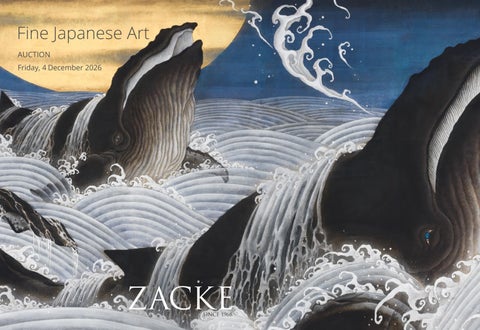
Fine Japanese Art AUCTION Friday, 4 December 2026
Fine Japanese Art CATALOG JPN1226
AUCTION Friday, 4 December 2026, 1 pm CET
JOIN US LIVE Attend in person at our new auction room at Zelinkagasse 6 or participate online via Zacke Live – and enjoy premium buyer’s terms with no additional online bidding fees Register now: www.zacke.at
EXHIBITION 30 November - 3 December Monday – Friday 10 am – 6 pm as well as by appointment
GALERIE ZACKE Zelinkagasse 6 1010 VIENNA AUSTRIA
Tel +43 1 532 04 52 E-mail office@zacke.at www.zacke.at
IMPORTANT INFORMATION
According to the general terms and conditions of business of Galerie Zacke Vienna, Founded 1968, SZA Versteigerungen & Vertriebs GmbH, 1010 Wien, online at www.zacke.at ABSENTEE BIDDING Absentee bids are carried out under the regulations of the terms of business of Galerie Zacke, SZA Versteigerungen & Vertriebs GmbH, which requires written submission of your purchase limit. Orders without purchase limits cannot be processed. Only the submitted lot number of the auction lot is binding for the processing of the absentee bid. The place of jurisdiction is Vienna, Austrian Law and Austrian jurisdiction are exclusively applicable for all legal questions arising from the business relationship. Absentee bids for this auction will be accepted until the day of auction by 10:00 a.m. We regret that absentee bids received after the time stated above will not be processed until after the auction. PLEASE SEND ABSENTEE BIDS FOR THIS AUCTION TO: Fax: +43 1 532 04 52 20 or Email: office@zacke.at or Mail: Galerie Zacke, Zelinkagasse 6, 1010 Wien, Austria, Europe WE ACCEPT THE FOLLOWING METHODS OF PAYMENTS: • Cash • Certified or personal check • Bank transfer (please inquire to receive our bank account information) • Credit card (Visa, MasterCard, Amex) up to EUR 5.000 - higher amounts require prior approval and are subject to service fees TELEPHONE BIDDING It is generally possible to bid by telephone during the auction. Please fill out the absentee bidding form enclosed in this catalog and include your telephone number at which you can be reached during the auction. In the “bid in euro” column please write “TEL” and then send us the completed absentee bidding form. Galerie Zacke will call you on the day of the auction, on the telephone number provided, 5 lots before the lot you are bidding on and the bidding will commence at the starting price, as stated in the catalog. If Galerie Zacke cannot reach you during the auction, Galerie Zacke will bid the starting price on your behalf. ESTIMATES AND STARTING PRICES The auction will begin with the starting price and written bids will be accepted only with a minimum amount equivalent to the starting price. SHIPPING AND TRANSPORT INSURANCE For domestic shipping Galerie Zacke (hereinafter called “the company”) charges in average Eur 15,- to Eur 50,- per item, depending on size and weight. These fees cover the costs of packing and shipping. Fees for bulky or fragile items, or international shipping will be quoted upon request.
The purchased goods are transported at the risk of the customer following handover of the packaged item to the post office or another carrier which the customer agrees to through his/her submission of the purchase order. According to the specific wish of the customer, the auctioned goods may be insured for the value of the purchase price (highest bid and all surcharges). This insurance fee is 3% of the purchase price. For any lots with a purchase prices exceeding EUR 350,- the transport insurance will be automatically arranged by the company if it does not expressively receive the purchaser’s written denial of this service and signed waiver of claims. Payments due to the company under the insurance contract will be charged to the customer. The company is also entitled to assign claims under the insurance contract to the customer providing the terms of the insurance contract do not prevent this. In any case, the company is only required to make payment to the customer specifically if payment has effectively been received from the insurance company. COLOR AND CONDITION Auction lots will be exhibited for viewing prior to the auction, thus offering all interested customers the opportunity to examine the quality and condition of the works exhibited. The catalog illustrations are intended to assist customers during such preview. In illustrations, printed colors do not correspond exactly to the originals. The printed catalog images are not representative for the condition of the illustrated pieces. Hidden flaws and damages are indicated in the condition report. The illustrations in our online catalogs can be strongly magnified, so that most damages and restorations are well recognizable. ENDANGERED SPECIES / CITES INFORMATION Some items in this catalog may for example consist of ivory, rhinoceros-horn, tortoise shell, or some types of tropical wood, and are subject to the Convention on International Trade in Endangered Species of Wild Fauna and Flora [CITES]. Such items are marked with the symbol Ɏ on www.zacke.at and may only be exported outside the European Union after an export permit in accordance with CITES has been granted by the Austrian authorities. We would like to inform you that such licenses are typically not granted. COMPLAINTS At its auctions, Galerie Zacke sells consigned lots on behalf of third-party consignors. For this reason, any complaints related to purchased lots must be in accordance with §32-48 of the general terms and conditions of business of Galerie Zacke, which can be found on www.zacke.at THE ART LOSS REGISTER All items starting above EUR 2,000 have been checked by the Art Loss register.
PEFC Certified This product is from sustainably managed forests and controlled sources PEFC/06-39-10
www.pefc.at
produziert gemäß Richtlinie Uz24 des Österreichischen Umweltzeichens, Print Alliance HAV Produktions GmbH, UW-Nr. 715
ABSENTEE BIDDING FORM FOR THE AUCTION Fine Japanese Art JPN1226 ON DATE 4 December 2026
LOT NR.
LOT TITLE
BID IN EURO
PLEASE RAISE MY BID BY ONE BIDDING INCREMENT (ca. 10%) IF NECESSARY IMPORTANT NOTICE: Bids do not include buyer’s premium and VAT. Margin taxation applies. Items with added VAT are marked in the online catalog.
PLEASE CALL ME WHEN A HIGHER BID THAN MINE HAS BEEN RECEIVED MY PHONE NUMBER
TELEPHONE BIDS: If you like to bid by telephone, please state ‘TEL’ in the ‘BID IN EURO’ column instead of a Euro amount. Galerie Zacke will call you on the day of the auction, on the telephone number provided, 5 lots before the lot you are bidding on and the bidding will commence at the starting price, as stated in the catalog. If Galerie Zacke cannot reach you during the auction, Galerie Zacke will bid the starting price on your behalf. TERMS OF PAYMENT, SHIPPING AND COLLECTION:
NAME
ADRESS CITY, COUNTRY
With the signature on this form, the client instructs the auctioneer to bid on his behalf. The Euro amount up to which the auctioneer shall bid on behalf of the client is either stated in this form or will be communicated to the auctioneer via telephone during the auction. All absentee bidding shall be governed by the terms and conditions [AGB] of Galerie Zacke.
POSTCODE
The client agrees with his signature that he has read, understood and fully accepted the AGB of Galerie Zacke. Galerie Zacke, founded 1968, is a registered brand of SZA Versteigerungen & Vertriebs GmbH, Vienna, Austria.
PHONE NUMBER
DATE & SIGNATURE
CREDIT CARD PAYMENT PLEASE CHECK THE DESIRED CARD COLLECTION BY CLIENT WITH PAYMENT ON THE PREMISES IN CASH, BY CERTIFIED CHEQUE OR CREDIT CARD INVOICE PAYMENT VIA BANK WIRE AFTER RECEIPT OF INVOICE SHIPPING AFTER RECEIPT OF PAYMENT EXPRESS PARCEL SERVICE REQUIRED (ACCORDING TO TERMS AND CONDITIONS OF GALERIE ZACKE)
AMEX
MASTERCARD
VISA
NAME ADDRESS CARD NUMBER EXPIRY DATE
SECURITY CODE
SHIPPING INSURANCE REQUIRED (ACCORDING TO TERMS AND CONDITIONS OF GALERIE ZACKE)
GALERIE ZACKE Zelinkagasse 6, 1010 Vienna, Austria Email: office@zacke.at Tel: +43-1-532 04 52 Fax: +43-1-532 04 52 20
IMPORTANT NOTICE: Whenever making a bid, whether personally or via an agent, in writing, online, telephone, or in any other way, the bidder fully and unconditionally accepts the Terms of Auction, the ‘Important Information’ section in the auction catalog, the Terms and Conditions (AGB) of Galerie Zacke, §1-48, the Fee Tariff, and the Bidding Increments table, all as published on www.zacke.at on the day of the auction.
ABSENTEE BIDDING FORM FOR THE AUCTION Fine Japanese Art JPN1226 ON DATE 4 December 2026
LOT NR.
LOT TITLE
BID IN EURO
HOW TO FIND OUR AUCTION & SHOWROOM AT ZELINKAGASSE 6
In the heart of Vienna’s first district, our showroom spans 6,000-square-foot and has been specially designed to provide a seamless auction and exhibition experience.
U2
SC
E
SS
GA
KA
IN EL
U4
Z
-KA I
SS E
DO
SAL
ZG
ZELINKAGASSE 6
AL
EFS
GA D
Starting 30 November you’ll be able to explore the exceptional pieces featured in this auction at Zelinkagasse 6, 1010 Vienna.
AN
UK
NA
JOS
OR RU
O
RU
LF
JOIN US LIVE
DO
SE
NZ-
AS
FRA
AG
AG
NZ
GO
UT
NE
Located at Zelinkagasse 6, 1010 Vienna, our auction and preview space is just a seven-minute walk from our longstanding, 10,000-square-foot office, photography, video, and cataloging hub at Sterngasse 13. Both locations are open to the public, and we warmly invite you to visit.
G
IN
NR
TE
T HO
PL
LF
L SA
AR
AT
K
Z
RIE
S
STERNGASSE 13
4 December 2026 at 1 pm CET Attend in person in our auction room at Zelinkagasse 6 or participate online via Zacke Live – and enjoy premium buyer’s terms with no additional online bidding fees. Register now: www.zacke.at.
KE
ÜC
BR
OR
ZT
SP
FISCHERSTIEGE
VISIT US IN VIENNA
Easily accessible by public transport or car (a parking garage is located nearby). By Public Transport: SCHOTTENRING station (U2, U4, tram lines 1, 31, 71, D, and bus 3A)
SC
H
W
ED
EN
PL
AT
U1
Z U4
IMPRINT Publisher Galerie Zacke founded 1968 © SZA Versteigerungen & Vertriebs GmbH 1010 Wien Zelinkagasse 6 Austria, Europe Tel (0043-1) 532 04 52 Email: office@zacke.at Editors Lukas Zacke Marion Schor Expert Lukas Zacke Catalogers Ananya Casius Anne-Aymone Gabriel Tatjana Borodin Daniel Gonzalez-Gracia Iris Horwath Assistance Mieko Gray Anna-Maria Pollmann Photography Georg Bodenstein David Lindengrün Cesilio Cesar Garcia Jonas Matyassy Loreen Sasse Vladimir Ramljak Design Hermann Kienesberger Printing Print Alliance HAV Produktions GmbH Website www.zacke.at
© GALERIE ZACKE Reproduction forbidden
6
7
Monumental Bronzes and Exceptional Metalwork from the Meiji & Taisho Periods Lots 1 to 41
8
9
1 MAKINO: A MASSIVE (78.5 CM) BRONZE ‘DRAGON AND TIGER’ VASE WITH CRYSTAL TAMA By Makino, signed Makino no sei Japan, Meiji period (1868–1912) Impressively cast on a monumental scale, the massive globular body supported on a short circular foot and rising through a slender neck to a widely flaring trumpet-shaped mouth encircled by a geometric fret border. A powerful, three-dimensional dragon coils dramatically around the neck, its sinuous body meticulously detailed with overlapping scales, branching horns, flowing mane, and curling whiskers, one raised claw grasping a crystal tama (sacred jewel). The broad body is cast in exceptionally bold relief with a ferocious tiger standing upon a rocky outcrop amid turbulent waves, its head raised and jaws open in a fierce roar as it confronts the dragon above. The dynamic composition continues around the lower section with further cresting waves. The bronze exhibiting a rich chocolate-brown patina. Signed to the underside MAKINO NO SEI [Made by Makino]. HEIGHT 78.5 cm, DIAMETER 44.8 cm WEIGHT 33 kg Condition: Very good condition with minor wear and casting irregularities. A loss to a section of the dragon’s tail. The bronze exhibiting a rich chocolate-brown patina. With a removable metal liner. The flourishing bronze workshops of Meiji-period Tokyo produced some of the finest examples of Japanese metalwork, combining traditional casting techniques with increasingly ambitious sculptural compositions. Among these are works bearing the seal Makino, including naturalistically modeled figural groups
10
and elaborate vessels distinguished by their dynamic compositions and meticulous surface detail. Although the precise identity of the artist or workshop remains largely undocumented, surviving examples demonstrate the exceptional technical refinement and sculptural naturalism characteristic of the Tokyo School during this period. The dragon and tiger (ryuko) constitute one of the most powerful and enduring subjects in East Asian art, embodying opposing yet complementary forces of nature. Traditionally, the dragon represents the heavens, clouds, and water, while the tiger symbolizes the earth and wind. Their dramatic confrontation evokes the dynamic balance of yin and yang, expressing the harmony of seemingly opposing powers. Here, the motif is given particular force through the imposing scale of the vessel and the bold sculptural treatment of the two creatures, their confrontation extending vertically from the turbulent waters below to the dragon soaring above. AUCTION COMPARISON Compare a related large bronze vase, sealed Dai Nihon Kano Seiun chu kore, dated to the early 20th century, 92.7 cm high, similarly decorated with a dragon encircling the neck above breaking waves, at Christie’s, Japanese and Korean Art, 20 March 2013, New York, lot 679 (sold for USD 7,500 or approx. EUR 9,500 converted and adjusted for inflation at the time of writing). Estimate EUR 8,000 Starting price EUR 4,000
11
12
2 A MASSIVE (76 CM) BRONZE ‘DRAGON AMID WAVES’ VASE WITH CRYSTAL TAMA Japan, Meiji period (1868-1912) Monumentally cast, the exceptionally large bronze usubata supported on a slightly everted circular foot, the compressed globular body densely modeled in high relief with turbulent, cresting waves, rising to a tall, waisted neck and a dramatically flaring, subtly lobed mouth encircled by an openwork manji-fret band. A magnificent, separately cast dragon emerges from the tumultuous waves, its powerful, sinuous body coiling dramatically around the neck, with the long tail extending upward. The dragon is superbly detailed with overlapping scales, sharply articulated dorsal spines, powerful clawed limbs, curling whiskers, and an expressive, ferocious head, one claw grasping a translucent rock crystal tama (sacred jewel). The surface displays a rich, dark bronze patina with areas of green verdigris, further accentuating the sculptural depth of the composition. HEIGHT 76 cm (excl. base), 81.5 cm (incl. base) WEIGHT 33.9 kg (excl. base) Provenance: Property from a San Francisco estate. Bonhams, Asian Decorative Arts, San Francisco, 15 November 2011, lot 3568. British collection, acquired from the above. Condition: Very good condition with minor wear and casting irregularities. Scattered small nicks and scratches, some dragon’s teeth lost, and areas of oxidation and encrustations. The bronze with a rich, dark patina and areas of green verdigris. The rock crystal tama with several natural fissures, some extending to the surface, and minor associated chips. The wood stand with small nicks and abrasions. With a fitted wood presentation stand. The present vase is a particularly ambitious example of Meiji-period bronze casting, combining the monumental proportions of an usubata with the sculptural vitality of an almost fully modeled dragon. Derived from Chinese bronze prototypes, usubata were developed in Japan for formal flower arrangements, their exceptionally broad mouths providing an imposing setting for elaborate floral displays. During the Meiji period, the form evolved into an important vehicle for the technical and artistic achievements of Japanese bronze founders, who produced increasingly elaborate examples for prestigious domestic commissions, international exhibitions, and the export market. The dragon (ryu) is among the most auspicious creatures in Japanese art, traditionally associated with water, rainfall, and the commanding forces of nature. Its emergence from turbulent waves, grasping the sacred jewel (tama), evokes its dominion over the waters and its supernatural powers. Estimate EUR 15,000 Starting price EUR 7,500
13
3 A LARGE (63 CM) AND EXCEPTIONAL BRONZE OKIMONO OF SHOKI RIDING A REARING SHISHI Japan, 19th century, late Edo (1615–1868) to Meiji period (1868–1912) Superbly cast in several sections, depicting the fierce demon queller Shoki astride a powerful, dramatically rearing shishi. The warrior leans boldly forward, his right arm thrust high above his head with the index finger pointing skyward, while his left hand firmly grasps the reins. His intensely expressive face, with furrowed brows, fierce inlaid eyes, and flowing beard, is framed by windswept hair. He wears elaborate Chinese-style armor and billowing robes, magnificently decorated with the Four Auspicious Creatures (shirei): a writhing dragon rendered in exceptionally fine high relief to the cuirass, and further intricate designs of a kirin, ho-o (phoenix), and a dragon-headed minogame (long-tailed tortoise) delicately incised across the sleeves and swirling skirts. The belt is further embellished with a ferocious beast-mask buckle, recalling archaistic Chinese ornament.
The striking image of Shoki riding a shishi unites two formidable protectors of East Asian mythology. Derived from the Chinese demon queller Zhong Kui, Shoki was revered in Japan for his power to ward off evil spirits and disease, while the mythical lion similarly embodied strength and protection. Although an unusual subject, this pairing was established in Japanese painting by the late Edo period, notably in Katsushika Hokusai’s (1760–1849) Shoki Riding a Shishi Lion of 1844, preserved in the Idemitsu Museum of Arts, Tokyo. Shoki riding a shishi lion by Katsushika Hokusai, dated 1844 The shishi is captured in a magnificent display of movement, its powerful body twisting and rearing, muscular limbs outstretched, and head thrown back in a thunderous roar, revealing sharp fangs and a curling tongue. Its imposing features are framed by deeply modeled, spiraling locks of hair, while the extraordinarily long, flame-like tail sweeps dramatically behind. The finely chased ornamental details and carefully polished surfaces contrast beautifully with the richly patinated, dark bronze, creating a composition of remarkable vitality and sculptural presence. HEIGHT 63.3 cm WEIGHT 14.8 kg (excl. stand), 25.1 kg (incl. stand) Condition: Good condition with expected wear and casting irregularities. Few small nicks and light scratches, one ear replaced in finely carved wood. The figure is assembled from several separately cast sections. The bronze with a smooth, darkbrown patina and scattered malachite encrustations. Presenting exceptionally well. With a fine green marble presentation stand. An exceptional synthesis of Chinese-inspired grandeur and Japanese craftsmanship, the present bronze combines an imposing guardian lion, elaborate Chinese-style armor, and archaistic beast-mask ornament with distinctly Japanese details and a remarkable sense of movement. The warrior’s armor is magnificently adorned with the Four Auspicious Creatures (shirei): a writhing dragon rendered in high relief across the cuirass, and the ho-o (phoenix), kirin, and tortoise delicately incised into the flowing robes. Particularly noteworthy is the tortoise, depicted as a minogame with a long, seaweed-like tail. These auspicious emblems enrich the composition with associations of virtue, longevity, and good fortune. The dramatic upward thrust of Shoki’s arm, the shishi’s roaring head, and the magnificent sweep of its tail lend the sculpture extraordinary vitality and theatrical force. AUCTION COMPARISON For an earlier Chinese stylistic comparison, see a large bronze ‘lion and foreigner’ censer and cover, dated to the Ming dynasty, 14th–15th century, measuring 54 cm in height, at Sotheby’s, Chinese Art, 18 September 2024, New York, lot 117 (sold for USD 45,600 or approx. EUR 43,000 converted and adjusted for inflation at the time of writing). Estimate EUR 15,000 Starting price EUR 7,500
14
15
4 SANJI AND GOSHIN: A MASSIVE (76.5 CM) BRONZE KORO (INCENSE BURNER) OF A MINOGAME AND NESTING CRANES ON MOUNT HORAI By Miyoshi Sanji (Miyoshi Mitsuharu) and Matsuzawa Goshin I, signed Imoji, takuetsu gino hojisha, Sanji, Goshin with seals Sanji and Goshin Japan, Takaoka city, Toyama prefecture, first half of the 20th century, Showa period (1926-1989) Finely cast in eight parts, depicting a minogame standing foursquare with its front legs bent, its head slightly raised and turned, the fierce mouth open to reveal sharp teeth. The mythical beast supports turtles perched on rockwork, rising to a tree trunk with finely textured, dragon-scale-like bark, surmounted by an elaborate nest of intertwined twigs containing four eggs and two finely modeled cranes. The nest is ingeniously reticulated, allowing incense smoke to rise gracefully between the two cranes. The whole framed by finely cast branches of pine and plum.
The bronze inscribed: Imoji, takuetsu gino hojisha, Sanji, Goshin with seals Sanji and Goshin [cast metal artists, holders of excellence in skills, Sanji and Goshin]. HEIGHT 76.5 cm WEIGHT 31 kg Condition: Very good condition with minor wear and casting irregularities. Tiny nicks, few small dents and light surface scratches. AUCTION COMPARISON Compare a closely related bronze okimono by the same artists, signed Imoji, takuetsu gino hojisha, Sanji, Goshin with seals Sanji and Goshin, dated first half of the 20th century, 77 cm high, at Zacke, Fine Japanese Art, 13 June 2025, lot 5 (sold for EUR 7,800). Estimate EUR 5,000 Starting price EUR 2,400
16
5 OSHIMA JOUN: A FINE BRONZE OKIMONO OF URASHIMA TARO RIDING A TURTLE By Oshima Joun (1858-1940), signed Ichijoken Joun zo Japan, early 20th century, Meiji (1868-1912) to Taisho period (1912-1926)
Urashima Taro is a legendary Japanese fisherman who rescues a turtle and is rewarded with a journey to the underwater Dragon Palace (Ryugu-jo), where he is welcomed by the beautiful Princess Otohime. Upon returning home, he discovers that centuries have passed, and when he opens a mysterious treasure box given to him by the princess, he is instantly transformed into an old man.
Masterfully cast as the legendary fisherman Urashima Taro seated astride a large turtle, leaning backward with his head raised and a joyful, almost dreamy expression. His smiling face is sensitively modeled, with gently narrowed eyes and long, flowing hair finely incised in undulating strands. He wears loosely draped robes and a skirt of finely textured grasses secured by a braided cord, with a small gourd suspended at his waist. The turtle is rendered in lively motion, its head extended forward, with alert eyes, a hooked beak, and powerful scaly legs terminating in sharp claws. The underside signed within a reserve ICHIJOKEN JOUN zo [made by Ichijoken Joun].
Condition: Excellent condition with minor wear.
HEIGHT 18 cm, LENGTH 25 cm WEIGHT 3 kg
Estimate EUR 6,000 Starting price EUR 3,000
Woodblock print of Urashima Taro by Ogata Gekko (1859-1920)
17
18
6 OSHIMA JOUN: A MASTERFUL BRONZE OKIMONO OF A SLEEPING SHOJO By Oshima Joun (1858-1940), signed Ichijoken Joun with kakihan Japan, Taisho period (1912-1926) Superbly and heavily cast as the drunken Shojo reclining in a deep slumber against a large sake jar, its broad circular mouth facing outward, the spirit resting both hands languidly upon the vessel. The face is rendered with remarkable sensitivity, the eyes tightly closed beneath prominent brows and the features relaxed in contented intoxication, framed by long locks of hair cascading over the shoulders. The voluminous robes envelop the reclining body in deeply modeled, fluid folds, pooling around the legs and opening at one end to reveal a finely detailed bare foot. The entire composition is finished in a rich, lustrous brown patina, emphasizing the exceptional sculptural modeling and subtle contrasts between the face, hair, garments, and vessel. Signed underneath ICHIJOKEN JOUN with kakihan. LENGTH 34 cm WEIGHT 3.2 kg Provenance: Flying Cranes Antiques, New York, United States. Collection of Eduardo Cohen, acquired from the above upon the closure of the gallery in 2017. Condition: Excellent condition with minor wear.
Jean Schaefer at Flying Cranes Oshima Joun (1858-1940), born Katsujiro Antiques, New York, in Edo, was one of the foremost Japanese in 2016 bronze artists of the late 19th and early 20th centuries. Trained by his father, Oshima Takajiro, in lost-wax casting and metal carving, he entered the Tokyo School of Fine Arts in 1890 and was appointed professor in 1918, teaching there until 1932. Joun achieved international recognition at the Paris Exposition Universelle of 1900, where his celebrated Sparrows among Rice Ears was awarded a gold medal. His finest works are distinguished by extraordinary casting skill, sensitive observation, and an exceptionally fluid approach to sculptural form.
The Shojo is a legendary sake-loving spirit of Chinese origin that became firmly established in Japanese folklore and Noh theater. In the Noh play Shojo, the spirit appears before Kofu, a virtuous liquor seller, on the banks of the Yangtze River. After joyfully drinking and dancing, the Shojo rewards Kofu with a miraculous jar from which liquor flows without end before collapsing into a drunken sleep. Joun’s composition captures precisely this final moment, transforming the auspicious tale of abundance and prosperity into an intimate and remarkably naturalistic study of complete inebriated repose. MUSEUM COMPARISON Compare a closely related work by the same artist, titled Shojo, 33.6 cm long, in the Chiba Prefectural Museum of Art, accession number 2593.
AUCTION COMPARISON Compare a related bronze okimono of Gama Sennin, by Oshima Joun, dated Taisho to Showa period, 24.2 cm tall, at Bonhams, Fine Japanese Art, 12 May 2009, London, lot 228 (sold for GBP 16,800 or approx. EUR 32,000 converted and adjusted for inflation at the time of writing). Estimate EUR 6,000 Starting price EUR 3,000
19
Condition: The bronze case in excellent condition with only minor wear and expected casting irregularities. The wood stand with occasional small dents. The clock mechanism was comprehensively restored by Kalivoda Uhrmachermeister between May and October 2026 and is in excellent working order. The restoration included extensive mechanical repairs, cleaning, adjustment, replacement of worn components, refurbishment of the dial and hands, and fitting of a new beveled glass and winding key. The original bronze patina was left untouched. A detailed restoration report and operating instructions are available upon request and will be supplied to the winning bidder. With a matching wood stand. During the Meiji period, Japan’s rapid modernization prompted many highly skilled metalworkers, formerly engaged in the production of swords and armor, to turn their expertise toward luxury decorative objects for export. Japanese bronzes achieved remarkable success at international exhibitions, particularly in Paris, stimulating European demand for elaborate sculptures, vases, candelabra, and clocks. The present work is a superb example of this artistic and technical exchange, combining the exceptional craftsmanship of Japanese bronze casting with the precision of French clockmaking. The celestial maiden, or tennyo, belongs to a long-established tradition of heavenly beings in Japanese Buddhist art, often represented floating through the heavens with billowing robes and fluttering celestial scarves. The present sculpture beautifully translates this imagery into a dynamic three-dimensional composition.
7 KANO SEIUN I: A SUPERB AND RARE BRONZE CLOCK DEPICTING A TENNYO (CELESTIAL MAIDEN), WITH A FRENCH MOVEMENT BY JAPY FRÈRES & CIE The case, by Kano Seiun I (1871-after 1937), signed Seiun The clock, by Japy Frères & Cie, stamped Japy Frères & Cie, Gde. Med. D’Honneur Japan, early 20th century, Meiji (1868-1912) to Taisho period (1912-1926) Masterfully cast and finely patinated, the elaborate bronze case rising from a rectangular base in a towering mass of swirling, deeply undercut clouds, surrounding a circular gilt clock dial. Above floats a graceful tennyo (celestial maiden), her slender figure poised in mid-flight, clad in voluminous robes cascading in richly modeled folds, secured at the waist by an ornamental sash with gilt clasps. A long celestial scarf billows dramatically around her shoulders, while her serene face is delicately modeled with downcast eyes and finely arched brows, the hair elegantly arranged in a high chignon adorned with floral ornaments. Her gracefully extended arms and the sweeping drapery lend the composition a remarkable sense of movement and weightlessness. The gilt clock dial is finely decorated with black Arabic numerals arranged in circular reserves around a polychrome enamel floral medallion, with delicately pierced steel hands and a hinged glass cover. The bronze sculpture is sealed SEIUN to the lower reverse. The clock is fitted with a French mechanical movement, manually wound with an eight-day power reserve, incorporating a Brocot escapement regulated by a pendulum. The independent rackstriking mechanism sounds the hours and half-hours on a cast silver bell. The movement is stamped Japy Frères & Cie, Gde. Med. D’Honneur, Made in France. HEIGHT 44.8 cm (excl. stand), 50.2 cm (incl. stand) WEIGHT 10.4 kg (excl. stand), 10.9 kg (incl. stand)
20
Kano Seiun I, born Kano Ginzaburo in 1871 and later adopting the art name Hoshosai, studied under the eminent metalworker Oshima Joun (1858-1940). He exhibited at the governmentsponsored Bunten exhibitions, participated in the Exposition Universelle of 1900 in Paris, and exhibited at the Taisho Exhibition in Tokyo in 1914. He remained active until at least 1937. Japy Frères & Cie, established under that name in 1854, continued the industrial enterprise founded by Frédéric Japy in Beaucourt in 1777. Renowned for its precision clock movements and mechanized production, the firm received numerous international distinctions, including the Grande Médaille d’Honneur at the Paris Exposition Universelle of 1855. It subsequently continued under the name Établissements Japy Frères from 1928. AUCTION COMPARISON Compare a related bronze threepiece clock garniture, dated to the late 19th century, 78.7 cm high, at Christie’s, 19th Century Furniture, Sculpture, Works of Art and Ceramics, 25 October 2005, New York, lot 548 (sold for USD 9,600 or approx. EUR 14,500 converted and adjusted for inflation at the time of writing). Compare a related bronze and mixed-metal clock by Man’ei, dated to the late 19th century, 91.4 cm high, at Bonhams, Fine Japanese and Korean Art, 17 March 2021, New York, lot 605 (sold for USD 21,312 or approx. EUR 28,500 converted and adjusted for inflation at the time of writing). Estimate EUR 10,000 Starting price EUR 5,000
21
8 GENRYUSAI SEIYA: A SUPERB AND LARGE BRONZE ‘TIGER EMERGING FROM A ROCKY GORGE’ VASE By Genryusai Seiya, sealed Seiya Japan, Meiji period (1868-1912) Superbly cast, the tall, gently tapering ovoid body rising from a short circular foot to a flared, petal-lobed mouth. The richly patinated bronze is masterfully worked in high relief with a powerful tiger dramatically emerging from beneath a rugged, overhanging rocky outcrop, its muscular body projecting boldly from the surface, the broad head lowered and turned outward, with a piercing gaze accentuated by its glaring golden eyes. The animal’s fur is meticulously rendered with fine incision, particularly around the face, neck, and powerful shoulders, while its forelegs extend toward a gently flowing stream below. The deeply sculpted rockwork, with sparse pine foliage, extends across the sides of the vessel, creating a striking contrast with the smooth, subtly variegated bronze ground. The stream and scattered stones are delicately rendered in low relief. Sealed underneath SEIYA.
22
HEIGHT 39 cm WEIGHT 4 kg Condition: Very good condition with minor wear, tiny nicks, and minor malachite encrustations to the underside. Few casting flaws to the back. Genryusai Seiya was a celebrated bronze craftsman who headed a Tokyo workshop renowned for its naturalistic animal sculptures, particularly tigers, elephants, and other exotic animals. While many of these works were conceived as freestanding okimono, the present vase demonstrates the workshop’s remarkable ability to integrate sculptural naturalism into vessel design. Particularly impressive is the dramatic treatment of the tiger, which appears almost to emerge from the surface of the bronze, its powerful musculature, intricately textured fur, and piercing golden eyes conveying an extraordinary sense of vitality. The contrast between the deeply modeled animal and rocky landscape and the smooth, lustrous patination further enhances the sculptural effect. Estimate EUR 4,000 Starting price EUR 2,000
23
9 JOSHU: A FINE OSHIMA JOUN SCHOOL BRONZE ‘JUROJIN WITH CRANES AND PINE’ TRIPOD KORO (INCENSE BURNER) By Kobayashi Joshu, signed Joshu saku Japan, early 20th century, Meiji (1868-1912) to Taisho period (1912-1926) Finely cast, the ovoid body supported on three gently curved, pointed legs and rising to a broad circular mouth fitted with a separately cast domed cover. The sides worked in varying degrees of relief with three cranes amid lush pine branches, two standing below and a third in flight above. The cover surmounted by Jurojin, the elderly deity of longevity, seated at ease in loose-fitting robes and holding an uchiwa fan in his right hand, his bearded face framed by a hood falling to the rear. The cover pierced with cloud-form apertures for the incense smoke to escape. The underside signed JOSHU saku [made by Joshu]. HEIGHT 27.7 cm (incl. cover) WEIGHT 2.1 kg (incl. cover) Condition: Excellent condition with only minor wear. Oshima Joun (1858-1940), whose school Joshu belonged to, was among the foremost Japanese bronze casters of the Meiji and Taisho periods. A professor at the Tokyo School of Art from 1887 to 1932, he exhibited internationally at Paris in 1900, St. Louis in 1904, and London in 1910, helping establish Japanese bronze sculpture at the highest level of international decorative arts. Estimate EUR 2,000 Starting price EUR 1,000
24
10 GENRYUSAI SEIYA: A FINE BRONZE OKIMONO OF THREE EGRETS SUPPORTING A CRYSTAL BALL By Genryusai Seiya, signed Seiya sei Japan, Meiji period (1868-1912) Finely cast as three elegant egrets standing backto-back, each balanced on one slender leg, their long necks gracefully arched backward and their upturned beaks meeting to support a crystal ball above. The plumage is naturalistically rendered with finely incised detailing, lending texture and definition to the compact, highly balanced composition. Signed to the tail feathers of one egret SEIYA sei [made by Seiya]. HEIGHT 21 cm (incl. crystal ball), 18.5 cm (excl. crystal ball) WEIGHT 1,016 g (incl. crystal ball), 743 g (excl. crystal ball) Condition: Very good condition with minor expected wear and minimal casting flaws. The separately cast legs with old reattachments at the joints, consistent with their construction. Genryusai Seiya was a master craftsman who headed a highly successful workshop specializing in finely cast bronzes made largely for the export market. His production ranged from figural and genre subjects to elaborate vessels and exceptionally naturalistic studies of animals. The present work is a particularly inventive example of the workshop’s ability to combine careful observation of the natural world with an elegant and highly decorative composition. MUSEUM COMPARISON Compare a closely related Chinese figure of three egrets supporting a crystal ball, dated 18th-19th century, 12.7 cm in diameter, in the Metropolitan Museum of Art, object number 02.18.814a, b. The earlier Chinese work provides an intriguing precedent for the distinctive arrangement of three birds supporting a sphere.
AUCTION COMPARISON Compare a closely related bronze table ornament similarly modeled with cranes supporting a crystal ball, signed Yoshiharu, dated late 19th century, 17.8 cm tall, at Christie’s, Japanese and Korean Art, 23 March 2000, New York, lot 89 (sold for USD 17,250 or approx. EUR 30,000 converted and adjusted for inflation at the time of writing). Estimate EUR 3,000 Starting price EUR 1,500
25
11 GENRYUSAI SEIYA: A FINE AND RARE BRONZE AND ROOTWOOD OKIMONO OF A CROW ON A TREE STUMP By Genryusai Seiya, signed Seiya chu Japan, late 19th century, Meiji period (1868-1912) Finely cast and naturalistically modeled as a crow (karasu) perched alertly on a separately carved gnarled rootwood stump. The bird is superbly detailed with finely textured legs and overlapping plumage, its head with an intense expression, the eyes ringed in gold, and a powerful beak. Signed between the legs within a rectangular reserve, partially effaced, SEIYA chu [cast by Seiya]. LENGTH 32.4 cm (excl. stand), HEIGHT 33.8 cm (incl. stand) WEIGHT 1.3 kg (excl. stand), 2.8 kg (incl. stand) Provenance: From a British private collection, the underside of the wood stand bearing an old collector’s label. Condition: Very good condition with minor typical wear. The separately cast legs have been re-attached at some point, as is common with this type. The signature is worn. The wood stand with occasional light surface scratches and minute nicks.
26
Meiji metalwork depicting crows is notably rare, with only a few examples recorded in literature and public collections. In Japan, the crow traditionally symbolizes gratitude and familial devotion, while the sacred Yatagarasu occupies an important place in Japanese mythology, appearing in the Kojiki as the divine guide who led Emperor Jimmu toward Yamato. Genryusai Seiya was a master craftsman who headed a workshop specializing in high-quality export wares, including genre figures, vases, and naturalistic animal bronzes. His remarkably lifelike models of birds and exotic animals rank among the most characteristic productions of the workshop. AUCTION COMPARISON Compare a closely related shakudo okimono of a crow on a tree stump by the same artist, signed Seiya chu, dated to the Meiji period, 34.1 cm high, at Zacke, Fine Japanese Art, 13 June 2025, Vienna, lot 20 (sold for EUR 5,200). Estimate EUR 6,000 Starting price EUR 3,000
27
12 YUKIMITSU: A SUPERB SILVER AND MIXED-METAL ‘LOVEBIRDS’ OKIMONO OF TWO DOVES AND DANDELIONS By Yukimitsu, signed Yukimitsu saku Japan, Meiji period (1868-1912) Superbly and naturalistically cast as a courting pair of doves perched closely together on a gnarled tree trunk, their heads gently inclined toward one another. The female is rendered in silver, her plumage exquisitely chased and engraved with individually delineated feathers, while the male is worked in dark shibuichi, his breast, neck, and wings richly enlivened with gold, suaka, and shakudo hirazogan, evoking the more pronounced iridescence of the male bird. The beaks and feet are picked out in gilt, subtly uniting the contrasting metals. Beneath the pair, the naturalistically modeled rocky trunk is applied with dandelions emerging between the roots, their leaves and newly opened blossoms rendered in contrasting patinated and gilt metal. The composition evokes the arrival of spring, when dandelions begin to flower and doves enter a period of active courtship and breeding. Long associated with fidelity and conjugal affection, the birds are shown in an intimate pose, the darker male gently nestling toward his silver companion, while the fresh blossoms below reinforce the themes of renewal, courtship, and the awakening of nature. The silver bird signed YUKIMITSU saku [made by Yukimitsu]. LENGTH 30.5 cm (incl. stand), 14.5 cm (the birds) WEIGHT 3.1 kg (incl. stand), 297 g (silver dove), 319 g (shibuichi dove)
Provenance: Flying Cranes Antiques, New York, United States. Collection of Eduardo Cohen, acquired from the above upon the closure of the gallery in 2017. Flying Cranes Antiques, founded by Jean and Clifford Schaefer, became one of New York’s leading specialists in Japanese Meiji-period art, with a particular emphasis on the virtuoso metalwork, cloisonné, ceramics, lacquer, and carvings Jean Schaefer at Flying produced by the foremost Cranes Antiques, New York, artists of the period. Over more in 2016 than four decades, the gallery placed important works in major private and museum collections internationally. Flying Cranes continued to retain a substantial collection of fine Meiji works until its closure in 2017; in her farewell, Jean Schaefer recorded that the gallery’s collections had passed to a purchaser. The present okimono formed part of this final gallery collection and was acquired by Eduardo Cohen at the time of its closure. Condition: Very good condition with minor wear including a tiny dent to one head. The separately cast legs with old reattachments at the joints, consistent with their construction. AUCTION COMPARISON Compare a related silver and shibuichi okimono of two pigeons, dated Meiji period, 14 cm long (the pigeons), at Bonhams, Fine Japanese Art, 17 May 2012, London, lot 351 (sold for GBP 6,250 or approx. EUR 11,000 converted and adjusted for inflation at the time of writing). Estimate EUR 6,000 Starting price EUR 3,000
28
29
13 A FINE SILVERED BRONZE OKIMONO OF A HAWK ON A TREE TRUNK Japan, Meiji period (1868-1912) Naturalistically cast as a powerful hawk crouching upon a gnarled tree trunk, its body lowered and wings partly spread as though preparing to launch itself into flight. The head is thrust forward with an intense, penetrating gaze, the hooked beak and strongly modeled features conveying the alertness of a bird of prey. The plumage is superbly worked with dense overlapping feathers of varying length and texture, particularly finely chased along the breast, wings, and sweeping tail. The eyes are picked out in gold, while the feet and formidable curved talons are rendered in contrasting bronze. The bird is mounted on a dramatically contorted rootwood stand, its twisting hollows, knots, and weathered projections forming a striking naturalistic setting. Particularly distinctive is a long, sinuous root extending from one side, its serpentine form strongly suggestive of a snake. Whether deliberately fashioned or selected for this resemblance, the feature adds a subtle predatory tension to the composition, evoking the hawk surveying its potential prey from above. HEIGHT 33 cm (incl. stand), LENGTH 25.1 cm (excl. stand) WEIGHT 3,637 g (incl. stand), 1,992 g (excl. stand) Provenance: Flying Cranes Antiques, New York, United States. Collection of Eduardo Cohen, acquired from the above upon the closure of the gallery in 2017. Flying Cranes Antiques was founded by Jean and Clifford Schaefer and became a leading New York specialist in Japanese Meiji-period art, particularly metalwork, cloisonné, ceramics, lacquer, and carvings. Over more than four Jean Schaefer decades, the gallery placed important works at Flying Cranes in major private and museum collections Antiques, New York, internationally. Significantly, Flying Cranes in 2016 still retained a substantial collection of fine Meiji works when it closed in 2017. In her farewell, Jean Schaefer recorded that the gallery’s collections had passed to a purchaser. The present piece formed part of this final gallery collection and was acquired by Eduardo Cohen at the time of its closure. Condition: Excellent condition with minor wear and light rubbing. The separately modeled legs have been reattached.
30
AUCTION COMPARISON Compare a related silvered bronze model of an eagle by Masatsune, dated late 19th to early 20th century, 71.5 cm tall, at Bonhams, Fine Japanese Art, 5 November 2020, London, lot 288 (sold for GBP 11,312 or approx. EUR 17,500 converted and adjusted for inflation at the time of writing). Compare a closely related silver-plated model of a hawk, signed Masatsune chu, similarly perched on a twisted tree stump with the beak, eyes, and feet finished in gilt and a separately cast gilt-bronze tree-stump stand, dated late 19th century, 42.6 cm high, at Christie’s, The di Portanova Collection, 20 October 2000, New York, lot 189 (sold for USD 10,575 or approx. EUR 18,000 converted and adjusted for inflation at the time of writing). Estimate EUR 10,000 Starting price EUR 5,000
31
14 SUGIURA GYOSO: AN IMPORTANT PAIR OF LARGE MIXED-METAL INLAID BRONZE ‘SPARROWS AND BAMBOO’ VASES Sugiura Gyoso (1856-1901), signed Gyoso sen Japan, c. 1880, Meiji period (1868-1912)
PROVENANCE The present lot at Bonhams, 12 September 2018, New York, lot 1, mid-estimate USD 60,000 or approx. EUR 71,000 Expert’s note: The present pair can be closely associated with the celebrated metalwork workshop of the Kiryu Kosho Kaisha, directed by Suzuki Chokichi. Its sophisticated casting and elaborate mixed-metal decoration correspond remarkably to documented works produced under Chokichi’s supervision, including examples in the Khalili Collection. The signature Gyoso sen [chiseled by Gyoso] identifies Sugiura Gyoso as responsible for the intricate decoration, reflecting the workshop’s practice of combining the talents of master bronze casters and specialist metalworkers. The close relationship to surviving companymarked works strongly suggests that the present vases were produced for the Kiryu Kosho Kaisha, almost certainly under Chokichi’s direct supervision. Superbly cast, each vase of ovoid baluster form, the generously rounded shoulders rising to a stepped, splayed mouth with a broad, flat rim, the body supported on an elaborate integral pedestal resting on five butterfly-form feet. The shoulders applied with a pair of archaistic handles suspending loose rings and pendants, while the pierced foot is embellished with floral motifs. The lustrous, dark-brown patinated bronze ground is exquisitely decorated in high and flat relief with richly contrasting inlays of gold, silver, shakudo, shibuichi, and copper.
32
The principal decoration depicts sparrows captured in animated flight amid slender bamboo stems and gracefully spreading foliage, their wings extended and bodies dynamically arranged as they dart through the branches. The birds are meticulously modeled in silver and contrasting alloys, their plumage individually chased with exceptionally fine detail, while the bamboo leaves shimmer in warm shades of gold, silver, copper, and reddish-brown. The reverse is similarly decorated with flowering nadeshiko (pinks, Dianthus superbus) and daisies, their delicate petals and foliage rendered in subtly varied metal tones. The carefully balanced compositions combine remarkable naturalism with a vivid sense of movement, particularly striking against the deep, almost black bronze ground. The mouth and foot are enriched with finely executed formal borders and gilt accents. Each vase signed GYOSO sen [chiseled by Gyoso]. HEIGHT 42.2 cm (each) WEIGHT 6.6 kg & 6.4 kg Provenance: Offered at Bonhams, Ancient Skills, New Worlds: Twenty Treasures of Japanese Metalwork from a Private Collection, 12 September 2018, New York, lot 1 (mid-estimate USD 60,000 or approx. EUR 71,000 converted and adjusted for inflation at the time of writing). Condition: Excellent condition with minor expected wear. Two butterfly-form feet on one vase have been reinforced. Suzuki Chokichi (1848-1919) was one of the foremost Japanese bronze casters of the Meiji period and headed the metalwork department of the Kiryu Kosho Kaisha, overseeing the production of some of the most accomplished bronzes created for the international market. His exceptional reputation culminated in his appointment as an Artist to the Imperial Household in 1896. Sugiura Gyoso (1856-1901), also known as Sugiura Yukimune, was a highly skilled specialist in chiseled and inlaid metalwork, trained in the tradition of the Yokoya school of sword fittings. Like his elder brother Sugiura Yukinari, he contributed to the Company’s prestigious metalwork commissions, later serving as an assistant professor at the Tokyo Art School.
33
Founded in 1873 following Japan’s success at the Vienna World Exposition, the Kiryu Kosho Kaisha played a pioneering role in promoting Japanese decorative arts internationally. Its bronze workshops combined sophisticated Fig. 1: Sparrows among bamboo, casting with the skills of design for the Kiryu Kosho Kaisha specialist decorators, company frequently working from designs commissioned from leading painters of the Shijo school. Of particular significance are two surviving designs from the company’s archives, closely related to the decoration of the present pair: a lively composition of sparrows among bamboo, corresponding to the birds and foliage on the vases (fig. 1), and an elaborate arrangement of flowering Fig. 2: Flowering nadeshiko in nadeshiko in vibrant colors, contrasting colors, design for the closely recalling the floral Kiryu Kosho Kaisha company decoration (fig. 2). Both are reproduced in Hida Toyojiro’s study of the Kiryu Kosho Kaisha design archives, pp. 302 and 89, respectively. These remarkable parallels provide valuable insight into the company’s collaborative production process, connecting the original pictorial designs with the exceptional casting and intricate mixed-metal decoration of the finished bronzes.
34
LITERATURE COMPARISON Compare a closely related pair of mixedmetal inlaid bronze vases, attributed to Suzuki Chokichi for the Kiryu Kosho Kaisha, dated to the 1880s, measuring 36.8 cm in height, in the Khalili Collection of Japanese Art, illustrated in Oliver Impey and Malcolm Fairley, Meiji No Takara: Treasures of Imperial Japan, Vol. II, Metalwork Part One, 1995, no. 2. Compare a closely related mixed-metal inlaid bronze vase by Sugiura Yukimune (Gyoso) for the Kiryu Kosho Kaisha, dated circa 1885, measuring 48 cm in height, from the same collection and publication, no. 3. Compare a further mixed-metal inlaid bronze vase by Suzuki Chokichi and Sugiura Yukinari, the elder brother of Gyoso, for the Kiryu Kosho Kaisha, dated to the early 1880s, measuring 60.5 cm in height, from the same collection and publication, no. 4.
AUCTION COMPARISON Compare a closely related large bronze and mixed-metal vase by Sugiura Yukimune (Gyoso) for the Kiryu Kosho Kaisha, dated to the late 19th century, measuring 86 cm in height, at Christie’s, Japanese and Korean Art, 18 September 2007, New York, lot 190 (sold for USD 85,000 or approx. EUR 122,000 converted and adjusted for inflation at the time of writing). Estimate EUR 80,000 Starting price EUR 40,000
35
15 A MASTERFUL AND LARGE MIXED-METAL INLAID BRONZE ‘CRANES AT NIGHT’ VASE Japan, c. 1900, Meiji period (1868-1912) Magnificently cast, the generously rounded ovoid body rising through broad shoulders to a short, waisted neck with an everted mouth. The exterior is exquisitely decorated in gold, silver, and shakudo takazogan with a flock of eleven red-crowned cranes sweeping across the night sky, evoked by the deep, lustrous black patina of the bronze. The birds are captured in wonderfully varied attitudes of flight, their elongated necks outstretched, slender legs trailing behind, and wings dramatically extended or raised, the individual feathers meticulously chased and engraved. The subtly contrasting metallic tones lend extraordinary depth and animation to the composition, with the densely overlapping birds appearing to soar through space, brilliantly offset by the vast, uninterrupted expanse of darkness below. HEIGHT 39.5 cm (excl. stand), 42.3 cm (incl. stand) WEIGHT 5.5 kg (excl. stand) Provenance: Christie’s New York, 20 March 2013, lot 669 (sold for USD 10,625 or approx. EUR 14,000 converted and adjusted for inflation at the time of writing). British collection, acquired from the above. Condition: Excellent condition minor wear and rubbing to the underside. With a finely carved wood presentation stand. The remarkable nocturnal composition is distinguished by its extraordinary restraint, the lustrous black patina serving not merely as a background but as an integral element of the design. The interplay of shimmering gold and silver against the profound darkness creates a striking illusion of depth, transforming the traditional auspicious motif of cranes, symbols of longevity, fidelity, and good fortune, into a breathtaking study of movement and space. The exceptional precision of the mixed-metal inlays, combined with the remarkably sophisticated arrangement of the birds, exemplifies the virtuosity of Japanese metalworkers at the turn of the 20th century. AUCTION COMPARISON Compare a closely related large mixed-metaldecorated bronze vase by the Miyao company, similarly decorated with cranes in flight, 42.5 cm high, at Christie’s, Japanese Art and Design, 20 June 2001, London, lot 85 (sold for GBP 24,675 or approx. EUR 57,000 converted and adjusted for inflation at the time of writing). Estimate EUR 15,000 Starting price EUR 7,500
36
37
16 HIROKATSU: A SUPERB PAIR OF LARGE MIXED-METAL INLAID SILVER ‘CRANES’ VASES By Hirokatsu, signed Hirokatsu koku Japan, late 19th century, Meiji period (1868-1912) Superbly worked in pure silver, each of elegant ovoid form with gently rounded shoulders rising to a short neck and subtly everted rim. The lustrous silver surfaces are exquisitely embellished in gold and shakudo takazogan with cranes in graceful flight, their slender, outstretched necks, trailing legs, and elegantly extended wings rendered with remarkable naturalism. The plumage is meticulously detailed with finely chased feathers. One vase depicts a pair of cranes soaring beneath a brilliant golden celestial sun, while the companion is decorated with three cranes in flight, their wings captured in subtly varied positions, creating a striking sense of movement and harmony. The finely balanced compositions are beautifully set against the expansive, unadorned silver grounds, emphasizing the refinement of the metalwork. Each vase is incised to the side HIROKATSU koku [carved by Hirokatsu], the bases stamped jungin [pure silver]. HEIGHT 30.5 cm (each) WEIGHT 1.36 kg & 1.44 kg Condition: Excellent condition with minor wear and few minor light scratches. AUCTION COMPARISON Compare a related pair of silver vases with herons in gold and copper relief, by Bokusui and Toshiyuki for Miyamoto, dated to the Meiji period, 30.3 cm high, at Christie’s, Japanese Craftsmanship: Art of the Meiji Period, 23 July 2015, London, lot 89 (sold for GBP 18,750 or approx. EUR 31,500 converted and adjusted for inflation at the time of writing). Estimate EUR 20,000 Starting price EUR 10,000
38
39
17 MITSUMASA: A FINE SILVER ‘BUTTERFLIES AND AUTUMN FOLIAGE’ TEAPOT AND COVER
Condition: Very good condition with minor typical wear, a small dent to the side, and few light surface scratches, particularly to the underside and along the edges.
By Mitsumasa, signed Mitsumasa koku Japan, Meiji period (1868-1912)
Mitsumasa (active during the Meiji period) is a name frequently encountered on fine silver export wares, often decorated with enamels.
The flattened, lobed body supported on a flat base, set with a short, gently curving upright spout and fitted with a slightly domed cover surmounted by a kiku-shaped finial, together with a hinged overarching handle. The exterior finely incised in kebori and katakiribori with various autumnal flowerheads, leaves, and windswept grasses, as well as two butterflies. The underside stamped jungin [pure silver] and signed beneath the spout MITSUMASA koku [engraved by Mitsumasa]. HEIGHT 16.8 cm (incl. handle), WIDTH 15.2 cm WEIGHT 344.7 g
AUCTION COMPARISON Compare a related silver teapot, decorated with scenes of birds and flowers, also with a kiku-shaped finial, dated to the early 20th century, 20.3 cm high incl. handle, at Bonhams, Fine Japanese and Korean Art, 17 March 2021, New York, lot 610 (sold for USD 11,475 or approx. EUR 13,000 converted and adjusted for inflation at the time of writing). Estimate EUR 3,000 Starting price EUR 1,500
40
18 KASHUNDO: A SUPERB MIXED METAL ‘TURTLE VIEWING AUTUMN MOON’ DISH By Kashundo Sadamasa, sealed Kashundo saku Japan, c. 1900, Meiji period (1868-1912) Finely worked in shallow, square form with canted corners, the broad, hammered copper ground centered by a circular, gently recessed silvered well, conceived as a luminous full moon and subtly enlivened by irregular gilt splashes suggestive of drifting clouds. The moonlit surface is crossed by slender autumn grasses, while the broad border is embellished with a flowering bush-clover (hagi) spray, all rendered in a masterly combination of shakudo and shibuichi in low relief. One corner is further adorned with a small naturalistically modeled turtle advancing through swirling ripples of water in shibuichi. The underside with a square seal reading KASHUNDO saku [made by Kashundo]. SIZE 20.4 x 20.4 cm WEIGHT 715 g
Provenance: Flying Cranes Antiques, New York, United States. Collection of Eduardo Cohen, acquired from the above upon the closure of the gallery in 2017. Condition: Very good condition with minor wear, rubbing to gilt and surface scratches underneath.
Jean Schaefer at Flying Cranes Antiques, New York, in 2016
The present dish is remarkable for the poetic sophistication of its design. Its recessed silvered center is ingeniously transformed into a radiant autumn moon, while soft gilt splashes evoke passing clouds and lend the composition an unusually atmospheric quality. Against this moonlit ground appear autumn grasses and flowering hagi, both motifs long associated with the season in Japanese art, poetry, and decorative design. At the lower corner, a small turtle emerges amid rippling water. This auspicious creature, cherished in Japan as a symbol of longevity, steadfastness, and good fortune, introduces a felicitous dimension to the composition. The juxtaposition of the moon, autumn plants, and turtle creates an image that is at once lyrical and celebratory, combining seasonal beauty with an allusion to long life and enduring happiness. Estimate EUR 3,000 Starting price EUR 1,500
41
42
19 KOMIN AND MEIKOKU FOR THE NOGAWA COMPANY: A MASTERFUL INLAID SHAKUDO BOX AND COVER DEPICTING EGUCHI NO KIMI AS A MANIFESTATION OF FUGEN BOSATSU By Komin and Meikoku for the Nogawa Company, with the Nogawa Company mark, signed Komin with kakihan and Meikoku (Akikuni) with the seal Minkoku Japan, late 19th century, Meiji period (1868-1912) Of rectangular form with gently rounded corners, the lustrous, polished shakudo migakiji ground exquisitely decorated in gold, silver, and iro-e takazogan. The cover depicts Eguchi no Kimi as a manifestation of Fugen Bosatsu, elegantly seated upon a reclining elephant, absorbed in reading a handscroll. The majestic animal is superbly rendered in high relief, the carefully chased details heightened by the contrasting tones of the various metals. Beside the elephant rests a small stand supporting a censer, from which slender wisps of smoke rise, and a small box. The composition is arranged with remarkable restraint against the lustrous dark ground, emphasizing the sculptural quality and subtle coloring of the inlaid figures. The sides are similarly embellished with dragonflies hovering among lotus leaves, blossoms, and slender stems, delicately worked in contrasting gold, silver, and reddish copper, their intricate details finely incised. The base is signed KOMIN with kakihan and MEIKOKU, with the seal MINKOKU, beside the mark of the Nogawa Company. SIZE 12 x 8.7 x 4.7 cm WEIGHT 500 g Condition: Excellent condition with only very minor wear.
The exquisite decoration illustrates the celebrated legend of Eguchi no Kimi, a 12th-century courtesan who encountered the wandering Buddhist monk and poet Saigyo (1118-1190). According to the story, Saigyo sought shelter at her establishment but was refused, prompting an exchange of poems concerning worldly attachment and the impermanence of earthly existence. The courtesan was subsequently revealed to be a manifestation of Fugen Bosatsu (Samantabhadra), the bodhisattva traditionally depicted riding a white elephant. The legend became the subject of the classical Noh play Eguchi and was frequently represented in Japanese painting and decorative arts. By presenting the courtesan in the guise of the enlightened bodhisattva, the composition conveys the Buddhist teaching that outward appearances are deceptive and that spiritual enlightenment may manifest in the most unexpected forms. Courtesan of Eguchi, by Katsukawa Shunsho (1726-1792) The Nogawa Company, established in Kyoto during the 19th century, was among the distinguished producers and retailers of fine Japanese metalwork during the Meiji period. Employing highly accomplished craftsmen, the company became celebrated for its sophisticated use of mixed-metal inlay, combining gold, silver, shakudo, and other copper alloys to create richly detailed compositions. The present box exemplifies this tradition, combining exceptional metalworking with a refined literary and Buddhist subject. Estimate EUR 15,000 Starting price EUR 7,500
43
20 YUKIKAZU: A FINE AND LARGE SOFT-METAL-INLAID BRONZE VASE DEPICTING MOUNT FUJI AND BAMBOO By Yukikazu (Kowa), signed Yukikazu Japan, Meiji period (1868-1912) The present vase combines two auspicious motifs of particular significance in Japanese art. Mount Fuji, with its enduring, snow-capped summit, evokes permanence and longevity, while bamboo symbolizes resilience, vitality, and renewal. The inclusion of young bamboo shoots introduces a further allusion to growth, prosperity, and the flourishing of successive generations. The composition is particularly effective in its juxtaposition of the towering, mature bamboo with the emerging golden shoots, set against the distant, timeless silhouette of Mount Fuji.
Finely cast in an elegant ovoid form, rising from a short foot to rounded shoulders and a short neck with a broad, everted rim. The richly patinated, chocolate-brown bronze ground is masterfully worked in silver, shibuichi, and gold takazogan to depict a serene landscape with Mount Fuji rising in the distance behind a flourishing bamboo grove. The tall, slender bamboo stalks are finely articulated with prominent nodes and delicately modeled leaves, their overlapping forms partially obscuring the snow-capped mountain, rendered in silver. Two young bamboo shoots, picked out in gold, emerge from the grassy foreground, their contrasting golden surfaces beautifully accentuating the dark bronze ground. Signed YUKIKAZU. HEIGHT 33.5 cm WEIGHT 3 kg Condition: Excellent condition with minor wear. The metalworker Yukikazu was an accomplished practitioner of mixed-metal decoration during the Meiji period, producing finely inlaid bronze vessels distinguished by their delicate pictorial compositions. He is known to have collaborated with the celebrated Kuroda Company of Kyoto, a prominent producer of sophisticated metalwork during the period. Several surviving works bear both Yukikazu’s signature and the Kuroda company mark, demonstrating this association. AUCTION COMPARISON Compare a related bronze vase with mixed-metal inlay by the Kuroda Company, dating to the Meiji period, 37 cm high, at Sotheby’s, The Great Exhibitions Sale, 31 October 2006, London, lot 573 (sold for GBP 6,000 or approx. EUR 14,000 converted and adjusted for inflation at the time of writing).
Mount Fuji and Bamboo, by Katsushika Hokusai (1760-1849)
44
Estimate EUR 10,000 Starting price EUR 5,000
45
21 YAMAMOTO KOKEN: A SUPERB AND LARGE MIXED METAL INLAID BRONZE ‘SAKURA’ VASE By Yamamoto Koken, signed Koken Japan, c. 1900, Meiji period (1868-1912) Masterfully crafted, the tall ovoid body rising from a narrow base to broad, rounded shoulders, a short waisted neck, and an everted rim. The lustrous, warm copper-brown ground superbly decorated in gold, silver, and iro-e takazogan with three magnificent sakura trees, their gracefully twisting trunks and spreading branches rendered in contrasting shades of silver-gray and dark patinated alloys. The bark is meticulously chased with fine horizontal striations, while the slender branches are adorned with countless delicate blossoms, each individually worked with finely delineated petals and minute gilt stamens, interspersed with pointed leaves and tightly closed buds. Some branches are laden with fully opened blossoms, while others bear only emerging flowers and unopened buds, capturing the trees at different stages of flowering. The overlapping branches create a remarkable sense of depth and movement, their intricate, naturalistic arrangement beautifully balanced by the smooth, lustrous bronze ground. The trees rise from gently undulating ground, subtly engraved along the lower body. Signed KOKEN to the reverse. HEIGHT 37 cm WEIGHT 4.9 kg Condition: Excellent condition with minor wear. Yamamoto Koken was an accomplished Kyoto metalworker active during the Meiji period, known for his finely executed bronze vessels decorated with intricate mixed-metal inlay. His works are characterized by naturalistic designs, meticulous attention to detail, and a refined use of contrasting metals and patinas. His artistry reflects the flourishing of Japanese decorative metalwork during the Meiji period, when traditional metalworking techniques were increasingly applied to sophisticated ornamental objects that attracted international recognition through the great world exhibitions.
The present vase is a particularly accomplished example of Koken’s artistry, remarkable for both the extraordinary precision of its metalwork and the poetic beauty of its composition. Rather than depicting the sakura trees in uniform bloom, the artist captures the fleeting transition from bud to blossom, with some branches bursting into flower while others are only beginning to awaken. The individually articulated petals, minute stamens, delicately shaped leaves, and finely textured bark reveal an exceptional sensitivity to nature. The contrast between the densely flowering branches and the expansive, unadorned bronze ground creates an elegant, almost painterly composition of remarkable refinement. In Japanese aesthetics, the ephemeral beauty of sakura evokes the transience of life, a sentiment particularly beautifully expressed here through the different stages of flowering. LITERATURE COMPARISON Compare another work by Yamamoto Koken in the Khalili Collection of Japanese Art, a shibuichi koro with a reticulated cover, similarly decorated with delicate sakura blossoms, measuring 10.5 cm in height, illustrated in Oliver Impey and Malcolm Fairley, Meiji No Takara: Treasures of Imperial Japan, Vol. II, Metalwork Part Two, 1995, pl. 89.
AUCTION COMPARISON Compare a closely related mixed-metal bronze vase with sakura motif, by Kuroda Kiichi, 36.8 cm tall, at Bonhams, Fine Asian Works of Art, 9 December 2008, San Francisco, lot 5229 (sold for USD 12,000 or approx. EUR 17,000 converted and adjusted for inflation at the time of writing). Estimate EUR 15,000 Starting price EUR 7,500
46
47
22 A SUPERB PAIR OF RARE SHIPPO- AND MIXED METAL-INLAID BRONZE ‘BUTTERFLIES AND BLOSSOMS’ VASES Japan, late 19th century, Meiji period (1868-1912) Superbly cast, the elegant pear-shaped bodies rising from tall circular feet to slender necks with broad, everted mouths, flanked by finely modeled openwork handles inspired by archaic Chinese bronzes. Each vase is exquisitely decorated in gold, shakudo, and other contrasting metal inlays, enriched with brilliantly colored shippo enamels, depicting flowering vines and clusters of grapes, the finely articulated leaves and blossoms connected by delicately curling tendrils. Above each composition hovers a magnificent butterfly, its outspread wings meticulously inlaid with vibrant blue, turquoise, yellow, and white enamels. The mouths are further embellished with alternating floral emblems in suaka and shakudo. The richly colored inlays contrast beautifully with the lustrous, warm brown patina of the bronze. HEIGHT 21.5 cm (each, excl. stand), 24.5 cm (incl. stand) WEIGHT 1.58 kg and 1.55 kg Condition: Excellent condition with minor wear. Each vase with a finely carved wood presentation stand. The present pair exemplifies the extraordinary technical refinement achieved by Japanese metalworkers during the Meiji period, combining the sophisticated mixed-metal inlay techniques traditionally associated with sword fittings with the brilliant polychromy of shippo enamel. Particularly remarkable is the meticulous integration of these contrasting materials, the delicate floral decoration and brilliantly colored butterflies standing out against the restrained, richly patinated bronze ground. Estimate EUR 10,000 Starting price EUR 5,000
48
49
23 KITAGAWA HOKUSEN I: A FINE BRONZE ‘SNAIL’ VASE WITH SILVER-INLAID TRAIL By Kitagawa Hokusen I (Motoyoshi, 1846-1922), signed Nanajuyon-o Hokusen with kakihan Japan, c. 1920, Taisho period (1912-1926) Of elegant sorori form, the bulbous body rising to a long slender neck and gently everted rim, applied with a naturalistically modeled snail creeping upward, its shell and soft body meticulously detailed. Behind the snail extends a sinuous trail delicately inlaid in silver, ingeniously suggesting the glistening slime left in its wake. The neck is incised in reisho (clerical script) with an extract from a poem by the celebrated Song-dynasty poet Su Shi (1037-1101). Signed Nanajuyon-o HOKUSEN [Hokusen at the age of seventy-four] with an elaborate kakihan. Inscription: To the neck, 腥涎不滿殼,聊足以自濡 Xing xian bu man ke, liao zuyi zi ru [Its slime does not fill its shell; it is barely enough to keep itself moist]. HEIGHT 23 cm WEIGHT 600 g Provenance: Oriental Treasure Box, San Diego, California. Condition: Excellent condition with minor wear. With a wood storage box. The inscription is taken from Su Shi’s poem Snail, from his series Eight Subjects from Yong Xiucai’s Paintings of Plants and Insects. The complete verse continues with the snail climbing ever higher, unaware that it should turn back, until its moisture is exhausted and it dries upon the wall. Hokusen ingeniously transforms the poem into three-dimensional imagery: the snail itself ascends the vase while its silver-inlaid trail gives tangible form to the very slime described in the inscription. The complete poem lends the seemingly playful subject a cautionary undertone, presenting the relentlessly climbing snail as an image of ambition pursued without knowing when to retreat. Kitagawa Hokusen I (1846-1922) was a distinguished metalworker of the Mito school and one of the artists who successfully carried its highly refined traditions of sword-fitting manufacture into the decorative arts of the Meiji and Taisho periods. Born in Mito, he studied metalwork under Sekijoken Motozane and later taught at the Tokyo Fine Arts School. His works are distinguished by precise modeling, sophisticated mixed-metal techniques, and an acute observation of the natural world. AUCTION COMPARISON Compare a closely related bronzeinlaid vase with a snail by the same artist, Kitagawa Motoyoshi (Hokusen), dated late 19th-early 20th century, 21.3 cm high, at Bonhams, Fine Japanese Works of Art, 17 September 2013, New York, lot 3269 (sold for USD 7,500 or approx. EUR 9,400 converted and adjusted for inflation at the time of writing). Estimate EUR 4,000 Starting price EUR 2,000
50
24 KITAGAWA HOKUSEN I: A MAGNIFICENT AND RARE ‘EMERGING CICADA’ DOUBLE-GOURD BRONZE VASE, DATED 1922 By Kitagawa Hokusen I (Motoyoshi, 1846-1922), signed Mito Hokusen with kakihan Japan, dated 1922 The sentoku bronze vase of elegant double-gourd form, finely inlaid in shakudo and gold takazogan with naturalistic ivy leaves and trailing vines encircling the shoulder. The body is ingeniously fitted with a removable cicada husk that can be exchanged for a remarkably lifelike adult cicada, allowing the composition to represent successive stages of the insect’s emergence and transformation. Both insects are meticulously worked with extraordinary attention to their wings, bodies, and minute anatomical details. Signed to the side with an inscription reading “made by Hokusen at the age of seventy-seven” with an elaborate gold kakihan, and with a large circular seal to the underside reading MITO HOKUSEN.
With the original wood tomobako (storage box) inscribed: “Carved cicadas on a gourd-shaped vase. Made at the age of 77. Kitagawa Hokusen.” The interchangeable cicada and its abandoned husk are an exceptionally inventive feature, transforming the vase from a static depiction of nature into an image of metamorphosis. By allowing the viewer to replace the empty shell with the living insect, Hokusen gives physical expression to the transition from one state to another. The theme is particularly resonant for a work created in 1922, the final year of the artist’s life.
HEIGHT 26.5 cm WEIGHT 3.3 kg
The double gourd, trailing ivy, and cicada further reinforce ideas of continuity, endurance, and seasonal change. Yet it is above all Hokusen’s technical conception - the contrast between the luminous sentoku bronze, delicate gold and shakudo inlays, and astonishingly naturalistic interchangeable insects - that elevates the vase into one of his most imaginative late works.
Condition: Excellent condition with minor expected wear, including a few light surface scratches mostly to the base.
Estimate EUR 10,000 Starting price EUR 5,000
51
25 RYUSAI: A LARGE AND RARE BRONZE ‘LIZARDS PREYING ON A FROG’ VASE By Ryusai, signed Ryusai zo Japan, Meiji period (1868-1912) Finely cast, the globular body rising to a tall cylindrical neck with a flaring mouth, the surface patinated to a lustrous black tone. The vase is adorned with two remarkably naturalistic lizards, their slender bodies sinuously encircling the neck and extending across the rounded shoulder, finely detailed with textured scales, delicately articulated limbs, and golden eyes. One lizard clings to the upper neck, its head turned downward, while the other coils around the neck and sprawls across the shoulder, both directing their attention toward an ill-fated frog perched on the opposite side of the vessel. The base signed within a rectangular reserve RYUSAI zo [made by Ryusai]. HEIGHT 42.8 cm WEIGHT 6.9 kg Condition: Excellent condition with minor wear.
The depiction of lizards is rare in Japanese bronze art of the Meiji period. The present vase is particularly accomplished in its lively composition, with the two reptiles cleverly arranged around the neck and shoulder, their attention focused on the unsuspecting frog.
MUSEUM COMPARISON Compare a closely related bronze vase also with two lizards in the Groninger Museum, Groningen, the Netherlands, object number 2019.1516.
AUCTION COMPARISON Compare a related bronze vase with a similar design, by Akichika, 26.7 cm high, at Christie’s, Japanese & Korean Art including Arts of the Meiji Period, 15 September 2010, New York, lot 618 (sold for USD 8,750 or approx. EUR 12,000 converted and adjusted for inflation at the time of writing). Estimate EUR 6,000 Starting price EUR 3,000
52
53
54
26 UNHO: AN EXCEPTIONALLY LARGE BRONZE ‘STRIDING TOAD’ OKIMONO By Unho (Unpo), signed Unho saku Japan, Meiji period (1868-1912) Superbly and naturalistically cast as a large toad in mid-stride, its heavy body carried low to the ground and the right leg extended, imparting a remarkably convincing sense of movement. The skin is meticulously modeled with minute dimples and wart-like protuberances, complemented by finely rendered folds around the limbs and flanks. Particularly striking are the large, protruding eyes, superbly inlaid in gilt and shakudo and lending the animal an alert, almost uncannily lifelike expression. The broad mouth, nostrils, and individually delineated toes are equally sensitively observed. Signed underneath UNHO saku [made by Unho]. LENGTH 37 cm WEIGHT 4.7 kg Provenance: Collection of Margaret Roebling Perrine, Trenton, New Jersey. Margaret Roebling Perrine was a member of the prominent Roebling family and the daughter of Ferdinand W. Roebling, a leading figure in John A. Roebling’s Sons Company, the celebrated family engineering and manufacturing enterprise intimately associated with the construction of the Brooklyn Bridge. In 1893, she married Frederic Auten Combs Perrine (1862-1908), a pioneering electrical engineer who became the first professor at Stanford University to teach electrical engineering. Margaret and Frederic were avid collectors of Japanese and Chinese art, assembling an important collection during the late 19th and early 20th centuries. Works from Margaret Roebling Perrine’s collection, including important Japanese prints and Chinese works of art, have subsequently appeared at major international auctions. Condition: Excellent condition with minor wear and expected casting irregularities.
Unho (Unpo) is recorded by Robert Haynes in The Index of Japanese Sword Fittings and Associated Artists, p. 2167, no. H 1106.0. Active around the turn of the 20th century, he worked in the tradition of the Goto Ichijo school. At 37 cm in length and weighing 4.7 kg, the present okimono is exceptionally large for a naturalistic Meiji-period bronze of a toad. The impressive scale transforms an intimate animal study into a substantial sculpture while retaining the minute surface detail and close observation of nature characteristic of the finest Meiji metalwork. AUCTION COMPARISON Compare a related naturalistically modeled bronze toad, signed Daisanme Wado no saku, dated 19th century, 26 cm long, at Christie’s, Asian Art, 21 November 2007, Amsterdam, lot 585A (sold for EUR 5,250 or approx. EUR 8,500 adjusted for inflation at the time of writing). Estimate EUR 8,000 Starting price EUR 4,000
55
27 ATSUYOSHI FOR THE MARUKI COMPANY: A SUPERB PAIR OF LARGE BRONZE GOATS By Atsuyoshi for the Maruki Company, signed Atsuyoshi with the mark Maruki shachu seisaku Japan, late 19th to early 20th century, Meiji period (1868-1912) Superbly and naturalistically cast with a rich dark-brown surface, the two goats depicted in contrasting poses, one standing upright with its head raised, the other lowering its head as if grazing. Their shaggy coats finely modeled in deeply undulating locks, with precisely rendered curling horns, pointed ears, long beards, and cloven hooves. Each signed to the base ATSUYOSHI within a rectangular reserve, followed by a seal mark MARUKI SHACHU seisaku [Manufactured at the Maruki Company]. The two figures are accompanied by a finely carved wood presentation base, fashioned with an irregular, undulating outline and beautifully figured grain. LENGTH (incl. base) 52.5 cm HEIGHT 28.5 cm and 17 cm WEIGHT of the goats 4.9 kg and 3.9 kg Provenance: Bonhams, Ancient Skills, New Worlds: Twenty Treasures of Japanese Metalwork from a Private Collection, 12 September 2018, New York, lot 18 (mid-estimate of USD 17,500 or approx. EUR 20,500 converted and adjusted for inflation at the time of writing). Condition: Excellent condition with minor expected wear.
56
PROVENANCE The present lot at Bonhams, 12 September 2018, New York, lot 18, mid-estimate of USD 17,500 or approx. EUR 20,500 The Maruki Company was active during the Meiji period (1868-1912) and was particularly renowned for its finely cast bronze animal sculptures, distinguished by their substantial weight, meticulous finish, and remarkable naturalism. Atsuyoshi is known for his finely modeled studies of both wild and domesticated animals, many produced for the Maruki Company. The contrasting attitudes of the present goats, captured with remarkable sensitivity and meticulous attention to their anatomy and shaggy coats, exemplify the expressive naturalism characteristic of the finest Meiji-period animal bronzes. Estimate EUR 15,000 Starting price EUR 7,500
28 A FINE AND CHARMING BRONZE OKIMONO OF A SEATED BEAR Japan, Meiji period (1868-1912) Naturalistically cast as a bear seated on its haunches in a remarkably relaxed and engaging pose, one forepaw resting forward while the other is raised to its mouth as though licking or grooming it. The rounded body is modeled with a convincing sense of weight and volume, the dense fur finely incised throughout in subtly varying strokes. The expressive head is particularly well rendered, with small rounded ears, a broad snout, and alert eyes double-inlaid with mother-of-pearl. HEIGHT 20 cm, LENGTH 25 cm WEIGHT 4.1 kg
Condition: Excellent condition with minor expected wear and light abrasions predominantly to the underside from surface contact. AUCTION COMPARISON Compare a related bronze figure of a bear by Atsuyoshi for the Maruki Company, similarly conceived as an exceptionally naturalistic study of the animal, dated late 19th to early 20th century, 25.2 cm tall, at Bonhams, Ancient Skills, New Worlds: Twenty Treasures of Japanese Metalwork from a Private Collection, 12 September 2018, New York, lot 19 (sold for USD 21,250 or approx. EUR 25,000 converted and adjusted for inflation at the time of writing). Estimate EUR 6,000 Starting price EUR 3,000
57
29 KOYOSAI SHOBEI: A SUPERB AND RARE BRONZE OKIMONO OF A RECUMBENT CAT By Koyosai Shobei, signed Koyosai Shobei chu Japan, late 19th to early 20th century, Meiji period (1868-1912) Superbly and naturalistically cast, the cat depicted in a recumbent position with its hindquarters tucked beneath its rounded body and its forepaws extended forward, the head slightly lowered and turned to one side. Despite its seemingly relaxed posture, the animal appears intensely alert, its ears pricked and its keen, almond-shaped eyes fixed intently on something beyond its reach, as though poised to spring into action at any moment. The broad, muscular body is masterfully modeled with subtly undulating contours and a richly textured surface, the fur rendered in vigorous, freely worked strokes, particularly around the cheeks, neck, chest, and forelegs, contrasting with the smoother, softly rounded back and haunches. The finely articulated paws, delicately modeled muzzle, and remarkably expressive eyes further enhance the lifelike character of this exceptionally accomplished animal study. The bronze displays a rich, dark-brown patina with attractive highlights to the raised areas. Signed underneath KOYOSAI SHOBEI chu [cast by Koyosai Shobei]. LENGTH 30 cm (excl. stand), 35 cm (incl. stand) WEIGHT 6.3 kg (excl. stand) Condition: Very good condition with minor wear, mostly to the underside from contact with the surface, and inherent casting irregularities. The stand with a few nicks and light scratches.
58
With a carved wood presentation stand. Koyosai Shobei was a Japanese bronze artist active during the Meiji period, particularly known for his finely cast animal sculptures. Surviving works include bronzes of bears and macaques as well as larger decorative vessels, several bearing signatures identifying him as the caster. Bronze studies of domestic cats are comparatively rare among Meiji-period animal okimono, making the present work particularly noteworthy. Its exceptional quality lies in the artist’s vigorous, almost impressionistic treatment of the fur and anatomy, combined with a remarkably sensitive observation of feline behavior. The subtle tension between the animal’s resting posture and its intensely watchful expression captures the distinctive character of the cat with extraordinary immediacy. Auction comparison: Compare a related bronze okimono of a macaque by the same artist, similarly signed Koyosai Shobei chu, dated late 19th to early 20th century, 24.2 cm high, at Bonhams, Fine Japanese Art, 11 May 2017, London, lot 380 (sold for GBP 3,500 or approx. EUR 5,500 converted and adjusted for inflation at the time of writing). Estimate EUR 6,000 Starting price EUR 3,000
30 SHOSAI: A FINE AND AUSPICIOUS BRONZE OKIMONO OF EIGHT RATS By Shosai, signed Shosai chu Japan, late 19th to early 20th century, Meiji period (1868-1912) Naturalistically cast as an adult rat gripping a large split pomegranate, accompanied by seven young, several playfully clambering over its back and sides, two tumbling over each other, and others gathered around a persimmon. The lively composition is finely detailed with realistically modeled fur, delicate paws, and long, curling tails, the eyes inlaid in silver. Signed to the underside SHOSAI chu [cast by Shosai] within a rectangular reserve. LENGTH 21 cm WEIGHT 4.4 kg Condition: Very good condition with minor wear, mostly to the underside from contact with the surface.
The rat (nezumi) is an auspicious animal in Japanese tradition, associated with Daikokuten, the God of Wealth and Prosperity, and symbolizing fertility, abundance, and numerous descendants. The depiction of eight rats is particularly auspicious, as the number eight (hachi) is associated in Japan with suehirogari, or everexpanding prosperity, while the seed-filled pomegranate further reinforces the symbolism of fertility and abundance. Auction comparison: Compare a closely related bronze okimono of rats, signed Dai Nihon Marunobu sei, dated late 19th century, 17 cm wide, at Christie’s, Japanese Art & Design, 11 May 2011, London, lot 378 (sold for GBP 8,125 or approx. EUR 15,000 converted and adjusted for inflation at the time of writing). Estimate EUR 15,000 Starting price EUR 7,500
59
60
31 A SUPERB AND HIGHLY HUMOROUS PARCEL-GILT BRONZE ‘MONKEY COLLECTOR’ OKIMONO Japan, Meiji period (1868-1912) Finely and naturalistically modeled as a seated anthropomorphic monkey collector, set on an integral base with a continuous band of stylized mythical beasts to the sides and intricate scrollwork to the top, the macaque’s fur meticulously rendered in dense, neatly engraved strokes. Its expressive face, with eyes picked out in gilt and dark pupils, conveys a keen fascination with the silvered monkey-form netsuke it is examining so intently, holding it carefully in one hand while raising a pair of spectacles with glass lenses and finely parcel-gilt frames to its eyes with the other. The netsuke is attached by a gilt cord threaded through an ojime to an inro decorated with a gilt chrysanthemum and butterfly, the latter suspended below its hands. The monkey is dressed in a loosely draped haori, the garment falling open at the front and elegantly cast with softly undulating folds. The haori is particularly finely embellished to the reverse with scattered maple leaves of various sizes, some heightened in gilt, and a prominent peach below the collar, likewise picked out in gilt. Beside the monkey on the integral base rest a closed fan and a tobacco pouch, completing this charming and humorously conceived composition.
AUCTION COMPARISON Compare a closely related bronze figure of a monkey collector, likewise shown seated and examining an object, though lacking the fine parcel-gilt details of the present lot, dated late 19th to early 20th century, 28.5 cm long, sold at Bonhams, Fine Japanese Art, 17 May 2018, London, lot 439 (sold for GBP 11,875 or approx. EUR 19,000 converted and adjusted for inflation at the time of writing). Estimate EUR 15,000 Starting price EUR 7,500
HEIGHT 24 cm, LENGTH 25.5 cm WEIGHT 4.7 kg Condition: Excellent condition with minor wear and typical casting irregularities, a few light scratches, and tiny nicks.
61
62
32 MIYAO: A CHARMING AND RARE PARCEL-GILT BRONZE OKIMONO OF A WOMAN FEEDING SPARROWS By the Miyao company of Yokohama, signed Miyao zo Japan, Meiji period (1868-1912) Finely cast as an elderly woman kneeling beside a birdcage, her face animated with a gentle smile as she feeds two sparrows perched atop the cage with a gilt spoon, holding a small bowl with food in her other hand. Her hair neatly combed into a bun, she wears a flowing kimono richly embellished with gilt origami cranes, kiri, and sakura blossoms. The finely detailed birdcage opens to serve as a box. Signed below the figure in a gilt rectangular reserve MIYAO zo [made by Miyao]. HEIGHT 23.5 cm (incl. stand), HEIGHT 17 cm (the figure) WIDTH of stand 17.8 cm WEIGHT 3.4 kg (total)
Provenance: Sotheby’s, Japanese Works of Art, Prints & Paintings, 16 May 2007, London, lot 963 (sold for GBP 7,800 or approx. EUR 16,000 converted and adjusted for inflation at the time of writing). British collection, acquired from the above. Condition: Very good condition with minor wear to the underside. The stand with a crack, repairs, and losses to the lacquer, yet still presenting well. Accompanied by a gilt-lacquered wood stand. Founded by Miyao Eisuke, the Miyao Company of Yokohama specialized in finely cast bronze sculptures embellished with gold and silver as well as contrasting copper alloys. Its works range from samurai warriors and figures from Japanese history and legend to charming scenes of everyday life, as exemplified by the present lot. The company also produced incense burners, vases, and other decorative objects. Estimate EUR 10,000 Starting price EUR 5,000
63
64
33 MIYAO: A SUPERB AND RARE PARCEL-GILT BRONZE FIGURE OF A HUNTER WITH A TANEGASHIMA TEPPO RIFLE By the Miyao company of Yokohama, signed Miyao Japan, Meiji period (1868-1912)
PROVENANCE The present lot at Christie’s New York, 18 September 2013, lot 715, sold for USD 23,750 or approx. EUR 30,100 Finely cast and superbly detailed, the hunter standing with his legs firmly braced and body leaning forward as he raises a long tanegashima matchlock rifle to his shoulder, his cheek pressed against the stock as he takes aim. He is dressed in richly patterned garments beneath a textured straw raincoat, the robes finely decorated in relief and parcel-gilt with phoenix roundels, wheel motifs, scrolling clouds, and other auspicious designs. A sword is secured at his back. His expressive face is naturalistically modeled with furrowed brows and narrowed eyes, conveying intense concentration. The back with an inlaid gilt rectangular reserve signed MIYAO. The figure is mounted on its original wood stand with four bracket feet, finely decorated in gold hiramaki-e with stylized phoenixes and scrolling foliage. HEIGHT 28 cm (incl. stand), 20 cm (excl. stand) WEIGHT 2.7 kg (incl. stand)
Provenance: Christie’s New York, 18 September 2013, lot 715, sold for USD 23,750 or approx. EUR 30,100 (converted and adjusted for inflation at the time of writing). Flying Cranes Antiques, New York, United States. Collection of Eduardo Cohen, acquired from the above upon the closure of the gallery in 2017. Flying Cranes Antiques was founded by Jean and Jean Schaefer Clifford Schaefer and became a leading New at Flying Cranes York specialist in Japanese Meiji-period art, Antiques, New York, particularly metalwork, cloisonné, ceramics, in 2016 lacquer, and carvings. Over more than four decades, the gallery placed important works in major private and museum collections internationally. Significantly, Flying Cranes still retained a substantial collection of fine Meiji works when it closed in 2017; in her farewell, Jean Schaefer recorded that the gallery’s collections had passed to a purchaser. The present piece formed part of this final gallery collection and was acquired by Eduardo Cohen at the time of its closure. Condition: Excellent condition with minor wear. The stand with little rubbing to the gilt, minor flaking to the lacquer, and few tiny nicks to the underside. Founded by Miyao Eisuke, the Miyao Company of Yokohama specialized in the manufacture of bronze sculptures, embellished with gold and silver as well as patinated copper alloys, that represent generic samurai warriors as well as more precisely identifiable characters from Japanese myth and legend. In addition, the company also made a smaller number of pieces in other formats such as incense-burners, vases, and chargers. AUCTION COMPARISON Compare a related bronze figure of a hunter, by Miyao Eisuke of Yokohama, dated Meiji period, at Sotheby’s, Asian Art, 6 December 2007, Paris, lot 177 (at an estimate of EUR 12,000 or approx. EUR 16,500 adjusted for inflation at the time of writing). Estimate EUR 15,000 Starting price EUR 7,500
65
34 KOMAI OTOJIRO: A MAGNIFICENT AND LARGE (45 CM) GOLD AND SILVER-INLAID IRON CHARGER By Komai Otojiro of Kyoto, signed Nihon koku Kyoto ju Komai sei Japan, Kyoto, late 19th century, Meiji period (1868-1912) The large shallow dish with foliate rim supported on a circular foot, its entire surface worked with an extraordinary density of damascened gold and silver. The central composition is boldly modeled in takabori with an elderly Buddhist figure seated crosslegged and holding an inscribed scroll, accompanied by a rakan who leans animatedly toward him and two oni rendered in lively, expressive poses. Surrounding the central group is an exceptionally elaborate arrangement of architectural, figural, and landscape reserves interspersed with a dazzling variety of geometric and floral patterns. The finely worked vignettes include a hunter approaching a deer, a farmer hurrying toward a shrine for shelter from a storm, an elderly man catching fish with his bare hands, an immortal arriving upon a cloud, and a child dancing joyfully before two seated figures, with a den-den daiko drum at his feet. Each miniature scene is executed with remarkable precision, despite occupying only a fraction of the surface. Particularly striking is the broad border conceived as sumptuous lengths of brocade draped and folded around the rim. Each overlapping section is individually decorated in gold nunomezogan with a different textile pattern, including shippo, hanabishi, key-fret, floral, diaper, and geometric designs. The alternating folds, densely patterned reserves, and contrasting relief figures create the impression of costly textiles layered across the dark iron ground. The base with the signature in applied silver Nihon koku Kyoto ju KOMAI sei [made by Komai of Kyoto, Japan]. The reverse fitted with an applied bracket for wall mounting. Inscriptions: The scroll inscribed 鍾馗出罪能鬼導佛悪人為能善 人, referring to Shoki’s power to save from sin and guide evil spirits toward the Buddha, transforming the wicked into the virtuous. DIAMETER 45 cm WEIGHT 3.1 kg Provenance: From a noted private collection in Munich, Germany. Condition: Excellent condition with minor wear, mostly to the rim around the brackets, and light tarnishing to the silver. Founded in 1841, the Komai workshop became one of the most celebrated metalworking enterprises of Meiji-period Kyoto after Komai Otojiro I assumed its leadership in 1865. The workshop specialized in extraordinarily intricate gold and silver inlay on iron, adapting techniques rooted in the manufacture and decoration of sword fittings to the new field of luxury decorative art. Its characteristic dark iron grounds provided a dramatic contrast for minute gold and silver nunomezogan, hirazogan, and takazogan, allowing extraordinarily complex pictorial and ornamental compositions to be executed on a remarkably small scale. In a promotional brochure published around 1915, Komai Otojiro II described the company as the “pioneer of damascene work.”
66
At 45 cm in diameter, the charger belongs to the most ambitious large-scale works produced by Komai. Its exceptional scale allowed the artist to combine monumental figural relief with an almost microscopic level of detail, uniting narrative scenes, architecture, landscape, and dozens of distinct textile patterns within a single coherent composition. LITERATURE COMPARISON Compare a related large charger depicting Nitta no Yoshisada, by the Komai Company, dated c. 1880, 49.3 cm diameter, in the Nasser D. Khalili Collection, illustrated in Oliver Impey and Malcolm Fairley eds., Meiji no fig. 1 Takara: Treasures of Imperial Japan, The Nasser D. Khalili Collection of Japanese Art, Metalwork Part I, London, 1995, cat. no. 17 (fig. 1). Several further large chargers by Komai and related workshops are illustrated in the same publication, cat. nos. 14-19, 21, and 23.
AUCTION COMPARISON Compare a related large overlaid iron charger by Komai Otojiro, signed Kyoto no ju Komai sei, dated 1886 or later, 44.5 cm diameter, at Bonhams, Fine Japanese & Korean Art, 16 September 2026, New York, lot 972 (sold for USD 95,750 or approx. EUR 85,500 converted at the time of writing). Compare a closely related large gold and silver-inlaid iron dish by the Komai Company, signed Kyoto ju Komai sei, dated late 19th century, 43.2 cm diameter, at Christie’s, Japanese Art: Meiji Period Magnificence, 24 June 2014, New York, lot 24 (sold for USD 56,250 or approx. EUR 70,700 converted and adjusted for inflation at the time of writing). Estimate EUR 30,000 Starting price EUR 15,000
67
68
35 A FINE GOLD-DAMASCENED BRONZE KOMAI-STYLE ‘DRAGON AND TAMA’ VASE Marked Fuku Japan, Meiji period (1868-1912) Elegantly formed, the pear-shaped body supported on a short circular foot and rising to a remarkably slender, gently waisted neck terminating in a flared trumpet-shaped mouth. The bronze finely decorated in intricate gold nunome-zogan, the surface densely covered with a rich profusion of chrysanthemum blossoms and scrolling foliage, meticulously rendered in minute detail. The bulbous body is encircled by a broad, shaped decorative band enclosing a magnificent sinuous dragon writhing amid swirling clouds in pursuit of a tama (sacred jewel). The mythical creature is finely detailed with overlapping scales, a fierce horned head, flowing whiskers, and powerful clawed limbs, its brilliant gold decoration contrasting dramatically with the dark ground. The mouth and foot are further embellished with finely patterned borders, the latter with overlapping seigaiha waves. The base bears the mark FUKU [Good Fortune] within a fan-shaped reserve. HEIGHT 18.5 cm WEIGHT 173 g Condition: Excellent condition with minor wear. The exquisite gold damascening of the present vase is characteristic of the celebrated Komai style, perfected in Kyoto during the Meiji period. Executed in the intricate nunome-zogan technique, in which thin gold foil is hammered into a finely crosshatched metal surface, the decoration demonstrates remarkable precision and refinement. Although particularly renowned for its iron wares, the Komai workshop also produced works in bronze and other copper alloys. The distinctive fan-shaped Fuku (‘Good Fortune’) mark is also found on other finely damascened Komai-style metalwares of the period. AUCTION COMPARISON Compare a closely related inlaid iron vase depicting a phoenix, by the Komai Company of Kyoto, 19 cm high, at Bonhams, Fine Japanese Art, 5 November 2020, London, lot 277 (sold for GBP 6,312 or approx. EUR 10,000 converted and adjusted for inflation at the time of writing). Estimate EUR 5,000 Starting price EUR 2,400
69
36 A SUPERB MIXED-METAL-INLAID IRON ‘HOZUKI’ BRUSH HOLDER (FUDE-ZUTSU) Japan, c. 1870s-1880s, Meiji period (1868-1912) Of cylindrical form, the finely textured iron ground superbly decorated in gold, shakudo, shibuichi, and suaka takazogan with naturalistic sprays of hozuki (lantern plant). The stems and serrated leaves are sensitively modeled and chased, while the pendant calyces are rendered at different stages of maturity, including one splitting open to reveal the rounded fruit within. The subtle contrasts of the various metals stand out dramatically against the dark iron surface, lending the composition exceptional depth and naturalism. HEIGHT 16.8 cm WEIGHT 1.1 kg Condition: Excellent condition with minor wear and small areas of corrosion to the iron. The hozuki, or Japanese lantern plant, is a familiar seasonal motif associated with midsummer and the Bon Festival, when its bright, lantern-shaped calyces are traditionally used as offerings for the returning spirits of the ancestors. The plant is also celebrated at the famous Hozuki-ichi held each July at Senso-ji in Asakusa, Tokyo. Particularly effective here is the depiction of the calyces in varying states, culminating in the opened husk revealing the fruit within, demonstrating the artist’s close observation of the plant through its natural cycle. MUSEUM COMPARISONS Compare a related iron brush holder, fude-zutsu, dated early 1870s, 17.1 cm tall, in the Metropolitan Museum of Art, object no. 91.1.617. Compare a related iron hanging vase, dated second half of the 19th century, 19.7 cm tall, in the Metropolitan Museum of Art, object no. 91.1.488.
AUCTION COMPARISON Compare a related mixed-metalinlaid iron brush pot, signed Kazutoshi, dated late 19th century, 16.3 cm tall, at Christie’s, Japanese and Korean Art, 18 March 2008, New York, lot 57 (sold for USD 13,750 or approx. EUR 19,000 converted and adjusted for inflation at the time of writing). Estimate EUR 4,000 Starting price EUR 2,000
70
37 AN RARE IRON AMIDADO-GAMA (TEA KETTLE), ATTRIBUTED TO TSUJI YOJIRO, AUTHENTICATED BY ONISHI SEIEMON Attributed to Tsuji Yojiro, unsigned Japan, late 16th-early 17th century, Momoyama (1573-1615) to early Edo period (1615-1868)
The present attribution is particularly significant for its accompanying kiwame by Onishi Seiemon, a member of the distinguished hereditary lineage of Kyoto kettle makers belonging to the Senke Jisshoku, the ten artisan families traditionally serving the Sen schools of tea ceremony. The document not ony identifies the kettle as Yojiro’s work but also explicitly associates it with the lifetime of Sen no Rikyu.
Finely cast in the classic Amidado form, the rounded, swelling body with a richly textured iron surface, rising through gently sloping shoulders fitted with a pair of small loop handles to a short, straight neck and broad circular mouth. The kettle is fitted with a slightly domed, finely patinated bronze cover surmounted by a pierced brocade-ball finial resting on a floret-shaped plate. The restrained form and rugged iron surface exemplify the austere aesthetics of the Japanese tea ceremony. HEIGHT 24.3 cm (incl. cover), WIDTH 25.2 cm (across handles) WEIGHT 4.5 kg (incl. cover) Condition: Very good condition with expected wear, casting irregularities, an old repair to the base, and areas of deep corrosion to the interior. With an associated wooden storage box. Accompanied by a historical attestation (kiwame), signed and sealed by the renowned Kyoto kettle maker Onishi Seiemon, unequivocally identifying the present kettle as a work of Tsuji Yojiro from the time of Sen no Rikyu. The attestation reads: Amidado-style tea kettle, with a body diameter of 7 sun 8 bu (approximately 23.6 cm), a mouth diameter of 4 sun (approximately 12.1 cm), and ring-handle attachments decorated with oni masks. The aforementioned kettle is unquestionably the work of Yojiro, dating from the time of Sen no Rikyu. Early spring, Year of the Fire Monkey (Hinoe-saru). Onishi Seiemon, kettle maker.’ Sealed Onishi.
AUCTION COMPARISON Compare a closely related iron Amidadotype tea kettle, attributed to Tsuji Yojiro, dated to the late 16th-17th century, 27.9 cm high, at Christie’s, Japanese and Korean Art, 18 September 2013, New York, lot 672 (sold for USD 11,250 or approx. EUR 14,500 converted and adjusted for inflation at the time of writing). Compare a closely related iron Shirihari-type tea kettle, attributed to Tsuji Yojiro, dated to the late 16th-17th century, 22.9 cm high, similarly authenticated by Onishi Seiemon, at Christie’s, Japanese and Korean Art, 18 September 2013, New York, lot 673 (sold for USD 10,000 or approx. EUR 12,500 converted and adjusted for inflation at the time of writing). Estimate EUR 3,000 Starting price EUR 1,500
71
38 TOUNSAI MASAKATSU: A FINE AND UNUSUAL MIXED-METAL INLAID AND IRON-MOUNTED WOOD MIZUOKE (WATER BUCKET) By Tounsai Masakatsu, signed Tounsai Japan, late 19th century, Meiji period (1868-1912) The cylindrical carved-wood bucket fitted with sturdy iron bands encircling the upper and lower rims, the richly patinated exterior superbly embellished with applied bronze and fine silver inlay. The naturalistically rendered decoration depicts trailing vines bearing plump gourds, delicate blossoms, and curling leaves, their intertwining stems spreading elegantly across the wooden surface. The composition is further animated by a bird, a snail, and a butterfly, each finely modeled, with subtle silver-inlaid details providing an attractive contrast to the darker bronze and iron mounts. The natural grain and warm patina of the wood beautifully complement the finely worked metal decoration. Applied above the foot with a square plaque with incurved edges, signed TOUNSAI. HEIGHT 26.6 cm WEIGHT 2.2 kg
72
Condition: Good condition with expected wear, traces of use, signs of weathering and corrosion, a few small losses, fine age cracks. The base plate is a later replacement. Fine, naturally grown patina. The metal suspension chain shown in the photographs is for illustration purposes only and is not included in the lot. AUCTION COMPARISON For another work by the same artist, compare a large cloisonné enameled silver punch bowl by Tounsai Masakatsu, signed Tounsai Masakatsu koku, dated c. 1890s, 33.2 cm diameter, at Zacke, Fine Japanese Art, 5 December 2025, Vienna, lot 14 (sold for EUR 9,100). Estimate EUR 2,000 Starting price EUR 1,000
39 A RARE BRONZE ‘OWL’ LANTERN Japan, early 20th century, Meiji (1868-1912) to Taisho period (1912-1926) Finely cast in the form of a horned owl (mimizuku) perched upon a gnarled branch, its rounded body intricately reticulated with overlapping, scalloped feathers, the deeply pierced openings designed to allow light to shine through from within. The expressive head is naturalistically modeled with large, circular pierced eyes framed by finely striated feathered discs, a prominent hooked beak, and sharply pointed ear tufts. The plumage is meticulously detailed with individually articulated feathers, the layered wings extending down either side of the body, while the powerful talons firmly grasp the branch below. The crown is fitted with a substantial suspension ring, the bronze displaying an attractive, dark patina with warm brown highlights.
AUCTION COMPARISON Compare a related bronze reticulated beast-form lantern, dated 19th century or later, 52.1 cm tall, at Christie’s, The Collection of Pierre Durand, 27 January 2022, New York, lot 1 (sold for USD 12,500 or approx. EUR 13,000 converted and adjusted for inflation at the time of writing). Estimate EUR 3,000 Starting price EUR 1,500
HEIGHT 35 cm WEIGHT 2.1 kg Provenance: Christie’s, Creatures, Great and Small, 17 December 2014, London, lot 11. From a British collection, acquired from the above. Condition: Very good condition with minor wear and traces of age. The bottom plate is lost. The metal suspension chain shown in the photographs is for illustration purposes only and is not included in the lot.
73
40 MIZUNO GENROKU IX: A FINE MIXED-METAL INLAID SHIBUICHI ‘KIRIN’ KORO (INCENSE BURNER) By Mizuno Genroku IX (1868-1938), sealed Genroku Japan, early 20th century, Meiji period (1868-1912) Masterfully cast in shibuichi (oborogin), the boat-shaped body supported on three elegantly splayed legs terminating in scrolling feet, the sides rising into broad, dramatically upswept handles, each issuing from a finely modeled beast mask suspending a loose ring. The lustrous, dark silver-gray surface exquisitely decorated in gold and silver Kaga zogan (metal inlay) with intricate archaistic scrollwork, interlocking geometric patterns, and stylized taotie masks. The domed cover is similarly embellished with alternating floral medallions and angular key-fret motifs, surmounted by a magnificent kirin, the mythical beast seated majestically with its long, elegantly arched neck rising to a fierce head with bulging eyes, pointed ears, prominent horn, and wide-open mouth revealing sharp teeth. Its muscular body is finely modeled with delicately incised details, the powerful haunches resting on the cover and the long, flame-like tail curling upward in elaborate scrolls. The circular base of the finial is encircled by a finely inlaid geometric border. The underside with a square gold-inlaid seal GENROKU. LENGTH 19 cm, HEIGHT 26.5 cm WEIGHT 1,744 g Condition: Excellent condition.
74
With a wood tomobako (storage box) inscribed to the front oborogin sei, Kaga zogan, Kirin futa, Funagata koro, 朧銀製 加賀象 嵌 麒麟蓋 舟形香爐 [Boat-shaped incense burner made of shibuichi (oborogin), decorated with Kaga-style metal inlay and surmounted by a kirin-form cover], and to the interior Kaga kinko soke Kyudaime sei Mizuno Genroku, 加賀金工宗家 九代目製 水野源六 [Made by Mizuno Genroku, ninth-generation head of the Kaga metalworking lineage]. Mizuno Genroku IX (Mitsuyoshi, 1868-1938) was a distinguished metalworker of Kanazawa and the ninth-generation head of the Mizuno Genroku family, a celebrated lineage of silversmiths who had served the Maeda lords of Kaga since the early seventeenth century. In 1900, he was commissioned by the city of Kanazawa to produce a precious-metal sculpture of mandarin ducks as a wedding gift for Crown Prince Yoshihito, the future Emperor Taisho, and subsequently supplied numerous works to the Imperial Household. MUSEUM COMPARISON Compare a related brass vase with gold and silver inlay depicting cranes amid reeds by the same artist, dated 1910, in the Museum of the Imperial Collections, Sannomaru Shozokan, collection no. SZK001111. Estimate EUR 5,000 Starting price EUR 2,400
41 MUNEYOSHI: A SUPERB INLAID SHAKUDO ARTICULATED ‘JIZAI’ OKIMONO OF A SWALLOWTAIL BUTTERFLY By Tomiki Muneyoshi (1899-1990), signed Muneyoshi (宗好) Japan, 20th century, Taisho (1912-1926) to Showa era (1926-1989) Superbly and naturalistically modeled as a swallowtail butterfly, meticulously constructed from individually worked and articulated components, the delicately scalloped wings finely incised with radiating veins and decorated with subtle suaka (refined copper) inlays against the lustrous, darkly patinated shakudo ground. The decoration includes a prominent eye-like marking and a series of crescent-shaped spots, faithfully reproducing the distinctive patterns of the insect’s wings. The slender body is finely detailed with a realistically modeled thorax, segmented abdomen, delicately fashioned legs, and long, curved antennae. The wings, head, legs, and abdomen are ingeniously assembled with movable joints, allowing the butterfly to assume a variety of lifelike positions. Signed MUNEYOSHI (宗好) beneath one wing.
AUCTION COMPARISON Compare a closely related articulated jizai okimono of a butterfly by the same artist, Tomiki Muneyoshi, likewise signed Muneyoshi (宗好) beneath the left smaller wing, dated to the Taisho to early Showa period, 11.5 cm wingspan, at Christie’s, Art of Japan, 8 December 2016, London, lot 28 (sold for GBP 6,000 or approx. EUR 10,200 converted and adjusted for inflation at the time of writing). Estimate EUR 5,000 Starting price EUR 2,400
LENGTH (including antennae) 5.5 cm, LENGTH (wingspan) 12.8 cm WEIGHT 21.1 g Condition: Excellent condition with minor expected wear. Tomiki Muneyoshi (1899-1990), also known as Tomiki Suketsugu, was a highly accomplished Japanese metal artist and a member of the celebrated Tomiki family of Kyoto metalworkers. Following the early death of his father, he was raised in the household of Takase Kozan (1869-1934), whose workshop became renowned for the production of exceptionally lifelike articulated metal sculptures. From an early age, Muneyoshi acquired the demanding skills of metalworking through practical training in the workshop, eventually becoming an accomplished maker of jizai okimono. His finely articulated studies of insects and other creatures demonstrate a remarkable combination of technical ingenuity, anatomical precision, and sensitivity to the varied colors and textures of Japanese metal alloys.
75
76
Arts of the Samurai Lots 42 to 102
77
42 A FINE MYOCHIN SCHOOL IRON ‘NOBUIE KABUTO’ TSUBA By a member of the Myochin School, inscribed Nobuie Japan, 19th century, Edo period (1615-1868)
With an Hozon Tosogu (worthy of preservation) certificate of the NBTHK, dated 27 October Heisei 20, [2008], with the description ‘Nobuie Kabuto tsuba’, mumei (unsigned), and from the Myochin school. Of aoigata form, with one kozuka and kogai hitsu-ana, carved in takabori and sukidashi with gold takazogan in the shape of a helmet, the surface detailed with overlapping plates and rivets rising to a tehen kanamono, the maedate in the form of a demon face. The reverse with an applied loop ring and the honorific inscription Nobuie, referring to the historical armorer Myochin Nobuie rather than constituting a maker’s signature. HEIGHT 8.5 cm, WIDTH 7.9 cm HEIGHT 2.8 cm (nakago-ana) THICKNESS 0.4 cm (seppa-dai) WEIGHT 142 g Condition: Excellent condition with minor wear. AUCTION COMPARISON Compare a closely related iron tsuba, signed Nobuie, dated to the 19th century, 8.6 cm tall, at Christie’s, Japanese and Korean Art, 18 March 2008, New York, lot 279 (sold for USD 3,750 or approx. EUR 5,300 converted and adjusted for inflation at the time of writing). Estimate EUR 2,000 Starting price EUR 1,000
43 A LARGE AND RARE IRON ‘NOZARASHI’ TSUBA Unsigned Japan, 18th century, Edo period (1615-1868) Of hirakakugata form, with one kozuka and kogai hitsu-ana, the tsuchimeji ground carved in takabori with gold and silver takazogan, featuring a skull and bones to one side and the crescent moon to the reverse. HEIGHT 8.6 cm, WIDTH 8.2 cm HEIGHT 2.8 cm (nakago-ana) THICKNESS 0.3 cm (seppa-dai) WEIGHT 180 g Condition: Excellent condition with minor wear. AUCTION COMPARISON Compare a related iron tsuba with skull and bones, signed Iwata Norisuke II, 8.6 cm tall, at Bonhams, The Samurai Sale, 22 October 2009, New York, lot 3062 (sold for USD 1,952 or approx. EUR 2,700 converted and adjusted for inflation at the time of writing). Estimate EUR 2,000 Starting price EUR 1,000
78
44 A RARE IRON HAMANO SCHOOL ‘FRAGRANT WOOD’ TSUBA School of Hamano Shozui, unsigned Japan, Edo, 18th century, Edo period (1615-1868) Of kawarigata form, with two kozuka hitsu-ana, the nakago-ana with suaka sekigane, finely carved in marubori (round carving) as a piece of koboku (fragrant wood) with simulated holes, detailed with gold nunomezogan bands. HEIGHT 6.7 cm, WIDTH 6.2 cm HEIGHT 2.8 cm (nakago-ana) THICKNESS 0.5 cm (seppa-dai) WEIGHT 96 g Provenance: Ex-collection Carlo Monzino. Condition: Excellent condition with minor wear. Fragrant woods (koboku) were highly prized in Japan, both for the preparation of blended incense (takimono) and for the refined art of incense appreciation, kodo. In the courtly game of genjiko, participants distinguished fragrances through combinations associated with the chapters of The Tale of Genji. Imported from distant regions such as Siam, India, and Indonesia, even small fragments of rare aromatic woods could command extraordinary prices. Estimate EUR 1,500 Starting price EUR 800
45 AN UNUSUAL TWO-LAYER SUAKA AND YAMAGANE TSUBA Unsigned Japan, 19th century, Edo period (1615-1868) Of unusual lobed form, with two kozuka hitsu-ana, one side of yamagane (unrefined copper) with a stippled ground and decorated in takabori with kiku and aster beside a fence, the reverse bearing a suaka migakiji ground detailed with gold and iro-e takazogan and hirazogan to depict fishermen hauling a boat. The mimi lined in shakudo.
HEIGHT 8 cm, WIDTH 8.2 cm HEIGHT 2.9 cm (nakago-ana) THICKNESS 0.3 cm (seppa-dai) WEIGHT 123 g Condition: Excellent condition with minor wear. Estimate EUR 1,500 Starting price EUR 800
79
46 A FINE IRON ‘FOUR PLAYFUL SHISHI’ TSUBA Unsigned Japan, 18th century, Edo period (1615-1868) Of kawari-gata form, with a kozuka and kogai hitsu-ana, boldly carved in takabori and partially pierced in sukashi with two pairs of lively shishi playfully chasing tama pearls. Their muscular bodies are finely detailed with curling manes and radiating tufts, the design enriched with gold hirazogan to the curls, gold takazogan to the eyes and tama, and silver inlay highlighting the claws. HEIGHT 7.8 cm, WIDTH 7.6 cm HEIGHT 2.7 cm (nakago-ana) THICKNESS 0.5 cm (seppa-dai) WEIGHT 173.6 g Condition: Excellent condition with minor typical wear. Estimate EUR 2,500 Starting price EUR 1,200
47 A FINE SUKASHI IRON TSUBA WITH A CROUCHING TIGER Unsigned Japan, 19th century, Edo period (1615-1868) Of nademarugata form, with one kozuka hitsu ana, the nakago ana with suaka sekigane, worked in gold, copper, and silver takazogan and gold nunomezogan, carved in shishiaibori, kebori and katakiribori, featuring a majestic tiger crouching between rocks over a crashing waterfall, the face with bulging eyes below bushy brows, and framed by scrolling clouds pierced in yo-sukashi. HEIGHT 7.3 cm, WIDTH 7.1 cm HEIGHT 2.6 cm (nakago-ana) THICKNESS 0.4 cm (seppa-dai) WEIGHT 125 g Condition: Excellent condition with minor wear. Estimate EUR 2,000 Starting price EUR 1,000
80
48 A LARGE SUKASHI IRON ‘ISE-EBI AND SEASHELLS’ TSUBA Unsigned Japan, late 18th century, Edo period (1615-1868) Of kawarigata form, with one kozuka and kogai hitsu ana, carved in nikubori and yo-sukashi featuring a lobster, awabi shells, and a sea snail shell, with details highlighted in gold nunomezogan. HEIGHT 9.4 cm, WIDTH 9 cm HEIGHT 2.8 cm (nakago-ana) THICKNESS 0.4 cm (seppa-dai) WEIGHT 185.1 g Condition: Very good condition with minor wear mostly around the seppa-dai, and little rubbing to gilt.
MUSEUM COMPARISON Compare a related openwork iron tsuba with crayfish and shell, signed Bushu no ju Masakata, dated c. 1790, 7 cm tall, in the Ashmolean Museum, accession number EAX.10528.
Estimate EUR 3,000 Starting price EUR 1,500
49 A FINE IRON SUKASHI TSUBA WITH A KIKU-FILLED BASKET, WARAJI, SCYTHE, FLUTE, AND KASA Unsigned Japan, 18th century, Edo period (1615-1868) Of kawarigata form, with kozuka- and kogai-hitsu-ana, finely worked in nikubori and yo-sukashi to depict a woven basket filled with flowering kiku (chrysanthemum) sprigs, accompanied by a scythe, flute, and waraji (straw sandals). The composition is particularly ingenious, the openwork structure of the basket on the obverse transforming on the reverse into a kasa (straw hat). Select details are finely picked out in gold nunomezogan. HEIGHT 7.5 cm, WIDTH 7.1 cm HEIGHT 2.9 cm (nakago-ana) THICKNESS 0.4 cm (seppa-dai) WEIGHT 73.5 g Condition: Very good condition with minor wear, mostly around the seppa-dai.
MUSEUM COMPARISON Compare a closely related iron tsuba with basket of chrysanthemums, unsigned, dated early 18th century, 7.6 cm tall, in the Seattle Art Museum, accession number 34.90.
Estimate EUR 3,000 Starting price EUR 1,500
81
50 UEDA KAZUTSUNE: A FINE IRON ‘MOKUME AND CICADA’ TSUBA By Ueda Kazutsune (died 1868), signed Tansuishi Kazutsune with seal Tan Japan, Kii province, mid-19th century, Edo period (1615-1868) Of tatemarugata form, with one kozuka hitsu ana, the finely worked mokume ground layered with a gold and iron takazogan cicada. Signed TANSUISHI KAZUTSUNE with a gold hirazogan seal TAN. HEIGHT 7.4 cm, WIDTH 6.9 cm HEIGHT 2.4 cm (nakago-ana) THICKNESS 0.3 cm (seppa-dai) WEIGHT 103.8 g Provenance: Van Ham, Netsuke & Japanese Art, 8 June 2017, Cologne, lot 1749 (sold for EUR 1,548 or approx. EUR 2,000 adjusted for inflation at the time of writing). With Giuseppe Piva: Japanese Art, Milan, acquired from the above. A copy of a signed and sealed certificate of authenticity from Giuseppe Piva, dated March 2018, accompanies the lot. Condition: Excellent condition. MUSEUM COMPARISON Compare a related iron tsuba by Ueda Kazutsune featuring Ja-kago and reeds, signed Tansuishi with seal, dated 18481868, in the Walters Art Museum, accession number 51.91. Estimate EUR 3,000 Starting price EUR 1,500
51 HIDETOMO SETSUHO: A FINE SENTOKU ‘SNAKE AND TREE’ TSUBA By Hidetomo Setsuho, signed Setsuho saku Japan, Meiji period (1868-1912) Of kawarigata form, the hammered sentoku ground simulating a rotten tree trunk, carved in takabori with a snake coiling around the sides, its eyes inlaid in gold and copper takazogan and the teeth rendered in silver takazogan. Signed Todai no san Roku ni oite, SETSUHO saku [made by Setsuho, at the foot of Mount Todai]. HEIGHT 7.5 cm, WIDTH 6.7 cm HEIGHT 2.4 cm (nakago-ana) THICKNESS 0.4 cm (seppa-dai) WEIGHT 144 g Condition: Excellent condition with minor wear. With a padded storage box. AUCTION COMPARISON Compare a closely related sentoku tsuba with a snake on a tree trunk, signed Setsuho Hidetomo, 6.6 cm tall, at Tessier Sarrou, Arts of Japan - Patrick Liebermann Collection, 3 April 2025, Paris, lot 150 (sold for EUR 3,900). Estimate EUR 2,000 Starting price EUR 1,000
82
52 SUGIOKA IKKEN: A SUPERB GOTO ICHIJO SCHOOL IRON TSUBA OF MOUNT FUJI, WITH NBTHK CERTIFICATE By Sugioka Ikken, signed Chikkasha Ikken with kakihan Japan, second half of the 19th century, Edo period (1615-1868) to Meiji period (1868-1912) The tsuba is accompanied by an NBTHK Tokubetsu Hozon [Especially Worthy of Preservation] certificate, no. 220695, dated 25 July Heisei 2 [1990], attributing the tsuba to Chikkasha Ikken, with a photo of the tsuba and the seal of the NBTHK.
AUCTION COMPARISON Compare a related iron tsuba of the Goto Ichijo school, signed Chikuunsha and sealed Ryu, dated to the late 19th century, finely worked with a heron standing in a stream among aquatic plants in takabori and gold and silver takazogan, 8.3 cm high, at Christie’s, Japanese and Korean Art, 20 March 2007, New York, lot 291 (sold for USD 2,400 or approx. EUR 3,500 converted and adjusted for inflation at the time of writing). Estimate EUR 6,000 Starting price EUR 3,000
Of nagamarugata form, with two hitsu-ana, the nakago-ana fitted with silver sekigane, the iron plate finely worked in sukidashibori with an atmospheric landscape of Mount Fuji rising majestically beyond a tranquil lake and pine trees. The mountain’s broad slopes and towering summit are delicately picked out in gold and silver hirazogan, their subtle luminosity contrasting beautifully with the dark iron ground, while the landscape is framed by a boldly worked uchikaeshi mimi. Signed CHIKKASHA IKKEN with kakihan. HEIGHT 7.2 cm, WIDTH 6.7 cm HEIGHT 2 cm (nakago-ana) THICKNESS 0.4 cm (seppa-dai) WEIGHT 88 g Condition: Excellent condition. Sugioka Ikken (1832-1904) is listed in Robert E. Haynes, The Index of Japanese Sword Fittings and Associated Artists, p.383-384 (H 01861.0). He was a student of Goto Ichijo.
83
53 SHOKATEI MOTOHIRO: A FINE OTSUKI SCHOOL SHIBUICHI ‘CROW ON SNOWY PINE’ TSUBA By Shokatei Motohiro, signed Shokatei Motohiro with kakihan Japan, late 18th to early 19th century, Edo period (1615-1868) Of nademarugata form, with one kozuka hitsu-ana, the nakago-ana with suaka sekigane, the shibuichi migakiji ground very finely inlaid in silver, gold, and shakudo takazogan, featuring a crow perched on a gnarled pine branch, the snow detailed in silver, and a gushing stream to the reverse. Signed SHOKATEI MOTOHIRO with kakihan. HEIGHT 7.1 cm, WIDTH 6.5 cm HEIGHT 2.8 cm (nakago-ana) THICKNESS 0.4 cm (seppa-dai) WEIGHT 124.1 g Provenance: From the private collection of Alan and Simone Hartman, New York. Condition: Excellent condition with minor wear. Shokatei Motohiro is listed in Robert E. Haynes, The Index of Japanese Sword Fittings and Associated Artists, p.1168 (H 05869.0). Shokatei Motohiro, also known as Nakagami Motohiro, was the first student of Otsuki Mitsuyoshi and later of Otsuki Mitsuoki. Estimate EUR 2,000 Starting price EUR 1,000
54 A FINE SHIBUICHI ‘CROW AND HERON ON A WILLOW BRANCH’ TSUBA Unsigned Japan, 19th century, Edo period (1615-1868)
Of aorigata form, with one kozuka hitsu-ana, the shibuichi migakiji ground detailed in silver, gold, and shakudo takazogan and hirazogan, as well as shishiaibori and katakiribori, to depict a heron and crow on a willow branch beside water, the reverse set with a full moon shrouded by misty clouds over a stream. HEIGHT 7.8 cm, WIDTH 5.9 cm HEIGHT 2.5 cm (nakago-ana) THICKNESS 0.4 cm (seppa-dai) WEIGHT 108 g Provenance: From the private collection of Alan and Simone Hartman, New York. Condition: Excellent condition with minor wear. The juxtaposition of the black crow and white heron belongs to the traditional Japanese subject known as uro-zu, literally ‘pictures of crows and herons’. The contrasting birds were associated with opposing yet complementary forces, their black-andwhite plumage lending itself particularly well to the refined tonal and material contrasts of Japanese metalwork. Crow and heron in snow, by Isoda Koryusai (1772-1781) MUSEUM COMPARISON Compare a closely related iron tsuba with crow and heron on a willow branch, signed Edo ju Nara saku, dated 1800-1867, in the Walters Art Museum, accession number 51.266. Estimate EUR 2,000 Starting price EUR 1,000
84
55 IWAMOTO KONKAN: A FINE SHIBUICHI ‘KANKO-DORI’ TSUBA Lineage of Iwamoto Konkan (1744-1801), signed Iwamoto Konkan with kakihan Japan, late 18th to early 19th century, Edo period (1615-1868) Of tatemarugata form, with one kozuka hitsu-ana, the migakiji ground stippled and pierced, finely decorated in gold and iro-e takazogan with a rooster perched on a drum overgrown with vines. The reverse with further vines and a finely rendered Chinese queue of braided hair. Signed IWAMOTO KONKAN with kakihan. HEIGHT 6.7 cm, WIDTH 6.3 cm HEIGHT 2.6 cm (nakago-ana) THICKNESS 0.4 cm (seppa-dai) WEIGHT 128.1 g Provenance: Christie’s London, 9 November 2005, lot 219 (part lot). From the private collection of Alan and Simone Hartman, New Alan & Simone York, acquired from the above. Condition: Excellent condition with minor wear. Hartman Iwamoto Konkan is listed in Robert E. Haynes, The Index of Japanese Sword Fittings and Associated Artists, p. 716-717 (H 03464.0). He was a student and the adopted son of the first Ryokan (H 07595). Konkan was the fifth master of the Iwamoto family and founder of the larger Iwamoto school. Originally, he worked in the Yokoya school style and the Nara school style but later developed his own style. Estimate EUR 2,000 Starting price EUR 1,000
56 A FINE SHAKUDO ‘CAT AND BUTTERFLY’ TSUBA Unsigned Japan, 19th century, Edo period (1615-1868)
Of kakumarugata form, with one kozuka hitsu-ana, the nakagoana with suaka sekigane, the shakudo migakiji ground detailed in shishiaibori and katakiribori, as well as gold and iro-e takazogan, featuring a cat and butterfly below a window by a stream, with vines growing on the lattice. HEIGHT 6.7 cm, WIDTH 6.1 cm HEIGHT 2.4 cm (nakago-ana) THICKNESS 0.4 cm (seppa-dai) WEIGHT 117 g Provenance: From the private collection of Alan and Simone Hartman, New York. Condition: Very good condition with minor wear, light scratches and few tiny nicks. The cat below the window may allude to Onna San no Miya, the Third Princess in the Tale of Genji, whose runaway pet cat famously caused a bamboo blind to be drawn aside, allowing Kashiwagi to glimpse her for the first time. AUCTION COMPARISON Compare a related sentoku tsuba with cat, attributed to Nakajima Toshiharu, dated to the 19th century, 6.7 cm tall, at Bonhams, London, 6 November 2013, lot 34 (sold for GBP 1,750 or approx. EUR 3,000 converted and adjusted for inflation at the time of writing). Estimate EUR 2,000 Starting price EUR 1,000
85
57 YURAKUSAI SEKIBUN: A FINE SHAKUDO ‘TIGER AND BAMBOO’ TSUBA Lineage of Yurakusai Sekibun, signed Yurakusai Sekibun Japan, 19th century, late Edo period (1615-1868) to Meiji period (1868-1912) Of nagamarugata form, with one kozuka hitsu ana, the shakudo migakiji ground decorated in gold, silver, and suaka takazogan to depict a tiger by rocks and sasa bamboo grasses. Signed YURAKUSAI SEKIBUN. HEIGHT 6.3 cm, WIDTH 5.7 cm HEIGHT 2.8 cm (nakago-ana) THICKNESS 0.4 cm (seppa-dai) WEIGHT 92.1 g Condition: Very good condition with minor wear, a few light scratches, and scattered tiny nicks. With a padded storage box. AUCTION COMPARISONS: Compare a related iron tsuba with tiger, signed Yurakusai Sekibun with a gold kao, dated to the 19th century, 7.1 cm tall, at Christie’s, The Edoris Collection of Japanese Art/Japanese Art & Design, 10 November 2004, London, lot 41 (sold for GBP 3,346 or approx. EUR 7,300 converted and adjusted for inflation at the time of writing). Estimate EUR 2,500 Starting price EUR 1,200
58 A MINO-GOTO SCHOOL SHAKUDO NANAKO ‘ZODIAC ANIMALS’ TSUBA Unsigned Japan, 18th-19th century, Edo period (1615-1868) Of mokkogata form, with one kozuka and one kogai hitsu ana, the shakudo nanako ground decorated in gold, copper, and silver with the twelve animals of the East Asian zodiac framed by a border of autumnal blossoms and leaves. One side showing the rat, ox, hare, dragon, snake, and tiger, the other side with the monkey, horse, goat, rooster, boar, and dog. HEIGHT 6.7 cm, WIDTH 6.1 cm HEIGHT 2.6 cm (nakago-ana) THICKNESS 0.4 cm (seppa-dai), 0.4 cm (mimi) WEIGHT 90.4 g Provenance: From the private collection of Alan and Simone Hartman, New York. Condition: Excellent condition with minor wear. Estimate EUR 2,000 Starting price EUR 1,000
86
Alan & Simone Hartman
59 TOSHIMASA: A FINE SHIBUICHI ‘SAMURAI’ TSUBA By Toshimasa, signed Toshimasa with kakihan Japan, 19th century, Edo period (1615-1868) Of mokkogata form, with one kozuka hitsu ana, the shibuichi migakiji ground finely decorated in gold, copper, and shakudo takazogan to depict a samurai, probably Ota Dokan, raising his hat before a rustic fence overgrown with flowering yamabuki. An open fan bearing a spray of yamabuki blossoms lies on the ground before him. The reverse depicts another warrior holding a bow and resting beneath a pine tree. Signed TOSHIMASA with kakihan. HEIGHT 6.6 cm, WIDTH 6 cm HEIGHT 2.6 cm (nakago-ana) THICKNESS 0.3 cm (seppa-dai) WEIGHT 89.1 g Provenance: Christie’s, Japanese Art and Design, 9 November 2005, London, lot 216 (part lot). From the private collection of Alan and Simone Hartman, New York, acquired from the above. Condition: Very good condition with minor wear, a few light scratches, and slight rubbing. Estimate EUR 2,000 Starting price EUR 1,000
60 INOUE KUNITAKA: A CHOSHU SCHOOL IRON ‘HUNTER AND RABBITS’ TSUBA By Inoue Kunitaka, signed Choshu Kunitaka saku Japan, mid-19th century, Edo period (1615-1868) Of nadekakugata form, with one kozuka and one kogai hitsu ana, carved in takabori, katakiribori, and kebori, as well as inlaid in gold and silver takazogan, featuring a hunter holding a tanegashima teppo rifle and chasing rabbits under the crescent moon. Signed CHOSHU KUNITAKA saku [Made by Kunitaka of Choshu]. HEIGHT 8 cm, WIDTH 7.5 cm HEIGHT 3 cm (nakago-ana) THICKNESS 0.4 cm (seppa-dai) WEIGHT 147.6 g
Condition: Excellent condition with minor wear. Inoue Kunitaka (active c. 1850s) is listed in Robert E. Haynes, The Index of Japanese Sword Fittings and Associated Artists, p. 755 (H 03666.0).
Estimate EUR 2,000 Starting price EUR 1,000
87
61 A FINE GOTO SCHOOL SHAKUDO NANAKO ‘DRAGON CHASING THE MAGIC PEARL’ TSUBA Unsigned Japan, 18th-19th century, Edo period (1615-1868) Of nademarugata form, with one kozuka and kogai hitsu ana, the nakago-ana with suaka sekigane, the shakudo nanako ground worked in takabori and gold takazogan to depict a sinuous three-clawed dragon grasping a magic pearl, the scales and scrolling clouds neatly rendered, and the mimi applied with a gilt rim. HEIGHT 8.3 cm, WIDTH 7.8 cm HEIGHT 2.7 cm (nakago-ana) THICKNESS 0.5 cm (seppa-dai) WEIGHT 193.3 g Provenance: From the private collection of Alan and Simone Hartman, New York. Condition: Excellent condition with minor wear. Estimate EUR 3,000 Starting price EUR 1,500
62 KIKUOKA MITSUYASU: A FINE KIKUOKA SCHOOL SHAKUDO NANAKO ‘INSECTS IN AUTUMN’ TSUBA By Kikuoka Mitsuyasu, signed Kikuoka Mitsuyasu with a kakihan Japan, c. 1800, Edo period (1615-1868) Of nademarugata form, the shakudo nanako ground superbly inlaid in gold and shakudo takazogan to depict a bee, a praying mantis, and two grasshoppers amid sprays of autumnal flowers. Signed KIKUOKA MITSUYASU with kakihan. HEIGHT 7.6 cm, WIDTH 7.2 cm HEIGHT 2.6 cm (nakago-ana) THICKNESS 0.4 cm (seppa-dai) WEIGHT 146.5 g Provenance: Christie’s, 9 November 2005, London, lot 219. From the private collection of Alan and Simone Hartman, New York, acquired from the above. Condition: Excellent condition with minor wear. Kikuoka Mitsuyasu (ca. 1800) is listed in the Haynes Index of Japanese Sword Fittings and Associated Artists on p. 1114 (H 05537.0). He was a student of Kikuoka Mitsuyuki, the founder of the Kikuoka school. Estimate EUR 3,000 Starting price EUR 1,500
88
63 FUJIKI HISATSUNE: A VERY RARE SHAKUDO NANAKO ‘HORSE AND MALACHITE-INLAID ROCK’ TSUBA
Hisatsune is listed in Haynes Index of Japanese Sword Fittings and Associated Artists on p. 312 (H 01545.0). Haynes identifies the artist as the student of Chizuka Hisanori.
By Fujiki Hisatsune, signed Hisatsune with kakihan Japan, Kaga Province, Kanazawa, c. 1800, Edo period (1615-1868)
Malachite is an uncommon material used for inlays on tsuba, making examples incorporating the vivid green stone particularly noteworthy. While tsuba makers employed a wide range of metals and inlay materials, malachite was comparatively rarely used, likely owing to its softness and relative fragility. Where employed, its intense green coloration provides a striking contrast to the dark patinated surfaces of iron or copper-alloy guards.
MUSEUM COMPARISON Compare a related shibuichi tsuba with malachite and carnelian inlays, dated 19th century, in the Ashmolean Museum, accession number EAX.11227.
PROVENANCE The present lot at Sotheby’s London, 9 November 2006, lot 906, sold for GBP 3,600 or approx. EUR 7,400
Estimate EUR 4,000 Starting price EUR 2,000
Of nademarugata form, with one kogai and kozuka hitsu ana, the kogai hitsu ana plugged in gold, the shakudo nanako ground finely inlaid in gold and iro-e takazogan to depict an untethered horse with ornate saddle cloth and reins, the reverse inlaid with a malachite and gold rock flanked by leafy branches. Signed HISATSUNE with kakihan. HEIGHT 7 cm, WIDTH 6.5 cm HEIGHT 2.9 cm (nakago-ana) THICKNESS 0.5 cm (seppa-dai) WEIGHT 123.3 g Provenance: Sotheby’s London, 9 November 2006, lot 906, sold for GBP 3,600 or approx. EUR 7,400 (converted and adjusted for inflation at the time of writing). From the private collection of Alan and Simone Hartman, New York, acquired from the above. The inner rim of the seppa-dai lacquered with the number ‘3’. Alan & Simone Condition: Excellent condition with minor Hartman wear.
89
64 TSUCHIYA YOSHICHIKA: A FINE SENTOKU ‘SHOKI AND ONI’ TSUBA By Tsuchiya Yoshichika, signed Tsuchiya Yoshichika with kakihan Japan, 19th century, Edo (1615-1868) to Meiji period (1868-1912) Of kakumarugata, with a gently raised rim, the migakiji ground rendered in shishiaibori and katakiribori with gold and iro-e takazogan to depict Shoki holding a long sword and gazing upward beneath his wide-brimmed straw hat, the reverse with a frightened oni clambering up a pine tree. Signed TSUCHIYA YOSHICHIKA with kakihan. HEIGHT 8.1 cm, WIDTH 7.4 cm HEIGHT 2.7 cm (nakago-ana) THICKNESS 0.4 cm (seppa-dai) WEIGHT 178.2 g
Provenance: From the private collection of Alan and Simone Hartman, New York. Condition: Excellent condition with minor wear. With a padded storage box. AUCTION COMPARISON Compare a closely related sentoku tsuba with shoki and oni, unsigned, dated late 18th to early 19th century, 7.5 cm high, at Zacke, Vienna, 2 September 2026, lot 94 (sold for EUR 5,200 at the time of writing). Estimate EUR 4,000 Starting price EUR 2,000
65 TSUCHIYA YASUCHIKA VI: A SUPERB AND LARGE SUAKA ‘YOJO STABBING THE KING’S CLOAK’ TSUBA By Tsuchiya Yasuchika VI (died 1861), signed Tsuchiya Masachika with kakihan Japan, c. 1860 Of kakumarugata form, with gently raised rim, the migakiji ground carved shishiaibori and inlaid in gold, silver, and sentoku takazogan to depict Yojo (Yu Rang) stabbing the robes of Cho Bujutsu (Zhao Wuxu), the reverse with a wooden bridge. Signed TSUCHIYA MASACHIKA with kakihan. HEIGHT 8.2 cm, WIDTH 8 cm HEIGHT 2.7 cm (nakago-ana) THICKNESS 0.4 cm (seppa-dai) WEIGHT 241.1 g Provenance: Christie’s London, 13 July 2006, lot 162 (part lot). From the private collection of Alan and Simone Hartman, New York, acquired from the above. Condition: Very good condition with minor wear and little rubbing. With a padded storage box. Estimate EUR 4,000 Starting price EUR 2,000
90
66 IWAMA MASAYOSHI AND TADATSUGU: A LARGE IRON ‘WASOBYOE IN THE LAND OF GIANTS’ TSUBA By Iwama Masayoshi (1764-1837) (the decoration) and Tadatsugu (the iron plate), signed Masayoshi with kakihan and Tadatsugu Japan, early 18th century (plate), early 19th century (decoration), Edo period (1615-1868) Of marugata form, with one kozuka hitsu ana, the nakago-ana with suaka sekigane, the iron ground decorated in gold and iro-e takazogan and hirazogan featuring Wasobyoe in the hand of a giant who bites his hand nervously, the reverse detailed with Mount Fuji towering over trees, and the mimi lined with a twisted-rope band. Signed Masayoshi with kakihan to one side and Tada[tsugu] on the reverse. HEIGHT 9 cm, WIDTH 8.9 cm HEIGHT 2.6 cm (nakago-ana) THICKNESS 0.4 cm (seppa-dai), 0.6 cm (mimi) WEIGHT 195.1 g Provenance: Christie’s London, 13 July 2006, lot 185, sold for GBP 2,400 or approx. EUR 5,000 (converted and adjusted for inflation at the time of writing). From the private collection of Alan and Simone Hartman, New York, United States, acquired from the above. A label from Hartman, inscribed ‘Masayoshi NACX’ accompanies the lot. Condition: Very good condition with minor Alan & Simone Hartman wear.
Iwama Masayoshi (1764-1837) is listed in the Haynes Index of Japanese Sword Fittings and Associated Artists on p. 1007 (H 04907.0). He was a student of the Hamano school artists Naoyuki, Nobuyuki, and Toshiyuki. Some of his pieces are worked in the style of the Goto school. MUSEUM COMPARISON Compare a closely related tsuba with a giant holding Wasobyoe, signed Shuno Hogen Nobuyoshi, dated 1800-1900, 8.5 cm diameter, in the Rijksmuseum, object number AK-MAK-1133.
AUCTION COMPARISON Compare a closely related Bakumatsu-period iron tsuba with Wasobyoe, signed Furukawa Genchin, dated late 19th century, 8.9 cm, at Bonhams, Fine Japanese Art, 16 May 2013, London, lot 266 (sold for GBP 3,500 or approx. EUR 6,100 converted and adjusted for inflation at the time of writing). Estimate EUR 5,000 Starting price EUR 2,400
With a padded storage box. The tsuba depicts a scene from the story of Wasobyoe. In the tale, the titular Wasobyoe sets out by boat from his native Nagasaki on a business trip but is blown off course by a typhoon. He is shipwrecked in the Land of Perennial Youth, where he lives for 200 years, and he subsequently visits a number of other fictitious countries, including the Land of Idlers, the Land of Paradox and the Land of Giants.
91
67 TSUCHIYA YASUCHIKA V: A SUPERB AND LARGE NARA SCHOOL SENTOKU ‘SPARROW NESTING IN A TEMPLE GUARDIAN’ TSUBA, DATED 1832 By Tsuchiya Yasuchika V (1787-1852), signed Tsuchiya Nyudo Tou Japan, dated 1832, Edo period (1615-1868) Of sumikirikakugata form, finely decorated in gold, suaka, and shakudo takazogan to depict the fearsome figure of a temple guardian, or nio, with bulging eyes and gaping mouth. A sparrow feeds its young, nestled within the guardian’s mouth, while a second sparrow approaches the scene. The composition is enclosed within a circular reserve, backed by misty clouds embossed on the migakiji ground and further incised with the upper section of a pagoda. The reverse incised in katakiribori featuring three ducks swimming on a lake beside a torii, inscribed 3rd month of the 3rd year of the Tenpo era [corresponding to 1832] and signed TSUCHIYA NYUDO TOU. HEIGHT 10.4 cm, WIDTH 10 cm HEIGHT 2.5 cm (nakago-ana) THICKNESS 0.4 cm (seppa-dai) WEIGHT 276.6 g Condition: Very good condition with minor wear and little rubbing. MUSEUM COMPARISON Compare a related suaka tsuba depicting a nio guardian, with a dove on the reverse, dated 19th century, 8.9 cm high, in the Metropolitan Museum of Art, object number 91.1.790.
92
AUCTION COMPARISON For the same subject on a large metalwork charger, see Bonhams Skinner, Asian Works of Art, 5-15 September 2022, Marlborough, lot 1104 (sold for USD 35,655 or approx. EUR 36,000 converted and adjusted for inflation at the time of writing). Estimate EUR 5,000 Starting price EUR 2,400
68 YOSHICHIKA: A SUPERB HAMANO SCHOOL SUAKA ‘SONGOKU AND THE FIVE FINGER MOUNTAIN’ TSUBA Signed Yoshichika Japan, Bakumatsu era (1853-1867) Of aorigata form with a gently raised rounded rim, the suaka ground meticulously worked throughout with a dense pattern of minute Y-shaped punches. Masterfully decorated in takabori and richly inlaid in shakudo, shibuichi, silver, and gold to depict the Monkey King Songoku riding upon swirling clouds, his magical staff held diagonally across his body and a writing brush raised triumphantly above his head. Before him rise five towering fingerlike peaks, representing the five fingers of Buddha which Songoku mistakes for pillars at the very edge of the universe. The reverse is similarly worked with a temple and pagoda emerging dramatically from scrolling clouds. Signed to the front YOSHICHIKA.
HEIGHT 8.4 cm, WIDTH 8.3 cm HEIGHT 2.2 cm (nakago-ana) THICKNESS 0.4 cm (seppa-dai) WEIGHT 246.4 g Condition: Excellent condition with minor wear. Songoku, known in Chinese as Sun Wukong, is the celebrated Monkey King of the 16th-century Chinese novel Journey to the West. The present tsuba depicts one of the most famous episodes in the story. After wreaking havoc in Heaven, Songoku boasts that even Buddha cannot contain him. Buddha challenges him to leap beyond the palm of his hand, whereupon the Monkey King soars to what he believes is the very edge of the universe. There he encounters five immense pillars and marks one with his brush as proof of his achievement. Upon returning, however, Songoku discovers that the five pillars were in fact Buddha’s fingers and that he had never escaped his palm. Buddha then overturns his hand and imprisons the humbled Monkey King beneath the Five Elements Mountain for five hundred years. The five towering forms and the brush raised in Songoku’s hand identify this celebrated episode with particular clarity. MUSEUM COMPARISON Compare a related Hamano school sentoku tsuba depicting Songoku riding on a cloud and blowing upon his hairs, by Iwama Masayoshi, in the collection of the Museum of Fine Arts, Boston, accession number 11.5459.
AUCTION COMPARISON Compare a related Hamano school tsuba depicting Songoku in a different episode from Journey to the West, signed Hamano Noriyuki, 8.5 cm diameter, at Zacke, Fine Japanese Art, 14 June 2024, Vienna, lot 253 (sold for EUR 16,900 or approx. EUR 18,100 adjusted for inflation at the time of writing). Estimate EUR 4,000 Starting price EUR 2,000
93
69 NORIYUKI: A FINE HAMANO SCHOOL SUAKA ‘HOTEI AND HIS TREASURE BAG’ TSUBA School of Hamano Noriyuki, signed Noriyuki Japan, 19th century, late Edo (1615-1868) to Meiji period (1868-1912) Of tate-marugata form, with one kozuka hitsu-ana, the finely hammered suaka ground skillfully carved in shishiaibori and embellished with gold and silver hirazogan and takazogan, depicting a jovial Hotei leaning against his voluminous treasure bag, scratching his head with an amused expression. Signed NORIYUKI. HEIGHT 6.8 cm, WIDTH 6.2 cm HEIGHT 2.7 cm (nakago-ana) THICKNESS 0.4 cm (seppa-dai) WEIGHT 113.7 g Condition: Excellent condition with minor wear. AUCTION COMPARISON Compare a related suaka tsuba depicting Hotei with two karako, similarly worked in shishiaibori and enriched with gold takazogan, school of Sugiura Joi, signed Issan Joi with seal, dated to the 19th century, 8.1 cm high, at Galerie Zacke, The Japanese Art Select Sale: Autumn Edition, 2 September 2026, Vienna, lot 97 (sold for EUR 3,380). Estimate EUR 2,500 Starting price EUR 1,200
70 TAKESHIMA TOSHITAKA: A FINE SUAKA ‘SWIMMING CARP’ TSUBA By Takeshima Toshitaka (died 1755), signed Takeshima Toshitaka with kakihan Japan, 18th century, Edo period (1615-1868)
Of nademarugata form, with one kogai and kozuka hitsu ana, the suaka migakiji ground chiseled in shishiaibori, kebori, and takabori with gold, silver, and shakudo takazogan, depicting a carp swimming in a pond. The reverse with crashing waves and silver dew drops. Signed TAKESHIMA TOSHITAKA with kakihan. HEIGHT 8.8 cm, WIDTH 8.3 cm HEIGHT 2.9 cm (nakago-ana) THICKNESS 0.5 cm (seppa-dai) WEIGHT 232.5 g Provenance: Christie’s, Japanese Art and Design including Arts of the Samurai, 9 June 2004, London, lot 75 (sold for GBP 1,912 or approx. EUR 4,200 converted and adjusted for inflation at the time of writing). From the private collection of Alan and Simone Hartman, New York, acquired from the above. Condition: Excellent condition with minor wear.
Alan & Simone Hartman
With a padded storage box. Takeshima Toshitaka (died 1755) is listed in Wakayama Takeshi, The Toso Kinko Jiten, on p. 234. Takeshima Toshitaka was a pupil of Goto Tsujo. Estimate EUR 3,000 Starting price EUR 1,500
94
71 TOSHIMASA: A SUPERB SUAKA AND SENTOKU ‘PAIR OF CARPS’ TSUBA Signed Toshimasa Japan, Meiji period (1868-1912) Of hakkakugata form, constructed from suaka and sentoku diagonally joined across the mid-section, the surface partly finished in migakiji and partly hammered, worked in takabori and inlaid in gold and iro-e takazogan to depict two spotted goldfish swimming through water. The reverse with a blossoming sprig. Signed TOSHIMASA. HEIGHT 9.1 cm, WIDTH 7.3 cm HEIGHT 2.4 cm (nakago-ana) THICKNESS 0.4 cm (seppa-dai) WEIGHT 201.7 g Condition: Excellent condition with minor wear. AUCTION COMPARISON Compare a related brass tsuba with ray and squid by the same maker, signed Toshimasa, dated Meiji period, 10.5 cm tall, at Bonhams London, 14 May 2015, lot 142 (sold for GBP 2,125 or approx. EUR 3,600 converted and adjusted for inflation at the time of writing). Estimate EUR 5,000 Starting price EUR 2,400
95
72 KUNICHIKA II: A FINE AND LARGE SENTOKU AND SUAKA ‘PUPPIES IN RICE SHEAVES’ TSUBA By Kunichika II (active c. 1860s), signed Kunichika Japan, late 19th century, Meiji period (1868-1912) Of kawarigata form, finely carved in katakiribori and kebori to depict two puppies playing amid rice sheaves, one rendered in suaka, the other of sentoku with silver spots, the fur neatly rendered and eyes detailed in gold takazogan. Signed KUNICHIKA. HEIGHT 8.4 cm, WIDTH 8.1 cm HEIGHT 2.5 cm (nakago-ana) THICKNESS 0.2 cm (seppa-dai) WEIGHT 138.3 g Provenance: From the private collection of Alan and Simone Hartman, New York. Condition: Excellent condition with minor wear. With a padded storage box.
Alan & Simone Hartman
Tsuchiya Kunichika II (active in the 1860s) is listed in the Haynes Index of Japanese Sword Fittings and Associated Artists, p. 738 (H 03556.0). He was born in Mito, Hitachi province, as the son of the fifth Tsuchiya Yasuchika, who also signed Kunichika. Estimate EUR 4,000 Starting price EUR 2,000
96
73 TAKATOSHI: A SUPERB SENTOKU ‘LUNAR HARES’ TSUBA
HEIGHT 7.3 cm, WIDTH 6.7 cm HEIGHT 2.3 cm (nakago-ana) THICKNESS 0.3 cm (seppa-dai) WEIGHT 86.9 g
By Ikeda Takatoshi, signed Takatoshi with kakihan Japan, 19th century, late Edo period (1615-1868)
Condition: Very good condition with minor wear.
Of nagamarugata form, with two hitsu-ana and suaka sekigane to the nakago-ana. The sentoku ground superbly worked in katakiribori, kebori, and kage-sukashi, further embellished with silver and gold hirazogan, depicting two hares, one spotted, seated among delicately engraved grasses beneath a moon partially veiled by drifting clouds. Signed TAKATOSHI with kakihan.
Ikeda Takatoshi is listed in the Haynes Index of Japanese Sword Fittings and Associated Artists, p. 1857 (H 09322.0). A distinguished member of the Otsuki school, Takatoshi is said to have studied under Otsuki Mitsuoki and subsequently became the teacher of the celebrated Kano Natsuo (1828-1898), one of Japan’s greatest metalworkers. AUCTION COMPARISON Compare a related sentoku tsuba depicting a lunar hare beneath the full moon, signed Fujiwara Kodo with a gold seal Hirochika, at Lempertz, Asian Art, 11 December 2021, Cologne, lot 259a (sold for EUR 5,000 or approx. EUR 6,200 adjusted for inflation at the time of writing). Compare a related sentoku tsuba by Otsuki Mitsuhiro, after a design by Tsuchiya Yasuchika, at Bonhams, The Edward Wrangham Collection of Japanese Art: Part IV, 6 November 2013, London, lot 28. Estimate EUR 6,000 Starting price EUR 3,000
97
74 ICHIRYU TOMOTOSHI: A SUPERB AND UNUSUAL MITO SCHOOL SENTOKU AND SUAKA ‘MIRROR POLISHER AND FLYING HORSE’ TSUBA By Ichiryu Tomotoshi (1831-1889), signed Tomotoshi Japan, late 19th century, Meiji period (1868-1912) Of unusual kawarigata form, the polished sentoku migakiji ground superbly worked in takabori and suaka takazogan, depicting a crouching craftsman, likely a mirror polisher, wearing flowing robes and a loosely draped headcloth. His expressive face and muscular arms are finely detailed as he presses both hands onto a ribbed cylindrical implement, with two further tools resting beside him. The reverse ingeniously modeled after an ancient Chinese bronze mirror of Tang-dynasty type, decorated in relief with a flying, winged horse. Signed TOMOTOSHI within a cartouche. HEIGHT 8.4 cm, WIDTH 8.2 cm HEIGHT 2.1 cm (nakago-ana) THICKNESS 0.4 cm (seppa-dai) WEIGHT 229 g Condition: Excellent condition with minor wear. The ingenious composition appears to unite the craft of mirror polishing with the richly decorated reverse of an ancient Chinese bronze mirror, reflecting the fascination with Chinese antiquities among Japanese metalworkers of the Edo period. Ichiryu Tomotoshi (1831-1889) was a distinguished metalworker of the Mito school and the fourth son of Tomoyoshi. He is listed in Robert E. Haynes, The Index of Japanese Sword Fittings and Associated Artists, p. 2001 (H 10114.0).
98
AUCTION COMPARISON Compare a related sentoku tsuba by the same artist, depicting a snake attacking a monkey, at Zacke, Fine Japanese Art, 5 December 2025, Vienna, lot 53 (sold for EUR 13,000). Estimate EUR 5,000 Starting price EUR 2,400
75 ISHIGURO MASAYOSHI: A SUPERB SUAKA AND SHIBUICHI ‘ONNA SAN NO MIYA’ MIRROR-FORM TSUBA By Ishiguro Masayoshi (1775-1862), signed Jugakusai Ishiguro Masayoshi with kakihan Japan, mid-19th century, Edo period (1615-1868) Of unusual kawarigata form, ingeniously modeled after a lobed bronze mirror, the polished shibuichi migakiji ground superbly worked in gold, silver, and iro-e takazogan, depicting the Third Princess (Onna San no Miya) partially emerging from behind a finely rendered bamboo blind (misu), her delicate face and richly patterned robes revealed as she gazes toward her spotted cat resting in the foreground. A magnificent peony blossoms below, its delicately modeled petals and contrasting dark foliage adding depth to the composition. The reverse masterfully worked in takabori to emulate the decorated back of an ancient Chinese bronze mirror of Tang-dynasty type, depicting three majestic ho-o (phoenixes) soaring amid billowing clouds. Signed JUGAKUSAI ISHIGURO MASAYOSHI with kakihan.
The present tsuba illustrates a pivotal moment from Chapter 34, Wakana no Jo (New Herbs, Part One), of Murasaki Shikibu’s The Tale of Genji. When the Third Princess’s pet cat escapes and inadvertently lifts a bamboo blind, the young courtier Kashiwagi catches a forbidden glimpse of Genji’s wife and falls hopelessly in love, setting in motion one of the novel’s great tragedies. The artist captures this fleeting moment with remarkable ingenuity, revealing only a tantalizing glimpse of the princess behind the meticulously worked blinds, effectively placing the viewer in Kashiwagi’s position. Equally ingenious is the tsuba’s unusual mirror form, its reverse faithfully recalling the elaborate bronze mirrors of Tang-dynasty China (618-907), which were introduced to Japan and subsequently reproduced during the Heian period. The connection is both historical and poetic: an object associated with reflection and seeing becomes the vehicle for a tale centered on an accidental, forbidden glimpse. Estimate EUR 8,000 Starting price EUR 4,000
HEIGHT 9 cm, WIDTH 8.9 cm HEIGHT 2.5 cm (nakago-ana) THICKNESS 0.4 cm (seppa-dai) WEIGHT 184 g Provenance: Christie’s London, 13 July 2006, lot 182. From the private collection of Alan and Simone Hartman, New York, United States, acquired from the above. Condition: Excellent condition with minor wear.
Alan & Simone Hartman
With a padded storage box. Ishiguro Masayoshi (1775-1862) is listed in Robert E. Haynes, The Index of Japanese Sword Fittings and Associated Artists, p. 1004 (H 04887.0). A distinguished master of the Ishiguro school, Masayoshi was a retainer of the Shimazu daimyo of Satsuma and worked at their residence in Edo. He studied under Sano Naoyoshi and the first Ishiguro Masatsune.
99
76 A FINE GOLD-PLATED ‘PEONY’ TSUBA, ATTRIBUTED TO KANO NATSUO School of Kano Natsuo (1828-1898), signed Natsuo Japan, Meiji period (1868-1912)
The large and thick tsuba of marugata form, with one kozuka and one kogai hitsu ana, crafted from copper alloy and covered in a substantial layer of gold plating of approximately 14–18K fineness. The richly textured ishime ground is masterfully decorated in katakiribori with a magnificent peony in full bloom, its broad, overlapping petals spreading across the lower half of the plate and extending toward the upper right, the finely detailed stamens forming a delicate focal point. The polished floral decoration contrasts beautifully with the minutely stippled ground. The reverse is elegantly engraved with a pair of butterflies. Signed NATSUO. HEIGHT 9 cm, WIDTH 9.1 cm HEIGHT 2.9 cm (nakago-ana) THICKNESS 0.6 cm (seppa-dai) WEIGHT 286 g Provenance: From the private collection of Alan and Simone Hartman, New York, United States. Condition: Excellent condition with minor wear. With a padded storage box. The magnificent peony dominating the present tsuba reflects the painterly qualities and expressive naturalism for which Kano Natsuo became celebrated. MUSEUM COMPARISON Compare a closely related iron tsuba depicting a peony and butterflies by Kano Natsuo, similarly decorated with a boldly carved peony to the obverse and butterflies to the reverse, dated to the 19th century, measuring 7 cm in diameter, in the Nezu Museum, Tokyo, collection no. 80991. Estimate EUR 5,000 Starting price EUR 2,400
100
77 KANO NATSUO: A SUPERB AND LARGE SHIBUICHI AND 18K GOLD ‘MOUNT FUJI’ TSUBA, DATED 1860 By Kano Natsuo (1828–1898), signed Koshin kishu Natsuo Japan, dated 1860, late Edo period (1615-1868) Of elegant tatemarugata form, with one kogai hitsu ana, the finely polished shibuichi migakiji ground masterfully engraved in delicate katakiribori and kebori, depicting a tranquil view of Mount Fuji rising majestically above a broad expanse of water. The mountain’s snowcapped summit emerges from drifting clouds, its gently descending slopes articulated by fine, sweeping chisel strokes, while a solitary sailboat glides across the water below. Delicate reeds and distant shorelines complete the remarkably atmospheric composition. The reverse is equally finely worked with three cranes in flight above the spreading branches of a pine tree. The mimi and kogai hitsu ana are elegantly lined in 18K gold. Signed KOSHIN KISHU NATSUO [Natsuo, late autumn of the cyclical year Koshin, corresponding to 1860]. HEIGHT 9.5 cm, WIDTH 8.9 cm HEIGHT 2.7 cm (nakago-ana) THICKNESS 0.5 cm (seppa-dai) WEIGHT 246.9 g
Provenance: Sotheby’s, Japanese Works of Art, 13 December 1972, London, lot 187. The collection of Nelson Aldrich Rockefeller (1908-1979), acquired from the above. Christie’s, Japanese and Korean Art, 29 March 2005, New York, lot 161. From the private collection of Alan and Simone Hartman, New York, United States, acquired from the above. Nelson Aldrich Rockefeller Alan & Simone (1908-1979) was an influential American Hartman politician, art collector, and philanthropist who served as Governor of New York from 1959 to 1973 and Vice President of the United States from 1974 to 1977. Condition: Excellent condition with minor wear. With a padded storage box. An outstanding example of the painterly qualities for which Kano Natsuo became celebrated, the present tsuba transforms a simple landscape into a composition of remarkable depth and refinement. Through the subtle variation of his chisel strokes, the artist evokes the monumental stillness of Mount Fuji, contrasted with the delicate movement of a solitary sailboat upon the water. The reverse, depicting cranes above a pine tree, introduces two traditional symbols of longevity, complementing the enduring and sacred presence of the mountain. Particularly noteworthy is the inscription dating the work to 1860, placing its execution during Natsuo’s Edo-period career, before his appointment as an Imperial Household Artist in 1890. Kano Natsuo (1828-1898) was one of the most celebrated Japanese metalworkers of the 19th century, renowned for his exceptional mastery of katakiribori, a demanding engraving technique capable of reproducing the expressive qualities of brush painting in metal. MUSEUM COMPARISON Compare a related iron tsuba depicting white plum blossoms by Kano Natsuo, signed Natsuo and dated 1861, similarly distinguished by its refined naturalistic carving, measuring 7.4 × 6.6 cm, in the Tokyo National Museum, accession no. F-19904. Estimate EUR 15,000 Starting price EUR 7,500
101
78 A RARE AND FINE SILVER ‘PEACH’ TSUBA Unsigned Japan, 19th century, Edo period (1615-1868) to Meiji period (1868-1912) Of kawarigata form, the nakago-ana with suaka sekigane, the silver migakiji ground finely modelled as a peach growing from a takabori branch with pierced sections and curling leaves. HEIGHT 7.1 cm, WIDTH 6.8 cm HEIGHT 2.4 cm (nakago-ana) THICKNESS 0.5 cm (seppa-dai) WEIGHT 174.5 g Provenance: The Edoris Collection of Japanese Art. Christie’s, 10 November 2004, lot 307 (part lot). Bonhams New York, 16 October 2012, lot 1076, mid-estimated at USD 6,000 or approx. EUR 7,600 (converted and adjusted for inflation at the time of writing). From the private collection of Alan and Simone Hartman, New York, acquired from the above. Condition: Excellent condition with minor wear. Estimate EUR 2,000 Starting price EUR 1,000
79 A FINE HIRATA SCHOOL SHIPPO-INLAID SHAKUDO ‘FOLDED PAPER’ TSUBA Unsigned Japan, late 18th century, Edo period (1615-1868) Of mokkogata form, pierced with two hitsu-ana for the kozuka and
kogai, the lustrous shakudo migakiji ground finely inlaid on both sides with folded ornamental papers worked in vibrant polychrome shippo enamels, their delicate floral and geometric patterns rendered in shades of turquoise, blue, green, purple, and white, intricately outlined in fine gold-wire cloisons. The striking contrast between the brightly colored enamel decoration and the smooth, deep black ground is particularly characteristic of the refined ornamental style of the Hirata school. HEIGHT 6.9 cm, WIDTH 6 cm HEIGHT 2.8 cm (nakago-ana) THICKNESS 0.4 cm (seppa-dai) WEIGHT 110 g Provenance: From the private collection of Alan and Simone Hartman, New York. Condition: Very good condition with minor wear and few fine scratches to the shakudo ground. The cloisonné enamels with scattered minute pitting and expected manufacturing irregularities, overall exceptionally well preserved. AUCTION COMPARISON Compare a related Hirata school shakudo tsuba decorated with gold and polychrome enamels depicting paulownia, chrysanthemum, and other family crests, dated to the 18th century, 6.8 cm high, at Bonhams, Arts of the Samurai, New York, 26 October 2022, lot 104 (sold for USD 4,462 or approx. EUR 4,600 converted and adjusted for inflation at the time of writing). Estimate EUR 2,000 Starting price EUR 1,000
102
80 A FINE RINSENDO SCHOOL SHIBUICHI ‘CROWS BENEATH THE FULL MOON’ KOZUKA
Provenance: From the private collection of Alan and Simone Hartman, New York, United States. Condition: Excellent condition with minor wear.
School of Rinsendo Mitsumasa (1721-1777), signed Rinsendo with seal Mitsumasa Japan, late 18th to early 19th century, Edo period (1615–1868)
With a padded storage box.
The polished shibuichi migakiji ground exquisitely decorated in shakudo, silver, and gold hirazogan, with fine katakiribori engraving, depicting three crows perched on the bare branches of a tree beneath a luminous full moon, with a gently flowing stream below. The dark silhouettes of the birds and the delicately engraved branches contrast beautifully with the silver moon and lustrous gray ground, evoking the atmospheric qualities of Japanese ink painting. Signed RINSENDO and sealed MITSUMASA. LENGTH 9.7 cm WEIGHT 27.9 g
The evocative moonlit composition is a fine example of the Rinsendo school’s mastery of sumi-zogan, a distinctive technique that translates the expressive qualities of monochrome ink painting into metalwork. AUCTION COMPARISON Compare a closely related Rinsendo School kozuka with crows, at Bonhams, The Edward Wrangham Collection of Japanese Art, 15 May 2012, London, lot 86 (sold for GBP 2,375 or approx. EUR 4,200 converted and adjusted for inflation at the time of writing). Estimate EUR 3,000 Starting price EUR 1,500
103
81 A FINE AND EXTENSIVE SHAKUDO ‘CHRYSANTHEMUM AND WAVES’ TACHI MOUNTING SET, WITH A MATCHED ‘DRAGON AND WAVES’ KOZUKA AND KOGAI The fuchi signed Yoshikazu with kakihan, the kozuka blade signed Kinkazan Fujiwara no Kanesada Japan, 18th century, Edo period (1615-1868) Comprising an extensive suite of five matching shakudo tachi fittings, including a kabutogane, fuchi, kuchikanamono, kurikata, and ishizuki, each finely carved in takabori with densely swirling, stylized waves, their flowing contours accentuated by delicate silver-inlaid kiku (chrysanthemum) blossoms. The fuchi signed YOSHIKAZU with kakihan. Accompanied by a finely matched shakudo nanako kozuka and kogai, each richly worked in takabori and gold takazogan with sinuous dragons emerging amid crashing waves. The kozuka fitted with its original-style steel blade, incised Kinkazan Fujiwara no Kanesada.
104
LENGTH 21.7 cm (kogai), 21.3 cm (kozuka and blade) WIDTH 4.1 cm (kabutogane) Provenance: From the private collection of Alan and Simone Hartman, New York. Condition: Very good condition with minor wear and light traces of use. With two fitted wood storage boxes, one containing the tachi fittings and the other the kozuka and kogai. The significance of this ensemble lies in its unusual breadth, preserving five corresponding tachi mounts alongside a finely matched kozuka and kogai. Estimate EUR 4,000 Starting price EUR 2,000
82 MYOCHIN MUNEKATSU: A FINE SEVENTY-TWO-PLATE RUSSET-IRON SUJIBACHI KABUTO By Myochin Munekatsu (active c. 1715), signed Kida Myochin Munekatsu Japan, 18th century, Edo period (1615-1868) Finely forged, the hachi (helmet bowl) constructed from seventytwo iron plates, their raised seams forming the elegantly radiating ridges characteristic of the sujibachi type. The crown surmounted by a four-stage mixed-metal tehen kanamono with chrysanthemum-form fittings, the back mounted with an agemakino-kan (ring fitting). The gently curved mabisashi (peak) lacquered red to the underside, the lower edge of the bowl pierced with a series of holes for attachment of the shikoro (neck guard). Signed to the interior KIDA MYOCHIN MUNEKATSU. WIDTH 30 cm WEIGHT 1,462 g Provenance: Christie’s, Important Japanese Swords, Armor, and Tsuba, 14 November 1967, London, lot 146 (part lot). From a British private collection, acquired at the above sale. With an old inscription reading ‘battlespy’ incised along the underside of the rim. Condition: Good condition with expected wear, scattered age cracks and losses to the lacquer.
Myochin Munekatsu (active c. 1715) was a distinguished armor maker who resided in Edo, Musashi Province, and also worked in the northern domains of Sendai and Aizu. According to Sasama Yoshihiko, Munekatsu issued authentication certificates asserting his position as the legitimate successor to the Myochin school. However, he appears to have been excluded from its principal lineage in Edo and subsequently relocated to Sendai, where he instructed local armorers. As several armor makers bore the name Munekatsu, the additional name Kida (木田) in the present signature is particularly significant, supporting its attribution to the master associated with the Sendai domain. AUCTION COMPARISON Compare a related thirty-eight-plate russet-iron sujibachi kabuto, signed Myochin Munekatsu saku, dated 18th19th century, at Christie’s, Japanese and Korean Art, 23 March 2004, New York, lot 265 (sold for USD 3,346 or approx. EUR 5,300 converted and adjusted for inflation at the time of writing). Estimate EUR 4,000 Starting price EUR 2,000
105
83 AN IMPRESSIVE AND RARE RUSSET-IRON OKITENUGUI-NARI SAIGA KABUTO Japan, 17th-18th century, Edo period (1615-1868) The substantial russet-iron hachi constructed from heavy riveted plates in the distinctive okitenugui-nari form associated with the Saiga armorers of Kii Province, the broad, strongly curved crown plate sweeping forward above the brow and secured by prominent rivets. The frontal plate finely worked in uchidashi with a pair of boldly raised eyebrows, each carefully incised to suggest individual hairs, flanking the central maedate-dai. A further crest fitting is positioned at the crown. The sides and rear are applied with pierced and shaped iron ornaments and further fitted with small attachment posts, all above the lacquered four-lame itazane shikoro laced in dark blue sugake odoshi. HEIGHT 31 cm, WIDTH 34 cm WEIGHT 2.7 kg (excl. stand), 3.2 kg (incl. stand) Condition: Very good condition with minor wear. Tiny nicks, few dents, minute losses and small age cracks to the lacquer of the shikoro. With a wood stand. The okitenugui-nari is one of the most distinctive helmet forms associated with the Saiga armorers of Kii Province. Rather than employing numerous narrow plates, these helmets were constructed from relatively few, heavy sheets of iron, creating an exceptionally robust bowl. The name refers to its resemblance to a tenugui, or cloth, tied over the head. Saiga helmets are further distinguished by their bold russet surfaces, exposed riveted construction, applied iron ornaments, and expressive uchidashi eyebrows.
106
The present example is particularly imposing, the massive forward-sweeping crown emphasizing the strength and sculptural character of the construction. The boldly modeled eyebrows lend the helmet an almost anthropomorphic appearance, while crest fittings at both the brow and crown allowed for removable and interchangeable ornaments, enabling the appearance of the helmet to be transformed according to occasion or preference. AUCTION COMPARISON Compare a closely related russet-iron Saiga-bachi kabuto, similarly worked with boldly hammered eyebrows and applied iron decoration, 17th century, at Sotheby’s, Asian Art: 5000 Years, 5-12 December 2025, Paris, lot 220 (sold for EUR 15,240). Compare a related later saiga bachi kabuto, signed Geishu Shin Muneharu saku, dated 19th century, at Christie’s, Japanese and Korean Art, 18 April 2018, New York, lot 113 (sold for USD 18,750 or approx. EUR 22,500 converted and adjusted for inflation at the time of writing). Estimate EUR 15,000 Starting price EUR 7,500
107
84 SAOTOME IEHARU: A FINE RUSSET-IRON SUJIBACHI KABUTO WITH KUWAGATA MAEDATE By Saotome Ieharu, signed Joshu ju Saotome Ieharu Japan, Hitachi Province, c. 1741-1744, Edo period (1615-1868)
The russet-iron sixty-two-plate sujibachi iron bowl with finely raised ridges converging beneath a five-stage mixed-metal tehen kanamono, the lowest tier neatly incised with foliate ornament, the bowl fitted to the rear with an agemaki-no-kan suspending a tassel and to the front with a large gilt-wood kuwagata maedate, the boldly sweeping antlers rising from a central kuwagata-dai, the broad iron mabizashi flanked by gently upturned fukigaeshi covered with finely printed egawa and bordered with gilt-metal fukurin, each applied with a gilt-metal circular plaque enclosing a Genjiko motif, surrounded by gilt kiku-form studs and edged with decorative mimi-ito, all above the five-lame black-lacquered iron shikoro, predominantly laced in dark blue. Inscriptions: Signed to the interior of the bowl ‘Joshu ju Saotome Ieharu,’ 常州住早乙女家春, [Saotome Ieharu, resident of Joshu]. HEIGHT 54 cm, WIDTH 39 cm WEIGHT 3.5 kg (excl. stand), 4.1 kg (incl. stand) Condition: Very good condition with minor wear. Typical rubbing to gilt, little flaking, tiny chips to maedate and soiling to leather. With a wood stand. Saotome Ieharu was a master of the Saotome school of armorers and is identified by the Nagoya City Museum as the eleventh generation of the lineage. The Saotome were active in Hitachi Province from the late Muromachi through the Edo period and became particularly renowned for the manufacture of technically accomplished multi-plate iron helmet bowls. Their work includes both sujibachi, characterized by prominently raised ridges, and koboshi-bachi with standing rivets, while signed examples frequently bear the residence inscription Joshu ju, referring to Hitachi Province. High-count constructions of sixty-two or more narrow, overlapping plates are particularly characteristic of the school, and in russet-iron helmets such as the present example the precision of the forging, riveting, and assembly is left fully exposed. MUSEUM COMPARISON Compare the closely related helmet preserved in the Nagoya City Museum, documentation number 491-0015-000000000, forming part of the Akaito odoshi munatori tsurumaru-mon uchidashi nimai-do gusoku. The museum catalogs the helmet as a russet-iron sixty-twoplate sujibachi by Saotome Ieharu and dates the armor to around the Kanpo era (1741-1744), providing a particularly important institutional comparison for the present lot. Estimate EUR 10,000 Starting price EUR 5,000
108
109
The present example is particularly striking because the elephant is not simply applied to the helmet as a crest. Instead, the entire architecture of the kabuto is absorbed into the animal, with the crown supporting the raised trunk and ears and the mabizashi transformed into its brow and eyes. This integration of the helmet’s functional elements into a fully zoomorphic conception represents one of the most inventive characteristics of kawari kabuto design. The elephant had long been familiar in Japan through Buddhist imagery, most notably as the sacred mount of Fugen Bosatsu, who is traditionally White elephant by Ito Jakuchu, represented riding a 18th century white elephant. Yet the animal acquired a remarkable new immediacy during the first half of the 18th century. In 1728, at the request of the eighth shogun Tokugawa Yoshimune, a male and female elephant from Vietnam arrived at Nagasaki. The female died shortly thereafter, but the surviving male was led overland from Nagasaki to Edo in 1729, passing through Kyoto, where it was presented before Emperor Nakamikado, before eventually being shown to Yoshimune in Edo. Although elephants had previously reached Japan, the 1729 journey provided an unprecedented opportunity for large numbers of people to see a living elephant. The animal caused considerable excitement along its route and inspired publications and visual representations. Ito Jakuchu (1716-1800), then a young boy living in Kyoto, is thought to have seen the elephant as it passed through the city, and elephants subsequently became a recurring subject in his work. It is conceivable that the anonymous armorer responsible for the present helmet was likewise responding to the heightened fascination with elephants generated by this remarkable event.
85 AN IMPRESSIVE AND RARE BLACK- AND GOLDLACQUERED ‘ELEPHANT’ KAWARI KABUTO (ECCENTRICALLY SHAPED HELMET) Japan, 18th century, Edo period (1615-1868) The iron hachi of etchu-zunari form, covered in lustrous black lacquer and surmounted by a dramatic lacquered superstructure conceived as an elephant with its trunk raised. The tall, gently curving trunk rises prominently from the crown, lacquered in gold and terminating in a black tip, and is flanked by large downwardcurving ears, their inner edges lined in gold. The broad mabizashi is ingeniously integrated into the zoomorphic design, worked in raised lacquer with a pair of stylized eyes beneath pronounced brow folds, so that the hachi, visor, trunk, and ears together form the head of the elephant. The lower edge is fitted with a five-lame blacklacquered shikoro without fukigaeshi, the interior with fabric lining. WIDTH 38.5 cm, HEIGHT 50 cm WEIGHT 2.1 kg (excl. stand), 2.7 kg (incl. stand) Condition: Very good condition with minor wear. Light surface scratches, minor rubbing and small losses to the lacquer, particularly to the gilt areas, and a few small age cracks to the lacquer of the shikoro. With a wood stand.
110
MUSEUM COMPARISON Compare a related zo hana nari kabuto (‘elephant-trunk form helmet’), dated to the Edo period, exhibited at the Oyama City Museum, Tochigi, in 2011, similarly modeled with a prominent elephant trunk and large lateral ears.
AUCTION COMPARISON Compare a related fully zoomorphic kawari kabuto modeled as a shachihoko, dated to the 18th-19th century, at Bonhams, Fine Japanese Art, 17 May 2018, London, lot 152 (sold for GBP 43,750 or approx. EUR 69,500 converted and adjusted for inflation at the time of writing). Compare a related black-lacquered kawari kabuto, Momoyama to early Edo period, with a wave-form crest, at Christie’s New York, An Inquiring Mind: American Collecting of Japanese and Korean Art, 15 April 2016, lot 63 (sold for USD 81,250 or approx. EUR 100,000 converted and adjusted for inflation at the time of writing). Estimate EUR 15,000 Starting price EUR 7,500
111
112
86 A RARE AND UNUSUAL MOROHADA-NUGI-DO GUSOKU (BARE-CHESTED CUIRASS ARMOR) WITH A KAWARI KABUTO, WITH NKBKHK TOKUBETSU KICHO (ESPECIALLY IMPORTANT) SHIRYO CERTIFICATE Japan, 17th century, Edo period (1615-1868) With a Tokubetsu Kicho Shiryo (Especially Important Object) certificate from the Association for the Research and Preservation of Japanese Helmets and Armor (Nihon Katchu Bugu Kenkyu Hozon Kai – NKBKHK), no. 2155, dated 27 October 2023. The lacquered-iron components laced in blue in the style of sukage and fitted on light-green silk brocade which conceals an armored vest manju no wa, consisting of a brigantine kikko (hexagonal segments) sewn between two layers of fabric. The armor comprises: Kabuto (helmet): A three-panel iron-kuronuri bachi in the shape of a human head (zunari), covered with uege (bearskin) and a trim of cascading horsehair around the brim, the bowl set with a pair of separately carved wood wakidate in the form of water buffalo horns, the integral deep mabisashi (brim) with embossed brows and furrowed shiwa (wrinkles) and fitted with a lacquered-wood circular maedate in the form of tsuki ni hoshi (stars by the moon), flanked by gently upturned fukigaeshi, all above five-lame jikoro with kiku-studs to the top. Menpo (Mask): A sabimono-iron ressei menpo with a removable nose plate secured by turning pins, cast with flared nostrils and an open mouth revealing gilt-lacquered teeth, below the applied horsehair mustache and above a goatee, designed with deeply embossed wrinkles, the chin with ase-nagashi, and the cheeks with bent anchoring posts, all fitted with a four-lame yodarekake. Do (Chest Plate): A rust-lacquered iron Morohada-Nugi-Do modeled in the form of a man’s exposed torso with prominent biceps and nipples, and naturalistic ripples to the stomach, the back similarly anatomically stylized and fitted with a sashimono gattari and uke-zutsu (sashimono pole holder), all laced with six sections of five-lame kusazuri, the last trimmed with bearskin. Sode (Shoulder Guard): A pair of seven-lame tosei sode. Haidate (Thigh Guard): A pair of lacquer iyo-style haidate with bearskin trim to the bottom edge. Kote (Armored Sleeves) and Tekko (Gauntlets): A pair of iron and kusari (chain mail) kote and tekko applied with kanamono in the form of foliate blossoms including kiku, sakura, and Japanese bellflower. Suneate (Shin Guards): A pair of iron and kusari (chain mail) shinostyle suneate. Condition: Very good condition with expected wear. The kabuto with flaking, losses, and cracks to the lacquer, as well as expected losses and touchups to the fur. Overall presenting superbly. With an armor stand and wood storage box (yoroibako) with key.
This armor is a rare example of a morohada-nugi-do gusoku (with a cuirass simulating a bare-chested torso) from the early Edo period (17th century). Warfare in Japan changed dramatically during the 16th century with the introduction of firearms and larger armies, prompting the development of more protective and distinctive armor. The morohada-nugi-do gusoku is one such form of so-called “modern armor” (tosei-gusoku), its striking torso-shaped cuirass intended both to distinguish the wearer and intimidate the enemy. AUCTION COMPARISON Compare a closely related MorohadaNugi-Do armor, dated to the 17th century, at Christie’s, Japanese and Korean Art, 16 September 2003, New York, lot 354 (sold for USD 45,410 or approx. EUR 74,000 converted and adjusted for inflation at the time of writing), where it was acquired for the Metropolitan Museum of Art, object number 2019.271a–o. Estimate EUR 40,000 Starting price EUR 20,000
113
114
87 AN OKEGAWA NIMAI-DO GUSOKU (TWO-PIECE CUIRASS ARMOR) WITH A MOMONARI KABUTO (PEACH-SHAPED HELMET) Japan, 18th century, Edo period (1615-1868) The predominantly russet-iron and black-lacquered components laced in white leather, mounted on fine gold silk brocade and fitted with kanamono with kiku (chrysanthemum), sakura (cherry blossom) and foliate designs as well as a Maru ni Hitotsu Uroko mon. The armor comprises: Kabuto (helmet): An iron momonari kabuto (peach-shaped helmet) with a prominent raised central ridge, flanked by dramatic black-lacquered wakidate (side crests) in the form of water buffalo horns, the mabisashi of curved form and embossed with stylized eyebrows, flanked by gently upturned fukigaeshi, all above the fivelame jikoro, applied with three gilt-metal stylized round kiku bosses at the top. Menpo (Mask): An iron menpo with a removable nose plate secured by turning pins, cast with pierced nostrils and an open mouth, revealing a full set of teeth, designed with deeply embossed wrinkles, the chin with ase-nagashi, and the cheeks with bent anchoring posts, all fitted with a 4-lame black-lacquered iron yodarekake. Do (Chest Plate): A white-leather-laced russet-iron nimai-do with six sections of five-lame kusazuri, the back fitted with a sashimono gattari (sashimono pole holder). The do further enhanced with gilt kiku-ringed cord apertures to the chest and shoulders. Sode (Shoulder Guard): A pair of seven-lame sode, the kanmuriita (top plates) edged with gilt-copper borders and applied with a row of sakura-byo (cherry-blossom rivets) above a band of printed leather set with three gilt-copper plaques finely worked with foliate designs and applied with chrysanthemum bosses. The sides fitted with elongated foliate plaques and kiku-shaped agemaki-no-kan, the lower lame with orange lacing, and fitted with orange cords and tassels. Kote (Armored Sleeves) and Tekko (Gauntlets): A pair of iron and kusari (chain mail) kote and tekko applied with butterfly hinges, large fluted hyotan-gane (gourd-shaped plates), narrow iron plates, and kanamono with sakura (cherry-blossom) and myoga (Japanese Ginger) design, as well as Maru ni Hitotsu Uroko mon, associated with the Hojo clan. Suneate (Shin Guards): A pair of black-lacquered suneate. Provenance: With Ginza Choshuya, February 2016. A private collection, acquired from the above. Condition: Excellent condition with expected wear. Some light soiling, light surface wear to the metal fittings, occasional flaking and tiny chips to the lacquer. With an armor stand and wood storage box (yoroibako).
AUCTION COMPARISON Compare a related whitelaced domaru gusoku, dated to the 18th-19th century, at Christie’s, Japanese and Korean Art, 23 March 2004, New York, lot 317 (sold for USD 65,725 or approx. EUR 105,000 converted and adjusted for inflation at the time of writing). Compare a related gusoku with a kabuto bearing black wakidate simulating oxhon, dated to the 17th century, Edo period, at Christie’s, Japanese and Korean Art, 21 March 2012, New York, lot 906 (sold for USD 37,500 or approx. EUR 49,000 converted and adjusted for inflation at the time of writing). Estimate EUR 30,000 Starting price EUR 15,000
115
116
88 AN IMPRESSIVE UCHIDASHI ROKUMAI-DO GUSOKU (SIX-PIECE CUIRASS ARMOR) WITH A SUPERB IRON KOBOSHI KABUTO BY SAOTOME IENAGA The kabuto by Saotome Ienaga, signed Saotome Ienaga Japan, Hitachi Province, 18th century, mid-Edo period (1615-1868) The predominantly black-lacquered components laced in blue, beige, and orange, mounted on blue brocade, and fitted with kanamono with foliate design. The armor comprises: Kabuto (helmet): A sixty-five-plate iron bowl with raised ridges and pointed rivets decreasing in size towards the top, topped by a six-stage mixed-metal kiku-form tehen kanamono, the lowest tier round and incised with foliate vines against a ring-punched ground, the mabisashi of curved, stylized form, worked with miage-shiwa (simulated forehead wrinkles), and surmounted by a red and gold lacquer maedate in the form of the rising sun, flanked by gently upturned fukigaeshi, all above the six-lame jikoro. The kabuto signed SAOTOME IENAGA [Saotome Ienaga]. Menpo (Mask): An iron menpo with a removable nose plate secured by turning pins, cast with pierced nostrils and an open mouth, partially obscured by a stiff moustache, designed with embossed wrinkles, the chin with ase-nagashi and applied with a stylized foliate-plaque in the center, flanked by two pegs on rhombus grommets, all fitted with a four-lame iron yodarekake, the last applied with printed leather and laced in orange. Do (Chest Plate): A blue laced six-piece rokumai-do with eight sections of five-lame kusazuri, the chest finely worked in uchidashi (repoussé) with an oni head with gilt highlights to the eyes, fangs and ears, all surmounted by a ken (sword), with gilt details. The do further enhanced with gilt kiku-ringed cord apertures to the chest and shoulders. Sode (Shoulder Guard): A pair of iron plate sode, centered by a bonji character relating to Fudo Myo-o and flanked on one side with a stylized kuwagata-dai pierced with an inome and stylized kiku agemaki-no-kan, all below three plaques with scrolling vines applied with kiku bosses, and three silvered sakura blossoms on printed leather, terminating in two lame to the bottom. Haidate (Thigh Guard): A pair of lacquered haidate. Kote (Armored Sleeves) and Tekko (Gauntlets): A pair of lacquered iron and kusari (chain mail) kote and tekko. Suneate (Shin Guards): A pair of iron suneate. Kegutsu (Shoes): A pair of fur shoes. Condition: Very good condition with minor wear. The lacquer with some light flaking, the maedate with the two lowest sun rays lost, the mabisashi with small dents and nicks. With an original wood storage box (yoroibako) decorated with a large Kagekyumaizasa mon within a circular border.
AUCTION COMPARISON Compare a related okegawa shichimai-do gusoku, the helmet by Saotome Ietada, dated to the 18th century, at Sotheby’s, The Samurai: Japanese Arms and Armour, 16 May 2024, London, lot 16 (sold for GBP 114,300 or approx. EUR 147,000 converted and adjusted for inflation at the time of writing). Compare a related uchidashi tosei gusoku armor, dated 18th-19th century, at Christie’s, Arts of the Samurai and Japanese Art & Design, 7 June 2000, London, lot 38 (sold for GBP 42,300 or approx. EUR 98,000 converted and adjusted for inflation at the time of writing). Estimate EUR 40,000 Starting price EUR 20,000
117
89 MYOCHIN: A SUPERB OKEGAWA NIMAI-DO GUSOKU (TWO-PIECE CUIRASS ARMOR) WITH AN IRON KOBOSHI KABUTO WITH KUYO-MON The kabuto by a member of the Myochin family, signed Myochin with kakihan Japan, 18th-19th century, Edo period (1615-1868) The armor comprises: Kabuto (helmet): A sixty-two-plate iron goshozan hachi (bowl) with raised ridges, finished with pointed rivets that decrease in size towards the top, and surmounted by a seven-stage metal tehen kanamono, the mabisashi of typical form with so-fukurin rims incised with foliate scroll to the edges and surmounted by a metal maedate in the form of Kuyo (Nine Celestial Bodies) mon, framed by kuwagata pierced with inome and fitted on kuwagata dai decorated with lotus blossoms borne on foliage, all flanked by gently upturned fukigaeshi applied with printed egawa (deerskin) and centered by ume (plum blossom) mon, above the five-lame jikoro laced in the kiritsuke style and with mimi ito on the edge of the lowest slat. The kabuto signed MYOCHIN with kao. Menpo (Mask): An iron menpo with a removable nose plate secured by turning pins, cast with pierced nostrils and an open mouth with red-lacquered lips, revealing a full set of lacquered teeth, partially obscured by a stiff horsehair moustache, designed with deeply embossed wrinkles, the chin with ase-nagashi, and the cheeks with bent anchoring posts, all fitted with a five-lame iron yodarekake. Do (Chest Plate): A nimai do with seven sections of five-lame kusazuri, the chest with a pair of gilt-copper kiku agemaki-no-kan, the back similarly adorned with a third, larger agemaki-no-kan borne on a rectangular plaque with chrysanthemum blossoms on incised vines.
118
Sode (Shoulder Guard): A pair of six-lame roiro-lacquered iron sode. Haidate (Thigh Guard): A roiro-lacquered pair of haidate with gilt tipped scales. Kote (Armored Sleeves) and Tekko (Gauntlets): A pair of iron and kusari (chain mail) kote and tekko. Suneate (Shin Guards): A pair of suneate. Condition: Very good condition with minor wear, traces of use, and expected flaking to lacquer. The suneate with extensive wear and losses to lacquer. With an armor stand and wood storage box (yoroibako) decorated to the sides with Maru ni Ken Hanabishi mon.
AUCTION COMPARISON Compare a closely related Nimai-Do Gusoku armor, dated to the 17th-19th century, at Christie’s, Japanese Art & Design, 16 May 2012, London, South Kensington, lot 145 (sold for GBP 12,500 or approx. EUR 22,000 converted and adjusted for inflation at the time of writing).
Estimate EUR 15,000 Starting price EUR 7,500
119
90 MYOCHIN MUNECHIKA: A SUPERB GOMAI-DO GUSOKU (FIVE-PIECE CUIRASS ARMOR) WITH A 62-PLATE RUSSET-IRON SUJIBACHI KABUTO, BOTH THE DO AND KABUTO SIGNED Japan, dated 1848, Edo period (1615-1868) The armor finely constructed from black-lacquered iron, predominantly laced in dark blue with multicolored and orange hems, mounted on blue and gold silk brocade, and richly embellished with gilt-metal kanamono in the form of kiku (chrysanthemum) blossoms, as well as the kaede (maple leaf) mon. The armor comprises: Kabuto (Helmet): A 62-plate russet-iron sujibachi with finely raised ridges, topped by a five-stage gilt-metal kiku-form tehen kanamono. The bowl fitted with four shiten-no-byo above corresponding hibiki-no-ana and an agemakino-kan to the back, suspending a violet agemaki. The mabisashi edged in gilt-metal so-fukurin and applied with three rounded bosses, surmounted by a lightweight gold-lacquered harinuki maedate in the form of a hyotan (double gourd), flanked by gently upturned fukigaeshi applied with printed leather, edged in so-fukurin, further enhanced with sakura-byo and centered by the kaede mon. The lower rim applied with four kiku-form bosses, all above the four-lame black-lacquered iron jikoro laced in dark blue, the lowest lame with multicolored and orange lacing. The kabuto signed on a rectangular gilt plaque: 明珎紀宗周作之, Myochin Ki Munechika saku kore [Made by Myochin Ki Munechika]. Menpo (Mask): An iron menpo with deeply embossed wrinkles, a removable nose plate secured by turning pins, pierced nostrils, and an open mouth with redlacquered lips. The chin with ase-nagashi and three odome (cord-retaining studs), the cheeks with bent anchoring posts. Fitted with a four-lame black-lacquered iron yodarekake laced in dark blue, the lowest lame with multicolored and orange lacing. Do (Chest Plate): A black-lacquered iron gomai-do (five-piece cuirass) laced in dark blue, with eight sections of five-lame kusazuri, the lowest lames with multicolored and orange lacing. The chest fitted with a pair of gilt-metal kiku-form agemaki-no-kan and further embellished with gilt chrysanthemum-form mounts surrounding the cord apertures at the chest and shoulders. The back fitted with an uke-zutsu (sashimono pole holder). The interior applied with two rectangular gilt plaques, inscribed 嘉永元年戊申六月日。明珎 紀宗周作之, Kaei gannen tsuchinoe-saru rokugatsu hi, Myochin Ki Munechika saku kore [Made by Myochin Ki Munechika on a day in the sixth month of the first year of the Kaei era (1848), the year of the Earth Monkey].
120
Sode (Shoulder Guard): A pair of five-lame black-lacquered iron sode laced in dark blue, the lowest lame with multicolored and orange lacing. Haidate (Thigh Guard): A pair of black-lacquered iron and kusari (chain mail) haidate. Kote (Armored Sleeves) and Tekko (Gauntlets): A pair of blacklacquered iron and kusari (chain mail) kote and tekko. Suneate (Shin Guards): A pair of black-lacquered iron, kusari (chain mail), and leather suneate. Condition: Very good condition with minor wear. Scattered chips and abrasions to the lacquer. Minor fraying and small losses to the lacing and textiles. With an armor stand and wood yoroi-bako (storage box). Myochin Munechika (born 1817) was a distinguished 19thcentury armorer of the renowned Myochin school and the third-generation representative of the Myochin family of armorers serving the Tsuyama domain. He trained under the celebrated master Myochin Muneyasu, whom he succeeded in 1846. MUSEUM COMPARISON Compare a related graduated brightgreen-laced armor with a haramaki-type cuirass by Myochin Munechika, dated to April 1856, in the Edo-Tokyo Museum, Tokyo, exhibited in In Praise of Great Edo (2026), exhibition no. 11. Compare a related suit of armor by Myochin Munechika, dated to 1855, in the Wereldmuseum collection, inventory no. RV-360-7749. AUCTION COMPARISON Compare a related purple-laced dangaedo armor with a Myochin helmet and facemask, the helmet signed Kashu ju Muneyoshi saku and the mask signed Kashu ju Munesumi saku, dated to the 18th-19th century, at Christie’s, New York, 22 September 2020, lot 66 (sold for USD 85,000 or approx. EUR 99,000 converted and adjusted for inflation at the time of writing). Estimate EUR 30,000 Starting price EUR 15,000
121
122
91 AN IMPORTANT NAKAGAWA CLAN ENSEMBLE OF TWO SUITS OF ARMOR (GUSOKU) WITH A MATCHING PAIR OF SIX-PANEL ‘JINMAKU’ BYOBU Japan, Edo period (1615-1868) An exceptionally rare and remarkably coherent ensemble comprising two suits of samurai armor and a matching pair of monumental six-panel folding screens, united by the distinctive heraldry of the Nakagawa family, rulers of Oka Domain in Bungo Province, present-day Oita Prefecture. Of particular importance is the repeated appearance of the family’s two principal crests: the Nakagawa-kashiwa mon, formed of paired oak leaves, and the distinctive cross-derived Nakagawa-kurusu mon. Both crests are prominently displayed across the armors and repeated on the monumental red jinmaku (military enclosure curtains) painted on the screens, forming an extraordinary ensemble of matching clan regalia. The matching pair of six-panel byobu, dated to the first half of the 19th century, is painted with imposing red jinmaku suspended from twisted blue-and-white ropes against a shimmering gold leaf ground. Each screen prominently displays both Nakagawa family crests in a complementary arrangement: one centered by a large white Nakagawa-kashiwa mon flanked by two Nakagawa-kurusu mon, the other centered by the Nakagawa-kurusu mon and flanked by two Nakagawa-kashiwa mon. The elaborate military curtains are further detailed with decorative borders and hanging cords, forming a magnificent heraldic backdrop to the two suits of armor. Ink, pigments, and gold leaf on paper. Mounted on silk brocade on six black-lacquered wood panels. SIZE 185.5 x 377.2 cm (each screen)
to the metal fittings, lacing, and textiles. With restorations and refurbishments carried out over time, in keeping with the Japanese tradition of carefully maintaining and preserving treasured suits of armor. The screens are likewise in very good condition, with vibrant colors and lustrous gold leaf, showing minor wear, soiling, and occasional flaking, as well as careful restorations and paper reinforcements. The entire ensemble presents exceptionally well. Each armor is accompanied by a stand and storage box (yoroibako). The exceptional importance of this ensemble lies in the survival of two suits of armor together with a matching pair of monumental screens bearing the same two Nakagawa family crests. The precise correspondence of these distinctive emblems across all four pieces creates an extraordinarily unified heraldic display. The jinmaku, traditionally used to enclose military encampments and identify a commander’s position, are here reproduced on an imposing scale, providing a magnificent backdrop to the armors and emphasizing the status and identity of the Nakagawa family. The ensemble thus offers a remarkable illustration of the ceremonial presentation of samurai armor and the enduring importance of clan heraldry during the Edo period. The Nakagawa family governed Oka Domain from 1594 until the abolition of the domain system in 1871. Nakagawa Hideshige (15701612), the first lord of Oka, arrived from Miki Castle and oversaw the transformation of Oka Castle into an early modern stone fortress. The impressive surviving ruins at Taketa, Oita Prefecture, remain closely associated with the family’s history (figs. 1-2). Particularly intriguing is the Nakagawa-kurusu mon, whose crossderived design has long been associated with the region’s Christian heritage. Local tradition holds that the emblem conceals the Jesuit letters ‘IHS’, although this interpretation remains unproven.
Provenance: From a Dutch collection. By repute, acquired in Japan from a dealer located in close proximity to the Oka Castle ruins, Taketa, Oita Prefecture, the former seat of the Nakagawa family. Condition: Exceptionally good condition overall, particularly considering the age and extensive nature of the ensemble. The armors are remarkably well preserved, with minor wear, age cracks, occasional scratches, small losses to lacquer, and some wear
The reported provenance further enhances the historical interest of the ensemble. According to the former owner’s account, the armors and screens were acquired from a dealer situated near the ruins of Oka Castle, the ancestral seat of the very family whose crests appear throughout the set. Although this tradition does not establish direct descent from the castle’s historical holdings, the geographical association is particularly compelling when considered alongside the remarkably consistent Nakagawa heraldry.
Fig. 1: Oka Castle ruins, Taketa, Oita Prefecture, the former seat of the Nakagawa family of Oka Domain
Fig. 2: Information panel at the Oka Castle ruins, Taketa, Oita Prefecture, relating to the history of the castle and the Nakagawa family
123
The earlier suit, dated to the 17th-18th century, comprises a black-lacquered iron nimai-do gusoku (two-piece cuirass armor), predominantly laced in yellow and mounted on blue-green and gold brocade with dragon and floral designs. Distinguished by the Nakagawa-kashiwa mon, the armor comprises: Kabuto (Helmet): A 32-plate blacklacquered iron sujibachi kabuto with a smoothly rounded bowl divided by raised ridges, topped by a six-stage mixed-metal kiku-form tehen kanamono, the mabisashi of typical form, applied with so-fukurin and surmounted by a gilt-metal maedate in the form of flames, flanked by gently upturned fukigaeshi, the mabisashi and fukigaeshi decorated in gold maki-e with the Nakagawakashiwa mon, all above the five-lame black-lacquered iron jikoro. Menpo (Mask): A black-lacquered iron ressei menpo with a removable nose plate secured by turning pins, pierced nostrils, and an open mouth, partially obscured by a stiff brown hair moustache and a small pointed chin beard, finely modeled with deeply embossed wrinkles, the chin with ase-nagashi and the cheeks with bent anchoring posts, all above a four-lame black-lacquered iron yodarekake. Do (Chest Plate): An orange-laced blacklacquered nimai-do with seven sections of five-lame kusazuri, the front fitted with a gilt-metal agemaki-no-kan on a kikuform fitting, the reverse fitted with gattari and machi-uke for a sashimono pole. Haidate (Thigh Guard): A pair of black-lacquered iron and kusari (chain mail) haidate, applied with decorative metal fittings, some in the form of kiku blossoms. Kote (Armored Sleeves) and Tekko (Gauntlets): A pair of black-lacquered iron and kusari (chain mail) kote, applied with hyotan-gane (gourd-shaped plates) and kiku-form elbow guards. The tekko applied with sakura (cherry blossom) fittings. Suneate (Shin Guards): A pair of brocade-covered suneate, the lower leather sections decorated with oak leaves forming the Nakagawa-kashiwa mon.
124
The second suit, dated to the late 18th-early 19th century, comprises a black-lacquered iron gomai yukinoshitado gusoku (five-piece Yukinoshita-type cuirass armor), predominantly laced in dark blue with multicolored and orange hems, mounted on blue brocade with gold floral and foliate designs. Distinguished by the Nakagawa-kurusu mon and an imposing crescent-shaped maedate, the armor comprises: Kabuto (Helmet): A 62-plate blacklacquered iron sujibachi kabuto with raised ridges, fitted with four shiten-nobyo (vestigial rivets) and pierced with hibiki-no-ana (reverberation holes) fitted with decorative cord knots, topped by a six-stage mixed-metal kiku-form tehen kanamono, the back fitted with a kikuform agemaki-no-kan suspending an orange agemaki, the mabisashi of typical form and surmounted by a large giltmetal maedate in the form of a crescent moon, flanked by gently upturned fukigaeshi applied with gilt-metal Nakagawa-kurusu mon, the lower rim with four gilt-metal stylized kiku bosses, all above the four-lame jikoro. Menpo (Mask): A black-lacquered iron ressei menpo with a removable nose plate secured by turning pins, pierced nostrils, and an open mouth revealing a full set of teeth, partially obscured by a stiff brown hair moustache and a small pointed chin beard, finely modeled with deeply embossed wrinkles, the chin with ase-nagashi and fitted with three odome (cord-retaining studs), all above a fourlame iron yodarekake. Do (Chest Plate): A dark-blue-laced blacklacquered gomai yukinoshita-do with eight sections of five-lame kusazuri, the shoulder boards fitted with projecting kohire (shoulder flanges) applied with the Nakagawa-kurusu mon, the chest and shoulders further embellished with gilt kiku-ringed cord apertures, the reverse fitted with a kiku-form agemaki-no-kan on a rectangular foliate plaque. Sode (Shoulder Guard): A pair of fivelame black-lacquered iron sode, fitted with gilt-metal kiku-form agemaki-no-kan. Haidate (Thigh Guard): A dark-blue-laced pair of black-lacquered iron haidate. Kote (Armored Sleeves) and Tekko (Gauntlets): A pair of black-lacquered iron and kusari (chain mail) kote and tekko, the elbows applied with kiku-form plates. Suneate (Shin Guards): A pair of leather, iron, and kusari (chain mail) suneate, with crimson tateage (knee guards). Estimate EUR 30,000 Starting price EUR 15,000
125
126
92 A MARU NI MITSUBA AOI MON NIMAI-DO GUSOKU (TWO-PIECE CUIRASS ARMOR) WITH AN IMPRESSIVE GOLD-LACQUERED HINENO-ZUNARI KABUTO AND SHACHIHOKO MAEDATE Japan, late Edo period (1615-1868) The iron components predominantly lacquered in gold and laced in dark blue and violet, mounted on purple and silver ornamental brocade, and fitted with gilt-metal kanamono including kiku (chrysanthemum) design, the imperial symbol of Japan, and the maru ni mitsuba aoi mon, associated with the Tokugawa clan. The armor comprises: Kabuto (helmet): A Hineno-zunari kabuto with a russet-iron bowl formed of large smooth side plates framed by gold-lacquered iron plates articulated with parallel raised ribs, running over the crown and along the lower sides. The gold-lacquered iron mabisashi of broad, angular form, with pronounced downturned sides, boldly embossed stylized eyebrows and surmounted by a gold-lacquered wood maedate in the form of a shachihoko (dragonfish), finely carved with scales and fins and detailed in red and black, flanked by gently upturned fukigaeshi, all above the six-lame gold-lacquered iron jikoro. Menpo (Mask): A black-lacquered iron menpo with a removable nose plate secured by turning pins, cast with pierced nostrils and an open mouth with red-lacquered lips, revealing a full set of goldlacquered teeth, applied with a bushy brown hair moustache and a small pointed chin beard, designed with deeply embossed wrinkles, the chin with ase-nagashi, and the cheeks with bent anchoring posts, all fitted with a five-lame gold-lacquered iron yodarekake, the lowest lame applied with three gilt-metal plaques incised with foliate designs, pierced with inome (boar’s eye), and applied with kiku-form bosses. Do (Chest Plate): A violet-laced gold-lacquered iron nimai-do (two-piece cuirass), with seven sections of five-lame kusazuri laced in dark blue and violet, the chest fitted with a pair of kiku-form agemaki-no-kan suspending orange agemaki, the back similarly fitted with a third kiku-form agemaki-no-kan suspending a violet agemaki, above two kiku-form bosses. Sode (Shoulder Guard): A pair of six-lame sode, the kanmuri-ita (top lame) applied with printed leather and kiku-form bosses, and further applied with three circular gilt-metal kanamono decorated with the maru ni mitsuba aoi mon, associated with the Tokugawa clan. Each sode fitted with an elongated gilt-metal plaque incised with foliate designs and terminating in a kiku-form agemaki-no-kan suspending an orange agemaki. Haidate (Thigh Guard): A pair of gold-lacquered iron haidate. Kote (Armored Sleeves) and Tekko (Gauntlets): A pair of goldlacquered iron and kusari (chain mail) kote and tekko, the elbows applied with kiku-form plates. Suneate (Shin Guards): A pair of gold-lacquered iron, kusari (chain mail), and leather suneate. Kegutsu (Shoes): A pair of high black fur-covered kegutsu with purple brocade shafts. Condition: Good condition with expected wear. The kabuto with chips and losses to the gold lacquer, partly with associated touchups, particularly to the mabisashi around the maedate fitting. The maedate with a loss to the tail fin, a repair to its left fin, and minor chips to the gold lacquer, some with associated touchups. The menpo with a dent and abrasion to the chin, as well as minor surface chips and cracks. Overall with light scratches, cracks, chips, rubbing, and small losses to the lacquer, partly with associated touchups, particularly along the upper edge of the do to the back and sides. The lacing with fraying and minor losses. The textiles with wear, fraying, and minor losses. Overall presenting well.
With an armor stand and later associated wood yoroibako (storage box), black-lacquered and decorated in hiramaki-e with a large stylized kiri (paulownia) mon, the character mae 前 [front/advance], and a geometric crest of a circle enclosing a square. AUCTION COMPARISON Compare a related gold-lacquered nimai-do gusoku made for a daimyo of the Tokugawa shogun family, dated to the 18th century, at Christie’s, Japanese & Korean Art, 24 March 2010, New York, lot 589 (sold for USD 134,500 or approx. EUR 186,000 converted and adjusted for inflation at the time of writing). Estimate EUR 25,000 Starting price EUR 12,000
127
93 A COMPOSITE ARMOR WITH A OKEGAWA NIMAI-DO GUSOKU (TWO-PIECE CUIRASS ARMOR) AND AN IRON SHIINARI KABUTO Japan, Edo period (1615-1868) The lacquered components are predominantly laced in dark blue and mounted on fine fabric with hexagonal diapered ground. The armor comprises: Kabuto (helmet): A lacquered-iron shiinari (acorn)-form hachi (bowl) finished with pointed rivets, the mabisashi of typical form and flanked by gently upturned fukigaeshi with copper rims, all above the five-lame jikoro. Menpo (Mask): A brown-lacquered iron menpo with a removable nose plate secured by turning pins, cast with pierced nostrils and an open mouth, partially obscured by a stiff stainedred moustache, designed with deeply embossed wrinkles, the chin with asenagashi and straight cord pegs borne on rhombus grommets, all fitted with a blue laced four-lame iron yodarekake. Do (Chest Plate): A lacquered wood and iron nimai do with seven sections of four-lame kusazuri, the back fitted with a sashimono gattari and uke-zutsu (sashimono pole holder). Haidate (Thigh Guard): A pair of haidate designed with hexagonal wood segments sewn between two layers of fabric. Kote (Armored Sleeves) and Tekko (Gauntlets): A pair of kote and tekko with wood segments sewn between two layers of fabric. Condition: Good condition with old wear, small losses to lacquer, small tears and breaks to the lacing, and expected soiling to the fabric. The kabuto with losses to lacquer, especially to the brim, and some rivets slightly loose. With an armor stand and wood storage box (yoroibako). Estimate EUR 5,000 Starting price EUR 2,400
128
94 A COMPOSITE ARMOR WITH A FINE RUSSET-IRON OKEGAWA NIMAI-DO GUSOKU (TWO-PIECE CUIRASS ARMOR) AND A SUJIBACHI KABUTO Japan, Edo period (1615-1868) The russet-iron components predominantly laced in ochre and orange, and mounted on pale green and blue fabric. The chest prominently decorated with a large gold-painted stylized bonji associated with Bato Kannon, while the helmet bears a gilt-metal maedate displaying the sumitate yotsume mon (four-eye crest), associated with the Shinozuka clan. The armor comprises: Kabuto (Helmet): A twenty-plate russet-iron sujibachi kabuto with a rounded bowl with raised ridges, fitted with four shiten-no-byo (vestigial rivets) and pierced with hibiki-no-ana fitted with decorative cord knots, topped by a three-stage copper-alloy kiku-form tehen kanamono, the mabisashi of typical form and decorated with three rounded bosses, and surmounted by a circular gilt-metal maedate finely worked with the sumitate yotsume mon, associated with the Shinozuka clan, in relief against a ring-punched ground, flanked by broad, gently upturned fukigaeshi, all above the four-lame jikoro densely laced in ochre, the upper lame decorated with four kiku-shaped bosses, the lowest lame accented with orange lacing. Menpo (Mask): A russet-iron menpo with a removable nose plate secured by pins, the nose with pierced nostrils, an open mouth, all fitted with a three-lame iron yodarekake, the lowest lame with orange lacing. Do (Chest Plate): A russet-iron yokohagi okegawa nimai-do (two-piece cuirass), constructed of horizontal plates and densely laced in ochre, with seven sections of five-lame kusazuri, the lowest lames with orange lacing. The large chest plate prominently decorated in gold with a variant of a stylized bonji associated with Bato kannon. Sode (Shoulder Guards): A pair of seven-lame russet-iron sode, the lowest lame accented with orange lacing. Haidate (Thigh Guards): A pair of blacklacquered iron haidate, the plates secured by rows of rivets and each decorated with a large gold-painted hishi (lozenge) framing a circular medallion. One inscribed 中六十六 Naka rokujuroku [Number 66 of the middle]. Kote (Armored Sleeves) and Tekko (Gauntlets): A pair of russet-iron and kusari (chain mail) kote and tekko. Condition: Very good condition with old wear. The maedate reinforced to the clip, flaking to the gold-painted decoration on the haidate and slightly to the bonji on the chest plate, the lacing with minor soiling. With an armor stand and wood storage box (yoroibako) inscribed in gold with the character 前 mae [front]. Estimate EUR 5,000 Starting price EUR 2,400
129
95 AN IMPRESSIVE LACQUERED IRON RESSEI MENPO WITH UCHIDASHI EARS Japan, 17th-18th century, Edo period (1615-1868) Finely cast and forged in one section with a removable nose plate secured by turning pins, cast with flared nostrils and an open mouth revealing the lips painted red, below the applied horsehair mustache, designed with deeply embossed wrinkles, extending toward the large uchidashi ears, the chin with ase-nagashi, and the cheeks with bent anchoring posts, the reverse lacquered in vermilion red, all fitted with a four-lame black-lacquered iron yodarekake laced in dark blue, the lower edge with mimi-ito. WIDTH 19.7 cm, HEIGHT 23.5 cm WEIGHT 432 g (excl. stand), 1,701 g (incl. stand) Condition: Very good condition with minor wear. The lacquer with small age cracks to the interior, tiny chips to the edges and some flaking. With a metal stand.
130
Masks have long played an important role in Japanese culture: in religious ceremonies, dance, Noh theater, and military costume. For samurai, masks served as a principal face defense and helped secure the helmet to the head more firmly. The majority of masks were half-length (menpo), covering the nose and the face below the eyes. Their iron surfaces are either lacquered or a dark russet finish; the interiors are usually lacquered red. AUCTION COMPARISON Compare a closely related iron ressei menpo with similar ears, dated 17th century, at Sotheby’s, The Samurai: Japanese Arms and Armour, 10 May 2022, London, lot 26 (sold for GBP 3,024 or approx. EUR 4,300 converted and adjusted for inflation at the time of writing). Estimate EUR 4,000 Starting price EUR 2,000
96 A FINE IRON HORAI-TYPE RYUBU MENPO Japan, 18th century, Edo period (1615-1868) Finely cast and forged in one section with a removable nose plate secured by small hinges, with gently flared nostrils and an open mouth, below a long, flowing horsehair mustache, the surface meticulously worked with fine diagonal yasurime, the chin is subtly modeled with a floral-shaped pin, the interior richly lacquered vermilion red, all fitted with a four-lame black-lacquered iron yodarekake, laced in dark blue in sugake odoshi. WIDTH 19.1 cm, HEIGHT 22 cm WEIGHT 532 g (excl. stand), 1,817 g (incl. stand) Condition: Very good condition with only minor wear. The lacquer with tiny age cracks to the interior, minute chips and light surface scratches. With a metal stand.
The Horai school was one of the distinctive regional traditions of Japanese armor making, particularly associated with the production of expressive iron face masks. Its origins and internal genealogy remain less clearly documented than those of the better-known Myochin or Saotome schools, but surviving works demonstrate a recognizable preference for refined forging, carefully finished surfaces, and masks of considerable sculptural character. AUCTION COMPARISON Compare a related menpo, similarly expressive, dated Edo period, at Bonhams, Antique Arms and Armour, 30 November 2017, London, lot 46 (sold for GBP 7,500 or approx. EUR 12,000 converted and adjusted for inflation at the time of writing). Estimate EUR 6,000 Starting price EUR 3,000
131
97 SEKISHU NAOTSUNA: AN EXCEPTIONALLY RARE NAGINATA-NAOSHI WAKIZASHI WITH NBTHK TOKUBETSU HOZON TOKEN CERTIFICATE Judged by NBTHK to be the work of Sekishu Naotsuna (1280-1348), unsigned Japan, 1280-1348, Kamakura period (1185-1333) to Nanbokucho period (1333-1392) The wakizashi has been judged and attested by the NBTHK to be the Tokubetsu Hozon Token (‘Especially worthy of Preservation’) rank. The NBTHK Tokubetsu Hozon paper, no. 144516, dated 9 August Heisei 11 [1999], with an image of the tang, with a registration stamp from the Educational Committee of Osaka, no. 115855, registration date 30 March Heisei 11 [1999], issue date 30 September Heisei 11 [1999], accompanies the lot.
The blade: Sugata (shape): shobu zukuri, iori mune, saki-zori, bo-hi (blood groove) Hamon (temper line): ko-notare and gunome with sunagashi and kinsuji Hada (forging grain pattern): mokume Boshi (tip): komaru Nakago (tang): suriage (shortened), kiri-jiri, the yasurime is kiri, two mekugi ana Mei/Uramei (signature): mumei (unsigned) The mounting: Habaki (blade collar): shakudo foil on copper, diagonal file marks Tsuba (sword guard): of mokkogata form with a shakudo-plugged kozuka and kogai hitsu ana, the iron ground carved in shishiaibori with crashing waves detailed with gold and silver takazogan drops Fuchi-kashira (handle fittings): shakudo waves with gold takazogan drops, the fuchi signed Omori Hiruhide Tsuka (handle): samegawa (rayskin), dark blue tsuka-ito, shakudo menuki with gold takazogan modeled as crashing waves Saya (sheath): lacquered samegawa with shakudo and silver kurigata decorated with waves NAGASA 48.1 cm (blade length), SORI 1.1 cm (curvature) LENGTH 62 cm (blade and tang), 73 cm (koshirae) Provenance: From a Czech private collection specializing in Japanese swords and fittings. Accompanied by an export certificate dated 23 May Reiwa 5 [2023]. Condition: Very good condition with minor wear. The saya with few fine age cracks and fills. Originally, the blade was forged as a naginata (Japanese polearm). Later, it was cut down and remounted for use as a wakizashi. During this conversion, the tang was altered and the blade was reshaped, but it retains features characteristic of its naginata origin. Sekishu Naotsuna (1280-1348) was a highly celebrated Japanese swordsmith from Iwami Province (modern-day Shimane Prefecture). He is best known as the representative master of the Iwami school and is traditionally recognized as one of the Masamune Juttetsu (the Ten Great Disciples of the legendary master blacksmith Masamune). Estimate EUR 8,000 Starting price EUR 4,000
132
133
98 BIZEN OSAFUNE KANEMITSU (ATTR.): A SUPERB BIZEN SCHOOL KATANA IN EXCEPTIONAL KOSHIRAE, WITH CERTIFICATE BY HONAMI KOSON
Condition: Very good condition with minor wear. The samegawa with tiny chips and small fills where the former mekugi ana were located, some rubbing to the silvered sections of the saya. The peg of the shirasaya is lost.
Attributed to Bizen Osafune Kanemitsu (1278-1360), unsigned Japan, early 14th century, late Kamakura period (1185-1333)
Accompanied by an expert opinion from the celebrated Japanese-sword appraiser Honami Koson. The appraisal certificate reads, ‘Bizen no kuni Kanemitsu, shoshin, nagasa ni-shaku yon-sun, omote-ura hi kore ari, tadashi suriage mumei nari, dai kinshi gohyaku-mai’ [Bizen no kuni Kanemitsu, genuine, Nagasa 2 shaku 4 sun [72.73 cm], grooves on both front and back, shortened, no signature, value of 500 gold mai], dated ‘Showa Jusan, boin, roku gatsu san nichi’ [3 June 1938, Earth-Tiger year], a kao from Koson, and with a stamp ‘Honami in’.
The katana is accompanied by a Kanteisho (appraisal) certificate from the Osaka Token Bijutsu Kurabu (Osaka Sword Art Club). The paper, no. 340706, dated 15 July Meiji 34 [1901], with an imprint of the tang and the seal ‘Osaka Sword’, signed Honami Yoshitake and sealed with the stamp of guarantee of the Osaka Sword Art Club, certifying that the blade is a genuine blade by Bizen no kuni Osafune Kanemitsu. The blade: Sugata (shape): shinogi zukuri, iori mune, torii-zori curvature, o-kissaki, bo-hi (blood grooves) Hamon (temper line): sanbonsugi, choji, sunagashi, chikei Hada (forging grain pattern): muji Boshi (tip): jizo Nakago (tang): suriage (shortened), kiri-jiri, the yasurime is kiri, two mekugi ana Mei/Uramei (signature): mumei (no signature) The mounting: Habaki (blade collar): gold foil over copper, diagonal file marks Tsuba (sword guard): of tatemarugata form, the shakudo migakiji ground decorated in katakiribori with fine vines, the mimi lined in gold Fuchi and kabuto-gane (handle fittings): gold and shakudo migakiji ground with leafy vines in katakiribori Tsuka (handle): samegawa (rayskin), beige tsuka-ito, gold and shakudo ‘dragon in clouds’ menuki Saya (sheath): sections of silvered sentoku, stained leather, and painted animal hair, probably horse hair, worked with irregular black spots to imitate leopard skin, with shakudo migakiji and gold fittings, ashi, the silver section incised with a paulownia (kiri) crest NAGASA 72.8 cm (blade length), SORI 2.3 cm (curvature) LENGTH 91.2 cm (blade and tang), 103.5 cm (koshirae), 98.4 cm (shirasaya) Provenance: From a Czech private collection specializing in Japanese swords and fittings. Accompanied by an export certificate dated 9 May Reiwa 6 [2024].
134
The sayagaki reads, ‘Bizen no kuni Kanemitsu, nagasa ni-shaku yon-sun, omote-ura hi kore ari, tadashi suriage mumei nari, dai kinshi gohyaku-mai’ [Bizen no kuni Kanemitsu, Nagasa 2 shaku 4 sun [72.73 cm], grooves on both front and back, shortened, no signature, value of 500 gold mai], the reverse dated, ‘Showa Jusan nen, boin, roku gatsu jokan’ [June 1938, Earth-Tiger year, first half of the month], Honami Koson, with a kao. Bizen Osafune Kanemitsu (1278-1360) was born into one of the most illustrious lineages of Japanese swordsmiths, descending directly from the great Osafune masters Kagemitsu, Nagamitsu, and Mitsutada. He succeeded his father Kagemitsu as head of the line and is traditionally counted among the Masamune no Juttetsu, having studied under Masamune in Sagami Province around 1320. Kanemitsu became the founder of the Soden-Bizen style, combining the refined Bizen tradition with techniques associated with the Soshu school. According to the Koto Meizukushi Taizen, he enjoyed an exceptionally long and productive career, living to the age of 83. Relatively few signed works survive today because many of his originally long blades were later shortened. AUCTION COMPARISON Compare a related ko-Bizen katana attributed to Bizen Kanemitsu, dated c. 1330-1340, nagasa 75.8 cm, at Bonhams, Fine Japanese and Korean Art including property from the Collection of Drs, 22 July 2020, New York, lot 1113 (sold for USD 40,075 or approx. EUR 50,000 converted and adjusted for inflation at the time of writing). Estimate EUR 15,000 Starting price EUR 7,500
135
99 MAGOROKU KANEMOTO: A SUPERB AND RARE KATANA WITH NBTHK HOZON TOKEN CERTIFICATE Judged by the NBTHK to be the work of Magoroku Kanemoto, unsigned Japan, Mino province, early 16th century The katana has been judged and attested by the NBTHK to be the Hozon Token (‘Worthy of Preservation’) rank. The NBTHK Hozon paper, no. 3031300, dated 31 May Reiwa 5 [2023], with an image of the tang, with a registration stamp from the Educational Committee of Osaka, no. 50687, registration date 6 September Showa 41 [1966], accompanies the lot. The blade: Sugata (shape): shinogi zukuri, iori mune, torii-zori curvature, chukissaki Hamon (temper line): Magoroku no sanbonsugi with nioi-deki Hada (forging grain pattern): ko-itame, mokume Nakago (tang): kiri-jiri, the yasurime is sujikai, two mekugi ana Mei/Uramei (signature): mumei (unsigned) The mounting: Habaki (blade collar): silver with patterned file marks Tsuba (sword guard): of mokkogata form with two kogai hitsu ana, gold and yamagane takazogan to depict a skull and bones Fuchi-kashira (handle fittings): shakudo nanako with gold takazogan dragons amid crashing waves Tsuka (handle): black-lacquered samegawa (rayskin), black tsukaito, gold, shakudo and shibuichi takazogan menuki in form of pheasants Saya (sheath): black lacquer with a mottled surface NAGASA 66.5 cm (blade length), SORI 1.4 cm (curvature) LENGTH 82.3 cm (blade and tang), 98 cm (koshirae), 95.1 cm (shirasaya) Provenance: From a Czech private collection specializing in Japanese swords and fittings. Condition: Very good condition with minor wear, few shinae, minor ware, a tiny kuchi-komi (rusty dimple), and five kirikomi cuts to the mune. The samegawa with few small repairs and touchups to the lacquer, few losses to the gold foil on the seppa, and a tiny flake to the lacquer of the saya.
136
Magoroku Kanemoto was the second generation of Kanemoto. He is regarded as one of the foremost swordsmiths of Seki and among the finest smiths working in Mino during the early 16th century. Active in the Akasaka area, he was renowned for producing exceptionally sharp and durable blades and was ranked Saijosaku among late Muromachi-period smiths, while his swords were also designated saijo o-wazamono for their superior cutting ability. Kanemoto is particularly celebrated for developing the distinctive sanbon-sugi hamon, or ‘three cedars’, as well as forging methods that improved the strength and resilience of his blades: AUCTION COMPARISON Compare a closely related Mino katana by Magoroku Kanemoto, dated early 16th century, at Bonhams, Fine Japanese and Korean Art, including the Alan and Simone Hartman Collection of Japanese Art, 20 March 2025, New York, lot 720 (at an estimate of USD 50,000 or approx. EUR 61,500 converted and adjusted for inflation at the time of writing). Estimate EUR 15,000 Starting price EUR 7,500
137
100 BISHU OSAFUNE HARUMITSU: A FINE KATANA IN KOSHIRAE By Bishu Osafune Harumitsu, signed Bishu Osafune Harumitsu Japan, dated 1506 The blade: Sugata (shape): shinogi zukuri, iori mune, torii-zori, chu-kissaki, futasuji-bi (double grooves) Hamon (temper line): gunome and midare, nie-deki, ashi, yo, kinsuji, and inazuma Hada (forging grain pattern): itame Boshi (tip): midare komi Nakago (tang): ubu (not shortened), kurijiri, one mekugi ana Mei/Uramei (signature): mei, Bishu Osafune Harumitsu, ura-mei, Eisho san nen ni gatsu nichi [on a day of the third month, Eisho 3 (1506)] The mounting: Habaki (blade collar): gold foil over copper, diagonal file marks Tsuba (sword guard): of marugata form, with two kogai hitsu ana, the iron ground worked in yo-sukashi with bamboo leaves and blossoms, signed Bushu ju Masanaga Fuchi-kashira (handle fittings): shakudo nanako with six gold takazogan zodiac animals (boar, ox, rat, horse, dragon, and dog) Tsuka (handle): samegawa (rayskin), black tsuka-ito, the gold menuki rendered with shishi and peonies Saya (sheath): black lacquer with black lacquer kurigata, dark brown horn kojiri and koiguchi NAGASA 67.1 cm (blade length), SORI 1.7 cm (curvature) LENGTH 82.5 cm (blade and tang), 98.2 cm (koshirae), 96.1 cm (shirasaya) Provenance: From a German private collection specializing in Japanese swords and fittings. Condition: Very good condition with minor wear, few kuchi-komi (rusty dimples) and few microscopic nicks to the cutting edge. The tsuka-ito with some tears and repairs, few small nicks to the habaki, light scratches to the lacquered saya. Estimate EUR 6,000 Starting price EUR 3,000
138
101 KANENOBU (ATTR.): A FINE WAKIZASHI IN KOSHIRAE Attributed to Kanenobu, unsigned Japan, Mino province, Kanbun period (1661-1673) The wakizashi is accompanied by a Kanteisho (‘Judgement paper’), no. 16616, issued by the Nihon Token Hozon Kai, dated 9 March Heisei 20 [2008], with a rubbing of the tang, attributing the wakizashi to Den Noshu Kanenobu and judging it genuine. The blade: Sugata (shape): shinogi zukuri, iori mune, torii-zori, chu-kissaki Hamon (temper line): togari-gunome in sanbonsugi style with sunagashi Hada (forging grain pattern): itame and masame Boshi (tip): midare-komi, the tip in hakake Nakago (tang): ubu (not shortened), kiri-jiri, the yasurime is taka no ha, one mekugi ana Mei/Uramei (signature): mumei (unsigned) The mounting: Habaki (blade collar): two-set, gold and silver foil over copper Tsuba (sword guard): of marugata form, with one kozuka and kogai hitsu ana, the kogai hitsu ana plugged in shakudo, the iron engraved with kiku blossoms Fuchi-kashira (handle fittings): the fuchi of shakudo nanako with a gold takazogan hen, rooster, and bamboo, the kashira of blacklacquered horn Tsuka (handle): samegawa (rayskin), leather tsuka-ito, gilt and shakudo menuki in form of zodiac animals Saya (sheath): black lacquer with black lacquer kurigata Kozuka (utility knife): copper suaka with gold and silver takazogan, signed Kanesada NAGASA 48.5 cm (blade length), SORI 0.8 cm (curvature) LENGTH 60.1 cm (blade and tang), 70.5 cm (koshirae) Provenance: Hungarian private collection. Zacke, Fine Japanese and Netsuke Art, 22 June 2019, Vienna, lot 46. From a German private collection specializing in Japanese swords and fittings, acquired from the above. Condition: Very good condition with minor wear. The saya with few nicks, light scratches, and touchups to the opening around the kozuka, few minor losses to the gold foil on the seppa. Estimate EUR 3,000 Starting price EUR 1,500
139
102 YAMON NAOKATSU: A FINE KATANA IN SUPERB KOSHIRAE WITH NBTHK HOZON TOKEN CERTIFICATES FOR THE BLADE AND TSUBA Judged by the NBTHK to be the work of Shoji Yamon Naokatsu (1835-1884), unsigned Japan, Musashi province, c. 1854-1864, late Edo period (1615-1868) The katana has been judged and attested by the NBTHK to be the Hozon Token (‘Worthy of Preservation’) rank. The NBTHK Hozon paper, no. 349351, dated 4 February Heisei 10 [1998], with an image of the tang, with a registration stamp from the Educational Committee of Shizuoka, no. 1494, registration date 7 May Showa 26 [1951], issue date 6 March Heisei 10 [1998], accompanies this lot.
The blade: Sugata (shape): hira zukuri, iori mune, torii-sori curvature, bo-hi (blood groove) Hamon (temper line): gunome midare, ko-choji midare-ba, una no ha (horse teeth) with ko-nie deki, ji-nie deki, sunagashi, and kinsuji Hada (forging grain pattern): ko-itame Boshi (tip): omaru Nakago (tang): ubu (not shortened), haagari, the yasurime is sujikai, one mekugi ana Mei/Uramei (signature): mumei (unsigned) The mounting: Habaki (blade collar): gold foil on copper, diagonal file marks Tsuba (sword guard): of nagamarugata form, a kozuka and kogai hitsu ana, iron with suaka and shakudo takabori crayfish, shakudo lined mimi and shishiaibori waves Fuchi-kashira (handle fittings): punched sentoku with gold takazogan pieces of the shogi game incised with their names (king, pawn, etc.) Tsuka (handle): samegawa (rayskin), black tsuka-ito, two suaka crayfish-form menuki Saya (sheath): black lacquer with fine aogai flakes Saya fittings: Omori School silver kojiri with waves, buffalo-horn kurigata NAGASA 71.4 cm (blade length), SORI 1.4 cm (curvature) LENGTH 92.6 cm (blade and tang), 102.8 cm (koshirae) Provenance: From a German private collection specializing in Japanese swords and fittings. Condition: Very good condition with minor wear. The saya with a tiny flake to the lacquer.
The tsuba has been judged and attested by the NBTHK to be the Hozon Token (‘Worthy of Preservation’) rank. The NBTHK Hozon paper, no. 450181, dated 27 June Heisei 18 [2006], with an image of the tsuba, and the issue date 29 September Heisei 18 [2006], accompanies this lot.
140
Shoji Yamon Naokatsu (1835-1884) is listed in Haynes Index of Japanese Sword Fittings and Associated Artists on p. 1323 (H 06662.0). He was the son of the first Naokatsu and used the name Naoyoshi until 1862. After the death of his father, he used the Naokatsu name as the second generation. Estimate EUR 10,000 Starting price EUR 5,000
141
142
Buddhist Art Lots 103 to 121
143
103 A RARE AND IMPRESSIVE BUDDHIST HANGING SCROLL DEPICTING DAIITOKU MYO-O (YAMANTAKA), MUROMACHI PERIOD Japan, 15th-16th century, Muromachi period (1333-1573) Ink, watercolors, gouache, and gold paint on silk. Mounted as a hanging scroll on a silk brocade frame with wooden jikusaki (roller ends). Finely painted to depict the six-headed wrathful esoteric deity Daiitoku Myo-o seated astride a recumbent water buffalo, his six arms radiating around him and holding a hoken (sacred sword), nyoibo (wish-granting staff), rinbo (wheel of the Buddhist law), club, bow, and arrow. The faces with fierce expressions, the dark body richly adorned with jewelry and draped in flowing scarves and a tiger skin, all framed by a flaming nimbus. Image SIZE 80.5 x 36.4 cm, SIZE incl. mounting 172.3 x 52.7 cm Condition: Very good condition with old wear, fading to pigments, creasing and folds with associated small losses. The mounting with expected wear, small tears and losses on the upper edges, and scattered soiling. In Esoteric Buddhism, there is one Buddha at the center of the universe, and four additional Buddhas, each of whom occupies one of the four cardinal directions. These Buddhas also manifest themselves in fierce forms called Kings of Brightness (myo-o), or Wisdom Kings. Daiitoku, as the Wisdom King of Great Awe-inspiring Power, is an avatar of the Buddha Amida and manages the west.
MUSEUM COMPARISON Compare a related hanging scroll, Daiitoku Myo-o, dated to the 13th century, 127.8 x 69 cm, in the Nezu Museum, Tokyo, collection number 10002. The painting is designated an Important Cultural Property.
AUCTION COMPARISON Compare a closely related earlier hanging scroll depicting Daiitoku Myo-o, dated to the 15th-16th century, 83 x 52 cm, at Bonhams, Fine Japanese Art, 14 May 2015, London, lot 224 (sold for GBP 4,375 or approx. EUR 7,400 converted and adjusted for inflation at the time of writing). Estimate EUR 3,000 Starting price EUR 1,500
144
104 A FINE TAIZOKAI (WOMB REALM) MANDARA WITH 414 DEITIES, EARLY EDO PERIOD Japan, 17th-18th century, early Edo period (1615-1868) Ink, watercolors, gouache, and gold paint on silk. Mounted on silk brocade, framed behind glass. Finely painted to depict 414 deities arranged across the twelve courts of the Womb Realm, centered on an eight-petaled lotus with Dainichi Nyorai (Mahavairochana) surrounded by four Buddhas and four bodhisattvas, the surrounding courts densely populated with buddhas, bodhisattvas, Wisdom Kings (myoo), guardians, and protective deities, all enclosed by a broad floral border.
Bodhisattvas. From this central lotus, the composition expands through eleven further courts populated by deities, myoo, and protective divinities, symbolizing the unfolding of Dainichi’s compassion throughout all realms of existence. Such mandaras were intended both for ritual use and contemplation.
MUSEUM COMPARISON Compare a closely related Taizokai mandara, late 17th century, 128 x 112 cm, in the British Museum, registration number 1881,1210,0.59.JA.
Image SIZE 93 x 74 cm, SIZE incl. frame 114.2 x 79.2 cm. Provenance: From a Belgian private collection. Condition: Good condition with old wear and generally wellpreserved colors. Creasing and folds, scattered soiling and stains, rubbing and flaking to pigment with possible touchups, and several tears and losses to the brocade border. The back of the frame with extensive browning and foxing. The Taizokai mandara, or Mandala of the Womb Realm, gives visual expression to the central teachings of Esoteric Buddhism. At its center is Dainichi Nyorai (Mahavairochana), surrounded by the other four of the Five Wisdom Buddhas and the Four Great
AUCTION COMPARISON Compare a closely related Taizokai Mandara (Mandala of the Womb World), 16th-17th century, 190.5 x 124.5 cm, at Christie’s, Japanese and Korean Art, 16 March 2021, New York, lot 7 (sold for USD 9,375 or approx. EUR 10,500 converted and adjusted for inflation at the time of writing). Estimate EUR 4,000 Starting price EUR 2,000
145
105 A LARGE AND IMPRESSIVE BUDDHIST HANGING SCROLL OF A SHAKA TRIAD (SHAKA SANZON) WITH THE SIXTEEN BENEVOLENT DEITIES, WITH TOKUGAWA AOI MOUNTS, 18TH CENTURY, EDO PERIOD Japan, 18th century, Edo period (1615-1868) Ink, watercolors, gouache, and gold paint on silk. Finely painted with Buddha Shakyamuni seated on a tiered lotus throne before a large circular aureole, wearing richly patterned red robes, his right hand raised in a gesture of reassurance. Above him rises an elaborate bejeweled canopy, lavishly adorned with colorful blossoms, tassels, and pendant ornaments. The Buddha is flanked by the bodhisattvas Monju (Manjushri), seated on a shishi, and Fugen (Samantabhadra), riding a white elephant. Surrounding the triad are the Sixteen Benevolent Deities (juroku zenshin), depicted in dynamic poses, wearing richly decorated armor and flowing robes, and carrying various weapons and attributes. The composition includes the fierce guardian figures Kongo Rikishi and Misshaku Rikishi, while the Chinese pilgrim Xuanzang (602-664) appears at the lower right, carrying a portable scripture chest, a scroll, and brush, opposite his legendary protector, the Great General of the Desert (Jinja Daisho). The entire scene is set against a luminous gold ground, framed by scrolling clouds and scattered falling petals.
The magnificent mounting is painted with gold phoenixes against a vibrant red ground, enriched with colorful brocade borders. The substantial gilt-copper jikusaki (roller ends) are finely chased with scrolling foliage and prominently decorated with the mitsuba aoi mon, the triple-leaf crest of the Tokugawa family. The mounting is further embellished with elaborate pierced gilt-copper fittings bearing the same crest and suspending movable rings.
Inscriptions: At the back of the scroll inscribed 大般若十六善神、 般若寺徳風主 Daihannya Juroku Zenshin, Hannya-ji Tokufu shu [The Sixteen Benevolent Deities of the Great Perfection of Wisdom (Mahaprajnaparamita), the owner Priest Tokufu of Hannya Temple]. Image SIZE 135 x 70.3 cm, SIZE incl. mounting 234 x 95 cm Provenance: A private collection, Düsseldorf, Germany. Condition: Very good condition with old wear and vibrant colors. Some soiling, creasing, and scattered flaking, rubbing and losses to pigment, particularly to the white aureole. The painted mounting with small losses at the top right edge, the mounting reinforced along top and bottom of the reverse. A fourth gilt-copper suspension loop possibly lost. MUSEUM COMPARISON Compare a closely related Shaka Triad with the Sixteen Benevolent Deities, dated 1828, 121.5 x 58.8 cm, preserved at Ensen-in, Oshika, Nagano Prefecture. The work is a designated cultural property and is noted for faithfully reproducing the established medieval iconography of the subject. Compare a closely related painting of the Shaka Triad with the Sixteen Benevolent Deities, 18th century, Edo period, 87 x 41 cm, in the British Museum, London, registration number 1881,1210,0.52.JA.
AUCTION COMPARISON Compare a closely related Buddhist painting of a Shaka Triad with the Sixteen Benevolent Deities, 16th century, Muromachi period, 130 x 58 cm, at Galerie Zacke, Fine Japanese Art, 6 December 2024, Vienna, lot 145 (sold for EUR 7,800 or approx. EUR 8,200 adjusted for inflation at the time of writing).
Estimate EUR 6,000 Starting price EUR 3,000
146
106 A LARGE AND FINE BUDDHIST PAINTING DEPICTING THE DEATH OF THE HISTORICAL BUDDHA, PARINIRVANA (NEHAN-ZU), EDO PERIOD Japan, 18th-19th century, Edo period (1615-1868) Ink, watercolors, gouache, and gold paint on paper. Mounted on a gilt brocade frame and framed behind glass. Depicting Buddha Shakyamuni reclining on his right side upon a richly decorated platform beneath flowering sala trees, surrounded by a densely gathered assembly of grieving bodhisattvas, rakan, monks, deities and guardians. Above, Queen Maya descends from the heavens amid swirling clouds, while the lower register is filled with mourning animals, birds, reptiles, and insects, including a large white elephant, tiger, horse, boar, and rooster.
Condition: Good condition, commensurate with age. Wear, creasing and folds, scattered stains, scattered small tears and losses, some with associated old repairs and touchups, some rubbing and flaking to pigments. The reverse with old paper reinforcements and patches. The silk brocade border with expected wear.
MUSEUM COMPARISON Compare a related painting by Hanabusa Itcho (1652-1724), titled Parinirvana of Sakyamuni, the Historical Buddha, dated to the late 17th century, 62.23 x 46.04 cm, in the Minneapolis Institute of Art, accession number 2013.29.2.
Image SIZE 138 x 108.5 cm, SIZE incl. frame 162.5 x 132.7 cm Estimate EUR 3,000 Starting price EUR 1,500
148
107 SHUHO: A LARGE AND IMPRESSIVE YUZEN-BIRODO ‘SHAKA TRIAD AND RAKAN’ BUDDHIST WALL HANGING, MEIJI PERIOD By Shuho, signed Shuho with seal Shuho Japan, Meiji period (1868-1912) Dyed and partially cut silk velvet (yuzen-birodo), mounted within a silk brocade border. Finely worked to depict Shaka Nyorai seated on a rocky outcrop and flanked by two attendant bodhisattvas, above an assembly of rakan dispersed throughout a dramatic mountainous landscape amid swirling clouds and bamboo. The enlightened disciples are individually rendered with expressive features and various attributes, accompanied by attendants and animals, including a dragon and tiger. Inscriptions: To the bottom-left, signed 秀峰 Shuho with seal 秀 峰 Shuho Image SIZE 213 x 146 cm, SIZE incl. mounting 243 x 171 cm
Condition: Good condition with old wear, creasing, soiling, and scattered stains. Rubbing and fading to pigments, few small tears, loose threads. The brocade mounting with wear and fraying. The reverse with traces of wear, creasing, and soiling. Presenting beautifully.
AUCTION COMPARISON Compare a closely related yuzen-dyed cut velvet wall hanging depicting the bodhisattva Fugen with two rakan, by Shuson, dated to the late 19th century, 207 x 141 cm, at Bonhams, Fine Japanese Art, 14 May 2015, lot 219, sold for GBP 2,250 or approx. EUR 3,800 converted and adjusted for inflation at the time of writing.
Estimate EUR 3,000 Starting price EUR 1,500
149
108 A LARGE AND RARE HINOKI WOOD FIGURE OF A SEATED SHINTO DEITY (SHINZO), KAMAKURA PERIOD Japan, 12th-13th century, Kamakura period (1185-1333) Carved from a single block (ichiboku-zukuri) of cypress (hinoki) wood with traces of pigment over gesso, the female deity seated in a composed frontal pose and dressed in the voluminous robes of a courtier. The garments fall in broad, rounded folds across the lap, creating a compact and monumental silhouette, while the upper robe is drawn closely around the shoulders and chest. Her serene face is modeled with gently arched brows, narrow downcast eyes, a straight nose, and small pursed lips, framed by long locks descending to either side. The restrained carving and solemn expression convey the quiet dignity characteristic of early Shinto devotional sculpture.
With a fitted wood stand. Shinzo were anthropomorphic representations of Shinto kami, created for enshrinement within sanctuaries and often kept concealed from ordinary view. Hinoki was especially prized for religious sculpture for its fine grain and durability, while the ichiboku-zukuri technique preserved the physical unity and mass of a single block of wood. In the present figure, the broad grain and age-worn surface remain integral to the image, lending the deity a particularly powerful and archaic presence.
HEIGHT 40 cm (excl. stand), 42 cm (incl. stand) Provenance: The private collection of Dr. Felix Guggenheim, Beverly Hills, and thence by descent. Dr. Felix Guggenheim (1904-1976) was a German-American publisher, literary agent, legal adviser, and collector. Born in Konstanz, he studied law and economics and earned doctorates from the universities of Zurich and Leipzig. After fleeing Nazi Germany, he settled in Los Angeles in 1940 and co-founded the bibliophile publishing house Pazifische Dr. Felix Presse, which issued limited editions Guggenheim by prominent German-speaking émigré (1904-1976) authors, including Thomas Mann, Franz Werfel, Alfred Döblin, and Lion Feuchtwanger. He later advised leading writers and publishers on transatlantic copyright and legal matters. An art collector and cultural-history enthusiast, Guggenheim assembled a collection that included Chinese antiquities acquired from established New York dealers during the 1950s and 1960s. Works from his collection were exhibited at the Lytton Center of Visual Arts in 1964 and the Los Angeles County Museum of Art in 1973. Condition: Good condition with old wear commensurate with age including age cracks and splits. The darker wood section is likely of later date and has been assembled to support the ancient figure. Firmly mounted on the wood base. Presenting magnificently.
150
Literature comparison: Compare a closely related wood figure of a seated deity, Kamakura period, dated 13th century, 42.5 cm high, in the Los Angeles County Museum of Art, accession number M.89.118.
AUCTION COMPARISON Compare a related pair of wood Shinto deities (shinzo), Kamakura period, dated to the 12th century, 43 cm and 26.3 cm high, at Christie’s, Japanese and Korean Art, 29 March 2005, New York, lot 494 (sold for USD 15,600 or approx. EUR 24,000 converted and adjusted for inflation at the time of writing). Estimate EUR 6,000 Starting price EUR 3,000
151
109 A RARE HEIAN PERIOD AMIDA NYORAI ENSHRINED IN A FINE 18TH CENTURY ZUSHI (PORTABLE SHRINE) Japan, the Amida figure 11th-mid-12th century, Heian period (7941185), the shrine from the 18th century, Edo period (1615-1868) Scientific Analysis Report: The result of a radiocarbon dating test conducted by RCD Lockinge, no. RCD-10495, of a sample taken in November 2025 from the present sculpture’s shoulder, is consistent with the dating of this lot. A copy of the signed report, dated 12 February 2026, accompanies this lot. Finely carved and lacquered, the shrine enclosing a standing figure of Amida Nyorai upon a tiered lotus throne, framed by an elaborate separately carved kohai of concentric flaming aureoles and scrolling lotus ornament. Particularly notable are the two hiten (celestial attendants) emerging from the scrolling ornament on either side, turned toward the Buddha in reverent adoration, emphasizing Amida’s raigo. The serene Buddha wears flowing monastic robes and holds his hands in a welcoming gesture. The black-lacquered zushi features hinged double doors, a gilt interior, and elaborate gilt-metal fittings chased with scrolling foliate designs, including shaped lockplates, hinges, and corner mounts.
152
HEIGHT 18 cm (the figure), 56 cm (the shrine) Provenance: From a private collection in Belgium, since the 1990s. Condition: Very good condition with old wear and few minor repairs with associated touchups to the lotus petals, kohai, and one foot. The shrine is in excellent condition with minor expected wear and light scratches. MUSEUM COMPARISON Compare a closely related giltwood cypress figure of Amida, late Heian period, dated to the 12th century, 18.9 cm high, in the Museum of Fine Arts, Boston, accession number 11.19. Estimate EUR 15,000 Starting price EUR 7,500
110 A POWERFUL LACQUERED WOOD ‘SCULPTOR’S MODEL’ HEAD OF THE NIO GUARDIAN AGYO, MUROMACHI PERIOD Japan, 16th century, Muromachi period (1333-1573) Finely carved from wood and covered in deep black lacquer, the wrathful guardian with a fierce expression, his bulging eyes set beneath deeply furrowed brows, the cheeks powerfully modeled, the nose with flaring nostrils, and the mouth open to reveal his teeth. The hair is gathered into a prominent topknot, while the thick neck is rendered with taut sinews. HEIGHT 15.1 cm Provenance: With G. Kitanaka, Kyoto, Japan (according to label). The private collection of Marion S. Sweeny, Hershey, Pennsylvania, USA. Philadelphia art trade. The private collection of Dr. Brian Salzberg, Philadelphia, USA, acquired from the above in 2004. An old label from G. Kitanaka is affixed to the tomobako and inscribed, ‘No. 515, Wooden Head (Sculptor’s sample?) / 1336-1573 / period A.D Ashikaga?’. Dr Brian M. Salzberg is an American neuroscientist, biophysicist, and emeritus professor of Neuroscience and of Physiology at the Perelman School of Medicine, University of Pennsylvania. Condition: Very good condition with old wear. Signs of weathering, minuscule losses, chips and rubbing to the lacquer, and scattered encrustations.
With a wood tomobako (storage box). Nio or Kongorikishi are two wrathful and muscular guardians of the Buddha standing today at the entrance of many Buddhist temples in East Asian Buddhism in the form of frightening wrestler-like statues. They are dharmapala manifestations of the bodhisattva Vajrapani, the oldest and most powerful deity of the Mahayana Buddhist pantheon. According to Japanese tradition, they traveled with Gautama Buddha to protect him. Within the generally pacifist tradition of Buddhism, stories of dharmapalas justified the use of physical force to protect cherished values and beliefs against evil. Nio are also seen as a manifestation of Mahasthamaprapta, the bodhisattva of power that flanks Amitabha in Pure Land Buddhism and as Vajrasattva in Tibetan Buddhism. They are usually a pair of figures that stand under a separate temple entrance gate, usually called Niomon in Japan. MUSEUM COMPARISON Compare a related group of two larger wooden heads of Nio with open and closed mouths, dated to the 1200s, Kamakura period, ca. 76.2 x 37.8 cm (each), in the Cleveland Museum of Art, accession number 1970.4. Estimate EUR 3,000 Starting price EUR 1,500
153
111 A RARE CYPRESS-WOOD FIGURE OF A HITEN (APSARA), HEIAN PERIOD Japan, 10th century, Heian period (794-1185) Finely carved from cypress wood, the celestial attendant shown in dynamic flight, the body twisting gracefully as the arms extend outward and the voluminous drapery and long scarves billow around the figure in sweeping curves. The head is gently inclined, with the hair gathered into a high coiffure, while the softly modeled torso and slender limbs convey an elegant sense of weightlessness and movement.
elements surrounding monumental Buddhist images. The powerful modeling and considerable scale of the present figure suggest that it originally formed part of such a large and important sculptural ensemble. LITERATURE COMPARISON Compare a closely related cypress wood figure of a hiten, Heian period, dated to the 10th century, 31.8 cm high, in the Metropolitan Museum of Art, object number 2002.447.3.
LENGTH 40 cm (excl. stand), HEIGHT 53 cm (incl. stand) Condition: Good condition, commensurate to age. Several age cracks, splits, losses, all as expected from a wood figure of over 1,000 years of age. Several sections reinforced with nails. With an associated presentation stand. Hiten (apsaras) are celestial beings who inhabit the Buddhist paradise and are frequently shown flying around images of the Buddha, often playing musical instruments, scattering flowers, or making offerings. Their airborne movement is conveyed through fluttering scarves and dramatically flowing garments. In Japanese Buddhist sculpture, hiten commonly adorned mandorlas and other
154
AUCTION COMPARISON Compare a related later gilt cypress-wood figure of a hiten (apsara), Heian period, dated to the 12th century, 33 cm high, at Christie’s, Japanese and Korean Art, 21 March 2012, New York, lot 983 (sold for USD 35,000 or approx. EUR 45,000 converted and adjusted for inflation at the time of writing). Estimate EUR 4,000 Starting price EUR 2,000
112 AN IMPRESSIVE LACQUERED WOOD FIGURE OF FUDO MYO-O (ACALA), NANBOKUCHO PERIOD Japan, Nanbokucho period (1336-1392) Carved and assembled from cypress wood in the jointed-wood technique (yosegi) and modeled as Fudo Myo-o seated in dhyanasana with the soft figure of a youth and a fierce facial expression, with menacing eyes inlaid in crystal (gyokugan) with painted pupils, thick furrowed brows, and the fangs biting the lower lip, the hair swept to one side in a braid down the left shoulder, a gilt-metal kurikara (Buddhist sword) held in the right hand and a rope in the left, the robes draped around his waist and over the left shoulder. HEIGHT 24.4 cm Condition: Good condition with expected old wear, minor age cracks, light warping with associated fine gaps, minuscule losses, and slightly loose elements, flaking and losses to lacquer, the sword handle reattached. With a wood storage box (tomobako) with label to the cover inscribed in Japanese, ‘Fudo Myo-o’.
Fudo Myo-o is worshiped as a wrathful manifestation of Dainichi, the Buddha at the heart of the Buddhist cosmos. A tenacious protector of Buddhist teachings, Fudo is armed with a lasso and sword to subdue negative forces. In keeping with scriptural descriptions, this example portrays a full-bodied, menacing figure biting his lower lip, with his hair bound and falling over his left shoulder. AUCTION COMPARISON Compare a closely related polychrome wood figure of Fudo Myo-o, dated Kamakura-Nanbokucho period, 14th century, 28.8 cm high, together with a base and flame nimbus described as “possibly original to the sculpture”, at Bonhams, Fine Japanese Works of Art, 16 March 2016, New York, lot 3024 (sold for USD 75,000 or approx. EUR 89,000 converted and adjusted for inflation at the time of writing). Estimate EUR 5,000 Starting price EUR 2,400
155
156
113 AN EXCEPTIONAL AND MASTERFULLY CARVED LARGE (121 CM) WOOD FIGURE OF A RAKAN PRESENTING A JEWEL, IN THE KEI TRADITION, KAMAKURA TO MUROMACHI PERIOD Japan, 14th-15th century, late Kamakura (1185-1333) to Muromachi period (1333-1573) Masterfully carved, the emaciated rakan stands upright, his separately carved right arm extended with the palm turned upward to present a pointed jewel, the slender fingers curling around its rounded base. His long monastic robe is secured at the left shoulder by a ring and knotted cord, leaving the opposite shoulder and part of the gaunt chest exposed, the ribs sharply articulated beneath the skin. The garment gathers across the abdomen in deeply undercut, overlapping folds before descending in long, weighty pleats, their rounded contours interrupted by sharply turned edges. The ample sleeves fall almost to the feet, the left arm concealed beneath the sweeping drapery. The face is carved with remarkable intensity, its prominent cheekbones and hollow cheeks accentuated by deeply furrowed brows and pronounced creases gathering around the eyes and mouth. The shaven head and elongated, pierced earlobes reinforce the ascetic character of the figure, while the open mouth reveals separately inset bone teeth. Particularly arresting are the eyes, painted behind glass, their dark pupils encircled by vivid goldpainted rings. Catching the light beneath the heavy brows, these luminous accents lend the gaze an extraordinary immediacy, commanding attention even from a distance. Together with the outstretched hand, the expression creates a direct, almost challenging engagement with the viewer. The feet are equally carefully observed, with individually articulated toes resting in open sandals. A single lotus seedpod is held between the great and second toes of each foot, its flattened head precisely detailed with individual seed cavities. The pronounced grain of the wood lends further texture to the taut anatomy and deeply carved folds, enhancing the contrast between the spare body and the enveloping robe. HEIGHT 107 cm (excl. stand), 121 cm (incl. wood base) Condition: Excellent condition with no repairs or restorations visible under UV light. Minor wear and age cracks as are to be expected. With a later large wood base, the figure mounted on two pegs and fully removable. AUCTION COMPARISON Compare a related wood figure of Jizo Bosatsu, dated to the Muromachi period, 95 cm high, at Christie’s, Art d’Asie, 8 June 2010, Paris, lot 414 (sold for EUR 91,000 or approx. EUR 120,000 adjusted for inflation at the time of writing). Note the comparable scale, inset painted eyes, and treatment of the monastic robes. Estimate EUR 30,000 Starting price EUR 15,000
157
EXPERT’S NOTE The Kei tradition and its enduring expressive power The present rakan gives powerful expression to the naturalistic ideals of the Kei tradition. Closely observed anatomy, an emphatically individualized face, and deeply articulated drapery are united in a sculpture of arresting physical and spiritual presence. Brought to maturity by the great Kei masters of the late 12th and early 13th centuries, this sculptural language continued to flourish during the Muromachi period. Its expressive force is beautifully realized here in the contrast between the ascetic’s spare physique, the richly worked robes, and the commanding presentation of the jewel. Kaikei’s Ten Disciples of the Buddha at Daihoonji, Kyoto, dated to the 13th century (fig. 1), offer particularly illuminating comparisons. The open mouth and gaunt features of Daikasho (Mahakashyapa) convey an intense spiritual character, while Mokukenren (Maudgalyayana) combines exposed ribs with deeply cascading robes. These qualities are brought together with remarkable assurance in the present rakan: the sharply defined anatomy gives the body a compelling physical reality, while the sweeping drapery and extended hand animate the figure beyond its upright stance. Gyoga, one of the Six Patriarchs of the Hosso School carved by Kokei and his workshop in 1189 for Kofukuji, Nara (fig. 2), provides an especially close parallel for the emphatic facial modelling. The strongly articulated brow, prominent cheekbones, and deeply folded skin transform the depiction of advanced age into an image of spiritual vigor. The same expressive concentration distinguishes the present rakan, whose wrinkles are carved as an intricate succession of raised ridges and deep recesses. The luminous goldringed eyes heighten this sculptural depth, imparting a startling vitality to the weathered face.
Fig. 1: Kaikei, Ten Disciples, 13th century. Daihoonji, Kyoto The jewel and lotus seedpods complete the figure’s distinctive conception. The jewel is presented prominently to the viewer, while the seedpods are delicately held between the toes, introducing an unexpected intimacy into the monumental stance. From the finely articulated feet to the extraordinary gaze, the carving sustains a compelling balance between close observation and dramatic expression. The result is a rakan of exceptional individuality, whose spiritual intensity is conveyed through every aspect of its form.
Fig. 2: Kokei and workshop, Gyoga, 1189. Kofukuji, Nara The enduring strength of this approach is vividly demonstrated by Muromachi religious portraiture. The late 15th-century figure of Ikkyu Sojun at Shuonan, Kyoto Prefecture (fig. 3), conveys a formidable personality through its drawn cheeks, firmly defined mouth, and concentrated expression. The present rakan invests this tradition of individualized characterization with an expansive, dramatic energy, expressed in the open mouth, brilliant eyes, and assertive gesture. Its sculptural power rests on the integration of these details into a coherent and unmistakably commanding presence.
158
Fig. 3: Ikkyu Sojun, late 15th century. Shuonan, Kyoto Prefecture
159
114 A LARGE GILT- AND POLYCHROME-WOOD FIGURE OF AIZEN MYO-O, EDO PERIOD Japan, 17th-18th century, Edo period (1615-1868) Finely carved and richly decorated in polychrome pigments and gilding, the six-armed wrathful deity seated in dhyanasana atop a magnificent lotus throne, its overlapping rows of fleshy petals painted in vivid shades of red and pink, with finely articulated veining and gilt edges. The deity is clad in elaborately patterned robes falling in deeply carved folds across his crossed legs, further adorned with elaborate gilt jewelry, beaded necklaces, and ornamental armlets. His six arms are raised in expressive gestures, holding various ritual attributes including a bow, arrow, lotus bud, and ritual bell. The ferocious red face is modeled with three glaring eyes, deeply furrowed brows, a broad nose, and an open mouth revealing fangs. The head is surmounted by a dramatic coiffure of flame-shaped locks, crowned by a gilt shishi head and kongo ornament. The figure is backed by an impressive circular kohai (halo), its concentric bands embellished with stylized flames and cloud motifs, all within a broad gilt-edged disc. The lotus throne rises from an elaborately decorated treasure vase, draped with a finely pleated ornamental cloth and supported on a tiered lotus base, all resting on a broad circular platform surrounded by gilt sacred-jewel finials.
Aizen Myo-o (sanskrit: Ragaraja), translatable as ‘Lust-tainted Wisdom King’, is a wrathful embodiment of Buddha, whose purpose is to teach through fear by warning against the depravity of earthly desires. Introduced to Japan in the 9th century, the Esoteric Wisdom Kings were originally Hindu deities, later adopted into the Buddhist pantheon, each emphasizing the expulsion of a particular form of degeneracy. While Aizen Myo-o’s startling appearance was meant to directly warn the viewer against passion and lust, artistic renditions of the deity in Japan were typically hidden objects, used for consultation and intercession by only a few select monks, giving lay people little or no access to Aizen’s image. However, as his imagery became more popularly available over time, there was a change of focus, during the Edo period when, ironically, Aizen became venerated as the patron of prostitutes and brothel owners, subverting his profound Shingon meaning for satirical purposes.
MUSEUM COMPARISON Compare a related polychromed wood figure of seated Aizen Myo-o, dated to the 17th century, Edo period, in the Nezu Museum, Tokyo, exhibited in Merciful Bodhisattvas, Terrifying Deities, 25 July-25 August 2019.
HEIGHT 30.5 cm (figure), 68.7 cm (overall) Condition: Good condition with expected age-related wear, minor losses, and possible old restorations, including rubbing and flaking to the polychrome decoration and gilding, with associated retouching. Some ritual attributes are lost, replaced, or fragmentary. Overall presenting remarkably well.
AUCTION COMPARISON Compare a related gilt and polychromed wood figure of Aizen Myo-o, dated to the 15th century, 69.3 cm high, at Bonhams, Fine Japanese and Korean Art, 15 March 2017, New York, lot 6158 (sold for USD 20,000 or approx. EUR 25,000 converted and adjusted for inflation at the time of writing). Estimate EUR 10,000 Starting price EUR 5,000
160
161
162
115 A MASSIVE (117 CM) POLYCHROME WOOD FIGURE OF TENTOKI, AFTER THE NATIONAL TREASURE AT KOFUKUJI, EDO PERIOD Japan, Edo period (1615-1868) Powerfully carved from a single block of wood in the ichiboku-zukuri technique, with the rocky base and lantern separately carved, the muscular demon-like figure standing in a dramatic, twisting pose atop an irregular rocky outcrop. His legs are firmly planted, the powerful torso sharply turned, with exceptionally well-defined musculature, bulging sinews, and prominent veins coursing along his arms and legs. A billowing scarf is draped across his shoulders and secured at the chest, while a tattered loincloth is wrapped around his waist. His left arm is raised to support a separately carved lantern with paneled sides and a broad overhanging roof surmounted by a bud-shaped finial, while his right arm extends downward, the hand tightly clenched. The ferocious face is finely detailed with bulging eyes beneath deeply furrowed brows, a prominent third eye, broad nose, and gaping mouth revealing sharp fangs, framed by unruly hair and short horns. The surface retains extensive traces of polychrome decoration. HEIGHT 117 cm (overall)
The present monumental figure is closely modeled after the celebrated Kamakura-period sculpture of Tentoki at Kofukuji Temple in Nara, one of a pair of extraordinary demon figures designated National Treasures of Japan. Originally installed in the temple’s Western Golden Hall, Tentoki and his companion Ryutoki represent formerly malevolent demons transformed into servants of the Buddhist faith, bearing lanterns to illuminate the sacred images. Their vigorous modeling, animated expressions, and remarkable sense of movement rank them among the most distinctive achievements of the Kei school of Buddhist sculpture. Ryutoki is securely attributed to Koben, the third son of the celebrated sculptor Unkei, through an inscription dating the work to 1215, while Tentoki is generally associated with the same sculptural tradition. The celebrated Kamakura-period figure of Tentoki, dating to the early 13th century, preserved at Kofukuji Temple in Nara and designated a National Treasure of Japan. The sculpture served as the direct model for the present monumental figure. Condition: Good condition with expected age-related wear, fine age cracks, old repairs to the right arm and left hand, a minor loss to the right fang, light flaking, and remnants of polychrome decoration. The reproduction of celebrated Buddhist masterpieces was an established practice in Japan, reflecting both reverence for the original works and the transmission of traditional sculptural techniques. Particularly notable is the example of Morikawa Toen (1820-1894), who produced painted wooden reproductions of the Kofukuji demons during the Meiji period, now preserved in the Tokyo National Museum. The present figure belongs to this tradition of recreating revered sculptural prototypes, retaining the powerful stance, expressive physiognomy, and dramatic lantern-bearing composition of the Kamakura original, while translating its remarkable sculptural vitality into an imposing, larger-scale work. LITERATURE COMPARISON Compare a closely related polychrome wood figure of Tentoki, copied after the National Treasure at Kofukuji by Morikawa Toen (1820-1894) in 1881, in the Tokyo National Museum, collection reference number C-18. Estimate EUR 20,000 Starting price EUR 10,000
163
164
116 AN IMPORTANT AND LARGE (94 CM) GILT-WOOD FIGURE OF SEISHI BOSATSU (MAHASTHAMAPRAPTA), KAMAKURA PERIOD Japan, 13th century, Kamakura period (1185-1333) Scientific Analysis Report: The result of a radiocarbon dating test conducted by RCD Lockinge, no. RCD-10357, of a sample taken in December 2024 from the present sculpture’s head, is consistent with the dating of this lot. A copy of the signed report, dated 7 April 2025, accompanies this lot. Lot Essay: Particularly remarkable is the exceptional survival of the gilded surface. After almost a millennium, extensive areas retain a rich, luminous brilliance, attesting to the extraordinary quality of the original workmanship and preservation. The present figure finds its closest comparison in the standing Amida triad in the Musée national des arts asiatiques-Guimet, Paris, inventory number MG 4723, whose Seishi Bosatsu is closely related in form, posture, and treatment of the drapery and likewise preserves a remarkably rich gilded surface. The Guimet triad vividly demonstrates the radiant appearance such devotional sculptures were intended to possess, making the superb survival of the gilding on the present figure all the more remarkable. The present sculpture would originally have formed part of an Amida-sanzon (Amida Triad), with Amida Nyorai (Sanskrit: Amitabha Tathagata), the Buddha of Infinite Light, at the center, flanked by his attendant bodhisattvas Kannon (Avalokiteshvara) and Seishi (Mahasthamaprapta). Such triads visualize the Welcoming Descent (raigo), in which Amida descends from the Western Pure Land with his celestial retinue to receive devotees at the moment of death. Amida triad (Amida-sanzon), Kamakura period, in the Musée national des arts asiatiques-Guimet, Paris, inventory number MG 4723 Finely carved, the bodhisattva standing gracefully upon a separately carved double-lotus pedestal, the hands joined before the chest in gassho (anjali mudra). The figure is richly gilt, the remarkably well-preserved gilding retaining a superbly luminous appearance across the face, torso, arms, and flowing garments. H e is clad in a long, diaphanous robe falling in deep vertical folds to the feet, with scarves and sashes looping outward from the arms and cascading elegantly along the sides. The torso is adorned with jeweled armlets and bracelets, while the serene face is finely modeled with gently downcast eyes, arched brows, a straight nose centered by an inlaid urna, and full lips with a finely delineated moustache, all flanked by elongated earlobes. The hair is gathered into a tall, elaborate topknot and crowned by a gilt tiara. HEIGHT (the figure) 70 cm, HEIGHT (incl. base) 94 cm Provenance: From a private collection in Arizona, USA. Condition: Good condition with typical old wear and minor rubbing and losses to the gilding and lacquer. Few minor, non-distracting repairs to both feet, the scarves, and to the lotus pedestal, some with associated touchups and remnants of adhesive. The extensive gilding is remarkably well preserved, retaining a superbly luminous appearance. Presenting magnificently.
AUCTION COMPARISON Compare a closely related gilt-wood standing figure of Juichimen Kannon, late HeianKamakura period, dated 12th-13th century, 71.3 cm high and 86.2 cm high incl. pedestal, at Christie’s, Japanese Art and Design, 19 June 2002, London, lot 48 (sold for GBP 22,705 or approx. EUR 51,000 converted and adjusted for inflation at the time of writing). Estimate EUR 40,000 Starting price EUR 20,000
165
117 A LARGE (96.5 CM) AND IMPRESSIVE STANDING GILT-WOOD FIGURE OF AMIDA NYORAI (AMITABHA), 18TH CENTURY, EDO PERIOD Japan, 18th century, Edo period (1615-1868) Finely carved in yosegi-zukuri (joined-block construction) and richly gilt, Amida standing upright atop a separately carved lotus pedestal, his hands held in raigo-in, the welcoming mudra associated with his descent to receive the faithful into the Western Pure Land. He is dressed in voluminous monastic robes opening at the chest and falling in a rhythmic succession of deeply carved, cascading folds across the body and toward the feet. The sensitively modeled face conveys a profound sense of serenity, with heavy-lidded downcast eyes inlaid beneath gently arched brows centered by a rock crystal byakugo (urna), the broad nose above full lips forming a subtle smile. The elongated earlobes frame the rounded face, while the hair is arranged in tight, regular curls over the domed ushnisha, set with a glass-inlaid nikkeishu. The figure is set on a fine multitiered lotus base. HEIGHT 86.6 cm (figure), 96.5 cm (total) Provenance: Kunsthandel Aalderink, Amsterdam, 17 June 2016. From a noted West Coast collection, United States, acquired by repute from the above. Condition: Good condition with expected wear, age cracks, and minor manufacturing irregularities. Small chips and nicks, scattered flaking and minor losses to the gilding, and light scratches. Several lotus petals are loose. The kohai (aureole) is lost. Overall presenting magnificently. Standing images of Amida making the raigoin became particularly important in Japanese Buddhist sculpture. During the Kamakura period, approximately three-shaku (c. 90 cm) standing figures of this type achieved particular prominence and established an influential sculptural model that continued to inform later representations of Amida. At 86.6 cm in height, the present figure closely approaches this traditional three-shaku format. Its rich gilding, inlaid eyes, glass-set byakugo and nikkeishu, and deeply modeled drapery lend the sculpture an imposing devotional presence characteristic of substantial Edo-period Buddhist images. AUCTION COMPARISON Compare a closely related larger (127.6 cm) gilt-wood standing figure of Amida, likewise depicted in the traditional raigo form, dated to the 19th century, at Bonhams, Fine Japanese Works of Art, 22 March 2011, New York, lot 3259, sold for USD 14,640 or approx. EUR 19,500 converted and adjusted for inflation at the time of writing. Estimate EUR 15,000 Starting price EUR 7,500
166
167
118 A VERY LARGE (137 CM) AND SUPERB GILT-WOOD FIGURE OF A STANDING AMIDA NYORAI (AMITABHA), 18TH CENTURY, EDO PERIOD Japan, 18th century, Edo period (1615-1868) Finely carved in yosegi-zukuri (joined-block construction) and richly gilt, Amida stands atop a separately carved lotus pedestal supported on a vigorously modeled cloud-form base. His right hand is raised and the left lowered in raigo-in, the welcoming gesture associated with his descent to receive the faithful into the Western Pure Land. He is dressed in voluminous monastic robes opening at the chest and falling in deeply carved, rhythmic folds across the body and toward the feet. The sensitively modeled face conveys a profound serenity, with heavy-lidded downcast eyes beneath gently arched brows centered by a crystal-inlaid byakugo (urna), a broad nose, and full lips forming a subtle smile. The elongated earlobes frame the rounded face, while the hair is arranged in tight, regular curls over the domed ushnisha, further embellished with a rose quartz-inlaid nikkeishu. The large kohai (aureole) is intricately carved in openwork with dense scrolling flames centered by a pierced lotus medallion. HEIGHT 82 cm (the figure), 137 cm (total) WEIGHT 14.2 kg (total) Provenance: Flying Cranes Antiques, New York, United States. Collection of Eduardo Cohen, acquired from the above upon the closure of the gallery in 2017. Flying Cranes Antiques was founded by Jean and Clifford Schaefer and became a leading New York gallery specializing in Japanese art, particularly Meiji-period metalwork, cloisonné, ceramics, lacquer, and carvings. Over more Jean Schaefer at Flying than four decades, the gallery placed Cranes Antiques, New important works in major private and York, in 2016 museum collections internationally. The present sculpture formed part of the gallery holdings acquired by Eduardo Cohen upon its closure in 2017. Condition: Good condition with expected wear, typical rubbing to gilt, flaking to lacquer, tiny nicks, and small chips. Age cracks to the aureole with associated touchups. Presenting exceptionally well.
168
Amida Nyorai, the Japanese manifestation of Amitabha, the Buddha of Infinite Light, presides over the Western Pure Land, where devotees sought rebirth and eventual enlightenment. Central to Japanese Pure Land belief is the concept of raigo, the descent of Amida, often accompanied by bodhisattvas and celestial attendants, to receive the faithful at the moment of death and guide them to his paradise. The raigo-in displayed by the present figure directly embodies this promise of salvation. The imposing scale and elaborate construction of the present sculpture indicate that it was conceived as a substantial altar image. Rising to 137 cm overall, the elongated standing figure is elevated above a lotus pedestal and billowing cloud base, while the expansive pierced aureole creates a commanding vertical composition. The cloud-form support and raigo-in gesture directly evoke Amida’s descent from the Western Pure Land, while the jewel-set byakugo and nikkeishu emphasize his transcendent nature. Most striking is the intricately carved aureole, whose dense field of scrolling flames gives visual form to the radiant light associated with Amida and forms a dramatic, almost weightless contrast to the substantial gilt figure. AUCTION COMPARISON Compare a related, larger gilt-lacquered wood figure of Amida Nyorai, dated to the first half of the Edo period, 180 cm high, at Christie’s, Art d’Asie, 10 December 2020, Paris, lot 65 (sold for EUR 52,500 or approx. EUR 62,000 adjusted for inflation at the time of writing). Compare a closely related gilt-wood figure of Amida of near-identical size (135 cm), at Zacke, Fine Japanese Works of Art, 4 June 2021, Vienna, lot 127 (sold for EUR 32,800 or approx. EUR 43,000 adjusted for inflation at the time of writing). Estimate EUR 20,000 Starting price EUR 10,000
169
119 A RARE DOUBLE-SIDED LACQUER ZUSHI (PORTABLE SHRINE) WITH A CERAMIC RELIEF OF FUDO MYO-O AND ATTENDANTS, EDO PERIOD Japan, 18th-19th century, Edo period (1615-1868)
The tall rectangular shrine of roiro lacquer, richly mounted with chased and pierced copper-alloy fittings, the rounded top above two pairs of hinged doors opening independently to either side. One side reveals a dark ceramic relief centered by Fudo Myo-o seated upon a rocky outcrop within a flaming mandorla, surrounded by the four other Great Wisdom Kings - Gozanze, Gundari, Daiitoku, and Kongo Yasha - with his principal child attendants Kongara and Seitaka below, all amid densely modeled clouds and flames. The reverse of the ceramic relief is dynamically modeled with Kurikara Ryu-o, the dragon manifestation of Fudo Myo-o, coiling around the sacred sword amid swirling flames and clouds. The richly gilt interior is fitted with a shaped upper panel painted with confronted ho-o birds, while the inner doors are finely painted in polychrome with the remaining six of Fudo’s Eight Great Child Acolytes - Eki, Anokuta, Shojo Biku, Shitoku, Eko, and Ukubaga together with Kongara and Seitaka forming the complete Hachidai Doji. HEIGHT 38.5 cm WEIGHT 3.6 kg (total) Condition: Restorations to the ceramic relief. Otherwise very good condition with old wear. Rubbing to gilt, flaking to lacquer, tiny nicks and dents to edges. The exceptional rarity of the present shrine lies in both its material and iconography. Ceramic devotional images housed within zushi are seldom encountered, while here the complete Godai Myoo is combined with the complete Hachidai Doji and, on the reverse, Kurikara Ryu-o, forming an unusually comprehensive iconographic program centered on Fudo. The Nara National Museum itself notes that representations of Fudo accompanied by all Eight Child Acolytes are rare.
The Five Great Myoo, Kamakura period, 13th-14th century, Nara National Museum, no. 945-0 Estimate EUR 4,000 Starting price EUR 2,000
170
Fudo Myoo and the Eight Child Acolytes, Kamakura period, 13th-14th century, Nara National Museum, no. 1012-0
171
120 AN IMPRESSIVE AND VERY LARGE (91 CM) LACQUERED WOOD ZUSHI (PORTABLE SHRINE) CONTAINING A GILT-POLYCHROME WOOD FIGURE OF JIZO BOSATSU, EDO PERIOD, RESTORED IN 1862 Japan, 17th-18th century, Edo period (1615-1868) Finely carved from multiple individually fashioned elements and assembled in the yosegi-zukuri technique, the bodhisattva is depicted seated in lalitasana on an elaborate lotus pedestal raised upon a tiered, hexagonal base. His left hand is gently raised beside the torso, supporting a sacred jewel (nyoi hoju) in the palm, while the right rests on his lap and holds upright a ringed monk’s staff (shakujo). The figure is clad in voluminous monastic robes, finely incised with delicate folds and opening at the chest to reveal an intricately carved and reticulated necklace (munakazari). The finely modeled face conveys a serene and contemplative expression, with heavy-lidded, downcast eyes beneath gently arched brows, a raised urna, broad nose, and full lips, framed by elongated, pendulous earlobes and a smoothly shaven head.
The figure is backed by an elaborate mandorla (kohai), centered behind the head by a radiating aureole composed of swirling clouds and circular reserves enclosing sacred Sanskrit characters in Bonji script. At the center, a lotus blossom issues numerous slender rays, while the mandorla is flanked by two vertical registers of miniature architectural shrines, each enclosing a small figure, amid luxuriant scrolling tendrils. The enclosing zushi is finely constructed in traditional architectural form, the exterior and interior finished in speckled roiro lacquer and embellished with ornamental metal fittings. Inscriptions: The mandorla inscribed in Bonji (Siddham) characters with the Sanskrit mantra of Jizo Bosatsu, om ha ha ha vismaye svaha, invoking the bodhisattva’s compassion and liberating power. The reverse with an extensive votive inscription: 元當川道東村住人、前川五郎 左衛門義光嫡、同苗荘兵衛 義虎、玄孫 前川荘左衛門義 陳。文久二壬戌年九月修復。 The inscription records the lineage of the Maekawa family, naming Maekawa Gorozaemon Yoshimitsu, his legitimate descendant Maekawa Shobei Yoshitora, and the latter’s great-great-grandson, Maekawa Shozaemon Yoshinobu. It further records the restoration of the image in the ninth month of Bunkyu 2 (1862), the year of the Water Dog. HEIGHT 73.5 cm (figure), 91 cm (total) Condition: Very good condition with expected age-related wear, fine age cracks, small repairs to the rays of the mandorla, the hands possibly reglued, light flaking to gilding and pigments, with occasional retouching. The shrine shows light surface wear and areas of revarnishing. Of particular importance is the extensive votive inscription, which preserves the genealogy of the Maekawa family and records the restoration of the image in 1862, providing a rare and valuable historical testimony to its continued veneration during the late Edo period. Intriguingly, the name Maekawa Shozaemon Yoshinobu (義陳) also appears in historical records as that of the head of a prominent Kyoto merchant family, whose financial activities were closely connected to the imperial court and shogunate. The family’s residence in Mibu subsequently became one of the headquarters of the Shinsengumi in 1863. This correspondence of names and chronology adds an intriguing historical dimension to the inscription. AUCTION COMPARISON Compare a related polychrome wood figure of Jizo Bosatsu, dated to the late 16th-early 17th century, 82.5 cm high (overall), at Bonhams, Fine Japanese and Korean Art, 11 September 2019, New York, lot 858 (sold for USD 13,825 or approx. EUR 16,000 converted and adjusted for inflation at the time of writing). Estimate EUR 15,000 Starting price EUR 7,500
172
173
121 YOSHIKAWA YASUYOSHI: A MASSIVE (62.5 CM) PAIR OF BRONZE KOMAINU (GUARDIAN DOGS) By Yoshikawa Yasuyoshi, with seal Yoshikawa Yasuyoshi Japan, Meiji period (1868-1912) Superbly cast as a pair of komainu seated upright on their haunches, one horned with its mouth closed and the other hornless with its mouth open, each powerfully modeled with muscular limbs, bulging eyes, a broad nose, sharp fangs, and large clawed paws. The voluminous manes are formed of tightly curled and finely striated locks, echoed by the magnificent openwork tails rising beside the bodies in flame-like tufts and swirling cloud forms. The bronze with a rich, lustrous dark brown patina.
174
Inscriptions: Each sealed to the underside 吉川安芳 Yoshikawa Yasuyoshi. HEIGHT 62.5 and 55 cm WEIGHT 26.2 kg and 25.9 kg Provenance: The private collection of Lawrence E. Gichner, Washington, D.C., USA. Ex-collection John (Jack) and Helen Mang, Alexandria, Virginia, USA, acquired from the above in 1968 (recorded under inventory number O150, “Temple Lions (pair) Large.”). The collection of J.M. Beer, Bethesda, Maryland, USA, acquired from the above. A copy of the corresponding page of the Helen R. Mang General Oriental Collection estate inventory, confirming the provenance above, accompanies this lot. Condition: Excellent condition with minor expected wear.
Yoshikawa Yasuyoshi was a bronze artist associated with Takaoka, in present-day Toyama Prefecture, one of Japan’s foremost centers of artistic metal casting. Established under the patronage of the Maeda clan during the early Edo period, Takaoka developed a distinguished tradition of bronze production, combining sophisticated casting techniques with meticulous hand-finishing and refined patination. During the Meiji period, its workshops achieved international recognition for the exceptional quality and artistic ambition of their metalwork. Komainu, literally “Korean dogs,” are lion-like guardians traditionally placed in pairs at Japanese shrine and temple entrances to ward off evil. Derived from Chinese and Korean sculptural traditions, the pair traditionally comprises a horned komainu with its mouth closed (ungyo) and a hornless shishi with its mouth open (agyo), together representing the sacred syllables a-un, symbolizing beginning and end. Over time, both figures came to be known collectively as komainu.
AUCTION COMPARISON Compare a related pair of similarly cast bronze karashishi, dated to the MeijiTaisho period, 104.1 cm high, at Bonhams, Fine Works of Asian Art, 18 June 2007, San Francisco, lot 6008 (sold for USD 33,000 or approx. EUR 47,500 converted and adjusted for inflation at the time of writing). Estimate EUR 30,000 Starting price EUR 15,000
175
176
Okimono & Decorative Arts Lots 122 to 146
177
122 A MONUMENTAL (65 CM) AND POWERFULLY CARVED STAINED WOOD FIGURE OF A TIGER Japan, 19th century, late Edo (1615-1868) to early Meiji period (1868-1912) Powerfully carved from a massive, solid block of wood, the long, dramatically curling tail constructed from three separately carved sections, joined together and anchored into the back of the sculpture. The tiger seated upright on its powerful haunches, its muscular forelegs planted firmly before it, the enormous head with small rounded ears, heavy brows, bulging eyes, a broad nose, and a fiercely snarling mouth exposing four curved fangs. The robust body is boldly worked in high and low relief, with alternating raised ridges and deeply carved, undulating stripes of flame-like fur extending across the shoulders, flanks, and powerful limbs. The surface is stained a deep, lustrous black, with the warm reddishbrown coloring of the wood shimmering through the raised areas and contrasting with the darker recesses, lending remarkable depth, movement, and vitality to the richly textured fur. The massive paws are finely detailed with sharp claws, while the sweeping tail further enhances the dynamic sculptural composition. HEIGHT 63.5 cm, LENGTH 65 cm WEIGHT 53 kg
Provenance: Ex-collection of Drs. Edmund and Julie Lewis, Chicago, Illinois. Condition: Very good condition with expected wear, natural age cracks, scattered small chips, encrustations, and light rubbing to the stained surface. Overall presenting impressively.
The present sculpture stands at a fascinating crossroads between Edo-period tradition and Meiji-period artistic ambition. While its commanding scale and extraordinary physical presence evoke the monumental aspirations of Meiji sculpture, its artistic conception remains unmistakably rooted in the earlier tradition. Rather than pursuing the anatomical naturalism increasingly favored by Meiji-period animal sculptors, the artist transforms the tiger into an almost mythical embodiment of power and ferocity. MUSEUM COMPARISON Compare a related monumental Edo-period tiger carved in lacquered and gilt wood, dated to the 18th-19th century, measuring 88 cm in height and 137 cm in length, in the Musée Cernuschi, Paris, museum no. M.C. 2162. Estimate EUR 15,000 Starting price EUR 7,500
178
Drs. Julie & Edmund Lewis
179
123 TEIGETSU: AN EXCEPTIONALLY RARE AND INGENIOUS CARVED WOOD ‘TORTOISE’ SUZURIBAKO By Teigetsu, signed Teigetsu Japan, late 19th century, Meiji period (1868-1912) Superbly and naturalistically carved as a large tortoise striding forward on four powerful legs, its head raised and turned slightly to one side with a remarkably lifelike expression. The scaly skin of the neck and limbs is crisply articulated, the clawed feet carefully modeled, and the eyes are ingeniously rendered with painted pupils beneath glass inlays. The broad domed carapace is carved in meticulous relief with overlapping hexagonal scutes and finely incised growth lines, closely reproducing the structure and texture of a natural tortoise shell. The entire carapace lifts away to reveal a concealed writing set fitted into the body of the animal, comprising a rectangular inkstone (suzuri) with gilt border and a circular copper water dropper (suiteki). The interior of the carapace fitted with a rectangular bone reserve signed TEIGETSU. LENGTH 37 cm Condition: Excellent condition with minor wear.
180
With a wood storage box inscribed, “Carved wood tortoise suzuri.” The tortoise (kame), one of the most enduring auspicious motifs in Japanese art, is associated above all with longevity and good fortune. Its use here is especially fitting: the massive, protective shell not only provides the sculptural focus of the composition but literally conceals and protects the writing implements within. AUCTION COMPARISON Compare a related tortoise-shaped lacquer kobako, dated late 19th century, Meiji period, 13.5 cm long, realistically modeled with a removable carapace enclosing a gold nashiji interior, at Bonhams, Fine Japanese and Korean Art, 11 September 2020, New York, lot 604 (sold for USD 3,570 or approx. EUR 4,100 converted and adjusted for inflation at the time of writing). The present work is considerably larger at 37 cm and is distinguished by its elaborate transformation into a complete writing set. Estimate EUR 6,000 Starting price EUR 3,000
181
124 CHIKUSAI: A FINE WOOD OKIMONO OF A TORTOISE By Chikusai, signed Chikusai Japan, Meiji period (1868-1912) Superbly carved as a tortoise striding forward with its long neck extended and head raised, the eyes inlaid in dark horn. The broad, domed carapace is meticulously worked with individually delineated polygonal scutes, each finely incised with concentric growth rings surrounding a stippled central field, the whole framed by a neatly arranged band of smaller marginal scutes. The stout, muscular legs emerge naturally from beneath the shell, their surfaces intricately carved with overlapping scales and finely textured skin, terminating in powerful feet with individually articulated claws. The underside is similarly detailed, with a long, tapering tail extending behind. Signed within an inlaid reserve CHIKUSAI. LENGTH 19.5 cm Condition: Very good condition with minor expected wear. Three claws are chipped. The tortoise is a revered symbol of longevity, wisdom, and good fortune in Japanese art, frequently depicted in elaborate okimono compositions featuring groups of young with their mother or several tortoises climbing upon one another. By contrast, the present work focuses entirely on a solitary animal, emphasizing the sculptor’s keen observation of nature and remarkable attention to anatomical detail. The lifelike posture, meticulously articulated shell, and finely textured skin lend the carving a striking sense of vitality, making it a particularly accomplished naturalistic study of this auspicious creature. Estimate EUR 5,000 Starting price EUR 2,400
182
125 A FINE AND LARGE WOOD OKIMONO OF A CARP AMID SURGING WAVES Japan, Meiji period (1868-1912) Superbly carved in the round, the magnificent carp swimming against a surging current, its powerful, elongated body elegantly arched and its head thrust forward, the mouth agape between thick, fleshy lips flanked by short barbels. The expressive head is finely detailed with large eyes double-inlaid in pale translucent and dark horn, pronounced gill plates, and delicately incised features. The body is meticulously covered in individually delineated, overlapping scales, their finely engraved outlines beautifully complementing the natural grain of the wood. The prominent dorsal fin, broad pectoral fins, and gracefully spreading tail are finely carved with radiating striations. Along one flank, a powerful wave rises and breaks against the carp’s body, its deeply undercut, curling crest and swirling foam masterfully rendered, lending the composition a remarkable sense of movement and vitality. LENGTH 37 cm Condition: Very good condition with only minor expected wear. A tiny section of one fin re-attached.
The carp ascending turbulent waters (koi no takinobori) is one of the most celebrated auspicious motifs in Japanese art, symbolizing strength, perseverance, and triumph over adversity. The subject derives from the ancient Chinese legend of the Dragon Gate (Longmen), according to which a carp that successfully ascended the treacherous rapids of the Yellow River would be transformed into a mighty dragon. Adopted into Japanese artistic tradition, the motif became a powerful emblem of ambition, determination, and the attainment of success, particularly associated with the virtues of courage and unwavering resolve. AUCTION COMPARISON Compare a closely related wood okimono of a carp, by Ryoji, dated Meiji period, 33 cm long, at Bonhams, Fine Japanese Art, 11 November 2010, London, lot 205 (sold for GBP 4,800 or approx. EUR 9,000 converted and adjusted for inflation at the time of writing). Estimate EUR 6,000 Starting price EUR 3,000
183
126 A MASTERFUL WOOD OKIMONO OF THREE MONKEYS STRUGGLING WITH A GIANT SNAKE Japan, c. 1880, Meiji period (1868-1912) Masterfully carved in the round as a remarkably dynamic and intricately intertwined group of three monkeys struggling with an enormous snake. The largest monkey stands upright at the center, its head raised defiantly, while a smaller monkey clambers up its body, stretching both arms upward in an effort to grasp its companion. Beneath them, a third monkey twists dramatically, its face pressed beneath the foot of the monkey above, the head turned sharply sideways in an extraordinarily lifelike expression of distress. The wonderfully animated arrangement of grasping hands, outstretched limbs, and contorted bodies conveys a striking sense of movement, heightened by the monkeys’ individually expressive faces. Their muscular forms are meticulously covered in finely incised fur, the delicate strands flowing naturally along the contours of their limbs and torsos. The powerful serpent winds sinuously around and between the struggling animals, its muscular coils tightly encircling their bodies, the head raised with an alert gaze. Its entire surface is intricately carved with individually delineated, overlapping scales, each finely stippled and outlined with darkened incisions, creating a remarkable textural contrast with the monkeys’ flowing fur. HEIGHT 22 cm Condition: Good condition with minor wear, small age cracks to the snake’s body, and a repaired crack to one monkey’s leg. Restorations to the tip of the snake’s tail and several fingers. Presenting beautifully. The monkey (saru) and snake (hebi) are celebrated subjects in Japanese art and folklore, both belonging to the twelve animals of the East Asian zodiac. Monkeys, admired for their intelligence, mischievous nature, and remarkably human expressions, were particularly favored by Japanese carvers, who delighted in capturing their playful antics and complex interactions. The snake, meanwhile, is traditionally associated with wisdom, renewal, and good fortune. The present work transforms the confrontation between these creatures into a remarkably animated and almost theatrical struggle, combining dramatic tension with subtle humor. Particularly delightful is the unfortunate monkey at the base, its face unceremoniously stepped upon by its companion as it twists desperately within the serpent’s coils. The ingenious arrangement of the three animals and the snake, together with the extraordinary naturalism of the carving, demonstrates the sculptor’s exceptional powers of observation and technical virtuosity. MUSEUM COMPARISON Compare a related wood okimono depicting a monkey wrestling a snake, dated circa 1890, in the Spurlock Museum of World Cultures, University of Illinois, collection no. 2020.06.0170, illustrated in Sculpted Stories: Selected Works from the Fred Freund Collection, University of Illinois, 2020. Estimate EUR 30,000 Starting price EUR 15,000
184
185
186
127 A SUPERB AND LARGE WOOD OKIMONO OF RYUJIN WITH A DRAGON Japan, late 19th century, Meiji period (1868-1912) Masterfully carved, the dramatic composition depicting Ryujin, the mighty Dragon King of the Seas, standing in a commanding pose beside a magnificent, sinuous dragon. The deity is portrayed as an imposing warrior, his fierce face finely modeled with deeply furrowed brows, piercing eyes, a prominent nose, and a finely incised mustache and beard. His head is crowned by an elaborate diadem and a dramatic coiffure of swept-back, flame-like locks. He is clad in richly ornamented armor, the breastplate meticulously carved with scrolling foliage and cloud motifs, further detailed with finely articulated fastenings, overlapping plates, and elaborate beast-mask shoulder guards. His flowing robes and billowing scarves are gathered in intricately carved bows across the chest and waist, their deeply undercut folds lending the figure a striking sense of movement. One arm is raised high, firmly grasping a tall trident, while the other is lowered at his side holding a sword. The magnificent dragon coils dramatically around the deity, its powerful, finely scaled body twisting upward behind him before descending in sweeping, undulating curves. Its ferocious head emerges at the front of the composition, with open jaws revealing sharp fangs, framed by prominent horns, flowing whiskers, and an elaborately curling mane, while its muscular limbs terminate in sharply defined claws. The intricate interplay of the two figures, with their richly detailed surfaces and deeply carved openings, creates a remarkably dynamic and sculpturally accomplished composition.
HEIGHT 35 cm Condition: Good condition with minor wear and small age cracks. Professional restorations to the tip of the trident, the connecting bridge, and the dragon’s body. Overall presenting beautifully. Ryujin, the legendary Dragon King of the Seas, occupies a prominent position in Japanese mythology, revered as a powerful deity commanding the oceans, tides, and weather. Traditionally believed to reside in the magnificent underwater palace of Ryugujo, he possesses sacred jewels (tama) through which he controls the ebb and flow of the tides. Ryujin is variously depicted as a majestic dragon or in human form as an imposing, richly armored ruler, frequently accompanied by a dragon symbolizing his dominion over the waters.
AUCTION COMPARISON Compare a closely related wood okimono depicting Ryujin and a dragon, by Rokkado, dated to the late 19th century, Meiji period, 27 cm high, at Zacke, Fine Japanese Art, Vienna, lot 183 (sold for EUR 20,020).
Estimate EUR 20,000 Starting price EUR 10,000
187
128 MASAHIDE: A FINE YAMADA SCHOOL WOOD OKIMONO OF RAKAN HANDAKA SONJA WITH HIS DRAGON By Masahide, signed Masahide saku Japan, Ise, Yamada Province, 19th century, late Edo (1615-1868) to Meiji period (1868-1912) Finely carved, the rakan Handaka Sonja standing in a lively, animated pose, his body wrapped in voluminous robes falling in deeply carved folds and secured at the waist. A massive dragon is dramatically draped around his shoulders like a living stole, its scaled body winding across his back and chest, while Handaka grasps its neck and holds the snarling head aloft as though proudly presenting the beast he has summoned. The dragon is powerfully rendered with bulging eyes, curling horns, open jaws lined with sharp teeth, and densely carved scales. Handaka’s expressive face is equally spirited, with deeply furrowed brows, narrowed eyes, and an open mouth, conveying an almost triumphant delight. In his other hand he cradles the magical hoju (wishgranting jewel) above a small basket filled with peaches of longevity. A sword in its scabbard is tucked into his belt at the reverse. Signed to the underside MASAHIDE saku [carved by Masahide]. HEIGHT 17.4 cm Provenance: The private collections of Henry Potter Stevens and Dorothy Ann Stevens, UK, acquired on 15 December 1947 (according to label). An old collector’s label inscribed to the base, ‘Handaka Sonja, signed Masahide, BBI-I 15/12/47.’ Condition: Good condition with minor wear, small repairs to several of the dragon’s spikes, and restoration to its horns. Presenting beautifully. AUCTION COMPARISON Compare a related Yamada school wood netsuke of a coiled dragon by Harumitsu, dated to the mid-19th century, 3.9 cm long, at Zacke, Fine Netsuke & Sagemono, 28 April 2023, Vienna, lot 147 (sold for EUR 6,500). Note the similarly carved dragon. Estimate EUR 4,000 Starting price EUR 2,000
188
129 A RARE AND LARGE BURLWOOD ‘DRAGON’ SCHOLAR’S ROCK Japan, Edo period (1615-1868) Superbly carved from an exceptionally gnarled piece of burlwood, the dramatic composition rising in an intricate arrangement of twisting roots, rugged outcrops, and deeply undercut openings, evoking a fantastical mountain landscape inhabited by a writhing dragon. The creature emerges from the uppermost section, its expressive head projecting to one side, with a prominent eye, open jaws, and jagged hornlike protuberances. Its sinuous body arches across the upper section before merging with the intertwining roots and branches below, their natural knots and clawlike projections enhancing the impression of movement and vitality. Several reishi (lingzhi) fungi, with their characteristic lobed and curling forms, are skillfully integrated into the rugged composition. The richly textured wood displays an attractive, warm golden-brown patina, with darker tones accentuating the deep recesses and natural contours. HEIGHT 49 cm Condition: Very good condition with minor wear and natural imperfections to the wood, including age cracks. The appreciation of scholar’s rocks and naturally contorted wood originated in Chinese literati culture, where unusual formations were prized for their ability to evoke miniature mountain landscapes and the transformative forces of nature. The present lot offers a particularly imaginative interpretation of this artistic tradition, transforming the intricate knots and cavernous openings of burlwood into a fantastical landscape inhabited by a writhing dragon. In Japanese culture, the dragon (ryu) is a powerful auspicious creature associated with water, rainfall, vitality, and protection, while the reishi fungi symbolize longevity and immortality. Here, the mythical beast appears to emerge almost spontaneously from the natural contours of the wood, its sinuous form merging seamlessly with the rugged landscape. The sculpture beautifully captures the interplay between nature and artistic imagination that lies at the heart of Japanese literati aesthetics. Estimate EUR 3,000 Starting price EUR 1,500
189
130 A SUPERB AND RARE CARVED ANTLER OKIMONO OF A DRAGON AND TWO KAPPA Japan, 19th century, Edo (1615-1868) to Meiji period (1868-1912) Remarkably large for a carving in antler, masterfully worked from a thick section near the coronet, ingeniously incorporating the natural contours, irregularities, and porous texture of the material into a dramatic rocky landscape. The intricately carved composition is dominated by a fierce dragon emerging from tumultuous, swirling waves amid towering, jagged rock formations, its sinuous, finely scaled body winding through the rugged terrain. The landscape is deeply undercut with cavernous recesses, overhanging cliffs, and curling waves, their rhythmic contours contrasting beautifully with the natural textures of the antler. Amusingly concealed among the rocks are two mischievous kappa, one eagerly devouring a cucumber, their expressive, beaked faces and webbed limbs emerging from the narrow crevices. Mounted on an elaborate four-footed lacquer stand, finely decorated in gold and polychrome maki-e with flowering branches, butterflies, grasses, and scrolling foliage. LENGTH 12.5 cm (incl. stand), HEIGHT 15 cm (incl. stand) Provenance: From the collection of Mrs. Frederica (Freda) Cook (1856-1925), and thence by descent. Condition: Very good condition with minor wear, natural imperfections to the material, and small age cracks. The lacquer stand with tiny chips and repairs. The carving is firmly mounted on the stand. Estimate EUR 4,000 Starting price EUR 2,000
190
Mrs. Frederica (Freda) Cook (1856-1925)
131 KAWAMOTO SHURAKU: A VERY FINE TOKYO SCHOOL IVORY OKIMONO OF KAN’U STROKING HIS BEARD By Kawamoto Shuraku (b. 1843), signed Kawamoto Shuraku sei Japan, Tokyo, late 19th century, Meiji period (1868-1912) Superbly carved, the God of War Kan’u (Guan Yu) standing in a dignified pose, his stern face bearing a contemplative expression as he holds a scroll associated with the Spring and Autumn Annals in his right hand, while his left hand gently strokes his long, flowing beard. He wears voluminous robes finely incised with stylized cloud patterns, secured at the waist by a belt with a beast-mask clasp, the garments falling in deeply carved, billowing folds. Particular attention is devoted to the finely modeled facial features and hands, the slender fingers elegantly curling around the beard. Signed to the back KAWAMOTO SHURAKU sei [made by Kawamoto Shuraku]. HEIGHT 10.6 cm Condition: Excellent condition with minor typical wear.
Kawamoto Shuraku (b. 1843), also known as Shojosai Shuraku, was a distinguished Japanese ivory carver of the Tokyo school. At the age of eleven, he entered the workshop of Hara Shugetsu, under whom he trained for ten years. He subsequently produced finely carved okimono, netsuke, vases, and pipecases for his patron Tsuji Sobei. Remarkably, Shuraku was represented at the Vienna World’s Fair of 1873 by a life-size skeleton, demonstrating his exceptional technical skill and versatility. The exhibition marked Japan’s first official participation in an international world’s fair and played an important role in introducing Japanese craftsmanship to European audiences. The present okimono exemplifies Shuraku’s refined sculptural technique, particularly in the sensitive modeling of the face and hands and the intricate treatment of the flowing robes. AUCTION COMPARISON Compare a related ivory okimono netsuke of a peasant woman and child, by Kawamoto Shuraku, dated to the 19th century, 9.5 cm high, at Bonhams, The Julius and Arlette Katchen Collection of Fine Netsuke, 8 November 2016, London, lot 35 (sold for GBP 3,500 or approx. EUR 6,000 converted and adjusted for inflation at the time of writing). Estimate EUR 4,000 Starting price EUR 2,000
191
132 A MASTERFUL AND LARGE SECTIONAL IVORY OKIMONO OF A COCKATOO Japan, Meiji period (1868-1912) Exquisitely carved in remarkable naturalistic detail, the majestic cockatoo perched upon a tall burlwood stand, its powerful talons firmly gripping the branch. The bird is depicted with its head inclined slightly downward, its expressive eyes lacquered in deep black and finely accented with silver inlay. The luxuriant plumage is rendered with exceptional precision, each feather individually modeled and meticulously incised to capture the delicate overlapping layers and textures. Particularly striking are the long, gracefully extending tail feathers and the prominent crest sweeping back from the head, their deeply carved and subtly undulating forms lending the sculpture an extraordinary sense of depth and movement. The ambitious sectional construction and masterful attention to anatomical detail exemplify the technical virtuosity of Meiji-period ivory carving. HEIGHT 29 cm (excl. stand), 62 cm (incl. stand) Provenance: British collection. Zacke, Asian Art Discoveries Day 1 - Japanese & Korean Art, 27 February 2020, Vienna, lot 93 (sold for EUR 22,752). A noted private collection, acquired from the above. Condition: Very good, complete and original condition with minor wear and natural age cracks. Very minor losses and chipping to the edges of some feathers. The cockatoo, an exotic bird not native to Japan, became a captivating subject for Meiji-period artists, who delighted in its expressive features and elaborate plumage. The exceptional scale and technical sophistication of the present sculpture recall the ambitious ivory carvings created for international exhibitions during the Meiji period. Notably, Sakabe Mitsunobu, the celebrated ivory sculptor to whom a closely related cockatoo is attributed, exhibited ivory carvings of parrots Cockatoo by Ohara and pigeons at the Paris Exposition Koson, c. 1926 Universelle of 1900. ´ AUCTION COMPARISON Compare a closely related ivory model of a cockatoo, attributed to Sakabe Mitsunobu, dated to the Meiji period, 29.2 cm high (the bird), at Bonhams, Fine Japanese Art, 10 November 2016, London, lot 438 (sold for GBP 23,750 or approx. EUR 39,500 converted and adjusted for inflation at the time of writing). Compare a closely related ivory okimono of a parrot perched on a wooden stand, dated to the Meiji period, 87 cm high (incl. stand), at Bonhams, Asian Art, 10 July 2013, Edinburgh, lot 21 (sold for GBP 37,250 or approx. EUR 64,500 converted and adjusted for inflation at the time of writing). Estimate EUR 15,000 Starting price EUR 7,500
192
193
194
133 YAMAZAKI NANKAI: A SUPERB, LARGE AND RARE FULLY ARTICULATED IVORY AND BONE JIZAI OKIMONO OF A SPINY LOBSTER (ISE-EBI) By Yamazaki Nankai (active c. 1900-1920), signed Nankai Japan, Tokyo, Meiji (1868-1912) to Taisho period (1912-1926) Superbly and naturalistically carved from ivory and bone, the spiny lobster (ise-ebi) ingeniously constructed from numerous individually carved components joined to permit lifelike movement throughout. The crustacean is rendered with long articulated antennae, ten finely jointed legs, movable mouthparts, a segmented abdomen, and a broad fan-shaped tail, the surface meticulously worked with the characteristic spines, ridges, and textures of the natural shell. The eyes are inlaid in stained bone. The complex articulation allows the body and appendages to be arranged with remarkable naturalism, while the movement of the numerous joined segments produces a characteristic dry sound evocative of a crustacean crawling across the seabed. Signed to the underside on an oval red-lacquer plaque NANKAI. LENGTH 49 cm (incl. extended antennae) Condition: Excellent, complete condition. Some articulated segments are more rigid than others, and several appear to have been reattached, with traces of adhesive, as is commonly encountered in complex articulated works of this type. Yamazaki Nankai was one of the foremost specialists in articulated ivory carving of the late Meiji and Taisho periods, and his extraordinary models of spiny lobsters rank among the most distinctive manifestations of the jizai okimono tradition in a nonmetallic medium. Jizai okimono had developed principally from the sophisticated metalworking traditions of Edo-period armorers, particularly the Myochin school, whose articulated animals were constructed to reproduce both the appearance and movement of living creatures. Nankai translated this tradition into ivory with astonishing technical precision, assembling numerous separately carved elements into sculptures combining mechanical ingenuity with exceptionally convincing naturalism. Nankai is generally identified with the artist of the same name recorded by Wakayama Takeshi in the Toso Kinko Jiten as a pupil of Unno Shomin (1844-1915), an attribution also recorded by Robert Haynes (H 06583.0). Shomin, himself a pupil and successor to the great Kano Natsuo, was appointed Imperial Artist in 1896 and became one of the leading authorities on metal carving in Meiji Japan. The association places Nankai within one of the most prestigious artistic lineages of the period and helps explain the extraordinary technical sophistication evident in his articulated works. Nankai’s standing among the leading ivory artists of his generation is further underlined by his association with Sakurai Sosai, the important Tokyo commissioner and dealer in fine ivory carvings who represented a select group of leading artists, including Nankai and Ando Rokuzan. His articulated lobsters are today preserved in important Japanese museum collections, including the National Museum of Modern Art, Kyoto, and the Kiyomizu Sannenzaka Museum, testifying to the exceptional quality and significance of his work.
MUSEUM COMPARISON Compare a closely related articulated ivory okimono of a spiny lobster by Yamazaki Nankai, dated Meiji to Taisho period, 36 cm long, in the National Museum of Modern Art, Kyoto, collection no. Ot0427.Compare a closely related articulated ivory carving of a spiny lobster by Yamazaki Nankai, 42 cm long, in the Kiyomizu Sannenzaka Museum, Kyoto, exhibited in 2008 and illustrated in the accompanying exhibition catalog, Exquisitely Crafted Ivory and Wood Carving of the Meiji Period, no. 20.
AUCTION COMPARISON Compare a closely related fully articulated ivory okimono of a lobster, dated Meiji period, unsigned, 41 cm long, at Sotheby’s, The Connoisseur’s Collection, including the Estate of the Late Edwina Baillieu, 26 May 2009, Melbourne, lot 218 (sold for AUD 20,400 or approx. EUR 20,500 converted and adjusted for inflation at the time of writing). Estimate EUR 8,000 Starting price EUR 4,000
195
134 A LARGE AND FINELY CARVED PAIR OF BAMBOO ‘SNAKES AND TOADS AMONG LOTUS’ RETICULATED VASES Japan, late 19th century, Meiji period (1868-1912) Masterfully carved from thick sections of bamboo, each of tall, hollow cylindrical form, intricately worked in high relief and openwork with powerful serpents entwined among luxuriant lotus leaves, blossoms, and slender stems. One vase depicts a large snake tightly coiled around the bamboo, its head lowered toward a plump toad resting almost nonchalantly among the foliage, the two confronting each other at close quarters. The companion vase presents a more dramatic encounter, with a sinuous serpent firmly gripping a struggling toad in its jaws, while another toad crouches on the rim above, seemingly observing the scene below. A particularly charming detail reveals the small foot of a further toad disappearing into a narrow crevice among the densely carved vegetation. The serpents are rendered with remarkable naturalism, their muscular bodies covered in meticulously articulated, overlapping scales, with finely detailed belly plates, broad heads, and alert, rounded eyes. The surrounding lotus leaves are deeply undercut and delicately veined, their sweeping, overlapping forms
196
creating a striking interplay of depth and open space. The richly textured surfaces are enhanced by the warm reddish-brown tones of the bamboo and the dark patina gathered in the recesses. HEIGHT 48.2 cm Condition: Very good condition with minor wear, small chips to the edges, and typical age cracks. The dramatic confrontation between snake and toad is a celebrated subject in Japanese art, recalling the traditional proverb hebi ni niramerareta kaeru (‘a frog transfixed by the gaze of a snake’), describing someone rendered helpless or paralyzed with fear before a formidable adversary. The present pair offers a particularly vivid interpretation of this familiar imagery, contrasting the almost comical composure of one toad, seemingly undisturbed by the serpent confronting it, with the dramatic fate of another already caught in its predator’s jaws. The remarkable naturalism and expressive detail of the carving lend the compositions an engaging narrative quality, capturing both the suspense and the culmination of the encounter. Estimate EUR 5,000 Starting price EUR 2,400
135 A RARE GROUP OF TWO AINU WOOD IKUPASUY (PRAYER STICKS) AND AN AINU TOBACCO CONTAINER WITH PIPE HOLDER Japan, mid-19th century, Edo period (1615-1868) Comprising two finely carved wood ikupasuy of elongated, tapering form, and a tobacco set. The first prayer stick is decorated with intricate crosshatched designs and three raised, cloud-shaped motifs, while the second is embellished with bands of incised geometric ornament and two applied relief elements. The slender wood pipe holder is similarly decorated with geometric and lozenge-shaped motifs, pierced with a large aperture for the pipe bowl, and attached by a cord with a variegated bead to a rectangular wood tonkotsu (tobacco container). LENGTH 8 cm (tonkotsu), LENGTH 38.5 cm (the largest ikupasuy) The indigenous Ainu people of Hokkaido are renowned for their distinctive woodcarving traditions, particularly the intricate geometric ornament adorning their ritual and everyday objects. Among their most sacred implements are the ikupasuy, used in libation ceremonies to offer sake and prayers to the kamuy (spiritual beings or deities). Regarded as intermediaries between humans and the spiritual world, these prayer sticks were traditionally carved by men, their distinctive patterns often bearing familial significance. Tobacco containers and pipe holders were likewise important personal possessions, frequently embellished with similar ornamental designs. An Ainu being offered sake with an ikupasuy on top
Provenance: From the collection of Ralph E. Phillips and Dorothy W. Phillips, acquired in Hokkaido in 1947, and thence by descent. Dorothy W. Phillips (1906-1977) was an American curator and art historian who served as assistant curator in the Egyptian Department of the Metropolitan Museum of Art from 1930 to 1948, and subsequently as curator of collections at the Corcoran Gallery of Art in Washington, D.C., from 1958 to 1977. Her husband, Ralph E. Phillips, was an official of the Chase Manhattan Bank and served as deputy controller of the U.S. Far Eastern Command in Japan. Condition: Excellent condition with minor expected wear and light traces of use. MUSEUM COMPARISON Compare a related wood ikupasuy, 30.5 cm long, in the University of Michigan Museum of Art, object number 1991/1.81. For a closely related Ainu tobacco container with an attached pierced wood pipe holder, compare an example in the Weltmuseum Wien, inventory numbers 37284. AUCTION COMPARISON Compare a related Ainu wood ikupasuy, dated to the mid19th century, 32.5 cm long, offered together with a makiri dagger at Zacke, Fine Japanese Art, 5 December 2025, Vienna, lot 150 (sold for EUR 4,940). Estimate EUR 4,000 Starting price EUR 2,000
197
136 KATAOKA MASANOBU: A RARE PAINTED AND LACQUERED WOOD KYOGEN KITSUNE (FOX) MASK WITH ARTICULATED JAW By Kataoka Masanobu, signed Kataoka Masanobu Japan, Osaka, Settsu, late 19th century, Meiji period (1868-1912) Boldly carved as a fox with a broad, subtly domed forehead, deeply slanted pierced eyes beneath pronounced brows, a short, rounded snout, and semi-pricked ears with the tips folding outward. The separately carved lower jaw is articulated, opening to reveal two rows of sharp teeth and a red-lacquered tongue, lending the mask a particularly animated expression. The surface is covered in cream-colored lacquer, finely worn and darkened with age, the ears picked out in dark brown. Two small, pierced apertures to either side for attachment. The reverse signed KATAOKA MASANOBU. HEIGHT 21 cm Provenance: A private collection, New York, United States. An old label applied to the back. Condition: Good condition, commensurate with age and use, with wear, fine age cracks, and minor flaking to the paint and lacquer. A small section of the chin reattached, the tip of the tongue lost, small chips to the nose, teeth, and ears, and an old fill to the forehead. Presenting beautifully. Kataoka Masanobu (片岡政信) was an accomplished modern mask carver active in Settsu (Osaka) during the Meiji period. His work is documented in the Taga Taisha Noh Kyogen Men Mokuroku, published in 1933, which records an Uba mask by Masanobu in the historic mask collection of Taga Taisha. His authorship has also been recognized through modern scholarly research. During a Tokyo National Museum-led study of Noh and Kyogen masks, a Chujo mask in the museum whose branded seal was largely damaged was identified as Masanobu’s work through the close correspondence of its surviving seal and reverse chisel marks with those of his Kyogen mask Suzume at Shinonome Shrine. These references firmly establish Masanobu as a specialist working within the classical tradition of Noh and Kyogen mask carving.
198
The Kitsune mask is used in the second act of Tsurigitsune (Fox Trapping), one of the most demanding pieces in the Kyogen repertory. An old fox, whose family has been killed by a hunter, first assumes the human form of the hunter’s uncle Hakuzosu in an attempt to persuade him to abandon fox trapping. Yet on encountering bait left in a trap, the fox is unable to resist its own nature, casts off its disguise, and returns in its true form. The articulated lower jaw is not merely decorative but an important theatrical device, opening as the actor howls to intensify the animal’s expression and amplify its cry. The importance and difficulty of the role are encapsulated in the traditional saying that a Kyogen actor’s training “begins with the monkey and ends with the fox.” MUSEUM COMPARISON Compare a related painted wood Kyogen mask of Kitsune, made specifically for Tsurigitsune, by Deme Kazumitsu, dated 17th-18th century, 21 cm high, in the Tokugawa Art Museum, Nagoya.
AUCTION COMPARISON Compare a closely related miniature version in the form of a lacquered wood mask netsuke of a Kitsune by Mitsunobu, likewise carved with an articulated jaw, pierced slanted eyes, semi-pricked ears, rows of sharp teeth, and a cream-colored lacquered surface, dated first half of the 19th century, 4 cm high, at Galerie Zacke, Fine Netsuke & Sagemono, 16 April 2021, Vienna, lot 284 (sold for EUR 10,370 or approx. EUR 13,000 adjusted for inflation at the time of writing). Estimate EUR 6,000 Starting price EUR 3,000
199
137 MAEDA CHIKUBOSAI I: A FINE BAMBOO HANAKAGO (FLOWER BASKET) By Maeda Chikubosai I (1872-1950), signed Chikubosai Japan, c. 1925, Taisho era (1912-1926) Of tall, rounded ovoid form, the body gently broadening toward the center and tapering toward the foot, finely woven from split susudake (smoked bamboo) in mutsume-ami (hexagonal plaiting), with closely spaced horizontal gozame (mat plaiting) creating a regular sequence of open geometric cells. The body is reinforced by slender vertical bamboo members extending upward to form a tall double handle of natural bamboo culms, neatly joined and secured at intervals with fine rattan wrapping and knotting. The mouth is similarly strengthened with concentric bound bamboo courses, while the foot is finished with a tightly wrapped circular rim. Signed underneath CHIKUBOSAI. WIDTH 19 cm, HEIGHT 42 cm Condition: Excellent condition. Minor wear to the underside. Maeda Chikubosai I was among the most important bamboo artists active in the Kansai region during the first half of the 20th century. Around 1912, he worked alongside Tanabe Chikuunsai I, one of the founding figures of modern bamboo basketry in Sakai, Osaka, and subsequently established his own distinguished career. In the late Taisho period, he made presentation baskets on behalf of the Imperial Household. From 1926 into the late 1930s, he held a series of solo exhibitions at Mitsukoshi in Tokyo. A defining feature of Chikubosai’s work is the masterful use of susudake, a rare and highly prized smoked bamboo reclaimed from the rafters of old farmhouses. Its deep, varied coloration lends a subtle patina and warmth to the surface, enhancing the interplay between material and structure. The present basket exemplifies his refined aesthetic, combining structural clarity, material richness, and technical precision. Estimate EUR 3,000 Starting price EUR 1,500
200
138 MAEDA CHIKUBOSAI II (DESIGNATED LIVING NATIONAL TREASURE): A FINE GOURD-SHAPED BAMBOO AND RATTAN HANAKAGO (FLOWER BASKET) By Maeda Chikubosai II (1917-2003), signed Chikubosai zo Japan, c. 1960-1990 Of tall, ovoid form, the body gently broadening toward the lower section and tapering to a short narrow neck, finely woven from split bamboo and rattan and finished in a rich reddish-brown lacquer. The surface is worked in exceptionally fine senjo-ami (thousandline plaiting), with closely spaced horizontal elements woven over vertical ribs. The upper body is encircled by an openwork band of angular folded bamboo framed by narrow braided courses, while the short circular mouth is neatly finished with a thick, tightly bound rattan rim. Signed CHIKUBOSAI zo [made by Chikubosai]. With an otoshi (water container). WIDTH 16 cm, HEIGHT 22 cm Condition: Excellent condition. Minor expected wear. With a wood tomobako (storage box) inscribed Kohyo hanakago Chikubosai saku with seal, 小瓢、花籃、竹房斎作 竹房斎, [A bamboo basket in a small gourd-shape, made by Chikubosai].
Maeda Chikubosai II (1917-2003) was born in Sakai City, Osaka, and trained in the workshop of his father, Maeda Chikubosai I. He became an independent artist in 1941 and succeeded to the Chikubosai name after his father’s death. Renowned for his mastery of traditional techniques and refined modern forms, he was designated a Living National Treasure (Important Intangible Cultural Property holder) in 1995. AUCTION COMPARISON Compare a related bamboo hanakago (flower basket) by the same artist, titled Sunlight, with a different openwork construction, dated c. 1960-1990, 33.5 cm high, at Bonhams, Tradition Travel Transition, 4 November 2021, London, lot 62 (sold for GBP 2,805 or approx. EUR 4,000 converted and adjusted for inflation at the time of writing). Compare also a cylindrical bamboo hanakago (flower basket) by the same artist, 30 cm high, at Christie’s, Japanese and Korean Art, 23 March 2000, New York, lot 143 (sold for USD 3,220 or approx. EUR 5,500 converted and adjusted for inflation at the time of writing). Estimate EUR 3,000 Starting price EUR 1,500
201
139 OMORI CHIKUYUSAI: A FINE BAMBOO HANAKAGO (FLOWER BASKET) By Omori Chikuyusai (b. 1911), signed Chikuyusai Japan, c. 1960s, Showa period (1926-1989)
PROVENANCE The present lot at Sotheby’s, Fine Japanese Art, 14 May 2019, London, lot 147, sold for GBP 10,000 or approx. EUR 16,000 Of elegant baluster form, the body broadening toward the lower section and tapering to a waisted neck beneath a gently flared circular mouth, finely woven from strips of susudake (smoked bamboo) predominantly in tightly controlled matsuba-ami (pine-needle plaiting). The lower body is encircled by a broad decorative band of ajiro-ami (twill plaiting) worked over gozame-ami (mat plaiting). The mouth and spreading circular foot are neatly reinforced with bound bamboo and rattan, all surmounted by a tall, slender arched handle similarly secured with fine bindings. Signed underneath CHIKUYUSAI. With a bamboo otoshi (water container). WIDTH 18 cm, HEIGHT 68 cm Provenance: Sotheby’s, Fine Japanese Art, 14 May 2019, London, lot 147 (sold for GBP 10,000 or approx. EUR 16,000 converted and adjusted for inflation at the time of writing). From a Japanese private collection, acquired from the above. Condition: Excellent condition with minor expected wear. Omori Chikuyusai (born 1911) was an associate member of the Nihon Kogeikai (Japan Art Crafts Association) and served as chairman of the Jokokai association. He lived and worked in Nagoya until 1971 and made bamboo baskets for tea masters, particularly for the Enshu School of Tea. LITERATURE COMPARISON Compare a related bamboo and rattan Karamono utsushi hanakago (flower basket in Chinese style) by the same artist Omori Chikuyusai, dated 1963, 40 x 21 x 17 cm, illustrated in Japanese Bamboo Art: Tradition and Simple Form, Mingei Gallery, p. 47. Estimate EUR 4,000 Starting price EUR 2,000
202
140 FUJINUMA NOBORU (DESIGNATED LIVING NATIONAL TREASURE): A FINE BAMBOO ‘GASSHO (PRAYER)’ HANAKAGO (FLOWER BASKET) By Fujinuma Noboru (b. 1945), signed Noboru Japan, 2008, Heisei period (1989-2019) Of tall, ovoid form, gently broadening toward the lower body and tapering to a narrow circular mouth, masterfully woven from split susudake (smoked bamboo) in sukashiami (openwork weave). The narrow strips are interlaced in alternating diagonal directions to create a dynamic herringbone and chevron pattern, the weave gradually opening and loosening toward the lower body. The rim and foot are meticulously bound with fine rattan strips. Surmounted by a tall, arched handle formed from paired bamboo strips, finely split and bound, their converging form recalling hands joined in prayer and echoing the title Gassho (Prayer). Signed underneath NOBORU. With an otoshi (water container). WIDTH 16.5 cm, HEIGHT 50 cm Condition: Excellent condition. With a wood tomobako (storage box) inscribed Gassho, Hanakago, Heisei nijunen, Noboru saku, 合掌、花籃、平成二0 年、昇作 [Prayer, flower basket, the 20th year of Heisei (2008), made by Noboru], with seal Noboru, 昇. Fujinuma Noboru (b. 1945) was born in Otawara, Tochigi Prefecture. After working for Nikon, he began an apprenticeship with bamboo artist Yagisawa Keizo in 1976. His work was accepted at the Japan Traditional Craft Arts Exhibition, Eastern Division, the following year, and he was designated Fujinuma Noboru a Living National Treasure in 2012. His (b. 1945) practice combines precise traditional techniques with the expressive possibilities of ara-ami, or freestyle plaiting, and encompasses every stage from selecting and preparing the bamboo to the final lacquer finish. MUSEUM COMPARISON Compare a related bamboo hanakago (flower basket) by the same artist, also titled Gassho (Palms Pressed Together in Prayer), dated 2003, 27.9 cm high, at the Herbert F. Johnson Museum of Art, Cornell University, object number 2012.015.031.
AUCTION COMPARISON Compare a related bamboo hanakago (flower basket) by the same artist, signed Heisei shichi nen haru, Noboru saku and sealed Noboru, dated 1995, 29.3 cm high, at Christie’s, The Collection of Victoria, Lady de Rothschild, 9 December 2021, London, lot 150 (sold for GBP 11,250 or approx. EUR 17,000 converted and adjusted for inflation at the time of writing). Estimate EUR 4,000 Starting price EUR 2,000
203
141 TORII IPPO: A BAMBOO HANAKAGO (FLOWER BASKET) By Torii Ippo (1930-2011), signed Ippo Japan, 1960-1980, Showa period (1926-1989) Of compressed baluster form, the body gently broadening toward the lower section and tapering to a circular mouth, finely woven from bamboo in tightly controlled yotsume-ami (cross plaiting). The short neck is worked in open vertical plaiting, while the circular mouth and foot are neatly reinforced with bound bamboo. Surmounted by a tall handle, formed from paired bamboo culms. Signed underneath IPPO. With a bamboo and metal otoshi (water container). WIDTH 22 cm, HEIGHT 34.1 cm Condition: Excellent condition with minor wear. Torii Ippo (1930-2011) was a major postwar Japanese bamboo artist from Aichi Prefecture and the son of bamboo craftsman Torii Hounsai. He began working in bamboo in 1951, initially teaching himself by copying his father’s baskets, and a 1959 encounter with
204
an eighth-century Shosoin basket proved decisive in confirming his vocation. From 1980 onward he increasingly moved beyond traditional basketry toward bold sculptural compositions, becoming particularly known for dynamic “band” constructions in bamboo. In 2006 he received the prestigious Tokusen Prize at Nitten. His works are held in major collections including the Metropolitan Museum of Art, Museum of Fine Arts, Boston, de Young Museum, Asian Art Museum, San Francisco, Nishio City Museum, and the Mint Museum. AUCTION COMPARISON Compare a related bamboo hanakago (flower basket) by the same artist, signed Ippo, dated c. 1960-1980, 31.7 cm high, at Bonhams, Fine Japanese and Korean Art, 17 March 2021, New York, lot 564 (sold for USD 2,040 or approx. EUR 2,300 converted and adjusted for inflation at the time of writing). Estimate EUR 2,000 Starting price EUR 1,000
142 MORIGAMI JIN: A BAMBOO ‘TOUJINGASA (CHINESE HAT)’ HANAKAGO (FLOWER BASKET) By Morigami Jin (b. 1955), signed Jin Japan, early 21st century Of jar-like form, the body gently broadening toward the lower section and tapering to a narrow cylindrical neck beneath an everted rim. Finely woven from split madake bamboo in tightly controlled yotsume-ami (cross plaiting), with a narrow band of gozame-ami (mat plaiting). The flared rim is formed from radiating parallel strips, its outer edge meticulously bound with fine rattan. Signed underneath JIN. With a bamboo otoshi (water container). HEIGHT 20 cm, WIDTH 21 cm Condition: Excellent condition. With a tomobako (storage box).
Morigami Jin (b. 1955) was born into a family of weavers and developed a distinctive practice in contemporary bamboo art. After completing his training, he established his own studio, employing assistants to help meet demand for his delicate works. His work was accepted at the Nitten (Japan Fine Arts Exhibition), and in 2004 he was a finalist in the Cotsen Bamboo Prize competition. His work was included in Fendre l’air, l’art du bambou au Japon at the Musée du quai Branly - Jacques Morigami Jin (b. 1955) Chirac, Paris (2018-2019). AUCTION COMPARISON Compare a related bamboo hanakago by the same artist, also signed Jin, dated c. 1999, 31.5 cm high, at Christie’s, The Collection of Victoria, Lady de Rothschild, 9 December 2021, London, lot 166 (sold for GBP 8,125 or approx. EUR 12,000 converted and adjusted for inflation at the time of writing). Estimate EUR 4,000 Starting price EUR 2,000
205
143 BUSEKI SUIGETSU: A BAMBOO ‘KOKON (PAST AND PRESENT)’ TAKEKAGO (BASKET) By Buseki Suigetsu (1930-2013), unsigned Japan, 20th century Of broad, circular form, woven from split susudake (smoked bamboo) in a boldly open and freely interlaced weave, the strips crossing at irregular angles to create a dynamic lattice. The thick rim is built up from multiple bundled bamboo strips, twisted and braided. WIDTH 35 cm, HEIGHT 25 cm Condition: Excellent condition with minor wear. With a wood tomobako (storage box) inscribed to the front ‘Takekago’, 竹籠, [Bamboo basket] and to the interior ‘Mei Kokon, Suigetsu saku’, 銘 古今、翠月作, [Entitled ‘Past and Present’ made by Suigetsu].
Buseki Suigetsu (1930-2013) was a Tokyo-based bamboo artist and the second-generation head of the family workshop Midoriya, established by his father, Buseki Suishin. Working in Arakawa, Tokyo, he continued the family tradition of finely woven flower baskets, overseeing the entire process from selecting and splitting the bamboo to dyeing, plaiting, and finishing. His technical mastery was formally recognized when the craft practiced at the workshop was designated an Intangible Cultural Property of Arakawa Ward during his generation. His importance within the lineage is also reflected in the training of his son, Buseki Suiko, who studied first under Suigetsu before continuing with Living National Treasure Iizuka Shokansai. LITERATURE COMPARISON Compare a related bamboo hanakago by the same artist, 15 cm high, 25 x 23 cm, illustrated in Philippe Boudin (2018), The Beauty of Japanese Bamboo Art, Mingei Gallery, cat. no. 16. Estimate EUR 2,000 Starting price EUR 1,000
206
144 TANABE CHIKUUNSAI II: A BAMBOO ‘MOUNTAIN PATH’ HANAKAGO (FLOWER BASKET) By Tanabe Chikuunsai II (1910-2000), signed Chikuunsai zo Japan, second half of the 20th century Of broad, rounded form, well woven from split hobichiku (phoenixtail bamboo) in open mutsume-ami (hexagonal plaiting), the broad strips creating a dynamic lattice. The rim is reinforced by thicker bundled bamboo. Signed to the underside CHIKUUNSAI zo [made by Chikuunsai]. WIDTH 22.5 cm, HEIGHT 13 cm Provenance: The collection of John Adair Jr. Condition: Excellent condition with minor wear. With a wood tomobako (storage box) inscribed to the top Yamaji hanakago, hobichiku, 山路 花籃 鳳尾竹 [Mountain Path flower basket, phoenix-tail bamboo], and to the interior Tekisuikyo, Chikuunsai, 滴翠居 竹雲斎, with two seals. Tekisuikyo was a studio name used by the artist.
Tanabe Chikuunsai II (1910-2000), born Tanabe Toshio, was the son of the pioneering bamboo artist Tanabe Chikuunsai I. Trained from an early age in basketry, as well as in traditional painting and calligraphy, he initially worked in a Chinese-inspired style and exhibited publicly from a young age under the name Shochiku. Following his father’s death in 1937, he assumed the name Tanabe Chikuunsai II and developed a more individual style characterized by refined structure and a modern sensibility.
Tanabe Chikuunsai II (1910-2000), at work
He became particularly known for his use of finely split bamboo and precise geometric plaiting, often creating lightweight and elegant forms. His work received wide recognition, including the Tokusen (Special Prize) and the Asakura Prize at the Eighth Nitten Exhibition in 1952, the Osaka Prefecture Arts Prize in 1959, and the Order of the Sacred Treasure (Zuiho), Fourth Class in 1981. In 1991, he passed the Chikuunsai name to his son and continued to play an important role as a senior figure in the field of Japanese bamboo art. MUSEUM COMPARISON Compare a related bamboo basket by the same artist, 22.9 cm high and 25.4 cm in diameter, at the Herbert F. Johnson Museum of Art, Cornell University, object number 2012.015.015. Estimate EUR 2,000 Starting price EUR 1,000
207
145 IIZUKA SHOKANSAI (DESIGNATED LIVING NATIONAL TREASURE): A FINE BAMBOO HANAKAGO (FLOWER BASKET) By Iizuka Shokansai (1919–2004), signed Shokansai saku Japan, late 20th century Of cylindrical form, well woven in a bold, freely interlaced construction, the broad strips crossing at irregular angles to create a dynamic lattice. The substantial circular rim is formed from tightly bundled and twisted bamboo. Surmounted by an arched handle composed of slender bundled bamboo elements, tightly wrapped and knotted at the apex. Signed underneath SHOKANSAI saku [made by Shokansai]. With a black-lacquered bamboo otoshi (water container). WIDTH 18.5 cm, HEIGHT 29 cm Condition: Excellent condition with minor expected wear. Iizuka Shokansai (1919-2004) was one of the most important Japanese bamboo artists of the postwar period and the second son of the celebrated Iizuka Rokansai. Born in Tokyo, he initially studied oil painting at the Tokyo School of Fine Arts before turning to bamboo and training under his father, mastering both traditional
208
Iizuka Shokansai (1919-2004)
plaiting techniques and Rokansai’s shin-gyo-so system of formal, semi-formal, and informal expression. Shokansai combined this rigorous technical foundation with a distinctly modern sensibility, producing both refined functional baskets and increasingly abstract sculptural works. From 1979 to 1981, he was employed by the Imperial Household Agency to catalogue and study the historic bamboo works preserved in the Shosoin and in 1982 he was designated a Living National Treasure for bamboo craft, only the second bamboo artist to receive this distinction. His works are held in major collections including the Metropolitan Museum of Art and the National Crafts Museum, Japan. MUSEUM COMPARISON Compare a related bamboo hanakago (flower basket), dated c. 1973, 30.2 cm high, in the National Crafts Museum, Kanazawa, collection ID no. Bm0040. Compare a related bamboo hanakago (flower basket), dated c. 1970s, 33.7 cm high, in the Metropolitan Museum of Art, object number 2019.424.15a, b. Estimate EUR 1,500 Starting price EUR 800
146 HONMA KAZUAKI: AN UNUSUAL BAMBOO ‘SEMI-KAGO (CICADA)’ KAKEHANAIKE (WALL FLOWER BASKET) By Honma Kazuaki (1930-2017), signed Kazuaki Japan, early 21st century, Heisei period (1989-2019) In the form of a cicada, tightly woven from split susudake (smoked bamboo) in a sculptural manner, the central body is worked in broad diagonal plaiting to form a compact, faceted sheath tapering toward the lower end, while long split bamboo strips curve downward in symmetrical sweeping arcs to either side, each terminating in neatly folded and bound tips. The upper opening is framed by thick bundled bamboo, tightly wrapped and knotted to form a substantial rim. The reverse is fitted with a loop for mounting and two slender wooden supports, one signed KAZUAKI. WIDTH 16.5 cm, HEIGHT 23.5 cm
centered on the expressive possibilities of bent and smoked bamboo, becoming particularly renowned for large-scale abstract compositions. From 1965 onward, he exhibited regularly at the Japanese Modern Craft and Art Exhibitions and the Nitten. His works are represented in major collections, including the Asian Art Museum, San Francisco, and the Metropolitan Honma Kazuaki Museum of Art, New York (object number (1930-2017) 2019.424.12). LITERATURE COMPARISON For a larger hanging work by the same artist, compare Sakasama-no (Contrary), c. 2000-2005, 48 x 46 x 46 cm, illustrated in Philippe Boudin (2018), The Beauty of Japanese Bamboo Art, Mingei Gallery, cat. no. 58.
Condition: Excellent condition with minor wear. With a wood tomobako (storage box) inscribed Kakehanaike, Semikago, 掛花生、蝉籃 [Hanging flower container, cicada basket], and signed Kazuaki, 一秋, with a seal. Honma Kazuaki (1930-2017) was one of the leading postwar Japanese bamboo artists associated with Niigata Prefecture. Born on Sado Island and later active in Niigata, he studied during the 1950s under the Tokyo-based bamboo artist Hayashi Shogetsusai (1911-1986), who specialized in bent-bamboo work. Honma subsequently developed a highly individual sculptural language
MUSEUM COMPARISON For comparison with the artist’s larger sculptural works, see Origin VI, in bamboo and rattan, dated 2001, 59.7 x 40 x 17.8 cm, at the Asian Art Museum, San Francisco, object number 2006.3.883. Estimate EUR 2,000 Starting price EUR 1,000
209
Lacquer - Sprinkled Splendor Lots 147 to 179
210
211
147 A RARE MUROMACHI NEGORO LACQUER YUTO (EWER FOR HOT WATER) Japan, 15th-16th century, Muromachi period (1333-1573) Elegantly fashioned from wood, the rounded body resting on scalloped bracket feet, the gently everted sides articulated by two raised circumferential bands. The broad central section is finished in transparent lacquer, revealing the beautifully figured grain of the keyaki (zelkova) wood, contrasting with the rich red lacquer covering the upper and lower sections. The vessel is fitted with an elongated, upturned spout, a tall, arched handle with inward-turned corners, and a circular lid surmounted by a central knop. The red lacquer has worn in places to reveal the underlying black lacquer, creating the distinctive, richly variegated patina characteristic of early Negoro ware. LENGTH 34 cm, HEIGHT 34 cm Condition: Good condition with old wear. Minor age cracks and old repairs to the handle with associated lacquer touchups. Accompanied by a wood tomobako (storage box), inscribed to the exterior of the cover Muromachi jidai Negoro nuri yuto, 室町時代 根来塗湯桶, [Negoro-lacquer hot-water ewer, Muromachi period], and to the interior Negoro nuri yuto, 根来塗湯桶, [Negoro-lacquer hot-water ewer]. Negoro lacquerware takes its name from Negoro-ji, a major Buddhist temple complex in present-day Wakayama Prefecture, traditionally associated with the production of red-lacquered
212
wooden vessels and implements. Characterized by robust yet elegantly restrained forms, Negoro ware was originally made for practical and ceremonial use, with yuto serving to dispense hot water or tea during meals in Buddhist monasteries. Its distinctive aesthetic derives from the application of red lacquer over successive layers of black lacquer, the latter gradually emerging through centuries of use and handling. The resulting interplay of red and black, enriched by a naturally acquired patina, has long been admired by Japanese tea practitioners and collectors. MUSEUM COMPARISON Compare a closely related Negoro redlacquer yuto (ewer for hot water), dated to the 16th century, 35.3 cm high, in the collection of the National Gallery of Victoria, Melbourne, accession number AS8.a-b-1979.
AUCTION COMPARISON Compare a related Negoro red-lacquer yuto (ewer for hot water), dated to the 14th to 15th century, 36 cm high, at Christie’s, Japanese Art and Design, 19 June 2002, London, lot 56 (sold for GBP 33,460 or approx. EUR 84,000 converted and adjusted for inflation at the time of writing). Estimate EUR 5,000 Starting price EUR 2,400
148 A FINE NEGORO LACQUER YAKKI (MEDICINE VESSEL) FROM THE MANPUKU-JI TEMPLE Japan, 18th century, Edo period (1615-1868) Finely turned, the compact vessel resting on a recessed ring foot, the rounded, globular body with gently swelling sides rising to a broad shoulder and short neck. The inrobuta (flush-fitting) cover with a subtly stepped rim, surmounted by a circular knop. The exterior covered in lustrous vermilion-red lacquer over a black lacquer ground, the red surface attractively worn through in places, particularly around the shoulder and along the lower body, revealing the dark lacquer beneath and creating a richly variegated patina. HEIGHT 8 cm, DIAMETER 8 cm Provenance: From the collection of Manpuku-ji Temple, according to the inscription on the accompanying storage box. Lesley Kehoe Galleries, Melbourne, Australia, 1988. From the collection of Eva & Aubrey Sweet, Melbourne, Australia, acquired from the above. Dore & Rees, 11 November 2025, lot 202 (sold for GBP 3,000 or approx. EUR 3,700 converted and adjusted for inflation at the time of writing). From a Swiss private collection, acquired from the above. A copy of the Eva and Aubrey original valuation from Lesley Kehoe Sweet Galleries, dated 10 March 1988, valuing the vessel at USD 15,000 (or approx. EUR 28,000 converted and adjusted for inflation at the time of writing), and documenting its presence in the Sweet collection, accompanies the lot. Condition: Excellent condition. With a silk brocade pouch and a wood tomobako (storage box) inscribed Negoro yakki, Manpuku-ji zo, 根来薬器 萬福寺蔵, [Negoro lacquer medicine vessel from the collection of Manpuku-ji Temple].
The accompanying storage box records the vessel as formerly belonging to Manpuku-ji Temple. The celebrated Manpukuji in Uji, Kyoto, was founded in 1661 by the Chinese Zen master Ingen Ryuki (1592-1673) and became the head temple of the Obaku school of Manpuki-ji temple in Kyoto Zen Buddhism. MUSEUM COMPARISON Compare a closely related Negoro redlacquer yakko (medicine jar), dated to the 16th-17th century, measuring 7.3 cm in height and 9.4 cm in diameter, in the collection of the Izumi City Kubo So Memorial Museum of Art, Osaka. Estimate EUR 3,000 Starting price EUR 1,500
213
149 TESSAI: A FINE CARVED AND POLYCHROME-PAINTED HINOKI WOOD BUNKO (DOCUMENT BOX) WITH BUGAKU AND GIGAKU MASKS By Kano Tessai (1845-1925), signed Tessai Dosha with kakihan Japan, Nara, dated autumn of 1914, Taisho period (1912-1926) Of rectangular form, finely fashioned from beautifully grained hinoki wood, the inrobuta (flush-fitting) cover and sides richly decorated with an array of ancient Bugaku and Gigaku masks, finely carved in relief and heightened with polychrome pigments. Each mask is rendered with remarkable individuality, displaying dramatically expressive and grotesque countenances, with bulging eyes, deeply furrowed brows, prominent noses, and exaggerated mouths, the intricate facial features accentuated by delicately applied colors. The cover is further embellished with lengthy inscriptions in flowing calligraphy. The underside of the cover is decorated with two additional masks, one of Ranryo-o type. Signed TESSAI DOSHA with the artist’s typical kakihan. Inscription: To the cover inscribed ‘Yamato no kuni Yoshinoyama Zao-do jumotsu, bu-gigaku-men junana-shu no uchi, Karurao-men, Nasori-men, hoka sushu. Kinoe-tora no aki no hi, Nanto Shonami-in, nanso ka, Yuiga-dokuson-an shu, Tessai Dosha shirusu. Kao,’ 大和 國 吉野山 蔵王堂 什物 舞伎楽面 十七種之内 迦楼羅王面 納曽利面 他数種。甲寅秋日 南都 勝南院 南窓下、唯我独 尊庵主、銕哉道者識 花押。, [In the Province of Yamato, at Mount Yoshino, among the treasures of Zao Hall are seventeen varieties of Bugaku and Gigaku masks, including the mask of Karura-o (the Garuda King), the mask of Nasori, and several other types. On an autumn day in the year of the Wood Tiger (kinoe-tora, Taisho 3, 1914), beneath the south-facing window at Shonami-in, Nanto (Nara). Inscribed by Tessai Dosha, master of the hermitage Yuigadokuson-an, with kakihan]. SIZE 16.5 x 45 x 33 cm
214
Condition: Excellent condition with minor wear and natural imperfections to the wood, a tiny age crack to one corner, and a few small areas of pigment loss, some apparently intentional. The present box is particularly representative of Tessai’s fascination with the ancient theatrical masks preserved in Japan’s great Buddhist temples. AUCTION COMPARISON Compare a closely related carved and polychrome-painted hinoki wood bunko and cover by the same artist, likewise decorated with ancient Bugaku and Gigaku masks and dated spring of 1914, 16.5 x 45 x 33 cm, at Bonhams, Fine Japanese Art, 16 May 2019, London, lot 93 (mid-estimate of GBP 10,000 or approx. EUR 16,000 converted and adjusted for inflation at the time of writing). Estimate EUR 4,000 Starting price EUR 2,000
150 ROSHU: AN UNUSUAL ‘SPIDER’ INKSTONE (SUZURI) WITH AN INLAID LACQUER COVER DEPICTING A DRAGONFLY By Roshu, signed Roshu with kakihan Japan, 19th century, late Edo (1615-1868) to Meiji period (1868-1912) The rectangular inkstone finely carved in relief with a spider, accompanied by a double-gourd-shaped wood cover displaying an attractive dark brown grain. The cover is exquisitely decorated in delicate gold takamaki-e and hiramaki-e with an intricate spider’s web spreading across the surface, its finely traced strands ensnaring a dragonfly with outstretched, meticulously veined wings, delicately articulated legs, and eyes inlaid with iridescent aogai (mother-of-pearl). The reverse presents a contrasting nocturnal scene, finely lacquered in gold and black with a crow perched on a pine branch, its beak open and plumage delicately delineated, silhouetted against a large, luminous gold moon. Signed ROSHU with the artist’s red kakihan.
with rice fields and the autumn harvest also connected it with agricultural abundance. The juxtaposition of these two auspicious motifs in the present work creates a particularly charming and subtly playful composition, the dragonfly, ordinarily a symbol of unconquerable forward motion, unexpectedly caught in the delicate strands of a spider’s web.
MUSEUM COMPARISON Compare a closely related design on an inro, dated to the 19th century, in the collection of the Musée Guimet, Paris, accession number EO 2226.
Estimate EUR 3,000 Starting price EUR 1,500
SIZE 18 x 10.5 cm Condition: Very good condition with minor wear. The inkstone with natural imperfections, a few tiny nicks, and light surface scratches. The interior of the cover with minor flaking to the lacquer along the edges and light surface scratches. The spider’s web (kumo no su) is a fascinating motif in Japanese decorative arts, traditionally associated with good fortune, auspicious encounters, and the attraction of desirable opportunities. The dragonfly (tonbo), meanwhile, was particularly admired as kachimushi, the ‘victory insect’, celebrated for its swift, unwavering flight and perceived refusal to retreat. As an emblem of courage, determination, and triumph, it frequently appeared on samurai armor, helmets, and sword fittings, while its association
215
151 A FINE GOLD AND BLACK LACQUER ‘BOTAN SHISHI’ SUZURIBAKO (WRITING BOX)
with two dancing monkeys on nashiji, pewter rims, and a removable ita (baseboard) fitted with a silver suiteki (water dropper), a silver tomoe-form container, and a suzuri (inkstone).
Japan, 18th century, Edo period (1615-1868)
SIZE 25.8 x 23 x 4.5 cm
Of rectangular form with rounded corners, the lustrous roiro ground finely decorated in gold and silver hiramaki-e and takamaki-e. The kabusebuta (overhanging) cover depicting two shishi amid rocky outcrops and blossoming peonies, one seated above the other, both with flowing manes and boldly curling, flamelike tails, the landscape enriched with kirigane flakes. The underside of the cover decorated with pine-covered hills, pagodas, figures, and a bridge spanning a river against a nashiji ground. The interior
Condition: Very good condition with minor typical wear, scattered losses to the corners of the baseboard and occasional small losses to lacquer to the interior.
216
With a wood tomobako (storage box). Estimate EUR 4,000 Starting price EUR 2,000
152 A FINE LACQUER ‘RED AUTUMN MOON’ SUZURIBAKO (WRITING BOX) Japan, 18th-19th century, Edo period (1615-1868) Of rectangular form, bearing a lustrous roiro ground exquisitely decorated in gold, silver, and red hiramaki-e and takamaki-e. The kabusebuta (overhanging) cover depicts a poetic autumn landscape beneath a large vermilion moon rising above the horizon, with field chrysanthemums and sasa-rindo (Japanese gentians) growing amid gently swaying grasses and delicate flowering plants. The slender stems and finely detailed foliage extend gracefully across the lower edge of the composition, creating a harmonious contrast with the expansive black lacquer ground. The interior is finished throughout in richly sprinkled cloud-form nashiji with gold fundame rims, and fitted with a removable writing tray and ita (baseboard), housing the original writing implements comprising a suzuri (inkstone) and copper suiteki (water dropper). SIZE 3.8 x 23.1 x 21.1 cm
Provenance: From the collection of Usa Kimiyasu, according to the inscription on the tomobako. Condition: Good condition with minor wear, minute losses to the lacquer, and some faint staining. A fine hairline crack to the interior of the cover, visible only from the inside, and minor craquelure to the interior corners. Presenting well. With an inscribed wood tomobako (storage box) with an old paper label inscribed Tsuki no de maki-e suzuribako, 月ノ出蒔絵硯箱, [Moonrise maki-e writing box]. AUCTION COMPARISON Compare a closely related lacquer suzuribako with a red lacquer moon and blossoming hagi, dated 19th century, 6 x 25.6 x 24.2 cm, at Lempertz, Japan II - Armour, Netsuke, Inro, Sagemono incl. The Papp Collection, 7 December 2018, Cologne, lot 144 (sold for EUR 4,500 or approx. EUR 5,800 adjusted for inflation at the time of writing). Estimate EUR 3,000 Starting price EUR 1,500
217
153 HAKUHO: A SUPERB AND RARE LACQUER ‘CROW, MOON AND WAVES’ SUZURIBAKO (WRITING BOX) By Hakuho, signed Hakuho saku with a kakihan Japan, early 20th century, Meiji (1868-1912) to Taisho period (1912-1926) Of rectangular form with rounded corners and a gently domed kabusebuta (overhanging cover), the exterior bearing a lustrous, finely gold-sprinkled ground, superbly decorated in richly textured black takamaki-e with a magnificent crow, its wings dramatically outstretched and its head raised, the beak open as though calling. The bird’s rounded body is supported on slender legs terminating in finely articulated claws, while its striking golden eye lends an arresting intensity to the composition. The plumage is exceptionally well rendered, with overlapping layers of individually delineated feathers, their subtly varied relief and finely incised details creating a remarkable impression of depth and movement. The broad wings and elegantly fanned tail extend almost to the edges of the cover, their dark, lustrous surfaces contrasting beautifully with the softly shimmering gold ground.
218
The interior is equally finely lacquered, with richly sprinkled gold nashiji, scattered kinpun and kirigane flakes, and delicate gold hiramaki-e depicting stylized waves and clouds, as well as a magnificently rising golden moon. Fitted with a rectangular suzuri (inkstone), a finely worked silver suiteki (water dropper), and two fude (writing brushes). Signed beneath the inkstone HAKUHO saku [made by Hakuho] with a red kakihan. SIZE 24 x 22.5 x 10.5 cm Condition: Very good condition with only minor wear, small dents, expected losses to kirigane flakes and light surface scatches. With an inscribed wood tomobako (storage box) signed and sealed by the artist. Estimate EUR 10,000 Starting price EUR 5,000
219
154 SHIBATA ZESHIN: A MASTERFUL AND LARGE LACQUER ‘PRAYING MANTIS BENEATH A MIST-VEILED MOON’ RYOSHIBAKO (DOCUMENT BOX) By Shibata Zeshin (1807-1891), signed Zeshin with seal Shin Japan, c. 1880s, Meiji period (1868-1912) Moonlit grasses and insects were among Zeshin’s most celebrated subjects, allowing him to explore the expressive possibilities of lacquer across both decorative objects and paintings. His Autumn Grasses in Moonlight, preserved in the Metropolitan Museum of Art (fig. 1), similarly evokes the poetic atmosphere of a Japanese autumn evening, traditionally associated with moon viewing and listening to insects. The same remarkable economy of composition characterizes his Cat Tails and Moon (fig. 2), also in the Metropolitan Museum, while a woodblock print depicting a praying mantis among sweet peas, dated c. 1887-1888 and preserved in the Smithsonian’s National Museum of Asian Art (fig. 3), demonstrates his fascination with the insect’s distinctive form and expressive gestures. The present box brings these recurring artistic interests together with exceptional refinement, its brilliant contrast between the richly textured, raised mantis and the ethereal, shimmering moon exemplifying Zeshin’s unparalleled command of the lacquer medium. Fig. 1: Autumn Grasses in Moonlight, by Shibata Zeshin, second half of the 19th century, in the Metropolitan Museum of Art, New York, object number 1975.268.137
Fig. 2: Cat Tails and Moon, by Shibata Zeshin, Edo period, in the Metropolitan Museum of Art, New York, object number 36.100.119
220
Fig. 3: Praying Mantis and Sweet Pea, by Shibata Zeshin, dated c. 18871888, in the Smithsonian’s National Museum of Asian Art, object number S2003.8.2189
Of rectangular form with rounded corners, the inrobuta (flushfitting) cover bearing a lustrous, mirror-polished roiro ground, superbly decorated in polychrome takamaki-e, hiramaki-e, and togidashi-e. The composition depicts a praying mantis perched upon gracefully arching autumn grasses beneath an immense, mistveiled moon. The insect is exceptionally rendered in thickly applied, raised colored lacquer, its delicately modeled body picked out in shades of green, brown, and gold, with finely articulated limbs and slender antennae. Particularly striking is its triangular head, turned directly toward the viewer, lending the creature an extraordinarily lifelike, almost inquisitive expression. The long, sweeping blades of grass are executed in subtly graduated green and gold lacquer, their elegant curves leading the eye toward the enormous moon dominating the upper right of the composition. The lunar disc is masterfully worked in mottled gold lacquer, scattered with minute silver flakes, through which the underlying roiro and gold appear to emerge in irregular passages. The interplay of polished black lacquer and shimmering metallic particles creates an extraordinary atmospheric effect, evoking wisps of mist drifting across the moon’s luminous surface. The interior is similarly finished in roiro and framed by fundame rims. Signed to the lower left in fine raised lacquer ZESHIN with a red square seal Shin. SIZE 38.7 x 28.5 cm Condition: Excellent condition with only minor wear and light surface scratches. AUCTION COMPARISON Compare a closely related lacquer tray with autumn grasses and a moon by the same artist, signed Zeshin, dated to the late 19th century, 49 cm long, at Christie’s, Lacquer, Jade, Bronze, Ink: The Irving Collection Evening Sale, 20 March 2019, New York, lot 811 (sold for USD 275,000 or approx. EUR 320,000 converted and adjusted for inflation at the time of writing). Compare a closely related lacquer panel with bell crickets, grasses, and a full moon by the same artist, signed Gyonen nanajuichi o Zeshin sei and sealed Koma, dated 1877, 55.9 x 73.4 cm, at Bonhams, The Misumi Collection of Important Works of Lacquer Art and Paintings, 8 November 2017, London, lot 7 (estimated at GBP 150,000200,000, corresponding to a midpoint of approximately EUR 242,000 converted and adjusted for inflation at the time of writing). The work was sold privately before the auction for an undisclosed price and was awarded the 2017 Asian Art in London prize for Outstanding Work of Art. Estimate EUR 30,000 Starting price EUR 15,000
221
The present box is a remarkable demonstration of Zeshin’s ability to manipulate lacquer not merely as a decorative medium, but as a means of creating light, atmosphere, and movement. Particularly extraordinary is the treatment of the immense moon, whose surface is far from uniform. The dark roiro lacquer appears to penetrate the mottled gold ground, while delicately scattered silver flakes catch and reflect the light at different angles. As the viewer moves, the metallic particles alternately emerge and recede, creating the remarkable illusion of shifting mist drifting across the lunar surface. This subtle optical effect is brilliantly contrasted with the thickly modeled praying mantis, whose animated, almost confrontational gaze gives the otherwise tranquil composition an unexpected sense of life and personality. The present ryoshibako represents a masterful synthesis of Zeshin’s extraordinary technical ingenuity and his profound sensitivity to the natural world. Its composition is built around a striking contrast of scale and character. The enormous moon
222
dominates the upper portion of the cover, its luminous, atmospheric surface creating a sense of vast, almost limitless space, while the tiny praying mantis commands attention through its extraordinarily vivid presence. Perched upon a slender blade of grass, the insect turns toward the viewer with an almost playful self-assurance, its raised body and delicately modeled features seeming to emerge from the lacquer ground. The result is an exceptionally engaging composition, in which a seemingly modest creature becomes the protagonist of a magnificent moonlit landscape. Shibata Zeshin (1807-1891) was among the greatest masters of Japanese lacquer, celebrated for his extraordinary technical innovations and painterly approach to the medium. Trained under Koma Kansai II (1766-1835) and subsequently in the MaruyamaShijo school of painting, he developed a distinctive artistic language that united exceptional naturalism with an unprecedented mastery of lacquer textures, colors, and finishes. In 1890, he became the first lacquer artist appointed Teishitsu Gigeiin (Imperial Household Artist), confirming his position among the foremost artists of Meiji Japan.
155 SHIBATA ZESHIN: A FINE URUSHI-E ‘CLAMS AND SASA’ PAINTING By Shibata Zeshin (1807-1891), signed Zeshin utsusu and sealed Zeshin Japan, c. 1880s, Meiji period (1868-1912) Urushi-e (lacquer) on paper. Mounted on paper with a silk brocade border and framed behind glass. Finely painted in a restrained palette of warm ochre, brown, and black lacquer, depicting a delicate arrangement of sasa bamboo leaves and scattered clam shells. The long, slender leaves extend diagonally across the composition, their finely articulated veins contrasting with the rounded forms and subtly patterned surfaces of the shells. Executed with remarkably economical yet assured brushwork, the arrangement occupies only the lower portion of the sheet, surrounded by generous empty space, lending the composition a sense of quiet elegance and refinement. Inscriptions: To the left signed Zeshin utsusu, 是真寫, [painted by Zeshin] and sealed Zeshin 是真. Image SIZE 13.5 x 13.1 cm and SIZE incl. mounting 29.1 x 24 cm Provenance: The Collection of Jay R. Butterman, New York, United States. Condition: Very good condition with minor wear and fading to colors. The gilt frame with flaking and small nicks. Shibata Zeshin (1807-1891) was among the most celebrated and innovative lacquer artists of nineteenth-century Japan. The present composition combines Zeshin’s characteristic sensitivity to the natural world with subtle auspicious symbolism. Clam shells, particularly those of the hamaguri,
traditionally symbolize marital harmony and fidelity, while the evergreen sasa bamboo suggests resilience and enduring vitality. Bamboo branches are also associated with the worship of Ebisu, the patron deity of fishermen and prosperity, lending the imagery a possible further allusion to abundance and good fortune. Such associations enrich an otherwise deceptively simple still life, exemplifying Zeshin’s ability to invest ordinary natural subjects with poetic significance.
MUSEUM COMPARISON Compare a closely related urushi-e painting titled Bamboo Shoots by the same artist, similarly executed in lacquer on paper, dated to circa 1880s, 11.4 x 8.9 cm, in the Metropolitan Museum of Art, object number 36.100.126.
AUCTION COMPARISON Compare a closely related urushi-e painting titled Shells by the same artist, executed in lacquer, ink, and color on paper with mother-of-pearl and gold foil embellishments, 19.1 x 16.7 cm, at Christie’s, The Joseph Collection of Japanese Art, 11 November 2015, London, lot 34 (sold for GBP 15,000 or approx. EUR 26,000 converted and adjusted for inflation at the time of writing). Estimate EUR 2,000 Starting price EUR 1,000
223
TWO MASTERPIECES BY UNRYUAN (LOTS 156-157) Unryuan (Kitamura Tatsuo, b. 1952) is regarded as one of the foremost contemporary Japanese lacquer artists working in the classical tradition. Born in Wajima, Ishikawa Prefecture, one of Japan’s principal centers of lacquer production, he began a long apprenticeship at an early age and acquired a thorough grounding in the traditional techniques of lacquer manufacture and decoration. Over time, he developed an increasingly deep commitment to classical forms and methods, combining exceptional technical precision with an extraordinary delicacy of execution and minute attention to detail. In 1985, he established his own independent studio. His art name, Unryuan, literally ’Cloud-Dragon Retreat,’ reflects both his
birth in the Year of the Dragon and the independent identity of his workshop. His work has been widely exhibited internationally and is Unryuan (Kitamura Tatsuo, b. 1952) held in major museum and private collections, including the Victoria and Albert Museum in London. The V&A devoted an exhibition to his work, Unryuan: Master of Traditional Japanese Lacquer Ware, held in the Toshiba Gallery of Art from 30 October 2002 to 6 February 2003.
156 UNRYUAN: A MASTERFUL KORIN AND ZESHIN-STYLE LACQUER INRO-DANSU (STORAGE BOX FOR INRO)
aogai and pewter against a kinji ground in a refined neo-Rinpa manner; other fans depict plum blossoms beneath the moon, trailing vines, and further natural motifs. The five drawer fronts are individually decorated with rinzu-inspired and brocade patterns, including waves, sayagata, and hanabishi, and fitted with silver loop handles on chrysanthemum-form bosses. The inner faces of the doors are each applied with a simulated tsuba (sword hand guard), masterfully imitating patinated metal and decorated with shishi (Chinese mythical lions) and a waterfall. The silver fittings are finely chased with karakusa and foliage against a stippled ground, further with silver handles to the sides. Signed to one fan to the side UNRYUAN with kakihan.
By Kitamura Tatsuo (Unryuan, born 1952), signed Unryuan with kakihan Japan, late 20th century, Heisei period (1989-2019) A technical tour de force of traditional lacquer craftsmanship, the rectangular cabinet is raised on a scalloped bracket base and fitted with two hinged doors opening to reveal five drawers, the lower drawers with fitted compartments for the storage of inro. The partially textured red-lacquer ground is lavishly decorated in gold maki-e and embellished with a sophisticated combination of aogai (mother-of-pearl), pewter, and other materials. The exterior is conceived as an arrangement of overlapping fans, each forming an independent pictorial field. Most prominent is the Uji River Bridge with jakago (gabions), rendered in luminous
224
SIZE 36.2 x 22.8 x 28.6 cm Condition: Excellent condition with only very minor wear. With a lacquered wood tomobako (storage box) inscribed Inro makie, Inro Tansu, 印籠蒔絵、印籠箪笥, [Inro makie lacquer, a cabinet for inro items].
225
The present cabinet is a true masterpiece, bringing together several sophisticated strands of Japanese lacquer tradition within a single composition. Particularly striking are the simulated tsuba applied to the inner faces of the doors. Their convincingly metallic appearance recalls the extraordinary material imitations perfected by Shibata Zeshin (1807-1891), as well as Zeshin’s own celebrated sagedansu decorated with sword fittings (fig. 1). Sawaguchi Goichi records in his seminal Nihon shikko no kenkyu (1933) that such lacquer imitations could be produced using negative plaster molds, into which successive layers of lacquer were built up in reverse before being released and applied to the object. This ingenious technique produced remarkably lifelike simulations of metalwork and may also explain the recurrence of identical motifs across different works. Unryuan’s revival of this demanding trompe-l’oeil tradition reflects his profound engagement with the technical achievements of earlier lacquer masters. The cabinet equally reflects the enduring influence of the Rinpa tradition. This is particularly evident in the fan depicting the Uji River Bridge and jakago, a celebrated theme in Japanese decorative art and especially associated with Rinpa. An early 17th-century screen in the Metropolitan Museum of Art similarly transforms the Uji River landscape into a bold decorative composition dominated by the bridge, flowing water, and jakago (fig. 2). Unryuan further evokes the legacy of Ogata Korin (1658-1716) through his sophisticated combination of gold lacquer, aogai, and metal inlay. Korin’s celebrated inlaid lacquerwork, exemplified by the National Treasure Writing Box with the Eight-Plank Bridge in the Tokyo National Museum (fig. 3), provides an apt material parallel for this refined interplay of contrasting surfaces and precious materials. Fig. 1: A sagedansu decorated with sword fittings, by Shibata Zeshin, illustrated in Meiji no Takara: Treasures of Imperial Japan – The Nasser D. Khalili Collection, The Kibo Foundation, 1995, Shibata Zeshin, no. 72 Fig. 2: A Rinpa screen depicting the Uji River, in the Metropolitan Museum of Art, object no. 2015.300.105.1, .2
Fig. 3: The National Treasure Writing Box with the EightPlank Bridge, by Ogata Korin, in the Tokyo National Museum
226
AUCTION COMPARISON Compare a related table with sword fittings and inro by the same artist, signed Unryuan and kakihan, dated 20th century, 25.5 x 54.8 x 32.3 cm, at Bonhams, Fine Japanese Art, 16 May 2013, London, lot 394 (sold for GBP 49,250 or approx. EUR 85,000 converted and adjusted for inflation at the time of writing). Estimate EUR 25,000 Starting price EUR 12,000
227
157 UNRYUAN: A MASTERFUL CONTEMPORARY IRO-E TOGIDASHI-E ‘DANCERS’ SUZURIBAKO (WRITING BOX) By Kitamura Tatsuo (Unryuan, born 1952), signed Unryuan with kakihan Japan, late 20th century, Heisei period (1989-2019) Of rectangular form with distinctive stepped corners and finely mounted with silver rims, bearing a shimmering gold and silver ground masterfully decorated in iro-e togidashi-e and embellished with kirigane. The flush-fitting inrobuta cover depicts an elegant female dancer in richly patterned robes decorated with ho-o (phoenix) motifs, gracefully holding an open fan amid drifting clouds of gold and silver. The underside of the cover is similarly decorated with a second female dancer holding a fan, while the fitted interior depicts a third dancer beside the writing implements, comprising a large suzuri (inkstone) and a finely worked silver suiteki (water dropper) in the form of a clam shell. The brilliant silver mounts and suiteki provide a striking contrast to the warm gold lacquer and richly colored robes. Signed UNRYUAN with kakihan. SIZE 20.2 x 15.1 x 3 cm Condition: Excellent condition. With two wood tomobako (storage boxes), one inscribed Buyo maki-e suzuribako, 舞踊蒔絵 硯箱 [Dance-design maki-e writing box].
228
The present writing box is a superb demonstration of Unryuan’s mastery of togidashi-e and his extraordinary attention to detail. The decoration unfolds as the box is opened, revealing three dancers in progressively different poses and richly patterned costumes. Particularly striking is the interplay between the softly modulated gold and silver ground, the minute colored lacquer decoration, the crisp silver-mounted rims, and the sculptural shell-form suiteki. The restrained form of the box provides an elegant setting for an exceptionally refined and technically accomplished pictorial composition. AUCTION COMPARISON Compare a closely related iro-e togidashi-e lacquer suzuribako (writing box) depicting the Hokoku Festival by the same artist, similarly decorated with dancing figures and fitted with an inkstone and shell-form water dropper, signed Unryuan, 16.5 cm long, at Christie’s, Asobi: Ingenious Creativity, Japanese Works of Art from Antiquity to Contemporary and Ceramics from the Collection of Bernard Leach, 15 October 2013, London, lot 91 (sold for GBP 11,250 or approx. EUR 19,500 converted and adjusted for inflation at the time of writing). Estimate EUR 6,000 Starting price EUR 3,000
229
158 KOBAYASHI KAKO: A SUPERB AND LARGE GOLD TOGIDASHI LACQUER ‘PARODY OF THE THREE VINEGAR TASTERS’ TRAY By Kobayashi Kako (b. 1849), signed Kako and sealed Kobayashi Japan, late 19th-early 20th century, Meiji period (1868-1912) Of rectangular form with indented corners (irizumi), the finely silver-mounted tray bearing a lustrous kinji ground, masterfully decorated in gold, silver, and aokin takamaki-e, hiramaki-e, and togidashi-e. The central circular reserve, set against a densely gold-sprinkled roiro ground, depicts two venerable Chinese sages accompanied by a wonderfully animated oni, all intently studying an unfurled scroll covered in minute inscriptions. The foremost sage, with a deeply wrinkled face, piercing eyes, and a long flowing beard, leans forward in animated concentration, his robes intricately decorated with overlapping scales and brocade patterns. Behind him stands the second sage, wearing an elaborate headdress and richly patterned robes, his dignified expression contrasting with the comical appearance of the oni below. The red-skinned demon, with a wild mane, prominent horns, and an expressive face, eagerly grasps the scroll with its clawed hands, introducing a delightful element of humor to the scholarly gathering. The three figures are rendered with exceptional delicacy, their expressive features, elaborate garments, and subtly differentiated lacquer surfaces displaying Kako’s consummate mastery of the medium. The circular composition is surrounded by an expansive gold ground, framed by a raised border finely embellished with flowering peonies, scrolling foliage, and geometric floral latticework. Signed to the lower left KAKO and sealed KOBAYASHI in red lacquer. The underside finished in fine nashiji. SIZE 24.3 x 30.3 cm Provenance: Christie’s, Asian Decorative Arts, 17 September 2001, New York, lot 88 (part lot). US private collection, acquired from the above. Condition: Excellent condition with only very minor typical wear.
230
The composition appears to offer a humorous reinterpretation (mitate) of the Three Vinegar Tasters, a traditional allegory of the unity of Confucianism, Daoism, and Buddhism. Rather than gathering around a vessel of vinegar, two sages study a shared scroll alongside an inquisitive oni, transforming the familiar philosophical subject into a charming and witty scene. This inventive treatment also recalls the satirical spirit of Otsu-e painting. The Three Vinegar Tasters, by Kano Eitoku Tachinobu, dated 1800-1880, in the British Museum, registration number 1881,1210,0.1548 With a wood tomobako (storage box). Kobayashi Kako (b. 1849) was a distinguished Tokyo-based lacquer artist particularly renowned for his skill in togidashi-e and takamaki-e. Born in Edo, he studied under Tsurushita Eijusai before establishing his own studio in 1868, adopting the art names Kako and Kaizan. Kako’s celebrated mastery of togidashi-e is brilliantly demonstrated in the present tray, particularly in the extraordinary refinement of the figures, their intricately patterned robes, and the richly textured lacquer ground.
Estimate EUR 10,000 Starting price EUR 5,000
231
232
159 AN EXCEPTIONAL SILVER-FITTED LACQUER ‘GAGAKU INSTRUMENTS’ TABAKO-BON (PORTABLE SMOKING SET) Japan, 19th century, late Edo (1615-1868) to Meiji period (1868-1912) Of rectangular form, the finely fitted smoking set surmounted by a tall twisted-silver handle and fitted with three drawers, each applied with ingenious silver pulls modeled as a biwa lute and flutes. The open upper compartment is set with two shaped rests supporting a bamboo-stem kiseru (tobacco pipe) with finely worked mixed-metal fittings, together with a removable hiire (fire container) in the form of a taiko drum and a haifuki (ash receptacle) modeled as a sho (vertical mouth organ). Both are exceptionally detailed in silver and mixed metals, finely engraved with dragons, scrolling foliage, and clouds. The upper section is enclosed by a remarkable series of twenty-two suspended rectangular plaques in silver, gold, shibuichi, and other metals, variously engraved and worked with karakusa, rinzu, and other textile-inspired patterns. Two larger silver plaques are finely decorated with butterflies amid blossoms, while the corners and structural joins are reinforced with elaborate silver mounts. The lacquered exterior is richly decorated in gold and silver takamaki-e and hiramaki-e on a lustrous roiro ground, further embellished with kirigane and applied gold foil. The continuous landscape depicts a river winding through pine-covered hills, with bridges, boats, and scattered courtly objects including a fan and box. The drawer interiors are finished in polished roiro with scattered silver flakes and fundame rims. SIZE 23 x 14 x 27 cm Condition: Very good condition with minor wear. Tiny nicks, slight rubbing, an age crack to the front edge, expected minor losses to kirigane and gold foil, and tarnishing and minute warping to the silver fittings. Remarkably well-preserved for this type.
The ingenious fittings transform the principal instruments of Japanese court music into functional elements of the smoking set. The sho forms the ash receptacle, the taiko the fire container, while the drawer pulls take the forms of a biwa and flutes. These instruments are closely associated with gagaku, the ceremonial music of the Imperial court, and bugaku, the dances traditionally performed to its accompaniment. Gagaku assumed much of its classical form during the Heian period (794-1185) and remains part of Imperial, Shinto, and Buddhist ceremonial traditions today. The dragon-decorated taiko-shaped hiire closely recalls Shibata Zeshin’s Drum for Gagaku Dance, dated 1882, a lacquer painting of a flame-crested taiko with dragons amid scrolling clouds, in The Metropolitan Museum of Art, object no. 36.100.109
AUCTION COMPARISON Compare a closely related silver fitted lacquer tabako-bon depicting blossoms and birds, dated 19th century, 19.8 x 14.3 x 23.5 cm, at Zacke, Fine Japanese Art, 12 June 2026, Vienna, lot 204 (sold for EUR 19,500). Estimate EUR 6,000 Starting price EUR 3,000
233
160 A FINE PAIR OF METAL MOUNTED GOLD AND BLACK LACQUER HASAMIBAKO (TRAVELLING CHESTS) Japan, 18th-19th century, Edo period (1615-1868) Each of rectangular form with a gently rounded cover, the lustrous roiro ground richly decorated in gold hiramaki-e with an intricate network of scrolling karakusa foliage, the elegantly curling tendrils and stylized leaves interspersed with large circular mon of the rindo-guruma (gentian-wheel) type, each composed of five stylized gentian blossoms and gracefully sweeping leaves radiating from a central disc. The elaborate decoration extends continuously across the covers and sides, creating a harmonious and richly ornamented composition. The edges and corners are reinforced with finely engraved metal mounts, the fronts fitted with shaped lock plates and substantial loop handles, retaining their braided cords with red tassels. The interiors are fitted with removable roiro-lacquered trays, neatly finished with gold fundame rims. SIZE (each) 37 x 37 x 58 cm
234
Provenance: From a private collection, Heath House, Hampshire, acquired around 1900 and thence by descent. Condition: Overall good condition with some losses to lacquer and associated cracks. Minor warping to the metal mounts. Professional restoration is recommended. Presenting well. AUCTION COMPARISON Compare a closely related pair of giltmetal mounted gold and black lacquer hasamibako (travelling chests), dated late 18th-early 19th century, 36.5 x 63 x 46.5 cm, at Christie’s, The Collections of Principessa Ismene Chigi Della Rovere and a Noble Genoese Family, 4 February 2015, London, lot 119 (sold for GBP 30,000 or approx. EUR 51,000 converted and adjusted for inflation at the time of writing). Estimate EUR 3,000 Starting price EUR 1,500
161 A RARE AND VERY LARGE (78 CM) LACQUER BOX IN THE FORM OF A YAKATABUNE (PLEASURE BOAT) Japan, 19th century, late Edo (1615-1868) to Meiji period (1868-1912) Finely constructed in the form of an elegant Japanese pleasure boat (yakatabune), the elongated hull with gracefully curving sides, a dramatically upswept prow, and a sharply pointed stern, lacquered in lustrous shades of reddish-brown and black with rich e-nashiji grounds and gold fundame borders. The extremities are reinforced with finely worked silver and metal mounts, some fittings ingeniously simulated in lacquer, while the lower hull is embellished with stylized waves in silver and gold. The central pavilion is supported on slender pillars and surmounted by a detachable, gently pitched roof with elegantly upturned eaves, its rich brown lacquer ground exquisitely decorated in gold and polychrome hiramaki-e and takamaki-e with scattered variations of the character kotobuki (longevity), some inlaid with gold foil. The remarkably elaborate construction allows the entire pavilion to be lifted from the hull, revealing a series of removable deck panels decorated with a finely executed gold diamond-lattice pattern, their removal exposing the spacious lacquered interior. Further embellished with delicate gold scrollwork, finely sprinkled nashiji, and silver kiku (chrysanthemum) fittings.
LENGTH 78 cm Condition: Good condition with typical old wear, few small chips, the most notable to the stern of the boat, typical losses to gold foil, some of the gold foil loose. Light rubbing and discoloration to lacquer as is to be expected. Presenting finely. AUCTION COMPARISON Compare a related smaller lacquer box and cover in the form of a boat, dated Meiji period, 33.5 cm long, at Bonhams, Fine Japanese Art, 10 November 2011, London, lot 95 (sold for GBP 5,250 or approx. EUR 9,500 converted and adjusted for inflation at the time of writing). Estimate EUR 3,000 Starting price EUR 1,500
235
162 A SUPERB AND LARGE SILVER-MOUNTED BLACK AND GOLD LACQUER INRO-KODANSU (STORAGE CABINET FOR INRO) WITH PEONY KARAKUSA AND PAULOWNIA CRESTS Japan, 19th century, Edo period (1615-1868) Of rectangular typical kodansu form, the exterior exquisitely decorated in gold hiramaki-e and takamaki-e with luxuriant peony blossoms amid a dense network of scrolling karakusa foliage, the overlapping petals delicately detailed and surrounded by gracefully curling tendrils, finely veined leaves, and delicate buds. The elaborate composition extends continuously across the top,
sides, and hinged front door, the lustrous black roiro ground richly sprinkled with fine gold nashiji. The top fitted with an elegantly arched silver carrying handle secured by kiku mounts, the edges, hinges, and door fittings similarly constructed. The hinged door opens to reveal three drawers of graduated height, their richly speckled nashiji grounds embellished in gold lacquer with paired go-shichi no kiri-mon (five-seven-five paulownia crests), a prestigious emblem historically associated with the imperial court and subsequently adopted by Toyotomi Hideyoshi. Each drawer is fitted with a silver chrysanthemum-form escutcheon and loose-ring pull, the interiors furnished with fitted softwood supports for the storage of inro. The reverse of the door is beautifully decorated with three gold-lacquered clam-shell-shaped reserves, recalling the aristocratic kai-awase shell-matching game, containing delicate miniature scenes of pine trees beside flowing water, bamboo blinds, and autumnal maple foliage. SIZE 19 x 30 x 21.5 cm Condition: Very good condition with minor wear, tiny chips to the corners, little rubbing to lacquer and small age cracks. With a wood tomobako (storage box). Estimate EUR 5,000 Starting price EUR 2,400
236
163 A FINE LACQUER BOX AND COVER WITH INTERIOR TRAY AND TWO KOGO, FOR THE INCENSE MATCHING GAME Japan, 19th century, Edo period (1615-1868) Of rectangular form, the exterior bearing a richly gold-sprinkled roiro ground, finely decorated in gold and silver hiramaki-e and takamaki-e with mura-nashiji and kirigane to depict chrysanthemums (kiku), the design elegantly continuing from the inrobuta (flush-fitting) lid onto the sides of the box. The interior, as well as the rims and underside, is finished in silver lacquer. The box contains a fitted tray decorated with a gold river stream strewn with petals on a silver ground, and two small kogo, their covers with circular panels enclosing peony and kuzu (arrowroot) blossoms respectively. SIZE 5.8 x 8 x 3.4 cm Provenance: From the collection of Eva & Aubrey Sweet, Melbourne, Australia. Condition: Excellent condition with only minor wear and typical losses to kirigane flakes. The present set was used for the incense-matching game. Like the Way of Tea and flower arrangement, the enjoyment of incense had developed into a complex pastime by the Edo period and had a large following during the seventeenth century. The various games involved guessing a fragrance from among more than 2,000 varieties, matching fragrances, and blending incenses to suggest certain moods. AUCTION COMPARISON Compare a closely related lacquer box with interior tray and two smaller boxes, for the incense matching game, 3.6 x 8.3 x 5.9 cm, at Zacke, Fine Japanese Art, 16 June 2023, Vienna, lot 13 (sold for EUR 6,500).
Estimate EUR 4,000 Starting price EUR 2,000
237
164 A RARE AND EXTENSIVE SET OF 91 MINIATURE LACQUER FURNISHINGS (HINADOGU) FOR THE GIRLS’ DAY FESTIVAL (HINA MATSURI) Japan, 19th century, late Edo period (1615-1868) An exceptionally extensive ensemble comprising 91 pieces, including 46 miniature furnishings and 45 accessories, finely decorated in gold hiramaki-e on a lustrous black roiro ground with scrolling foliage and stylized blossoms, complemented by red-lacquered interiors, metal fittings, bamboo blinds, and braided silk cords with tassels. The set includes a palanquin (norimono) with carrying poles and two roofed portable boxes; cabinets and chests of drawers (tansu), travelling trunks (nagamochi), shelving units, garment racks, a bamboo-blind screen, and a reading stand; six footed serving trays (kakeban), miniature tables, stands, and lighting fixtures; tea and dining equipment, including kettles, braziers, bowls, dishes, lacquered containers, and utensils; a pair of octagonal shell-matching containers (kaioke), wheeled stands, and further miniature accessories. Together, the elaborate ensemble recreates the luxurious furnishings and ceremonial accoutrements of a noble Japanese household on a remarkably diminutive scale.
Hinamatsuri, celebrated annually on 3 March, is one of Japan’s most cherished traditional festivals, dedicated to the health, happiness, and prosperity of young girls. Its origins are traditionally associated with ancient purification rituals and the aristocratic custom of hiinaasobi, or playing house with dolls. During the Edo period (1615-1868), these customs developed into increasingly elaborate celebrations, with finely dressed dolls representing the imperial couple and their courtly entourage displayed alongside ceremonial offerings and miniature furnishings on tiered platforms covered in red cloth. A Japanese woodblock print with a doll’s festival display (hinamatsuri), c. 1885
LENGTH 3.4 cm (small stand) - 37 cm (palanquin) Provenance: From a private English collection, Heath House, Hampshire. By repute, acquired in Asia around 1900. The same collection includes a Louis XVI bureau plat reportedly used as a working desk by the French Emperor Napoleon III. Condition: Very good condition with minor wear, occasional small nicks and surface scratches, and tiny losses to some covers and a lantern top. Minor repairs. Presenting exceptionally well.
The miniature furnishings, known as hinadogu, were meticulously crafted reproductions of the luxurious bridal trousseaux of aristocratic and wealthy samurai families. Including palanquins, cabinets, chests, dressing equipment, and ceremonial tableware, they reflected the refinement of noble domestic life while symbolizing wishes for a daughter’s future happiness and auspicious marriage. MUSEUM COMPARISON Compare a set of hina dolls and miniature accessories, dated to the Edo period, formerly belonging to Princess Kazunomiya, now in the National Museum of Japanese History, object number H-40.
238
AUCTION COMPARISON Compare a related miniature lacquer carriage for the Girls’ Day Festival, dated to the 19th century, Edo period, 30.2 cm high, at Christie’s, Lacquer, Jade, Bronze, Ink: The Irving Collection Day Sale, 21 March 2019, New York, lot 1321 (sold for USD 32,500 or approx. EUR 38,000 converted and adjusted for inflation at the time of writing). Compare a closely related but smaller set of miniature lacquer furniture for the Girls’ Day Festival, comprising 64 pieces, dated to the 19th century, Edo period, the largest 34.9 x 23.5 x 27.9 cm, at Christie’s, Japanese and Korean Art, 18 March 2008, New York, lot 27 (sold for USD 6,250 or approx. EUR 8,500 converted and adjusted for inflation at the time of writing). Estimate EUR 10,000 Starting price EUR 5,000
239
165 A RARE EARLY ASHIDE LACQUER AKODA KORO (INCENSE BURNER) WITH IZUTSU Japan, 17th century, Edo period (1615-1868) Of melon-shaped form, bearing a lustrous kinji ground finely decorated in gold takamaki-e and hiramaki-e with scattered leaves and stylized characters in ashide (hidden writing), further embellished with iridescent aogai (mother-of-pearl), kirigane flakes, and e-nashiji. One side depicts an izutsu (well curb) amid grasses, alluding to the celebrated episode of the Ise monogatari. The domed gilt-metal cover is finely pierced and chased with overlapping leaves and a further character. The interior of metal. DIAMETER 7 cm Condition: Excellent condition with minimal wear. With a wood tomobako (storage box) inscribed Ashide koro, Ishikawa Soeki shoji, 阿し手香炉、石川宗益所持 (‘Ashide incense burner, formerly owned by Ishikawa Soeki’), and an old wood tag inscribed Jidai ashide makie, 時代葦手蒔絵 (‘Old ashide maki-e lacquer’).
240
The izutsu (well curb) refers to the famous episode of the tenth-century Ise monogatari (Tales of Ise), in which two childhood companions measure their heights beside a village well before eventually marrying. The motif became a poetic symbol of enduring love, memory, and the passage of time, later immortalized in Zeami’s celebrated Noh play Izutsu. The present composition cleverly incorporates ashide (hidden characters) into the decoration, reinforcing its sophisticated literary allusion. The distinctive melon-shaped akoda-koro, often fitted with pierced metal covers, represents an early tradition of Japanese lacquer incense burners particularly associated with the Momoyama and early Edo periods. AUCTION COMPARISON Compare a related late 17th-century lobed lacquer koro decorated with clematis and plum crests, at Sotheby’s, New York, 16 September 2008, lot 284 (sold for USD 6,875 or approx. EUR 9,300 converted and adjusted for inflation at the time of writing). Estimate EUR 3,000 Starting price EUR 1,500
166 SHUNSHO: A FINE TOGIDASHI LACQUER ‘CHRYSANTHEMUMS’ KOGO (INCENSE BOX) By a member of the Shunsho family, signed Shunsho with seal Mitsusada Japan, late 18th century, Edo period (1615-1868) Of circular form, bearing a lustrous, fine gold-sprinkled roiro ground, exquisitely decorated in gold and silver togidashi-e with a profusion of flowering chrysanthemums (kiku). The blossoms, depicted in various stages of bloom, are rendered with finely delineated petals and surrounded by luxuriant foliage, the intricate composition extending continuously across the flush-fitting (inrobuta) cover and sides. Signed to the interior of the cover SHUNSHO with seal MITSUSADA. The underside and interior are finished in nashiji with fundame rims. DIAMETER 7.4 cm Provenance: From the private collection of Alan and Simone Hartman, New York. Condition: Excellent condition with minimal expected wear. AUCTION COMPARISON Compare a related two-tiered lacquer jubako (stacking box) by a member of the Shunsho family, also decorated in fine togidashi, 19 x 14.3 x 9.2 cm, at Christie’s, Japanese and Korean Art, 18 September 2007, New York, lot 246 (sold for USD 18,750 or approx. EUR 27,000 converted and adjusted for inflation at the time of writing). Estimate EUR 2,500 Starting price EUR 1,200
167 AN UNUSUAL GOLD LACQUER ‘CHARCOAL BASKET’ KOGO (INCENSE BOX) Japan, late 19th-early 20th century, Meiji period (1868-1912) Of rounded rectangular form, ingeniously modeled as a basket filled with charcoal, the box bearing a lustrous kinji ground, finely decorated in gold and silver takamaki-e and hiramaki-e to imitate woven bamboo basketry. The flush-fitting inrobuta cover is naturalistically modeled in high relief as a pile of black charcoal, subtly sprinkled with kinpun, the exposed ends displaying radiating fissures characteristic of kikuzumi (chrysanthemum charcoal), traditionally prized in the Japanese tea ceremony. The cover is framed by a finely modeled braided bamboo rim. The sides are embellished with fan-shaped reserves enclosing delicate landscapes with mountains, flowering cherry, lakeside pines, and bush clover. The underside and interior are finished in goldsprinkled roiro, further embellished with scattered kirigane flakes and bordered by fine fundame rims. SIZE 4.8 x 7 x 8.6 cm Provenance: From the private collection of Alan and Simone Hartman, New York. Condition: Excellent condition with only very minor expected wear and a tiny chip to the interior of the cover.
Alan & Simone Hartman
Estimate EUR 2,000 Starting price EUR 1,000
241
168 A FINE AND LARGE GOLD-LACQUER ‘FIVE-CLAWED IMPERIAL DRAGON’ KOGO (INCENSE BOX) Japan, Meiji period (1868-1912) Of circular form, bearing a lustrous fundame ground finely decorated in gold and red takamaki-e and hiramaki-e. The inrobuta (flush-fitting) cover boldly depicting a magnificent five-clawed dragon writhing amid dense scrolling clouds, its fierce horned head rendered frontally with bulging eyes, open jaws, and long, flowing whiskers. Its sinuous body, finely articulated scales, and powerful outstretched claws are rendered in relief, further embellished with brilliant iridescent aogai (mother-of-pearl) inlays along its undulating back. The imposing composition closely recalls the five-clawed imperial dragons of Qing China, particularly those adorning the magnificent robes of the Qianlong Emperor (1736-1795). The sides are further decorated in low relief with clouds and waves centered by a tall waterfall. The interior of rich e-nashiji with fundame rims. DIAMETER 12.3 cm
242
A closely related five-clawed dragon on an Imperial robe, possibly made for the Qianlong Emperor, China, 18th century. The Metropolitan Museum of Art, New York, object no. 35.84.8 Condition: Very good condition with minor expected wear and light rubbing to edges. The underside with a restoration to the edge. Presenting beautifully. Estimate EUR 3,000 Starting price EUR 1,500
169 A FINE GOLD LACQUER FAN-SHAPED ’DRAGON’ KOGO (INCENSE BOX) Japan, late 18th to early 19th century, Edo period (1615-1868) Of lobed gunbai (war fan) form, bearing a lustrous roiro ground, finely decorated in gold and silver hiramaki-e and takamaki-e, further embellished with iridescent aogai (mother-of-pearl) inlays. The flush-fitting inrobuta cover depicts a powerful dragon writhing across the surface, with a stylized crescent moon and sun nestled amid scrolling clouds in the upper corners, all against an intricate geometric ground of interlocking floral motifs rendered in gold lacquer and aogai, reminiscent of the Somada style. The sides are richly decorated in gyobu-nashiji, while the underside and interior are finished in fine nashiji with gold fundame rims. SIZE 9.7 x 8.5 x 3.6 cm Provenance: S. Honma, Tokyo, Japan, 1990. An old private collection, Rome, Italy, acquired from the above. A copy of a certificate issued by S. Honma Art Shop, Tokyo, dated 13 August 1990, accompanies the lot. Condition: Excellent condition with only very minor non-distracting losses to the aogai inlays. AUCTION COMPARISON Compare a related lacquer gunbai fanshaped kogo (incense box) and cover decorated with fans, by Seishu, dated to the late 19th-early 20th century, 4.5 x 11.7 x 9.5 cm, at Bonhams, Fine Japanese Art, 9 November 2017, London, lot 327 (sold for GBP 1,750 or approx. EUR 3,000 converted and adjusted for inflation at the time of writing). Estimate EUR 2,500 Starting price EUR 1,200
170 A FINE GOLD LACQUER ‘CHRYSANTHEMUMS’ KOGO (INCENSE BOX) WITH AN UNUSUAL KNOPPED COVER Japan, 19th century, Edo period (1615-1868) Of shallow circular form, the inrobuta (flush-fitting) cover surmounted by a large cylindrical knop serving as a convenient grip for lifting the lid. The exterior finely decorated in iro-e takamaki-e with a dense profusion of chrysanthemums (kiku), their finely delineated blossoms rendered in varying sizes and stages of bloom, closely overlapping to form a richly layered kiku-zume pattern. The decoration extends continuously across the cover, its prominent central knop, and the sides of the box, with individual blossoms picked out in contrasting shades of gold and darker tones. The underside and interior finished in gyobu-nashiji on a roiro ground with fundame rims. DIAMETER 8.1 cm Provenance: From an old French private collection, with an old label to the interior inscribed ‘8843 MT ZS’. Condition: Excellent condition with minimal wear. Estimate EUR 2,500 Starting price EUR 1,200
243
171 A RARE AND FINE GOLD LACQUER ‘DRAGON AND CARP’ TSUBA-FORM JU-KOBAKO (SMALL TIERED BOX) Japan, Meiji period (1868-1912)
Finely crafted as a two-tiered stacking box bearing a lustrous kinji ground richly decorated in brilliant gold takamaki-e, hiramaki-e, and e-nashiji, further embellished with okibirame. The flush-fitting inrobuta cover is formed as two overlapping tsuba (sword guards), with simulated hitsu-ana, depicts dragons writhing amid swirling clouds and carp swimming through turbulent waters, evoking the legend of the Dragon Gate (Longmen), in which a carp transforms into a dragon after ascending a waterfall. The sides are finely decorated with scattered blossoms and aogai-inlaid (mother-ofpearl) butterflies against a skillfully rendered mokume (wood-grain) ground, the individual tiers separated by narrow raised borders. The interiors are finished in gyobu-nashiji on a roiro ground, decorated with further butterflies and bordered by fundame rims. LENGTH 16.5 cm Provenance: From the private collection of Alan and Simone Hartman, New York. Condition: Very good condition with minor expected wear, light rubbing to edges, and minuscule losses to mother-of-pearl and kirigane flakes. The middle tray with a crack to the interior edge. The underside with few light scratches.
Alan & Simone Hartman
AUCTION COMPARISON Compare a closely related but smaller and less elaborately decorated lacquer kobako (small box) and cover, dated to the late 19th century, 11.7 cm long, at Bonhams, Fine Japanese and Korean Art, 12 September 2018, New York, lot 1158 (sold for USD 3,125 or approx. EUR 3,700 converted and adjusted for inflation at the time of writing). Estimate EUR 4,000 Starting price EUR 2,000
244
172 A SUPERB AND LARGE GOLD LACQUER ‘SILVER ROOSTER ON A WAR DRUM’ PRESENTATION BOX AND COVER Japan, late 19th century, Meiji period (1868-1912) Finely modeled as a kanko (remonstrance drum) supported on an elegant pillar stand, exquisitely decorated in gold and colored takamaki-e, hiramaki-e, and togidashi-e, and surmounted by a magnificent silver rooster. The bird is naturalistically modeled with finely chased plumage, a proud upright stance, a long, sweeping tail, and gilt legs. The inrobuta (flush-fitting) cover forming the drumhead, decorated with a coiling dragon in relief and encircled by silver and metal bosses. The body of the drum is decorated with a rich mokume (wood-grain) pattern, while the shaped stand is embellished with shimmering gyobu nashiji. The interior of nashiji with fundame rims. HEIGHT 39.4 cm Provenance: From the private collection of Alan and Simone Hartman, New York. Condition: Very good condition and presenting beautifully. Minor expected wear along the edges, two tiny chips to the edge of the drum, and typical losses to the gyobu nashiji flakes. The kankodori (rooster on a drum) is an ancient symbol of peace and benevolent rule. According to Chinese tradition, a drum was placed outside the ruler’s court so that subjects could sound it to voice grievances. Under a just and peaceful government, however, the drum remained unused for so long that birds could roost upon it undisturbed. The motif is particularly fitting for the Meiji era, when the skills of metalworkers formerly devoted to sword fittings were increasingly redirected toward the creation of extraordinary decorative works. The present combination of exquisitely chased silver and sumptuous lacquer beautifully embodies this flourishing of artistic ingenuity. AUCTION COMPARISON Compare a related model of a silver rooster on a metal-inlaid drum, by Katsuhira, dated early 20th century, 34 cm high, at Christie’s, Japanese and Korean Art, 18 April 2018, New York, lot 102 (sold for USD 20,000 or approx. EUR 24,000 converted and adjusted for inflation at the time of writing). Estimate EUR 10,000 Starting price EUR 5,000
245
173 A FINE MOTHER-OF-PEARL-INLAID BLACK LACQUER BUNKO (DOCUMENT BOX) WITH MAGNOLIA Japan, mid-20th century, Showa period (1926-1989) Of rectangular form with softly rounded corners, bearing a lustrous, mirror-black roiro ground exquisitely inlaid with iridescent aogai (mother-of-pearl). The flush-fitting inrobuta cover depicts an elegantly arching magnolia branch with delicate blossoms, pointed buds, and finely veined leaves, rendered in carefully selected pieces of luminous shell displaying subtle shades of white, green, and rose, the flower centers accented in warm orange. The graceful composition extends diagonally across the cover and continues seamlessly over the edges onto the sides, the shimmering inlays providing a striking contrast to the deep black lacquer ground. The restrained design, with its generous expanses of polished lacquer, lends the composition a remarkable sense of elegance and refinement. The interior is similarly finished in lustrous roiro with fine silver rims.
246
SIZE 33.3 x 23.6 x 11.3 cm Provenance: From a private collection in Saxony, Germany. Condition: Very good condition with minor expected wear, a few light surface scratches, particularly to the underside, and occasional tiny nicks. The inlays are beautifully preserved and the box presents exceptionally well. AUCTION COMPARISON Compare a related black lacquer box for personal accessories by Takai Tairei (1881-1971), dated to the mid-20th century, at Bonhams, Fine Japanese & Korean Art, 25 March 2026, New York, lot 1079 (sold for USD 35,840 or approx. EUR 32,500 converted and adjusted for inflation at the time of writing). Estimate EUR 2,000 Starting price EUR 1,000
174 MASANOBU: A FINE PAIR OF ENAMELED SILVER AND SHIBAYAMA-INLAID VASES By Masanobu, signed Masanobu Japan, late 19th century, Meiji period (1868-1912) Each supported on four lobed bracket feet, the bulbous body rising to a slender neck with an elegantly flaring floriform rim. The feet, shoulders, and necks are richly embellished in vibrant polychrome cloisonné enamels with chrysanthemums, peonies, and other blossoms amid scrolling foliage. The silver bodies, flanked by finely cast dragon-form handles, are inset with lobed roiro lacquer panels exquisitely inlaid in the Shibayama style with mother-of-pearl, horn, bone, and coral, depicting birds amid luxuriant chrysanthemums and flowering peonies. Particularly noteworthy are the unusual deep black roiro lacquer grounds, a rare departure from the gold lacquer grounds typically employed in Shibayama work, providing a striking contrast to the iridescent inlays and brilliant enamels. Each signed to the underside within a rectangular gilt reserve MASANOBU. HEIGHT 22.8 cm (each) WEIGHT 416 g & 426 g Condition: Overall good condition and presenting well. Typical losses and repairs to inlays, minor wear to mounts, and some retouching to the black-lacquered ground.
AUCTION COMPARISON Compare a closely related pair of silver, cloisonné enamel, and Shibayama-inlaid vases, dated to the late 19th century, 27.9 cm high, at Christie’s, Japanese and Korean Art, 18 September 2007, New York, lot 254 (sold for USD 10,000 or approx. EUR 14,500 converted and adjusted for inflation at the time of writing). Compare also a related silver, mixed-metal, enamel, and Shibayamainlaid pedestal bowl with dragon handles, dated circa 1900, 34.4 cm in diameter, at Sotheby’s, Collections & Collectors, 28 April 2016, London, lot 267 (sold for GBP 18,750 or approx. EUR 31,500 converted and adjusted for inflation at the time of writing). Note the striking combination of gold lacquer Shibayama panels and a contrasting black ground, providing a particularly interesting visual comparison to the present vases with their rare black roiro lacquer panels. Estimate EUR 12,000 Starting price EUR 6,000
247
175 HARUAKI: A SUPERB ENAMELED SILVER AND SHIBAYAMA-INLAID ‘HAWK AND DRAGON BASKET’ VASE By Haruaki, signed Haruaki Japan, late 19th century, Meiji period (1868-1912) Raised on four splayed bracket feet, the compressed globular silver body rising to a tall, slender neck with a flaring, scalloped rim, flanked by a pair of openwork handles modelled as stylized dragons. The silver exterior richly embellished in polychrome cloisonné enamels with floral sprays, scrolling foliage, and butterflies. The body inset on either side with a large lobed gold-lacquer panel, exquisitely decorated in Shibayama-style inlays of mother-of-pearl, horn, coral, and other materials. One panel depicts a majestic hawk perched on a gnarled flowering prunus branch amid cascading wisteria, chrysanthemums, and other blossoms, with a small bird in flight. The reverse presents an elaborate hanging flower arrangement (ikebana) contained within an extraordinary dragon-shaped basket, its sinuous body, curling tail, and open jaws intricately rendered amid the profusion of blossoms. Signed HARUAKI within a rectangular gilt reserve to the underside. HEIGHT 18.5 cm WEIGHT 218 g Provenance: From a private collection in the United States. With an inventory number ‘29355’ incised to the base. Condition: Overall good condition and presenting well. Few losses to inlays and minor wear and age cracks to the gold lacquer. AUCTION COMPARISON Compare a related silver-mounted Shibayama vase by Ujitomo, similarly depicting a suspended dragon-shaped basket containing an ikebana arrangement, dated to the Meiji period, 16.8 cm high, at Bonhams, Fine Japanese Art, 5 November 2009, London, lot 114 (sold for GBP 4,080 or approx. EUR 8,000 converted and adjusted for inflation at the time of writing). Estimate EUR 8,000 Starting price EUR 4,000
248
176 SOMIN: A FINE SHIBAYAMA-INLAID GOLD LACQUERED VASE By Somin, signed Somin Japan, late 19th century, Meiji period (1868-1912) Of elegant hexagonal baluster form, supported on a splayed foot, the faceted body rising through angular shoulders to a long, gently waisted neck. The lustrous kinji ground exquisitely inlaid in Shibayama style with mother-of-pearl and tortoiseshell, depicting three birds in flight among the flowering branches of a cherry tree, with butterflies fluttering between the blossoms. The neck and foot further embellished with densely scattered gold flakes on a radiant nashiji ground. Signed SOMIN within an oval inlaid cartouche to one side. HEIGHT 16.1 cm Condition: Very good condition, the inlays are remarkably intact. With expected wear to the gold lacquer including minor age cracks and tiny nicks along the edges. One small area of re-touching to the gold lacquer next to the middle bird. AUCTION COMPARISON Compare a related Shibayama lacquer and silvermounted baluster vase by Komin, dated to the late 19th century, at Bonhams, Fine Japanese Works of Art, 19 March 2013, New York, lot 2240 (sold for USD 8,750 or approx. EUR 11,300 converted and adjusted for inflation at the time of writing). Estimate EUR 5,000 Starting price EUR 2,400
249
177 YAMAZAKI MUSHU: A VERY FINE LACQUER ‘MIRACLE GRASS’ NATSUME (TEA CADDY) By Yamazaki Mushu (b. 1966), signed Mushu Japan, 2010, Heisei period (1989-2019) Published: Erik Thomsen Gallery, Contemporary Lacquer by Yamazaki Mushu, New York, cat. no. 8. Of elegant, elongated form with a flush-fitting cover, the exterior bearing a lustrous roiro ground delicately sprinkled with gold kinpun and flakes. Masterfully decorated in gold takamaki-e and hiramaki-e, with intricate details in powdered shell and gold, silver, and platinum foil, depicting slender clover plants with delicate leaves and blossoms rising gracefully around the sides. The interior and base are finished in dense nashiji with fundame rims. Signed underneath MUSHU with seal. HEIGHT 8.9 cm, DIAMETER 5.7 cm Provenance: Erik Thomsen Gallery, New York. The private estate of Jay Jones (19242024) and Mary Jayne Jones (1924-2022), Washington State, USA, acquired from the above. Married for 72 years, Jay and Mary Jayne Jones Jay and Mary Jayne Jones were passionate collectors with diverse artistic interests, ranging from Inuit sculpture and archaic Asian artifacts to fine Japanese screens and early 20th-century lacquer writing boxes, many acquired from Naga Antiques in New York. Condition: Excellent condition. With the original wood tomobako (storage box), titled Kisekikusa naganatsume [Tall Tea Caddy with Miracle Grass].
250
Yamazaki Mushu (born 1966), originally named Yamazaki Atsushi, is a distinguished contemporary master of Kaga maki-e, the refined lacquer tradition of Ishikawa Prefecture. Born the eldest son of lacquer master Yamazaki Geishu, he entered the workshop of Nakamura Shōzō in 1985, receiving rigorous training in traditional lacquer techniques. In 1990, he established himself independently and adopted the artistic name Mushu, meaning ‘Dream Boat,’ Yamazaki Mushu at expressing his ambition to transform his work, 2024 artistic visions into tangible form through lacquer. While remaining faithful to the exacting standards of his training, Mushu has developed a distinctive artistic vocabulary, combining traditional gold and silver maki-e with colored lacquers and an unusually rich variety of decorative materials. Introduced to New York audiences by Erik Thomsen in 2006, his works have since been exhibited extensively in Japan and internationally. He received the prestigious Minister of Agriculture, Forestry and Fisheries Prize at Japan’s National Lacquerware Exhibition in both 2015 and 2016. His works are represented in the collections of the Harvard Art Museums and the Minneapolis Institute of Art. AUCTION COMPARISON Compare a related lacquer nagatebako (accessory box) by the same artist, dated 2007, 21.3 x 8.6 x 4.7 cm, at Bonhams, The Alan and Simone Hartman Collection, 14 December 2023, New York, lot 104 (sold for USD 5,120 or approx. EUR 5,000 converted and adjusted for inflation at the time of writing). Estimate EUR 5,000 Starting price EUR 2,400
178 CHAHIRA ISSAI III: A FINE INLAID LACQUER ‘HERMIT CRABS AND MARINE LIFE’ NATSUME (TEA CADDY) By Chahira Issai III, signed Issai Japan, 2024, Reiwa period (2019–present) Of traditional rounded form with an inrobuta (flush-fitting) cover, the lustrous roiro ground exquisitely decorated in iro-e takamaki-e and hiramaki-e, enriched with finely sprinkled gold kinpun, gold flakes, and iridescent aogai (mother-of-pearl) inlay. The cover depicts a large hermit crab emerging from an intricately detailed spiral shell, its vivid red claws and delicate antennae contrasting strikingly with the shimmering gold-sprinkled ground, above a sweeping band of silver waves. The composition continues around the sides with four smaller hermit crabs, their intricately patterned shells rendered in contrasting colors and textures, amid gently undulating waves. The lower section is further adorned with a large jellyfish and a starfish, and the interior of the cover is decorated with two iridescent conch shells against a deep roiro ground. Signed to the underside ISSAI. HEIGHT 6.7 cm Condition: Excellent condition. With the original wood tomobako (storage box), inscribed Kinoetatsu, Yadokari, Issai, with seal, 甲辰 やどかり 一斎 [Year of the Wood Dragon, corresponding to 2024, Hermit Crab, Issai]. Estimate EUR 2,000 Starting price EUR 1,000
179 SASAKI SHOAN: A FINE LACQUERED KUROGAKI ‘DRAGON AND TAMA’ KOGO (INCENSE BOX) By Sasaki Shoan (b. 1947), signed Shoan Japan, 21st century
Of circular form with an inrobuta (flush-fitting) cover, fashioned from richly figured kurogaki (black persimmon) wood, its dramatic natural grain providing a striking ground for the finely executed decoration in iro-e takamaki-e and hiramaki-e. The cover depicts a fierce dragon emerging from swirling clouds, its finely articulated scales, flowing mane, sharply pointed horns, and long curling whiskers meticulously rendered in gold and colored lacquer. Its vivid blue-green eyes and open jaws, revealing a red tongue, lend the creature a powerful expression as it reaches toward a luminous tama (sacred jewel). The jewel, formed from a large domed iridescent inlay, is encircled by concentric swirling bands of raised lacquer suggesting turbulent waves. The dragon’s sinuous, scaly body continues around the sides, harmoniously integrated with the natural patterns of the wood. The interior finished in dark lacquer. Signed to the recessed base in red lacquer SHOAN. DIAMETER 7.3 cm Condition: Excellent condition. With the original wood tomobako (storage box), inscribed Kurogaki, Ryu maki-e, Kogo, 黒柿 龍蒔絵 香合 [Black persimmon wood incense box with dragon maki-e], signed SHOAN 省庵 with seal. Sasaki Shoan (born 1947) is a distinguished contemporary lacquer artist based in Kyoto, celebrated for his mastery of maki-e, raden (mother-of-pearl inlay), and kanshitsu (dry lacquer) techniques. His work combines traditional craftsmanship with Portrait of Sasaki inventive compositions and sophisticated Shoan, August 2024 surface treatments. Estimate EUR 2,000 Starting price EUR 1,000
251
Cloisonné, Ceramics & Porcelain Lots 180 to 234
252
253
180 NAMIKAWA YASUYUKI: A MAGNIFICENT BLACK-GROUND CLOISONNÉ ENAMEL ‘BLOSSOMING PRUNUS’ MINIATURE VASE By Namikawa Yasuyuki (1845-1927), signed Kyoto Namikawa Japan, c. 1900-1910, Meiji period (1868-1912) Published & Exhibited: Malcolm Fairley Ltd. (ed.), Japanese Enamels of the Meiji Era, 15-26 June 1998, p. 17, no. 13. Superbly crafted, the small baluster body tapering elegantly toward the base, with high rounded shoulders rising to a short neck, the mouth and foot fitted with silvered-metal rims. The exterior is exquisitely decorated in vivid polychrome enamels outlined in minute silver wire with flowering prunus branches, some buds still tightly closed while others open into delicate blossoms, heralding the end of winter and imminent arrival of spring. The sparse composition leaves broad expanses of the lustrous jet-black ground uninterrupted, its remarkable depth enlivened by subtle flashes of midnight blue. The underside signed KYOTO NAMIKAWA on a square silver tablet. The naturalistic design, spacious composition, exceptionally fine wirework, and extensive monochrome ground are characteristic of Namikawa’s mature production and support a dating to c. 1900-1910. HEIGHT 8.1 cm WEIGHT 52.1 g Provenance: Malcolm Fairley Ltd., London. A private collection in London, United Kingdom, acquired from the above. Condition: Excellent condition with no damage or restoration (examined under UV light). Only very minor manufacturing irregularities. The mounts with minor expected wear. Namikawa Yasuyuki (1845-1927) is widely regarded as one of the foremost Japanese cloisonné artists of the Meiji period. He began producing cloisonné during the early 1870s and rapidly distinguished himself through the extraordinary precision of his wirework and his continuous experimentation with enamel colors, textures, and firing techniques. Around 1878-1879, he came into contact with the German chemist Gottfried Wagener (18311892), whose expertise in ceramic pigments and firing technology contributed to Namikawa’s development and refinement of increasingly clear transparent and opaque enamels. Among Namikawa’s greatest technical achievements was the development of the celebrated semi-transparent mirror-black enamel that became a hallmark of his mature work. Producing such an extensive monochrome ground was exceptionally demanding. The powdered enamel had to be carefully laid, repeatedly fired and replenished, and finally subjected to a laborious process of grinding and polishing until the surface became perfectly smooth and lustrous. Large uninterrupted areas were particularly unforgiving: even a slight miscalculation during firing could result in uneven fusion, dullness, bubbling, or minute air holes that would remain conspicuous across the polished surface. Namikawa’s mastery of this difficult black enamel allowed him to create extraordinarily deep, flawless grounds against which his brilliantly colored flowers, birds, and naturalistic motifs appear almost jewel-like.
254
Namikawa achieved significant international recognition at the great world expositions, receiving awards at the Philadelphia Centennial Exposition of 1876 and the Paris Expositions Universelles of 1878 and 1889. He was likewise honored repeatedly at Japan’s National Industrial Expositions, ultimately receiving a total of 31 prizes at exhibitions in Japan and abroad. In 1896, together with the unrelated Namikawa Sosuke (1847-1910), Yasuyuki was appointed Imperial Household Artist (Teishitsu Gigeiin); the two were the only cloisonné artists ever to receive this prestigious designation. LITERATURE COMPARISON Compare a closely related black-ground cloisonné enamel vase, decorated with blossoming cherry branches, by Namikawa Yasuyuki, dated 1905-1910, 10.6 cm high, illustrated by Oliver Impey and Malcolm Fairley (eds.), The Nasser D. Khalili Collection of Japanese Art, Meiji no Takara: Treasures of Imperial Japan, vol. 3, Enamels, 1994, no. 28.
AUCTION COMPARISON Compare a closely related cloisonné enamel vase, decorated with blossoming prunus branches, by Namikawa Yasuyuki, dated c. 1900, 10.5 cm high, at Christie’s London, 22 November 2001, lot 111 (sold for GBP 5,875 or approx. EUR 13,000 converted and adjusted for inflation at the time of writing). Estimate EUR 10,000 Starting price EUR 5,000
255
181 NAMIKAWA SOSUKE: A MAGNIFICENT AND LARGE MUSEN CLOISONNÉ ENAMEL ‘SOLITARY EGRET’ VASE, AFTER A DESIGN BY WATANABE SEITEI By Namikawa Sosuke (1847-1910), after a design by Watanabe Seitei (1851-1918), signed with the silver-wire Sakigake mark of Namikawa Sosuke Japan, c. 1890-1900, Meiji period (1868-1912) Of elegant ovoid form, the body gently tapering toward the foot, with high-rounded shoulders rising to a short, slightly waisted neck, fitted with shakudo mounts at the mouth and foot. The luminous pale-grey ground superbly worked in musen (wireless) cloisonné enamels to depict a solitary white egret, its head gracefully bowed and one slender leg raised against its body. The plumage is rendered with extraordinary delicacy, the subtly graduated white enamels creating the impression of individual feathers painted in fine washes, while the long, pointed beak, piercing eye, and slender legs are precisely articulated in colored enamels and fine wire. The bird is positioned asymmetrically against an expansive, virtually uninterrupted ground, its remarkable simplicity and generous negative space evoking the refinement of Japanese ink painting. The recessed base bears the silver-wire Sakigake mark against a deep maroon enamel ground. With a finely carved wood stand. HEIGHT 26.4 cm (excl. stand), 30.8 cm (incl. stand) WIDTH 18 cm (at shoulders) WEIGHT 2.5 kg (excl. stand), 2.7 kg (incl. stand) Provenance: Collection of Dr. Garrett Droppers (1860-1927), United States, and thence by descent. Sotheby’s, Japanese Works of Art from Private Collections, 5 October 2023, London, lot 107 (estimate GBP 30,000-40,000). Dr. Garrett Droppers (1860-1927) was a distinguished American economist, academic, diplomat, and collector of Japanese art. From 1889 to 1898, he served as Professor of Political Economy and Finance at Tokyo University, during which Dr. Garrett time he developed a keen appreciation for Droppers Japanese ceramics, cloisonné enamels, and (1860-1927) other works of art. He subsequently served as President of the University of South Dakota and, following his appointment by President Woodrow Wilson in 1914, as United States Minister to Greece and Montenegro. The present vase has a distinguished early provenance through his collection, assembled during a remarkable period of artistic innovation in Japan. Condition: Excellent condition with no visible damage or signs of restoration (checked under UV light). The present vase brings together the genius of two masters of Meiji art: Watanabe Seitei, whose bird-andflower paintings are celebrated for their naturalism and lyrical economy, and Namikawa Sosuke, who transformed cloisonné into a medium capable of rivaling painting. Seitei’s designs found an ideal interpreter in Sosuke, whose revolutionary musen technique enabled him to capture the softness of feathers, the subtle play of light, and the expressive power of an almost empty ground.
A particularly illuminating comparison is Seitei’s Egrets at the Water’s Edge, painted around 1887 and preserved in the Metropolitan Museum of Art (fig. 1). The bowed head and raised leg closely recall the present bird, but Sosuke’s interpretation takes this principle of restraint still further. Without water, reeds, or any suggestion of landscape, the egret appears suspended in space, its delicate silhouette commanding the entire surface. The seemingly effortless result required extraordinary technical mastery: the snow-white plumage is modeled in softly graduated enamels, while the eye, beak, and slender legs are articulated through minute accents of colored enamel and fine wire. The result possesses all the spontaneity and softness of a brush painting, achieved through the painstaking application and repeated firing of vitreous enamels. Fig. 1: Egrets at the Water’s Edge, by Watanabe Seitei, dated c. 1887, 35.6 x 27.3 cm, in the Metropolitan Museum of Art, New York, object number 14.76.61.52 The celebrated collaboration between Seitei and Sosuke was instrumental in elevating cloisonné from decorative craftsmanship to pictorial art. Surviving works bearing Seitei’s signature and Sosuke’s Sakigake mark testify to this remarkable artistic exchange, while a closely related egret panel in the Khalili Collection demonstrates their shared appreciation for the expressive possibilities of simplicity. Sosuke’s achievements were recognized at the World’s Columbian Exposition in Chicago in 1893, where his celebrated cloisonné plaque depicting Mount Fuji was exhibited in the painting section, a remarkable acknowledgment of the artistic heights to which he had elevated the medium. LITERATURE COMPARISON Compare a closely related musen cloisonné enamel panel depicting a solitary egret standing on one leg against a pale-grey ground, after a design by Watanabe Seitei, signed and sealed Seitei, dated c. 1890, 46 x 33.5 cm, in the Khalili Collection, object number EX 293, illustrated in Joe Earle, Splendors of Imperial Japan: Arts of the Meiji Period from the Khalili Collection, 2002, no. 213, pp. 304-305.
AUCTION COMPARISON Compare a pair of closely related cloisonné enamel vases decorated with egrets wading in a shallow pond, sealed Sakigake, by the workshop of Namikawa Sosuke, dated c. 1900, 31.7 cm high, at Christie’s, Japanese and Korean Art including Arts of the Meiji Period, 15 September 2010, New York, lot 583 (sold for USD 146,500 or approx. EUR 200,000 for the pair, converted and adjusted for inflation at the time of writing). Estimate EUR 60,000 Starting price EUR 30,000
256
257
182 GONDA HIROSUKE: A SUPERB PAIR OF LARGE CLOISONNÉ ENAMEL ‘DOVES’ VASES
Condition: Pristine condition with no signs of damage or restoration under UV light. Some very minor wear to the silvered metal mounts.
By Gonda Hirosuke (1865-1937), signed with the mark of Gonda Hirosuke Japan, early 20th century, Meiji period (1868-1912)
Gonda Hirosuke (1865-1937) was adopted into the Gonda family in 1887 and trained under Hayashi Kodenji. He established his own enameling workshop in Nagoya in 1891. Renowned for his exceptional technical mastery and innovative use of cloisonné enamels, he excelled in combining intricate silver-wire decoration with subtle, painterly gradations of color, achieving remarkable depth and naturalism. He also collaborated as a subcontractor with the Ando Jubei workshop, mastering a wide range of enameling techniques and becoming one of the leading figures of the golden age of Japanese cloisonné. He received numerous awards at international expositions, including Paris (1889), Chicago (1893), St. Louis (1904), and Liège (1905).
Each masterfully crafted, the baluster body rising from a splayed foot through gently sloping shoulders to a slender, waisted neck with a trumpet-shaped mouth, both ends fitted with silvered mounts. The exteriors exquisitely enameled with two opposing doves against a rich vermilion-red ground, their remarkably lifelike appearance achieved through extraordinary technical precision and masterful gradations of enamel. The plumage is rendered in a dazzling spectrum of blues, ranging from delicate turquoise and pale azure to intense cobalt, interspersed with brilliant white, while the neck and breast exhibit exceptionally subtle transitions from pure white through soft gray to deep charcoal. The individual feathers are meticulously delineated in fine silver wire, with intricate patterns and minute details creating an astonishing sense of depth and naturalism. The harmonious combination of painterly shading and precise silver-wire work demonstrates the exceptional technical virtuosity of Gonda Hirosuke and represents a remarkable achievement of Japanese cloisonné craftsmanship. The bases incised with the mark of Gonda Hirosuke in the form of a flaming pearl (tama). HEIGHT 36.4 cm (each) WEIGHT 926.1 g and 964.5 g
258
AUCTION COMPARISON Compare a closely related larger cloisonné enamel vase, decorated with doves amongst wisteria branches, by Gonda Hirosuke, dated to the late 19th century, 45.8 cm high, at Christie’s, Japanese Craftsmanship: Art of the Meiji Period, 23 July 2015, London, lot 74 (sold for GBP 15,000 or approx. EUR 25,600 converted and adjusted for inflation at the time of writing). Estimate EUR 20,000 Starting price EUR 10,000
259
183 ANDO JUBEI: A LARGE AND SUPERB MORIAGE AND MUSEN CLOISONNÉ ENAMEL ‘BLOSSOMING LILIES’ VASE By Ando Jubei (1876-1953), sealed with the Ando mark Japan, early 20th century, Meiji (1868-1912) to Taisho period (1912-1926) Superbly crafted, the tall baluster body gently tapering towards the foot and rising to high, rounded shoulders and a short neck, the mouth and foot fitted with silvered rims. The exterior is finely decorated against a luminous powder-blue ground with blossoming lilies, the white and pale-blue petals delicately shaded around pale yellow-green stamens and set among long, lanceolate leaves in graduated shades of blue. The design masterfully combines fine silver-wire cloisonné with musen (wireless) enameling to create soft, painterly transitions, while selected petals are built up in moriage relief, lending the blossoms remarkable depth and sculptural presence. The underside is sealed with the Ando mark. Condition: Excellent condition with no restorations or repairs visible under UV light. HEIGHT 30.3 cm WEIGHT 1.3 kg Ando Jubei (1876-1953) was one of the leading figures of the Nagoya cloisonné industry during the late Meiji and Taisho periods. The celebrated Ando Cloisonné Company became renowned for its sophisticated use of advanced enameling techniques and produced works for the Imperial Household as well as for major international exhibitions. Ando participated in the Japan-British Exhibition of 1910, and the company remains active in Nagoya today.
260
Moriage, literally ‘piling-up’, is a painstaking technique demanding exceptional care, especially during the polishing stage. It entails the successive layering of enamel to achieve a three-dimensional effect and is especially suited to natural motifs, such as plants and flowers. This technique is believed to have been inspired by the raised enamels displayed by Western craftsmen at the Paris 1900 Exposition Universelle. In Japan, moriage first appeared at the Fifth Domestic Exposition in Osaka in 1903, presented by Kawade Shibataro and the Ando Company. The technical difficulty of the process, combined with its striking visual impact, has rendered moriage cloisonné works highly prized by collectors. Musen, literally ‘wireless’, is a cloisonné technique in which the metal wires separating individual fields of enamel are removed before the final firing or dispensed with altogether. This allows adjacent colors to merge in subtle gradations, producing the soft, painterly effects characteristic of the finest musen enamels. On the present vase, this technique is particularly effective in the delicately shaded petals of the lilies, contrasting beautifully with the crisp silver-wire outlines and raised moriage decoration. AUCTION COMPARISON Compare a closely related moriage enamel vase by Ando Jubei, decorated with snapdragons on a blue-green ground, Meiji period, 31.2 cm high, at Christie’s, New York, 22 September 2005, lot 261 (sold for USD 12,000, or approx. EUR 18,000 converted and adjusted for inflation at the time of writing). Estimate EUR 15,000 Starting price EUR 7,500
261
184 A LARGE MUSEN CLOISONNÉ ENAMEL ‘TAISHAKUGAWA GORGE’ PRESENTATION VASE Commissioned by the Mitsukoshi company, with the Mitsukoshi company seal mark Japan, c. 1924, Taisho period (1912-1926) Finely crafted, the elegant baluster body supported on a splayed foot and rising through high, rounded shoulders to a slightly waisted neck with an everted rim and broad circular mouth, the mouth and foot fitted with silver mounts. The exterior finely decorated in vivid polychrome enamels with a picturesque landscape of Taishaku Gorge, a slender wooden bridge spanning the deep ravine between steep, rocky cliffs covered in lush vegetation. The mountains and densely wooded slopes are delicately rendered in subtle shades of green, gray, and blue using the musen (wireless) technique, creating atmospheric gradations against a luminous sky-blue ground. The composition is framed below by a stylized wave border encircling the foot and above by a geometric kotobuki, or longevity, border around the mouth. Inscriptions: to the base, Taishaku-gawa Hatsudensho rakusei kinen, San’yo Chuo Suiden Kabushiki Gaisha [Commemorating the completion of the Taishakugawa Hydroelectric Power Station, Sanyo Chuo Suiden Co. Ltd.], with the seal of Mitsukoshi. HEIGHT 36.8 cm WEIGHT 2.6 kg Condition: Excellent condition with no visible damage or signs of restoration (checked under UV light). Minor manufacturing irregularities, including a small burst bubble in the enamel near the shoulder, and slight wear to the metal mounts. A view of Shinryu Lake and its bridges, surrounded by the dramatic wooded cliffs of Taishaku Gorge, Hiroshima Prefecture. The lake was created following the completion of the Taishakugawa Dam in 1924. AUCTION COMPARISON Compare a closely related pair of cloisonné enamel presentation vases by the Ando Jubei studio, decorated in musen enamels and silver wire with views of Nagoya Castle and the Third Divisional Barracks in Nagoya, presented in June 1917, each 37 cm high, at Christie’s, The Avo Krikorian Collection: Innovation and Inspiration of Meiji Period Design, Zurich, 19 February 2007, lot 205 (sold for CHF 48,000 or approx. EUR 56,000 converted and adjusted for inflation at the time of writing). Estimate EUR 4,000 Starting price EUR 2,000
262
185 GONDA HIROSUKE: A FINE MUSEN CLOISONNÉ ENAMEL ‘MOUNT FUJI AMIDST CLOUDS’ VASE By Gonda Hirosuke (1865-1937), signed with the mark of Gonda Hirosuke Japan, early 20th century, Meiji (1868-1912) to Taisho period (1912-1926) Masterfully crafted, the baluster body tapering towards the foot and rising to high, rounded shoulders and a short, waisted neck, the mouth and foot fitted with silvered rims. The exterior finely worked in standard and musen (wireless) cloisonné enamels and silver wire, depicting a cluster of pine trees in the foreground, with the snowcapped peak of Mount Fuji rising beyond rolling banks of clouds, the latter delicately rendered in subtle wireless enamels, all against a luminous sky-blue ground. The foot rim stamped with the artist’s mark in the form of a flaming tama (jewel) and the initials C.P.O. HEIGHT 17.9 cm WEIGHT 425.2 g Condition: Excellent condition with no restorations or repairs visible under UV light. A few small dents to the upper rim.
The initials C.P.O. are consistent with the mark of the Central Purchasing Office, an organization of the United States Far East Command during the Allied Occupation of Japan. An official memorandum issued in 1949 records that merchandise purchased in Japan by the Central Purchasing Office for sale through authorized Post Exchange systems was marked ‘CPO’ in Roman letters before March 1949. The stamp is therefore a postwar distribution mark and does not indicate the date of manufacture of the present vase. AUCTION COMPARISON Compare a closely related musen cloisonné enamel vase by Gonda Hirosuke, similarly decorated with cranes in flight before Mount Fuji and crashing waves against a blue ground, Meiji or Taisho period, early 20th century, 40 cm high, at Bonhams, New York, 17 March 2021, lot 624 (sold for USD 6,375 or approx. EUR 7,100 converted and adjusted for inflation at the time of writing). Estimate EUR 2,500 Starting price EUR 1,200
263
186 HATTORI TADASABURO: A LARGE AND FINE CLOISONNÉ ENAMEL ‘BAMBOO LEAVES’ VASE By Hattori Tadasaburo, signed Hattori Japan, early 20th century, Meiji period (1868-1912) Elegantly formed, the elongated baluster body gently tapering toward the base and rising to high, rounded shoulders, a subtly waisted neck, and an everted circular mouth, both ends fitted with metal mounts. The exterior superbly decorated in silver-wire cloisonné enamels with areas of musen (wireless) technique, depicting a magnificent bamboo grove against a lustrous, pale celadon-green ground. A thick, segmented bamboo culm rises prominently through the composition, its broad stalk delicately shaded in graduated tones of emerald, turquoise, and pale green, flanked by slender shoots and gracefully arching branches laden with long, pointed leaves. The foliage is meticulously delineated in fine silver wire, the individual leaves rendered in subtly varying shades of green and blue, with selected passages executed in wireless enamel to achieve soft, painterly transitions of color. The underside bearing the incised signature HATTORI within a leaf-shaped reserve. HEIGHT 30.1 cm WEIGHT 1.1 kg Condition: Excellent condition with minor wear. No visible restoration under UV light. Expected manufacturing irregularities, including light pitting and minuscule manufacturing-inherent losses to the enamels. Hattori Tadasaburo (d. 1939) was one of the leading cloisonné enamel artists of the Meiji period, celebrated for his technical innovations and exceptional refinement. By 1914, he was recognized as one of Japan’s five leading enamel masters, alongside Namikawa Yasuyuki, Namikawa Sosuke, Ando, and Ota, as recorded in the Official Guide of the Imperial Japanese Government Railways. His works were also commissioned as Imperial presentation pieces, reflecting the esteem in which his craftsmanship was held. The present vase exemplifies a particularly refined and painterly aspect of Hattori’s artistry. Rather than relying on the pronounced relief of moriage, the artist achieves depth through finely controlled silverwire outlines, subtle wireless passages, and beautifully graduated enamels. The graceful arrangement of the bamboo, with its broad, softly shaded stalk and delicately overlapping leaves, is striking in its naturalism and compositional restraint. LITERATURE COMPARISON Compare a related pair of musen and moriage cloisonné enamel vases decorated with fruiting gingko-trees, by Hattori Tadasaburo, dated c. 1905, 36.9 cm high, illustrated in Meiji no Takara: Treasures of Imperial Japan - The Nasser D. Khalili Collection, The Kibo Foundation, 1995, Enamel, no. 68. Estimate EUR 4,000 Starting price EUR 2,000
264
187 ANDO JUBEI: A PAIR OF FINE MUSEN CLOISONNÉ ENAMEL ‘BLOSSOMING IRISES’ VASES By the workshop of Ando Jubei (1876-1953), sealed with the Ando company mark Japan, first half of the 20th century, Meiji (1868-1912) to Taisho period (1912-1926) Each finely crafted, the baluster body rising through high-rounded shoulders to a short, waisted neck and a circular mouth, both ends fitted with brass mounts. The exterior decorated in luminous polychrome enamels in the musen (wireless) technique against a softly graduated pink ground, depicting blossoming irises amid windblown grasses. The underside sealed with the Ando company mark. HEIGHT 17.9 cm (each) WEIGHT 498 g & 505 g Condition: Excellent condition with no visible damages or signs of restoration (checked under UV light). Minor manufacturing irregularities and expected wear to the metal mounts.
Musen, literally ‘wireless’, was among the most refined innovations in Japanese cloisonné enamel during the late 19th century. Unlike conventional cloisonné, in which metal wires permanently outline the design, the wires were removed before firing, producing soft tonal gradations and painterly transitions. The technique received considerable acclaim at international exhibitions during the Meiji period. AUCTION COMPARISON Compare a related larger pair of musen cloisonné vases, decorated with blossoming lilies, by the Ando Jubei workshop, dated c. 1912, 35.6 cm high (each), at Bonhams: Fine Japanese and Korean Art, including the Crawford Collection of Surimono, 22 September 2021, New York, lot 1068 (sold for USD 7,650 or approx. EUR 8,300 converted and adjusted for inflation at the time of writing). Estimate EUR 4,000 Starting price EUR 2,000
265
188 KUMENO TEITARO: AN EXCEPTIONAL MORIAGE CLOISONNÉ ENAMEL ‘BLOOMING PLANTAIN LILIES’ VASE By Kumeno Teitaro (1861-1939), sealed Kume Japan, early 20th century, late Meiji period (1868-1912) to Taisho period (1912-1926) Finely crafted, the elegant baluster body gently tapering toward the foot, with high, rounded shoulders rising to a short, slightly waisted neck and everted mouth, the mouth and foot fitted with metal mounts. The exterior masterfully decorated in thickly applied polychrome moriage enamels with blooming plantain lilies (hostas, giboshi), their clusters of delicate white and vivid cobaltblue trumpet-shaped blossoms, some fully open to reveal fine yellow stamens, others still tightly closed in buds, rising amid gracefully curving stems and broad, deeply veined emerald-green leaves, all against a smooth, luminous pale blue-gray ground. The blossoms and foliage are exceptionally finely modeled in remarkably high relief, with the individual petals and rounded buds projecting boldly from the surface, while the broad, undulating leaves are rendered with deeply sculpted veins and delicately curling edges, lending the composition an extraordinary sense of depth, movement, and naturalism. The underside bearing the impressed seal KUME. HEIGHT 24.6 cm WEIGHT 1.1 kg Condition: Excellent condition with minor wear and manufacturing irregularities, including scattered minute pitting. Fine hairline cracks to the enamel near a white flower and to the adjacent foliage. Minor expected wear to the metal mounts. No signs of restoration or damage visible under UV light. Particularly noteworthy is the exceptionally pronounced relief of the decoration on the present vase, with the blossoms and foliage projecting boldly from the smooth enamel ground, approaching the sculptural qualities of works modeled almost in the round. The ambitious modeling, combined with the delicate tonal variations and striking contrast between the vibrant flowers and restrained blue-gray ground, lends the composition an extraordinary sense of vitality. AUCTION COMPARISON Compare a closely related moriage cloisonné enamel vase by Kumeno Teitaro, decorated with peony blossoms rendered in relief, dated to the early 20th century, 25.4 cm high, at Bonhams, Fine Japanese and Korean Works of Art, New York, 18 March 2015, lot 3165 (sold for USD 15,000 or approx. EUR 19,000 converted and adjusted for inflation at the time of writing). Estimate EUR 5,000 Starting price EUR 2,400
266
189 TOMIKI SHOBEI: A SUPERB TSUIKI-JIPPO GINBARI CLOISONNÉ ENAMEL ‘INSECT DAIMYO PROCESSION’ VASE By Tomiki Shobei, sealed Tomiki Japan, c. 1900, Meiji period (1868-1912) Of elegant baluster form, the gently tapering body rising to generously rounded shoulders and a short, waisted neck, the mouth and foot fitted with silver mounts. The exterior is masterfully decorated in luminous polychrome enamels with finely modeled tsuiki-jippo relief details against a shimmering ginbari ground, delicately stippled and shading from pale lavender and silvery pink at the shoulders to brilliant turquoise blue below. The elaborate composition depicts a whimsical daimyo procession of anthropomorphized grasshoppers, praying mantises, and wasps marching through flowering autumn grasses. The insects assume exaggerated human postures, carrying blossoms and long-stemmed plants as ceremonial standards, while others bear an insect cage serving as the palanquin of a feudal lord. The individually rendered insects are heightened by richly colored raised enamelwork, lending the animated scene an extraordinary sense of depth and movement. The base bears the impressed seal mark TOMIKI. HEIGHT 16.6 cm WEIGHT 288.7 g Condition: One tsuiki-jippo detail forming part of the body of a grasshopper has been repaired, detectable only under UV light examination. Otherwise, very good condition with minor wear and expected manufacturing irregularities. The silver mounts with small dents and light tarnishing. The insect daimyo procession: A brilliant satire of feudal authority. The whimsical procession belongs to a tradition of Japanese pictorial satire in which insects parody the elaborate ceremonial journeys of feudal lords. Grasshoppers and mantises assume the roles of proud samurai, while wasps serve as porters and an insect cage replaces the lord’s palanquin. Beyond its playful charm, the subject subtly mocks the rigid hierarchies and ostentatious privileges of Tokugawa society. A closely related interpretation appears in Procession of Insects by Nishiyama Hoen (1804-1867), preserved in the British Museum, while the irreverent humor recalls the political caricatures of Kawanabe Kyosai (1831-1889). The present vase brilliantly translates this satirical tradition into cloisonné enamel, combining extraordinary technical refinement with wit and artistic imagination.
Insect daimyo procession by Nishiyama Hoen (1804-1867), in the British Museum, London, registration number 1881,1210,0.2264
AUCTION COMPARISON Compare a closely related ginbari cloisonné enamel vase by the same maker, 19.5 cm high, at Sotheby’s, Masters of Enamel: The Collection of John and Muriel Okladek | Including Further Japanese Works of Art from the Meiji Period, 1868-1912, 3 November 2021, London, lot 105 (sold for GBP 1,516 or approx. EUR 2,800 converted and adjusted for inflation at the time of writing). Estimate EUR 4,000 Starting price EUR 2,000
267
190 HATTORI TADASABURO: A FINE AND RARE PLIQUE-À-JOUR ‘BLOSSOMING CHRYSANTHEMUMS’ MINIATURE VASE By Hattori Tadasaburo (d. 1939), signed Hattori Japan, early 20th century, Meiji period (1868-1912) Exquisitely crafted, the diminutive baluster body supported on a subtly splayed foot and rising through high, rounded shoulders to a short, gently waisted neck and a broad circular mouth, both ends fitted with silver mounts. The translucent body delicately worked in fine silver wire and vibrant polychrome enamels, with a profusion of blossoming chrysanthemums borne on leafy stems, their overlapping petals and foliage meticulously delineated against a subtly red-suffused ground. The luminous enamels create a striking interplay of color and light, lending the densely arranged blossoms an exceptional jewel-like brilliance. The recessed base bearing the signature HATTORI. HEIGHT 9.1 cm WEIGHT 72 g Condition: Excellent condition, particularly remarkable for this type, which is frequently affected by extensive cracking. Only a few minor, superficial cracks just below the mouth of the vase. An exceptionally well-preserved example, with no visible damage or evidence of restoration under UV light.
268
Hattori Tadasaburo (d. 1939) was among the foremost cloisonné enamel masters of Nagoya. MUSEUM COMPARISON Compare a closely related plique-àjour cloisonné enamel baluster vase decorated with chrysanthemums against a translucent pale green ground, dated 1900-1910, 12.3 cm high, in the Ashmolean Museum, Oxford, accession no. EA1990.5. AUCTION COMPARISON Compare a closely related pliqueà-jour cloisonné enamel vase with chrysanthemums, attributed to Hattori Tadasaburo, dated c. 1905, of almost identical size, 9 cm high, at Galerie Zacke, Asian Art Discoveries, 27 January 2022, Vienna, lot 359 (sold for EUR 3,792). Estimate EUR 5,000 Starting price EUR 2,400
191 A LARGE AND FINE PLIQUE-À-JOUR ‘BLOSSOMING IRISES’ BOWL Japan, Meiji period (1868-1912) Of elegant form, the deep, gently rounded sides supported on a slightly flaring foot, the mouth and foot applied with silver mounts. The body is exquisitely decorated in vibrant translucent polychrome enamels delineated by delicate silver wire, depicting a profusion of blossoming irises (shobu) amid gracefully sweeping grasses against a finely bubble-suffused ground. The luminous enamels create a remarkable stained-glass effect, allowing light to penetrate the delicate floral composition. HEIGHT 6.2 cm, DIAMETER 15.1 cm WEIGHT 283.4 g Provenance: From the collection of Adrianus Schouten, Netherlands, assembled over approximately 45 years. Condition: Very good condition with typical manufacturing-inherent flaws, including minor pitting and fine hairline cracks, a small loss to the interior, and light tarnishing to the silver mounts.
Plique-à-jour, known in Japan as shotai shippo, is among the most technically demanding cloisonné techniques. Unlike conventional cloisonné, the metal foundation is dissolved after firing, leaving only the delicate silver wires and translucent enamels, which transmit light like stained glass. The process requires extraordinary precision, as the fragile enamel structure must remain intact without its supporting metal body. The present bowl is particularly impressive for its unusually large size, luminous colors, and intricate floral decoration, exemplifying the remarkable technical virtuosity of Meiji-period enamelers. AUCTION COMPARISON Compare a closely related plique-à-jour bowl decorated with various blossoming flowers against a similarly bubble-suffused ground, dated to the Meiji period, measuring only 11.1 cm in diameter, at Zacke, Fine Japanese Art, 2 December 2022, Vienna, lot 115 (sold for EUR 4,420).
Adrianus Schouten
Estimate EUR 4,000 Starting price EUR 2,000
269
192 A SUPERB AND LARGE (46 CM) MIDNIGHT-BLUEGROUND CLOISONNÉ ENAMEL ‘SPARROWS AMID BLOSSOMING CHRYSANTHEMUMS’ FACETED VASE, ATTRIBUTED TO HAYASHI KODENJI Japan, late 19th century, Meiji period (1868-1912)
Masterfully crafted, the imposing faceted baluster body supported on a gently tapering foot and rising through broad, rounded shoulders to a waisted neck with a prominently thickened, everted rim, the mouth fitted with a gilt-metal liner. The exterior exquisitely decorated in vibrant polychrome enamels outlined in fine silver wire against a lustrous midnight-blue ground, depicting a luxuriant profusion of blossoming chrysanthemums in brilliant white, lavender, pink, orange, and red, interspersed with two sparrows, one perched amid the foliage and the other in flight. The densely clustered flowers are rendered with exceptional precision, their delicately shaded petals and finely detailed foliage creating remarkable depth and naturalism. The composition framed by finely patterned bands of colorful lappets around the neck and foot. Particularly noteworthy is the unusually broad, thickened rim, intricately decorated with minute white flowerheads against a spiral-patterned ground, a distinctive feature associated with the works of Hayashi Kodenji and his workshop, further supporting the attribution. The silver mount around the foot stamped jungin [pure silver]. HEIGHT 46.2 cm WEIGHT 3.7 kg Condition: Pristine condition, with no evidence of damage or restoration under UV light, exceptionally rare for wares of this size. Only very minor expected wear to the metal mounts. Hayashi Kodenji (1831-1915) was a pivotal figure in the history of cloisonné enameling and instrumental in the formation and leadership of the Shippo-cho enamelers guild, and it is probable that he worked for the Nagoya-based Shippo Kaisha. As well as being an innovative enameler, he was also an astute businessman. Stories are told that in his early days he walked from Nagoya to Yokohama to sell his wares at a time when there was a longstanding prohibition on selling copper (which included the body of cloisonné objects). He worked with his son, Kodenji II, for over 40 years and it is often difficult to distinguish the work of the two makers. He exhibited and won prizes at numerous international exhibitions, including Nuremberg 1885 (silver), Paris 1889 (silver), and St. Louis 1904 (gold). In 1912, Glendining of London auctioned over 300 ‘Japanese cloisonné enamels from the Glasgow Exhibition offered for sale by Mr. K. Hayashi of Nagoya’. AUCTION COMPARISON Compare a closely related midnight-blueground cloisonné enamel hexagonal vase, decorated with sparrows among flowering chrysanthemums, also unsigned and possibly attributable to the workshop of Hayashi Kodenji, dated to the Meiji period, 36.8 cm high, at Bonhams, Meiji Modern Design, 11 June 2003, London, lot 451 (sold for GBP 5,019 or approx. EUR 11,000 converted and adjusted for inflation at the time of writing). Compare a related smaller cloisonné enamel vase, signed Dai Nihon Hayashi Kodenji zo, decorated with blossoming cherry, chrysanthemums, and other flowers against a deep-blue ground, with a similarly broad rim, dated to the late 19th century, Meiji period, 19 cm high, at Sotheby’s, Masters of Enamel: The Collection of John and Muriel Okladek, 3 November 2021, London, lot 61 (sold for GBP 11,340 or approx. EUR 16,300 converted and adjusted for inflation at the time of writing). Estimate EUR 10,000 Starting price EUR 5,000
270
271
193 A PAIR OF VERY LARGE (74 CM) AND FINE MIDNIGHT-BLUE-GROUND CLOISONNÉ ENAMEL ‘BLOSSOMING CHRYSANTHEMUMS’ VASES Japan, c. 1900, Meiji period (1868-1912) Superbly crafted, each monumental baluster body supported on a short circular foot, rising in a gently swelling profile to rounded shoulders and an elegantly waisted neck with a widely flaring, trumpet-shaped mouth, the mouth and foot fitted with gilt metal mounts. The exterior exquisitely decorated in vivid polychrome enamels within delicate silver wire against a deep, lustrous midnight-blue ground, depicting luxuriant sprays of chrysanthemums (kiku) in full bloom, their densely layered petals rendered in delicate shades of rose pink, ivory, and pale yellow, interspersed with smaller blossoms and tightly furled buds. The flowers are borne on gracefully arching stems with finely articulated, serrated leaves in subtly graduated shades of green and gray, the richly detailed floral compositions extending across the bodies and ascending toward the necks. The two vases present harmoniously balanced, complementary designs, their brilliant enamels contrasting beautifully with the remarkably rich blue ground. HEIGHT 74 cm (each) WEIGHT 5.1 & 5.4 kg
Condition: Exceptionally fine condition, particularly remarkable for a matching pair of such monumental dimensions. No visible cracks, enamel losses, or signs of restoration, including under UV examination. Only very minor wear and expected manufacturing irregularities. The extraordinary state of preservation is especially noteworthy, as large Meiji-period cloisonné enamel vessels frequently exhibit cracking, chipping, losses, and subsequent restorations. AUCTION COMPARISON Compare a related pair of monumental cloisonné enamel vases, similarly decorated with chrysanthemums against a dark-blue ground, dated to the Meiji period, 147.3 cm high (each), at Freeman’s, Asian Arts, 9 April 2024, Philadelphia, lot 207 (sold for USD 17,780 or approx. EUR 17,000 converted and adjusted for inflation at the time of writing). Compare a related large cloisonné enamel vase, dated to the late 19th century, 92.2 cm high, at Bonhams, Fine Japanese Works of Art, 19 March 2013, New York, lot 2419 (sold for USD 15,625 or approx. EUR 20,000 converted and adjusted for inflation at the time of writing). Estimate EUR 15,000 Starting price EUR 7,500
272
273
194 A LARGE (58 CM) AND FINE CLOISONNÉ ENAMEL ‘KINGFISHER AMID BLOSSOMING WISTERIA AND IRISES’ VASE Japan, Meiji period (1868-1912) Of imposing baluster form, the gently tapering body rising to generously rounded shoulders and a waisted neck with a flaring mouth, the mouth and foot fitted with metal mounts. The exterior is masterfully decorated in vibrant polychrome enamels delineated by delicate silver wire against a deep, lustrous black ground, depicting a kingfisher perched among gracefully arching branches of wisteria laden with cascading blossoms, above flowering irises and gently swaying grasses. The elegant, asymmetrical composition creates a striking sense of movement and depth, the brilliantly colored flowers and finely rendered bird standing out dramatically against the dark ground. The neck and foot are encircled by finely patterned bands of stylized foliage and geometric motifs, providing a refined ornamental frame to the naturalistic scene. HEIGHT 58.4 cm WEIGHT 2.8 kg Condition: Excellent condition, particularly remarkable for a vase of this considerable size. Minor wear to the metal mounts, typical manufacturing-related crackling to the interior, a few light surface scratches to the black enamel ground, and scattered minuscule bruises. Typical minor pitting throughout. AUCTION COMPARISON Compare a closely related large cloisonné enamel vase decorated with blossoming seasonal flowers against a black ground, dated to the late 19th century, 58.2 cm high, at Zacke, Fine Japanese Art, 5 December 2025, Vienna, lot 206 (sold for EUR 2,600). Estimate EUR 4,000 Starting price EUR 2,000
274
195 A MASSIVE (61 CM) AND FINE CLOISONNÉ ENAMEL CHARGER WITH SPARROWS AND CHRYSANTHEMUMS Japan, c. 1900, Meiji period (1868-1912) Of imposing circular form, with shallow, gently rounded sides resting on a straight foot, the rim and foot mounted in gilt metal. The interior is exquisitely decorated in brilliant polychrome enamels worked within fine silver wire, the central medallion depicting two sparrows fluttering above luxuriant clusters of blossoming chrysanthemums and leafy foliage against a luminous sky-blue ground. The scene is framed by an elaborate border of stylized reishi-shaped reserves enclosing floral motifs, interspersed with intricate geometric and foliate diaper patterns. The exterior is decorated with concentric bands of scrolling and spiraling motifs against a vivid azure-blue ground. DIAMETER 61.2 cm WEIGHT 5.6 kg Condition: Excellent condition, particularly considering the exceptional size and type, with minor wear and manufacturing irregularities, including pitting and small dents, mostly confined to the exterior and without affecting the finely decorated interior.
AUCTION COMPARISON Compare a closely related pair of cloisonné enamel chargers decorated with birds and butterflies among flowering plants, Meiji period, diameter 61 cm each, at Christie’s, London, 25 February 2021, lot 22 (sold for GBP 12,500 or approx. EUR 19,500 for the pair, converted and adjusted for inflation at the time of writing). Compare a related but larger cloisonné enamel charger depicting five cranes amid blossoming chrysanthemums and peonies, late 19th century, diameter 76.8 cm, at Bonhams, New York, 14 September 2010, lot 6175 (sold for USD 4,880 or approx. EUR 6,700, converted and adjusted for inflation at the time of writing). Estimate EUR 6,000 Starting price EUR 3,000
275
196 A MASSIVE (44 CM) AND EXCEPTIONALLY RARE MISHIMA-STYLE TAKEO KARATSU CHARGER Japan, Hizen Province, Takeo kilns, c. 1620–1650, early Edo period (1615-1868) Skillfully potted, the broad, shallow bowl supported on a short, tapered foot, the gently rounded sides rising to an exceptionally wide, flaring rim. The interior elaborately decorated with finely impressed and incised designs inlaid with creamy-white slip beneath a transparent glaze, contrasting beautifully with the warm, dark brown stoneware body. The central well, displaying irregular dark firing marks, is encircled by concentric registers of stylized chrysanthemum blossoms, undulating lines, scrolling foliage, intricate geometric key-fret patterns, and further delicate floral motifs extending to the rim. The decoration is executed with remarkable precision and rhythmic regularity, reflecting the distinctive aesthetic of early Korean-inspired Mishima ware. The glaze attractively pooling across the exterior. Inscriptions: Three seals, one reading ‘Bright Spring Myself Alone’. HEIGHT 10.7 cm, DIAMETER 44.4 cm Condition: Good condition with expected wear and firing irregularities, slight warping, fine hairline cracks, and a small chip to the rim with an old and carefully executed kintsugi repair. With an old wood tomobako (storage box), the reverse of the cover bearing a lengthy handwritten note dated spring Meiji 8 (1875), the Year of the Wood Pig, signed by the monk Unge. The inscription historically identifies the charger as Gyeryongsan (Keiryuzan) ware of early Joseon Korea, discussing its connections with Buddhist temples and relating a tradition of ceramic production by warrior monks in the region.
276
The present charger belongs to a rare group of early Takeo Karatsu wares reviving the elaborate stamped and whiteslip-inlaid decoration of Korean buncheong stoneware, produced during the early Joseon dynasty (1392–1910) and known in Japan as Mishima. Following the introduction of Korean ceramic traditions to Hizen, the Takeo kilns began producing their own interpretations of these earlier wares around the 1610s, combining Korean-derived techniques and ornamental motifs with distinctly Japanese forms. Particularly remarkable is the monumental scale of the present charger, measuring 44.4 cm in diameter. While Mishima decoration is frequently encountered on smaller tea bowls and dishes, such exceptionally large early Takeo Karatsu chargers are considerably rarer. A closely related example measuring 49.6 cm, preserved in the Nakashima Hiroshi Collection and designated an Important Cultural Property of Takeo City, attests to the historical significance of this unusual large-scale production. LITERATURE COMPARISON Compare a closely related large Mishima-style Takeo Karatsu dish with inlaid and stamped decoration depicting cranes and chrysanthemums, dated to the first half of the 17th century, measuring 49.6 cm in diameter, in the Nakashima Hiroshi Collection, designated an Important Cultural Property of Takeo City, illustrated in Soyoung Lee and Jeon Seung-chang, Korean Buncheong Ceramics from Leeum, Samsung Museum of Art, The Metropolitan Museum of Art, New York, 2011, p. 108, fig. 3.8. Estimate EUR 2,000 Starting price EUR 1,000
277
197 A FINE NABESHIMA CELADON-GLAZED PORCELAIN ‘KIRIN’ KORO (INCENSE BURNER) Japan, 19th century, late Edo period (1615-1868) Finely modeled, the mythical creature depicted seated on its haunches, the four legs terminating in hooves, while the upright flaming tail is entwined with curling locks. Its robust torso is covered in minutely rendered overlapping scales and rises to a separately modeled head, its fierce expression marked by bulging eyes and a prominent snout, the gaping jaws revealing sharp fangs and tongue, flanked by flowing whiskers and framed by a luxuriant flame-like mane, the crown surmounted by a distinctive horn. HEIGHT 28.5 cm Condition: The horn with evidence of professional restoration. Otherwise, excellent condition with only minor wear and expected firing irregularities. This incense burner is an excellent example of celadon porcelain produced at the Nabeshima clan kiln at Okawachi-yama, the official kiln serving the Nabeshima family, lords of the Saga domain.
278
The present vessel takes the form of a kirin, a Japanese mythical creature derived from the Chinese qilin and traditionally associated with the group of four auspicious creatures, alongside the dragon, phoenix, and tortoise. Its fantastical hybrid form is particularly distinguished by a single horn rising from the head, accounting for the frequent comparison with a unicorn, while the four hoofed legs and powerfully modeled hindquarters recall the anatomy of a shishi. Dense feather-like plumage covers the remainder of the body, introducing a further visual association with the phoenix. AUCTION COMPARISON Compare a closely related Nabeshima celadon-glazed porcelain incense burner in the form of a kirin, dated to the 18th-19th century, 29.2 cm high, at Bonhams, Fine Japanese and Korean Art, 20 September 2023, New York, lot 632 (sold for USD 6,400 or approx. EUR 6,200 converted and adjusted for inflation at the time of writing). Note the restoration to the horn. Estimate EUR 3,000 Starting price EUR 1,500
198 A RARE DARK BROWN- AND TURQUOISE-GLAZED STONEWARE ‘SKELETONS BATTLING A GIANT CRAB’ VASE Japan, early 20th century, Meiji (1868-1912) to Taisho period (1912-1926) Finely potted, the ovoid body rising from a short, straight foot through gently sloping, tiered shoulders to a slender neck with a thickened, rounded rim. The exterior is covered in a dark brown glaze with deeply carved, striated textures, animated by an extraordinary scene of three enameled skeletons engaged in a comical battle against a giant crab. One skeleton raises a long stalk as though brandishing a battle standard, while the crab seizes another by the foot with one of its powerful pincers. The creature’s protruding eyes are picked out in vivid turquoise, echoing the lustrous turquoise glaze covering the neck. The recessed base inscribed yonju-ichi [forty-one], possibly a kiln or production mark. HEIGHT 22.3 cm Condition: Two chips to the foot ring. Otherwise excellent condition.
The delightfully irreverent design of the present vase transforms a macabre subject into a spirited parody of heroic combat. The three animated skeletons, one brandishing a stalk like a makeshift standard, recall the humorous skeletal processions and dances of late Edo and Meiji-period art, most notably those depicted by Kawanabe Kyosai (18311889), whose Dancing Skeletons in the British Museum exemplifies this playful treatment of death. As in Kyosai’s work, the skeletons retain distinctly human gestures and bravado, their grotesque appearance rendered all the more amusing by the theatrical absurdity of their predicament. Kawanabe Kyosai (1831-1889), Dancing Skeletons, Meiji period. Hanging scroll. British Museum, registration no. 1946,0209,0.48 Estimate EUR 1,500 Starting price EUR 800
279
199 A SUPERB MINO ORIBE WARE ‘AUTUMN GRASSES’ MIZUSASHI (FRESH WATER JAR) With an impressed seal Japan, 19th century, late Edo period (1615-1868) to Meiji period (1868-1912) Superbly potted, the cylindrical body with subtly waisted sides and fine horizontal throwing lines, gently tapering toward a short foot and rising to a broad circular mouth. The vessel is fitted with a deeply recessed, dish-shaped cover, beautifully glazed in lustrous shades of emerald and moss green and centered by a rounded, tiered tama-shaped knop. The exterior is freely painted in iron brown with slender autumn grasses and reeds, their elegantly sweeping stems and leaves emerging from a warm ivory ground suffused with fine crackle. A rich copper-green glaze flows dramatically from the upper rim in bold, irregular cascades, pooling in darker tones and creating a striking contrast with the spontaneous, almost calligraphic brushwork below. The glaze stops short of the base, revealing the buff-colored stoneware body. Particularly noteworthy is the underside, displaying a beautifully pronounced spiral of closely spaced string-cut marks, with a small impressed two-character seal. Inscriptions: The underside with an impressed two-character seal, tentatively read 重瓶 (Juhei/Jubei or Shigekame). The first character, 重, also appears in the personal name Shigenari (重然) of Furuta Oribe (古田織部, 1544-1615), possibly suggesting an intentional homage to the celebrated tea master. HEIGHT 15.4 cm Condition: Excellent condition with typical firing irregularities. No visible damage or signs of restoration (examined under UV light).
280
Oribe ware emerged in the Mino kilns of present-day Gifu Prefecture during the late 16th and early 17th centuries, closely associated with the innovative aesthetic of the celebrated warrior and tea master Furuta Oribe (1544–1615). Characterized by its vibrant copper-green glazes, expressive iron-brown decoration, and unconventional forms, Oribe represented a radical departure from the restrained traditions of earlier Japanese tea ceramics. Its distinctive aesthetic enjoyed a revival during the Edo period, when potters reinterpreted the bold designs of their Momoyama predecessors. The present mizusashi beautifully exemplifies this tradition, its freely brushed autumn grasses and dramatically flowing green glaze balanced by the refined proportions of the vessel and the carefully worked spiral-cut underside. MUSEUM COMPARISON Compare an earlier Shino/Oribe ware mizusashi similarly decorated with autumn grasses, dated to the Momoyama period (1573–1615), 17.5 cm high, in the Metropolitan Museum of Art, object number 2019.193.55a, b. Compare a related earlier Oribe ware sake bottle decorated with a three-leaf arrowhead, dated to the early 17th century, 17.8 cm high, in the Metropolitan Museum of Art, object number 2002.447.25. Estimate EUR 2,500 Starting price EUR 1,200
200 KENZAN III: A FINE RED-GLAZED ‘PINE TREES’ CHAWAN (TEA BOWL) By Miyata Gosuke (Kenzan III, active c. 1818-1844), signed Kenzan Go tsukuru Japan, 19th century, late Edo period (1615-1868) Exquisitely hand-modeled, with slightly concave sides resting on a short foot and rising to a gently undulating rim. The surface entirely covered in a lustrous orange-red glaze with ash-grey patches, further enlivened by stylized pine-tree motifs painted in milkywhite tones beneath the glaze. The underside signed KENZAN GO tsukuru. HEIGHT 8.2 cm, DIAMETER 10.3 cm Condition: Excellent condition. With the original wood tomobako (storage box). MUSEUM COMPARISON Compare a related red-glazed Raku ware chawan with foliage decoration, possibly by Raku Tannyu, dated c. 1811-1850, 11.7 cm diameter, in the Victoria & Albert Museum, accession number 245-1877. Estimate EUR 2,000 Starting price EUR 1,000
201 RAKU KONYU (KICHIZAEMON XII): AN AMBER-GLAZED RAKU WARE ‘HAKKE’ KORO (INCENSE BURNER) By Raku Konyu, Kichizaemon XII (1857-1932), sealed Raku Japan, dated 1919, Taisho period (1912-1926) Skillfully modeled, the flattened globular body supported on three short legs, with high rounded shoulders rising to a gently incurved rim and a circular mouth, surmounted by a slightly domed cover pierced with three cloud-shaped apertures. The surface is covered overall in a lustrous amber glaze suffused with a soft whitish bloom and finely carved with eight trigrams picked out in gilt, the edges of the apertures on the cover similarly highlighted. The underside bearing the RAKU seal mark. HEIGHT 10.2 cm, DIAMETER 12.3 cm Condition: Excellent condition. With the original wood tomobako (storage box), inscribed to the underside of the cover: Kichizaemon saku, ame-gusuri, hakke koro, tsuchinoto-hitsuji-doshi, konomu kore Sa, with kakihan, jugo no uchi, indicating that the censer was made by Raku Kichizaemon XII, decorated with ame-yu (ame-gusuri), or amber glaze, and Hakke, or the Eight Trigrams, and inscribed in the tsuchinoto-hitsuji year (1919). The inscription further records that the piece was favored by Sen Sosa (1863-1937), 12th-generation grand master of the Omotesenke school of tea ceremony, whose kakihan appears alongside, and that it formed one of a group of fifteen works. The present incense burner is particularly notable for its association with Omotesenke, one of the three principal schools of the Japanese tea ceremony. Estimate EUR 2,000 Starting price EUR 1,000
281
202 MATSUMOTO HOZAN: A RARE SATSUMA CERAMIC ‘DRUNKEN SHOJO BY THE SEASHORE’ VASE
Condition: Excellent condition with no visible damages or signs of restoration (checked under UV light). Minor wear and expected rubbing to gilding.
By Matsumoto Hozan, signed Kyoto Matsumoto Hozan Japan, c. 1900, Meiji period (1868-1912)
Matsumoto Hozan (active circa 1900) was a Kyoto-based Satsuma artist and decorator whose exceptionally finely painted wares are distinguished by elaborate figural compositions, intricate ornamental borders, and sumptuous gilding. His works are variously signed Matsumoto Hozan and Dai Nihon Kyoto Matsumoto Hozan, with some examples also bearing the mark of the Yasuda Company.
Of cylindrical form, set to opposite sides with two angular gilt handles, the exterior exquisitely decorated in vibrant polychrome enamels and extensive gilding with two large rectangular panels. One depicts four shojo, the mythical red-haired, sake-loving spirits of Japanese folklore, gathered on a rocky seashore, two drinking from large sake saucers, a third reclining beside an open book, and the fourth dancing with a sake ladle slung across her shoulders, with richly decorated sake jars nearby. Fishing boats and distant mountains are visible across the tranquil bay. The opposing panel depicts an elegant gathering of richly dressed men and women before thatched pavilions. Both scenes are framed by elaborate gilt borders of floral scrolls and intricate geometric patterns against a reddish-brown ground. The recessed base is densely decorated with a profusion of chrysanthemums in delicate pastel enamels, surrounding a gilt rectangular reserve signed Kyoto MATSUMOTO HOZAN. HEIGHT 22.4 cm
282
AUCTION COMPARISON Compare a related Satsuma ceramic vase, decorated with large panels of figures in a garden before a pavilion and a lakeside landscape, by Matsumoto Hozan, dated to the late 19th century, 29 cm high, at Christie’s, The Avo Krikorian Collection: Innovation and Inspiration of Meiji Period Design, 19 February 2007, Zurich, lot 33 (sold for CHF 3,360 or approx. EUR 4,000 converted and adjusted for inflation at the time of writing). Estimate EUR 3,000 Starting price EUR 1,500
203 KINZAN: A FINE SATSUMA CERAMIC ‘SWIRLING AUTUMNAL BLOSSOMS’ BOWL By Kinzan, signed Kinzan Japan, Meiji period (1868-1912) Finely potted with shallow rounded sides, a short square-section foot, and a subtly incurved rim. Painted in polychrome enamels and gilding over a finely crackled glaze, the interior decorated with swirling bands of colorful chrysanthemums and red maple leaves, spiraling toward a monumental stylized blossom. The exterior with alternating gilt-framed panels depicting boys engaged in festive activities, possibly alluding to the autumn Shichi-Go-San celebration, reserved against geometric and floral patterns, framed by a leaf-shaped lappet band below and a key-fret border above. The underside signed KINZAN in gilt.
DIAMETER 11.1 cm Condition: Excellent condition with no visible damages or signs of restoration (checked under UV light). With minor wear and expected rubbing to gilding and overglaze pigments. The signature slightly rubbed. AUCTION COMPARISON Compare a closely related Satsuma ceramic bowl, by Kinzan, dated to the Meiji period, 13.3 cm diameter, at Sotheby’s, Japanese and Korean Works of Art, 14 July 2005, London, lot 970 (sold for GBP 4,200 or approx. EUR 9,000 converted and adjusted for inflation at the time of writing). Compare a closely related Satsuma ceramic bowl, the interior decorated with similarly swirling rows of floral clusters, signed Shizan, dated to the Meiji period, 12.5 cm diameter, at Christie’s, Japanese Ceramics and Works of Art, 8 November 2008, London, lot 73 (sold for GBP 3,250 or approx. EUR 6,500 converted and adjusted for inflation at the time of writing). Estimate EUR 4,000 Starting price EUR 2,000
283
204 KIZAN: A FINE SATSUMA CERAMIC ‘AUTUMN MAPLE LEAVES’ VASE, IN THE STYLE OF YABU MEIZAN By Kizan, signed Kizan Japan, Meiji period (1868-1912) Masterfully potted, the slender, truncated-conical body gently tapering towards the base, with high, angled shoulders rising to a subtly waisted neck with a narrow circular mouth. The exterior finely painted in bright polychrome enamels with gilt accents beneath a finely crackled ivory-white glaze, depicting luxuriant maple branches undergoing their seasonal transformation. The leaves are rendered with remarkable subtlety, transitioning from fresh greens and soft yellows to vibrant shades of crimson and deep red, evoking the transient beauty of autumn. The foot and neck encircled by key-fret decorative bands. The recessed base signed in gold script within a square reserve KIZAN. HEIGHT 19.3 cm Condition: Excellent condition with no visible damages or signs of restoration (checked under UV light). Very minor rubbing to gilding. AUCTION COMPARISON Compare a related Satsuma earthenware baluster vase, decorated with autumn maple leaves, by Yabu Meizan, dated to the Meiji period, 24.6 cm high, at Bonhams, Fine Japanese Art, 17 May 2012, London, lot 321 (sold for GBP 3,500 or approx. EUR 6,000 converted and adjusted for inflation at the time of writing). Estimate EUR 4,000 Starting price EUR 2,000
205 KINZAN: A FINE SMALL SATSUMA CERAMIC TEAPOT AND COVER By Kinzan, signed Kinzan Japan, late 19th to early 20th century, Meiji period (1868-1912) The ovoid body supported on a short foot, fitted with a curved spout and handle, and surmounted by a domed cover with a globular finial. Finely decorated in rich polychrome enamels and gold with lobed panels depicting sages, attendants, elegantly dressed women, and cranes, reserved against a dense arrangement of intricate geometric and floral patterns. The exceptionally fine detailing and elaborate ornamentation closely recall the celebrated Satsuma wares of Yabu Meizan. The base with the gilt signature Kinzan. HEIGHT 12.7 cm Condition: Excellent condition with no visible damages or signs of restoration (checked under UV light). Light rubbing to gilding and to the signature. AUCTION COMPARISON Compare a related Satsuma ceramic miniature teapot and cover, by Yabu Meizan, 8.1 cm high, at Zacke, Fine Japanese Art, 5 December 2025, Vienna, lot 231 (sold for EUR 3,120). Estimate EUR 3,000 Starting price EUR 1,500
284
206 YABU MEIZAN: A SUPERB AND RARE SATSUMA CERAMIC INCENSE BOX (KOGO) By Yabu Meizan (1853-1934), signed Yabu Meizan Japan, c. 1890-1905, Meiji period (1868-1912) Masterfully potted and exquisitely decorated in polychrome enamels and rich gilt over a finely crackled cream glaze. The fitted cover modeled as a magnificent chrysanthemum with gilt-outlined petals surrounding a central roundel depicting boys engaged in scholarly pursuits. The sides richly decorated with a dense millefleur ground of chrysanthemums, contrasting with the restrained interiors of box and cover, each depicting a sparrow in flight amid trailing purple wisteria. Signed YABU MEIZAN in gilt to the underside.
HEIGHT 3 cm (incl. cover), DIAMETER 9.3 cm Condition: Excellent condition with no visible damage or restoration under UV light. Very minor typical rubbing to gilding. Yabu Meizan (1853-1934) was one of the most accomplished and celebrated Satsuma artists of the Meiji period. His workshop produced high-quality wares for both domestic appreciation and export, and he actively promoted his work internationally, participating in world expositions and contributing to the global success of Japanese ceramics during the height of Japonisme. The present kogo, a form only rarely explored by Meizan, is a particularly successful example of the artist’s mastery of miniature decoration. Its composition is carefully organized in distinct visual layers: the minute figural scene forms the focal point at the center, framed by the monumental radiating petals of the chrysanthemum, which in turn give way to the densely patterned floral ground encircling the sides. Upon opening the box, this almost overwhelming richness is replaced by the spacious and lyrical design of sparrows and pendant wisteria, creating a deliberate contrast between exterior abundance and interior restraint. LITERATURE COMPARISON Compare a closely related satsuma earthenware incense box (kogo) and cover, by Yabu Meizan, c.18901905, 7.7 cm long, illustrated in Oliver Impey and Malcolm Fairley, The Nasser D. Khalili Collection of Japanese Art. Treasures of Imperial Japan. Ceramics Part II, 1995, no. 38. Estimate EUR 6,000 Starting price EUR 3,000
285
286
207 OKAMOTO RYOZAN FOR THE YASUDA COMPANY: A SUPERB SATSUMA CERAMIC ‘HAWK AMID BAMBOO AND CHERRY BLOSSOM VIEWING AT MOUNT FUJI’ VASE By Okamoto Ryozan (c. 1820-1910), signed Kyoto Ryozan with the mark of the Yasuda Company Japan, late 19th century, Meiji period (1868-1912) Superbly potted, the tall, gently tapering body rising from a splayed foot to sharply angled shoulders, surmounted by a waisted neck and broad, everted mouth. The exterior exquisitely painted in vivid polychrome enamels and gilt over a finely crackled ivory glaze, with two large opposing panels. One depicts a magnificent hawk perched on a bending bamboo stem beside a stream, its keen gaze and intricately delineated plumage rendered with remarkable naturalism, framed by slender bamboo stalks and sweeping clusters of lush foliage, accompanied by two small sparrows in flight. The other presents a lively springtime gathering of elegantly dressed men and women, attendants, and travelers, some on horseback and others carrying parasols, making their way beneath flowering cherry trees at the foot of majestic, snow-capped Mount Fuji, its distant summit emerging through the mist. The delicate pink blossoms, set against the mountain’s lingering snow, beautifully capture the arrival of spring. The panels are separated by richly gilt brocade bands filled with overlapping geometric diaper patterns and stylized flowerheads, with further intricate floral motifs encircling the neck and foot. The underside bears the signature Kyoto RYOZAN, together with the marks of the Yasuda Company and the Shimazu clan. HEIGHT 29.7 cm Condition: Excellent condition. A small area in the lower right corner of the hawk panel fluoresces under UV light, possibly indicating minor retouching, although no associated damage is apparent. Otherwise, no evidence of damage or restoration. The present vase is particularly distinguished by the masterful contrast between its two compositions. The solitary hawk, an emblem of strength and vigilance, is depicted amid resilient bamboo with extraordinary painterly restraint, while the reverse bursts into life with a bustling springtime procession beneath the first cherry blossoms. The juxtaposition of these two scenes, one serene and contemplative, the other animated and richly detailed, demonstrates Ryozan’s exceptional versatility and artistic sophistication. Okamoto Ryozan (c. 1820-1910), born Nakamura Tatsunosuke, is widely regarded as one of the foremost Satsuma artists of the golden age of Meiji export ceramics. He trained under the distinguished 10th-generation potter Nishimura Zengoro, who bore the artistic name Ryozan. Following his master’s death in 1851, Tatsunosuke adopted the name Okamoto Ryozan in tribute. He later became Head Artist at the Yasuda Company in Kyoto, where he established himself as a leading figure in Satsuma production. His works are particularly admired for their exquisite brushwork, refined compositions, and harmonious use of color and gold. The Yasuda Company, founded in 1896 by Yasuda Genshichi and Yasuda Kizaburo, was among the most respected Kyoto workshops of the late Meiji period. Renowned for its exacting standards, the firm collaborated with leading artists including Ryozan, Sozan, Kizan, Hozan, and Seikozan, producing exceptional export wares that exemplify the height of Meiji ceramic artistry.
AUCTION COMPARISON Compare a closely related Satsuma ceramic vase, decorated with scenes of a spring outing by a lakeside pavilion and quail under flowering plants, by Okamoto Ryozan, dated to the late 19th century, 22.5 cm high, at Bonhams, Fine Japanese Works of Art, 16 September 2014, New York, lot 2250 (sold for USD 25,000 or approx. EUR 31,500 converted and adjusted for inflation at the time of writing). Estimate EUR 15,000 Starting price EUR 7,500
287
208 MATSUMOTO HOZAN FOR THE YASUDA COMPANY: A VERY LARGE (46 CM) AND IMPRESSIVE SATSUMA CERAMIC ‘AUTUMN AND SPRING’ VASE By Matsumoto Hozan, signed Matsumoto Hozan with the Yasuda company and Shimazu clan marks Japan, c. 1900, Meiji period (1868-1912) Of imposing baluster form, the heavily potted body supported on a short splayed foot, with high rounded shoulders rising to a waisted neck and broad circular mouth with a thickened rim. The exterior finely decorated in vivid polychrome enamels and gilt with two large opposing panels presenting contrasting seasonal scenes. One depicts two ducks in flight beside a flowering plum tree on a riverbank, emblematic of spring, while the other shows five richly attired boys caught in a gust of wind playing kakurenbo (hide-andseek) beneath maple trees, their reddened foliage evoking autumn. The panels are reserved against a deep cobalt-blue ground richly embellished in gilt with scrolling karakusa, stylized flowers and butterflies, ho-o (phoenix) roundels, and hollyhock crests. The foot is encircled by a formal foliate border, while the shoulder and neck are further enriched with elaborate geometric and ornamental bands. The underside signed in gilt MATSUMOTO HOZAN beneath the Yasuda company mark and Shimazu clan crest. HEIGHT 46 cm Provenance: Christie’s, 30 June 1981, London, lot 172. A private collection, acquired from the above. Bonhams, Fine Japanese Art, 17 May 2018, London, lot 421. French private collection, acquired from the above. Condition: Excellent condition, with no restorations or repairs visible under UV light. Some very light typical rubbing to gilding.
Matsumoto Hozan (active circa 1900) was a Kyoto-based Satsuma artist and decorator active during the late Meiji period, whose name appears on a group of particularly finely decorated wares, frequently in association with the Yasuda Company. His works are variously signed Matsumoto Hozan and Dai Nihon Kyoto Matsumoto Hozan, while examples made for Yasuda additionally bear the firm’s distinctive trade mark. Hozan specialized in elaborate polychrome and gilt decoration, often juxtaposing large pictorial reserves of figures, landscapes, or birds and flowers with densely ornamented cobalt-blue grounds enriched with scrolling foliage, geometric borders, and auspicious motifs. The present vase is an especially ambitious example of his work, distinguished by its imposing scale and carefully conceived seasonal contrast between spring and autumn, while the exceptionally rich surrounding ornament exemplifies the sophisticated decorative vocabulary associated with Hozan’s production for Yasuda. The Yasuda Company, founded in 1896 by Yasuda Genshichi and Yasuda Kizaburo, was one of the leading Kyoto firms associated with the production of fine Satsuma wares during the late Meiji period. Renowned for its high standards and careful selection of collaborators, the company worked with accomplished artists including Ryozan, Sozan, Kizan, Hozan, and Seikozan, producing elaborately decorated export wares that exemplify the technical refinement of Meiji-period Satsuma ceramics. AUCTION COMPARISON Compare a closely related slightly smaller Satsuma earthenware vase, decorated with beauties with attendants and cranes in flight, by Matsumoto Hozan, lacking the Yasuda company mark, 41.2 cm high, at Bonhams, Fine Japanese and Korean Art, 21 March 2018, New York, lot 2199 (sold for USD 7,500 or approx. EUR 8,800 converted and adjusted for inflation at the time of writing). Estimate EUR 10,000 Starting price EUR 5,000
288
289
209 KINKOZAN: A SUPERB SATSUMA CERAMIC ‘DOVES BENEATH A FLOWERING CHERRY TREE’ VASE By the Kinkozan company, signed and sealed Kinkozan zo Japan, early 20th century, late Meiji (1868-1912) to Taisho period (1912-1926) Finely potted, the elegant baluster body gently tapering toward the foot, with high rounded shoulders rising to a short waisted neck and circular mouth with a thickened rim. The exterior covered in a luminous, finely crackled ivory-white glaze, reminiscent of the finest Yabu Meizan wares, and exquisitely painted in bright polychrome enamels with restrained gilt accents. The decoration forms a continuous, unframed naturalistic composition of doves beneath a flowering cherry tree, the birds pecking and foraging amid leafy bamboo and flowering shrubs, while blossom-laden branches sweep gracefully across the upper body. Particularly striking is the unusually spacious arrangement, leaving broad passages of the pristine white crackled ground exposed and lending the decoration a refined, almost painterly quality. The base signed in fine gold KINKOZAN zo [made by Kinkozan] within a painted reserve and further impressed KINKOZAN zo [made by Kinkozan]. HEIGHT 20.9 cm
290
Provenance: From a French private collection, the underside bearing an old label from Artcurial, Paris. Condition: Excellent condition, with no restorations or repairs visible under UV light. Only very minor typical rubbing to the gilding. The Kinkozan company was among the most successful producers of so-called Kyo-Satsuma (Kyoto Satsuma) wares. Like their counterparts in Osaka, Yokohama, and Tokyo, Kinkozan’s production reflects Kyoto’s response to strong Western demand for finely painted Japanese ceramics during the Meiji period. Following the international exposure of Japanese art at the Paris Exposition of 1867, the rise of Japonisme in Europe led to a significant increase in exports, with Kinkozan wares admired for their delicate brushwork, refined compositions, and harmonious use of color and gold. AUCTION COMPARISON Compare a closely related Satsuma vase by the Kinkozan studio, similarly decorated in polychrome enamels and gilt on an extensive finely crackled white ground, with a comparable naturalistic composition and of similar size, 21.5 cm high, at Bonhams, Fine Japanese Works of Art, 16 September 2014, New York, lot 2220 (sold for USD 35,000 or approx. EUR 44,000 converted and adjusted for inflation at the time of writing). Estimate EUR 5,000 Starting price EUR 2,400
291
210 KINKOZAN: A RARE AND FINE SATSUMA CERAMIC ‘ROOSTERS AND HENS AMONG BAMBOO GROVES’ CONICAL VASE By the Kinkozan company, signed and sealed Kinkozan zo Japan, late 19th-early 20th century, Meiji period (1868-1912) Exceptionally potted in a rare, elongated truncatedconical form, the broad, flat base rising in gently tapering sides to a slightly everted circular mouth. The exterior exquisitely painted in vivid polychrome enamels and gilt over a finely crackled glaze, depicting a lively group of cockerels and hens amid towering bamboo groves, the birds meticulously rendered with richly variegated plumage and bright red combs, surrounded by slender bamboo stalks rising to dense clusters of finely delineated leaves. The scene is set against a subtly graduated ground, transitioning from a pale cream tone above to richly stippled gold below. The mouth is encircled by an intricate gilt brocade border incorporating stylized hollyhock leaves and shippo motifs, while the foot is framed by a finely patterned geometric band. The underside bears the gilt signature and impressed seal KINKOZAN zo [made by Kinkozan]. HEIGHT 29.4 cm Condition: Very good condition with no visible damage or signs of restoration (checked under UV light). Minor typical wear to gilding. A few very fine non-distracting hairlines to the body. The Kinkozan company was among the foremost producers of Kyo-Satsuma (Kyoto Satsuma) wares, renowned for their exceptionally fine painting, sophisticated compositions, and lavish gilding. The flourishing Western demand for Japanese decorative arts during the Meiji period, particularly following the Paris Exposition of 1867, contributed greatly to the workshop’s international success. Particularly noteworthy is the present vase’s unusually tall, tapering conical form, a rare departure from the more conventional baluster and ovoid shapes associated with Kinkozan production. Its elegant, architectural silhouette provides an ideal setting for the beautifully composed bamboo grove and animated birds. AUCTION COMPARISON Compare a closely related Satsuma ceramic vase, similarly decorated with numerous cockerels and hens against a speckled gilt ground, signed Kinkozan, dated to the late 19th century, 31.2 cm high, at Christie’s, The Avo Krikorian Collection: Innovation and Inspiration of Meiji Period Design, 19 February 2007, Zurich, lot 12 (sold for CHF 16,800 or approx. EUR 20,000 converted and adjusted for inflation at the time of writing). Estimate EUR 6,000 Starting price EUR 3,000
292
293
294
211 KINKOZAN: A VERY LARGE (47 CM) AND IMPRESSIVE SATSUMA CERAMIC ‘SPRING AND AUTUMN’ VASE By the Kinkozan company, signed Dai Nihon Kyoto Kinkozan zo Japan, Meiji period (1868-1912) Finely potted, the imposing baluster body tapering gently toward the base and rising through high angular shoulders to a waisted neck with a broad circular mouth and straight rim. The exterior exquisitely decorated in vivid polychrome enamels and gilt with two large opposing rectangular panels presenting contrasting seasonal scenes. One depicts a spring garden with two elegantly dressed beauties and a young girl from a wealthy household strolling beneath flowering cherry branches. The opposing panel evokes late summer and early autumn, with a cockerel and hen pecking for seeds amid a profusion of ripening and flowering plants, including loofah, aubergines, beans, corn, Chinese lanterns, and susuki (pampas grass), with a pair of sparrows perched on trailing branches above. The pictorial reserves are set against a lustrous deep cobalt-blue ground densely enriched in gilt with repeated stylized foliate motifs. The flattened shoulders are further embellished with mon interwoven among stylized chidori (plovers) above waves, while the foot and neck are enclosed by richly patterned geometric and foliate borders. The underside signed in gilt Dai Nihon Kyoto KINKOZAN zo [made by Kinkozan, Kyoto, Great Japan]. HEIGHT 47 cm Provenance: Bonhams, Fine Japanese Art, 9 November 2017, London, lot 266 (sold for GBP 6,000 or approx. EUR 9,700 converted and adjusted for inflation at the time of writing). French private collection, acquired from the above. Condition: Excellent condition, with no restorations or repairs visible under UV light. Some very light typical rubbing to gilding.
The exquisite decoration of the present vase is particularly notable for its carefully conceived seasonal contrast. The tranquil spring scene of beauties beneath cherry blossoms is balanced by an exceptionally detailed late-summer and autumn composition of domestic fowl amid ripening crops and seasonal plants. Framed by the deep cobalt-blue and densely gilded surrounding ornament, the two expansive pictorial reserves create a striking interplay between intimate naturalistic imagery and the sumptuous decorative vocabulary characteristic of Kinkozan’s finest production. AUCTION COMPARISON Compare a closely related Satsuma vase, decorated with pheasants and chickens, attributed to Kinkozan, 60.5 cm high, at Christie’s, The Avo Krikorian Collection: Innovation and Inspiration of Meiji Period Design, 19 February 2007, Geneva, lot 40 (sold for CHF 28,800 or approx. EUR 33,500 converted and adjusted for inflation at the time of writing). Compare a closely related Satsuma vase, decorated with mandarin ducks among wisteria and a rooster with hen walking in a bamboo grove, by Kinkozan, 40.6 cm high, at Bonhams, Fine Japanese Works of Art, 22 March 2011, New York, lot 3139 (sold for USD 18,300 or approx. EUR 23,500 converted and adjusted for inflation at the time of writing). Estimate EUR 12,000 Starting price EUR 6,000
295
212 KINKOZAN: A FINE AND LARGE SATSUMA CERAMIC ‘BIJIN-GA AND KACHO-GA’ VASE By the Kinkozan company, signed Kinkozan zo Japan, Meiji period (1868-1912) Finely potted, the hexagonal faceted body rising from a short, gently splayed foot through high angular shoulders to a subtly waisted neck with a circular mouth and thickened rim. The exterior exquisitely decorated in vivid polychrome enamels and gilt with two large opposing rectangular panels. One depicts two elegantly dressed beauties and a young girl in a luxuriant garden of chrysanthemums beneath flowering cherry branches, while the other is painted with a rooster and hen amid abundant flowering plants and beneath a further blossoming cherry tree. The pictorial reserves are framed by richly gilt foliate ornament and fluttering butterflies against a lustrous deep cobalt-blue ground, the sumptuous decoration continuing across the foot, shoulders, and neck. The latter is further embellished with an array of mon (family crests) and intricate geometric and floral borders. The underside signed in gilt within a square reserve KINKOZAN zo [made by Kinkozan]. HEIGHT 30.7 cm Condition: Excellent condition, with no restorations or repairs visible under UV light. Only very minor typical rubbing to the gilding and tiny non-distracting losses to the painted decoration.
296
The Kinkozan company was among the most successful producers of so-called Kyo-Satsuma (Kyoto Satsuma) wares. Like their counterparts in Osaka, Yokohama, and Tokyo, Kinkozan’s production reflects Kyoto’s response to strong Western demand for finely painted Japanese ceramics during the Meiji period. Following the international exposure of Japanese art at the Paris Exposition of 1867, the rise of Japonisme in Europe led to a significant increase in exports, with Kinkozan wares admired for their delicate brushwork, refined compositions, and harmonious use of color and gold. The exquisite decoration of the present vase juxtaposes bijin-ga, depictions of elegant beauties, with kacho-ga, images of birds and flowers, two of the most enduring themes in Japanese pictorial art. Framed by a deep cobaltblue ground densely enriched with gilded ornament, the spacious pictorial reserves create a striking interplay between intimate naturalistic imagery and the sumptuous decorative vocabulary characteristic of Kinkozan’s finest Meiji-period production. AUCTION COMPARISON Compare a closely related larger Satsuma hexagonal vase, by Fuzan for the Kinkozan Company, 40 cm high, at Bonhams, Fine Japanese Art, 12 May 2011, London, lot 136 (sold for GBP 6,600 or approx. EUR 12,000 converted and adjusted for inflation at the time of writing). Estimate EUR 6,000 Starting price EUR 3,000
297
213 KINKOZAN: AN UNUSUAL AND LARGE SATSUMA CERAMIC ‘RAKAN AND MULTI-FACED DEMON’ VASE By the Kinkozan company, signed Kinkozan tsukuru Japan, early 20th century, Meiji (1868-1912) to Taisho period (1912-1926) Of imposing baluster form, the gently tapering body rising to generously rounded shoulders and a short neck with a broad circular mouth, divided into several horizontal registers by raised gilt ribs. The exterior is exquisitely decorated in delicate polychrome enamels and extensive gilding, the principal register depicting a lively procession of Buddhist rakan, each individualized with remarkably expressive features, elaborate flowing robes, and animated gestures. Several are distinguished by radiant gilt aureoles, while others are accompanied by an elephant and a ferocious tiger. Particularly striking is an extraordinary multi-faced demon, its grotesque, fiery-red visages with wildly flowing hair and exaggerated, snarling expressions rendered with remarkable imagination and painterly finesse. The figures are set against a finely stippled gilt ground suggesting drifting clouds. The surrounding registers are lavishly embellished with dense clusters of blossoming hydrangeas and other seasonal flowers, finely detailed foliage, raised gilt bamboo leaves, and intricate geometric diaper patterns incorporating stylized lotus and floral motifs. The central register bears the gilt signature KINKOZAN tsukuru [made by Kinkozan]. HEIGHT 32.7 cm Condition: Excellent condition with no visible damages or signs of restoration (checked under UV light). Typical wear and expected rubbing to gilding. AUCTION COMPARISON Compare a related smaller Satsuma ceramic ovoid vase, similarly decorated with encircling horizontal registers enclosing continuous figural scenes and flowerhead motifs, by Kinkozan, dated to the Meiji period, 16 cm high, at Bonhams, Fine Japanese Art, 5 November 2009, London, lot 213 (sold for GBP 3,120 or approx. EUR 5,900 converted and adjusted for inflation at the time of writing). Estimate EUR 3,000 Starting price EUR 1,500
298
214 KINKOZAN: A LARGE SATSUMA CERAMIC ‘RELIEF-MOLDED DRAGON AMID CHRYSANTHEMUMS’ VASE By the Kinkozan company, signed Dai Nippon Kyoto Kinkozan no zo Japan, early 20th century, late Meiji (1868-1912) to Taisho period (1912-1926) Finely potted, the compressed globular body supported on a short, straight foot and rising to a tall, subtly waisted neck with a dramatically everted rim and broad circular mouth. The exterior is richly decorated in luminous polychrome enamels and extensive gilding over a finely crackled glaze, dominated by a magnificent relief-molded gilt dragon winding sinuously around the neck, its boldly projecting head, long whiskers, and finely modeled claws lending the composition a striking sculptural quality. The central section is densely covered with large, overlapping chrysanthemum blossoms in delicate shades of white, cream, and pale pink, their finely delineated petals contrasting with the richly patterned decoration above and below. The neck is further divided into bold vertical panels alternating gilt grounds with scattered auspicious motifs and intricate floral arabesques in turquoise, green, and iron-red enamels against a deep black ground. Their strongly geometric arrangement creates a remarkable visual rhythm, almost Art Deco in character. The upper and lower extremities are enriched with densely clustered chrysanthemum motifs, while the bulbous base is encircled by a profusion of overlapping cherry blossoms above a narrow gilt border. The underside bearing the signature Dai Nippon Kyoto Kinkozan no zo [Made by Kinkozan, Kyoto, Great Japan]. HEIGHT 46.8 cm Condition: Excellent condition with minor wear and light rubbing to the gilding. No visible damage or signs of restoration under UV light. The present vase is particularly remarkable for its bold, almost architectural composition, combining traditional Japanese floral ornament with an unexpectedly modern geometric aesthetic. The strongly delineated vertical panels, contrasting dark and luminous grounds, and rhythmic repetition of stylized motifs anticipate the visual language of Art Deco. Particularly striking is the magnificent relief-molded dragon, whose powerful threedimensional presence breaks through the meticulously painted surface. This imaginative combination of sculptural modeling, elaborate gilding, and highly stylized ornament demonstrates the extraordinary versatility of the Kinkozan workshop during the transition from the Meiji to Taisho periods. Estimate EUR 3,000 Starting price EUR 1,500
299
300
215 KINKOZAN: A MASSIVE (47.5 CM) AND FINE SATSUMA CERAMIC ‘GYORAN KANNON RIDING A CARP WITH RAKAN’ CHARGER By the Kinkozan company, signed Dai Nippon Kyoto Kinkozan seizo Japan, early 20th century, Meiji period (1868-1912) Of circular form, with shallow, gently rounded sides supported on a short, straight foot. The interior exquisitely decorated in luminous polychrome enamels and lavish gilding over a clear, finely crackled glaze, depicting an elaborate celestial scene centered on Gyoran Kannon, the bodhisattva of compassion, seated astride a magnificent carp soaring amid billowing gilt clouds. The deity is richly adorned in intricately patterned robes and elaborate jewelry, her serene face framed by a magnificent beaded aureole from which golden rays radiate across the composition. Flanking Kannon are two fierce-looking rakan, both with elaborate gilt halos, the figure to the left with his emaciated torso exposed, raising an ornate ritual vessel aloft, a sinuous dragon coiling beneath him, while the figure to the right is seated holding a slender staff. The celestial assembly is completed by richly attired attendants, a youthful Buddhist acolyte, and a further haloed figure hovering among the clouds. The entire composition is enlivened by extensive gilding worked in delicate relief, contrasting the finely detailed robes and animated expressions with the powerful movement of the carp and dragon. The rim is framed by shaped panels enclosing floral motifs and intricate geometric diaper patterns above a keyfret border. The underside bears the inscription Dai Nippon Kyoto Kinkozan seizo [Made by Kinkozan, Kyoto, Great Japan].
Gyoran Kannon, or ‘Fish-Basket Kannon’, is one of the thirty-three traditional manifestations of Kannon Bosatsu (Avalokiteshvara), the bodhisattva of compassion. According to a Chinese Buddhist legend, Kannon appeared as a beautiful fish seller who encouraged her many suitors to memorize Buddhist sutras, thereby spreading the teachings of Buddhism. Although traditionally depicted carrying a basket of fish, Gyoran Kannon is also represented riding a giant carp, a manifestation particularly associated with the protection of fishermen and seafarers. Gyoran Kannon riding a giant carp, from Katsushika Hokusai's (1760–1849) Hokusai Manga, volume 13, c. 1849
HEIGHT 7.8 cm, DIAMETER 47.5 cm Condition: Excellent condition with minor wear and expected light rubbing to the gilding. No visible damage or signs of restoration under UV light. The present composition is especially striking for the contrast between Kannon’s perfect serenity and the extraordinary energy of the surrounding figures, the powerful carp, and the writhing dragon. The juxtaposition of carp and dragon may further evoke the celebrated Chinese legend of a carp transforming into a dragon after ascending the Dragon Gate, symbolizing perseverance and spiritual transformation. The unusual iconography was famously explored by Katsushika Hokusai (1760–1849) in his Hokusai Manga, volume 13, published around 1849. The Kinkozan company was among the foremost producers of Kyoto Satsuma (Kyo-Satsuma) ceramics during the Meiji period, renowned for its exceptional painting, elaborate compositions, and lavish use of gold. Such richly ornamented works were particularly admired by Western collectors during the height of Japonisme. AUCTION COMPARISON Compare a related Satsuma ceramic charger, painted by Sozan for the Kinkozan company, dated to the Meiji period and measuring a considerably smaller 39 cm in diameter, at Bonhams, Fine Japanese Art, 15 May 2014, London, lot 445 (sold for GBP 31,250 or approx. EUR 53,000 converted and adjusted for inflation at the time of writing). Estimate EUR 6,000 Starting price EUR 3,000
301
216 KINKOZAN: A SUPERB AND LARGE SATSUMA CERAMIC ‘MOUNTAINOUS LANDSCAPE WITH PAVILIONS’ DISH
mist. The entire composition is rendered with exceptional precision and remarkable atmospheric depth, framed by a narrow gilt rim. The underside bears the impressed seal KINKOZAN zo [made by Kinkozan].
By the Kinkozan company, sealed Kinkozan zo Japan, early 20th century, Meiji (1868-1912) to Taisho period (1912-1926)
DIAMETER 30.5 cm
Finely potted, the circular dish with shallow, gently rounded sides supported on a short, straight foot. The interior exquisitely painted in polychrome enamels and delicate gilding over a clear, finely crackled glaze, depicting a magnificent mountainous landscape with towering, jagged peaks rising above an expansive body of water, their summits disappearing into the mist beneath a softly gilded sky. The precipitous cliffs are densely covered with pine trees and foliage in subtle shades of green, gold, and russet, interspersed with multi-tiered pavilions and secluded retreats nestled among the rocks. To one side, a waterfall cascades down a steep rocky gorge, while below, small figures wander along winding paths and cross a narrow wooden bridge spanning a stream. Further pavilions overlook the water, with small boats navigating the tranquil expanse and distant mountain ranges gradually fading into the
302
Condition: Excellent condition with no visible damages or signs of restoration (checked under UV light). Only minor typical wear to gilt. AUCTION COMPARISON Compare a related smaller Satsuma ceramic dish by Kinkozan, similarly distinguished by its atmospheric landscape painting with figures emerging from the mist, 22.1 cm diameter, at Zacke, Fine Japanese Art, 12 June 2026, Vienna, lot 154 (sold for EUR 6,500). Estimate EUR 5,000 Starting price EUR 2,400
217 KINKOZAN: A VERY FINE SATSUMA CERAMIC ‘SAMURAI AND CHERRY BLOSSOMS’ VASE By the Kinkozan company, sealed Kinkozan zo Japan, Meiji period (1868-1912)
Finely potted, the globular body is supported on a short, straight foot and surmounted by a gently waisted neck with a thicklipped rim and narrow circular mouth. The exterior is exquisitely decorated in vivid polychrome enamels with extensive gilt details, with two large panels, one depicting a group of warriors dressed for battle, several mounted on horseback, amid blossoming cherry, and the other enclosing a pair of pheasants with richly rendered plumage among flowering chrysanthemums and foliage, both panels framed by a deep midnight-blue ground extending across the surrounding surface and enlivened with an array of gilt and silvered cherry blossoms and maple leaves. The recessed base is covered in a clear glaze revealing the cream-toned ceramic body beneath and bears the impressed seal mark KINKOZAN zo [made by Kinkozan]. HEIGHT 11.4 cm Condition: Excellent condition with no visible damages or signs of restoration (checked under UV light). Minor wear and light rubbing to gilding. AUCTION COMPARISON Compare a closely related Satsuma ceramic vase decorated with a cockerel and chickens under a cherry tree, by Kinkozan, dated to the late 19th century, 17 cm high, at Christie’s, The Avo Krikorian Collection: Innovation and Inspiration of Meiji Period Design, 19 February 2007, Zurich, lot 39 (sold for CHF 9,360 or approx. EUR 11,000 converted and adjusted for inflation at the time of writing). Estimate EUR 3,000 Starting price EUR 1,500
303
218 IMASHIKA: A MASTERFUL RETICULATED HIRADO MIKAWACHI PORCELAIN ‘TWO CARP SWIMMING AMONG CHERRY BLOSSOMS’ VASE By Imashika, signed Mikawachi Imashika sei Japan, early 20th century, Meiji period (1868-1912) Superbly potted, the large baluster body gently tapering toward the foot and rising through high rounded shoulders to a subtly waisted neck with a gently everted rim. Ingeniously constructed with a double wall, the outer shell intricately reticulated in a fine hexagonal lattice and exquisitely painted in underglaze cobalt blue and iron-brown beneath a transparent glaze.
HEIGHT 30 cm
The continuous composition depicts two large carp swimming through sweeping currents beneath blossoming cherry branches, their powerful bodies rendered in finely graduated iron tones and overlapping the broad ribbons of cobalt-blue water. The pierced outer wall reveals the separately formed inner vessel, itself painted in underglaze blue with further currents and drifting blossoms, creating an extraordinary impression of depth as the decoration appears to recede behind the openwork lattice. The shoulders are encircled by a formal band of pointed lappets. The lower body impressed within an oval reserve Mikawachi IMASHIKA sei [made by Imashika, Mikawachi].
The impressed Imashika sei (今鹿製) mark is associated with the historic Imamura kiln lineage at Mikawachi. The present-day successor workshop records Imashika sei among the kiln marks used during the period of the eleventh-generation kiln head Imamura Fusataro, following the transition of the former Hirado domain kiln into private production after the Meiji Restoration.
Provenance: From a noted private collection in New York, United States. Condition: Excellent condition. No restorations or repairs visible in UV light.
The extraordinary technical sophistication of the present vase lies in the interaction between its double-walled construction, intricate reticulation, and pictorial decoration. The outer wall was pierced before firing into a dense hexagonal lattice recalling mutsume-ami, a traditional bamboo plaiting technique in which strips cross in three directions to produce a repeating network of hexagonal openings. Mikawachi potters developed such openwork to an exceptional degree of refinement: every aperture weakened the unfired porcelain body and accelerated its drying, demanding remarkable control to prevent distortion or collapse before and during firing. Here this technical virtuosity is transformed into a remarkably sophisticated pictorial device. The two carp occupy the foremost plane, swimming across the solid passages of the outer wall, while sweeping cobalt currents bind the composition together. Behind them, the geometric lattice forms a second plane through which the separately decorated inner vessel becomes visible, its further streams and drifting cherry petals appearing recessed within the body. The result is a layered composition of unusual spatial complexity: fish, water, openwork, and inner decoration overlap and dissolve into one another, giving the impression that the carp are moving through rather than merely across the surface of the vase. The effect changes continuously as the vessel is viewed in the round. The painted decoration on the inner wall shifts behind the stationary lattice, while the sinuous contours of the water carry the eye around the body, lending the entire composition an exceptional sense of fluidity and motion. LACMA notes that the hexagonal openwork derives from Japanese basketry and may also evoke jakago, woven gabions filled with stones and traditionally used along waterways, making the pattern particularly apt for a design of carp and flowing water. MUSEUM COMPARISON Compare a near-identical Hirado Mikawachi double-walled reticulated vase, likewise decorated with two carp swimming in a stream beneath blossoming cherry and also bearing an Imashika mark, dated to the early 20th century, 30 cm high, in the Los Angeles County Museum of Art (LACMA), accession number AC1997.273.56. Estimate EUR 10,000 Starting price EUR 5,000
304
305
219 MAKUZU KOZAN I: A SUPERB UNDERGLAZE-BLUE PORCELAIN ‘MISTY MOUNTAINS’ VASE By Makuzu Kozan I (1842-1916), signed Makuzu Kozan sei Japan, c. 1900-1915, Meiji (1868-1912) to early Taisho period (1912-1926)
Finely potted, the tall baluster body rising from a short, splayed foot through high, angular shoulders to a waisted neck with a broad circular mouth and thick-lipped rim. The exterior masterfully painted in varying shades of cobalt blue beneath a clear transparent glaze, depicting a meandering stream flowing between rocky, pine-studded banks, with distant mountains gradually dissolving into delicate mist. The underside signed within a rectangular reserve in underglaze blue MAKUZU KOZAN sei [made by Makuzu Kozan]. HEIGHT 30.7 cm Provenance: A private collection in Hampshire, United Kingdom, thence by descent. Woolley & Wallis, Japanese Works of Art, 7 December 2020, Salisbury, lot 255. A private collection in the United Kingdom, acquired from the above. Inventory no. ‘A. 1971’ inscribed underneath. Condition: Excellent condition, with no restorations or repairs visible under UV light. Makuzu Kozan I (1842-1916), also known as Miyagawa Kozan, moved from Kyoto to Yokohama in 1870, where he established his celebrated ceramics workshop. His early works, often inspired by earlier Japanese and Chinese ceramics, quickly found favor with Western collectors, while his technical virtuosity also earned him great acclaim in Japan. In 1896, he was appointed Artist to the Makuzu Kozan (1842-1916) Imperial Household. In his later career, Kozan increasingly turned to porcelain and underglaze decoration, drawing particularly on the blue-and-white traditions of China. On the present vase, cobalt is handled less as linear ornament than as a painterly medium: pale washes, deeper accents, and areas of exposed white create remarkable atmospheric recession, allowing the riverbanks, pines, and distant mountains to dissolve gradually into mist. LITERATURE COMPARISON Compare a closely related underglazeblue vase with a similar landscape design, dated c. 1910-1915, 36.6 cm high, signed Makuzu Kozan sei, illustrated in Oliver Impey and Malcolm Fairley, The Nasser D. Khalili Collection of Japanese Art. Treasures of Imperial Japan. Ceramics Part I, 1995, no. 45.
MUSEUM COMPARISON Compare a closely related underglazeblue porcelain vase by Makuzu Kozan, dated c. 1900-1916, 29.5 cm high, in the Victoria & Albert Museum, accession number FE.22-1981.
AUCTION COMPARISON Compare a closely related underglaze-blue porcelain vase, decorated with Mount Fuji among pine-studded hills, by Makuzu Kozan, dated c. 1900, 35.8 cm high, at Christie’s, Japanese and Korean Art, 19 September 2000, New York, lot 129 (sold for USD 5,640 or approx. EUR 9,300 converted and adjusted for inflation at the time of writing). Estimate EUR 5,000 Starting price EUR 2,400
306
307
220 MAKUZU KOZAN I: A FINE UNDERGLAZE-COPPER-RED PORCELAIN ‘DRAGONS AND WAVES’ VASE By Makuzu Kozan I (1842-1916), signed Makuzu Kozan sei Japan, c. 1900, Meiji period (1868-1912) Finely potted in a compact handbell form recalling the Chinese yaoling zun, the body with gently flaring lower sides rising to rounded shoulders and a short, subtly waisted neck with a narrow circular mouth. The exterior finely decorated with three writhing dragons painted in underglaze copper-red against a pale celadongreen ground delicately patterned with stylized waves reserved in white, the dragons’ eyes picked out in cobalt blue. The underside signed in underglaze blue within a rectangular reserve MAKUZU KOZAN sei [made by Makuzu Kozan]. HEIGHT 9.8 cm Condition: Excellent condition, with no restorations or repairs visible under UV light. LITERATURE COMPARISON Compare a related vase with a wave design and an underglaze-red dragon, dated c. 1893, 37.6 cm high, signed Dai Nihon Kozan sei, illustrated in Oliver Impey and Malcolm Fairley, The Nasser D. Khalili Collection of Japanese Art. Treasures of Imperial Japan. Ceramics Part I, 1995, no. 12.
308
In his later career, Kozan increasingly A blue-andturned to porcelain white and and drew extensively underglazeon Chinese ceramic red ‘dragon traditions. The present and waves’ vase closely recalls Qing yaoling dynasty prototypes vase, Qing in both form and dynasty, decoration, particularly Kangxi the Kangxi-period period yaoling vase preserved (1662-1722), in the Guangdong Guangdong Museum, which similarly Museum. combines a compact handbell form with underglaze-red dragons amid stylized waves. Kozan reinterprets this celebrated Chinese vocabulary with remarkable refinement, setting the copper-red dragons against a delicate celadon-green wave ground and accenting their eyes in cobalt blue. Estimate EUR 2,000 Starting price EUR 1,000
221 MAKUZU KOZAN I: A RARE AND SUPERB PUDDINGSTONE BROWN-GLAZED PORCELAIN VASE By Makuzu Kozan I (1842-1916), sealed Kozan Japan, c. 1900-1910, Meiji period (1868-1912) Finely potted, the globular body rising from a short, gently spreading foot to a cylindrical neck with a narrow circular mouth and subtly incurved rim, the sloping shoulders set with a pair of sinuously modeled handles. The exterior covered overall in a striking brown glaze, enlivened by scattered mottled areas resembling the distinctive conglomerate structure of puddingstone. The glaze stopping neatly above the foot to reveal the milky-white tone of the porcelain body beneath. The foot rim impressed with the seal KOZAN. HEIGHT 17.5 cm Condition: Excellent condition, with no restorations or repairs visible under UV light other than one very fine hairline to the interior rim (not visible from the outside). Makuzu Kozan I (1842-1916), also known as Miyagawa Kozan, moved from Kyoto to Yokohama in 1870, where he established his celebrated ceramics workshop. His early works, often inspired by earlier Japanese and Chinese ceramics, Makuzu Kozan quickly found (1842-1916) favor with Western collectors, while his technical virtuosity also earned him great acclaim in Japan. In 1896, he was appointed Artist to the Imperial Household. MUSEUM COMPARISON Compare a closely related puddingstone brown-glazed porcelain vase by Makuzu Kozan I, dated c. 1900, 27.5 cm high, also sealed Kozan, in the British Museum, registration number 1981,0601.1. Compare also a closely related puddingstone brownglazed porcelain vase by Makuzu Kozan I, dated c. 1905, 43 cm high, in the Carnegie Museum of Art, Pittsburgh, accession number 2021.12.1.A-.B.
Estimate EUR 3,000 Starting price EUR 1,500
309
222 WADA MORIHIRO: A YUSAI STONEWARE ‘TORI-MON’ FLOWER VASE By Wada Morihiro (1944-2008), signed Mori Japan, c. 1980s, late Showa period (1926-1989) Finely potted, the ovoid body rising from a short, straight foot through gently sloping shoulders to a slightly waisted neck with a narrow circular mouth. The exterior is decorated with highly stylized bird-like motifs, composed of iron-brown areas around the foot and neck overlapping feather-like linear designs in ochre and red, the two sections separated by a broad expanse of finely crackled greenish-white glaze. The underside signed MORI.
LITERATURE COMPARISON Compare a closely related yusai stoneware pot with flying bird pattern, by Wada Morihiro, dated 1978-1983, 28 cm high, in the Minneapolis Institute of Art, accession number 2025.91.53.
HEIGHT 23.6 cm Condition: Excellent condition. With the original wood tomobako (storage box), the top of the cover signed by the artist Wada Morihiro and sealed Mori, the reverse inscribed yusai kaki [glazed flower vessel]. Wada Morihiro (1944-2008) was one of Japan’s most influential contemporary ceramic artists, known for transforming traditional pottery through richly patterned surfaces and Wada Morihiro (1944-2008) innovative decorative techniques.
310
AUCTION COMPARISON Compare a related larger glazed stoneware vase, by Wada Morihiro, dated 1993, 35 cm high, at Bonhams, International Post-War and Contemporary Ceramic Art, 5 June 2007, New York, lot 100 (sold for USD 18,000 or approx. EUR 25,500 converted and adjusted for inflation at the time of writing). Estimate EUR 2,000 Starting price EUR 1,000
223 HAMADA SHOJI (DESIGNATED LIVING NATIONAL TREASURE): A STONEWARE ALBARELLO FLOWER VASE By Hamada Shoji (1894-1978), signed and sealed to the tomobako Japan, c. 1960, Showa period (1926-1989) Finely potted, the cylindrical body with subtly incurved sides, the lower portion gently narrowing toward a short, flared foot and rising to a slightly tapered neck with a thick-lipped rim. The buff stoneware body covered in white slip and transparent glaze, the central section swept with broad, overlapping hakeme brushstrokes and painted in dark iron with abstract stem-and-leaf motifs. The interior is covered in a dark iron glaze with streaks of enigmatic blue. HEIGHT 19.3 cm Condition: Excellent condition. With the original wood tomobako inscribed Hanabin (Flower Vase), signed Shoji and sealed.
Hamada Shoji outside his studio at Mashiko in 1974
AUCTION COMPARISON Compare a closely related stoneware albarello vase by Hamada Shoji, dated circa 1960, 22 cm high, at Sotheby’s, Fine Japanese Art, 15 May 2020, London, lot 43 (mid-estimated at GBP 2,500 or approx. EUR 3,900 converted and adjusted for inflation at the time of writing). Estimate EUR 1,500 Starting price EUR 800
224 KAWAI KANJIRO: JIGUSURI CHAWAN By Kawai Kanjiro (1890-1966), signed and sealed to the tomobako Japan, Kyoto, mid-20th century, Showa period (1926-1989) Finely hand-modeled, with deep, gently waisted sides supported on a short, slightly tapered foot, the surface covered overall in a pale olive-green glaze enlivened with dark splashes and attractively pooling across the vessel. The glaze stopping around the foot rim to reveal the dark earthen tone of the ceramic body beneath. HEIGHT 7.9 cm, DIAMETER 11.9 cm Condition: Excellent condition. With the original wood tomobako (storage box), inscribed by the artist Jigusuri chawan, Kawai Kanjiro in Kan (of Kanjiro), sealed Kawai Kan in. 1953 AUCTION COMPARISON Compare a related glazed stoneware chawan, by Kawai Kanjiro, dated to the mid-20th century, 12.3 cm diameter, at Sotheby’s, Japanese Works of Art, Prints & Paintings, 9 November 2006, lot 1238 (sold for GBP 2,520 or approx. EUR 5,200 converted and adjusted for inflation at the time of writing). Estimate EUR 1,500 Starting price EUR 800
311
225 FUKUMOTO FUKU: FROST ON THE MOON By Fukumoto Fuku (b. 1973), signed Fukumoto Japan, dated 2014, Heisei period (1989-2019) Exquisitely potted from three separately thrown porcelain elements, comprising two flared bowls supporting a globular vessel surmounted by a fitted cover with a stalk-like knop. The components are joined by a lustrous bluish glaze with subtle orange iridescence, while the top of the cover is beautifully finished in a deep-blue glaze echoed on the underside of the vessel. The artist’s stylized mark incised beside the foot FUKUMOTO. HEIGHT 21.6 cm, DIAMETER 17.7 cm Provenance: Joan B. Mirviss Ltd., New York. A private collection, Boston, United States, acquired from the above, by repute. Condition: Excellent condition. With the original wood tomobako (storage box), inscribed Tsuki no shimo [Frost on the Moon], signed Fukumoto Fuku, and sealed Fuku. Fukumoto Fuku (b. 1973) is a leading figure among the second generation of female ceramic artists who have helped reshape contemporary Japanese ceramics. Born to a family of accomplished textile artists, she pursued ceramics at Kyoto City University of Arts, studying under the celebrated ceramic sculptor Akiyama Yo. Drawing inspiration from celestial phenomena, particularly the moon, sun,
312
Fukumoto Fuku (b. 1973)
and stars, Fukumoto creates ethereal porcelain compositions that contrast the soft radiance of unglazed white surfaces with lustrous glazes in varying shades of blue, from teal to powder blue. Her innovative approach to traditional ceramic forms has earned her considerable international recognition, with works held in important museum collections in Japan and the United States. Characteristic of Fukumoto’s distinctive artistic practice is the assembly of several delicately potted porcelain elements, each individually glazed before being stacked and refired. MUSEUM COMPARISON Compare a closely related blue-glazed porcelain mizusashi from the same series, titled ‘Frost in Moonlight’, by Fukumoto Fuku, dated 2012, 19.1 cm high, in the Minneapolis Institute of Art, accession number 2025.91.11a, b.
AUCTION COMPARISON Compare a related set of three nesting blue- and green-glazed porcelain bowls, titled ‘Moonlight’, by Fukumoto Fuku, dated 2003, 47 cm diameter, at Sotheby’s, Modern and Contemporary Japanese Art, 31 October 2023, London, lot 40 (sold for GBP 4,064 or approx. EUR 5,300 converted and adjusted for inflation at the time of writing). Estimate EUR 4,000 Starting price EUR 2,000
226 FUJII SHUMEI: A LARGE ‘TIDAL WAVES’ CARVED WHITE PORCELAIN VASE By Fujii Shumei (1936-2017), signed Shumei Japan, 20th century Superbly potted, the globular body rising through gently sloping shoulders to a subtly tapered neck with a circular mouth. The exterior meticulously carved with overlapping registers of concentric, sweeping arcs, evoking rippling waves and tidal currents. The finely articulated ridges and recessed channels create a rhythmic interplay of light and shadow beneath the luminous bluish-white glaze, which stops short of the foot to reveal the white porcelain body. The underside signed SHUMEI. HEIGHT 29.8 cm Condition: Excellent condition. With the original wood tomobako (storage box), inscribed by the artist Hakuji hori tsubo [Carved white porcelain vase] and Togei Nitten kaiyu [Associate member of Nitten, ceramics], signed and sealed Shumei, accompanied by leaflets documenting his artistic lineage and achievements up to Showa 63 (1988).
Fujii Shumei (1936-2017) was a celebrated ceramic artist born in Arita, Saga Prefecture, the historic center of Japanese porcelain production. Beginning his career in local pottery workshops at the age of fifteen, he established his own kiln, Shumeigama, in 1974. His work is distinguished by its refined porcelain forms, exceptional precision of surface decoration, and close Fujii Shumei engagement with the natural world. Among (1936-2017) his characteristic techniques is shio-bori, or tide carving, in which meticulously repeated incisions evoke the rhythmic movement of water, as beautifully exemplified by the present vase. Fujii is equally renowned for his distinctive leafimprinting technique, using the delicate veins of leaves to suggest mountainous landscapes inspired by his native Arita. First selected for the prestigious Nitten exhibition in 1962, he went on to receive numerous distinctions, including the Japan New Crafts Award in 1981 and the Saga Cultural Achievement Award in 1994. Estimate EUR 2,000 Starting price EUR 1,000
313
227 TOKUDA YASOKICHI III (DESIGNATED LIVING NATIONAL TREASURE): A FINE KUTANI-GLAZED PORCELAIN ‘CAT’S EYE’ FLOWER VASE By Tokuda Yasokichi III (1933-2009), signed Kutani Masahiko Japan, late 20th century, Showa (1926-1989) to Heisei period (1989-2019) Magnificently potted, the globular body supported on a circular foot and rising to rounded shoulders surmounted by a short, waisted neck with a narrow mouth. The exterior is superbly covered in a rich, lustrous midnight-blue glaze with streaked effects and a slender cat-eye motif in lighter shades of blue and green, the glaze attractively pooling on the interior below the mouth. The recessed base left unglazed, bearing an impressed foliate design below the signature KUTANI MASAHIKO. HEIGHT 15.6 cm Condition: Excellent condition. With the original signed and inscribed wood tomobako (storage box) and a biographical note on the artist.
314
MUSEUM COMPARISON Compare a related spherical Kutani glazed porcelain vase, also with a ‘cat’s eye’ design, signed by Tokuda Yasokichi III, dated 2001, 16.5 cm high, at the Metropolitan Museum of Art, New York, accession number 2001.734.
AUCTION COMPARISON Compare a closely related Kutani glazed porcelain ‘cat’s eye’ vase, by Tokuda Yasokichi III, dated to the late 20th-early 21st century, 27.9 cm high, at Zacke, Fine Japanese Art, 12 June 2026, Vienna, lot 172 (sold for EUR 14,300). Estimate EUR 6,000 Starting price EUR 3,000
228 TOKUDA YASOKICHI III (DESIGNATED LIVING NATIONAL TREASURE): A FINE KUTANI GLAZED PORCELAIN VASE By Tokuda Yasokichi III (1933-2009), signed Kutani Masahiko Japan, late 20th century, Showa (1926-1989) to Heisei period (1989-2019) The globular body supported on a short broad foot and rising to a slender cylindrical stem-form neck, covered overall in a rich, lustrous, finely crackled, blue-green streaked glaze, save for the white foot and base signed KUTANI MASAHIKO below an impressed foliate design. HEIGHT 24.6 cm Condition: Excellent condition. With the original wood tomobako (storage box), signed and sealed by the artist.
Tokuda Yasokichi III was designated a Bearer of Important Intangible Cultural Assets (a ‘Living National Treasure’) in 1997 for his mastery of the innovative saiyu glaze technique, based on traditional Kutani colored glaze enamels as handed down from his grandfather and father, Tokuda Yasokichi I (1873-1956) and Tokuda Yasokichi II (1907-1997). Before he succeeded his father in 1988 as Tokuda Yasokichi III, the artist was known as Tokuda Tokuda Yasokichi III Masahiko. (1933-2009) AUCTION COMPARISON Compare a closely related Kutani glazed porcelain vase of near-identical design, by Tokuda Yasokichi III, dated to the late 20th century, 27 cm high, at Zacke, Fine Japanese Art, 16 June 2023, Vienna, lot 166 (sold for EUR 7,150). Estimate EUR 4,000 Starting price EUR 2,000
315
229 TOKUDA YASOKICHI III (DESIGNATED LIVING NATIONAL TREASURE): A FINE KUTANI GLAZED PORCELAIN FLOWER VASE By Tokuda Yasokichi III (1933-2009), signed Kutani Masahiko Japan, late 20th century, Showa (1926-1989) to Heisei period (19892019) The globular body supported on a short broad foot ring and rising to a slender waisted neck flaring dramatically to a wide mouth, the surface covered overall in a rich, lustrous, finely crackled, blue-green streaked glaze, save for the white foot and base signed KUTANI MASAHIKO atop an impressed foliate design. HEIGHT 25.8 cm Condition: Excellent condition. With the original wood tomobako (storage box), signed and sealed by the artist.
316
Tokuda Yasokichi III was designated a Bearer of Important Intangible Cultural Assets (a ‘Living National Treasure’) in 1997 for his mastery of the innovative saiyu glaze technique, based on traditional Kutani colored glaze enamels as handed down from his grandfather and father, Tokuda Yasokichi I (1873-1956) and Tokuda Yasokichi II (19071997). Before he succeeded his father in Tokuda Yasokichi 1988 as Tokuda Yasokichi III, the artist was III (1933-2009) known as Tokuda Masahiko. AUCTION COMPARISON Compare a closely related Kutani glazed porcelain vase by the same artist, Tokuda Yasokichi III, 21.7 cm high, at Zacke, Fine Japanese Art, 12 June 2026, Vienna, lot 171 (sold for EUR 5,850). Estimate EUR 4,000 Starting price EUR 2,000
230 TOKUDA YASOKICHI III (DESIGNATED LIVING NATIONAL TREASURE): A FINE AND LARGE KUTANI GLAZED PORCELAIN VASE By Tokuda Yasokichi III (1933-2009), signed Kutani Masahiko Japan, late 20th century, Showa (1926-1989) to Heisei period (19892019) Magnificently modeled, the broad, gently tapering body supported on a short foot and rising in a subtly undulating profile to a wide mouth. The surface is covered in a rich, lustrous, finely crackled glaze, beautifully transitioning from deep cobalt blue across the lower body to vibrant blue-green and pale yellow-green toward the rim, with softly streaked effects. The white base bears the signature KUTANI MASAHIKO beneath an impressed foliate design. HEIGHT 26.8 cm, WIDTH 29.8 cm
Condition: Excellent condition. With the original wood tomobako (storage box), signed and sealed by the artist, and a biographical note on the artist. AUCTION COMPARISON Compare a related large Kutani glazed porcelain basin by the same artist, similarly modeled with a broad, open mouth and rounded sides, 35 cm long, at Zacke, Fine Japanese Art, 12 June 2026, Vienna, lot 170 (sold for EUR 4,160). Estimate EUR 4,000 Starting price EUR 2,000
317
231 TOKUDA YASOKICHI III (DESIGNATED LIVING NATIONAL TREASURE): A FINE KUTANI-GLAZED PORCELAIN FLOWER VASE By Tokuda Yasokichi III (1933-2009), signed Kutani Masahiko Japan, late 20th century, Showa (1926-1989) to Heisei period (1989-2019) Finely potted, the slender body gently flaring towards the base and rising to a slightly waisted neck with a circular mouth, covered overall in a rich, lustrous, and finely crackled, blue-green streaked glaze. The recessed base left unglazed and signed below an impressed foliate design KUTANI MASAHIKO. HEIGHT 22.3 cm Condition: Excellent condition. With the original signed and inscribed wood tomobako (storage box) and a biographical note on the artist. Tokuda Yasokichi III was designated a Bearer of Important Intangible Cultural Assets (a ‘Living National Treasure’) in 1997 for his mastery of the innovative saiyu Tokuda Yasokichi III glaze technique, (1933-2009) based on traditional Kutani colored glaze enamels as handed down from his grandfather and father, Tokuda Yasokichi I (1873-1956) and Tokuda Yasokichi II (1907-1997). Before he succeeded his father in 1988 as Tokuda Yasokichi III, the artist was known as Tokuda Masahiko. AUCTION COMPARISON Compare a related Kutani-glazed porcelain vase, by the same artist, Tokuda Yasokichi III, 29.5 cm high, at Zacke, Fine Japanese Art, 27 May 2022, Vienna, lot 75 (sold for EUR 5,688). Estimate EUR 2,000 Starting price EUR 1,000
318
232 YOSHIRO KIMURA: A MAGNIFICENT HEKIYU-GLAZED PORCELAIN VASE By Yoshiro Kimura (b. 1946), sealed Yo (of Yoshiro) Japan, early 21st century, Heisei period (1989-2019) Exquisitely modeled, the three-sided body gently twisting upward, its concave sides rising to a three-pointed mouth. The surface covered overall in a luminous, finely crackled hekiyu glaze graduating from deeper blue tones at the base to paler hues toward the mouth, attractively pooling on the interior below the rim. The underside sealed YO. HEIGHT 36.7 cm Condition: Excellent condition. With the original wood tomobako (storage box), inscribed Hekiyu, Ryoko, Yoshiro [Faceted vase with blue-green glaze, Yoshiro] and sealed Yoshiro. Yoshiro Kimura (b. 1946) is a renowned Japanese ceramic artist. Born in Ehime, he moved with his family to the Hiroshima area and, like many living near that area, he was profoundly Yoshiro Kimura influenced by the (b. 1946) enduring atomic legacy. He graduated from Okayama Kogyo High School in 1970, after which he began to develop his signature blue hekiyu glaze, drawing inspiration from Middle Eastern ceramics. His mastery of this nuanced blue gradation is the result of decades of dedicated refinement and the forms he created, while rooted in Japanese tradition, are distinctly his own. From 1999 onwards his works have been featured in numerous exhibitions and included in many public collections, both in Japan and internationally, and he has been awarded with several distinctions over the course of his exceptional career. AUCTION COMPARISON Compare a closely related porcelain vase from the Hekiyu Renmonko series, by Yoshiro Kimura, dated 2015, 22 cm high, at Piasa, Japanese Design, 1 December 2021, Paris, lot 130 (sold for EUR 5,850 or approx. EUR 7,100 adjusted for inflation at the time of writing). Estimate EUR 3,000 Starting price EUR 1,500
319
233 KAWABATA KENTARO: ‘CHLONIE,’ AN EXTRAORDINARY BIOMORPHIC CERAMIC AND GLASS SCULPTURE By Kawabata Kentaro (b. 1976), signed with the artist’s mark Japan, dated 2010, Heisei period (1989-2019) An extraordinary and wildly imaginative sculptural composition, exquisitely modeled in two separate sections, combining ceramic and glass with lustrous silver and cobalt glazes. Rising from a gently flared foot, the astonishingly elongated, asymmetrical body twists and swells into an irregular bulbous form before narrowing into a slender upper section. The surface shimmers with deep cobalt-blue and amethyst tones, interspersed with reddish-purple hues, minute speckles, and dramatic metallic streaks, creating the impression of an otherworldly, almost liquid substance. The upper section culminates in a fantastical assemblage of contorted silver-glazed forms, resembling a grotesque head or crown composed of twisted bones, tangled tendrils, and crumpled metallic folds. Elongated skeletal appendages extend down the sides, lending the composition a bizarre quasi-anthropomorphic appearance. The entire sculpture evokes an alien life form caught in the process of metamorphosis, its impossibly attenuated proportions and surreal anatomy recalling exotic deep-sea creatures and imaginary organisms. The base incised with the artist’s mark. HEIGHT 61.8 cm Provenance: A private collection, New York, acquired from Gallery Tosei, Kyoto, Japan, by repute. Condition: Excellent condition. Kawabata Kentaro (b. 1976) is among the most inventive figures in contemporary Japanese ceramics, celebrated for his radically experimental approach to form, material, and surface. Combining ceramics and glass with unconventional glazing techniques and unpredictable firing effects, he creates fantastical objects that hover between the organic and the artificial, the beautiful and the Kawabata Kentaro grotesque. He received the prestigious Kamoda in his studio Shoji Award in 2004 and the Grand Prize at the Paramita Ceramic Exhibition in 2007. His works are represented in the collections of the Minneapolis Institute of Art and the Mashiko Museum of Ceramic Art. The present sculpture dates to 2010, a pivotal year in Kawabata’s career when he mounted Chlonie at Gallery Hashimoto in Tokyo, his first exhibition at a contemporary art gallery. Video: Prospective bidders are encouraged to view the informative film documenting Kawabata Kentaro’s creative process, produced for the Keiko Art International online exhibition devoted to the artist in 2015, offering fascinating insights into his experimental techniques and sculptural imagination. See the online listing for the video. LITERATURE COMPARISON Compare a related sculptural work associated with Kawabata Kentaro’s Chlonie series, illustrated in the contemporary announcement for the exhibition Kentaro Kawabata: Chlonie, held at Gallery Hashimoto, Tokyo, 12 November-11 December 2010. The exhibition featured experimental ceramic sculptures, including a monumental work approaching 1.5 meters in height, demonstrating the extraordinary ambition and inventive sculptural language of this important body of work. Estimate EUR 8,000 Starting price EUR 4,000
320
234 OGATA KAMIO: A NERIAGE STONEWARE FLOWER VASE (HANAIKE) By Ogata Kamio (1949-2022), signed Ka Japan, dated 2009, Heisei period (1989-2019) Masterfully thrown and carved with a broad, rounded body articulated by rhythmic diagonal folds that spiral around the surface, evoking the ridges of a large conch shell, tapering toward a small flat base and rising to a small, irregularly shaped mouth. The unglazed surface is decorated in the neriage technique, with clays in varying shades of blue, gray, black, and white layered, thrown, and carefully manipulated on the wheel to create a striking marbled pattern of undulating, interlacing strata. The underside incised with the single-character signature Ka. HEIGHT 14.3 cm Provenance: Joan B. Mirviss Ltd., New York. A private collection, Boston, United States, acquired from the above, by repute. Condition: Excellent condition. With the original wood storage box (tomobako), inscribed Neriage shima hanaike, Kamio [Neriage striped-pattern flower vase, made by Kamio], signed Kamio and sealed Kamio in [seal of Kamio].
Ogata Kamio (1949-2022), a native of Hokkaido, was a self-taught potter whose work was distinguished by a sustained exploration of marbled clay, particularly the Japanese technique known as neriage. His highly distinctive vessels were formed from numerous thin layers of differently colored clay, which he manipulated into ridged, folded, and pleated surfaces to heighten the optical effect of the striated Ogata Kamio patterns. (1949-2022) AUCTION COMPARISON Compare a closely related larger neriage vessel, Depths, by Ogata Kamio, dated 2014, 25.4 cm high, at Bonhams, Fine Japanese and Korean Works of Art, New York, 22 March 2023, lot 818, sold for USD 7,650 or approx. EUR 7,300 converted and adjusted for inflation at the time of writing. Estimate EUR 6,000 Starting price EUR 3,000
321
322
Paintings, Textiles & Woodblock Prints Lots 235 to 283
323
324
235 KANO TAKAYASU: A RARE AND LARGE VOTIVE PLAQUE (EMA) DEPICTING THE GENERAL ZHAO YUN RESCUING THE INFANT A DOU, DATED 1795 By Kano Takayasu (Kano Kenpo), signed Kano Takayasu and sealed Kenpo-in Japan, dated 1795, Edo period (1615-1868) Constructed from joined softwood boards, probably Japanese cedar or cypress, and set within an ebonized architectural frame with gilt-metal fittings, the peaked upper edge recalling the gabled form of a shrine or temple roof. Boldly painted in ink and polychrome pigments directly onto the wood, depicting the Chinese general Zhao Yun (Choun) charging forward on a galloping black horse while protecting the infant A Dou (Ato, later Liu Shan) against his chest. Zhao Yun is shown in richly patterned green robes over armor, gripping a long red-shafted spear as the horse surges forward with legs fully extended and its tail streaming behind. The steep diagonal of the spear, countered by the horse’s racing movement, lends the composition a powerful sense of dynamism and urgency, while the pronounced natural grain of the wooden ground remains an integral part of the image. Inscriptions: Inscribed 奉獻 Hoken [Dedicated as an offering]; 狩 野賢保筆 Kano Takayasu hitsu [Painted by Kano Takayasu]; and 御寶前、寛政七乙卯歳五月吉辰、三宅氏 Gohozen, Kansei shichi kinoto-u-toshi gogatsu kisshin, Miyake-shi [Respectfully offered before the sacred presence, on an auspicious day in the fifth month of the seventh year of Kansei, the Year of the Wood Hare (1795), by the Miyake family]; with a square red seal 賢保印 Kenpo-in [Seal of Kenpo].
The dramatic subject is drawn from one of the most celebrated episodes in the Romance of the Three Kingdoms (Sangokushi engi), the rescue of Liu Bei’s infant son during the Battle of Changban in AD 208. As Cao Cao’s forces overtook Liu Bei’s retreating army, his family became scattered amid the fighting. Zhao Yun returned through the enemy lines and eventually discovered A Dou with Liu Bei’s wounded wife, Lady Mi, beside a well. Unable to escape, she entrusted the infant to Zhao Yun before throwing herself into the well. The general secured the child beneath his armor and, wielding his spear, fought his way through the surrounding troops on horseback, returning A Dou safely to his father. The episode became an enduring image of loyalty and martial courage and, through the immense popularity of the Three Kingdoms narratives in Edo-period Japan, an established subject in Japanese painting and prints. Kano Takayasu (Kano Kenpo) was an Edo-period painter active in the late eighteenth century. Little biographical information appears to survive, and his precise position within the Kano school remains uncertain. The present signed and dated ema provides firm evidence of his activity in 1795.
SIZE 87 x 111 cm Provenance: The collection of John A. Adair Jr. (1942-2025). John A. Adair Jr. (1942-2025) was an American dealer and collector who lived in Japan for more than four decades. In 1978, he founded Kurofune Antiques in Tokyo, which he operated for 35 years and developed into a noted destination for Japanese furniture, basketry, textiles, prints, and folk art. He retired in 2013 and returned to the United States. Kurofune Antiques was featured in The New John Adair Jr. York Times, The New Yorker, and The Wall (1942-2025) Street Journal. Condition: Very good condition with expected wear and minor rubbing. Considering the age and material, the pigments are remarkably well preserved, with only scattered small losses. The wood with natural imperfections, few age cracks, and minor wear and nicks to the corners. The frame and metal fittings with agerelated wear and minor losses to the gilding.
MUSEUM COMPARISON Compare a closely related painted wooden ema depicting Zhao Yun rescuing the infant A Dou at Chion-ji Temple, Kyoto. This temple preserves numerous historical painted votive plaques donated by worshippers. Compare a related Kano school hanging scroll by Kano Kazunobu depicting Zhao Yun on horseback cradling the infant Liu Shan and carrying him to safety, dated 1840-1863, in the British Museum, museum no. 1881,1210,0.1376. Estimate EUR 4,000 Starting price EUR 2,000
325
236 AN IMPRESSIVE PAIR OF PAINTED KEYAKI WOOD ‘MOKUME AND PINES’ PANELS Japan, 19th century, Edo period (1615-1868) Painted in gouache and thickly applied polychrome pigments on keyaki (Japanese zelkova) wood. Each set within a wood frame. Finely painted with gnarled pine branches bearing clusters of slender green needles, the restrained composition artfully conceived around the dramatically figured mokume grain of the keyaki. SIZE 150 x 72 cm (each) Provenance: From a private collection in East Germany, acquired between the 1970s and 1990s. Condition: Very good condition with expected wear, natural age cracks and minor imperfections to the wood, very minor flaking to the pigments, a few small nicks to the edges and panels, and light surface scratches.
MUSEUM COMPARISON Compare a related pair of inlaid cedar wood sliding doors depicting plum blossoms, exhibited at Gishumon Bansho, Kyoto Imperial Palace, Introduction of Court Culture, 26 February-2 March 2025. Compare another related pair of wood panels depicting a pine tree, exhibited in the Mogami Yoshiaki Historical Museum, Yamagata, Shizen no katachi: Shozo meihin shohekiga [Forms of Nature: Masterpieces of Screen and Partition Painting from the Collection], 12 September 2018-20 January 2019. Estimate EUR 4,000 Starting price EUR 2,000
326
327
237 A SUPERB FOUR-PANEL SILK EMBROIDERY ‘BIRDS AND MARINE LIFE AMID CLOUDS AND WAVES’ BYOBU (FOLDING SCREEN) Japan, late 19th to early 20th century, Meiji period (1868-1912) Exquisitely embroidered in polychrome silk and metallic threads on a dark silk ground. Mounted on silk brocade on four dark-lacquered wood panels with finely chased metal fittings. The exceptionally elaborate composition depicts a multitude of birds soaring and swooping above a turbulent sea beneath immense banks of stylized clouds. The birds are individually rendered in subtly graduated shades of cream, ochre, brown, gray, blue, and violet, their plumage meticulously worked in fine stitches delineating individual feathers. Above, the billowing clouds are formed from dense arrangements of concentric spirals and scrolling outlines worked in metallic thread. The lower register is dominated by monumental cresting waves, curling foam, and powerful whirlpools, their sweeping contours embroidered in long, closely spaced metallic threads that create an extraordinary sense of movement. Amid the turbulent currents appears a remarkable variety of marine life, including numerous fish, a ray, an eel, crustaceans, and an octopus, worked in vivid shades of rose, turquoise, green, and gold. Particularly striking is the ingenious layering of the metallic wave patterns over the bodies of the fish, creating the convincing impression of creatures swimming beneath the water’s surface. The contrasting embroidery techniques, from the minute stitches describing individual feathers and scales to the sweeping metallic threads forming the waves, demonstrate exceptional technical mastery, while the dark ground lends the entire composition remarkable depth and luminosity. SIZE 171 x 240.8 cm Condition: Very good condition with expected wear. Minor soiling, minute losses to the embroidery, including to the head of the octopus, occasional fraying and a few loose threads. Few minute tears, rubbing and wear along the joints, with some old reinforcements. The reverse with old reinforcements and patches. Presenting beautifully. The present screen is a superb example of Japanese pictorial embroidery, known as nui-e, which flourished during the Meiji period. During this era, Japanese textile artists transformed traditional embroidery into ambitious large-scale compositions that rivaled contemporary painting. MUSEUM COMPARISON Compare a related four-panel silk-embroidered screen depicting cormorant fishing at night, dated 1900-1910, measuring 167.5 x 276 cm, produced by Iida & Co. (Takashimaya) after a design probably by Takeuchi Seiho, in the Ashmolean Museum, Oxford, accession number EA2000.3. Compare also a related four-panel embroidered silk screen depicting peacocks, by Tanaka Rishichi, dated 1893, measuring 84.2 x 190.9 cm, in the Tokyo National Museum, accession number I-27.
Estimate EUR 6,000 Starting price EUR 3,000
328
329
238 A SUPERB SET OF FOUR LARGE GOLD-GROUND ‘BIRDS AND FLOWERS OF THE FOUR SEASONS’ SILK EMBROIDERY PANELS Japan, circa 1890, Meiji period (1868-1912) Exquisitely embroidered in colored silk threads, with areas worked in low relief against a shimmering ground of gold-wrapped threads. Each panel presents an elaborate bird-and-flower composition celebrating the changing seasons. Spring is represented by sparrows fluttering among delicately flowering cherry branches, while summer depicts a pair of mandarin ducks nestled among flowering irises, with butterflies fluttering overhead. Autumn is celebrated through chrysanthemums in full bloom, with birds and butterflies hovering among the blossoms. Winter presents a magnificent peacock perched upon a flowering magnolia tree, its luxuriant tail sweeping downward in a cascade of intricately worked feathers, each eyespot individually rendered in subtly shaded silk. The exceptional refinement of the needlework, with its subtle gradations of color, finely delineated plumage, and intricately layered petals, creates a remarkably painterly effect. Each panel mounted behind glass in a custom gilt and lacquered frame. IMAGE SIZE approx. 90 x 53 cm (each) SIZE INCL. MOUNTING 108.5 x 71.8 cm (each) Provenance: Warren Imports, Laguna Beach, California, acquired from a private estate in Belgium in 1990. A private collection in Boston, Massachusetts, acquired from the above. A copy of an invoice from Warren Imports, dated 1 February 1991, recording a purchase price of USD 27,500 or approx. EUR 61,000 (converted and adjusted for inflation at the time of writing), accompanies this lot. Also accompanying the lot is a copy of a Fine Arts Appraisal, written and signed by Michael R. May, Fine Arts Director of Warren Fine Arts Appraisal, Imports Far East Fine Arts, dated dated 10 December 1991, 10 December 1991, recording a recording a value of value of USD 30,000 or approx. USD 30,000 or approx. EUR 65,000 (converted and EUR 65,000 adjusted for inflation at the time of writing), and confirming the dating and earlier provenance. Condition: Very good condition with minor wear and fading to colors. Minor losses to corners, scattered loose threads, and small holes. The frames with minor chipping, light surface scratches, and rubbing. The present panels are outstanding examples of the sophisticated Japanese pictorial embroidery developed during the Meiji period, when textile artists elevated traditional needlework to a remarkable level of painterly refinement. Particularly impressive is the masterful treatment of the birds’ plumage and the delicate modulation of color across the blossoms, creating extraordinary depth and naturalism against the luminous gold-thread ground. Such elaborate embroidered pictures, known as shishu-ga, were produced as prestigious decorative works for domestic and international audiences, and closely rivaled contemporary painting in their artistic ambition.
330
MUSEUM COMPARISON Compare a related four-panel silk embroidered screen depicting birds and flowers of the four seasons, produced by Iida & Co. of Kyoto, dated circa 1880-1900, each panel measuring 192.5 x 73.7 cm, in the Royal Collection, inventory number RCIN 42037. The screen was presented to King Edward VII in 1902 on behalf of Emperor Meiji and exhibited in Japan: Courts and Culture, The Queen’s Gallery, Buckingham Palace, 8 April 2022-12 March 2023. Estimate EUR 8,000 Starting price EUR 4,000
331
239 A FINE AND LARGE UNKOKU SCHOOL SIX-PANEL ‘PEACOCKS IN AN AUTUMNAL GARDEN’ BYOBU (FOLDING SCREEN)
Condition: Good condition with expected wear. Minor rubbing to pigments, small tears, and few surface scratches. Scattered small losses with associated old repairs and touchups. The reverse with traces of wear and use and few old repairs.
Japan, 17th-18th century, Edo period (1615-1868)
The present screen belongs to the distinguished pictorial tradition of the Unkoku school, founded by Unkoku Togan (1547-1618), who served the Mori lords in western Japan and deliberately positioned himself as an heir to the artistic legacy of Sesshu Toyo. Under Togan and his successors, the school developed a highly distinctive manner characterized by disciplined compositions, forceful ink drawing, angular rockwork and vegetation, and an increasing integration of brilliant color and gold grounds. The tradition remained particularly influential throughout the Chugoku region and northern Kyushu during the Edo period.
Ink, watercolors, gouache, and gold leaf on paper. Mounted on silk brocade on six black-lacquered wood panels with finely chased brass fittings incised with blossoming chrysanthemums. Finely painted on a luminous gold ground, depicting a pair of peafowl beneath the spreading branches of a gnarled pine, the male displaying his magnificent tail while the hen forages beside him. The birds are surrounded by bamboo, flowering chrysanthemums, and grasses, while to the right a winding pond is bordered by rocks, reeds, and autumn foliage, with sparrows fluttering above. SIZE 174.5 x 378 cm
332
The present work is particularly close to the flower-and-bird paintings of Unkoku Tokaku (born 1647), fifth head of the
Unkoku school, who styled himself Sesshu VII and was especially celebrated for his kacho-ga. Tokaku’s surviving screens similarly combine monumental birds and vegetation with a carefully ordered disposition of motifs across expansive gold grounds. The comparison is particularly instructive in establishing the present screen within the wider Unkoku pictorial tradition, without suggesting an attribution to Tokaku himself. MUSEUM COMPARISON Compare a closely related six-panel screen by Unkoku Tokaku, one of a pair, dated 17th18th century, in the Yamaguchi Prefectural Art Museum.
AUCTION COMPARISON Compare a closely related pair of four-panel ‘Peacocks’ folding screens by Unkoku Tokaku (born 1674), dated to the late 17th to early 18th century, each 165 x 286 cm, at Zacke, Fine Japanese Art, 6 December 2024, Vienna, lot 234 (sold for EUR 20,800).
Estimate EUR 15,000 Starting price EUR 7,500
333
240 A MASTERFUL PAIR OF RINPA TWO-PANEL ‘FLOWERS AND GRASSES OF THE FOUR SEASONS’ BYOBU (FOLDING SCREENS) Japan, 17th-18th century, Edo period (1615-1868)
334
Ink, watercolors, gouache, gold paint, and gold leaf on paper. Each mounted on silk brocade on two wood panels. Finely painted with a profusion of seasonal flowers and grasses growing along a meandering stream, progressing from spring and early summer on the right to winter on the left, including hydrangea (ajisai), bleeding heart, iris, hollyhock, peony, poppy, Japanese pink (nadeshiko), chrysanthemum (kiku), Chinese bellflower (kikyo), golden lace (ominameshi), bush clover (hagi), persimmon, bamboo grass, and narcissus (suisen), all reserved against a rich gold ground, with delicate streaks of falling rain.
SIZE 169.5 x 158 cm (each) Condition: Very good condition with minor wear and excellent colors. Little soiling, few small tears, and expected rubbing and flaking to pigments. The backs with typical traces of wear and use. The depiction of flowers and grasses from different seasons within a single composition follows a long-established decorative tradition closely associated with Rinpa painting. Here, the dense clusters of blossoms and foliage are unified by the winding blue stream and broad gold ground, creating a highly rhythmic and richly decorative composition.
AUCTION COMPARISON Compare a closely related pair of six-panel ‘Grasses and Flowers of the Four Seasons’ byobu, dated to the 18th-19th century, 155.3 x 357.2 cm each, at Christie’s, Japanese and Korean Art, 19 March 2019, New York, lot 295 (sold for USD 60,000 or approx. EUR 69,000 converted and adjusted for inflation at the time of writing). Estimate EUR 15,000 Starting price EUR 7,500
335
336
241 A FINE TWO-PANEL ‘EGRETS IN A MARSH’ BYOBU (FOLDING SCREEN) Japan, 18th century, Edo period (1615-1868) Ink, colors, and gold leaf on paper. Mounted within silk-brocade borders on two black-lacquered wood panels with metal fittings. Finely painted with an anchored boat partly concealed among sweeping reeds at the left, a large coil of rope resting across the vessel, while three white egrets wade through the shallow water, one beside the boat and two advancing across the open expanse to the right. The reeds and marsh grasses are rendered in fluid ink strokes against a softly modulated ground, enlivened by scattered passages of shimmering gold leaf suggesting drifting mist and reflected light. The dense, dark mass of the boat and vegetation is finely balanced by the delicate white birds and broad open water, creating a strikingly asymmetrical and atmospheric composition. SIZE 168.5 x 185.4 cm Provenance: With Ariane Dandois, Paris, France. The collection of Sydell Miller (1937-2024), Palm Beach, Florida, acquired from the above. Christie’s New York, La Rêverie: The Ariane Dandois Sydell Miller Collection of Sydell (1937-2024) Miller, 10 June 2021, lot 103. A private collection, Monaco, acquired from the above. Condition: Good condition with wear consistent with age. Scattered stains, creases, rubbing, and light scratches. Small losses and flaking to the paper, pigments, and gold leaf. Further wear and minor losses along the panel joints. MUSEUM COMPARISON Compare a closely related pair of two-panel screens, Egrets with Willows, by Kano Sokuyo (active 1716-1736), dated 1716-1736, 172.7 x 176.2 cm, in the Philbrook Museum of Art, Tulsa, object nos. 1966.27.4-5. The screens similarly juxtapose white egrets with sweeping waterside vegetation across a restrained, atmospheric composition. The work is currently identified by the Philbrook as Egrets with Willows, 1716-36. Estimate EUR 4,000 Starting price EUR 2,000
337
242 AN IMPRESSIVE AND RARE TWO-PANEL ‘BATTLE OF ICHI-NO-TANI’ BYOBU (FOLDING SCREEN), FROM THE TALE OF THE HEIKE Japan, 17th century, Edo period (1615-1868). Ink, colors, gold pigment, and gold leaf on paper. Mounted within silk brocade borders and black-lacquered wood frames with finely worked copper-alloy fittings, including circular floral mounts which may represent plum blossoms and are perhaps evocative of the Kaga umebachi mon associated with the Maeda family of Kaga. Finely painted with episodes from the Battle of Ichi-no-Tani of 1184, one of the decisive engagements of the Genpei War recounted in the Tale of the Heike. Elaborately armored Minamoto and Taira warriors advance through a hilly landscape of rocky outcrops, streams, bridges, pines, and drooping willows, while mounted warriors gallop through the valleys. Their armor, helmets, swords, bows, spears, standards, and horse trappings are carefully differentiated. Broad passages of shimmering gold cloud divide the successive episodes and lend depth and rhythm to the composition. At the far right, an elderly bald man holding a woven kasa is accompanied by a youth, representing the old hunter and his son Washio Yoshihisa. According to the Tale of the Heike, the hunter advised Yoshitsune on the route through the mountains behind the Taira position and, being too old to accompany him, sent his son as guide, enabling Yoshitsune’s celebrated descent upon the Taira forces.
At the lower right, another episode depicts the death of Taira no Tadanori (Tadanori no saigo). Tadanori is shown overpowering the Minamoto warrior Okabe Tadazumi, whom he has pinned to the ground, before being struck by one of Okabe’s retainers and killed. Okabe later identified the fallen warrior from a waka poem attached to his quiver. Nearby, warriors gather solemnly beneath a striped field curtain, one raising his sleeve to his face in grief, perhaps representing the aftermath of Tadanori’s death. The Tale of the Heike relates that warriors on both sides mourned the celebrated warrior-poet. SIZE 182 x 203 cm Provenance: The collection of Joanne (1930-2013) and Howard Hamamoto (1931-2024), Honolulu, Hawaii. Howard Hamamoto was a prominent supporter of cultural exchange between Japan and the United States, serving as chairman of the Japan-America Society of Hawaii and the Crown Prince Akihito Scholarship Foundation. In 2014, he was awarded the Order of the Rising Sun, Gold Rays with Joanne and Howard Neck Ribbon, by the Government of Japan. Hamamoto, Together, Joanne and Howard Hamamoto Honolulu assembled a collection reflecting their longstanding engagement with Japanese art and culture. Condition: Good condition, commensurate with age, with extensive wear, scattered flaking and losses to pigments, minor stains and soiling, and minute losses to the painted surface. The silk brocade borders with losses and tears, the mounting and frames with further wear and traces of use. Presenting beautifully. LITERATURE COMPARISON Compare a closely related pair of two-panel folding screens depicting the Genpei War, Edo period, 17th century, in the Kagawa Museum, the right screen depicting the Battle of Ichi-noTani, size 150.4 x 169 cm. The museum dates the screens to the Keicho (1596-1615) to Genna (1615-1624) eras and notes stylistic affinities with the Hasegawa school. Compare also a related Kano school six-panel folding screen depicting the Battle of Ichi-no-Tani, dated to the Kan’ei era (1624-1644), 155.4 x 373.8 cm, in the British Museum, registration number 1950,1111,0.23.
AUCTION COMPARISON Compare a related six-fold screen depicting the Battle of Ichi-no-Tani from the Tale of the Heike, Edo period, late 17th century, 89 x 265 cm, at Christie’s South Kensington, The Japanese Aesthetic, 15 May 2013, lot 295 (sold for GBP 11,250 or approx. EUR 16,500 converted and adjusted for inflation at the time of writing). Estimate EUR 6,000 Starting price EUR 3,000
338
339
243 AN IMPORTANT AND HISTORIC TWO-PANEL ‘MOGAMI SCREEN’ BYOBU DEPICTING THE SUMMER SIEGE AND FALL OF OSAKA CASTLE
Particular attention is given to the differing ranks and circumstances of the combatants, from lower-ranking samurai charging into battle almost naked and without armor to elaborately equipped mounted retainers advancing through the confusion.
Japan, late 18th to early 19th century, Edo period (1615-1868)
The brutality of the conflict is rendered with extraordinary immediacy. Warriors return carrying severed enemy heads as proof of valor, others administer final rites to mortally wounded comrades, while bloodied bodies and decapitated corpses lie scattered across the battlefield. At the margins of the fighting, women tend to wounded soldiers returning from combat. Broad clouds of gold divide the various episodes, creating a striking contrast between the sumptuous decorative surface and the uncompromising violence of the subject. While many surviving copies of the celebrated Mogami composition are comparatively summary in execution, the present screen is
Ink, watercolors, gouache, and gold paint on paper. Mounted within silk brocade borders on two wood panels with metal fittings. Finely painted with the final fighting of the Summer Siege of Osaka in 1615, the densely populated composition unfolding before the walls of Osaka Castle. Mounted samurai and foot soldiers clash with swords, spears, and matchlock firearms beneath a forest of banners and heraldic standards, while cavalry press through the melee and fugitives stream away from the fighting.
340
distinguished by its meticulous brushwork, rich coloring, and remarkable wealth of narrative detail. SIZE 103.5 x 194 cm Condition: Very good condition with expected wear, light soiling, minor staining, and scattered flaking to the pigments. Evidence of old worm activity, since stabilized and repaired. The reverse with traces of wear and use, and the label with age-related browning. The exceptional importance of the present screen lies in the rare convergence of historical significance, pictorial quality, and survival. With the original Mogami Screen destroyed in 1894 and the surviving copies generally far more summary in execution, few extant versions preserve
this celebrated composition with comparable refinement, detail, and immediacy. The present work therefore assumes exceptional importance as a surviving visual record of the lost archetype itself. At the same time, it documents one of the defining events in Japanese history - the Summer Siege and fall of Osaka Castle in 1615, which brought the Toyotomi house to an end and secured Tokugawa supremacy - with a gruesome realism rarely encountered in Japanese battle painting. Severed heads, dying and mutilated soldiers, the wounded, and civilians caught in the aftermath transform the scene from a conventional celebration of martial valor into an extraordinary historical document. In the absence of the lost original, the present screen stands as one of the most compelling surviving records of both its composition and the brutal reality of the event it commemorates.
341
recognized precisely the scenes that had been described to him. In 1799, Omata Shichiro had already copied the Kozenji screen, beginning the wider dissemination of its composition. Art historian Miyajima Shinichi identifies Takehisa Shobei Masakatsu, a Mogami retainer documented as having been dispatched to both the Winter and Summer campaigns, as the likely commissioner of the lost original, thus placing its conception remarkably close to the experience of an eyewitness to the battle. An account written after viewing the original at Kozenji in 1811 explicitly describes it as a two-panel screen painted in colors on a gold ground.
Inscriptions: To the reverse, a paper label inscribed 最上屛風 の由来。元和元年五月 徳川家康自ら大阪に出陣の折 江戸城 留守主将と命ぜられし最上家親に 凱旋と祝したる際の 引出 物として 画家に命じ戦争の有様と 大阪城落城の凄惨なる状 態を 活写せしめ下をれし 貴重なる屛風であったが 最上家 改易のとき法幢寺(光禅寺)に寄進し世に最上屛風と称して 有名 なりしも 山形大火の時 行方不明なれり後 数片に分割され 諸方に分蔵されている 現に此の一片は 日本風俗大成(豊 臣編)に写真掲載されている貴重なるものである。「日本風俗 大成」(豊臣編)「最上屛風」とあり。 [Origin of the Mogami Screen. In the fifth month of Genna 1 (1615), when Tokugawa Ieyasu personally set out for Osaka, Mogami Iechika (1582-1617) was appointed commander of Edo Castle during his absence. To commemorate Ieyasu’s triumphant return, a painter was commissioned to record vividly the events of the war and the horrific scenes surrounding the fall of Osaka Castle, and the resulting screen was presented to Mogami Iechika as a commemorative gift. When the Mogami family was dispossessed of its domain, the screen was donated to Hodoji Temple (Kozenji Temple) and became celebrated as the ‘Mogami Screen.’ It became unaccounted for at the time of the Great Fire of Yamagata and was later divided into several sections, which came to be preserved separately in different locations. This particular section is especially valuable, since it was photographically reproduced in Nihon Fuzokuga Taisei, in the volume devoted to the Toyotomi period, under the title ‘Mogami Screen.’] The Summer Siege of Osaka in 1615 brought the struggle for political supremacy between the Tokugawa and Toyotomi houses to its dramatic conclusion. Following the Winter Siege of 1614 and the subsequent dismantling of much of Osaka Castle’s formidable defensive works, hostilities resumed the following spring. Fierce engagements at Kashii, Domyoji, Yao, and Wakae culminated in the battles of Tennoji and Okayama, where the Toyotomi forces were ultimately overwhelmed. Osaka Castle fell and was consumed by fire, while Toyotomi Hideyori and his mother Yodo-dono died within the fortress. The destruction of the Toyotomi house removed the last major dynastic rival to Tokugawa authority and marked one of the defining moments in the establishment of the Tokugawa order. The so-called Mogami Screen is one of the most extraordinary pictorial records associated with this decisive event. The original was formerly preserved at Kozenji Temple in Yamagata and is recorded in modern scholarship as having been destroyed in the Great Fire of Yamagata in 1894. Its remarkable reputation, however, can be traced far further back. In 1800, the celebrated physician and scholar Sugita Genpaku recalled that as a youth in 1748 he had heard of a screen recording the fighting of Mogami retainers who had participated in the Osaka campaign. When shown a copy more than half a century later, Genpaku
342
This close connection with eyewitness testimony helps explain the startling realism that separates the Mogami Screen from conventional representations of heroic warfare. The composition records men fighting almost naked in the summer heat, soldiers returning with severed heads, the wounded receiving final rites, women tending injured combatants, and mutilated bodies lying across the field. Rather than presenting battle solely as an idealized display of martial valor, it preserves the confusion, exhaustion, violence, and human cost of war with an almost documentary intensity. The present screen retains these defining features with unusually meticulous brushwork and coloring and was already published in 1929 in Nihon Fuzokuga Taisei under the title ‘Mogami Byobu’. It thus preserves an exceptionally fine record of a celebrated pictorial tradition whose lost archetype was rooted in the recollections of men who witnessed the fall of Osaka. MUSEUM COMPARISON Compare a closely related copy of the Mogami Screen, preserved as two hanging scrolls in the Tokyo National Museum, collection no. A-9307. Recorded by the museum as Mogami Byobu zu (mohon) [Copy of the Mogami Screen], the composition is closely related, although considerably less elaborate in execution than the present lot. A further important copy, made in Kansei 11 (1799), is preserved in the Kaminoyama Castle Local History Museum. Its accompanying inscription records that Omata Shichiro copied the Kozenji original in that year and that this copy marked the beginning of the wider dissemination of the composition; Sugita Genpaku recorded seeing a newly made copy shortly thereafter. Compare also an 1846 copy of the Osaka Summer Campaign composition in the Tokugawa Art Museum, collection no. TAM000036, ink and colors on silk, 26.8 x 100.4 cm. The refined execution of this handscroll is particularly comparable to the present lot. Estimate EUR 30,000 Starting price EUR 15,000
244 A FINE PAIR OF LARGE SIX-PANEL ‘ITSUKUSHIMA SHRINE AND MIYAJIMA’ MEISHO ZU BYOBU (FOLDING SCREENS) Japan, 17th-18th century, Edo period (1615-1868) Ink, watercolors, gouache, gold leaf, and gold flakes on paper. Each mounted on silk brocade within red-lacquered wood frames with finely chased brass fittings. Finely painted in panoramic bird’s-eye perspective with two expansive views of the sacred island of Itsukushima (Miyajima), its monumental shrine, bustling waterfront, and wooded religious precincts, all set against the lustrous gold-leaf ground and deep blue-black waters of the Seto Inland Sea, enlivened by numerous sailing vessels and smaller boats. One screen depicts the celebrated Itsukushima Shrine, its extensive complex of interconnected halls and covered galleries raised on wooden pilings above the sea, with the monumental offshore torii, a gracefully arched bridge, and a pagoda rising amid the rocky wooded slopes. Numerous visitors traverse the raised walkways and shrine precincts, while boats approach the sacred shore and deer wander along the water’s edge. The companion screen appears to depict the neighboring waterfront settlement and temple precincts of Miyajima. A densely built town extends between steep, pine-covered rocky hills, its crowded rooftops and open-fronted shops overlooking a sheltered landing filled with moored boats. A prominent pagoda rises among the trees, with further shrines, pavilions, and torii gates dispersed throughout the landscape. Small figures animate the winding paths and waterfront, while deer roam freely among the visitors. The rich gold-leaf ground and delicate flecks of gold scattered across the dark waters lend both compositions a striking luminosity. SIZE 173 x 370.8 cm (each) Condition: Good condition with expected wear. Some soiling, stains, light scratches, flaking and losses to the pigments and gold leaf and small tears, some with associated repairs and touchups, rubbing along the joints. The backs with signs of wear and use, tears and losses to the paper, repairs and reinforcements. The present pair belongs to the tradition of meisho zu, or paintings of celebrated places, which flourished in large-scale screen painting during the Edo period. Itsukushima, renowned for its shrine seemingly floating upon the sea, was counted alongside Matsushima and Amanohashidate among Japan’s Three Great Views. Such screens celebrated both the spiritual significance of these destinations and the lively culture of pilgrimage and sightseeing. Particularly noteworthy is the recurrence of deer on both screens, traditionally regarded as sacred messengers at Itsukushima. Together with the distinctive coastal scenery and religious architecture, their presence suggests that the two screens present complementary views of Miyajima itself, encompassing both the sacred shrine complex and the bustling settlement beyond. AUCTION COMPARISON Compare a related pair of large sixpanel screens, Kurama and Itsukushima, dated to the 17th century, ca. 170 x 381 cm each, at Sotheby’s, Masterpieces of Asian Art from the Okada Museum of Art II, 4 September 2026, Hong Kong, lot 2153 sold for HKD 704,000 or approx. EUR 80,000 converted at the time of writing). Estimate EUR 8,000 Starting price EUR 4,000
344
345
245 AN IMPORTANT AND RARE SIX-PANEL ‘NANBAN’ BYOBU DEPICTING THE ARRIVAL OF A PORTUGUESE SHIP FOR TRADE Japan, 18th-early 19th century, Edo period (1615-1868) Ink, watercolors, gouache, gold paint, and gold leaf on paper. Mounted as a six-panel folding screen within silk brocade borders and fitted with copper-alloy mounts decorated with cherry blossoms against a ring-punched ground. Finely painted with the arrival of a great Portuguese carrack, or kurofune (‘black ship’), at a Japanese port, traditionally associated in Nanban imagery with Nagasaki. The monumental three-masted vessel dominates the composition, its dark hull rising dramatically from turbulent waves while sailors climb among the rigging and furl the sails. Smaller craft crowd alongside the ship as passengers and cargo are conveyed toward shore. To the right, Portuguese merchants and missionaries gather before a Christian mission complex rendered in the architectural vocabulary of a Japanese temple, its tiled roofs, verandas, and
346
interiors emerging through great banks of gold cloud. Missionaries in long black robes are shown among richly dressed Portuguese merchants, while within the building figures gather before a Christian altar. Throughout, the artist delights in the distinctive appearance of the foreigners, carefully recording their voluminous bombacha pantaloons, patterned garments, ruffled collars, capes, facial hair, and jewelry. The foreigners are depicted with curiosity rather than hostility. Their exotic dress and appearance are observed with remarkable attention, while the numerous small narrative details lend the scene an immediate and often humorous humanity characteristic of Nanban painting. SIZE 122 x 274 cm Provenance: With John Eskenazi, London, United Kingdom, acquired in Kyoto in the mid-1980s. A private collection in Switzerland, acquired from the above in June 1990. Condition: Good condition with old wear. Some soiling, few stains, and flaking to pigments and gold. The reverse with signs of wear and use, particularly along the joints, which have been reinforced and repaired.
Nanban byobu, literally ‘Southern Barbarian screens’, developed following the arrival of Portuguese merchants in Japan in 1543. The Portuguese established Nagasaki as the principal center of their trade from 1571, bringing Chinese silks, European goods, firearms, exotic animals, and other commodities to Japan in exchange principally for silver. Their immense ocean-going carracks, unlike AUCTION COMPARISON Compare a related pair of six-panel folding screens depicting the arrival of a Portuguese ship, the disembarkation of its distinguished passengers, and the unloading of exotic goods and livestock, dated to the 17th/18th century, each 174.5 x 361 cm, at Bonhams, Fine Japanese Art, 6 November 2014, London, lot 218 (mid-estimated at GBP 100,000 or approx. EUR 167,000 converted and
anything previously seen in Japanese waters, became potent symbols of the extraordinary encounter between two distant cultures. Estimate EUR 20,000 Starting price EUR 10,000 adjusted for inflation). Compare an important Nanban six-fold screen depicting the arrival of a Portuguese ship for trade, dated to the 17th century, 122 x 373 cm, at Christie’s, European Courts Encounter Japan, 11 May 2015, London, lot 8 (sold for GBP 818,500 or approx. EUR 1,365,000 converted and adjusted for inflation).
347
246 A VERY RARE SIX-PANEL ‘WHALE HUNT’ BYOBU (FOLDING SCREEN) Japan, 17th-18th century, Edo period (1615-1868) Ink, watercolors, gold paint, and gold leaf on paper. Mounted on silk brocade on six roiro-lacquered wood panels with metal fittings. The expansive maritime composition depicting numerous whaling boats navigating a densely patterned sea, their crews pursuing, encircling, and harpooning whales amid rhythmic rows of white-crested waves. The scene is animated by signal flags, long poles, harpoons, and tightly packed groups of fishermen straining at their oars or leaning into the hunt, while several dark-bodied whales break the surface between the vessels. Scattered passages of gold enliven the sea and heighten the dramatic movement of the composition. The large upper pictorial field is set above a smaller plain lower register, the two separated by a narrow silk brocade border. SIZE 229.5 x 371 cm Provenance: The private collection of Laura-Lee W. Woods, California, USA. Condition: Good condition with old wear and well-preserved, vibrant colors. Expected flaking to pigment and gold. Scattered tears and small losses with associated old repairs and touchups. The back with traces of wear Laura-Lee Whittier and use, scratches, small tears, and old Woods (1926-2025) repairs. Organized coastal whaling developed into a highly coordinated maritime industry during the Edo period. In Taiji, Wakayama Prefecture, hand-harpoon whaling was established in 1606, while the introduction of net whaling later in the 17th century required increasingly large and specialized crews. Fleets of boats, signal systems, harpooners, net crews, and hundreds of workers were involved in the pursuit and processing of whales.
348
The present screen vividly conveys the collective nature of the hunt. Numerous boats and whales are distributed across the expanse of the sea. The extensive use of gold and repeated scalloped wave patterns lend the scene a highly decorative quality, while the minute figures preserve remarkable detail concerning the organization and equipment of the hunt. The rarity of surviving whale-hunting imagery makes the present screen an unusual pictorial record of one of Edo Japan’s most demanding maritime industries.
AUCTION COMPARISON Compare a related pair of six-panel folding screens by Makino Baisen, ‘Whales and hunting boats’, ink, color and gold flecks on paper, dated 19th century, 159.4 x 395.7 cm each, at Christie’s, An Inquiring Mind: American Collecting of Japanese and Korean Art, 15 April 2016, New York, lot 21 (sold for USD 137,000 or approx. EUR 167,000 converted and adjusted for inflation at the time of writing).
Despite its economic importance, whale hunting was only rarely depicted in Japanese painting. Among the few surviving examples is Tosa Mitsunori’s Whale harvesting by Tosa Mitsunori (1583-1638) six-panel (1583-1638) ‘Whale Harvesting’ screen in the Osaka Museum of History, considered the earliest surviving Japanese painting devoted to the subject. Estimate EUR 6,000 Starting price EUR 3,000
349
247 A FINE AND LARGE SIX-PANEL ‘TALE OF GENJI’ BYOBU (FOLDING SCREEN) Japan, 18th century, Edo period (1615-1868) Ink, watercolors, gouache, gold paint, and gold and silver leaf on paper. Mounted on silk brocade on six black-lacquered wood panels. Finely painted with scenes from The Tale of Genji, depicting elegantly attired courtiers and court ladies moving through palace pavilions and landscaped gardens amid pines, flowering trees, and winding waterways. A mounted nobleman accompanied by attendants appears at the left, while further figures converse or sit in contemplation within architectural interiors and secluded garden settings. Broad bands of gold and silver cloud drift across the composition, partially obscuring the landscape and separating the individual episodes.
350
SIZE 170 x 369 cm Provenance: From an old private collection in Germany. Condition: Very good condition with old wear. Some soiling, few small tears, and scattered flaking to pigment. Minor losses with associated old repairs and touchups. The back with signs of wear and use, stains, tears, tape repairs, and small dents. The Tale of Genji captures the refined aesthetics of Heian court life, where aristocrats valued seasonal beauty and poetic sensitivity as measures of character and status. This screen painting reflects that world, with figures seated in a palace interior - partially opened to the landscape - contemplating flowering trees that echo the novel’s recurring themes of impermanence and longing. Just as in Genji, the architectural openness blurs the boundary between human emotion and the natural world, making nature a silent participant in the story of love and courtly life.
MUSEUM COMPARISON Compare a related Tosa School six-panel ‘Scenes from the Tale of Genji’ byobu, one of a pair, dated to the late 18th century, 154.5 x 351.2 cm each, in the Cleveland Museum of Art, accession number 1948.124.1-.2.
AUCTION COMPARISON Compare a related six-panel screen depicting scenes from ‘The Tale of Genji’, Tosa School, dated to the 17th century, 156.2 x 355.6 cm, at Bonhams, Fine Japanese and Korean Works of Art, 22 March 2023, New York, lot 988 (sold for USD 16,575 or approx. EUR 16,000 converted and adjusted for inflation at the time of writing). Estimate EUR 3,000 Starting price EUR 1,500
351
248 A FINE AND LARGE SIX-PANEL ‘CRANES IN A MOUNTAINOUS LANDSCAPE’ BYOBU (FOLDING SCREEN) Japan, 18th-19th century, Edo period (1615-1868) Ink, watercolors, gouache, and silver leaf on paper. Mounted on silk brocade on six black-lacquered wood panels with metal fittings decorated with phoenixes. Finely painted with a flock of redcrowned cranes amid reeds and rocks in a waterside landscape, receding toward distant mountains against a silver ground.
352
SIZE 171 x 371 cm Condition: Good condition with old wear. Some rubbing, scattered staining, with small losses, minor flaking, tears and old repairs to the painted surface. The back with small holes and losses. Tears and minor losses to the joints. The crane is one of the most prominent symbols of longevity and good fortune in Asia. They are believed to have a long lifespan and to traverse between heaven and earth. In turn, these attributes have made them logical companions of sennin, the Taoist Immortals. The red-crowned or Japanese crane depicted on this screen is said to live for 1,000 years.
AUCTION COMPARISON Compare a closely related six-panel byobu screen with cranes in a reeded pond, dated to the 19th century, 168.5 x 366 cm, at Christie’s, Interiors - Including Asian Works of Art, 9 September 2015, London, lot 411 (sold for GBP 7,500 or approx. EUR 11,000 converted and adjusted for inflation at the time of writing). Estimate EUR 5,000 Starting price EUR 2,400
353
249 KANO YUSENSAI MUNENOBU: A FINE SIX-PANEL ‘RED-CROWNED CRANES AND PEONIES’ BYOBU (FOLDING SCREEN) By Kano Yusensai Munenobu, signed Kano Yusensai Munenobu go with a pot-shaped seal Setsu Japan, 17th-18th century, Edo period (1615-1868) Ink, watercolors, gouache, and gold leaf on paper. Mounted within silk brocade borders on six wood panels with metal fittings incised with chrysanthemum blossoms. Finely painted on a luminous gold ground with a group of red-crowned cranes gathered along the banks of a meandering stream. Some stand upright in stately poses, their long necks elegantly extended, while others bend gracefully to drink or forage at the water’s edge. To the right, luxuriant flowering peonies emerge from
354
craggy rockwork, their full blossoms and dense foliage forming a richly colored counterpoint to the slender white bodies of the cranes. The composition is particularly effective in its balance of densely painted passages and broad expanses of uninterrupted gold, lending the scene both monumentality and graceful visual rhythm. Inscriptions: To the lower right, signed 狩野由宣斎宗信毫 Kano Yusensai Munenobu go [painted by Kano Yusensai Munenobu] and with a red pot-shaped seal 雪 Setsu. SIZE 169 x 381 cm Condition: Good condition with expected wear, minor staining, rubbing and scattered flaking to the pigments, and losses to the gold ground. Evidence of old worm activity, since stabilized and repaired. Presenting beautifully.
AUCTION COMPARISON Compare a closely related six-fold screen with cranes and pine, dated to the 18th century, 107 x 273 cm, at Christie’s, Refined Beauty: Japanese Art of the Edo Period, 28 July 2015, London, lot 1 (sold for GBP 12,500 or approx. EUR 21,000 converted and adjusted for inflation at the time of writing). Compare a closely related sixpanel folding screen depicting red-crowned
cranes in a landscape, dated to the 18th century, 178.8 x 373 cm, at Christie’s, Art of Japan, 8 December 2016, London, lot 111 (sold for GBP 50,000 or approx. EUR 62,000 converted and adjusted for inflation at the time of writing).
Estimate EUR 10,000 Starting price EUR 5,000
355
250 MARUYAMA-SHIJO SCHOOL: A FINE SIX-PANEL ‘CRANES’ BYOBU (FOLDING SCREEN) Japan, 18th century, Edo period (1615-1868) Ink, watercolors, gouache, and gold leaf on paper. Mounted with silk brocade borders on six roiro-lacquered panels with gilt-metal fittings. Finely painted with a group of red-crowned cranes (tanchozuru) in various graceful poses, their elegant forms rendered with remarkable naturalism, the delicately shaded white plumage contrasting beautifully with the black necks and wing feathers, long slender legs, and vivid vermilion crowns. The birds are arranged in a lively yet harmonious composition against a lustrous gold-leaf ground, their finely observed postures and subtle variations in movement conveying a striking sense of vitality.
356
SIZE 182 x 374 cm Condition: Very good condition with expected wear and vivid colors. Slight creasing, light scratches, spots of rubbing and flaking, small losses to the gold ground, some repairs and associated touchups. The back with signs of wear and use, stains, tape repairs and small dents. Presenting beautifully. The crane is one of the most prominent symbols of longevity and good fortune in East Asian art. Traditionally believed to live for a thousand years and to travel between heaven and earth, cranes are closely associated with immortality and frequently depicted as companions of the Taoist Immortals (sennin). The naturalistic rendering of the birds in the present screen, with their individually observed postures and finely articulated plumage, reflects the artistic ideals of the Maruyama-Shijo
school, particularly the emphasis on direct observation of nature pioneered by Maruyama Okyo (1733-1795). MUSEUM COMPARISON Compare one of a closely related pair of six-panel screens depicting cranes by Maruyama Okyo (1733-1795), dated 1772, Edo period, 170.8 x 349.9 cm, in the Los Angeles County Museum of Art, accession no. M.2011.106.1.
AUCTION COMPARISON Compare a related six-panel screen depicting cranes by an anonymous artist of the Shijo/Maruyama school, dated to the 18th century, Edo period, at Bonhams, Fine Japanese Art, 12 November 2008, London, lot 184 (sold for GBP 9,000 or approx. EUR 18,000 converted and adjusted for inflation at the time of writing). Estimate EUR 8,000 Starting price EUR 4,000
357
358
251 AN IMPRESSIVE PAIR OF SIX-PANEL ‘CRANES’ BYOBU (FOLDING SCREENS) Signed Kaiyu (Yasuo) Japan, early 20th century, Meiji (1868-1912) to Taisho period (1912-1926) Ink, watercolors, gouache, and gold leaf on paper. Each mounted on six wood panels with metal fittings incised with sakura blossoms and raised knops along the long edges. Finely painted, depicting a group of tanchozuru (red-crowned cranes) in varied and animated poses, some standing erect, others preening, calling, or spreading their wings, all set against a luminous gold-leaf ground. The birds are rendered with crisp plumage and delicate coloration, their elegant forms enlivened by sparse clusters of bamboo and foliage along the lower edge. Inscriptions: Each screen signed 懐雄 Kaiyu (Yasuo). SIZE 122 x 272 cm (each) Condition: Very good condition with minor wear and only spots of rubbing. Wear and reinforcements to the joints. The crane is one of the most prominent symbols of longevity and good fortune in Asia. They are believed to have a long lifespan and to traverse between heaven and earth. In turn, these attributes have made them logical companions of sennin, the Taoist Immortals. The red-crowned or Japanese crane depicted on these screens is said to live for 1,000 years.
AUCTION COMPARISON Compare a related pair of six-panel ‘Pine Trees and Cranes’ screens by Ikegami Shuho (1874-1944), dated to the Taisho period, 171.5 x 396 cm each, at Bonhams, Fine Japanese Art, 15 May 2014, London, lot 296 (sold for GBP 12,500 or approx. EUR 21,000 converted and adjusted for inflation at the time of writing). Estimate EUR 10,000 Starting price EUR 5,000
359
252 FUKUNAGA SEIHAN: A FINE PAIR OF FOUR-PANEL ‘RED-CROWNED CRANE AND RISING SUN’ BYOBU (FOLDING SCREENS) By Fukunaga Seihan (1883-1961), signed Seihan with seal Fuku Japan, c. 1920, Taisho period (1912-1926) Ink, watercolors, and gouache on silk with gold ground. Each mounted as a four-panel folding screen within a black-lacquered wood frame. Finely painted against luminous gold grounds, one screen depicting a solitary red-crowned crane standing tall in profile, its white plumage boldly contrasted by the black neck, wing, and tail feathers and brilliant red crown, with sparse pale bamboo leaves punctuating the otherwise uninterrupted expanse of gold. The companion screen is dominated by a monumental vermilion
360
rising sun, its circular disk bisected by a broad horizontal veil of mist, with delicate bamboo and grasses emerging from the lower edge. The radical economy of detail, carefully balanced asymmetry, and broad fields of gold lend the pair a strikingly modern and highly graphic quality. Inscriptions: Each screen is signed 晴帆 Seihan and with a red seal 福 Fuku. SIZE 128 x 162 cm (each) Condition: Very good condition with minor wear and wellpreserved colors. Scattered small stains and areas of light soiling to the gold ground, minor creasing along the panel joins, and a small area of minute flaking.
The crane, bamboo, and rising sun form a concentrated ensemble of auspicious imagery. The red-crowned crane has long been associated in Japan with longevity and good fortune, while bamboo evokes resilience and enduring vitality, and the rising sun renewal and prosperity. Fukunaga Seihan (1883-1961) was a Japanese painter from Yamaguchi Prefecture. In 1908, he accompanied statesman Ito Hirobumi on travels through Korea, Beijing, and Shanghai, and in 1910 continued to Europe, studying art in England before pursuing watercolor and oil painting in Paris. Returning to Japan in 1915, he exhibited at the Bunten and later became particularly noted for large-scale decorative painting. His important architectural commissions included fusuma paintings for Ninnaji Temple, Yasukuni Shrine, Ise Jingu, Kashihara Jingu, and Atsuta Jingu.
AUCTION COMPARISON Compare a related pair of six-panel screens depicting stylized cranes by Yamamoto Koichi (18681912), dated to the Meiji period, 100 x 276 cm each, at Bonhams, Fine Japanese Art, 11 May 2010, London, lot 162 (sold for GBP 43,200 or approx. EUR 80,000 converted and adjusted for inflation at the time of writing). Estimate EUR 8,000 Starting price EUR 4,000
361
253 A SUPERB SIX-PANEL ‘WEEPING WILLOW, HERON AND NADESHIKO’ BYOBU (FOLDING SCREEN) Japan, 18th century, Edo period (1615-1868) Ink, watercolors, gouache, and gold leaf on paper. Mounted within silk brocade borders on six black-lacquered wood panels with finely chased brass fittings. Finely painted on a luminous gold-leaf ground with a monumental weeping willow, its gnarled trunk and long, cascading branches extending dramatically across the upper register above a meandering dark stream. The banks are densely carpeted with clusters of white, pink, and red nadeshiko (pinks), interspersed with delicate grasses to form a richly patterned foreground. At right, a solitary white heron glides across the open gold ground, lending movement and an elegant counterpoint to the sweeping mass of the willow. SIZE 174.5 x 378 cm
362
Condition: Good condition with old wear, some soiling, minor staining and scratches, a few small tears, and scattered flaking to pigments and gold leaf. Few small losses with associated old repairs and touchups. The individual panels have been reinforced with metal fittings. The reverse with signs of wear and use and one small tear to a corner. The present screen draws upon the decorative vocabulary of several major traditions of Edo-period painting. The monumental scale of the willow and expansive gold ground recall the grand decorative compositions associated with the Kano school, while the refined treatment of seasonal flora and lyrical engagement with nature reflect the yamato-e tradition cultivated by the Tosa school. At the same time, the bold asymmetry of the composition, broad areas of uninterrupted gold, and rhythmic, almost abstract distribution of the flowering plants reveal strong affinities with Rinpa design.
AUCTION COMPARISON Compare a closely related pair of Japanese six-panel folding screens with herons, Edo period, 18th century, each 169.5 x 382 cm, at Christie’s, The Collector: English Furniture, Works of Art and Portrait Miniatures, 22 May 2019, London, lot 60 (sold for GBP 60,000 or approx. EUR 93,000 converted and adjusted for inflation at the time of writing).
Estimate EUR 15,000 Starting price EUR 7,500
363
254 A FINE AND LARGE RINPA SIX-PANEL ‘CHRYSANTHEMUMS AND AUTUMN GRASSES’ BYOBU (FOLDING SCREEN) Japan, late 18th-19th century, Edo period (1615-1868)
Ink, watercolors, gouache, and gold leaf on paper. Mounted on silk brocade on six black-lacquered wood panels with finely chased brass fittings with brocade and foliate scroll design on a ring-punched ground. Finely painted on a luminous gold ground, depicting white and yellow chrysanthemums (kiku) rising among tall susuki grasses, bush clover, and further autumnal plants scattered across a low grassy bank. The composition is arranged with elegant asymmetry, the delicate stems and arching grasses creating a gentle sense of movement across the expansive surface, while the restrained palette and broad areas of gold lend the scene a refined, serene atmosphere. SIZE 172.5 x 378 cm
364
Condition: Very good condition with minor wear. Few stains and minor flaking to pigment, mainly along the joints. Small scratches and nicks. The back with signs of wear and use, including tears, scratches, and losses. MUSEUM COMPARISON Compare a closely related Rinpa six-panel ‘Autumn’ byobu, dated 1800-1833, 156 x 361 cm, in the Isabella Stewart Gardner Museum, Boston, object number P29w7.2.
AUCTION COMPARISON Compare a closely related six-panel ‘Hedge and Autumn Grasses’ byobu, dated to the 19th century, 160.6 x 360.6 cm, at Christie’s, Japanese and Korean Art, 21 September 2006, New York, lot 144 (sold for USD 33,600 or approx. EUR 50,000 converted and adjusted for inflation at the time of writing). Estimate EUR 5,000 Starting price EUR 2,400
365
255 MORIKAWA SOBUN: A SUPERB AND LARGE SIX-PANEL ‘DEER IN A MOUNTAIN LANDSCAPE’ BYOBU (FOLDING SCREEN)
Inscriptions: To the lower left, inscribed 明治戊戌秋寫 曽文 Meiji tsuchinoe-inu aki sha, Sobun [Painted in autumn of the tsuchinoeinu year of Meiji (1898), Sobun] and sealed 曽文印畫 Sobun in ga [Painted and sealed Sobun].
By Morikawa Sobun (1847-1902), signed Sobun with seal Sobun in ga Japan, dated 1898
SIZE 171.5 x 378 cm
Ink, watercolors, gouache, and gold paint on paper. Mounted on silk brocade on six wood panels. Finely painted with a stag and doe standing beneath gnarled pine trees, their finely brushed coats and delicately articulated antlers contrasting with the softer treatment of the surrounding landscape. The composition opens toward distant mountain peaks receding into layers of mist, while restrained washes of ink and color merge with the warm gold ground to create a tranquil, atmospheric setting.
366
Condition: Excellent condition with only very minor wear and scattered foxing. Dating to the mature phase of Morikawa Sobun’s career, the present screen exemplifies his celebrated treatment of deer within atmospheric landscapes. The stag and doe are rendered with finely observed fur and antlers, while the monumental pine, pale foreground, and distant mountains dissolve into soft washes and mist. The contrast between the sharply observed animals and the spacious landscape is characteristic of Sobun’s refined interpretation of the Maruyama-Shijo tradition.
MUSEUM COMPARISON Compare Morikawa Sobun’s ‘Deer and Fawn among Oak Trees’, dated 1898, the same year as the present screen, color on silk, 160.9 x 115.1 cm, in the Museum of the Imperial Collections, Sannomaru Shozokan, Tokyo, management number SZK000041. The work was exhibited at the 1898 Japan Art Association exhibition, where it received a second-class silver medal, and was acquired there for the Imperial Household. Compare a closely related pair of sixpanel folding screens, ‘Deer and Pine in the Snow’, by Morikawa Sobun, dated 1892, painted on paper, size 171 x 378.6 cm (each), in the British Museum, London, registration number 1985,0720,0.1-2.
AUCTION COMPARISON Compare a related two-panel screen depicting a pair of deer, by the Shijo school painter Mori Sosen (1747-1821), late 18th-early 19th century, 165.4 x 186.7 cm, at Christie’s, Arts of Asia Online, 27 March 2025, New York, lot 129 (sold for USD 27,720 or approx. EUR 25,000 converted and adjusted for inflation at the time of writing). Estimate EUR 15,000 Starting price EUR 7,500
367
256 MARUYAMA-SHIJO SCHOOL: A FINE AND LARGE SIX-PANEL ‘MISTY MOUNT FUJI AND PINES’ BYOBU (FOLDING SCREEN) Japan, early 20th century, Meiji (1868-1912) to Taisho period (1912-1926)
368
Ink and gouache on paper. Mounted on silk brocade over six black-lacquered wood panels with gilt-metal fittings. Finely painted with the monumental snow-capped cone of Mount Fuji rising majestically above drifting veils of mist, its broad slopes delicately modeled in pale washes and white pigment. Below, successive ranges of pine-covered mountains emerge from and dissolve into the vapor, their softly modulated tones progressing from pale grey to deep ink and creating a remarkable sense of atmospheric recession. The broad expanse of mist dominating the lower half of the composition heightens the impression of scale and distance, while the restrained palette and subtle handling of ink lend the landscape a quiet, poetic quality characteristic of the MaruyamaShijo tradition. The reverse decorated with scattered clouds.
Inscriptions: To the lower right, bearing a two-character signature tentatively read Fujitani 藤谷 and a red seal read ko in 孝印. SIZE 173.5 x 367 cm Condition: Very good condition with minor wear. The reverse with typical traces of wear and use, including small losses and a few scratches and tears. The atmospheric treatment of the landscape is strongly indebted to the Maruyama-Shijo tradition, particularly in the use of graded ink washes and the dissolution of solid forms into mist. Rather than defining Mount Fuji through hard contours, the artist allows the mountain and surrounding ridges to emerge gradually from a moisture-laden atmosphere, producing an imposing yet remarkably tranquil vision of the sacred peak.
AUCTION COMPARISON Compare a related pair of sixpanel screens depicting Mount Fuji, Seikenji, and Miho no Matsubara by Maruyama Okyo (1733-1795), 153.5 x 372.2 cm each, at Christie’s, Asobi: Ingenious Creativity - Japanese Works of Art from Antiquity to Contemporary, 15 October 2014, London, lot 60 (sold for GBP 62,500 or approx. EUR 105,000 converted and adjusted for inflation at the time of writing). Estimate EUR 4,000 Starting price EUR 2,000
369
257 MIO GOSEKI: A FINE AND LARGE SIX-PANEL ‘TIGER AND CUB’ BYOBU (FOLDING SCREEN) By Mio Goseki (1885-1946), signed Goseki saku with seal Goseki Japan, first half of the 20th century, Taisho (1912-1926) or early Showa period (1926-1989) Ink, watercolors, gouache, and gold paint on silk. Mounted on six roiro-lacquered wood panels with finely chased gilt-metal fittings decorated with scrolling vines. Finely painted, depicting an adult tiger and cub reclining upon a rocky ledge amid sparse grasses, their bodies rendered with finely delineated stripes and soft modeling. Behind them, twin waterfalls descend between steep, verdant cliffs, while distant mountains recede into mist against the luminous gold ground. Inscriptions: To the lower right, signed Goseki saku 呉石作 with seal Goseki 呉石. SIZE 171.5 x 366 cm Condition: Very good condition with typical old wear. Scattered spots of rubbing to the painting, minor soiling, and little flaking. A stabilized tear to the bottom-right edge of the right panel. The reverse with spots of rubbing, discoloration, tears and few small holes. Some wear and losses to the joints. Mio Goseki (1885-1946) was born in Tokyo and became widely known as Tora no Goseki [Goseki of the Tigers]. He studied Shijostyle painting under the celebrated animal painter Ohashi Suiseki (1865-1945) and spent several years traveling in China and Korea to study the physiognomy of tigers. Following his return to Japan, he concentrated increasingly on tiger paintings, exhibited twice at the Bunten, and received third prize at the Tokyo Industrial Exhibition for a tiger painting. His close observation of the animal underpinned the naturalistic treatment of fur, musculature, and expression for which his works became renowned. AUCTION COMPARISON Compare a closely related six-panel ‘Tigers’ screen by Ohashi Suiseki (1865-1945), ink and color on silk, 153 x 367 cm, at Christie’s, Japanese and Korean Works of Art, 22 September 2004, New York, lot 184 (sold for USD 9,560 or approx. EUR 15,000 converted and adjusted for inflation at the time of writing). Estimate EUR 8,000 Starting price EUR 4,000
370
371
258 SHIOZAKI KEN: HATO SOGEIZU (WHALES GET OVER THE SWELLING WAVE) By Shiozaki Ken (b. 1972), signed Ken with seal Shiozaki Ken Japan, 2021
Exhibited: 1. Tamabi DNA - A Genealogy of Contemporary Nihonga, Japanese Painting, Tama Art University, Tokyo, 3 April - 20 June 2021. 2. Ken Shiozaki: The Look in Your Eyes, Seizan Gallery, Tokyo, 14 21 February 2023. 3. Japanese Painting Trio Exhibition, AMMON, Kyoto, 29 September - 22 October 2023. Ink, mineral pigments, gold paint, and gold leaf on Kochimashi paper. Mounted as an imposing six-panel byobu on blacklacquered wood panels. The impressive composition depicts two monumental whales surging through turbulent waves, their
372
massive dark bodies rising amid curling breakers beneath a large golden setting sun. Inscriptions: To the left panel, signed 顕 Ken and sealed 塩崎顕印 Shiozaki Ken. SIZE 159.7 x 360 cm Condition: Excellent condition. Estimate EUR 60,000 Starting price EUR 30,000
Shiozaki Ken (b. 1972) was born in Machida, Tokyo, and studied Japanese painting at Tama Art University, graduating in 1995 and completing his graduate studies there in 1997. His practice draws on Japanese painting from the Heian through Edo periods, reinterpreting Shiozaki Ken its subjects, materials, and visual conventions for a contemporary audience. His engagement with traditional painting has also included commissions for Buddhist temples, among them Rengeji, Ryugenji, and Komyoin.
373
374
Shiozaki’s inspirations: The present monumental screen, titled Hato Sogeizu [Whales get over the Swelling Wave], ranks among Shiozaki Ken’s most ambitious large-scale works and exemplifies his distinctive reimagining of historical Japanese painting. Its towering wave immediately recalls Katsushika Hokusai’s celebrated Under the Wave off Kanagawa, circa 1830-1832, in the Metropolitan Museum of Art, New York (fig. 1), while the combination of monumental marine creatures and the foldingscreen format finds a striking historical precedent in Ito Jakuchu’s celebrated Elephant and Fig. 1: Hokusai, Great Wave Whale, a pair of six-panel screens preserved in the MIHO Museum (fig. 2). Shiozaki transforms these historical references into a highly individual composition dominated by the immense dark bodies of the whales, sweeping curves of the waves, and brilliant Fig. 2: Jakuchu, Elephant and Whale golden sun.
The bold silhouettes, flattened pictorial space, and rhythmic contours lend the composition the graphic force of ukiyo-e, while its traditional materials and byobu format firmly root it in Japanese Fig. 3b: Shiozaki, whale painting painting.
Shiozaki’s Achievements: Shiozaki has also brought the visual language of historical Japanese art into dialogue with contemporary popular culture through a number of high-profile projects. His LA MER, Under the Wave, a reinterpretation of Hokusai’s Great Wave, was exhibited at the Sumida Hokusai Museum in 2024 (fig. 4). In 2018, his Imayo Ukiyo-e Hansoro: Seikan Taisen Monogatari, inspired by Solo: A Star Wars Story, was presented to the film’s director Ron Howard (fig. 5).
Fig. 4: Shiozaki, LA MER
Shiozaki’s Whales: The whale is a recurring subject in Shiozaki’s work, yet the present screen represents the motif on an exceptional scale. In 2016, he painted Togeizu [Whale amid Waves], measuring approximately 45.5 x 38 cm (F8), followed in 2021 by the larger Togei Shokyokuzu [Whale amid Waves and Rising Sun], approximately 72.7 x 60.6 cm (F20), exhibited at Sendai Mitsukoshi (figs. 3a-b). Executed in the same year, the present work expands the subject across more than 3.5 meters, transforming the intimate compositions of these earlier paintings into an immersive pictorial panorama. Fig. 3a: Shiozaki, whale painting
Fig. 5: Shiozaki, Star Wars In 2026, Shiozaki created a monumental ukiyoe-inspired Pokémon composition for Tokyo Flower Carpet 2026 on Gyoko-dori in Marunouchi, Tokyo, marking Pokémon’s 30th anniversary (fig. 6). These projects demonstrate the breadth of his practice and his ability to translate the techniques and visual vocabulary of Japanese painting into a distinctly contemporary idiom.
Fig. 6: Shiozaki, Pokémon
375
259 YAMAGUCHI TSUBAKI: A TWO-PANEL ‘GHOSTLY VISION’ BYOBU (FOLDING SCREEN) By Yamaguchi Tsubaki (b. 1931), signed Yamaguchi Tsubaki with seal Tsubaki Japan, c. 2005
EXHIBITED Saete Menso (冴えて面相), Vanilla Gallery, Tokyo, 9-21 January 2006.
Ink on paper. Finely painted in expressive black ink, combining precise linear drawing with freely brushed and splashed passages, and mounted on two black-lacquered wood panels. The left panel depicts a gaunt elderly figure seated with his head lowered, facing the inverted nude figure of a woman on the right, her long black hair cascading below her head. Above them, a turbulent, cloud-like mass of intertwined human bodies and grotesque forms extends across both panels, gradually dissolving into freely splashed ink. Inscriptions: Signed to the lower left YAMAGUCHI TSUBAKI (山口 椿), with seal Tsubaki (椿). SIZE 158 x 159 cm Condition: Excellent condition with minor expected wear. Yamaguchi Tsubaki (born 1931) is an extraordinarily versatile Japanese painter, writer, and cellist. Born in Tokyo, he studied cello at the Paris Conservatoire under Maurice Marechal and with Andre Navarra in Siena, subsequently studying painting under Marino Marini in Italy. During his years in Europe, he also worked as a portraitist at the Kirov Theatre in Leningrad, depicting celebrated ballet dancers including Rudolf Nureyev and Natalia Makarova. After returning to Japan, he pursued painting alongside an extensive literary career devoted to erotic, surreal, and supernatural subjects, publishing numerous illustrated works, including Eros no Yakata and a reinterpretation of Ugetsu Monogatari. His remarkable creative vitality has endured well into old age, as demonstrated by his participation as a cellist in a multidisciplinary performance at Kamigamo Shrine, Kyoto, in 2021. In his boundless artistic curiosity, extraordinary versatility, and enduring creative energy, Yamaguchi Tsubaki recalls the spirit of Katsushika Hokusai. Moving effortlessly between painting, literature, music, and performance, he draws deeply on the traditions of Edo-period visual culture while developing a distinctly modern language of eroticism, fantasy, and the grotesque.
376
Yamaguchi Tsubaki performing on cello The present monumental screen is a striking expression of this singular imagination. Combining the meticulous outlines of traditional menso painting with dramatic, freely splashed ink (hatsuboku), Yamaguchi creates a haunting vision of intertwined bodies and supernatural forms. Exhibited at Vanilla Gallery in Tokyo in 2006, the screen was described in a contemporary account as a ghostly folding screen, with particular attention drawn to the inverted woman with flowing black hair, inspired by kabuki imagery. The composition brilliantly unites the theatrical, erotic, and macabre elements that characterize his oeuvre. Estimate EUR 6,000 Starting price EUR 3,000
377
260 IWASAKI ERI: THE SCENT OF POPPY SEED INCENSE, “BIND THE HEM OF MY ROBE, TO KEEP IT WITHIN, THE GRIEVING SOUL THAT HAS WANDERED THROUGH THE SKIES” By Iwasaki Eri (b. 1968), signed and sealed by the artist Japan, Kyoto, 2019 Ground mineral pigments (iwa-enogu) and platinum paint on Japanese mulberry paper (washi). Mounted on a wood panel. Finely painted to depict a pale, spectral young woman emerging from darkness, enveloped in sinuous trails of smoke evoking the scent of poppy seeds burned during the goma ritual.
378
Inscriptions: To the right edge sealed 繒 [E]. The reverse signed 岩崎絵里 Iwasaki Eri with seal 繒 [E] and titled 芥子の香。嘆きわ び、空に乱る々わが魂を 結びとゞめる 下がりの褄。岩崎絵 里。Keshi no kaori (Keshi no ka). Nageki wabi, sora ni midaruru waga tamashii o musubi-todomeru sagari no tsuma [The Scent of Poppy Seed Incense: “Bind the hem of my robe, to keep it within, The grieving soul that has wandered through the skies”]. SIZE 33.5 x 53 cm Condition: Excellent condition. Particularly evocative is the word tsuma (褄), referring to the lower edge or hem of a kimono. Within Japanese dress culture, the expression tsuma o toru, literally “to take up the hem,” also acquired an association with geisha, from the custom of holding up the left hem of the kimono while walking. In Iwasaki’s poetic inscription, however, the trailing hem assumes a more profound symbolic role: it becomes the last physical tether capable of binding a grief-stricken soul that threatens to scatter into the sky, suspending the figure between the corporeal and the immaterial.
the haunting female apparitions of Tsukioka Yoshitoshi (fig. 2). At the same time, the ethereal figure, whose body appears to dissolve into the surrounding strands, introduces a modern meditation on the instability of identity and the boundary between human and immaterial form, resonating with themes explored in Ghost in the Shell (fig. 3).
Fig. 2: Tsukioka Yoshitoshi, Oshu adachigahara hitotsuya no zu [The Lonely House on Adachi Moor], 1885, LACMA M.84.31.138a-b
The sweeping, circular forms surrounding the figure create sinuous rhythms reminiscent of the celebrated octopus imagery of Katsushika Hokusai (fig. 1), while the pale, spectral woman emerging from darkness evokes
Fig. 3: Poster for Ghost in the Shell, 1995
Eri Iwasaki (b. 1968, Hyogo, Japan) began her study of Nihonga in high school and is a graduate of the Kyoto Saga Junior College of Arts. As a leading figure among contemporary Nihonga artists, Iwasaki’s works have been shown widely, including at SEIZAN Gallery Tokyo, SEIZAN Gallery New York, Mitsukoshi in Tokyo, Sendai, Osaka, Takashimaya Osaka, and KAHO Gallery in Kyoto, among many others. Her work is in the Art Collection of Kyoto Prefecture. Iwasaki lives and works in Kyoto, Japan.
Eri Iwasaki (b. 1968)
AUCTION COMPARISON Compare a related larger painting by the same artist, sealed Eri, dated 2022, 90.5 x 116.5 cm, at Christie’s, Japanese and Korean Art, 19 March 2024, lot 129 (sold for USD 32,760 or approx. EUR 30,000 converted and adjusted for inflation at the time of writing). Fig. 1: Hokusai, Tako to Ama [Octopus and Shell Diver] in Kinoe no Komatsu [Pining for Love], 1814
Estimate EUR 6,000 Starting price EUR 3,000
379
261 KATSUSHIKA HOKUSAI: AN IMPORTANT AND RARE ‘RYUBI JUMPING HIS HORSE ACROSS A STREAM’ KAKEMONO (HANGING SCROLL), EXHIBITED IN 1915 By Katsushika Hokusai (1760-1849), signed zen Hokusai Iitsu hitsu with red seal Katsushika Japan, c. 1834 Published: 1. Catalogue of the Loan Exhibition of Japanese Works of Art and Handicraft from English Collections, in aid of the funds of the British Red Cross Society and the Order of the Hospital of St. John of Jerusalem in England, London, 1915, p. 18, no. 43 (not illustrated; the subject identified as Gentoku crossing the Dankei River). 2. Forrer, Matthi. “Both Ryubi and Hokusai Making a Jump in a Newly Discovered Hokusai Painting.” Elegant Gathering in a Scholar’s Garden: Studies in East Asian Art in Honor of Jeong-hee Lee-Kalisch, edited by Annegret Bergmann et al., Verlag und Datenbank für Geisteswissenschaften, 2015, p. 186-90. Exhibited: British Red Cross, Loan Exhibition of Japanese Works of Art and Handicraft from English Collections, London, 14 October-13 November 1915. Ink, watercolors, gouache on silk. Mounted as a hanging scroll on a silk brocade frame with jikusaki (roller ends). Finely painted, the dramatic composition depicts the Chinese warrior Liu Bei (Ryubi) mounted on a powerful black horse as it plunges down a steep rocky embankment and leaps across a raging stream. Liu Bei twists in the saddle to look back over his shoulder, as though checking for pursuers, his body clad in elaborate armor with richly patterned textiles, while his horse is shown in mid-stride with outstretched legs, streaming mane, and tail, heightening the sense of speed and peril. The rushing water below is rendered in broad, curling waves, while the steep banks are articulated with angular rock forms and scattered vegetation, creating a vivid contrast between the warrior’s tightly controlled figure and the turbulent landscape. Inscriptions: To the bottom-left, signed 前北斎為一筆 zen Hokusai Iitsu hitsu [Formerly Hokusai, now Iitsu, brushed this] with red seal Katsushika 葛飾. The jikusaki with two labels, ‘Loan Exhibition of Japanese Art 1915, [Red Cross] 43’ and ‘Hokusai 1760-1849, Gentoku escaping from an ambush’. The tomobako inscribed to the top of the lid, 玄徳超潭渓啚、北斎筆 Gentoku cho Tankei zu [Painting of Gentoku leaping across to the Tanxi River], and to the side, 前北斎 玄徳潭渓 Zen Hokusai, Gentoku Tankei [Formerly Hokusai, Gentoku at the Tanxi River]. The top of the lid additionally with an old handwritten collector’s label, ‘Original Painting by Hokusai, Gentoku, the Chinese Emperor, escaping from an ambush in the castle of his father-in-law by leaping on horseback (Tahiro) over the river Dankei - a jump of thirty feet across a ravine! The subject was a favorite one of Hokusai who has given another version in his Manga. […] in Catalogue, Signature on box →Hokusai,’ and an inventory label, ‘S.T.P. Collection 39.’ SIZE of the Image 79.5 x 33.5 cm, SIZE incl. mounting 167 x 46 cm
380
Expert’s note: To give the brave hero on his horse the prominent position he deserves, Hokusai made sure that the image occupied at least more than half of the For a near identical sketch by Katsushika painting surface Hokusai, see the Hokusai manga, Vol. 6, - an obvious published in 1817 rule in painting. Consequently, in the vertical composition Hokusai was obliged to make the horse considerably larger. Indeed, in the painting the horse from nose to tail was easily twice as large as the one in the Manga plate (see Hokusai manga, Vol. 6, 1817). And yet in spite of this difference in size, the painting is an almost literal copy after the original Manga design. Tilted some 25 degrees in comparison with the Manga plate, the immediate impression of the painting is not so much that of a man jumping across a river as it is a man making his horse leap down a steep cliff. Consequently, the river’s almost ten-meter width is rather confirmed in the horizontal Manga design than in the vertical composition of the painting. There it almost looks as if Ryubi encounters a cascade upon his escape. Provenance: Collection S.T.P. (according to label), no. 39. The private collection of Dr. Jonathan Hutchinson, London, UK. A private collection in the USA. Doyle New York, 4 April 2006, lot 3108 (group lot). A private collection in the Netherlands, acquired from the above. Dr. Jonathan Hutchinson (1859 - 1933) was an English ophthalmic surgeon and the son of the famous surgeon and pathologist Sir Jonathan Hutchinson (1828-1913). An important early collector and scholar of Japanese art, Hutchinson was particularly active in the study and promotion of Japanese prints and works of art in Britain and served as both a Council Member and Vice-President of the Japan Society, London. He assembled a substantial collection encompassing ukiyo-e prints, drawings, surimono, illustrated books, kakemono, netsuke, lacquer, metalwork, carvings, and ceramics. Following his death, the collection was dispersed at Sotheby & Co., London, on 29-30 June 1933 in the dedicated sale Catalogue of the Important Collection of Japanese Colour Prints and Works of Art, the Property of the Late Jonathan Hutchinson, Esq., F.R.C.S. Condition: Very good condition with minor wear. The colors are superbly preserved. Only little soiling and negligible flaking to pigment. The mounting with typical traces of wear and use. With the original wood tomobako (storage box). The subject derives from a celebrated episode in the Chinese History of the Three Kingdoms (Sangokushi), in which Liu Bei narrowly escapes an assassination attempt at a banquet in Xiangyang. Excusing himself under the pretext of washing his hands, he flees on horseback, only to be confronted by the Tan River. His horse initially falters at the bank before making an extraordinary leap across the stream, carrying Liu Bei to safety. Hokusai captures the climactic moment of escape with characteristic theatricality, transforming the historical episode into a dynamic image of courage, danger, and miraculous deliverance.
The signature ‘painted by Iitsu, formerly Hokusai’ (zen Hokusai Iitsu hitsu), with seal ‘Katsushika’ (or ‘Tengu’ 天 狗, as it was commonly read until recently), was used by Hokusai after 1820 - he appropriately announced his change of name into Iitsu, or ‘One year old again,’ in 1820 when he turned 61, at least by the Japanese count. And after 1831, he occasionally added his age (for instance, as 71 years old) to this signature on paintings, or simply added something like ‘Old man’ (‘rojin’). In the absence of a specified age or the sobriquet ‘Old man,’ one might be tempted to infer that the painting of Ryubi Jumping his Horse Across a Stream was painted somewhere in the period between 1820 and 1830. However, early in 1834 Hokusai announced yet another change of name: ‘the former Hokusai Iitsu is changing his name into Gakyorojin Manji’ (zen Hokusai Iitsu aratame Gakyorojin Manji 前北斎為一改画狂老 人卍). This forms the signature in the first volume of the Hundred Views of Mount Fuji (Fugaku byakkei) album, which was issued in the third month of 1834. The British Museum has further noted that Hokusai employed different variants of the Katsushika seal during his Iitsu and Manji periods, while observing that the use, variants, and forged versions of these seals remain a complex field requiring further study. There are only a handful of extant paintings from the Iitsu period, a time when Hokusai was either not fully active or extremely busy designing the roughly 200 prints that would later make his international reputation. However, the twenty or so paintings that we know from the Iitsu period fail to demonstrate equivalent painting qualities to those seen in the present lot. The present depiction very closely reflects what Hokusai tells us in the two-volume (1848) painting manual, the Illustrated Treatise on the Use of Colors (Ehon saishikitsu). In the manual he recounts in detail how to use pigments of various color, or various tints of some color, in order to create a painting that convincingly represents animals, birds, or plants - almost in an effort to create the impression of naturalism through the application of a wellconsidered color scheme. How this worked becomes clear when we take a closer look at the present painting. It must have taken many hours of painstaking work to paint the horse alone, for its hair is meticulously rendered in numerous hues of brown, reddish-brown, black, and grey. This is certainly how Hokusai painted in the 1840s, but this painting dates to circa 1834, shortly before ‘Hokusai’ Iitsu announced his change of name into Manji - and so it must be a very early example of the technique of painting specified in the 1848 Illustrated Treatise on the Use of Colors. The present painting stands as compelling evidence of Hokusai’s remarkably assured command of color, texture, and naturalistic representation by circa 1834, revealing a painter already working with the confidence and technical sophistication he would later articulate in the Illustrated Treatise on the Use of Colors.
LITERATURE COMPARISON For a closely related unsigned painted wood panel depicting Liu Bei Crossing the Tan River, traditionally attributed to Katsushika Hokusai, dated October 1818, 61 x 98 cm, see the Kitamuki Kannon Hall, Jorakuji Temple, Ueda. For an important Iitsu-period painting by Hokusai, compare Cormorant on a Rock (Ganto U zu), in the Hayashibara Museum of Art, painted in ink and colors on silk and signed 葛飾前北斎為一筆 Katsushika zen Hokusai Iitsu hitsu, with seal 飾可. The museum dates the work to Hokusai’s Iitsu period, when he was in his sixties to seventies.
AUCTION COMPARISON Compare a related painted ema (votive plaque) depicting Minamoto no Yoshitsune, by Katsushika Hokusai, dated c. 1830s, image size 39 x 54 cm, at Zacke, Fine Japanese Art, 6 December 2024, Vienna, lot 268 (sold for EUR 97,500).
For a further discussion, see Matthi Forrer, “Both Ryubi and Hokusai Making a Jump in a Newly Discovered Hokusai Painting,” in Elegant Gathering in a Scholar’s Garden: Studies in East Asian Art in Honor of Jeong-hee Lee-Kalisch, edited by Annegret Bergmann et al., Verlag und Datenbank für Geisteswissenschaften, 2015, p. 186-90.
Estimate EUR 40,000 Starting price EUR 20,000
382
262 ITO JAKUCHU: MANDARIN DUCKS IN THE SNOW Attributed to Ito Jakuchu (1716-1800), signed Jakuchu with seals To Jokin no in and Jakuchu koji Japan, dated 1774 Ink, watercolors, and gouache on silk. Mounted as a hanging scroll on a silk brocade frame with antler jikusaki (roller ends). Finely painted with birds in a snowy winter landscape, a male mandarin duck perched on a snow-covered rock above the water while another duck feeds below, and three smaller birds resting among the long drooping branches of a snow-laden willow. The composition is further detailed with flowering shrubs, layered rocks, and falling snow, the birds rendered in vivid naturalistic detail against the subdued ground. Inscriptions: To the upper left, signed and inscribed 安永甲午孟冬 寫於洗心館、若冲 An’ei kinoe-uma moto, Senshin-kan nite utsusu, Jakuchu [In the early winter (November) of the kinoe-uma year of the An’ei era (An’ei 3, 1774), painted at the Senshin-kan Studio, Jakuchu], and with two seals, 藤汝鈞印 To Jokin no in and 若冲居士 Jakuchu koji. Image SIZE 116.7 x 49 cm, SIZE incl. mounting 196.8 x 63 cm Provenance: Ex-collection Dr. Claudio Perino, Turin, Italy, acquired mostly in Japan in the early 2000s. Dr. Claudio Perino (b. 1951) is a collector with a keen interest in Japanese, Chinese and Far Eastern cultures. His collection consists of over 2000 works of art, partly loaned to the Museum of Oriental Arts (MAO) in Turin, Italy and to the Museo delle Culture (MUSEC) in Lugano, Switzerland. Condition: Very good condition with minor wear and vibrant colors. Little soiling, light creasing, scattered foxing, and minor flaking to the pigments, mainly to the white gouache. The frame with usual traces of wear and use.
Ito Jakuchu (1716-1800) inherited his father’s greengrocery business but preferred to live the solitary life of a painter. Sometime in his early thirties he became interested in Zen Buddhism and met Daiten Kenjo (1719-1801), a scholar-monk who became abbot of Shokoku-ji, one of the five most important Zen monasteries in Kyoto. Daiten proved influential in the artist’s life going forward. Jakuchu is usually described as an idiosyncratic nonconformist, positioning him in stark contrast to the prevailing orthodox Kano lineage. However, his meticulously detailed paintings reveal his own conscientious reliance on Chinese prototypes. Daiten, his friend, patron and spiritual guide, made the Chinese works available to him. For example, the artist was able to study original paintings of cranes by the obscure fifteenth-century Chinese artist Wen Zheng that were preserved at Shokoku-ji. Today, Jakuchu is a household name in Japan - exhibitions of his work are always blockbusters, and for good reason.
LITERATURE COMPARISON Compare a closely related hanging scroll painting depicting Mandarin ducks in the snow, by Ito Jakuchu, dated 1759, in the Museum of the Imperial Collections, Sannomaru Shozokan, management number SZK002949-003.
AUCTION COMPARISON Compare a related painting of a sedge of seven cranes, by Ito Jakuchu and from the same collection, dated c. 1755, at Zacke, Fine Japanese Art, 12 June 2026, Vienna, lot 285 (sold for EUR 18,200).
Estimate EUR 8,000 Starting price EUR 4,000
384
263 TANI BUNJI: A FINE HANGING SCROLL PAINTING OF A CRANE ABOVE WAVES BENEATH THE RISING SUN By Tani Bunji (1812-1850), signed Bunji ga and sealed Fujiwara Yoshinori Masawara Japan, first half of the 19th century, Edo period (1615-1868) Ink, watercolor, and gouache on silk. Mounted as a hanging scroll with fine silk brocade and damask, and fitted with ivory jikusaki (roller ends). The exceptionally fine mounting features a broad border of lustrous gold brocade woven with repeating floral medallions, framing the painting within narrow bands of dark floral brocade, complemented by pale gray silk damask panels with subtly woven geometric patterns and a pair of decorative brocade futai (hanging wind bands). Finely painted with a magnificent redcrowned crane swooping above turbulent waves, its broad wings dramatically outstretched, the long tail feathers and slender legs trailing behind. The bird’s elegant plumage is meticulously rendered in delicate shades of white, gray, and black, with individually delineated feathers and finely detailed wing tips. Its gracefully curved neck and sharply pointed beak lend a remarkable sense of movement to the composition. The crane is depicted beneath a brilliant vermilion sun against a striking deep blue sky, contrasting with the densely rendered waves below, their rhythmic swells and curling, foaming crests finely outlined in ink and delicately shaded in muted tones of brown and gold. Inscriptions: Signed to the lower left 文二 畫 Bunji ga [Painted by Bunji] and sealed 藤 原義宣正童 Fujiwara Yoshinori Masawara. The tomobako lid inscribed 谷文二波鶴 Tani Bunji nami ni tsuru [Painting of cranes over waves, Tani Bunji]. A paper label on the side of the tomobako inscribed 文二波鶴 Bunji nami ni tsuru [Painting of cranes over waves, Bunji]. Image SIZE 121.5 x 52.3 cm, SIZE incl. mounting 204.5 x 73.6 cm Condition: Excellent condition with minor wear and beautifully fresh colors. Very light creasing, minor discoloration, and faint staining to the blue ground. With an inscribed wood tomobako (storage box). Estimate EUR 3,000 Starting price EUR 1,500
386
264 MARUYAMA OKYO: MANDARIN DUCKS By Maruyama Okyo (1733-1795), signed Okyo with seals Okyo no in and Chusen Japan, dated 1784, Edo period (1615-1868) Published: Forrer, Matthi [ed.] (2020) Kakemono: Five centuries of Japanese painting. The Perino Collection, p. 40, cat. no. 16. Exhibited: MUSEC Villa Malpensata, Lugano, Kakemono: Five centuries of Japanese painting. The Perino Collection, 17 July 2020-11 April 2021. MAO Museo d’Arte Orientale, Turin, Kakemono: Five centuries of Japanese painting. The Perino Collection, 12 November 2021-25 April 2022. Ink and watercolors on silk. Mounted as a hanging scroll on a silk brocade frame with black-lacquered wood jikusaki (roller ends). Finely painted with four mandarin ducks (oshidori), a female descending in flight toward two males and a second female gliding across the water below. The birds are rendered with delicate naturalism, the vivid plumage of the males contrasting with the subdued tones of the females, while soft washes suggest the tranquil surface of the water. Inscriptions: To the lower right, inscribed 天明甲辰初秋寫 Tenmei kinoe-tatsu shoshu utsusu [Painted in the early autumn of Tenmei 4 (1784)], signed 應舉 Okyo, with seals 應舉之印 Okyo no in [Seal of Okyo] and 仲選 Chusen. Image SIZE 109 x 41.1 cm, SIZE incl. mounting 188 x 54.7 cm Provenance: Ex-collection Dr. Claudio Perino, Turin, Italy, acquired mostly in Japan in the early 2000s. Condition: Very good condition with minor wear and sublimely preserved colors. Few stains, light soiling, minor creasing. Maruyama Okyo (1733-1795), from present-day Kameoka, Kyoto, was a student at the Kano school of painting. He gained much renown after his first commission, the Seven Misfortunes and Seven Fortunes. As his public image grew, Okyo founded his own school in Kyoto, the Maruyama school of painting, dedicated to his style of blending Western naturalism with Eastern decorative designs. He taught his students to rely on nature to render images in a realistic picture of light, shadow, and forms. The school grew popular, and branches soon appeared in other locations, including Osaka. Much of the school’s work is today preserved at Daijo-ji, a temple in Kasumi. Noteworthy pupils include Okyo’s son, Maruyama Ozui, Nagasawa Rosetsu, and Matsumura Goshun.
MUSEUM COMPARISON Compare a closely related hanging scroll by the same artist, Mallard and mandarin ducks, formerly in the collection of Michael Tomkinson, 115.9 x 55.3 cm, in the National Museum of Asian Art, Smithsonian Institution, Washington, D.C., accession number F1904.128.
Estimate EUR 4,000 Starting price EUR 2,000
387
265 MARUYAMA OKYO: A SUPERB PAIR OF ‘COCKS, HENS, AND CHICKS’ HANGING SCROLLS WITH TOKUGAWA-CRESTED MOUNTINGS By Maruyama Okyo (1733-1795), signed Okyo with seal Okyo Japan, dated 1773, Edo period (1615-1868) Ink, watercolors, and gouache on silk. Mounted as a pair of hanging scrolls within exceptionally sumptuous silk brocade mountings, the central borders intricately woven with golden floral arabesques, while the upper and lower sections are decorated with auspicious roundels amid scrolling foliage. The striking red lacquer jikusaki (roller ends) are emblazoned with the gilt mitsuba-aoi (triple hollyhock) crest of the Tokugawa family. The paintings are exquisitely rendered with lively groups of cocks, hens, and chicks gathered beneath delicately flowering branches. The magnificent roosters stand proudly with brilliant red combs, luxuriant bluegreen tail feathers, and finely articulated plumage, while the hens busily peck at the ground or tend to their young. Each bird is depicted with extraordinary naturalism, its distinctive posture, delicate markings, and individual feathers meticulously observed and rendered with subtle gradations of color. The flowering branches, gently sweeping across the compositions, provide an elegant counterpoint to the animated birds, while the masterful balance of densely worked detail and generous empty space exemplifies Okyo’s revolutionary approach to naturalistic painting. Inscriptions: The first signed and dated 安永癸巳仲夏寫、應舉 An’ei mizunoto-mi chuka utsusu, Okyo [Painted in midsummer of An’ei 2 (1773), Okyo]. The second signed 應舉 Okyo with seal 應舉 Okyo. Image SIZE 117 x 50 cm, SIZE incl. mounting 214 x 66 cm (each) Provenance: Collection of the Tokugawa family, until circa 18101820, by repute. Collection of the Wake family, acquired from the above, by repute. The private collection of Opel and Bert Jones, reportedly received as gifts in recognition of their assistance and involvement in the reconstruction of Japan following World War II, and thence by descent to their nephew Jack Tucker in the mid-1980s. A copy of a provenance note dated 23 August 1955 accompanies the lot. Condition: Excellent condition with only minor wear, vibrant colors, and minuscule soiling. With a wood tomobako (storage box).
Particularly remarkable are the exceptionally luxurious silk brocade mountings and the red lacquer roller ends bearing the gilt mitsuba-aoi crest of the Tokugawa shogunal family. The elaborate gold-woven floral patterns and auspicious medallions reflect a level of refinement befitting a prestigious collection. These distinctive fittings are especially noteworthy in light of the reported provenance from the Tokugawa family, although they do not independently establish that history. The paintings themselves are equally exceptional, demonstrating Okyo’s celebrated mastery of naturalistic observation through the animated expressions, meticulously rendered plumage, and wonderfully engaging interaction of the birds and their young. Maruyama Okyo (1733-1795), founder of the influential Maruyama school, revolutionized Japanese painting through his pioneering emphasis on shasei, or direct observation from life. Born into a farming family in Tanba Province, he studied under Ishida Yutei (1721-1786) in Kyoto and drew inspiration from traditional Kano and Chinese painting as well as Western techniques of perspective and realism. His innovative synthesis of meticulous naturalism and decorative elegance established a new direction in Japanese painting, profoundly influencing subsequent generations of artists. MUSEUM COMPARISON Compare a closely related hanging scroll depicting a cock, hen, and chick by the same artist, dated to the 18th century, 109.5 x 47.1 cm, in the Freer Gallery of Art, National Museum of Asian Art, Smithsonian Institution, accession number F1904.385. Compare a closely related pair of hanging scrolls depicting cocks and hens by the same artist, dated to the 18th century, 106.3 x 38.5 cm, in the Miho Museum.
AUCTION COMPARISON Compare a related triptych of hanging scrolls depicting a hen, rooster, and pheasants by the same artist, signed Mo Shokado hitsu-i Okyo, each sealed Okyo no in and Chusen, dated to the 18th century, each measuring 36 x 39.5 cm, at Christie’s, Japanese and Korean Art, 17 March 2009, New York, lot 26 (sold for USD 47,500 or approx. EUR 66,800 converted and adjusted for inflation at the time of writing).
Estimate EUR 5,000 Starting price EUR 2,400
388
389
266 KINOSHITA OJU: KOI AND TURTLES By Kinoshita Oju (1777-1815), signed Oju with seal Oju Japan, Kyoto, 1800s-1810s, Edo period (1615-1868) Published: Forrer, Matthi [ed.] (2020) Kakemono: Five centuries of Japanese painting. The Perino Collection, p. 100, cat. no. 80. Exhibited: MUSEC Villa Malpensata, Lugano, Kakemono: Five centuries of Japanese painting. The Perino Collection, 17 July 2020-11 April 2021. MAO Museo d’Arte Orientale, Turin, Kakemono: Five centuries of Japanese painting. The Perino Collection, 12 November 2021-25 April 2022. Ink and watercolors on silk. Mounted as a hanging scroll on a brocade silk frame with wood jikusaki (roller ends). Finely painted with three carp swimming through a tranquil pond, while two turtles rest on a rocky bank overlooking the water, the scene rendered in soft washes and subtle tonal gradations. Inscriptions: Signed 應受 Oju with seal 應受 Oju. The tomobako inscribed, 絹地水ニ鯉亀繪、應受筆 Kinuji mizu ni koi kame ga, Oju hitsu [A painting of carp and a tortoise on silk, painted by Oju]. Image SIZE 105.5 x 34.5 cm, SIZE incl. mounting 174.5 x 47 cm With an inscribed wood tomobako (storage box). Provenance: Ex-collection Dr. Claudio Perino, Turin, Italy, acquired mostly in Japan in the early 2000s. Dr. Claudio Perino (b. 1951) is a collector with a keen interest in Japanese, Chinese and Far Eastern cultures. His collection consists of over 2000 works of art, partly loaned to the Museum of Oriental Arts (MAO) in Turin, Italy and to the Museo delle Culture (MUSEC) in Lugano, Switzerland. Condition: Very good condition with minor wear, creasing and folds, and a few minor stains, few small losses and flaking to the pigment. The quiet naturalism of the present painting is characteristic of the Maruyama tradition, with close observation of the movements and forms of the aquatic animals combined with restrained, atmospheric washes. Carp (koi), admired for their vigor and perseverance, are traditionally associated with advancement and success, while turtles (kame) are longstanding emblems of longevity, lending the tranquil composition an auspicious undertone. MUSEUM COMPARISON Compare a closely related hanging scroll, Carp swimming in clear water, by the same artist, dated 1777-1815, 43.1 x 57.5 cm, in the Ashmolean Museum, Oxford, accession number EA1973.144. Compare a related hanging scroll of Turtles by Maruyama Okyo (1733-1795), 106.8 x 46.7 cm, in the Smithsonian National Museum of Asian Art, Washington D.C., accession number F1904.398. Estimate EUR 2,000 Starting price EUR 1,000
267 KISHI GANKU: A FINE PAIR OF ‘TIGER AND DRAGON’ HANGING SCROLLS By Kishi Ganku (1749-1839), each signed Ganku with seals Ganku and Funzen Japan, 1785-1808, Edo period (1615-1868) Published: Forrer, Matthi [ed.] (2020) Kakemono: Five centuries of Japanese painting. The Perino Collection, p. 113, cat. no. 95. Exhibited: MUSEC Villa Malpensata, Lugano, Kakemono: Five centuries of Japanese painting. The Perino Collection, 17 July 2020-11 April 2021. MAO Museo d’Arte Orientale, Turin, Kakemono: Five centuries of Japanese painting. The Perino Collection, 12 November 2021-25 April 2022. Ink on silk. Each mounted as a hanging scroll on a silk brocade frame with ivory jikusaki (roller ends). Finely painted as a complementary diptych, the right scroll with a vicious dragon emerging from swirling storm clouds, the left with a tiger seated amid rocks and grasses, conspicuously turning its head away from the dragon, avoiding the beast’s piercing gaze.
Inscriptions: Each signed 岸駒 Ganku with seals 岸駒 Ganku and 賁然 Funzen. Image SIZE 99.6 x 41.3 cm (each), SIZE incl. mounting 185 x 54.5 cm (each) Provenance: Ex-collection Dr. Claudio Perino, Turin, Italy, acquired mostly in Japan in the early 2000s. Condition: Very good condition with minor wear. Few stains, some creasing, and minor rubbing and fading to the ink. The mountings with expected wear and minuscule losses to the edges. AUCTION COMPARISON Compare a closely related pair of hanging scrolls, Tiger and Dragon, by Kishi Ganku, dated to the 19th century, at Bonhams, Fine Japanese & Korean Art, 25 March 2026, New York, lot 953 (sold for USD 5,376 or approx. EUR 4,800 converted at the time of writing). Estimate EUR 3,000 Starting price EUR 1,500
391
268 NAGASAWA ROSETSU: THE SNOW-COVERED SUMMIT OF MOUNT FUJI RISING ABOVE THE MIST By Nagasawa Rosetsu 1754-1799, with seal Gyo Japan, c. 1794-95, Edo period (1615-1868) Published: Forrer, Matthi [ed.] (2020) Kakemono: Five centuries of Japanese painting. The Perino Collection, p. 174, cat. no. 158. Exhibited: MUSEC Villa Malpensata, Lugano, Kakemono: Five centuries of Japanese painting. The Perino Collection, 17 July 2020-11 April 2021. MAO Museo d’Arte Orientale, Turin, Kakemono: Five centuries of Japanese painting. The Perino Collection, 12 November 2021-25 April 2022. Ink on silk. Mounted as a hanging scroll on a silk brocade frame with black-lacquered wood jikusaki (roller ends). Finely painted with the snow-covered summit of Mount Fuji emerging from dense banks of mist, its long sloping flank extending diagonally across the composition. The mountain is rendered in subtle gradations of ink, with dark, jagged brushwork defining the exposed rocks and softer washes forming the surrounding clouds, creating a striking sense of depth and atmosphere. Inscriptions: To the bottom left, sealed 魚 Gyo [fish]. To the back, inscribed 蘆雪 不二 Rosetsu Fuji Image SIZE 25.4 x 45 cm, SIZE incl. mounting 108.5 x 47.4 cm
392
Provenance: Ex-collection Dr. Claudio Perino, Turin, Italy, acquired mostly in Japan in the early 2000s. Condition: Good condition with wear, some soiling, scattered stains, and minor foxing. The mounting with signs of wear and use, soiling, creasing, and folds. Nagasawa Rosetsu (1754-1799) was an 18th-century Japanese painter of the Maruyama School, known for his versatile style. He was born into the family of a low-ranking samurai. He studied with Maruyama Okyo in Kyoto. Rosetsu’s early period works are in the style of Maruyama Okyo, although critics agree that the pupil’s skill quickly surpassed his master’s. Finally, they had a falling out and Rosetsu left the school. After the break, he worked under the patronage of the feudal lord of Yodo and accepted commissions from several temples. His works are kept in many museums worldwide, including the Dallas Museum of Art, the Walters Art Museum, the Princeton University Art Museum, the Harvard Art Museums, the Los Angeles County Museum of Art, the British Museum, the Minneapolis Institute of Art, and many more. MUSEUM COMPARISON Compare a closely related hanging scroll by the same artist, Mt. Fuji in Distance, dated to the mid-1790s, ink on silk, 164.7 x 64 cm, in the National Museum of Asian Art, Smithsonian Institution, Washington, D.C., accession number F2021.4.21a-f. Compare a closely related hanging scroll by the same artist, Moonlit Landscape, dated 1794-95, 97.5 x 40.5 cm, in the Metropolitan Museum of Art, New York, object number 2020.392. Estimate EUR 3,000 Starting price EUR 1,500
269 MARUYAMA OKYO: DRAGON ASCENDING MOUNT FUJI By Maruyama Okyo (1733-1795) or a close follower, sealed Okyo and Chusen Japan, 1790s, Edo period (1615-1868) Published: Forrer, Matthi [ed.] (2020) Kakemono: Five centuries of Japanese painting. The Perino Collection, p. 181, cat. no. 165. Exhibited: MUSEC Villa Malpensata, Lugano, Kakemono: Five centuries of Japanese painting. The Perino Collection, 17 July 2020-11 April 2021. MAO Museo d’Arte Orientale, Turin, Kakemono: Five centuries of Japanese painting. The Perino Collection, 12 November 2021-25 April 2022. Ink on silk. Mounted as a hanging scroll on a silk brocade frame with ivory jikusaki (roller ends). Finely painted with a sinuous dragon ascending through dark billowing clouds toward the snow-capped peak of Mount Fuji, turbulent waves surging below, the atmospheric composition rendered almost entirely in subtly modulated ink washes. Inscriptions: To the right, seals 應舉 Okyo and 仲選 Chusen. Image SIZE 127.2 x 46.2 cm, SIZE incl. mounting 201.3 x 62 cm Provenance: Ex-collection Dr. Claudio Perino, Turin, Italy, acquired mostly in Japan in the early 2000s. Condition: Very good condition with expected wear. Little staining, foxing, tiny losses, a crease through the center with associated repairs, minor rubbing. The mounting with minor wear, reinforced along the top at the reverse. The combination of the dragon and Mount Fuji brings together two of the most potent symbols in Japanese visual culture. Traditionally regarded as a divine creature capable of ascending to the heavens, the dragon came to symbolize success, growth, and the overcoming of obstacles. Mount Fuji, by contrast, has long been revered as a sacred peak and associated with longevity and eternity. The pairing thus creates a powerful contrast between stillness and movement, permanence and ascent: the immovable, snow-capped mountain set against the sinuous dragon rising dynamically through the heavens. AUCTION COMPARISON Compare a closely related hanging scroll by the artist’s school, also bearing the seals Okyo and Chusen, dated 1787, 41 x 60 cm, at Bonhams, Fine Japanese Art, 12 May 2011, London, lot 334 (sold for GBP 45,600 or approx. EUR 82,500 converted and adjusted for inflation at the time of writing). Estimate EUR 4,000 Starting price EUR 2,000
270 MARUYAMA OKYO: DRAGONS AND TIGERS IN FIERCE COMBAT By Maruyama Okyo (1733-1795), sealed Okyo no in Japan, c. 1770, Edo period (1615-1868) Ink, watercolors, gouache, and gold paint on silk. Mounted as a hanging scroll within silk-brocade borders. Finely painted with two sinuous dragons and two snarling tigers locked in a dramatic struggle, their bodies tightly intertwined in a powerful, swirling composition. One dragon grasps the tail of a tiger, while the tiger retaliates by sinking its teeth into the dragon’s tail. The twisting serpentine forms of the dragons contrast with the muscular bodies and richly striped coats of the tigers, creating a remarkably animated interpretation of this celebrated subject. Inscriptions: To the lower left, sealed 應舉之印 Okyo no in [Seal of Okyo]. Image SIZE 106 x 51 cm, SIZE incl. mounting 183.5 x 64 cm. Provenance: German private collection. Inscribed in German ‘Drachen und Tiger’ to the reverse. Condition: Good condition with minor wear, creasing, light soiling, and some flaking to the pigment along the left margin. The mounting with traces of age and minuscule losses. Only one antler roller end is preserved. The pairing of dragon and tiger, known as ryuko-zu, is one of the most enduring subjects in East Asian painting, inherited in Japan from the Chinese pictorial tradition. The dragon, associated with the heavens, clouds, water, and rain, confronts the earthbound tiger, traditionally linked with the terrestrial realm and the wind. Together they embody two formidable and opposing natural forces held in dynamic balance. In the present painting, this traditional confrontation is intensified dramatically: rather than merely facing one another across separate compositions, the dragons and tigers are brought together in a single compact field, physically entangled in a ferocious struggle. While individual tigers appear frequently in Okyo’s oeuvre, and the traditional dragon-and-tiger subject was commonly conceived as a pair of facing compositions, the present work offers a remarkably unusual interpretation: two dragons and two tigers are brought together within a single pictorial field and physically entangled in fierce combat. Rather than confronting one another across separate scrolls, the opposing forces collide directly, transforming the conventional ryuko-zu theme into an exceptionally dynamic and tightly unified composition.
394
Maruyama Okyo (1733-1795) was one of the most influential painters of eighteenth-century Kyoto and the founder of the Maruyama School. He trained in Kano-school techniques under Ishida Yutei and developed a distinctive style combining Chinese painting traditions, Western methods of perspective and modeling, and shasei - close observation from life. His animal paintings became particularly celebrated for their combination of acute observation, remarkably tactile surfaces, and powerful decorative composition.
MUSEUM COMPARISON Compare a related pair of hanging scrolls depicting Dragon and Tiger, by Maruyama Okyo, dated 1770, each c. 106 x 50 cm (image size), in the Metropolitan Museum of Art, New York, object no. 2023.583.16a, b.
AUCTION COMPARISON Compare a related hanging scroll painting depicting a dragon amidst clouds, by the same artist, signed Okyo and sealed Okyo no in and Chusen, 115.3 x 53.7 cm, at Christie’s, Japanese and Korean Art, 16 September 2025, New York, lot 109 (sold for USD 13,970 or approx. EUR 12,500 converted and adjusted for inflation at the time of writing).
Estimate EUR 10,000 Starting price EUR 5,000
271 KISHI GANKU: TIGER UNDER A PINE TREE Attributed to Kishi Ganku (1756-1839), signed Ganku with seal Kakan Ganku Japan, 19th century, Edo period (1615-1868) Ink and watercolors on silk. Mounted as a hanging scroll within a silk brocade frame with bone jikusaki (roller ends). Finely painted with a powerful tiger seated beneath an overhanging pine tree, its striped coat rendered in subtly modulated brushwork, the animal with an alert, penetrating gaze. Inscription: To the upper right, signed 岸駒 Ganku with seal 可観岸駒 Kakan Ganku. A second, partially illegible seal to the composition with the characters: 雅 (ga), 駒 (koma), 観 (kan), […]. To the back, inscribed 岸駒之虎 Ganku no tora [Tiger by Ganku]. Image SIZE 125 x 51 cm, SIZE incl. mounting 209.5 x 68 cm Condition: Very good condition with wear and little fading to colors. Few folds and creasing, minor foxing, water stains and scattered soiling. The mounting with usual traces of wear and age, and small losses to the silk at the back. Kishi Ganku (1756-1838) was the founder of the Kishi school and became particularly celebrated for his forceful depictions of tigers. Drawing on Kano-school painting, Chinese naturalistic traditions associated with Shen Nanpin, and the observational approach of contemporary Kyoto painting, he developed a distinctive manner combining meticulous linear description with vigorous brushwork. Tigers became his signature subject, their coats frequently built up from dense, needle-like strokes against more freely brushed landscape elements. MUSEUM COMPARISON Compare a closely related hanging scroll painting of a tiger, by the same artist, mid-Edo period, in the Tokyo Fuji Art Museum, Hachioji. The museum specifically notes the animal’s frontal pose, piercing gaze, and Ganku’s characteristic trembling line. Estimate EUR 2,000 Starting price EUR 1,000
396
272 MOCHIZUKI KINPO: TIGER By Mochizuki Kinpo (1846-1915), signed Kinpo and with seal mark Mochizuki manabu in Japan, dated 1897 Ink and watercolors on silk. Mounted as a hanging scroll within a silk brocade frame with ivory jikusaki (roller ends). Finely painted in soft brush strokes to depict a tiger facing the viewer, the majestic feline with forelegs crossed exposing sharp talons, and the face with a fierce expression and piercing eyes. Inscriptions: To the lower right, signed 金鳳 Kinpo with the seal mark 望月学印 Mochizuki manabu in. To the cover of the wood box, inscribed 虎図壹幅 Tora zu ippuku [picture of a tiger, one scroll]. To the interior of the cover, 明治 丁酉 一月 Meiji hinoto-tori ichi gatsu [corresponding to 1897] and signed 金鳳 Kinpo with seal mark 金鳳 Kinpo. Image SIZE 42.6 x 104.2 cm, SIZE incl. mounting 55.7 x 198.1 cm Provenance: From the private collection of Heinrich Georg Johann and Eva Harms, assembled in Shanghai between 1935 and 1942. Condition: Very good Heinrich Georg condition with minor wear, Johann Harms and little soiling, and few creases his wife Eva that are reinforced to the back. The mounting with signs of wear, creasing, and the lower section with water damage and stains, all reinforced to the back. With an inscribed and dated wood tomobako. Mochizuki Kinpo (1846-1915) born in Osaka, initially studied painting under Jinpo Hayashi, receiving instruction in the Maruyama school, and later continued his training with Kan’ei Nishiyama of the Shijo school. His early ambitions, however, did not immediately center on painting, as he once aspired to become a swordsman. Instead, he entered government service, working for the Ministry of the Interior, where he was appointed to the Geography Division and spent a period stationed in Hokkaido. During this time, he submitted a work based on his experiences in Hokkaido to the First National Painting Exhibition, for which he received a certificate of commendation. Thereafter, he relocated to Tokyo to pursue painting in earnest, exhibiting widely, particularly in exhibitions associated with the Japan Art Association. He mainly created animal images for the Japan Art Association and often won awards. Estimate EUR 3,000 Starting price EUR 1,500
397
273 UTAGAWA KOKUNIMASA: JIGOKU TAYU (HELL COURTESAN) By Utagawa Kokunimasa (1874-1944), signed with a seal Ryua Japan, early 20th century, Meiji period (1868-1912) Ink, watercolors, and gouache on silk. Mounted as a hanging scroll within a silk brocade frame with wood jikusaki (roller ends). Finely painted with the celebrated courtesan Jigoku Tayu standing beside a monumental painting of the open-mouthed Agyo, one of the two Nio guardians, rendered in vigorous monochrome brushwork. The courtesan turns toward the fearsome guardian while holding a Buddhist fly whisk (hossu), her sumptuous outer robe richly decorated with scenes of the Buddhist hell populated by demons and tormented souls. A young attendant (kamuro), dressed in white, kneels at her feet and gazes upward. The juxtaposition of the vividly colored and elegantly poised courtesan with the boldly brushed guardian creates a striking picture-within-a-picture composition, underscoring the subject’s characteristic tension between worldly beauty and Buddhist contemplation. Inscription: To the lower left, signed and sealed 柳 蛙 Ryua [Willow Frog]. To the reverse, inscribed 地 獄太夫ノ画 Jigoku Tayu no ga [Painting of the Hell Courtesan]. IMAGE SIZE 144 x 58.5 cm, SIZE incl. mounting 205.5 x 72 cm Condition: Very good condition with minor wear, folds and creasing, light foxing, and scattered soiling. The mounting with usual traces of wear and age and small losses to the silk on the reverse. With an associated inscribed wood awasebako (storage box). Jigoku Tayu, the celebrated “Hell Courtesan,” is one of the most compelling figures in Japanese popular culture, embodying the paradoxical union of sensual beauty, worldly pleasure, death, and Buddhist enlightenment. MUSEUM COMPARISON Compare a hanging scroll depicting the same subject by Utagawa Kunisada II (1823-1880), titled The Hell Courtesan, dated to the late 1850s, ink and color on silk, 165.1 x 101 cm, in the Metropolitan Museum of Art, New York, accession number 2023.78. Like the present work, Jigoku Tayu is depicted in sumptuous robes decorated with scenes of the Buddhist hell, juxtaposing the beauty of the courtesan with imagery of damnation and spiritual redemption. Estimate EUR 3,000 Starting price EUR 1,500
398
274 UTAGAWA KUNIMINE: BEAUTIES VIEWING CHERRY BLOSSOMS (HANAMI) Utagawa Kunimine (1861-1943), signed Nihon-e Kunimine with seals Utagawa and Kunimine Japan, early 20th century, Meiji (1868-1912) to Taisho period (1912-1926) Ink, color, and gold on silk. Mounted as a hanging scroll with silk brocade borders. Depicting an elegantly dressed beauty seated on a low vermilion platform beneath flowering cherry branches, her kneeling attendant beside her, as she raises her gaze toward the blossoms. The elaborate textile patterns, carefully arranged coiffures, and restrained spring setting are rendered with fine, controlled brushwork. Inscription: To the lower right, signed 日 本繪 國峰 Nihon-e Kunimine [Japanese painting, Kunimine], with seals 歌川 Utagawa and 國峰 Kunimine. The tomobako inscribed 花見絵 Hanami-e [Painting of Cherry-Blossom Viewing] and 花見 Hanami [Cherry-Blossom Viewing]. Image SIZE 111 x 40.5 cm, SIZE incl. mounting 203 x 55.5 cm Condition: Very good condition with minor wear and light foxing. The colors remain vibrant. The mounting with expected traces of age and use. The roller ends are lost. With an inscribed wood tomobako (storage box). Utagawa Kunimine (1861-1943), born Katsuta Ginnosuke in Kameido, was the grandson of Utagawa Kunisada (Toyokuni III) through his mother and the son of Utagawa Kunihisa II. Active as an illustrator from the early Meiji period, he worked for the Kyoto Hinode Shinbun, Osaka Mainichi Shinbun, and Miyako Shinbun. Around 1901 he returned to Kyoto and increasingly devoted himself to hand-painted works. AUCTION COMPARISON Compare a closely related bijin-ga depicting a beauty and attendant viewing cherry blossoms by Ito Shoha (1877-1968), 52 x 57 cm, at Christie’s, Japanese and Korean Art, 23 March 2000, New York, lot 300 (sold for USD 16,100 or approx. EUR 27,500 converted and adjusted for inflation at the time of writing). Estimate EUR 3,000 Starting price EUR 1,500
399
275 UTAGAWA TOYOKUNI I: AN IMPORTANT AND MASTERFULLY PAINTED ‘MUSOBYOE KOCHO MONOGATARI’ ALBUM WITH CALLIGRAPHY BY TAKIZAWA BAKIN, DATED 1816 Paintings by Utagawa Toyokuni I (Ichiyosai, 1769-1825); text and calligraphy by Takizawa Bakin (1767-1848) Japan, dated 1816 Expert’s note: The exceptional importance of the present album lies in the conjunction of Takizawa Bakin’s own revised manuscript with original paintings by Utagawa Toyokuni I. According to the colophon, Bakin corrected omissions and errors in the previously printed text and regarded the present manuscript as an authoritative abridged version, completed in 1816. Significantly, the earlier printed Musobyoe Kocho Monogatari, issued in 1809-1810, was illustrated by Utagawa Toyohiro (1773-1828), rather than Toyokuni. The paintings in the present album therefore constitute a fresh pictorial interpretation of Bakin’s fantastic narrative, executed several years after its publication directly in brush and color on silk. Toyokuni is celebrated above all as one of the dominant print designers of his age, while his autograph paintings are considerably less frequently encountered. The carefully brushed text, richly colored paintings, and gold-flecked borders further suggest a private commission intended for intimate viewing and collection. Bakin and Toyokuni had previously collaborated on Yakusha meisho zue (1800), placing the present manuscript within an established artistic relationship. Ink, colors, and gold paint on silk, each leaf mounted within goldflecked paper borders and bound in an album with a purple silk cover. The album comprises seventeen finely painted scenes from Musobyoe Kocho Monogatari, written by Takizawa Bakin (17671848), with paintings by Utagawa Toyokuni I. INSCRIPTIONS The colophon on p. 5 states that Volume Five was revised and carefully recopied by the author, with illustrations on several pages by Ichiyosai Utagawa Toyokuni. As the printed edition contained omissions and errors, these have now been corrected, and this text should be regarded as the authoritative abridged version. Completed on the twenty-first day of the twelfth month of Bunka 13 (1816), by Kyokutei Bakin.
IMAGE SIZE 34 x 50 cm (each), ALBUM SIZE 37 x 55.5 cm
400
Utagawa Toyokuni I (1769-1825) is best known as the leading theatre print designer and book illustrator of the late 18th and early 19th century. The son of a puppet-maker, he entered the school of a neighbor, the ukiyo-e painter and landscapist Utagawa Toyoharu (1735-1814), from whom he received his family name Utagawa and derived the first two syllables of his personal, or working, name. At first Toyokuni imitated the work of the popular beauty artists of the day, Hosoda Eishi (1756-1829) and Kitagawa Utamaro (1754-1856), but by the mid-1790s, his own brand of sharp and incisive portraiture emerged. Toyokuni was especially talented as a teacher and instructed numerous pupils. Under his guidance the Utagawa School rose to dominate the publication of theatre prints in the early 19th century. Two of his students, Utagawa Kunisada (1786-1865) and Utagawa Kuniyoshi (1797-1861), together with the landscapist Utagawa Hiroshige (1797-1858) (a pupil of his colleague Utagawa Toyohiro (1773-1828), became the leading ukiyo-e printmakers of the late Edo period. Although Toyokuni is celebrated above all as a print designer and book illustrator, painting formed an important part of his practice. Such autograph works are far less commonly encountered than his woodblock prints and preserve the movement of the artist’s brush directly, revealing subtleties of line, color, pattern, and expression that acquire a different character when translated into carved and printed form. The present album is especially significant in this respect, comprising seventeen original paintings on silk rather than designs translated into print. See also a hanging scroll painting by the artist depicting women and attendant, dated c. 1795, in the Metropolitan Museum of Art, object number 36.100.86 (fig. 1), and a woodblock print of the same subject, by the artist, dated 1790, sold at Sotheby’s, The Huguette Berès Collection of Japanese Prints, Drawings & Illustrated Books, 27 November 2002, Paris, lot 86, fig. 2 (sold for EUR 92,750 or approx. EUR 140,000 adjusted for inflation at the time of writing). fig. 1 fig. 2 Condition: Excellent condition. The paintings retain remarkably vivid and fresh colors. Minor expected wear, including minuscule stains and foxing. The present album offers an abridged version of Musobyoe Kocho Monogatari, comprising excerpts inscribed by the author, Takizawa Bakin, and seventeen paintings by Utagawa Toyokuni I. The selections draw on different volumes and appear in a varied sequence, while the paintings frequently extend beyond the passages on the facing pages. Bakin’s exceptionally intricate handwritten kana requires specialist paleographical expertise and presents considerable challenges even to experienced readers. Takizawa Bakin (1767-1848), also known by his literary name Kyokutei Bakin, was among the foremost novelists of late Edoperiod Japan. Born into a samurai household in Edo, he became a pupil of Santo Kyoden in 1790 and developed an exceptionally prolific career, drawing upon Japanese history, Chinese literature, folklore, and moral philosophy. His celebrated Nanso Satomi Hakkenden (The Eight Dog Chronicles, 1814-1842) extended to 106 volumes. Even after losing his sight, Bakin continued its composition through dictation to his daughter-in-law, Omichi. His combination of elaborate invention and moral purpose also informs the present lot, Musobyoe Kocho Monogatari.
401
BAKIN’S FANTASTIC WORLD: SPIRITS, MONSTERS, AND HUMAN FOLLY Musobyoe Kocho Monogatari is a phantasmagoric journey through imaginary countries populated by strange creatures, spirits, and grotesque personifications of human desires and failings. It follows the fisherman Musobyoe, whose extraordinary dream carries him away from the familiar human world into a succession of allegorical realms. The title and conception allude to the famous butterfly dream of the Chinese philosopher Zhuangzi (Soshi): just as Zhuangzi could not tell whether he had dreamed of being a butterfly or whether a butterfly had dreamed of being Zhuangzi, Musobyoe’s experiences blur the boundary between waking reality and dream. Bakin himself presents the world as resembling a great dream in which human beings are constantly transformed by their desires and passions. Musobyoe’s journey begins in the Land of Youth, whose helpless and demanding inhabitants satirize human immaturity, before continuing through the Lands of Sexual Desire, Heavy Drinking and Greed, where sensuality, intoxication and avarice govern entire societies. In the sequel, he passes through the Lands of Broken Promises, Worldly Passions, Sorrow and Pleasure, each revealing further aspects of human behavior. Bakin combines fantasy, humor and social satire with moral instruction, interweaving these encounters with historical anecdotes and reflections on learning, filial piety and proper conduct. Drawing upon classical Chinese thought and Buddhist and Confucian ideas, the tale transforms familiar appetites and failings into the customs of imaginary societies, inviting readers to examine their own desires and attachments. The album’s fantastic creatures give visible form to the desires and weaknesses that govern Bakin’s imaginary countries. Their playful names reinforce the satire, from the “Whining Insect” of the Land of Youth to the “greedy guts” and “tight-fisted” inhabitants of the Land of Greed. Human appetites become the defining characteristics of extraordinary beings, lending humor and grotesque invention to the tale’s moral instruction. The accompanying texts extend this supernatural world through references to deceptive foxes and tanuki, a demon of money, and the sake-loving shojo. Together, these creatures and spirits enrich the dream narrative, making familiar failings appear strange and inviting readers to recognize their own attachments in its fanciful inhabitants. LITERATURE COMPARISON Compare an important painted album by the same artist, 100 Views of Contemporary Adornment, comprising 24 leaves in ink and color on silk, each 37.8 x 54.5 cm, dated 1816, recorded by the University of Michigan Library, Work Record ID 164146. The complete album was exhibited from the Weston Collection at the Osaka City Museum of Fine Arts, Seductive Smiles: Masterpieces of Ukiyo-e Paintings from the Weston Collection, 14 April-21 June 2015.
AUCTION COMPARISON Compare a related hanging scroll painting depicting a beauty with a hand mirror, by the same artist, at Christie’s, Japanese Works of Art, 27 April 1994, New York, lot 95 (sold for USD 156,500 or approx. EUR 318,000 converted and adjusted for inflation at the time of writing).
Estimate EUR 25,000 Starting price EUR 12,000
402
FROM PRINT TO PAINTING: TOYOKUNI REIMAGINES BAKIN’S FANTASTIC WORLD Comparison with the earlier printed Musobyoe Kocho Monogatari, illustrated by Utagawa Toyohiro, reveals the remarkable freedom with which Toyokuni approached Bakin’s narrative. These paintings are not simply enlarged or colored versions of the published illustrations. Toyokuni repeatedly reconfigures the compositions, isolating and enlarging motifs, altering the placement and scale of figures, opening densely arranged printed pages into expansive pictorial spaces, and introducing brilliant color, elaborate textile patterns, atmospheric landscapes, and finely observed detail. The transformations are especially striking when viewed side by
side. Figures that function as small or subsidiary elements in the printed book become commanding protagonists in the album, while architectural and landscape settings are freely expanded to create greater depth and narrative drama. Elsewhere Toyokuni retains the essential narrative motif of Toyohiro’s design but fundamentally changes its visual character through color, gesture, and brushwork. The comparisons demonstrate that the album is not a painted reproduction of the printed book, but an independent reimagining of Bakin’s fantastic world by one of the leading artists of the Utagawa school.
The present album (left) and Utagawa Toyohiro’s corresponding illustration in the earlier printed Musobyoe Kocho Monogatari (right), vol. 1 (1), p. 5, right
The present album (left) and Utagawa Toyohiro’s corresponding illustration in the earlier printed Musobyoe Kocho Monogatari (right), vol. 2 (1), p. 3, left
The present album (left) and Utagawa Toyohiro’s corresponding illustration in the earlier printed Musobyoe Kocho Monogatari (right), vol. 1 (5), p. 5
403
404
405
276 HIROSHI YOSHIDA: MOONLIT COASTAL LANDSCAPE WITH PINE TREE By Hiroshi Yoshida (1876-1950), signed H. Yoshida Japan, early 20th century Ink and watercolors on paper. Set inside a frame, behind glass. Depicting a tranquil coastal landscape by moonlight, with a large pine tree extending its branches across the upper composition and framing the expansive body of water beyond. The moonlight casts a soft, luminous reflection across the distant sea, while low vegetation and rocks define the shoreline in the foreground. Inscription: To the lower right, signed H. Yoshida in Roman script.
MUSEUM COMPARISON Compare a closely related watercolor painting by the same artist, dated 1907, 59.6 x 80.5 cm, in the National Museum of Modern Art, Tokyo, collection ID no. W00001.
Image SIZE 28.5 x 37.2 cm, SIZE incl. frame 40.3 x 48.1 cm Provenance: From a Swedish private collection. Condition: Very good condition. The sheet with rubbing to color, foxing and staining to the back. The outer edge and reverse with strips of paper from previous mounting. Hiroshi Yoshida (1876-1950) began his artistic training with his adoptive father in Kurume, Fukuoka prefecture. Around the age of twenty, he left Kurume to study with Soritsu Tamura in Kyoto, subsequently moving to Tokyo and the tutelage of Shotaro Koyama. Yoshida studied Western-style painting, winning many exhibition prizes, and making several trips to the United States, Europe and North Africa selling his watercolors and oil paintings. While highly successful as an oil painter and watercolor artist, Hiroshi Yoshida turned to woodblock printmaking upon learning of the Western world’s infatuation with ukiyo-e. While widely traveled and knowledgeable of Western aesthetics, he maintained an allegiance to traditional Japanese techniques and traditions.
406
AUCTION COMPARISON Compare a closely related watercolor depicting two fishing boats, by the same artist, dated to the early 20th century, size 50.4 x 67 cm, at Bonhams, Snow, Sex and Spectacle, 13 May 2021, London, lot 328 (sold for GBP 19,000 or approx. EUR 28,500 converted and adjusted for inflation at the time of writing). Estimate EUR 10,000 Starting price EUR 5,000
277 UTAGAWA KUNIYOSHI: SOMEONE WHO MAKES A FOOL OF PEOPLE By Utagawa Kuniyoshi (1797-1861), signed Ichiyusai Kuniyoshi ga with kiri seal Japan, c. 1847 Color woodblock print on paper. Vertical oban. Signed Ichiyusai Kuniyoshi ga with kiri seal; publisher: Yamatoya Kyubei, sealed to the lower left. Title Hito o baka ni shita hito da (Someone Who Makes a Fool of People), from the series Menso Giga (A Figures’ Face). Finely printed as a humorous yose-e (composite picture), the oversized head ingeniously assembled from intertwined nude figures. SIZE of the sheet 36 x 25.2 cm Condition: Good condition, with minor wear, slight fading to colors, and light browning to paper. Minor soiling, expected rubbing. A small paper reinforcement to the back on the upper right margin. This remarkable print belongs to Kuniyoshi’s celebrated yose-e, or composite pictures, in which numerous individual figures are combined to create a larger image. The conceit forms part of the playful world of giga, comic imagery devoted to caricature, exaggeration, and visual wit. Although the composition abounds with nudity, its purpose is humorous rather than erotic: the viewer is invited to decipher how the apparently grotesque face has been constructed. Kuniyoshi pushes the illusion to extraordinary lengths. Intertwined bodies swell into cheeks, noses, and lips, while the blue checked garment itself is assembled from further clothed figures. Even the smallest details participate in the joke: the eye is formed by a black bowl, the eyebrow by a black fundoshi, and the beard by a tattoo. The resulting face seems coherent at first glance, yet dissolves into a mass of separate bodies as soon as the eye begins to examine it more closely. The humor lies precisely in this instability. Kuniyoshi turns looking itself into a game: the viewer repeatedly shifts between recognizing a single human head and discovering the multitude of figures hidden within it. The print therefore demonstrates not only his gift for caricature but also his fascination with optical illusion and pictorial transformation, qualities that make his comic designs among the most inventive images of late Edo-period ukiyo-e.
408
Such comic exaggeration has deeper roots in Japanese art. Medieval satire such as Choju-jinbutsu-giga (Scrolls of Frolicking Animals and Humans) already cultivated expressive distortion through elastic gesture and mischievous humor. By the Edo period this sensibility entered popular prints and illustrated books, where artists refined pictorial puzzle and caricature for urban audiences. Utagawa Kuniyoshi (1797-1861) was one of the last great masters of ukiyo-e. His work spanned a wide range of subjects: landscapes, bijin (beautiful women), Kabuki actors, cats, mythical creatures, and heroic samurai battles. His prints are represented in major museum collections worldwide, including the Metropolitan Museum of Art, Princeton University Art Museum, Walters Art Museum, Portland Art Museum, Seattle Art Museum, Brooklyn Museum, and the Van Gogh Museum. Kuniyoshi’s fascination with visual invention appears across his work. Known for dramatic warrior triptychs, he also explored whimsical imagery. Figures assembled from cats, bodies formed from smaller elements, and concealed pictures within compositions reveal sustained interest in optical illusion. In the present work that impulse condenses into a single grotesque head.
MUSEUM COMPARISON Compare a closely related print in the Fine Arts Museums of San Francisco, accession number 1981.1.54.
AUCTION COMPARISON Compare a related print by the same artist, from the same series, at Bonhams, Japanese Art, 28 May-10 June 2024, London, lot 1022 (sold for GBP 19,200 or approx. EUR 24,000 converted and adjusted for inflation at the time of writing).
Estimate EUR 10,000 Starting price EUR 5,000
409
278 ICHIEISAI YOSHITSUYA: TRIPTYCH OF YORIMITSU TRYING TO CAPTURE HAKAMADARE BY DESTROYING HIS MAGIC By Ichieisai Yoshitsuya (1822-1866), signed Ichieisai Yoshitsuya Japan, dated 1858 Color woodblock print on paper. Oban Triptych. Set inside a frame, behind glass. Signed Ichieisai Yoshitsuya, censor’s seal Horse 4, publisher Tsutaya Kichizo (Koeido). Title Kijutsu o yabutte Yorimitsu Hakamadare o karamen to su (Yorimitsu Tries to Capture Hakamadare by Destroying His Magic). The triptych depicts the confrontation between Minamoto no Yorimitsu and the magician Hakamadare Yasumasa from the Taiheiki (Chronicle of Great Peace), which is a Japanese historical epic written in the late 14th century and covers the period from 1319 to 1367. Lord Minamoto Yorimitsu (also known as Raiko) and three of his four top retainers pursue the notorious thief Hakamadare, who attempts to evade capture by using magic to create a distracting illusion of a fight between a bear and an enormous snake.
Ichiesai Yoshitsuya (1822-1866) was a Japanese ukiyo-e artist who worked primarily in the mid-19th century. He was a student of Utagawa Kuniyoshi and specialized in creating prints featuring kabuki actors and historical subjects. Yoshitsuya was known for his dynamic and dramatic compositions, as well as his use of bright colors and intricate details. He collaborated with other prominent artists and publishers of his time and created a large body of work that continues to be highly regarded. Yoshitsuya died at the young age of 44. AUCTION COMPARISON Compare a closely related print at Christie’s, From Artist to Woodblock: Japanese Prints, London, 11 July 2019, lot 100 (sold for GBP 6,875 or approx. EUR 10,500 converted and adjusted for inflation at the time of writing).
SIZE of the sheets c. 25 x 37.3 cm (each) Condition: Good condition with old wear, some soiling, expected rubbing, minor creasing, and tiny losses—mostly limited to the edges of the sheets. The colors superbly preserved and overall presenting well.
410
Estimate EUR 3,000 Starting price EUR 1,500
279 UTAGAWA KUNISADA I: TRIPTYCH OF THE CAT-STONE MONSTER OF OKAZAKI FROM AN OLD TALE
its monstrous identity. The National Museum of Japanese History notes that this conception of the bakeneko drew upon established Edo-period beliefs and imagery surrounding supernatural cats.
By Utagawa Kunisada I (Toyokuni III) (1786-1864), signed Oju Toyokuni ga Japan, dated 1847
Kunisada heightens the theatrical revelation by allowing the gigantic feline apparition to dominate all three sheets. Its enormous staring eyes and exposed teeth emerge behind the human figures, while the vertical blinds and hanging textiles retain the sense of an actual stage interior. The contrast between the frail, wild-haired figure of the old woman and the colossal cat behind her makes the moment of transformation immediately legible, turning one of Edo kabuki’s best-known supernatural episodes into a particularly striking triptych.
Color woodblock print on paper. Oban triptych. The central sheet signed Oju Toyokuni ga, the outer sheets signed Shigen no oju Toyokuni ga (by Toyokuni at the request of the publisher), censor’s seals Hama and Kinugasa; publisher: Sanoya Kihei with seal ‘Sano-ki’. Title Mukashigatari Okazaki Nekoishi yokai (The Cat-Stone Monster of Okazaki from an Old Tale). Kabuki triptych from the play ‘Onoe Baiju ichidai banashi’, performed at Ichimura theatre in 7/1847. The actors (from left to right): Sawamura Sojuro V, Onoe Baiju (Onoe Kikugoro III), Ichimura Uzaemon XII.
MUSEUM COMPARISON Compare a closely related triptych by the same artist, with the same seals, in the Waseda University Theatre Museum, inventory numbers 100-8855, 100-8856, and 100-8857.
SIZE 36.5 x 25.4 cm (each sheet) Condition: Good condition with wear, light soiling, minor creasing, and scattered minuscule wormholes in the lower margins. The reverse with remnants of old paper mounting in the upper corners. The present triptych commemorates the 1847 production of ‘Onoe Baiju Ichidai Banashi’ at the Ichimura-za, staged as a farewell performance marking Onoe Kikugoro III’s retirement from the Edo stage. The production reworked the celebrated ‘Okazaki Monster Cat’ episode from ‘Hitori Dochu Gojusan Tsugi’. In this tradition, the supernatural cat appears in an old temple disguised as an elderly woman in elaborate court robes before revealing
Estimate EUR 3,000 Starting price EUR 1,500
411
280 TSUKIOKA YOSHITOSHI: TRIPTYCH OF IWAMI JUTARO SEES A MONSTER By Tsukioka Yoshitoshi (1839-1892), signed Ikkaisai Yoshitoshi ga Japan, dated June 1865 Color woodblock print on paper. Oban triptych. Signed Ikkiaisai Yoshitoshi ga, censor’s seal aratame; publisher: Fukushimaya Tashichi (Senkindo) with seal to the lower left. Title Iwami Jutaro Kai no ukagau (Iwami Jutaro sees a monster) Depicting the legendary hero Iwami Jutaro entering a dense, shadowy forest to rescue a young maiden offered as an annual sacrifice to a monstrous Hihi. At the right, Jutaro advances cautiously through the trees, one hand gripping his sword, while the central and left sheets reveal the terrifying creature surrounded by grotesque attendants and supernatural beings, the captive maiden lying within the makeshift shrine behind them. SIZE of the sheet ca. 35 x 24.8 cm, SIZE incl. mounting ca. 52.5 x 41.5 cm (each) Condition: Very good condition with minor wear and good colors. Few stains, creasing mainly to the outer margins. Each sheet mounted onto a carton at the corners, presented in a passepartout. The present print illustrates the legend of the warrior Iwami Jutaro, who encounters a village where a young woman is to be sacrificed to a supposed mountain deity. Refusing to accept the custom, Jutaro lies in wait and discovers that the “god” is in
412
fact a monstrous hihi, a giant supernatural ape descending from the mountain to claim its victim. Yoshitoshi captures the tense moment before the confrontation, with the white-haired creature emerging from the darkness amid grotesque attendants and eerie forest forms. Combining horror with touches of dark humor, the composition is a striking example of Yoshitoshi’s early fascination with supernatural subjects. Tsukioka Yoshitoshi (1839-1892) was one of the leading woodblock print artists during the Meiji era (1868-1912) and one of the last to work in the traditional ukiyo-e manner. Born in Edo (present-day Tokyo), he showed a strong interest in classical Japanese literature and history. When he was eleven, he became a student at Kuniyoshi Utagawa’s studio. Under his teacher’s guidance, he showed exquisite draftsmanship skills and learned how to draw from life, something not necessarily part of the training of schools of painting and illustration in Japan. MUSEUM COMPARISON Compare a closely related triptych by the same artist in the Minneapolis Institute of Art, accession number 2017.106.65a-c. Estimate EUR 4,000 Starting price EUR 2,000
281 KAWASE HASUI: MYOHONJI TEMPLE, KAMAKURA By Kawase Hasui (1883-1957), signed Hasui with seal Kawase Japan, dated 1931 Color woodblock print on paper. Vertical oban. Signed Hasui and sealed Kawase; publisher: Watanabe Shozaburo, sealed to the lower right. Title Kamakura Myohonji (Myohonji Temple, Kamakura), from the series Shin Tokyo hyakkei (One Hundred Views of New Tokyo). Depicting the Myohonji Temple of the Nichiren Sect in Kamakura, the kaido trees are in full bloom at the main gate. SIZE of the sheet 40.1 x 26.6 cm, SIZE incl. mounting 46.4 x 33 cm Condition: Excellent condition. Mounted on a passepartout.
Kawase Hasui (1883-1957) was a prominent Japanese artist and printmaker of the shin-hanga (“new prints”) movement, which focused on traditional techniques and subject matter. He is best known for his landscape prints depicting scenes of Japan, which were highly detailed and often captured the beauty and tranquility of the country’s natural landscapes. Hasui’s works were characterized by their delicate colors and sophisticated composition, and his legacy as a master of shin-hanga continues to influence Japanese art and culture today. AUCTION COMPARISON Compare a related print by the same artist at Bonhams, Fine Japanese and Korean Art, including the Crawford Collection of Surimono, 22 September 2021, New York, lot 946 (sold for USD 2,422 or approx. EUR 2,600 converted and adjusted for inflation at the time of writing). Estimate EUR 3,000 Starting price EUR 1,500
413
282 KAWASE HASUI: SNOW AT THE SHRINE FRONT, HIE SHRINE By Kawase Hasui (1883-1957), signed Hasui with seal Kawase Japan, dated January 1931 Color woodblock print on paper. Vertical oban. Signed Hasui with seal Kawase; publisher: Watanabe Shozaburo, sealed to the lower right. Title Shato no yuki, Hie Jinja (Snow at the Shrine Front, Hie Shrine). Depicting two women beneath umbrellas approaching the inner precincts of Hie Shrine in Chiyoda in heavy snowfall. SIZE of the sheet 38.2 x 26 cm
Kawase Hasui (1883-1957) was a prominent Japanese artist and printmaker of the shin-hanga (“new prints”) movement, which focused on traditional techniques and subject matter. He is best known for his landscape prints depicting scenes of Japan, which were highly detailed and often captured the beauty and tranquility of the country’s natural landscapes. Hasui’s works were characterized by their delicate colors and sophisticated composition, and his legacy as a master of shin-hanga continues to influence Japanese art and culture today.
AUCTION COMPARISON Compare a closely related print by the same artist, at Christie’s, Japanese Art Online, 23 September 2026, New York, lot number 315 (sold for USD 12,800 or approx. EUR 11,500 converted at the time of writing).
Condition: Excellent condition with minor wear and only slight browning to paper. Three tiny mounting holes to the top margin. Estimate EUR 5,000 Starting price EUR 2,400
414
283 KAWASE HASUI: CLEARING AFTER A SNOWFALL ON MOUNT FUJI, TAGONOURA BEACH By Kawase Hasui (1883-1957), signed Hasui with seal Kawase Japan, dated January 1932 Color woodblock print on paper. Vertical oban. Signed Hasui with seal Kawase; publisher: Doi Sadaichi with watermark ‘Doi’ located at the top-left corner. Title Fuji no yukibare, Tagonoura (Clearing after a snowfall on Mount Fuji, Tagonoura Beach). The peak of Mount Fuji is colored pink with the clear rays of sunset following a day of heavy snowfall, framed by snow-laden boughs of pine trees. Fuji is reflected on the calm water of the bay below. SIZE of the sheet 39.3 x 26.9 cm Condition: Very good condition with minor wear, browning to paper, and light creasing to the lower right outer edge.
AUCTION COMPARISON Compare a closely related print by the same artist, at Christie’s, New Wave: Icons of modern Japanese prints online, 24 September 2024, New York, lot number 42 (sold for USD 27,720 or approx. EUR 26,000 converted and adjusted for inflation at the time of writing). Compare a closely related print by the same artist, at Zacke, Fine Japanese Art, 5 December 2025, Vienna, lot number 341 (sold for EUR 11,700). Estimate EUR 6,000 Starting price EUR 3,000
415
TERMS OF AUCTION
§ 1) The auction shall be carried out in accordance with the provisions of the rules of procedure of GALERIE ZACKE©, SZA VERSTEIGERUNGEN UND VERTRIEBS GMBH, Zelinkagasse 6, 1010 WIEN (hereinafter referred to as the company) as well as in accordance with sections 244-246 of the GEWERBEORDNUNG [Industrial Code] of 1994. The auction shall be carried out on commission. The auctioneer shall be entitled to withdraw lots exceptionally, to conduct the auction deviating from the order of the catalog numbers and to offer lots jointly. In the event of any dispute concerning a double bid or if the auctioneer has missed a bid, the auctioneer shall be entitled to revoke acceptance of a bid and to continue auctioning the item. The figures stated in the catalog shall be the highest bid in Euro (€) expected by the respective expert. As a rule, the bid shall be increased by 10% of the last bid. (See table of the bidding increments). § 2) The acceptance of a bid shall be granted to the highest bidder unless a hidden reserve has been agreed upon with the consignor of the item in question. Such a hidden reserve (also called limit or just reserve) shall be the minimum price under which the item will not be sold during the auction. This reserve will be disclosed upon request and after the auction only and may exceed the estimate. The auctioneer will in this case bid on behalf of the seller against all other bidders until the reserve has been reached. If a reserve is not reached during the auction, the auctioneer will knock down the item to the highest bidder at the final bid, but the sale will be conditional of the acceptance of this final bid by the seller. In this case the highest bidder shall be bound to his/her last bid for a term of 8 days starting with the day of the knockdown. If the winning bidder does not receive a written cancellation notice within this term of 8 days, the knockdown becomes unconditional and the sale is final. Typically, only a minority of all items in an auction have a hidden reserve. § 3) Most items shall be subject to differential taxation. A uniform surcharge of 25% plus the value added tax applicable to the surcharge to the amount of 20% shall be added to the achieved highest bid (final and highest bid). Thus, the surcharge shall be 30% of the final and highest bid in total. Items with added VAT are marked † in the online catalog. § 4) In the event of sales abroad, the value added tax will be repaid if the item is sold to a country which is not a member country of the European Union (third country), the legal requirements are met, and the proof of exportation is provided. The value added tax shall not be shown separately on the invoice. § 5) The auction buyer must pay the purchase price immediately upon acceptance of the bid (final and highest bid plus 25% surcharge, plus the value added tax applicable to the surcharge to the amount of 20%, or the added VAT on top of the final price, when a lot is highlighted accordingly in the auction catalog). The company may grant an auction buyer a term of payment for the purchase price in whole or in part when this has been formally applied for in writing before the auction. § 6) In the event of a term of payment, or any payment delay, in whole or in part, the company shall be entitled to charge default interest (12% p.a.) as well as storage charges (2.4% pf the final and highest bid per month commenced) after 14 days upon acceptance of the bid. The item purchased at auction shall be handed over exclusively upon full payment of the purchase price including all costs and charges accrued since the acceptance of the bid. § 7) The buyer should take acquired items into possession, as far as possible, immediately or after the end of the auction. Items which have been fully paid for shall be handed over in our show rooms in GALERIE ZACKE, Zelinkagasse 6, 1010 VIENNA. If a deferred purchase price is not paid within the set period, the company shall be entitled to auction the item again in order to recoup its claim from the defaulting auction buyer. In this case, the defaulting auction buyer shall be liable to the company for the total loss of commission incurred by the company due to the re-auctioning as well as for any default interest and storage charges. § 8) The company shall be entitled to a lien on all items of the buyer irrespective of whether the buyer bought them within the scope of an auction or in free sale or the company secured ownership of these items otherwise. This lien shall serve to secure all current and future, qualified, limited and unmatured claims to which the company is entitled and which result from all legal transactions concluded with the buyer. § 9) The items received for auction will be exhibited and may be viewed prior to the auction. In doing so, the company shall give everyone the opportunity to check the nature and the condition of the exhibited items to the extent deemed possible within the scope of the exhibition. Every bidder shall be deemed to act on its own behalf unless it provides a written confirmation saying that it acts as a representative or agent of a well-known principal. The company may refuse bids; this shall particularly apply if a bidder who is unknown to the company or with whom the company has no business connections yet does not provide a security deposit before the auction. However, in principle there shall be no claim to accept a bid. If a bid has been refused, the previous bid shall remain effective. § 10) The company’s experts evaluate and describe the items received for auction and determine the starting prices unless otherwise stated in the catalog or expert opinion. The information concerning production technique or material, state of preservation, origin, design and age of an item is based on published or otherwise generally accessible (scientific) findings concluded by the company’s expert with the necessary care and accuracy. The company shall warrant to the buyer according to §34-38 of the AGB (Terms and Conditions) that properties are correct provided that any complaints referring to this are made within 45 days after the auction day. Subsequent complaints shall be excluded in principle. The company shall not be liable for any further information in the catalog and expert opinion as well. This shall also apply to illustrations in the catalog. The purpose of these illustrations is to guide the potential buyer during the preview. They shall not be authoritative for the condition or the characteristics of the pictured item. The published condition reports shall only mention defects and damage affecting the artistic or commercial value significantly. Complaints concerning the price shall be excluded upon acceptance of the bid. The company reserves the right to amend the catalog online prior to the auction. These amendments shall also be made public orally by the auctioneer during the auction. In this case, the company shall be liable for the amendment only. All items offered may be checked prior to the auction. These items are used. Any claims for damages exceeding the liability named above and resulting from other material defects or other defects of the item shall be excluded. When making the bid, the bidder confirms that he/she has inspected the item prior to the auction and has made sure that the item corresponds to the description.
§ 11) If a customer is not able to participate in an auction personally, the company shall accept purchase orders. These orders may be placed in writing via mail, e-mail, fax, www.zacke.at or a third party bidding platform. In the case of a purchase order placed by phone or orally, the company shall reserve the right to make the performance dependent on a confirmation from the principal communicated in writing. Furthermore, the company shall not be liable for the performance of purchase orders. Equal purchase orders or live bids will be considered in the order of their receipt. Bids which below the estimate shall be exhausted completely. Bids which do not correspond to the increments determined by the company (see bidding increment table) will be rounded up to the next higher increment. The table of these increments can be sent upon request. The written bid (purchase order) must include the item, the catalog number and the offered top bid limit which is quoted as the amount of the acceptance of the bid without buyer’s commission and without taxes. Ambiguities shall be carried by the bidder. A purchase order which has already been placed may only be cancelled if the written withdrawal is received by the company at least 72 hours prior to the beginning of the auction. § 12) The company may refuse a purchase order without explanation or make its execution dependent on payment of a security deposit. In the event of an unsuccessful order, such a deposit will be reimbursed by the company within 5 working days. Processing of purchase orders is free of charge. § 13) Every seller shall in principle be entitled to withdraw the items offered for auction until the start of the auction. Therefore, it is impossible to assume liability or to give warranty for the actual offering. § 14) Paid items must be collected within 30 days after payment. Items which have not been collected may be re-offered without further communication at the starting price from the recent auction reduced by 50%. Items which have not been collected within 30 days after the auction or for which the company does not receive any proper shipping instructions stating the type of shipping and the address of dispatch (independent of a possibly placed purchase order) shall be stored at the owner’s risk. Furthermore, the company shall be entitled to store items which have been purchased at auction and paid but not collected at the buyer’s risk and expense, including the costs for an insurance, with a forwarding agency. It shall be understood that the provision concerning the re-auctioning of unpaid and paid but not collected items must also apply to items not exhibited or stored on the premises of the company. The ownership shall be transferred to the buyer at the time of handing over the issuing note. § 15) In the case of mixed lots with a starting price of less than EUR 350.00, the company shall not warrant for the completeness or correctness of the individual items within a mixed lot. § 16) A registration for a bid by telephone for one or several items shall automatically represent a bid at the starting price of these items. If the company cannot reach a bidder by telephone, it will bid the starting price on behalf of this bidder when the respective lot is up for auction. § 17) Payments made to the company by mistake (through the payer’s fault) (e. g. due to miscalculation of the exchange rate by the payer) or payments made to the company for the same invoice several times shall be compensated in form of a credit note for goods for an indefinite period of time. The repayment of such payments in cash shall be excluded. § 18) Certain auction lots may exist several times (multiples). In such a case, the auctioneer may accept a second, third or even more bids from the underbidder(s). In this case, the text in the catalog and not the illustration shall be exclusively binding with regard to the warranty. § 19) The company reserves the right to assign to the buyer all rights and obligations resulting from the contractual relationship between the company and the seller by way of a respective declaration, as well as to assign to the seller all rights and obligations resulting from the contractual relationship between the company and the buyer by way of a respective declaration, in each case in terms of a complete assignment of contract with the result that the contractual relationship - following the submission of the aforementioned declarations by the company – shall exclusively be between the seller and the buyer, all of which is in accordance with the basic model of the commission agreement. Buyers and sellers shall already now give their explicit consent to this contract assignment. § 20) The place of performance of the contract brought about between the company on the one hand and the seller as well as the buyer on the other hand shall be the place of business of the company. The legal relationships and contracts existing between the company, the sellers and the buyers shall be subject to Austrian law. The company, the sellers and the buyers shall agree to settle all disputes resulting from, concerning and in connection with this contract before the territorially competent court of Vienna. § 21) The export of certain art objects from Austria shall require a permit from the Bundesdenkmalamt [Federal Monuments Office]. The company will orally provide information about art objects for which such export permit will probably not be granted at the beginning of the auction. § 22) Whenever making a bid, whether personally or via an agent, in writing, online, telephone, or in any other way, the bidder fully and unconditionally accepts the Terms of Auction, the ‘Important Information’ section in the auction catalog, the Terms and Conditions (AGB) of Galerie Zacke, §1-50, the Fee Tariff, and the Bidding Increments table, all as published on www.zacke.at on the day of the auction.
ZELINKAGASSE 6 1010 VIENNA AUSTRIA Tel +43 1 532 04 52 E-mail office@zacke.at
www.zacke.at