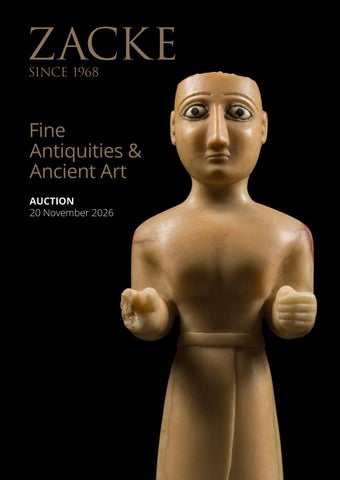
Fine Antiquities & Ancient Art AUCTION 20 November 2026
1
2
Provenances
Museum Deaccessions Musée d’Art Classique de Mougins, the Museum of Classical Art in Mougins, France The Saoud bin Mohammed Ali Al-Thani Foundation, Paris, France The Zelnik István Southeast Asian Gold Museum, Budapest, Hungary Wolf’s Museum of Mystery, St. Augustine, Florida, United States The Musée Gantner, France Historic Gallery and Dealership Provenances André de Munter Archéologie, Brussels, Belgium Ariadne Galleries, New York and London Asfar & Sarkis, Beirut B.C. Galleries, Melbourne, Australia Bruno Cooper Works of Art, Norwich, UK Byron Theodore Zoumboulakis (1923-2006), Geneva C.J. Martin Ltd., Specialist in Ancient & Mediaeval Coins & Antiquities, London, UK Charles Ede Ltd., London, UK Christoph Bacher, Vienna, Austria Daphne Zimmermann Koutoulakis, Geneva, Switzerland
Donati Arte Classica, Lugano Fortuna Fine Arts Ltd., New York, United States Galerie Ägyptischer Kunst, Göttingen, Germany Galerie Alte Römer, Hamburg, Germany Galerie Antike Kunst Socowi, Vienna, Austria Galerie Arete, Zurich Galerie Chenel, Paris, France Galerie Cybèle, Paris, France Galerie David Ghezelbash, Paris, France Galerie du Sycomore, Paris, France Galerie Eberwein, Roswitha Eberwein, Göttingen, Germany Galerie Günter Puhze, Kunst der Antike, Freiburg, Germany Galerie Harmakhis, Brussels, Belgium Galerie Nefer, Switzerland Galerie Orient Occident, J.L. Despras, Paris, France Gawain McKinley, Ancient and Decorative Arts, London, UK Gerhard Herinek, Vienna, Austria Ghassan T. Rihani, Amman, Jordan H. M. Luther Antiques, London, UK Heidi Vollmoeller, Zurich, Switzerland Jean-David Cahn AG, Basel, Switzerland Jean-Louis Domercq Joseph Uzan, Galerie Samarcande, Paris, France Kunsthandlung Faust, Cologne, Germany La Reine Margot, Paris, France
Laurent Bermudez Primitive Arts, Berkeley, California, United States Le Père & Associates, New York, United States Martin Doustar, Brussels, Belgium Marvin Kagan Art, New York, United States Mathias Komor, New York, United States Max Willborg (1933-2001), Stockholm and London McAlpine Ancient Art Limited, London, UK Michael Barber Fine Asian Art, Chicago, United States Nicholas Wright, London, UK Oliver Forge and Brendan Lynch, London, UK Robert Bigler, Zurich, Switzerland Royal-Athena Galleries, New York, United States Rupert Wace Ancient Art, London, UK Simone de Monbrison, Paris, France Simpson Galleries, Houston, United States Sjoerd de Vries (1952-2025) Spink & Son, London, UK Sue Ollemans, London, UK Superior Galleries, Los Angeles, United States Sycomore Ancient Art, Geneva, Switzerland Private Estates and Collection Provenances Acher Eskenasy, Paris, France Agnes Barclay, UK Agnieszka Mancewicz (1940-2021), Krakow, Poland Ali von Mertz, Florida, United States
Andrea Mori, Ascona, Switzerland Arthur (1854-1932) and Marcel Huc Arthur M. Sackler (1913-1987) Arthur Stone Dewing (1880–1971) Mary and Lloyd Morain, Boston, United States Axel Guttmann, Berlin, Germany Belinda Ellison Ben Mankowitz, UK Bernard Gantner, France Bruce Gollan, Australia Carmelo Barbera, Messina, Italy Christian Levett (b. 1970), France Countess de Tudert Darwin Freeman, United States Derek J. Content, London, UK Dr. Athanasios C. Ghertsos, Greek Consul in Zurich and Eleonora Frey née Ghertsos Dr. Erwin Hoess (1909-1985) Dr. Ewald Nowotny (b. 1944), Vienna, Austria Dr. Hans Halter, Switzerland Dr. Helmut Ploog (1940-2024), Munich, Germany Dr. Kai-Torsten Hohn, Dresden, Germany Dr. Martin Winkler (1893-1982), Feldafing, Germany Dr. Mons Fischer Dr. Peter Rudeck, Vienna, Austria Dr. Régis Lisfranc (born c. 1933), Paris, France Dr. Robert Friedinger-Pranter (1894-1967), Vienna, Austria Provenance list continues on the inside back cover
Fine Antiquities & Ancient Art CATALOG ANT1126
LIVE AUCTION 20 November 2026, 1 pm CET
JOIN US LIVE Attend in person at our auction room at Zelinkagasse 6 or participate online via Zacke Live – and enjoy premium buyer’s terms with no additional online bidding fees. Register now: www.zacke.at
EXHIBITION 11–19 November, Monday–Friday 10 am– 6 pm 20 November, 10 am–12 pm as well as by appointment
GALERIE ZACKE Zelinkagasse 6, 1010 Vienna Austria
Tel +43 1 532 04 52 E-mail office@zacke.at
www.zacke.at 3
IMPORTANT INFORMATION
According to the general terms and conditions of business of Galerie Zacke Vienna, Founded 1968, SZA Versteigerungen & Vertriebs GmbH, 1010 Wien, online at www.zacke.at ABSENTEE BIDDING Absentee bids are carried out under the regulations of the terms of business of Galerie Zacke, SZA Versteigerungen & Vertriebs GmbH, which requires written submission of your purchase limit. Orders without purchase limits cannot be processed. Only the submitted lot number of the auction lot is binding for the processing of the absentee bid. The place of jurisdiction is Vienna, Austrian Law and Austrian jurisdiction are exclusively applicable for all legal questions arising from the business relationship. Absentee bids for this auction will be accepted until the day of auction by 10:00 a.m. We regret that absentee bids received after the time stated above will not be processed until after the auction. PLEASE SEND ABSENTEE BIDS FOR THIS AUCTION TO: Fax: +43 1 532 04 52 20 or Email: office@zacke.at or Mail: Galerie Zacke, Zelinkagasse 6, 1010 Wien, Austria, Europe WE ACCEPT THE FOLLOWING METHODS OF PAYMENTS: • Cash • Certified or personal check • Bank transfer (please inquire to receive our bank account information) • Credit card (Visa, MasterCard, Amex) up to EUR 5,000 - higher amounts require prior approval and are subject to service fees TELEPHONE BIDDING It is generally possible to bid by telephone during the auction. Please fill out the absentee bidding form enclosed in this catalog and include your telephone number at which you can be reached during the auction. In the “bid in euro” column please write “TEL” and then send us the completed absentee bidding form. Galerie Zacke will call you on the day of the auction, on the telephone number provided, 5 lots before the lot you are bidding on and the bidding will commence at the starting price, as stated in the catalog. If Galerie Zacke cannot reach you during the auction, Galerie Zacke will bid the starting price on your behalf. ESTIMATES AND STARTING PRICES The auction will begin with the starting price and written bids will be accepted only with a minimum amount equivalent to the starting price. SHIPPING AND TRANSPORT INSURANCE For domestic shipping Galerie Zacke (hereinafter called “the company”) charges in average Eur 15,- to Eur 50,- per item, depending on size and weight. These fees cover the costs of packing and shipping. Fees for bulky or fragile items, or international shipping will be quoted upon request. The purchased goods are transported at the risk of the customer following handover of the packaged item to the post office or another carrier which the customer agrees to through his/her submission of the purchase order. According to the specific wish of the customer, the auctioned goods may be insured for the value of the purchase price (highest bid and all surcharges). This insurance fee is 3 % of the purchase price. For any lots with a purchase prices exceeding EUR 350,the transport insurance will be automatically arranged by the company if it does not expressively receive the purchaser’s written denial of this service and signed waiver of claims. Payments due to the company under the insurance contract will be charged to the customer. The company is also entitled to assign claims under the insurance contract to the customer providing the terms of the insurance contract do not prevent this. In any case, the company is only required to make payment to the customer specifically if payment has effectively been received from the insurance company.
4
COLOR AND CONDITION Auction lots will be exhibited for viewing prior to the auction, thus offering all interested customers the opportunity to examine the quality and condition of the works exhibited. The catalog illustrations are intended to assist customers during such preview. In illustrations, printed colors do not correspond exactly to the originals. The printed catalog images are not representative for the condition of the illustrated pieces. Hidden flaws and damages are indicated in the condition report. The illustrations in our online catalogs can be strongly magnified, so that most damages and restorations are well recognizable. ENDANGERED SPECIES / CITES INFORMATION Some items in this catalog may for example consist of ivory, rhinoceroshorn, tortoise shell, or some types of tropical wood, and are subject to the Convention on International Trade in Endangered Species of Wild Fauna and Flora [CITES]. Such items are marked with the symbol Ɏ on www.zacke.at and may only be exported outside the European Union after an export permit in accordance with CITES has been granted by the Austrian authorities. We would like to inform you that such licenses are typically not granted. COMPLAINTS At its auctions, Galerie Zacke sells consigned lots on behalf of thirdparty consignors. For this reason, any complaints related to purchased lots must be in accordance with §32-48 of the general terms and conditions of business of Galerie Zacke, which can be found on www.zacke.at
IMPORTANT INFORMATION Whenever making a bid, whether personally or via an agent, in writing, online, telephone, or in any other way, the bidder fully and unconditionally accepts the Terms of Auction, the ‘Important Information’ section in the auction catalog, the Terms and Conditions (AGB) of Galerie Zacke, §1-50, the Fee Tariff, and the Bidding Increments table, all as published on www.zacke.at on the day of the auction
THE ART LOSS REGISTER All items starting above EUR 2,000 have been checked by the Art Loss register.
ABSENTEE BIDDING FORM FOR THE AUCTION Fine Antiquities & Ancient Art ON DATE 20 November 2026
LOT NR.
LOT TITLE
BID IN EURO
PLEASE RAISE MY BID BY ONE BIDDING INCREMENT (ca. 10%) IF NECESSARY IMPORTANT NOTICE: Bids do not include buyer’s premium and VAT. Margin taxation applies. Items with added VAT are marked in the online catalog.
PLEASE CALL ME WHEN A HIGHER BID THAN MINE HAS BEEN RECEIVED MY PHONE NUMBER
TELEPHONE BIDS: If you like to bid by telephone, please state ‘TEL’ in the ‘BID IN EURO’ column instead of a Euro amount. Galerie Zacke will call you on the day of the auction, on the telephone number provided, 5 lots before the lot you are bidding on and the bidding will commence at the starting price, as stated in the catalog. If Galerie Zacke cannot reach you during the auction, Galerie Zacke will bid the starting price on your behalf. TERMS OF PAYMENT, SHIPPING AND COLLECTION:
NAME
ADDRESS CITY, COUNTRY POSTCODE
With the signature on this form, the client instructs the auctioneer to bid on his behalf. The Euro amount up to which the auctioneer shall bid on behalf of the client is either stated in this form or will be communicated to the auctioneer via telephone during the auction. All absentee bidding shall be governed by the terms and conditions [AGB] of Galerie Zacke. The client agrees with his signature that he has read, understood and fully accepted the AGB of Galerie Zacke. Galerie Zacke, founded 1968, is a registered brand of SZA Versteigerungen & Vertriebs GmbH, Vienna, Austria.
PHONE NUMBER
DATE & SIGNATURE
CREDIT CARD PAYMENT PLEASE CHECK THE DESIRED CARD COLLECTION BY CLIENT WITH PAYMENT ON THE PREMISES IN CASH, BY CERTIFIED CHEQUE OR CREDIT CARD INVOICE PAYMENT VIA BANK WIRE AFTER RECEIPT OF INVOICE SHIPPING AFTER RECEIPT OF PAYMENT EXPRESS PARCEL SERVICE REQUIRED (ACCORDING TO TERMS AND CONDITIONS OF GALERIE ZACKE)
AMEX
MASTERCARD
VISA
NAME ADDRESS CARD NUMBER EXPIRY DATE
SECURITY CODE
SHIPPING INSURANCE REQUIRED (ACCORDING TO TERMS AND CONDITIONS OF GALERIE ZACKE)
GALERIE ZACKE Zelinkagasse 6, 1010 Vienna, Austria Email: office@zacke.at Tel: +43-1-532 04 52 Fax: +43-1-532 04 52 20
IMPORTANT NOTICE: Whenever making a bid, whether personally or via an agent, in writing, online, telephone, or in any other way, the bidder fully and unconditionally accepts the Terms of Auction, the ‘Important Information’ section in the auction catalog, the Terms and Conditions (AGB) of Galerie Zacke, §1-48, the Fee Tariff, and the Bidding Increments table, all as published on www.zacke.at on the day of the auction.
5
ABSENTEE BIDDING FORM FOR THE AUCTION Fine Antiquities & Ancient Art ON DATE 20 November 2026
LOT NR.
LOT TITLE
Further images of all lots at www.zacke.at 6
BID IN EURO
7
8
IMPRINT Publisher Galerie Zacke founded 1968 © SZA Versteigerungen & Vertriebs GmbH 1010 Wien Zelinkagasse 6, Austria, Europe Tel (0043-1) 532 04 52 Email: office@zacke.at Editors Lukas Zacke Marion Schor Experts Alexander Zacke Lukas Zacke Max Zacke Catalogers Ananya Casius Anne-Aymone Gabriel Daniel Gonzalez-Gracia Iris Horwath
Assistance Anna-Maria Pollmann Photography Georg Bodenstein David Lindengrün Cesilio Cesar Garcia Jonas Matyassy Loreen Sasse Vladimir Ramljak Design Christina Zhang Printing Print Alliance HAV Produktions GmbH Website www.zacke.at © GALERIE ZACKE Reproduction forbidden
9
VISIT US IN VIENNA HOW TO FIND OUR AUCTION & SHOWROOM AT ZELINKAGASSE 6 NG
Located at Zelinkagasse 6, 1010 Vienna, our auction and preview space is just a seven-minute walk from our longstanding, 10,000-square-foot office, photography, video, and cataloging hub at Sterngasse 13. Both locations are open to the public, and we warmly invite you to visit.
U4
H
SC
E
SS
GA
A NK
LI
ZE
LF
SAL
ZG
JOIN US LIVE
ZELINKAGASSE 6
PL
LF
SP
K
Z
RIE
S
STERNGASSE 13
20 November 2026 at 1 pm CET Attend in person in our auction room at Zelinkagasse 6 or participate online via Zacke Live – and enjoy premium buyer’s terms with no additional online bidding fees. Register now: www.zacke.at
10
KE
ÜC
BR
R TO
LZ
SA
AR
AT
AL
DO
AN
RU
O
UK
AI FS-K
E SS
D
NA
E JOS
GA
OR RU
DO
SE
NZ-
AS
FRA
AG
AG
NZ
GO
UT NE
Starting 11 November you’ll be able to explore the exceptional pieces featured in this auction at Zelinkagasse 6, 1010 Vienna.
U2
RI
EN
T OT
FISCHERSTIEGE
In the heart of Vienna’s first district, our showroom spans 6,000-square-foot and has been specially designed to provide a seamless auction and exhibition experience.
Easily accessible by public transport or car (a parking garage is located nearby). By Public Transport: SCHOTTENRING station (U2, U4, tram lines 1, 31, 71, D, and bus 3A)
SC
H
W
ED
EN
PL
AT
U1
Z U4
11
1 A RARE ALABASTER HEADREST WITH FLUTED COLUMNAR SUPPORT, OLD KINGDOM, 5TH–6TH DYNASTY, CIRCA 2494–2181 BC Egypt. Finely carved and assembled from three separately worked elements, the broad rectangular base supporting an elegant fluted columnar shaft, subtly tapering and flaring toward either end. Above, a square collar supports the deeply curved crescent-shaped headpiece, its upturned terminals smoothly rounded and carefully balanced to cradle the head. The restrained architectural construction, combining the broad horizontal base and sweeping upper support with the rhythmically fluted central shaft, lends the headrest a remarkably harmonious and almost sculptural appearance. The finely polished, semi-translucent Egyptian alabaster is of a warm creamy-beige tone with subtle lighter veining. (3) Provenance: Probably with Mathias Komor, New York, USA, according to a provenance statement signed by James G. Hanes III. Collection of James G. Hanes Jr., North Carolina, USA, 1960s-1970s, probably acquired from the above, and thence by descent to his son James G. Hanes III, 1995-2015. Brunk Auctions, Asheville, North Carolina, USA,18 March 2016, lot 383, sold for USD 28,000 or approx. EUR 34,000 (converted and adjusted for inflation at the time of writing). A noted private collector, acquired from the above, and thence by descent. A copy of the provenance statement signed by James G. Hames III, dated 8 March 2016, confirming the provenance above, accompanies the lot.
PREVIOUS AUCTION RESULT The present lot at Brunk Auctions, Asheville, North Carolina, USA, 18 March 2016, lot 383, sold for USD 28,000 or approx. EUR 34,000 James G. Hanes Jr. formed his collection primarily during the 1960s and 1970s. Hanes acquired extensively from the New York dealer Mathias Komor. According to the family, the present objects were most likely acquired during this period, although the original purchase receipts were not retained. His collecting activities had largely ceased by 1980, and the present object was in his possession at his home in North Carolina by 1984, the year of Komor’s death. Mathias Komor (1909-1984) was a New York based art dealer and collector who was active from 1930 until his death in 1984. Condition: Very good condition with minor wear, few tiny chips to the edge of the pillow, little nibbling, and few natural fissures. Weight: 2.1 kg Dimensions: Height 20.7 cm Headrests mimicked the sun (the head) rising in the horizon (the headrest’s pillow). Therefore, waking up would have been seen as rebirth for the sleeper, like the sun’s morning appearance was for the world. Many headrests show wear and have impressions from, or actual scraps of attached linen, indicating they were padded for comfort. Although pillows existed, a headrest was cooler and elevated the sleeper’s face away from the insects and scorpions that prowled in the night.
LITERATURE COMPARISON Compare a closely related alabaster headrest found in a wealthy official’s tomb, dated Old Kingdom, ca. 2323-2150 BC, 19.1 cm tall, in the Metropolitan Museum, object number 26.2.11.
AUCTION RESULT COMPARISON Type: Near identical Auction: Christie’s London, 15 April 2015, lot 29 Price: GBP 25,000 or approx. EUR 42,000 converted and adjusted for inflation at the time of writing Description: An Egyptian alabaster headrest, Old Kingdom, 5th-6th dynasty, circa 2494-2181 B.C. Expert remark: Compare the near identical form, color of the stone, and size (19.7 cm).
Estimate EUR 10,000 Starting price EUR 5,000
12
13
2 AN EGYPTIAN ALABASTER PILGRIM FLASK, NEW KINGDOM, DYNASTY XVIII-XIX Egypt, circa 1550-1186 BC. Exquisitely carved, the globular body of lenticular section with sharply defined edges, rising to a high angled shoulder set with subtly modeled twin duck-head handles and surmounted by a short waisted neck with a flat disk rim. The finely polished, translucent stone is of a creamy ivory-white tone with attractive pale brown and white banding. Provenance: Collection of Herbert Bier, London, thence by descent. Christie’s London, 6 July 2016, lot 108 (sold for GBP 5,000 or approx. EUR 8,300 converted and adjusted for inflation at the time of writing). A private collection in the United Kingdom, acquired from the above. Herbert Bier (1905-1981) was a German-born art dealer who established a distinguished career in London and played an important role in the international art trade of the mid-twentieth century. Condition: Very good condition with minor wear, a minuscule chip and few minute nibbles to the rim, the Herbert Bier in 1929/1930 stone with natural fissures, some of which may have developed into fine hairline cracks. Weight: 270 g Dimensions: Height 9.6 cm From the Early Dynastic Period onwards, the Egyptians extensively quarried a stone commonly referred to as alabaster, although it is more accurately identified as travertine, a form of calcium carbonate. Whitish and slightly translucent, often marked by veins of contrasting color, the stone was obtained primarily in Middle Egypt, particularly in the region between Minya and Asyut. The most celebrated and important source was the quarries at Hatnub, near Amarna, while another major quarry, already exploited during the Old Kingdom, was located at Wadi Gerawi, near Helwan.
14
PREVIOUS AUCTION RESULT The present lot at Christie’s London, 6 July 2016, lot 108, sold for GBP 5,000 or approx. EUR 8,300 Prized for its pale color, translucency, and durability, Egyptian alabaster was associated with purity and employed for a wide range of prestigious purposes, including architectural elements, temple pavements, sarcophagi, altars and, above all, statuary and vessels. Estimate EUR 3,000 Starting price EUR 1,500
3 AN EGYPTIAN OR PHOENICIAN BANDED ALABASTER VASE, CIRCA 7TH – 6TH CENTURY BC Eastern Mediterranean. Masterfully carved and hollowed, the baluster body gently tapering to the flat base, rising through high-angled shoulders to a short, waisted neck with a flat rim and a circular mouth. The finely polished, semi-translucent stone exhibits soft shades of luminous honey-amber, enlivened by whitish horizontal bands of varying thickness. The base vertically drilled, with a narrow channel extending towards the rim. Provenance: Michael Barber Fine Asian Art, Chicago, United States. Previously in a European private collection. Condition: Very good condition, with expected wear, traces of weathering and erosion, old chips, and minor nibbling along the rim. The stone with natural fissures, some of which may have developed into fine hairline cracks. Weight: 4.6 kg Dimensions: Height 25.3 cm This highly sculptural vessel resembles the much smaller metal ewers with spouts that Egyptians used, together with matching basins, for washing their hands before meals and pouring libations for deities and the
deceased. Here, the utilitarian form has been enlarged and translated into stone to ensure an eternal supply of water for a high-ranking member of the nobility or royal court, to whom this vessel must have surely belonged.
AUCTION RESULT COMPARISON Type: Closely related Auction: Christie’s New York, 9 December 2015, lot 132 Price: USD 15,000 or approx. EUR 18,500 converted and adjusted for inflation at the time of writing Description: An Egyptian or Phoenician alabaster vase, circa 7th century BC Expert remark: Compare the closely related form, manner of carving, and stone. Note the nearly identical size (25.1 cm).
Estimate EUR 2,000 Starting price EUR 1,000
15
16
4 A RARE MARBLE FIGURE OF A SEATED CAT, PTOLEMAIC TO ROMAN PERIOD, CIRCA 332 BC - 1ST CENTURY BC Egypt. Masterfully carved, the cat sits upright on its haunches atop an integral rectangular base, the body turned slightly to one side, the head held forward with a steady, attentive gaze. The facial features, though simply modeled, are strikingly expressive: almond-shaped eyes beneath erect ears, a short rounded muzzle, and a quietly composed presence that conveys both alertness and serenity. Provenance: With Nicholas Wright, London, United Kingdom, 1960s. The private collection of Guy Weill Goudchaux (1914–2006), acquired from the above. The private collection of Charles Rupert Wace, London, United Kingdom, acquired from the above in 1980. We have received a note from Charles Rupert Wace, with the following statement: “I, CHARLES RUPERT WACE hereby confirm and affirm that I bought the Romano-Egyptian seated cat (pictured and described below) from Guy Goudchaux in 1980. To Provenance Statement from the best of my knowledge, it was Rupert Wace legally on the market and was acquired by Mr. Goudchaux in the 1960s from Nicholas Wright.” A copy of this note accompanies the present lot. Condition: Fine condition, commensurate with age. Some losses, small chips, scattered nicks and scratches, surface weathering, erosion, and encrustations.
EXPERT’S NOTE Marble was an exceedingly rare material for Egyptian sculpture, as it was imported rather than locally quarried. A small group of marble and limestone cats, several now in the British Museum and dated c. 332–200 BC, has been attributed to a single workshop. Petrie identified the group as originating from the Bubasteion at Naukratis (Naukratis Excavations, 1884–1886; Arts and Crafts of Ancient Egypt, 1909). The present figure, sharing the same rare material, scale, and modeling, was likely produced within this context of specialized Hellenistic craftsmanship in Egypt.
Weight: 2.9 kg (excl. stand), 4.6 kg (incl. stand) Dimensions: Height 19.7 cm (excl. stand), 29.5 cm (incl. stand) With an associated wood stand. (2) Estimate EUR 12,000 Starting price EUR 6,000
kingship. The present figure, with its expressive presence, belongs to this distinguished artistic current, where Hellenistic craftsmanship served Egyptian religious devotion at the highest level. While a dating within the context of Naukratis, c. 332–200 BC, appears most plausible, a production extending into the early Roman period cannot be excluded, given the continued vitality of Ptolemaic artistic traditions and workshop practices.
Marble cats of this scale are exceptionally rare within the corpus of Egyptian sculpture. While small bronze and faience figures were produced in vast numbers as votives, the decision to carve a cat in marble reflects a deliberate elevation of the subject, both in material and in execution. The Ptolemaic dynasty, which ruled Egypt from the conquest of Alexander the Great in 332 BC until the Roman annexation, cultivated a synthesis of Egyptian religious tradition with Hellenistic refinement. Cats in this period were rendered with a new naturalism— rounded musculature, subtle asymmetry, and a calm vitality—that goes beyond the more schematic types of earlier centuries. This stylistic sophistication mirrors the broader Ptolemaic program of linking the dynasty to Egypt’s divine order: the cat, as Bastet’s manifestation, not only symbolized fertility and health but also the protection of Ra and, by extension, the king himself. It is tempting to see in works such as this the conscious patronage of the Ptolemies, who used traditional cult animals and their representations to legitimize their rule and, most importantly, to demonstrate continuity with pharaonic
Figures of cats related to the present lot, c. 332–200 BC, marble and limestone, from the Bubasteion at Naukratis, London, British Museum, 1905,0612.1–3, 4, 6, 7, 18
17
Weight: 95.8 g (excl. stand), 245.3 g (incl. stand) Dimensions: Height 5.5 cm (excl. stand), 12 cm (incl. stand) Mounted on a fitted wood stand. (2) In ancient Egypt, the cat personified Bastet, the goddess of fertility, pleasure, and good health. Those hoping to conceive or seeking protection against disease would make offerings to her. This often took the form of a pilgrimage to her temple, Bubastis (modern Tell Basta near Zagazig in the eastern Delta), or Memphis to deposit votive objects. Bubastis, in addition to other Egyptian sites, became the site of a large cat cemetery, in which mummified cats were deposited as votives. Skeletal evidence suggests that the mummified cats had been intentionally killed while still young, rather than having been cherished pets that died of natural causes. Small cat figurines were often wrapped in the linen bandages of the mummified remains, which were in turn placed in bronze or wooden containers in the shape of seated cats. Many of the larger, hollow-cast bronze cats can be interpreted in this way and retain an opening into the body cavity. The majority of the bronzes, however, were dedicated in shrines.
5 AN EGYPTIAN BRONZE HEAD OF A CAT, LATE PERIOD Egypt, c. 664-332 BC. Hollow-cast, with alert expression, the angular face with deeply-set elongated eyes, the radiating whiskers finely incised above the closed mouth, pierced upright ears with gold earrings and incised tufts as horizontal striations to the edges. The bronze with a naturally grown patina, enlivened by vibrant malachite encrustations and patches of cuprite, creating a striking mottled effect reminiscent of the coat of a spotted feline. Provenance: The private collection of George Embiricos, acquired in the 1950s-1960s. With Rupert Wace Ancient Art, London, United Kingdom. A private collection in London, UK, acquired from the above in 2001. George Embiricos (1920-2011) was George Embiricos Rupert Wace a Greek shipping magnate (1920-2011) (b. 1955) and distinguished art collector who assembled an exceptionally broad collection. His collection was noted for both its quality and remarkable range, including major works by El Greco, Goya, Cézanne, Van Gogh, Kandinsky, Picasso, and Francis Bacon. Among the most celebrated works in his collection was Paul Cézanne’s The Card Players, reportedly sold in 2011 to the Qatari royal family for an estimated USD 259-320 million, at the time widely reported as the highest price ever paid for a painting. Rupert Wace (b. 1955) has been a leading figure in the world of Antiquities for over forty years. A collector at heart and sometime dealer by profession, Wace's expertise ranges from ancient Egypt and the Classical world to the Near East. Condition: Good condition, commensurate with age. Old wear, obvious losses, casting irregularities, and repairs to the snout with stabilization to the interior. The gold earrings renewed. Overall with a naturally grown patina, showing distinct cuprite and malachite encrustations.
18
The function of these large cat heads is ambiguous. They have been found in offering contexts, and it is commonly assumed that they formed part of a composite statuette; the full statuette, when intact, probably would have had a hollow wooden body and held a cat mummy inside, much as similar large hollow copper alloy statuettes did. However, these figures are almost never found with the composite bodies, even at sites where wood is relatively well preserved. It is possible that in some cases these cat heads were dedicated on their own, or were purposefully disassembled from their bodies, which were then discarded or used in another way. AUCTION RESULT COMPARISON Type: Closely related Auction: Christie’s New York, 13 October 2020, lot 14 Price: USD 27,500 or approx. EUR 31,000 converted and adjusted for inflation at the time of writing Description: An Egyptian bronze cat head, Late Period Expert remark: Compare the closely related modeling, expression, and gold earrings. Note the similar size (7.9 cm).
AUCTION RESULT COMPARISON Type: Closely related Auction: Christie’s London, 6 December 2017, lot 93 Price: GBP 32,500 or approx. EUR 52,500 converted and adjusted for inflation at the time of writing Description: An Egyptian bronze cat head, Late Period Expert remark: Compare the closely related modeling, expression, and size (8.4 cm).
Estimate EUR 8,000 Starting price EUR 4,000
19
6 AN EGYPTIAN BRONZE, WOOD, AND LAPIS LAZULI FIGURE OF AN IBIS, LATE PERIOD Egypt, c. 664-332 BC. Finely modeled in a recumbent posture, the sacred ibis with a wooden body, its folded wings carefully outlined and terminating in a tail tipped with opaque blue glass paste. The separately cast bronze head is set on an elegantly curved S-shaped neck, ridged at the base, the long beak finely incised and the eyes neatly inlaid with lapis lazuli pupils. The separately cast bronze legs are similarly detailed, with incised articulation to the tarsi and toes. The underside retains four bronze tenons for attachment. Provenance: From a private collection in the Île-de-France region, France. Condition: Very good condition, commensurate with age. Manufacturing irregularities, natural fissures and age cracks to the wood—especially around the bronze mounting, remnants of gilding, and extensive wear to stuccoes and pigments—all as visible. Overall presenting superbly. Weight: 335 g (excl. stand), 629 g (incl. stand) Dimensions: Length 19 cm (excl. stand), Length 23 cm (incl. stand) With an associated fitted wood stand. (2) The ibis was sacred to the god Thoth who was the god of knowledge, time, mathematics, and writing, as well as the divine messenger identified with Hermes in the Greek period. Among his main places of worship, which included his center at Hermopolis, was the sacred site at Saqqara which received countless pilgrims who would pause at the nearby breeding lake to secure one of the millions of ibises which would later be mummified, potted and placed in the vast catacombs adjoining the temple which maintained the cult and cult-statue of the ibis-headed Thoth. Even during the 19th century no visit to Egypt was complete without a visit to the 'Tomb of the Birds' at Saqqara; see A. Leahy and J. Tait (eds.), Studies on Ancient Egypt in honour of H. S. Smith, London, 1999, pp. 209-214. Thoth, whose word created the universe, is often shown with Maat who maintained the cosmic balance of the universe. Estimate EUR 10,000 Starting price EUR 5,000
20
AUCTION RESULT COMPARISON Type: Closely related Auction: Christie’s New York, 4 June 2015, lot 10 Price: USD 81,250 or approx. EUR 99,000 converted and adjusted for inflation at the time of writing Description: An Egyptian wood and bronze Ibis, Late Period to Ptolemaic Period Expert remark: Compare the closely related modeling of the wooden torso and bronze head and feet with incised details. Note the similar size (18 cm).
AUCTION RESULT COMPARISON Type: Closely related Auction: Christie’s Paris, 20 December 2011, lot 187 Price: EUR 34,600 or approx. EUR 44,500 adjusted for inflation at the time of writing Description: An Egyptian stuccoed wood and bronze ibis, Late period to Ptolemaic Expert remark: Compare the closely related modeling of the wooden torso and bronze head and feet with incised details. Note the larger size (25 cm).
AUCTION RESULT COMPARISON Type: Closely related Auction: Bonhams London, 30 September 2015, lot 8 Price: GBP 40,000 or approx. EUR 67,000 converted and adjusted for inflation at the time of writing Description: An Egyptian bronze and wood ibis, Late Period - Ptolemaic Period Expert remark: Compare the closely related modeling of the wooden torso and bronze head and feet with incised details. Note the larger size (33 cm).
21
7 AN EXCEPTIONALLY FINE BRONZE FIGURE OF NEITH AS A WARRIOR GODDESS, LATE PERIOD
PUBLISHED Charles Ede, Egyptian Antiquities, 2014, no. 11. Egypt, circa 600 BC. The goddess strides forward with her left leg advanced on an integral rectangular base, fists clenched—one lowered, the other slightly raised—in a gesture of power. She wears the Deshret, the Red Crown of Lower Egypt, its tall reeds bound with ribbons at the back, and her face is cast with finely modeled features. An incised broad collar, armlets, and anklets adorn her, while a close-fitting garment, held by straps, clings from just below the breasts to the ankles, emphasizing the sculptural elegance of her form. Artloss Register: Certificate #S00089008 from June 20th, 2014. A copy of this document is accompanying this lot. Provenance: - With Phocian Jean Tano, Cairo, Egypt, inventory no. F132. - The private collection of Sgt. W. A. Pickersgill of the Green Howards Yorkshire Regiment, United Kingdom, acquired between 19021940, and thence by descent. - Bonhams London, 23 October 2013, lot 33. - With Charles Ede Ltd., London, United Kingdom, 2014. Condition: Excellent condition, commensurate with age. Expected casting irregularities, the attributes lost, minor rubbing, scattered nicks and scratches, signs of weathering and erosion, and encrustations. Overall with a fine, Phocian Jean Tano (1898-1972) naturally grown patina, showing malachite encrustation. The wood base with an old label, inscribed ‘[...] Tano, no F132, Cairo, Egypt’. Weight: 319.6 g (excl. stand), 374.2 g (incl. stand) Dimensions: Height 18.2 cm (incl. tenon, excl. stand), 20.3 cm (incl. stand) With an associated fitted wood stand. (2)
22
Neith was revered as both hunter and warrior, the mother of the crocodile god Sobek, and a divine ally in humanity’s struggles against its enemies. Although her cult was invoked from early times, her worship declined during the Middle and New Kingdoms. It was only with the rise of the 26th Dynasty and the establishment of Sais as the capital that Neith’s cult regained prominence. In this later period she was venerated as a genderless mother-father figure, and most surviving statuettes of the goddess date from this time. In the present bronze, Neith appears as warrior goddess and personification of Lower Egypt, striding forward with masculine vigor, once holding an ankh and a was-scepter, and wearing the Red Crown of Lower Egypt.
AUCTION RESULT COMPARISON Type: Closely related Auction: Christie’s New York, 9 December 2015, lot 135 Price: USD 87,500 or approx. EUR 101,000 converted and adjusted for inflation at the time of writing Description: An Egyptian bronze Neith, Late Period, 26th dynasty Expert remark: Compare the closely related modeling and similar subject, incised decoration, and pose. Note the slightly larger size (20.5 cm).
AUCTION RESULT COMPARISON Type: Closely related Auction: Christie’s London, 6 December 2016, lot 129 Price: GBP 75,000 or approx. EUR 132,000 converted and adjusted for inflation at the time of writing Description: An Egyptian bronze Neith, Late Period, 26th dynasty Expert remark: Compare the closely related modeling and similar subject, incised decoration, and pose. Note the slightly larger size (21 cm).
Estimate EUR 10,000 Starting price EUR 5,000
23
8 A BRONZE FIGURE OF A FALCON-HEADED HORUS, LATE PERIOD Egypt, c. 664-332 BC. Striding forward with the left foot advanced, the falcon-headed deity wearing a belted kilt and striated tripartite wig, crowned by the Double Crown of Upper and Lower Egypt fronted by an uraeus and a projecting coil, fulfilling his role of uniting and ruling over all of Upper and Lower Egypt, the 'Lord of the Two Lands.' The face with a small beak and neatly articulated, once parcel-gilt eyes. Provenance: The private collection of Lt Colonel Athol Rowe (1911-1986) and Mrs Jill Rowe (1934The entry from Lt Colonel Rowe’s ledger, 2025), Surrey, UK, stating the date of purchase as January 1963 acquired in London in January 1963, and thence by descent to the last owners. A copy of the entry from Lt Colonel Rowe’s ledger, stating the date of purchase as January 1963, acquisition location ‘London’, and describing the present lot as ‘Bronze figure of God Horus, 4½”, walking, Egyptian, double crowned,’ accompanies the lot. A copy An insurance valuation request, addressed of an insurance valuation to Christie, Manson & Woods, by Colonel request, addressed to Athol Rowe, dated 17 December 1971 Christie, Manson & Woods, by Colonel Athol Rowe, dated 17 December 1971, and stating an insurance value of GBP 80, accompanies this lot. Condition: Very good condition, commensurate with age. Old wear, casting irregularities, rubbing, scattered nicks, remnants of pigment, and encrustations. Overall with a fine, naturally grown patina. The eyes were originally highlighted with gilding, which is now only partially visible due to the development of the bronze patina.
24
Weight: 126.5 g (incl. stand) Dimensions: Height 11.4 cm (excl. stand), 14 cm (incl. stand) Firmly mounted on an associated wood stand. (2) In Egyptian mythology, Horus was the son of Osiris and Isis and was depicted as a falcon-headed god of the sky. After Osiris was murdered by his jealous brother Set, Isis gathered and reassembled his dismembered body and briefly restored him to life, long enough to conceive Horus. Horus later fought a series of battles against Set, ultimately defeating him and succeeding Osiris as king. Here in the present example, there is a notable feature that references the uncle-nephew battle—the finely articulated eyes, which once were distinctively parcel-gilt. According to myth, in his role as sky-god, one of Horus’ eyes represented the sun and the other the moon. While the original gilding has to some extent been obscured by the growth of the bronze patina, traces remain discernible, and the carefully worked eyes continue to stand out prominently. Such emphasis is particularly meaningful in an image of Horus, creating a striking visual connection between the sculptural treatment and their celestial and regenerative significance. AUCTION RESULT COMPARISON Type: Closely related Auction: Christie’s London, 3 July 2024, lot 16 Mid-Estimate: GBP 30,000 or approx. EUR 37,500 converted and adjusted for inflation at the time of writing Description: An Egyptian bronze Horus standing on an ibex, Late Period, 26th Dynasty, circa 664-525 BC Expert remark: Compare the closely related form and similar modeling of the kilt, headdress, and facial expressions. Note the larger size (20 cm). Estimate EUR 4,000 Starting price EUR 2,000
9 A RARE AND IMPORTANT BRONZE PANTHEISTIC DEITY, PTOLEMAIC PERIOD Egypt, 332-30 BC. Finely cast as a complex syncretic deity standing upon two crocodiles on an integral rectangular base encircled by a serpent, combining the bowed legs of Ptah-Pataikos and the naked, pot-bellied body of Bes. A feline head emerges at the groin, while an incised scarab centers the abdomen. The arms project forward with clenched hands beneath the jackal head of Anubis, flanked by two outward-facing uraei. Above rises an elaborate composite crown with the double-plumed crown of Osiris, horizontal ram’s horns, two further forward-facing uraei, surmounted by a solar disk. At the reverse, Horus spreads his finely incised wings over the back, while the ram-headed Khnum rises above, crowned by a solar disk with frontal uraeus and framed by the tall ostrich plumes of the headdress. Provenance: The private collection of Jean-Jacques Rotthier, Belgium, by 1999, and thence by descent. Jean-Jacques Rotthier (1932-2009) was a Belgian collector of Egyptian antiquities as well as African and Oceanic art, who began assembling his collection in the 1970s. His interests were shaped by extended stays in Africa and by exchanges with specialists including Bernard de Grunne and Pierre Dartevelle. Rotthier regularly made works available for important exhibitions throughout Europe, including in Brussels, Paris, Amsterdam, and Venice. Condition: Very good condition, commensurate with age. Expected wear and casting irregularities, minor losses, mainly to the base and parts of the serpent. Signs of weathering and erosion, particularly to the base, scattered small nicks, oxidation, encrustations. The bronze displaying a rich dark brown patina with areas of green malachite and reddish cuprite encrustations. Weight: 929 g Dimensions: Height 20.6 cm (excl. base), 23 cm (incl. base) Mounted on an associated base.
25
26
PUBLISHED & EXHIBITED 1. Eugène Warmenbol (ed.), Ombres d’Égypte: Le peuple de Pharaon, Musée du Malgré-Tout, Treignes, 20 June-12 December 1999, p. 102103, catalog number 102. 2. La condition humaine: Le rêve d’une ombre, Museu d’Història de la Ciutat de Barcelona, Barcelona, 10 May-26 September 2004, p. 41. 3. Arnaud Quertinmont (ed.), Dieux, génies et démons en Égypte ancienne: à la rencontre d’Osiris, Anubis, Isis, Hathor, Rê et les autres, Musée royal de Mariemont, Morlanwelz, 21 May-20 November 2016, p. 208, catalog number 67. Pantheistic deities became particularly popular during the Late and Greco-Roman periods, combining the attributes and powers of several gods into a single image intended to offer comprehensive divine protection. Their deliberately complex iconography was closely connected with magic and apotropaic practice, and related representations could be accompanied by protective spells. Rather than portraying a single divinity, such figures embodied a deliberately composite supernatural being, concentrating solar, funerary, regenerative, and protective forces within one image. Their hybrid appearance was therefore not merely ornamental, but central to their function: each additional divine aspect strengthened the figure’s magical efficacy. This accumulation of powers makes pantheistic bronzes among the most complex and intriguing expressions of later Egyptian religious thought.
AUCTION RESULT COMPARISON Type: Closely related Auction: Christie’s London, 6 December 2016, lot 150 Estimate: GBP 179,000 or approx. EUR 295,500 converted and adjusted for inflation at the time of writing Description: An Egyptian bronze pantheistic deity, Ptolemaic period Expert remark: Compare the closely related syncretic iconography, combining jackal and ram heads with a falcon element, bowed legs, two crocodiles, and an integral rectangular base, as well as the closely related dating and similar size (18.4 cm).
Estimate EUR 30,000 Starting price EUR 15,000
27
10 AN EXCEEDINGLY RARE BRONZE OF A PANTHEISTIC DEITY, PTOLEMAIC PERIOD EXPERT’S NOTE This remarkable figure unites attributes of several major Egyptian deities: The jackal body clearly recalls Anubis, while the falcon head and avian talons derive from Horus. The conical crown may allude to Osiris in his solar or funerary aspects. The incised wings on the back possibly evoke Isis or Horus in his protective form. Most striking is the elongated phallus curling backward, a feature strongly associated with Min, the god of fertility. By merging all these attributes, the statue embodies multiple divine powers in a single form, a classic and important aspect of divine imagery in the Ptolemaic period. Anubis (middle) and Horus (right) in the tomb of Horemheb (KV57) in the Valley of King Egypt, 332-30 BC. Boldly cast with the body of a jackal and the head of a falcon, the figure is shown seated on its haunches, avian talons gripping a double-armed plinth with rounded ends. It wears a broad collar above a finely engraved apron and a wide sash enveloping the upper body and the long, slender legs. An elaborate headcloth falls in lappets over the shoulders and is surmounted by a conical crown. The back is incised with fur textures and wings, while the elongated phallus curls backward over the right hindquarter to rest upon the buttocks, indicating its original function as a handle on an important piece of furniture or vessel. Provenance: The Zakaria Collection in Los Angeles, United States, acquired in the 1960s. Christie’s New York, 9 December 2005, lot 79 (sold for USD 12,000 or approx. EUR 18,000 converted and adjusted for inflation at the time of writing). A private collection in the Midwest, United States, acquired from the above and thence by descent. Condition: Good condition with ancient wear and traces of use, commensurate with age. Remnants of wax seal to the underside. Small dents, nicks, and losses. Possibly with minuscule old repairs, and associated touchups. Overall with an exceptionally fine, naturally grown patina.
PREVIOUS AUCTION RESULT The present lot at Christie’s New York, 9 December 2005, lot 79, sold for USD 12,000 or approx. EUR 18,000 Weight: 512 g Dimensions: Height 14 cm Estimate EUR 8,000 Starting price EUR 4,000
28
29
11 AN INSCRIBED LIMESTONE FIGURE OF A NOBLEMAN, MIDDLE KINGDOM Egypt, circa 2055-1650 BC. Carved seated upright on a rectangular seat with a low back, the figure resting both hands flat upon the thighs, the fingers indicated by incised lines, and the parallel feet supported on an integral projecting plinth. The face with elongated, almond-shaped eyes beneath arched brows, extended cosmetic lines, a prominent nose, and full lips, framed by a long, smooth wig falling behind the shoulders and in two lappets over the chest, leaving the ears exposed. A broad collar encircles the neck, while a close-fitting garment extends to the ankles. The back supported by a narrow dorsal pillar. The polished stone mottled in shades of dark brown, black, and ochre, with scattered lighter inclusions. Inscriptions: Three vertical columns of incised hieroglyphic signs occupy each side of the seat, with a further column extending down the dorsal pillar. Among the recognizable forms are the ankh sign, corresponding to the Egyptian ʿnḫ, “life” or “to live,” and an eye sign corresponding to Gardiner D4. Provenance: Collection of Martin Kerner, Kirchdorf, Switzerland, before 2000. Koller, Zurich, Auction 100. Michael Voglsinger, Zurich, acquired from the above, according to a provenance letter from Michael Voglsinger. A copy of this provenance letter accompanies the present lot. A European private collection, acquired from the above. Condition: Very good condition with expected wear, signs of weathering, traces of burial, nibbling to edges, light nicks. The stone with a rich, naturally grown, smooth patina. Weight: 170 g Dimensions: Height 9 cm The name of this nobleman is unknown, but his long garment and prominent ears convey his elevated status. The exposed ears evoke the ability to hear petitions, presenting the sitter as an attentive figure of authority.
30
LITERATURE COMPARISON Compare a related black serpentine figure of Kha-em-Waset, 8.6 cm high, dated to the reign of Amenhotep III, ca. 1370-1360 BC, in the Walters Art Museum, accession number 22.68.
AUCTION RESULT COMPARISON Type: Related Auction: Christie’s London, 5 October 2000, lot 140 Price: GBP 23,500 or approx. EUR 53,000 converted and adjusted for inflation at the time of writing Description: An Egyptian basalt figure of a seated nobleman, Middle Kingdom, Dynasty XII/early XIII, circa 1843-1730 BC Expert remark: Compare the related modeling and manner of carving from a similar polished dark stone. Note the size (15 cm). Estimate EUR 8,000 Starting price EUR 4,000
A LARGE PAINTED LIMESTONE
FRAGMENT OF A HATHOR CAPITAL WITH A CROWNED URAEUS COBRA
31
12 A LARGE PAINTED LIMESTONE FRAGMENT OF A HATHOR CAPITAL WITH A CROWNED URAEUS COBRA, NEW KINGDOM EXPERT’S NOTE A particularly close comparison is a painted limestone head of Hathor from Deir elMedina in the Louvre (E 14389 BIS), dated to the New Kingdom on the basis of its excavation context. Both fragments give unusual prominence to a large, humanlooking eye and render the goddess’s face with striking directness. The Louvre fragment has lost the areas where the bovine ear and any adjoining ornament, including an uraeus cobra, might have appeared; the present work preserves the ear and the exceptionally large crowned uraeus cobra. The scale of the surviving fragment, approximately 43 cm wide, suggests that it belonged to a substantial architectural element. An original size of roughly 90 × 60 cm is probable. In a certificate dated 5 June 1989, Galerie du Sycomore, Paris, already assigned the fragment to “Egypte. Nouvel Empire (Deuxième moitié du deuxième millénaire avant J.C.).” The Louvre comparison supports that attribution. Egypt, circa 1550-1069 BC. Carved in relief, the fragment preserves the upper part of Hathor’s face, dominated by a large, naturalistically rendered eye beneath a sweeping cosmetic line. Her bovine ear emerges beside the face, while deeply incised strands of her wig retain traces of blue pigment. To the right rises a monumental uraeus cobra, its expanded hood and ribbed neck carved in bold relief. Traces of red pigment survive on the crown above its head. Provenance: With Galerie du Sycomore, Paris, France. A private collection in Marseille, France, acquired from the above in 1989. A copy of a certificate of authenticity from Galerie du Sycomore, Paris, dated 5 June 1989, written and signed by Jean-Louis Domercq, dating the present lot to the New Kingdom, accompanies the lot. Condition: Very good condition, commensurate with age. Old wear, obvious losses, scattered nicks and chips, expected signs of weathering, soil deposits, and typical A certificate of authenticity encrustations. The column with traces of blue pigment to the hair and red pigment to from Galerie du Sycomore, Paris, dated 5 June 1989 the cobra. French Export License: Certificat d’exportation pour un bien culturel, no. 247705, dated 5 July 2024, has been granted. A copy accompanies this lot. Weight: 25.1 kg (incl. stand) Dimensions: Length 43 cm (excl. stand), Height 32 cm (incl. stand)
Hathor columns appeared at the beginning of the New Kingdom. Their capitals could bear the goddess’s face on two opposing sides, beneath a shrine-shaped element resembling the sound box of a sistrum. Later examples increasingly placed her face on all four sides. This arrangement presented Hathor as a goddess whose presence extended in every direction. Such columns were used in temples associated with female deities; smaller examples may also have formed part of kiosks or other structures. A later, four-sided example inscribed for Nectanebo I is held by the Metropolitan Museum of Art, object no. 28.9.7.
32
The present lot’s side view (see upper image on the right page) provides an important clue to its original form: The monumental uraeus cobra occupies the corner of the capital, exactly where normally a second Hathor face would appear on a conventional four-sided capital. By contrast, a Ptolemaic capital sold by Christie’s, fig. 1 (see auction result comparison below) preserves Hathor’s fig. 1 head on one side, no cobra on the corner, and parts of two further Hathor heads on the adjoining sides. The present arrangement therefore differs substantially from that later type and supports an earlier, two-faced conception of the capital, consistent with its New Kingdom attribution. AUCTION RESULT COMPARISON Type: Closely related Auction: Christie’s New York, 9 April 2024, lot 124 Price: USD 63,000 or approx. EUR 58,500 converted and adjusted for inflation at the time of writing Description: An Egyptian sandstone column capital with Hathor, Ptolemaic period Expert remark: Compare the closely related modeling of the head and bovine ears. Note the lack of uraeus cobra, the smaller eyes, the simplified wig, and the much later dating. AUCTION RESULT COMPARISON Type: Closely related Auction: Christie’s London, 15 April 2015, lot 166 Price: GBP 27,500 or approx. EUR 46,000 converted and adjusted for inflation at the time of writing Description: An Egyptian limestone Hathoric pillar, Late period-Ptolemaic period Expert remark: Compare the closely related modeling of the head and bovine ears. Note the lack of uraeus cobra, the smaller eyes, and the much later dating. Estimate EUR 20,000 Starting price EUR 10,000
33
Weight: 4.9 kg (incl. stand) Dimensions: Height 21.4 cm (excl. stand), 27 cm (incl. stand) Mounted on an associated stand. (2)
13 A RARE GRANODIORITE FRAGMENTARY DYAD OF A HUSBAND AND WIFE HOLDING HANDS, MIDDLE KINGDOM, CIRCA 1800 BC EXPERT'S NOTE Few fragments illustrate the workings of fate as poignantly as the present piece. Over the course of nearly 3,800 years, chance has determined what would survive of the original sculpture and, consequently, where the eye of the modern beholder must fall. Remarkably, what remains is perhaps the most intimate and meaningful detail of the entire composition: the joined hands of husband and wife. Parts of their bodies are lost, yet their hands remain clasped, preserving in stone a gesture of companionship that was intended to transcend mortal life. Marriage in ancient Egypt was rather different from the institution we understand today. There appears to have been no prescribed religious wedding ceremony, nor even a specific Egyptian word for a ‘wedding’; marriage was essentially established by a couple forming a household together. Yet Egyptian funerary belief envisaged earthly relationships continuing into the afterlife, and husbands and wives were frequently represented holding hands together in tombs and commemorative sculpture. Seen in this light, the surviving handclasp acquires particularly strong resonance: of everything that time could have preserved from this dyad, it is the couple’s physical bond that has endured. Egypt. Finely carved in high relief from dark-speckled granodiorite, preserving the torsos of a husband and wife standing side by side, joined by their hands at the center. The man wears a flaring kilt, his right arm held straight along his side, while the woman is dressed in a long close-fitting robe, with remains of her tripartite wig falling over the shoulder and her left arm similarly lowered. Their inner arms converge in the intimate handclasp, uniting the two figures within the compact composition. The couple is set against a broad shared back slab, the reverse left plain. Provenance: The private collection of Max Willborg, Stockholm and London, and thence by descent. Christie’s London, 7 November 2001, lot 369. A private collection, acquired from the above. Condition: Very good condition, commensurate with age. Fragmentary as preserved, with obvious losses, expected wear and weathering, and minor encrustations. The surviving carved details remain remarkably well defined.
34
Max Willborg (1933-2001)
The representation of husband and wife together was one of the most enduring forms of Egyptian private sculpture. Such dyads presented the couple as an enduring social and familial unit, with physical contact serving as a powerful visual expression of companionship, unity, and continuity. The joining of hands was a particularly meaningful gesture within this tradition, transforming a simple act of touch into a statement of the inseparable bond fig. 1 between two individuals. A closely related Middle Kingdom example is the basalt statue group of Nefer-heb and his wife Dedet-nebu in the Kunsthistorisches Museum, Vienna (Egyptian Collection, inventory number INV 5046, fig. 1), dated to circa 1700-1650 BC, where the spouses hold each other by the hands in a restrained yet powerful expression of their unity. The present granodiorite dyad continues this long-established tradition, using the meeting of hands as a subtle but profound expression of the enduring bond between husband and wife. AUCTION RESULT COMPARISON Type: Closely related Auction: Christie’s New York, 3 February 2026, lot 13 Mid-Estimate: USD 150,000 or approx. EUR 131,000 converted at the time of writing Description: An Egyptian granodiorite pair statue of the wab-priest Piay and his wife Takharu, dated to circa 16401500 BC Expert remark: Compare the closely related granodiorite medium, standing husband-and-wife composition, shared back slab, and the joining of the spouses’ hands at the center of the composition, expressing the same ideal of marital unity through physical connection. Note the complete preservation of the figures and larger size (32.3 cm).
AUCTION RESULT COMPARISON Type: Related Auction: Christie’s London, 23 September 1998, lot 131 Price: GBP 17,250 or approx. EUR 40,000 converted and adjusted for inflation at the time of writing. Description: A Middle Kingdom steatite stele of a husband and wife, Dynasty XII, 1991-1783 BC Expert remark: Compare the closely related Middle Kingdom date, husbandand-wife subject, shared back support, and especially the meaningful gesture of the spouses holding hands as an expression of unity and companionship. Note the considerably smaller size (9.2 cm). Estimate EUR 10,000 Starting price EUR 5,000
35
14 AN INSCRIBED GRANITE FIGURE OF A WOMAN WEARING A LONG WIG, FROM A SEATED COUPLE GROUP, NEW KINGDOM, 18TH DYNASTY (1550–1292 BC) Egypt, 1550-1295 BC. Finely carved, the bust of the female is rendered in a formal pose, wearing a close-fitting dress and a long wig framing the face and falling over the shoulders. The oval face is sensitively modeled with almond-shaped eyes, a straight nose, full lips, and a softly rounded chin, the features conveying a serene and dignified expression. The torso is rendered with restrained modeling, the garment indicated by a fine incised contour across the chest. Inscriptions: The reverse retains a broad section of the back slab, finely incised with a partially legible hieroglyphic inscription including an offering formula. Provenance: The private collection of JeanJacques Rotthier, Belgium, and thence by descent to his two daughters. Jean-Jacques Rotthier (1932-2009) was a Belgian collector of Egyptian antiquities as well as African and Oceanic art, who began assembling his collection in the 1970s. His interests were shaped by extended stays in Africa and by exchanges with specialists including Bernard de Grunne and Pierre Dartevelle. His Jean-Jacques Egyptian collection ranged from the Predynastic Rotthier visiting the Period to Roman Egypt, and Rotthier regularly gallery Dartevelle made works available for important exhibitions © Valérie Dartevelle throughout Europe, including in Brussels, Paris, Amsterdam, and Venice. He collected with particular emphasis on artistic quality and individuality, and his collection remained with his family after his death before being dispersed at auction. Condition: Good condition, commensurate with age. Ancient wear, obvious losses, small cracks and old fills, signs of weathering and erosion, scattered chips and minor encrustations. Parts of the hieroglyphic inscription on the reverse remain well legible.
Weight: 4.5 kg (incl. stand) Dimensions: Height 16 cm (excl. stand), 22.8 cm (incl. stand) Mounted on an associated stand. (2) EXPERT'S NOTE The surviving form suggests that the present fragment may once have formed part of a larger pair or family group. The broad back slab and substantial masses of stone extending beyond the female figure are consistent with New Kingdom private group statuary, in which two or more individuals were frequently carved together against a common support. While the surviving portion does not by itself conclusively establish this reconstruction, several closely related New fig. 1 Kingdom sculptures demonstrate how such groups were conceived. The type is well illustrated by the granodiorite pair statue of Neferkhawet and Rennefer, dated to Dynasty 18, in the Metropolitan Museum of Art, object number 2012.412 (fig. 1); and another pair depicting King Horemheb and queen Mutnedjemet, dated 1319-1292 BC, in the Museo Egizio, Turin, Cat. 1379 (fig. 2). There, the two figures are integrated into a compact composition against a substantial common back support, its flat fig. 2 surfaces carrying funerary prayers and representations of members of their family. The sculpture demonstrates how the broad backing mass could serve both a structural and commemorative function within New Kingdom private group statuary.
AUCTION RESULT COMPARISON Type: Related Auction: Christie’s New York, 11 December 2003, lot 42 Price: USD 83,650 or approx. EUR 133,000 converted and adjusted for inflation at the time of writing Description: An Egyptian brown quartzite bust of a queen, New Kingdom, 19th-20th Dynasty, 1307-1070 BC Expert remark: Compare the related female subject, close-fitting garment, long tripartite wig, and back pillar. Note the later date and larger size (23.8 cm).
AUCTION RESULT COMPARISON Type: Related Auction: Christie’s New York, 9 December 2005, lot 10 Price: USD 26,400 or approx. EUR 39,500 converted and adjusted for inflation at the time of writing Description: An Egyptian black granite bust of a woman, Middle Kingdom, 12th Dynasty, 1991-1783 BC Expert remark: Compare the closely related black granite medium, female subject, closefitting dress, long lappet wig, and back pillar. Note the earlier date, larger size (20 cm), and lack of any inscription. Estimate EUR 10,000 Starting price EUR 5,000
36
37
15 AN EXPRESSIVE BLACK BASALT HEAD OF A MALE OFFICIAL, MIDDLE KINGDOM, DYNASTY XII-XIII Egypt, 1981-1640 BC. Finely carved, the face with a stern expression, the wide eyes with a thick outline and sharply pointed cosmetic lines extending out towards the temple, below slightly arched brows carved in relief, all above the thick lips curved into a tight smile. The head covered by a striated wig set low on the forehead and tucked behind the ears. Provenance: - With Le Père & Associates, New York, 1980s. - The private estate of Mr. Norbert Choucroun (1925-1996), Houston, acquired from the above on 13 September 1985. - The private collection of Will L. McLendon, Houston, acquired from the above in 1996.
The present lot displayed in the Houston residence of Norbert Choucroun and Will Loving McLendon Condition: Good condition with old wear, commensurate with age. Natural fissures, obvious losses, extensive rubbing, scattered nicks and scratches, signs of weathering and erosion, and encrustations. Weight: 434 g (excl. stand), 605.4 g (incl. stand) Dimensions: Height 6.4 cm (excl. stand), 12.3 cm (incl. stand) With an associated wood stand. (2) While this small head still carries features held over from the late XIIth Dynasty royal portraits, the narrow eyes and small smiling mouth belong in Dynasty XIII. French Egyptologist Jacques Vandier has argued that the head covering, which is of a type common throughout the Middle Kingdom, may be a striped kerchief worn over a wig, shaved head or natural hair, like a private person’s version of the royal nemes headcloth.
38
Norbert Choucroun with the early 19th century bronze ‘Child Playing the Cornemuse by Clodion’, 1974
Invoice from Le Père & Associates, dated 13 September 1985
LITERATURE COMPARISON Compare a closely related black granite head of a male official, dated to the 18th dynasty, possibly Third Intermediate period, 14.9 cm high, in the British Museum, registration number EA66836 (fig. 1). Compare a closely related granodiorite head and shoulders of a male statue, Middle Kingdom-Early New Kingdom, dated to ca. 1981-1550 BC, 15.2 cm high, in the Metropolitan Museum of Art, object number 66.99.65.
AUCTION RESULT COMPARISON Type: Closely related Auction: Christie’s New York, 4 June 1999, lot 218 Price: USD 18,400 or approx. EUR 30,500 converted and adjusted for inflation at the time of writing Description: A Middle Kingdom granite head of a man, Dynasty XII Expert remark: Compare the closely related modeling and similar expression and striated wig. Note the size (10.9 cm). AUCTION RESULT COMPARISON Type: Closely related Auction: Christie’s New York, 4 February 2025, lot 8 Price: USD 20,160 or approx. EUR 17,500 converted and adjusted for inflation at the time of writing Description: An Egyptian granodiorite portrait head of a man, Middle Kingdom Expert remark: Compare the closely related modeling and expression, striated wig, and similar size (7.9 cm). Estimate EUR 4,000 Starting price EUR 2,000
fig. 1
39
40
16 A QUARTZITE FACE OF A MALE DIGNITARY, DYNASTY XIII, REGION OF MEMPHIS, CIRCA 1750–1650 BC Egypt. Superbly carved, with a prominent cranial structure and delicately rendered features, marked by deeply carved almond-shaped eyes set beneath softly modeled brows, an elegantly articulated nasal bridge flanked by subtly rounded cheeks, and delicate pursed lips. The silicified stone of an attractive reddish-brown tone with subtle ochre accents. Provenance: Bruno Cooper Works of Art, Norwich, United Kingdom, 2004. Collection of Paolo Bertuzzi, acquired from the above and thence by descent. A copy of the signed invoice from Bruno Cooper, dated 27 October 2002, addressed to Paolo Bertuzzi, confirming the attribution and dating above, and stating a purchase price of GBP 14,000 or approx. EUR 31,000 (converted and adjusted for inflation at the time of writing), accompanies this lot. Morley ‘Bruno’ Cooper (d. 2012) arrived in England from the United States in 1958 on a scholarship to Cambridge. After a successful academic career, he transformed Invoice from Bruno what had been an absorbing hobby, dabbling Cooper, dated in antiques, into a full career. Trading in the 27 October 2002, Suffolk town of Long Melford, he quickly established a reputation for the fine European stating a purchase price of GBP 14,000 or furniture he stocked. Always restless, he approx. EUR 31,000 eventually became bored of the furniture market. He closed the shop and from then on exhibited exclusively at international antique fairs where his reputation spread wider. His stock, characterized by his personal eclecticism, was a cabinet of curiosities. Paolo Bertuzzi (1943-2022) was a fashion stylist from Bologna. He was the son of Enrichetta Bertuzzi, founder of Hettabretz, a noted Italian fashion company with customers such as the Rothschild family, Audrey Hepburn, and Elizabeth Taylor. He was also an avid collector of antiques for more than sixty years. Condition: Good condition with expected wear, signs of weathering, obvious losses, old smoothed chips. The stone with a rich, naturally grown patina. Weight: 1.3 kg (excl. stand), 2.1 kg (incl. stand) Dimensions: Height 16 cm (excl. stand), 41.7 cm (incl. stand) With an associated acrylic stand. (2) Hard stones such as quartzite, diorite, granodiorite, and granite were closely associated with royal and divine sculpture during the Old Kingdom. Their extraction, transport, and carving required considerable resources and labor, and their use therefore conveyed status, access to materials controlled by the state and permanence. During the Middle Kingdom, however, such stones ceased to be reserved principally for fig. 1 royal and divine images and were increasingly employed for statues of high officials, see for example a head from a large statue of a priest or dignitary dated ca. 1700-1600 BC in the Metropolitan Museum of Art, object number 02.4.191 (fig. 1). This development accompanied a broader institutional transformation in which senior officials acquired a more prominent presence within the principal state sanctuaries. Private stelae, chapels, and statues became increasingly numerous in these sacred spaces, allowing members of the elite to establish a permanent presence within the cult and to participate symbolically in the rituals performed for the gods. Forms of monumentality previously associated much more closely with royalty thus became an important means of selfrepresentation among the highest levels of Egyptian society. Quartzite was particularly favored among the exceptionally hard stones employed during this period. Its compact structure permitted the creation of highly polished surfaces, although its hardness made carving extraordinarily demanding. The distinctive reddish-brown color of much
Paolo Bertuzzi working on one of his books, Goa Made. An Archaeology Discovery
LITERATURE COMPARISON Compare a related quartzite face of Senwosret III, dated c. 1878-1840 BC, 16.5 cm high, in the Metropolitan Museum of Art, object number 26.7.1394. Compare a related quartzite face from a composite statue, probably Queen Tiye, dated c. 1386-1330 BC, 13.3 cm high, in the Metropolitan Museum of Art, object number 11.150.26. Estimate EUR 15,000 Starting price EUR 7,500 Egyptian quartzite also carried symbolic significance. Gebel el-Ahmar, a major ancient quarry site situated near Heliopolis, northeast of presentday Cairo, was an important source of Egyptian quartzite, producing stone ranging in color from cream to deep red and purplish tones. The material later became closely associated with solar symbolism, an association probably reinforced by the proximity of the quarries to the great cult center of the sun god at Heliopolis. The growing demand for sculpture among officials and dignitaries encouraged the development of a distinctive image of the high official during the Dynasty 13, combining maturity and physiognomic individuality with authority and a clear continuity with royal models established during the late Dynasty 12. Characteristic features included shaved or partially bald heads emphasizing the broad expanse of the cranial vault and the underlying structure of the face, together with heavy-lidded eyes and carefully modeled fig. 2 mouths, like a 13th Dynasty quartzitesandstone head of a male figure in the British Museum, registration number 1939,0614.1 (fig. 2). Maturity and features associated with the image of a wise ruler, such as the shaven head, would identify a male dignitary as an experienced and conscientious holder of high office, while the elegant bone structure of the face and the sensitively pursed lips convey an impression of nobility and refinement.
41
17 A RED QUARTZITE HEAD OF A PRIEST, EARLY PTOLEMAIC PERIOD, CIRCA 4TH CENTURY BC Egypt. Sensitively carved with a tall, rounded, and shaven head, the face with almond-shaped eyes framed by defined lids beneath gently arched brows, a prominent nose, and finely delineated lips forming a restrained smile. The cheeks taper toward a rounded chin, the ears prominently rendered. The polished stone is of a warm, earthy red tone with scattered paler areas. Provenance: The Mirošević-Sorgo collection, acquired circa 1930-1940, and thence by descent in the family to the previous owners based in London, United Kingdom. Martin Doustar, Brussels, Belgium, acquired from the above. Condition: Very good condition with expected wear, traces of weathering and erosion, small chips, old fills, and light surface scratches. The stone with natural fissures, some of which may have developed into minor hairline cracks. Weight: 200 g (excl. stand), 1.1 kg (incl. stand) Dimensions: Height 6.4 cm (excl. stand), 16.3 cm (incl. stand) With an associated metal stand. (2) This piece depicts a priest from the Ptolemaic Period. Statues of baldheaded men of this type are known as ‘egg-heads’. The head is slightly elongated and the cranial bone structure is often well defined. The face is sensitively modeled and we are left with an image that evokes a real face, even if it is not a representation of any one particular model. Features could be recombined to create a more realistic face, and we cannot assume that this piece is a true portrait of a particular individual. The shaven head is a characteristic feature of Egyptian priestly imagery, associated with the requirements of ritual purity observed by those serving the gods. Priests shaved their heads and bodies as part of these practices, and the convention appears in sculpture well before the Ptolemaic period. In the present head, the pronounced cranial dome contrasts with the delicately articulated features and restrained smile, lending individual character to an established sculptural type.
42
Nikola Mirošević-Sorgo
AUCTION RESULT COMPARISON Type: Closely related Auction: Christie’s London, 6 December 2016, lot 134 Price: GBP 68,750 or approx. EUR 112,000 converted and adjusted for inflation at the time of writing Description: An Egyptian red quartzite head of a priest, early Ptolemaic period, circa 4th century BC Expert remark: Compare the closely related modeling, stone, and manner of carving with similar facial features. Note the much larger size (22.5 cm).
Estimate EUR 4,000 Starting price EUR 2,000
43
44
18 A FINE POLYCHROME LIMESTONE RELIEF FRAGMENT WITH THE NILE GOD HAPI, NEW KINGDOM, DYNASTY XVIII-XIX Egypt, c. 1450-1189 BC. Carved in shallow relief and retaining extensive original polychromy, the fragment preserves the upper body and arms of Hapi, the personification of the Nile inundation, shown holding a rectangular offering table before him. The god's fleshy torso and long, delicately articulated hand are painted in red ochre, with the characteristic pendulous breast emphasizing his fecund, androgynous nature, while the offering table and surrounding elements retain a warm cream tone. Portions of vessels are preserved above the table, the composition outlined with finely incised details and retaining remarkably vivid red, cream, and darker pigments. Artloss Register: Certificate #S00121210 from 13 February 2017. A copy of this document accompanies this lot. Provenance: - With Galerie Orient Occident, J.L. Despras, Paris, France. - The private collection of Jean Deriat, Paris, France, acquired from the above in 1970. - With Galerie Cybèle, Paris, France, acquired from the above in 2016. - The private collection of Michel Goughassian (1943–2020), Paris, France, acquired from the above in 2021. A copy of an old black-and-white photograph from Galerie Orient Occident, dating from before 1975, accompanies this lot. A copy of a handwritten invoice, written and signed by Jean Deriat, dated 3 May 2016, confirming the dating and provenance above, accompanies the lot. A copy of an invoice from Galerie Cybèle, addressed to Michel Ghougassian, dated 20 July 2021, confirming the dating above, accompanies this lot. Condition: Very good condition, commensurate with age. Obvious losses, expected old wear, small chips and nicks, natural fissures, and scattered minor encrustations. The original polychromy is remarkably well preserved, with only minor touchups. Weight: 4.1 kg (incl. stand) Dimensions: Height 20 cm (excl. stand) 24.5 cm (incl. stand) Mounted on an associated metal stand. (2) Hapi was the personification of the annual inundation of the Nile, whose floodwaters renewed Egypt's fields and sustained the agricultural cycle upon which the country depended. His unusual androgynous form, combining a male identity with pendulous breasts and a full abdomen, expressed nourishment, fertility, and abundance. The god was consequently closely associated with the produce generated by the inundation and was frequently represented bearing the food and other provisions bestowed by the Nile.
LITERATURE COMPARISON Compare a related sandstone relief of the Nile god Hapi, dated to Dynasty 25, 747-656 BC, 85 x 39.5 x 6.5 cm, in the Ägyptisches Museum und Papyrussammlung, Staatliche Museen zu Berlin, inventory number ÄM 24026.
Estimate EUR 6,000 Starting price EUR 3,000
EXPERT'S NOTE The surviving composition strongly suggests that this fragment once belonged to the lower register of a temple wall, where processions of fecundity figures carried the bounty of Egypt toward the gods. A closely related conception appears on the limestone relief from the Chapel of Ramesses I at the Temple of Seti I at Abydos, dated to circa 1299-1290 BC, now in the Metropolitan Museum of Art, New York, object number 11.155.3a (fig. 1). Its lower register incorporates Nile gods, two of whom bind the lotus and papyrus around the sema-tawy emblem, while others approach bearing vessels of fresh water symbolizing life, happiness, food, and provisions. Such figures formed an important component of temple decoration, embodying the fertility and abundance upon which Egypt and its cults depended. The pendant breast, full torso, and offering table of the present figure are characteristic of this tradition. Particularly close is a relief of Hapi in the Temple of Seti I at Abydos, dating to the early 13th century BC (fig. 2), in which the god similarly extends his long, flattened hand beneath an offering table, providing a compelling parallel for the distinctive gesture preserved on the present fragment. Although the head, headdress, and any identifying inscription of the present relief are lost, its attribution to Hapi accords closely with the established iconography of the Nile god and related fecundity figures.
fig. 1
fig. 2
Relief from the North Wall of the Hapi bearing an offering table, Chapel of Ramesses I, Temple of Temple of Seti I, Abydos, early 13th Seti I, Abydos, circa 1299-1290 century BC. Photograph by Richard BC. Metropolitan Museum of Mortel Art, New York, object number 11.155.3a
45
19 A LIMESTONE TALATAT RELIEF OF TWO LADIES-IN-WAITING, ONE HOLDING AN OSTRICH-FEATHER FAN, AMARNA PERIOD, REIGN OF AKHENATEN, CIRCA 1353-1335 BC EXPERT'S NOTE The identification of the two women as ladies-in-waiting of the Amarna royal court is supported by two remarkably close reliefs in the Metropolitan Museum of Art, New York. fig. 1 The most important comparison is a limestone relief of Male and Female Attendants, dating to the reign of Akhenaten and probably originally from Amarna (fig. 1). The Met explicitly identifies the women as ladies-in-waiting. They follow male fig. 2 attendants as members of the royal entourage and carry ostrich-feather fans. The correspondence with the present fragment is particularly close: the women wear similarly close-fitting pleated garments, display the characteristic elongated hands of Amarna art, and the principal figure holds the long handle of a fan, the feathers of which were originally situated in the now-lost upper section of the relief. A second relief provides the wider context (fig. 2). It depicts the much larger figure of Queen Nefertiti followed by bowing male courtiers and a row of three ladies-in-waiting. Their smaller scale and ordered arrangement demonstrate their position within the carefully structured hierarchy of the Amarna royal entourage. The term “lady-in-waiting” is used here in the Egyptological sense for elite female attendants attached to the royal household. These were not ordinary servants. They accompanied members of the royal family during ceremonial and public appearances. Particularly significant is the long kerchief held by the smaller woman on the present fragment: the Met notes that the courtiers on the closely related relief carry long kerchiefs as markers of their status. The identification is further supported by the 2012 expertise of Jean-Louis Domercq, who attributed the relief to the Amarna period and Hermopolis and cited John D. Cooney’s Amarna Reliefs from Hermopolis in American Collections (Brooklyn Museum, 1965), specifically the parallels entitled “Ladies in waiting” and “Attendants of the Royal Family.” Taken together, the evidence is compelling: the Amarna style, female court dress, ceremonial fan, status kerchief, scale and arrangement of the figures, and the close parallels from the Hermopolis/Amarna corpus identify the two women as members of Akhenaten’s royal entourage – specifically as ladies-in-waiting. Egypt, Amarna Period, Dynasty XVIII, reign of Akhenaten, circa 1353-1335 BC. Carved in sunk relief with two ladies-in-waiting advancing to the left, their fragmentary bodies preserved from the chest downward. Both wear finely pleated linen garments closely following the contours of their bodies. The larger figure at left holds the long handle of a ceremonial fan, originally surmounted by ostrich feathers, while the smaller attendant behind her gathers a long kerchief in her hand. Their softly rounded thighs, prominent abdomens, narrow waists, and elongated fingers are characteristic of the distinctive court style developed under Akhenaten. Provenance: The private collection of Jean Lebon, before 1978. With Galerie du Sycomore, Paris, France, acquired from the above in 1978. A private collection in Marseille, France, acquired from the above in 2012. Thereafter with Galerie Ghezelbash, Paris, France. A copy of a handwritten purchase note, written and signed by Jean Lebon, addressed to Galerie du Sycomore, dated 18 April 1978, confirming the sale of four Egyptian antiquities, accompanies the lot. A copy of an invoice from Galerie du Sycomore, dated 6 November 2012, David Ghezelbash confirming the dating above, accompanies the lot. A copy of a certificate of authenticity, written and signed by Jean-Louis Domercq of Galerie du Sycomore, dated 16 November 2012, confirming the dating above, accompanies the lot.
46
Condition: Good condition with old wear, commensurate with age. Obvious losses, scattered nicks and scratches, expected weathering, signs of erosion, and encrustations. French Export Licenses: Certificat d’exportation pour un bien culturel, nr. 125050, dated 1 March 2011, and nr. 260567, dated 30 April 2026, have been granted. Copies of these two documents accompany this lot. Art Loss Register: ALR Ref. S00049449, dated 21 June 2011. A copy of the certification document accompanies the lot. Weight: 4.2 kg (incl. stand) Dimensions: Length 27 cm (excl. stand), Height 28.2 cm (incl. stand) Mounted on an associated stand. (2) Talatats, standardized limestone blocks of relatively uniform size and weight, were used extensively in the construction and decoration of temples at Amarna. After the city was abandoned, many were dismantled and reused as building fill and foundations in later monuments. The present relief probably comes from Hermopolis, approximately 25 kilometers north of Amarna, where relief blocks from the disfavored former capital were repurposed during the later 18th and 19th Dynasty buildings. This grouping of ladies-in-waiting is a standard detail of scenes centering on the royal family. It occurs in several of the Amarna tombs in such a range of styles that it is certain these scenes were executed by different artists. It is equally clear that, however much these groups differ in style and competence of execution, they are all based on the same composition in a master pattern book. AUCTION RESULT COMPARISON Type: Closely related Auction: Sotheby’s New York, 11 June 2010, lot 7 Price: USD 230,500 or approx. EUR 307,000 converted and adjusted for inflation at the time of writing Description: An Egyptian Limestone Relief Fragment, Amarna, 18th Dynasty, late in the reign of Akhenaten, circa 1340-1335 B.C. Expert remark: Compare the closely related modeling of the slender hands and elegant fingers. Note the size (22 x 26 cm).
AUCTION RESULT COMPARISON Type: Closely related Auction: Christie’s New York, 4 June 2008, lot 8 Price: USD 182,500 or approx. EUR 242,000 converted and adjusted for inflation at the time of writing Description: An Egyptian limestone relief, New Kingdom, Late Dyansty XVIII Expert remark: Compare the modeling of the slender hands and elegant fingers. Note the size (27.9 cm). Estimate EUR 15,000 Starting price EUR 7,500
47
48
20 AN IMPORTANT AND PUBLISHED LIMESTONE RELIEF OF THE COURT OFFICIAL PATJWMA, WEARING TWO ‘GOLD OF HONOR’ NECKLACES, NEW KINGDOM, LATE 18TH–19TH DYNASTY
PUBLISHED P. Clayton, 'Ancient Egypt', in M. Merrony (ed.), Mougins Museum of Classical Art, Mougins, 2011, p. 36, fig. 6.
EXHIBITED Musée d’Art Classique de Mougins (Mougins Museum of Classical Art), June 2011–August 2023, inventory number MMOCA.201. Patjwma is identified by name in the hieroglyphic inscription and represented kneeling in adoration before Atum, one of the great creator gods of ancient Egypt, here invoked as “Lord of the Two Lands.” Particularly significant are the two shebyu necklaces prominently worn around his neck, identified in the earlier Christie’s publication as two “Gold of Honor” necklaces. During the New Kingdom, such elaborate gold necklaces were bestowed by the king upon distinguished officials as highly prestigious marks of royal favor and achievement. Their conspicuous representation therefore conveyed far more than personal wealth: they proclaimed Patjwma’s recognition by the royal court. The surviving inscription further invokes a long life united with good health and, as interpreted in the Christie’s publication, Patjwma’s resurrection and well-being in the hereafter. His adoration of Atum thus carried a profound funerary significance, invoking the divine powers through which regeneration, resurrection, and a blessed existence in the afterlife could be attained. The relief therefore presents Patjwma both as a highly distinguished member of the courtly elite, proudly displaying his royal honors, and as a devout worshipper seeking eternal renewal. Egypt, 1391-1196 BC. Finely sculpted in sunk relief, depicting the court official Patjwma (Pa-tchawj) kneeling in adoration, his arms raised in worship. He is richly attired in an elaborately pleated festive costume with a finely pleated apron and duplex wig, and prominently wears a twostranded shebyu, the prestigious “Gold of Honor” associated with royal distinction. Above him are four columns of partially preserved hieroglyphs invoking Atum, Lord of the Two Lands, and requesting a long life united with good health for the court official Patjwma. Inscriptions: With four columns of hieroglyphs above: 'doing obeissance to... Atum/ Lord of the two lands/ a good lifetime, united with good health/ by the court official Patjwma (Pa-tchawj)' Condition: Good condition, commensurate with age. Old wear, obvious losses, extensive weathering, scattered chips and nicks, rubbing to details, scratches, and soil encrustations. Despite the weathering, the carving remains remarkably sharp and well preserved overall. French Export License: Certificat d’exportation pour un bien culturel, no. 258197 dated 28 November 2025, has been granted. A copy accompanies this lot. Provenance: - The private collection of Ernst Kofler and Marthe Kofler-Truniger, Lucerne, Switzerland, acquired in the 1950s-60s. - Christie’s New York, 12 December 2002, lot 186. - A private collection, acquired from the above, and thence by descent. - Bonhams London, 1 May 2008, lot 46 (sold for GBP 18,000 or approx. EUR 35,000 converted and adjusted for inflation at the time of writing). - The private collection of Christian Levett, France, and from thereon permanently exhibited in the Musée d’Art Classique de Mougins, the Museum of Classical Art in Mougins, France.
Christian Levett at the Mougins Museum of Classic Art
PREVIOUS AUCTION RESULT The present lot at Bonhams London, 1 May 2008, lot 46, sold for GBP 18,000 or approx. EUR 35,000 Ernst Kofler (1899-1989) and Marthe Kofler-Truniger (1918-1999) were prominent Swiss collectors based in Lucerne who assembled an important and wide-ranging collection of antiquities and European works of art during the mid-20th century. Ernst Kofler-Truniger was active in the family fashion business in Lucerne before increasingly devoting himself to collecting and the art trade. Together with Marthe, he built the collection over several decades, acquiring works of exceptional quality that later entered major international collections. Important groups from their holdings were subsequently dispersed through landmark sales, while individual works are today preserved in institutions including the J. Paul Getty Museum, Museum of Fine Arts Boston, and the Metropolitan Museum of Art. Christian Levett (b. 1970) is a British commodities trader-turned-collector whose passion for collecting began in childhood. In 2011, he founded the Musée d’Art Classique de Mougins (Mougins Museum of Classical Art) in southern France, where antiquities are exhibited in dialogue with works by modern and contemporary artists influenced by the classical tradition. Since retiring from commodities in 2016, Levett has devoted himself fulltime to art and philanthropy, sponsoring academic scholarships and supporting archaeological excavations, including at Hadrian’s Villa in Tivoli. Weight: 3 kg (incl. stand) Dimensions: Height 25.5 cm (excl. stand), 30.5 cm (incl. stand) Mounted on an associated stand. (2) AUCTION RESULT COMPARISON Type: Closely related Auction: Christie’s New York, 10 June 2010, lot 37 Price: USD 116,500 or approx. EUR 155,000 converted and adjusted for inflation at the time of writing Description: An Egyptian limestone relief, New Kingdom, Dynasty XIX-XX Expert remark: Compare the closely related form and related modeling. Note the much larger size (55.8 cm).
AUCTION RESULT COMPARISON Type: Closely related Auction: Christie’s New York, 7 December 2006, lot 24 Price: USD 24,000 or approx. EUR 34,500 converted and adjusted for inflation at the time of writing Description: An Egyptian limestone relief, New Kingdom, Dynasty XIX-XX Expert remark: Compare the closely related form and related modeling. Note the size (33.6 cm). Estimate EUR 20,000 Starting price EUR 10,000
49
21 AN IMPORTANT PUBLISHED LIMESTONE RELIEF OF HATHOR AS A COW, WITH ROYAL CARTOUCHE OF RAMESSES II, DYNASTY XIX, 1279–1213 BC, POSSIBLY FROM DEIR EL-BAHARI Weight: 1,582 g (incl. stand) Dimensions: Length 19.2 cm, Height 11 cm (excl. stand), 12.5 cm (incl. stand) Mounted on an associated metal stand. (2)
PUBLISHED & EXHIBITED 1. Eugène Warmenbol (ed.), Ombres d'Égypte: Le peuple de Pharaon, Musée du Malgré-Tout, Treignes, 20 June-12 December 1999, p. 105, catalog number 107. 2. Arnaud Quertinmont (ed.), Dieux, génies et démons en Égypte ancienne: à la rencontre d'Osiris, Anubis, Isis, Hathor, Rê et les autres, Musée royal de Mariemont, Morlanwelz, 21 May-20 November 2016, p. 178, catalog number 49. EXPERT’S NOTE The present fragment is particularly notable for combining Hathor’s bovine form with the royal cartouche of Ramesses II and the menat collar. The 1999 publication observes that Hathor appears in fully animal form especially often in votive works, whereas her human or semi-human manifestations dominate temple imagery, supporting the interpretation of the relief as part of a votive stele. The later 2016 catalogue reconstructs the original scene with a blue lotus rising before the goddess’s nostrils above a table of offerings, with a dedicator once standing before it. The menat was both an emblem of fertility and a ritual musical instrument closely associated with Hathor, goddess of love, joy, dance, music, and motherhood. The possible provenance from Deir el-Bahari is especially significant, since numerous votive offerings to Hathor from the sanctuary have been connected with the Beautiful Festival of the Valley. Egypt, according to the two publications cited above, quite possibly from Deir el-Bahari. Finely carved in sunken relief with the forepart of the goddess Hathor in bovine form facing right, crowned by the solar disk cradled between long curving horns. Her large almond-shaped eye is extended by a cosmetic line, while a broad menat collar composed of multiple beaded strands encircles the neck, its long counterpoise extending across the back. Before her muzzle rises a lotus flower, probably once placed above a table laden with offerings. The field is inscribed with the name of Hathor before the horns. Above the counterweight at the back are preserved the remains of a royal cartouche bearing the name of Ramesses II. Provenance: The private collection of Jean-Jacques Rotthier, Belgium, by 1999, and thence by descent. Condition: Good condition, commensurate with age. Fragmentary as preserved, old repairs to one edge, natural cracks and fissures, with expected wear and erosion, scattered chips, nicks, and minor encrustations.
Jean-Jacques Rotthier visiting the gallery Dartevelle © Valérie Dartevelle
Deir el-Bahari remained one of the most important sacred landscapes of western Thebes during the reign of Ramesses II. Although its great monuments had been founded centuries earlier by Mentuhotep II and Hatshepsut, the site retained profound associations with Amun, royal regeneration, and the divine legitimacy of kingship. During the Ramesside period, monuments damaged in the Amarna era were restored, reflecting the renewed importance of the traditional cults and sacred landscape of Thebes. The bovine form of Hathor was particularly important in New Kingdom votive imagery, especially in the Theban necropolis, where the goddess appears receiving offerings, emerging from the western mountain, or protecting the king. The present fragment was likewise interpreted in the published literature as part of a votive stele. LITERATURE COMPARISON Compare a closely related limestone votive stela with three Hathor cows, dated to the joint reign of Hatshepsut and Thutmose III, 12 x 17.5 cm, excavated at Deir el-Bahri and now in the Metropolitan Museum of Art, accession number 23.3.47. Compare a related limestone relief of Hathor in bovine form wearing a menat, likewise dated to the reign of Ramesses II, 80.5 cm long, in the Musée du Louvre, inventory number E 16276, excavation number Deir el-Medina 1939 no. 6 A and B. AUCTION RESULT COMPARISON Type: Closely related Auction: Christie’s London, 3 December 2025, lot 62 Price: GBP 66,040 or approx. EUR 81,000 converted and adjusted for inflation at the time of writing Description: An Egyptian limestone talatat relief with a bull, New Kingdom, 18th Dynasty, reign of Akhenaten, circa 1351-1334 BC Expert remark: Compare the closely related style, bovine subject, limestone medium, sunk-relief technique, similarly fine quality of carving, and closely comparable New Kingdom dating, the comparison preceding the present relief by only around a century. Note the somewhat larger size (35.5 cm). Estimate EUR 15,000 Starting price EUR 7,500
A closely related composition is found on the limestone stela of Abnioutef in the Musée du Louvre, (inventory number E 3468, C 265 and C 296) (fig. 1), showing Hathor as a cow wearing the menat before a table of offerings. The surviving lotus before the muzzle of the present goddess probably belonged to a comparable offering scene, as also suggested in the 2016 publication. A further stela from Deir elBahri, now in the British Museum (registration number EA689) (fig. 2), shows the divine cow suckling the king, emphasizing Hathor's protective and nurturing role. Particularly significant is the stela of Khabekhnet in the British Museum (registration number EA555) (fig. 3), dating to the early reign of Ramesses II. Here Hathor again appears in bovine form, emerging from the western mountain. Together, these stelae place the present fragment firmly within the Ramesside tradition of private devotion to Hathor in western Thebes.
50
fig. 2 Limestone stela with Hathor as a cow suckling the king, Dynasty 18, excavated at the Stela of Abnioutef, late Temple of Mentuhotep, Deir Dynasty 18, limestone, 38 el-Bahri, British Museum, x 24 cm, Musée du Louvre, London, museum number Paris, inventory number E EA689, registration number 3468, C 265 and C 296 1905,1014.8
fig. 1
fig. 3 Stela of Khabekhnet, Dynasty 19, early reign of Ramesses II, limestone, 64 x 42.5 x 10 cm, British Museum, London, museum number EA555
51
22 A FINE LIMESTONE RELIEF FRAGMENT OF A KING WEARING A COBRA APRON, NEW KINGDOM, 19TH DYNASTY, CIRCA 1292-1189 BC
PUBLISHED & EXHIBITED Oliver Forge and Brendan Lynch, Fragments. From the Tiber to the Ganges, 3 July-10 July 2015, London, no. 6
Egypt. Finely carved in raised relief, depicting the hands and waist of a pharaoh holding a long staff in one hand and an ankh, the ancient Egyptian symbol of life, in the other. The king wears an elaborately pleated royal kilt centered by an ornate ceremonial cobra apron. The apron is finely worked with alternating vertical bands of braided, beaded, and geometric ornament, flanked by two rearing uraei with expanded hoods, their long, slender bodies extending upward along either side to form the outer borders of the central panel. The sharply incised pleats and intricate ornamentation of the apron contrast effectively with the smoothly modeled arm and hand. The opaque limestone is of a soft, creamy-beige tone. Provenance: The Central School of Arts and Crafts, London, 1930s. Oliver Forge and Brendan Lynch, London, 2015, acquired from the above. The Central School of Arts and Crafts was established by the London County Council in 1896 as an institution dedicated to the teaching of fine and applied arts. Founded in the spirit of the Arts and Crafts movement associated with William Morris and John Ruskin, the school became an important center for artistic and design education in London. In 1966, it was renamed the Central School of Art and Design. Oliver Forge & Brendan Lynch, founded in 1998, is a London- and New York-based independent dealership specializing in antiquities including Near Eastern, Egyptian, Greek, Roman, as well as Indian, Islamic, and Southeast Asian art. The principals—Oliver Forge and Brendan Lynch—are former directors of the Antiquities and Indian & Islamic departments at Sotheby’s London. Condition: Good condition with obvious losses, minor signs of weathering and erosion, few small watermarks, and traces of prolonged burial.
The shendyt was a kilt-like garment worn in ancient Egypt, which was made of cloth and was worn around the waist, typically extending to above the knees. Shendyts are depicted on pharaohs, deities, and commoners in a variety of situations in Egyptian artwork.
Central School of Arts and Crafts, 1936
From left to right, Brendan Lynch, Oliver Forge, and Angus Johnson
Weight: 186 g (excl. stand), 661 g (incl. stand) Dimensions: Length 13.3 cm (excl. stand), Height 17.2 cm (incl. stand) With a modern stand. (2)
52
EXPERT'S NOTE The elaborate royal costume provides an important indication for the dating of the present fragment. While aprons incorporating uraei have a considerably earlier history in Egyptian royal iconography – a Middle Kingdom statue of Senusret III in the British Museum already shows a beaded central panel terminating in two cobras – increasingly elaborate forms became particularly prominent during the later New Kingdom. The term “cobra apron” is used in Egyptological literature for a distinctive element of royal costume and regalia characterized by two or more rearing cobras. Although the precise configuration varied considerably, the uraei served not merely as decoration but as potent emblems of divine protection and kingship. The cobra apron was conventionally represented frontally, allowing its complex construction and symbolic imagery to remain fully visible. The present example is particularly elaborate. Two large uraei flank a central panel composed of alternating braided, beaded, and patterned vertical bands, while their elongated bodies rise along its sides. This richly ornamented apron is combined with a deeply pleated royal kilt, producing the complex layering and strong contrasts of texture characteristic of royal costume during the Ramesside period. Such elaborate ceremonial aprons are well documented during the 19th Dynasty. A limestone relief showing Seti I and the future Ramesses II, now in the Institute for the Study of Ancient Cultures, Chicago, depicts the king wearing a kilt with a ceremonial apron decorated with five pendent uraei. Under Ramesses II, royal regalia could become particularly elaborate, with the aprons of royal kilts sometimes terminating in entire friezes of uraei. The dating is further supported by studies of New Kingdom royal sculpture, which note that kilts with aprons decorated with uraei and solar discs are not securely attested before Amenhotep III but become widely represented in Ramesside iconography. Comparable elaborate ceremonial kilts are known under both Seti I and Ramesses II. The exceptionally crisp carving of the pleats, the complex construction of the cobra apron, and the refined differentiation between smooth flesh and densely patterned textile therefore support an attribution of the present relief to the 19th Dynasty.
AUCTION RESULT COMPARISON Type: Related Auction: Christie’s London, 7 December 2022, lot 4 Price: GBP 59,220 or approx. EUR 82,000 converted and adjusted for inflation at the time of writing Description: An Egyptian limestone relief, New Kingdom, 18th Dynasty, Amarna Period, circa 1351–1334 BC, 27.9 cm wide Expert remark: Compare the related Egyptian limestone relief, similarly finely carved with figural decoration and of comparable fragmentary character. Note that the Christie’s example dates to the preceding 18th Dynasty and is executed in the distinctive Amarna style, whereas the present relief belongs to the subsequent Ramesside tradition of the 19th Dynasty and depicts a king wearing an elaborate cobra apron. Estimate EUR 8,000 Starting price EUR 4,000
53
54
23 A SUPERB LIMESTONE RELIEF OF A BEE, ROYAL SYMBOL OF LOWER EGYPT, LATE DYNASTIC PERIOD, 25TH–31ST DYNASTY, CIRCA 715-332 BC Egypt. Finely carved in sunken relief with a large bee shown in profile, its anatomy rendered with remarkable precision and decorative refinement. The insect is depicted with a long curved body articulated by delicately incised transverse markings, slender legs, long antennae, and two prominently raised wings, their membranes filled with closely spaced parallel lines. Particularly striking is the contrast between the deeply cut outlines and the exceptionally fine linear detailing of the wings and segmented abdomen, lending the diminutive creature an unusually vivid and monumental presence. The abdomen terminates in a prominently rendered, sharply pointed sting, an unusually precise detail. The limestone is of a warm, creamy-beige tone. EXPERT’S NOTE The bee was one of the most important royal symbols of ancient Egypt. As the hieroglyph bity, it represented Lower Egypt and formed part of the ancient royal title nswt-bity, conventionally translated as “He of the Sedge and the Bee” or “King of Upper and Lower Egypt.” Paired with the sedge, emblematic of Upper Egypt, the bee thus proclaimed the pharaoh’s sovereignty over the unified Two Lands. Beyond its royal significance, the bee was intimately connected with one of Egypt’s most valued natural products. Honey was the principal sweetener alongside dates, but was also employed in medicine, particularly in the treatment of wounds, and in religious and ritual contexts. Beeswax likewise had numerous practical uses. Beekeeping was practiced in Egypt from at least the Early Dynastic Period, making the bee simultaneously a familiar creature of everyday life and a powerful emblem of kingship. Provenance: Private collection, Switzerland, acquired circa 1960, and thence by descent. Rupert Wace Ancient Art, London, United Kingdom, 21 November 2007. A noted collector from France, acquired from the above. Rupert Wace (b. 1955) has been a leading figure in the world of Antiquities for over forty years. A collector at heart and dealer by profession, Wace's expertise ranges from Rupert Wace (b. 1955) ancient Egypt and the Classical World to the Near East. His clients include international collectors and many of the world's leading museums, including the British Museum, The Metropolitan Museum of Art, and the Museum of Fine Arts, Boston, among others. He is a longstanding member of The Antiquities Dealer's Association (ADA) and currently sits on the board of the International Association of Dealers in Ancient Art (IADAA).
PUBLISHED Collector's Menagerie. Animal sculpture from the ancient world, Rupert Wace Ancient Art, London, 2010, no. 14. Condition: Good condition with expected wear, age cracks, signs of weathering and erosion, traces of prolonged burial, obvious losses, remnants of ancient pigment. Weight: 238 g (incl. mount) Dimensions: Length 13.4 cm With a modern mount for hanging. (2)
LITERATURE COMPARISON Compare a closely related plaque inscribed with royal titles, dated third intermediate period, mid-8th century BC, 26.5 cm tall, in the Metropolitan Museum of Art, object number 11.150.31.
Estimate EUR 8,000 Starting price EUR 4,000
55
24 A BLACK GRANITE FUNERARY STELE OF WENNEFER (ONUPHRIOS), SCRIBE AND HEM-NETJER PRIEST, PTOLEMAIC PERIOD, CIRCA 200 BC Egypt. Finely carved in sunk relief, the surviving upper section of the round-topped stele presents Wennefer at the right, standing in reverent adoration before a procession of three deities. He wears a long, closefitting garment and raises both hands in prayer, while the hieroglyphic inscription before him records his name and titles as a scribe and hem-netjer priest. Facing Wennefer is Ptah, shown in his canonical mummiform guise, enveloped in a close-fitting garment and wearing a tight skullcap, his hands grasping the was scepter. Behind him stands the falcon-headed Sokar in anthropomorphic form, likewise holding a was scepter, followed at the far left by Nefertum, distinguished by his tripartite wig and the lotus emblem rising above his head. The composition is crowned by a large winged solar disk spreading across the curved summit of the stele, forming a celestial canopy above the encounter between the deceased and the divine realm. Numerous and dense hieroglyphic inscriptions above the divine figures contain offering formulas addressed to the gods. Provenance: With Daphne Zimmermann Koutoulakis, Geneva, Switzerland. The private collection of Egyptologist Frédérique von Känel, acquired from the above in 1991, and thence by descent. A copy of a signed and stamped invoice from Daphne Zimmermann Koutoulakis, dated 21 May 1991, stating a purchase price of CHF 27,000 or approx. EUR 38,000 (converted and adjusted for inflation at the time of writing), accompanies the lot. Condition: Very good condition, commensurate with age. Old wear, obvious losses, natural fissures, scattered nicks and chips, expected rubbing, signs of weathering and erosion, and encrustations. Weight: 18.1 kg (incl. stand) Dimensions: Length 48.5 cm (excl. stand), 48 cm (incl. stand) Firmly mounted on a fitted metal and stone base. (2) EXPERT'S NOTE The stele is remarkable for the carefully structured encounter between Wennefer and three closely interconnected Memphite deities: Ptah, Sokar, and Nefertum. Ptah was the great creator god and divine patron of Memphis; Sokar, whose principal cult was likewise centered in the Memphite necropolis, embodied the funerary realm and became intimately associated with both Ptah and Osiris; while Nefertum, the lotus god of regeneration, was regarded as the son of Ptah and formed with Ptah and Sekhmet the principal Memphite divine triad. Their juxtaposition here therefore evokes a particularly dense network of ideas surrounding creation, death, renewal, and eternal rebirth. The name of the deceased adds a further layer of meaning. Wennefer (Greek: Onuphrios), literally “the Perfect One” or “He Who Continues to Be Perfect,” was also one of the most important epithets of Osiris. The name thus carried powerful funerary associations of its own, evoking the god who had overcome death and attained renewed and eternal existence. For a deceased priest bearing this name, the appearance before Ptah, Sokar, and Nefertum would have possessed particular resonance: the imagery brings together the Memphite gods of creation and the necropolis with the Osirian promise of regeneration embodied in Wennefer’s very name.
56
Above the scene, the winged solar disk extends across the rounded summit like a celestial vault. Its protective presence completes the theological program of the stele, placing Wennefer's act of perpetual worship beneath a divine and cosmic canopy and transforming the monument into an enduring image of his hoped-for participation in the regenerated world of the gods. Wennefer is the Egyptian name inscribed on the stele; Onuphrios is its Greek rendering, not a second name adopted by the deceased. In Ptolemaic Egypt, Greek was widely used in administration alongside Egyptian, while hieroglyphs remained in use on religious monuments. LITERATURE COMPARISON Compare a related black granite relief funerary stele of Thut-sotem, dated late 4th-late 1st century BC, 41.3 cm high, in the Walters Art Museum, Baltimore, accession number 22.124. Compare a related limestone stele, with a similar rounded top and winged sun disc, Ptolemaic period, 222-204BC, 74 cm high, in the British Museum, registration number EA1054.
AUCTION RESULT COMPARISON Type: Related Auction: Bonhams London, 3 July 2019, lot 291 Price: GBP 75,062 or approx. EUR 117,000 converted and adjusted for inflation at the time of writing Description: An Egyptian limestone round-topped stele for Padi-Bast, Akhmim, Ptolemaic Period, circa 4th Century BC Expert remark: Compare the related modeling and similar rounded top and winged sun disc depicting. Note the size (70.5 cm).
AUCTION RESULT COMPARISON Type: Related Auction: Christie’s New York, 29 April 2019, lot 114 Price: USD 56,250 or approx. EUR 64,000 converted and adjusted for inflation at the time of writing Description: An Egyptian basalt relief, Ptolemaic period, Reign of Ptolemy I Expert remark: Note the size (55.9 cm). Estimate EUR 20,000 Starting price EUR 10,000
57
58
25 A FINE AND RARE SERPENTINE SHABTI, MIDDLE KINGDOM, DYNASTY XII-XIII, CIRCA 1900-1650 BC Egypt. Finely carved from dense reddish-brown stone in compact mummy form, the body entirely enveloped in a close-fitting shroud and gently tapering toward the feet. The figure wears a smooth tripartite wig, its broad lappets descending onto the chest and framing the prominently exposed ears. The sensitively modeled face is distinguished by almondshaped eyes beneath gently arched brows, a straight nose, full lips forming a subtle smile, and a softly rounded chin. Provenance: The private collection of Martin Kerner, Kirchdorf, Switzerland. Thereafter with Antiquitäten-und Kunsthandel Michael Voglsinger, Zurich, Switzerland. A European private collection, acquired from the above in 2022. Martin Kerner (d. 2008) was a Swiss researcher, author, and collector with wide-ranging interests in early material culture, ritual objects, ancient systems of measurement, and archeoastronomy. A noted specialist in Indonesian keris, he published 'Keris-Griffe aus dem malayischen Archipel' with the Museum Rietberg, Zurich, in 1996, alongside studies on prehistoric measuring systems and astronomy. Michael Voglsinger is a Zurich-based antiques dealer and collector whose interests include Asian art, antiquities, clocks, walking sticks, and, above all, historic arms. A lifelong collector, he later turned his passion into a profession, developing particular expertise in Oriental weapons, especially rare Mughal and Ottoman examples with jade hilts, while building an extensive network of dealers and private collectors through fairs and the international antiques trade. Condition: Very good condition, commensurate with age. Ancient weathering, natural fissures and fine cracks, and an abrasion to the underside. The surface with attractive smooth, lustrous wear and a fine, naturally grown patina of rich, deep reddish-brown color. Weight: 151 g Dimensions: Height 10.8 cm The shabti was an ancient Egyptian funerary figurine. They were placed in tombs among the grave goods and were intended to act as servants or minions for the deceased, should they be called upon to do manual labor in the afterlife. The practice of using shabtis can be traced to the First Intermediate Period, when wax or terracotta figurines serving as substitutes for the deceased were buried alongside the body. Most shabtis were small, and many produced in multiples – they sometimes covered the floor around a sarcophagus. Shabtis were produced in large quantities throughout Egyptian eras. Alongside scarabs, they rank among the most common ancient Egyptian artifacts and frequently appear in museum exhibits.
LITERATURE COMPARISON Compare a closely related stone shabti, dated to the Middle Kingdom-Early New Kingdom, 18 cm high, in the Metropolitan Museum of Art, New York, object number 20.2.7.
AUCTION RESULT COMPARISON Type: Closely related Auction: Sotheby’s London, 3 December 2019, lot 66 Mid-Estimate: GBP 100,000 or approx. EUR 155,000 converted and adjusted for inflation at the time of writing Description: An Egyptian brown serpentine ushabti of Nedjem-ib, late 12th/13th dynasty, circa 1800-1640 BC Expert remark: Compare the closely related brown serpentine medium, smooth mummiform body, tripartite wig, prominent ears, large almond-shaped eyes, broad mouth, and finely modeled facial features. Note the larger size (27.8 cm) and the dedicatory inscription naming Nedjem-ib.
AUCTION RESULT COMPARISON Type: Closely related Auction: Christie’s London, 15 April 2015, lot 40 Price: GBP 218,500 or approx. EUR 364,500 converted and adjusted for inflation at the time of writing Description: An Egyptian serpentine shabti, Middle Kingdom, Dynasty 11-12, circa 20551773 BC Expert remark: Compare the related serpentine medium, mummiform conception, finely modeled facial features, prominent ears, and smooth polished surface. Note the larger size (22.2 cm) and horizontal bands around the body.
Estimate EUR 15,000 Starting price EUR 7,500
59
60
26 AN EXCEPTIONALLY FINE SERPENTINE ‘BABOON’ KOHL POT, NEW KINGDOM, DYNASTY XVIII Egypt, c. 1550-1300 BC. Finely carved from dark serpentine as a baboon embracing a cylindrical kohl pot, the animal standing with bent legs and long arms clasping the vessel, the hands with individually incised fingers. The head is finely detailed with a projecting muzzle and striated hair. The pot retains its separately carved circular lid. The stone of a deep, dark tone, with attractive wear to the projecting areas from extensive handling. (2) Art Loss Register: Certificate from 13 November 2000. A copy of the certification document accompanies the lot. Provenance: With Sycomore Ancient Art, Switzerland, at an unspecified date, as documented by an archived screenshot of the gallery’s website showing the present figure in the section devoted to the history of the gallery. Reportedly Dorotheum, Vienna, 28 September 1998, lot 58 (neither the auction catalogue nor confirmation of the sale could be obtained from Dorotheum). The private collection of Monsieur JeanLouis Domercq, Geneva, Switzerland, by repute acquired from the above. A copy of a notarized attestation issued by Maître Etienne A. Jeandin, Geneva, dated 11 December 2003, confirming the presence of the present object at Domercq’s private residence in Geneva, accompanies this lot. Jean-Louis Domercq is a French antiquities dealer and collector who founded Galerie du Sycomore on the rue des Beaux-Arts in Paris in 1971. In 1993, the gallery relocated to Geneva as Sycomore Ancient Art and is today based in Zug, Switzerland. Over more than five decades, Domercq established himself as a specialist in Egyptian, Greek, and Roman antiquities. Works handled by Sycomore have entered major international private and institutional collections, and the gallery has participated in leading international art fairs, including TEFAF Maastricht and Frieze Masters. PROVENANCE
the New Kingdom, was stored in small containers and applied with slender sticks. Monkeys frequently appear on such vessels, transforming an otherwise simple utilitarian object into an intimate piece of sculpture. The Metropolitan Museum of Art notes that representations of monkeys were particularly popular in the decoration of cosmetic vessels and preserves a closely related early Dynasty 18 type in which the animal clasps the cylindrical kohl tube with both hands (see a literature comparison). The present vessel is distinguished by the exceptional refinement with which the animal has been integrated into the simple cylindrical form. The elongated arms follow the wall of the vessel, while the individually rendered fingers, carefully modeled muzzle, and incised hair give remarkable character to a sculpture barely five centimeters high. Particularly appealing is the extensive smooth wear to the projecting surfaces, which lends the dark serpentine a soft, almost glossy appearance while leaving the finer details clearly legible. The survival of the closely fitting lid further enhances the remarkable completeness of this diminutive luxury object.
Weight: 102 g Dimensions: Height 5.2 cm
AUCTION RESULT COMPARISON Type: Closely related Auction: Arte Primitivo, New York, 2628 May 2020, lot 411 Mid-Estimate: USD 20,500 or approx. EUR 23,000 converted and adjusted for inflation at the time of writing Description: An Egyptian black steatite kohl vessel with baboons, New Kingdom, 19th-20th Dynasty, 13201085 BC Expert remark: Compare the closely related dark stone medium, cylindrical kohl vessel, baboon decoration, New Kingdom dating, and similarly diminutive scale. Note the slightly larger size (7.6 cm), and the presence of two baboons rather than a single figure embracing the vessel.
Cosmetic vessels combining monkeys with kohl containers form a particularly charming group within the luxury arts of New Kingdom Egypt. Kohl, most commonly a dark cosmetic made from galena during
Estimate EUR 8,000 Starting price EUR 4,000
Jean-Louis Domercq
A notarized attestation issued by Maître Etienne A. Jeandin, Geneva, dated 11 December 2003
Condition: Very good condition, commensurate with age. Expected wear, minor scratches, small abrasions to the bottom, signs of burial. The stone with beautifully softened high points and a deep, lustrous dark tone from extensive handling. Remarkably complete with the separately carved lid still preserved.
61
27 A GREEN SERPENTINE SHABTI FRAGMENT FOR HARWA, THE ROYAL ACQUAINTANCE, LATE PERIOD, 25TH DYNASTY PUBLISHED Szabados, Tamás (2023), Study of an Ancient Egyptian Statuette from a Private Collection, [Bachelor’s Thesis, Eötvös Loránd University, Budapest]. The complete thesis is available to readers on our website www.zacke.at. Egypt, c. 744–656 BC. Finely carved, the ushabti depicts Harwa, in an idealized form, the arms crossed right over left, each hand holding an incised hoe, a seed bag suspended by a single cord over the right shoulder. The face is sensitively modeled with small eyes, a broad nose, full lips, and prominent ears, framed by a smooth tripartite wig, and a false beard to the chin. Four horizontal registers of finely incised hieroglyphs extend across the front and partly around the sides. Inscriptions: To the body, an excerpt from Spell 6 of the Book of the Dead, naming the owner as Harwa, “the King’s Acquaintance.” The text calls upon the statuette to answer “Here I am” when Harwa is summoned to perform work in the afterlife, breaking off before the enumeration of the tasks. Provenance: The private collection of Martin Kerner, Kirchdorf, Switzerland, and thence by descent to his wife. A Hungarian private collection, acquired from the above. The underside with a felt base and collection number ‘A35’. Martin Kerner (d. 2008) was a Swiss researcher, author, and collector with wide-ranging interests in early material culture, ritual objects, ancient systems of measurement, and archeoastronomy. A noted specialist in Indonesian keris, he published 'Keris-Griffe aus dem malayischen Archipel' with the Museum Rietberg, Zurich, in 1996, alongside studies on prehistoric measuring systems and astronomy. Condition: Very good condition, commensurate with age. Old wear, fragmentary as preserved, small chips to the beard, pitting, and abrasions, with wear to the incised details. The facial features and substantial portions of the inscription remain remarkably well preserved. Weight: 416 g (excl. stand), 661.4 g (incl. stand) Dimensions: Height 11.3 cm (excl. stand), 13 cm (incl. stand) With an associated stand. (2) EXPERT’S NOTE The inscription offers particularly compelling evidence for identifying the owner as Harwa. In addition to his name and the title “King’s Acquaintance,” it preserves an unusual grammatical feature in the spell’s “obstacle formula,” the passage concerning impediments to performing work in the afterlife. As Szabados notes, the verb meaning “to impose” or “to set up” carries a third-person plural suffix reportedly found only on the ushabtis of Harwa and Amenirdis I. This textual correspondence strengthens the attribution suggested by the figure’s stylistic affinities. Its original setting remains uncertain, however. Szabados allows that it may have been deposited as a votive offering at the cult place of the Divine Adoratrice or another deity, rather than included in Harwa’s burial equipment. Harwa was the first of seven High Stewards of the Divine Adoratrice, holding one of the most important offices in the theocratic state of Amun at Thebes. Serving Amenirdis I, the God’s Wife of Amun, he exercised extensive administrative and priestly responsibilities and subsequently participated in her funerary cult. His tenure is traditionally described as lasting approximately forty years under the Nubian pharaohs Shabaqa (713-698 BC) and Shebitqo (698-690 BC), and into the reign of Taharqa (690-664 BC). Harwa is particularly renowned for his vast funerary complex at Asasif, Thebes (TT 37), near Hatshepsut’s mortuary temple at Deir el-Bahri. Combining references to earlier Egyptian traditions with innovative architectural and decorative features, this monument provided a model for later elite funerary complexes.
62
The present fragment reflects the deliberate revival of earlier Egyptian traditions during the Kushite period. Its stone construction, portrait-like facial modeling, and absence of a back pillar recall Middle Kingdom models, while the inscription follows a version of the shabti spell whose structure likewise draws upon an early formulation. Even the designation shabti, retained in the text, reflects this archaizing tendency. These references to the past are combined with features characteristic of the figure’s own period, including a flattened Saite-style wig and a seed bag suspended by a single cord over the right shoulder, a form associated with Nubian ushabtis. The figure thus illustrates how earlier sculptural and textual traditions were selectively incorporated into contemporary funerary practice.
LITERATURE COMPARISON Compare a closely related brown serpentine shabti of Harwa, 12.65 cm high, in the Petrie Museum of Egyptian Archaeology, accession number LDUCEUC30151. Compare a closely related fragment of an ushabti of Harwa, Late Period, 664-655 BC, 10.4 cm high, in the Rijksmuseum van Oudheden, Leiden, inventory number F 1949/2.3 (fig. 1).
fig. 1 AUCTION RESULT COMPARISON Type: Closely related Auction: Christie’s London, 30 April 2008, lot 202 Price: GBP 24,500 or approx. EUR 47,500 converted and adjusted for inflation at the time of writing Description: An Egyptian upper part of a serpentine shabti for the royal acquaintance Harwa, Late Dynasty, XXV-early Dynasty XXVI Expert remark: Compare the identical subject and similar modeling, preservation, inscriptions, and size (11.5 cm).
AUCTION RESULT COMPARISON Type: Closely related Auction: Sotheby’s New York, 15 December 2016, lot 19 Mid-Estimate: USD 75,000 or approx. EUR 92,000 converted and adjusted for inflation at the time of writing Description: A Fragmentary Egyptian Serpentine Ushabti of the Chief Lector Priest Petamenophis, 25th Dynasty, reign of Taharqa/Tanwetamani, 690656 B.C. Expert remark: Compare the closely related modeling and similar subject, preservation, and inscriptions. Note the size (18.7 cm). Estimate EUR 20,000 Starting price EUR 10,000
63
28 A FINE EGYPTIAN LIMESTONE ‘IMSETY’ CANOPIC JAR, LATE PERIOD, 26TH DYNASTY, 664-525 BC
PUBLISHED & EXHIBITED Eric Gubel (ed.), Egypte onomwonden. Egyptische oudheden van het Museum Vleeshuis, Museum Vleeshuis, Antwerp, Belgium, 13 October 1995-14 January 1996, no. 102, illustrated. Carved in two parts, the hollowed jar with broad rounded shoulders tapering gently toward the narrow flat base, the separately carved lid in the form of the human-headed Imsety, one of the Four Sons of Horus and guardian of the liver. His rounded face is framed by a smooth broad wig leaving the large ears exposed, with almond-shaped eyes, a straight nose, and full lips drawn into a subtle smile. The vessel is deeply hollowed, the interior preserving extensive ancient chisel marks. Provenance: The Phillips Collection, Washington D.C., USA, before 1983. The private collection of Marcel Aernout, Hamme, Belgium. With Galerie Harmakhis, Brussels, Belgium. With Martin Doustar, Brussels, Belgium. Galerie Harmakhis was founded in 1988 in the Sablon by Jacques Billen (b. 1960), a specialist in ancient Egyptian art. A graduate of the Université Catholique de Louvain in History of Art and Archaeology, Oriental Philology, and History, Billen offers through the gallery a selection of Egyptian antiquities alongside Jacques Billen (b. 1960) classical works and, occasionally, objects from the ancient Near East. Martin Doustar is a Brussels-based art dealer and collector whose career spans more than two decades. He began his professional journey in the early 2000s with a focus on Modern Art, developing a keen interest in the ways early twentieth-century artists were influenced by ‘primitive’ art from Africa and Oceania. Over time, his connoisseurship expanded into archaeological and ethnographic fields, with particular expertise in the ancient arts of the Pacific, Africa, and pre-Columbian America, while also encompassing Asian material culture and modern masterpieces. He is the author of numerous scholarly catalogs and has organized thematic exhibitions on a wide range of subjects. Condition: Very good condition, commensurate with age. Old wear and weathering, with scattered small chips and nicks, and minor losses. The surface with scattered encrustations. A small chip to the edge of the lid reattached. Weight: 8.4 kg Dimensions: Height 36 cm Canopic jars contained internal organs removed from the body during the mummification process. The jars came in sets of four, one each for the liver, lungs, stomach, and intestines. The present example depicts Imsety, guardian of the liver, wearing a wide wig leaving his ears exposed.
64
Imsety was one of the Four Sons of Horus, divine guardians in Egyptian funerary belief. He was depicted with a human head and entrusted with the protection of the liver of the deceased. Unlike his brothers with animal forms, his human appearance stressed closeness to mankind. Imsety was under the protection of Isis, linking him to healing, motherhood, and the myth of Osiris’s resurrection. He was also connected to the south, forming part of the sons’ role as cosmic protectors of the four directions. In funerary texts, he is invoked to preserve vitality and rebirth, ensuring the liver remained unharmed for use in the afterlife. Through this role, Imsety embodied divine care, protection, and renewal within Egyptian religion. LITERATURE COMPARISON Compare a closely related limestone and painted canopic jar with human-headed lid representing Imsety, 26th Dynasty, 664525 BC, 28 cm high, in the Metropolitan Museum of Art, New York, USA, object number 12.183.1a.1, .2 (fig. 1). Compare a closely related limestone canopic jar with human-headed lid representing Imsety, 26th Dynasty, circa 600 BC, 23.5 cm high, in the Toledo Museum of Art, Toledo, object number 1906.14.
AUCTION RESULT COMPARISON Type: Closely related Auction: Christie’s New York, 12 October 2021, lot 109 Price: USD 62,500 or approx. EUR 67,000 converted and adjusted for inflation at the time of writing Description: An Egyptian alabaster canopic jar, Late Period, 26th Dynasty, 664-525 BC Expert remark: Compare the related 26th Dynasty dating, form, and human-headed Imsety lid. Note the different alabaster medium and larger size (43.9 cm). AUCTION RESULT COMPARISON Type: Closely related Auction: Christie’s London, 25 October 2007, lot 35 Price: GBP 20,900 or approx. EUR 42,000 converted and adjusted for inflation at the time of writing Description: An Egyptian painted limestone canopic jar with lid, Dynasty XXVI, 664-525 BC Expert remark: Compare the closely related limestone medium, 26th Dynasty dating, form, and human-headed Imsety lid. Note the painted hieroglyphic inscription and slightly smaller size (30.5 cm). Estimate EUR 20,000 Starting price EUR 10,000
fig. 1
65
66
29 AN EXCEPTIONALLY WELL-PRESERVED AND FINE LIMESTONE ‘SCULPTOR’S MODEL’ BUST OF A KING, EARLY PTOLEMAIC PERIOD, CIRCA 305–200 BC Egypt. Portrayed wearing a plain nemes-headdress with central uraeus, the serene features with almond-shaped eyes and full lips, below an elegant nose, the torso carved without arms and with well-defined pectorals. The left ear unfinished and with fine a grit patterns to the back and chest. Provenance: McAlpine Ancient Art Limited, London, United Kingdom, 27 March 1985. The collection of the Historian Paul A. Cohen, Boston, USA, acquired from the above. Two collection numbers, ‘N3365’ and ‘M1275’, inscribed to the back. A copy of the invoice from Bruce and Ingrid McAlpine, on 27 March 1985, addressed to Mr. Paul A. Cohen, invoice number CS 0256, confirming the provenances above, accompanies the lot. The price stated of the invoice is USD 6,000 which is equivalent Invoice from Bruce and Ingrid to USD 18,700 today. Ingrid McAlpine, dated 27 March 1985 McAlpine was one of London’s most prominent antiquities’ dealers. Although Ingrid originally studied linguistics and political science, she was also passionate about art and archaeology which she studied in Paris. Her varied careers in the 1960s saw her working in Brussels for the Common Market and, renowned for her style, as an international buyer in fashion, later coming to London to work for a furniture dealership. It was in London in 1972 that she and Bruce McAlpine launched the eponymous antiquities gallery, which became known as Bruce and Ingrid McAlpine Ancient Art. From 1977, the business occupied fine premises in Brook Street opposite Claridge’s and, as one of the leading London Antiquities dealerships, moved to The Vale in Chelsea in the early 1990s. Paul A. Cohen (1934-2025) was a distinguished American historian and scholar of modern China, who served as Edith Stix Wasserman Professor of Asian Studies and History at Wellesley College and was an Associate of Harvard University's Fairbank Center for Chinese Studies. A graduate of the University of Chicago and Harvard University, Cohen published extensively on modern Chinese history and historiography. His influential works include Discovering History in China and History in Three Keys, the latter awarded the John K. Fairbank Prize in East Asian History. Condition: Excellent condition, especially considering the relative softness of the limestone and the considerable age of well over two millennia. The remarkable preservation of the finely carved facial features is particularly noteworthy. The nose, right cheek, and lips with minuscule old fills and touchups. Expected minor wear, scattered small chips, tiny losses, surface scratches, and nicks. Weight: 1,772 g Dimensions: Height 17.6 cm Sculptors’ models of royal heads and busts are known predominantly from the 30th Dynasty onwards. The present bust represents a model piece in the truest sense: one ear and the uraeus remain unfinished, while it retains the distinctive incised grid on the backside, and the characteristic straight guideline along the lower edge of the wig lappets. These features offer a rare and revealing glimpse into the working methods and preparatory stages of the sculptor.
LITERATURE COMPARISON Compare a closely related but smaller limestone royal bust, dated Ptolemaic period, 400200 BC, 12.3 cm tall, in the Metropolitan Museum of art, object number 30.8.79.
AUCTION RESULT COMPARISON Type: Near-identical Auction: Bonhams London, 28 November 2018, lot 193 Price: GBP 50,000 or approx. EUR 79,000 converted and adjusted for inflation at the time of writing Description: An Egyptian limestone sculptor's model of a pharaoh bust Expert remark: Compare the identical subject and material, the near-identical manner of carving, and the similar size (17.2 cm). Estimate EUR 20,000 Starting price EUR 10,000
67
30 AN IMPORTANT AND PUBLISHED FRAGMENTARY STATUE OF NECHO, GOD’S FATHER AND PROPHET OF HATHOR, HOLDING A NAOS OF OSIRIS, SAIS, SAITE PERIOD, 26TH DYNASTY PUBLISHED Olivier Perdu, “Compléments au dossier des prêtres renep et des autres prêtrises d'Imaou,” BIFAO 120, 2020, p. 280282, doc. 47, fig. 8. Egypt, 664-525 BC. Finely carved as a kneeling priest presenting a naos containing a standing figure of Osiris. The god is shown mummiform, wearing the tall atef crown and holding the crook and flail crossed before the chest. The shrine rises directly from the rectangular base and is surmounted by a rounded roof, its facade framed by vertical columns of finely incised hieroglyphs. Further inscriptions extend over the dorsal support and around the base. The donor kneels immediately behind the shrine, his folded legs forming a compact composition in profile. Provenance: The private collection of Louis-Benjamin Fleuriau de Bellevue (1761-1852), La Rochelle, France, brought back from one of his journeys, by repute, and thence by descent within the same family. Beaussant Lefèvre & Associés, Hôtel Drouot, Paris, 15 November 2013, lot 19, mid-estimate of EUR 25,000 or approximately EUR 33,000 (adjusted for inflation at the time of writing). Thereafter with Galerie Chenel, Paris, France. A private collection, Marseille, France, acquired from the above. A copy of a certificate from Galerie Chenel, confirming the provenance and dating above, accompanies this lot. Louis-Benjamin Fleuriau de Bellevue (1761-1852) was a prominent La Rochelle naturalist, geologist, traveler, collector, and public figure. Trained in the natural sciences at Geneva, he undertook extensive scientific journeys through Europe between 1788 and 1793 and later played an important role in organizing and preserving the natural-history collections of La Rochelle; his own collections and library were ultimately bequeathed to the city, whose Musée du Nouveau Monde was named in his honor. Condition: Very good condition, commensurate with age. Obvious losses, expected wear, weathering and erosion, scattered small nicks, encrustations. The hieroglyphic inscriptions remain remarkably extensive, well-preserved, and largely legible. Weight: 5.9 kg Dimensions: Height 20.7 cm
68
Louis-Benjamin Fleuriau de Bellevue (1761-1852)
A certificate from Galerie Chenel
Inscriptions: To the naos, ‘An offering which the king gives to Osiris who resides in Sais; everything that appears upon his altar for the ka of the kherep-hut priest, god’s father, servant of Horus of the Two Great Diadems, renep-priest and hepet-wedjat-priest, Necho, son of Iuefaa, son of the kherep-hut priest Padineith, whom Tjeskhoutperet conceived.’ To the dorsal support, ‘[An offering which the king gives to …] the invocation offering, every good, pure, and pleasing thing on which a god lives, for the ka of the guest, kherep-hut priest, god’s father, overseer of confidential affairs […], the one who presents Maat, and prophet of Hathor, Mistress of Mefky, Necho, son of Iuefaa, whom Heqeret conceived.’ Around the base, an appeal addressed to ‘all the wab-priests who come and go in the temple of the Mistress of Sais,’ asking them to perpetuate the memory of the owner before the ‘great god who presides over the House of the King of Lower Egypt,’ identified by Perdu as the Saitic Osiris.
Visualization of the hieroglyphic text carved in a vertical column along each of the two jambs framing the naos. After Olivier Perdu, BIFAO 120 (2020), p. 281
Visualization of the hieroglyphic text arranged in two vertical columns on the dorsal pillar, the missing upper sections are indicated by lacunae. After Olivier Perdu, BIFAO 120 (2020), p. 282
69
The inscriptions preserve an unusually well-preserved detailed record of the statue's owner and his family. Necho was the son of Iuefaa and Heqeret and belonged to a priestly family of the western Delta; his paternal grandfather Padineith likewise held the title of kherep-hut priest, while Tjeskhoutperet was most probably his paternal grandmother. Necho himself held a remarkable succession of priestly offices, including kherephut priest, god's father, servant of Horus of the Two Great Crowns, reneppriest, hepet-wedjat-priest, and prophet of Hathor, Mistress of Mefky. The present statue belongs to a distinctive corpus of private naophorous monuments associated with Sais during the Saite period and is remarkable for the precision with which its original context can be reconstructed. Perdu demonstrates that both the inscriptions and the form of the naos point specifically to Sais. Particularly significant is the appeal around the base to priests of the temple of the “Mistress of Sais,” while the rounded roof of the Osirian shrine belongs to a type characteristic of private statues originating from the city and appears to echo the form of the local sanctuary of Osiris. A particularly instructive parallel is the kneeling basalt statue of Psamtik-sa-Neith, 26th Dynasty, likewise presenting a shrine containing Osiris and originally dedicated in the temple of Neith at Sais (Penn Museum, Philadelphia, inventory number 42-9-1). The convergence of textual, cultic, and architectural evidence thus provides an unusually secure localization for the present monument within the Saitic sculptural tradition.
70
LITERATURE COMPARISON Compare a closely related kneeling naophorous statue of Horpairdisu, 26th Dynasty, attributed to Sais, with a shrine containing a divine image, in the Egyptian Museum, Cairo, CG 665, illustrated in Ludwig Borchardt, Statuen und Statuetten von Königen und Privatleuten im Museum von Kairo, vol. III, Berlin, 1930, p. 12-13, no. 665, pl. 122.
AUCTION RESULT COMPARISON Type: Closely related Auction: Christie’s New York, 14 October 2014, lot 111 Price: USD 100,000 or approx. EUR 123,500 converted and adjusted for inflation at the time of writing Description: An Egyptian graywacke naophoros for the priest Tja-Khonsuimu, Late Period, 26th-30th Dynasty, 664-343 BC Expert remark: Compare the closely related Late Period dating, dark hardstone medium, kneeling naophorous form, integral base and back pillar, extensive hieroglyphic inscriptions, and shrine held before the figure. Note the larger size (34.6 cm) and that the naos contains Hathor in the form of the heavenly cow, whereas the present example contains Osiris. Estimate EUR 25,000 Starting price EUR 12,000
31 A DARK GRAY BASALT TORSO OF A MAN, LATE PERIOD, 664-332 BC Egypt. Finely carved in a striding pose, both hands held to his sides with palms open, and dressed in a short kilt with central tab hanging between the legs. The opaque stone is of a deep gray color with fine polish. Provenance: - Collection of Rene Withofs, Belgium, acquired in the 1960s-1970s. - Guerin, Paris, 1990s. - Galerie Chenel, Paris, acquired from the above. - British private collection, acquired from the above. Condition: Very good condition with minor wear, obvious losses, few tiny chips, signs of weathering and erosion, and traces of prolonged burial.
Gladys, Adrien and Ollivier Chenel
Weight: 864 g (incl. stand) Dimensions: Height 12.3 cm (excl. stand), 18.5 cm (incl. stand)
AUCTION RESULT COMPARISON Type: Closely related Auction: Sotheby’s London, 6 July 2021, lot 140 Price: GBP 35,280 or approx. EUR 52,500 converted and adjusted for inflation at the time of writing Description: An Egyptian basalt torso of a man, 26th/30th dynasty, 664342 B.C. Expert remark: Compare the closely related subject, material, and condition. Note the size (24.8 cm) and inscriptions.
Mounted to a modern stand. (2) IADAA Search certificate: Certificate no. 18:02 from 6 July 2026. A copy of this document is accompanying this lot.
Estimate EUR 8,000 Starting price EUR 4,000
71
32 A GREYWACKE FRAGMENTARY STATUE BASE OF HORI, LATE PERIOD, DYNASTY XXVI, 664-525 BC Egypt. Finely carved with the naturalistically modeled left foot and lower ankle of Hori, resting on a rectangular plinth, the toes individually articulated and the upper surface smoothly polished. The sides of the base are finely incised with a continuous band of hieroglyphs. The dense opaque greywacke is of an even dark greenish-gray tone. Inscriptions: The preserved hieroglyphic inscription is substantial and names the portrayed person as Hori. Provenance: John Perdios, United Kingdom, 1960-2001. In the K. N. private collection, United Kingdom, acquired from the above, 2001-2012. New York trade, 2014. An American private collection, acquired from the above. John (Yannis) Perdios was a Greek collector who grew up in Cairo. His interests encompassed ancient Egyptian antiquities and Greek modern art. Several of his Egyptian antiquities subsequently entered private collections and appeared at major international auctions. His collection of modern Greek art was exhibited at the National Gallery and Alexandros Soutzos Museum, Athens, in 1998 and 1999. Condition: Very good condition with expected wear, signs of weathering and erosion, traces of prolonged burial, little pitting, obvious losses, few tiny chips and nicks to edges, and minor encrustations. The carving is well preserved and clearly defined. Artloss Register: Certificate no. S00089092 from 23 June 2014. A copy of this document accompanies this lot.
72
Weight: 3.8 kg (incl. stand) Dimensions: Length 19.4 cm (excl. stand), 25.2 cm (incl. stand) Mounted to a modern stand. (2) AUCTION RESULT COMPARISON Type: Closely related Auction: Christie’s London, 5 October 2000, lot 161 Price: GBP 19,975 or approx. EUR 45,500 converted and adjusted for inflation at the time of writing Description: An Egyptian dark grey basalt fragmentary statue base of king Apries, reign of Apries, 589-570 B.C. Expert remark: Compare the similar subject, manner of carving, and finely incised hieroglyphs. Note the size (49.5 cm).
Estimate EUR 15,000 Starting price EUR 7,500
73
74
33 A RARE LIFESIZE WOODEN HAND FROM A MONUMENTAL STATUE, MIDDLE KINGDOM, 12TH DYNASTY, 1991–1785 BC PUBLISHED D. Wildung, J.L. Domercq, Ancient Egyptian Wood Sculptures, Sycomore Ancient Art, Geneva, 2015, p. 26–27, catalog no. 7.
EXPERT AUTHENTICATION A copy of the expert certificate from Sycomore Ancient Art, Geneva, reference no. N1189, confirming the dating and provenance, accompanies the lot. A copy of the signed authentication certificate by Christoph Bacher, reference number 1621, confirming the dating and provenances, accompanies the lot. Egypt. Finely carved in lifesize proportions as a left hand, the fingers gently curled inward and the thumb resting naturally across them. The slender, elongated fingers are sensitively modeled, with carefully delineated fingernails and subtly articulated joints, lending the hand a remarkably naturalistic appearance. The center is hollow. The surface preserves extensive traces of reddish-brown pigment. Condition: Good condition with expected wear, obvious losses, traces of fire, natural age cracks, and few tiny nicks. Provenance: - Galerie Sycomore, Geneva, Switzerland, before 1983. - French private collection, acquired from the above, by 1993. - The private collection of Mr. D., Geneva, Switzerland, acquired from the above. - Jean-Louis Domercq, Galerie Sycomore, Geneva, Switzerland, after 2001. - Christoph Bacher, Vienna, Austria.
A copy of a notarized certificate dated 15 January 2001, confirming the provenance from Jean-Louis Domercq, accompanies the lot. An image of the present hand was also featured on a New Year’s greeting card issued by Galerie Sycomore. Weight: 454 g Dimensions: Length 18.3 cm EXPERT’S NOTE The lifesize proportions and carefully finished details indicate that the hand originally belonged to a substantial wooden statue. Its tightly curled fingers and hollowed center suggest that it was designed to grasp a separately made attribute, most likely a staff or scepter. Such separately attached elements were a practical feature of Egyptian wooden sculpture, allowing projecting parts to be carved independently and fitted to the figure. The surviving reddish-brown pigment further suggests that the hand belonged to a male figure, following the conventional Egyptian use of darker reddish tones for male skin. AUCTION RESULT COMPARISON Type: Closely related Auction: Sotheby’s New York, 10 December 2009, lot 13 Price: USD 56,250 or approx. EUR 76,500 converted and adjusted for inflation at the time of writing Description: An Egyptian wood forearm from an over-lifesize figure of a man, Middle Kingdom, probably 12th Dynasty, 1938-1759 B.C. Expert remark: Compare the similar subject, manner of carving, and materials. Note the size (40 cm). Estimate EUR 15,000 Starting price EUR 7,500
75
34 A RARE EGYPTIAN GLASS-, BONE- AND BRONZE-INLAID WOOD MUMMY MASK, THIRD INTERMEDIATE PERIOD TO LATE PERIOD, CIRCA 1070-332 BC Finely carved from dark brown wood, the fragmentary mask is modeled with an elongated oval face, a straight nose, gently smiling lips, and a softly rounded chin. The eyes are particularly striking and elaborately constructed, with bone whites and black glass pupils, framed by separately applied bronze eyebrows and eye rims, lending the face a remarkably vivid, lifelike expression. A tall wig rises above the forehead, its surface retaining substantial traces of pigment. EXPERT’S NOTE The designation “mummy mask” encompasses several forms of funerary face covering and is not restricted to masks placed directly over the wrapped head of the deceased. In both museum and auction terminology, separately carved wooden faces originally attached to the lids of anthropoid coffins are likewise often described as wooden mummy masks. The present example belongs to this latter tradition: the substantial, separately carved wooden face would originally have formed the focal element of an anthropoid coffin lid rather than being worn directly over the face of the mummy. Particularly noteworthy is the sophisticated construction of the eyes, combining bone and glass with separately applied bronze surrounds and eyebrows. Such costly and technically elaborate details were intended to give the transfigured deceased an enduring, vividly animate appearance. The style and quality of the carving also leave open an earlier date within the long tradition of wooden coffin masks, possibly extending into the Third Intermediate Period. The warm reddish-brown color and dense appearance of the wood find close parallels among Egyptian wooden coffin masks. Sycomore fig (Ficus sycomorus), one of the principal native timbers employed for Egyptian coffins and separately carved coffin faces from this group, is a possible candidate, although the exact wood species of the present mask has not been scientifically determined. Provenance: The private collection of Dr. Martin Winkler, Feldafing, Germany, acquired by 1960, and thence by descent. With Galerie Günter Puhze, Freiburg, acquired from the above in 2007. The private collection of Erika Krautkrämer, acquired from the above in 2007, and thence by descent within the family. Christie’s New York, 17 October 2023, lot 124, dated as late period (664-332 BC) mid-estimate of USD 40,000 or approx. EUR 38,000 converted and adjusted for inflation at the time of writing. Dr. Martin Winkler (1893-1982) was a German historian and art collector based in Feldafing, Bavaria. Erika Krautkrämer (1932-2022), together with her husband, Dr. Herbert Krautkrämer (d. 2003), was instrumental in the foundation of WHU: Otto Beisheim School of Management in Germany. Shortly after World War II, Dr. Herbert Krautkrämer and his brother Josef founded a company for non-destructive material testing, creating Germany’s first pulse-echo ultrasonic device—a global success that lives on in Waygate Technologies (Baker Hughes).
EXTERNAL EXPERT AUTHENTICATION The present lot at Christie’s New York, 17 October 2023, lot 124, dated as late period (664-332 BC) mid-estimate of USD 40,000 or approx. EUR 38,000
76
Condition: Good condition, commensurate with age. Old wear, expected natural cracks, obvious losses, chips, holes, scattered nicks and fissures, weathering, and remnants of pigment, especially to the headdress. Weight: 1,289 g (incl. stand) Dimensions: Height 31 cm (excl. stand), 44 cm (incl. stand) Mounted on an associated wood stand. (2)
LITERATURE COMPARISON Compare a closely related wooden face of a coffin, 18th dynasty, dated 1400 BC, 17.3 cm high, in the British Museum, registration number EA6887.
AUCTION RESULT COMPARISON Type: Closely related Auction: Christie’s London, 8 December 2021, lot 136 Price: GBP 225,000 or approx. EUR 330,000 converted and adjusted for inflation at the time of writing Description: An Egyptian polychrome wood mummy mask, New Kingdom, 18th Dynasty, circa 1550-1292 BC Expert remark: Compare the closely related separately carved wood face from an anthropoid coffin lid, the red complexion indicating a male owner, the large almond-shaped eyes, elegantly arched eyebrows, gently smiling lips, and remains of a striped headdress. Note the considerably earlier dating.
AUCTION RESULT COMPARISON Type: Closely related Auction: Sotheby’s London, 5 December 2023, lot 5 Mid-Estimate: GBP 200,000 or approx. EUR 260,000 converted and adjusted for inflation at the time of writing Description: A Large Egyptian Wood Mummy Mask, 19th/21st Dynasty, 1305-956 B.C. Expert remark: Compare the closely related form and similar expression and inlays. Note the size (29 cm) and considerably earlier dating. Estimate EUR 20,000 Starting price EUR 10,000
77
78
35 A FINELY INLAID ANTHROPOID COFFIN SECTION FOR A ‘LADY OF THE HOUSE’, DAUGHTER OF KAR-EF, WITH HIEROGLYPHS INVOKING OSIRIS AND KHONSU-HORUS, DYNASTY XXVI
PUBLISHED & EXHIBITED Galerie Ägyptischer Kunst, (Alexander Sandmeier), Göttingen, October 1975, no. 36. Egypt, circa 664-525 BC. Gessoed and finely painted, the face is framed by a tripartite wig beneath outstretched vulture wings. The eyelines and brows are inlaid in bronze, while the eyes are inlaid with alabaster and glass, and the fleshy lips are drawn into an enigmatic smile. She wears a broad floral diadem and an elaborate wesekh-collar with falcon-headed terminals. Below, the sky goddess Nut is depicted with outstretched, winged arms, her name inscribed in hieroglyphs within the sun disk of her headdress. Wearing a tight-fitting red tunic, she crouches upon a temple façade decorated with a chequerboard pattern and flanked on either side by a ram with undulating horns, each wearing a double-plumed headdress surmounted by a sun disk. The composition is framed along the edges of the coffin by bands of red, black, and yellow.
Provenance: - A private collection in Germany, acquired in the late 1960s-early 1970s. - With Galerie Ägyptischer Kunst, Göttingen, 1975. - A private collection, Germany, acquired from the above in 1975. - With Roswitha Eberwein, Göttingen, Germany. - The collection of Renate Wald, Germany, acquired from the above in 1988, and thence by descent. - Christie’s London, 26 April 2012, lot 213, sold for GBP 73,250 or approx. EUR 127,500 converted and adjusted for inflation at the time of writing, as property from the estate of Renate Wald - The private collection of Erika Krautkrämer, Germany, acquired from the above, and thence by descent within the family.
Erika Krautkrämer (1932-2022) and her husband Dr. Herbert Krautkrämer
Renate Wald with her husband Hubertus Wald
Inscriptions: Thirteen columns of hieroglyphic text and a horizontal band below, comprising funerary offering formulas invoking Osiris and KhonsuHorus on behalf of the deceased. The inscription reads in translation: “A royal offering to Osiris, Foremost of the West, Great God, Lord of Abydos, that he might give all offerings, every type of provisions, wine [uncertain], to the Mistress [uncertain], for the ka of the Osiris, Lady of the House [uncertain]; he might give an offering to the Lady of the House [uncertain], True of Voice, daughter of Kar-ef, Hail Amun; a royal offering to KhonsuHorus for the ka of the Lady of the House Ir-Djehouty [uncertain], wine, milk, everything good and pure for the kas of [uncertain].” Condition: Good condition, commensurate with age. As commonly found with Egyptian wood coffin covers of this considerable age, the piece has undergone restoration and stabilization over time, including reassembly, consolidation, fills, and associated retouching. Expected wear, age cracks, and scattered minor losses. The polychrome decoration is remarkably well preserved, retaining strong and vivid colors. The reverse is fitted with a rectangular wooden support board.
PREVIOUS AUCTION RESULT The present lot at Christie’s London, 26 April 2012, lot 213, sold for GBP 73,250 or approx. EUR 127,500 Weight: 14 kg (incl. mounting) Dimensions: Height 74.3 cm (excl. mounting), 75.5 cm (incl. mounting)
79
The iconographic program further emphasizes protection and regeneration. Nut spreads her wings across the chest, enveloping the deceased as the celestial goddess through whom the sun was reborn each morning. She is flanked by Banebdjedet, the ram god of Mendes, who embodied the four divine ba souls of Ra, Shu, Geb, and Osiris and thus the primordial forces of creation. The combination of the vulture headdress, winged Nut, and flanking ram deities forms a carefully conceived funerary program centered on the deceased's divine transformation, protection, and eternal renewal. LITERATURE COMPARISON Compare a closely related upper part of a painted wood inner coffin lid, of the noblewoman Ta-aa (Tawaya), 26th Dynasty, 69 cm high, in the World Museum Liverpool, inv. no. M13992 (fig. 4). Compare a closely related painted wood anthropoid coffin for the lady Kaahapy, dated to the 25th-26th Dynasty, in the Louvre, Paris, inv. nos. N 2566 and N 2625, similarly decorated with a tripartite wig, vulture headdress, wesekh collar, and a kneeling winged figure of Nut flanked by two ram deities. The owner is likewise identified as a “Mistress of the House.”
The Theban female anthropoid coffin underwent a distinctive development during the 25th and 26th Dynasties. The deceased was presented as a transfigured, divine being, with the vulture headdress becoming a characteristic feature of elite female coffins. Formerly associated principally with goddesses and queens, the headdress served both as a marker of female identity and as a powerful image of divine protection. Contemporary Theban examples closely parallel this development, including the coffin of Ankhshepenwepet, Dynasty XXV (The Metropolitan Museum of Art, New York, inv. no. 25.3.202a, b, fig. 1) and that of Isetirdis, Dynasty XXVI (The Metropolitan Museum of Art, New York, inv. no. 30.3.44a, b, fig. 2). Particularly significant is the unusually close correspondence with the coffin of Ta-di-Isis, Dynasty XXVI, likewise from Thebes, which displays a closely related conception of the female anthropoid coffin and further situates the present fragment within a well-defined Theban tradition of the 26th Dynasty (Rätisches Museum, Chur, inv. no. K 1205, fig. 3).
fig. 1
80
fig. 2
fig. 3
AUCTION RESULT COMPARISON Type: Closely related Auction: Christie’s New York, 11 June 2003, lot 358 Price: USD 171,000 or approx. EUR 270,000 converted and adjusted for inflation at the time of writing Description: An Egyptian gessoed and painted wood anthropoid sarcophagus, Late Period, Dynasty XXV-XXVI, 712-525 BC, 180 cm high. Expert remark: Compare the closely related dating, painted wood medium, broad collar, and extensive funerary decoration incorporating a winged sky goddess and numerous divine figures. Note the larger size (180 cm), and that the comparison is a complete sarcophagus. AUCTION RESULT COMPARISON Type: Closely related Auction: Sotheby’s New York, 15 December 2016, lot 15 Price: USD 348,500 or approx. EUR 422,000 converted and adjusted for inflation at the time of writing Description: An Egyptian polychrome wood sarcophagus lid of the Lady Tjenety, 25th Dynasty, 750-656 BC, 181 cm high. Expert remark: Compare the closely related female subject, dating, polychrome wood medium, broad collar, anthropoid form, and richly painted funerary decoration. Note the larger size (181 cm) and that the comparison preserves the complete sarcophagus lid. Estimate EUR 60,000 Starting price EUR 30,000
fig. 4
81
36 A FINE BRONZE-INLAID WOOD COFFIN LID OF A MAN WITH A BOLDLY STRIPED TRIPARTITE WIG, EGYPT, LATE PERIOD, CIRCA 664-332 BC EXPERT'S NOTE The exceptional quality of the present mask is most immediately apparent in its remarkably expressive face. The large almond-shaped eyes are set beneath emphatically modeled brows, creating an intense, almost arresting gaze, while the long nose and compact mouth are carved with a subtle asymmetry that prevents the features from appearing rigid or formulaic. Viewed from different angles, the projecting brow, nose, and lips give the face an unusually sculptural presence and a striking sense of individuality. This should not necessarily be understood as portraiture in the modern sense; rather, the sculptor has endowed the idealized image of the deceased with a distinctly human character. The effect is heightened by the striking contrast between the softly modeled face and the rigorous, almost architectural rhythm of the exceptionally large tripartite wig, whose broad lappets dominate much of the composition. Its alternating dark and ochre-yellow bands were not merely decorative, but evoked the precious materials lapis lazuli and gold, colors closely associated with the divine. The monumental scale and emphatic treatment of the wig thus reinforce the transformation of the deceased into an idealized, divine being, while providing a powerful visual frame for the remarkably individualized face. Egypt, 664-332 BC. Finely carved in wood, covered with richly painted stucco, the deceased shown with a redbrown complexion and an expressive elongated face, with almond-shaped eyes, eyelines and brows inlaid in bronze, a long straight nose, and a small, firmly closed mouth. The voluminous tripartite wig is painted in alternating dark and ochre-yellow bands, the crown with red and dark ornament. The chest is covered by a broad collar of colorful concentric registers of rosettes, petals, pendants, checkerboard patterns, and geometric motifs, with horizontal bands between the lappets. The reverse deeply hollowed. Provenance: With Kunsthandlung Faust, Cologne, Germany. The private collection of Erika Krautkrämer, Germany, acquired from the above in 1980, and thence by descent in the family. A private collection in London, United Kingdom, acquired from the above via the German art and antiquities trade. Erika Erika Krautkrämer (1932Krautkrämer (1932-2022), 2022) and her husband together with her husband, Dr. Herbert Krautkrämer Dr. Herbert Krautkrämer (d. 2003), was instrumental in the foundation of WHU: Otto Beisheim School of Management in Germany. Shortly after World War II, Dr. Herbert Krautkrämer and his brother Josef founded a company for non-destructive material testing, creating Germany’s first pulse-echo ultrasonic device—a global success that lives on in Waygate Technologies (Baker Hughes). Condition: Good condition, commensurate with age. Expected wear, age cracks, losses, flaking and rubbing to the stucco and pigments, particularly along the crown and sides, restored and retouched areas in the polychromy, scattered minor chips and soiling. The reverse with later mounting fixtures. Overall with a fine, naturally grown patina to pigments. German Export License: Ausfuhrgenehmigung Nr. 14600, dated 16 February 2026, has been granted. A copy accompanies this lot.
82
Weight: 5.3 kg Dimensions: Height 65 cm The red-brown complexion conventionally identifies the deceased as male, while the imposing wig and elaborate broad collar transform his image into an idealized funerary form appropriate to eternal existence. The substantial scale of the mask, together with its deeply hollowed reverse and broad shoulder section, suggests that it originally formed the upper portion of an anthropoid wooden coffin.
LITERATURE COMPARISON Compare the related lid of the inner coffin of Amenfaiher, Dynasty 25, in the Ashmolean Museum, Oxford, inv. no. 1886.6548, illustrated in John H. Taylor and Marie Vandenbeusch (eds.), Ancient Egyptian Coffins: Craft Traditions and Functionality, British Museum Publications on Egypt and Sudan 4, Leuven, Paris and Bristol, 2018, p. 367, fig. 13. Compare a closely related painted wood and gesso face from a coffin lid, Egypt, Faiyum, Late Period, 25th Dynasty, 722-655 BC, 45.7 cm high, in the Michael C. Carlos Museum, Emory University, object number 2018.010.420. Compare a closely related large painted wood head and upper torso from a coffin lid, Egypt, Late Period, probably 25th-26th Dynasty, 760-525 BC, 66 x 40 cm, in the National Museum of Natural History, Smithsonian Institution, record identifier nmnhanthropology_8504005.
AUCTION RESULT COMPARISON Type: Closely related Auction: Christie’s New York, 4 June 2015, lot 168 Price: USD 68,750 or approx. EUR 84,000 converted and adjusted for inflation at the time of writing Description: An Egyptian wood coffin lid, 30th Dynasty to Ptolemaic Period, circa late 4th-late 1st century BC Expert remark: Compare the closely related anthropoid coffin-lid form, polychrome decoration over stucco, boldly striped wig, broad collar, strongly articulated eyes and facial features. Note the smaller size (57 cm).
Estimate EUR 30,000 Starting price EUR 15,000
83
37 A POLYCHROME WOOD FIGURE OF PTAH-SOKAR-OSIRIS, LATE PERIOD TO PTOLEMAIC PERIOD Egypt, c. 356-59 BC. Finely carved as a standing mummiform figure on an integral rectangular plinth, the arms concealed beneath the tightly wrapped shroud. The upper body retaining extensive original polychromy, painted in red, blue, black, cream, ochre and details in gold, with an elaborate broad collar composed of concentric bands of geometric and beadwork motifs. The face is modeled with large eyes, a broad nose, and full lips, framed by a tripartite wig with long lappets falling to the chest. The crown of the head is pierced with a small aperture, likely once serving to secure the original headdress.
SCIENTIFIC ANALYSIS REPORT The result of a radiocarbon dating test conducted by RCD Lockinge, no. RCD10543, based on one wood sample taken from the present polychrome figure of Ptah-Sokar-Osiris, is consistent with the dating of this lot. The report states two calibrated intervals at a probability of 68.2%, namely 351-296 BC with a probability of 32.3% and 209-155 BC with a probability of 35.9%. The report further states four calibrated intervals of dates falling within the overall range of 356-59 BC, namely 356-279 BC with a probability of 39.3%, 257-247 BC with a probability of 1.2%, 233-100 BC with a probability of 53.9%, and 68-59 BC with a probability of 1.1%. Thus, the combined probability for a date between 356-59 BC is 95.5%. A copy of the report accompanies this lot. Provenance: A private estate, probably acquired at Bonhams in the 1970s. Hannam's Auctioneers, Selborne, 17 August 2020, lot 322. A private collection, acquired from the above. A copy of a signed provenance statement from Hannam's Auctioneers, dated 30 January 2026, confirming the provenance above, accompanies this lot. Condition: Good condition, commensurate with age. Old wear, weathering, age cracks, abrasions, nicks, chips and losses to the wood, some wormholes, obvious flaking, touchups, and losses to the gesso and polychromy. The reverse with a deep original cavity, probably once containing ritual material, a metal nail driven into the wood above, the underside carved with a square mortise, probably once serving to secure the figure to its original base. Weight: 848 g (excl. stand), 1,826 g (incl. stand) Dimensions: Height 45 cm (excl. stand), 47.5 cm (incl. stand) With an associated metal stand. (2) Ptah-Sokar-Osiris combined three deities associated with creation, the necropolis, and resurrection: Ptah, Sokar, and Osiris. Figures of this composite funerary deity became an important element of Egyptian burial assemblages, where they were intended to protect the deceased and assist in their rebirth in the afterlife. Such figures were often hollowed to receive funerary papyri or other ritual deposits associated with regeneration. Particularly noteworthy on the present example is the deep rectangular cavity to the reverse, preserving an important aspect of its original funerary function.
AUCTION RESULT COMPARISON Type: Related Auction: Sotheby’s New York, 11 June 2010, lot 11 Price: USD 11,875 or approx. EUR 16,500 converted and adjusted for inflation at the time of writing Description: An Egyptian polychrome wood figure of Ptah-Sokar-Osiris, Ptolemaic Period Expert remark: Compare the closely related modeling, broad collar, tripartite wig, and extensive polychrome decoration. Note the larger size (74.9 cm) and the preserved base and crown.
Estimate EUR 4,000 Starting price EUR 2,000
84
85
86
38 AN IMPORTANT AND PUBLISHED MUMMY MASK WITH AN UNUSUALLY RICH ICONOGRAPHY, PROBABLY AKHMIM, CIRCA 50-100 AD, FEATURED ON THE COVER OF ‘TOD AM NIL’ EXHIBITED 1. Schirn Kunsthalle, Augenblicke. Mumienporträts und ägyptische Grabkunst aus römischer Zeit, Frankfurt, Germany, 30 January 1999 - 11 April 1999. 2. Austrian National Library, Tod am Nil: Tod und Totenkult im antiken Ägypten, Vienna, Austria, 22 July 2003 - 5 March 2004.
PUBLISHED 1. Klaus Parlasca, Augenblicke. Mumienporträts und ägyptische Grabkunst aus römischer Zeit (exhibition catalogue), Frankfurt, 1999, p. 336-337, no. 230. 2. Harald Froschauer & Hermann Harrauer, Tod am Nil: Tod und Totenkult im antiken Ägypten (exhibition catalogue), Vienna, 2003, p. 86-87, no. 4. Note that the present lot is shown on the cover of this exhibition catalogue. EXPERT’S NOTE The present mask was published by Klaus Parlasca in the catalogue of the landmark 1999 Frankfurt exhibition Augenblicke Mumienporträts und ägyptische Grabkunst aus römischer Zeit in the Schirn Kunsthalle (192.715 visitors in 1999) as no. 230. Parlasca proposed Akhmim as its probable place of origin and specifically emphasized the remarkable quality of its execution, regarding this very quality as an important chronological indicator and concluding that the mask must have been created before the end of the 1st century AD. This assessment provides the basis for the more precise dating of circa 50-100 AD adopted here. The mask was subsequently also exhibited as no. 4 in Tod am Nil: Tod und Totenkult im antiken Ägypten at the Austrian National Library in Vienna (173.153 visitors in 2003) from 2003-2004. Its importance within the exhibition is particularly evident from its selection as the cover image of the accompanying catalogue. Significantly, the Austrian National Library also chose the present mask to represent the exhibition in the official Austrian Cultural Report 2003, further underlining its status as one of the defining images of Tod am Nil. Egypt. Finely modeled in cartonnage and richly decorated in polychrome pigments and gilding. The face is entirely gilt and outlined in red, with wide-open almond-shaped eyes heavily lined in black beneath prominent arched brows. The forehead is adorned with a band of uraei (sacred cobras) supporting solar discs, centered by two confronting cobras enclosing a larger solar disc. A second gilded diadem encircles the head, embellished with raised dots imitating precious stones and decorated with rosettes and images of Bes, beneath a band of lotus blossoms flanked by buds. Crowning the composition is a winged scarab pushing a solar disc enclosing a falcon, flanked by a flail and an ostrich feather symbolizing Ma’at. The sides of the head are decorated with a red-ground band of uraei supporting solar discs. Below, kneeling jackal- and falcon-headed deities beat their breasts in jubilation, flanking a central panel depicting a falcon.
Condition: Good condition, commensurate with age. Extensive wear, weathering, and traces of prolonged burial, with losses to the cartonnage, pigments, and gilding. Areas of retouching to the pigments and gilding, as well as old reinforcements to the cartonnage, consistent with the age and fragile nature of the material. Provenance: - Collection of Sayyid Khashaba Pasha, Egypt, 1910, and thence by descent to his son Osman Khashaba. - Simone de Monbrison, Paris, 1965. - Pierre Bergé & Associés, Paris, 21 May 2014, lot 82, sold for EUR 120,000 or approx. EUR 160,000 (adjusted for inflation at the time of writing).
PREVIOUS AUCTION RESULT The present lot at Pierre Bergé & Associés, Paris, 21 May 2014, lot 82, sold for EUR 120,000 or approx. EUR 160,000
87
Sayyid Khashaba Pasha was a prominent and wealthy citizen of Asyut, Upper Egypt who developed a strong interest in the archaeology of his region in the early 20th century. Encouraged by the French Egyptologist Gaston Maspero (1846-1916), then Director of Antiquities of Egypt, he undertook and financed excavations in the ancient necropolises of Asyut and Meir between 1910 and 1914, assembling a significant collection of antiquities in the division of finds. He also founded the Egyptian Museum of Antiquities in Asyut, which remains in existence today. Simone de Monbrison was a distinguished Parisian dealer and collector active from the late 1960s, specializing in African and other non-European arts as well as ancient Mediterranean antiquities. Her gallery issued illustrated catalogues documenting a wide-ranging inventory, and works formerly in her collection subsequently entered major institutional and private collections. Egyptian Export License: The present mask is accompanied by a copy of the official Egyptian export license, authorization no. 1240, dated 8 February 1965. The permit specifically identifies the object as “Gilded cartonnage mummy mask no. 68,” records it as belonging to the Collection Khashaba Pasha, and names Madame Simone de Monbrison, Paris, as the person to whom it was exported. The document further records Cairo Airport as the port of shipment and provides for inspection by the Egyptian Museum, official sealing of the package, and customs clearance. Such surviving Egyptian export documentation from this period is uncommon and provides particularly valuable contemporary evidence for both the lawful export of the mask and its provenance prior to its arrival in France. A copy of the complete documentation accompanies this lot. Weight: 867 g (excl. stand), 4.3 kg (incl. stand) Dimensions: Height 33 cm (excl. stand), 40 cm (incl. stand) Akhmim, ancient Panopolis, was an important religious and funerary center in Upper Egypt, situated on the east bank of the Nile near modern Sohag. Its extensive necropolises yielded large quantities of richly decorated funerary equipment, including painted and gilded cartonnage masks and mummy coverings, particularly during the Ptolemaic and Roman periods. Excavations in the late 19th century brought numerous examples into major international museum collections. The long-established tradition of elaborate funerary decoration at Akhmim provides an important context for the present mask. Klaus Parlasca proposed Akhmim as its probable place of origin in his 1999 publication. The ancient Egyptians believed that for the ank (transfigured spirit) of the deceased to live happily in the afterlife, it should forever be bound to a representation of the physical body. The mummified body provided this role; however, to guarantee against any threat to this fundamental connection due to accidental destruction of the mummy, a substitute body in the form of a statue or coffin could be provided. True embalming began in about
88
2600 B.C., with the extraction of the organs, and reached the height of its technique in about 1000 B.C. The brain was removed and discarded, while the principal organs of the body cavity (lungs, liver, heart and stomach) were kept separately in canopic jars or boxes. The limbs and skin were padded out, false eyes and hair were added, all to make the deceased appear as true to life as possible. The wrapped mummy would be placed in one or multiple coffins of various shapes, materials and styles, depending on the fashions of the time. Cartonnage masks, providing a highly stylized image of the deceased, were first used in the First Intermediate Period (c. 21602025 B.C.), with gilded faces becoming popular in the Second Intermediate Period (c. 1700-1550 B.C.). Their inclusion in the burial trappings fell out of practice in the Twenty-First Dynasty only to reappear in the Late Period and Ptolemaic Period, alongside pectorals and foot bases made from the same material and attached to the outer wrappings. The uraei and solar discs, attributes closely associated with the goddess Isis, together with the lavish gilding, carry profound funerary significance. The ancient Egyptians believed that the skin of the gods was fashioned from gold, and the radiant gilded surface therefore alludes to the deceased woman’s transformation into a divine and immortal being in the afterlife. The presence of Bes, the bandy-legged protective deity associated particularly with women, childbirth, and the safeguarding of mothers and infants, further reinforces the theme of rebirth in afterlife. The repeated lotus blossoms, often employed as an allusion to the ankh, or sign of life, evoke the daily cycle of the flower’s opening and closing in response to the sun. In Egyptian thought, the lotus was associated with the emergence of the rising sun and its disappearance at dusk, making it a potent symbol of renewal and eternal life. Crowning the composition, the vignette of a scarab pushing a solar disc enclosing a falcon further evokes the deceased’s passage into a blessed afterlife and her transformation into a divine being.
LITERATURE COMPARISON Compare a closely related cartonnage mummy mask, dated ca. 100 BC-1st century AD, 36 cm long, in the Bowdoin College Museum of Art, accession number 1917.12.
AUCTION RESULT COMPARISON Type: Closely related Auction: Christie’s London, 4 December 2024, lot 7 Price: GBP 81,900 or approx. EUR 103,000 converted and adjusted for inflation at the time of writing Description: An Egyptian gilt cartonnage mummy mask, Ptolemaic period - Roman period, circa 1st century B.C.1st century A.D. Expert remark: Compare the closely related form, decoration, use of gilt and pigments, and condition. Note the size (33 cm). Estimate EUR 60,000 Starting price EUR 30,000
89
39 AN EGYPTIAN MUMMY PORTRAIT OF A YOUNG MAN, ROMAN PERIOD, 2ND-4TH CENTURY AD The painted mummy portraits of Roman Egypt occupy a unique position between Egyptian funerary tradition and Greco-Roman portraiture. Painted on thin wooden panels and placed over the faces of the deceased, these striking likenesses preserve some of the most important surviving examples of ancient panel painting. Executed in tempera, the present portrait displays the matte surface, expressive brushwork, and linear modeling characteristic of the technique. Its frontal presentation and large, intensely focused eye lend the sitter a remarkable immediacy.
PUBLISHED Klaus Parlasca and Hans G. Frenz, Repertorio d'Arte dell'Egitto GrecoRomano, Serie B, Vol. IV: Ritratti di mummie, Rome, 2003, pl. 188, no. 881, fig. 4, describing the piece as follows: “Formerly Vienna, Collection of Dr. R. Friedinger-Pranter (1961); 22.9 × 8 cm. (…) Fragment of a portrait of a boy shown frontally, with short, wavy hair. He wears a white chiton with a dark clavus. Probably early 4th century AD.” EXPERT'S NOTE The present fragment is distinguished by its important early provenance from the collection of Theodor Graf, one of the pivotal figures in the rediscovery of Romano-Egyptian mummy portraits, as well as its publication in the standard corpus by Parlasca and Frenz. Particularly notable are its unrestored state, tempera technique, and strikingly direct gaze. Although K. Parlasca in his Ritratti di mummie series consistently placed the er-Rubayat portraits very late in his chronological scheme – mid to late 4th century AD – based on the apparent “crudity” of style, more recent scholarship has ascribed a significantly earlier placement to the 2nd century AD. As S. Walker and M. Bierbrier inform (p. 86 in Ancient Faces: Mummy Portraits from Roman Egypt), “careful observation of hairstyles, jewelry and clothing worn by the subjects of the portraits reveals that they are approximately contemporary with the grander encaustic panels from Hawara.” The apparent “crudity” of the portraits derives from the material employed – tempera rather than encaustic on wood. Finely painted in tempera on wood, preserving the left half of the frontal portrait of a young man and part of his shoulder. His large almondshaped eye is finely outlined beneath a dark arched brow, the individual lashes carefully picked out, while the short wavy black hair leaves the ear exposed. The warm reddish complexion is subtly modeled, with delicate dark contours accentuating the nose, cheek, and gently smiling lips. He wears a white chiton with a dark clavus. Condition: Very good condition, commensurate with age. Fragmentary as preserved, with the original lower edge intact. Expected wear and scattered flaking and losses to the pigments. Unrestored. Austrian Export License: An export pre-approval certificate has already been issued by the Federal Monuments Authority of Austria (Bundesdenkmalamt). Provenance: - Said to be from er-Rubayat. - The private collection of Theodor Graf (1840-1903), Vienna, acquired from the above, by repute, and thence by descent. - A private collection in Vienna, acquired from the above between 1904 and 1915. - The private collection of Dr. Robert Friedinger-Pranter (1894-1967), Vienna, acquired in 1962 from an Austrian private collection, and thence by descent within the family. Dimensions: 22.9 x 8 cm (excl. frame), 44 x 34 cm (incl. frame) Mounted on red velvet and framed behind glass. (2)
90
The exceptional quality of this painting was recently emphasized by Alfred Grimm, who described the present portrait as being of superb quality, particularly noting the expressive line and subtle coloration of the flesh tones, and comparing them with the finest examples from the Theodor Graf collection. LITERATURE COMPARISON Compare a similarly fragmentary mummy portrait of a young man, dated 170-190 AD, in the National Gallery of Victoria, Melbourne, inv. no. 1500-5. Compare a fragmentary female mummy portrait from Roman Egypt, dated 275-325 AD, painted in tempera on sycomore fig wood, in the Musée du Louvre, Paris, inv. no. MNC 1697 (P 206).
AUCTION RESULT COMPARISON Type: Closely related Auction: Christie’s New York, 9 June 2011, lot 66 Price: USD 43,750 or approx. EUR 56,500 converted and adjusted for inflation at the time of writing Description: An Egyptian painted wood mummy portrait of a woman, Roman Period, circa 100-140 AD Expert remark: Compare the closely related tempera technique, painted wood medium, narrow panel format, large expressive eyes, and naturalistic modeling of the facial features. Note the similar size (25.4 cm high) and female subject.
AUCTION RESULT COMPARISON Type: Related Auction: Sotheby’s New York, 5 February 2026, lot 16 Price: USD 889,000 or approx. EUR 755,000 converted at the time of writing Description: A mummy portrait of a man, Roman Egypt, Flavian period, circa late 1st century AD, encaustic on wood, probably sycamore, 32.5 x 15.4 cm. Expert remark: Compare the related Roman-Egyptian funerary portrait tradition, wooden support, frontal presentation, and naturalistic treatment of the sitter. Note the earlier Flavian dating, larger size (32.5 cm high), and the different technique. Estimate EUR 20,000 Starting price EUR 10,000
91
40 AN EXCEPTIONALLY FINE EGYPTIAN IVORY FIGURE OF A NUDE WOMAN WITH A DISTINCTIVE HELMET-FORM WIG, CIRCA 6TH–4TH CENTURY BC OR EARLIER EXPERT'S NOTE Small-scale figures carved from ivory belong among the most intimate and compelling creations of ancient Egyptian sculpture. Freed from the monumentality and rigid conventions of official stone statuary, they allowed the sculptor to concentrate extraordinary expressive power within a remarkably small format. The present figure is dominated by the extraordinary helmet-form wig, its densely hatched surface forming an almost architectural counterpoint to the smooth, emphatically nude body below. Such elaborate coiffures were never merely incidental details in Egyptian art: hair and wigs could communicate beauty, sexuality, status, ritual identity, and transformation. Nude female figures of this broad tradition were once rather simplistically described as “concubine figures.” Modern scholarship has moved away from this interpretation. Their emphatic femininity, nudity, and frequent funerary context are instead understood in relation to the regenerative powers of female sexuality, fertility, and rebirth, while related Middle Kingdom types have also been connected with ritual performers associated with Hathor. Finely carved in the round, the slender nude female figure stands rigidly upright, her elongated arms held close to the body and her long legs drawn together, creating a strikingly columnar silhouette. The emphatically modeled breasts and buttocks and gently swelling abdomen contrast with the otherwise spare, almost geometric treatment of the body. Her face is framed by an imposing helmet-form wig, deeply incised with a dense hatched pattern, lending the figure a remarkably distinctive and almost architectural presence. Provenance: Arts d' Orient, Hôtel Drouot, Paris, France, 25 September 1997, lot 301. Christie’s London, United Kingdom, 20 April 2005, lot 58, mid-estimate of GBP 6,500 or approximately EUR 14,750 adjusted for inflation and converted at the time of writing. An important private collector from Paris, France, acquired from the above. Condition: Good condition with minor wear, few losses, fine age cracks, and the head reattached. Fine naturally grown patina overall. Weight: 23.8 g Dimensions: Height 11.2 cm
92
EXTERNAL EXPERT AUTHENTICATION The present lot at Christie’s London, United Kingdom, 20 April 2005, lot 58, mid-estimate of GBP 6,500 or approximately EUR 14,750
LITERATURE COMPARISON Compare a closely related bone figure of a lady, dated 1069-664 BC, 6 cm tall, in the Musée du Louvre, inventory number E 14264. Compare a closely related ivory figure of a lady, dated 1349-1295 BC, 10.5 cm tall, in the Musée du Louvre, inventory number E 27429.
Estimate EUR 4,000 Starting price EUR 2,000
93
94
41 AN EARLY AND RARE GOLD AMULET OF THOT, NEW KINGDOM, CIRCA 1500-1200 BC AUCTION RESULT COMPARISON Type: Closely related Auction: Christie’s London, 26 April 2012, lot 34 Price: GBP 32,450 or approx. EUR 59,000 converted and adjusted for inflation at the time of writing Description: An Egyptian gold Oxyrhynchus fish amulet, Late New Kingdom-Late Period, circa 1150-350 B.C. Expert remark: Compare the closely related subject, material, form, and fine detailing. Note the identical size (3.9 cm). PUBLISHED Emma Brunner-Traut, Hellmut Brunner, Johanna Zick-Nissen, Osiris, Kreuz, Halbmond. Die drei Religionen Ägyptens, 1984, Philipp von Zabern, Mainz am Rhein, p. 41, no. 25. EXHIBITED Kunstgebäude am Schlossplatz, Stuttgart, 18 February - 23 April 1984 Kestner Museum, Hannover, 10 May - 5 August 1984 EXPERT’S NOTE The notably early dating of the present figure is confirmed by its published scholarly record. The figure was already attributed to the New Kingdom, circa 1500–1200 BC, in the above-mentioned publication, which is significantly earlier than the dating generally assigned to comparable examples, including the two auction result comparisons cited. The figure is undoubtedly conceived as a miniature version of a larger temple statue, translating a monumental cult image into precious, portable form. Its diminutive scale is readily explained by its execution in solid gold, a material whose exceptional value and divine associations made it extremely rare and desirable.
AUCTION RESULT COMPARISON Type: Closely related Auction: Sotheby’s London, 3 December 2019, lot 71 Price: GBP 37,500 or approx. EUR 57,000 converted and adjusted for inflation at the time of writing Description: An Egyptian gold amulet of Sekhmet, Ptolemaic Period, 305–30 B.C. Expert remark: Compare the closely related material, form, fine execution, and similarly elaborate detailing. Note the identical size (3.9 cm).
Estimate EUR 15,000 Starting price EUR 7,500
Egypt. Finely rendered in solid gold, depicting Thoth with a human body and the head of an ibis framed by a long striated wig. The god is shown striding forward with his left leg advanced, dressed in a shendyt, his arms lowered and his hands clenched into fists. Thot’s ibis-headed form, as represented here, was among his principal anthropomorphic manifestations. The backside is fitted with a small loop for suspension, indicating that the figure was intended to be worn or otherwise suspended as an amulet. Provenance: Erwin Oppenländer collection, since 1969, and thence by descent in the family. Erwin Oppenländer (1901-1988) was a distinguished German collector of ancient art whose extensive collection encompassed Egyptian, Greek, Roman and Near Eastern antiquities. Condition: Excellent condition with minor wear and casting irregularities. German Export License: Ausfuhrgenehmigung Nr. 15672, dated 6 August 2027, has been granted. A copy accompanies this lot. Weight: 19.7 g Dimensions: Height 3.9 cm Thoth, known in ancient Egyptian as Djehuti, was one of Egypt’s most important deities, revered principally as the god of wisdom, writing, knowledge, and measurement. Usually represented with the head of an ibis or in the form of a baboon, he was regarded as the divine inventor of writing and language and as the patron of scribes. His mastery of knowledge extended to mathematics, astronomy, medicine, and magic, making him an embodiment of intellectual and sacred wisdom.
LITERATURE COMPARISON Compare a closely related gold figure of Thot, dated New Kingdom, late period, 664-332 BC, 3.5 cm tall, in the Royal Museums of Art and History, Brussels, inventory number E.8059 (fig. 1). Compare a related gold amulet of Nehebkau, dated late period, 664-332 BC, 2 cm tall, in the Art Institute of Chicago, reference number 1894.962.
fig. 1
95
42 A REMARKABLY FINE AND INSCRIBED GOLD AMULET OF A SHABTI, LATE PERIOD, 664–332 BC Egypt. Exquisitely cast in solid gold in characteristic shabti form, the mummiform figure with the arms crossed over the chest and holding hook and whip, two agricultural implements. The serene face is finely modeled beneath a nemes-headdress, with a false beard extending from the chin. The lower body is prominently inscribed with a vertical column of hieroglyphs, while a suspension loop at the base indicates its function as a precious amulet. Inscriptions: The front of the figure is inscribed with a short vertical column of hieroglyphs, beginning with a solar-disc sign. The individual signs are rendered in a highly abbreviated and schematic manner, as is characteristic of inscriptions on miniature precious-metal funerary figures, where the extremely limited surface required considerable compression of the hieroglyphic forms. While several signs can be individually recognized, the sequence does not permit a secure continuous reading from the surviving inscription alone. Its placement and vertical arrangement nevertheless clearly identify it as an intentional hieroglyphic inscription rather than merely ornamental decoration. Provenance: Erwin Oppenländer collection, since 1968, an thence by descent in the family. An old label with the collection number ‘6361’ to the back. Erwin Oppenländer (1901-1988) was a distinguished German collector of ancient art whose extensive collection encompassed Egyptian, Greek, Roman and Near Eastern antiquities, specializing on ancient glass, stone vessels, jewelry, and cylinder seals. His collection was formed over several decades, dating from the 1930s onwards, and included a group of ancient Near Eastern cylinder seals acquired by the Freie Universität Berlin in 1967. Important works from his collection were exhibited in 1974 in ‘Gläser der Antike: Sammlung Erwin Oppenländer’ at the Museum für Kunst und Gewerbe, Hamburg and at the Römisch-Germanisches Museum in Cologne in 1975, and subsequently entered major institutional collections, including the J. Paul Getty Museum. Condition: Very good condition with expected wear, casting irregularities, small dents, few nicks, minor fissures, and tiny losses. German Export License: Ausfuhrgenehmigung Nr. 15672, dated 6 August 2027, has been granted. A copy accompanies this lot. Weight: 7.6 g Dimensions: Length 4.1 cm The shabti was an ancient Egyptian funerary figurine. They were placed in tombs among the grave goods and were intended to act as servants or minions for the deceased, should they be called upon to do manual labor in the afterlife. The practice of using shabtis can be traced to the First Intermediate Period, when wax or terracotta figurines serving as substitutes for the deceased were buried alongside the body. Most shabtis were small, and many produced in multiples – they sometimes covered the floor around a sarcophagus. Shabtis were produced in large quantities throughout Egyptian eras. Alongside scarabs, they rank among the most common ancient Egyptian artifacts and frequently appear in museum exhibits. Gold amulets in the form of shabtis are extremely rare. AUCTION RESULT COMPARISON Type: Closely related Auction: Christie’s New York, 8 June 2007, lot 34 Price: USD 60,000 or approx. EUR 84,500 converted and adjusted for inflation at the time of writing Description: An Egyptian gold and enamel Ba bird amulet, late period to Ptolemaic period, 664-30 B.C. Expert remark: Compare the similar features. Note the form and cloisonné details as well as the size (5.6 cm).
Estimate EUR 10,000 Starting price EUR 5,000
96
97
43 A FINE AND RARE SILVER AMULET OF TAWERET, LATE PERIOD EXPERT'S NOTE The use of silver distinguishes the present figure from the far more numerous representations of Taweret (also called Thoeris) in faience and stone. Particularly noteworthy is the exceptionally detailed rendering despite its diminutive scale, from the deeply incised wig and crocodile tail to the elaborate horned and feathered crown. The suspension loop behind the crown indicates that the statuette was intended to be carried or suspended as an amulet, allowing the goddess' protective power to remain physically close to its owner. Egypt, 664-332 BC. Finely cast in silver, the goddess standing upright on an integral base in a dynamic pose, one leg advanced as if in forward motion. Her arms hang lowered alongside the elongated torso and distended abdomen, with two pendulous breasts above. The welldefined hippopotamus head is characterized by large circular eyes and a prominent rounded muzzle, framed by a finely striated wig falling over the shoulders. A long crocodile tail descends along the back. The head is surmounted by an elaborate crown with the sun disk between curving horns before tall double feathers, finely incised with diagonal striations. A suspension loop is attached to the reverse of the crown. Provenance: The private collection of Jacques Hollander, Belgium, and thence by descent. Condition: Very good condition, commensurate with age. Expected wear and minor casting irregularities, slight warping, and a small loss to the headdress. The surface with dark tarnishing, areas of oxidation, and localized encrustations. Weight: 8 g (excl. stand), 58 g (incl. stand) Dimensions: Height 3.8 cm (excl. stand), 7.7 cm (incl. stand)
Jacques Hollander with his wife Galila, 1974
These animals were among the most formidable species known in ancient Egypt, and the combination of their strengths was believed to produce a particularly potent deity and protective amulet. Taweret had primary responsibility for protection for women during pregnancy and childbirth. She is frequently portrayed standing upright and leaning on a ‘sa’ sign, a hieroglyphic motif from ancient Egypt that denoted protection and magical safety AUCTION RESULT COMPARISON Type: Related Auction: Christie’s New York, 9 December 2005, sale 1691, lot 38 Price: USD 10,200 or approx. EUR 15,500 converted and adjusted for inflation at the time of writing Description: An Egyptian silver amulet of Satet, Ptolemaic Period Expert remark: Compare the closely related solid-cast silver medium, standing female deity, integral plinth, and suspension loop. Note the different goddess, size (6.7 cm high), and later dating.
AUCTION RESULT COMPARISON Type: Closely related Auction: Christie’s New York, 6 December 2001, lot 263 Price: USD 4,465 or approx. EUR 7,500 converted and adjusted for inflation at the time of writing Description: An Egyptian silver figure of Taweret, Late Period, Dynasty 26-30 Expert remark: Compare the closely related silver medium, identical deity, dating, striding pose, integral plinth, suspension loop, and similar small scale. Note the slightly larger size (5.7 cm).
With an associated metal stand. (2) Taweret and other closely related goddesses emerged from the blending of leonine, hippopotamus, crocodilian, and human attributes.
98
Estimate EUR 3,000 Starting price EUR 1,500
44 A SUPERB FAIENCE AMULET OF TAWERET, LATE PERIOD, DYNASTY XXVI, 664-525 BC
EXPERT AUTHENTICATION A copy of the expert certificate from Sycomore Ancient Art, Geneva, confirming the dating and provenance, accompanies the lot. A copy of the signed authentication certificate by Christoph Bacher, reference number 1622, confirming the dating and provenances, accompanies the lot.
Egypt. Finely modeled, the anthropomorphic deity standing on a rectangular base in a dynamic pose, with the left leg slightly advanced as if in forward motion. The arms hang lowered alongside the elongated torso and swollen abdomen, suggestive of pregnancy. The well-defined animal head, combining features of a lion and a hippopotamus, is characterized by a pair of almondshaped eyes and a prominent muzzle with a gaping mouth revealing its dentition. Pointed ears are set back and emerge from a thick mane that cascades over the shoulders and chest. The figure is fitted with a vertical support at the rear, set with a small loop for suspension. Provenance: - Collection of Countess de Tudert, 27 December 1977. - Galerie Sycomore, Paris, France, acquired from the above. - French private collection, Paris, acquired from the above. - Collection of Jean-Louis Domerq, since 1993. - The private collection of Christoph Bacher, Vienna, acquired from the above. The stand with an old label, ‘C.P.’. A copy of the invoice from Sycomore, on 27 December 1977, confirming the provenance above, accompanies the lot. A copy of the provenance letter signed by Jean-Louis Domerq, on 31 October 2025, reference number N1262, confirming the provenances above, accompanies the lot. A copy of a notarized certificate, on 15 December 2003, confirming the Jean-Louis Domercq provenance, accompanies the lot. An image of the present figure appeared on a New Year’s greeting card issued by Galerie Sycomore. A copy of the card accompanies the present lot. Condition: Good condition with ancient wear, expected firing irregularities, signs of prolonged burial, the feet reattached, and the base with chips to one corner.
Weight: 196 g (incl. stand) Dimensions: Height 6.8 cm (excl. stand), 9.9 cm (incl. stand) Mounted to a modern bronze stand. (2)
LITERATURE COMPARISON Compare a closely related faience Taweret amulet, dated Late Period, 5.1 cm high, in the Metropolitan Museum of Art, object number 04.2.365.
Estimate EUR 6,000 Starting price EUR 3,000
99
45 A RARE AND FINE ALABASTER SHABTI, NEW KINGDOM, DYNASTY XVIII-XIX Egypt, c. 1450-1189 BC. Finely carved from translucent alabaster, the mummiform figure standing on an integral base, the arms are crossed over the chest and carved in low relief, with the hands schematically indicated. A tripartite wig with broad lappets falling to the chest and finely incised vertical striations, particularly evident to the reverse. The serene, idealized face is modeled with almond-shaped eyes beneath gently arched brows, a straight nose, small mouth, and rounded chin. Remnants of black pigment outline the eyes, brows, wig, collar, arms, and the vertical inscription to the front. Inscriptions: To the front, a vertical column of painted hieroglyphs, partially preserved. Provenance: With Galerie Cybèle, Paris, February 1997. A French private collection, Lyon. Acquired by the last owner in 2021. Galerie Cybèle was founded in Paris in 1988 by French antiquities dealer Jean-Pierre Montesino. Condition: Very good condition, commensurate with age. Expected wear, few small nicks, and minuscule losses. The painted decoration is extensively worn with only traces of black pigment remaining, and the hieroglyphic inscription is partially effaced. Natural veining and color variations inherent to the stone. Weight: 423 g Dimensions: Height 16.3 cm
100
The use of translucent alabaster, more precisely Egyptian calcite, distinguishes this shabti from the far more numerous examples produced in faience, terracotta, or limestone. The material was quarried principally at Hatnub in Middle Egypt and was particularly valued for its luminosity and finely polished surface. Its employment for funerary sculpture was costly and therefore associated with individuals of considerable status, while the stone's luminous appearance carried connotations of purity and regeneration particularly suited to the funerary sphere. AUCTION RESULT COMPARISON Type: Closely related Auction: Christie's London, 25 October 2012, lot 46 Price: GBP 6,250 or approx. EUR 11,000 converted and adjusted for inflation at the time of writing Description: An Egyptian alabaster shabti, New Kingdom, Dynasty 19-20 Expert remark: Compare the closely related material and dating, mummiform pose, tripartite striated wig, crossed arms, and hieroglyphic inscription. Note the almost identical size (16 cm) and that the comparison bears six lines of hieroglyphic inscription. Estimate EUR 3,000 Starting price EUR 1,500
The shabti was an ancient Egyptian funerary figure placed among the grave goods and intended to perform manual labor on behalf of the deceased in the afterlife. By the Ramesside period, such figures were commonly represented in mummiform guise holding agricultural implements and could bear painted or inscribed hieroglyphic texts.
46 A POLYCHROMED LIMESTONE SHABTI, NEW KINGDOM, RAMESSIDE PERIOD, DYNASTY XIX-XX Egypt, c. 1307-1070 BC. Finely carved in mummiform, standing on an integral rounded base, the arms are crossed over the chest, the hands emerging from the wrapping, grasping painted agricultural attributes (hoes), with the broad usekh collar indicated by horizontal bands between the lappets. A tripartite wig with broad lappets falling to the chest, framing a rounded, serenely modeled face with large almond-shaped eyes, arched brows, a straight nose, full lips, and prominent ears. Inscriptions: To the front, a painted vertical column of hieroglyphic inscription. Provenance: The private collection of J. Engels. The private collection of A. v. d. B. A private collection, acquired in 2017. Condition: Very good condition, commensurate with age. Expected wear, few small nicks, and expected fading and losses to the pigments. The hieroglyphic inscription is partially preserved. Weight: 206 g Dimensions: Height 13.6 cm
AUCTION RESULT COMPARISON Type: Closely related Auction: Bonhams London, 1 May 2008, lot 56 Price: GBP 4,200 or approx. EUR 6,200 converted and adjusted for inflation at the time of writing Description: An Egyptian painted limestone shabti, New Kingdom, 18th19th dynasty, circa 1550-1185 BC Expert remark: Compare the closely related material, polychrome decoration, mummiform pose, tripartite wig, crossed arms holding agricultural implements, and central vertical column of hieroglyphs. Note the larger size (18 cm).
Estimate EUR 3,000 Starting price EUR 1,500
101
47 A TURQUOISE FAIENCE AMULET OF RA-HORAKHTY, LATE PERIOD-PTOLEMAIC PERIOD Egypt, 664-30 BC. Finely modeled in low relief on a remarkably thin, flatbacked plaque, depicting the falcon-headed solar deity Ra-Horakhty standing in profile upon an integral oval base. The figure is rendered with a compact body, long tail feathers, and a folded wing articulated with finely incised lines, the head surmounted by a prominent solar disk. The entire surface is covered in a luminous turquoise-blue glaze, emphasizing the crisp silhouette and delicate details of the amulet. Provenance: An old private collection, North Rhine-Westphalia, Germany. Condition: Fair condition, commensurate with age. Small chips, rubbing, and scattered encrustations. Old repairs to the tail, base, and neck with associated fills and touchups.
regeneration, kingship, and cosmic order. Frequently represented as a falcon or falcon-headed deity crowned by the solar disk, Ra-Horakhty was especially important in funerary religion, where his rising each morning offered a powerful model for the deceased’s hoped-for rebirth. Amulets depicting the god were therefore protective as well as regenerative, invoking the life-giving force of the sun and the safeguarding power of Horus for their wearer or owner.
LITERATURE COMPARISON Compare a closely related glazed composition falcon, Ramesside Period, circa 1292-1069 BC, in the British Museum, London, registration number EA61835.
Weight: 37 g Dimensions: Height 10.3 cm, depth 0.3 cm Ra-Horakhty, “Ra-Horus of the Horizon,” was a major solar deity who united the sun god Ra with Horus in his celestial aspect. He embodied the sun’s daily passage across the sky and, by extension, ideas of renewal,
102
Estimate EUR 2,000 Starting price EUR 1,000
48 A FINE AND INSCRIBED PALE TURQUOISE FAIENCE SHABTI, LATE PERIOD Egypt, 664-332 BC. Finely modeled, the figure standing mummiform on an integral rectangular base against a tall back pillar, the arms crossed over the chest, holding a pick and hoe, with a seed bag slung over the left shoulder. The deeply striated tripartite wig frames the finely rendered face with almond-shaped eyes, a broad nose, and gently smiling lips, above a long braided beard with curled tip. Nine horizontal registers of finely incised hieroglyphs extend across the front and partly around the sides. Inscriptions: Around the figure, a hieroglyphic inscription in 9 horizontal lines. Provenance: An old private collection, North Rhine-Westphalia, Germany. Condition: Very good condition, commensurate with age. Expected wear and manufacturing irregularities, signs of weathering and erosion, minor pitting, scattered encrustations. Weight: 194 g Dimensions: Height 18.3 cm Literature comparison: Compare a closely related faience shabti, Late Period, Dynasty 26-30, 19.2 cm high, in The Metropolitan Museum of Art, New York, object number 10.130.1049. AUCTION RESULT COMPARISON Type: Closely related Auction: Sotheby’s London, 3 December 2019, lot 68 Price: GBP 5,625 or approx. EUR 8,700 converted and adjusted for inflation at the time of writing Description: An Egyptian turquoise faience ushabti of Tjai-ne-hebu, Admiral of the Royal Fleet, 26th Dynasty, reign of Amasis, 570-526 BC Expert remark: Compare the closely related proportions, turquoise glaze, finely striated tripartite wig, projecting braided beard, agricultural implements, and extensive horizontal hieroglyphic inscription. Note the similar size (18 cm).
AUCTION RESULT COMPARISON Type: Closely related Auction: Christie’s London, 6 July 2016, lot 113 Price: GBP 6,250 or approx. EUR 10,500 converted and adjusted for inflation at the time of writing Description: An Egyptian pale green faience shabti for Pa-di-Osiris, Late Period, circa 4th century BC Expert remark: Compare the closely related proportions, pale turquoise-blue faience, carefully modeled facial features, strongly striated wig, integral plinth, and multiple horizontal registers of hieroglyphs. Note the slightly larger size (19.5 cm).
Estimate EUR 3,000 Starting price EUR 1,500
103
49 A SUPERB FAIENCE SHABTI OF THE TREASURER OF LOWER EGYPT, PA-ABUMEH, SAITE PERIOD, SECOND HALF OF THE 26TH DYNASTY, 6TH-5TH CENTURY BC EXHIBITED Musée d’Art Classique de Mougins (Mougins Museum of Classical Art), 2011-2023, inventory number MMoCA.696. EXPERT’S NOTE Pa-abumeh, whose “good name” was Psamtik-seneb, was a high-ranking official of the Late Period who held the prestigious title of Treasurer of the King of Lower Egypt as well as that of King’s Acquaintance. The office of treasurer belonged to the uppermost echelon of the Egyptian administration and placed its holder in close proximity to the royal court and the management of the crown’s economic resources. His elevated status is reflected in the exceptionally large and finely produced group of faience shabtis prepared for his burial. Numerous examples survive today in major institutional collections, including twenty-two in Cairo and eight in the Metropolitan Museum of Art, New York. Despite the comparatively substantial number of Pa-abumeh shabtis preserved in major institutional collections, the present lot appears to be the only example to have come to the international auction market during the past two decades, a remarkable circumstance that underlines the extreme rarity of these shabtis in private hands. Egypt. Finely rendered with arms crossed over the chest and the hands and head emerging from the wrappings, the left hand grasps a pick and the right hand holds a hoe, along with a twisted cord that leads to a basket of seeds behind the left shoulder. His face with a gentle smile, wearing a tripartite wig and false beard. The lower body is incised with ten horizontal lines of inscription, wrapping around to meet on either side of the back pillar. Inscriptions: The hieroglyphs reproduce Chapter VI of the Book of the Dead and give the name of the deceased, ‘The Chancellor of the King of Lower Egypt, known to the king, Pa-abumeh, nicknamed Psametikseneb, son of Aakha, born of Taoupetnefret’. Condition: Very good condition with minor wear, firing irregularities, few traces of prolonged burial, and little encrustations.
PUBLISHED 1. P. Clayton, Ancient Egypt, in M. Merrony (ed.), Mougins Museum of Classical Art, 2011, p. 37, fig. 9. 2. M. Merrony, Ancient Egypt, in M. Merrony (ed.), Musée d'Art Classique de Mougins, La collection famille Levett, France, 2012, p. 22. Weight: 227 g Dimensions: Height 17.2 cm Although there a number of shabtis for Pa-abumeh in collections around the world, the location of his tomb is not known. As a Treasurer of the King of Lower Egypt and King's Acquaintance, it is possible that he was buried at Saqqara, where many of the highest officials of his time had their tombs.
French Export License: Certificat d’exportation pour un bien culturel, no. 258609, dated 4 February 2026, has been granted. A copy accompanies this lot. Provenance: - M. M. Belfer collection, Paris, France, acquired in the 1960s. - Galerie David Ghezelbash, Paris, France, 2011. - Christian Levett collection, Musée d'Art Classique de Mougins, acquired from the above.
LITERATURE COMPARISON Compare a closely related shabti for Pa-abumeh, dated Later period, 595-380 BC, 15.3 cm tall, in the Metropolitan Museum of Art, object number 15.43.11.
The base inscribed with the collection number MM.2011.693. David Ghezelbash studied at the École du Louvre and worked for the Louvre Museum and Metropolitan Museum of Art, before opening his gallery in 2007. The gallery specializes in ancient art and archaeology from the Mediterranean and ancient Near East, with particular expertise in Greek, Roman, Egyptian, and Oriental antiquities. It participates in major international art fairs and publishes annual catalogues of its works.
David Ghezelbash Christian Levett (b. 1970) is a British commodities trader-turned-collector whose passion for collecting began in childhood. After building early collections of medals, art, and natural history books, he turned to antiquities in the early 2000s, quickly establishing himself as one of the most active private collectors in the field. In 2011, he founded the Musée d’Art Classique de Mougins (Mougins Museum of Classical Art) in southern France, where Christian Levett at antiquities are exhibited in dialogue with the Mougins Museum works by modern and contemporary artists of Classic Art influenced by the classical tradition. Since retiring from commodities in 2016, Levett has devoted himself full-time to art and philanthropy, sponsoring academic scholarships and supporting archaeological excavations, including at Hadrian’s Villa in Tivoli.
104
AUCTION RESULT COMPARISON Type: Closely related Auction: Christie’s New York, 26 January 2023, lot 24 Price: USD 37,800 or approx. EUR 39,000 converted and adjusted for inflation at the time of writing Description: An Egyptian faience shabti for Hekaemsaef, Late Period, 26th Dynasty, reign of Amasis, 570–526 B.C. Expert remark: Compare the closely related form, material, period, and similarly fine execution. Note also the similar size (18 cm).
Estimate EUR 8,000 Starting price EUR 4,000
105
106
50 A FINE AND EXTENSIVELY INSCRIBED PALE TURQUOISE FAIENCE SHABTI, LATE PERIOD Egypt, 664-332 BC. Finely modeled, the mummiform figure stands on an integral rectangular base against a tall back pillar, its arms crossed over the chest and holding a pick and hoe, with a seed bag slung over the left shoulder. The deeply striated tripartite wig frames the finely rendered face, with almond-shaped eyes, a straight nose, and gently smiling lips, above a long plaited beard with a curled tip. Nine horizontal registers of finely incised hieroglyphs extend across the front and partly around the sides. Inscriptions: Around the figure, a hieroglyphic inscription in 9 horizontal lines. Provenance: From an old private collection in North Rhine-Westphalia, Germany. Condition: Very good condition, commensurate with age. Expected wear and manufacturing irregularities, minor pitting, scattered encrustations and surface deposits, small chips and abrasions to the glaze. Weight: 139 g Dimensions: Height 15.9 cm AUCTION RESULT COMPARISON Type: Closely related Auction: Sotheby’s London, 3 December 2019, lot 67 Price: GBP 11,250 or approx. EUR 17,500 converted and adjusted for inflation at the time of writing Description: An Egyptian turquoise faience ushabti of Tjai-ne-hebu, Admiral of the Royal Fleet, Dynasty XXVI, reign of Amasis, 570-526 BC Expert remark: Compare the closely related turquoise faience, slender proportions, tripartite wig, braided beard with curled tip, agricultural implements, seed bag, tall back pillar, and extensive hieroglyphic inscription comprising ten horizontal lines extending around the figure. Note the slightly larger size (17.7 cm) and that it is securely inscribed for Tjai-ne-hebu.
AUCTION RESULT COMPARISON Type: Closely related Auction: Christie’s New York, 4 February 2025, lot 18 Price: USD 25,200 or approx. EUR 23,000 converted and adjusted for inflation at the time of writing Description: An Egyptian faience shabti for Nesbanebdjed, Late Period, Dynasty XXX, 380-343 BC, 19.6 cm high. Expert remark: Compare the related turquoise faience, finely modeled mummiform figure, tripartite wig, braided beard, agricultural implements, and back pillar. Note the larger size of the comparison (19.6 cm), as well as its secure identification as Nesbanebdjed.
Estimate EUR 4,000 Starting price EUR 2,000
107
51 AN INSCRIBED PALE BLUE FAIENCE SHABTI, LATE PERIOD, DYNASTY XXX Egypt, possibly Tell el-Rub'a, circa 380-343 BC. Finely modeled, standing on a rectangular base, holding the pick, hoe, and seed bag slung over the left shoulder, wearing a braided beard with a curled tip and tripartite wig falling to the top of the rectangular back pillar, his face with smiling mouth, broad nose, and deeply set eyes. Vertical and horizontal registers of finely incised hieroglyphs extend across the front and partly around the sides. Inscriptions: To the front, a T-shaped hieroglyphic inscription. Provenance: From an old private collection in North Rhine-Westphalia, Germany. Condition: Very good condition, commensurate with age. Expected wear and manufacturing irregularities, signs of weathering, minor pitting and abrasions, scattered encrustations. Weight: 89 g Dimensions: Height 13.5 cm The present shabti belongs to a distinctive Late Period type characterized by turquoise faience, a tripartite wig, long plaited beard, agricultural implements, back pillar, and a T-shaped hieroglyphic inscription. Particularly close parallels are found among the numerous shabtis made for the priest Nesbanebdjedet and discovered in his tomb
108
at Mendes, including an example in the Metropolitan Museum of Art, New York, object number 2021.41.126. While the close stylistic and epigraphic similarities suggest a possible connection with this group, the inscription of the present figure has not been deciphered.
AUCTION RESULT COMPARISON Type: Closely related Auction: Christie’s New York, 5 December 2012, lot 139 Price: USD 4,750 or approx. EUR 6,100 converted and adjusted for inflation at the time of writing Description: An Egyptian faience shabti for Djehuty-Mose-Imy-Shenyt-Khnum, Ptolemaic period, 304-30 BC Expert remark: Compare the closely related turquoise-blue faience medium, mummiform pose, tripartite wig, crossed arms, integral plinth and back pillar, and hieroglyphic inscription. Note the slightly larger size (16.5 cm).
Estimate EUR 2,000 Starting price EUR 1,000
52 A DEEP TURQUOISE-BLUE FAIENCE ‘SHABTI’ FIGURE, LATE PERIOD, DYNASTY XXX Possibly Tell el-Rub'a, circa 380-343 BC. Finely modeled, standing on a rectangular base, the mummiform figure with crossed arms holding a pick and hoe, the seed bag slung over the left shoulder. Wearing a braided beard with curled tip and a tripartite wig falling to the top of the rectangular back pillar, the face sensitively rendered with a smiling mouth, broad nose, and finely incised eyes. Horizontal and vertical registers of finely incised hieroglyphs extend across the front and partly around the sides. Inscriptions: To the front, a T-shaped hieroglyphic inscription. Provenance: From an old private collection in North Rhine-Westphalia, Germany. Condition: Very good condition, commensurate with age. Expected wear and manufacturing irregularities, minor pitting and abrasions, scattered encrustations, and small losses to the glaze. Weight: 71 g Dimensions: Height 13.3 cm
AUCTION RESULT COMPARISON Type: Closely related Auction: Galerie Zacke, Vienna, 21 November 2025, lot 56 Price: EUR 9,100 or approx. EUR 9,400 adjusted for inflation at the time of writing Description: A pale blue faience shabti of Nesbanebdjed, Dynasty XXX, 380-342 BC Expert remark: Compare the closely related modeling, pale blue faience, tripartite wig, braided beard, agricultural implements, rectangular back pillar, and particularly the T-shaped hieroglyphic inscription. Note the larger size (17 cm).
Estimate EUR 2,000 Starting price EUR 1,000
109
53 AN ‘IBIS’ AMULET, BLUE AND GREEN BICHROME FAIENCE, LATE PERIOD, DYNASTY XXV-XXXI Exhibited: TEFAF, Maastricht, March 7-14, 2024. Expert Note: The ibis was the sacred bird of Thoth, the god of wisdom, writing, and divine judgment. In amulet form, the ibis is more than a naturalistic bird—it embodies Thoth himself in his avian guise. As scribe of the gods, Thoth presided over the Weighing of the Heart ceremony, where he recorded whether the soul of the deceased was justified against the feather of Maat. The spur between the ibis’ feet, once supporting such a feather, makes the association explicit, confirming the amulet’s funerary function. By highlighting the tail feathers in lapis blue, the artist emphasized the bird’s celestial and regenerative aspect — aligning the ibis (Thoth’s form) with cosmic permanence and the cycle of renewal. Egypt, circa 715-332 BC. The sacred bird of Thoth standing on an integral base, with a pendant loop at the nape of the neck, the head and body in green, with a patch of darker blue to the tip of the tail feathers. Provenance: A private collection in Switzerland, acquired in the 1960s, and thence by descent. Thereafter with Rupert Wace Ancient Art, London. The base and fitted stand with an inventory label, inscribed ‘17695’. Condition: Good condition with expected wear and encrustations, commensurate with age. A small old repair to the neck. The feather of Maat lost. Weight: 2.7 g (excl. stand), 44.1 g (incl. stand) Dimensions: Length 2.4 cm (excl. stand), 7 cm (incl. stand) With a fitted wood stand. (2)
110
Literature comparison: Compare a related faience ibis with maat feather, Late Period-Ptolemaic Period, dated to 664–30 BC, 1.9 cm wide, in the Metropolitan Museum of Art, object number 26.7.873.
AUCTION RESULT COMPARISON Type: Closely related Auction: Sotheby’s New York, 8 December 2015, lot 37 Price: USD 11,250 or approx. EUR 14,500 converted and adjusted for inflation at the time of writing Description: An Egyptian Pale Blue Faience Amulet of Thoth, 26th/ 30th Dynasty, 664342 B.C. Expert remark: Compare the related modeling of the ibis head and the similar color of the faience. Note the height of 7 cm.
Estimate EUR 2,000 Starting price EUR 1,000
54 A TURQUOISE-GLAZED FAIENCE AMULET OF PATAIKOS, LATE PERIOD Egypt, 664–332 BC. Boldly rendered as a naked dwarf with bowed legs and short arms akimbo, a relatively elongated torso, with well-defined genitalia, a deeply impressed circular navel within a slightly rounded belly. The disproportionately large head of the figure conveying an amiable expression characterized by almond-shaped eyes, a broad nose, and full lips. The neck fitted with a loop containing a small hole for suspension. Provenance: Collection of Jerome M. Eisenberg, New York, USA, the collection formed primarily from the early 1960s through the 1990s, and thence by descent. Condition: Good condition with expected old wear and firing irregularities. Obvious losses. Flaking to glaze, mostly at the backside. Few minor nicks and minute chips. Small areas with soil encrustation. Weight: 40.7 g (incl. stand) Dimensions: Height 6.9 cm (excl. stand), 7.9 cm (incl. stand) Mounted on an associated stand. (2) Pataikos refers to a protective deity represented in the form of a dwarf, displaying the characteristic features of achondroplastic morphology. Possibly associated with the craftsman god Ptah, such figures are closely related to depictions of Horus the Savior on magical stelae known as cippi, and may also appear alongside Sekhmet or Nefertem, who, together with Ptah, constituted the Memphite triad. The name is believed to derive from the account of Herodotus, who, in his Histories, described a comparable image of Ptah at Memphis in dwarf form, noting its resemblance to the Phoenician Pataikoi, miniature protective figures that he had seen adorning the prows of Phoenician ships.
LITERATURE COMPARISON Compare a related pale green-glazed faience amulet of Pataikos, Egypt, Late to Ptolemaic period, dated 664-30 BC, 6.6 cm high, in the Metropolitan Museum of Art, object number 90.6.196. Compare a related green-glazed faience amulet of Pataikos, Egypt, Late to Ptolemaic period, dated 1069332 BC, 4.5 cm high, in the Art Institute of Chicago, reference number 1894.196.
AUCTION RESULT COMPARISON Type: Closely related Auction: Bonhams London, 8 December 2022, lot 248 Price: GBP 15,000 or approx. EUR 19,500 converted and adjusted for inflation at the time of writing Description: A sizeable Egyptian pale blue glazed faience Pataikos amulet, Late period, c. 664-332 BC Expert remark: Compare the closely related subject and manner of modeling. Note the similar size (7 cm). Estimate EUR 2,000 Starting price EUR 1,000
111
55 A TURQUOISE-GLAZED FAIENCE AMULET OF THE ENTHRONED SEKHMET, LATE PERIOD, DYNASTY XXVI (SAITE)
PUBLISHED Charles Ede Limited, Egyptian Antiquities, 2013, no. 19. Egypt, 664-525 BC. Well-modeled, the lion-headed goddess sitting hieratically upon a throne, the sides neatly incised with a crisscross pattern, on a rectangular base. Her elongated forearms resting upon her thighs, while the head crowned with a royal wig, from which pointed ears emerge, surmounted by a serpent and fitted with a suspension loop.
and carries out divine punishment. She is typically depicted seated on a throne, a portrayal that emphasizes divine authority and dominion over the world, reflecting her ability to maintain order and safeguard Egypt. The prominently raised serpent, or uraeus, on her headdress represents Uadjet, the protective cobra goddess of Lower Egypt, and signifies her royal authority and vigilant oversight. In Egyptian belief, amulets depicting Sekhmet were thought to evoke her power and confer protection upon the wearer.
LITERATURE COMPARISON Compare a related glazed faience amulet of a lion-headed Bastet, Egypt, Third Intermediate period, dated 872-664 BC, 6.8 cm high, in the Metropolitan Museum of Art, object number 26.7.868.
Weight: 23.7 g Dimensions: Height 6.3 cm
AUCTION RESULT COMPARISON Type: Closely related Auction: Christie’s New York, 11 December 2003, lot 351 Price: USD 3,107 or approx. EUR 5,500 converted and adjusted for inflation at the time of writing Description: An Egyptian faience Sekhmet amulet, Third Intermediate period, dynasty XXI-XXII, 1070-712 BC Expert remark: Compare the related subject and manner of modeling. Note the smaller size (5.1 cm) and the obvious glaze flaking.
Sekhmet occupies a central position within the Egyptian pantheon as a warrior goddess, a deity of medicine, and a solar divinity. As the eldest daughter of the sun god Ra, she often embodies his retributive power
Estimate EUR 2,000 Starting price EUR 1,000
Provenance: A private collection in New York, United States. Charles Ede Limited, by 2013. A collector, acquired from the above. With an old collector’s label affixed to the base, inscribed ‘9282’. Condition: Good condition with ancient wear and firing irregularities. Few minor losses to the back of the throne, left ear of the deity, and the suspension hole. Light surface scratches and minute chips here and there. Small areas with soil encrustation.
112
56 A TURQUOISE-GLAZED FAIENCE AMULET OF SEKHMET NURSING THE YOUNG PHARAOH, LATE PERIOD TO PTOLEMAIC ERA
with signs of old restoration and a small chip. Small areas with soil encrustation. The image displaying exceptionally well despite its age. Weight: 48.2 g Dimensions: Height 7 cm Horus was venerated as one of the foremost deities in ancient Egyptian religion, personifying kingship and celestial order, while also governing martial and hunting domains, and was at times regarded as the initiator of Egyptian civilization. As the son of Osiris and Isis, he occupied a central position as the divine embodiment of royal authority. His depiction as a child being nursed was a recurring motif in devotional iconography, emphasizing his role as the legitimate heir and divine ruler.
PUBLISHED Gerry D. Scott, Temple, Tomb, and Dwelling. Egyptian Antiquites from the Harer Family Trust Collection, 1992, p. 158, no. 105. EXHIBITED Los Angeles County Museum (LACMA), exhibited 1986-1991. Temple, Tomb, and Dwelling. Egyptian Antiquites from the Harer Family Trust Collection, University Art Gallery, California State University, and San Bernardino County Museum, 1992. University of Arizona, Tucson, 1993. California State University, San Bernardino, periodically 1994-2023. Egypt, 760-30 BC. The plaque is of rectangular form, finely modeled to depict the lion-headed Sekhmet majestically seated on a throne, wearing the royal wig surmounted by a serpent, gently nursing the divine child, Horus on earth. A Horus falcon, crowned with a sun disc, adorns the side of the throne. The plaque pierced with two small holes for suspension along the upper edge. Provenance: Superior Galleries, Los Angeles, 9 March 1984. Collection of Dr. William Benson Harer, acquired from the above. Condition: Good condition with ancient wear and firing irregularities. Few minor glaze losses, mostly to the base. Expected fissures, one
While Isis, his natural mother, is traditionally portrayed as the nurturing figure, in this instance the act is performed by the lionheaded goddess Sekhmet. As the first-born daughter of the sun god Ra, Sekhmet was revered both as a warrior and as a goddess of healing, closely associated with the protection of kings. In this symbolic maternal role, she imparts not only life but also the distinctive attributes of her divine nature to the young Horus, including her solar power and martial prowess. Sekhmet’s appearance in this context underscores the fluidity of Egyptian theology, wherein different goddesses could assume overlapping roles to highlight specific theological or cultic associations.
LITERATURE COMPARISON Compare a closely related faience amulet plaque of Isis nourishing a pharaoh, Egypt, Third Intermediate period, dated 1050-900 BC, 3.1 cm high, in the Metropolitan Museum of Art, object number 74.51.4533.
Estimate EUR 2,000 Starting price EUR 1,000
113
57 AN EGYPTIAN GREEN FAIENCE AMULET OF A BABOON, PTOLEMAIC PERIOD Egypt, 4th-3rd century BC. Finely modeled, depicted seated on its haunches upon a small plinth, the long tail curving to the right and the forepaws resting on the knees, with the genitalia exposed. The body and head of the animal are covered by a mantle of fur rendered with a finely incised crosshatched pattern. The simian face marked by deep-set eyes and a prominent muzzle. The back of the animal fitted with a small loop for suspension. Art Loss Register: ALR reference S00014342. A copy accompanies the lot. Provenance: The private collection of L. L., Belgium. Rupert Wace Ancient Art Limited, London, by 2011. A private collection in Belgium, acquired from the above. Copies of the invoice from Rupert Wace, dated 17 March 2011, confirming the attribution and dating above, and stating a purchase price for the present lot of EUR 2,500 or approx. EUR 3,500 (adjusted for inflation at the time of writing), and a certificate from Rupert Wace with a lengthy description including several references, further confirming the dating Rupert Wace (b. 1955) above, accompany the lot. Condition: Good condition with expected wear, firing irregularities, including slight warping, signs of prolonged burial, encrustations, and minor nibbling. Weight: 9.4 g (excl. stand), 17.2 g (incl. stand) Dimensions: Height 3.5 cm (excl. stand), 4.6 cm (incl. stand) With an associated wood stand. (2)
114
Baboons were closely related to Toth, the god of wisdom, but also depicted as animals welcoming the sun god in the morning and in the evening. Their cries at daybreak were interpreted as greetings to the rising sun, suggesting foreknowledge of its return, while Egyptian art frequently shows them raising their arms in solar adoration. Alongside these solar associations, the baboon was revered as a manifestation of lunar divinity, linked to Khonsu of Thebes and Thoth of Hermopolis in Middle Egypt. Thoth, Lord of Time, inventor of writing, and patron of scribes, was also represented as an ibis or ibis-headed figure. His responsibilities for reckoning time and maintaining the calendar were closely connected with his lunar character. His baboon manifestation may have developed through assimilation with an earlier deity known as ‘the Great White One’, whose lunar identity became absorbed into Thoth’s own. AUCTION RESULT COMPARISON Type: Closely related Auction: Christie’s London, 29 October 2003, lot 375 Price: GBP 4,465 or approx. EUR 9,700 converted and adjusted for inflation at the time of writing Description: An Egyptian turquoise faience baboon, Late Period, circa 6th3rd century BC Expert remark: Compare the closely related subject, modeling, and size (3.8 cm).
Estimate EUR 2,000 Starting price EUR 1,000
58 A CARNELIAN ‘BABOON’ AMULET, THOTH, LATE PERIOD TO PTOLEMAIC ERA EXPERT’S NOTE The baboon was the original sacred animal of Thoth, god of wisdom and writing. From the Middle Kingdom onward, the moon-god Khonsu, in his lunar aspect, was also associated with Thoth and could likewise be represented as a baboon. Khonsu formed part of the Theban triad, worshiped at Luxor from the New Kingdom, together with his father AmunRe and his mother Mut. Egypt, 664-30 BC. Naturalistically depicted on an integral square base, his forepaws resting on his knees, the tail curled around his proper right leg, the face neatly incised with a charming expression and surrounded by a wide radiating ruff. Accurately pierced vertically through the head. The semi-precious stone is of a mottled deep amber hue with inclusions of white and red. Provenance: The collection of Miss Agnes Barclay, acquired c. 19201940, and thence by descent. With C.J. Martin Ltd., Specialist in Ancient & Mediaeval Coins & Antiquities, London, United Kingdom. A private collection in New York, acquired from the above in 2017 and thence by descent. A copy of an invoice from C.J. Martin Ltd., London, dated 13 June 2017, accompanies the lot. In this invoice the present lot is listed within a group of hardstone amulets made from lapis and carnelian, sold for USD 19,500 or EUR 23,500 converted and adjusted for inflation at the time of writing.
An invoice from C.J. Martin Ltd., London, dated 13 June 2017 Condition: Very good condition with minor expected wear and natural fissures and hairlines. Weight: 3.4 g Dimensions: Height 2 cm Estimate EUR 2,000 Starting price EUR 1,000
115
59 A TURQUOISE FAIENCE WEDJAT EYE AMULET, LATE PERIOD Egypt, 664-332 BC. Finely modeled in the form of the left Eye of Horus, the almond-shaped eye and arched brow rendered in raised relief, with the characteristic extended cosmetic line and stylized falcon cheek markings below. The surface is covered with a luminous turquoise-blue glaze. Provenance: An old private collection, North Rhine-Westphalia, Germany. Condition: Very good condition with minor wear and firing irregularities. Signs of weathering and erosion, small nicks, and light encrustations. Weight: 12 g Dimensions: Length 3.9 cm AUCTION RESULT COMPARISON Type: Closely related Auction: Christie’s London, 27 October 2004, lot 508 Price: GBP 5,975 or approx. EUR 13,000 converted and adjusted for inflation at the time of writing Description: An Egyptian turquoise glazed composition wedjat-eye of Horus amulet, circa 6th-3rd century BC Expert remark: Compare the closely related dating, turquoise glazed composition, conventional wedjat-eye form, and particularly the contrasting dark brown glaze accentuating the brow and pupil. Note the larger size (5.5 x 4 cm). Estimate EUR 1,000 Starting price EUR 500
60 A FINE AND UNUSUAL GREEN FAIENCE FRAGMENT OF THOTH AS A MUMMIFORM BABOON, LATE PERIOD, DYNASTIES XXVI-XXVII EXPERT’S NOTE Distinguished by its unusual mummiform conception, the present fragment is closely related to the enigmatic group conventionally known as shebet offerings, in which a mummiform baboon appears in association with a basket and back pillar. The precise function of these objects remains debated; the Metropolitan Museum of Art notes that the baboon may allude to Thoth, with examples recorded from Saqqara near the ibis cemeteries as well as from Hermopolis, one of the principal cult centers of the god (see Metropolitan Museum of Art, object number 2021.41.129) (fig.1).
fig. 1
Egypt, c. 664 - 404 BC. Finely molded as the head of a mummiform baboon, an animal manifestation of the god Thoth, backed by a pillar. The projecting muzzle is framed by a densely striated mane, with the lappets of a striated wig emerging beneath and falling over the shoulders. The face is finely modeled with deeply set eyes, a broad muzzle, and incised fur details. Provenance: The private collection of Dr. Hans Halter, Switzerland, before 1966. In the EU since 2006. Condition: Good condition, commensurate with age. Old wear, obvious losses, manufacturing irregularities, scattered chips—particularly to the forehead, eyes, and tip of the nose. Remnants of pigment and adhesive to the bottom from previous mounting. Austrian Export License: Ausfuhr-Bestätigung gemäß §18 Abs: 1 Denkmalschutzgesetz (DMSG), reference GZ 2025-0.728.241, dated 23 September 2025, has been granted by the Federal Monuments Authority of Austria (Bundesdenkmalamt). A copy of this document accompanies the lot.
116
Weight: 41 g (excl. stand), 100 g (incl. stand) Dimensions: Height 4.5 cm (excl. stand), 10.5 cm (incl. stand) With an associated wooden stand. (2) Estimate EUR 1,000 Starting price EUR 500
61 A CARNELIAN ‘CAT’ AMULET, BASTET, NEW KINGDOM EXPERT'S NOTE High-quality carnelian was difficult to obtain, quarried in limited deposits in Nubia and the Eastern Desert, and prized for its translucency and saturated color. While ordinary carnelian was worked into the beads and ornaments that circulated widely in Egypt, only the finest material was selected for amulets, where clarity and brilliance carried protective force. Such use places the present amulet in an elite tradition, echoed by the rich array of carnelian jewels discovered in the tomb of Tutankhamun, where the stone’s fiery hue symbolized vitality, solar energy, and rebirth in the afterlife. Egypt, c. 1550-1069 BC. Naturalistically depicted on an integral base, the tail wrapped around its right side, its front paws are held next to each other at the end of strong, broad legs, and erect pointed ears crown the finely detailed face. Neatly pierced vertically through the head. The semiprecious translucent stone is of exceptionally fine quality, displaying a mottled deep amber hue with natural white and brown inclusions.
eastern Delta), or Memphis to deposit votive objects. Bubastis, in addition to other Egyptian sites, became the site of a large cat cemetery, in which mummified cats were deposited as votives. Skeletal evidence suggests that the mummified cats had been intentionally killed while still young, rather than having been cherished pets that died of natural causes. Small cat figurines were often wrapped in the linen bandages of the mummified remains, which were in turn placed in bronze or wooden containers in the shape of seated cats. Many of the larger, hollow-cast bronze cats can be interpreted in this way and retain an opening into the body cavity. The majority of the bronzes, however, were dedicated in shrines.
Weight: 2.7 g Dimensions: Height 2.4 cm
AUCTION RESULT COMPARISON Type: Closely related Auction: Zacke Vienna, 21 November 2025, lot 38 Price: EUR 4,680 or approx. EUR 4,800 adjusted for inflation at the time of writing Description: A carnelian ‘cat’ amulet, Bastet, Late Period to Ptolemaic Era Expert remark: Compare the closely related subject, manner of carving, and stone. Note the nearly identical size (2.2 cm).
In ancient Egypt, the cat personified Bastet, the goddess of fertility, pleasure, and good health. Those hoping to conceive or seeking protection against disease would make offerings to her. This often took the form of a pilgrimage to her temple, Bubastis (modern Tell Basta near Zagazig in the
Estimate EUR 1,500 Starting price EUR 800
Provenance: Collection of Belinda Ellison, acquired in Cairo or London in the 1940s, thence by descent. A private collection in North London, United Kingdom, acquired from the above. Condition: Excellent condition with only minor wear.
117
62 A ‘HORUS FALCON’ GRANODIORITE AMULET, BIK, LATE PERIOD, DYNASTY XXVI-XXX Egypt, 664-332 BC. Finely carved from black-and-white speckled granodiorite, the falcon-god Horus stands upright upon a low rectangular base, the compact body modeled with folded wings overlapping along the back and articulated by strong incised lines. The head is carefully rendered with prominent eyes and a short hooked beak, while the sturdy legs descend to the integral base. The reverse of the head is pierced with a suspension loop, confirming its function as a large amulet. Provenance: With Galerie Arete, Zurich. Private collection E.L., Zurich, acquired from the above in 1986. With Robert Bigler, Zurich, Switzerland. The property of a Swiss private collector, acquired from the above in 2010. A copy of an invoice from Robert Bigler, Zurich, dated 23 June 2010, confirming the dating and provenance above, accompanies this lot. Condition: Good condition, commensurate with age. Old wear, obvious losses, small chips to the base and feet, rubbing, and natural fissures.
Robert Bigler Weight: 106.4 g (incl. stand) Dimensions: Height 4.3 cm (excl. stand), 9.4 cm (incl. stand) With an associated stand. (2)
118
The falcon was the sacred bird of Horus, one of the most powerful protective deities of ancient Egypt. Small figures and amulets such as this were placed in the funerary assemblage to embody his guardianship, ensuring the safe passage of the deceased into the afterlife. One of the oldest and most important deities of ancient Egypt, Horus was worshipped in several distinct forms: as a falcon he was a sky god closely associated with divine kingship and solar power, while as Horus the Child he was venerated as the son of Isis and Osiris. As a protector of kingship and an embodiment of royal authority, Horus was prominently represented in temple sculpture, most famously at the Ptolemaic Temple of Horus at Edfu in Upper Egypt. AUCTION RESULT COMPARISON Type: Closely related Auction: Bonhams London, 13 April 2011, lot 18 Price: GBP 1,560 or approx. EUR 2,800 converted and adjusted for inflation at the time of writing Description: An Egyptian diorite falcon amulet, Late Period Expert remark: Compare the closely related modeling, subject, and similar material. Note the size (3.5 cm). Estimate EUR 2,000 Starting price EUR 1,000
63 A ‘TWO FINGERS’ LIMESTONE AMULET, LATE PERIOD Egypt, 664-332 BC. Finely modeled in the round, in the form of the elongated and flattened index and middle fingers of a right hand, with the nails subtly incised. The finely polished, opaque stone is of a homogeneous dark tone with faint brown nuances. Provenance: Collection of John Hunt, Preston, United Kingdom, thence by descent. John Hunt was a respected jeweler and silversmith who served as Mayor of Preston in 1926 and played a prominent role in the civic life of the town. In 1927, he hosted King Fuad I of Egypt during the royal visit to Horrockses Cotton Mills. In recognition of this hospitality, Hunt was presented with a number of Egyptian artefacts, including the present piece. Condition: Old repairs to the tips of the fingers. Otherwise, very good condition with expected wear, traces of weathering and erosion, and minor nibbling.
John Hunt during his inauguration as Mayor of Preston in 1926
Weight: 25.2 g Dimensions: Length 9.9 cm Two finger amulets, always depicting the index and middle fingers, were placed on mummies near the incision from where the internal organs were removed during embalming. Known examples date to the Late Period and are always made from dark stone such as basalt, steatite, or obsidian. According to Carol Andrews, the location [of the amulets] on the torso near the embalming incision has led to the suggestion that it represents the two fingers of the embalmer. It would thus have been intended to reconfirm
the embalming process or perhaps give added protection to the most vulnerable part of the mummy. See Carol Andrews, Amulets of Ancient Egypt, 1994, p. 85. AUCTION RESULT COMPARISON Type: Closely related Auction: Christie’s New York, 4 June 2015, lot 9 Price: USD 81,250 or approx. EUR 100,000 converted and adjusted for inflation at the time of writing Description: An Egyptian obsidian two finger amulet, Late Period, 664-332 BC Expert remark: Compare the closely related subject, modeling, and manner of carving. Note the similar color of the stone and the size (12.7 cm).
AUCTION RESULT COMPARISON Type: Closely related Auction: Christie’s New York, 10 June 2010, lot 39 Price: USD 13,750 or approx. EUR 18,500 converted and adjusted for inflation at the time of writing Description: An Egyptian dark stone two-finger amulet, Late Period, Dynasty XXVI-XXX, circa 664343 BC Expert remark: Compare the closely related subject, modeling, manner of carving, and size (10.8 cm). Note the similar color of the stone. Estimate EUR 2,000 Starting price EUR 1,000
119
64 AN INTRICATE ‘GRASSHOPPER’ AMULET, RED AND BROWN AGATE, OLD BABYLONIAN PERIOD, CIRCA 1800 BC Mesopotamia. Finely carved in the form of a grasshopper, the insect rendered with remarkable naturalism, from the pronounced ridges of the pronotum and bent hind legs to the characteristic bulbous eyes. The choice of stone is particularly effective, its undulating bands of red, pink, gray, and brown running longitudinally across the body and enhancing the impression of the insect’s segmented anatomy. The craftsman has skillfully exploited the natural striations of the agate so that the darker wavy bands correspond visually with the divisions of the abdomen. Art Loss Register: ALR Ref. S00120954. A copy of the certification document accompanies the lot. Provenance: European Art Market, 1990s. A private collection in the USA, acquired in 1999. With Ariadne Galleries, New York and London, acquired on the New York art market in 2016. A private collection in the USA, acquired from the above in 2017. A copy of a certificate issued by Ariadne Demirjian, confirming the dating and the above provenance, accompanies this lot. A copy of the invoice from Ariadne Demirjian, dated 23 January 2017, confirming the dating and provenance above, accompanies the lot.
A certificate issued by Ariadne Demirjian
EXPERT’S NOTE Amulets carved from agate are exceptionally rare in Old Babylonian material culture. Although hard and semi-precious stones were highly valued throughout Mesopotamia, fig. 1 they were more commonly employed for cylinder seals, beads, and other small luxury objects, while surviving amulets are frequently fashioned from other stones or composite materials. The use of banded agate for the present work therefore already distinguishes it as an object of considerable refinement. Agate itself was prized for its natural color variations and was deliberately exploited by ancient craftsmen, as demonstrated by later Mesopotamian “eye-stone” amulets in which the stone’s natural banding became integral to the image. Rarer still is the choice of a grasshopper as the subject. Insect amulets are attested in the ancient Near East, including examples in the form of flies, but grasshopper or locust amulets are far better documented in Egypt than in Mesopotamia. See Christie’s New York, 13 December 2002, lot 534 (sold for USD 7,767 or approx. EUR 12,500 converted and adjusted for inflation at the time of writing) (fig. 1). Condition: Good condition, commensurate with age. Old wear, obvious losses, expected natural fissures and inclusions, minuscule nibbling, and signs of prolonged burial. The amulet has a crack through the center, with associated repairs. Weight: 13.9 g (excl. stand), 144.9 g (incl. stand) Dimensions: Length 4.5 cm (excl. stand), Height 4.3 cm (incl. stand) With an associated stand. (2)
LITERATURE COMPARISON Compare a related agate frog, Akkadian, dated 2400-2200 BC, 2.7 cm wide, in the British Museum, registration number 123555.
Estimate EUR 1,500 Starting price EUR 800
120
65 A SMALL CORE-FORMED GLASS UNGUENT VESSEL, NEW KINGDOM, DYNASTY XVIII Egypt, c. 14th century BC. Skillfully crafted, the four-faceted body with rounded corners and gently tapering sides, rising through high-angled shoulders to a broad cylindrical neck with slightly curved sides and a narrow circular mouth. The surface is decorated with opaque white and yellow threads, drawn into a festoon pattern. Provenance: Bruno Cooper Works of Art, Norwich, United Kingdom, 2003. Collection of Paolo Bertuzzi, acquired from the above. A copy of the signed invoice from Bruno Cooper, dated 11 February 2003, addressed to Paolo Bertuzzi, confirming the attribution and dating above, and stating a purchase price for the present lot of GBP 4,500 or approx. EUR 9,800 (converted and adjusted for inflation at the time of writing), accompanies this lot. Condition: Good condition, commensurate with age, with old wear, expected manufacturing irregularities, extensive weathering, signs of prolonged burial, encrustations, and small chips.
Paolo Bertuzzi working on one of his books, Goa Made. An Archaeology Discovery
Weight: 37.5 g Dimensions: Height 7.1 cm A true color revolution took place in Egyptian glass production around the middle of the second millennium BC. Although the manufacture of faience, a glazed material particularly associated with a distinctive turquoise-blue color, had been mastered much earlier, glass does not appear to have been deliberately produced in Egypt before the Dynasty 18. Following the foreign campaigns of Thutmose III (ca. 1458–1438 BC), craftsmen adopted and further developed sophisticated techniques of polychrome glassmaking already established in Mesopotamia and Syria. Small glass vessels, such as the present example, consequently emerged as highly prized luxury objects.
LITERATURE COMPARISON Compare a related Egyptian coreformed marvered glass vase, dated 1550-1292 BC, 15.3 cm high, in the British Museum, registration number EA4739.
AUCTION RESULT COMPARISON Type: Related Auction: Bonhams London, 24 October 2012, lot 180 Mid-Estimate: GBP 17,500 or approx. EUR 30,000 converted and adjusted for inflation at the time of writing Description: An Egyptian core-formed glass kohl bottle, 18th Dynasty, 15501292 BC Expert remark: Compare the related form and decorative style, with analogous marvered threads spiraling around the vessel. Note the larger size (14.5 cm). Estimate EUR 1,000 Starting price EUR 500
121
66 A CARTHAGINIAN ‘DEMONIC MASK’ GLASS PENDANT, PHOENICIA, CIRCA 5TH CENTURY BC Finely formed from semi-translucent blue glass with applied yellow details. The demonic mask has bulging eyes formed by blue knobs over large yellow circles, large arched yellow eyebrows that curl outward into circular appliqués reminiscent of ram’s horns, a prominent nose, and a yellow mouth. Provenance: Rassla Foundation, Zurich, Switzerland. A copy of a signed declaration from Inti Ligabue, dated 28 May 2026, confirming the provenance above, accompanies this lot. The Rassla Foundation in Zurich held the collection assembled by Dr. Giancarlo Ligabue (1931-2015), the Italian entrepreneur, paleontologist, explorer, and distinguished collector of archaeology and ethnographic art. Condition: Good condition, commensurate with age. Expected wear, obvious losses, small old repairs, expected manufacturing irregularities, small losses, pitting, minor soiling, encrustations. Weight: 3 g Dimensions: Height 2 cm These intricate glass pendants, produced centuries before the invention of glassblowing, demonstrate the skill of Phoenician artisans in the Eastern Mediterranean. Using a technique called rod-forming, glassmakers wound hot threads of colored glass around a metal core to sculpt minute details, such as the beard of a male head or the horns of a ram. The staring eyes and vibrant colors were not merely decorative; these objects functioned as apotropaic amulets, worn to ward off the "evil eye" and protect the wearer from misfortune.
122
AUCTION RESULT COMPARISON Type: Related Auction: Christie’s London, 5 December 2018, lot 67 Price: GBP 10,000 or approx. EUR 16,000 converted and adjusted for inflation at the time of writing Description: A Carthaginian glass head pendant, circa 5th-4th century BC Expert remark: Compare the closely related dating, compact proportions, polychrome glass construction, and strongly modeled mask-like facial features. Note the slightly larger size (3 cm). Estimate EUR 1,500 Starting price EUR 800
67 A CARTHAGINIAN GLASS HEAD PENDANT, CIRCA 5TH-4TH CENTURY BC PUBLISHED Moscati, Sabatino (1983) ‘I Fenici signori del Mare’, Ligabue Magazine 3, 1983, p. 38. EXPERT'S NOTE The destruction of Carthage in 146 BC marked one of antiquity’s most decisive cultural ruptures. Once a thriving Phoenician metropolis and dominant Mediterranean power, Carthage fell to Rome after the Third Punic War, its population enslaved and its cities razed. Yet, the Punic artistic spirit persisted, particularly in the refined craftsmanship of glassmaking that had developed from Phoenician traditions and spread across the western Mediterranean. Among the most distinctive artifacts of this legacy are the glass head pendants—miniature effigies molded or rod-formed in vibrant, multicolored glass. These pendants, depicting stylized male or female heads with expressive features, were traded widely and served both as ornaments and protective amulets. Their technical sophistication and symbolic power embody the enduring influence of Carthaginian artisans long after the city’s destruction, preserving a fragment of its identity through the fragile medium of glass. Phoenicia, Carthage. This rod-formed pendant is composed of polychrome glass in the form of a bearded man’s head. The ochre face features large round eyes, a prominent nose, and projecting ears. The lower face is framed by a thick dark-blue beard, with remnants of the original dark-blue hair around the crown and sides of the head. Additional applied white and blue details accent the eyes and facial features. Provenance: Rassla Foundation, Zurich, Switzerland. A copy of a signed declaration from Inti Ligabue, dated 28 May 2026, confirming the provenance above, accompanies this lot. Condition: Good condition, commensurate with age. Expected wear and manufacturing irregularities, obvious losses, pitting, weathering, cracks, and a chip above the right eye. The suspension loop lost.
Dr. Giancarlo Ligabue (1931-2015) Weight: 4 g Dimensions: Height 2.1 cm AUCTION RESULT COMPARISON Type: Closely related Auction: Christie’s London, 2 May 2013, lot 10 Price: GBP 10,625 or approx. EUR 18,000 converted and adjusted for inflation at the time of writing Description: A Carthaginian Glass Bearded Head Pendant, circa 5th-3rd century BC. Expert remark: Compare the closely related dating and size, dark-blue glass, opaque yellow-ochre face, applied blue-and-white eyes, and polychrome applied details. Note the preserved disc earrings, striped turban, and suspension loop. Note the similar size (2.3 cm). Estimate EUR 1,500 Starting price EUR 800
123
68 AN EGYPTIAN MULTICOLORED FAIENCE, CARNELIAN AND AGATE BEAD NECKLACE Middle Kingdom to Late Period, circa 1800-600 BC. Finely assembled, the necklace composed of densely strung multicolored faience disc beads on a brown cord, the lower section interspersed with six green hardstone disc beads, four spherical carnelian beads, and centered by a large oval agate bead. Provenance: The private collection of Lloyd and Jeanne Raport, Washington DC and Florida, USA, acquired between 1972-2000, and thence by descent. Condition: Good condition, commensurate with age. The beads restrung on a modern brown cord. Expected wear, minor chips, nicks, losses, discoloration, few encrustations. Weight: 21 g Dimensions: Length 90 cm Estimate EUR 1,500 Starting price EUR 800
124
Lloyd and Jeanne Raport (1928-2025)
AUCTION RESULT COMPARISON Type: Closely related Auction: Christie’s New York, 8 December 2016, lot 78 Price: USD 5,000 or approx. EUR 6,100 converted and adjusted for inflation at the time of writing Description: An Egyptian faience diskbead necklace, New Kingdom Expert remark: Compare the closely related arrangement of numerous small faience disc beads and the multicolored appearance of the strand. Note the smaller size (38.1 cm).
69 A GYPTIAN NECKLACE WITH MULTICOLORED FAIENCE, CARNELIAN AND AGATE BEADS Middle Kingdom to Late Period, circa 1800-600 BC. Finely assembled, the necklace composed of densely strung multicolored faience disc beads on a brown cord, the lower section interspersed with eight green hardstone disc beads, two rounded carnelian beads, and centered by a large, barrelshaped agate bead. Provenance: The private collection of Lloyd and Jeanne Raport, Washington DC and Florida, USA, acquired between 1972-2000, and thence by descent. Condition: Good condition, commensurate with age. The beads restrung on a modern brown cord. Expected wear, signs of weathering and erosion, minor nicks, losses, discoloration, few encrustations. Weight: 17 g Dimensions: Length 86.5 cm
LITERATURE COMPARISON Compare a closely related string of faience disc beads, Middle Kingdom, late Dynasty 12-early Dynasty 13, 51.7 cm long, in The Metropolitan Museum of Art, New York, object no. 08.200.42b.
Estimate EUR 1,500 Starting price EUR 800
125
70 A RARE ASSYRIAN SERPENTINITE CYLINDER SEAL WITH A TRADING SCENE EXPERT'S NOTE The present seal is particularly remarkable for its unusually narrative and secular subject. Rather than the combat, hunting, or cultic scenes frequently encountered on Middle Assyrian seals, it appears to show a commercial transaction in progress: two bearded men accompany a heavily constructed two-wheeled cart, the foremost guiding or urging the harnessed horse with a long staff, while his companion turns from the rear of the vehicle to pass goods to a third standing figure. A solar emblem appears prominently above the cart. The lively movement and closely observed interaction between the figures accord well with the increased naturalism and narrative quality characteristic of Middle Assyrian glyptic art. Middle Assyrian period, 1200-1050 BC. Finely carved in intaglio with a continuous figural scene centered by a two-wheeled cart drawn by a horse and accompanied by three bearded figures, one receiving goods from the vehicle, with a solar emblem above. Drilled through the center for suspension. Provenance: From the private collection of Danho Adul Massich, Austria, acquired in 1978. Condition: Very good condition, commensurate with age. Expected wear, signs of use and typical weathering, and the stone with natural fissures and inclusions. Weight: 5.8 g Dimensions: Height 2.6 cm With a modern clay impression. (2) The cylinder seal was an important instrument of administration and personal identity in the ancient Near East. Carved in reverse and rolled across wet clay, it produced a continuous impression used to authenticate documents, transactions, and property. Cylinder seals first appeared in Mesopotamia in the fourth millennium BC and are today an important source for the study of ancient Near Eastern society and imagery.
126
Literature comparison: Compare a closely related Middle Assyrian cylinder seal with a chariot combat scene, dated to the 13th-12th century BC, 1.1 cm diameter, in the Walters Art Museum, Baltimore, accession no. 42.741. AUCTION RESULT COMPARISON Type: Closely related Auction: Christie’s New York, 11 December 2009, lot 373 Price: USD 4,750 or approx. EUR 6,500 converted and adjusted for inflation at the time of writing Description: A Middle Assyrian obsidian cylinder seal with a charioteer driving a horse over a fallen opponent, circa 13th century BC Expert remark: Compare the closely related dating, dark stone, horsedrawn vehicle, and similarly animated multi-figural narrative scene. Note the larger size (3.2 cm). AUCTION RESULT COMPARISON Type: Closely related Auction: Christie’s New York, 12 June 2002, lot 383 Price: USD 4,182 or approx. EUR 6,900 converted and adjusted for inflation at the time of writing Description: A Middle Assyrian chalcedony cylinder seal with a lion attacking an ibex beneath a winged solar disk, circa 1300-1100 BC Expert remark: Compare the closely related dating, cylindrical form, finely carved figural composition, and prominent solar emblem above the principal scene. Note the larger size (4.45 cm). Estimate EUR 1,000 Starting price EUR 500
71 A SMALL BRONZE FIGURE OF ASHURNASIRPAL II, NEO-ASSYRIAN EMPIRE, CIRCA 883-859 BC Skillfully cast, depicted standing frontally, the left hand raised to the chest and holding a large, pointed mace, while the right arm is lowered beside the body, grasping a ceremonial sickle. The figure is clad in a long tunic, his dignified face marked by deep-set eyes, a slender nose, and full lips framed by a luxuriant beard, while the long hair is surmounted by a distinctive headdress. Provenance: From a private collection in Budapest, Hungary. Condition: Good condition, with expected wear, casting irregularities, traces of weathering and corrosion, and signs of prolonged burial. The bronze with a rich, naturally grown patina with vibrant malachite encrustations.
reproduces the celebrated statue of King Ashurnasirpal II dedicated in the Temple of Ishtar Sharrat-niphi, intended to commemorate the piety of the king before the goddess, now held by the British Museum, registration number 118871.
Weight: 113.8 cm Dimensions: Height 6.5 cm
LITERATURE COMPARISON Compare a related Babylonian bronze man and dog, dated to the c. 8th7th century BC, 7 cm high, in the Metropolitan Museum of Art, object number 39.30.
Ashurnasirpal II was the third king of the Neo-Assyrian Empire, reigning from 883 to 859 BC and succeeding his father, Tukulti-Ninurta II. During his reign, he pursued an ambitious program of military expansion, campaigning northwards into Asia Minor as far as Nairi and exacting tribute from Phrygia, before turning westwards into Aram, in present-day Syria, where he subdued Aramaean and Neo-Hittite territories between the Khabur and Euphrates rivers. The present bronze figure faithfully
Estimate EUR 3,000 Starting price EUR 1,500
127
128
72 A FINE BLACK SCHIST PYXIS WITH A PROCESSION OF FELINES, BACTRIA, CIRCA 2500-2200 BC Finely carved in relief with a continuous procession of striding felines, each with a powerful body, long curling tail, and finely detailed head, wearing a broad collar decorated with a lozenge pattern. The bodies are pierced with numerous recessed spots, once set with contrasting inlays. The details are boldly worked with deeply incised facial features, fur, claws, and geometric ornament. Provenance: A private collection, assembled through acquisitions on the United Kingdom and international art markets before 2000. Thereafter in the private collection of a gentleman in West London, United Kingdom, acquired from the above. Condition: Good condition, commensurate with age. Extensive wear, small old repairs, several natural age cracks, scattered nicks, and minor encrustations. The original inlays are now lost, as commonly seen on related examples. Weight: 2.2 kg Dimensions: Height 10 cm, diameter 13.5 cm A pyxis is a small, usually cylindrical or round lidded container used in the ancient world primarily for storing jewelry, cosmetics, ointments, and other personal items. The term refers to the vessel type rather than its material, with surviving examples made of pottery, wood, ivory, metal, or stone.
AUCTION RESULT COMPARISON Type: Related Auction: Christie’s London, 1 October 2014, lot 143 Price: GBP 20,000 or approx. EUR 33,500 converted and adjusted for inflation at the time of writing Description: A Bactrian chlorite jar, 3rd millennium BC, 9.5 cm diameter. Expert remark: Compare the closely related Bactrian origin, dark chlorite medium, short cylindrical form and boldly carved exterior decoration. Note the different serpent motif and smaller size (9.5 cm diameter).
AUCTION RESULT COMPARISON Type: Closely related Auction: Christie’s London, 15 May 2002, lot 265 Price: GBP 19,975 or approx. EUR 44,000 converted and adjusted for inflation at the time of writing Description: A Western Asiatic chlorite jar, circa 2500 BC Expert remark: Compare the closely related cylindrical form, date, dark chlorite medium, relief carving, and deeply recessed settings originally intended for contrasting inlays. Note the different decoration of hybrid scorpion-men and slightly smaller size (7.3 cm high and 10.8 cm diameter). Estimate EUR 4,000 Starting price EUR 2,000
129
130
73 A LARGE AND RARE BACTRIAN ALABASTER MONKEY, 2ND MILLENNIUM BC Oxus Civilization. Boldly carved as a stylized crouching simian, the torso hunched forward, with truncated forepaws and rising to a rounded head. The abstracted face is marked by a pair of incised circular eyes, a flattened muzzle with a straight mouthline, and pointed ears resting close against the head. The finely polished, opaque stone is of a creamy yellow tone, with natural inclusions, orange and light-brown shading. Provenance: A private collection in Switzerland, acquired prior to 1971. Collection of Joseph Uzan, Gallery Samarcande, Paris, France, acquired from the above. A copy of the invoice, dated 2 December 2011, confirming the attribution and dating above, for a group of three alabaster monkeys, including the present lot, accompanies this lot. Joseph Uzan was a Paris-based antiquities dealer and collector and the founder of Galerie Samarcande, established in 1973 at 13 rue des Saints-Pères in the Saint-Germain-des-Prés district. Over several decades, he developed a particular passion and scholarly expertise in archaeological material and works of art from the ancient Mediterranean, the Near East, and the Islamic world. Through Galerie Samarcande, Uzan became an established figure in the international antiquities trade, maintaining close relationships with notable private collectors, dealers, and public institutions, and handling numerous works that subsequently entered major museum collections, including the Musée du Louvre, the Musée Guimet, the Metropolitan Museum of Art, and the Princeton University Art Museum. From 2013 onwards, the direction of the gallery passed progressively to his daughter, Sabrina Uzan-Kaminski, who continued the family activity in archaeology and ancient art. Condition: Good condition, with expected wear, traces of weathering and erosion, signs of prolonged burial, old repairs, including at the neck and right leg, old fills, and scattered small chips. The stone with natural fissures, some of which have developed into fine hairline cracks. Considering the age of the piece, approximately 3,000–4,000 years, its overall state of preservation is exceptional. Weight: 4.6 kg (excl. stand), 4.8 kg (incl. stand) Dimensions: Height 27.2 cm (excl. stand), 28.8 cm (incl. stand)
The present figure belongs to an exceedingly rare and enigmatic group of stylized anthropomorphic and zoomorphic sculptures dating to the Bactrian Bronze Age, carved from alabaster, calcite, and other soft stones. Works of this type share a number of recurring features, including highly schematic volumes, finely polished surfaces, circular drilled or incised eyes, limbs reduced to abbreviated projections, and sometimes cavities possibly intended to receive separately made elements.
AUCTION RESULT COMPARISON Type: Closely related Auction: Christie’s New York, 6 December 2007, lot 64 Price: USD 7,500 or approx. EUR 10,500 converted and adjusted for inflation at the time of writing Description: A Bactrian alabaster seated monkey, circa 2nd millennium BC Expert remark: Compare the closely related subject, modeling, and manner of carving. Note the smaller size (20.3 cm).
With an associated wood stand. (2) The Oxus Civilization or Bactria–Margiana Archaeological Complex (BMAC), recently dated to c. 2250-1700 BC, is the modern archaeological designation for a Bronze Age civilization of Central Asia, previously dated to c. 2400-1900 BC, by Sandro Salvatori, in its urban phase or integration era. Though it may be called the ‘Oxus civilization’, apparently centered on the upper Amu Darya (Oxus River) in Bactria, most of the BMAC’s urban sites are actually located in Margiana (modern Turkmenistan) on the Murghab river delta and the Kopet Dagh mountain range. There are a few later sites in northern Bactria (c. 1950–1450 BC), the territory of southern Uzbekistan, but they are mostly graveyards belonging to the BMAC-related Sapalli culture. A single BMAC site, known as Dashli, lies in southern Bactria, the territory of northern Afghanistan. Sites found further east, in southwestern Tajikistan, though contemporary with the main BMAC sites in Margiana, are only graveyards, with no urban developments associated with them. BMAC sites were discovered and named by the Soviet archaeologist Viktor Sarianidi when he was excavating in northern Afghanistan between 1969 and 1979. Sarianidi’s excavations revealed numerous monumental structures in many sites, fortified by impressive walls and gates. Reports on the BMAC were mostly confined to Soviet journals. A journalist from The New York Times wrote in 2001 that during the years of the Soviet Union, the findings were largely unknown to the West until Sarianidi’s work began to be translated in the 1990s.
AUCTION RESULT COMPARISON Type: Closely related Auction: Christie’s New York, 11 December 2003, lot 108 Price: USD 15,535 or approx. EUR 25,000 converted and adjusted for inflation at the time of writing Description: A Bactrian calcitealabaster idol, circa 2nd millennium BC Expert remark: Compare the closely related modeling, with similar facial features, manner of carving, and stone. Note the smaller size (19.4 cm).
Estimate EUR 10,000 Starting price EUR 5,000
131
132
74 A LARGE ALABASTER FIGURE OF A PRIEST OF SABA, MIDDLE PERIOD OF ANCIENT SOUTH ARABIA, KINGDOMS OF SABA, MA'IN, QATABAN AND HADRAMAWT, 3RD-1ST CENTURY BC EXPERT'S NOTE The imposing scale, exceptional quality, and distinctive devotional gesture of the present figure identify it as the representation of a personage of high social standing, most likely a priest from the region of Saba. At 58 cm in height, it would have commanded a powerful presence within the temple sanctuary for which it was conceived. The position of the arms and clenched hands indicates that the figure originally held an object and was represented in the act of making a votive offering. This gesture belongs to a long-established tradition of devotional imagery in ancient Arabia and the Levant during the first millennium BC and is conventionally described as the “Orans” posture, a term derived from Latin orare, “to pray.” Characteristically, the worshipper stands frontally, with the elbows held close to the body and the forearms and hands extended toward the deity. Such votive figures served as enduring substitutes for their donors within the sacred space. Once installed in a sanctuary, the image perpetuated the worshipper’s presence before the deity and maintained his act of devotion beyond the moment of the original offering. In the present figure, this religious function is given unusual visual force by the monumental scale, powerful frontal stance, and intensely animated inlaid eyes. Yemen. Finely carved and meticulously polished, the male figure stands frontally atop a rectangular integral base, his feet placed firmly side by side with individually articulated toes. The compact, powerful physique is sensitively modeled with broad shoulders, strong upper arms, pronounced pectoral muscles, a narrow waist, and subtly articulated knees. Both arms are bent forward at the elbows, the clenched hands originally intended to hold an object. He wears a finely detailed kilt wrapped around the hips and fastened at the rear. The face is delicately fashioned yet strongly stylized, with subtly modeled cheekbones, geometricized ears, and a long, straight-edged nose merging seamlessly into the symmetrical arch of the eyebrows. The large eyes retain their elaborate inlays of bitumen, bronze, and marble, lending the otherwise highly abstracted features a remarkably vivid presence. The sculptor cleverly exploited the natural variations of the calcite alabaster, incorporating the coarser texture of the stone into the treatment of the hair, while a fine horizontal reddish vein runs naturally across the shoulder blades. Provenance - With Asfar & Sarkis, Beirut, 1950s-1960s. - Thereafter in a private collection, Europe and Asia, acquired in the 1980s. - Thereafter on the London art market, 2009. - Thereafter with Ariadne Galleries, New York and London. - Thereafter in a private collection, United States, acquired from the above. - A copy of a certificate issued by Ariadne Galleries, confirming the dating and the above provenance, accompanies this lot. - A copy of the official 1934 antiquities dealer’s license from Asfar & Sarkis accompanies this lot.
Founder of Ariadne Galleries, Torkom Demirjian
Art Loss Register: ALR Ref. S00099221. A copy of the certification document accompanies the lot. Provenance Note: Asfar & Sarkis and the 1934 Antiquities License The early provenance of the present sculpture is exceptionally well supported by an unusual surviving document: a copy of the official 1934 antiquities-dealer’s license of Jean Sarkis and Georges Asfar. Issued by the Service des Antiquités and entitled “Licence pour le Commerce des Antiquités,” it formally authorized the partners to trade in antiquities and expressly subjected their business to the Antiquities Law of 7 November 1933. Significantly, the license also required them to submit annually to the Service des Antiquités an inventory of the antiquities in their possession. Asfar & Sarkis were among the established antiquities and art dealers of the Levant during the 20th century, operating in Damascus and subsequently Beirut and supplying major international collectors and institutions. Their standing was already firmly established before the date of the present license: in 1929 the Louvre acquired directly from Asfar & Sarkis an important medieval marble capital from Jerusalem, while in the
Trade license for the firm Asfar & Sarkis, issued in 1934
Certificate of the Art Loss Register
Certificate issued by Ariadne Galleries
early 1930s they sold the celebrated eighteenth-century Damascus Room to Hagop Kevorkian; the latter subsequently entered the Metropolitan Museum of Art through the Hagop Kevorkian Fund. Their later clientele included Doris Duke (1912–1993), the American heiress, philanthropist, and one of the foremost private collectors of Islamic art of the 20th century, whose celebrated collection is preserved at Shangri La in Honolulu. Duke purchased works directly from Asfar & Sarkis during her 1938 visit to Damascus and continued dealing with the firm for decades; in 1953 she acquired her monumental Damascus Room from them. Works passing through the firm are today represented, among others, in the Louvre, the Metropolitan Museum of Art, the Shangri La Museum of Islamic Art, Culture & Design, and the Science Museum Group collections. The presence of a copy of the 1934 license with the present sculpture is readily explicable in this historical context. At a time when the reproduction of documents was neither instantaneous nor inexpensive, retaining and supplying photographic or other copies of an official antiquities-trading license required deliberate effort. For an established dealer operating in a region in which antiquities also circulated through unauthorized excavation and unregulated trade, such a document provided clients with tangible evidence that Asfar & Sarkis were officially licensed by the antiquities authorities and operating within the contemporary legal framework. The license therefore constituted a meaningful commercial credential, distinguishing their business from unauthorized participants in the antiquities trade. In the present case, Ariadne Galleries recorded the sculpture as having been with Asfar & Sarkis, Beirut, during the 1950s–1960s, followed by a private collection in Europe and Asia in the 1980s and its appearance on the London art market in 2009. The copy of the 1934 license was already recorded by Ariadne as accompanying the sculpture and has remained with the figure through its subsequent ownership.
133
AUCTION RESULT COMPARISON Type: Closely related Auction: Sotheby’s London, 7 December 2021, lot 4 Price: GBP 499,000 or approx. EUR 748,000 converted and adjusted for inflation at the time of writing Description: A South Arabian Alabaster Figure of a Woman, Qataban, 3rd Century BC/1st Century AD Expert remark: Compare the closely related modeling and similar stone, facial expression, and losses. Note the much smaller size (46 cm). Condition: Superb condition, commensurate with age. Expected wear, natural fissures, losses to the fingers of the right hand, and scattered minor chips throughout. Some deposits surrounding the eye inlays, with weathering to the bitumen and marble and oxidation to the bronze. The proper left hand is reattached, along with a section of the proper left side of the integral base. The alabaster has developed a magnificent warm ivorytoned patina, while much of the original fine polish remains remarkably well preserved. Although both characteristics are known among South Arabian alabaster sculpture, their quality is particularly striking in the present figure. Considering its considerable size, age, and refined carving, the overall state of preservation is outstanding. Particularly remarkable is the survival of the elaborate eye inlays, which retain all three constituent materials—bitumen, bronze, and marble—and contribute substantially to the figure’s powerful expression. Weight: 21.1 kg (incl. stand) Dimensions: Height 59 cm (excl. stand), 69 cm (incl. stand) Mounted on an associated stand. (2) LITERATURE COMPARISON Compare a closely related funerary Statuette of Abi-yadaʿ, Yemen, dated to the 3rd century BC, 47 cm high, in the Toledo Museum of Art, object number 2023.340. Compare a closely related calcite figure of a woman with painted eyes, Yemen, dated 1st-2nd century, 74.5 cm high, in the British Museum, registration number 134693. Compare a closely related alabaster figure of a man with incised eyes, Yemen, dated 2nd-1st BC, 40 cm high, in the Museum Five Continents, Munich, inventory number 89-312 302.
AUCTION RESULT COMPARISON Type: Closely related Auction: Christie’s New York, 16 June 2006, lot 40 Price: USD 192,000 or approx. EUR 233,000 converted and adjusted for inflation at the time of writing Description: A South Arabian alabaster head of a man, circa 1st century BC-1st century AD Expert remark: Compare the closely related facial modeling and expression, particularly the long straight nose, arched brows, large inlaid eyes, and treatment of the hair. Note the related material and cultural context, as well as the smaller size (26.6 cm high) and that this example comprises a head only, whereas the present lot is a complete standing figure measuring 58 cm in height.
AUCTION RESULT COMPARISON Type: Closely related Auction: Sotheby’s London, 7 December 2021, lot 5 Price: GBP 52,920 or approx. EUR 75,000 converted and adjusted for inflation at the time of writing Description: A South Arabian alabaster bust of a man, 3rd–2nd century BC Expert remark: Compare the closely related facial type and treatment, particularly the prominent straight nose continuing into the arched eyebrows, the large inlaid eyes, geometricized ears, and closely related treatment of the hair. Note also the closely corresponding material, date, and South Arabian cultural context. This example, however, is preserved only as a bust, while the present lot is a complete standing figure measuring 58 cm in height. Estimate EUR 60,000 Starting price EUR 30,000
134
135
75 A RARE AND MONUMENTAL LIMESTONE HEAD OF A BULL, ANCIENT KINGDOM OF SABA, CIRCA 500 BC South Arabia. Boldly carved as the head of a bull, the massive, elongated muzzle rounded at the tip and pierced with nostrils, beneath large almond-shaped eyes framed by finely ribbed brows and pronounced lower folds. The forehead is centered by a triangular field of deeply incised, sweeping locks, surmounted by short horns carved with transverse rings and flanked by projecting, folded ears. Provenance: With Heidi Vollmoeller, Zurich, Switzerland. The private collection of Dr. Athanasios C. Ghertsos, Greek Consul in Zurich, acquired from the above, c. 1977-1978, and thence by descent to his daughter, Eleonora Frey née Ghertsos. A copy of a provenance statement, written and signed by Eleonora Frey née Ghertsos, confirming the provenance above, accompanies the lot. Heidi Vollmoeller (1916-2004) was a pioneering Zurich antiquities dealer and one of the first women to establish herself in the field in the early 1950s. Her renowned gallery on Bahnhofstrasse supplied important collectors and international museums, with works formerly handled by her now held in institutions including the J. Paul Getty Museum and Corning Museum of Glass. Dr. Athanasios C. Ghertsos was the Greek Honorary Consul in Zurich and a noted collector of antiquities and coins. Works from his collection have entered institutional collections, including the Alpha Bank Numismatic Collection in Athens. Ghertsos was also a longtime supporter of filmmaker Gregory J. Markopoulos and provided financial support to the Lexicon Iconographicum Mythologiae Classicae. Condition: Very good condition, commensurate with age. Obvious losses, mainly to the adjoining stone. Expected wear, weathering and erosion, remnants of pigmented encrustations near the eyes, and scattered deposits. Weight: 25.1 kg Dimensions: Height 35 cm The bull occupied a central place in Sabaean religious imagery and ritual. It was closely associated with Almaqah, the national deity of Saba and lord of the great Awam sanctuary at Marib. Sabaean inscriptions even refer to Almaqah as the “Bull of Ba'lum,” an epithet reflecting the animal's associations with power and fertility. Bulls were also among the animals dedicated at Awam, demonstrating that their significance extended beyond symbolism. The bull likewise played an active role in Sabaean sacrificial practice, as inscriptions from Awam record the sacrifice of bulls. Against this ritual background, the present monumental head gives imposing sculptural form to an animal deeply embedded in Sabaean cult and closely associated with divine power. The monumental scale of the present head sets it apart from the considerably smaller bull protomes and stelae that survive in much greater numbers. Its substantial projection and remains of the adjoining stone support its interpretation as an architectural protome, possibly once incorporated into a pillar base or altar within an important cultic setting.
136
LITERATURE COMPARISON Compare a closely related bull's head, from Ma’rib, Almaqah-Temple (Bar’ân), dated to the 5th century BC (or earlier), 22 cm high, in the Ma’rib Archaeological Museum, Yemen, inventory number BAR 205, illustrated in Wilfried Seipel (ed.), Jemen: Kunst und Archäologie im Land der Königin von Saba, 1998, p. 322, no. 236 (fig. 1). Compare a related stone bull’s head, Iran, 1st millennium BC, 9 x 13.5 cm, in the fig. 1 Museum Rietberg, Zurich, inventory number RVA 6. Compare the monumental limestone double-bull capital from the Apadana, or audience hall, of the palace of Darius I at Susa, Achaemenid period, reign of Darius I, 522-486 BC, in the Musee du Louvre, Paris, Department of Near Eastern Antiquities, inventory number AOD 1.
AUCTION RESULT COMPARISON Type: Closely related Auction: Sotheby's London, 7 December 2021, lot 21 Price: GBP 44,100 or approx. EUR 66,000 converted and adjusted for inflation at the time of writing Description: A large South Arabian limestone libation table spout, 3rd century BC-1st century AD Expert remark: Compare the closely related limestone medium, South Arabian origin, and bull-head form. Note the different function as a libation table spout and that the dimensions (20.2 x 24 x 42 cm) refer to the complete spout rather than the bull's head alone. AUCTION RESULT COMPARISON Type: Closely related Auction: Sotheby’s London, 7 December 2021, lot 7 Price: GBP 50,400 or approx. EUR 74,000 converted and adjusted for inflation at the time of writing Description: A South Arabian alabaster bull stele, Qataban, 3rd century BC-1st century AD Expert remark: Compare the bull-head form with elongated muzzle, almond-shaped eyes, and strongly articulated brows. Note the size of the whole stele (35.2 cm), as well as the different function as a funerary stele, alabaster medium, Qatabanian origin, and later dating. Estimate EUR 15,000 Starting price EUR 7,500
137
138
76 A LARGE AND RARE PALMYRENE LIMESTONE BUST OF A WOMAN, 2ND CENTURY AD Palmyra, Syria. Finely carved in high relief as a noble Palmyrene woman, her hair parted at the center and drawn back beneath a tall, neatly pleated veil falling over the shoulders. She wears a tunic beneath a voluminous himation, its deeply incised folds sweeping diagonally across the chest, the left hand grasping the veil at the shoulder and the right gathering the mantle below the breast, secured by a large brooch. The oval face is sensitively modeled with gently arched brows, large almond-shaped eyes, a straight nose, and small pursed lips, the eyes retaining traces of black pigment. Provenance: The private collection of Jérôme Carcopino, France, and thence by descent within the family. Jérôme Carcopino (1881-1970) was a distinguished French historian, archaeologist, and epigraphist specializing in ancient Rome. From 1913 he lived in Algiers, where he served as director of Algeria’s archaeological museum, before later returning to France to pursue Jérôme Carcopino, an academic career that included Member of The teaching at the Sorbonne and French Academy, directing the École française de December 1955 Rome. He published extensively on Roman history, religion, and archaeology and was elected to the Académie des Inscriptions et Belles-Lettres in 1930 and the Académie française in 1955. Condition: Very good condition, commensurate with age. Expected wear, obvious losses, natural fissures, remnants of pigment, small chips, scattered nicks, encrustations, and expected weathering. French Export License: A permanent French certificat d’exportation d’un bien culturel, no. 253066, dated 18 April 2025, has been granted by the French Ministry of Culture. A copy accompanies this lot. Weight: 40.4 kg (incl. stand) Dimensions: Height 51 cm (excl. stand), 55.5 cm (incl. stand) With an associated stand. (2) The portraits of Palmyra rank among the most distinctive sculptural achievements of the Roman Near East. During the first three centuries AD, the prosperous caravan city developed extensive communal tombs in which the deceased were placed in individual burial niches, or loculi. These were sealed by limestone slabs carved with portraits of the deceased, transforming the interiors of the tombs into galleries of familial remembrance. The halflength portrait format became especially prevalent from the later 1st century AD onward. The present bust is particularly distinguished by its large scale and remarkably refined carving. The softly modeled face contrasts with the rhythmic pleats of the veil and broad diagonal folds of the mantle, while the surviving black pigment to the eyes offers a rare impression of the polychrome appearance these portraits originally possessed. At over 50 cm high, the bust approaches life size and belongs to the more imposing examples of Palmyrene portraiture.
Female portraits placed particular emphasis on dress, jewelry, and gesture. The veil, mantle, and careful arrangement of the hands served not merely as decorative details but communicated the deceased woman's social fig. 1 position and respectable status. Comparable 2ndcentury Palmyrene portraits show women grasping or drawing their veils across the body, while the frontal pose and distant gaze lend the figures an enduring, almost hieratic presence. A closely related treatment of the veil and hands may be observed in a Palmyrene limestone funerary relief of circa 150-200 AD in The Metropolitan Museum of Art, New York, 44.9 cm high, object no. 02.29.5 (fig. 1).
AUCTION RESULT COMPARISON Type: Closely related Auction: Christie’s, New York, 8 June 2001, lot 256 Price: USD 44,650 or approx. EUR 74,500 converted and adjusted for inflation at the time of writing Description: A Palmyrene limestone bust of a woman, circa mid-2nd century AD Expert remark: Compare the closely related dating, frontal composition, veil, pendant earrings, shoulder brooch, and closely related positioning of the hands gathering the drapery. Note the similar size (54 cm).
AUCTION RESULT COMPARISON Type: Closely related Auction: Christie’s, New York, 17 October 2023, lot 104 Price: USD 94,500 or approx. EUR 91,500 converted and adjusted for inflation at the time of writing Description: A Palmyrene limestone relief with a portrait bust of a woman, circa late 2nd-early 3rd century AD Expert remark: Compare the closely related monumental size, frontal presentation, veiled head, deeply folded drapery, and raised hand grasping the mantle. Note the slightly later dating, more elaborate jewelry and similar size (51.4 cm). Estimate EUR 20,000 Starting price EUR 10,000
139
77 A MAGNIFICENT PALMYRENE LIMESTONE RELIEF OF A MAN NAMED HERMES, 3RD CENTURY AD, PROBABLY INGHOLT GROUP III, CIRCA 200-273 AD
PUBLISHED G. Wilhelm Nebe, “Zwei neue palmyrenische Inschriften,” in Magdalena Dlugosz (ed.), Vom “Troglodytenland” ins Reich der Scheherazade: Archäologie, Kunst und Religion zwischen Okzident und Orient. Festschrift für Piotr O. Scholz zum 70. Geburtstag, Berlin, 2014, pp. 97-119. EXPERT'S NOTE Unlike many Palmyrene funerary portraits, the present relief preserves the identity of the deceased through its accompanying inscription, naming him as Hermes. This gives the portrait a rare personal dimension, directly connecting the image with the individual it commemorates. The distinction is well illustrated by the auction comparisons, which include both the inscribed portrait of Demas and the portrait of an unidentified woman whose name has not survived. The dating of our portrait follows the chronological system established by the Danish archaeologist Harald Ingholt (1896-1985), one of the pioneering scholars of Palmyrene sculpture. In his seminal 1928 study Studier over Palmyrensk Skulptur, based largely on portraits securely dated by their inscriptions, Ingholt divided Palmyrene funerary sculpture into chronological and stylistic groups. His system remains a fundamental reference for the dating of Palmyrene portraiture today. The present relief most probably belongs to his Group III, corresponding to circa 200-273 AD. Syria, Palmyra, Roman period. Finely carved from pale, veined limestone with a warm yellowish surface tone and remnants of original black pigment, the funerary relief showing the bust of a bearded man identified by the accompanying inscription as Hermes. He is shown frontally with large almond-shaped eyes, the irises and pupils delineated by concentric incisions, beneath prominent brows. His short wavy hair falls in finely worked strands across the forehead, while the moustache and short beard are carefully detailed. He wears a chiton beneath a deeply draped himation, both hands held before the torso and grasping the folds of his garment. The figure is set against a recessed rectangular field. Inscription: To the left of the head is a three-line Palmyrene inscription reading, ‘šlm / hrms / ḥbl’ [‘Image [or relief] of Hermes. Alas!’]. The inscription was examined in 2012 by the Semitic scholar G. Wilhelm Nebe together with Prof. Dr. Klaus Beyer, who identified its script as Palmyrene cursive and read the three lines as šlm hrms ḥbl, “Image [or relief] of Hermes. Alas!” Nebe noted that the inscription was apparently previously unpublished and demonstrated that both the personal name Hermes and the funerary lament ḥbl are well attested in the Palmyrene epigraphic corpus.
140
A certificate from Galerie Alte Römer Provenance: A private collection, France, established in the 1960s, and thence by descent. Thereafter with Galerie Alte Römer, Hamburg, Germany. The private collection of Dr. Kai-Torsten Hohn, Dresden, Germany, acquired from the above in 2016. A copy of the a certificate from Galerie Alte Römer, confirming the dating and provenance above, accompanies this lot. Dr. Kai-Torsten Hohn is a German surgeon and distinguished collector whose passion for art began in his youth, when he accompanied his parents on extensive travels to the ancient civilizations of the Mediterranean. This early exposure sparked his lifelong interest in collecting, initially focusing on ancient and Islamic art. Over the years, his travels to various Asian countries led to the formation of a significant collection centered on Buddhism and Tibet. Condition: Good condition, commensurate with age. Expected wear and weathering, scattered natural fissures. A restoration to his right shoulder and small restorations to his left eye, cheeks, and upper lip. Remnants of ancient black pigment. Remarkably, given the monumental size and considerable age of the sculpture, the extent of restoration is exceptionally limited. The surface displays a particularly fine, naturally grown ancient patina, lending the stone considerable depth and character. Weight: 90.8 kg (incl. stand) Dimensions: Height 45 cm (excl. stand), 56.5 cm (incl. stand) Mounted on an associated metal stand. (2)
141
Palmyrene funerary reliefs were created to close the individual burial niches of the city's monumental tombs, presenting the deceased in an immediately recognizable, highly codified form. Their combination of rigid frontality, linear treatment of drapery and hair, and emphatically rendered eyes are characteristic of Palmyrene sculpture, in which Classical forms were transformed by strong local and eastern, particularly Parthian, traditions. The accompanying inscriptions commonly identify the deceased and frequently end with the funerary lament hbl, “Alas!”. The present relief belongs to the mature phase of this sculptural tradition. Dating to circa 200-273 AD, it is characterized by the short, carefully worked beard and moustache, the large, incised eyes, the strongly frontal presentation, and the linear folds of the chiton and himation. The refinement of the carving is particularly evident in the hair, brows, and facial features, while the compact pose and tightly arranged drapery lends the figure a monumental presence despite its relatively modest scale.
LITERATURE COMPARISON Compare a closely related Palmyrene limestone funerary relief of Mattanay, dated circa 200-273 AD, 48.3 cm high, in the Metropolitan Museum of Art, New York, USA, object number 01.25.3. Compare a closely related Palmyrene limestone funerary relief of Maqi, dated circa AD 200, 52.1 cm high, in the J. Paul Getty Museum, Los Angeles, USA, object number 88.AA.50.
AUCTION RESULT COMPARISON Type: Closely related Auction: Christie’s New York, 3 February 2026, lot 9 Price: USD 127,000 or approx. EUR 110,000 converted at the time of writing Description: A Palmyrene limestone relief with a portrait bust of Demas, circa mid-2nd-early 3rd century AD Expert remark: Compare the closely related Palmyrene origin, limestone medium, half-length male funerary portrait, frontal presentation, draped costume, large articulated eyes, and identifying Palmyrene Aramaic inscription. Note the slightly larger size (54.6 cm) and the youthful, beardless sitter holding a scroll. Estimate EUR 40,000 Starting price EUR 20,000
142
143
PROVENANCE
Arthur Huc (1854-1932)
The Huc Inventaire from 1954, with the present lot entry highlighted
78 A RARE AND LARGE SCHIST FIGURE OF A YAKSHI, GANDHARA, 2ND-3RD CENTURY Standing with legs crossed on a square base carved with rosettes, her left hand supporting her waist, wearing a pleated sari held together by an elaborate belt, richly adorned in beaded jewelry, the serene face with almond-shaped eyes, aquiline nose, and full lips, flanked by elongated earlobes with floral earrings, the wavy hair with a tiara. Provenance: Arthur Huc (1854-1932). Marcel Huc, inherited from the above. Thence by descent within the same family. Zacke, Vienna, 11 March 2022, lot 555, sold for EUR 32,864 or approx. EUR 40,000 (adjusted for inflation at the time of writing). Collection of Dr. Mons Fischer, acquired from the above. Arthur Huc was the chief editor of La Dépêche du Midi, at the time the leading newspaper in Toulouse, France. He was also an accomplished art critic and early patron of several artists, including Henri de Toulouse-Lautrec. At the same time, Arthur Huc was a keen collector of Asian art, a passion that he inherited from his legendary ancestor Évariste Régis Huc, also known as the Abbé Huc (1813-1860), a French Catholic priest and traveler who became famous for his accounts of Qing-era China, Mongolia and especially the then-almost-unknown Tibet in his book “Remembrances of a Journey in Tartary, Tibet, and China”. Dr. Mons Fischer is a seasoned private collector of modern and contemporary art, who has also acquired fine Chinese works of art since the 1980s, eventually building one of the most important collections of its kind in Austria. Inventory List: In 1954, L. Magniette, bailiff of the court in Toulouse (Huissier), was ordered to compile a complete inventory of the collection inherited by Marcel Huc from his father, Arthur Huc, the so-called “Inventaire Huc”. The present lot is listed in this inventory as part of a group of Gandhara stones as follows: “Seconde pièce cave- 32 pierres similaires Gandhara emballés- Bouddha et divers. (Voir suite)” (second room basement: 32 similar Gandhara stones wrapped- Buddhas and various. (see follow up). A copy of the inventory list and cover page are accompanying this lot. Condition: Extensive weathering and wear. Few structural cracks. Some breaks, losses and erosions. Remnants of an old varnish above remnants of soiling from excavation. French Export License: Certificat d’exportation pour un bien culturel Nr. 185465 dated 30 June 2017 has been granted and a copy is accompanying this lot. Weight: 49 kg (total) Dimensions: Height 79 cm (excl. base) With an associated wood base. (2)
144
Rooted in the early narrative reliefs of Bharhut and Sanchi, where the voluptuous yakshi first emerged as a symbol of fertility and abundance, the present figure reflects the enduring appeal of this auspicious female earth spirit as she entered the artistic vocabulary of Gandhara. Reimagined through the region’s distinctive synthesis of Indian iconography and Hellenistic naturalism, the Gandharan yakshi retains the archetypal sensuous form—broad hips, full breasts, and elaborate coiffure—yet is rendered with the supple modeling, subtle facial expression, and refined ornament that typify the Kushan-period atelier. Such figures, often integrated into architectural settings, not only embodied fecundity and prosperity but also bridged the indigenous shalabhanjika motif with the cosmopolitan aesthetic of Gandhara, marking an important chapter in the transmission and transformation of early Buddhist visual culture.
AUCTION RESULT COMPARISON Type: Closely related Auction: Christie’s New York, 19 September 2002, lot 20 Price: USD 339,500 or approx. EUR 520,000 converted and adjusted for inflation at the time of writing Description: An important and rare gray schist figure of Tyche, Gandhara, 2nd/3rd century Expert remark: Compare the closely related modeling, stone, and manner of carving. Note the size (92 cm).
Estimate EUR 30,000 Starting price EUR 15,000
145
79 THE FOUR LOKAPALAS OFFERING BEGGING BOWLS TO THE BUDDHA, A MONUMENTAL (116 CM) GRAY SCHIST GABLE RELIEF, ANCIENT REGION OF GANDHARA, 2ND-4TH CENTURY EXPERT'S NOTE This relief captures the most important and pivotal moment in Buddhism, when the Four Lokapalas, celestial guardians of the four cardinal directions, present their begging bowls to the Buddha. A symbol of his renunciation and spiritual authority, the offering signifies the divine recognition of his awakening. Deeply and finely carved within a caitya arch to depict Buddha seated on a low pedestal with a serrated rim, four bowls to the base, the right hand raised and the left clutching his heavy sanghati with cascading naturalistic folds. His graceful ovoid face with the taught pursed lips of a knowing smile and heavy-lidded eyes, his hair exquisitely incised in wavy, almost symmetrical waves pulled over the ushnisha. The deity is surrounded by the four lokapalas (celestial guardians) leaning with fixated anticipation upon Buddha and wearing long flowing robes and tunics. Provenance: Collection of Leonardo Vigorelli, Bergamo, Italy. Leonardo Vigorelli is a retired Italian art dealer and noted collector, specializing in African and ancient Hindu-Buddhist art. After studying anthropology and decades of travel as well as extensive field research in India, the Himalayan region, Southeast Asia, and Africa, he founded the Dalton Somaré art Leonardo Vigorelli gallery in Milan, Italy, which today is being run by his two sons. Condition: Good condition, commensurate with age. Extensive wear, obvious losses, chips, nicks, scratches, structural fissures, signs of weathering and erosion, and encrustations. Professionally conserved to museum standards in 2026, including cleaning, stabilization, and conservation. Earlier restorations, including various old repairs and fills, were removed and replaced with appropriate contemporary conservation materials and techniques. A comprehensive illustrated conservation report is available and can be provided upon request.
LITERATURE COMPARISON Compare a closely related schist gable relief depicting Buddha seated in maharajalilasana, dated to the 2nd century, in the Museum of Oriental Art, Turin, identifier MAO1007.
AUCTION RESULT COMPARISON Type: Closely related Auction: Christie’s New York, 20 September 2007, lot 232 Price: USD 529,000 or approx. EUR 768,000 converted and adjusted for inflation at the time of writing Description: An important green schist gable relief, Gandhara, 2nd-3rd century Expert remark: Compare the related form, modeling, and manner of carving. Note the much smaller size (90 cm).
Dimensions: Height 116 cm (excl. stand), 117.5 cm (incl. stand) Mounted on an associated stand. (2) Immediately after the attainment of enlightenment, when the Buddha decided to eat after the forty-nine days emancipation, four begging bowls were presented by the guardians of the four directions. The four lokapalas offered Buddha bowls made of gold, which he refused as too fine. To please Buddha, they changed the bowls into stone, a material associated with monastic life, and Buddha accepted. Before he began to eat, the Buddha transformed the four bowls into one, in order that no one offering might be seen as favored over the others. For a further discussion and related depictions of the presentation of the four begging bowls, see Ghani ur Rehman, The Power of Bodhi: The Miraculous Mergence of the Four Begging Bowls by the Buddha Represented in Gandhara Sculpture, Pakistan Journal of History and Culture, Vol. XXXI, No.2 (2010). A caitya arch is a distinctive architectural and sculptural motif in Gandharan art, characterized by a horseshoeshaped or ogee arch that frames niches, windows, and decorative elements. It is commonly associated with early Buddhist and rock-cut architecture, particularly chaitya halls (prayer halls with stupas) and stupa decorations.
146
AUCTION RESULT COMPARISON Type: Closely related Auction: Bonhams New York, 20 March 2024, lot 754 Price: USD 1,080,000 or approx. EUR 1,100,000 converted and adjusted for inflation at the time of writing Description: A schist gable relief with the Teaching Buddha, Gandhara, 3rd-4th century Expert remark: Compare the related form, modeling, and manner of carving. Note the much smaller size (70 cm). Estimate EUR 40,000 Starting price EUR 20,000
147
148
80 A GRAY SCHIST FIGURE OF A YOUNG DEVOTEE, ANCIENT REGION OF GANDHARA, 2ND-4TH CENTURY Finely modeled, the youthful devotee standing upright against a narrow back slab, with his left hand resting at the hip, wearing pendant earrings and a beaded necklace, the lower body wrapped in a short garment falling in densely pleated folds. The rounded face with almond-shaped eyes, a straight nose, and full lips. The hair arranged in neat curls and surmounted by a large hand from an accompanying figure, adorned with a beaded bracelet. Provenance: The private collection of Sjoerd de Vries, and thence by descent. Condition: Good condition, commensurate with age. Wear, obvious losses, small chips, natural fissures, old repairs, signs of weathering and erosion, and encrustations.
Sjoerd de Vries and the Dalai Lama at the Wereldmuseum Rotterdam in 2009, at the inauguration of a Tibetan temple installed by de Vries for the museum Weight: 2.4 kg Dimensions: Height 30.8 cm AUCTION RESULT COMPARISON Type: Closely related Auction: Christie’s New York, 23 March 2010, lot 123 Price: USD 1,500 or approx. EUR 2,100 converted and adjusted for inflation at the time of writing Description: A gray schist standing figure of an attendant, Gandhara, 2nd3rd century Expert remark: Compare the closely related standing attendant carved in gray schist, similarly dressed and adorned with jewelry. Note the elaborate headdress and larger size (53.7 cm). Estimate EUR 2,000 Starting price EUR 1,000
149
81 A MEHRGARH TERRACOTTA FIGURE OF A STANDING MOTHER GODDESS, INDUS VALLEY CIVILIZATION EXPERT'S NOTE Anthropomorphic male and female human forms have been excavated from several sites associated with the Indus Valley Civilization. Mehrgarh’s female figurines are endowed with prominent breasts and elaborate headdresses. The curvy physiques of figurines were not meant to sexualize the female body, but to revere it, and its role in the creation of life. Baluchistan, Pakistan, 3000-2500 BC. Modeled as a voluptuous woman, the deity’s hands positioned to the sides as she looks straight ahead. The goddess is adorned with jewelry and her animated expression is marked by wide, hollow eyes above a pointed nose. She is modeled with a slender waist, wide hips, and small rounded shoulders, accentuating her deified position in society as the creator of life. Provenance: B.C. Galleries, Melbourne, Australia. B.C. Galleries was a high-end gallery dealing in antiquities and tribal art from around the globe for over a quarter of a century. The gallery was run by Frank Bottaro, a Sicilian-born taxidermist who sold his business to pursue his passion for archaeology. He recounted tales of fleeing for his life in tribal lands while searching for ancient treasures, of earning the trust of desert tribes whose lands were rich with buried artifacts, and of narrowly escaping death on more than one occasion when less hospitable locals learned of his activities. Condition: Very good condition, commensurate with age. Old wear, firing irregularities, small nicks, and minuscule losses. Possible old repairs and touchups, all as expected.
150
Weight: 36.6 g (excl. stand), 53.6 g (incl. stand) Dimensions: Height 11.4 cm (excl. stand), 12.6 cm (incl. stand) With an associated stand. (2)
LITERATURE COMPARISON Compare a closely related Mehrgarh style terracotta figure of a seated mother goddess, 13.3 cm tall, ca. 3000–2500 BCE, in the collection of the Metropolitan Museum of Art, accession number 2001.305 (fig. 1). Compare a closely related Mehrgarh style terracotta figure of a seated mother goddess, 8.6 cm tall, ca. 3000–2500 BCE, in the collection of the Metropolitan Museum of Art (the MET), accession number 2001.306
fig. 1 Estimate EUR 1,000 Starting price EUR 500
82 A LARGE NEOLITHIC POTTERY ‘IBEX’ VESSEL, INDUS VALLEY CIVILIZATION, MEHRGAHR CULTURE, CIRCA 3000-2200 BC Scientific Analysis Report: A thermoluminescence analysis report issued by QED Laboratoire on 24 May 2026, reference number QED2620/FC0201, based on two samples taken from the neck and base of the vessel, determines the average age of the last firing to be between 4,200 and 5,000 years (1σ), consistent with the dating above. A copy of the report accompanies this lot. Balochistan. Masterfully potted, the globular body supported on a short foot, with gently sloping shoulders rising to a subtly waisted neck with a broad circular mouth. The exterior painted in dark brownish-black slip with a continuous frieze centered by a stylized ibex in profile, depicted with exaggerated horns and an elongated body, interspersed with rosette motifs, with geometric bands encircling the lower body and neck. Provenance: Property of a North London Gentleman, acquired before 2000 and thence by descent. Martin Doustar, Brussels, Belgium, acquired from the above via the UK auction market. Condition: Good condition, with expected wear, firing irregularities, signs of prolonged burial, encrustations, extensive rubbing to pigments, and few small chips. Weight: 3.5 kg Dimensions: Height 29.3 cm, Diameter 34 cm The prehistoric cultures of Balochistan occupy a foundational place in the early history of South Asia and provide important insight into the development of settled civilization before the rise of the Indus Valley Civilization. Among the most significant archaeological traditions in the
region are Mehrgarh, the painted ceramics known as Nal Ware, and the later Kulli Culture, each representing successive stages in the social and artistic evolution of prehistoric communities.
LITERATURE COMPARISON Compare a related Nakhichevan neolithic pottery vessel decorated with ibexes, dated 15th-13th century BC, 49 cm high, found at the village of Shahtakhty, in the National Museum of History of Azerbaijan, Baku.
AUCTION RESULT COMPARISON Type: Closely related Auction: Christie’s Amsterdam, 21 May 2003, lot 601 Price: EUR 7,170 or approx. EUR 12,000 adjusted for inflation at the time of writing Description: An Indus Valley pottery jar and a cup, 2300-2000 BC and 33003000 BC Expert remark: Compare the related decoration and motifs. Note the much smaller size (12 cm) and that the lot further comprises a smaller cup with geometric decoration. Estimate EUR 2,000 Starting price EUR 1,000
151
152
83 A LARGE ETRUSCAN TERRACOTTA BUST OF A NOBLE WOMAN, CIRCA 3RD-2ND CENTURY BC Finely modeled in dark red terracotta and approximately life-size, the youthful woman is shown frontally with an oval face, almond-shaped eyes beneath softly arched brows, a straight nose, and full lips set in a composed expression. Her hair is parted at the center and arranged in dense, finely incised locks framing the face, forming a strikingly modern, almost bob-like coiffure. She wears a close-fitting chiton beneath a himation drawn over the back of her head and diagonally across her chest. The fabric gathers beneath her prominently modeled right breast before falling in broad folds across the torso. Her left arm was originally bent, with the forearm extended horizontally and the hand cast separately. Provenance: With Ghassan T. Rihani, Amman, Jordan. Ex-collection A.M., Ascona and Amsterdam, acquired from the above, and thence by descent in the family. A copy of a signed invoice from Ghassan T. Rihani, dated 13 July 1987, accompanies the lot. On this invoice, the present lot is the last position, listed as “large votive terracotta female bust”. Ghassan T. Rihani (d. 2001) was a Jordan-based antiquities dealer active in the second half of the 20th century. He dealt in ancient Near Eastern and related works of art and became a recognized figure in the regional antiquities trade, supplying private collectors, museums, and the Invoice from Ghassan T. Rihani, international art market. dated 13 July 1987 Condition: Good condition, commensurate with age and size. With firing irregularities, visible losses, scattered nicks, scratches and chips, fine fissures, and encrustations. Several breaks with old fills, touchups, and repairs, as commonly encountered in ancient terracotta sculptures of this scale. Weight: 22.8 kg Dimensions: Height 62 cm Mounted on an associated stand. (2) EXPERT NOTE Terracotta votive offerings became increasingly widespread in the sanctuaries of central Italy from the fifth century BC. Worshippers dedicated them to a deity in connection with a request, a vow, or an expression of thanks. Some represented individual parts of the body and could refer to concerns about health or fertility. Heads and busts offered another means of representing a person before the deity: the figure remained present in the sanctuary after the worshipper had departed. Such images need not have been portraits of identifiable individuals. The impressive, approximately life-size scale of the present bust distinguishes it from the many known smaller votive heads.
LITERATURE COMPARISON Compare a closely related Terracotta half-figure of a woman, East Greek, dated late 4th-3rd century BC, 13.2 cm high, in the Metropolitan Museum of Art, object number 26.164.6. Compare a closely related Terracotta relief bust of a woman, East Greek, dated 2nd half of the 5th century BC, 15.6 cm high, in the Metropolitan Museum of Art, object number 26.199.67 (fig. 1).
fig. 1
AUCTION RESULT COMPARISON Type: Closely related Auction: Christie’s New York, 18 December 1998, lot 96 Price: USD 85,000 or approx. EUR 150,000 converted and adjusted for inflation at the time of writing Description: A large Etruscan terracotta statue of a man, circa 3rd century BC Expert remark: Compare the closely related material and similar modeling, face, and garments. Note the much larger size (101.6 cm).
AUCTION RESULT COMPARISON Type: Closely related Auction: Christie’s London, 26 April 2012, lot 284 Price: GBP 16,250 or approx. EUR 28,500 converted and adjusted for inflation at the time of writing Description: An Etruscan terracotta votive female bust, circa 3rd-2nd century BC Expert remark: Compare the closely related material and similar modeling, face, and garments. Note the much smaller size (40.5 cm).
Estimate EUR 15,000 Starting price EUR 7,500
153
84 A TERRACOTTA HEAD OF A GREEK NOBLE WOMAN, SECOND HALF OF THE 4TH CENTURY BC Southern Italy, probably Sicily. Finely modeled, the youthful female head rising from a powerfully rendered neck marked by two incised horizontal folds, whose face is distinguished by almond-shaped eyes beneath softly arched brows, a slender nose flanked by fleshy cheeks, and full lips forming a restrained smile. The visage framed by long hair arranged in vigorously modeled wavy locks, from which the pierced ears emerge at either side. A large opening is preserved at the top of the head, with a smaller circular vent at the back. Provenance: Collection of Nicolas Koutoulakis, Switzerland, acquired between 1939-1994. Thereafter in a private collection in Vienna, Austria. Condition: Good condition with expected wear, firing irregularities, signs of prolonged burial, obvious losses, the nose possibly repaired, old fills, remnants of pigments, encrustations, and minor chips. Weight: 1.3 kg Dimensions: Height 20.9 cm This type of votive head is generally associated with either the goddess Demeter or the youthful Persephone, frequently depicted with her hair arranged in flowing locks and surmounted by a polos, a cylindrical headdress frequently employed in Greek iconography as a marker of
154
female divinity. Such figures were originally adorned with earrings, as indicated by the pierced earlobes, and were often embellished with painted and gilded details before being dedicated as votive offerings in sanctuaries. Female heads and busts of this type are widely attested at the principal centers of ancient Sicily, where Demeter and Persephone ranked among the most prominent tutelary deities of the island. AUCTION RESULT COMPARISON Type: Closely related Auction: Christie’s London, 25 October 2006, lot 99 Price: GBP 3,600 or approx. EUR 7,400 converted and adjusted for inflation at the time of writing Description: A large West Greek terracotta female head, early 4th century BC Expert remark: Compare the closely related subject and modeling. Note the polos and, consequently, larger size (30.5 cm).
Estimate EUR 3,000 Starting price EUR 1,500
85 A GREEK TERRACOTTA FIGURE OF APHRODITE, HELLENISTIC PERIOD, CIRCA 200 BC Boeotia, Tanagra. Finely modeled, the youthful goddess depicted standing with her weight on the right leg, reaching down to remove the sandal from her raised left foot, while the left arm is lifted for balance in a graceful counterpoise. The folds of her chiton cascade softly over the body. The youthful face with delicately rendered features, surmounted by neatly arranged hair. Provenance: Spink & Son, London, United Kingdom, 1957. A private collection in London, acquired from the above and thence by descent. Sotheby’s London, 8 December 1994, lot 204, mid-estimate GBP 2,500 or approx. EUR 6,400 (converted and adjusted for inflation at the time of writing). A copy of the signed invoice from Spink & Son, dated 31 July 1957, confirming the dating and attribution above, accompanies the lot. Condition: Good condition, commensurate with age. As with the vast majority of Hellenistic terracotta figures of this considerable age, approximately 2,200 years, the present piece shows old breaks and associated repairs. Expected wear, firing irregularities, signs of prolonged burial, encrustations, occasional minor chips. Weight: 1.3 kg Dimensions: Height 32.4 cm The representation of Aphrodite removing her sandal before bathing was popular throughout the Hellenistic and Greco-Roman world and became a favored form of votive offering in sanctuaries dedicated to the goddess across the Mediterranean. Two principal types of the so-called sandal-binder are known: an earlier type with the right foot raised, and a variant with the left foot raised. The latter was particularly popular at Centuripe in Sicily, where examples have been found in tombs dating to the late 3rd and early 2nd centuries BC.
EXTERNAL EXPERT AUTHENTICATION The present lot at Sotheby’s London, 8 December 1994, lot 204, midestimate GBP 2,500 or approx. EUR 6,400 AUCTION RESULT COMPARISON Type: Closely related Auction: Christie’s London, 6 October 2011, lot 98 Price: GBP 6,000 or approx. EUR 10,500 converted and adjusted for inflation at the time of writing Description: A Greek terracotta Aphrodite, Hellenistic period, circa 3rd century BC Expert remark: Compare the closely related subject and modeling, with similar pose, treatment of the drapery, and size (30 cm). Estimate EUR 3,000 Starting price EUR 1,500
155
86 A GREEK TERRACOTTA FIGURE OF A DWARF COMIC ACTOR, HELLENISTIC PERIOD, CIRCA 3RD–1ST CENTURY BC EXPERT’S NOTE Dwarf comic actors or comedians belonged to the broad and colorful world of popular entertainment that flourished throughout the Hellenistic world. Alongside the formal performances of Greek comedy existed a much less regulated theatrical culture of mimes, dancers, musicians, buffoons, and itinerant performers, presenting short farces, comic sketches, parody, physical humor, and sometimes deliberately risqué entertainment. In modern terms, this world perhaps came closer to vaudeville or burlesque than to the formal theatre. Dwarfs are recorded among entertainers at both private and public spectacles, and famously appeared as dancers in the great Dionysiac procession of Ptolemy IV at Alexandria. Terracotta figures of comic actors preserve this vivid theatrical culture particularly well, capturing the exaggerated gestures, costumes, masks, and physical characterization through which performers entertained audiences across the Hellenistic world. Boldly modeled, standing on an oval pedestal, depicted nude but for a mantle draped over the shoulders and across the rounded belly, which he lifts with both hands to expose the genitalia and buttocks. The disproportionately large balding head with a deeply wrinkled face, marked by small eyes, a snub nose, and full lips, framed below by a thick, curling beard. Provenance: Collection of George Embiricos, London, acquired between the late 1950s and the 1960s. Christie’s London, 25 April 2001, lot 241 (sold for GBP 2,115 or approx. EUR 4,700 converted and adjusted for inflation at the time of writing). Art Market, Canada, acquired from the above. Bonhams London, 3 July 2019, lot 115 (sold for GBP 4,062 or approx. EUR 6,300 converted and adjusted for inflation at the time of writing). A private collection in the United Kingdom, acquired from the above. With a fragmentary old collector’s label affixed to the base. George A. Embiricos Condition: The legs visibly restored. Otherwise, good (1920-2011) condition, with expected wear, firing irregularities, traces of erosion, signs of prolonged burial, encrustations, and remnants of old pigments.
156
PREVIOUS AUCTION RESULT The present lot at Bonhams London, 3 July 2019, lot 115, sold for GBP 4,062 or approx. EUR 6,300 Weight: 29.2 g (excl. stand), 158.3 g (incl. stand) Dimensions: Height 8.2 cm (excl. stand), 10.1 cm (incl. stand) With an associated metal stand. (2)
AUCTION RESULT COMPARISON Type: Closely related Auction: Bonhams London, 6 July 2023, lot 39 Price: GBP 5,376 or approx. EUR 7,000 converted and adjusted for inflation at the time of writing Description: A Greek terracotta figure of an actor, c. 4th-3rd century BC Expert remark: Compare the closely related subject and modeling. Note the larger size (15 cm).
Estimate EUR 3,000 Starting price EUR 1,500
87 A GREEK BLACK-FIGURED TERRACOTTA ‘PAGENSTECHER’ LEKYTHOS WITH EROS AND APHRODITE, CIRCA 330 BC
PUBLISHED & EXHIBITED Charles Ede Ltd., Antiquities 179, 2008, no. 23.
Scientific Analysis Report: A thermoluminescence analysis report issued by Laboratory Kotalla on 14 January 2007, based on sample number 06110107, sets the manufacturing date of both samples taken to be 2400 years +/-20% ago, consistent with the dating above. A copy of the report accompanies this lot. South Italy. Masterfully potted, the pear-shaped body supported on a splayed foot and rising to a slender, waisted neck with a narrow circular mouth, one shoulder set with a gently curved handle. The exterior finely painted in dark pigments with carefully incised details, depicting the youthful, winged Eros offering a phiale to his beloved Aphrodite, her legs draped in a finely pleated mantle leaving the torso exposed, while holding a cista aloft in her left hand, the scene embellished with foliate motifs around the handle. The composition framed by black decorative bands encircling the neck and foot and extending along the outer side of the handle. Provenance: Collection of Prof. Anton Hoess, assembled from the 1850s onwards, thence by descent to the research chemist Dr. Erwin Hoess (1909-1985), and subsequently to his son, Germany. Charles Ede Ltd., London, 2011. A private collection in the United Kingdom, acquired from the above. A copy of the invoice from Charles Ede Ltd., dated 15 June 2011, confirming the dating above, and stating a purchase price of GBP 4,000, or approx. EUR 7,200 (converted and adjusted for inflation at the time of writing), accompanies this lot. Condition: Very good condition, with expected wear, firing irregularities, signs of prolonged burial, encrustations, and typical rubbing to pigments. Two holes drilled for sample-taking. Weight: 436.7 g Dimensions: Height 21.1 cm
LITERATURE COMPARISON Compare a closely related Pagenstecher lekythos dated to the third quarter of the 4th century BC, 17.4 cm high, in the Museum of Fine Arts, Budapest, inventory number 99.2.A.
Estimate EUR 3,000 Starting price EUR 1,500
157
158
88 AN ATTIC RED-FIGURED PELIKE, MANNER OF THE SABOUROFF PAINTER, CIRCA 450 BC, WITH A FEMALE FIGURE IN PENELOPE ICONOGRAPHY PUBLISHED Coins and Vases of Arthur Stone Dewing: A Memorial Exhibition, published by J. Peter Oleson und Diana Buitron, Fogg Art Museum, Cambridge, Massachusetts, USA, 1971, no. 22. EXHIBITED Museum of Fine Arts, Boston, USA, 1961-2002. Fogg Art Museum, Cambridge, Massachusetts, USA, 11 March-15 April 1971, and 2002.
Fogg Art Museum, Cambridge, Massachusetts, USA EXPERT’S NOTE The figure of the seated woman, her head inclined forward in a contemplative attitude and hand resting beneath the chin, closely parallels the iconography traditionally associated with Penelope, the faithful wife of Odysseus. This distinctive pose, emblematic of waiting and reflection, is well attested in Classical art, most famously on the Attic red-figured skyphos from Chiusi attributed to the Penelope Painter, as well as in sculptural adaptations such as the Greek marble from Persepolis. While absolute identification remains uncertain, the painter of the present pelike was clearly engaging with the same visual vocabulary that defined Penelope’s imagery in fifth-century Athens. The attribution to the Manner of the Sabouroff Painter and his circle underscores the diffusion of this expressive type within mid-Classical vase painting. On the obverse, a woman sits on a stool to the right, facing left, wearing a chiton and a himation with a black border, her hair bound in a wide band. She rests her right elbow on her raised knee, her head inclined downward, her hand beneath her chin in a pensive pose. Before her stands a handmaid in a chiton, her hair in a sakkos, extending a fillet; a wreath hangs above. On the reverse, a draped youth stands facing left, holding a walking stick in his right hand, his hair bound with a fillet. A band of ovolo ornaments the neck. Provenance: The private collection of Arthur Stone Dewing, Boston, USA, and thence by descent to his daughter Mary Morain and her husband Lloyd. A private collection in the US, received as a gift from Lloyd Morain. Christie’s New York, 9 June 2011, lot 91, sold for USD 35,000 or approx. EUR 42,500 converted and adjusted for inflation at the time of writing. An old inventory number to the base inscribed ‘4660-3’. Condition: Pristine condition with only minor wear and manufacturing irregularities. Minuscule flaking and rubbing to pigment, tiny chips to the foot ring, and expected minor soiling. Weight: 704 g Dimensions: Height 20.2 cm Estimate EUR 15,000 Starting price EUR 7,500
PREVIOUS AUCTION RESULT The present lot at Christie’s New York, 9 June 2011, lot 91, sold for USD 35,000 or approx. EUR 42,500 AUCTION RESULT COMPARISON Type: Closely related Auction: Christie's London, 1 October 2014, lot 87 Price: GBP 68,500 or approx. EUR 120,000 converted and adjusted for inflation at the time of writing Description: An Attic red-figured pelike, circa 430 BC Expert remark: Compare the closely related form and similar technique. Note also the identical size (20.3 cm).
159
89 A RED-FIGURED TERRACOTTA ‘FISH’ DISH, LATE CLASSICAL PERIOD, 4TH CENTURY BC Southern Italy, probably Campanian or Apulian. Skillfully modeled, with shallow, conical sides rising from a splayed foot to an outward-curving rim. The interior is finely painted with a dark slip and accented with white details, depicting two bream and an electric ray reserved against the contrasting ground and arranged radially around the undecorated depressed center. The fish are rendered with prominent fins and large circular eyes, framed by
a border of crashing-wave motifs. The underside is left unadorned, revealing the buff earthen tone of the ceramic body. Provenance: Laurent Bermudez Primitive Arts, Berkeley, California, United States, 1993. Collection of Carmelo Barbera, Messina, Italy, acquired from the above. Thereafter in a private collection in Naples, Italy. A copy of the invoice from Bermudez Primitive Arts, dated June 1993, addressed to Carmelo Barbera, accompanies this lot. Condition: Good condition with expected wear, firing irregularities, the foot possibly reattached, a visible loss and small chips to the rim, encrustations, light rubbing to pigments with minor touchups, and scattered surface scratches. Weight: 223.3 g Dimensions: Diameter 17.5 cm AUCTION RESULT COMPARISON Type: Closely related Auction: Christie’s London, 6 December 2017, lot 52 Price: GBP 13,750 or approx. EUR 22,000 converted and adjusted for inflation at the time of writing Description: A Campanian red-figured fish plate, attributed to the Heligoland Painter, circa 4th century BC Expert remark: Compare the closely related form, manner of painting, and decorative ‘fish’ motifs. Note the similar size (18.5 cm). Estimate EUR 3,000 Starting price EUR 1,500
160
90 A PAESTAN RED-FIGURED STEMLESS KYLIX, FROM THE WORKSHOP OF THE PAINTER OF NAPLES 1778 South Italy, second half of the 4th century BC. Finely potted with shallow, gently rounded sides supported on a tiered foot and fitted with two large rectangular handles slightly upturned. The interior is decorated with an unclothed, bearded attendant of Dionysus, depicted in a graceful pose with a long tail, while holding a staff in the left hand and setting fire to an altar with the right, encircled by incised flowing lines. The underside is further adorned with laurel leaves, while the recessed base is decorated with concentric circles. Provenance: André de Munter Archéologie, Brussels, Belgium, by 1981. The private collection of M. & F. Farber, Belgium, acquired from the above. Christoph Bacher, Vienna, Austria, acquired from the above. A copy of the signed invoice from André de Munter, dated 22 December 1981, confirming the attribution and dating above, accompanies this lot. Condition: Very good condition with expected wear, firing irregularities, signs of prolonged burial, encrustations, light rubbing and small losses to pigments. Weight: 368.2 g Dimensions: Diameter 18.5 cm, Width 27.4 cm (across handles) The Painter of Naples 1778 is not an artist whose ancient name is known, but a conventional designation established by modern scholarship, principally within the attributional system developed by the archaeologist and art historian Arthur D. Trendall. The name derives from a bell-krater in Naples, now preserved in the National Archaeological Museum of Naples (inventory no. 1778), which served as the key reference work from which Trendall, through stylistic comparison, attributed a substantial group of related vessels to the same hand. The British Museum places the activity of the painter approximately between
335 and 320 BC and regards him as one of the principal figures of the late phase of Paestan vase painting, although the associated workshop tradition continued towards the end of the 4th century BC. AUCTION RESULT COMPARISON Type: Closely related Auction: Christie’s New York, 8 June 2007, lot 116 Price: USD 12,000 or approx. EUR 17,000 converted and adjusted for inflation at the time of writing Description: A Paestan red-figured stemless kylix, attributed to the Painter of Naples 1778, circa 330320 BC Expert remark: Compare the closely related form, decorative subject, and manner of painting. Note the similar size (19.1 cm excl. handles).
Estimate EUR 6,000 Starting price EUR 3,000
161
91 A FINE APULIAN RED-FIGURE GUTTUS WITH A LION-HEAD SPOUT, THE DARIUS PAINTER’S WORKSHOP, 4TH CENTURY BC Finely potted, the lentoid body raised on a ring foot, with a recessed central filling aperture, a tall loop handle, and a projecting spout molded like a lion’s head. Decorated in red-figure technique with a reclining nude youth holding a mirror towards a draped seated female holding a casket and wreath, a rosette between, a palmette flanking the handle, all reserved against the lustrous, black-glazed ground with details in added cream. Provenance: Christie’s London, 6 May 1982, lot 210 (part lot). A private collection in England, acquired from the above and thence by descent. Condition: Very good condition, commensurate with age. Wear, firing irregularities, light scratches and scattered flaking to the pigments, and small chips around the mouth and rim. Weight: 184 g Dimensions: Height 6.8 cm, Diameter 11 cm Estimate EUR 1,500 Starting price EUR 800
162
AUCTION RESULT COMPARISON Type: Closely related Auction: Christie’s New York, 9 December 2005, lot 257 Price: USD 4,800 or approx. EUR 7,200 converted and adjusted for inflation at the time of writing Description: An Apulian redfigured guttus, the Darius Workshop, circa 360-320 BC Expert remark: Compare the identical workshop and closely related form and figural decoration. Note the ram-head spout, and the slightly larger size (14.3 cm).
92 A GOOD APULIAN RED-FIGURE GUTTUS WITH A BOAR-HEAD SPOUT, THE DARIUS PAINTER’S WORKSHOP, 4TH CENTURY BC The compressed circular body supported on a low ring foot and rising to a recessed central strainer with multiple perforations, set with a tall loop handle and a projecting spout neatly modeled as a boar’s head, its fur finely incised. The reserved terracotta body is decorated in black with a broad band of radiating tongues around the shoulder and concentric bands of ovolo encircling the central aperture, the boar’s features picked out in black. Provenance: Christie’s London, 6 May 1982, lot 210 (part lot). A private collection in England, acquired from the above, and thence by descent. Condition: Very good condition, commensurate with age. Wear, firing irregularities, and scattered flaking to pigments. Weight: 153 g Dimensions: Height 5.6 cm, Diameter 11 cm The Darius Painter ranks among the foremost masters of South Italian red-figure vase painting. Active in Apulia during the later 4th century BC, he is celebrated for sophisticated mythological and theatrical compositions, confident draughtsmanship, elaborate ornament, and the accomplished use of added color. His highly influential workshop disseminated this distinctive pictorial language across a wide range of
vessel types and represents one of the artistic high points of late Apulian vase painting. The guttus was a pouring vessel, its name deriving from the Latin gutta, meaning ‘drop,’ in reference to the controlled dispensing of its contents through the narrow spout. AUCTION RESULT COMPARISON Type: Closely related Auction: Christie’s New York, 9 December 2010, lot 113 Price: USD 6,250 or approx. EUR 8,500 converted and adjusted for inflation at the time of writing Description: An Attic red-figured guttus, circa 400 BC Expert remark: Compare the closely related lentoid form with a ring handle, central perforated filter, and molded lion-head spout. Note the figural rather than geometric decoration and the larger size (13.7 cm). Estimate EUR 1,500 Starting price EUR 800
163
93 A BLACK-FIGURED TERRACOTTA ‘ROOSTERS AND SNAKE’ ARYBALLOS (OIL FLASK), MIDDLE TO LATE CORINTHIAN PERIOD, EARLY 6TH CENTURY BC Finely modeled, the globular body supported on a small, gently splayed foot and rising to a short neck with a thick, slightly inward-sloping rim and narrow circular mouth, one side fitted with an upright handle. The exterior is finely decorated in black and garnet-red slip with two opposing cockerels, their plumage delicately rendered with incised details, flanking a coiling snake. Provenance: Laurent Bermudez Primitive Arts, Berkeley, California, United States, 1997. Collection of Carmelo Barbera, Messina, Italy, acquired from the above. Thereafter in a private collection in Naples, Italy. A copy of the invoice from Bermudez Primitive Arts, dated July 1997, addressed to Carmelo Barbera, confirming the attribution and dating above, and stating a purchase price for the present lot of USD 1,500 or approx. EUR 2,800 (converted and adjusted for inflation at the time of writing), accompanies this lot. Condition: Good condition, with expected wear, firing irregularities, signs of prolonged burial, encrustations, light rubbing to pigments, and small chips along the rims.
164
Weight: 518.3 g Dimensions: Height 14.7 cm, Diameter 12.7 cm AUCTION RESULT COMPARISON Type: Closely related Auction: Sotheby’s New York, 10 December 2008, lot 55 Price: USD 10,625 or approx. EUR 15,000 converted and adjusted for inflation at the time of writing Description: A Corinthian aryballos, attributed to the Wieler Painter, circa 580 BC Expert remark: Compare the closely related form and painted decorative motifs, with similarly confronted rooster. Note the nearly identical size (14.6 cm). Estimate EUR 1,500 Starting price EUR 800
94 A GREEK BLACK-FIGURE PAGENSTECHER TERRACOTTA LEKYTHOS (OIL FLASK) Southern Italy, Paestum, c. 340 BC. Finely modeled, the slender baluster body supported on a projecting foot and surmounted by a waisted neck with a flat rim, one side set with an upright curved handle. The exterior is finely painted in dark pigments with carefully incised details, depicting the head of a youthful male in profile, his long hair delicately bound by a reddish band and flanked by foliate motifs. The composition is framed by black decorative bands encircling the neck and foot and extending along the outer edge of the handle. Provenance: Royal-Athena Galleries, New York, United States, 1984. Collection of Lloyd and Jeanne Raport, Washington DC, United States, acquired from the above. A copy of the invoice from Royal-Athena Galleries, dated 17 November 1984, confirming the attribution above, and stating a purchase price for the present lot of USD 1,500 or approx. EUR 4,200 (converted and adjusted for inflation at the time of writing), accompanies this lot. Condition: Good condition with expected wear, firing irregularities, signs of prolonged burial, the handle reattached, typical rubbing to pigments, and minor nibbling along the rims.
du cabinet de M. William Hamilton (commonly abbreviated AEGR), the monumental four-volume catalogue of the collection of ancient vases assembled by Sir William Hamilton and first published in Naples from 1766. D’Hancarville (1719-1805), a French antiquarian and writer on ancient art, was commissioned by Hamilton to catalogue and interpret the collection, producing a lavishly illustrated publication that became highly influential in the development of Neoclassical taste.
LITERATURE COMPARISON Compare a closely related Paestan black-figured Pagenstecher terracotta lekythos, dated 340225 BC, 15.5 cm high, in the British Museum, registration number 1772,0320.35.
Weight: 180.7 g Dimensions: Height 14.5 cm The subject depicted on the present vessel was accorded particular prominence through its inclusion in the final volume of the Pierre-François Hugues d’Hancarville’s Antiquités étrusques, grecques et romaines tirées
Estimate EUR 2,000 Starting price EUR 1,000
165
95 A RARE LIFE-SIZE SNAKE, BLACK-GLAZED TERRACOTTA, ATTICA, CIRCA 450 BC Scientific Analysis Report: 1. A thermoluminescence analysis report issued by Laboratory Kotalla on 18 August 2025, based on sample number 25AP07082025, sets the firing date of the sample taken to be 2400 years +/-13.5 %, consistent with the dating above. A copy of the report accompanies this lot. 2. A thermoluminescence analysis report issued by Oxford Authentication on 11 February 2010, based on sample number N110a63, sets the firing date of the one sample taken between 1700 and 2600 years ago, consistent with the dating above. A copy of the report accompanies this lot. EXTERNAL EXPERT AUTHENTICATION This lot was authenticated and dated by Alessandro Neri, an International Cultural Heritage expert, confirming the dating stated above. He states that after visual examination, the object with its stylistic features, manufacturing techniques, and burial patina is authentic. A copy of the statement accompanies the lot. Greece. Naturalistically modeled as a winding snake, identified as a viper in the expertise by Cahn, the sinuous body terminating in a gently raised head detailed with stern eyes, a pointed snout, and closed mouth. The red terracotta body covered overall in a lustrous near-black Attic glaze. Artloss Register: Certificate from March 2010. A copy of this document accompanies the lot. Provenance: - Bruce Gollan collection, circa 1970-1980, Australia. - Since 1991 in a London private collection, United Kingdom. - Jean David Cahn, acquired from the above. - TEFAF 2010, 16 March 2010. - The Saoud bin Mohammed Ali Al-Thani Foundation. A copy of an expertise, issued by Cahn International, 24 March 2010, L-Nr. 10037, accompanies the lot.
Saoud bin Mohammed Ali Al-Thani (1966-2014) Condition: The snake with expected wear and traces of prolonged burial. The head and several sections of the body have been reattached with minor touchups. One section of the body and the tip of the tail have been renewed. The underside with two holes drilled for sample taking and subsequently refilled. Light scratches and minor flaking to the glaze. Given the inherent fragility of an object of this type and its age of more than 2,500 years, breaks and subsequent reassembly are to be expected. The present example is preserved to a remarkably large extent in its original substance, with only comparatively minor replacements. The state of preservation must therefore be considered excellent for an object of this age and type. Overall presenting exceptionally well. Weight: 301 g Dimensions: Length 46.3 cm Black-glazed pottery in the Greek world represents one of the most technically sophisticated strands of ceramic production. Attic black-glazed wares were produced from at least the eighth century BC, reaching their peak between the sixth and fourth centuries, and were widely exported throughout the Mediterranean. Technologically, the black surface is achieved through the application of a specially prepared, iron-rich clay slip and a carefully controlled firing sequence. Within this broader technological framework, black-glazed animal figurines form a small but significant category bridging tableware and coroplastic production. Snakes were closely associated with ideas of death, regeneration, and rebirth in the ancient fig. 1 Mediterranean world. They appear throughout ancient art in sculpture, pottery, frescoes, and mosaics, while snake-shaped ornaments in iron, bronze, and gold, fig. 2 particularly bracelets, were also widespread. Owing to the fragility of terracotta, however, freestanding ceramic representations of snakes are comparatively fig. 3 rare among surviving examples. See a related bronze snake, dated 6th century BC, 11.4 cm long, in the British Museum, museum number 1951,0329.7 (fig. 1). For a glass snake, dated 1-100 AD, see the Getty Museum, reference number 2003.257 (fig. 2). See a gold bracelet in the form of a snake, Ptolemaic period, 8.5 cm long, in the Metropolitan Museum of Art, object number 1988.22 (fig. 3). Estimate EUR 15,000 Starting price EUR 7,500
166
167
96 A ROMAN ‘MOLOSSIAN HOUND’ WATERSPOUT, RED TERRACOTTA, 3RD-2ND CENTURY BC
SCIENTIFIC ANALYSIS REPORT A thermoluminescence analysis report issued by QED Laboratoire on 20 April 2026, based on sample number QED2616/ FG-0501, determined that the firing dates of the two samples are consistent with the dating above. A copy of the report accompanies this lot.
Southern Italy, Apulia. Naturalistically modeled, the hound depicted in a crouching stance with the forepaws extended forwards over the fluted mouth of the waterspout, the underside decorated as an elongated acanthus leaf. The torso of the animal is covered with a thick, mane-like coat, while the head is raised and fitted with a collar around the neck, identifying it as a domestic dog. The face is marked by a pair of bulging eyes with an alert forward gaze, a prominent muzzle with open mouth, and upright rounded ears. Provenance: The personal collection of Michel Maignan, Paris, France, and thence by descent. Condition: Good condition with expected wear, firing irregularities, traces of weathering, signs of prolonged burial, encrustations, small repairs to both ears, and minor chips. Two minuscule holes from sample-taking, one beneath the snout and the other along the lower edge at the rear of the waterspout.
Weight: 1.4 kg (excl. stand), 2.2 kg (incl. stand) Dimensions: Height 21.2 cm (excl. stand), 26.3 cm (incl. stand) With a fitted acrylic stand. (2) This terracotta dog, likely made from a single mold, originally served as a waterspout in a private Roman house. Its function and architectural setting are confirmed by closely related examples from Pompeii and Herculaneum, where such fittings were preserved following the eruption of Mount Vesuvius in AD 79. Arranged around the compluvium, the opening in the tiled roof of the atrium, sometimes alternating with lion-headed counterparts, they channeled rainwater into the impluvium below. The collared dog rests its forelegs above the opening, which is supported by acanthus leaves. It represents a Molossian hound, a breed originating in northwestern Greece and renowned in antiquity for its strength, courage, and ferocity, qualities that made such dogs particularly suitable as guardians of the household. With its upright ears and intensely focused expression, the present hound embodies precisely this role: an alert and formidable presence watching over the Roman home.
LITERATURE COMPARISON Compare a closely related Campanian terracotta waterspout in the form of a dog, dated to the early 1st century AD, 63 cm long, in the Princeton University Art Museum, object number y1989-51.
AUCTION RESULT COMPARISON Type: Closely related Auction: Sotheby’s London, 5 July 2022, lot 174 Price: GBP 10,710 or approx. EUR 15,000 converted and adjusted for inflation at the time of writing Description: A terracotta water spout, Etruscan or South Italian, circa 4th century BC Expert remark: Compare the closely related subject and modeling, with similar facial features. Note the similar size (17.8 cm). AUCTION RESULT COMPARISON Type: Related Auction: Christie’s New York, 8 June 2012, lot 192 Price: USD 27,500 or approx. EUR 35,500 converted and adjusted for inflation at the time of writing Description: A Roman terracotta waterspout, circa late 1st century BCearly 1st century AD Expert remark: Compare the related type of item, craftmanship, and material. Note the smaller size (14 cm). Estimate EUR 6,000 Starting price EUR 3,000
168
169
170
97 A VERY LARGE TERRACOTTA FRAGMENT FROM THE RIM OF A VOTIVE BASIN, SICILY, 6TH-5TH CENTURY BC
PUBLISHED Charles Ede Ltd, Ancient Terracotta Sculpture, Ancient Terracottas XVI, March 2000, no. 51. Magna Graecia, Southern Italy, Sicily. The slightly curved rim supported on three tapering feet, the exterior finely molded in relief with alternating panels separated by fluted architectural columns. One panel depicts a quadriga drawn by four horses, with the charioteer holding the reins and a dove in flight above; the alternating panel shows a winged silen running to the right, holding a goose in one hand and a wreath in the other. The scenes are framed by a band of hatched rectangles above and a band of zig-zags below. Provenance: Donati collection, Lugano. Charles Ede Ltd., London, 5 September 2000, lot 51. A private collection, United Kingdom, acquired from the above, and thence by descent. Donati Arte Classica was a longstanding family-run dealership specializing in Classical antiquities. The business was run by Ugo Donati (1891-1967), who operated as an antiquities dealer in Ticino. It was subsequently continued by his son Pino Donati, whose name appeared regularly in the provenance of important Greek, Roman and Egyptian antiquities from the 1960s and 1970s. Pino was in turn succeeded by Stefano Donati, who continued the business under the name Donati Arte Classica in Lugano. Stefano Donati (born 1954), graduated from the Academy of Fine Arts in Rome in the late 1970s and became part of the Transavantgarde movement. After returning to Ticino, he started working as an antiquarian focusing on classical art. Charles Ede Ltd., founded in 1971 by Charles Richard Montague Ede (1921–2002), is recognized as one of the world’s leading dealers in ancient art, specializing in works from Egypt, Greece, and the Roman Empire, as well as early European art before c. 1000 AD. After early ventures in publishing and the arts, Ede turned his attention to antiquities, establishing the firm that now enjoys an international reputation and a prominent presence at major art fairs worldwide. Condition: Good condition with expected ancient wear, weathering and erosion, obvious losses, the feet with repairs, scattered small chips and nicks, and few encrustations. Weight: 10.6 kg Dimensions: Length 49.7 cm
LITERATURE COMPARISON Compare a closely related pottery lustral basin featuring a chariot with winged horses, Metaponto area, dated 7th century BC, in the Museo Archeologico Nazionale di Metaponto.
AUCTION RESULT COMPARISON Type: Related Auction: Christie’s London, 8 December 2021, lot 73 Price: GBP 47,500 or approx. EUR 71,000 converted and adjusted for inflation at the time of writing Description: A Greek marble relief with quadriga, Classical period, circa late 5th century B.C. Expert remark: Compare the similar subject. Note the material, high relief carving, and size (90 cm). Estimate EUR 10,000 Starting price EUR 5,000
171
98 A COMPLETE AND EXCEPTIONALLY WELL-PRESERVED PHOENICIAN LEAD SARCOPHAGUS, LATE HELLENISTIC TO EARLY ROMAN PERIOD, CIRCA 150 BC-AD 50
PUBLISHED Murray Eiland, ‘Materials and Manufacture’ in Mougins Museum of Classical Art, catalogue, p. 178, fig. 53. EXHIBITED Musée d’Art Classique de Mougins (Mougins Museum of Classical Art), June 2011–August 2023, inventory number MMoCA.47. Decorated in relief, the long rectangular sides with a band of laurel leaves and a frieze divided into six panels by Corinthian columns, alternately showing dolphins with a central Medusa mask and laurel leaves with a central seated sphinx, a border of scrolling vines below. The arched end panels similarly decorated, one with a temple facade formed by four Corinthian columns, a vase between the outermost columns issuing foliate tendrils spiraling upwards, and a pediment above bordered by laurel
172
leaves, with ivy leaves at the terminals and a central roundel enclosing a Medusa mask; the other with an eight-armed cross formed by four twisted rods terminating in ivy leaves and centered by a roundel enclosing a Medusa mask. Provenance: Collection of Graham Geddes, Melbourne, Australia, acquired from Sotheby's London in the early 1980s. Bonhams London, 15 October 2008, lot 102, sold for GBP 9,600 or approx. EUR 18,500 (converted and adjusted for inflation at the time of writing). The private collection of Christian Levett, France, acquired from the above and from thereon permanently exhibited in the Musée d’Art Classique de Mougins, the Museum of Classical Art in Mougins, France. Condition: Good condition with expected wear, manufacturing irregularities, areas of corrosion, signs of prolonged burial, obvious losses, old repairs, light warping. The interior of the coffin is reinforced by a removable, custom-made acrylic glass support structure, commissioned by the Musée d’Art Classique de Mougins to museum conservation and safety standards. The structure provides substantial additional stability to the coffin and furthermore facilitates its safe handling and transportation. A comparable custom-made support system would likely cost approximately EUR 4,000–5,000 to have built today.
Graham Geddes
Christian Levett at the Mougins Museum of Classic Art
French Export License: Certificat d’exportation pour un bien culturel, no. 258289, dated 28 November 2025, has been granted. A copy accompanies this lot.
as permanently visible monuments. They formed the precious inner container of the burial, placed within a stone or wooden outer sarcophagus or inside a rock-cut tomb. Their elaborate decoration was thus created principally for the deceased and the funerary sphere rather than for public display. PREVIOUS AUCTION RESULT The present lot at Bonhams London, 15 October 2008, lot 102, sold for GBP 9,600 or approx. EUR 18,500 Weight: 127 kg Dimensions: Length 169.3 cm Lead sarcophagi rank among the most distinctive and technically remarkable products of the funerary culture of the ancient Phoenician coast. Although produced in a number of centers, principally Tyre and Sidon, complete examples surviving with their original form substantially intact are exceptional. The inherent softness and weight of lead, combined with two millennia of burial, recovery, handling, and subsequent movement, left many surviving examples crushed, distorted, fragmented, or incomplete. The remarkable state of preservation of the present sarcophagus therefore gives a particularly rare impression of the monumental appearance these objects originally possessed. Unlike stone sarcophagi, lead coffins were generally not conceived
LITERATURE COMPARISON Compare a closely related Phoenician lead sarcophagus, dated to the first half of the 1st millennium AD, 186 cm long, in the Musée du Louvre, inventory number AO 10227. Compare a closely related Roman lead sarcophagus, dated 3rd-4th century, 168.9 cm long, in the Walters Art Museum, accession number 55.85.
Estimate EUR 8,000 Starting price EUR 4,000
173
Beginning in the 8th century BC, Greek metalsmiths produced bronze cauldrons, of hammered sheet, and affixed multiple griffin protomes along the perimeter of the curving bowls with nails. These cauldrons were primarily found in sanctuaries and were likely dedicatory in nature. The griffin imagery is inspired by Near Eastern motifs of monsters, which also adorned vessels. Literature comparison: Compare a closely related griffin protome from a cauldron, dated to the mid-7th century BC, 18.4 cm high, in the Harvard Art Museums, object number 1963.130.
AUCTION RESULT COMPARISON Type: Closely related Auction: Sotheby’s New York, 6 December 2012, lot 8 Price: USD 290,500 or approx. EUR 369,000 converted and adjusted for inflation at the time of writing Description: A Greek bronze griffin protome, circa late 7th Century BC Expert remark: Compare the closely related subject, modeling, finial, and squawking expression. Note the larger size (19.7 cm).
99 A GREEK BRONZE GRIFFIN PROTOME, ARCHAIC PERIOD, CIRCA 7TH CENTURY BC Finely cast, the griffin with a thick, sinuous neck rising from a flaring flange and terminating in a powerful bird-of-prey head. The beak is shown wide open, revealing a projecting tongue curled upward, while the menacing eyes are slightly narrowed beneath thick, strongly projecting lids extending far toward the temples. A pair of long, pointed, horn-like ears rise rigidly behind the head, emphasizing the creature’s vigilant character, and is centered by a tall knop-form finial. The high-quality casting is further enriched with extensive cold-worked decoration. Fine engraved lines along the sides and back of the head indicate dense plumage, while hatched bands descend along either side of the neck and terminate in elegant volutes. The bronze displays a rich, naturally grown patina with areas of malachite encrustation. Provenance: Fortuna Fine Arts Ltd., New York, USA. A private collection in the USA, acquired from the above in 2016, and thence by descent. A copy of an invoice from Fortuna Fine Arts Ltd., dated 8 August 2016, and stating a purchase price of USD 55,000 or approx. EUR 66,500 (converted and adjusted for inflation at the time of writing), accompanies the lot. Condition: Very good condition, commensurate with age. Casting irregularities, Invoice from Fortuna obvious losses, nicks, the inlays to the eyes Fine Arts Ltd., dated lost, weathering, and encrustations. 8 August 2016, and Weight: 573.4 g (excl. stand), 1,054 g (incl. stand) stating a purchase price of USD 55,000 or Dimensions: Height 13 cm (excl. stand), 20 cm approx. EUR 66,500 (incl. stand)
174
AUCTION RESULT COMPARISON Type: Closely related Auction: Sotheby’s London, 13 June 2016, lot 4 Price: GBP 56,250 or approx. EUR 93,000 converted and adjusted for inflation at the time of writing Description: A Greek bronze griffin protome, Samos(?), circa late 7th Century BC Expert remark: Compare the closely related subject, modeling, finial, and squawking expression. Note the similar size (12.9 cm).
AUCTION RESULT COMPARISON Type: Closely related Auction: Christie’s London, 1 October 2014, lot 76 Price: GBP 35,000 or approx. EUR 58,500 converted and adjusted for inflation at the time of writing Description: A Greek bronze griffin protome, Archaic period, circa late 7th-late 6th century BC Expert remark: Compare the closely related subject, modeling, finial, and squawking expression. Note the larger size (20.5 cm). Estimate EUR 10,000 Starting price EUR 5,000
175
176
100 A RARE BRONZE RELIEF OF DIONYSUS ON A PANTHER, 1ST CENTURY BC-1ST CENTURY AD, EX MUSÉE GANTNER EXHIBITED Musée Gantner, Lachapelle-sous-Chaux, 1993 to 2013. Roman Empire. Finely worked in high relief with Dionysus riding upon a panther, the god rendered with delicate, feminine features and seated side-saddle. His long hair falls to the nape, bound by a grape-decorated fillet, while a fur skin is draped over his left shoulder in a knot, and a voluminous coat wrapped around his hips, cascading in pleats to the ankles. His finely rendered sandals complete the figure. The panther strides forward with its head turned to the side, mouth agape and ears alert, its whiskers finely chiseled and eyes formerly inlaid. Provenance: A.G. Auction 56, Basel, 19 February 1980, Kunstwerke der antiken Münzen und Medaillen, lot 159. The archaeological collection of Bernard Gantner, acquired from the above, then exhibited in the Musée Gantner. Osenat Fontainebleau, Paris, 19 January 2014, Musée Bernard Gantner (1928-2018), lot 20. A noted private collection, acquired from the above. Bernard Gantner (1928-2018) was a French landscape painter, lithographer, and illustrator from Belfort, whose artistic career developed alongside a deep interest in archaeology and the arts of different cultures. He formed a substantial personal collection of archaeological and art-historical objects, with particular The painter Bernard interests in Asian, Egyptian, Greek, Roman, Gantner in his atelier and Pre-Columbian art, as well as rare books and incunabula. His collection was displayed alongside his own paintings in the Musée Gantner, which he established at Lachapelle-sous-Chaux in 1993. Following the closure of the Musée Gantner, the archaeological collection was dispersed at auction by Osenat, Fontainebleau, on 19 January 2014. Condition: Good condition with minor wear, obvious losses, a thin crack to the face of the panther, some sections reattached with fills and areas of stabilization to the back. Small remnants of gilt. Fine dark brown patina with some malachite encrustations. Weight: 552 g (excl. stand), 351 g (incl. stand) Dimensions: Height 18.4 cm (excl. stand), 20.4 cm (incl. stand) With a modern stand. (2) In Greek and Roman art, Dionysus, the god of wine, vines, fertility and festivity, is frequently shown accompanied by a panther or wearing its spotted skin, which became one of his characteristic attributes. The animal appears alongside the god in a wide range of media, from Greek vase painting and Hellenistic sculpture to Roman mosaics and wall paintings. For a terracotta panther head with closely related expression and features, dated 1st century AD, see the Metropolitan Museum of Art, object number 12.232.9. Also compare a related female depiction of Dionysus riding a panther with nearly the same clothes and hair on a mosaic from the House of Masks in the Archaeological Museum in Delos.
PROVENANCE The present lot at A.G. Auction 56, Basel, 19 February 1980, Kunstwerke der antiken Münzen und Medaillen, lot 159.
AUCTION RESULT COMPARISON Type: Closely related Auction: Christie’s New York, 8 June 2004, lot 455 Price: USD 38,240 or approx. EUR 59,000 converted and adjusted for inflation at the time of writing Description: A late Hellenistic or roman bronze fulcrum terminal, circa 1st century B.C. Expert remark: Compare the similar figural subject, material, and size (19.2 cm).
Estimate EUR 15,000 Starting price EUR 7,500
177
101 A MARBLE BUST OF YOUNG BACCHUS, LATE 1ST TO EARLY 2ND CENTURY EXPERT AUTHENTICATION A copy of the signed authentication certificate by Christoph Bacher, reference number 3321, confirming the dating and provenances, accompanies the lot. Roman Empire. Finely carved as a chubby-cheeked boy with alert eyes framed by sinuous eyelids. His mouth is slightly open, and pronounced dimples appear at the corners of his cheeks. The boy wears a headband that holds his curly hair in place. Provenance: A French private collection, acquired from a French auction house. Christoph Bacher, Vienna, Austria, acquired from the above, 3 January 2019. Collection of Michael Grabner, Vienna, acquired from the above. A copy of the invoice from Christoph Bacher, on 3 January 2019, addressed to Michael Grabner, invoice number 20190102, with the purchase price of EUR 1,800 or approx. EUR 2,400 (adjusted for inflation at the time of writing), accompanies the lot. Condition: Good condition with expected wear, signs of weathering and erosion, obvious losses, and scattered old chips. Weight: 1,304 g (incl. stand) Dimensions: Height 11.8 cm (excl. stand), 14.5 cm (incl. stand) Mounted to an acrylic stand. (2) EXPERT'S NOTE The present lot is likely a representation of the child Bacchus. It is possible that the little god originally sat upon the shoulder of Hermes, as suggested by a small break above the left side of the chest. The child wears a band in his hair, which may represent a ribbon or, perhaps, a metallic diadem. If the latter is correct, this could indicate that the head is in fact a portrait of a noble child, as the diadem in Hellenistic art was utilized as a signifier of those belonging to a princely family.
178
AUCTION RESULT COMPARISON Type: Closely related Auction: Bonhams London, 28 November 2019, lot 99 Estimate: GBP 20,000 or approx. EUR 31,000 converted and adjusted for inflation at the time of writing Description: A Greek marble head of Eros, Late Hellenistic period, circa 1st century B.C. Expert remark: Compare the similar features, treatment of the hair, and manner of carving. Note the missing torso and size (15.2 cm). AUCTION RESULT COMPARISON Type: Closely related Auction: Sotheby’s London, 4 December 2018, lot 22 Price: GBP 10,000 or approx. EUR 16,000 converted and adjusted for inflation at the time of writing Description: A roman marble bust of a young satyress, circa 1st/2nd century A.D. Expert remark: Compare the similar subject, manner of carving, and color of the stone. Note the size (14.5 cm). Estimate EUR 2,000 Starting price EUR 1,000
102 A SMALL BRONZE FIGURE OF A YOUNG BOY, PROBABLY EROS, ROMAN EMPIRE, 1ST CENTURY AD EXPERT AUTHENTICATION A copy of a signed authenticity certificate by Christoph Bacher, reference number 3760, confirming the dating above, accompanies the lot. A copy of a signed expertise from Galerie Nefer, Zurich, 17 June 1997, confirming the dating above, accompanies the lot. The nude boy, probably Eros, is seated with his left knee drawn up, supporting himself with his left hand, while his right arm extends outward in a lively gesture. His head turns to follow the movement of the outstretched hand, lending the figure a remarkable sense of animation. The eyes are carefully articulated. His abundant, deeply waved hair falls in thick locks onto the nape and covers the ears, parted centrally above the forehead and gathered into the characteristic topknot typically associated with representations of Eros. Provenance: Galerie Nefer, Switzerland, 17 June 1997. An American private collection, acquired from the above. Christoph Bacher, Vienna, Austria, acquired from the above. Condition: Good condition with expected wear, casting irregularities, and minor corrosion. Fine naturally grown patina with cuprite and malachite encrustations. Weight: 53.5 g Dimensions: Length 4.8 cm
EXPERT'S NOTE Small-scale bronze figures of this type were frequently used as ornamental attachments to luxury vessels or furniture. The compact seated pose and extended arm suggest that the present figure originally formed part of a larger decorative ensemble. Its identification as Eros is supported by the youthful nude body and distinctive topknot, characteristic of the god’s Hellenistic and Roman iconography. The representation of children has a long tradition in Greek art, beginning in ancient Crete in the 16th century BC and continuing through the late Hellenistic period. While some representations depict mythical figures, such as Eros (Cupid) and Heracles, many portray children engaged in everyday activities, including play or participation in ceremonies. These images bear witness to the affection and importance accorded to children in Greek society. AUCTION RESULT COMPARISON Type: Closely related Auction: Christie’s New York, 8 June 2012, lot 190 Price: USD 5,625 or approx. EUR 7,200 converted and adjusted for inflation at the time of writing Description: A roman bronze infant, circa 1st century A.D. Expert remark: Compare the similar subject and manner of casting. Note the size (8.3 cm). Estimate EUR 2,000 Starting price EUR 1,000
179
103 A ROMAN BRONZE FIGURE OF MERCURY AS GOD OF COMMERCE, CIRCA 1ST-2ND CENTURY AD Finely cast, the youthful god shown standing nude in a relaxed contrapposto, the weight borne on one leg while the other is set slightly forward. His proper right arm is bent and lowered, holding the characteristic money bag, while the left arm hangs beside the body with the hand loosely clenched. The head is inclined gently downward and turned slightly to the right, the face sensitively modeled with silver-inlaid eyes lending the figure a vivid expression. The compact curls are closely arranged around the head, while the athletic body is carefully articulated with broad shoulders, a defined torso, and slender limbs. Provenance: The collection of William Froelich, New York, USA, 1970s. Thereafter with La Reine Margot, Paris, France. A private collection in France, acquired from the above. Bonhams Paris, 7 October 2021, lot 14 (midestimate EUR 17,500 or approx. EUR 21,500 adjusted for inflation at the time of writing), shown on the cover page of the catalog. A private collection in France, acquired thereafter in the French art market. Condition: Good condition, commensurate with age. Expected casting irregularities, small dings, typical pitting, losses to fingers on the left hand. The stand perhaps not original to the figure, but likely of the same period. One attribute possibly lost. Remnants of old varnish. The bronze with a naturally grown patina with splashes of malachite and cuprite encrustations. Weight: 1,008 g (incl. stand) Dimensions: Height 18.8 cm (excl. stand), 23 cm (incl. stand) The figure stands upon an ancient circular pedestal raised on a square plinth.
EXTERNAL EXPERT AUTHENTICATION The present lot at Bonhams Paris, 7 October 2021, lot 14, mid-estimate EUR 17,500 or approx. EUR 21,500 Mercury was the Roman god of commerce, communication, travel, the guide for souls to the underworld, and was often associated with speed and agility. He served as the messenger of the gods, connecting the divine with the mortal and was known for his cleverness and adaptability. Here, the young god is depicted in his role as god of commerce, holding a money bag in his hand. The present lot is inspired by the Doryphoros by Polykleitos, the celebrated Greek sculptor active during the 5th century BC. Best known for his bronze figures of youthful male athletes, Polykleitos was among the most influential sculptors of Classical Greece. His works survive primarily through marble and bronze copies of the Roman Imperial period. The Doryphoros, or ‘Spear-Bearer’, known most famously from the Roman marble version in the Museo Archeologico Nazionale in Naples, embodied Polykleitos’ ideal system of harmonious proportions and balanced contrapposto. His figures are characterized by the weight resting on one leg, balanced by the relaxed opposite leg, a corresponding shift in the shoulders and hips, and the subtle interplay of tense and relaxed musculature.
AUCTION RESULT COMPARISON Type: Closely related Auction: Christie’s New York, 8 June 2004, lot 476 Price: USD 23,900 or approx. EUR 37,000 converted and adjusted for inflation at the time of writing Description: A Roman bronze Mercury, circa 1st century AD Expert remark: Compare the closely related modeling and similar contrapposto and slender form. Note the size (17.1 cm).
AUCTION RESULT COMPARISON Type: Closely related Auction: Christie’s New York, 11 June 2003, lot 195 Price: USD 21,510 or approx. EUR 34,000 converted and adjusted for inflation at the time of writing Description: A Roman bronze figure of Mercury, circa 1st-2nd century AD Expert remark: Compare the closely related modeling and similar contrapposto, slender form, and money bag. Note the size (15.9 cm).
Estimate EUR 15,000 Starting price EUR 7,500
180
181
104 A FINE BRONZE LEAPING STAG, ROMAN, CIRCA 1ST-2ND CENTURY Shown in mid-leap with raised forelegs and sharply defined cloven hooves, the stag turns its head to the left, its eyes finely incised and antlers branching gracefully. Delicate engraving renders the texture of the fur, while the surface bears a rich dark patina enlivened by mottled malachite and cuprite encrustations. Provenance: The private collection of Dr A. Binkert, Basel, Switzerland. Jean-David Cahn AG, Basel, Switzerland, 26 June 2000, lot 255, sold for CHF 3,480 or approx. EUR 7,700 converted and adjusted for inflation at the time of writing. With Charles Ede Ltd., London, United Kingdom, acquired from Phillip Najmann in 2003. The private collection of Ben Mankowitz, UK, acquired from the above, 21 June 2005, and thence by descent. A copy of an invoice from Charles Ede Ltd., dated 21 June 2005, confirming the dating above, accompanies the lot. Condition: Good condition, commensurate with age. Extensive wear, casting irregularities, obvious losses, some warping, signs of weathering and erosion, and encrustations. A small aperture to the belly plugged with an old fill. Overall with a rich dark patina, malachite and cuprite encrustations. Weight: 79.5 g (excl. stand) 131.6 g (incl. stand) Dimensions: Length 6.8 cm (excl. stand), 10.2 cm (incl. stand) With an associated fitted wood stand. (2) Literature comparison: Compare a related bronze figure of a deer, dated 1st-2nd century, discovered during the excavation of a house at the edge of a Roman road between Brèves and Entrains, and now in the Musée Rolin, Autun, illustrated by Annemarie Kaufmann-Heinimann, Götter und Lararien aus Augusta Raurica, 1998, p. 242, fig. 193.
182
PREVIOUS AUCTION RESULT The present lot at Jean-David Cahn AG, Basel, Switzerland, 26 June 2000, lot 255, sold for CHF 3,480 or approx. EUR 7,700
AUCTION RESULT COMPARISON Type: Closely related Auction: Christie’s New York, 21 April 2021, lot 42 Price: USD 11,250 or approx. EUR 13,000 converted and adjusted for inflation at the time of writing Description: A Roman bronze stag, circa 1st century Expert remark: Note the size (13.6 cm).
Estimate EUR 2,000 Starting price EUR 1,000
105 A FINE ROMAN BRONZE PROTOME OF MINERVA EMERGING FROM AN ACANTHUS LEAF, CIRCA 3RD CENTURY AD
French Export License: Certificat d’exportation pour un bien culturel, no. 247659 dated 10 July 2024, has been granted. A copy accompanies this lot.
Finely cast, depicting the bust of Minerva emerging from a deeply modeled acanthus leaf, the goddess wearing a crested helmet and cuirass. Her face is rendered with large almond-shaped eyes beneath gently arched brows, a straight nose, and full lips, framed by thick curling locks of hair. The shoulders are protected by a finely articulated lorica squamata, while an ornamental collar is centered by a prominent medallion bearing the mask of Medusa.
EXTERNAL EXPERT AUTHENTICATION The present lot at Christie’s Paris, 30 September 2003, lot 105, mid-estimate EUR 11,000 or approx. EUR 16,000
Provenance: The private collection of Jacques and Henriette Schumann, Paris, by 1987, no. 106, and thence by descent. Christie’s Paris, 30 September 2003, lot 105 (mid-estimate EUR 11,000 or approx. EUR 16,000 adjusted for inflation at the time of writing). Tajan, Hôtel Drouot, Paris, 29 October 2008, lot 275. A private collection in Europe, acquired from the above. Jacques (1909-1987) and Henriette (1911-2002) Schumann were prominent Parisian collectors and patrons. During the Second World War, their Paris residence and the Château Jacques and de la Chapelle-en-Serval were plundered by the Henriette Schumann Nazis and parts of the family collections were on their honeymoon spoliated. After the war, Henriette undertook in Florence, 1937 sustained efforts to recover the lost property. Jacques later became vice-president of the Friends of the Louvre. Following Jacques’s death in 1987, Henriette donated an important bust of Ramses II to the Louvre in his memory, which today welcomes visitors to the upper part of the Egyptian Antiquities department. In recognition of her longstanding support of French cultural institutions, she was subsequently awarded the Ordre des Arts et des Lettres. Condition: Very good condition, commensurate with age. Expected casting irregularities, obvious losses, warping, small nicks, rubbing, surface corrosion, and pitting, all as expected. Thick soil deposits to the back and additionally fitted with a loop cord attachment to secure to the associated stand.
Weight: 684 g (excl. stand), 1,408 g (incl. stand) Dimensions: Height 17 cm (excl. stand), 23.2 cm (incl. stand) Mounted on a neatly fitted green marble stand. (2) AUCTION RESULT COMPARISON Type: Closely related Auction: Christie’s New York, 5 December 2012, lot 82 Price: USD 56,250 or approx. EUR 75,000 converted and adjusted for inflation at the time of writing Description: A Roman bronze bust of Minerva, circa late 1st-early 2nd century AD Expert remark: Compare the closely related depiction of Minerva wearing a crested helmet and scale armor, centered by the head of Medusa, as well as the closely related facial features and treatment of the hair. Note the earlier dating and larger size (23.5 cm). Estimate EUR 2,000 Starting price EUR 1,000
183
106 A ROMAN BRONZE STEELYARD WEIGHT IN THE FORM OF A BUST OF SILENUS, CIRCA 2ND CENTURY AD Boldly cast, the servant of Dionysus depicted emerging from a calyx of acanthus leaves and wearing a nebris falling from the left shoulder. The head turned upwards and to the right, with his flattened face holding a hieratic expression, marked by bulging eyes, a snub nose, and full lips framed by a curling moustache and a long beard of voluted curls. The neatly arranged hair is surmounted by a wreath of ivy leaves and berries, with a fragmentary suspension hook emerging from the top of the head. The reverse filled with lead, as expected. Provenance: A private collection in Paris, since the early 20th century, and thence by descent. Hôtel des Ventes Victor Hugo, Dijon, 14 March 2015, lot 99. A private collection in France, acquired from the above. Sotheby’s London, 4 December 2018, lot 8, sold for GBP 5,000 or approx. EUR 8,000 (converted and adjusted for inflation at the time of writing). A private collection in the United Kingdom, acquired from the above. Condition: Good condition with expected wear, casting irregularities, minor losses, traces of weathering, encrustations, areas of corrosion. Overall with a naturally grown, almost black patina. Weight: 1.4 kg (incl. stand) Dimensions: Height 9.6 cm (excl. stand), 13.2 cm (incl. stand) Mounted on a finely polished Siena marble stand, probably dating from the late 19th to early 20th century. (2) Silenus, the aged companion and tutor of Dionysus, known to the Romans as Bacchus, embodied both the pleasures of wine and the wisdom associated with divine inspiration. Traditionally represented with a luxuriant beard, broad features, and an ample physique, he was a distinctive presence in the god’s exuberant retinue. His character offered Roman bronzeworkers considerable scope for expressive modeling, as demonstrated by the furrowed brow and richly articulated beard of the present bust.
184
PREVIOUS AUCTION RESULT The present lot at Sotheby’s London, 4 December 2018, lot 8, sold for GBP 5,000 or approx. EUR 8,000 AUCTION RESULT COMPARISON Type: Related Auction: Christie’s London, 26 April 2005, lot 207 Price: GBP 3,600 or approx. EUR 7,600 converted and adjusted for inflation at the time of writing Description: A Roman bronze steelyard weight in the form of a male bust, circa 1st-2nd century AD Expert remark: Compare the related form, modeling, and manner of casting. Note the similar size (11.5 cm). Estimate EUR 4,000 Starting price EUR 2,000
107 A ROMAN BRONZE STATUETTE OF APOLLO WITH PATERA AND QUIVER, 2ND CENTURY Roman Empire. Finely cast, the youthful god depicted nude and advancing with one leg extended forward, the right outstretched hand holding a shallow patera, the left with a laurel branch. A diagonal baldric crosses the torso, supporting a quiver at the back. The youthful face with round eyes and a straight nose, the head turned slightly to one side. His hair is arranged in short wavy locks gathered at the crown, with longer tresses falling over the shoulders. Provenance: Belgian art trade. A private collection in the United Kingdom, acquired from the above in the 1990s, and thence by descent. Condition: Very good condition, commensurate with age. Expected wear, obvious losses, casting irregularities, rubbing, and remnants of gilding along the crevices. The bronze with a naturally grown, smooth patina with scattered malachite and cuprite encrustations. Weight: 72 g Dimensions: Height 8.1 cm Literature comparison: Compare a closely related solid-cast Roman bronze statuette of Apollo, 11.2 cm high, in the Musée Carnavalet, Paris, inventory number AM 745, published in Les bronzes antiques de Paris, Musée Carnavalet, 1989, catalogue number 7, p. 53.
AUCTION RESULT COMPARISON Type: Closely related Auction: Christie’s New York, 13 December 2013, lot 164 Price: USD 3,500 or approx. EUR 4,500 converted and adjusted for inflation at the time of writing Description: A Roman tinned bronze Apollo, circa 1st-2nd century AD Expert remark: Compare the related nude figure of Apollo holding a phiale, with similarly idealized youthful features and carefully arranged hair. Note the tinned surface, absence of the quiver and branch, and slightly larger size (10.8 cm).
Estimate EUR 1,500 Starting price EUR 800
185
186
108 A WHITE MARBLE LIFESIZE HEAD OF A YOUTH, GREECE, LATE 4TH CENTURY BC EXPERT'S NOTE Greek marble sculpture of the 4th–3rd centuries BC marks one of the great culminations of ancient portraiture, when the idealized beauty of the Classical tradition increasingly gave way to greater naturalism, individuality, and emotional presence. Marble heads of this period can possess an extraordinary immediacy, achieved through subtle modeling of the features, deeply set eyes, and a remarkably sensitive treatment of expression. The present head exemplifies this development, combining classical restraint with a distinctly individual presence. The exceptional sculptural quality of this period is further illustrated by the works cited in the literature comparison and auction result comparison below. Finely carved facing forward, with parted lips and prominent brow, his hair falling over the forehead in locks framing the heavy-lidded eyes, and with bow-shaped lips. Provenance: W.F. private collection, New York, acquired in the 1970s, and thence by descent. Condition: Good condition with expected wear, obvious losses, the nose with old chips, the face cleaned, few surface scratches, and small touchups along the brows and on cheeks. Weight: 8.1 kg (incl. stand) Dimensions: Height 26.6 cm (excl. stand), 38.1 cm (incl. stand) Mounted to a modern stand. (2)
LITERATURE COMPARISON Compare a related marble head of a youth from a relief, Greek, dated late 4th century BC, 33 cm tall, in the Metropolitan Museum of Art, object number 11.91.1.
AUCTION RESULT COMPARISON Type: Closely related Auction: Sotheby’s London, 12 June 2017, lot 9 Price: GBP 43,750 or approx. EUR 70,500 converted and adjusted for inflation at the time of writing Description: A Greek marble relief head of youth, Attica, 3rd quarter of the 4th century B.C. Expert remark: Compare the closely related features. Note the size (17 cm). Also note that the head was once part of a relief.
Estimate EUR 15,000 Starting price EUR 7,500
187
109 A GREEK MARBLE PORTRAIT HEAD OF A PTOLEMAIC QUEEN, PROBABLY ARSINOE II, CIRCA 3RD CENTURY BC EXPERT’S NOTE Among the possible identifications, Arsinoe II (c. 316-270 BC) deserves particular consideration. The present head shows notable similarities to the portrait of Arsinoe II in the Antikensammlung, Berlin, particularly in its narrow, elongated facial structure, almost straight profile of the nose, small fleshy mouth, and tapering chin. Significantly, the Berlin museum itself emphasizes the characteristic forms of the nose and mouth as important features in the identification of portraits of Arsinoe II, while acknowledging considerable variation Portrait of Arsinoe II, among surviving portraits attributed to Antikensammlung, the queen. The Berlin head is dated to the Staatliche Museen zu earlier 3rd century BC and is considered Berlin, inv. no. 1976.11 very likely to represent Arsinoe II. An attribution to Arsinoe II is further supported by the exceptional longevity of her portrait tradition. Following her death in 270 BC, Arsinoe was deified and became the focus of an enduring royal cult. Her images continued to be produced long after her lifetime, while iconographic schemes associated with her were subsequently adopted for representations of later Ptolemaic queens. The longevity of this tradition is demonstrated by surviving images made for her posthumous cult as late as the second half of the 2nd century BC. While a definitive identification cannot be made, the physiognomic parallels with established portraits and the unusually enduring posthumous image tradition of Arsinoe II make her a particularly compelling possibility.
centrally controlled’. See Susan Walker and Peter Higgs (eds.), Cleopatra of Egypt: From History to Myth, 2001, p. 149. The identification and precise dating of royal portraits, although often based on comparison with likenesses on coinage and other established sculptural types, can be subjective and a matter of debate. According to Roland R. Smith, portraits of queens ‘are, for the most part, hard to distinguish consistently from representations of goddesses on the one hand and portraits of non-royal women on the other’. See Roland R. Smith, Hellenistic Royal Portraits, 1988, p. 2. On the present marble head, however, the markedly rougher treatment of the upper parts of the head, starkly contrasting with the exceptionally fine finish of the face and surviving portions of the coiffure, suggest that it was originally completed with separately applied elements, probably in stucco, which may have included parts of the hairstyle and a royal headdress or crown. This provides further support for the identification of the sitter as a Ptolemaic queen. Her pointed chin, small mouth and fleshy lips find parallels in portraits variously attributed to Arsinoe II, Berenike II and Arsinoe III. Among these possible identifications, however, the present head appears to find its closest parallels in portraits attributed to Arsinoe II, as discussed below. LITERATURE COMPARISON Compare a closely related Hellenistic-Ptolemaic marble head of Queen Arsinoe III, dated 217-203 BC, 13.9 cm high, in the Walters Art Museum, accession number 23.6. Compare a closely related marble head of a Ptolemaic queen, dated to the late 3rd-early 2nd century BC, 23.5 cm high, in the Yale University Art Gallery, accession number 1998.23.10. Compare a related marble head of a Ptolemaic queen, dated c. 270-250 BC, 38.1 cm high, in the Metropolitan Museum of Art, object number 2002.66.
Exquisitely carved, raised on a delicate neck, with youthful feminine features, the elongated face marked by almond-shaped eyes beneath softly modeled brows, a slender nose, and full lips forming a restrained expression, the hair falling in delicate braids to either side. Provenance: Jean-Louis Domercq, Galerie du Sycomore, Paris, acquired in the 1970s. The private collection of a Lady in Rome, Italy, acquired from the above in 2006. Chiswick London, 19 November 2019, lot 122, sold for GBP 15,500 or approx. EUR 24,000 (converted and adjusted for inflation at the time of writing). A private collection in the United Kingdom, acquired from the above. Jean-Louis Domercq founded Galerie du Sycomore in Paris in 1971. Over the years, he established a reputation for selecting works of notable aesthetic quality and rarity, some of which later entered major museum collections. In 1993, Domercq was also involved in the founding of the International Association of Dealers in Ancient Art (IADAA). Condition: Very good condition with expected wear, signs of of weathering and erosion, obvious losses, old smoothened chips, and remnants of ancient pigments. The marble with a fine, naturally grown, smooth patina. Italian Export License: Ministero dei Beni e delle Attività Culturali e del Turismo, Ufficio Esportazione di Firenze, Attestato di libera circolazione, no. 10684, dated 27 July 2016, has been granted. A copy of this document accompanies this lot. Weight: 2.8 kg (incl. stand) Dimensions: Height 21.6 cm (excl. stand), 23.3 cm (incl. stand) With an associated metal stand. (2) The Ptolemies were a Macedonian Greek dynasty descended from Ptolemy I, a general of Alexander the Great, who ruled Egypt from 305 BC until the Roman conquest in 30 BC. Ptolemaic royal portraiture therefore combined Greek Hellenistic and Egyptian traditions, with portraits such as the present head belonging firmly to the former. The designation ‘Greek’ in this context refers to the artistic and cultural tradition rather than just the geography. The dynastic cult of the Ptolemies evolved from the native Egyptian tradition of Pharaonic adoration. The deification and worship of the living Ptolemaic rulers is recorded on reliefs and temple decoration in both the Egyptian and Greek styles. Founded by Ptolemy II for the deification of his parents as the ‘Theoi Soteres’, or Savior Gods, the cult quickly came to encompass living rulers with individual cults for the king and queen. As Sally-Ann Ashton informs, “images of deceased members of the royal family were worshipped as ‘Sunnaoi Theoi’, or Temple-sharing Gods, in both Greek and Egyptian temples”. Furthermore, the historical record preserves decrees ‘illustrating that the appearance of royal statuary was regulated and
188
AUCTION RESULT COMPARISON Type: Closely related Auction: Christie’s New York, 16 June 2006, lot 160 Price: USD 66,000 or approx. EUR 95,000 converted and adjusted for inflation at the time of writing Description: A Greek marble portrait bust of a queen, Ptolemaic period, circa 3rd century BC Expert remark: Compare the closely related subject, modeling with similar facial features, and manner of carving. Note the smaller size (16.5 cm).
AUCTION RESULT COMPARISON Type: Closely related Auction: Christie’s New York, 8 June 2007, lot 124 Price: USD 132,000 or approx. EUR 185,000 converted and adjusted for inflation at the time of writing Description: A Greek marble portrait of a queen, Ptolemaic period, circa 3rd century BC Expert remark: Compare the closely related subject, modeling, with similar facial features, and manner of carving. Note the larger size (29.6 cm). Estimate EUR 15,000 Starting price EUR 7,500
189
190
110 A FINE MARBLE HEAD OF A BOY, ROMAN EMPIRE, AUGUSTAN TO JULIO-CLAUDIAN PERIOD, CIRCA 1ST CENTURY AD Exquisitely carved with striking naturalism, depicting a youthful child, his face marked by almond-shaped eyes bearing an attentive gaze, set beneath softly arched brows, a slender nose flanked by fleshy cheeks, and full lips forming a delicate smile. His hair is combed forward, the individual strands masterfully delineated, parting to either side at the center of the forehead and curling around his small ears and at the nape. Provenance: Marie Laforet, Geneva, Switzerland, 1980. Collection of Andrea Mori, Ascona, Switzerland, acquired from the above, and thence by descent. A copy of the signed invoice from Marie Laforet, dated 3 July 1980, addressed to Andrea Mori, in which the present lot is described as a “Greek marble head of a child”, accompanies this lot. Marie Laforet (1939-2019), born Maitena Marie Brigitte Douménach, first came to prominence as an actress in the early 1960s. She made her film debut opposite Alain Delon and Maurice Ronet in Plein Soleil (1960), directed by René Clément, followed by Invoice from Marie Laforet, leading roles in La Fille aux yeux d’or dated 3 July 1980, addressed (1961) and Le Rat d’Amérique (1962), to Andrea Mori both directed by Jean-Gabriel Albicocco. In parallel, she developed a highly successful recording career and, by the end of the decade, had become an established figure in French popular music. In the late 1970s, Laforet settled in Geneva, where she became closely involved with the art market. Introduced to its professional circles by the auctioneer and collector Pierre Cornette de Saint-Cyr, she opened an art gallery in the city and pursued her longstanding interest in works of art, antiques, and the auction trade. Condition: Very good condition, with expected wear, signs of weathering and erosion, obvious losses, old smooth chips. The stone with a fine, naturally grown patina. Weight: 3.9 kg (excl. stand), 5.9 kg (incl. stand) Dimensions: Height 15.1 cm (excl. stand), 20.8 cm (incl. stand) With an associated marble stand. (2) The present head belongs to a characteristic category of Roman child portraiture developed during the Augustan and Julio-Claudian periods. During the first decades of the Empire, a distinctive approach to the representation of children emerged, particularly among affluent Roman families and, most prominently, within the Julio-Claudian dynasty. Wealthy families frequently commissioned portraits of their children that emulated those of the imperial household. Such portraits combined unmistakably youthful features, such as rounded cheeks, a small mouth, and a still softly developed jaw, with a restrained and idealized presentation markedly different from the pronounced realism characteristic of adult portraiture of the Republican period. The treatment of the hair is particularly significant in marble portraits of this type. The arrangement of locks across the forehead served as an important marker of fashion and chronology and, in certain instances, of dynastic association. Julio-Claudian child portraits frequently show short or moderately long hair combed forwards and carefully arranged into individual locks that part or form small, forked patterns above the forehead. At the same time, the intricate rendering of the hair provided sculptors with an opportunity to display their technical virtuosity and skill in naturalistic carving.
Marie Laforet (1939-2019) with Alain Delon in Plein Soleil (1960)
LITERATURE COMPARISON Compare a closely related Roman marble head of Caius Julius Caesar as a child, dated to the late 1st century BC, 32.8 cm high, in the Musée d’Art et d’Histoire, Geneva, inventory number 008935.
AUCTION RESULT COMPARISON Type: Closely related Auction: Christie’s New York, 8 June 2007, lot 157 Price: USD 16,800 or approx. EUR 23,500 converted and adjusted for inflation at the time of writing Description: A Roman marble head of a boy, circa late 1st century BC to early 1st century AD Expert remark: Compare the closely related subject, manner of carving, and modeling, with analogous facial features and treatment of the hair. Note the similar size (19.7 cm).
AUCTION RESULT COMPARISON Type: Closely related Auction: Christie’s London, 2 April 2014, lot 98 Price: GBP 18,750 or approx. EUR 31,500 converted and adjusted for inflation at the time of writing Description: A Roman marble head of a young boy, circa early 3rd century AD Expert remark: Compare the closely related subject, manner of carving, and modeling, with analogous facial features and treatment of the hair. Note the later dating and larger size (31 cm). Estimate EUR 10,000 Starting price EUR 5,000
191
192
111 A ROMAN MARBLE PORTRAIT HEAD OF AESCHYLUS, THE FATHER OF GREEK TRAGEDY, 1ST–2ND CENTURY AD, DEACCESSIONED BY THE MUSÉE D’ART CLASSIQUE DE MOUGINS
PUBLISHED 1. Royal-Athena Gallery, Art of the Ancient World. Vol. XXII, no. 89, January 2011, p. 8, cat. no. 12. 2. Pollini, 'Roman Marble Sculpture', in M. Merrony (ed.), Mougins Museum of Classical Art, Mougins, 2011, p. 86, fig. 25. 3. Merrony (ed.), Musée d’Art Classique de Mougins: La collection Famille Levett, Mougins, 2012, p. 56 and 85. 4. Egypte Ancienne, no. 8, May-July 2013.
5. Wrathall, "Collectors & Collections," Christie's Magazine, JanuaryFebruary 2016, p. 52. 6. Squire, 'A Passionate Collector', in Minerva: The International Review of Ancient Art & Archaeology, vol. 29, no. 2, London, March April 2018, p. 16. 7. Leung, "From 4th-Century Greek Vases to Female Abstract Expressionism", Larry's List, 01/01/2022.
EXHIBITED Musée d’Art Classique de Mougins (Mougins Museum of Classical Art), June 2011–August 2023, inventory number MMoCA.568. EXPERT'S NOTE Aeschylus (c. 525-456 BC), the father of Greek tragedy, led a life almost as dramatic as the works he created. In 490 BC, he fought at Marathon, where the Athenians defeated the invading Persian army and where his brother Cynaegirus was killed in battle. Ten years later, Aeschylus experienced the Persian Wars again at Salamis. Remarkably, his epitaph commemorated his courage at Marathon rather than his fame as a poet. Aeschylus would fundamentally transform Western theatre. Traditionally credited with introducing the second actor, he made genuine dramatic dialogue and conflict possible. Of the many plays attributed to him, only seven survive complete, among them The Persians, Prometheus Bound, and the Oresteia trilogy—Agamemnon, The Libation Bearers, and The Eumenides. Nearly 2,500 years after his death, his tragedies remain alive on the world stage. The Persians and the Oresteia continue to be performed internationally, from the ancient theatres of Epidaurus and Syracuse to major modern stages in New York, London, Paris, and beyond. The simple soldier who survived the Persian Wars thus became the dramatist whose works helped define Western theatre—and are still played to this day. Finely carved, the poet depicted as a bearded man with a grave, contemplative expression. The face is strongly modeled with high cheekbones, deeply set eyes beneath heavy lids, a broad nose, and a slightly parted mouth framed by a thick moustache. The long beard falls in deeply carved, wavy locks, while the hair is somewhat receding above the forehead, the remaining strands arranged in deliberately tousled curls combed forward, with shorter locks projecting at the temples. The treatment emphasizes both age and intellectual gravity, characteristic of the so-called Farnese type traditionally identified with Aeschylus, regarded as the father of Greek tragedy. Provenance: An old private collection in Portugal. Collection W. L., Sint Niklaas, Belgium, acquired c. 2005. Royal-Athena Galleries, New York, acquired from the above. The private collection of Christian Levett, France, and from thereon permanently exhibited in the Musée d’Art Classique de Mougins, the Museum of Classical Art in Mougins, France. Royal-Athena Galleries was a prominent New York antiquities dealership directed by
Christian Levett at the Mougins Museum of Classic Art
Dr. Jerome M. Eisenberg (1930-2022), a leading antiquities dealer, scholar, and specialist in ancient art, particularly Etruscan bronzes and Roman sculpture. Christian Levett (b. 1970) is a British commodities trader-turnedcollector whose passion for collecting began in childhood. He turned to antiquities in the early 2000s, quickly establishing himself as one of the most active private collectors in the field. In 2011, he founded the Musée d’Art Classique de Mougins (Mougins Museum of Classical Art) in southern France. Since retiring from commodities in 2016, Levett has devoted himself full-time to art and philanthropy, sponsoring academic scholarships and supporting archaeological excavations, including at Hadrian’s Villa in Tivoli. Condition: Good condition, commensurate with age. Expected wear, obvious losses, and ancient chips, particularly to the right side of the head and the tip of the beard. Typical traces of weathering and fine natural fissures. Minor old repairs to the nose and eyebrows, discreet and barely noticeable. The white marble has developed a magnificent, naturally grown ivory-colored patina with a soft, lustrous surface. French Export License: Certificat d’exportation pour un bien culturel, no. 243476 DUPLICATА dated 23 October 2023, has been granted. A copy accompanies this lot. Weight: 29.6 kg (incl. stand) Dimensions: Height 33 cm (excl. stand), 48 cm (incl. stand) With an associated 19th-century red-toned marble stand. An old engraved brass plaque on the base incorrectly identifies him as ‘Homerus.’ (2) The first inscribed portrait of Aeschylus (Athens, 525-456 BC), author of the Oresteia trilogy among many other works, was created more than a century after his death, during the 110th Olympiad (340-336 BC). At that time, the Athenian statesman Lycurgus decreed that statues of the three great tragic poets, Aeschylus, Sophocles, and Euripides, be erected in the Theater of Dionysus in Athens. The commission formed part of a broader effort to preserve and canonize the dramatic heritage of classical Athens, by then already regarded as a cornerstone of Greek culture. Aeschylus is thought to have written some seventy to ninety plays, of which only seven survive complete, while fragments of others are preserved in ancient quotations and Egyptian papyri.
193
No securely inscribed portrait of Aeschylus survives, and several portrait types have therefore been proposed by scholars as representations of the poet. As Gisela Richter observed, the Greek prototype underlying the surviving Roman copies was probably the portrait erected under Lycurgus in the late 4th century BC. Its identification rests in part on the repeated association of this otherwise unnamed poet type with portraits of Sophocles and Euripides. Similarities with the so-called “Lateran type” portrait of Sophocles further support a date of circa 340-330 BC for the original conception. The image was subsequently copied and adapted during the Roman period, when portraits of celebrated Greek poets, philosophers, and statesmen were highly prized as expressions of education and cultural refinement. Such works were displayed in villas, libraries, gardens, and other cultivated settings, where they evoked the intellectual prestige of the Greek past. The present portrait belongs to this tradition: although ultimately dependent on a 4thcentury BC Greek prototype, it reflects the Roman practice of preserving and reinterpreting canonical images of the great figures of antiquity. Its mature features, severe expression, and carefully rendered hair and beard were intended less as a literal likeness than as a visual embodiment of the dignity, wisdom, and gravitas befitting one of the foundational masters of Greek tragedy.
LITERATURE COMPARISON Compare a closely related Roman-copy of a 4th century Greek original portrait of Athenian tragedian Aeschylus, in the Neues Museum, Berlin, inventory number SK 313 (fig. 1). Compare a related marble portrait of a Greek Philosopher, dated ca. 100-125 AD, 53.7 cm high, in the Museum of Fine Arts, Budapest, inventory number 5000 (fig. 2). Compare a closely related marble portrait of Homer, realized as an idealized Roman portrait bust, dated to the 2nd century AD, 57.15 cm high, in the British Museum, registration number 1805,0703.85.
fig. 1
fig. 2 AUCTION RESULT COMPARISON Type: Closely related Auction: Christie’s New York, 7 December 2011, lot 180 Price: USD 146,500 or approx. EUR 190,000 converted and adjusted for inflation at the time of writing Description: A Roman marble portrait head of Aischylos, circa 1st century AD Expert remark: Compare the closely related modeling and similar subject, material, idealized features, hair, and physiognomy. Note the similar size (33.7 cm). Also note the significant damages to this example.
194
AUCTION RESULT COMPARISON Type: Closely related Auction: Sotheby’s London, 2 July 2019, lot 247 Price: GBP 100,000 or approx. EUR 155,000 converted and adjusted for inflation at the time of writing Description: A Roman marble portrait head of Aristotle, circa 1st century AD Expert remark: Compare the closely related modeling and similar material, idealized features, hair, and physiognomy. Note the size (34.5 cm). Also note the significant damages to this example.
AUCTION RESULT COMPARISON Type: Closely related Auction: Christie’s London, 7 December 2022, lot 43 Price: GBP 126,000 or approx. EUR 175,000 converted and adjusted for inflation at the time of writing Description: A Roman marble portrait head of Hermarchos, circa 1st century BC-AD Expert remark: Compare the closely related modeling and similar material, idealized features, hair, and physiognomy. Note the larger size (39.3 cm).
Estimate EUR 60,000 Starting price EUR 30,000
195
112 A PUBLISHED FUNERARY STELE FOR SOTERIDAS, LYDIA, ROMAN IMPERIAL PERIOD, DATED BY INSCRIPTION TO 192-193 AD PUBLISHED Peter Herrmann (ed.), Tituli Asiae Minoris V. Tituli Lydiae linguis Graeca et Latina conscripti. Fasciculus I: Regio septentrionalis ad orientem vergens, Vienna, 1981, no. 63. Finely carved from white marble, the rectangular stele centered in the upper field by a large stylized funerary wreath, tied at the top and composed of paired leaves around a circular element, above four lines of carefully incised Greek inscription. The broad undecorated lower field and the surrounding surface retain pronounced diagonal dressing marks. Inscriptions: To the front, inscribed [ἔ]τους σοζʹ, μη(νὸς) Γορπ̣[ι][α]ίου ηʹ. Σωτηρίδαν Ἀ̣θηνιανὸς ὁ πατ[ὴρ] ἐτείμησεν. [‘In the year 277, on the eighth day of the month Gorpiaios, Athenianos, his father, honored Soteridas.’ (corresponding to 192-193 AD)]
196
Provenance: From the private collection of Ernst-Ulrich Walter, Germany, acquired between 1963 and 1986, by repute, and thence by descent. Condition: Good condition, commensurate with age. Expected wear and weathering, losses along the edges, scattered encrustations, small chips, and old repairs with associated touchups. The wreath and inscription remain largely intact and well legible! Weight: 26.4 kg Dimensions: Height 50.5 cm (incl. stand) With an associated metal stand. (2) AUCTION RESULT COMPARISON Type: Closely related Auction: Christie’s New York, 7 December 2006, lot 144 Price: USD 38,400 or approx. EUR 56,500 converted and adjusted for inflation at the time of writing Description: A Roman marble funerary stele for Stratonike, Lydia, circa mid-2nd century AD Expert remark: Compare the closely related Lydian origin, Roman Imperial dating, marble medium, pedimental form, large funerary wreath, and dated Greek inscription employing the formula ἐτείμησαν, ‘honored’. Note the considerably larger size (98.4 cm). Estimate EUR 6,000 Starting price EUR 3,000
113 A ROMAN MARBLE RELIEF FRAGMENT OF MELEAGER LEANING ON HIS SPEAR, 2ND CENTURY AD Roman Empire. Finely carved in relief with the youthful hero Meleager, one arm raised alongside his head, firmly grasping the vertical shaft of a spear on which the hero rests. His head inclined beneath thick curling hair bound by a fillet, the sensitively modeled face with almond-shaped eyes, a straight nose, and slightly parted lips. Provenance: The private collection H., Paris, France, acquired in the 1950s and thence by descent within the family. With Christoph Bacher, Vienna, Austria. The private collection of Michael Grabner, Vienna, acquired from the above in 2018. A copy of a certificate of authenticity from Christoph Bacher, confirming the dating and provenance above, accompanies this lot. A copy of the invoice from Christoph Bacher, dated 24 May 2018, confirming the dating and provenance above, and stating a discounted purchase price of the present lot of EUR 5,100 or approx. EUR 6,600 adjusted for inflation at the time of writing, accompanies this lot. Condition: Very good condition, commensurate with age. Old wear, obvious losses, mineral deposits, signs of weathering and erosion, and scattered encrustations. French Export License: A permanent French certificat d’exportation d’un bien culturel, no. 189822, dated 27 November 2017, has been granted by the French Ministry of Culture. A copy accompanies this lot. Weight: 3.7 kg Dimensions: Size 17 x 20 cm (excl. stand), 20 x 21 cm (incl. stand) With an associated stand. (2)
AUCTION RESULT COMPARISON Type: Related Auction: Christie’s New York, 12 April 2022, lot 109 Price: USD 16,380 or approx. EUR 17,000 converted and adjusted for inflation at the time of writing Description: A Roman marble sarcophagus fragment, circa early 3rd century AD Expert remark: Compare the related fragmentary sarcophagus context and high-relief carving with prominently modeled heads. Note the larger size (44.4 cm long).
AUCTION RESULT COMPARISON Type: Related Auction: Bonhams London, 5 October 2011, lot 138 Mid-Estimate: GBP 10,000 or approx. EUR 18,000 converted and adjusted for inflation at the time of writing Description: A Roman marble sarcophagus fragment, Hercules and the Erymanthian boar, 2nd century AD Expert remark: Compare the related fragmentary sarcophagus context and high-relief carving with a prominently modeled youthful head. Note the larger size (38 cm wide). Estimate EUR 3,000 Starting price EUR 1,500
197
198
114 A RARE MARBLE RELIEF OF A ROMAN TOGATUS WITH HIS WIFE IN DEXTRARUM IUNCTIO, CIRCA 2ND CENTURY AD
PUBLISHED J. Pollini, 'Roman Marble Sculpture', in M. Merrony (ed.), Mougins Museum of Classical Art, Mougins, 2011, p. 110, fig. 78.
Provenance: The collection Graham Geddes, Melbourne, Australia, acquired in 1982. Bonhams London, 15 October 2008, lot 59, sold for GBP 14,400 or approx. EUR 28,000 converted and adjusted for inflation at the time of writing. The private collection of Christian Levett, Christian Levett at France, and from thereon the Mougins Museum permanently exhibited in of Classic Art the Musée d’Art Classique de Mougins, the Museum of Classical Art in Mougins, France. Condition: Good condition with old wear, commensurate with age. Obvious losses, scattered nicks and scratches, expected weathering, signs of erosion, and encrustations. Overall with a naturally developed ivory-tone patina.
EXHIBITED On loan to the University of Melbourne, Australia, March 1988 - July 2003. Then at the Museum of Mediterranean Antiquities, Monash University, November 2005 - April 2008. Musée d’ Art Classique de Mougins (Mougins Museum of Classical Art), June 2011–August 2023, inventory number MMOCA.45. EXPERT’S NOTE The present relief belongs to the long-established iconographic tradition of the funerary banquet, in which the deceased is represented reclining upon a kline, often accompanied by his seated wife. Originating in Greek funerary and votive imagery, the type remained an important element of Roman commemorative art, where it conveyed not only remembrance of the deceased but also family, social status, and civic identity. Particularly significant here is the intimate connection between husband and wife, emphasized by their clasped right hands. This gesture, known as dexiosis and, in a specifically Roman marital context, as dextrarum iunctio, was a well-established visual expression of marital union. Rather than necessarily recording a literal moment of farewell, it proclaimed affection, concord, and the enduring bond between husband and wife. The man is unmistakably dressed in a toga, the quintessential garment of the male Roman citizen and an important visual marker of civic status. Its deliberate inclusion in this representation therefore carried significance beyond dress: the man is presented simultaneously as husband and Roman citizen. His wife, seated beside him and enveloped in her mantle, correspondingly assumes the dignified role of the Roman matron. The combination of the funerary banquet, the toga, and the dextrarum iunctio thus presents the couple through the complementary ideals of marriage, family, and Roman civic identity. While its surviving fragmentary state does not permit its original architectural setting to be reconstructed with certainty, such reliefs were typically placed at the center of larger funerary marble monuments rather than serving merely as sarcophagus decoration. Finely carved in high relief with a reclining man and a seated woman in an intimate domestic setting. The man reclines on an elaborate kline, resting on his left elbow, his body enveloped in deeply folded drapery, and holds a shallow phiale in his left hand. At the foot of the couch sits a woman, elegantly dressed in a himation, her wavy hair gathered into a voluminous chignon secured by a ribbon. The two figures turn toward one another and clasp hands at the center of the composition, creating a remarkably direct connection. Behind them rises a stylized palm tree, while the carefully articulated couch, with its shaped sides and turned supports, provides an architectural framework for the scene.
PREVIOUS AUCTION RESULT The present lot at Bonhams London, 15 October 2008, lot 59, sold for GBP 14,400 or approx. EUR 28,000 French Export Licenses: Certificat d’exportation pour un bien culturel, nr. 257996, dated 28 November 2025, has been granted. A copy of the document accompanies the lot. Weight: 19.2 kg Dimensions: Length 48 cm
LITERATURE COMPARISON Compare a closely Roman marble sepulchral relief depicting two figures clasping their right hands in dextrarum iunctio, dated to the 1st century BC (Augustan?), 56.25 cm wide, in the British Museum, registration number 1973,0109.1. Compare a closely related Roman marble sarcophagus fragment depicting a marriage scene with bride and groom in dextrarum iunctio, dated to the 2nd century AD, 87 cm wide, in the British Museum, registration number 1805,0703.143. Compare a closely related Roman marble sarcophagus fragment depicting a married couple clasping hands, dated to the early 3rd century AD, 40 cm wide, in the Metropolitan Museum of Art, object number 18.145.52.
Estimate EUR 15,000 Starting price EUR 7,500
199
200
115 A ROMAN WHITE MARBLE FRAGMENT DEPICTING THE MYTH OF SELENE AND ENDYMION, CIRCA 180-220 AD Magnificently carved, depicting the goddess of the Moon with youthful facial features and delicately rendered hair, surmounted by a crescent set above her forehead. Her right hand is gracefully raised beside her head, grasping a billowing mantle, which is further held aloft by three winged cupids, exquisitely rendered in openwork. Provenance: Bruno Cooper Works of Art, Norwich, United Kingdom, 2003. Collection of Paolo Bertuzzi, acquired from the above. A copy of the signed invoice from Bruno Cooper, dated 11 February 2003, addressed to Paolo Bertuzzi, confirming the attribution and dating above, and stating a purchase price for the present lot of GBP 21,000 or approx. EUR 46,000 (converted and adjusted for inflation at the time of writing), accompanies this lot. Condition: Good condition with expected wear, traces of weathering and erosion, obvious losses, the section incorporating the head of Selene visibly repaired, old fills, and scattered minor chips. The stone with natural fissures, some of which may have developed into fine hairline cracks.
Paolo Bertuzzi working on one of his books, Goa Made. An Archaeology Discovery
Weight: 12.3 kg Dimensions: Length 45.8 cm
Invoice from Bruno The gradual shift in Roman Cooper, dated 11 February 2003, and stating a funerary practice from purchase price for the cremation to inhumation, present lot of GBP 21,000 which took place from the or approx. EUR 46,000 late first century AD and particularly during the second century, created a growing demand for elaborately carved stone sarcophagi, which became important vehicles for funerary display and commemoration among wealthy patrons, often decorated with mythological, pastoral, or heroic imagery. The myth of Selene and Endymion became particularly well suited to this new funerary context. Selene, the goddess and personification of the Moon, commonly identified by the lunar crescent above her forehead, as in the present example, fell in love with the beautiful youth Endymion, who was granted eternal sleep, preserving his youth and beauty unchanged. On Roman sarcophagi, this perpetual slumber provided a powerful metaphor for death as a peaceful and timeless rest, while the repeated nocturnal visits of Selene to Endymion evoked the endurance of love beyond death.
AUCTION RESULT COMPARISON Type: Related Auction: Christie’s London, 6 October 2011, lot 134 Price: GBP 20,000 or approx. EUR 36,000 converted and adjusted for inflation at the time of writing Description: A Roman marble sarcophagus fragment, circa 3rd-4th century AD Expert remark: Compare the related modeling, manner of carving in openwork, and stone. Note the slightly later dating and similar size (38 cm).
AUCTION RESULT COMPARISON Type: Related Auction: Bonhams London, 5 October 2011, lot 285 Price: GBP 39,650 or approx. EUR 71,000 converted and adjusted for inflation at the time of writing Description: A Roman marble sarcophagus relief fragment, Antonine Period, circa AD 161-192 Expert remark: Compare the related modeling, manner of carving in openwork, and stone. Note the similar size (43 cm).
Estimate EUR 12,000 Starting price EUR 6,000
201
202
116 A ROMAN WHITE MARBLE FRAGMENT OF A MALE HEAD, PROBABLY SERAPIS, CIRCA 2ND-3RD CENTURY AD EXPERT’S NOTE Distinguished by exceptional sculptural quality, this fragment combines powerful, idealized features with remarkably sensitive naturalism. The subtle modeling around the surviving eye and cheek conveys the softness of living flesh, while the flowing locks of the beard lend depth and movement to the composition. The marble’s attractive warm ivory tone further enhances its sculptural presence. Although the subject cannot be securely identified, the mature features and abundant beard recall representations of gods such as Jupiter and especially Serapis, as well as heroic figures including Odysseus. See a related Roman marble head of Zeus, dated to the 2nd century AD, in the Uffizi Galleries, Florence, inventory number 1914 n. 73. Note the related idealized mature features and treatment of the beard. The museum relates the sculpture to a type employed for representations of Jupiter, Neptune, and Serapis. Superbly carved with the powerful features of a mature bearded male, the surviving almond-shaped eye framed by carefully delineated lids beneath a prominent brow. The strongly modeled nose rises above full, gently parted lips, framed by a sweeping mustache and luxuriant beard with wavy locks terminating in curling points. Provenance: From a private collection in Berlin, Germany. Condition: Good condition with old wear, signs of weathering and erosion, obvious losses, old fills, small chips. The marble with a rich, naturally grown, warm patina. The surface possibly with areas of later sculptural reworking. Weight: 2.8 kg Dimensions: Height 22.1 cm
LITERATURE COMPARISON Compare a closely related marble fragment of a male head, dated to the 2nd century AD, in the Museo di Scultura Antica Giovanni Barracco, Rome.
AUCTION RESULT COMPARISON Type: Closely related Auction: Bonhams London, 1 May 2013, lot 98 Price: GBP 8,125 or approx. EUR 13,500 converted and adjusted for inflation at the time of writing Description: A Roman marble portrait head fragment, circa late 2nd-early 3rd century AD Expert remark: Compare the related modeling and manner of carving. Note the smaller size (19.5 cm) and lesser state of preservation.
AUCTION RESULT COMPARISON Type: Closely related Auction: Christie’s New York, 6 June 2013, lot 607 Price: USD 50,000 or approx. EUR 62,500 converted and adjusted for inflation at the time of writing Description: A Greek marble head of Serapis, Ptolemaic Period, circa 2nd– 1st century BC, 22.2 cm high Expert remark: Compare the closely related marble head of Serapis, dating to the Ptolemaic period and displaying the characteristic mature, bearded physiognomy of the god. Estimate EUR 6,000 Starting price EUR 3,000
203
204
117 AN ICONIC AND MONUMENTAL ROMAN LIMESTONE RELIEF OF MEDUSA, THE DEADLY BEAUTY OF ANTIQUITY, SECOND HALF OF THE 2ND CENTURY AD EXPERT'S NOTE The extraordinary place occupied by Medusa in the classical mythology is reflected even in her name. While the great Greek gods were absorbed into Roman religion under Latin names – Zeus as Jupiter, Athena as Minerva, and others – Medusa crossed from the Greek into the Roman world essentially unchanged: Greek Medousa became Latin Medusa. Like Herakles, whose name survived in the closely related Latin form Hercules, she belonged to a shared mythological vocabulary that transcended the boundaries between Greece and Rome. Few figures of antiquity achieved an identity so immediate and enduring: the name Medusa, like her terrifying frontal image, required no translation, and only very few images of classical antiquity rival Medusa in their visual power and universal recognition. The Metropolitan Museum of Art devoted an entire exhibition to this remarkable phenomenon, aptly entitled Dangerous Beauty: Medusa in Classical Art. Over the centuries, the terrifying and grotesque Gorgon of early Greek art was transformed into an increasingly human and ultimately beautiful woman, without ever losing her deadly power. The present relief belongs firmly to this later tradition: the monstrous features have given way to an idealized female face, while the uncompromising frontal gaze still confronts the beholder directly. Beauty had replaced monstrosity, but the gaze alone remained a deadly weapon. Expressively carved as the head of Medusa, her rounded face with deeply set eyes beneath heavy brows, a broad nose, and full lips. Thick, disheveled locks frame the face, interspersed with serpents, a pair of wings emerging behind the upper part of the head, the feathers articulated in three rows. Further intertwined snake bodies are visible beneath the chin. A curling acanthus leaf is carved at the lower left beside the head. The relief was conceived as an architectural element, the terrifying image of the Gorgon serving an apotropaic function. Provenance: Found in Lebanon, according to the present inventory record. With Galerie Antike Kunst Socowi, Vienna, Austria. Sold at Kunst- und Antiquitätenmesse Wien (Art and Antiques Fair of Vienna), on 7th June 1992. The collection of Dr. Ewald Nowotny, Vienna, Austria, acquired from the above, collection inventory number A0051. A copy of an inventory record from the Dr. Nowotny collection, dated 1 November 2009, stating that the relief was found in Lebanon and that the acquisition was supervised by Dr. Gilbert Hamamciyan, proprietor of Antike Kunst Socowi, accompanies this lot. Condition: Very good condition, commensurate with age. Fragmentary as preserved, obvious losses, particularly along the outer edges, with old wear and weathering, scattered chips, abrasions, scattered encrustations An inventory record from and deposits. The central facial features and principal the Dr. Nowotny collection, sculptural elements are remarkably well preserved. dated November 2009, stating that the relief was Weight: 69.5 kg found in Lebanon Dimensions: Size 70 x 43.5 cm
205
The gorgoneion, or head of Medusa, was one of the most powerful protective images of the ancient world. Her terrifying gaze was believed to ward off evil, making the motif particularly suited to temples and monumental architecture. By the Roman period, Medusa had become more humanized in appearance, while retaining her characteristic frontal gaze, serpentine locks, and wings.
fig. 1
A Medusa head from the facade of the Nabataean temple at Khirbet edhDharih, Jordan, circa 100 AD, now in The Jordan Museum, Amman. The temple facade incorporated Medusa heads at the corners of the architrave, approximately ten meters above ground.
The use of Medusa on monumental architecture was particularly widespread in the Roman East. At the temple of Khirbet edh-Dharih in Jordan, built around AD 100, Medusa heads were prominently placed on the facade amid elaborate architectural ornament (fig. 1). Closely related architectural fragments probably originating from Smyrna, now in the British Museum and Nasjonalgalleriet, Oslo (figs. 2-3), likewise show large, winged Medusa heads with serpentine hair and acanthus ornament. These provide particularly close parallels for the composition and scale of the present relief.
fig. 2
Marble fragment with the head of Medusa, British Museum, London, registration number 1864,0220.4, 50.5 cm high as preserved. Brian F. Cook interpreted the fragment as architectural and probably originating from Smyrna. Published in Brian F. Cook, “Two MedusaHead Friezes,” The J. Paul Getty Museum Journal, vol. 1, 1974, fig. 2.
fig. 3
Marble fragment with the head of Medusa, formerly Nasjonalgalleriet, Oslo, catalog number 107, 52.2 cm high. Cook regarded it as the companion to the London fragment and likewise probably originating from Smyrna. Published in Brian F. Cook, “Two Medusa-Head Friezes,” The J. Paul Getty Museum Journal, vol. 1, 1974, fig. 3.
fig. 4 Medusa-head frieze from the architrave of the Temple of Apollo at Didyma, Turkey, Hadrianic period, 2nd century AD
The celebrated Medusa frieze from the Temple of Apollo at Didyma provides an impressive monumental comparison (fig. 4). There, enormous frontal Gorgon heads were integrated with luxuriant vegetal ornament along the exterior architecture. The same combination of a dominant frontal head, spreading wings, animated locks, and acanthus decoration is found on the present relief. Significantly, the similarity with Didyma was already noted in the older documentation accompanying this piece.
Medusa also remained an important image in the funerary art of the Roman Levant. A late 2nd-century sarcophagus fragment in the British Museum, possibly found in Lebanon or Syria, centers a Medusa head within an elaborate garland (fig. 5). Although funerary rather than architectural, it provides further evidence for the popularity of monumental Medusa imagery in the same region and period.
fig. 5
Roman Proconnesian marble garland sarcophagus fragment with the head of Medusa, late 2nd century AD, British Museum, London, registration number 1837,0220.1, 60 x 99 cm. The museum records the findspot as possibly Lebanon or Syria and considers the relief probably late Antonine.
The present relief therefore fits convincingly within the broader tradition of monumental Medusa imagery in the Roman East during the 2nd century AD. Its reported Lebanese findspot, large scale, winged frontal head, serpentine locks, and surviving acanthus ornament strongly support its interpretation as part of a substantial architectural ensemble, most likely from a religious or public monument.
206
AUCTION RESULT COMPARISON Type: Closely related Auction: Sotheby’s London, 3 July 2018, lot 43 Price: GBP 112,500 or approx. EUR 177,500 converted and adjusted for inflation at the time of writing Description: A fragmentary roman marble oscillum, circa 1st century A.D. Expert remark: Compare the closely related high-relief treatment, and head of Medusa emerging from a mass of writhing serpents and deeply carved hair. Note the different marble medium, the surrounding oakleaf wreath, and the double-sided oscillum format. Note the much smaller size (47 x 45 cm). AUCTION RESULT COMPARISON Type: Related Auction: Bonhams London, 6 October 2010, lot 159 Mid-Estimate: GBP 50,000 or approx. EUR 93,000 converted and adjusted for inflation at the time of writing Description: A Roman marble relief fragment, circa 3rd century A.D. Expert remark: Compare the related Roman dating and relief format, as well as the similarly bold, deeply carved treatment of a large head dominating the composition. Note the different marble medium, profile orientation of the head, and more complex figural composition. Note the much smaller size (51.5 x 30 cm) and that only half the head of Medusa has survived. Estimate EUR 20,000 Starting price EUR 10,000
AN IMPORTANT AND RARE
ROMAN MARBLE STATUE OF HERMANUBIS
207
118 AN IMPORTANT AND RARE ROMAN MARBLE STATUE OF HERMANUBIS, 1ST-2ND CENTURY AD Greco-Egyptian. Masterfully carved as the syncretic deity standing in contrapposto, weight on the right leg, wearing a short tunic with overfold bound at the waist and a chlamys fastened at the right shoulder, the deep, cascading folds falling over a tree-trunk support. In his left hand he holds a winged caduceus (kerykeion) and small talaria are indicated at the ankles, uniting the attributes of Hermes with those of Anubis. Provenance: Sotheby’s New York, 23 June 1989, lot 135 (sold for USD 26,000 or approx. EUR 58,000 converted and adjusted for inflation at the time of writing). An art dealer and collector in New York, acquired from the above, and thence by descent. Christie’s New York, 6 October 2022, lot 3 (mid-estimate of USD 100,000 or approx. EUR 94,000 converted and adjusted for inflation at the time of writing). Condition: Good condition with ancient wear and minor weathering, commensurate with age. Obvious, smoothened losses and chips. The underside with five circular remnants from fleece patches. Overall with an elegant, naturally grown patina. Weight: 21.7 kg Dimensions: Height 56 cm Hermanubis, the fusion deity combining the Greek messenger god Hermes with the Egyptian funerary god Anubis, emerged during the Roman imperial period as a product of cross-cultural religious syncretism in Egypt. Embodying both the eloquence and mobility of Hermes and the protective guidance of Anubis, he served as a psychopomp — a conductor of souls between worlds — and a mediator between Greek and Egyptian spiritual traditions. Statues such as this one, carved with Roman naturalism yet imbued with Egyptian iconography, reflect the permeability of religious identities in the ancient Mediterranean, where divinity could transcend ethnic and cultural boundaries through the shared language of form and ritual. The intentional decapitation of such figures — whether through religious iconoclasm, political upheaval, or neglect — speaks to the recurrent fragility of hybrid or liminal identities in history. Hermanubis, neither fully Greek nor fully Egyptian, became an early victim of the anxiety surrounding blended forms of belief, his destruction emblematic of the suppression of intermediaries who bridge opposites. This act of defacement was not merely physical but ideological: a deliberate erasure of complexity. The same dynamic — the marginalization and silencing of figures that resist singular definition — persists into the present, from the Buddhas of Bamiyan to the destruction of Palmyra, from the throwing of Columbus into Baltimore Harbor to the defacement of Lenin statues in post-Soviet cities. Each shattered head, ancient or modern, reminds us that societies, when confronted with what they cannot easily define, so often turn their violence against it. Conceptually, Hermanubis, for example, shares traits with the dogheaded Saint Christopher of the Byzantine tradition. Both figures emerge from the liminal zone between human and divine, their animal features expressing spiritual transformation rather than monstrosity. Each embodies a synthesis of cultures — Hermanubis uniting Greek and Egyptian theologies, Saint Christopher blending Christian sainthood with remnants of Cynocephalus lore — and both reveal how deeply hybrid imagery unsettled later orthodoxy. Their eventual reinterpretation or suppression illustrates the recurring unease with divine forms that refuse clear categorization.
208
EXTERNAL EXPERT AUTHENTICATION The present lot at Christie’s New York, 6 October 2022, lot 3, mid-estimate of USD 100,000 or approx. EUR 94,000
LITERATURE COMPARISON Compare a closely related marble statue of the god Hermanubis with preserved jackal head, dated to the 1st-2nd century AD, 155 cm (high), in the Vatican Museum, object number 22840 (fig. 1). Compare a closely related marble statue of the decapitated god Hermanubis, dated to the 1st-2nd century AD, in the collection of the famous artist Cy Twombly. Compare a related marble relief fragment of Hermanubis, dated to the 1st2nd century AD, 56 cm (high), in the Walters Art Museum, accession number 23.50.
fig. 1 Estimate EUR 20,000 Starting price EUR 10,000
209
210
119 A FINE WHITE MARBLE HEAD OF A RAM, ROMAN EMPIRE, 2ND CENTURY AD Finely carved from white marble as the head of a ram, the elongated muzzle with subtly modeled nostrils and mouth beneath almond-shaped eyes framed by gently raised lids. The horns curl into powerful and elegant spirals beside the head, their natural ridges indicated by finely incised grooves, with the small ears emerging behind. Provenance: A private collection in Southern France, where, according to tradition, the present lot has remained in the same family for several generations. Condition: Good condition, commensurate with age. Old wear and weathering, with obvious losses, scattered chips and abrasions, particularly to the muzzle, signs of weathering, and encrustations. The marble with an attractive warm honey-beige tone and beautifully smooth, lustrous wear from age and handling. Weight: 602 g (excl. stand), 1,209 g (incl. stand) Dimensions: Height 7.8 cm, width 8.5 cm (excl. stand), height 18 cm (incl. stand) With an associated marble stand. (2) The ram occupied a prominent place in Roman ritual and decorative imagery. Sheep and goats were among the domestic animals regularly offered in Roman religious sacrifice, while the ram’s head itself became a recurring ornamental motif on altars, funerary monuments, and other architectural furnishings. Particularly characteristic are compositions in which garlands or festoons are suspended from the horns. A Roman marble funerary altar, circa 1468 AD, in The Metropolitan Museum of Art, New York, (object number 25.78.29, fig. 1), is decorated with heavy garlands suspended from ram heads, a scheme which the museum notes derives from the decoration of public sanctuaries. A Roman marble altar of the 1st-2nd century AD in the British Museum, (registration number 1907,1214.3, fig. 2), similarly bears floral festoons suspended from ram heads at its corners.
fig. 1
fig. 2
The present fragment captures the animal with remarkable naturalism: the heavy curling horns, gently projecting ears, narrow muzzle, and softly rounded facial planes create an immediately recognizable and surprisingly expressive image. Its fragmentary rear and lower edge suggest that the head once formed part of a larger sculptural or decorative ensemble, although its precise original function cannot now be determined. Particularly appealing is the mellow honey-colored surface, which emphasizes the softly worn contours while preserving the finely incised ridges of the horns. LITERATURE COMPARISON Compare a related Roman marble ram’s head fragment, probably Hadrianic, from a sarcophagus at Sardis, with a tightly curling horn and remains of an adjoining garland, in the Archaeological Exploration of Sardis, inventory number S60.032. Compare a closely related Roman marble ram’s head, 2nd century AD, 17.1 cm high, in the Barakat Gallery, London, stock number PF.5275 (fig. 3).
fig. 3
AUCTION RESULT COMPARISON Type: Closely related Auction: Gorny & Mosch, Munich, 16 December 2015, lot 13 Estimate: EUR 8,000 or approx. EUR 10,500 adjusted for inflation at the time of writing Description: A Roman marble head of a panther, 1st-2nd century AD, 13.2 cm long. Expert remark: Compare the closely related dating, white fine-grained marble medium, small scale, isolated animal head, weathered surface, and similarly fragmentary state, with the head likewise broken at the neck. Note the slightly larger size (13.2 cm) and different animal subject. Estimate EUR 6,000 Starting price EUR 3,000
211
120 A SUPERB PAIR OF HELLENISTIC SILVER RAM-HEAD APPLIQUÉS, LATE 3RD-EARLY 2ND CENTURY BC EXPERT'S NOTE The close correspondence in scale, modeling, and workmanship strongly indicates that the two heads were conceived as a pair. Their hollow construction and open backs identify them as appliqués, while the substantial silver weight, deeply modeled fleece, and precisely ribbed horns point to their original use on a high-status object of Hellenistic luxury metalwork. The remarkably vivid treatment of the curling fleece and powerful spiraling horns is reminiscent, on a miniature scale, of the celebrated Bronze Ram of Syracuse, once likewise part of a pair, and now in the Museo Archeologico Regionale Antonino Salinas, Palermo, inventory number 8365. Hellenistic period. Finely cast and cold-worked as a closely matched pair of ram heads, each with a long tapering muzzle, subtly modeled nostrils and mouth, and almond-shaped eyes beneath a dense mass of tightly curled fleece. The powerful horns sweep outward before curling tightly beside the head, their surfaces carefully articulated with closely spaced transverse ribbing. The deeply worked fleece is rendered in individually defined curling locks, contrasting with the smoother planes of the face and muzzle. Each is hollow and open at the reverse, with irregular attachment edges, indicating that the pair probably once served as a matched pair of handle attachments on a luxury silver vessel, perhaps a situla. (2) Animal-head fittings formed an important element of Greek luxury metalwork, serving as terminals, attachments, and ornamental elements on cauldrons, jugs, situlae, and related vessels. An early Greek bronze bull's-head cauldron attachment of the 7th century BC in The Metropolitan Museum of Art (fig. 1), followed by a bronze ram's head from the Acropolis, circa 550-525 BC, probably once attached to the rim of a lebes (fig. 2), illustrate the long tradition of separately worked animal protomes used as vessel decoration. Closer in date and function is a bronze situla of 400-300 BC in the British Museum, preserving two movable handles secured by separately worked figural attachments. A pair of Greek silver shell-shaped attachments in The Metropolitan Museum of Art, dating to the late 4th-3rd century BC and measuring approximately 4 cm, is particularly relevant in terms of
fig. 1
fig. 2
Provenance: E.D. private collection, USA, acquired in the late 1970s, and thence by descent within the family. A copy of a provenance statement, dated 18 January 2026, confirming the above, accompanies this lot. Condition: Very good condition, commensurate with age. Expected wear and casting irregularities, slight rubbing to one muzzle. The silver with minor dark tarnishing and oxidation, one with encrustations on the inside. The finely worked details remain remarkably well preserved. Weight: 32 g and 32.5 g Dimensions: Width 4 cm (each) AUCTION RESULT COMPARISON Type: Related Auction: Christie’s New York, 4 June 2008, lot 197 Price: USD 116,500 or approx. EUR 158,000 converted and adjusted for inflation at the time of writing Description: A Greek silver ladle (kyathos), Seleucid, circa 3rd-2nd century BC, 34.9 cm high. Expert remark: Compare the closely related Hellenistic dating, silver medium, and finely modeled zoomorphic decoration, particularly the elaborate ibex-head terminal with ridged horns, prominent ears, and incised details. Note the considerably larger size (34.9 cm) and different function as a ladle. Estimate EUR 15,000 Starting price EUR 7,500 material, scale, and function (fig. 3). The museum suggests that such fittings may have decorated the junction between the handle and shoulder of an oinochoe. Particularly important are the royal silver vessels from Aigai (Vergina). The large silver situla from Tomb II, traditionally identified as the tomb of Philip II, demonstrates the exceptional quality of Macedonian silver vessels of the late 4th century BC (fig. 4), while a silver patera from Tomb III terminates in a finely cast ram's head (fig. 5). Together, these examples provide a convincing context for the present pair, whose hollow backs and attachment edges indicate that they were originally affixed to a larger object, most likely a prestigious silver vessel. Their closely matched size, weight, and workmanship strongly suggest that they were conceived as a pair.
fig. 3
Pair of Greek silver Greek bronze cauldron attachments in the form Bronze head of a ram, attachment in the form of seashells, Hellenistic probably a decorative of a bull's head, circa 7th element from the rim of period, late 4th-3rd century BC, 5.99 x 6.3 cm, a lebes, 550-525 BC, 5 cm century BC, 4.1 x 4.4 cm, The Metropolitan Museum high, Acropolis Museum, The Metropolitan Museum of Art, New York, object of Art, New York, object Athens, inventory number 1988.102.18 number 1994.5.1, .2 number EAM X 6676
212
fig. 5 Silver symposium patera with a cast ram-headed fig. 4 handle from Tomb III of the Great Tumulus at Aigai Silver situla from Tomb II (Vergina), associated with of the Great Tumulus at Alexander IV, late 4th Aigai (Vergina), 4th century century BC, Museum of BC, Museum of the Royal the Royal Tombs of Aigai, Tombs of Aigai, Vergina Vergina
213
214
121 A ROMAN BRONZE WATER SPOUT DEPICTING PAN, PROBABLY FROM A NYMPHAEUM, CIRCA 1ST–2ND CENTURY Expert’s note: Comparable bronze fountain spouts in the form of satyrs, Silenoi, Pan, and other mythological heads have been documented from excavations across the Eastern Mediterranean, frequently associated with Roman nymphaea and bathing complexes. Such figural spouts were fundamental elements of architectural schemes to enliven facades, their open mouths serving as conduits for flowing water. The nymphaeum was not merely a fountain but a monumental civic installation, often elaborately decorated, that articulated themes of abundance, leisure, and the patronage of local elites or even imperial authorities. The use of expressive bronzes to conduct water reflects the Roman tendency to merge utility with iconography, transforming hydraulic technology into a visual metaphor of divine vitality. Surviving examples are rare, and they constitute important evidence for the artistic and social dimensions of Roman public waterworks. Finely detailed, the head shows luxuriant hair, a full beard and long moustache, with horns rising from the crown, pointed ears, and a ridged brow. The thick lips are parted to form a spout. The bronze is exceptionally well cast and remarkably well preserved, its surface enriched with a naturally grown patina and vibrant malachite encrustations. Provenance: Miteva Collection, London, United Kingdom, 1990s. Ariadne Galleries, New York and London, acquired in 2013. A distinguished American private collection, acquired from the above on 20 May 2017. A copy of a certificate from Ariadne Galleries, describing the present lot as a spout in the form of Pan and confirming the dating and provenance above, accompanies this lot.
Condition: Very good condition, commensurate with age. Casting irregularities, minuscule losses to the extremities, signs of weathering and erosion and encrustations to the interior. The bronze with a naturally grown patina with areas of malachite encrustations. Weight: 57 g (excl. stand), 155.4 g (incl. stand) Dimensions: Height 4 cm (excl. stand), 6.8 cm (incl. stand); Width 4.5 cm (excl. stand) With an associated stand. (2) LITERATURE COMPARISON Compare a related pair of bronze water spouts in the form of lion masks, Greek or Roman, dated c. 100 BC-100 CE, 13 cm high, in the Metropolitan Museum of Art, object number 74.51.5677, .5678. Compare a related bronze water spout with lion mask, Greek or Roman, dated c. 100 BC100 CE, 18.4 cm high, in the Metropolitan Museum of Art, object number 74.51.5675 (fig. 1).
fig. 1
Estimate EUR 6,000 Starting price EUR 3,000
215
122 A GREEK-CYPRIOT SILVER BRACELET FRAGMENT WITH A GOLD LION HEAD, CLASSICAL PERIOD, 5TH CENTURY BC Finely crafted, the undecorated penannular rod terminating in a small, finely modeled gold lion head, the face defined by a pair of bulging eyes and a prominent muzzle with gaping jaws revealing sharp fangs, flanked by rounded ears emerging from a luxuriant mane. Provenance: Bruno Cooper Works of Art, Norwich, United Kingdom, 2004. Collection of Paolo Bertuzzi, acquired from the above and thence by descent. A copy of the signed invoice from Bruno Cooper, dated 15 December 2004, addressed to Paolo Bertuzzi, confirming the attribution and dating above, and stating a purchase price for the present lot of GBP 2,800 or approx. EUR 6,000 (converted and adjusted for inflation at the time of Paolo Bertuzzi working writing), accompanies this lot. on one of his books, Condition: Fragmentary preservation Goa Made. An with obvious losses. Otherwise in good condition, with expected wear, manufacturing Archaeology Discovery irregularities, and small dents. The gold lionhead is exceptionally well preserved, retaining remarkably crisp details and presenting beautifully. Weight: 14.5 g Dimensions: Length 8.1 cm The present bracelet, known in ancient Greek as a ‘pselion’, belongs to a well-established type of personal adornment of the Classical period, consisting of a penannular rod terminating in gold animal heads. Originating in the Achaemenid world, bracelets of this form were produced in a range of sizes: smaller examples were worn at the wrist, larger ones such as the present piece near the elbow, and the grandest on the upper arm. Animalhead terminals were a common feature of Greek jewelry and were widely employed on earrings, clasps, and bracelets, with rams, lions, goats, and bulls among the most frequently represented.
216
AUCTION RESULT COMPARISON Type: Closely related Auction: Christie’s New York, 8 December 2016, lot 39 Price: USD 6,000 or approx. EUR 7,200 converted and adjusted for inflation at the time of writing Description: A Greek silver bracelet with gold duck terminals, Classical period, c. 5th century BC Expert remark: Compare the closely related form and size (8.3 cm) with similarly modeled gold animal-headed finials. Note the state of preservation. Estimate EUR 3,000 Starting price EUR 1,500
123 A GREEK ‘MEDUSA’ SILVER APPLIQUÉ, CLASSICAL PERIOD, 5TH CENTURY BC
Weight: 9.1 g (excl. stand), 69.9 g (incl. stand) Dimensions: Size 6.2 x 7.6 cm (the appliqué), Height 9 cm (incl. the stand)
EXHIBITED Musée d’Art Classique de Mougins (Mougins Museum of Classical Art), June 2011–2016, inventory number MMoCA.666.
With an associated wood stand. (2)
Skillfully chased and embossed, the oval silver plaque depicting the frontal head of Medusa, with wide, staring eyes beneath arched brows, prominent cheeks, and a grimacing mouth exposing teeth and a protruding tongue. Small curls frame the forehead, while longer locks descend beside the face, flanked by coiling serpents. Enclosed within a rope-pattern border and pierced along the edge for attachment.
PUBLISHED John Boardman, ‘Greek Art’, in Mark Merrony (ed.), Mougins Museum of Classical Art, 2011, catalogue, p. 72, no. 60.
Art Loss Register: ALR reference S00119496. A copy accompanies the lot. Provenance: A private collection in France. The private collection of Christian Levett, France, acquired from the above via the New York art market and subsequently on permanent exhibition at the Musée d’Art Classique de Mougins (MACM), France. Ariadne Galleries, New York and London, acquired from the above in 2016. A private collection in the United States, acquired from the above. Copies of the invoice from Ariadne Galleries dated 2 February 2017 and a Research Summary written by Ariadne Demirjian of Ariadne Galleries, confirming the attribution and dating above, Founder of Ariadne accompany this lot. Galleries, Torkom Condition: Good condition with old wear, Demirjian manufacturing irregularities, traces of weathering, encrustations, expected tarnish, light warping, small dents.
LITERATURE COMPARISON Compare a related Greek gilded-silver appliqué depicting a gorgoneion, South Italy, dated 525-500 BC, 3.7 cm high, in the J. Paul Getty Museum, accession number 96.AM.110.11.
Estimate EUR 2,000 Starting price EUR 1,000
217
124 A HALLSTATT BRONZE SPECTACLE FIBULA, LATE BRONZE AGE, 12TH-8TH CENTURY BC Skillfully formed from a single length of square-section wire, coiled into two large opposing spirals joined by an elongated vertical loop. Provenance: Collection of Acher Eskenasy, Paris, France, acquired from a Munich antiquarian in the 2000s. Martin Doustar, Brussels, Belgium, acquired from the above. Condition: Excellent condition with expected wear and casting irregularities. The bronze with a fine, naturally grown patina with vibrant malachite encrustations. Weight: 259.2 g (excl. stand), 479.5 g (incl. stand) Dimensions: Height 14.4 cm (incl. stand), Length 16.8 cm (excl. stand) With an associated metal stand. (2)
Martin Doustar in his gallery
Spectacle fibulae are formed from a continuous length of bronze wire wound into two spirals, often linked by a figure-of-eight element, with the ends forming the pin and catch. Originating within the Hallstatt cultural
218
sphere of central Europe, they became widely distributed and locally imitated across the Balkans, the Danubian region, and northern Greece, as well as along the western Adriatic coast and in southern Italy, from the beginning of the first millennium BC onwards. Archaeological evidence indicates that such ornaments were commonly worn in pairs, fastened at the shoulders to secure the garment. AUCTION RESULT COMPARISON Type: Closely related Auction: Bonhams London, 16 April 2015, lot 85 Mid-Estimate: GBP 4,000 or approx. EUR 6,700 converted and adjusted for inflation at the time of writing Description: A European geometric bronze armlet, Carpathian, Middle Bronze Age, circa 1600-1200 BC Expert remark: Compare the closely related form, modeling, and manner of casting. Note the earlier dating and similar size (14.5 cm).
Estimate EUR 3,000 Starting price EUR 1,500
125 AN ETRUSCAN BRONZE STAMNOS HANDLE WITH SILENUS MASKS, CIRCA 5TH-4TH CENTURY BC Finely cast, the curved and fluted handle supported by two lanceolate leaves, each decorated in high relief with a stylized head of Silenus, marked by bulging eyes, prominent noses, and long, finely incised beards, flanked by pointed ears and surmounted by a symmetrical pair of volutes.
These heavy, solid-cast handles were once attached to a stamnos, a large vessel used in the Greek world primarily for holding or mixing wine, a function closely reflected in the recurrent use of Dionysiac imagery, including representations of the wine god’s companion and tutor Silenus. The form was later adopted by the Etruscans during the Late Classical and Hellenistic periods, when bronze stamnoi were also used as containers for cremated remains.
Provenance: A private collection in Switzerland, by the 1980s. Collection of Byron Zoumboulakis, Geneva, by 1997. A private collection in the United Kingdom, acquired from the above. A copy of the invoice from Byron Zoumboulakis, dated 15 October 1997, confirming the attribution and dating The Zoumboulakis family in the above, accompanies this lot. 1960s Condition: Very good condition with expected wear, casting irregularities, signs of prolonged burial, areas of corrosion, light warping, minor dents. The bronze with a rich, naturally grown patina with vibrant malachite encrustations.
AUCTION RESULT COMPARISON Type: Closely related Auction: Christie’s New York, 13 December 2013, lot 122 Price: USD 3,750 or approx. EUR 4,700 (for two) converted and adjusted for inflation at the time of writing Description: A pair of Etruscan bronze stamnos handles, circa late 5th-4th century BC Expert remark: Compare the closely related form, decorative motifs, and manner of casting. Note the size (13.7 cm).
Weight: 834.1 g (excl. stand), 1.2 kg (incl. stand) Dimensions: Height 15.5 cm (excl. stand), 21.8 cm (incl. stand) With an associated wood and metal stand. (2)
Estimate EUR 3,000 Starting price EUR 1,500
219
126 AN ETRUSCAN OR PICENIAN FEMALE CEREMONIAL BELT, EARLY BRONZE AGE, SECOND HALF OF THE 8TH CENTURY BC
PUBLISHED & EXHIBITED Galerie Günter Puhze. Kunst der Antike / Ancient Art, Freiburg im Breisgau, 2013, p. 19, no. 28. Central Italy. Masterfully cast, of elongated form with a gently curving profile, the broader central section decorated with an arrangement of nine raised bosses, each encircled by several concentric incised rings, the composition flanked on either side by subtly incised triangular motifs and sinuous double lines forming pairs of highly stylized water birds shown in profile, emerging from two additional raised bosses at the ends of the belt plate. The whole framed above and below by further incised lines with crosshatched ornament. The belt terminates at one end in a hook and at the other in a rectangular plate, by which it was originally attached to a leather breastplate. Provenance: A private collection in Switzerland since the 1950s. Collection of Axel Guttmann, Berlin, Germany, acquired from the above in 1982. Galerie Günter Puhze, Freiburg im Breisgau, Germany, 2013. A private collection in Germany, acquired from the above. Condition: Very good condition with expected wear, casting irregularities, signs of prolonged burial, areas of corrosion, small dents, and minor nibbling along the edges. The bronze with a rich, naturally grown patina, with extensive malachite encrustations to the reverse.
Axel Guttmann (1944-2001)
Günter Puhze
Among the most distinctive are the lozenge-shaped bronze belts found in aristocratic burials. They were formed from a sheet of bronze bent into a semicircular profile and were apparently attached to a textile or leather strap, which passed through perforations at one end and engaged with a hook at the other. Bronze belts are particularly well represented in female and child burials, with lozenge-shaped examples occurring most frequently. Their strong association with the female sphere has led some scholars to connect them with the matrimonial status of women. However, their presence in child burials indicates that they cannot be interpreted exclusively as symbols of marriage and may instead have conveyed a broader aspect of social or familial identity. For a detailed discussion of bronze belts as indicators of social identity and rank in prehistoric central Tyrrhenian Italy, see Sanna Lipkin, The Belt in Prehistoric Central Tyrrhenian Italy, in Janne Ikäheimo, Anna-Kaisa Salmi, and Tiina Äikäs (eds.), Sounds Like Theory XII: Nordic Theoretical Archaeology Group Meeting in Oulu, 2012, Monographs of the Archaeological Society of Finland, vol. 2, Helsinki: The Archaeological Society of Finland, p. 35-58.
Weight: 1.5 kg (incl. stand) Dimensions: Length 32.8 cm (excl. stand), 33.1 cm (incl. stand) With an associated wood stand. (2) In the archaeological record of central Tyrrhenian Italy, gender is often inferred from grave goods, particularly where the preservation of human remains does not permit reliable determination of biological sex or age. Male burials are frequently associated with weapons, while female graves more commonly contain textile-working implements, particular types of brooches, jewelry, and other elements of personal adornment. Belts served not only a practical function but also acted as visible markers of identity and status. In central Tyrrhenian Italy, differences in form and decoration appear to have reflected distinctions of rank, gender, and ethnicity. Leather belts survive only rarely, usually where metal fittings or rivets have aided preservation, whereas bronze examples provide more substantial evidence for their social significance.
220
LITERATURE COMPARISON Compare a closely related Villanovan bronze belt, dated 775-725 BC, 29 cm long, in the Musée du Louvre, inventory number MND 2303. Compare a closely related Italian bronze lozenge-shaped belt, dated to the first half of the 8th century BC, in the Museo Nazionale di Villa Giulia, inventory number 64492.
Estimate EUR 15,000 Starting price EUR 7,500
221
222
127 A REMARKABLY WELL-PRESERVED CHALCIDIAN HELMET, TINNED BRONZE, GREECE, 5TH-4TH CENTURY BC EXPERT'S NOTE Formed from hammered bronze sheet and subsequently tinned to impart a striking silvery hue, the present helmet preserves much of its original tinned surface, offering a rather rare glimpse of how such armor would have appeared nearly 2,500 years ago. Skillfully hammered, composed of a high-rising calotte divided into two halves by a pronounced central ridge and separated from the lower helmet wall by an inward-curving step. The ear cut-outs are bordered by raised, outward-curving rims, while the eyebrows are similarly rendered in raised relief. The eye openings are separated by a lanceolate nose guard and flanked by matching cheek guards, rounded at the rear and angular at the front, each attached to the helmet bowl by a hinge. A perforation at the lower end of each cheek guard allowed the helmet to be secured beneath the chin. At the rear, a short neck guard projects horizontally from the helmet bowl. Provenance: H. M. Luther Antiques, London, United Kingdom, 1973. Collection of Arthur M. Sackler, acquired from the above. Subsequently on the American and, later, Belgian art markets. A copy of the invoice from H. M. Luther Antiques, dated 18 May 1973, addressed to Arthur M. Sackler, confirming the attribution and dating above, H. M. Luther Antiques was founded in London in 1947 and subsequently established a prominent presence in New York, becoming a respected source for antiquities from the ancient Mediterranean world, alongside objects from a broad range of later periods and artistic Arthur M. Sackler traditions. Its inventory reflected an eclectic (1913-1987) but connoisseurly approach to collecting and attracted a diverse international clientele of private collectors, interior designers, and members of the art trade. The firm ceased operations in 2019, after seventy-two years in business. Arthur Mitchell Sackler (1913-1987) was one of America’s foremost art collectors, who amassed the largest Chinese art collection in the world. His name lives on in many art-related projects: the Sackler Wing that houses the Temple of Dendur at the Metropolitan Museum of Art, the Arthur M. Sackler Gallery at Princeton University, and the Arthur M. Sackler Museum at Harvard University. At the Smithsonian Institute, the Arthur M. Sackler Gallery is a museum for Asian and Near Eastern Art. In China, the Arthur M. Sackler Museum of Art and Archaeology teaches museology to students in Beijing. Condition: Very good condition with old wear, casting irregularities, traces of weathering, areas of deep corrosion, signs of prolonged burial, small dents, and surface scratches. The suspension pins of the cheekpieces are possibly replaced. While areas of the surface display an attractive malachite-green patina, remarkably, approximately 60–70% of the original tin surface remains intact, representing an outstanding degree of preservation. Weight: 938.2 g (excl. stand), 2.5 kg (incl. stand) Dimensions: Height 34.3 cm (excl. stand), 38.8 cm (incl. stand) With an associated metal stand. (2)
223
The Chalcidian helmet takes its name from the city of Chalcis on Euboea, a large island lying immediately off the eastern coast of mainland Greece, where helmets of this type are depicted on pottery traditionally associated with the city. Less restrictive than the Corinthian and Illyrian types that preceded it, the Chalcidian helmet offered greater freedom of movement and visibility. Typically lighter in construction, it is characterized by a pronounced carinated ridge, curved cheek guards, often hinged for a closer fit, and openings for the ears. This type of helmets were widely used throughout the Greek and Hellenistic worlds, particularly during the fifth and fourth centuries BC, and the type remained in use during the age of Alexander the Great. Several closely related examples have been found in the northern Black Sea region. For a discussion of developments in Greek warfare, from the predominantly phalanx-based combat of the sixth century BC towards the increasingly varied use of light infantry, cavalry, archers, and other mobile forces during the fifth and fourth centuries BC, see Randall A. Hixenbaugh, Ancient Greek Helmets: A Complete Guide and Catalog, 2019, p. 140. Estimate EUR 20,000 Starting price EUR 10,000
224
LITERATURE COMPARISON Compare a closely related Greek tinned bronze Chalcidian helmet, dated c. 350-200 BC, 31.8 cm high, in the Cleveland Museum of Art, accession number 2023.106 (fig. 1). Compare a closely related Greek bronze Chalcidian helmet, dated c. 500 BC, 30.1 cm high, in the Walters Art Museum, accession number 54.2468.
fig. 1 AUCTION RESULT COMPARISON Type: Closely related Auction: Christie’s New York, 30 January 2024, lot 14 Price: USD 315,000 or approx. EUR 301,000 converted and adjusted for inflation at the time of writing Description: A Greek tinned bronze Chalcidian helmet, Late Classical to Hellenistic Period, circa 350-200 BC Expert remark: Compare the closely related form, refined craftmanship, and tinned surface. Note the similar size (31.7 cm).
128 A RARE COLLECTION OF EIGHT MALE AND FEMALE ADORANT BRONZE FIGURES, DAGHESTAN, CIRCA 500 BC – 500 AD EXPERT'S NOTE Only a bit over one hundred examples of these rare figurines have been recorded since 1867, including male, female, and hermaphroditic figures, many with explicitly sexual or phallic characteristics. One of the earliest substantial studies was published in 1933 by Alexei Zakharov in the Polish archaeological journal Światowit under the title 'Materials for the Archaeology of the Caucasus: Anthropomorphic Bronze Figurines', proposing a classification based on pose and archaeological context while leaving questions of chronology and origin unresolved. Only in recent decades has a broader specialist literature become available in English, yet the dating of the group remains debated: many scholars have favored the first millennium BC, while technical and compositional analyses undertaken by Dr. Peter Northover in the late 1990s supported a broad range of approximately 500 BC-500 AD. By contrast, Prof. Murtazali S. Gadjiev proposed a later date in the 6th-9th centuries AD, based in part on the discovery of comparable figurines together with a small spoon datable to that period. See Robert Chenciner, Ancient Copper Alloy Figurines from Daghestan, in The Antiquaries Journal, vol. 79, September 1999, p. 59-79. North Caucasia. Each boldly cast, the stylized anthropomorphic figures depicted with elongated limbs, some with prominent genitalia. Five are shown with their arms raised in an attitude of prayer, their hands disproportionately large; two smaller figures have the arms arched away from the torso; and a final figure is depicted with the hands crossed over the abdomen. The faces rendered with highly schematic features.
Provenance: Collection of Agnieszka Mancewicz, Krakow, Poland, acquired before 1990 and thence by descent. Thereafter with Martin Doustar, Brussels, Belgium. Condition: Good condition, with old wear, casting irregularities, traces of weathering, areas of deep corrosion, and signs of prolonged burial. The bronze with a rich, naturally grown patina, some of the figures with vibrant malachite encrustations. Weight: 562.3 g (incl. frame) Dimensions: Height 4.2 - 7.4 cm (figures), Size 22 x 22 cm (frame)
Martin Doustar in his Gallery
Mounted on a linen and wood frame. (9) The present lot belongs to a well-known group of small lost-wax copperalloy figures, generally measuring between 30 and 60 mm in height, found primarily in the mountainous regions of western Dagestan and southeastern Chechnya in the Caucasus, where they appear to have been associated with ancient ritual practices. Typically represented standing and nude, many display distinctive gestures of devotion, with the arms raised or the hands brought together, and therefore sometimes conventionally described as ‘adorants’. Early finds were at first sometimes interpreted as isolated toys or curiosities, before their connection with ancient cult practices in the Caucasus was more fully recognized. Archaeological evidence indicates that anthropomorphic bronze figurines appeared in the Caucasus as early as the 15th-13th centuries BC, although figures displaying the characteristic devotional gestures seen in the present group appear to have emerged at a later date during the Iron Age. The exact interpretation of these distinctive postures, particularly the significance of the raised arms, has remained elusive and the subject of considerable scholarly debate. Estimate EUR 4,000 Starting price EUR 2,000
225
129 A CELTIBERIAN IRON DAGGER WITH A BRONZE SCABBARD, 3RD-2ND CENTURY BC The dagger of pointed form, set with a thin handle that terminates in an oval fitting surmounted by three knobs. The bronze sheath embossed with fine dots and lines forming two panels enclosing an S-shape emblem within geometric bands. The sides flanked by a pair loops suspending two decorative pendants. Provenance: Bruno Cooper Works of Art, Norwich, United Kingdom, 2004. Collection of Paolo Bertuzzi, acquired from the above. A copy of the signed invoice from Bruno Cooper, dated 15 December 2004, attributing the present lot to the Imperial period, Roman Empire, dating it 1st century, and stating a purchase price for the present lot of GBP 4,000 or approx. EUR 8,600 (converted and adjusted for inflation at the time of writing), accompanies this lot. Condition: Good condition with expected wear, signs of weathering and erosion, warping, corrosion to the iron elements, some losses, and few tears. Weight: 206 g Dimensions: Length 25.9 cm (the dagger)
a symbol of martial status and personal prestige. The distinctive dagger traditions of the Celtiberians and other peoples of northern Iberia played an important role in the development of the Roman pugio, which was subsequently adopted as a standard sidearm of the Roman soldier. By the Imperial period, elaborately decorated pugiones were also worn as symbols of rank and status. The weapon eventually acquired a darker association in Roman history through its use in political assassination and suicide, most famously in the murder of Julius Caesar in 44 BC.
AUCTION RESULT COMPARISON Type: Closely related Auction: Christie’s New York, 8 October 2024, lot 45 Price: USD 37,800 or approx. EUR 35,500 converted and adjusted for inflation at the time of writing Description: A roman iron pugio and scabbard with bronze insets, circa 150250 A.D. Expert remark: Compare the similar form, and fine decorations. Note the size (36 cm).
With a padded storage box. (2) The Celtiberian dagger was an important weapon of the warrior cultures of the Iberian Peninsula during the centuries preceding the Roman conquest. Intended for close-quarters combat, it also served as
226
Estimate EUR 4,000 Starting price EUR 2,000
130 A ROMAN BRONZE PATERA WITH A RAM-HEADED HANDLE, CIRCA 1ST-2ND CENTURY AD Skillfully cast, the circular vessel with shallow, rounded sides rising from a short foot to a gently tapering rim, fitted with a straight, ribbed handle extending from a pelta-shaped attachment plate to a finely modeled ram head, marked by delicately incised eyes, a pointed muzzle, and tightly curled horns. The recessed base decorated with concentric circular motifs. Provenance: A private collection in Bavaria, Germany, acquired before 2000. Gorny & Mosch, Munich, 26 June 2018, lot 239. A private collection in the United Kingdom, acquired from the above. Condition: Good condition with expected wear, casting irregularities, traces of use, areas of corrosion, the handle reattached, light warping, small dents. The bronze with a rich, naturally grown patina, with vibrant malachite and azurite encrustations.
LITERATURE COMPARISON Compare a related Roman bronze patera, dated to the early 1st century AD, 37.5 cm long, in the Metropolitan Museum of Art, object number 1989.281.87.
AUCTION RESULT COMPARISON Type: Closely related Auction: Christie’s New York, 8 June 2005, lot 151 Price: USD 7,200 or approx. EUR 11,000 converted and adjusted for inflation at the time of writing Description: A Roman bronze patera, circa 1st century AD Expert remark: Compare the closely related form and manner of casting with similar ram-headed handle. Note the larger size (42.9 cm).
Weight: 478.6 g Dimensions: Diameter 15.5 cm (excl. handle), Length 26.8 cm This finely worked and ornate vessel was used for serving food or drink at dinner parties or for pouring libations at religious ceremonies. Such high-quality bronze paterae often have a wolf or ram head finial to the handle.
Estimate EUR 3,000 Starting price EUR 1,500
227
131 TWO ROMAN GOLD AND AMETHYST EARRINGS, 3RD CENTURY AD Roman Empire, 3rd century AD. Finely worked, each earring centered by an oval amethyst cabochon set in a gold bezel and framed by an openwork border of looped gold wire, the lower edge suspending a cluster of three spherical deep blue glass beads. The reverse with a curved gold wire forming the ear hook. (2) Provenance: The private collection of Lloyd and Jeanne Raport, Washington DC and Florida, USA, acquired between 1972-2000. Condition: Good condition, commensurate with age. Old repairs to the attached ear hook on one and the attachment of one glass bead on the other earring. Expected wear and weathering, bending to the gold wire, scattered encrustations. The amethysts with minor cracks, one with a small chip. Weight: 1.1 g (each) Dimensions: Width 1.4 and 1.2 cm AUCTION RESULT COMPARISON Type: Closely related Auction: Gorny & Mosch Munich, 12 July 2023, lot 111 Price: EUR 1,263.50 or approx. EUR 1,400 adjusted for inflation at the time of writing Description: A pair of Roman gold bow earrings set with red carnelian and blue glass, 3rd century AD Expert remark: Compare the nearly identical dating, gold bow construction, oval reddish hardstone setting, and blue glass bead decoration. Note the larger size (3 cm). Estimate EUR 1,000 Starting price EUR 500
132 A FINE ROMAN GOLD EARRING WITH A GRANULATED PENDANT, CIRCA 1ST-3RD CENTURY AD Roman Empire. Finely worked, the slender gold wire hoop suspending an elongated pendant. The upper section is finely ribbed to imitate tightly coiled wire, while the oval terminal is divided by raised ribs and decorated between them with rows of granulation. Provenance: The private collection of Lloyd and Jeanne Raport, Washington DC and Florida, USA, acquired between 1972-2000. Condition: Very good condition, commensurate with age. Expected wear and weathering, expected warping to the gold wire, scattered encrustations, and the inlaid bead to the center possibly lost. Weight: 4.2 g Dimensions: Height 3.1 cm
LITERATURE COMPARISON Compare a closely related Roman gold earring with clustered sphere, Imperial Period, 2nd-3rd century AD, 5.1 cm high, in The Metropolitan Museum of Art, New York, object no. 74.51.3172.
Estimate EUR 1,000 Starting price EUR 500
228
133 A PAIR OF ROMAN GEMSTONE-INLAID GOLD EARRINGS, CIRCA 3RD-4TH CENTURY Each finely crafted from thin sheet gold with rich granulated decoration, with a circular panel centered by an inset pearl, above a square section set with a gemstone and framed by flower buds, and two pendant elements decorated with further floral motifs and terminating in an amethyst drop. The reverse fitted with a hook for suspension from the earlobe. (2) Provenance: Collection of Derek J. Content, London, United Kingdom. Thereafter in the collection of Georgia Chrischilles, Brussels, Belgium, according to Sue Ollemans acquired from the above in the 1980s, and thence by descent to her brother Rolf Chrischilles, Vaucluse, France, and thence by further descent. Sue Ollemans, London, by April 2025. A copy of a provenance statement by Sue Ollemans, dated 8 July 2025 and confirming the above, accompanies the lot. Condition: Good condition with expected wear, manufacturing irregularities, signs of prolonged burial, encrustations, few minor losses. As with all ancient jewelry, later reworking, alterations, and additions cannot be excluded. Weight: 11.3 g (total) Dimensions: Length 4.8 cm (each) Roman jewelry drew upon a diverse range of artistic traditions, encompassing a marked Etruscan influence, particularly in goldworking techniques, while the growing presence of Greek goldsmiths in Rome contributed to the continuation and adaptation of Hellenistic forms and decorative motifs, alongside ornamental elements of Egyptian inspiration. Gold was among the principal materials employed, allowing craftsmen to exploit a sophisticated range of decorative techniques. Particularly characteristic were filigree and granulation, both represented in the present
example, in which fine gold wires and minute granules were applied to the surface to create intricate ornamental patterns. Earrings were produced in a remarkable variety of forms, often incorporating hollow elements that reduced their weight while permitting elaborate construction. Literary sources attest to the considerable value attached to such ornaments. Pliny the Elder, in his Natural History, notably comments upon the extravagant sums devoted by Roman women to pearls and earrings. Despite their abundance in the Roman world, complete matching pairs are considerably less frequently preserved, particularly with their constituent elements substantially intact. AUCTION RESULT COMPARISON Type: Related Auction: Christie’s New York, 7 December 2006, lot 310 Price: USD 5,040 or approx. EUR 7,500 converted and adjusted for inflation at the time of writing Description: A pair of Roman gold, glass and garnet earrings, circa 3rd century AD Expert remark: Compare the related decoration and craftsmanship. Note the size (3.8 cm).
Estimate EUR 3,000 Starting price EUR 1,500
229
134 A GROUP OF TWO ROMAN MOSAIC GLASS FACE BEADS, 1ST CENTURY BC-1ST CENTURY AD Both of squat spherical form, each of opaque white glass and decorated with polychrome mosaic elements. One is bisected by a dark blue band set with frontal human masks in white-framed rectangular panels, interspersed with geometric fields quartered in red, green, yellow, and white. The other is similarly ornamented with frontal masks reserved within blue-bordered panels and divided by broad red-and-white bands, with further green and yellow glass inclusions. (2) Provenance: Ex-collection M. B., Hesse, since before 1970, and thence by descent. Condition: Good condition, commensurate with age. Extensive wear, manufacturing irregularities, small losses and chips, fissures, and minor encrustations. Weight: 2 g and 2.2 g Dimensions: Length 1.7 cm and 1.8 cm Mosaic face beads appear in the first century CE, either as globular beads with a row of faces at the greatest diameter or as flat, round, or square beads. Flat face beads, square in cross section, require only one floret, as opposed to the spherical ones, which can accommodate between two and eight, with most having four faces in a single row spanning the mid-section of the bead, usually arranged in an alternating pattern with florets featuring geometrical motifs. The face beads were not necessarily produced in the same workshops where the mosaic canes were produced. The canes, intact or cut into florets, may have been sold to other workshops, operating either nearby or farther afield. Mosaic glass quite often is ascribed to Alexandrian or other Egyptian workshops, but no glass workshops for this kind of product have been found, so this hypothesis remains unproven. Literature comparison: Compare a closely related glass mosaic face bead, Early Imperial, dated 1st century BC-1st century AD, 1.3 cm high, in the Metropolitan Museum of Art, object number 52.11.16.
230
AUCTION RESULT COMPARISON Type: Closely related Auction: Christie’s New York, 7 December 2011, lot 412 Price: USD 6,250 or approx. EUR 8,200 (for two) converted and adjusted for inflation at the time of writing Description: Two Roman mosaic glass face beads, circa 1st century AD Expert remark: Compare the closely related modeling, faces, style, and size (1.27 cm).
AUCTION RESULT COMPARISON Type: Closely related Auction: Bonhams London, 13 April 2011, lot 320 Price: GBP 3,360 or approx. EUR 6,000 (for one) converted and adjusted for inflation at the time of writing Description: A Roman mosaic glass face bead, circa 1st century BC-AD Expert remark: Compare the closely related modeling, faces, style, and size (1.2 cm). Estimate EUR 2,000 Starting price EUR 1,000
135 A FINE ROMAN BLUE AND GOLD GLASS BEAD NECKLACE, PTOLEMAIC PERIOD–ROMAN PERIOD, CIRCA 2ND CENTURY BC–2ND CENTURY AD Roman Empire. Finely assembled, the necklace composed of alternating gold-glass spool-shaped beads with deep blue glass spherical beads, centered by a larger globular gold-glass bead. Provenance: The private collection of Lloyd and Jeanne Raport, Washington DC and Florida, USA, acquired between 1972-2000. Condition: Very good condition, commensurate with age. Expected wear and weathering, some beads with minor chips, nicks, cracks, surface flaking, encrustations. The beads restrung with a modern white cord and fitted with a modern metal clasp.
Lloyd and Jeanne Raport (1928-2025)
Weight: 19 g Dimensions: Length 46.5 cm Gold-glass beads were a particularly luxurious form of ancient glass jewelry, produced by enclosing a thin layer of gold foil between layers of glass, thereby combining the brilliance of precious metal with the translucency and durability of glass. The technique was developed in the Hellenistic world and was subsequently refined and widely employed by Roman glassmakers, especially for beads and personal ornaments. AUCTION RESULT COMPARISON Type: Closely related Auction: Christie’s New York, 11 December 2014, lot 276 Price: USD 4,750 or approx. EUR 6,000 converted and adjusted for inflation at the time of writing Description: A Roman gold-glass bead necklace, circa 1st-2nd century AD Expert remark: Compare the closely related dating, gold-glass technique, and globular bead forms. Note the similar size (44 cm). Estimate EUR 2,000 Starting price EUR 1,000
231
136 A PAIR OF MEROVINGIAN BRONZE BELT PLAQUES, CIRCA 650-700 AD Southwestern Gaul (present-day Aquitaine, France). Each skillfully cast, of rectangular form with rounded corners, one fitted with nine hemispherical bosses on applied conical bases and the other with ten, arranged in a regular pattern and surrounded by finely incised decoration of concentric circles, arcs, and linear registers. (2) Provenance: Bruno Cooper Works of Art, Norwich, United Kingdom, 2004. Collection of Paolo Bertuzzi, acquired from the above. A copy of the signed invoice from Bruno Cooper, dated 2 November 2004, addressed to Paolo Bertuzzi, confirming the dating and attribution above, and stating a purchase price for the present lot of GBP 4,300 or approx. EUR 9,300 (converted and adjusted for inflation at the time of writing), accompanies this lot. Paolo Bertuzzi working on Condition: Good condition with one of his books, Goa Made. expected wear, casting irregularities, An Archaeology Discovery traces of weathering, areas of deep corrosion, signs of prolonged burial, obvious losses, light warping, and small dents. The bronze with a rich, naturally grown patina with vibrant malachite encrustations. Weight: 226.6 g (total) Dimensions: Length 12.7 - 14.3 cm
232
The Aquitanian tradition constitutes one of the most distinctive regional groups of dress metalwork from Merovingian Gaul, with a particularly strong concentration in the southwest and areas bordering the Pyrenees. During the sixth and seventh centuries, Aquitaine developed a highly characteristic regional production of large copper-alloy belt plaques, frequently rectangular or trapezoidal and occasionally tinned, decorated with multiple hemispherical bosses, incised concentric circles, and geometric motifs. The belt became an important means of personal display, expressing rank, wealth and social identity within this tradition. Large Aquitanian plaques, prominently displayed on the clothing and requiring considerable quantities of metal and specialized workmanship, transformed the belt into a particularly conspicuous element of dress. In addition to securing garments, such fittings could support small personal objects, pouches or implements. Their frequent occurrence in funerary contexts further demonstrates their significance in articulating the social identity of the deceased. LITERATURE COMPARISON Compare a related copper alloy belt plate with nine bosses, France, Occitanie, dated to the 7th century, 13 cm long, in the Musée d’Archéologie de Toulouse, inventory number 24008 A.
Estimate EUR 3,000 Starting price EUR 1,500
137 A LOMBARDIC GOLD ‘PEACOCKS’ BELT BUCKLE, LATE 6TH–FIRST HALF OF THE 7TH CENTURY Italo-Byzantine. Finely crafted, the rectangular gold plate worked in openwork and detailed in repoussé and incision, depicting a pair of confronted stylized peacocks arranged symmetrically around a central motif, their bodies, plumage, and surrounding ornament rendered with finely chased linear and dotted details. The composition is enclosed within a raised rectangular border and further enriched with geometric and foliate elements, creating a densely ornamented surface characteristic of the highly decorative metalwork of the period. The plate is hinged to a long tapering gold tongue with a rounded terminal, passing across a massive circular bronze loop. The reverse retains substantial iron encrustations and burial accretions. Provenance: Bruno Cooper Works of Art, Norwich, United Kingdom, by 2002. Collection of Paolo Bertuzzi, acquired from the above and thence by descent. A copy of the signed invoice from Bruno Cooper, dated 27 October 2002, addressed to Paolo Bertuzzi, confirming the dating and attribution above, and stating a purchase price for the present lot of GBP 6,500 or approx. EUR 14,500 (converted and Invoice adjusted for inflation at the from Bruno time of writing), accompanies Cooper, this lot. dated Condition: Good condition 27 October with old wear, manufacturing 2002, and irregularities, signs of stating a prolonged burial, areas of purchase deep corrosion to the bronze, price for the encrustations, minor dents, present lot of surface scratches. GBP 6,500 or approx. Weight: 34.7 g EUR 14,500 Dimensions: Length 8.4 cm
The designation ‘Italo-Byzantine’ describes Italian work reflecting Byzantine artistic traditions, often commissioned or worn by Lombard patrons. Following their arrival in the Italian peninsula in AD 568, the Lombards established a kingdom alongside territories that remained under the rule of Byzantium. Interactions between these regions encouraged the circulation of luxury objects and the exchange of artistic traditions. The Lombardic (or Langobardic) aristocracy expressed its wealth and rank through sumptuous dress and equipment, with gold belt fittings and other precious ornaments lending particular splendor to the attire of elite horsemen.
AUCTION RESULT COMPARISON Type: Related Auction: Christie’s London, 7 November 2001, lot 260 Price: GBP 3,290 or approx. EUR 7,400 converted and adjusted for inflation at the time of writing Description: A fine Byzantine gold belt buckle, early 7th century AD Expert remark: Compare the related openwork gold decoration incorporating stylized bird heads. Note the different plate shape and the size (6.3 cm).
Estimate EUR 3,000 Starting price EUR 1,500
233
138 A RARE AND ELABORATELY INLAID BONE BELT BUCKLE PLAQUE WITH AN EAGLE, MEROVINGIAN GAUL, 6TH CENTURY AD Frankish Kingdom. The slightly curved bone plaque finely carved and richly embellished with polychrome multi-material inlays, depicting a highly stylized eagle in profile. The bird is distinguished by its powerful hooked beak and prominent circular eye, the latter formed by a reddish-brown agate cabochon centered by a gold boss. The head and body are densely set with individually shaped inlays of agate, mother-of-pearl, colored glass, and other materials, creating a remarkably vivid polychrome effect. The elongated body is articulated by an intricate arrangement of overlapping, scale-like elements, while the wings are rendered by deeply carved parallel feathers interspersed with rows of blue glass inlays. Further circular and irregularly shaped cabochons enrich the composition, with three raised inlays forming a crest above the head. The reverse fitted with a curved metal element, once associated with the original fastening mechanism. Provenance: Collection of Paolo Bertuzzi, acquired from the above. A copy of the signed invoice from Bruno Cooper, dated 27 October 2002 and addressed to Paolo Bertuzzi, confirming the dating and attribution above, and stating a purchase price for the present lot of GBP 9,800 or approx. EUR 22,000 (converted and adjusted for inflation at the time of writing), accompanies this lot. Condition: Very good condition, commensurate with age. Wear, signs of prolonged burial, traces of weathering, encrustations, small chips, minor losses, and light warping. The bone with a fine, naturally grown patina with areas of malachite coloration, likely resulting from prolonged burial in contact with or in close proximity to copper or copper-alloy objects. Weight: 46.6 g Dimensions: Height 10 cm
234
Paolo Bertuzzi working on one of his books, Goa Made. An Archaeological Discovery LITERATURE COMPARISON Compare a related Visigothic eagle fibula, dated circa 500 AD, 10.4 cm high, found in the Merovingian cemetery at Cutry, grave 859, Meurtheet-Moselle, and illustrated in Die Franken. Wegbereiter Europas. Vor 1500 Jahren: König Chlodwig und seine Erben, Reiss-Museum Mannheim, Mainz, 1996, vol. 2, pp. 847-848, fig. 16a-b. Compare a related Visigothic embellished bronze eagle fibula, dated to the 6th century, found in Tierra de Barros, Spain, and now in the Walters Art Museum, accession number 54.422. Estimate EUR 8,000 Starting price EUR 4,000
139 A VISIGOTHIC GARNET-INLAID GILT BRONZE BELT PLAQUE, 2ND-3RD QUARTER OF THE 6TH CENTURY Spain. Skillfully cast, of square form with a recessed central panel set with an oval garnet encircled by four additional drop-shaped garnets against a stippled ground, the composition framed by a finely chased geometric band. Provenance: Bruno Cooper Works of Art, Norwich, United Kingdom, 2004. Collection of Paolo Bertuzzi, acquired from the above. A copy of the signed invoice from Bruno Cooper, dated 2 November 2004, addressed to Paolo Bertuzzi, confirming the attribution and dating above, and stating a purchase price for the present lot of GBP 2,000 or approx. EUR 4,300 (converted and adjusted for inflation at the time of writing), accompanies this lot. Condition: Good condition with expected wear, casting irregularities, small losses to the reverse, a minor fissure to one of the inlaid garnets, minor losses to gilding, light warping. Weight: 49.5 g Dimensions: Length 5.8 cm
An invoice from Bruno Cooper, dated 2 November 2004, and stating a purchase price for the present lot of GBP 2,000 or approx. EUR 4,300
The Visigoths were a Germanic people who established themselves in the Iberian Peninsula that gradually consolidated their rule over much of the region during the fifth and sixth centuries AD. Visigothic power endured in the Iberian Peninsula until 711, when the kingdom was defeated by invading Arab and Berber forces.
Numerous objects of personal adornment associated with Visigothic communities have been recovered from cemeteries across present-day southern France, Spain and Portugal, providing important evidence for the material culture and social practices of the period. Belt buckles such as the present lot served as highly visible expressions of rank and status, accompanying their wearers into the grave. The finest examples like the present lot are distinguished by sumptuous inlays of semi-precious stones and colored glass, with garnet particularly prized in Visigothic jewelry. Such decoration was frequently executed in cloisonné, a technique in which carefully cut and polished stones were fitted into a network of individual compartments, or cloisons, creating intricate geometric patterns of contrasting color and brilliance. Archaeological evidence from burials indicates that belt buckles of the present type formed part of female dress and personal adornment. AUCTION RESULT COMPARISON Type: Closely related Auction: Christie’s New York, 4 February 2025, lot 59 Price: USD 25,200 or approx. EUR 23,000 converted and adjusted for inflation at the time of writing Description: A Visigothic garnet and glass-inlaid gilt bronze belt buckle, circa 6th century AD Expert remark: Compare the closely related form and decoration with garnet inlay. Note the size (7.9 cm), extensive losses to gilding, and buckle.
Estimate EUR 2,000 Starting price EUR 1,000
235
140 A FINE MEROVINGIAN GARNET-INLAID BRONZE BOW FIBULA, FIRST HALF OF THE 6TH CENTURY AD Frankish Empire, probably Northern Gaul or Rhineland. Skillfully cast, with a semicircular head plate, an arching bow, and an elongated triangular foot. The head plate is set with five projecting knobs, while the foot bears two projections on either side and terminates in a further knob, each inset with garnet. The surfaces of the head plate and foot are neatly decorated with scrolling motifs. Provenance: Bruno Cooper Works of Art, Norwich, United Kingdom, 2004. Collection of Paolo Bertuzzi, acquired from the above. A copy of the signed invoice from Bruno Cooper, dated 2 November 2004, addressed to Paolo Bertuzzi, confirming the attribution and dating above, and stating a purchase price for the present lot of GBP 1,300 or approx. EUR 2,800 (converted and adjusted for inflation at the time of writing), accompanies this lot. Condition: Overall good condition with expected wear, casting irregularities, light warping, areas of deep corrosion, old repairs, some inlays possibly reattached, remnants of gilding, minor dents.
LITERATURE COMPARISON Compare a closely related Frankish garnet-inlaid gilt-silver bow brooch, dated 500–550 AD, 9.5 cm long, in the Metropolitan Museum of Art, object number 17.191.173.
Paolo Bertuzzi working on one of his books, Goa Made. An Archaeology Discovery
Weight: 26.7 g Dimensions: Length 8.7 cm The Franks, ruled by the Merovingian dynasty, and the Ostrogoths were connected not only through political rivalry and diplomacy but also through significant cultural exchange during the first half of the sixth century. Both kingdoms inherited many Roman traditions, including Latin as a language of administration and elements of Roman law, taxation, and court practice, while Christianity further contributed to the formation of shared cultural networks. Diplomatic marriages, embassies, trade, and the movement of clerics and aristocrats encouraged the circulation of political customs and ideas, while the circulation of itinerant craftsmen likewise facilitated the transmission of artistic forms and styles, as well as luxury objects such as the present lot.
236
Fibulae were brooches or pins used throughout antiquity, from the Early Iron Age through the Roman and early medieval periods, to fasten garments in place, performing a function comparable to that of modern buttons or safety pins. The bow brooch, so called from the arched section linking its two terminals, was a particularly characteristic and costly component of female Germanic dress during the Migration Period and early Middle Ages. In some traditions, such brooches were worn in pairs at the shoulders, while in Frankish and Ostrogothic dress examples were more commonly worn as paired decorative elements suspended from the belt.
AUCTION RESULT COMPARISON Type: Closely related Auction: Bonhams London, 5 December 2024, lot 71 Mid-Estimate: GBP 7,000 or approx. EUR 8,600 (for two) converted and adjusted for inflation at the time of writing Description: A pair of Ostrogothic gilt-silver digitated fibulae, circa 5th-6th century AD Expert remark: Compare the closely related form and refined craftmanship. Note the different material, absence of inlays, larger size (12.2 cm), and that the lot comprises two fibulae. Estimate EUR 1,500 Starting price EUR 800
141 A LARGE SASANIAN SILVER BOWL, 5TH-7TH CENTURY The bowl worked in repousse with a figural scene at the well featuring a man and woman dressed in loose robes, flanked by two soldiers in armor. The exterior detailed with a row of bearded heads rising from flaming ribbons. Provenance: The collection of The Zelnik István Southeast Asian Gold Museum, acquired in Islamabad in the mid-1990s. Institutional art collection in Belgium, acquired from the above. Dr. István Zelnik, President of the Hungarian South and Southeast Asian Research Institute, is a former high-ranking Hungarian diplomat who spent several decades in Southeast Asia, building the largest known private collection of Asian art in Europe. Condition: Good condition with expected wear, dents, warping, few tears, small losses, tarnish, patination, and corrosion. Weight: 675 g Dimensions: Diameter 23 cm
LITERATURE COMPARISON Compare a related silver bowl with raised design, Khwarazm, dated 8th century, 12.4 cm diameter, in the British Museum, museum number 1877,0820.1 (fig. 1). Compare a related Sasanian silver bowl with female busts, Iran, dated 3rd-4th century, 24.1 cm diameter, in the Metropolitan Museum of Art, object number 1970.5.
fig. 1
Dr. István Zelnik Estimate EUR 6,000 Starting price EUR 3,000
237
142 A RARE SCYTHIAN GOLD ‘MYTHICAL BEAST’ DRESS ORNAMENT, CIRCA 5TH CENTURY BC Northern Black Sea region, possibly from Maikop. Finely worked in repoussé, depicting a compact feline beast standing in profile with its head sharply turned backward over the shoulder. The powerful body is modeled with rounded haunches and muscular limbs, the forelegs extended forward, while the head is rendered with a broad muzzle, prominent rounded ear, and deeply defined eye. The tightly compressed pose and emphatic turning of the head are characteristic of Scythian animal-style ornament. Pierced along the lower edge for attachment to a garment or textile.
When the nomads of the Eurasian steppes entered the region bordering on the ancient Near East, they brought with them a highly mobile lifestyle, including a sophisticated horse-riding military and a tradition of wealth display in the form of gold ornaments for their clothing, equipment, and animal trappings. By the fifth century B.C., when this gold plaque was probably made, the art of the nomads was influenced by arts from nearby settled populations, including the Greeks and the Achaemenid Persians. LITERATURE COMPARISON Compare two closely related Scythian gold dress ornaments, Northern Black Sea region, possibly from Maikop, dated circa 5th century BC, 2.9 cm (each), in the Metropolitan Museum of Art, object number 24.97.56 and 24.97.57.
Provenance: A private collection in Europe, 1980s. New York art market, early 1990s. Pierre Bergé & Associés, Paris, 29 May 2013, lot 178 (midestimate EUR 1,750 or approx. EUR 2,200 adjusted for inflation at the time of writing). A notable private collection. Condition: Very good condition, commensurate with age. With ancient wear, small dents, warping, a loss to the tail, and signs of burial, including soil encrustations. Weight: 1.3 g (excl. stand), 8.8 g (incl. stand) Dimensions: Length 2.4 cm (excl. stand), Height 3.9 cm (incl. stand)
238
Estimate EUR 1,500 Starting price EUR 800
143 AN ‘ADDORSING STAGS’ BRONZE BELT PLAQUE, ORDOS, 2ND-1ST CENTURY BC From the steppes of northern China and its border regions, in what is today southern Siberia or western Inner Mongolia. Of rectangular form, crisply cast in openwork with two addorsed ibexes standing in profile, their bodies strongly arched and legs extended in opposing directions. Each animal is modeled with a long tapering muzzle, pointed ears, and dramatically swept-back antlers branching into stylized leaf-shaped tines. Their intertwined forms create a compact, rhythmic composition, enclosed within a rectangular border articulated with geometric compartments. The surface displays a dark brown patina with lighter earthen encrustations highlighting the recessed details. The reverse is fitted with two loop-cord attachments to the edges. Provenance: Collection of Dr. Helmut Ploog, Munich, Germany. Dr. Helmut Ploog (1940-2024) was among the most influential and respected graphologists in the German-speaking world. Over the course of a distinguished career as an expert witness, educator, and author, he published a series of seminal works that are now regarded as standard references in the study of handwriting and character analysis. Beyond his professional achievements, Ploog cultivated a deep commitment to the arts. He assembled a Dr. Helmut Ploog notable collection of Asian art, including significant Chinese, Japanese and Thai works. He donated part of (1940-2024) his collection, among them several important Khmer sculptures, to the Weltmuseum in Vienna.
Condition: Very good condition, commensurate with age. Old wear, casting irregularities, small losses, age cracks, nicks and rubbing, corrosion, signs of weathering, and encrustations. The bronze with a naturally grown patina with extensive malachite encrustations. Weight: 201.6 g Dimensions: Length 13.3 cm AUCTION RESULT COMPARISON Type: Closely related Auction: Boisgirard Antonini Paris, 5 June 2013, lot 48 Mid-Estimate: EUR 9,500 or approx. EUR 12,000 adjusted for inflation at the time of writing Description: Plaque ajourée aux deux bouquetins opposes, Ordos, Steppes chinoises, IIIe -IIe siècle av. J.-C. Expert remark: Compare the closely related form, subject, and decoration. Note the size (13.5 cm). Estimate EUR 1,500 Starting price EUR 800
239
144 A RARE ROMAN AMBER GLASS INDENTED FLASK, EASTERN MEDITERRANEAN, CIRCA 1ST-4TH CENTURY Roman Empire. Free-blown in translucent amber-brown glass, the elegant vessel with a tall, waisted neck flaring toward a broad funnel-shaped mouth with rounded rim. The tapering, pear-shaped body swells toward the lower section and terminates in a slightly concave base. The lower margin is rhythmically modeled with seven evenly spaced indentations and decorated above with two groups of three encircling wheel-cut lines. Provenance: With Gerhard Herinek, Vienna, Austria. The private collection of Dr. Peter Rudeck, Vienna, Austria, acquired from the above in 1989, and thence by descent. A copy of an expertise, written and signed by Gerhard Herinek, dated 16 June 1989, confirming the dating above and recording Asia Minor as the findspot, accompanies this lot. Condition: Good condition, An expertise, written and commensurate with age. signed by Gerhard Herinek, Expected wear, corrosion dated 16 June 1989 and weathering, areas of ancient deposits and encrustations to the exterior and interior. A barely visible, stable stress crack to the rim. Weight: 74 g Dimensions: Height 17.3 cm AUCTION RESULT COMPARISON Type: Closely related Auction: Christie’s London, 20 April 2005, lot 163 Price: GBP 7,800 or approx. EUR 14,000 converted and adjusted for inflation at the time of writing Description: A Roman dark blue glass indented beaker, 2nd century AD Expert remark: Compare the related tall proportions and deeply indented body. Note the different color, earlier dating, and slightly smaller size (15 cm). Estimate EUR 1,000 Starting price EUR 500
240
145 A RARE ROMAN AMBER GLASS VASE ON A RAISED FOOT RING, EASTERN MEDITERRANEAN, CIRCA 2ND-4TH CENTURY Free-blown in translucent amber-colored glass, the elegant vessel with a globular body supported on a pronounced applied foot ring, rising through rounded shoulders to a tall, gently concave neck and broad funnel-shaped mouth with a slightly thickened rim. Provenance: With Gerhard Herinek, Vienna, Austria. The private collection of Dr. Peter Rudeck, Vienna, Austria, acquired from the above in 1989, and thence by descent. A copy of an expertise, written and signed by Gerhard Herinek, dated 17 March 1992, confirming the dating above and recording Asia Minor as the findspot, accompanies this lot. Condition: Very good condition, commensurate with age. Expected wear, minor surface scratches, slight warping to the mouth, and deposits and encrustations to the interior and exterior. The surface with attractive iridescence. Weight: 44 g Dimensions: Height 15.3 cm
AUCTION RESULT COMPARISON Type: Closely related Auction: Christie’s London, 22 April 2013, lot 7 Price: GBP 3,000 or approx. EUR 5,100 converted and adjusted for inflation at the time of writing Description: A Roman pale green glass flask with a spherical body, tall cylindrical neck, and funnel rim, circa 3rd-4th century AD Expert remark: Compare the closely related dating, spherical body, tall slender neck, and wide funnel-shaped mouth. Note the larger size (24.8 cm).
Estimate EUR 1,000 Starting price EUR 500
241
146 A VERY RARE ROMAN MANGANESE-PURPLE GLASS SPRINKLER FLASK, 3RD-4TH CENTURY AD Finely modeled, the flattened globular body rising through high, rounded shoulders to a slender neck with a slight constriction at the base and a flaring mouth with an inward-folded rim. The body is decorated with two rows of eight small pinched projections. The glass displays beautiful varying shades of aubergine purple with faint iridescence. Provenance: Sotheby’s London, 14 July 1981, lot 445. A private collection in the United Kingdom, acquired from the above, and thence by descent. Condition: Very good condition with expected wear, manufacturing irregularities, including minor fissures, slight warping, and the base with a pontil mark, signs of prolonged burial, encrustations, minuscule chips, and light surface scratches.
PROVENANCE The present lot at Sotheby’s London, 14 July 1981, lot 445 Weight: 91.1 g Dimensions: Height 8.8 cm LITERATURE COMPARISON Compare a closely related Roman glass sprinkler flask, dated to the 3rd-4th century AD, 10.2 cm high, in the Victoria & Albert Museum, accession number CIRC.456-1910. Compare a closely related Roman glass sprinkler flask, dated to the 3rd-4th century AD, 12.2 cm high, in the Getty Museum, object number 2003.335.
Estimate EUR 2,000 Starting price EUR 1,000
242
243
147 A ROMAN GREEN GLASS SPRINKLER FLASK, 3RD-4TH CENTURY AD
PREVIOUS AUCTION RESULT The present lot at Christie’s, London, 6 May 1982, lot 38, sold for GBP 345 or approximately EUR 2,250 Finely modeled, the globular body decorated with spiraling flutes, rising from a flattened base through rounded shoulders to a waisted neck and an everted rim. The glass displays a beautiful green hue with striking purple-blue iridescence. Provenance: Christie’s London, 6 May 1982, lot 38, sold for GBP 345 or approximately EUR 2,250 converted and adjusted for inflation at the time of writing. A private collection in the United Kingdom, acquired from the above, thence by descent. Condition: Very good condition with expected wear, manufacturing irregularities, including minor fissures, signs of prolonged burial, encrustations, minuscule chips, and light surface scratches. Weight: 94.9 g Dimensions: 11.2 cm
LITERATURE COMPARISON Compare a closely related Roman glass sprinkler flask, dated to the late 3rd-4th century AD, 10.5 cm high, in the Michael C. Carlos Museum, Atlanta, object number 2018.010.388.
AUCTION RESULT COMPARISON Type: Closely related Auction: Christie’s New York, 12 April 2016, lot 113 Price: USD 30,000 or approx. EUR 37,000 converted and adjusted for inflation at the time of writing Description: A Roman glass snake thread sprinkler flask, circa late 2ndearly 3rd century AD Expert remark: Compare the closely related form, refined craftsmanship, and color of the glass. Note the ‘snake thread’ decorative motif and similar size (10 cm). Estimate EUR 2,000 Starting price EUR 1,000
244
245
148 A ROMAN OLIVE-GREEN MOLD-BLOWN GLASS PILGRIM FLASK, CIRCA 1ST–2ND CENTURY AD Superbly crafted, the slightly flattened globular body rising from a concave base to a slender neck and narrow circular mouth with a broad projecting rim, the shoulder set with an upright straight handle. Each flattened side of the body is decorated in relief with a central rosette, framed by raised circular motifs and dotted spirals.
Core-formed and cast glass vessels were first produced in Egypt and Mesopotamia as early as the fifteenth century BC, but only began to be imported and, to a lesser extent, made on the Italian peninsula in the midfirst millennium BC. By the time of the Roman Republic (509-27 BC), such vessels, used as tableware or as containers for expensive oils, perfumes, and medicines, were common in Etruria (modern Tuscany) and Magna Graecia (areas of southern Italy including modern Campania, Apulia, Calabria, and Sicily).
Provenance: Marvin Kagan Art, New York, by 1987. Collection of Sylvan and Joan Schefler, New York, acquired from the above and thence by descent. A copy of the invoice from Marvin Kagan Art, dated 9 November 1987, addressed to Sylvan Schefler, describing the present lot as Byzantine and dating it 6th-7th century AD, accompanies this lot. Condition: Superb condition, with expected wear, manufacturing irregularities, traces of Sylvan and Joan Schefler handling and use, and a few small fissures around the neck and handle. Given the inherent fragility of juglets of this type and age, the substantially intact state of preservation of the present example makes it a notably rare survival.
AUCTION RESULT COMPARISON Type: Closely related Auction: Sotheby’s London, 17 December 2020, lot 6 Price: GBP 8,820 or approx. EUR 13,500 converted and adjusted for inflation at the time of writing Description: A Roman pale blue moldblown glass flask, circa 1st century AD Expert remark: Compare the related form, molding, and decoration. Note the similar size (8.3 cm).
Weight: 60.6 g Dimensions: Height 9.8 cm
Estimate EUR 2,000 Starting price EUR 1,000
246
149 A RARE AND UNUSUALLY WELL-PRESERVED ROMAN GLASS RHYTON, 3RD-4TH CENTURY AD PUBLISHED & EXHIBITED Martin Kunz (ed.), 3000 Jahre Glaskunst von der Antike bis zum Jugendstil, Kunstmuseum Luzern, 19 July-13 September 1981, p. 102, no. 394 (dated 2nd-3rd century AD) Carefully blown, with a spherical body extending into a long, curved neck terminating in a funnel-shaped mouth. A small conical projection emerges near the base of the neck. The transparent, nearly colorless glass bearing faint iridescence. Provenance: Found in Syria, according to publication above. The KoflerTruniger Collection, Lucerne, Switzerland. Christie’s London, 5 March 1985, lot 62. Collection of Sylvan and Joan Schefler, New York, acquired from the above, and thence by descent. Condition: Very good condition with expected wear, manufacturing irregularities, traces of use, a minute loss to the tip of the small projecting tube, minor hairline cracks, remnants of soil. Given the inherent fragility of artefacts of this type and age, the exceptional state of preservation of the present example makes it a particularly rare survival. Weight: 24.2 g (excl. stand), 244.7 g (incl. stand) Dimensions: Length 18 cm (the rhyton), 20.8 cm (the stand) With an associated acrylic stand. (2) EXPERT’S NOTE The present dating follows Christie’s attribution to the 3rd-4th century AD in its 1985 Kofler-Truniger sale, giving weight to its specialist assessment and the collectors’ extensive knowledge of ancient glass. Alternative chronologies should nevertheless be acknowledged. The 1981 Kunstmuseum Luzern catalogue proposed the 2nd-3rd century AD, while also suggesting a possible
Islamic provenance. A related vessel in the National Museum of Damascus (see literature comparison), assigned to the 9th-10th century AD, provides a substantially later parallel. Both Christie’s and the Lucerne catalogue record that the present vessel was reputedly found in Syria.
PROVENANCE The present lot at Christie’s London, 5 March 1985, lot 62
LITERATURE COMPARISON Compare a closely related Roman glass cosmetic vessel, dated 3rd-4th century AD, in the Deutsches Apotheken-Museum, Heidelberg, inventory number II A 2244.
Estimate EUR 2,000 Starting price EUR 1,000
247
150 A ROMAN GREEN GLASS FISH FLASK, 2ND-4TH CENTURY AD Roman Empire, probably Syro-Palestinian region. Free-blown in transparent pale green glass, the flattened ovoid body finely tooled into the form of a fish, tapering to a short cylindrical neck at one end and drawn out at the opposite end into a narrow projection. A finely applied thread winds around the body in closely spaced spirals, creating a delicate ribbed effect suggestive of the fish's scales. Provenance: With Gawain McKinley, Ancient and Decorative Arts, London, United Kingdom. The private collection of Sylvan and Joan Schefler, New York, United States, acquired from the above on 26 June 1987. A copy of the invoice from Gawain McKinley, dated 26 June 1987, confirming the dating above, accompanies this lot. Condition: Good condition, commensurate with age. Expected wear and manufacturing irregularities, small bubbles, natural fissures, minor surface deposits and encrustations, and areas of attractive iridescence. An old repair to Sylvan and Joan Schefler the claw of the stand. Weight: 14 g (excl. stand), 36.7 g (incl. stand) Dimensions: Length 10 cm (excl. stand), 11.1 cm (incl. stand) With an associated stand. (2)
248
Roman glassmakers produced an extraordinary variety of vessels, ranging from simple utilitarian containers to highly inventive zoomorphic forms. Fish-shaped flasks belong to a particularly rare group, likely produced in the eastern Mediterranean, especially the Syro-Palestinian region. Their precise function remains uncertain, although examples have plausibly been interpreted as containers for garum, the fermented fish sauce ubiquitous in Roman cuisine, perhaps intended for pouring directly at the table. AUCTION RESULT COMPARISON Type: Closely related Auction: Bonhams London, United Kingdom, 23 October 2013, lot 73 Price: GBP 20,000 or approx. EUR 34,000 converted and adjusted for inflation at the time of writing Description: A Roman green glass fish flask Expert remark: Compare the closely related Roman fish-shaped glass vessel and green glass medium. Note the larger size (15 cm) and applied fins. Estimate EUR 1,500 Starting price EUR 800
151 A FINE ROMAN ‘HELMETED HEAD’ GLASS PLAQUE, 1ST-2ND CENTURY North Africa. Finely molded from pale transparent glass, of oval form and worked in relief with the head of a bearded warrior, possibly Mars, the god of war, wearing a crested helmet. The face is rendered with large eyes beneath prominent brows, a straight nose, and a short beard, the helmet detailed with incised bands and ornament. Provenance: Ex-collection M. B., Hesse, since before 1970, and thence by descent. Condition: Very good condition, commensurate with age. Expected wear and manufacturing irregularities, small chips and nibbling along the edges, suffused with bubbles, and scattered encrustations. Weight: 2.6 g Dimensions: Height 2.5 cm
LITERATURE COMPARISON Compare a related Punic glass doubleheaded pendant, late 4th-3rd century BC, cast in a two-part mold, 2.2 cm high, in the Metropolitan Museum of Art, New York, accession number 17.194.578.
Estimate EUR 1,000 Starting price EUR 500
249
152 A BRONZE FIGURE OF A TORTOISE, DONG SON CULTURE Northern Vietnam, 2nd century BC-2nd century AD. Boldly cast, the oval body raised off the ground and supported by strong limbs, the carapace finely incised with numerous spiral and geometric designs characteristic of the Dong Son culture, centered by a circular aperture to the top, the head gently raised and detailed with similarly stylized eyes and snout. Provenance: From the private collection of Darwin Freeman, collected between 1968 and 1971, and thence by descent within the same family. Condition: Very good condition with expected wear, casting irregularities, traces of weathering, signs of prolonged burial, light warping. The bronze with a rich, naturally grown patina with vibrant malachite encrustations. Weight: 513.2 g Dimensions: Length 15.7 cm Literature comparison: Compare a related elephant-shaped vessel with similar spiral designs and circular aperture, 16 cm long, dated 2nd century BC to 2nd century AD, in the Asian Civilisations Museum, Singapore, accession number 2007-56439.
250
AUCTION RESULT COMPARISON Type: Closely related Auction: Zacke Vienna, 16 October 2025, lot 106 Price: EUR 15,600 Description: An exceptional bronze figure of a tortoise, Dong Son culture Expert remark: Compare the closely related subject, modeling, and decorative style. Note the nearly identical size (16 cm). Estimate EUR 3,000 Starting price EUR 1,500
153 A RARE BIRD-HEADED BRONZE VESSEL, DONG SON CULTURE Vietnam, 500 BC-AD 300. Skillfully cast, the egg-shaped body rising from a splayed foot through gently sloping shoulders, adorned with a raised collar of pendant elements, and a slender neck extending into a stylized avian head, marked by a pair of bulging eyes beneath a continuous arched brow and a prominent beak. The head surmounted by a cylindrical extension terminating in a narrow mouth with a gently everted rim. The body, foot, and upper rim decorated with incised concentric horizontal ridges. Provenance: From the private collection of Darwin Freeman, collected between 1968 and 1971, and thence by descent within the same family. Condition: Good condition, commensurate with age, with ancient wear, casting irregularities, including slight warping, traces of weathering, with areas of deep corrosion, old repairs and fills, as generally expected from ancient Dong Son excavations, signs of prolonged burial, and encrustations. The bronze with a rich, naturally grown patina and vibrant malachite encrustations. Displaying exceptionally well. Weight: 874.2 g Dimensions: Height 25.6 cm
AUCTION RESULT COMPARISON Type: Closely related Auction: Zacke Vienna, 9 March 2023, lot 212 Price: EUR 3,900 or approx. EUR 4,500 adjusted for inflation at the time of writing Description: A rare ‘pensive monkey’ bronze vessel, Dong Son culture Expert remark: Compare the closely related manner of casting, modeling, and decorative style with animal head and spiral designs. Note the similar size (20 cm).
Estimate EUR 2,000 Starting price EUR 1,000
251
154 A RARE BRONZE BUFFALO-FORM VESSEL, DONG SON CULTURE Northern Vietnam, 2nd century BC-AD 2nd century. Skillfully cast, the bovid depicted at rest, the hind legs tucked beneath the voluminous body and the forelegs outstretched, the short tail swept to one side. The head is slightly lowered, with bulging eyes and a pointed muzzle, surmounted by large antlers and pricked ears. The body is finely adorned with numerous spiral motifs characteristic of the Dong Son culture. Provenance: From the private collection of Darwin Freeman, collected between 1968 and 1971, and thence by descent within the same family. Condition: Minor old repairs and fills as generally expected from ancient Dong Son excavations. Some losses, fissures, signs of weathering and erosion, and casting flaws. Overall, still in very good condition commensurate with age. Fine malachite-green patina with brown encrustations overall. Weight: 997.3 g Dimensions: Length 21.1 cm
252
AUCTION RESULT COMPARISON Type: Closely related Auction: Zacke Vienna, 13 December 2023, lot 299 Price: EUR 3,900 or approx. EUR 4,200 adjusted for inflation at the time of writing Description: A rare bronze horse-form vessel, Dong Son culture Expert remark: Compare the closely related animal form, decorative style, and manner of casting. Note the smaller size (13.2 cm).
Estimate EUR 1,500 Starting price EUR 800
155 A RARE BRONZE ‘BUFFALO’ BELL, DONG SON CULTURE Northern Vietnam, c. 400 BC-100 AD. Finely cast with a long slit along the bottom and a large suspension tube at the top, centered by a bull’s head, issuing a sinuous rope-halter encircling the globular bell with the surface entirely covered in neatly incised spiral lines characteristic of the Dong Son culture. Provenance: From the private collection of Darwin Freeman, collected between 1968 and 1971, and thence by descent within the same family. Condition: Very good condition, commensurate with age. Extensive wear, signs of weathering and erosion, and encrustations indicating a prolonged period of burial. The bronze is covered in a rich, naturally grown patina with vibrant malachite encrustations. Weight: 832.1 g (excl. stand), 1.3 kg (incl. stand) Dimensions: Height 9.4 cm (excl. stand), 18.7 cm (incl. stand) With an associated metal stand. (2) AUCTION RESULT COMPARISON Type: Closely related Auction: Christie’s London, 30 January 2019, lot 149 Price: GBP 5,250 or approx. EUR 8,500 (for four) converted and adjusted for inflation at the time of writing Description: Four Cambodian Dong Son buffalo bells, Battambang province, probably 300 BC-300 AD Expert remark: Compare the closely related form and manner of casting. Note that this lot comprises four bells. Estimate EUR 1,000 Starting price EUR 500
253
156 A FINE BRONZE MALE FIGURE, DONG SON CULTURE Vietnam, 500 BC-300 AD. Finely cast, the standing figure gazing slightly upwards, his arms arched with the hands lowered towards the waist, framing his prominent phallus. The torso neatly decorated with six large spiral designs arranged in two vertical columns. His bold face with a hieratic expression, marked by a pair of bulging eyes, a slender nose, and full lips, flanked by prominent ears. Provenance: From the private collection of Darwin Freeman, collected between 1968 and 1971, and thence by descent within the same family. Condition: Very good condition, commensurate with age, with ancient wear, casting irregularities, traces of weathering, areas of deep corrosion, signs of prolonged burial, encrustations, possibly small old repairs, obvious losses. The bronze with a rich, naturally grown patina and vibrant malachite encrustations. Displaying exceptionally well. Weight: 902.4 g (excl. stand), 1.4 kg (incl. stand) Dimensions: Height 31.2 cm (excl. stand), 32.4 cm (incl. stand) With an associated metal stand. (2) Dong Son (named for Dong Son, a village in Thanh Hoa, Vietnam) was a Bronze Age culture in ancient Vietnam centered at the Red River Valley of northern Vietnam from 1000 BC until the first century AD. Vietnamese historians attribute it to the states of Van Lang and Au Lạc. Its influence spread to other parts of Southeast Asia, including Maritime Southeast Asia, throughout the first millennium BC. The culture long remained a mystery to Western archaeologists, and it was known only through its bronze objects, many of which were taken from burial sites. Dong Son bronze objects were exhibited in Europe for a century before their original location was even determined, and several theories and speculations over the dating methodologies of the culture continue to this day.
AUCTION RESULT COMPARISON Type: Closely related Auction: Zacke Vienna, 16 October 2021, lot 579 Price: EUR 15,168 or approx. EUR 18,000 adjusted for inflation at the time of writing Description: A rare male bronze figure, Dong Son culture Expert remark: Compare the closely related manner of casting, modeling, and decorative motifs with spiral designs. Note the similar size (28 cm).
AUCTION RESULT COMPARISON Type: Closely related Auction: Zacke Vienna, 21 November 2025, lot 126 Price: EUR 11,700 Description: An unusual male bronze figure, Dong Son culture Expert remark: Compare the closely related manner of casting, modeling, and decorative style with spiral designs. Note the larger size (38.5 cm).
Estimate EUR 5,000 Starting price EUR 2,500
254
255
157 A LARGE BRONZE MALE FIGURE, DONG SON CULTURE Vietnam, 500 BC-300 AD. Finely cast, the standing figure gazing upward, his arms arched and subtly adorned with bracelets, his hands lowered toward the waist, encircled by a belt, framing his prominent phallus. His chest, abdomen, and knees neatly decorated with large spiral designs. His bold face with an amiable expression marked by a pair of protruding buns, raised rounded eyes with further spiral motifs, a drop-shaped nose, and a faint smile. Provenance: From the private collection of Darwin Freeman, collected between 1968 and 1971, and thence by descent within the same family. Born 1946 in Idaho, United States, Darwin Freeman was a member of the armed forces and later became an avid collector. He met his wife in the mid-1960s, and the pair later relocated to her hometown of Innsbruck, Austria. In 1967, Freeman was drafted into the US Army and served in Germany and Thailand. While he was stationed at the Embassy in Bangkok, between 1969 and 1971, he actively began engaging in the exploration and collection of ancient bronzes and other works of art. Upon completing his duty, Freeman arranged for his collection to be shipped to Austria, where it remained in storage until this day. Condition: Good condition, commensurate with age, with ancient wear, casting irregularities, traces of weathering, with areas of deep corrosion, signs of prolonged burial, encrustations, possibly small old repairs, obvious losses. The bronze with a rich, naturally grown patina and vibrant malachite encrustations. Displaying exceptionally well.
Weight: 1.5 kg Dimensions: Height 36.8 cm Dong Son (named for Dong Son, a village in Thanh Hoa, Vietnam) was a Bronze Age culture in ancient Vietnam centered at the Red River Valley of northern Vietnam from 1000 BC until the first century AD. Vietnamese historians attribute it to the states of Van Lang and Au Lạc. Its influence spread to other parts of Southeast Asia, including Maritime Southeast Asia, throughout the first millennium BC. The culture long remained a mystery to Western archaeologists, and it was known only through its bronze objects, many of which were taken from burial sites. Dong Son bronze objects were exhibited in Europe for a century before their original location was even determined, and several theories and speculations over the dating methodologies of the culture continue to this day.
LITERATURE COMPARISON Compare a related smaller seated male figure, Vietnam, Dong Son culture, dated 500 BC-300 AD, 8.9 cm high, in the Metropolitan Museum of Art, object number 2000.287.
AUCTION RESULT COMPARISON Type: Closely related Auction: Zacke Vienna, 21 November 2025, lot 127 Price: EUR 26,000 Description: A rare male bronze figure, Dong Son culture Expert remark: Compare the closely related manner of casting, modeling, and decorative motifs with spiral designs. Note the size (41.4 cm).
Estimate EUR 3,000 Starting price EUR 1,500
256
257
158 A DARK GREENSTONE WERE-JAGUAR MASK, OLMEC CULTURE, MIDDLE PRECLASSIC PERIOD, CIRCA 900–400 BC Southern Mexico. Finely carved and carefully polished, the compact mask displaying the powerful and highly stylized features associated with the Olmec were-jaguar. The broad, almost rectangular face is centered by a wide flattened nose above the characteristic open mouth, framed by thick fleshy lips with sharply downturned corners. The deeply recessed, narrow eyes are drilled at either end and pierced through the pupils, beneath prominent arched brows, while the elongated ears are pierced for suspension. The strongly modeled cheeks and pronounced mouth lend the face an intense, almost transformative expression. The opaque stone is attractively mottled in deep green and brown tones with lighter brown inclusions and scattered black markings. Provenance: Private collection, San Salvador, El Salvador, and thence by inheritance to Ali von Mertz, Florida, United States. Wolf’s Museum of Mystery, St. Augustine, Florida, United States. Martin Doustar, Brussels, Belgium, acquired from the above. Wolf's Museum of Mystery was an eccentric, two-story oddities collection in St. Augustine, Florida, operated by Wolfgang ‘Wolf’ von Mertz and his wife Ali ‘Lilly’. Martin Doustar in his The museum was filled with Gallery unusual artifacts, including taxidermy, Marilyn Monroe trading cards, an Alaskan war mask, and John Wayne Gacy's Bible. After a devastating fire in February 2019, most of the collection was lost except for a few stone and metal artifacts including the present mask. Martin Doustar is a Brusselsbased art dealer and collector whose career spans more than two decades. He began his professional journey in the early 2000s with a focus on Modern Art, developing a keen interest in the ways early twentieth-century artists were influenced by ‘primitive’ art from Africa and Oceania. Over time, his connoisseurship expanded into archaeological and ethnographic fields, with particular expertise in the ancient arts of the Pacific, Africa, and pre-Columbian America, while also encompassing Asian material culture and modern masterpieces. He is the author of numerous scholarly catalogs and has organized thematic exhibitions on a wide range of subjects. Condition: Good condition with expected ancient wear, faint traces of fire, few natural fissures, and minor erosion to the stone. Weight: 835 g Dimensions: Length 16.4 cm
258
The Olmec were Mesoamerica's greatest lapidaries; their work in jade and serpentine was prized by both contemporary and later Mesoamerican cultures. Human beings with jaguar traits, such as the downturned mouth of this figurine, are common in Olmec art. Such creatures were probably believed to possess supernatural powers. Long before the rise of the Maya and Aztec, the Olmec established one of the foundational artistic traditions of ancient Mesoamerica. Celebrated as Mesoamerica’s earliest major civilization and often regarded as its “mother culture,” the Olmec produced monumental stone sculptures, animated clay figures, and finely worked objects in hard stone. Their lapidaries mastered the carving of jade, serpentine, and other precious materials to create figures, masks, celts, and personal ornaments for the ruling elite. While deeply rooted in the human form, Olmec art also gave powerful expression to composite supernatural beings, whose forms range from strikingly naturalistic to highly abstract.
LITERATURE COMPARISON Compare a related Olmec greenstone were-jaguar mask, Mexico, dated middle formative, 800 BC300 BC, 13.5 cm tall, in the National Gallery of Victoria, Melbourne, accession number PC51980.
AUCTION RESULT COMPARISON Type: Closely related Auction: Sotheby’s New York, 14 May 2010, lot 34 Price: USD 46,875 or approx. EUR 62,500 converted and adjusted for inflation at the time of writing Description: Olmec greenstone mask, Puebla region, Middle Preclassic, ca. 900-600 B.C. Expert remark: Compare the similar facial features and manner of carving. Estimate EUR 15,000 Starting price EUR 7,500
259
159 A FINE SERPENTINE MASK, TEOTIHUACAN CULTURE, CLASSIC PERIOD, CIRCA 450–650 AD Mexico. Finely carved and polished to create the highly idealized and almost architectonic facial form characteristic of Teotihuacan masks. The broad forehead gently curves across the top, tapering toward the rounded trapezoidal chin. The face is sensitively modeled with prominent arched brows framing deeply recessed, almond-shaped eyes, a long straight nose with subtly flared nostrils, and a slightly open mouth with full, carefully delineated lips. The elongated rectangular ears are pierced through the lobes, with additional apertures at either side of the mask for attachment or suspension. The restrained geometry of the face is softened by the subtle modeling of the cheeks and mouth, creating the serene and timeless expression characteristic of Teotihuacan stone masks. The finely polished serpentine is of a pale spinach-green tone, attractively mottled with beige and light brown inclusions and natural veining. Provenance: Collection of Harald J. Wagner, San Francisco, USA, 1960s, and thence by descent. Martin Doustar, Brussels, Belgium. Harald J. Wagner (1903– 1976) was a San Franciscobased architect, art patron, and collector. After studying architecture at the University of Oregon and moving to San Francisco in 1927, Wagner developed an extensive interest in art and began Martin Doustar in his collecting works from around Gallery the world. His repeated travels to Mexico from the 1950s onward led to a particular fascination with its preColumbian cultures, and he eventually acquired a house there, where he lived part of the year. His extraordinary collection included more than seventy fragments of painted Teotihuacan murals, acquired in Mexico during the 1960s, and was bequeathed to the De Young Museum in San Francisco after his death before being returned to Mexico. Martin Doustar is a Brussels-based art dealer and collector whose career spans more than two decades. He began his professional journey in the early 2000s with a focus on Modern Art, developing a keen interest in the ways early twentieth-century artists were influenced by ‘primitive’ art from Africa and Oceania. Over time, his connoisseurship expanded into archaeological and ethnographic fields, with particular expertise in the ancient arts of the Pacific, Africa, and pre-Columbian America, while also encompassing Asian material culture and modern masterpieces. He is the author of numerous scholarly catalogs and has organized thematic exhibitions on a wide range of subjects. Condition: Good condition with expected ancient wear, signs of weathering and erosion, the bridge of the nose reattached with minor touchups and tiny losses. Weight: 2 kg (excl. stand), 2.8 kg (incl. stand) Dimensions: Height 14 cm (excl. stand), 21.2 cm (incl. stand) With a modern stand. (2)
260
EXPERT’S NOTE Despite their conventional designation as “masks,” Teotihuacan stone masks were almost certainly not intended to be worn. Instead, they probably formed the faces of elaborately clothed effigies, with the lateral perforations serving to attach the mask, headdress, and other accoutrements. Their recessed eyes and mouths may originally have been enriched with shell, pyrite, or other inlays, giving them a considerably more vivid appearance. Rather than serving a primarily funerary purpose, such effigies were likely activated through ritual and displayed or carried during ceremonial events, or venerated within sacred spaces. Their highly idealized features appear not to represent individuals, but rather an enduring sacred or supernatural identity.
LITERATURE COMPARISON Compare a closely related serpentine mask of a human, Teotihuacan, dated Early Classic, 0-600 AD, 21.5 cm tall, in the Dumbarton Oaks Museum, accession number PC.B.054.
AUCTION RESULT COMPARISON Type: Closely related Auction: Sotheby’s New York, 15 May 2009, lot 127 Price: USD 92,500 or approx. EUR 126,000 converted and adjusted for inflation at the time of writing Description: A fine Teotihuacan greenstone mask, Classic, ca. A.D. 450-650 Expert remark: Compare the similar form and facial features, manner of carving, and color of the stone. Estimate EUR 15,000 Starting price EUR 7,500
261
160 A PRE-COLUMBIAN FEMALE FIGURE, PAINTED TERRACOTTA, CHUPÍCUARO CULTURE Scientific Analysis Report: A thermoluminescence analysis report issued by QED Laboratoire on 25 September 2017, based on sample number QED1737/BP-0104, sets the firing date of the two samples taken between 1800 and 2300 years ago, consistent with the dating above. A copy of the report accompanies this lot. Mexico, 3rd century BC-1st century AD. Boldly modeled, the figure stands with arms akimbo and sturdy legs slightly apart. The broad, flattened torso rises to an elongated head with deeply recessed eyes, a prominent aquiline nose with pierced nostrils, and an open mouth. Bold geometric decoration in red and cream accentuates the angular form, the surface finely burnished. Provenance: Simpson Galleries, Houston, United States. Martin Doustar, Brussels, Belgium, acquired from the above. Simpson Galleries is a family-operated auction house specializing in fine art, antiques, and decorative arts founded in Houston in 1962 by William ‘Bill’ Simpson (b. 1926). Originally established as Simpson’s Antiques and later known as William Simpson Galleries, the firm developed from a small Westheimer location into a longstanding presence in Houston’s art and collecting community. Across three generations William D. Simpson, of the Simpson family, the gallery has maintained founder of Simpson a sustained engagement with connoisseurship, Galleries in Houston appraisal, and the stewardship and sale of private and institutional collections. Condition: Good condition, with old wear, firing irregularities, traces of weathering, signs of prolonged burial, expected rubbing and losses to pigments with associated touchups, and minor chips. Two small holes from sample taking. Weight: 1.1 kg (excl. stand), 1.9 kg (incl. stand) Dimensions: Height 32.8 cm (excl. stand), 33.7 cm (incl. stand) With an associated metal stand. (2) The spectacular finish of this solid figure is a classic feature of the Chupícuaro style. The red slip is brilliant and multi-tonal, with white or cream slip providing contrast and detail. Overall, the surfaces of the sculpture are smooth and highly burnished. In profile, the figure appears quite flat. The top of the elongated head curves backward, its shape suggestive of cranial deformation. Instead of hair covering the head, the figure seems to be wearing a white cap with a thick strap under the chin; on the front of the cap, at the top, is a thin white stripe dividing a block of red. The facial features are modeled: large eyes, outlined in white with carved rounded pupils; a protruding nose with drilled nostrils; and a deeply gouged mouth, slightly smiling. Ears are indicated by simple, rounded indentations on the sides of the head. The figure wears an elaborately decorated costume. A pattern of diamond shapes and cross-hatching in white on red covers most of the front of the torso. The architectural stepped-pyramid motif outlined in white on the figure’s back may be a graphic reference to a specific place. The bold designs on both front and back, as well as the white slip on the figure’s upper legs, may represent a woven garment or body paint. Most of the lustrous bichrome ceramics and figures from Chupícuaro were recovered from funerary contexts. The Chupícuaro polychrome figures from the Michoacán, Guanajuato region are the earliest Mesoamerican large figural ceramics with complex polychrome designs of a highly consistent iconographic style. The detailed resist technique is one aspect of a sophisticated and innovative ceramic tradition beginning in the Middle to Late Preclassic (c. 500 BC). The highly burnished redware surface mastered by the ancient ceramists, remained an influential style into the Postclassic era.
262
The site of Chupícuaro was part of a cluster of well-developed regional centers with strong ties to other urban communities eastward in the Valley of Mexico and to the western regions of Jalisco. The distinctive figures became known in the 1920s, however the subsequent construction of the Solís Dam in 1949 along the Rio Lerma flooded much of the region.
LITERATURE COMPARISON Compare a closely related Chupícuaro ceramic standing figure, dated to the 3rd century BC-1st century AD, 39.1 cm high, in the Metropolitan Museum of Art, object number 2005.91.11 (fig. 1). Compare a closely related smaller Chupícuaro earthenware female figure, dated 4th century BC2nd century AD, 17.8 cm high, in the Crocker Art Museum, accession no. 2021.75.12.
fig. 1
AUCTION RESULT COMPARISON Type: Closely related Auction: Sotheby’s New York, 16 May 2013, lot 10 Price: USD 43,750 or approx. EUR 55,000 converted and adjusted for inflation at the time of writing Description: A Chupícuaro standing female figure, Late Preclassic, circa 300-100 BC Expert remark: Compare the closely related subject, modeling, and polychrome decorative style. Note the similar size (35 cm).
Estimate EUR 6,000 Starting price EUR 3,000
263
161 A PRE-COLUMBIAN BLACK CERAMIC ‘JAGUAR-HEADED FIGURE’ OCARINA, TAIRONA PEOPLE
PUBLISHED & EXHIBITED Josef Mairitsch, Columbus am Wörthersee: Amerika vor Columbus, Klagenfurt, 1 June31 October 1992, p. 99.
Colombia, Sierra Nevada de Santa Marta, 14th-15th century. Boldly modeled as a crescent-shaped, edge-blown vessel flute, open at both ends and pierced with two fingerholes. Seated upon it is a stylized male anthropomorphic figure with exposed genitalia, his hands resting on his knees and his upright torso rising to a large, stylized feline head framed by an imposing crescent-shaped headdress finely decorated with incised motifs. Provenance: Collection of Prof. Josef Mairitsch, Austria, acquired between 1960 and the early 1980s, thence by descent. With an old collector’s label bearing the inventory no. ‘M 161’ affixed to the underside. A copy of the inventory list, including item no. 161, together with the handwritten notes of Josef Mairitsch concerning the present piece, accompanies the lot. Condition: Good condition with expected wear, firing irregularities, traces of weathering, signs of prolonged burial, encrustations, minuscule chips, and light surface scratches.
264
Weight: 98.4 g (excl. stand), 121.8 g (incl. stand) Dimensions: Height 8.5 cm (excl. stand), 9.7 cm (incl. stand) With an associated wood and metal stand. (2) Although numerous types of instruments survive from pre-conquest South and Central America, little is known of how they were used. Whistles, trumpets, and rattles in animal or human form probably had ceremonial functions or served as playthings. Smaller whistles in animal shapes, perhaps worn suspended from the neck, frequently have fingerholes that allow variation of pitch. Flutes and bells are all that remain of many musical traditions of the Tairona people of the Sierra Nevada de Santa Marta region, Colombia. The importance of these metal, terracotta, and blackware instruments is evident in their carefully detailed incising and punctuation. The symbolic meanings of the effigies are obscure, and the relationship between the forms and their musical functions is unclear. It is believed that musical effigies served as talismans and were played to link the mortal and immortal realms.
LITERATURE COMPARISON Compare a closely related Tairona ceramic ocarina, dated 1300-1500, 7 cm long, in the Metropolitan Museum of Art, object number 1984.507.10.
Estimate EUR 1,500 Starting price EUR 800
162 A BLACK-PAINTED POTTERY VESSEL WITH ZOOMORPHIC HANDLES, CHANCAY CULTURE
PUBLISHED & EXHIBITED Josef Mairitsch, Columbus am Wörthersee: Amerika vor Columbus, Klagenfurt, 1 June31 October 1992, p. 103.
Peru, 1300-1450 AD. Skillfully modeled, the cylindrical body rising through high-angled shoulders to a bulbous neck and a flaring, gently curved rim. The sides are set with zoomorphic handles, one in the form of a downward-facing stork head, its beak grasping an applied flatfish, the other shaped as a small bird with oversized legs, its body set at an angle and its head marked by large, round eyes. The body is decorated in dark brownish-black pigment, with two rectangular panels reserved on the upper section of the body, one filled with dots and undulating lines, the other with a hatched pattern incorporating zoomorphic figures. Provenance: Collection of Prof. Josef Mairitsch, Austria, acquired between 1960 and the early 1980s, thence by descent. With an old collector’s label bearing the inventory no. ‘M 141’ affixed to the underside. A copy of the inventory list, including item no. 161, together with the handwritten notes of Josef Mairitsch concerning the present piece, accompanies the lot. Condition: Good and complete condition with expected wear, firing irregularities, traces of weathering and prolonged burial, surface encrustations, minute chips, and light scratches.
Weight: 281.4 g Dimensions: Height 11 cm Estimate EUR 1,500 Starting price EUR 800
265
163 AN ‘OWL-FACED SHAMAN WOMAN’ STIRRUP-SPOUT VESSEL, PAINTED POTTERY, MOCHE CULTURE Scientific Analysis Report: A thermoluminescence analysis report issued by Laboratory Kotalla on 16 November 2025, based on sample number 18R250925, sets the manufacturing date of the sample taken to be 1180 years +/-14.7% ago, consistent with the dating above. A copy of the report accompanies this lot. Peru, 675-850 AD. Skillfully potted in the form of an anthropomorphic figure seated cross-legged, the hands crossed over the lap, dressed in voluminous robes and adorned with a beaded collar and a mantle covering the oversized head. The face is concealed by a large owl mask, distinguished by prominent round eyes and a small, curved beak. The hunched back set with a curved handle rising to an upright, straight spout. Provenance: Collection of Sigrid and Rolf Verlemann-Müller, Detmold, Germany, by 1980. A private collection in Germany, acquired from the above. Condition: Overall good condition with expected wear, firing irregularities, minute chips along the rim of the spout, rubbing and losses to pigments, occasional surface scratches, signs of burial, expected cracks with associated professional repairs. A small hole from sample taking. German Export License: Ausfuhrgenehmigung Nr. 15672, dated 6 August 2026, has been granted. A copy of this document accompanies this lot. Weight: 432.5 g Dimensions: Height 20.2 cm
266
LITERATURE COMPARISON Compare a closely related Moche ceramic bottle in the form of a shaman woman in the Peabody Museum, Harvard University, object number 09-3-30/75622.1.
AUCTION RESULT COMPARISON Type: Related Auction: Christie’s Paris, 7 June 2005, lot 320 Price: EUR 6,600 or approx. EUR 10,500 adjusted for inflation at the time of writing Description: An Early Mochica owl vessel, circa 300-100 BC Expert remark: Compare the related stirruphandle avian form and painted decoration. Note the similar size (17.5 cm).
Estimate EUR 3,000 Starting price EUR 1,500
164 A TURQUOISE AND SHELL INLAID COPPER CEREMONIAL ‘HAND’ KNIFE, TUMI, MOCHE CULTURE, 1ST-3RD CENTURY EXHIBITED Frieze, Collections 2017, 2 August 2017, London Peru. The flaring blade terminating to one end in a semi-circular cutting edge, the other end formed as a hand, each finger detailed with arrowhead lines and fingernails, the sides further inlaid in turquoise, spondylus shell, and motherof-pearl, and fitted with a small loop below the middle finger. Provenance: Dr. Régis Lisfranc collection, Paris, France. Martin Doustar, Brussels, Belgium, acquired from the above. Condition: Good condition, commensurate with Martin Doustar in his gallery age. Extensive wear, signs of weathering and erosion, corrosion, traces of prolonged burial, and losses to the inlays. The knife displaying a fine, naturally grown patina with malachite encrustations. Weight: 194 g (excl. stand), 339 (incl. stand) Dimensions: Length 16.6 cm (excl. stand), Height 21.5 cm (incl. stand) With an associated modern stand. (2)
Tumi (Quechua for 'knife') is a generic term encompassing the many kinds of sharp tools utilized in pre- and post-colonial eras of the Central Andes region. These knifes were employed for a diverse set of purposes including as kitchen knives, agricultural tools, secondary weapons of warriors and hunters, sacrificial knives, pendants, and medical tools.
LITERATURE COMPARISON Compare a closely related copper hand knife, Moche culture, dated 1st-3rd century, 23.5 cm long, in the Metropolitan Museum of Art, object number 1986.199.
Estimate EUR 4,000 Starting price EUR 2,000
267
165 A PRE-COLUMBIAN WOOD KERO (CEREMONIAL DRINKING CUP), CHIMU-LAMBAYEQUE CULTURE Northern Peru, Chancay-Lambayeque Valley, 1100-1470 AD. Skillfully carved, of truncated conical form, the exterior decorated in high relief with a crouching anthropomorphic figure dominated by a large head, with almond-shaped eyes beneath sharply arched brows extending into a slender nose, and an elongated mouth revealing the teeth. The face is flanked by large ears adorned with prominent circular earrings and surmounted by a rectangular crown decorated with a lozenge pattern. The figure is framed by two horizontal registers encircling the vessel, each containing further anthropomorphic and animal figures interspersed with geometric motifs. The wood exhibiting an attractive grain and a fine, naturally grown patina. Provenance: Collection of Guy and Régine Dulon, Paris, France, thence by descent. Binoche et Giquello, Paris, France, 2015. Martin Doustar, Brussels, Belgium, acquired from the above. Guy and Régine Dulon were distinguished French collectors who, over the course of five decades, assembled an eclectic yet discerning collection reflecting a sustained interest in the artistic traditions of distant and ancient civilizations, bringing together Pre-Columbian and Indonesian art with PostMartin Doustar in his Impressionist painting. Martin Doustar is a gallery Brussels-based art dealer and collector whose career spans more than two decades. Condition: Good condition overall with expected wear, visible splits and natural age cracks, traces of handling and use, signs of prolonged burial, obvious losses, and small chips.
French Export License: Certificat d’exportation pour un bien culturel, nr. 172828, dated 9 February 2016, has been granted. A copy of this document accompanies this lot. Weight: 131.7 g Dimensions: Height 12 cm, Diameter 7.5 cm Kero is the Quechua term for a beaker-shaped vessel or tall cup. Keros have been made since the earliest times of Peruvian culture and were most frequently made in pairs. They were used to solidify social relationships between two high-ranking individuals who would fill their keros with chicha, a fermented maize beverage, and drink together; an act and symbol of balanced and mutual reciprocity. Often given as gifts at significant events, keros were personal items that would be used at ceremonies during a person's lifetime and then buried with the individual at their death. Keros were made from metal, ceramic, and wood, but examples of the latter are rare because the material is more vulnerable to decomposition.
LITERATURE COMPARISON Compare a closely related Tiwanaku wood kero, dated 5001000 AD, 11.1 cm high, in the Hood Museum of Art, Dartmouth, object number 2008.4.17. Compare a closely related wood kero, excavated at Huaca Bandera, Valle de la Leche, Lambayeque, Northern Peru, in the Museo Contisuyo, Moquegua.
AUCTION RESULT COMPARISON Type: Closely related Auction: Christie’s Paris, 10 December 2003, lot 426 Price: EUR 32,900 or approx. EUR 53,500 adjusted for inflation at the time of writing Description: A colonial wood ceremonial kero, Highlands, 16th century AD Expert remark: Compare the closely related form, decorative style, and manner of carving. Note the larger size (21.5 cm). Estimate EUR 1,500 Starting price EUR 800
268
269
166 A CHIMU RITUAL WOOD SCEPTER, 12TH-15TH CENTURY Peru. Boldly carved, with an elongated shaft of circular section tapering to a point at one end and extending at the other into a flat oval panel, carved on both sides in high relief with a stylized anthropomorphic guardian figure depicted frontally, the outstretched arms grasping two staffs resting on the ground, and a lizard-like creature extending across the waist. The bare torso rises to a face with strongly geometric features, surmounted by a pair of long curving horns. Provenance: An old private collection in Belgium. Subsequently with Roger Bergmans, Lommel, Belgium. Martin Doustar, Brussels, Belgium, acquired from the above. Condition: Good condition with expected wear, natural age cracks, occasional minor chips mostly along the edges, and light surface scratches. The wood with a fine, naturally grown, dark patina. Weight: 320.1 g (excl. stand), 1 kg (incl. stand) Dimensions: Height 42.8 cm (excl. stand), 44.1 cm (incl. stand) With an associated metal stand. (2)
Martin Doustar in his gallery
Scepters and ceremonial staffs were emblems of authority and prestige among the Chimú elite. Their significance is reflected in representations of individuals carrying staffs on textiles, goldwork, and pottery. Surviving wooden examples incorporate human figures and fantastic animals, associating the bearer’s rank with a wider vocabulary of sacred imagery. A scepter in the Museo de Arte Precolombino, Cusco, is carved with serpents bearing feline heads, interpreted as combining terrestrial strength with the regenerative powers of the underworld. The imposing frontal figure grasping two staffs on the present lot similarly evokes authority and supernatural protection.
LITERATURE COMPARISON Compare a related oar-shaped royal scepter depicting the founder of the Chimú dynasty, dated 1200-1476, 32 cm high, in the Israel Museum, Jerusalem.
Estimate EUR 3,000 Starting price EUR 1,500
270
167 A PRE-COLUMBIAN BLACKWARE ANTHROPOMORPHICSPOUTED BOTTLE, CHIMU CULTURE Peru, 1300-1450. Carefully molded, the flattened globular body supported on a short, splayed foot, with gently sloping shoulders rising to a conical neck modeled as an anthropomorphic face, marked by a pair of bulging eyes, a prominent nose, and large pointed ears. The rear of the vessel set with a large, curved handle. Provenance: Collection of Prof. Josef Mairitsch, Austria, acquired between 1960 and the early 1980s, thence by descent. With an old collector’s label affixed to the underside. Condition: Very good condition with expected wear, firing irregularities, signs of prolonged burial, occasional minor chips, and light surface scratches. Weight: 389.4 g Dimensions: Height 16.2 cm In the centuries following the decline of the Moche civilization, the Chimú kingdom emerged as the dominant political power on the north coast of Peru, eventually extending its control from near the present-day border with Ecuador to north of Lima. Chimú potters drew extensively upon the forms, imagery, and techniques of earlier north-coast traditions, particularly those of the Lambayeque, or Sicán, culture, whose territory was incorporated into the Chimú realm around 1375.
PUBLISHED & EXHIBITED Josef Mairitsch, Columbus am Wörthersee: Amerika vor Columbus, Klagenfurt, 1 June-31 October 1992, p. 101.
LITERATURE COMPARISON Compare a closely related Sicán fired clay vessel, dated to the 8th-14th century, 17 cm high, in the Museum Rietberg, inventory number RPB 725. Compare a closely related Chimú ceramic spout bottle, dated to the 14th-mid-15th century, 22.7 cm high, in the Metropolitan Museum of Art, object number 65.266.5. Estimate EUR 1,500 Starting price EUR 800
271
168 A PRE-COLUMBIAN ‘LLAMA GIVING BIRTH’ VESSEL, BLACKWARE, CHIMU CULTURE Peru, c. 14th-15th century. Finely molded in the form of a recumbent llama, depicted captive with its four legs bound together beneath the body with a rope and turning its head attentively towards its hindquarters as it gives birth, with the newborn emerging between her hind legs. Provenance: A private collection in Northern Germany, acquired between the 1980s and 1990s, thence by descent. The base with an old collector’s label and an inscribed inventory number. Condition: Very good condition with expected wear, firing irregularities, signs of prolonged burial, possible old repairs around the ears, occasional minor chips, and light surface scratches. Weight: 493.7 g Dimensions: Length 19.2 cm
LITERATURE COMPARISON Compare a closely related Chimu blackware clay vessel depicting a llama giving birth, 19.7 cm long, in the Detroit Institute of Arts, accession number 73.190.
Estimate EUR 2,500 Starting price EUR 1,200
272
273
TERMS OF AUCTION
§ 1) The auction shall be carried out in accordance with the provisions of the rules of procedure of GALERIE ZACKE©, SZA VERSTEIGERUNGEN UND VERTRIEBS GMBH, Zelinkagasse 6, 1010 WIEN (hereinafter referred to as the company) as well as in accordance with sections 244246 of the GEWERBEORDNUNG [Industrial Code] of 1994. The auction shall be carried out on commission. The auctioneer shall be entitled to withdraw lots exceptionally, to conduct the auction deviating from the order of the catalog numbers and to offer lots jointly. In the event of any dispute concerning a double bid or if the auctioneer has missed a bid, the auctioneer shall be entitled to revoke acceptance of a bid and to continue auctioning the item. The figures stated in the catalog shall be the highest bid in Euro (€) expected by the respective expert. As a rule, the bid shall be increased by 10% of the last bid. (See table of the bidding increments). § 2) The acceptance of a bid shall be granted to the highest bidder unless a hidden reserve has been agreed upon with the consignor of the item in question. Such a hidden reserve (also called limit or just reserve) shall be the minimum price under which the item will not be sold during the auction. This reserve will be disclosed upon request and after the auction only and may exceed the estimate. The auctioneer will in this case bid on behalf of the seller against all other bidders until the reserve has been reached. If a reserve is not reached during the auction, the auctioneer will knock down the item to the highest bidder at the final bid, but the sale will be conditional of the acceptance of this final bid by the seller. In this case the highest bidder shall be bound to his/her last bid for a term of 8 days starting with the day of the knockdown. If the winning bidder does not receive a written cancellation notice within this term of 8 days, the knockdown becomes unconditional and the sale is final. Typically, only a minority of all items in an auction have a hidden reserve. § 3) Most items shall be subject to differential taxation. A uniform surcharge of 25% plus the value added tax applicable to the surcharge to the amount of 20% shall be added to the achieved highest bid (final and highest bid). Thus, the surcharge shall be 30% of the final and highest bid in total. Items with added VAT are marked † in the online catalog. § 4) In the event of sales abroad, the value added tax will be repaid if the item is sold to a country which is not a member country of the European Union (third country), the legal requirements are met, and the proof of exportation is provided. The value added tax shall not be shown separately on the invoice. § 5) The auction buyer must pay the purchase price immediately upon acceptance of the bid (final and highest bid plus 25% surcharge, plus the value added tax applicable to the surcharge to the amount of 20%, or the added VAT on top of the final price, when a lot is highlighted accordingly in the auction catalog). The company may grant an auction buyer a term of payment for the purchase price in whole or in part when this has been formally applied for in writing before the auction. § 6) In the event of a term of payment, or any payment delay, in whole or in part, the company shall be entitled to charge default interest (12% p.a.) as well as storage charges (2.4% pf the final and highest bid per month commenced) after 14 days upon acceptance of the bid. The item purchased at auction shall be handed over exclusively upon full payment of the purchase price including all costs and charges accrued since the acceptance of the bid. § 7) The buyer should take acquired items into possession, as far as possible, immediately or after the end of the auction. Items which have been fully paid for shall be handed over in our show rooms in GALERIE ZACKE, Zelinkagasse 6, 1010 VIENNA. If a deferred purchase price is not paid within the set period, the company shall be entitled to auction the item again in order to recoup its claim from the defaulting auction buyer. In this case, the defaulting auction buyer shall be liable to the company for the total loss of commission incurred by the company due to the re-auctioning as well as for any default interest and storage charges. § 8) The company shall be entitled to a lien on all items of the buyer irrespective of whether the buyer bought them within the scope of an auction or in free sale or the company secured ownership of these items otherwise. This lien shall serve to secure all current and future, qualified, limited and unmatured claims to which the company is entitled and which result from all legal transactions concluded with the buyer. § 9) The items received for auction will be exhibited and may be viewed prior to the auction. In doing so, the company shall give everyone the opportunity to check the nature and the condition of the exhibited items to the extent deemed possible within the scope of the exhibition. Every bidder shall be deemed to act on its own behalf unless it provides a written confirmation saying that it acts as a representative or agent of a well-known principal. The company may refuse bids; this shall particularly apply if a bidder who is unknown to the company or with whom the company has no business connections yet does not provide a security deposit before the auction. However, in principle there shall be no claim to accept a bid. If a bid has been refused, the previous bid shall remain effective. § 10) The company’s experts evaluate and describe the items received for auction and determine the starting prices unless otherwise stated in the catalog or expert opinion. The information concerning production technique or material, state of preservation, origin, design and age of an item is based on published or otherwise generally accessible (scientific) findings concluded by the company’s expert with the necessary care and accuracy. The company shall warrant to the buyer according to §34-38 of the AGB (Terms and Conditions) that properties are correct provided that any complaints referring to this are made within 45 days after the auction day. Subsequent complaints shall be excluded in principle. The company shall not be liable for any further information in the catalog and expert opinion as well. This shall also apply to illustrations in the catalog. The purpose of these illustrations is to guide the potential buyer during the preview. They shall not be authoritative for the condition or the characteristics of the pictured item. The published condition reports shall only mention defects and damage affecting the artistic or commercial value significantly. Complaints concerning the price shall be excluded upon acceptance of the bid. The company reserves the right to amend the catalog online prior to the auction. These amendments shall also be made public orally by the auctioneer during the auction. In this case, the company shall be liable for the amendment only. All items offered may be checked prior to the auction. These items are used. Any claims for damages exceeding the liability named above and resulting from other material defects or other defects of the item shall be excluded. When making the bid, the bidder confirms that he/ she has inspected the item prior to the auction and has made sure that the item corresponds to the description.
§ 11) If a customer is not able to participate in an auction personally, the company shall accept purchase orders. These orders may be placed in writing via mail, e-mail, fax, www.zacke.at or a third party bidding platform. In the case of a purchase order placed by phone or orally, the company shall reserve the right to make the performance dependent on a confirmation from the principal communicated in writing. Furthermore, the company shall not be liable for the performance of purchase orders. Equal purchase orders or live bids will be considered in the order of their receipt. Bids which below the estimate shall be exhausted completely. Bids which do not correspond to the increments determined by the company (see bidding increment table) will be rounded up to the next higher increment. The table of these increments can be sent upon request. The written bid (purchase order) must include the item, the catalog number and the offered top bid limit which is quoted as the amount of the acceptance of the bid without buyer’s commission and without taxes. Ambiguities shall be carried by the bidder. A purchase order which has already been placed may only be cancelled if the written withdrawal is received by the company at least 72 hours prior to the beginning of the auction. § 12) The company may refuse a purchase order without explanation or make its execution dependent on payment of a security deposit. In the event of an unsuccessful order, such a deposit will be reimbursed by the company within 5 working days. Processing of purchase orders is free of charge. § 13) Every seller shall in principle be entitled to withdraw the items offered for auction until the start of the auction. Therefore, it is impossible to assume liability or to give warranty for the actual offering. § 14) Paid items must be collected within 30 days after payment. Items which have not been collected may be re-offered without further communication at the starting price from the recent auction reduced by 50%. Items which have not been collected within 30 days after the auction or for which the company does not receive any proper shipping instructions stating the type of shipping and the address of dispatch (independent of a possibly placed purchase order) shall be stored at the owner’s risk. Furthermore, the company shall be entitled to store items which have been purchased at auction and paid but not collected at the buyer’s risk and expense, including the costs for an insurance, with a forwarding agency. It shall be understood that the provision concerning the re-auctioning of unpaid and paid but not collected items must also apply to items not exhibited or stored on the premises of the company. The ownership shall be transferred to the buyer at the time of handing over the issuing note. § 15) In the case of mixed lots with a starting price of less than EUR 350.00, the company shall not warrant for the completeness or correctness of the individual items within a mixed lot. § 16) A registration for a bid by telephone for one or several items shall automatically represent a bid at the starting price of these items. If the company cannot reach a bidder by telephone, it will bid the starting price on behalf of this bidder when the respective lot is up for auction. § 17) Payments made to the company by mistake (through the payer’s fault) (e. g. due to miscalculation of the exchange rate by the payer) or payments made to the company for the same invoice several times shall be compensated in form of a credit note for goods for an indefinite period of time. The repayment of such payments in cash shall be excluded. § 18) Certain auction lots may exist several times (multiples). In such a case, the auctioneer may accept a second, third or even more bids from the underbidder(s). In this case, the text in the catalog and not the illustration shall be exclusively binding with regard to the warranty. § 19) The company reserves the right to assign to the buyer all rights and obligations resulting from the contractual relationship between the company and the seller by way of a respective declaration, as well as to assign to the seller all rights and obligations resulting from the contractual relationship between the company and the buyer by way of a respective declaration, in each case in terms of a complete assignment of contract with the result that the contractual relationship following the submission of the aforementioned declarations by the company – shall exclusively be between the seller and the buyer, all of which is in accordance with the basic model of the commission agreement. Buyers and sellers shall already now give their explicit consent to this contract assignment. § 20) The place of performance of the contract brought about between the company on the one hand and the seller as well as the buyer on the other hand shall be the place of business of the company. The legal relationships and contracts existing between the company, the sellers and the buyers shall be subject to Austrian law. The company, the sellers and the buyers shall agree to settle all disputes resulting from, concerning and in connection with this contract before the territorially competent court of Vienna. § 21) The export of certain art objects from Austria shall require a permit from the Bundesdenkmalamt [Federal Monuments Office]. The company will orally provide information about art objects for which such export permit will probably not be granted at the beginning of the auction. § 22) Whenever making a bid, whether personally or via an agent, in writing, online, telephone, or in any other way, the bidder fully and unconditionally accepts the Terms of Auction, the ‘Important Information’ section in the auction catalog, the Terms and Conditions (AGB) of Galerie Zacke, §1-50, the Fee Tariff, and the Bidding Increments table, all as published on www.zacke.at on the day of the auction.
Dr. William Benson Harer Erika Krautkrämer (1932–2022), Germany Ernst-Ulrich Walter (1919–2013), Germany Erwin Oppenländer (1901-1988), Germany Frédérique von Känel (1943-2023) George Embiricos (1920-2011), London, UK Georgia Chrischilles (d. 2017), Brussels, Belgium Graham Geddes, Melbourne, Australia Guy and Régine Dulon, Paris, France Guy Weill Goudchaux (1914–2006), France Harald J. Wagner (1903–1976), San Francisco, United States Herbert Bier (1905-1981), London, UK J. Engels Jacques (1909-1987) and Henriette (1911-2002) Schumann, Paris, France Jacques Hollander (1940-2004), Belgium James G. Hanes Jr. and James G. Hanes III, North Carolina, United States Jean Deriat (1922-2016), Paris, France Jean Lebon
Jean-Jacques Rotthier (1932-2009), Belgium Jérôme Carcopino (1881-1970), France Jerome M. Eisenberg (1930–2022), New York, United States John (Yannis) Perdios John Hunt, Preston, UK Josef Mairitsch (1938–1994), Austria Leonardo Vigorelli, Bergamo, Italy Lloyd and Jeanne Raport, Washington DC, United States Louis-Benjamin Fleuriau de Bellevue (1761-1852), La Rochelle, France Lt Colonel Athol Rowe (1911-1986) and Mrs Jill Rowe (1934-2025), Surrey, UK M. & F. Farber, Belgium M. M. Belfer collection, Paris, France Marcel Aernout, Hamme, Belgium Marie Laforet (1939-2019), Geneva, Switzerland Martin Kerner (d. 2008), Kirchdorf, Switzerland Michael Grabner, Vienna Michael Voglsinger, Zurich, Switzerland
Michel Goughassian (1943–2020), Paris, France Michel Maignan (1940–2019), Paris, France Miteva Collection, London, UK Nicolas Koutoulakis (1910-1996), Switzerland Norbert Choucroun (1925–1996), Houston, United States Paolo Bertuzzi (1943-2022), Bologna, Italy Paul A. Cohen, Boston, United States Phillip Najmann Phocian Jean Tano (1898–1972), Cairo, Egypt Prof. Anton Hoess Rassla Foundation, Zurich, Dr. Giancarlo Ligabue (1931-2015), Switzerland Renate Wald, Germany René Withofs (1919-1997), Belgium Rolf Chrischilles, Vaucluse, France Sayyid Pasha and Osman Khashaba, Egypt Sigrid and Rolf Verlemann-Müller, Detmold, Germany Sylvan (1938-2025) and Joan Schefler, New York, United States
The Central School of Arts and Crafts, London, UK The Kofler-Truniger Collection, Lucerne, Switzerland The Mirošević-Sorgo Collection The Phillips Collection, Washington D.C., United States The Zakaria Collection in Los Angeles, United States Theodor Graf (1840-1903), Vienna, Austria W. A. Pickersgill, Green Howards Yorkshire Regiment, UK Will L. McLendon (1925–2025), Houston, United States William Froelich, New York, United States Provenance list continues on the inside front cover
275
1010 VIENNA AUSTRIA ZELINKAGASSE 6 Tel +43 1 532 04 52 E-mail office@zacke.at
www.zacke.at 276