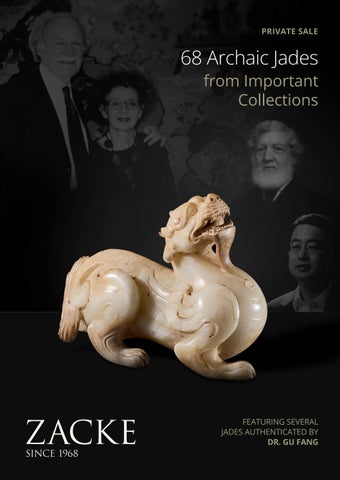
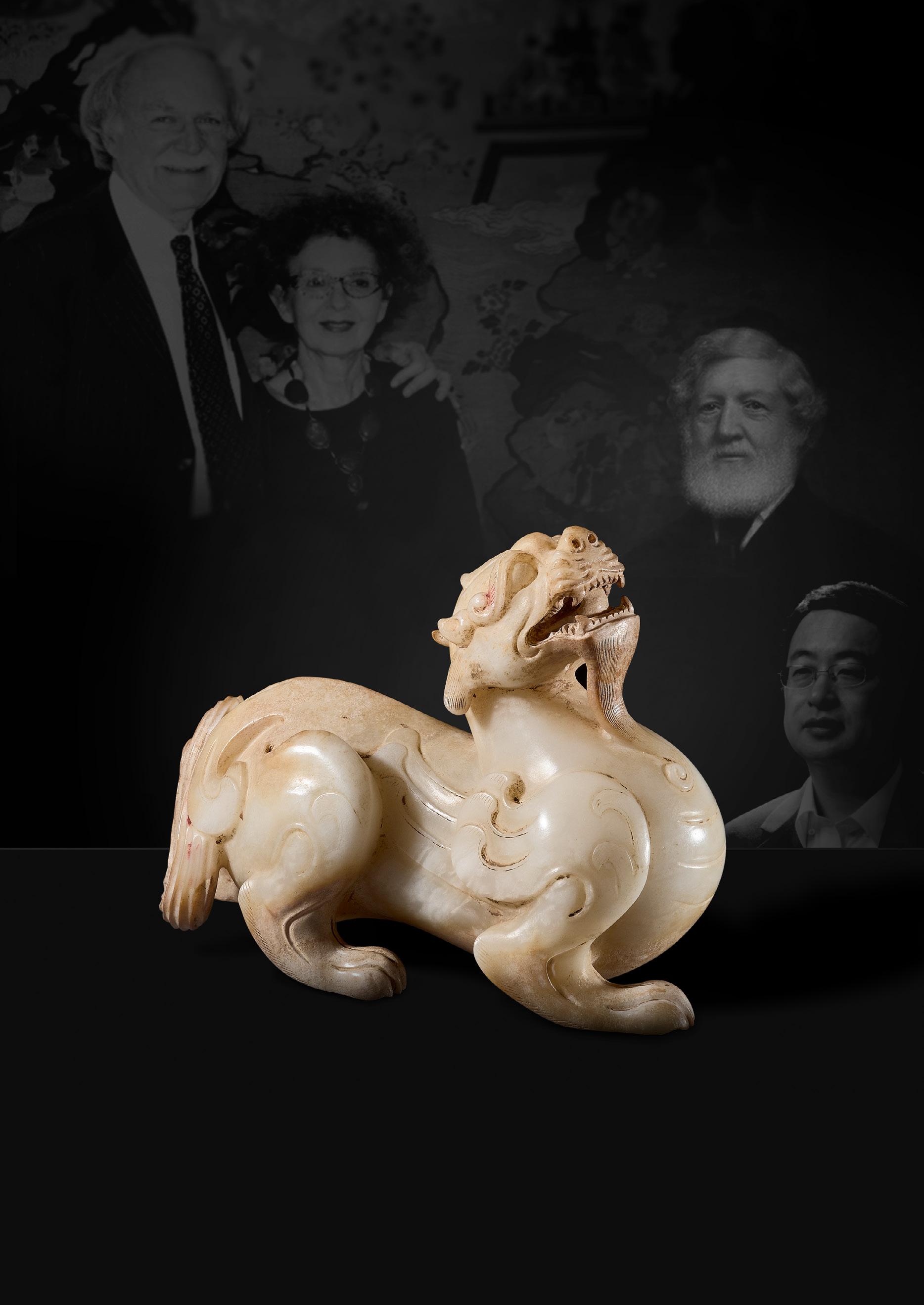
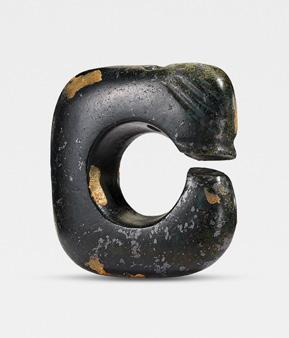
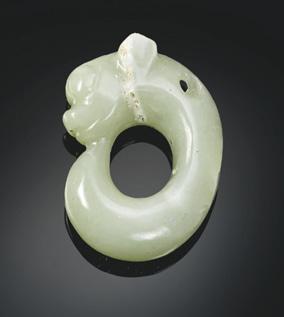
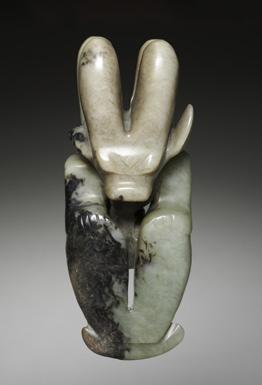
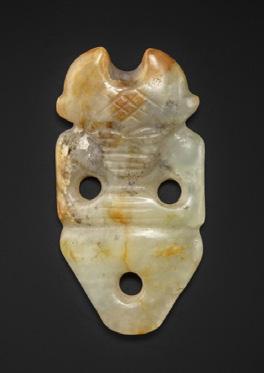
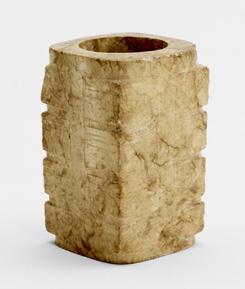
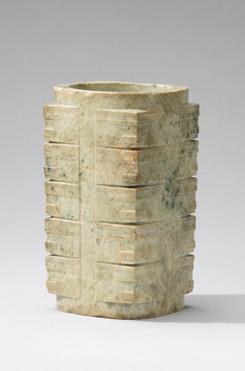
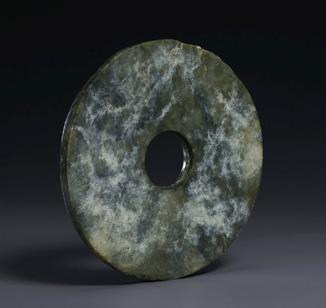
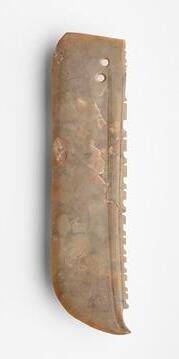
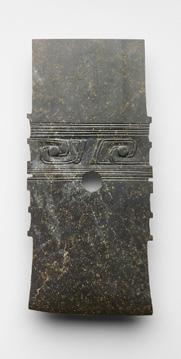
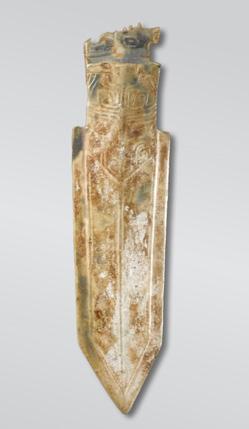
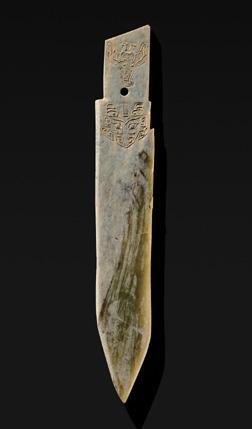
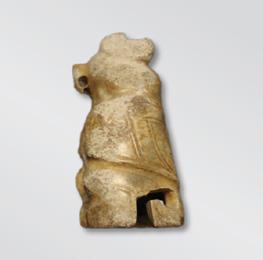
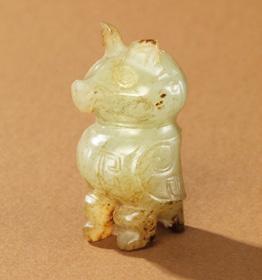
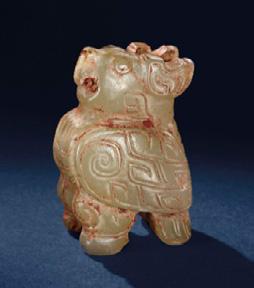
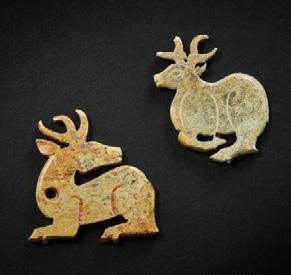
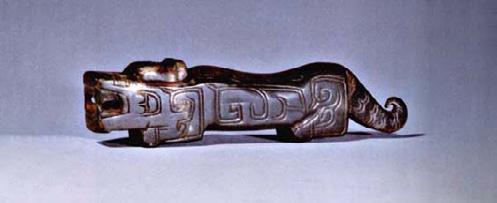
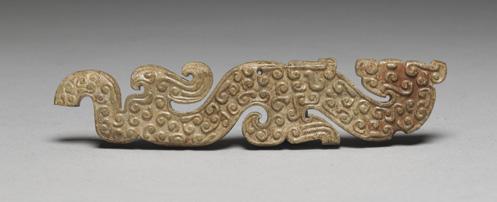
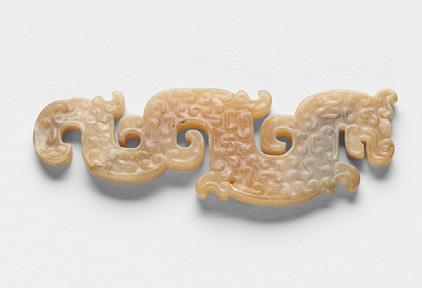
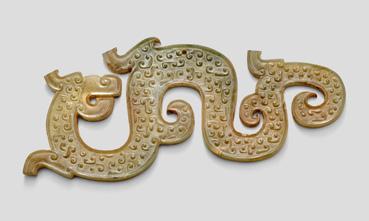
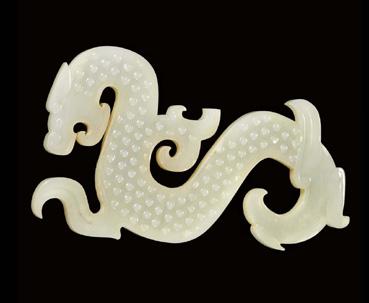
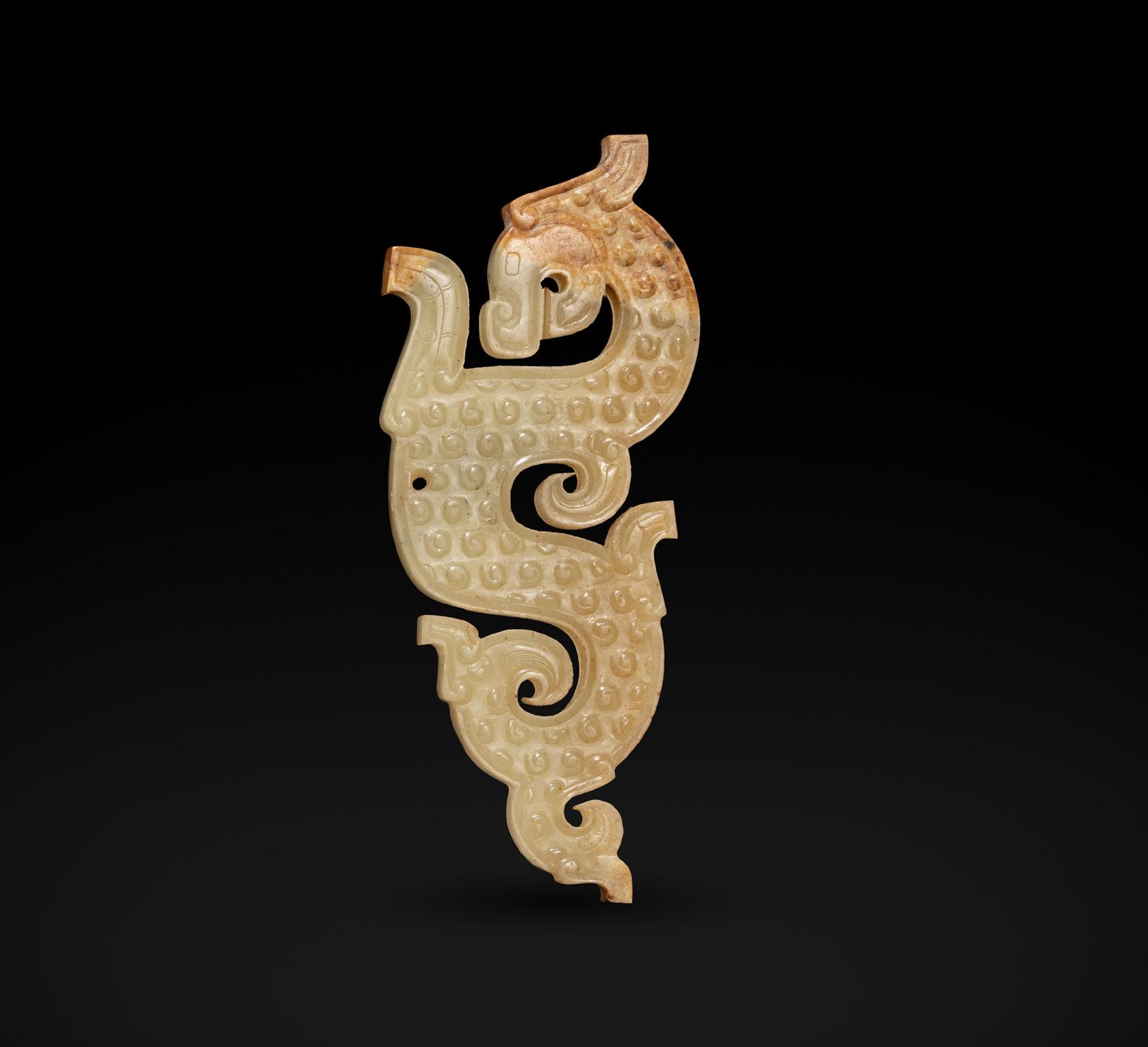
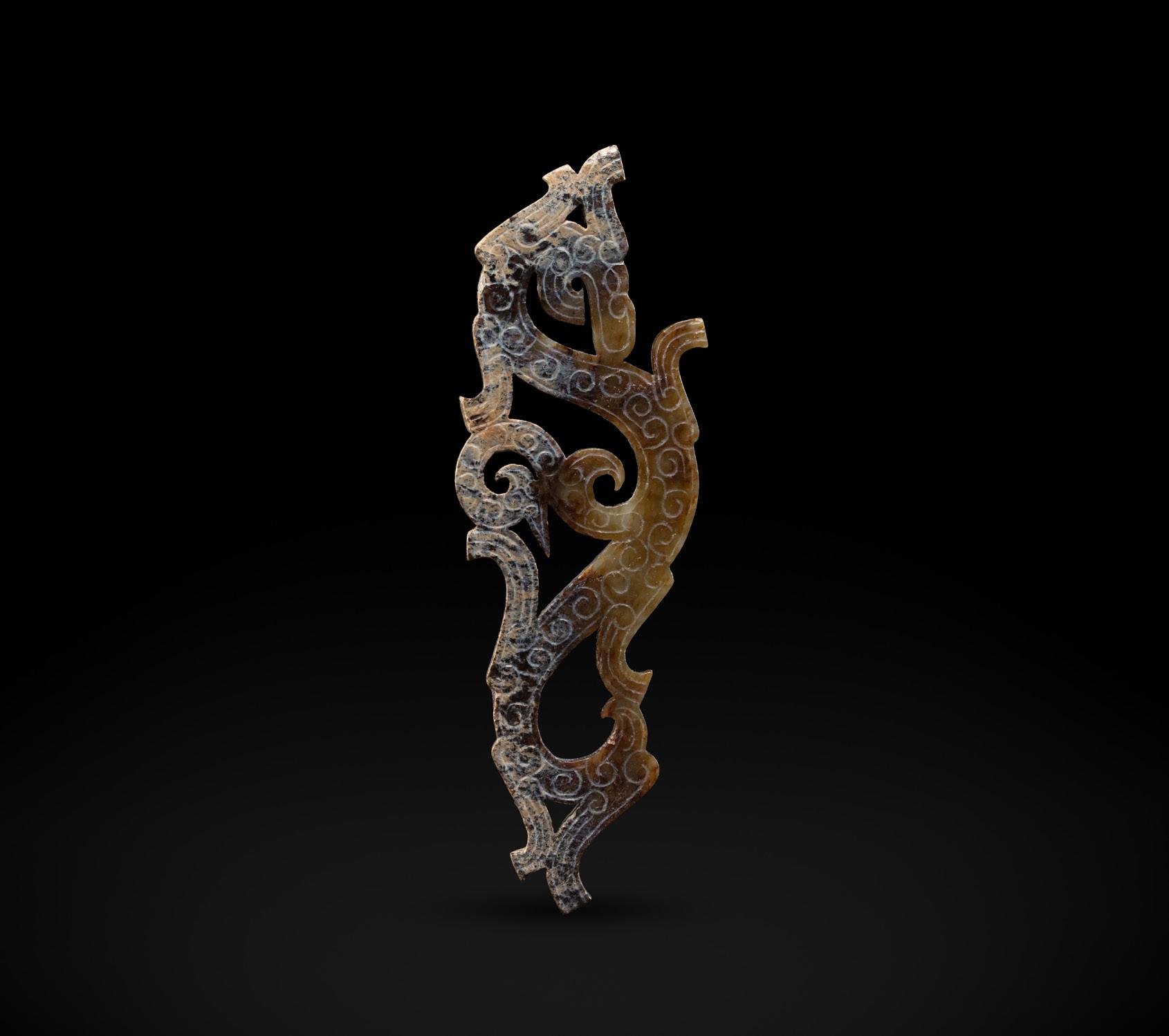
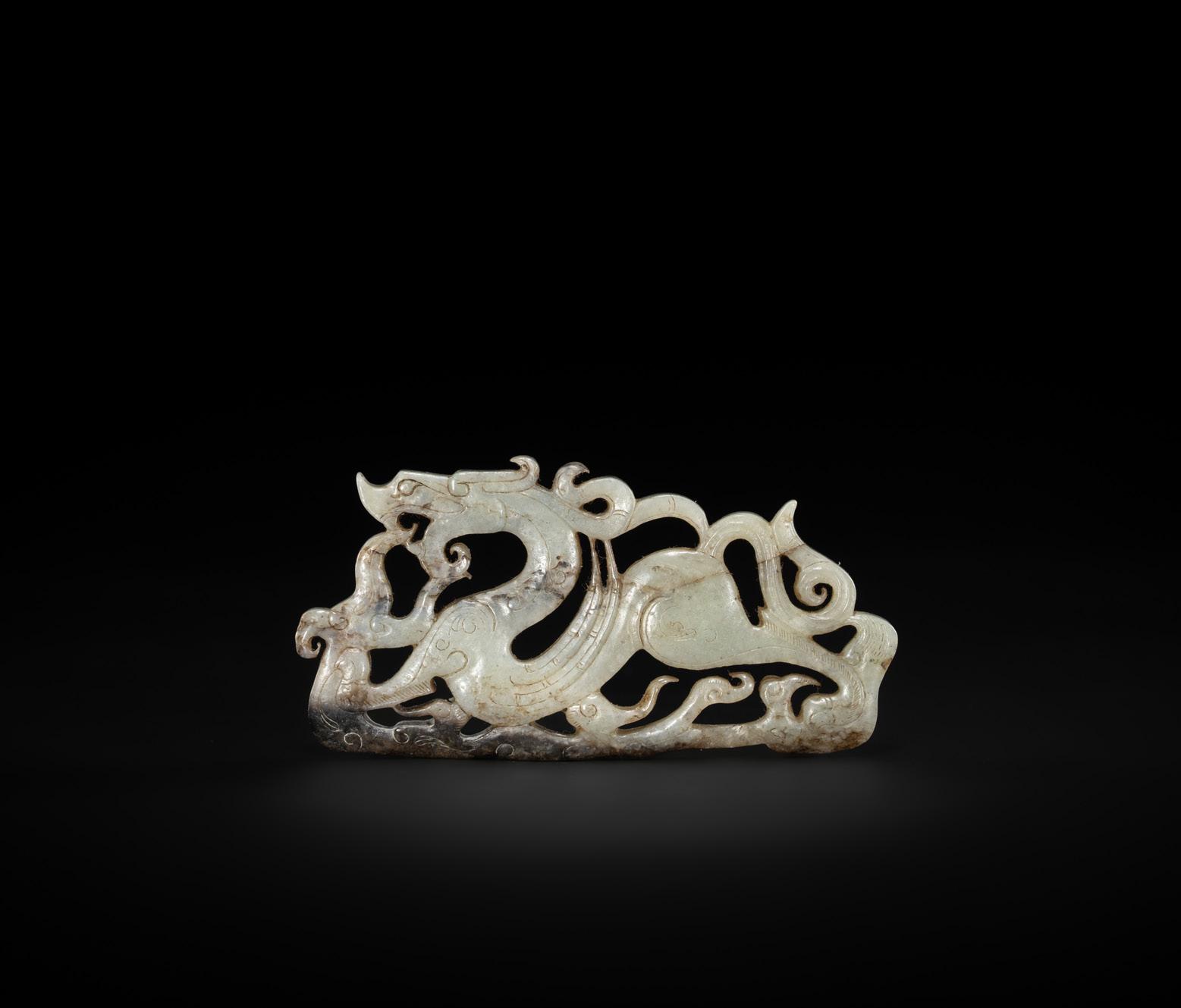
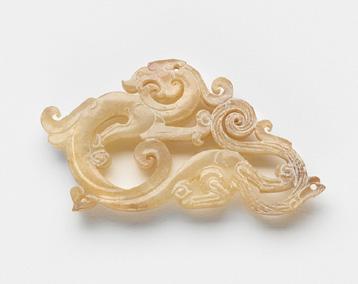
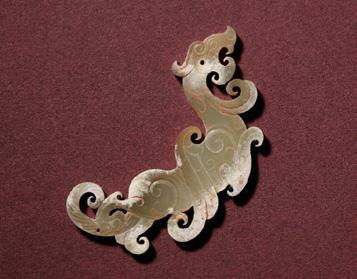
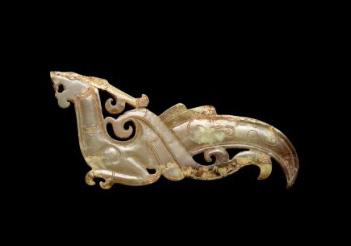
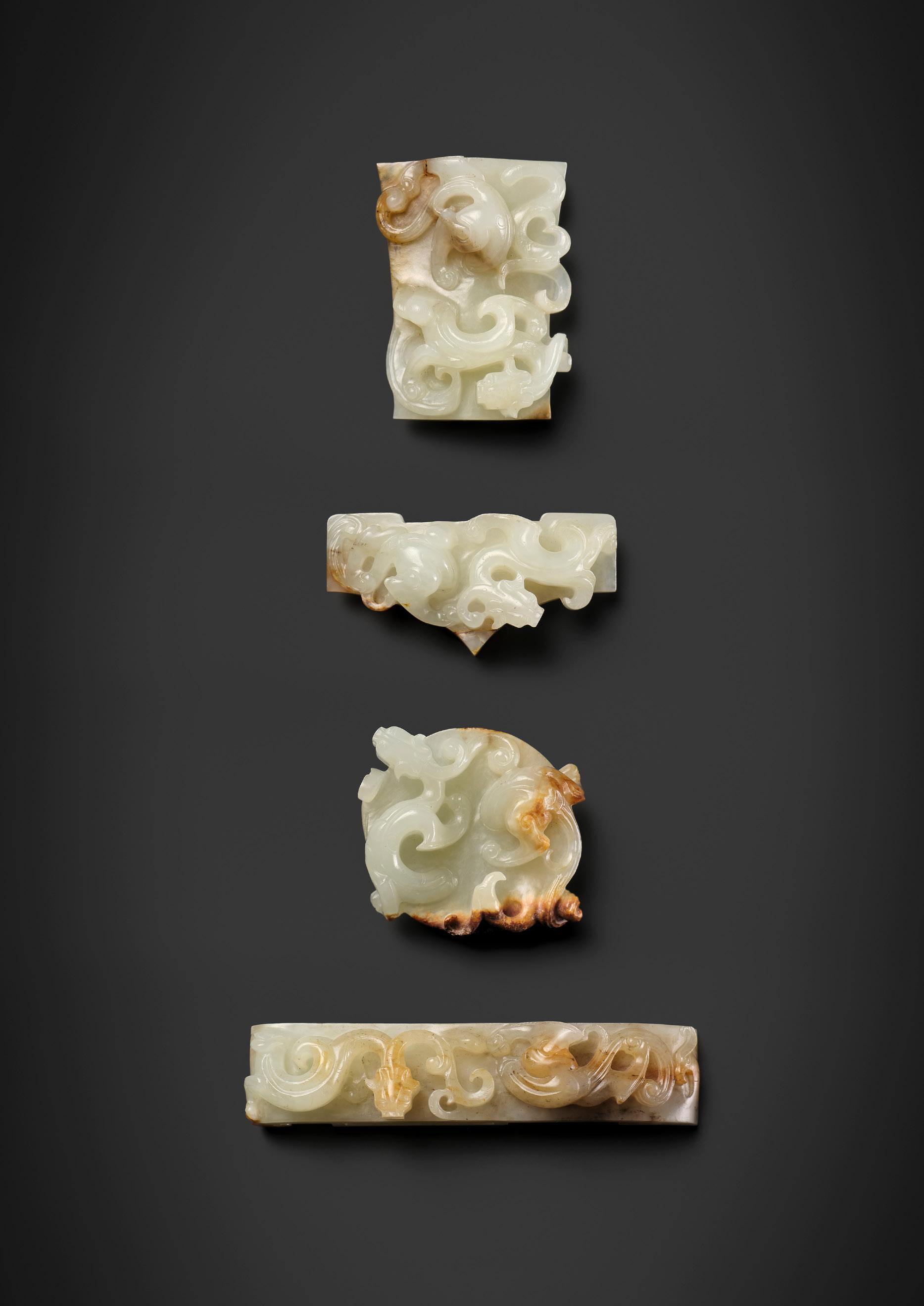
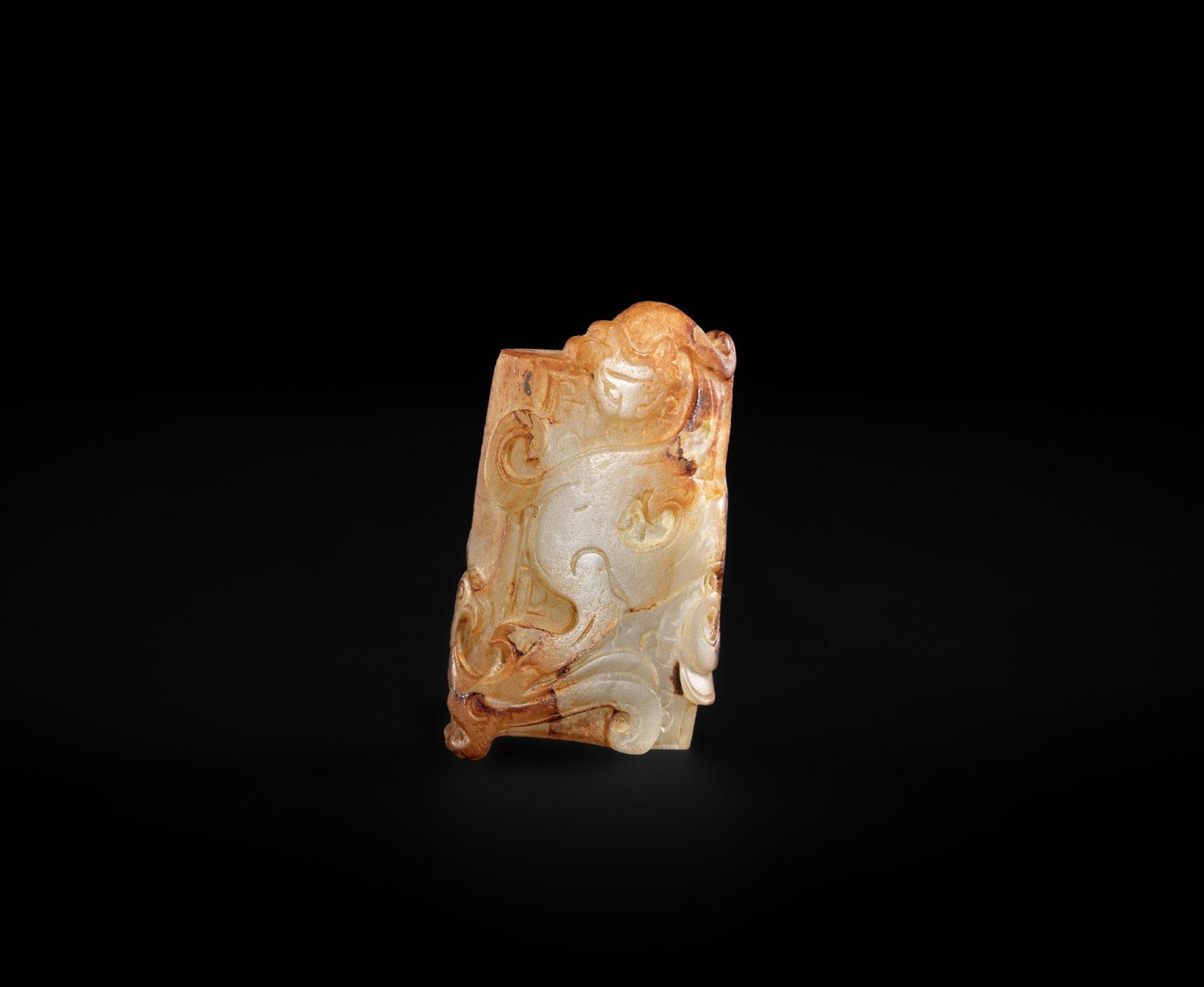
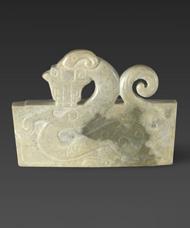
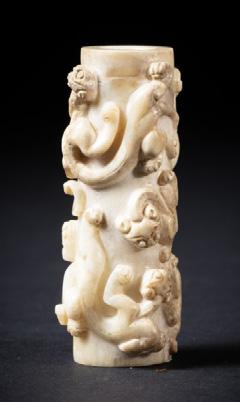
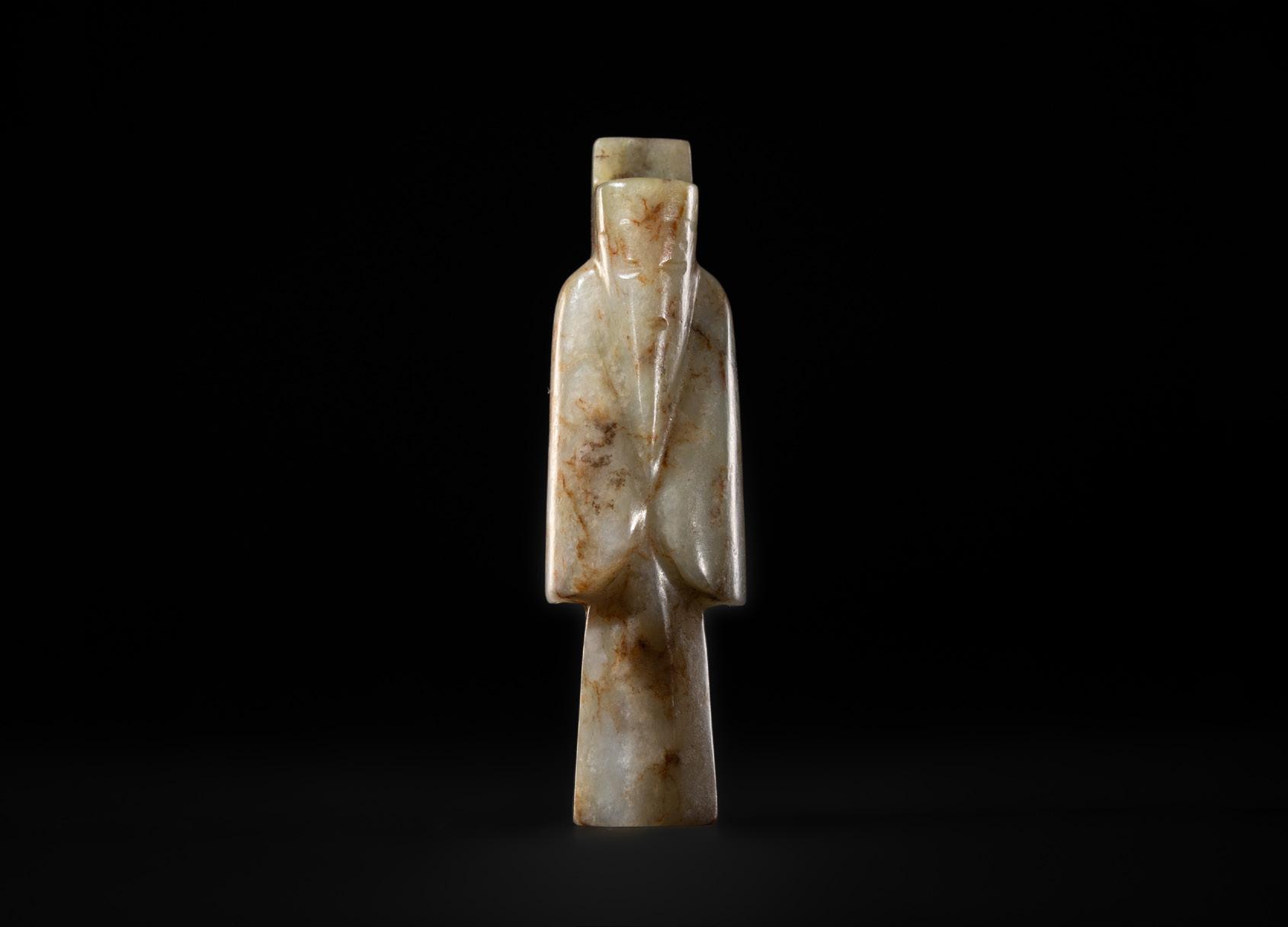
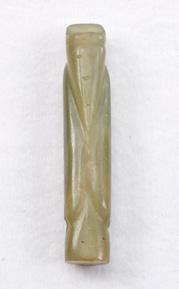
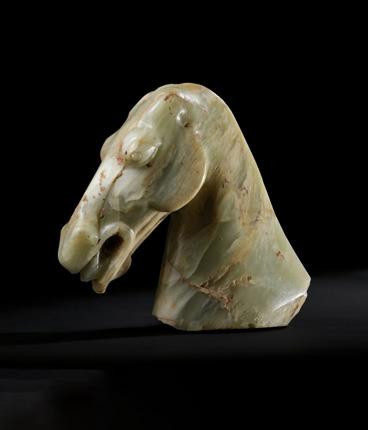
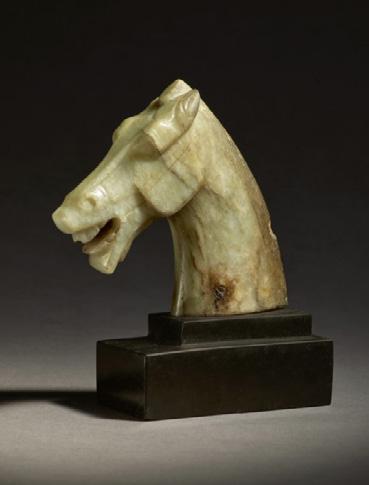
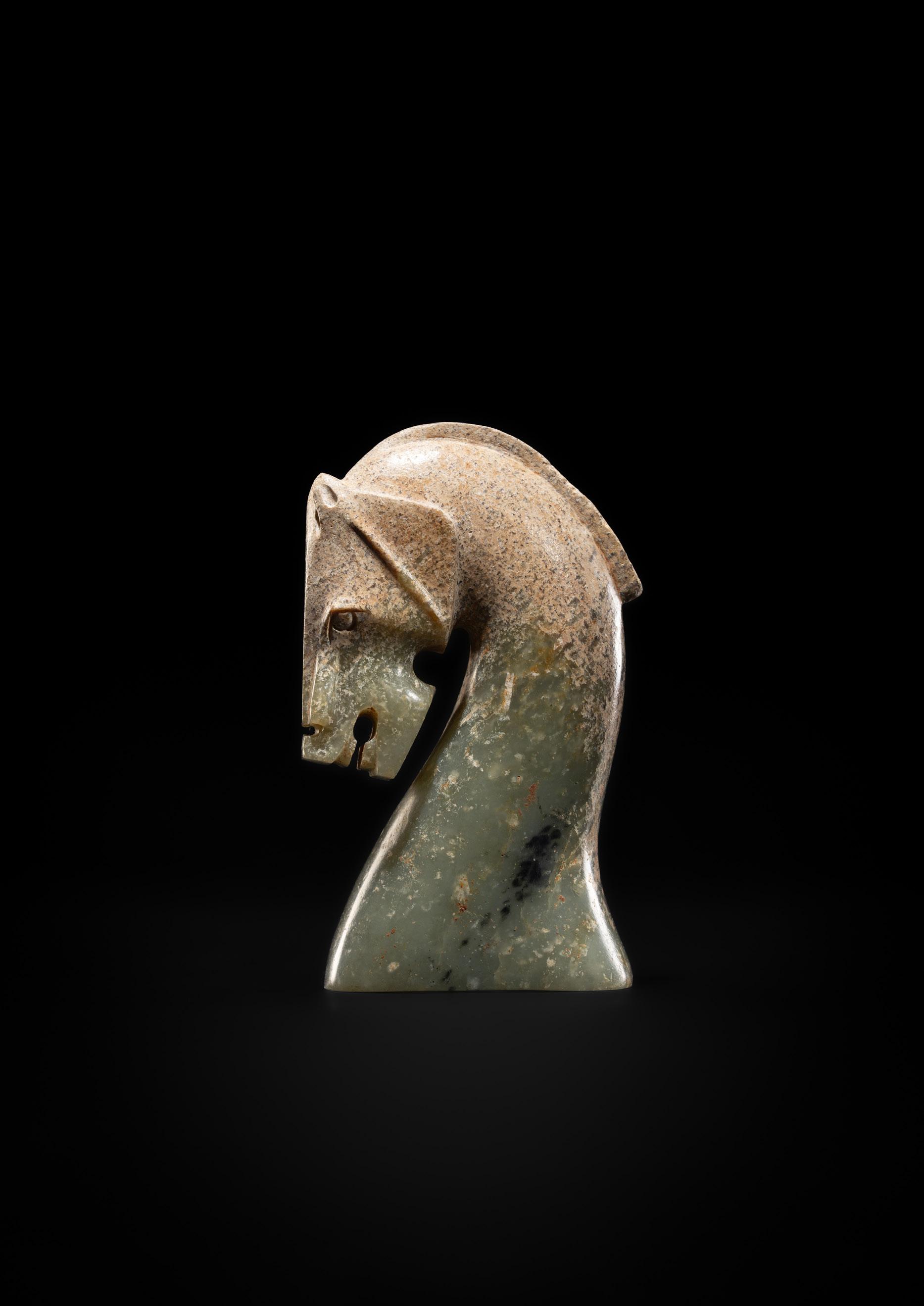
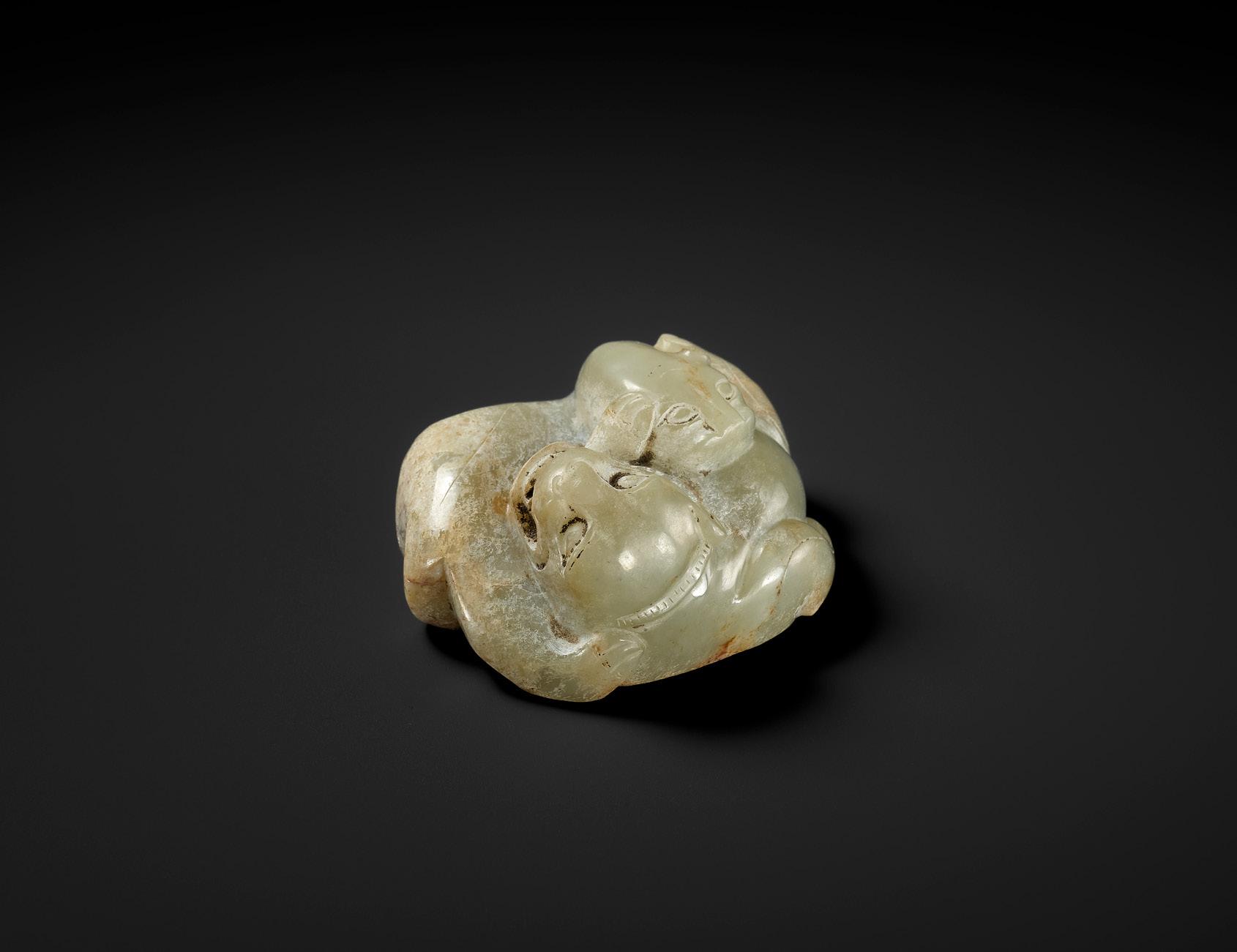
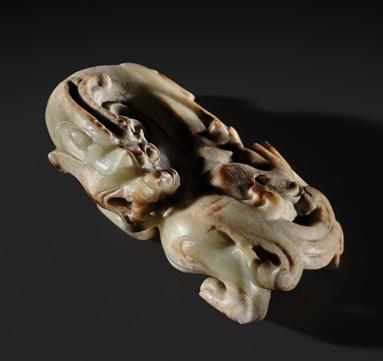
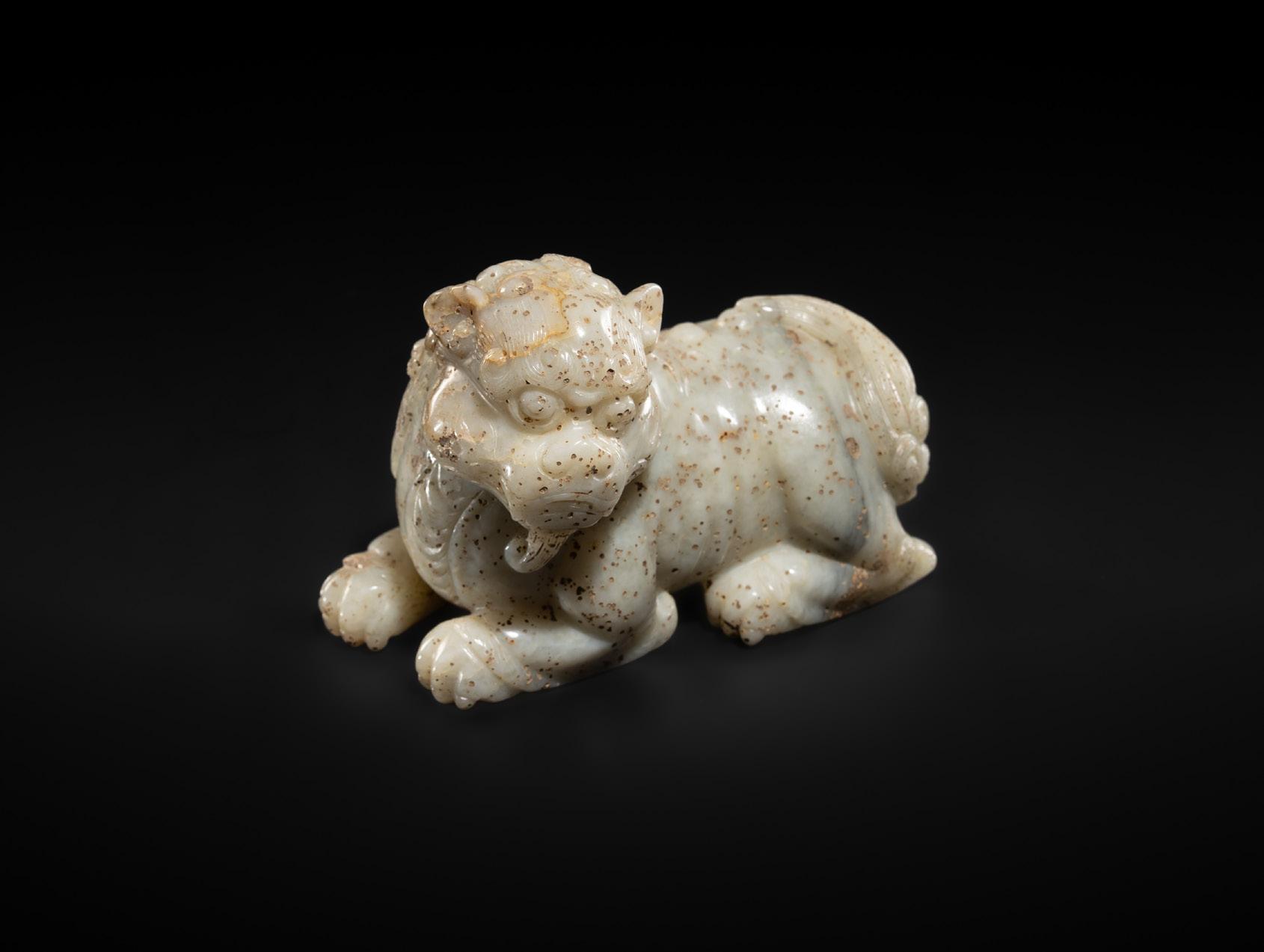
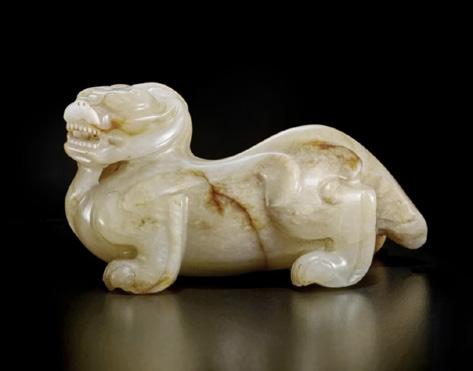
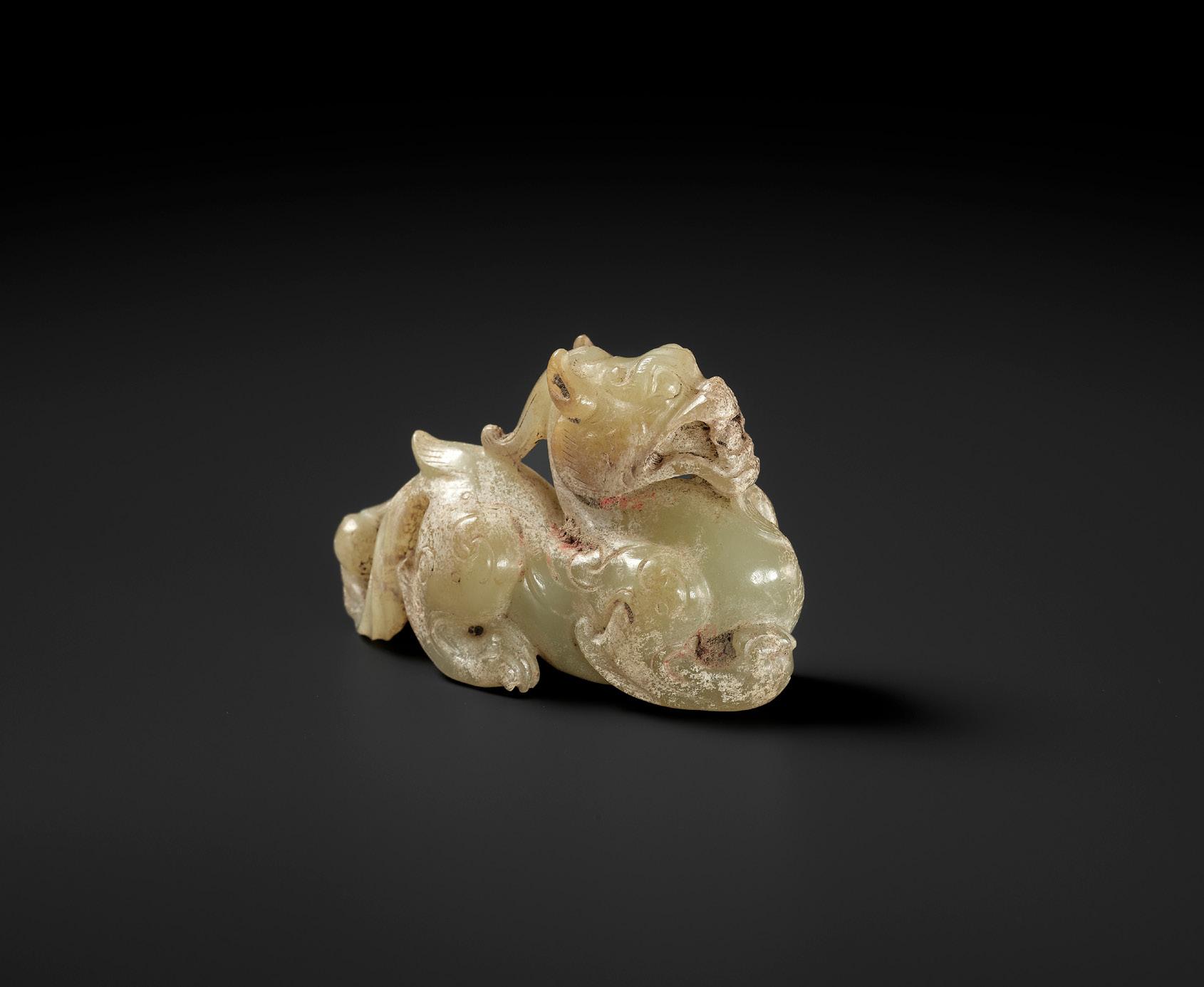
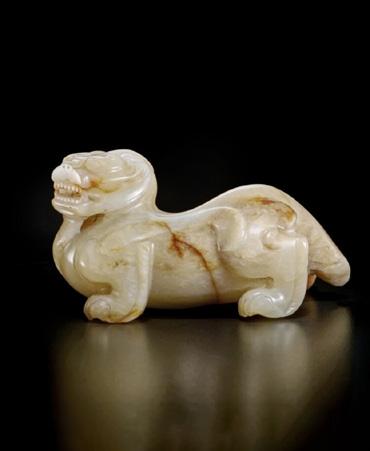
The Sam and Myrna Myers Collection
We are immensely proud to have been entrusted by Sam Myers with the stewardship of his collection, one that has traveled across the globe and already inspired countless scholars, connoisseurs, and enthusiasts.
This private sale presents a rare opportunity to acquire a curated selection of jades from this important collection at fair market value.
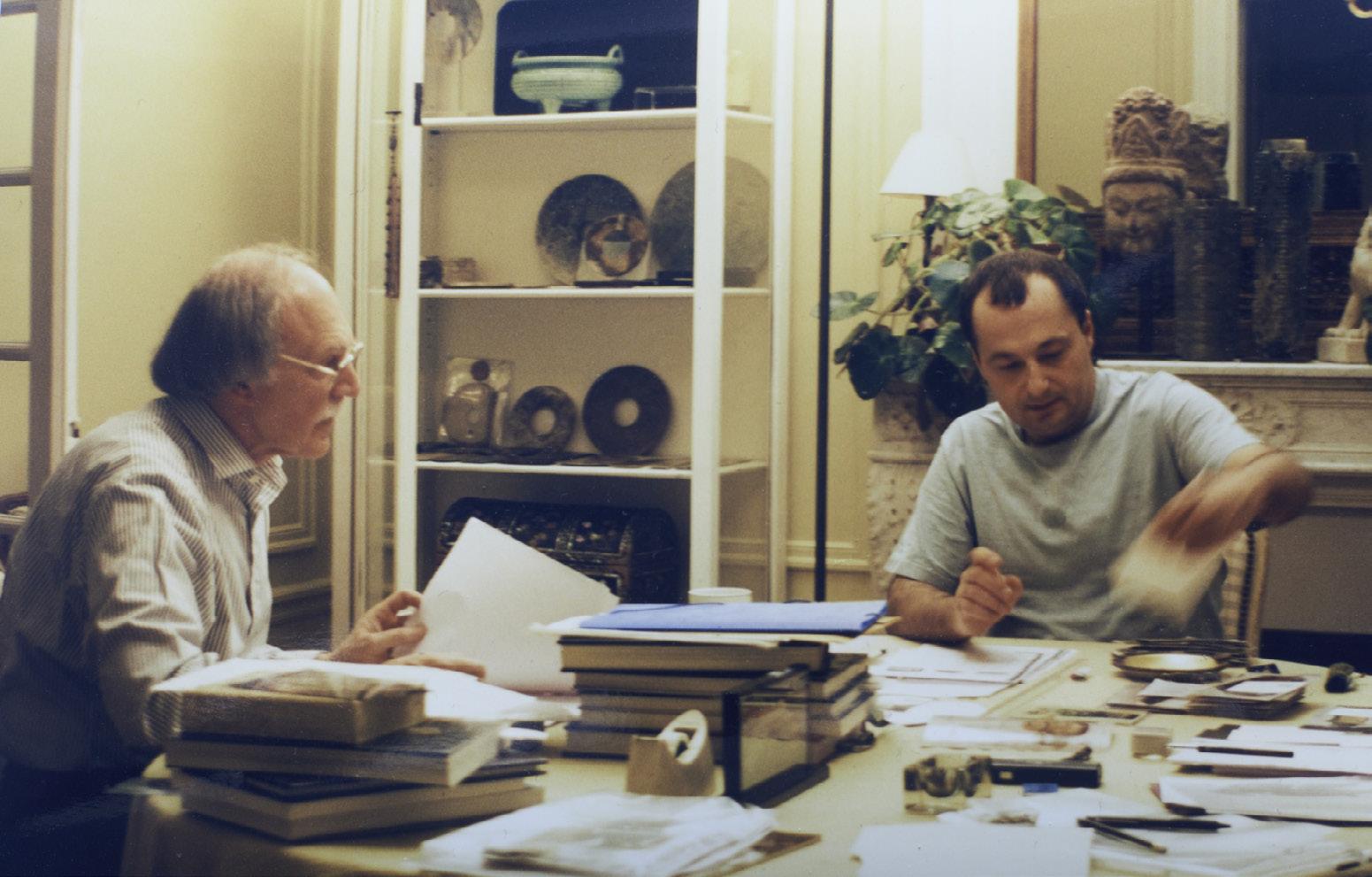
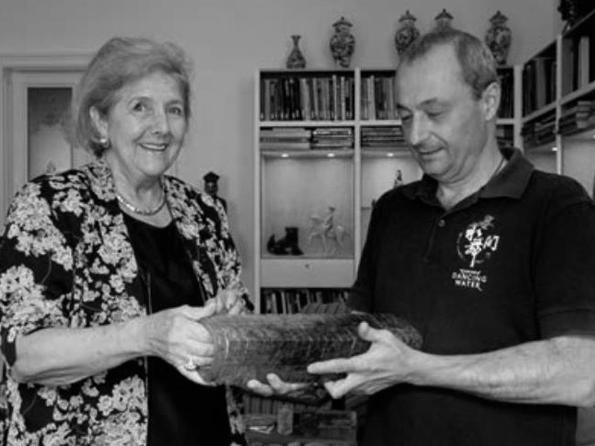
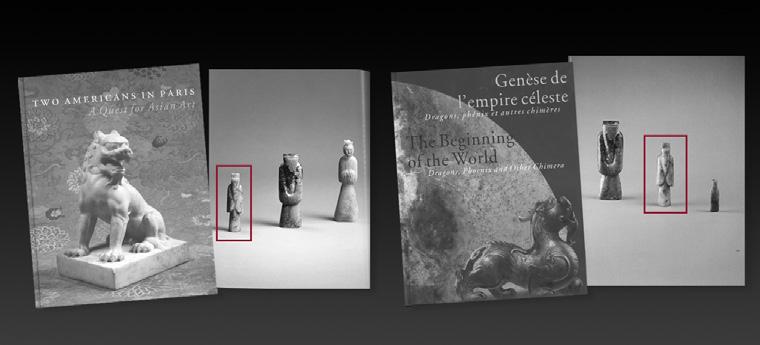
Sam and Myrna Myers (d. 2012) are first generation Americans, who shared a taste for collecting beautiful objects of art. On a trip to Ascona, Switzerland, the couple stumbled into a small antique shop which started their journey of collecting antiques. When Sam Myers was sent to Paris by his law firm in the mid-1960s, he and his wife Myrna became so enamored with the city that they decided to make it their home. There, over the course of 50 years, they built an extraordinary art collection, and
Publications
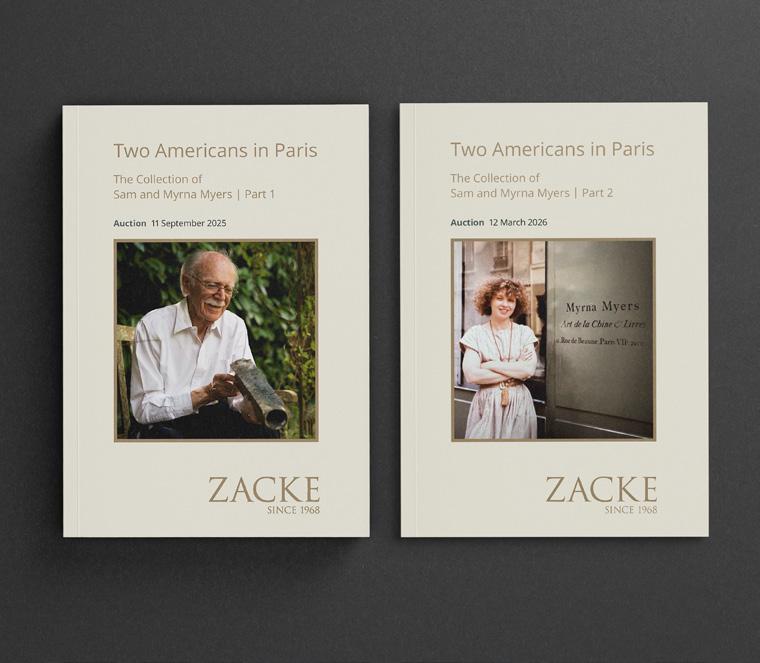
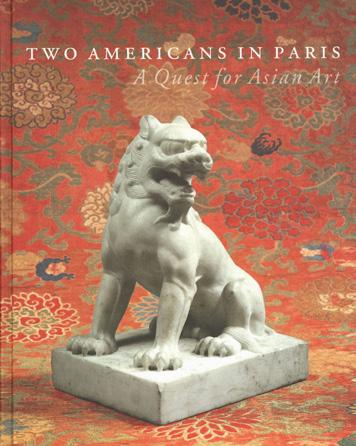
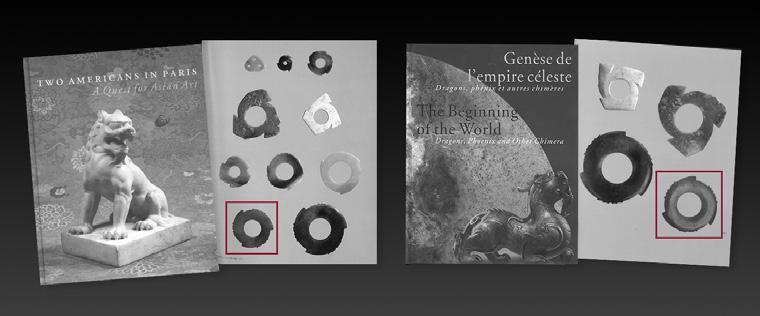
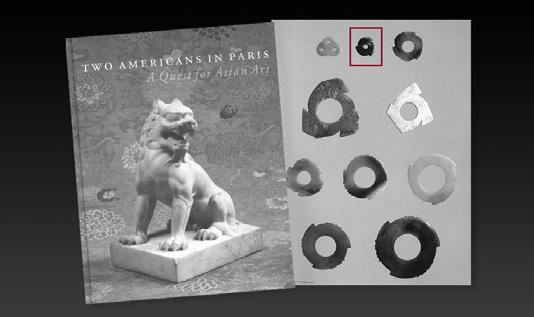
Jean-Paul Desroches, Two Americans in Paris: A Quest for Asian Art. Lienart, Paris, 2016
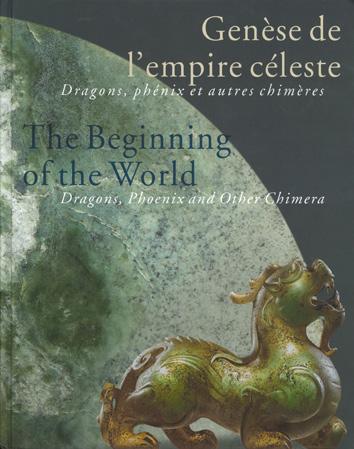
Jean-Paul Desroches, The Beginning of the World Dragons, Phoenix and Other Chimera, Lienart, Paris, 2020
In 2025 and 2026 already two parts of the Sam and Myrna Myers Collection were auctioned in these rooms with great success.
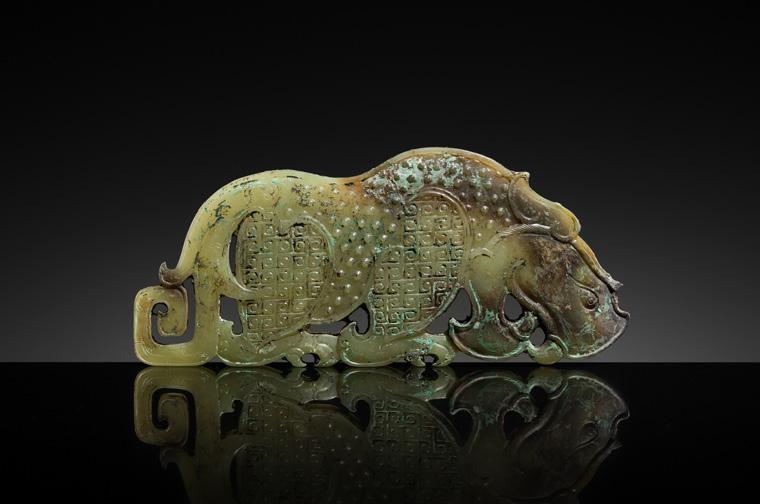
A fine and large green jade ‘rhinoceros’ plaque, Warring States-Western Han dynasty, from the Sam and Myrna Myers Collection sold for EUR 130,000 at Zacke in 2025.
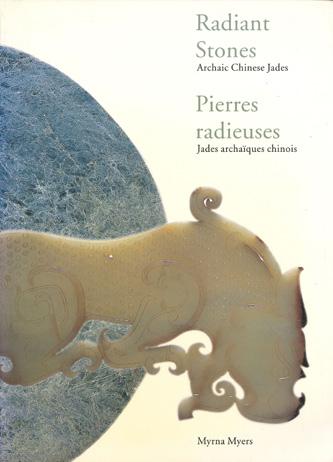
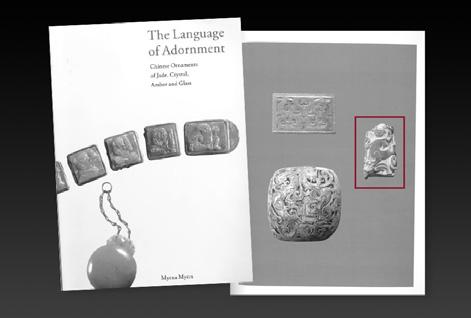
in 1976, Myrna opened a gallery in Paris specializing in Asian art. Their collection spans a wide range of precious objects from Chinese jades, ceramics, textiles, Indian ivory carvings, to Japanese clothing and lacquer, some of which was exhibited in the Kimbell Art Museum. Part of their collection was sold at Sotheby’s, London, ‘Two Americans in Paris, The Collection of Sam and Myrna Myers’, on 4 November 2021. The couple also worked together with jade expert Filippo Salviati to create one of the most outstanding jade collections globally and authored several books on jade, including Radiant Stones (2000), The Language of Adornment (2002), and Genèse de l’Empire Céleste (2020).
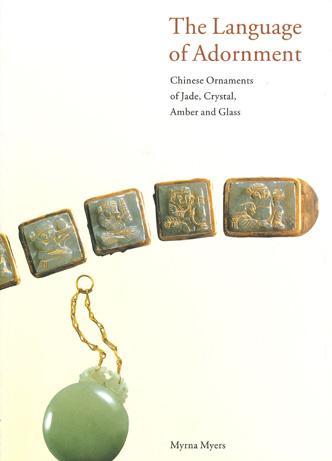
Filippo Salviati, The Language of Adornment: Chinese Ornaments of Jade, Crystal, Amber and Glass from the Neolithic Period to the Qing Dynasty, Myrna Myers, 2002
Filippo Salviati, Radiant Stones: Archaic Chinese Jades, Myrna Myers, Paris, 2000
David Taylor
David Taylor (1876-1958) was a prominent British businessman based in Belfast who owned several commercial properties and a substantial portfolio of stocks and shares. During his travels to East Asia in the early 20th century, he acquired numerous jades, which remained in his family for nearly a century. His grandfather, Sir David Taylor (1815-1904), was born in Perth, Scotland, and relocated to Belfast in 1842, where he served as mayor in 1867, and again in 1883 and 1884.
Prof. Filippo Salviati
Filippo Salviati is Associate Professor of Chinese and Korean Art and Archaeology at the Department of Oriental Studies, Sapienza University of Rome. His research, spanning approximately four decades, focuses on the art and material culture of East Asia, with particular emphasis on Chinese archaic jades, Buddhist art, and the historical development of Chinese and Korean visual traditions. His most signifi cant publications include 4000 years of Chinese archaic jades The development of the jade-carving tradition from the Neolithic to the Han dynasty (2017), a key reference on the evolution of jade craftsmanship and symbolism in ancient China, and L’arte cinese (2009), a widely used academic overview of Chinese art history.
Sir David Taylor, Mayor of Belfast (1867 and 1883-1884), grandfather of David Taylor (1876-1958)
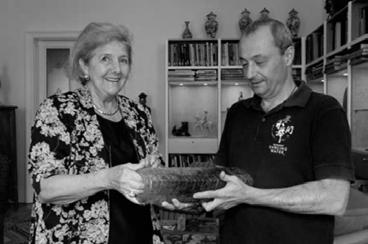
Irene Zacke and Filippo Salviati
ORDER FORM
Private Sale: 68 Archaic Jades from Important Collections
PSJAD0626
TE RMS OF PAYMENT, S HI PPING AND COLLECTION:
ADDRE S S
CITY, COUNTRY
POSTCODE
PHO NE N UMBER
GALERIE ZACKE NA ME
CREDIT C AR D PAYMENT
PLEASE CHECK THE DESIRED CARD
COLLECTION BY CLI ENT W IT H PAYMENT ON THE PREMISES IN CASH, BY CERTIFIED CHEQUE OR CREDIT CARD
INVOICE PAYMENT
VIA BANK WIRE AFTER RECEIPT OF INVOIC E SHIPPING AFTER RECEIPT OF PAYMENT
EXPRESS PARCEL SERVICE
REQUIRED (ACCOR DING TO TERMS AND CONDITIONS OF GALERIE ZACKE)
SHIPPING INSURANCE
REQUIRED (ACCOR DING TO TERMS AND CONDITIONS OF GALERIE ZACKE)
Zelinkagasse 6, 1010 Vienna, Austria
Email: office@zacke.at
Tel: +43-1-532 04 52
Fax: +43-1-532 04 52 20
DATE & SIGNATURE IMPORTANT NOTICE:
At its sales, Galerie Zacke sells consigned lots on behalf of third-party consignors. For t his reason, any complain ts related to purchase d lots must be reported to Galerie Zacke within 6 weeks after the receipt of such lot.
All sales are according to the general terms and conditions of business of Galerie Zacke Vienna, Founded 1968, SZA Versteigerungen & Vertriebs GmbH, 1010 Wien, online at www zacke.at
Literature comparison:
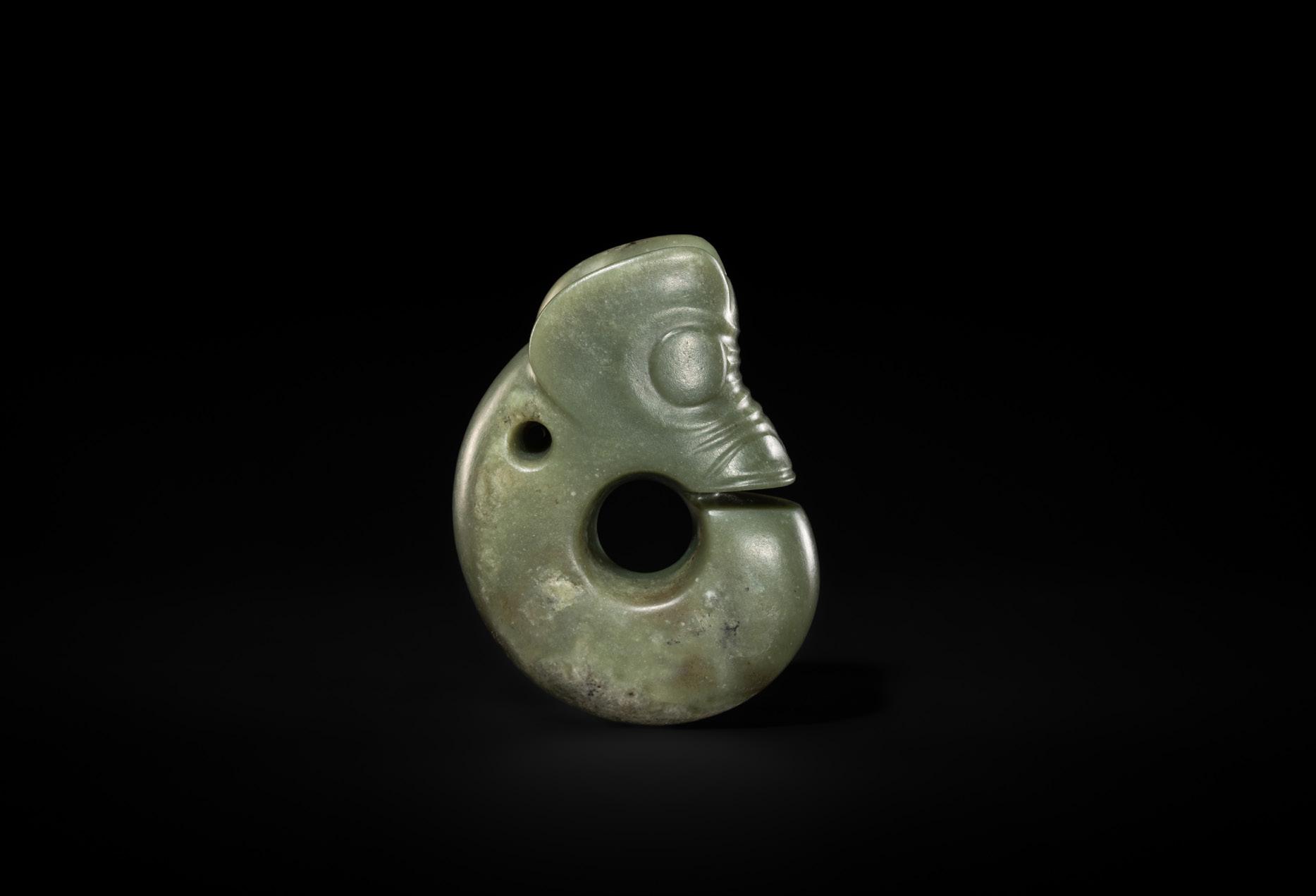
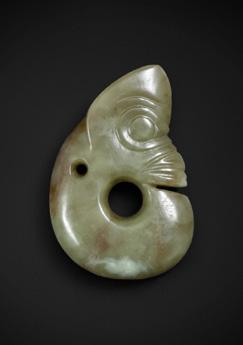
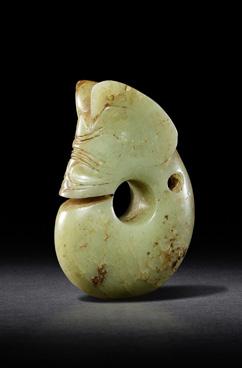
1 A GREEN JADE ‘PIG-DRAGON’ PENDANT (ZHULONG), LATE NEOLITHIC PERIOD, HONGSHAN CULTURE
EXPERT AUTHENTICATION
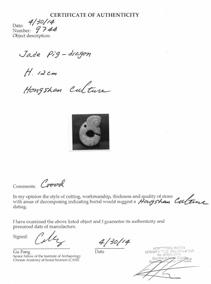
Dr. Gu Fang has examined the present lot and confirms its authenticity and the dating above, noting the style of cutting, workmanship, thickness, and quality of stone with decomposed areas indicating burial, all suggesting a dating to the Hongshan culture. He assessed it as a piece of notably good quality. A signed and notarized copy of Dr. Gu’s expertise, dated 30 August 2014, accompanies this lot.
Northeastern China, Inner Mongolia, 4700-2500 BC. Boldly carved, the coiled body of the mythical creature extending into a finely rendered head, subtly articulated with bulging eyes, a wrinkled snout, and flared nostrils. The slit beneath the lips terminates sharply before reaching the circular aperture that centers the carving, which has been perforated from both sides, as is the smaller aperture for suspension on the neck of the figure. The superbly polished, semi-translucent stone of deep green hue, enlivened by whitish inclusions and dark mottling.
Provenance: From a private collection in New York, United States.
Condition: Excellent condition with only minor surface wear and natural age-related imperfections.
Weight: 337.5 g
Dimensions: Height 9.7 cm
Compare a closely related jade ‘pig-dragon’ pendant, Neolithic period, Hongshan culture, 4700-2900 BC, 6.3 cm high, in the British Museum, registration number 2022,3034.46. Compare a closely related jade pendant in the shape of a coiled ‘pig-dragon’, Neolithic period, Hongshan culture, 4700-2900 BC, 10.4 cm high, found at the Qing period tomb at Shisicang, Wuqing, Tianjin, now in the Center for Cultural Heritage Preservation of Tianjin, illustrated by Gu Fang, The Complete Collection of Jades Unearthed in China, vol. 1, 2005, p. 103.
AUCTION RESULT COMPARISON
Type: Closely related
Auction: Sotheby’s Paris, 10 June 2021, lot
Price: EUR 327,100 or approx. EUR 390,000 adjusted for inflation at the time of writing
Description: A celadon and russet jade ‘pigdragon’ zhulong, Neolithic period, Hongshan culture
Expert remark: Compare closely related form, manner of carving, and color of the stone. Note the similar size (8.5 cm).
AUCTION RESULT COMPARISON
Type: Closely related
Auction: Bonhams Hong Kong, 29 May 2024, lot 355
Price: HKD 893,000 or approx. EUR 104,000 converted and adjusted for inflation at the time of writing
Description: A pale green jade ‘pig-dragon’ carving, Neolithic period, Hongshan culture
Expert remark: Compare closely related form, manner of carving, and color of the stone. Note the similar similar size (11 cm).
Purchase for EUR 7,500
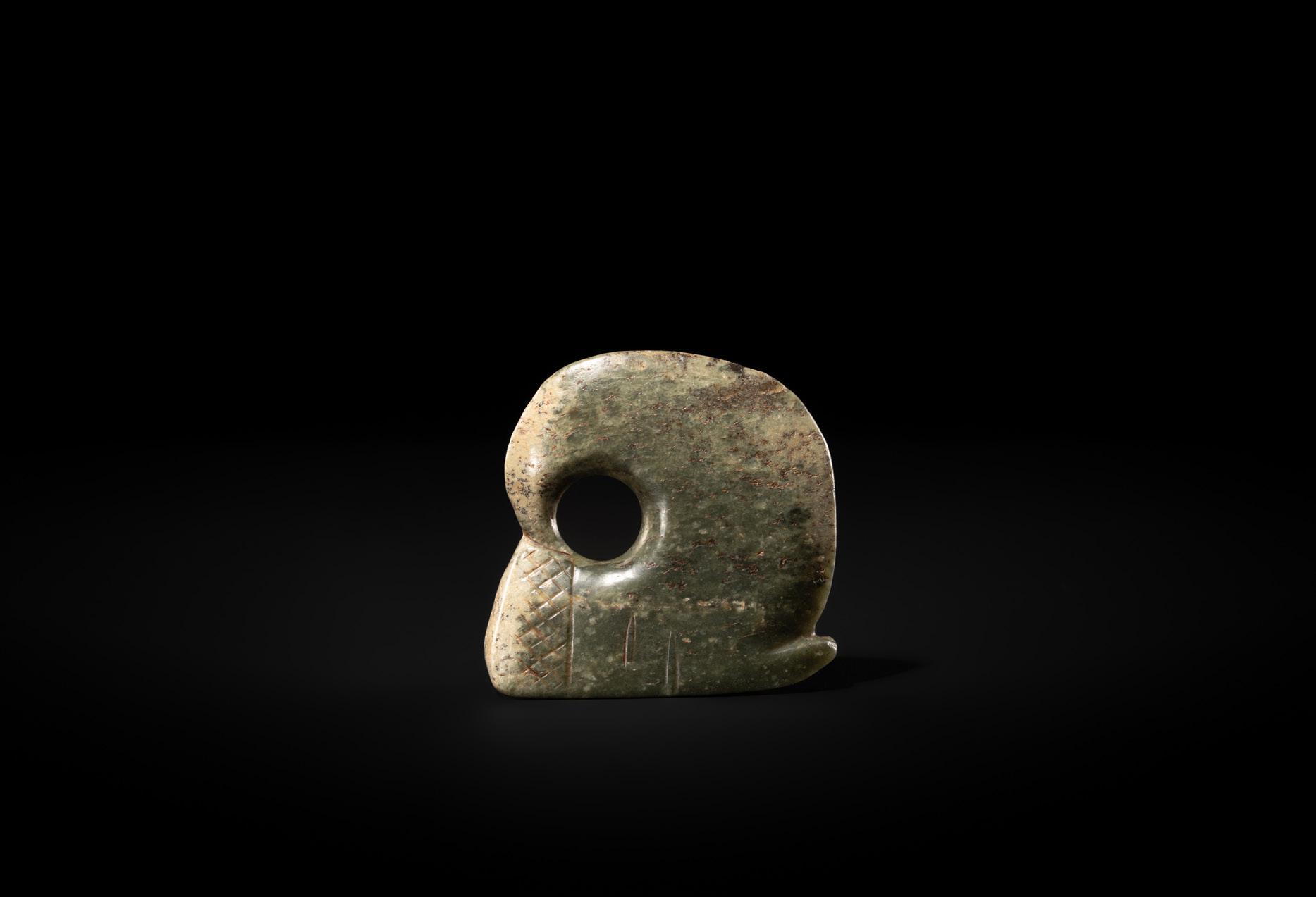
2 AN UNUSUAL DARK GREEN JADE ‘PIG-DRAGON’ PENDANT (ZHULONG), LATE NEOLITHIC PERIOD, HONGSHAN CULTURE
EXPERT AUTHENTICATION
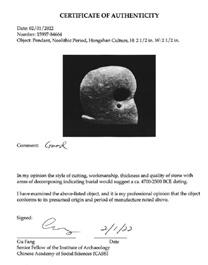
Dr. Gu Fang has examined the present lot and confirms its authenticity and the dating above, noting the style of cutting, workmanship, thickness, and quality of stone with decomposed areas indicating burial, all suggesting a dating to 47002500 BC. He assessed it as a piece of notably good quality. A signed copy of Dr. Gu’s expertise, dated 1 February 2022, accompanies this lot.
Northeastern China, Inner Mongolia, 4700-2500 BC. Of gently rounded form, boldly carved as a nascent pig-dragon (zhulong), its tail curling forward to meet its highly abstracted head, decorated on both sides with an incised cross-hatched pattern, extending into a subtly protruding crest, and vertically pierced for suspension. The finely polished, opaque stone of a dark greenish tone with creamy-white patches, dark shading, and few small cloudy inclusions.
Provenance: From a private collection in New York, United States. Condition: Very good condition, commensurate with age, with only minor surface wear, expected natural imperfections, and distinct traces of weathering and erosion.
Weight: 122.5 g
Dimensions: Length 6.7 cm
The highly abstracted form of the present jade figure represents an intriguing embryonic stage within the well-known repertoire of prototypical pendant forms of pig-dragons (zhulong), all typically articulated around a boldly perforated circular aperture that transversely pierces all of them,
characteristic of the Neolithic Hongshan culture of northeastern China. Despite the rudimentary rendering of the pig-dragon arguably depicted in the present carving when compared with more canonical examples, the coiling tail of the figure and its slightly protruding crest allow it to be associated with this family of enigmatic Hongshan mythical creatures.
AUCTION RESULT COMPARISON
Type: Related
Auction: Bonhams Hong Kong, 1 December 2020, lot 102
Price: HKD 140,000 or approx. EUR 17,000 converted and adjusted for inflation at the time of writing
Description: An opaque green stone ‘pigdragon’ pendant, possibly Neolithic period, early Hongshan Culture
Expert remark: Compare the related form, manner of carving, and opacity of the stone. Note the similar size (7.6 cm).
AUCTION RESULT COMPARISON
Type: Related
Auction: Christie’s Paris, 8 December 2021, lot 221
Price: EUR 10,000 or approx. EUR 12,000 adjusted for inflation at the time of writing
Description: A white jade ‘pig-dragon’ pendant, possibly Neolithic period, Hongshan culture
Expert remark: Compare the related form and manner of carving. Note the different color of the stone and smaller size (4.5 cm).
Purchase for EUR 9,000
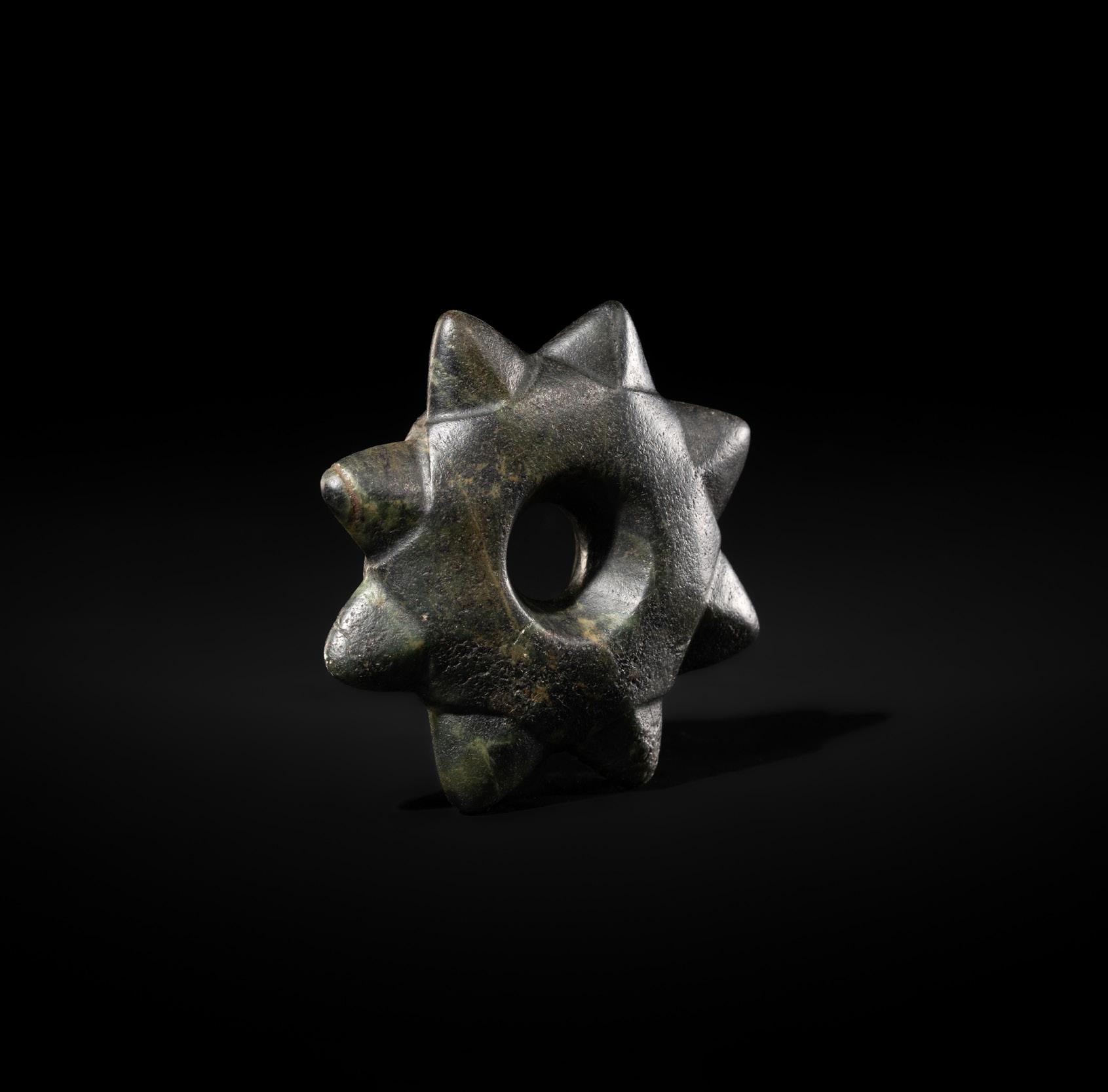
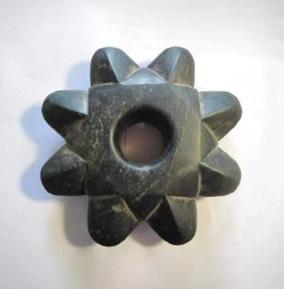
A VERY RARE DARK GREEN JADE STAR-SHAPED PENDANT, LATE NEOLITHIC PERIOD, HONGSHAN CULTURE
EXPERT AUTHENTICATION
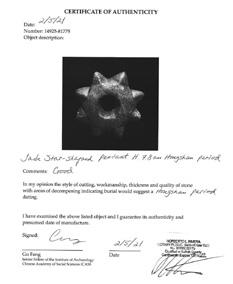
Dr. Gu Fang has examined the present lot and confirms its authenticity and the dating above, noting the style of cutting, workmanship, thickness, and quality of stone with decomposed areas indicating burial, all suggesting a dating to 4700-2500 BC. He assessed it as a piece of notably good quality. A signed and notarized copy of Dr. Gu’s expertise, dated 5 February 2021, accompanies this lot.
Northeastern China, Inner Mongolia, 4700-2500 BC. Finely carved, of flattened and rounded form, pierced at the center from both faces with a circular aperture, the outline articulated with eight radiating, pointed protrusions forming a star-like configuration. The well-polished, opaque stone of a dark hue with variegated shadings and inclusions in varying shades of dark green.
Provenance: From a private collection in New York, United States. Condition: Very good condition, commensurate with age, with minor surface wear, expected natural imperfections, and usual traces of weathering and erosion.
Weight: 97.4 g
Dimensions: Length 7.5 cm
LITERATURE COMPARISON
Compare a closely related dark green jade star-shaped pendant, late Neolithic period, Hongshan culture, 4700-2500 BC, in the Rende North Ancient Civilization Museum.
Purchase for EUR 4,500
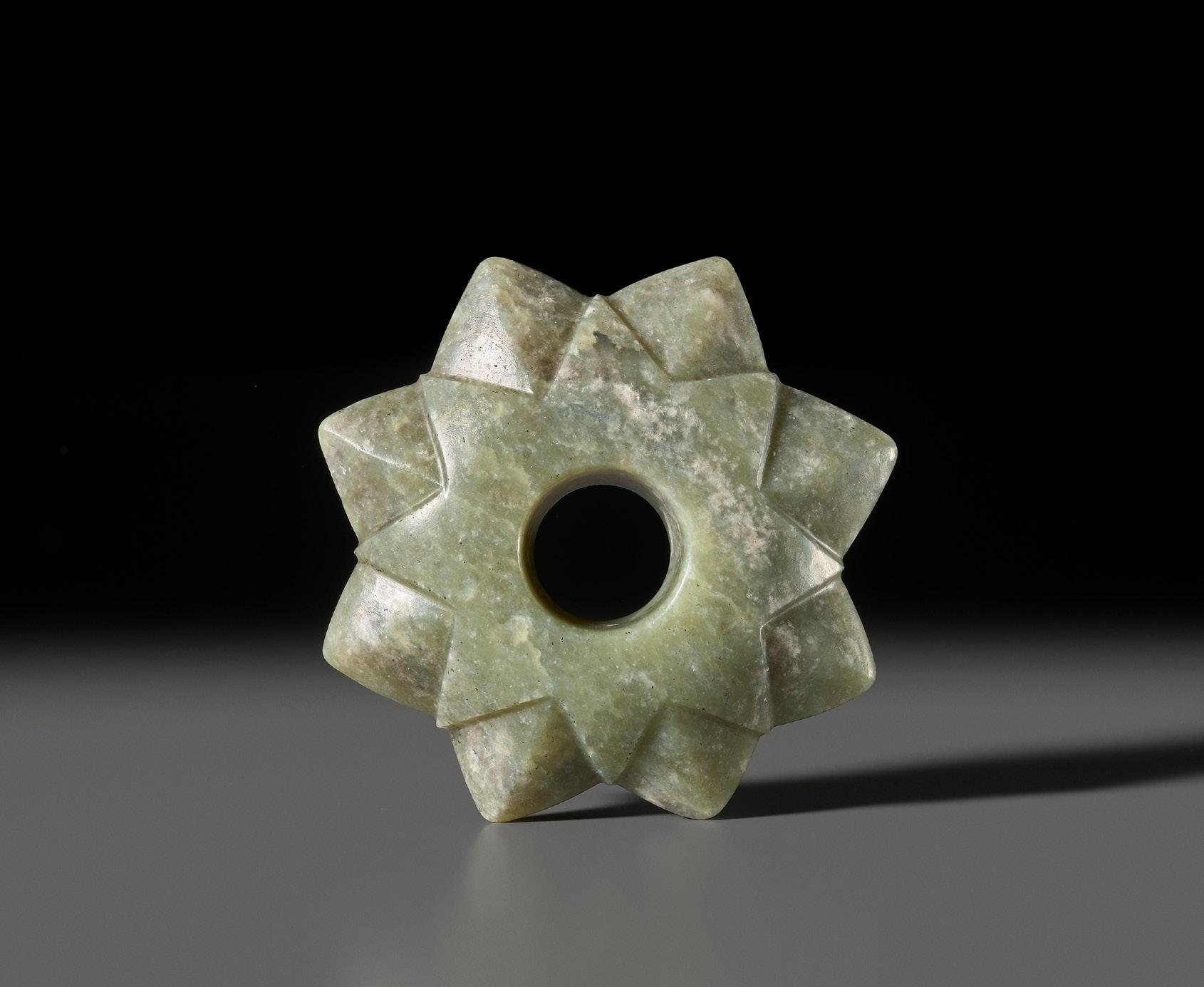
4 AN EXCEEDINGLY RARE CELADON JADE STAR-SHAPED PENDANT, LATE NEOLITHIC PERIOD, HONGSHAN CULTURE
EXPERT AUTHENTICATION
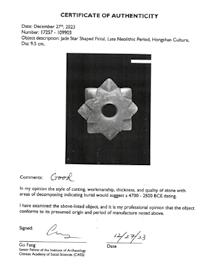
Dr. Gu Fang has examined the present lot and confirms its authenticity and the dating above, noting the style of cutting, workmanship, thickness, and quality of stone with decomposed areas indicating burial, all suggesting a dating to 47002500 BC. He assessed it as a piece of notably good quality. A signed copy of Dr. Gu’s expertise, dated 27 December 2023, accompanies this lot.
Northeastern China, Inner Mongolia, 4700-2500 BC. Superbly carved in a flattened octagonal form, slightly domed on both sides, and pierced at the center from both faces by a circular aperture. The outline articulated by eight radiating pointed projections, derived from the interlocking of two squares and a star-like configuration that harmoniously merges both geometric schemes. The exquisitely polished, semi-translucent stone of an appealing celadon hue, enlivened by icy white inclusions and delicate darker shadings.
Provenance: From a private collection in New York, United States. Condition: Excellent condition with only minor surface wear, natural age-related imperfections, and expected traces of weathering and erosion.
Weight: 234.3 g Dimensions: Length 9.6 cm
1
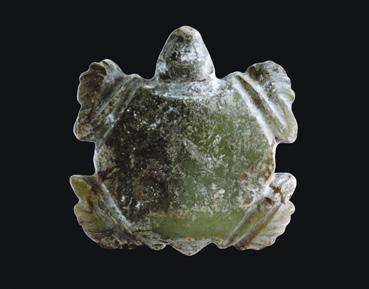
A celadon jade carving of a turtle, late Neolithic period, Hongshan culture, 3.9 cm long, excavated from Tomb no. 1 at Hutougou burial site, Fuxin, Liaoning Province, and illustrated in Gu Fang, The Complete Collection of Jades Unearthed in China, vol. 2, 2005, p. 119
Some scholars have sought to relate these exceedingly rare octagonal jade artefacts to the more widely known turtle-shaped carvings associated with the Hongshan culture. In these works, the stylized morphology of the turtle, with its head, tail, and limbs extending beyond the shell, can be seen as visually echoing the radial composition of the present star-shaped design (fig. 1). Beyond their formal resemblance, turtles were already revered at the time as emblems of longevity and endurance. Their very anatomy was also interpreted in cosmological terms, with the shell understood as a representation of the celestial vault and the plastron as the terrestrial plane, together forming a microcosmic image of the universe. See Yiming Sun, Analysis of jade with octagonal shape as a sacrificial vessel, in Advances in Social Science, Education, and Humanities Research, vol. 673, 2022, p. 624-627.
Evident in the present carving is the symbolic interplay between the geometric forms of the circle and the square, which finds close conceptual parallels in numerous jade artefacts from various Neolithic cultures in China, such as the well-known ‘cong’ vessels of the Liangzhu culture. In both contexts, such geometric articulations are commonly interpreted as expressions of cosmological order, articulating the relationship between heaven and earth through a visual language that integrates abstract form with metaphysical meaning.
Purchase for EUR 9,750
fig.
5
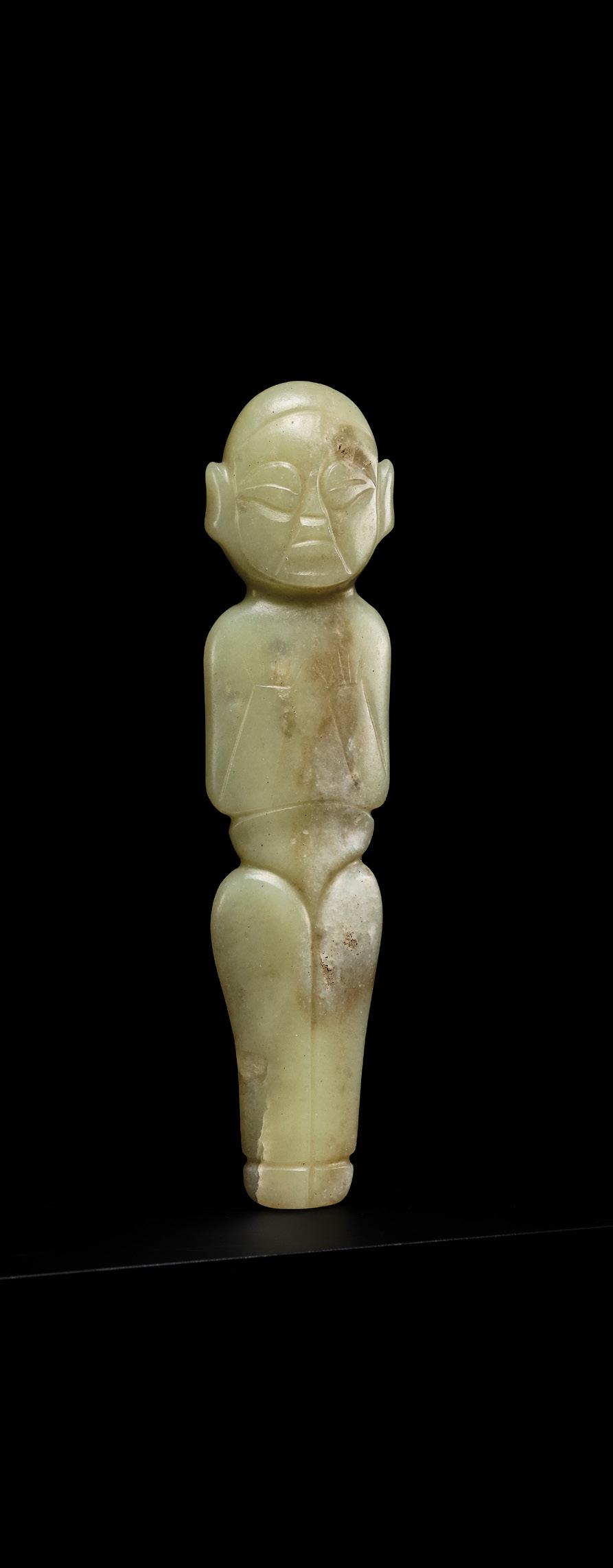
AN EXTRAORDINARY PALE CELADON JADE
FIGURE OF A STANDING HUMANOID, LATE NEOLITHIC PERIOD, HONGSHAN CULTURE
EXPERT AUTHENTICATION
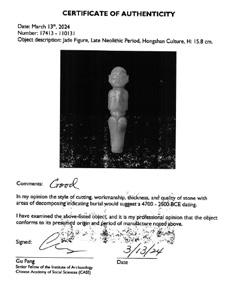
Dr. Gu Fang has examined the present lot and confirms its authenticity and the dating above, noting the style of cutting, workmanship, thickness, and quality of stone with decomposed areas indicating burial, all suggesting a dating to 4700-2500 BC. He assessed it as a piece of notably good quality.
A signed copy of Dr. Gu’s expertise, dated 13 March 2024, accompanies this lot.
Northeastern China, Inner Mongolia, 4700-2500 BC. Superbly carved, of flattened form, the stylized human-like figure depicted standing with its legs together and forearms raised before the chest, the fingers neatly incised. The face boldly rendered, conveying an aged expression, with large, elongated eyes, a broad nose, and full lips, all flanked on either side by prominent ears. The figure pierced at the back of the neck for suspension. The finely polished, translucent stone of an attractive pale celadon tone, suffused with light brown and icy white inclusions
Provenance: From a private collection in New York, United States. Condition: Excellent condition with only minor surface wear and natural imperfections, such as inclusions and small fissures.
Weight: 115.4 g
Dimensions: Length 15.7 cm
LITERATURE COMPARISON
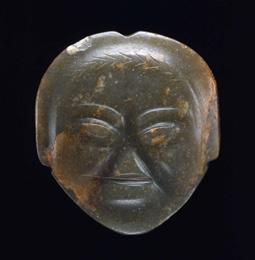
Compare a related dark green jade ‘human face’ pendant, late Neolithic period, Hongshan culture, 6 cm long, in the Museum of Fine Arts, Boston, accession number 1988.286.
AUCTION RESULT COMPARISON
Type: Closely related
Auction: Bonhams Hong Kong, 29 May 2018, lot 3
Price: HKD 162,500 or approx. EUR 20,500 converted and adjusted for inflation at the time of writing
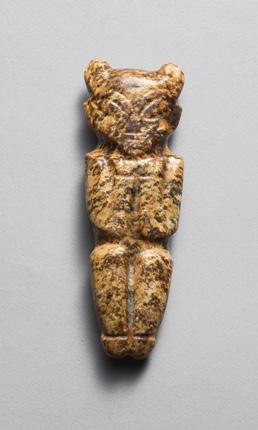
Description: A rare archaic jade ‘human-figure’ pendant, Neolithic period, Hongshan culture
Expert remark: Compare the closely related standing stance of the figure, with legs together and forearms raised, and manner of carving. Note the different color of the stone and smaller size (7.2 cm).
Purchase for EUR 16,500
6
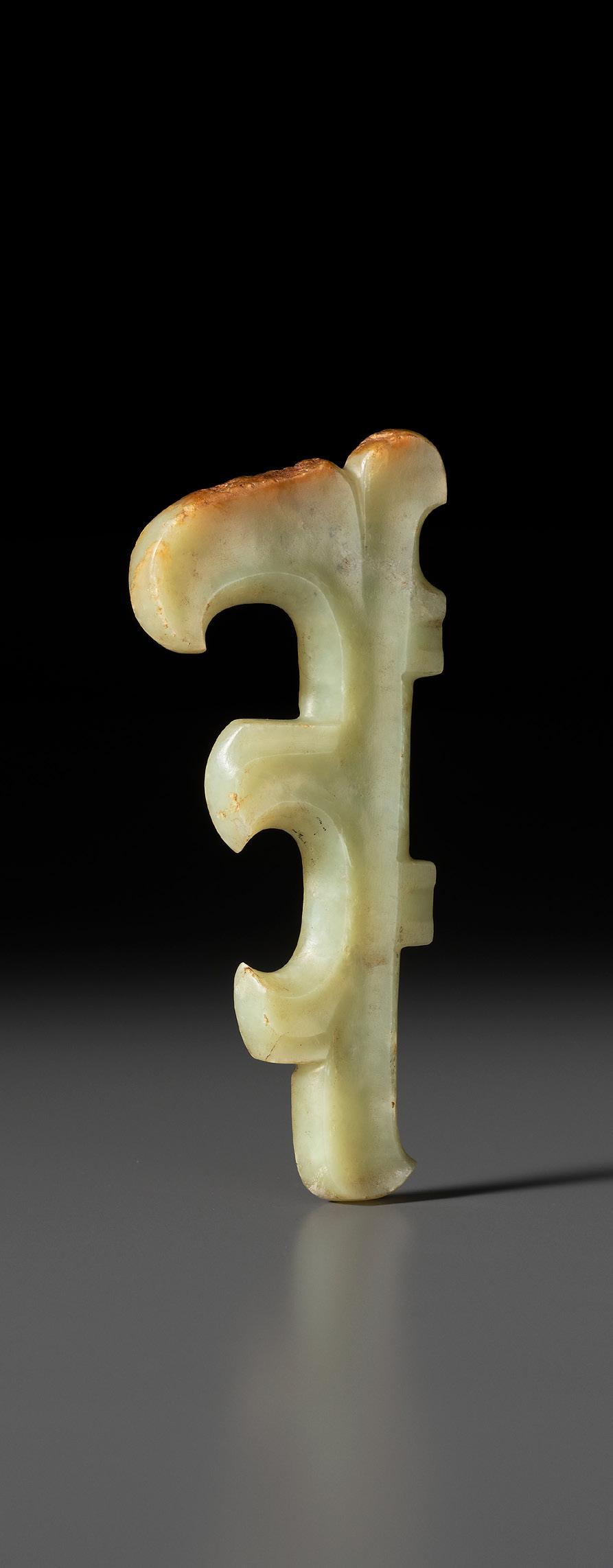
A FINE PALE CELADON JADE HOOK-SHAPED ORNAMENT, LATE NEOLITHIC PERIOD, HONGSHAN CULTURE
Northeastern China, Inner Mongolia, 4700-2500 BC. Boldly carved, of
EXPERT AUTHENTICATION
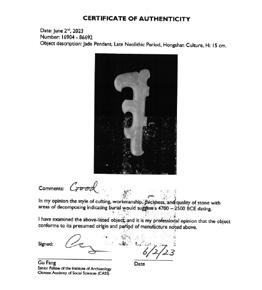
Dr. Gu Fang has examined the present lot and confirms its authenticity and the dating above, noting the style of cutting, workmanship, thickness, and quality of stone with decomposed areas indicating burial, all suggesting a dating to 4700-2500 BC. He assessed it as a piece of notably good quality. A signed copy of Dr. Gu’s expertise, dated 2 June 2023, accompanies this lot.
flattened form, as an elongated shaft with a slightly convex surface, three hook-shaped protrusions along one side, and two rectangular flanges on the opposite side. The reverse pierced above and below with two pairs of holes for suspension. The superbly polished, translucent stone of a pale celadon tone, suffused with cloudy inclusions and marked by two russet patches along the upper edge, indicative of prolonged burial in contact with iron oxides.
Provenance: From a private collection in New York, United States. Condition: Very good condition, commensurate with age, with minor surface wear and natural imperfections, such as inclusions and small fissures. Traces of weathering and erosion, with few small chips along the edges, some of which have smoothed over millennia.
Weight: 106.1 g (excl. stand), 225.2 g (incl. stand)
Dimensions: Length 15.2 cm (excl. stand), Height 16.7 cm (incl. stand)
With an associated metal stand. (2)
AUCTION RESULT COMPARISON
Type: Related
Auction: Bonhams Hong Kong, 29 May 2024, lot 418
Mid-estimate: HKD 70,000 or approx. EUR 7,900 converted and adjusted for inflation at the time of writing
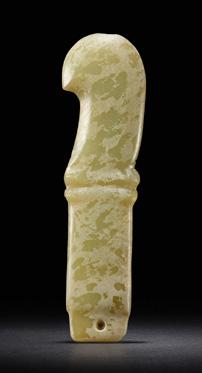
Description: A yellow jade ‘eagle-head’ handled staff, Neolithic period, Hongshan culture
Expert remark: Compare the related form, manner of carving, and color of the stone. Note the slightly smaller size (11.2 cm).
Purchase for EUR 6,750
Dr. Gu Fang
7
A GREEN JADE ‘CLOUD-SCROLL’ PENDANT, LATE NEOLITHIC PERIOD, HONGSHAN CULTURE
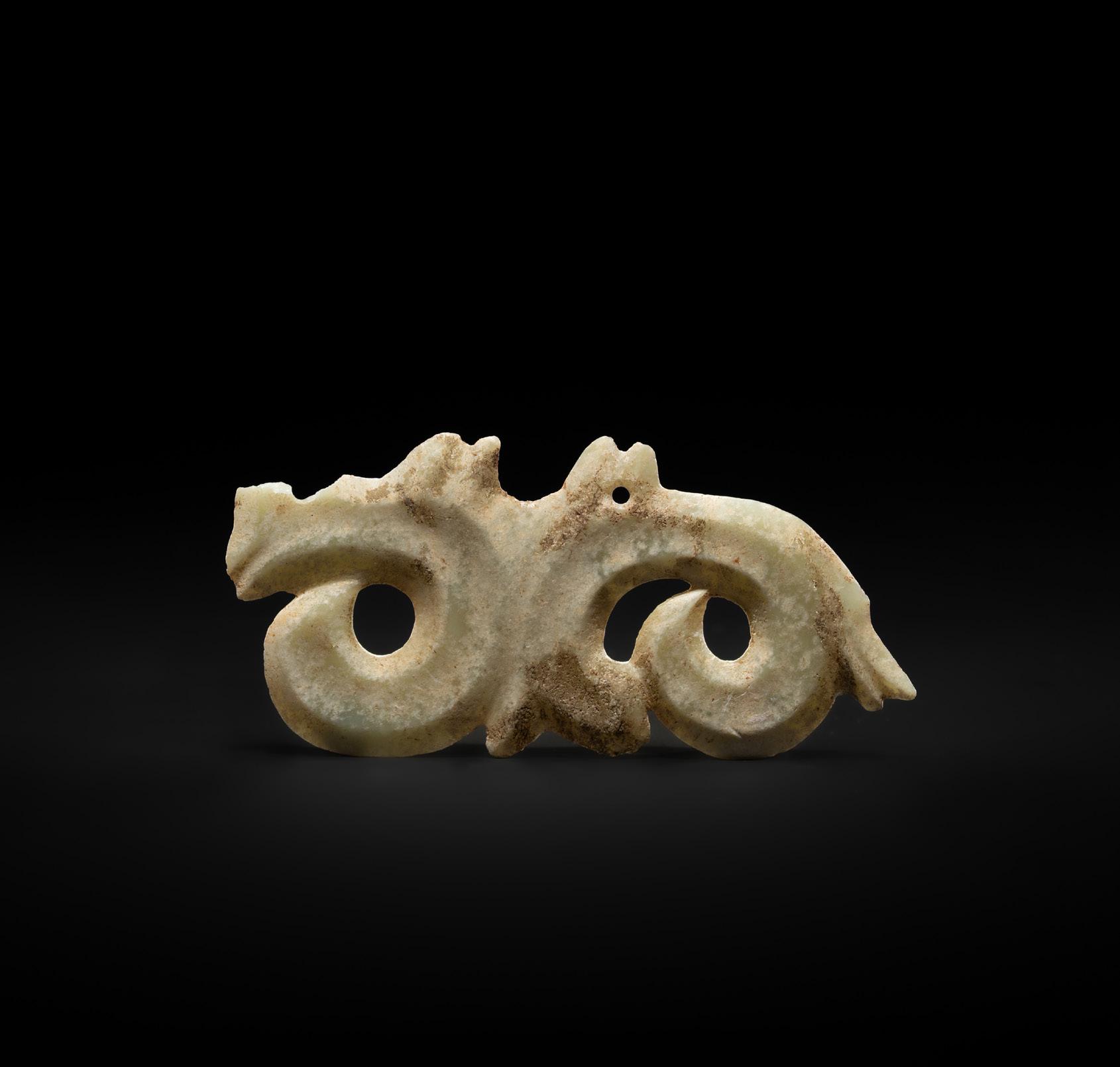
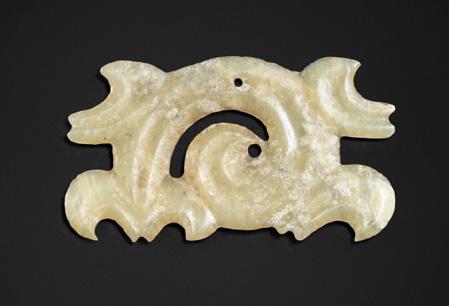
Northeastern China, Inner Mongolia, c. 4700-2500 BC. The flat plaque carved in openwork in the form of a stylized scrolling cloud. Subtly detailed with curved ridges and grooves on each side. Pierced to the top for suspension. The polished stone is of a pale greenish-yellow tone with some opaque inclusions, pale clouds, and small patches of creamy calcification.
Provenance: From the Sam and Myrna Myers Collection, acquired between circa 1965-2012.
Condition: Good condition, commensurate with age, with old surface wear and natural age-related imperfections. Traces of weathering and signs of prolonged burial. An old loss to one corner. Minor nibbling to the edges. The stone surface with remnants of soil encrustations.
Weight: 34.1 g
Dimensions: Length 11.2 cm
AUCTION RESULT COMPARISON
Type: Related Auction: Sotheby’s Paris, 10 June 2021, lot 91 Price: EUR 20,160 or approx. EUR 23,000 adjusted for inflation at the time of writing
Description: A pale yellowish-brown jade cloudshaped pendant, Neolithic period, Hongshan culture Expert remark: Note the smaller size (8.5 cm).
Purchase for EUR 6,500
8
A LARGE RUSSET AND PALE CELADON ‘TOOTHED ANIMAL’ MASK ORNAMENT, HONGSHAN CULTURE
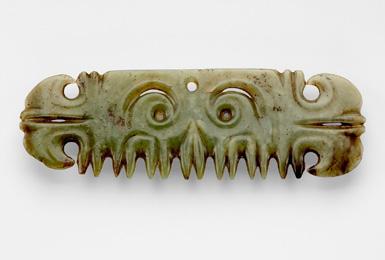
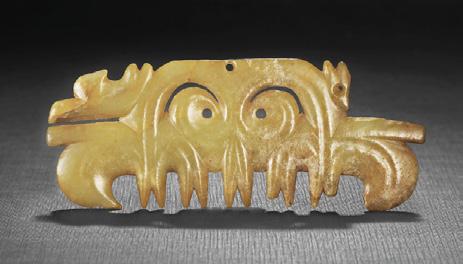
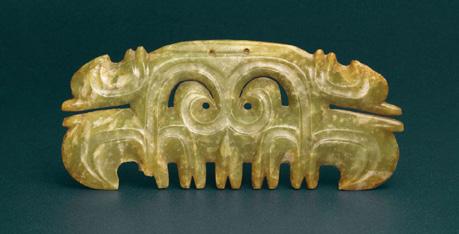
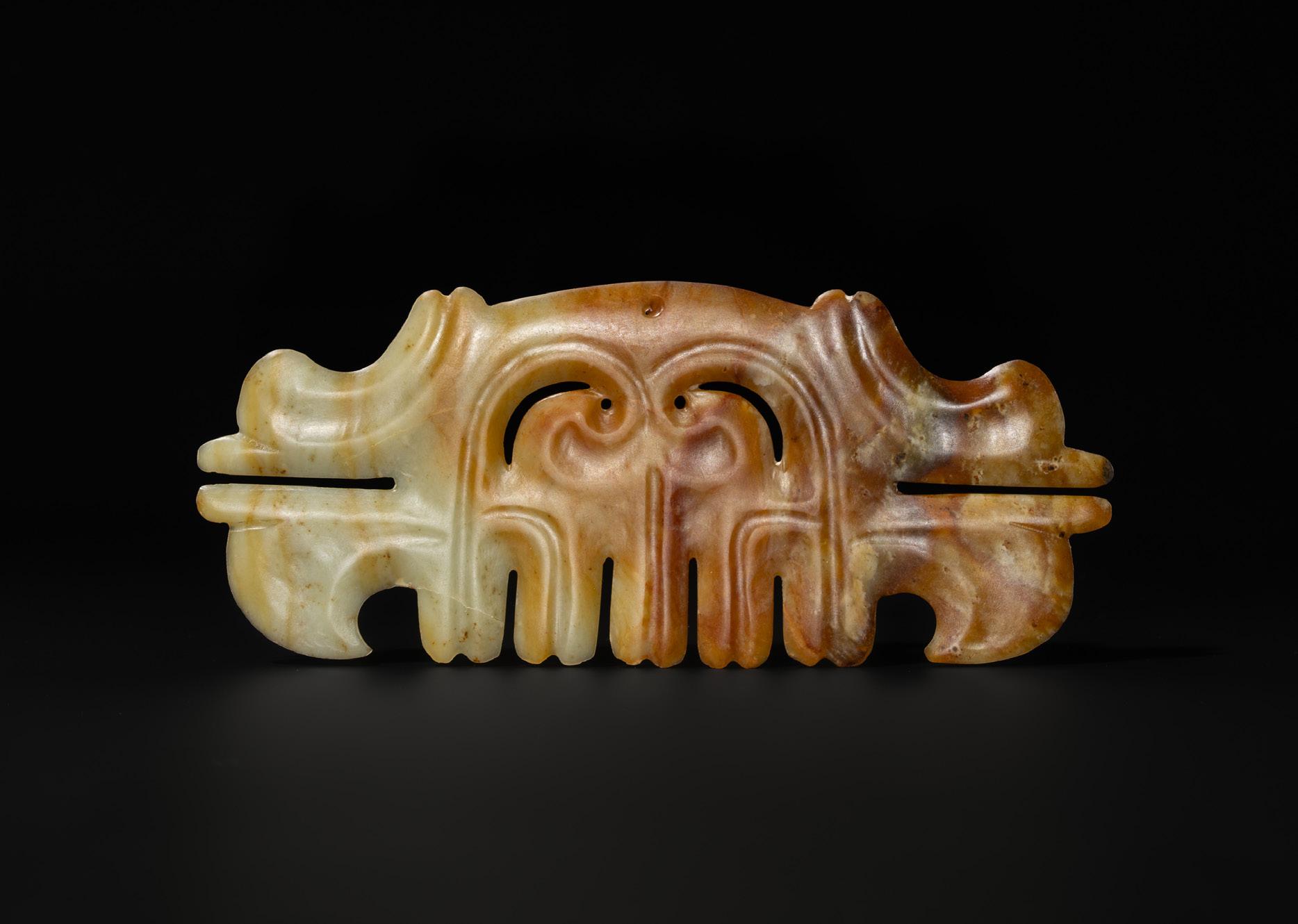
Northeastern China, Inner Mongolia, c. 4500-3000 BC. Finely carved and pierced in the form of an animal mask, adorned with arched brows set above circular eyes, and horns rising to the tips of curved, projecting ears. The facial features are meticulously rendered through deep, concave channels, while the lower edge of the carving is detailed with five tooth-like projections. The highly polished, predominantly translucent stone displaying russet and pale celadon tones with yellow and dark caramel streaking, interspersed with sparse icy inclusions.
Provenance: From the Sam and Myrna Myers Collection, acquired between circa 1965-2012.
Condition: Good condition with ancient surface wear and natural age-related imperfections. Distinct traces of weathering and erosion. Expected signs of prolonged burial. A crack with an associated repair and minimal nibbling.
Weight: 80.9 g
Dimensions: Length 17.9 cm
Hongshan ‘toothed’ pendants are characterized by a stylized central mask and a row of double-pointed protrusions along the lower edge, evoking animal teeth. The central motif is flanked on either side by flattened extensions, each marked by a straight incision at its center.
LITERATURE COMPARISON
Compare a related jade toothed mask ornament, Hongshan culture, c. 4500-3000 BC, 17.2 cm long, in the Smithsonian Institution, National Museum of Asian Art, accession number F1991.52.
AUCTION RESULT COMPARISON
Type: Closely related
Auction: Christie’s Hong Kong, 28 November 2018, lot 2708
Price: HKD 1,750,000 or approx. EUR 229,000 converted and adjusted for inflation at the time of writing
Description: A very rare celadon jade toothed animal mask ornament, Hongshan culture, circa 4000-3000 BC
Expert remark: Compare the closely related form, manner of carving, and color of the stone. Note the smaller size (12 cm).
AUCTION RESULT COMPARISON
Type: Closely related
Auction: Christie’s Hong Kong, 29 November 2017, lot 2704
Price: HKD 10,900,000 or approx. EUR 1,450,000 converted and adjusted for inflation at the time of writing
Description: A very rare green jade toothed animal mask ornament, late Hongshan culture
Expert remark: Compare the closely related form, manner of carving, and color of the stone. Note the similar size (19.6 cm).
Purchase for EUR 13,000
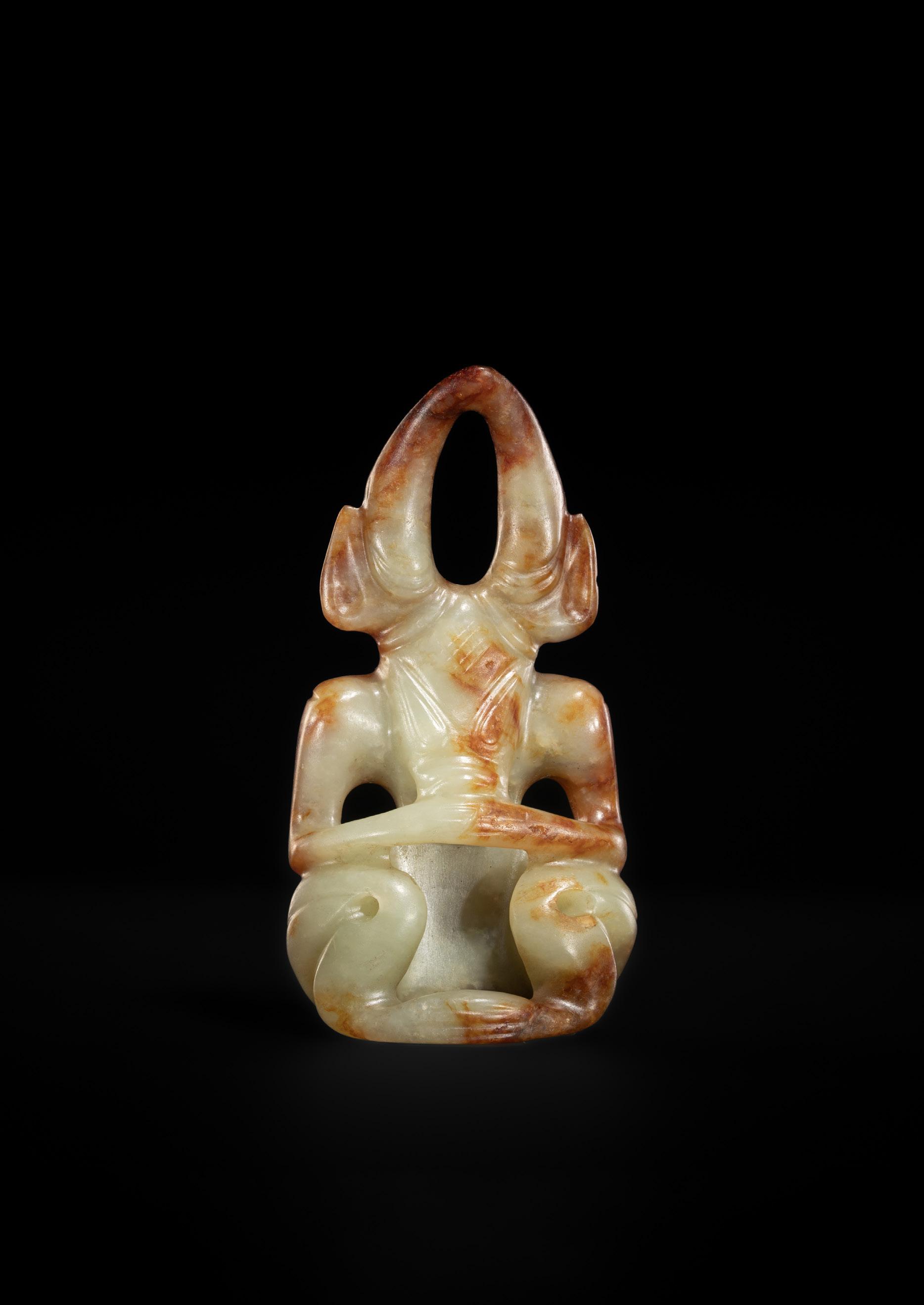
9 A MAGNIFICENT PALE CELADON AND RUSSET JADE ‘SUN GOD’ PENDANT, LATE NEOLITHIC PERIOD, HONGSHAN CULTURE
EXPERT AUTHENTICATION
Dr. Gu Fang has examined the present lot and confirms its authenticity and the dating above, noting the style of cutting, workmanship, thickness, and quality of stone with decomposed areas indicating burial, all suggesting a dating to 47002500 BC. He assessed it as a piece of notably good quality. A signed copy of Dr. Gu’s expertise, dated 4 August 2023, accompanies this lot.
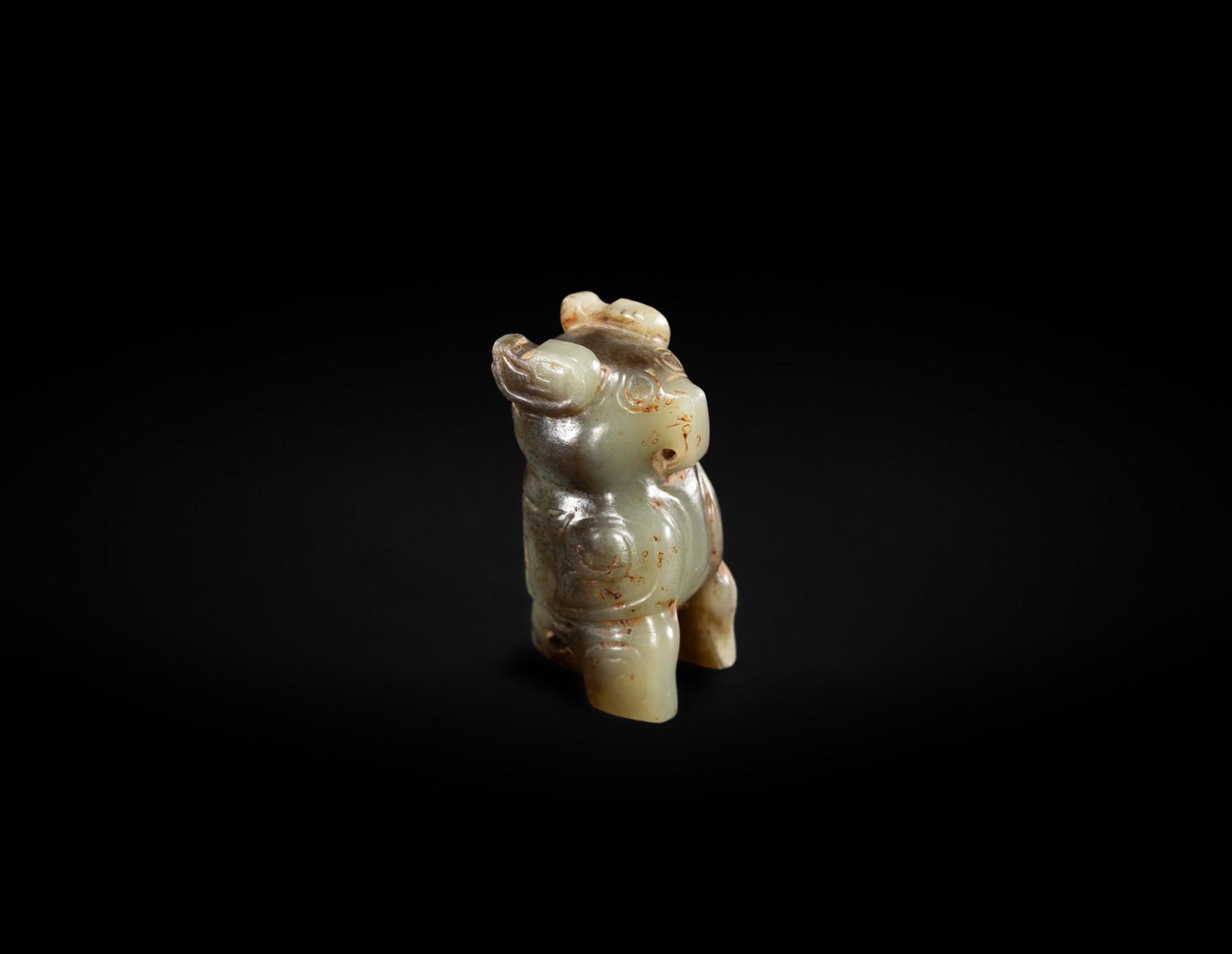
China, 4700-2500 BC. Exquisitely carved in the form of a double-horned humanoid seated in a squatting posture, with unusually large feet interlaced and the hands similarly intertwined, resting upon the knees. The face of the creature, with bovine features, finely detailed, with slit eyes set beneath a cross-hatched surface, similar to that seen on the reverse of the figure, and flanked by protruding ears and surmounted by a pair of prominent upright horns. The superbly polished, translucent stone of an appealing interplay of pale celadon and russet tones, enlivened by cloudy inclusions.
Provenance: From a private collection in New York, United States. Condition: Excellent condition with only minor surface wear and natural age-related imperfections.
Weight: 94.9 g
Dimensions: Height 10.3 cm
The Hongshan culture remained largely unrecognized until the 1980s. Centered in northeastern China, it is characterized by its monumental ritual architecture constructed of stone, stone-lined burial chambers, and a highly distinctive jade corpus, frequently the only category of artefact recovered from funerary contexts.
The present piece belongs to a rare group of three-dimensional anthropomorphic figures , of which only a small number have been securely recorded. Most examples entered collections in the course of the twentieth century, prior to the advent of systematic archaeological excavation that subsequently clarified the cultural and chronological parameters of the Hongshan tradition.
Interpretations of these horned, mask-like figures remain varied. While some scholars have suggested a possible association with solar symbolism, occasionally invoking comparative references to ancient solar deities such as Ra in Egypt, the prevailing view situates them more cautiously within a ritual and possibly shamanistic sphere, reflecting the complex symbolic vocabulary of Hongshan religious practice.
LITERATURE COMPARISON
The present lot is stylistically related to the Hongshan humanoid figures discussed in Angus Forsyth, Five Chinese Jade Figures. A Study of the Development of Sculptural Form in Hongshan Neolithic Jade Working, Orientations, vol. 21, no. 5, May 1990, pp. 5463. Forsyth illustrates three figures worked in the round. One was in the collection of Louis C.G. Clarke and has since 1960 been in the Fitzwilliam Museum, Cambridge (accession number O.55-1961), another from the Severance A. Millikin collection has since 1953 been in the Cleveland Museum of Art (accession number 1953.628), and the third, from the collection of Ernest Erickson, has been at least since the 1960s in the Ostasiatiska Museum, Stockholm. An additional figure in the Palace Museum, Beijing, has been published together with the Fitzwilliam and Stockholm examples in James C.S. Lin, The Immortal Stone. Chinese Jades from the Neolithic Period to the Twentieth Century, Cambridge, 2009, pp. 15-16.
AUCTION RESULT COMPARISON
Type: Closely related
Auction: Sotheby’s Paris, 10 June 2021, lot 77
Price: EUR 40,320 or approx. EUR 45,000 adjusted for inflation at the time of writing
Description: A very rare jade ‘humanoid figure’ pendant, Neolithic period, Hongshan culture
Expert remark: Compare the closely related subject, with similar pose and horn configuration, manner of carving, and color of the stone. Note the smaller size (4.5 cm).
Purchase for EUR 22,500
Dr. Gu Fang
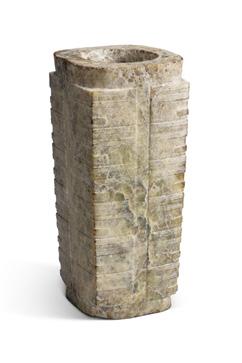
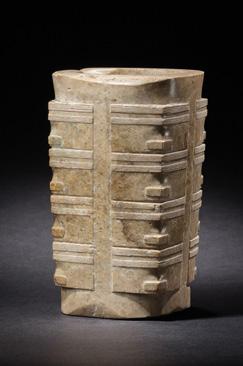
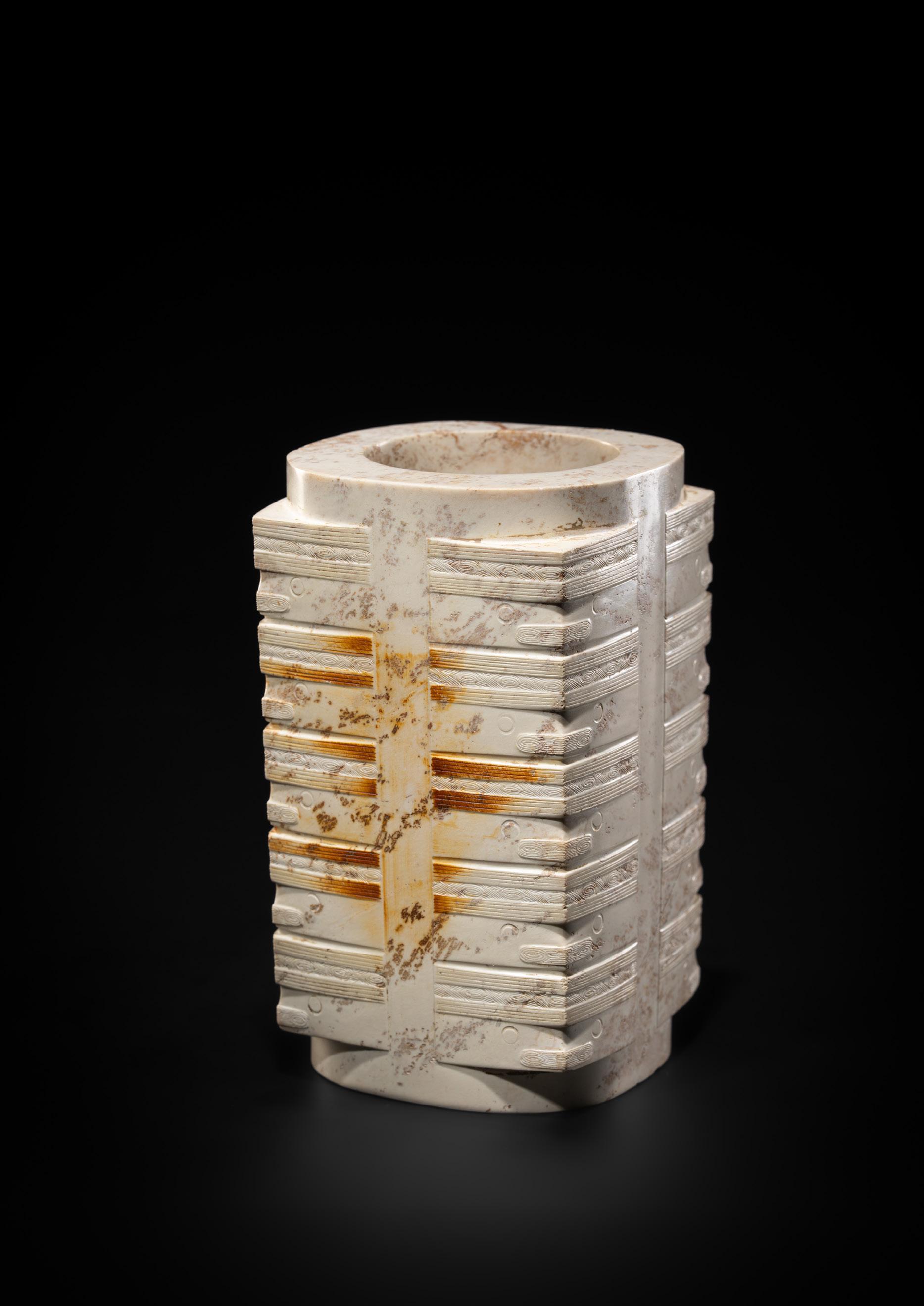
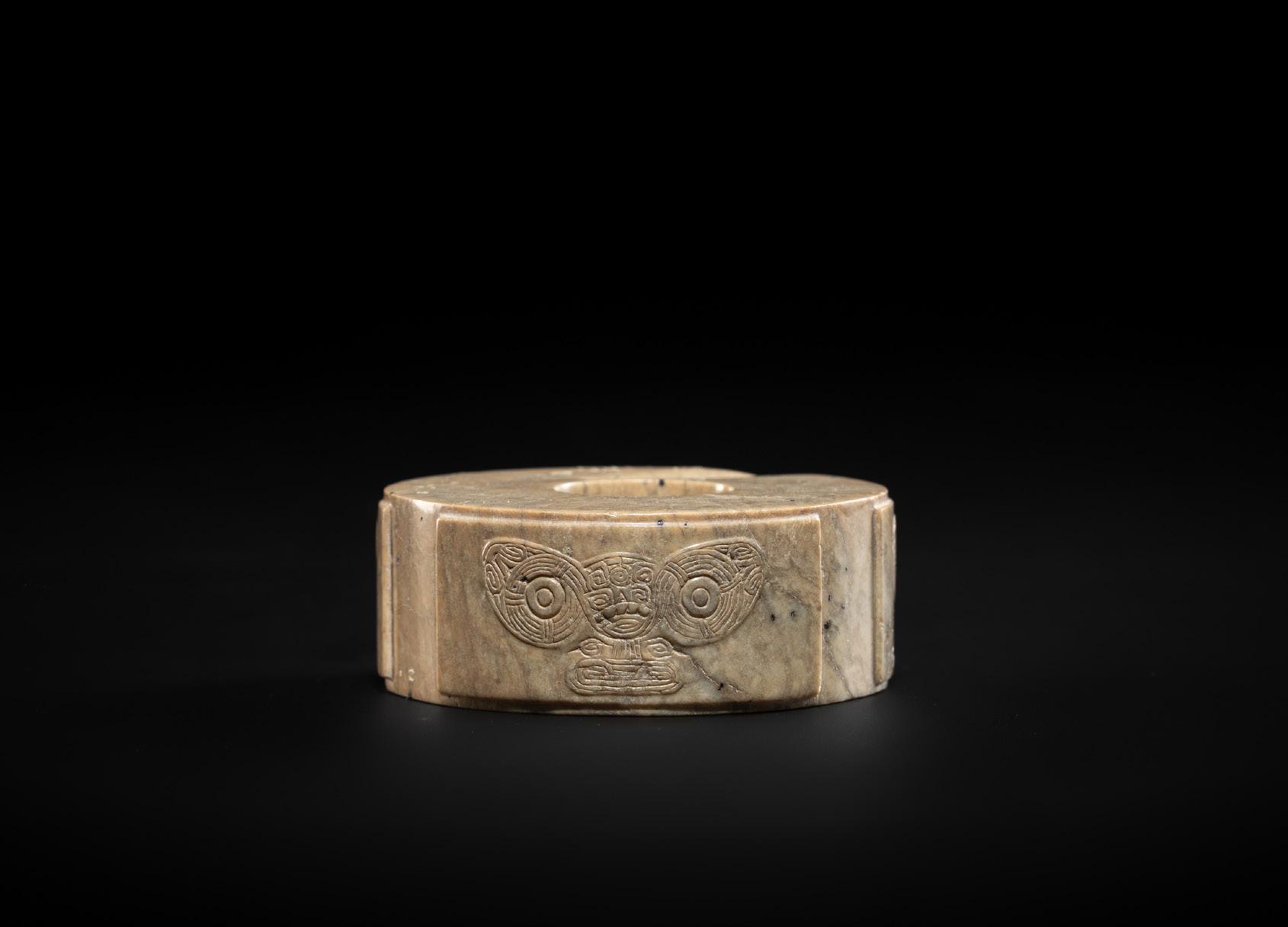
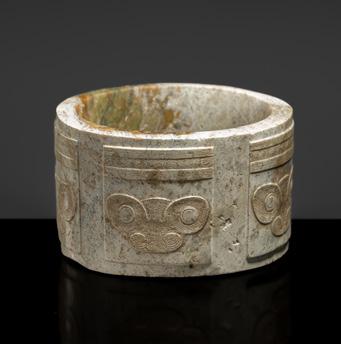
A MAGNIFICENT FIVE-TIERED MOTTLED JADE RITUAL TUBE (CONG), LATE NEOLITHIC PERIOD, LIANGZHU CULTURE
EXPERT AUTHENTICATION
Dr. Gu Fang has examined the present lot and confirms its authenticity and the dating above, noting the style of cutting, workmanship, thickness, and quality of stone with decomposed areas indicating burial, all consistent with materials attributed to the Liangzhu culture, and therefore indicating a date within its associated chronological range. He assessed it as a piece of excellent quality. A signed and notarized copy of Dr. Gu’s expertise, dated 6 January 2007, accompanies this lot.
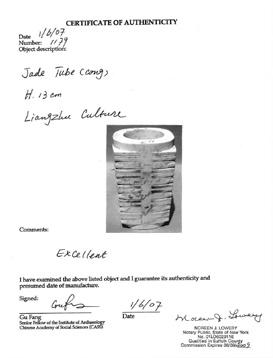
Southeastern China, c. 3300-2200 BC. Of square section, with thick walls and gently rounded sides, hollowed with a long, cylindrical perforation. Each corner, divided into five tiers, is carved with anthropomorphic and zoomorphic mask motifs, whose noses, as well as the raised bands above their circular eyes, are finely incised with linear and spiral designs. The faces of the vessel are articulated by a subtly recessed vertical band at the center of each side. The superbly polished stone with extensive evidence of mineral alteration, resulting in an opaque, milky surface consistent with prolonged burial, and scattered russet patches.
Provenance: From a private collection in France. Condition: Very good condition, commensurate with age, with surface wear and natural imperfections, such as inclusions and fissures, some of which have developed into hairline cracks. Traces of weathering and erosion. Minor nibbling along the edges. The stone with evidence of mineral alteration.
Weight: 1,001 g
Dimensions: Height 12.9 cm
With an associated padded silk storage box. (2)
Liangzhu culture and its jades became famous by the late 1980s, when some important cemeteries were discovered and the rich contents of their tombs were revealed to the world. However, the discoveries of the past fifteen years have dramatically changed our view of this late Neolithic culture. Chinese archeologists have uncovered at the Mojiaoshan site evidence of a large, walled settlement measuring 750 acres. They unearthed remains of palatial foundations, jade workshops, habitation sites and a network of waterways within the city, which is presently the largest walled settlement of late Neolithic China.
The jades of Liangzhu culture abound in number and diversity, excelling in craftsmanship as some of the most illustrious jade artefacts in the history of Chinese civilization. Among the many types of jades of the Liangzhu culture, the jade cong are the most distinctive. Liangzhu jade cong have a square outer section and a circular inner hollow. Each corner serves as a vertical axis over which a symmetrical mask motif is carved. The cong are the only type of Liangzhu jades with decoration. The early cong were mainly squat, featuring exquisitely carved deity or animal details within the masks, while the later ones were mostly tall with simplified facial features dominated by the eyes and nose.
LITERATURE COMPARISON
Compare a closely related jade four-tiered tube (cong), late Neolithic period, Liangzhu culture, c. 3300-2200 BC, 10.5 cm high, in the Smithsonian Institution, National Museum of Asian Art, accession number F1968.36.
AUCTION RESULT COMPARISON
Type: Closely related
Auction: Bonhams Hong Kong, 28 November 2017, lot 1
Price: HKD 4,660,000 or approx. EUR 595,000 converted and adjusted for inflation at the time of writing
Description: A rare grey and green jade ritual vessel (cong), Neolithic period, Liangzhu culture
Expert remark: Compare the closely related form, manner of carving, and color of the stone. Note the slightly smaller size (11.1 cm).
AUCTION RESULT COMPARISON
Type: Closely related
Auction: Christie’s Hong Kong, 2 May 2025, lot 1003
Price: HKD 3,024,000 or approx. EUR 328,000 converted and adjusted for inflation at the time of writing
Description: A rare six-tiered jade cong, Neolithic period, Liangzhu culture
Expert remark: Compare the closely related form, manner of carving, and color of the stone.
Note the slightly larger size (18 cm).
AUCTION RESULT COMPARISON
Type: Closely related
Auction: Bonhams Hong Kong, 29 May 2024, lot 358
Price: HKD 486,400 or approx. EUR 54,000 converted and adjusted for inflation at the time of writing
Description: A grey and green jade cong, Neolithic period, Liangzhu culture
Expert remark: Compare the closely related form, manner of carving, and color of the stone. Note the similar size (13 cm).
Purchase for EUR 15,600
Dr. Gu Fang
11
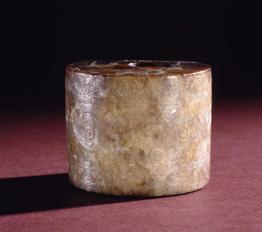
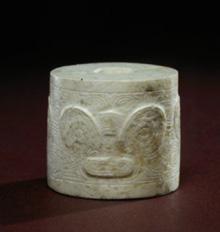
A RARE AND LARGE IVORY WHITE JADE ‘MASK’ BEAD, LATE NEOLITHIC PERIOD, LIANGZHU CULTURE
Southeastern China, c. 3300-2200 BC. Of tubular form, the exterior sides finely carved in relief with three raised rectangles, each enclosing a mask made of delicately incised lines. The central perforation drilled from both sides and with a notch to the upper side. The finely polished, opaque stone of a creamy-white color with light gray veins and dark speckles.
Provenance: From the Sam and Myrna Myers Collection, acquired between circa 1965-2012. With an affixed old collector’s label, inscribed ‘4035’.
Condition: Very good condition with expected old wear and natural age-related imperfections, such as small fissures, some of which may have developed into thin hairlines. Traces of weathering and signs of prolonged burial. The stone surface with an unctuous feel overall.
Weight: 146.5 g
Dimensions: Diameter 5.9 cm
LITERATURE COMPARISON
Compare a related yellow-brown jade ring with masks, Liangzhu culture, 4 cm high, in the British Museum, registration number 1937,0416.154. Compare a related creamy-white jade bead with masks, Liangzhu culture, 3 cm long, in the British Museum, registration number 2022,3034.64.
AUCTION RESULT COMPARISON
Type: Related
Auction: Bonhams New York, 21 March 2022, lot 237
Price: USD 62,812 or approx. EUR 61,000 converted and adjusted for inflation at the time of writing
Description: A Liangzhu jade bead ornament with carved masks, Neolithic period
Expert remark: Compare the related form and incised mask decoration. Note the slightly smaller size (2.8 cm).
AUCTION RESULT COMPARISON
Type: Related
Auction: Zacke Vienna, 11 September 2025, lot 217
Price: EUR 31,200
Description: A very rare green and russet jade ‘mask’ bangle, Liangzhu culture
Expert remark: Compare the related form and incised mask decoration. Note the slightly larger size (8.7 cm).
Purchase for EUR 3,900
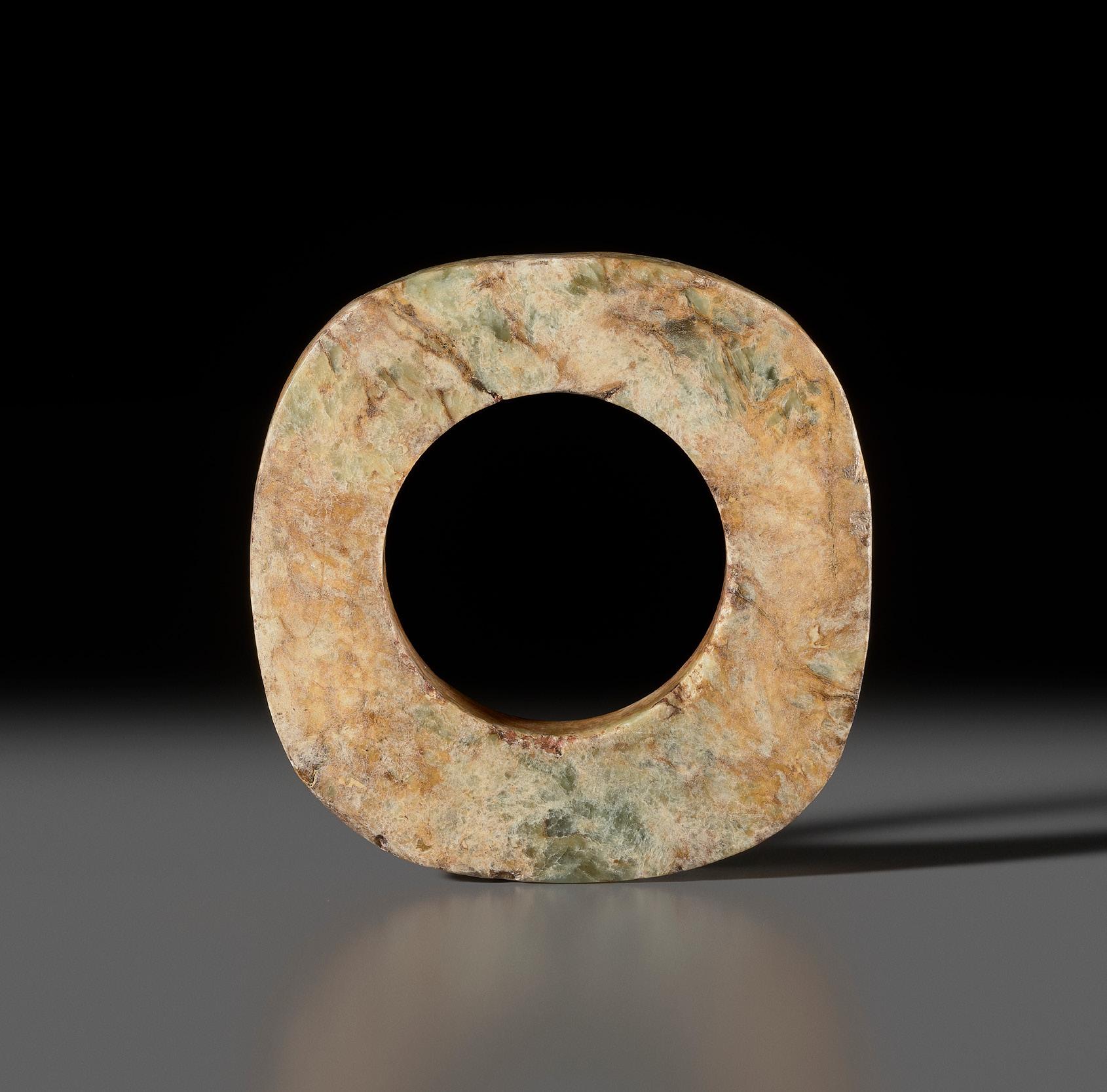
A MOTTLED TAUPE AND IVORY-COLORED OPAQUE JADE BRACELET, LATE NEOLITHIC PERIOD, LIANGZHU CULTURE
Southeastern China, c. 3300-2200 BC. Thickly carved and slightly square in form with rounded edges, carved from stone of mottled taupe and ivory tones, suffused with russet, green, and buff-white veining.
Provenance: From the Sam and Myrna Myers Collection, acquired between circa 1965-2012.
Condition: Good condition with wear and natural age-related imperfections, such as fissures, some of which have developed into thin hairlines. Traces of weathering and signs of prolonged burial. Minor nibbling along the edges. Occasional small nicks and old smoothed chips.
Weight: 343.1 g
Dimensions: Width 11.4 cm
AUCTION RESULT COMPARISON
Type: Closely related
Auction: Christie’s New York, 25 September 2020, lot 1722
Price: USD 25,000 or approx. EUR 27,000 converted and adjusted for inflation at the time of writing
Description: A mottled taupe and ivory colored opaque jade bracelet, Neolithic period, Liangzhu culture, 3rd millennium BC
Expert remark: Compare the closely related form and color of stone. Note the nearly identical size (11.2 cm).
Purchase for EUR 6,500
13
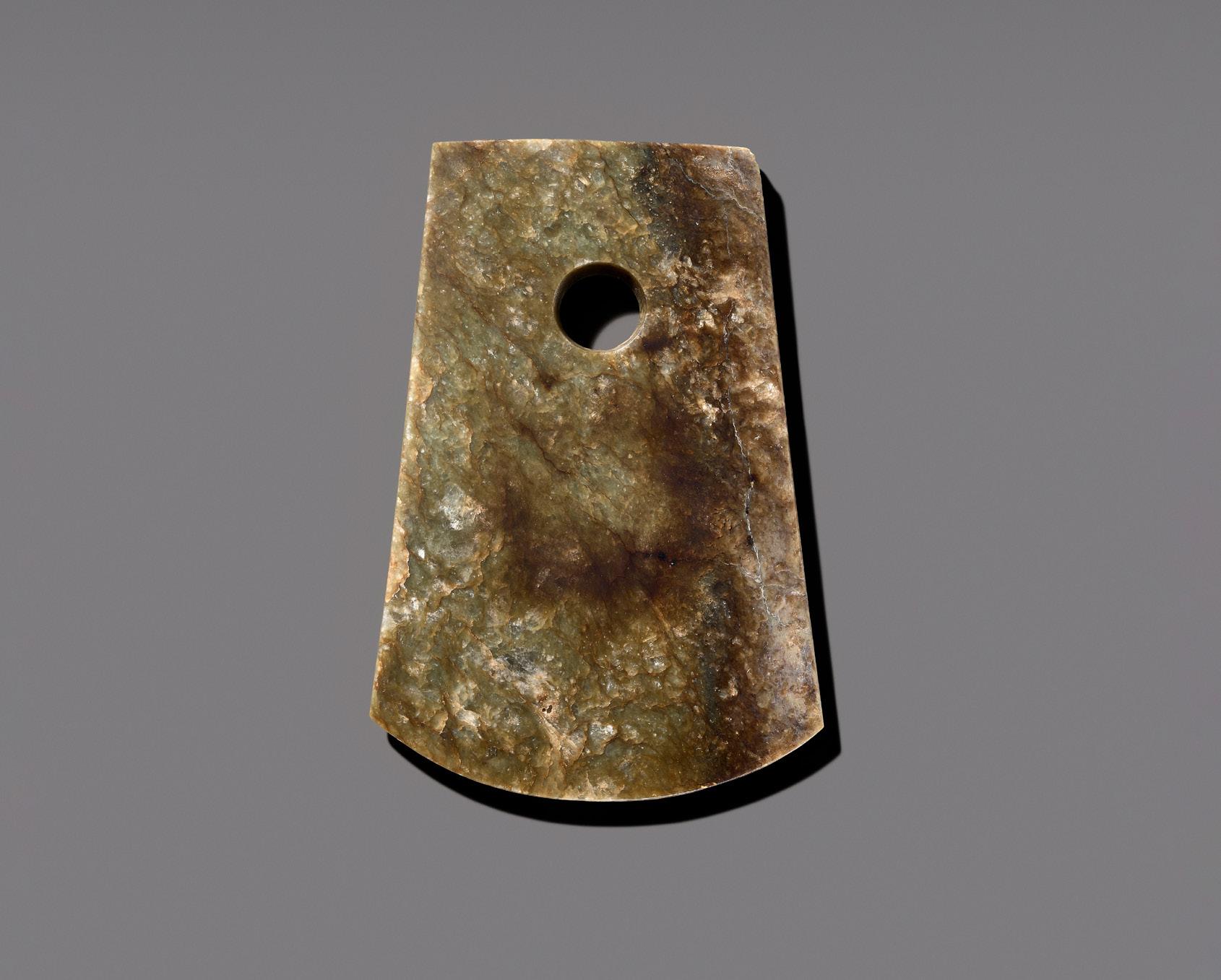
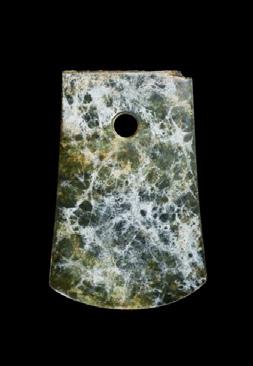
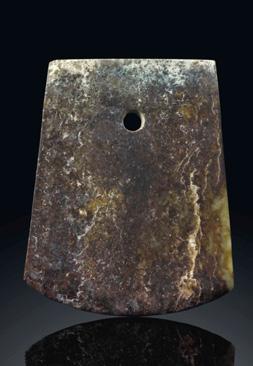
A MOTTLED GREEN AND BROWN JADE CEREMONIAL AXE (YUE), NEOLITHIC PERIOD, LIANGZHU CULTURE
EXPERT AUTHENTICATION
Sam Bernstein has authenticated this lot, confirming the dating above.
A copy of Sam Bernstein’s expertise, dated 6 January 2020, accompanies this lot. Sam Bernstein is an internationally recognized specialist dealer in Chinese antiquities. He has authored thirteen volumes on Chinese art including The Emperor’s Jade Suit and Chinese Jade: The Immortal Stone. Over the past several decades, S. Bernstein & Co. has helped to form some of the great collections of Oriental art in the world.
Southeastern China, c. 3300-2200 BC. Of trapezoidal form, finely carved with straight sides and a thinly beveled, curved cutting edge, with a circular aperture centrally placed in the upper section, drilled from both faces. The semi-translucent stone of an appealing interplay of variegated green tones, accented by brown inclusions and calcified white shading. Its superbly polished surface imparting an overall smooth tactile feel.
Provenance: From a private collection in France.
Condition: Very good condition with surface wear and natural agerelated imperfections, such as inclusions and small fissures. A small chip to one corner of the upper edge, which has smoothed over millennia of exposure, and occasional minute nibbles along the edges.
Weight: 441.3 g
Dimensions: Length 17.8 cm
Jade axes of this type are considerably rarer than ‘bi’ disks or even ‘cong’ tubes, as they appear to have been reserved for the highest-status burials. In most cases, only a single example is recovered from each elite tomb, underscoring their exceptional exclusivity and symbolic significance.
AUCTION RESULT COMPARISON
Type: Closely related
Auction: Sotheby’s Hong Kong, 9 October 2023, lot 3711
Price: HKD 279,400 or approx. EUR 32,000 converted and adjusted for inflation at the time of writing
Description: A mottled green jade ceremonial axe, Neolithic period, Liangzhu culture
Expert remark: Compare the closely related form, manner of carving, and color of the stone.
Note the slightly larger size (20.6 cm).
AUCTION RESULT COMPARISON
Type: Closely related
Auction: Christie’s London, 6 November 2012, lot 74
Price: GBP 15,000 or approx. EUR 28,500 converted and adjusted for inflation at the time of writing
Description: A mottled jade axe, Neolithic period, Liangzhu culture
Expert remark: Compare the closely related form, manner of carving, and color of the stone. Note the similar size (17.7 cm).
Purchase for EUR 7,800
AUCTION RESULT COMPARISON
Type: Closely related
14
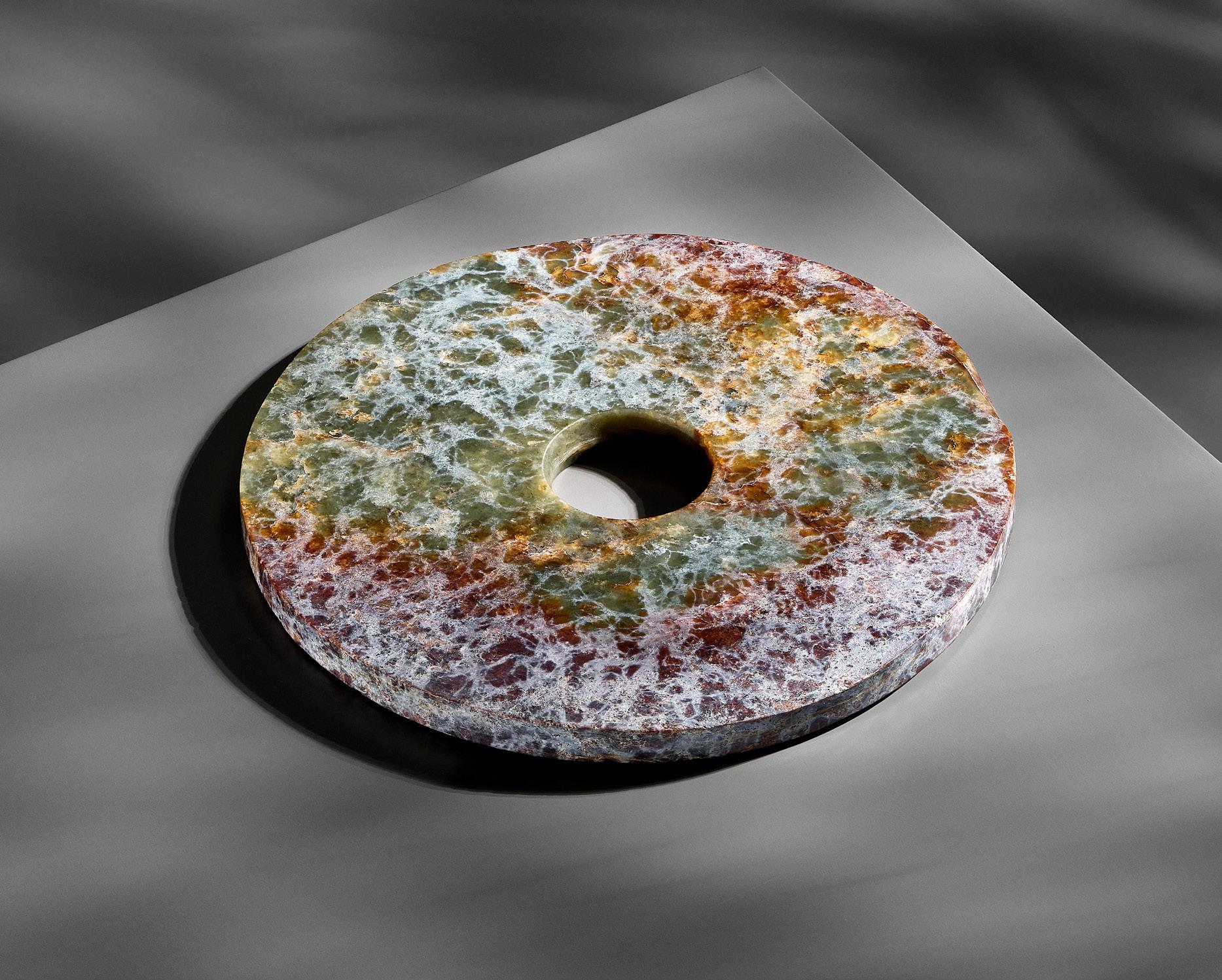
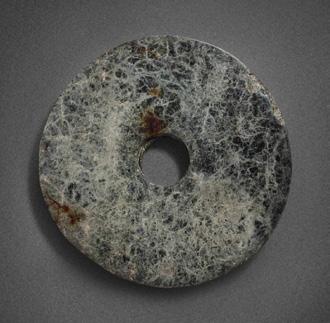
A THICK CELADON AND RUSSET JADE ‘CLOUDED’ DISK (BI), LATE NEOLITHIC PERIOD, LIANGZHU CULTURE
Southeastern China, c. 3300-2250. Of circular form, with a central aperture drilled from both sides, resulting in a subtle encircling ridge. The finely polished, opaque stone of an appealing celadon tone enlivened by large russet patches, dark green inclusions, and a dense network of cloud-like areas of creamy white calcification.
Provenance: From the Sam and Myrna Myers Collection, acquired between circa 1965-2012.
Condition: Very good condition with old surface wear and natural age-related imperfections, such as inclusions and small fissures. Minor nibbling and occasional small chips along the edges, some of which have smoothed over time.
Weight: 1,047 g
Dimensions: Diameter 19.8 cm, Depth 1 cm
Expert’s note:
The present stone exhibits natural internal clouding resulting from variations in crystallization and prolonged mineral alteration within the jade. These mist-like inclusions extend from the interior of the body to the surface of the stone, confirming that the feature is intrinsic to the material. Such characteristics develop gradually over millennia and reflect the geological history of the stone.
Auction: Christie’s New York, 19 March 2015, lot 487
Price: USD 40,000 or approx. EUR 47,000 converted and adjusted for inflation at the time of writing
Description: A large, opaque, mottled dark green and ivory hardstone ‘bi’ disk, Neolithic period, Liangzhu culture Expert remark: Compare the closely related form, manner of carving, and color of the stone with similarly calcified areas. Note the slightly larger size (21 cm).
AUCTION RESULT COMPARISON
Type: Closely related
Auction: Christie’s New York, 25 September 2020, lot 1702
Price: USD 23,750 or approx. EUR 25,500 converted and adjusted for inflation at the time of writing
Description: A mottled, dark bluishgreen jade ‘bi’ disk, Neolithic period, Liangzhu culture
Expert remark: Compare the related form, manner of carving, and color of the stone with analogous areas of diffuse chromatic alteration. Note the slightly smaller size (17.8 cm).
Purchase for EUR 3,900
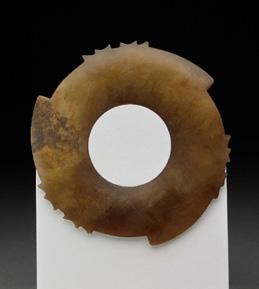
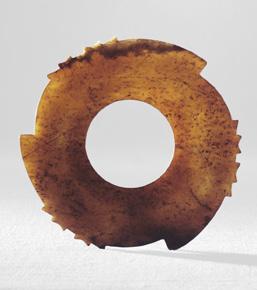
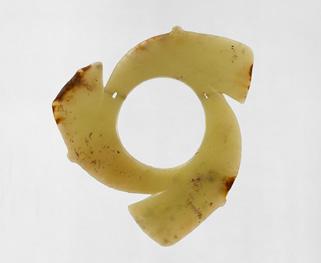
A SPLENDID YELLOW JADE NOTCHED DISK (YABI), LATE NEOLITHIC PERIOD, DAWENKOU OR LONGSHAN CULTURE
PUBLISHED
1. Jean-Paul Desroches (ed.) et al, Two Americans in Paris: A Quest for Asian Art, Paris, 2016, p. 47, no. 83.
2. Jean-Paul Desroches (ed.) et al, The Beginning of the World. Dragons, Phoenix, and Other Chimera, Paris, 2020, p. 247, no. 175.
Exhibited:
1. Pointe-à-Callière Museum, From the Lands of Asia. The Sam and Myrna Myers Collection, Montréal, 17 November 2016-19 March 2017.
2. Kimbell Art Museum, From the Lands of Asia. The Sam and Myrna Myers Collection, Fort Worth, Texas, 4 March-19 August 2018.
Eastern China, c. 4500-1900 BC. Of circular form, the outer rim finely carved with three pronounced notches rising to pointed tips and articulated with small, raised projections. The interior pierced by a large circular aperture and delicately incised on one side with two horizontal lines and a single diagonal mark. The superbly polished, translucent stone of an appealing amber-yellow hue, enlivened by russet veining and natural inclusions.
Provenance: From the Sam and Myrna Myers Collection. According to the Myers ledger, acquired at Hôtel Drouot, Paris, France, on 27 May 2012.
Condition: Excellent condition with only minor surface wear, natural age-related imperfections, and light traces of weathering and erosion.
Weight: 134.4 g
Dimensions: Diameter 12.9 cm
Longshan and Dawenkou, located in the Shandong province area, between the cultural sphere of Hongshan in the North and that of the Liangzhu to the South, were two late Neolithic cultures which used jade items, primarily as status symbols and emblems of power. Compared to their neighbors and antecedents, the Dawenkou and Longshan cultures made less use of jade, which was worked mostly as small ornaments, tabletshaped axes or ritual blades. The jades of these cultures, such as the notched rings exemplified by the present lot, represent a development of earlier shapes.
Notched rings form a category of their own and are still poorly understood, though a line of development of this peculiar form can be traced to small Hongshan culture ornaments. Over time, the indentations carved on these small jades gradually developed into pointed projections, usually three in number. The latest Neolithic examples show an increase in the size of the disks and the addition of small, regular notches carved on the sections of the border comprised between the projections. These notches are a recurring feature on jades crafted during the transition from the late Neolithic to the Bronze Age (c. 2200-1900).

As noted by Filippo Salviati, these regular notches may represent a faint memory of the outline of the feathered headdress worn by the Liangzhu anthropomorphic figures and were carved on jades reserved for the elite members of these late Neolithic and early Bronze Age societies. See Filippo Salviati, Early Bronze Age, in Jean-Paul Desroches (ed.) et al, Two Americans in Paris: A Quest for Asian Art, 2016, p. 46.
LITERATURE COMPARISON
Compare a closely related amber-yellow jade notched disk, late Neolithic period, Longshan culture, c. 2300-1700 BC, 13.3 cm diameter, in the Harn Museum of Art, University of Florida, object number 2009.48.272. Compare a closely related amber-yellow jade notched disk, early Bronze Age, Shang dynasty, c. 1600-1050 BC, in the Penn Museum, object number 72-22-1A. Compare a closely related green jade notched disk, late Neolithic period, 14.6 cm diameter, in the National Palace Museum, Taipei, accession number 001285N000000000.
AUCTION RESULT COMPARISON
Type: Closely related
Auction: Sotheby’s Hong Kong, 10 July 2020, lot 133
Price: HKD 2,000,000 or approx. EUR 240,000 converted and adjusted for inflation at the time of writing
Description: A brown jade notched disk, late Neolithic period
Expert remark: Compare the closely related form, manner of carving, and color of the stone. Note the similar size (14 cm).
Purchase for EUR 28,600
Sam and Myrna Myers
16
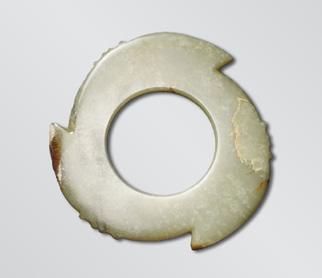
AN EXQUISITE MOTTLED JADE NOTCHED DISK (YABI), LATE NEOLITHIC PERIOD, DAWENKOU OR LONGSHAN CULTURE
PUBLISHED
Jean-Paul
Desroches (ed.) et al, Two Americans in Paris: A Quest for Asian Art, Paris, 2016, p. 47, no. 76.
Exhibited:
1. Pointe-à-Callière Museum, From the Lands of Asia. The Sam and Myrna Myers Collection, Montréal, 17 November 2016-19 March 2017.
2. Kimbell Art Museum, From the Lands of Asia. The Sam and Myrna Myers Collection, Fort Worth, Texas, 4 March-19 August 2018.
Eastern China, c. 2200-2000 BC. Of circular form, pierced from both sides by a narrow central aperture, and with an outer edge carved into pronounced notches forming three curved arcs. The superbly polished, semi-translucent stone of an attractive dark tone with deep greenish highlights, enlivened with ochre and white inclusions.
Provenance: From the Sam and Myrna Myers Collection. According to the Myers ledger, acquired in Hong Kong on 14 April 2001, and in the collection for 25 years.
Condition: Excellent condition with only minor surface wear, natural age-related imperfections, and light traces of erosion.
Weight: 25.1 g
Dimensions: Diameter 5.1 cm
Notched rings form a category of their own and are still poorly understood, though a line of development of this peculiar form can be traced to small Hongshan culture ornaments. Over time, the indentations carved on these small jades gradually developed into pointed projections, usually three in number. The latest Neolithic examples show an increase in the size of the disks and the addition of small, regular notches carved on the sections of the border comprised between the projections. These notches are a recurring feature on jades crafted during the transition from the late Neolithic to the Bronze Age (c. 2200-1900).
LITERATURE COMPARISON
Compare a related larger jade notched disk, late Neolithic period, Longshan culture, c. 2400-1900 BC, 64 cm long, in the Metropolitan Museum of Art, object number 1999.302.
AUCTION RESULT COMPARISON
Type: Related
Auction: Christie’s Hong Kong, 28 November 2018, lot 2709
Price: HKD 1,000,000 or approx. EUR 125,500 converted and adjusted for inflation at the time of writing
Description: A celadon jade notched disk
Expert remark: Compare the related form with similar flanges and manner of carving. Note the different color of the stone and larger size (13 cm).
Purchase for EUR 6,500
17
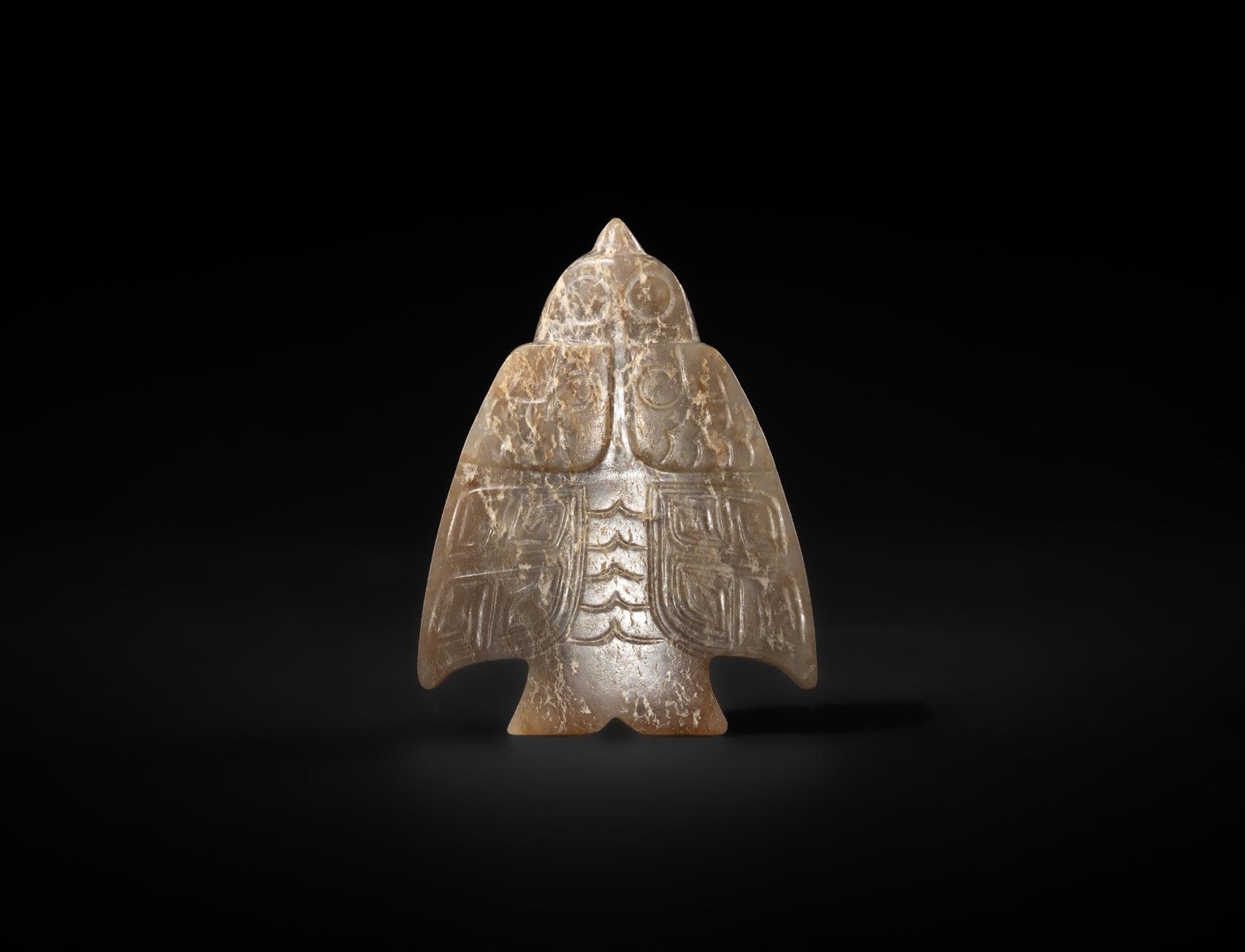
A SUPERB PALE CELADON JADE ‘OWL’ PENDANT, LATE SHANG DYNASTY, ANYANG PHASE
Expert authentication:
Prof. Filippo Salviati has examined the present lot in Vienna and confirmed its authenticity and the dating above.
China, c. 1300-1050 BC. Of flattened form, modeled with the head facing upwards, and wings tucked along the body resembling a triangle, and the feet tucked below the body. The wings incised with angular scrolls and stylized feathers, and the head detailed with circular eyes. Pierced through the beak for suspension. The finely polished, semi-translucent stone of a pale celadon-beige color suffused with a dense network of creamy veins.
Provenance: From a private collection in Canada.
Condition: Excellent condition with only minor surface wear and natural age-related imperfections, such as inclusions and small fissures. Distinct traces of weathering and erosion.
Weight: 38.6 g
Dimensions: Length 6.1 cm
LITERATURE COMPARISON
Compare a related jade pendant of a bird, late Shang dynasty, Anyang phase, 5.4 cm long, in the Smithsonian Institution, National Museum of Asian Art, accession number S1987.879.
Compare a related jade pendant of a bird, late Shang dynasty, Anyang phase, 9.7 cm long, illustrated in Gu Fang, The Complete Collection of Jades Unearthed in China, vol. 5, 2005, p. 59.
AUCTION RESULT COMPARISON
Type: Related
Auction: Christie’s New York, 13 September 2019, lot 820
Price: USD 62,500 or approx. EUR 70,500 converted and adjusted for inflation at the time of writing
Description: A rare large mottled brown and greenish-beige jade bird-form pendant, late Shang dynasty, 13th-11th century BC
Expert remark: Compare the related form, incised decoration, and manner of carving. Note the similar size (5.9 cm).
Purchase for EUR 5,850
18
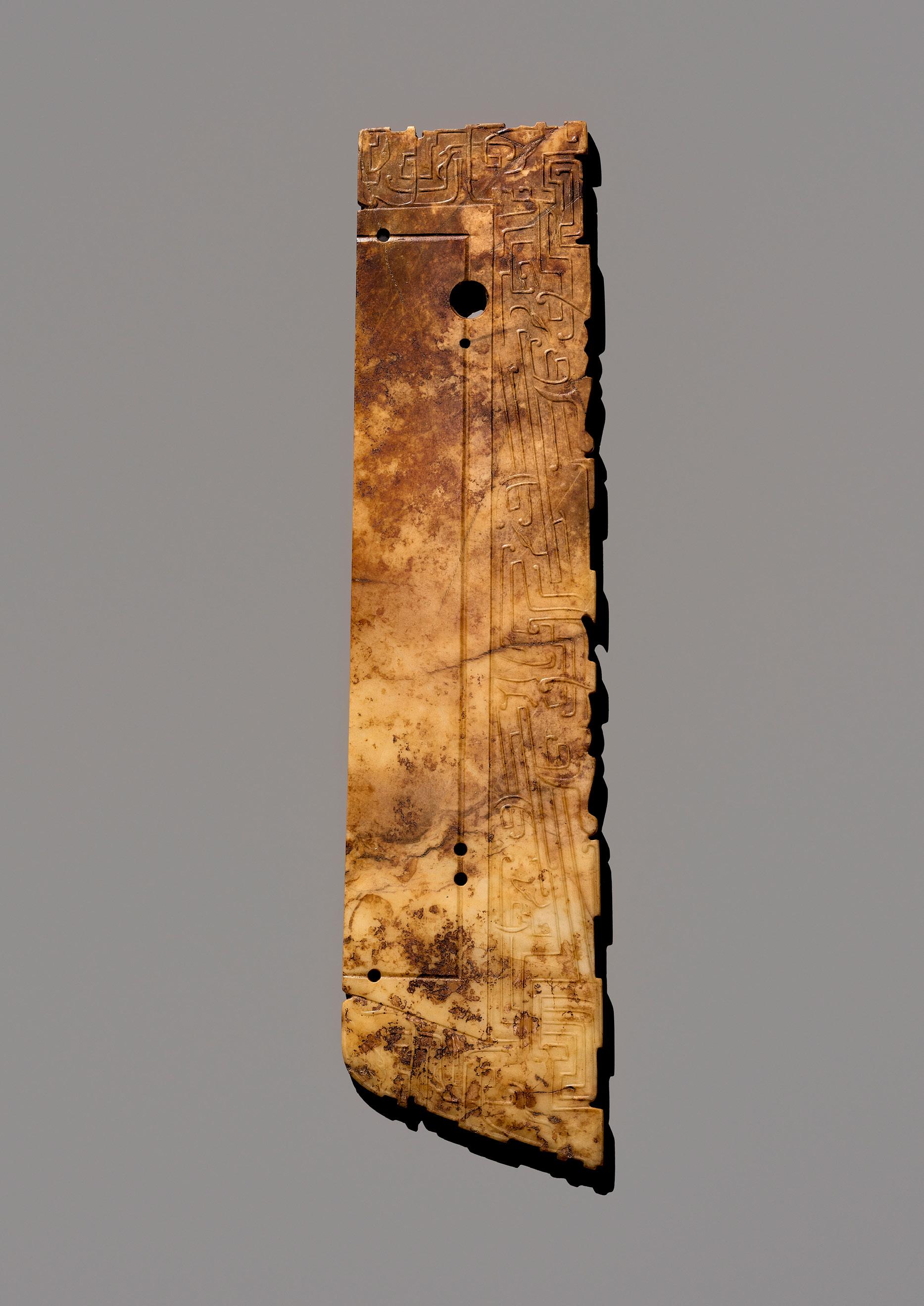
AN UNUSUALLY LARGE AND INCISED WHITE AND RUSSET JADE NOTCHED RITUAL BLADE, LATE SHANG DYNASTY, ANYANG PHASE
China, c. 1300-1050 BC. Finely carved, rectangular in form, with a diagonally cut upper edge and three sides boldly notched. The blade finely decorated on both faces with a band of incised linear patterns and geometric motifs adjacent to the notched edges, and perforated with several circular apertures, one of which is notably larger, intended for securing the implement to a shaft. The finely polished, translucent stone, originally of an icy-white hue, richly suffused with russet tones, displaying natural veining and patches of this coloration.
Provenance: The collection of David Taylor, Belfast, North Ireland, passed down through the Taylor family to his descendants. Thereafter in a private collection in Ilford, United Kingdom. David Taylor (1876-1958) was a prominent British businessman based in Belfast who owned several commercial properties and a substantial portfolio of stocks and shares. During his travels to East Asia in the early 20th century, he acquired numerous jades, including the present lot. His grandfather, Sir David Taylor (1815-1904), was born in Perth, Scotland, and relocated to Belfast in 1842, where he served as mayor in 1867, and again in 1883 and 1884.
Sir David Taylor, Mayor of Belfast (1867 and 1883-1884), grandfather of David Taylor (1876-1958)
Condition: Very good condition with minor surface wear and natural age-related imperfections, such as inclusions and fissures. Distinct traces of weathering and erosion, as well as evidence of prolonged burial in contact with iron oxide deposits, including occasional remnants of soil encrustation.
Weight: 431.2 g
Dimensions: Length 33.7 cm
Following the invention of bronze, weapons such as blades and daggers were also produced in more refined materials, notably jade, for ceremonial purposes. The present blade represents a jade adaptation of a weapon type widely distributed across many regions of China during the Shang period, distinguished by its characteristic diagonally cut terminal edge, with its larger perforation in the tang indicating the point at which the blade was originally mounted onto a wooden shaft. Unusually, this blade is one of the few known examples that presents incised decoration on its surface, in contrast to more common undecorated examples, where the visual emphasis lies on the inherent aesthetic qualities of the stone.
The significance of such ceremonial blades within Shang dynasty society is underscored by both the quantity and the exceptional quality of examples excavated from the tomb of Lady Fu Hao (d. c. 1200 BC), consort of King Wu Ding (r. 1324–1266 BC). Discovered near the Shang capital of Anyang in Henan province, her tomb offers valuable insight into the diversity of scale, design, and technical refinement achieved in jade carving during her lifetime. See Yinxu Fu Hao mu / Tomb of Lady Hao at Yinxu in Anyang, 1980, pl. 107-113, and Jessica Rawson, Chinese Jade. From the Neolithic to the Qing, 1995, p. 40–41.
LITERATURE COMPARISON
Compare a related marbled green jade notched ceremonial knife (dao), late Shang dynasty, Anyang phase, c. 1300-1050 BC, 13.1 cm long, from the Arthur M. Sackler collection, in the Smithsonian Institution, National Museum of Asian Art, accession number S1987.568. Compare a related dark green jade notched dagger-axe (ge) with incised scrolling decoration, late Shang dynasty, Anyang phase, c. 1300-1050 BC, 12.7 cm long, from the Arthur M. Sackler collection, in the Smithsonian Institution, National Museum of Asian Art, accession number S2012.9.268.
AUCTION RESULT COMPARISON
Type: Related
Auction: Sotheby’s New York, 22 March 2011, lot 63
Price: USD 68,500 or approx. EUR 84,500 converted and adjusted for inflation at the time of writing
Description: A rare archaic jade dagger, late Shang dynasty to early Western Zhou dynasty
Expert remark: Compare the related manner of carving with similarly raised ritual decoration. Note the different color of the stone and much smaller size (14 cm).
AUCTION RESULT COMPARISON
Type: Related
Auction: Zacke Vienna, 12 March 2026, lot 76
Price: EUR 46,800
Description: A large and inscribed jade ‘taotie’ ceremonial dagger-axe (ge), late Shang dynasty, Anyang phase
Expert remark: Compare the related manner of carving with similarly raised ritual decoration. Note the different color of the stone and slightly larger size (40.1 cm).
Purchase for EUR 58,500
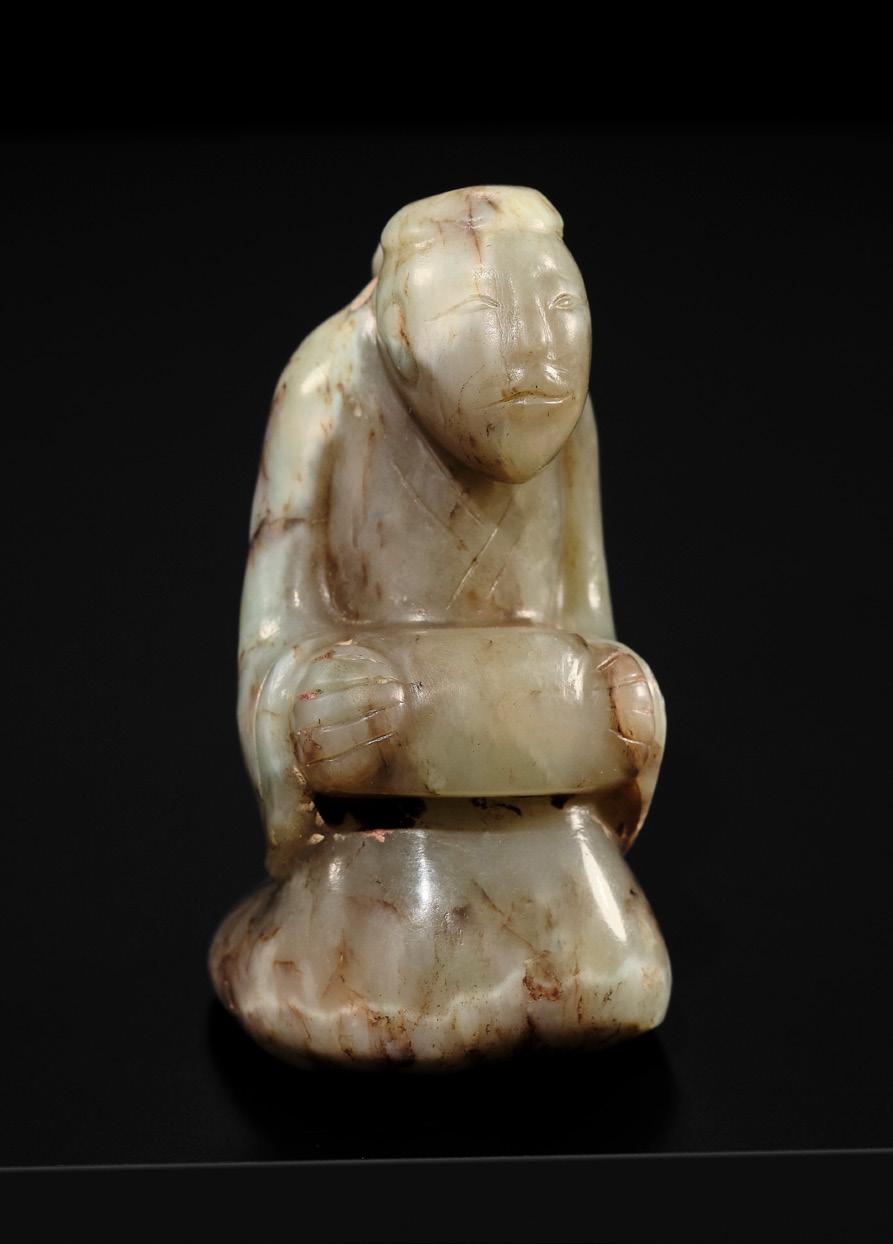
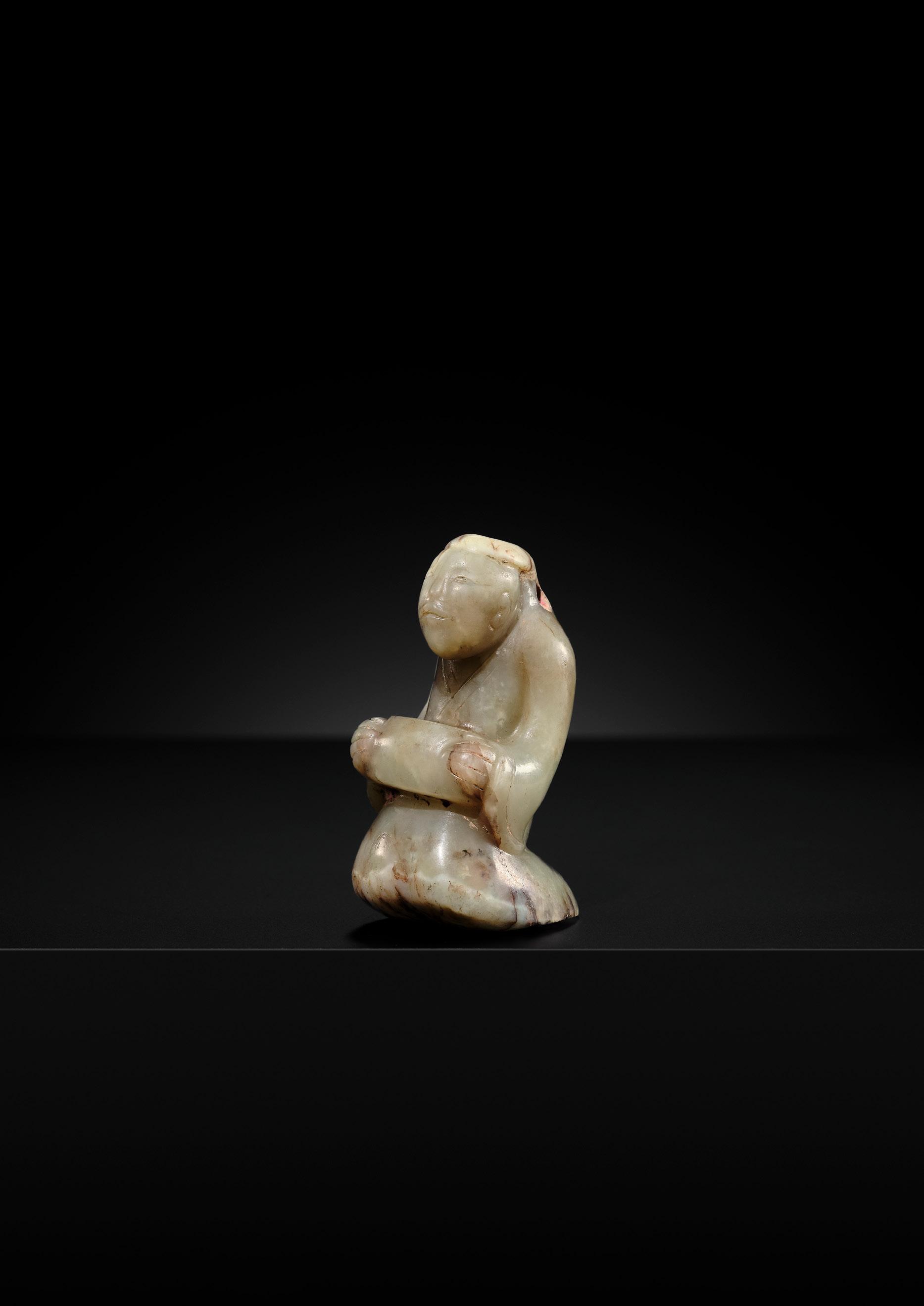
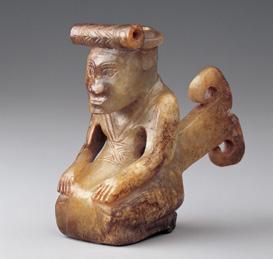
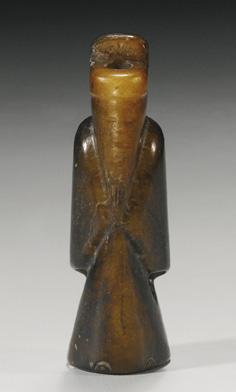
AN EXCEEDINGLY RARE PALE CELADON JADE ‘KNEELING MAN’ PENDANT, SHANG DYNASTY
China, c. 1600-1050 BC. Finely carved, depicted in a prostrate stance with a slightly hunched back, holding a long vessel close to the chest with both hands. The figure clad in loose-fitting robes with wide sleeves that fall gracefully from the forearms, while his oval face, rendered with subtly incised features, is surmounted by a distinctive headgear. The back of the head transversely perforated with a circular aperture for suspension. The finely polished, translucent stone of a pale celadon hue, now almost entirely covered by bluish-white tones resulting from mineral alteration and calcification resulting from millennia of interment.
Provenance: From the Sam and Myrna Myers Collection, acquired between circa 1965-2012.
Condition: Very good condition with expected surface wear and natural age-related imperfections. Traces of weathering and erosion. The stone with extensive signs of mineral discoloration and scattered remnants of soil encrustation, consistent with prolonged burial.
Weight: 110.1 g
Dimensions: Height 6.7 cm
Kneeling figures of this type are among the rarest jade artifacts from the Shang dynasty. Examples carved with related features have been found at the tomb of Lady Hao, dated to around 1200 BC, suggesting that this piece was made at around the same time. While the identification and function of these kneeling figures is a matter of speculation, their rarity suggests, as noted by Jessica Rawson, that ‘they are likely to have been extremely valuable and to have offered Fu Hao some sort of power or access to power’. See Jessica Rawson, Mysteries of Ancient China, 1996, p. 108.
About a kneeling jade figure from the Tomb of Fu Hao, Ai Weiwei notes that ‘some people believe this small carving represents Fu Hao herself, but I believe it is more mythological than memorial in function, a ritual object related to a higher power’. See Ai Weiwei on a Shang Dynasty jade from the tomb of Fu Hao, published in Jori Finkel, It Speaks to Me: Art that Inspires Artists, 2019. This interpretation underscores the enigmatic role such figures played in Shang dynasty rituals and beliefs.
The Tomb of Fu Hao is an archaeological site at Yinxu, the ruins of the ancient Shang dynasty capital Yin, within the modern city of Anyang in Henan Province, China. Discovered in 1976 by Zheng Zhenxiang, it was identified as the final resting place of the queen and military general Fu Hao, who died about 1200 BC. She was likely to have been the Lady Hao inscribed on oracle bones by King Wu Ding as well as one of his many wives. The artifacts unearthed within the grave included 755 jade objects, among them besides contemporary Shang jades also Longshan, Liangzhu, Hongshan, and Shijiahe jades. It is to date the only Shang royal tomb found intact with its contents and excavated by archaeologists, never having been looted probably due to its considerable distance from other known tombs.
AUCTION RESULT COMPARISON
Type: Related
Auction: Sotheby’s Hong Kong, 2 April 2019, lot 3412
Price: HKD 1,000,000 or approx.
EUR 122,500 converted and adjusted for inflation at the time of writing
Description: An extremely rare white and russet jade kneeling figure, Shang dynasty
Expert remark: Compare the related modeling with analogous prostrate stance, manner of carving, and color of the stone, notwithstanding the extensive calcification of the present specimen. Note the slightly smaller size (4 cm).
AUCTION RESULT COMPARISON
Type: Related
Auction: Bonhams Hong Kong, 4 July 2024, lot 63
Price: HKD 281,600 or approx. EUR 31,500 converted and adjusted for inflation at the time of writing
Description: An archaic jade carving of a kneeling figure, Shang dynasty or later
Expert remark: Compare the related modeling with analogous prostrate stance, manner of carving, and color of the stone, notwithstanding the extensive calcification of the present specimen. Note the slightly smaller size (4.4 cm).
Purchase for EUR 26,000
Sam and Myrna Myers
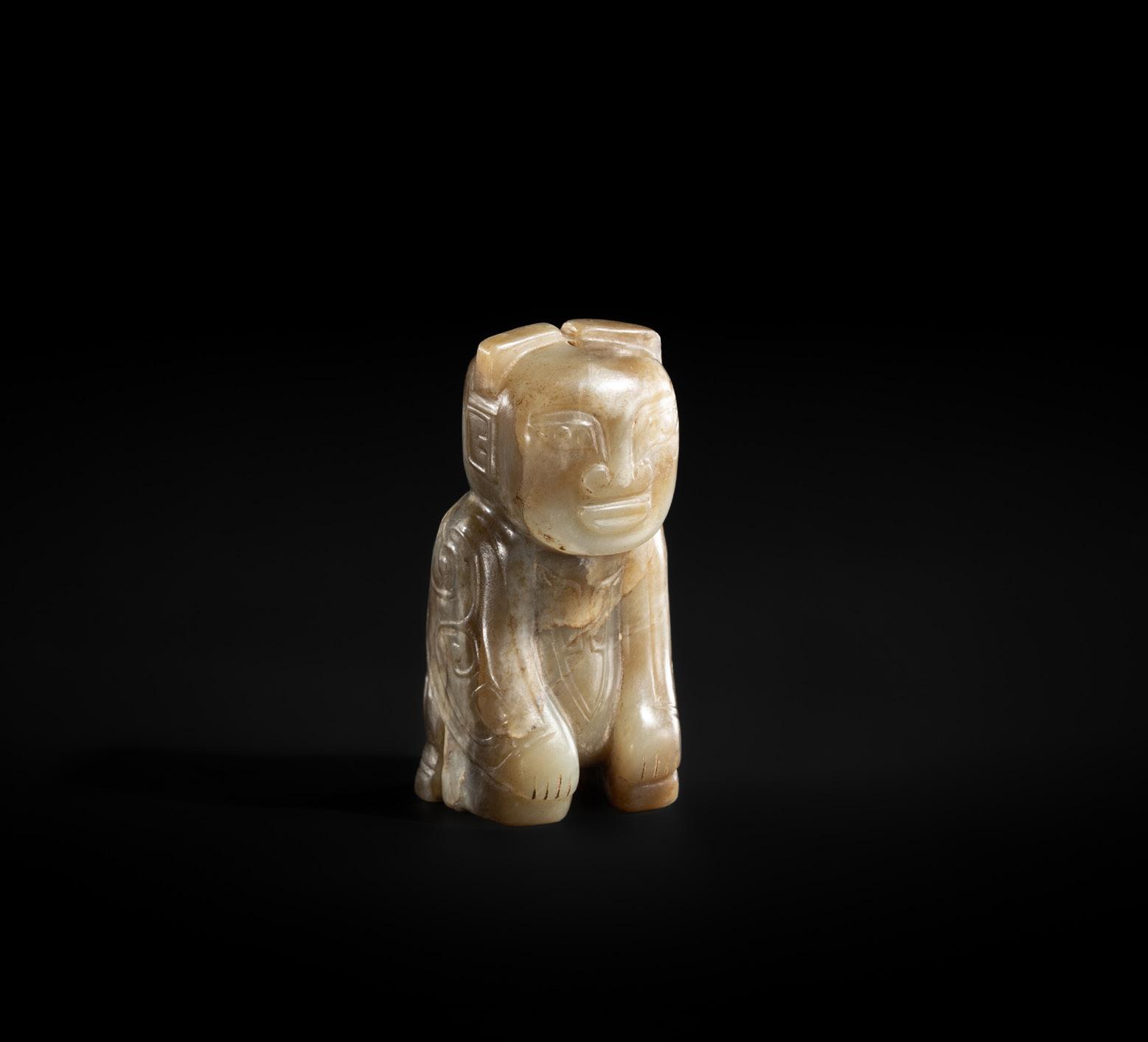
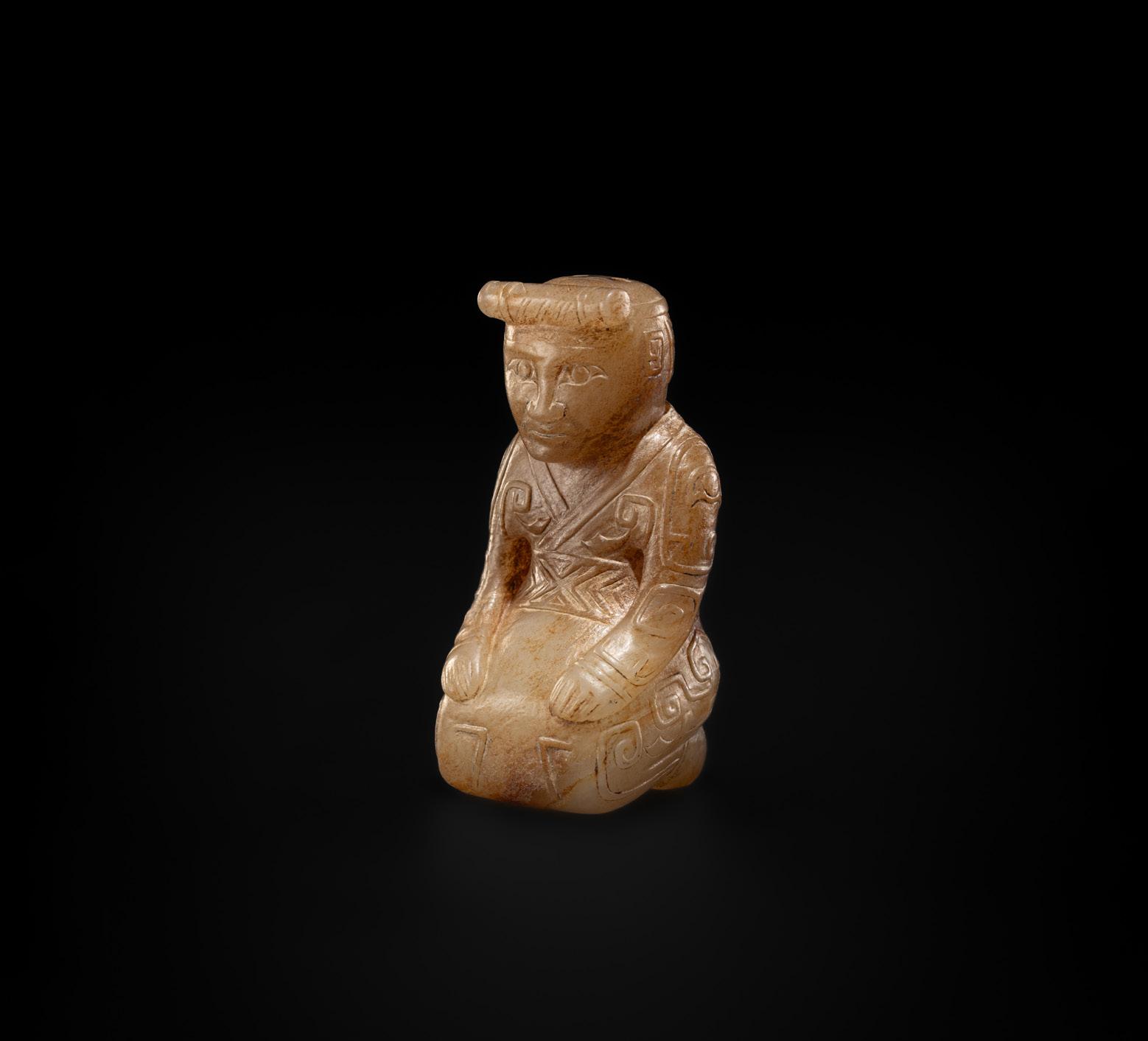
A VERY RARE PALE CELADON JADE ‘KNEELING MAN’ PENDANT, SHANG DYNASTY
China, c. 1600-1050 BC. Finely carved, the figure shown in a prostrate posture with a slightly hunched back, with hands resting upon the knees, and enveloped in a wide-sleeved garment decorated with neatly incised scrolling motifs. His oversized, rounded face, rendered with a subtly incised schematic expression, marked by large eyes, a broad nose, and full lips, while surmounted by a distinctive headdress, interrupted at the center and pierced with two small apertures for suspension. The reverse of the head further shaped with a small notch. The finely polished, semitranslucent stone of a pale celadon tone suffused with olive-green and light brown inclusions, together with delicate areas of whitish mineral alteration accrued through millennia of burial.
Provenance: The collection of David Taylor, Belfast, North Ireland, passed down through the Taylor family to his descendants. Thereafter in a private collection in Ilford, United Kingdom.
Condition: Excellent condition with only minimal surface wear and natural age-related imperfections, such as inclusions and small fissures. The stone with minor remnants of soil encrustation due to long-term burial.
Weight: 106.8 g
Dimensions: Height 6.3 cm
About a kneeling jade figure from the Tomb of Fu Hao, Ai Weiwei notes that ‘some people believe this small carving represents Fu Hao herself, but I believe it is more mythological than memorial in function, a ritual object related to a higher power’. See Ai Weiwei on a Shang Dynasty jade from the tomb of Fu Hao, published in Jori Finkel, It Speaks to Me: Art that Inspires Artists, 2019. This interpretation underscores the enigmatic role such figures played in Shang dynasty rituals and beliefs.
LITERATURE COMPARISON
Compare a related jade kneeling figure, late Shang dynasty, 1300-1050 BC, 4.3 cm high, in the Harvard Art Museums, object number 1943.50.317, included in the exhibition Ancient Chinese Jades, Fogg Art Museum, Harvard University, Cambridge, 1975, cat. no. 121.
AUCTION RESULT COMPARISON
Type: Related
Auction: Bonhams Hong Kong, 4 July 2024, lot 63
Price: HKD 281,000 or approx. EUR 31,500 converted and adjusted for inflation at the time of writing
Description: An archaic jade carving of a kneeling figure, Shang dynasty or later Expert remark: Compare the related modeling with analogous prostrate stance, manner of carving, and color of the stone, notwithstanding the extensive calcification of the present specimen. Note the slightly smaller size (4.4 cm).
Purchase for EUR 10,400
21
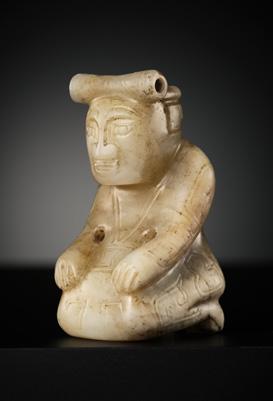
AN EXCEEDINGLY RARE ‘FU HAO TYPE’ WHITE AND RUSSET JADE CARVING OF A KNEELING HUMAN FIGURE, SHANG DYNASTY
China, c. 1600-1050 BC. Finely carved in a prostrate posture, with hands resting upon the knees, and the torso gently curved forward. The figure attired in a garment crossed over the chest and secured by a broad sash at the waist, both embellished with characteristic scrollwork motifs of the period. The powerfully modelled head bearing a finely incised hieratic expression, distinguished by large eyes, a broad nose, and full lips, flanked by ears engraved with further scrolling designs and surmounted by a distinctive tubular headdress. The upper section of the head pierced with two small apertures for suspension. The finely polished, translucent stone of a whitish tone suffused with russet speckling, cloudy inclusions, and creamy-white areas of opaque calcification.
Provenance: The collection of David Taylor, Belfast, North Ireland, passed down through the Taylor family to his descendants. Thereafter in a private collection in Ilford, United Kingdom.
Condition: Very good condition with old surface wear and natural age-related imperfections. Distinct traces of weathering and erosion. The stone surface with evidence of whitish mineral accretion, consistent with prolonged burial.
Weight: 137.1 g
Dimensions: Height 7.4 cm
The Tomb of Fu Hao is an archaeological site at Yinxu, the ruins of the ancient Shang dynasty capital Yin, within the modern city of Anyang in Henan Province, China. Discovered in 1976 by Zheng Zhenxiang, it was identified as the final resting place of the queen and military general Fu Hao, who died about 1200 BC.
LITERATURE COMPARISON
Compare a closely related jade carving of a kneeling human figure, Shang dynasty, Anyang phase, 1300-1046 BC, 7 cm high, excavated from the tomb of Lady Fu Hao, held by the National Museum of China, Beijing.
AUCTION RESULT COMPARISON
Type: Closely related
Auction: Zacke Vienna, 17 October 2024, lot 94
Price: EUR 19,500 or approx. EUR 20,500 adjusted for inflation at the time of writing
Description: A ‘Fu Hao type’ jade carving of a kneeling human figure, Shang dynasty
Expert remark: Compare the closely related modeling with analogous prostrate stance and thread-relief decoration, manner of carving, and color of the stone, Note the slightly smaller size (6.3 cm).
Purchase for EUR 19,500
Sir David Taylor, Mayor of Belfast (1867 and 1883-1884), grandfather of David Taylor (1876-1958)
China, c. 1300-1050 BC. Finely carved in the round as an owl standing upright on its feet and tail, with its head held high, marked by a pair of circular eyes, a sharply hooked beak, and curling ear tufts. The breast and wings of the bird rendered in rounded form and decorated with finely incised double-line grooves. The beak pierced with a small circular aperture for suspension. The skillfully polished, translucent stone of an attractive celadon tone, with subtle cloudy inclusions, russet mottling, and traces of opaque mineral alteration.
Provenance: The collection of David Taylor, Belfast, North Ireland, passed down through the Taylor family to his descendants. Thereafter in a private collection in Ilford, United Kingdom. Condition: Very good condition with surface wear and natural agerelated imperfections. Distinct traces of weathering and erosion. The stone surface with scattered areas of soil accretion, consistent with long-term burial.
Sir David Taylor, Mayor of Belfast (1867 and 18831884), grandfather of David Taylor (1876-1958)
Weight: 24.3 g
Dimensions: Length 3.9 cm
The owl motif is among the earliest and most prominent images in ancient China.
The Tomb of Fu Hao is an archaeological site at Yinxu, the ruins of the ancient Shang dynasty capital Yin, within the modern city of Anyang in Henan Province, China. Discovered in 1976 by Zheng Zhenxiang, it was identified as the final resting place of the queen and military general Fu Hao, who died about 1200 BC.
LITERATURE COMPARISON
Compare a closely related jade figure of an owl, Shang dynasty, 1500-1050 BC, 5 cm high, in the British Museum, registration number 1968,0422.16.
AUCTION RESULT COMPARISON
Type: Closely related
Auction: Christie’s Hong Kong, 30 November 2016, lot 3202
Price: HKD 4,620,000 or approx. EUR 607,000 converted and adjusted for inflation at the time of writing
Description: An important and rare celadon jade carving of an owl, late Shang dynasty, 13th-11th century BC
Expert remark: Compare the closely related subject, incised decoration with analogous double-line grooves, and manner of carving. Note the nearly identical size (4.1 cm).
AUCTION RESULT COMPARISON
Type: Closely related
Auction: Christie’s Hong Kong, 30 November 2020, lot 2716
Price: HKD 687,500 or approx. EUR 82,000 converted and adjusted for inflation at the time of writing
Description: A white jade carving of an owl, Shang dynasty, c. 1600-1046 BC
Expert remark: Compare the closely related subject, incised decoration with analogous double-line grooves, and manner of carving. Note the nearly identical size (3.5 cm).
Purchase for EUR 10,400
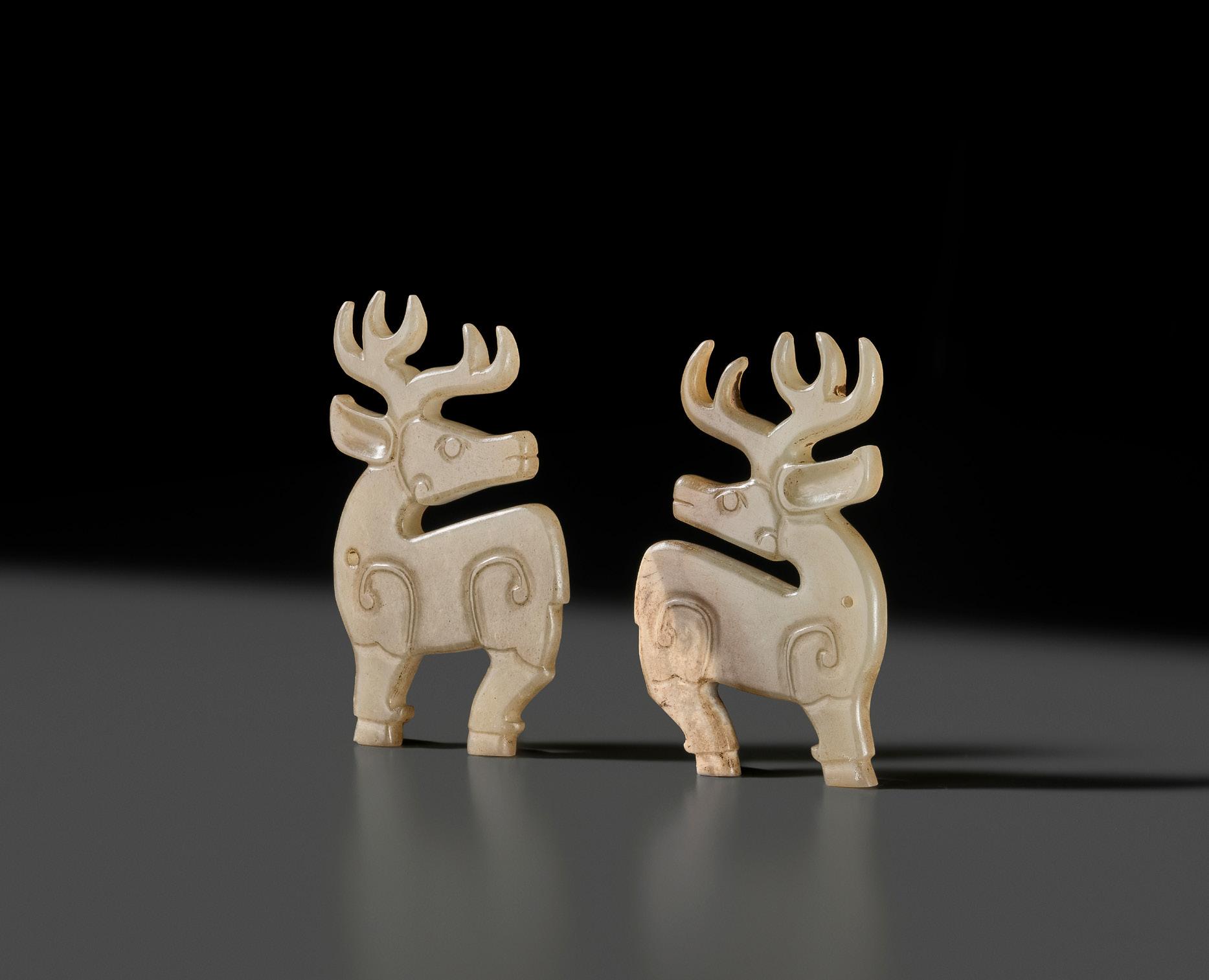
A PAIR OF FINE PALE CELADON JADE ‘STAG’ PENDANTS, WESTERN ZHOU DYNASTY
China, c. 1050-77ß BC. Each skillfully carved in the form of a stag silhouette, standing firmly on its legs with the head turned as if looking back, defined by a prominent snout and pointed ears, and surmounted by pronounced antlers. The finely polished, translucent stone of an attractive pale celadon tone with icy-white inclusions, light brown veining, and occasional areas of opaque, leached white mineral deposits.
Provenance: The collection of David Taylor, Belfast, North Ireland, passed down through the Taylor family to his descendants. Thereafter in a private collection in Ilford, United Kingdom. Condition: Very good condition with only minor surface wear and natural age-related imperfections. Distinct traces of weathering and evidence of prolonged burial, including small remnants of soil encrustation.
Weight: 65.6 g (total)
Dimensions: Length 7.7 cm (each)
Literature comparison:
Compare a closely related jade figure of a stag, Western Zhou dynasty, 1100-901 BC, 5 cm high, in the British Museum, registration number 1945,1017.13. Compare a closely related jade figure of a deer, Western Zhou dynasty, 1100-901 BC, 4.8 cm high, in the Metropolitan Museum of Art, object number 24.51.14. Compare a closely related jade pendant in the form of a stag, Western Zhou dynasty, 1050-950 BC, 5.4 cm high, from the Arthur M. Sackler collection, in the Smithsonian Institution, National Museum of Asian Art, accession number S1987.873.
AUCTION RESULT COMPARISON
Type: Closely related Auction: Sotheby’s Hong Kong, 8 April 2023, lot 3792
Price: HKD 609,600 or approx.
EUR 70,500 converted and adjusted for inflation at the time of writing
Description: Two calcified jade ‘deer’ plaques, Western Zhou dynasty Expert remark: Compare the closely related decorative subject, standing pose with prominent antlers, and manner of carving. Note the smaller size (4.4 cm).
AUCTION RESULT COMPARISON
Type: Closely related Auction: Christie’s Hong Kong, 29 November 2017, lot 2737
Price: HKD 525,000 or approx.
EUR 67,500 converted and adjusted for inflation at the time of writing
Description: A jade deer-form pendant, mid-Western Zhou dynasty Expert remark: Compare the closely related decorative subject, standing pose with prominent antlers, and manner of carving. Note the smaller size (4.6 cm).
Purchase for EUR 7,800
24
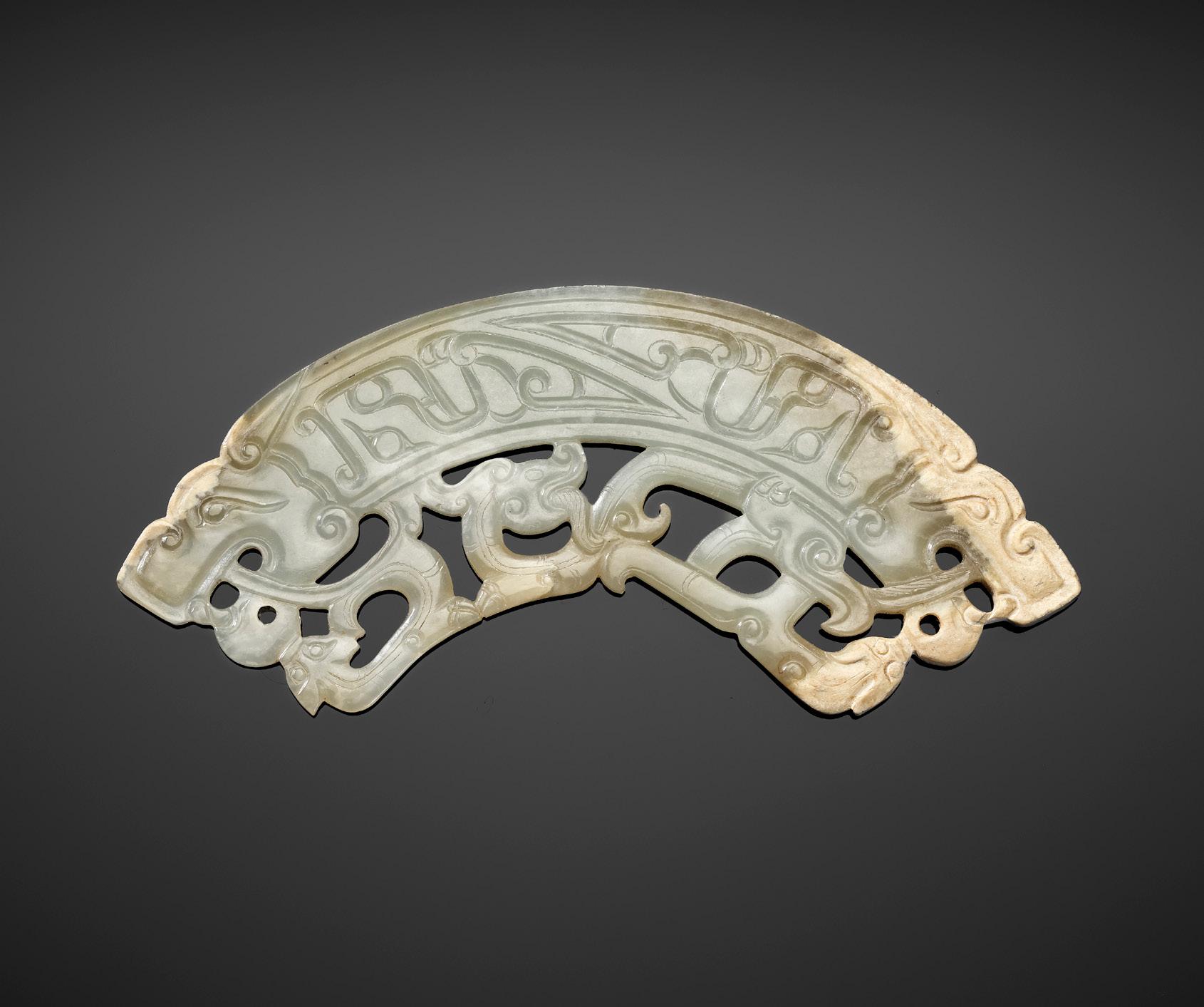
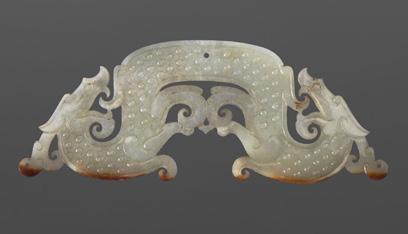
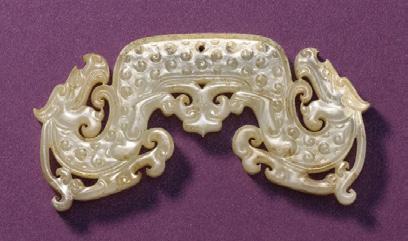
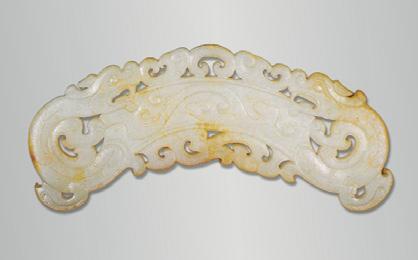
A RARE PALE CELADON JADE RETICULATED ‘DRAGON’ PENDANT, HUANG, EASTERN ZHOU DYNASTY
China, 770-221 BC. Arched in form, finely carved in openwork to depict two stylized dragon heads of different sizes at either end, each gripping a vine in its mouth. The sinuous bodies of the principal dragons enclose three smaller mythical creatures, two of them positioned with their heads meeting the chins of the larger dragons, while a third is centered within the composition. The bodies delicately incised with comma-shaped scrolls and archaic ornamental motifs. The meticulously polished, translucent stone of a pale celadon tone with icy inclusions, subtle brown clouding, and areas of opaque, creamy-white calcification.
Provenance: From the Sam and Myrna Myers Collection, acquired between circa 1965-2012.
Condition: Very good condition with ancient surface wear and natural age-related imperfections. Traces of weathering and signs of prolonged burial, including few minuscule chips, some of which have smoothed over millennia, and minor nibbling along the edges.
Weight: 23.7 g
Dimensions: Length 10.5 cm
Expert’s note:
The present pendant exhibits a high degree of design complexity, distinguished by its sophisticated and richly articulated detailing.
It is representative of a style primarily circulated in eastern Anhui, northern Jiangsu, Xuzhou region, and western Shandong. This tradition is characterized by exceptional craftsmanship, intricate carving, and openwork decoration, as well as a prominent use of dragon and phoenix motifs as principal ornamental themes.
AUCTION RESULT COMPARISON
Type: Related
Auction: Sotheby’s New York, 18 March 2014, lot 149
Price: USD 62,000 or approx. EUR 75,000 converted and adjusted for inflation at the time of writing
Description: A fine and rare jade pendant, huang, Eastern Zhou dynasty
Expert remark: Compare the related form with analogous ‘double dragon’ heads and manner of carving with openwork details. Note the different color of the stone and incision work.
Purchase for EUR 7,800
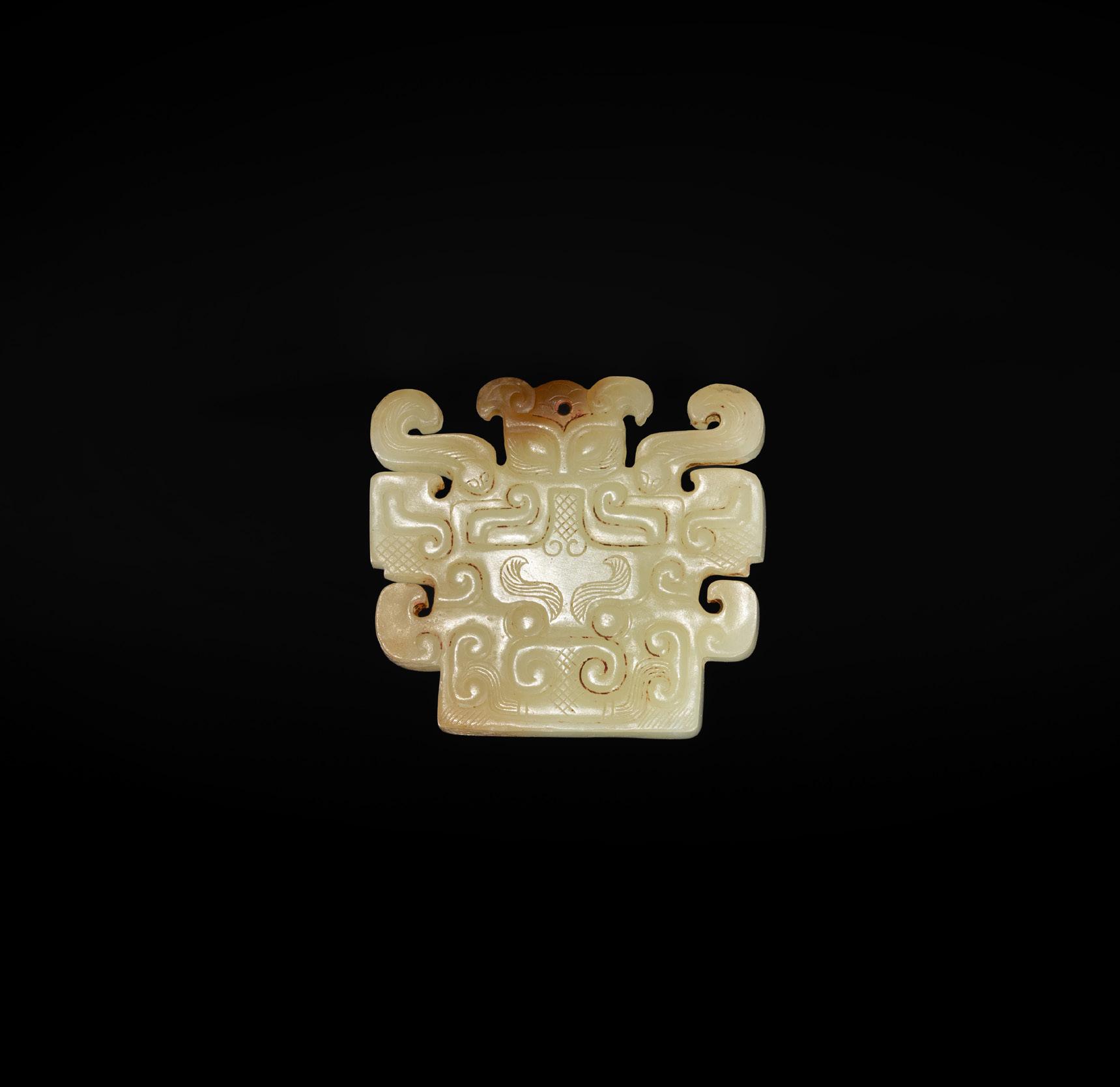
A RARE PALE CELADON JADE ‘MASK’ PENDANT, EASTERN ZHOU DYNASTY
China, 771-256 BC. Of flattened form, carved to both sides with a face of a dragon with circular eyes below bushy eyebrows centered above a wide snout and moustache, and surmounted by a face resembling an owl which is further flanked by two snakes. The top pierced for suspension. The finely polished, translucent stone of a pale celadon color with few minor areas of calcification and cloudy white inclusions.
Provenance: Private collection of Prof. Filippo Salviati, Rome, Italy.
Condition: Very good condition with minor wear and natural agerelated imperfections, such as small fissures, some of which may have developed into thin hairlines. Occasional minute nicks and shallow surface scratches. Minor nibbling along the edges. The stone surface with remnants of red ritual pigment.
Weight: 21.1 g
Dimensions: Length 4.3 cm
AUCTION RESULT COMPARISON
Type: Related
Auction: Sotheby’s Hong Kong, 9 October 2020, lot 62
Price: HKD 176,400 or approx. EUR 22,000 converted and adjusted for inflation at the time of writing
Description: A celadon jade ‘animal mask’ plaque, Spring and Autumn period
Expert remark: Compare the related flattened form, scrolling design, and color of the stone. Note the similar size (5 cm).
Purchase for EUR 4,550
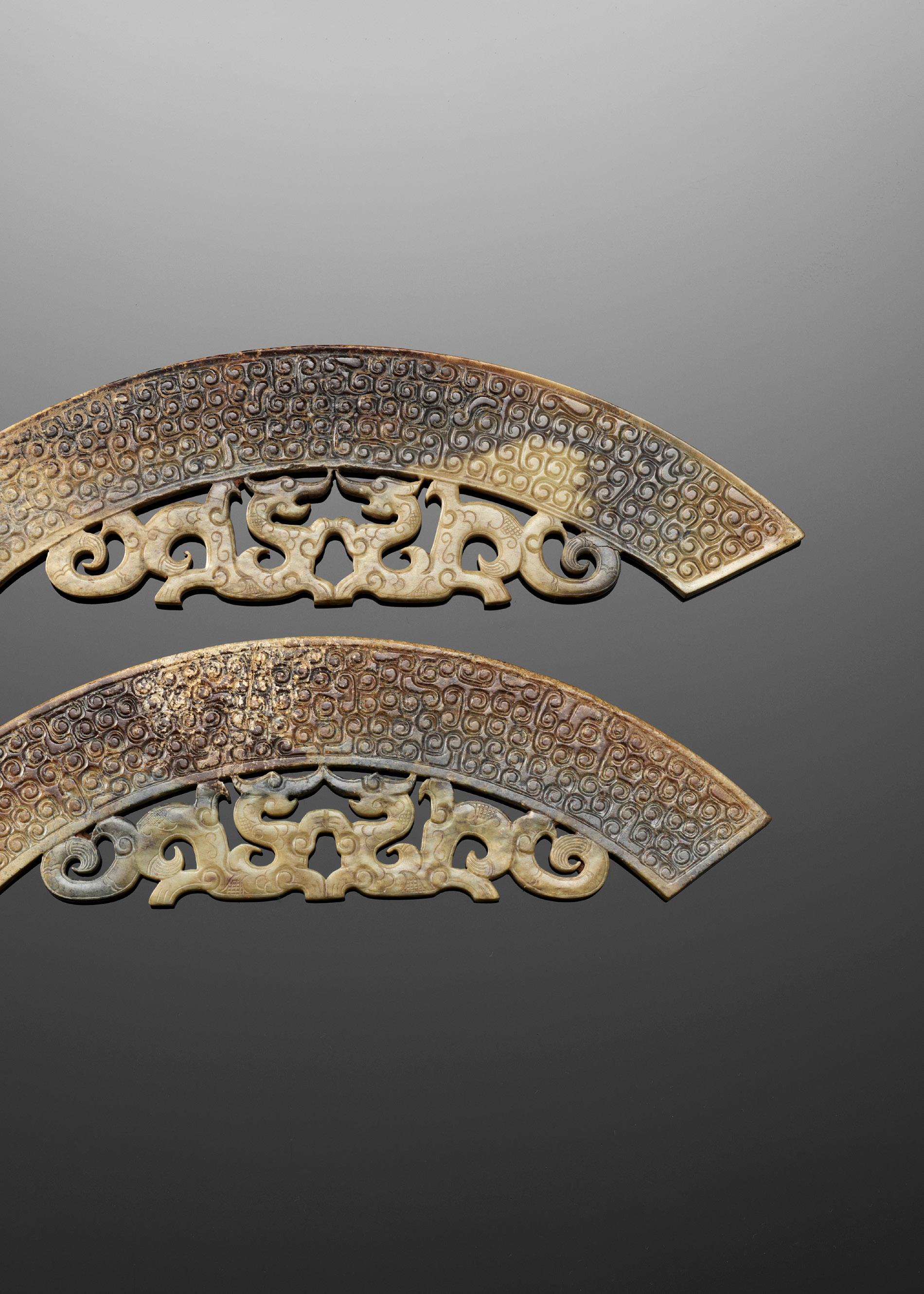
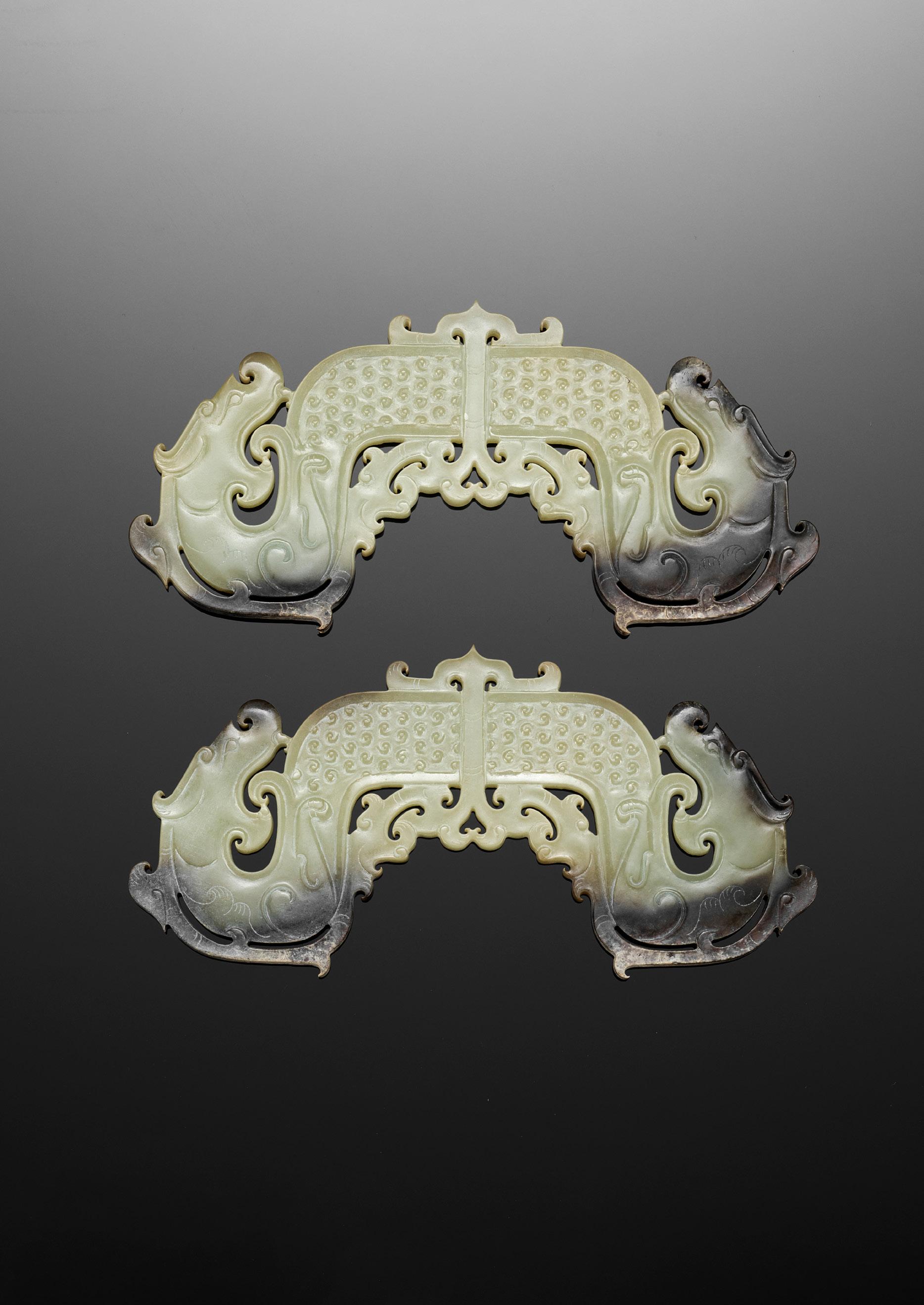
A PAIR OF JADE ‘DRAGON’ PENDANTS, HUANG, EASTERN ZHOU DYNASTY
China, Chu state, late Spring and Autumn period, 6th-5th century BC. Of slightly arched and flattened form, the pendants carved in relief with interlinked C-spirals framed by raised borders, all below two confronting dragons with sinuous bodies and curling tails, their features neatly incised. The mostly opaque stone is of a beige to pale gray tone with extensive patches of dark russet-brown and grayish-black tone as well as cloudy inclusions.
Provenance: Private collection of Prof. Filippo Salviati, Rome, Italy.
Condition: Good condition, commensurate with age, a fine hairline crack to one dragon tail, nibbling to the edges, few small, smoothened chips, and signs of weathering and erosion.
Weight: 88.6 g and 92.3 g
Dimensions: Length 19.4 am and 18.4 cm
This type of design, style, and stone are typical of the jades from the Chu cultural region, such as those discovered in the Xiong family tomb at Jingzhou, Hubei. Chu was a Zhou dynasty vassal state. Their first ruler was King Wu of Chu in the early 8th century BC. Chu was located in the south of the Zhou heartland and existed mostly during the Spring and Autumn period. At the end of the Warring States period, it was destroyed by the Qin in 223 BC during the Qin’s wars of unification.
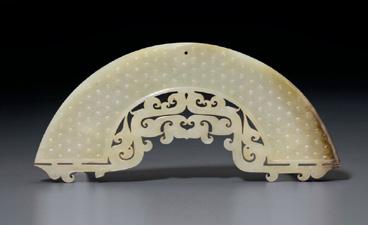
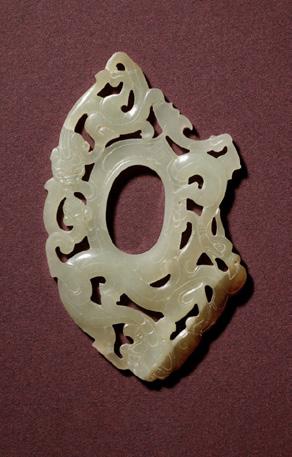
The closest comparable example for the present lot is a jade huang (see fig. 1) unearthed from a Warring States tomb in the ancient city of Qufu in Shandong Province. Qufu was once the capital of the Zhou-dynasty Lu state and the hometown of Confucius.
AUCTION RESULT COMPARISON
Type: Related
Auction: Christie’s New York, 17 March 2015, lot 4
Price: USD 197,000 or approx. EUR 240,000 converted and adjusted for inflation at the time of writing
Description: A very rare white jade arc-shaped pendant, Huang, China, late Eastern Zhou dynasty, 5th-4th century BC
Expert remark: Compare the related form and openwork decorations to the lower half. Note the lot comprises only one pendant, the color of the jade, and the smaller size (16.2 cm).
Purchase for EUR 20,800
fig. 1
Filippo Salviati
27
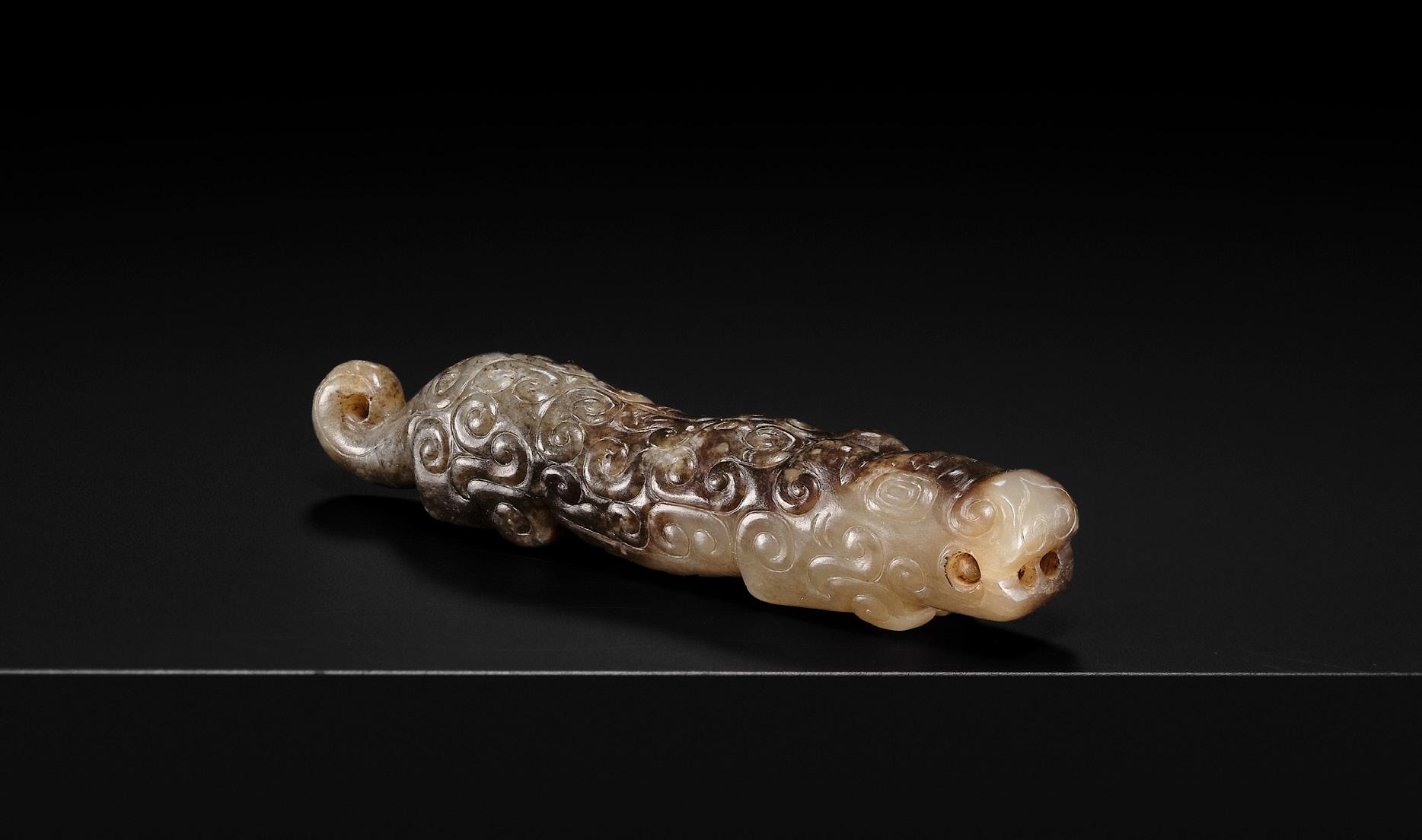
AN EXCEPTIONAL PALE CELADON AND BROWN JADE ‘TIGER’ PENDANT, SPRING AND AUTUMN PERIOD
China, c. 770-475 BC. Finely carved in the round, the stylized feline depicted in a recumbent pose with its limbs tucked beneath its elongated body, decorated with raised C-shaped scrollwork, while extending into a coiled tail, pierced with a small aperture for suspension, and a highly abstracted, two-horned head, whose muzzle is similarly perforated to suggest sharp fangs. The superbly polished, translucent stone of a pale celadon tone, marked by opaque dark brown patches and softly clouded inclusions.
Provenance: From the Sam and Myrna Myers Collection, acquired between circa 1965-2012.
Condition: Excellent condition with only minor surface wear, natural age-related imperfections, such as inclusions and small fissures, and minimal soil encrustation within the nostril perforations, consistent with long-term burial.
EXPERT’S NOTE
Weight: 28.9 g Dimensions: Length 7.6 cm
AUCTION RESULT COMPARISON
Type: Related
Auction: Christie’s Hong Kong, 29 November 2024, lot 1062
Price: HKD 352,800 or approx. EUR 40,000 converted and adjusted for inflation at the time of writing
Description: A jade tiger-form ear pick, late Spring and Autumn period, c. 570-476 BC
Expert remark: Compare the related recumbent stance of the animal, manner of carving, and decorative motifs in raised scrollwork. Note the slightly smaller size (5.3 cm).
Purchase for EUR 19,500
The present jade carving constitutes an exceptionally rare example that notably integrates techniques and decorative motifs from different periods of the early dynasties of China. Its zoomorphic design, carved in the round, is firmly aligned with Shang dynasty (c. 1600–1050 BC) jade specimens (fig. 1), with well-known comparable examples among the jades excavated from the tomb of Fu Hao, consort of King Wu Ding (1324–1265 BC) (fig. 2). In contrast, its carved decoration, composed of raised C-shaped scrolls and spirals, strongly belongs to the ornamental vocabulary of the Spring and Autumn period (770–475 BC), being likewise noteworthy that representations of mythical creatures from this later period were predominantly executed in plaque form (fig. 3), a fact that further underscores the exceptional nature of the present carving.
fig. 1
Fig. 1: Compare a related jade pendant in the form of a tiger, late Shang dynasty, Anyang phase, c. 1250-1050 BC, 5.7 cm long, in the Smithsonian Institution, National Museum of Asian Art, accession number S1987.553
fig. 2
Fig. 2: Compare a related jade pendant in the form of a tiger, late Shang dynasty, Anyang phase, c. 1250-1050 BC, 14.1 cm long, excavated from the tomb of Lady Fu Hao, and illustrated in Zhongguo meishu quanji: Diaosu bian [Complete Collection of Chinese Art: Sculpture], vol. 1, 1988, p. 51
Fig. 3: Compare a related jade dragon pendant, decorated with raised commashaped spirals, late Spring and Autumn period, 570-475 BC, 12.2 cm long, in the National Palace Museum, Taipei, accession number 000486N000000000 fig. 3
A FINE PALE CELADON JADE ‘DRAGON’ PENDANT, EASTERN ZHOU DYNASTY
China, 771-256 BC. Of flattened form, carved as a sinuous dragon detailed with raised comma-shaped scrolls enclosed by raised borders, and pierced at the center for suspension. The finely polished, semitranslucent stone of a pale celadon tone with areas of creamy-white calcification.
Provenance: Private collection of Prof. Filippo Salviati, Rome, Italy.
Condition: Very good condition with minor surface wear and natural age-related imperfections, such as small fissures, some of which have developed into thin hairlines. Minor nibbling along the edges.
Weight: 46.2 g
Dimensions: Length 10.8 cm
LITERATURE COMPARISON
Compare a related jade ‘dragon’ pendant, Eastern Zhou to Warring States period, 10.6 cm long, in the Smithsonian Institution, National Museum of Asian Art, accession number S1987.563.
AUCTION RESULT COMPARISON
Type: Related
Auction: Bonhams New York, 15 March 2021, lot 15
Price: USD 56,562 or approx.
EUR 62,000 converted and adjusted for inflation at the time of writing
Description: Two pale celadon green and gray jade dragon-shaped pendants, Eastern Zhou dynasty, 5th-4th century BC
Expert remark: Compare the related form, decoration in high relief, and color of the stone. Note the larger size (16 cm) and that the lot comprises two pendants.
AUCTION RESULT COMPARISON
Type: Related
Auction: Sotheby’s Hong Kong, 9 October 2020, lot 13
Estimate: HKD 400,000 or approx.
EUR 50,000 converted and adjusted for inflation at the time of writing
Description: A superb white jade S-shaped ‘dragon and phoenix’ pendant, Eastern Zhou dynasty, Warring States period
Expert remark: Compare the related form and comma-shaped spiral decoration. Note the different color of the stone and larger size (12.5 cm).
Purchase for EUR 5,850
LITERATURE COMPARISON
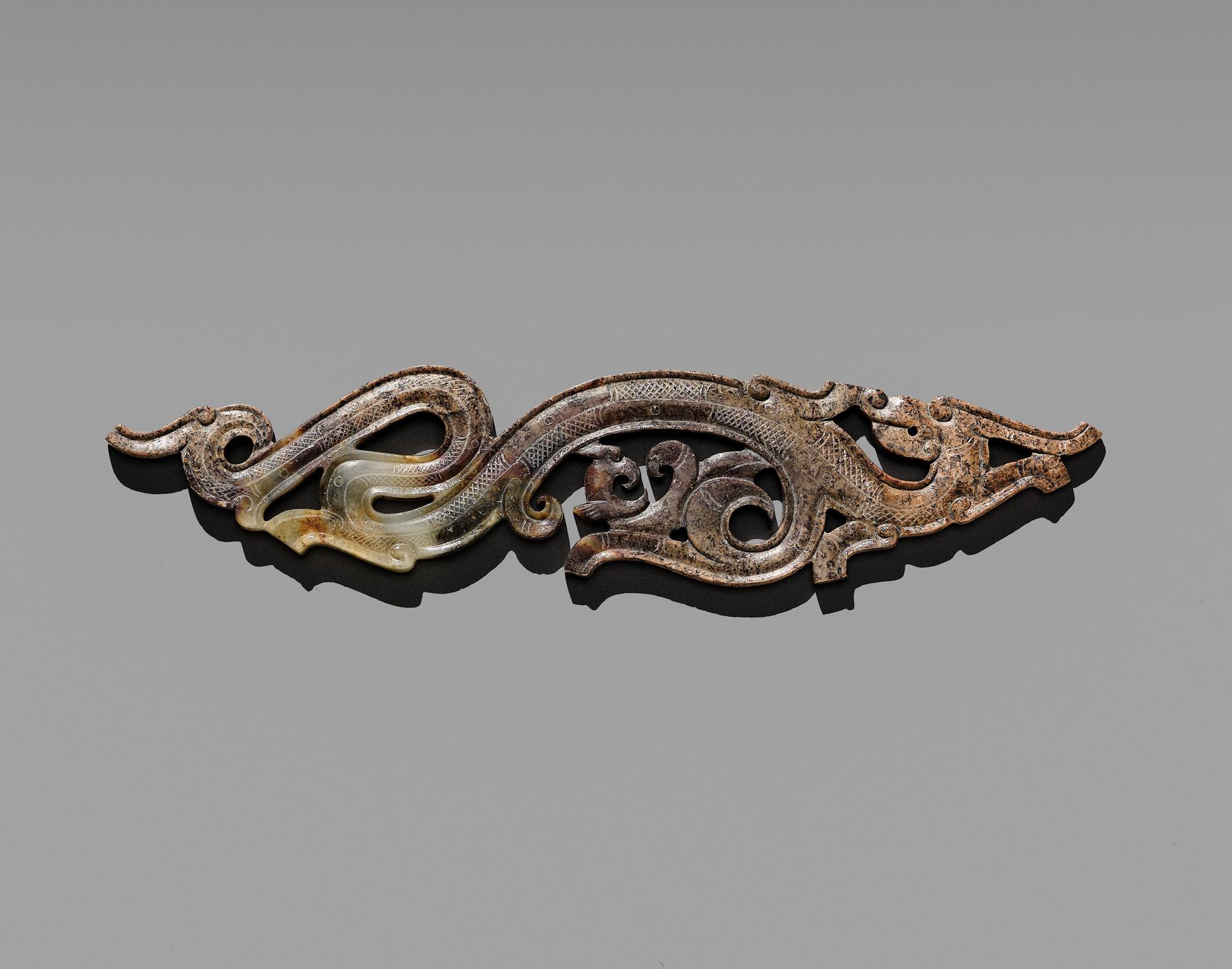
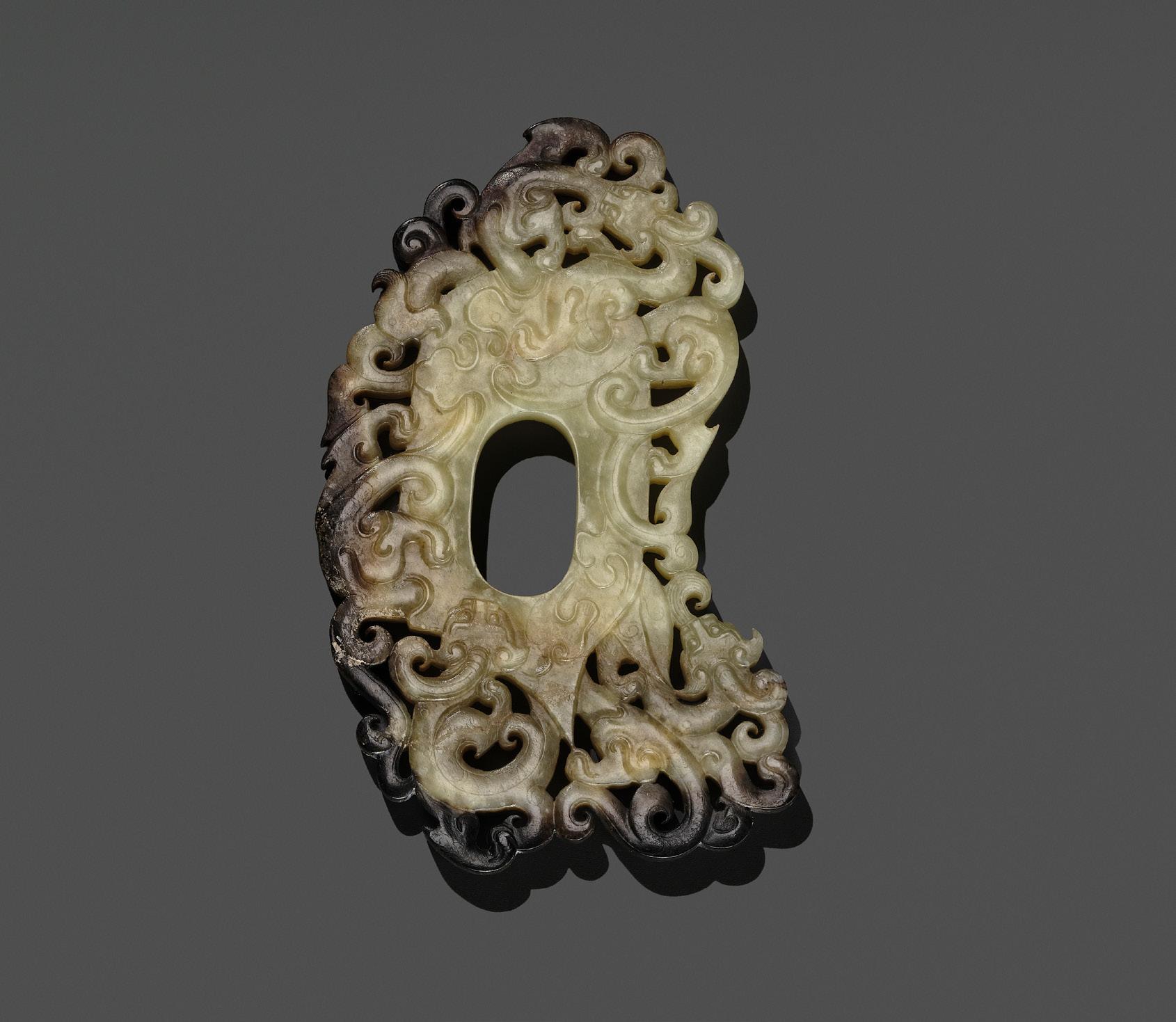
A PALE CELADON AND RUSSET JADE ‘DRAGON’ PLAQUE, EASTERN ZHOU DYNASTY
Expert authentication: Prof. Filippo Salviati has examined the present lot in Vienna and confirmed its authenticity and the dating above.
China, 770-221 BC. Intricately carved in openwork as a sinuous dragon terminating in a phoenix on the other end and incised with C-scrolls within a lined border. The semi-translucent stone is of a pale celadon tone transitioning to a russet color, with russet inclusions, and areas of calcifications.
Provenance: From a private collection in Canada.
Condition: Very good condition, commensurate with age, with surface wear and natural age-related imperfections, such as small fissures, some of which have developed into thin hairlines. Traces of weathering and erosion. Minuscule smoothed chips.
Weight: 49.6 g
Dimensions: Length 13.5 cm
Compare a related jade ‘dragon’ plaque, Eastern Zhou dynasty, 31 cm long, in the Smithsonian Institution, National Museum of Asian Art, accession number S2012.9.1255.1. Compare a related jade ‘dragon’ pendant, Eastern Zhou dynasty, 13 cm long, in the Smithsonian Institution, National Museum of Asian Art, accession number S2012.9.1352.
AUCTION RESULT COMPARISON
Type: Related
Auction: Sotheby’s Hong Kong, 18 April 2024, lot 581
Price: HKD 48,000 or approx. EUR 5,500 converted and adjusted at the time of writing
Description: A celadon jade ‘dragon’ pendant, Warring States period
Expert remark: Compare the related face, incised scrolling design, and color of the stone. Note the slightly smaller size (10.1 cm).
Purchase for EUR 5,200
A PAIR OF OPENWORK PALE CELADON JADE ‘DOUBLE DRAGON’ PLAQUES, EASTERN ZHOU DYNASTY
Expert authentication:
Prof. Filippo Salviati has examined the present lot in Vienna and confirmed its authenticity and the dating above.
China, 770-221 BC. Each intricately carved in openwork with two confronting dragons flanked by sinuous serpents, detailed with hatched areas, and pierced to the upper end for suspension. The finely polished, semi-translucent stone of a pale celadon tone with distinct russet and brown inclusions.
Provenance: From a private collection in Canada.
Condition: Both plaques fractured, with associated minor losses and residual adhesive traces. Otherwise, good condition with minor surface wear and natural age-related imperfections, including small fissures. Distinct traces of weathering and erosion.
Weight: 37.4 g and 46.8 g
Dimensions: Length 14 cm (each)
AUCTION RESULT COMPARISON
Type: Related
Auction: Sotheby’s Hong Kong, 25 November 2022, lot 868
Price: HKD 252,000 or approx. EUR 31,000 converted and adjusted for inflation at the time of writing
Description: A jade reticulated ‘dragon and phoenix’ plaque, Warring States period
Expert remark: Compare the related reticulated design, manner of carving, and color of the stone. Note the slightly smaller size (11 cm) and that lot comprises only one pendant.
Purchase for EUR 7,800
A LARGE WHITE AND RUSSET JADE ‘DRAGON’ PENDANT, EASTERN ZHOU
DYNASTY
China, 7th-3rd century BC. The jade carved as a dragon, with circular eyes, a prominent snout, and comma spirals decorated to the S-shaped body that terminates in a coiled tail reminiscent of a phoenix head. The body of the dragon is elegantly curved, the head, tail and scrolled appendages are further enriched with subtly engraved motifs, and the upper section is pierced at the center for suspension. The semitranslucent jade is of a beautiful white hue with grayish inclusions and transitioning into russet shades at the edges.
Provenance: Private collection of Prof. Filippo Salviati, Rome, Italy.
Condition: Excellent condition with some minor signs of age-related weathering, and natural inclusions and alterations. The stone with natural fissures, some of which may have developed into thin hairlines cracks over time.
Weight: 157.6 g
Dimensions: Length 19.5 cm
With a fitted storage box. (2)
Literature comparison:
Compare a closely related jade pendant in the form of a dragon with raised curls, Warring States period, 475-221 BC, 12.3 cm long, from the collection of Charles L. Freer, in the Smithsonian Institution, National Museum of Asian Art, accession number F1917.376. Compare a closely related jade ‘dragon’ pendant, Warring States period, 4th century BC, 11.1 cm long, in the Harvard Art Museums, object number 1943.50.440, illustrated in Jenny F. So, Early Chinese Jades in the Harvard Art Museums2019, cat. 25D.
AUCTION RESULT COMPARISON
Type: Closely related
Auction: Christie’s Hong Kong, 3 December 2021, lot 2716
Price: HKD 750,000 or approx. EUR 91,500 converted and adjusted for inflation at the time of writing
Description: A jade ‘dragon and phoenix’ pendant, late Warring States period, c. 300-221 BC
Expert remark: Compare the closely related ‘coiling dragon’ form and manner of carving with similarly raised comma-shaped spiral motifs. Note the different color of the stone and slightly smaller size (16.3 cm).
AUCTION RESULT COMPARISON
Type: Closely related
Auction: Christie’s Hong Kong, 3 October 2025, lot 1108
Price: HKD 444,500 or approx. EUR 49,000 converted and adjusted for inflation at the time of writing
Description: A celadon jade ‘dragon’ pendant, Warring States period, 475-221 BC
Expert remark: Compare the closely related ‘coiling dragon’ form and manner of carving with similarly raised comma-shaped spiral motifs. Note the different color of the stone and nearly identical size (19.2 cm).
Purchase for EUR 29,900
Filippo Salviati
32
A FINE PALE CELADON JADE ‘DOUBLE DRAGON’ PLAQUE, WARRING STATES PERIOD
China, 5th-3rd century BC. Of flattened form, carved in openwork with two single-horned dragons whose scrolling limbs enclose an ovoid panel with a pointed end and a large central aperture, the surface further incised with scroll motifs. The finely polished, semi-translucent stone of pale celadon tone, suffused with grey hues, and marked by cloudy white inclusions, dark specks, and cream-colored surface alterations.
Provenance: From the Sam and Myrna Myers Collection, acquired between circa 1965-2012.
Condition: Very good condition with surface wear and natural agerelated imperfections. Traces of weathering and erosion. Minor nibbling along the edges. The stone surface with sparse remnants of red pigment and small areas of soil encrustation, consistent with prolonged burial.
Weight: 75.3 g
Dimensions: Length 11.8 cm
With constant warfare as a central part of life during the Zhou dynasty, weaponry made of jade or with jade parts proliferated. Plaques such as these, with a shield-shape formed by a pointed ended oval body, derive from archer’s thumb rings. Originally made from leather, these rings prevented the thumb from harming when the bow string is pulled. Archer’s rings date as early as the Shang dynasty as manifested by archaeological evidence from Anyang. From the Warring States period, however, the
ring gradually lost its utilitarian function as a practical object for archery, becoming flat and purely ornamental.
AUCTION
RESULT COMPARISON
Type: Related
Auction: Bonhams Hong Kong, 5 April 2016, lot 24
Price: HKD 1,360,000 or approx. EUR 187,000 converted and adjusted for inflation at the time of writing
Description: A large, calcified pale green jade ‘dragon’ plaque, Warring States period
Expert remark: Compare the related form decorated with analogous writhing dragons, manner of carving with openwork details, and color of the stone. Note the similar size (12.6 cm).
Purchase for EUR 7,800
AUCTION RESULT COMPARISON
Type: Related
Auction: Christie’s Hong Kong, 3 December 2021, lot 2705
A FINE PALE CELADON JADE ‘DOUBLE DRAGON’ PENDANT, WARRING STATES PERIOD
China, 475-221 BC. Arched in form, each extremity symmetrically carved in openwork as a highly stylized dragon head in profile, distinguished by a curled muzzle and flowing crest. The shared body of the creatures finely decorated on both sides with a dense pattern of raised commashaped spirals. The finely polished, translucent stone of a beautiful pale celadon tone, suffused with icy white inclusions, occasional russet veining, and areas of opaque, creamy-white calcification.
Provenance: From the Sam and Myrna Myers Collection, acquired between circa 1965-2012.
Condition: Very good condition with ancient wear and natural agerelated imperfections. Traces of weathering and erosion. Minor nibbling along the edges. The stone surface with scattered small areas of mineral alteration and calcification, consistent with longterm burial.
Weight: 29.3 g
Dimensions: Length 10.9 cm
Purchase for EUR 7,800
Price: HKD 687,500 or approx. EUR 82,500 converted and adjusted for inflation at the time of writing
Description: A reticulated jade dragon-form pendant, mid-Warring States period, c. 400-300 BC
Expert remark: Compare the related form featuring a similarly coiled dragon motif, manner of carving, and color of the stone. Note the slightly smaller size (8 cm).
AUCTION RESULT COMPARISON
Type: Related
Auction: Christie’s Hong Kong, 3 December 2021, lot 2718
Price: HKD 1,250,000 or approx. EUR 150,500 converted and adjusted for inflation at the time of writing
Description: A yellowish-celadon jade reticulated ‘double-dragon’ pendant, mid-Warring States period, c. 400-300 BC
Expert remark: Compare the related form featuring an analogous twin dragon motif, manner of carving, and color of the stone. Note the similar size (12.2 cm).
AUCTION RESULT COMPARISON
Type: Closely related
Auction: Christie’s New York, 19 March 2015, lot 582
Price: USD 75,000 or approx. EUR 91,000 converted and adjusted for inflation at the time of writing
Description: A rare pale greyish-green jade openwork dragon-form pendant, China, Warring States period, 4th century BC
AN EXQUISITE PALE CELADON AND BROWN JADE ‘DRAGON AND PHOENIX’ PENDANT, WARRING STATES PERIOD
Expert authentication:
Prof. Filippo Salviati has examined the present lot in Vienna and confirmed its authenticity and the dating above.
China, 4th century BC. Of arched form, magnificently carved in openwork as a sinuous dragon with a backward-turned head and a tail that transforms into a phoenix. The surface decorated with a finely incised cross-hatched pattern and finished with a small suspension hole pierced at the mouth of the dragon. The finely polished, translucent stone of a pale celadon tone, with extensive opaque brown mineral deposits, dark speckling, and small russet inclusions.
Provenance: From a private collection in Canada.
Condition: Very good condition with ancient surface wear and natural age-related imperfections. Distinct traces of weathering and signs of prolonged burial. Minor nibbling along the edges.
Weight: 38.3 g
Dimensions: Length 15.7 cm
Expert remark: Compare the closely related decorative form with analogous decorative subject, manner of carving, and color of the stone. Note the smaller size (8.4 cm) and its provenance in the Collection of Robert H. Ellsworth, New York, prior to 2000.
AUCTION RESULT COMPARISON
Type: Closely related
Auction: Bonhams New York, 9 September 2019, lot 801
Price: USD 10,700 or approx. EUR 12,000 converted and adjusted for inflation at the time of writing
Description: A jade ‘phoenix’ plaque, Warring States to Han dynasty or later
Expert remark: Compare the closely related decorative form with analogous decorative subject, manner of carving, and color of the stone. Note the much smaller size (5.3 cm).
Purchase for EUR 7,800
A DARK GREEN JADE ‘DRAGON’ PENDANT (XI), WARRING STATES PERIOD TO WESTERN HAN DYNASTY
China, 5th-1st century BC. Of flattened, crescent form, finely carved in openwork to depict a highly stylized dragon in profile, with a tapering body ending in a pointed tail, and extending at the other into a schematic head with a curled crest, circular eye, and gaping jaws. The semi-translucent stone of dark green hue, with cloudy inclusions, russet veining, and areas of creamy-white calcification.
Provenance: From the Sam and Myrna Myers Collection, acquired between circa 1965-2012.
Condition: Very good condition with ancient surface wear and natural age-related imperfections. Distinct traces of weathering and erosion. Minor nibbling along the edges. The stone surface with extensive areas of soil encrustation, consistent with long-term burial.
Weight: 16 g
Dimensions: Length 10 cm
LITERATURE COMPARISON
Compare a closely related jade pendant in the form of a crescentshape dragon, Warring States period, 475-221 BC, 12.5 cm long, once part of the Qing court collection, held now by the National Palace Museum, and illustrated in The Complete Collection of the Treasures of the Palace Museum: Jade ware, 1995, p. 184, no. 153.
Compare a related jade ‘dragon’ pendant, Warring States period to Western Han dynasty, 3rd century BC, 6 cm long, in the Metropolitan Museum of Art, object number 2008.285.
AUCTION RESULT COMPARISON
Type: Related
Auction: Christie’s Hong Kong, 29 November 2022, lot 2730
Price: HKD 945,000 or approx.
EUR 116,000 converted and adjusted for inflation at the time of writing
Description: A pair of jade reticulated ‘dragon’ pendants, xi, Western Han dynasty
Expert remark: Compare the related subject with similarly modeled, crescent-shaped dragons. Note the similar size (11.5 cm) and that the lot comprises two pendants.
AUCTION RESULT COMPARISON
Type: Related
Auction: Sotheby’s Hong Kong, 8 April 2023, lot 3829
Price: HKD 254,000 or approx.
EUR 30,500 converted and adjusted for inflation at the time of writing
Description: A greyish-white jade ‘dragon’ pendant, Warring States period to Han dynasty
Expert remark: Compare the related form, decorative subject, and manner of carving. Note the slightly smaller size (8.5 cm).
Purchase for EUR 5,200
A FINE PALE CELADON JADE RETICULATED ‘WINGED DRAGON’ PENDANT, WARRING STATES PERIOD TO WESTERN HAN DYNASTY
China, c. 4th-3rd century BC. Exquisitely carved in openwork as a highly stylized, writhed dragon shown in profile in a dynamic striding pose, the creature advances with one forelimb extended forward while the rear limb stretches powerfully backward, and its tail curls gracefully over it. The body is superbly modeled, with distinctive wings articulating the torso, and finely incised details defining the haunches and agile limbs. The animated head is raised, marked by jaws wide open, and horns flowing backward in scroll-like forms. The finely polished, translucent stone of a pale greyish celadon tone, enlivened by dark brown patches, subtle mottling, and soft cloudy inclusions.
Provenance: From the Sam and Myrna Myers Collection, acquired between circa 1965-2012.
Condition: Very good condition with surface wear and natural agerelated imperfections, such as inclusion and small fissures, some of which have developed into thin hairlines. Traces of weathering and erosion. A minor loss on the rear section, gently abraded as a result of centuries of exposure.
Weight: 35.1 g
Dimensions: 7.8 cm
LITERATURE COMPARISON
Compare a closely related jade pendant in the form of a dragon, Warring States period, 475-221
BC, 9 cm long, from the Arthur M. Sackler Collection, in the Smithsonian Institution, National Museum of Asian Art, accession number S1987.30.
AUCTION RESULT COMPARISON
Type: Related
Auction: Christie’s Hong Kong, 29 November 2022, lot 2727
Price: HKD 2,520,000 or approx. EUR 296,000 converted and adjusted for inflation at the time of writing
Description: A jade dragon-form pendant, Western Han dynasty
Expert remark: Compare the related decorative subject, manner of carving, and color of the stone. Note the identical size (7.7 cm).
AUCTION RESULT COMPARISON
Type: Closely related
Auction: Sotheby’s Hong Kong, 7 May 2025, lot 3760
Price: HKD 571,500 or approx. EUR 62,000 converted and adjusted for inflation at the time of writing
Description: A jade ‘winged dragon’ pendant, Han dynasty
Expert remark: Compare the closely related decorative subject, manner of carving, and color of the stone. Note the similar size (6.9 cm).
Purchase for EUR 5,200
37
AN EXTREMELY RARE WHITE AND RUSSET
JADE ‘INFINITE HAPINESS’ RETICULATED DISK (BI), HAN DYNASTY
China, 206 BC-AD 220. Boldly carved on both sides with an overall array of small raised circular studs contained within inner and outer raised borders, enclosing a reticulated composition with a pair of stylized dragons flanking the Chinese characters Weiyang 未央 (happiness) at the upper and lower registers. The top of the disk extending into a prominent flange, intricately rendered in openwork with a pair of opposing phoenixes and dragons, their sinuous bodies interlacing as they guard the characters Zhangle 長樂 (infinite) at the center, together with the lower characters conveying an auspicious message of longevity and prosperity. The finely polished, translucent stone of a pale celadon tone, with patches of russet coloration, cloudy inclusions, and occasional calcified areas.
Provenance: From the Sam and Myrna Myers Collection, acquired between circa 1965-2012.
Condition: Very good condition with surface wear and natural agerelated imperfections, such as inclusions and small fissures. Light traces of weathering and erosion. Minor nibbling along the edges. The stone surface with scattered small areas of whitish calcification.
Weight: 245.6 g
Dimensions: Length 15.9 cm
LITERATURE
COMPARISON
Compare a closely related pale celadon and russet openwork ‘Chang Le’ disk, bi, Eastern Han dynasty, AD 25-220, 16.6 cm high, in the National Palace Museum, Taipei, accession number 000307N000000000.
Compare a closely related white and russet openwork ‘dragon and phoenix’ disk, bi, Han dynasty, 206 BC-AD 25, in the Qingzhou Museum, Weifang, Shandong Province.
AUCTION RESULT COMPARISON
Type: Closely related
Auction: Zacke Vienna, 12 March 2026, lot 109
Price: EUR 15,600
Description: An exceptionally rare, inscribed jade disk, bi, Eastern Han dynasty
The present disk exhibits an intricate composite configuration integrating formal elements of the ‘bi’ disk and pendant types. Parallels may be drawn with related examples that incorporate openwork auspicious inscriptions as an intrinsic component of their decoration. It is therefore plausible to interpret such disks as having served an apotropaic function or as bearing symbolic significance within ritualized or otherwise culturally codified contexts. Purchase for EUR 19,500
Expert remark: Compare the closely related form, manner of carving in openwork, and color of the stone. Note the slightly larger size (22.4 cm) and the provenance, as this lot was also formerly also part of the Sam and Myrna Myers Collection.
A PAIR OF FINE WHITE JADE ‘DRAGON AND PHOENIX’ DISKS (BI), WESTERN HAN DYNASTY
China, 206 BC-AD 9. Each of circular form with a central aperture, boldly carved on both sides with a field of raised comma-shaped spirals, enclosed by inward-sloping inner and outer borders. The top of each disk delicately carved in openwork, one depicting a stylized sinuous dragon, the other an abstracted coiling phoenix. The finely polished, translucent stones of a pale greenish-white hue, with icy inclusions and small opaque calcified areas.
Provenance: From the Sam and Myrna Myers Collection, acquired between circa 1965-2012.
Condition: Good condition with surface wear and natural agerelated imperfections, such as inclusions and fissures, some of which have developed into fine hairlines. A minor loss to the beak of the phoenix, and small chips that have been softened by centuries of exposure. The stone with scattered small areas of opaque, cream-colored calcification.
Weight: 52.3 g (phoenix) and 50.5 g (dragon)
Dimensions: Length 9.6 cm (phoenix) and 9.8 cm (dragon)
Sam and Myrna Myers
AUCTION RESULT COMPARISON
AUCTION RESULT COMPARISON
Type: Closely related
Auction: Christie’s Hong Kong, 30 May 2022, lot 2912
Price: HKD 693,000 or approx. EUR 81,500 converted and adjusted for inflation at the time of writing
Description: An archaistic russet and celadon jade ‘phoenix’ disk
Expert remark: Compare the closely related decorative ‘phoenix’ motif, with an analogous field of raised nodes, and manner of carving. Note the different color and similar size (9.5 cm).
Type: Closely related
Auction: Christie’s Hong Kong, 31 May 2017, lot 2717
Price: HKD 500,000 or approx. EUR 64,000 converted and adjusted for inflation at the time of writing
Description: A jade ‘phoenix’ disk, Warring States period
Expert remark: Compare the closely related decorative ‘phoenix’ motif, with a similar field of raised nodes, manner of carving, and color of the stone. Note the similar size (7.6 cm).
Purchase for EUR 23,400
A RARE AND IMPORTANT PAIR OF PALE AND BLACK OPENWORK JADE ‘DRAGON’ PENDANTS, HUANG, EARLY WESTERN HAN
Published:
Filippo Salviati, “La Cina imperiale delle origini: osservazioni sui contatti artistici con l’Occidentee il mondo nomadico nell’arte delle dinastie Qin e Han”, in M. Bussagli, P. D’Amore, P. Fedi, L. Giuliano, M. A. Polichetti, Filippo Salviati (eds.), L’eredità umana e scientifica di Mario Bussagli, Rome, 2021, pp. 353-364, fig. 2 (one pendant only).
China, 2nd-1st century BC. Each pendant is of flattened shape and finely carved as two conjoined dragons with their heads curving upwards on either end and their bodies decorated in relief with comma spirals within raised borders. The translucent stone is of a pale celadon tone with opaque patches of black tone and areas of calcification.
Provenance: Private collection of Prof. Filippo Salviati, Rome, Italy.
Condition: Very good condition with minor wear and few minuscule nicks and nibbling to the edges. The stone with natural fissures, some of which may have developed into thin hairlines cracks over time.
Weight: 106 g and 104.8 g Dimensions: Length 16 cm (each)
With a fitted storage box. (3)
LITERATURE COMPARISON
The design of this pair of huang matches that of a similar ornament excavated in 1977 from a late Eastern Zhou tomb at Yanggong, Changfeng, Anhui province. Two related pendants from the Myers collection are reproduced in J. P. Desroches (ed.), Two Americans in Paris. A Quest for Asian Art, Paris 2016, nos. 139 and 140. Compare a related openwork dragon head plaque, dated Warring states period, 13.1 cm long, in the Harvard Museum, object number 1943.50.470.
AUCTION RESULT
COMPARISON
Type: Related
Auction: Christie’s Hong Kong, 31 May 2017, lot 2718
Price: HKD 1,000,000 or approx. EUR 133,000 converted and adjusted for inflation at the time of writing
Description: A very rare jade ‘dragon’ pendant, Western Han dynasty (206 BC-8 AD)
Expert remark: Compare the related form, color of the jade, and raised comma spirals. Note the lot comprises one pendant of smaller size (9 cm).
Purchase for EUR 71,500
Filippo Salviati
40
A RARE CREAM-WHITE JADE ‘DRAGON’ RING, LATE WESTERN HAN DYNASTY
EXPERT AUTHENTICATION
Dr. Gu Fang has examined the present lot and confirms its authenticity and the dating above, noting the style of cutting, workmanship, thickness, and quality of stone with decomposed areas indicating burial, all suggesting a dating to the late Western Han dynasty. He assessed it as a piece of very good quality. A signed copy of Dr. Gu’s expertise, dated 13 March 2006, accompanies this lot.
China, 206 BC- AD 9. Circular in form, skillfully carved to depict a highly stylized dragon biting its own coiled tail with its abstracted snout. The elongated body of the mythical creature delicately incised and ornamented with small curls that articulate its outline, in harmony with the flowing forms of the head and its undulating crest. The finely polished stone with an overall opaque creamy white hue, as a result of extensive mineral alteration and calcification due to centuries of interment.
Provenance: A private collection in Hong Kong, 1999. Thereafter held in a private collection in New York, United States.
Condition: Good condition with ancient wear and natural agerelated imperfections. Distinct traces of weathering and erosion. Scattered minor nicks and shallow surface scratches. The stone extensively calcified, with occasional remnants of soil accretion, consistent with long-term burial.
Weight: 40.1 g
Dimensions: Diameter 12.3 cm
AUCTION RESULT COMPARISON
Type: Related
Auction: Christie’s Hong Kong, 29 November 2022, lot 2720
Price: HKD 756,000 or approx.
EUR 88,500 converted and adjusted for inflation at the time of writing
Description: A white jade c-shaped ‘dragon’ pendant, Western Han dynasty
Expert remark: Compare the related form with analogous decorative subject and manner of carving. Note the similar size (12 cm).
AUCTION RESULT COMPARISON
Type: Related
Auction: Sotheby’s Hong Kong, 20 May 2025, lot 3515
Price: HKD 57,150 or approx. EUR 6,500 converted and adjusted for inflation at the time of writing
Description: A white jade ‘chilong’ ring (huan), Han dynasty
Expert remark: Compare the related form with analogous decorative subject and manner of carving. Note the smaller size (5.8 cm).
Purchase for EUR 8,250
A SUPERB CELADON AND RUSSET JADE ‘DRAGON AND PHOENIX’ RETICULATED DISK (BI), WESTERN HAN DYNASTY
China, 206 BC-AD 9. Circular in form, finely carved in openwork to depict an auspicious composition including a stylized coiling dragon confronting a majestic phoenix of abstracted form, their bodies adorned with delicately incised cross-hatched details, interwoven with scrolling tendril motifs, and framed by plain inner and outer borders, each slightly convex with crisply defined edges. The finely polished, translucent stone of an attractive yellowish celadon hue, distinguished by a russet patch near the rim and scattered icy-white inclusions.
Provenance: From the Sam and Myrna Myers Collection, acquired between circa 1965-2012.
Condition: Very good condition with ancient surface wear and natural age-related imperfections. Distinct traces of weathering and erosion. Expected minor nibbling along the edges. The stone with small areas of soil encrustation and whitish calcification, consistent with long-term burial.
Weight: 96.8 g
Dimensions: Diameter 10.2 cm
Purchase for EUR 15,600
LITERATURE COMPARISON
Compare a closely related pale celadon and russet jade reticulated ‘dragon and phoenix’ disk (bi), Western Han dynasty, 206 BC-AD 9, excavated from the tomb of the King of Nanyue, Guangzhou, 1983, and illustrated in Jades from the Tomb of the King of Nanyue, 1991, pl. 148.
AUCTION RESULT COMPARISON
Type: Closely related
Auction: Christie’s Hong Kong, 29 November 2022, lot 2722
Price: HKD 1,512,000 or approx. EUR 180,000 converted and adjusted for inflation at the time of writing
Description: A pale celadon jade reticulated ‘dragon and phoenix’ disk (bi), Western Han dynasty
Expert remark: Compare the closely related decorative ‘dragon and phoenix’ motif, manner of carving, and color of the stone. Note the slightly smaller size (8.5 cm).
AN EXCEEDINGLY RARE CELADON JADE ‘DRAGON AND PHOENIX’ RITUAL STEM CUP, WESTERN HAN DYNASTY
China, 206 BC-AD 9. Masterfully carved and hollowed, the tubular body supported on a flaring foot with a bulbous mid-section, finely decorated on the exterior with a grid of raised, comma-shaped spiral dots, overlaid in high relief by a highly abstracted phoenix and a writhing dragon, whose body is rendered with exceptional refinement, as though part of it were momentarily enveloped by a splash of liquid spilling from the cup. The finely polished, translucent stone of a beautiful celadon tone suffused with russet patches, subtle cloudy inclusions, and localized opaque mineral deposits.
Provenance: From the Sam and Myrna Myers Collection, acquired between circa 1965-2012.
Condition: Good condition with ancient wear and natural agerelated imperfections, such as inclusions and fissures. Distinct traces of weathering and erosion. The stone with scattered areas of mineral discoloration, resulting from prolonged contact with iron oxides, remnants of soil encrustation, mostly to the interior, and red ritual pigment.
Weight: 522.7 g
Dimensions: Height 16.4 cm
Jade cups of this form are exceedingly rare. Vessels like the present example were not merely luxury items signifying wealth and status but also belonged to a category of wares closely associated with longevity and the pursuit of immortality.
The quest for immortality was a central preoccupation among the Han dynasty elite, fueled by the growing influence of Daoist sects by the mid2nd century. Highly valued for its translucency, hardness, and symbolic durability, jade was believed to possess protective powers. Liquids held in jade vessels were thought to absorb these properties, transforming them into magical elixirs capable of granting immortality.
A very similar jade cup found in the tomb of the King of Nanyue was buried with a lobed jade stand attached to a bronze basin. Scholars suggest it is likely a dew-collecting object associated with immortality elixirs, see literature comparison below.
LITERATURE COMPARISON
Compare a closely related pale celadon jade ritual stem cup with a bronze tray, Western Han dynasty, 206 BCAD 9, 23.6 cm high, unearthed from the tomb of the King Wen of Nanyue, held by the Nanyue King Museum, Guangzhou, accession number 6104. Compare a closely related jade ritual stem cup, Western Han dynasty, 221-206 BC, 14.5 cm high, unearthed from the Afang Palace Site, Chezhang Village, Xi’an City, held by the Xi‘an Museum.
AUCTION RESULT COMPARISON
Type: Closely related
Auction: Bonhams London, 9 November 2017, lot 2
Price: GBP 31,250 or approx. EUR 45,000 converted and adjusted for inflation at the time of writing
Description: A very rare black and brown jade stem cup, Western Han dynasty Expert remark: Compare the closely related form, manner of carving, and high-relief decoration. Note the different color of the stone and smaller size (10.1 cm).
AUCTION RESULT COMPARISON
Type: Closely related
Auction: Sotheby’s Hong Kong, 9 October 2020, lot 16
Price: HKD 21,955,000 or approx. EUR 2,638,000 converted and adjusted for inflation at the time of writing
Description: An extremely rare and important jade ‘twin bird’ stem cup, Western Han dynasty Expert remark: Compare the closely related form, manner of carving with analogous highrelief decoration, and color of the stone. Note the smaller size (11.3 cm).
Purchase for EUR 19,500
Sam and Myrna Myers
AN IMPORTANT PALE CELADON AND RUSSET JADE COMPLETE FOUR-PART ‘DRAGON AND PHOENIX’ SWORD FITTING SET, WESTERN HAN DYNASTY
China, 206 BC-AD 8. Comprising a pommel, sword guard, scabbard slide, and scabbard chape, each finely carved with youthful dragons (chilong) and phoenix motifs. The sinuous bodies of the dragons partially emerging from the surface, while phoenix heads with long, curling crests adorn the pommel, slide, and chape. The reverse of the chape and sword guard incised with taotie masks and comma-shaped scrolling motifs. The superbly polished, translucent jade of a pale celadon tone, marked by russet veining, subtle clouding, and icy inclusions.
Provenance: From the Sam and Myrna Myers Collection, acquired between circa 1965-2012.
Condition: Very good condition with old surface wear and natural age-related imperfections, such as inclusions and small fissures. Traces of weathering and signs of prolonged burial. Few minute nibbles along the edges and exposed areas.
Weight: 93.7 g (pommel), 46.4 g (guard), 87.8 g (slide), 84 g (chape)
Dimensions: Length 6.6 cm (pommel), 7 cm (guard), 11 cm (slide), 6.9 cm (chape)
LITERATURE COMPARISON
Compare a closely related set of jade ‘dragon and phoenix’ sword fitting, Han dynasty, 206 BCAD 220, illustrated in Jean-Paul Desroches, The Beginning of the World, 2020, p. 36-38, no. 13.
Compare a related jade ‘dragon’ scabbard slide, Han dynasty, 206 BC-AD 220, 9.5 cm long, in the Smithsonian Institution, National Museum of Asian Art, accession number S1987.787.
AUCTION RESULT COMPARISON
Type: Related
Auction: Christie’s Hong Kong, 31 May 2017, lot 2711
Price: HKD 8,460,000 or approx. EUR 1,139,000 converted and adjusted for inflation at the time of writing
Description: An important set of three jade ‘chilong’ sword fittings and a jade sword guard, Western Han dynasty
Expert remark: Compare the related decorative motifs with chilong and taotie masks and manner of carving. Note the slightly smaller size (scabbard slide 8.8 cm).
AUCTION RESULT COMPARISON
Type: Related
Auction: Christie’s Hong Kong, 29 November 2022, lot 2750
Price: HKD 504,000 or approx. EUR 62,500 converted at the time of writing
Description: A very rare complete set of four jade sword fittings, Western Han dynasty
Expert remark: Compare the related form and taotie-mask motif. Note the absence of chilong and similar size (scabbard slide 9.5 cm).
Purchase for EUR 32,500
Sam and Myrna Myers
44
A PALE CELADON AND RUSSET ‘DRAGON AND PHOENIX’ PENDANT, WESTERN HAN DYNASTY
PUBLISHED
Myrna Myers (ed.) & Filippo Salviati (auth.), The Language of Adornment.
Chinese Ornaments of Jade, Crystal, Amber and Glass, Paris, 2002, no. 50.
China, 206 BC-AD 9. The bead finely carved in relief with a chilong and phoenix that wrap around the ornament, the dragon’s body dissolving into semi-abstract volutes, contrasting with the rigid form of the bead. The surface of the bead detailed with small curls on a raised rectangle and drilled vertically for suspension. The stone is of a pale celadon color with russet skin and areas of calcification.
Provenance: From the Sam and Myrna Myers Collection, acquired between circa 1965-2012. With two collection numbers ‘108’ and ‘4785’.
Condition: Good condition, commensurate with age, with ancient wear and natural age-related imperfections, such as small fissures, some of which have developed into thin hairlines. Traces of weathering and signs of prolonged burial, including areas of leached white mineral alteration. Occasional small chips.
Weight: 42.7 g Dimensions: Height 5 cm
Expert’s note:
Dragons carved in high relief, their sinuous bodies extending beyond the confines of the object, exemplify a stylistic tradition that emerged in the late Eastern Zhou period and continued into the Western Han.
LITERATURE COMPARISON
Compare a pale celadon jade scabbard chape with a bird, late Western Han dynasty, 2.9 cm long, in the National Palace Museum, Taiwan, accession number 000759N000000000. Compare a related pale celadon scabbard chape with a chilong, Western Han dynasty, in the Shanghai Museum.
AUCTION RESULT COMPARISON
Type: Related
Auction: Sotheby’s Paris, 21 December 2023, lot 88
Price: EUR 19,050 or approx. EUR 19,500 adjusted for inflation at the time of writing
Description: A jade ‘chilong’ bead, Western Han dynasty
Expert remark: Compare the related manner of carving and relief decoration. Note the different color of the stone, similar size (6 cm), and provenance, as this lot was also formerly part of the Sam and Myrna Myers Collection
Purchase for EUR 6,500
45
A MAGNIFICENT WHITE AND RUSSET JADE ‘BEARDED SAGE’ PENDANT, WESTERN HAN DYNASTY
Exhibited:
1. Pointe-à-Callière Museum, From the Lands of Asia. The Sam and Myrna Myers Collection, Montréal, 17 November 2016-19 March 2017.
2. Kimbell Art Museum, From the Lands of Asia. The Sam and Myrna Myers Collection, Fort Worth, Texas, 4 March-19 August 2018.
China, 206 BC-AD 9. Finely carved, the figure, with an octagonal-section body, standing in a hieratic and dignified posture, with the hands concealed within the long sleeves of the robe, which fall straight along the sides. The face simply incised, with slit-like eyes and a small mouth, framed below by a long, pointed beard and surmounted above with a ceremonial official hat. The figure pierced with an aperture at the top of the head and, just below the sleeves, with another perforation passing through the body for suspension. The superbly polished, semitranslucent stone exhibiting an appealing interplay of whitish tones, russet veining and patches, and softly clouded inclusions.
Provenance: From the Sam and Myrna Myers Collection. According to the Myers ledger, acquired in Hong Kong on 1 November 1999, and in the collection for over 25 years.
Condition: Excellent condition with only minor surface wear and natural age-related imperfections, such as inclusions and small fissures.
Weight: 42.2 g
Dimensions: Height 7.4 cm
LITERATURE COMPARISON
Compare a closely related celadon jade figure of a bearded sage, Han dynasty, 220 BC-AD 206, 4.2 cm high, from the Arthur M. Sackler collection, in the Smithsonian Institution, National Museum of Asian Art, accession number S2012.9.2837.
PUBLISHED
1. Jean-Paul Desroches (ed.) et al, Two Americans in Paris: A Quest for Asian Art, Paris, 2016, p. 86, no. 179.
2. Jean-Paul Desroches (ed.) et al, The Beginning of the World. Dragons, Phoenix, and Other Chimera, Paris, 2020, p. 199, no. 124.
AUCTION RESULT COMPARISON
Type: Closely related
Auction: Sotheby’s New York, 18 March 2014, lot
Price: USD 13,750 or approx. EUR 16,500 converted and adjusted for inflation at the time of writing
Description: A jade figure of a bearded sage, Western Han dynasty Expert remark: Compare the closely related subject and manner of carving. Note the different color of the stone.
Purchase for EUR 7,800
AN EXCELLENT PALE CELADON AND BROWN JADE RETICULATED ‘ARCHER’S RING’ PENDANT, HAN DYNASTY
China, 206 BC-AD 220. Exquisitely carved, centered with a shield in the form of an archer’s ring, brilliantly overlaid with a number of highly abstracted dragons, their faces crisply detailed and elongated limbs coiling gracefully around the ring to form an intricate reticulated lattice. The superbly polished, translucent stone of a refined pale celadon tone, with areas of dark brown mottling around the rim and natural cloudy inclusions.
Provenance: From the Sam and Myrna Myers Collection, acquired between circa 1965-2012.
Condition: Very good condition with minor surface wear and natural age-related imperfections. Light traces of weathering and erosion. Few minuscule chips to exposed areas, some of which have smoothed over centuries of exposure.
Weight: 58.1 g
Dimensions: Length 11.1 cm
Expert’s note:
The oval shape of this pendant is derived from an archer’s ring worn to protect the thumb of the archer when drawing the string of a bow. Such rings were documented in the late Shang period (13th-11th centuries BC), but it was during the Han dynasty that the typical oblong ring was transformed, becoming the shield-shape central element of small elaborate pendants richly decorated with dragons.
Purchase for EUR 13,000
AUCTION RESULT COMPARISON
Type: Closely related
Auction: Christie’s Hong Kong, 29 November 2022, lot 2706
Price: HKD 1,386,000 or approx. EUR 162,500 converted and adjusted for inflation at the time of writing
Description: A white jade ‘chi dragon and phoenix’ reticulated pendant, late Western Han to early Eastern Han dynasty
Expert remark: Compare the closely related form with analogous decorative dragon motifs, manner of carving in openwork, and color of the stone. Note the nearly identical size (10.7 cm).
AUCTION RESULT COMPARISON
Type: Closely related
Auction: Christie’s Hong Kong, 4 October 2016, lot 22
Price: HKD 812,500 or approx. EUR 106,500 converted and adjusted for inflation at the time of writing
Description: A white and russet jade ‘dragon’ pendant, Han dynasty
Expert remark: Compare the closely related form with analogous decorative dragon motifs, manner of carving in openwork, and color of the stone. Note the slightly smaller size (9 cm).
47
A FINE DARK HUED AND RUSSET JADE RETICULATED ‘DRAGON AND PHOENIX’ PLAQUE, HAN DYNASTY
China, 206 BC-AD 220. Intricately carved in openwork, of elongated form, to depict a coiling dragon with flowing curls coursing along its body and its highly stylized head turned backward in a retrospective pose, accompanied by an opposing phoenix, of abstracted features, rendered with an open beak and sweeping crest. The finely polished, semi-translucent stone of an appealing interplay of dark greenish-grey and russet tones, with extensive areas of mineral alteration and creamywhite calcification.
Provenance: From the Sam and Myrna Myers Collection, acquired between circa 1965-2012.
Condition: Very good condition with surface wear and natural agerelated imperfections. Distinct traces of weathering and erosion. Occasional minuscule chips, some of which have smoothed over time. The stone surface with extensive areas of mineral alteration.
Weight: 21.8 g
Dimensions: Length 6.1 cm
Purchase for EUR 5,850
AUCTION RESULT COMPARISON
Type: Related
Auction: Christie’s Hong Kong, 28 November 2018, lot 2778
Price: HKD 937,500 or approx. EUR 118,000 converted and adjusted for inflation at the time of writing
Description: A rare jade reticulated ‘chi-dragon’ pendant, Eastern Han dynasty Expert remark: Compare the related form, manner of carving in openwork, and color of the stone. Note the similar size (7 cm).
AUCTION RESULT COMPARISON
Type: Related
Auction: Bonhams Los Angeles, 22 June 2021, lot 45
Price: USD 24,062 or approx. EUR 23,000 converted and adjusted for inflation at the time of writing
Description: A white jade ‘phoenix’ plaque, Han dynasty or later Expert remark: Compare the related form and manner of carving in openwork. Note the different color of the stone and slightly larger size (8.3 cm).
48 A VERY RARE PALE CELADON AND RUSSET JADE ‘COILING DRAGONS’ BASIN, HAN DYNASTY
Expert authentication: Prof. Filippo Salviati has examined the present lot in Vienna and confirmed its authenticity and the dating above.
China, 206 BC-AD 220. Of circular form, finely carved with deep, rounded sides resting on a flat base, rising to a short, tapered shoulder and a broad, horizontal rim. The exterior masterfully decorated in high relief with an encircling band of stylized dragons coiling around the body, surmounted by a band of raised C-shaped scrolls at the shoulder, while the rim is rendered in openwork and further enlivened with alternating dragons and tigers. Below, a distinctive petalled diaper pattern encircles the base, that bears a square seal inscription, possibly incised at a later date. The finely polished, translucent stone of pale celadon tone, suffused with large russet patches and areas of opaque calcification.
Provenance: Private Collection of Irene and Wolfgang Zacke (1942–2022).
Condition: Very good condition with ancient wear and natural imperfections, such as inclusions and fissures. Traces of weathering and erosion. Expected minor nicks and shallow surface scratches. Scattered areas of soil encrustation.
Weight: 424.1 g
Dimensions: Diameter 17.4 cm
With a padded silk storage box. (2)
Jade carvers attained a remarkable level of refinement during the Han dynasty, building upon techniques already established in earlier ritual objects, such as the well-known ‘bi’ disks and other ornamental forms, including rings and bracelets, all of which share a distinctive circular design principle. In this period, artisans expanded both their repertoire of surface ornamentation and their mastery of openwork, applying these methods to a wider range of objects. This development gave rise to unusual combinations of form and decoration that had few precedents in earlier periods and that would later serve as important models and sources of inspiration for works produced primarily during the Qing dynasty.
Irene Zacke and Filippo Salviati
The present basin is a representative example of this development , distinguished by its combination of raised C-shaped scroll motifs alongside stylized dragons and tigers rendered in both high relief and openwork, together with uncommon foliate designs encircling the base. The result is an experimental work of its time, notable for its refined execution and for the inventive integration of decorative elements.
LITERATURE COMPARISON
Compare a related pale celadon and russet jade ornate ring-disk, Warring States period, 4th-3rd century BC, 14.2 cm diameter, from the Grenville L. Winthrop Collection, in the Harvard Art Museums, object number 1943.50.539. Compare a related russet jade openwork ‘dragon and phoenix’ disk, Western Han dynasty, 2nd century BC, in the Nanyue King Museum, Guangzhou. Compare a related pale celadon and russet jade openwork ‘dragon and phoenix’ disk, Eastern Han dynasty, AD 25-220, 23.8 cm high, sold at Sotheby’s, Hong Kong, 22 April 2021, lot 9.
Purchase for EUR 15,600
A RARE PAIR OF JADE OPENWORK ‘DRAGON AND IMMORTAL’ PLAQUES, HAN
DYNASTY
China, 2nd century BC to 1st century AD. The plaques are of rectangular form, superbly carved in openwork with a sinuous dragon amid thick scrolling clouds and surmounted by an immortal holding on to its body. The translucent stone is of a white tone with cloudy inclusions, gray shadings, and areas of opaque calcification.
Provenance: Private collection of Prof. Filippo Salviati, Rome, Italy.
Condition: Very good condition with minor wear, few small nicks here and there, few minuscule chips, and light scratches. The stone with natural fissures, some of which may have developed into thin hairlines cracks over time.
Weight: 53.8 g and 58.2 g
Dimensions: 10 cm (each)
LOT ESSAY
The image of the human figure riding the dragon is similar to that painted on a tomb tile excavated at Jincun, Luoyang and now in the Royal Ontario Museum, Toronto, object number 931.13.186, and another in the Museum of Fine Arts, Houston, object number 69.25.
LITERATURE COMPARISON
The present lot is quite rare, especially as a pair. Compare also the three plaques in openwork illustrated Filippo Salviati, 4000 Years of Chinese Archaic Jades, Vienna, 2017, p. 302-303, nos. 304-306.
Purchase for EUR 22,100
Filippo Salviati
A MAGNIFICENT PALE CELADON JADE RETICULATED ‘DOUBLE DRAGON’ PENDANT (HUANG), EASTERN HAN DYNASTY
China, AD 25-220. Arched in form, elaborately carved in openwork, depicting two dragons twisting to turn back toward one another, their sinuous bodies extending into tails that disappear behind scroll-like cloud motifs. The superbly polished, translucent stone of an even pale celadon hue, with icy clouding and occasional areas of whitish calcification.
Provenance: From the Sam and Myrna Myers Collection, acquired between circa 1965-2012.
Condition: Excellent condition with only minor surface wear, natural age-related imperfections, including minute fissures, and small areas of soil encrustation, consistent with long-term burial.
Weight: 42.3 g
Dimensions: Length 9.4 cm
LITERATURE COMPARISON
Compare a nearly identical jade ‘double dragon’ pendant, Han dynasty, 206 BC-AD 220, 9.4 cm long, in the National Palace Museum, once a part of the Qing court collection, and illustrated in The Complete Collection of the Treasures of the Palace Museum: Jade ware, 1995, p. 249, no. 209.
Purchase for EUR 13,000
AN EXCELLENT IVORY-TONED JADE ‘DRAGON AND PHOENIX’ ARCHER’S RING PENDANT (JE), HAN DYNASTY
China, 206 BC-AD 220. Superbly carved in openwork, the oval guard ring decorated on one side with comma-shaped scrolls and raised linear motifs, while encircled by a phoenix, depicted with a tall crest and forked tail, and a youthful dragon, whose face is finely rendered, its legs delicately incised, and its bifurcated tail extends along the side of the ring. The finely polished, opaque stone of an ivory tone, the result of extensive mineral alteration consistent with long-term burial and suffused with light russet inclusions.
Provenance: From the Sam and Myrna Myers Collection, acquired between circa 1965-2012.
Condition: Very good condition with minor surface wear and natural age-related imperfections. Subtle traces of weathering and erosion. Minuscule nibbling along the edges.
Weight: 22.5 g
Dimensions: Length 6 cm
LITERATURE COMPARISON
Compare a related celadon jade ‘dragon and phoenix’ pendant in the form of an archer’s ring, Han dynasty, 206 BC-AD 220, 6.9 cm long, in the Minneapolis Institute of Art, accession number 50.46.371.
AUCTION RESULT COMPARISON
Type: Related
Auction: Bonhams, Hong Kong, 29 May 2024, lot 440
Price: HKD 192,000 or approx. EUR 23,000 converted at the time of writing
Description: A Jade ‘dragon and phoenix’ reticulated pendant, Western Han dynasty Expert remark: Compare the related form with analogous mythical creatures, manner of carving, and color of stone. Note the slightly larger size (8.2 cm).
AUCTION RESULT COMPARISON
Type: Related
Auction: Bonhams Hong Kong, 30 November 2022, lot 4
Price: HKD 318,000 or approx. EUR 39,500 converted and adjusted for inflation at the time of writing
Description: A white jade ‘dragon and phoenix’ pendant, Han dynasty Expert remark: Compare the related form with analogous mythical creatures, manner of carving, and color of stone. Note the slightly larger size (8 cm).
Purchase for EUR 10,400
AN EXQUISITE PALE GREENISH-WHITE JADE ‘DRAGON’ FOOTED CUP AND COVER (ZHI), HAN DYNASTY
Expert authentication:
Prof. Filippo Salviati has examined the present lot in Vienna and confirmed its authenticity and the dating above.
China, 206 BC-AD 220. Superbly carved, of cylindrical form, with sides subtly tapering toward the flat base, raised on three short feet, a handle in the form of a coiling dragon, with its head rendered with meticulous detail in contrast to the simplified treatment of the loop, and, on the opposite side, a further powerful dragon masterfully carved in openwork. The exterior finely carved in relief with additional mythical creatures writhing around the surface of the vessel, which is covered by a slightly domed lid, decorated with scrolling tendrils and surmounted by a flat finial in the form of a stylized flower head. The finely polished, translucent stone of pale greenish-white tone suffused with cloudy inclusions.
Provenance: Private Collection of Irene and Wolfgang Zacke (1942–2022).
Condition: Very good condition with minor surface wear and natural imperfections. Minimal signs of erosion. Light traces of usage. Minute nibbling along the edges and a small chip to the cover.
Weight: 226.5 g
Irene Zacke and Filippo Salviati
Dimensions: Height 6.3 cm, Width 10.6 cm
With a padded silk storage box. (2)
The so-called ‘zhi’ represents a vessel form widely used for food and drink from the Zhou through the Qin, Han, and Jin periods. It is characterized by a cylindrical body with straight sides and a deep interior, typically fitted with a ring handle or a semi-ring handle. Some examples are provided with covers, while others lack lids. Bronze and lacquer zhi are relatively common in the Han dynasty, whereas examples made of jade are exceedingly rare.
Early textual sources, including the Hanshu (Book of Han) and the Shiji (Records of the Grand Historian), record the use of the zhi as a drinking vessel. Unlike ordinary containers for wine, it was reserved for formal ritual contexts and high-status banquets. During the Han dynasty, the production and use of jade vessels of this type were closely associated with contemporary alchemical thought and elite beliefs concerning longevity. It was widely believed that consuming food and drink from jade vessels allowed the absorption of the ‘vital essence’ (jingqi) contained in the stone, thereby contributing to the attainment of physical immortality.
Literature comparison:
Compare a related russet jade cup (zhi) with bird and animals design, Western Han dynasty, 206 BC-AD 9, 7.8 cm high, in the National Palace Museum, Taipei, accession number K1C005659.
AUCTION RESULT COMPARISON
Type: Related
Auction: Sotheby’s Hong Kong, 5 May 2026, lot 918
Price: HKD 2,560,000 or approx. EUR 277,500 converted and adjusted for inflation at the time of writing
Description: A very rare white and celadon jade ‘dragon and phoenix’ cup and cover, zhi, Han dynasty
Expert remark: Compare the related form, manner of carving, and decorative motifs. Note the similar size (10.2 cm)
AUCTION RESULT COMPARISON
Type: Related
Auction: Zacke Vienna, 12 March 2026, lot 101
Price: EUR 20,800
Description: A jade and bronze ‘auspicious beasts’ vessel and cover, zhi, Han dynasty
Expert remark: Compare the related form, manner of carving, and decorative motifs. Note the slightly smaller size (8.4 cm).
Purchase for EUR 15,600
A SUPERB WHITE JADE ‘CHILONG’ RHYTON (GONG), HAN DYNASTY
China, 206 BC-AD 220. Finely carved in the form of a horn, rising from a twisted, bifurcated tail-like handle at the base to a straight-edged oval mouth. The exterior intricately incised with scrolling ornament and dragon-like motifs, and carved in openwork to depict a youthful dragon writhing across the surface of the vessel, ascending toward the rim where its stylized head emerges. The finely polished, translucent stone of an appealing icy-white tone, with cloudy inclusions and extensive areas of chalky-white mineral deposits, slightly reducing the transparency of the stone.
Provenance: The collection of David Taylor, Belfast, North Ireland, passed down through the Taylor family to his descendants. Thereafter in a private collection in Ilford, United Kingdom. Condition: Very good condition with surface wear and natural agerelated imperfections. Distinct traces of weathering and evidence of prolonged burial, including scattered remnants of soil encrustation and areas of leached white mineral alteration.
Weight: 463.4 g
Dimensions: Length 15.1 cm
Sir David Taylor, Mayor of Belfast (1867 and 18831884), grandfather of David Taylor (1876-1958)
Archaic jade rhyta were among the many foreign forms introduced into China following the imperial expansions of Emperor Wu in the late second century BC, a period marked by intensified contact with distant regions through the extensive network of routes collectively known as the Silk Road. Although their origins lie in antiquity, rhyta continued to serve as drinking vessels in Central Asia until as late as the eighth century. Among the most notable early Chinese examples is the jade rhyton recovered from the tomb of the King of Nanyue, illustrated by Jessica Rawson in Chinese Jade from the Neolithic to the Qing, 1995, p. 70, fig. 61.
Prototypical Han dynasty rhyta, such as the present lot, take the form of a horn emerging from a twisted, bifurcated tail-shaped handle, with the sides finely incised with scrolling ornament. In later periods, particularly during the Song dynasty and Ming dynasty, and continuing into the Qing dynasty, this distinctive vessel type underwent significant reinterpretation. Its surfaces were often enriched with decorative bands inspired by Eastern Zhou and Han dynasty bronzes and jades, although youthful dragons (chilong) carved in high relief continued to constitute the most distinctive decorative element of the type.
LITERATURE COMPARISON
Compare a related pale celadon jade rhyton, Western Han dynasty, 203-111 BC, 18.4 cm high, excavated from the King of Nanyue Tomb, Guangzhou, now held by the Nanyue King Museum, accession number 3768.
Compare a related pale celadon jade rhyton with dragon and phoenix design, Western Han dynasty, 206 BC-AD 9, 10.1 cm high, in the National Palace Museum, Taipei, accession number 002790N000000000.
AUCTION RESULT COMPARISON
Type: Closely related
Auction: Zacke Vienna, 12 March 2026, lot 103
Price: EUR 33,800
Description: An exceptional and important celadon and russet ‘chilong’ rhyton, Han dynasty
Expert remark: Compare the closely related form with analogous ‘chilong’ decoration and manner of carving. Note the different color of the stone and smaller size (8.8 cm).
Purchase for EUR 26,000
A SUPERB JADE ‘DRAGON’ BELT BUCKLE, HAN DYNASTY
China, 206 BC – 220 AD. Finely carved as a belt buckle, the front is depicting chilong dragons in dynamic postures emerging from a cloudlike surface, their bodies only partly visible. The incised lines add further details to the composition. The translucent stone is of a pale celadon color with russet inclusions.
Provenance: Private collection of Prof. Filippo Salviati, Rome, Italy.
Condition: Very good condition with minor wear. The stone with natural fissures, some of which may have developed into thin hairlines cracks over time.
Weight: 101.4 g
Dimensions: Length 9.9 cm
LITERATURE COMPARISON
Compare a related jade belt buckle, dated Eastern Han dynasty, in the National Palace Museum, image number K1C001328N000000000PAC. See also two further examples from the Myers collection of archaic Chinese jades published in Two American in Paris. A Quest for Asian Art, Lienart, 2016, p. 72, no. 157 and Myers, The Beginning of the World According to the Chinese. Dragons, Phoenix and other Chimera, 2020, p. 35, 34, no. 11.
Purchase for EUR 20,800
Filippo Salviati
55
AN EXTREMELY RARE CELADON JADE CARVING OF A HORSE HEAD, HAN DYNASTY
EXPERT AUTHENTICATION
Dr. Gu Fang has examined the present lot and confirms its authenticity and the dating above, noting the style of cutting, workmanship, thickness, and quality of stone with decomposed areas indicating burial, all suggesting a dating to 206 BCAD 220. He assessed it as a piece of notably good quality. A signed copy of Dr. Gu’s expertise, dated 24 July 2024, accompanies this lot.
China, 206 BC-AD 220. Strikingly modeled with a sinuous, elongated neck, rising from a flat oval base, and extending into a lowered head, detailed with bulging eyes, flared nostrils, and strongly articulated jaws held open to reveal the powerful dentition of the equine, all surmounted by a pair of small, pointed ears and a stylized mane. The finely polished, semi-translucent stone of an appealing celadon tone, the upper surface of the carving covered with a broad area of creamy-white calcification, subtly suffused with dark speckles.
Provenance: From a private collection in New York, United States. Condition: Very good condition with surface wear and natural agerelated imperfections. Traces of weathering and erosion. Minor nibbling and small chips, some of which have smoothed over centuries of exposure. The stone with large areas of creamy-white calcification, consistent with long-term burial.
Weight: 281.2 g
Dimensions: Height 10.1 cm
The horse has played a significant role, throughout the long history of China, in the expansion and consolidation of the empire, as well as a means by which to maintain contact and control across such a vast and diverse terrain. The Han dynasty was repeatedly threatened with attempts by the Xiongnu, the multi-ethnic nomadic group inhabiting the Eurasian Steppe, to raid the northern and eastern boundaries of the empire. This led to a search for horses that were superior to the domestic breeds of China and better suited to the challenging topographies of the regions.
During the reign of the Wudi Emperor (141 to 87 BC), the discovery of the fabled ‘celestial’ or ‘blood-sweating’ warhorses from the lands of Ferghana (modern-day Turkmenistan) was made by an envoy to the court. These powerful steeds were not only of greater stature to those from China, but were also known for their speed, power and stamina. Significant diplomatic and, eventually, military resources were allocated to secure these breeds, and it is reputed that in 101 BC fifty such horses reached the capital.
It is against this backdrop that a thriving artistic tradition of equine sculpture began to emerge, with craftsmen capturing the vigor and power of the steed, typically conveyed through depictions of bulging eyes, flaring nostrils, muscular jowls below sharply pronounced cheek bones, and an open square jaw framed by snarled lips to expose the teeth.
Mirroring the military significance of the arrival of these horses into China, sculptures of horses and riders began to appear frequently amongst the most prominent tomb goods. As Daoist faithfully believed that jade possessed preservative properties capable of safeguarding the body after death, jade horse figures were therefore highly valued as funerary objects, intended to assist the deceased in the journey toward the heavens, where such creatures were believed to convey the soul to an immortal realm.
LITERATURE COMPARISON
Compare a closely related pale celadon jade carving of a horse head, Han dynasty, 206 BC-AD 220, 17.2 cm width, in the Victoria & Albert, registration number A. 16-1935, and illustrated in illustrated in Jessica Rawson and John Ayers, Chinese Jade throughout the Ages, 1975, no.197.
AUCTION RESULT COMPARISON
Type: Closely related
Auction: Sotheby’s Hong Kong, 5 May 2026, lot 9801
Price: HKD 1,920,000 or approx. EUR 208,500 converted and adjusted for inflation at the time of writing
Description: A rare large celadon jade horse head, Han dynasty
Expert remark: Compare the closely related subject, manner of carving, and color of the stone. Note the larger size (17.5 cm).
AUCTION RESULT COMPARISON
Type: Closely related Auction: Sotheby’s New York, 22 September 2020, lot 252
Price: USD 746,000 or approx. EUR 805,500 converted and adjusted for inflation at the time of writing
Description: An extremely important and rare celadon and russet jade horse head, Han to Six dynasties
Expert remark: Compare the closely related subject, manner of carving, and color of the stone. Note the similar size (9.7 cm).
Purchase for EUR 27,000
Dr. Gu Fang
56
A RARE PALE CELADON JADE ‘BEAR AND TIGER’ MAT WEIGHT, HAN DYNASTY
China, 206 BC-AD 220. Boldly carved in the round, to depict a bear and a tiger locked in spirited struggle. The ursid reclines on its back with its head raised, its mouth slightly open to reveal sharp fangs, while its prominent eyes impart a vivid sense of vitality. One forepaw grasps an ear of the feline, which rests its abstracted head against the abdomen of the bear. The finely polished, translucent stone of a pale celadon tone with sparse russet inclusions and localized areas of mineral alteration.
Provenance: From the Sam and Myrna Myers Collection, acquired between circa 1965-2012.
Condition: Very good condition with surface and natural agerelated imperfections, such as inclusions and fissures, some of which have developed into thin hairlines. Traces of weathering and erosion. The stone surface with scattered areas of soil encrustations, consistent with prolonged burial.
Weight: 238.5 g
Dimensions: Length 7.1 cm
LITERATURE COMPARISON
Compare a closely related bronze weight with tiger and bear, Han dynasty, 206 BCAD 220, 6.8 cm diameter, sold at Bonhams, London, 5 November 2009, lot 19. Compare a closely related inlaid bronze weight with tiger and bear, Han dynasty, 206 BC-AD 220, 5.7 cm long, sold at Bonhams, New York, 21 March 2022, lot 210.
AUCTION RESULT COMPARISON
Type: Related
Auction: Bonhams Hong Kong, 30 May 2017, lot 54
Price: HKD 2,340,000 or approx. EUR 314,000 converted and adjusted for inflation at the time of writing
The sculptural depiction of animals in combat was introduced to China from the nomadic and semi-nomadic cultures of Central Asia, the Eurasian steppes, and the Ordos region, and was an innovation particular to the Warring States and Han dynasty periods. Compare smaller mat weights in the form of two energetic fighting animals, such as one illustrated in the Isabella Stewart Gardner Museum’s exhibition, ibid., p. 84, fig. c.; another from the collection of Dr. Paul Singer included in the exhibition “Animal Style” Art from East to West, Asia House Gallery, New York 1970, cat. no. 80; and a third sold at Christie’s New York, 2nd December 1993, lot. 184. Purchase for EUR 6,500
Description: An exceptionally rare jade mythical bird scroll weight, Eastern Han Dynasty or later
Expert remark: Compare the form, manner of carving, and color of the stone. Note the similar size (6.5 cm).
57 A RARE PALE CELADON AND BROWN JADE ‘RECUMBENT TIGER’ PENDANT, HAN DYNASTY
Expert authentication:
Prof. Filippo Salviati has examined the present lot in Vienna and confirmed its authenticity and the dating above.
China, 206 BC-AD 220. Boldly carved in the form of a crouching feline, the face turned to the right, detailed with almond shaped eyes centered by a broad nose and below bushy eyebrows and circular ears, the long tail sweeps onto the back, its feet tucked below the body, incised with fur hairs, and an aperture for suspension below the head. The semi-translucent stone is of a pale celadon tone transitioning to a deep brown color, interspersed with tiny gray specks and few brown veins.
Provenance: From a private collection in Canada.
Condition: Excellent condition with only minor surface wear and natural age-related imperfections, such as inclusions and small fissures.
Weight: 78.7 g
Dimensions: Length 8.3 cm
AUCTION RESULT COMPARISON
Type: Related
Auction: Bonhams New York, 20 March 2023, lot 28
Price: USD 16,575 or approx. EUR 16,000 converted and adjusted for inflation at the time of writing
Description: A fragmentary archaic white jade recumbent tiger, Han dynasty
Expert remark: Compare the related subject and flattened facial features. Note the slightly smaller size (6.3 cm).
Purchase for EUR 7,800
AN EXTRAORDINARY WHITE JADE FIGURE OF A BIXIE, HAN DYNASTY
China, 206 BC-AD 220. Carefully carved in mid-stride with wings issuing from the muscular front legs, its body with incised details and a bifurcated tail, the beast’s head with an open jaw depicting a ferocious facial expression framed by a long beard, bulging eyes, and bushy eyebrows. The semi-translucent stone is of a white tone with cloudy white inclusions and areas of calcification.
Provenance: Private collection of Prof. Filippo Salviati, Rome, Italy.
Condition: Very good condition with minor surface wear and natural age-related imperfections. Distinct traces of weathering. The stone surface with scattered remnants of soil encrustations and red ritual pigment.
Weight: 880.7 g
Dimensions: Length 14.1 cm
Representations of these creatures were frequently placed in tombs, serving either as guardian figures intended to protect the deceased from malevolent spirits or as auspicious decorative motifs adorning luxury objects of smaller scale.
AUCTION RESULT COMPARISON
Type: Related
Auction: Bonhams Hong Kong, 5 April 2016, lot 32
Price: HKD 21,960,000 or approx. EUR 2,990,000 converted and adjusted for inflation at the time of writing
Description: A rare jade carving of a bixie, Han dynasty or later Expert remark: Compare the related posture with analogous facial features, manner of carving, and color of the stone. Note the smaller size (8.7 cm).
AUCTION RESULT COMPARISON
Type: Related
Auction: Sotheby’s Hong Kong, 9 October 2020, lot 40
Price: HKD 2,142,000 or approx. EUR 267,000 converted and adjusted for inflation at the time of writing
Description: A rare celadon jade figure of a Bixie, Eastern Han dynasty
Expert remark: Compare the closely related subject, related pose of the creature, and manner of carving. Note the much smaller size (4.8 cm).
Purchase for EUR 65,000
Filippo Salviati
A SUPERB WHITE JADE FIGURE OF A BIXIE, HAN DYNASTY
China, c. 206 BC-AD 220. The powerful horned beast depicted in a recumbent posture, with finely carved legs, ending in distinct hooves, tucked beneath its muscular body, meticulously incised with wings on either side and a ridged spine that extends into a bifurcated tail rendered in openwork. The head, raised and turned to the right, with pronounced leonine features, and marked by a pair of bulging eyes and a strong muzzle with a gaping mouth that reveals sharp fangs. The superbly polished, translucent stone of an astonishing icy white tone, subtly shaded with light russet hues and punctuated by scattered areas of opaque, creamy-white calcification.
Provenance: From the Sam and Myrna Myers Collection, acquired between circa 1965-2012.
Condition: Very good condition with old surface wear and natural age-related imperfections. Traces of weathering and erosion. The stone surface with scattered areas of mineral alteration and calcification, as well as remnants of soil encrustation, consistent with long-term burial.
Weight: 406.3 g
Dimensions: Length 10.4 cm
AUCTION RESULT
COMPARISON
Type: Related
Auction: Sotheby’s Hong Kong, 2 April 2018, lot 3416
Mid-estimate: HKD 3,500,000 or approx. EUR 440,000 converted and adjusted for inflation at the time of writing
Description: A powerfully carved and rare celadon jade figure of a bixie, Eastern Han dynasty
Expert remark: Compare the related pose of the mythical creature, manner of carving, and color of the stone. Note the similar size (9 cm).
Purchase for EUR 16,900
60
A VERY RARE GREEN JADE FIGURE OF A WATER BUFFALO, HAN DYNASTY
China, 206 BC-AD 220. Boldly carved in the round, shown in a recumbent posture with its limbs tucked beneath its body, except for the right foreleg, which extends gracefully forward. The tail of the animal is tightly curled and minutely incised, as are the delicate lines that render the fur of the animal across the body. Its large head is gently raised and distinguished by a pair of bulging eyes, a pronounced muzzle, and two characteristic curled horns that converge at the back of the head, skillfully carved to suggest a harmoniously twisting surface. The finely polished, opaque stone of a muted greenish-grey tone, suffused with subtle icy white inclusions and dark mottling.
Provenance: From the Sam and Myrna Myers Collection, acquired between circa 1965-2012.
Condition: Very good condition with ancient surface wear and natural age-related imperfections. Distinct traces of weathering and erosion. The stone with scattered areas of soil encrustation, mostly to the underside, consistent with long-term burial.
Weight: 208.1 g
Dimensions: Length 8.2 cm
Jade buffalo carvings have long been highly prized in China, where the animal has since antiquity been associated with strength and prosperity, due to its essential role in agricultural labor and food production. The popularity of the buffalo has deep mythological roots, according to which the legendary Emperor Yu of the Xia dynasty (c. 2100–1600 BC) is said to have cast an iron ox or buffalo in order to subdue the floods that threatened his realm. The mythological and practical auspiciousness of buffalo ensured that they were included among animal figures from early times. Indeed, the ox or buffalo is one of the twelve zodiac animals, corresponding to one of the twelve earthly branches of the traditional Chinese calendrical system.
MUSEUM COMPARISON
Compare a closely related jade carving of a reclining water buffalo, Han dynasty, 206 BC-AD 220, 12 cm long, from the Charles Lang Freer collection, in the Smithsonian Institution, National Museum of Asian Art, accession number F1919.54.
AUCTION RESULT
COMPARISON
Type: Related
Auction: Sotheby’s Hong Kong, 5 May 2026, lot 953
Price: HKD 384,000 or approx. EUR 41,500 converted and adjusted for inflation at the time of writing
Description: A small jade carving of a buffalo, Han dynasty
Expert remark: Compare the closely related recumbent posture of the animal, with similarly curled horns, and manner of carving. Note the different color of the stone and smaller size (3.5 cm).
Purchase for EUR 16,900
61
AN EXTRAORDINARY PALE CELADON AND RUSSET JADE FIGURE OF A BIXIE, HAN DYNASTY
China, 206 BC-AD 220. Superbly carved, the two-horned beast standing foursquare, its muscular body, framed by curling wings, extending into a long tail that resolves into three curling whorls. The head, slightly raised and powerfully modeled, rendered with bulging eyes above a snarling mouth that reveals a row of sharp teeth and a protruding tongue. The finely polished, opaque stone of a pale celadon hue, suffused with russet patches and subtle cloudy inclusions.
Provenance: From the Sam and Myrna Myers Collection, acquired between circa 1965-2012.
Condition: Very good condition with ancient surface wear and natural age-related imperfections. Distinct traces of weathering and erosion. The stone with scattered areas of soil encrustation and russet discoloration, all consistent with long-term burial and sustained contact with iron oxides.
Weight: 462.9 g
Dimensions: Length 10.7 cm
Pixiu are mythical hybrid creatures, considered powerful protectors, resembling strong, winged tigers or lions, auspicious for wealth, and said to have a voracious appetite exclusively for gold, silver, and jewels. Therefore, pixiu have always been regarded as being capable of drawing wealth from all directions, and according to the Chinese zodiac, they are especially helpful for those who are going through a bad year. There are two types of Pixiu: the one with two horns is the female, called Bixie. The one with only one antler is the male, called Tianlu.
Emperor Wu of the Han dynasty declared that the pixiu would be forever known as the ‘Treasure of the Emperor’, that only royal personage could possess a pixiu, and that it was strictly forbidden for all others to own one, including officials. This law was kept through to the very end of the Qing dynasty. Lifelike sculptures of these mythical beings made from durable materials, such as jade, were made to embody and pacify the elemental and supernatural forces of the living world.
AUCTION RESULT COMPARISON
Type: Closely related Auction: Bonhams Hong Kong, 29 May 2024, lot 361
Mid-estimate: : HKD 700,000 or approx. EUR 80,000 converted and adjusted for inflation at the time of writing
Description: A jade carving of a bixie, Six dynasties
Expert remark: Compare the closely related pose of the mythical creature, with similar facial features, manner of carving, and color of the stone. Note the slightly later dating and identical size (10.7 cm).
AUCTION RESULT COMPARISON
Type: Closely related
Auction: Zacke Vienna, 12 March 2026, lot 111
Price: EUR 65,000
Description: A superb celadon and russet jade figure of a Bixie, Han dynasty
Expert remark: Compare the closely related pose of the mythical creature, manner of carving, and color of the stone. Note the slightly smaller size (14 cm) and the provenance, as this lot was formerly part of the Sam and Myrna Myers Collection.
Purchase for EUR 26,000
A MAGNIFICENT CELADON AND RUSSET JADE
FIGURE OF A TIANLU, HAN DYNASTY
China, 206 BC-220 AD. Dexterously carved, the powerful, single-horned beast standing firmly on all fours, with its elongated, muscular body flanked by a pair of wings extending into a symmetrically bifurcated tail and a slightly raised head, marked by bulging eyes beneath heavy, bushy brows and a prominent muzzle opening into a gaping mouth, revealing sharp teeth, and a flowing goatee. The finely polished, semi-translucent stone of celadon hue, with russet shading and cloudy inclusions throughout.
Provenance: From the Sam and Myrna Myers Collection, acquired between circa 1965-2012.
Condition: Excellent condition with only minor surface wear and natural imperfections.
Weight: 381.1 cm
Dimensions: Length 10.9 cm
Pixiu are mythical hybrid creatures, considered powerful protectors, resembling strong, winged tigers or lions, auspicious for wealth, and said to have a voracious appetite exclusively for gold, silver, and jewels. Therefore, pixiu have always been regarded as being capable of drawing wealth from all directions, and according to the Chinese zodiac, they are especially helpful for those who are going through a bad year. There are two types of Pixiu: The one with two horns is the female, called bixie. The one with only one antler is the male, called tianlu.
Emperor Wu of the Han dynasty declared that the pixiu would be forever known as the ‘Treasure of the Emperor’, that only royal personage could possess a pixiu, and that it was strictly forbidden for all others to own one, including officials. This law was kept through to the very end of the Qing dynasty. Lifelike sculptures of these mythical beings made from durable materials, such as jade, were made to embody and pacify the elemental and supernatural forces of the living world.
AUCTION RESULT
COMPARISON
Type: Closely related
Auction: Sotheby’s Hong Kong, 9 October 2020, lot 40
Price: HKD 2,142,000 or approx. EUR 257,000 converted and adjusted for inflation at the time of writing
Description: A rare celadon jade figure of a Bixie, Eastern Han dynasty
Expert remark: Compare the closely related pose of the mythical creature and manner of carving. Note the different color of the stone and smaller size (4.8 cm).
AUCTION RESULT
COMPARISON
Type: Closely related
Auction: Zacke Vienna, 12 March 2026, lot 111
Price: EUR 65,000
Description: A superb celadon and russet jade figure of a Bixie, Han dynasty
Expert remark: Compare the closely related pose of the mythical creature, manner of carving, and color of the stone. Note the slightly smaller size (14 cm) and the provenance, as this lot was also formerly part of the Sam and Myrna Myers Collection
Purchase for EUR 26,000
A SUPERB PALE CELADON JADE CARVING OF A BIXIE, HAN DYNASTY
China, 206 BC-220 AD. Skillfully carved, the mythical creature depicted in a recumbent posture, with its long, ridged tail and feet tucked beneath the body, the surface finely incised with fur-like detailing and scrolling motifs, while the back is hollowed with a circular aperture bordered by a cylindrical rim. Its powerful head gently tilted to one side and rendered with bulging eyes, an open mouth revealing sharp fangs, and a pair of horns flanking the ears. The semi-translucent stone of a pale celadon hue, mottled with areas of gray speckling, as well as russet inclusions.
Provenance: From the Sam and Myrna Myers Collection, acquired between circa 1965-2012.
Condition: Very good condition with ancient surface wear and natural age-related imperfections, such as inclusions and fissures. Distinct traces of weathering and erosion. Expected signs of longterm burial. Occasional minuscule chips to exposed areas.
Weight: 199.1 g
Dimensions: Length 7.3 cm
AUCTION RESULT COMPARISON
Type: Related
Auction: Bonhams Hong Kong, 5 April 2016, lot 33
Price: HKD 24,760,000 or approx. EUR 3,373,000 converted and adjusted for inflation at the time of writing
Description: A grey and black jade carving of a chimera, bixie, Han Dynasty or later
Expert remark: Compare the related decorative subject, manner of carving, and color of the stone. Note the slightly smaller size (5.5 cm).
AUCTION RESULT COMPARISON
Type: Related
Auction: Bonhams New York, 20 March 2023, lot 31
Price: USD 378,375 or approx. EUR 360,000 converted and adjusted for inflation at the time of writing
Description: A jade figure of a recumbent beast, bixie, Six dynasties
Expert remark: Compare the related decorative subject and manner of carving. Note the different color of the stone and similar size (7 cm).
AUCTION RESULT COMPARISON
Type: Related
Auction: Sotheby’s New York, 22 September 2021, lot 46
Price: USD 107,100 or approx. EUR 112,000 converted and adjusted for inflation at the time of writing
Description: A beige and russet jade bixie, Han to Six dynasties
Expert remark: Compare the related subject, manner of carving, and color of the stone. Note the similar size (7 cm).
Purchase for EUR 9,100
AN EXCELLENT WHITE JADE ‘BIXIE AND IMMORTAL’ CARVING, HAN DYNASTY
China, 206 BC-AD 220. Boldly carved, the mythical beast shown in a recumbent pose, its muscular body, flanked by a pair of wings, extending into a bifurcated tail and a powerful head, raised and turned to the right, characterized by prominent bulging eyes, a pronounced muzzle, and an open mouth revealing sharp fangs. Standing atop the creature is an immortal figure clad in a distinctively feathered robe. The semi-translucent jade of pale greyish-white tone, with subtle inclusions and areas of opaque mineral alteration.
Provenance: From the Sam and Myrna Myers Collection, acquired between circa 1965-2012.
Condition: Very good condition with ancient wear and natural agerelated imperfections, such as inclusions and fissures. Expected traces of weathering and erosion. The surface with sparse areas of old ritual pigment and soil encrustations, consistent with prolonged burial.
Weight: 341.7 g
Dimensions: Length 8.9 cm
LITERATURE COMPARISON
Compare a closely related jade ‘bixie and immortal’ carving, Han dynasty, 206 BC-AD 220, 16 cm long, formerly in the Myers Collection, illustrated in Jean-Paul Desroches, Genèse de l’empire celeste: dragons, phoenix et autres chimères, 2020, p. 77, no. 41.
AUCTION RESULT
COMPARISON
Type: Closely related
Auction: Christie’s Hong Kong, 29 November 2024, lot 1067
Price: HKD 11,870,000 or approx. EUR 1,344,000 converted and adjusted for inflation at the time of writing
Description: A jade carving of a bixie and winged immortal, early Eastern Zhou to late Western Han dynasty, c. 86 BC-AD 88
Expert remark: Compare the closely related subject, manner of carving, and color of the stone. Note the slightly smaller size (5.5 cm).
AUCTION RESULT
COMPARISON
Type: Closely related
Auction: Zacke Vienna, 12 March 2026, lot 110
Price: EUR 78,000
Description: A fine celadon and brown jade group of an immortal riding a bixie, Han dynasty
Expert remark: Compare the closely related subject and manner of carving, with analogous traces of prolonged burial. Note the different color of the stone and slightly larger size (11.5 cm).
Purchase for EUR 13,000
A SUPERB PALE CELADON JADE CARVING OF A TIANLU, WESTERN HAN DYNASTY
China, 206 BC-AD 9. Magnificently carved in the round, the mythical creature rendered in a dynamic posture, with its gracefully coiling body extending into a bifurcated tail and a powerfully modeled, single-horned head with feline features, distinguished by prominent bulging eyes and a pronounced muzzle with forcefully articulated jaws, open to reveal sharp fangs. The finely polished, translucent stone of an appealing pale celadon tone, enlivened by extensive areas of opaque, creamy-white mineral inclusions.
Provenance: From the Sam and Myrna Myers Collection, acquired between circa 1965-2012.
Condition: Very good condition with surface wear and natural agerelated imperfections. Distinct traces of weathering and erosion. The stone surface with extensive areas of mineral alteration, consistent with long-term exposure to burial conditions.
Weight: 163.5 g
Dimensions: Length 7.8 cm
AUCTION RESULT
COMPARISON
Type: Closely related
Auction: Zacke Vienna, 16 April 2016, lot 123
Price: EUR 78,000
Description: An exceptional and powerfully carved white and brown jade carving of a bixie, Western Han dynasty Expert remark: Compare the closely related modeling of the creature, with an analogous coiled stance, manner of carving, and color of the stone. Note the slightly larger size (11.6 cm).
Purchase for EUR 15,600
66
AN EXCELLENT WHITE JADE FIGURE OF A MYTHICAL LION, EASTERN HAN TO SIX DYNASTIES
China, c. 3rd-5th century. Powerfully carved, the creature shown in a recumbent posture upon its flexed legs. Its compressed body, finely ridged to anatomically suggest the ribcage and detailed with raised swellings indicating the spine, extends into a coiled, bushy tail and a strongly modeled head, turned to the left. The feline features of its visage defined by a pair of bulging eyes beneath heavy, bushy brows, a prominent muzzle, and powerful jaws, all framed by a luxuriant mane that curls around the neck, together with a pair of pointed ears. The superbly polished, semi-translucent stone of a striking white tone, enlivened by subtle grey veining and mottling, as well as delicate cloudy inclusions.
Provenance: From the Sam and Myrna Myers Collection, acquired between circa 1965-2012.
Condition: Very good condition with surface wear and natural age-related imperfections, such as inclusions and small fissures.
Distinct traces of weathering and erosion. Scattered small chips, many of them filled with soil deposits, consistent with longterm burial.
Weight: 395.2 g
Dimensions: 9.5 cm
Expert’s note:
The powerful beast rendered on the present lot, with its compact body crouched low and tensed on four sturdy legs, exudes a forceful strength. Its compelling sculptural presence, characteristic of Eastern Han and Six Dynasties jade carving, is emphasized through bold modeling combined with finely incised details and a highly polished stone surface. Particular attention should be drawn to the thickly formed legs, which are further articulated with sharply rendered claws, a feature commonly observed in early animal jades of this period. Such jade carvings of animals and mythical beasts were greatly admired during the Northern Song and Ming dynasties, when they inspired the production of numerous archaistic interpretations and copies.
AUCTION RESULT COMPARISON
Type: Related Auction: Sotheby’s New York, 22 September 2021, lot 46
Price: USD 107,100 or approx. EUR 109,500 converted and adjusted for inflation at the time of writing
Description: A beige and russet jade bixie, Han to Six dynasties
Expert remark: Compare the related modeling of the creature, with an analogous crouching stance, manner of carving, and color of the stone. Note the slightly smaller size (7 cm).
Purchase for EUR 15,600
Sam and Myrna Myers
AUCTION RESULT
COMPARISON
Type: Related
67
A MAGNIFICENT PALE CELADON JADE
FIGURE OF A BIXIE, HAN DYNASTY
China, 206 BC-220 AD. Skillfully carved, the mythical creature shown in a crouching stance, its muscular body articulated through fine incised detailing, extending into a long bifurcated tail and a powerful head, slightly drawn back in an alert posture, as it stares intently with prominent bulging eyes beneath thick, curling eyebrows, above a well-defined snout and an open mouth exposing its fangs. The semitranslucent stone of an appealing celadon tone, with yellowish to light russet highlights and cream-colored mineral accretions.
Provenance: From the Sam and Myrna Myers Collection, acquired between circa 1965-2012.
Condition: Very good condition with ancient wear and natural agerelated imperfections. Traces of weathering and erosion. The surface with sparse remnants of red ritual pigment and scattered areas of soil encrustation and mineral alteration, consistent with prolonged internment.
Weight: 67.3 g
Dimensions: Length 6.6 cm
Purchase for EUR 6,500
Auction: Sotheby’s Hong Kong, 2 April 2018, lot
Estimate: HKD 3,000,000 or approx. EUR 393,000 converted and adjusted for inflation at the time of writing
Description: A powerfully carved and rare celadon jade figure of a Bixie, Eastern Han dynasty
Expert remark: Compare the related posture, finely carved details, and color of the stone. Note the slightly larger size (9 cm).
AUCTION RESULT
COMPARISON
Type: Related
Auction: Zacke Vienna, 12 March 2026, lot 112
Price: EUR 39,000
Description: A large celadon and russet jade figure of a bixie, Han dynasty
Expert remark: Compare the related crouching posture with the head similarly tilted backward, manner of carving, and the color of the stone. Note the much larger size (17.5 cm).
68
A WHITE AND BROWN JADE FIGURE OF A BIXIE, SIX DYNASTIES
China, 3rd-6th century. Finely carved as a crouching bixie, its mouth open in a roar revealing tongue and teeth, the head further detailed with thick brows, curled ears, and a furcated horn, the body with neatly incised wings, muscular limbs, and bifurcated tail. The mostly translucent stone is of a white color with pale brown shadings and cloudy white inclusions.
Provenance: Private collection of Prof. Filippo Salviati, Rome, Italy.
Condition: Very good condition with minor wear. The stone with natural fissures, some of which may have developed into thin hairlines cracks over time.
Weight: 112.6 g
Dimensions: Length 10.2 cm
Purchase for EUR 7,150
Filippo Salviati
LITERATURE COMPARISON
Compare with a bixie excavated from an early Western Han tomb in Shaanxi province, illustrated by Yang Boda, Zhongguo meishu quanji: yuqi (Chinese Works of Art Series: Jade), vol. 9, Beijing 1986, no. 174 (fig. 1), and a bixie in the collection of the Palace Museum and dated to the Northern and Southern dynasties, illustrated ibid., no. 212.
AUCTION RESULT COMPARISON
Type: Related Auction: Sotheby’s New York, 22 September 2021, lot 46
Price: USD 107,100 or approx. EUR 113,000 converted and adjusted for inflation at the time of writing
Description: A beige and russet jade bixie, Han - Six Dynasties Expert remark: Compare the related subject, posture, details, and menacing face. Note the color of the jade and the smaller size (7 cm).
fig. 1