National Open and Distance University – UNAD
School of Administrative, Accounting, Economic, and Business Sciences
– ECACEN
Specialization in Strategic Project Management
Course: Research Seminar
Code: 102437383
Application of PMBOK principles and domains in an artificial intelligence project for sports betting platforms
Opinion Article
Presented by: Yenifer Yuliana Delgado Arroyo
Presented to: Carlos Alfonso González Beleño
Quibdó, Chocó – Colombia July 2026
APPLICATION OF PMBOK PRINCIPLES AND DOMAINS TO AN ARTIFICIAL INTELLIGENCE PROJECT FOR SPORTS BETTING PLATFORMS
Abstract
This article reflects on the application of the principles and performance domains established in the seventh edition of the PMBOK Guide to a project developing an AI- and machine learning-based SaaS platform designed to support decision-making within sports betting platforms. It analyzes the key contributions of the principles-based approach, highlighting value creation, stakeholder management, adaptability to change, and uncertainty management. Finally, it outlines how these elements strengthen the project's planning, execution, and sustainability.
Keywords: PMBOK, project management, artificial intelligence, machine learning, technological innovation.
Introduction
Organizations today face increasingly dynamic environments where digital transformation and technological innovation demand project management that is more flexible and focused on value creation. The seventh edition of the PMBOK Guide represents a significant evolution from traditional approaches (Project Management Institute, 2021); it proposes managing projects based on principles and performance domains, allowing best practices to be adapted to the specific needs of each initiative.
This perspective is particularly relevant for technology projects such as the one developed during this course, titled "Design of a predictive model based on Artificial Intelligence and Machine Learning to optimize decisionmaking on online sports betting platforms." Given the evolving nature of such solutions, simply following a sequence of activities is insufficient; it is necessary to manage the project flexibly, continuously analyze risks, and maintain an unwavering focus on creating value for stakeholders.
The seventh edition of the PMBOK Guide organizes project management around twelve principles, notably stewardship, leadership, stakeholder engagement, value creation, systems thinking, adaptability and resiliency, and quality and risk management. It also establishes eight performance domains such as those concerning stakeholders, the team, planning, delivery, measurement, and uncertainty which guide the comprehensive development of projects.
Reflection on PMBOK Principles
From my perspective, the PMBOK principles represent a major contribution to modern project management. Rather than establishing rigid rules, they offer a flexible framework that enables responsible, value-driven decision-making. I believe this approach is particularly valuable for technological innovation projects, where change is constant and adaptability is a decisive factor for success.
In the project developed during this course, applying these principles entails acting ethically and responsibly when handling information, maintaining ongoing communication with stakeholders, and focusing every decision on creating value for users. In my view, these aspects are fundamental to ensuring that a platform based on Artificial Intelligence and Machine Learning is not only technically efficient but also useful, reliable, and sustainable.
Another key principle is the focus on value creation. The proposed platform aims not only to implement an AI-based technological solution but also to deliver tangible benefits to organizations by optimizing analysis processes, reducing operational risks, and strengthening competitiveness.
Likewise, adapting to change is essential given the rapid evolution of AI and machine learning technologies. Therefore, the project must incorporate continuous improvement processes that allow for the updating of predictive models and a timely response to emerging market needs.
Reflection on Performance Domains
In my view, performance domains complement the principles by offering a comprehensive view of project management. Rather than establishing rigid procedures, they guide the team toward the outcomes that must be achieved throughout the project lifecycle.
For this technology proposal, the stakeholder domain is essential because it fosters ongoing communication among all involved parties. Maintaining a close relationship with users makes it possible to identify opportunities for improvement and ensure that the solution meets real market needs.
The team domain is also a decisive factor. An Artificial Intelligence-based project requires professionals with expertise in software development, data analysis, machine learning, and project management. Coordinating these profiles fosters innovation and allows the team to leverage each member's knowledge to achieve the established objectives.
I consider the planning domain equally important, as it allows for the clear definition of the project's scope, resources, schedule, and risks. Proper planning
facilitates activity tracking and enables timely decision-making when deviations occur.
Furthermore, the measurement domain provides objective information on project performance through indicators that assess the achievement of objectives. In a project of this nature, measuring the accuracy of predictive models, user satisfaction, and the platform's financial performance is indispensable for ensuring continuous improvement.
Finally, the uncertainty domain takes on special significance. Technology projects are exposed to risks related to the rapid evolution of digital tools, cybersecurity, data protection, and regulatory changes. In my opinion, identifying these risks from the outset and defining response strategies strengthens the project's sustainability and reduces the likelihood of adverse impacts on its outcomes.
Application to the developed project
I believe that applying the principles and domains of the PMBOK framework provides a solid foundation for managing the project developed during the course. This approach enables organized planning, proper resource management, stakeholder engagement, and a continuous process of monitoring and improvement.
Beyond its technological impact, I believe this project should be developed based on principles of social responsibility and the ethical use of artificial intelligence. The proposed platform must guarantee the protection of personal data, transparency in how predictive models operate, and the prevention of algorithmic biases that could affect user decision-making. Furthermore, it is essential to promote the responsible use of information, avoiding the encouragement of risky behaviors related to sports betting while ensuring compliance with current regulations. In this way, the technological solution will not only help improve analysis and prediction processes but also strengthen user trust and foster responsible, sustainable innovation aligning with the European Commission's (2019) recommendations on trustworthy AI and the principles outlined by Russell and Norvig (2022).
Additionally, the flexibility of the PMBOK framework allows for adapting decisions to the changing conditions of the technological landscape, fostering innovation without losing control of the project. This is particularly important for an AI- and machine learning-based SaaS platform, where the constant evolution of technology demands dynamic, value-oriented management.
Finally, I believe that applying PMBOK principles and domains fosters management that is more organized, flexible, and results-oriented. In artificial
intelligence projects where technological change is constant this approach enables timely responses to risks, strengthens decision-making, and ensures the project delivers value to all stakeholders while maintaining a balance between innovation, quality, and social responsibility.
Conclusion
After analyzing the PMBOK principles and domains, I believe its greatest strength lies in promoting project management centered on people, value creation, and adaptability. Rather than merely providing a list of processes, this approach offers a guide for making informed decisions based on the specific characteristics of each project.
In the case of the project developed here, applying these principles strengthens planning, improves stakeholder communication, enables the management of technological risks, and increases the likelihood of the proposed platform's success. For this reason, I consider the PMBOK an essential tool for managing technological innovation projects (Project Management Institute, 2021) and for contributing to the development of sustainable solutions that meet the current needs of organizations.
As a future specialist in Strategic Project Management, I believe that applying the PMBOK equips me with the tools to lead projects with a strategic, ethical, and continuous-improvement-oriented mindset. This learning experience strengthens my professional development and will enable me to face the challenges of technological and innovative projects with greater confidence.
PMP Self-Assessment Test Evidence
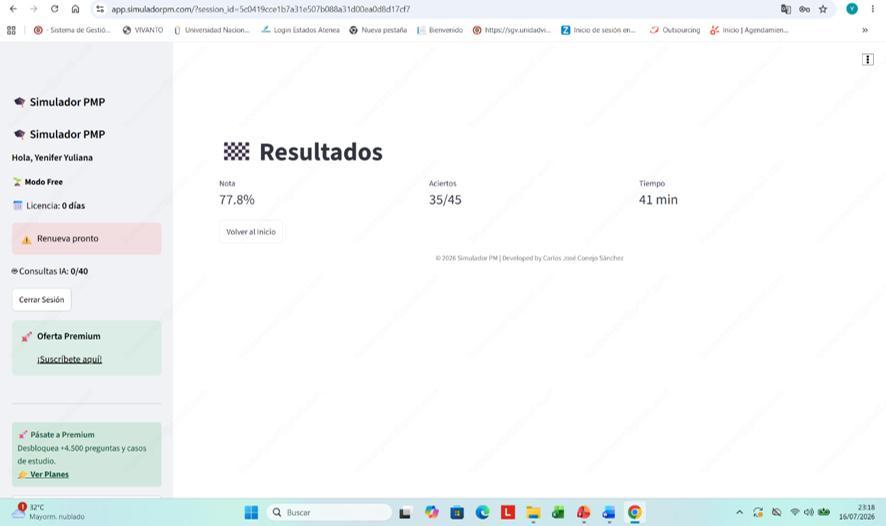
A score of 77.8% was achieved, with 35 correct answers out of 45, demonstrating the level of knowledge acquired during the course.
References
Project Management Institute. (2021). A Guide to the Project Management Body of Knowledge (PMBOK® Guide) (7th ed.). Project Management Institute.
Garzón Agudelo, D. M., Sarmiento Rojas, J. A., & Gutiérrez-Junco, Ó. J. (2019). Formulación y evaluación de proyectos de ingeniería. Editorial UPTC.
Martínez Jaramillo, H. A., et al. (2023). Transformación socioeconómica desde los escenarios sustentables en la nueva normalidad. Sello Editorial UNAD.
Russell, S., & Norvig, P. (2022). Artificial Intelligence: A Modern Approach (4th ed.). Pearson.
European Commission. (2019). Ethics guidelines for trustworthy AI. High-Level Expert Group on Artificial Intelligence.