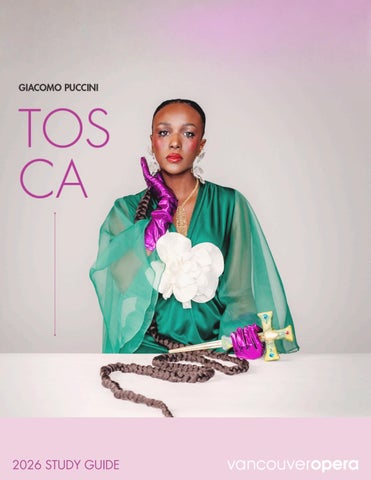
2026 STUDY GUIDE
EDUCATION AT VANCOUVER OPERA Dear Friends, Welcome to Puccini’s masterpiece, Tosca—a thrilling journey through passion, betrayal, and political turmoil in 1800 Rome. This study guide is designed to help you get more out of Tosca— whether you're seeing it for the first time or the tenth. At its center is Floria Tosca, a celebrated opera singer forced to make agonizing choices to save the man she loves from a ruthless police chief. Guided by sweeping melodies and intense dramatic tension, this performance brings each character to life. What you'll see on stage is the result of months of work from our singers, orchestra, directors, designers, and crew — and we hope this guide helps you appreciate the incredible craft and artistry they've brought to this production. Prepare to be swept away by one of opera’s most enduring and unforgettable experiences.
See you at the opera,
Ashley D Foot
Ashley Daniel Foot Director of Engagement and Civic Practice
STUDY GUIDE TEAM DIRECTOR OF ENGAGEMENT, CIVIC PRACTICE | ASHLEY DANIEL FOOT EDITOR | JANE POTTER LAYOUT | VICTOR YIN
TOSCA The 2026–2027 season opens with one of opera’s most passionate stories. Passion, politics, and betrayal collide in Tosca—a breathtaking opera where love burns bright against the dark tides of tyranny. Set amidst upheaval and war in 1800s Rome, the fiery singer Floria Tosca is caught in a deadly triangle between her beloved, the revolutionary artist Mario Cavaradossi, and Baron Scarpia, the corrupt, sadistic chief of police. Puccini’s masterful score will crackle with emotion under the baton of VO Music Director Jacques Lacombe, as Floria navigates a brutal game of power and sacrifice where even her voice—the thing she holds most sacred—becomes a weapon. This new co-production with Pacific Opera Victoria is directed by their celebrated Artistic Director, Brenna Corner, with a cast that includes baritone Gregory Dahl, who has recently stunned VO audiences as both Marcello in La Bohème and Don Pasquale, David Pomeroy, who The New York Times called “a powerful, agile tenor,” and the captivating Lebanese-Canadian soprano Joyce El-Khoury in the title role. More than a tale of doomed love, Tosca is a searing portrait of resistance in the face of oppression, where art and faith are tested against cruelty and injustice. It’s opera at its most visceral—intimate yet grand, deeply human and tragically heroic. In Tosca, the personal becomes political, and every choice cuts deep.
DISCOVER MORE
Inside Vancouver Opera podcast provides a unique backstage glimpse into the world of Vancouver Opera. We’re on Substack: Scan the QR code or click here
Study Guide - TOSCA
vancouveropera.ca
THE COMPOSER
Giacomo Puccini Facts about Puccini Speed Demon: Loved fast cars; crashed badly while writing Madama Butterfly. Heavy Smoker: Constant cigar smoker; led to throat cancer. Family Business: Came from five generations of musicians in Lucca. Puccini photographed by A. Dumont
Born in Lucca, Italy, in 1858, Giacomo Puccini was one of the most prolific and successful composers of his time. His most well-known operas include Tosca, Madama Butterfly, and Turandot. Puccini was known for developing the verismo, or realism, style of opera which featured real life characters, their everyday lives, and the tragedies which beset them, a departure from the romantics before him who relied on myth, history, and fairytales for their storylines. Some of opera’s best know arias were composed by Puccini, including “Nessun Dorma”, “O Mio Babbino Caro”, and “Un Bel dì, Vedremo.” A life-long smoker, Puccini developed throat cancer at age 64, eventually dying from complications from treatment in 1924 at the age of 65.
DISCOVER MORE Learn more about Puccini’s life and times. Scan the QR code or click here.
Study Guide - TOSCA
Recording Pioneer: His music was among the first recorded on Edison’s phonograph. Opera Rivalry: Bitter feud with composer Leoncavallo over TOSCA. Duck Hunter: Passionate hunter near his home in Torre del Lago. Sabotaged Premiere: First night of Madama Butterfly disrupted by bird whistles. Romantic Scandals: Turbulent affairs; wife caused tragic public scandal. Superstitious: Refused performances on unlucky Friday the13th. Unfinished Finale: Died before completing Turandot, later finished by another composer.
vancouveropera.ca
TOSCA
WHO’S WHO
Floria Tosca Joyce El-Khoury
Mario Cavaradossi David Pomeroy
Baron Scarpia Gregory Dahl
Cesar Angelotti Neil Craighead
Sacristan Peter Monaghan
Spoletta Callum Alden
Sciarrone Mihnea Nitu
Jailer Willy Myles-Grenzberg
DISCOVER MORE Tosca in 60 Seconds Click here or scan the QR Code
Study Guide - TOSCA
vancouveropera.ca
THE DIRECTOR
Brenna Corner
One of the most remarkable aspects of the opera canon is its ability to resonate deeply in our modern world. Whether experiencing the bohemian romance of Paris or Tosca's politically volatile Rome, these stories reflect enduring truths about the human condition; whether for good or bad. This flexibility is what makes them so enduring: we can reinterpret the same story, highlight different thematic elements, and still remain entirely faithful to the music, the characters, and the original narrative. In Puccini's Tosca, we enter a world of political machinations and corruption. A world where the ideas of truth and freedom are heavily controlled and manipulated. This work is far more than a period piece; it is a story of political oppression, speaking truth to power, and the vital role art plays in that struggle. All of which sadly continue to have resonance in our modern world. At the same time, it is the deeply intimate story of a young woman navigating a corrupt world for the sake of love, pushing herself to unimaginable lengths. Despite its rich layers, the core of our production uses this Italian masterpiece to hold a mirror to our own fractured reality. The political turmoil consuming Rome—suffocating surveillance, abuse of power, and the crushing of dissent —echoes the challenges we navigate today. In this production, the stakes are visceral and immediate. Yet, amidst the brutality of Scarpia’s regime, the heart of the opera remains a profound testament to the human spirit. Floria Tosca and Mario Cavaradossi remind us that in times of instability, love and sacrifice are not merely romantic ideals, but radical acts of defiance. Their devotion serves as the ultimate resistance against tyranny. Ultimately, while the shadows of oppression loom large, the only thing that will endure indefinitely is the light of truth, and art. This is a story for now—urgent, raw, and resonant. Study Guide - TOSCA
vancouveropera.ca
THE CONDUCTOR
Jacques Lacombe
As I’m writing my notes about Tosca, the question that comes to my mind is: Why do I love Puccini’s music so much? I guess that, just like in personal relationships: it’s impossible to give a complete answer to such a question, and perhaps it’s better that way, as it keeps a certain level of mystery to our feelings. But, having said that, I’ll take the chance of exploring some potential explanations for my love of Puccini’s Music. If, for a minute, you forgive me for being a bit personal, I must confess that I’m an incurable romantic…Tosca is the first opera I’ve ever learned and since the first day I’ve opened that score, it has always had a special place in my heart. In addition to that, it is with a Puccini opera, La Fanciulla del West that I’ve made my debut with Vancouver Opera, developing a very special relationship with this unique organization. For me, this was the beginning of a very precious and stimulating collaboration with the company, which I now have the honour to serve as Music Director. I could not have wished for a better way to start my relationship with Vancouver than by conducting Puccini. Going back to my love of Puccini’s music, one of the many reasons why I love this music so much is probably his unique talent to put in music stories that moves us so deeply in a direct way. In my opinion, that’s one of the reasons why his operas are so popular. The way Puccini communicates with his audience goes beyond the knowledge of the language and the codes of the “opera”. I sincerely believe that people who know nothing about music, who don’t know the Italian language nor the stories that inspired the Italian maestro from Lucca still “get it”. This element is fascinating to me as it talks about the power of art. That power is exactly what inspired Puccini to put into music this play written by the French author, Victorien Sardou. It’s after seeing the great Sarah Bernhardt, for whom the play was written, performing Study Guide - TOSCA
the play in French, a language that Puccini didn’t speak, that he was convinced to put this play into music. That tells a lot about the unique talent of this actress. And it does tell a lot about the talent of Puccini to reach such a vast audience. I think that Puccini is one of the best composers to put in music in a very personal and unique way, the complexity of human emotions and nature. Puccini had a great sense for theatre and drama, combined with an obvious and outstanding musical talent. He defined himself as a theatreman. He once wrote: “I see the characters, the colours and the gestures of the characters. If, alone at home, I can’t see a scene in front of me, I don’t write, I cannot write a single note”. Hopefully, we’ll be able to give life to the vision that Puccini had for his Tosca and move you listening and watching one of the greatest operas ever written… vancouveropera.ca
TOSCA
Illustrations A note by Barry Ekko In this three-image series for Tosca, I approached the opera as a thriller unfolding over a single day. Love, jealousy, political power, and violence build quickly from one act to the next.
Illustration by Barry Ekko
Study Guide - TOSCA
vancouveropera.ca
TOSCA
Illustrations
For the first illustration, I focused on Tosca and Mario Cavaradossi inside Sant’Andrea della Valle. Mario remains absorbed in the portrait he is painting while Tosca watches him closely, introducing the jealousy and uncertainty between them.
Tosca’s Jealousy Illustration by Barry Ekko
Study Guide - TOSCA
vancouveropera.ca
TOSCA
Illustrations
For the second illustration, I focused on the confrontation between Tosca, Scarpia, and Mario. With Tosca placed between Scarpia and the guarded Mario, the composition reflects the imbalance of power and control in the scene.
Study Guide - TOSCA
Scarpia’s Interrogation Illustration by Barry Ekko
vancouveropera.ca
TOSCA
Illustrations For the final illustration, the setting moves to Castel Sant’Angelo at dawn. Tosca bends over Mario after the execution, surrounded by the fortress walls, the Archangel Michael, and the morning sky. Across the three illustrations, I used simplified forms, limited colour, theatrical lighting, and recurring architecture to connect the acts visually. I wanted the series to move from jealousy, to control, to loss. Many thanks to Vancouver Opera for the opportunity to interpret Tosca through illustration.
Mario’s Execution Illustration by Barry Ekko
Study Guide - TOSCA
vancouveropera.ca
TOSCA
Illustrations
Tosca’s Entrance, Act 1 Illustration by Parham Peyvandi
Study Guide - TOSCA
vancouveropera.ca
TOSCA
Synopsis The events take place in Rome on a single day in the year 1800.
ACT I The church of Sant’ Andrea della Valle Cesare Angelotti, an escaped political prisoner and ex-consul of Rome, enters the church furtively. He lets himself into the Attavanti Chapel after finding a key that his sister has hidden for him. The artist Mario Cavaradossi enters to resume work on his portrait of Mary Magdalene, whose face is that of a blue-eyed, golden-haired woman often seen praying in the church. Although he admires the beauty of his model, he thinks only of his true love, the darkhaired, dark-eyed singer Floria Tosca. Angelotti tries to sneak away but recognizes his friend Cavaradossi who, hearing Tosca’s voice outside, gives him a basket of food and forces him back into the chapel to hide. Tosca enters, and having heard voices, is suspicious of her love and accuses her lover of entertaining a woman when he should be working. Mario assuages her fears and agrees to meet her later that night at his villa near the edge of the city. When she has gone, Cavaradossi offers his villa to Angelotti as a hideout, and the two men flee together. Baron Scarpia, the head of judicial and religious enforcement (and police) arrives with his henchmen, in search of Angelotti. They quickly discover clues that connect Cavaradossi to the woman in the painting, who is really Angelotti’s sister. Tosca leaves, focused on finding Cavaradossi who she believes is being unfaithful to her at his villa, not realizing that she has been tricked and is leading Scarpia’s agents directly to her lover.
Yongzhao Yu as Cavaradossi with Catherine Thornsley Pacific Opera Victoria, 2026. David Cooper Photography
ACT II Scarpia’s offices in the Palazzo Farnese Having followed Tosca to Cavaradossi’s villa, Baron Scarpia has the painter secretly arrested for sheltering Angelotti (still hidden within the villa). Cavarodossi is brought before Scarpia for interrogation but is led to the torture chamber when he refuses to reveal Angelotti’s whereabouts. Tosca arrives, and Scarpia questions her as Cavaradossi’s cries of agony are heard in the adjoining room. Though Cavaradossi implores her to keep silent, Tosca agrees to reveal Angelotti’s hiding place if her lover is freed. Cavaradossi, angered by Tosca’s betrayal of his friend, openly defies Scarpia, who orders his execution.
Yongzhao Yu as Cavaradossi with Peter Monaghan as Sacristan Pacific Opera Victoria, 2026. David Cooper Photography
Study Guide - TOSCA
vancouveropera.ca
execution. As news arrives of Angelotti’s discovery and subsequent suicide, Tosca begs for her lover’s life. Scarpia names his price: her submission to his lecherous advances. Desperate, she agrees so long as Scarpia writes a letter of safe conduct for herself and Cavaradossi. Scarpia insists that there must be at least a mock execution and arranges the details with his aide that this execution will take place as they did when they “shot” Count Palmieri. Alone with Tosca, Scarpia advances amorously towards her. She stabs him with a knife she has found, takes the safe conduct pass, and rushes out to free Cavaradossi.
ACT III The Battlements of the Castel Sant’ Angelo As dawn approaches, Cavaradossi arrives at the prison of Castel Sant’ Angelo to be executed by firing squad. He sings of his love for Tosca, a love which has finally given him reason to live. Tosca appears unexpectedly with the news that his execution is to be a fake one, and that when he is “shot” he must feign death. They share a moment of joy as they look forward to their life together. The execution takes place and Cavaradossi falls to the ground. After the firing squad marches off, Tosca is horrified to discover that her lover is actually dead—she was tricked by Scarpia, and the fake firing squad death “like Count Palmieri’s” was all a ruse. Shouting is heard from inside the castle: Scarpia’s body has been discovered. Trapped, Tosca cries out, consigning both herself and Scarpia to God’s judgement, and leaps from the building to her death. Synopsis by Maureen Woodall, Pacific Opera Victoria
Catherine Thornsley as Tosca with a supernumerary Pacific Opera Victoria, 2026. David Cooper Photography
Catherine Thornsley as Tosca Pacific Opera Victoria, 2026. David Cooper Photography
Catherine Thornsley as Tosca. Pacific Opera Victoria, 2026. David Cooper Photography
Study Guide - TOSCA
vancouveropera.ca
Q&A
What is opera?
WHERE DID OPERA COME FROM?
HOW LONG ARE OPERAS?
Opera came from Italy, just like gelato! The word opera means ‘work’ in Italian, as in work of art, not homework.
Operas can be up to four hours long, which may be how long French class feels, but at least you don’t have to wear a costume, make-up, possibly a wig, sing and dance under hot lights, and memorize an entire opera, like the performers do.
WHO MAKES OPERA HAPPEN? Opera is a group effort by conductors, musicians, singers, dancers, set designers, costume creators, lighting experts, directors, theatre staff, make-up artists, wig makers, carpenters, prop designers, and more, to tell a story, sing, dance, and entertain the audience all the same time.
NO MICROPHONES? Unlike Drake or Taylor Swift, opera singers don’t use microphones. Instead, they learn to project their voices. They may go from projecting over the sound of the live orchestra in one moment, to dropping to a near whisper in the next moment (just like your school principal during assemblies). To protect each other’s hearing, opera singers cannot face directly towards each other while singing. Ear plugs are not allowed.
HOW LONG DO YOU HAVE TO TRAIN? Opera singers often have as many years of education as physicians, and must continue training throughout their career.
Study Guide - TOSCA
NO SKIPPING FRENCH CLASS! Composers write in their language, and sometimes in second or third languages too, so opera singers must often learn English, French, German, Italian, and even Russian and Czech if they want to perform worldwide. And in case you’re wondering, ‘ice cream’ in Czech is ‘zmizlina’.
DOES IT PAY THE BILLS? If you were a top opera singer, you could make as much as $20,000 per performance.
WHAT OTHER SKILLS DO OPERA SINGERS NEED? Singers must learn to brush off negative reviews in time to perform the same show the following night.
FUN FACT Opera has been around for as long as gelato, which is just over four hundred years.
vancouveropera.ca
GLOSSARY
Opera terms
ACTS / SCENE
ENSEMBLE
Acts and scenes are ways of categorizing sections of operas. An act is a large-scale division of an opera, and each opera will typically include from two to five acts. Acts can be subdivided into scenes, which are often differentiated by a change in setting or characters.
A musical piece for two or more soloists, accompanied by orchestra. Types of ensembles include duets (for two soloists), trios (for three soloists), and quartets (for four soloists).
ADAGIO
Meaning “loud” or “strong” in Italian, forte is a dynamic level in music that indicates a loud volume. Adding the suffix “-issimo” to a word serves as an intensifier—since forte means “loud,” fortissimo means “very loud.”
Literally “at ease,” adagio is a tempo marking that indicates a slow speed. An adagio tempo marking indicates that the performer should play in a slow and leisurely style.
ALLEGRO
Italian for “cheerful” or “joyful,” Allegro is the most common tempo marking in Western music, indicating a moderately fast to quick speed.
ARIA
FORTE
LIBRETTO
The text of an opera, including all the words that are said or sung by performers.
OVERTURE
An instrumental piece that occurs before the first act as an introduction to an opera.
A song for solo voice accompanied by orchestra.
BRAVO / BRAVA / BRAVI
Italian for “nicely done”; shouted by audience members after a performance. “Bravo” for men, “Brava” for women, and “Bravi” for all.
CHORUS
A section of an opera in which a large group of singers performs together, typically with orchestral accompaniment.
CRESCENDO
A gradual raising of volume in music achieved by increasing the dynamic level. When music crescendos, the performers begin at a softer dynamic level and become incrementally louder.
Study Guide - TOSCA
RECITATIVE
Speech-like singing in-between musical numbers that advances the plot.
SCORE
The complete musical notation for a piece, the score includes notated lines for all of the different instrumental and vocal parts that unite to constitute a musical composition.
TEMPO
Literally “time” in Italian, tempo refers to the speed of a piece of music.
vancouveropera.ca
ACTIVITY 1
Match the terms
Study Guide - TOSCA
vancouveropera.ca
ACTIVITY 2
Opera's Most Dangerous 24 Hours
A Newcomer's Guide to Tosca
Imagine a single day in which a woman must choose to betray the man she loves or lose him forever. That day is Tosca and, by the time the curtain falls, three people will be dead. This is not a gentle story. It is a thriller, and one of the most gripping ever staged.
The Article
The year is 1800, and Rome is a city on edge, caught between armies and ruled by fear. Three people are about to collide: Floria Tosca is a famous singer, passionate and fiercely in love; her lover, Mario Cavaradossi, a painter secretly hiding a political prisoner on the run; and Baron Scarpia, chief of police, who hunts down enemies of the state and who has decided he wants Tosca for himself. Over the next twenty-four hours Scarpia springs his trap. He arrests Cavaradossi, has him tortured while Tosca is forced to listen. And then he offers her a bargain so cruel it has shocked audiences for over a century: give herself to Scarpia, and her lover will be spared. What Tosca decides in that moment, and what it costs her, is the beating heart of the opera. Why does this story still grab audiences more than a hundred years later? The emotions are universal: love, jealousy, power, desperation, and courage under unbearable pressure. Puccini’s music works like a film score, swelling and tightening exactly when the tension does. When Tosca sings “Vissi d'arte,” (“I lived for art,”) the whole theatre seems to hold its breath. Why, she asks, after a life devoted to beauty and faith, has she been brought to this terrible moment. Tosca is often called a shocker, and for good reason. The ending arrives like a trapdoor opening beneath you. We won't spoil it here, but know that Puccini and his librettists built the whole opera to detonate in its final minutes. If you think opera is slow, stuffy, or hard to follow, Tosca will prove otherwise: it moves like a thriller, hits like a gut punch, and long after the music stops, asks what would you be willing to do for the person you love most?
Study Guide - TOSCA
vancouveropera.ca
ACTIVITY 2 Discussion
Before the Opera 1.The article calls Tosca a thriller rather than an opera. What do you expect from a thriller? Make a list of three things, and check them against the opera afterward. 2.Scarpia offers Tosca an impossible bargain. Before you know what she chooses, what do you think a person should do in that situation? Is there a right answer? 3.Puccini set the story on a single day in a city under military occupation. How does compressing a story into twenty-four hours change the way it feels? After the Opera 1.Tosca has been described both as a victim and as one of opera's most powerful heroines. Which reading do you find more convincing, and what evidence from the production supports it? 2.In “Vissi d'arte,” Tosca asks why a life devoted to art and faith has led her here. Do you think the opera gives her an answer? 3.Scarpia is one of the great villains in opera. What makes a villain frightening: their power, their motives, or the fact that they believe they're entitled to what they want? 4.Cavaradossi is hiding a political fugitive. How does the political backdrop change your reading of what's otherwise a love story? 5.Did the music tell you things the words didn't? Find one moment where you understood what a character felt before you read the surtitle. 6.The ending is famously abrupt. Did it feel earned to you, or shocking for its own sake? 7.Whose story is this? Make the case for Tosca, then make the case for Cavaradossi, then for Scarpia.
Quick Reference
Composer: Giacomo Puccini Premiere: Rome, 1900 Language: Italian, performed with English surtitles Setting: Rome, June 1800 Acts: Three The aria to know: “Vissi d'arte” (“I lived for art”)
Study Guide - TOSCA
vancouveropera.ca
TICKETS
CONTACT US
VO Ticket Centre Mon-Fri 9am to 5pm 604 683 0222
Vancouver Opera 1945 McLean Drive Vancouver, BC V5N 3J7 604 682 2871
vancouveropera.ca