Change





Welcome to the first 2026 edition of Champion & Change, where we explore Employment, one of the core pillars of the Good Youth Employment Benchmark
Employers play a vital role in shaping young people’s journeys into the workplace, and we want to extend a huge thank you to every employer that has completed the Benchmark this year These insights allow us to continue developing meaningful resources and supporting employers to build evidence-based recruitment and retention strategies.
The latest labour market data highlights why this work matters. The unemployment rate for young people not in full-time education is now at its highest level since 2014, while vacancies have fallen to their lowest point since March 2021. With more young people actively seeking work and fewer opportunities available, the labour market is becoming increasingly challenging to navigate.
Recent updates on the expansion of the Youth Guarantee signal a renewed national commitment to tackling youth unemployment With expanded support, extended age ranges, and increased incentives for employers, alongside wider apprenticeship reforms, there is a clear opportunity to strengthen pathways into work
At the same time, regional partnerships are critical in
translating national policy into local impact Through our work with the Cambridgeshire & Peterborough Combined Authority, we are excited to support the development of a long-term Youth Employment Strategy to better connect policy, investment, and employer action
Periods of unemployment early in life can have lasting consequences, not only socially but economically A thriving economy depends on a workforce that is supported to develop and grow, making access to meaningful employment a shared priority.
As we prepare to launch this year’s Youth Voice Census, we are reminded of the importance of listening directly to young people. Last year, over 8,200 young people shared their experiences, helping to shape understanding of the barriers and opportunities they face.
In this edition, we’ll bring together insights and practical guidance to support employers in building strong early-career pathways, from inclusive recruitment and apprenticeships to effective onboarding that helps young people thrive from day one
Laura-Jane RawlingsMBEDL CEO & Founder
From amplifying young voices to contributing to national conversations about the future of skills and work, here’s a snapshot of what we’ve been working on.
We’re excited to welcome an incredible new cohort to our Youth Ambassador Programme.

Over the next 14 months, they will play a vital role in shaping conversations around education, skills and employment, ensuring young people’s lived experiences are represented in decision-making spaces We look forward to the impact they will have in amplifying youth voice across the sector
Our Policy & Research Director, Baz Ramaiah, recently joined BBC News live to discuss the latest labour market data and what it means for young people navigating today’s economy

With unemployment for 16–24-yearolds not in full-time education at 14.1%, the discussion highlighted the real challenges young people face when trying to access work, and the need for practical solutions that support sustainable employment.
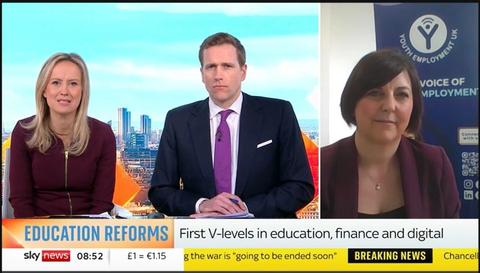
Youth employment has also been in the spotlight following major post-16 education reforms, including new V Levels and changes to applied general qualifications Baz joined LBC News to discuss the implications, while our CEO, Laura-Jane Rawlings, spoke on Sky News and LBC Radio about the opportunity these reforms present if implemented and communicated effectively
Our Connected Communities Forum brings together local and combined authority leaders to share learning and explore solutions to youth employment challenges.
Recent discussions focused on developments in the Youth Guarantee and examples of effective local practice. The forum ensures areas beyond trailblazer regions can collaborate, strengthen strategies and drive impact
Thank you to our forum sponsor, NCFE, for supporting this work
Through our work with the Cambridgeshire and Peterborough Combined Authority Youth Guarantee, we captured local career stories highlighting opportunities across the region.
These will form part of a first-of-itskind regional careers exploration course, helping young people better understand their local labour market and the pathways available to them.

A big thank you to the College of West Anglia, Baker Perkins, Inspire Education Group, Millfield Autoparts Limited, Paragraf, AB Agri, and the young people who shared their stories.
We were proud to see the launch of OnTrack+, a new function within the Compass+ platform developed by the Careers & Enterprise Company.
This tool helps schools identify students who may be at risk of becoming NEET (not in education, employment or training), enabling earlier support and more targeted careers education interventions.
Youth Employment UK previously led the research and recommendations that informed this work, and it’s fantastic to see this new capability now live in schools across England.
We kicked off 2026 with the first APPG for Youth Employment inquiry, Harnessing Young People’s Skills for the Future of Work, bringing together policymakers and partners to focus on youth transitions, the Youth Guarantee, and the latest NEET data. With growing alignment across policy and practice, the year ahead presents real opportunity for progress.
Our team continues to contribute to national conversations through events, podcasts and conferences, including the Form the Future Conference, ATC Conference 2026 and Health & Wellbeing at Work. Discussions have explored the future of skills and further education, the impact of AI on recruitment, and how employers can expand access to meaningful experiences of work for young people.
Latest reports, government developments, and policy news that impact the youth employment landscape.
Government Delivers on Youth Employment UK’s Recommendations: Additional £1 Billion of Youth Guarantee Funding
The government has announced today that it will inject an additional £1 billion of funding into the Youth Guarantee to:
Introduce a new Youth Jobs Grant - businesses will receive £3,000 for each young person (aged 18-24) they employ who has been on Universal Credit for the six months. Expand the youth Jobs Guarantee - from 18-21 year olds to 18-24 year olds.
Create new apprenticeship incentives - providing SMEs with an additional £2,000 for each apprentice aged 16-24 that they take on
This is welcome news, and the result of tireless campaigning from Youth Employment UK to provide greater support to employers to take on young people and to expand the jobs guarantee to include 21-24 year olds
Where should the government go next?
To build on this success, we believe it
is vital that the government continues to listen to us at Youth Employment UK by:
Introducing a Young Person’s Entitlement - to act as a force for NEET prevention by ensuring all young people access the right curriculum, careers support and work experience opportunities in school.
Closing the support gap - by ensuring that all young people can access high-quality mental health services, housing support and public transport in order to be able to better access the employment and training opportunities in their local area
Leading a national cultural shift by championing young people and the enormous value they can bring to employers
Read the full article to explore what the additional £1 billion funding will be used to support.

The government has published Every Child Achieving and Thriving, a wider school reform White Paper that includes significant proposals to reform the SEND system
The publication comes in response to sustained pressure on the SEND system.
The White Paper states that while many children and young people receive effective support, the system overall has become inconsistent and financially unsustainable. The government’s stated aim is to create a more consistent, earlier and outcomes-focused approach.
Read the full article to explore the challenges identified in the white paper, what reforms it proposes, and what the Youth Voice Census tells us about the importance of safety and wellbeing in education settings
Catherine McKinnell MP Appointed as Co-Chair for the All-Party Parliamentary Group for Youth Employment
As Secretariat for the All-Party Parliamentary Group (APPG) for Youth Employment, we are delighted to welcome Catherine McKinnell as Co-Chair Catherine brings a wealth of experience and a longstanding commitment to improving outcomes for children and young people Until recently, Catherine served as Minister of State for Schools, where she played a key role in shaping policy on education, skills and opportunity.
Find out more.
The Department for Education announced significant reforms to England’s post-16 education system, which will include the introduction of a new qualification called ‘V Levels’.
These reforms aim to streamline post-16 options, and to
strengthen the pathways leading to higher education, apprenticeships and employment.
Watch the CEO and founder of Youth Employment UK, Laura-Jane Rawlings MBE DL, discuss VLevels on Sky News.
‘Get Britain Working: Labour Market Insights’ offers an updated snapshot of how the UK labour market is performing, particularly for young people and those claiming Universal Credit (UC) Explore what the data tells us about youth employment trendsand what it means for policy, employers and local support systems
Written by Baz Ramaiah Policy and Research Director
Youth Employment UK


The beginning of 2026 has seen the crisis of youth unemployment deepen, with the proportion of young people who are unemployed and not in full-time education at the highest it has been since 2015.
The start of the new year has also brought a watershed moment in Westminster’s recognition of the crisis. The number of times “youth unemployment” has been mentioned in parliament so far is double what it was in 2026.
A raft of new government policies suggest that this is not just about talk - it's about action.
The government is currently in the process of rolling out its ‘Youth Guarantee’, a wide-ranging package of initiatives to drive down the youth NEET rate. There have been recent developments in three of the Youth Guarantee’s policy areas: apprenticeships, the Youth Jobs Guarantee, and the Youth Jobs Grant
From April 2026, the Apprenticeship Levy will be replaced by the new Growth and Skills Levy This aims to be a more flexible pot of funding that can be spent by employers on pre-
apprenticeships and new ‘foundation’ apprenticeships, giving more young people an entry point into the labour market. This new Levy will also fully fund apprenticeships for young people under the age of 25 for SMEs, and provide £2,000 additional funding for each young apprentice they take on
The Youth Jobs Guarantee
April 2026 will also see the start of the government’s pilot of its ‘jobs guarantee’ for young people In 6 target areas of the UK, 1,200 18-24 year olds who have been on Universal Credit for 18

We expect that the government will announce the organisations that will be delivering the Jobs Guarantee towards the end of March 2026
These will be in 6 target areas: Birmingham and Solihull, the East Midlands, Greater Manchester, Hertfordshire and Essex, Central and East Scotland, and Southwest and Southeast Wales
Delivery organisations will identify and secure jobs for participating young people with local employers.
To support this activity, delivery organisations will receive funding to cover the salary costs of each young person they support, as well as £2,650 per young person to cover the costs of their training, onboarding, and any other wraparound support.
Employers who take on a young person as part of the programme will be able to claim these salary and support costs from the delivery organisations.
This new grant will award businesses £3,000 for every young person (aged 18-24) that they hire
The young person must have been on Universal Credit and seeking work for a minimum of 6 months The grant aims to remove some of the short term costs that can be a barrier for employers to take on young people
Employers can take advantage of these new government initiatives and expand their youth employment activity over the next few months
Here’s how they can do that:
Employers have the opportunity to review their current apprenticeship strategy, ensuring they are making the most of new government funding and opportunities
The reduced minimum durations and entry requirements for apprenticeships, including the introduction of foundation apprenticeships, make it easier for organisations to recruit young people who may not yet have the related formal qualifications or experience.
This is particularly important for NEET young people, who face additional barriers to entering the labour market; offering apprenticeships can provide them with a structured route into employment, training, and longterm career development.
Apprenticeships also offer access to a motivated and trainable workforce, help fill skills gaps, and can contribute to building a pipeline of talent tailored to the organisation’s needs
Recruitment can quickly become costly. On top of your standard hiring costs for each new employee, there are many hidden costs too. These hidden costs are often not included in your initial budgets. They’ll include staff time, productivity loss, the impact of unsuccessful hires, and even process inefficiencies that impact your recruitment every time. Read on to explore the practical tips to help you reduce hidden recruitment costs.
1. Getting it right first time to avoid wasting resources
It may seem obvious, but the cost of a bad hire can eclipse all other recruitment costs combined when you don’t recruit effectively the first time. It’s essential that you approach recruitment strategically.
This means having a clear set of parameters in mind, budgeting your resources before you begin, and ensuring that you have a robust assessment process in place to select the right candidate.
Many employers make the mistake of rushing recruitment to get someone in post quickly, or cutting corners in the process to save money, which ultimately costs you more time and money
2. Look for candidates in the right places
Getting the right candidates starts with looking in the right places. Take the time to really understand the role you’re hiring for and the kind of employee you want to recruit.
You’ll need to understand where candidates are looking for their next role. Looking for candidates in the right places reduces time wasted and decreases the likelihood of making a bad hire.
If you’re looking to recruit young talent and early career professionals, the Youth Employment UK Opportunity Finder is the ideal place for effective recruitment
Continue reading the article here.
What Are the Costs of Recruiting in 2026?
Handling High Volumes of Job Applicants: Batched vs. Rolling Recruitment
How to Manage High Volumes of Job Applicants Efficiently
How to Attract Quality Job Applicants
Strengthen Your Youth Employment Strategy and Employer Brand
Boost Your Visibility and Attract Top Young Candidates

Exclusive Resources
Access a comprehensive library of resources designed to support your strategic priorities.
Account Manager
Dedicated, personalised support from your Account Manager.
Recognition
Showcase your commitment with your official badge.
The Benchmark
Measure and strengthen your strategy with the digital benchmark tool.
Smart, Strategic Solutions That Deliver Real Results
Exclusive Events
Join Members exclusive events and enjoy unlimited access to the full archive.
Stay Future Proof
Stay informed with policy and trends in the evolving youth employment landscape.
Our Opportunity Finder features a wide range of jobs, events and training - all designed to help young people find the right pathway. Become an Employer Partner and get your vacancies in front of hundreds of thousands of young people.

The Youth Voice Census has always been a space for young people across the UK to share their experiences.
It acts as an annual temperature check on how young people in the UK feel about life, study, work and general prospects
It captures insights from young people about what systems are working for them and where additional support is needed across education, training, accessing work and being in work
What did we hear in 2025?
Last year, we hit a milestone, capturing the views and experiences of more than 8,200 young people aged 11-30 from across the UK We learned about the realities young people face
1. Many young people feel indifferent or uncertain, reflecting disengagement and mixed experiences.
2. Wellbeing is stagnating, and support works best for those closest to education and work.
3. Career experiences and wider opportunities are narrowing
4. Young people feel conflicted about the future of work, with only half confident they have the skills and experience employers want.
but what will 2026 reveal? What has changed, and what challenges remain?
Share the survey with your network to help get more young voices heard
Sponsoredby







We’re calling on organisations and educators to amplify youth voices by dedicating time for young people aged 11-30 to complete the Youth Voice Census.
Hold a ‘Your Say Day’ to help shape the future of education, work, and life opportunities for young people while gaining valuable insights about young people today.

Help amplify young people's voices by sharing the 2026 Youth Voice Census.
You can download a range of resources - including posters, images and digital screens - to make it easy for you to spread the word and show your support.
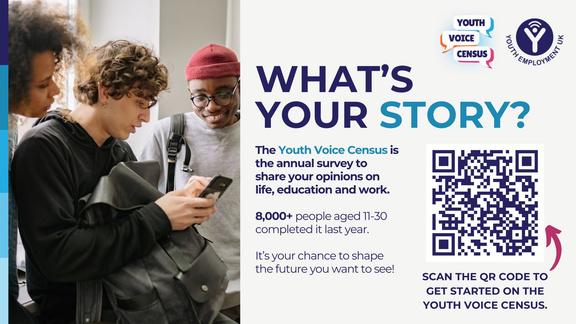

Help us ensure more young people are heard and represented
Every share makes a difference - let’s create change together!
Chief People Officer, NCFE
Every year, the Youth Voice Census gives employers a powerful opportunity to listen directly to the experiences of young people across the UK
We spoke with Helen Ketteringham, Chief People Officer at NCFE, to learn about how they are using the insights to shape their approach to young people, work experience and the future workforce.
Their experience shows how organisations can turn young people’s voices into meaningful action.
Why does NCFE champion the Youth Voice Census?
“NCFE is a long-standing Member and proud Patron of Youth Employment UK. We’ve paid really close attention to the insights from the Youth Voice Census report every year.
We are key stakeholders and ambassadors to those who share a deep sense of responsibility to help ensure that every individual has the chance to learn, grow, and thrive in education and work It really feels as though this is at the heart of our ethos, which is around no learner being left behind
Our work is to promote and advance learning, and to help create a fairer, more inclusive society There’s a strong link, and together, we really care about the social impact at the heart of it.”
Why should employers pay close attention to the Census?
“I think the Youth Voice Census is a call to action for employers to come together.
Young people bring fresh ideas, creativity and resilience into the workplace that everyone can benefit from. We should always be thinking about our future workforce and enable that workforce too. Supporting their development means building a stronger, more dynamic future for both organisations and society
I believe that every employer has a duty here, and unfortunately we’ve seen a decline in opportunities I think the Youth Voice Census report (and events like Youth Employment Week) shine a spotlight where it needs to be shone.
The Youth Voice Census helps get this front and centre in business goals, and that’s certainly happening at NCFE.”
What insights from the Youth Voice Census sparked the biggest conversations at NCFE?
“We have regular connection days, where we encourage our colleagues to come together through a range of different opportunities. It was good to get representation from around NCFE and we reflected on the findings using a Mad, Sad, Glad model.
We were mad that only 26% of NEET young people feel they know what employers want, compared to 49% overall, showing a lack of confidence in employability We, as employers, are responsible for helping young people to understand this and to break the gap.
Another point of contention was that NEET young people consistently reported the lowest

wellbeing scores of all young people. We were sad about the general rising anxiety, but we were glad that from 2024 to 2025 there was a reported increase in access to mental health support Amongst the backdrop of what we’re learning about anxiety and wellbeing, it was good to see that there is support there.
The Youth Voice Census report is the basis for us to have the right conversations and also challenge ourselves and each other
This opportunity to come together helped us break it down, and move it into action and impact We explored: What can we do personally? What can we do as an employer? What can we do within our sector, and with our platform?
We have a duty to help put it into action and create the impact we want to have ”
What would you say to employers who haven’t yet shared or used the Youth Voice Census?
“We have the opportunity to share our own voice, and it’s really important that we give that voice to our future
workforce and to the next generation as well The Youth Voice Census is providing the opportunity for our young people to have that voice.
We all know that we can read a really interesting report, but if we don’t all take responsibility to act on the findings then we’ll see the report come along again next year and there’s a risk that it’s telling us about the same challenges.
When more of us get involved, that becomes a stronger voice and a collective force for improvement.
As employers, we should all be encouraging it and promoting it so that we understand our future workforce. The more responses the Youth Voice Census gets, the more insight we get. It’s more representative of our future workforce too.
We should all do what we can in terms of encouraging as many responses to the survey as possible ”
Click here to read the full article.
The Youth Voice Census provides one of the most powerful insights into the experiences, challenges and aspirations of young people across the UK. In 2025, over 8,200 young people shared their experiences.
By sharing the survey with your networks, you can help build a clearer picture of what the next generation needs from education and work.
Share the Youth Voice Census and encourage the young people in your networks to take part.

We’re proud to launch a new Virtual Work Experience course in partnership with Compass Group UK & Ireland, designed to open up access to careers in hospitality, food and support services.
Created for young people aged 14-18, the course offers an engaging introduction to the sector through real employer insight, interactive content and clear progression pathways.
Hosted on the Youth Employment UK platform, the programme is currently being piloted with educators, with a wider rollout to come.
For employers, this approach offers a practical way to reach and inspire future talent, showcasing your opportunities at scale, building awareness of pathways, and engaging young people earlier in their career journey.
As part of Compass’ Classroom to Careers strategy, it highlights how accessible, high-quality career exploration can support stronger talent pipelines.
“We are very proud to have a longstanding partnership with Compass Group UK & Ireland, having worked with them for over two years
The annual Youth Voice Census tells us time and time again that too many young people lack confidence in their skills and miss out on key work experience opportunities By making these resources freely available for all, we hope more young people will have the confidence to explore new opportunities as they take their next steps from the classroom to fulfilling careers.”
Laura-Jane RawlingsMBEDL
CEO & Founder

“We are excited to be working with Youth Employment UK on this project – offering young people the chance to explore work with us and learn about our wonderful industry Supporting young people into meaningful work is something we care deeply about at Compass and this forms part of our new ‘Classroom to Careers’ strategy, which aims to further support young people who are looking to get onto the career ladder in hospitality. We hope students enjoy the module and gain valuable insight into our business and the opportunities within our sector.”
JonathanFoot Director of Skills and Early Careers

Reaching young talent requires more than awareness - it requires strategy. You need the right channels, the right format, the right messaging and the right partnerships
We work with employers to create bespoke careers exploration resources that showcase your organisation or sector in a way that is engaging, accessible and built for scale From real employee stories and engaging videos to interactive activities and dedicated guides, we’ll help bring your opportunities to life.
Through our work with NHS England and partners, we helped showcase targeted roles through a national, youth-first approach, combining a dedicated careers hub, careers exploration course, and video content all designed for engagement.
50,000+
54,000+
62,000+
Views across careers content Young People Engaged Social Views
This is what happens when insight, platform and delivery come togetherturning awareness into real engagement and supporting future talent pipelines
Partner
Us? Start the Conversation
Showcase your organisation or sector at scale
Build awareness of career pathways and entry routes
Engage young people earlier through the right channels and formats
Strengthen inclusive, future-focused talent pipelines
Deliver meaningful impact through accessible career exploration
If you’re looking to raise awareness of your roles and attract the next generation of talent, we’d love to work with you.
Let’s build something impactful together.
Watch the webinars below for fresh insights and practical ideas to help you navigate the changing youth employment landscape and strengthen your future talent pipeline.
In collaboration with the Carers Trust, we explored the youth employment landscape through the lens of young adult carers, shining a light on the challenges they face in education, training and work
Open to all
From balancing caring responsibilities with study and employment, to overcoming barriers in recruitment and progression, the discussion highlighted why this group is too often overlooked.
This is a must-watch session packed with practical ideas and real-world insight to help you take action and create opportunities for young adult carers
In this webinar, we explored the current youth employment policy landscape and the latest developments shaping the agenda, highlighting key emerging themes and what they could mean in practice for employers
Joined by the Department for Work and Pensions, we discussed how policy changes may influence recruitment approaches, workforce planning, and the support employers provide to young people entering the labour market.
This exclusive session will help your organisation stay competitive and up to date with the latest developments in youth employment


As employers grapple with persistent skills shortages and growing challenges in finding the talent they need, Youth Futures Foundation’s Make it an Apprenticeship campaign urges leaders to rethink how they attract, develop, and retain young people.
The campaign calls on employers to convert suitable entry-level roles into Level 2 and 3 apprenticeships, creating opportunities where they are most needed to empower young people – and businesses – to thrive.
Across the UK, one in eight young people are currently not in employment, education or training, while employers report significant challenges finding the talent they need In 2024, 27% of all vacancies were classed as ‘skills shortage vacancies’, which “employers struggle to fill due to a lack of skills, qualifications or experience among applicants”.
Evidence in Youth Futures Foundation’s Youth Employment Toolkit suggests that apprenticeships can improve young people’s employment prospects.
Apprenticeships deliver real business value, with 77% of employers reporting improved productivity, and 83% saying they would recommend entry-level apprenticeships to others
Yet Level 2 and 3 apprenticeship starts have fallen drastically since 2016/17 The steepest decline is at Level 2 – the very roles young people often rely on to get started.
Now, as youth employment and apprenticeships continue to rise up the national policy agenda, there’s a key opportunity for employers to act, and reap the benefits in a changing youth employment system.
The campaign challenges employers to shift organisational mindsets, with three clear calls to action:
1. Make it an Apprenticeship – You don’t need to create a brand-new role to create an apprenticeship opportunity.
Instead, reframe suitable entry level vacancies as apprenticeships for young people.
2. Make it Level 2 – Reassess entry requirements and remove unnecessary barriers that prevent young people from accessing opportunities to start their careers
3. Make more opportunities – Those who can, train additional apprentices to strengthen organisational and sector wide talent pipelines
This isn’t just a call for social progress, it’s an opportunity to futureproof workforce planning and strengthen organisational resilience.
Apprentices learn organisational culture and processes from the start, and 61% of employers retain all apprentices who complete their programme
Employers who create entry-level apprenticeship opportunities for young people can benefit now, as trailblazers in shaping an employment system that works better for everyone.
A great onboarding process can make a new starter feel welcome and bring them up to speed quickly and effectively.
However, many employers make the mistake of assuming that onboarding starts on the employee’s first day. In fact, good onboarding begins long before that.
We’ll show you how to start the onboarding process from the point of making an offer of employment. You’ll learn why onboarding pre-work matters and some practical strategies to help you get started.
A great onboarding process must:
Be proactive: Employers should anticipate the needs of new starters as far as possible instead of leaving them to work things out and ask questions.
Create connection: Onboarding isn’t just about learning your software systems and receiving access codes. It should also allow new employees to meet and connect with their peers with the goal of integrating them into your culture.
Focus on learning: Starting a new job comes with a steep learning curve. One of the main purposes of onboarding is to give new employees the knowledge and training they need to succeed.
Provide clarity: Every workplace is different, and your new employee will likely have lots of questions. The onboarding process should remove uncertainty wherever possible and offer clarity around role, responsibilities, and expectations. Be employee-focused and manager-led: Line managers have the most important role to play in successful onboarding, and must be equipped with the resources they need to support new employees effectively
The onboarding process begins from the moment you make someone an offer of employment. Starting a new job or making a career change is a big decision, and you have the opportunity to make it a positive experience.
Begin by making sure your offer is as clear and comprehensive as possible. Include all the core information your new employee will need to know, including the job title, salary, working hours, and workplace.
Let them know how excited you are to have them join you and how much you look forward to welcoming them. You can also invite them to ask any initial questions they may have at this stage
There will usually be a gap between when a new employee accepts your offer and when they come to work for their first day.
This can be anything from days to months, depending on the role, circumstances, and any notice period they may need to work at their current job.
You can facilitate a smooth onboarding process by staying in
touch during this time Keep the new starter updated on what’s happening behind the scenes ahead of welcoming them to your organisation, ensure they have any information they’ll need in plenty of time, and give them a point of contact if they have any additional questions.
Employers can make use of digital and multimedia tours as part of their onboarding strategies. Video welcomes from managers and team members, virtual workspace walkthroughs or premises tours, interactive informational or training modules, and infographics are all great tools to add to your pre-start onboarding for new employees
Mistake 1: Neglecting pre-start onboarding entirely
Do not wait until your new employee’s first day to start onboarding them. Instead, create a strategy that begins with the offer of employment
Mistake 2: Forgetting the “human” element
Many employers focus solely on organisational or practical information during the pre-start onboarding phase, forgetting about the all-important role of human connection in the workplace.
Click to continue reading...
Gain instant access to an exclusive library of resources, including expert articles, practical guidance, and on-demand videos.
Read More
Learn how to create an onboarding experience that helps young employees feel confident, supported, and ready to succeed. This article explores why onboarding matters, how long it should last, and the key considerations when welcoming young people into the workplace.
Read Now
Discover how your existing employees can help create a stronger onboarding experience. From sharing their own insights to acting as mentors, learn how involving your team can reduce resistance, improve collaboration, and help new hires settle in and succeed.
Read Now
Membership gives you the tools and insights you need to stay informed and make a real impact in your organisation.