Champion Change



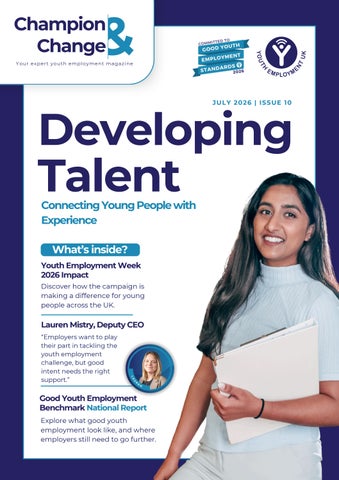

YouthEmploymentWeek 2026Impact
Discover how the campaign is making a difference for young people across the UK.
LaurenMistry,DeputyCEO
“Employers want to play their part in tackling the youth employment challenge, but good intent needs the right support”
GoodYouthEmployment BenchmarkNationalReport
Explore what good youth employment look like, and where employers still need to go further.
Welcome to the latest edition of Champion & Change, where we bring together the latest insights, guidance and policy updates to help employers create meaningful opportunities for young people
Young people’s participation in education, employment and training has never been higher on the national agenda
From the publication of the first Milburn Review to the continued rollout of the government's work experience reforms, there is growing momentum behind creating better pathways into work and ensuring every young person has the opportunity to succeed.
This year, our research has painted a clear picture of both the progress being made and the challenges that remain. Across our Good Youth Employment Benchmark National Report and The College Experience Report, one clear message stands out: work experience is one of the most important steps on a young person's journey into employment, but for too many, that bridge is still difficult to cross.
74% of young people say work experience helps them understand work, yet only 26% of those in education undertook it Even where opportunities exist, access is often shaped by connections, meaning not every young person has the same chance to gain valuable workplace experience
We also found that 56% of employers offer more than 3 types of work experience. The challenge is not about availability, it's about quality and accessibility Too many opportunities remain informal or inconsistent Just 36% of employers consistently set learning objectives and only around a third consistently provide the preparation before placements Without this, work experience cannot fully deliver on its potential to bridge the gap between education and employment
There is growing recognition of the vital role employers play in creating accessible pathways into work. High-quality work experience is no longer an added extra for your talent pipleine; it’s essential for helping young people into employment.
In this edition, we've brought together the latest policy developments, practical guidance and employer insights to help you create impactful work experience opportunities.
Whether you're developing a new programme or enhancing an existing one, we hope you'll find ideas and inspiration to support your next steps
Lauren Mistry Deputy CEO
Youth Voice Census 2026
We took the Youth Voice Census 2026 across the UK with our Your Say Day Tour, visiting colleges, employers, youth organisations and more to meet young people where they are We heard directly about young people's experiences, while encouraging thousands more to have their say. Their insights will help influence employers, policymakers and educators, and we look forward to sharing the findings in September.
The College Experience Report
In partnership with the Association of Colleges, we launched The College Experience, exploring what college life looks like for young people today. The report highlights both the positive experiences and the challenges many students continue to face, including access to careers support, employer engagement and meaningful work experience It also calls for stronger collaboration between colleges, employers and policymakers to help ensure every young person can access the opportunities they need to succeed
Good Youth Employment Benchmark Report & Awards
We brought employers and partners together for the Good Youth Employment Benchmark Report Launch and Awards, celebrating organisations that are leading the way in creating better opportunities and
experiences for young people Click to read about the winning organisations
Supporting Employers Through Good Youth Employment Training
Our team delivered Good Youth Employment CPD course with the South London Partnership as part of its Youth Guarantee activity. The training equipped employers with practical tools and evidence-based approaches to recruit, support and retain young people, helping them build inclusive workplaces where young talent can thrive.
Youth Voices on Work Experience
Following the publication of the Milburn Review, our Youth Ambassadors, Moyin and Luke, shared their personal experiences of accessing work experience. Their reflections highlighted why accessible, high-quality work experience is essential if every young person is to have a fair chance of succeeding
Showcasing the Youth Guarantee
Our CEO and Founder, Laura-Jane Rawlings MBE DL, welcomed colleagues from HM Treasury to Peterborough United Football Club to showcase the impact of the Cambridgeshire & Peterborough Combined Authority Youth Guarantee Trailblazer. The visit highlighted the power of local partnerships and investment.

Over 915,000 reach on all digital channels
Read our impact report to celebrate everything Youth Employment Week 2026 made possible
“An important week of raising awareness that brings together young people, educators, employers and partners to create really meaningful opportunities for young people across the UK.
With over 1 million young people not in education, employment or training, this year’s Youth Employment Week couldn’t be more crucial.”
- BARONESS JACQUI SMITH, MINISTER FOR SKILLS






Milburn Review: Young People and Work Diagnostic Report Released (A Summary)
The first report from the Milburn Review has been published, exploring the causes behind the rising number of young people not in education, employment or training (NEET)
Explore the key themes and findings from the review, including the need for a more coordinated support system and the implications for youth employment policy, employers and local services Click to read.
Youth Employment UK has launched the National Commission on the Local Funding Gap, bringing together local government, policymakers and employers to address challenges around the future funding of youth services and employment support. Explore how the inquiry aims to build more resilient regional systems and create long-term solutions to support young people through education, skills and employment pathways. Click to read.
The Youth Jobs Grant scheme offers employers financial support to recruit eligible young people and help create new pathways into work. Discover how the programme works, what employers need to know about eligibility and applications, and how organisations can engage with this opportunity over the next three years. Click to read.

Government Expands Personalised Employment Support with £60m Innovation Fund
Explore how the government is expanding personalised employment support for disabled people and those with health conditions through new investment and innovation. Discover what the Pathways to Work Innovation Fund means for employers, charities and public sector organisations, alongside the latest progress in supporting people into work. Click to read.
Students will continue to study core academic subjects, with the opportunity to study technical or vocational subjects They will be able to combine subjects and spend time with employers to gain realworld experience The reforms will aim to bring together regional mayors, local leaders, schools, colleges and employers Click to read.
Data consistently shows that young people benefit tremendously from work experience opportunities However, despite the extensive proven benefits, many young people are falling through the cracks
But what makes a good work experience programme and what should a work experience programme include? In this quick guide, we will show you the key components for work experience opportunities that both serve young people and address your business needs.
1. Set clear goals and objectives
Think about why you want to run a work experience programme What are you hoping to get out of it and what are you hoping to give back to young people? What learning outcomes should participants achieve by the end of the programme?
What does “good” look like to you?
Set clear goals and objectives for your programme informed by both your organisation’s business priorities and the needs of young people. Ideally, goals should be SMART: Specific, measurable, achievable, relevant, and time-bound.
2. Ensure your recruitment processes are fair and inclusive
Take the time to advertise your work experience opportunities through a variety of channels and to create a selection process that is fair and inclusive This means using inclusive and accessible language, eliminating unnecessary requirements, and providing the supports or adjustments young people may need to participate in your application and selection process.
It can also mean being flexible around the timing and location of placements, where possible. Where appropriate, virtual work experience offerings can be a great addition to your programme and allow more young people to participate
3. Design meaningful activities to support skills development
Work experience is not a cheap labour solution for organisations. While it can and should benefit the employer, it is first and foremost a learning opportunity for participants.
Employers should ensure that work experience participants are given the opportunity to take part in real, meaningful projects in a hands-on way Tasks or projects should be directly tied to learning outcomes and skills priorities, taking into account both sector-specific and role-specific needs and the individual’s personal learning and development goals
Click to continue reading.


MichaelDavis
Sales Office Manager, Millfield Autoparts
We caught up with Michael Davis, Sales Office Manager - Upper Management at Millfield Autoparts, to hear how the business is creating meaningful work experience opportunities for young people
Tell us about your approach to providing work experience opportunities for young people.
When young people do work experience at Millfield Autoparts, they get to work in different departments of the business
One day they could be working in the warehouse, picking and putting stock away The next day, they could be working in Despatch, taking items from the lift and putting them on the correct shelf for the driver to take to the customer
They may also spend time working in the Sales office with one of the sales team, finding the right parts for the customer, then booking it out for the customer. A timetable is given to the person on work experience on the first day when they have their induction
We meet the young person before the placement to make sure that they want to work with us We show them around the building and show them where and who they will be working with
How do you ensure your work experience opportunities are inclusive and accessible to different groups of young people?
We will take any young person So if they need to spend more time in one

area rather than another, we let them do that If they need extra support, they will work in the office where I am to help them through the day.
Some of the young people that we have had have been really shy or don’t talk much at college. Once they have been with us for a couple of weeks, they become a different person We treat everyone the same - they are part of the Millfield Family, where everyone gets on.
One college tutor told us:
“I don’t know what you did, but the student has come back to college and is a different person – talking, taking part more, and listening to their lectures. Thank you.”
How has membership supported your youth employment strategy?
Youth Employment UK have the tools that we need to take our work experience and internships to the next level
Webinars and events are a great way of meeting people and finding out what they do and how we can work with them or get ideas from other members. Membership does help your business in many ways and has helped us connect with the right people to help us improve what we do
The Good Youth Employment Benchmark has also helped the company improve what we are doing for the young people in our area.
Strengthen Your Youth Employment Strategy and Employer Brand
Boost Your Visibility and Attract Top Young Candidates


Exclusive Resources
Access a comprehensive library of resources designed to support your strategic priorities.
Account Manager
Dedicated, personalised support from your Account Manager.
Showcase your commitment with your official badge.
The Benchmark
Measure and strengthen your strategy with the digital benchmark tool.
Smart, Strategic Solutions That Deliver Real Results
Exclusive Events
Join Members exclusive events and enjoy unlimited access to the full archive.
Stay Future Proof
Stay informed with policy and trends in the evolving youth employment landscape.
Our Opportunity Finder features a wide range of jobs, events and training - all designed to help young people find the right pathway. Become an Employer Partner and get your vacancies in front of hundreds of thousands young people.

Running a great work experience programme takes planning and preparation Poor communication, lack of expectation setting, and insufficient training are some of the most common mistakes employers make.
Here are the common mistakes to avoid when preparing your staff to support a work experience student

Mistake 1: Unclear expectations
Clear expectations are vital for both your existing staff and the work experience student. Noone will get the most out of the situation if they do not know what they are supposed to be doing or what is expected of them.
Unclear expectations can also create a poor first impression for the work experience student, which can colour their entire placement and harm your reputation
The solution: Be clear with both current staff and the incoming work experience student about your expectations before the placement starts.

Both staff and the placement student should be given clear and specific information about the tasks or projects the student will work on, who they will report to, who will be responsible for training and supervising them, and the learning outcomes for the placement
Mistake 2: Lack of preparation and training
Many employers assume that because your existing staff know how to do their jobs effectively, they are equipped to support a work experience student. However, managing and mentoring people are different skills
A lack of adequate training and preparation can lead to staff feeling overwhelmed with a responsibility for which they are not prepared, and the student feeling unsupported during their placement.
The solution: Determine who will supervise the work experience student during their placement and who will be responsible for their training. This is likely to involve several individuals.
Click here to keep reading.
How to design a work experience placement that actually supports skill development
Creating work experience placements for those with additional needs
Measuring the impact of your work experience opportunities

In a bid to tackle rising levels of youth unemployment, the UK government has pledged to make more work experience placements available to young people and those who are not in employment, education, or training (NEET )
One of the ways it is doing this is through the sector-based work academy (SWAP) scheme. In this guide to the SWAP scheme for employers, we’ll walk you through everything you need to know
SWAPs are short courses that prepare participants for work through a combination of pre-employment training and a work experience placement, culminating in a guaranteed interview for a permanent job
SWAPs are delivered as a partnership between Jobcentre Plus, training providers such as colleges, and employers.
SWAPs are open to anyone over the age of 18 who is able to work, actively looking for work, and receiving either Universal Credit, Jobseeker’s Allowance, or Employment and Support Allowance.
SWAPs are free to participants, and they will continue to receive their benefits while taking part. Any other associated expenses, such as travel and childcare costs, are also covered
SWAPs are currently available in England and Scotland. They are not available in Wales, though jobseekers can find similar support through the Skills to Employment pathway.
SWAPs are customisable and flexible, so they can work well for a variety of roles across many different sectors As they are designed to create opportunities for those who are currently out of work, entry-level roles can be particularly appropriate areas for employers to recruit through SWAPs.
However, they can also be a great approach for hard-to-fill or highturnover roles that require a basic framework of skills and work readiness rather than specific prior experience or qualifications
You will receive support from Jobcentre Plus to design a programme and placement that addresses real business needs in your sector and organisation If for any reason you are unable to offer all three components of a SWAP, Jobcentre Plus will work with you to find creative solutions to any limitations.
If you are interested in offering a SWAP placement or recruiting through SWAPs, start by contacting your local Jobcentre Plus.
Click here to learn more about SWAPs.