Achieving Research Excellence: Strategies for Leading Top Clinical Trials | Yousuf A.
Gaffar, M.D

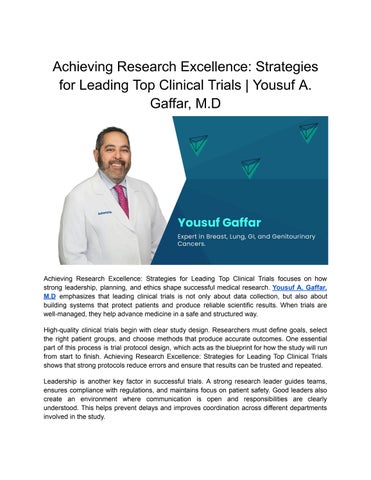
Achieving Research Excellence: Strategies for Leading Top Clinical Trials focuses on how strong leadership, planning, and ethics shape successful medical research Yousuf A. Gaffar, M.D emphasizes that leading clinical trials is not only about data collection, but also about building systems that protect patients and produce reliable scientific results. When trials are well-managed, they help advance medicine in a safe and structured way
High-quality clinical trials begin with clear study design. Researchers must define goals, select the right patient groups, and choose methods that produce accurate outcomes One essential part of this process is trial protocol design, which acts as the blueprint for how the study will run from start to finish. Achieving Research Excellence: Strategies for Leading Top Clinical Trials shows that strong protocols reduce errors and ensure that results can be trusted and repeated
Leadership is another key factor in successful trials. A strong research leader guides teams, ensures compliance with regulations, and maintains focus on patient safety Good leaders also create an environment where communication is open and responsibilities are clearly understood. This helps prevent delays and improves coordination across different departments involved in the study
Patient safety remains the highest priority in any clinical trial Every stage of research must be monitored carefully to ensure that risks are minimized. Ethics committees and regulatory bodies review trial plans before they begin and continue oversight throughout the study Achieving Research Excellence: Strategies for Leading Top Clinical Trials highlights that without strict safety standards, research cannot move forward responsibly or ethically.
Data quality is another major element in clinical research success Accurate data collection, consistent documentation, and proper analysis are all required to produce meaningful results. Even small errors can affect outcomes and lead to incorrect conclusions That is why training research staff and using reliable systems is so important in modern clinical environments.
Technology is also improving how clinical trials are managed Digital tools now help track patient data, monitor progress in real time, and reduce manual errors These systems make it easier to manage large studies across multiple locations. As a result, trials can move faster while still maintaining high standards of accuracy and compliance
Collaboration plays a central role in achieving excellence. Clinical trials often involve doctors, researchers, nurses, and external partners working together When teams share knowledge and coordinate effectively, studies become more efficient and more reliable Achieving Research Excellence: Strategies for Leading Top Clinical Trials shows that teamwork strengthens every stage of the research process, from planning to publication
A regulatory compliance framework is essential for ensuring that every clinical trial follows legal and ethical standards It helps protect participants, maintain transparency, and ensure that results are accepted by the global medical community Achieving Research Excellence: Strategies for Leading Top Clinical Trials demonstrates that strong compliance systems are not just rules to follow, but foundations for trustworthy and high-impact medical research