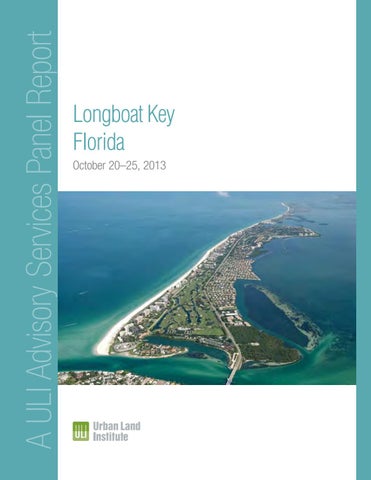
A ULI Advisory Services Panel Report
Longboat Key Florida October 20–25, 2013
A ULI Advisory Services Panel Report
Longboat Key Florida Developing on Success and Envisioning the Future
October 20–25, 2013
About the Urban Land Institute THE MISSION OF THE URBAN LAND INSTITUTE is to provide leadership in the responsible use of land and in creating and sustaining thriving communities worldwide. ULI is committed to n
B ringing together leaders from across the fields of real estate and land use policy to exchange best practices and serve community needs;
n
F ostering collaboration within and beyond ULI’s membership through mentoring, dialogue, and problem solving;
n
E xploring issues of urbanization, conservation, regeneration, land use, capital formation, and sustainable development;
n
A dvancing land use policies and design practices that respect the uniqueness of both built and natural environments;
n
S haring knowledge through education, applied research, publishing, and electronic media; and
n
S ustaining a diverse global network of local practice and advisory efforts that address current and future challenges.
Established in 1936, the Institute today has more than 30,000 members worldwide, representing the entire spectrum of the land use and development disciplines. Professionals represented include developers, builders, property owners, investors, architects, public officials, planners, real estate brokers, appraisers, attorneys, engineers, financiers, academicians, students, and librarians. ULI relies heavily on the experience of its members. It is through member involvement and information resources that ULI has been able to set standards of excellence in development practice. The Institute has long been recognized as one of the world’s most respected and widely quoted sources of objective information on urban planning, growth, and development.
Cover photo: Jack Elka Photography Š 2014 by the Urban Land Institute 1025 Thomas Jefferson Street, NW Suite 500 West Washington, DC 20007-5201 All rights reserved. Reproduction or use of the whole or any part of the contents without written permission of the copyright holder is prohibited.
2
An Advisory Services Panel Report
About ULI Advisory Services THE GOAL OF ULI’S ADVISORY SERVICES program is to bring the finest expertise in the real estate field to bear on complex land use planning and development projects, programs, and policies. Since 1947, this program has assembled well over 400 ULI-member teams to help sponsors find creative, practical solutions for issues such as downtown redevelopment, land management strategies, evaluation of development potential, growth management, community revitalization, brownfield redevelopment, military base reuse, provision of low-cost and affordable housing, and asset management strategies, among other matters. A wide variety of public, private, and nonprofit organizations have contracted for ULI’s advisory services. Each panel team is composed of highly qualified professionals who volunteer their time to ULI. They are chosen for their knowledge of the panel topic and screened to ensure their objectivity. ULI’s interdisciplinary panel teams provide a holistic look at development problems. A respected ULI member who has previous panel experience chairs each panel. The agenda for a five-day panel assignment is intensive. It includes an in-depth briefing day composed of a tour of the site and meetings with sponsor representatives; a day of hour-long interviews of typically 50 to 75 key community representatives; and two days of formulating recommendations. Long nights of discussion precede the panel’s conclusions. On the final day on site, the panel makes an oral presentation of its findings and conclusions to the sponsor. A written report is prepared and published. Because the sponsoring entities are responsible for significant preparation before the panel’s visit, including sending extensive briefing materials to each member and arranging for the panel to meet with key local community
Longboat Key, Florida, October 20–25, 2013
members and stakeholders in the project under consideration, participants in ULI’s five-day panel assignments are able to make accurate assessments of a sponsor’s issues and to provide recommendations in a compressed amount of time. A major strength of the program is ULI’s unique ability to draw on the knowledge and expertise of its members, including land developers and owners, public officials, academics, representatives of financial institutions, and others. In fulfillment of the mission of the Urban Land Institute, this Advisory Services panel report is intended to provide objective advice that will promote the responsible use of land to enhance the environment.
ULI Program Staff Gayle Berens Senior Vice President, Education and Advisory Group Thomas W. Eitler Vice President, Advisory Services Daniel Lobo Manager, Education and Advisory Group Caroline Dietrich Logistics Manager, Education and Advisory Group James A. Mulligan Senior Editor David James Rose Manuscript Editor/Managing Editor Betsy VanBuskirk Creative Director Anne Morgan Graphic Designer Craig Chapman Senior Director, Publishing Operations
3
Acknowledgments ON BEHALF OF THE URBAN LAND INSTITUTE, the panel would like to thank Mayor Jim Brown and the Longboat Key town commissioners. In addition, the town thanks Dave Bullock, Alaina Ray, and all the Longboat Key staff persons for their assistance in planning and executing the panel. The panelists also extend their gratitude to all of the interviewees who contributed their time and insights to this process.
4
An Advisory Services Panel Report
Contents ULI Panel and Project Staff. . . . . . . . . . . . . . . . . . . . . . . . . . . . . . . . . . . . . . . . . . . . . . . . . . . . . . . . . . . 6 Introduction: the Challenge and the Assignment . . . . . . . . . . . . . . . . . . . . . . . . . . . . . . . . . . . . . . . . . . . 7 Understanding Longboat Key. . . . . . . . . . . . . . . . . . . . . . . . . . . . . . . . . . . . . . . . . . . . . . . . . . . . . . . . . 11 Market Dynamics. . . . . . . . . . . . . . . . . . . . . . . . . . . . . . . . . . . . . . . . . . . . . . . . . . . . . . . . . . . . . . . . . . 14 Opportunity Focus. . . . . . . . . . . . . . . . . . . . . . . . . . . . . . . . . . . . . . . . . . . . . . . . . . . . . . . . . . . . . . . . . 23 Longboat Key Mobility. . . . . . . . . . . . . . . . . . . . . . . . . . . . . . . . . . . . . . . . . . . . . . . . . . . . . . . . . . . . . . 30 Implementation . . . . . . . . . . . . . . . . . . . . . . . . . . . . . . . . . . . . . . . . . . . . . . . . . . . . . . . . . . . . . . . . . . . 36 Conclusion. . . . . . . . . . . . . . . . . . . . . . . . . . . . . . . . . . . . . . . . . . . . . . . . . . . . . . . . . . . . . . . . . . . . . . 39 Implementation Considerations. . . . . . . . . . . . . . . . . . . . . . . . . . . . . . . . . . . . . . . . . . . . . . . . . . . . . . . 40 Appendix. . . . . . . . . . . . . . . . . . . . . . . . . . . . . . . . . . . . . . . . . . . . . . . . . . . . . . . . . . . . . . . . . . . . . . . . 41 About the Panel. . . . . . . . . . . . . . . . . . . . . . . . . . . . . . . . . . . . . . . . . . . . . . . . . . . . . . . . . . . . . . . . . . . 43
Longboat Key, Florida, October 20–25, 2013
5
ULI Panel and Project Staff Panel Chair Kamuron Gurol Director of Community Development City of Sammamish Sammamish, Washington
Panel Members Angelo Carusi Principal Cooper Carry Inc. Atlanta, Georgia Bill Clarke Planning Consultant Ross, California Greg Cory Principal Land Use Economics San Francisco, California Zachary Greene Director of Commercial Properties MassDevelopment Boston, Massachusetts
6
Jim Hill Acting Director Ivory Boyer Real Estate Center, University of Utah Park City, Utah Donna Lewis Planning Director Mercer County, New Jersey Trenton, New Jersey Kenneth Voigt Ayres Associates Waukesha, Wisconsin
ULI Project Staff Thomas W. Eitler Vice President, Advisory Services Caroline Dietrich Logistics Manager, Education and Advisory Group Basil Hallberg Senior Associate
An Advisory Services Panel Report
Introduction: the Challenge and the Assignment LOCATED OFF THE SOUTHWEST COAST of Florida, Longboat Key is a ten-mile barrier island and a beautiful, peaceful, and unique community. The key’s convenient location, desirable climate, and white sand beaches have made the town an attractive place for year-round recreational opportunities including boating, fishing, golf, tennis, and biking. While there is much to love about Longboat Key, the community has recognized the need for change. Most homes and condominiums were constructed more than 30 years ago, and many now do not meet flood regulations or the demands of the new and emerging real estate markets. There have been divisive and distracting debates over density restrictions adopted by the town in 1984. Community leaders have expressed concern that Longboat Key’s future must be revisited to ensure that the high-quality lifestyle and pleasing mix of residential areas and commercial uses can be maintained and enhanced. The town of Longboat Key asked ULI to take an objective, big-picture perspective to help inform an update to the town’s 20-year comprehensive plan and vision and to create a roadmap implementation strategy with specific next steps. Using a broad-based community process, they identified ten questions of specific interest focusing on the following: evolving market demand; balancing residential, commercial, and tourism uses; creative approaches to leverage Longboat Key’s assets; and comments on the advisability of a town center and community center. The ULI panel was composed of ten experts and staff who analyzed data, interviewed locals, and brought their experience to bear on the challenges and opportunities facing the community. This report will help guide the community as it charts a new course for the future.
History of Land Use on the Key It is clear that residents, visitors, and businesses love Longboat Key, but perhaps for different reasons. All appreciate the natural beauty and assets, and a reasonable consensus exists to avoid becoming overdeveloped or overused like some sister communities to the north and south. Nevertheless, Longboat Key has seen changes over the years from the development of older eclectic neighborhoods in the north and the master planning conducted by the Arvida Corporation in the south. Overall, the key has enjoyed a long period of prosperity and rising real estate values.
Tampa Bay
Anna Maria Island
41
Longboat Key
301
75
Sarasota
Lido Key
Gulf of Mexico
Siesta Key
Area map.
Longboat Key, Florida, October 20–25, 2013
7
As a reaction to the Arvida development and other significant changes that took place in the late 1970s and early 1980s, the town of Longboat Key enacted in 1984 strong controls on future development through a new comprehensive plan and land development code that restricted new residential and tourism developments and downzoned most of the island. The downzoning created a large amount of nonconforming land uses as well as a complex system to manage new growth. The 1984 Comprehensive Plan and associated land development and zoning codes also established the playing field for limited new development and appears to be the primary source for a series of intracommunity disputes and divisions that have been distracting and destructive.
Maintaining Quality of Life In recent years, instead of the early and ambitious projections of 20,000 full-time residents, the population has leveled off and even declined in the last two census counts to about 7,000 year-round residents—a number that rises to roughly 20,000 during “season,” a period from December through March. The 1980s-era plans appear to have achieved their goal—perhaps too well. Now, Longboat Key may be a victim of its own success. As the development of the last 30 years reaches the end of its useful life, it is a good time to ask whether the policies and tools of the past are right to meet the challenges of the next 30 years. The good news is that many options have been preserved, partly because of the significant limiting effect of the comprehensive plan and land development codes. And the town government and community have made many good decisions to retain the assets and qualities that make Longboat Key special and unique. These include preservation and restoration of smaller islands on the bay side, beach nourishment efforts on the gulf side, a strong system of public infrastructure and emergency response, and bicycle trails along Gulf of Mexico Drive. Like nourishing the beach to ensure the preservation of an important resource, the key has a chance to nourish the broader community and economy by considering and implementing the recommendations and steps herein.
8
Another piece of good news is that the people of Longboat Key may be the most important “asset” in the community’s “portfolio.” There are ample local intellectual and financial resources, and plenty of practical experience, to draw upon as the planning process ensues. The panel found that the local “horsepower” is smart, has strong business experience, and is able and willing to participate in setting policy, helping to fund implementation and in volunteering time for community causes. A challenge will be whether newer homeowners who reside only seasonally (the panel heard in some cases as little as a week or two every few years) will be willing to contribute in that same way to the community in future years.
The Panel’s Assignment Over the week, the panel gained an understanding of Longboat Key and its people, history, and potential future. The panel analyzed key data and studies completed to date, researched market trends and peer communities, and performed over 80 interviews with community leaders, local residents, and businesses. The town assembled a thorough and informative briefing book that helped the panel prepare and arrive ready to hit the ground running. This Advisory Services report represents the results of the panel’s research and efforts. The panel’s scope of work was framed by the questions below and which were answered throughout the report. To assist in finding the panel’s response to each question, please refer to the appendix. H ow realistic is the vision plan for Longboat Key to help ensure that it continues to attract residents and visitors to maintain it as a premier destination? W ho will be the likely residents of and visitors to Longboat Key over the next 20 years? W hat should the balance of residential, tourism, and supportive commercial services be to ensure Longboat Key’s status as a premier residential and visitor destination? H ow should the town government encourage revitalization to make properties attractive for the future?
An Advisory Services Panel Report
Do the differences in the north key, mid key, and south key warrant separate planning efforts? If so, what would be the primary elements of those plans? What challenges and opportunities should the town be aware of that are likely to influence its future and how can the town prepare for them? What innovations or creative approaches should Longboat Key develop to address challenges in community infrastructure that could be applied on Longboat Key? What are Longboat Key’s most important assets? How important is the concept of a “town center” to Longboat Key, and what are the best attributes and where should it be located? Should Longboat Key have a community center?
Summary of Recommendations The ULI panel has formulated the following eight key recommendations for Longboat Key to address the challenges in the aforementioned ten questions and, more broadly, the future of the town. The recommendations are based on the panel’s understanding of the physical setting and development patterns of Longboat Key, the input of the residents and businesses, research into new and emerging market trends, and the opportunities that are evident from the panelists’ week-long site visit. Build community together—“loving Longboat.” The panel recognizes a number of opportunities to build upon recent successes (the adopted referendum to restore a limited number of new units to make up for units lost through recent redevelopment of hotels into high-end condominiums) and the strong but geographically defined social networks here on the key. The key has many strong assets among which are the geographic and physical beauty of the island as well as the passionate and well-educated members of the community. This community deserves the chance to become more cohesive and less divided. The recommendations herein are really opportunities to build a more cohesive and collaborative community.
Longboat Key, Florida, October 20–25, 2013
Update and adapt to a changing market. Longboat Key must take steps to recognize and understand the needs of the market. Will the next generation of residents and visitors come for the same reasons people came in the 1980s, 1990s, and early 2000s? Who are these people and what do they want? Will new visitors “fall in love with Longboat Key” and choose to buy a home there as many existing residents did? The panel believes the community can and should adapt to the needs and desires of future residents and visitors. Focus on the future instead of the past. Taking time to renew the future vision for Longboat Key is absolutely necessary for continued success. The 1980s-vintage plans and codes not only are out of date, but also perpetuate an unfortunate current pattern of community infighting, with good people focusing on the things that divide instead of working together and making more progress. The panel’s recommendation is not to amend the town’s comprehensive plan, but to replace it with a new plan tailored to meet the needs of the future. The panel recommends that the current system of “tourism units” and other complicated aspects of the legacy code be abandoned or suspended and that new zones that reflect the community vision be adopted. The panelists also strongly recommend developing and adopting modern codes and permit processes to implement those policies in the land development process. The importance of undertaking this planning and zoning process cannot be emphasized strongly enough. Relax rental restrictions. One of the areas of emphasis is how best to recover and retain commercial businesses on the key. The problem is that business customer volumes drop in the off-season, and more year-round residents are needed. The panel found that the restrictions on rentals (principally, the one-rental-per-30-days restriction) may do more harm than good, especially for the success of local businesses, and the panelists recommend that those restrictions be relaxed or abandoned. Implement early actions for opportunity sites. There are several opportunity sites in the south, middle, and north parts of the key that merit attention and early action,
9
perhaps with targeted planning efforts involving landowners, nearby residents, and community leaders. Redevelopments at the Colony and the Whitney Center/Village are two sites of interest, and the town government should engage in such efforts now to ensure that the right vision for the future can be developed. Complete the town center at the center of the community. Most interviewees said that the Publix supermarket was the de facto center of the Longboat Key community. That area also includes several other existing draws for local residents, including the town hall, the tennis center, local banks, and other businesses. The panel recommends completing the picture by focusing new public and private development in the area and crafting an updated master plan that emphasizes healthy lifestyles, walkability, open space, and community events like a farmers market, all of which will catalyze new private development like retail and restaurants. If desired, a broader array of housing styles including choices for seniors could also be planned and built. Locate the community/cultural center at the town center. Once the community decides upon the size, features, functions, and costs of such a center, and decides to proceed with constructing it, the best location is near other existing uses that draw residents today. While the panel does not have an opinion as to whether the town should build a community/cultural center, such a facility would certainly be a positive force and further catalyze new commercial development in the area.
10
Mobility on Longboat Key. Mobility is an important element in the quality of life of residents in a community. It serves as the lifeblood for local businesses and the health of residents. The existing transportation system can be enhanced with improved transit service through increased service and/or augmentation by a town “jitney” or a water taxi system that connects primary destinations along the island. Each of these enhancements has an annual operating cost that needs to be evaluated before moving forward. Enhancing all the island connectivity elements reduces residents’ and visitors’ reliance on the automobile, which already creates roadway capacity issues during the high season. This report includes an implementation roadmap with specific steps and priorities to take as Longboat Key undertakes the process to prepare for the future.
The panel hard at work after touring the island and interviewing close to 100 stakeholders.
An Advisory Services Panel Report
Understanding Longboat Key LONGBOAT KEY HAS MANY natural, built, and soft assets. However, it does face challenges. Positive steps, based on the key’s strengths, can be taken to protect investment. Longboat Key offers a beautiful natural beach setting with a very attractive climate. An extensive shoreline on the Sarasota Bay and the Gulf of Mexico exists relative to the land area of the key. Residents enjoy the benefits of living on an island on or near the waterfront. Safety is an additional asset, as little to no criminal activity occurs on the key. A variety of neighborhoods with different and unique characteristics appear on the island. The south was primarily master planned as a resort community including club amenities. In the north, neighborhoods developed more organically with areas such as the Village with an “old Florida” character. Longboat Key residents live in a small town, but due to the proximity of Sarasota and Bradenton, they enjoy access to the sort of cultural activities, amenities, and services provided by larger towns. The variety of neighborhoods creates problems when it comes to community identity and cohesion, but Longboat will be significantly stronger if everyone can work together to face the challenges ahead. Longboat Key has a problem common to affluent resort communities. It is a great place that has attracted many people with the means to live anywhere they choose, as well as many people of more modest means. The desirability of owning a second home on Longboat Key has pushed up property values, with the adverse impact of population decline among full-time residents. It is at the root of the seasonality challenge that makes it hard for local merchants to survive. It means change and dealing with big contrasts. A few examples of places with some similarities include Hawaii; Vail, Colorado; Park City, Utah; and Hamilton, Wyoming.
Longboat Key, Florida, October 20–25, 2013
What Is Longboat Key’s “Place”? Is Longboat Key a retirement community? Some interviewees said “yes” and others said “no!” The panel found the median age is 70, and the vast majority of residents, full-time or seasonal, are retired. Is Longboat Key a resort community? Again, some yesses and some nos. And yet, the Longboat Key Resort was just ranked number 12 in the 2013 Top Florida Resorts by Condé Nast Traveler’s Choice Awards—and that is only the most recent award. Is it a community at all or a group of individual developments with separated social networks? To what extent is this community “one Longboat” or “many Longboats”? Longboat Key is really a combination of all of the above, and a universal love for the island occurs regardless of which perspective one holds.
Vision: “Loving Longboat” The panel observed that the different perspectives about the identity of the island have caused divisiveness. A common vision for the future borne out of love for the island can be the unifying factor and can heal the wounds of divisiveness. Some would believe that Longboat Key has only two choices: stay exactly as it is today or become like Anna Maria Island or Bradenton Beach. In reality, Longboat Key can remain extraordinary by respecting its past and present characteristics that made it unique while enhancing attributes to ensure it remains attractive for future residents. Stakeholders are encouraged to imagine a future on Longboat Key that:
11
i s unique, extraordinary, and welcoming to guests of all ages; embraces nature and the environment; offers a variety of cultural, recreational, and leisure activities; has a high-quality built environment that respects the natural environment; builds community through shared experiences and communication; and features a vibrant “center of community.” Longboat Key does not need to compete with surrounding commercial areas. However, it should serve residents, year-round and seasonal, as well as visitors. Strategic changes to plans and regulatory policies will afford the market more flexibility to invest in and serve the community. These changes should come out of the shared vision and the common sentiment of “loving Longboat.”
Challenges Not everyone on Longboat Key is experiencing the same situation. The southern part of the key may have a more cohesive story because it was master planned as a residential resort community, with the Longboat Key Club acting as the central element. The northern part of the island is more eclectic and developed organically. One significant challenge that Longboat Key faces is a tone of divisiveness that has diminished the quality of public debate over the future. The residents of the key overall clearly have a lot of horsepower, ability, and means. How can the people of Longboat Key get along better, affirm their mutual interests, and move ahead productively? Beyond this overarching concern, the key faces several other challenges. Seasonality is challenging the survival of local businesses when revenue and customers drop significantly during a period that lasts more than half the year.
12
Demographic trends are expected to generate a smaller pool of retirement-age candidates to buy or build new homes. The island’s population of school-age children is very small and there are no public schools located on Longboat Key. Some businesses have sometimes felt that the town is “against” them. The panel heard stories where simple permits or decisions took many months and opponents took advantage of ample opportunities in the complex plans and codes to oppose even very reasonable development projects. The state’s rigid condominium laws and the complexity of individual condo owner associations’ decision-making processes can make revitalizing or replacing buildings more than difficult. Good ideas likely have been shelved and thoughtful development discouraged because of the cost and uncertainty of the permitting process. When these issues are combined with a global real estate market downturn and with significant increases in flood insurance rates, it is not surprising that Longboat Key has determined that the time for change is now.
The Remedy To use a medical analogy, the panel’s remedy for a healthy Longboat Key is as follows: Like any healthy body, Longboat Key needs to reduce stress. This can be achieved through soft communitybuilding, healing divisiveness, creating new traditions, and emphasizing goodwill and common interests. The panel heard that a new community foundation has been created. This is a great opportunity to bring people from different parts of the island together to achieve common goals. Healthy bodies also need social connections. Improved communication between and among the elected officials and full-/part-time residents would greatly improve the quality of life. The key enjoys a host of natural amenities that help residents and visitors lead an active lifestyle. The former resort called the Colony served to introduce generations
An Advisory Services Panel Report
of people to tennis, and today's residents have kept that tradition. Longboat can now build upon that foundation to offer a broader array of activities such as kayaking and ecotourism, and this can only serve to improve the quality of life.
The two drawbridges to Longboat Key often cause traffic backups during the peak tourist season.
FLICKR/WHGRAD
Of course, healthy bodies need nourishment: let the sense of community be replenished as has been done
with Longboat Key’s beaches. Sometimes you haul in more sand and sometimes you remove impediments to the natural replenishment process. To make things happen, you will need—figuratively speaking—to haul in more sand, intentionally acting the way a master developer would in a new community. Other things will happen naturally, by the market, if the stakeholders on Longboat Key remove the impediments.
Longboat Key, Florida, October 20–25, 2013
13
Market Dynamics Second-Home Market Conditions The panel heard many things from the residents of Longboat Key. The uniform appreciation of the extraordinary setting and the need to preserve a high-quality lifestyle were common threads. The core values of protection and enhancement of the natural and built environments were also frequently cited. Not the least of the concerns was protection of property values and the considerable emotional and financial investment that residents have made in deciding to purchase a residence on Longboat Key. Whether it was a purposeful decision by the original developers, or whether it evolved over time, the number of permanent residents relative to the total housing stock clearly shows that the key is dominated by what would be considered second and seasonally occupied homes. Within that context, the panel believes it is useful to provide some historical context.
Evolution of Second-Home Ownership The purchase of a second home is largely a lifestyle decision, based on one’s confidence in personal income and net worth, as well as perceived use. As such, the growth in the ownership of second homes has been defined by a general rise in disposable income and by demographic shifts, regardless of buyer source or location. The post–World War II emergence of a strong middle class, rising levels of automobile ownership and use providing reasonable access to recreation locations, and the “age wave” of the baby boomers precipitated an increase in the incidence of second-home ownership starting in the early 1970s, reaching a peak in the 2005-to-2009 time frame before the Great Recession affected all aspects of the economy. Interest in second-home ownership has also varied over time. The original emphasis was on personal use with reasonable access time, which tended to mitigate consumers’
14
willingness to commit large amounts of their financial resources. The result was relatively modest developments occupied seasonally. Starting in the late 1970s and early 1980s, as the baby boomers plunged into the market, price escalation in second-home locations began to outpace the rise in primary housing values, which resulted in a shift to a user/investor profile, wherein a second-home purchase increasingly became justified less on the perceived usage pattern than as a pure alternative investment. This trend also came to peak with the easy money and lending standards that emerged during the early 2000s. The net result was an artificial escalation of both price and demand that came to a resounding end between 2005 and 2009. The typical duration of recessions since 1980, when second-home market growth began to accelerate, has been relatively short (less than a year) and the impact on gross domestic product (GDP) comparatively modest. The most recent recession has lasted longer and the impact on GDP is double that of any other event since 1980. During other recessions in that time frame, the impact on the second-home market was a relatively short period of slacking demand, with little downward pressure on prices. Since 2007, unlike in previous recessions, there was a virtual standstill in demand and in most markets and price erosion was equal to, or in some locations greater than, the impact on primary-housing values. The market is recovering, but second-home prices are recovering more slowly than those in primary markets. On the other hand, Longboat Key maintains a key advantage in a recovering market. A decade-old study sought to quantify the remaining developable coastal land in the state. Casting an even wider net, the study found only approximately three miles of significant private coastline between the North Carolina/South Carolina state line and the Alabama/Florida state line that would be suitable
An Advisory Services Panel Report
Changes in Household Composition There are longer-term demographic trends that will come into play in future years. When the second-home market began expanding in the 1970s, household composition and characteristics were very different than they are today. Back then, the baby boomers were just entering their peak earning years and there was a broad-based affluent middle class. Nowadays, the affluent middle class is being hollowed out and is shrinking as a proportion of the overall population. Then, household income was growing in real terms versus contracting and most households had a single earner, versus having dual incomes today. In those days, household debt was close to 20 percent of gross household income versus 30 to 40 percent now. Thus, the data suggest that there is less real disposable income across a broader segment of the market than there was 20 to 30 years ago.
Age Wave and the Population
EXHIBIT 1
U.S. Birth Rates per 1,000 Population, 1909–2008 35 35 30 30
25 25 20 20 15 15 10 10 55 00
1909 1909 1912 1912 1915 1915 1918 1918 1921 1921 1924 1924 1927 1927 1930 1930 1933 1933 1936 1936 1939 1939 1942 1942 1945 1945 1948 1948 1951 1951 1954 1954 1957 1957 1960 1960 1963 1963 1966 1966 1969 1969 1972 1972 1975 1975 1978 1978 1981 1981 1984 1984 1987 1987 1990 1990 1993 1993 1996 1996 1999 1999 2002 2002 2005 2005 2008 2008
for new development. The vast majority of other opportunities were smaller-scale inholdings within existing developed areas that could accommodate either infill or redevelopment. Thus, Longboat Key and other existing coastal communities maintain the enviable positions of being located in increasingly scarce environments that cannot be replicated.
Source: U.S. Census Bureau. Note: Orange refers to baby-boom birth years.
residents within the target age bracket of second-home purchasers will decline through 2030. Professional experience also shows that there is typically a five-year window during one’s life when there is an aspiration for a second-home purchase. There is a belief among many in the research community that as a result of the Great Recession those in the later stages of that cycle may skip the second-home purchase, focusing instead on a deferred retirement purchase. A similar opinion exists that those in the early stage of that life cycle have had their confidence and wealth eroded, and it may take a number of years for both to be replenished. Thus, it is reasonable to
Additional factors will affect future second-home demand. First is the age structure of the consumer. As shown in exhibit 1, the annualized birth rate in the United States is at the lowest rate since the early 1900s, which indicates that immigration accounts for the vast majority of the population growth that has occurred in recent years. The bulge of the baby-boom phenomenon is clearly shown in orange, with the resulting rapid decline in births generally defined as generation X.
EXHIBIT 2
Market Size
83,000
The second factor is the size of the market. The reported buyer profile within the typical second-home community is generally between 45 and 60 years old. The average age, as revealed through buyer surveys conducted by one firm, has been approximately 52 dating back to the late 1970s. As exhibit 2 shows, the number of U.S.
82,000
Longboat Key, Florida, October 20–25, 2013
Projected Population of Potential Second-Home Buyers in the United States, Age 45–60 (thousands), 2015–2035 85,000 84,000
81,000 80,000 79,000
2015
2020
2025
2030
2035
Source: U.S. Census Bureau.
15
assume that previously obtained absorption rates may be difficult to replicate for years to come.
class. Recent published data on the distribution of wealth reveal the following:
Concentration of Wealth
From 1979 to 2007, incomes of the top 1 percent of households grew 275 percent.
There is a third and equally compelling longer-term trend that may affect future demand for second homes: the increasing disparity in income and the erosion of the middle
Between 2002 and 2007, the income of the top 1 percent of households grew ten times faster than that of the bottom 90 percent.
EXHIBIT 3
U.S. Distribution of Wealth, 2007 40–60% 4 percent
Bottom 40%
The top 1 percent owns approximately 35 percent of the total wealth in the country. 40%
0.2 percent
60–80% 10.9 percent Top 1%
80–90%
34.6 percent
12 percent 90–95%
95–99% 27.3 percent
Source: Edward N. Wolff, Recent Trends in Household Wealth in the United States: Rising Debt and the Middle-Class Squeeze—an Update to 2007.
EXHIBIT 4
12,000,000 10,000,000 8,000,000 6,000,000 11,427,078
2,000,000 $1–5 million
1,161,184
582,458
31,104
14,546
$5–10 million
$10–50 million
$50–100 million
>$100 million
Source: Credit Suisse, Global Wealth Databook 2013.
16
5% From 1990 to 2007, household debt increased by 30 percent. 4% During the recession, over 50 percent of the jobs lost 1% were in the middle class. Only approximately 2 percent of job gains since have gone to the middle class. All of these point to what is referred to as the “hollowing out” of the middle class, historically the largest consumer group for second homes. The implication is that demand for second homes will increasingly be among only the wealthiest of households.
Distribution of High-Net-Worth Individuals in the United States
0
The 2001–2003 tax cuts saved the top 1 percent more 20% than the total earnings of the bottom 150 million wage-earners. 20% Real household income has gone up marginally 10% since 1985.
11.2 percent
4,000,000
From 1992 to 2007, the top 400 earners’ incomes rose by 392 percent.
Even with these longer-term trends, there is still demand for second homes. According to the American Affluence Institute, interest in purchasing a second home within the next 24 months has increased to previously reported levels during the nine years in which the survey has been active. This is a statistically reliable survey of the top 5 percent of households by net worth. The annual survey by the National Association of Realtors also reports increased interest, which is in line with what other similar consumer surveys have found. Professional experience, however,
An Advisory Services Panel Report
indicates that the aspiration and intent to own a second home rarely, if ever, match actual experience.
Wealth Distribution If one then takes into consideration the declining size of the target market for the next ten-plus years, and the concentration of wealth in the age cohort that is largely below that of the traditional buyer, it might be reasonable to argue that demand will be well below the robust levels achieved prior to the Great Recession. Couple this with information from the 2012 Knight Frank survey of North American high-net-worth households (i.e., those with net worth exceeding $2 million) and the near-term market size shrinks even further as 44 percent report already owning a second home at a beach location. Thus, the conclusion may be that the near- to intermediateterm market conditions for Longboat Key and for similar mature, premier beach locations could be challenged by a shrinking overall market appetite, and one increasingly concentrated at the upper end of the wealth spectrum. Real, increasing demand from a fresh pool of buyers may not evolve for several years, and it is still unclear whether the qualified gen-X and gen-Y buyers will have the same aspirational values demonstrated by their parents. The baby boomers clearly demonstrated that they were different from their parents, and the forthcoming consumers are already demonstrating that they have different recreational and spending habits than their baby-boom predecessors. They may not have any desire to own a second home, but will clearly have the ability to work from a traditional second home, resort, or recreational lifestyle location. This is a potential paradigm shift that could dramatically affect the core community fabric of Longboat Key and similar destinations. It is reasonable to expect slightly younger, more active buyers with broader needs, to perhaps include schools. In order to maintain community vitality, it will be critical that the housing policies going forward allow for refreshing, revitalizing, remodeling, and refinement of the housing stock to meet emerging consumer tastes as the reins of ownership—and the responsibility of stewardship—are passed to a new generation.
Longboat Key, Florida, October 20–25, 2013
EXHIBIT 5
Population of Longboat Key, Sarasota County, and Manatee County, 1990–2017 1990 U.S. Census Longboat Key
2000 U.S. Census
2010 U.S. Census
Projected 2012
Projected 2017
7,603
6,888
6,872
6,852
2.81%
–0.94%
–0.12%
–0.06%
325,957
379,448
382,557
389,840
1.73%
1.64%
0.41%
0.38%
264,002
322,833
323,791
331,653
2.47%
2.23%
0.15%
0.49%
5,937
Annual growth rate Sarasota County
277,776
Annual growth rate Manatee County
211,707
Annual growth rate
Source: U.S. Census Bureau, ESRI Community Analyst data.
Local Market Analysis Population In analyzing the overall market conditions, the panelists started by considering the demographic makeup of Longboat Key and Sarasota County as a whole. The Environmental System Resource Institute (ESRI) Community Analyst data were used in the analysis. ESRI is an industry standard provider of demographic data that relies on census data and its proprietary software to provide historic and projected information. When one looks back to 1990, the population trends indicate a significant increase between the 1990 and 2000 censuses. Population on Longboat Key has remained largely unchanged since 2000, and according to ESRI’s projections, the island’s year-round population will decline slightly through 2017. This is in sharp contrast to Sarasota County, which has continued to show annualized growth in population, with future growth anticipated through the projection period. As of the 2010 census, the median age of the population of Longboat Key is just over 70, while the county’s median
17
EXHIBIT 6
Population by Age on Longboat Key, 2010–2017 Age
2010 U.S. Census
Estimated 2012
Projected 2017
0–4
39
0.6%
39
0.6%
39
0.6%
5–9
58
0.8%
57
0.8%
52
0.8%
10–14
62
0.9%
59
0.9%
54
0.8%
15–19
64
0.9%
60
0.9%
52
0.8%
20–24
50
0.7%
50
0.7%
43
0.6%
25–34
75
1.1%
75
1.1%
73
1.1%
35–44
137
2.0%
131
1.9%
116
1.7%
45–54
443
6.4%
416
6.1%
343
5.0%
55–64
1,322
19.2%
1,333
19.4%
1,269
18.5%
65–74
2,275
33.0%
2,335
34.0%
2,556
37.3%
75–84
1,795
26.1%
1,735
25.2%
1,682
24.5%
568
8.2%
582
8.5%
573
8.4%
85+
Source: U.S. Census Bureau, ESRI Community Analyst data.
Percentage of Longboat Key Population Aged 25 to 54 Years, 2000–2017 20% 15%
5% 0%
25–34 years
10.5% 16.4%
5.0%
1.4%
2.0% 1.1%
1.7% 1.1%
2000
2010
4.3%
34–44 years 44–54 years
Source: U.S. Census Bureau, ESRI Community Analyst data.
18
The most dramatic demographic shift appears in the 25-to-54 cohort. As shown in exhibit 7, the percentage of people in this group is expected to drop from over 16 percent in 2000 to less than 8 percent in 2017—a drop from 1,231 people to 532.
Housing Market Trends The panelists have studied the recent sales of residential property on Longboat Key as well as on the barrier islands to the north and south. As shown in exhibit 8, sale prices for housing on Longboat Key span a vast range. In the last 12 months, more than 27 percent of properties on Longboat Key traded for prices above $1 million. The panel also notes that 74 percent of the transactions were all-cash deals.
What’s Selling Now?
EXHIBIT 7
10%
age is 52.5. Exhibit 6 shows Longboat Key’s population by age from the 2010 census along with projected figures for 2012 and 2017. As clearly shown, the largest cohort of folks living on Longboat Key is between ages of 65 and 84. While the numbers have shifted slightly, this has been consistent going back to 2000 and is expected to continue through the projection period.
2017 projected
Conversations with brokers indicate that the best-selling single-family homes on Longboat Key are those on the gulf with pricing in excess of $3 million and those below $500,000 on north end of the key. Condominiums, which have been well maintained in all price ranges, are selling shortly after being listed. Gulf-front condominiums start at approximately $500,000 and bay-side units’ entry-level pricing is approximately $200,000. Lastly, although they represent a much smaller share of the market, brokers indicate that trailers start at approximately $80,000. Land pricing is quite variable, with indicated pricing ranging from $149,000 up to more than $6 million for a gulf-front lot. The panelists note that according to Zillow.com, on average, properties sold in the past year as of October 2013 are selling at prices that are 60 to 70 percent of the estimated values seen at the end of 2005, just before the bubble burst. An Advisory Services Panel Report
EXHIBIT 8
Single-Family Home Sales in Study Area Property types and sales amounts
Longboat Key residential sales (Sarasota, Manatee)
Anna Maria Island (Brandenton, Anna Maria, and Holmes Beach) residential sales (Manatee)
Sold 10/23/12–10/23/13
543
382
Manatee County
204
382
Sarasota County
339
SF homes
120
SF homes, Manatee County
65
SF homes, Sarasota County
55
Lido/St. Armand’s residential sales (Sarasota) 119 119
240
42
REO/short sales
46
29
7
Price range sold
$49,900–$6,800,000
$78,000–$3,420,000
$96,000–$6,350,000
>$1 million
106
26
38
>$2 million
32
5
16
>$3 million % of all-cash deals
13
1
4
74%
50%
69%
Source: MLS; data provided by Saunders & Company. Note: SF = single-family; REO = bank-owned.
Who’s Buying Now? Through discussions with several real estate brokers active on Longboat Key, the panelists understand that the buyer’s profile is in transition. In years past, the vast majority of buyers were people who purchased retirement or vacation properties, mainly from the U.S. Northeast and Midwest. Nearly all of them had spent time on Longboat Key over the years before deciding to buy. Some had family on the island, but many vacationed at the resort or hotel properties. While a proportion of today’s buyers still meet this profile, increasing numbers of buyers have different stories. The panel heard that some of today’s buyers are younger people who, through advancements in technology, are able to work from anywhere. The fact that they no longer need to engage in daily, in-person interactions with colleagues and clients affords them the opportunity to reside in the community of their choice. Contrary to the previously presented demographic data, the panel also heard that young families are relocating
Longboat Key, Florida, October 20–25, 2013
from Anna Maria Island as well as the mainland. Multiple real estate agents as well as stories from the Sarasota Herald-Tribune have reported increasing enrollment of children from Longboat Key at Anna Maria Elementary School. The panel heard that families with young children like the quality of education provided by the school and move to Longboat Key due to its safe, quiet atmosphere and the single-family neighborhoods in the northern part of the island. The question remains as to the extent and durability of this trend. Current demographics indicate that school-age children (ages 5–19) make up only 2.6 percent of the island’s population.
How Are Buyers Finding Their Way to Longboat Key? As noted previously, the panel understands that fewer folks in the market for property on Longboat Key carry memories of vacations on the island. This is at least partially due to the decline and subsequent loss of the popular Colony Beach Resort in 2010 and the closure and subsequent redevelopment of the former Holiday Inn property in 2003.
19
While in operation, both of these properties served to funnel potential buyers into the local real estate market. The panelists note that the Colony property remains tied up in litigation as of the writing of this report. The panel recommends that a resort/hotel component be part of the redevelopment of the Colony property. Furthermore, the timing of this redevelopment is critical to the continued health of the market for residential property on the island. If redevelopment does not occur for several years, the funnel of potential buyers visiting the island may not be replenished, leading to downward pressure on property values. The panel suggests that the town’s government develop a “pre-engagement” strategy in the very near term to ensure a swift approval process once litigation has been completed. The town should make sure the appropriate staff is in place to work with a potential developer. Even more important, the town’s commissioners and/or staff should consider proactively meeting with their constituents to pass along information and understand residents’ concerns with a goal of limiting dissention. The panelists feel it would be advantageous for these discussions to commence as soon as possible, even prior to identifying a likely developer. The impending redevelopment of the Hilton hotel property will further constrain visitors’ near-term access to the island, thereby removing more potential buyers from the aforementioned funnel. The panelists understand that the redevelopment will likely result in the closure of the facility for 12 to 18 months. Some interviewees perceived that the existing restrictions on short-term rentals have historically served the island well. However, the cost of these policies is evidenced in the loss of business suffered by the island’s restaurants and retailers. At the same time, it’s clear that not all residents adhere to the restrictions and that policies are not consistently enforced. The continued growth of the internet has changed the way people find vacation experiences. This has helped to create a gray market of sorts for short-term vacation rentals on the island. As of the writing of this report, the
20
panelists found more than 550 listings for short-term rentals of single-family homes and condominiums on VRBO.com (Vacation Rentals by Owner) and AirBnB.com. Given the evidence, the panel recommends investigating relaxing the rental duration restrictions, perhaps as a test at first during the summer or off-season. The resulting increase in off-season expenditures by these new visitors will provide not only more business to the restaurants and retailers when they most need it, but also rental income to real estate owners who may, in turn, choose to perform much-needed renovations to add value to their property.
Change Is Coming Future buyers of residential property on Longboat Key will be (and, to some extent, already are) looking for a product that is different from much of today’s housing stock. Buyers will be looking for newer product, which is in short supply. Specifically, current trends in residential property construction have the following attributes that will be desired by tomorrow’s buyers. These attributes include the following: ceiling heights of nine or ten feet or more; open floor plans; larger units; more bedrooms; double master bedrooms; new kitchens with modern appliances; and more closets and additional storage space. Evidence of these trends is already apparent in the market as the town has reported increasing numbers of building permits for combining multiple condominium units. Those willing to buy existing product will be looking for certain on-site amenities that are largely not found in today’s stock. For example, some buyers are looking for spa services and up-to-date fitness equipment. If the existing stock of housing is not updated, potential buyers will start looking elsewhere.
An Advisory Services Panel Report
Technology/Communication Tomorrow’s buyers are going to expect to be able to continue the mobile lifestyle to which they’ve become accustomed. In this regard, the town needs to continue its technological improvements. The panelists understand that in the past few years, the town government has made great strides in improving its use of technology. This trend needs to continue. The panel cannot advise the town on the divisive cell tower issue. However, the panelists will recommend that the town take advantage of all advancements in mobile technology in an effort to afford its residents and visitors consistent and reliable mobile communication.
Market Conclusions In order to maintain the health of the market, Longboat Key will need to embrace change. EXHIBIT 9
Year Householder Moved into Unit on Longboat Key Year
Percentage of housing stock
2010 or later
6.1%
2000 to 2009
42.7%
1990 to 1999
31.3%
1980 to 1989
14.7%
1970 to 1979
4.1%
1969 or earlier
1.1%
Source: U.S. Census Bureau.
As shown in exhibit 9, which was included in the panelists’ briefing materials, this is clearly a market in transition, with nearly half of the housing stock changing hands in the past 14 years. This is necessary not only for the high-end condominium market, but also for all residential property on the island. As diversity is part of the fabric of this community, it’s important to make efforts to retain all sectors. Only continued evolution will allow Longboat Key to stay Longboat Key.
Focus on the Future Instead of the Past As a reaction to development, the town government in the mid-1980s enacted strong controls on future
Longboat Key, Florida, October 20–25, 2013
development through a new comprehensive plan and land development code that restricted new residential and tourism developments and downzoned most of the island. This also resulted in creating a large amount of nonconforming land uses and a complex system for managing new growth. The 1984 Comprehensive Plan and associated land development and zoning codes also established the playing field for limited new development and appear to be the primary source for a series of intracommunity disputes and divisions that have been distracting and destructive to the community. The panel believes that Longboat Key should develop and adopt a new comprehensive plan and land development code. The town adopted a general vision plan that lays out a broad framework in 2011. But without an update to the comprehensive plan and the land development code, Longboat Key will not have the tools necessary for its vision's continued success. The 1980s-vintage plans and codes not only are out of date, but also perpetuate an ongoing pattern of community infighting, with good people focusing on the things that divide instead of working together and making progress. The panelists’ recommendation is not to amend the town’s comprehensive plan, but to replace it with a new plan tailored to reflect community input as well as local priorities and goals. The panel also strongly recommends developing and adopting modern codes and permit processes to implement those policies in the land development process. The panel recommends that the current system of “tourism units” and other complicated aspects of the legacy code be abandoned or suspended and that new zones be adopted that reflect the community vision. New plans and codes should allow the market flexibility especially in opportunity areas for desired uses to select a site instead of sites that prohibit most uses. The panel cannot emphasize the importance of undertaking this planning and zoning process strongly enough. The new plan, codes, and vision for Longboat Key should consider emphasizing healthy lifestyles, walkability, open space, and other features and functions that leverage the
21
area’s natural resources and assets and reflect the changing market demand of new residents and visitors. The plan should recognize existing uses (rather than perpetuate nonconforming status of much of the land use map) and should catalyze new private development like retail and restaurants. If desired, a broader array of housing styles could also be planned and built consistent with policy goals in the plan. Some community members expressed interest in using form-based codes and other innovative tools to guide land
development, and these should be explored and adopted if they help to implement policy goals. Longboat Key should also continue to update its permit processes, to hire and mentor good staff, and to set high expectations for customer service. This does not mean setting standards for new development that are low or incompatible with community goals. The town has made good selections in staff leadership in recent years, and that progress should be bolstered and supported.
Climate Adaptation and Coastal Resiliency As a coastal community, Longboat Key is faced with the challenge of rising sea levels brought about by climate change. Rising sea levels exacerbate the frequency, intensity, and scope of devastation caused by natural hazards— particularly flooding, wave forces, and storm surges. With Longboat Key being a narrow strip of land surrounded by water, even modest sea-rise projections portend a formidable future, absent an appropriate long-term climate adaptation and coastal resiliency strategy. Seasonal flooding already affects low-lying coastal neighborhoods on the key, and completely washed out a beach on the island’s northern end. Thorough implementation of proper adaptation and resiliency strategies will help not only preserve, but also protect the community’s economy, habitat, people, and infrastructure. Continued development along the coast exposes the town to more risk and will cause the cost of natural hazards to grow worse. An appropriate climate adaptation and coastal resiliency plan to protect the town minimizes
22
R esearch and understand new insurance requirements. R eestablish, maintain, and promote native vegetation along the coastline. I mplement planning management tools such as setbacks and buffers, and zoning plus development regulations and incentives.
The panel inspects a washed-out beach off North Shore Road.
flooding costs, lowers insurance premiums, and drives down the cost of doing business in the city—all while enhancing economic development and improving quality of life. Preservation and protection of the waterfront means future generations can enjoy the town locals take pride in and visitors have come to love. To minimize the impact of sea-level rise, the town must look to strategies focused on flooding, wave forces, and storm surges. Among the strategies used, here are some to consider:
I mprove access to education and information, particularly through coastal monitoring systems, advisory notices, and evacuation plans. C oordinate neighborhood plans with city and regional strategies. L ink outcomes of site analysis, vulnerability assessment, and resilience enhancement to the waterfront planning process. For more information, see After Sandy, ULI’s recent report on lessons learned from Hurricane Sandy: uli.org/wp-content/uploads/ ULI-Documents/AfterSandy.pdf.
An Advisory Services Panel Report
Opportunity Focus THIS SECTION ADDRESSES some specific findings and recommendations regarding important areas along the key. While the vision plan adopted in 2011 gives a general overview of goals, the panel suggests that the town use the recommendations from the opportunity focus section of this report to dive deeper into the future vision of the town.
North Key Starting at the north end of the island, the Whitney Beach area contains single-family homes, retail, and commercial uses along Gulf of Mexico Drive, as well as restaurants on Broadway and the Ringling College Arts Center. The Whitney Plaza Shopping Center and several adjacent buildings along Gulf of Mexico Drive near the Broadway intersection are vacant or, at best, underused. Other parcels are undeveloped. This less-than-thriving commercial area, along with the age of the structures, provides a rather unattractive first impression of the Whitney Beach community and Longboat Key overall. Patrons of the restaurants and the arts center often cause parking to overflow into the residential neighborhood.
through the Whitney Plaza is unlikely to occur in the near term. The plaza itself has recently undergone a facelift, and this—plus the multiple small developed and undeveloped parcels, existing structures, and potential wetland impacts—must be taken into account for such a development to occur. The panel recommends that a mixed-use hotel/commercial designation and development be pursued, but also that Longboat Key’s entry image and traffic and pedestrian improvements be implemented immediately. Improvements to Whitney Plaza would include a roundabout, a pedestrian walkway, and landscaping. These will provide safety improvements, upgrade the image of the area, and begin to prepare the area for further development.
Whitney Plaza Interim Uses As already mentioned, it appears that it will be some time before a mixed-use development will occur at Whitney Plaza. The panel suggests that in the interim some uses other than straight retail be considered for Whitney Plaza. One idea would be for the plaza and Ringling College to work together to program some new activities or those
Gulf of Mexico Drive/Broadway In recent years, plans have been put forth to reshape or redevelop this area. Most recently, the Longboat Revitalization Task Force in conjunction with New College of Florida prepared the Longboat Key North End Idea Book. The Idea Book presents design ideas from the results of several meetings and design workshops. One idea for the area near the Gulf of Mexico Drive and Broadway intersection includes traffic and pedestrian access improvements and a mixed-use development of the Whitney Plaza shopping center and adjacent properties. The panel observes that mixed-use development that in proposals is shown running south from the intersection
Longboat Key, Florida, October 20–25, 2013
Whitney Plaza should be designated as a mixed-use hotel/ commercial development opportunity with enhanced pedestrian and traffic flow.
Broadway
N ●
Gulf of Mexico Drive
23
normally held at the existing art center in these buildings. The large grocery store building would seem suited to some of these uses. Another idea would be an incubator or a community kitchen use in the former restaurant building. An incubator facility would provide space for entrepreneurial chefs without the need for them to make a substantial capital investment. It could be dedicated to early-stage catering, pop-up dining, and small-scale wholesale food businesses. By covering the capital cost of shared kitchen facilities, lent on a time-slot basis to budding entrepreneurs, the incubator would enable a business to develop to the stage where it can invest in its own kitchen facilities. The space could also be used as a community kitchen that provides opportunities for people to cook or learn to cook together. This approach would build community strength through the activity of preparing food as well as lasting individual skills for self-sufficiency.
The Art Center Generally, the art center as an existing use exists compatibly with its neighbors. The exception occurs when events at the center cause parking to overflow into the adjacent neighborhood. Also, the neighbors are generally not in favor of changes at the center that might generate a higher intensity of use and consequently more traffic and parking conflicts. In addition to its everyday programs, Ringling College operates its Center for Creativity out of the art center. This program consists of a two- or three-day program of arts immersion for approximately 20 selected corporate employees. The corporation sends participants to the program with the goal of instilling and encouraging creativity in employees who encounter such creativity in their everyday work. The college and corporations that have participated so far report impressive results in the way employees respond to work situations after the program. Ringling College would prefer to have a location for arts courses and the Center for Creativity in a more central location on Longboat Key and not inside a residential
24
neighborhood. The panel suggests that the town engage with Ringling in pursuing a means of moving to such a site. This discussion would also of necessity include the conversion of the current art center site to low-density residential development.
The art center building, which sits in a residential neighborhood in the north end of the key, would function better in a more central location on Longboat Key.
Bayfront Community Park The town’s Bayfront Community Park is located midkey with frontage on Gulf of Mexico Drive and Sarasota Bay. Currently, it has a recreation center building; tennis, basketball, and shuffleboard courts; and a multipurpose ballfield. Recently, Sarasota County and the town government acquired land to expand the park. An improvement plan has been prepared showing a landscaped park eliminating the ballfield while adding a new 15,000-square-foot community center. The panel understands that this community/cultural center has been the topic of conversation, evaluation, and elections for a very long time. The panel suggests that if such a facility were to go forward, that it be located in the town center rather than in Bayfront Park. The panelists do, however, recommend that the landscape and programming elements as shown on the recent improvement plan be implemented as soon as possible so as to provide an opportunity for more use of this active recreation park. A major increase in waterside activities could be implemented once the park is redeveloped.
An Advisory Services Panel Report
Town Center The panel was asked whether the concept of a town center was important, what the best attributes of a Longboat Key town center would be, and where the best location would be for it to be successful. The panelists believe that any community should have an area where people can go for their daily and intermittent needs, including shopping, civic, and institutional services—an area that one might call the town center. The area east of Gulf of Mexico Drive at Bay Isle Parkway/ Road contains the town hall, the library, the Publix grocery store, the CVS drugstore, three banks, the town tennis center, the post office, a church, and a synagogue. Recently, the Publix has been rebuilt with expanded parking. This is Longboat Key’s town center.
provide an enhanced draw, prompting longer visits and greater pedestrian activity. The panel presents some bold ideas for the development of this more vital Bay Isle town center. Two versions are shown on the next two pages—the village green scenario and the main street scenario. Common to both are the following features: A new, central spine or axis approximately 750 feet in length that runs west off Bay Isle Road just north of Bay Isle Parkway; and A combination of retail and commercial uses and civic buildings with a total of approximately 35,000 square feet of space flanking this central spine. Here would be shops where one could get a coffee, buy a newspaper, and get a bite to eat.
The Bay Isle Parkway/Road area probably is not often perceived as a town center because of its disjointed layout. People now drive here frequently to go to the Publix or CVS and occasionally go to the banks and civic facilities, but the lack of a focus creates an area of separate identities that does not invite one to linger or take a stroll. The panel recommends completely rethinking this area so as to ultimately increase the level of activity, creating a sense of place unique to Longboat Key. Implementing these ambitious plans will define a more complete town center and
The existing town center is disjointed and not inviting to pedestrians, but it offers an opportunity to reimagine and develop a focal point for the town.
Publix
Longboat Key, Florida, October 20–25, 2013
25
The village green scenario has a gentle curved axis lined with retail and other commercial shops and parking as well as provides open space for community festivals and gatherings.
I n front of the existing town hall would be an open space with a flexible design to accommodate such things as festivals, a farmers market, garden club events, or pop-up retail. utdoor seating areas are provided at the ends of O buildings at the entrance to this new area. The existing pedestrian network would be expanded and tied into the recently built facilities around the Publix and CVS.
Publix
L ocations are provided for an expanded library, a medical office/facility, and a community/cultural center. T here would be impacts on certain existing buildings and parking areas. Under both plans, some of the Publix parking would be affected. Also, the existing vacant restaurant and SunTrust buildings would ultimately need to be removed. As the 21st-century demands for banks and bank buildings are much less significant than those of the era when the SunTrust building was built, this removal appears to be possible.
Town Center: Village Green Under this alternative, the axis is curved and contains a central open space area or island between the flanking shops and parking. Most days, this would be landscaped open space; on certain days, however, festivals, markets, or other events would be held here. The proposed location for the community/cultural center is in the central reservation at the entry to the street. In the interim, this area would be open space. While the SunTrust building would be removed in order to complete the design, the implementation could be phased so as to delay the need for this action. This layout has a larger impact on the existing Publix parking areas than the main streeet scenario does.
Town Center: Main Street
The village green scenario allows for flexible open space and provides an opportunity to build a cultural center in a later phase.
26
Under this scenario, the axis is straight and does not contain the median open space reservation. There is an open space area north of the axis in front of what might be the medical building and another in front of the town hall. The community/cultural center location is on the existing Sun-
An Advisory Services Panel Report
Trust parcel in front of the town hall and, as mentioned, might be a part of a second phase of development. The following are some ideas about the facilities and activities that if sited here would contribute to realizing a true town center: Commercial/Retail. As mentioned previously, Longboat Key generates more demand for retail services than are provided on the island. At the same time, the seasonal nature of residency makes it difficult for tenants to survive from one high season to the next. It is suggested that some 30,000 square feet of commercial/retail demand could be accommodated here.
The main street scenario is envisioned on a straight access lined by retail shops and civic uses ending at the town hall.
Publix
Medical. Medical facilities that might develop in the town center include laboratory services where blood could be drawn, physical therapy spaces, doctors’ office space, and perhaps an urgent care facility. Longboat Key should work with Sarasota Memorial Hospital and the government of Sarasota County in pursuing such a facility. Longboat Key taxpayers pay toward Sarasota County’s public hospital system and should work to get local benefits in return. Library. The existing library is small and staffed by volunteers. A transition from the present limited services to the more extensive county library system service should be pursued. This might include construction of a branch library measuring some 5,000 to 7,000 square feet in size. This building would include book storage, book/ DVD rentals, computer terminals, space for Friends of the Library book sales, and perhaps even light food and beverage services. If implemented as done in other metropolitan areas, books and other media could eventually be ordered online with delivery to the local library. As with the aforementioned hospital system, Longboat Key taxpayers pay toward Sarasota County’s public library system and should work to get local benefits in return. Community/Cultural Center. Discussion continues regarding the need for and implementation of a Longboat Key community/cultural center. Such a facility would include space for lectures, classes, and fitness activities as well as a “black-box” theater or multipurpose room.
Longboat Key, Florida, October 20–25, 2013
Both the village green scenario and the main street scenario offer outdoor dining opportunities and attractive pedestrian environments, allowing people to linger.
27
Though it has been proposed to build this community center in Bayfront Park if it goes ahead, the panel strongly recommends it be constructed in the town center. While a 15,000-square-foot facility has been suggested, a smaller center (measuring, say, 7,000 to 8,000 square feet) with land available for potential expansion might be considered. At a minimum, the center should contain functional rooms and a commercial kitchen, and designs should incorporate community input through charrettes or online visual preference surveys.
Implementation Codes and Policies As previously mentioned, the panel recommends a completely new comprehensive plan and zoning code/map. While some of the policies of 1984 and later plans still remain relevant, many others need to be revisited so as to effect the type of change the panelists believe is essential. Here are some examples: Condo policies that restrict redevelopment of aging inventory need to be adjusted to encourage rehabilitation of dated buildings. The land development code only allows condominium properties to rebuild the same number of units or the number of units allowed by the underlying zoning, whichever is greater, and the same cubic content, height, and open space of the existing development. Policies also limit the total floor/ area ratio (FAR) of such properties. These policies should be revisited so as to adapt to the needs of the 21st-century
28
market while perhaps maintaining some of the current provisions. For example, the unit count and height limits could be held while allowing a higher FAR and/or coverage ratio.
The Colony The panel sees the Colony property as an important opportunity site. The panelists encouraged the town government and ownership group to work together to identify thoughtful, future-oriented zoning and resist the default option to return to the underlying six-tourist-unitsper-acre regime. The panel believes that an effort should be made to use the site to plan and deploy new zoning techniques like form-based codes or demonstration zones to allow for new development styles that will add value.
The panel inspects the Colony, which once was a draw to Longboat Key but has sat unused and deteriorating for the past few years.
An Advisory Services Panel Report
Condominium Revitalization Every 20 to 30 years, condos need to be recapitalized: roofs and foundations need replacing, and additional work needs to be completed to keep buildings viable. These capital expenses are necessary and help the condominium complex as a whole keep its value. But for those with a short-term view—for instance, those who are moving soon, or those who are quite old and without a bequest motive—the recapitalization might not seem worthwhile. Capital infusions often require the approval of condo boards, whose representation at any one time may or may not wish to pursue optimal maintenance. This dilemma is being faced by many beach resort communities that were developed in the 1970s and 1980s, including many locations on Longboat Key. The responsibility for this maintenance lies with the individual condo association; however, as with any structure or property, there are impacts on the public realm and on the island as a whole. The panel believes there is a role for both the town and the Federation of Longboat Key Condominium Association to play. The panel suggests that the town government and the Federation do the following: Meet to map out a strategy for cooperation; Conduct a basic evaluation of all condos; Create a priority list for minor as well as major renovations; Consider a strategy for grants and loans to those associations facing major renovations; Understand the insurance issues associated with sea-level rise; and Consider methods to create a fund supplementing renovation costs: ● special assessments by area; ● an islandwide special assessment; and ● a fee system for public facilities—parking, recreation use, etc. In addition, the panel recommends that the Federation and the town government explore the opportunity for major renovations similar to those undertaken at the Manor Vail in Colorado. In this case, the condominium association agreed to a major renovation that not only rehabbed the existing units but also added some units as a means to fund the rehab process.
Longboat Key, Florida, October 20–25, 2013
29
Longboat Key Mobility AN INFRASTRUCTURE ELEMENT that directly affects the quality of life, vitality, health, and economy of Longboat Key is its transportation system. This system includes the following mobility components: street network; bicycle network; pedestrian network; transit network; and gateway/streetscape. The existing conditions for each of these components are described below along with recommendations for their enhancement to fulfill the needs of Longboat Key residents and visitors.
Street Network Existing Conditions. Transportation on Longboat Key is basically provided by Gulf of Mexico Drive (GMD), also known as State Road 789. This 45-mile-per-hour roadway provides access onto and off of the island and internally between destinations on the island. As such, it provides a mobility corridor for autos, pedestrians, bicyclists, and transit users. The corridor is on a 100foot right-of-way with a 34-foot-wide roadway providing one lane of traffic in both directions and five-foot-wide bike lanes on both sides. There are locations at key property access points along SR 789 in which the roadway is widened to provide a center left-turn lane and in some cases an exclusive right-turn lane. There are also locations along GMD in which the five-foot bike lanes appear to narrow down. While they meet current minimum four-foot-width design standards, the panel believes that five-foot bike lanes are necessary for bike
30
riders to feel safe to use. Traffic signals are located at Longboat Key Club Road and at Bay Isles Parkway. In 2007, a detailed traffic study was conducted by the University of South Florida Center for Urban Transportation Research that documented these conditions and recommended measures to reduce traffic congestion problems. Average annual daily traffic, according to the Florida Department of Transportation, reaches volumes at the New Pass Bridge section of GMD of 17,900 vehicles. During peak tourist season, this section of GMD is at the upper end of roadway capacity levels for a twolane roadway with intersection capacity improvements. During the rest of the year, traffic levels are significantly lower. Major traffic congestion occurs in the vicinity of the two access bridges to the island. This congestion is related to high traffic and parking conflicts at the St. Armand’s commercial area traffic circle near the south-end bridge and at the Bridge Street mini-roundabout and the traffic signal located near the north-end bridge. These traffic congestion problems are exacerbated by bridge opening operation at both gateways to the island. Bridge openings, which are controlled by the U.S. Coast Guard, have been documented to occur about four times an hour and last an average of about 3.5 minutes per opening, creating long backups that can take up to 20 minutes to dissipate. Enhancements. The same University of South Florida study mentioned above identified a series of traffic engineering improvements for the north and south bridge approaches into Longboat Key. The fact that seasonal traffic is at capacity of the current two-lane roadway indicates that the most effective congestion solution is to expand roadway capacity by widening to four lanes. Since this action would turn GMD’s character into a rural highway and would have an impact on adjacent properties, it is not
An Advisory Services Panel Report
EXHIBIT 10
Bike Lane Width: East Side of Gulf of Mexico Drive (South Bridge to North Bridge) Width
Location
4’2”
Bridge
4’
20’ north of Outrigger
4’
Across from Players’ Club
4’5”
50’ south of Islander Club
4’2”
Across from Diplomat, 3155 Gulf of Mexico Drive
4’2”
100’ south of Royal Road
4’8 ½”
North of Casa del Mar, 4621 Gulf of Mexico Drive
4’5”
North of Sandhamn entrance
5’
6000 Gulf of Mexico Drive
4’6 ½”
6670 Gulf of Mexico Drive
5’6”
Last driveway before bridge
considered a feasible solution on Longboat Key and is therefore not recommended. Additional traffic congestion is created at intersections with crossing or turning traffic conflicts. Many of the main entrances to developments along GMD on Longboat Key have been enhanced with left- and right-turn lanes. Under heavy seasonal traffic levels, it still becomes difficult for traffic exiting properties to enter the through-traffic stream on GMD at these improved intersections unless they have been signalized. Select intersections have already been treated with traffic signals at high trip generator intersections. Traffic signals should not be installed unless volumes satisfy warrant levels in the Manual of Uniform Traffic Control Devices (MUTCD), which are based on traffic safety considerations. Roundabouts are an alternative traffic management tool that might better suit some development entrances. Unlike traffic lights, they are not required to satisfy the MUTCD traffic signal warrants. The advantages of roundabouts are as follows:
Bike Lane Width: West Side of Gulf of Mexico Drive (North Bridge to South Bridge)
reduced traffic crash problems;
Width
Location
reduced motorist delays;
5’8 ½”
Bridge
pedestrian-friendliness;
4’11”
6609 Gulf of Mexico Drive
5’
5919 Gulf of Mexico Drive
5’
20’ south of Covert II, 5231 Gulf of Mexico Drive
5’2”
The Castillian, 4525 Gulf of Mexico Drive
5’3”
100’ south of the entrance of Bayport
4’4”
Between 3105 and 3037 Gulf of Mexico Drive
4’5”
Across from South Firehouse
4’6”
80’ north of the Promenade
4’3”
40’ north of Yawl Lane
4’4”
Bridge
calmed traffic speeds; and a dditional aesthetic treatments to the roadway corridor. A single-lane roundabout can handle approximately 20,000 cars per hour, making it a good alternative to traffic lights for development entrances. A traffic engineering operation analysis should be conducted for high-volume property entrances or roadway intersections to identify potential locations for roundabout improvements to reduce traffic congestion during peak seasonal traffic periods on GMD. Single-lane roundabouts require a footprint of 90 to 150 feet and should not be located close to traffic signal–controlled intersections or other potential bottlenecks such as the drawbridges.
Source: Town of Longboat Key.
Longboat Key, Florida, October 20–25, 2013
31
width along GMD. This is important to provide experienced bicyclists protection from 45-mile-per-hour traffic on GMD, particularly from the effects of wind shadows created by large trucks. The existing edge of roadway on GMD does not have a gravel shoulder but directly abuts the grass terrace that normally creeps to extend over the paved bike lane surface. A full five-foot bike lane minimizes the impact of adjacent grass issues with bike lane operation. It is also recommended that the existing concrete multiuse path providing shared use for pedestrians and bicyclists ultimately be replaced with a ten-foot-wide continuous asphalt surface with a yellow centerline. The minimum standard for a multiuse path is eight feet, while ten feet is the desirable width, which is appropriate to the use activity along GMD. A continuous pavement surface provides a smooth, nonjointed ride for bicyclists.
Pedestrian Network
When used in the right locations, roundabouts solve many traffic issues, including reducing motorist delays and improving pedestrian safety.
Bicycle Network Existing Conditions. Bicycle movement is provided for experienced riders by the two bike lane shoulders on GMD. Less experienced bike riders use an eight-foot-wide multiuse path constructed within the right-of-way of the east side of GMD. In both cases, bicyclists encounter many conflicts with automobile traffic entering and exiting property driveways along GMD. Multiuse path continuity along GMD is fairly continuous along the bay (east) side of the roadway but is intermittent along the gulf (west) side of the roadway. Enhancements. Bike lane shoulder improvements can be made to provide a minimum five-foot-wide continuous
32
Existing Conditions. Pedestrian mobility along GMD is provided by the multiuse path along the bay (east) side with an intermittent narrower sidewalk along the gulf (west) side. Designated pedestrian crossings along GMD are relatively few. It is noted that pedestrian and bicycle activity in the GMD corridor is very active throughout the day. A pedestrian and bicycle safety study was conducted in June 2013 that identified existing conditions and enhancement measures including recommended locations for marked pedestrian crossings. Enhancements. It is important to provide a continuous multiuse path and/or sidewalk along both sides of GMD. Having continuous pedestrian facilities along both sides of GMD reduces the need for pedestrians to cross traffic except at marked crosswalk locations, thereby minimizing safety conflicts. The 2013 study conducted by the Florida Department of Transportation identified the following locations of higher pedestrian crossing activity that should be upgraded to marked crosswalks, including the installation of either pedestrian signals or a pedestrian hybrid beacon:
An Advisory Services Panel Report
north of Monroe Street; in the vicinity of Bayport Way; between Club Longboat and Sea Grape Inn; between Banyan Bay and Centre Shops; and between Spanish Drive and Binnacle Point Drive.
FLICKR/NEIGHBORHOODS.ORG
It is recommended that all crosswalks be marked with “continental”-style pavement markings (white longitudinal lines parallel to traffic flow), which provide the highest visibility level for motorists and sight-impaired pedestrians. It is further recommended that, where feasible, a median island for pedestrians be constructed at the recommended crosswalk locations to maximize pedestrian safety. A benefit of median islands is their ability to help identify locations where motorists can expect to encounter pedestrians as well as their ability to calm traffic speeds and provide aesthetic enhancements with low-height landscaping treatments. Studies have shown that pedestrian fatalities related to automobile crashes increase to 85 percent with vehicle speeds of 40 miles per hour or greater.
An additional pedestrian enhancement involves the installation of a pedestrian-level lighting system along the multiuse path system on GMD. This enhancement is particularly beneficial during the high-activity season on Longboat Key when early morning and evening time periods are under nighttime conditions. Pedestrian-level lighting that is not obtrusive to adjacent properties and is turtle-friendly will increase pedestrian safety and add to the aesthetics of GMD as well as the image of Longboat Key’s quality lifestyle.
Studies have also shown that elderly and child pedestrians are most susceptible to vehicle crash fatalities due to their age and fitness levels.
Enhanced crosswalks have continental-style pavement markings for maximal visibility and a traffic island that affords pedestrians a safety refuge when crossing the road.
EXHIBIT 11
Vehicle Impact Speed and Likelihood of Death 100% 80% 60% 40% 20% 0%
5%
45%
85%
20 mph
30 mph
40 mph
Source: Traffic Advisory Unit, www.nhtsa.gov/people/injury/research/pub/HS809012.html. Note: mph = miles per hour.
Longboat Key, Florida, October 20–25, 2013
33
Transit System Existing Conditions. Transit service is provided in a coordinated manner along the GMD corridor by Sarasota and Manatee counties. Current service is provided on an hourly schedule. Bus stops are at locations marked by signs, with most stops including a five-foot-by-eight-foot concrete passenger boarding pad. Some bus stops are not accessible from sidewalk or multiuse path connections. Enhancements. Several actions can be implemented to enhance transit use and access along GMD. The first and most important action is to increase transit service frequency from one-hour service to 15-minute service. This can be done with additional subsidies to the existing county transit systems or by the town initiating its own “jitney� system that would be limited to serving destinations only on the island between the north and south bridges. This service should provide access into the Publix and Key Club developments and other major destinations along GMD. A side benefit of this service is providing convenient access to island businesses as well as a potential reduction of congestion-causing traffic volumes on GMD. Additional transit enhancements that encourage increased ridership involve installing all bus stop locations with shelters or shade treatments with benches, concrete passenger
landing areas, and hard surface connectivity to the multiuse/ sidewalk path system. Under this enhancement scenario, bus stop boarding pads would be enlarged to five feet by 12 feet to accommodate an eight-foot-wide pedestrian shelter. Landscaping treatments at the sheltered bus stops will improve their visibility and make them more attractive to users. Finally, it is recommended that high-use bus stops be located at marked pedestrian crosswalk locations. Another form of transit can involve development of a water taxi system to transport Longboat Key residents between principal destinations along the island. An advantage of this transit option is a reduction in traffic activity on GMD as well as encouragement of shopping activity to support island businesses. Previous studies have indicated a water taxi system would not be viable to transport residents to the mainland.
Gateway/Streetscape Existing Conditions. Existing GMD, as described above, is a 24-foot-wide roadway with five-foot bike lanes along each side. It is recognized that properties abutting GMD have a high level of landscaping at their boundary with the GMD right-of-way. The impact of the existing property landscaping on the corridor is 38 feet removed from traffic on SR 789, creating more of a suburban/rural throughtraffic feel to drivers.
All bus stops should be accessible from the sidewalk or multiuse path as well as have benches and shelters or shade treatments to keep users out of the Florida sun.
34
An Advisory Services Panel Report
Inconsistent landscaping currently exists along Gulf of Mexico Drive, which creates an unattractive corridor.
Current conditions along Gulf of Mexico Drive.
Enhancements. Consideration should be given to creating gateway treatments at the north and south entrances to the island. Modern roundabouts were mentioned in the interviews as one way to create a gateway. As mentioned earlier, a single-lane roundabout has a footprint ranging from 90 to 150 feet and functions best with balanced traffic volumes on their approaches outside the influence area of traffic signals or other bottlenecks that create traffic platooning surges through the roundabout. The bridge opening is one bottleneck that creates longer platooning conditions than expected from a typical traffic signal operation. While roundabouts will be beneficial in some parts of the island, they will not be beneficial as a gateway treatment for Longboat Key due to the proximity to the backup caused by bridge traffic. Other gateway treatments can include construction of landscaped median islands and/or monument/landscaping treatments along both sides of GMD near the north and south bridges. Both of these treatments, which can even be applied together, have the ability to reinforce the identity of Longboat Key as well as calm traffic speeds on GMD.
Tree-lined streets enhance the image of the area and improve property values for adjacent locations.
Continuous landscaping treatments will calm traffic and provide shade to pedestrians.
A landscaping enhancement available for the GMD corridor involves development of a high-level landscape plan that includes planting trees and flower beds between the roadway edge and multiuse path/sidewalk. This can be in the form of concentrated landscaping areas with regular spacing along GMD or with a continuous treatment along the entire corridor. Visual preference studies have shown that tree-lined streets create a favorable neighborhood image and also serve to calm traffic speeds. Regular spacing of trees will also provide aesthetic benefits along Gulf of Mexico Drive.
Longboat Key, Florida, October 20–25, 2013
35
Implementation THE PANEL HAS LAID OUT a possible future for this magic place. That future, if embraced, cannot happen unless the entire community—north and south, wealthy and not so wealthy, young and old—work together to achieve common goals. All share a common interest in maintaining or increasing the value of local assets. It has already been explained that there is a shrinking pool of potential purchasers and increasing competition from other premier resort communities. Even those people who would prefer to simply be left alone should share the goal and participate in protecting the future of Longboat Key. It is time to heal the wounds caused by the differences and focus on the commonalities. The entire community can come together for some quick successes that would demonstrate that the community could work together. Some of the panel’s recommendations may be difficult to implement or may even appear impossible. The panelists urge Longboat Key stakeholders to try. Examine not just the recommendation, but the problem it is trying to solve. Look at the origin of the recommendation. Look at it in different ways. Don’t say, “We can’t do it.” Instead, ask, “What if we tried it this way?”
Teamwork Community The panel was excited by the passion and professionalism of the town staff. Their interest in building bridges and solving problems will serve the community well as it moves forward. The leadership and strong, focused approach are exactly what is needed during a time of transition. The town should continue to hire the best people and give them the tools to be successful.
36
Healthy Community Good health is a goal for people of all ages and income levels. There are four facets of good health: food and nutrition; exercise and rest; reduced stress; and social interaction. These activities and the recommendations will enhance overall health for residents and guests, while providing opportunities to build community. The recommendations include building physical improvements and “interpersonal infrastructure” that will knit the Longboat Key community together for a stronger future.
“Center of Community” As mentioned previously, the panel heard that the “center of community” is the Publix site, and can be enhanced and enlivened through a number of civic and community investments that will leverage new private sector development to create a genuine sense of place. Longboat Key stakeholders have seen sketches of a potential center of community. Even if there were 100 percent agreement on that project, it would still take time to implement. Both concepts include a community “green” that could be used for programmed events such as concerts, art shows, and a weekly seasonal farmers market. These events do not need to wait for a new community green to become a reality. A weekend, seasonal farmers market could have a temporary location in the town hall parking lot or in one of the parks. This would be a small-scale project that requires minimal investment and builds community both through its creation and through the weekly opportunity to mingle with people from all parts of the island.
An Advisory Services Panel Report
Environmental Community
Digital Community
Continue the practice of strong environmental control. Longboat Key has a wealth of environmental resources that may not be fully understood by everyone. The variety of sea birds and wildlife, combined with the mangroves and shores, offers a wide range of opportunities for education. MOTE Marine, while located in Sarasota, could be a valuable resource for such education. Not everyone understands the intricate symbiotic relationships in nature. Appreciation of these assets is another commonality, but one that perhaps is not fully developed.
The panelists heard significant objection to the cell tower that was proposed on the north end of the island. The panel has no expertise in the technical aspects of cell towers or digital communication. However, the panelists strongly believe that future buyers in the not-too-distant future will demand first-class digital communication. The panel also believes that this area of technology is rapidly advancing. Efforts should be made to investigate and implement some enhanced solutions that do not have aesthetic impacts. In the meantime, there are home technologies that would enhance existing networks. However, it appears that many people are not aware of such things, or do not have the technical ability to install such enhancements. This is an opportunity for people with more advanced technical skills to help their neighbors.
Recreation Community While tennis is historically the sport of choice on ÂLongboat Key, the panel recommends that additional outdoor recreation activities be created. Kayaking, paddleboarding, and the like are very popular in waterfront communities. These activities could be added to serve the local community without attracting large numbers of day visitors. The panel also heard requests for pickleball courts and playgrounds, which could be built on existing parkland. These activities would also provide an additional activity center, bringing different groups of people together. There is an extensive trail and sidewalk network available on Longboat Key today. An analysis should be done to be certain that linkages are available and clearly identified. Maps could be available on the town’s website and could include mile-markers or other location information that would be useful for those wanting to know how far they walked or for emergency purposes. The large communities and the Key Club have programming professionals who schedule and organize activities. However, these activities are not universally available. The town should hire a recreation/cultural professional to program, schedule, and organize activities for all residents of the island.
Longboat Key, Florida, October 20–25, 2013
Welcoming Community The streetscape and signage are very neat and orderly, but they could use refreshing, especially at the gateways. It should be done in a low-key, first-class way that welcomes residents and visitors while maintaining the extraordinary ambience of Longboat Key. The comprehensive plan and zoning ordinance served Longboat Key well during the boom times of the 1980s and, in many ways, made the key what it is today. However, these regulations are now standing in the way of revitalization of defunct assets such as the Colony. A new plan and ordinance are necessary to allow for redevelopment of that site as well as rehabilitation of businesses and other outdated residential properties. In addition, Longboat Key should consider a trial program of seasonally loosening the rules on rentals to allow for shorter stays. This will be of particular importance when the Hilton closes for renovation. Such a program could be crafted for a defined period of time and be carefully monitored and measured for impacts. For example, traffic counts could be done throughout the trial period. Restaurant owners could be asked to
37
compare reservation levels during the new program to those seen in previous years. The panel understands that state law currently prohibits local jurisdictions to tailor rental ordinance but encourages the town to lobby the state government so that Longboat Key can experiment with a rental program that bolsters commercial and retail activity but does not detract from the character of the island.
Communicating Community The panel heard distrust of the elected and appointed government officials as well as distrust and dismissiveness between residents of different areas of the island. Efforts must be made to improve communication between the elected/appointed officials and all areas of the island. The panelists believe that there should be opportunities for people to interact with elected and appointed officials in casual and nonconfrontational ways. The panel heard complaints about a lack of opportunities for such interaction. The panelists were quite impressed with the interactions observed both at the welcoming reception and at the registration area for the interviews.
38
An Advisory Services Panel Report
Conclusion RESIDENTS, BUSINESSES, AND VISITORS love Longboat Key for many different reasons. All appreciate the natural beauty and community assets, the strong social networks and diversity of local neighborhoods, and the peaceful, high-quality lifestyle. But the community has struggled with how best to retain important characteristics like the low-density character while providing sufficient commercial services for residents and opportunities for the next waves of homebuyers and visitors. Like some of the aging housing stock, the land use policy and regulatory systems put in place in the 1980s have outlived their useful life and have been the unfortunate focus of too much litigation and community division. The good news is that options have been preserved, and the town and community have made many good decisions to retain the assets and qualities that make the key unique and extraordinary. To continue and enhance success, Longboat Key must take steps to recognize and understand the needs of new and emerging demographic trends and real estate markets. The next generation of residents and visitors needs and wants different things than the generations that spearheaded development in the 1970s, 1980s, and 1990s. So it’s time to re-envision the future. The panel recommends that those plans not be just amended but replaced, and that such a process is really an oppor-
Longboat Key, Florida, October 20–25, 2013
tunity to build community together. The panel believes that the de facto town center exists at the Publix site, and can be enhanced and enlivened through a number of civic and community investments that will leverage new private sector development and create a genuine sense of place. There are also other opportunity sites where new development and community investments might best be focused to take advantage of existing resident and visitor user patterns and existing public and private infrastructure. Transportation on Longboat Key has a dramatic impact on the image of the community and quality of life of its residents. A series of enhancements have been identified to enhance mobility along Gulf of Mexico Drive. Lastly, the panel has identified an implementation roadmap with specific steps and priorities for Longboat Key to undertake. If the community embraces this roadmap, the panelists are confident that the smart, successful people of Longboat Key can and will continue to build a better future together.
39
Implementation Considerations
40
IMPLEMENTATION ITEM
WHO
COMMENTS
PRIORITY
1
Rezoning the Colony
Town of Longboat Key
Institutionalizing the hotel zoning of the Colony ensures that the high-end tourist facility will return to the site and enable process when development is ready to proceed.
High
2
Land use planning efforts for Whitney Plaza
Town of Longboat Key, property owners, business leaders, neighborhood residents, and other stakeholders
A vacant or at best underused shopping center that is likely better served in the future as a mixed-use development. Doing the vision/zoning upfront that enables the desirable development for community will streamline the process. As part of this process, interim uses should be explored to backfill with creative uses such as an incubator or a community kitchen.
High
3
Comprehensive/vision plan update
Town of Longboat Key, residents, business leaders, property owners, and other stakeholders
The comprehensive plan for the town has not been updated in 30 years. A new plan is needed that reflects the changes that have occurred in the past 30 years and the changes desired for the next 30.
High
4
Developing and adopting modern codes and permit processes
Town of Longboat Key staff
The panel heard from multiple business leaders that current codes and permit processes make business investment frustrating at best and unlivable at worst. Town codes should provide certainty to investors and help implement the vision plan for the town.
High
5
Master plan for Publix supermarket area
Town staff and stakeholders
The Publix site is the center of Longboat Key and should be developed into a pedestrian-friendly town center that primarily serves local residents but also visitors.
High
6
Engaging Ringling Arts College on space needs
Town of Longboat Key staff and Ringling Arts College
The Ringling College of Arts indicated to the panel that it would like a space more central to the community and not in a residential neighborhood.
Mid
7
Gateway improvement for Gulf of Mexico Drive and Broadway intersections
Town of Longboat Key and Florida Department of Transportation
The gateway to Longboat Key should reinforce the identity of the key as well as help to calm traffic.
Mid
8
Enhancing Bayfront Park passive and active recreation
Town of Longboat Key
The town should go forward with the landscape improvements identified to enhance and expand the recreation opportunities of the park including waterfront activities.
Mid
9
Opening a medical facility on the island
The town of Longboat Key and Sarasota County
Residents of the key pay a lot into the local tax system and should receive some benefit. A local medical facility that could provide basic services would benefit the residents of the town.
Mid
10
Considering a community/cultural center at the town center
Town of Longboat Key, residents, business leaders, property owners, and other stakeholders
If the town decides to move forward with a community/cultural center, it should be built as part of the town center at the Publix site, creating a sense of gravity and synergy with other uses to attract people.
Mid
11
Enhancing the bike and pedestrian network
Town of Longboat Key and Florida Department of Transportation
Continues multiuse path on both sides of the island to avoid unnecessary crossings as well as enhanced crossing where necessary. Five-foot-wide bike lanes for the duration of GMD.
Mid
12
Enhancing transit access
Town of Longboat Key and transit provider
Increased frequency and enhanced bus stops with shelters and shade treatments as well as a possible jitney system.
Mid
13
Digital communication enhancements
Town of Longboat Key and residents
The town should use unobtrusive technology to enhance the telecommunication on the island; the next crop of residents will expect fast and reliable access.
Mid
14
Programming and organizing recreational/cultural activities
Town of Longboat Key, residents, and volunteers
Residents of Longboat Key are very active and would benefit from having a professional program that coordinates recreational, cultural, and volunteer activities.
Low
15
Landscaping Gulf of Mexico Drive
Town of Longboat Key and Florida Department of Transportation
Consistent landscaping along Gulf of Mexico Drive will enhance the aesthetics along the route while also providing an additional benefit of shading the pedestrian and bike routes, giving relief from the Florida sun.
Low
An Advisory Services Panel Report
Appendix The following questions were answered throughout the report: 1) How realistic is the vision plan for Longboat Key to help ensure that it continues to attract residents and visitors to maintain its status as a premier destination? The panel noted that Longboat Key adopted a vision plan that serves as a broad framework in 2011. The panel believes that this framework should be the starting place for updating the comprehensive and land use plan. (See “Focus on the Future Instead of the Past,” pages 9 and 21.) 2) Who will be the likely residents of and visitors to Longboat Key over the next 20 years? The panel refrained from predicting who the future residents of and visitors to Longboat Key will be, but current trends portend a Longboat Key that continues to age and consists primarily of part-time residents. These trends will continue if Longboat Key does not adhere to the recommendations in the report. (See “Changes in Household Composition” and “Age Wave and the Population,” page 15; “Local Market Analysis,” pages 17–19; and “Change Is Coming,” page 20.) 3) What should the balance of residential, tourism, and supportive commercial services be to ensure Longboat Key’s status as a premier residential and visitor destination? The panel encourages the town to experiment with relaxing the rental restrictions and gauging the impacts on the economy and residents. (See “Relax Rental Restrictions,” page 9, and “How Are Buyers Finding Their Way to Longboat Key?” pages 19–20.)
Longboat Key, Florida, October 20–25, 2013
4) How should the town government encourage revitalization to make properties attractive for the future? In general, future buyers will demand a different product than what is currently available on Longboat Key. In many instances, the market will provide the desired attributes without government interference. Some condominium revitalizations, however, will pose more of a challenge. The panel outlined actions that the town can take in partnership with the Federation of Longboat Key Condominium Associations to encourage revitalization of condominiums. (See “Change Is Coming,” page 20, and “Condominium Revitalization,” page 29.) 5) Do the differences between the north key, mid key, and south key warrant separate planning efforts? If so, what would be the primary elements of those plans? The panel believes that opportunity areas exist in the north and mid key for the town to generate a vision and development plan that warrant separate planning efforts. The south key, existing primarily as a master planned community, should be addressed with the comprehensive plan update. (See “Opportunity Focus,” pages 23–29.) 6) What challenges and opportunities should the town be aware of that are likely to influence its future and how can the town prepare for them? The panel believes that shifting demographics pose a serious challenge. The panel also believes that if Longboat Key adheres to the recommendations in the report, the shifting demographics will be an opportunity for the island to continue to attract residents. (See “Market Dynamics,” pages 14–22.)
41
7) What innovations or creative approaches should Longboat Key develop to address challenges in community infrastructure that could be applied on Longboat Key? The panel made recommendations on how to enhance community infrastructure. (See “Opportunity Focus,” pages 23–29, and “Longboat Key Mobility,” pages 30–35.) 8) What are Longboat Key’s most important assets? The panel believes that Longboat Key’s most important assets are the passionate members of the community, the physical beauty, and the quality of life on the island. The panel also notes that without proper maintenance, Longboat Key’s assets will erode. (See “Maintaining Quality of Life,” page 8, and “Understanding Longboat Key,” pages 11–14.)
42
9) How important is the concept of a “town center” to Longboat Key, what are the best attributes, and where should it be located? The panel believes that a town center should be built in the vicinity of the Publix grocery area. (See “Town Center,” pages 25–28, for a detailed description of the town center concept.) 10) Should Longboat Key have a community center? The panel heard diverse opinions on the topic of the community/cultural center. The panel believes that if the community decides to go forward with a community/cultural center, it should be built in the town center. (See “Community/Cultural Center,” pages 27–28.)
An Advisory Services Panel Report
About the Panel Kamuron Gurol Panel Chair Sammamish, Washington Kamuron Gurol has served as assistant city manager and community development director for the city of Sammamish, Washington, since 2005. Sammamish is a new city (incorporated in 1999) that formed to gain greater control over local issues, especially growth and development challenges. His team has successfully navigated an innovative Town Center plan (using a hybrid of performance and traditional zoning tools) and new Shoreline Master Program (using an incentive-based strategy to improve habitat while recognizing property rights) through the rough waters of public comment, planning commission review, state agency approval, and city council adoption. Sammamish also received a 2009 Governor’s Smart Community award for its over-the-counter permit approval process. Before that, Gurol worked as a corridor planning manager for the Washington State Department of Transportation Urban Planning Office, where he oversaw corridor improvement plans for several large state highways in the Greater Seattle area. As director of the Kitsap County Department of Community Development, Gurol was responsible for all aspects of community development department (building plan review and inspections, land use permits, long-range planning, and a community development block grant program) serving about 250,000 residents. As manager of Snohomish County’s planning division, he was responsible for successful policy development for the county comprehensive plan and various subarea plans, for planning policy issues with 20 cities, and for county GIS and demographic work products.
Longboat Key, Florida, October 20–25, 2013
Gurol began his work in public administration, planning, and environmental and natural resources with King County, where he created a nationally recognized transfer of development rights program. Gurol holds a bachelor of science degree in geology from the University of Washington and a master of public administration degree from the Kennedy School of Government at Harvard University.
Angelo Carusi Atlanta, Georgia Angelo Carusi has been designing with Cooper Carry’s Atlanta office for 30 years. For the last 22 years of his career, he has focused on mixed-use master planning and retail design. Named a principal in the firm’s retail studio in 2000, Carusi most recently directed the design of the Shops at Wiregrass, a 1 million-square-foot lifestyle center in Tampa, and the Mercato, a 500,000-square-foot mixed-use community located in Naples, Florida. He has experience in the design of retail, hospitality, office, and residential uses. This knowledge of specific building types informs mixed-use design. Over the years, his projects have received several of the retail industry’s highest design honors, including an International Council of Shopping Centers (ICSC) Award of Merit for the renovation of Charlottesville Fashion Square in Virginia. Carusi holds a bachelor of architecture degree from the University of Tennessee. He is a LEED Accredited Professional with the U.S. Green Building Council, a member of the American Institute of Architects, the Urban Land Institute (ULI), the ICSC, and the Buckhead Business Association.
43
For over 11 years, Carusi has taught courses on making critical decisions for retail renovations and mixed-use design at ICSC University. He has also participated on many ICSC and ULI panels and has published articles in Retail Traffic, Retail Construction, and Urban Land magazine.
Bill Clarke Ross, California Bill Clarke is licensed as both a civil engineer and a landscape architect and has over 30 years’ experience in planning, design, and construction projects. He works as a consultant with developers and other planning and design firms and public agencies on issues ranging from new community plans to site planning and engineering. For more than 20 years, Clarke was with two of the largest landscape architecture firms in the country. As a principal at the SWA Group in Sausalito, California, he worked on projects including the Weyerhaeuser Corporate campus outside Tacoma, Washington; the engineering planning for the Woodbridge new community in Irvine, California; and for ARAMCO compounds in Saudi Arabia. As a principal at EDAW Inc., Clarke led a team that won a design competition for a government complex in Doha, Qatar, and prepared construction documents for Washington Harbour in Washington, D.C. In recent years, Clarke’s work has centered on the planning and implementation of a variety of projects. For example, he was part of a team preparing a resource management plan for the country of Palau. At present, he is working on the implementation of a town center for the new community of Mountain House, California.
44
Greg Cory San Francisco, California Until 2009, Greg Cory was senior vice president with Economics Research Associates (ERA). The ERA brand was absorbed by a publically traded engineering company in 2007, the name extinguished, and the historic consulting lines largely abandoned. In order to rekindle the unique culture that was embodied in ERA, he founded his own company—Land Use Economics LLC, headquartered in San Francisco. Cory is also founder of the Land Use Guild International, a member-based consortium of seasoned, respected practitioners with similar backgrounds dedicated to sharing knowledge and resources, helping to maintain standards, and providing peer review of each other’s work as an additional service to clients. The consortium represents the resources of four separate companies, a combined expertise of more than 130 years, and experience in over 50 international markets. Cory has specialized in developmental economics throughout his career. While he has dealt with a broad cross section of land uses, Cory has specialized in tourism and resort development due to the potential impact on lesser-developed economies. He has accumulated over 30 years’ experience in analyzing the demand for hotels, resorts, and recreation-oriented facilities; has studied more than 450 resorts in over 45 international markets in depth; and is a frequent lecturer on resort economics and tourism. While at ERA, Cory served as head of the Resort Practice Group, and was the corporate representative to the Caribbean Tourism Organization, the National Golf Foundation, and the National Ski Area Association. He also served as chairman of the Recreation Development Council of the Urban Land Institute, and is a contributing author for two books on resort development published by that organization, specifically the Resort Development Handbook and Developing Golf in Residential Communities.
An Advisory Services Panel Report
Zachary Greene Boston, Massachusetts Zach Greene is the director of commercial properties in the real estate department at MassDevelopment. He has been actively involved in all of the agency’s real estate dealings, and has been a leader in the largest and most complex deals evaluated and undertaken during his tenure. MassDevelopment is the public economic development and real estate development agency for the commonwealth of Massachusetts. The agency’s real estate activities include consulting to cities and towns regarding underused or distressed publicly or privately owned properties; planning for downtown and district real estate and economic development and revitalization; development of surplus federal, state, county, and municipal properties; due diligence on dozens of properties each year in support of MassDevelopment real estate deals or those by other parties; and tenanting and otherwise managing the real estate assets in its portfolio. Greene is an expert commercial real estate analyst and appraiser who has evaluated dozens of prospective real estate deals with MassDevelopment, and has followed at least one (1550 Main in Springfield, Massachusetts) through the entire development process. All of these deals involved distressed properties in economically challenged cities. His current responsibilities include oversight of the agency’s varied commercial property portfolio, which includes Class A, downtown office buildings, lab/flex space, and a state-owned fish pier. Before his public sector real estate career, Greene was a commercial real estate appraiser with Byrne McKinney & Associates in Boston. Projects included the appraisal and analysis of more than $1.5 billion of real estate located throughout New England, including over 10,000 existing and proposed apartment and condominium units and 5 million square feet of Class A and Class B office space.
Longboat Key, Florida, October 20–25, 2013
In addition to valuation assignments, he worked with the firm’s principles on consulting assignments covering existing and proposed large-scale developments throughout New England. Greene holds a BA degree in economics from Brandeis University.
Jim Hill Park City, Utah Jim Hill is acting director of the Ivory Boyer Real Estate Center at the University of Utah’s David Eccles School of Business. A partner with East West Partners, he is active in real estate development acquisitions, based in Park City, Utah. Hill has had a 30-year career in real estate development. He was managing partner, Utah, for East West Partners from 2003 to 2011, developing and selling 150 ski homes at Deer Valley Resort in Park City. He led East West’s team in Denver on the early development of Riverfront Park, a downtown neighborhood of ten city blocks. Hill was with the Walt Disney Company for nine years, focusing on real estate and resort projects in Europe, Latin America, and North America. Based in Paris, he opened the first hotel at Euro Disney as project manager of the 1,000-room Hotel Cheyenne. Hill started his career in 1984 in Washington, D.C., in development and leasing of office and commercial properties. A member of the Urban Land Institute, Hill is active as an angel investor as a member of the Park City Angel Network, and has served as a mentor for the BoomStartup business accelerator in Salt Lake City. He served as a board member of the Park City Community Foundation, and is on the advisory board of the Peace House, a women’s shelter in Park City. Hill holds an MBA from the University of Chicago and a BS in economics from Brigham Young University.
45
Donna Lewis
Kenneth Voigt
Trenton, New Jersey
Waukesha, Wisconsin
Donna Lewis is the planning director for Mercer County, New Jersey. She has served the county for 25 years. Geographically and economically diverse, Mercer County comprises large contiguous agricultural areas, suburbs, small towns, and Trenton, the state capital. Her office is responsible for transportation and infrastructure planning; open space, historic, and farmland preservation; land development review; and redevelopment planning. The office also administers the Open Space Preservation Trust Fund, which generates $15 million annually.
Kenneth Voigt has more than 40 years of experience in traffic engineering and transportation planning. He has worked on traffic study projects that include the City of Charlotte Street Design Guidelines, Downtown Eau Claire Street Design and Parking Conversion Studies, and numerous private developments. Voigt teaches traffic engineering and environmental impact courses at the University of Wisconsin at Milwaukee and intersection design, traffic impacts of land development, traffic safety, and parking courses for the University of Wisconsin Engineering Extension.
Lewis managed the award-winning restoration of the Louis Kahn Bath House in Ewing, New Jersey, the former site of the Jewish Community Center. This modern structure is individually listed on the National Register of Historic Places and was featured in the movie My Architect, made by Nathaniel Kahn, the son of Louis Kahn. She is a past member of the National Urban and Community Forestry Advisory Council, an advisory board to the U.S. Secretary of Agriculture. Lewis also served on the Transportation Research Board (TRB) Transportation Needs of National Parks and Public Lands Committee and is a “friend” to the TRB Access Management Committee. She is also a member of the Central Jersey Transportation Forum Steering Committee and the Delaware Valley Regional Planning Commission. Lewis has participated in two National Cooperative Highway Research Panels and in the national scan of best practices in highway access management. She has sponsored two Urban Land Institute advisory panels and served on numerous Advisory Services panels.
Voigt’s experience on large, complex corridor management projects ranging from capacity improvements to neighborhood and downtown parking studies and to bicycle and pedestrian improvements, along with his common-sense approach to identifying community transportation enhancements, provides insight into creating great communities. Voigt is on the board of directors for the Congress for the New Urbanism, and is a past international president of the Institute of Transportation Engineers. He has received numerous awards and has presented papers at the TRB Urban Street Symposium, American Planning Association, Institute of Transportation Engineers, American Public Works Association, Transportation Research Board Annual Meeting, and ITS World Congress meetings.
Lewis holds bachelor degrees in political science and English from the College of New Jersey and a master’s degree in city and regional planning from Rutgers University. She is a New Jersey–licensed professional planner and a member of the American Institute of Certified Planners. She has also been an adjunct professor at the College of New Jersey. She is a court-appointed special advocate for children in the foster care system.
46
An Advisory Services Panel Report
♟ Printed on recycled paper.
A ULI Advisory Services Panel Report
1025 Thomas Jefferson Street, NW Suite 500 West Washington, DC 20007-5201