GULF COAST
feBRuaRy 17 – feBRuaRy 23, 2012
Business Review
tHRee dollaRs
fiRst uP:
HousinG:
an inventor’s deck of cards makes playing politics hilarious.
see PaGe 12
READ‘EM & WEEP
Page 8
stoRy on PaGe 14
Attorneys on Trial
HOPE IN CAPE CORAL
How trial lawyers excel at squashing bills that prevent bad-faith lawsuits.
In ground zero of the bust, residential building rises again.
companies • trends • entrepreneurs • ceos
the weekly newspaper for Gulf coast Business leaders
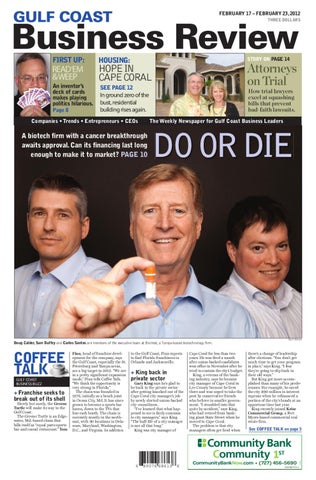
a biotech firm with a cancer breakthrough awaits approval. can its financing last long enough to make it to market? PaGe 10
Mark Wemple
doug calder, sam duffey and carlos santos are members of the executive team at BioVest, a Tampa-based biotechnology firm.
GULF COAST BUSINESS BUZZ
+ franchise seeks to break out of its shell
Slowly but surely, the Greene Turtle will make its way to the Gulf Coast. The Greene Turtle is an Edgewater, Md.-based chain that bills itself as “equal parts sports bar and casual restaurant.” Tom
to the Gulf Coast, Finn expects to find Florida franchisees in Orlando and Jacksonville.
+ King back in private sector
Gary King says he’s glad to be back in the private sector after getting knocked out of the Cape Coral city manager’s job by newly elected union-backed city councilmen. “I’ve learned that what happened to me is fairly common to city managers,” says King. “The half-life of a city manager is not all that long.” King was city manager of
Cape Coral for less than two years. He was fired a month after union-backed candidates won office in November after he tried to contain the city’s budget. King, a veteran of the banking industry, says he became city manager of Cape Coral in Lee County because he lives there and was urged to take the post by conservative friends who believe in smaller government. “I stumbled into that quite by accident,” says King, who had retired from banking giant State Street when he moved to Cape Coral. The problem is that city managers often get fired when
there’s a change of leadership after elections. “You don’t get much time to get your program in place,” says King. “I fear they’re going to slip back in their old ways.” But King got more accomplished than many of his predecessors. For example, he saved the city $90 million in interest expense when he refinanced a portion of the city’s bonds at an opportune time last year. King recently joined Krise Commercial Group, a Fort Myers-based commercial real estate firm.
see coffee talK on page 3
Community 1ST
CommunityBankNow.com • (727) 456-5690 MEMBER FDIC
57379
coffee talK
Finn, head of franchise development for the company, says the Gulf Coast, especially the St. Petersburg and Tampa areas, are a big target in 2012. “We are in a pretty significant expansion mode,” Finn tells Coffee Talk. “We think the opportunity is very strong in Florida.” The chain was founded in 1976, initially as a beach joint in Ocean City, Md. It has since grown to become a sports bar haven, down to the TVs that line each booth. The chain is currently mostly in the northeast, with 30 locations in Delaware, Maryland, Washington, D.C., and Virginia. In addition
2
www.review.net
Gulf coast Business Review FEBRUARY FEBRUARY 173– –FEBRUARY FEBRUARY23, 9, 2012
www.review.net
GULF COAST
Business Review A DIVISION OF THE OBSERVER GROUP INC.
www.review.net The Gulf Coast Business Review is Southwest Florida’s newspaper for business leaders. With offices in Hillsborough, Pinellas, Pasco, Manatee, Sarasota, Lee and Collier counties, the Review is the only weekly business newspaper that provides business leaders, entrepreneurs, CEOs and investors with a regional perspective. The Review’s mission is to deliver relevant news and information on Southwest Florida’s leading and growing companies, up-and-coming entrepreneurs and the important economic, industry and government trends affecting business. The Business Review is also the leading publisher of public notices on the Gulf Coast of Florida.
editor and Publisher / Matt Walsh, mwalsh@review.net Managing Editor / Kat Hughes, khughes@review.net
Associate Publisher / Diane Schaefer, dschaefer@review.net
Deputy Managing Editor / Mark Gordon, mgordon@review.net
Director of Legal Advertising / Kristen Boothroyd, kboothroyd@review.net
Editor-Lee/Collier / Jean Gruss, jgruss@review.net
Advertising Production Manager / Kathy Payne, kpayne@yourobserver.com
Editor-Tampa Bay / Alex Mahadevan, amahadevan@review.net
Advertising Graphic Designer / Shawna Polana
Research Editor / Sean Roth, sroth@review.net Web Editor / Alex Walsh, awalsh@review.net Editorial Design / Foster Barnes Editor-at-Large / Rod Thomson, rthomson@yourobserver.com
Chief Financial Officer / Laura Keisacker, lkeisacker@yourobserver.com Director of Distribution and Subscription Sales & Marketing / Anne Shumate, subscriptions@review.net
HOW TO REACH US MANATEE COUNTY
HILLSBOROUGH COUNTY
5570 Gulf of Mexico Dr., Longboat Key, FL 34228 Phone: 941/362-4848 Phone: 941/906-9386 (Legal Notices) Fax: 941/954-8530
412 E. Madison St., Suite 911 Tampa, FL 33602 Phone: 813/221-9505 (Legal Notices) Fax: 813/221-9403
68458
SARASOTA COUNTY
44184
2
COLLIER COUNTY
PO Box 2234 Sarasota, FL 34230 1970 Main St., Suite 400, Sarasota, FL 34236 Phone: 941/362-4848 Phone: 941/906-9386 (Legal Notices) Fax: 941/954-8530
The French Quarter, 501 Goodlette Road N., #D-100 Naples, FL 34102 PHONE: 239-263-0122 (Legal Notices) Fax: 239/263-0112
PASCO COUNTY
LEE COUNTY
5237 Summerlin Commons Blvd., Suite 324 Fort Myers, FL 33907 Phone: 239/275-2230 (Jean Gruss); FAX: 239/936-1001 (Legal Notices)
ORANGE COUNTY
446 N. Dillard St., Suite 4 Winter Garden, FL 34787 Phone: 407-271-4855 (Legal Notices) Fax: 407-286-1802
5709 Main St., New Port Richey, FL 34652 Phone: 813/221-9505 (Legal Notices) Fax: 813/221-9403
PINELLAS COUNTY
14004 Roosevelt Blvd. Clearwater, FL 33762 Phone: 727/447-7784 (Legal Notices) Fax: 727/447-3944
To send Legal Notices, email to: legal@review.net. Name the county of interest in the subject line and attach notice. Deadline for legal notices is noon Wednesday. For Display Advertising, Call (941) 362-4848. Deadline for display advertising space is noon Friday.
HOWTO SUBSCRIBE Subscription Price
One-Year Periodical Rate ................................................................... $75 One-Year First-Class Mail ................................................................ $107 Two-Year Periodical Rate ................................................................. $127 Two-Year First-Class Mail ................................................................ $180 Three-Year Periodical Rate............................................................... $185 Three-Year First-Class Mail ............................................................. $239 Single copy price: $3 Group rates for five or more corporate subscriptions are available. To subscribe online: www.review.net If you have a question about your subscription or wish to suspend your subscription temporarily, call Anne Shumate, (877) 231-8834 or contact her by e-mail: subscriptions@review.net
POSTALINFORMATION The Gulf Coast Business Review (ISSN#1539-9184) is published weekly on Fridays by the Gulf Coast Review Inc., 1970 Main St., Sarasota, FL, 34236; 412 E. Madison St., Tampa, FL 33602; 14004 Roosevelt Blvd., Clearwater, FL 33762; 5709 Main St., New Port Richey, FL 34652; 5570 Gulf of Mexico Dr., Longboat Key, FL 34228; 5237 Summerlin Commons Blvd., Suite 324, Fort Myers, FL 33907; and The French Quarter, 501 Goodlette Road N., #D-100, Naples, FL 34102. Periodicals Postage Paid at Sarasota, FL, and at additional mailing offices. The Gulf Coast Business Review is circulated in Charlotte, Collier, Hillsborough, Lee, Manatee, Pasco, Pinellas and Sarasota counties. PostmasteR: Please send changes of address to The Gulf Coast Business Review, P.O. Box 3169, Sarasota, FL 34230. for information on reprints, visit review.net
“The road is cleared,” said Galt. “We are going back to the world.” He raised his hand and over the desolate earth he traced in space the sign of the dollar. Ayn Rand, Atlas Shrugged
$$
Gulf coast Business Review FEBRUARY 17 – FEBRUARY 23, 2012
www.review.net
3
coffee talK + local product receives ‘awesome’ endorsement
wHo is tHe next entRePReneuR of tHe yeaR?
Do know someone who started with little more than an idea and ambition and used them to build a successful business? Someone who has a knack for seeing and capitalizing on opportunity? Someone who leads his or her business with integrity and intelligence, inspiring other entrepreneurs? The Business Review is seeking business leaders with all of the above for its 2012 Entrepreneur of the Year award. The award recognizes top entrepreneurs from Tampa to Naples, whose companies have shown exceptional performance the past three years. Nominees should be visionaries and leaders who have overcome obstacles to lead their companies to great achievements. Nominees must be owners or part owners of their companies, which must be based on the Gulf Coast. Last year’s winner was Jane Mason, founder and CEO of eMason, a Clearwater-based software firm. The Sarasota-Manatee region winner was Jim Kuhlman, president of Florida Shores Bank and the Lee-Collier winner was John Langley, president and CEO of Medscribe Information Systems based in Naples. To nominate an entrepreneur, send his or her name by March 23 to Alex Mahadevan at alexm@review.net or call 941-302-3117. Please include the person’s name, company, contact information and a brief description of what distinguishes the candidate. The winners will be featured in our May 18 issue.
+ council reveals plan to ease permitting
The Economic Competitiveness Committee, which was formed by Tampa Mayor Bob Buckhorn, broke up on Valentine’s Day. But the planned disbanding of the committee wasn’t heartbreaking. In fact, the 19-person group of local business leaders presented a strategy to help Tampa hang with the likes of Raleigh, N.C., and Dallas.
see coffee talK on page 5
economic snaPsHot
544 Bay Isles Road Longboat
Professional Office in the Northern Trust Bank Building Great opportunity to Lease Prime Office space in this unique building, neighboring Northern Trust Bank and Signature Sotheby’s International Realty. Great location across from City Hall and next to the US Post Office. Elegant building with high ceilings and arch windows all around. Features Include: • 1175 Square Feet Approximately • New Laminated Wood Flooring • New elegant moldings throughout • Three Private Offices • Conference Room • Large Reception Area • Kitchenette with some new appliances • 2 Bathrooms • Immediate Occupancy
what it means: The TampaSt. Petersburg and Fort Myers areas both exceeded the statewide annual jump in tourism-related taxable sales in November (up 7.8%). Still, every area of the Gulf Coast posted an increase in this category, suggesting the start of the tourism season
email: sunset1@comcast.net
Powerful Results For Small And Mid-Sized Companies Throughout The State Of Florida.
A.H. “Skip” Kitchner
($ in millions)
$ tourism $177.1 $558.2 $139.8 $157.1 $29.4
ROBles RealTy llC Office: (941) 388-3434
CLU, ChFC, ChHC ,REBC, CASL
novemBeR touRism area Cape Coral-Fort Myers Tampa-St. Petersburg Naples Sarasota-Bradenton Punta Gorda
Ivan Fernandez (941) 320-4343
Employee Benefit Plans. Executive Financial Services. & Insurance.
touRism and RecReation what the data show: Taxable sales in the tourism and recreation category include those at hotels, bars, restaurants, liquor stores, art stores, gift shops, admissions, sporting goods, rentals and jewelry stores. The latest data is for November.
Call to schedule a showing:
annual change 14.2% 8.2% 7.3% 7.2% 1.2%
Source: Florida Legislature Office of Economic & Demographic Research
was better than in 2010. Growth in tourism and recreation-related taxable sales was reported in every area of the state in November. forecast: Higher occupancies and rising room rates at Gulf Coast hotels suggests the winter tourism season is off to a strong start. However, some airlines have cut back service to the Gulf Coast, which may keep some travelers away this season. Airports in the region have reported flat or declining passenger numbers. Also, rising gasoline prices may slow tourism if they rise above $4 a gallon.
We utilize a combination of personal attention and the latest technology to provide our clients with a smooth renewal process and exceptional service, as well as administrative and compliance support.
Rich Pierro ChFC, ChHC, CLU, RHU
Call today. 941-753-3053
Founded in 1975 www.kitchnerandpierro.com
5550 26th St. West, Suite 7 Bradenton, FL Member of (UBA) United Benefit Advisors®
71448
Würkin Stiffs, the Sarasota-based business behind Power Stays and Polo Stays, magnetic devices that connect collars to shirts, got the gift of entrepreneurial dreams just before Christmas. The present was a 15-second plug on the NBC Today show, when standup comedian Chuck Nice and host David Gregory chatted about men’s holiday gifts. “They make your collar stand up no matter what,” Nice told Gregory about the Power Stays. Added Nice: “It’s like Viagra for your shirt. It’s awesome.” Not exactly the firm’s marketing tagline, but the publicity has nonetheless boosted Würkin Stiffs. The Today Show bit came at the end of what was already a big year for the company: Owner Jonathan Boos, who founded the firm in Boos 2006, says revenues grew 40% last year over 2010. The sixemployee firm now has more than $1 million in annual sales. Boos expects to grow at least 40% again in 2012. “It’s a lot of little things that keep adding up,” Boos tells Coffee Talk. “There’s a lot going on.” One big thing occurred earlier this month, when the U.S. Patent and Trademark office approved the firm’s second patent for magnetic collar stays. The patent, according to a Würkin Stiffs statement, “encompasses the function and fastening of a shirt collar utilizing a magnetic collar stay in the broadest form.” Boos says the patent process was lengthy because the patent officer in Washington didn’t really get the product. “A lot of the claims were rejected,” says Boos. “So we just kept going further.” Würkin Stiffs has also taken the product line further. The firm recently released a line of Italian calfskin wallets made to protect against radio frequency identification theft, a budding industry trend. The firm also has a new product line called iWurk, a series of bamboo and walnut cases for iPads and iPhones. The cases are etched in menswear inspired designs. The firm, finally, has a new website and logo. “This has all taken root from one product,” says Boos, “which is fantastic.”
Premier Business Location in the Heart of Longboat Key For Lease
Gulf coast Business Review FEBRUARY 3 – FEBRUARY 9, 2012
www.review.net
Gulf coast weeK
TIA gets new routes, PreCheck
REGIONAL BUSINESS NEWS AT A GLANCE
saRasota-manatee city supports renovations
The Bradenton City Council approved a $7.5 million bank loan that will be used to pay for improvements at McKechnie Field, spring training home of the Pittsburgh Pirates. The planned improvements to the 1923 stadium include new seats and a boardwalk area. Manatee County will also provide up to $400,000 a year in funding for the project, with funds from a portion of the tourism-bed tax. The last renovations to McKechnie Field were done in the early 1990s. Just south of downtown Bradenton, the field is also the home stadium of the Bradenton Marauders, a single-A minor league team.
EXECUTIVE
DECISION who won in the recent national mortgage settlement with the country’s five largest banks? To vote in this week’s poll question, visit: review.net/decision. Results from last week’s poll: Do you support Florida entering the foreclosure settlement agreement with the rest of the states? 37% yes
63% no
defendant pleads guilty
Onetime Sarasota Realtor Richard Bobka has admitted to his role in a widespread real estate flipping fraud case. Bobka pleaded guilty to federal charges Feb. 10 for his role in the mortgage fraud scheme authorities say encompassed 22 residential properties in Sarasota and more than $47.5 million in loans. Bobka initially pleaded not guilty, but he switched his plea four days into the trial. Bobka is the 16th of 19 defendants in the case to plead guilty. He faces up to 30 years in prison.
Co., says a release from the company. One million of the shares being sold are from existing shareholders. Raymond James will not collect any money from that portion of the offering. Underwriters will have a 30day option to buy 1.6 million additional shares, which are currently trading at $34.08. The overallotment allows underwriters to increase the offering by 6.6%, which is less than half of the 15% allowed by law.
channel construction starts
For the second year in a row, Sarasota has made Penske Truck Rental’s list of the most frequent moving locations in the country. The city was ninth in the 2011 survey, just like it was in 2010. The other cities on the list are significantly bigger. The list includes Atlanta, Phoenix, Orlando, Dallas/Fort Worth, Chicago, Houston, Denver, Seattle and Charlotte, N.C. Sarasota is the only small city on the list. Penske tracks online one-way truck rental reservations to compile the list.
Miami-based Related Group broke ground on a mixed-use property located in the Channel District Feb. 13. The firm bought the land from Regions Bank for $25.70 per square foot in December 2010 and plans to spend $55 million on its development. The project will include apartments and 4,800 square feet of retail space along with two parking garages. The 5.8-acre property was previously owned by the Tampa developer Sembler Investments, which announced plans to build a mixed-use project that included a hotel and offices in 2006.
tamPa Bay
colliers nabs project
sarasota makes list
Ray Jay plans public offering
Raymond James Financial Inc., the St. Petersburg-based financial services firm, announced plans to sell 10.5 million shares of stock through a public offering to finance a portion of its scheduled purchase of Morgan Keegan and
Trammell Crow has awarded Colliers International Tampa Bay the leasing assignment for the first hotel and office project built in downtown Tampa in more than 20 years. Trammell Crow is developing the 20-story, 400,000-square-
Tampa International Airport will get 25 new flights this summer and implement the Transportation Security Administration’s PreCheck program by the end of 2012, according to releases from TIA. JetBlue will begin twice-daily service from TIA to LaGuardia Airport and daily flights to Reagan National Airport in Washington, D.C., on June 11. Spirit Airlines will begin four weekly foot office tower and 350-room hotel called SouthGate at the southeast corner of Brorein and Morgan streets. Besides SouthGate’s proximity to Tampa’s convention center and entertainment venues, the development will be adjacent to the University of South Florida’s recently developed Center for Advanced Medical Learning and Simulation. That center is expected to draw thousands of physicians and other health care professionals to the area each year.
cHaRlotte-lee-collieR Home prices jump
The median price of existing single-family homes in the Fort Myers area rose nearly 31% in January compared with the same month a year ago, driven by fewer distressed sales. The median price of an existing single-family home in the Fort Myers area in January was $106,000 compared with $81,000 in January 2011, according to the Realtor Association of Greater Fort Myers and
flights from TIA to Dallas/Ft. Worth International Airport on May 4. Both airlines are lowcost carriers. PreCheck offers frequent travelers the option of registering with TSA to go through a pareddown security check that would not require the removal of shoes or laptops from carry-on luggage.
the Beach. As prices rose, sales declined. Realtors reported sales of existing single-family homes fell nearly 17% to 863 in January compared with the same month in 2011. Of the January sales, 52.8% were conventional sales and the remainder were distressed short sales or bankowned properties.
Hotel revenues surge
Revenues at hotels and motels in Lee County rose 32% in December compared with the same month a year ago, reflecting the tourism industry’s recovery. Revenue per available room, an important gauge of industry financial health that combines occupancy and rates, rose to $61.17 in December compared with $46.32 in December 2010, according to statistics compiled for the Lee County Visitor and Convention Bureau. Hoteliers in Lee County pushed the average daily rate up 15% to $110.71 as occupancies rose to 55.3% in December compared with the same month a year ago.
March 9, 2012 Special Issue:
Law: InsIghts and advIce
Space reservation deadline: March 2, 2012 In this issue, editors will focus on the Gulf Coast’s latest legal challenges, wins and rulings affecting business and industry. From marketing strategies to precedent setting cases this special issue will feature stories relevant to the way your clients do business. Reach a readership of business leaders and decision makers that depend on the Business Review to keep them informed.
Our lineup of 2012 special issues offers an entire year of opportunities to advertise and reach Florida’s Gulf Coast business leaders. To receive more information or our 2012 Editorial Calendar, call Diane Schaefer at (941) 362-4848.
›
www.review.net
›
where BUSINESS starts
75218
4
5
COFFEE TALK
CONTINUED FROM PAGE 3
When Buckhorn formed the committee in June, the goal was to expedite the permitting process and ease regulatory burdens on builders. So the ECC included leaders representing the groups the regulations effect: Tampa Bay construction firms, developers, attorneys and architects. According to the city, its Construction Services Center is supposed to be the “one-stop shop” for permitting needs. But members of the ECC had some recommendations to make the city more development-friendly. In the report, available on the city’s website, there is an entire page dedicated to trimming regulations related to trees and landscaping. The committee also suggested merging entitlement and permitting staff into one office. Another notable suggestion was to “create a work environment that instills a ‘Can-Do’ attitude.” The committee’s recommendations, along with the Urban Land Institute’s advice on how to develop the land around the Hillsborough River, have the mayor as excited as a high school football coach at halftime. “Three-and-a-half years from now I want to look back and say ‘this was our time,” Buckhorn said. The challenge, as always, is implementing the recommendations. Coffee Talk looks forward to seeing what the city “Can-Do.”
+ Business-climate survey suggests recovery
A business-climate survey by the Greater Naples Chamber of Commerce suggests the worst of the economic downturn is over. Only five of the 201 organizations surveyed said they plan to reduce staff and just 26 said they thought the economy was in decline. In addition, most companies in Naples reported no problems finding qualified staff and reasonably priced housing for their employees. And banks are in a lending mood, chamber members report. The survey says of the 59 companies that sought bank financing, 44 were successful. Of course, business-climate surveys tend to benefit from “survivorship bias.” The companies polled were the survivors of the downturn. Still, it’s a good sign that a survey of the winners indicates confidence they’ll be around for next year’s questionnaire.
+ Regional economic development stuck
Don’t expect the creation of a regional economic development effort in the Fort Myers-Naples area to spring up quickly. “Today, it doesn’t exist,” says James Moore, the director of the Lee County Economic Development Office. Moore says the Southwest Florida area that encompasses Fort Myers and Naples is the only coastal region of the state that has no regional, multi-county economic development organization. “We’re behind and we need to catch up,” he told a recent gathering of the Real Estate Investment Society in Fort Myers. The lack of a coordinated economic development effort hampers industry recruitment. “Companies don’t care about political boundaries,” Moore says. “They’d rather talk to one person instead of five different people.” What’s more, state government invites regional organizations to travel on trade missions and then extends invitations to local economic development group if there’s room left, putting the Fort MyersNaples area at a disadvantage. One obstacle to local regionalism efforts, Moore says, is that the economic development agency in Collier County was disbanded last year after funding dried up. “They’re trying to resurrect that in different form,” Moore says, noting that there are pro-regional forces at work in Collier.
Salon rises above economic downturn
Featured ProPerties
FOR LeASe
PARKLAND CeNTeR - Sarasota, FL
2520-34 Trailmate Drive
When Coral Pleas opened a highend salon in January 2008, she was determined to prove there was still a place for luxury — despite the recession. A little more than four years later, Pleas has come through on her quest. Her east Manatee County salon, Cutting Loose, had $1.8 million in revenues in 2011. That’s up 48% from $1.22 million in 2010. Pleas expects to reach at least $2.2 million in 2012 sales. She also plans to open one more, and possibly two, new locations this year. One of the keys to the growth, says Pleas, has been the salon’s commitment to training new stylists and employees. She launched a second location in 2009, After Hours, in space next door to Cutting Loose, for an alternative, less expensive salon and training center. Every Monday, for example, is a training day where new employees work with senior staffers. The training allows Pleas to groom stylists, an important element in an industry known for high turnover. Says Pleas: “We don’t hire other people’s hairdressers.”
+ Savtira racks up fame in advisory board
It’s easy to be skeptical of Timothy Roberts’ grandiose plans. The chairman and CEO of the Ybor-based tech company Savtira Corp. has had big boasts fall flat before. A proposed gaming system called Phantom failed to materialize for investors of Infinium, a Sarasota company Roberts headed. But with an advisory board that includes the founder of Atari, a co-creator of Microsoft’s Xbox and a former Red Bull executive, Savtira has big names to back its claim to be developing “disruptive technology.” Roberts, who promised in August of last year to create 265 jobs within 18 months to qualify for tax incentives, now tells Coffee Talk he is planning to have as many as 500 employees by the end of 2012. Roberts says Savtira is in negotiations to acquire a former cigar factory in Ybor to meet expanding employment. With the 112 employees that Roberts says Savtira employs, the company is still more than halfway from meeting its obligation for the tax incentives it enjoys. Roberts also concedes that some of the big names on his advisory board were friends of his father. “I’ve always been scared to reach out to these guys because they’re like family,” Roberts tells Coffee Talk. Harry Drnec, the former managing director of Red Bull’s operations in the United Kingdom, is one such adviser. Nevertheless, Roberts says the advisory board provides valuable analysis of trends in technology and marketing and provides a geographic reach from Seattle to the UK. “They have already made money with their own products,” Roberts says. “Now they’ll guide us and provide their knowledge.”
23,300 SF • Warehouse 6464 Parkland Drive
Suite 102 1,542 SF $7.00 NNN Office/workshop Suite 103 1,293 SF $7.00 NNN Office + small whse Suite 108 1,200 SF $7.00 NNN Office + whse
Covered dock with 24 clear height. 1,500 SF office/showroom. $4.50 NNN
17,472 SF • Manufacturing 6423 Parkland Drive
3,000 SF - 27,330 SF • WHSE/Office 2280 Trailmate Drive
Air conditioned with 800 Amps electric. Bright, clean manufacturing! 15% office. $4.50 NNN
Newer building. 25-28 clear. Office or warehouse. Loading dock. $5.00 - $8.00 NNN
MANASOTA INDUSTRIAL PARK – Bradenton, FL 36,360 SF • WHSE/Office 4521 19th St. Court East
New! Great Tilt Wall shell building. 24-27 clear height. Will finish to suit. $5.00 NNN 73106
www.review.net
Price includes 10% office buildout
For information, call Beverly Vorhees at (941) 756-5599 Email: bvorhees@high.net • parklandcenter.com
SBA Lenders that come in early and work all night. Like you.
SBA Preferred Lending Partner. At Community Bank, we have been an SBA Preferred Lending Partner for nearly 15 years, making the small business loan process easy to navigate and quick to close with loan decisions made on-site. Our experience, expertise, friendliness and desire for your business is unmatched in Florida. Dade City
Pasco County
Contact us for a consultation today. SBA@CommunityBankNow.com (727) 456-5690 • (877) 266-2265 CommunityBankNow.com/SBA checking • savings • money markets • mortgages • business loans • SBA loans • association and treasury services • and a host of other sophisticated banking products you might not expect
17 locations across Pinellas, Hillsborough, Manatee, Charlotte, Pasco counties and coming this spring to Belleair
Pinellas County COMING SOON
Zephyrhills
Hillsborough County Hyde Park
Belleair
Westshore
Largo Mid-County
Riverview
4th Street Beach Drive
West Central
Apollo Beach
Manatee County West Bradenton
Lakewood Ranch
Braden River
Charlotte County Port Charlotte
Veterans
Punta Gorda
Community 1ST Loans subject to credit approval.
MEMBER FDIC
75190
Gulf coast Business Review FEBRUARY 17 – FEBRUARY 23, 2012
6
GULF COAST BUSINESS REVIEW FEBRUARY 3 – FEBRUARY 9, 2012
www.review.net
Stop Giving Free Stuff
“
“
FIRST UP
Companies can do more to help alleviate poverty by helping poor people become self-reliant. Entrepreneurs are great role models.
Ismael Hernandez, The Freedom & Virtue Institute: ‘We need to challenge the system of dependency.’
C
orporations could learn a lot from Ismael Hernandez. Many companies have embraced corporate giving to help less-fortunate people, but the donations aren’t improving their lot. Despite the best intentions, Hernandez says, many corporate donors and charities are perpetuating poverty by giving stuff away. Companies bankroll free food, school supplies, furniture and all sorts of handouts that keep people in poverty. Instead, Hernandez says, these charities should help poor people become more self-reliant so they can lift themselves out of their situation in life. Hernandez is in a position to know. The executive director of The Freedom & Virtue Institute in Fort Myers, Hernandez grew up poor in a communist household in Puerto Rico and later became a Jesuit seminarian. Disillusioned with the communist propaganda (his father was a Marxist and founder of Puerto Rico’s Socialist Party), Hernandez now espouses the ideas of limited government and individual liberty. With decades of experience helping inner-city poor people, Hernandez teaches churches and other community organiza-
tions to promote personal responsibility and economic initiative. “The entrepreneur has always been vilified, but the man of business is showing us the way,” Hernandez says. Hernandez acknowledges his views haven’t exactly been welcomed in some circles, even by some in the Catholic Church for whom he worked for years, he says. But his ideas strike at the heart of what’s wrong with charitable giving today. “We feel sorry and give things, and it makes us feel good,” Hernandez says. “When we give with the heart, we are perpetuating the problems we’re trying to fix.” Poverty is exacerbated because many charities depend on an ever-increasing population of poor people to justify their existence. These self-perpetuating organizations thrive on a combination of government grants, and they guilt successful people into giving more. “It’s all a scheme to get to your pocket,” Hernandez says. “Poverty keeps their doors open.” Instead, Hernandez says, entrepreneurs should be regarded as role models whose success should be celebrated. “You’ve fulfilled your duty by being the best entrepreneur you can be; make the best product you can and do it honestly,” Hernandez
JimJett.com
After decades of working with the poor, Ismael Hernandez says government and most charities have a vested interest in maintaining the status quo. says. “Compassion is a voluntary exercise or it’s a fraud by people who want power.” The proof is that poor people in capitalist countries are better off than the middle classes in nations that don’t promote free enterprise, he says. Hernandez’ message resonates with entrepreneurs. The institute is backed by entrepreneurs such as residential developer David Lucas and technology startup founder John Gamba Jr. “We need to challenge the system of dependency,” Hernandez says. For example, Hernandez’ institute created a program called the Self Reliance Club, which helps school-aged students work toward buying their own school supplies. They earn money working at school and the community and open a savings account. In partnership with local merchants, children get a store card for the money they can use to buy school supplies. Instead of lining up for free school supplies in the fall, students earn them by working. “You know how much better you feel about yourself?” Hernandez smiles. —Jean Gruss
Better ways to give •Develop a corporate vision for giving that fits with your business mission. •Recipients of your help should be expected to do something to earn your gift. •Make sure you’re not duplicating efforts. •Communicate the values that are important in your business, such as self-reliance and hard work. Engage in activities that help people pull themselves out of poverty. •Be wary of organizations that accept government grants because they promote a culture of dependency. Hernandez, whose own organization does not accept any government money, calls these organizations “grant groupies.” •Once you’ve articulated your vision, develop a set of criteria that charities must meet. “Everyone talks the talk, but examine what they actually do,” Hernandez says. •Ask yourself: What talents do you have to offer? You may have talents that could help young entrepreneurs lift their families out of poverty.
Market Opportunity FIRST UP
S
Gulf Coast executives who crave advice from peers now have more options. One group seeks the “leaders who want to be better CEOs.”
arasota-Bradenton area decision makers usually head north, to Tampa, for high-level networking among fellow corner office occupants. But the networking opportunities have begun to come to them. Two groups in particular have led the charge: The Association for Corporate Growth and the Gulf Coast CEO Forum. ACG Tampa Bay expanded to SarasotaBradenton late last year, while the CEO Forum is an independent group modeled after the CEO Council of Tampa Bay. Matt Walsh, editor and publisher of the Business Review, helped launch the CEO Forum and is currently the group’s president. ACG Tampa Bay Chairman John Connery says a handful of Sarasota-Bradenton professionals have attended ACG events in Tampa over the past few years, which got him thinking about expansion. And last year he met with the chairman of ACG San Francisco, who told him about that group’s success in hosting meetings in Oakland.
“We are moving full steam on this,” Connery says. “We think it’s a viable opportunity.” There are 14,000 members ACG members worldwide, spread through 56 chapters. The organization was founded in 1954. The focus is to provide networking programs and business opportunities for middle-market growth companies. Members are mostly a mix of attorneys, accountants, potential investors, commercial investment bankers and entrepreneurs. Executives and professionals with private equity firms are also members. The Tampa Bay chapter, formed in 1998, has been one of the fastest growing ACG chapters. The membership count has grown from 126 in July 2007 to 225 in 2012. About 70 people attended ACG Tampa Bay’s first Sarasota-Bradenton meeting, held at the Sarasota Yacht Club late last year. A second meeting was held in January. “We want to be a more significant
Mark Wemple
John Connery is the chairman of the Tampa Bay Chapter of the Association for Corporate Growth. The chapter recently expanded to the Sarasota-Bradenton region. player” in supporting companies in the region grow, says Connery. The Gulf Coast CEO Forum also wants to play a significant role in helping local companies grow. The forum, unlike the ACG expansion, is independent of the CEO Council. But the strategy is the same: to have a group where CEOs can share information comfortably, and give and receive advice, without feeling like they are being sold something. The CEO Forum does that through monthly meetings and roundtable discussions, says executive director Lynn Weddington, who was hired in November. The forum was formed in June and now has 65 members. Says Weddington: “We want the leaders who want to be better CEOs.” — Mark Gordon
Executive Session The next Sarasota-Bradenton meeting for the Association for Corporate GrowthTampa Bay chapter is scheduled for 5:30-8 p.m., March 7, at the Sarasota Yacht Club. The topic is “Today’s Lending — the Rules Have Changed.” The annual membership fee for the Association for Corporate Growth is $335. Visit http://www.acg.org/tampabay for more information. The Gulf Coast CEO Forum, meanwhile, meets once a month, also at the Sarasota Yacht Club. The forum seeks members with companies that have at least $1.5 million in annual sales and 10 employees. Email lwedd@comcast.net for more information.
Gulf coast Business Review FEBRUARY 3 – FEBRUARY 9, 2012
www.review.net
Brew Master fiRst uP
G
7
The business of beer manufacturing clearly drafts an element of amusement with it. But achieving success isn’t all fun and games.
et ready to get jealous: Michael Wagner isn’t just an entrepreneur, he’s an entrepreneurial professional brew master. The gig, though, isn’t all suds and Buds. It’s a combination of a decade of dedication, a big chunk of personal savings and a gamble that a gritty neighborhood just south of downtown Bradenton is poised for a rebound. Wagner’s avenue in beer is the Little Giant Brewing Co. The Little Giants is the nickname of the sports teams from Wagner’s alma mater, Wabash College in Indiana. Wagner’s brewery is actually more of a manufacturing facility where a variety of microbrews are the products. The brewery will go in an empty 5,000-square-foot building next to McKechnie Field, where the Pittsburgh Pirates hold spring training. He intends to open it in June. The facility will sell beer wholesale to bars, restaurants and resorts, and it will sell retail, too, in a customer lounge and bar area at the front of the building. There are no plans to sell food. “We are all about great beer,” says Wagner. “That’s the mission.” The mission began in a shack, literally, on Anna Maria Island. A Chicago native, Wagner began to brew some beer there for friends in late 2009. He shared space with an 86-year-old artist in the shack. Says Wagner: “It was home brewing with a purpose.”
Before that, Wagner, 40, traveled the world on a beer-brewing expedition for 10 years, from Colorado to Germany to Turks and Caicos. He has worked for several breweries in Tampa and the Midwest. He even attended the Siebel Institute of Technology in Chicago — the Harvard of brew schools. Wagner is seemingly launching the Little Giant at the right time. The craft brew industry sold $7.6 billion worth of beer in 2010, up from $7 billion in 2009, according to the Brewers Association, a Boulder, Colo.-based trade group. Wagner still had his doubts about the Gulf Coast being a good place to launch a commercial brewery. “I’ve always called Southwest Florida the beer frontier,” says Wagner, because Budweiser and other socalled big-box brews dominate the market. “I never knew if the demographics would support this business.” But he decided to give it a shot late last year. It will cost between $500,000 and $750,000 to launch the brewery. Wagner’s personal savings, plus some money from outside investors, will fund the venture. The first phase is to turn the 40-yearold building, which has been everything from a Greyhound bus station to a water purification facility to a Mexican restaurant, into a beer manufacturing plant. The work includes a total turnover of the plumbing and electrical work, in addition to new paint and floors. Also, the ceiling in
Mark Wemple
michael wagner will turn a decade of experience in brewing beer professionally into an entrepreneurial venture. He plans to open his business, the Little Giant Brewing Co., in downtown Bradenton later this year. one area will be extended to make way for some large equipment. The neighborhood that surrounds the building presents another challenge. In addition to McKechnie Field there’s an eclectic mix, from a homeless shelter to an auto repair shop. Wagner didn’t receive
any subsides from the city to open the brewery there, but he says he might apply for help soon. “I look at this as a pillar in the neighborhood,” says Wagner. “Hopefully other business will build up around it.” — Mark Gordon
Share your experience with the next generation of business leaders.
Advertisement
Rent-a-Writer for Ads, PR, Social Media
Your employees can make a DIFFERENCE in a child’s life in just ONE day by participating in a JA in a Day in an area school. Adopt a grade in a school and your company volunteers can deliver curriculum to all classes in that grade in one school day.
Inspire the Entrepreneurial Spirit in our children. Call today to learn more about business partnerships!
To get involved, contact Jim Brown, Manatee/Sarasota Education Program Manager 941-361-1410 • jim.brown@ja.org • www.jasarasota.org 6710 Professional Parkway West, Suite 200 • Sarasota, FL 34240
75771
75774
To get professional results, call us for advertising and literature, press releases and articles, web launching and re-launching, social media. We quote each project in advance. And we write better. In PR, our experienced journalists succeed because we talk the language of editors. We were editors ourselves. We can guarantee a specified number of major feature articles/interviews, and a flow of press releases. It’s important to have regular press releases – one or more monthly – because editors don’t know you now, but will. Articles in your key media get 10-20x the readership of other means, and cost a tenth as much. In social media, we price our services a la carte and achieve frequent presence in this lowest cost of all media. We’re the only all-journalist agency. And it makes a whale of a difference. Here are three reasons why journalists succeed (and amateurs do not): • We spot stories you don’t. • We write professionally. • We arrange major interviews and articles — 19 cover stories last year alone! JournalistPR LLC, 388-8200. mail@journalistpr.com.
Gulf coast Business Review FEBRUARY 3 – FEBRUARY 9, 2012
www.review.net
The Full Deck
“
“
8
Brian lewis, VoteThemOutCards: ‘If George Soros comes in, I’m not giving him a discount.’
fiRst uP
Brian lewis hopes to sell thousands of decks of playing cards lampooning left-wing politicians.
Brian Tietz
Brian Lewis was laid off after Thanksgiving, so he turned a hobby designing playing cards that lampoon left-wing politicians into a business.
I
t’s time for a change. Brian Lewis has seen that promise up close: He was laid off after Thanksgiving from a Fort Myers kitchenconstruction and remodeling company. The self-styled Reagan Republican and retired U.S. Navy officer says he’d been designing a deck of playing cards that take jabs at left-wing politicians in time for this election season. “This was going to be a hobby,” he says. But after he was laid off, Lewis, 56, turned his efforts into a full-time entrepreneurial venture called VoteThemOutCards, playing cards that poke fun of left-wing candidates — and some Republicans, too. One of the cards shows a tearful President Barack Obama holding a baby rattle and wearing a bulging diaper with the words: “It’s time for a change.” Lewis hopes to sell 50,000 decks, many of them via his website, votethemoutcards.com, and by phone. Once the presidential campaign begins in earnest, he expects to sell hundreds of decks to conservative supporters, including at the Republican convention in Tampa this summer. “We’ve got about $20,000 invested in it so far,” he says. The cards depict various politicians, in order of their prominence. Senate Majority Leader Harry Reid is a joker and House Minority Leader Nancy Pelosi is an ace of diamonds, for example. Florida Senator Bill Nelson is jack of hearts. But Lewis didn’t spare some Republicans. Maine Senator Olympia Snowe is a queen of clubs because of her support for Obamacare, and U.S. Rep. Bill Young is a nine of spades because he’s a career politician. “They were such easy targets,” Lewis notes. Lewis commissioned artists from Southwest Florida College in Fort Myers, where his wife teaches in the art department. Lewis made sure the artists agreed with his political outlook. “Are you going to have a problem with this?” he asked them. Some of the messages are subtle, such as Reid holding up a small yellow bird with his middle finger. Others are
more direct: California Senator Dianne Feinstein, an ace of hearts, is whispering secrets to a terrorist while holding a classified drone-strike schedule. Pelosi’s card had to be redrawn a few times. “They kept making her look too good,” Lewis chuckles. Lewis says he’s got an inventory of 10,000 decks and gives discounts for bulk orders. He estimates breaking even after he sells 5,000 decks. He sells the decks for $9.95 a piece, including shipping and handling. “If George Soros comes in, I’m not giving him a discount,” Lewis says, referring to the billionaire supporter of leftist groups in the U.S. Lewis says he’s sticking to making fun of liberals; he won’t make a deck for the other side. There’s more to come, too. “We’re already looking to 2016,” he says. The designs for the cards also are available on T-shirts,
but Lewis partnered with shirt-printer Café Press to reproduce them and earns a small percentage of the sales. “I didn’t want to have to buy 5,000 T-shirts and print them up,” he says. Much of Lewis’ marketing will be targeted at conservative organizations and politicians using social media such as Facebook. He mailed some decks to radio talk show hosts such as Rush Limbaugh and congressional staffers of conservative politicians. Only Florida U.S. Sen. Marco Rubio sent his deck back to Lewis, with a note explaining that his office doesn’t accept any gifts. Lewis, who says he’s never been politically active before this endeavor, says he’s learned a valuable lesson from his research and entrepreneurial venture: “It told me I never want to be a politician,” he says. —Jean Gruss
Gulf coast Business Review FEBRUARY 3 – FEBRUARY 9, 2012
www.review.net
9
Some communications providers see this as “a building.” We know it’s a prime restaurant pad with ample foot traffic and adjacent retail.
At Bright House Networks Business Solutions, we believe to understand your communications needs, we first must understand your organization and its challenges. When you put us to work for you, your professional, dedicated account executive will work with you to ensure we deliver solutions that satisfy your and your tenants’ communications and business requirements – immediately and long term. Join the growing number of commercial property owners and managers who list Bright House Networks Business Solutions as prime advantage.
• Advanced, competitively priced voice, data and video solutions for businesses of all sizes • Professional, local, dedicated account teams • Tenants keep existing phone numbers and equipment • Local, tenant-direct customer care is just a call away – 24/7/365 • One reliable provider and one easy, affordable monthly bill for all your properties
Call 1.855.339.5370 or visit brighthouse.com/business to connect with your local account team. We’ll give you a FREE network consultation and bill evaluation to ensure you’re getting maximum value from your communications.
74285
©2012 Bright House Networks. Serviceable areas only. Some restrictions may apply. Services provided at the discretion of Bright House Networks.
10
GULF COAST BUSINESS REVIEW FEBRUARY 3 – FEBRUARY 9, 2012
www.review.net
“
BIOTECHNOLOGY by Alex Mahadevan | Tampa Bay Editor
Sam Duffey, BioVest International: ‘The phoenix has risen from the ashes. Now the fun part begins.’
“
Samuel Duffey was promoted to serve as president of BioVest after the Tampa biotechnology company emerged from bankruptcy in 2008.
Mark Wemple
Gulf coast Business Review FEBRUARY 3 – FEBRUARY 9, 2012
Double Down A Tampa biopharmaceutical says its vaccine will REVOLUTIONIZE cancer treatment. But after emerging from bankruptcy in 2008, its future hangs on final FDA approval.
I
t takes a great deal of patience, some faith and bit Review summaRy of madness to hold equity company. BioVest in pharmaceutical companies. International Inc. Things are especially risky for industry. Biotechnology a small biotechnology compaKey. Focusing on ny that went bankrupt before processes in product deit could bring its product to velopment to guarantee the market. FDA approval. It can take decades to go through the required testing to gain regulatory approval by the Food and Drug Administration, and BioVest International Inc., a Tampa biotechnology firm developing a vaccine for non-Hodgkin’s lymphoma, entered Chapter 11 bankruptcy in 2008 in the midst of trials for its vaccine. That’s where the main challenge for the biotech industry lies: spending years undergoing five phases of clinical trials for the Food and Drug Administration with little or no revenue. The rigorous and time-consuming process can mean the death of any breakthrough idea. BioVest, with its ostensibly groundbreaking product BiovaxID, has made it through Phase III trials and has plans to apply for FDA approval this year after successfully exiting its bankruptcy. But the firm, which recorded a net loss of $15.3 million for its 2011 fiscal year, must keep capital coming in to avoid another bankruptcy during the approval process. That’s where Samuel Duffey stepped up to take command. Duffey was promoted from general counsel to president in 2008, after the company’s reorganization. “We were like a turtle pulling our head, legs and tail into our shell,” Duffey says. “The bankruptcy was our shell.” Duffey says he knew the company needed a new strategy, so he decided to focus on the development of the cancer vaccine, which he and his team see as the biggest opportunity for a future income stream.
Personalized treatment
Although BiovaxID is considered a cancer vaccine, it doesn’t function the same way as other vaccines. For example, a flu vaccination helps its recipients build immunity to that particular strain of the flu, preventing sickness from it. BioVest’s vaccine is different in several ways. For one, the subject has already been diagnosed with non-Hodgkin’s lymphoma, for which he or she may be under treatment. The disease could also be in remission. Essentially, BiovaxID empowers the white blood cells of a patient’s body to attack the mutated cells causing the cancer. The most recent test shows that the treatment is successful at locking non-Hodgkin’s lymphoma in remission more than a year longer than patients receiving no treatment. Another way BiovaxID differs from a usual vaccine is that it is customized for each patient. A sick individual would have a biopsy of his tumor shipped to BioVest, which then develops a product based on that sample. The personalized vaccine is created and returned to the subject. Phase III testing, which Carlos Santos, BioVest vice president of product development and regulatory affairs, says is considered the “gold standard” for FDA trials, showed that BiovaxID was able to keep subjects of the test in remission for roughly 14 months longer than those given a placebo. The FDA approval process consists of five phases of clinical trials that Douglas Calder, BioVest’s vice president of strategic planning and capital markets, says take roughly 15 years to navigate. The third phase consists of a randomized study of individuals. If successful, the third phase is generally when the FDA will approve a drug. And following the approval, the final two phases are tests that take place after the drug is marketed. Although the FDA has approved two other cancer vaccines, the process still proves difficult for BioVest. The FDA will weigh the benefits and risks of BiovaxID to determine its approval. But because cancer vaccines are so new, the government organization is still tweaking its approval conditions, Santos explains. Provenge, a vaccine targeting prostate cancer in men, was the first cancer vaccine to be approved in early 2010. However, because BioVest’s product extended the median remission time of its test subjects by more than a year, the
benefit heavily outweighs the risk, Duffey says. “There was only a little bit of redness at the injection point,” says Santos on the minimal risk BiovaxID demonstrated in its Phase III trials. Dr. Eduardo Sotomayor, the Susan and John Sykes Endowed Chair for Hermatologic Malgnancies at Moffitt Cancer Center in Tampa, says the timing is promising for BioVest’s quest for approval. “Five years ago I would say the FDA would never approve a cancer vaccine,” Sotomayor says. “But the environment is more favorable, and there is a good chance (BiovaxID) will get FDA approval.”
double down
The success demonstrated by BiovaxID Phase III trials, which was an eight-year study, gave investors hope during a dark time for the company. Accentia Biopharmaceuticals, a Tampa company that currently owns 61% of BioVest, filed for Chapter 11 bankruptcy in 2008. BioVest filed jointly. In the midst of waiting for results from BioVest’s Phase III trial, macroeconomic conditions froze credit markets in 2007 and hurled the firm into financial turmoil. As a small biotechnology company reliant mostly on financing to sustain operations, BioVest could not pay an outstanding debt to a secured creditor and entered reorganization. But to the surprise of Charles Postler, the Tampa-based attorney representing BioVest in its bankruptcy proceedings, roughly 90% of the shareholders agreed to a reorganization plan. “There was the potential for major litigation there,” Postler explains. “But all the parties knew the company was developing potentially life-saving drugs.” Secured and unsecured creditors agreed to double down on the company’s future earnings potential and accepted stock as well as cash. “Most creditors took stock,” Postler says. With the firm’s financial crisis temporarily resolved, Duffey says the company replaced most of its scientific staff in 2008. The company has $1.5 million cash on hand and may receive up to $6 million from Accentia’s sale of Analytica International, an economic consulting subsidiary specializing in health care, Calder explains. He believes the company will have sufficient funding to make it through the FDA approval this year. Although he will not disclose specifics, Calder says the firm is working on a deal to restructure debt it has due in November and have the option of an equity offering to raise needed capital. This year is a pivot point for the future of the company and its shareholders. If the company fails to get regulatory approval in any of the jurisdictions it applies (BioVest is seeking approval in Canada and the European Union as well), it may have to fund additional studies. Calder says BioVest will seek out a large pharmaceutical firm to license BiovaxID to pay for such a study. Because the Phase III trials of the vaccine are complete, the product could go to the market, with post-market studies ordered by the FDA. BioVest, which employs 38, is remodeling its corporate headquarters and plans to hire an undisclosed amount of new employees this year. BioVest has a hurdle approaching, but the executive team is excited about the future of the company. “The Phoenix has risen from the ashes,” Duffey says. “Now the fun part begins.”
at a Glance Biovest inteRnational inc. Headquarters: Tampa ceo: Samuel Duffey 2011 Revenues: $3.9 million stock symbol: BVTI Recent stock price: $0.71 52-week stock-price range: $0.32 – $0.77 Price-earnings ratio (trailing 12 months): N/A dividend: N/A market capitalization: $99.8 million Source: Bloomberg Businessweek
www.review.net
11
uPcominG
CALENDAR OF EVENTS FEBRUARY 21
Business foRum: James Prokopanko, president and CEO of The Mosaic Co., will join other business leaders to discuss the Tampa Bay area’s business climate at the annual University of Tampa Fellows Forum. The event will start at 7:15 a.m. at the David A. Straz Jr. Center for the Performing Arts (Louise Lykes Ferguson Hall), 1010 N. W.C. MacInnes Place, Tampa. Cost is $40 per person. For more information visit tampachamber.com. cHaRlotte BRoadBand: John Honker of Magellan Advisors and Ray Desjardins, senior division manager of the Charlotte County Information Technology Department, will discuss Charlotte County’s proposed broadband project. The lunch event will run from 11:30 a.m. to 1 p.m. at the Captain’s Table at Fishermen’s Village, 1200 W. Retta Esplanade, Suite 55, Punta Gorda. For more information visit SuncoastTechnologyForum.com.
FEBRUARY 22
ReGulatoRy landscaPe: Herschel Vineyard Jr., secretary of the Florida Department of Environmental Protection, and Melissa Meeker, executive director of the South Florida Water Management District, will speak at a meeting of the Chamber of Southwest Florida. The event will run from 8 a.m. to 1:30 p.m. at the Holiday Inn, 9931 Interstate Commerce Drive, Fort Myers. Cost is $60 for members and $70 for others. For more information, contact David Miller at 239-275-2102 or email chamberswf@gmail.com. land sQuaBBle: Lee County Commissioner Ray Judah and Lee Clerk of Courts Charlie Green will discuss the county’s controversial conservation-land acquisition program at the February meeting of The Tiger Bay Club of Southwest Florida. The event will run from 11 a.m. to 1 p.m. at the Royal Palm Yacht Club, 2360 W. First St., Fort Myers. For more information visit swfltigerbay.org.
FEBRUARY 23
BaseBall Business: Representatives from the Boston Red Sox and Minnesota Twins will discuss doing business with the teams at the Southwest Florida Chapter of Institute of Management Accountants’ second annual baseball summit. The event will start at 7:30 a.m. at the Plantation Country Club, 10500 Dartington Drive, Fort Myers. Cost is $30 for pre-registered attendees and $45 at the door. For more information visit jaswfl.org.
MARCH 7
Real estate caPital: Steve Cohn, senior vice president of the Florida region’s commercial real estate for Bank of America; Rick Croteau, president of the east region for Newland Real Estate Group; and Mike Moser, eastern region president of Starwood Land Ventures will speak at the Urban Land Institute Southwest Florida’s March meeting. The event will run from 8 a.m. to 10:30 a.m. at the Miromar Golf Club, 18520 Miromar Lakes Blvd., Estero. Cost is $25 for members and $35 for others. For more information visit swflorida.uli.org.
APRIL 25
Business Hall of fame: Junior Achievement of Southwest Florida will induct Scott Fischer of Scott Fischer Enterprises and Barbara Watt of Century 21 Fischer Sunbelt Realty into the 2012 Business of Hall of Fame, Lee County, at a dinner and awards ceremony. The event will start at 5 p.m. at the Hyatt Regency Coconut Point Resort and Spa, 5001 Coconut Road, Bonita Springs. For more information visit jaswfl.org.
12
Gulf coast Business Review FEBRUARY 3 – FEBRUARY 9, 2012
www.review.net
“
HomeBuildinG by Jean Gruss | Editor/Lee-Collier
“
Brian Gomer, Premier Cape Construction: ‘We’re busier now than we’ve been in the last four years.’
JimJett.com
don and Ginny Koogler recently sold the $2.3 million model home they started building in Cape Coral before it was completed.
The Cape is Back Cape Coral suffered mightily during the housing crash, but Florida’s second-largest city is seeing signs of a rebound in residential construction. Demand may outpace supply.
T
he priciest home in this year’s Lee The Lee Building Industry AssociaCounty parade of homes is located tion parade of homes, an annual industry in the area that epitomized the event during which builders open model real estate bust: Cape Coral. homes to the public for three weeks, has The fact that homebuilding activity is 42 homes this year, a 31% increase from picking up in one of the country’s bleak- last year. Of that total, 13 models are loest area for foreclosures is one cated in Cape Coral, indicator that the state’s eco- Review summaRy more than double the nomic recovery is well under five that were in the paindustry. Residential way. rade last year and one construction Cape Coral is Florida’s secmore than the dozen trend. Hard hit areas ond-largest city by landmass, homes in the entire such as Cape Coral are measuring 120 square miles county’s parade just seeing a residential and connected by three bridgtwo years ago. building resurgence. es to Fort Myers. The city’s What’s more, entreKey. Labor costs 133,000 platted lots cover an preneurs built many of area four times bigger than Lee’s new model homes Miami, and its 400 miles of this year, not large nasaltwater and freshwater canals helped tional homebuilding companies. “Now drive real estate sales to a frenzy of spec- all the monkeys are copying me,” laughs ulation during the boom and the spec- Bob Knight, co-owner of Paul Homes, tacular collapse that followed. who was one of the few local builders But Cape Coral remains fertile ground prescient enough to open a model home for future homebuilding, and entrepre- in Cape Coral two years ago when he neurs are eager to start again at the first sensed the market turning. sign of optimism. Barely half the city’s The most expensive home in the palots have been built upon so far in its 50- rade this year is the one built by entreyear history. Its population is 154,000, preneurs Don and Ginny Koogler on a less than half the 400,000 it could ac- waterfront lot in Cape Coral. The $2.3 commodate. million, 7,500-square-foot home built
on speculation was sold before it was completed. Already, 1,500 people have toured the home in the first weekend it was opened to the parade. In another sign of confidence in the market, Scottsdale, Ariz.-based Taylor Morrison acquired the remaining 577 home sites at Sandoval, one of the few master-planned residential communities in Cape Coral. While the terms of the deal weren’t disclosed, the community accounted for more than 40% of the residential permits in Cape Coral last year. Even the Cape Coral Construction Industry Association, whose ranks were cut in half during the downturn, recently hired a new-membership director. Executive Director Heather Mazurkiewicz says she hopes to grow the trade group’s membership roster by 10% to 20% this year. To be sure, homebuilding hasn’t yet surged to boom-time levels. In fiscal 2005 ending in October, Cape Coral issued 7,694 permits for the construction of single-family homes. So far this fiscal year, the city has issued 85 permits. But builders say they’re anticipating a surge in demand that will likely overwhelm the short supply of new homes
available today. Foreclosures of well-located newer homes have run their course, they say. “We’re busier now than we’ve been in the last four years,” says Brian Gomer, vice president with Premier Cape Construction.
location and amenities
At this point in the homebuilding recovery, builders are focused on certain locations where there is limited supply: waterfront lots with access to the Caloosahatchee River and the Gulf of Mexico. “That’s where the demand is,” says Gomer. For example, the southwest area of Cape Coral, south of Cape Coral Parkway, has few homes for sale that were built in the last five years, says Gomer. “The number of foreclosures has dropped dramatically,” he adds. “Those opportunities don’t exist anymore.” What’s more, the Cape Coral market remains relatively less expensive than many other areas. Koogler points to a waterfront lot next to his model home that is listed for $600,000, half what it would have cost in 2006. But similar lots this close to the Gulf of Mexico sell for $4 million in Naples, he says. Other areas of the city are doing better, too. For example, the gated community of Sandoval has been drawing new-home buyers through the downturn. The master-planned community is unique because a sea of scattered lots surrounds it and it would be difficult for any developer to assemble 500 acres to create a competing gated development. “If you were trying to duplicate Sandoval, it would take you a couple of years,” says Steve Kempton, Taylor Morrison’s president for West Florida. Taylor Morrison, which was one of the original builders at Sandoval six years ago, acquired the remaining 577 lots there from developer Bonita Bay Group. In a sign of improvement, Taylor Morrison raised the price of its lowest-price home by 5% last year. So far this year through January, builders have sold 25 homes at Sandoval. Last year they sold a total 116 homes.
Gulf coast Business Review FEBRUARY 3 – FEBRUARY 9, 2012
www.review.net
JimJett.com
Cape Coral’s 400 miles of canals appeal to buyers looking for waterfront lots on which to build a home.
ich liebe cape coral
At least half of the buyers of new homes in Cape Coral are foreigners, say builders. Germans have been big buyers in particular, bolstered by a favorable exchange rate and an already large presence of their fellow countrymen. The German American Social Club of Cape Coral draws more than 30,000 people for its Oktoberfest festival to its 25-acre campus. “They’ve been more positive on our market than local or North American buyers,” says Gomer. Knight says Germans are buying homes and renting to their fellow countrymen when they’re not here. And Koogler notes that some Europeans are confident enough that they expect to sell these homes at a profit in two to three years. Unable to find high-yield investments, they’re investing in Southwest Florida real estate in search of higher returns, he says. Besides Germans, builders have also seen an influx of Canadians in recent years. A favorable exchange rate also helps these buyers and low prices relative to a few years ago have been a draw. “The Canadians have found Cape Coral,” says Koogler. Meanwhile, U.S. buyers have been more cautious. Part of it may be the fact that bank credit remains tight, particularly for “jumbo” loans of more than $417,000. “A lot of clients said if they could get loans, they would build,” says Koogler. Still, judging by the foot traffic in the model homes during the parade, builders are optimistic that U.S. buyers will
increase spending. “I think it’s consumer confidence,” says Koogler. “As long as the stock market can stay steady,” he adds. Koogler says he’s expecting $100 million in sales of luxury homes this year, more than triple the $29 million in sales in 2011. Gomer says recent articles in national newspapers and magazines have noted Cape Coral’s affordability. “People are starting to pay attention,” he says. “For so long Cape Coral was the poster child for bad news.” Knight says he tracks model traffic by groups of people, rather than individuals. Last year, about 100 groups toured the model home during the parade. This year, Knight says the first weekend saw 165 groups. “They were chatting with the salespeople and having good conversations,” he notes.
spec is back
Builders are so confident they can find buyers that they’re building speculatively. “We have a couple of inventory homes we are building on our own properties,” says Gomer. “That shows our confidence in the market.” While construction loans are available for the most credit-worthy homebuyers, banks aren’t lending for speculative homebuilding. That’s likely to keep the supply in check and be especially lucrative for builders with the financial strength to do that. Besides lower land prices, the cost of labor remains low relative to the boom times. But builders caution that a stronger-than-expected rebound could cause labor costs to spike. Fact is, many subcontractors ranging from electricians to plumbers left the market during the bust because there was little work, as evidenced by the decline in the membership of the local construction industry association. “Now we’re making sure we’ve got people if growth comes back,” says Knight. “Right now the trades are keeping up, but if it comes quicker we’ve got to watch out. That could snuff the whole thing out.”
WOULD YOU LIKE
MORE TIME
FOR BUSINESS? We thought so. Take advantage of our Loyal Reader subscription auto-renewal program and save precious minutes. No bills, no stamps, no missed issues. Contact our subscriptions department for details.
Start saving time! Call: 877.231.8834 or Email: subscriptions@review.net
66821
Most of the buyers now are older people whose children have left or those who have recently retired, says Kempton. “Family buyers haven’t been as prevalent because of the job market,” he says. Kempton says that the city has done a good job widening roads, adding sewer systems and building new schools. A new hospital for military veterans is scheduled to open later this year, he notes. “They’ve done a terrific job taking that city to the next level,” he says.
13
14
Gulf coast Business Review FEBRUARY 3 – FEBRUARY 9, 2012
www.review.net
GoveRnment watcH
Kill Bills By Rod tHomson | Editor-at-Large
Rep. Kathleen Passidomo, R-Naples, wrote the bad-faith bill that was defeated 8-7 in committee with the votes of three of her Republican colleagues.
Rep. Richard steinberg, D-Miami Beach, who opposes the bad-faith reform bill, voted in favor to keep the bill in the committee at least until the next committee meeting.
Florida is one of the most litigious states in the country. But attempts to change the laws meet intense resistance from perhaps the most powerful lobbying group in Tallahassee: trial lawyers.
A
bevy of facts dramatibillion — not including cally support the notion Review summaRy medical malpractice. that Florida is a haven In a 2007 national issue. Businesses for “bad-faith” lawsuits that Harris poll, 62% of busisay lawsuit-friendly allow a jury to award up to ness owners or managers Florida is a drag on the hundreds of times more than said they make business economy. an insurance policy covers. decisions to avoid lawKey. Make state laws Perhaps the most telling fact suits; 61% said the fear more business-friendly is this: one out of every five of lawsuits made their in the courtroom. bad faith claims in the United products and services States arises in Florida. more expensive and 45% That costs insurance comsaid the fear of lawsuits panies millions, but it ultimately costs made a product or service unavailable to consumers and businesses millions as well customers. because insurance companies make up How real is the impact on companies those losses in premiums. It’s a lose-lose and jobs? situation. If targeted in a lawsuit, 71% of small So then how did a measure that would businesses say they would very likely have reform the bad-faith statute get nixed in a to hold back on hiring new employees, House committee 8-7? Through the power according to a national poll conducted in and influence of a group that wins under 2010 by Bill McInturff and Doug Schoen the state’s current law: trial lawyers. for the U.S. Chamber Institute for Legal But the bad-faith bill victory is far from Reform. the only win for what some consider the state’s most effective special interest group overwhelming influence in Tallahassee. Trial lawyers as a group make up one of According to groups representing busi- the wealthiest demographics in Florida. nesses, trial lawyers in Florida represent They know the system in the courts and one of the biggest obstacles to economic in the halls of power in the Capitol. They and job growth — and are part of the rea- have a small army of about 20 lobbyists, son the state ranks 42nd in legal climate but more importantly they can field a phafor businesses, according to the Harris In- lanx of high-powered trial lawyers who teractive Poll. persuade legislators privately while debatIndeed, mention lawyers to almost any ing public bills vigorously. business owner and the groans say it all. “The trial lawyers are overwhelming,” The same can be said for the organizations says Bill Herrle, Florida executive director in Tallahassee that represent businesses in of the National Federation of Independent Florida. Businesses. He says he is going up against Relatively easy and costly lawsuits are their lobbyists and lawyers at every turn in one part of the trifecta that have become Tallahassee. the bane of Florida businesses that is The frustration over the apparent power rounded out with over-regulation and of trial lawyers and their ability to use the high taxes. Lawsuits cost untold millions system and block reform can verge on the of dollars in lawsuits and the threat of personal. Listen to Mark Wilson, presilawsuits, which require inefficiencies and dent and CEO of the Florida Chamber of heavy insurance premiums. Commerce: According to NERA Economic Consult“There are those people who make ing, the tort liability price tag for small things, services, products and employ peobusinesses in America in 2008 was $105.4 ple. And there are those people who take...
tHe financial costs
tHe PRoductivity costs
While big companies get headlines for lawsuit payouts, most of the liability payouts fall to small businesses. NERA Economic Consulting found the following: • The tort liability price tag for small businesses in America in 2008 was $105.4 billion. This does not include medical malpractice, which was another $29.8 billion. • Small businesses bore 81% of total business tort liability costs. • Small businesses paid $35.6 billion of their tort costs out of pocket as opposed to through insurance. Further, Tillinghast/Towers Perrin predicted that tort costs would reach $183.1 billion in 2011 for all businesses, suggesting a trend that is not sustainable long-term.
in a 2007 Harris poll, 62% of business owners/managers said they make business decisions to avoid lawsuits.these decisions had the following effects: • 61% said the fear of lawsuits made their products and services more expensive. • 45% said the fear of lawsuits made a product or service unavailable to customers. • 23% said the fear of lawsuits forced them to cut employee benefits. • 11% said the fear of lawsuits decisions forced them to lay off employees.
trial lawyers don’t make anything. All they do is take.” Debra Henley, executive director of the Florida Justice Association — the trial lawyers’ lobbying arm in Tallahassee — veritably scoffs at the idea that trial lawyers have overwhelming influence in Tallahassee. “We’re still outnumbered by interests that would close the door to the courthouse,” she says. Indeed, the number of registered lobbyists for business groups exceed that of trial lawyers by a long shot. But part of the reason for that is that the trial lawyers’ FJA makes extensive use of its lawyer members to lobby in Tallahassee. Unlike most business lobbyists, those lawyer members are not paid, and only those who are paid are registered as lobbyists. But the FJA is not as partisan as one might expect. While trial lawyers as a group give much more to Democrats, Henley says that she is a Republican, as are the past two presidents of the FJA.
more than a third of the business people had a lawsuit filed against them in the past 10 years.these suits had the following effects: • 73% said business suffered because litigation was very time consuming. • 64% said business suffered because litigation was very expensive. • 61% said they felt more constrained in making business decisions generally. • 45% said they changed business practices in ways that do not benefit customers. In a separate 2010 Harris poll, 67% of business owners or managers said that the litigation environment in a state is likely to impact important business decisions at their companies, for instance, where to locate or do business.
Bad faith
Outnumbered or not, the insurer’s badfaith bill is an example of how well the trial lawyers play the system, both in Tallahassee and during the 10 months of the year when the Legislature is not in session. Florida’s bad-faith law has been a financial boon for the state’s trial lawyers. The
Gulf coast Business Review FEBRUARY 3 – FEBRUARY 9, 2012
lawsuits are allowed when lawyers claim that an insurance company did not settle a claim in the proscribed timeframe — which can be as little as a few days. The plaintiffs typically go for many times more money in a payout than was covered in the insurance policy. A $10,000 policy can turn into a $10 million payout. Businesses say lawyers game the system by asking for so much background data in such a short timeframe that it becomes impossible for an insurance company to settle within the time limit. Then the lawyers sue the insurance companies for not settling the lawsuits in a timely manner. “What we’ve got here is a statute that forces almost every claim into litigation,” former Florida Supreme Court Justice Charles T. Wells told the House subcommittee. “The only ones making money consistently off this are lawyers.” But Fred Cunningham, president of the Florida Justice Association and a Palm Beach personal injury lawyer who, it just so happens, focuses on insurance company bad-faith litigation, assured the panel that there is “no crisis” in the current law. “This is a draconian solution in search of a problem.” And FJA’s Henley says the current badfaith law protects businesses, and it is insurance companies pushing for the change so they are not on the hook for amounts beyond policy limits. For years, trial lawyers have successfully fought to retain the current law that is so profitable for their business — and, they say, good for their clients. Last year, a procedure was used to sideline a reform bill without a vote being taken. That gave cover to legislators who would have voted against it to go home and tell businesses that they were for it. This year, backers wanted to make legislators vote and were able to do that in the House Civil Justice Subcommittee. But the bill was already dead before the vote. Those following it closely knew that the trial lawyers had persuaded three Republicans to side with Democrats and trial lawyers. Those Republicans were Matt
www.review.net
15
ButtinG Heads
The business community and trial lawyers are at odds with each other on dozens of issues. Here are a few: Bill Businesses Reform no-fault insurance to save $1 billion annually Yes Insurers bad-faith reform to close loopholes Yes Line up expert witness testimony standards with feds and 36 other states Yes Workers comp reform on physician drug repackaging Yes Civil remedies against insurers Yes Modifying surplus lines insurers with Citizens Yes Senate bill to downsize Citizens to reduce assessments after a hurricane Yes Putting a trial lawyer on board of Citizens No Medical malpractice reform, sovereign immunity for ER doctors Yes Reverse a long-term care court ruling Yes Medical malpractice wrongful death changes Yes Truth in damages changes Yes
tRial lawyeRs No No
status In committee Killed
No No No No
In committee In committee Killed Killed
No Yes
Killed In committee
No No No No
Killed In committee On House floor Killed
Note: Any bills still in committee after the week of Feb. 20 will probably be killed for the session.
— altering laws in an attempt to hold down outrageous lawsuits and payouts. That is not how Henley sees it. “Tort reform means the legal system won’t be there when you need it,” she says. She claims the system is already weighted in favor of businesses. Businesses clearly don’t agree. A bill to reform no-fault insurance, which is costing insurance companies and ultimately consumers more than $1 billion annually and forcing premiums to rise up to 70% in the past two years, is being fought by the FJA and its members. They oppose the caps on attorneys’ fees, the repeal of the attorney fee risk multiplier, the ability of insurers to require testimonies under oath, independent medical exams and additional time for insurers to investigate suspicious claims.
Gaetz, R-Fort Walton Beach; Shawn Harrison, R-Tampa; and Jose Oliva, R-Miami Lakes. None of the three Republicans responded to requests for an explanation of his vote. While they all have received campaign donations from lawyers, it is a small percentage of the totals for each of them. Rep. Kathleen Passidomo, R-Naples, author of the bad-faith bill, said she could not explain the votes of her Republican colleagues. “I have no idea. They didn’t articulate any reasons I thought were credible.”
Blocking reform
Bad faith is far from the only bill on which the trial lawyers are fighting the business community. Each year there is a multitude of bills that fall under the category of tort reform
They also oppose legislation changing the expert witness standards to conform them to the federal law and what 36 other states already use. Business interests say that the current law allows “junk science” to be allowed and has caused damage to many Florida businesses. When that bill came up in committee recently, several trial lawyers from around the state who have successfully used the current standard spoke against the change. They did not prevail in the end, but Rep. Richard Steinberg, D-Miami Beach, who opposes the bill, voted in favor so he could use a parliamentary procedure known as “retaining” to keep the bill in the committee at least until the next committee meeting. Only someone voting in the
see Bills on page 16
March 2, 2012 Special Issue:
Top SaleSpeople:
How THey Do iT
Space reservation deadline: February 24, 2012 In this issue, editors will focus on the Gulf Coast’s top sellers across a variety of disciplines, profiling their evolution into inspirational industry leaders and emphasizing their tips to fellow salespeople on how to set the right goals and close every deal. Don’t miss the chance to reach a broad market of sellers aspiring to be the best and looking forward to a bright future.
Our lineup of 2012 special issues offers an entire year of opportunities to advertise and reach Florida’s Gulf Coast business leaders. To receive more information or our 2012 Editorial Calendar, call Diane Schaefer at (941) 362-4848.
www.review.net
›
where BUSINESS starts
75535
›
16
Gulf coast Business Review FEBRUARY 3 – FEBRUARY 9, 2012
www.review.net
workers comp loophole closing in legislature
Closing a costly loophole in the state’s workers compensation law appears to be heading toward approval in the Legislature. The loophole allows physicians to dispense repackaged drugs from their offices and charge employers prices that go far beyond the statutory reimbursement for the same pharmaceuticals that are dispensed at pharmacies. The relabeled prescription drugs are sold at rates up to 679% more than what a pharmacy is allowed to charge under workers compensation. The cost of the loophole falls back squarely on businesses, who could see their workers comp premiums go up 9% this year. The increase would drop to about 6.5% if the drug repackaging loophole is closed, according to backers, who say the problem is costing workers comp about
$62 million a year. Doctors and the groups representing them argue that dispensing medication in their offices helps ensure that patients get their drugs. But the bill closing that hole by capping doctor’s fees at the same rate at which pharmacies are reimbursed would not stop physicians from giving out the medicine. It would bring the prices in line. It passed House Health and Human Services Committee, its second committee of reference, and has passed a Senate committee. The Workers’ Compensation Coalition has made the physician drug repackaging issue one of its top priorities for the session.
changing standards for expert witnesses
Legislation that changes the expert witness standards to conform them to the federal law and 36 other states passed a committee but is temporarily stalled on a parliamentary move. Business organizations want to change to the standard that is more broadly accepted — known as “Daubert” — because it will get rid of the “junk science” they say is allowed under the current law, known as “Frye.” The Daubert standard has resulted in too many businesses being
gouged and has given the state a reputation as an easy place to sue companies, proponents of the bill say. A Harris Interactive Poll ranked Florida 42nd in the nation in legal climate for businesses — not something state leaders are thrilled with. But the Florida Justice Association, the state’s trial lawyers group, opposes the change along with Democrats. Opponents say that the bill will cost prosecutors and judges time and energy to learn the new standard and apply it. But proponents say the cost will be minimal. “Justice is worth the cost,” said Rep. Gayle Harrell, R-Stuart. “Whatever it will cost to make sure we have appropriate science in our courtrooms is worth the cost.” Democrats tried several delaying tactics for the bill. When it was obvious it was going to pass out of committee, Rep. Richard Steinberg, D-Miami Beach, who opposes the bill, voted in favor so he could use a parliamentary maneuver known as “retaining.” That keeps the bill in committee at least until the next committee meeting. Only someone voting in the majority can ask that it be retained.
the eyes have it in compromise
Two controversial healthcare issues that pit some of the most powerful special interests in Tallahassee against each other are now combined into a livetogether, die-together bill. But almost the entirety of the disputes between optometrists,
Committee for the meeting. Bennett’s vote was the deciding vote in blocking attempts to kill the medical malpractice provisions — which had deadlocked at 4-4 previously.
doctors and trial lawyers revolves around money. Optometrists and medical doctors who specialize in fullrange eye care — ophthalmologists — have been at odds for years over allowing optometrists to prescribe eye medicines. The Florida Medical Association has fought to keep the optometrists from being able to give out medicine. However, the FMA has been fighting the trial lawyers over medical malpractice reform. And in a Senate committee, the two items were put together in one bill. The FMA agreed to support optometrists prescribing drugs while the optometrists support the medical malpractice reform — one element of which is to make it harder to prove that doctors are negligent for not performing extra diagnostic tests on patients. The trial lawyers oppose the whole deal because they do not want medical malpractice reform. Their business relies on the most litigation-friendly laws, while doctors want the system less litigation-friendly. The trial lawyer opposition made the bill difficult. To get passage, Senate President Mike Haridopolos added Sen. Mike Bennett, R-Bradenton, to the Health Regulation
Bills from page 15
the business model
NFIB’s Herrle says power in Tallahassee is essential to the trial lawyers’ business future. “Their business model depends on favorable statutes to sue people,” he says bluntly. And they have been successful in Florida. The state laws governing bad-faith lawsuits are a prime example of that. Henley says the trial lawyers’ business is giving people who have been wronged some redress in court. “We’re trying to protect people when the unthinkable happens,” she says.
A bill that would have given greater property tax exemptions for Florida homeowners was defeated in committee on a tie vote. Currently, the first $50,000 of a house’s value is exempted from property taxes if it is the Floridian’s primary residence. The bill would have increased the exemption to 15% of a homestead property’s value up to $200,000 and 10% thereafter up to $400,000. The goal was to give greater tax relief to more homeowners and help spur the housing market. Local governments strongly opposed the added exemption because they rely heavily on property taxes to fund their operations. The change would have lowered taxable property value in every county and put local governments in the bind of having to cut more services or increase tax rates.
Bad law?
debra Henley, executive director of the Florida Justice Association: ‘We’re still outnumbered by interests that would close the door to the courthouse.’ majority can ask it be retained. Steinberg, an attorney, and others had tried to delay the vote the entire meeting. This points to how well the trial lawyers play the game. If they cannot win on votes, they try to kill bills any other way, from working to have an unfriendly bill sent to as many committees as possible — a potential death sentence because of the nineweek time constraint of the session — to procedural moves such as “retaining.” Others use these maneuvers, but FJA seems to be particularly effective at it. Henley admits that trial lawyers are usually on the opposite side of the groups representing businesses, but she asserts that the bills being pushed under tort reform will not improve the state’s economy. “None of the things they propose would bring more jobs to Florida,” she says.
Homestead expansion beaten in committee
Bill Herrle, Florida executive director of the National Federation of Independent Businesses: ‘The trial lawyers are overwhelming.’ She says some trial lawyers do very well financially, but most of them are middleclass lawyers. Like any industry, the topearners are usually the best at what they do. “The most successful lawyers monetarily take the biggest risks and take on top corporate interests,” she says. “They have to be at the top of their game.” Trial lawyers make their money by taking a percentage of a settlement or jury award, normally about one-third, but it can go higher. So a $300,000 award nets the lawyer $100,000. A $10 million claim, $3.3 million. The money adds up when a law firm has dozens of suits active at any given time. And that is why the trial lawyers are so aggressive in protecting the laws that favor their business. Henley says they are looking out for people in tragic situations. But they also undeniably profit personally. There has been another effect of Florida’s favorable lawsuit climate. The state has a lot of lawyers. The Bureau of Labor Statistics tracks a “location quotient” to measure the concentration of jobs in that industry compared with the rest of the country. The country’s average being one, Florida’s quotient is 1.32, making it the second highest concentration of lawyers in the nation, behind only New York state. By comparison, California’s is 1.10 and Texas’ is 0.75. There’s something lawyers find attractive in Florida. But other than on TV, trial lawyers are
not popular with the public. In a survey conducted by the American Tort Reform Association, 83% of Americans held a negative view of trial lawyers. That may explain why FJA changed its name from the Academy of Florida Trial Lawyers in 2007 — two years after the Florida Justice Reform Institute was created. The group’s online belief statement says: “We passionately believe that all Floridians benefit when deserving individuals have a fair chance to seek justice in our state’s courts and that Florida’s consumers are made safer when large corporations and industries are held to a high ethical standard and accept fair responsibility for their actions.”
Home field advantage
Lawmakers are creating or fixing laws by the hundreds each year. Lawyers’ lifeblood is knowing the law and making the most of it on behalf of their clients and themselves. As such, trial lawyers have a bit of a home field advantage in Tallahassee over businesses by understanding the intricacies of law. And they are often talking to other lawyers when they are talking to lawmakers — speaking the same language. The familiarity doesn’t hurt their influence. Further, there is a whole different dynamic at work between the trial lawyers and businesses. Most business people are focused on running their companies — product development and sale, production, distribu-
Bad-faith lawsuits result when a consumer’s lawyer claims that an insurance company did not settle a claim in an appropriate time. Under current Florida law, an insurance company is presumed to be in bad faith if it does not settle in 60 days. And plaintiff lawyers are allowed to shorten the time to as little as a week. A bill addressing the problem was defeated 8-7 in committee. It would have limited claims for excess damages beyond a policy limit to only the insured, not to third parties; created a 90-day notice for commencement of a bad-faith lawsuit, rather than the current 60-day period; and if a good-faith effort is made to settle the policy up to the maximum payout within the time period, that should be proof of no bad faith. tion, hiring, credit, regulatory compliance, customer service, expanded facilities and so on. As such, they rarely understand how proposed laws in Tallahassee might affect their business down the road until they have run into them over the years, according to William Large, president of the Florida Justice Reform Institute. By then, it is often difficult to change. One of Large’s major tasks is to educate business owners on the threat of new laws for their business. “Trial lawyers understand it in a millisecond,” he says. “They (the FJA) don’t have to explain why a bill is important.” Large can sound almost envious of their prowess. “They’re very well organized, articulate, smart. They understand the effects of laws on their business,” he says. Further, businesses are always asking for many different statutory changes during a session, from regulatory changes to tax shifts. “Tort is part of the white noise effect of the many ‘asks,”’ Large says. Not for the trial lawyers. “Trial lawyers are focused one thing,” Large says. “Stop tort reform.” And they’re pretty darn good at it, year after year.
Gulf coast Business Review FEBRUARY 3 – FEBRUARY 9, 2012
www.review.net
17
commercial real estate TAMPA BAY by Sean Roth | Real Estate Editor
Rialto Fund buys Interstate Corporate Center he says. “They also liked the location across from Citrus Park Mall. The thought was that even if FedEx were to pull out it would not be difficult to find a replacement tenant. The building is in it great shape, and it’s only four to five years old.” The price equated to a 10% (capitalization rate) pay-off ratio based on income.
BUYER: RREF ACP Acquisitions LLC (principals:
Jeffrey Krasnoff, Stuart Miller, Thekla Salzman, Mark Sustana, Diane Bessette and Bruce Gross), Miami SELLER: FOA 6302 East Martin Luther King Boulevard LLC PROPERTY: 6302 Dr. Martin Luther King Jr. Blvd., Tampa PRICE: $17.25 million PREVIOUS PRICE: $25.48 million, December 1999 LAW FIRM ON DEED: Greenberg Traurig PA, Fort Lauderdale
PLANS, DESCRIPTION: Rialto Real Estate Fund, an affiliate of Rialto Capital Management LLC, purchased the 344,896-square-foot Interstate Corporate Center for $17.25 million. The price equated to $50 per square foot. Built in 1984, the Class-B office building was last renovated in 1997. It was 76% occupied at the time of the sale and currently houses Remington College, Strayer University and the Florida Department of Revenue. Jim Crews of Bishop & Associates Inc. represented the seller and Dale Peterson and Paul Carr of the Tampa Investment Properties Group of CBRE represented the buyer. Rialto Capital Management did not respond prior to deadline. Rialto, a Miami-based subsidiary of public homebuilder Lennar Corp., and its affiliated entities have invested in or handled the workout and/or oversight of billions of dollars of real estate assets, including distressed commercial and residential real estate loans and properties, as well as mortgage-backed securities. Rialto is also the sponsor and investor in a private equity fund that invests in distressed and value-add real estate.
Etc… North Miami’s Zzicardi buys FedEx, Verizon retail strip BUYER: Zzicardi Inc. (principal: Ricardo and
Daniela Carozzi and Jose Nae), North Miami SELLER: Johnson Citrus LLC PROPERTY: 8206 Citrus Park Drive, Tampa PRICE: $3.5 million PREVIOUS PRICE: $1.75 million, May 2007 LAW FIRM ON DEED: Roca Gonzalez PA, Miami PLANS, DESCRIPTION: A North Miami
• Time Warner Business Services LLC leased 23,289 square feet at LakePointe Two at Tampa Bay Park. Laurie Alden of Highwoods Properties represented landlord and Jack Hoskins of CBRE Group TalaVera represented Time Warner.
BUYER: The CEPCOT Corp. (principals: Fred
and John Thomas, Karen McLead, James Eisch, Robert Milner and John Carlton Jr.), Clearwater SELLER: Redus Florida Land LLC PROPERTY: 125 Island Way, Clearwater PRICE: $1.25 million PREVIOUS PRICE: $2.3 million, December 2005 LAW FIRM ON DEED: Rogers Towers PA, Jacksonville
PLANS, DESCRIPTION: An investment group led by Fred and John Thomas, Pinch A Penny Pool Patio Spa’s founder and current president and CEO respectively, purchased 0.98 acres of land approved for TalaVera at Island Estates for $1.25 million. TalaVera was originally envisioned as a multifamily development with 27 units. Bill Eshenbaugh and Ryan Sampson of Eshenbaugh Land Co. in Tampa represented the seller and Michelle Chenault of Coldwell Bank in Clearwa-
commercial real estate SARASOTA-MANATEE
BUYER: Cornelius Family LLC, Sarasota SELLER: Villa De Santa Monika LLC PROPERTY: 1503 Fourth St., Sarasota PRICE: $675,000 PREVIOUS PRICE: $300,000, December 2002 LAW FIRM ON DEED: J. Kevin Drake PA,
Sarasota
The Cornelius family of Sarasota and Michigan purchased the 1,590-square-foot Station 400 restaurant building north of downtown Sarasota for $675,000. The price equated to $425 per square foot. Allen Conrad with Re/Max Alliance Group represented the buyer and Brad Lindberg with the Sperry Van Ness Commercial Advisory Group’s Sarasota office represented the seller. The Rosemary District restaurant building is a reassembled 1850s-era railroad depot. The existing Station 400 PLANS, DESCRIPTION:
Ortho Med Pain doctor moving to Bee Ridge location
BUYER: Empire Building Ventures LLC (princi-
pals: Maria and William Cole), North Venice SELLER: Norma Jean Wright as individual and trustee of the Norma Jean Wright Revocable Trust PROPERTY: 4071 Bee Ridge Road, Sarasota
restaurant ownership will lease back the building. The family, led by former auto executive Bill Cornelius, already owns the 17,734-square-foot building across an alley from Station 400 at 1525 Fourth St. After acquiring the larger building in July, the Cornelius family and partners created the restaurant and brewery Darwin’s on 4th in the vacant space that formerly housed the Mad Crow Brewery and Grill. The building already also housed a wine storage business, and a second restaurant is being considered. “It made sense for my guy to lock up his parking,” Conrad says. “Eric, who runs Station 400 is going to stay there and continue to operate it. They are open for breakfast and lunch, which allows the restaurants to use it for valet parking at night.” PRICE: $900,000 PREVIOUS PRICE: $1.36 million LAW FIRM ON DEED: Furen & Ginsburg PA,
Lakewood Ranch
PLANS, DESCRIPTION: Dr. William Cole, of the Sarasota pain and sports medicine clinic Ortho Med Pain Relief Centers, and his wife, Maria, purchased the
Proposed Elevation
Clearwater investor group buys TalaVera land
investor group led by Ricardo and Daniela Carozzi and Jose Nae purchased a 6,544-square-foot retail strip for $3.5 million. The price equated to $535 per square foot. The small building, an outparcel to the Plaza at Citrus Park, is fully leased to FedEx Office and Verizon Wireless. The property is covered under a double net lease, which obligates the tenants to pay the parcel’s property tax and building insurance. Blake Hunter of SRS Real Estate Partners and William T. Snow II, formerly with SRS Real Estate Partners, represented the seller. Jacky Londono of Morgan Whitney Inc. represented the buyer. FedEx has only one year existing on its lease, but Verizon Wireless’ lease has another six years remaining, according to Hunter. “The big driver was the strong tenants,”
Darwin’s on 4th building owner buys Station 400 property
• The Tampa Airport Marriott has completed its $9 million renovation project. The property’s renovations included a complete overhaul to the guest rooms, including bathrooms and suites, as well as revitalization to the concierge lounge and corridors. • Lennar’s Central Florida Division, which builds homes in more than 40 communities in Tampa, Lakeland, Orlando, and Brevard County, has relocated to new offices at 4600 W. Cypress St. in Tampa’s Westshore area. The company’s new offices include two floors that total some 26,000 square feet of office space.
ter represented the buyer. “The rule has been that if you buy waterfront property at the right price it will probably treat you well,” Eshenbaugh says. “They certainly aren’t making any more of it. [The buyer] likely bought it as an investment, because it was price right, for a hold.” 7
by Sean Roth | Real Estate Editor
8,280-square-foot former Century 21 Advantage office building on Bee Ridge Road for $900,000. The price equated to $109 per square foot. Glenn Brown of RE/Max Alliance Group represented the seller and Nick Porter of Re/Max Alliance Group represented the buyer. Cole plans to occupy the 4,140-squarefoot first floor of the building and lease out the second level, according to Brown. The first floor features a lobby, 17 offices, two conference rooms and four bathrooms. The second floor includes a training room, 18 offices and four bathrooms. “It’s a concrete block building with great exposure on Bee Ridge,” Brown says. Calls to Cole’s office were not returned prior to deadline. The purchase entity Empire Building Ventures LLC mortgaged the property to Regions Bank for $765,000.
D.R. Horton buys 17 lots in Palmer Oaks Estates
BUYER: D.R. Horton Inc. (principals: Paul
Romanowki, Donald Tomnitz, Bill Wheat, Donald Horton, Thomas Montano and Stacey Dwyer), Deerfield Beach SELLER: PLP Development LLC successor by merger with PLP Lots LLC PROPERTY: Palmer Oaks Estates, lots 39, 40, 41, 44, 46, 55, 56, 57, 59, 60, 62, 63, 64, 65, 67, 69 and 71, a portion of Honore Avenue and Clark Road, Sarasota PRICE: $1.03 million LAW FIRM ON DEED: Williams Parker Harrison Dietz & Getzen, Sarasota
PLANS, DESCRIPTION: Fort Worth, Texasbased homebuilder D.R. Horton Inc. expanded its holdings in the Palmer Oaks Estates community with the purchase of another 17 lots for $1.03 million. The price equated to $60,735 per lot. “It’s an existing community that’s been doing really well for us, so we decided to pick up another 17 lots,” says Darren Saltzberg, vice president of sales and
marketing for the Tampa-Sarasota division of D.R. Horton. “There aren’t many areas of [Sarasota] county where you can get new construction in the $200,000s. We’re building in the twos to low threes. It comes down to price and location.”
Etc…
• Geo Acquisitions LLC purchased 1656 Main St., Sarasota from Liberty Savings Bank for $167,500. Janet Robinson and Michael Jolly of Coldwell Banker Commercial NRT represented the seller and Nathan Dunham of Dunham Calabrese Realty represented the buyer. • GB Impex Inc. leased 6,403 square feet of industrial space at 1172 Jefferson Ave., Sarasota from National Energy Resources Inc. Janet Robinson of Coldwell Banker Commercial NRT represented the landlord and Terry Eastman of James Buchanan Realty represented the tenant. • Balance Health and Fitness leased 3,651 square feet of space at 423 Lemon Ave., Sarasota from Chewy Holdings LLC. Debbie Anglin and Nick DeVito II of Ian Black Real Estate and Ken D’Agostino of D’Agostino Real Estate Group Inc. handled the transaction. • Phillip Roy Financial Consultants Inc. leased 5,271 square feet at 7901 Professional Parkway, Unit 4, Sarasota from Suffolk Construction Co. Inc. Debbie Anglin of Ian Black Real Estate handled the transaction. • Judicial Correction Services LLC leased 2,500 square feet at 1991 Main St., Suite 210, Sarasota from Sarasota Main Real Estate LLC. Steve Horn and Ian Black of Ian Black Real Estate handled the transaction. • Yonker Investment Inc. leased 2,000 square feet of industrial flex space at 1635 University Parkway, Sarasota, to Country Fresh Foods Inc. Peter Bartys, of Michael Saunders & Co. Commercial Division, handled the transaction.
18
GULF COAST BUSINESS REVIEW FEBRUARY 3 – FEBRUARY 9, 2012
www.review.net
commercial real estate TAMPA BAY by Sean Roth | Real Estate Editor
Rialto Fund buys Interstate Corporate Center he says. “They also liked the location across from Citrus Park Mall. The thought was that even if FedEx were to pull out it would not be difficult to find a replacement tenant. The building is in it great shape, and it’s only four to five years old.” The price equated to a 10% (capitalization rate) pay-off ratio based on income.
BUYER: RREF ACP Acquisitions LLC (principals:
Jeffrey Krasnoff, Stuart Miller, Thekla Salzman, Mark Sustana, Diane Bessette and Bruce Gross), Miami SELLER: FOA 6302 East Martin Luther King Boulevard LLC PROPERTY: 6302 Dr. Martin Luther King Jr. Blvd., Tampa PRICE: $17.25 million PREVIOUS PRICE: $25.48 million, December 1999 LAW FIRM ON DEED: Greenberg Traurig PA, Fort Lauderdale
PLANS, DESCRIPTION: Rialto Real Estate Fund, an affiliate of Rialto Capital Management LLC, purchased the 344,896-square-foot Interstate Corporate Center for $17.25 million. The price equated to $50 per square foot. Built in 1984, the Class-B office building was last renovated in 1997. It was 76% occupied at the time of the sale and currently houses Remington College, Strayer University and the Florida Department of Revenue. Jim Crews of Bishop & Associates Inc. represented the seller and Dale Peterson and Paul Carr of the Tampa Investment Properties Group of CBRE represented the buyer. Rialto Capital Management did not respond prior to deadline. Rialto, a Miami-based subsidiary of public homebuilder Lennar Corp., and its affiliated entities have invested in or handled the workout and/or oversight of billions of dollars of real estate assets, including distressed commercial and residential real estate loans and properties, as well as mortgage-backed securities. Rialto is also the sponsor and investor in a private equity fund that invests in distressed and value-add real estate.
Etc… North Miami’s Zzicardi buys FedEx, Verizon retail strip BUYER: Zzicardi Inc. (principal: Ricardo and
Daniela Carozzi and Jose Nae), North Miami SELLER: Johnson Citrus LLC PROPERTY: 8206 Citrus Park Drive, Tampa PRICE: $3.5 million PREVIOUS PRICE: $1.75 million, May 2007 LAW FIRM ON DEED: Roca Gonzalez PA, Miami PLANS, DESCRIPTION: A North Miami
• Time Warner Business Services LLC leased 23,289 square feet at LakePointe Two at Tampa Bay Park. Laurie Alden of Highwoods Properties represented landlord and Jack Hoskins of CBRE Group TalaVera represented Time Warner.
BUYER: The CEPCOT Corp. (principals: Fred
and John Thomas, Karen McLead, James Eisch, Robert Milner and John Carlton Jr.), Clearwater SELLER: Redus Florida Land LLC PROPERTY: 125 Island Way, Clearwater PRICE: $1.25 million PREVIOUS PRICE: $2.3 million, December 2005 LAW FIRM ON DEED: Rogers Towers PA, Jacksonville
PLANS, DESCRIPTION: An investment group led by Fred and John Thomas, Pinch A Penny Pool Patio Spa’s founder and current president and CEO respectively, purchased 0.98 acres of land approved for TalaVera at Island Estates for $1.25 million. TalaVera was originally envisioned as a multifamily development with 27 units. Bill Eshenbaugh and Ryan Sampson of Eshenbaugh Land Co. in Tampa represented the seller and Michelle Chenault of Coldwell Bank in Clearwa-
commercial real estate SARASOTA-MANATEE
BUYER: Cornelius Family LLC, Sarasota SELLER: Villa De Santa Monika LLC PROPERTY: 1503 Fourth St., Sarasota PRICE: $675,000 PREVIOUS PRICE: $300,000, December 2002 LAW FIRM ON DEED: J. Kevin Drake PA,
Sarasota
The Cornelius family of Sarasota and Michigan purchased the 1,590-square-foot Station 400 restaurant building north of downtown Sarasota for $675,000. The price equated to $425 per square foot. Allen Conrad with Re/Max Alliance Group represented the buyer and Brad Lindberg with the Sperry Van Ness Commercial Advisory Group’s Sarasota office represented the seller. The Rosemary District restaurant building is a reassembled 1850s-era railroad depot. The existing Station 400 PLANS, DESCRIPTION:
Ortho Med Pain doctor moving to Bee Ridge location
BUYER: Empire Building Ventures LLC (princi-
pals: Maria and William Cole), North Venice SELLER: Norma Jean Wright as individual and trustee of the Norma Jean Wright Revocable Trust PROPERTY: 4071 Bee Ridge Road, Sarasota
restaurant ownership will lease back the building. The family, led by former auto executive Bill Cornelius, already owns the 17,734-square-foot building across an alley from Station 400 at 1525 Fourth St. After acquiring the larger building in July, the Cornelius family and partners created the restaurant and brewery Darwin’s on 4th in the vacant space that formerly housed the Mad Crow Brewery and Grill. The building already also housed a wine storage business, and a second restaurant is being considered. “It made sense for my guy to lock up his parking,” Conrad says. “Eric, who runs Station 400 is going to stay there and continue to operate it. They are open for breakfast and lunch, which allows the restaurants to use it for valet parking at night.” PRICE: $900,000 PREVIOUS PRICE: $1.36 million LAW FIRM ON DEED: Furen & Ginsburg PA,
Lakewood Ranch
PLANS, DESCRIPTION: Dr. William Cole, of the Sarasota pain and sports medicine clinic Ortho Med Pain Relief Centers, and his wife, Maria, purchased the
Proposed Elevation
Clearwater investor group buys TalaVera land
investor group led by Ricardo and Daniela Carozzi and Jose Nae purchased a 6,544-square-foot retail strip for $3.5 million. The price equated to $535 per square foot. The small building, an outparcel to the Plaza at Citrus Park, is fully leased to FedEx Office and Verizon Wireless. The property is covered under a double net lease, which obligates the tenants to pay the parcel’s property tax and building insurance. Blake Hunter of SRS Real Estate Partners and William T. Snow II, formerly with SRS Real Estate Partners, represented the seller. Jacky Londono of Morgan Whitney Inc. represented the buyer. FedEx has only one year existing on its lease, but Verizon Wireless’ lease has another six years remaining, according to Hunter. “The big driver was the strong tenants,”
Darwin’s on 4th building owner buys Station 400 property
• The Tampa Airport Marriott has completed its $9 million renovation project. The property’s renovations included a complete overhaul to the guest rooms, including bathrooms and suites, as well as revitalization to the concierge lounge and corridors. • Lennar’s Central Florida Division, which builds homes in more than 40 communities in Tampa, Lakeland, Orlando, and Brevard County, has relocated to new offices at 4600 W. Cypress St. in Tampa’s Westshore area. The company’s new offices include two floors that total some 26,000 square feet of office space.
ter represented the buyer. “The rule has been that if you buy waterfront property at the right price it will probably treat you well,” Eshenbaugh says. “They certainly aren’t making any more of it. [The buyer] likely bought it as an investment, because it was price right, for a hold.” 7
by Sean Roth | Real Estate Editor
8,280-square-foot former Century 21 Advantage office building on Bee Ridge Road for $900,000. The price equated to $109 per square foot. Glenn Brown of RE/Max Alliance Group represented the seller and Nick Porter of Re/Max Alliance Group represented the buyer. Cole plans to occupy the 4,140-squarefoot first floor of the building and lease out the second level, according to Brown. The first floor features a lobby, 17 offices, two conference rooms and four bathrooms. The second floor includes a training room, 18 offices and four bathrooms. “It’s a concrete block building with great exposure on Bee Ridge,” Brown says. Calls to Cole’s office were not returned prior to deadline. The purchase entity Empire Building Ventures LLC mortgaged the property to Regions Bank for $765,000.
D.R. Horton buys 17 lots in Palmer Oaks Estates
BUYER: D.R. Horton Inc. (principals: Paul
Romanowki, Donald Tomnitz, Bill Wheat, Donald Horton, Thomas Montano and Stacey Dwyer), Deerfield Beach SELLER: PLP Development LLC successor by merger with PLP Lots LLC PROPERTY: Palmer Oaks Estates, lots 39, 40, 41, 44, 46, 55, 56, 57, 59, 60, 62, 63, 64, 65, 67, 69 and 71, a portion of Honore Avenue and Clark Road, Sarasota PRICE: $1.03 million LAW FIRM ON DEED: Williams Parker Harrison Dietz & Getzen, Sarasota
PLANS, DESCRIPTION: Fort Worth, Texasbased homebuilder D.R. Horton Inc. expanded its holdings in the Palmer Oaks Estates community with the purchase of another 17 lots for $1.03 million. The price equated to $60,735 per lot. “It’s an existing community that’s been doing really well for us, so we decided to pick up another 17 lots,” says Darren Saltzberg, vice president of sales and
marketing for the Tampa-Sarasota division of D.R. Horton. “There aren’t many areas of [Sarasota] county where you can get new construction in the $200,000s. We’re building in the twos to low threes. It comes down to price and location.”
Etc…
• Geo Acquisitions LLC purchased 1656 Main St., Sarasota from Liberty Savings Bank for $167,500. Janet Robinson and Michael Jolly of Coldwell Banker Commercial NRT represented the seller and Nathan Dunham of Dunham Calabrese Realty represented the buyer. • GB Impex Inc. leased 6,403 square feet of industrial space at 1172 Jefferson Ave., Sarasota from National Energy Resources Inc. Janet Robinson of Coldwell Banker Commercial NRT represented the landlord and Terry Eastman of James Buchanan Realty represented the tenant. • Balance Health and Fitness leased 3,651 square feet of space at 423 Lemon Ave., Sarasota from Chewy Holdings LLC. Debbie Anglin and Nick DeVito II of Ian Black Real Estate and Ken D’Agostino of D’Agostino Real Estate Group Inc. handled the transaction. • Phillip Roy Financial Consultants Inc. leased 5,271 square feet at 7901 Professional Parkway, Unit 4, Sarasota from Suffolk Construction Co. Inc. Debbie Anglin of Ian Black Real Estate handled the transaction. • Judicial Correction Services LLC leased 2,500 square feet at 1991 Main St., Suite 210, Sarasota from Sarasota Main Real Estate LLC. Steve Horn and Ian Black of Ian Black Real Estate handled the transaction. • Yonker Investment Inc. leased 2,000 square feet of industrial flex space at 1635 University Parkway, Sarasota, to Country Fresh Foods Inc. Peter Bartys, of Michael Saunders & Co. Commercial Division, handled the transaction.
Gulf coast Business Review FEBRUARY 3 – FEBRUARY 9, 2012
www.review.net
19
commercial real estate LEE-COLLIER by Sean Roth | Real Estate Editor
Mirasol at Coconut Point sells for $5.5 million
BUYER: Mirasol Holdings LLC, Miami SELLER: ALV Coconut Point LLLP PROPERTY: 20000 block of Alamanda Drive,
Bonita Springs, (Every unit except for 9-104) PRICE: $5.5 million LAW FIRM ON DEED: Alhadeff & Sitterson PA, Miami PLANS, DESCRIPTION: Miami-based real estate investment and management firm 13th Floor Investments purchased most of the Mirasol at Coconut Point residential community in Bonita Springs for $5.5 million. The purchase included 34 completed residences, a clubhouse, gatehouse, pool and fitness center as well as developed lots for an additional 190 residences. The property was acquired through 13th Floor Investment’s Florida Real Estate Value Fund from the community’s developer, Naples-based ALV Coconut Point. Since opening Mirasol in 2008, ALV Coconut Point was only able to close on one sale. 13th Floor Investments says it is considering reducing the density of the original developer’s site plan of 190 additional units in order to provide larger and higher-value condominiums. It is considering a number of options for the future development of the property, including doing the developing itself, having a builder partner in the project, or selling the vacant land to a third-party builder. In the short-term, the buyer plans to refresh and replace the landscaping, clean and touchup the existing homes and implement a regular community maintenance program prior to marketing the existing homes for sale. Prices are expected to start in the mid$100s, down significantly from the prior owner’s starting point around $250,000. Homes in the community range in size
from 900 square feet to more than 1,400 square feet. The Mediterranean-style Mirasol at Coconut Point is adjacent to the 1.2 million-square-foot Coconut Point Mall. The Mirasol purchase marks the third acquisition in five months and the eighth deal in total for 13th Floor’s Florida Real Estate Value Fund. The previous two purchases were Summit Place and Bristol Pines, both in Naples. Miami-based 13th Floor Investments has acquired more than $200 million in real estate assets since its inception in 2006.
Deep Creek church buys Abundant Life building
BUYER: Deep Creek Community Church Inc.
(principals: Steven Glover, Mike Burgess and Alexander Cook) Punta Gorda SELLER: Assemblies of God Loan Fund PROPERTY: 1500 Cooper St., Punta Gorda PRICE: $1.53 million PREVIOUS PRICE: $160,000, November 1987 LAW FIRM ON DEED: Fisher & Sauls PA
Deep Creek Community Church purchased the 18,188-square-foot former Abundant Life Assembly of God church building for $1.53 million. The price equated to $84 per square foot. Occupying a 9.77-acre parcel, the vacant building was renovated in 2005 after Hurricane Charley. The church has been portable since its founding nearly 10 years ago, and most recently held its services from a space in Charlotte High School. According to pastor Steve Glover, the church plans to relocate and start operating from the new location in early March. “We have a lot of dreams in mind to build upon what we are already doing as PLANS,
DESCRIPTION:
Homebuilder D.R. Horton buys 30 Sandoval lots BUYER: D.R. Horton Inc., Fort Myers SELLER: San Tropics Properties LLC formerly
known as Sandoval Properties LLC PROPERTY: lots 1-8, 15-17, 22-30, 32-37 and 39-41, block 8025, Sandoval, phase 2, property north and east of Veterans Memorial Parkway, Cape Coral PRICE: $1.28 million LAW FIRM ON DEED: Broad and Cassel, Boca Raton
D.R. Horton Inc. purchased another 30 lots in the gated Sandoval master-planned community for $1.28 million. The price equated to $42,500 per lot. “We’ve been selling up a storm there for the past couple years,” says Jill Meeks, the homebuilders’ vice president of sales and market for Southwest Florida. “Sales there have exceeded our projections the past several months. It’s been pretty amazing. We’ve just been selling through our inventory.” Meeks says that Sandoval is easily Cape Coral’s top-selling community — PLANS, DESCRIPTION:
an outreach-minded church community,” Glover says. Deep Creek Community Church mortgaged the property to Foundation Capital Resources Inc. for $1.46 million.
Etc…
• Bonefish Property Group LLC purchased 3191 Harbour Blvd., Suite 2, Port Charlotte from M&I Regional Properties LLC for $89,000. Ronald Struthers PA of Coldwell Banker Commercial NRT represented the seller and Thurston Martin of Coldwell Banker Sunstar Realty represented the buyer. • Sellstate Realty Systems Network Inc. leased 2,600 square feet of office space at the Minton Building at 5245 Big Pine Way, Fort Myers. Adam Palmer of LandQwest Commercial handled the transaction. • Alkel Trading Corp. purchased a 1,200-square-foot industrial flex space at
accounting for nearly half of all sales in the city — and one of the most desirable in all of Lee County. She attributes that to its location and being one of the few amenitized and gated communities in Cape Coral. In 2011, 120 home sites were sold in Sandoval, a 74% increase since 2010. Recently Taylor Morrison purchased the remaining 577 home sites in Sandoval from the Bonita Bay Group. The development features basketball, volleyball, tennis and bocce courts, horseshoe pits, a children’s play area, large lagoon pool and 5,319-square-foot community center. 4776 Radio Road, Naples from Bayview Loan Servicing for $65,000. Frank Szelest of Re/Max Realty Group Commercial Division handled the transaction. • Nami Japanese Steakhouse Inc. leased 3000 square feet in Reflection Lakes Commons, a retail and office center on Cypress Lake Drive in South Fort Myers. Cindy Stratton, of Real Estate Services International handled the transaction. • Simplified Technologies LLC, a computer and telephone installation and support business, leased 2900 square feet in the Daniels:Metro Park of Commerce, located near Gulf Coast Hospital in Fort Myers. Tiffany Cleland, of Real Estate Services International handled the transaction.. • Alvah W. Alexander III purchased 20 acres of agricultural land at 15520 N. Mallard Lane, Fort Myers from Dixie P. Kelley for $130,000. Fred Kermani of CRE Consultants handled the transaction.
NETWORKING by Jim Jett | Photo Contributor
ULI meets to forecast trends Executives gathered at an Urban Land Institute meeting Jan. 24 in Estero to discuss trends in real estate. Panelists discussed forecasts for the economy, housing and commercial real estate. Speakers included Gregory Miller, chief economist with SunTrust Banks, and Dean Schwanke, the executive director of the Urban Land Institute’s Center for Capital Markets and Real Estate. Right: Glen Salyer, business development director with the Lee County Economic Development Office, and Tim Byal, vice president of finance with Miromar Development.
David Farmer, managing principal of Keystone Development Advisors, and Dean Schwanke, executive director for the ULI Center for Capital Markets and Real Estate.
Doug Schwartz, senior vice president with WCI Communities, Keith Gelder, director of land development for Stock Development, and Ryan Binkowski, director of planning for Waldrop Engineering.
Kathleen Oppenheimer, attorney with Pavese Law Firm, and Tony Palermo, senior planner with the Lee County Department of Community Development.
Dana Bessett, developer with Bateman Communities, and Al Bateman, president of Bateman Communities.
GULF COAST BUSINESS REVIEW FEBRUARY 3 – FEBRUARY 9, 2012
www.review.net
You can see it. We can help make it happen. Whether it’s expanding your business, entering new markets, or making strategic acquisitions, you need a commercial bank that shares your vision. BMO Harris Commercial Bank can provide expert, one-on-one guidance and the financial resources you need to help turn your vision into reality. bmoharris.com/redframe
BMO Harris BankSM and M&I® are trade names used by BMO Harris Bank N.A. Member FDIC
73180
20