Having power washers and paint sprayers on the salesfloor opens up the opportunity to rent equipment to project-oriented DIYers. Learn from retailers who have run rental programs in their operations for decades and the manufacturers that want to help you start your own program.
Signs of Spring
Prep Is Half the Battle
Your customers will soon want guidance on how to bring their exterior wood surfaces back to life. Learn from some of the industry’s manufacturers in the category about trends and best practices.
Now is the time to stock up on new patterns and learn the latest wallcovering trends. From ease of use to statement pieces, discover why you should invest top to bottom in this category.
Maximum Merchandising
Merchandising is a critical component of retail success. Get a refresher on best practices to share with your staff. Plus, see examples of how paint retailers are setting up their stores to sell.
Not too long ago, if someone needed to purchase a product, they went to the store that sold that product. Someone needed toys, they’d go to a toy store. They needed shoes, they’d go to a shoe store.
We all know those days are long gone. Not only are there plenty of stores that sell toys, shoes, eggs, TVs and slow cookers all in the same location, but you can also find all these items and more with just a few taps on your smartphone.
This new reality presents an interesting dilemma for retailers of all stripes. But this dilemma is particularly vexing for retailers who offer a more vertical product selection such as paint and decorating products.
On one hand, you need to specialize in your category so you can go broader and deeper in your offering than other retailers. You need to have the people who know about your product category to provide better advice than any general merchandise retailer could.
Now, I am not suggesting you add rice cookers or iPads to your assortment, but I do think it is important to aggressively explore areas like rental or niche categories to broaden your appeal.
And while you can focus on achieving these goals to differentiate your offering from what someone might find at their local big box or online, by specializing too closely on a product area, you can also miss out on capturing shoppers who need products beyond a tightly focused selection.
So what’s a retailer to do?
Now, I am not suggesting you add rice cookers or iPads to your assortment, but I do think it is important to aggressively explore areas like rental or niche categories to broaden your appeal.
The idea is simple. If you can capture more “shopping occasions” the more business you can attract. So rather than hoping you can just capture a consumer’s visit when they are tackling a paint project, why not look for ways to cast a wider net? Wallcoverings, decor, window treatments, art, housewares, tool rental and services all can serve this purpose.
As you browse this month’s issue of Paint & Decorating Retailer, I urge you to take a look at the ads and read some of the stories that might help you capture more shopping occasions. After all, the more traffic you generate, the more opportunities you have to earn lifelong customers.
Dan Tratensek DanT@nrha.org
Publisher, Executive Vice President, Sales Dan Simon dan@pdra.org
Phone: 800-737-0107, Fax: 636-229-4750
Editor-in-Chief
Dan Tratensek dant@nrha.org
Issue Contributors
Hilary Daninhirsch
Diane Franklin Graeme Haase
Heather Kauffman-Peters
Jerry Rabushka
EDITORIAL, DESIGN & PRODUCTION
Managing Editor
Melanie Moul editor@pdra.org
Hans Cummings Autumn Ricketts
Todd Taber
Nancy Vondersaar
Association Coordinator Tina Sullivan tina@pdra.org
Graphic Artist & Web Coordinator
Kim Groseclose kim@pdra.org
ADVERTISING
Advertising Manager Clarissa Thomas clarissa@pdra.org Phone: 636-680-2749
Long Lasting, Easy to Apply & a Breeze to Maintain
“As a relatively new Armstrong-Clark dealer, we have been very pleasantly surprised at the amount of product that we are selling. There is a strong demand for a super premium oil based exterior stain line. We are benefiting from customers who are doing online research for the best quality exterior wood stains. We are also getting great contractor feedback. My staff is confidently recommending Armstrong-Clark over more widely known national brands. If we are unsure of product or application issues, Armstrong-Clark's customer service is extremely knowledgeable and helpful."
Harry, Owner - Adler Brothers, Inc.
”We are in a county with a lot of wood homes and decks. We've only had Armstrong for 2 years but its become one of our top sellers! Painters like the ease of application and the free sample can program. Armstrong's service has been outstanding!”
Rob, Owner - Tamalpais Paint & Color
The Big Picture
TIn the Winner’s Frame
he 2019 Independent Small Business of the Year award went to Art Lounge, a Spartanburg, South Carolina, custom frame shop and art gallery with a strong commitment to community.
The Independent Small Business of the Year award—also known as The Indie Award—is handed out each year by Independent We Stand, a national small business movement that promotes the value of independent local businesses.
Art Lounge promotes over 20 local artists in its gallery and has created recognition and support for art in the community by hosting biannual outdoor artist markets and other events. The shop’s efforts have generated over $50,000 in sales of local art over the years, and it has also raised more than $25,000 for area nonprofits since opening in 2011.
“As a small business owner, I’ve made it my mission to give back to the community that has shown overwhelming support for both my framing shop and the artists who display their works in our gallery,” says Brandi Dice, owner of Art Lounge. “Being recognized by the community for giving back to the community is a great feeling.”
As the newest winner, Art Lounge will receive a prize package that includes a marketing makeover valued at $25,000; a $1,000 STIHL equipment certificate; and an award plaque.
“We couldn’t be more pleased to recognize Art Lounge as The Indie Award winner this year,” says Bill Brunelle, co-founder of Independent We Stand. “The shop is a perfect example of how small, independent businesses incorporate the community into their day-to-day operations.”
Perfect Design
Protected Foundations
Below-Grade Waterproofing With Elastochem’s Hygrothane
According to reports from the U.S. Census Bureau and CNBC, U.S. housing starts are rising higher than expected. A report from the U.S. Housing and Urban Development and Commerce Department indicates the number increased 3.2 percent in November to a seasonally adjusted annual rate of 1.37 million units. If builders and contractors are among your customers, increasing your selection of products used in the construction process may be in your best interest.
“In today’s market, new building materials have to do more than perform,” says John Volk, Elastochem’s general manager. “They also have to speak to the pressing needs of the time-strapped builder and contractor.”
To that end, Elastochem Specialty Chemicals Inc., a leading Canadian manufacturer of spray polyurethane materials, offers Hygrothane, a two-component, polyurethane-based waterproofing membrane for below-grade concrete foundations. Its liquid formula eliminates the use of primers and long cure times with
a one-step spray application. It cures to form a solid membrane, even in below-freezing temperatures, eliminating seams and joints. Foundations sprayed with Hygrothane can be backfilled less than one hour after application, and the product contains no VOCs.
Traditional foundation waterproofing systems, such as peel-and-stick and sheet membranes, pose the risk of inconsistent seams. These seams can lead to water buildup. Other liquid-applied formulas are water-based, which presents challenges at below-freezing temperatures. These also may require multiple coats that increase application and curing time. Water damage can make a foundation less sturdy and destroy personal belongings. Structural repairs are often expensive and can lower the value of one’s home. Using Hygrothane to waterproof foundations can mitigate these risks. Waterproofing can also reduce mold growth, including hazardous black mold, which can cause dangerous health problems like asthma, sinus complications, respiratory infections and allergies.
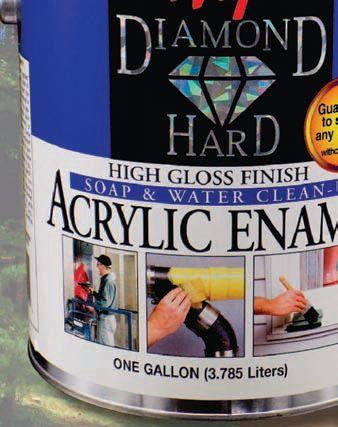
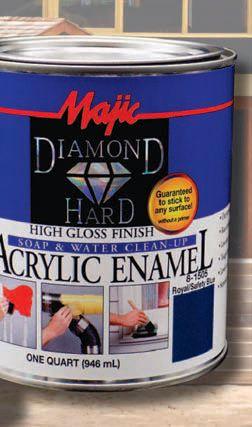
The most durable, long-lasting acrylic finish that sticks to hard to paint surfaces without priming. It levels to a smooth finish with excellent gloss and color retention.
Diamondhard Acrylic Enamel is perfect for use on galvanized metal, aluminum, brick, concrete, glass, masonry, plastic, drywall, and more!
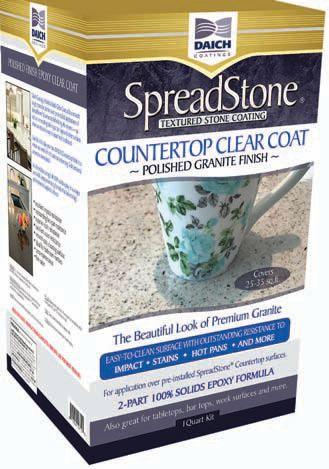
Countertop Refinishing Kit
Use SpreadStone™ Mineral Select™ Countertop Refinishing Kit to refinish existing countertops. It includes all application tools and required coatings to coat up to 40 square inches of surface. The decorative stone finish is resistant to stains, abrasions, impacts, household cleaners and hot pans.
Daich Coatings
866-463-2424 or daichcoatings.com
Spray Primer
Zinsser’s® Cover Stain® Turbo Spray Primer offers four times greater output than traditional spray primers. It features a 10-inch wide spray pattern for greater coverage and comes in a 26 oz. can for large projects.
Zinsser
877-385-8155 or rustoleum.com
Interior Paint
ZAR ® Gold Paint is an interior oil-based gold leaf finish designed for decorative use. This one-step, brush-on finish is ideal for picture frames, knick-knacks, furniture trim, crafts and more, wherever the richness and beauty of gold is desired. It can be used to accent, glaze or cover wood, metal, glass and other surfaces.
UGL
570-344-1202 or zar.com
Product
Surface Protector
Trimaco’s Heavy Duty SuperTuff® Tack Back Surface Protector is self-adhesive and can be used on horizontal and vertical surfaces. It is leak resistant and can withstand forklifts and high traffic.
Trimaco
833-274-7747 or trimaco.com
Floating House Numbers
Hillman’s Distinctions House Numbers can be mounted flush for a traditional look or used with floating mounts for a modern update. They’re available in solid brass or in black, nickel or bronze finish die-cast zinc.
Hillman
800-800-4900 or hillmangroup.com
PaintCare Expands Into The Empire State
New York Creates Statewide Paint Recycling Program
Anew law approved by the New York State Legislature and signed by Gov. Andrew Cuomo will create a program to allow residents and businesses to recycle unwanted paint. According to the New York Product Stewardship Council, the industry-managed paint recovery and recycling program will recycle more than 2 million gallons of paint annually.
Currently, almost all unwanted paint is disposed of in landfills or waste-to-energy facilities, according to PaintCare, a nonprofit organization created by the paint industry through the American Coatings Association. The new program will reduce the financial burden of waste management that local governments now shoulder and will create recycling sector jobs to reprocess millions of gallons of paint for reuse and recycling.
New York is the 10th state to adopt this program, joining California, Colorado, Connecticut, Maine, Minnesota, Oregon, Rhode Island, Vermont, Washington state and the District of Columbia. PaintCare will manage the program in New York.
“We look forward to building on our 10 years of experience in other states to launch a program in New York that not only works for the paint industry, but also meets public demand for convenience, efficiency and cost-effectiveness,” says Heidi McAuliffe, vice president of government affairs for the American Coatings Association.
The program is expected to go into effect in early 2021 and will offer hundreds of drop-off locations throughout the state. There will be no cost to residents and businesses when dropping off their unwanted paint; funding to run the program will be included in the cost of new paint.
24 States Raise Minimum Wage in 2020
According to U.S. News & World Report, 24 U.S. states have either raised their minimum wage or plan to in coming months. In addition, the minimum wage in the District of Columbia will rise to $15 per hour from $14 before the end of the year, according to the article.
Washington state currently offers the highest state minimum wage at $13.50 per hour. Of states that recently raised the minimum wage, Florida’s is the lowest, at $8.56 per hour, while businesses in Minnesota with annual gross revenues below $500,000 have a minimum wage of $8.15 per hour.
Minimum Wage Hikes By State
These are the states that have raised, or plan to raise, minimum wages in 2020.
New Appointments to PPG Executive Roles
PPG recently announced several new appointments to its executive team which will take effect throughout the first quarter of 2020.
Chancey Hagerty, the current vice president of global industrial coatings, will become vice president of global automotive refinish coatings, effective March 1. He will continue to be a member of the Operating Committee and will report to PPG executive vice president Tim Knavish. Hagerty succeeds Gary Danowski, current vice president of global automotive refinish coatings, who is retiring.
Kevin Braun, current vice president of industrial coatings in the Americas, will fill the vacancy left by Hagerty and will join the Operating Committee.
Andrew Carroll, current global technical director of industrial coatings, will become vice president of industrial coatings of the Americas and will report to Braun, becoming an officer of PPG.
Chancey Hagerty
Gary Danowski
Kevin Braun
Andrew Carroll
TM
Senate Confirms SBA Director
Jovita Carranza has been confirmed by the U.S. Senate to head the U.S. Small Business Administration by a bipartisan vote of 88-5. She is a Treasury Department official who served as deputy SBA administrator during George W. Bush’s presidency. Carranza is the first permanent head of the SBA in almost a year and will become the highest-ranking Latina official in the Cabinet. During her confirmation hearing in December, Carranza said she planned to “put particular emphasis on opening more doors for women and for entrepreneurs in underserved communities, including military families and veterans.”
Jovita Carranza
By Jerry Rabushka
Dealing With Deck Prep
New Products Are in the Cards
As spring peeks out from underneath snow blankets, consumers will start thinking about the projects they want to take on to prepare their outdoor spaces for warmer weather. One of those key projects is deck care and maintenance. To help you help your customers, the leading manufacturers of exterior wood care products have brought to market reformulations of the trusted products. Read on to learn more about how to get your customers’ exterior wood surfaces ready for the next season and how to educate them about the proper steps to prep and long-term care.
No 2 Projects Are the Same
Mike Mundwiller, field development manager for Benjamin Moore, says many companies have re-evaluated formulas as the industry and consumer culture have shifted.
“Naturally through the years, formulations have changed for the betterment of the environment and the applicator,” he says.
After the snow melts and the wind stops, he says homeowners should thoroughly look over their deck and other exterior wood surfaces.
“No two projects have the same application conditions, so inspect for mold, mildew, wood deterioration and nail popups,” he says.
“Benjamin Moore offers outstanding wood prep products in our Arborcoat line, such as 315 Remove, 316 Restore, 317 Brighten and 318 Clean.”
The products are available in concentrates, so they can be mixed to just the right strength to combat individual issues—someone with mild maintenance issues, for example, can use less product, which allows you to provide greater value to the customer.
PPG has also made upgrades to its line, Olympic® Elite™ Advanced Stain + Sealant in One, which while not a prep product, makes prep a lot easier due to its Weather-Ready™ application technology. While prep is essential, it’s a step that consumers often try to skip or do quickly, and PPG considered that perspective when developing this product.
“Some transparencies in this product line can be applied after rain or winter weather because they are formulated for damp-wood applications for consistent results,” says Jill Lamont, PPG senior marketing manager for Olympic Stain.
“The product is rain-ready eight to 12 hours after application, which is four hours faster than most traditional stain products, so consumers no longer have to fear their completed project will be ruined by unpredictable precipitation.”
“The exterior stain category has split between moving toward modified oils and water-based formulas and low-VOC non-drying oil-based formulas.” —Brian Carter, Armstrong-Clark
More than prep formulas changing, Brian Carter, president of Amstrong-Clark, has observed that the biggest changes are the stain formulas themselves and what type of prep they require for maintenance coats. Knowing what product your customer is applying will help you recommend the right prep regimen.
“The exterior stain category has split between moving toward modified oils and water-based formulas and low-VOC non-drying oil-based formulas,” says Carter. “The modified oil and water-based stains require stripping or sanding, while the low-VOC oil-based stains simply require cleaning. However, some of these formulas fade more quickly than others. Wood restoration professionals may still strip, brighten and lightly sand when applying a maintenance coat with the low-VOC oils, but the work is easier than the ‘heavy-duty’ stripping and sanding needed with film-forming products. Customers want stains that are long lasting, easy to apply and a breeze to maintain.”
That way, when the breezes do finally come, homeowners can enjoy them on a well prepped and coated deck.
Consumers want that perfect look for their exterior wood surfaces without needing to put in a lot of elbow grease. Be sure to ask the scope of the project, their desired outcome and how much maintenance they’re willing to put in when making suggestions.
Photo courtesy of Armstrong-Clark
While SamaN is mainly known for interior stains in the U.S., its products do venture outside. Because the company has a large customer base in the U.S. and Canada, SamaN understands the impact cold weather can have on exterior wood. In addition to its exterior stain lines, SamaN has developed an environmentally responsible product to prepare decks once summer finally does come.
“SamaN Contractor Grade Deck Wash is a water-based formula specially developed to restore the natural color of even the most damaged and weathered wood surfaces with concentrated power, without bleach,” says Ashley Fleming, U.S. vice president of sales and marketing. “It is highly effective in cleaning and removing clear finishes, unsightly weathering, mold, algae, mildew, staining, oil, grease and tannin stains from bleeding wood, such as cedar and redwood.”
The wash is suitable for cleaning plastic or wood composite decking material.
“SamaN Deck Wash may be used to neutralize and brighten surfaces that have been stripped with the SamaN Deck Stripper,” she says. “Using SamaN Deck Wash will improve the performance of your reapplied waterproofer or stain.”
And if there aren’t sunny days in the forecast, that makes for good news.
“It’s actually easier to prep your deck on a rainy day with this product,” says Fleming. “The surface usually needs to be wet before cleaning or stripping and it also needs to be rinsed. A sunny day may cause you more work because you have to add the moisture required to keep the surface wet.”
Add on Customers With Add-On Sales
Carter says cross-merchandising deck prep and stain products with paint products can be a key selling tool.
“We have worked to drive add-on stain sales for customers buying paint,” he says. “We have accomplished this with a paint counter display—not a shelf display where the product is sold—that rests where customers wait for their paint.”
These types of displays essentially put a silent sales associate in front of customers waiting while their paint mixes. It’s another way to ask them if they have a deck or fence that needs to be refinished without being pushy about it.
“We recommend they take a brochure, pick a color and get a free sample can,” Carter says. “Even if their deck or fence is not a current project, they will have the sample can at home reminding them of both the project and where they got the can.”
Rainy weather doesn’t mean exterior wood care projects need to be delayed. In fact, SamaN deck prep and care products are easier to use when the surface is already wet because there’s no need to add water.
Photo courtesy of SamaN
Photo courtesy of SamaN courtesy Before After
Understanding the process for applying and maintaining exterior wood care products is key to helping your customer through their projects. Be sure your staff can successfully walk a customer through a deck staining or fence maintenance project using various products and tools.
“Staying up-to-date on product information and color trends and providing customers with recommendations that align with their project and desired results will help you position yourself as a woodcare expert and, ultimately, sell more exterior stain.”
—Jill Lamont, PPG
The Value of a Good Education
Many consumers will need guidance when it comes to choosing the right stain and wood care products for their exterior wood surfaces. Be sure you and your staff are knowledgeable about the products you sell and the processes required for certain surfaces.
“We find that even if a consumer has stained before, they’re still looking for how-to information or best practices,” says PPG’s Lamont. “In-store literature, brochures and how-to instructions will help guide your customers through the process.”
It’s important to help consumers through the staining process, so one recommended step is to read through the instructions with them while they’re still in the store. That way, you can suggest the right tools and answer any additional questions they have.
“We recommend retailers ensure their customers understand the prep requirements for applying a maintenance coat before applying a stain for the first time,” Carter says.
Not only do customers want help on the process, but they also will want to know the trends.
“Staying up-to-date on product information and color trends and providing customers with recommendations that align with their project and desired results will help you position yourself as a woodcare expert and, ultimately, sell more exterior stain,” Lamont says.
Fleming says a successful display educates everyone involved and leads to more product sales. One retailer created their creative display to show the varied capabilities of SamaN’s exterior stain.
“The retailer painted each slat of an actual wooden fence showcasing the different colors,” she says.
“This was smart because customers automatically identified the product they needed for their fence projects. The retailer was also more prepared to personally speak to his display and our products.”
Photo courtesy of PPG
By Hilary Daninhirsch
Get Powered Up
How You Can Differentiate With an Equipment Rental Department
Renting power tools to complete a paint job is cost-effective for the consumer, and it can be a profitable ancillary service for retailers to offer.
After all, if customers are going to come to your store to select paint, it would be convenient for them if your business provided a one-stop shopping experience for all their painting needs.
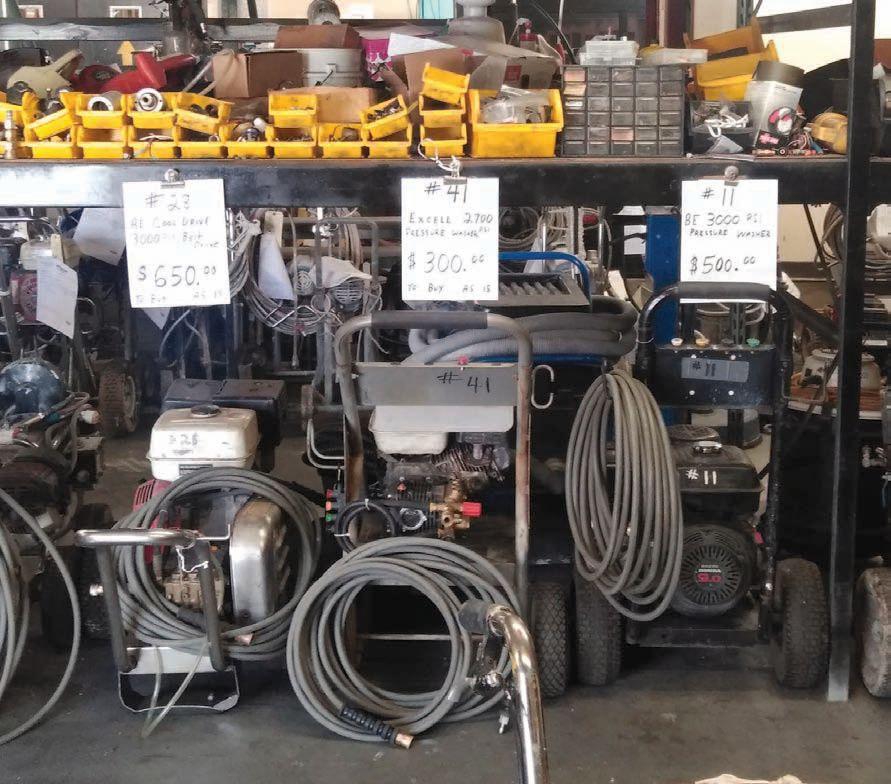
Equipment such as paint sprayers, pressure washers and floor scrubbers can be expensive to buy outright,
particularly for DIYers. Plus, homeowners may not have the storage space nor the ability to maintain the equipment over the long haul.
On the following pages, learn from retailers who offer equipment rental programs in their stores. Discover how the service has streamlined projects for customers and brought in extra business. Plus, find out what equipment manufacturers recommend retailers stock to help DIYers accomplish the most popular paint and decorating projects.
Advantages of Lending
Bob Brinton, owner of Brinton’s Paint Co. in Jacksonville, Florida, has maintained a rental department in his store since 1976. He started with pressure cleaners and paint sprayers, which are still his two primary rentals, but due to high demand and the popularity of epoxy floors, he recently branched out into renting floor concrete grinding machines, as well as driveway scrubbers. He says renting out equipment is valuable for his business.
“It helps us from not only the point of view of profitability, but also it draws customers in knowing that we have these rentals available,” he says.
His primary rental customers are DIYers, as contractors generally own their own equipment.
The Brinton’s rental department brings in enough business that Brinton employs a full-time equipment mechanic who maintains the rental pieces and makes repairs to contractor-owned equipment.
“Repair is another component; we consider that a necessity here,” he says.
As an added service, Brinton gives renters instructions on how to properly use the machines before they go home with them. He sets the equipment up and tests it right on the spot to make sure it is working properly.
Sometimes, people who come in to rent equipment become new paint customers as well.
“Customers who are trying to make a decision on paint or may be using a competitors’ paint end up buying from us instead,” he says.
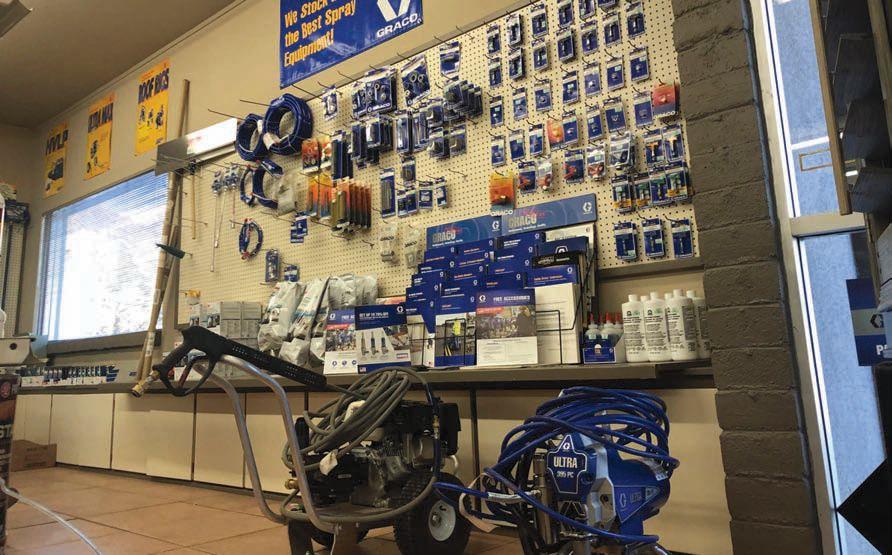
Jimmy Heath owns Heath’s Paint Center in Flagstaff, Arizona, and has been renting out power equipment in his store for about 40 years. Heath offers airless sprayers and pressure washers. He mostly carries Graco products, as he has had a long-standing relationship with them.
“Offering the customer a choice is a big advantage; giving them options is important,” he says.
Brinton’s Paint Co. in Florida has been renting out pressure washers and paint sprayers for decades. In recent years, they have added concrete grinding machines due to the popularity of epoxy floors.
Photo courtesy of Brinton’s Paint Co.
How Rental Boosts Sales
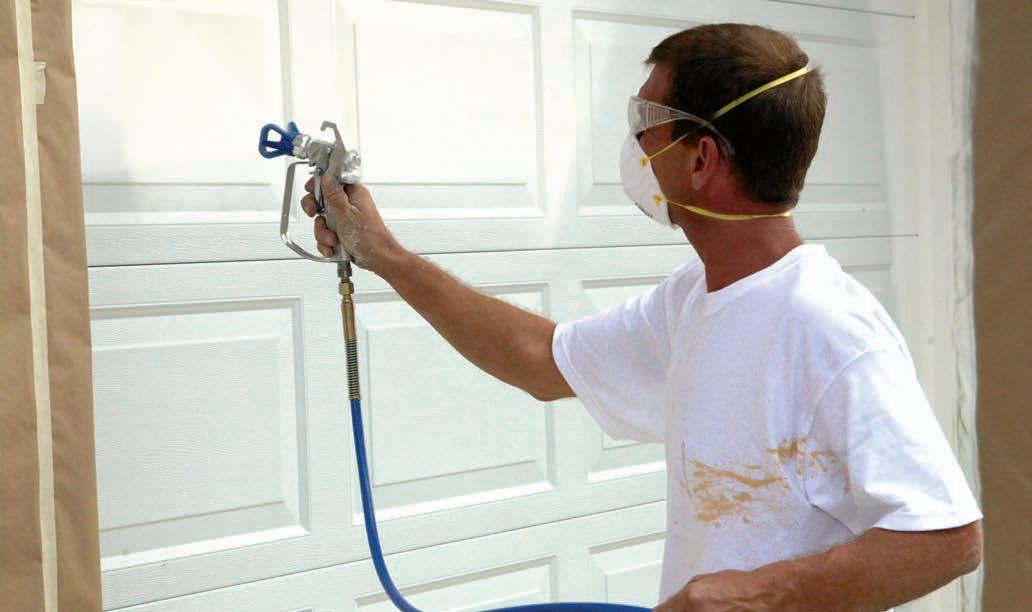
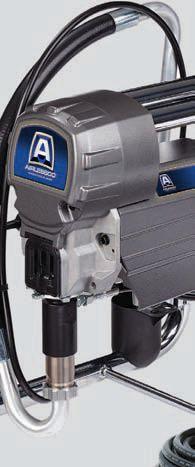
Many independent paint retailers who do rent out power equipment carry Airlessco Sprayers, a complete, durable line of airless sprayers manufactured by Graco.
“When renting spray equipment to boost sales, it’s important to offer sprayers that are built to last and known for reliability so your customers are more productive and ultimately buy more paint,” says Dan Johnson, product manager at Graco.
He says renting sprayers also drives paint sales.
“We see this time and time again. People who sell and rent spray equipment sell more paint. They’ll also sell a wider range of coatings,” Johnson says. “They can capture more of their customers’ job budgets. The more that they can serve their customer, the more that they can increase their revenue.”
Jennifer Duffie, channel marketing manager for the contractor equipment division at Graco, says consumers have a lot of choices when it comes to choosing their paint, so retailers should provide an additional incentive to make choosing easier.
“People often make their decision based on the services that are available, and offering rental is another level of service,” she says. “The most important thing is taking care of the customer. The last thing I want to do is send one of my customers down the street to another business.”
“We see this time and time again. People who sell and rent spray equipment sell more paint.”
—Dan Johnson, Graco
Providing rental equipment to customers, particularly high-quality equipment, can offer unique advantages, Johnson says.
“Rental is a really nice solution for independent retailers to help customers grow their businesses by ‘test driving’ larger, differentiated products to help out with different applications or test an alternative product,” he says.
Taking Necessary Precautions
Just as with any new endeavor, whether adding a new department or hiring a new employee, it’s important to prepare for challenges that come along. The same is certainly true for operating a rental department, especially one geared toward DIYers.
Brinton says customers occasionally try to steal the machines, even though they are told up front that they’re responsible for protecting the machine from theft and to return it back on time.
Graco is the primary equipment brand Heath’s Paint Center rents out to customers. Store owner Jimmy Heath says his strong relationship with the company is one key reason he maintains his rental department.
Photo courtesy of Heath’s Paint Center
Consumers often take on complex painting projects that require professional-grade equipment. If they are already coming to you for your paint and your expertise, adding equipment rental to the mix is just the next step in offering superior customer service.
Recouping the Investment
“Once you’ve rented something out so many times, that is where you’re really hitting the good profit. You have some parts you have to put in occasionally, but that does not outweigh what you’re taking in.”
—Bob Brinton, Brinton’s Paint Co.
“We have had theft in the past, so you take some losses every now and then,” he says.
Strothkamp’s Paint Center outside St. Louis has been renting power equipment the entire 64 years that the store has been in business. Owner Bob Strothkamp offers commercial-level power washers, paint sprayers, wallpaper steamers and a floor sander.
He says equipment maintenance marks another significant investment. He and Heath agree that not everyone treats equipment with care, so it’s important to build repair and maintenance costs into the rental fees.
Brinton tracks how many times a tool is rented out as well as the profits earned on the equipment. He says the initial investment in the machine sometimes has more than paid for itself.
“Once you’ve rented something out so many times, that is where you’re really hitting the good profit,” he says. “You have some parts you have to put in occasionally, but that does not outweigh what you’re taking in.”
When it comes to the lifespan of rental equipment, it depends on the tool. Strothkamp says a good power washer will last three years in the rental cycle, and a paint sprayer will last longer, though those are harder to keep clean. Some products naturally last longer; he is still stocking wallpaper steamers that are nearly 10 years old. In his operation, he says it takes about 15 to 20 rentals of a paint sprayer to recoup the initial investment, while a power washer might take about 20 rentals.
Rental Trends
For a variety of factors, the retailers have noted a decline in the rental business.
“I’ve noticed a trend over the last ten years that rentals are dropping a little bit because more contractors and homeowners own their own equipment,” Brinton says.
Photo courtesy of Graco
PDRA’s mission is simple.
We are here to help YOU become better, more profitable retailers! Join today and strengthen your team, your industry, and your association! Online Training for You & Your Team
As YOUR industry association, PDRA provides…
“PDRA’s education and training courses provide employees with the information and confidence they need to succeed. The Compensation and Home Sweet Home Research Studies provided me with valuable information that I was able to apply to my business. Recently we started using the Content Marketing Program to support the communications we send out to local customers in the area. As the Paint Industry Association, PDRA supports all dealersTOGETHER WE ARE BETTER!”
_ Jay Donnelly | Flanagan Paint
Beyond DIY: Expanding Your Rental Department
While most retailers who enter into power equipment rental anticipate serving the needs of professionals or DIYers who need a paint sprayer or a power washer, there are opportunities to serve much broader industries. Offering unique equipment solutions, such as steam equipment that is capable of sterilizing spaces, can open up another avenue of service for your operation.
Therma-Kleen, headquartered in Michigan, is the country’s only manufacturer of dry vapor steam equipment. The units, called Thermal-Steem, have approximately 5 percent moisture and are used to sterilize surfaces to kill pathogens immediately on contact.
“When cleaning a surface for painting, you’re essentially super-cleaning that surface, getting rid of anything that may deter the adherence of paint; it also melts away greases and grime,” says owner Louis Perrot.
Perrot says his equipment is exclusively for the commercial and medical industries, such as hospitals and restaurants. He says Therma-Kleen offers training on the equipment and there are discount opportunities for retailers interested in purchasing multiple machines.
Perrot says offering equipment like this presents a value-added component because it gives customers additional options. There are also opportunities to build margins with add-on sales and repeat business.
Strothkamp and Heath have also noticed a dip in the rental business and both attribute this to more homeowners preferring to buy cheaper versions of these products. Heath says people are buying cheaper equipment in part because they like to have ready access to tools.
“It would be more cost-effective to rent once; they would have access to a superior piece of equipment and would not have to maintain it,” he says.
One way to combat this challenge is to explain the difference between the cheaper equipment and the equipment you offer for rent. Many people will see the benefits of not needing to clean, store or maintain the equipment after use.
Despite dips in the market, Strothkamp continues to find new ways to promote his rental business in his community.
“Rental equipment brings in a few customers who may not otherwise make it into the store,” he says.
“I don’t think you can make a living renting tools, but it is nice to have the option available for your customers to tackle new projects.”
Heath says he makes more money selling the used equipment than he does in the rental business.
“Typically, it takes 20 rentals to make it worthwhile to sell equipment,” he says. “While the rental side may not be at its peak, I have no shortage of people looking for equipment to buy that is in top shape.”
On average, he sells about six pieces of equipment a year, but replaces it with new equipment for the rental side of the business.
Staying Competitive
Independent paint and decorating retailers offering equipment for rent will also have to contend with competition from big-box chains. Brinton notes that his prices are better than the big-box stores, and he keeps his equipment in prime condition for customers’ safety and convenience.
“The difference between us is that our prices are lower than big boxes, and I think we have better equipment,” Strothkamp says.
Even in complex markets, there are opportunities to compete in the power equipment segment.
“Our market is saturated with big boxes and paint-related businesses, plus equipment rental businesses,” Heath says. “Where I have found my niche is in equipment repair. I’m an authorized warranty repair technician for Graco, and I work on any type of spray equipment.”
While he doesn’t advertise the rental equipment, he does advertise the repair segment of his business, which he says is a key differentiator between his business and others that offer power equipment rental.
Photo courtesy of Therma-Kleen
Differentiation can be key in competitive markets. Johnson agrees that independent retailers who sell used rental equipment can have a competitive edge in their markets. Retailers also often have the advantage over big-box stores when it comes to personal service.
“Business is built on a relationship with the client, and what better way to strengthen a relationship than to provide a more complete set of solutions for their customers to help their needs now and in the future as well,” Johnson says.
Manufacturer Support
For retailers who choose to start a rental side of their operation, companies like Graco offer manufacturing support with factory-trained sales representatives and marketing collateral, such as door decals, banners, equipment check-in and check-out procedures and special buy-in programs.
“For a retailer who wants to rent, we have the tools they need to help support this offering and expand their business,” says Johnson.
There is an opportunity to earn additional profit dollars on rental equipment. Once you make back your initial investment, sell used equipment at a discount to give customers a positive price image of your business.
Photo courtesy of Graco
Photo courtesy of Graco
By Diane Franklin
Welcoming in Wallcoverings
How Pattern, Color and Texture Are Driving Consumer Trends
The dawn of a new decade is bringing diverse new looks to wallcoverings. Several trends from the previous decade will continue, most notably the use of natural materials and nature-inspired themes, such as tropical and botanical. However, the industry’s focus on creative expression means consumers can expect an ever-widening array of styles, patterns and colors to enliven their interiors in 2020.
“Trends for 2020 are fresh and exciting,” says DeAnna Hain, executive director of marketing for York Wallcoverings. “Colors move from bold primary-driven clean shades to more tempered earth tones accented with rich spice shades, while metallics present with burnished finishes and aged patinas.”
Also for 2020, Hain predicts the emergence of interiors that combine urban sophistication with softened edges and organic themes, while casual looks will trend toward more textural layering.
“Classic motifs return with force for a generation that has never experienced them, updated with fresh colors,” she says. “Maximalism becomes the direct counterpoint to the dominant pared-down aesthetic that is currently en vogue.”
Natural Trends Abound
George Bolger, studio manager for Brewster Home Fashions, forecasts that several major trends from 2019 will remain strong in 2020. For instance, consumers will continue their love affair with natural materials, particularly grasscloths.
“Sometimes grasscloths can be fine weaves so they almost look like silk,” Bolger says. “Or they can be really chunky and very expressive woven effects.”
Photo courtesy of York Wallcoverings
Bolger also forecasts the continuation of the tropical trend, but with bolder colorations and larger-scale designs.
“I think lush big leaves and lush florals in greens, blues and other vibrant colors will be trendy,” he says.
Another continuing trend Bolger predicts for 2020 is the “glam” look—although he sees it becoming less splashy than when it was first introduced.
“I believe it will become more refined in terms of materials and colorations,” he says. “There will be more elegance to it—almost like a ‘vintage glam’ look, where it’s utilizing pearl, metallic washes and maybe a little beading that is reminiscent of old Hollywood and the Roaring ’20s.”
Other wallcovering experts likewise see natural themes dominating in the year ahead, including tropical motifs and strong demand for botanical themes.
“Botanical is always a strong seller in the U.S. and will keep on growing,” says Gregory Godeau, head of international sales for Arthouse Ltd. “The tropical theme, although not new, is not disappearing just yet and keeps on evolving each year and should also perform well in 2020, especially as people use the tropical pattern on a statement wall only.”
Other trends Godeau predicts for 2020 include wooden and brick effects, art deco or Charleston theme designs and the use of glitter along with the emergence of some foil designs.
A Pattern Resurgence
Wallcoverings are having a resurgence in U.S. homes primarily because consumers have rediscovered the desirability of pattern. Younger consumers, who previously have not used the product, are finding creative ways to incorporate wallcoverings into their overall room designs.
“I think the idea of pattern, which went out of vogue for a time, has really hit people again,” says Bolger. “You used to cover four walls with wallpaper, but today you may have the headboard wall or the fireplace wall—wonderful places to put an accent or pattern into the room. That’s what wallpaper can do. It gives you that extra bit of oomph to transform a room.”
Moreover, today’s wallcoverings are easy to install and remove, which Bolger notes overcomes previous objections about the product being difficult to use.
One reason for wallcoverings’ resurgence, according to Hain, is that consumers are discovering the personality and texture it can bring to their home. While feature walls are an excellent way to achieve this, the look of the feature wall is evolving.
“The feature wall has become a mural wall, using nonrepeating scenic and oversized classic oil paintings to create art for the wall that is the wall itself,” Hain says. “The ceiling, as well, has become a focus to trick the eye regarding height or enhance room lighting through reflection.”
In 2020, representatives from the industry’s leading wallcovering companies predict a continuation of the tropical trend, but bold colors and large-scale designs will become prominent.
Photo courtesy of Brewster Home Fashions
Photo courtesy of Arthouse Ltd.
4 Tips to Boost Wallcovering Sales
Selling wallcoverings successfully requires a combination of customer service and display techniques that highlight the beauty of the product. See the recommendations from industry experts here and take the opportunity to refresh your wallcoverings department before the springtime rush.
1. Educate Your Staff
“Education and getting the wallcoverings outside of the collection binder are critical,” says York Wallcoverings’ DeAnna Hain. “Sales education should be part of every employee’s repertoire so they feel encouraged to speak on the topic of wallcoverings, thereby increasing sales. Use all marketing materials provided and display as many wallpaper samples and available marketing displays as possible to draw and enchant the eye.”
2. Go Digital
Astek’s Rachel Brand advises retailers to invest in a strong and appealing digital platform. She points out that Astek offers such resources to engage consumers.
“Our website and social platforms allow us to share not only our products but our wallcoverings in projects and spaces, inspiration and behind-the-scenes content,” she says.
3. Use Provided Displays
Gregory Godeau at Arthouse recommends retailers engage consumers by using freestanding displays, refreshing them regularly to maintain customers’ interest.
“The aim is to draw people in. Therefore, it is always advisable to have the funkier designs on display,” he says. “These will not necessarily be your best-sellers, but it will get people’s attention and make you stand out from the competition.”
4. Sell With Service
Ultimately, the key to selling is to offer high-quality customer service. Specialty paint and decorating stores excel at personalized service.
“Many smaller retailers have somebody there to guide the customer and to service the product—that’s paramount,” says George Bolger of Brewster. “Visuals also help any sale. We’re starting to put more posters into our collections. So, hang the posters, use counter displays and keep nicer books out showing a pattern and people will naturally go over and take a look.”
Ultimately, selling wallcoverings requires buy-in from sales staff.
“A conscious effort must be made by store personnel, in-home color consultants and designers to offer the product,” he says.
Godeau concurs that the primary use of wallcoverings in 2020 will continue to be in statement or feature walls, noting that this usage allows consumers to be more adventurous in their choices.
“Your home is your haven,” he says. “The statement wall encourages people to choose more varied designs depending on their mood and atmosphere they want to create.”
Wallcoverings tell a story, says Rachel Brand, design and media manager for Astek, which is part of the reason they are becoming popular for statement or feature walls. In that regard, Brand says statement murals behind beds in place of headboards are becoming particularly popular.
“We’re seeing this treatment in both hospitality and residential spaces,” she says. “I also expect to see more wallcoverings on ceilings in 2020. A wallpapered ceiling adds unexpected drama to a space without overwhelming the rest of the room’s decor.”
In addition to traditional wallcoverings, there are other products that enhance the trend of pattern on the wall. For instance, Hain says commercial wallcoverings are increasingly being used in homes.
“Spatially, one of the most significant trends is the discovery of commercial wallcoverings for residential projects,” she says. “As remote jobs and nontraditional hours shift our definition of work and home, the lines between residential pattern and commercial texture and durability are beginning to merge.”
Another product that is finding its niche is peel-and-stick wallpaper. Bolger reports that Brewster’s peel-and-stick NuWallpaper has an extensive range of designs that can be used in the same manner as traditional wallcoverings— as fireplace walls, headboard walls or backsplashes— but it also can be used as an accent on furniture, in the back of bookshelf units, on stair risers and any number of other unique and unexpected surfaces.
“It’s something different that creates a little bit of pop,” Bolger says. “For renters or people who don’t want to make a long-term commitment, they can do an accent wall and, one year later, take it down if they want to make a change.”
Visual Versatility
Because of wallcoverings’ endless style options, many consumers are using the product as a form of expression. This is driving one of the trends identified by Astek’s Brand.
“I’m noticing that wallcoverings with a narrative or strong point of view are picking up momentum,” she says. “Illustrative patterns that tell a story with lots of visual details are really resonating right now. Unlike traditional toiles or conversational motifs, this new wave of patterns is assuredly contemporary, featuring bold or unexpected imagery executed in various artistic styles and techniques.”
Similarly, Buddy Bressler, national sales manager for America’s Window Covering Buying Network, sees wallcoverings emerging as a way for consumers to show artistic preferences.
“Abstract art has been a big influence and is trending in wallpaper today,” he says. “With enticing new patterns reflective of fine art pieces, these new patterns go from bold to subtle and allow for diversity of use. Patterns range from the whimsical to exotic while paying tribute to classic heritage prints, all reimagined for a new generation.”
Bressler adds that wallcoverings can be used in place of architectural features such as wood paneling, coffered ceilings and marble.
“Today’s wallpaper offers durability and ease of use that makes architecturally inspired designs a favorite choice at a fraction of the cost while providing an extended color palette not found in traditional structural installations,” he says.
The versatility of wallcoverings also means they can be used in many different types of interior settings to meet the needs of a wide range of consumers.
“Wallpaper continues to grow in popularity as consumers search for unique touches to add pattern, color and texture,” Bressler says. “It is driven by the increase in smaller urban living spaces and the desire of suburban dwellers to go beyond the cookie-cutter designs of the past.”
Wallcoverings offer versatility to consumers who want to make a visual statement in a room.
Photo courtesy of Astek
By Todd Taber
Merchandising Made Easy
Elevate Inventory and Guide Customers to Sales With These Tips
Product merchandising, at its core, is a critical component of retail success that reflects your company’s values and continuing commitment to customer satisfaction.
When maintained regularly and developed creatively, effective merchandising can introduce customers to new products, ensure they have everything they need for popular DIY projects and assure them that your business prioritizes an organized, efficient shopping experience.
But maintaining your merchandising is often easier said than done. As the business day passes, the power of merchandising can fade as displays become disarranged
and employees must focus on helping customers rather than stocking shelves or replacing products that were sold.
You can set the expectation that merchandising is a priority, and the Paint and Decorating Retailers Association and Paint & Decorating Retailer magazine are here to be your guide.
On the following pages, review the core tenets of retail merchandising alongside photos from independent paint and decorating operations. Share this article with your staff at your next team meeting, and then log on to pdra.org to access additional training materials for more advanced merchandising best practices.
3 Big Ideas for Setting Up in a Small Store
If you operate in a small store, there are still plenty of merchandising tactics you can utilize to ensure customers find tried-and-true products alongside new discoveries. Every paint and decorating retailer has a different floorplan, giving each operator a slew of challenges and opportunities to merchandise products.
1. Use signage to your advantage.
One of the main tools for operators in small spaces is signage. Bold, informative signage can help delineate different sections of your store, helping segment products into departments shoppers can browse. Point-of-purchase signs and aisle violators can be small tools that help showcase new products or special prices.
2. Build up, not out.
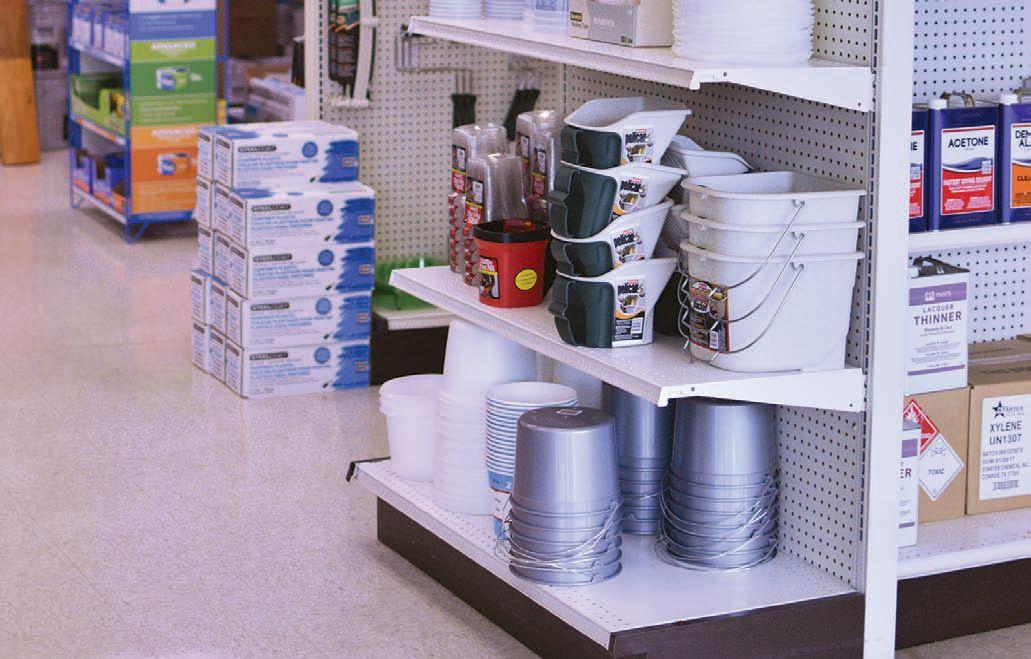
Another way to beat the space squeeze is to think vertically. Endcaps and stackouts can help you display many products without sacrificing valuable floorspace, but take care not to stack products too high. Customers could injure themselves by dropping products or losing their balance.
3. Make use of counter space.
Merchandising products on counters—either at your registers, the paint-mixing station or at consultation tables—ensures they receive high visibility. It also gives employees working
in these areas the opportunity to quickly tell customers about products to boost transaction size. Placing impulse items like consumables and locally made products on counters can give your sales team one final opportunity to boost transaction sizes and ensure each customer leaves with everything they need, and maybe a little more.
Master Merchandising and More
Ready to learn more about merchandising and other ways to set your business apart? Head to pdra.org/education to learn more about the training opportunities that are available for you and your team.
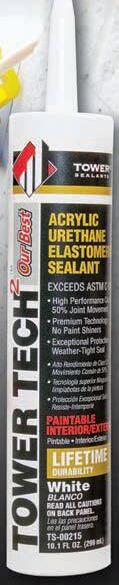
In Neumann, Arizona, Payson Paint & Sundries owner Gene Neumann keeps a close eye on home construction trends in the area. Log homes are popular in his community, so he stocks many lines of sealants to meet shopper demand.
5 Components of a Great Endcap
Endcaps are versatile tools in your overall merchandising strategy. Perfect for displaying new products or items you’re ready to clear out, endcaps invite customers to explore products they may missed before.
1. Keep it simple.
The most effective endcaps convey strong, clear messages to customers: low prices, new products, convenient project bundles. When you use endcaps to display disparate products or overload the shelves with signage, the endcap loses its power to convert browsers into buyers.
2. Think beyond the endcap.
Don’t let your merchandising creativity end at the endcap. Try to place endcaps around similar products. For example, if your endcap features the latest line of chalk paint, be sure customers can see an assortment of brushes and drop cloths near the paints to spur them to gather all the supplies they need to accomplish a stellar final product.
3. Choose your products wisely.
Clean and complete endcaps can have powerful effects on shoppers. Mass displays of a single product imply low prices for shoppers, and themed endcaps can inspire your customers to tackle a variety of projects around their homes.
4. Use endcaps as pricing opportunities.
Endcaps can be effective tools to help develop a competitive price image. Use your endcaps to promote special sales you’re currently offering. Large signage displaying low prices will give shoppers the impression that all of your products are competitively priced.
5. Mix it up for best results.
Be sure your team is always thinking proactively about upcoming endcaps. Don’t let the same endcap stay up for too long. If customers visit your store one month and are delighted by low prices and new products, the same endcap could look stale if they visit a month later and nothing has changed.
Endcaps are often the perfect place to group supplies for popular projects, allowing customers to get everything they need in one area. Employees should regularly maintain endcaps to ensure no items are blocking customers’ footpaths.
4 Basics of Successful Merchandising
Understanding some of the basic elements of effective merchandising can help your staff take it to the next level.
Take a moment to review some of the core concepts of merchandising to ensure you and your staff are on the same page and properly presenting products to your shoppers.
1. Ensure shelves are full.
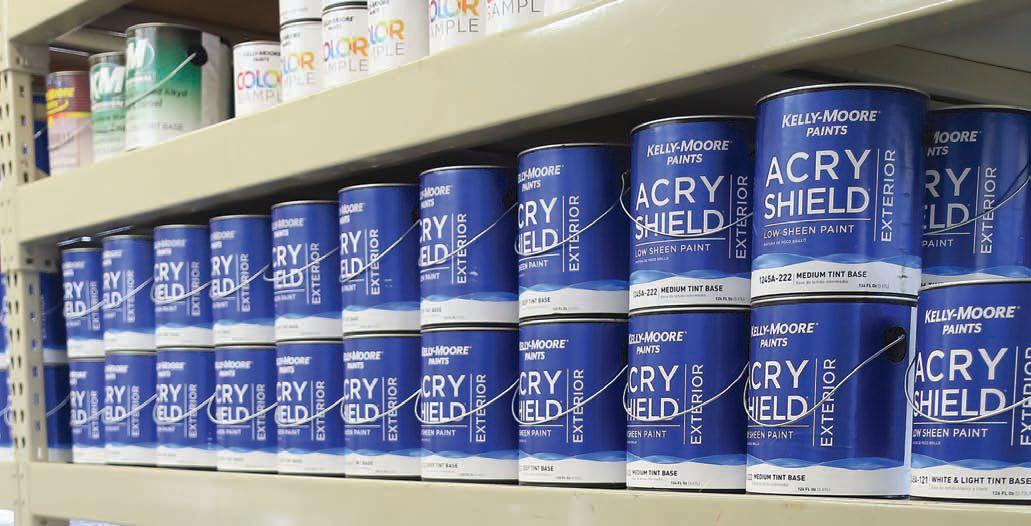
One of the easiest ways to upgrade your merchandising is to ensure there are no gaps of missing products. By ensuring your shelves are full of paint and sundries, customers can grab what they need, when they need it. That foresight will boost average transaction sizes and prevent customers from visiting another business to get their project supplies.
2. Make all products face forward.
Ensuring your products are front-facing is a simple way to enhance your merchandising. When products are faced, customers can easily glance at labels to learn more about the brand, formula and intended use of the products they’re considering.
3. Take time to clean.
Devoting time to cleaning your display is one small step that can give shoppers a positive impression of your store. But cleaning extends beyond just picking up misplaced items and trash—regularly clean and dust shelves and products, especially slow-movers that are still core items. You may need to keep them in stock, but they also need to stay clean.
4. Double-check the display.
Make a final check of the complete display to ensure everything is ready for shoppers. Be sure displays are organized and highlighting the products you want to promote. Remove empty packages or damaged items and do a final check to ensure you’re displaying the right price.
At Flanagan’s Paint & Supply in Creve Coeur, Missouri, company vice president Jay Donnelly ensures merchandising is clean and inviting. The team at Flanagan’s prioritizes merchandising to help give their store an organized, professional atmosphere.
By Jerry Rabushka
Perfecting Partnerships
ICP Group Is Focused on Growing Independent Businesses
Most independent retailers share similar challenges, like differentiating their stores and competing against big boxes. In this industry, it’s not surprising to learn that suppliers are working through the same challenges.
Innovative Chemical Products (ICP Group) uses its versatility as a manufacturer to provide products and services to grow its independent retailer customers, and in turn, secure its position in the marketplace.
Industry veterans likely remember the brands that came together to create ICP Group. Graham Paint and Gray Seal were acquired by what was then called California Paints. Shortly after the company’s Andover, Massachusetts, headquarters acquired several brands, it announced it was streamlining and simplifying its offerings by consolidating these many brands into three main lines.
“Our goal is to bring together dozens of industry-leading brands to offer our customers reliable solutions for virtually any application in the building envelope. We sought to create
the ‘best of all worlds’ when it came to paint, coatings, adhesives and other products,” says Matt Culverhouse, director of sales, national accounts for ICP Buildings Solutions Group. “It’s a lot of products, so we want to make sure we’re meeting our customers on their level while eliminating any confusion about our brands.”
The desire to simplify led to the creation of ICP’s Diversified Coatings Group, which allows professional and DIY painters an easy way to find a product to solve painting challenges.
“DCG is engaging customers with a Build Your Own Brand (BYOB) strategy; not only do we offer leading products under the FixALL, California Paints®, Storm System®, Scuffmaster® and IdeaPaint brands, but we also offer branding solutions, which is designed and produced to meet each customer’s specific needs while utilizing existing infrastructure to limit each retailer’s exposure to new costs, while adding margin to their bottom line,” Culverhouse says.
No Changing Channels
An important component of ICP Group’s approach to the independent paint industry is that it focuses solely on the independent retailer.
“ICP’s DCG is 100 percent focused on supporting the independent retailer and being a truly integrated partner,” says Jim Smith, vice president of sales, retail architectural.
Culverhouse says ICP Group works to help its independent retailer network stay current with today’s changing market. Margins are shrinking, overhead is growing and consumers have many more buying options than they used to. He says DCG is helping to bring consumers back to the independent retailer.
“We are providing real solutions with branding, products and technologies unique to their channel, which brings consumers back to their stores, increases top-line sales and offers a better margin return,” he says. “We are eliminating any confusion around our brand portfolio and are making it easy for our customers to discover what else we have to offer.”
To improve how it does business with customers, ICP Group has made multiple investments.
• Streamlining operations to improve lead times.
• Implementing a new single purchase order system to allow all products to come on one order.
• Establishing one central customer service point of contact.
• Creating a new Customer Liaison department to provide unprecedented service for every customer.
• Building a dedicated coatings sales team, focused on the independent retailer.
It’s not an easy task to meld several regional brands with a clear message. Smith and Culverhouse praise the marketing team for providing a program where retailers can choose from a mix of core brands and specialty brands that best fits their customer base.
“Our retailers look at us as one company, not a collection of brands, so it was vital that we empower our DCG sales team with access to our other brands,” Culverhouse says.
Honoring Legacies
The paint industry has a long memory, and ICP Group knows it must keep up the longtime tradition of the brands it absorbed.
“The regional brands we acquired were very good partners to their customers,” Smith says. “I believe our customers would agree we’re in a better place than a year or two ago. Overall, people matter, and we have a very strong team of paint and coating professionals poised to move our dealers forward and support their success.”
Smith says the people are one of the company’s most important investments.
“Our most exciting development in 2019 was our investment in people, products and programs,” he says. “Our DCG leadership team has over 75 years of paint experience. We’re confident in our product formulations going into 2020, and our new dealer, seasonal and new technology promotions are better than ever. The strength of each brand we’ve acquired has given us a buildable foundation to become the best partner to our retailers and contractors.”
Pick Up the Phone
Sometimes companies focused on growth can lose sight of their customers, but not ICP Group. The company is open to hearing retailers’ questions and concerns, which is centered around its 2020 message for independents: “Let’s Talk.”
“The lifeblood of any company is new products and new technologies, and ICP Group has a deep offering of solutions and new products for the independent channel,” Culverhouse says.
Product Partners
One new initiative is a partnership with Crayola. Culverhouse says the company is bringing easy-to-use dry erase products to the residential market and rebranding the Dry-Treat™ line as STAIN-PROOF™ Care and Maintenance Solutions.
More than just a supplier of products, ICP Group wants to work with independents as a partner to grow operations.
“With our manufacturing power and expertise, ICP Group can work alongside your business and support you with broader coatings solutions that complement your existing product offerings, entice professional contractor sales and introduce pro-grade product technologies to DIY consumers,” Culverhouse says.
“ICP Group can help you set yourself apart from the competition, fight the box stores at their own game and make margin doing it. Our BYOB program offers the best-in-market value proposition and delivers the highest profit margin against the nationals.”
Innovative Chemical Products (ICP Group) is the umbrella company for a broad variety of paint, coatings and ahesive brands, and it is focused on serving the independent retail channel.
Fresh Coat
3 Tips to Sending Emails That Lead to Sales
3
Despite being the oldest form of digital communication, email is holding strong as the No. 1 communication channel in the U.S. with over 90 percent of people between the ages of 15 and 64 using email and 99 percent of users checking email daily, according to 2017 data from OptinMonster. Because of its popularity, email is also the best digital option for capturing sales.
According to the Data & Marketing Association, every $1 spent on email marketing campaigns in 2018 averaged $32 in ROI.
Keep It Short
1
Research from email testing company Litmus indicates that the average attention span in an email is just 13.4 seconds, suggesting the ideal length of copy in an email is around 50 words.
Subject lines and preview text should also be short, punchy and creative (but not misleading clickbait) to increase open rates.
2
To compete with the flood of emails people receive every day—203.6 billion emails were sent per day in 2019—retailers need to provide value in their outreaches. Blogs, videos, courses, events and surveys that don’t specifically advertise brand, but create interest in products and provide solutions to common consumer concerns are effective in creating value.
Combining content marketing with email marketing to increase brand awareness. Here are three tips for increasing the success of content-focused email campaigns in 2020.
Make It Visual
According to marketing experts, videos in email campaigns are one of the best ways to grab attention and have the added benefit of acting as a stand-in salesperson. GIFs and attractive photos can also draw attention to certain parts of an email or to products or services. Most importantly, avoid blocks of text and generic intros.
Be Mobile-friendly
3
According to email marketing firm BlueHornet, nearly 90 percent of consumers surveyed said they would delete or unsubscribe from emails that weren’t optimized for mobile devices. Fortunately, creating mobile-ready messages is simple using templates that are available from many email campaign providers.
PDRA Now
Put on Your Show Shoes
The Lancaster Buying Show Season Is Back
South Carolina-based buying group Lancaster will host two buying markets in the first half of the year, and the first one is just around the corner.
The theme of the 2020 Florida Buying Show is “The Magic of Lancaster,” and it takes place at the Gaylord Palms Resort & Convention Center Feb. 7-9. The event kicks off with an educational seminar on Friday afternoon before the show floor opens on Saturday.
The seminar this year is focused on serving contractors. “Improving Your Contractor Trade” will be presented by Steve Skodak, the former executive director of Painting Contractors Association. The event is sponsored by the Paint and Decorating Retailers Association and PPG.
“The PCA and Lancaster have always been great friends of the PDRA, and we are so pleased to be able to sponsor this
presentation at the seminar,” says PDRA CEO LeAnn Day. “He’s going to give great insights on how retailers can better identify the needs of their contractor customers and how they can develop a strategic business plan to serve them.”
The Buying Show starts at 9 a.m. on Saturday, and Early Bird Specials are available to attendees until 11 a.m. The day ends with a performance from magic illusionist Drew Thomas. The show continues Sunday morning until noon.
For those who aren’t able to attend the Florida Buying Show, there is another chance to capture everything Lancaster offers at the buying group’s Las Vegas Buying Show, which takes place in conjunction with the National Hardware Show.
The Lancaster show will take place May 5-6. For more information and to register, visit lancasterco.com/events
Lancaster hosts its annual Florida Buying Show Feb. 7-9 at the Gaylord Palms Resort & Convention Center, and they will be co-located again at the National Hardware Show in Las Vegas in May.
Reflecting on Past Scholarship Recipients
The PDRA Annual Scholarship Program is underway, and there is still time to nominate a deserving student in your community. PDRA members in good standing are encouraged to nominate excellent students, whether they are employees, family members or just members of the community. The deadline to submit nomination forms and essays is March 2.
For more details and to submit your nomination materials, visit pdra.org/scholarship Retailers can send interested students to pdra.org/cashforcollege
Before you submit your nominations, take a look back at the last three years’ winners for some insights into how they used their scholarship award. Read excerpts from their essays here.
2017: Jennifer Fick
Nominated by Dan Rosebrough, owner, Seminole Design Center, Seminole, Missouri
Jennifer used her scholarship award to pay the tuition toward an internship with Seminole Design Center.
“I want to be a respected leader in the industry of design and coatings for architectural structures. Through education, I will enrich myself. I will have the motivation to succeed, and I am determined to use my knowledge and skills I have obtained during my education and through my internship experiences.”
2018: Jeremy Keim
Nominated by Jerry and Donna Keim, owners of Keim’s Paint Center in Rock Island, Illinois
Jeremy used his scholarship toward his final year of schooling in an accounting program at St. Louis University.
“This scholarship will help me complete the master’s program at SLU, therefore helping me achieve my goals of attaining my CPA accreditation and beginning my accounting career. I believe I am a worthwhile investment by the PDRA because of my academic success. This success has set me up to excel in my master’s program and the audit world.”
2019: Emma Petri
Nominated by Jerry Keim, owner of Keim’s Paint Center in Rock Island, Illinois
Emma used her scholarship award for her senior year at Iowa State University.
“Receiving this scholarship would help me continue my academic endeavours into my senior year of college. Upon graduating, I hope to find a job in the entertainment or sporting industry.”
Industry Calendar
MARCH 13-15
PACOA Spring Dealer Market Queens College Fitzgerald Gymnasium Flushing, New York pacoa.com
MARCH 22-25
Shoptalk 2020 Mandalay Bay Las Vegas shoptalk.com
MAY 5-7
PDRA Paint & Accessories Show at the National Hardware Show Las Vegas Convention Center Las Vegas pdra.org/trade-show
MAY 5-6
Lancaster Las Vegas Buying Show at the National Hardware Show Las Vegas lancasterco.com/events
JUNE 22-24
NRF Protect 2020
David L. Lawrence Convention Center Pittsburgh, Pennsylvania nrfprotect.com
OCTOBER 29-30
Chicago Build Expo McCormick Place Chicago chicagobuildexpo.com
NOVEMBER 24-25
National Paint and Decorating Show Ricoh Arena Coventry, England paintshow.co.uk
If you would like your event included in this list, email editor@pdra.org with the date, location and a brief overview of your event.
What’s Your Story?
In many issues of Paint & Decorating Retailer magazine throughout the year, we dedicate pages to tell stories of retailers who are compelling providers of customer service and who are offering innovative ideas to their peers.
While we regularly identify retailers who have strong histories and warrant coverage in the magazine, we also rely on the industry to share the stories they hear.
Paint & Decorating Retailer invites retailers from around the world to share their stories. If you’re interested in being profiled in the magazine, send an email to editor@pdra.org and explain in a few sentences how you contribute to your community, how you are innovating the independent paint retail industry and what your plans are for continuing your operation well into the future.
We look forward to hearing from you and telling your complete story in the magazine.
Clear In-Store Signage Improves Sales
With the spring selling season right around the corner, it’s important to stock your store with the relevant products and accessories to be sure your customers have everything they need. But what good are the products if your customers can’t find what they’re looking for or miss components on their list? Clear signage and customer checklists can go a long way to complete the sale.
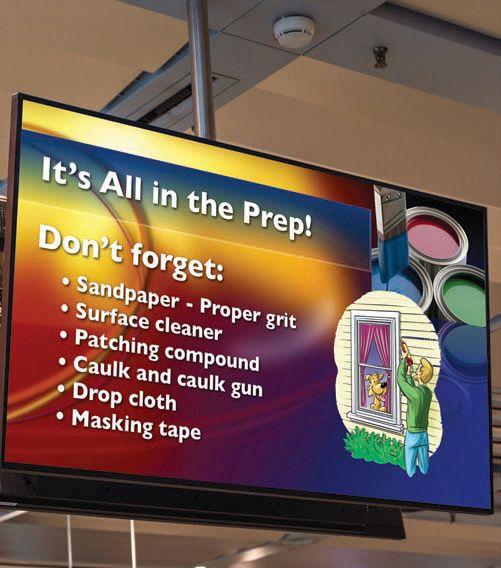
The PDRA makes it easy for you with its digital signage program. High-impact digital videos include painting tips, reminders about the tools customers may need for their projects and calls to action encouraging customers to rely on your staff for their painting questions. While digital signage doesn’t replace knowledgeable staff, it can show your customers that your associates can be trusted to know the answers to their questions.
The PDRA digital signage program is an affordable way to keep your brand and expertise in front of customers while they shop. The videos come to you already installed on a USB flash drive. Simply plug the flash drive into your TV, and the video starts playing.
Access the digital signage program for just $99. To learn more, contact Member Services by calling 800-737-0107 or email info@pdra.org
Guest Column Independence
Saving the Spirit
3 Ways to Maintain the Shop-Local Spirit After the Holidays
The holiday season is full of colorful decor, warm tidings and small business buzz.
The shop-local spirt runs high, as consumers look to local businesses and independent retailers for unique gifts and holiday party essentials. Once the holidays are over, the rest of the winter season can be slower than many retailers would prefer. Avoid the post-holiday slump with the following tips to brighten your business.
1. Join a Main Street organization.
Main Street organizations spread cheer throughout the community all year long. These groups bring small business owners and local leaders together to revitalize downtown storefronts, organize community events and generate enthusiasm for local businesses. In these ways, Main Street organizations work hard to maintain the shop-local spirit no matter the season. Plus, they tend to offer valuable perks to their members, such as low-interest loan programs and advertising discounts. To get involved, look for a Local First organization, downtown business association or similar group in your community.
2. Embrace every season.
Increasing brand awareness is much easier when you can connect your business to something timely—so why not leverage the other seasons? Independent We Stand offers seasonal graphics that can be used online and on social media to help spread the shop-local message at any time of year (download them at pdra.org). Offline, you can draw customers into your store by hosting a seasonal promotion or event, such as a Valentine’s Day painting class for couples or a spring cleanup day at a nearby green space. By celebrating every season, your campaigns will be timely and engaging in a way that rivals the holiday buzz.
3. Go where your customers go.
During the holiday season, customers generally come to you. They need to update their home for holiday guests or find the right gift for a loved one. After the holidays, they may not have a similar reason to return right away, but you can still make sure they think about your business. Take part in local events and festivals, sponsor a youth sports team or provide a public service like Hess Lumber in Malad City, Idaho. They created a community recycling program and regularly volunteer at the local fire department. Read the entire story at independentwestand.org. Think about where your customers will be and then find meaningful ways to connect with them outside your store.
When you do your part to keep the shop-local spirit high after the holidays, you support more than your store’s bottom line. Spreading the shop-local message all year long builds up local businesses throughout the community and makes the local economy stronger. Make your community more vibrant this year finding ways to connect with your customers and other small businesses in every season.
Bill Brunelle is the co-founder of Independent We Stand, which educates communities about the benefits of shopping locally. IWS inspires small business owners to celebrate their local status and community value. IWS is sponsored by STIHL, Do it Best Corp. and PPG Paints.
Doug Crowther, owner of Hess Lumber in Malad City, Idaho, created a community recycling program and volunteers for his local fire department.
PDRA EDUCATION INITIATIVE
Brightening the Holiday Season
Carl Reineke, owner of Reineke Decorating Centers in Missouri, believes in doing all he can to make the holiday season memorable for his community. For 12 years and counting, Reineke has partnered with the St. Charles Convention Center and community organization We Love St. Charles for the annual Helping Hands for the Holidays event, in which local families in need are treated to a holiday meal and connected with beneficial community resources.
Reineke says it all began because his daughter worked for the St. Charles Convention Center. She was searching for a Santa Claus for a holiday event, and Reineke volunteered to don the Santa suit. He says he looks forward to the holiday event each year, and recently his wife, Pam, has joined him as Mrs. Claus.
“There are too many bad things in the world today,” Reineke says. “The Helping Hands for the Holidays event helps bring some joy to people’s lives.”
Reineke says his most cherished memory from previous events was when a child in foster care asked if she could join him and Mrs. Claus at the North Pole. “I’ve never forgotten that moment,” he says.
At the 2019 event, 1,600 attendees received a holiday meal. In addition, more than 2,400 winter coats and accessories and 500 personal care bags were distributed. Local organizations provided health screenings and information on medical care.
Guests at the event were also treated to a full suite of holiday-themed activities and a special photo session with Santa Claus. Since 2007, Helping Hands for the Holidays has provided resources to more than 13,000 individuals in need.
UNMATCHABLE
When you find the perfect color, nothing else will do. Perfection comes from our paint and our proprietary Gennex® colorants, together, creating colors impossible to replicate.
Insist on Benjamin Moore®. Ask your Benjamin Moore representative about Gennex Color Technology, which makes our colors, all 3,500 of them, one-of-a-kind. Unmatchable.