





Follow us: facebook.com/PrevalSprayer | twitter.com/PrevalSprayer | youtube.com/user/prevalspraygun


Follow us: facebook.com/PrevalSprayer | twitter.com/PrevalSprayer | youtube.com/user/prevalspraygun

Published










A closer look at the manufacturers that supported retailers in 2016.






Publisher/Director of Sales

Dan Simon, dan@pdra.org
Editorial
Editor
Steve Stevens steve@pdra.org
Art Director
Murry Keith murry@pdra.org
Directories Editor/Circulation Manager
Lori Goad lori@pdra.org
Production Director
Jo Ann Ray jo@pdra.org
Director of Finance/Human Resources
Renée Nolte renee@pdra.org
Association Coordinator
Tina Sullivan tina@pdra.org
Account Executive
Brandi Hemmer brandi@pdra.org
a dv E rtising
Publisher/Director of Sales
Dan Simon dan@pdra.org
Phone: (800) 737-0107, Fax: (636) 229-4750
Account Executives
Richard Bright rbright@brightconcepts.net
Phone: (410) 869-3253, Fax: (530) 452-2266
Brandi Hemmer brandi@pdra.org
Phone: (636) 680-2785, Fax: (636) 229-4750
P dra EXECU tiv E lE ad E rs HiP
LeAnn Day
Executive Director
O fficers
Craig Bond
President and Western Region Director
Tommy’s Paint Pot, Eugene, Oregon
Jeff Baggaley
Past President
Color Company Decorating Centre Ltd., London, Ontario, Canada
Mike Fleck
Vice President/Treasurer and Eastern Region Director
Fleck’s Paint Spot, Toms River, New Jersey
D irectOrs
Robert Mueller
Director at Large
Benjamin Moore Kelowna, Kelowna, B.C., Canada Jay Donnelly
Midwest Region Director
Flanagan Paint & Supply, St. Louis, Missouri
P dra a dvisory Committ EE
Dori Marks, PPG Industries
Thomas Hill, The Coatings Alliance
Eugene Andreassi, Benjamin Moore
Joe Jankoski, Hunter Douglas
Bob Clemence, Hyde Tools
John J. Petroci III, Dumond Chemicals
John Shingledecker, Allpro Corporation
Richard Russo, Reed Exhibitions
The company works for independent dealers because it’s run by independent dealers.

In 1999, Thomas A. Hill III, chief executive officer of the Coatings Alliance LLC, makers of C2 Paint, took notice of the rapid consolidation in the coatings industry in tandem with the unstable supply chains that led to a hyper-competitive marketplace. What he saw was reduced or limited opportunities for the independent dealer channel.
Rather than seeing this as a drawback, Hill came up with a way to turn the tide in favor of independent dealers: He, along with other founding members, created C2 Paint, an innovative company made up of independent dealers that operate in the premium and super-premium end of the channel.
“Because of this unique business model, we were able to cultivate and execute fresh, innovative ideas and ultimately

differentiate ourselves through advancements in technology and, most important, color,” said Hill. “By offering a superior product and a unique color selection driven by independent dealers, we are able to provide a clear competitive advantage. We continue to operate from that foundation.”
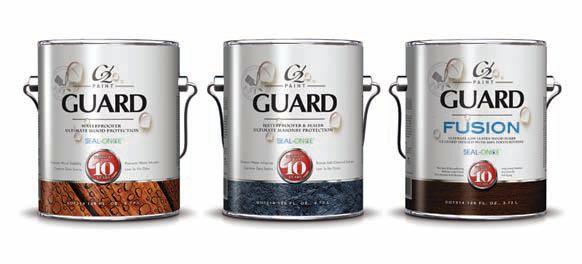
Today, the company offers super-premium interior and exterior trade sales paints under the C2 Luxe label and a premium interior line under the C2 Studio label. Products also are available in the following lines: C2 Premium Exterior, C2 Guard (which includes C2 Fusion) and C2 Cabinet & Trim. All products are eco-friendly and meet or exceed environmental standards. Also, each paint is designed and created with the company’s full-spectrum color philosophy in mind: No black colorant is used in any of the paint colors; instead, multiple colorants and artist-grade pigments,


like cobalt blue and oxide green, are utilized. In addition, C2 Paint forgoes traditional lacquer paint chips in favor of 17-inch-by-25-inch “Ultimate Paint Chips,” which are made from real paint.
Since its inception, C2 Paint has prided itself on being a “safe harbor” for the independent dealer by offering distinct and stable brand solutions, superior product quality, select distribution and high margin and profit potential. “We
believe that the independent dealer should be the primary brand in his or her marketplace,” said Hill. “We fully support independent dealers in achieving their goals. We do this in a number of ways: first, by offering select distribution—not layering dealers on top of each other—and also by having a nationally recognized super-premium brand that allows them to differentiate themselves from their competitors. It’s the combination of these things that provides a ‘safe harbor’
for our independent dealers.”
Given the company’s success, it’s clear that many independent dealers have sought out that “safe harbor” with C2 Paint. The company experienced significant growth through the beginning of the recession in 2009. Like others in the paint industry, the company saw a decline in sales as the recession dragged on. However, that trend has reversed, and C2 Paint is now seeing double-digit growth again. “We attribute this to our premier product selections, an improved economy and our partnership with PPG, which includes having their architectural sales force represent the C2 line of products,” said Hill. “This sales emphasis gives us broader reach while still diligently supporting our fundamental policy of providing a safe harbor for the independent dealer.”
Harry Adler, a founding member of C2 Paint and co-owner of Adler’s Design Center & Hardware, in Providence, Rhode Island, had his doubts about the company’s concept. “I wasn’t sure it would work, but I wanted to try it,” he said. “Tom convinced me that logistics would not be a problem, because he had the industry contacts.” It’s a move Adler is more than happy he made. Today, C2 Paint represents 85 percent of his store’s paint sales. “The quality level and color is what our customers want,” he said.
That “quality level and color” is exactly what Hill thinks will
expand C2 Paint further into the marketplace. “We see C2 as a major player on the premium and super-premium end of the independent dealer channel, with increased distribution and a national brand that is recognized for offering the most coveted color in the marketplace,” he said.
Future growth, though, depends on independent dealers reaching their full potential. “C2 is an obvious answer for many consumer questions, so we do best where retailers have a strong reputation in their area,” said Adler. Consumers trusting their dealers to direct them to the best-quality products, and dealers having a high-quality product to sell that was created by like-minded independent retailers? That’s a win-win from every angle. •


This 30-year-old paint company is looking to expand its presence beyond arts-and-crafts stores.


In 1985, DecoArt started as a division of Ceramichrome, a manufacturer of molds, glazes and specialty finishes for the ceramics industry. It didn’t take long for the arts-and-crafts community to embrace the company’s flagship product, Americana, a ceramics branded acrylic color. In 1988, company president Stan Clifford took an innovative approach to marketing his products by putting them into the hands of teaching artists and influencers free of charge.
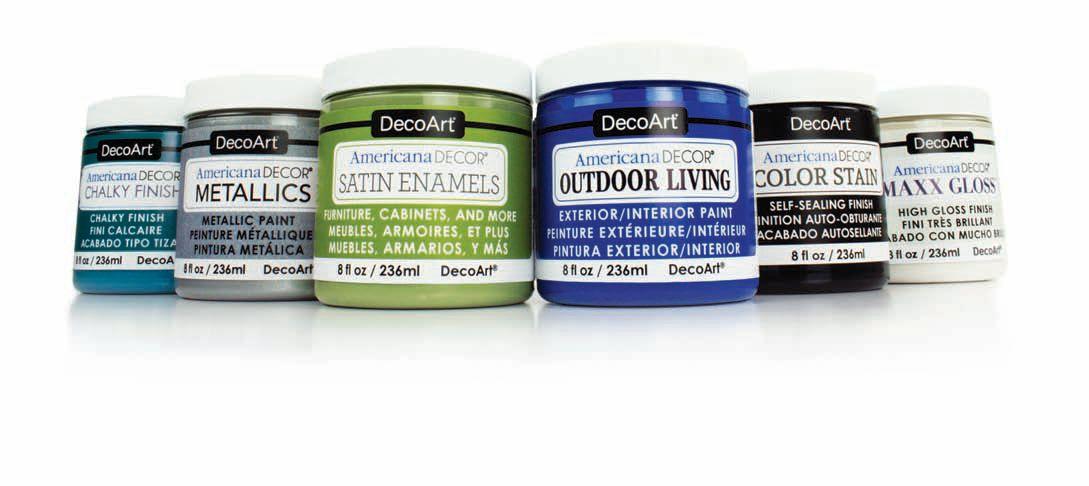
In 1997, the company’s name was officially changed to DecoArt Inc., and today it manufactures more than 3,000 products with global distribution. These products fall into several primary product lines, including Americana Acrylics, Americana Decor, Americana Gloss Enamels, Patio Paint, Dazzling Metallics and Americana Multi-Surface.
While its primary distribution is, naturally, in arts-andcrafts and fine-arts stores, as well as grocery stores, DecoArt is now looking to increase its presence in paint and hardware

by
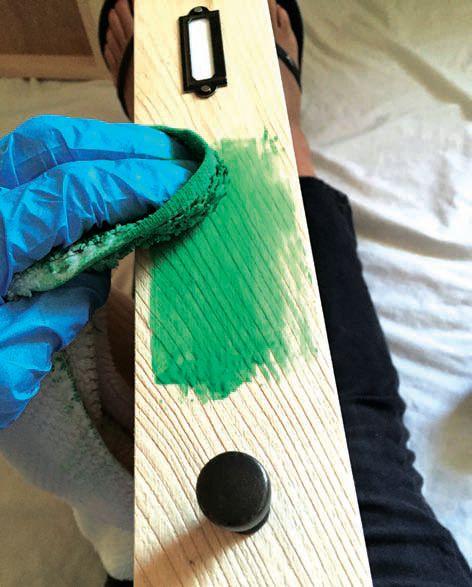
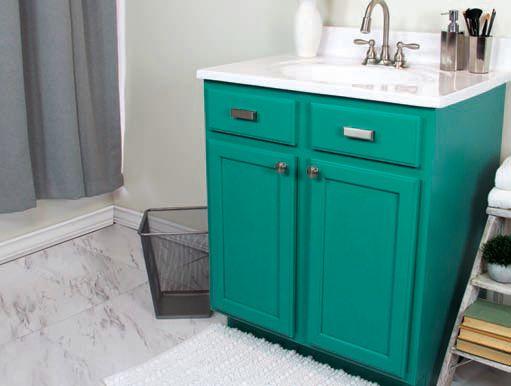
stores. The reason for this is simple: DecoArt’s products are no longer limited to the arts-and-crafts community. “With the addition of Americana Decor Chalky Finish to our product offerings, we took a giant leap from being a craft paint company to being a player in the DIY sphere,” said Tom Schaub, vice president of creative marketing at DecoArt, which is based in Stanford, Kentucky. “The wide consumer success of that offering led us to develop an entire program of DIY paints, finishes, mediums and stencils.” Maxx Gloss, the first product in that program, was launched in winter 2015, and the remainder of the line—Outdoor Living, Color Stain, Metallics and Satin Enamels—was introduced earlier this year.
To help spread the word about DecoArt, the company implemented a blogger outreach program in 2010 as a way of making a connection with major online influencers in the craft and DIY spheres, Schaub said. The success of that program, thanks to the blogs themselves as well
as the rapid growth and reach of Pinterest, went a long way in extending DecoArt’s reach beyond the arts-andcrafts community. “Our goal is to continue to expand our reach into the DIY home decor paint and finishes market by employing the same basic principles we used in the craft market: spreading the word that we are a name to be trusted for high-quality and cutting-edge product offerings,” said Schaub. “DecoArt wants to continue to grow our presence in the DIY realm, and a major facet of that will be expanding our presence in independent [paint and] hardware stores.”
Those high-quality and cutting-edge product offerings are exactly what attracted Melissa Reese, owner of New Holstein True Value, in New Holstein, Wisconsin. Initially, she was looking for chalky paint after many customers started asking for it. After researching it, she went to another top competitor in the market, but discovered that company wasn’t for her. That company wanted a no-

compete policy, plus it required Reese to hold regular classes on how to use the product. As Reese put it, “That wasn’t a fit for me.”
After finding DecoArt, she ordered it from a third party before reaching out to the company directly—a move she was glad to make. “They have low minimums, like three-packs, and a very good margin on what they sell us,” said Reese. And, she added, carrying DecoArt has proved quite effective in attracting more women into her store. “It’s so appealing to women,” she said. “If you want to round out your paint department, DecoArt is my go-to source. It’s the piece we were missing with the woman shopper.”
Those women now think of Reese’s store as their paint store, she said. “That younger generation, they’re the ones spending money,” she said. “They want to upcycle and recycle furnishings. And, more often, they come back because of my other product offerings. Maybe they don’t purchase something else right then, but they remember I have it in the future.”
Reese highly recommends that her fellow paint and hardware store owners give DecoArt a closer look. “You need to at least look into it, even if you are a small store,” she said. “I think it’s a huge opportunity that little stores can take advantage of for not a lot of money.”
DecoArt is currently experiencing a transformation that
Schaub said the company hopes will carry DecoArt into its next 30 years of business. “We are undergoing a rebranding this year, with a new logo design and a renewed emphasis on innovation,” he said. “As a company we want to be transparent across the board, not only to our employees but also to our customers and the end consumers. To do this, we have a renewed commitment to product quality and innovation.” •

This New York technology company helps retailers manage the business of getting paid.




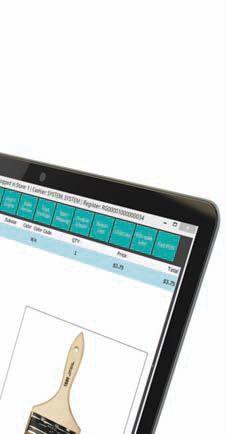
Founded in 1983, Cam Commerce Solutions develops, markets, installs and services integrated POS, ERP and payment processing products for small to medium-size retailers.

Specifically, the company’s primary offerings are software programs for POS, integrated e-commerce, customer management, purchasing/receiving, inventory, reporting/business intelligence, loyalty/frequent shoppers, merchandise planning, distribution/warehouse and work orders.
“Cam Commerce doesn’t build its products specifically for the paint and hardware industries, but it has incorporated paint and hardware specific features into its application,” said Ian Goldman, president of Cam Commerce Solutions. “As a whole, Cam has been in the hard-goods industry for over 30 years, and from its inception, Cam has catered to the hardware and paint verticals and has continually expanded into different verticals from there.”
Based in Fountain Valley, California, Cam Commerce Solutions was acquired by Staten Island, New York-based Celerant

Technology Corporation in March 2012. “By combining forces, these two divisions now have more than 30 years of experience in developing, marketing, installing and servicing highly integrated multichannel solutions for retailers,” said Goldman.

Since the acquisition, the entire organization has experienced significant growth in spite of a challenging economy, said Goldman. “Both divisions – the Celerant and Cam teams –have meshed well and, as a result, the Cam product line is more productive than ever. We leveraged the bicoastal presence in our support and installation departments, giving greater flexibility and wider coverage for support and installations.”
Of course, expanding the support and installation departments is just one aspect of Cam Commerce Solutions’ evolution going forward. As with all technology, the company continues to revise and upgrade its product offerings to better serve its customers. “Cam Commerce Solutions is 100 percent dedicated to improving its products and providing clients with outstanding customer support,” said Goldman.
“We know that service and ongoing updates to the software we provide are crucial to our clients’ continued success. We

“Whenever I need help with something or have an issue, I get a quick response. They’re available when we need them, courteous, proficient and quickly resolve problems.”
are also fully aware of their concern that when they invest in a POS system, they do so cautiously as they want to be assured that the company they select will be around to protect and enhance their investment for years to come,” he said.
Choosing a POS system provider certainly was not easy for Justin Nauta, owner of Spearfish Paint, in Spearfish, South Dakota, who looked into Cam Commerce’s Retail Star POS program after a colleague recommended it. “After researching other vendors, Cam seemed to be familiar with our industry and their system seemed very user-friendly,” he says. “We liked the product features that we will eventually be able to grow into.”
Nauta also loves that the easy-to-use program lets him spend valuable hours with customers rather than training employees on the software. “It enables us to spend time growing the business and not focusing on the POS,” he said. “It has made tasks such as inventory management very easy. It also provides us with a whole list of reports that we can use to analyze our business.”
Retail Star’s reporting function is also important for David Schaleger, latex paint recycling specialist with MetroPaint, a part of Portland, Oregon’s regional government agency Metro. “The biggest benefit is the ability to keep track of both production and sales of not just the paint product but also the paint’s batch number,” he said. “MetroPaint is a
recycled latex paint and, as such, customers are sometimes skeptical of the paint’s quality. It’s important to us that we’re able to quickly trace any customer complaints back to the batch so that we can rule out any batch-specific issues concurrent with resolving the customer’s specific issues.”
Both retailers are impressed by Cam Commerce Solutions’ service department. “Whenever I need help or have an issue, I get a quick response,” said Nauta. “They’ve been great all through the process, from sales to training to support once it was up and running.” Schaleger agreed, stating that the company’s technical support has never disappointed him. “They’re available when we need them, courteous, proficient and quick to resolve problems,” he said.
Growth remains strong and customers seem to love the current product offerings. “Our goal is to prepare to bring a next generation of products to the customer base and to the market that CAM services,” said Goldman. “Over the past few years, we have learned the customer base and target market of the company well, and we have started planning for the next generation of products. We’re moving in the direction of providing more innovative and trackable features, with the goal of helping our paint and hardware customers increase sales and improve their overall ROI efforts.” •
The Pennsylvania company with humble beginnings has come a long way in 84 years.
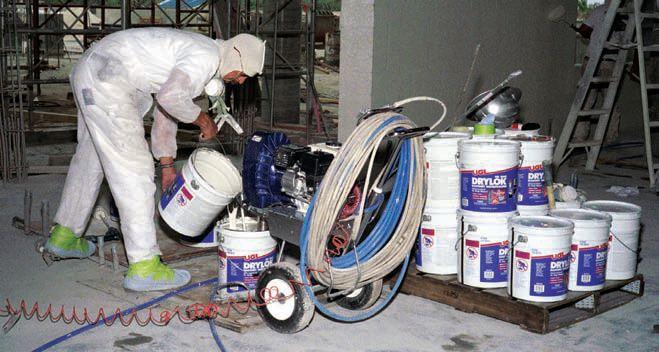
It’s hard to believe United Gilsonite Laboratories started in 1932 with furnace cement and a sausage grinder. That’s right: a sausage grinder. Company founder Gerald Baker Payne went door to door mixing furnace cement in a sausage grinder he purchased from a junkyard for $5. By 1953, UGL had introduced its Drylok line, which included nine separate products for waterproofing basements, stopping active masonry leaks, protecting and beautifying interior and exterior masonry walls, and painting masonry floors. Today, UGL also manufactures Zar Interior Stains and Clear Finishes, Zar Exterior Deck and Siding Stains, and UGL Maintenance and Repair products.
Given that the Dunmore, Pennsylvaniabased company will celebrate its 85th anniversary in 2017, it’s not surprising that UGL has experienced its share of growing pains. “UGL started as a ‘paint specialty’ company manufacturing products for homeowners,” said Joseph M. McGraw, director of marketing and advertising for United Gilsonite Laboratories. “The paintspecialty products seem to be losing their marketability [among DIYers]. Although we still make unique products such as glazing compounds, gold paint and plaster patching, the unique craftsmen who use these products seem to be slowly fading away. However, we still manufacture these products for a specialty restoration market.”
McGraw said that although these products were originally developed for use by homeowners, they have captured the attention of contractors and are gaining broader appeal and finding their way into
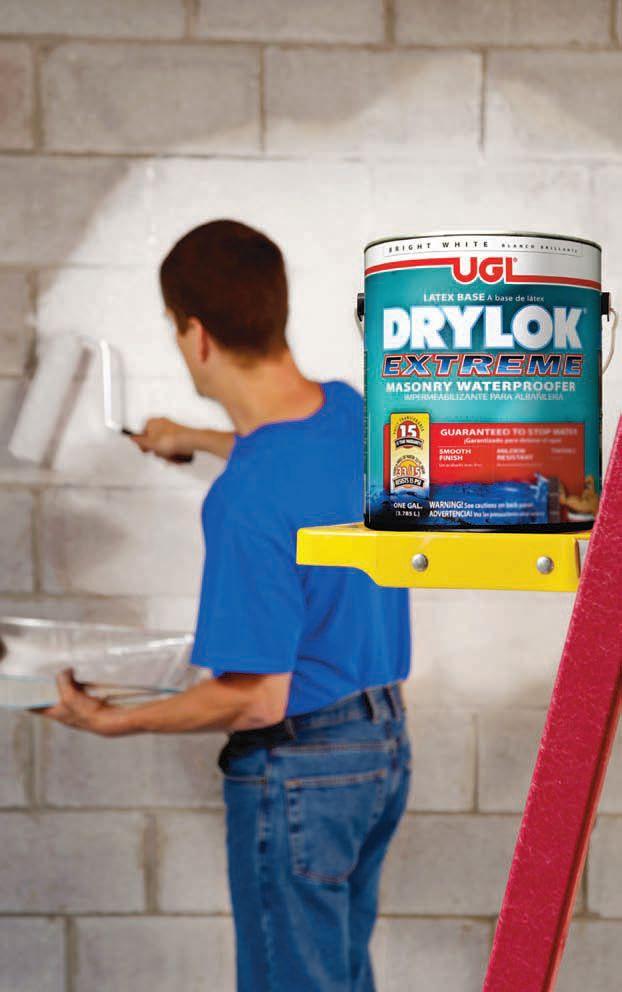

pro and contractor projects. “These changes, along with many others, have led to the growth and adaptation of our company,” he added.
The increased interest from contractor markets has led to additional changes and challenges for UGL. “UGL is tasked with this market’s labeling needs and larger container sizes, and marketing to a totally different distribution channel than we have been in the past,” said McGraw. “Even the point-of-purchase displays are different for this market.”
Also, UGL has looked for ways to continue creating quality proven products that meet the ever-changing government regulations in the industry. “Government regulations for product VOC levels are one of the major issues for companies like ours,” said McGraw. “Products that have proven quality and effectiveness are not enough anymore. Finding resin substitutions that have lower VOC levels but the same performance, comparable prices and
similar properties is a continual challenge for our R&D department.”
The company’s advertising tactics have also changed. Unlike in years past, modern advertising isn’t a one-way street of placing a print ad in a magazine and hoping contractors see it and respond with a purchase. “Now advertising has to be interactive,” said McGraw. “If you make a claim, customers head to the Internet and social media sites and ask others to verify the claim. Manufacturers have to be present and available to back their claims and hear what consumers are suggesting as truth. Advances in information technology, data gathering and analytics help us create highly customized offers that steer customers to the right merchandise at the right moment.”
UGL’s ability to adapt to a changing market while incorporating government regulations has enabled the company to remain strong in the industry. “It is a fine balance between growing and maintaining profitability while keeping customer
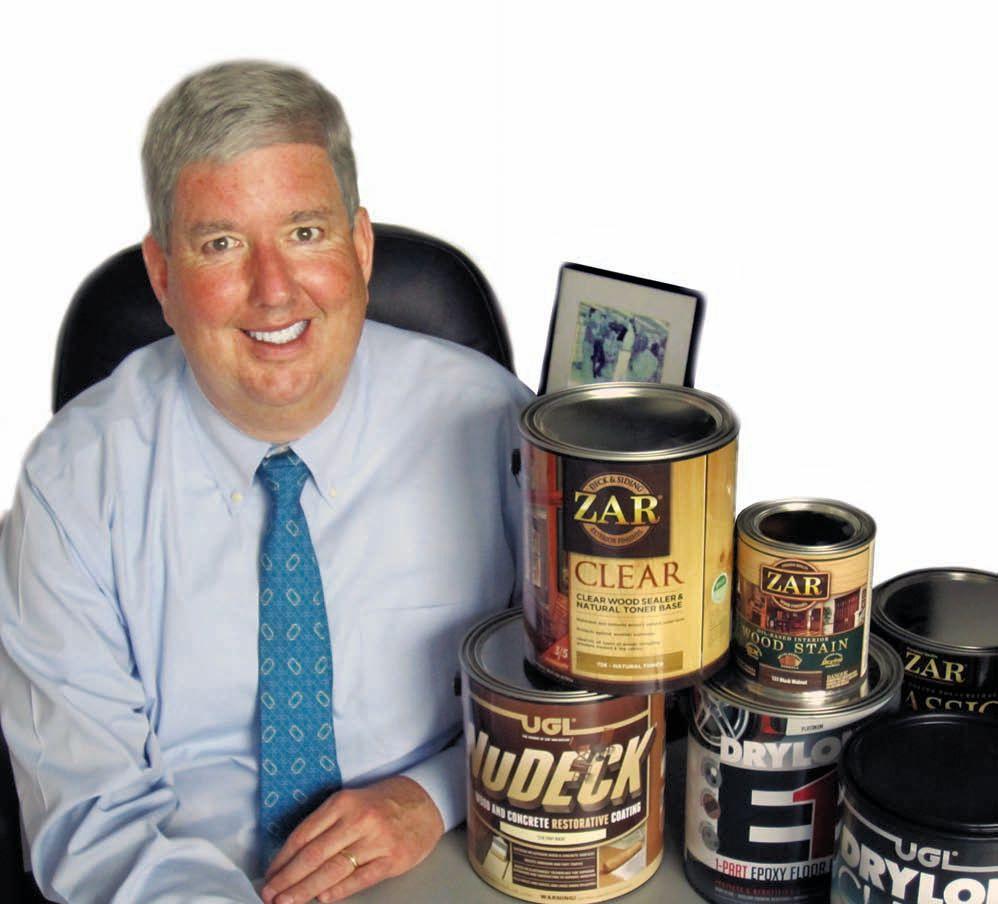
service at an intimate level,” said McGraw. “We put a very strong emphasis on our dealers. Educating our dealers and providing them with effective point-of-purchase and a direct sales force that are the dealers’ personal sales associates is key to our success. We understand that dealers are our eyes and ears. We listen and we respond accordingly, and we value that relationship.”
According to their dealers, it’s a relationship that benefits both parties. Jay Donnelly, vice president of Flanagan Paint & Supply, in St. Louis, said his UGL sales rep is incredible. “Our staff can call him anytime with questions, and he helps
them troubleshoot the problem without calling me or one of the other owners into it.” Brian Hubbard, store manager at Hubbard’s Paint & Wallpaper, in Barnstable, Massachusetts, agreed and said, “I think they support the independent retailer, so that’s important to us.”
Don’t look for UGL to change that focus in the future. “Although we keep growing, we continue to stay true to quality, attention and customer needs,” said McGraw. “We believe in creating relationships, not just closing the sale. We care about our customers and want to serve them the best way we know how.” •

Through 90 years of paint company mergers and acquisitions, Diamond Vogel is still independent.
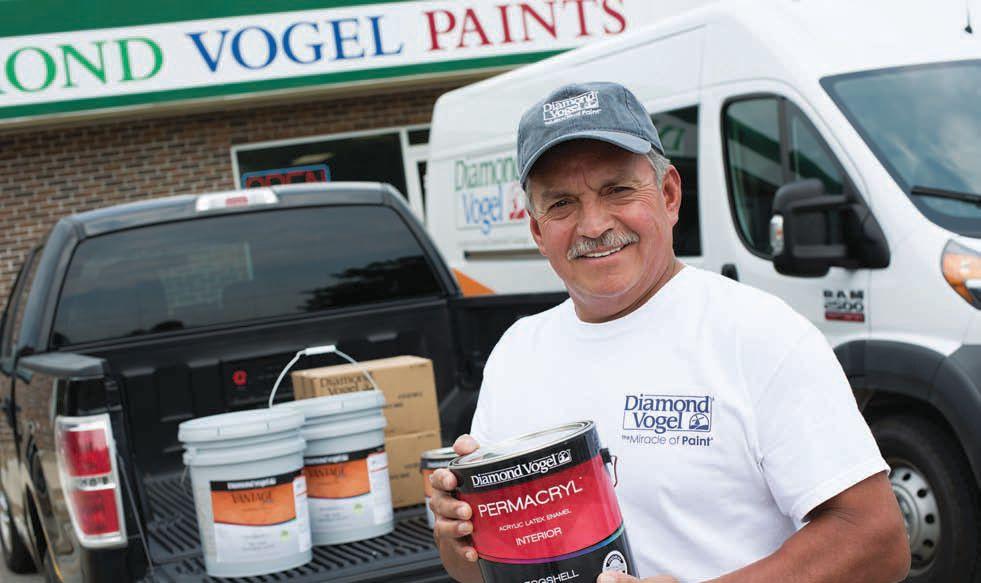
When Andrew Vogel, founder of Diamond Vogel Paints, first arrived in America from his native Holland at 16 years old, he dreamed of becoming a farmer. Living in Orange City, Iowa, he took a routine path to achieve this dream: He married, purchased some livestock and planted crops. However, as his grandson Doug Vogel said, Andrew wasn’t good at farming. “The pigs died, and the crops failed,” said Doug, who is the vice president of trade marketing at Diamond Vogel.
However, when someone asked Andrew to paint the local creamery, Andrew discovered he could make better paint than what was available to him. After all, he’d learned how to do just that from his own father and grandfather, who worked as painters and paperhangers in Holland.
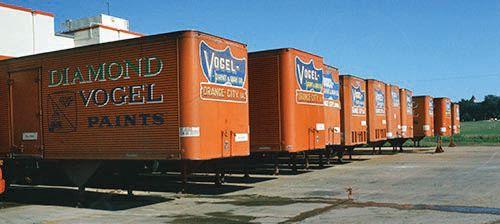
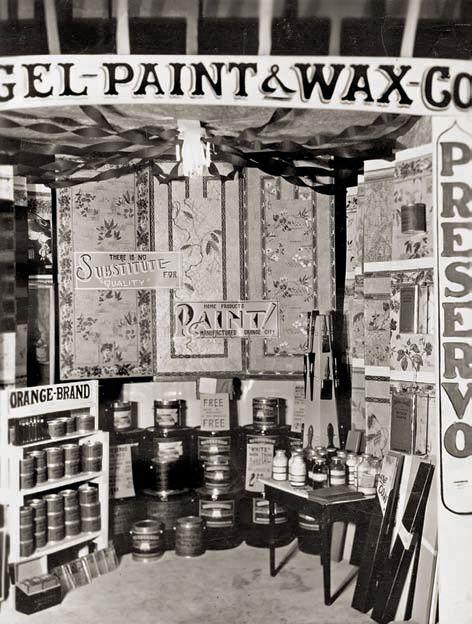
Back then, painters made their own paint and applied it themselves. So, in 1926, with two paint grinders from Chicago, Andrew started making paint in his own garage.
It didn’t take long for Andrew to find success with Vogel Paint and Wax Company. He continued to make his paint, and when his four sons returned home following World War II, they joined the business as well. “There was quite a boom in the business, and it really grew in shortline agricultural equipment, paint for farm equipment,” said Doug.
In 1967, Andrew expanded the business through his purchase of Diamond Products Company, in Marshalltown, Iowa. “That’s how we got into the store business,” said Doug. In the 1970s, Andrew started marketing the company as Diamond Vogel Paints to draw upon each of the two companies’ reputations: Vogel, as a strong name
in industrial coatings, and Diamond, as a strong name in architectural paint. Additional acquisitions followed, including such brands as Komac in Denver and Esser in Milwaukee. “There has been a lot of consolidation in the industry,” said Doug. “Luckily, we’ve been on the good side of that.”
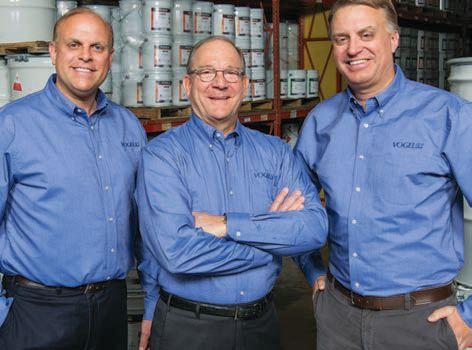
Today, Diamond Vogel Paints maintains a strong product offering that includes Diamond Vogel Paint, Pinnacle Protective Coatings, Vogel Paint, traffic-marking coatings and both powder and liquid industrial finishes. Also, the company operates 66 company-owned stores in 13 states, from Illinois to Colorado to New Mexico. Third-generation Vogel family members currently lead the company: Doug, his brother Mark (vice president of OEM finishes) and their cousin Drew (president and CEO).
In the past three decades, Doug said he has seen the company undergo quite a bit of change in order to maintain its foothold in the industry. In the 1980s, Diamond Vogel Paints transformed itself into a decorating center that included wallpaper. Then, between the 1990s and the 2000s, the company refocused itself on being a contractor paint store, largely due to competition with bigbox stores. Diamond Vogel wasn’t open as many hours,
didn’t have the same amount of floor space to carry a large inventory and didn’t have the prime real estate locations of the big boxes.
The change turned out to be quite a good one for Diamond Vogel Paints. “We really enjoyed serving painting professionals,” said Doug. “And we’re a paint manufacturer; that’s what we do, it’s the heart of our business, making and selling paint.” Today, the company continues to look for ways to serve painting professionals—people who are paid to paint, including contractors, maintenance workers, government employees and so on. “We see a lot of opportunity in that, certainly in our own geography where we are,” said Doug. “I think that’s one of the things in our DNA. We live in an area of the country that’s not heavily populated, so if it’s being painted, we want to know how to sell it. We have become diverse to survive.”
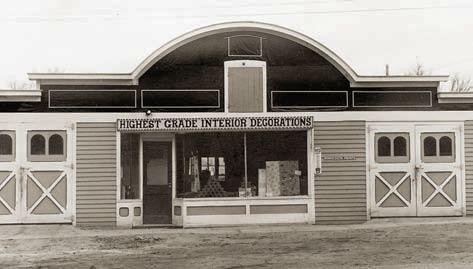

Diamond Vogel Paints’ store managers can attest to this approach firsthand. Paul Nelsen, manager of Diamond Vogel in Ames, Iowa, has been with the company for 50 years. “Over this half century, like any good company, we’ve learned to bend and flex, not only with developing products but also growing in size and knowledge,” he said. “We’ve been fortunate to have leadership that can envision the needs of the paint market for consumers, contractors and industrial customers.”
And that leadership can’t wait to see what the future will bring. “We’re looking forward to the future with the third generation now, and we have some fourth-generation family members starting in the business, so we’re excited about what’s in store,” said Doug. “We’ve been privileged to work in a dynamic industry with quality people, and it continues to be a privilege to be a part of it.” •

Stoner Inc.’s purchase of Mötsenböcker’s Lift Off could boost both brands.
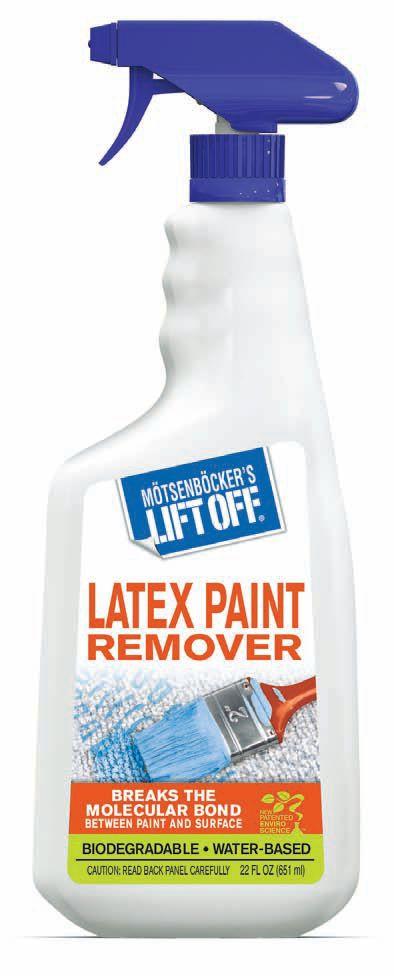
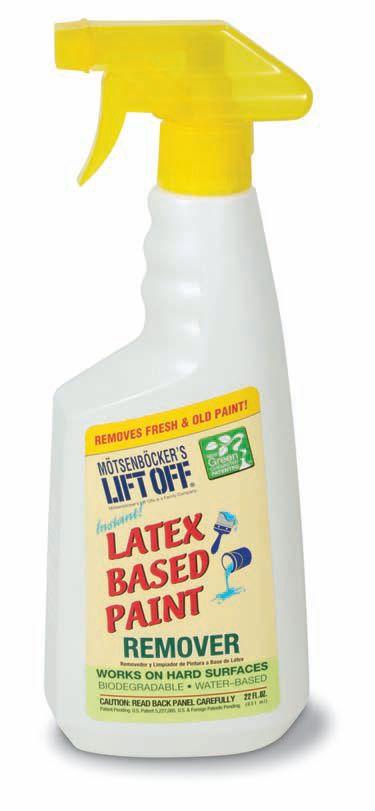
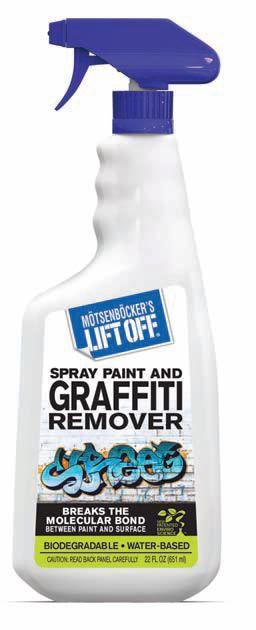
Last fall, Stoner Inc.—a family-owned manufacturer of high-performance products for the home, automotive, industrial cleaning and molding industries—announced it had acquired Mötsenböcker’s Lift Off, which is well known for its removal products for stains, adhesives, paints, varnishes and caulks.
Rob Ecklin Jr., president of Stoner Inc., in Quarryville,
Pennsylvania, said he knew Mötsenböcker’s would be a good fit for Stoner in several ways. “From a channel standpoint, Mötsenböcker’s matches up with us,” he said. “Our sales channels are very similar. From a cleaning standpoint, Mötsenböcker’s also matches up.”
Stoner is a chemistry-based company, and Ecklin said he was intrigued by Mötsenböcker’s products, which are all water-based. In addition, Mötsenböcker’s Lift Off products



are biodegradable and sustainable, and they contain low or no VOCs. “There’s a lot of water-based chemistry these days, but the challenge is, does it work?” said Ecklin. Stoner associates started sampling Mötsenböcker’s products to find out; they spent approximately six months studying the business of Mötsenböcker’s Lift Off and sampling the products. Not surprisingly, the Stoner team discovered that Mötsenböcker’s products do work.
With the background and experience of Gregg A. Mötsenböcker, the chemist and namesake behind Mötsenböcker’s Lift Off, how could the products not work? Mötsenböcker created his first product in 1978 to remove price stickers and chewing gum without damaging any product or its packaging. After establishing a long-term relationship with Sherwin-Williams, Mötsenböcker moved into the paint and sundries market.
In 1995, Mötsenböcker was named an Outstanding Innovator of the Year by the Patent & Trade Office and, shortly thereafter, created the first-ever water-based chemistry to remove solvent-based paint. Today, he holds more than 50 patents, earning him the nickname “The Wizard.” As a result of his success, Mötsenböcker has received a lot of interest in acquiring his company. So why did he go with Stoner? “I am passionate about what I do,” said Mötsenböcker. “I wanted to find somebody who would give me the attention deserving of my product line.”
Stoner has certainly devoted a lot of attention to Mötsenböcker’s Lift Off, starting with the product packaging. “We want to help it stand out on the shelf,” said Ecklin. “We
received feedback that users wanted more training and tips, so we addressed that on the packaging, as well as online and through social media networks. Customers can tell what the product does by looking at the front of the package.” Moving forward, Stoner will continue to market Mötsenböcker’s Lift Off as its own brand.
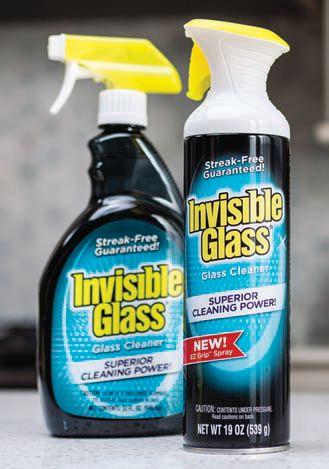
“We look at acquisitions as a growth strategy, so Mötsenböcker’s is no different,” said Ecklin, whose company also owns such brands as Invisible Glass, Speed Bead and Tarminator. “We want to keep that brand identity, but we have more resources to grow and expand the brand. We expect to continue to grow at a double-digit rate.”
Mötsenböcker’s brand awareness already had a footprint in the marketplace, and Stoner can only enhance that. In fact, Mötsenböcker said he thinks Stoner will impact his brand in a sizable way. “We’ve had tremendous reach here and overseas,” said Mötsenböcker. “Now we can grow the retail side and the commercial side as well because of brand awareness.” While Mötsenböcker’s has maintained relationships with big-box stores and national hardware stores, you can expect to see more Mötsenböcker’s Lift Off products on the shelves of independent retailers as well. Offering Mötsenböcker’s Lift Off products will give
independent retailers a whole new sales tool to reach their customers, said Ecklin.
Retailers can also expect to see more from Mötsenböcker, who will continue to work as a consultant with Stoner, which has negotiated an initial term with Mötsenböcker for the next five years, with some options to move forward after that if both sides desire. “Gregg is working on new formulas right now,” said Ecklin. Formulas for existing products will remain the same.
Mötsenböcker is looking to create more products that will help the end user. “I push saving time,” he said. “Time is money. It’s also about advocacy—I want it safe for the environment and for the individual. That’s a big score. Not many products can say that.” •


The toolmaker is moving its brand into the North American market.
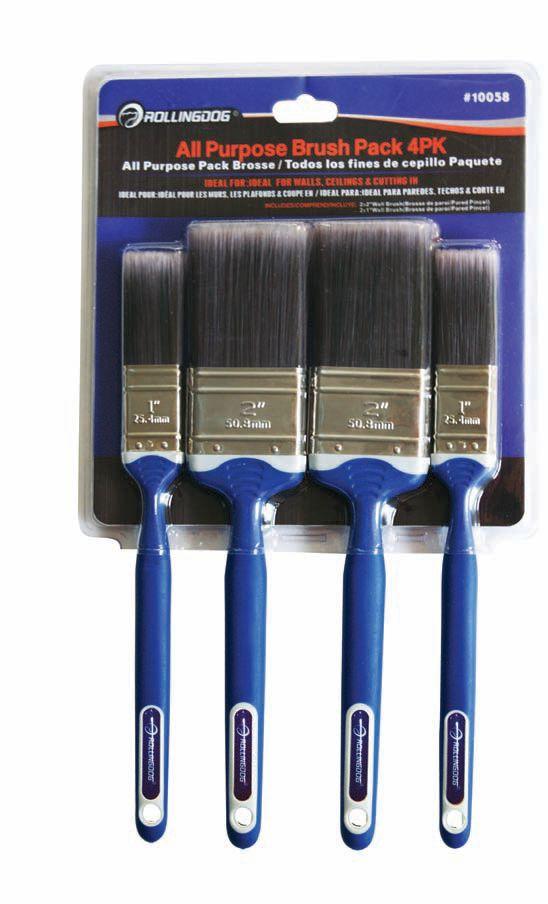
Established in 2008, Cliff Tools Group quickly established itself as a leading original equipment manufacturing (OEM) company producing private-label paint and home-improvement tools in China. However, in 2013, the company decided to start specializing in certain categories and create its own identity. And Rollingdog was born.
The company set out to create higher-end painting tools, so they hired engineers to take existing products and make them better, said Mike Leonardi, vice president of North American operations for Rollingdog Innovation Technology Limited, which has its headquarters in Ningbo, China, and an office in Laval, Quebec. Specifically, the company sought to improve the design of the products, adding features that would make the end user’s job easier. Engineers also
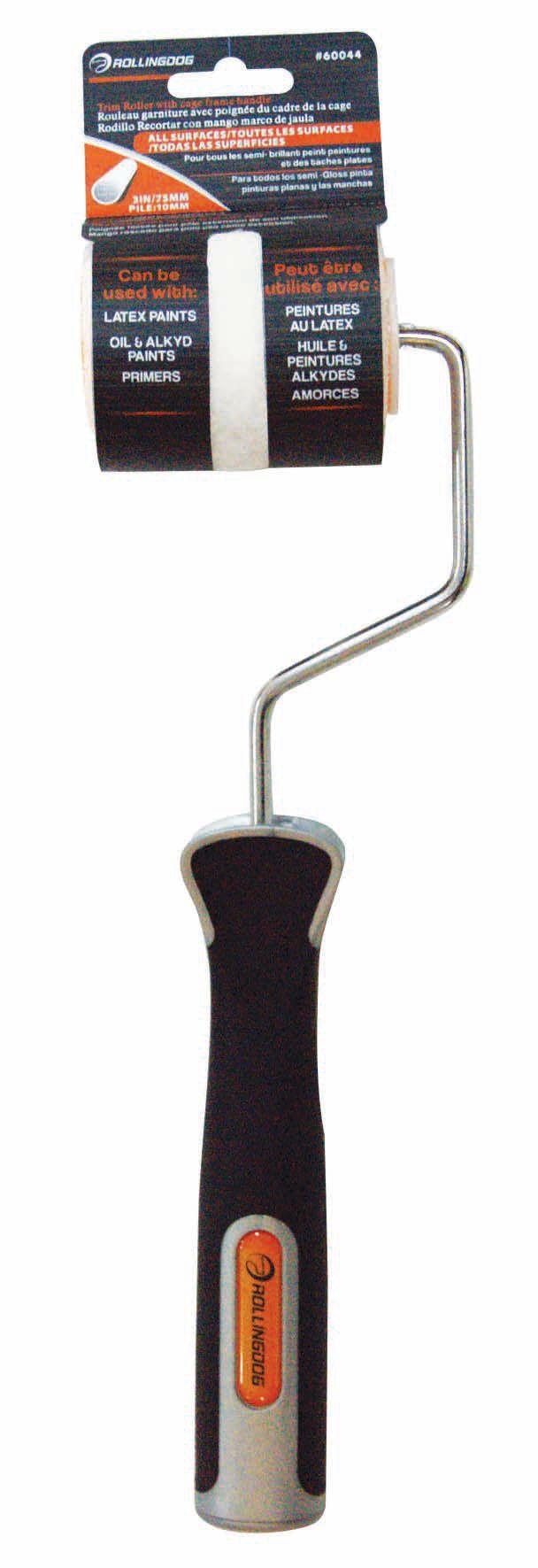
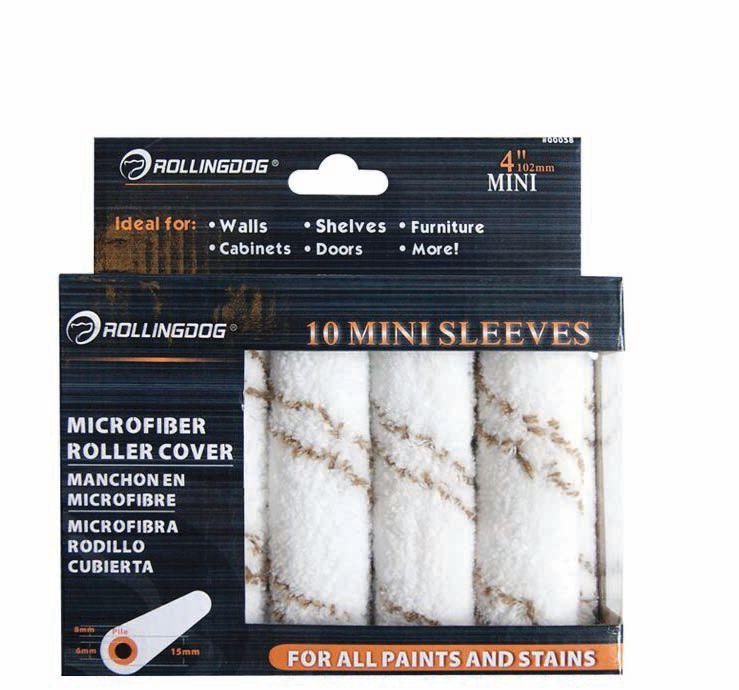
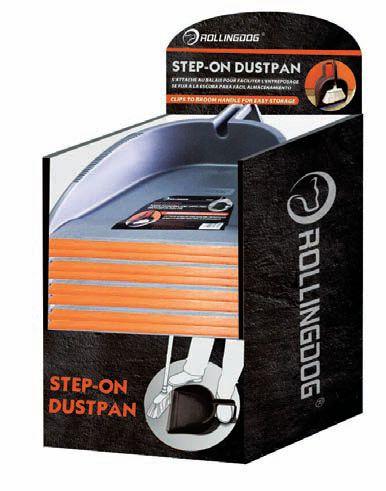
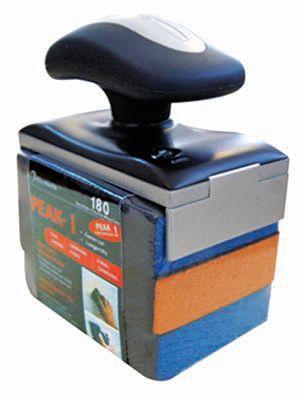
worked to make the tools more ergonomic for the hand and body. “We wanted to bring in products that would be appealing to women,” said Leonardi. “There are a lot more women in the industry.”
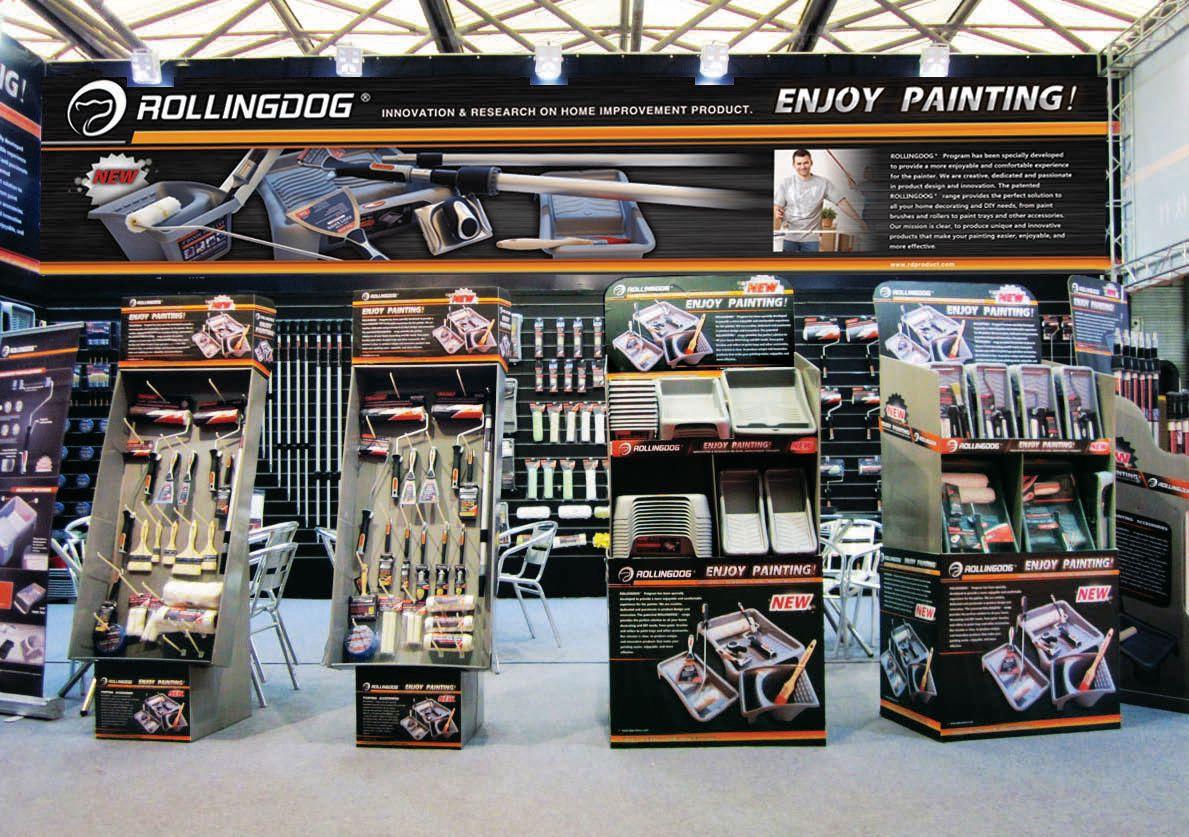
Today, Rollingdog features an entire line of painting sundries that includes brushes, rollers, trays, frames, patch and prep tools, abrasives, air and power tools, extension poles, painting pads and semiautomatic equipment. “We’ve grown the company into an innovative manufacturer,” said Leonardi. Those innovations include a strong focus on product development, design and packaging.
To determine which products to make, the company conducted a survey of painters worldwide, asking them what they wanted from their paint tools and sundries, said Leonardi. “We asked what they were looking for in the products and what they didn’t like, and we
passed that information along to the engineers,” he said. The company took basic tools—think a brush, tray or roller frame—and challenged the engineers to do something different and more innovative with each one.
“This is an ongoing project,” said Leonardi, adding that the company brought in everything it could: pads, buckets, automatic air tools—anything that revolves around the patch-and-prep domain. “We want to see how we can make professional and DIY users’ lives easier and better.”
With a full array of paint sundries available, Rollingdog is now working to spread the word about its products. “We made private-label products for a lot of distributors, and our main goal now is to basically make our label an everyday national brand,” said Leonardi. “We started pushing it out, and we’ve had a lot more success internationally.” In fact, Rollingdog now distributes its products in 27 countries around the globe.
Two years ago, Rollingdog made its first appearance at the National Hardware Show and attracted a lot of interest from major hardware stores in both the United States and Canada. The company is also using direct marketing, advertising in magazines like American Painting Contractor , attending more trade shows (including this year’s National Hardware Show) and having its sales teams hand out samples for testing, especially with independent paint and hardware dealers.
Leonardi said Rollingdog is looking forward to building more relationships with independent retailers throughout North America. “We are a very flexible company, and we are able to accommodate the small independent retailer,” he said. And, with Rollingdog warehouses in Chicago and Montreal, those independent retailers can get the products they need in short order.
To help retailers draw in more customers, Rollingdog improved the aesthetics of its products at the store level. This includes a number of point-of-purchase displays to help storeowners introduce the brand and its products. In addition, the company routinely creates informational handouts for retailers to share with their customers; the handouts provide an in-
depth look at the product, the innovation that went into it and how those innovations benefit the end user.
All of Rollingdog’s efforts are starting to show positive results. Going from the fourth quarter of 2016 into spring 2017, the company looks to have a lot more customers on board in the United
States and Canada, with many of those customers coming from the independent retailer segment. “We see a positive outlook for 2017,” said Leonardi. “A lot more people are getting to know the Rollingdog brand. We’re going to be the company that’s going to bring innovation to this industry that’s really been outdated.” •


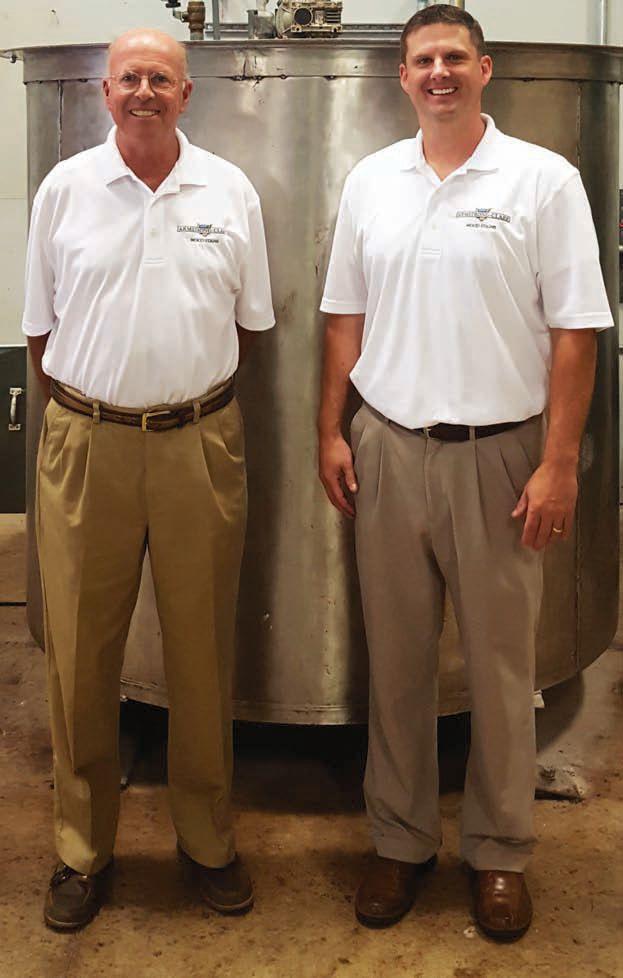
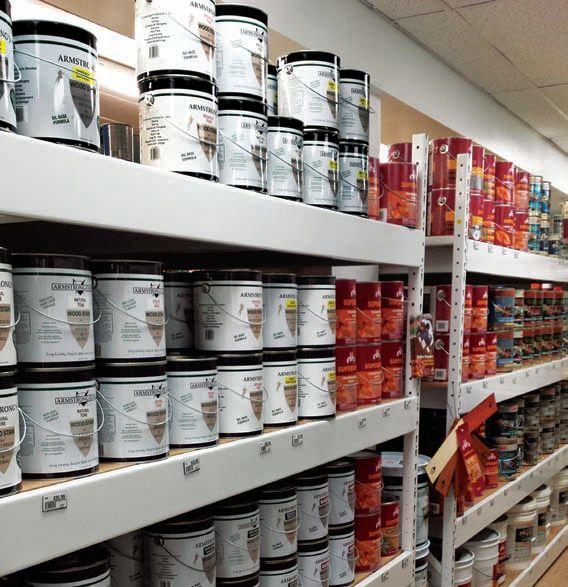
In 1989, when Jake Clark cofounded Armstrong-Clark Company of Sonora, California, with Jim Armstrong, Clark sought to develop an oil-based wood stain that wouldn’t dry out and was easy to apply and maintain. He succeeded, and the company now offers four key product lines: transparent colors, semitransparent colors, hardwood transparent colors and semisolid colors. Since those early years, Clark has seen a lot of change in the paint industry, including internal changes at the company and consolidation in the marketplace. The internal changes included a buyout by Clark of his partner. As the company moved forward, Clark also worked to expand the reach of Armstrong-Clark from a strong regional presence to a solid national player in the marketplace. “In recent years, our company has experienced significant growth year over year in part due to wood restoration professionals discovering our product,” said Clark. “Although many people still haven’t heard of us, we have become a nationally recognized brand.”
To help spread the word, ArmstrongClark is attending more trade shows and has updated its advertising. Plus, the company recently submitted an application for a drop-ship program with one of the hardware co-ops. These efforts are showing results. In fact, Brian Carter, vice president of Armstrong-Clark, said not a day goes by that he doesn’t receive phone calls from people wanting to try their stain. “If you gave me a map and a handful of darts and then blindfolded me, I could still throw the darts and hit a state I’ll receive a phone call from today on where to buy,” he said.
According to retailers, the reason for such interest in Armstrong-Clark’s pro-

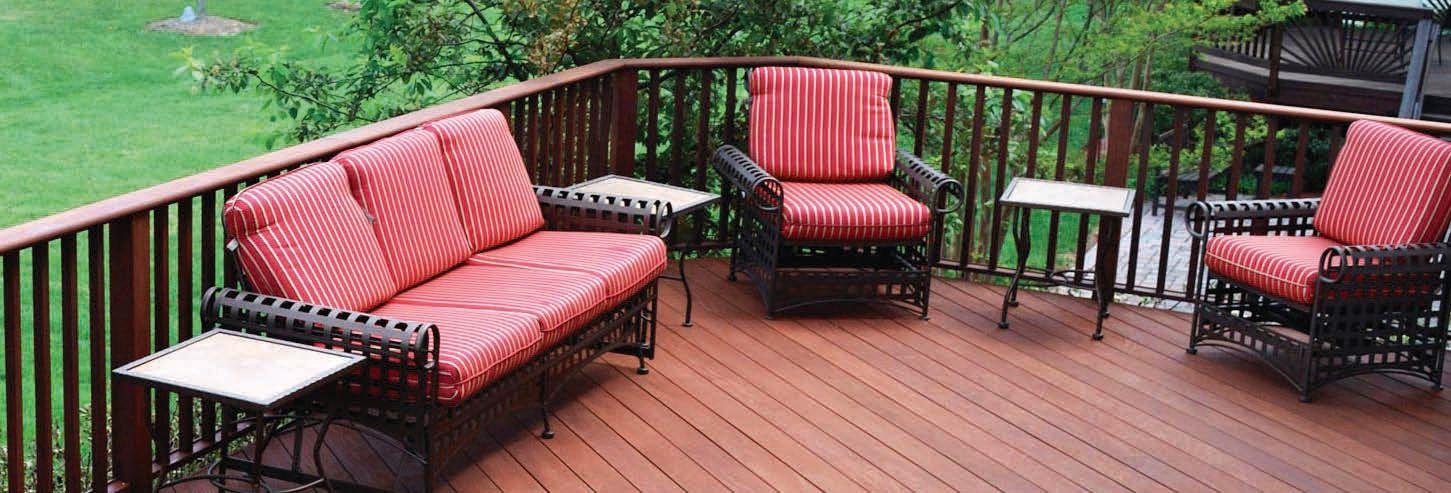



ducts is simple. “It’s an idiotproof product for customers,” said Bret L. Monroy, store manager for Rodda Paint, in Oregon City, Oregon. “You can apply it in direct heat or over-apply it and still get puddles off it.” Monroy speaks from personal experience. He stained his own deck with Armstrong-Clark stain, came back two days later and was still able to remove puddles from it.
This easy application process coupled with easy maintenance (no stripping is required to reapply—just wash and apply a new coat) is a big hit with customers, said Candice Perrotti, store manager at Sonora Lumber Company, in Sonora, California. She said her customers, an even split between homeowners and contractors, feel strongly about ArmstrongClark’s product longevity, application and maintenance. They like how easy the products are to use and how easy it is to
understand how the products work, she said.
In fact, retailers can provide free four-ounce samples to customers so they can experiment at home before making a purchase. “Even new employees at the dealer can get off the hook by handing a sample can to a customer so they can see how it really looks on their project,” said Clark. “That’s what the four-ounce sample can does for dealers.”
And when retailers or customers have questions, they will get answers firsthand from Clark or Carter. “I’m the owner of the company and I answer the phone,” said Clark. “Brian is number two. That’s not a fluke. We have the most experience in wood restoration questions. If you grow too quickly, that becomes more difficult. Customers are pleased to talk to the guys who run the show.”
And the guys who run the show have no plans to turn
that show over to anyone else. In fact, Clark said the prevalent consolidation in the marketplace has led to reformulated products that are cheaper and don’t perform well. “In our opinion, there have been two things driving reformulation,” said Clark. “One, big companies have stockholders who need to be kept happy, and they are kept happy with making more margin. Two, other companies have been unable to develop low-VOC formulas to keep up with current and anticipated government regulations and moving more toward waterborne formulas.”
As a result, Armstrong-Clark is benefitting from this movement. “Quality independent stain manufacturers have been gobbled up,” he said. “There are only a couple of us left. As the other independents get gobbled up by large companies, their brands end up in the big-box stores. Customers previously loyal to other brands are flowing to us every day.”
Going forward, Armstrong-Clark seeks to remain fiercely independent and is working with independent retailers to make that happen. “When you grow too fast, you lose contact with the customer,” said Carter. “It’s really important to us to give customers what they need.” •



This Texas company aims to use its recent acquisition by Nexeo Solutions to bring more private label paint products to retailers.


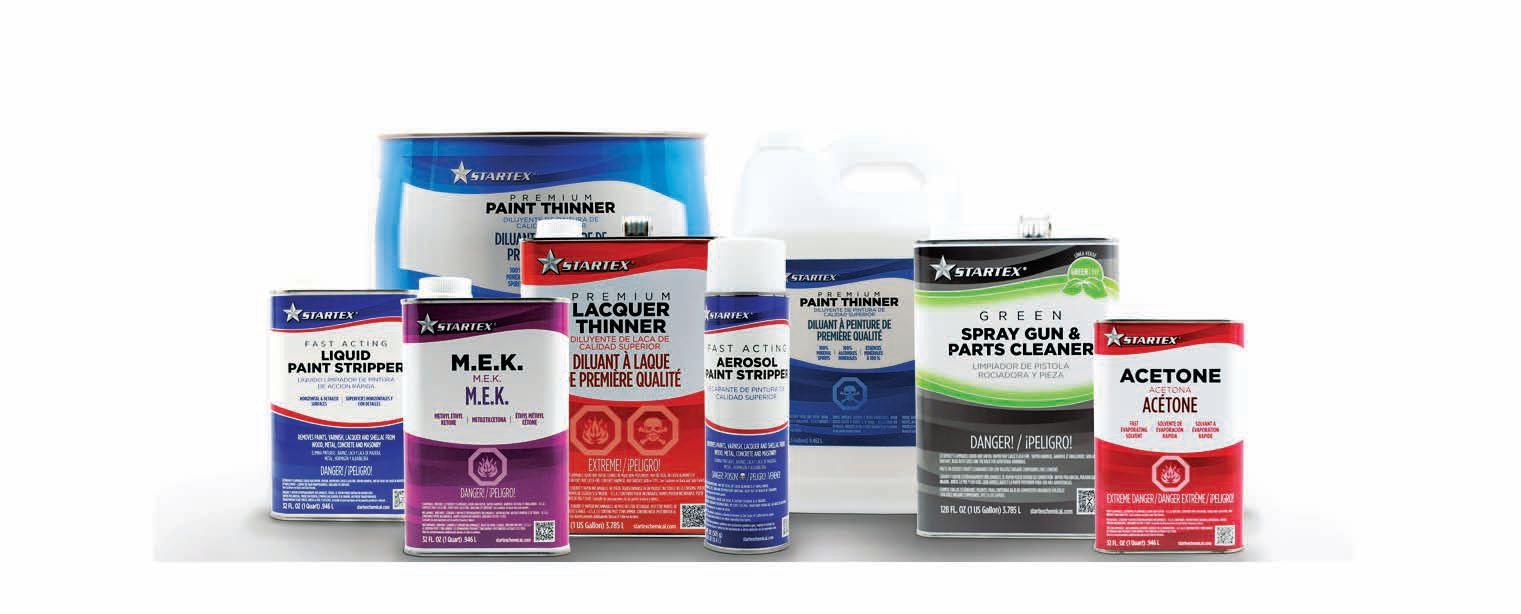
Since 1984, paint contractors and consumers across the nation have turned to a Texas-born brand to finish their projects better, faster and for less money. Three decades and one new owner later, the Startex team is primed to continue this Lone Star legacy of high-quality solvents, thinners, paint strippers and cleaners.

trucks and 13,000 products. Reciprocally, CSD offered a key advantage and growth driver missing at Nexeo Solutions: a trusted consumer brand and the ability to make private-label products as small as half an ounce.

The Startex story began as an initiative by Chemical Specialists and Development, Inc. (CSD) in the small town of Cut and Shoot, Texas. To serve local paint stores, CSD offered speedy delivery, a local sales team and the ability to make small batches of private-label product. That successful model enabled the business to expand to national retail chains and purchase a larger, more capable production facility a few miles west, in the city of Conroe, Texas.
As the years continued, the Startex label continued to increase in market share and CSD added production capabilities. This caught the attention of Nexeo Solutions, a large chemical distributor, whose corporate headquarters are just minutes south of Conroe. As talks of an acquisition began, both sides agreed on a common goal: Sustain the legacy of value and goodwill tied to the Startex brand.
To fulfill this goal, both organizations turned to their core competencies and foundational capabilities. As a global company, Nexeo Solutions provided CSD scale and reach with access to serve more than 27,000 customers with more than 100 North American facilities, 300 delivery
“We had a small team that had been selling the same products to the same customers for over a decade,” said Shawn Becker, corporate account manager for Startex. “Our business was dialed in, and we were frankly very nervous about what changes would come after being acquired by Nexeo Solutions.”
This situation was entirely new for Nexeo Solutions. Formerly known as Ashland Distribution Company and part of Ashland Inc., Nexeo Solutions began as an independent organization in 2011. Uniting teams and embracing change takes strategy, so Nexeo Solutions made a decision to build upon Startex’s existing business model.
“Startex did an amazing job servicing Gulf region customers with five salespeople and two-day deliveries out of Conroe,” said Mike Bliss, business director for Startex. “We wanted to provide the same experience to retailers across North America.”
Over time, the Startex team more than doubled its number of technical sellers, added two production facilities and started inventorying Startex products in Nexeo Solutions locations from Los Angeles to Atlanta, and from Edmonton to Toronto. But increasing scale was just the start.
“Our retailers are facing challenges from every direction, from the proliferation of big-box stores to
“Our retailers are facing challenges from every direction, from the proliferation of big-box stores to new VOC regulations. We had to do more to help them differentiate themselves and expand their profitability.”
new VOC regulations. We had to do more to help them differentiate themselves and expand their profitability,” said Bliss. The team engaged Nexeo Solutions’ research and development chemists to expand their product portfolio, starting with a new low-VOC line of products. “Thanks to Paul Lewis, Technical Manager, we now have
a full line of easy-to-choose, VOC-compliant solvents that lead the industry in high performance,” said Bliss. While working on new labels, Startex upgraded all of its labels to make them more consumer-friendly and available for international use in Canada. Doing so enabled Startex to better serve international retailers by providing access to products that could be sold anywhere in North America, helping to minimize inventory and simplify supply chains.

“We have added a full line of VOC-compliant products, paint strippers, adhesive removers, part cleaners, hand cleaners and towels, and graffiti removers since the acquisition,” said Becker. “Our team is even better positioned to continue growing with our channel partners and new private-label accounts.”

Today, Startex is piloting next-day case-quantity deliveries in Southern California, pushing innovative new products through their research and development pipeline and capitalizing on new media to create demand for their retail partners. Going forward, this once small-town Texas brand will now do more than ever to help their retailer partners be the preferred destination for contractors and consumers.