PART I OF 2-PART SERIES ON HARDWARE/LBM COMPANIES OVER 100 YEARS OLD
May/June 2019 Vol. 11, No. 4
THE INDUSTRY’S DIGITAL LEADER
CENTURY CLUB:
The INNOVATORS and SURVIVORS Who Helped Build America
CONTENTS May/June 2019 n Vol. 11, No. 4
26
CENTURY CLUB: THE INNOVATORS AND SURVIVORS WHO HELPED BUILD AMERICA— PART I
A TIMELINE OF HARDWARE MANUFACTURING INNOVATION
67
7 12 16 18 20 26 77 82 85 88 91 93 94 96
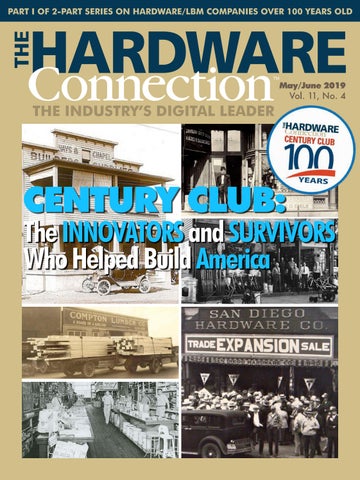
Featured on our cover (clockwise from upper left): Chapel Lumber, Elmira, N.Y.; Edele & Mertz Hardware, St. Louis, Mo.; Trevor True Value, Moline, Ill.; San Diego Hardware Company, San Diego, Calif.; Quinn Hardware (formerly JP Blunt & Son), Skowhegan, Maine; and Compton Lumber, Seattle, Wash.
DECADE
www.TheHardwareConnection.com
N
L
YEARS
IN
IO
Connection
TM
D I G I TA
Like us on Facebook by clicking here.
A
OF
Editor’s Note: Chris Jensen Trend Watch: Craig Cope Digby’s Hardware Cartoon: Scott Jensen Amazing But True Hardware Stories From Tom’s Shop: Hardware Products Review Century Club: The Innovators and Survivors Who Helped Build America—Part I National Hardware Show Product Spotlight Technology Update: Windows 7, Ransomware and Replacing Your POS System Category Report: Hardware & Fasteners The Hardware Conference Preview In the News Upcoming Events Retail Ideas Behind the Numbers
N O VA
T
THE HARDWARE Connection ■ May/June 2019 ■ 3
ADVERTISER’S INDEX Ace Hardware Corp. | www.myace.com . . . . . . . . . . . . . . . . . . . . . . . 4, 5 A.O. Smith-Reliance Water Heaters | www.RelianceWaterHeaters.com .22, 33 Do it Best Corp. | www.independentsdoitbest.com . . . . . . . . . . . . 30, 31 ECi Software Solutions | www.ECiSolutions.com . . . . . . . . . . . . . . . . . 17 Epicor Software Corp. | www.epicor.com . . . . . . . . . . . . . . . . . . . . . . . 21 Ganymede Technologies Corp./J3 Point-of-Sale | www.j3pos.biz . . 25 House-Hasson Hardware | www.househasson.com . . . . . . . . . . . . . . 39 Hyde Tools | www.hydetools.com . . . . . . . . . . . . . . . . . . . . . . . . . . . . . . 15 Kaba Ilco | www.ilco.us . . . . . . . . . . . . . . . . . . . . . . . . . . . . . . . . . . . . . . . 19 Orgill Inc. | www.orgill.com . . . . . . . . . . . . . . . . . . . . . . . . . . . . . . 2, 28, 41 Spartan Power | www.spartanpower.com . . . . . . . . . . . . . . . . . . . . . . 24 STIHL | www.stihlusa.com . . . . . . . . . . . . . . . . . . . . . . . . . . . . . . . . . . . . . 13 Sunnyside Corporation | www.sunnysidecorp.com . . . . . . . . . . . . . . . 10 WD-40 Company | www.wd40.com . . . . . . . . . . . . . . . . . . . . . . . . . . 8, 23 Wooster Brush Company | www.woosterbrush.com . . . . . . 11, 36, 37
Connection
TM
91900 Overseas Highway | Tavernier, FL 33070 | www.TheHardwareConnection.com Publisher/Principal: Craig Cope craig@thehardwareconnection.com 804-690-0666 Editor/Founder/Principal: Chris Jensen chris@thehardwareconnection.com 317-514-8864 Founder/Principal: Tom Chasteen tom@thehardwareconnection.com 305-852-6126 Marketing & Creative Director/Principal: Dan Akers dan@thehardwareconnection.com 317-797-6609
6 ■ THE HARDWARE Connection ■ May/June 2019
Senior Business Advisor: John Hammond jhammond@thehardwareconnection.com National Account Manager: Dan Beck dbeck@thehardwareconnection.com 518-852-9624 Contributing Writers: Andy Curry, Doug Donaldson, Gary Pittsford The Hardware Connection is published eight times a year by The Hardware Connection, Inc. All editorial contents copyrighted 2019 by the publisher. No editorial may be reproduced without the prior permission of the publisher.
EDITOR’S NOTE
By Chris Jensen
Celebrating the Resilience of American Hardware Entrepreneurs
W
e marvel at tech start-ups that become overnight success stories with billion-dollar market caps, but then watch as they crash and burn in a few short years. Is there a more impressive accomplishment than starting a business that is able to sustain itself for more than 100 years? In this issue of The Hardware Connection, we are proud to be publishing the first of a two-part series on the Century Club: The Innovators and Survivors Who Helped Build America. Part II will come out in our July-August issue. We will be highlighting the accomplishments of retailers, wholesalers and manufacturers over 100 years old, with complete listings on our website (click here). You can look at the Century Club retailers listed by state on our map or scroll down the entire list. What’s really neat is to click on the store histories or click through the gallery of old photos we have for many of these Century Club retailers. You can learn about immigrant entrepreneurs who came to America short on cash but willing to work
hard to meet the changing needs of a community. When these novice merchants ran into an obstacle, they couldn’t just google a solution. The Century Club includes retail businesses that rebuilt after multiple fires or that hung on when all their employees and customers went off to war, which shows what American ingenuity and resilience are all about. This Century Club series is the culmination of two years of diligent work, although I have to admit I have been collecting a file on old hardware stores for nearly 15 years. That either means I’m a procrastinator for taking so long to give these stores their much-deserved recognition, or I’m a masochist for overwhelming myself with so much information. I think it’s both. I was able to identify 516 hardware stores and LBM stores that have been in business for at least a century. That is a lot more than I thought I would find, which I take as a positive sign. For some of these retailers the founding dates are approximate, as not everyone kept good records in the 19th century or passed them THE HARDWARE Connection ■ May/June 2019 ■ 7
Click Here to View Our Profile
EDITOR’S NOTE along. Many are run by the fourth, fifth or sixth generation of the same family, and the oldest store is now up to the ninth generation—Cowls Building Supply, you can take a bow. Only 30 percent of businesses make it to the second generation and just 12 percent to the third generation. I’m surprised the success rate into the fourth generation is as high as it is—3 percent. It’s safe to say that the ninth generation doesn’t compute in any actuarial tables for business succession. Consider how many times someone bought something in a hardware store over the past 100 years and then look around at every old home or building in your area and think of all the products needed to keep those structures functional over the span of their existence. That’s a lot of trips to the hardware store. General stores popped up as the western frontier opened up and settlers and homesteaders needed a wide variety of goods. General stores fell out of favor as the 20th century progressed, but now those hardware retailers that have survived the purge of Main Street by Walmart and Amazon find themselves having to operate like an old-fashioned general store again, selling everything needed to keep people shopping local.
On a sad note, we just learned that Jebens Hardware in Blue Island, Ill., will be closing soon, with a liquidation sale lasting until July. It has been in business for 143 years, but the owners couldn’t find a buyer. Jebens Hardware is listed in our Century Club—it earned that honor— and let’s hope a last-minute savior will emerge. Several Century Club retailers were saved at the last minute after announcing they were closing including Ocean Beach Paint and Hardware in San Diego and Newtown Hardware House (which is profiled in this issue). The industry’s biggest loss was when Elwood Adams Hardware in Worcester, Mass., closed in 2017 after being in business for 235 years. It was founded in 1782—six years before the U.S. Constitution was ratified. That’s an incredible run, but I kept hoping someone would step in and save the business. The industry and that community suffer when such a legacy ends. I was able to identify 43 centuryold hardware/LBM stores that have closed in the last decade, but I also know of 42 retailers who will hit the century mark in the next few years. We will keep adding them to the Century Club website Then there are stores like Harrison Brothers Hardware in Huntsville, Ala., which dates back to 1897 and THE HARDWARE Connection ■ May/June 2019 ■ 9
EDITOR’S NOTE retains its original appearance down to the 1907 cash register that still rings up purchases. It is operated by the Historic Huntsville Foundation to preserve the old way of life and as a history lesson to those willing to put their phones down long enough to experience a long-gone era.
10 ■ THE HARDWARE Connection ■ May/June 2019
Independent grocers, book stores, shoe stores and drug stores have largely become extinct, but old-fashioned hardware stores and familyrun lumberyards can still be found in small towns and big cities across America. They still have what people need, with personalized service that cannot be found in the big boxes or buying from Amazon. Turn to page 26 to start reading about some incredible Century Club retailers, then keep reading to learn about century-old wholesalers and finally, on page 67 you will find an extensive timeline of product innovations from Century Club manufacturers. After all, retailers only survived for more than a century because they had unique products to offer to their customers. Contact me at chris@thehardwareconnection.com to tell me what you think about this Century Club project or to tell me about companies that should be added. And to all the Century Club members out there—we salute you for your remarkable achievement of longevity! n
www.TheHardwareConnection.com
Click Here to View Our Profile
TREND WATCH
By Craig Cope
Century Club Companies Have Survived and Thrived in the Face of Adversity
R
ecency bias is a cognitive error that refers to our tendency to overemphasize more recent events or information. During the “Great Recession” in the late 2000s, it was a common occurrence to hear comments declaring this was the worst time in the history of our economy. Obviously, anyone who experienced the Great Depression during the 1930s would strongly disagree. We all experience recency bias at points in our lives. You could argue we are experiencing one right now in retail. It seems we cannot go a week without hearing about a large retailer closing locations, as online retailers continue to capture market share. The media has coined the phrase “retail apocalypse” to describe the store closings. Anyone reading the headlines is led to believe this is the worst time in history to own brick and mortar stores. Our senior business advisor, John Hammond, often provides his opinion, shaped by over 45 years in the hardware channel, which helps put everything into perspective. He reflects on the new businesses over the years
that were going to put an end to the independent hardware retailers. Here are just a few: retail catalogs, catalog showrooms, discount mass merchants, big-box warehouse stores and now Amazon. Paraphrasing Mark Twain, the death of the independent hardware retailers has been greatly exaggerated. As we celebrate and salute companies more than 100 years old in our next two issues, take a minute to reflect on all the adversity, disruption and opportunities these companies have faced—and they are still going strong today. I have compiled my own list of just a few significant events these companies successfully navigated. 1. World War I and World War II— Imagine what business operations were like during a time of global war. Two key areas often overlooked during these periods are significant labor shortages as efforts were focused on the war and the availability of raw goods sourced from other countries. 2. The Great Depression—Lasting approximately 10 years, it was the most widespread economic depression of the 20th century. Business owners often
12 ■ THE HARDWARE Connection ■ May/June 2019
www.TheHardwareConnection.com
Click Here to View Our Profile
TREND WATCH tell stories of how they survived during some short-term market decline. Surviving a decade under those incredible and historic times is truly amazing. 3. Nuclear Age and Cold War— Closely linked, both events introduced a level of uncertainty to the everyday lives of Americans. 4. The Information Age—This important era of technology innovation brought the personal computer to businesses and homes alike. Computers became and remain a pillar of modern business, and most hardware and LBM stores now wonder how they did without one for so many years. Without the rapid adoption of digital technology our magazine would not have been founded and celebrating 10 years of digital publishing success this year.
5. E-commerce—While the impact on business is still unfolding and being defined daily, the initial startup phase led us to believe everything would be eventually purchased online. That is until all these new tech start-ups discovered businesses must be profitable to survive. I hope you enjoy our special two-part series celebrating the Century Club: The Innovators and Survivors Who Helped Build America. Once you are done absorbing all the information in this issue, please visit our special Century Club website for a listing of the retailers, wholesalers and manufacturers who have achieved this significant milestone. The site also contains a treasure trove of old pictures and hyperlinks to learn more about these remarkable companies. n Left: Today, D.E. Turner Hardware in Mooresville, N.C., looks much as it did when it opened in 1899, still in the same historic building with antique fixtures. Below: Northville Lumber was founded in Northville, Mich., in 1827, 34 years before the Civil War started. It is billed as the oldest business in Michigan. This photo depicts the store in 1918, its first year in a new location, where it still operates.
14 ■ THE HARDWARE Connection ■ May/June 2019
www.TheHardwareConnection.com
Click Here to View Our Profile
HARDWARE HUMOR
16 ■ THE HARDWARE Connection ■ May/June 2019
www.TheHardwareConnection.com
HARDWARE HUMOR
W
e have customers who complain that they wanted a 16” x 20” air filter but we sold them a 20” x 16” air filter. Then there are the people who say I got these shelf brackets that go on the right side of the wall, but I need them to go on the left side. Matt Fabian Turner, Pierce & Fultz Ace Hardware Navasota, Texas
M
ore than a couple of times we have sold a bolt cutter to a customer who walked across the tracks to the train station and cut the chain off a bike and stole the bike. That’s why we no longer take returns on bolt cutters. The thief generally tries to return the bolt cutter on the way out. Alan Talman Karp’s Hardware East Northport, N.Y..
Amazing but TRUE
HARDWARE
STORIES
O
nce had a man come into my store dressed in nothing bu t a bathing suit and sneakers. He was cove red with sweat and out of breath. He said he had just removed ha lf the shingles from his roof and noticed a thun derstorm fast approachin g. He needed a big tarp fast and had no wallet, no money and no credit cards, but promised to return and pay after he got hi s roof covered. He was particularly concerned that “my wife will kill me if all her living room furn iture gets wet.” I eyed him up and down and said, “Man, you couldn’t m ake up a story like that .” I gave him our bigges t tarp. That afternoon, he returned and paid for the tarp and profusely thanked me for taking his word. We did have a thunderstorm and it di d keep his house dry. Over the next few years he often repeated his than ks. Dick Beal Retired retailer Merritt Island, Fla.
ght an adult u o b y d la a e m recall the ti the top of her to it d e p p a tr s tricycle and working at a s a w y b b u h e h icminivan. T of no DUI conv y c li o p t ic tr s a le refinery with his work vehic e m a c e b le c y tions. The tric nd the plant. u ro a ls o to l u a so he could h Steve Beeson ty & True Value Beemun’s Varie a Soldotna, Alask
I
* All of these stories were originally posted on Hardlines Digest. 18 ■ THE HARDWARE Connection ■ May/June 2019
www.TheHardwareConnection.com
SPONSOR
Click Here to View Our Profile
From
p o h S s Tom’ W
TS REVIE E PRODUC
HARDWAR
T
By Tom Chasteen
his is the time of the year when manufacturers begin releasing and marketing their new products for the year. A new product launch is a complicated process that revolves around three basic tasks. The first step is to come up with an idea, followed by preliminary designs and several prototypes. This is usually followed by committee meetings to discuss how the company might improve or modify the prototype, not just from a functionality perspective but also from a production standpoint. Then the manufacturer will begin investing in production dies and molds, which is an expensive stage and sometimes takes a lot of time to ensure the production of the product will run smoothly. While the production team is refining how they will make the product another team is working on the marketing of the new product, which includes package design, securing a unique barcode, packaging molds, photos of the product to be used in both marketing and packaging of the product, and then what text will be printed on the label such as directions on how to use the product and any necessary
warnings. Finally, the legal team has to review and approve the verbiage. The third process is operations, which coordinates the production of the product and works out distribution logistics as well as final costs to make the product as well as the various pricing levels (wholesale, industrial, retailer, consumer and online) in addition to supplying distribution support data such as sales forecasts and initial inventory levels. If the vendor is outsourcing the manufacturing to another country, then they must take into account raw material cost increases, tariffs and monetary exchange rates that could affect the projected profitability of the new product. This is a simplistic explanation of what it takes to bring a new product to market and I’m sure I have probably missed key factors such as specific products that are freight intensive or require hazmat classification. Like most retailers, it did not occur to me how involved the new product process could be, which explains why companies are so protective of their intellectual property and patents in the United States.
20 ■ THE HARDWARE Connection ■ May/June 2019
www.TheHardwareConnection.com
PRODUCT #1: CRESCENT/LUFKIN® SHOCKFORCE™ Lufkin®, which is now part of the Crescent family of Apex Tool Group brands, has come out with a completely new line of measuring tapes called the ShockForce™. They truly are the next generation of measuring tapes. ShockForce™ tapes come in three sizes: 16 feet, 25 feet and 35 feet, featuring the traditional yellow and black lettering blades or a high-visibility black blade with no-glare fluorescent green lettering. The ShockForce™ measuring tapes also have measurements on both sides of the blade with large easy-to-read numbers and a large textured end hook on the measuring blade that all but eliminates the blade slipping off one end of what
p o h S m’s
From
To
WARE
HARD
IEW
S REV
UCT PROD
you are trying to measure. However, the big advantage is the blade will extend out a full 14 feet without breaking. Just try that with any other tape. Lufkin subjected these tapes to a 100-foot drop test. Our testers dropped the 16-foot tapes from 30 feet multiple times with no damage other than a few scratches. In addition, the ShockForce™ tapes have a metal guard protecting the locking button and all of the ShockForce™ tapes carry a lifetime warranty. Lufkin has made these tapes compact so they fit comfortably in the palm of your hand and fit easily in a carpenter’s leather tool belt. You would think it would be impossible to improve upon the regular measuring tape design, but all of our testers agreed that Lufkin has done just that with the ShockForce™ line of measuring tapes. Check out the video.
Click Here to View Our Profile
p o h S m’s
From
To
WARE
HARD
IEW
S REV
UCT PROD
PRODUCT #2: HYDE TOOLS BETTER FINISH™ CAULK REPAIR
Hyde Tools, a Century Club manufacturer, keeps coming up with innovative ideas that fit nicely into independent retailers’ paint departments. Hyde has just come out with its Better Finish™ 2.8 oz. Caulk Repair. It features an integrated application tip that is resealable and can be used both interior and exterior in one simple to use and resealable tube that will stay fresh up to three years.
The caulking is a siliconized acrylic caulk that can be painted over in just 20 minutes. It is water and mildew resistant, has a 50-year durability rating and cleans up with water. Hyde’s new reusable Better Finish line of 2.8-ounce caulking tubes are perfect for those small jobs around the home, even for a novice DIYer. Our testers gave Hyde’s Better Finish Caulk Repair five stars for its convenience and ease of use. Check out the video.
PRODUCT #3: MAYHEW TOOLS 13-IN-1 LED MULTI TOOL Mayhew Tools has just released a new 13-in-1 Multi Tool that is completely different than other multi tools on the market. It comes with 13 multi-functional tools along with an innovative design that allows the blade set of tools to be removed from the multi tool and used like a conventional pocket knife. It also comes with a rechargeable LED light that will last up to 1.5 hours of continual use and a USB port to charge the LED light. All of our testers commented on how naturally and comfortably the Mayhew multi tool fit in the palm of their hands. It was also easy to apply full pressure in the pliers. Stop by the
Mayhew booth at the next show and hold the multi tool in your hand and you will see why our testers liked it. Check out the video.
CENTURY CLUB:
Edele & Mertz Hardware was founded in St. Louis in 1912 and is now run by the fourth generation of the Edele family.
The Innovators and Survivors Who Helped Build America Part I
H
By Chris Jensen and Doug Donaldson
ardware stores are like a sanctuary for a community, a place to connect, catch up with neighbors, discuss current events and of course, buy the items needed to repair and maintain the biggest investment most people will ever have—their home. Lumberyards are also integral to the foundation of any town, as they carry lumber and building products essential to build and improve structures that give people shelter. Hardware stores and lumberyards, and before them the general store— are the cohesive fabric that has kept American communities growing and thriving since the frontier days. These merchants sold the essential items of
10 Oldest U.S. Hardware Stores
26 ■ THE HARDWARE Connection ■ May/June 2019
www.TheHardwareConnection.com
1. Foster Farrar Company—1796 2. S.L. Wadsworth & Son—1818 3. Farmers Hardware—1836 4. Booker Hardware—1837 5. Hartke Hardware—1839 6. Clarks Ace Hardware—1845 6. Morris Hardware—1845 8. Trilling True Value Hardware—1850 9. Pensacola Hardware—1851 10. Placerville Hardware—1852
CENTURY CLUB: PART I the day with a personal touch, evolving with the times and passing on their businesses to the next generation of the family. When you walk into a hardware store these days and spot a wooden floor, rolling ladder, tin ceiling and nail bins, the nostalgic feeling makes you harken back to a simpler time, when even small towns had three hardware stores on Main Street, with a lumberyard and sawmill positioned on the outskirts of town. There was no need to travel to another town to get what you needed. Tools were built to last, every store front had multiple window displays and kids knew where to find the glass candy jar of Atomic Fireballs. Retail stores and businesses come and go, but the survivors—those able to outlast wars, recessions, housing slumps, fires, floods, encroaching competition and bad business decisions— are the innovators, those able to adapt and change with the times. These retail pioneers learned to zig when everyone else zagged. More important, each generation of the family found a way to convince the next generation it was their duty and responsibility to continue serving the community, or they found a friend or neighbor who could carry on the tradition. They didn’t quit when times got tough, they worked harder and smarter. The ever-evolving tools, hardware, paint, gadgets and building materials www.TheHardwareConnection.com
stocked in hardware and LBM stores are the essential fabric that weaves through America, as surely as the Mississippi River cuts through the Delta Basin and the Colorado River cuts through the Grand Canyon. It is a tribute to American ingenuity and resilience that so many Century Club retailers remain in business today—516 and counting! Read on to learn the stories of the Century Club innovators and survivors who helped build America, and see if you can discover some secrets or nuggets of wisdom that can put your retail business on the path to become a Century Club member.
10 Oldest U.S. LBM Stores 1. Cowls Building Supply—1741 2. Bethel Mills—1781 3. Tinsman Brothers—1785 4. Wilkins Lumber—1808 5. Smoot Lumber—1822 6. Northville Lumber—1827 7. E.R. Hinman & Sons—1830 8. F.D. Sterritt Lumber—1841 9. S.W. Collins Company—1844 10. Scholl Lumber—1845 THE HARDWARE Connection ■ May/June 2019 ■ 27
Check Out All the Century Club Members The Hardware Connection has identified 516 hardware and LBM stores, 175 manufacturers and 11 wholesalers that were founded in the United States of America and remain in business after 100 or more years. While we cannot profile them all in this special two-part series, we can list them all in the special Century Club section of our website. You will find all the Century Club hardware and LBM stores listed by state in the U.S. map. For many of these retailers, you can click on the camera icon beside their name and see a gallery of old store photos. If the store name is underlined, you can click on that hyperlink to read more about the store’s history. To add store photos, update your information or if we are missing any Century Club companies, contact Editor Chris Jensen at chris@thehardwareconnection.com. To visit the Century Club website, click here.
OLDEST LBM STORE IN AMERICA: COWLS BUILDING SUPPLY About 6 a.m. every morning, Evan Jones, president of Cowls Building Supply, drives to work through the Paul C. Jones Working Forest, a living, growing reminder of his family’s history as the oldest home improvement retailer in the United States. Evan’s father and forest namesake opened Cowls Building Supply in 1980. However, the company’s history as a lumber retailer extends back 278 years to 1741—35 years before 13 states signed the United States Declaration of Independence to form a new country. It was in 1741 that company founder Jonathan Cowls was among the first five families to settle the area that is now North Amherst, Mass. Now, the ninth generation of Cowls descendants manages the company, www.TheHardwareConnection.com
Evan Jones is president of Cowls Building Supply, which is the oldest LBM store in America, dating back to 1741.
THE HARDWARE Connection ■ May/June 2019 ■ 29
CENTURY CLUB: PART I by the Cowls family helped build the Amherst-Sunderland Street Railway in the late 1800s. Throughout its history, Cowls Building Supply has wholeheartedly embraced change and technology. For example, when the store opened in 1980, it was the first home center to start business fully computerized, tracking inventory and customers electronically. W.D. Cowls & Co. invoice from 1892. The company’s innovation has also helped boost the bottom line. In which is the 15th oldest family-owned 2014, Cowls installed 400 solar panbusiness in the United States. Cinda els, which produced enough electricJones, Evan’s sister, is president of W.D. Cowls Inc., a real estate, alternative ener- ity to power the 6,000-square-foot sales floor and two 10,000-squaregy and forest management company. foot lumber warehouses. Evan oversees Cowls Building Supply. Evan stays attuned to market “Our work ethic has been passed changes and adjusts his product down from generation to generation,” lines. For example, after big-box Evan says. “We’re basically a farming retailers moved into the area about family that comes to work every day. My dad worked six days a week and on 15 years ago, he thinned the plumbing and electrical departments and Saturdays, he’d bring me to work with expanded other areas, adding a winhim since I was five years old.” dow and kitchen showroom. Cinda and Evan take pride in buildCowls Building Supply stays ahead of ing on past generations of legacy while the competition by catering to contracredefining the business for today. The tors, who compose about 75 percent of siblings live by a longtime family slogan: Respect the past, but don’t live in it. the store’s customer base. For contractors, the store offers drive-through lumOver the course of nearly three cenber racks and a delivery fleet with boom turies in business, Cowls acquired timtrucks and demountable forklifts. berlands throughout Hampshire and While the company embraces Franklin counties (they are the largest change, it maintains a conservative private landowner in Massachusetts), sold lumber and continually expanded philosophy about financing, avoiding becoming overextended. When in new directions, including tobacit does expand in a new area of busico, onion and dairy farming; and of ness, it takes the steps slow and steady, course, sawmilling. Lumber milled 32 ■ THE HARDWARE Connection ■ May/June 2019
www.TheHardwareConnection.com
CENTURY CLUB: PART I according to Evan. This approach maintains the company’s stability, he says. Cowls made history around 1940 when the family firm opened what is believed to be the country’s first electric sawmill, but in recent years family leaders faced a crucial decision about the sawmill. While the mill represented a family tradition, the changing lumber market and related expenses led the family to close the sawmill in 2010. However, the mill closing made way for another opportunity for the business to expand and serve the community. Through W.D. Cowls Inc., the family has used the sawmill site to develop real estate, creating North Square @ The Mill District, a town center that includes apartments and retail spaces. “It’s an honor knowing that there are nine generations behind you who have been doing this,” Evan says. “It’s a great joy to run the business and keep 30-plus families employed and to keep this legacy going for future generations.” There may be a 10th generation on the way, too. Evan has three young children who also ride through the forest named after their grandfather.
Foster Farrar delivery truck from 1911.
change of location and new telephone numbers. The current co-owners, Karel Rescia and Paul Czapienski, credit the store’s longevity to staying closely attuned to customer needs and adding new niches. In 1796, Samuel Clark Jr. opened the original business on Main Street in Northampton to supply building materials to local carpenters and contractors. After a change in ownership, the store
OLDEST HARDWARE STORE IN AMERICA: FOSTER FARRAR COMPANY The first telephone number for Foster Farrar Company in Northampton, Mass., was 11. Yes, only two digits. The family-owned business has thrived through decades of changes, including a 34 ■ THE HARDWARE Connection ■ May/June 2019
Paul Czapienski and Karel Rescia are co-owners of Foster Farrar True Value, America’s oldest hardware store, which dates back to 1796.
www.TheHardwareConnection.com
was renamed Foster Farrar Company in 1914 and has had only six owners during the past century. The store has been with True Value since the 1960s. During its first 70 years as Foster Farrar, the business operated at its bustling Main Street location. However, as the customer base and community grew, the store needed to adapt and change. A pivotal time in the company’s history was 1989, when the retailer decided to move from its longtime location to 145 King Street. The move meant leaving a building full of store history for a site that offered much more parking and space to expand. The risk paid off. Contractors found it easier to pop in and out of the store, so the move strengthened that portion of their business. Now, the store’s customer base is evenly split between do-it-yourselfers and contractors. The current owners, Rescia and Czapienski, represent the store’s dichotomy of tradition and embracing new directions. Rescia’s father, Richard, bought the store in the 1960s, and in 2001, she became coowner. Czapienski bought into the business in 1996 after working at another hardware store. To survive economic ups and downs, Rescia says the store would tighten its belt, but has never laid off any staff. Currently, the store has 17 employees and many have been with the company for a decade or more. www.TheHardwareConnection.com
The store is well known in the community of about 28,000 people just north of Springfield, Mass. Often donating materials to schools, the store also provides products for local non-profit organization raffles. Rescia and Czapienski pride themselves on being attuned to their local market and responding by shifting the store’s inventory and service offerings to match customers’ needs. For example, in 2003, the store began selling a large selection of locks. In a college town with a slew of rental properties, the niche was a natural. Now, within the 10,000-square-footstore there is a locksmith shop with two full-time employees dedicated to only the lock business. Foster Farrar provides sales, service and installation of locks including electronic locks and proximity key fobs for cars. The store has two vans that can provide mobile locksmith services. Other service-oriented niches the store has developed over the years includes screen repair, lamp repair and small appliance repair. To match the needs of the community, the store also stocks art supplies. Czapienski says the store’s success comes from finetuning its assortment. Foster and Farrar once stocked large appliances such as stoves, washers and dryers, but these product lines weren’t worth the space or margins once big-box stores started opening in the area. Now, the store
THE HARDWARE Connection ■ May/June 2019 ■ 35
CENTURY CLUB: PART I works to solidify its position as a convenience hardware store. “It’s really rewarding to have someone walk out of the door with a smile on their face,” says Rescia, who began working in the store when she was 16. “It’s challenging and exciting, because we help people with problem solving and it’s always different.”
SERVING ALL THE NEEDS OF THE COMMUNITY: WANKEL’S HARDWARE In New York City, decade after decade, businesses come and go, buildings rise and fall and rise again. However, Wankel’s Hardware has remained a steady presence in its Upper East Side community for 123 years.
Sean McMorrow is fifth-generation family member operating Wankel’s Do it Best Hardware in New York City, which was founded in 1896.
In 1896, second-generation GermanAmericans Bernhart and Elizabeth Wankel (who are related to Felix Wankel, the inventor of the rotary engine) purchased a building on Third Avenue between 88th and 89th streets to open a hardware store. At the time, the predominantly German area was home to several breweries, and the Wankels’ best-selling item was a simple wooden bucket used to carry beer. The store has remained in the same building since its founding and is now owned and managed by the fourth and fifth generations of the Wankel family. The current owner and president is Katherine Wankel, the great-granddaughter of the founders. Managing the day-to-day operations of the store is Katherine’s nephew, Sean McMorrow, the company’s vice president. McMorrow says he is reminded of the store’s history every time he steps on the basement staircase,
Wankel’s Hardware has been in the same location for 123 years, but the Third Avenue El (elevated railway) no longer goes right by the store in the Upper East Side of Manhattan.
38 ■ THE HARDWARE Connection ■ May/June 2019
www.TheHardwareConnection.com
CENTURY CLUB: PART I which is one of the store’s few architectural features to remain the same during the past century. “Every time I pass by that exact wall my ancestors touched for 123 years, it really strikes me and I feel closer to them,” he says. Over the decades, the store has weathered financial roller coasters during recessions and even had to contend with Mafia influence during its history. While the store has been a steadfast presence in the Upper East Side, it also reflects the changes in the community. In the 1990s, Wankel’s had a number of industrial and commercial accounts, but the neighborhood has since changed to become more residential with new apartment buildings dotting the skyline. Now, about 80 percent of the Do it Best store’s business comes from consumers. Wankel’s assortment is carefully selected to make the 2,500 square feet of retail space as productive as possible. McMorrow is careful not to overbuy and evaluates and adjusts inventory quickly. For example, the store recently decreased hand tool offerings and thinned fasteners while expanding the container, storage and organizing options. Light bulbs and cleaning products are strong niches for the store, with most customers within walking distance. Looking forward, McMorrow has been examining ways to boost the
store’s online sales. He is in the process of implementing Pointy, a Google-affiliated service that allows customers to search the store’s instock inventory on their smartphone. Along with reflecting the changing times, the store also mirrors the community through its employees. Founded by families of immigrants, Wankel’s Hardware has always hired refugees and immigrants from across the world. On a wall in the store is a world map dotted with pins that indicate employees’ original country. With employees hailing from dozens of countries, it is a rarity to place a new pin, according to McMorrow. Currently, the store employs 12 and provides training not only in the hardware business, but also helping the immigrant employees become better acclimated to their new home. Many employees are hired through the United Nations International Rescue Committee. One former employee, Van Tran from Vietnam, worked in the store from 1998 to 2004 and is now a professor of sociology at Columbia University.
40 ■ THE HARDWARE Connection ■ May/June 2019
www.TheHardwareConnection.com
CENTURY CLUB: PART I Wankel’s also hires physically or mentally challenged individuals along with those formerly homeless or incarcerated. Such compassion reflects a long-held company philosophy to serve the community in whatever way they can. “Working here full time for 16 years has really been a gift to me,” McMorrow says. “I’ve gotten to know all different walks of life. The best part Cornell’s Hardware operated at this location in about being a retailer in the city is our Eastchester from 1958 until 1974. Thomas Fix staff and the neighbors who come in (cousin of President John Fix III) is on the far left. every day. One customer is an 84-yearburgeoning business, the brothers old lady who has been coming here hired help, and in 1916, John Fix, the for 20 years. Our store has become a grandfather of current owner John touchstone for our customers.” Fix III, began working at the store TOGGLING TRADITION AND INNOVATION: after school and on weekends.
CORNELL’S TRUE VALUE
The next time a customer asks how to hang a picture on drywall and you offer a toggle bolt, you are connecting to some of the history of Cornell’s True Value Hardware in Eastchester, N.Y. In the late 1800s, William Rubly, the inventor of the “Tuckahoe Toggle Bolt,” a precursor to today’s ubiquitous toggle bolt, converted his general store to a hardware store. In 1908, brothers Charlie and Bailey Cornell bought the Tuckahoe, N.Y., store from Rubly; the following year, they incorporated as Cornell Brothers Inc. As Westchester County grew, so did the brothers’ business, and Cornell’s quickly became the go-to destination for hardware. With the 42 ■ THE HARDWARE Connection ■ May/June 2019
John Fix III represents the third generation of his family to operate Cornell’s True Value Hardware in Eastchester, N.Y.
www.TheHardwareConnection.com
The most pivotal moment in the company’s history came during the Great Depression. The Cornells had no children who wanted to continue the business, and the family was set to close the store. That is when Fix Sr. stepped in and offered to buy the business. Initially, Fix Sr. had trouble financing the purchase, but his wife, Mary, worked at a bank and was able to help secure a $9,000 loan. The Cornell name stayed, but the store then became a Fix family legacy. To stay in business more than a century, Cornell’s faced several challenges. One of the direst came on an early morning in March 1946 when a fire swept through the store, leaving only a burned-out shell. As the store was rebuilt, the family continued operating in a temporary space with fixtures loaned from a vendor. With the post-World War II economic boom, the business grew dramatically in Tuckahoe, and the Fixes eventually opened a branch store about a mile away in Eastchester in 1958. When additional space was available, the family expanded that store and moved all the merchandise into the Eastchester location in 1962. That year Cornell’s joined Cotter & Company, which would become True Value. After another decade of growth, the store outgrew its old location as the lease was ending. The Fix family purchased a vacant lot about two blocks away and began construction on a store www.TheHardwareConnection.com
that would include 9,000-square-foot retail space and a 9,000-square-foot basement warehouse. The new store opened in January 1974, and one of the few fixtures that moved from the old store to the new was the conveyor that moved deliveries to the basement storage area. That conveyor system is still in operation, but today it is used to move products for a growing business in online sales. “We’re really proud of being in business continuously in the same community for so long. It’s rewarding to keep our roots here,” says Fix, whose father, John Fix Jr., still comes in and works the sales floor on occasion. Fix represents the third generation of the family involved in the business, along with his sister Mary Beth (Fix) Wellington and cousin, Thomas Fix. Mary Beth’s son, Jack Wellington, represents the fourth generation of the family to serve the community. “Being in a hardware store is in our DNA, our history, so it feels like we’re carrying on a tradition,” says Fix. “People in town know the Fix family owns Cornell’s. We’re continuing a legacy in town that’s part of a fabric in the community and our family.” THE HARDWARE Connection ■ May/June 2019 ■ 43
CENTURY CLUB: PART I KEEPING THE LEGACY ALIVE: NEWTOWN HARDWARE HOUSE You might call Bill Newell an accidental retailer. He just couldn’t bear to see his local hardware store close after being open for 143 years. Newtown Hardware House in Newtown, Pa., dates back to 1869— four years after the Civil War ended. Dave Callahan had owned the store since 1985, but after a quarter century of ownership he was seeing fewer customers come in and poke around the century-old wooden drawers of screws and nuts. In 2011, staff and loyal customers walked around town handing out hundreds of “Save Newtown Hardware” bumper stickers. In spring of 2012, a cash mob was organized to infuse cash into the business. It attracted a big turnout, but it wasn’t enough to save the business. Callahan announced he was closing the store that September. Newell was one of many customers saddened by the news. “I had been shopping in the store for 20 years. I live two blocks away and have an office next door. I had previously asked Dave whether he wanted a partner, because I saw signs of distress,” he says. Two days after it was announced that Newtown Hardware House was closing, the community rejoiced to learn that Newell and his wife Meg had stepped in to buy the business. 44 ■ THE HARDWARE Connection ■ May/June 2019
Newtown Hardware House as it looked in 1915.
Newtown Hardware House as it looks today in its 150th year of operation at the same location.
Bill Newell and his wife Meg stepped in to rescue Newtown Hardware House from closing in 2012.
www.TheHardwareConnection.com
“We thought this was something we could do for the town,” he explains. “Newtown has a lot of restaurants and beauty salons, but the number of bona fide retailers is shrinking.” A peek at Newtown Hardware House’s history reveals the store is like a cat with nine lives—it just keeps going. The red brick building at 106108 South State Street was almost completely destroyed by a massive fire in March 1899 that was reportedly set by burglars. It was rebuilt to the original specifications and reopened before Christmas that year. You can see in the store along the rear wall where some of the original bricks remain. As you walk on centuryold wooden floors you can see the rolling ladder still in use and wooden drawers that used to contain saws. The original safe behind the checkout counter literally weighs a ton. On the outside of the safe is the name H.C. Worstall, one of the two original owners back in 1869. Newtown Hardware House, which is celebrating its 150th anniversary this year, started as a farm store selling fence posts and barbed wire. The floors above used to be a warehouse with a crane system to pull products. Now Newtown is a bedroom community for Philadelphia and New Jersey, which means big-box stores are just a short drive away. “Newtown is filled with 18th and 19th century homes, but DIY activity doesn’t happen www.TheHardwareConnection.com
The old safe behind the checkout counter has the name of H.C. Worstall, one of the two original owners of Newtown Hardware House back in 1869.
here. People go to Depot or hire the work done,” Newell explains. Newell is just the fifth owner in the store’s history, and he feels a sense of obligation not just to keep the business going but to ensure it thrives again in this new age of retail. He and his wife are trained business people, but they are trying to do a delicate balancing act of maintaining the store’s old-fashioned appeal with what makes business sense. He cleaned out hundreds of SKUs and reconfigured his assortment to match the clientele. “We try to use modern metrics and really look at what we carry and how fast it’s turning,” explains Newell, who buys from Orgill. People come in looking for light bulbs and extension cords, or to get their lamp or screen repaired. They also get browsers who are killing time with their family until dinner, so there is a giftware section and nostalgic toys like Gumby, Spirograph and Spud Gun.
THE HARDWARE Connection ■ May/June 2019 ■ 45
CENTURY CLUB: PART I “Our store is not a destination anymore. Retail is changing and there’s going to be a major shakeout,” Newell says. “First was the emergence of the big boxes and now the second wave is digital and e-commerce. You make it by doing stuff that is proprietary.” Newell believes he needs to find the right mix of online and brick and mortar sales. He currently makes about $100 a day by offering up to 1,000 SKUs on eBay. “We’re always going to sell hardware, but that alone won’t keep the business open. I’m trying to develop a proprietary online mix and get smarter with digital marketing,” he explains. Now that the business has stabilized, Newell is looking for the secret formula to get positive growth going. “This is something to do for the town. Everybody appreciates that we saved the store and we have loyal customers. It’s not going to close on my watch,” he says.
A REVOLUTIONARY APPROACH TO RETAIL: R.W. SHATTUCK HARDWARE From its inauspicious start in the basement of a house in West Medford, Mass., 162 years ago, R.W. Shattuck Hardware has evolved into a thriving two-store company under third-generation ownership. “The key to our success today is a lot of luck,” explains current owner John Wheatley III, who followed his father
(John Wheatley Jr.) and grandfather (John Wheatley Sr.) into the business. “We’re sitting on valuable real estate and that has helped us survive.” After launching the business in 1857, R.W. Shattuck moved his store to Arlington, Mass., a few years later. He started off selling stone, oil and coal, like many merchants of the day, because you have to sell what people need. During the Revolutionary War, patriot soldiers sought refuge in Arlington (then a village within Cambridge called Menotomy), and Paul Revere’s famous ride took him through Menotomy, so the area is steeped in history. A few short decades after those historic Colonial moments, Shattuck was setting up shop in the bustling farm community. Shattuck didn’t have any sons, but he had a daughter who married Charles Stevens. Together they had a son named Ralph Stevens. In 1921, Wheatley’s grandfather started working in the store. The second floor of Shattuck Hardware was a center of activity for tin plate, sheet iron and copper workers to do their work. “Ralph Stevens and my grandfather became partners in 1929 and formed a corporation, right as the Depression kicked in,” Wheatley points out. It took more than luck to keep the business going through the Depression. The Works Progress Administration (WPA) kept painters
46 ■ THE HARDWARE Connection ■ May/June 2019
www.TheHardwareConnection.com
R.W. Shattuck Hardware has gone through many changes since opening in 1857.
and carpenters busy with work, so there was some commerce to be conducted, but most people lacked money for essentials. Their next property was acquired in 1936, still during the Depression, and business was hard to come by. Shattuck’s was the first local retailer to test the sale of ski equipment, which proved to be a popular diversion. Instead of selling stoves, the store branched off into kitchenware. In 1958, Stevens wanted to retire and Wheatley’s grandfather bought him out and his father joined the business. “They ran it together from the 1950s until my grandfather stepped back in 1975. My father also had a cousin, George Wheatley, who was involved for a while,” Wheatley says. In 1986, their current property became available and his father and grandfather bought it. www.TheHardwareConnection.com
“It’s all about sales, and the population density is so high here it would be hard not to be successful,” Wheatley explains. “We have 10,000 square feet of space in an old mill building eight miles from Boston with great parking. We’re very fortunate we moved here. The old store was on Main Street with no parking.” Wheatley had nothing to do with the store growing up, and he had another career in sales for 30 years until buying the business from his father in 2009 at the age of 52. Business quickly took off with the third generation of the Wheatley family running things. He computerized the business and bought a second store in Lexington, Mass. Sales have more than doubled since he took over a decade ago. Wheatley knows it is very rare for a business to continue into a third
THE HARDWARE Connection ■ May/June 2019 ■ 47
CENTURY CLUB: PART I generation, and he is unsure if the fourth generation will get involved. “My son is in his late 20s and he’s interested, but he’s a jazz musician and loves what he’s doing. I also have a daughter who’s still in college,” he says. “I feel an obligation to keep things going, like I’m a curator.” R.W. Shattuck Hardware is the oldest business in town, although a lumberyard—Arlington Coal and Lumber—is also a century old. On the sales floor is a picture that shows a horse and buggy in front of Shattuck’s from 1867. Wheatley also puts “Established in 1857” on everything to promote the store’s longevity, but he says most people don’t seem interested in such history. Joining the Ace co-op in the 1980s has helped the business tremendously, according to Wheatley. “Ace is on the cutting edge and they’ve been a great supplier,” he says. Ace encouraged them to start offering free assembly and delivery and now they deliver a lot of grills. “My dad used to sell maybe five grills a year. He was afraid of selling big items,” Wheatley says. “He never would’ve brought in outdoor power equipment, but we sell 150 snow blowers a year and did $100,000 in Stihl last year. Anything that seems lucrative we add.” Owning a hardware store has been a big change for Wheatley, because he now has to pay attention to so
many details. “We’ve got a good business going, and there are still a lot of customers who shop local on purpose,” he says. It’s just like the early days of the business, when people came to R.W. Shattuck to buy their coal and stone.
PERFECTING THE OLD-FASHIONED TOUCH: COHEN & CO. HARDWARE It only took 103 years, but Cohen & Co. Hardware in Philadelphia finally got some long-deserved recognition. In 2016, Popular Mechanics magazine honored the store with its inaugural list of “America’s Best Hardware Stores.” Still owned and operated by the Cohen family and still in the same South Street neighborhood it’s always been in, Cohen & Co. gets by with a 1,000-square-foot sales floor that is packed with a careful mix of products just right for the neighborhood. They buy from Orgill. “I take care of the customer who comes here every day,” explains fourthgeneration owner Mitchell Cohen, who greets most customers by name as they walk in. His great-grandparents were the original owners when it was named B. Cohen Hardware. His grandfather Phil and his father Marvin both grew up working in the business. Marvin, who is 88 years old, still comes in and helps out on occasion. They have been in the current location for 23 years. “We used to have lumber when we were around the corner,
48 ■ THE HARDWARE Connection ■ May/June 2019
www.TheHardwareConnection.com
In 1964 the store was known as P. Cohen Hardware, after Phil Cohen, grandfather of current owner Mitchell Cohen.
but my father closed that in 1995,” Mitchell points out. “I remember when I jumped on a forklift and managed to drop a load of paint. Oh boy, those are memories you don’t forget.” Cutting 1,000 keys a week, Mitchell estimates they have cut between 4 and 5 million keys over the years. Now they are famous for odd-shaped custom glass cutting and mirrors. “We just did a big custom glass project for a restaurant. Retail in general is kind of scary, so you have to get business where you can,” he says. “Our name is well-respected.” Growing up Mitchell spent weekends working at his dad’s store and has worked full time in the business since he was 18. As he recalls, “I went to look at a college. I walked in the front, sat with the dean and then went right out the back door. I went into the hardware store and told my dad, ‘I want you to be the teacher in my life.’ It’s been an education every year.” www.TheHardwareConnection.com
Mitchell Cohen is the fourth-generation owner of Cohen & Co. Hardware in Philadelphia.
The store has one employee— Punchy—who has been there 38 years. To Mitchell’s way of thinking, any store under 1,000 square feet is manageable. As he puts it, “Call me old fashioned, but keeping it small works for me. Small store, small headaches.” The current challenge is to attract new customers while still meeting the needs of people who come in three to four times a week. “We’re going for the customer who needs a product they can’t find anywhere else. Young people don’t think of us, but there are older customers who come here all the time,” he points out. “They know what you have when they need you.” THE HARDWARE Connection ■ May/June 2019 ■ 49
CENTURY CLUB: PART I His wife, Annamarie, has been a big help. She suggests items like jewelry, handmade soap and roses to put by the register, which is a result of having family in the flower business. “Flowers and plants are a draw. I find we’re staying open later if people are still coming in,” Mitchell says. Although he never followed through on his crazy early ambition to be a commercial scuba diver, Mitchell is quite content with his life as a hardware retailer. ‘You learn about life and trusting people. I’m here seven days a week and every day is different,” he says. “It’s all about who comes in the door and making them happy.”
PERSONALIZED SERVICE STILL MATTERS: ZETTLER DO IT BEST HARDWARE John Zettler, the third-generation owner of Zettler Hardware, has been the guiding force for nearly a halfcentury as the Do it Best retailer has grown to five locations in the Columbus, Ohio, area. John’s great-grandfather, Louis Zettler, got the family started in retail in 1844 with a grocery and meatpacking business. In 1886, four of Louis’ sons started a hardware store, which proved to be a lasting legacy. One of the sons was John’s grandfather, who kept the store going until John’s father, H. Taylor Zettler, took over in 1937. John grew up in the business and took over with his brother when
their father died in 1985. In 2008, John’s brother went off on his own with two stores, which is when his son Michael started taking on more responsibility with the business as a fourth-generation operator. Their newest store opened in Pickerington, Ohio, in January 2017. The 20,000-square-foot store embraces Zettler’s history and stresses oldfashioned service while also providing customers with a fresh, modern shopping experience. Zettler’s 30,000-square-foot store in Powell, Ohio, which opened in December 2009, embraces state-of-theart technology and design to create an environmentally responsible and sustainable building. It features a white roof with high-tech magnifying-type glass tubes that reflect the sun and save energy throughout the store. “We built that new store in 2008 and 2009 when contractors were willing to work almost at cost during the recession,” John explains. “I had sold
50 ■ THE HARDWARE Connection ■ May/June 2019
The Zettler family entered the hardware business in 1886.
www.TheHardwareConnection.com
All four of John’s kids grew up working in the business, but only Michael is involved these days. He oversees three of the stores. John is hopeful that some of his grandchildren will get involved in the business as the fifth generation of the family. John appreciates the support they receive from Do it Best, who has been their supplier since 2007. As he puts it, “We have inner-city stores John Zettler and his son Michael are the third and fourth generation of the family to operate and suburban stores in high-income Zettler Hardware. areas. Do it Best lets you adapt the approach to different markets, and two stores to my brother and took the retained earnings and spent it on green that has helped us be successful.” John Zettler’s ongoing legacy is the features for the new store. It seemed like remarkable success he has had guida smart investment at the time and it ing and growing his family business has paid off for us,” he adds. from one generation to the next. He John continues to follow a simple has positioned the company for continretail philosophy: deliver personalized ued growth and prosperity for years to service with competitive prices, and come, which is a key ingredient of sucoffer a broad assortment that includes cess for Century Club retailers. hard-to-find items that you cannot buy at the big boxes. The number one priority at Zettler Hardware is taking care EVOLVING WITH THE TIMES: of the customer, especially making BUILDERS SUPPLY sure they don’t have to wait long in the As a third-generation owner, C.D. checkout line. “Bubber” Gregory Jr. has been workThe most important retail lesson ing at Builders Supply in Lancaster, John learned from his father is to S.C., since the 1940s. “I love people own your building rather than rent. and enjoy the business. I would As he explains, “If you own your be bored sitting home,” says the building and business gets bad, you 92-year-old with a gleam in his eye. don’t have to pay rent. My father Builders Supply Company was grew up in the Depression and he founded in 1908—the same year emphasized the importance of being Henry Ford began producing the frugal, and I’ve tried to teach Michael Model T automobile—and was purthe same approach.” chased by the Gregory family a year www.TheHardwareConnection.com
THE HARDWARE Connection ■ May/June 2019 ■ 51
Bubber Gregory and his son Greg represent the third and fourth generation of their family to operate Builders Supply in Lancaster, S.C.
later. Today, the company is led as president by Bubber’s son, Greg Gregory, who serves in the South Carolina Senate in his spare time. “Being able to change with the times is important. Even in the last 30 years, we’ve had to make major adjustments while still meeting the needs of customers,” Greg explains. They primarily cater to large builders now, but in the 1970s and ‘80s they were heavy into hardware, variety, housewares and toys with a 26,000-square-foot sales floor. “That business fell by the wayside when Depot and Walmart came to town. The town was fairly depressed due to cotton mills closing, so we had to go to the Charlotte market to attract builder business,” Greg says. Bubber knows all about changing product mix with the times, as
Builders Supply did not start out with a specialty in LBM sales when his grandfather started the business in 1908 in the same location they are in today—the building is 117 years old. “We were heavy in the coal and ice business back in the early days. Everybody had to have coal and ice— there were no refrigerators until after World War II—and we had a monopoly on those in town. I started working in coal and ice at age 12, because that’s where the action was,” Bubber points out. He adds, “My father loved that business, but it faded out. He told me I needed to learn the lumber business after college, and that was a smart thing to do. We went from being the largest coal and ice dealer to not selling it at all; you had to adjust.”
52 ■ THE HARDWARE Connection ■ May/June 2019
www.TheHardwareConnection.com
They also used to be in the construction business, developing the first subdivision in Lancaster with 110 lots. “What keeps Builders Supply competitive is the dedication of our employees and our willingness to adapt to an ever-changing marketplace,” says Bubber, who proudly notes they were one of five businesses in town to survive the Great Depression. Adds Greg, “My father has always been one to embrace change and been on the leading edge or close behind. We’ve always treated employees in an exemplary manner, which is a testament to the workplace environment.” Greg started working in the business at the age of 14, loading trucks out of the warehouse. He always knew he wanted to be part of the family business. “Our responsiveness is key to competing with the chains. We have relationships with national builders and they are important. But when your business is wholly dependent on production builders, it’s not pleasant during a housing slowdown,” says Greg. He points out sales fell 85 percent during the last recession, but in 2018 sales were double what they were prior to the recession. Adds Bubber, “When Depot came to town we could’ve tried to compete in hardware, but there’s the perception that they’re cheaper. You have www.TheHardwareConnection.com
to be the best at what you do. I hope we’re positioned for the future.” Being able to survive and change with the times is their biggest accomplishment, according to Bubber. “One of the great joys of my life has been working with the hundreds of people that have made our company successful over the decades,” he says. “We survived the Great Depression and the last recession, so we can survive just about anything.”
PREPARING THE SIXTH GENERATION: SETTERGREN ACE HARDWARE Mark Settergren is the fourthgeneration owner of Settergren Ace Hardware, with three stores in Minneapolis. The business was started in 1895 by his great-grandfather, Will Settergren and Will’s brother, Gus. “Hardware retailing has always been in my blood,” Mark says. “It’s not like going to work. I think of it like farming, going to the barn every day. It’s a commitment you have.” In the early days, the business used to be called Settergren Hardware, Furniture and Undertaking, so they have learned how to adapt to meet the needs of the community. “We made and sold wooden caskets. The store was also selling cow stanchions in 1919,” says Mark, who still has a little embalming fluid around as a reminder of the store’s past history. “You can’t get stuck on your product mix. If I wasn’t changing
THE HARDWARE Connection ■ May/June 2019 ■ 53
CENTURY CLUB: PART I “I now have three stores one mile away from each other on three sides of Lake Harriet. Each store has a unique niche and demographic,” Mark says. “We switched to Ace right before I took over my dad and uncle’s store, and Ace has been a great co-op.” He says they aren’t a hardware store, but are more like an oldfashioned general store. “We sell Settergren Ace Hardware used to be a member candles, canning supplies and school of Our Own Hardware before switching to Ace supplies, not just hammers. Today’s in the early 1990s. generation thinks a general store is Dollar General.” product mix we’d be closed. I’m conHardware stores only thrive from stantly adding new products,” he adds. one generation to the next if their Mark’s grandfather, Carl, had his reputation remains pristine. “This is own shop, so his Uncle Philip and a legacy for my family, so we have father, Dale Settergren, left and to keep the community happy,” Mark opened their own store. “My grandsays. “We offer unmatched personal father eventually closed his store, service and listen to the needs of cusretired and then went to work for his tomers. We advertise that we have two sons. I grew up working in that the best rake and the best shovel, store for 45 years,” he says. because people are willing to pay for Mark was young and married and there wasn’t enough business to sup- a higher-quality product.” The stores range in size from 5,000 port both of them at his dad’s store, square feet up to 10,000 square feet, so he bought his first store, Simms with merchandise stacked from the Hardware, in 1986. That store dated back to the early 1900s and was close floor to the ceiling. Mark’s father put in 75 years of serto the University of Minnesota. vice with the business and worked In 1990, Mark purchased Diamond until he was 90. His brother worked Lake Hardware, then in 1995 he bought out his father and uncle while alongside him for many of those also selling the old Simms Hardware years. “My dad died last November and my Uncle Philip died 13 days store by the university. Finally, in later. It’s amazing that they worked 2011 he opened up his third store in together for so long,” Mark says. Linden Hills. 54 ■ THE HARDWARE Connection ■ May/June 2019
www.TheHardwareConnection.com
Mark Settergren with his father Dale and Uncle Philip (right), who both worked in the business for seven decades.
He learned from his dad and grandfather that the most important things are the small things like picking up the trash, keeping the store neat and training employees to learn customers’ names. “The retail business is changing every day, from technology to products. We went 111 years without computers and now we can’t operate without them,” he adds. The fifth generation of the family is out working other jobs, although Mark does have nephews who might be interested in taking over. His son, Carl, was thinking about joining the family hardware business, but there’s www.TheHardwareConnection.com
not enough room in the business for him to be paid like he can get paid elsewhere—the same situation Mark found himself in at a similar age. “Carl works four days a week and has benefits and a 401k. It’s much more expensive to buy into the business today with all the technology you need,” Mark points out. Mark’s grandsons Ben and Will, who are 8 and 5, walk around the store with shirts that say 6th generation. “I love to see that. When I worked with my dad and grandfather, we never took the time to realize how cool it was for three generations to be working together,” he says. n
THE HARDWARE Connection ■ May/June 2019 ■ 55
CENTURY CLUB: PART I
Looking Back at Old Store History The best way to see how hardware and LBM stores have changed over the past century or more is to look at old photos through the years. You can find more than 600 old store photos from Century Club retailers by visiting The Hardware Connection Century Club website and clicking on the image icon next to the retailer’s name. Click here.
Adler’s Hardware in Providence, R.I., is shown here in 1960. Phares Bomberger bought a small trading post in Elm, Pa., in 1887 and renamed it Bomberger’s General Store.
Campbell Do it Best Lumber and Supply, which dates back to 1915 in Superior, Wis., is now employee owned.
Sauser’s Hardware was founded in 1909 in Pine City, Minn.
56 ■ THE HARDWARE Connection ■ May/June 2019
www.TheHardwareConnection.com
CENTURY CLUB: PART I
The early days of Welden Hardware are shown here from the late 1800s. This 1907 National cash register is still used to ring up purchases at Harrison Brothers Hardware in Huntsville, Ala., just like it was by original owners James and Daniel Harrison.
City Lumber & Box Company was founded in Astoria, Ore., in 1904.
Since its founding in 1894, Waters True Value has grown to seven stores across Kansas and is operated by the fifth generation of the Waters family.
Jebens Hardware in Blue Island, Ill., just announced it was closing by July after 143 years of operation, as no one expressed interest in purchasing the business with its historic display cases and rolling ladder.
Chapel Lumber in Elmira, N.Y., shows the intersection when supplies could come by horse and wagon, car or train.
Charles Meek Sr. opened the first Meek Lumber Yard in 1919, expanding until the early 1950s throughout southern Missouri.
www.TheHardwareConnection.com
THE HARDWARE Connection ■ May/June 2019 ■ 57
CENTURY CLUB: PART I
Ring’s End Lumber started out in the coal and fuel oil industry in 1902.
Northampton Lumber is the oldest building supply store still operating on Virginia’s eastern shore.
Morris Hardware has been operated by the same family for six generations since George Morris started a small tin shop that sold hardware in McConnelsville, Ohio, in 1845, making it the oldest family-owned and operated hardware store in Ohio. Fresno Ag Hardware dates back to 1876 in Fresno, Calif.
Quinn Hardware started out in 1865 as J.P. Blunt & Son in Skowhegan, Maine, and has been owned by three generations of the Quinn family since 1959.
S.L. Wadsworth & Son in Eastport, Maine, is America’s oldest ship chandlery and second-oldest hardware store. It is owned and operated by the sixth generation of the family.
58 ■ THE HARDWARE Connection ■ May/June 2019
www.TheHardwareConnection.com
CENTURY CLUB: PART I
San Diego Hardware started out in 1892 selling the items of the day such as washboards, wood stoves, ice boxes and Winchester firearms. Today, the oldest family-owned business in San Diego is a two-level showroom for decorative hardware. John Sixt came to America from Germany in 1883 with $3 in his pocket. In 1912 he bought an old wooden mill and converted it to grist mill to sell feed and flour, expanding into LBM in 1956.
Stenerson Bros. Lumber was started in 1889 by three Norwegian immigrant brothers and is now operated by the fifth generation of the Stenerson family. Wilson Hardware was founded in Rochester, N.Y., in 1916.
Charles Towle is shown in front of Towle’s Hardware & Lumber, which he started in Dixfield, Maine, in 1911. The store is now operated by his grandson, Butch Towle. www.TheHardwareConnection.com
Trevor True Value Hardware shown here in 1948, 61 years after it was founded in Moline, Ill.
THE HARDWARE Connection ■ May/June 2019 ■ 59
CENTURY CLUB: WHOLESALERS
WHOLESALERS SERVE IMPORTANT ROLE IN TWO-STEP DISTRIBUTION CHANNEL
By Chris Jensen
A
t one time there were more than 450 hardware wholesalers in the United States. Many of them were regional or specialty distributors, but quite a few were full-line wholesalers. Today, only a dozen full-line distributors remain in business and seven of them are Century Club members. Emery-Waterhouse is technically the oldest wholesaler—founded in 1842— but it lives on as part of Ace Wholesale Holdings after being acquired in 2014. Hardware distribution effectively started in the early part of the 19th
Orgill built a one-story steel distribution facility in 1946 while also expanding its four-story distribution center.
60 ■ THE HARDWARE Connection ■ May/June 2019
www.TheHardwareConnection.com
10 Oldest U.S. Wholesalers 1. Emery-Waterhouse (div. of Ace Wholesale Holdings): 1842 2. Orgill Inc.: 1847 3. Bostwick-Braun Company: 1855 4. Blish-Mize Company: 1871 5. Florida Hardware Company: 1875 6. Jensen Distribution (div. of Ace Wholesale Holdings): 1883 7. Huttig Building Products: 1885 8. Monroe Hardware: 1886 9. House-Hasson Hardware: 1906 10. Horizon Distribution: 1912 (started as Yakima Hardware Co. retail store in 1881) century when peddlers loaded up their horses and wagons with goods from factories across New England and headed across the region and down to emerging markets in the South. As the population of the country began to drift to the West, so did the peddlers. The advent of a canal system and railroads opened up faster distribution channels, and numerous hardware wholesale houses sprouted up throughout the 19th century. Louisville-based Belknap had a pretty good run after its founding in 1840, becoming the largest distributor in the country until imploding due to financial difficulties in 1986. The 20th century was marked by the rise of the dealer-owned cooperative, starting with Ace Hardware Corp. in 1924 and then Hardware Wholesalers Inc. (now Do it Best Corp.) in 1945 and Cotter & Company (now True Value Co.) www.TheHardwareConnection.com
in 1948. The evolution of automotive transportation also enabled distributors to develop into speedy, efficient transporters of goods across the country. The hardware wholesalers that remain in business today have developed programs and services to keep their retail customers and members competitive against chain and online competitors, which is a major reason why there are still nearly 30,000 independent hardware stores and lumberyards in the United States. Hardware distributors have helped introduce American manufacturers’ goods to global markets while working closely with vendors to improve supply chain efficiencies. Being stuck in the middle of the two-step channel of distribution between manufacturers and retailers has turned out to be a lucrative spot for wholesalers. THE HARDWARE Connection ■ May/June 2019 ■ 61
ORGILL TRANSFORMS FROM REGIONAL TO INTERNATIONAL DISTRIBUTOR Orgill Inc. began when William Orgill came from England to join his brother, Joseph, as a traveling salesman for Joseph’s importing company in New York. They imported and sold cutlery, tools, guns and other kinds of hardware. During his travels, William learned of a hardware business in Petersburg, Va., that was for sale. He purchased the inventory and moved it to Memphis by ship. He opened for business on April 1, 1847. Throughout its 172-year history, Orgill has run more than one business. In the beginning it operated as both a retailer and distributor. In 1908, the company sold off its retail operation to concentrate on the distribution business. Over the generations, the Orgill family demonstrated a remarkable ability to know not only when to start the company on a new course, but also what course to take. First, there was William, who in the 1840s saw opportunity awaiting on the western frontier of America. Next there was his brother, Edmund, who had the courage to take his family to live on the banks of the Mississippi River and actively manage the company that became Orgill Inc. In the next generation, Frederick understood the changing needs of the new 20th century and expanded the company’s inventory to accommodate inventions, such as electric lighting and indoor plumbing. His brother, William, began
Orgill’s first delivery truck from 1920.
geographical expansion by setting up a subsidiary in Jackson, Miss., which in 1923 was a hotbed of growth spurred by the timber industry. In another generation, a second Edmund steered the company through the product shortages of World War II and into the post-war boom years, recognizing the need to find new products to keep hardware retailers ahead of their competitors. His cousin, Joseph Jr., understood the need for distribution efficiencies and
62 ■ THE HARDWARE Connection ■ May/June 2019
Joseph Orgill Jr. and his son Joe Orgill III guided the company as president from 1955 to 1980.
www.TheHardwareConnection.com
through affiliates and subsidiaries, owned manufacturing as well as distribution operations. Joe Orgill had formed a business partnership with a cousin from his mother’s side, Michael McDonnell, in 1969. Orgill ran the distribution business while McDonnell ran the manufacturing arm. Orgill exceeded $1 billion in sales in 2007. Another major decision came in the late 1970s, when Joe Orgill made a tough decipioneered the idea of single-story waresion—he decided the company needed houses, the standard today. The toe-line that Joe Jr. installed, another innovation, is professional management. Although he was the fourth generation of his family to not uncommon. When Joe Orgill III took over as presi- be involved in running the company, Orgill knew it was time to get some help. “You dent of Orgill Brothers & Co. in 1968 at can’t fire yourself, but you can get out of the young age of 31, he found a comthe way,” he said. pany that operated efficiently but faced Enter Bill Fondren, who had joined stiff and increasing competition from Orgill in 1977 to head up its appliance a new kind of hardware distributor, the division. He was named president of dealer-owned cooperative. He lost no Orgill in 1981. Fondren was the first time starting nearly five decades of non-Orgill to rise to the presidency, and change and expansion. just the seventh president in the comIn 1970, the company acquired inventory pany’s history. In Fondren, Orgill obviassets of C.M. McClung in Knoxville and ously saw someone who could reinvent hired 27 of their sales reps. It was a strategy the company and get it back on track the company would use repeatedly in the without tearing down a solid foundafuture to acquire new territory and new tion. Under Fondren’s guiding hand, the accounts without expensive fixed assets. company enjoyed a steady period of terIt was also the beginning of the huband-spoke distribution system that served ritory expansion and sales growth. He was followed by Ron Beal, who the company successfully and profitably joined Orgill in 1985. Beal was brought in for decades. In the years that followed, and given a specific charge: to increase the Orgill added sales forces from other discompany’s market share. He moved quicktributors who could no longer hold out against competition. And with those sales ly to bring more talented, experienced people on board. In the process, Beal forces came new customers and a wider revamped the buying department, created geographic distribution system. a marketing department and upgraded the In the early days of Joe Orgill’s presicompany’s training program. dency, during the 1970s, the company www.TheHardwareConnection.com
THE HARDWARE Connection ■ May/June 2019 ■ 63
Fondren spent 24 years as president and CEO and then was followed by Beal, who led the company to exceed the $1 billion mark in sales in 2007. Under his guidance, Orgill greatly expanded its distribution network, evolved into a national distributor reaching all 50 states and expanded into Canada. Today, Orgill Inc., now privately owned, is the largest independent wholesaler in the United States with sales exceeding $2.5 billion. The company operates seven distribution centers across the United States and Canada and serves more than 6,000 retail hardware stores, home centers, pro lumber dealers and farm stores throughout the U.S., Canada and more than 50 countries. It moved into a new world headquarters building in Collierville, Tenn., at the end of 2017. Last October, the company announced that Beal would drop the president title but remain the company’s chairman and CEO. Boyden Moore, who had been serving as Orgill’s general manager of retail, as well as president of the company’s subsidiary, Tyndale Advisors, assumed the position of Orgill president on January 1, 2019. He becomes only the ninth president in Orgill’s 172-year-history. As Moore explains Orgill’s history of adapting to change, “The company’s culture is rooted in carefully listening to our customers. That deep listening and genuinely caring about our customer is lived out throughout the organization from top to bottom and will always be who we are.” Excerpts from “Celebrating 150 Years of Tradition, Innovation and Service” by Orgill Inc., 1997.
HOUSE-HASSON HAS BEEN FOCUSED ON ITS DEALERS’ SUCCESS SINCE 1906 Don Hasson is the third generation of his family to be involved in running Knoxville, Tenn.-based House-Hasson Hardware, which is America’s largest independent regional hardware distributor. Don’s grandfather, C.S. Hasson, started the business in 1906 with Sam House and in the early days they had a strict policy of selling only to merchants. C.S. Hasson spent two decades calling on customers in north Georgia before taking over as president in 1926 when House retired. He would steer the company through the Great Depression and two world wars. J.W. “Jack” Hasson became president in 1950, guiding the company to add another warehouse and expand to seven states within 150 miles of Knoxville. In 1970, he became
64 ■ THE HARDWARE Connection ■ May/June 2019
Don Hasson is the third generation of his family to run House-Hasson Hardware.
www.TheHardwareConnection.com
An early House-Hasson delivery wagon.
Shown here in 1912, shipping orders were gathered up on a cart before being loaded for delivery.
chairman when his younger brother, James Hasson, took over as president. A pivotal moment came in early 1980, when the 74-year-old company and 140 employees moved into a new headquarters and warehouse in the Forks of the River Industrial Park in Knoxville. That facility has expanded numerous times since, with the latest expansion being 100,000 square feet of new warehouse space under construction this year that will bring it to 500,000 square feet. In 1986, Don Hasson became the third generation of his family to serve as company president. He would lead the company to a new period of prosperity through a series of acquisitions, expanding to international markets and growing territories to more than 20 states while keeping the company at the forefront of wholesale and retail technology. With the acquisition of Persinger Supply in 2007, the company gained a second warehouse in Prichard, W.Va., that underwent a
50,000-square-foot expansion last year. When House-Hasson acquired certain assets of Moore-Handley in 2009, it was actually buying a larger company. Earlier this year, House-Hasson spent $2.5 million to purchase inventory from Hardware Distribution Warehouses while also hiring eight key HDW salesmen. Taylor Hasson and Carrie Finney— the son and daughter of Don Hasson—represent the fourth generation of the Hasson family to be involved in the business. Taylor is vice president of marketing, while Carrie is HR manager. Editor Chris Jensen interviewed Don Hasson about his company’s 113-year history of focusing on dealer profitability. Jensen: How proud are you that the company continues to be operated by members of the Hasson family with the fourth generation now involved? Hasson: I am really pleased to have Taylor and Carrie involved in the business. Both are doing really
www.TheHardwareConnection.com
THE HARDWARE Connection ■ May/June 2019 ■ 65
well and they continue to grow in their roles. Taylor has been calling on a lot of new customers in Texas, Arkansas and Mississippi. Jensen: What has been the key to House-Hasson’s ability to survive and thrive for so long? Hasson: We constantly reinvested earnings into the business. We built net worth and net earnings over 100 years. Eliminating debt so we are totally debt free is one of our greatest assets. Jensen: What have been some of the pivotal moments in the company’s history? Hasson: The two biggest were building a new warehouse in Knoxville in 1980, which was a huge milestone. And the second was the purchase of Moore-Handley in 2009. That was our single largest acquisition and it wouldn’t have been possible without the second warehouse in Prichard. We also added 15 good salesmen with that deal. Jensen: What business lessons did you learn from your father and grandfather? Hasson: The main tenets were to keep the company strong and be conservative in business practices but be aggressive in the market. Jensen: Explain how the company has been able to progress by adopting the right technology at the right time. Hasson: One of our great strengths has been the use of technology and
House-Hasson’s Knoxville warehouse is undergoing a 100,000-square-foot expansion this year.
implementing technology in our businesses and in our retailers’ businesses. Our website helps customers do a lot of things like order merchandise, look at purchase history, change retail pricing and set order quantities. It’s a very effective and affordable way for small stores to operate efficiently. Jensen: Your grandfather, C.S. Hasson, got his start as a traveling salesman, so does that explain why the company still places high value on having experienced sales reps calling on dealers every week? Hasson: His first role was that of salesman, and that is still the backbone of our organization. We have an excellent sales force with 65 territory managers and six regional managers—it’s the way we choose to go to market. Each of our customers would say that they have the very best salesman and they appreciate the service and advice they get from their rep. n
66 ■ THE HARDWARE Connection ■ May/June 2019
www.TheHardwareConnection.com
CENTURY CLUB: MANUFACTURERS
A Timeline of
HARDWARE MANUFACTURING
INNOVATION By Chris Jensen
H
Roller assembly line at Wooster Brush.
ardware manufacturing has a long and storied history in America. During Colonial times, most goods were produced by skilled craftsmen who confined selling efforts to their local region. The American Industrial Revolution started around 1820 and lasted until about 1870. The invention of the steam engine and electricity and the development of machine tools gave emerging hardware manufacturers the power to make rapid advancements in production. As hardware manufacturers opened factories all over New England and the Rust Belt, Americans gained employment choices beyond farming www.TheHardwareConnection.com
10 Oldest U.S. Manufacturers 1. Ames Companies: 1774 2. Pratt-Read: 1798 3. Valspar: 1806 4. Bromwell Housewares: 1819 5. Collins Axe: 1826 6. Simonds International: 1832 7. Cooper Industries: 1833 8. Campbell Hausfeld: 1836 9. Disston Company: 1840 9. Yale: 1840
THE HARDWARE Connection ■ May/June 2019 ■ 67
CENTURY CLUB: MANUFACTURERS
and population centers began shifting from rural to urban. Peddler’s wagons were used to help manufacturers expand sales regionally, and then hardware wholesalers started springing up to handle the distribution function from manufacturer to retailer. When the 1,912-mile First Transcontinental Railroad was completed in 1869 it paved the way for raw materials, goods and people to move more quickly across the country, enabling manufacturers to begin reaching a national base of customers. Tariffs were first enacted in 1789 to protect newly formed American industries, becoming the major source of revenue for the federal government until the federal income tax was adopted in 1913. When World War I started, many American manufacturing companies shifted production to aid the war effort. Price controls were adopted so that commercial demands were subordinate to war demand. Numerous U.S. manufacturers were cited for outstanding contributions to the war effort. When the Great Depression started in 1929, industrial production was cut in half, the stock
market plunged 89 percent, unemployment hit 25 percent and international trade collapsed. To survive this extended economic downturn, hardware manufacturers had to rely on American ingenuity and resilience. After World War II ended, U.S. manufacturers began seeing increased demand for their products at home and abroad, thanks in part to adoption of the General Agreement on Tariffs and Trade (GATT). American hardware manufacturers then enjoyed a period of prosperity that lasted until low-cost global producers began popping up in the 1970s. The consolidation trend among companies has continued over the past few decades, as globally focused manufacturing conglomerates align respected brands to make themselves more attractive to key retail customers. All of the following hardware product innovations were developed by manufacturers or brands that are at least 100 years old today and that remain in business.
68 ■ THE HARDWARE Connection ■ May/June 2019
www.TheHardwareConnection.com
1851 The Wooster Brush Company is founded when the Foss brothers make handles, attach hog bristle and begin selling paintbrushes door to door in Ohio. 1857 Stanley begins manufacturing levels. 1857 The Stanley Rule & Level Company is founded by Frederick Stanley’s cousin, Henry Stanley. 1864 William Thomas Nicholson patents the first file-cutting machine, beginning the Nicholson File Company. 1866 C.H. Hanson is founded when Danish immigrant Christian Henry Hanson begins producing hand-cut stencils in a facility that would be destroyed by the Great Chicago Fire in 1871. 1875 Isaac Hyde forms Hyde Manufacturing Company as a cutlery Ames shovels used during construction of the manufacturer, soon using its bladeTranscontinental Railroad. making skills to make knives and blades for pros in various industries. 1875 Red Devil patents the Woodward Wizard, an innovative glass-scoring tool that could be used as a tack hammer, can opener, corkscrew and knife/scissor sharpener. 1877 Sherwin-Williams & Company 1843 The Stanley Works is founded develops the first closable paint can, enabling paint to be reused without in New Britain, Conn., by Frederick Stanley to make hinges, bolts and door drying out. 1877 Samuel Cabot develops a hardware. wood preservative from creosote dis1849 Pratt & Lambert is founded in Buffalo, N.Y., to make a product that tillate. He later pioneers a dispersion technique called Collopaking that comdries linseed oil paint. bines finely ground pigments with cre1849 William Zinsser starts his osote, an innovative process that leads company in Manhattan. 1774 Captain John Ames begins making America’s first shovels. 1819 Bromwell Brush and Wire Goods Co. begins making the Original Popcorn Popper, which still maintains its original design 200 years later. 1826 Collins & Company begins making the first ready-to-use axes in America. 1833 Brothers Charles and Elias Cooper form the C&E Cooper Company (now Cooper Industries) making plows, kettles, stoves and hog troughs. 1834 Pratt-Read, which was founded in 1798 to make piano keys, produces its first screwdriver. 1837 Ames shovels break ground for the B&O Railroad, the first common carrier railroad in the U.S.
www.TheHardwareConnection.com
THE HARDWARE Connection ■ May/June 2019 ■ 69
CENTURY CLUB: MANUFACTURERS to superior wood surface penetration and enhanced wood protection. 1877 L.S. Starrett makes his first combination squares. 1879 Thomas Alva Edison creates the first commercially practical incandescent light bulb that lasts longer than other bulbs. 1883 Benjamin Moore and his brother Robert start a paint business in Brooklyn, N.Y., initially called Moore Brothers. The first product is Moore’s Prepared Calsom Finish. Their first building burned to the ground a year later but they reopened within three days. Benjamin Moore dates back to 1883.
Channellock tools have been made in Meadville, Pa., since 1886.
coal furnaces. Butz’s company would later merge with Honeywell. 1886 Maze Lumber buys a used cut nail machine and begins making nails from pure zinc, which leads to the formation of the nail division of W.H. Maze Company. 1886 John Pickett Council begins making tools for the turpentine harvesting industry. 1889 Four brothers—W.R., Andrew, John and Jean Case—begin selling handcrafted knives from the back of a wagon. 1890 Lufkin® introduces the first steel measuring tape.
1883 John Michael Kohler applies enamel to a cast-iron hog scalder/ water trough to create the first bathtub for Kohler Co. 1884 After Ralph Chapin notices customers coming into his hardware store in Oakfield, N.Y., to buy kerosene have cans that leak, he develops a kerosene can that doesn’t leak. When the product proves popular, he sells his hardware store and starts Chapin Mfg. Co. 1885 Albert Butz invents the damper-flapper, a thermostat for regulating 70 ■ THE HARDWARE Connection ■ May/June 2019
Early Lufkin steel long tape.
Early Lufkin tape measure.
www.TheHardwareConnection.com
1892 Benjamin Moore introduces Muresco, a ready-mix wall and ceiling paint that becomes the best-selling calcimine paint in the U.S. in the early part of the 20th century. 1893 The Henry A.F. Lueders Oil Company is founded by Henry Lueders on the north side of Chicago, distributing kerosene and other oils from a horse-drawn wagon. It would evolve into Sunnyside Corporation. The Henry A.F. Lueders Oil Company was founded in 1893 by Henry Lueders.
1896 National Carbon Company produces Columbia, the first commercially available battery sold in America. National Carbon Company later becomes Eveready Battery Company, known today as Energizer. 1898 Victor® develops the first spring-based mouse trap. 1899 Ames shovels build New York subways. 1900 Maze Nail is first nail maker to package fasteners in 50-lb. boxes. 1902 A.I. Jacobs receives a patent for the Drill Chuck, forming Jacobs Chuck Manufacturing Company. 1903 Chapin begins making hand sprayers and compressed air sprayers. www.TheHardwareConnection.com
1905 Simonds Manufacturing Co. opens one of the first all-electrically operated plants in the U.S. in Fitchburg, Mass. 1906 Valentine & Company produces Valspar varnish, which is the first coating for wood that retains its clear finish when exposed to water. 1906 The General Electric Company patents a method for making tungsten filaments for use in incandescent light bulbs. 1906 Russian immigrant Isidor Leviton opens a tinsmithing business specializing in mantle tips for gas lighting. He would quickly shift gears to focus on the pull-chain lamp holder. 1908 Crescent Tool Company develops the first adjustable wrench produced in America.
Early Crescent adjustable wrench made of heavy carbon steel.
1908 General Electric scientist renders tungsten ductile, which paves the way for modern incandescent lighting. 1910 Duncan Black and Alonzo Decker come up with a lighter and easier-to-use power drill that features a pistol-grip, trigger switch modeled after the design of a Colt .45 pistol. Modern electric power drills evolve from this innovative concept.
THE HARDWARE Connection ■ May/June 2019 ■ 71
CENTURY CLUB: MANUFACTURERS 1910 Arthur Harrison manufactures his first line of waterproofing materials with the Clifford I. Miller Company, which changes its name to Minwax in 1916. 1910 William Allen of The Allen Manufacturing Company (now part of Apex Tool Group) patents a cold drawing process for making hex socket set screws. Wrenches or hex keys to turn these screws would eventually be Allen’s claim to fame. 1911 Kohler Co. introduces the first one-piece, built-in bath with an integral apron.
1911 Maytag produces the first electric washing machine. 1914 A.O. Smith develops the Smith Motor Wheel, a gas-powered device for bikes, followed a year later by the Smith Flyer, a small two-seat vehicle with a gas engine. 1917 The Wooster Brush Company becomes one of the first U.S. companies to adopt profit-sharing program with employees. 1917 Hudson Mfg. Co. issues its first catalog of sprayers. 1918 Vaughan & Bushnell Mfg. introduces its classic 999 pattern ripping hammer. 1919 Lufkin® patents the folding rule.
Early Lufkin wood rule.
Campbell Chain started as Victory Chain Co. in 1919.
1919 Blackhawk Mfg., a subsidiary of American Grinder Mfg. Co. (now part of Stanley Black & Decker), introduces interchangeable socket sets, ushering in the modern era of socket tools. 1920s Adhesive masking tape is introduced by 3M. 1921 Hyde introduces a line of wallpaper trimming knives. 1921 3M introduces Wetordry™, the world’s first water-resistant coated abrasive. 1922 Wooster Brush introduces innovative Shasta® brushes.
72 ■ THE HARDWARE Connection ■ May/June 2019
www.TheHardwareConnection.com
Wooster Brush finishing department from 1923.
Utilac® was developed by Benjamin Moore in 1927.
1923 Black & Decker develops first electric screwdriver. 1924 Toro introduces the first power mower, the 30-inch Park Special. 1924 Kidde produces the first portable carbon dioxide fire extinguisher. 1924 William Peterson develops the first locking pliers, which he calls Vise-Grip. 1925 3M invents masking tape and introduces Scotch® brand tape product line. 1926 Kohler Co. introduces the Electric Sink, a forerunner to the modern dishwasher. 1926 Porter-Cable introduces first portable belt sander. 1927 Hyde Tools begins manufacturing putty knives. 1927 Benjamin Moore introduces Utilac, a quick-drying enamel that produces a brilliant sheen.
Hyde introduces the joint knife in the 1930s.
www.TheHardwareConnection.com
1928 Sunnyside pioneers the packaging of solvents and chemicals into consumer-oriented containers. Those early containers reflect the yellow and black graphics theme that has evolved into the highly recognized Sunnyside packaging of today.
Sunnyside pioneers the packaging of solvents and chemicals into consumer-oriented containers.
Hyde Mfg. Co. display at trade show in New York.
THE HARDWARE Connection ■ May/June 2019 ■ 73
CENTURY CLUB: MANUFACTURERS
Champion DeArment Tool Company invents tongue-and-groove, slip-joint pliers in 1933 trademarked as Channellock.
Hyde Tools press and stamping in the 1930s.
Hyde Tools etching department in 1938.
1928 Weyerhaeuser introduces 4-Square ® lumber, marking the first time lumber was grade marked, squared precisely, cut to specific lengths and wrapped. 1930 Maze Nail develops spiral shank nails. 1930s Thomas & Betts introduces cast solderless lugs, which eliminate the need to solder connections. 1930s Hyde designs the joint knife for drywall installation. 1933 Columbus McKinnon develops the first alloy chain, which is stronger and lighter than wrought iron chain. 1933 Champion DeArment Tool Company invents tongue-andgroove, slip-joint pliers with extra length and jaw width. In 1949 they are trademarked as “Channellock” and the hand tool with the sky-blue handle becomes so popular they change the company name to that in 1963. 1933 Rohm and Haas Company develops Plexiglas ®. 1934 Fritz Schori of Bauer AG invents the first cylinder lock with a reversible key. This flat key with dimples on both sides remains one of the most popular locking technologies, and it led to Bauer AG’s new locking specialty business being called KABA. 1936 A.O. Smith patents the glass-lined water heater.
74 ■ THE HARDWARE Connection ■ May/June 2019
www.TheHardwareConnection.com
William Zinsser & Co. depot shown here in 1897.
1937 Wooster Brush is the first company to make an angled sash brush, trademarked as the Lindbeck. 1940s Dicks-Pontius Company (now DAP Inc.) helps revolutionize the home repair market by marketing caulks and sealants in disposable cartridges. 1940s Minwax® begins developing a liquid, brush on, paraffin formula to seal stone, which is later adapted for use on wood floors 1941 Carl Weller patents the first soldering gun. 1941 Sherwin-Williams introduces Kem-Tone, the first emulsion-based, fast-drying paint for homeowners. The product addressed the raw material shortage caused by the war. 1941 Weyerhaeuser establishes the first certified Tree Farm in Washington state, a movement that would include 70,000 members in all 50 states by the end of the century. www.TheHardwareConnection.com
1942 Duct tape is created during World War II by Johnson & Johnson’s Permacel Division to keep water out of ammunition cases. 1942 Wooster Brush provides the first synthetic filament paintbrushes to the military. 1946 William Zinsser & Company introduces B-I-N®, the first shellacbased primer sealer. 1947 Inspired by DuPont’s development of a formula combining gas and liquid into a single spray can, Howard Kester develops a way to blend his coatings into aerosol, which features many advantages over the brush-on method. Krylon ® products expand beyond the commercial art business when color is added to the coatings in the early 1950s. 1951 Benjamin Moore introduces its first water-thinned paint: Paqua Synthetic Resin. THE HARDWARE Connection ■ May/June 2019 ■ 75
CENTURY CLUB: MANUFACTURERS
An early mobile tool truck from K-D Tools.
1952 George Stephen invents the revolutionary kettle grill while working for Weber Brothers Metal Works in Chicago. 1953 Porter-Cable develops its first portable band saw. 1953 Briggs & Stratton develops the aluminum engine, whose lighter weight makes it ideal for rotary lawn mowers. 1957 Bosch becomes the first company to introduce a power tool with a plastic casing, which made it safer to use by protecting users from electric shock. 1957 Benjamin Moore introduces Regal Wall Satin latex interior paint. 1960 Kaba develops the world’s first pushbutton lock, which uses PIN codes so you can restrict access to specific time periods. 1961 Black & Decker introduces the first cordless power tool. 1964 Wooster Brush introduces Super/Fab® Rollers, which feature a proprietary blend of man-made fibers that provide fast coverage. 1964 DAP pioneers the development of latex caulking compounds.
Wooster Brush paintbrushes are known for their durability.
1964 Kohler Co. introduces the self-rimming vitreous china lavatory, which eliminates need for metal frame on the countertop. 1975 Kaba introduces the first electronic safe system. 1982 Zinsser introduces Bulls Eye® 1-2-3, the first whole-house, waterbased primer. 1982 Benjamin Moore develops the coatings industry’s first Computer Color Matching System, which makes it possible to match any paint color. 1984 Bosch develops the first rechargeable, battery-operated rotary hammer. 1999 Benjamin Moore introduces EcoSpec®, a house paint made without volatile organic compounds (VOCs) or solvents. 2002 Wooster Brush introduces Jumbo-Koter® miniroller system that never drags or slides. 2008 Kaba Ilco introduces an electronic locking system based on RCID technology, which enables users to unlock doors by touching the handle. n
76 ■ THE HARDWARE Connection ■ May/June 2019
www.TheHardwareConnection.com
NHS PRODUCT SPOTLIGHT
T
his year’s National Hardware Show® in Las Vegas was filled with promising new products. The following pages profile innovative products found at the Hardware Show that offer strong sales potential. Click on the links to the vendors’ web sites and discover if these new items are the right fit for your business.
National Hardware Show
Product
Spotlight
SAFETY CANOPIES
• GenTent® Safety Canopies are easyto-install weatherproof covers that ensure safe operations of portable generators in virtually any wet weather conditions while keeping the generator portable. • The GenTent reduces CO poisoning or electrocution risks by enabling portable generators to safely operate outdoors away from structures during wet weather. • Installation is a simple 3-step operation to weatherproof your power: clamp it, frame it and cover it.
• The company’s patented, portable generator safety canopies are Made in the USA and relied on by the National Guard as well as homeowners, tailgaters, campers, first responders and businesses.
www.TheHardwareConnection.com
THE HARDWARE Connection ■ May/June 2019 ■ 77
GenTent Safety Canopies www.gentent.com 781-334-8368
NHS PRODUCT SPOTLIGHT METAL SERIES RECIP BLADES • Professional bi-metal blades with cobalt high-speed steel teeth and shatterproof shockabsorbing alloy backbone. • 1” width and heavy-duty blade thickness for clean cuts with less vibration in heavy metal-cutting applications. • 1/2” universal shank with 5% tilt angle for faster cuts and skidfree starts.
• Last 20 times longer than standard bi-metal blades in metal applications. Century Drill & Tool Company www.centurydrill.com 800-621-4776
FLIPBIT™ JOINT KNIVES AND 7-IN-1 PAINTER’S TOOL • FlipBit™ line was created to save drywall specialists time and energy—from installation to finishing. Features full-tang stainless steel blades and classic nylon handles. • Each knife includes Phillips #2 screw bit—angled for maximum torque when setting screws. • With flip-up screw bits for setting screws on the fly, each bit is angled to give users maximum torque and avoid the awkwardness of using bits that protrude straight from a handle’s end.
• The FlipBit™ line includes three joint knives with 3, 4 and 6-inch flexible blades and a multi-tool with a wide range of applications common to paint prep situations. Hyde Tools www.hydetools.com 800-872-4933
78 ■ THE HARDWARE Connection ■ May/June 2019
www.TheHardwareConnection.com
THE PET GAZEBO® • Offers pet owners a versatile, modular and safe kennel yearround as a modern alternative to traditional kenneling. • The portable, lightweight and easyto-assemble PET GAZEBO® fits seamlessly into any home, outdoor entertaining area or campsite. • Comes in a neutral earth taupe canopy, with five additional canopy styles available. Also available in a reversible, weather-resistant canopy to withstand even the toughest of elements.
• Available in small, medium and large sizes. Advantek www.petgazebo.com 800-664-4939
BRUTE FORCE™ DUCT TAPE • T-Rex® reinvented the category of duct tape when they unveiled Brute Force™, a new product that fundamentally changes what contractors and extreme do-it-yourselfers can do with a roll of tape. compact and portable tool for • With patent-pending Forge-Link™ demanding jobs that would typi™ cally require rope or chain—tasks technology at its core, Brute Force like towing heavy-construction is the strongest duct tape on the materials short distances, hoisting market. a large tool bucket up scaffolding • It features a high-bond, doubleor strapping and securing a bulky thick adhesive and an extreme tool or appliance for transport. tensile cloth that allows one loop of the tape to hold more than 700 Shur-Tech Brands pounds of weight. www.trextape.com • The sheer strength and durability ™ 440-937-7000 of Brute Force make it a quick, www.TheHardwareConnection.com
THE HARDWARE Connection ■ May/June 2019 ■ 79
NHS PRODUCT SPOTLIGHT WALABOT DIY PLUS
via the free app in the Google • With Walabot DIY Plus, Vayyar brings Play Store. its famous “Superman vision” to every homeowner, providing a visual • The device features a new map of everything inside the wall, product casincluding metal and wooden studs, ing with easy slide strips that allow pipes, wires and even rodents. for smooth scanning of your walls, • Brings professional-grade capabilities no matter the surface type, and to consumers and is the only all-ina software upgrade that includes one tool capable of seeing through enhanced wall scanning accuracy. the most difficult materials including lath, plaster, drywall and concrete. Vayyar Imaging • Both affordable and easy-to use, 844-WALABOT Walabot DIY Plus easily attaches to www.walabot.com/diy an Android phone and is controlled
GLU® ALL-PURPOSE ADHESIVE • Anyone who has had to glue plastic to plastic knows how frustrating it can be. That’s because plastic substrates have little if any surface roughness, with nothing for most glues to grab hold of. • Glu has finally solved this plastics challenge. This proprietary formula bonds virtually anything gluable, making it the ultimate allpurpose adhesive. • Glu is the only solvent-free, 100% pure glue available in the retail market today. • It dries clear, is environmentally safe, hi-viscosity and bonds in 30 seconds.
K-Co Products 949-276-5252 www.kco-innovations.com
80 ■ THE HARDWARE Connection ■ May/June 2019
www.TheHardwareConnection.com
HEAVY-DUTY BATTERY CABLES • Spartan Power uses battery cables that are UL 1232/1284/1338/1346/10269 approved, ROHS compliant, VW-1 and moisture resistant and rated for up to 1000V. • 4 AWG, 2 AWG, 1/0 AWG, & 4/0 AWG battery cables are not only great for use with Spartan Power’s DC to AC power inverters, but they can also be used for RV, motorhomes, travel trailers, campers, fleet trucks, boats and other vehicle wiring applications, grounding cables, golf cart wiring, solar and many other on or off-grid applications where pure copper is recommended.
• All Spartan Power battery cables are Made in USA and come with a lifetime crimp warranty. • Come with either 5/16” or 3/8” ring terminals depending on the battery cable size. These cable sets have adhesive lined irradiated polyolefin (PO) heat shrink, which is exceptionally resistant to water, fungus and UV light. Spartan Power www.spartanpower.com 775-800-1725
ECO-FRIENDLY CLEANERS
• These smart formulations that use plant-based ingredients and 100% pure essential oil blends leave your home sparkly clean and smelling wonderfully fresh. • Delight your senses with every drop of these lovely liquids’ handcrafted aroma profiles. Each is carefully crafted from non-traditional essential oil blends. Fresh favorites include: Rosemary & Mint, Grapefruit & Bergamot, and Sweet Lavender & Lime. • All formulas are plant-based, biodegradable and earth friendly. Includes Sapadilla Dish Soap, Sapadilla Hand Soap, Sapadilla, Countertop Cleanser, Sapadilla www.TheHardwareConnection.com
All-Purpose Cleaner and Sapadilla Laundry Detergent. • Sapadilla All-Purpose Cleaner is a highly concentrated, biodegradable and earth-friendly liquid super cleaner that can be used on almost every hard surface in your home. It works wonders on floors, walls, bathrooms, kitchens and more. Sapadilla www.sapadilla.com 833-434-1019 THE HARDWARE Connection ■ May/June 2019 ■ 81
TECHNOLOGY UPDATE
By Fred Fischer
Windows 7, Ransomware and Replacing Your POS System
A
re you facing a Windows 7 computer replacement, or your POS company is forcing you to change your software because it won’t run on Windows 10, or worried about ransomware effecting your business? Changes are happening. On January 14, 2020, Windows 7 and Windows Server 2008 will be end of life. That is only eight months away. Much like when Windows XP came to end of life, there will be no more monthly security updates for Windows 7 or Windows Server 2008. Monthly Windows updates are very important to keep your business safe. First, security is extremely important if your point-of-sale system processes credit cards. Secondly, even more important in today’s world are the security improvements in Windows 10 and other improvements preventing ransomware attacks. Google “Baltimore Ransomware” and see the mess the City of Baltimore is
in. As of this writing, it has been two weeks that all city services (networks) have been shut down because of ransomware and there is no end in sight. The RobbinHood ransomware payment of some $70,000 would be small compared to the lost services and costs. With no insurance to cover this, taxpayers will be forced to foot the bill. How do you protect yourself from ransomware? The best surefire way is to keep data backups, both on-site and offsite. A USB thumb drive or a USB external drive is not the answer. There was recently a case where a retailer lost all their history and backup data due to the backup drives being left plugged (USB) into the server computers. Their computers were down a week and they ultimately paid $19,000 in ransomware fees to get most of the data back. With a proper plan, they could have been back up and running in two or three hours at most.
82 ■ THE HARDWARE Connection ■ May/June 2019
www.TheHardwareConnection.com
TECHNOLOGY UPDATE Another great defense is a decent and current firewall. We do not hear as much about computer viruses like we used to, although viruses are still out there. The bad guys go where the money is and that is ransomware. Credit card fraud has moved to the online e-commerce world, because the chip credit card has reduced in-store fraud. If you get ransomware, what do you do? First, you need good multi-day backups. Second, you must reformat the hard drive of all computers in your network. Even if you use some type of software to hopefully clean the hard drive, you are still at risk. The software is buried in the root of the Windows operating system, and designed to reappear a few months later. If you get burned once, shame on you, but there is no excuse for the second time. If you are considering replacing your current point-of-sale system, what do you do? There are lots of choices available to you, from free software to expensive systems. When considering a point-of-sale package, consider what is the best dollar value, not the lowest price. Is the software easy to learn (helpful when you www.TheHardwareConnection.com
hire new employees)? Is it going to help me manage and order my inventory? What does the accounting side of the software look like? Will it help me reduce my account bills and save me money? Is there portability in the software design so you can easily manage inventory? What is the company’s support like and how does it work? Ask for the support phone number and try calling it a couple of times and see if you get an answering machine or put on hold for an extended period of time, or does a live person answer the phone who can get the support issue solved on that phone call? What financing options do they offer? Do you buy the software upfront or do they offer a SaaS model? SaaS stands for “Software as a Service” and you basically are paying to use the software instead of buying it upfront with a support fee. Does the software company offer on-site installation and training in your store? Ask to talk to existing customers, including some who have bought in the last six months and others who have been customers for five to 15 years.
THE HARDWARE Connection ■ May/June 2019 ■ 83
TECHNOLOGY UPDATE Most importantly, do not look at purchasing a point-of-sale system as an expense. It is an investment to protect your biggest asset—your inventory. There is plenty that goes on with inventory from theft (customers and employees), to managing prices and price changes, to more recently keeping up with tariff price changes. Does the software give you the opportunity to make good decisions about controlling your inventory? Look at the purchase as a package solution, not just something to keep track of sales figures. It is a long-term relationship,
84 ■ THE HARDWARE Connection ■ May/June 2019
so make sure it is a good fit before you sign the proposal. Ransomware can happen to you, so it is time to upgrade those old computers. There are many newer software programs that will not work with Windows 7 and older software programs that will not work on Windows 10. Don’t wait until the last minute to replace those computers and take measures to protect your business. Plan ahead and be ready. n Fred Fischer is president and ceo of J3 Point-of-Sale–Ganymede Technologies Corp. Contact him at fred@j3pos.biz or 888-600-5522.
www.TheHardwareConnection.com
CATEGORY REPORT
HARDWARE TRENDS Sales of Door Locks (Independent Hardware Channel) 12 Months % Change vs. Year Ago Door Locks: Units . . . . . . . . . . . . . . . . . . . . . . . . . . . . . . . . . . . . . . . . . . . . -5 .3% Door Locks: Dollars . . . . . . . . . . . . . . . . . . . . . . . . . . . . . . . . . . . . . . . . . . . .-0 .6% Source: Vista Information Services, div. of Epicor Software Corp.
Unit Sales Breakdown for Door Locks Total of 3,928 Items with Sales Total Category Top 5 Items % of Unit Sales . . . . . . . . . . . . . . . . . . . . . . . . . . . . . . . . . . . . 14 .8% Top 10 Items % of Unit Sales . . . . . . . . . . . . . . . . . . . . . . . . . . . . . . . . . . . 22 .0% Top 20 Items % of Unit Sales . . . . . . . . . . . . . . . . . . . . . . . . . . . . . . . . . . . 31 .0% Top 30 Items % of Unit Sales . . . . . . . . . . . . . . . . . . . . . . . . . . . . . . . . . . . 38 .3% Source: Vista Information Services, div. of Epicor Software Corp.
Seasonality of Sales of Door Locks (Index=100) 120
120 110
110
97
100
100
90 80
96
101 102
109
108 100
99
96
101
100 90
90
70
Apr. 80 2018
May June July 2018 2018 2018
Aug. Sept. Oct. Nov. Dec. Jan. Feb. Mar. 2018 2018 2018 2018 2018 2019 2019 2019
Source: Vista70 Information Services, div. of Epicor Software Corp.
Door Locks Share of Sales by Type (Latest 12 Months) Knob 0
10
Lever
62 .2% 20
30
Single
40
50
60
20 .7%
70
14 .9%
Double
2 .1%
Other
0 .1% 0
10
20
30
www.TheHardwareConnection.com
40
50
60
70
Source: Vista Information Services, div. of Epicor Software Corp.
Manufacturers and retailers use Vista’s retail POS and Consumer Panel data to better sell to their customers. Go to www.vistainfoservices.com.
THE HARDWARE Connection ■ May/June 2019 ■ 85
Left: New Palestine Hardware in New Palestine, Ind., is becoming established as a destination for fasteners.
HARDWARE BUYING UPDATE
Right: San Diego Hardware Company has the largest selection of decorative hardware on the West Coast.
• The kitchen hardware design trend for 2019 is matte black or black bronze finish, which is used to enrich cabinetry and give the kitchen a sleek, contemporary look . • Polished brass hardware is on the rise in kitchen design as farmhouse style design remains trendy . • Copper is being used extensively by interior designers in drawer handles, cabinet hardware, light fixtures, faucets and in accent pieces . • Most smart locks require the homeowner to replace their existing lock, but some models install over a standard deadlock so they can use a traditional set of keys to unlock their door or an easy-touse phone app .
• Keyless door locks went from 30 .6 percent share of sales in 2017 to 22 .7 percent in 2018, according to Vista Information Services, a division of Epicor Software Corp . • Combo door locks rose from 16 .4 percent share of sales in 2017 to 23 .9 percent in 2018, according to Vista Information Services . • Sliding barn doors are in demand as a decorative and functional alternative to traditional swinging doors in interior spaces . • The market for builders and cabinet hardware is estimated to reach $18 .1 billion by 2020, according to Global Industry Analysts Inc .
86 ■ THE HARDWARE Connection ■ May/June 2019
www.TheHardwareConnection.com
Sponsors:
Co-Sponsors:
Help Us Honor the Industry’s Best Retailers at the 2019 BEACON AWARDS Join us for this important recognition program that honors the best of the best dealers who represent the future of the industry. The Beacon Awards are held annually at The Hardware Conference in beautiful Marco Island, FL, and are co-sponsored by The Hardware Conference and The Hardware Connection magazine.
The Hardware Conference will be held Aug. 16-18, 2019 For more information about attending this event along with all other educational seminars, open floor discussions and social activities at the 2019 Hardware Conference, visit
www.TheHardwareConference.com
THE HARDWARE CONFERENCE
Hardware Conference Focuses on Dealer-toDealer Talk
I
f you’ve been thinking about going to The Hardware Conference in Marco Island, what’s holding you back? It’s even more fun than you think. This year’s Hardware Conference, scheduled for August 16-18 at the JW Marriott Marco Island Beach Resort in Marco Island, Fla., will continue building on tradition, as the industry’s largest gathering of independent retailers will be celebrating its 31st year. The Hardware Conference is open to any independent retailer, regardless of wholesaler affiliation. The event is an opportunity for retailers to get together and discuss ways to improve their businesses and grow sales and profits in the face of competition. Not only are lasting memories and friendships made, but attendees return to their stores with lots of new ideas to implement. Following a $320 million renovation and upgrade to JW Marriott status, the resort right on the beach offers an oasis of luxurious comfort with activities designed for the whole family. You can check out the latest new
88 ■ THE HARDWARE Connection ■ May/June 2019
Upper: The Hardware Conference is set for August 16-18 at the newly remodeled JW Marriott right on the water in Marco Island, Fla. Lower: The 2019 Beacon Award winners will be honored during an awards banquet on Friday evening.
products from leading vendors during open exhibit hours. The Conference schedule leaves you and your family plenty of time to enjoy three swimming pools, a wide variety of water activities, spa services at the newly remodeled Spa by JW or a relaxing walk along the white sand beach. Conference directors Craig and Shanti Cope host a family-friendly, affordable event that provides independent retailers with a forum for www.TheHardwareConnection.com
Sponsors:
Retail attendees have a chance for one-on-one dialogue with vendors.
Co-Sponsors:
sharing ideas and discussing business issues with key suppliers. The industry’s premier event for the independent retail hardware channel offers an awards program that was launched in 2013 to recognize the “best of the best” retailers. The Beacon Awards are co-sponsored by The Hardware Conference and The Hardware Connection. Additional sponsorship support comes from Apex Tool Group, Epicor, Rust-Oleum, Ettore, Ace Hardware, Do it Best Corp. and Orgill. In addition to Retail Beacon Awards for each of the participating wholesalers, the awards banquet honors the industry’s best new stores in two categories: over 20,000 square feet and under 20,000 square feet. The 2019 Beacon Awards banquet will be held Friday evening, August 16, at the JW Marriott Marco Island. Winners will receive all-expense paid trips for two to the 2019 Hardware Conference including conference registration, airfare, hotel and meals. They will also receive a special Beacon Award trophy and be featured in an article in The Hardware Connection. www.TheHardwareConnection.com
Leading vendors participate in the Conference with tabletop booths showcasing their latest product introductions. Dealers can engage in informal conversations with manufacturers without the pressure of buying, both during exhibit hours and at meal functions and receptions. On Thursday, August 15, Epicor will be holding an all-day Technology Forum for its customers. Learn how to make better use of your POS system or get your questions answered. The Conference is designed for the whole family, with Saturday afternoon set aside with vendorsponsored golf, beach activities, a shelling excursion and Everglades airboat excursion. Saturday night all the vendor booths are auctioned off, with all of the proceeds again going to the Nicklaus Children’s Hospital Foundation. More than $1.2 million has been raised for that great cause over the past 31 years. For more information, go to www.thehardwareconference.com or contact Craig or Shanti Cope at 305-853-0049. n
THE HARDWARE Connection ■ May/June 2019 ■ 89
CONFERENCE2019 AUGUST 16-18
REGISTER HERE TODAY!
“Where Relationships Are Formed”
3 Days of Networking, Relaxing and Learning Meet colleagues and new friends at the industry’s largest conference for independent hardware retailers. Share ideas with top retailers on how to grow your business, interact with key vendors on how to increase sales in your store and attend educational seminars, all-industry cocktail receptions and dinners in an exclusive 5-star resort setting.
Learn More About Your POS System at the Hardware Technology Forum Epicor will offer full-day, hands-on training sessions for retailers. Bring your tablet or laptop so you can log right into your store as you learn new “tips and tricks” to make your POS software more productive in your store.
Honor the Industry’s Best Retailers at the 2019 Beacon Awards The Beacon Awards are an important recognition program that honors the best of the best dealers who represent the future of the industry. Sponsors:
Co-Sponsors:
FOR MORE INFORMATION ABOUT ATTENDING THE BEACON AWARDS ALONG WITH ALL OTHER EDUCATIONAL SEMINARS, OPEN FLOOR DISCUSSIONS AND SOCIAL ACTIVITIES AT THE HARDWARE CONFERENCE, VISIT WWW.THEHARDWARECONFERENCE.COM
IN THE NEWS NEW STORES: • Busy Beaver has acquired Three Sons’ True Value Hardware in Minerva, Ohio, and opened a new store in Calcutta, Ohio. • Pellicci Ace Hardware is opening its fourth store in Rosemount, Minn. • Dave and Amy Jasso opened Cantonment Ace Hardware in Cantonment, Fla. • Kodiak Building Partners has acquired Christensen Lumber of Fremont, Neb. • Trevor and Todd Miller opened their second M&S Do it Best Hardware in Lehighton, Pa. • Bliffert Lumber & Hardware has opened a new store in Germantown, Wis., that formerly housed Neu’s Supply Line. • Mid-Cape Home Centers (founded in 1895) has acquired Wood Lumber Co. of Falmouth, Mass. (founded in 1912). • M&M Building Supply has opened its third location in Mathews, N.C.
KUDOS TO:
• Meek’s Lumber & Hardware in Springfield, Mo., celebrated its 100th anniversary. • Bloedorn Lumber, with 23 stores in four states, is celebrating its 100th anniversary.
PEOPLE ON THE MOVE: • ECi Software Solutions has appointed Jim Holden as vice president of sales-LBM and Hardlines division. Jim Holden • Do it Best Corp. has named Scott Sproul director of international sales, Kyle Walters regional sales and business development manager, Kevin Tindall regional sales and business development manager, Andrew Hufford planning and production manager, Corbin Prows product development manager and Justin Hanford sales and service manager.
WHOLESALERS IN THE NEWS:
• Crown Ace Hardware is celebrating • Ace Hardware Corp. reported 1Q its 70th anniversary this year. revenues of $1.38 billion, up 5.1% • Handyman Ace Hardware is from last year. Net income rose 90% celebrating its 80th anniversary. to $22.6 million and same-store U.S. • Millheim Small Engine and sales were up 3.9%. Acehardware.com Hardware in Spring Mills, Pa., is sales increased 55% in the first quarter. celebrating its 25th anniversary. Ace also announced it has acquired www.TheHardwareConnection.com
THE HARDWARE Connection ■ May/June 2019 ■ 91
the remaining 58% of ownership of ACO Inc., which operates 50 Great Lakes Ace Hardware stores in Ohio and Michigan.
Do it Best Corp. is looking to change the marketing recipe it offers members,
so that they can better capitalize on opportunities. “We know there are weeks that are more important than others,” said Rich Lynch, vice president of marketing, during the co-op’s spring market in Indianapolis. Do it Best is reducing its promotions from 26 to 12, so members can have the flexibility to be laser focused with marketing, Lynch said. He pointed out that innovation was front and center at the market with the Launch Zone featuring prospective vendors that offer unique and innovative products. Lynch listed three new marketing ingredients. First, making better use of customer data segmentation for the Do it Best Rewards program. “The top 29 percent of customers are making 64 percent of purchases,” Lynch said. Second, offering a consumer financing option through Synchrony Bank. Third, helping members develop a more robust web presence. “There will be a tiered process to help them find the right e-commerce solution that is localized so they can sell their products at their prices,” he added. President Dan Starr said the co-op will again have a rebate to members that exceeds $100 million and they have signed 80 new members this year. “We’re in an industry full of change— change that we initiate and change that is unexpected,” Starr said. “We need to make sure we’re keeping you relevant,” he told members in attendance.n
92 ■ THE HARDWARE Connection ■ May/June 2019
www.TheHardwareConnection.com
OTHER NEWS: • Central Network Retail Group (CNRG), a multi-brand retailer currently operating 104 stores in 14 states, announced plans to open seven stores in California, all in locations formerly operated by Orchard Supply Hardware. For these stores, CNRG will create a new brand called Outdoor Supply Hardware. While CNRG will bring its own merchandising assortment to the stores, this new brand will also strive to honor the long-standing appeal of Orchard Supply to local consumers and business shoppers by offering many of the same products and services for which the locations were well known and loved. “These stores have meant so much to these communities over the years and we are excited to be able to bring them back to life,” said John Sieggreen, CNRG president.
FOR THE FULL STORY: • Ace Hardware store reopens in Paradise, Calif., after Camp Fire. Click here.
DO IT BEST LOOKS TO ENHANCE MARKETING TOOLS
UPCOMING EVENTS JUNE
The Hardware Conference August 16-18, Marco Island, Fla. www.thehardwareconference.com
House-Hasson Hardware Summer Dealer Market June 13-15, Sevierville Events Center, Sevierville, Tenn.
SEPTEMBER
PRO Group 2019 Group Merchandising Conference June 17-19, Embassy Suites AtlantaCentennial Olympic Park, Atlanta
Ace Hardware Corp. Fall Convention September 6-8, Georgia World Congress Center, Atlanta Blish-Mize Fall Dealer Market September 19-21, Overland Park Convention Center, Overland Park, Kan.
United Hardware Fall and Winter Buying Market June 28-30, Minneapolis Convention Center, Minneapolis
JULY
Bostwick-Braun Company Fall Dealer Market September 19-21, Seagate Center, Toledo, Ohio
Alabama Farmer’s Cooperative AFC Booking Show July 8-10, Renaissance, Montgomery, Ala.
Bradley Caldwell Fall Trade Show September 10-12, Harrah’s Resort, Atlantic City, N.J.
AUGUST
Emery Jensen Distribution Show 2019 September 16-21, Anaheim Convention Center, Anaheim, Calif.
Florida Hardware Fall Market August 16-18, Double Tree Hotel & Convention Center, Orlando, Fla.
Home Hardware Fall Market September 22-24, Home Hardware Distribution Centre, St. Jacobs, Ont.
Independent Garden Center Show and Independent Home Improvement Show August 13-15, McCormick Place, Chicago
Horizon Distribution Trade Show & Conference Expo September 6-8, Convention Center & Sundome, Yakima, Wash.
Mid-States Rendezvous August 18-20, Minneapolis Convention Center, Minneapolis Orgill Fall Market August 22-24, McCormick Place, Chicago
Monroe Hardware Fall Market September 13-15, TD Convention Center, Greenville, S.C. spoga+gafa 2019 September 1-3, Cologne Exhibition Center, Cologne, Germany
For a complete listing of calendar dates, click here. www.TheHardwareConnection.com
THE HARDWARE Connection ■ May/June 2019 ■ 93
RETAIL IDEAS
UNCOVERING A DELICIOUS FIND Hardware on the Square in historic St. Augustine, Texas, dates back to the late 1800s and perhaps even as far back as 1836. Last fall, owners Joseph and Buster Consford were doing some renovation work to turn a corner of the store into a coffee shop and removed a wall that had been up since 1920. They took down pegboard that had been on the wall and Joseph’s daughter started scraping away the old paint. Imagine their surprise when they discovered a significant bit of history behind it. What they unearthed was an outdoor billboard showing the words “Coca-Cola
but that’s a project for another day. Joseph notes that people have been coming from 100 miles away to see this piece of history. n
THE MUSEUM IS NOW OPEN
One of the most common challenges retailers face is making the most of their selling space for revenue-generating products and services. For Schauer Hardware, the challenge came down to figuring out the best use for an awkward second-floor loft area in its historic building in downtown Forest Park, Ill. Instead of trying to put additional product in the loft space, Owner Richard Schauer and his team created an informal museum where they display artifacts from the store’s extensive history. The museum includes antique cash registers, old tools, wooden bins, an ancient scale, catalogs from long ago, an old blow torch, wooden boxes that used to store screws, fliers from the original store and a seven-foot wooden level, as well as a gallery of old pictures. Hardware on the Square unearthed this “Some of these items are from when historic Coca-Cola outdoor billboard during my grandfather started in the business 76 renovation work. years ago, and we didn’t want to throw anyDelicious-Refreshing” in a distinctive vinthing away. It was just in storage,” Schauer tage style. It was signed by Thomas Cusack explains. He notes the building itself dates Company—Cusack was the original billboard back to 1920. artist for Coca-Cola. Joseph did some research and learned these Coke billboards were done between 1894 and 1923, a period that would fit with the building’s history. Stucco was put over that wall in 1920 and there’s no one alive in town who remembers seeing that Coca-Cola billboard, according to Joseph. “It was pretty cool to discover that,” he says. Schauer’s Hardware has turned an upstairs There is still more of the outdoor billboard loft area into a hardware museum. to be revealed that is out of sight in the attic, 94 ■ THE HARDWARE Connection ■ May/June 2019
www.TheHardwareConnection.com
Orme Do it Best Hardware in Cambridge, Ohio, is celebrating its 150th anniversary this year. The hardware museum features antique cash registers, old tools, wooden bins, old pictures and a seven-foot wooden level.
from his father in 1996 and began buying and remodeling distressed stores, growing the business to seven Orme Do it Best Hardware stores by 2014. Not only do people go up to check out the “Our main focus has always been cusmuseum, they keep bringing in old hardware tomer service. Without customers coming in stuff to add to the display, which Schauer the door every day, we are all out of a job,” describes as organized disorganized. “It’s Karen says. n good to take kids up there and show them the way things used to be, while older customers appreciate the nostalgia,” he says. The museum has succeeded in drawing customers up to the space and getting them to spend more time in the Do it Best store, deepening their connection to the business. n
ORME DO IT BEST HARDWARE TURNS 150 YEARS OLD Orme Do it Best Hardware, with seven stores in Ohio, held a 150th anniversary celebration for their original store in Cambridge on May 3. Attendees were able to enjoy food, drinks, entertainment, door prizes and vendor booths. The business was opened in 1869 by A.C. Cochran and later bought by R.V. Orme and Jacob Meredith, when it became known as Meredith and Orme Hardware. The store has been at its current location since 1973. Current owner Karen McCoy took over the business after her husband, Dick McCoy, passed away in March 2016. Dick had taken over the business from his father, Jack, who bought Orme Hardware’s Cambridge location in 1957. Dick purchased the business www.TheHardwareConnection.com
This end cap shared some of the highlights of Orme Do it Best Hardware’s 150 years of history, including being honored with the Beacon Award in 2016 from The Hardware Connection.
THE HARDWARE Connection ■ May/June 2019 ■ 95
E H T D N I BEH NUMBERS
1885
The year The Old Hardware Store opened in Halstead, Kan. When Margaret Kraisinger bought the business in 1998, The year Huntington & Hopkins Hardware she converted the store’s look back to 1916, the year the hardware cabinets were opened in Sacramento, Calif. Although installed. She focused on selling vintage the store was demolished in 1970, it was turned into a museum that recreates what hardware until closing and auctioning everything off in 2017. it looked like in the 1860s with vintage tools and lanterns hanging from the ceiling. It maintains a retail shop selling oldfashioned toys and oil lamps.
1855
172
Number of years Danner’s Hardware operated in Vevay, Ind., before closing in 2010. It was the oldest business to be continuously operated at the same site in Indiana. The Danner family bought the business in 1897 and maintained ownership until auctioning off everything including a 1915 wooden Maytag washer and marbles that dated back to the 1700s. 96 ■ THE HARDWARE Connection ■ May/June 2019
235
Number of years Elwood Adams Hardware operated in Worcester, Mass.—making it the oldest hardware store in America—before closing in 2017. When the store opened in 1782 it featured Worcester’s first brick building. Originally known as Smith & Adams, it operated as Elwood Adams Hardware from 1891 until closing. The building has been listed on the National Register of Historic Places since 1980. www.TheHardwareConnection.com