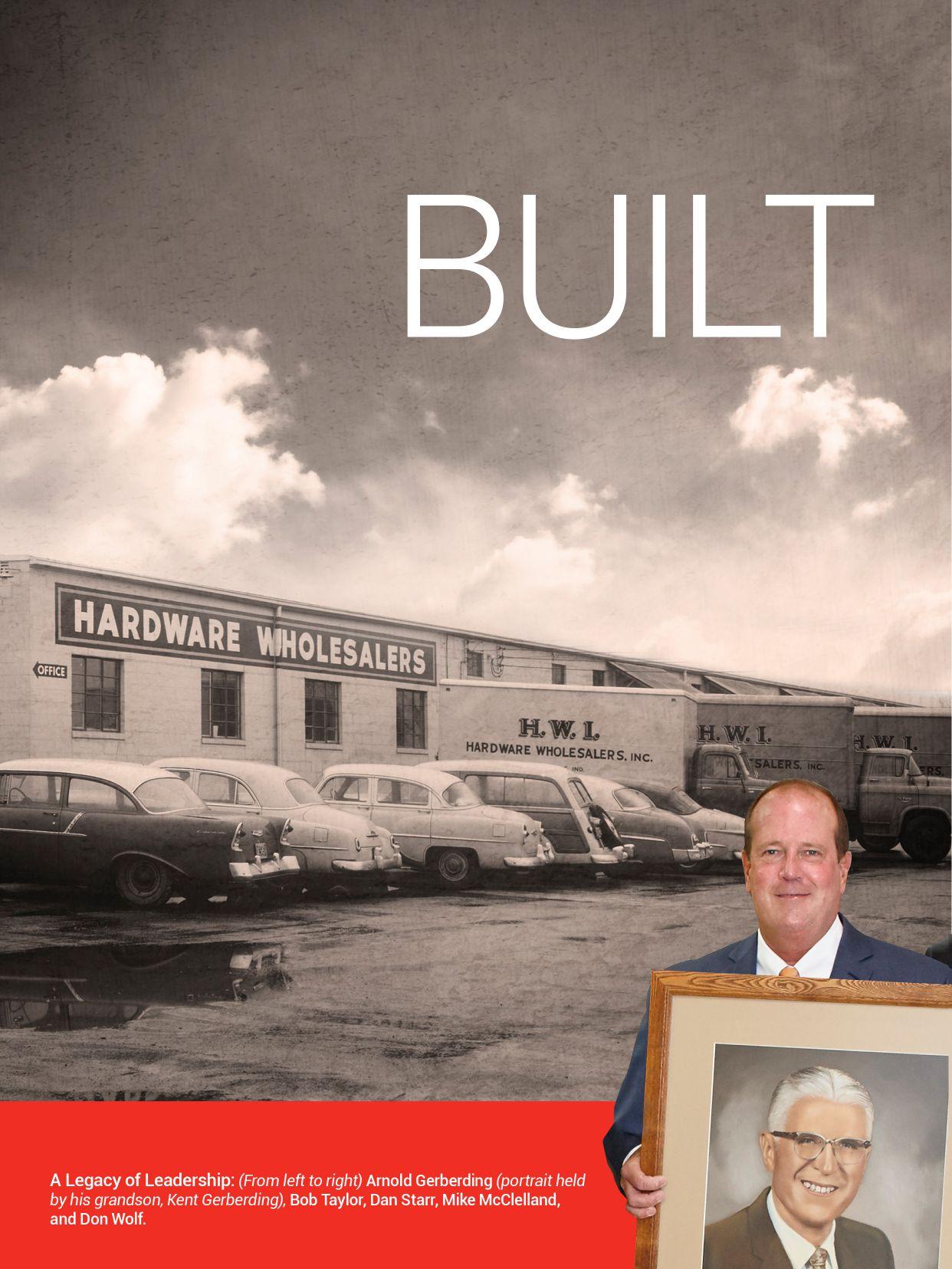
impression: that’s a retailer that will be successful due to his energy, passion and enthusiasm.
Shortly after I returned to the NRHA office, I got a call from a newspaper reporter in Napoleonville. She wanted to interview me about my visit to Dan’s store. Dan had been so excited that an editor from a national magazine was visiting his business, he called up the local paper and got them to write about it. That was an early lesson in what makes some hardware businesses stand out from others—energy, passion and enthusiasm. I’m delighted to know Dan’s family business is still going strong after 110 years.
Also during my 21 years at NRHA, I got to research and write three company history books. The first, in 1997, highlighted the first 150 years in Orgill history. The next, to mark the 100th anniversary of the American Hardware Manufacturers Association (AHMA) in 2001, explored the role manufacturers and AHMA played in growing the twostep channel of distribution throughout the 20th century. Sadly, AHMA disbanded in 2017, leaving U.S. manufacturers without a strong advocate. My third industry history book covered 100 years of history for House-Hasson Hardware on the occasion of their centennial anniversary in 2006. I guess
register. The dealer registration fee is $149 per attendee and includes three cocktail receptions, two dinners, two breakfasts and your choice of any of the half-day activities. If you also wish to take part in the Technology Forum on Thursday, August 15, the registration fee is $299. Technology Forum attendees receive a full day of training provided by Epicor plus breakfast, lunch and cocktail reception on Thursday in addition to the Hardware Conference. To register either click here or just call 305-853-0049.
The Hardware Conference has been and will always remain a familyfriendly, affordable industry event. Hotel room rates are just $189 per night plus tax. This is a savings of over $150 per night versus the hotel’s normal rate. In the event you would like to extend your stay, our special room rate extends from August 9 through August 21 based on availability. Click here to book your hotel reservation at our special room rate. Like many companies in the hardware channel, we are driven to give back to
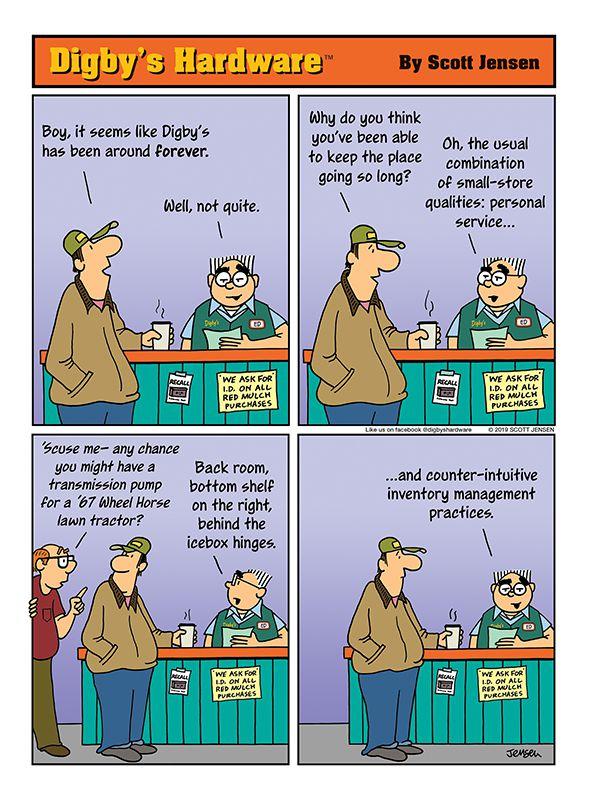
HARDWARE HUMOR
From Tom’s Shop
HARDWARE PRODUCTS REVIEW
PRODUCT #1:
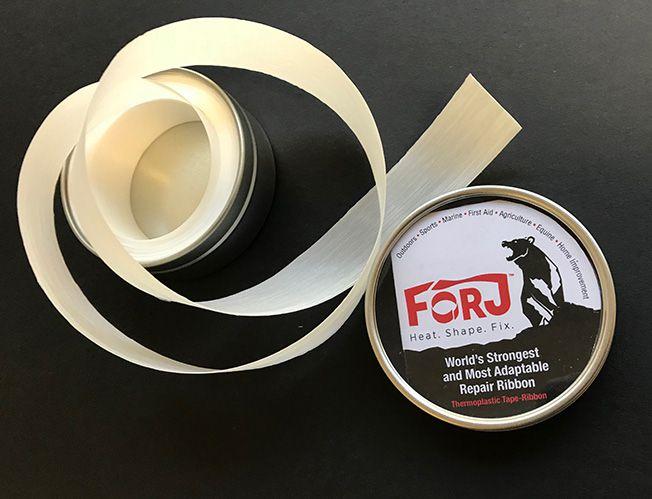
FORJ THERMOPLASTIC TAPE RIBBON
FORJ/RESINFIBER LLC
By Tom Chasteen
Forj™ is a thermoplastic repair tape that is far superior to any repair tape I’ve come across recently. This tape is made from a composite material of polyethylene fiber combined with a linear resin that makes the Forj tape unbelievably strong. The tensile strength of the 1” wide tape is an incredible 1,000 pounds and it weighs less than a ½ lb. per 100 feet.
To activate the tape adhesive the user must heat the tape to 140 degrees—this can be done using hot water, a hair dryer, an iron or even a car or truck exhaust. The tape comes as an opaque white color; as it heats up it gets clearer. Once it becomes clear the tape is ready to apply to the area the user is trying to repair. As the tape cures and cools it goes back to an opaque white color and fuses itself.
Here is another unique feature of the Forj Tape—it can be reused or readjusted by simply heating it back up. The only caveat is the user has to make sure not to overheat the tape. Once it becomes clear there is no additional advantage to heating it any more as it is ready to use.
Obviously, it is not easy to handle anything that is 140 degrees. Our users found it best to heat it up until it becomes flexible and can be molded or wrapped on the repair area, wrap it tight to keep tension on it and then finish heating the tape until it becomes clear. All of our testers agreed the strength and the ability to easily remove the tape and even reuse it is a huge advantage over other repair materials.
This is a really great product to make emergency repairs on everything from ski poles, knife grips, kayaks, sails, rope whipping, chafe wrapping and harnesses to halters, pipes, table legs, pvc water pipes and fence posts. Plus, it’s impervious to water.To learn more, click on this video link.
PRODUCT #2:
STONE CARE CLEANING LINE
GRANITE GOLD
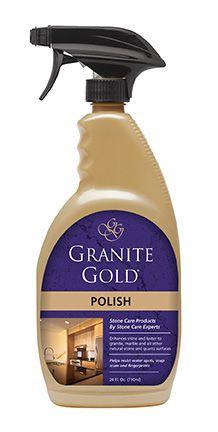
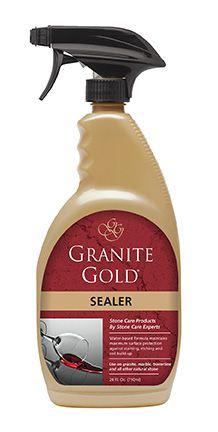
Granite Gold has developed a complete line of 22 stone care products that include marble, granite and other natural stone materials. We tested four products— Daily Cleaner, Sealer, Polish, and Clean & Shine—and all four products are safe to use on surfaces where food preparation takes place. None of the four products has phosphates or ammonia and all four products are biodegradable.
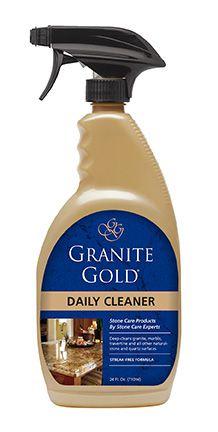
The Daily Cleaner deep cleans marble, granite and travertine and has a streak-free formula. This is the product for kitchen cleanup every day or after each meal.
The Sealer is a great product to develop a strong protective barrier coat on stone
surfaces. It is important not to allow the sealer to actually dry on the surface or it will create a hazy look on the surface. The trick here is to wipe it on in small areas, wipe it into the stone and then dry and buff the surface with a thin cloth. For even greater protection, allow 20 minutes and then apply a second or third coat, waiting 20 minutes between each new coat of sealer.
The Polish adds a rich luster to the stone surface. All the user needs to do is apply the polish to the surface, then wipe it clean with a clean cloth, followed with another clean cloth to bring the rich luster out.
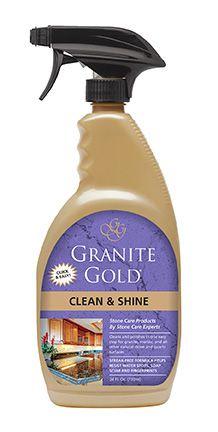
The Clean & Shine will clean and shine in one easy step. It is as easy as spraying it on and wiping it dry and buffing the surface with a clean paper towel.
If you have upscale homes with natural stone surfaces in your market, then you will definitely want to look into stocking the Granite Gold products. Check out the following videos:
Daily Cleaner: Sealer: Polish: Clean & Shine:
NIX COLOR SENSOR
NIX SENSOR LTD.
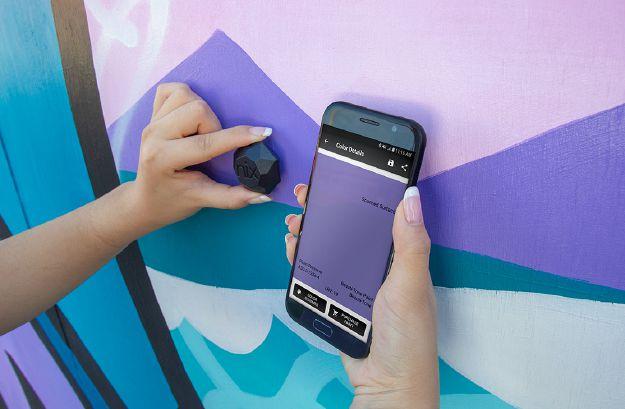
While digital color matching is not new, the Nix Mini and Pro bring some interesting features that may help you and your customers. Our testers identified a few key features: the size of the device (slightly smaller than a ping pong ball), the device is rechargeable by a common micro USB cable and it comes PRODUCT
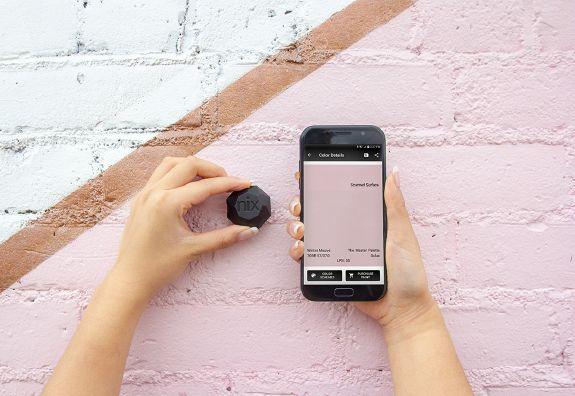
Nix Color Sensor is looking to take the guesswork and frustration out of paint color matching. Available in two versions, the Nix Mini and Nix Pro are handheld digital color sensors that connect to a smartphone app via Bluetooth. Simply place the sensor against the object to block out ambient light and the sensor uses its own light source to read the color wavelengths. The app will then display matching paints from a library of more than 30,000 colors.
from the factory already calibrated. Paintmatching devices are only as good as their calibration and any errors during the process will yield incorrect results.
The Nix Color Sensor Mini and Pro can be a great addition to your paint department. If you have customers who are painters, interior designers, artists or anyone looking to match paint colors, then the Nix is a perfect tool and time saver. Another approach could be offering the Nix Mini as a “loaner” to customers to take home and determine their color scheme and then return to the store to purchase the exact paint color. The Nix Pro would make a great addition to your color counter, allowing your employees to achieve exact color
matches of virtually any object while also having the ability to import custom colors you may offer in your store.
The company has a YouTube channel helping customers set up the device and connection to their smartphone. Click here to see the Nix Color sensors in action and here for a more thorough demonstration.
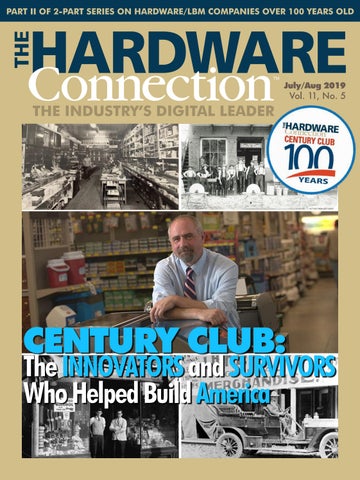
The Innovators and Survivors Who Helped Build America Part II CENTURY CLUB:
By Chris Jensen and Doug Donaldson
Independent hardware and LBM stores have been helping build America since the early days of the nation. In fact, one industry retailer is even older than America— Cowls Building Supply in Amherst, Mass., dates back to 1741.
The oldest hardware store still in business also dates back to the 18th century in Massachusetts—Foster Farrar Company was founded in Northampton, Mass., in 1796.
Both Cowls Building Supply and Foster Farrar were profiled in our last issue, along with many
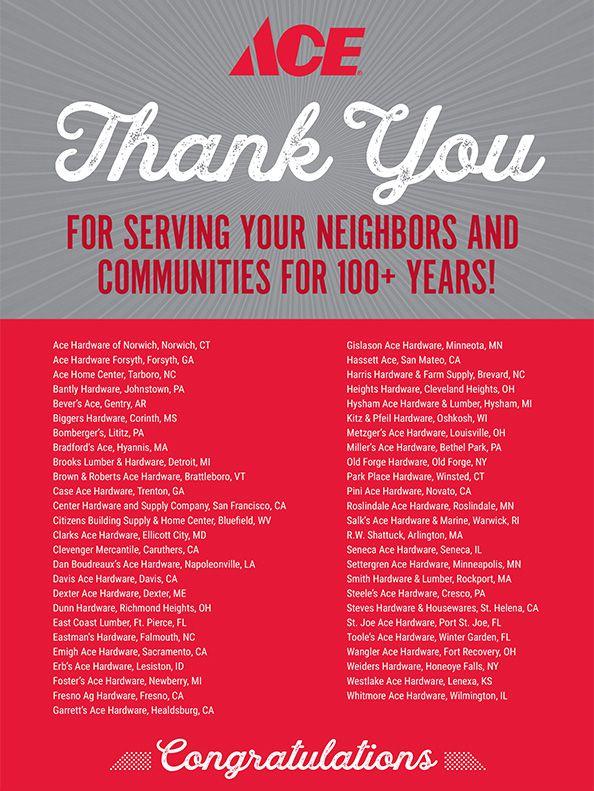
other Century Club retailers. The Hardware Connection Century Club honors the independent hardware and LBM stores in America as well as the U.S. wholesalers and manufacturers that remain in business after 100 years.
Read on to learn the survival strategies and business insights of 14 more Century Club retailers, and see if you can learn from their ability to adapt to a changing industry.
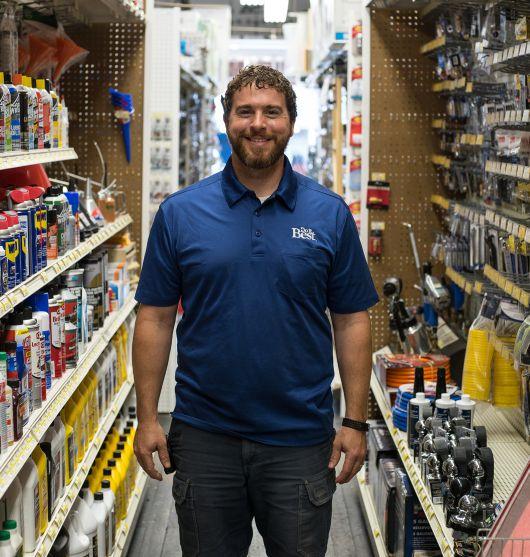
Eli Bliffert is the fifth generation of his family to run Bliffert Lumber & Hardware in Milwaukee.
Find Out More About Century Club Members
The Hardware Connection has identified 528 hardware and LBM stores, 176 manufacturers and 11 wholesalers that were founded in the United States of America and remain in business after 100 or more years. All are listed in the special Century Club section of our website, which can be found here: http://thehardwareconnection.com/century-club/
You will find the Century Club hardware and LBM stores listed by state in the U.S. map. For many of these retailers, you can click on the photo icon beside their name and see a gallery of old store photos. If the store name is underlined, you can click on that hyperlink to read more about the store’s history.
To add store photos, update your information or if we are missing any Century Club companies, contact Editor Chris Jensen at chris@thehardwareconnection.com.
If you missed Part I of our special report on the Century Club, click here.
SURVIVING LEAN TIMES:
BLIFFERT LUMBER & HARDWARE
During the Great Depression, the existence of Bliffert Lumber & Hardware in Milwaukee depended on five-gallon buckets of coal. The greatgrandfather of current owner and vice president Eli Bliffert went door to door selling buckets of coal to keep the business afloat during those lean times.
Another more recent pivotal moment in the company’s history came during the recession of 2009. The business struggled, shrank staff and Eli took all of the money out of his 401(k) to keep the company afloat. Very slowly, the business rebounded. Such grit and determination eventually led the company to grow to eight stores throughout Milwaukee.
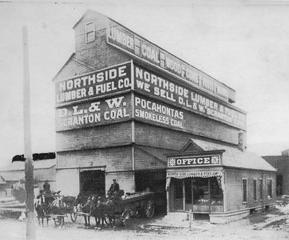
Founded in the 1880s as Northside Lumber & Fuel Company, the company
incorporated in 1904, about the same time J.P. Bliffert, Eli’s great-great grandfather, began working there. Bliffert would marry a daughter of an owner, and after World War I, the company took the Bliffert name.
Bliffert Lumber & Hardware started out as Northside Lumber & Fuel Company.
Since its creation, Bliffert Lumber & Hardware has been deeply woven within the fabric of the Milwaukee area. Many homes in Milwaukee’s north side neighborhoods were built with lumber, nails, roofing material and windows from the company.
To acknowledge Bliffert Lumber & Hardware’s deep ties to the community, the Milwaukee Public Museum included a display of the company’s 1904 store in the Streets of Old Milwaukee permanent exhibit, which recreates urban life in Milwaukee at the turn of the 20th century. The Bliffert display includes the company’s turnof-the-century office with original light fixtures, door hardware and furniture, and visitors can browse a selection of period hardware products.
Bliffert Lumber & Hardware is one of the few continuously operating businesses in Milwaukee owned by the same family. Eli, the fifth generation of the Bliffert family to own the company, began working in the store in 1993 and is very conscious about living up to the family legacy. “It’s a lot of responsibility, and I think about the people who came before me,” Eli says. “I live in my greatgreat-grandfather’s house. Every day, I feel the history and tradition.”
Eli’s recent decisions reflect longtime company values. The family has always reinvested in the company for long-term growth, and throughout his tenure Eli has been attuned to the changing needs of the community. For example, in the
1980s, the company eliminated paint sales and started selling millwork. As homeowners looked to renovate homes, they needed a source of millwork.
Now, Bliffert Lumber & Hardware offers more than 1,000 molding profiles that haven’t been manufactured since the 1920s, shipping orders throughout America. The company is the largest dealer of fire-treated lumber in Wisconsin. Bliffert Lumber & Hardware has also developed a strong niche supplying lumber to pack and crate equipment made in Milwaukee.
The company is a longtime Do it Best member, and Eli currently serves on the Do it Best board of directors.
“Do it Best has helped us grow immensely,” Eli says. “Do it Best has been a total solution for our lumberyard and hardware business. They have provided the financial assistance and advice that have enabled us to grow.”
The business has grown dramatically in the past two decades. In 1993, the business had two locations and 24 employees. Now, Bliffert Lumber & Hardware employs about 200 people throughout eight stores. This past April, the company acquired Neu’s Supply Line in Germantown, becoming the company’s sixth new location since 2002.
The sixth generation has also expressed interest in the family business. Eli’s son and daughter have worked in the store while attending school.
CENTURY CLUB: PART II
“What I enjoy most about being a hardware retailer is getting to help people every day,” Eli says. “Customers could be building a house or deck, but I’m here to solve a problem. It’s also really rewarding to look around the area at the hospitals and schools and know that we provided the materials for those landmark buildings.”
STILL ROLLING ON THE RIVER: N. DAIN’S SONS
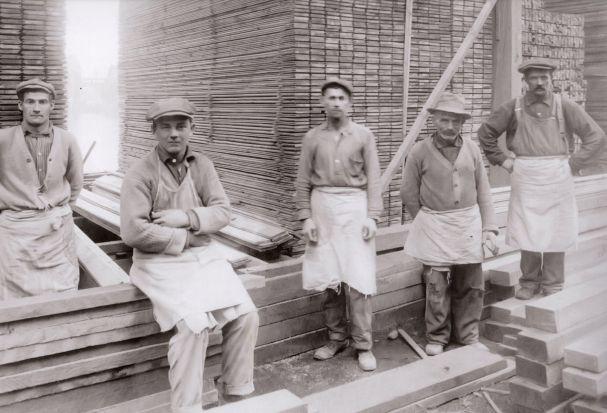
As the hulking wood planer grumbles to life and bites into a massive slab of pine, Jeff Dain feels a deep connection to previous generations of the Dain family who owned this lumberyard on the banks of the Hudson River. After the wood is muscled through the planer a few times, Jeff runs his hand along the surface, satisfied.
Jeff is the fifth-generation owner and president of N. Dain’s Sons, a lumberyard that has been at the same location in Peekskill, N.Y., since 1848. The original sign still hangs inside the store as a reminder of the business’ modest, early beginnings, when the company schooner delivered lumber along the river.
Nathaniel Dain, a great-grandson of a Revolutionary War veteran, founded the lumberyard after teaching at West Point and studying medicine. Once Nathaniel purchased the store on the banks of the Hudson River, he also began the family’s long tradition of community involvement by serving as a school board trustee and on several other boards and organizations.
“It’s just amazing to me that over the past five generations the world
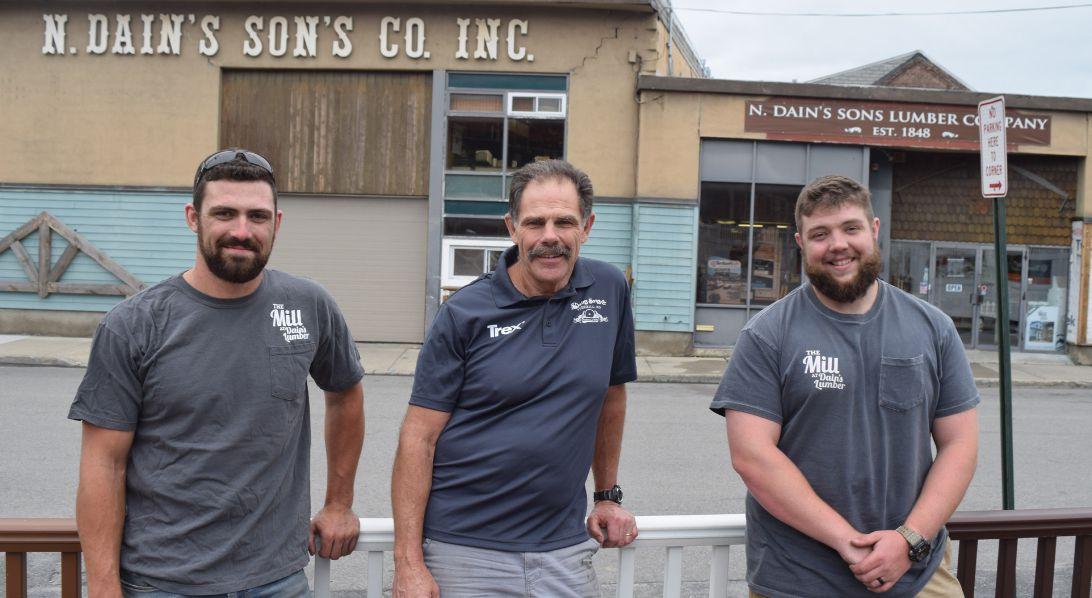
Jeff Dain (center) represents the fifth generation to run N. Dain’s Sons in Peekskill, N.Y., while sons Bryant Dain (left) and James Dain (right) represent the sixth generation.
CENTURY CLUB: PART II
has changed so dramatically and yet, within this little company, it’s the same. Our livelihood, our connections to family and life—it’s the same as it always was,” Jeff says.
Throughout the company’s 171 years of history, it faced several critical challenges, including business upheavals and recessions, not to mention fires that swept through the lumberyard in 1978 and 1989.
During the fire on February 1, 1989, the office and sheds burned down to the ground. With only two old trucks and an empty warehouse, Jeff and his family rebuilt the business with the help of longtime customers, employees and vendors.
The lumberyard faced another threat in the early 1990s when Home Depot built a store in a nearby town. Rather than face the new competition, other locally owned lumberyards in the area closed. Dain’s Lumber addressed this challenge by revamping the store to be more homeowner friendly and improving the store’s assortment with new products.
One example: In the 1990s, Dain’s Lumber became the first lumberyard in the area to stock and display Trex ® composite decking. While other lumberyards shied away from the new product, Dain’s invested heavily in Trex ® and created a large outdoor composite deck display. The store also hosted an annual deck and fence
show, which has now been running for 17 years. For Hudson Valley residents, Dain’s Lumber is now the goto destination for Trex ® composite decking.
Jeff constantly looks for new products and ways to improve his business. Two years ago, the store built a 4,000-square-foot woodshop and showroom that utilizes locally sourced, live-edge tree slabs that would have otherwise been firewood or put in a landfill. Along with handcrafted woodwork such as desks, countertops, flooring and molding, the shop also fixes wood products and sells wood for do-it-yourself projects.
Jeff started working at the lumberyard in 1973, sweeping floors and stocking nails when he was a teenager. Now, the sixth generation of the Dain family has started working in the business. Son James Dain
This is a scene from N. Dain’s Sons from 1905, 57 years after the business was founded by Nathaniel Dain.
CENTURY CLUB: PART II
serves as the executive vice president, son Bryant Dain is the welding/ metal shop supervisor and daughter Christine Dain is the corporate secretary.
Like their father, the sixth-generation family members proudly do the same lumberyard chores passed down from generation to generation. In fact, it’s a Dain family joke that if you don’t have sawdust in your pockets before the laundry, you will after.
“At this point in my life, I love seeing the family come into the business with a new sense of commitment and love that has been going for six generations,” Jeff says. “I love talking to the customers and helping them. The customers have grown up with our company, and it’s been a privilege knowing their fathers and mothers along with new customers who aren’t just carpenters and builders but homeowners, do-it-yourselfers, artists and other business owners.”
A NEW FACE IN AN OLD BUSINESS: VARNS AND HOOVER HARDWARE
Nathan Miller felt the pull of family and knew the family’s centuryold hardware store needed a new generation to lead it. Taking over as the new owner of Varns and Hoover Hardware in Middlebury, Ind., in
January, he knows he has 133 years of tradition to follow.
Miller’s great-great-grandfather, Ellsworth Varns, started a hardware store with his half-brother, W.W. Wise, in Mancelona, Mich., in 1886. The entire town soon burned down, so they headed south with a $5,000 insurance check in hand.
They settled in Middlebury and opened Wise & Varns Hardware. Wise died in 1912, so Ellsworth took over full interest in the store and moved it across the street to its current location.
Ellsworth’s son Clarence came back to the business after returning from World War I. Ellsworth became the second president of First State Bank in Middlebury, and he deftly managed to
In January, Nathan Miller became the fifthgeneration owner of Varns and Hoover Hardware in Middlebury, Ind.
CENTURY CLUB: PART II
navigate the bank and the hardware store through the Great Depression.
After that his son Clarence and his brother-in-law Clarence Hoover got more involved, which is when the Varns and Hoover name came into play. Clarence ran things until the 1970s, when the business was sold to his daughter, Gerry Warstler, and her husband, Dean—Miller’s grandparents. Their son-in-law, Carl Eash, managed the store from the 1990s until 2015.
Although he lived in nearby Goshen, Miller said he grew up hanging out in the store. “I wanted to go to college, but becoming involved in the store is always something that I wanted to do,” he says.
After college, Miller worked at a hospital for five years before joining the Do it Best store full time in 2016 and later taking over as manager. He and his wife, Cait, bought the business from his family, and she joins him in the store on Saturdays.
As the new, young face of the business, Miller didn’t want to introduce too many changes right away. “It has to be change people are ready for. I don’t want customers to doubt our capabilities. The store has been here so long, so there were expectations. People know us and trust us,” he says.
Varns and Hoover Hardware, which has been a member of Do it Best since 1962, features about 15,000 square feet of retail space and
gets 50 percent of its business from Amish customers. Miller remembers observing his grandfather attempt to speak some Dutch with them. “He could talk to anyone and was just a very genuine person,” he says.
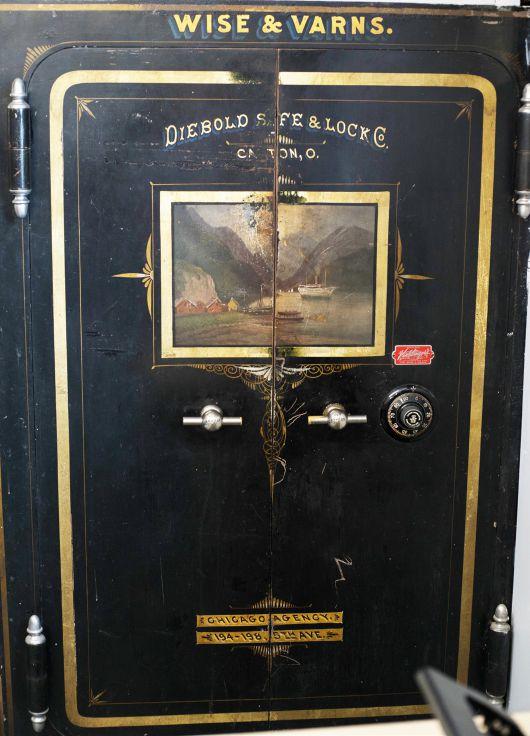
The store still features original wood floors, although it no longer has the wood shelves or rolling ladder. In addition to an old glass-cutting machine and a pipe cutter from the 1930s, they still pull rope from the basement to cut rope on the sales floor with an old rope cutter. Also in use every day is the original safe. “Burglars have broken in and tried to break into the safe with tools from the store, but it can’t be broken into,” Miller notes.
This original safe displaying the original name of the company, Wise & Varns, is still used every day at Varns and Hoover Hardware.
Varns and Hoover was the world’s first distributor of Fuller-O’Brien Paints, which started in nearby South Bend with the auto industry. Today, the store sells a lot of bird seed and fly tape with plumbing as the top category. “The Amish do a lot of plumbing. They’ll run their own gas line for gas lights. You have to listen to customers to know what they need,” Miller says.
People in town jokingly call the store Varns and Google. “They’ll come in and ask for the phone number of another business. We’re like the information hub for Middlebury,” Miller says.
The store’s fortunes are closely tied to the RV industry, which is expected to slow down in the area. “RVs were doing awesome in the 1970s and we were selling a lot of lumber for them. It’s important not to have all your eggs in one basket,” Miller says.
Miller’s grandfather began selling Maytag appliances, while Eash opened up the back room to plumbing, which turned into their top category. Miller knows it’s up to him to discover the next big thing.
They own a warehouse across the street and he is thinking about possible ideas for the space. “We lost the drug store in town with the soda fountain, and I might try to bring something like that back, a place where the community can gather,” he says.
Miller comes into the store each day and observes the antique tools along the far wall that his grandfather put up
in the 1970s and the antique display of barbed wire, which used to be a top seller. He knows the future success of the business is tied to embracing the store’s long and storied past. “I feel a lot of responsibility, but I enjoy that responsibility,” he says.
ENTERING A THIRD CENTURY OF SERVICE: S.L. WADSWORTH & SON
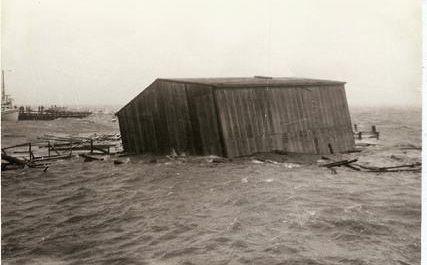
Some hardware stores have suffered through fires, floods or hurricanes. S.L. Wadsworth & Son in Eastport, Maine, may be the only one that literally washed out to sea.
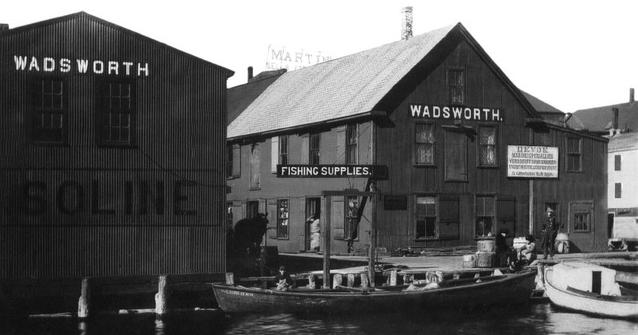
The business, which dates back to 1818 and has been operated continuously by the same family for six generations, was lost when the central wharf and buildings collapsed and were washed out to sea by the Groundhog Gale of 1976 (so named because it happened on Groundhog Day).
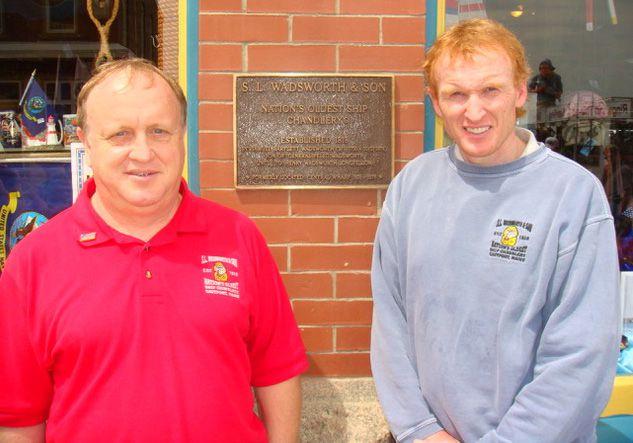
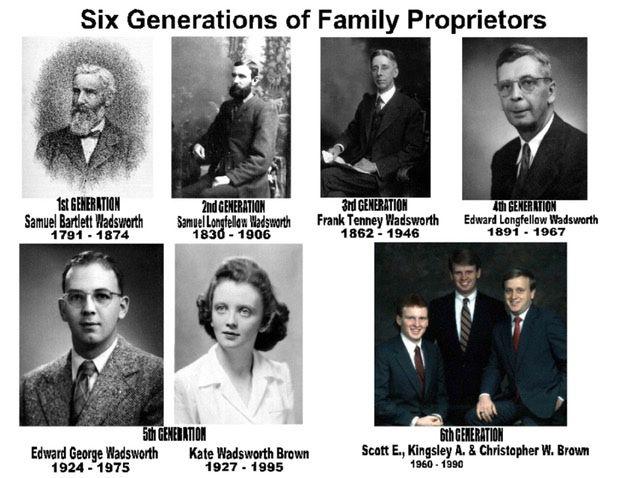
Christopher Wadsworth Brown (left) is the sixth generation of his family to run S.L. Wadsworth & Son, the nation’s second-oldest hardware store. His brother, Scott Brown (right), helps out occasionally.
CENTURY CLUB: PART II
Previously, the business overcame a major fire in 1886 and when the wharf was destroyed by a hurricane in November 1945, but the building survived. The ’45 storm was so bad that a door that previously opened from the store to the wharf opened only to the great void of a churning sea.
S.L. Wadsworth & Son, in addition to being the second-oldest hardware store in America, the nation’s easternmost store and the oldest retail business in Maine, is the nation’s oldest ship chandlery. A ship chandlery is a source of supply for seamen and ships in seaport areas. There used to be five or six operating in Eastport—which was a major shipping port for goods coming over from Europe—but Wadsworth is the only one remaining.
Christopher Wadsworth Brown, who represents the sixth generation
of his family to run the business, says they had to rethink the business model and regroup quickly after everything was lost to sea. After being closed for three months, S.L. Wadsworth & Son reopened across the street and began focusing more on regular hardware items. “The needs of ships aren’t the same as they used to be,” he points out.
People no longer come in seeking whale oil or harpoons, but everyone needs hardware.
“We always had hardware items such as rope and galvanized fittings, but we used to sell sail cloth, alcohol and ice,” Brown says. “Now we have no real specialty marine products. We’ve got a gift shop and hardware on three floors.”
Brown worked part time in the store during his youth—when his uncle, Edward Wadsworth, was
S.L. Wadsworth & Son is the nation’s oldest ship chandlery, but the business has focused on hardware since the wharf and store building washed out to sea during a storm in 1976.
CENTURY CLUB: PART II
running the business—and he remembers exploring all the rooms upstairs. Brown’s uncle died in 1975, so his mother, Kate Wadsworth Brown, had only been at the helm for 10 months before disaster struck.
Brown’s parents died in a tragic house fire a few days after Thanksgiving in 1995. His grandmother was 100 years old, so he knew he was needed back home to keep the business going. At the time he was doing bankruptcy work in Virginia. His brother, Scott, works outside the business these days but offers occasional help.
“The retail market is changing, and you have to change with it,” says Brown, who embraces his family’s long tradition of providing service and product to those who pass through the front door and want to speak with the present generation of Wadsworths.
A TRADITION OF SERVICE SINCE 1908: EMIGH ACE HARDWARE
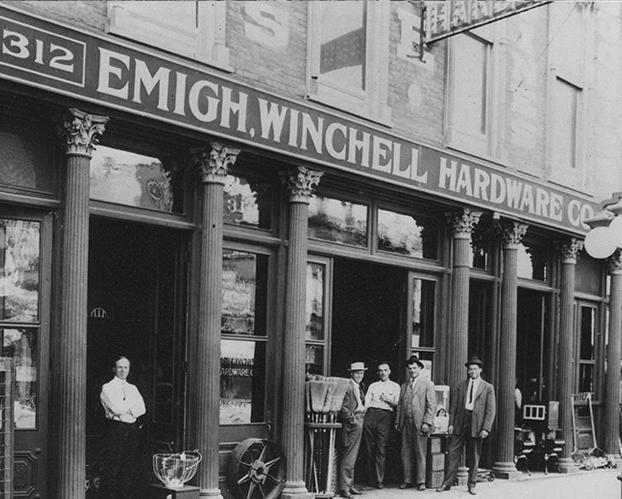
The first Emigh Hardware store was opened in 1908 by brothers James and Clay Emigh, who set up shop at 1208 J Street in Sacramento, Calif., after moving from Suisan City.
Four years later, the company merged with Winchell and Cline and moved to a larger location at 312 J Street. Another move in 1918 took the business to Seventh and J Street,
here around 1912, the
where it remained for 14 years under the leadership of the brothers.
With the retirement of the senior Emigh brothers in the early 1930s, the next generation took the helm. James’ sons Albert, James Jr. and Colby moved the business farther uptown to 13th and J Street, the current location of the Sacramento Community Convention Center. During these years of the Depression and World War II, even steel garbage cans were placed on sale, much to the consternation of competitors who wanted to keep prices high.
By 1952, Colby was ready for another move. Attracted by the postwar building boom in the suburbs, he took a risk and relocated the business to “the country,” the newly developed Country Club Centre at El Camino and Watt whose only neighbor was a goat farm.
Shown
store on J Street in Sacramento was known as the Emigh-Winchell Hardware Company.
The newer base of customers here had trouble pronouncing the name Emigh, so in the 1960s the company introduced a cartoon character depicting a pigtailed girl in overalls saying, “Call me Amy.” Little Amy, a composite of Colby and Jesma Emigh’s daughters Carol and Mary, is still a familiar feature in Emigh Hardware advertisements. Also during the 1960s, Emigh became a member of Ace Hardware and increased its purchasing power as a result.
Colby Emigh’s son-in-law, Rich Lawrence, took over as general manager in 1971 and in 1973 moved the business across the street to the present 35,000-square-foot location on El Camino Avenue.
Lawrence’s son, Brian, is the fourth generation to contribute to the family legacy and he oversees Emigh’s Outdoor Living, a
15,000-square-foot patio furniture showroom that opened in April 2000 right next door to the hardware store. In 2005, Emigh Ace installed a rooftop solar system.
At Emigh Ace Hardware, customers are treated to extras they cannot get elsewhere. The store has nearly 100 knowledgeable employees, some of whom have been with the company for more than 20 years. At no cost, customers can have their faucet parts cleaned. Power equipment is set up, serviced and ready to go. Cashiers do not interrupt sales to take phone calls—all calls are handled in the back office by an operator.
“Our customers take ownership of the store,” says Rich Lawrence. “They feel it’s their store.”
The business, ever conscious of its position as a Sacramento institution, has always done its part to improve the quality of life in the city it has called home for so long.
A longtime champion of youths, the company donates to several area schools and hosts “65 Roses Golf Tournament” to benefit the Cystic Fibrosis Foundation.
Just as it has done over the past 111 years, the store will continue to maintain the quality of service and selection of products customers have come to expect. At Emigh Ace Hardware, service has been a tradition since 1908.
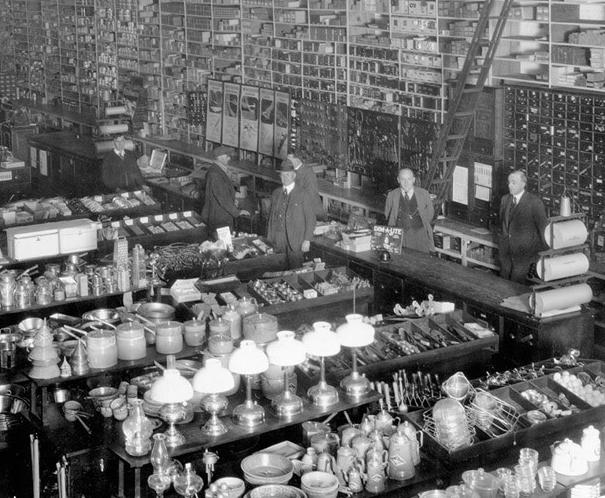
The lighting department at Emigh Hardware in 1922 offered many options to customers.
CENTURY CLUB: PART II
FIVE GENERATIONS OF STREET SMART: GARBER HARDWARE
At Garber Hardware’s Chelsea location, products on peg hooks subtly dance to the beat of never-ending Ninth Avenue traffic. Through five generations, the hardware store has been finely attuned to its New York City home and customers.
“It’s second nature to move with the pulse of the city,” says co-owner Nathan Garber.
Founder Joseph Garber and his son Nathan Garber (the current co-owner’s namesake), began the business from a push cart in 1884, operating on Eighth Avenue and Horatio Street. The family came to the United States from Odessa, Russia (now part of Ukraine) in the late 1800s to escape the pogroms facing Russian Jews.
The Chelsea location is the family’s second store; the first store is in Greenwich Village between Charles and 10th Street and managed by Scott Schoen, Garber’s co-owner and cousin.
The Chelsea store opened in 2016, and while only about a mile from the Greenwich Village location, it has its own vibe and product mix. Garber maintains a mix of convenience plumbing and electrical supplies along with a strong selection of cleaning supplies.
“When customers come in, they have problems that need solutions now,” Garber says. “So, we have to carry a little bit of everything. That’s one of the exciting things about my
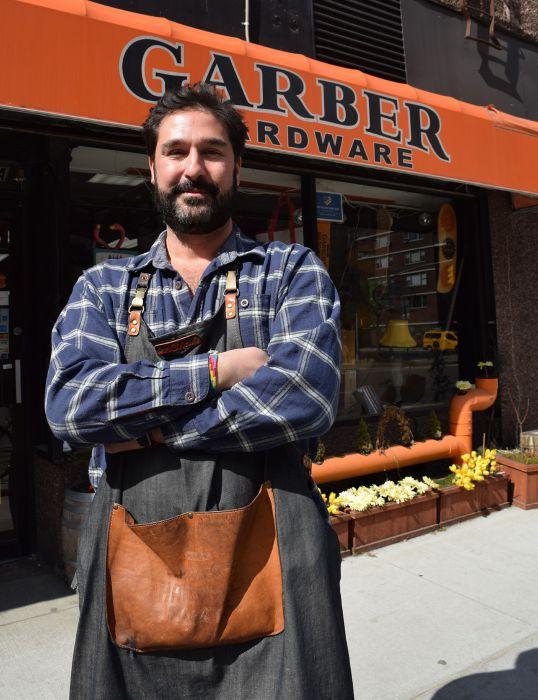
Nathan Garber is the fifth-generation co-owner of Garber Hardware, with two stores in New York City.
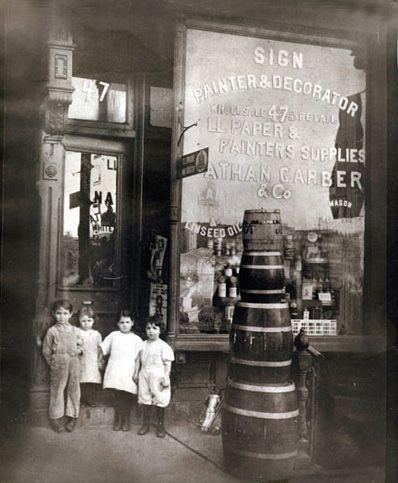
Founder Joseph Garber and his son Nathan Garber began what is now Garber Hardware from a push cart in 1884, soon moving to a store location that specialized in paint products.
job— coming up with workarounds and ways to help customers.”
Once, a world-renowned fashion designer who lives nearby and is also a regular customer came to the store an hour before a runway shot and asked Garber to help fix a broken heel. Garber got the designer back in the heels and to the show on time.
The Chelsea store is about 1,800 square feet with two employees, and the Greenwich Village store is 4,500 square feet with six employees. The cousin co-owners have to constantly manage inventory to keep quick-turning items in stock. To help, the store has turned to technology, including a fully integrated POS system to place orders and manage inventory through its distributor, Orgill.
Garber, who admits to hating paperwork, sees the POS as a way to help solve problems for his customers and to help the store prosper in the frenetic New York City environment that has seen many other independent hardware stores go by the wayside.
To survive such economic ups and downs when other stores didn’t, Garber has incorporated a family motto into his everyday operations. Whenever he is asked how’s business, Garber replies: “Could be better.” Garber’s optimistic, forwardlooking attitude has helped the store weather challenges, including competition from big-box stores, recessions and Amazon.
“I have many customers with childhood members of the store, and some whose parents and grandparents were customers as well,” Garber says. “It feels special to be a steward of this entity. I want to see the store on its way to 200 years old. I take a lot of pride in that.”
PUTTING CUSTOMERS FIRST: HARDMAN’S HARDWARE
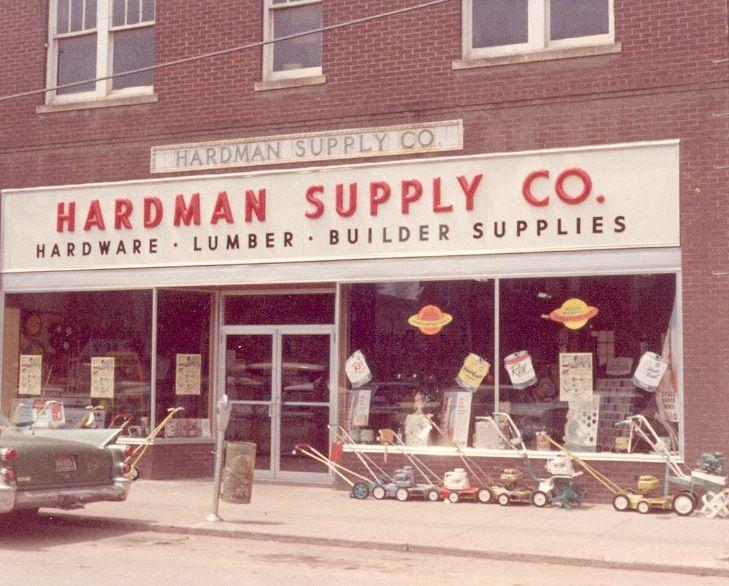
Hardman’s Hardware dates back to 1907, when it was founded by O.R. Hardman through the merging of two produce companies in Spencer, W.Va. In 1928, the company incorporated as Hardman Supply Company and expanded product lines to sell produce, wool, poultry and other agricultural goods. Hardware, appliance and farm machinery lines were added in the 1930s and 1940s.
O.R.’s son, Charles, joined the company in the 1940s after serving in Europe in World War II, and he would be the next generation to take over leadership.
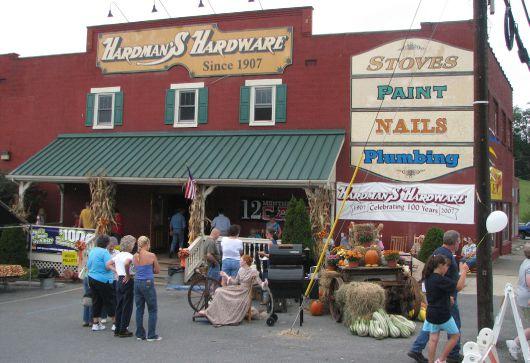
Hardman’s Hardware is shown here in 2007 celebrating its 100th anniversary at the Summersville, W.Va., location, which adopted the country store format.
CENTURY CLUB: PART II
Hardman Supply Company’s old location in Spencer, W.Va., showcased the new emphasis on hardware and building materials as the second generation of the Hardman family, Charles Hardman, took over leadership after returning from World War II.
In the 1950s and ‘60s, locations were added in Glenville, Ripley and Grantsville, W.Va. By 1970, three of Charles’ sons—Stan, Fred and Tom— had joined Hardman’s. Expansion continued in the 1980s and ‘90s with new locations added in Moorefield, Summersville and Mineral Wells, W.Va. Hardman’s still operates those seven Do it Best locations today.
In 2018, Fred’s son, Owen, became president as the fourth generation of the family to run the company. “I am proud, happy and thrilled to have been a part of this company for 18 years and to take over the leadership from a long line of successful leaders,” says Owen.
Owen’s cousin Jamie Hardman Loving (Stan’s daughter) serves remotely as the company’s chief
financial officer. They are joined on the board of directors by two other fourth-generation family members: Gwen Hardman Lowry (Stan’s daughter) and Elizabeth Hardman Ricks (Tom’s daughter).
The fifth generation has already got started in the business. Jamie’s daughters Adelaide and Charlotte and Gwen’s daughter Eliza have worked at the checkout in various stores helping bag products for customers.
While maintaining the company legacy is important, Owen is more focused on finding ways to grow the company. “There is certainly some pressure to succeed and to grow the company, but all of my family is very supportive of me and of me trying new things,” he says.
Owen was able to observe how his father, uncles and grandfather approached business challenges, which gave him a solid foundation for how to keep the company moving forward.
“Customer service is one of the most important aspects of our business, and we work hard to make that a part of everything we do. We have always placed a high value on customer service, but it is especially important now given the Internet competition we have,” Owen says. “We also work to hire knowledgeable employees who can provide expert advice to our customers.”
He adds, “We also have to be ready to adapt our product selection,
including dropping lines even though they may have traditionally been strong, and trying new lines. Embracing and integrating technology is critical.”
Hardman’s implemented a “country store” format in two of its locations in which part of the store is designed as an old-time hardware store, and Owen points out that concept has proven popular with customers.
Expanding to seven stores in the 1970s gave Hardman’s access to new markets with different needs. “Each of our locations is unique and carries product lines that other locations do not. This, along with our membership in Do it Best, gives us a solid foundation from which we can explore new initiatives,” Owen says.
While the Hardman family has made generous gifts to West Virginia University for a student study center, the company has given back to the community in many ways over the years. “We always try to be active in the communities where we have a presence. We encourage our local store management to be involved in local civic matters, such as chambers of commerce and city councils,” says Owen. “We donate both time and money to local projects, like helping to build playground equipment for a local school, and we participate in festivals and shows. We also try to help our communities recover from disasters (such as floods) by
collecting donations and working with volunteer groups to rebuild homes,” he adds.
Future initiatives include evaluating product lines and trying new ones. “We are working on expanding the services that we can offer customers after they purchase a product. We are continuing the evolution of our digital communications by adding more depth to what we are sending out,” Owen says.
ALL IN THE FAMILY: G.W. SMITH LUMBER
When G.W. Smith Lumber Company planed its first board foot of lumber in Lexington, N.C., in 1905, the world’s first movie theater had just opened in Pittsburgh and Albert Einstein had just published his theory of relativity.
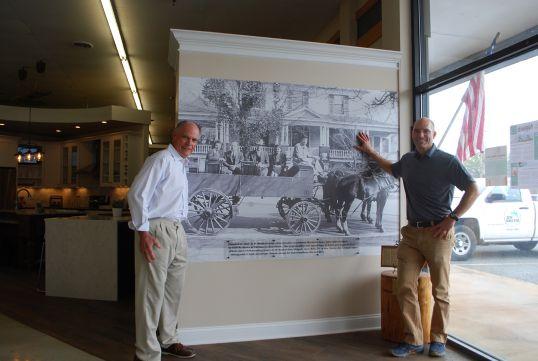
The company was founded by Griff Smith in a shed behind their house. His wife Nora was often called on to run the planer and dress lumber, until she made Griff move the business so she could tend to her own chores. Lumber was dressed to customers’ dimensions, stacked, air dried and then delivered by horse and wagon, notes his great-grandson Mark Smith, the current president.
In 1919, Griff moved the office on the back of a wagon to its present location on West Center Street. The old office now serves as the entrance sign and historical museum for the current pro building supply center.
“We started manufacturing doors, cabinets and window sashes in the 1930s. We later became a family of builders who built commercial buildings,” Mark says. “Through the Depression the business almost shuttered. We could hardly pay anyone.”
Griff turned over the business in 1940 to three sons—Griff, Bruce and Frank—although the younger Griff soon left to run a building store in Reidsville. America’s post-war housing boom enabled G.W. Smith to double its warehouse space, triple the lumberyard size and build a modernized shop.
Bruce became the sole owner in 1957 and expanded to four lumberyards before his untimely death in 1966.
“We had a million-dollar debt in 1966, but we overcame our debt and continued to expand our business,” Mark points out, adding that his grandfather had four sons and three came back to run the business including his father Steve.
G.W. Smith Lumber was still manufacturing and processing lumber until that was phased out in the late 1970s. In 1979, they sold some of the yards and bought a millwork operation, making jambs and moldings for the furniture industry as a wholesale operator. Another fourthgeneration family member, Ted Smith, manages Smith Millwork, which now distributes fine custom moldings and door parts throughout the Southeast. They consolidated operations when they built their current facility in 1980. In 1985, they started an employee stock ownership plan (ESOP). “The ESOP is a good, financed way to bring employees into the business and also enabled the company to buy out two brothers,” Mark points out.
“Every year we pay out a dividend that represents about a 10 percent increase in pay like a 401(k) plan. Employees now own about 20 percent of the business. It’s been a really good thing for everyone,” says Steve, who is the primary owner of Smith Companies with his brother Jerry.
The Smiths estimate the family business has sold more than one billion board feet of lumber over the past
Steve Smith (left) and son Mark Smith stand beside an old picture of the family home, which is where the original store for G.W. Smith Lumber was located.
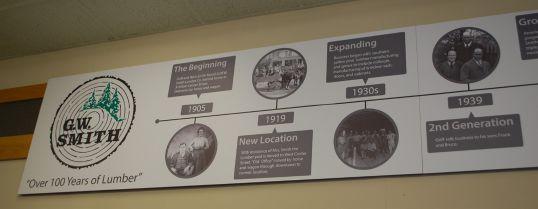
The entire 114-year history of G.W. Smith Lumber is outlined on a timeline displayed on the sales floor.
century, which is hard to fathom from its humble origins in a shed delivering lumber by horse and wagon.
G.W. Smith Lumber Company now offers an e-showroom on its website and deploys a fleet of heavy trucks including booms. They bill themselves as the complete builder’s supply store with everything to build from the “tree to the key.”
As Steve points out, the building supply industry has changed as a result of building technology. “All houses were built with 2 x 10s. You dressed them and carried them. Now it’s all i-joists. In the early days we made doors and sashes, but now everything is prehung,” he says.
Although the last recession and housing slump hurt, G.W. Smith Lumber came out fine because they weren’t leveraged, says Steve. “We’ll just keep adapting to whatever comes our way,” he adds.
KEEPING IT OLD-FASHIONED: WAKARUSA PRO HARDWARE
Mike Schade understands that he is the keeper of the traditions. When you buy a century-old hardware store that hasn’t changed much in 100 years, you embrace the past and don’t adopt radical changes.
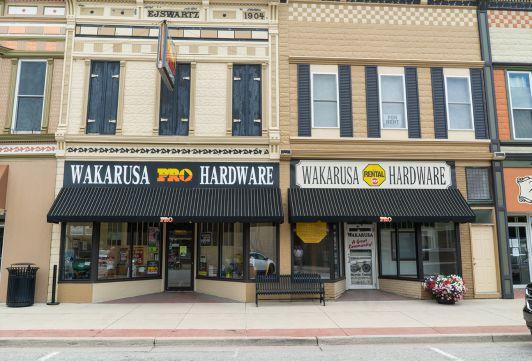
Schade purchased Wakarusa PRO Hardware in Wakarusa, Ind., from his uncle, Kenny Twa, in 2009. His uncle had owned it for nine years and changed the name to Wakarusa Hardware. The business dates back to 1904 and remains in its original location.
Click here for video history of Wakarusa PRO Hardware.
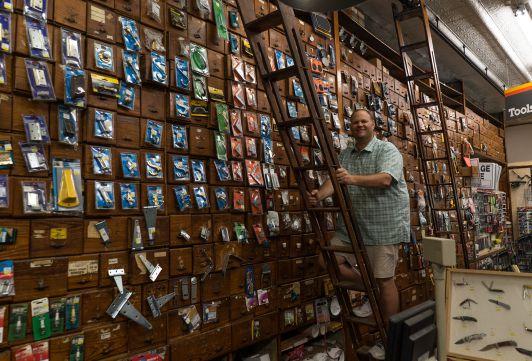
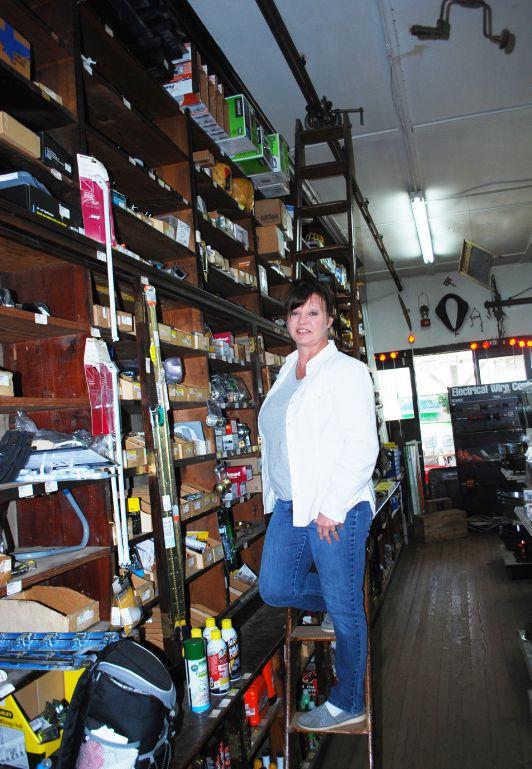
Originally known as Leonard Company until 1973, the business has only had five owners in 115 years. It still features the original rolling ladders, original wall of a thousand wooden drawers, original pressed tin ceiling, original hardwood floors and original wood counter.
“I climb the rolling ladders and get stuff down from the wooden drawers at least 10 times a day,” Schade says. Schade worked at a hardware store in Elkhart, Ind., from 1987 until 2005. He joined his uncle in the store in 2008 and knew that he was looking to retire. “My uncle talked me into working for him and then talked me into buying the business,” he recalls.
The store now features about 4,000 square feet of retail space after Schade bought the adjacent space and expanded in 2012. That
Owner Mike Schade still uses the original rolling ladders to get products down from the original wall of a thousand wooden drawers at Wakarusa PRO Hardware.
CENTURY CLUB: PART II
After 115 years, Wakarusa PRO Hardware is still at its original location in Wakarusa, Ind.
is also when a large manufacturer, Utilimaster, left town, although a manufactured home builder has since replaced some of the lost business.
“Businesses come and go, but we can’t just rely on people in town,” Schade says. “We offer the convenience of shopping local so people don’t have to take three trips to Lowe’s to get what they need.”
Plumbing is the top-selling category along with regular hardware items and they have established niches in rental and UPS shipping. They have been buying from Bostwick-Braun since 1990.
“Every day I get comments of appreciation from customers,” Schade says. “I feel a deep responsibility to keep the business going.”
A STORE FILLED WITH TREASURES: PIEDMONT HARDWARE
Samantha Saunders is the proud curator of a business that is equal parts hardware store and hardware museum. If only the walls could talk, or if
someone had passed on detailed notes about the treasures contained in the basement and the attic.
Piedmont Hardware in Maiden, N.C., dates back to 1910 and has been located in the same building on Main Street since 1922. It was bought by Saunders’ father, Howard Cline, in 1982. She bought the business from him in 1999 and is only the fourth owner in 109 years.
The original owner, Samuel Finger, operated the store from 1910 to 1976, then it closed for four years until a new owner emerged and restocked the shelves with merchandise. Cline bought
Samantha Saunders stands on the rolling ladder that has been in use at Piedmont Hardware in Maiden, N.C., since 1922.
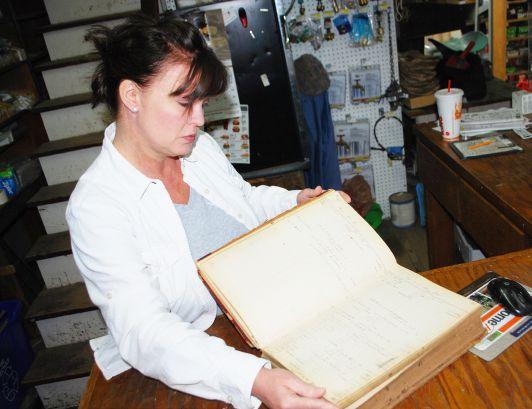
Samantha Saunders looks at the original ledger book for Piedmont Hardware, with the first entry dated from November 1910.
it two years later from someone who didn’t own it long enough to learn the stories behind the antiques that had been left behind.
The business today takes up three store fronts, leaving 10,000 square feet for retail space. Cline bought the two adjacent store fronts in the 1980s, which enabled the store to expand.
“I grew up in the store. My father bought it when I was 14, and I’ve always enjoyed being around the people,” Saunders says.
Hearing the squeaks when she walks on the original wooden floors, climbing up one of the three rolling ladders that are used daily to retrieve goods from the 12-foot wooden shelves, Saunders can feel the history seep through.
“There’s an impression that’s been put on me being part of this, that I’m part of something bigger than me,” she says. “I get a lot of praise from customers for still being here on Main Street.”
Antique tools and equipment are on display for decoration but not for sale, a reminder of the store’s historic past. Many of the antiques on the wall came from Saunders’ grandfather. You can spot a Kordite sign with a coupon that expires in October 1955, alongside an old sign board that let customers know during the war that bicycles were off the ration list. They still use an antique seed scale from 1907 that is as accurate as ever.
“I added a two-line phone system and AC when I took over—those were the first two things,” she says. “Then I installed computers—I figured that would make Mr. Samuel Finger roll over in his grave.”
The original bolt bins can be found in the basement, where you can also see a coal chute and a furnace that dates back to 1915. The freight elevator is now grounded, as the attic and basement are used for storage and nostalgia. In the attic lies an original, fireproof accounts receivable box with ledgers. The first entry in the ledger book is from November 1910 and shows payables and payroll.
Window displays still change with the seasons for the Orgill store, which does a brisk business with a garden center out back. Saunders’ son, Blake, has been working in the store while studying mechanical engineering, and he might stay around to keep the legacy going. After all, someone needs to be the next curator for Maiden’s Main Street hardware museum.
CENTURY CLUB: PART II
DEDICATED TO THE THINGS THAT LAST: BOMBERGER’S STORE
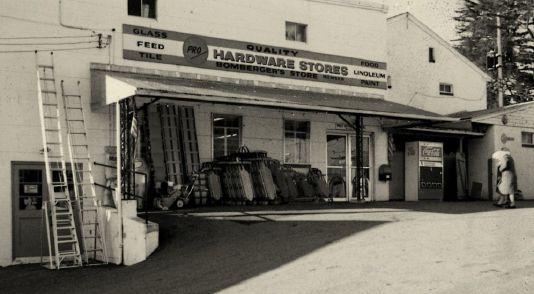
When he was only 20 years old, Phares Bomberger showed an early entrepreneurial streak by buying out the owner of a small trading post known as the John Gable General Store, located in the village of Elm, Pa. In 1887, the store was renamed Bomberger’s General Store, offering everything from bread and milk to hammers and nails.
Over the years, the family-owned store strived for growth by continuing to offer new and exciting niches to meet the needs of the growing populace. For example, Phares established both an insurance business and a linoleum business in the basement of the building.
Several generations, and 85 years later, in 1972, a new store was built on the property, which doubled both space and sales. The lawn and garden and floor covering departments were added and there was a further expansion of grocery, hardware, dry goods, fire arms, ammunition and insurance.
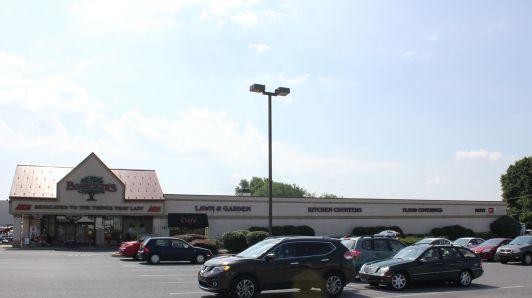
In November 1994, Bomberger’s celebrated the opening of its new store in the town of Lititz, located about two miles from its founding location. This location offered easier accessibility as well as over 64,000 square feet of retail space dedicated to exceeding the needs of customers. Consumers can design a new kitchen or bath, choose new hardwood floors in the flooring showroom or browse the gift department.
Phares Bomberger bought a small trading post in Elm, Pa., in 1887 and renamed it Bomberger’s General Store.
In 1994, Bomberger’s Store moved to a new 64,000-square-foot location in Lititz, Pa.
Bomberger’s remains a family owned and operated store with Roy Jr. representing the fourth generation of the family. The fifth generation includes Richard and Jenny Bomberger, Bob and Dori Resch, Todd and Beth Bomberger, and Emily Bomberger and DJ Weaver. More recently the sixth generation—Nicole Resch and Will Rothenberger—has started working at the store.
Bomberger’s, which was honored with a Retail Beacon Award from The Hardware Connection in 2016, has three unique business niches: a wholesale division, online John Deere parts business and The Elm
Tree Cafe. The wholesale division imports 2,200-pound bags of sugar and 100-pound bags of salt and wholesales them to bakeries around Baltimore and Washington, D.C.
As CEO Bob Resch points out, Bomberger’s has returned to its general store roots and is now a modern country store—an old business offering all the items modern-day shoppers want.
“One of the biggest reasons for our success is we allow managers and employees to make mistakes, as long as they were trying to improve the business,” says Resch. “We never turn down an opportunity to encourage ideas.”
After 130 years of being a singlestore operator, Bomberger’s finally opened a second store in Annville, Pa., in April 2017. Bomberger’s Ace of Annville features 7,500 square feet of space in a former furniture store, with the buildout supervised by Todd Bomberger. Adding a second store enables the family members to spread their wings a little while taking Bomberger’s to new heights.
LOOKING OUT FOR OTHERS: LANN HARDWARE
Walter Lann III is the fifth generation of his family to run Lann Hardware, which is an institution in Aberdeen, Miss. Lann’s great-greatgrandfather, Captain Harry Jerome Bonaparte Lann, was a farmer and Civil War hero before he became a hardware retailer in 1879.
After four years of Civil War and 10 years of reconstruction, everyone in town was struggling at that time. It was not an ideal time to start a hardware business in Mississippi.
The business was originally called Lann & Carter Hardware. J.W. Carter was a hardware drummer (traveling salesman) who had some land and wanted to start a hardware store. He wanted a partner who was well-known and trusted in the area—no one fit that criteria better than Captain Lann.
“He knew everyone in the area and was very well-respected. What he said was the word. He was real generous to everyone and would extend credit when times were lean. Every generation of the family since has been like that,” says Lann, who is known around town as III.
“The Carter family eventually got out of the business in the early 1900s and the Lanns took over,” explains Lann.
“My father grew up in the business and his father before him. I started in the
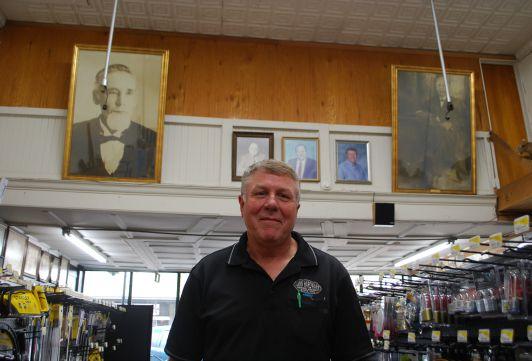
Walter Lann III stands before portraits of the five generations of his family to run Lann Hardware in Aberdeen, Miss.
CENTURY CLUB: PART II
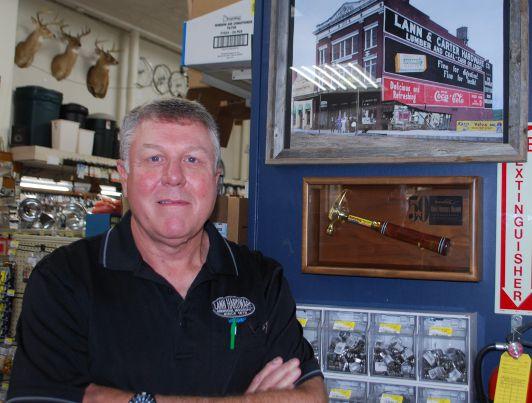
Walter Lann III stands next to a picture showing what Lann & Carter Hardware looked like in the early days.
summers when I was 12. All our family members are workers. Daddy died here at 82 and he never missed a day of work,” Lann recalls.
Lann picked up some definitive retailing principles from his father that he has followed diligently. “My daddy always said, ‘You’ve got to treat every person fair.’ He wanted us to lose if that’s what it took so no one left unhappy. He also said, ‘Good word doesn’t travel fast, but a bad word does.’ I’ve found that to be good advice through the years,” Lann says.
The Lann family also operated a funeral home for a while, but eventually got out of that business. The hardware business has been in the current building for 60 years and it is just the third location for Lann Hardware in 140 years.
“We either had to remodel or move out, so we moved to this building,” Lann explains. They ended up buying two buildings. Part of it used to be J.C.
Penney, while the other side was a bank and a clothing store.
The 8,000-square-foot sales floor serves the town of 6,500 people by stocking all the essentials. After 140 years, Lann says they have a pretty good idea what people need.
“We’ve been in business so long that we’ve got 500 charge accounts and 75 percent of our business is on charge accounts—some for over 100 years. If my great-great grandfather helped someone, then that whole family had a charge account,” says Lann. “Many of our customers today have been coming here for generations. People don’t move in and out here; they’re born here and stay.”
Overlooking the sales floor are framed pictures of the five generations of the family to run the business. Another framed picture shows what Lann & Carter Hardware looked like back in the early days, with large billboards from Spearmint Gum and CocaCola along the outside of the store.
Lann Hardware used to sell coal, then later branched out into wood heaters, farm implements and even Studebaker wagons. Today, a full paint store resides within the hardware store and the computer keeps them straight on inventory.
“My father was never a computer person. We went more modern with computers when I took over, so we’ve had computers for 30 years,” says Lann. “We used to have two secretaries who wrote everything down and then did hand statements every month. We send
out 1,000 statements a month, but it’s all automated now,” he adds.
Lann is proud of his store’s long history, but just about every story he tells involves his father. “Customers used to use my daddy as an encyclopedia to ask about people and places. He did affidavit witness work, because he never forgot anyone,” Lann proudly notes. “My father hadn’t been paid since he was in his 60s, but he still came in every day and helped, same as his daddy.”
Another retail lesson he learned from his father was to make sure a member of the family was always in the store. “Daddy always said an owner has to be here at all times, so at least one of us is here, because people want to see the owner in the store,” Lann says.
Lann Hardware has been a customer of Orgill for a long time. In fact, Lann went to work for Orgill for a year upon the advice of his father. “My daddy knew Joe Orgill and he said it would be beneficial for me,” Lann recalls.
Lann has a set of twin daughters who worked in the store during summers while in college, but he also sees hope in four grandsons who could be the next generation of the Lann family to serve the Aberdeen community.
“My daddy called everyone his friends, saying enemies don’t help you. We’ve been serving friends for 140 years, and being over 100 years old is a feat we can be very proud of,” says Lann.
ADAPTING TO CHANGING MARKET: MAKINSON HARDWARE
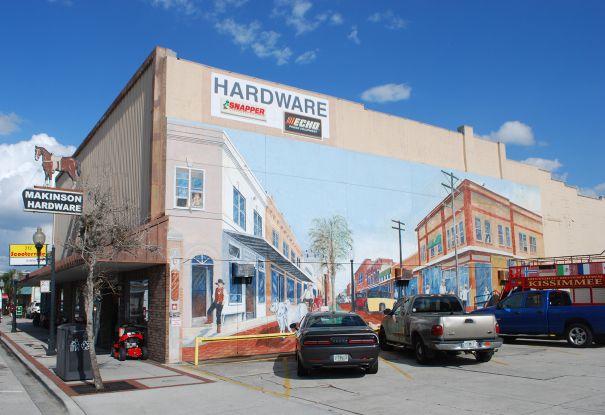
When Makinson Hardware was founded in Kissimmee, Fla., in 1884, it was 87 years before Walt Disney World opened and transformed the entire region around Orlando. Back then the area was a mixture of cattle farms, horse country and orange groves, along with swamp land inhabited by gators. In the early years the upstairs area was used to trade alligator and deer hides with the Miccosukee and Seminole Indian tribe.
Makinson Hardware is the oldest hardware store in Florida continuously operated by the same family.
Pensacola Hardware, which dates back to 1851, is actually the oldest hardware business in the state, but that store has
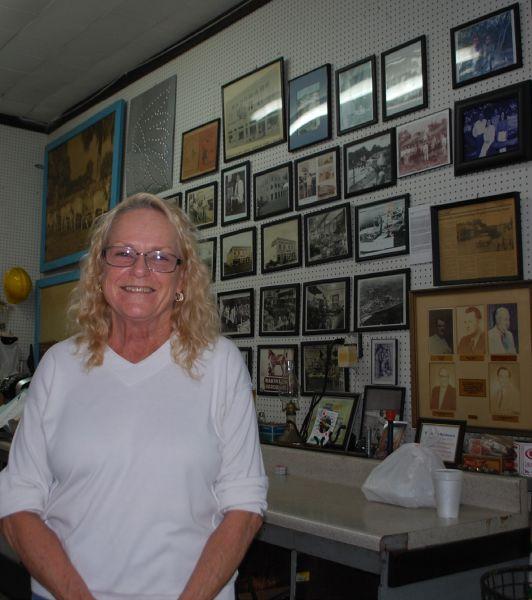
Elaine Makinson stands in front of a wall of old photos showcasing the history of Makinson Hardware, which has been run by the Makinson family since its founding in 1884.
CENTURY CLUB: PART II
been owned by four or five different families through the years.
Elaine Makinson, the current owner, married into the business with husband Leon “Buster” Makinson. Buster worked in the business from 1962 until he passed away in 2013, working alongside his brother Bill, who worked there from 1958 until 2000.
Elaine started working part time in the store in the 1970s and then full time later on. All four of their kids started helping out in the store when they were young and two remain involved in the business.
“There have been boom times, but there has never been a time when business was terrible,” Elaine says. “We base our business on customer service. We greet everyone and follow through to ensure they get what they need. We try to carry items that the big-box stores don’t carry.”
Her late husband’s grandfather, William Burrough Makinson, started the business 135 years ago and it’s been in the family ever since. It is the oldest business in Kissimmee.
Makinson Hardware survived a fire around 1900 and managed to hang on during the Great Depression. The retail space has been added on through the years and is currently 17,000 square feet. They buy from Orgill.
When the area was big horse country the store sold a lot of western wear, Elaine notes. That section was converted to outdoor power
equipment in the 1970s, but a large horse still stands like a sentry by the front door.
“We still do a lot of things like the old way of doing business. We do as little as possible on the computer and still don’t scan at the register,” says Elaine. “We keep saying we’re saving changes for the next generation, but then the next generation doesn’t want to change either. Our biggest accomplishment is still being here.”
She says they are continually looking to offer new services and merchandise. They got into lawn equipment and now fill propane tanks and offer fax and UPS services. “They put a rail and bus station by us recently, which has benefitted us. We get a lot of business from tourists staying at local hotels or campgrounds,” she points out.
A mural on the outside of Makinson Hardware in Kissimmee, Fla., shows what the business district looked like in 1925.
A large mural on the outside of the store was done in freehand by a local artist in 2004 from a picture taken of downtown Kissimmee in 1925—a simpler time from a bygone era. One person in the mural was made to look like William Makinson, with cattle and cars illustrated to depict the joining of the ages.
The store has been her life for the past 40 years, and Elaine doesn’t worry too much about what the future holds. “If thoughts go in my head about closing, it seems like five people come in that day and comment on how we have the best hardware store. It doesn’t take much to pick you up,” she says.
SIX GENERATIONS OF FAMILY LEADERSHIP: MORRIS HARDWARE
The following script was recently used by Morris True Value Hardware in McConnelsville, Ohio, to give local residents a store tour of six generations of family history.
Welcome to Morris Hardware, the oldest family-owned and operated hardware store in the state of Ohio.
As many great American tales go, it all began with an immigrant and a dream. George P. Morris, of Trowbridge, England, answered the call of opportunity across the Atlantic Ocean. Setting sail with his brother in 1817, he made his way from Marietta to the Eagleport area.
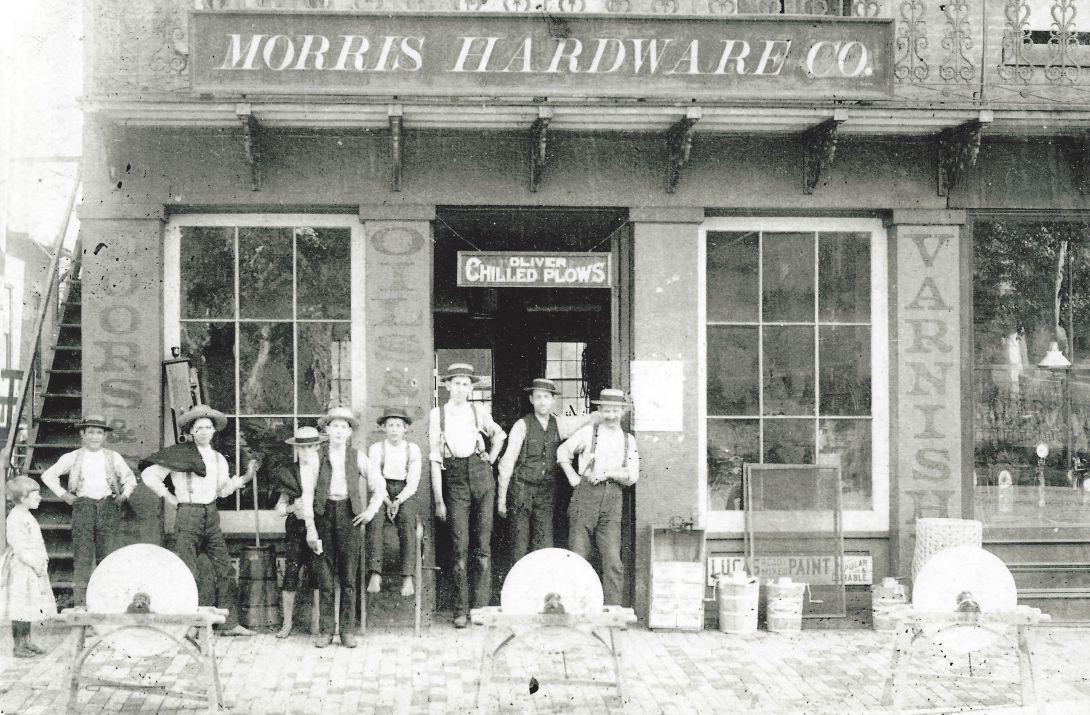
Morris Hardware was founded in McConnelsville, Ohio, in 1845, making it the sixth-oldest hardware store in America.
CENTURY CLUB: PART II
After various attempts to make a living, including a prosperous run in salt manufacturing, he turned his focus to McConnelsville. He built the Morris Home, located two blocks east at 236 East Main Street, and began a small tin shop that also sold hardware. Thus, Morris Hardware was born in 1845.
It wasn’t long before George needed a place to accommodate his growing business. He and his sons built a three-story structure that was completed in 1849, and has since been home to Morris Hardware.
George was known by his acquaintances as a man of restless energy, who got in eight hours of work in the forenoon and eight hours in the afternoon. It was this restless energy, and George’s integrity that established the solid foundation that Morris Hardware has continued to thrive upon.
During George’s era of management, he added an expansion west, which housed several businesses over the years and now holds the store’s paint department, as well as the fourth floor, home to what was described in 1906 as the finest Masonic Lodge in the county.
George Morris retired from the hardware business in 1868, passing on the business to his son, Robert. Robert Morris would also come to own the Morris Block upon his father’s passing in 1873. He employed his two nephews, George and William Scott, who would come to run the business in a partnership as the third generation.
Robert Morris was the father of five children. One of his sons, Charles Morris, picked up his grandfather’s craft of tinsmithing. You can still see the pressed tins ceilings in various patterns throughout the store. Charles Morris ran a tinsmith shop on the third floor of Morris Hardware during the partnership of George and William Scott.
A pair of brothers, grandsons of George Morris, would come under the employ of their uncle Robert in the 1880s. While mere teenagers at the time, the two took the family business very seriously and quickly earned the respect and trust of Robert. Upon his retirement 1886, the two took over the business as a partnership.
William, the younger of the two, devoted his energy to the day-to-day operations.
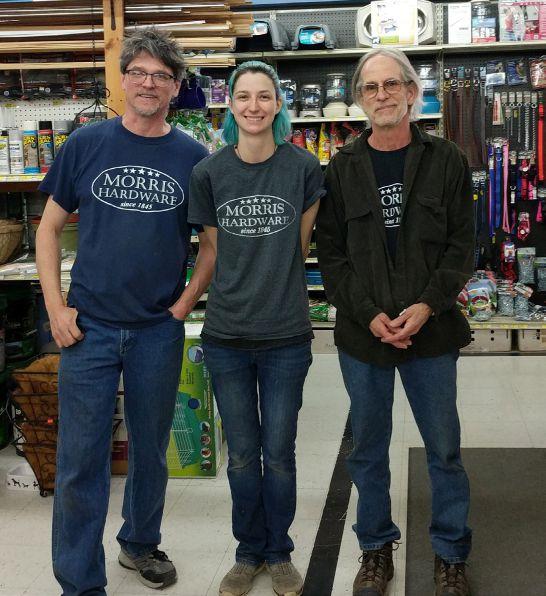
The management team of Morris True Value Hardware includes, left to right: John Houser, Shayna Roberts and Tom Schanken.
George, however, was an innovator.
George and William’s era of management was the height of growth and prominence of the business in the community.
George’s interest at Morris Hardware was introducing labor saving and comfort devices of the 20th century to the community of McConnelsville. He traveled the country with his wife, artist and architect Francis Hawkins. The two returned home with ideas for civic improvement. He and his wife co-owned the first automobile in the community.
A solid, hand-hewn beam stretches 50 feet across the basement, a symbol of the integrity of a business surviving for nearly 175 years.
Jerrold Scott, the son of William Scott and nephew of George Scott, was a partner of his uncle until his retirement in 1953. Jerrold took over the family business but his ownership of the store would be brief.
Jerrold became ill in the mid-1950s. His daughter, Janet Scott, moved to Chicago to pursue an education in nursing. While in the Windy City she met Robert Schanken. The two married and had two children: Steve and Tom. Janet returned with her family to McConnelsville in 1954, and before long, Robert took over the store. Robert immediately got to work tidying the building and the store, discarding many unnecessary items.
Robert believed in instilling a work ethic in his young boys, putting Tom to work sweeping the floors as young as 12 years old. That work ethic stayed with Tom, and in 1976, he became the sixth-generation
owner of Morris Hardware. Tom has worked in the store longer than any other owner and has been through the transition from American Hardware to ServiStar, and through the merger with True Value.
In 1991, Tom led the store through a large transition: replacing the flooring, the shelving and updating the lights—making the store much more customer friendly, brighter and more orderly. He also added an air conditioning system. Tom also greatly increased merchandise across the store, increasing the variety to give customers more options.
In 1996, an enthusiastic young man responded to an ad in the local newspaper seeking an assistant manager for Morris Hardware. During his career here at the store, John Houser has been responsible for several renovations and updates. He began by updating the checkout counter—adding beautiful granite countertops and moving the office upfront, making employees more accessible to serve customers. He also significantly streamlined the restocking process.
In the mid-2000s, space became available that was home to many businesses over the years, most notably the pharmacy. Morris Hardware saw this as an opportunity to expand its offerings to the community. Drop ceilings were removed to reveal the beautiful pressed tin above— bright pink in color. Also, bright pink were the shag carpets below. The ceilings were painted and the floor remodeled, and Houser custom built the color showcase in the paint department. n
CENTURY CLUB: PART II
Looking Back at Old Store History
The best way to see how hardware and LBM stores have changed over the past century or more is to look at old photos through the years.
You can find more than 750 old store photos from Century Club retailers by visiting The Hardware Connection Century Club website and clicking on the image icon next to the retailer’s name. Click here.
From humble beginnings in 1908, Aubuchon Hardware has expanded to 104 locations in New York and New England.
Ten-store Toole’s Ace Hardware got its start in 1983 when Walter Toole bought Bray Hardware, which dates back to 1906 in Winter Garden, Fla.
L.H. Sturm Hardware as it looked in the 1890s in Jasper, Ind.
From the early days of Bradford’s Ace Hardware in Hyannis, Mass., which was founded in 1892.
Gilson’s Do it Best Hardware in Blissfield, Mich., was founded in 1910.
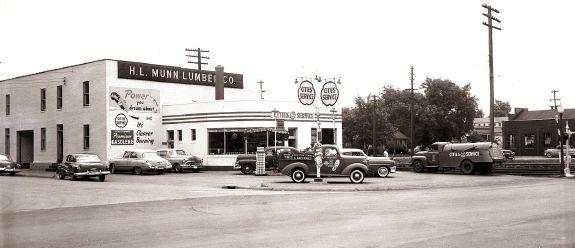
H.L. Munn Lumber was started in 1891 in Ames, Iowa, by Hiram Lester Munn, a Civil War veteran.
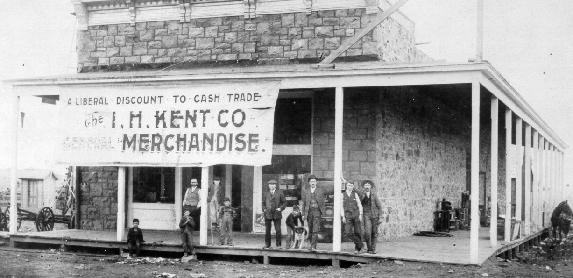
Kent’s Supply Center, the oldest retailer in Nevada, started out as the I.H. Kent Company in Stillwater in 1892.
CENTURY CLUB: PART II
Wilhelm’s Hardware dates back to 1881 in Myerstown, Pa.
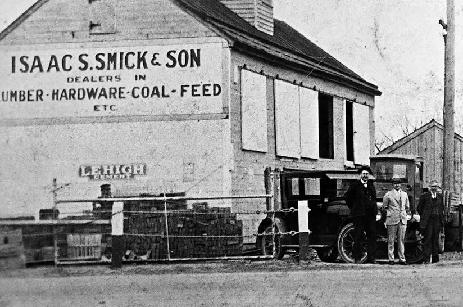
Smick Lumber is now in the fifth generation of Smick family ownership serving southern New Jersey.
The Requarth Company dates back to 1860 in Dayton, Ohio.
THE HARDWARE CONFERENCE
The Hardware Conference Brings the Industry Together
Developing relationships between independent hardware retailers and vendors has always been the main focus of The Hardware Conference. That’s why the Conference theme is “Where Relationships Are Formed.”
From August 16-18 at the JW Marriott Marco Island Beach Resort in Marco Island, Fla., the industry will be gathering as old industry friends are reunited for the 31st edition of The Hardware Conference.
This year marks the fifth year since Craig and Shanti Cope began the journey transitioning the Conference from Tom and Dale Chasteen. “Since we elected to stay with the Marriott during their renovation project, we have become the oldest consecutive-attending group at the resort,” said Craig. “We are pleased to announce we have signed a three-year extension keeping The Hardware Conference at the JW Marriott Marco Island through 2023.”
Come to the Conference and share ideas with fellow independent hardware retailers on how to grow and improve your business and interact with leading vendors on ways to increase category sales in your
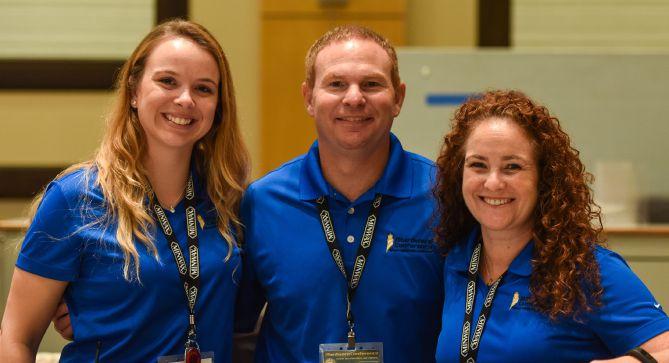
Upper: Craig and Shanti Cope, assisted by Megan Nieto (left), are your hosts for The Hardware Conference.
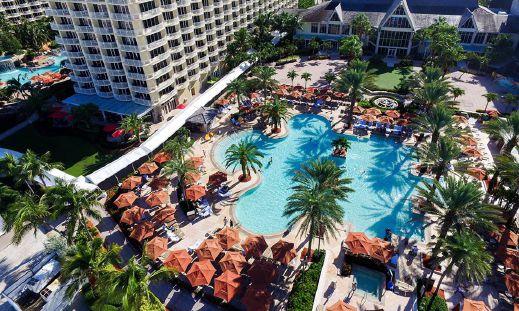
Lower: The Hardware Conference is held at the beautiful JW Marriott in Marco Island right on the beach.
store. In addition to an open dialogue session and a Beacon Award winner panel discussion where key industry topics are discussed with frank remarks, retail attendees will have many formal and informal opportunities to network with other retailers.
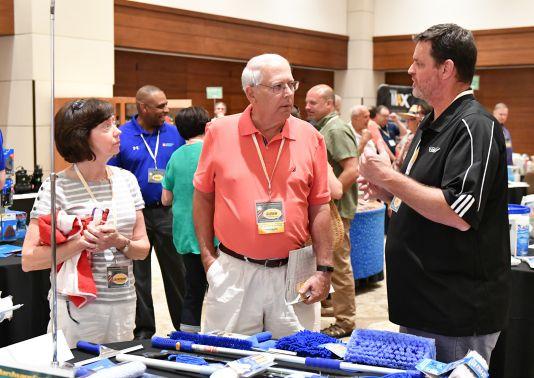
Key vendors participate in the Conference by displaying tabletop booths that highlight their product lines, and retailers will find it refreshing to have oneon-one dialogue with vendors without the pressure of buying.
“Dealers, vendors and wholesalers get together to discuss a variety of issues pertinent to our industry. The facility is wonderful and very affordable. The meals are superb and the entertainment outstanding,” says Matt Noonan III of Noonan True Value in Springfield, Ill.
Dealer registration for The Hardware Conference is one of the best bargains in the hardware industry—$149 per person. The fee covers:
• Three cocktail receptions, two dinners and two breakfasts plus access to the hospitality suite all weekend.
• Your choice of golf, shelling, Everglades airboat excursion or beach activities
Saturday afternoon.
• Access to vendor booths Saturday and Sunday.
• Open dialogue sessions on Saturday and Sunday.
• Wholesaler luncheon on Friday.
Retailers get a chance to have informal discussions with key vendors without the pressure of buying.
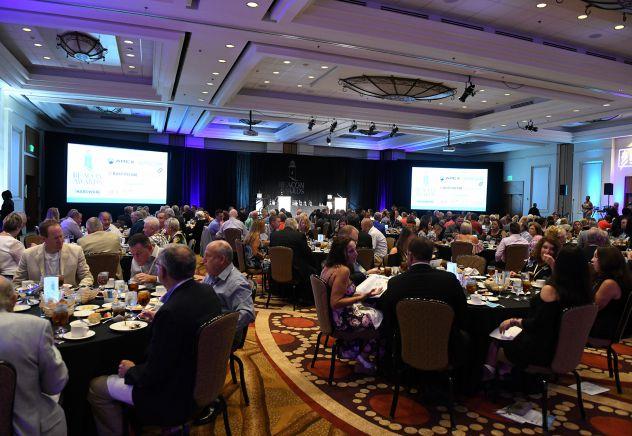
Friday evening’s banquet honors the 2019 Beacon Award winners.
THE HARDWARE CONFERENCE
HARDWARE TECHNOLOGY FORUM
Kicking off the event is a Hardware Technology Forum that starts the day before the Conference officially opens on Thursday, August 15. Epicor will again offer a full-day, hands-on training session for its retail customers. Bring your tablet or laptop so you can log right into your store as you learn new tips and tricks to make your POS software more productive in your store.
To attend the Technology Forum and the Conference the cost is only $299 per person and includes all training programs for one day plus breakfast, lunch and cocktail reception on Thursday in addition to the other Conference meal functions and activities the rest of the weekend.
BEACON AWARD WINNERS REVEALED
One of the highlights of the event promises to be the seventh annual Beacon Awards, which will recognize the industry’s Best New Stores, as well as Retail Beacon Award winners from participating wholesalers Ace Hardware, Do it Best Corp. and Orgill.
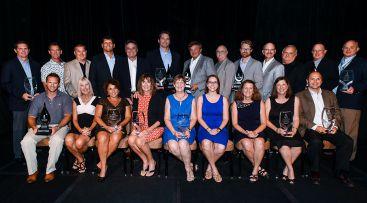
The “Best of the Best” retailers in the industry are recognized during Friday’s Beacon Awards banquet.
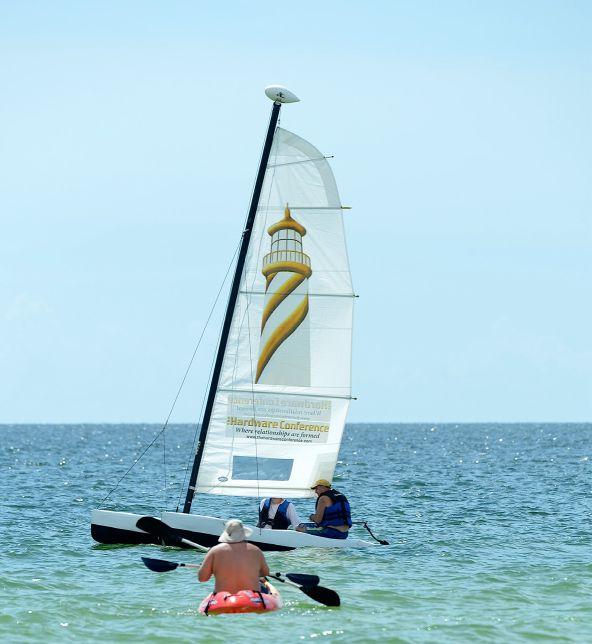
The Conference allows plenty of time to enjoy fun water activities.
The Beacon Awards are co-sponsored by The Hardware Conference and The Hardware Connection with special sponsorship support from Apex Tool Group, Epicor, Ettore and Rust-Oleum. The Beacon Awards banquet will be held Friday evening, August 16.
SIGN UP TODAY
Vendor booths will be auctioned off Saturday night with the proceeds benefiting the Nicklaus Children’s Hospital Foundation.
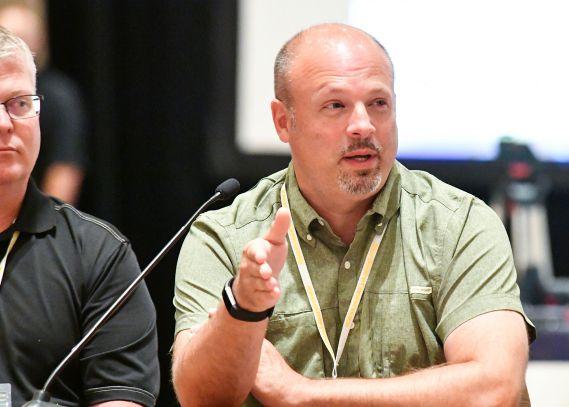
The open dialogue sessions enable retailers to give direct feedback to vendors about key issues.
MARQUEE SPONSORS
The Hardware Conference would like to thank and recognize its Marquee Sponsors for their support over the years. The following companies are Marquee Sponsors of this year’s event:
The Conference is designed to include the whole family, with plenty of free time for fun activities such as golf, shelling and Everglades airboat excursions, sailing and walking on the beautiful, sandy beach.
In addition to traditional giveaways, Craig and Shanti will also have a grand prize drawing for a $1,000 gift card of the cruise line of the winner’s choice. All dealers are eligible to win but must be present at the time of the drawing.
Attendees enjoy special room rates of $189 per night—a significant savings from regular rates of $375+. To make your room reservations, call the JW Marriott at 239-394-2511 and mention that you are a part of The Hardware Conference or go to https://book.passkey.com/e/49817384.
For more information on attending the 2019 Hardware Conference or to register, call Craig or Shanti Cope at (305) 853-0049 or go to www.thehardwareconference.com. n
Attendees get to enjoy terrific views from the penthouse hospitality
The Hardware Connection Magazine
The Hillman Group
Wooster Brush
Nicklaus Children’s Hospital Foundation
Hyde Tool
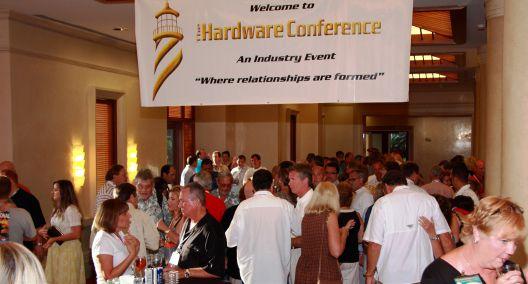
All-industry cocktail receptions are a great way to catch up with industry friends.
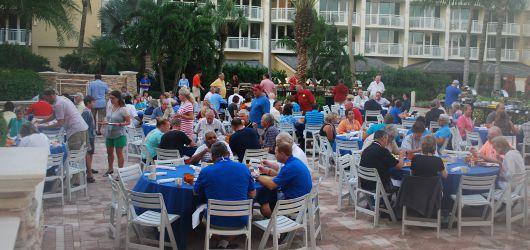
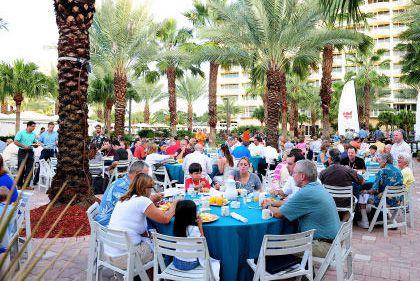
You can mingle with other retailers during breakfast on the terrace.
terrace.
THE HARDWARE CONFERENCE
SCHEDULE OF EVENTS
Thursday, August 15
Epicor Breakfast – 8:00 AM – 9:00 AM
Technology Forum, Vendor and Dealer Registration – 8:00 AM – 12:00 PM
Epicor Technology Forum – Dealers – 9:00 AM – 5:00 PM
Vendor Only Meeting – 10:00 AM – 3:00 PM
Vendor and Dealer Registration – 1:00 PM – 4:00 PM
Cooking Demonstration, sponsored by Napoleon Grills & Propane Cowboys–6:00 PM–7:15 PM
Kids’ (ages 5-12) Night Out – 6:15 PM – 10:30 PM
Beacon Awards Banquet Dinner – 7:15 PM – 9:30 PM
At conclusion of dinner, hospitality suite is open
Saturday, August 17
Breakfast – 7:00 AM – 8:00 AM
Exhibit Areas Open – 8:15 AM – 10:00 AM
Beacon Award winner panel discussion – 10:15 AM – 11:30 AM
Golfing at the Rookery – 12:00 PM – 5:45 PM
Wooster Brush Day at the Beach – 12:00 PM – 4:30 PM
Everglades Airboat Excursion – 12:00 PM – 5:00 PM
Cooking Demonstration,sponsored by Napoleon Grills & Propane Cowboys–12:30 PM–7:15 PM
Hospitality Suite Open – 1:00 PM – 5:00 PM
Shelling Excursion – 2:00 PM – 4:30 PM
Cocktail Reception – 6:15 PM – 7:15 PM
Key West Buffet Dinner Party and Auction – 7:15 PM – 9:00 PM
At conclusion of dinner, hospitality suite is open
Sunday, August 18
Breakfast – 7:00 AM – 8:00 AM
Exhibit Areas Open – 8:15 AM – 10:00 AM
Open Dialogue Session – 10:15 AM – 11:30 AM
Closing Remarks– 11:30 AM – 12:00 PM
“Where Relationships Are Formed”
AUGUST 16-18
3 Days of Networking, Relaxing and Learning
Meet colleagues and new friends at the industry’s largest conference for independent hardware retailers. Share ideas with top retailers on how to grow your business, interact with key vendors on how to increase sales in your store and attend educational seminars, all-industry cocktail receptions and dinners in an exclusive 5-star resort setting.
Learn More About Your POS System at the Hardware Technology Forum
Epicor will offer full-day, hands-on training sessions for retailers. Bring your tablet or laptop so you can log right into your store as you learn new “tips and tricks” to make your POS software more productive in your store.
Honor the Industry’s Best Retailers at the 2019 Beacon Awards
The Beacon Awards are an important recognition program that honors the best of the best dealers who represent the future of the industry.
Sponsors:
Co-Sponsors: FOR MORE INFORMATION ABOUT ATTENDING THE BEACON AWARDS ALONG WITH ALL OTHER EDUCATIONAL SEMINARS, OPEN FLOOR DISCUSSIONS AND SOCIAL ACTIVITIES AT THE HARDWARE CONFERENCE, VISIT WWW.THEHARDWARECONFERENCE.COM
CATEGORY REPORT
PLUMBING TRENDS
Sales of Toilet Repair
(Independent Hardware Channel)
12 Months % Change vs. Year Ago
Toilet Repair: Units
Toilet Repair: Dollars
Source: Vista Information Services, div. of Epicor Software Corp.
Unit Sales Breakdown for Toilet Repair
Total of 1,135 Items with Sales
Top 5 Items % of Unit Sales
Top 10 Items % of Unit Sales
Toilet Repair Share of Sales by Type (Latest 12 Months)
and
PLUMBING DEPARTMENT MERCHANDISING
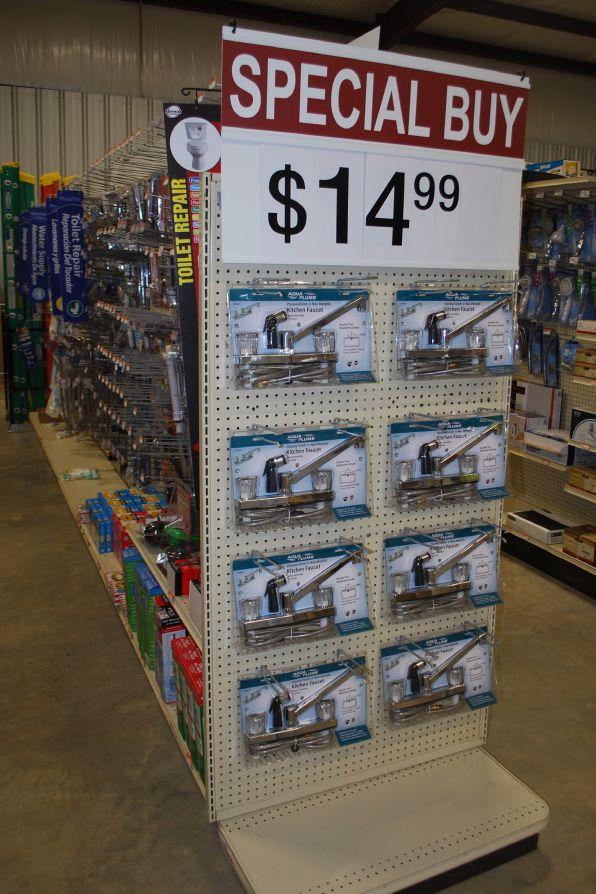
Entry-level faucets are promoted on an end cap at Nettleton Hardware in Nettleton, Miss.
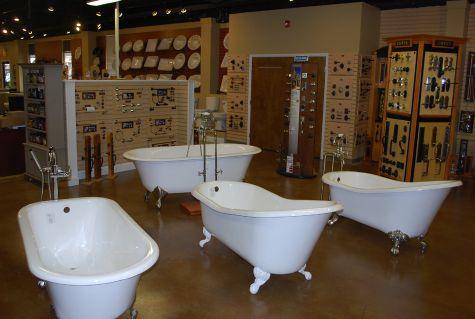
Park Supply features a plumbing and bath showroom that showcases a wide variety of options.
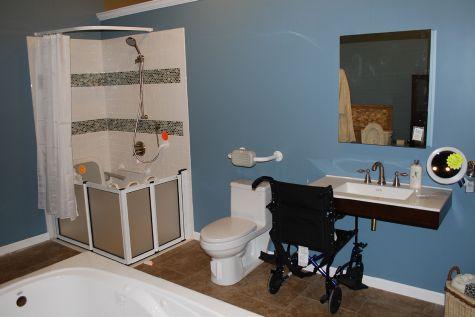
Bath vignettes at Park Supply in Huntsville, Ala., illustrate how to accommodate the needs of elderly and handicapped customers.
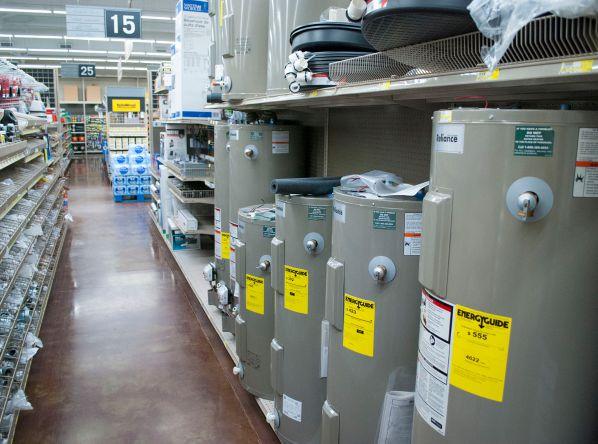
Water heaters are displayed out of the box at Agricola Do it Best Hardware & Lumber in Lucedale, Miss.
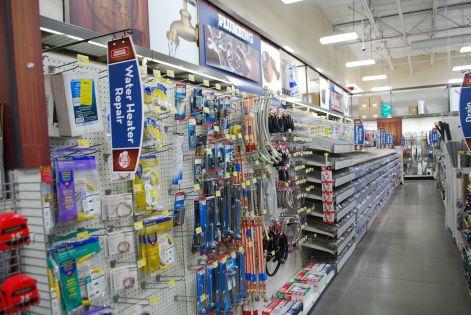
Water heater repair products help make the plumbing department stand out at Parkrose Hardware in Portland, Ore.
Woodland Do it Best Hardware & Home in Woodland Park, Colo., makes sure it stays in stock on core plumbing items.
IN THE NEWS
NEW STORES:
• Justin and Kristin Meeks opened their second Pease River Supply location in Quanah, Texas.
• Strand Ace Hardware opened in Modesto, Calif.
• Century Club member Woodford Lumber & Home has acquired the Clear Lake, Iowa, location of Superior Lumber.
• Jeff Ulmer, owner of Action Hardware, has acquired Fairfax Hardware in Wilmington, Del., from Art Pleasanton, who retired after serving the community for over 40 years.
• Century Club member Alexander Lumber, based in Aurora, Ill., has opened a new location in Iowa City, Iowa.
• Tweedy and Popp Hardware at Crown Hill has opened in Seattle.
• Liz Haun is opening Nyssa Mercantile, a True Value store in Nyssa, Ore.
• Ron Wade and Roger Copenhaver have sold True Value in Grafton (Va.) to Peninsula Ace Hardware.
• National Lumber has opened its 9th store in East Hartford, Conn.
• Carter Lumber has acquired and reopened four lumberyards and a truss plant formerly operated by DuBell Lumber in New Jersey.
• Rocky’s Ace Hardware has acquired Cantelmi’s Forks Hardware in Easton, Pa.
• Miner’s Ace Hardware opened its 9th store in Goleta, Calif., in a former OSH location.
KUDOS TO:
• White Hardware in McCormick, S.C., is celebrating its 100th anniversary this year.
• Bruce Thomas is celebrating the 70th anniversary of Mayfair Hardware in Saskatoon, Sask.
• The Kuenning family held a grand reopening for their recently expanded and renovated Western Ohio True Value Hardware store in Troy, Ohio.
• Do it Best Corp. celebrated a milestone birthday of its former leader by giving back to an organization he helped establish more than 40 years ago. Fort Wayne Mayor Tom Henry joined leaders from Do it Best and Big Brothers Big Sisters of Northeast Indiana on June 18 to celebrate the 90th birthday of Don Wolf, who served as president and CEO of the Fort Wayne-based co-op from 1967-1992. Mayor Henry shared an official proclamation declaring June 18, 2019, Don Wolf Day in the city of Fort Wayne. Do it Best leaders unveiled the Big DONation, a donation drive for Big Brothers Big Sisters of Northeast Indiana, an organization Wolf co-founded in 1972 and helped grow into one of the largest chapters in the United States. Do it Best will match all donations to the organization through October 18, up to $90,000.
PEOPLE ON THE MOVE:
• Do it Best Corp. has named Todd Hixson LBM business development manager; Josh Ratcliff division manager for lumber and reload operations; Joe Corah division manager for panels,
distribution and specialty products; Jean Fahy division manager of building materials; Shannon Bearman business analyst; Corinne Beer global sourcing associate merchandise manager; and David Dalman LBM reload inventory and pricing manager.
WHOLESALERS IN THE NEWS:
• Orgill will be expanding its network of distribution facilities with the addition of a 780,000- square-foot distribution center in Rome, N.Y. The new facility will be Orgill’s eighth full-service DC. The new facility will service customers in seven states: New York, Vermont, New Hampshire, Maine, Massachusetts, Connecticut and Rhode Island. Orgill plans for the facility to be fully operational by early 2022.
• Ace Hardware is opening 11 stores in former Orchard Supply Hardware locations.
OTHER NEWS:
• A July 8 fire destroyed Century Club member Greene Lumber Company in Greene, Iowa, which dates back to 1899. Kemp Lumber and Building Supplies in Kemp, Texas, was destroyed July 4 in a fire.
• Silver Canyon Group, a San Diego-based private equity investment firm, formed Fulcrum Building Group to acquire a majority interest in South Bay Lumber of Santa Rosa Beach, Fla., and Navarre Lumber of Navarre, Fla., on July 1. Fulcrum’s launch is the first step in creating a leading provider of building products and services and a platform for future growth. The owners of South Bay, brothers
John and Jay Pugh, and owner of Navarre, Bobby Killingsworth, have an ownership stake in Fulcrum and each business will continue to operate under its current management structure and brand name. Tyndale Advisors, a wholly owned subsidiary of Orgill, has been engaged to provide management services. Craig Cowart of Tyndale will serve as CEO of Fulcrum and oversee strategy and growth.
FOR THE FULL STORY:
• Umber’s Do it Best Hardware helps with tornado recovery. Click here.
ECI SOFTWARE SOLUTIONS MAKES TWO MAJOR ACQUISITIONS
ECi Software Solutions has acquired Pacsoft, a leading provider of inventory management and POS software solutions for retail hardware businesses worldwide, with a significant presence in Australia. The Pacsoft team and product portfolio will join ECi’s LBM and Hardlines Division, led by John Maiuri.
In addition to maximizing the collective market and software expertise of both teams to best support customer success, the acquisition also allows ECi to significantly enhance its footprint in Australia. To that end, ECi will continue to innovate, sell and support the Pacsoft suite of solutions, and its customer base will join nearly 4,000 businesses that already trust vertical-specific solutions from ECi’s LBMH Division to run their businesses.
“Pacsoft’s customers face many of the same challenges that ECi’s core customer base does, so we understand what they are up against
and need to effectively grow their businesses,” said Ron Books, CEO of ECi. “By expanding the customer base, augmenting the product portfolio and extending our geographical footprint, we can bring additional value to all of the businesses we serve.”
ECi also acquired Spruce Computer Systems Ltd., a UK-based reseller of ECi’s Spruce software for managing timber, hardware and building materials businesses in the United Kingdom. Spruce Computer Systems Ltd. will become part of ECI’s LBM and Hardlines division.
ECi has been selling its merchant software solutions in the United Kingdom for nearly 20 years through its successful partnership with Spruce Computer Systems Ltd. The acquisition not only cements that strong relationship, but also creates an official UK presence for ECI’s LBMH division and continues ECi’s global expansion.
In other news, ECi released upgraded versions of its LBMH division software products: Spruce®, an end-to-end management software for the LBM industry, and RockSolid MAX®, a cloud-based POS software for independent hardware stores, home centers and convenience lumberyards. These updates include significant new industry-specific features that provide opportunity for hardware stores and LBM businesses to run more efficient operations.
ACE EXPANDS PAINT BUSINESS WITH BENJAMIN MOORE
Ace Hardware Corp. and Benjamin Moore announced an expanded relationship that will make Benjamin Moore paints more widely available to DIY customers at locally owned Ace Hardware stores across the
country. Ace Hardware has named Benjamin Moore its preferred paint supplier and will offer an assortment of Benjamin Moore paints to participating Ace stores in the U.S. by Spring 2020.
“Since 2005, Benjamin Moore and Ace Hardware have worked together to service the DIY customer through the hardware segment. Expanding our relationship with Ace furthers our legacy commitment to the independent retail channel, while broadening access to Benjamin Moore for paint customers,” said Dan Calkins, chairman and CEO of Benjamin Moore. “We look forward to continuing to offer the personalized service and industry expertise that consumers have come to expect from both Benjamin Moore and Ace Hardware.” Benjamin Moore will increase its footprint in Ace Hardware stores and make its products available through an exclusive warehouse distribution program. This model will enable independently owned and operated Ace Hardware stores to carry an assortment of premium interior and exterior Benjamin Moore paints, notably Regal® Select and ben®. Benjamin Moore will also assume responsibility for manufacturing Clark+Kensington® and Royal®, Ace Hardware’s private-label paint brands.
“Ace has been and will continue to be a neighborhood destination for quality paint and helpful advice. Our expanded relationship with Benjamin Moore reinforces our commitment to provide the highest-quality brands, that can’t be found in discount stores or websites, to our customers while further strengthening our independent retailers,” said John Surane, executive vice president, chief merchandising and sales officer of Ace Hardware. n
UPCOMING EVENTS
AUGUST
Florida Hardware Fall Market
August 16-18, Double Tree Hotel & Convention Center, Orlando, Fla.
Independent Garden Center Show and Independent Home Improvement Show
August 13-15, McCormick Place, Chicago
Orgill Fall Market
August 22-24, McCormick Place, Chicago
The Hardware Conference
August 16-18, Marco Island, Fla. www.thehardwareconference.com
SEPTEMBER
Ace Hardware Corp. Fall Convention
September 6-8, Georgia World Congress Center, Atlanta
Blish-Mize Fall Dealer Market
September 19-21, Overland Park Convention Center, Overland Park, Kan.
Bostwick-Braun Company Fall Dealer Market
September 19-21, Seagate Center, Toledo, Ohio
Bradley Caldwell Fall Trade Show
September 10-12, Harrah’s Resort, Atlantic City, N.J.
Emery Jensen Distribution Show 2019
September 16-21, Anaheim Convention Center, Anaheim, Calif.
Home Hardware Fall Market
September 22-24, Home Hardware Distribution Centre, St. Jacobs, Ont.
Horizon Distribution Trade Show & Conference Expo
September 6-8, Convention Center & Sundome, Yakima, Wash.
Monroe Hardware Fall Market
September 13-15, TD Convention Center, Greenville, S.C.
spoga+gafa 2019
September 1-3, Cologne Exhibition Center, Cologne, Germany
OCTOBER
Do it Best Corp. Fall Market
October 18-21, Indiana Convention Center, Indianapolis
House-Hasson Hardware Fall Dealer Market
October 24-26, Sevierville Events Center, Sevierville, Tenn.
NAWLA Traders Market
October 16-18, H.B. Gonzalez Convention Center, San Antonio
North American Wholesale Lumber Association Traders Market
October 16-18, Henry B. Gonzalez Convention Center, San Antonio, Texas
True Value Fall Reunion
October 3-6, McCormick Place, Chicago
Wallace Hardware Company Fall Dealer Market
October 9-11, LeConte Center, Pigeon Forge, Tenn.
For a complete listing of calendar dates, click here.
RETAIL IDEAS
S.L. WADSWORTH & SON IS STEEPED IN U.S. HISTORY
Century Club member S.L. Wadsworth & Son has created a lot of history since opening for business in Eastport, Maine, in 1818. It is America’s oldest ship chandlery, second-oldest hardware store and the easternmost store, as well as Maine’s oldest retail business.
Christopher Wadsworth Brown is the sixth generation of his family to run the business, which shifted from serving the needs of ships as a chandlery to focusing on hardware after the entire store building and wharf washed out to sea during a storm in 1976.
Wadsworth & Son literally
out to sea during the Groundhog Gale of 1976.
The Wadsworth family may have a long hardware lineage, but the family can trace its roots back to the pilgrims. Christopher Wadsworth—namesake of the current owner—came over to Plymouth Colony with his brother William in 1632 on the ship Lion. Christopher Wadsworth Brown is directly descended from him 11 generations.
Six generations of the Wadsworth family have been operating S.L. Wadsworth in Eastport, Maine, since 1818.
The fifth generation of the family is represented by General Peleg Wadsworth, who was a trusted brigadier general on George Washington’s staff during the Revolutionary War and later the first Congressman from the region of Massachusetts (that later became Maine). A Harvard graduate, Peleg distinguished himself with valor in the Penobscot Expedition and gained fame for escaping from British capture.
Eddie and Ned Wadsworth represented the fourth and fifth generations of the family to run the nation’s oldest ship chandlery in Eastport.
S.L.
washed
SWITCHING FROM ENGINEER TO HARDWARE SALESMAN
Engineer Maurice White III went from working on the radar system for the F-16 Fighting Falcon to running a small hardware store in McCormick, S.C.
One of Peleg’s14 kids, Zilpah, became mother to the famous poet, Henry Wadsworth Longfellow. Another, Samuel B. Wadsworth, founded the hardware and chandlery business that was named after him in 1818.
Brown, the current proprietor, says his grandfather, Ned Wadsworth, had quite the history with Franklin D. Roosevelt (FDR) who was a boyhood friend. In the summer of 1916, Ned was excited to go up in an airplane from the USS North Carolina, which was docked in Eastport harbor. The ship’s captain nixed that plan, only to be overruled by Roosevelt, who happened to be on the ship and was the assistant secretary of the Navy. So FDR helped Ned become the first Eastporter to fly over the harbor.
Roosevelt first became ill with polio in 1921 while vacationing at the family’s summer home in Campobello Island in Maine. He was filmed then while on the wharf outside S.L. Wadsworth in Eastport. “Our family had a lot of contact with the Roosevelts,” Brown explains. “Eleanor would take my mother for ice cream.” n
It’s not just any hardware store, writes Greg Deal in the Index-Journal. White Hardware has been in the family for 100 years, making the Do it Best member part of The Hardware Connection Century Club.
Maurice’s grandfather, Maurice White Sr., and White Sr.’s two brothers, Kletner and Wallace White,
Chris Brown (left), the current owner of S.L. Wadsworth & Son, gets an early hardware lesson from his uncle, Edward Wadsworth.
Maurice White Sr. stands in White Hardware in McCormick, S.C., in 1932.
RETAIL IDEAS
opened the store in 1919, one door down from its current location. When White Sr. died in 1956, Maurice White Jr. took over operations.
After graduating from Clemson with an engineering degree, Maurice White III went to work for Westinghouse Electric’s governmental division, where he worked on the radar.
“I knew at some point and time in my life that I was going to have to deal with the hardware store,” White III said.
To read more, click here. n
CLARKS ACE HARDWARE IS THE SIXTH-OLDEST HARDWARE STORE IN AMERICA
Well into the 1970s, customers would walk into Andy Clark’s hardware store in Ellicott City, Md., looking for parts for their Ontario seed drills.
“It was a super durable piece of gear,” Andy said.
How durable? Well, the Ontario drill—used to plant grain—came on the market around 1900. Back then, it would be pulled across a farm field by a team of horses, writes John Kelly in The Washington Post.
“Once the horses were gone, they’d just hitch it up behind a tractor,” Andy said.
Andy Clark represents the sixth generation of the family to run Clarks Ace Hardware in Ellicott City, Md., which was founded in 1845. It is the sixtholdest hardware store in America.
It’s possible Andy’s grandfather or great-grandfather sold the drills his customers wanted parts for. At 174 years old, Clarks is probably the oldest continuously operating business in Howard County and is a member of The Hardware Connection Century Club.
To read more, click here. n
OUR 60,000+ READERS AREN’T THE ONLY ONES WHO’VE NOTICED OUR EXCEPTIONAL EDITORIAL!
2019 Digital Awards
Honorable Mention for Best Digital Magazine
FOLIO: Magazine
2018 Regional Bronze Award for Best E-Zine
American Society of Business
The Hardware Connection has won six awards for editorial excellence in the past five years. We just received a 2019 FOLIO Digital Awards honorable mention for Best Digital Magazine.
This follows winning a 2018 Eddies Digital Award for Breaking News Coverage, a 2018 Regional Bronze Award for Best E-Zine from the
2017 Eddies Digital Award for Best Standalone B2B Digital Magazine
FOLIO: Magazine
2018 Eddies Digital Award for Breaking News Coverage
FOLIO: Magazine
American Society of Business Publication Editors and a 2017 Eddies Digital Award from FOLIO for Best Standalone Digital Magazine in the B2B category.
We strive to bring our readers editorial content that is relevant and retail-focused, and these awards demonstrate the quality and credibility of our editorial content.
Just Another Reason Why We Are the Industry’s Digital Leader!
BEHIND THE NUMBERS
61%
Percentage of U.S. stores that are understaffed at least 25 percent of the time during peak periods., according to the Global Retail Absence Survey issued by The Workforce Institute at Kronos Inc.
42%
Percentage of all retailers who feel absenteeism has a significant impact on store revenues.
167,000
Decline in retail trade employment since January 2017, according to the Bureau of Labor Statistics, with 5,800 retail jobs lost in June 2019.
0.5%
Percentage retail sales increased in May 2019, with e-commerce sales rising 3.6% in the first quarter.
-7.5%
Decline in Consumer Confidence Index in June.
70%
Percentage of U.S. retail locations that now offer Apple Pay.