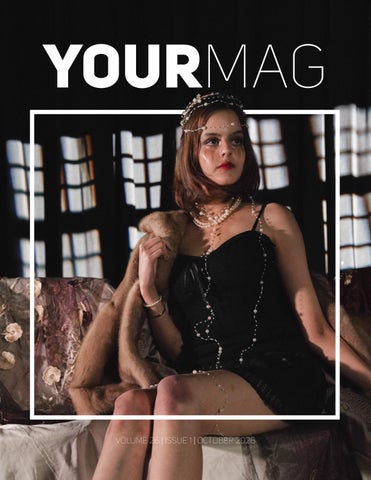
Yourmag
Volume 26 | Issue 1 | OCTOBER 2026
Recognized in Spring 2012, YOURMAG’s goal is to promote knowledge of the magazine industr y by giving students the opportunity to be responsible for all aspects of a monthly lifestyle publication. With an audience of urban college students in mind, members create content across a broad range of topics and mediums, including style, romance, music, pop culture, personal identity, and experiences. YourMag’s overarching aim is to foster a positive, inclusive community of writers, editors, and artists.
1 | YOURMAG
volume 26 | issue 1 | October 2026
MOLLY DEHAVEN Managing Editor
KAT BOSKOVIC Editor-in-Chief
eliana vega Creative Director
Ryan williams Co-Editorial Director
HEATHER THORN Editor-in-Chief
KYLIE LOHSE Community Chair
sophie scholl Co-Editorial Director
Audrey Coleman Co-Head Designer
tehya tenasco Style Editor
ELLA DONOGHUE Web Editor
ELizabeth liatsos Co-Head Designer
SOFIA WELCH Asst. Style Editor
ABBY HOYT Asst. Web Editor
nil oskuz Asst. A&E Editor
louise berke Living Editor
HEATHER THORN Romance Editor
grace chandler Head Proofreader
KEIRA MOOAR Art Director
EMA SABAU Photo Director
Tiffany Tran Marketing Director
ELIOT BERKLEY Copy Chief
lucy belon Asst. Photo Director
BETHANY HANSON Asst. Managing Editor
casey berman Asst. Copy Chief
Copy editors: ELLIOT BERKLEY, Tiana Distasio, maya lehrich, madison lucchesi, and claudia rufo GRAPHIC designERS: ELIZABETH LIATSOS, AUDREY COLEMAN, AMARI WITT AND SYDNEY FINK Proofreaders: GRACE CHANDLER
YOURMAG | 2
CONTENTS Romance
5
AUTISM IS... HOT NOW?
7
HOW THE WEST REWROTE CLEOPATRA
9
YM ROMANCE HORROR STORIES
Editorial
11
GENESIS
style
19
HOW TO BECOME A PERSON WHO LIKES THINGS
21
CURATING THE MINIMUM WAGE WARDROBE
25
ON THE FRINGE
27
YOUR CLOSET
31
HEAR, SPEAK, SEE
editorial
39
LESSONS ON LIVING THAT ONLY DYING COULD GIVE
Living
41
IF BIRTH FEELS LIKE DEATH TO THE BABY
43
WAIT, WHEN DID THE INTERNET GET SO BLEAK?
45
POLYMER PALPITATIONS
editorial
53
BYE, BYE, MISS AMERICAN PIE
arts & Entertainment
55
WHEN DID FANFICTION BECOME MAINSTREAM?
57
“HELL IS A TEENAGE GIRL:” HOW THE HORROR GENRE IS A HOME FOR FEMALE TRAUMA
3 | YOURMAG
ymp3
59
LAST CALL
artist statement
61
ALEX CULINA
Letter from the Editor This issue marks my seventh semester with Your Mag, my first as Managing Editor, and somehow, my last semester of college. It feels fitting for Cataclysm to be our first issue of this Volume. There’s something a little cruel about how beautiful October is. Just as the air turns crisp and the season settles into its splendor, the days grow shorter and the cold creeps in. Not to get too morbid, but the final semester of college feels much the same. When I joined YourMag freshman year, I saw it as something larger than life, and I wasn’t quite sure where I belonged. Now, nearly nineteen issues later, I’m nearing the end of my time traversing tight deadlines, perilous production plans, and computer-crashing InDesign files, having found more belonging than I know what to do with. I think that’s why this issue feels so personal. I’m standing in the middle of something I once dreamed of, already wishing I could make it last longer. If I have learned anything from Cataclysm, it’s this: The beauty of something isn’t diminished by knowing it will end; part of that beauty is recognizing just how fleeting it is while we’re still lucky enough to experience it. To our E-board and contributors, thank you for pouring so much of yourselves into these pages. This magazine has always been a testament to what we can create together, and I feel so lucky to be part of it. Here’s to making something beautiful before the (leaves) fall. Enjoy Cataclysm <3 With love, Molly DeHaven, Managing Editor
In 1976, British historian Sir John Bagot Glubb proposed that empires enjoy approximately 250 years of greatness before succumbing to their own decadence. The historical evidence is less accommodating, but the coincidence is rather uncanny: the United States celebrated its 250th birthday this July. Two and a half centuries of life, liberty, and the pursuit of happiness, and perhaps the candles on the birthday cake are beginning to look suspiciously like a funeral pyre. For our October issue, Cataclysm, we turned to Babylon, whose ancient grandeur survives the popular imagination largely through the spectacle of its downfall. The Hanging Gardens, the feasts, the excess, the biblical warnings: an entire civilization reduced to an extravagant cautionary tale. But the most compelling part of a cataclysm is not necessarily the collapse itself. It’s the moment before, when the fruit is at its ripest, the party is at its loudest, and nobody has yet thought to check the foundations. It is also the morning after, when the ruins become the raw materials of something else. Across these pages, our writers and creatives explore the ruptures that divide history and our own lives into befores and afters. Welcome to Cataclysm. The empire may be celebrating its birthday, but somebody ought to keep an eye on the cake. Yours until the fall, Kat Boskovic, Editor-in-Chief
Cataclysm comes at a fitting time as the leaves reach their most beautiful before falling, and people are experiencing their own personal changes. After all, people tend to change around the same time as the leaves do. While it’s melancholic to say goodbye to an old chapter of our lives, the next one is a necessity. This aftermath is at the center of this issue of YourMag. Cataclysm is not just about holding on tight to the peak and all of the dazzling colors and intense emotions that come with it. It’s also about looking to the future and knowing that circumstances must change. In this issue, our creatives urged readers to analyze the peaks and valleys that they may be experiencing–what they are composed of, and what the future holds. Cataclysm presents us all with a choice. We can either prepare ourselves for the next chapter, or let things fall apart. Either way, stagnation is an impossibility. Eliana Vega, Creative Director
YOURMAG | 4
Autism Is... WRITTEN BY KYLIE LOHSE
5 | ROMANCE
ART BY KEIRA MOOAR
. Hot Now? I
realized that my brain made me ugly when I was 12. It was the day before school picture day in 7th grade, a little over a year after I found out about my autism diagnosis. My homeroom teacher was going over the general dress code, reminding us our outfits should be school appropriate. “I’m going to dress autistic tomorrow,” my classmate whispered into my ear. “What do you mean?” I asked, playing dumb. He didn’t know that I was autistic. No one knew, then. “I’m going to dress ugly,” he said, expecting me to laugh along. But I just stayed quiet. I browsed the internet, researching the part of me I was trying my best to conceal. Google told me autistic people are “socially awkward” and have trouble maintaining romantic and platonic relationships. I browsed images of what autism “looked like,” and found a plethora of photos of conventionally unattractive white boys with acne and greasy hair. The worst thing for an already insecure adolescent girl to find out is that her condition is deemed ugly by society. I had been told that I was pretty before, but now I wondered if that was true. I thought telling someone that I was autistic would soil their perception of my physical appearance, that this one simple fact about my psyche was what deemed me worthy or not. Sometimes, the opposite would happen. I informed people of my neurodivergence and was told, “You don’t look autistic.” What I heard: “You’re too conventionally attractive to be autistic.” That was my answer. I would be ugly and unlovable for the rest of my life. I would never discover what it was like to be loved by someone, for someone to want to spend the rest of their life beside me. Since you have to be nice to the autistic girl, I felt that no one would ever truly find me attractive outside of pity. But then one day, once I was no longer an awkward preteen and instead an adult woman in college, it seemed that my diagnosis was no longer a hindrance to my “attractiveness,” but a benefit. It was as if someone simply flipped a light switch, turning autism hot. I discovered a new trend on TikTok where women filmed their boyfriends and their unique interests or slightly quirky habits. The audio accompanying the video said, “I like him. I like that autistic man, and would I be wrong if I asked him at dinner, ‘Is you autistic, cause I like that.’” There was also an upsurge of people, mostly men, talking about how they wanted their girlfriend to be “a little autistic.” Women proudly called themselves “neurospicy,” a slang term used to describe neurodivergence. I knew the internet tended to be sporadic and change its opinions in a blink, but I wasn’t expecting to go from videos mocking “the autistic kid in class” to videos captioned, “I
want an autistic girlfriend, tbh” just a few scrolls away. The emerging desire for an autistic girlfriend felt vaguely familiar at first; then, I realized this trend has happened before with the Manic Pixie Dream Girl (MPDG) film trope. The MPDG is an eccentric, quirky young woman who exists solely to further the male love interest’s character arc. But I noticed a lot of the traits of the MPDG are traits common in autistic women. The MPDG trope portrays autistic women as objects to be fetishized and used by men, rather than treated as an equal partner in a relationship. I started to wonder what it would be like to be in a relationship with someone fascinated by this fantasy. I don’t want to be someone’s Alaska Young or Ramona Flowers, reduced to bringing my innocent quirkiness into their life. Would they leave me once they realized that autism isn’t a character trait, but a disability that affects almost every aspect of my life? I imagined this person falling in love with their assumed perception of me created by the media, and eventually discovering the non-fetishized side of autism. Would they bite into me thinking I’m a ripe clementine only to realize that I’m rotten on the inside? My fear of being rotten on the inside doesn’t just apply to romantic relationships; I’ve felt this way in many platonic friendships. I’d enter a friendship with a very filtered version of myself, masking the unattractive parts. The mental breakdowns, the special interests, the awkwardness and lack of social cues—all of that hides under a thick layer. I’d eventually reveal to them that I’m autistic once this mask was exhausted and I felt I could consider this person a true friend. They’d typically accept me initially; “That doesn’t change anything, you’re still my friend.” But then we’d both slowly realize it wasn’t true. I’d mask myself less, revealing more of myself, the rotten parts. And then I’d finally expire and lose a friend. Seeing autism suddenly portrayed in this fetishized and romanticized way has caused a roller coaster of emotions in my brain. At first, part of me was happy that I was finally considered attractive by mainstream society. But as I thought about it more, only certain parts of autism were deemed attractive, and I fell back into my melancholic state of feeling unlovable and fixating on my physical appearance in order to compensate for something. What I realized about love is that it can’t be forced. You can’t force yourself to love or to be loved by someone who won’t accept you for who you are, who won’t embrace both the ripe and the rotten parts. I can’t force myself to be someone the world wants me to be in order to experience love. So I tell myself that I will find my person one day, someone who wants to chew on a rotten apple. Someone willing to love me unconditionally for who I am. YM ROMANCE | 6
How the west Rewrote Cleopatra WRITTEN BY HEATHER THORN
ART BY BELLA PACHON
s one of the ancient world’s most famous leaders, Queen Cleopatra VII and her reputation have captivated us for centuries: the mesmerizing femme-fatale leader and seductress with eyes lined in dark kohl. Her beauty was an irresistible power that held the hands of formidable men on the way to their downfall. Western tradition presents Cleopatra as more seductive than smart, focusing on her allure and attractiveness rather than her attributes as an active leader of Egypt. Despite Cleopatra being one of the most memorable and recognizable historical figures, much of the information about her remains shrouded in depictions of her insatiable sexuality. Cleopatra was a savvy politician, known not only for her intelligence and cunning in Ancient Egypt, but also for her benevolent leadership throughout her 22-year reign. She was fluent in ancient Egyptian, remaining the first and only Ptolemaic ruler in their 300-year reign to learn the language. In total, she could speak nine languages. As an independent monarch, Cleopatra returned Egypt to its former glory through her political alliances and substantial knowledge of economics, linguistics, law, and military strategy. But for all of Cleopatra’s intellectual qualities as Egypt’s monarch, it is her sexuality and relationships with men that she is largely remembered for in Western tradition. She has gone down in history as one of the most infamous seductresses, her romantic life intertwined with two of the Roman Empire’s most influential men: Julius Caesar, Roman general and dictator of the Roman Republic, and Mark Antony, powerful military leader and statesman. Following the death of her father, Cleopatra ascended the throne at the age of 18 alongside her younger brother, whom she married that same year. Cleopatra’s reign would end up being the last of the Ptolemaic Pharaohs, as she would discover the instability awaiting her. Rome’s military and political power was rapidly expanding and threatening Egypt’s declining territorial control, and internal court conflict turned into a civil war: Cleopatra against her brother. Forced into exile and needing an ally, Cleopatra found one in the most powerful man of the Mediterranean world: Julius Caesar. When Cleopatra visited him to win his financial support, she secured the help of a trusted servant to carry her into his palace undetected. Out of a bundle of dirty laundry she emerged, and as the story goes, Caesar was transfixed at the sight of her. In a life-or-death situation, the diplomatic maneuver offered Cleopatra her one shot at defeating her brother. Roman writers depicted the dirty sack of bedclothes as a lavishly decorative rug to frame Cleopatra as seductive—and retellings ran with it. Joseph L. Mankiewicz’s 1963 Cleopatra, starring Elizabeth Taylor and Richard Burton, cemented the scene as cinematically glamorous. The rug is swept under Cleopatra’s feet and out she tumbles effortlessly, not a hair out of place or a smear of her thick eyeliner to be seen. The dramatization of Cleopatra’s covert palace entrance
downplays the reciprocal necessity of her and Caesar’s political alliance. Both sides reaped benefits by winning the civil war against Cleopatra’s brother; Cleopatra gained protection from her brother’s armies while Caesar restored Roman power by funding his armies with Egypt’s wealth and resources. Ultimately, Cleopatra politically aligned with and married Marc Antony, leader of Rome’s eastern provinces. Their marriage was an equal one between independent monarchs—as opposed to a relationship between rulers of a dominant and weaker territory—that allowed Cleopatra to return Egypt to its former state of prosperity. Under their alliance, she leveraged Egypt’s supplies and funds in exchange for the reacquisition of Egyptian territories, established trade with Eastern nations to grow Egypt’s economy, and ensured Egypt’s position as a world power. In addition, their enduring political relationship resulted in three children who Cleopatra guaranteed would have power along with their own territories. However, upon Rome’s defeat of Egypt in the Battle of Actium, all other opportunities for Cleopatra to secure and advance Egypt’s power were depleted. Following Antony’s suicide, Cleopatra followed suit with her own honorable suicide—refusing to be taken captive and instead ending her life on her terms. History was left to be rewritten by the victors. The adopted son of Caesar, Octavian, would go on to smear Cleopatra’s reputation and vilify her as a seductress whose allure Mark Antony couldn’t tear himself away from. Roman revisionist narratives depict Cleopatra as villainous, manipulative, and a woman who preyed upon Roman leaders. The recasting of Cleopatra’s political alliance as sexual domination is a framing that Hollywood has clung to. Cecil B. DeMille’s Cleopatra (1934) portrays Cleopatra as fair-skinned with feminine features, and their alliance as an extravagant love affair. She seduces Antony in a lavish set-up, using promiscuity for power as an unstoppable “femme fatale.” By legitimizing Cleopatra as a politically powerful woman explicitly because of her desirability, Western media diminishes the terms by which she’s remembered. She was more than the constructed caricature she has been reduced to: that of a manipulative monarch set on seducing powerful men. Yet Cleopatra remains only one example of the dangerous intersection of women and power, one that rewrites narratives in order to downplay women’s achievements. Other historical “femme fatales” including Wu Zetian (China’s only female emperor who ruled in her own right), Anne Boleyn (Henry VIII’s wife and consequent scapegoat of the English Reformation), Marie Antoinette (infamous French monarch systemically targeted by accusations of pornography, promiscuity, and incest) and Mata Hari (an exotic dancer executed upon suspicion of luring inside information from men during World War I), have also seen their narratives rewritten in a way that emphasizes or erases female achievements while serving patriarchal politics. YM
A
ROMANCE | 8
YOURDATING
HORROR STORIES One time I went on a date with this super pretty girl and I totally thought she was a fake troll account at first because she didn’t have a lot of photos on her instagram. She was real, and we had a nice dinner and walked around the Common. We started talking about previous dating experiences and she mentioned that the last person she dated was for several years and they never broke up because that person died. Turns out I was the first person she went on a date with since that. After our second date she texted me and said she wasn’t ready for a relationship. Over the summer, I worked at a restaurant in Yellowstone National Park. I met a guy at the employee village gym, hit it off, and we decided to go on a cute granola date to this really pretty geyser lookout spot thirty minutes from the park. On our way there, my car broke down on the side of the road, and it took him the length of time I spent calling TripleA (ten minutes tops) to start making cannibal jokes. I was sort of laughing and playing along until he tried to (playfully?) bite my nose. His tooth got caught on my fresh nose piercing and ripped it out, resulting in a fairly decent amount of blood, which he definitely swallowed at least some of. Once the tow truck showed up, we had a silent ride back to the park and I would still see him at the gym weekly, but we never spoke again. I still think he’s actually a cannibal and did it on purpose just to be able to drink human blood. I met my awful dating story on the app Duet, of all places. Me and this guy, Murphy, had been talking for less than a day, but we had a good volley of conversation. We both thought, “what was the harm?” So we set up the date for later than night, hoping maybe that this was the man of my dreams! The date lasted less than 30 minutes. The plan was to go to Chinatown, get something to eat and then go to the common. As soon as we get there, it’s aco taco for sure. We struggled to keep a conversation going. I could live with a little bit of awkwardness, but it got so much worse. We ended up at Gong Cha, ordered our drinks, and were waiting for them in a seating area by the window. We had been silent for quite some time until, asks me, “Aren’t you cold?” I told him, “Not really, I have a cardigan on over my crop top.” And he goes, “No, because your whole stomach is out.” I faked an IBS attack and got the fuck outta there. Haven’t been on Duet since. 9 | ROMANCE
Freshman year, after spending months hanging out with a man every single day, he left school and sent himself to a maximum security psych ward in the desert. His only form of communication was sending letters to his parents, so on the same day somebody happened to finally break the news to me that he had been hooking up with many other girls the entire time I thought we were together, his mother texted me a scanned PDF document of a letter he wrote for me, claiming that he loved me and wanted me to be his wife one day. Guy took me to “Obsession” and tried to hold my hand during the most graphic scene of the movie. Then he tried to defend Bear during the car ride home. On the second date (that we never even said was a date) we went to see the movie “Argylle” in theaters for the bit. After it was over he took me to the tenth floor common room of Little Building so he could read me the skit he wrote for a comedy troupe audition. He was not a comedy major. I had to force every single laugh. He did not get into the comedy troupe. The summer before senior year, after three months of devoted celibacy following one final (terrible) hookup with the guy I lost my virginity to, a notorious serial monogamist at my high school asked me out on a date. He had just ended things—for the fourth time—with his girlfriend and admitted that his annihilation at my hands in our Sparta vs. Athens debate (#Athens4eva) in World Civilizations was “the hottest thing that ever happened to me.” Because curiosity always kills the cat (it was rumored he was quite the munch), I agreed to brunch—a brunch that culminated in three hours of him trying to convince me he was attractive. Whether it was the fifteen-year-old choir girl who apparently was actively stalking him, the plethora of girls who had hit on him in Italy that July, or his restaurant manager teaching him to bartend so he could be the establishment’s “eye candy,” every story somehow supplied another character witness for his desirability. By the time the check came, I knew considerably more about how badly other women supposedly wanted him than I did about him. Nothing makes a man hotter quite like spending three hours explaining that he is. When I was in high school, there was this guy who literally went for every blonde in our grade. He was in my friend group, and I thought he was kinda cute. I hadn’t dated anyone before, so I was a little anxious, but eventually he told me that he liked me. One weekend during the year, and he kept insisting that I come to his house to watch “Star Wars” or “Back to the Future.” He made a selfie of me his background photo, and kept calling me PYT. This massively gave me the ick, so I ended things. At one point, he also dated my close friend at the time, so we spent the following weeks kind of trolling him. I still haven’t seen “Star Wars” or “Back to the Future.” Maybe one day. ROMANCE | 10
G E N E S I S
DIRECTED AND PH
ELIANA
MODELED B
G E N E S I S
HOTOGRAPHED BY
A VEGA
BY EVA LUNA
19 | Style
how to become a person who likes things WRITTEN BY KAT BOSKOVIC
ART BY MOLLY DEHAVEN
T
he online populace has recently received word that eating buttered toast is chic. This is fantastic news for buttered toast, which has spent the better part of its career as something you eat when you are seven, sick, broke, British, or have approximately four minutes before you need to leave the house. After centuries of thankless service, bread and butter have finally ascended. They are not merely food anymore. They are chic. The announcement came, as announcements of this nature increasingly do, in pale pink text: “kinda chic to eat buttered toast.” Not long after, I learned—a big win for philosophy students such as myself—it was also kinda chic to read Marx. Kinda chic to wear a scarf. Kinda chic to have a private life. Kinda chic to stop obsessing over having a flat stomach. The jurisdiction of chic, apparently, has expanded considerably since Audrey Hepburn wore Givenchy. A favorite dispatch from the new regime: “kinda chic to do whatever you want and let them think whatever they want.” But this presents a minor administrative problem: if I am doing whatever I want because I don’t care what anyone thinks, why must I first be informed that doing so is chic? For most of its 170-year life, chic had considerably stricter border control. The word began circulating in French print in 1856, when writers such as Gustave Flaubert in his classic Madame Bovary used it to evoke a distinctly Parisian species of artistic flair, an elegance that appeared instinctive precisely because its codes were so thoroughly learned. By the 1860s and 1870s, Anglophone speakers had imported it alongside the other things we have historically trusted the French to understand better than us: clothes, cigarettes, and adultery. Paris in the nineteenth century was not known as the Brothel of Europe for lack of reason. In 1887, The Lady reported that the women of New York considered nothing quite so chic as a luncheon party. Forty years later, E.F. Benson described the glittering arrival of guests before their hostess in Lucia in London as “the most chic informality” imaginable. Chic could be casual, certainly, but it was the sort of casual that required you to have somewhere to go after the opera. For much of the following twentieth century, this distinction was sustained by a remarkably legible architecture of cultural authority. Chic had institutions; it had Parisian couture houses and Manhattan society pages, fashion editors and critics, runways and guest lists. In 1947, Christian Dior presented the collection that would restore enormous skirts and constricted waists to the fashionably feminine silhouette. Carmel Snow, then Editor-in-Chief of Harper’s Bazaar, christened it the “New Look.” It was a sequence quaint in its efficiency: the designer proposed an aesthetic, the editor named it, the magazine consecrated it, and the public received it. The women who embodied chic were imagined to possess chic as something prior to clothing, an innate faculty through which an object acquired significance. Reflecting on Audrey Hepburn’s wardrobe in Sabrina, costume designer Edith Head remarked that if the dress “had been worn by somebody with no chic it would never have become style.” The garment alone could not perform the transformation without the correct body, correct woman, and correct social meaning already accumulated around her. Chic did not simply describe the object, but the authority to make the object desirable—a logic that reached its most grotesque conclusion in the “heroin chic” of the 1990s, when the term migrated from clothes onto the body itself, an aesthetic of gauntness and pallor sported by figures like Kate Moss. Amidst the pressures of the digital era, institutions once entrusted with administering chic have since lost much of their jurisdiction. Teen Vogue’s 2025 tale of absorption into Vogue was only the latest chapter in the fashion magazine’s long retreat from the center of cultural authority. Where taste once moved through comparatively legible channels, social media has splintered that hierarchy into an anarchic field in which everyone consumes, curates, imitates, and pronounces at once. A trend no longer descends from somewhere, but ricochets; if no one governs chic, everyone does.
STYLE | 20
And govern we have. According to The Guardian, Google searches for “chic” have risen 5,000 percent, while the hashtag has amassed more than 60,000 posts on instagram at last count. After nearly two centuries of Parisian socialites, couture houses, and women subsisting on cigarettes—and possibly cocaine—chic has finally returned to the people. And the people have decided it is chic to eat toast. Or, more precisely, “kinda chic to eat buttered toast,” delivered in the pale pink lowercase text that appears to be constitutionally required for these announcements. The formula itself is perfect. “Kinda” is the verbal equivalent of holding your hands up: I’m not telling you what to do, God forbid in this age of democracy. I’m just noticing. Chic does the dirty work anyway. Then comes the verb, where increasingly bizarre portions of ordinary human existence are marched before the tribunal for aesthetic review. To eat. To read. To walk. To sleep. To have hobbies. To disappear. To possess a stomach containing internal organs. Guilty on all counts of being chic. This is rather a dramatic expansion of jurisdiction for a word that once concerned itself with post-opera luncheon parties. There is, in fact, remarkably little that chic cannot digest. The regime metabolizes its own opposition almost on contact; attempt to escape aesthetic judgement and the escape itself becomes aestheticized. “Kinda chic to not obsess over having a flat stomach” takes a vocabulary historically attached to thin, wealthy, overwhelmingly white femininity and recruits it to announce emancipation from the beauty standards that vocabulary helped construct. “Kinda chic to read Marx” performs an even neater trick, converting a body of work devoted to demystifying capitalist social relations into another sign by which the self can be rendered desirable. Marx survives commodification only to become an accessory; one imagines Capital resting face-down beside a dirty martini and a pack of lipstick-stained Marlboro Reds, having finally discovered the revolutionary potential of being chic. The snake does not merely eat its tail, but puts the tail on Pinterest first. “I like this” is no longer enough; everything you like must be positioned as chic, and all taste must be made legible in the regime’s vocabulary. Your breakfast needs an angle. Your paperback needs to be face-up on the cafe table. Your wired headphones say something about you, as does your flip phone, your Pilates class, your refusal to attend Pilates class, the sardines in your cupboard, the Diet Coke in your hand, the fact that you go dancing until four in the morning, the fact that you would rather die than go dancing until four in the morning. An object must not enter your life without immediately being put to work constructing you. Chic is wonderfully efficient at handling the paperwork of becoming a person. It is a universal translator for desire: feed a liking into one end and a socially intelligible person spits out the other. “I eat buttered toast” becomes “I am the kind of woman who eats buttered toast.” “I read classical literature,” therefore I am the kind of woman who reads classical literature. I have a private life; please observe what an exquisitely private woman I am. The thing is relieved of its duties as an object of enjoyment and reassigned to public relations. This is not quite the same as having good taste. Taste, supposedly, is what accumulates after the unfortunate business of being alive for a while. “This moves me, this bores me, this is beautiful, this is hideous, I have absolutely no intellectual defense for this and nevertheless I adore it.” Taste is an amalgamation of all the books you creased and clothes you wore to death and songs that attached themselves to summers and films you hated despite everyone insisting they were masterpieces—but it all leaves open the horrifying possibility that you go to pilates simply because you like pilates. Not that taste has ever been innocent. Pierre Bourdieu famously wrote in Distinction: A Social Critique of the Judgement of Taste that “Taste classifies, and it classifies the classifier. Social subjects… distinguish themselves by the distinctions they make, between the beautiful and the ugly, the distinguished and the vulgar, in which their position in the objective classifications is expressed or betrayed.” These distinctions do not merely sort the objects around us, but reveal our own position within a social world. What we like has always said something about who we are—or, at least, where we belong. The peculiar reversal of the regime of chic is that classification increasingly precedes preference. We no longer merely discover what our preferences say about us after the fact; we learn what loving the thing would say about us before deciding whether our image can afford to love it.
An image of a person with taste must be assembled in the opposite direction; it requires consistency, an agreement between objects because they produce a character together. We have never had more objects, aesthetics, microgenres, subcultures, and identities available with which to distinguish ourselves, yet the performance of distinction increasingly follows the same grammar. First decide upon the person, then acquire her preferences, for a reversal holds no positioning, no cultural analysis, no defense prepared in advance for the imaginary prosecution. Worse, it leaves open the chance that you might read Dostoevsky yet listen to Pitbull, wear archival Margiela yet covet something from the Target clearance rack, or spend three years cultivating an impeccably pretentious Letterboxd only to discover that your favorite film is Mamma Mia! Here We Go Again. An actual person is under no obligation to be aesthetically coherent, but a carefully constructed one cannot afford such indiscretions. The regime of chic hardly needs to punish this incoherence; we have become perfectly capable of handling enforcement ourselves. Before the ugly shoes leave the house or the outdated song reaches the Instagram story, the preference has already undergone review. Does this seem like me? Would I admit to liking this? What sort of person does? Self-censorship precedes censorship: you will conduct the background check yourself. And it is an exhausting background check where the democratization of taste begins to look considerably less democratic. We have been liberated from the editor only to install one in our heads—at least Anna Wintour had the decency to sit across town. Somewhere beneath all this positioning is an embarrassingly primitive potentiality: that you might eat the toast because you wanted the toast. YM
W
Curating the Minimum Wage Wardrobe
hat can I do to save money today? This was the question I asked myself every day over the course of this past summer. Not exactly the summertime leisure I was hoping for when I moved to Boston in June, but for lower tuition costs, I was prepared to take any leaps necessary to avoid crippling debt. It’s shocking how many hundreds are removed from a tuition bill when you move off campus. I’ve always been smart with my money. I save a portion of every paycheck, I pay my loan minimums each month, and I keep myself in check from overspending, but still… The convergence of my clothing addiction and the biological need for fulfilling meals and self-care necessities gave my wallet a run for its money. Grocery shopping became a careful dodging of purchasing impulsive snacks, and walking outside felt like it came with a $30 price tag. I worked two customer service jobs, but my biweekly paychecks couldn’t keep up with my summer in the city. At least I didn’t have to pay for gas. Unfortunately, time waits for no one. Despite my budgeting dilemma, autumn was fast approaching, and thoughts of sweaters and scarves clouded my mind. My wardrobe was in dire need of a refresh for my final fall semester of college. With a heavy wallet, I partook in a thrift crawl on my day off, hopping from store to store and forming calluses on my fingertips from scouring endless racks of clothing. But soon my hunt turned sour, my brain crunching numbers at the speed of light. What was once a gleeful activity that promised a satisfying adrenaline rush had morphed into a torturous one. I felt ashamed for wanting to spend money on material pleasures rather than banking those funds for a future I’m still uncertain about. Still, I continued to shop, hoping I would find something reasonably priced and wearable.
23 | Style
Then I found it. A Vivienne Westwood sweater hanging on a rack labelled “Staff Picks” at 2nd Street. It was the perfect grayish green, almost purple when I moved it back and forth, with The Orb symbol stitched in white at the center. It was just what I needed. What I had been searching for all day. The price was a whopping $180, so I told myself to wait until I got paid, and if the sweater was still there when I returned, I would buy it. When I left the store, a part of me hoped it would be gone. I felt guilty for considering tapping my card right then and there. I returned and bought the sweater without trying it on. I cringed thinking about my bank account, but I didn’t allow the numbers to rule me. Instead, I allowed myself this luxury. I allowed myself to feel okay with buying an article of clothing that spoke to me. “Investing in quality clothing is important” is a saying I’ve heard every fashion guru online spew. I’d like to reimagine that phrase as “Curating a versatile wardrobe is important.” Quality is a vague concept. Yes, some fabrics are objectively higher quality than others, but beauty is still in the eye of the beholder. Curation is all about the eye. It’s about translating a piece into the style world you’ve subconsciously envisioned for yourself. Since purchasing the Vivienne Westwood sweater, I’ve made conscious choices to buy pieces I envision myself styling for various occasions. Rather than letting my budget scare me into stagnation, I let it guide me towards staple pieces I knew would last for years to come. Working around a smaller wage doesn’t have to be a nightmare, and you don’t have to sacrifice your happiness for the sake of a savings account. YM
WRITTEN BY TEHYA TENSASCO PHOTOS BY EMA SABAU
STYLE | 24
25 | Style
On The Fringe WRITTEN BY SOFIA WELCH
ART BY KEIRA MOOAR
n a dimly lit 1920s jazz bar, a flapper girl dances across the floor, the fringe trim of her drop-waist dress accenuating every move. Carefree, boundless, dazzling. On a runway during 2026 New York Fashion Week, a model crosses the catwalk in a voluminous, blue, metallic-fringe dress. Bold, sculptural, and commanding. It’s hard to tell where the fringe ends, and the girl begins. I’m sure the first image that pops into many people’s heads when they hear “fringe” is the aforementioned “flapper girl.” In the post-WWI era, flapper girls moved away from societal norms of gender and fashion, tossing their corsets and long skirts aside for shorter hemlines, drop waists, and free-flowing fringe dresses that represented growing autonomy. During WWI, women took on many manufacturing and agricultural roles on the home front and played a larger role in society than ever before. This brought women from the fringes of society to the spotlight and fringe embellishment to those scandalously high hemlines. Post-WWI, the 1920s became an era of excess and celebration. After tasting independence, women refused to return to the background. Fringe became a celebration of freedom, movement, and being seen. The fringe swayed wherever the body told it to. The eye-catching fringe made any woman hard to ignore. But just as the girls tasted the freedom and movement fringe could give them, the end of the decade brought the stock market crash and the beginning of the Great Depression. Women traded their fringe for aprons and work uniforms as they held down the home life and entered the workforce to keep their families afloat in an era of economic ruin and hardship. But the fringe flame had been ignited. Its association with freedom would return in the 1960s with youth and the hippie movement. At festivals, teenagers danced in clouds of smoke with their fringe-lined suede vests and boots paired with bell bottoms. Hippies, passionate about the environment and fascinated by other cultures, found fashion inspiration in Native American clothing and its use of fringe. Across tribes, fringe can vary in placement, length,
and decoration. Plains tribes like the Lakota wore longer fringes, while Southwest tribes like the Apache used shorter fringe with decorative elements like beading. Fringe served practical purposes in Native American culture, like helping leather and hide garments dry faster, but hippies were more occupied with fringe’s spiritual meaning. In many Native American tribes, fringe symbolized flowing energy, and its swaying in the wind connected them to the natural world, mimicking the movement of grasses and trees. This resonated deeply with hippies’ values: creativity, nature, self-expression. Many ideals of the hippie movement still resonate with young people today, including the fashion. Walk down Newbury Street, and you’ll see stores selling trendy fringed suede bags and tiered fringe boots. You can pass a stylish girl on the sidewalk with a fringe trimmed leather jacket, aptly dressed to get a matcha or see a set at Woodstock. Fringe isn’t just on the sidewalk, it’s on the runway too. During New York Fashion Week, fashion label AREA recently revealed their Spring 2027 collection. When runway footage of the collection came across my feed, it stopped me in my tracks. I had never seen fringe like this. The video showed a wide range of fringe iterations, from shimmering silver shreds to flowing strings of beads and shells. The collection represents fringe as far more diverse than historical examples. One look includes a fringed dress made of old jump ropes. Anything can be fringe. That is precisely the beauty of it. Fringe is an embellishment not dictated by material, but by form. This return to fringe mirrors the desire for autonomy and expression seen in its use in the 1920s and 1960s. Amid vast sociopolitical upheaval and attacks on human art with the rise of artificial intelligence, a return to fringe offers creativity and freedom in response to a world that seeks to silence it. The versatility of fringe represented in AREA’s collection exhibits the way modern imagination sees fringe as malleable, personal, and boundless. Fringe is no longer confined to movements or fabrics. Today’s fringe belongs to everyone. YM
I
STYLE | 26
YOUR CLOSET INTERVIEWED BY SOFIA WELCH
GABRIELLE (SHE/HER)
PHOTOS BY EMA SABAU
How would you describe your personal style in three words? Eclectic, haunted, pirate. Where do you typically get your outfit inspiration from? There’s a mixture of things. My high school theatre teacher was the most fashionable person I’ve ever met. She had the clunkiest jewelry, and I wanted to take up as much space as she did with her style. Also a lot of 90s media. Definitely Buffy The Vampire Slayer. Also just my own personal intuitive drawings to textures and colors and patterns. Who is your celebrity/style icon? My theatre teacher, she’s incredible. She had a very 70s-inspired fashion sense. A lot of linens, big flowy sleeves. You could tell she was very thrifty and into antiques. Also Ponyo’s Dad. Like a lot of the jewel-tone colors, the very sharp silhouettes. 27 | Style
What are three pieces in your wardrobe you can’t live without? I have this coat that I never let go of once it gets cold outside. It’s very penny lane. I asked for it when I was 16, and you’ll have to pry it out of my cold, dead hands. love the gold details on this jacket and, of course, the pop of red. I love this cause I feel like I’m wearing a carpet. And of course, a pinstripe vest. But I love that it’s two types of pinstripe and there’s embroidery on it. Is there any piece that has sentimental value or a fun story behind it? This skirt. I’ve had her since I was 17, from the same friend who taught me to sew buttons. They were the first person I connected with creatively. They worked at a thrift store, and when I graduated, they gifted me this skirt, and they said: “This pattern represents you.” And I was like, “ Wow, you know my soul.” I made my button bangles. I’m super into buttons.
STYLE | 28
YOUR CLOSET INTERVIEWED BY SOFIA WELCH
JONATHAN (HE/HIM)
How would you describe your personal style in three words? Coats, boots, flowy. Where do you typically get your outfit inspiration from? Rather than turning to outfit inspiration, I try to go to a thrift store, for example, and find a random piece of clothing or fabric and make it a challenge for myself to find a way to style it. Who is your celebrity/style icon? Law Roach. I find Law Roach’s method dressing and overall styling in color and silhouette to be the most compelling; his understanding of elements of design regularly aligns with mine. What are three pieces in your wardrobe you can’t live without? Trench coat, pinstripe pants, boots. Is there any piece that has sentimental value or a fun story behind it? Pinstripe pants, I sewed them myself, originally for a production. The pants have value to me because it feels much more creatively freeing to make my own pieces for a look than having to actively seek out and find pieces. Especially if I have an idea of an outfit or a piece that would require very specific designs or details.
PHOTOS BY EMA SABAU
What TV/movie character’s wardrobe do you most identify with? Miranda Priestly. My outfits tend to be more structured with cleaner lines focused on how each piece works coherently by use of color or shape. What song would you use to narrate your style? Lady Gaga, Doechii, “Runaway” If you could only shop at one place for the rest of your life, where would it be? If I could shop at one place for the rest of my life, while I don’t fully support large chain stores, it would be a store such as Nordstrom due to their wide range and variety of clothes. Other stores that I go to, such as Hollister, I only ever go to for one specific item of clothing; in the case of Hollister, jeans.
DIRECTED BY NICHOLAS LONG AND HANNAH McCALL PHOTOGRAPHED BY NICHOLAS LONG AND HANNAH McCALL STYLED BY ELIZABETH LIATSOS MAKEUP BY SOPHIE FLORESCU MODELED BY REBECCA KASUBA, BRIANA CORCON, AND MAHIKA GODBOLE
Hear, Sp
peak, See
The E
End
37 | LIVING
Lessons on Living That Only Dying Could Give WRITTEN BY SCARLETT HEIKKILA
T
he summer before my senior year of high school, I should have been pronounced dead. I was driving home when another car emerged and hit me. I thought I had my life all figured out. I was going to become cheer captain, get into Cal Poly San Luis Obispo to study business, and spend a picture-perfect senior year with my best friends and boyfriend. It was halfway through summer, when my boyfriend broke up with me, that I realized something was deeply wrong. Talking with my friends felt draining; every interaction was like a performance, a persona I would put on to mold myself into a person they would deem cool and popular. I was irrationally worried about being disliked or excluded. I couldn’t picture a worse fate, so I didn’t allow myself to explore new interests. Eventually, seeking validation from everyone in my life became my full-time job. Life wasn’t sustainable. Thoughts of dying crept in, and I started questioning if life was even worth living. Everyone else seemed so happy, so likeable, as if life came easy to them. Why didn’t I feel the same way? It was around that time that I had stopped wearing my seatbelt. Although I fantasized about death, I never thought it would get so close. In mid-June, I survived a car crash I was told should have killed me. I had been driving home with my windows down and music all the way up. The streets were empty, not a person in sight. I felt like the only girl in the world. As I was crossing a bridge that stretched over the freeway, a car suddenly shot out of the off-ramp and turned left directly into my path. I knew I had the green light, so why was he there? Should I swerve? Brace for impact? Had I told my parents I loved them lately? Was I ready to die? I regained consciousness in the middle of the road, still sitting in my car as the horn blared, airbags hung deployed, and the smell of burnt rubber pierced my senses. The other car had spun out, and I had narrowly escaped the lane of oncoming traffic.
PHOTOS BY LUCY BELON
A man coming off the freeway pulled me out of my car. I was paralyzed with shock. He called the police and sat with me as I fought to come back to reality. Everything happened so fast: sirens, cops, my parents, firefighters pulling glass shards out of my arm, intense questioning, and confusion. The cops didn’t understand how I survived; they kept telling me how extremely lucky I was. For weeks after the crash, life was a blur of insurance calls, sleepless nights, and horrible anxiety. I tried to move on quickly, attended cheer camp a week later, and went to baseball games as if nothing had happened, but there was an underlying anxiety every time I left my house. During the sleepless nights that followed the crash, my racing thoughts typically centered around one question: Why. Why had I lived? Did I even deserve it? Hours of consideration led me to a dead end. I still don’t know why I lived, but I decided that second chances are rare, and I wasn’t going to waste mine. Over the course of the next year or so, I became deeply passionate about life. College applications rolled in, and instead of pursuing business, a safer degree, I decided to move 3,000 miles across the country and study Sports Communications here at Emerson. I finally stopped waiting for the perfect, predictable future and started making the most of the fragile life I had been given, because if I didn’t, then why was I still here? If I kept holding myself back, then I wasn’t truly living—and if I wasn’t meant to live, I wouldn’t have been given another day. So, if you take any life advice, take it from the girl who should have died. Don’t fear love, eat the donut you’re craving, water every passion (especially the ones you’re bad at), talk to that stranger, embrace growing pains, and most importantly—say yes! Say yes to the new, the uncomfortable, and the unfamiliar. Once you do, life becomes a whole lot better. YM
LIVING | 38
39 | LIVING
If Birth Feels Like Death For the Baby WRITTEN BY ELLA DONOGHUE
PHOTOGRAPHY BY ELIANA VEGA
ast week my card declined at the bar. This week I penciled “hang out socially” and “have sex” into my calendar, squeezing them in between class, work shifts, and meetings. I could’ve sworn life used to be fun. In the past year, I’ve had to learn to do things I admittedly used to ask adults to do for me, or things I’d never faced before, like replacing a smoke alarm battery that won’t stop chirping. Calling the bank. Sending scarily professional emails. Cancelling subscriptions for workout classes that are unnecessarily difficult to cancel. Paying rent. Worst of all, I even suffered through one very uncomfortable trip with my friends to urgent care, due to an emergency situation involving a stuck menstrual disc. Each of these mortifying realities made me feel stupidly unprepared and inexperienced. Living on my own for the first time, graduation looming, I find myself constantly feeling like a newborn baby. It’s as though I spent my first two decades developing inside the warm, protective womb of adolescence, and abruptly, I am expected to emerge as a capable adult. “Birth feels like death to the baby” is a quote from Irish writer John O’Donohue. He says that the infant is traumatized by its birth, experiencing its own beginning as an ending. The newborn involuntarily cries and reaches for its mother in a desperate, confused attempt to regain a sense of familiarity amidst the novelty. Leaving the home that had been made purely to foster its growth, ending the once indivisible connection between child and mother, and being introduced to senses and consciousness must feel like death. Or, at least, the end of comprehensible simplicity. Reality is instead something unknown and drafty, strange and bright; after its involuntary relocation to the delivery room, the baby is terrified, incapable of imagining what new wonders await. “This is not the life I knew,” we can imagine the newborn thinking, if it were capable of thought. I’ve been through enough endings—life-ruining breakups,
downfalls of ephemeral friend groups, closing doors to old dorm rooms and childhood homes for the last time—to understand that all kinds of finality can be mournful. Sometimes the end of an era comes with the knowledge of its impermanence; the ending announces itself like a cue that ushers you straight into your new beginning. Whatever version of you has died, you quickly bury it, walking backwards toward your future but still gazing upon the gravesite, teary-eyed and grieving, understanding that you will soon become someone different. In these times, though the ending is sad, the future is imaginable and exciting. You can foresee how the death of your former self will allow a more evolved version to emerge. Other endings—like the realization that childhood is long gone while adulthood remains an overwhelming mystery—might cause you to feel like the newborn baby, who does not know how it will grow. Who is blind to the reality that it is evolving, and will continue to forever; that soon it will learn the shape of its own hands, the rhythm of sleeping and waking. That the world it entered so unexpectedly and unwillingly will eventually contain its favorite song, its first kiss, its friends and their favorite bar, the people it will love and the places it will call home. If birth feels like death to the baby, how much endless beauty can we expect to arise from all the sudden, terrifying endings we are thrust into? Standing on the precipice of adulthood, staring out toward the foggy abyss of the unknown, there is no obvious moment of becoming. There is only an accumulation of unfamiliar experiences that make us spiral until we become dizzy, distorting our view of what lies just ahead so that it seems insurmountable. We learn how to budget and manage time and send important emails for the first time like babies turning their babble into language: Unaware of exactly what you’re doing—or that you are doing anything at all— until suddenly and without your own recognition, you’re speaking words you hadn’t noticed you’d been learning. YM
L
LIVING | 40
WAIT, WHEN DID THE INTERNET GET SO BLEAK?
A
few weeks ago, I was scrolling on TikTok when suddenly, my feed was swarmed with nostalgia bait. Every scroll offered another edit of intensely saturated VSCO photos, 2014 galaxy print videos, edgy ghost photoshoots à la 2019, and Bath & Body Works hauls. These edits, paired with the recent call on social media to “bring back 2016!”, point to one thing. People yearn for what the internet used to feel like. The truth is, Gen Z’s online presence has undeniably changed in a significant way since the early 2010s. Instead of the carefree fun these “nostalgia bait” edits depict, opening social media today guarantees scrolling through hate, judgment, and increased anxiety surrounding our digital presence. This begs the question: Has social media itself become a darker platform, or has the way Gen Z communicates with one another changed as a whole? When discussing the pre-2020 internet, the elephant in the room is the rupture point in our generation: COVID-19. There is a defined before and after that evidently traumatized every part of our generation, and I question whether the digital landscape only feels darker because we view everything before 2020 through rosecolored glasses, or because the online ecosystem has truly lost this “whimsy.” Gi DiFebbo, a 24-year-old actress who started her social accounts back in 2014, is one of the Gen Z social media users who agree that the internet “just feels more bleak” nowadays, reminiscing about a time when “people were just there to have fun.” This carefree approach to social media did not last, as being online today feels more like a headache than a party. Where did all this fun go? Two words: cringe culture. Cringe culture refers to the tendency of people online to mock and ridicule someone who’s acting in a way they deem uncool, awkward, or embarrassing. More often than not, being “cringe” goes hand in hand with acting authentically. DiFebbo recounts watching the fear of being cringe grow from the late 2010s on. “Remember that word ‘cheugy’? I think that’s when it started. People slowly started to drag everyone for not being cool enough.” This obsession with being cool, with behaving “nonchalantly,” is what I personally believe is the biggest poison to social media culture. To get a younger Gen Z’s perspective, I sat down with Gianna Goldstein, an 18-year-old student at Pratt Institute, who joined social media in early 2020, a time she feels was right before cringe culture started. “When we just began lockdown, no one cared about being cringe online,” she says. “We were all suffering together. The internet was a fun way to let out pent-up emotions.” She recalls making silly dances, watching awkward ukulele tutorials, and a general lack of fear of judgment. The internet remained our escape, a place we could be ourselves and not worry about being
uncool. Because, you know, we had bigger things to worry about, like the global pandemic. Once the lockdown lifted, cringe culture took over social media with a vengeance. “We started getting back into the world, and so people online started to get more judgemental,” Goldstein says. DiFebbo agrees with this post-pandemic shift. “During COVID, you could do whatever online, and then once we got back to the real world, it all started to feel so serious.” We are yearning for a time when life didn’t feel so serious. We grew up, left our 2020 energy behind, and suddenly became hyper-self-conscious in a way that poisoned our self-esteem. Thank you, cringe culture. But it’s not just the cringe of it all or the lack of hauls that’s made the online world feel darker. The stress of the internet has become interwoven into the way it works as a whole. After 2020, when the number of social users massively increased due to the global lockdown, suits at Instagram and TikTok started to zero in on creating hyper-specialized “For You” pages (You know, the ones that become frighteningly catered to your interests in an attempt to keep you scrolling until your eyes bleed). According to Campaign Live, the “For You” pages use interest graphs to show people anything that will get them to stay longer. Unfortunately, the thing that keeps most people glued to their screens is divisiveness. It’s all about engagement in order to produce more money for these platforms. Our eyes, our time, and our brains are their payment, and they want our attention in any way they can get it. The good news: there’s hope for Gen Z to bring back a brighter online presence. Recently, trends like “make Instagram casual again” are encouraging people to stop caring so much about what they post and start having fun. “Recently I’ve seen more people post in the way that they used to, which is really fun to see,” DiFebbo says. “I think we’re once again realizing, ‘wait, it’s actually not that serious.’” People are so fed up with living in such a strictly critical online world that we may be heading back to digital positivity. Judgment will always exist online, whether we like it or not. But we get to decide who is a part of our online world, just as we do in our real world. “Now that I’m here at Pratt, I feel like we’re all pretty cringe in a way. Judgment is just not woven into the culture as it is in other places,” Goldstein says. “It all depends on who you surround yourself with, in person and online.” DiFebbo leaves us with this wisdom as an older member of Gen Z’s internet. “As you get older, you start to really not care. Cause at a point, it simply doesn’t matter. Who cares?!” We have the power to build our own community, and decide whether we want to live in authenticity, or revel in the fear of “acting cringe.” Because after all, to be cringe is to be free. Yes, I cringed while writing that last line. And that’s okay. YM
WRITTEN BY LIZ MAZZOLA ART BY KEIRA MOOAR
POLYMER PA DIRECTED BY LUCIA LE PHOTOGRPAHED BY LUCIA LE MAKEUP BY BELLA PACHON MODELED BY KEIRA MOOAR, SOFIA ANELLO, AND CARISSA MARCELLA
ALPITATIONS
51 | ARTS & ENTERTAINMENT
bye bye miss american pie
WRITTEN BY ADDISON BRENIZER
ART BY EMA SABAU
usic “died” on Feb. 3, 1959. Three rock ’n’ roll stars— Buddy Holly, Richtie Valens, and J.P. Richardson—all lost their lives in a plane crash while on tour together. Between their deaths and Elvis Presley’s military service, rock ’n’ roll was fizzling out. A product of the 1950s post-war economic boom, now the popular culture had to change with the decade. Hippie counterculture took precedence, and genres like folk rock and Motown became vehicles for political commentary rather than mere entertainment. Don McLean’s 1971 “American Pie” turned this shift into an epic as his narrator observes the idyllic 1950s evolve into the political turmoil of the 60s. The song is teeming with small references to the late 1960s: the verse about the football game refers to the Vietnam War; “Helter Skelter” references the Manson murders; and the mention of James Dean is a callback to the tail end of the Golden Age of Hollywood. McLean wrote within a far more unified cultural landscape, where these references were widely recognizable. Everyone watched the same movies at the cinema, wore the same clothes advertised in popular magazines, and listened to the same music on the radio. Generation Z’s experience, especially with Internet access, means that we get to engage with media beyond what is mainstream. There is no singular “day the music died” for Gen Z; it could just as easily be the long-lasting effects of 9/11 as it could be coronavirus. How do you package CGI remakes, the natural texture of 35mm film, tote bags, maximalist jewelry, flannels, and TikTok, which produces trends and references faster than any user could possibly absorb, into one epic? Considering this fragmentation, a modern “American Pie” for Gen Z would be nearly impossible. Writing lyrics that touch upon every possible cultural reference from the past thirty years would be hard, but even choosing a genre would be impossible. Would it be more representative to use the emerging genre of bedroom pop, industrial hip-hop, or of folk punk? As a generation with nearly unlimited streaming access to music across decades and cutting-edge music-making technology, we are no longer limited to what’s on the radio. We are free to develop our own tastes in music, and with that,
our own stories and experiences surrounding the way that music makes us feel. We asked some of our peers if there was a song that summed up their experiences being young in America. At first, this was to get a sense of what song could be our generation’s “American Pie,” but interestingly, we never got a repeated response. Every student had a different answer, from The Strokes’ “Someday” to Mac Miller’s “The Spins” to Everybody’s Worried About Owen’s “Dreaming.” We’ve consolidated the songs into a YouTube playlist. There’s everything ranging from The Beatles to Pitbull. Many of our peers had multiple answers as well. When one person would answer, everyone around would nod in agreement, or their answer would cause them to remember another song by a similar artist or in the same genre. Some even had specific songs for specific moments of their lives, like Corinne Bailey Rae’s “Put Your Records On” being their forever “song of the summer.” One thing we find interesting about the answers is the time period range. Someone was just as likely to name a Simon & Garfunkel song as they were to name a song by Olivia Rodrigo. Gen Z refers back to older music to articulate their experiences. Part of the reason is access. Music is preserved and passed down, so we can listen to songs that would’ve been lost to time otherwise. Furthermore, the messages of these older songs still resonate today. Take Billy Joel’s 1977 “Vienna:” there is something deeply relatable about the need to “slow down” and “take the phone off the hook and disappear for a while.” Joel was writing about needing to take a break from ambition, but “Vienna” is easily applied to the constant consumption of social media and the comparison it invites into our lives. A song being “from another time” does not prevent listeners from relating to it today. When my earlier question was inevitably turned back onto me, I had to begrudgingly admit that my personal “American Pie” was, in fact, Don McLean’s “American Pie.” That said, I wouldn’t want a modern version of it; it wouldn’t encapsulate our lived experiences. A playlist would be the better option, hands down. We do not limit our tastes to one genre, artist, or album, so why should we try to confine our experiences to one song? YM
M
ARTS & ENTERTAINMENT | 52
53 | ARTS & ENTERTAINMENT
When Did Fanfiction Become Mainstream? WRITTEN BY BAILEY FLAHERTY
ART BY KEIRA MOOAR
ately, it’s seemed like every other month there’s a new announcement about a work of fanfiction being published traditionally. The Love Hypothesis mirrors Rey and Kylo Ren from Star Wars, After is a Harry Styles self-insert, and Alchemised is a Handmaid’s Tale Draco and Hermione reimagining. When did this acceptance of fan work in the larger publishing pool become commonplace? I’ve been writing fanfiction since the fateful day of my 13-yearold life when I discovered Wattpad from a Google search for Will and Nico from Percy Jackson. While I’ve written for a variety of fandoms, I cannot picture myself attempting to get these stories published as original works. I don’t want to ignore them—and I will probably be very open about how fanfiction shaped my writing style—but they’re definitely not something I want to associate with my publishing career since they are not wholly mine. This isn’t a unique perspective; many traditionally published authors I look up to feel the same. Olivie Blake, author of The Atlas Series, claims in a Publishers Weekly interview that the hours she spent writing fanfiction taught her how to “understand how you make a person care.” These Violent Delights author Chloe Gong expressed in a 2021 TikTok that the stories she wrote on Wattpad were “pretty instrumental to…learning how to write” and provided a training ground for her future best-selling stories. While both authors are open about writing fanfiction, they do not disclose the accounts on which they wrote it. It is seen as something tangential to their published works because, while it is their imagined story—in a certain sense—most aspects of it are not original. The whole thing about fanfiction, of course, is that it’s not original. It’s a fan connecting to a set of characters they like and imagining them in a different world or set of circumstances. There’s obviously a distinct writing style from the fan-author that can be qualified as original, but the characters and defining aspects around them are ultimately someone else’s. As Mark Twain once said, “There is no such thing as a new idea.” His opinion is that it’s impossible not to be influenced by the things you consume, so it only makes sense that as we create our own ideas, they reflect a “kaleidoscope” of others. There are infinite combinations to make, but “they are the same old pieces of colored glass that have been in use through all the ages,” in his words. Throughout history, there are countless examples of this literary kaleidoscope, from Virgil crafting an entire epic about Homer’s minor Iliad character Aeneas, to Jean Rhys revisiting Jane Eyre with his work Wide Sargasso Sea. Inevitably, authors are inspired by one another in the stories they create. However, it is the difference between inspiration and interpretation where fanfiction diverges. When published traditionally, it’s often very clear that fanfiction is, in fact, fanfiction. We see a brunette girl and a white-blond boy
on the cover of a new academic rivals romance and immediately know it’s Draco and Hermione. I know that if I were to publish my fanfiction about a blond, sunshine character and his dark-haired, grumpy boyfriend, nearly everyone would identify their obvious similarities to Will and Nico from Percy Jackson. While I have no issue telling people I write fanfiction, I would never want to traditionally publish it under my name because those characters are not ones I created myself. I gain pleasure from the process of writing about others’ characters, but no true sense of fulfillment. The reason I indulge in fanfiction in the first place is because the attachment I feel to a certain interest is overwhelming. With Percy Jackson, for example, waiting a year between the books’ releases made little me go stir-crazy. I had nowhere else to go for content, so I had to write it myself. When I look back on things I’ve written, I feel joy because at the end of the day, these characters are characters I truly adore. What I do not feel is pride because, at the end of the day, I did not think up the delicious concept of the son of Apollo and the son of Hades falling for each other. That dynamic is not mine, it is Rick Riordan’s. But as more and more fanfiction becomes traditionally published, I lose faith in my own original ideas. Who wants to read about my characters when they could just pick up another book of the “same colored glass” as Draco and Hermione again? When they could watch yet another movie about a girl getting sold to Harry Styles? Already there’s a trope-ification on BookTok and Bookstagram which allows people to pick up a book based on the tropes they already know they like. Certain tropes such as “enemies to lovers” and “forced proximity” are exemplary of popular fanfiction pairings, so readers can now sort through traditionally published books the same way they do with fanfiction tags. Why should readers discover something new when they can reread the same familiar pairing over and over again? In this sense, the publishing industry’s hunger for nostalgia is a dangerous thing. Big bucks are spent on retellings of classic tales and rewritings of fan work, but there’s a deficit in the amount spent on authenticity. Sure, there’s “no such thing as a new idea,” but there certainly is such a thing as an overdone concept. There must be a means of acknowledging how influential fanfiction can be—for both the writers whose style is developed as well as the readers who discover their taste—while still focusing primarily on the production of original, authentic works. I hope that in the coming years, the publishing landscape will find a way to make sure our literary canon colored glass makes “new combinations indefinitely,” as Twain says, staying steadfast against the stagnation that comes when we indulge in the same ship again and again. YM
L
61 | ARTIST STATEMENT
ARTS & ENTERTAINMENT | 54
HELL IS A TEENAGE GIRL TRIGGER WARNING: THIS ARTICLE MENTIONS THEMES OF RAPE
WRITTEN BY ISABELLA FERNANDES
PHOTOGRAPHY BY EMA SABAU
orror understands women better than any other genre—it is the one that most honestly portrays the brutalities of both girlhood and womanhood. The conventions of the genre allow for this metamorphosis to be treated with the honesty they deserve, while depicting how harrowing these experiences can truly be. Carrie is one of the most notable examples of this. Both the film and the book capture the inherent ostracization of the female experience, particularly through Carrie’s supernatural powers and the recurring motif of blood. Carrie’s powers make her a stranger to herself as well as others. Although she cannot control them, she is punished for their existence by both her mother and her peers, reflecting the ways women are shamed for bodily transformations that they cannot control. The use of pig’s blood in the narrative is largely significant in its association with filth. It’s significant that Carrie’s peers chose to pour pig’s blood over her head during the prom; there is a stark contradiction between the utopic American teen attending prom and the gross animal blood. Yet, this Western stigma is anything but natural. Everyone sheds blood, be it humans or animals. Menstrual blood is the only blood that is shed without requiring violence, yet is regarded with the most visceral disgust, which is why the choice of pig’s blood specifically in the prom scene matters. The blood in Carrie is a physical marker of that shame, which is not exclusively eternal. The transformation from girlhood to womanhood can make one feel like a stranger to themselves. This change can feel so extreme that it produces a sense of inhumanity, a concept the horror film Ginger Snaps takes to heart when protagonist Ginger Fitzgerald literally transforms into a werewolf as a metaphor for puberty. Like Carrie, Ginger begins as a social outcast, but this transformation makes Ginger increasingly attractive to those around her. However, as the world often does with a confident woman, they seek to tear her down. Her werewolfinduced sexual prowess is received with contempt, even by her sister, who is aware of her supernatural transformation. Ginger Snaps speaks to the vilification of women, especially when it comes to the weaponization of biological and hormonal processes that casts their bodies as inherently threatening. Jennifer’s Body explores the vilification of women even further. Much like Ginger, Jennifer suffers a transformation—one that is not a shorthand for puberty, but instead a manifestation of the trauma caused by sexual assault. Members of the fictional band Low Shoulder attempt to sacrifice Jennifer to Satan in exchange for success, but unbeknownst to the band, the ritual goes wrong because Jennifer is not a virgin as they believed she was. This causes her to become a succubus. The scene of the ritual itself largely resembles a gang rape, with the men circling Jennifer and holding her down. The members hold
a knife to her chest, a phallic symbol that strengthens the metaphor. As the only one to become demonically influenced in the ritual, Jennifer’s experience parallels how women are treated like monsters during all stages of sexual assault cases—the incident, the coming forward, and the aftermath. Jennifer’s best friend Needy chastises her for going on a killing spree after her possession, but of course the men’s abuse of Jennifer is never questioned. These events are life-altering to an extent that cannot be overstated. In Jennifer’s case, her demonic possession leads to the brutal, remorseless murder of men; if she does not engage in these acts, her exterior visibly decays. When attempting to kill Needy’s boyfriend Chip, Jennifer says, “I need you hopeless” :hopeless like she was made to feel by the band, because the true terror was not becoming a monster but instead not being treated like a person when her bodily autonomy was viscerally violated by the members of Low Shoulder. While Jennifer’s Body is not the first film to add to the rape revenge tradition in horror, it made way for many contemporaries, including Promising Young Woman. The promising young woman, Cassie, mirrors Jennifer. She essentially functions as an avenging angel in the film’s narrative after her best friend Nina is raped, drops out of college, and eventually takes her life. However, there are some important divergences in Promising Young Woman’s depiction of rape revenge. For one, it is not supernatural like Jennifer’s Body. Second, and perhaps most interestingly, is that Cassie is already a woman instead of in the process of becoming one, thus informing much of how she goes about her revenge. Cassie is much more cynical in dealing with men—and women who side with the very men who subjugate them—in the aftermath of her best friend’s assault. She is written as a fully established character and woman, lived in and tired of what she has been through, rendering her revenge personal and emotionally charged despite being plotted with calculated precision. She knows how to get the men she is targeting to do what she wants. Unfortunately, being the most prepared woman is still not enough. Before she can see the fruits of her labored revenge take fruit, Cassie is murdered, suffocated by a pillow. Her hand tries to pry the pillow off her face before going completely still. The shot lingers in silence for a couple of seconds. Where other genres might have trivialized these events as a joke or as a subplot, the horror genre confronts them through the grotesque and supernatural. Despite portraying female leads as beastly creatures, these films tell women that they are not the monsters—their perpetrators are more monstrous than they’ll ever be. Maybe more importantly, they tell women that they are not to blame for the horrors done unto them. YM
H
Babylon – 5 Seconds of Summer Walls Could Talk – Halsey Straight to Hell – The Clash Hella Good – No Doubt Ego Death at a Bachelorette Party — Hayley Williams Karma Police — Radiohead OLD TECHNOLOGY — Slayyyter visions — Charli xcx 22 – Taylor Swift Heroes – David Bowie Some Nights – fun. Don’t Dream It’s Over – Crowded House Don’t Look Back In Anger – Oasis A Letter to Elise – The Cure For Sure – Ethel Cain I’m Not a Girl, Not Yet a Woman – Britney Spears Choreomania - Florence and the Machine Closing Time - Semisonic Heaven or Las Vegas - Cocteau Twins If You Lie Down With Me - Lana Del Rey I Know It’s Over - The Smiths Common People – Pulp The Killing Moon – Echo & the Bunnymen Born Slippy (Nuxx) – Radio Edit – Underworld All These Things That I’ve Done – The Killers Highway to Hell — AC/DC Feel The Rush — Asha Banks Doomsday — Lizzy McAlpine Minibar — Gracie Abrams Free– Florence + the Machine Bitter Sweet Symphony– The Verve Sex on Fire– Kings of Leon Come a Little Closer– Cage the Elephant 57 | YMp3
YMP3 | 58
ARTIST STATEMENT
alex cullina
What inspires you? People inspire me. I love not only meeting new people, but also documenting everyone’s individual beauty. Every person I’ve photographed is beautiful in their own unique way. Some photographers also inspire me, like Petra Collins and Bishop Elegino, whom I’ve come across online. Their work shares a similar edgy, creepy alternative aesthetic and feels uncomfortable but still beautiful. Their work reminds me that photography doesn’t have to be clean or traditionally pretty to be meaningful. What led you to graphic design? My love for photography is what originally led me to graphic design. I have always been drawn to darker aesthetics, especially in photography, fashion, makeup, and film. When I first started taking photography seriously, I focused mainly on capturing the image itself. Over the past two years, though, I realized I could take my photographs further by combining them with graphic design. It started with digital collages. I began experimenting with Photoshop, layering different photographs, textures, shapes, colors, and other visual elements. I liked that I was no longer limited to what I could capture with my camera. Photography let me capture what already existed, while graphic design let me change it and create something new. Eventually, Photoshop became another part of my creative process rather than just a tool I used to edit photographs. I started using graphic design to build on the emotions and stories already present in my images. I could make an image feel darker, stranger, or more surreal. Describe your style in one sentence. My style is dark, creepy, and surreal. I combine fashion, portrait photography, and graphic design to create images that feel like they exist somewhere between reality and the “unreal.” What is your creative process? My creative process is quite hectic; not to be a cliché, but it often comes to me in the moment, based on the colors and shapes I am drawn to. It usually starts with a Pinterest mood board, then I find a model, do the shoot, and immediately start editing. I play around with different shapes, text/poems, and textures to see what matches best, all in Photoshop. I think that the unpredictability is one of my favorite parts of creating. I don’t always know where an idea will go, and I like letting it lead instead of forcing the work in a specific direction. Are there recurring themes in your work? Beauty is a major theme in my work, but I do not think beauty has to mean something traditionally pretty. I’m interested in darker, strange, creepy, or unconventional forms of beauty. I like images that can be beautiful and uncomfortable at the same time. Fashion, makeup, dramatic lighting, and graphic design all help me explore that idea. Another recurring theme is self-expression. Much of my work is about letting people express themselves without feeling like they have to fit a specific standard. I think photography can help people see themselves differently and feel confident in who they are. Where can we find your work? You can find my work primarily on Instagram at @alexcullinamedia. I use Instagram to share my photography, graphic design, collaborations, and other media projects. It’s become more than a portfolio for me because it lets me connect with other photographers, models, designers, and people who share similar styles and creative ideas.
What is your favorite project and why? Honestly, I have a hard time choosing a favorite project because each project means something different to me. I do not think of my work as just individual photographs or finished pieces. Every project represents an experience I had with myself, another artist, a model, or a specific moment in my life. Some of my favorite projects are the ones where I could experiment fully and not worry about whether the final result would be perfect. I love projects where I can combine photography with fashion, makeup, graphic design, or surreal elements. Those projects give me the most freedom to figure out what I actually want my style to be. I also really value projects that involve collaboration. Working with other artists lets me see ideas I wouldn’t have thought of on my own. Everyone brings their own perspective, and I think the final piece becomes more interesting because of that. For me, the process is sometimes more important than the final image. Even if a project doesn’t turn out exactly how I imagined, I usually learn something from it. Every project has helped me grow as a photographer and designer, so I don’t think I could choose just one favorite. ARTIST STATEMENT | 62