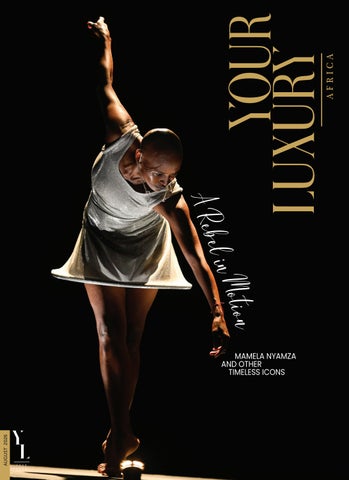
THE ETERNAL DISRUPTOR: Dancer and choreographer Mamela Nyamza is expanding the vocabulary of South African dance
VINTAGE AMBITION:
sommelier Sean Kubheka went from aspiring architect to pouring some of the world’s rarest wines
ANALOGUE
When August hits, mid-year fatigue can bring on feelings of mild panic.
It’s around now that we start looking at what we’ve achieved (or haven’t) so far, and figuring out what we still need to do so we don’t feel like total losers at the end of the year. Whether the list is invisible or consists of New Year’s resolutions written optimistically over champagne in December, we all have goals at the start of the year. And while goals are important for ambition, once they become a noose around your neck, they’re no longer serving you.
August is also Women’s Month in South Africa, and a reminder that we need to celebrate those brave women who decided that 9 August 1956 would be the last day they accepted being treated like second-class citizens in their own country. I reap the rewards of their gumption: I have a career, can vote, and enjoy the protection of the state when it comes to my human rights because of all the heroes who took a stand decades ago. Those women were not banking on being icons of change – they simply got tired of accepting the status quo.
I mention all this to illustrate how time shapes nearly everything we do. Whether it’s fighting for the rights of other women when you’re in your late 50s and 60s, or projecting what you want to achieve and by when, time dictates our individual satisfaction as much as it determines whether we’ll end up on the right side of justice. Our to-do lists should serve as a roadmap that allows us to meander and take the road less travelled, so when you have to reroute, you don’t feel discombobulated by the change in trajectory.
A plan that can’t change is a plan that has already failed. Impermanence is the only consistent fact about the human experience, and being comfortable with that dichotomy is crucial to enjoying life. Dissatisfaction robs us of joy. Being timeless – living in time but not being straitjacketed by it –sounds easy in theory, but not so much in practice. Whether you’re a younger person reaching heights at an early age or an elder defying body and aesthetic limitations, timelessness is about knowing that time is as elastic as it is relative.
Instead of worrying about what you still haven’t done or the many things you’re still to achieve this year, look at what you’ve made happen and pat yourself on the back for that.
If what you focus on expands, imagine how much abundance you could invite into your life just by dedicating 80 percent of your mental real estate to the good things. Because optimism, like joy, is always timeless.
2.DOLCE&GABBANA
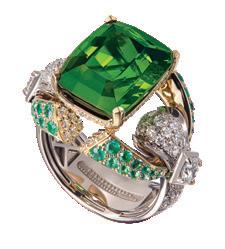
Chunky rings have always been my speed. Over the years, it’s become harder to wear heavy earrings, but a statement ring can elevate the most basic outfit into something unforgettable. The Dolce&Gabbana ring from the Alta Gioielleria 2026 collection in yellow and white gold with green tourmaline, emeralds, and diamonds is perfect to be worn with this year’s spring/summer trends. Ref: WRSN8HW2188. dolcegabbana.com
FIVE for AUG UST my top
1.NARS AFTERGLOW LIP BALM
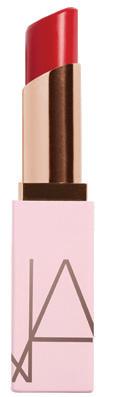
Available in six wearable shades, NARS Afterglow Lip Balm combines the nourishment of a balm with a sheer wash of glossy colour. My favourite, Miseducation (because it reminds me of that classic album, The Miseducation of Lauryn Hill), delivers a flattering rosy nude tint that’s perfect for everyday wear, while the hydrating formula leaves lips feeling soft, smooth, and moisturised. arcstore.co.za
3.FOUR SEASONS HOTEL THE WESTCLIFF JOHANNESBURG – Ubusika Ritual
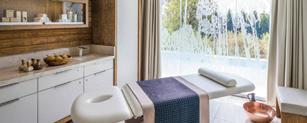
Going for a spa treatment in winter is a must. Inspired by the Zulu word for winter, the Ubusika Ritual at Four Seasons Hotel The Westcliff is a restorative fullbody spa experience designed to bring warmth, relaxation, and renewal. The treatment combines a grounding back massage, nourishing facial mask, frontbody massage, soothing scalp massage, and is personalised with a choice of three West African organic shea butter blends. fourseasons.com
4.NIKE: FOOTBALL BOOTS by Neal Heard (Phaidon)
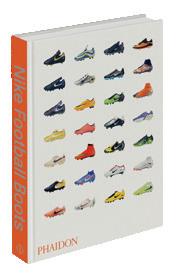
Now that the World Cup fever is over, I want to say how pleased I am that South Africa finally qualified for the FIFA round of 32. If your house has an aspiring Bafana Bafana player or just a fan of football, this book is the perfect gift. From the revolutionary Mercurial to the iconic Tiempo and Phantom, Nike: Football Boots celebrates the design, innovation, and cultural impact of some of the world’s most influential football boots. Written by sneaker and football historian Neal Heard, this volume explores Nike’s evolution on and off the pitch.
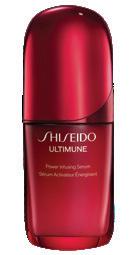
5.SHISEIDO ULTIMUNE POWER INFUSING SERUM
When you get to my vintage, a serum is not just a niceto-have – it’s a prerequisite. Backed by more than three decades of research into skin immunity, Shiseido’s latest Ultimune Power Infusing Serum is designed to slow the skin’s ageing cycle while visibly improving radiance, texture, and the appearance of fine lines. Powered by the brand’s exclusive Power Fermented Camellia+ technology, it harnesses the regenerative properties of the Japanese camellia flower to strengthen the skin barrier and promote a smoother, firmer, more youthful-looking complexion. The fast-absorbing formula is also available in a refill designed to reduce plastic waste. arcstore.co.za
Photographer: Val Adamson
ROOTED IN RARITY
GET YOURS ONLINE AT TAKEALOT & NORMAN GOODFELLOWS
Win
Jonathan Ball Publishers and YourLuxury Africa are giving away a collection of luxury co ee table books worth R3 695 to one lucky reader.
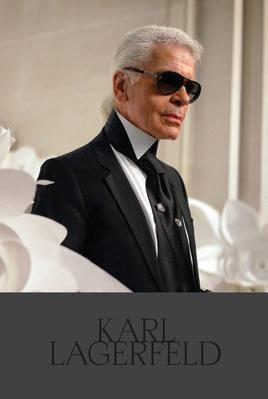
The prize includes KARL LAGERFELD: FASHION ICON, a beautifully illustrated tribute to one of fashion’s most influential creative visionaries. The monograph traces his remarkable career, from his early years to his transformative work at some of fashion’s biggest brands.
Also included is RALPH LAUREN CATWALK, the first comprehensive volume dedicated to more than five decades of Ralph Lauren’s womenswear collections.
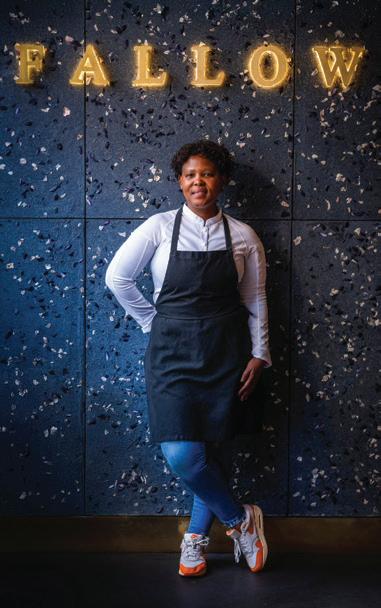
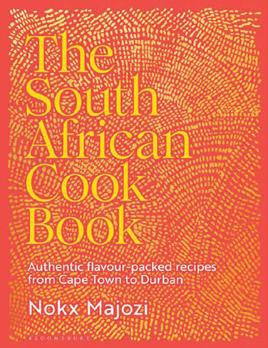
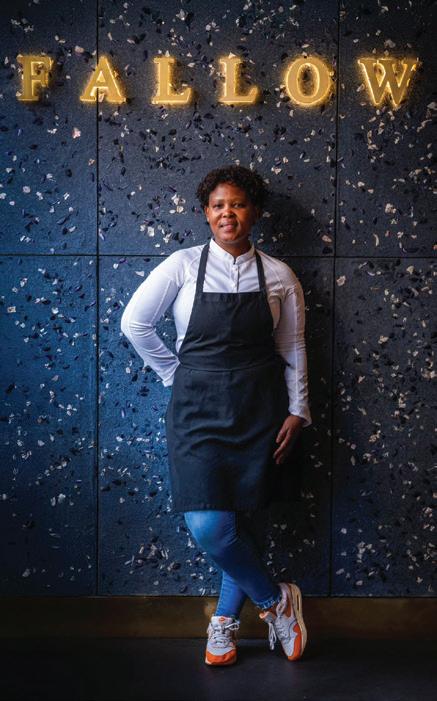
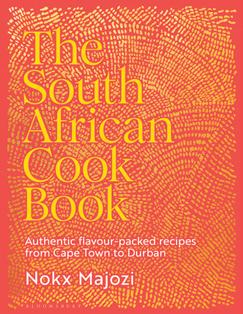
Completing the prize is a signed copy of THE SOUTH AFRICAN COOKBOOK by celebrated chef Nokx Majozi, Chef in Residence at London’s acclaimed Fallow restaurant, packed with flavour, nostalgia, and contemporary South African recipes.
Whether you’re passionate about fashion, design, or food, this curated collection deserves pride of place on your co ee table.
COFFEE TABLE BOOKS WORTH R3 695
TO ENTER Scan the QR code or visit @yourluxury.africa and click on the link in bio.
Competition open until 31 August 2026. Ts & Cs apply.
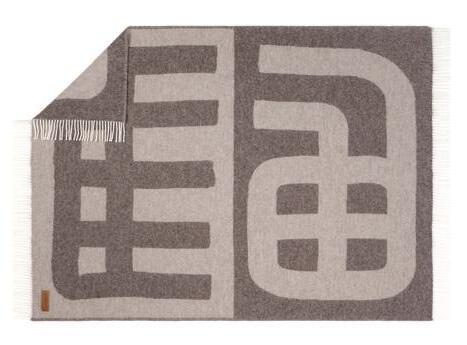
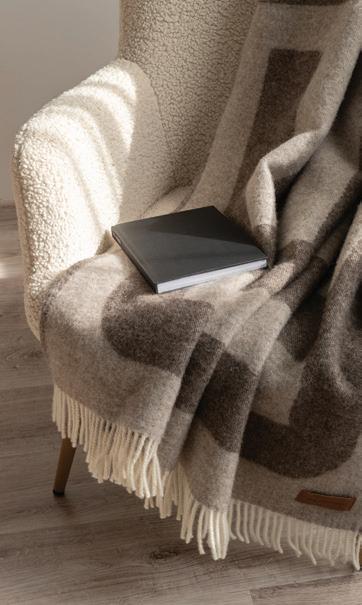
The Ninevites and YourLuxury Africa are giving one reader a luxurious Zodwa Blanket worth R2 699.
Crafted in collaboration with AKAKIR Studio from 100% New Zealand wool, the Zodwa Blanket combines exceptional craftsmanship with contemporary South African design.
Founded by South African designer Nkuli Mlangeni Berg in 2012, The Ninevites (theninevites.com) is a multidisciplinary design house and creative agency that collaborates with artisans, designers, and cultural institutions while supporting thriving creative economies.
Wrap yourself in a piece that is as meaningful as it is beautiful this winter.
TO ENTER Scan
Win
A NINEVITES ZODWA BLANKET WORTH R2 699
EDITORIAL: EDITOR IN CHIEF Lerato Tshabalala lerato@yourluxury.africa CREATIVE DIRECTOR Kate Walters COPY EDITOR Tamlyn Cumings CONTRIBUTING EDITOR Leigh Herringer WATCH & JEWELLERY EDITOR Debbie Hathway debbie@yourluxury.africa IMAGE EDITOR Coralie Elske DIGITAL EDITOR Jessica Levitt jessica@yourluxury.africa TRAFFIC CO-ORDINATOR Rachel Ndawo
ADVERTISING & MARKETING: ADVERTISING DIRECTOR Yvonne Sha +27 (82) 903 5641 I yvonne@yourluxury.africa ADVERTISING CO-ORDINATOR Yvette Mehl +27 (21) 439 4907 I yvette@yourluxury.africa
ACCOUNT MANAGER: NATIONAL Gina van de Wall I gina@yourluxury.africa SALES EXECUTIVES: Sumeshni Pillay I sumeshni@yourluxury.africa
ADVERTISING SALES MANAGER: LONDON AND THE UK Louella Stocchi I louella@yourluxury.africa PAID MEDIA SPECIALIST | SOCIAL MEDIA MANAGER Mbali Mthimkhulu I mbali@yourluxury.africa
MANAGEMENT: MANAGING DIRECTOR Yvonne Sha CO-FOUNDER Jacquie Myburgh Chemaly DISTRIBUTION & PRINT: DISTRIBUTION On the Dot, Media Support PRINTED BY CTP Printers, Cape Town for YourLuxury Africa, PO Box 1053, Sea Point 8060, Cape Town.
All rights reserved. Whereas precautions have been taken to ensure the accuracy of information, neither the editor nor YourLuxury Africa can be held liable for any inaccuracies, injury or damages that may arise. The opinions expressed in the articles may not reflect those of the publisher. As part of our celebration of craftsmanship and culture, this publication features select alcohol brands. We support responsible enjoyment. Not for sale to persons under 18. Please drink responsibly. All prices correct at time of going to print.
printers CAPE OWN
yourluxury.africa
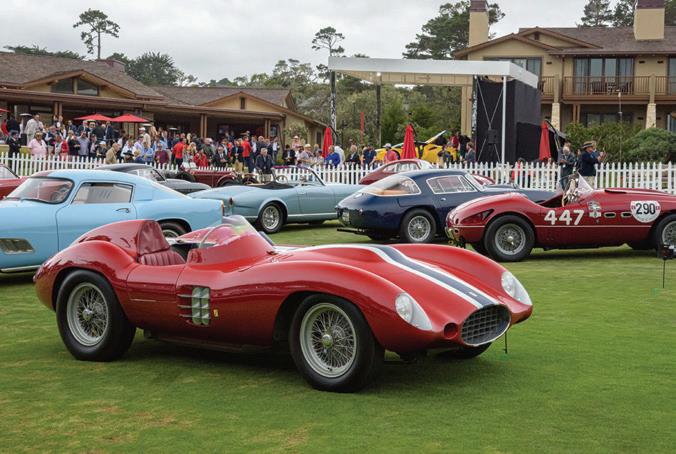
PEBBLE BEACH CONCOURS D’ELEGANCE
16 August | California, USA
Celebrating its 75th edition, the Pebble Beach Concours d’Elegance once again brings together some of the world’s most extraordinary collector cars, leading luxury brands, and passionate automotive enthusiasts. From expertly restored vintage vehicles and rare concept cars to racing legends and exclusive debuts, the event remains the pinnacle of automotive excellence. An unmissable date on the global luxe automotive calendar. pebblebeachconcours.net
CULTURE
DIARY
EDINBURGH FESTIVAL FRINGE
7-31 August | Edinburgh, Scotland
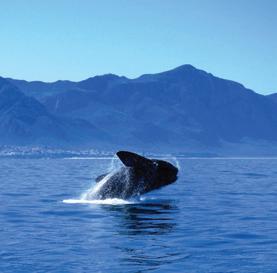
WHALE SEASON
August – October | Western Cape, South Africa
Although southern right whales can now be spotted along the Cape coast almost year-round, this month traditionally marks the start of peak whale-watching season. Hermanus remains the epicentre of the migration, where cliff-path walks, boutique hotels, exceptional seafood, and daily sightings combine to create a memorable coastal escape. Add to that the nearby Hemel-en-Aarde valley’s wine estates for a getaway that blends nature with some of our country’s finest wines. whalehermanus.com
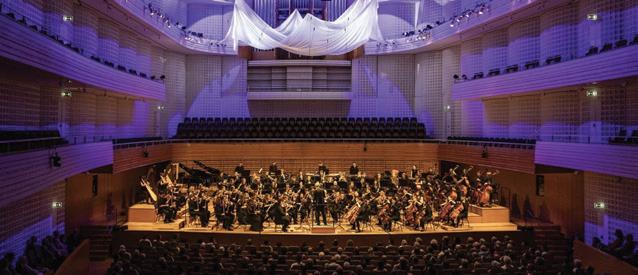
LUCERNE FESTIVAL
13 August – 13 September | Lucerne, Switzerland
Set against the breathtaking backdrop of Lake Lucerne, the world’s finest orchestras and soloists gather for one of classical music’s most prestigious festivals. Over five weeks, the flagship Summer Festival presents more than 100 concerts, featuring both celebrated conductors, internationally acclaimed performers, and exciting emerging talent. If Switzerland is on your European itinerary this month, be sure to make time for at least one concert. lucernefestival.ch
Every August, Scotland’s capital transforms into the world’s largest stage as the Edinburgh Festival Fringe takes over the city. More than 3 600 productions are set to be performed across 258 venues, spanning everything from contemporary dance and comedy skits to cabaret, poetry readings, and live music. With household names performing alongside newcomers – anyone can take part – the Fringe promises an unforgettable celebration of creativity. For more information, visit edfringe.com.
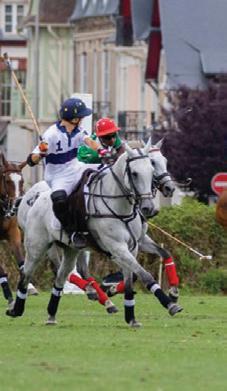
DEAUVILLE INTERNATIONAL POLO TOURNAMENT
10-30 August | Normandy, France
Europe’s summer polo calendar reaches its elegant finale in Deauville, home to one of France’s oldest and most prestigious polo clubs. This year’s programme centres around the Barrière Deauville Polo Cup, alongside multiple tournaments, beach polo, and family-friendly events. Expect elite sport together with Normandy’s timeless glamour, seaside sophistication, and champagne-filled afternoons. deauvillepoloclub.com
WORDS TAMLYN CUMINGS
THE WORLD’S MOST ENDURING LUXURY BRANDS HAVE ONE THING IN COMMON: THEY THINK IN DECADES, NOT SEASONS. INVESTORS SHOULD DO THE SAME
Dividend The
EWORDS BRIGHT KHUMALO
ach year we invest billions in the pursuit of the next big thing. The next AI company. The next fashion trend. The next holiday destination. The next must-try restaurant. We’ve become remarkably good at chasing novelty.
Yet when you look at the world’s most enduring luxury brands, they seem almost uninterested in what’s next. They aren’t trying to reinvent themselves every season. They’re refining, preserving, and quietly compounding.
Perhaps that’s because real luxury has never been about being new. It’s about surviving long enough to become timeless.
There’s a fascinating concept known as the Lindy Effect. It suggests that for things that don’t naturally wear out – think books, ideas, brands, or designs – the longer they’ve already existed, the longer they’re likely to continue existing. A novel that has remained in print for a century will probably still be read a century from now. A watch design that has barely changed in 70 years has already proved it can outlast fashion. Luxury understands this instinctively.
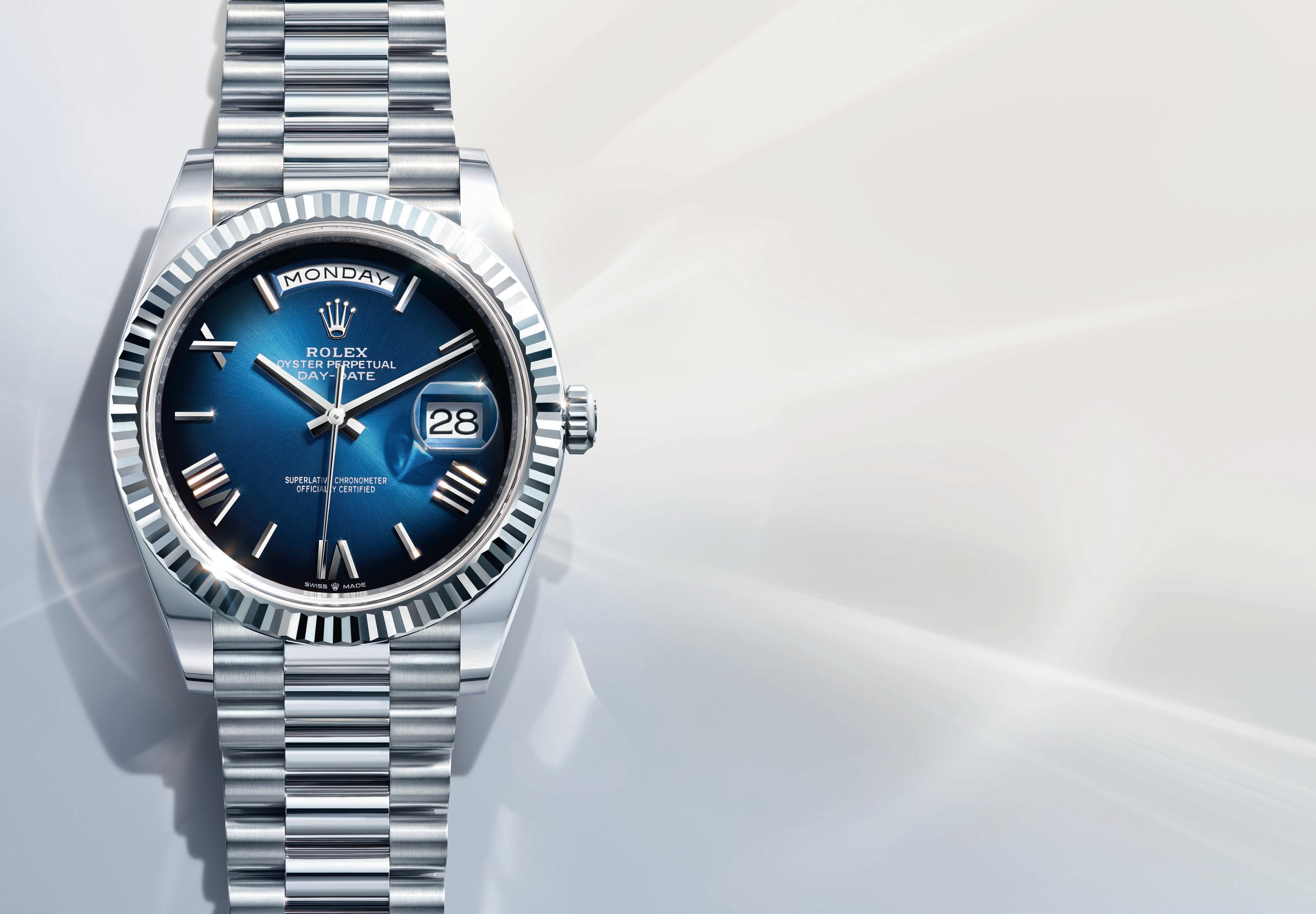
Take the Cartier Tank. More than a century after its debut, it still looks contemporary. The Rolex Submariner has become so recognisable that countless brands have borrowed from it, yet the original remains the benchmark. Hermès still produces bags that routinely outlive their first owners, while Patek Philippe has spent decades reminding us that we merely look after their watches for the next generation.
“The passage of time doesn’t diminish things, it enhances them”
These brands don’t chase relevance; they somehow became relevant and have stayed that way. The same principle is true in investing.
Every market cycle produces a new story. In the new millennium, it was the Dotcom stocks. Recently it’s been cryptocurrencies, and earlier in the decade it was SPACs. How can I forget Artificial Intelligence, right? Some will undoubtedly become extraordinary businesses. Many won’t.
Meanwhile, companies like Ferrari, Hermès, and Richemont continue doing what they’ve always done: allocating capital carefully, protecting their brands, and thinking in decades rather than quarters.
It’s not particularly exciting. But then neither is long-term compounding, until you look back in time. I often think that’s the most significant difference between wealth and luxury. Both reward patience far more than excitement.
The finest leather develops character because it’s used. A mechanical watch becomes more meaningful because it’s worn. A beautifully designed home gathers memories that no architect could ever draw. The passage of time doesn’t diminish these things, it enhances them.
Contrast that with most modern consumption. We replace phones every few years. Fashion cycles have become so short that what’s in today can feel tired next season.
Social media encourages us to move on before we’ve had time to appreciate what we already own.
Luxury asks us to do the opposite. To buy less. To choose better. To care for what we have. It’s a surprisingly good investment philosophy too.
As investors, we spend enormous amounts of time trying to identify businesses that can still be relevant 30 years from now. The answer is rarely found by asking what’s fashionable today. More often, it’s found by asking what has already demonstrated an extraordinary ability to endure.
The brands that survive wars, recessions, changing tastes, and technological revolutions deserve our attention precisely because they’ve already passed the hardest test of all: time.
The older I get, the more I find myself applying the same filter outside investing. Which friendships have endured? Which books do I reread? Which possessions would I replace immediately if I lost them? Interestingly, very few of the answers are the newest things in my life.
Perhaps that’s the real lesson of timeless luxury. Its value isn’t created by scarcity alone, craftsmanship, or even price. It’s created by longevity. By remaining desirable long after the excitement has faded.
In an age obsessed with what’s next, maybe the greatest luxury isn’t discovering something new. It’s recognising something that was always worth keeping. ■
Bright Khumalo is a Portfolio Manager and Analyst at Vestact Asset Management
A Matter of
Time
NOT EVERY NEW RELEASE BECOMES A FUTURE COLLECTABLE. WHILE RARITY CONTINUES TO INFLUENCE VALUE, TODAY’S MOST COVETED WATCHES ARE ALSO DEFINED BY TIMELESS DESIGN, MECHANICAL EXCELLENCE, AND ENDURING DESIRABILITY
WORDS DEBBIE HATHWAY
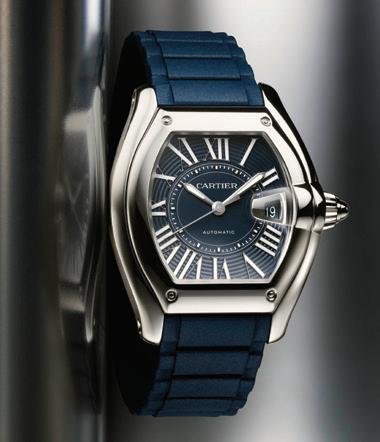
1. First launched in 2002, the Roadster brought automotiveinspired design to CARTIER without sacrificing the elegance for which the Maison is known. Its tonneau-shaped case, magnified date, and flowing bracelet remain instantly recognisable more than two decades later. The 2026 revival refines the original rather than reinventing it, proving the strength of a design that has aged remarkably well. In a market crowded with lookalike sports watches, the Roadster remains unmistakably Cartier. POA, cartier.com
2. Few watches have a stronger claim to heirloom status than the OMEGA Speedmaster Moonwatch. This 2026 stainless-steel edition refreshes the formula with a striking reverse-panda dial, pairing blackand-white lacquered surfaces and black ceramic bezel rings filled with a white-enamel tachymeter scale. It’s powered by the Master Chronometer Calibre 3861, a direct descendant of the movement lineage trusted by NASA astronauts. POA, omegawatches.com
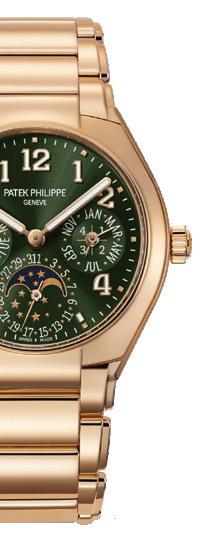
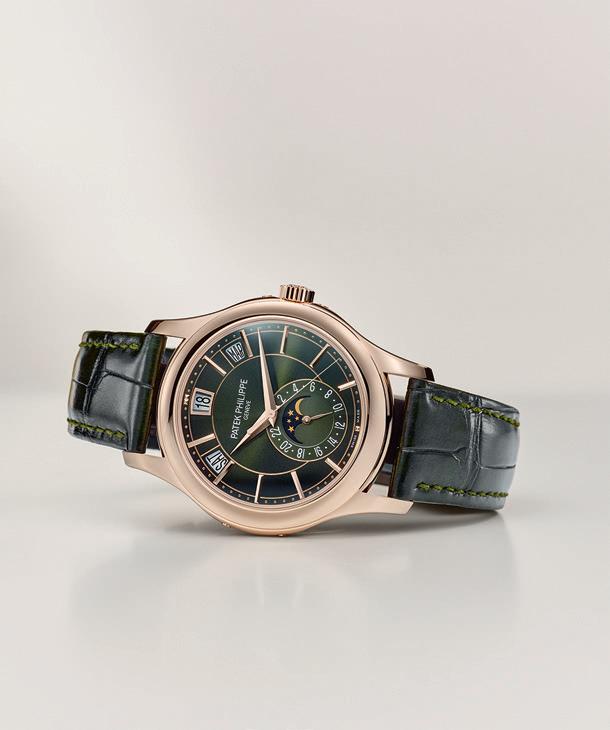
3. The Twenty~4 Perpetual Calendar 7340/1R-010 marks two milestones for the collection: its first complication and first perpetual
calendar. Combining a rose gold case and bracelet with a sunburst olive-green dial, it brings one of PATEK PHILIPPE’S most celebrated complications to a contemporary audience. With perpetual calendars among the manufacture’s most prized creations, it has all the credentials of a future heirloom.
POA, patek.com
4. Ranked 36th in Morgan Stanley’s 2025 Top 50 Watch Brands Report, F.P.JOURNE is an independent manufacture experiencing a “stratospheric rise” in the auction market. The Élégante Gino’s Dream (2024 release) pairs a titanium tortue-shaped case set with 52 ceramic glass baguettes and a vivid yellow strap, proving that future heirlooms can be unconventional. Meanwhile, the Chronomètre Furtif (2025 release, pictured) takes the opposite approach, prioritising discretion over display with its anthracite grey Grand Feu enamel dial on white gold paired with a tungsten-carbide case and bracelet. The frosted numerals emerge against the mirror-polished surface as they catch the light.
POA, fpjourne.com
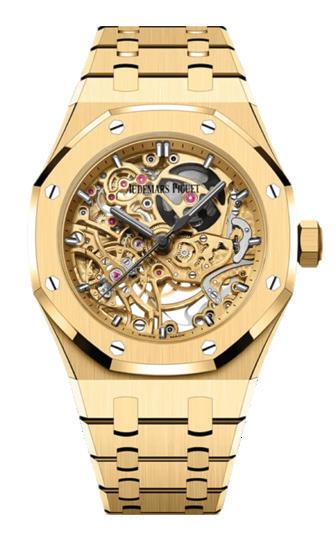
5. Openworked Royal Oaks occupy a special place in the collecting world, combining
Gérald Genta’s landmark design with an unobstructed view of AUDEMARS PIGUET’S movement finishing and hand-decoration. The new 37mm Royal Oak Double Balance Wheel Openworked elevates that formula with a toneon-tone yellow gold aesthetic, revealing the patented Calibre 3132 and its twin-balance architecture. Introduced in 2016, the double balance wheel has become one of AP’s modern signatures. POA, audemarspiguet.com
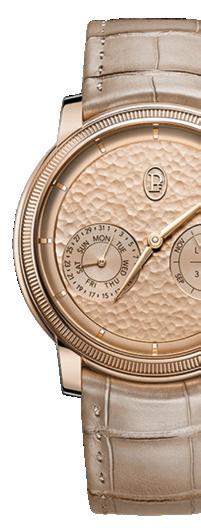
6. Created as part of a trilogy to mark 30 years of PARMIGIANI FLEURIER, the Toric Quantième Perpétuel demonstrates why quiet craftsmanship often ages better than spectacle. Its handhammered 18kt rose gold dial gives each watch a unique character, while the perpetual calendar display is arranged with remarkable clarity and restraint –the indications are concentrated in two coaxial sub-dials. Beneath the signature knurled bezel sits a hand-wound manufacture movement finished with solid rose gold bridges. Limited to 30 numbered pieces, it embodies the rarity, artistry, and mechanical sophistication that define a collectable. POA, parmigiani.com, bhhboutique.co.za
TIME
well told
WHAT
SEPARATES
HERMÈS
FROM THE GREAT SWISS WATCHMAKERS ISN’T
TECHNICAL CAPABILITY – IT’S PERSPECTIVE. CREATIVE DIRECTOR OF HOROLOGY, PHILIPPE DELHOTAL, EXPLAINS WHY THE MAISON BELIEVES FANTASY, ARTISTRY, AND A SENSE OF PLAY ARE AS ESSENTIAL TO FINE WATCHMAKING AS PRECISION
WORDS DEBBIE HATHWAY
In an industry often defined by technical specifications, heritage claims, and ever-more complex mechanical achievements, Hermès has carved out a different path. Its watches are serious pieces of horology, yet the Maison’s skill at storytelling sets it apart.
For Philippe Delhotal, Creative Director of Hermès Horloger, that difference is fundamental. “We are storytellers at Hermès,” he says.
The philosophy was evident at Watches and Wonders this year, where visitors stepped behind the scenes of a theatrical set inspired by the hidden mechanics of a stage. The installation explored the world of skeleton watches, revealing the normally concealed architecture of movement construction. Rather than presenting skeletonisation as a purely technical exercise, Hermès framed it as a narrative.
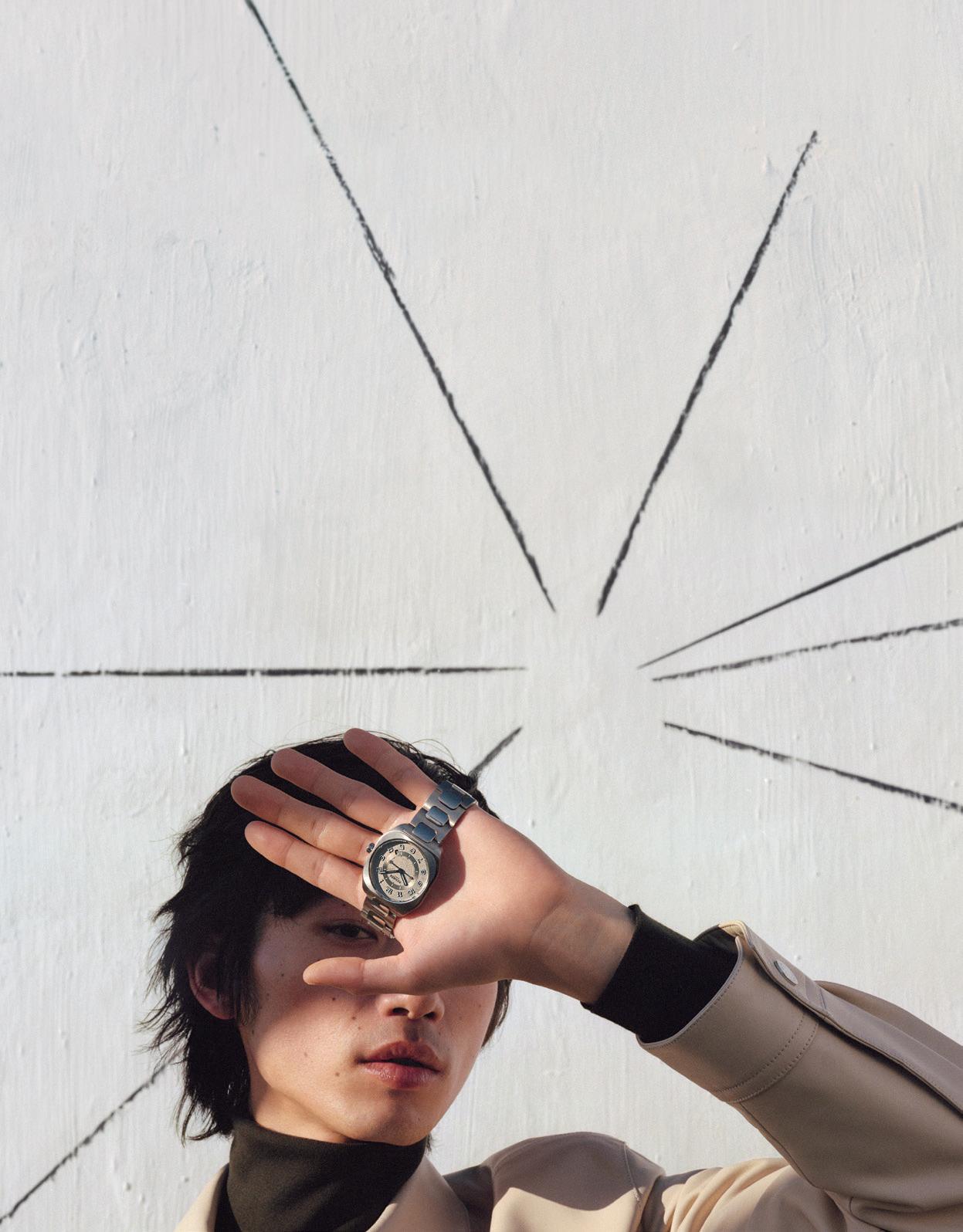
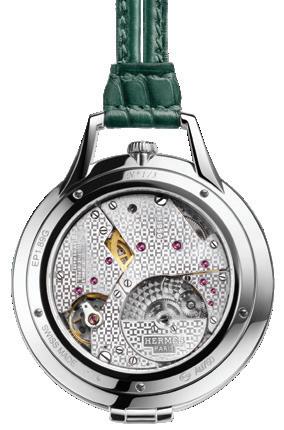
The concept extends to the watches themselves. Philippe points to the new Hermès H08 Squelette as an example. Traditionally, skeleton watches celebrate technical prowess by removing as much material as possible to create transparency, lightness, and thinness. Hermès chose not to do that as it didn’t suit the sporty spirit of the line. Instead, the movement was designed to reflect the watch’s urban character, drawing inspiration from steel structures, scaffolding, and the geometry of modern cities. The result is a skeleton movement with a distinct identity rather than an exercise in engineering minimalism. “Our skeletons have their story,” he explains.
very present. We are a House of creation. This is one of our strengths today.”
That balance has helped Hermès attract collectors who own some of the industry’s most prestigious pieces and are looking for something different.
The Maison focuses on memorable encounters and unexpected moments, such as a gathering in the Camargue centred on horses and a unique performance, rather than conventional luxury trappings.
“We are storytellers at Hermès”
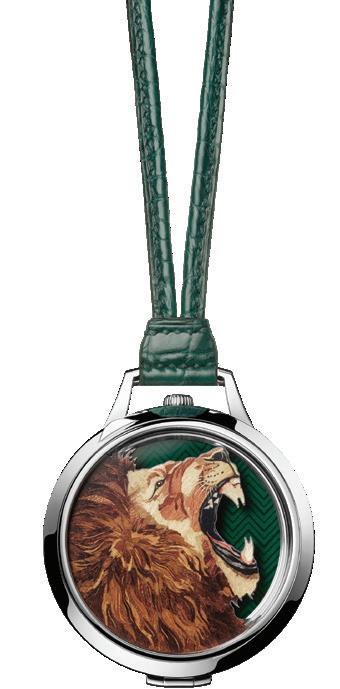
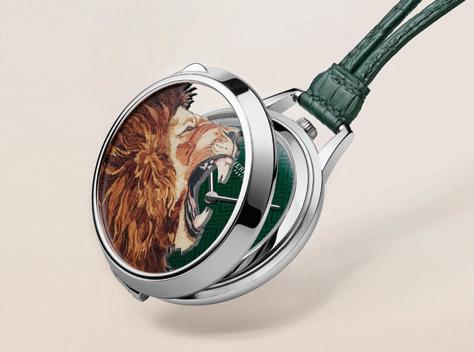
That emphasis on narrative accounts for the prominence of animals and figurative motifs at Hermès. Many originate from the House’s famous silk scarves, where artists create worlds populated by horses, lions, cats, and other creatures. Translating those designs onto a watch dial is not simply a matter of miniaturisation. The challenge lies in selecting the most meaningful fragment of a much larger story and preserving its emotional resonance at a dramatically smaller scale.
Yet perhaps the most revealing insight comes from Philippe’s view of what distinguishes Hermès from many of its Swiss competitors. He describes Hermès as a meeting point between Swiss rigour and French imagination. “You need lightness. You need fantasy, you need to laugh. Life is far too serious,” he says. “I always come back to this. That’s the thing about Hermès – the creative lightness and this fantasy. And the artisanal side is
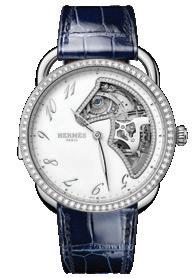
Today’s affluent collectors, Philippe suggests, are looking for experiences and objects that feel genuinely different. That philosophy has not gone unnoticed by the industry. He still speaks warmly of the breakthrough moment at the Grand Prix d’Horlogerie de Genève, when Arceau Le temps suspendu won against far more established watchmaking names.
The award helped change perceptions of what Hermès could achieve in haute horlogerie through its unique perspective formed through creativity, craftsmanship and storytelling.
Hermès watches do more than simply measure time; they invite wearers to see it differently. ■
TOP TO BOTTOM: Hermès H08 Squelette; Hermès Arceau samarcande
FOREVER
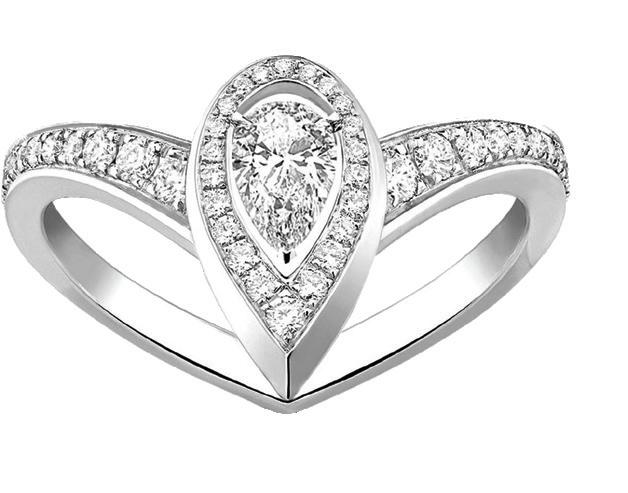
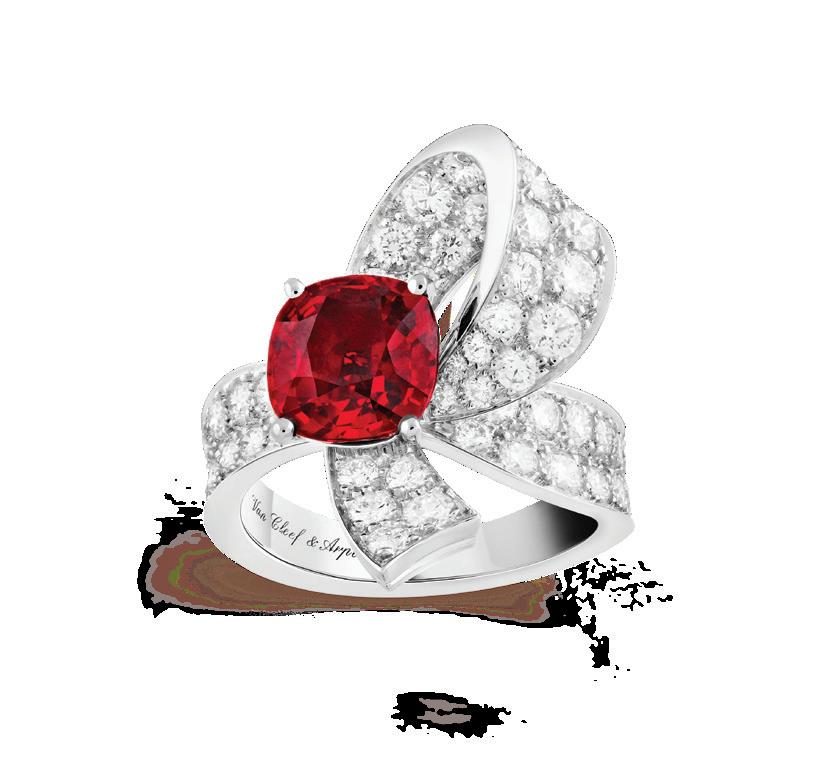
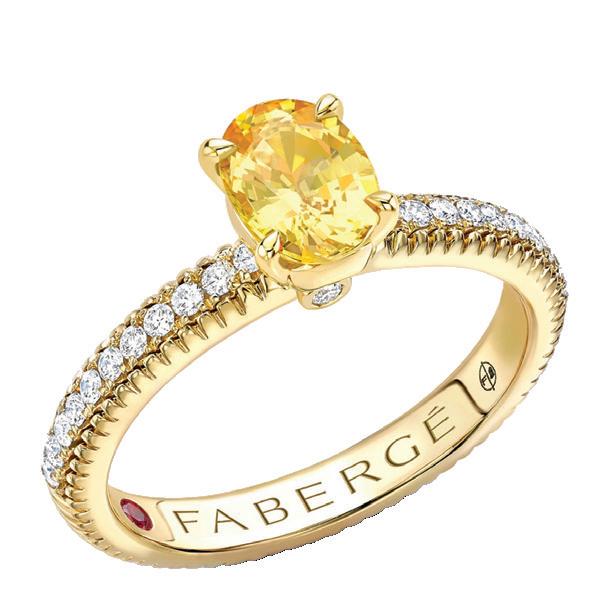
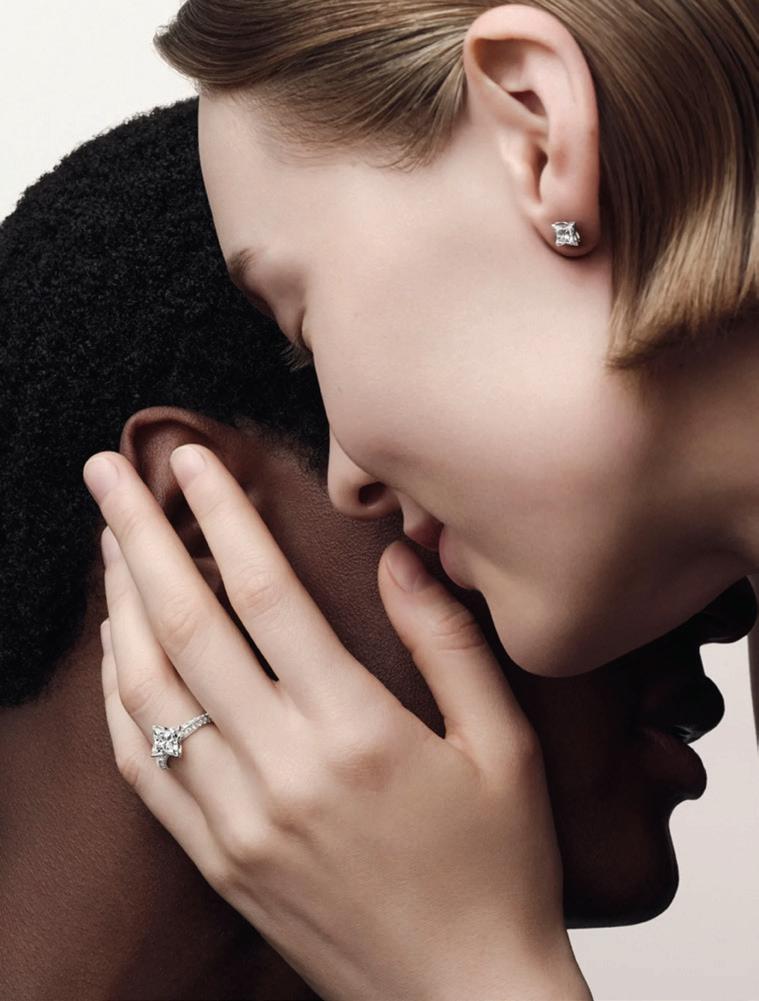
platinum solitaires dominated jewellery counters and proposals alike. Today, however, a new generation of brides is redefining what timeless looks like. Fuelled by celebrity engagements, social media, and a growing appreciation for individuality, oval, elongated cushion, and pear-shaped diamonds have emerged among the classics, while yellow gold has staged a return. From unexpected proportions to vintage-inspired settings, the modern engagement ring should feel personal enough to
TINGTHERULESOFENGAGEMEN
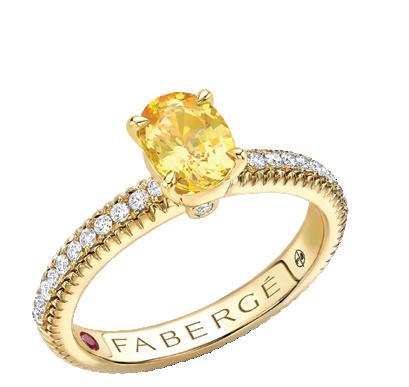
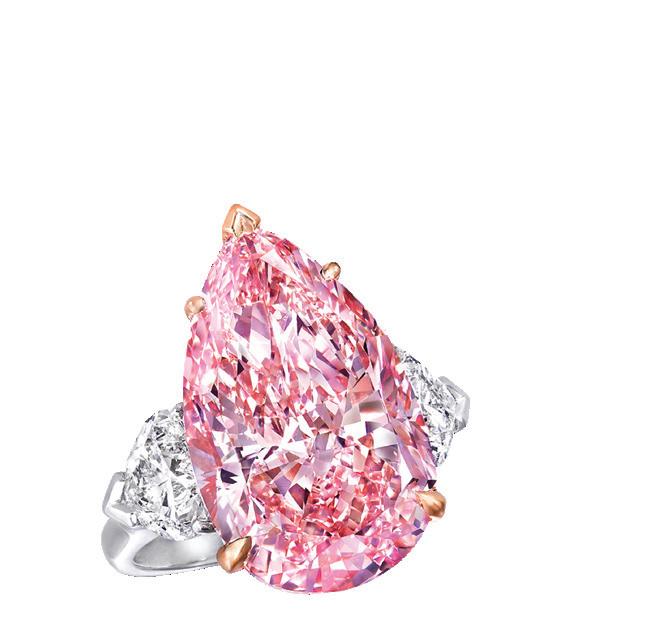
Paris Fiery 0.10ct pear-cut diamond ring in white gold with gradient pavé. Also available in yellow and pink gold. POA, messika.com pavé solitaire, LV Monogram star-cut ring, set in platinum, louisvuitton.com 3. VAN CLEEF & Boucle solitaire ring in platinum, centred on a 3.02ct cushioncut Mozambique ruby, framed by 1.88cts of pavé diamonds in a vancleefarpels.com 4. FABERGÉ Love yellow sapphire pavé ring in 18kt yellow gold, set with a 0.92ct oval yellow sapphire, pavé-set diamonds, and a concealed Mozambique ruby within the band. POA, faberge.com, GRAFF 12.02ct Fancy vivid pink and white diamond ring (14.09cts). POA, delaire.co.za
1.
2.
3.
4. 5.
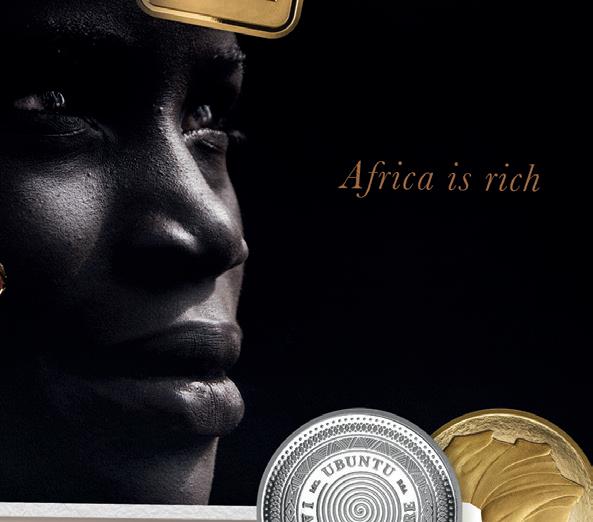
The Evolution of African Wealth
From the spirit of Ubuntu to the strength of the Nguni, African wealth has always told a story.
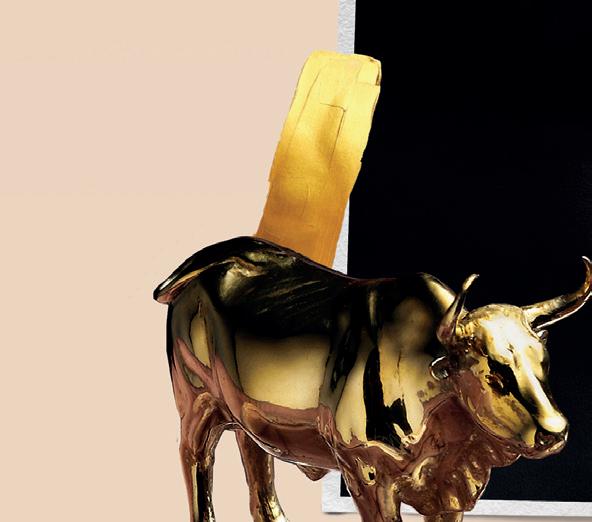
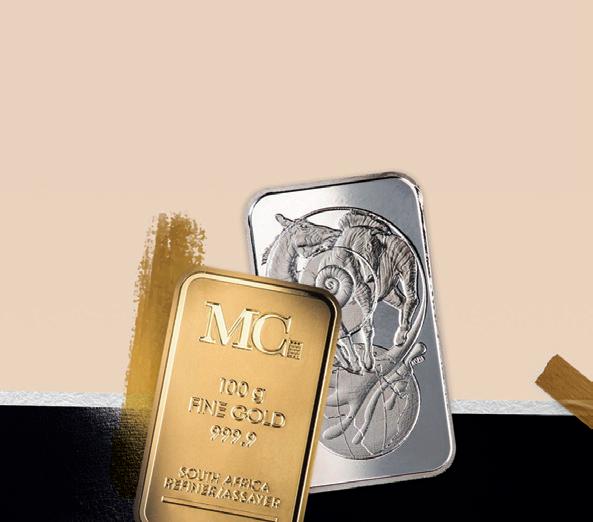
MetCon honours this legacy with modern expressions of value — Ubuntu Rounds, Minted Bars, and Nguni Cows & Bulls — cast in precious metals, from the heart of our land.
THESE PRODUCTS HAVE OUTLASTED FLEETING TRENDS, EARNED CULT STATUS, AND BECOME PERMANENT FIXTURES IN BATHROOM CABINETS AND MAKE-UP BAGS AROUND THE WORLD
COMPILED BY CANDICE-LEE KANNEMEYER
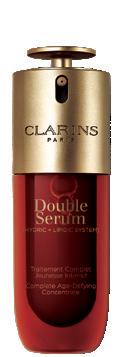
3. CLARINS DOUBLE SERUM:
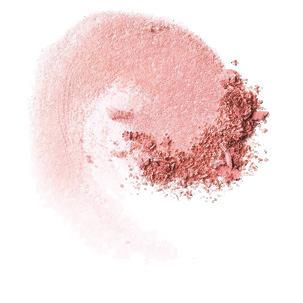
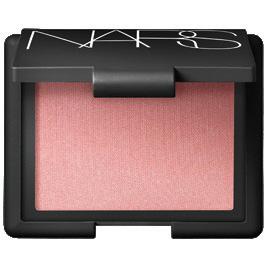
1. NARS BLUSH IN ORGASM:
Provocative name aside, it became iconic because the shade simply works. Introduced in 1999, its peachy-pink hue infused with a fine golden shimmer flatters an extraordinary range of complexions. The silky texture blends effortlessly, while the luminous finish offers the subtle effect of a blush and highlighter in one sweep. R880; arcstore.co.za
2. ELIZABETH ARDEN EIGHT HOUR
CREAM SKIN PROTECTANT: Few products deserve the term multi-purpose quite like this one. Created in 1930, the soothing balm earned its name after a client claimed it mended her child’s grazed knee within eight hours. Rich in castor seed oil, vitamin E, salicylic acid, and protective petrolatum, it softens dry and rough skin, tames brows, conditions cuticles, and comforts chapped lips with equal ease. R539 for 50ml; edgars.co.za
It continues to set the benchmark for anti-ageing skincare. The ingenious dual-chamber bottle combines the water- and oilbased formulas at the moment of application, mirroring the skin’s own hydrolipidic film. Enriched with 22 plant extracts, it leaves skin looking firmer, smoother, and noticeably more radiant. R1 790 for 50ml; clarins.co.za
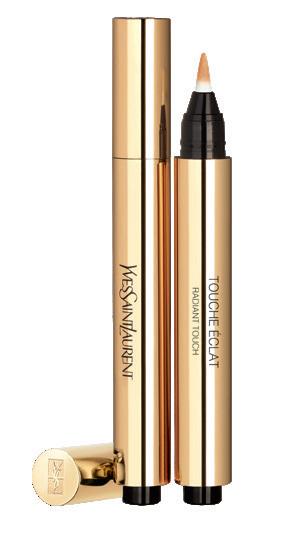
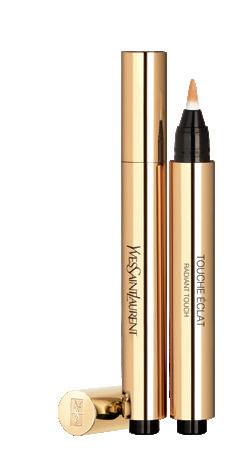
4. YVES SAINT LAURENT TOUCHE
ÉCLAT: Before this product arrived in 1992, concealers focused almost exclusively on coverage. Yves Saint Laurent changed the conversation with a light-reflecting pen that brightened rather than concealed. The innovative clickpen design and luminous formula quickly became indispensable backstage and beyond, instantly refreshing under-eye shadows while highlighting the high points of the face and reviving tired complexions. R750; arcstore.co.za
5. DERMALOGICA DAILY
MICROFOLIANT: Inspired by the centuries-old Japanese ritual of cleansing with milky rice water, the product transformed exfoliation forever. The innovative rice-based powder activates on contact with water, creating a creamy paste that gently buffs away dull skin without any abrasion. Blended with salicylic acid and soothing colloidal oatmeal, it leaves skin feeling smooth, refined, and luminous. R889 for 40g; dermalogica.co.za
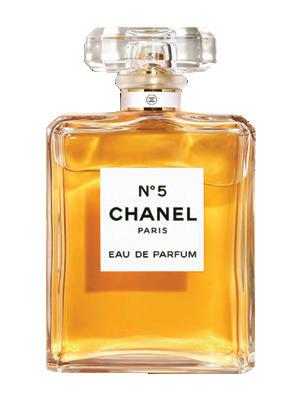
6. CHANEL NO.5 EAU DE PARFUM: When Marilyn Monroe declared she wore nothing but “a few drops of Chanel No.5” to bed, the fragrance secured its place in pop culture. Its story, however, began decades earlier when Gabrielle Chanel commissioned a perfume that should smell “like a woman” rather than a flower. The result redefined modern perfumery, pairing citrus with a floral heart
of jasmine and May rose, before settling into a base of sandalwood and vanilla. R2 800 for 50ml; woolworths.co.za
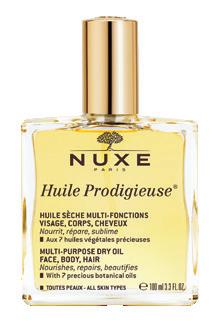
7. NUXE HUILE PRODIGIEUSE MULTI-PURPOSE DRY OIL: Since its debut in 1991, the dry oil became synonymous with easy French beauty. It nourishes the face, body, and hair without any greasy residue, thanks to a blend of seven naturally sourced botanical oils. The orange blossom, magnolia, and vanilla fragrance is instantly recognisable. R855 for 100ml; woolworths.co.za
8. BIODERMA SENSIBIO H20 MICELLAR WATER: Long before micellar water became a staple, Bioderma introduced their version in 1995, quietly changing the way we remove make-up. The formula suspends microscopic cleansing micelles in purified water, lifting away oil, dirt, and make-up without disrupting the skin barrier. R420 for 500ml; clicks.co.za
WINGS
MORE THAN A PLACE TO REST A CUP OR BOOK, THE COFFEE TABLE IS OFTEN THE FOCAL POINT OF A LIVING ROOM. IT INVITES CONVERSATION AND OFFERS AN OPPORTUNITY TO SHOWCASE THOUGHTFUL DESIGN. WHETHER SCULPTED FROM STONE, WOOD, OR METAL, THESE PIECES BLUR THE LINE BETWEEN FURNITURE AND FUNCTIONAL ART
COMPILED BY LERATO TSHABALALA
Objects Desire of
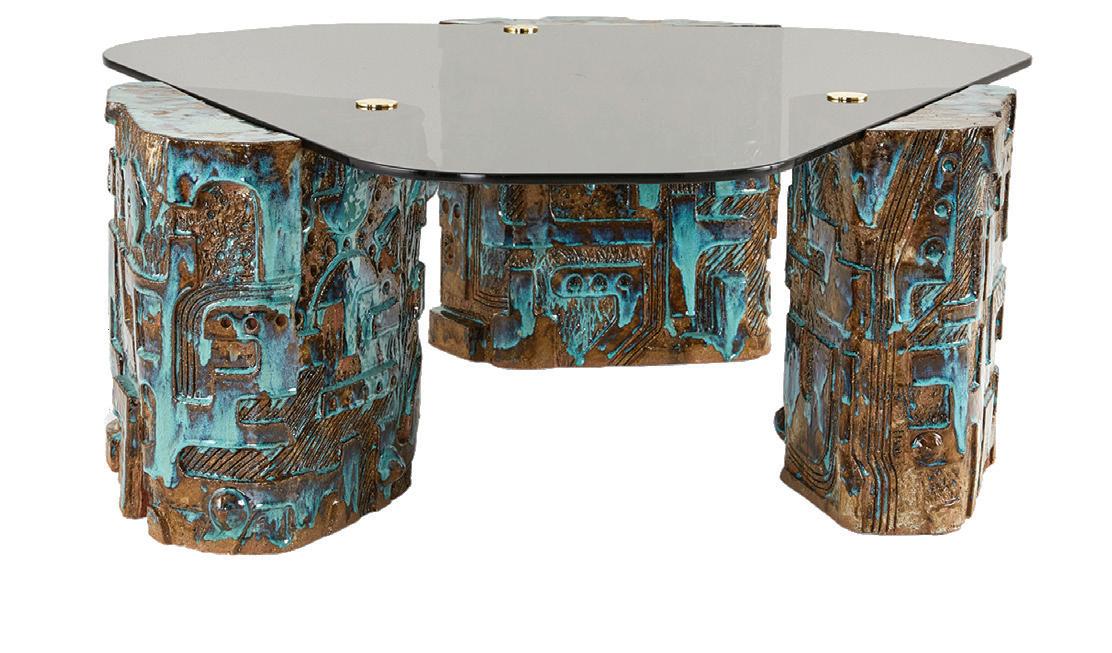
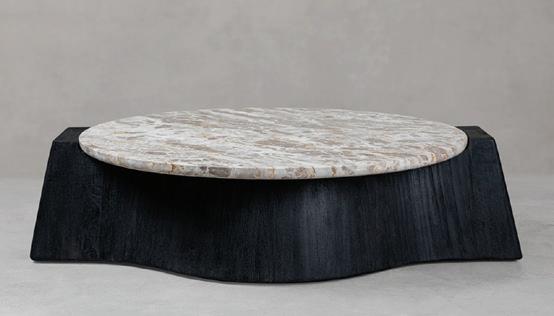
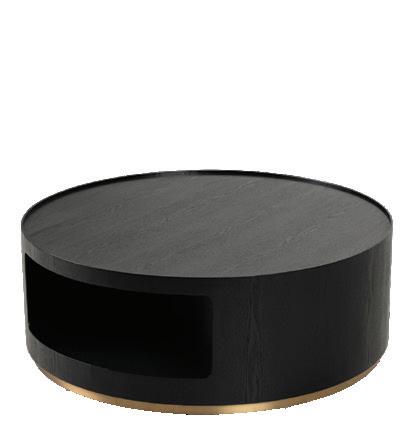
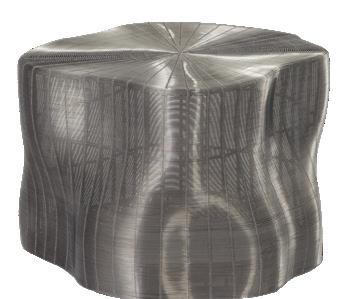
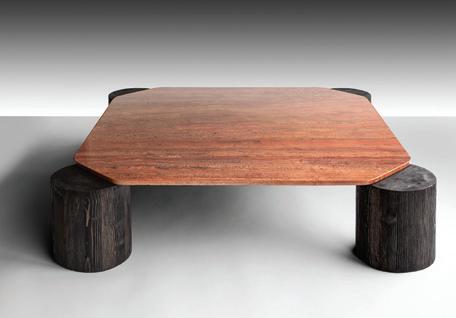
O1. EGG DESIGNS: This So Disco coffee table celebrates the artistry of the handmade. Its individually moulded and glazed ceramic base ensures no two pieces are alike, while a bronze glass top and solid-brass detailing complete this playful yet sophisticated design. POA, eggdesigns.com 2. WEYLANDTS: The Aero coffee table in Capri beige balances organic beauty with refined luxury. Featuring a leathered marble top supported by a beautifully carved mango wood base, its sculptural form highlights the natural character of every material. R19 995, weylandts.co.za 3. ROCHE BOBOIS: The Iron Tree cocktail table transforms stainless steel into an intricate work of art. Hand-woven from a single continuous wire around an organic steel structure, each piece is unique, celebrating exceptional sculptural design. R95 840, roche-bobois.com 4. @HOME: This Alison coffee table brings contemporary elegance to everyday living. Crafted in dark oak veneer with a sleek painted metal base and trim, it pairs clean-lined design with practical functionality thanks to an integrated storage shelf. R16 999, bash.com 5. OKHA: The Magnifico coffee table makes a bold architectural statement through clean geometry and exceptional materiality. Elevated on four cylindrical legs and topped with luxurious stone, it’s a commanding centrepiece that can be tailored to individual specifications. POA, okha.com
SHYDEAWAY
with heart
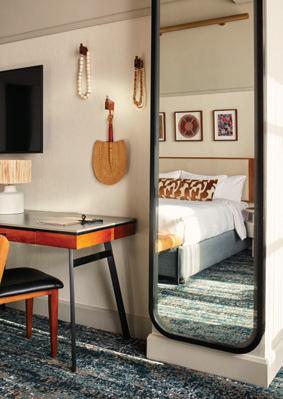
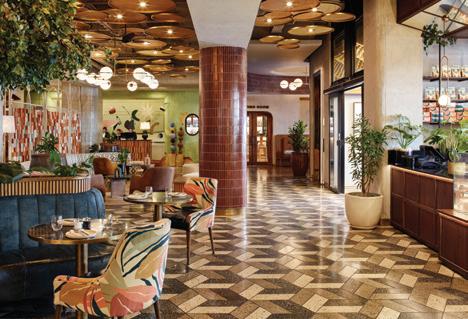
et in the heart of the bustling Rosebank precinct and housed within The Bank, Hyde Johannesburg Rosebank brings the brand’s signature blend of laid-back Los Angeles style and bohemian whimsy to its first African address. The hotel seamlessly blends contemporary design with relaxed sophistication, showcasing South African art alongside inviting social spaces that feel as connected to the neighbourhood as they do to their guests.
Behind this stylish façade is an impressive commitment to sustainability. Hyde Johannesburg Rosebank is now Green Key certified, one of the hospitality industry’s leading international ecocertifications recognising environmentally responsible tourism. Solar panels, a heat recovery system for hot water, and a borehole supplying around 40 percent of the property’s water form part of the wider strategy to reduce the
COMBINING DESIGN-LED INTERIORS WITH THOUGHTFUL SUSTAINABILITY, HYDE JOHANNESBURG ROSEBANK OFFERS A FRESH TAKE ON CITY STAYS
The Hydeaway Retreat Package pairs 15% off premium room categories with a complimentary breakfast at Proud Mary and 10% off dinner at either Proud Mary or Nine Lives, for stays until 31 December 2026.
hotel’s environmental footprint without compromising guest comfort.
The same attention to detail extends to the hotel’s dining spaces. On the ground floor, Proud Mary serves everything from leisurely breakfasts and boutique wines to generous grills in a mid-century modern space that evolves naturally from morning coffee to evening cocktails.
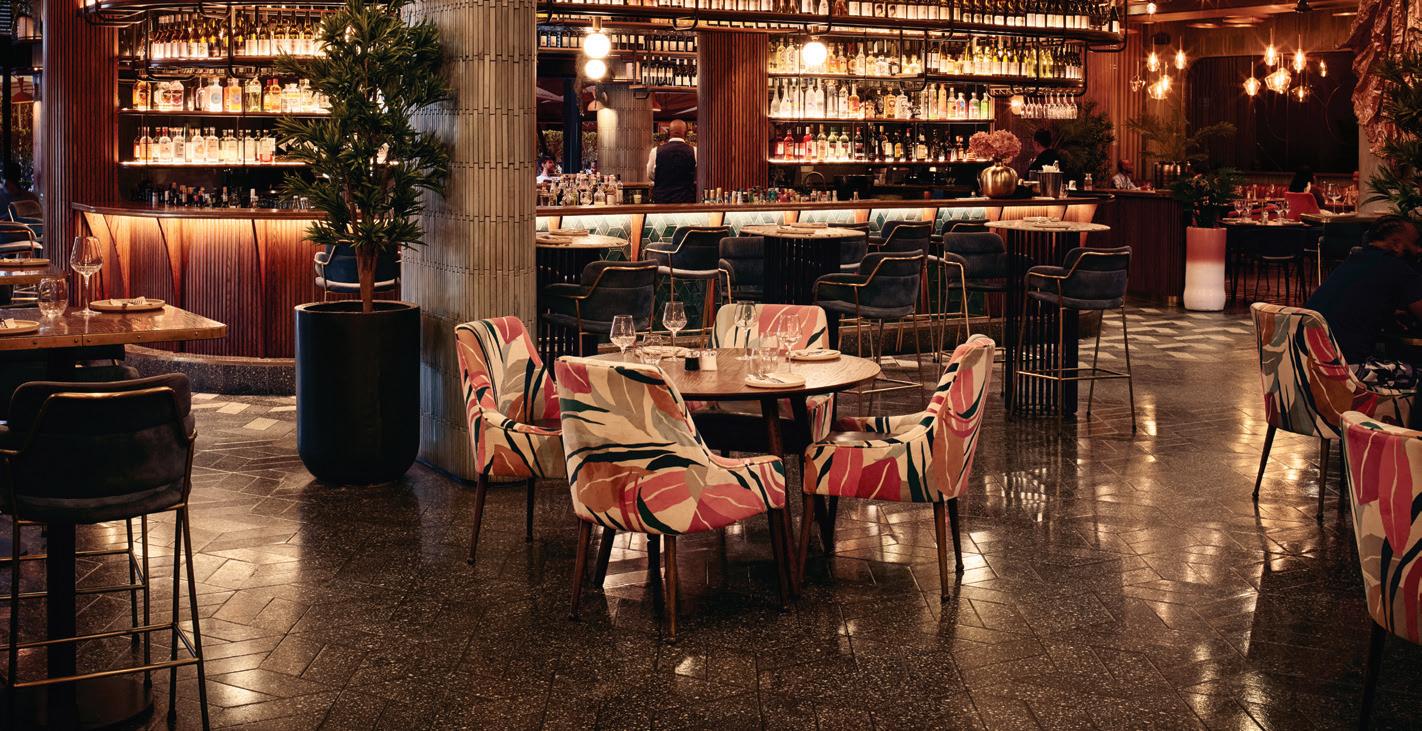
For those seeking something more intimate, Nine Lives offers a change of pace. Hidden between the fourth and fifth floors, Johannesburg’s first inter-floor speakeasy pairs ‘70s-inspired interiors with signature cocktails, rare international spirits, and an Asian-inspired menu.
Whether visiting for business, a weekend escape, or an evening out, Hyde Johannesburg Rosebank provides an incredibly stylish base from which to experience one of Johannesburg’s most vibrant neighbourhoods. hydehotels.com/johannesburg
Stand the chance to win a one-night stay for two (Friday, Saturday, or Sunday night) at Hyde Johannesburg Rosebank in a VIP King Room, including breakfast at Proud Mary and a R1 000 dinner voucher to spend at Proud Mary or Nine Lives.
The Eternal
DISRUP TOR
CONTEMPORARY DANCER AND CHOREOGRAPHER
MAMELA NYAMZA’S STRENGTH LIES IN CHALLENGING DANCE NORMS AND BARING HER SOUL IN HER EMBODIED ACTIVISM. WITH PLENTY TO CELEBRATE THIS YEAR, SHE BEGINS AGAIN
WORDS KGOMOTSO MONCHO-MARIPANE
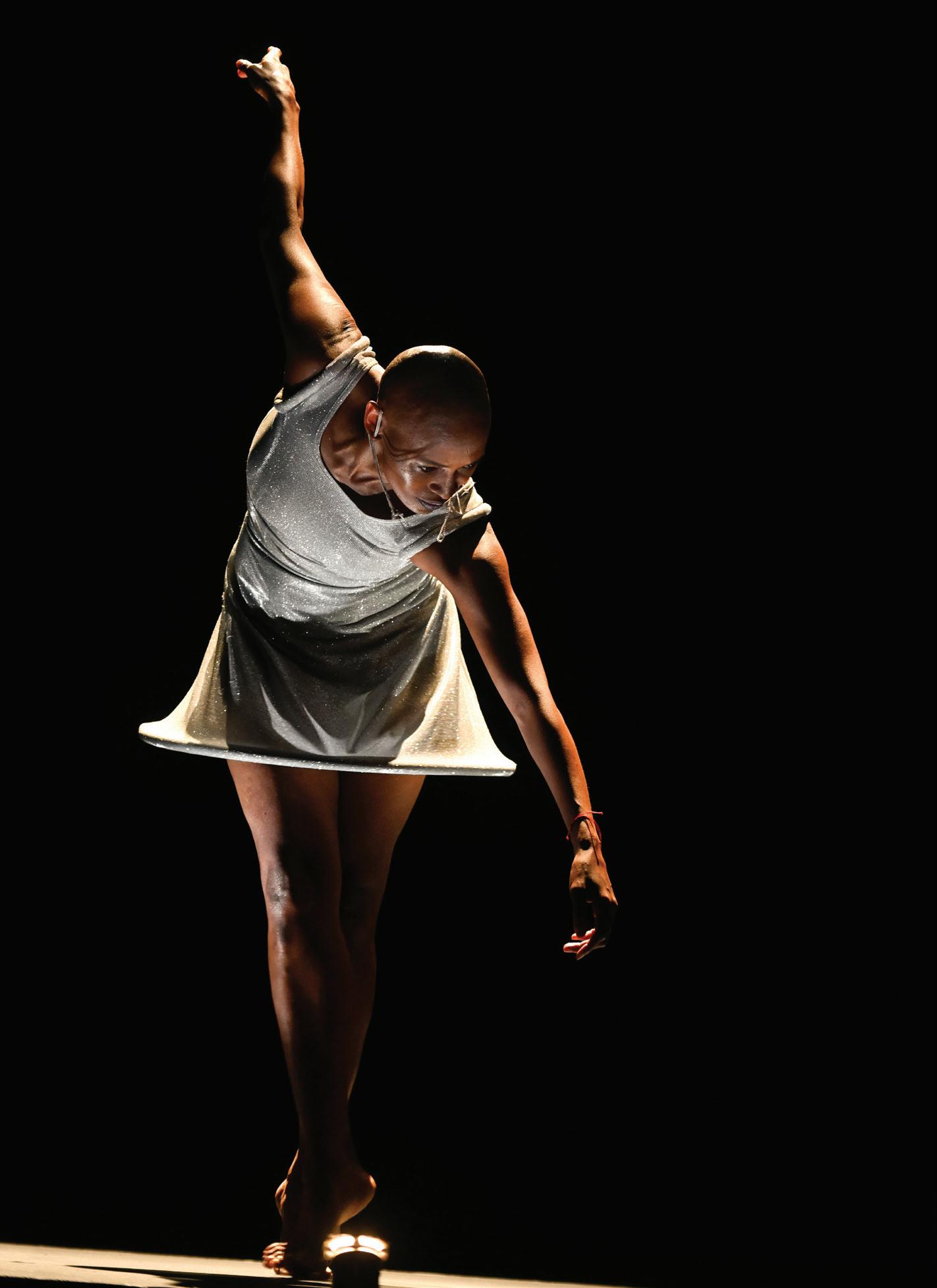
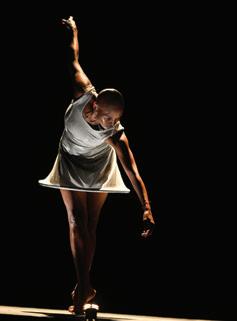
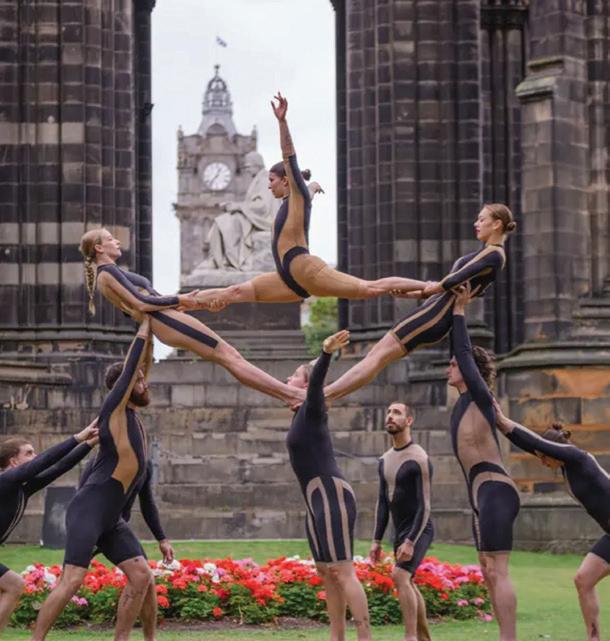
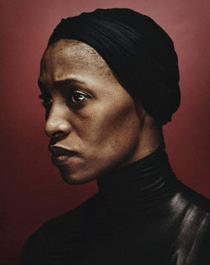
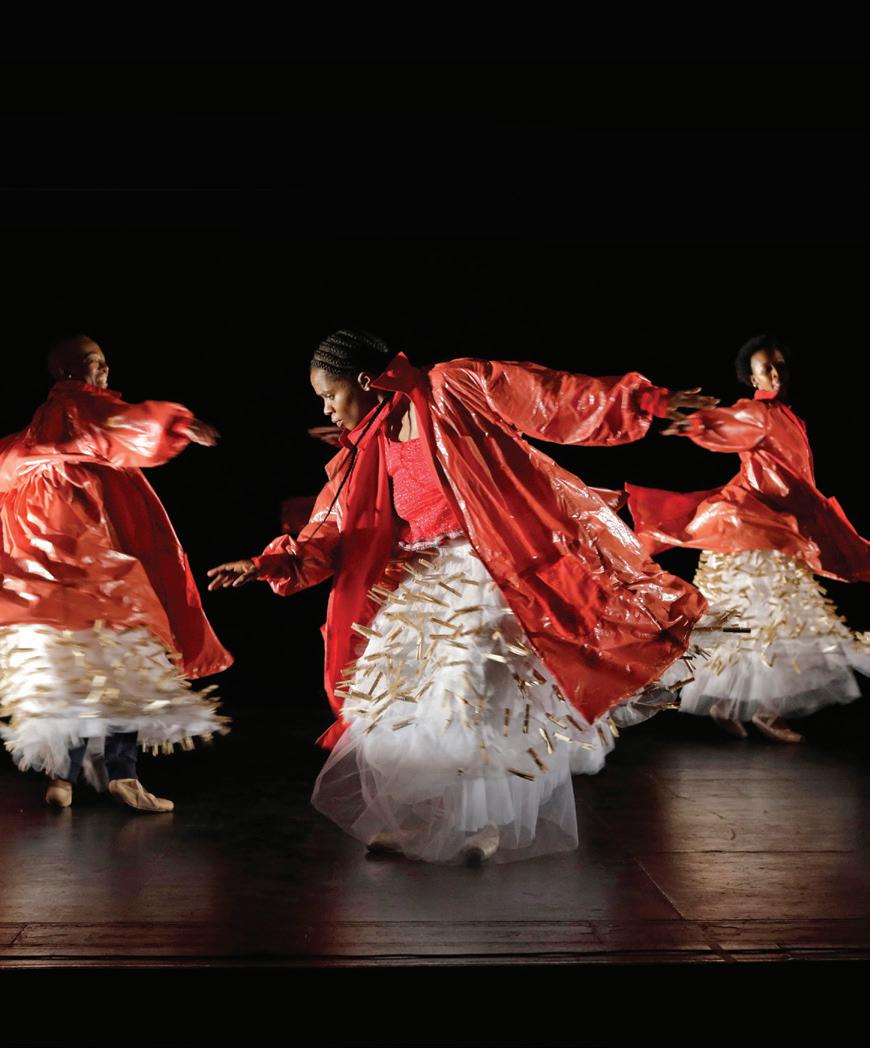
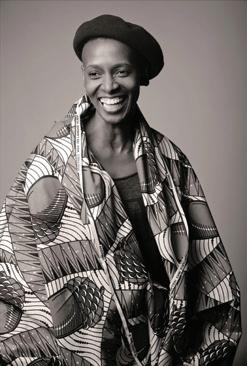
Mamela Nyamza is having a significant moment. The awardwinning South African dance maverick turns 50 on 22 September – a milestone coinciding with one of the highest honours in contemporary dance: the 2026 Silver Lion at the Venice Biennale’s Biennale Danza.
The recognition comes alongside the global premiere of her new work
The Herd/Less at the 20th International Festival of Contemporary Dance in Venice, after its local premiere at Cape Town’s Baxter Theatre in May. The production continues to tour across both South Africa and Europe through to the end of the year.
Showcasing work at one of Cape Town’s leading theatres was particularly meaningful for Mamela. “It was the first time I self-produced a showcase of my work on a big stage in my hometown. My people were there, and they still needed to be inspired and represented. The moment was complemented by the Silver Lion Award. I’m happy that finally I’m being recognised; not only at home but internationally. It’s validation that people see me and that my voice matters,” she says.
“I was always cast as the understudy and never made it as a fully fledged ballerina”
A REBEL IS BORN
Born in Gugulethu in 1976 – the year of the Soweto student uprisings –Mamela carries the spirit of resistance into her creative practice. She started ballet at the age of eight at the Zama Dance School under the Royal Academy of Dance, before completing a National Diploma in Ballet at Pretoria Technikon (now Tshwane University of Technology) in 1994.
But early promise didn’t guarantee acceptance. “I was always cast as the understudy and never made it as a fully fledged ballerina, despite having my diploma. There was constant criticism of my black form,” Mamela recalls.
A scholarship to study at the Alvin Ailey American Dance Theater in New York in 1998 marked a turning point. It was there that choreographer Fabrice Herrault created a personalised version of The Dying Swan, originally titled The Black Swan – a piece that would become part of Mamela’s repertoire.
On returning home, she joined the State Theatre Dance Company, performing internationally in both contemporary and African dance.
BREAKING FORM
While developing her voice and style as a choreographer, she began dismantling the conventions that shaped her training. Her work interrogates the politics of the body, often fusing autobiography with cultural and social critique.
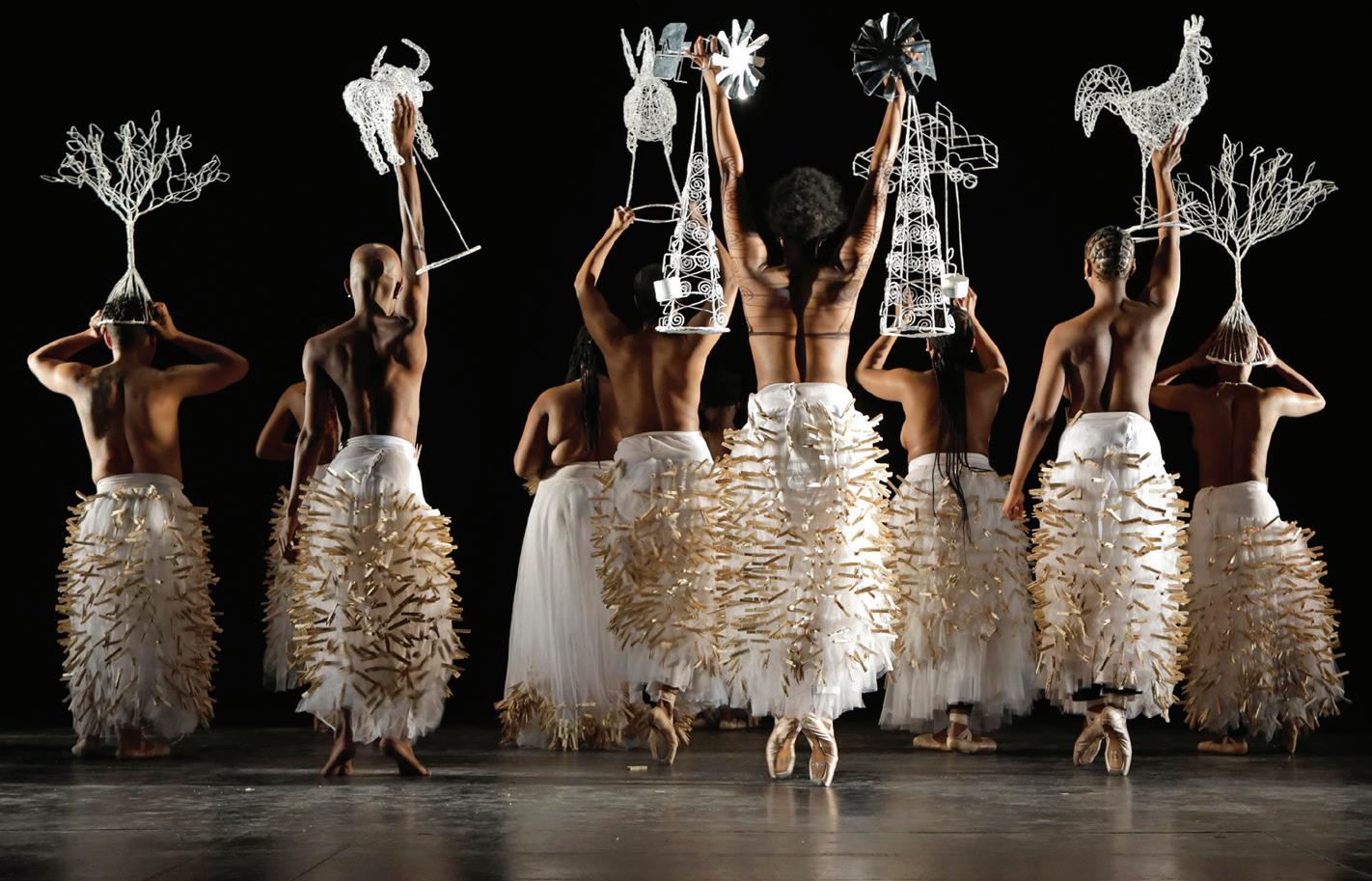
Both Hatch (2008) and Hatched (2009) marked this shift, exploring Mamela’s life and identity as an African dancer, woman, mother, and lesbian. They were also shaped by the loss of her mother, Tozama Nyamza, who was murdered and raped at home by her lover.
“I had a connection with The Dying Swan song, which helped me connect with my mom,” Mamela says. “She died in 1999, and that’s the year I performed The Dying Swan solo. My works have helped me heal from the trauma of my mom’s death, although it never really goes away. But I view it from a better place now.”
Collaboration expanded her dance language even further, including The Last Attitude with Nelisiwe Xaba, which used personal experiences with ballet to question the politics of inclusion and belonging.
She’s gone on to create many other powerful works, including I Stand Corrected (2012) with Mojisola Adebayo, 19-Born-76-Rebels (2014), and De-ApartHate (2017), which confront genderbased violence and social injustices through raw, embodied performance.
DANCE AS CONFRONTATION
Her experimental edge comes from pushing the boundaries of dance and having to be inventive with limited resources. She’s developed a strippedback, site-specific aesthetic that blends dance theatre, physical theatre, and performance art rich in symbolism.
“I’m always looking to go somewhere else with dance. If I do the same thing, I feel like I’m not challenging myself. I also want to challenge the audience. Not having a lot of resources makes you work and think smart,” she says.
That audacity and instinct are evident in Black Privilege (2018), a stirring, ritualistic solo work in which Mamela appears semi-nude and covered in gold paint as she confronts rejection and the injustices faced by women.
“Not having a lot of resources makes you work and think smart”
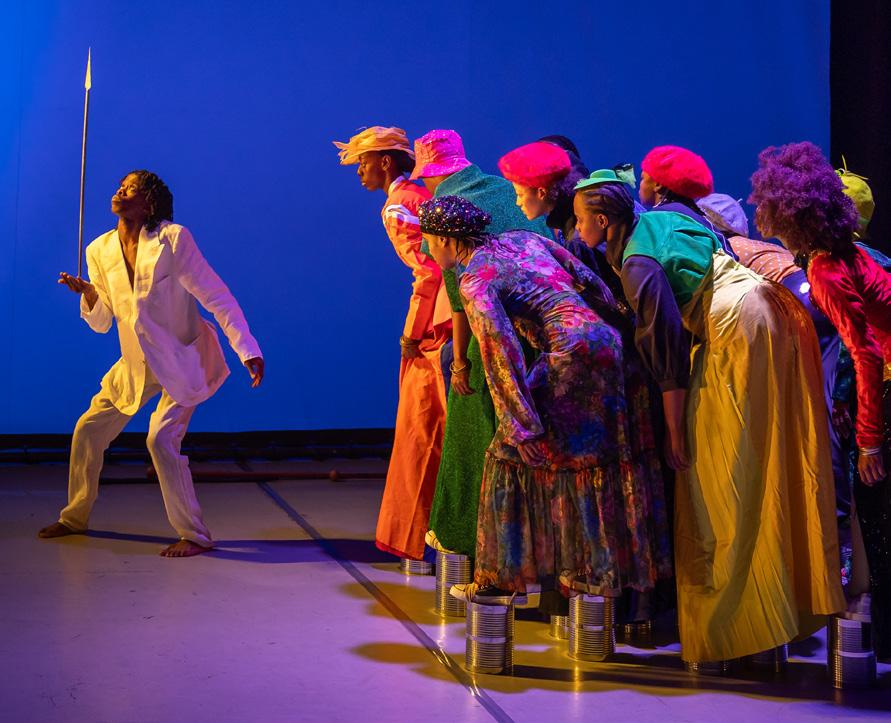
THE HERD/LESS
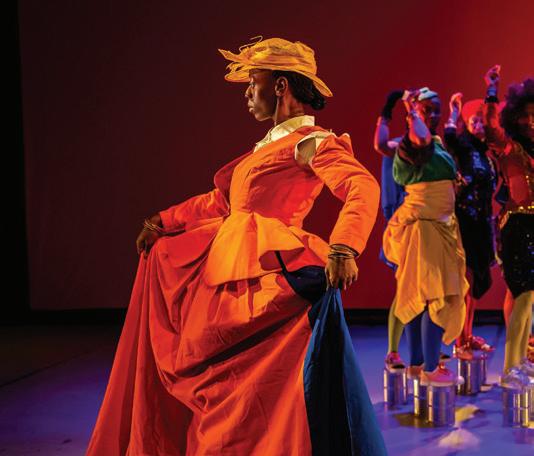
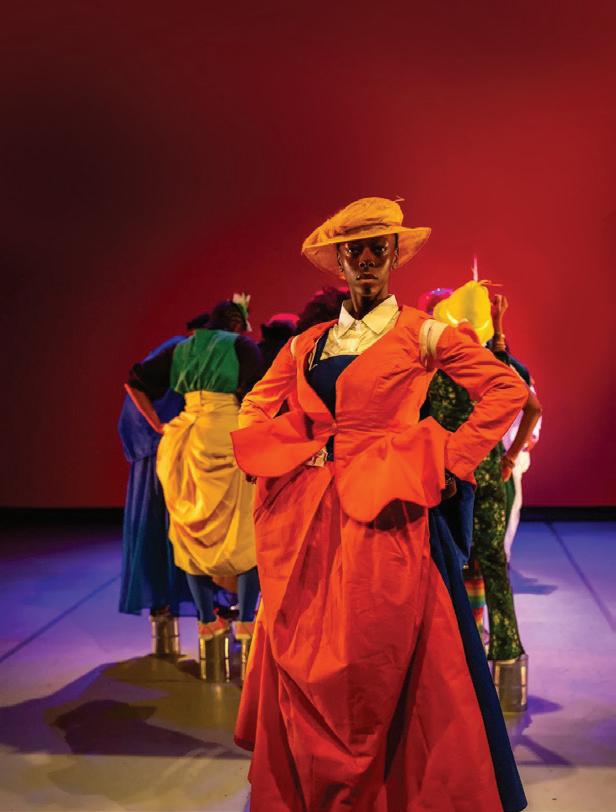
Her latest work, The Herd/Less, is a commentary on the current state of leadership in South Africa. Using cans as a metaphor for restriction and control, the piece explores political cycles and their side effects through movement, colour, and symbolism.
Performed by young dancers from her company Mamela’s Artistic Movement (MAM), the work has an urban language that celebrates queerness and the street smarts of Kwaito culture.
“I’m now behind the scenes. I’m enjoying being the producer, director, and choreographer. I create better with an outside view. And I’m passing the baton to the young generation. But I remain an independent thinker. I use my voice freely on stage,” Mamela says.
WHERE TO WATCH MAMELA’S WORK:
THE HERD/LESS
Durban: 25 August – 6 September at the Jomba! Contemporary Dance Experience
Johannesburg: 9 – 12 September at the Market Theatre
London: 8 – 10 October at the Dance Umbrella
Switzerland: 3 & 4 November at Dampfzentrale Bern HATCHED ENSEMBLE
Moscow: 22 & 23 November at the Pacific International Theatre Festival
A NEW CHAPTER
At 50, Mamela is not concluding her career; she’s recalibrating it. With international recognition, a new company, and a major body of work, she continues to expand the vocabulary of South African contemporary dance. ■ @mamela_nyamza
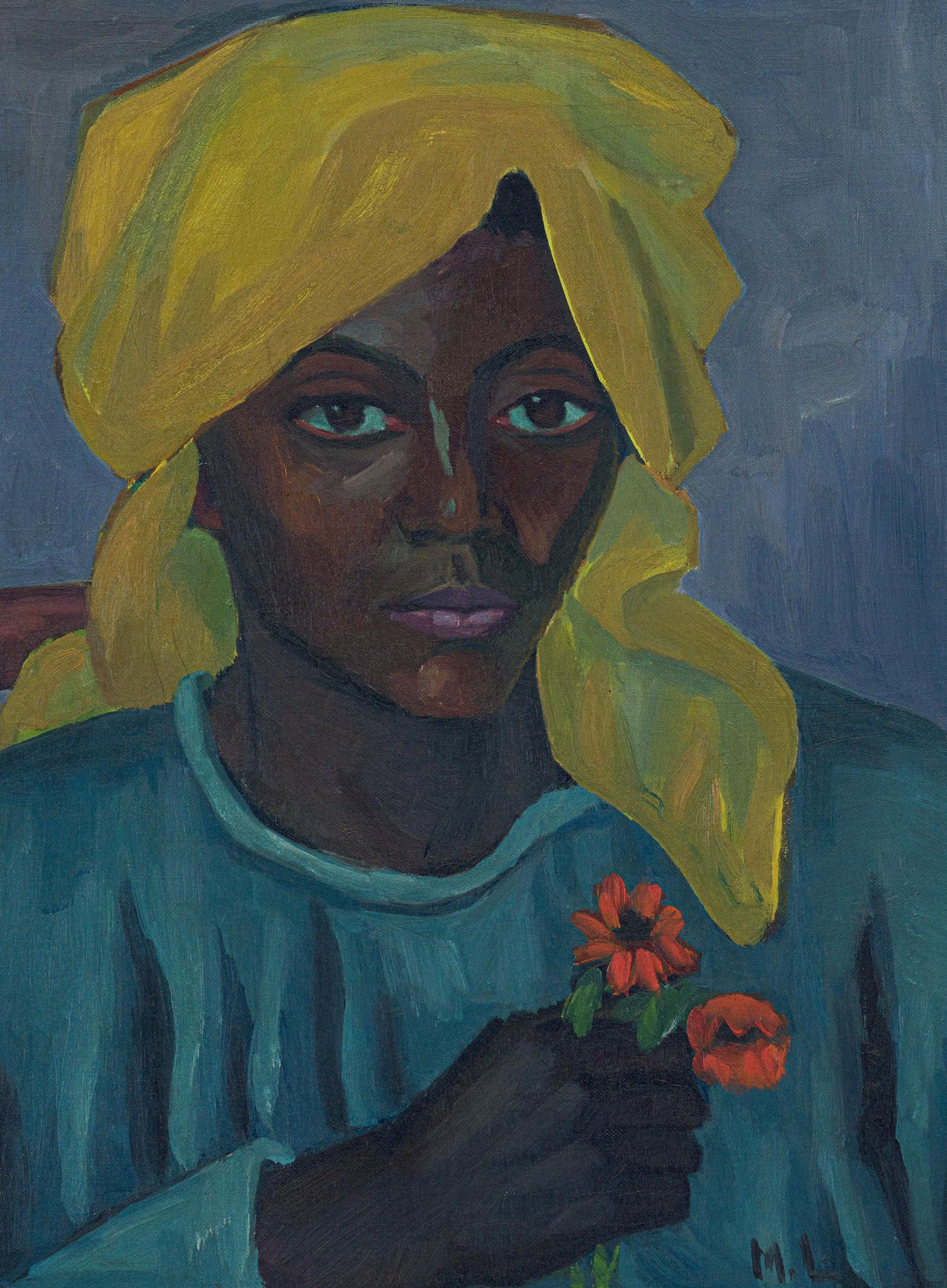
Maggie Laubser, Portrait of a Woman with Headscarf Holding
the collection of Elita de Klerk
VINTAGEAMBITION
FEW CAREERS ARE BUILT AS UNEXPECTEDLY AS SEAN KUBHEKA’S. A CHANCE INTRODUCTION TO WINE TRANSFORMED AN ASPIRING ARCHITECT INTO ONE OF SOUTH AFRICA’S RISING SOMMELIERS, NOW TRUSTED TO GUIDE GUESTS THROUGH LEGENDARY LABELS AT ONE OF DUBAI'S MOST PRESTIGIOUS DESTINATIONS
WORDS DEBBIE HATHWAY
Sean Kubheka once imagined himself designing buildings. Today, he is decanting some of the world’s rarest wines in Dubai. The journey would take him much further than he ever imagined.
Sean studied mathematics, engineering, science, and graphic design at school, encouraged by his father, who constantly challenged him to think beyond convention. He passed away while Sean was still in primary school, leaving his brother – Sean’s uncle – to step in and adopt that fatherly role. “He didn’t just raise me; he gave me belief. Belief that I could become anything and that limitation was a choice,” he says.
When Sean’s dream to study architecture didn’t materialise, he decided to “leave comfort behind and find himself.” He printed CVs and knocked on doors, then secured a role as a runner at a steakhouse group in Durban. “Before that, I had already learned how to hustle by selling braai meat and pap on the streets during my school years,” he says.
Wine entered the mix unexpectedly. What began as curiosity soon became an obsession with history, geography, and the people behind every bottle. His enthusiasm caught the attention of a training manager who offered him the opportunity to study wine formally while continuing to work. For three years, life became a demanding cycle of classes and late-night service, often finishing at two in the morning.
“People often buy into the story before they buy the wine”
The effort paid off. Sean’s career progressed through Durban and Johannesburg before opportunities in the Middle East led him to Qatar, then to Dubai, and one of the hospitality industry’s most coveted addresses: SAL at Burj Al Arab. Sean interviewed for the sommelier position between services, still in uniform, and speaking from a basement corridor. He got the job.
The first time he walked into Dinner by Heston, Atlantis’ Michelin-starred restaurant, it stopped him in his tracks. It wasn’t simply the food or the scale of the operation, but the meticulous attention to detail, from the immaculate kitchen and mixology lab to one of the Middle East’s most impressive wine cellars. “I remember thinking, ‘This is it,’” he says. “This is where I wanted to be.”
Working at destinations such as SushiSamba and launching celebrity-chef concepts with Geoffrey Zakarian taught him how much performance, precision, and personality mattered. “I stood out through consistency,” he says.
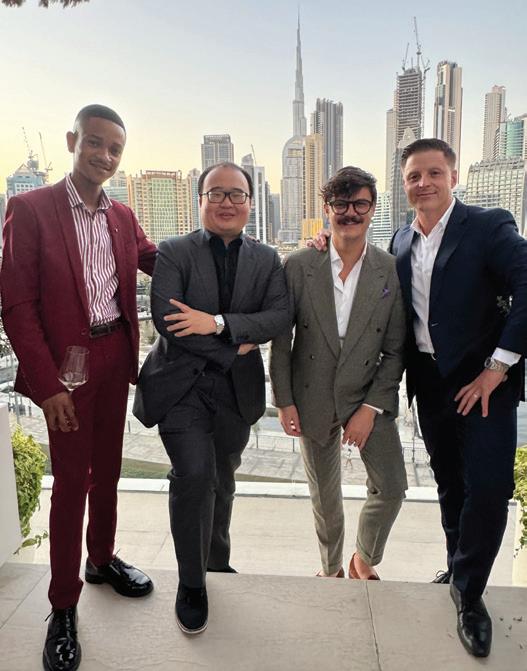
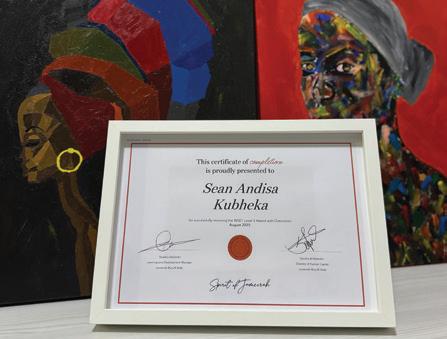
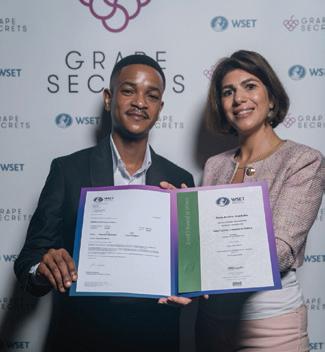
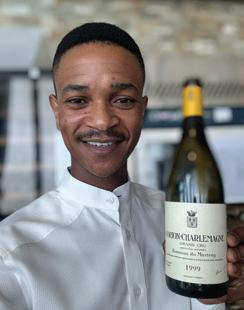
CLOCKWISE FROM LEFT:
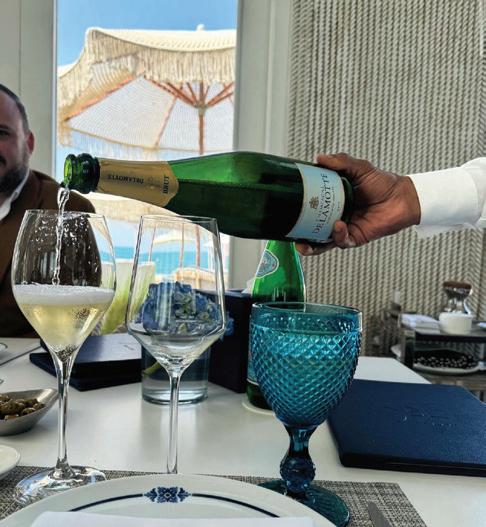
At Star Wine List of the Year event with sommelier Hao, Jumeirah Burj Al Arab head sommelier Antonio Costigliola, and Atlantis Dubai director of beverage Samuel Lacroix; Wine & Spirit Education Trust Level 3 Graduation Day; Wines from regular dinner service at Al Muntaha, the Michelinstarred restaurant at Jumeirah Burj Al Arab; The 1999 CortonCharlemagne Grand Cru, one of Sean’s earliest landmark sales at Jumeirah Burj Al Arab
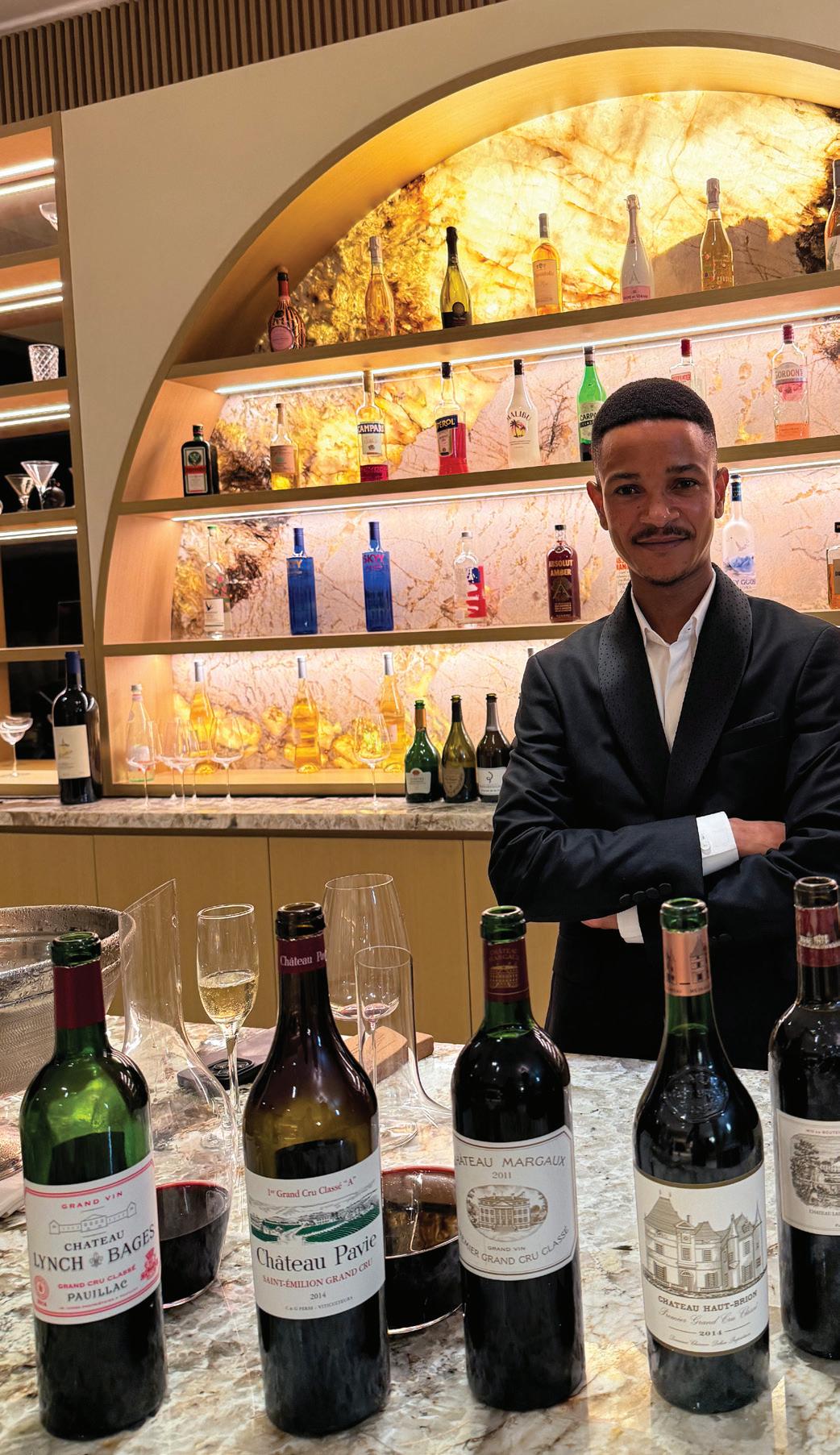
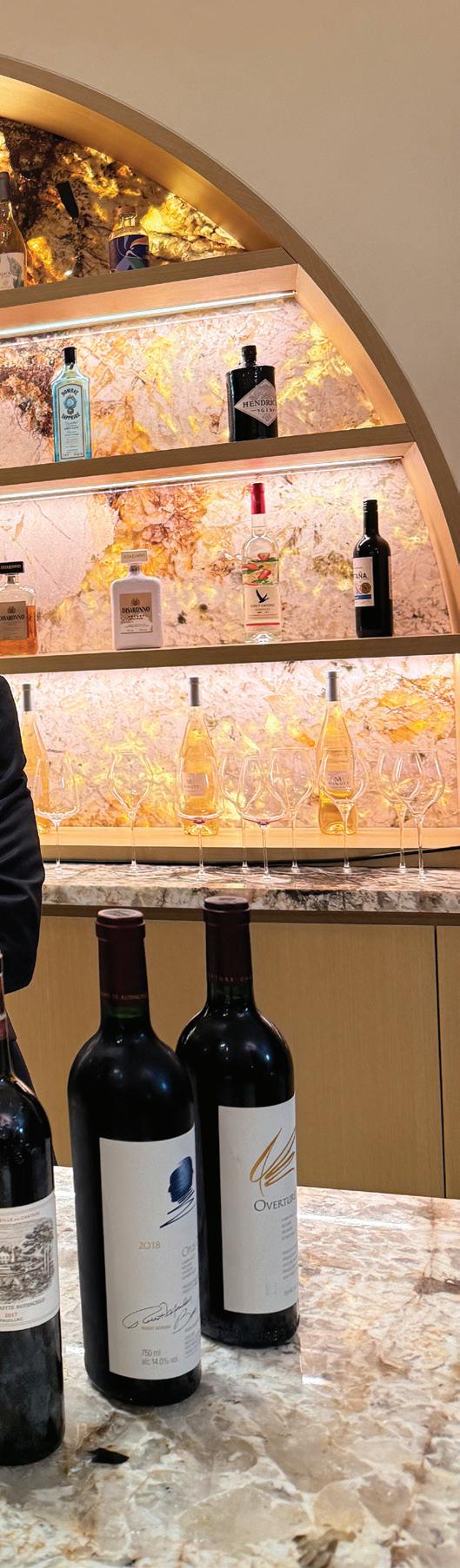
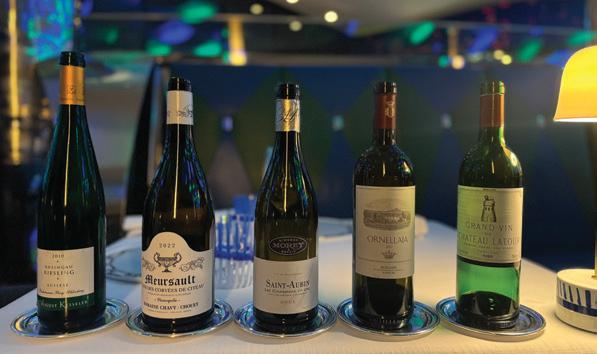
Along the way, he’s poured some of the world’s most sought-after wines, including Château Margaux, Penfolds Grange, rare Champagne vintages, and Domaine de la Romanée-Conti. Whether it’s an everyday chardonnay or a rare Bordeaux, Sean is more interested in the stories behind the bottle than the price on the list.
Now sharing his deep knowledge of harvests, winemaking, and terroir with guests at Seafire Steakhouse, Atlantis, The Palm – Dubai, he says guests request some of the world’s most sought-after labels, with one recently asking for something “powerful, historical, and memorable”. Sean suggested Château Margaux 2010 instead of his usual Opus One – a bold recommendation given the price difference. It worked. So much so that the guest immediately asked for a second bottle. This time, Sean recommended a 1991 Penfolds Grange to accompany his steak. “People often buy into the story before they buy the wine,” he says. “We don’t sell wine because it’s chardonnay or cabernet sauvignon. We sell the story behind it.”
That fascination extends into his own collection. A private client recently gifted him a bottle of Pétrus 2005 after Sean helped source several rare wines for his personal cellar. The gesture prompted him to invest in a temperature-controlled EuroCave cabinet and begin building a collection of his own. It may well be the first genuinely luxurious purchase he’s made for himself, not for prestige but to protect something meaningful.
There’s another side to his story, too. His paintings, many of them colourful contemporary portraits created in oil, have begun attracting commissions from clients in Dubai after they discovered his work online. His art mirrors his wine journey: “Colour as flavour, texture as structure, composition as balance.”
While Sean has built an international career, it has not been without sacrifice. There’s little sense that he is chasing status. If anything, his attention remains fixed on home – helping his twin brothers access opportunities he never fully had and creating a life that extends beyond himself. Even his definition of luxury has changed to “peace, freedom, and space.”
On his days off, luxury looks simple: a bottle of Springfield Estate Méthode Ancienne open on the table, paintbrushes in hand, and a blank canvas waiting to be filled. For Sean, the two pursuits have never been separate. “Wine, to me, is liquid philosophy. Art is its reflection.” ■
THE MEASURE CHARACTER of
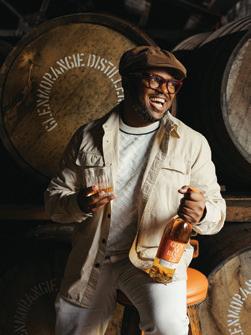
GLENMORANGIE'S LATEST CAMPAIGN CELEBRATES THE VALUE OF TIME, CRAFT, AND PERSPECTIVE BY BRINGING TOGETHER THREE OF AFRICA'S LEADING CULTURAL VOICES. IN SOUTH AFRICA, THAT ROLE BELONGS TO AUTHOR AND COMMENTATOR KHAYA DLANGA, WHOSE THOUGHTFUL APPROACH MADE HIM THE PERFECT FIT
For more than 180 years, Glenmorangie has crafted its Highland single malt with an unwavering commitment to patience and precision. Those same qualities underpin the whisky maker's most ambitious Africa-focused campaign to date –one that explores how identity is shaped through craft, curiosity, and the stories we tell.
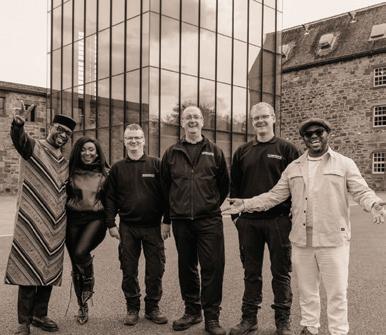
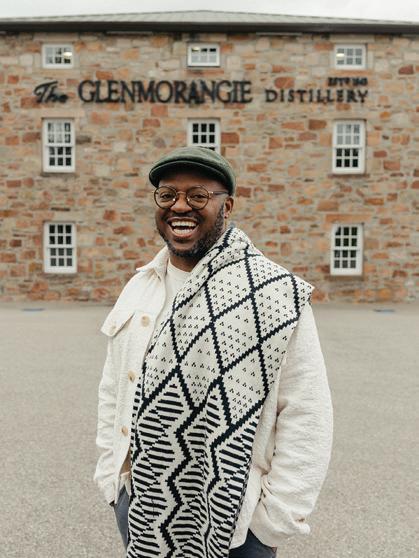
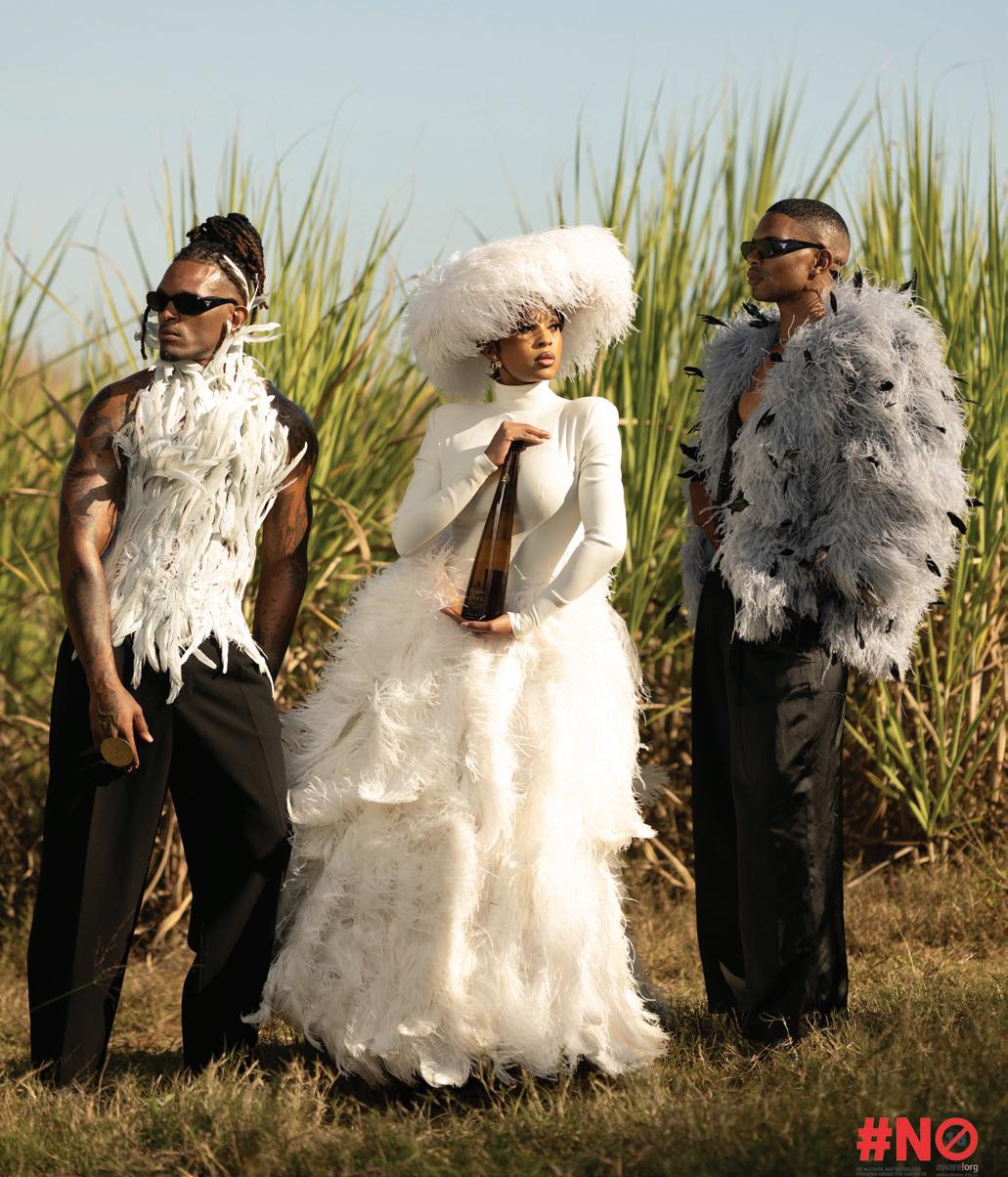
Leading the South African chapter is acclaimed author, columnist, and social commentator Khaya Dlanga, who joins Kenyan actress Kate Kamau and Nigerian artist and creative executive Darey Art Alade as the campaign's three African ambassadors.
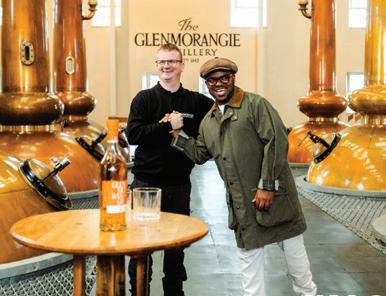
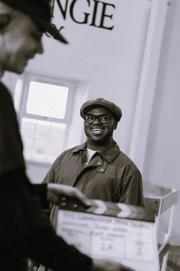
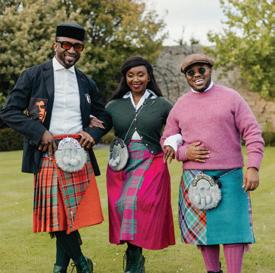
Rather than serving as traditional brand ambassadors, the trio travelled to Glenmorangie's Highland distillery in Tain, Scotland, immersing themselves in the people, traditions, and craftsmanship behind the whisky. Their experiences form the foundation of a campaign that celebrates the connections between heritage and creativity.
For Khaya, whose career has been built on asking difficult questions and telling authentic South African stories, the journey resonated on a deeply personal level.
"I've always been curious about people and the stories they carry, so I found myself as drawn to the conversation as I was to the whisky," he said. "Behind every tradition were people who cared deeply about preserving something meaningful. It was a reminder that real character is built over time."
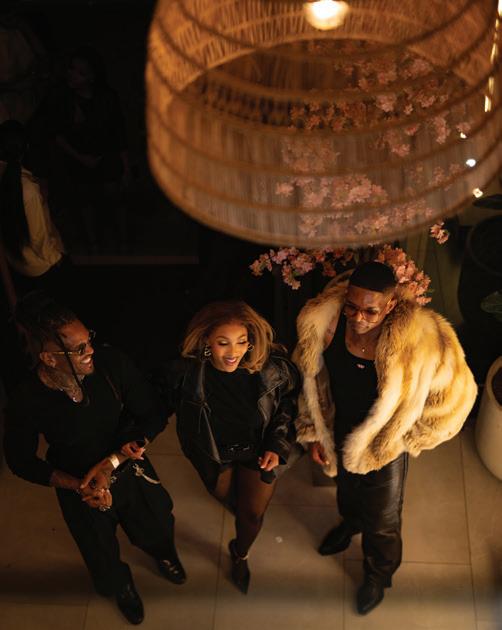
That spirit of conversation carried through to the Johannesburg launch, where friends of the brand gathered alongside Khaya's guests for an intimate dinner celebrating creativity, connection, and storytelling. The evening was hosted by broadcaster and Khaya's close friend Anele Mgudlwa, who described him as "an architect of attention" – a fitting tribute to his remarkable ability to shape conversations that resonate across South African society.
The campaign arrives at a time when African creatives are increasingly influencing global conversations around literature, music, fashion, design, and luxury. By partnering with Khaya, Kate, and Darey, Glenmorangie places contemporary African storytelling alongside one of Scotland's most celebrated whiskymaking traditions, creating a dialogue between two cultures united by a respect for craft.
“Real character is built over time”
Caspar MacRae, President and CEO of The Glenmorangie Company, said the collaboration reflected a genuine meeting of cultures. "At Glenmorangie, we've been perfecting the art and science of whisky making for more than 180 years, creating our spirit in Scotland's tallest stills for its signature elegant character. When we welcomed Kate, Darey, and Khaya to Tain, they brought a real sense of humour and curiosity into their conversations with our distillery team, who thoroughly enjoyed the opportunity to share some of the stories behind our single malts and how they have been shaped by our Highland provenance.”
He added, "The conversations that emerged throughout the journey were genuinely inspiring. It's a delight to now see each storyteller's unique take on their visit to Scotland, and to celebrate their creativity and individuality through this campaign, which I'm sure will resonate with whisky lovers across Kenya, Nigeria, South Africa, and beyond."
Running across South Africa, Kenya, and Nigeria until December, the campaign combines long-form editorial features, episodic digital films, and intimate cultural dinners, celebrating the idea that whether crafting a single malt or shaping a story, true character is never rushed.
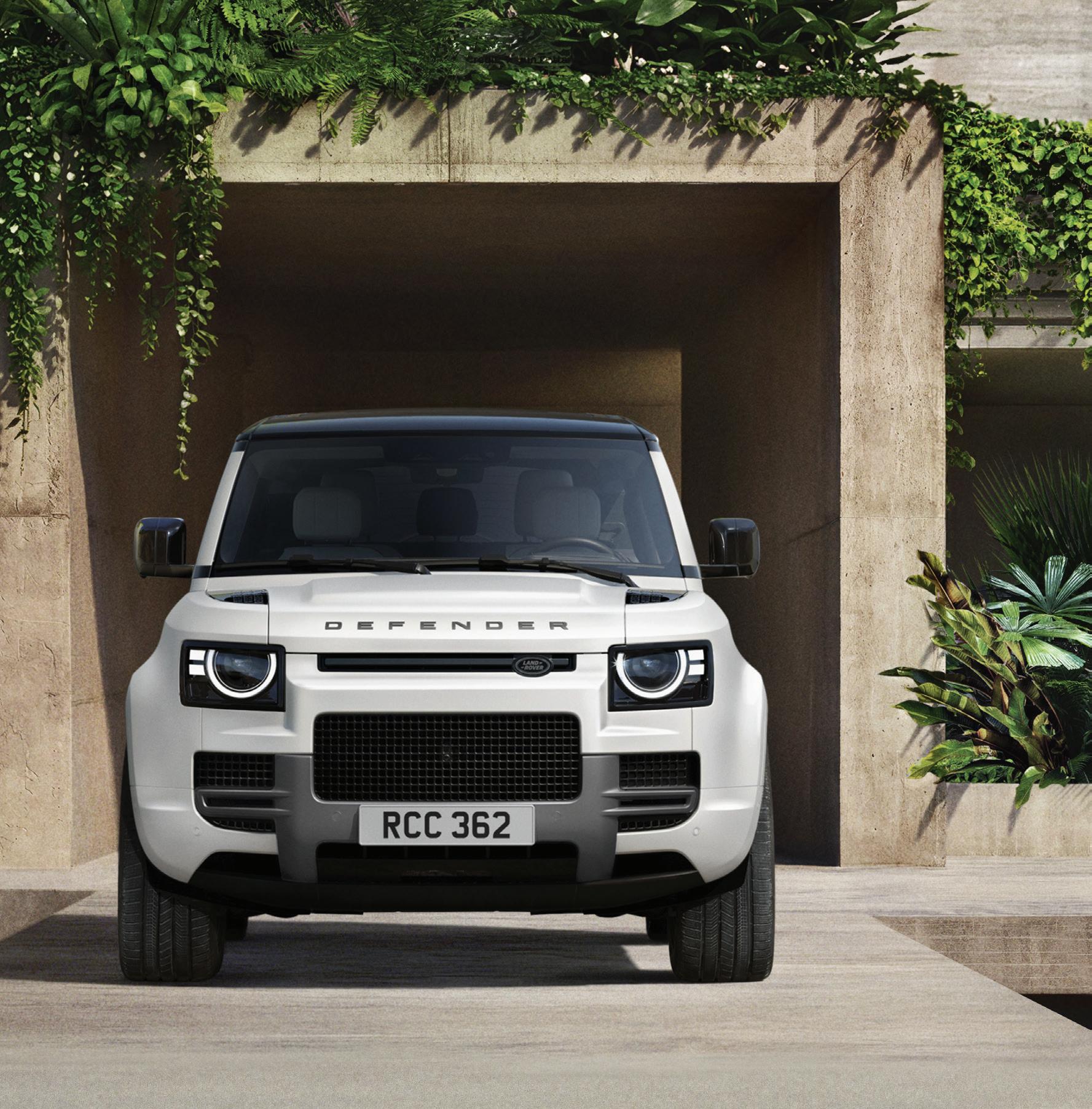
DEFENDER LEGACY The
FEW VEHICLES HAVE EVOLVED AS SUCCESSFULLY AS THE DEFENDER. THE NEW DEFENDER VERTEX BUILDS ON THAT LEGACY WITH A DISTINCTIVE EXPRESSION OF LUXURY, CAPABILITY, AND DESIGN
Few vehicles have earned iconic status across generations. For more than 75 years, the Defender has evolved from a hardworking off-roader into one of the world’s most desirable luxury 4x4s. While trends have come and gone, the Defender has retained an enduring appeal that transcends fashion, making it one of the automotive world’s most enduring icons.
The new Defender Vertex introduces a more exclusive interpretation of the iconic luxury 4x4, balancing urban sophistication with genuine off-road capability. Whether navigating city streets or venturing into the wilderness, the Defender Vertex has been designed for those who refuse to compromise between luxury and adventure.
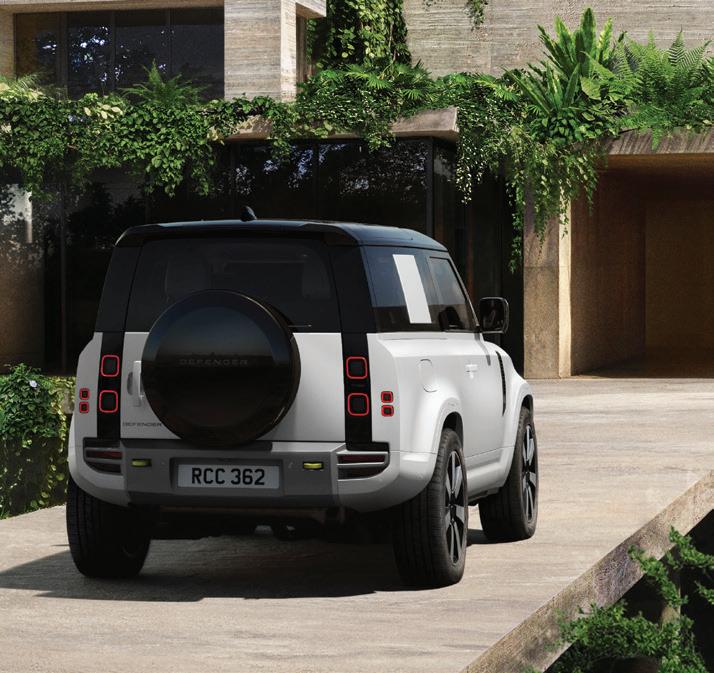
The exterior adopts a more assertive look. New extended front and rear bumpers finished in Shadow Atlas Matte create a more muscular stance, complemented by a larger profiled front grille and redesigned fog lamps. A Gloss Black tailgate spoiler enhances the vehicle’s sporting character, while contrasting yellow front brake callipers and matching exposed rear recovery eyes provide subtle yet unmistakable design signatures that reinforce the Defender’s adventurous DNA.
Lower-body cladding reinforces its commanding stance. Completing the look are exclusive 22-inch Diamond Turned Satin Dark Grey wheels with Carpathian Grey contrast, while alternative 20-inch and Gloss Black wheel designs provide additional opportunities for personalisation.
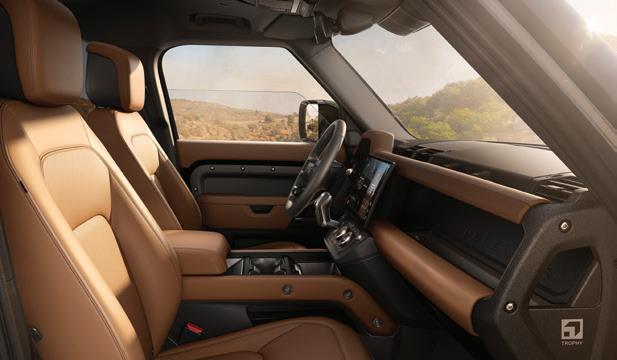
Inside, the Defender Vertex continues its philosophy of “tough luxury.”
Premium Windsor Leather remains available alongside innovative Ultrafabrics™ upholstery, while the introduction of Ebony Forged textile –a durable knitted material manufactured from 100 percent polyester – offers a contemporary alternative that perfectly complements the Defender’s adventurous personality. Three-zone Climate Control, Cabin Air Purification Plus, an Air Quality Sensor, and integrated domestic power socket ensure every journey is as comfortable as it is effortless.
“The Defender Vertex has been designed for those who refuse to compromise between luxury and adventure”
For those seeking to personalise other Defender models, the design language introduced by Vertex extends to the new Extended Exterior Pack, available across selected Defender X-Dynamic SE, X-Dynamic HSE, and V8 derivatives, allowing even more owners to embrace its bold styling.
With the arrival of the new Defender Vertex, this legendary nameplate enters another chapter. It combines unmistakable British craftsmanship, contemporary luxury, exceptional customisation, and world-renowned all-terrain capability in a vehicle that continues to define the modern luxury 4x4.
The Defender’s enduring appeal lies in its ability to evolve without losing its identity. Special editions such as the SV90, Wolf, and the Td5-powered Defender became favourites in their own right during the 1990s, reinforcing its reputation for capability, durability, and lasting desirability. landrover.co.za/defender
THE HOTTEST TICKET IN JOHANNESBURG NIGHTLIFE IS NO LONGER THE LOUDEST ROOM IN TOWN. FROM ELEVATED JAZZ SANCTUARIES IN BRAAMFONTEIN TO VINYL-LED LISTENING BARS IN SANDTON, A GROWING ANALOGUE MOVEMENT IS RESHAPING THE CITY’S AFTER-DARK CULTURE
WORDS SHAI RAMA
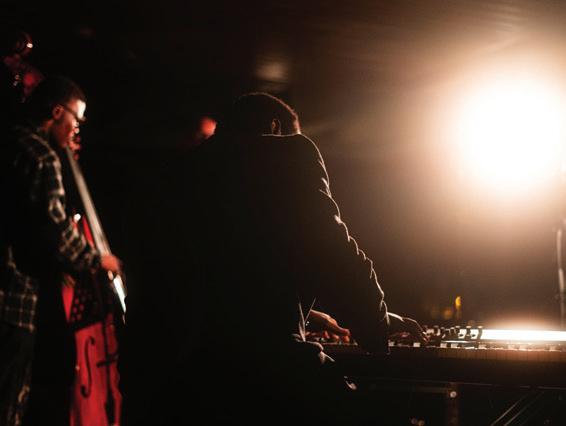
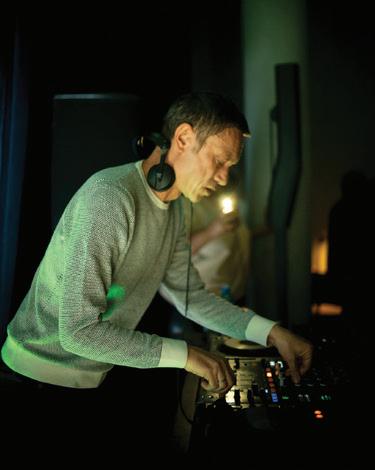
Analogue culture is making a sophisticated comeback in Johannesburg. Moving beyond the standard bar scene, a new wave of listening bars and jazz spaces are prioritising live music and rare vinyl over generic playlists, redefining the city’s nightlife through a more curated, immersive lens.
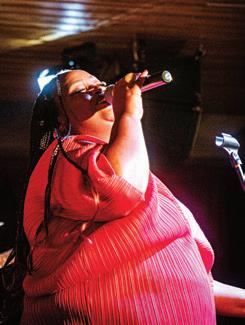
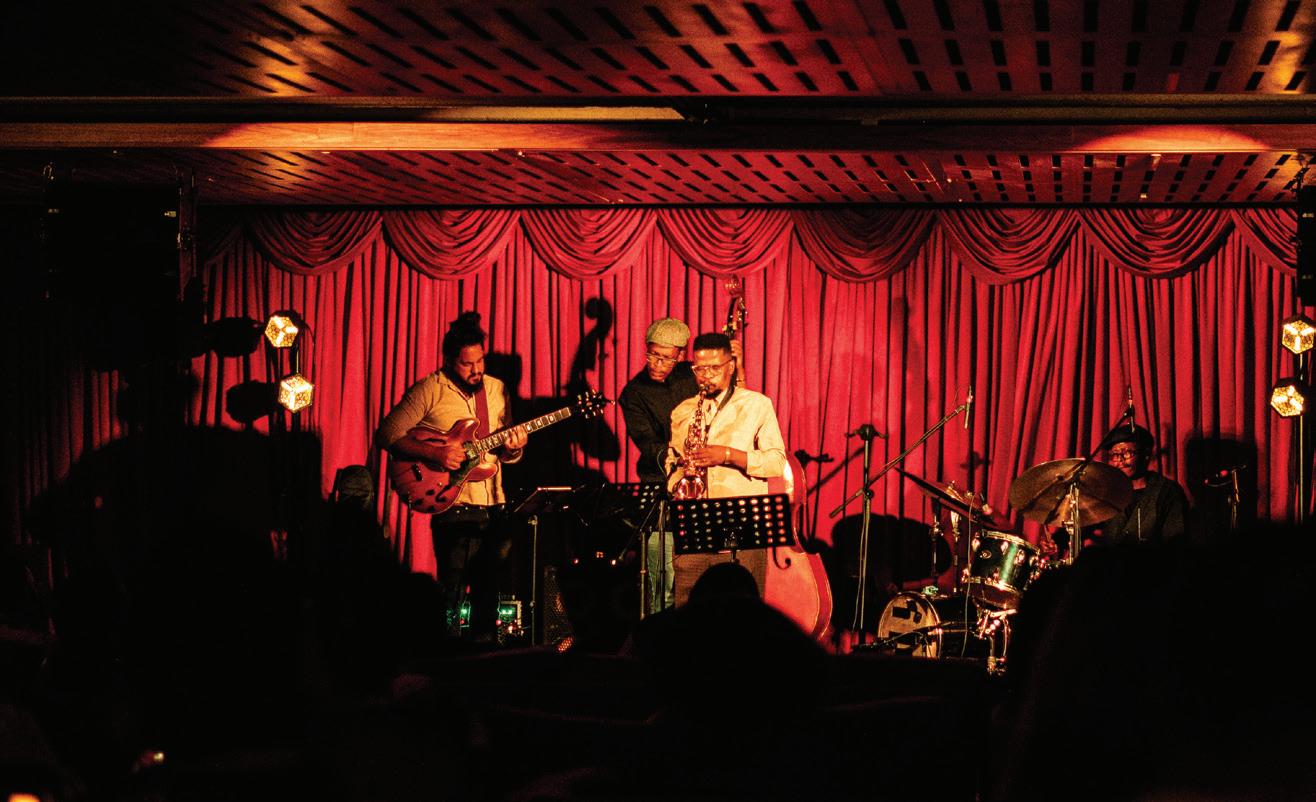
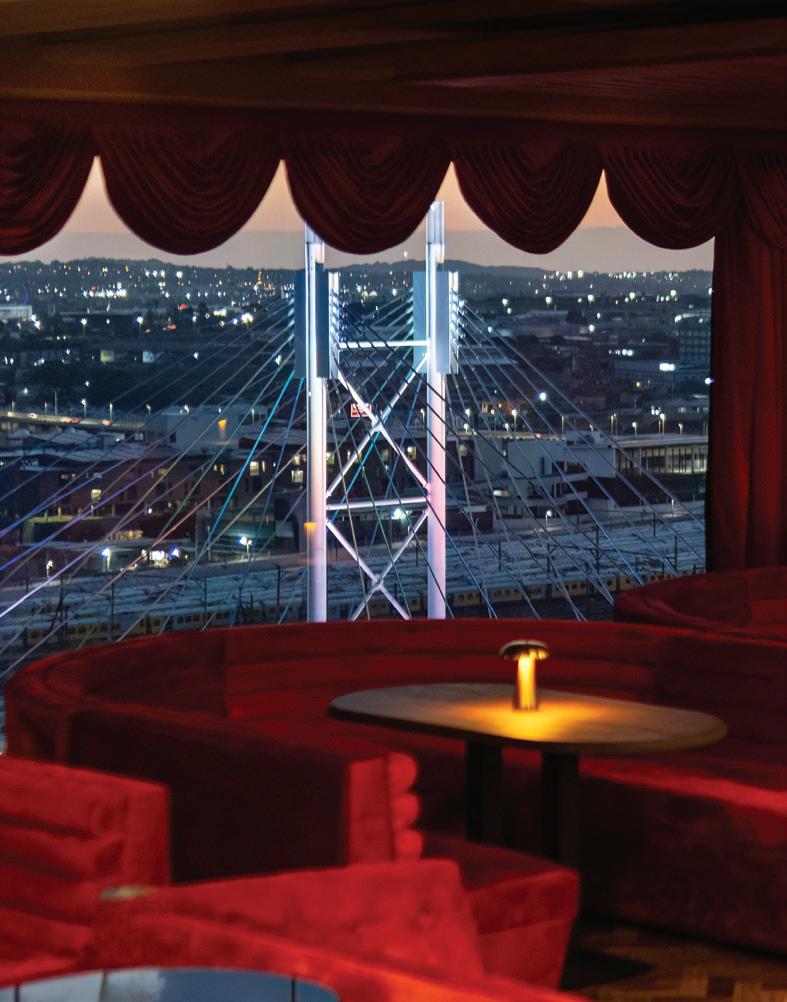
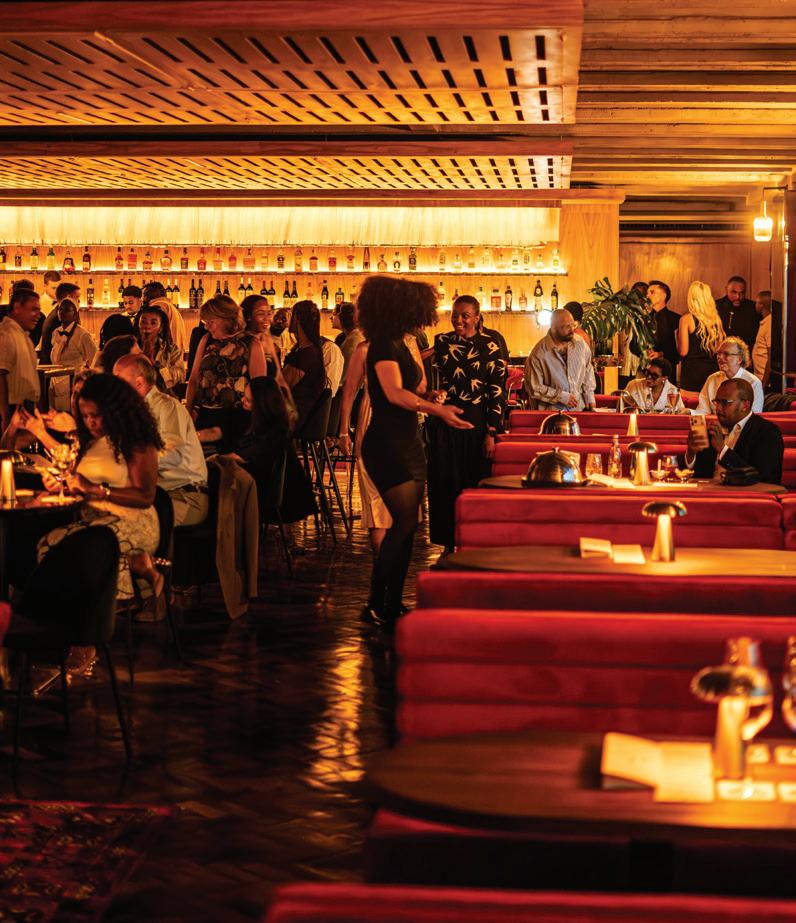
Hugh’s Jazz Club floats thirteen floors above the streets of Braamfontein: a velvet-draped space serving as a living tribute to the legendary Hugh Masekela. “He believed that music could hold a community together,” says Adam Levy, founder of Hugh’s Jazz Club. “That it could carry memory forward without making people feel like they are standing in a museum. I’d been sitting with the idea of a jazz club for a while, but what pushed it from idea to reality was the conversation with Pula Twala and Barbara Masekela (Bra Hugh’s sister) at the Heritage Foundation. When they described what Hugh stood for – the joy, the political consciousness, the absolute refusal to be nostalgic in a mournful way – I knew we were talking about the same thing.”
Adam wanted the room to do what great music does: transport guests the moment they walk in, while simultaneously making them feel completely at home. There’s an atmospheric quality to red velvet, dark timber, and
ANALOGUEnights
amber light that is universally understood by the body before the mind even catches up. Drawing from his travels to the great jazz rooms of New York, Paris, and Tokyo, he noted that they shared a specific warmth that was physical rather than merely decorative. “We worked hard to get that right,” adds Adam. “The finishes had to feel earned, not applied. Every material had to justify its presence.”
This vision extended beyond aesthetics to acoustics, with specialist glazing insulating the room from Braamfontein’s bustle and bespoke ceiling panels helping to create a warm, intimate sound. Even the parquet flooring was carefully engineered, ensuring every performance feels rich and immersive without overwhelming conversation.
The menu is equally considered, celebrating local flavours while drawing inspiration from the global influences that shaped Hugh’s life. Like the interiors, every detail is considered. “We’d rather do fewer things exceptionally than more things adequately,” says Adam.
Ultimately, placing such a sophisticated, analogue sanctuary in the heart of the inner city was a deliberate move. Braamfontein provides the perfect foundation for the club's high-altitude elegance. "I’ve been in Braamfontein for more than 20 years. I’ve watched it go through every version of itself: neglected, then discovered, then over-exposed, then quiet again. What has always been true about it is its stubbornness. It refuses to be one thing. It’s a neighbourhood with memory and with ambition at the same time,” Adam concludes.
“We’d rather do fewer things exceptionally than more things adequately”
OLD-SCHOOL REVIVAL: Rich interiors, considered menus, and carefully curated music take centre stage at Joburg’s new generation of bars
“Music becomes an integral part of the experience”
For Ruwayne Sebia, Creative Director and Head of Digital at Artistry Sandton, the city is just as integral to the identity of Sandton’s Listening Bar at Artistry. “Our three-level experience was inspired by the way Joburg moves,” he explains of the project, which was conceptualised by musician J’Something in partnership with hospitality network BlackBrick Sandton. “Guests can start with a slow, curated dining experience on the rooftop, immerse themselves in live performances and storytelling in our 100-seater theatre, and then transition into the energy of the Listening Bar as the evening unfolds.”
The Listening Bar at Artistry is, for many, the most magnetic part of this three-storey space: an “interpretation of a modern Joburg gathering place,” says Ruwayne. In honour of the city’s ability to bring people together, the Artistry team imagined this part of their venue as a place where artists, creatives, and curious music lovers could gather.
A subtle distinction became important here: while many venues treat music as “background noise”, the creators of Artistry wanted to design an environment where music becomes an integral part of the experience.
“Great sound is non-negotiable,” says Ruwayne. “We’ve invested in a sound experience that allows guests to truly appreciate the nuances of a record, a DJ set, or a live performance. The aim is to create an immersive listening experience without sacrificing comfort or conversation.”
Then there’s the curation of what you’ll hear through that state-of-the-art sound system: Ruwayne and the Artistry team work closely with “selectors, DJs, and artists who understand how to read a room while introducing audiences to new sounds. The selections move fluidly between genres and eras – from soul, jazz, disco, alternative, and house to electronic music, amapiano, and global sounds, always with a focus on quality and intention rather than trends.”
Together, the two spaces point to a broader shift in Johannesburg nightlife. In a city long defined by high-energy clubs and late-night excess, these spaces invite guests to slow down, listen with intention, and reconnect with music as something to be experienced rather than simply heard. It's a quieter kind of luxury, and one that feels perfectly in tune with where Joburg is headed. ■ hughs.co.za; thisisartistry.co.za
POWER OF CONVERSATION
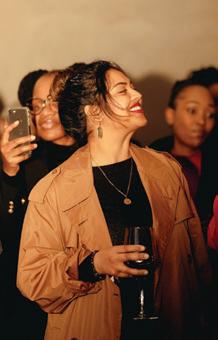
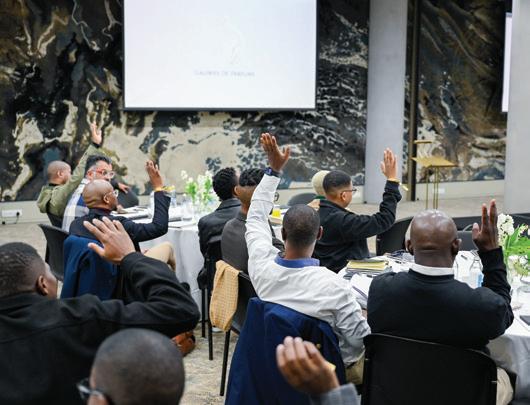
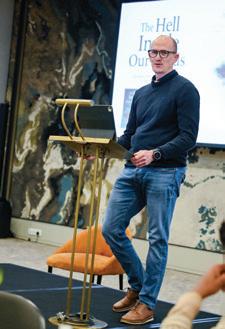
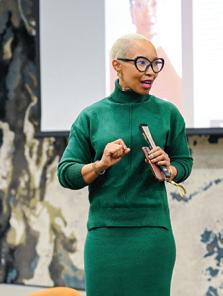
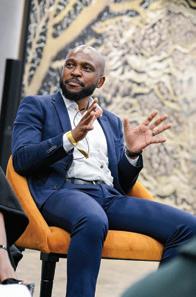
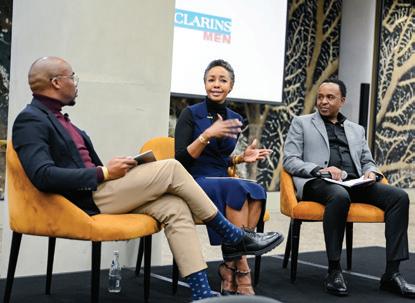
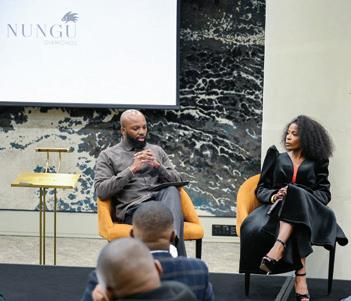
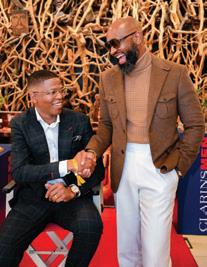
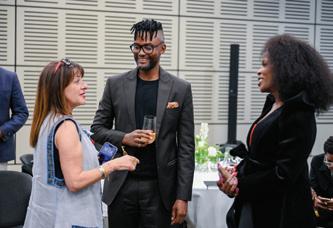
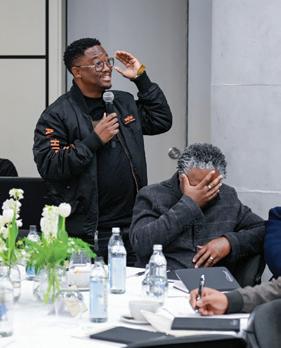
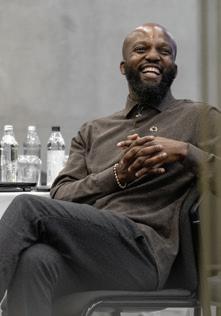
The second edition of the Vastly Sage Gentlemen’s Winter Brunch brought together an influential cross-section of business leaders, entrepreneurs, professionals, and changemakers at The Leonardo in Sandton, Johannesburg, on 21 June for a day centred on modern masculinity, leadership, and wellbeing.
Hosted by broadcaster Clement Manyathela, sporting a custom diamond bracelet and lapel pin from Nungu Diamonds, the event made space for discussions that encouraged men to challenge traditional perceptions of vulnerability, mental health, and emotional resilience. Thought-provoking panel conversations focused on reducing the stigma surrounding men’s mental wellbeing, reminding those who were there that strength goes beyond business achievements, physical fitness, and awards.
THE 2026 VASTLY
SAGE GENTLEMEN’S WINTER BRUNCH CREATED SPACE FOR OPEN CONVERSATIONS AROUND MEN’S MENTAL HEALTH, RESILIENCE, AND THE VALUE OF VULNERABILITY
“Strength goes beyond business achievements, fitness, and awards”
For more information on upcoming events, visit vastlysage.com
Throughout the morning, a carefully curated programme encouraged honest dialogue around issues that are often overlooked in professional spaces – especially for men. Renowned medical practitioners, neurosurgeon Dr Paseka Seroto and OB-gynae-sexologist Dr Mpume Zenda, explored the realities of sustaining high performance while maintaining a healthy lifestyle, strong relationships, and longterm wellbeing. Their session highlighted the importance of prioritising health before crisis hits.
Heartwarming personal stories added another layer to the morning. Health industry leader Brandon Fairweather shared his own experience of open-heart surgery and the anxiety that followed, offering a candid reflection on recovery and resilience. Life coach Xoli Madlala encouraged attendees to approach life's transitions and difficult times with greater emotional awareness, while Reverend Kabelo Motlhakane closed the event with an inspiring message about purpose, perseverance, and transforming rejection into opportunity.
Looking beyond personal wellbeing, a panel featuring author of Drift Happens, Nkululeko Khumalo, AI expert Irene Kiwia, and technology executive Josiah Moloi examined the future of leadership in an increasingly AI-driven world, exploring how adaptability, strategic thinking, and continuous learning will define the next generation of leaders.
An interactive mentorship circle facilitated by Mayur (Miles) Bhana encouraged guests to continue these conversations beyond the stage, reinforcing the day’s emphasis on authentic connections and shared experiences.
As media partner, YourLuxury Africa was proud to support an initiative that continues to foster meaningful dialogue among South African men, together with principal partners Mercedes-Benz SA, Clarins Men, and Nungu Diamonds. The Gentlemen's Winter Brunch demonstrated that true luxury can also be found in creating space for honest conversation and personal reflection.
Vastly Sage’s thoughtful hospitality complemented the programme, with refreshments from Glenmorangie and Icelandic Glacial Water alongside mouth-watering foods. Guests left with curated gift bags that included treats from Wings Group, Biogen, and Clarins, as well as a copy of YourLuxury Africa’s June issue – fittingly themed the Gentlemen’s Issue.
As has become customary at her events, Amanda Dambuza also gifted each guest a live plant – a fitting reminder that growth, much like the day’s conversations, begins with careful nurturing.
“TLighting the Path
TWENTY
YEARS AFTER
ITS
LAUNCH, THE CARTIER
WOMEN’S INITIATIVE
HAS BECOME ONE OF THE WORLD’S MOST INFLUENTIAL PROGRAMMES FOR WOMEN
IMPACT ENTREPRENEURS
WORDS LERATO TSHABALALA
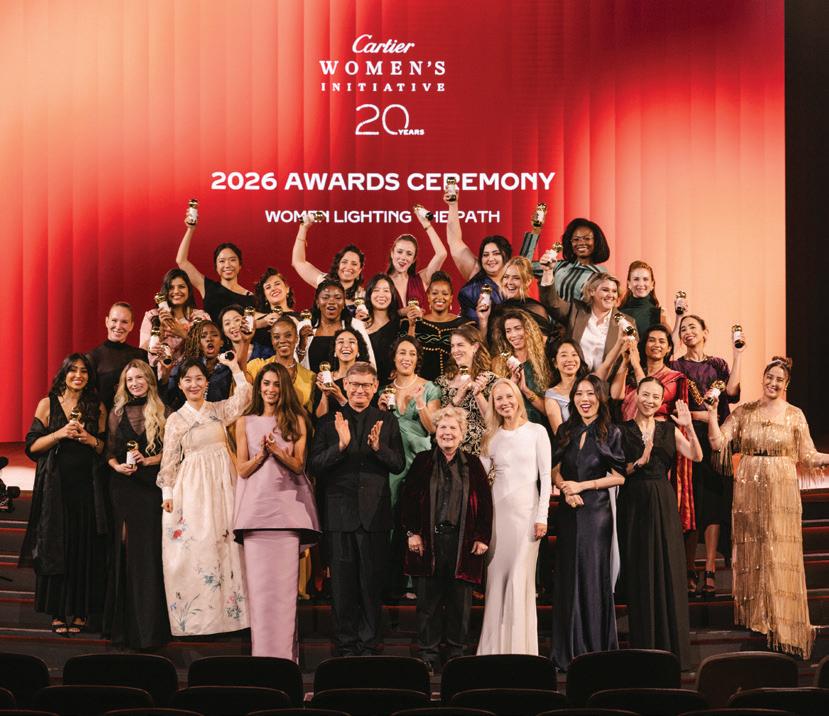
his anniversary is more than a celebration. It is a reaffirmation of our commitment,” says Cyrille Vigneron, Chairman of Cartier Culture and Philanthropy. In a world where startup success is often measured by billion-dollar valuations and rapid exits, the Cartier Women’s Initiative has spent the past two decades championing a different definition of entrepreneurship: one where commercial success and social impact are inseparable.
Founded in 2006, the Cartier Women’s Initiative was created to identify, fund, and support female entrepreneurs whose businesses address some of the world’s most pressing environmental and social challenges. What began as an annual awards programme has evolved into a global fellowship, offering financial support, executive leadership training, business coaching, academic learning, and access to an international network of entrepreneurs who continue supporting one another long after the awards ceremony ends. I got a sneak peek at the alumni WhatsApp group, where more than 300 women founders continue to share advice and support long after the fellowship ends. It’s impressive to see the Cartier Women’s Initiative connect women beyond borders over the past two decades.
Over the years, the initiative has expanded from recognising a handful of entrepreneurs to supporting founders across nine regional awards – Latin America and the Caribbean, Europe, North America, Francophone Sub-
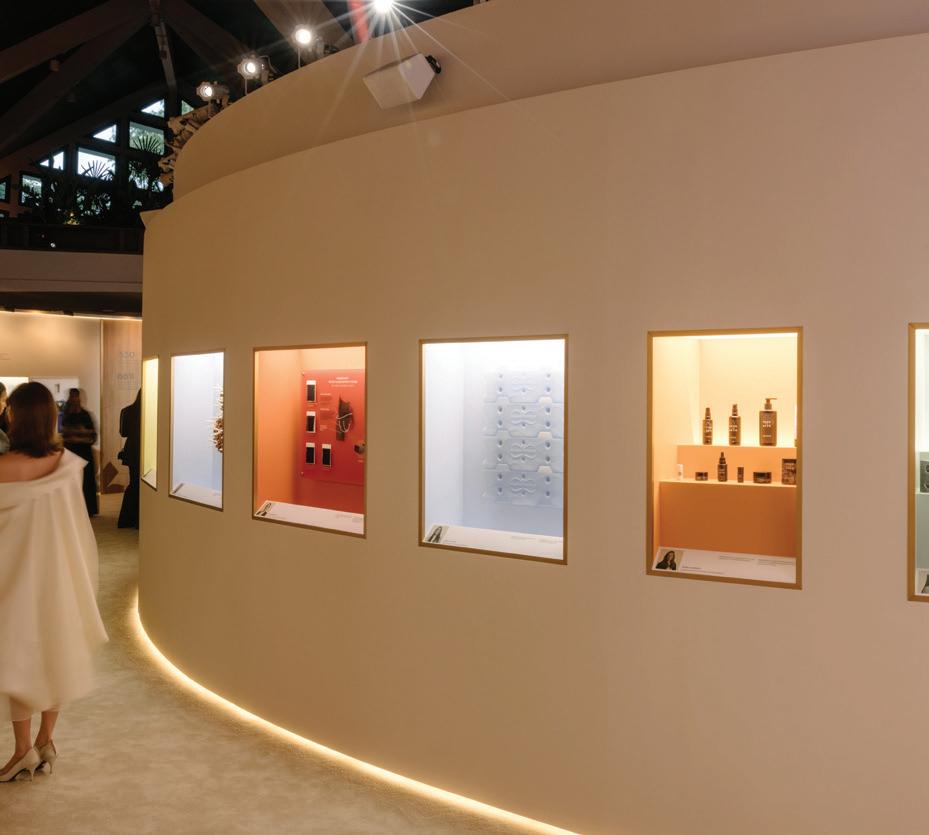
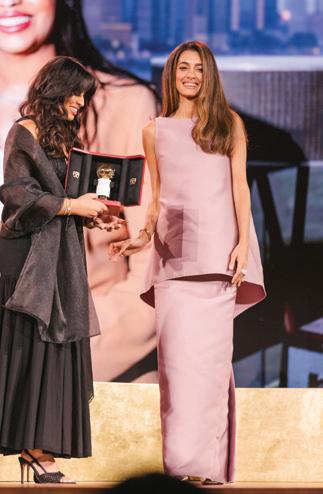
Saharan Africa, Anglophone and Lusophone Africa, the Middle East and North Africa, East Asia, South Asia and Central Asia, and Oceania – alongside the Science & Technology Pioneer Award. Each year, 30 fellows are chosen, with first-place awardees receiving $100 000, second-place recipients $60 000 and third-place fellows $30 000, in addition to a year-long fellowship programme. Its 20th anniversary, celebrated in Bangkok under the theme Women Lighting the Path, felt less like a retrospective and more like a glimpse into the future. Alongside the Cartier Dialogues and awards ceremony, guests experienced an immersive exhibition at Chulalongkorn University tracing the initiative’s two decades of impact. Through interactive displays, “cabinets of curiosities”, and personal stories, the exhibition showcased the journeys of 20 fellows whose ventures span biodiversity, healthcare, education, inclusion, and women’s economic empowerment. At the same time, an anniversary film celebrated the growing global community of changemakers that the Cartier Women’s Initiative has built over the past 20 years.
Those journeys were brought vividly to life during the Cartier Dialogues, where we got to hear from speakers like psychologist and executive coach Dr Lisa Orbé-Austin, who explored imposter syndrome alongside Cyrille. Amal Clooney (who was as glamorous as she was inspiring) and professional boxer Ramla Ali explored courage, kindness, and
leadership. The interesting conversations set the tone for a week dedicated not simply to celebrating achievement, but to examining the mindset required to create meaningful change.
The significance of the Cartier Women’s Initiative lies in its refusal to treat entrepreneurship and impact as opposing forces. Rather than funding charities, it invests in commercially viable businesses solving systemic problems – from financial inclusion and healthcare to education, sustainable fashion, food security, and climate resilience. The emphasis is not simply on rewarding innovation but on building businesses capable of scaling that innovation.
The programme’s evolution reflects that philosophy. The introduction of its fellowship model in 2020 shifted the focus from recognition to long-term acceleration, combining leadership development with mentorship, executive coaching and lifelong access to a global community of founders.
Walking through the university halls during the awards ceremony, hosted by writer and broadcaster Sandi Toksvig, one thing became unmistakably clear: these women were not waiting for permission to lead. They were already reshaping industries, creating jobs, and solving challenges that governments and corporations have struggled to address for decades. For Cyrille, that is precisely the point. “When given the means to lead, innovate, and create, women can redefine the future,” he says.
FASHION WITH PURPOSE
Susan Namirimu never imagined that a tailoring workshop would become the catalyst for transforming the lives of hundreds of women in northern Uganda. The founder and CEO of Mtindo traces the beginning of her journey to a young woman named Beatrice, who arrived at her workshop searching for an apprenticeship.
“The opportunity to work with me gave her not only an income but also the independence she deeply craved,” explains Susan. “Witnessing how this changed her life made me realise that fashion could be more than creativity; it could be a vehicle for empowerment.” That realisation became Mtindo.
CHANGEMAKERS:
Susan Namirimu (left) and Adeline Pelage
Today, the company operates through a dual model: Mtindo Academy trains unemployed young women in practical tailoring skills, while Mtindo Studio provides paid employment producing garments for local and international brands. The result is an ecosystem where education immediately translates into economic opportunity. To date, the business has trained 227 women, creates around 50 jobs annually, and has increased participating tailors’ incomes by 38 percent.
Yet despite these impressive numbers, Susan insists that empowerment extends beyond employment. “Meaningful empowerment for women entrepreneurs goes beyond access to funding,” she says. “It means equipping women with the skills, networks, and confidence to build businesses that are sustainable and impactful.”
Susan believes the Cartier Women’s Initiative has reinforced that philosophy. “My experience with the Cartier Women’s Initiative has reaffirmed my purpose of creating opportunities for women through social entrepreneurship. It has shown me the power of innovation rooted in care and responsibility.”
Operating in Uganda has required resilience as much as creativity.
“With limited infrastructure and systems in place, we often have to find innovative ways to overcome challenges and keep moving forward,” she says. “The market is full of untapped potential. There is always room to innovate, grow, and create solutions that truly make a difference.”
FROM INVESTMENT BANKING TO BESPOKE BISCUITS
Thousands of kilometres away in Cameroon, Adeline Pelage found herself asking a deceptively simple question while walking supermarket aisles. Why were imported biscuits dominating the shelves while local farmers struggled to create value from crops grown just kilometres away?
After spending more than a decade in investment banking between Paris and Africa, Adeline returned home determined to build something different. “I often joke that I went from analysing financial models to analysing biscuit textures,” she laughs.
“At some point, I stopped asking myself, ‘Why doesn’t this exist?’ and started asking, ‘Why not build it?’”
The result was Biscuiterie Bobo, a company producing preservative-free snacks made from locally sourced crops such as sweet potato and cassava. More than simply manufacturing biscuits, the business has become a vehicle for strengthening local agriculture, creating employment and reducing dependence on imported foods.
The company supports more than 100 smallholder farmers, sources over 80 percent of its ingredients locally and has created more than 100 direct and indirect jobs – 60 percent of them held by women.
Adeline believes recognition from the Maison validates years of invisible work. “Cartier Women’s Initiative gave us something very powerful: visibility, credibility and a global community,” she says. “As entrepreneurs, especially in Africa, we spend years building quietly – solving problems nobody sees, making payroll, fixing machines, convincing suppliers, and reassuring teams. Then suddenly, a recognition like Cartier shines a light on all those invisible years.”
Her advice to aspiring entrepreneurs is refreshingly pragmatic. “Don’t wait for perfect conditions. They don’t exist,” she says. “Build real businesses, not just beautiful presentations. Impact is important – but profitability matters too. A business that survives creates far more impact than a business that only inspires.”
Twenty years after its inception, the Cartier Women’s Initiative has become far more than an awards programme. It is a global community built on the belief that entrepreneurship can improve lives, strengthen communities and create more equitable economies. And if the stories of Susan and Adeline are any indication, the next twenty years may prove even more transformative than the first.
I echo Amal’s sentiment when she said: “To the Cartier Women’s Initiative fellows of 2026, I want to say: congratulations. What you do is not easy. Stay committed, stay courageous, and remember that the only way to fail is not to try.” ■
Beyond
FINISH LINE
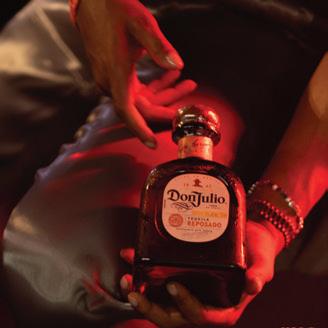
THIS YEAR’S HOLLYWOODBETS DURBAN JULY WAS ABOUT MORE THAN HORSE RACING. THROUGH BESPOKE FASHION, CURATED EXPERIENCES, AND MEMORABLE MOMENTS, DON JULIO ADDED ITS DISTINCTIVE SPIRIT TO ONE OF SOUTH AFRICA’S MOST ANTICIPATED SOCIAL EVENTS
Over the years, the Hollywoodbets Durban July has become more than simply South Africa’s biggest horse racing event. It has become a showcase for fashion, design, hospitality, and cultural expression. Under this year’s theme, Country Allure, brands embraced storytelling as much as style, with Don Julio creating one of the day’s most thoughtfully curated experiences.
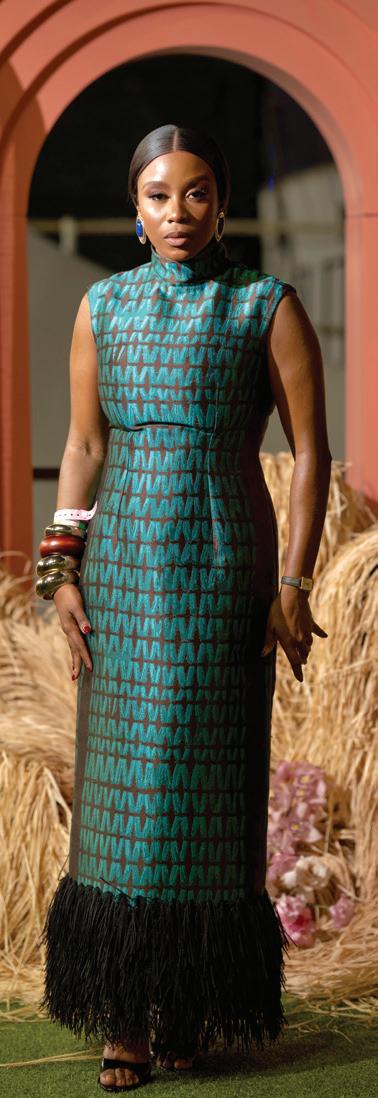
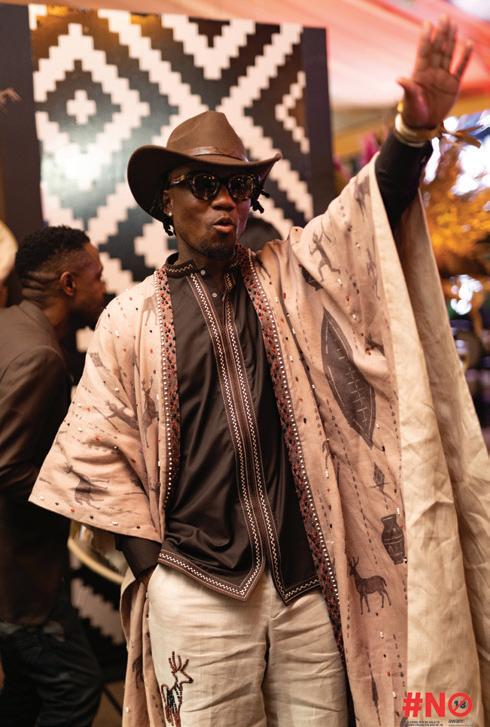
Few collaborations captured that spirit more elegantly than the partnership between Don Julio, couturier Orapeleng Modutle, actress and style icon Linda Mtoba, and television producer Teddy Geldart. Created exclusively for the event, Orapeleng’s bespoke gown embodied the Country Allure theme through refined tailoring and contemporary African design. Worn by Linda, the look was one of the day’s standout fashion moments, effortlessly celebrating the creative vision that continues to shape contemporary South African fashion.
For Don Julio, the partnership was more than a fashion collaboration. It was a celebration of the artisans who continue to shape Africa’s luxury landscape through patience, precision, and an unwavering commitment to excellence. As Cebisa Luzipho, Culture Manager for Don Julio South, West & Central Africa at Diageo, explains, “True luxury is never created in isolation; it lives in the people who dedicate themselves to their craft. Whether it’s a master distiller in Jalisco or a South African couturier creating a one-of-a-kind garment, the common thread is artistry, patience, and intention. The Durban July is an opportunity to celebrate those values alongside some of the country’s most remarkable creative talent, and that’s where Don Julio feels most at home.”
Beyond the races themselves, guests moved effortlessly between fashion, entertainment, and social gatherings, creating the distinctive rhythm that has made the Durban July one of the country’s defining lifestyle events. It is this blend of style, culture, and hospitality that continues to draw both local tastemakers and international names, with Don Julio creating an atmosphere where guests lingered long after the final race.
5 MINUTES WITH CEBISA LUZIPHO (pictured left)
WHY WAS THE DURBAN JULY THE RIGHT MOMENT FOR DON JULIO? For more than a decade, the Durban July has been a premier highlight on the South African calendar. We are proud to have a long-standing history with this iconic event.
FROM THE DON’S TABLE TO THE JULY – WHAT’S THE THREAD CONNECTING IT ALL? The Don’s Table celebrates the relentless dedication behind true craft. This spirit is alive at the Durban July, where Africa’s finest designers showcase artistry through fashion. This year, Don Julio partnered with Orapeleng Modutle, capturing the spotlight for one of South Africa’s most sought-after designers while celebrating the collective talent on display.
HOW DO YOU PICK WHO TO WORK WITH?
Deciding who to work with is never about simple logo placement or finding the biggest name for an algorithm. Instead, the process is rooted in a deliberate framework that mirrors Don Julio’s heritage of exceptional craftsmanship and cultural substance.
WHAT DOES LUXURY MEAN FOR DON JULIO IN SOUTH AFRICA? At its core, the brand stands for luxury rooted in authentic cultural substance. While its global heritage is anchored in Mexican craftsmanship – specifically the legacy of founder Don Julio González, who pioneered the spirit por amor (for love) – the way that heritage is expressed in South Africa has been reimagined for a new generation of sophisticated tastemakers.
The soundtrack to the day was equally impressive. International performers Bryson Tiller, Swae Lee, and Masego shared the stage with local favourites Cassper Nyovest, Elaine, Shekhinah, and Tresor. Much of the event’s appeal, however, lay in what happened beyond the stage and racecourse, where fashion, music, and hospitality became just as much a part of the experience as the entertainment itself.
As daylight faded and the racecourse began to empty, attention shifted to Club 1942, Don Julio’s invitationonly after-hours experience. Inspired by the brand’s Don Julio 1942, the space traded fanfare for intimacy, bringing together creatives, tastemakers, and industry leaders over signature cocktails, live entertainment, and relaxed conversation that stretched well into the evening.
Long after the final race was run and the last cocktail poured, it was these carefully considered moments that lingered. In a day defined by style, creativity, and connection, Don Julio demonstrated that the most memorable experiences are often shaped not only by what is served, but by the people, partnerships, and the stories behind them.
SThe Cape of Two Sides
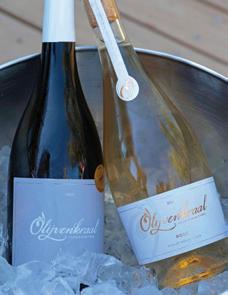
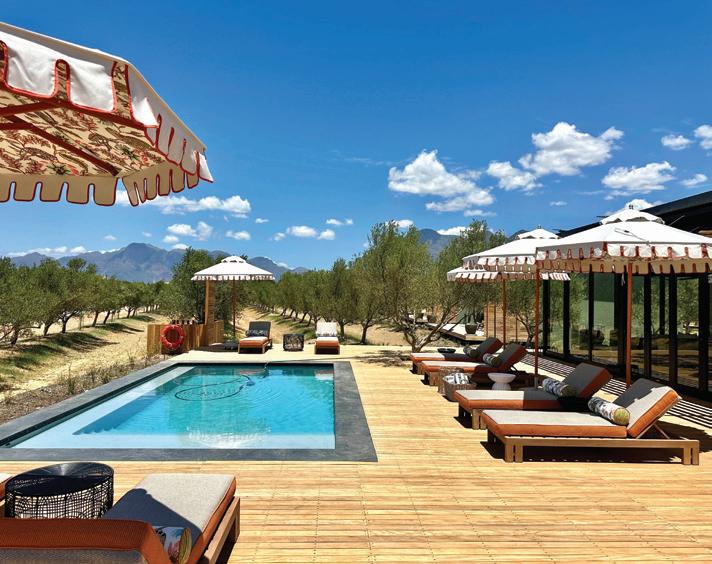
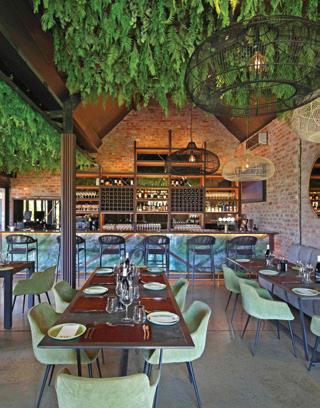
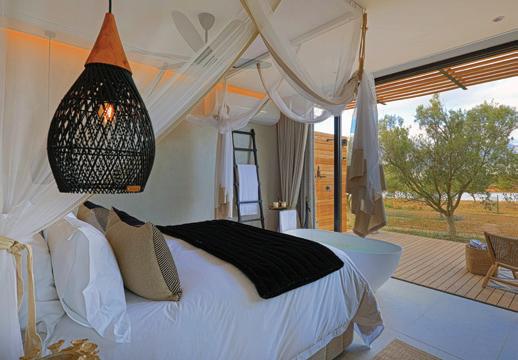
ACROSS THE GREAT KAROO AND THE CAPE WINELANDS, SAMARA KAROO RESERVE AND OLIJVENKRAAL WINELANDS LODGE INVITE GUESTS TO SLOW DOWN THROUGH EXTRAORDINARY WILDLIFE, THOUGHTFUL DESIGN, AND LANDSCAPES THAT REWARD THOSE WILLING TO PAUSE
WORDS LERATO TSHABALALA
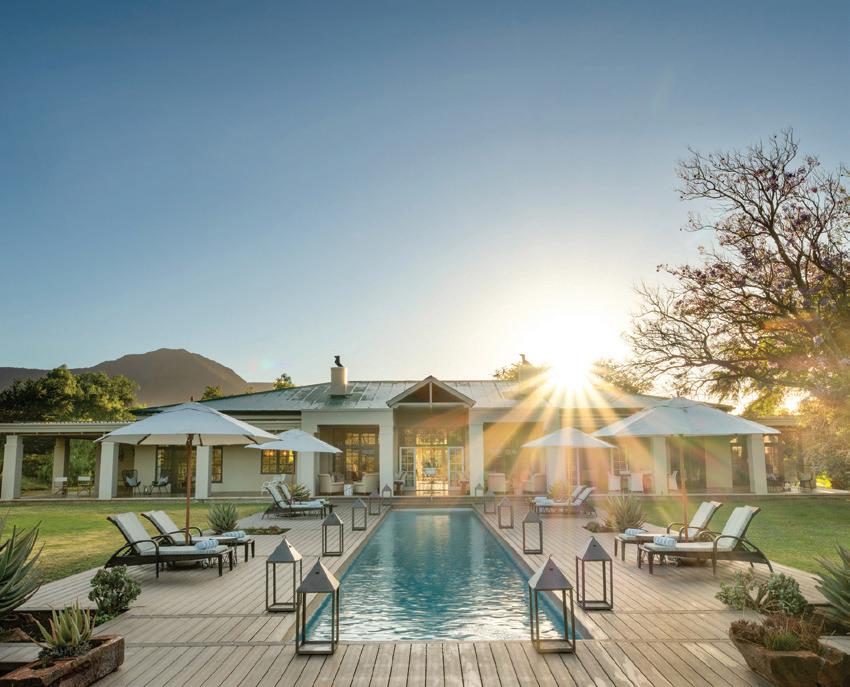
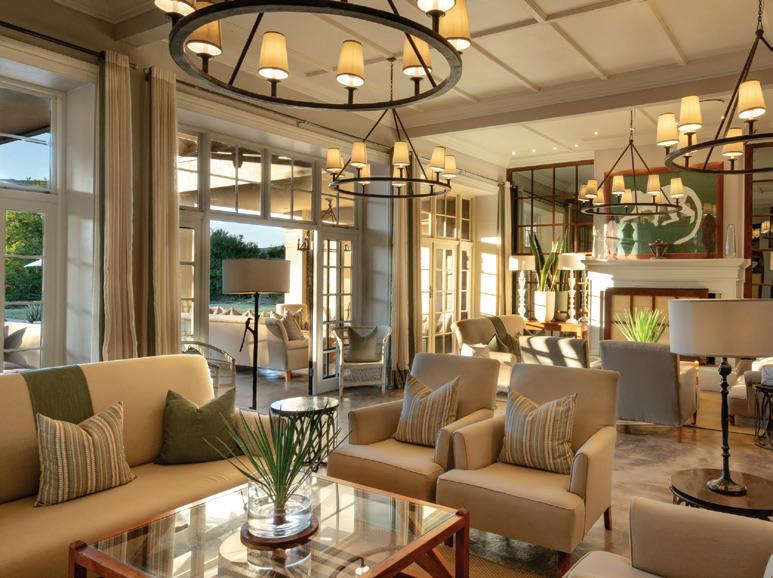
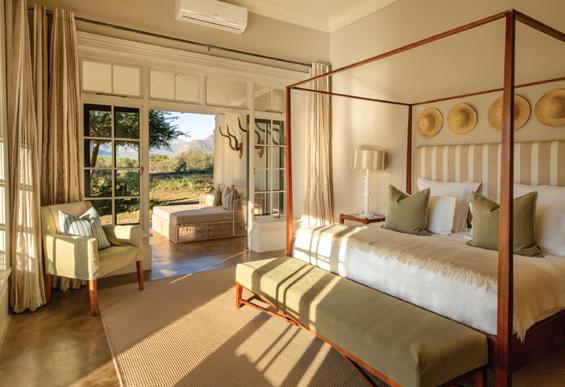
outh Africa is a place of contrasts. It’s a place where ancient mountains give way to endless plains and vineyards surrender to open wilderness. Samara Karoo Reserve and Olijvenkraal Winelands Lodge celebrate these landscapes, proving that luxury is at its most memorable when it belongs to its surroundings.
SAMARA KAROO RESERVE – THE MANOR
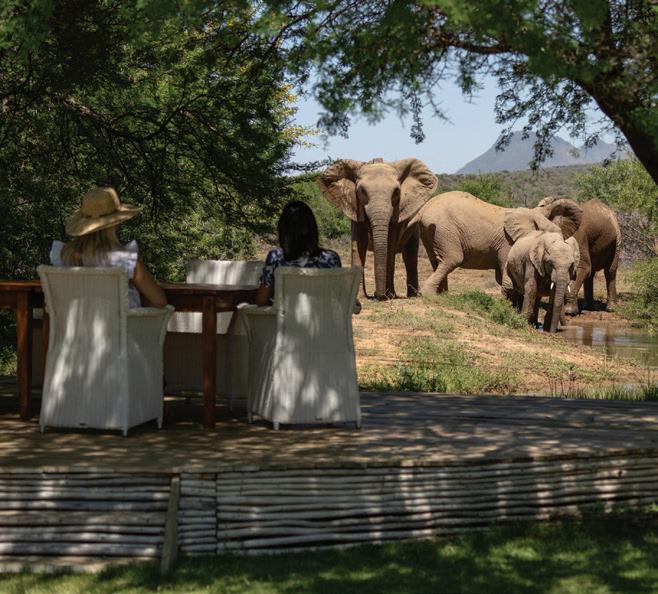
Imagine stepping out onto a Karoo plain and, within a single bush walk, witnessing a cheetah mother shepherding her cubs through the grass, two rhinos drinking quietly at a pond, and a lone giraffe drifting past as if time itself had slowed to match its gait. That was the rhythm of my days at The Manor at Samara Karoo Reserve –a place where wildlife doesn’t just appear, it arrives with a kind of narrative grace, as though the land is telling its own story.
Head guide Roelof Wiesner and tracker Marno Olifant shaped the experience with an ease that comes only from deep knowledge and deeper love for the reserve. “She wouldn’t be moving so close to us if she didn’t trust us. It’s about us not intruding on her space,” said Roelof as we stood still watching the cheetah and her six cubs. Their tracking turned every outing into a lesson in patience and wonder, and their storytelling made the landscape feel alive with memory. The Manor itself, roughly three hours from Gqeberha, has undergone a thoughtful facelift – not flash, but refined, spacious, and quietly sophisticated. With just four suites, a private vehicle, a dedicated chef, and an infinity pool where we spotted a giraffe while having lunch, every detail feels considered.
Inside, two generous living spaces, a dining room, breakfast room, and intimate alcoves create a home rather than a lodge. On winter nights, the new boma becomes the heart of the villa – a place to gather under the stars, wrapped in firelight and Karoo silence. On our final evening, Roelof led us through a stargazing session that felt almost ceremonial. We counted two shooting stars, and I left knowing four constellations
I’d never been able to identify before. Pure magic that stays with you long after you’ve returned home.
Wildlife moves freely around The Manor, often drifting past the pond just beyond the pool. Even the small details feel intentional: warm staff, baths drawn each night, and the vibrant wildlife wallpaper – great for the ’Gram.
But Samara is more than a beautiful place to stay. It’s a conservation undertaking of rare ambition – 67 000 acres of restored semi desert, rewilded over decades to bring back the ecological richness that once defined the Great Karoo. During our ‘4Cs’ discussion, General Manager Marnus Ochse frames it simply: “Samara exists because the land needed a second chance. Every decision we make is
about restoring what was lost and protecting what remains.” His clarity is striking, especially when he speaks about the role guests play in this work. “When you stay here, you’re not just observing conservation – you’re contributing to it. Your presence directly supports the projects that keep this landscape alive.”
Samara’s story began in 1997 with a battlefield conversation and grew into one of South Africa’s most significant conservation undertakings. The story of Sibella, the cheetah whose life nearly ended at the hands of hunters before being rescued and rehabilitated, remains one of Samara’s most powerful narratives. Introduced to the reserve in 2003, she’s raised 19 cubs and contributed to almost three percent of South Africa’s wild cheetah population. Her descendants still roam the plains, and encountering them feels like witnessing the continuation of a miracle.
Game drives often include cheetah tracking, a signature Samara experience that speaks to the reserve’s conservation legacy. Morning drives may lead to the Samara Mara, where rooigras ripples across the plains and herds of springbok, black wildebeest, and eland move in loose formation. A Kondoa Mountain picnic offers a pause in the day – a chance to sit above the valley and take in the enormity of the Karoo. Afternoon high tea precedes sunset drives to the Plains of Camdeboo, where the light turns molten, and cheetah tracking resumes in the golden hour. Night drives reveal aardvark, porcupine, and caracal, while guided bush walks and hikes bring guests closer to the land itself.
Vultures are among the Karoo’s most important indicators of ecological recovery. Southern Africa’s white backed vulture population has declined by more than 80 percent over the past three decades, and Cape vultures number fewer than 4 000 breeding pairs across the entire region. So when you see a kettle of vultures rising on the thermals above Samara, it’s not just a dramatic sight – it’s evidence that the reserve’s rewilding efforts are working.
“When you stay here, you’re not just observing conservation – you’re contributing to it”
Marnus describes Samara’s work as both scientific and deeply human. “Rewilding isn’t just about animals,” he says. “It’s about healing soil, restoring vegetation, and creating a landscape that can sustain life for generations.” His pride is palpable when he speaks about the staff. “Many of our team members have grown up with Samara. Their knowledge, their passion – that’s what makes this place feel alive.”
For families, the Cubs Programme adds another layer of magic. Children learn spoor identification, rock painting, beading, stargazing, and even stokbrood making, all within the safety of The Manor’s fenced grounds. It’s an invitation for young travellers to fall in love with the wild.
On the final morning, guests participate in Spekboom planting –a quiet, grounding ritual that closes the loop between visitor and landscape. Spekboom, with its high carbon sequestration potential and deep root systems, is central to Samara’s soil restoration efforts. Planting one is a small act with a long echo, a gesture that roots you to the Karoo long after you’ve left. I named my spekboom ‘Spekkie ’, and I’m hoping it’ll thrive for decades to come.
samara.co.za
Samara is currently offering a limited Stay 3, Pay 2 special across all lodges until 30 September 2026
OLIJVENKRAAL WINELANDS LODGE
Tucked into the olive groves of Paarl, Olijvenkraal Winelands Lodge balances thoughtful design with the quiet presence of wildlife. Though recently opened, it feels rooted in the rhythms of the farm and the contours of the land. The origins of Olijvenkraal trace back to a moment of recognition rather than revelation. As owner Richard Fisher explains, “The bush was never really about a location. It was about space, rhythm, and silence. I realised that same sanctuary could live here in Paarl, among the olives.” That insight shaped the lodge’s design philosophy: follow the land, don’t impose on it.
Suites are tucked among the trees, linked by long wooden walkways that encourage a slower pace. Each one has been curated by interior designer Lisa Bellamy, whose approach balances raw texture with refined comfort. “The stillness wasn’t something we added; it was something we worked very hard not to disturb,” she notes – a sentiment reflected in the natural materials, low lighting, and open sightlines that allow the olive groves and mountain line to remain the heroes.
“The lodge feels rooted in the rhythms of the farm and the contours of the land”
Inside, you’ll find fireplaces, generous minibars, private patios, and indoor lounge areas that flow seamlessly into the outdoors. Large openings frame views of grazing springbok, gemsbok, sable, and bontebok, creating a sense of quiet theatre that unfolds throughout the day. Even the outdoor shower came with unexpected wildlife encounters, as I watched springbok running across the property.
The Clubhouse anchors the lodge – a social heart where mornings begin with coffee on the deck, afternoons drift into swims, and evenings settle around the fire. Its bar and lounge open onto expansive outdoor spaces, and the swimming pool blends into the groves with understated elegance.
Dining at FYRE is central to the Olijvenkraal experience. The kitchen is built entirely around open flame, with no closed stoves – a deliberate choice that honours South Africa’s braai culture. The menu is rooted in the land: olives and coldpressed oil from the farm, Karoo meat, local boerenkaas, and estate wines including Shiraz, Malbec, and MCC. Signature dishes such as skilpadjies on grilled cornbread, braaibroodjies with peach chutney, and the braaiplankie for two tell a story of terroir expressed through smoke, fire and patience.
Beyond dining, Olijvenkraal offers a rare balance of accessibility and seclusion. Under an hour from Cape Town and just 30 minutes from Stellenbosch, it feels both connected and remote – a place where travellers can switch off, slow down, and reconnect with themselves and each other. As Richard puts it, “Real luxury now is the permission to do less.” ■ olijvenkraal.co.za
MODERN CHARACTER AND A SPORTY FEEL
For those who seek sporting thrills without compromising comfort and style, the Ferrari Amalfi Spider pairs exhilarating performance with effortless versatility and the unique pleasure of open-air driving.
ORDERS EXCLUSIVELY AVAILABLE THROUGH SCUDERIA SOUTH AFRICA.
Scuderia Johannesburg: 011 706 6900
Scuderia Cape Town: 021 464 3000
Scuderia Durban: 031 584 7404
THE DELTA you’veheardneverof
BEYOND SANGWALI LIES A WETLAND WILDERNESS THAT DEFIES EVERY STEREOTYPE OF NAMIBIA. IN THE ZAMBEZI REGION, NKASA LINYANTI OFFERS FRONT-ROW ACCESS TO ELEPHANTS, LIONS, AND RED LECHWE, INVITING TRAVELLERS INTO A REMOTE, WATER-BOUND WORLD
WORDS RICHARD HOLMES
Somewhere past the village of Sangwali, I have to remind myself I’m still in Namibia. Except here, there are no rolling sand dunes. No sunbaked plains of shattered rock. No thirsty scrubland dotted with springbok. Instead, I find myself gazing at towering knobthorns and sausage trees pregnant with fruit. And is that a baobab beyond? The Zambezi Region, once known as the Caprivi Strip, is full of surprises.
As our safari vehicle trundles south along bumpy sand roads, the disconnect hits home. Watery channels appear. Herds of impala hide in the turpentine grass and elephants materialise from the thickets. As we pull to a halt at Nkasa Linyanti, hippos grunt and chortle in the distance. Welcome to Namibia’s Okavango.
I’d arrived in darkness, but dawn broke to reveal the quiet beauty of Nkasa Rupara National Park, a 32 000-hectare reserve of grasslands, reed-lined channels, riverine woodland, and wildlife-rich islands. When the annual floodwaters arrive from Angola in winter, months after the rains have fallen upstream, it looks for all the world like the more famous delta across the border.
This is one of Namibia’s most important yet little-known wetland ecosystems, and the setting for one of my favourite new camps in southern Africa.
The latest addition from conservation-led safari company Natural Selection, Nkasa Linyanti sits entirely unfenced on a private concession on Nkasa Island, one of two large islands in the park. From my under-canvas suite – there are only six – views of grasslands sweep south towards the Linyanti River. Warthogs run riot beneath my private deck while elephants wander across the horizon. At night, the canvas walls all but rumble with the roar of lions.
The design draws subtly on local aesthetics, from fish traps to rugs of natural fibres. Though it’s barely a few months old, the camp already feels settled in the landscape. Here you’ll find everything you need and nothing you don’t.
In a world of maximalist lodges offering the last word in creature comforts, this is a welcome departure. There’s Wi-Fi
if you must, but rather settle at the writing desk, where a bird book awaits. Better yet, take a seat outside and watch the grasslands for signs of life. Or follow the short sandy path to the communal area, where you can settle into the lounge with a G&T or gather at the fireside to hear the story of how this camp came to be.
Because Nkasa Linyanti is a prime example of how tourism can support conservation at scale.
Nkasa Rupara may be a relatively small park, but it’s a keystone of the Kavango-Zambezi Transfrontier Conservation Area, a vast conservation landscape linking Namibia, Botswana, Angola, Zambia, and Zimbabwe. It’s a vital corridor for buffalo and elephant, and the hope is that the ancient migration routes into Angola will one day be revived. In a region where wildlife needs space to follow water, food, and seasonal grazing, unfenced landscapes like these are invaluable.
“For decades I’ve gazed longingly across the Linyanti River from Botswana, eyes fixed on Nkasa Rupara National Park,” says Colin Bell, co-founder of Natural Selection. “Each glimpse stirred something in me, especially after memorable flights over Nkasa Island revealed its breathtaking beauty: lush islands, untouched waterways, and vast open savannahs teeming with wildlife. It’s a place that feels like Namibia’s answer to the Okavango Delta, equally wild and utterly captivating.”
“Here, you’ll find everything you need and nothing you don’t”
The Cook family, Natural Selection’s partners in the camp, were similarly taken with the landscape, although it took some vision to bring this memorable property to life. “When we first came here, there was almost nothing in the way of wildlife,” says Cate Cook (pictured below left), daughter of owners Brett and Chantelle. “On my first trip, I wrote in my journal, ‘Why are we here?’”
WILDLY CAPTIVATING:
That was pre-pandemic, but today the landscape has transformed. Granting a formal concession has helped keep poachers at bay, and the opportunity for employment – much of the camp staff is drawn from Sangwali village and the broader Zambezi Region – is helping local communities view wildlife as a source of sustainable income, not meat for the pot. The camp also supports the work of national park wardens by supplying them with a vehicle, a boat, and fuel for patrols.
And the result is noticeable. Elephants in abundance. Herds of impala on the plains. Red lechwe splashing in the shallows. When the rains bring fresh grass, thousandstrong herds of buffalo arrive. And in their wake, lions. On a single game drive, we saw 18 lions, and they left their prints in camp almost every night of my stay. Birding is another drawcard, with more than 430 species recorded in the park.
“There has been no restocking, no bringing in animals,” says Cate. “It’s purely because the camp is here that these animals have moved back into the area.”
And that’s the real story here.
Nkasa Linyanti is as charming a camp as you could ask for, with unique access to a wild and remote corner of Namibia. But it’s the conservation success beyond the suites that makes this undiscovered corner of the country worth a visit. Get there before it gets too busy. ■
From canvas-clad suites to floodplains teeming with wildlife, Nkasa Linyanti is a conservationist’s dream
GETTING THERE
• FLIGHTS: Airlink operates daily flights from Johannesburg to Kasane, a four-hour road transfer from the camp. Or fly from Windhoek to Katima Mulilo, followed by a 3.5-h road transfer.
• VISA: No visa required for South African passport holders.
• HEALTH: Nkasa Rupara National Park is a low-risk malaria area. Consult your travel doctor before departure.
• BOOK: Via naturalselection.travel or your preferred agent.
Performance Luxury REDEFINED
Some performance cars are built to dominate racetracks. Others are designed to devour corners of our country in supreme comfort. The newly launched Audi RS e-tron GT performance manages to do both.
As the most powerful electric Audi ever created, and the only example currently in South Africa (and YourLuxury Africa the first to test it), the RS e-tron GT performance represents the pinnacle of the brand’s legendary RS performance division. Combining breathtaking performance with handcrafted luxury and sophisticated technology, it is a car designed for those who value exclusivity as much as driving excitement.
A car of this calibre deserves a destination that shares the same philosophy. That made Brahman Hills in the KwaZulu-Natal Midlands – a luxury retreat renowned for its understated elegance, sustainability, and connection with nature – the perfect setting to experience Audi’s flagship electric grand tourer.
With the country’s only RS e-tron GT performance at my disposal, I packed my family into Audi South Africa’s flagship electric RS model, finished in striking Bedford Green Metallic, and pointed its nose towards the rolling hills of the KZN Midlands. The objective wasn’t simply to complete another road trip –it was to experience how Audi’s most exclusive electric grand tourer performs when asked to do what its Gran Turismo badge promises: cover long distances in extraordinary comfort while delivering uncompromising performance.
AN EPIC DRIVE IN AUDI’S RS E-TRON GT PERFORMANCE FROM JOHANNESBURG TO THE KWAZULU-NATAL MIDLANDS
WORDS EDWARD MOLEKE MAKWANA
Leaving Johannesburg behind, the RS e-tron GT performance immediately settled into its natural environment. Long highway stretches highlighted the remarkable refinement of the cabin, where wind and road noise were almost entirely absent, allowing conversations and the Bang & Olufsen 3D Premium Sound System to take centre stage.
Audi’s suite of advanced driver assistance systems transforms long-distance driving into an unexpectedly relaxing affair. Adaptive lane guidance and semi-autonomous driving assistance confidently negotiated sweeping bends and lengthy highway stretches, while the regenerative braking system allowed me to maximise efficiency by manually adjusting energy recuperation via the touchscreen. Combined with Efficiency mode, it became almost a game to recover additional range while enjoying the drive.
What impressed me most, however, was how effortlessly the Audi balanced seemingly conflicting personalities. At highway speeds it cruised with the refinement expected of a luxury grand tourer, yet the instant an overtaking opportunity presented itself, the immediate surge of electric torque reminded everyone onboard that this
remains an RS performance machine. The acceleration is relentless, yet beautifully controlled, inspiring confidence rather than intimidation.
Our first planned recharge came at Zero Carbon Charge’s off-grid, solarpowered station near Reitz, where the battery still indicated around 175 kilometres of remaining range. Forty-five minutes later, after charging at speeds of up to 232kW, the battery had returned to full capacity with a projected driving range of just over 500 kilometres. The stop felt less like an inconvenience and more like a welcome opportunity to stretch our legs and enjoy refreshments before continuing the journey.
With renewed energy – both ours and the Audi’s – we continued towards the Midlands.
Selecting Brahman Hills as our destination was not accidental. Like the RS e-tron GT performance, the award-winning estate blends modern design with sustainability, proving that environmental responsibility need not come at the expense of refinement or indulgence. The similarities became increasingly apparent as we arrived among the rolling hills of the Midlands. We checked into the beautifully appointed Duiker Villa, one of the property’s newest premium villas designed for guests seeking complete privacy. Complete with expansive living spaces and personalised hospitality –including the option of a private chef and butler – it provided the perfect environment to unwind after a rewarding day behind the wheel.
Just as Audi has reimagined high performance for an electrified future, Brahman Hills has embraced sustainable hospitality without compromising luxury. The pairing felt entirely natural – two premium experiences demonstrating that innovation and environmental consciousness can comfortably coexist. The following morning, sunlight illuminated the estate’s beautifully landscaped gardens and rolling hills. After a leisurely breakfast overlooking the countryside, it was time to begin the journey home.
Another scheduled charging stop near Tugela provided the ideal opportunity to prepare for what would become the highlight of the drive. Rather than simply retracing our route along the N3, we diverted onto the magnificent R74 via Oliviershoek Pass, where the RS e-tron GT performance could fully demonstrate its dynamic capabilities.
With the dramatic Drakensberg Mountains providing an unforgettable backdrop, I selected Dynamic mode before activating RS Performance. The transformation was immediate. Despite weighing well over two tonnes, the RS e-tron GT performance disguised its mass with astonishing agility. Every corner was dispatched with surgical precision as Audi’s legendary quattro all-wheel-drive system intelligently distributed torque between the axles. Steering remained beautifully direct, while the adaptive suspension delivered an extraordinary balance between body control and ride comfort across the twisting mountain pass.
Instead of a conventional exhaust note, acceleration is accompanied by a futuristic soundtrack reminiscent of a high-performance jet preparing for takeoff – a fitting accompaniment to one of the fastest production Audis ever created.
Performance figures only tell part of the story. With outputs of up to 680kW available through Launch Control, the RS e-tron GT performance can sprint from 0-100km/h in as little as 2.5 seconds before reaching an electronically limited top speed of 250km/h. Yet what impressed me most wasn’t outright speed – it was how effortlessly the car transitioned between exhilarating performance and refined long-distance comfort. Few performance cars make covering hundreds of kilometres feel this effortless.
Every detail reinforces the sense that this is Audi’s electric performance halo model – crafted not simply to be fast, but to showcase the very best of the brand’s engineering, craftsmanship, and design philosophy. Inside, Audi has created a cabin befitting its flagship Gran Turismo. Sport Seats Pro with illuminated RS logos proved exceptionally supportive over hundreds of kilometres, while the panoramic glass roof flooded the interior with natural light. Travelling with my young family also highlighted the car’s surprising practicality. The additional rear centre seat made accommodating children considerably easier than one might expect from such an athleticlooking grand tourer.
Technology plays an equally important role. The Audi Virtual Cockpit Plus, head-up display, intuitive MMI Navigation Plus and immersive Bang & Olufsen 3D Premium Sound System transformed every kilometre into a premium
experience, while Matrix LED headlights with Audi laser light turned the return journey after sunset into a masterclass in nighttime visibility without dazzling oncoming traffic.
Perhaps the most distinctive feature on our test car, however, was the optional Matte Carbon Camouflage Package – a first for Audi. Inspired by the world of exotic supercars, each panel features crushed carbon fibres encapsulated within resin, creating a unique pattern that ensures no two vehicles are ever identical.
“What impressed me most was how effortlessly the car transitioned between exhilarating performance and refined long-distance comfort”
By the time we rolled back into Johannesburg after almost 900 kilometres on the road, one conclusion had become abundantly clear. The Audi RS e-tron GT performance is far more than an astonishingly fast electric car. It is a genuinely accomplished grand tourer that seamlessly combines breathtaking performance, exceptional luxury, cutting-edge technology, and surprising everyday usability.
Yes, electric touring still requires well-planned charging stops, but on this journey they became little more than natural pauses in an otherwise effortless drive rather than defining the experience itself.
The newly launched RS e-tron GT performance is more than Audi’s fastest electric production vehicle. It is the brand’s electric flagship – a statement of what the future of luxury performance looks like for those who appreciate a one-of-a-kind Audi.
Some journeys are memorable because of where they take you. Others are unforgettable because of what you drive. This one delivered both.
The Audi RS e-tron GT performance is available in South Africa exclusively by customer order, allowing buyers to customise the vehicle to their individual preferences.
BUILT TO ENDURE
FROM THE EFFORTLESS SERENITY OF THE ROLLSROYCE CULLINAN AND THE BMW X5’S PIONEERING SPIRIT, TO THE AUDI Q7’S QUIET CONFIDENCE AND THE UNAPOLOGETIC DRAMA OF THE LAMBORGHINI URUS, THESE SUVS PROVE THAT ENDURING LUXURY IS SHAPED OVER TIME
WORDS EDWARD MOLEKE MAKWANA
True luxury is not defined only by a vehicle’s price, performance, or abundance of technology. It’s also measured by longevity: the ability to remain desirable as tastes change, technologies evolve, and new competitors arrive.
Some premium SUVs have now existed long enough to transcend the product cycles that created them. The Rolls-Royce Cullinan, BMW X5, Audi Q7, and Lamborghini Urus occupy different
corners of the luxury market, yet each has established a distinctive identity that is instantly recognisable.
Rather than allowing familiarity to diminish their appeal, their manufacturers continue to reinvent them. New generations introduce electrification, sophisticated digital systems, and increasingly advanced chassis technologies, while preserving the qualities that originally made them desirable.
THE ART OF PRESENCE
I recently had the privilege of driving the Rolls-Royce Cullinan Black Badge, widely regarded as one of the world’s pre-eminent super-luxury SUVs.
Rolls-Royce Motor Cars Johannesburg invited me to join a small group at an exclusive experience themed Born from the Earth. The curated occasion explored the origins and remarkable story of a vehicle named after the Cullinan Diamond, the largest gem-quality rough diamond ever discovered.
Since launching in 2018, the Cullinan has transformed perceptions of what a RollsRoyce can be, taking the Marque’s famous “magic carpet ride” beyond city streets without sacrificing refinement.
Stepping into the Cullinan Black Badge felt almost like being introduced to royalty. After all, this is the brand associated with kings, queens, and the world’s most influential personalities.
The interior was a genuine sanctuary. As I guided it away from the showroom, the outside world seemed to disappear. Road imperfections were absorbed with composure, while the cabin remained calm enough to function as an office, private lounge, or home on wheels.
Beneath the imposing bodywork is a 6.75-litre twin-turbocharged V12 engine producing 441kW and 900Nm. The engine announced its presence with a deep and authoritative note, but never disturbed the sense of calm inside the cabin. Its performance felt effortless rather than theatrical, delivering an immense reserve of power without undermining the dignity of the experience.
That duality is what makes the Black Badge compelling. It’s a darker, more assertive alter ego of the traditional Rolls-Royce, but it remains unmistakably refined. Its monumental Pantheon grille, elevated stance, and intricate detailing create a stage on which both the vehicle and its owner assert their presence.
My brief first-hand encounter reminded me why Rolls-Royce operates in a realm of exclusivity that few other manufacturers can genuinely challenge. Each Cullinan is individually commissioned and curated, making conventional pricing almost irrelevant.
THE ORIGINAL GAME CHANGER
While the Cullinan redefined super-luxury mobility, the BMW X5 played an equally important role in establishing the modern premium SUV. Since debuting in 1999, the X5 has helped define the premium SUV, combining everyday practicality with engaging dynamics. Its fifth generation builds on that formula. The newcomer adopts a more monolithic interpretation of BMW’s design language, bringing together familiar X5 proportions and technologies introduced through the Neue Klasse programme. Its upright front end is defined by a vertically illuminated kidney grille and new double-X lighting graphics, while recessed “Winglet” door handles operate electrically.
Inside, traditional luxury meets an increasingly digital experience. South African models will feature BMW Panoramic Vision across the windscreen, a free-form central display, a 3D head-up display, and BMW Operating System X. Materials such as Merino leather, Alcantara, glass, and even natural slate reinforce the feeling that modern technology does not have to come at the expense of craftsmanship.
The biggest change lies beneath the surface. South Africa will receive the diesel-powered X5 xDrive40d, the X5 50e plug-in hybrid, and the first fully electric iX5 60 xDrive.
Using sixth-generation eDrive technology, the electric model promises a range of up to 845km, an 800-volt electrical architecture, faster charging, and bidirectional charging capability. The battery uses newly developed cylindrical cells that represent a significant step forward for BMW’s electric vehicles.
Production begins at BMW Group Plant Spartanburg in the United States this month, with the South African market launch scheduled for early 2027. The technology may be new, but the mission remains familiar: combining comfort, space, and versatility with the driving character that helped make the X5 a global success.
QUIET CONFIDENCE
The Audi Q7 joined the premium SUV establishment in 2005 and has spent more than two decades building its reputation around space, quattro allwheel drive, and understated authority.
Its newly unveiled third generation develops that formula rather than abandoning it. The design is imposing without being excessively theatrical, characterised by commanding proportions, a high shoulder line, and a striking interpretation of Audi’s Singleframe grille.
Flexibility remains central to its appeal. Available with five, six, or seven seats, the Q7 continues to place versatility at the heart of its appeal, while updated lighting technology and driver displays bring meaningful innovation.
Depending on the configuration, luggage capacity extends when the rear seats are folded. A redesigned centre console adds larger storage areas, oversized cupholders, and wireless charging for two smartphones.
Lighting technology is one of the Q7’s defining features. Optional digital Matrix LED headlights can project high-resolution patterns onto the road, while digital OLED rear lights offer selectable signatures and communication functions. Driver-assistance information can also be projected into the driver’s field of vision, making the technology as practical as it is sophisticated. Power initially comes from 3.0-litre V6 diesel engines producing either 180kW and 500Nm or 220kW and 630Nm. MHEV Plus technology can contribute an additional 18kW, while an electrically powered compressor improves response.
An eight-speed Tiptronic transmission and quattro permanent all-wheel drive remain standard. Adaptive air suspension and a limited-slip centre differential are available to enhance the balance between comfort, stability, and agility.
Built in Bratislava like its predecessors, the third-generation Q7 illustrates why certain luxury SUVs endure. It does not chase trends at the expense of its established strengths. Instead, it modernises the qualities that have always mattered: space, comfort, discreet prestige, and long-distance capability.
UNFILTERED EMOTION
The Lamborghini Urus is younger than the other nameplates featured here, but its influence has been immediate.
The production Urus arrived in 2017 and quickly became one of Lamborghini’s defining models, combining the Marque’s trademark drama with genuine everyday usability.
The new Urus SE Performante pushes that formula to an extraordinary level. Its plug-in hybrid powertrain combines a 4.0-litre twinturbocharged V8 with an electric motor to produce 597kW and 1 000Nm. Lamborghini claims a 0 to 100km/h time of 3.3 seconds and a top speed of 312km/h.
Despite its extraordinary performance, the plug-in hybrid Urus can still travel more than 60km on electric power alone, while extensive carbon fibre and revised
aerodynamics sharpen both efficiency and handling. The new AURA dual-chamber air suspension is designed to broaden the vehicle’s abilities even further. Lamborghini says it reduces body roll during demanding driving while also lowering vibrations and improving comfort on imperfect roads.
Strada, Sport, and Corsa modes are joined by a new Rally setting calibrated for loose surfaces. A titanium Akrapovič exhaust system provides the theatrical soundtrack expected of a Lamborghini, while the driver-focused cabin receives exposed carbon fibre, sustainable CorsaTex microfibre, and a new 12.3-inch infotainment display.
The Urus SE Performante is expected to be available locally later in 2027. Its significance is already clear. It proves that even the newest luxury icons are built not simply to impress today, but to endure tomorrow. ■
FLAVOURS FROM HOME
AS CHEF IN RESIDENCE AT LONDON’S FALLOW, NOKX MAJOZI IS INTRODUCING GLOBAL AUDIENCES TO THE RICHNESS OF SOUTH AFRICAN CUISINE. CELEBRATING THE RELEASE OF THE SOUTH AFRICAN COOKBOOK , SHE SHARES THE JOURNEY BEHIND HER CAREER, A PERFECT DAY OF EATING THROUGH LONDON, AND THE DISHES THAT TRANSPORT HER BACK HOME COMPILED BY LERATO TSHABALALA
YOUR JOURNEY FROM DURBAN TO LONDON HAS BEEN REMARKABLE. WHAT FIRST SPARKED YOUR LOVE OF COOKING, AND WHEN DID YOU REALISE IT COULD BECOME A CAREER? While the book is dedicated to my mother, my father inspired me to be a chef through his love for cooking. He believed in bold flavours and attention to detail, and his creations motivated me. My grade 12 Home Economics practical demonstrations were a turning point. Cooking dishes inspired by different cuisines sparked something in me, and that’s when I knew I wanted to become a chef.
YOUR DEBUT BOOK, THE SOUTH AFRICAN COOKBOOK, CELEBRATES THE DIVERSITY OF THE COUNTRY’S CUISINE. WHAT INSPIRED YOU TO WRITE IT, AND WHICH RECIPES FEEL MOST PERSONAL TO YOU? Whenever I travel, I’m surprised at how difficult it is to find a cookbook dedicated to South African cuisine, so this felt like the right place to start. We have such a rich and diverse food culture, and I wanted to introduce it to a wider audience. The recipes that mean the most to me – samp and beans, fish curry, oxtail with dumplings, Amado cheesecake with guava, fish and chips, and sorghum porridge – are more than favourites; they’re a celebration of the people, places, and traditions that have shaped my journey as a chef.
LONDON HAS BECOME YOUR ADOPTED CITY. ARE THERE ANY SIMILARITIES BETWEEN THE FOOD CULTURES OF YOUR TWO HOMES? Yes, there are many similarities. London is vibrant and a global melting pot, with traditional food, street food, and markets. It’s very similar to South African food culture.
WHEN YOU’RE OFF DUTY, WHAT DOES DOWNTIME LOOK LIKE FOR YOU?
I spend time with my family, especially my daughter. She’s a foodie, so we try new restaurants, bakeries, markets, or go back to some of our favourites. And we love shopping sprees in the High Streets.
IF A FRIEND WAS VISITING LONDON FOR JUST 24 HOURS, WHERE WOULD YOU SEND THEM FOR BREAKFAST, LUNCH, AND DINNER?
For breakfast, Hide for its exceptional take on classics – it’s been voted the best breakfast spot in London. Lunch would be at the Michelin-starred Legado, which celebrates authentic regional Spanish cuisine. Dinner has to be Fallow, where innovative, seasonal British cooking is at the heart of the menu.
YOU’VE SPOKEN PASSIONATELY ABOUT SOUTH AFRICA’S EMERGENCE AS A WORLD-CLASS GASTRONOMIC DESTINATION. WHICH CHEFS, RESTAURANTS, OR FOOD MOVEMENTS IN THE COUNTRY ARE EXCITING YOU MOST RIGHT NOW? South Africa’s dining scene has never been more exciting. Peter Tempelhoff’s award-winning FYN has become one of the country’s most internationally celebrated restaurants, while Ryan Cole’s Salsify at the Roundhouse continues to earn acclaim for its refined, seasonal menus. I’m also inspired by the work of Ismail Amos at Wiggle Room, Johannes Richter at The LivingRoom in Durban, and Moses Moloi at Gigi Restaurant in Johannesburg.
EVERY SOUTH AFRICAN LIVING ABROAD HAS THAT ONE MEAL THEY CRAVE. WHEN YOU’RE FEELING HOMESICK, WHAT DO YOU COOK FOR YOURSELF?
When I miss home, I cook pap, chakalaka, boerewors, and steak.
MANY OF YOUR RECIPES DRAW ON FAMILY TRADITIONS WHILE BRINGING A CONTEMPORARY PERSPECTIVE TO SOUTH AFRICAN COOKING. WHICH FOODS FROM YOUR CHILDHOOD STILL INFLUENCE THE WAY YOU COOK TODAY?
Curries and rice dishes, seven colours (South Africa’s iconic Sunday lunch of roast meat, vegetables, and colourful sides), and garage pies.
WHAT IS LUXURY TO YOU? Luxury for me is about experiences and simply having time to myself. ■ @nokxmajozi
The South African Cookbook is published by Bloomsbury and distributed by Jonathan Ball Publishers in South Africa, R430