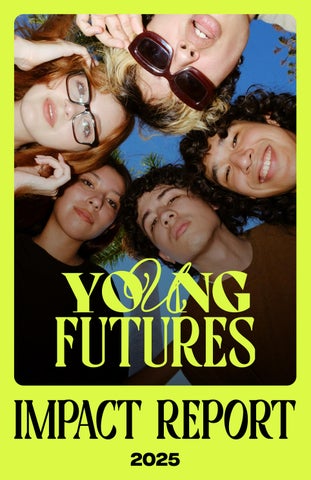
2025
IMPACT REPORT
Earlier this year, a young person told us, ˝it is a new day and age and my whole life is technically on my phone. That does not mean that it is a crippling addiction, but that is where my access to the world comes from.˛€
Their words capture the dual truth of growing up today: technology is essential, yet it also creates new pressures and challenges for young people and the adults and communities that support them.
At Young Futures, we exist to ensure that young peopleˇs access to the world through phones, AI, and other technologies is matched by the strength of human systems around them: families, educators, mentors, and community spaces where they feel known, supported, and safe. In 2025, our work demonstrated both what is possible and what is required to make meaningful, systemic impact.
This past year, Young Futures grew in both scale and depth. We continued to center youth voices and research while running three funding challenges. Call Me Maybe helps schools and nonprofits create youth-led approaches to phone use in the classroom. Here Comes the Fun showcases programs that use games and digital play to promote learning, connection, and wellbeing. Oops!&AI Did It Again gives young people agency in navigating artificial intelligence across learning, creativity, relationships, and mental health. Together, these challenges drew 338 applications across 39 states, representing a combined $31M in funding requests.
This momentum marked a clear inflection point. In September, we announced the YF500, a five-year commitment to support 500 Young Futures Innovators and reach 20 million young people with balanced, connected, and healthy digital experiences. By connecting community-rooted leaders across the country through the Young Futures Community, the YF500 invests in a national infrastructure for youth wellbeing, turning isolated efforts into a shared foundation of trust, skills, and support for young people where they live and learn.
Our team grew too. With the addition of Cassie Archdeacon, Program Associate, Brooke Messaye, Communications Associate, and YF Fellows Trey Leveque and Zoe Shub, we strengthened our programs, expanded our reach, and awarded $3.5 million in grants since 2024 to improve young peopleˇs wellbeing.
Dear YF Community,
With gratitude,(
Chief Executive Officer
Today, Young Futures is 41 YF Innovators strong, with an estimated 15 additional grantees to be awarded in the coming month through our AI Challenge. Since our launch, we have supported organizations reaching thousands of young people and have seen our first cohort expand its youth reach sevenfold in just one year. To date, we have received $75 million in funding requests. The demand and creativity in this field are unmistakable.
Whatˇs Ahead in 2026
In early 2026, we will launch the Express Yourself Challenge Series, three parallel funding tracks supporting girls, boys, and gender-expansive youth. Together, these challenges explore how digital life is shaping identity, safety, belonging, and self-expression, and invest in organizations helping young people navigate those forces with confidence and care.((In May, we will host the inaugural Young Futures Block Party, a day and a half of celebration, storytelling, and bold field-building, uniting youth leaders, innovators, funders, and partners shaping the future of youth digital wellbeing.((As AI rapidly enters classrooms and daily life, young people are navigating tools that are reshaping how they learn, relate to one another, and participate in the world around them. In response, we are launching the Groundwork Initiative, a multi-year effort partnering with youth, educators, and community-based organizations, particularly those rooted in communities often overlooked in technology design. Groundwork centers diverse lived experience to ensure emerging technologies support wellbeing, belonging, youth agency, and the skills young people need to participate fully in their communities and be active members of society.((Meeting this moment requires partnership. We are deeply grateful to our multi-year foundational partners, including Pivotal Ventures, Susan Crown Exchange, The Goodness Web, Enlight Foundation, Resonance Philanthropies, and the Arthur M. Blank Family Foundation, whose support fuels grants, grantee learning through the YF Academy, research, and core platform operations. We are also grateful to our challenge-specific partners, including Pinterest, the Bezos Family Foundation, Niantic Spatial, Omidyar Network, and Hopelab.((Young Futures is not just a grantmaker.(It is a growing national community, a platform for youth voice, and a durable infrastructure for(the future our young people deserve.
Over half of young people ages 13 to 24 say their lives are happy and their mental health is good if not ˝very good˛. Yet others feel overwhelmed or isolated 61% say loneliness affects their mental health, and over one-third say it disrupts daily life.
These averages mask significant disparities. LGBTQ+ youth and those from lower-income households report poor mental health at more than triple the rate of their peers (Hopelab National Poll, 2025). The gap between those who are ˝doing okay˛ and those who are struggling continues to widen. Against this backdrop, teens are trying to find stability in a world where the digital environment around them is growing more complex, more immersive, and more challenging to navigate.
The State of Teens
More than half of U.S. adolescents over age 13 have used generative AI tools S
of teens have used AI companions, and 1 out of 3 of those users experience discomfort with AI companions Common Sense Mediaˇs Talk,(Trust & Trade-Offs 2025
, 2025€
Senate Judiciary Committee
72%
>50%
Digital tools like AI are shaping how(teens cope, connect, and learn.
, T
LGBTQ+ youth report poor mental health at almost triple the rate of their peers Hopelab, N
of teen girls had a major depressive episode last year (vs. 11% of boys) Hopelab National Poll, 2025
NIMH Trevor Project, 202 3x
30%
But some are struggling more deeply than ever:(Girls, LGBTQ+ youth face disproportionate challenges.
€say loneliness affects their mental health at(least somewhat Hopelab National Poll, 2025
of youth ages 13 24(describe themselves as ˝somewhat˛ or ˝very˛ happy Hopelab National Poll, 2025
1 in 3
61%
The positive: youth mental health is resilient.(The majority of teens report feeling happy and mentally well.
BY THE NUMBERS
In 2025, teens are no longer just managing screen time, comparison culture, and academic pressure. They(are also navigating a world where generative AI tools, classroom algorithms, and companion bots shape their daily experiences in subtle and(not-so-subtle ways. Unlike social media, young people often cannot opt out of using AI tools. Schools have incorporated AI-driven learning platforms, feedback systems, and disciplinary technologies that influence how students receive support and understand expectations (Surgo Health 2025).
AI in Their Lives
AI in Their Feeds,
AI in the Classroom,
LAYER: A NEW
AI companions add a new layer to this landscape. 72% of teens ages 13 to 17 have used an AI companion at least once, and 52% interact with one a few times a month or more (Common Sense Mediaˇs Talk, Trust & Trade-Offs 2025). One in three teens who use AI companions say they turn to them for social interaction or emotional support, while 34% report feeling uncomfortable with something a bot has said or done (Common Sense Mediaˇs Talk, Trust & Trade-Offs 2025). These realities raise essential questions about authenticity and connection. Across studies, teens report both the appeal and the discomfort of AI tools that shape(how they learn, connect, and express themselves.
Many teens describe feeling overwhelmed by environments that(move faster than they can process, where it is increasingly difficult(to distinguish what is real, what is artificial, and what is being optimized for them.
Across gender and identity, young people are navigating an online environment that increasingly shapes how they see themselves and their place in the world. Nearly all boys ages 11 17 are online daily, and most regularly encounter masculinity-related content that appears in their feeds without being sought out (Common Sense Media, 2025). Higher exposure is linked to increased feelings of worthlessness and self-doubt, alongside rising loneliness and uncertainty about how to ask for help as boys age (CSM, 2025; Surgo Health, 2025). For many, online life is not just entertainment. It is a space where identity is formed and emotional strain can intensify.
Girls face a different but equally powerful set of pressures. Algorithm-driven feeds saturated with beauty filters and appearance-focused content are linked to higher body dissatisfaction and lower self-esteem, particularly when girls compare themselves to peers (BMC Womenˇs Health, 2023; Body Image, 2023). Much of this content is delivered automatically, reinforcing narrow expectations around beauty and maturity (Penn State/Duffy). While many teens recognize that social media negatively affects girls their age, far fewer identify its impact on themselves, pointing to how normalized these pressures have become (Pew Research Center, 2024). At the same time, research shows that girls also use online spaces to maintain friendships, express emotions, and find connection during moments of stress, especially when offline support feels limited (PMC Review, 2023).
LGBTQ+ and nonbinary youth experience some of the highest mental health risks overall, with elevated rates of depression, anxiety, and suicidal ideation, particularly among transgender and nonbinary teens (The Trevor Project, 2025). Digital spaces can amplify risk through harassment and misinformation, yet they also serve as vital sources of affirmation and belonging. Many LGBTQ+ young people report that online communities allow them to connect and be their full selves when that feels difficult offline (The Trevor Project, 2025). Across all groups, the evidence points to the same need: trusted adults, affirming communities, and connected support systems that help young people navigate digital life with confidence, agency, and care.
YF INNOVATORS FUNDED
IN NONPROFIT GRANTS AWARDED
young people reached
41
$3.25m
>868K
2025 YF Impact metrics
Taken together, the state of teens is more layered than ever. Young people rely on the digital world to stay connected 80% of teens say social media helps them keep in touch with friends (Pew, 2023) yet that same digital world can heighten anxiety, isolation, and digital tension. The question for teens is not whether they should use technology. It is how they can navigate it in ways that support identity, belonging, and wellbeing.
FORWARD
NAVIGATING
Demonizing technology will not get us there. Half of teens say it would be difficult to give up social media altogether (U.S. Surgeon General, 2024). What teens need is agency, guidance, and tools that help them build healthier digital lives. And in 2025, that means tools that consider not only screens but AI: powerful, omnipresent, and deeply intertwined with how young people learn, connect, and grow.
Young people deserve a digital ecosystem that supports their sense of identity, connection, and possibility. The path ahead requires listening to teens, elevating their voices, and designing solutions that reflect the digital world they are actually living in.
In 2025 at the Clinton Global Initiative, Young Futures announced a commitment that reflects the scale of what young people deserve: the YF500, a first-of-its-kind philanthropic index fund designed to build a national infrastructure for youth wellbeing in a tech-driven world. This five-year, $50 million initiative will fund and connect 500 Young Futures Innovators working at the intersection of youth wellbeing and technology.
The YF500 builds on three years of proof: open challenges surface emerging leaders, the YF Academy helps them grow, and the peer mentorship of the Young Futures Community and the storytelling of the YF Studio amplify their impact. Now weˇre moving from individual wins to a coordinated ecosystem. With foundational support from Pivotal Ventures, Susan Crown Exchange, Enlight Foundation, The Goodness Web, Resonance Philanthropies, and Arthur M. Blank Family Foundation, along with challenge partners like Pinterest, Bezos Family Foundation, Hopelab, Omidyar Network, and Niantic, we have already secured more than 50% of our $50M goal.
It is time to move beyond isolated wins and build(something larger.˛
- Katya Hancock CHIEF EXECUTIVE OFFICER
yf500: BUILDING A NATIONAL INFRASTRUCTURE FOR YOUTH WELLBEING
By 2030, the YF500 will reach half of Young Futuresˇ 10-year vision: 40 million young people living more connected, balanced lives, and 20 million families equipped to support them.
This is what infrastructure looks like in a digital age: a network of trusted adults, youth-led programs, and community-based solutions linked together, learning faster, and supporting teens in ways that last.
(Instead of betting on one idea, the YF500 spreads investment across hundreds of leaders who know what their communities need most.
The path forward is clear. To help young people thrive, we must strengthen the people and places they already trust and give them the ecosystem to grow. The YF500 is how we build that future, not one pilot at a time, but together, at scale.
A Systems-Level Investment
The YF500 model moves beyond transactional grantmaking. Each year, multiple open calls identify community-rooted innovators who join the Young Futures Academy, a five-month accelerator focused on leadership, fundraising, storytelling, and youth co-creation. We invest in their capacity, connect them, and document what works so solutions can travel from one community to the next. What a school district in Philadelphia learns about restorative phone policies can help inform a program in rural Colorado. What a Latina mental health collective builds in North Carolina can inspire teen creators in New Orleans.
How the YF500 Works
Here Comes the Fun supports solutions that strengthen pre-teen and teen wellbeing through positive digital play. Play is essential to how young people build identity, connection, and resilience, and today much of that play happens in digital spaces. In partnership with the Joan Ganz Cooney Center at Sesame Workshop and with support from Niantic Spatial, this challenge meets young people where they are, investing in solutions that help digital play serve them by fostering joy, creativity, inclusion, and healthy social connection.
Call Me Maybe is our rapid-response challenge for schools and nonprofits grappling with phone use in classrooms. Phones are now part safety device, part lifeline, part distraction. Young people told us that the ˝all or nothing˛ debate doesnˇt reflect their reality: many rely on their phones for transportation, caregiving, health needs, or a sense of safety, even as they acknowledge phones can erode focus and connection. Seeded by Pinterest and supported by Pivotal Ventures and Susan Crown Exchange, Call Me Maybe funds solutions that help schools move beyond rigid bans toward youth-informed models that reduce distraction, support learning, and honor studentsˇ real needs.
Oops!&AI Did It Again funds youth-powered solutions that help young people navigate artificial intelligence with safety, critical thinking, and agency. Informed by our Youth Listening Tour and the Center for Digital Thrivingˇs GenAI Youth Memo, the challenge reflects how deeply AI now shapes school, creativity, relationships, and mental health. It supports work across four areas: youth influence on AI, use of AI in learning and work, impacts on relationships and wellbeing, and the role of trusted adults as guides. The challenge launched with foundational support from Pivotal Ventures, Susan Crown Exchange, Enlight Foundation, The Goodness Web, Resonance Philanthropies, and the Arthur M. Blank Family Foundation, with additional support from Pinterest, the Bezos Family Foundation, Hopelab, and Omidyar Network.
Grant recipients from each challenge become YF Innovators and join the Young Futures Academy. There, they step beyond the day-to-day work of their organizations to strategize, elevate their storytelling, and connect with like-minded leaders.
In 2025, we focused our(funding challenges on the(three areas where young people told us they needed meaningful support: reclaiming play, managing phones in schools, and navigating AI.€
FUNDING(CHALLENGES(IN 2025
2025 retreat
The Young Futures Academy is where YF Innovators level-up: refining their strategy, sharpening their stories, and building whatˇs next with peers who get it. In early 2025, we wrapped our second full Academy cycle with the Under Pressure cohort, culminating in a virtual showcase where each YF Innovator presented their work to funders, partners, and peers. The Showcase drew over 200 live attendees and received a 100 Net Promoter Score (NPS) from the audience.
In the fall, a new Academy cycle brought together 15 YF Innovators from the Here Comes the Fun and Call Me Maybe cohorts. The experience kicked off with an in-person retreat featuring Masterclasses led by nonprofit and fundraising experts, along with structured time for reflection and peer learning. Stepping back from the grind of day-to-day operations gave YF Innovators the breathing room to think about strategy, growth, and scaling their impact. YF Innovators left energized and helped us continue our streak with another 100 NPS.
BEYOND(THE GRANT: INSIDE THE(YF ACADEMY
Michael ˝Mike˛ Fauteux GiveThx With over two decades of experience as an educator dedicated to advancing equity, Mike applies gratitude science in this digital program to bolster student and educator wellbeing and social-emotional skills.
Juliana Lozano Despierta Drawing from her own experiences with therapy and as a(first-generation college graduate, Juliana founded Despierta(to provide culturally responsive care for Latinas, particularly for immigrant and first-generation communities.
Arielle Geismar Design It For Us At just 16, Arielle gained national recognition for organizing 10,000 students to protest gun violence and has since led impactful campaigns and shaped policies in technology, mental health, and youth rights. At Design It For Us, she co-led work advocating for safer social media and online platforms for kids, teens, and young adults.
Carolyn Gan California Partners Project Passionate about driving lasting change, Carolyn helps caregivers support the teens in their lives with research-backed and culturally sensitive resources.
Anahita Dalmia - Agents of Influence A Forbes 30 Under 30 honoree, Anahita founded Agents of Influence in response to the surge of misinformation during the pandemic, creating an educational video game that helps middle school students build media literacy and critical thinking skills through immersive gameplay.
Under Pressure Cohort
MEET THE 2025 YF INNOVATORS
winter 2025
Michelle Culver THE Rithm Project Having been at the forefront of human flourishing for over two decades, and with experience as an educator and leader building Teach for Americaˇs first national program, Michelle launched the Rithm Project to empower young people to rebuild and evolve human connection in the age of AI.
Regisha ˝Reggie˛ Rijkaard Pause 4 Peace Foundation From giving her weekly allowance to homeless individuals as a child, to establishing a reading center for underserved children in the Philippines as a teen, Reggie has committed her life to uplifting marginalized communities through education and mindfulness. As the leader of Pause 4 Peace, she is influencing the next generation of influencers to navigate the digital world mindfully.
Madeline ˝Maddie˛ Freeman NoSo At just 24, Maddie was named to the 2025 Forbes 30 Under 30 list, recognized for her work as founder and CEO of NoSo, a digital wellness nonprofit helping teens around the world find a healthy tech/life balance. Their flagship program, NoSo November, promotes digital detoxes from social media.
Samin Bhan Lookupp Nationally recognized for his work reshaping the future of social connection at the intersection of technology and research, Samin co-founded Lookupp in high school with his brother, Atiksh, offering a solution that encourages communities to ˝look up˛ from their phones and be rewarded for engaging face-to-face with those around them.
Valerie Grison-Alsop Give Us The Floor Inspired by the cultural and identity struggles she faced growing up, Valerie combines her career expertise in media and advertising, background in science, and empathy as a mother to create research-based solutions that provide safe and accessible online peer support for 2SLGBTQIA+ youth nationwide.
Alex LeeNatali Health Connected Alex is mobilizing teen interns to co-design phone policies and roll out a neuroscience-informed digital literacy curriculum across four partner schools. The initiative blends policy change with brain-based education to build intrinsic motivation for healthier phone habits.
Marcus Bratton Colorado Education Initiative Marcus is training student teams in 13 districts to(design, test, and propose new phone policies. Their model(empowers young people to prototype solutions and present them to district leaders, creating sustainable approaches led by students rather than mandates.
Kimberly Tsai Cawkwell Challenge Success Kimberly is helping three schools co-create student-centered phone policies by guiding youth, educators, and families through collaborative design sessions. Insights from this work are being translated into a national toolkit grounded in equity and adolescent development.
Call Me Maybe Cohort
MEET THE 2025 YF INNOVATORS
summer 2025
Lindsay Butrum The Policy Project Lindsay is guiding Utah schools through the rollout of a new statewide phone-use law. Partnering with educators and students, they are developing hands-on tools and sub-grants to help districts craft policies rooted in real community needs rather than one-size-fits-all rules.
Daniel Merin School District of Philadelphia Daniel is training student and teacher ambassadors to redesign phone policies through a restorative lens. His Respect Our Phones program centers immigrant and(working youth, using peer leadership and multimedia storytelling to build schoolwide buy-in.
Valerie Tillman-Bankhead Holmes County Consolidated School District Valerie is€launching Phones Down, Heads Up, a student-led effort pairing Yondr pouches with digital literacy lessons. Student ambassadors model responsible phone use while addressing the realities of rural communities where phones often serve as safety and caregiving tools.
Amanda Slavin Learning Economy Foundation Amanda is harnessing AI to help learners take ownership of their growth. Her project offers a digital tool that tracks meaningful play and provides personalized prompts for shared activities that strengthen learning.
Alise Dixon Boys and Girls Clubs of(Southeastern Michigan Alise leads a youth-driven effort to build safer, more inclusive gaming communities. Her program includes the GameSafe Pledge and a youth-managed Twitch channel that promotes respect across digital spaces.
Erin J.K. Truesdell Entrepreneurial Game Studio Erin is transforming a city skyline into a platform for playful learning. Her project invites youth to learn programming by designing games for the worldˇs largest architectural video(game display.
Here Comes the Fun Cohort
MEET THE 2025 YF INNOVATORS
fall 2025
Kathryn Youngblood Debris Tracker Junior Kathryn is reimagining community science through a(mission-based app game that helps teens explore and prevent plastic pollution. Her project places joy and creativity at the center of environmental action.
Jen Chiou CodeSpeak Labs Jen co-created a digital role-playing game where youth collaborate through culturally diverse adventures. Quest Craft sparks imagination while strengthening social connection and life-navigation skills.
Jake Stika Next Gen Men Jake is building an online community where masculine-(identifying youth can connect, play, and support one another.(The NGM Alliance focuses on youth-led digital experiences that foster genuine connection and wellbeing.
Beth Rosenberg Tech Unlimited Beth empowers neurodiverse teens to create videos explaining why their favorite games matter to them. Her work highlights digital play as a source of confidence and identity while fostering greater family understanding.
Dr. Lynn Fiellin play2PREVENT Lab Dr. Fiellin is co-creating an interactive digital game with teens and families to address the mental health challenges of social media. The initiative empowers youth to build resilience and develop healthier online habits together.
Josh Thompson and the Civics Unplugged team continue to show the long-tail power(of youth civic leadership, with alumni driving policy wins like comprehensive health education for 3,000,000+ students in California, financial(literacy courses for 200,000+ Kentucky students, and the rescue of 4,000,000+ pounds of surplus food through youth-founded initiatives.
Domenico Ruggerio of We Are Family opened Charlestonˇs first LGBTQ+ youth community center, providing a safe space for over 1,700 young people to belong and delivering nearly 1,900 hours of free individual and group therapy(to LGBTQ+ youth statewide.
Diana Turner & Alex Owens of Be Loud Studios supported over 1,000 youth on the mic in 2025, with 99% of families saying Be Loud has helped their teen feel more confident. Notably, their B
After the Storm youth-produced series on Hurricane Katrina aired on local NPR and CNN.
shaped by nearly 100 caregivers and 75+ experts, circulated through partners like the American Academy of Pediatrics and the California Dept. of Education.
HIGHLIGHTS
Carolyn Gan of Cal Partners Project is helping families reclaim balance with T
Tech/Life Balance resources and a Movement & Outdoor Activity Guide
Born
WINS & MILESTONES
Luke Wall of Only7Seconds received a Murdock Trust grant to expand their work addressing youth loneliness in the Pacific Northwest. Through new youth-led clubs, more than 50,000 young people have already experienced intentional,(in-person connection.
Lewis Bernstein of 3G Mentoring has already connected hundreds of participants across multiple cities, with 100% reporting stronger social connectedness, 93% of teens reporting improved communication skills, and 87% noting significant growth in emotional wellbeing. Programs are now expanding in New York City, Los Angeles, Northern California, and Colorado.
, an AI-powered platform that helps parents of(6 14-year-olds form healthy tech habits. In Q3 alone, #HalfTheStory reached 56,744 students, nearly tripling their 2025 goal, and secured Girls Inc.ˇs commitment to reach 10,000 girls by 2026. In New York, they led a growing phone-free movement, launching the first statewide Teen Tech Council supported by Governor Hochul and Secretary Clinton, alongside Phone-Free Prom, a new Phone-Free Fun Toolkit, and a $300,000 fund for teen-led solutions.
Larissa May of #HalfTheStory launched G
Ginko Juliana Lozano of Despierta has served 600+ people in 2025, bringing her total to nearly 4,000 youth served in Charlotte. This year, they expanded their Latinx mental health program, Bonita Rising, to three new schools, launched a Teen Voice Committee, and built a bilingual wraparound program, Bonita Mama, that now has a waitlist of 600+ families.
NyRee Clayton-Taylor of Hip Hop Into Learning (HHN2L) reports that 70% of youth feel more confident using their voice to speak up for themselves and for others thanks to their arts-based framework. HH2NL€12 high school students to Berlin for the Education First Global Leadership Summit, where they collaborated with 900 peers from around the world. They also recently formed a(3-year partnership with the Los Angeles Philharmonic and received two key grants from Cultural Sustainability and from SouthArts.
Michelle Culver of The Rithm Project engaged 1,800+ education leaders, piloted a new Sparks Toolkit for schools, convened two Human Connection + AI Summits where 100% of participants left more committed to building a more connected future, and earned national recognition from outlets like Fast Company and The 74.
Maddie Freeman of NoSo has built a global digital detox movement spanning 40 U.S. states, 33 countries, and six continents, scaling youth-led speaker and leadership training programs that bring digital wellness into schools worldwide. Their most recent ˝No Social Media November˛ campaign engaged over 20,000 participants.
HIGHLIGHTS
WINS & MILESTONES
Michael Fauteux of GiveThx strengthened wellbeing for 30,000 students and 10,000 educators across nine states, with 72% reporting improvements in mental health and connection. In new schools, 75% saw better attendance, and GiveThx is set to reach 35,000 students this year across 110 new schools, with interest from over 300 schools.
Valerie Grison-Alsop of Give Us The Floor expanded its peer-support app to age 24 and added more than 25 youth-designed discussion channels. After one month on the app, 83% of youth feel less lonely, 78% say the community helped with their struggles, and 70% report improved mental health.
In spring 2026, weˇll host the inaugural YF Block Party, a two-day gathering to bring together YF Innovators, youth leaders, funders, and field experts around shared learning, connection, and celebration. Set in Austin on May 13 14, the Block Party will spotlight solutions that are working for young people and create space for the relationships that move this field forward. Weˇd love to see you there.
Celebrating at the YF Block Party
with Life With Machines, hosted by Baratunde Thurston, which explored the human side of AI and amplified youth perspectives on identity and connection, including voices from future Oops!&AI Did It Again cohort members. In 2026, we are strengthening this work with the addition of Yelitsa Jean-Charles as Director of Creative Strategy, bringing a bold, culturally fluent vision for storytelling shaped by her leadership as a founder, creative strategist, and nationally recognized voice on representation and social impact.
episode partnership
YF Studio is Young Futuresˇ storytelling platform, designed to amplify our grantees and their solutions, elevate youth voices, and shift the narrative about teens and technology toward a more hopeful, solutions-oriented future. Through original content and partnerships, YF Studio brings emerging issues into focus and highlights whatˇs working on the ground.
Highlights from 2025 included a fi
five-
Expanding YF Studio
headed
weˇre
WHERE
If youˇd like to learn more about partnering with us, reach out at partnerships@youngfutures.org.
Thank you for walking with us. We remain deeply committed to supporting young people as they navigate a rapidly changing digital world, and grateful for the partners who make this work possible.
In the first half of 2026, Young Futures will launch a new funding challenge designed to deepen our impact as digital pressures on young people continue to intensify.
The Express Yourself Challenge Series will fund solutions across(three parallel tracks focused on girls, boys, and gender-expansive youth: This Girl Is On Fire, Man in the Mirror, and Just the Way You Are. Together, these tracks address how online pressures and emerging technologies shape identity, safety, and belonging in gender-specific ways. The series will prioritize youth-led and community-rooted approaches that strengthen self-expression, confidence, and wellbeing across diverse digital environments.
Executing Three(Parallel Funding Tracks This Spring
Partnering to Advance Digital Literacy
Laying the Groundwork Initiative: A Blueprint for AI and Education
In parallel, we are partnering with a major technology organization on a multi-year digital literacy initiative focused on delivering practical, accessible tools for young people, families, and educators. Young Futures is contributing youth insight and field expertise to the curriculum design and serving as a go-to-market partner across the Americas, helping ensure these resources reach the communities that need them most. Together, this work aims to strengthen understanding of emerging technologies, build critical skills, and support healthy engagement online at scale.
At Young Futures, weˇve been listening across our national ecosystem and taking seriously the responsibility to help shape a systems-level blueprint before AI becomes fully embedded in classrooms and childhood. We are beginning to shape a long-term, community-grounded initiative that brings together young people alongside philanthropy, educators, nonprofits, researchers, technologists, and cultural leaders. This moment is urgent. If youˇre interested in helping design what comes next, we invite you to join the conversation.