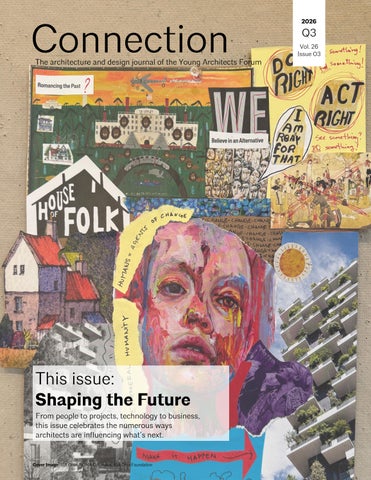
Connection
The architecture and design journal of the Young Architects Forum
This issue: Shaping the Future
From people to projects, technology to business, this issue celebrates the numerous ways architects are influencing what’s next.
Cover Image: AIA Ohio, NOMA Columbus, AIA Ohio Foundation
2026
Q3 Vol. 26 Issue 03
Connection
2026 Young Architects Forum Advisory Committee 2026 Chair 2026 Vice Chair 2026 Past Chair 2026-2027 Advocacy Director 2026-2027 Communications Director 2025-2026 Community Director 2026-2027 Knowledge Director 2025-2026 Strategic Vision Director 2026 AIA Strategic Council Representative 2026 College of Fellows Representative 2026 Council of Architectural Component Executives Liaison AIA Staff Liaison
2026 Young Architect Representatives Alabama, Ashley Askew, AIA Alaska, ChungTse Lin, AIA Arizona, Sarah Potzler, AIA Arkansas, Lauren Miller, AIA California, Magdalini Vraila, AIA Colorado, Lauren Falcon, AIA Connecticut, James Regnier, AIA Delaware, Lauren DeSimone, AIA Florida, Bryce Bounds, AIA Georgia, Adam Drummond, AIA Hawaii, Krithika Penedo, AIA Idaho, Katie Darter Bennett, AIA Illinois, Raquel Guzman Geara, AIA Indiana, Rachel Lindemann, AIA Iowa, Ben Hansen, AIA Kansas, Garric Baker, AIA Kentucky, Jessica Farmer, AIA Louisiana, Calvin Gallion, AIA Maine, Sarah Kayser, AIA Maryland, Alonzo Colon, AIA Massachusetts, Charly Kring, AIA Michigan, Cara Wagner, AIA Minnesota, Constance Chen, AIA Mississippi, Robert Farr, AIA Missouri, Valerie Michalek, AIA Montana, Elizabeth Zachman, AIA Nebraska, Angel Coleman, AIA
Kiara Gilmore, AIA Anastasia Markiw, AIA Sarah Woynicz, AIA Tanya Kataria, AIA Nicole Becker, AIA Kumi Wickramanayaka, AIA Arlenne Gil, AIA Kaylyn Kirby, AIA Ashley Thornberry, AIA Lisa Lamkin, FAIA Hillary Cole Kathleen McCormick
Nevada, Kristen Levin, AIA New Hampshire, Brooke DeYoung, AIA New Jersey, Abby Benjamin, AIA New Mexico, Diana Duran, AIA New York, Mi Zhang, AIA North Carolina, Carrigan (Pennypacker) Doble, AIA North Dakota, Ben Gutowski, AIA Ohio, Margaret Beecroft, AIA Oklahoma, Brian Letzig, AIA Oregon, Elizabeth Lagarde, AIA Pennsylvania, Melanie Ngami, AIA Puerto Rico, Reily J. Calderón - Rivera, AIA Rhode Island, Vacant South Carolina, Cheyenne Kalb, AIA South Dakota, Elizabeth “Liz” Brown, AIA Tennessee, Sarah Page, AIA Texas, Justin Taplet, AIA Utah, Melissa Gaddis, AIA Vermont, Vacant Virginia, John McKenna, AIA Washington, Rio Namiki, AIA Washington D.C., Mika Naraynsingh, AIA West Virginia, Daniel Garvin, AIA Wisconsin, Justin Marquis, AIA Wyoming, Kendra Shirley, AIA AIA International, Jason Holland, AIA
Connection is the official quarterly publication of the Young Architects Forum of AIA. This publication is created through the volunteer efforts of dedicated Young Architect Forum members and made possible through generous grant funding from the College of Fellows. Copyright 2026 by The American Institute of Architects. All rights reserved Views expressed in this publication are solely those of the authors and not those of The American Institute of Architects. Copyright © of individual articles belongs to the author. All images permissions are obtained by or copyright of the author.
2
Issue No. 03: 2026 Quarter 3
Contents 5
Figuring It Out, Editor’s Note Nicole Becker, AIA, NCARB, LEED AP BD+C
29
From Shelter to Strategy Sanand Maddipati, Assoc. AIA
6
Career Evolution, Chair’s Message Kiara Gilmore, AIA
30
Advocacy in Action Series Tanya Kataria, AIA
7
Building Community Before Buildings Justice Barnes, Assoc. AIA, NOMA
34
Building a Career in a New City Caitlin Brady, AIA, LEED AP BD+C
10
Design for Neuro Inclusion Kristen Levin, AIA, NCARB, MBA
36
A Stronger Foundation, A National Framework Savannah Elise Sinowitz, AIA, NCARB
13
CKLDP: A Leadership Incubator for Architecture’s Next Generation Jane Rodrigues, AIA, NCARB, LEED AP BD+C
40
Mentorship to Fellowship John J. Clark, AIA, NCARB
18
The License to Lead Joe Taylor, AIA
44
Sponsored Evolution Andrew Benavides, NCARB, RA
20
From Analysis to Paralysis Neşe Altıntaş, Assoc. AIA, NOMA, CWA
48
Growing Up on the Border and Designing Healthcare Spaces Today Sarah Potzler
23
Beyond Buildings Afomia Hunde, Assoc. AIA, NOMA
50
Shaping Your Path While Earning Your License Isabel Souza, Assoc. AIA, NOMA, FITWELL AMB
26
On the Necessity of Tomorrows Cameron Guthrie, Assoc. AIA, NOMA, LEED AP BD+C, Ben Moody, Alexandra Oetzel, AIA, NCARB, LEED AP BD+C, Samuel Tibbs, AIA, NOMA, NCARB
52
Building Belonging Jane Rodrigues, AIA, NCARB, LEED AP BD+C
57
Connect + Chill
3
Connection
Editorial team Nicole Becker, AIA, NCARB, LEED AP BD+C Editor in chief Nicole is a project architect at Jacobs, based in Portland, OR practicing at the intersection of design, infrastructure, and emerging technologies. She is the 2026 Communications Director for the Young Architects Forum.
Bryce W. Bounds, AIA, NCARB, CGC Senior editor Bryce is a Miami native, a Construction Project Management Supervisor in the Public Works department of Broward County, and Florida’s YAR. He attended Design and Architecture Senior High School (DASH) in Miami-Dade and graduated from the Rhode Island School of Design (RISD) with bachelors in both Architecture and Fine Art. Constance Chen, AIA, NCARB Senior editor Constance is a Minnesota native and a principal at Locus Architecture in Minneapolis. A University of Notre Dame graduate, her design approach intends to make meaningful connections between people and spaces. She serves as Minnesota’s YAR. Valerie Michaelek, AIA, NCARB Senior editor Valerie is a Project Architect at HOK in St. Louis. Her professional experience spans a diverse range of project types, including aviation, science and technology, higher education, corporate, healthcare, and commercial work, and includes volunteer leadership at the local, state, regional, and national levels through the AIA. She currently serves as AIA Missouri’s YAR. Ben Gutowski, AIA, NCARB Senior editor Ben is an Associate Architect at Zerr Berg Architects in Fargo, ND. He works on projects from schematic design through construction and anything from museums to schools. He is passionate about design and meaningfully connecting people to the built environment. He is serving his first year as North Dakota’s Young Architect Representative.
4
Justin Marquis, AIA, NCARB Senior editor Justin is a Project Architect with Somerville Architects & Engineers in Green Bay, Wisconsin. Managing projects through all phases of development from conceptual design to construction administration, he currently supports the healthcare and educational studios at Somerville. He has a degree from the University of Wisconsin - Milwaukee and lives in the Fox Valley area with his family. Justin is the Wisconsin Young Architect Representative.. Garric Baker, AIA, NCARB Senior graphic designer Garric is a graduate of the College of Architecture, Planning & Design at Kansas State University and excels in leadership positions with state and regional Chambers of Commerce, Young Professionals, the Kansas Barn Alliance, local and state Wide AIA Kansas Board of Directors, and Regional Economic Development activities. Katie Bennett, AIA, NCARB Senior graphic designer Katie is a project manager at Babcock Design in Salt Lake City, Utah and Boise, Idaho, and oversees projects during their inception phase through schematic design. She is the current YAR for the state of Idaho and is passionate about housing and sustainable design. Calvin Gallion, III, AIA, NOMA, NCARB, LEED GA Senior graphic designer Calvin is an architect and principal at studio^RISE in New Orleans. A Tulane graduate and Natchitoches native, he is a passionate advocate for community and rehabilitation projects. He serves as EDI Chair for AIA New Orleans and as Louisiana’s YAR. Kendra Shirley, AIA, NCARB Senior graphic designer Kendra is a project architect at Arete Design Group in Wyoming and Colorado and is Wyoming’s YAR. As a graduate from one of the top undergraduate architecture programs in the country, Kendra’s training and experience provides her with a unique and innovative perspective for creating extraordinary experiences and designs.
Issue No. 03: 2026 Quarter 3
Beyond What’s Next Editor’s Note The future of architecture means something different to each of us. The future can feel distant, overwhelming, exciting, and unknown. From new technologies, to new trends in practice, or alternative business models, the truth is that the future is being shaped already. The beauty in that is our ability to impact it. Having the opportunity to make a difference through the work we do, the people we mentor, the communities we serve, the questions we ask, and the type of person we choose to be is one of the most exciting, and often intimidating things about being an architect in the 21st century. Every generation inherits new challenges, and with them new opportunities to redefine what success looks like and what practice can become. From AI, to licensure, equity, mental health, and career paths, we recognize we exist in a practice today that is growing more multifaceted than ever. This issue celebrates the numerous ways architects are influencing what’s next. We explore how emerging professionals are preparing to lead in an AI-driven world, why licensure remains a powerful catalyst for opportunity, and how initiatives like Project “Almost” Architect are creating more equitable pathways into the profession. We hear stories of resilience from architects who have relocated, changed direction, or built momentum through life’s transitions. But shaping the future extends far beyond our own careers. Through stories like Growing Up on the Border and Designing Healthcare Spaces Today, Building Community Before Buildings, and Beyond Buildings: Where Architecture Creates Value in an Increasingly Interconnected World, we’re reminded that architecture is ultimately about people. Our greatest impact isn’t measured only by the buildings we complete, but by the relationships we foster, the barriers we remove, and the sense of belonging we help create. Some days, when we’re just trying to make it through a deadline or deal with an unhappy client, thinking of the future is exhausting. Or when we contemplate job insecurity and the rising costs of healthcare and housing, the future can feel daunting. My hope is that this issue reminds you that uncertainty is ok and that no matter where you find yourself, you matter and your impact matters. The future isn’t built by a handful of visionaries working alone. It’s built collectively: through mentorship, advocacy, curiosity, and a willingness to leave the profession stronger than we found it. Every conversation, every act of service, every young professional we encourage, and every community we thoughtfully engage helps shape what comes next.
As architects, we’re trained to think decades ahead. We design buildings that outlive us, spaces that adapt over generations, and communities that continue evolving long after construction is complete. The same mindset applies to our profession. The future won’t be defined by a single innovation, technology, or transformative idea. It will be shaped by thousands of thoughtful decisions made by architects who choose to lead with purpose, empathy, and courage. Thank you for being part of that future. Forward together, Nicole Becker Editor in chief / Connection
2027 Editorial Committee: Call for submissions. The Connection editorial committee welcomes submissions of articles, projects, photography, and other design content for editorial review and publication in our widely circulated e-magazine, with selections based on each issue’s theme. We seek volunteers, contributing writers, interviewers, and design critics interested in building their writing portfolio by collaborating with our editorial team on targeted articles and interviews. Contributors are asked to submit one or more articles per publication cycle (3–4 issues per year). If you are interested in submitting content or joining the editorial committee, please contact Editor in Chief Nicole Becker at nicolejbecker1@gmail.com.
Nicole Becker, AIA, NCARB, LEED AP BD+C
Project Architect at Jacobs, Portland, OR 2025-2026 Communications Director AIA Young Architects Forum.
5
Connection
Shaping the Future Chair’s message ...the future is not simply something we enter. It is something we shape. The future of architecture is often discussed as though it is something waiting for us just beyond the horizon. We imagine new technologies, evolving practice models, changing communities, and challenges that will eventually require us to adapt. But the future is not simply something we enter. It is something we shape. It is shaped through the decisions we make today: the projects we pursue, the questions we ask, the voices we invite into the room, the people we mentor, and the values we protect when the pressures of practice make compromise easier. It is shaped not only through transformative ideas, but through the accumulation of everyday choices across our firms, communities, and profession. For young architects, this responsibility can feel both energizing and daunting. We are still establishing ourselves within systems and structures we did not create, while increasingly being asked to help reimagine them. We are navigating rapidly changing technology, new expectations of workplace culture, growing climate and housing challenges, and an evolving understanding of what architects can, and should contribute to society. It would be easy to believe that shaping the future belongs primarily to those with the most authority, experience, or influence. But meaningful change rarely begins only at the top. It often begins with someone willing to question an inherited assumption, test a different way of working, advocate for an overlooked perspective, or imagine what could exist beyond what has always been done.
Shaping the future does not require predicting it perfectly. Architecture has always operated within uncertainty. Our work asks us to envision conditions that do not yet exist, understand competing needs, and translate possibility into something tangible. These same skills position architects to meaningfully influence the changes ahead. The challenge is to approach that influence with intention. What parts of our profession deserve to be carried forward? What systems are no longer serving the people within them? Where can we make room for new voices, new ideas, and new definitions of success? How might our decisions today create a profession that is more resilient, inclusive, collaborative, and relevant tomorrow? This issue explores the individuals and ideas engaging with those questions. Their work reminds us that the future of architecture will not be shaped by one innovation, one initiative, or one generation. It will emerge through collaboration across experiences and perspectives, and through our willingness to remain curious about what the profession can become. As the Young Architects Forum, we have an opportunity to do more than prepare emerging leaders for the future. We can help equip them to influence it. We can create spaces where ideas are tested, assumptions are challenged, and young architects recognize that they do not need to wait for permission or a particular title to begin making an impact. The future may be uncertain, but our role within it does not have to be passive. May we be thoughtful about what we inherit, courageous about what we challenge, and intentional about what we create next.
Young architects are already doing this work. We are experimenting with new models of practice and leadership. We are advocating for healthier, more equitable workplaces. We are embracing technology while asking thoughtful questions about how it should serve our profession and communities. We are expanding architectural influence through policy, research, development, education, public service, and entrepreneurship. We are designing not only buildings, but new possibilities for how architects can lead.
6
With appreciation, Kiara Gilmore, AIA 2026 Chair | Young Architects Forum SarahGilmore, Kiara Woynicz, AIA AIA Firstname Lastname is an theAssociate 2025 Chair at of Modus the Young StudioArchitects in Fayetteville, Forum Arkansas. and a Lorem ipsum dolor Project Architect Gilmore serves asat2026 HKS.Chair She brings ofsit the Young aamet, community-centric Architects Forum focusbrings and to clients a perspective and teams, rooted valuing in mentorship, purpose-driven service, practice consectetur adipiscing elit, sed doand that supportsdesign. high-impact the firm’s social justice, equity, diversity, and eiusmod tempor incididunt ut labore. inclusion efforts to foster belonging in the profession.
Issue No. 03: 2026 Quarter 3
Building Community Before Buildings The future of architecture isn’t built solely through design—it is built through relationships. Establishing a new National Organization of Minority Architects chapter required persistence, collaboration, and the belief that representation matters. This article reflects on how one volunteer initiative transformed into a statewide community for mentorship, advocacy, and professional growth, demonstrating that emerging professionals don’t need permission to lead meaningful change. The Gap That Sparked a Movement Like many students who came before and after me, I graduated from the University of Arkansas Fay Jones School of Architecture and Design as a member of NOMAS. That student chapter gave me community, mentorship, and a sense of belonging. But when I transitioned into practice, I encountered what generations of Arkansas graduates had already experienced: there was no professional NOMA chapter in our state. The community that had supported us as students simply ended at graduation. There was no local network to join; no mentors; no professional chapter to help us stay connected, grow as leaders, or maintain the sense of belonging we had cultivated as students. To stay involved, we had to look to neighboring states—often losing the momentum built in NOMAS. Some graduates even left Arkansas entirely to find the support they needed. I felt that gap personally, and I watched my peers feel it too. That experience stayed with me. This became the catalyst for me to start a chapter here: to give Arkansas students a place to land, emerging professionals a place to grow, and the next generation of architects a place where they could see themselves reflected in the profession.
When I first began exploring the idea of forming a NOMA chapter in Arkansas, the reality was stark: there was little to no interest. Conversations fizzled. Outreach attempts stalled. Even a collaborative attempt with Memphis NOMA couldn’t gain traction because Arkansas simply didn’t have the participation to sustain it. What was intended to be the spark of “NOMA Arkansas” evolved into strengthening Memphis NOMA. This wasn’t discouraging but enlightening, revealing that the gap was not only organizational, but also educational. Many local firms and professionals simply didn’t know what NOMA was, what it offered, or why it mattered. A Vision Becomes a Team As the vision gained momentum, others stepped forward who felt the same urgency and hope for what NOMA Arkansas could become. Our founding team—Areej Ali, AIA; Mario Pacheco, Assoc. AIA; Laura Ramirez, AIA; and myself, Justice Barnes, Assoc. AIA, NOMA —brought together leadership experience, mentorship backgrounds, university connections, firm relationships, and community partnerships.
That motivation became the spark that started everything.
This team didn’t just join the effort, they shaped it. Every conversation, meeting, and decision was strengthened by their commitment to building something meaningful for Arkansas.
Facing the Silence: When No One Was Ready
Arkansas Was Ready—It Just Needed a Catalyst
Left to Right: Justice Barnes, Assoc. AIA, NOMA, Laura Ramirez, AIA, Mario Pacheco, Assoc. AIA, Areej Ali, AIA
7
Connection
Above: Exhibited at the 2025 AIA Arkansas Convention: a poster board exploring ‘Why NOMA in Arkansas?’ created by Mario Pacheco, Assoc AIA.
Arkansas has a vibrant design community filled with architects, educators, students, and industry partners. What we lacked was a centralized organization dedicated to mentorship, advocacy, professional development, and representation. Our founding team recognized that gap and saw an opportunity to build something that could uplift, connect, and inspire. The more we talked with architects across the state, the clearer it became that people were hungry for this kind of community. Turning Interest Into Infrastructure Starting a chapter meant more than filling out paperwork,it meant building a coalition. What began as informal conversations over lunch evolved into structured planning meetings, working sessions, and eventually a statewide movement. One of our earliest steps was hosting initial interest meetings. During one meeting, NOMA South Region Vice President, Brien Graham, NOMA, AIA, NCARB joined us to explain NOMA’s mission, national structure, and the impact a chapter could have in Arkansas. His presence brought clarity, credibility, and momentum. This meeting also strengthened internal connections. Laura Ramirez, AIA, who serves on the AIA Arkansas DEI Committee, helped build a bridge between our efforts and the broader architectural community. That collaboration led to one of our first major public moments: participating in the annual AIA Arkansas Conference. Together with the DEI Committee, we created an interest table and
8
interactive board asking a simple question: “Why NOMA in Arkansas?” Attendees filled the board with sticky notes sharing stories of mentorship, calls for representation, excitement for student support, and hope for community. This moment helped spark momentum, expanded our visibility, and strengthened the sense of connection that continues to drive this movement forward Partnerships That Made the Mission Real As our efforts expanded, partnerships became essential. Universities expressed interest in strengthening student pathways. Community organizations saw alignment with their missions. These partnerships transformed our work from a grassroots effort into a statewide initiative. NOMA Arkansas wasn’t being built for the community,it was being built with the community. Shared Leadership, Shared Purpose One of the greatest lessons in this journey was that leadership is never about one person. Developing bylaws, defining board roles, recruiting volunteers, establishing partnerships, planning programming, exploring funding opportunities, and creating a sustainable organizational structure all required collective insight and dedication. Founding a chapter wasn’t about creating another organization. It was about creating community.
Issue No. 03: 2026 Quarter 3
Above: Sticky-note feedback collected from attendees on the ‘Why NOMA in Arkansas?’ poster board.
A Pipeline of Support for Every Stage of the Profession The driving force behind NOMA Arkansas has always been clear: supporting students, emerging professionals, and seasoned architects alike. Our goal is to create a space where mentorship flows in both directions: where seasoned architects share wisdom and emerging professionals bring fresh perspectives. Through mentorship, licensure support, networking, leadership development, community outreach, and student engagement,
Every architect can point to someone who opened a door for them—a mentor, professor, supervisor, or colleague who encouraged them at the right moment. we aim to build a pipeline of support that begins in architecture school and continues throughout an architect’s entire career. Representation matters. Mentorship matters. Community matters. A Milestone Worth Celebrating This summer, we celebrate a major milestone: NOMA Arkansas has officially begun the process of forming as a professional chapter. What started as a personal desire to support students has grown into a statewide movement supported by architects, educators, and students across Arkansas. This moment represents possibility, progress, and the beginning of a community that will grow long after its founding members.
What We’re Building Next This is only the beginning. Our vision includes: ● Mentorship programs from school through licensure ● Professional development opportunities ● Community outreach that inspires future architects ● Statewide partnerships that expand access and representation The future of architecture isn’t built by one project or one person. It’s built by communities willing to invest in each other. Arkansas is ready—and we’re excited to see what we build next. The Journey to NOMA Arkansas 2024–2025 ● Asked why Arkansas lacked a NOMA professional chapter ● Connected with architects, students, and national NOMA leaders ● Leveraged experience through AIA Arkansas, NAC, YAF ● Organized statewide conversations to gauge interest ● Recruited founding volunteers and future board members ● Established partnerships with AIA Arkansas DEI Committee, universities, and community organizations ● Hosted the inaugural interest meeting 2026+ ● Began the official process of forming NOMA Arkansas ● Developed mission, bylaws, and organizational structure ● Initiated nomination process for board members and core leadership roles ● To be continued… NOMA Arkansas is still developing, expanding, and building the foundation for a strong, sustainable future. And as we continue this work, we invite our community to join us because the future we’re shaping is one we build together.
Justice Barnes, Assoc. AIA, NOMA
Barnes is an architectural designer at Cromwell Architects and Engineers in Little Rock, Arkansas. Barnes serves as the AIA NAC STAR for Arkansas and holds active leadership roles within AIA AR.
9
Connection
Design for Neuro Inclusion YAF Advocacy Focus Group - Webinar Recap
As the architectural profession continues to broaden its understanding of health, safety, and welfare, conversations around neurodiversity and neuro-inclusive design have become increasingly urgent. While architects have long considered accessibility, ergonomics, and universal design, the neurological experience of space, how people perceive, process, and respond to their environments, has often remained unaddressed in conventional standards. To help emerging professionals navigate this expanding landscape, the Young Architects Forum’s Advocacy Workgroup hosted Design for Neuro Inclusion on June 23, 2026. The webinar brought together three leaders whose work bridges neuroscience, architecture, interior design, and human wellbeing: Don Ruggles, AIA, NCARB, ICAA, ANFA, Kay Sargent, FASID, FIIDA, CID, LEED AP, MCR.w, WELL AP and Erin Orenchak, SIDC, ASID. Their cross-disciplinary perspectives offered a compelling look at how architects can design spaces that support the full spectrum of human neurological experience. What emerged was a powerful call to action: neuro-inclusive design is not a niche specialty, it is a necessary evolution of good design. Understanding the Brain–Environment Connection Architect and author Don Ruggles opened the session by grounding the conversation in neuroscience. His work in neuroaesthetics explores how the built environment is processed by the brain and how those subliminal responses shape emotion, movement, and behavior. Ruggles stated:
“There are no neutral spaces. Every space generates either a survival response or a pleasure response.” “There are no neutral spaces. Every space generates either a survival response or a pleasure response.” The human nervous system processes 11 million bits of information per second, yet only 50 bits reach conscious awareness. This means that most of our reactions to space: comfort, unease, calm, and stress are determined long before we become aware of them. Sympathetic (survival) inputs are five
10
to seven times stronger than parasympathetic (pleasure) inputs, making it easy for a single stressor to override an otherwise beautiful environment. For architects, this reframes design as a biological intervention. Ruggles described the ideal balance for neurotypical individuals as 80% rest and relaxation, 20% excitement, but noted that neurodivergent individuals often require a different ratio. Designing for homeostasis, he argued, should be considered a civil right, a standard of care that supports all neurological profiles. Neurodiversity in Practice: Designing for Sensory Needs Interior designer and global thought leader Kay Sargent expanded the conversation from neuroscience to neurodiversity, emphasizing that 20–30% of people identify as neurodivergent and that number rises to 53% among Gen Z. Neurodiversity is a difference, not a deficit. Every person is neurodiverse, but not everyone is neurodivergent. Sargent outlined how individuals fall along a spectrum of sensory thresholds: • Hypersensitive (sensory avoiders) who prefer calm, ordered, low-stimulation environments • Hyposensitive (sensory seekers) who thrive in energetic, layered, high-stimulation environments These differences mean that a single “open, flexible” space may not serve everyone equally. Sargent stressed the importance of choice, variety, and control, noting that autistic individuals often act as the “canary in the coal mine,” their heightened sensitivity reveals environmental issues that affect many others, just less intensely. One of her most actionable insights centered on spatial sequencing. Designers often assemble a “kit of parts” consisting of quiet zones, collaboration areas, focus rooms, lounges, but often place them without considering adjacency or transition. “If you take all of those and you just throw them in the space together… you have literally just pureed the workplace.” Instead, Sargent advocated for intentional sequencing: buffering quiet zones from active ones, using materiality and lighting
Issue No. 03: 2026 Quarter 3
Left: Diagram of the Aesthetic Triad. Photo Credit: Dr. Anjan Chatterjee. Right: Diagram of the Design Triad. Photo Credit: Dr. Anjan Chatterjee.CCAN to signal transitions, and creating environments that allow individuals to self-select the sensory conditions they need. Her firm’s research shows measurable improvements when neuro-inclusive strategies are applied: • 38% increase in satisfaction with acoustics • 25% increase in ability to manage distractions • 24% increase in ideation • 16% increase in perceived productivity These results reinforce that neuro-inclusive design benefits everyone, not just neurodivergent users. Neuroaesthetics at Home: Designing for Daily Life Interior designer Erin Orenchak brought the conversation into the residential realm, where neuroaesthetics can profoundly shape daily routines, relationships, and well-being. Her clients include individuals with attention-deficit / hyper activity disorder (ADD), obsessive compulsive disorder (OCD), anxiety disorders, autism, and families navigating multiple neurotypes under one roof.
“Home isn’t simply where they live, it’s where they recover from sensory overload.” “Home isn’t simply where they live, it’s where they recover from sensory overload.” Orenchak described how people naturally gravitate toward spaces that feel rewarding and avoid those that feel overwhelming. In one project, a “kids’ TV room” was consistently avoided by a homeowner with ADD and OCD. After redesigning it to align with his sensory needs, the room transformed into a daily destination, a powerful example of how neuroaesthetic principles can reshape behavior.
Drawing from Dr. Anjan Chatterjee’s research, Orenchak highlighted two essential frameworks: • The Aesthetic Triad: meaning, emotion, sensation • The Design Triad: coherence, fascination, hominess Neurodivergent participants consistently prioritized coherence, reinforcing the need for clarity, order, and predictable spatial cues. She also outlined five foundations of neuroaesthetic residential design: 1. Luminance: Light guides movement and regulates focus. 2. Art: Creates emotional connection and activates the brain’s default mode network. 3. Biophilia: Natural materials and patterns reduce stress. 4. Color: Influences arousal and mood; must be tailored to the individual. 5. Customized Design: Neuro-inclusive design is not about diagnosis; it is about personal meaning.
“There is no universally perfect color palette. There is only the right color story for the people who will live in that space.” “There is no universally perfect color palette. There is only the right color story for the people who will live in that space.” A Call to Action for Emerging Professionals Throughout the webinar, panelists emphasized that young architects are uniquely positioned to lead the shift toward neuro-inclusive design. Their fresh perspective, curiosity, and willingness to challenge assumptions make them powerful advocates for environments that support all minds.
11
Connection
Looking Forward The Design for Neuro Inclusion webinar highlighted a profound truth: the built environment shapes human health, neurologically and emotionally. As the profession evolves, neuro-inclusive design offers architects a way to create environments that foster belonging, reduce stress, and enhance well-being.
“... the built environment shapes human health, neurologically and emotionally.” For emerging professionals, this is both an opportunity and a responsibility. By integrating neuroscience, sensory awareness, and human-centered design, architects can create spaces that support the full spectrum of human experience, ultimately shaping a more inclusive future for the profession and the communities it serves.
Presenters Included: Don Ruggles, AIA, NCARB, ICAA, ANFA CEO Emeritus Ruggles Lindemann Bell Kay Sargent, FASID, FIDA, CID, LEED AP, MCR w, WELL AP Senior Principal & Director of Thought Leadership, Interiors HOK Eryn Oruncak, SIDC, ASID Founder & Interior Designer Elan Design
Kristen Levin, AIA, NCARB, MBA
Kristen is an architect at JKAE Design in Reno, NV specializing in education and public works projects. She serves as the Nevada representative to YAF and President-Elect to the AIA Northern Nevada chapter.
12
Issue No. 03: 2026 Quarter 3
CKLDP: A Leadership Incubator for Architecture’s Next Generation Ryan McEnroe, FAIA, ASLA, LEED AP Associate Principal with Quinn Evans, an interdisciplinary practice and recipient of the 2024 AIA Firm Award. Ryan has been active with the AIA’s YAF, serving as chair in 2020 and is a co-founder of the AIA|DC Chapter’s CKLDP. He serves nationally with AIAS, NAAB, and NCARB.
Shelby Morris, AIA Co-Managing Director of Gensler Atlanta. He has been an architect and respected leader in Atlanta for 20+ years, delivering exceptional work for the city’s most prominent developers. He was 2024 AIA Atlanta President, was on the 2017 AIA National YAF Advisory Committee, and is a member of ULI Atlanta’s Advisory Committee.
Mindy Goodroe, AIA Healthcare Architect and Strategist with global experience designing complex medical facilities. Specializing in women’s, infants’, and pediatric environments, she blends vision, operations, and patient experience. She launched Georgia’s Women in Healthcare chapter and co-founded the AIA CKLDP in Georgia, advancing leadership and community-focused design. I wrote my first article about the Christopher Kelley Leadership Development Program for YAF (Young Architects Forum) Connection in early 2026, intending simply to highlight the program’s impact since its founding - particularly on me - and how it shaped my path to leadership. Through both participating in the program and writing that piece, I found myself wanting to understand it more deeply and how it influences architectural practice and the future of the profession. That curiosity led me to reach out to the program’s founding members in Washington, DC, as well as in Atlanta, GA, where I reside. Below are highlights of my conversations with Ryan McEnroe, FAIA, co-founder of the DC Program, and with Shelby Morris, AIA & Mindy Goodroe, AIA, founders of the GA Program: Jane: How was the program founded in DC? What inspired you to introduce the program in GA?
Ryan: It’s 2010, my first year out of UVA and the second year of the AIA Virginia’s Emerging Leaders in Architecture Program. That program selected five students from each of Virginia’s five NAAB-accredited schools in addition to eleven young architects (sixteen scholars total) for nine sessions. It had a huge impact on me. There were parts I loved and parts I didn’t fully agree with, but it was- and still is- a strong leadership program. By 2013, three years after graduating, I had my licenses in both architecture and landscape architecture and suddenly had time on my hands since I wasn’t studying for exams. David Haresign, FAIA, my mentor and then President of AIA DC, encouraged me to start something similar in DC and introduced me to Sean Stadler, FAIA. Sean, who’s about ten years my senior, had been thinking about starting a leadership development program within the chapter to train future leaders.
13
Connection
Sean was close friends with Christopher Kelley, an AIA DC member deeply involved at the national level. Both Christopher and Sean contributed to the founding of the National Associates Committee and later chaired the YAF Advisory Committee in 2009 and 2010 respectively. At the time, the profession was still reeling from the recession, and AIA National had recognized the need for leadership development. Some local programs had started, but many quickly lost momentum. During their time serving on the YAF, Sean and Christopher explored launching something nationally but were unsuccessful. So, this became a passion project. Sean had the strategic vision and understanding of the local AIA DC board; I had the energy. It was almost a complementary partnership. We studied precedents– Virginia’s EL Program, Kansas City’s Pillars Leadership Program, Leadership Portland, and Dallas’ ELP. Two big takeaways were the structured half-day sessions and ending with a happy hour. Sean always believed the program could grow beyond DC if it succeeded. Sadly, Christopher passed away in 2012, and we felt that naming the program after him would be a great legacy. When we launched the program in September 2013, we had strong interest and a great inaugural class. That first class graduated in May 2014. Mindy: Two of us from HKS DC were in that inaugural class. The first year went incredibly well. What made the program special was that scholars were responsible for the educational content. We identified what we wanted to learn, reached out to speakers, and organized the sessions ourselves- it was part of the learning. I loved the community I built in DC. When I moved to Atlanta a year later, I felt a real sense of loss. Ryan then reached out about starting a CKLDP chapter here and introduced me to Shelby. At an AIA Atlanta Open House, I met Chris Yueh, who suggested I connect with Tangela. I later met Tangela at a design awards event and shared the program’s history and impact. AIA Georgia had already been considering a leadership program, and she helped schedule a presentation to the board. The support was overwhelming. It was much easier because the DC program was already well established(2). Shelby: At the time, I was at the Beck Group. Ryan and I had served together for the YAF National Advisory Committee, and he reached out just as I was finishing the ULI Center for Leadership- another complementary program. Mindy, Tangela, and I took the “kit of parts” Ryan’s team had created and adapted it for Atlanta. Our goal was [program] sustainabilitya leadership incubator for the profession. David Southerland, Executive Director AIA GA/ATL, has been especially great about following up with graduates and asking, “What’s Next?”.
14
Above: Cofounders of the GA Program Mindy Goodroe, AIA; Shelby Morris, AIA; & Tangela Monroe, CAE with the 2021 AIA Georgia Bronze Medal Award. Photo Credit: AIA Georgia.
Jane: It sounds like everything aligned perfectly- Mindy moving here, leadership transitions, and the AIA Georgia board looking for a program. What challenges did you face launching it? Ryan: Every chapter struggles in year two. The key is not letting up. You must understand what works for your chapter size and stay committed. CKLDP now has allied programs in places like Houston, Colorado, Detroit, South Florida, Georgia, and beyond (1) . We talked about asking AIA National to monitor the program, but the current model gives local founders ownership. The framework is consistent, but each chapter makes it their own.
Issue No. 03: 2026 Quarter 3
Above: Sean Stadler, FAIA & Ryan McEnroe, FAIA at AIA Grassroots San Diego 2018. Photo Credit: Ryan McEnroe, FAIA.
The calendar was another challenge. Summers in DC tend to encourage a lot of vacation time, so it made good sense to not have sessions during the summer, allowing fewer conflicts for session speakers. However, this then created challenges with how the program was funded (over an academic year), which didn’t align with the financial calendar of the chapter. Mindy: Personally, my challenge was staying engaged. After I moved to Atlanta, I had more responsibilities at work and at home. There’s a sweet spot where you can be a leader in your firm and within AIA, and CKLDP really helps you understand that balance. I’m eager to get back involved. Shelby: Early on, people wondered if this was just another AIA program. We had no scholars at first- we had to recruit. But scholars are what make the program. We were intentional about the structure and leadership succession, making sure advocates for the program were always in place. Jane: Is there a right time in someone’s career to join? Shelby: There’s a natural progression, but it’s different for everyone. It’s usually when you start understanding the business of architecture and feel ready for that next step. You might be hitting a ceiling or looking for renewed excitement beyond what architecture school taught you. Ryan: We’re all different. Over time, ambition can dip, and you need something new - a job, a project, or an extracurricular. For me, CKLDP became that outlet. The program tends to attract
architects who are already leaders in their own right, often with three to eight years of experience. Jane: What’s the secret sauce? Mindy: The structure and scholar-driven content. It’s like an executive MBA compressed into a year. You build strong peer relationships and realize that people you once felt intimidated by are accessible. There are no tests- you take what’s relevant to you. Shelby: Because it’s peer-driven, every year is different. It’s like a constantly evolving master’s program on the business of architecture. Firms were initially wary, thinking it might encourage job-hopping, but that mindset has shifted. Leaders want growth for their people. Mindy: And the value is real. Smaller firms often can’t afford internal leadership programs. CKLDP fills that gap. Jane: What makes CKLDP different? Shelby: Large firms’ programs are often insular. CKLDP connects you across firms, which is incredibly invaluable. Mindy: The return on investment- in learning and connectionsis huge. Ryan: I can’t stress a professional network enough; the cohort the scholars are a part of, makes for long-term professional
15
Connection
Ryan: I can’t stress a professional network enough; the cohort the scholars are a part of, makes for long-term professional connections, and one never knows when a phone call will be made.
Ryan: Saakshi Terway, Assoc. AIA is another CKLDP alumni serving on the AIA National Board.
Jane: Was the curriculum copied from DC or tailored to Georgia?
Mindy: Getting out of your comfort zone and owning a topic you fully know.
Mindy: It started with DC’s framework but evolved. Some topics shifted based on local priorities.
Shelby: Management, teamwork, and presentation.
Shelby: Political advocacy, for example, became one of the three mandatory sessions in Georgia. Other topics were voted on by the class. Ryan: All chapters can take liberty with the curriculum, so long as they each incorporate the foundational structure of firm, Institute, and civic leadership. Jane: What motivates scholars and firms to participate? Do firms see ROI? Ryan: There’s a leadership training gap between school and practice. Unless you’re in a large firm, you may get little or no training. This program fills that gap. At Quinn Evans, scholars often accelerate toward leadership roles, and retention improves. Katie Slattery, AIA, was also in the first cohort, soon there after she was promoted to Sr. Associate and then Principal. I was her teacher during the CKLDP, but she is my supervisor in the office. The ROI is real. Mindy: HKS saw the same benefits. Personally, the confidence I gained through CKLDP helped me start my own consulting practice eventually. Jane: Have you seen transformations after graduation?
Jane: What’s the hardest part of planning a session?
Jane: For me, it was learning to seek sponsorship. Shelby: And believing in what you’re asking for. Ryan: I always try to stress that you are not asking for money, but instead presenting an opportunity. Jane: How can the program be elevated? Shelby: We need to go beyond our industry bubble – build relationships with city councils, mayors, and state leaders. Architects should be community leaders influencing policy. Mindy: Topics like self-promotion, using social media effectively, asking for opportunities, and avoiding burnout are critical. Shelby: Practice innovation is also key. While serving on the YAF under Chair Evelyn Lee, FAIA, I participated in the “Practice Innovation Lab”, a session that brought together national leaders to creatively question the future of architectural practice. If we don’t continually adapt, we’ll be left behind. Mindy: And the future of education- what should schools be teaching now, including AI? Who implements those changes? I attended the Design Intelligence Council in Portland led by Dave Gilmore that discussed similar topics.
Ryan: One early scholar, Rachel Johnson, AIA went on to start the program in Denver after missing the community. About half of the programs nationwide were started by alumni.
Jane: I’ve seen progress with business-focused courses in schools, and it’s encouraging. I took “Entrepreneurship in Architecture” with Prof. James Cramer during my master’s at Georgia Tech.
Shelby: In Georgia, Sarah Woynicz, AIA started her AIA journey through CKLDP. It led to her becoming YAF National Chair, building national relationships, and eventually to the AIA National Board. I can’t be more proud of her. She is a model of the impact of the program and the connections it builds.
Shelby: I love that because James was the founder of Design Intelligence before Dave came in. Our industry has depth beyond design- management, leadership, and more. Don’t give up on it too early.
Mindy: Yiselle Santos Rivera, our AIA 2027 National president, is also an alum. CKLDP helped connect her as a valuable voice for the profession. After going through CKLDP, she served multiple roles both locally and nationally for AIA. Both Sarah and Yiselle are incredible examples of what happens when you lean into leadership.
16
Jane: What’s the most important trait for future leaders? Shelby: Empathy. If people don’t want to follow you, you’re not a leader. Mindy: Leadership works when you lift others up. Self-centered leadership eventually collapses.
Issue No. 03: 2026 Quarter 3
Jane: What’s the biggest challenge young architects face today? Shelby: Letting go of being the “doer” and learning to teach and empower others. CKLDP helps with that transition. Jane: Final advice for emerging leaders? Mindy: Know your strengths, build a team that complements you, and create your own “Board of Advisors”. Make time for what you love. Shelby: Don’t be afraid to make decisions. Indecision costs more than making the wrong call.
Ryan: Life happens; get your license as soon as you can. Jane: Any recommended books or resources? Ryan: Blue Ocean Strategy by Renee Mauborgne and W. Chan Kim. Who Moved My Cheese by Dr. Spencer Johnson. Mindy: 6 Types of Working Genius by Patrick Lencioni- it helped me understand my value. Shelby: The Psychology of Money- confidence and personal wealth matter. Jane: Mindy, that book helped me understand myself, too- it was like finally getting glasses and seeing clearly.
Above: Jane Rodrigues, AIA addressing the GA 2026 CKLDP Cohort as the Program Chair. Photo Credit: Katherine Uhrin, AIA.
Other information: 2014, November – Merker, Ian, “Christopher Kelley Leadership Development Program,” CONNECTION. vol. 12, Issue 06 2018, May – Toddy, Matthew, “Mentorship: A Primer – A Conversation with Industry Experts,” CONNECTION. Vol. 16, Issue 01 2018, September – Lo, Yu-Ngok, “2018 AIA Young Architects Award Winner Profile – An Interview with Ryan McEnroe, AIA,” CONNECTION. Vol. 16, Issue 03 AIA Grassroots 2010: The Value of Attending https://www.youtube.com/watch?v=IQYa29lozkQ&t=80s
Footnotes: (1) More information on the AIA DC Chapter & the allied locations can be found at https://www.ckldp.com/ (2) More information on the AIA Georgia Chapter can be found
Jane Rodrigues, AIA, NCARB, LEED AP BD+C
Rodrigues is a Design Manager at Gensler in Atlanta, GA. Rodrigues is a licensed architect, 2026 CKLDP Chair and a 2024 AIA Georgia Carmen Stan Memorial Scholarship recipient.
17
Connection
The License to Lead:
Preparing Young Architects for the AI-Driven Future The profession of architecture, like most other professions, is at a critical inflection point as a result of two major influences: artificial intelligence and the wave of Baby Boomers who will be retiring in the next few years. What follows is thoughts on how these factors specifically impact young architects within their first ten years of licensure who will need to face these challenges head on and start preparing to face these challenges now. Major Shifts It’s hard to go a day without interacting with AI in our daily or work lives. AI has arrived, and the initial knee-jerk reaction from the architecture community centered around job security seems to be transitioning into a more proactive dialogue about how to regulate its impact on the profession. Examples of this can be found through the formation of the AIA AI Task Force,NCARB’s public statement on AI, and the innumerable sessions on the topic at every architecture conference. NCARB recently released its NCARB by the Numbers 2026 Edition, and a couple of statistics really stood out to me: 14% of licensed architects are currently over the age of 65, and only 3% of architects are under 30. [Architects by Age] These two realities are converging at the same moment. Today’s emerging professionals, young architects and midcareer architects will be responsible for shaping the future of the profession and navigating how AI will impact the practice of architecture. While a bit overwhelming, we have a tremendous
opportunity in front of us to challenge norms in our profession and make meaningful improvements to the culture and practice of architecture. In order to do so, we must shift our focus from technical proficiency and software skills to something more intangible, professional judgment.
“It’s hard to go a day without interacting with AI in our daily or work lives.” The Skill That Will Still Matter One skill that both AIA’s Guidance for the Responsible Use of AI by Architecture and Design Firms and NCARB’s Position on the Use of Artificial Intelligence in the Architecture Profession mention as vital to the preservation of architects is Professional Judgment. As technical knowledge and production capabilities become more accessible through AI, the differentiator will increasingly be the ability to exercise sound judgment, assume responsibility, and earn the trust of clients and the public Professional judgment means you can be trusted, and you have earned that trust through a wide variety of experiences. These experiences might include delivering successful projects, managing clients and consultants, selling an idea and following through on it, solving complex problems, speaking at events, writing, creating content, or leading teams. The challenge is that trust is earned over time through the accumulation of countless decisions and actions. It is developed through experience and demonstrated through performance. Yet there must be some baseline measure of competency that signals to clients, employers, and the public that an individual is prepared to accept professional responsibility, and to me that baseline is licensure. Licensure as a Baseline for Professional Judgment Licensure is a nationally recognized credential that establishes a baseline level of competency from which professional judgment can develop.
Left: NCARB by the Numbers - Architects by Age
18
Per the AIA, “In the public interest, AIA holds that architects licensed through rigorous examination, possess the necessary education, training, and experience to lead the design process to protect the health, safety, and welfare of the public in the built environment. While other regulated or licensed professionals may participate or be responsible for specialized and focused components, architects are uniquely qualified to take responsible control for the coordinated integration of building systems through a comprehensive understanding of design, construction, and the coordination of project teams from project inception to completion.” [AIA Public Policy Directory].
Issue No. 03: 2026 Quarter 3
With the advancement of AI, the “responsible control” that falls on the architect becomes increasingly important. While AI may become capable of producing drawings, generating specifications, automating documentation, and accelerating portions of the design process, architects will always be needed to conceive new design ideas, guide their clients as trusted advisors, and ultimately manage the design and implementation as the party with responsible control. Supporting Licensure Earning your license as soon as you are able if you are pursuing a career in architecture has always been a critical step in gaining credibility and displaying a dedication to your craft. Motivations vary from person to person, but ultimately, earning your license demonstrates a level of rigor, commitment, and mastery that rightfully earns trust within the profession. Beyond the legal authority and responsibility it provides, licensure also creates opportunities for higher compensation, greater career flexibility, control of one’s career, and increased opportunities for advancement.
“...earning your license demonstrates a level of rigor, commitment, and mastery that rightfully earns trust within the profession.”
This will become even more true as AI continues to evolve. Many foresee AI becoming a great equalizer that allows smaller firms to compete more effectively with larger firms that possess greater resources.
While ultimately it falls on the individual emerging professional to earn their license, the way in which architects support them needs to shift to respond to this urgency.
to spend time teaching them skills that will improve their professional judgment. The pipeline does not end at licensure. Some practical ways to do this; giving young architects exposure to multiple project types so they can encounter a variety of different challenges, giving them a seat at the table during leadership meetings to “In a world that is listen, and assigning them new tasks to help constantly changing, them continue to grow.
architects must understand the forces shaping the profession and determine how best to prepare for them.”
For young architects; find a mentor who will share lessons learned and provide perspective gained through experience, strategically select a firm to work for that allows them to be client-facing and manage projects, volunteer to work on proposals, learn how to develop fees, negotiate with consultants, and pursue opportunities to win work. Put yourself in situations that require decision-making and accountability. Accepting the Challenge In a world that is constantly changing, architects must understand the forces shaping the profession and determine how best to prepare for them. The challenges of AI and succession will undoubtedly transform architecture, but they also create opportunities for the next generation to lead. If we invest in developing licensed architects, mentoring future leaders, and strengthening professional judgment across the profession, we can ensure that architecture not only adapts to change, but emerges stronger because of it.
We as architects need to do a better job mentoring licensure candidates, giving them work that is relevant to their exams and that aligns with the different categories of experiences required by the AXP. The amount of individual studying can be shortened significantly if the candidates are learning things on the job that they can apply to the exams as the AXP intended. Hopefully as we embrace AI as a tool, we can invest more time in mentoring the next generation of architects. Developing Professional Judgment As mentioned previously, licensure is the baseline for developing professional judgment and ensuring a healthy pipeline of architects is only one piece of how we can shape the profession. The other major piece is once licensed, how do we expedite the development of our professional judgement? Similar to architects needing to do a better job supporting emerging professionals with becoming licensed, firm leaders and established architects need to do a better job of mentoring young architects and teaching them how to lead. They need to stop gatekeeping knowledge and skills, and be more willing
Joe Taylor, AIA is a Project Architect with 12 years of experience currently working for Moody Nolan in their DC office.
19
Connection
From Analysis to Paralysis Salon I - From Scarcity to Scar City
ISSUE From Analysis to Paralysis
The road moves us. The intersection gathers us. The threshold separates and unites us. The pressure point transforms us. THE CHALLENGE From Scarcity to Scar City
THE ASK Learning Healing & Healing Learning BACKGROUND Dear Initial Decision Maker, They say, a door closes and a window opens.
And somewhere between the Land and the Road, between the subject and the collective, we begin making meanings out of the spaces that make us. INCIDENT On Friday, January 9th, 2026, I was hit by a car in the middle of a pedestrian crossing next to a stop sign. A burgundy sedan came through the opposite direction of the regular traffic route and vanished as I hit the ground.
But which door? RFI: Location required. The rest is a health erosion. What type of door? Submittal: Product specifications required. Is it fixed or operable? Transparent, translucent, or tinted? Who gets to see through it? Who gets to open it? And who gets to actually move through the spaces that the so-called door—or the gateway—governs, separates, and identifies? And what type of window will open? Is it fixed or half-operable? Transparent or tinted? What does it reveal? What does it conceal? Who gets to see through it, and who gets to be seen? What happens when there are no actual doors or windows, but a lot of intersections, thresholds, and pressure points that move us, congregate us, and redirect us? Louis Kahn said, “The street is a room by agreement.” A street can be a room. An intersection can be a room. Some rooms have walls, doors, and windows. Others are defined by roads, crossings, boundaries, agreements, lived experience and the people who move through them. When lived experience leaves its mark, space becomes place.
But what truly hurt me the most was not the fact that I was hit by a car. I was left there, laying down, abandoned. p.s. Abandonment issues do not only happen when you have neglectful parents. CHALLENGE As a neurodivergent hyperactive who rejects victim mentality, I was labeled a victim of a crime, yet became the one who had to play detective through evidence hunting and self-advocacy. As a student mentality lover, I had to learn the insurance monopoly game and digest the fact that not knowing how to drive a motor vehicle—which perfectly explains why I would not have auto insurance—would not help me when I was the pedestrian or the biker. Realities hit hard. Crossroads, crossings, and spaces that became places through the marks of lived experience led me into heavy purging, perseverance, and patience practicing. I had to ask myself what it means to be victimized without allowing victimhood to become the identity of the subject. I had to revisit redemption, empowerment, and self-empowerment in much greater depth.
The Land comes first. It carries the resources, energy, memory, and the core of all. As above, so below.
Then I started asking why they might have left me there.
Then appears the path. The path becomes the road as the Pilgrim moves through, where the Pilgrim finds the Comrade, and the Collective cultivates through the congregation of pilgrims on the road.
Did they panic? Did they not know what to do? Did they think somebody else would help? Were they afraid of becoming involved? Were they navigating rules, liability, insurance, or systems that made intervention feel risky? Have we created so
20
Issue No. 03: 2026 Quarter 3
many boundaries around responsibility that people no longer know where their responsibility begins, where it ends, or how to move through the space between? I kept circling back. The Full Circles Nexus became an infinity trap. I had to chase the security footage. I had to trace the paths, identify the cameras, and follow the evidence. I had to play the police while trying to become a patient. The collision became a question about the intersection. The intersection became a question about public health, safety, and welfare. Walkable cities that support the motor, not the legs. Long live the ADA! The people who left became questions about fear, responsibility, policy, advocacy, insurance, practice, and the systems that shape how people are protected, supported, or left behind. And then the analysis expanded beyond me. What happens when abandonment is not only interpersonal but spatial, institutional, infrastructural, medical, political, and systemic? What happens when communities are left behind through generations of decisions? Through contracts and limits? Through the allocation of taxpayer dollars? Through redlining and its spatial afterlives?
Above: From Analysis to Paralysis: Salon I – Scarcity to Scar City explores land as a living archive of memory. Through the layering of hand drawing, analog collage, and digital composition, the work examines the Genesis of Place through the function of Space × Subject. Created as the inaugural piece in the ongoing salon series, From Analysis to Paralysis, the artwork proposes that methodology overrides the result, inviting reflection on the questions we ask before making the Initial Decision. Artist Statement: The Land Comes First. Then appears the Path. The Path forms the Pilgrim. The Collision reveals the Comrade. The Nexus cultivates the Way. The Way births the Will. So, Dear Initial Decision Maker: Before making the Initial Decision, before giving the Final Call, and before celebrating the Groundbreaking, please pause and ask: What memories are we breaking into? Sincerely, Subject 0 Through unequal access to transportation, healthcare, third places, community hubs, learning hubs, and healing hubs? What happens when scarcity is not only the lack of money or
21
Connection
resources, but also a scarcity of access, care, visibility, belonging, and places where people can congregate before reaching a pressure point? That is where scarcity becomes Scar City. And the more I tried to understand what happened, the more I analyzed. The more I analyzed, the more the questions multiplied. The analysis turned into paralysis. Not only as a metaphor. A whiplash spinal injury caused temporary paralysis across my left side. I could not afford the healthcare support I needed (praise to our most accessible healthcare system), so I had to travel overseas to receive help. Only recently did I begin walking again. There is a deep trench between knowing and understanding. I was physically living through From Analysis to Paralysis while intellectualizing it. But paralysis is not the end of analysis. Maybe it is a pressure point–or a line. Maybe it is the moment when analysis has accumulated so much that we must learn how to move through it differently. Not by abandoning the questions, but by allowing the questions to change us. W 15th St / S Throop St intersection is marked for me now. It is no longer only an address or the 60 Blue Island/26th bus route. It is my Memento Mori Salon. A room without walls, created through impact, abandonment, memory, investigation, pain, recovery, and everything that continued after the burgundy sedan disappeared. Riff “The street is a room by agreement.” (LK) But what happens when the agreement is broken? Who governs liability insurance? Who carries the consequences after all? And who gets to participate in repairing what has been broken? Da Capo Dear Initial Decision Maker, I am not asking you to carry every consequence alone. I am asking you to remember that every decision carries people within it. Before we become architects, planners, designers, policymakers, representatives, or Initial Decision Makers, we are human. We have already moved through rooms, crossed thresholds, followed paths, found roads, and learned which doors open for us. We have already experienced where we belong, where we are
“I am not asking you to carry every consequence alone. I am asking you to remember that every decision carries people within it.” 22
welcomed, where we are protected, and where we are left. The subject is not only the user. Not only the stakeholder. Not only a demographic, a data point, a constituent, a case study, or a requirement. The subject is the lived experience. The subject carries memory. The subject receives sense. The sense generates meaning. That is where Learning Healing begins, as a prerequisite for Healing Learning. We learn how to heal by recognizing what space has carried into us. We heal the learning act by allowing lived experience to become part of how we ask questions, make decisions, and create interventions. We move from analysis to paralysis, and then learn how to move through healing and learning—returning to analysis not as the same subject, but as a subject changed by what they have experienced, healed, and learned. Because the brain intervenes; Methodology overrides the result. The way we ask the question, changes the answer. And because becoming you is not an individual act; Collectives rise through the Comrades, who collide paths offered by the Land. The Land Comes First. Then appears the Path. The Path forms the Pilgrim. The Collision reveals the Comrade. The Nexus cultivates the Way. The Way births the Will. And together, we continue becoming, helping, healing, learning, and cultivating community. So, Dear Initial Decision Maker: Before making the Initial Decision, before giving the Final Call; Before celebrating the Groundbreaking, please pause and ask: What memories are we breaking into? Sincerely, Subject 0 (a.k.a Neşe Gülay Altıntaş)[ Neşe Altıntaş, Assoc. AIA, NOMA, CWA
Altıntaş is neurodivergent meaning maker and systems thinker specializing in trauma-informed learning environments and creative placemaking and the 2025 recipient of the AIA YAF + LFRT Future Forward Grant.
Issue No. 03: 2026 Quarter 3
Beyond Buildings Where Architecture Creates Value in an Increasingly Interconnected World Introduction Discussions about architecture’s future frequently begin with artificial intelligence, automation, and computational design. Yet these conversations risk overlooking a more fundamental transformation: the problems architecture is being asked to solve. While new technologies continue to reshape how architects work, they are not the most consequential force reshaping the profession. Housing affordability is no longer solely a question of residential design; it intersects with transportation, public health, financing, and land-use policy. Climate adaptation depends as much on ecology, infrastructure, governance, and long-term stewardship as it does on building performance. Sports districts are no longer measured only by the quality of their venues, but by their relationships to mobility, economic development, public space, neighborhood identity, and year-round activation. Across nearly every sector, architectural projects operate within interconnected systems. These challenges differ in scale and context, yet they share one characteristic: none can be solved from within a single discipline. This shift has profound implications for architectural practice. Rather than requiring architecture to reinvent itself, this shift reveals something the profession has always done exceptionally well: bringing diverse forms of knowledge into meaningful relationship with one another. Architects have long worked at the intersection of competing priorities, translating technical requirements, environmental realities, social aspirations, and economic constraints into places that function as coherent wholes. As projects grow more complex, this integrative capacity is becoming one of architecture’s defining strengths. The future of architecture may therefore be shaped less by expanding the boundaries of the profession than by recognizing the enduring strength that has always existed within it. Architecture’s Enduring Strength Every profession develops its own way of creating value. Engineers analyze structural performance and technical systems. Economists evaluate incentives and markets. Ecologists examine relationships within natural systems. Public officials balance governance, regulation, and public accountability.
Contractors focus on constructability, sequencing, and delivery. Each discipline contributes specialized knowledge that is indispensable to the success of a project. Architecture has never attempted to replace that expertise. Instead, it has occupied a different role. Architectural practice requires the continual integration of diverse forms of knowledge into a coherent whole. A single project demands simultaneous consideration of structural systems, environmental performance, material assemblies, accessibility, life safety, cost, constructability, spatial experience, cultural context, long-term operations, and the aspirations of clients and communities. These considerations rarely align neatly. They frequently compete with one another, requiring careful judgment rather than isolated optimization. This way of thinking is embedded throughout architectural education and practice. From the earliest design studios to professional practice, architects are trained to work across scales, disciplines, and time horizons. Every drawing, model, coordination meeting, and design review reinforces the understanding that successful projects emerge not from solving one problem at a time, but from balancing many at once. Unlike many disciplines that optimize individual systems, architecture has traditionally been responsible for reconciling many systems simultaneously. This ability to balance competing priorities without losing sight of the whole distinguishes architectural thinking from many forms of specialized expertise. That distinction matters more than ever. The defining challenges of the twenty-first century are seldom the result of a single technical problem waiting for a single technical solution. They arise from the interaction of environmental, economic, social, political, operational, and cultural forces that must be understood together. As complexity increases, the profession’s ability to integrate competing priorities becomes less of a supporting skill and more of a defining responsibility. Architecture has never created value solely through the buildings it produces. Its enduring contribution has been making complexity coherent enough for meaningful action, and ultimately construction possible.
23
Connection
Buildings Are Evidence of Integration Completed buildings often appear deceptively complete. They present themselves as singular works, inviting attention to their form, materiality, and spatial qualities. Yet every building is the visible outcome of an extensive process of negotiation, coordination, and reconciliation.
coordination, material assemblies, specifications, and construction administration will always define the profession’s credibility. Without technical competence, architecture cannot fulfill its responsibility to the public.
Before a foundation is poured, countless decisions have already shaped the project. Communities articulate priorities. Owners establish objectives. Engineers evaluate performance. Public agencies interpret regulations. Financial constraints influence feasibility. Environmental conditions redefine possibilities. Each participant contributes a different perspective, often with competing definitions of success.
Projects demand fluency across disciplines rather than expertise in only one. Architects are expected to engage with environmental scientists, transportation planners, public agencies, economists, contractors, data specialists, healthcare professionals, and community organizations—often within the same project. Success depends not on mastering each discipline independently, but on understanding how their knowledge intersects and influences the built environment.
Architecture gives physical form to these conversations. A building is more than a completed object. It is evidence that environmental, technical, economic, cultural, and social priorities have been integrated into a single place, creating something no individual discipline could have achieved alone. Recognizing this changes how we understand architectural authorship. The architect is not valuable because every decision belongs to them. Nor should it. The profession’s greatest contribution lies in helping different forms of expertise coexist productively within a shared vision. Rather than optimizing one variable at the expense of others, architects continually search for solutions that acknowledge the interdependence of technical performance, human experience, environmental responsibility, economic feasibility, and cultural meaning. This capacity for synthesis has always existed within architectural practice. What is changing is the scale of the challenges to which it is applied. Projects extend beyond individual buildings to encompass districts, campuses, transportation networks, ecological systems, and regional infrastructure. Success depends less on solving isolated design questions than on understanding how decisions in one domain influence outcomes across many others. Buildings remain architecture’s most visible achievement. They also reveal something less visible: the profession’s capacity to transform complexity into coherence. Preparing Architects for an Integrated Future If architecture’s distinguishing strength is its ability to integrate diverse forms of knowledge, then the profession’s preparation must evolve alongside the problems it seeks to address.
Yet technical competence alone is no longer sufficient.
This distinction is important. The profession does not need architects who attempt to become engineers, economists, ecologists, or policymakers. It needs architects who can understand how each perspective contributes to a shared objective while ensuring that no single priority overwhelms the others. That ability requires a broader definition of professional development. What, then, should emerging architects learn? Beyond technical expertise, they should cultivate the skills that allow effective collaboration across disciplines to occur: listening carefully, asking better questions, communicating across disciplines, facilitating collaboration, interpreting complex information, and recognizing relationships that may not be immediately visible to others. These are often described as “soft skills.” In reality, they are core professional competencies. As projects become more interconnected, architecture’s value will depend not only on what architects know individually, but on how effectively they enable knowledge from many disciplines to work together.
Architecture’s enduring “contribution has been
making complexity coherent enough for meaningful Technical excellence remains the foundation of architectural action practice. Drawing, detailing, building science, structural
24
”
Issue No. 03: 2026 Quarter 3
Figure 1. Architecture creates value by transforming interdisciplinary complexity into coherent places, aligning diverse forms of knowledge that no single discipline can resolve independently. Intersections in Practice Architecture’s ability to create value between disciplines is most evident where contemporary projects become too complex for any single field to address independently. Consider climate adaptation. Designing for resilience extends far beyond improving building performance. It requires architects to work alongside ecologists, engineers, policymakers, infrastructure planners, and local communities to reconcile environmental, technical, financial, and social priorities. No single discipline owns the challenge. Progress depends on aligning diverse forms of expertise toward a shared outcome.
tangible, enduring, and experienced by the public. They remain, and always will be, central to the profession. Yet buildings tell only part of the story. Every completed project reflects countless conversations, negotiations, revisions, compromises, technical discoveries, and shared decisions that remain largely invisible after construction is complete. The built work represents not only design excellence but the successful integration of diverse knowledge into a coherent outcome. Perhaps this has always been architecture’s quiet contribution.
Housing presents a similar reality. Questions of affordability cannot be answered through design alone, nor through policy or finance in isolation. They emerge from the interaction of land-use, transportation, construction methods, regulation, investment, and community priorities. Architecture contributes not by replacing these disciplines, but by helping translate their competing objectives into places where people can live.
Not simply producing buildings, but creating the conditions under which knowledge from many disciplines can come together to shape places that improve daily life.
Although the contexts differ, the pattern remains remarkably consistent. The profession’s most significant opportunities no longer arise from isolated design questions. They arise where disciplines intersect, where competing priorities must be reconciled, and where technical, environmental, economic, and social knowledge must ultimately become a single physical reality.
The profession’s future will not be defined by its ability to master every discipline involved in shaping the built environment. It will be defined by its ability to connect them. Buildings will always remain architecture’s most visible achievement. Its greatest contribution, however, may be less visible: helping diverse forms of knowledge become places that no discipline could have created alone.
This is where architecture creates value. Beyond Buildings Throughout history, architecture has been recognized through its most visible achievements. Buildings naturally become the symbols of architectural accomplishment because they are
Technology will continue to transform how architects work. Complexity is transforming why architecture matters.
Afomia Hunde, Assoc. AIA, NOMA Architectural designer, educator, and researcher whose work explores architecture, climate resilience, and community-centered design. A graduate of the Harvard Graduate School of Design, her work bridges design, research, and practice
25
Connection
On the Necessity of Tomorrows
Above: 22nd Century City Workshop | Group Photo, Knowlton South Garden
In Starboard Wine: More Notes on the Language of Science Fiction, Samuel Delany argues, “If you don’t see it, you can’t work for it.” Architecture, as a visual and spatial discipline, possesses a unique capacity to imagine futures and communicate them to others. Every line we draw is an act of projection. Every project asks us to believe in a world before it exists. The 22nd Century City Workshop put this premise into practice. Rather than asking participants to predict the future, it challenged them to imagine multiple futures. For one day, we brought together students, architects, landscape architects, planners, and allied professionals for a speculative design charrette at The Ohio State University’s Knowlton School. Eight alliance organizations partnered for this event: AIA Ohio, AIA Columbus, NOMA Columbus, AIAS OSU, NOMAS OSU, AIAS BGSU, NOMAS BGSU, and the Knowlton Society. Supported by an AIA Ohio Foundation Grant, the workshop deliberately assembled participants from different generations, disciplines, institutions, and professional backgrounds, recognizing that no single perspective can adequately imagine the future. And like Delany, rather than beginning with a site analysis or building program, each team began with fiction. Participants first assumed the identity of a fictional character - a time-traveling teenager, an immortal resident, an android, a gardener, an unhoused neighbor, or one of several other speculative personas. Each character experienced Columbus differently, encouraging teams to understand the city through lived experience before proposing physical interventions. By shifting the starting point from buildings to people, the
26
workshop reframed architecture as a response to evolving social, environmental, and cultural conditions rather than an exercise in formal problem-solving. From these narratives, teams developed a vision for one of ten districts across Columbus. Rather than producing a conventional architectural proposal, participants translated their stories into drawings, maps, policies, civic agreements, visionary imagery, and other forms of design representation. The workshop intentionally expanded the definition of architectural practice, inviting participants to think across systems of governance, infrastructure, ecology, mobility, and culture. The workshop provided a shared framework without prescribing a single outcome. Teams selected the questions and themes most relevant to their stories, allowing each proposal to emerge from its own values, assumptions, and ambitions. The result was not one vision of Columbus in 2100, but ten distinct and often contradictory futures. Each revealed different possibilities for how the city might evolve. Just as importantly, the workshop fostered collaboration across generations. Students approached the future with curiosity and few professional constraints, while practitioners contributed technical knowledge, historical perspective, and an understanding of implementation. Rather than exchanging expertise in one direction, participants built ideas together, producing proposals that neither group would likely have developed independently.
Issue No. 03: 2026 Quarter 3 Examples The workshop’s ten multi-generational, interdisciplinary teams produced a diverse body of speculative work that stretched conventional design practice into unfamiliar territory. Rather than converging on a single vision of Columbus, each team developed a distinct future grounded in different social, environmental, and cultural questions. Performance City (Team 1) One team imagined downtown Columbus as an immersive civic stage where streets, buildings, and public spaces became sites for performance, gathering, and spectacle. The proposal blurred the boundary between architecture and theater, envisioning a city that continually transformed through festivals, art, and public participation. The atmosphere recalled the layered urban intensity of Blade Runner, but replaced dystopian anxiety with cultural vibrancy and civic expression. Above: Team 4 - Sarah Bonser Biersteker, Rebecca Carey, Peyton Hash
High Speed Rail Region Borders Regional “Palaces” New Roads Scioto River
Above: Team 1 - Zachary Stewart, Joseph Baker
Above: Team 9 - Karla Maldonado
Chronicles of the Flooded Neighborhood (Team 4) Another team followed Marty, a time-traveling skateboarder, as he navigated multiple versions of Columbus shaped by recurring 100-year flood events. Ohio Stadium served as a refuge in one timeline, while infrastructure built as an emergency FEMA shelter evolved into a thriving center of commerce and community in another. By tracing a single place across centuries, the proposal demonstrated how adaptable buildings and infrastructure can support communities through changing environmental and social conditions, transforming resilience into a long-term civic asset.
Thanksgiving, 2135 (Team 9) This proposal explored food systems, social work, and community through the lens of a future Thanksgiving celebration. Rather than focusing on technological innovation, the team asked which traditions endure as cities change. Their vision centered on a network of community gardens and shared landscapes that shortened the distance between farm and table while strengthening neighborhood relationships. Thanksgiving became less about a fixed holiday and more about an annual ritual of harvest, care, and collective preparation for the seasons ahead, illustrating how our landscapes can cultivate belonging.
27
Connection
Above: 22nd Century City Workshop | All teams assembled, Knowlton Hall Main Space
Impact The workshop demonstrated that students, architects, and designers already possess many of the skills required to navigate uncertainty. What we often lack is permission (and dedicated space) to exercise them. Further, this workshop presented speculation not as design with impunity, but as a well-defined and engaged methodology. It’s a method that is used often in design education, connecting students to policy, public action, consensus-building, etc. In this way, the workshop is positioning speculation as the beginning of advocacy. These ten teams demonstrated that design education can cultivate engaged citizenship. By asking who inhabits future cities and whose stories shape them, participants confront questions of equity, sustainability, governance, care, and public life that extend far beyond individual buildings. In doing so, they recognized that architects do not simply respond to the future; they help define it. Effective advocacy requires more than identifying today’s challenges - it requires a compelling vision of what comes next. The necessity of tomorrows, then, is not simply that they arrive - it is that we have a responsibility and opportunity to imagine them before they do. By making possible tomorrows visible, architects and designers gain something to work towards, communities gain something to rally around, and the profession gains a clearer sense of its responsibility in shaping the century ahead.
28
Cameron Guthrie, Assoc. AIA, NOMA, LEED AP BD+C is a project captain & sustainability specialist at MA Design in Columbus, Ohio.
Ben Moody is a project associate at DesignGroup and adjunct faculty at OSU’s Knowlton School.
Alexandra Oetzel, AIA, NCARB, LEED AP BD+C is an architect at Moody Nolan and adjunct faculty at OSU’s Knowlton School.
Samuel Tibbs, AIA, NOMA, NCARB is an architect at Schooley Caldwell and adjunct faculty at OSU’s Knowlton School.
Issue No. 03: 2026 Quarter 3
From Shelter to Strategy:
Navigating the Career of Architecture Since life began, seeking shelter has been a fundamental biological imperative for every creature - Shelter from elements, shelter from predators. Though it remained quite basic for animal form, it became very complex for human species. What started as caves and crude huts slowly escalated into an architectural arms race. Somewhere between “this rock keeps rain off my head” and “let’s build something visible from space,” we turned shelter into a spectacle. Today, our structures stretch from grounded simplicity to ambitious towers nudging the edges of the troposphere. But behind this dramatic evolution lies something deeper: Architecture is not just about buildings; it is about navigation. Not the kind involving maps and compasses, but the kind that requires navigating complexity, constraints, and constant change.As a career, architecture is less of a straight road and more of a maze. At a first glance, it may seem like a field of creativity: sketching ideas, imagining spaces, shaping skylines, and yes, that’s part of it. But calling architecture “just “Architecture is not creative” is like calling a just about buildings; it chess grandmaster “just is about navigation.” someone who moves pieces around.” The real game is strategy. Every project is a balancing act between physics, functionality, aesthetics, budget, and the unpredictable nature of human expectations.
In many ways, architecture mirrors human evolution itself. Just as we adapted from basic survival to complex societies, our shelters evolved into intricate systems of design and meaning. And just as early humans had to read their environment to survive, architects today must read far more abstract landscapes of economic trends, urban needs, and even human psychology. There’s also a quiet irony in all this progress. Despite the layers of complexity, the endless calculations, and the towering ambitions, architecture still circles back to its original purpose: creating spaces where life can exist, function, and feel secure. Strip away the glass facades and steel frameworks, and the goal remains surprisingly ancient. So, when someone chooses architecture as a career, they’re not just choosing to design buildings. They’re choosing to navigate a field where certainty is rare, challenges are constant, and outcomes are deeply human. It’s less about constructing walls and more about understanding the invisible forces that shape how we live within them. And perhaps that’s the most fitting analogy of all: architecture is not a destination, but a journey we navigate “one where the map is incomplete, the terrain keeps shifting, and yet, somehow, you’re expected to build something that lasts”.
Think of an architect as a navigator on a ship that has multiple captains. The client wants grandeur, the engineer demands feasibility, the environment imposes limits, and the budget quietly threatens mutiny. Your job is to steer through all of it without sinking the project or your sanity. And unlike most careers, architecture doesn’t deal with a single set of rules. Each project reshuffles the deck. Different materials, different climates, different cultural contexts. Every time you think you’ve “figured it out,” the profession politely reminds you that you haven’t. It’s a career built on constant reorientation. This is where the idea of navigation becomes essential. To pursue architecture is to learn how to move through layers of uncertainty. You navigate design challenges, regulatory systems, construction constraints, and evolving technologies. You shift between roles of an artist, engineer, problem-solver, and negotiator. Sometimes all in the same afternoon. If that sounds exhausting, it is. But it’s also what makes the field uniquely dynamic.
29
Sanand Maddipati, Assoc. AIA is an Architectural Designer in Rogers, AK, & researcher conducting indoor air quality studies at ASU.
29
Connection
Advocacy Work Group in action.
Advocacy in Action Series The Advocacy Focus Group is proud to present the Advocacy in Action Series--a curated collection of resource documents created by young architects, for young architects. Through this initiative, the Young Architects Forum seeks to amplify the collective knowledge of early to mid-career professionals and create accessible tools that support growth, career resilience, and meaningful engagement in the profession. Each quarter, three new documents will be released, addressing topics that shape the young architect experience, including career development, leadership, self-advocacy, and wellness. If you are interested in contributing your own resource document to the series, please reach out to Tanya Kataria, YAF 2026 Advocacy Director, at tkataria@integrusarch.com.
Tanya Kataria, AIA
is a Project Architect at Integrus Architecture in Seattle, Washington. Kataria currently serves as Advocacy Director for the AIA Young Architects Forum, where she brings together her passions for advocacy, equitable design, and environmental stewardship to help shape a more inclusive profession.
2026 Young Architect Forum Annual Meeting Attendees
30
MENTORSHIP PROGRAMS ACROSS THE NATION
Mentorship plays a vital role in professional development by offering guidance, support, and opportunities for growth. It enables mentees to gain valuable knowledge, expand their networks, and advance their careers. Having a mentor means having someone who advocates for you, provides constructive feedback, and supports your growth in personal and professional areas. *Click on the links below for AIA’s guide on mentorship
MENTORSHIP OVERVIEW
MENTOR RESOURCES
AIA YAF + COF
MENTEE RESOURCES
ARQUITINA
ALIGN PROGRAM
LICENSURE COHORTS
A long-range initiative (think ten years, not one) that connects young architects with AIA Fellows. Through a grouping system referred to as “pods”, the program pairs four to six young architects with two to three fellows, facilitating professional and leadership development.
Go above and beyond the 1% of licensed Latina architects in the US while creating equitable and inclusive opportunities in the architecture profession.
OBJECTIVES Support young architects in defining their legacy within the profession while navigating their career paths. Create a vehicle for mentorship and career development that connects young architects and Fellows with peers across the country. Accelerate contributions of young architects and develop regionally diverse collectives to contribute more in the future.
Participants are ARE candidates currently on their journey to licensure. Arquitinas receive exam support and critical mentorship to guide them along in their career. Each year there are 2 cohorts. 1 in the Spring and one in the Fall. Each one meets for virtual sessions over the course of 13 weeks around different topics and study sessions. Applications for the Fall cohort open July 6th. Follow Arquitina on LinkedIn and Instagram for updates. Or e-mail arquitinaplanning@arquitina.org
ALIGN PROGRAM
ARQUITINA WEBSITE
NOMA
NEXUS
(Professional Development Program)
MENTORSHIP FOR THOSE WHO NEED IT
PPD builds stronger connections between the architecture profession and HBCUs. Since its founding, the program has connected over 500 students with more than 40 architecture firms and hundreds of professionals nationwide. GOALS Help students/HBCU’s build a pipeline with firms across the country that advance diversity in the profession. Support students from HBCU’s in securing entry-level
Virtual, nationwide mentorship program supporting equity and access to the architecture profession. It connects professionals across the country with AIA Fellows via guest speaker presentations and discussion sessions focused on professional development, leadership, and growth.
BENEFITS Access : A mentorship network outside your AIA chapter, school, or firm.
THE EVERYDAY ADVOCATE THE YAF GUIDE: WAYS TO SHAPE ARCHITECTURE FROM THE COMFORT OF YOUR DESK
Advocacy is often misunderstood as a full-time civic commitment, an obligation separate from professional practice. For the newly licensed architect, however, the most powerful platform for change is not always civic — it is can be your everyday project work flow. The responsibilities tied to your stamp, and your work as a professional represents legal custody of public health, safety, and welfare. By embedding systemic advocacy directly into standard drawing sets, specifications, and mentorship opportunities your day-to-day choices become an active engine for progress. O1 ADVOCACY THROUGH CODE
O2 ADVOCACY THROUGH MATERIALS
O3 ADVOCACY THROUGH MENTORSHIP
Universal Design Beyond Baseline Accessibility
Specifying for the World
Encourage Licensure
_ Building codes represent the
_ Specifications carry significant weight. The materials you place in a project directly impact physical and environmental costs.
_Now that you are licensed you have the chance to extend your reach backwards.
codified minimum required to design a space for compliance. Equitable design views the code as a framework not a finish line.
_ Strive to design buildings that incorporate the accessible route as the main experience shared by everyone.
_ Proactively integrate inclusive signage, barrier free hardware, and sensory-soothing spaces or elements directly and integral to the design, and not as separate add-ons that are more easily removed.
_ Whether a project is seeking LEED or WELL certification, you have the ability to select products that can limit supply-chain emissions, are equitably sourced, and have a more positive impact on the environment.
_Use your spec power to strip limit VOC, and safeguard occupants. _Low-carbon concrete mixes,
_Professional sustainability
requires breaking down barriers for those aspiring to become architects.
_Democratize your knowledge: Share study strategies, lend owned resources, and be a resource to help demystify the path to licensure for younger team members. _Model healthy professional boundaries to those on your team.
renewable timber, or salvaged materials, can create a positive impact with each project.
Your architectural stamp is not just a certification of competence; it is an instrument of public impact. Every line drafted, path laid out, and boundary set is a voice you have for the equitable world you want to build.
ACTIVATE YOUR ADVOCACY TODAY: @aiayaf
YAF Connection Magazine
YAF Community Hub
Connection
Building a Career in a New City
Above: San Francisco. Photo credit: Caitlin Brady
So, you’re ready for a change. Not just a new firm, but an entirely new city. This kind of leap is exciting. It can also feel risky. In 2018, I relocated from Philadelphia to San Francisco. To most people, the move looked spontaneous. In reality, it was the result of more than a year of research, networking, and self-reflection. If you’re considering a similar move, here’s the approach I used to reduce risk and relocate with intention. Start by learning everything you can about the job market in your target city. Subscribe to local industry newsletters and join professional groups on LinkedIn, Facebook, or other platforms. I subscribed to AIA San Francisco’s newsletter and joined the Bay Area Young Architects (BAYA) group on LinkedIn, where
34
I ultimately found the job posting for the position I accepted. Next, reach out to anyone who might have local knowledge. Friends, family, former classmates, or even that girl who lived in your freshman-year dorm, who you never really got to know because you were always in studio, but you still follow on Instagram and now she lives in San Francisco. Perhaps that last example was a bit specific, but those conversations were invaluable. These conversations helped me narrow down neighborhoods to research on Zillow, Craigslist, and Facebook Housing Groups. They also gave me a realistic understanding of rental prices, commute times, and cost of living, which allowed me to calculate the minimum salary I would need to comfortably cover rent, expenses, and savings.
Issue No. 03: 2026 Quarter 3
Left: First event with my new colleagues in San Francisco. Right: Webex interview - while on a family vacation in OBX. Photo credits: Caitlin Brady
After several months of research while taking and passing six AREs, I was ready to begin applying for jobs as a licensed architect! I started my search on the AIA San Francisco job board, LinkedIn, and firm websites. I tried to look deeper than a firm’s online portfolio; did companies invest in their people and communities? Were employees active in AIA? Did the firm sponsor NOMA, ACE Mentor, emerging professional programs, advocacy initiatives, or charitable organizations? Those commitments likely signaled a healthy firm with resources to invest back into their communities.
job. It led me to an opportunity that changed the trajectory of my career. Relocating to San Francisco pushed me outside my comfort zone, introduced me to incredible mentors and colleagues, and gave me the chance to work at a firm where I learned more than I could have imagined. Moving across the country required courage, but thoughtful preparation gave me the confidence to take that leap, and I’m grateful I did.
Once I identified my top two firms, I customized my résumé and portfolio to more closely align with the posted job descriptions and practice areas of work for each opportunity. I also connected with architects at my experience level on LinkedIn to learn about their experiences at each firm. After our conversations, I asked if they would be willing to forward my résumé to the hiring team. Those referrals made all the difference. My application didn’t get stuck in HR’s inbox. It was delivered directly by a trusted employee. I was invited to interview virtually with both firms and ultimately received offers from each. Because I had already spoken with several professionals in San Francisco, I felt confident that the compensation packages were competitive. Even so, I wanted to experience both firms and the city firsthand before making a decision. I booked a Saturday flight to San Francisco, toured potential apartments and neighborgoods on Sunday, and completed my final interviews on Monday before accepting an offer and flying home to Philadelphia. A month later, I started my new role – and life – in San Francisco. Looking back, all of that research did more than help me find a
Caitlin Brady, AIA, LEED AP BD+C is a Senior Associate at HCM, based in Washington, DC. She hosts the Architectette Podcast, which features stories from women shaping the built environment and redefining leadership in AEC.
35
Connection
Issue No. 17: Quarter 3 2019
A Stronger Foundation, A National Framework
AIA Oregon’s Project “Almost” Architect
Above: Project “Almost” Architect Mentor Match - 2026
Excavation As all great projects do, Project “Almost” Architect by AIA Oregon began by building a foundation. One year after the pilot program was introduced in the AIA Young Architects Forum Connections publication, the program has tested that foundation, confronted its weaknesses, and begun building toward a national future. Excavation began in early 2024, revealing that the challenges facing licensure candidates extended far beneath the surface. The first question appeared simple: Why are Architect Registration Examination (ARE) pass rates so low? Is the issue simply comprehension and competency? If preparedness were the only issue, wouldn’t pass rates improve
36
on second or third attempts, especially with NCARB’s required 60‑day waiting period and the additional time to study? Why, then, do more than one-third of licensure candidates ultimately stop their pursuit? Of those who began the licensure process in 2012, approximately 37% had stopped pursuing a license by 2025. Among candidates who became inactive while completing the Architectural Experience Program (AXP), 61% were already more than halfway finished. This suggests that attrition is not simply caused by a lack of effort or dedication. People are walking away after investing years in the process (National Council of Architectural Registration Boards [NCARB], 2026).
Issue No. 03: 2026 Quarter 3
The examination data exposes another layer. With an overall ARE pass rate of just 55%, the average successful candidate needed nine attempts to pass six divisions. Pass rates fell from an average of 60% on first attempts to 51% on second attempts. Meanwhile, the number of candidates completing the ARE decreased by 3% from the previous year (NCARB, 2026).
cohort, and licensure-focused programming, all at no cost. The inaugural cohort included seven emerging professionals, two mid-level or senior designers, and one firm owner.
After months of grassroots research, the hole in the narratives our profession had been telling itself was large enough to stand in — neck-deep. Candidates were investing significant time and money in NCARB Record fees, textbooks, study subscriptions and exam fees, only to become less likely to pass with each unsuccessful attempt. Once the pit was dug, the problem at the bottom came into focus. Candidate preparedness could not tell the whole story. After an unsuccessful exam, financial pressure, fear of another setback, and the gradual erosion of confidence can become barriers of their own. The question is not simply whether candidates are working hard enough: It is why so many do not feel supported or confident enough to continue. Architectural education often teaches students to compare themselves with their peers. Studio can become a race to produce the most developed project or compelling idea, with each student measuring their work against the pinup beside them. Failure is uncommon, and when it happens, it is rarely discussed. That silence follows candidates into licensure. An unsuccessful exam can feel like evidence that they are less capable than the people around them. Instead of recognizing failure as part of the process, candidates may carry it as a private shortcoming. Shame encourages them to struggle alone, poisoning a path already defined by uncertainty. The solution is remarkably simple, even if achieving it is not: remove the shame, doubt, and fear attached to failure and build a support network around the candidate. Normalize unsuccessful attempts. Share resources. Reduce the financial burden. Most importantly, create the support candidates need to rebuild their confidence and release the weight of “what if.” The Foundation Much as footings distribute structural loads into the ground, Project “Almost” Architect was designed to distribute the burden of licensure across a network of resources, mentors, and peers. When AIA Oregon announced the pilot program in early 2025, it received 54 applications in just two weeks. After a competitive review process, 10 candidates were selected for the 12-month program. Each participant received a Black Spectacles subscription, a carefully matched mentor, access to a peer
Above: Project “Almost” Architect Participant, Adel Makboul, speaking at Annual Chris White Golf Tournament fundraiser for PAA.
The lessons from the pilot year were staggeringly apparent. Some candidates excelled, while others tested only once or twice during the 12-month cycle. Some became active members of the peer network, while others remained largely silent. One participant recognized that the timing was not right and withdrew from the program. According to AIA Oregon’s internal program records, the pilot produced 23 exam attempts and 14 passes, resulting in a 60.8% pass rate. That was above the NCARB national average, but not by much. The pilot did not produce a perfect result, but it gave us something equally valuable: a clear picture of what needed reinforcement. Access to resources mattered, but access alone was not enough. Candidates also needed accountability, consistent contact and confidence built early enough to carry them through the full year.
37
Connection
Above: Project “Almost” Architect Programming
Adding Reinforcement The foundation was laid, but we were not ready to build upward just yet. Moving into 2026 meant confronting the cracks exposed during year one and reinforcing the program before the next pour. Project “Almost” Architect expanded to 12 candidates for a new 12-month cycle, with several changes formed directly from the lessons of the pilot. Candidates confirmed their commitment to the licensure process by agreeing to test at least once per quarter. It was an attainable expectation, but firm enough to keep momentum from slipping. Programming was extended across the entire year, with cohort events every other month to maintain engagement. Optional biweekly video calls created space for quick, 15-minute progress check-ins. Dedicated study tracks also connected candidates preparing for similar divisions. Those beginning with Practice Management and Project Management could study alongside peers navigating the same material, while candidates further along could work together through Project Planning and Design or Project Development and Documentation. The most important reinforcement, however, was confidence. Eric Corey Freed, RA, LDA, LEED Fellow, Principal and
38
Sustainability Director at CannonDesign and a respected licensure coach, kicked-off programming with the cohort to address fear, failure, and the mindset candidates need to succeed. Before anything lasting could be built, candidates needed to believe the formwork would hold. The evidence was immediate. During the first quarter, Project “Almost” Architect recorded 15 exam attempts and 12 passes across five ARE divisions. That 80% pass rate was 25 percentage points higher than the national average. Some participants completed as many as three exams during the first three months of the program. The reinforcement was in place. Project “Almost” Architect was ready to rise.
Project “Almost” Architect recorded 15 exam attempts and 12 passes across five ARE divisions. That 80% pass rate was 25 percentage points higher than the national average.
Issue No. 03: 2026 Quarter 3
Building a Framework Project “Almost” Architect’s success lies in asking hard questions, uncovering less obvious truths, and learning by trying. One of the most overlooked barriers may not be competency, but the fear of failure and everything attached to it: money wasted, confidence shaken, and struggles misunderstood as shortcomings rather than part of the process. The program has no intention of stopping here. In June 2026, Project “Almost” Architect received a $20,000 Strategic Plan Activation Fund grant from AIA National. The funding will support a national resource hub, program blueprint, and replication toolkit that AIA chapters can adapt to the needs of their own communities. What began as a local pilot in Oregon is now becoming a framework for supporting licensure candidates across the country. Everyone deserves support, and this journey was never meant to be completed alone. Nothing worth building is completed in a day, and the path to licensure is no exception. At AIA Oregon, we are proud to be shaping the future of the profession, one foundation at a time.
Citations National Council of Architectural Registration Boards. (2016). NCARB by the numbers: 2016 edition. https://www.ncarb.org/ sites/default/files/2016-NBTN.pdf National Council of Architectural Registration Boards. (2026). NCARB by the numbers: 2026 edition. https://www.ncarb.org/ sites/default/files/NBTN-2026.pdf
Above: Savannah Sinowitz, the creator of Project “Almost” Architect at the AIA Oregon Strategic Planning Retreat, advocating for licensure resources and emerging professionals across the state.
AIA Oregon. (2026). Project “Almost” Architect program results [Unpublished internal program data].
Savannah Elise Sinowitz, AIA, NCARB Registered architect and Associate at ZGF Architects in Portland, Oregon. She proudly created Project “Almost” Architect and AIA Oregon’s Committee on Practice and Licensure.
39
Connection
Mentorship to Fellowship YAF to COF
Ryan McEnroe, FAIA, ASLA, LEED AP, CDT Washington, DC Elevated in 2023 Object 3 - Led the Institute COF Liaison while YAF Chair: Frances Halsband, FAIA
Jon Penndorf, FAIA, LEED AP BD+C Washington, DC Elevated in 2017 Object 3 - Led the Institute COF Liaison while YAF Chair: John Sorrenti, FAIA
Lora Teagarden, FAIA, LEED AP BD+C Indianapolis, IN Elevated in 2026 Object 3 - Led the Institute COF Liaison while YAF Chair: Roger Schluntz, FAIA
Jessica O’Donnell, FAIA, NCARB Collingswood, NJ Elevated in 2026 Object 3 - Led the Institute COF Liaison while YAF Chair: Kate Schwennsen, FAIA
Since the Young Architects Forum (YAF) was established in 1990, 17 of its national chairs have been elevated to the AIA College of Fellows—a testament to their continued leadership and lasting connection to Fellows within the Institute. That connection is intentionally fostered through the College of Fellows liaison to the YAF Advisory Committee, who provides mentorship, guidance, and a valuable bridge between the two groups. For many YAF leaders, this relationship offers a glimpse into the College of Fellows Executive Committee (ExCom) and its responsibilities, including that of supporting the next generation of architects. The Quarterly spoke with four of the elevated former YAF chairs to reflect on their journeys—from leading YAF to pursuing Fellowship—and to explore how mentorship, service, and continued engagement can strengthen the relationship between YAF and the College for the next generation.
From YAF Chair to Fellow 17 former chairs of the Young Architects Forum have since been elevated to Fellowship within the Institute 40
John Clark (JC): As YAF Chair, who was your liaison to the
Year Chair 2022 Jessica O’Donnell, FAIA 2021 Abigail Brown, FAIA 2020 Ryan McEnroe, FAIA 2019 Lora Teagarden, FAIA 2017 Evelyn Lee, FAIA 2016 Joshua Flowers, FAIA 2014 Jonathan Penndorf, FAIA 2010 Sean Stadler, FAIA 2006 Soren Simonsen, FAIA 2004 F. Michael Ayles, FAIA 2001 Paul S. Woolford, FAIA 2000 John Harrison, FAIA 1999 Mary Katherine Lanzillotta, FAIA 1995 Brad Simmons, FAIA 1993 William Carpenter, FAIA 1992 Todd C. Voth, FAIA 1991 David Hart, FAIA
Issue No. 03: 2026 Quarter 3
Above: 2019 ALIGN Mentorship breakfast with John Castellana, FAIA; Lawrence Fabbroni, AIA; Lora Teagarden, FAIA; Ryan McEnroe, FAIA; Roger Schluntz, FAIA; Terri Stweart, Hon. AIA, Peter Kittner, FAIA, and Ed Vance, FAIA. Photo Credit: Ryan McEnroe, FAIA COF? Describe the support the ExCom gave you and the YAF Advisory Committee? What insight into the College did you gain from him/her? Ryan McEnroe (RM): Frances Halsband, FAIA was the liaison, but was more hands off on direct mentorship with me. Instead, Peter Kutner and Ed Vance were strong advocates for me applying for Fellowship, and not waiting till I became gray haired. Both Ed and Peter continually spoke about the positive impact the College has on the profession, specifically in regards to mentorship of the next generation. Jessica O’Donnell (JO): Kate Schwennsen, FAIA was the COF Liaison during my term as Chair in 2022. My year as Chair aligned with the 30th anniversary of the formation of YAF, which is celebrated quinquennially with YAF Summit events. The support from both Kate and the College in preparation of YAF Summit 30 was exceptional. Kate provided inspirational guidance from her wealth of understanding of AIA. She was a champion of our Summit 30 | Mission 2130 event along with the entire COF ExCom that year. I was fortunate to also have a close working relationship with the COF liaisons preceding and succeeding Kate while I was vice chair and past chair. Working with Ron Blitch, FAIA, as vice chair enabled me to better understand the COF ExCom structure and the College’s dedication to empowering the next generation of designers starting at the K-12 level. Ron encouraged me not to be afraid of asking AIA for big things, especially when there is the potential to positively change lives. Working with Jeanne Jackson, FAIA, as past chair, she gracefully supported challenging conversations and she emboldened me to stand firm in our core beliefs of what is best for a given demographic. Jon Penndorf (JP): John Sorrenti, FAIA, was our liaison for
my year as YAF chair. John was an active participant in our YAF leadership meetings and was a wonderful, supportive presence to our group. John provided us great insight into how the College of Fellows functions and how many COF priorities truly aligned with those of the YAF. I still enjoy seeing John at COF events—always such a positive champion for the COF and the profession. JC: Is there a specific moment or Fellow that inspired you to become a Fellow? RM: My sponsor Helene Combs Dreiling, FAIA, was the strongest advocate for me beginning the application process as soon as I was eligible. We first met when I was still a student, so the inspiration to become a member of the College was groomed over a decade of continued mentorship and guidance. JP: My sponsor was probably who inspired me most—David Daileda, FAIA, and I served on the local AIA|DC board together as well as on the AIA Conference Planning Committee in 2012. His inclusive and approachable leadership style gave me something to both aspire to and learn from, and I followed in many of his footsteps in both local and national AIA leadership. JC: When did you feel ready or confident to apply for fellowship? What resources were available to you to in the endeavor? RM: I applied for Fellowship as soon as I was eligible. I had various informal resources through a handful of mentors that are more familiar with the process of applying. I also used the AIA|DC schedule as a reference.
41
Connection
JO: I don’t think I ever felt ready or confident—but with encouragement from Fellows and members of the COF ExCom I did believe my contributions and service to date were significant enough to justify the time and effort to pull my application together. I reached out to several folks that I knew had applied recently to understand their process and then worked with my sponsor to determine what schedule would be best for me. The most helpful resource was my sponsor and getting extra eyes on my draft applications along the way. Lora Teagarden (LT): Due to quickly volunteering with YAF at a national level soon after my licensure, I felt confident enough to apply for Fellowship as soon as I met the time requirement. I had also regularly been asked by Fellows and AIA leaders when I was going to submit, surprised that I hadn’t yet because of eligibility. At that time, I had seen many of my peers performing important service and receiving elevation, so the path and process were clear. We regularly shared exhibit examples and otherwise had a group of Fellows and peers to ask questions of when unsure about a specific item. When it came time to begin the work of creating the submission, I connected early with my hopeful sponsor for their buy-in, quickly followed that with outreach to my letter writers, and then got to work. I performed all of the effort on my own, after hours from my work at RATIO, after we had put our toddler to bed. It was many long nights and weekends, but it was worth it. JC: What advice would you give to current national and local YAF leaders that aspire to Fellowship? RM: It’s not a matter of if, but when you will become a Fellow. As leaders of YAF, we have been and will continue to make a significant impact on the profession. JO: I recommend creating a living document to capture your speaking engagements, articles, awards, successful initiatives and their ripples. Adding to that document or folder each month, or after each event, will give you a head start when you start compiling your application because the data will be at your fingertips. One challenge I had to work through was determining what to include in my application and items did not rise to the level of needing to be included. Your application needs to tell a very specific and succinct story. Every item you list or dedicate space to in the application must reinforce your 35 word statement. If an initiative was meaningful to you but did not directly relate to your 35 words, then it should not be included. Sorting through a decade or more of meaningful work that you invested time and energy into is no easy task. JP: If you’re already in a position of volunteer leadership in the YAF (or elsewhere in the AIA), you’re already building that resume and portfolio that can someday support your application package for Fellowship. The potential for elevation to the College of Fellows can be closer than you think. In fact, the requirement for 10 years of licensed, AIA membership ironically coincides with the end of one’s “Young Architect” period. Take a moment to document your experiences as you go now; having photos,
42
Top: Jon Penndorf, FAIA, with sponsor David Daileda, FAIA. Photo Credit: Jon Penndorf, FAIA Middle: YAF leaders at 2017 AIA Conference on Architecture. Photo Credit: Ryan McEnroe, FAIA Bottom: Lora Teagarden, FAIA, addressing YAF leaders. Photo Credit: Lora Teagarden, FAIA
Issue No. 03: 2026 Quarter 3
collateral materials, and graphics from your YAF experiences will be important components of your future application.Also, think about who you might ask to support you in your nomination process—you’ll need a sponsor, references, and others who can provide you with guidance and feedback along the way. LT: Start tracking every effort now. Make a running list of interviews, articles, community meetings, whatever it is that you’re doing. And have people take pictures of you doing it! Keep all of that in a folder and it will make the creation of the application that much easier. Consider who can speak to different parts of your story and try to show geographic and industry breadth in those people via testimonials and reference letters. Otherwise, just keep doing the great work you’re already doing. You rarely get on this path accidentally, and the work you are doing is important for your community, our profession, and the industry. Believe in that good work.
the importance of the COF/YAF relationship. When we support emerging leaders, we support our future. Everything as small as: “how do I properly detail this connection, or respond to this client;” or as big as: “I think I’m ready to pivot to a new job or volunteer role in a different part of the industry;” that mentorship happens via intentional connections and relationships. The support system not only trains and prepares young minds for their time as leaders in the future, but it also shows them that they are leading now by asking good questions and looking for mentorship. As mentors, you also have the ability to learn from them; to witness the energy and innovation that might spur you to think differently about how you approach a process in your own office. There is only upside to this relationship, for all involved.
JC: You each are fruits of a strong relationship between the College and the YAF. Now as a Fellow, describe the importance of continuing to support emerging leaders, particularly those in the YAF. RM: The YAF are the next generation of leaders within our profession. Support and mentorship are foundational to anyone’s success, as a Fellow we all need to be giving back and sharing our insight within the profession. JO: I see my elevation to the College as a launch pad for further engagement within AIA and with the broader profession. I have a deep appreciation for my journey to Fellowship and the fact that it was not something I accomplished by myself. Many, many people along the way helped inspire me, encourage me, and open doors for me. My goal is to keep those doors propped open for those who will come next and use every opportunity I have to support emerging leaders in any way I can. JP: One of the first things I sought to do after being elevated was to be a stronger, more consistent mentor to emerging professionals. It’s critical to lift others up and keep the pipeline for leadership of the profession strong. I’ve had meaningful mentorship experiences through the ALIGN program and through local AIA|DC mentoring programs. Supporting emerging leaders is critical to a strong AIA, and one that can reflect the times and communities in which we design. LT: As someone who earned their Fellowship on mentorship and equity initiatives within the Institute, I will always champion
“The support system not only trains and prepares young minds for their time as leaders in the future, but it also shows them that they are leading now by asking good questions and looking for mentorship.”
John J. Clark, AIA, NCARB
Clark is the Director of the Institute for Design and Construction & Assistant Professor at FAU’s School of Architecture. He is also a cofounder and principal at Realm Architecture + Development in Fort Lauderdale, FL.
43
Connection
Sponsored Evolution
Above: Chesapeake Climate Action Network (CCAN) meeting. Photo Credit: Mike Tidwell Architects have a uniquely powerful position to influence the direction of not just designers’ futures, but all communities’ futures. This influence extends to progressing technologies, including AI. In 2025 the American Institute of Architects (AIA) created the AI Task Force with appointees by former AIA President Evelynn Lee and current AIA President Illya Azaroff. These task force members included various architects, AIA staff members, professors, chief information officers, AI experts, and even AI firm founders, but lacked vital perspectives including impact analysts, community liaisons, and environmental advocates. In March of 2026, I approached the task force for comment on the missing perspectives. A month later, the Task Force replied saying “AIA remains committed to engaging a wide range of perspectives as we continue to explore AI’s impact on architecture.” without directly addressing my query regarding additional perspectives. With that reply and, due to these perspectives I felt the AI Task force lacked, I reached out to Mike Tidwell to hear from an expert on the environmental and community concerns surrounding the impacts of AI that we felt the task force has overlooked. Tidwell is the founder and director of the Chesapeake Climate Action
44
network, a grassroots nonprofit dedicated to raising awareness about the impacts and solutions associated with global warming and climate change, including, more recently, the impacts of data centers. As an activist, author, and filmmaker, Mr. Tidwell uses his platform and resources to help local communities gain victories for the climate. These include the “RENEW Act” in Maryland in December 2025, the “Community Energy Act” in Virginia in May 2025, and the “Healthy Homes Act” in Washington, D.C., in May 2024. I sat down with Mr. Tidwell to ask various questions regarding AI and Data centers including, their climate impact, their connection with Architects, and how AI is evolving our industry and the careers of our professionals. We started by discussing the relationship and influence that AIA has on the average architect, and the organization’s AI Task Force whose mission statement says that it is “...leading efforts to address the opportunities and challenges of artificial intelligence in architecture. By developing resources, guidance, and educational programming, the task force ensures architects can adopt AI responsibly, ethically, and innovatively while advancing the profession.”
Issue No. 03: 2026 Quarter 3
Left: Mr. Mike Tidwell of CCAN. Photo Credit: Mike Tidwell. Right: Mr. Tidwell speaking at a rally. Photo Credit: CCAN
Benavides: If you were invited to closed-door meetings like the AI Task Force, what one item would you make sure they are taking into consideration when implementing the widespread use of AI and consequentially, data centers? Mr. Tidwell: The number one thing is that these data centers, that support artificial intelligence evolution and build up, have to be powered by clean energy. Otherwise, AI is contributing to climate change. And that is the most disturbing pattern we are seeing from this data center buildout, that it is triggering, literally, the most gargantuan pulse of CO2 that is racking state and federal climate goals. So the number one factor that I believe should be taken into consideration is are we or are we not tackling this with clean energy. If we are, then fine, but if we are not then we are developing an advanced technology that is destroying the planet through overheating. B: So making these data centers with clean energy would be a good starting point in the conversation. What other environmental or community impacts should we be concerned about? T: Oh, there are legions, and obviously they are well publicized; whether its water, noise pollution affecting nearby communities, location of data centers, or historically overburdened communities. Yeah, lots of impacts.
that these tech companies’ number one concern is speed. ‘How fast can we build these things?’ That is their number one concern. Their number one concern is not climate, their number one concern is not impacts on communities, their number one concern is not water. And you know, most people agree that, in life, when you move fast you make mistakes. And mistakes are being made. So can data centers be designed with more efficient chips that need less energy? That seems clear. Can they be designed in ways that do not have a profound impact on water? Sure. But that means slowing down and getting things right. My advice would be to power these things with clean energy and slow down this wild race. Honestly, it seems like a race to the bottom. B: You mention slowing down this rampant race: there have been many bills and movements centered around data centers slowing down. Where do you land on the scale in terms of moratorium versus an outright ban? T: Well, you can’t ban it. If you are calling for a ban, you are calling for something that is not going to happen. Both political parties want data centers and AI. The regulatory system is set up for it, Wall Street is dependent on it. I don’t know how you ban this stuff. Moratorium though, sure, any state or jurisdiction that thinks they need six months or two years. We [the Chesapeake Climate Action Network] are supportive of any and every jurisdiction that feels like they need to slow down or have a moratorium.
B: Going off on that, our role as architects is that we like to say we help our community directly through our buildings and our spaces. There have been arguments that a compromise is to allow data centers to keep operating, but be built, with welldesigned buildings and systems. Do you think a well-designed building and system is enough to justify the impact of the data centers?
B: Speaking of messaging, we as a society have gone through eras of messages related to conscious consumption. Various trends we have seen include replacing plastic straws for sustainable alternatives, we have pushed carpooling to work – to what degree do you believe people and/or employees are aware of their footprint and consumption when using AI?
T: I mean, I don’t know: We don’t know. This is all new, this is a new threat, this is a new problem to solve. It seems clear
T: That’s a good question. I think people are starting to make the connection. I think people are startled to the degree with which
45
Connection
Above: Personal sketchbooks and reading material. Photo Credit: Andrew Benavides products. I think people are starting to make the connection between what they do on the computer and their connection to AI. They are becoming aware that there is no cloud, the cloud is physical. And the more data you store, need, or use, the more you are physically building out a data center infrastructure with significant consequences. B: The architectural field is seeing an uptick of generative AI in both our profession and from our clients. Just this past week, I gave a client elevations to review for their new home and they came back with a new design created through Gemini. As a writer, how do you view the use of generative AI in a creative field? T: So wait, they took your design and ran it through an AI agent and sent you what? B: They sent me altered elevations of my original design, an alteration performed by Gemini.
46
T: And what was your impression of the second iteration? B: You know, scarily enough, not as outlandish as I have seen. My outdated assumption is that AI is still making six-fingered people, but when it comes to precise, lined, architectural drawings – something that does not have to be abstract – AI was able to replicate the work pretty well. And so as a writer, and someone else in the creative field, how do you view it coming into our space? T: Well, computers will never write like human beings. Ever. We see the type of writing that AI creates. It’s soulless, and it goes out of its way not to offend anyone. It has errors and it has a lifelessness about it. Now will that change? Probably. Humans are unpredictable. You can’t predict how past genius or prizewinning writers will write about situations. So I don’t think genius can be captured by a computer. I think that is a truth, but the other way to view it is, can computers get close enough that people do not care? Probably, people will get used to it. People
Issue No. 03: 2026 Quarter 3
are swimming in AI slop, and if you spend the rest of your life not reading pieces from a human being you probably will not care. And that’s horrible, terrible, and terrifying. Closing Thoughts After our conversation, several things became clear to me. First, data centers, generative AI, and chatbots all come with a price tag that someone is paying, even though we may not directly experience or see the cost. That consumption cannot be taken lightly. That cost comes in many different forms; including unsustainable water usage, energy intake, and negative impacts on our cognitive functions . So as designers we must ask ourselves, are these prompts or queries worth the footprint it will cost?
Keynote Speakers Charlene Li and Ryan “...Architects have Bergman, and the a uniquely powerful AIA AI Symposium, position to influence AIA and the AI Task force has not publicly the direction of our taken these questions communities’ futures.” and perspectives into account and have continued to proceed full steam ahead. So it is thanks to this unheard and necessary perspective given by Mike Tidwell, which is shared by many others, that we now better understand the impacts and consequences the continuing sponsorship of AI and data centers can be within the Architectural field particularly as it relates to our communities, the environment and our workforce.
Second, while we may not be able to close Pandora’s box, we are not powerless when it comes to AI’s growth. We can and should slow down AI and data center’s rate of progression, especially when we have a clear and actionable goal through energy and impact regulations. Analysis of AI and data centers should be treated with the same transparent rigor of study that architects are used to giving every aspect of our profession; from feasibility to impact studies all the way to the sketch of a handrail, Architects and Designers perform their due diligence. Because our top priorities, as Architects, are to the safety and well being of people and communities and that is why I have started a petition calling for a moratorium of platforming AI within AIA, similar to moratoriums happening currently across the nation including calls by US Senators and those in Congress have already called for. This petition calls for three actionable items for AIA: • Publicly disclosing all findings and research that the AI Task Force has found; • the establishment of a permanent and unbiased AI Regulatory Committee; and • an immediate moratorium of platforming AI within AIA until the AI Regulatory Committee has been able to enact safety rails serving both our members and the members in our community. Third, as Tidwell mentioned, we do not know what the top priorities are for these AI companies, several, including Anthropic, have divulged aspirations for displacing work done by Architects and Engineers by 70% to AI, and we have to take these companies for their word. So when we discuss the evolution of our industry we must ask ourselves should we allow AI Company representatives in our influential spaces like the AI Task Force knowing their aspirations? We then must ask who is asking us to evolve? And should we? At what costs? These questions should be asked at all levels within our field, because architects have a uniquely powerful position to influence the direction of our communities’ futures. We owe those communities proper diligence and reflections based on these points previously mentioned. Coming off the heels of AIA26, where numerous AI advocates were given key roles including
Andrew Benavides, NCARB, RA
Benavides is a licensed Project Architect at Gatorsktch Corp. in Arlington, VA. He is a multi-faceted story teller committed to telling the stories of those whose voices are not heard within his designs and his production studio.
47
Connection
Growing Up on the Border and Designing Healthcare Spaces Today I was born in Nogales, Arizona, in a house on a waterbed. My godmother helped deliver me before I was taken to the hospital for a routine checkup. It was a humble beginning in a border town where two cultures shaped my identity from the very start. I grew up in a low-income family within an underserved community. My mother immigrated from Mexico, and my father was a second-generation American. We spent much of our childhood living in an apartment, yet my mother never allowed us to think of ourselves as disadvantaged. She constantly reminded us that there was always someone with less, and that humility, gratitude, and compassion mattered far more than material possessions. Most importantly, she taught us that if we were fortunate enough to succeed, we had a responsibility to give back to the very communities that helped shape us. My career in healthcare architecture began with an internship designing outpatient radiology centers. As my career progressed, there were several times I considered leaving healthcare in pursuit of more design-oriented work. I was drawn to projects that seemed more architecturally expressive. Yet it wasn’t until
I began designing health clinics and hospitals for underserved communities that I discovered where I truly belonged. While working at Cunningham, I worked on Valleywise Medical Center—Phoenix’s public hospital serving many of the region’s underserved residents—was transformative. Collaborating with the San Carlos Apache Tribe to design the Clarence Wesley Health Center in Bylas, Arizona, reinforced the importance of creating culturally responsive healthcare environments. Contributing to Yuma County Public Health further strengthened my belief that architecture can directly improve lives and expand access to care. The defining moment came while the San Carlos Apache Wesley Clarence Health Center was completing construction. I was invited into the community’s elementary school to speak with their fourth grade students about their new health center and to share my journey—from growing up in a border town to traveling the world and becoming an architect. Members of the Apache Tribe that I had worked with through the design process of the Health Center believed the students would connect with
Above: presenting to San Carlos Apache students what architecture is Photo Credit: Alista Thompson, Project Coordinator, San Carlos Apache Health Corporation. Photo Credit: Sarah Potzler
48
Issue No. 03: 2026 Quarter 3
Above: Sharing my personal story and growing up along the border, in addition to visiting my roots as descendant of the Tarahumara tribe. Right: Cunningham Architects donated skateboards, from the boxes we created a city. Photo Credits: Sarah Potzler
my story because of our shared experiences of growing up in underserved communities and my heritage as a descendant of an Indigenous tribe in Mexico - Tarahumaras. My colleague, Samia, of Egyptian descent, also joined the presentation, as she was vital in the design of the “As I stood in front Health Center.
of those students, I realized my career had come full circle.”
We talked about what architects do, explored drawings, renderings, and completed buildings, and then turned the classroom into a design studio. Together, we imagined a city, building it from cardboard boxes and craft paper before transforming those ideas into architectural renderings. As I stood in front of those students, I realized my career had come full circle. I saw pieces of my own childhood reflected in them—the same curiosity, the same imagination, and the same untapped potential, despite many of the challenges growing up on the border. In that moment, I understood that architecture is about far more than designing buildings. It is about creating opportunities, inspiring the next generation, and demonstrating that where you come from should never define where you can go. I came to see that every clinic, hospital, and community health center is more than a building. It represents dignity, access, hope, and opportunity. It becomes a place where people receive care, where families find comfort, and where children begin to
imagine futures that once felt out of reach. As I reflect on my life and career, I continue to work with underserved communities here at Shepley Bulfinch such as Phoenix Children’s hospital, I realize my journey was never just about designing buildings—it was about giving back. The values my mother instilled in me, combined with growing up in a border community and experiencing cultures around the world, continue to shape every project I undertake. Healthcare architecture has become more than my profession; it is my way of serving others, honoring the community that made my own future possible, and creating spaces that can inspire the next generation to believe in their own potential.
Sarah Potzler
is a Senior Project Healthcare Architect at Shepley Bulfinch; she leads healthcare projects, champions equitable healthcare access, mentors AIA ARE candidates, and was honored with AIA10 Award for communitycentered design.
49
Connection
Shaping Your Path While Earning Your License
Passing the exams and earning a license is a milestone that genuinely shapes a career. But it isn’t the only thing doing the shaping. Long before that license arrives, a career is already being built in the Tuesday afternoon spent redlining a set for the second time, the client call taken on short notice because the project manager was out, the site visit where a detail that looked clean on paper turns out to look different once it’s actually built. That everyday work is doing more than it gets credit for. It’s building the exact knowledge the exams are designed to measure, and it’s shaping the professional someone is becoming along the way. It helps to see the two as connected rather than competing. The exams and “That everyday the job aren’t separate tracks work is doing running in parallel, one for more than it gets testing and one for working. They draw from the same well. credit for. It’s The job is where the learning building the exact happens; the exam is where it knowledge the gets checked.
exams are designed to measure, and it’s shaping the professional someone is becoming along the way.” 50
Consider what fills a typical week early in practice: coordinating with an engineer, sitting through a code review, tracking submittals during construction and learning, sometimes for the first time, what each one means. None of it feels like studying at the
moment,but it is. Researching a code section for a permit builds the same knowledge the exams draw on, whether anyone frames it that way or not. Watching a value engineering conversation unfold in real time teaches building systems in a way no prep material fully can, because the tradeoffs are visible as they happen rather than explained after the fact. Much of this learning happens informally, through exposure rather than instruction. Growth often comes sideways: being asked to review a spec section for the first time, joining a site visit because there was room to include one more person, or catching something in a meeting and working out on the spot why it matters. These moments cover more ground than any single project role could on its own. Someone who has moved between a few different responsibilities, spent time in construction administration, sat in on early design, and reviewed documents has already lived through a great deal of what the exams ask about. It’s worth stating that everyone’s path through this looks different, and that’s entirely normal. Some people move through their exams in a steady, uninterrupted stretch. Others take one division at a time. Some spread them across years, around a demanding project, or around a season when work leaves little room for studying. Some pass a section on the first attempt. Others need a second or third. None of that reflects whether someone will become an exceptional architect. What matters is the choice to keep going. This process rewards persistence far more than it rewards speed. None of this unfolds in isolation, either. Progressing through exams, meeting what a workplace expects, discovering where
Issue No. 03: 2026 Quarter 3
Above: The path to growth and success. Photo Credit: Isabel Souza
the profession genuinely fits for someone, and beginning to take on the kind of responsibility that eventually looks like leadership. Holding all of that at once is demanding, and it rarely feels perfectly balanced. Some months the exams take priority. Some months the job does. Some months the goal is simply keeping pace, and neither gets quite the attention it deserves. That isn’t a sign of falling behind. It’s simply what it looks like to carry several real, competing priorities at once and trust that they will eventually reinforce each other. Shaping a career doesn’t require a finished plan or a fixed timeline. It requires paying attention to what the current stage of work is teaching, asking for the assignments that stretch a little further than what’s comfortable, and remembering that the path is still a path even when it slows down or takes an unexpected turn. Falling short on an exam is not the end of the story. The willingness to stay in the process is what ultimately carries someone through to the license, and to everything that follows it.
Isabel Souza, Assoc. AIA, NOMA, FITWELL AMB is a Senior Design Professional with 10+ years of experience in the AEC industry. She is currently pursuing licensure and is dedicated to creating innovative, impactful design solutions.
51
Connection
Building Belonging How Mentorship Shapes Leaders, Community, and Architecture’s Legacy
Graciela Carrillo, FAIA serves as Senior Manager at Nassau BOCES Facilities, overseeing capital and operational projects that support school and administrative facilities throughout Nassau County. Graciela is currently serving as the 2025–2027 At-Large Director on the AIA Board. She is also the Co-Founder of the Immigrant Architects Coalition, a nonprofit organization committed to empowering immigrant architects in their professional journeys. A national speaker and podcast host, Graciela has co-authored two books and contributed to Latinas in Architecture book.
Gloria Kloter, AIA, NCARB, CODIA is an award-winning architect, keynote speaker, and bestselling author. She is CEO of Glow Architects and an advocate for immigrant architects, women, and mothers in the profession. She serves on the AIA Strategic Council, the Immigrant Architects Coalition, Arquitina, AIA Florida and NCARB.
Mentorship is often described as a cornerstone of professional growth. It evolves alongside careers, adapting to new challenges, leadership roles, and personal aspirations. Every architect can thus name someone who changed the trajectory of their career. For Gloria Kloter, AIA, NCARB, and Graciela Carrillo, FAIA, mentorship has never been a one-way exchange. Throughout their careers, mentors have become collaborators, sponsors, colleagues, and friends. Today, they are equally committed to paying that support forward. Their conversation reveals that mentorship goes far beyond career advice to include building a sense of belonging within the profession. Mentorship Begins with Relationships Jane Rodrigues: How would you define mentorship? Graciela Carrillo: Mentorship is someone sharing their experience to help another person navigate their own path. But for me, it’s a step further.
52
“It’s a constant exchange of knowledge, advice, and experiences that allows both people to grow.” Gloria Kloter: Mentorship is intentional. I’ve participated in numerous mentoring programs as both a mentor and mentee. “The best mentoring relationships are built on trust, generosity, consistency, and mutual respect. They become friendships that continue long after a formal program ends.” Those are still the people I reach out to years later. JR: So mentorship isn’t limited to one person throughout your career? Gloria: Not at all. Early in your career, you may need someone to help you through school or licensure. Later, you might need someone who has started a practice, led a firm, or served in professional organizations.
Issue No. 03: 2026 Quarter 3 “Nobody knows everything. You need different mentors for different seasons of your career.” That’s why we encourage architects to build a community of trusted advisors whose collective experiences support every stage of professional growth.
Five Lessons on Building Meaningful Mentoring Relationships •
Beyond Advice JR: How is mentoring different from coaching?
•
Graciela: Coaching usually begins with a specific objective. You’re working toward a defined goal, and the coach helps you get there.
•
Mentorship, however, is broader and more personal. Sometimes you don’t even know what you need yet. A mentor helps you recognize opportunities, navigate uncertainty, and even discover strengths you didn’t know you had. It’s a relationship that develops over time rather than a service built around a specific outcome. Gloria: Coaching is goal-driven. Mentorship is relationshipdriven. A mentor shares personal experiences and trusts you to apply those lessons to your own journey. Those conversations continue long after one goal has been accomplished. Finding Your People JR: How did you find mentors early in your career? Graciela: One of the biggest misconceptions is that you have to join a mentoring program to find a mentor. Programs are valuable, but they’re only one path. Most of my mentors came into my life because I started conversations with people whose work I admired. I asked questions, stayed curious, and kept in touch. Over time, those conversations naturally became mentoring relationships. That’s what I call organic mentoring. “I never asked someone to be my mentor. We simply kept talking and built a relationship that continued because we both valued it.”
• •
Lead with genuine curiosity. Start conversations & ask thoughtful questions. Build a circle. Your needs evolve throughout your career, and your mentors should too. Be intentional. Find mentors whose values align with yours and invest in the relationship. Remember, mentorship is reciprocal. The strongest relationships are built on trust, consistency, and mutual learning. Pay it forward. Mentorship comes full circle when today’s mentees become tomorrow’s mentors.
Gloria: I’ve experienced mentorship in many different ways, but the relationships that lasted all started with curiosity. Whether you’re in school, preparing for licensure, starting a business, or pursuing leadership, identify people who are already where you hope to be. Then, introduce yourself. One conversation can become the beginning of a relationship that shapes your entire career. Creating Community Through Mentorship JR: What inspired the creation of the IAC Mentorship Program, and what makes it unique? Gloria: We saw a need in the immigrant architecture community, and Graciela had the vision for IAC’s Mentorship Program. What makes her such an exceptional leader is her ability to bring together the right people around a shared purpose.
Above: Immigrant Architects Coalition members at the community social organized during the 2026 AIA Conference on Architecture & Design, San Diego. Photo credit: Graciela Carrillo, AIA
53
Connection
Above: Immigrant Architects Coalition collaborators at 2025 AIA WLS, Atlanta. Photo credit: Graciela Carrillo, AIA
Graciela: Gloria has always been a strong champion of mentorship, and I trusted her to lead this initiative. She joined the IAC board to help realize this vision. Inspired by the eight chapters of our book Prospering in the U.S., the IAC Mentorship Program fast-tracks relationship-building by providing the time, structure, and community needed to foster meaningful connections. Today, our five-member board leads initiatives aligned with each person’s strengths and passions, while supporting one another along the way. That collaborative spirit reflects the very foundation of the mentorship program itself. The People Who Opened Doors JR: Can you share someone who had a profound impact on your journey?
Sometimes we need someone else to see our potential before we’re able to recognize it ourselves. Today, those relationships have become reciprocal. We continue to support one another, celebrate each other’s success, and seek each other’s advice. That’s what lasting mentorship becomes. Willy & Kelly are also both immigrants and contributing members of the IAC. Gloria: Different mentors appeared when I needed them most. Michael Riscica first encouraged me through my licensure journey, but perhaps his greatest gift was introducing me to the people I needed to know, including Graciela. That single introduction led to leadership opportunities, national programs, and lifelong friendships. Graciela is someone who constantly looks around and asks who else she can help elevate.
Graciela: That’s always a difficult question because I’ve been fortunate to have many mentors. The relationships that immediately come to mind are with Willy Zambrano, FAIA, and Kelly Hayes McAlonie, FAIA. Neither began as a formal mentoring arrangement. I reached out for advice; they generously shared their experiences, and over time, those conversations became trusted friendships.
Another mentor who profoundly shaped me was Brian Penschow, AIA. We met through an informal mentoring initiative, and at first, I felt intimidated reaching out to him. Instead of waiting for me to ask questions, Brian regularly checked in, shared articles, and asked how I was doing.
What made them so influential wasn’t just the guidance they offered but their confidence in me. They encouraged me to pursue leadership roles I never imagined for myself.
Without realizing it, he taught me one of the greatest lessons on mentorship. A good mentor doesn’t simply answer questions. They create a space where someone feels comfortable asking them. I’ve carried that lesson into every mentoring relationship since.
“They were the ones telling me, ‘You should do this. This opportunity is for you.’ And I trusted them.”
54
Emily Grandstaff-Rice, FAIA, demonstrated a different kind of leadership. When I shared my dream of starting my own
Issue No. 03: 2026 Quarter 3
Above: Immigrant Architects Coalition collaborators at the book signing of City Shapers II during the 2026 AIA Conference on Architecture & Design. Photo credit: Graciela Carrillo, AIA
practice, she immediately recognized entrepreneurship wasn’t her area of expertise. Rather than trying to provide every answer herself, she connected me with people who could.
continues to motivate me.
She taught me that great mentors don’t need to know everything. Sometimes their greatest strength is serving as connectors who help you find the right people.
Early in my career, someone advised me not to pursue architectural licensure in the United States. They believed it would take too long and suggested I accept that I might never practice as an architect here. I went home devastated.
Belonging, Courage, and Confidence JR: Mentorship often requires vulnerability. What were some of the greatest fears you faced, and how did your mentors help you overcome them? Graciela: When I first came to the United States, my greatest challenge wasn’t becoming licensed. I craved a sense of belonging. Like many immigrants, I faced language barriers, cultural differences, and people who questioned whether pursuing licensure was worth the effort. I also spent years on a work visa, never fully certain whether I would be able to stay and continue building the life I envisioned. Those experiences naturally create self-doubt. My mentors reminded me that I belonged in this profession and encouraged me to keep moving forward. Looking back, I realize they gave me confidence when it faltered. Today, those challenges are different. I still question myself, but the questions differ. I care deeply about serving others, and I constantly ask whether I’m giving my best to the people who have placed their trust in me. That sense of accountability
Gloria: I experienced something very similar.
The very next day, another architect gave me completely different advice. She said, “What do you have to lose? Try.” That conversation changed everything. Another defining moment came at the Women’s Leadership Summit when I heard Shannon Christensen, FAIA, speak about balancing motherhood, leadership, and architecture. Until then, I believed I would eventually have to choose between having a family and pursuing my professional ambitions. Her advice was simple: “There’s never a perfect time. You simply have to begin.” Today, I have three children, my own practice, and leadership roles that continue to inspire me. Looking back, I realize that one honest conversation can completely reshape the way someone sees their future. The Joy of Paying It Forward JR: What do mentors gain from investing their time in others? Graciela: More than people realize. One of the greatest rewards is seeing someone return years later
55
Connection to tell you they earned their license, started their own firm, or stepped into a leadership role they once thought was beyond their reach. “Those moments are incredibly fulfilling because you know they’ve found their own path.” Watching former mentees become confident professionals and, in turn, mentor others is one of the greatest privileges of my career. That’s how our profession continues to grow. Gloria: I genuinely celebrate other people’s accomplishments as if they were my own. It feels like a shared victory. One experience that really came full circle for me was mentoring someone who later decided to write a book. We talked through the process, discussed how to organize the manuscript, and eventually he asked me to write the foreword. It brought me great joy to see someone trust themselves enough to pursue an idea they cared deeply about. To me, that’s the true essence of mentorship.
Conclusion Architecture has always been a profession built on apprenticeship, and mentorship is the modern expression of that lineage. This conversation reminds us that mentorship, at its best, instills confidence, builds a sense of belonging, and opens doors that might otherwise remain closed. The most influential mentors challenge assumptions, create opportunities, and believe in us even before we do. For Gloria Kloter and Graciela Carrillo, mentorship has come full circle. They found their people, their circle, their tribe. In turn, both women carry that same responsibility, supporting others with the hope that today’s mentees will become tomorrow’s leaders. The IAC Mentorship program is built on this very belief. As one generation lifts the next, these relationships extend far beyond individual careers. They shape cultural resilience and create communities where future leaders can belong, grow, and help others do the same. This is how we shape the future of our profession.
Connection Beyond the Workplace JR: How can emerging professionals build meaningful relationships in a hybrid or remote work environment? Graciela: Remote work shouldn’t stop anyone from finding mentors, and mentors don’t have to come from your workplace or even your city. Technology makes it easier than ever to connect with people who inspire you. Reach out through LinkedIn, attend virtual events, participate in professional organizations, and don’t be afraid to introduce yourself.
Resources IAC Podcast IAC Publications The Architecture of Motherhood by Gloria Kloter Designing Your Life by Bill Burnett 212 Leadership by Mac Anderson The 5 Levels of Leadership by John C. Maxwell
But don’t stop there. When possible, attend conferences, volunteer, join committees, and invest in building relationships in person. Gloria: I think it’s about balance. Technology expands your network. Personal connections deepen it. Both matter. Advice for the Next Generation JR: What advice would you give someone who wants to find a mentor but doesn’t know where to begin? Graciela: Be yourself. Ask thoughtful questions. Listen. And offer something back. The strongest mentoring relationships grow naturally when both people enjoy learning from each other. Gloria: I’d also remind people that not every connection needs to evolve to a mentoring relationship. Look for someone whose values, energy, and leadership style resonate with you. Most importantly, don’t wait to be invited. Reach out. Start the conversation.
Jane Rodrigues, AIA, NCARB, LEED AP BD+C
is a Design Manager at Gensler in Atlanta, GA. Rodrigues is a licensed architect, 2026 CKLDP Chair and a 2024 AIA Georgia Carmen Stan Memorial Scholarship recipient.
56
Issue No. 03: 2026 Quarter 3
Connect + Chill
Cocktails & Streaming Content for the Casual Consumer Each quater the YAF Knowledge Focus Group curates streaming video content and a cocktail / mocktail recipe to salute each quarterly theme. In Q4 we highlight Driving Wellness: Mitigating Burnout, Redefining Wellness with the following recommendations:
Cocktails, Mocktails, + Movies!
CONNECT + CHILL Q3 - Shaping The Future
THE LATE SUMMER KITCHEN GARDEN FIZZ Ingredients:
Instructions:
2 oz Organic gin
Grab some rosemary and lemons from your summer kitchen garden and cucumbers from your local farmers market.
3 oz Organic tonic water 1 oz Fresh lemon juice 3 or 4 Cucumber slices 1 oz Rosemary simple syrup
Into a cocktail shaker, combine the cucumber slices and rosemary simple syrup and muddle. Add the gin, lemon juice, and ice. Shake vigorously for 15 seconds. Double-strain into an ice-filled glass to catch the pulp, top with tonic water, and stir gently. Sip and contemplate closing regenerative design loops!
Brought to you by the Young Architects Forum
SAME SAME, BUT DIFFERENT
Ingredients:
Instructions:
2 oz Club soda
Grab some rosemary and lemons form your summer kitchen garden and cucumbers from your local farmers market.
3 oz Organic tonic water 1 .5 oz Fresh lemon juice 3 or 4 Cucumber slices 1 oz Rosemary simple syrup 3 or 4 Basil leaves
Into a cocktail shaker, combine the cucumber slices, basil leaves and rosemary simple syrup and muddle. Add the lemon juice, and ice. Shake vigorously for 15 seconds. Double-strain into an ice-filled glass to catch the pulp, top with tonic water and club soda, and stir gently. Feel the late summer cool breezes as you sip with this adaptive reusable recipe!
Author: AIA YAF Knowledge Focus Group (Arlenne Gil, AIA/Magdalini Vraila, AIA/Joe Taylor, AIA/Mel Ngami, AIA/Robert Farr, AIA/ Elizabeth Zachman, AIA/Brady Laurin, AIA/Trent Schmitz, AIA/Diana Duran, AIA/Mi Zhang, AIA/Reily Joel Calderon Rivera, AIA/Daniela Moral, AIA/Courtney Carrier,AIA)
Streaming Recommendations: Each quarter the YAF Knowledge Focus Group curates streaming video content and a cocktail and mocktail recipe to salute each quarterly theme. In Q3, we highlight Shaping The Future through visual storytelling with the following recommendations: The Bear - The last season of The Bear is out! The parallels between service in the food industry and in architecture are very thought provoking. The show centers around an original family restaurant turned high end and the pressures and beauty that are integral. The increasing demands from patrons for quality and experience, the survival of small businesses in our current economy and the interpersonal relationships and dynamics are a few themes that highlight this parallel. Available to stream on Hulu. Flow - This beautiful and poignant animated Oscar winner is dialogue-less but filled with immense emotion. It is a dystopian adventure film about a cat’s journey in a post-apocalyptic world. The landscapes and scenography are stunning and the creatures you meet as you flow along with the cat are depicted with much depth. The animation is dreamy rather than hyper realistic and lies at the intersection between art and visual storytelling. Available to stream on multiple platforms.
Author Bio: The AIA YAF Knowledge Focus Group is dedicated to identifying important issues of recently licensed architects and the creation of knowledge resources to enable young architects to advance their careers
57
Connection
58