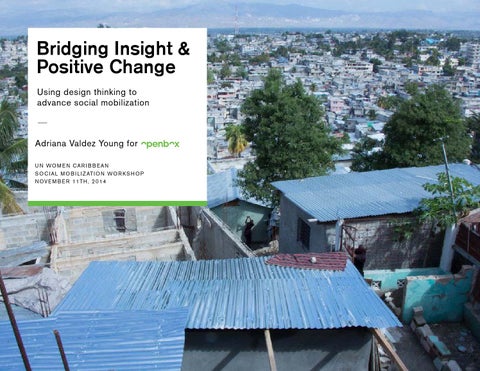
Bridging Insight & Positive Change Using design thinking to advance social mobilization
Adriana Valdez Young for U N WO M E N CAR I B B EAN S O C I A L M O B I L I Z AT I O N W O R K S H O P N OVE M B E R 11TH, 2014
COM M U N ITY | DE S IG N R E S EARCH PRACTICE
Culture is the original technology. Creating the right tools to affect change begins with understanding and designing from people’s everyday lives.
Locations Beijing, China Hong Kong, China Bangalore, India
Mumbai, India Pune, India Nairobi, Kenya
Kuwait City, Kuwait Beirut, Lebanon San Luis PotosĂ, Mexico
Ramallah, Palestine Pisco, Peru Barcelona, Spain
London, UK New York, USA
How might design thinking be applied to create tools for positive change? Designing for Communities Designing to Understand Designing to Empower Designing to Sustain From Insight to Change
DESIGNING FOR COMMUNITIES |
DESIGN THINKING
Design thinking is a methodology of creative problem-solving that opens new pathways for generating insights, building engagement, and achieving impact. D E S I G N TH I N K I N G CAN B O LSTE R E F F E CTIVE S O C I A L M O B I L I Z AT I O N E F F O R T S I N T H E S E WAYS :
D E S IG N I NG TO U N D E R STAN D
D E S IG N I NG TO E M POWE R
D E S IG N I NG TO SUSTAI N
Applying a people-centered, participatory approach to the research and design process in order to generate and validate ideas from lived experiences.
Building inclusive and accessible ways to open dialogue, iterate solutions, activate partnerships, and amplify positive role models and community dynamics.
Seeding the conditions and tools for communities to maintain and grow their own initiatives.
INSIGHT |
D E S I G N I N G T O U N D E R S TA N D
The Haiti Report, Port-au-Prince
“When women participate, they learn that what they have to say is important.”
Selling & Planning Rye Lane, London
“It’s not a racial thing. It’s about lifestyle.” — Mark, Immigrant Entrepreneur
— Eramithe Delva, KOFAVIV
Community mapping to understand how survivors of gender-based violence shift from victims to advocates.
Market mapping, ethnography and card games to understand and share the stories of recent immigrants and refugees building creative and resilient business models.
Key Success Factors Participant Observation Living and working alongside participants
Journey Mapping Tracing participant trajectories from their perspectives
Prototyping Testing lightweight design concepts and provocations to gather feedback and collect data
E NGAG E M E NT |
DE S IG N I NG TO E M P OW E R
Shield & Spear, South Africa
Yegna, Ethiopia
“I’m trying to free myself from community stigmas or expectations of the community.”
“I am realizing I want to change by listening to [Yegna].” — Yegna listener
— Floyd Avenue, Member of Smarteez Fashion Collective
Using visual storytelling as a tool to amplify the voices of artists testing the limits of freedom of expression and create new opportunities for dialogue.
Building a girl empowerment brand that includes a magazine, radio drama, and listening clubs to promote positive role models for girls and their communities.
Key Success Factors Storytelling Using visual language and narratives to facilitate empathy, dialogue, and engagement
Branding Demonstrating positive behaviors and lifestyles that people want to emulate
Peer Ambassadors Empowering community members to lead knowledge sharing and open feedback channels
CHANGE |
D E S I G N I N G T O S U S TA N
Beat Making Lab, Senegal
Barefoot College, India
“The people need a female rapper.”
“We always believed cutting and welding iron wasn’t for women, it was a man’s job.”
—Youssa Senerap, Gotal
—Student, Barefoot College
Setting up digital music production studios in partnership with women’s advocacy centers and community health clinics.
Peer-to-peer and DIY pedagogical approach to democratize access to professional training otherwise limited to an educated class.
Key Success Factors Participatory Learning Creating a holistic environment where participants are encouraged to bring their lived experiences to the learning process
Professional Development Equipping communities with professional skills and tools to improve their ocio-economic status
Partnerships Identifying community partners to contribute complementary resources and support long-term engagement
F ROM I N S IG HT TO P OS ITIVE CHANG E
Design thinking helps to make insights more actionable, accessible, and shareable. By taking a people-centered approach, you can open up more inspiring, empowering, and effective ways to mobilize for change.
Designing to Understand Participant Observation Journey Mapping Prototyping
Designing to Empower Storytelling Branding Peer Ambassadors
Designing to Sustain Participatory Learning Professional Development Partnerships
Thank You. Adriana Valdez Young adriana@opnbx.com opnbx.com