:اعداد ايمن منصور/ا خبير مادة
الكيمياء لغات Q1 -Choose the correct answer 1-The element which gives the maximum oxidation state among the transition elements (+7) in its compounds is ……
a-24Cr c-27Co
b- 25Mn d-26Fe
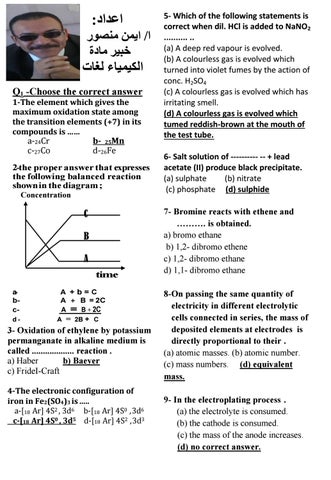
2-the proper answer that expresses the following balanced reaction shown in the diagram ; Concentration
time abcd-
A +b=C A + B = 2C A = B + 2C A = 2B + C
3- Oxidation of ethylene by potassium permanganate in alkaline medium is called ................... reaction . a) Haber b) Baeyer c) FrideI-Craft 4-The electronic configuration of iron in Fe2(SO4)3 is ….. a-[18 Ar] 4S2 , 3d6 b-[18 Ar] 4S0 , 3d6 c-[18 Ar] 4S0 , 3d5 d-[18 Ar] 4S2 , 3d3
5- Which of the following statements is correct when dil. HCl is added to NaNO2 .......... .. (a) A deep red vapour is evolved. (b) A colourless gas is evolved which turned into violet fumes by the action of conc. H2SO4 (c) A colourless gas is evolved which has irritating smell. (d) A colourless gas is evolved which tumed reddish-brown at the mouth of the test tube. 6- Salt solution of ---------- -- + lead acetate (II) produce black precipitate. (a) sulphate (b) nitrate (c) phosphate (d) sulphide 7- Bromine reacts with ethene and ………. is obtained. a) bromo ethane b) 1,2- dibromo ethene c) 1,2- dibromo ethane d) 1,1- dibromo ethane 8-On passing the same quantity of electricity in different electrolytic cells connected in series, the mass of deposited elements at electrodes is directly proportional to their . (a) atomic masses. (b) atomic number. (c) mass numbers. (d) equivalent mass. 9- In the electroplating process . (a) the electrolyte is consumed. (b) the cathode is consumed. (c) the mass of the anode increases. (d) no correct answer.
10- On electroplating a spoon of copper by a layer of silver, we use….. (a) silver cathode in copper sulphate solution. (b) silver anode in silver nitrate solution. (c) silver cathode in silver nitrate solution. (d) graphite anode in silver nitrate solution. 11-In the electrolytic cell for purification of copper, the cathode used is …. . (a) graphite rod. (b) impure copper. (c) pure copper. (d) copper sulphate solution. 12-The elements that have positive oxidation potentials .......... (a) act as cathode in galvanic cells. (b) replacehydrogen ions in acidic solutions. (c) are strong oxidizing agents. (d) have the ability to gain electrons. 13. The increase of temperature increases the rate of reaction as it---(a) increases the proportion of activated molecules. (b) the kinetic energy of the activated molecules is high enough to break the bonds within the molecules. (c) supply the energy needed for endothermic reactions. (d) all the previous answers are right. 14-The magnetic moment of the paramagnetic substances decreases by the increase of …………..
A-single electrons in the d sublevel. B-mass number C-atomic number d-number of paired electrons in the d sublevel 1- Electrons of ….. sublevel is
affected by the energy of visible light . a-4s b- 3P c-3d d-1s
15-The reaction of iron and sulphur gives ………… a-Fe2(SO4)3 b-FeSO4 c-Fe2O3 d-FeS 16- Which of the following cations whose carbonate salt is soluble in Water ? ----(a)Mg 2+ (b) NH4+ (C) Ca2+ (d) Cu2+ 17-FeO reacts with dil. acids to give…. a-iron(II) salt on b-iron(III) salt only c- iron(II) salt and water d-iron(III)salt and water 18-Which of the following ions would form a white precipitate when sodium hydroxide solution is added to it ? -------(a) Aluminum ions. (b) Calcium ions. (c) Iron (II) ions. (d) Copper (II) ions. 19- To deposit (gm/atom) of a trivalent metal .. ·········· coulombs are required (a) 9650 (b) 96500 (c) 189000 (d) 289500 20-Compound FeCl3 is………… a) Paramagnetic and colorured. b) Diamagnetic and colourless c) Diamagnetic and colorured. d) Paramagnetic and colourless
[Ag=108] a) Faraday (b) 1/10 Faraday 21-X, Y, Z and W are four c ) 1/5 Faraday ( d ) Faraday metals, on heating 26- A salt solution with silver nitrate Z + W oxide =Z oxide + W solution produce a yellow coloured X + Z oxide = No reaction precipitate which is insoluble in X+ Yoxide=X oxide +Y ammonia solution. So, the salt may be X + W oxide - No reaction (a) chloride. (b) bromide. So, the metals are arranged according (c) nitrate. (d) iodide. to their chemical activity as : (a)Y<X<W<Z (b)Y<X<Z<W 27-The degree of dissolution of Lead chloride in its saturated (c)X<Y<Z<W (d)X<Y<W<Z 22-which compound is an electrolyte? a- C6H12O6 glucose b- C 6H6 benzene c- CH3OH methanol d- CH3COOH acetic acid 23- We can detect glucose by using ...... a) Schiffs reagent b) iron tri chloride c) Fehling's solution 24- To recharge a car battery in which the acid density is 1.1 gm/cm3, the battery is connected to . (a) a hydrometer. (b) a source of electricity with a potential slightly more than that of the battery. (c) dynamo. (d) a source of electricity with a potential equals that of the battery. 25-The quantity of electricity needed to precipitate 1/10 equivalent of silver from silver nitrate solution ................
solution at a constant temperature equal ............... a- half concentration of lead cations (Pb++) b- Double concentration of lead cations (Pb++) c- Half concentration of chloride anions (Cl-) d- Double concentration of chloride anions (Cl-) 28-The anode in the car's battery is made of............ a) Copper ( b) aluminum c ) lead ( d) iron 29-Each half cell in the galvanic cell is called a ........... electrode. a) standard (b) reducible c) non - reversible ( d) reversible 30- If you are provided with the following metals: Iron - copper - zinc - gold. you can determine their locations in the electrochemical series by one of the following..... a)Its malleability and ductility . b ) addition of water to each metal. c ) addition of each one to a solution of the other metal d) addition of hydrochloric acid to each metal
31-The color of blue litmus solution turns red in the hydrolysis of ........... salt A-ammonium acetate B-ammonium chloride C-sodium carbonates D-ammonium carbonate 32-The color of methyl orange turns orange in the hydrolysis of ..............salt
A-ammonium acetate b-sodium carbonates C-sodium carbonates d- A and c
33-The ionization constants (Ka) of four weak acids are shown below, which Ka represents the weakest of these acids? a- Ka = 1 x 10⁻⁵ b- Ka = 1.0x 10⁻⁴ c- K a= 7.1x10⁻³ d- Ka = 1.7 x 10⁻² 34-Mass of magnesium precipitated by passing 2 Faraday in solution of magnesium sulphate is........... Mg=24 a) 48 grams ( b ) 12 grams c ) 36 grams ( d ) 24 grams 35-The alkane which contains more than 17- carbon atoms, is a … alkane . a) Solid b) Liquid c) Gaseous d) Vapour c36-When adding sodium carbonate to an acidic solution , a-PH increases b-PH decreases c-PH constant d- non is correct 37-What is the substance which was added to the solution (X)to change its PH value as shown in the figure ?
a-ammonium carbonate b-ammonium chloride c-sodium carbonate d-Distilled water
38- In Daniel cell the mass of the zinc electrode ………………….while the mass of the copper electrode…………………. D-ammon a)Increases, decreases. b) decreases, increases c) Increases, increases. d) decreases, decreases 39-During discharging in lead battery , substance ……………… is reduced. a)HgO b) Pb c) PbO2 d)H2SO4
Q2-Write the scientific expression of the following 1-Formula of hydrate iron III oxide 2- They are used as fungicide 3-the method of conversion of water gas to liquid fuel 4- Mixture of hydrogen and carbon monoxide 5- Catalyst in hydrogenation of oil 6-alloy is used in heating coils and electrical ovens 7- It is used in the detection of glucose by changing its colour from blue to orange 8-the element is used in tanning of leather.
9-The chemical analysis used to identify the constituents of the substance whether it is pure (simple salt) or a mixture of several substances.
10- An acidic gas turns an acidified solution of potassium dichromate by conc. H2SO4 into green. 11-The maximum pressure of water vapor in air at certain temperature
12-A stationary system apparently but a dynamic system reality 13- The masses of the different materials formed or consumed by the same amount of electricity are directly proportional to their equivalent masses. 14- The quantity of formed or consumed material at any electrode if it is gas or solid is directly proportional to the quantity of electricity that passes in the electrolytic solution 15- The presence of more than one organic compound having the same molecular formula. 16- A group of compounds having the same general molecular formula and graduated in their physical properties. 17- Combination of a large number of unsaturated simple molecules to form a large one. 18- The formula that indicates the number and type of atoms in the organic molecule and the kind of linkage between the atoms by the covalent bonds.
5-(finally divided nickel) 6-(nickel chromium alloy) 7-(fehleng solution) 8-Chromium 9-Qualitative analysis 10- Sulphur dioxide or SO2 11-saturated water vapour pressure
12-dynamic equilibrium 13- (Faraday second law) 14- (Faraday first law) 15-Isomer or isomerism 16-Homologous series 17-polymerization 18-Structural formula
19-catalytic hydration 20-Solubility product or Ksp
Q3-Give the scientific explanation:-
1-Transition elements are characterized by having variable oxidation states. Because the two sublevels 4S and 3d of nearly equal energy and their electrons are lost in sequence when the atom is oxidized. 2-The reaction of acetic acid with 19-It is addition reaction forming unstable ethyl alcohol is reversible one. compound which loses a water molecule , B. It takes place in both directions and a stable compound is formed . forward and backward so the products 20-It is the product of multiplication of and reactants are always found in the the concentration of ions of sparingly Solution soluble substance in its saturated solution each is raised to power number of moles CH3COOH + C2H5OH in balanced equation.
CH3COO C2H5 + H2O
answer
1-(2Fe2O3.3H2O) 2-(MnSO4) &(CuSO4) 3-(fisher tropsch) 4-(water gas)
3-The reaction of active metals (as Magnesium) with diluted sulphuric is irreversible reaction.
Because one of the products escapes from the medium as evolved hydrogen gas
Mg + 2HCl
MgCl2 + H2
4-Iron does not react with conc. nitric acid Due to formation of a thin non – porous layer of oxide which protects iron from further oxidation. (Passivity)
5-Magnetite reacts with conc. acids and gives two salts of iron II and III . Bec.it is a mixed oxide of Fe2O3 , FeO conc Fe3O4 + 4H2SO4 Fe2(SO4)3 + FeSO4 +4H2O 6 - The hydrogen ion does not exist freely in the aqueous solutions of acids. Because the hydrogen ion contains an empty orbital, so it can accept the lone pair of electrons on the oxygen atom in a water molecule by a coordinate bond forming the hydrated proton or hydronium ion
7- Sodium chloride solution has a neutral effect on litmus. NaCl Na+ + Cl-1 H2O H+ + OH- by addation NaCl + 2H2O + Na+ + OH-
H+ + Cl-
Because NaCl dissociates in water giving hydrochloric acid and sodium hydroxide which are strong electrolytes and completely ionized , so the concentration of H+ ions equals that of OH- ions ,
8- pH Value of pure water = 7 Because the concentration of hydrogen ion equals the concentration of hydroxyl ion = 10-7. 9- In the electrolysis cell of bauxite, the carbon electrodes must be changed from time to time. Because rising oxygen reacts with the carbon electrodes and gives carbon mono oxide and carbon dioxide 3 /2 O2 + 2C CO + CO2 Causing erosion of carbon electrodes 10-Reaction of iron with chlorine form iron III chloride Because chlorine is a strong oxidizing agent so it prevents the formation of iron II salt ď „ 2Fe + 3Cl2 2FeCl3
11-Recently we use a mixture of salts of aluminum sodium, calcium, fluorides, rather than carylite when extracting aluminum metal? B. it reduces melting point and has lower density than of the molten which facilitates the separation of aluminum, in the bottom of the electric cell 12-the density of the sulphuric acid in the battery can identify the car battery condition. B. when the battery is completely charged the density of acid equal from 1.28 to 1.30 gm/cm3 but if the acid density decreased to less than 1.2 gm/cm3, the battery needs to recharging and increasing its acid concentration
13-Lithium is used in making mobile battery . B. It is the lightest known metal and it has the lowest standard reduction potential relative to all metals ( - 3.04v) broken easily.
because water is a weak electrolyte so the 11-Using chloroform as anesthetic is stopped Because the inaccurate estimation of the dose causes the death of patient
12-The use of ethylene glycol as antifreeze substance Because it forms hydrogen bonds with water molecules and it prevents their combination with each other to form ice crystals reaction reaches more 3000°C. 13-Ethyne reacts by addition in two steps while ethene reacts in one step. Because ethyne contains two (pi) bonds while ethene contains one only.
Q4-How can you get 1-Iron III oxide from iron III chloride 0 FeCl3 + 3NH4OH >200 c 3NH4Cl + Fe(OH)3 2Fe(OH)3 Fe2O3 + 3H2O
Q5-What is the effect of heat on: 1-Iron II sulphate
Fe2O3 + SO2 + SO3
2- Iron II oxalate COO Fe COO
14-The reaction of alkenes with water needs acidic medium To produce positive hydrogen ion
2FeSO4
Absence of air
FeO + CO2 + CO
Q5-How can you get 1- The three iron oxides from iron 3Fe + 2O2 Fe3O4 Fe3O4 + H2 H2 O
0
400:700 c
3FeO +
2FeO + O2
Fe2O3
2-Iron III oxide from iron III chloride FeCl3 + 3NH4OH 0 3NH4Cl + Fe(OH)3 >200 c 2Fe(OH)3 3H2O
Fe2O3 +
Q6-How can you differentiate between
1- Carbonate salt and Bicarbonate salt Exp
By using magnesiu m sulphate solution
Carbonat e salt
Bicarbona te salt
a white ppt. of magnesium Sulphate is formed on cold
a white ppt. of magnesium Sulphate is formed after heating
2- How can you distinguish, without using reagents, between silver chloride and sodium chloride salts? Exp. sodium silver By adding water
chloride
chloride
is sparingly or slightly soluble in water
It completely dissolve in water
(3) Sodium nitrite and sodium nitrate salts.
Experim ent 1-By using dilute hydroc hloric acid
Nitrite salt Colourless gas evolves (NO)which turns reddish brown at the mouth of the test tube (NO2)
Nitrat e salt No reacti on
4-Sodium bicarbonate and sodium nitrite salts. Sodium sodium Exp. bicarbonate nitrite Effervescence Colourless tacks place 1-By using and CO2 gas gas dilute evolves hydrochloric evolved (NO)whic acid which turn h turns lime water reddish brown at milky for the mouth short time of the test tube (NO2)
Q7-Show by balanced chemical reactions what happens in each of the following: (1) Exposing filter paper moistened with acidified potassium dichromate solution to the gas which is evolved when the solid salt of sulphite reacts with dil. HCl K2Cr2O7(aq) +3SO2(g) +H2SO4(aq) K2SO4(aq)+ Cr2(SO4)3(aq)+ H2O(l) (2) Exposing filter paper moistened with lead acetate (II) solution to the gas which is evolved when the solid salt of sulphide reacts With dil. HCl (CH3COO)2Pb(aq) + H2S(g) PbS(s) ↓ + 2CH3COOH(aq) (3) Adding lead acetate solution to sodium sulphate. Na2SO4(aq) + (CH3COO)2Pb(aq) CH3COONa (aq) + PbSO4(s) Q8 -Show by balanced chemical reactions what happens in each of the following : (1) Passing carbon dioxide in limewater. short time CO2 (g) + Ca(OH)2(aq) CaCO3(s) + H2O(l) 2CO2 (g) + Ca(OH)2(aq)
long time
Ca(HCO3)2 2-Decomposing isolated acid from the reaction of sodium nitrite with dil. HCl 3HNO2
HNO3 +H2O(l) + 2NO(g)
Q9-compare 1-Blast furnace and Medrix furnace related to:Iron ore, Source of reducing agent, Reducing agent, chemical equation)
P .O .C
Blast furnace
Medrix furnace
iron ore
Fe2O3
Fe2O3
from coke coal [ C ]
from natural gas
CO
CO + H2
Source of reducing agent Reducing agent equation in Blast furnace
equation in Medrix furnace
Fe2O3(s) + 3CO(g) 2Fe(s) + 3CO2(g) Fe2O3(s) + 2CO(g)+ H2(g)
2Fe(s) +2CO2(g)+H2O(g)
2-Paramagnetic & diamagnetic substances related to:(define - magnetic moment)
Paramagnetic substance
Diamagnetic substance
It is the substance which is attracted to the magnetic field due to the presence of unpaired electrons in ( d ) orbitals .
It is the substance which is repelled to the magnetic field due to the presence of paired electrons in ( d ) orbitals .
3-types of chemical analysis
Qualitative analysis
Quantitative analysis
Analysis that aims to Analysis that identify the aims to measure constituents or the percent or components of the ratio or weight substance if it is pure of each ( simple salt )or constituent of the mixture from different substance . substances. 4-Anodic protection and Cathodic protection (1) Anodic (2) Cathodic protection protection covering iron with covering iron more active metal with less active than iron as zinc metal than iron (called as tin (Sn) galvanizing) iron scratching takes place iron is the will be cathode and zinc will anode anode and so when scratch corrode first happens zinc will corrode first and this takes long time
Q10-Mention one confirmatory test for each of the following (1) Chloride anion. NaCl (aq) + AgNO3(aq) AgCl (s) + 2NaNO3(aq) white ppt. (2) Iodide anion. NaI (aq) + AgNO3(aq) AgI (s) + NaNO3( aq) yellow ppt. (3) Phosphate anion. Na3 PO4+ 3 AgNO3 Ag3 PO4 +3 NaNO3 yellow p.pt
Q11 -Classify the following reactions into Irreversible and reversible reactions: 1-2Cu(NO3)2 = 2CuO + 4NO2 + O2 Irreversible 2- CH3COOH(aq)+ C2H5OH(aq) = CH3COOC2H5 (aq)+ H2O(L) reversible
Q14-What
happens when we put copper chloride solution in electrolytic cell Oxidation &reduction reaction take place non spontaneously anode
cathode
3 - In a closed vessel: CO (g)+ H2O (g) = CO2 (g+ H2 (g) reversible
Cu2+ Cl-
C
Q12- Arranged the following solutions in ascending order according to PH value 1 - NaCl – FeCl3 - (CH3COO) 2Ca NaCl neutral salt PH =7 FeCl3 acidic salt PH < 7 (CH3COO) 2Ca basic salt PH >7 FeCl3 < NaCl < (CH3COO) 2Ca Q13--What
is meant by corrosion ,write its chemical equation Corrosion It is electro chemical process of metals due to oxidation or losing electrons
a-at the cathode: Cu+2 + 2e- → Cu b - at the anode 2Cl- → Cl2↑ + 2 e Total reaction Cu2+ + 2ClCu + Cl2 Q15-Write down the name of the
following compound according to IUPAC system: a-
a-oxidation of iron
2Fe
2Fe2+ + 4e
b. At cathode (carbon) reduction takes place for oxygen of air as follow
2H2O + O2 + 4e 4OHc. Iron ions (Fe2+) combine with hydroxide ions (OH-) to form iron II hydroxide 2Fe2+ + 4OH2Fe(OH)2 d. Iron II hydroxide oxidizes in air to iron III hydroxide as follow 2Fe(OH)2 + H2O + 1/2O2 2Fe(OH)3 SO the total reaction is the sum of the above as follow: 2Fe + 3H2O + 3/2O2 2Fe(OH)3
3bromo, 2 methyl hexane b-CH3C(CH3)2 CH(CH2CH3)CH3 2,2, 4 tri methyl pentane
c- (CH3)2C(CH3)2 2,2 di methyl propane
a- surgeon
Q16- Find the magnetic moment of the cations of the following substances Cr2O3 , Fe2O3 , TiO2( 26 Fe , 24Cr , 22Ti) answer Cr III magnetic moment=3 Fe III magnetic moment=5 Ti+4 magnetic moment=0
Q17-What is the rule or effort of the following scientists in chemistry? a-Goldberg –Wage They put Low of mass action :At a constant temperature, the rate of a chemical reaction is directly proportional to the product of multiplication of the reactant concentrations
a-Berzelius He put vital force theory Organic compounds are formed from vital force, which is found in body of living cells
surgical instruments b- civil engineer
concrete -Electricity Towers
Q20-problems 1 - Amount of nitrogen gas and hydrogen gas introduced the in the container of volume 5 liters the interaction between them according to the equation N2 + 3 H2 2NH3 if the number of moles of nitrogen, hydrogen and ammonia at equilibrium is equal to 13.5 Mole, 1.25 Mole, 0.25 mole. Calculate the value of the equilibrium constant Concentration in mole / L = number of moles ÷ volume in liters The concentration of nitrogen N2 = 13.5 ÷ 5 = 2.7 mol / l The concentration of hydrogen H2 = 1.25 ÷ 5 = 0.25 mol / L The concentration of ammonia NH3 = 0.25 ÷ 5 = 0.05 mol / L
Kc
c-Wohler He prepared urea by evaporating ammonium cyanate solution which is prepared from reaction of ammonium chloride with silver cyanate by heating
Kc
[NH3]2 = [H ]3 [N ] 2 2 [0.05]2 = [0.25]3 [2.7]
Kc = 0.059 2- 2gm of impure sodium chloride dissolves in water and added to Q18-What is meant by : 1-transition element? the abundance of silver nitrate It is the element in which (d) or (f) 4.628 g of silver chloride sublevel incompletely filled by electrons precipitated. Calculate the in either the free or in one of its percentage of chlorine in the oxidation sample. Q19--Mention one use of iron in the profession of ;
Solution
[Ag=108 , Cl= 35.5 ]
NaCl + AgNO3 Na NO3 +Ag Cl 1mol 1mol The Mole of chloride Cl-= 35.5 gm The Mole of AgCl = 108 + 35.5 = 143.5 g Cl 35.5 g Xg
AgCl 143.5 g 4.628 g 35.5 × 4.628 143.5
Mass of chlorine = = 1.14 g
3-Calculate the value of pH of the solution of 0.01 mol / l of sodium hydroxide
Solution Sodium hydroxide strong alkali monoydroxyl fully ionized, so the concentration of [OH-] is equal to the concentration of alkaline solution itself = 0.01 -
POH = - log [OH ] = - log 0.01 = 2 PH = 14 - 2 = 12 4-Calculate KSP for silver chromate Ag2 CrO4 If you know that the 8concentration of [ CrO4-2]equal to 7.8 × 10⁻⁵ mole / L and the concentration of [Ag + ] equal to 1.56 ×10⁻⁴ mole / L
Solution Ag2 CrO4 2Ag++ CrO42KSP = [Ag +] 2 [CrO4-2]
KSP = [1.56 × 10⁻⁴] 2 [7.8 × 10⁻⁵] KSP = 1.9 × 10 -12 5 - In the balanced reaction CO + H2O H2 + CO2 H = + Explain how each change affects the following changes on the concentration of hydrogen A - add more of CO2 b - add more water vapor c - Adding a catalyst d - increase the temperature e - reduce the size of the pot
Solution A - add more of CO2 concentration of hydrogen decreases b - add more water vapor concentration of hydrogen increases c - Adding a catalyst concentration of hydrogen does not change d - increase the temperature concentration of hydrogen increases e - reduce the size of the pot concentration of hydrogen does not change bec. number of moles of reactants 3 - In the balanced reaction 3H2 (gas)+N2 (gas) 2NH3(gas) H = )-( . Explain the factors that decrease the amount of ammonia formed 1- decreasing pressure 2- increasing conc. Of ammonia
2Fe3O4 + 1/2 O2 2 × 232 g x
3- decreasing conc. Of nitrogen or hydrogen gas 4- heating or increasing temp. 6 - In the balanced reaction NH2 – NH2 N2 +2H2 H= Explain the effect of pressure and temperature to increase the rate of formation of nitrogen gas 1- decreasing pressure 2- increasing conc. Of NH2–NH2 3- decreasing conc. Of nitrogen or hydrogen gas 4- cooling or decreasing temp. 7- How many liters of oxygen gas at (stp) can be released from thermal dissociation of 42.6 grams of sodium chlorate ( NaClO3) into sodium chloride and oxygen ? [O=16 , Cl= 35.5 ,Na=23]
x =
2NaClO3 2(23+35.5+3x16)gm 213 gm 42.6 gm
2NaCl +
3O2
3 X 22.4 liters 67.2 liter x liter
Volume of oxygen = 42.6 x 67.2 = 13.44 liters 213
8-When oxidation of half grams of ore of magnetite Fe3O4 it turns into iron III oxide resulted in 0.411 g of Fe2O3. Calculate the percentage of black oxide in the raw. [Fe=56 , O= 16] Solution: The Mole of Fe3O4 = 3 × 56 + 64 = 232 gm The Mole of Fe2O3 = 2 × 56 + 48 = 160 gm
= 0.3973 gm
232 × 2 × 0.411 160 × 3
Percentage =
0.3973 x 100
= 79.46%
0.5
9-write the symbol of the following galvanic cell work indicating oxidized reducing agent and the value of the electromotive force of the cell H2+Cu2+ 2H+ + Cu Note that the oxidation potential of copper = -0.34 V (spontaneous or not) Solution
anode cathode H2 Cu
Oxi. Pot. Red. Pot.
Solution Write the balanced equation
3Fe2O3 3 × 160 g 0.411 g
0
- 0.34
0
0.34
From the equation H2
2H+
+2e
oxidation
( H2 reducing agent ) anode Cu
Cu2+ +2e
reduction
( Cu oxidizing agent) cathode
Symbol of cell H2/ 2H+ // Cu2+ /Cu e.m.f of cell = zero + 0.34= 0.34 volt Spontaneous because value of emf is +ve 10-(A) And (B) are two elements their oxidation potential 0.37 and 0.23volt and (A) and (B) are divalent
Answer the following :1-Which one is oxidized and which is reduced? A oxidized ,B ,reduced 2-Which one acts as anode and which is cathode? A anode . B cathode 3-Write the symbol of this cell? A / A2+ // B2+ / B 4- Write the reactions which take place at anode and at cathode? Anodic reaction A A2+ + 2e Cathodic reaction B2+ + 2e B 5-Which is more active A is more active than B 6- Find E.M.F for this cell? Emf = 0.37 – (- 0.23 ) = 0.14 volt 7- Does it gives electric current or not? Why? It gives electric current spontaneously B. emf is positive
1-Black carbon from sodium acetate CaO/∆
CH3COONa + NaOH
Na2CO3 + CH4 CH4
C + 2H2
1000 °c
2-Chloroform from methane CH4 + Cl2
CH3Cl + HCl
U.V U.V
CH3Cl + Cl2 CH2Cl2 + Cl2
U.V
CH2Cl2 + HCl CHCl3 + HCl
3-Ethane from ethanol H2SO4 conc.
C2H5OH C2H4 + H2
180 °c Pt or Ni
C2H4 + H2O C2H6
150 - 300 °c
4-dihydric alcohol from mono hydric alcohol or ethylene glycol from ethanol
7-Calculate the quantity of H2SO4 conc. electricity in coulombs required to C2H5OH 180 °c form:
C2H4 + H2O
(1) 0.1 mole of Cu2+ C2H4 + H2O + [o] KMNO4 Alkaline medium The amount of electricity needed to edit CH2 CH2 Mole OH OH = number of atoms of the molecule x faraday × valency = 1x1x2=2F 0.5 mloe needs =1x 2 x 0.5 =1 F = Q21-Explain by drawing exp. for 96500c
Q20- how can you get
electroplating the spoon or jug with a layer of silver
Cathode (-)
Anode(+) silver
spoon AgNO3
Steps: 1- Clean the spoon or jug well then connects it with the (-ve) pole of battery acts as cathode 2- Connect a pure silver rod to the (+ve) pole of battery acts as anode. 3- put the spoon and the silver rod in (AgNO3) solution 4- passing a suitable current for a time ,the spoon will plated with layer of silver Reactions At anode :- (silver rod) Ag Ag+ + e (oxidation) At Cathode :- (spoon) Ag+ + e Ag (redaction)
Q21-Give reasons for
(3) Both of ethyl alcohol and dimethyl ether have the same molecular formula (C2H6O), but they have different properties.
Because they have different structural formula or isomers (4) Methane is a saturated compound, but ethene is not. Because the bonds in methane molecule are single sigma bonds, but ethene molecule has a double bond between the two carbon atoms one sigma and one pi bond. (5) Alkanes are chemically inactive chemically. Because the carbon atoms are combined together by a single sigma bond which is strong and cannot broken easily. (6) Alkanes, alkenes or alkynes are homologous series. Because each compound exceeds the previous one by (–CH2) group.
The failure of vital force theory. Because the scientist Wohler destroyed it when he prepared urea by heating of two inorganic 7- Soda lime is used instead of NaOH in compounds (ammonium chloride and preparation of methane. Because Soda lime is a mixture of NaOH silver cyanate). and CaO , CaO is used to decrease melting point of the mixture . (2) The great number and variety of 8 -The colour of bromine water organic compounds. Due to the ability of carbon atoms disappears when it is added to ethylene, to combine with themselves or with while it remains on adding to methane. Because bromine reacts with ethylene by other atoms by different types of addition forming di bromo ethane which bonds & carbon is tetravalent
(1)
is colourless, whereas methane does not react with bromine .
Na2SO3(aq) + 2AgNO3(aq) Ag2SO3(s) ↓ + 2NaNO3(aq)
Q22-Mention one confirmatory test for each of the following : (1) Carbonate anion.
Black p.pt (4) Iodide anion. NaI (aq) + AgNO3(aq)
Salt solution + magnesium sulphate
AgI (s) + NaNO3( aq) yellow ppt. white ppt. is formed on cold soluble in (5) Phosphate anion. Na3 PO4+ 3 AgNO3 Ag3 PO4 hydrochloric acid. +3 NaNO3 solution
(aq)
Na2CO3(aq) + MgSO4(aq)
(aq)
yellow p.pt (s)
(aq)
Na2SO4(aq) + MgCO3(s) (2) Sulphide anion. Salt solution + silver nitrate solution black p.pt. is formed from silver sulphide
Q23- Write the chemical equations of: (1) The oxidation reactions in: (a) Daniel cell. Zn Zn+2 + 2e (b) The lithium ion C6 + Li+ + e
LiC6
Na2S (aq) + 2AgNO3
(c) The mercury cell. Zn Zn+2 + 2e
Ag2S(S) + 2NaNO3(aq)
d-The lead-acid battery. Pb
(3) Bicarbonate anion.
Pb2+ + 2e
Salt solution + magnesium sulphate (2) The reduction reactions in : solution white ppt. is formed (a) Daniel cell. after heating soluble in hydrochloric acid. Cu+2 + 2e Cu ∆ 2NaHCO3(aq) + MgSO4(aq) (b) The lithium ion Na2SO4(aq) + Mg(HCO3 (aq) )
(4) Sulphite anion. Salt solution + silver nitrate solution a white p.pt is formed which turn black by heat
CoO2 + Li+ + e = LiCoO2 (c) The mercury cell. Hg2+ + 2e
Hg
(d) The lead-acid battery.
PbO2 +4H+ +SO42- = PbSO4 + 2H2O
(3) The total reaction in : (a) Daniel cell. +2 +2 Cu + Zn Zn + Cu (b) The lithium ion
LiC6 + CoO2
C6 + LiCoO2
(c) The mercury cell.
Zn + HgO
ZnO + Hg
(d) The lead-acid battery.
Pb+ PbO2 +4H+ +2SO422PbSO4 + 2H2O (4) The recharge reactions in:
It act as electrolyte to connect between positive and negative poles (5) Diluted sulphuric acid in the car battery. It act as electrolyte to connect between positive and negative poles (6) Hydrometer. It is used in measuring the density of the acid solution in car battery Q25- Mention the disadvantages of each of the following: (1) The primary cells. It can not be recharge
(a) The lead-acid battery.
(2) The mercury cell. It is poisons
2PbSO4 + 2H2O Pb+ PbO2 +4H+ +2SO42-
Q26- Draw a labelled diagram for
Q24 What are the importance of each of the following: (1) Galvanic cells.
each of the following: (1) Daniel cell.
it changes chemical energy into electrical energy through spontaneous reactions,. (2) Salt bridge in the galvanic cell. It prevents saturation of excess of (+ve) zinc ions or (-ve) sulphate ions in (2) The lead-acid battery. the two half cells and the current will continuously flow. (3) Mercury cell.
It is used in ear phones, clocks and cameras (4) Potassium hydroxide in the mercury cell.
Q26-write the structural formula of
a- Urea
O ||
H–N–C–N–H | | H H
a-2,2, di methyl pentane CH3 | CH3-C-CH2-CH2-CH3 | CH3
Q28- Saturated open chain hydrocarbon having 17 atoms in its structure ." 1- What are the number of carbon and hydrogen atom in this compound. 5 carbon , 12 hydrogen 2- Write the molecular formula of this hydrocarbon . C5H12 3- Write the expected structural formulae, then name each one according to IUPAC
system. CH3-CH2-CH2- CH2 CH3 pentane
CH3 | CH3-CH-CH3 CH3 CH3 CH3 CH3 | | | 2,2 dimethyl propane CH3-CH-CH2- C- CH –CH2 –CH2 -CH3 CH3 | | CH3 CH3-CH-CH2- CH3 2methyl butane Q28-Write the name of each compound according IUBAC 5- Show by chemical equations and the aapparatus used to prepare each of CH3- CH - CH-CH3 | | the following methane gases in lab. C2H5 CH3 And write balanced chemical 2,3, di methyl pentane equation
b- 2,4,4,5- tetra methyl octane
bCH3- CH – CH2-CH-CH3 | | CH2 CH2 | | CH3 CH3
3,5, di methyl heptane
c-
CH3 | CH3-C=CH- CH3
2 - methyl 2 – Butylene
CH3COONa + NaOH CaO/heat CH4 + Na2CO3
مع اطيب التمنيات بالنجاح والتوفيق انشاءهللا
ايمن منصور/ا