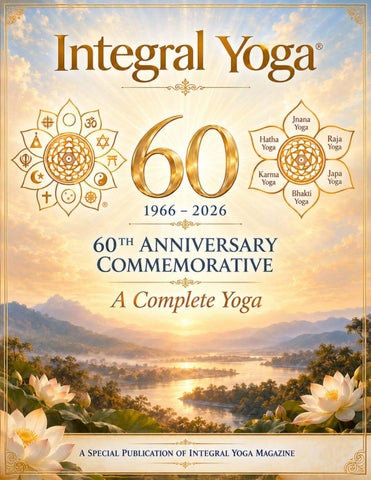
Integral Yoga® 60th Anniversary Commemorative 1966–2026
© 2026 Integral Yoga® Magazine/Satchidananda Ashram–Yogaville®, Inc. All rights reserved.
This commemorative publication brings together historical materials, reflections, teachings, photographs, and articles celebrating sixty years of Integral Yoga in the West. Individual photographs, archival materials, and other contributed works remain the property of their respective copyright holders where applicable.
Integral Yoga Magazine 108 Yogaville Way Buckingham, Virginia, 23921 USA Web: integralyogamagazine.org Email: iymagazine@integralyoga.org
Contents PART I • THE COMPLETE PATH
Introduction: Sixty Years of Integral Yoga
5
Integral Yoga: A Complete Path to Realization
8
The Gateway and the Mountain: How the Yoga Sutras and the Nondual Vision Fit Together in Integral Yoga
13
Understanding the Guru Principle
19
Integral Yoga at Sixty: Carrying the Whole Path Forward
23
PART II • BEGINNINGS AND LEGACY
How Integral Yoga Came to the West
31
“He’s Here!”: Meeting Swami Satchidananda in 1966
36
When Integral Yoga Was Young in New York
39
Peter Atman Max: Opening the Door for Integral Yoga
49
The Global Legacy of Integral Yoga
56
PART III • ROOTS AND LIVING TRADITION
The Spirit of Sat-Chid-Ananda
70
Swami Sivananda and the Yoga of Synthesis: A Formative Stream of Integral Yoga
73
A Sacred Tapestry: The Spiritual Roots of Integral Yoga
75
The Integral Yoga Dharma: Shared Principles for Spiritual Life
87
Page numbers correspond to the pages in this commemorative PDF.
(An early announcement for a talk at the first Integral Yoga Institute in New York.)
5
Introduction to the Commemorative Issue Sixty Years of Integral Yoga An anniversary invites us to remember. A sixtieth anniversary invites something more: to look back with gratitude, to understand more deeply what has been received, and to ask what is worth carrying forward. On October 7, 1966, the Integral Yoga Institute was formally established in New York City. Swami Satchidananda had come to America expecting to stay only briefly. Instead, a small circle of young seekers gathered around him, asked him to remain, and began what would become a remarkable chapter in the history of Yoga in the West. Yet the story of Integral Yoga did not begin in New York. Swami Satchidananda arrived carrying a spiritual inheritance formed over many years in India and Sri Lanka. His roots reached deeply into the sacred traditions of South India; into Yoga and Vedanta; into the devotional and mystical currents that shaped him from childhood; and into the teachings of his Guru, Swami Sivananda of Rishikesh. These streams found a distinctive and accessible expression in the complete path he offered to his students as Integral Yoga. Integral Yoga embraces the whole human being. Its six branches—Jnana, Hatha, Raja, Japa, Bhakti, and Karma Yoga—bring wisdom, physical and energetic practice, mastery of the mind, sacred sound, devotion, and selfless service into one integrated spiritual life. The practices are many, yet their purpose is one: realization of the True Self and the expression of that realization in daily life. During the sixty years since those first gatherings in New York, Integral Yoga has taken many forms. It has been practiced in ashrams and city centers, homes and hospitals, schools and prisons, retreat halls and meditation rooms. It has contributed to emerging fields of Yoga therapy and lifestyle medicine, fostered interfaith understanding, trained teachers around the world, supported education and humanitarian service, and offered countless individuals a practical way to bring spiritual life into ordinary life. The story, however, cannot be told only through institutions and accomplishments. Integral Yoga was transmitted through relationships: between Guru and disciple, teacher and student, friend and friend, and among people who practiced, served, questioned, struggled, learned, and built together. Some of the most illuminating pages of this commemorative therefore come from those who were present during the early years and remember what it felt like when the story was still new.
6
This volume brings those dimensions together. It traces the unlikely chain of events that brought Swami Satchidananda to America; recalls the early years of the Integral Yoga Institute; explores the spiritual streams that shaped the Integral Yoga Tradition; reflects on the meaning of his teaching and his name; remembers individuals whose lives became inseparable from the story; and looks at some of the ways Integral Yoga has found expression in the world. It is not intended as an exhaustive history. Sixty years of spiritual life cannot be contained within a single publication. Rather, these pages offer a series of windows—into the beginnings, the teachings, the people, the roots, and the spirit of a path that has touched many lives. History is worth preserving not simply so that the past will be remembered. A spiritual tradition remains alive when what has been received continues to be understood, practiced, and embodied. As Integral Yoga marks sixty years in the West, may this commemorative be offered in that spirit: with gratitude for Swami Satchidananda and the timeless teachings he shared; with appreciation for all those whose dedication and service helped carry them forward; and with renewed attention to the purpose at the heart of the Path—the realization of who we truly are. Om Shanti.
7
(A complete spiritual path designed to engage the whole of human life.)
Integral Yoga: A Complete Path to Realization For many people, the first encounter with Integral Yoga comes through a Hatha Yoga class, a retreat, or one of its teachers. Yet Integral Yoga is much more than a collection of practices. It is a complete spiritual path designed to engage the whole of human life. Integral Yoga is a Yoga-Vedanta tradition. Yoga and Vedanta are not identical systems of thought. Classical Yoga offers a disciplined path of practice through which the body, vital energy, senses, and mind are gradually refined and steadied. Advaita Vedanta provides the nondual vision that gives the Path its ultimate orientation: there is one Infinite Reality, and our essential nature is not different from That. In Integral Yoga these two streams work together. Practice prepares and clarifies the instrument; spiritual understanding reveals what the practice is ultimately for.
8
What Makes Integral Yoga “Integral”? The word integral means whole. Human beings do not live through only one dimension. We have bodies and minds, thoughts and emotions, energy and will. We act, relate, love, question, seek meaning, and long to know what is ultimately true. A complete spiritual path therefore needs to engage the whole person. Swami Satchidananda taught six branches of Yoga as complementary dimensions of one Path: Jnana Yoga is the path of wisdom and spiritual inquiry. It asks the fundamental questions: What is ultimately real? Who am I beneath the changing body, mind, personality, and circumstances of life? Its aim is not simply intellectual knowledge, but direct recognition of our true nature. Hatha Yoga works with the physical body and the vital energy that animates it. Through postures, breathing practices, deep relaxation, cleansing practices, diet, and balanced living, the body and nervous system become steadier instruments for spiritual life. Raja Yoga is the science of the mind and self-mastery. Through ethical discipline, concentration, meditation, and the progressive refinement described in Patanjali’s eight limbs of Yoga, the restless mind becomes clear and still. Japa Yoga uses the repetition of sacred sound, or mantra, to attune the mind and heart to the Divine. Mantra can become a current of sacred continuity running through meditation and daily life alike. Bhakti Yoga opens the heart through prayer, worship, chanting, love, and devotion. It transforms emotion into a means of drawing closer to the Divine and recognizing that same sacred Presence in all. Karma Yoga brings the Path directly into action. Work becomes an offering when it is performed with care, nonattachment, and a spirit of selfless service. The question changes from “What will I get from this?” to “How may this action serve?”
9
No single branch is the whole of Integral Yoga. Each illuminates and supports the others. Wisdom without love can become dry. Devotion without discrimination can lose direction. Meditation without ethical grounding can become unbalanced. Physical practice without a spiritual aim can become merely exercise. Service without inner practice can become exhausting. Their integration is their strength.
(Goal of Integral Yoga written by Swami Satchidananda, late 1960s).
10
The Vision Behind the Practice A spiritual path also needs to know where it is going. Integral Yoga is grounded in the nondual vision of Advaita Vedanta. Vedanta calls the ultimate Reality Brahman—Infinite Consciousness, limitless Being—and teaches that the true Self is That. From this perspective, Self-realization does not mean becoming something we are not. It means recognizing what has always been true beneath the changing conditions with which we ordinarily identify. This vision gives meaning to every dimension of practice. We care for the body, yet we are not limited to the body. We steady the mind, yet we are not merely the thoughts passing through it. We cultivate love and compassion, not simply as desirable qualities, but because separation is not the deepest truth. We serve others because, at the deepest level, there is no absolute “other.” The Eight Limbs and the Six Branches Patanjali’s eight limbs of Yoga form a foundational inner architecture within Integral Yoga: ethical principles, personal disciplines, posture, regulation of the life force, withdrawal of the senses, concentration, meditation, and absorption. Raja Yoga presents this eightfold system most explicitly and systematically, while the six branches together engage the whole person and give expression to the complete Integral Yoga Path. The six branches give the Path greater breadth. Jnana provides its orienting vision. Hatha develops the body and vital energy. Raja provides systematic inner discipline. Japa works through sacred sound. Bhakti opens the heart. Karma carries spiritual practice into every action and relationship. Together, the limbs and branches allow the spiritual life to permeate the whole person.
11
Rooted in Tradition, Open to All Integral Yoga arose within the ancient spiritual culture of India. Swami Satchidananda’s formation included the Tamil Shaiva, Siddhar, and devotional traditions of South India; the wisdom of Advaita Vedanta; the classical discipline of Yoga; and the Yoga of Synthesis taught by Swami Sivananda. These roots matter. Universality does not require a tradition to erase its origins. At the same time, Swami Satchidananda taught that spiritual truth is not the possession of any single religion. His familiar statement, “Truth is one, paths are many,” expresses the vision that became one of the most visible features of his interfaith work. This does not mean that all traditions are identical or should be blended together. It means that people can stand sincerely within their own spiritual path while honoring the sacred in the paths of others. The Goal Swami Satchidananda described many fruits of Yoga: a healthy body, a peaceful mind, a loving heart, clarity, strength of will, and a life of useful service. Yet the culmination of the Goal of Integral Yoga that he originally wrote in his own hand was unmistakable: Realization of the True Self. The immediate benefits of Yoga matter deeply. Greater health, calmness, balance, compassion, and usefulness enrich human life. Yet they point beyond themselves. Integral Yoga ultimately asks the ancient question beneath every spiritual search: Who are we really? The Path leads inward toward that discovery—and then outward again, as realization is expressed through the way we live, love, serve, and meet the world. That is the completeness of Integral Yoga: not escape from life, but the transformation of life through the recognition of the Truth at its heart.
12
The Gateway and the Mountain: How the Yoga Sutras and the Nondual Vision Fit Together in Integral Yoga
(“The Gateway & the Mountain,” an artistic rendering.) The Recipe Swami Satchidananda once explained Raja Yoga with a recipe. In New York in September 1966, in his first conversation with a young student named Sadasivam Greenstone, he asked whether Sadasivam could cook. You get a recipe from a trusted source, Sadasivam said, gather good ingredients, and follow the steps with care. Swami Satchidananda held up Swami Vivekananda’s Raja Yoga, a presentation of Patanjali’s Yoga Sutras. This was the recipe. If Sadasivam wanted the peace he saw in his teacher, he had only to follow the instructions. A recipe is made for something. What was this one for? Patanjali had company in those first classes. Among the first scriptures Swami Satchidananda taught his American students were three from his Tamil homeland: the Thirukkural of Thiruvalluvar, the Thiruvasagam of Manikkavasagar, and the Thirumantiram of Thirumular. Sadasivam loved the Thirumantiram most. He noticed it appearing less often, while the Thirukkural, a practical guide to virtuous living, appeared more, and he asked why. The students were not yet ready for its advanced teachings, Swami Satchidananda told him. They needed a foundation first. And the teachings must never be watered down: the teacher’s work is to make
13
them understandable and keep their truth intact. He kept the teaching whole and changed the order in which he gave it. Patanjali became the gateway of Integral Yoga. The mountain beyond the gate is Brahma vidya (knowledge of the Absolute), the nondual vision of Advaita Vedanta. The gate and the mountain belong to different philosophies. Swami Satchidananda taught both, and the way they fit together is the design of Integral Yoga. The Gateway: Patanjali’s Method Patanjali’s 196 aphorisms present Yoga as a method with a defined goal, a defined obstacle, and an ordered practice. Swami Satchidananda translated the goal, in the second sutra, as “The restraint of the modifications of the mind-stuff is Yoga.” The obstacle is the restless mind, with its vrittis (thought-waves) and, beneath them, the kleshas (afflictions), rooted in avidya (ignorance of our true nature). The practice rests on abhyasa and vairagya: “These mental modifications are restrained by practice and non-attachment,” in his translation of sutra 1.12. It unfolds through ashtanga yoga, the eight limbs: yama and niyama (ethical restraints and observances), asana (posture), pranayama (regulation of the breath), pratyahara (withdrawal of the senses), and dharana, dhyana, and samadhi (concentration, meditation, and absorption). Limb by limb, the grip of the mind loosens. A young New Yorker in 1966 could take up this system and keep whatever faith they came with. Patanjali names Ishvara (the Supreme) and recommends surrender to the Divine, and he leaves the form of the Divine to the practitioner. Sutra 1.39, in Swami Satchidananda’s translation, offers meditation on “anything one chooses that is elevating.” A Christian, a Jew, or a seeker with no religion at all could enter through their own devotion. Patanjali gave those first students something they could begin the same evening they heard it. Where the Two Visions Part The Yoga Sutras carry a darshana (philosophical vision) of their own. Classical Yoga is closely allied with Samkhya, which sees two principles in all of existence. Purusha is the Seer: pure, unchanging awareness. Prakriti is the seen: nature in every form, including the body, the senses, and the mind itself. We suffer because we take ourselves to be what we see. Sutra 2.17, in Swami Satchidananda’s translation: “The cause of that avoidable pain is the union of the Seer (Purusha) and seen (Prakriti, or Nature).” The remedy is viveka (discrimination): learning to tell what changes from what stays, until the Seer stands free of everything it sees, thoughts included. Patanjali calls this freedom kaivalya, “the independence of the Seer” in Swami Satchidananda’s translation. Here the two visions begin to part. In Patanjali’s account, liberation leaves the distinction standing. Purusha is free, and Prakriti remains Prakriti. The Seers are also many. Samkhya counts a Purusha for every being, and sutra 2.22 says of the seen, “Although destroyed for him who has attained liberation, it (the seen) still exists for others, being common to them.”
14
(Artist rendering of Sri Patanjali, left and Adi Shankara representing Advaita Vedanta, right). Advaita Vedanta, the teaching of the Upanishads as Adi Shankara explained it, takes one more step. Atman, the Self, is Brahman, the one Reality. One sun shines in many pots of water, and the many Seers are that one Self. The seen belongs to it too: body, mind, and world have no existence apart from Consciousness, as a wave has none apart from water. Swami Satchidananda expressed the goal of Integral Yoga in more than one way. In his handwritten statement of the Goal of Integral Yoga, its culmination is “Realization of the True Self.” He also spoke of realizing the spiritual unity behind all the diversity of creation and living harmoniously as one universal family. These are not different goals. The first speaks from the standpoint of discovering the true Self within; the second expresses what that realization reveals—that the Self within is the one Reality appearing through all beings and all creation. Patanjali’s kaivalya frees the Seer from the seen, and the unity Swami Satchidananda named goes on to find one Self in both, and in every being. Who Is the Witness? The word that blurs the two visions most often is the witness, sakshi. Swami Satchidananda gave witnessing great emphasis, and the word does two jobs. Sit and watch a thought. It comes, it changes, it goes, and you remain. Watch anger arise, and it is seen as a movement in the mind, something more distant than my anger. This is one of Raja Yoga’s great discoveries: what can be seen cannot be the Seer. Witnessing in this sense is a
15
stance the mind learns to take toward thoughts, emotions, and sensations. It can be practiced, it frees us from our mental weather, and in Patanjali’s terms it is the discrimination between Purusha and Prakriti at work. Then the question changes. What about the one who says, “I am watching”? That, too, can be noticed. Even the satisfaction of being a good witness can be seen. A student can settle at this stage for years, and the stance still holds two: a watcher here, a watched there. Advaita presses on. Who is the witness? In Advaita, sakshi names the Self as self-luminous Consciousness, the light by which every thought is known, including the thought “I am witnessing.” This Consciousness performs no act of observing and takes up no position. It is present in the restless mind and the still mind alike. When the last distinction between observer and observed falls away, what remains is Pure Consciousness itself, Atman, Brahman. Sutra 1.3, in Swami Satchidananda’s translation, reads: “Then the Seer (Self) abides in Its own nature.” Samkhya hears a Seer standing free of nature. Advaita hears the one Self, with nothing standing apart from it. How Swami Satchidananda Held Them Together Integral Yoga starts where we are. Sit straighter. Breathe. Tell the truth. Repeat the mantra. Watch what the mind does. These look like small things, and slowly they make the instrument still enough for another question to be heard: Who am I? The book Swami Satchidananda held up to Sadasivam gives the image. In Raja Yoga, Swami Vivekananda compares the mind to a lake: the vrittis are its waves, the true Self is the bottom of the lake, and the bottom can be seen only when the ripples subside. Patanjali stills the water. Classical Vedanta asks for the same preparation before the knowledge of the Self, namely discrimination, dispassion, calm, self-restraint, and a longing for liberation. A student who sincerely lives the eight limbs develops many of the same capacities: discrimination, nonattachment, self-restraint, steadiness, and inwardness.
16
(Artistic rendering of the 6 branches of Integral Yoga.) Integral Yoga can therefore take Patanjali seriously on his own terms. His psychology of the mind and his discipline remain powerful exactly as he gave them, and his philosophy of two principles can be read as he meant it. The nondual darshana that orients Integral Yoga comes through Advaita Vedanta and is articulated most explicitly in Jnana Yoga, which carries the inquiry further, into the nature of the Self and of ultimate Reality. Swami Vivekananda, a monk of Advaita Vedanta, wrote the book on Patanjali that became Sadasivam’s recipe. Jnana Yoga gives explicit voice to the nondual vision that orients the whole Integral Yoga Path. Hatha Yoga works through the body. Raja Yoga steadies the mind. Japa Yoga gathers the mind around the Divine Name. Bhakti Yoga opens the heart. Karma Yoga loosens the grip of selfinterest. Jnana Yoga asks the question waiting inside all of them: Who is practicing? The vision and the practice need each other. The nondual vision without practice remains an idea held by a restless mind. Practice without the vision can stop at the gate: a meditator can spend years refining the watching of thoughts and take that refinement for the goal. Held together, they give the student a double vision: tend to what needs tending in daily life, with an easeful body, a peaceful mind, and a useful life, while knowing more and more deeply what all of it is. Sixty Years On Sixty years ago, Swami Satchidananda set the Thirumantiram aside for students who needed a foundation and handed them a recipe. Integral Yoga students have been following it ever since.
17
The recipe was for something. Patanjali teaches us to still the mind enough to see, and Advaita asks what, finally, is seeing. The gate opens onto the mountain, and at the summit is the teaching Swami Satchidananda carried from the beginning: the Self within is the Self in all. About the Author: Erik Phillips-Nania is a Yoga teacher, writer, former attorney, and author of Climate Change Yoga (2015, rev. 2021), which develops an eco-yoga framework for the healing and revitalization of the Earth. He holds a JD and a Master of Environmental Law and Policy from Vermont Law School, and a 500-hour RYT teaching certification in the Himalayan Kundalini lineage from World Peace Yoga School in Rishikesh. He is founding editor of the Journal of Contemplative Neuroscience & Yogic Studies, and his writing explores dharma, moksha, Ayurveda, pranayama, sacred ecology, and the yogic perspective on contemporary civilization. Erik lives and serves at Satchidananda Ashram–Yogaville as Programs Coordinator. He writes at https://epn108.substack.com/.
(Erik Phillips-Nania)
18
Understanding the Guru Principle: The Spiritual Principle Beyond the Human Personality
(Swami Satchidananda paying respects to his Guru while in Swami Sivananda’s kutir, Rishikesh, 1981.) One of the central teachings of the Integral Yoga Tradition is also one that can be difficult to understand in the modern West: the principle of Guru. In the traditions of Yoga and Vedanta, Guru means more than an individual spiritual teacher. Behind the human teacher is what is called Guru-tattva—the universal principle of spiritual wisdom and grace through which the seeker is guided toward realization of the True Self. The human Guru gives that principle a living form. Through teaching, spiritual presence, guidance, initiation, example, and relationship, something that might otherwise remain philosophical becomes personal and transformative. Swami Satchidananda expressed this distinction very directly: “What you call the spiritual master or Guru is not the person. The Guru is eternal. The Guru’s inspiration, the Guru’s spiritual force, the Guru’s divine energy, the Guru’s vibration will always be there guiding you, directing you.” The person and the principle therefore belong together without being identical. Guru-tattva transcends any one individual. The Guru is the human channel through whom that universal principle functions within a particular spiritual lineage and relationship.
19
Guru, Lineage, and Transmission Spiritual traditions are carried through transmission. Teachings can be written in books, recorded, translated, and studied, yet a living tradition is more than information. It is wisdom received, practiced, realized, and passed from teacher to student. Swami Satchidananda himself was formed within such relationships. His spiritual life was shaped by the sacred culture of South India and by luminaries including Sri Sadhu Swamigal, Sri Swami Chidbhavananda, Sri Ramana Maharshi, and others. Later, through Sri Swami Sivananda of Rishikesh, he received Sannyas initiation and entered that formal lineage that continues within Integral Yoga. These relationships were not all identical. They represented different streams of spiritual formation, practice, realization, and transmission. Together they helped form the teacher who would eventually bring Integral Yoga to the West. In a lineage-based tradition, the universal and the particular belong together. Guru-tattva is the universal principle. The Guru is the particular human being through whom a student receives a spiritual transmission, and through whom a tradition is given a recognizable form. For Integral Yoga, that human being is Swami Satchidananda. The Integral Yoga Tradition came through his spiritual formation, realization, teachings, and the complete Path he transmitted to his students. Guru-bhakti Bhakti Yoga is the path of love and devotion. When that love and devotion are directed toward the Guru principle, it is called Guru-bhakti. This was an important part of the spiritual tradition Swami Satchidananda himself received. His Guru, Swami Sivananda, wrote: “Guru bhakti is the foundation of all other Yogas—Karma Yoga, Bhakti Yoga, Raja Yoga, Hatha Yoga, etc.” Guru-bhakti was not something Integral Yoga introduced as a personal addition to Yoga. It was part of the spiritual inheritance in which Swami Satchidananda himself had been formed and which he lived as a disciple. Guru-bhakti may naturally include deep personal love and gratitude toward the individual who served as one’s Guru. Yet its deepest focus is the spiritual Reality reflected through that person—the wisdom, light, and grace that awaken the disciple to their true nature. People will express this relationship differently. For some, it takes the form of profound personal devotion. Others relate primarily through the teachings, spiritual practice, gratitude, reverence, or the guidance they have received. Swami Satchidananda’s place as the founder and Guru through whom the Integral Yoga Tradition was transmitted is part of the Tradition itself. A person’s personal relationship with
20
him is their individual choice; his place within the Integral Yoga Tradition does not depend upon whether a particular person feels devotional toward him.
(Sri Sadhu Swamigal, the family Guru who played an important role in Swami Satchidananda’s early spiritual life and formation.) The Spiritual Transmission and the Human Personality Understanding Guru-tattva also allows us to make an important distinction between spiritual transmission and the human personality through which it flows. The human Guru lives a human life. A mature understanding of Guru-tattva asks us to hold reverence for the spiritual wisdom transmitted through the Guru together with discernment about the human life through which it was expressed. The truth of a teaching can be recognized as true. Genuine spiritual awakening, guidance, and transformation experienced through a teacher remain genuine. At the same time, human actions can be viewed honestly, with the same discernment and ethical responsibility that Yoga asks us to bring to every area of life. Guru-tattva helps us understand how these realities can be held together. The spiritual principle is greater than the individual personality through which it functions. The human instrument has its history, personality, gifts, relationships, and complexities. The wisdom toward which the Guru points transcends them all. This distinction allows gratitude for what has
21
been genuinely received to coexist with discernment about the human personality through which it was transmitted. It also helps clarify the continuing place of Swami Satchidananda within the Integral Yoga Tradition. As its founder and Guru, he remains the one through whom Integral Yoga took its contemporary form and through whom its complete Path was transmitted to his students. Gurutattva allows the spiritual transmission to be understood as greater than the individual personality through which it was expressed, while preserving the essential role of the Guru within the Tradition. A Living Transmission Guru-tattva also helps explain why spiritual transmission does not depend entirely upon the continued physical presence of the Guru. In the Yoga tradition, the spiritual relationship with the Guru is not confined by time or space. The Guru’s physical form may no longer be present, yet the spiritual relationship and transmission continue. The Guru may still be experienced as a living presence and source of guidance, and the disciple’s relationship with the Guru can continue to deepen inwardly. Guru-tattva helps us understand this continuity. The human form serves as an instrument of transmission, yet the Guru principle is not limited to that form. What was received through the Guru in physical presence is not confined to a particular time, place, or period of the disciple’s life. The Guru points toward the teaching. The teaching points toward realization. And realization reveals the Reality that was never confined to either Guru or disciple. The Guru and the True Self The deepest purpose of the Guru-disciple relationship is therefore not attachment to the Guru. It is realization of the Self. The Guru serves as a mirror. What the disciple may initially recognize as peace, wisdom, love, or spiritual radiance in the Guru ultimately points toward the same Reality within. Jnana Yoga gives the orienting vision: the Self we seek is our own deepest nature. Bhakti Yoga gives the heart’s movement toward that Reality through love. Guru-tattva brings these together. The disciple may begin by looking toward the Guru, yet the Guru continually points back toward the Truth that is already present. The deepest teaching is not, “Remain forever looking at me.” It is: recognize That which you see through me as your own true Self. In this way, Guru-tattva is neither the worship of a human personality nor an abstract spiritual concept. It is the living principle through which spiritual wisdom is received, transmitted, and finally realized. And when that realization dawns, the apparent distance between Guru, disciple, and the Truth toward which both have been pointing begins to disappear.
22
Integral Yoga at Sixty: Carrying the Whole Path Forward
(Photo of opening portion of the original aerogramme sent to Bombay, 1966.) In a handwritten aerogramme from Swami Satchidananda to Sohini Mehta – his first Indian disciple living in Bombay – he wrote, “I am now in New York, America. I just came for 2 days here, but many devotees have gathered round and insisted that I must stay longer. They have even wanted to form a sangha, and so we formed the Integral Yoga Institute.” That was on October 7, 1966. Sixty years have passed since he wrote those words. In South India, the completion of sixty years is traditionally recognized as Shashti Poorthi, a milestone marking the completion of a full cycle and a time for gratitude, reflection, and renewed spiritual purpose. As Integral Yoga marks sixty years in the West, the symbolism feels especially fitting. An anniversary naturally invites celebration: gratitude for what has been given, for the lives that have been touched, and for the many ways the teachings have traveled far beyond the small circle that first gathered around Swami Satchidananda in 1966. A sixtieth anniversary also offers an opportunity to look again at the Path itself. What is Integral Yoga in its fullness? And what does it mean to carry the whole Path forward? A Living Spiritual Tradition Integral Yoga is a spiritual tradition as well as a system of practice. A spiritual tradition is more than an organization, a method, or a collection of techniques. It carries a lineage through which
23
spiritual teachings are transmitted from teacher to student. It has an understanding of Reality that gives the path its direction, disciplines through which that vision is lived, sacred teachings and practices, spiritual community, and a clear understanding of the purpose toward which the path is leading. Integral Yoga contains all of these. Its roots reach through Swami Satchidananda to his Guru, Swami Sivananda, and into the wider streams of Yoga, Vedanta, and the South Indian Tamil Shaiva traditions that formed Swami Satchidananda from his earliest years. Its spiritual life includes meditation, mantra, study, selfless service, Hatha Yoga, devotion, ethical discipline, worship, satsang, and the relationship between Guru and disciple. Together, these form the living context of the Integral Yoga Path. Why Integral Yoga Is Integral The word integral points to wholeness. Swami Sivananda taught a Yoga of Synthesis because he recognized that the human being is multifaceted. We think and feel. We act and choose. We inhabit a body and live through the energies that sustain it. We seek wisdom, love, freedom, meaning, and relationship with the Divine. A complete spiritual path therefore needs to address the whole person. Swami Satchidananda carried this same understanding into Integral Yoga. Its six branches—Jnana, Hatha, Raja, Japa, Bhakti, and Karma Yoga—engage different dimensions of human life while serving one spiritual aim. Jnana Yoga develops discrimination and inquiry into our true nature. Hatha Yoga works with body and vital energy. Raja Yoga disciplines and steadies the mind. Japa Yoga uses sacred sound and mantra to focus and attune the mind and heart. Bhakti Yoga opens the heart through love and devotion. Karma Yoga transforms action through selfless service, nonattachment, and offering. Their strength lies in their integration. A particular practice or branch may draw someone more strongly at a particular time. Integral Yoga nevertheless invites the whole person into the Path. The branches support and balance one another because the person practicing them is whole. This is what makes Integral Yoga integral. The Vision That Gives the Path Its Direction A complete spiritual path also needs a clear understanding of where it is leading. The traditional Sanskrit word darshana refers to this orienting vision: an understanding of what is ultimately real, who we truly are, what keeps us bound, and what spiritual freedom means. Integral Yoga is grounded in the nondual vision of Advaita Vedanta. Nonduality means that ultimate Reality is not divided into separate, independent realities. Beneath and within the apparent diversity of life is one Infinite Reality—one Consciousness, appearing through countless forms. Vedanta calls that infinite Reality Brahman and the essential nature of each human being Atman, the true Self. Its central realization is that the true Self is Brahman. Spiritual realization is not the creation of something that does not yet exist. It is the recognition of what has always been true,
24
obscured by our identification with the changing body, personality, thoughts, emotions, and circumstances of life. This helps clarify two ways in which Swami Satchidananda spoke about the goal of Integral Yoga. In the “Goal of Integral Yoga” that he originally wrote in his own hand in the late 1960s, he named “Realization of the True Self” as its culmination. At other times he described the goal as realizing the spiritual unity behind all the diversity of creation and living harmoniously as members of one universal family. These are two expressions of the same realization. “Realization of the True Self” speaks from the standpoint of the seeker looking within: Who am I beneath the changing body, mind, personality, and circumstances of life? The recognition of spiritual unity speaks from the standpoint of what that realization reveals: the Self discovered within is not separate from pure Infinite Consciousness appearing as all beings and all creation. The inward and outward realizations meet in the same place. To know the Self is to discover that the deepest truth within us is the same Self shining through the many. Two phrases are especially familiar to many practitioners of Integral Yoga: “Truth is one, paths are many” and “Easeful, peaceful and useful. Those are the three words that I use to define a yogic life.” The first expresses Swami Satchidananda’s interfaith vision: many spiritual and religious paths can lead toward the one Truth. The second describes the qualities of a yogic life—greater ease, peace, and usefulness in the world. These teachings are important expressions of Integral Yoga, yet neither replaces its deeper spiritual aim. In the Goal of Integral Yoga that Swami Satchidananda wrote in his own hand, the culmination is “Realization of the True Self.” One describes how Yoga is lived; the other names the fullest fruition of the Path.
25
(Photo: Artistic composite of some of the spiritual streams, sages, and teachers that shaped Swami Satchidananda’s spiritual formation and the Integral Yoga Tradition.) Lineage and Spiritual Transmission Integral Yoga has always understood spiritual teaching as something passed through a living lineage from teacher to student. The traditional term for this is Guru-parampara. Guru-tattva is also central in Integral Yoga. It refers to the Guru principle behind that lineage: the way spiritual realization is transmitted through the Guru’s spiritual presence, teaching, and guidance. Swami Satchidananda’s spiritual formation drew from several deep streams. From childhood he was immersed in the Tamil spiritual culture of South India, including its Shaiva, Siddhar, and devotional currents. His later formation included his own intensive study and practice, two years with Swami Chidbhavananda, time with Sri Ramana Maharshi and other Tamil sages and saints, and then his years with Swami Sivananda, from whom he received sannyas initiation. These many currents—Tamil devotional spirituality, Yoga, Vedanta, and the living transmission of his teachers—came together in the Integral Yoga Tradition that Swami Satchidananda later transmitted to his own students. The Guru-disciple relationship can take many forms. Some students may experience deep personal devotion. Others may relate primarily through the teachings and guidance they have received. The emotional expression will naturally differ from person to person. The principle of spiritual transmission remains part of the Tradition itself. This becomes especially important as
26
the generations become further removed from direct contact with Swami Satchidananda. Words such as Guru, lineage, and transmission can easily become abstractions if their meaning is never explained. A living tradition must make clear not only what it teaches, but how those teachings have been received and carried forward. The Whole Person and the Spiritual Goal Swami Satchidananda stated the goal of Integral Yoga with remarkable breadth. In the statement he originally wrote in his own hand, he included a body of health and strength, a mind of clarity and calmness, a sharp intellect, a strong yet pliable will, a heart full of love and compassion, a life full of dedication, and Realization of the True Self. There was great wisdom in that formulation. Self-realization is the spiritual goal, yet the Path engages every dimension of human life. The body needs to be cared for. The mind needs to become clear and steady. Discrimination needs to be sharpened. The will needs strength without rigidity. The heart needs to open in love and compassion. Life itself needs direction and dedication. Integral Yoga does not separate spiritual realization from the life we are actually living. It brings the whole person into the Path. That may be one of Swami Satchidananda’s most important gifts. He did not ask people to choose between spiritual realization and life in the world. He taught a path through which body, mind, heart, work, relationship, service, meditation, and spiritual aspiration could become parts of one integrated life. From the First Generation to the Future The first generation of Integral Yoga students learned much of the Tradition through immersion. Swami Satchidananda was physically present and teaching. Students attended satsang, practiced Hatha Yoga and meditation, chanted, studied, served through Karma Yoga, received mantra initiation, participated in sacred observances, and lived within his ashrams and Integral Yoga centers where the different dimensions of spiritual life naturally intersected.
27
(Virginia Ashram residents work with Swami Satchidananda on land clearing,1982.) Yet immersion meant more than formal teachings and scheduled practices. When Swami Satchidananda was in residence he was part of the texture of daily life. Students might work beside him on a Karma Yoga project, encounter him while he was driving through the ashram, ask a question in passing, or receive an unexpected teaching in the midst of ordinary work. Formal teaching and daily life were not sharply separated. Much was transmitted simply through being with him—working, serving, observing, asking questions, and sharing the life of the ashram. A great deal was learned simply by being there. Sixty years later, the circumstances are naturally different. Future generations will encounter Integral Yoga in many ways: through video talks by Swami Satchidananda, classes, books, online programs, retreats, teachers, centers, and communities. Many will never have known Swami Satchidananda personally or lived within the spiritual environment in which the first generation received the teachings. This gives Integral Yoga an important opportunity. What was once absorbed largely through immersion can now be communicated with greater clarity and intention, so that future generations encounter not only individual practices, but the whole Integral Yoga Tradition to which those practices belong. The question for the coming years is therefore not simply how to preserve what has been received. It is how to transmit its fullness.
28
Carrying the Whole Path Forward A living tradition survives because each generation receives something that cannot simply be stored in an archive. Books can preserve teachings. Recordings can preserve a face and a voice. Institutions can preserve places and programs. The Path itself must be lived. Integral Yoga was given as a complete path for the development and transformation of the whole human being. Its six branches belong together. Its practices are illuminated by an orienting spiritual vision. Its life flows through lineage and transmission. Its immediate fruits enrich human life, while its deepest aim reaches toward Realization of the True Self. Sixty years after Integral Yoga first took root in the West, the invitation is to carry that whole Path forward.
29
How Integral Yoga Came to the West
Conrad Rooks with Swami Satchidananda, Sri Lanka, early 1966. It was 1966. The Beatles had stopped touring. A generation of young Americans was searching for meaning, for peace, for something the world around them could not seem to provide. From that searching rose the counterculture: restless, idealistic, and beneath all its noise, genuinely hungry for transformation. Into that moment stepped a Tamil Swami from South India — fiftytwo years old, tall and dark, with a long flowing beard, and carrying within him the living wisdom of an ancient and unbroken spiritual tradition. He did not come because he had a mission. He would be the first to say so. A Filmmaker in Kandy In the mid-1950s, at the request of his Guru, Sri Swami Sivananda of Rishikesh, Swami Satchidananda left the ashram on the banks of the Ganges and went to serve devotees in Sri Lanka. He had been there for thirteen years when a young American filmmaker named Conrad Rooks found his way to him. Conrad had been staying at a hotel in Kandy. He had heard there was someone in the area who could teach Yoga and asked the hotel owner—who happened to be the mayor of Kandy, and a student of Swami Satchidananda’s—for an introduction. Conrad arrived at the ashram with
31
studied nonchalance. “I’m not going to take much of your time,” he told Gurudev. “Fifteen minutes is enough. I have just one or two questions about kundalini and this and that.” “Well, fine; come,” Swami Satchidananda replied. “After 10 o’clock everyone at the ashram goes to bed, and I can give you a little time.” Conrad arrived punctually at ten. They began to talk. “We started talking and talking and talking,” Swami Satchidananda would later recall. “All of a sudden, he looked at his watch; it was 4 o’clock in the morning. Something had happened. He wanted to stay with me; he didn’t want to go back.” And he did stay for weeks, immersed in Swami Satchidananda’s company day and night. Conrad had traveled through India visiting ashrams, searching for meaning, for guidance, for someone who could speak to the burning questions he carried. In Swami Satchidananda, he had found what he was looking for. Only when his lawyers sent urgent telegrams from Paris did he reluctantly leave. But he did not forget. A few weeks later, without a word of warning, a telephone call arrived at Swami Satchidananda’s ashram. It was British Airlines. A round-trip ticket to Paris was waiting for him. Conrad had sent it without asking. “When are you going?” the caller asked. “I don’t know,” Swami Satchidananda replied. “Who sent the ticket?” He was told the name. “All right. But I can’t just leave everything and come right away. Give me two weeks.” Two weeks later, he arrived in Paris. He thought he might stay a month. Whatever lay ahead, he was, as always, entirely in the hands of Providence. Spring in Paris Meanwhile, a separate thread of the story had been quietly unspooling in New York City. Peter Max was one of America’s most celebrated artists—bold, visionary, his work inseparable from the spirit of the era. One night, at two in the morning, he climbed a ten-foot ladder to look down at a large collage he had spent days assembling. It was meant to give him a glimpse of the universe, some revelation about what life was all about. It gave him nothing. Frustrated and exhausted, he closed his eyes and wished for an answer. “Suddenly,” he later wrote, “I envisioned a cloud that opened up and a man with a white beard appeared through it and said, ‘Relax, everything is okay.’”
32
Peter Max with Swami Satchidananda, 1960s. He descended the ladder. An hour later, at three in the morning, the phone rang. It was Conrad Rooks, calling from Paris, asking him to come work on his film Chappaqua. Within days, Peter Max was on a plane. When he arrived at the Hotel Napoleon Bonaparte in Paris, Conrad picked up the house phone: “Hello, Swami? I’ve got the American artist with me. Can you please meet us downstairs for breakfast?” Peter had heard the word ‘Swami’ before but had no idea he was about to meet a monk. The elevator door opened. “A tall, dark, magnificent man walked out wearing orange clothes and a beautiful long beard,” Peter recalled. “The moment I saw him, I knew that it was the man in my vision.” The two spent the next five or six days together. Between his work with Conrad, Peter spent every available moment with Swami Satchidananda. On his last day in Paris, he said: “Swami, America needs you very, very much. It would be really nice if you could come to America.” “America needs me?” Swami Satchidananda asked. “Why?” Peter told him about the youth and the longing, the searching, the hunger for something real beyond what drugs or politics or money could offer. He told him that the teachings of Yoga were what was needed. Then Swami Satchidananda said: “Okay, if there’s a need, I’ll come.”
33
July 31, 1966 Peter Max flew back to New York. Three days later, Swami Satchidananda arrived for what was meant to be a two-day stop before returning to Sri Lanka. Peter went to JFK to meet him and missed the flight. When he got home, Swami Satchidananda was already there, chatting with Peter’s wife, Liz. That evening, Peter called his friends. Word spread quickly. By six o’clock, forty-five people had crowded into the apartment. Swami Satchidananda sat in lotus position on the couch and spoke in his soft, gentle voice. The room stilled. Cigarettes were put out. Those sprawled on the floor sat up and crossed their legs. After two hours, Gurudev closed his eyes and led the room into meditation. When it was over, everyone moved to the kitchen. The conversation turned to one question: how to keep him in New York. One person put his hands in his pockets and dropped whatever money he had on the Formica table. Everyone followed. Between them, they gathered about a hundred dollars. “And that,” Peter Max later wrote, “was the birth of the Integral Yoga Institute.” Two days became five months. When Gurudev finally flew back to Sri Lanka, his students were already at work. They had found an apartment. They were setting up classes. Waiting at the airport when he landed was the American Ambassador to Sri Lanka, a close friend, holding the correspondence sent by Swami Satchidananda’s new students asking him to come back, to stay, to make his home among them. “I don’t know what you have done to our people in America,” the Ambassador told him. “They have sent me letters and telegrams asking me to pack you up and send you back there.”
34
Swami Satchidananda in New York, with Statue of Liberty in view, 1966. The Interview Even then, the path was not straightforward. His students wanted him to come as a recognized religious minister, which was a category the American government had never extended to a Yoga teacher. Six hundred letters arrived on his behalf: from rabbis, Protestant ministers, Catholic priests, all writing to the US Immigration Department. The director called him for a personal interview. “Why do you want to live in this country?” the director asked. “Sir, to be honest, I am not very keen about that,” Swami Satchidananda replied. The director stared. “What? Am I hearing right? Are you speaking correct English?” “Yes, Sir,” Swami Satchidananda said. “It’s not me. All these people filled out the form. They wanted me to sign it, so I signed it. It’s because of their pressure that I signed and requested to live here. It’s not that I want to come and stay here or do anything.” The director, moved by an exchange unlike anything in his experience, sent the entire file to the federal government. Within days, the word came back: “Please ask the Swami to stay here; we are processing his visa.” The visa that was granted carried a designation that had never before been issued in the history of American immigration: Minister of Divine Words. Truer words were never spoken. On October 7, 1966, the Integral Yoga Institute of New York was formally founded. Providence Years later, reflecting on all of it—the fifteen minutes in Kandy that had become weeks, the ticket arriving from Paris without warning, the vision a New York artist had had at two in the morning, the hundred dollars on a Formica table, the immigration director’s astonishment— Swami Satchidananda was, as always, perfectly clear about what had actually happened, and who had done it. “And that’s how I came to America. It was not anything that I did. Something, Providence, pushed me. Sincerely, I am nothing. In fact, compared to many people, I am not even a great scholar or a big man or even a thinker. All I know is that some unseen power is just making me do things and I am doing. I’m comfortable that way. That way, I never have any room for anxiety, worry, or depression.” Sixty years on, across six continents, in the lives of thousands of teachers and countless students who never met him and yet carry his peace, that unseen power is still at work.
35
“He’s Here!”: Meeting Swami Satchidananda in 1966
(A reunion at Peter Max studio, 1991. L-R: Peter Max, Swami Satchidananda, Ezra, Peter & Sarah Petronio.) The Beginning When Peter Petronio first encountered Swami Satchidananda in the summer of 1966, he was already a renowned spiritual master with students in India, Sri Lanka, Hong Kong, and Europe. It was Peter’s close friend, the artist Peter Max, who had met Swami Satchidananda in Paris while working with filmmaker Conrad Rooks on his film Chappaqua, and who had invited him to come to New York. One morning, the phone rang. It was Peter Max: “He’s here! Come over right away.” When Peter arrived at Peter Max’s apartment, he encountered a tall, elegant man in saffron robes. “I had no idea as to the importance of his presence,” he recalls. “I just intuitively felt that I could not let this gentle and wise man leave us and go away. I asked him: ‘Please, can you stay with us.’ His reply was: ‘Let’s see.’” At that first meeting there were four of them—Peter Max, Victor Zurbel, their friend Chuck Soloway, and Peter. But word spread quickly that someone important was in town. By that same evening there were twenty people in the room, including the poet Allen Ginsberg. Soon there were fifty, then a hundred. “Today there are thousands of teachers and students within the Integral Yoga community,” Peter reflects. “The rest is history.”
36
What struck Peter most deeply at that first gathering was something Swami Satchidananda said in response to a simple question: Where do we tune in? He replied: “Can you hear the radio playing? Of course not, but the waves are all around us. You need a radio to tune in. In life you need the practice of Yoga to tune in to yourself and a higher level of spiritual and human understanding.” “I’ve kept that thought in my mind for the past sixty years,” Peter says. A Friendship Across Three Continents Swami Satchidananda sensed that America was on the verge of a spiritual awakening — and as he would always say, it was not anything he had done to bring that about. Providence had pushed him. The students’ own readiness to receive had called him forth. He was there to serve, and what he offered was simple: a path toward an easeful body, a peaceful mind, and a useful life. For Peter and his wife Sarah, those words were not a slogan. They were a compass. Over the decades, Peter and Sarah, and their children Leela and Ezra, remained close to Swami Satchidananda across three continents. They visited him in New York, at the former ashram in Connecticut, and at the present Satchidananda Ashram–Yogaville in Virginia. Swami Satchidananda visited them in their homes in Brooklyn, in Paris, in Chicago—sitting at the table, sharing Sarah’s home-cooked Indian meals, present in the ordinary rhythms of their lives. “Of course, our relationship was spiritual master and devotee,” Peter reflects, “but spending family time together allowed us to share everyday life together.” The Teaching That Guided Everything There came a moment when Peter faced a serious business conflict. He had a choice: to press on through a difficult situation or to step away and absorb a real financial loss. He called Swami Satchidananda and posed the question. After a brief conversation, he offered this: “Close your eyes and imagine that you are holding a bowl of milk in both hands. Now open your eyes and you see that it has spoiled. Now just open your hands and let it drop to the ground and move on. It’s as simple as that.” And then he added, quietly: “Never do anything that disturbs your peace.” “Over the years,” Peter writes, “I have kept that very simple comment as a guiding principle for all of my actions and relationships. I’ve been able to turn it into a dynamic in which the positive vibe can overwhelm the negative vibe. In other words: ‘do good’.” Swami Satchidananda also blessed Peter with a mantra. When asked what he wanted, Peter replied, without quite knowing why: “Focus.” And so, he received a mantra for focus, which he has returned to ever since in moments of creative challenge or uncertainty, opening, as he describes it, the top of his mind to receive what comes from above. “Perhaps he put it in my mind,” Peter writes. It is the kind of remark that Swami Satchidananda would have appreciated: playful, wondering, and almost certainly true.
37
(Last visit in Paris, 2002. L-R: Swami Satchidananda, Peter, Sarah and Leela Petronio. “See You Around” The last time Peter saw Swami Satchidananda was in Paris in 2002. He was passing through the city on his way to what would be his final visit to India. They met for lunch, and Swami Satchidananda was in high spirits showing Peter a new personal organizer, playing the film of his opening prayer at Woodstock on its tiny screen, sharing memories with the delight one had given everything and held onto nothing. When the taxi arrived to take him to the airport, Swami Satchidananda got in, rolled down the window, looked Peter in the eyes, smiled, and said: “See you around.” “He will always be with us,” Peter says simply. Sixty years on, Peter and Sarah Petronio live in Paris. He still photographs, still writes, still reflects. In the daily practice of a life shaped by that first improbable evening in a New York apartment—by the radio waves nobody can hear, by the bowl of milk released, by the peace that waits whenever we stop disturbing it—the teaching continues to arrive. About Peter & Sarah Petronio: Peter Petronio was born in Brooklyn in 1941. Sarah was born in Bombay (now Mumbai) in 1944. They are, by any measure, citizens of the world. He is a designer, photographer, and creative consultant whose work has spanned continents; she a celebrated jazz tap dancer and author whose art took her from New York to Paris to India and beyond. And yet, like so many lives that found their deepest anchoring in the orbit of Swami Satchidananda, the thread that runs through everything.
38
When Integral Yoga Was Young in New York
(Photo: The “Village Voice” newspaper announces “The Swami Who Makes the People Glow,” 1968.) It all started in June 1968. I had just graduated from Columbia University with a degree in math and philosophy. But after all those years of studying Eastern and Western philosophy, much of it still felt theoretical. I wanted a real practice. Then I noticed an ad in the Village Voice for the Integral Yoga Institute (IYI) and Swami Satchidananda. His image was captivating and somehow familiar. I began attending his lectures at the Universalist Church and taking Hatha Yoga classes at the IYI. I had no idea that I was stepping into a community, and a way of life, that would shape the next four years of my life— and beyond. I gave up everything overnight—drugs, smoking, alcohol, caffeine, meat, sex. I began taking classes every day and became a serious student of Yoga: Hatha Yoga, pranayama, meditation, chanting—the whole path. The next step was moving into the IYI at 500 West End Avenue, a large apartment building on the Upper West Side at 84th Street and West End Avenue. The IYI leased adjoining apartments, 5A and 5B, on the fifth floor. Together they provided a Yoga studio, living quarters, a kitchen, a reception area, bathrooms, and quarters for Swamiji. The early IYI was an odd mix of ashram and asylum, meditation and medication, with young people, hippies, artists, dancers, and seekers. There was plenty of excitement and plenty of energy.
39
The Guru My experience has taught me the importance of having a teacher, mentor, coach, or Guru— someone with experience who knows us and can guide us. Swami Satchidananda, or Swamiji as we called him, was that and much more. He was the Guru, the one who guided us on the path. Mostly, I tried to be serious in my practice, keep my nose clean, and avoid getting “busted,” as we referred to it in those days. Getting busted meant being directly challenged or corrected by the Guru in a way that exposed an attitude, habit, or bit of ego that needed to be seen. Later I learned that the whole point was to get busted! It meant the Guru was working on you. One of the great benefits of living in the early IYI ashram and being part of a sangha—a spiritual community—was that there were plenty of opportunities for what might be called “ego collisions.” Living and practicing together continually brought our habits and reactions to the surface, giving us opportunities to grow and learn from one another. In retrospect, I had relatively little one-on-one contact with Swamiji. I can recall only a handful of private interviews. Every student and devotee had a different relationship with the Guru. We were all unique individuals with different backgrounds, and Swamiji seemed to adjust his approach accordingly. In 1970, I completed my alternative service as a conscientious objector and satisfied my draft requirement. Soon afterward, the IYI manager told me that Swamiji wanted to see me. Clueless, I met with him in his study. He asked what my future plans were. I told him I had always wanted to travel to India. Suddenly it became patently obvious to me that “India” was sitting right in front of me! Swamiji then told me that the manager had recommended that I become the next Executive Secretary, probably for a two-year term, and asked if I would like to do it. That meant continuing to live at the IYI and helping with the start-up of the new building on West 13th Street. I said yes, not really knowing what the decision would involve, but trusting the Guru. Looking back, it was a major turning point in my life. I was twenty-four. Ashram Life at 500 West End Avenue Three of us lived in one room and slept on mats on the floor. It was very basic, very simple, very plain. All my possessions fit into a backpack—clothes, shoes, personal items, and one book, The Bhagavad Gita, which I studied every day. That was it—the life of an ascetic. Just before Swamiji left on a major trip, he initiated me into mantra meditation. It was a simple and powerful ceremony and blessing, and I began my mantra practice.
40
(Swami Satchidananda tries to lighten the mood during the first formal photo of the 500 West End Ave. members. Siva next to him; Peter Max standing far left.) I was a serious student: up at 4 a.m. to meditate, daily Hatha Yoga, daily Karma Yoga, Bhagavad Gita study, pranayama, a vegetarian breakfast, and then off to work down 10th Avenue. Sometimes several of us slept on the roof during the New York City summer heat. Not quite camping, but close! We were all expected to meditate at 4 a.m. as part of our ashram practice. The resident who was most regular in his practice led the meditation. Some of the others tended to horse around, although they too were dedicated students. They often stayed up later than the rest of us and then had trouble getting up early. One task for an ashram newcomer was to announce morning meditation. That meant knocking lightly on each bedroom door, ringing a bell, and calling, “Hari Om, time for meditation.” One morning a young woman who was new to the ashram had the duty. She knocked gently on one door, rang the bell, and sweetly said, “Hari Om, time for meditation”—only to be greeted by a loud expletive followed by, “I’m not getting up!” I remember taking the bus to Ananda Ashram in Monroe, New York, for one of our first Yoga retreats. It was about an hour outside the city and a wonderful place for Yoga, meditation, and study. Before the founding of Satchidananda Ashram in Connecticut in 1973, Swamiji led programs there and many of us took advantage of its proximity for weekend retreats. It was there that we first experienced an ashram routine outside the city. I also happened to be there as a Karma Yoga volunteer, teaching Hatha Yoga in July 1969 during the first moon landing. Everyone at the retreat center was huddled around the television. What a time to share together!
41
Learning to Teach Things were moving quickly in those days, and the IYI was growing at a tremendous pace. It was part of a much larger spiritual ferment: Zen centers, Krishna Consciousness, Jewish study groups, Christian study groups, and many other communities were flourishing during the late 1960s and early 1970s. I became proficient in the Yoga asanas and was eventually asked to teach. After going through a certification process, I was added to the class rotation. One day I walked across the street to a drug rehabilitation program and mentioned the benefits of Yoga. They immediately asked me to teach there, and it became the first IYI community outreach program. At the time, I had no idea how widely Yoga would eventually be used in therapeutic settings — the early days of Yoga therapy! Many of the senior IYI teachers were sent out to help start centers in other cities, including Los Angeles, San Francisco, Dallas, and Detroit. I think I also taught the one and only Hatha Yoga class ever offered at the New York Zen Center! Some Zen students invited me. The Roshi seemed skeptical at first, but once the class began, he quickly saw the benefits. With the wide range of Yoga practices, each of us had our preferences and strengths. Mine was Karma Yoga. I was proficient in the asanas and practiced meditation, but service was what came most naturally to me. An Emerging Interfaith Vision From those early days, Swamiji had warm friendships with spiritual teachers and clergy from a number of faith traditions. They visited the IYI, and it was inspiring to spend time with them. Brother David Steindl-Rast, OSB, was a frequent visitor, as was Rabbi Joseph Gelberman of the Little Synagogue. We also loved listening to the concerts of Rabbi Shlomo Carlebach.
42
( Carnegie Hall “Concert” – Yoga demo, music & lecture) Carnegie Hall—and A Brush with the Law In early 1969, before the summer when Swamiji opened the Woodstock Festival and became widely known as the “Woodstock Guru,” the IYI organized a Yoga lecture for him at Carnegie Hall. Several IYI students demonstrated asanas onstage and chanted kirtan. The event sold out and generated considerable interest in the young IYI. Before the lecture, several of us volunteered to paste up posters around the neighborhood. We put them on empty walls and fences. I became a little too enthusiastic and pasted one on a subway entrance. Oops! A police officer stopped me and issued a misdemeanor citation. I paid the fine the next day. It was probably worth it! I was rewarded in another way: as part of the set-up crew, I got to stand on the Carnegie Hall stage. What a thrill—a once-in-a-lifetime experience. How I Became Siva People often ask me how I received my Yoga name, Siva. The story still makes me smile. One evening, Swamiji invited the IYI residents to an Indian dinner at a neighborhood Upper West Side restaurant. That same evening, I had been asked to teach a private Hatha Yoga class at the Park Avenue apartment of one of our patrons. It meant missing the dinner with Swamiji, but as a dedicated Karma Yogi, I went to teach.
43
When I returned, the first person I met in the lobby was the IYI manager. Instead of saying, “Hi, Barry,” he said, “Hi, Siva.” I looked at him, puzzled, and said, “Huh?” He explained that during dinner Swamiji had asked, “Where is Siva?” The manager replied, “Do you mean Barry?” Swamiji said, “No, Siva.” And that’s how I got my Yoga name. Siva is the name of one of the three major forms of God in Hinduism. The word means “auspicious,” and in its deeper sense refers to the infinite Consciousness that Siva represents. I liked the name immediately, and it has stayed with me ever since. A Call from Home In the lobby at 500 West End Avenue was a payphone shared by all the residents. One evening someone called out, “Siva, phone.” Even before I answered, I knew what it was. My mother was calling to tell me that my father had died of a heart attack. Somehow, I had already sensed it. I told her I would fly home to Phoenix in the morning. I made a reservation on the first flight out of LaGuardia and then walked the streets of New York all night. I couldn’t sleep. I shaved my head, beard, and eyebrows. Only later did I learn of the Indian mourning custom of shaving the head and beard. I flew home and joined my family for the funeral. When I returned, Swamiji noticed that my head was shaved and my beard was gone. He gestured toward me. I told him that my father had passed away. He nodded. He understood.
(Photo: Halloween Party at the new 13th Street building, 1970.)
44
A New Home on West 13th Street Our new IYI home at 227 West 13th Street had once housed artists’ studios. The entire north side of the building had glass skylights that had provided light for the artists. Built in 1940, it had a basement and six floors. The basement eventually became the Integral Yoga Natural Foods store—the first fully vegetarian natural food store in Manhattan. The rest of the building became classrooms, a kitchen, a family room, offices, and rooms for residents. Swamiji stayed there when he was in the city. We also enjoyed the roof, where we had a spectacular view of the World Trade Center being built. Classes continued at 500 West End Avenue, though most IYI activities shifted to West 13th Street. As Executive Secretary, I had the good fortune of signing the contract for the new building. In general, all of us who resided and/or served there were compatible, and it was a fun place to live. For our first Halloween in the building, Swamiji joined us as we all dressed up in costumes and danced. He dressed as Santa because he would be in India for Christmas. Of course, curfew was still 10 p.m. so everyone could get up for 4 a.m. meditation! Kitchen duty rotated. Some yogis were better cooks than others. One resident was the baker, and he was excellent. It was wonderful to smell the fresh bread coming out of the industrial ovens. The bread was sold through the IYI’s natural food store. A Wedding—and a Lesson in Mantra My first wife, who was also an IYI member, and I were officially married at City Hall. We then asked Swamiji to marry us in a spiritual ceremony. Two other young Yoga couples were married at the same gathering at the 13th Street building, attended by family, friends, and Yoga students. It was all very festive. We shared South Indian food—upma, raita, and halva. It was there that my mother met Swamiji for the first time. He was always gracious with family members, particularly parents. My mother lamented, “Guess I didn’t do such a good job with him.” Swamiji beamed and replied, “Oh, not at all! Otherwise, he wouldn’t be here now!” My mother and twin sister smiled. Swamiji enjoyed the festivities and even rode a bicycle around the gathering. After the wedding, my new wife asked Swamiji whether we should use the same mantra. He thought that was a good idea for a married couple. First he asked her, “What is your mantra?” She recited it perfectly, with all the syllables and the correct pronunciation. Swamiji was pleased. Then he asked me. I fumbled around and told him what I thought it was. Swamiji frowned and said, “That’s not a mantra! You had better take hers.” I guess I blew that one!
45
Retreats at Annhurst A few of us organized the first Annhurst Yoga retreat in 1970 at a private Catholic college in Connecticut. The grounds and facilities were beautiful and so well suited to the program that it seemed as though the place had been made for us. The retreat was so well received that several more followed. Later, the week-long retreats shifted to the new Connecticut ashram, Satchidananda Ashram–Yogaville in Pomfret. The Annhurst retreats lasted eight days and included daily Hatha Yoga, meditation, fasting, silence, and cleansing practices. The one major problem was registration. We really botched that! For Annhurst II the following summer, Swamiji asked the Catholic Sisters to take over registration. That was a good idea. Some of the Sisters even joined the Hatha Yoga classes. Word Out of Silence At the end of the summer of 1972, my then-wife and I were invited to participate as the Yoga representatives at the “Word Out of Silence Symposium” at Mt. Saviour Monastery in Elmira, New York. It was an extraordinary opportunity to take part in an early interfaith symposium organized by the Center for Spiritual Studies, founded by Swamiji, Brother David Steindl-Rast, Rabbi Gelberman, and Shimano Roshi. The gathering brought together a remarkable range of spiritual teachers and speakers, among them Alan Watts, Ram Dass, Sasaki Roshi, Swami Venkatesananda, Father Thomas Berry, Gesshin Roshi, Pir Vilayat Khan, Rabbi Carlebach, and Bishop Kallistos Ware. It was a wonderful week, but it was also bittersweet. We knew it would be our final IYI function before leaving New York to begin a new life elsewhere.
46
(Photo: Siva with Swami Satchidananda during a visit to Mount Rainier, Washington, 1974.) Leaving New York Following the symposium, we made the difficult decision to leave our first home as a married couple—the IYI urban ashram. We had been talking about having a family and felt that New York City was not the right place for us. After some research, we decided to move to Seattle for careers and family. We packed up, said goodbye to Swamiji, and committed ourselves to organizing future programs for him in Seattle. Then we loaded our station wagon with all our belongings and headed west. I was leaving the IYI ashram, but I was not leaving behind what those years had given me. Swamiji visited us in the years that followed, and we helped organize programs for him. Decades later, I would help bring former residents of those early New York days together again for reunions. Many of us remained connected across the years. Those four years in New York had changed the course of my life. One chapter was ending; another was just beginning. Postscript As this remembrance is being published, another chapter in the life of 227 West 13th Street has just come to a close. In September 2026, after more than half a century as the New York home of Integral Yoga, the building was sold as the IYI faced financial difficulties that made it impossible to continue as its owner.
47
There is poignancy in saying goodbye to a place that has held so much history—the classes, satsangs, celebrations, friendships, service, and spiritual practice of so many Integral Yoga students. Yet there is also something deeply reassuring in knowing that the building will continue to serve a spiritual purpose under the auspices of the organization founded by Mata Amritanandamayi, widely known as Amma. Her organization has also graciously made it possible for the IYI to remain on one floor of the building for up to a year while it seeks a new and suitable home. A new chapter begins in a place that has been dedicated to spiritual life for more than fifty years. About the Author Barry “Siva” Wick became involved with the Integral Yoga Institute in New York in 1968, shortly after graduating from Columbia University. He lived in the early IYI ashram, taught Hatha Yoga, served as Executive Secretary during the IYI’s early years on West 13th Street, and participated in some of its pioneering outreach, retreat, and interfaith programs. After leaving New York in 1972, he remained connected with Integral Yoga over the years, helping organize programs for Swami Satchidananda and, later, reunions of early New York IYI residents. He and his wife, Marcia, live in Colorado, where he enjoys spending time with his two sons and four grandchildren. A longtime avid swimmer, swimming remains one of his favorite activities.
Marcia & Siva Wick, poolside.
48
Peter Atman Max: Opening the Door for Integral Yoga
(Peter Max with Swami Satchidananda, late 1960s. ©Integral Yoga Archives) The Integral Yoga community celebrates the extraordinary life and legacy of Peter Max (1937– 2026), known to us by the name Atman, given to him by Swami Satchidananda. One of the most celebrated artists of the modern era, Peter helped define the visual language of a generation through his radiant colors, cosmic imagery, exuberant imagination, and unmistakable style. Yet for the Integral Yoga community, Peter was someone even more intimate and historically significant: a beloved spiritual brother, a devoted student and longtime friend of Swami Satchidananda, and the person whose invitation brought Swami Satchidananda to America in 1966 and whose gathering of friends around him helped give birth to the first Integral Yoga Institute. In 1966, filmmaker Conrad Rooks had invited Swami Satchidananda from Sri Lanka to Europe while Rooks was completing his autobiographical film, Chappaqua. Peter was invited to Paris to consult on artwork and visual treatments for the film. There, at the Hotel Napoleon, he first encountered the tall Swami in orange robes who would profoundly change the course of his life. Peter later recalled that he had experienced an unusual vision shortly before the meeting, during an intense period of questioning about the meaning of life and the universe. When Swami Satchidananda appeared before him in Paris, Peter felt an immediate recognition and his attention quickly turned from the film to Swami Satchidananda. Peter sought every opportunity to be near the Swami, asking questions, learning about Yoga and meditation, and
49
even sketching the movements of Surya Namaskar, the Sun Salutation, on an envelope as Swami Satchidananda demonstrated them. During those days together, Peter became convinced that Swami Satchidananda was urgently needed in America. The country was in the midst of enormous social and cultural change, and many young people were searching for expanded consciousness through psychedelic drugs. Peter saw in Yoga another possibility—a path inward, grounded in spiritual practice. Before leaving Paris, he pleaded with Swami Satchidananda to come to New York. As Peter remembered it, he told him, “America needs you very, very much.” Swami Satchidananda eventually agreed: if there was a need, he would come. When Swami Satchidananda arrived in New York, the story began with the kind of wonderfully human mishap that he would later recount with amusement. Peter went to JFK Airport to meet him, but the flight arrived early and the two missed one another. By the time Peter returned home, Swami Satchidananda had somehow made his way to the Upper West Side apartment Peter shared with his wife, Liz. Not knowing what the Swami looked like, Liz opened the door, took one look at the unfamiliar figure in orange robes with flowing hair and beard—and quickly closed it again. She soon reopened the door and asked, “Are you the Swami?” Swami Satchidananda greeted her with his characteristic warmth, and before long Peter arrived home to find the two of them together. Peter soon began telephoning friends and inviting them to meet the extraordinary teacher he had discovered in Paris. Dozens crowded into the apartment. Swami Satchidananda spoke about Yoga and then led them in meditation. Afterward, the young people gathered in Peter’s kitchen and began asking how they could persuade the Swami to stay. They emptied their pockets, coins rolling onto the table, and began raising what they could toward a place where he might live and teach. Peter later described that spontaneous moment as the birth of the Integral Yoga Institute.
50
( Swami Satchidananda & Peter Max meditating at the IYI in front of large portrait of Swami Sivananda; LIFE magazine article, 1968.) From those improvised beginnings grew the first Integral Yoga Institute (IYI), formally established in New York on October 7, 1966, at 500 West End Avenue. Peter served as its first president and remained closely connected with Swami Satchidananda and Integral Yoga throughout the decades that followed. Looking back in 1984, Swami Satchidananda himself emphasized that the Integral Yoga community should “never, never forget the true originators,” recalling Peter and the pioneering group who gave their time, energy, and limited resources simply because they believed in what was taking shape. As Swami Satchidananda put it, Conrad Rooks had brought him as far as Paris, and from there, “Peter took over, in a way.” Three years later, as enormous crowds overwhelmed the roads surrounding the 1969 Woodstock Music and Art Festival, organizer Michael Lang urgently sought someone who could help set a peaceful tone for the gathering. He called Peter and asked whom he thought should open the Festival. Peter answered without hesitation: “My Swami, Swami Satchidananda.” The invitation came unexpectedly; Swami Satchidananda had just finished teaching a Hatha Yoga class at the IYI when Peter’s call reached him. He agreed to go, and a car was sent to bring Swami Satchidananda to the Festival. Victor (Arjuna) Zurbel, Peter’s close friend and collaborator, was among those who accompanied Swami Satchidananda on the hurried journey to the Festival.
51
But as they approached Woodstock, traffic had become virtually impassable, eventually backing up for some twenty miles. With the car barely moving, Festival organizers improvised yet again: a helicopter landed in a nearby pasture and carried Swami Satchidananda, along with musician Tim Hardin, Arjuna and several others, the rest of the way. Within a remarkably short span of time, he had gone from teaching a Yoga class in New York City to addressing hundreds of thousands of young people at one of the most iconic cultural events of the twentieth century— where his message of peace became one of the enduring moments of Woodstock. Yoga did not merely become an important part of Peter’s personal life; it entered deeply into his art. Before meeting Swami Satchidananda, Peter had already been fascinated by astronomy, galaxies, planets, and the immensity of the outer universe. Through Yoga and meditation, he said, he discovered an inner cosmos. Meditation gave him a new freedom and concentration, and his work began to emerge less from preconceived ideas and more from an intuitive, almost meditative flow. Peter wrote that Swami Satchidananda had helped him recognize that “the cosmos could be found within oneself,” releasing what he described as a vast reservoir of artistic energy. That spiritual influence remained visible throughout Peter’s creative life. He spoke of wanting his paintings to be harmonious, beautiful, and peaceful—art that could “enter the heart.” He incorporated images of sages, meditators, planets, stars, birds, angels, and expansive landscapes into the visual universe for which he became famous. And when journalists asked about his art, Peter repeatedly spoke about Swami Satchidananda and Yoga; he recalled even giving interviewers the address of the Integral Yoga Institute when their curiosity was awakened.
52
( Swami Satchidananda appreciating his pop-art portrait by Peter Max as Peter & Adam look on; Via Max studio, New York, mid-1980s. ©Integral Yoga Archives) Peter’s bond with Swami Satchidananda also became part of his family life. His son Adam (Prabhu) maintained a close relationship with Swami Satchidananda over the decades. Adam frequently helped arrange radio and television interviews for him and often turned to him personally for advice and counsel. Peter’s daughter, Libra (Jyothi), also shared a personal connection with Swami Satchidananda and both she and her brother remain a part of the circle of affection and friendship that joined the Max family with Integral Yoga. Peter’s generosity toward Integral Yoga was equally enduring. Over many years he donated artwork for projects and fundraising efforts benefiting the Light Of Truth Universal Shrine (LOTUS), Yogaville, and the wider Integral Yoga community. He created a special portrait of Swami Satchidananda for Integral Yoga’s 30th anniversary, and his artwork graced numerous Integral Yoga books and publications. His artwork appeared on the cover and throughout Beyond Words, the first collection of Swami Satchidananda’s talks and teachings, and his distinctive artwork subsequently appeared on a special series of Integral Yoga book covers. His images were also featured repeatedly in Integral Yoga Magazine, particularly for commemorative and milestone occasions. Decades after that first meeting in Paris, he contributed his art once again to The Woodstock Guru, Integral Yoga Publications’ 2019 book celebrating the history and legacy of Swami Satchidananda’s appearance at Woodstock. Much of that collaboration was facilitated over the decades by Arjuna Zurbel, an accomplished graphic designer and longtime creative colleague of Peter’s, who helped adapt and integrate Peter’s
53
artwork into many of the books, magazine covers, and other projects that became part of Integral Yoga’s visual heritage. Beyond Integral Yoga, Peter Max became one of the most recognizable American artists of his generation. His “Cosmic ’60s” imagery became inseparable from the visual culture of that era, while his later work extended into bold neo-expressionist painting. He created celebrated interpretations of American symbols—most famously the Statue of Liberty and the American flag—and his work included portraits of presidents, cultural figures, spiritual leaders, musicians, athletes, and human-rights icons, among them His Holiness the Dalai Lama and Nelson Mandela. He painted monumental Liberty works at the White House in 1981 and played an active role in the campaign for the restoration of the Statue of Liberty. Yet those who knew Peter personally often encountered something quieter than the brilliant artist and public figure. He was exceptionally sensitive, gentle, warm, and compassionate. His tenderness extended especially to animals. Peter credited his encounter with Swami Satchidananda with introducing him not only to Yoga and meditation but also to vegetarianism; he later became vegan and an outspoken advocate for animal welfare. He and his family supported animal-rights and environmental causes, often using his art and studio to raise awareness and funds. Asked which cause mattered most deeply to him, Peter spoke unequivocally of wanting animals to be free from suffering at human hands.
( Collage of various artwork of Swami Satchidananda by Peter Max over the decades.)
54
Nearly sixty years have passed since that young New York artist went to Paris to work on a film and instead came home talking almost entirely about a Swami. The consequences of that encounter are difficult to measure. Peter opened his home. He gathered his friends. He asked Swami Satchidananda to come to America. He helped create a place for him to remain and teach. And through his extraordinary visibility as an artist, he continued for decades to tell the world about the spiritual teacher whose presence had transformed his own understanding of creativity, Cosmic Consciousness, and life. It is especially poignant that Peter’s passing comes just weeks before the 60th anniversary of the founding of the Integral Yoga Institute of New York on October 7, 1966. As Integral Yoga prepares to mark sixty years in America, we remember with profound gratitude one of the people without whom that history would have unfolded very differently. Peter filled the world with color. He helped open a doorway through which Yoga entered countless lives. And for those of us in Integral Yoga, his life will always remain inseparable from one simple, consequential act of love: he met a spiritual teacher, recognized something precious, and wanted to share it. Thank you, Atman. May you be surrounded by the peace, beauty, and boundless light that you spent a lifetime placing upon the canvas.
55
The Global Legacy of Integral Yoga
(Surrounded by young Americans at an early outdoor Yoga Festival who were eager to learn from a Yoga Master from India.) By the time Swami Satchidananda arrived in New York in 1966, he was no newcomer to the work of transformation. He had already spent more than a decade in Sri Lanka, where he transformed the lives of all who came within his orbit — opening Divine Life Society branches in Colombo and Jaffna, founding the first Satchidananda Ashram in Kandy, and beginning to build bridges between the spiritual leaders of Sri Lanka’s Catholic, Buddhist, and Muslim communities, some of whom participated in his early interfaith efforts. He quietly earned the title given to him by those who watched him work: “the Revolutionary Monk.” He had toured Hong Kong, Japan, the Philippines, and Malaysia. He had spoken at international Yoga conventions in Europe and been named Honorary President of the British Wheel of Yoga. He had received a private audience with Pope Paul VI in Rome, where the two men discussed the possibility of uniting the people of the world regardless of religion or race. He had visited the Dalai Lama at Dharamsala. He had lectured in Brussels, Denmark, Sweden, Belgium, England, When he stepped off the plane at JFK Airport, carrying several decades of service and the living wisdom of an ancient spiritual tradition, the West was only beginning to discover what had arrived.
56
The Half-Million Three years after arriving in America, he stood before half a million people in a rain-soaked field in upstate New York and opened the Woodstock Music Festival with prayer, chanting, and an invocation of peace. It was August 1969. The images of him that day in flowing orange robes and serene before that vast and restless multitude became iconic. But what is easily missed is what he actually said. “The entire world is going to watch this,” he told the crowd. “The entire world is going to know what the American youth can do for humanity.” He was not offering flattery. He was offering a challenge: that the searching, the hunger, the longing that had drawn half a million young Americans to a muddy field in August was not mere restlessness but the beginning of something if they chose to follow it through. America heard him that day whether or not it knew his name. Something entered the cultural stream.
(The first Washington, DC Integral Yoga Institute, early 1970s.) The Teaching Takes Root The Integral Yoga Institute of New York had been founded in 1966. Within a few years, centers had opened in Los Angeles, San Francisco, Washington D.C., Detroit, and across the United States. A generation of young Americans who had been searching for something real found their way through the doors and the teaching found its way outward into places most had never imagined Yoga would reach: drug rehabilitation programs, prisons, hospitals, schools.
57
Integral Yoga Magazine, which Swami Satchidananda founded in 1969, was the first Yoga magazine ever published in America and continues today in digital form. The magazine explores the philosophy and practices of Yoga and how to live them fully in daily life. In 1972, Integral Yoga Natural Foods, inspired by his teachings on vegetarian diet and natural living became the first fully vegetarian health food store in Manhattan, followed by a sister store in Charlottesville, Virginia in 1980. The Manhattan store served New Yorkers for decades before closing, while the Charlottesville store continues to this day—a testament to his vision that Yoga is not a practice confined to a mat but a way of life embraced in every dimension, including how we nourish ourselves. In 1975, Swami Satchidananda launched the Integral Yoga Hatha Teacher Training program. Over the decades that followed, it would produce thousands of Integral Yoga teachers — carrying Hatha Yoga, meditation, pranayama, and the philosophy of the Yoga Sutras into hospitals, schools, prisons, rehabilitation centers, universities, and Yoga studios across six continents. That same year, he ordained the first of his American students as Swamis in the Holy Order of Sannyas. In 1980, he ordained the first Integral Yoga Ministers, with a recognition, characteristic of his vision, that the householder path is no less sacred than the monastic path. Swami Satchidananda founded, in 1977, one of the first primary schools in America to offer a Yoga-based education alongside a full academic curriculum. The school was the first stateaccredited elementary school of its kind, opened in Connecticut. In 1981 it expanded and found its permanent home at the Virginia Ashram as the Yogaville Vidyalayam, nurturing generations of children in the belief that education of the whole person— body, mind, and spirit—is the only education worthy of the name. In 1978, his translation and commentary on the Yoga Sutras of Patanjali was published. It remains, to this day, one of the most widely read versions of Yoga’s foundational text in the English language. Swami Satchidananda’s commentary is not a scholarly exercise, but a living transmission: Patanjali’s ancient wisdom made warm, precise, and immediately applicable to the lives of ordinary people seeking the peace that is their birthright. Hundreds of thousands of copies have found their way into Yoga teacher training programs and many more hands across the world.
58
(Swami Satchidananda, Dr. Ornish and Dr. McLanahan share their trailblazing work, South India, 1999.) A Revolution in Medicine Among the many dimensions of Swami Satchidananda’s service, perhaps none has had a more far-reaching impact on daily life in the West than his contribution to the field of medicine and healing. It began with a young doctor named Sandra McLanahan, who attended an Integral Yoga retreat in 1972 and heard Swami Satchidananda speak. She received the Sanskrit name Amrita, completed her residency, and moved into Satchidananda Ashram–Yogaville East, the first East Coast ashram, which had opened in Connecticut in 1973. Swami Satchidananda began mentoring her in his approach to Yoga and holistic health, an approach rooted in his own background as a naturopath and homeopath, and she traveled with him to India to observe Yoga therapy firsthand. In 1976, inspired by his vision and mentorship, she opened Integral Health Services in Putnam, Connecticut—the first holistic health center in America—bringing together practitioners from every healing discipline to assess and treat the whole person. Prevention magazine called it “The Clinic Where Love and Medicine Go Hand in Hand.” The waiting list reached five hundred patients at one point. Around that same time, a medical student named Dean Ornish was introduced to Swami Satchidananda and became one of his close students, traveling with him to India on several occasions. Swami Satchidananda mentored him and helped him design his first research study and his program for reversing heart disease, which drew on Integral Yoga as its foundation. His
59
landmark findings, published in The Lancet in 1990, proved for the first time in the history of Western medicine that heart disease could not only be prevented but reversed through lifestyle changes: vegetarian diet, meditation, Hatha Yoga, and stress management. Together, Dr. McLanahan’s and Dr. Ornish’s trailblazing work represented the early foundations of what would become Yoga therapy and lifestyle medicine in America. Dr. Ornish went on to become one of President Clinton’s personal physicians. Medicare eventually funded his research. Time and Newsweek both featured him on their covers. Dr. Amrita’s influence extended into the medical world in ways both formal and personal. Through close friendships with physicians and their families, Swami Satchidananda’s approach to Yoga and healing took root in unexpected places, including in some of America’s leading medical centers. Bill Moyers’ landmark PBS series “Healing and the Mind” profiled nine of Swami Satchidananda’s students. Swami Satchidananda himself lectured at the National Institutes of Health, Johns Hopkins Medical Center, and Baylor College of Medicine in the 1970s, when such ideas were still considered radical. They were not radical. They were ancient. The West simply had not yet caught up. Larry King Live was probably CNN’s most watched and longest-running television program. In his 2010 memoir, My Remarkable Journey, King reflected on who he considered his most enlightened guest across his many decades in broadcasting: “There have been so many, but I really liked what Swami Satchidananda told me. He made a lot of sense. There was a wonderful peace about him. He was fascinating to listen to. I never forgot that.”
(Satchidananda Ashram-Yogaville finds its perfect home in the Virginia countryside.)
60
The Ground They Built On In 1979, nearly 700 acres of land along the James River in central Virginia became Satchidananda Ashram–Yogaville. From that ground grew one of the most remarkable intentional communities in America: a school, organic gardens, a Fine Arts Society, an audio and video archive, a publishing house, a credit union, a Yoga Academy hosting certified Yoga Teacher Training programs, weekend retreats, and a resident community living by a daily vow of selfless service. Guests arrive each year to take part in programs, retreats, and the life of the ashram. Swami Satchidananda’s vision was to create a living and serving village of yogis, and he expressed it in a charter that has never been surpassed as a statement of what Yogaville is and aspires to be: Yogaville is an aspiration to express the True Self. Yogaville is an abode of perfect dedication. Yogaville is a model world of health and harmony, peace and prosperity. Yogaville is a spiritual center for study, research and growth. Yogaville is a community expressing the spiritual unity in diversity through a life of purity and serenity. Yogaville is an embrace to all nations, cultures and creeds. Yogaville belongs to all who believe in the precepts and lifestyle of Integral Yoga and affirm to follow it. Come. Let us walk together, talk together, think together and live together. Swami Satchidananda also brought to America the Fine Arts Society, which had begun in Sri Lanka under the devoted leadership of the Rasiah family. Established at Yogaville in 1984, it offered not only day classes, but for twenty-five years, it conducted the only residential summer program in Bharata Natyam in the United States — a lifeline for children of the Indian diaspora seeking to maintain a living connection to their South Indian cultural heritage. And at the center of Yogaville, in the foothills of the Blue Ridge Mountains, surrounded by a sixteen-acre lake, stands the Light Of Truth Universal Shrine (LOTUS). Dedicated in July 1986 before a gathering of more than three thousand people from around the world, it is the only interfaith shrine of its kind ever built to house altars for the major world faiths as well as including lesser-known faiths and faiths yet unknown. A single column of light rises from its central altar to the top of the dome, where it divides into twelve rays, each one illuminating a different altar. It is a statement born of deep spiritual realization: there is only one God, and the many faiths are different paths leading to that same One. The LOTUS exists to make that truth visible. Pope John Paul II, shown plans for the LOTUS during Swami Satchidananda’s private audience with him in Rome in 1984, responded: “That is very good. I am so glad to hear about this and I give all my blessings and benedictions to this work.”
61
(LOTUS India, dedicated in 2014 at Chettipalayam.) In 1996, the LOTUS Center for All Faiths was founded to carry the shrine’s vision beyond its walls, coordinating educational interfaith programs and celebrations that continue to bring people of different faiths together in the spirit of understanding and unity. In 2014—the centennial of Swami Satchidananda’s birth—a replica was built by the Swami Satchidananda Trust at his birthplace in South India, carrying his vision of spiritual unity back to the land where it was first born in him. The Lord Siva Nataraja Shrine is situated at a lovely hilltop location overlooking the LOTUS, with a panoramic view of the Blue Ridge Mountains in the distance. Dedicated in 1991, the site is known as “Kailash,” named after the holy abode of Lord Siva in the Himalayas. The sevenfoot tall bronze Murti, or sacred statue, that is installed within the Shrine was generously donated to the Ashram by Dr. Karan Singh and his wife, Princess Yasho. Dr. Singh is the son of the last Maharaja of Kashmir, a former member of the Indian Parliament, former Indian Ambassador to the United States and a well-known scholar and public servant. Swami Satchidananda entered Mahasamadhi on August 19, 2002. As is customary in the Indian tradition, his body was interred according to traditional Vedic rituals inside Chidambaram, the Mahasamadhi Shrine. In accordance with Swami Satchidananda’s wishes, the ceremonies were conducted by the revered pontiff, Sri Santalinga Maruthachala Adigalar, from the Perur Temple in his native South India.
62
In 2017, a flight of steps was installed connecting Chidambaram to the Kailash Shrine above it on the hillside fulfilling something Swami Satchidananda himself had envisioned and spoken of while still in the body—a dream that had waited for the right moment to become real. Now devotees could make the ascent as a conscious act of pilgrimage, climbing toward Kailash just as Swami Satchidananda as a young sadhu had once climbed the ancient steps of the Palani hill shrine, drawn upward toward the Divine. The Company He Kept One way to measure a person’s reach is to look at who sought their company. By that measure, the evidence is staggering. Swami Satchidananda co-founded the Center for Spiritual Studies in New York in 1968, the first regular monthly gathering in America of clergy from different faiths sharing dialogue. His partners in that founding included Rabbi Joseph Gelberman; Br. David-Steindl Rast, a Benedictine monk; and Shimano Roshi.
63
(Top L-R: With Dean James Morton & Roshi Glassman; Rabbi Gelberman & Br. David; Dalai Lama; Bottom L-R: Mrs. Coretta King, Pope John Paul II, Mrs. Hillary Clinton.) Over the decades that followed, he served on the advisory boards of The Temple of Understanding, Thanksgiving Square, The Parliament of the World’s Religions, the International Interfaith Centre, The Interfaith Center of New York, and the United Religions Initiative. He signed the Parliament of the World’s Religions’ Global Ethic in Chicago in 1993 alongside the Dalai Lama and hundreds of other religious leaders. In 1994, he received the Juliet Hollister Award at the United Nations—alongside Her Majesty Queen Noor of Jordan and the Very Rev. James Parks Morton—in recognition of his contribution to interfaith understanding. In 2002, Sri Chinmoy presented him with the U Thant Peace Award, given to those who have exemplified the ideals of the late UN Secretary-General and “tirelessly pursued world peace.” Previous recipients had included Pope John Paul II, Mother Teresa, Archbishop Desmond Tutu, and Nelson Mandela. In November 1998, President and Mrs. Clinton received him at the White House and expressed their appreciation for his prayers and support during difficult times noting, “His efforts made a positive difference to our world and our future.” He gave the invocation at the opening of the 54th Session of the United Nations General Assembly in 1999, before Secretary-General Kofi Annan and the President of the General Assembly. He participated in the Soviet-American Citizens Peace Summit in Washington as official chaplain. Also in 1999, the Dalai Lama invited him to join a planning session for the newly-formed Interreligious Friendship Group hosted by President Jimmy Carter at the Carter Center in Atlanta.
64
In 2014, the Interfaith Center of New York — which named its highest honor, the James Parks Morton Interfaith Award, in recognition of Rev. Morton’s decades of interfaith service — presented the award posthumously to Swami Satchidananda. Dr. Dean Ornish accepted it on his behalf, at a ceremony where former Vice President Al Gore was also honored. Rev. Morton had long called Swami Satchidananda “an apostle of peace,” and at that ceremony bestowed on him one more title: “interfaith visionary.” Dr. Dean Ornish said: “None of my work would have been accomplished were it not for Swami Satchidananda’s inspiration.” Sri Narendra Modi, Prime Minister of India, wrote “It is through the work of pioneers such as Swami Satchidananda that Yoga has gained acceptance and recognition across the world.”
(Students at SJN practice Yoga, along with academic studies.) He Never Forgot Mother India After establishing his international headquarters in Virginia, Swami Satchidananda returned to India at least once a year for the rest of his life. In the Coimbatore district of Tamil Nadu, where he was born, an Integral Yoga Institute grew into a major center offering Yoga classes, teacher training, and spiritual retreats for residents and visiting students from around the world. A wing of Kovai Medical Center and Hospital was named for him. An ophthalmology clinic and research center, the LOTUS Vision Trust, performed hundreds of free cataract surgeries in his name. The Integral Ear Institute, founded by a family of devotees, opened in 1999 to serve children with hearing loss.
65
In 1997, a dream he had carried for years was realized: the Satchidananda Jothi Nikethan (SJN) school opened on forty-five acres at the foothills of the Nilgiri Mountains, within sight of the landscape of his childhood. A residential school serving six hundred students, it offers full academic education alongside Yoga, meditation, classical Indian music and dance. It is founded on the principle Swami Satchidananda had lived his entire life: “Live and Learn to Love and Serve.” He also brought the West back to India, bringing teams of Western doctors, including Dr. Ornish and Dr. McLanahan, to exchange knowledge with Indian Ayurvedic physicians and nature cure practitioners; sponsoring American plastic surgeons to perform free cleft palate surgeries for children in need; and working to bring Dr. Ornish’s heart disease reversal program to hospitals throughout the country where heart disease had been rising steadily. The movement he built flowed in both directions, as it always had. His Gifts to the World Swami Satchidananda entered Mahasamadhi in August 2002 in South India, where he had been attending a world peace conference—in service, as he always was, until the very last moment. What he gave the world in a single lifetime staggers the imagination. He seeded a healthcare revolution that changed how Western medicine understands the relationship between body, mind, and spirit. He built a Yoga village in Virginia dedicated to the practice and embodiment of Integral Yoga, where people of every background live and serve together according to the principles he set forth in the Yogaville Charter. He created the world’s first interfaith shrine, where the Light at the center illumines altars for every faith. He founded schools on two continents where children learn that education of the whole person is the most important education. He trained thousands of teachers who carry the practices into hospitals, prisons, schools, and communities on six continents. He gave a body of teachings, recordings, and writings that continue to transform lives daily. And through it all, he demonstrated—not in words alone but throughout his life—that one human being, fully surrendered to the Divine and dedicated to the service of all, can change the world. No other Yoga master who came to the West built anything quite like this in breadth, in depth, and in the sheer range of human life it touched. World leaders and searching young Americans. Medical researchers and children in rural India. The halls of the United Nations and a small apartment in New York where it all began. One Swami whose life of tireless service expressed what it means to live in full surrender to God and in dedicated service to all.
66
(Some of SIS’s global projects and SIS coordinators, Les Anand Roberts not pictured. The Living Legacy The seeds Swami Satchidananda planted continue to grow. As Integral Yoga marks its 60th anniversary, the LOTUS celebrates its 40th as it continues welcoming seekers of every faith, just as Swami Satchidananda envisioned. Integral Yoga Institutes and Centers on six continents offer his teachings to students and seekers worldwide. The teachings continue to find new ground. In 2007 an Integral Yoga Center opened in Taiwan, and in 2016 programs were conducted for the first time on the mainland of China, including teacher training, bringing the practices to one of the last major regions of the world where they had not yet taken root. Service in Satchidananda (SISproject.org) is a non-profit international network of charities established in 2009 in honor of Swami Satchidananda by Nalanie Chellaram and based on his core teaching of selfless service. Service in Satchidananda funds global projects that are working in a sustainable way and giving back to their local communities. Projects include medical camps (free surgeries in India), education scholarships, disaster relief, free Yoga to underserved populations, providing essential living items to communities in need, and more. In 2014, the Integral Yoga Global Network was formed, bringing together centers, teachers, and practitioners worldwide. Working in partnership with the Integral Yoga Teachers Association, it continues to expand, supporting centers and teachers across the globe and convening international conferences that strengthen and unite the worldwide Integral Yoga community.
67
Integral Yoga remains one of the longest-serving certified teacher training schools recognized by Yoga Alliance. In 2019, the Integral Yoga Therapy Certification Program received approval from the International Association of Yoga Therapists—a formal recognition of what Swami Satchidananda had understood and taught since the 1960s: that Yoga is medicine. When the pandemic closed physical doors in 2020, Yogaville and Integral Yoga centers around the world responded by livestreaming satsangs, programs, and teacher trainings, bringing the teaching into homes everywhere. In 2021, Integral Yoga TV launched, making the teachings and practices available on demand to anyone, anywhere in the world. Yoga educational and teacher training opportunities continue to expand. The first generation that received his teachings directly is now passing the torch. What comes next belongs to those who carry the teaching not as history but as living practice, and who understand that doing so is itself a form of service. In his own words: “The first lesson to be learned from Yoga is to lead a dedicated life. The most important thing you can do is to dedicate your life in service. If service becomes your motto in life, you will always be peaceful and joyful.” His teachings are a gift to all of humanity, as boundless in their giving as the one who offered them.
68
The Spirit of Sat-Chid-Ananda
(Satchidananda: Ultimate Reality according to Advaita Vedanta.) Looking Back at the First Ten Years In 1976, Integral Yoga marked ten years since its founder, Swami Satchidananda, first came to America and began the work that would take root as Integral Yoga in the West. To commemorate the anniversary, Satchidananda Ashram–Yogaville, then located in Connecticut, published a special volume reflecting on that first decade—its beginnings, its growth, and the community that had formed around the teachings. Swami Satchidananda contributed a handwritten message for the occasion. Fifty years later, as we celebrate Integral Yoga’s 60th anniversary in 2026, his words offer a remarkable window into how he viewed all that had unfolded during those first ten years—and his hopes for the decades that lay ahead. What Does “Satchidananda” Mean? In his handwritten anniversary message, Swami Satchidananda offered a prayer that Integral Yoga would see “many more decades of continued growth in the Spirit of SAT CHID ANANDA.” His rendering of SAT CHID ANANDA as three distinct words points beyond his own name to the meaning of the Sanskrit term itself—and to a teaching that lay at the heart of everything he taught.
70
In Vedanta, Sat-Chid-Ananda expresses the nature of the ultimate Reality — Brahman, and of the true Self: Sat, Being or Existence; Chid, pure Consciousness; and Ananda, Bliss. These are not three separate attributes of Reality, but ways of pointing toward the nature of the one indivisible Reality that is our own true nature. Swami Satchidananda rarely presented this teaching in technical Vedantic language. Particularly during his talks in the West, he spoke in simple, direct terms that his students could immediately relate to. He spoke again and again about the universal longing for peace and happiness. Yet his point was not simply that spiritual practice would make us happier. It was that the peace and happiness we seek outwardly are expressions of what we already are at the deepest level. Behind that accessible language was the nondual understanding expressed in his name. He taught that there is one infinite Consciousness or God, in religious terms, appearing as the many, just as the one ocean appears as waves, foam, and bubbles. The forms and names appear different, but nothing appearing is other than that one Reality. As he sometimes put it very simply, “God dwells in you as you.” Seen in this light, Ananda—which Swami Satchidananda commonly translated as “bliss”—does not mean an emotional state that comes and goes. It points to the inherent fullness of our true nature. Peace and happiness are not ultimately something to be acquired from outside ourselves; they are discovered when we cease to mistake the changing conditions of body and mind for who we truly are. His prayer that Integral Yoga continue to grow “in the Spirit of SAT CHID ANANDA,” therefore, carries a meaning far beyond a reference to his own name. Sat-Chid-Ananda points to the Reality that the teachings of Yoga and Vedanta ultimately invite us to realize: the infinite BeingConsciousness-Bliss that is our own true nature. To grow “in the Spirit of SAT CHID ANANDA” suggests more than outward growth. It points to a spiritual tradition remaining rooted in its deepest purpose; to the organization entrusted with stewarding that tradition remaining faithful to it; and to the practice of its spiritual path leading us toward the realization of the Truth to which the teachings point. Integral Yoga could grow through the Ashram, through centers, through teachers and students, through service and the sharing of the teachings—yet the heart of that growth would be the awakening of individuals to the Truth those teachings reveal. Read fifty years later, his prayer offers something more than a hope for Integral Yoga’s continued existence. It reminds us what that continuing life is for: to help us discover the peace and happiness we seek not as something outside ourselves, but in the realization of who we truly are—and, ultimately, to recognize that same Reality in all. We are pleased to share Swami Satchidananda’s original handwritten message, followed by a transcription below.
71
(Handwritten 10th Anniversary Message, 1976.) Beloved friends, It gives me great joy to watch the growth of the Integral Yoga Institutes and the Satchidananda Ashrams, and I thank the Lord for providing me a small and humble part in this Divine work. My service to you people is my service to God. It is my food. It is my breath. It is my very life. This work is my worship and my Yoga. May this beautiful book and your very lives be an inspiration to many, many more to lead an ideal life filled with purity, sincerity, and sacrifice. May I take this opportunity to thank you all and to say that it all happened because of your readiness to receive, devotion to follow, and dedication to serve. I am ever grateful to you. May you all see many more decades of continued growth in the spirit of Sat Chid Ananda and enjoy perfect health and harmony, peace and prosperity. Every yours in humble service, Swami Satchidananda
72
Swami Sivananda and the Yoga of Synthesis: A Formative Stream of Integral Yoga
(Graphic of Vintage poster by Victor Arjuna Zurbel, late 1960s.) As we celebrate sixty years of Integral Yoga, we also look back to the spiritual streams that helped shape the path Swami Satchidananda brought to the West. In 1949, Swami Satchidananda met his Guru, Sri Swami Sivananda of Rishikesh, and received Sannyas initiation from him. Swami Sivananda taught what he called the “Yoga of Synthesis”— an approach to spiritual life that brought together the major paths of Yoga rather than treating them as separate or competing ways. At the heart of this approach was an understanding of the human being as a whole. As Swami Sivananda explains in the teaching that follows, “will, feeling and thought are not distinct and separate,” and therefore neither are work, devotion, and knowledge. Each has its place in spiritual development, and each supports the others. For Swami Sivananda, their integration leads toward what he called “integral development”—a harmonious unfolding of the whole person directed toward Self-realization. This vision became an important stream in Swami Satchidananda’s own spiritual formation. In time, the integration of the different branches of Yoga would find its own expression in the Integral Yoga he taught as a complete path to realization.
73
In 2026, as we celebrate Integral Yoga’s 60th-anniversary year, Swami Sivanandaji’s words offer a glimpse into one of the important sources from which that complete path emerged. The Yoga Of Synthesis By Sri Swami Sivananda Some maintain that the practice of Karma Yoga alone is the only means for salvation. Some others hold that devotion to the Lord is the only way to release. Some believe that the path of wisdom is the sole way to attain the final beatitude. There are still others who hold that all the three paths are equally efficacious to bring about perfection and freedom. Man is a strange, complex mixture of will, feeling and thought. He wills to possess the objects of his desires. He has emotion and so he feels. He has reason and so he thinks and ratiocinates. In some, the emotional element may preponderate, while in some others, the rational element may dominate. Just as will, feeling and thought are not distinct and separate, so also work, devotion and knowledge are not exclusive of one another. The Yoga of Synthesis is the most suitable and potent form of Sadhana. In the mind there are three defects, viz., Mala or impurity, Vikshepa or tossing and Avarana or veil. The impurity should be removed by the practice of Karma Yoga. The tossing should be removed by worship or Upasana. The veil should be torn down by the practice of Jnana Yoga. Then only is Selfrealisation possible. If you want to see your face clearly in a mirror, you must remove the dirt in the mirror, keep it steady and remove the covering also. You can see your face clearly in the bottom of the lake only if the turbidity is removed, if the water that is agitated by the wind is rendered still, and if the moss that is lying on the surface is removed. So too is the case with Selfrealisation. The Yoga of Synthesis alone will bring about integral development. The Yoga of Synthesis alone will develop the head, heart and hand and lead one to perfection. To become harmoniously balanced in all directions is the ideal of religion. This can be achieved by the practice of the Yoga of Synthesis. To behold the one Universal Self in all beings is Jnana, wisdom; to love this Self is Bhakti, devotion; and to serve this Self is Karma, action. When the Jnana-Yogin attains wisdom, he is endowed with devotion and selfless activity. Karma Yoga is for him a spontaneous expression of his spiritual nature, as he sees the one Self in all. When the devotee attains perfection in devotion, he is possessed of wisdom and activity. For him also, Karma Yoga is a spontaneous expression of his divine nature, as he beholds the one Lord everywhere. The Karma-Yogin attains wisdom and devotion when his actions are wholly selfless. The three paths are in fact one in which the three different temperaments emphasise one or the other of its inseparable constituents. Yoga supplies the method by which the Self can be seen, loved and served.
74
A Sacred Tapestry: The Spiritual Roots of Integral Yoga
(Some of the spiritual streams that formed Swami Satchidananda and shaped the Integral Yoga Path. Clockwise from center: Swami Satchidananda Swami Chidbhavananda, Vallalar, Goddess Bhuvaneshvari, Swami Sivananda) Integral Yoga did not begin when Swami Satchidananda arrived in America in 1966. He came to the West carrying a spiritual formation shaped over many years by the sacred traditions, teachers, and practices of India. This article traces some of the currents that helped form him: the Tamil Siddhar and Bhakti traditions, the light-worship of Sri Ramalinga Swamigal, the disciplined Yoga-Vedanta training of Swami Chidbhavananda, the silent wisdom of Sri Ramana Maharshi, the devotion to the holy name embodied by Papa Ramdas, and Swami Sivananda’s Yoga of Synthesis. Together, these streams help us understand Integral Yoga not simply as teachings Swami Satchidananda introduced in the West, but as a living spiritual Tradition rooted in lineage and a comprehensive spiritual path. To follow these threads is to discover how deep the ground beneath the Integral Yoga Path actually goes.
75
The First Thread: Born of Sacred Earth The first thread is not a teacher or a text. It is a landscape. Before Swami Satchidananda was born, his mother traveled sixty miles to Palani—the holy hill of the Siddhars (Tamil mystics)—to the ashram of the family Guru, Sri Sadhu Swamigal, a great Siddhar and Tantric Yogi. There she received a mantra to invoke the Divine Light, which she repeated continuously, calling the soul she wished to receive. Swami Satchidananda said of this years later: “He gave a sound-form to my mother as a mantra, which converted me into a sound-form, and because of that, this socalled body and mind were born.” He was born on December 22, 1914, in the village of Chettipalayam in Tamil Nadu, into a home already saturated with spiritual life. His father was a celebrated Tamil poet. Wandering ascetics and holy people passed through as honored guests. “Atithi Devo Bhava,” the guest is God, not as sentiment but as daily practice. As a young boy, Swami Satchidananda rose before dawn to gather flowers, grind sandalwood paste, and watch his father offer the arati—the flame waved before the deity—absorbing, without being told, that the sacred and the ordinary were not two different things.
(Sri Sadhu Swamigal, Palani, late 1930s.) Tamil Nadu had been shaped for centuries by the extraordinary tradition of the Siddhars, the Tamil mystics who understood the body not as an obstacle on the spiritual path but as its very field. In their understanding, liberation is not found by leaving the world behind. It is found by seeing through it to its Source. This is why Hatha Yoga in Integral Yoga is never merely exercise, and why the body is always honored as sacred ground.
76
Just before he was to turn 30, his marriage ended. Swami Satchidananda withdrew into seclusion and then traveled to Palani, where he spent almost two years at the ashram of Sadhu Swamigal. He rose before dawn and walked four miles in darkness to bathe in the river, then climbed nearly a thousand steps to attend the pre-dawn temple service at the ancient hilltop shrine of Lord Muruga. The central instruction was simple and total: choose one position and do not move. Day after day, Swami Satchidananda sat motionless for hours at the Samadhi Shrine of the legendary Siddhar Bhogar. On one such day, a pilgrim arrived and, finding the motionless sadhu, emptied his entire bag of gold and silver coins over the seated form. When Swami Satchidananda opened his eyes, the pilgrim was gone. Coins lay scattered around him. He stood quietly, let them slide off, bowed to Goddess Lakshmi and to Lord Muruga, and walked down the hill. He left every coin behind. It was at Bhogar’s Samadhi Shrine that the mantra and yantra (sacred geometric symbol) of the Integral Yoga Tradition were received. During meditation one day, Bhogar appeared in a vision, placed his right palm over Swami Satchidananda’s head, and gave direct initiation. All awareness of the body dissolved. Bhogar’s own chosen deity was Goddess Bhuvaneshvari and it was her transmission he passed forward that afternoon. The Bhuvaneshvari Yantra sits at the center of the Integral Yoga logo and the All-Faiths Yantra. Those who receive mantra initiation receive her bija, or seed sound—a heart-opening, spacious, enfolding mantra received through a Siddhar lineage thousands of years old. It is She who carries the Shakti, the living current of this dimension of Integral Yoga’s lineage. Still alive. Still flowing. The Second Thread: The Heart That Melts Tamil bhakti is devotion so complete, so consuming, so utterly without remainder that it was not something Swami Satchidananda practiced. It was what he was. His presence carried a quality of total inner devotion, perfumed with love, that had been forming since childhood through the verses his father recited, through the saints whose stories filled his home, through his own realization. The great Tamil poet-saints, the Nayanars, who lived between the sixth and ninth centuries, wrote because the love burning in them had nowhere else to go. Their hymns were alive in Swami Satchidananda’s childhood home.
77
(A few of the Tamil Bhakti Poet-Saints who deeply inspired Swami Satchidananda.) One verse from the 9th-century saint Manikkavasagar echoed through Swami Satchidananda’s teachings for decades: “I gave myself to You, and You gave Yourself to me. Tell me, O Lord, who has lost in this bargain? You, who are beyond all, or I, who have gained everything?” When the sense of a separate self dissolves completely in love, what remains is not a devoted individual who has found God. What remains is only the One. This is what the Tamil Bhakti tradition understood and what made it so significant in the story of Integral Yoga: bhakti and jnana, love and wisdom, are not two paths. They are two currents flowing toward the same ocean. One very visible expression of this thread in Integral Yoga flows through a 19th-century Tamil saint named Sri Ramalinga Swamigal, known as Vallalar. His central realization was Arutperum Jyoti, the Supreme Light of Grace. He realized God as the Light that illuminates all, shining through every name and every form. Vallalar rejected caste completely, championed vegetarianism as ahimsa (non-violence) lived fully, and organized the feeding of the poor as an act of worship. In his Temple of Wisdom at Vadalur, a flame has burned continuously since 1867. When Swami Satchidananda chose the visible form of worship for the Integral Yoga Tradition, he chose Jyoti. The Jyoti chant sung at every arati was composed by Vallalar. The Kallarkum song chanted at Chidambaram (Swami Satchidananda’s Mahasamadhi Shrine) was written by Vallalar. And the Light Of Truth Universal Shrine (LOTUS), where one central light illumines
78
altars for each world faith, is Vallalar’s Arutperum Jyoti given three-dimensional form in foothills of Virginia’s Blue Ridge Mountains. This same current of light, inclusivity, and unity-in-diversity would become one of the hallmarks of Integral Yoga through Swami Satchidananda’s well-known credo: “Truth is one, paths are many.” This was not only a message of interfaith respect, it also expressed a profound nondual realization: behind the many names, forms, symbols, and sacred paths, there is one Reality shining through all. To honor the many paths, then, is not to lose sight of the One; it is to recognize the One appearing as the many. The Third Thread: The Discipline of Form After Palani, Swami Satchidananda entered another important phase of training under one of the most demanding teachers he would ever encounter: Sri Swami Chidbhavananda, head of the Sri Ramakrishna Tapovanam, an ashram on the banks of the Kaveri River. Swami Satchidananda later said that he went there as a spiritual rebel At the Tapovanam, he encountered a rigorous structure and discipline that helped steady and strengthen the spiritual intensity that had built within him. Daily life left no hour unaccounted for—recitation of the Bhagavad Gita at four a.m., sunrise meditation, study, worship, and service. This was not rigidity for its own sake. It was the understanding that Self-realization requires a prepared instrument, and that preparing the instrument is itself part of the path. During this period, Swami Satchidananda also received brahmacharya diksha, the pre-sannyas initiation, marking a further deepening of his formal spiritual commitment; he was given the name Sambasivam Chaitanya. One teaching Swami Satchidananda carried for the rest of his life came from a single moment. He was sweeping his room and tossed the dust casually over the ashram fence. Swami Chidbhavananda had been watching. “Only this side is yours and that side is not yours?” His question carried the entire weight of Advaita Vedanta within it: if there is truly one Reality pervading everything, how can any piece of the world be other? Every surface, every person, every moment of contact deserves the same attention we would bring to the most sacred object.
79
(L-R: Sri Swami Vivekananda, Sri Ramakrishna, Sri Swami Chidbhavananda) In the Ramakrishna–Vivekananda lineage, Swami Satchidananda encountered a form of Vedanta that was not merely philosophical, but lived, devotional, and practical. Sri Ramakrishna’s realization of vijnana pointed beyond a merely intellectual Advaita to the direct recognition that Brahman alone is real—and that this very world is Brahman appearing as countless names and forms. Swami Chidbhavananda brought this current into a uniquely South Indian expression. A profound scholar of Advaita Vedanta, he was also deeply rooted in Tamil spiritual culture. He wrote extensively on the Bhagavad Gita and interpreted Vedanta as something to be lived in daily life, not merely studied. At the same time, he honored the Tamil bhakti poet-saints, especially Manikkavachakar, whose Thiruvachagam he interpreted through a Vedantic lens, showing how the melting heart of devotion and the highest nondual wisdom point to the same Truth. He also had a deep connection with the Shakta tradition, writing on the Sri Lalitha Sahasranama and honoring the Divine Mother as a living spiritual reality. In this way, Swami Chidbhavananda modeled a synthesis of Advaita, Tamil bhakti, disciplined practice, service, and Goddess devotion that Swami Satchidananda would also embody in his own distinctive way. Through this thread, Integral Yoga inherited not only a philosophy of nonduality, but a way of holding wisdom, devotion, worship, discipline, and service together. The world is not rejected as an obstacle to realization; it becomes the very field in which the Divine is recognized and served. This understanding harmonized naturally with what Swami Satchidananda had already received
80
through the Tamil Siddhar and Shaiva-Shakta currents: that the One is not elsewhere but shining through all forms. The Ramakrishna–Vivekananda lineage also affirmed the harmony of Jnana, Bhakti, Karma, and Raja Yoga—not as competing paths, but as complementary dimensions of a complete spiritual life. This prepared an important foundation for what Swami Satchidananda would later receive more directly through Sri Swami Sivananda’s Yoga of Synthesis, which expanded the integrated approach to include Hatha Yoga and Japa Yoga as well. A Practical Current: The Healing Wisdom of Nature Another practical current also entered Swami Satchidananda’s formation during these years: the healing wisdom of nature cure. Through his contact with Bhikshu Swamigal, a monk who had earlier served as a doctor and who conducted nature cure camps in and around Chennai (then Madras), Swami Satchidananda learned an approach to health rooted in simplicity, vegetarian diet, elemental treatments, service, and harmony with nature. Healing was understood not merely as the treatment of symptoms, but as the restoration of balance in body, mind, habits, and way of life. This early training left a lasting imprint on Swami Satchidananda’s later guidance around diet, natural living, stress, relaxation, and the inseparable relationship between body, mind, and spirit. It also helped prepare the ground for what would later become an important dimension of Integral Yoga’s service in the West: Yoga therapy—the use of Yoga, meditation, lifestyle change, and compassionate care as pathways toward healing and wholeness. The Fourth Thread: The Pathless Path
(Sri Ramana Maharshi)
81
After all that fire and intensity, the fourth thread arrived in the simplest form imaginable. Two words. In Tamil. Summa iru. Be silent; just be. This is the teaching of Sri Ramana Maharshi, the great sage of Arunachala, whose own realization had come in a single afternoon when, as a teenager, he turned toward a sudden overwhelming fear of death rather than running from it. He lay down and investigated the source of the “I” that feared. His breath ceased. The life force withdrew. And yet something remained—present, luminous, entirely undisturbed. Not the personality, not the body, not the mind. Something prior to all of those. He spent the rest of his life pointing everyone toward the same recognition through the one question that, pursued honestly, dissolves the questioner. “Nan yar?” Who am I? Not as a question to be answered by more thinking but as an invitation to follow the sense of “I” back to where it arises and discover what remains when it dissolves. When Swami Satchidananda arrived at Sri Ramanashram, he brought a question. Sri Ramana returned it: “Who is asking? Who are you? Find out the answer and come to me then.” That was the entire instruction. Later, Swami Satchidananda offered it to his own students as one of the most direct practices of Jnana Yoga: “Who are you? Find out the answer.” This thread wove into Integral Yoga the practice of mouna (sacred silence) and the recognition that the Self is not a destination. It is what you already are. The practice removes what obscures this recognition. The Fifth Thread: The Holy Name That Carries All Where the fourth thread moved through silence, the fifth moves through joyful, continuous sound: the constant repetition of the holy name of God. Swami Ramdas, known throughout South India by that single affectionate name “Papa,” had lived an ordinary life until his late thirties, when his father placed the Ram mantra in his hands: Om Sri Ram Jai Ram Jai Jai Ram. The mantra took hold of him so completely that he walked out of his previous life with nothing, into a world where every person, every tree, every difficulty, every unexpected gift of food, was Ram appearing in a new form. By the time Swami Satchidananda came to spend time with him, his response to every question, every circumstance, every request was the same: “As Ram wishes.” No will of his own asserting itself. Not because he had suppressed his will, but because there was no longer any separate self present to have a will. The absorption had been that total.
82
(Swami (Papa) Ramdas with Mother Krishnabai.) Swami Satchidananda often illustrated what Papa Ramdas embodied with the story of a monkey who reaches into a tender coconut to grasp the coconut meat inside, only to find that its clenched fist will not pass back through the opening. The monkey cries in agony—wounded and trapped—when all that is needed is to let go of the coconut meat. Papa Ramdas had simply opened his hand completely, and what he found was inner freedom flooding him with joy. His teaching was equally simple: the holy name leads the grasping mind to surrender. This thread gave Integral Yoga something profound: Japa Yoga as one of the six branches—not only a meditation tool, but a vibrational devotional current able to carry one through daily life. The Sixth Thread: The Living Model This thread gathers all the others into a single integrated structure and sends them into the world. In 1949, Swami Satchidananda made his way north to the Rishikesh ashram of Sri Swami Sivananda. He had formed an image of what the great Swami would be like: austere, eyes closed, voice low and mystical. Instead, he heard a loud booming voice and deep hearty laughter of a huge man telling stories to some devotees. The image dissolved on the spot. Swami Satchidananda ran forward and prostrated at his feet. Sivanandaji held his new disciple’s hands tenderly, asked where he had come from, and told him, “Your troubles are over. Stop wandering and stick to this place.”
83
(Swami Satchidananda with Swami Sivananda, Rishikesh, mid-1950s.) He called to an attendant: “Bring him some idli and coffee.” Swami Satchidananda’s eyes widened—both at familiar South Indian fare appearing unexpectedly at a Himalayan ashram, and at the coffee. In all of Sivanandaji’s books, coffee was listed among the substances an aspirant should avoid. It was the first of many lessons in the difference between the letter of the teaching and the spirit of the teacher. Three months after his arrival, Sivanandaji offered sannyas, the final ordination into monastic life. Sivanandaji said, “You look so beautiful with your long hair and beard. Are you ready to renounce those also?” Swami Satchidananda replied that in sannyas one renounces everything. Swami Sivananda laughed with delight. “He’s ready to give me his life. He’s even ready to give me his hair!” On the banks of the Ganges, the one born as Ramaswamy became Swami Satchidananda—Existence, Consciousness, Bliss—the three qualities Vedanta uses to point at what cannot be fully named: the nature of the Self Itself. Another important dimension of this thread was the Yoga-Vedanta vision that permeated Sivananda Ashram. Swami Sivananda did not teach Yoga as a body-based discipline alone, nor Vedanta as philosophy alone. At the Yoga-Vedanta Forest Academy, which he founded in Rishikesh in 1948, these were held together as a unified path of practice and realization. Not long after Swami Satchidananda received sannyas, Swami Sivanandaji appointed him as a professor at the Academy and gave him the title “Yogiraj.” This Yoga-Vedanta synthesis would become one of the defining features of Integral Yoga: a path that joins disciplined practice with the nondual wisdom of the Self.
84
What Swami Sivanandaji gave was above all a framework: the Yoga of Synthesis. To the four classical Branches, he had added two more: Hatha Yoga and Japa Yoga. Six branches, addressing every dimension of the human being. A complete path, structured and transmissible. He also gave a model: a world teacher who welcomed everyone without exception, fed hundreds of people daily without charge, and turned no one away. His most recognizable teaching began with a single word: Serve. “Serve, Love, Give, Purify, Meditate, Realize.” Swami Satchidananda carried it so deeply it became the words on his personal stationery: “The dedicated enjoy supreme peace. Therefore, live only to serve.” On every Integral Yoga altar, the photographs of Swami Satchidananda and Swami Sivananda are displayed together with the AllFaiths Yantra, and a flame burns before them. Through Swami Sivananda, Swami Satchidananda received sannyas and became part of the Holy Order of Sannyas, traced to Adi Shankaracharya in the 8th century. This sacred monastic stream continues in the Integral Yoga Tradition through the Integral Yoga Swamis, who carry forward the spirit of renunciation and service. The Tapestry Complete
(Integral Yoga, a Complete Path of Yoga flowing from the many streams through Swami Satchidananda.) In 1966, the tapestry arrived in the West. Swami Satchidananda stepped off a plane in New York carrying all of these currents invisibly, the way a tree carries its entire root system even when it has grown far above the ground where it was seeded. One important strand of this lineage is the sannyas tradition he received from Swami Sivananda.
85
Yet the spiritual roots of the Integral Yoga Tradition are not limited to the monastic lineage alone. They also include all the other threads—the Tamil Siddhar and Shaiva-Shakta traditions, the heart-melting devotion of Tamil bhakti, the Divine Light of Vallalar, the nondual wisdom of Sri Ramana Maharshi, the holy name as lived by Papa Ramdas, the practical Vedanta and synthesis of the Ramakrishna–Vivekananda stream, the complete Yoga of Synthesis given by Swami Sivananda, and the ancient path of practice codified in Patanjali’s Yoga Sutras. When Swami Satchidananda arrived in the West, he made a deliberate choice. The forms through which he himself had been shaped were not yet familiar to many of his new students. He needed a bridge, and he found it in Patanjali’s Yoga Sutras: a system of daily practice that could meet Western students where they actually were, and carry them, step by step, toward the same realization the six threads had carried him. His commentary on the Yoga Sutras, published in 1978, became the most widely read version of that foundational text in the English language. A tapestry can be used without understanding how it was made. You can sit on it, admire it, even be moved by its beauty, without ever knowing the threads. But to carry it forward with the same integrity and love with which it was given requires knowing where it came from. The threads traced here are not merely historical background; they are woven through the heart of the Integral Yoga Tradition itself. The ground beneath this living tapestry reaches into ancient sacred soil: the Tamil Siddhar and Shaiva-Shakta streams; the heart-melting devotion of Tamil Bhakti and Vallalar’s Divine Light; the practical Vedanta and synthesis of the Ramakrishna–Vivekananda stream; the healing wisdom of nature cure and service; the silent self-inquiry of Sri Ramana Maharshi; the holy name as lived by Papa Ramdas; Sri Swami Sivananda’s Yoga of Synthesis and the Holy Order of Sannyas; and the ancient path of practice codified in Patanjali’s Yoga Sutras. Through his own life and direct experience, Swami Satchidananda received and embodied these currents, then gave their synthesis a living, teachable form as the complete Integral Yoga Path— a path that continues to be practiced, shared, and carried forward for future generations. To practice Integral Yoga with this understanding is to know that you are not standing at the end of something. You are standing in the middle of a living current that has been flowing for a very long time and that, through your practice, flows forward still.
86
The Integral Yoga Dharma Sutras: Shared Principles for Spiritual Life
A spiritual tradition lives not only through its teachings and practices, but through the way those teachings are embodied. The Integral Yoga Dharma Sutras gather twelve shared principles for this lived expression of the Path—a common spiritual orientation for how we speak and act, serve and lead, meet disagreement and conflict, and care for one another. No individual or community will embody these principles perfectly. They describe the direction toward which we seek to return: truthfulness, compassion, respect, responsibility, selfless service, and recognition of the Divine Presence in one another. As Integral Yoga marks sixty years, the Dharma is offered as both a commitment and a practice—a reminder that how we live with one another is itself part of our Yoga.
The Twelve Principles of the Integral Yoga Dharma Sutras 1. Honoring the Divine in All We recognize that, in our essential nature, we are one. We seek to relate to every person with dignity, kindness, and care, remembering that each of us is more than a role, opinion, wound, mistake, or disagreement. We strive to honor the Divine Light in one another while upholding truthfulness, accountability, and ethical clarity. 2. Honoring Integral Yoga as a Living Tradition We honor Integral Yoga as a living spiritual tradition with sacred roots, lineage, transmission, teachings, practices, and community. We recognize the spiritual streams that formed Swami Satchidananda and came together in the complete Path he transmitted as Integral Yoga. We commit to preserving and transmitting this Tradition with accuracy, humility, and gratitude. 3. Honoring Integral Yoga as a Complete Path We affirm that Integral Yoga is a complete and integrated path of spiritual awakening and daily transformation. Its six branches—Jnana Yoga, Hatha Yoga, Raja Yoga, Japa Yoga, Bhakti Yoga, and Karma Yoga—are complementary expressions of one unified Path. Its goal is realization of the True Self and the expression of that realization in daily life. 4. Respecting Swami Satchidananda’s Foundational Role 87
We recognize Swami Satchidananda’s foundational place as Integral Yoga’s founder and Guru, through whom the Tradition and Path were transmitted. Respecting that role does not require denying or minimizing conduct that has caused pain, concern, and difficult questions. We seek to hold the spiritual depth and transformative value of what he transmitted together with honesty about the complexity and limitations of his human life. Each person is free to determine their own inner relationship with him. 5. Practicing Truthful, Compassionate, and Nuanced Communication We seek truth without losing compassion and practice compassion without abandoning discernment. We speak and listen respectfully, distinguish facts from feelings, interpretations, and assumptions, and make room for sincere questions, complexity, and differing perspectives. We refrain from ridicule, personal attack, motive-attribution, and communication that needlessly inflames or divides. 6. Going Directly to One Another When Concerns Arise Whenever appropriate and safe, we bring concerns directly and respectfully to the person involved, asking questions and seeking clarification before drawing conclusions or escalating. We avoid gossip, drawing others into conflict, public accusation, and the spread of unverified information. Serious ethical, legal, safety, or organizational concerns belong in appropriate reporting and accountability channels. 7. Working with Conflict as Part of the Path Conflict is part of life in community and need not be a failure. We seek to use conflict as an opportunity for deeper truth, repair, accountability, and transformation by owning our part, making amends where possible, and seeking repair rather than victory. Compassion does not require avoidance; some situations require boundaries, accountability, or separation to prevent further harm. 8. Confidentiality, Trust, and Responsible Speech We honor confidentiality, privacy, and responsible speech as spiritual and ethical practices. We treat personal disclosures, meetings, pastoral conversations, personnel matters, legal matters, and other sensitive processes with appropriate care. Confidentiality does not mean secrecy that protects harm; concerns involving safety, abuse, legal obligations, or serious ethical misconduct require appropriate reporting and accountability. 9. Honoring All Paths Integral Yoga welcomes sincere seekers of all faiths, cultures, and backgrounds. Its teaching that “Truth is One, Paths are Many” calls us to respect the many religious and spiritual paths through which people seek Truth. Practicing Integral Yoga does not require anyone to give up their own religion. Those who practice Integral Yoga remain grounded in the Integral Yoga Path while honoring the freedom of others to follow their own paths. 10. Leadership as Stewardship and Service Those who serve in visible or formal roles are stewards of the Tradition, not its owners. Leadership calls for service to the whole, honest and responsible communication, appropriate process, accountability, consultation, and ethical clarity. Authority in Integral Yoga is service, not control. 11. Responsibility of Monastics, Ministers, Teachers, and Representatives Those who minister, teach, train, counsel, or publicly represent Integral Yoga carry a particular responsibility to uphold the integrity of the Tradition and Path. We commit to presenting Integral Yoga in its fullness, continuing our own study and practice, representing it truthfully, maintaining ethical boundaries, acting with humility, and refraining from using our roles to advance personal agendas contrary to the Tradition we are entrusted to serve. 12. Renewal, Accountability, and Recommitment We recognize that individuals and communities may fall short of these commitments. When we do, we seek to pause, reflect, acknowledge what happened, make amends where possible, seek guidance where needed, and recommit to the teachings and to one another. Renewal comes through the way we live the teachings together—with honesty about the past, compassion in the present, and ethical clarity for the future. An Interpretation of the Twelve Principles The brief statements above express the shared principles of the Integral Yoga Dharma Sutras. The following commentary explores their meaning more fully and offers guidance for how they may be lived and applied within the Integral Yoga community.
88
Context for the Principles The Integral Yoga Tradition is rooted in the ancient wisdom of Yoga, Advaita Vedanta, Sanatana Dharma, and the living current of Guru-tattva, the principle of spiritual wisdom and grace transmitted through the Guru. These spiritual currents came together in Swami Satchidananda and found contemporary expression in the complete Path he transmitted as Integral Yoga. Spiritual community is both a blessing and a responsibility. We gather not only to practice, study, teach, serve, and worship, but also to learn how to live the teachings in relationship with one another. Our conduct, speech, decisions, service, and ways of addressing conflict are themselves part of our Yoga. The Integral Yoga Dharma Sutras are offered as a shared foundation for how we seek to live, serve, communicate, and work together. 1. Honoring the Divine in All The recognition of our essential unity is not only a spiritual teaching; it is meant to shape the way we relate to one another. Honoring the Divine in all does not mean overlooking harmful behavior or setting aside discernment. It calls us to meet one another with dignity and care while remaining truthful, responsible, and ethically clear. Therefore, we commit to: ● ● ● ● ●
Relate to one another with dignity, respect, and care. Practice kindness in thought, word, deed, gesture, and tone. Remember that the way we relate to one another is itself part of our sadhana. Refrain from demeaning, ridiculing, shaming, or dismissing others. Allow room for human limitation while continuing to uphold truthfulness, accountability, and ethical clarity.
2. Honoring Integral Yoga as a Living Tradition A living spiritual tradition is more than a body of teachings or practices. It carries a spiritual inheritance, a lineage of transmission, forms of practice and worship, a community that embodies them, and a responsibility to transmit them faithfully to future generations. Integral Yoga is nourished by both a formal Sannyas lineage and a broader constellation of formative spiritual streams. The formal Sannyas lineage comes through Swami Sivananda of Rishikesh. Swami Satchidananda received Sannyas initiation from Swami Sivananda in the Dashanami/Saraswati lineage, which Integral Yoga sannyasis carry forward as a sacred stream within Integral Yoga. Swami Satchidananda’s spiritual formation was also shaped by a wider inheritance: the Tamil Shaiva-Shakta, Siddhar, and Bhakti traditions; the nondual wisdom of Advaita Vedanta; classical Yoga; and the comprehensive synthesis of Yoga and Vedanta he received through Swami Sivananda. These currents came together in him and found integrated expression in the Path he transmitted as Integral Yoga. The Integral Yoga Tradition includes the Guru through whom the teachings were transmitted; the spiritual roots and lineages from which they flow; the teachings themselves; the Path through which they are practiced and lived; the Sangha that carries them; and the Ashram, centers, teachers, ministers, monastics, and organizations entrusted with their stewardship. In Integral Yoga, Sangha is not merely a social community. It is the fellowship of those drawn together by the Tradition and Path who support one another in living them with sincerity, humility, practice, and service. We therefore seek to understand the spiritual inheritance of Integral Yoga, transmit it accurately, preserve what is essential, and carry it forward with gratitude, humility, and discernment. 3. Honoring Integral Yoga as a Complete Path Integral Yoga can easily be encountered through one aspect of its teachings—a Hatha Yoga class, meditation, Raja Yoga, selfless service, interfaith work, or another doorway. No single doorway, however, represents the whole. 89
The six branches—Jnana Yoga, Hatha Yoga, Raja Yoga, Japa Yoga, Bhakti Yoga, and Karma Yoga—are complementary dimensions of one integrated spiritual Path. Together with its teachings, practices, ceremonies, community life, and service, they address the whole person and orient spiritual life toward realization of the True Self. We therefore seek to: ● ● ● ● ●
Present Integral Yoga as a complete spiritual Path rather than primarily as a system of techniques or wellness practices. Preserve the relationship among its six branches rather than treating them as unrelated approaches. Help those who teach and practice Integral Yoga understand the spiritual purpose underlying its practices. Avoid reducing the Tradition to whichever aspects are most familiar, popular, or personally preferred. Keep realization of the True Self at the heart of the Path.
4. Honoring Swami Satchidananda’s Foundational Role Swami Satchidananda’s place within Integral Yoga is foundational: the contemporary Tradition and Path came through his realization, teaching, and transmission. At the same time, honoring that role does not require denying or minimizing aspects of his human life that have caused pain, concern, and difficult questions. Within the long history of the spiritual lineages from which Integral Yoga emerged, Guru-tattva—the Guru principle—has been foundational. Guru-tattva is the universal principle of spiritual wisdom and grace transmitted through the Guru, guiding us toward awakening to our true nature. The human instrument may have limitations and complexities, yet these do not diminish the spiritual wisdom and transmission itself. Recognizing this distinction calls for both honoring the spiritual transmission and clear ethical discernment regarding the human teacher We affirm that: ● ● ● ● ●
Swami Satchidananda is Integral Yoga’s founder and Guru, through whom the Tradition and Path were transmitted. His human life may be approached with truthfulness, discernment, and an openness to complexity. Each person is free to determine the nature of their own inner relationship with him. Differences in personal relationship do not alter his foundational place within the Integral Yoga Tradition. Those who teach, lead, serve, or represent Integral Yoga should speak about him with both truthfulness and respect for that foundational role.
5. Practicing Truthful, Compassionate, and Nuanced Communication Spiritual community inevitably brings differences of perception, experience, interpretation, and conviction. Communication rooted in Yoga asks us neither to avoid difficult truths nor to abandon compassion when speaking about them. Complex situations may require us to hold more than one reality at the same time: grief and gratitude, accountability and forgiveness, devotion and discernment, personal pain and shared responsibility. Nuance does not mean avoiding clarity. It means resisting the impulse to reduce people or situations to a single interpretation when greater complexity is present. We therefore seek to: ● ● ● ● ● ● ● ● ● ●
90
Speak truthfully and respectfully. Listen carefully before responding. Seek to understand before seeking to be understood. Avoid interrupting, attacking, mocking, or attributing motives. Distinguish among facts, feelings, interpretations, and assumptions. Examine our own reactions before speaking from hurt, anger, or fear. Welcome sincere questions and differing perspectives without turning difference into hostility. Resist either/or thinking when a situation calls for deeper reflection. Make room for quieter voices and those who may need more time or safety to speak. Practice restraint when speaking would only inflame, injure, or divide.
6. Going Directly to One Another When Concerns Arise Trust is difficult to sustain when concerns about one another travel through a community without direct conversation. Gossip, partial information, assumptions, and drawing others into a conflict can magnify misunderstandings and turn a resolvable concern into a wider rupture. Direct communication is not always possible or appropriate. Concerns involving safety, abuse, serious ethical misconduct, legal responsibilities, or significant power differences may require confidential assistance or formal reporting rather than approaching someone alone. Whenever circumstances permit, we therefore seek to: ● ● ● ● ● ● ●
Bring concerns directly and respectfully to the person involved. Ask questions before drawing conclusions. Seek clarification before escalating a concern. Avoid drawing others into a disagreement in order to pressure, shame, or isolate someone. Refrain from spreading unverified information. Use appropriate channels for serious ethical, legal, safety, or organizational concerns. Seek help from a trusted facilitator, elder, minister, supervisor, or appropriate process when direct conversation is not possible or has not been fruitful.
7. Working with Conflict as Part of the Path Conflict does not necessarily mean that spiritual community has failed. Differences and tensions are inevitable wherever people live, work, practice, and serve together. How we respond to conflict can itself become part of spiritual practice. Approached with humility and courage, conflict can reveal misunderstandings, unmet needs, unexamined assumptions, injuries requiring repair, and areas where individuals or communities need to change. When conflict arises, we seek to: ● ● ● ● ● ● ● ● ●
Stay connected where possible. Own our part. Ask questions from curiosity rather than judgment. Seek repair rather than victory. Make amends when we have caused harm. Receive correction without defensiveness when we are able. Offer forgiveness as we are able, without forcing premature reconciliation. Ask for help when tension continues. Recognize that some situations require boundaries, accountability, or separation in order to prevent further harm.
Compassion does not mean avoidance, and accountability does not mean punishment. We seek responses grounded in truth, non-harming, responsibility, and love. 8. Confidentiality, Trust, and Responsible Speech People must be able to speak honestly about personal, pastoral, organizational, and community concerns without assuming that what they share will circulate beyond the setting in which it was entrusted. Protecting appropriate confidentiality helps make trust possible. At the same time, confidentiality must never become a means of concealing or protecting harm. Ethical and legal obligations may sometimes require information to be shared with those responsible for addressing a concern. We therefore commit to: ● ●
Respect the privacy of individuals and groups. Not share personal disclosures without permission except where ethical, safety, or legal responsibilities require it. 91
● ● ● ●
Honor the confidentiality of meetings, pastoral conversations, personnel matters, legal matters, and sensitive community processes. Speak responsibly in public, online, and in private communications. Remember that electronic communication can easily magnify misunderstanding and harm. Use appropriate reporting and accountability channels when concerns involve safety, abuse, legal obligations, or serious ethical misconduct.
9. Honoring All Paths Integral Yoga’s teaching that “Truth is One, Paths are Many” expresses respect for the different religious and spiritual paths through which people seek Truth. This respect does not require people entering Integral Yoga to leave behind their own religious tradition. Integral Yoga has historically welcomed people of many religions as well as those who do not identify with a particular religion. A person may practice Integral Yoga while remaining deeply rooted in Christianity, Judaism, Islam, Hinduism, Buddhism, or another faith tradition. At the same time, honoring many paths does not mean treating spiritual traditions as interchangeable. Integral Yoga itself is a particular Tradition and Path, with its own teachings, practices, spiritual inheritance, and forms of transmission. We therefore seek to: ● ● ● ● ● ●
Welcome sincere seekers of all faiths, cultures, and backgrounds. Respect the religious and spiritual paths through which others seek Truth. Never require someone to give up their religion in order to practice Integral Yoga. Allow room for differing devotional expressions within the Integral Yoga community. Remain grounded in the Integral Yoga Path while honoring the freedom of others to follow theirs. Avoid disparaging, appropriating, or casually blending traditions in ways that obscure their integrity.
10. Leadership as Stewardship and Service Leadership within a spiritual tradition carries a particular responsibility because decisions made by those in authority affect not only programs and organizations, but also relationships, trust, spiritual community, and the transmission of the Tradition itself. Those who serve in leadership are therefore not owners of Integral Yoga. They are temporary stewards of something entrusted to their care. Leadership is an opportunity for service rather than personal control, status, or protection of factional interests. Those serving in leadership seek to: ● ● ● ● ● ● ● ● ● ●
Serve the good of the whole rather than personal preference or factional interest. Communicate clearly, honestly, and responsibly. Respect confidentiality and appropriate group process. Address disagreement through truthful and responsible processes rather than gossip, misrepresentation, or back-channel conflict. Provide appropriate pathways for concerns to be raised and addressed. Be transparent where transparency is needed and discreet where confidentiality is required. Welcome accountability. Make room for consultation, discernment, and wise counsel. Exercise authority as service rather than control. Model the respect, humility, steadiness, and ethical clarity expected of the wider community.
11. Responsibility of Monastics, Ministers, Teachers, and Representatives Those who minister, teach, train, counsel, or publicly represent Integral Yoga do more than speak for themselves. Their words, conduct, and choices inevitably shape how others understand the Tradition and Path.
92
This responsibility asks for more than familiarity with a particular subject or practice. It requires continuing study, personal practice, ethical conduct, humility about the limits of one’s knowledge, and care in distinguishing personal views from the teachings one has been entrusted to represent. We therefore commit to: ● ● ● ● ● ● ● ● ●
Present Integral Yoga in its fullness rather than reducing it to particular practices or preferred teachings. Represent the Tradition, its lineage and spiritual roots accurately and respectfully. Continue to study, practice, and deepen our understanding. Respect Swami Satchidananda’s foundational role as Integral Yoga’s founder and Guru, and accurately reflect that role when teaching or representing the Tradition Distinguish personal perspectives from the teachings of the Tradition when necessary. Refrain from using positions of trust or authority to advance personal agendas contrary to the Tradition we are entrusted to serve. Refer difficult questions to appropriate resources when we do not know how to respond. Maintain ethical boundaries with students, clients, seekers, and community members. Approach teaching and transmission with humility.
12. Renewal, Accountability, and Recommitment The Integral Yoga Dharma Sutras are not a declaration that individuals or communities will embody these principles perfectly. Spiritual practice includes recognizing when we have fallen short and returning again to what we know to be true. Accountability, in this sense, is not merely a response to wrongdoing. It is part of spiritual renewal: the willingness to look honestly at our actions, acknowledge their effects, make changes where needed, and begin again. When we fall short, we seek to: ● ● ● ● ● ● ● ●
Pause. Reflect. Acknowledge what happened. Take responsibility for our part. Make amends where possible. Seek guidance where needed. Learn from what occurred. Recommit to the teachings and to one another.
The renewal of Integral Yoga will not come only through policies, programs, or statements. It will come through the way we live the teachings together—with honesty about the past, compassion in the present, and ethical clarity for the future. Closing Affirmation We affirm these shared principles in the spirit of Yoga: union, harmony, self-discipline, compassion, and realization of the one Self in all. May our thoughts, words, and actions reflect the peace we seek. May our service preserve the integrity of the Integral Yoga Tradition. May our community become a field of healing, wisdom, courage, and love. May we honor the Divine Light in all beings. Om Shanti Shanti Shanti (Prepared by the Community Renewal Group Coordinating Team)
93