ALL TOGETHER BETTER CA YM
Fa Be ith/ Va liefs Ide lues / olo / gy
Ge o Lo grap cat hic ion Age 20 25 YM CA of the USA
ti o
Eth He nicit & rita y, Bac Cultu ge, kgr ral oun d
L Us angu e & ag To Nat e ng ive ue
n
Family Influence & Life Experiences ©
d e n tific a
ce Ra
& ational Organiz iliation ff Union A
x Se
Ap p W Bo ear or dy anc kC Ty e & on pe te nt /F ie ld
lf - I
Personal & s Recreational Habit
ic nom Eco round kg Bac
al ion cat nd Edu kgrou Bac ent/ artm /Dep oup r sion Divi Unit/G
Se
Ability
Individual
tus Sta
gin Ori nal place tio Na Birth &
Manage ment St atus
Or Sex ien ua ta l tio n
l nta Me alth He
tal ren Pa
Se nio rit y
e& om ic Inc nom nces Eco msta cu Cir
n tio ca Lo rk Wo
Com mu nic atio nS tyl e Ma rit al/ R Sta elati tus ons hip
nce erie Exp
V Mil etera itar n & y St atu s Stat us Your of the Y w Com mun ithin ity
Dimensions of Identity
s tu ta S l & ce ip na ien sh o n i t er ize nc xp Cit Fu k E or W
Colle t ctive & Global Contex
YMCA OF THE USA 101 N Wacker Drive, Chicago IL 60606 800 872 9622 ymca.org
592512 01/26
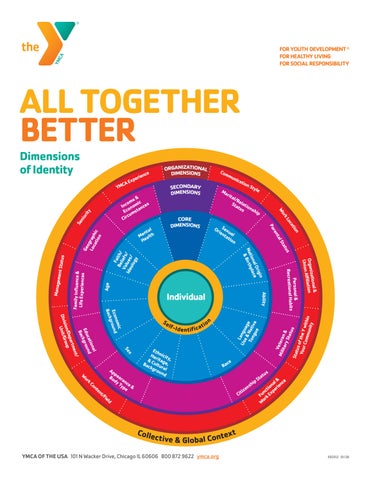
DIMENSIONS OF IDENTITY The Y is made up of people from all walks of life who are joined together by a shared commitment to ensure that everyone has the opportunity to learn, grow, and thrive. To truly be welcoming to all, it is critical to understand the many factors that make up and influence a person’s individuality to effectively engage, connect, and serve ALL members of our communities. Use this resource to learn about the different Dimensions of Identity and apply that knowledge to help make the Y be the place where everyone belongs.
INDIVIDUAL At the very center of the Wheel is the individual. All dimensions connect back to our unique experiences and perceptions of the world around us. Therefore, we are indivisible from them.
SELF-IDENTIFICATION Self-identification stresses the importance of how we see ourselves in determining our dimensions of identity.
COLLECTIVE & GLOBAL CONTEXT This ring highlights the role of the outside world in shaping how we define our dimensions of identity. Just as self-identification emphasizes the importance of how we see ourselves, collective and global context emphasizes the importance of how the world perceives us.
CORE DIMENSIONS Core dimensions are central to our personal experience, have sustained influence in our lives, and are often the dimensions that we most closely identify with. Many of these dimensions are unchangeable—reflecting how we were born—though some may change over the course of our lives.
AGE Age is simply how long someone has been alive, usually counted in years. But it’s more than just a number as different ages come with different expectations, rights, and responsibilities. For example, kids might need supervision at the pool, teens might be eligible for leadership programs, and older adults might prefer low-impact fitness classes. Age can shape how people experience the world and how others treat them. Self-reflection: • Think about how your age influences how others see you at work or how you relate to different age groups in your programs. • How has your perspective changed as you’ve gotten older? Organizational reflection: • How does a variety of ages show up in your programs, staff, and leadership? • Are your facilities and offerings accessible and engaging for all age groups? • What assumptions might exist about age and capability at your Y?
ABILITY Ability is about what someone can do physically, emotionally, or mentally. Everyone has different strengths and challenges. Some people may have disabilities that affect how they move, learn, or communicate. Others may have invisible conditions like anxiety or ADHD. At the Y, it’s important to create spaces where everyone feels welcome and supported, no matter their abilities.
Self-reflection: • Consider your own abilities. What tasks come easily to you, and what do you find challenging? How do you support others whose abilities differ from yours? Organizational reflection: • How does your Y accommodate different physical, emotional, and cognitive abilities? • Are your spaces and programs designed with universal access in mind? • What training or resources support staff in serving people of all abilities?
ECONOMIC BACKGROUND Economic background is about the financial situation someone grew up in. It is informed by whether their family had a lot of economic resources, very few, or somewhere in between. It can affect things like access to healthy food, safe housing, or quality education. Even if someone’s income changes later in life, their early experiences with money can shape how they think about spending, saving, and opportunity. For example, a child in a reduced cost lunch program might grow up to be a donor who deeply understands the importance of food access. Self-reflection: • Think back to your own upbringing. How did money (or the lack of it) shape your choices, values, or sense of security? • How does that influence how you approach financial access in your programs?
DIMENSIONS OF IDENTITY 2
Organizational reflection: • How do economic backgrounds influence participation and access at your Y? • Are your pricing structures and financial assistance programs equitable? • How does your Y partner with organizations addressing economic disparities?
Self-reflection: • What language(s) do you feel most comfortable using? • Have you ever changed how you speak to fit in or be understood? • How do you support the presence of different languages in your programs or on your team? Organizational reflection: • How does your Y support multilingual communication?
ETHNICITY, HERITAGE & CULTURAL BACKGROUND
• Are materials and signage accessible to non-English speakers?
This is about where someone’s family comes from, the traditions they follow, the language they speak, and the values they hold. It includes things like food, holidays, music, and ways of interacting. Ethnicity is different from race. Ethnicity is more about culture and heritage than physical appearance. For example, two kids in an afterschool program might both be Black, but one has Haitian heritage and the other is African-American with roots in the American South. Their experiences and traditions may be very different.
• What systems help staff navigate different languages effectively?
Self-reflection: • What cultural traditions or values shaped your upbringing? • How do they show up in how you lead, communicate, or celebrate with others? Organizational reflection: • How does your Y celebrate and respect different cultural traditions?
MENTAL HEALTH Mental health is about how people feel, think, and act to handle life’s ups and downs. It affects how we relate to others, make decisions, and manage stress. We all have mental health. Just like physical health, mental health can change over time. Some people live with conditions like depression or anxiety, which aren’t always visible. At the Y, being aware of mental health helps us support staff, participants, and families with empathy and care. Self-reflection: • How do you take care of your own mental health? • What signs do you notice when you or someone on your team might need extra support?
• Are cultural holidays, languages, and customs reflected in your programming?
Organizational reflection: • How does your Y promote mental health awareness and support?
• What partnerships help your Y connect with the variety of communities in your area?
• Are staff trained to recognize and respond to mental health needs?
FAITHS/BELIEFS/VALUES/IDEOLOGY This is about what people believe in at their core. It can be a religion, a set of values, or a way of seeing the world. Some people follow a faith like Christianity, Islam, or Buddhism. Others may not practice a religion but still live by values like kindness, honesty, or justice. Some may be politically active, while others aren’t. At the Y, respecting these differences helps build trust and community. Self-reflection: • What beliefs or values guide your decisions and leadership? • How do you create space for others to live out their values, even when they differ from yours? Organizational reflection: • How does your Y create space for diverse beliefs and values? • Are staff and participants encouraged to express their values respectfully? • What policies ensure ideological inclusion and prevent bias?
• What partnerships exist to support mental wellness in your community?
NATIONAL ORIGIN & BIRTHPLACE This refers to where someone was born or where their family comes from. It could be a country, a region, or even a city. For example, someone might be born in Mexico but raised in Chicago. Knowing someone’s national origin can help us understand their background, traditions, and sometimes the challenges they’ve faced like adjusting to a new culture or language. Self-reflection: • Where were you born, and how has that shaped your identity? • Have you ever had to adapt to a new culture or environment? How did that experience influence your work at the Y? Organizational reflection: • How does your Y welcome newcomers and immigrants? • Are cultural orientation or language support services available at your Y? • What barriers might exist for people born outside the U.S.?
LANGUAGE USE & NATIVE TONGUE Language use is how people communicate. It is not just about what language they speak, but how they speak it. Someone’s native tongue is usually the first language they learned. But people often switch between languages or styles depending on where they are, like using formal English at work and slang with friends. This is called code-switching. For example, a bilingual staff member might speak Spanish with some families that visit the Y and English with coworkers, helping everyone feel included.
RACE Race is a way society often groups people based on physical traits like skin color, hair texture, or facial features. These groupings don’t come from biology. In the U.S., race is a social system that has historically given more advantages (privilege) to some groups while limiting opportunities for others. These advantages show up in things like access to education, jobs, housing, and even how people are treated day to day. For example, an Asian teen in a leadership
DIMENSIONS OF IDENTITY 3
program might face different expectations than a white peer, even if they have the same skills. Self-reflection: • How has your race shaped your experiences in your career, in your community, or in how you’re perceived? • How do you ensure that all have access in your programs? Organizational reflection: • How does your Y address racial equity in hiring, programming, and leadership? • Are racial disparities tracked and addressed in outcomes or access? • What community voices are included in decision-making?
SEX Sex is a way to describe people based on their bodies, usually assigned at birth. Most people are assigned female or male based on things like reproductive organs. Sex is different from gender, which is about how people see themselves and how they show who they are in the world. Self-reflection: • How has your assigned sex influenced your experiences in leadership, in relationships, or in expectations placed on you? • How do you support people of all sexes in your programs?
Organizational reflection: • How does your Y ensure that all feel welcome in leadership and programming? • Are there gender-based assumptions in roles or responsibilities? • What policies support welcoming regardless of sex?
SEXUAL ORIENTATION Sexual orientation is about who someone is attracted to emotionally, physically, or romantically. Some people are attracted to the opposite sex, some to the same sex, and some to both. For example, someone might identify as gay, straight, bisexual, or queer. It’s a personal part of who they are, and at the Y, we support people being themselves without judgment. Self-reflection: • How do you create a space where people feel safe to be themselves, regardless of who they love? • What assumptions might you carry and how can you challenge them? Organizational reflection: • How does your Y create a safe space for LGBTQ+ staff and participants? • Are inclusive practices embedded in your policies and training? • What community partnerships support LGBTQ+ inclusion?
SECONDARY DIMENSIONS Secondary dimensions often have a greater degree of control, choice, or self-determination to change by the individual, though societal and structural barriers may hinder their ability to do so. These dimensions often change over time and can inform our daily experiences. Our core dimensions interact closely with our secondary dimensions. For example, one’s age (a core dimension) can impact their income (a secondary dimension).
APPEARANCE & BODY TYPE
CITIZENSHIP STATUS
Appearance is how someone looks on the outside, including things like clothing, hairstyle, skin tone, and body shape. Body type is about someone’s natural build. Some parts of appearance are choices, like wearing a uniform or makeup, while others, like height or body type, are not. At the Y, it’s important to avoid making assumptions based on how someone looks and to create spaces where everyone feels comfortable in their own skin.
Citizenship status is about someone’s legal relationship with a country, such as, whether they’re a citizen, a permanent resident, or have a visa. In the U.S., this can affect things like access to services, work eligibility, and feelings of safety. For example, a parent in a childcare program might be hesitant to fill out forms if they’re unsure about their immigration status. Being sensitive to this helps build trust.
Self-reflection: • How do you feel about your own appearance in professional settings?
Self-reflection: • Have you ever supported someone navigating citizenshiprelated challenges?
• Have you ever felt judged or made assumptions based on how someone looked?
• How do you ensure your programs feel safe and welcoming for all families, regardless of status?
Organizational reflection: • How does your Y promote body positivity and avoid appearancebased bias?
Organizational reflection: • How does your Y support individuals with varied citizenship statuses?
• Are uniforms, dress codes, or marketing materials inclusive of all body types?
• Are forms, services, and outreach sensitive to immigration concerns?
• What messages does your Y send about health and beauty?
• What legal or cultural barriers might affect participation?
DIMENSIONS OF IDENTITY 4
EDUCATIONAL BACKGROUND
INCOME AND ECONOMIC CIRCUMSTANCES
Educational background is the learning someone has had in school, at home, or through life experience. It includes things like high school, college, job training, or even learning from family or community. For example, a swim instructor might have a degree in aquatics education, while another learned through hands-on experience. Both bring valuable skills to the table.
This is about someone’s current financial situation. It applies to how much they earn, what kind of job they have, and how that compares to others. It’s different from economic background, which is about how someone grew up. For example, a single parent working two jobs might still struggle to afford childcare, even if they have a college degree. Understanding this helps the Y offer support like scholarships or sliding scale fees.
Self-reflection: • What has shaped your own learning journey? Was it formal education, lived experience, or both? • How do you value different types of knowledge in your team? Organizational reflection: • How does your Y value different types of learning and experience? • Are hiring and promotion practices inclusive of non-traditional education? • What opportunities exist for ongoing staff development?
Self-reflection: • How do your current financial circumstances shape your choices or stress levels? • How do you ensure your programs are financially accessible to all? Organizational reflection: • How does your Y ensure financial accessibility for all? • Are sliding scale fees or scholarships widely understood and used? • What partnerships help address economic hardship?
FAMILY INFLUENCE & LIFE EXPERIENCES This is about the events and relationships that shape someone’s life such as growing up in a big family, losing a loved one, getting married, adopting a child, or moving for work. These experiences affect how people show up in the world. For example, a staff member that comes from a military family that moved around a lot might be particularly empathetic to a new program participant that recently moved to your town. Self-reflection: • What life experiences have shaped how you lead or connect with others? • How do you bring empathy into your work? Organizational reflection: • How does your Y recognize and support diverse life journeys? • Are staff and participants encouraged to share their stories? • What practices foster empathy and connection across experiences?
MARITAL/RELATIONSHIP STATUS This describes someone’s relationship situation. It might mean being single, married, divorced, or in a partnership. It can affect things like who picks up a child from camp or who’s listed on emergency forms. At the Y, it’s important to respect all types of relationships and avoid assumptions about family structure. Self-reflection: • How has your relationship status influenced your work‑life balance? • How has it influenced how others perceive you? • How do you support a variety of family structures in your programs? Organizational reflection: • How does your Y support a variety of family structures in its programs and services? • Are emergency contact and registration forms inclusive? • What assumptions might exist about caregiving roles?
GEOGRAPHIC LOCATION Geographic location is where someone lives. This can be a city, suburb, rural area, a region, or neighborhood. It can affect things like access to transportation, safety, and community resources. For example, a teen from a rural area might travel far to attend a Y program, while someone in an urban neighborhood might take a bus or walk over after school. Self-reflection: • How does your location affect your access to resources, community, or opportunity? • How do you consider geography when designing inclusive programs?
PARENTAL STATUS Parental status is about whether someone is a caregiver such as a biological parent, adoptive parent, grandparent, or legal guardian. It can also include people who’ve raised children in other ways. For example, a senior might have custody of a grandchild and be the person that brings them to and from the Y. Recognizing different caregiving roles helps the Y support families more fully. Self-reflection: • Have you ever taken on a caregiving role, formally or informally? • How does that experience shape your empathy and approach to family engagement?
Organizational reflection: • How does location affect access to your Y’s services?
Organizational reflection: • How does your Y support caregivers in all forms?
• Are rural, suburban, and urban needs considered in program design?
• Are programs flexible for non-traditional parenting arrangements?
• What outreach strategies help bridge geographic gaps?
• What resources help caregivers feel seen and supported?
DIMENSIONS OF IDENTITY 5
PERSONAL & RECREATIONAL HABITS
VETERAN & ACTIVE MILITARY STATUS
These are the things people do for fun, health, or personal growth and might include exercising, reading, praying, meditating, or playing sports. These habits help people stay balanced and connected. For example, a staff member who practices yoga might lead a calming activity for kids after a busy day.
This refers to someone who has served, is currently serving in the military, or has close family who has. It can shape someone’s values, experiences, and needs. For example, a veteran might bring leadership skills to a youth program, or a military family might need flexible scheduling or payment options due to deployments.
Self-reflection: • What habits help you recharge or stay grounded?
Self-reflection: • Have you or someone close to you served in the military?
• How do you bring those practices into your work or share them with others?
• How does that experience influence your leadership style or your understanding of service and civic duty?
Organizational reflection: • How does your Y incorporate a variety of personal interests into programming?
Organizational reflection: • How does your Y support veterans and military families?
• Are staff encouraged to share their passions with participants?
• What community partnerships enhance this support?
• Are there programs or benefits tailored to their needs?
• What recreational activities are celebrated or overlooked in your Y culture?
ORGANIZATIONAL DIMENSIONS These dimensions contribute to how we experience our time with the Y from an organizational and professional lens. They help to shape how we approach our work and how we connect with others across the Y Movement and across other organizations and institutions.
COMMUNICATION STYLE
FUNCTIONAL & WORK EXPERIENCE
Communication style is how someone shares ideas and feelings through words, tone, body language, or writing. Some people are direct, others are more reserved. For example, a childcare worker might use gentle language with toddlers but be more assertive when talking to parents. Understanding different styles helps teams work better together.
This is the formal or informal experience someone has from jobs, volunteering, or training. For example, a lifeguard might have years of poolside experience but no formal degree. All types of experience matter and help people contribute meaningfully.
Self-reflection: • How would you describe your communication style? • When has it helped (or challenged) your ability to connect with others? Organizational reflection: • How does your Y adapt to different communication styles among staff and participants? • Are feedback and conflict resolution processes inclusive? • What training supports effective communication across styles?
DIVISION/DEPARTMENT/UNIT/GROUP This is the team or group someone works with. In many Ys these might be teams like aquatics, youth development, or membership. It’s how work is organized at the Y. For example, someone on the health and wellness team may collaborate with childcare staff to offer age-appropriate physical activity. Self-reflection: • How does your team’s focus shape your daily work? • What opportunities do you have to collaborate across departments? Organizational reflection: • How does your Y encourage collaboration across departments?
Self-reflection: • What experiences inside or outside the Y have shaped your skills and confidence? • How do you honor different kinds of expertise in your team? Organizational reflection: • How does your Y recognize and leverage diverse work experiences? • Are informal skills and lived experience valued in hiring and promotion? • What mentorship opportunities exist?
MANAGEMENT STATUS This is about whether someone oversees multiple projects or supervises others by being a team lead, director, or coordinator. It affects responsibilities like scheduling, mentoring, and decisionmaking. For example, a site supervisor in after-school programs might manage staff and also interact with families daily. Self-reflection: • If you’re in a management role, how do you balance leading with listening? • If not, how do you influence your team’s success from where you are? Organizational reflection: • How does your Y support leadership development at all levels?
• Are silos limiting innovation or inclusion?
• Are non-managers empowered to lead and innovate?
• What systems promote cross-functional teamwork?
• What systems ensure inclusive decision-making?
DIMENSIONS OF IDENTITY 6
ORGANIZATIONAL & UNION AFFILIATION This refers to the groups someone belongs to such as a church, a union, or a professional association. These affiliations can shape someone’s values, support systems, and sense of community. For example, a staff member who is active in an association for HR professionals might invite colleagues to a learning opportunity offered by the group. Self-reflection: • What organizations or communities have shaped your values or sense of purpose?
the facility, and more. It includes the skills and knowledge needed for that role. For example, someone in housing might need to understand local resources and trauma-informed care. Self-reflection: • What parts of your role energize you most? • How do your skills and training contribute to the Y’s mission? Organizational reflection: • How does your Y align work roles with its mission? • Are staff supported in connecting their skills to community needs? • What opportunities exist for role evolution?
• How do those affiliations show up in your work? Organizational reflection: • How does your Y engage with external affiliations to strengthen community ties? • Are staff supported in their professional development networks? • What partnerships enhance your mission?
SENIORITY Seniority is how long someone has worked at the Y in one role or across different positions. It can affect things like pay, responsibilities, and institutional knowledge. For example, a long‑time swim instructor might mentor new staff and help shape program traditions. On the other hand, someone with a shorter tenure at the Y might struggle to have their voice and ideas heard. It’s important to welcome all voices to the table. Self-reflection: • How has your time at the Y shaped your perspective? • What wisdom do you share or seek from others with different levels of experience? Organizational reflection: • How does your Y balance institutional knowledge with fresh perspectives? • Are newer staff encouraged to contribute ideas? • What practices ensure all voices are valued?
STATUS OF THE Y WITHIN YOUR COMMUNITY This is how the YMCA is seen and used in a local area. The Y can be seen positively, negatively, or neutrally as a trusted hub, a place for youth programs, or a resource for families. It can vary from one neighborhood to another. For example, one branch might be known for its food pantry, while another is a go-to spot for senior fitness.
WORK LOCATION This is where someone does their job. For most Y leaders, this means a YMCA branch, a YMCA association office, a school site, or remotely. It affects things like commute, access to facilities, and the community they serve. For example, a nutrition educator working in schools might have different needs than someone based at the main Y facility. Self-reflection: • How does your work location shape your daily experience and connection to the community? • What do you need to feel supported where you are? Organizational reflection: • How does your Y support staff across different work sites? • Are remote staff equally included in decision-making? • What systems ensure connection and support?
YMCA EXPERIENCE This is someone’s history with the YMCA. It can take the shape of being a staff member, a volunteer, a participant, a donor, or a member. It includes the experience people have had in training, paid/unpaid roles, and time generally spent in the Movement. For example, a former camp counselor who becomes a program director brings deep understanding of Y values and culture. Self-reflection: • What’s your Y story? • How has your journey shaped your connection to the mission and your approach to leadership? Organizational reflection: • How does your Y honor a variety of YMCA journeys? • Are long-time and new staff equally celebrated and welcomed?
Self-reflection: • How is your Y viewed in the community? • What role do you play in strengthening that reputation or expanding its reach? Organizational reflection: • How is your Y perceived locally, and by whom? • Are community needs and feedback actively sought? • What outreach efforts expand your impact?
• What practices strengthen connection to the mission across roles and YMCA experience?
BLANK SPACES The blank spaces in the core, secondary and organizational dimensions acknowledge that the wheel can never accurately (or fully) represent any single person’s experiences. These spaces allow an individual to add dimensions that are important to their identity. For more information, visit Link (link.ymca.net).
WORK CONTENT/FIELD This is the kind of work someone does from teaching swimming lessons, managing grants, coordinating volunteers, maintaining
DIMENSIONS OF IDENTITY 7