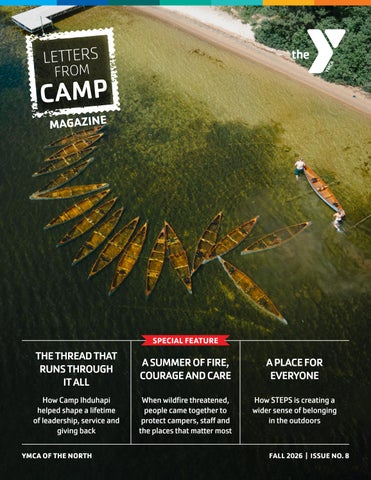
SPECIAL FEATURE
THE THREAD THAT RUNS THROUGH IT ALL
A SUMMER OF FIRE, COURAGE AND CARE
A PLACE FOR EVERYONE
How Camp Ihduhapi helped shape a lifetime of leadership, service and giving back
When wildfire threatened, people came together to protect campers, staff and the places that matter most
How STEPS is creating a wider sense of belonging in the outdoors
YMCA OF THE NORTH
FALL 2026 | ISSUE NO. 8
L E T T E R F RO
M THE
EDITOR
THE WEIGHT BEHIND
THE MAGIC
Being a camp director is not just a job; it’s a lifestyle. Of course, it requires your physical presence. I lived onsite and was on call 24 hours a day, seven days a week. If a toilet overflowed in the middle of the night and our property manager wasn’t available, you’d find me with a plunger. When staff members were not getting along, you’d find me mediating tough conversations. I helped out in the kitchen, the art barn, and everywhere in between. It also requires extraordinary emotional presence. Everyone has an opinion about programming, logistics, staffing, meals, weather, and just about everything else. You learn to listen, respond thoughtfully, act when you can, and let go of what you can’t control. The staff needs you. The parents need you. The campers need you. The board needs you. Everyone believes their need is the most urgent. Your decisions are questioned because most people can’t see the full scope of what you’re balancing. And often, there isn’t a clearly right or wrong answer. You simply do your best, guided by policy, experience, judgment, and a deep commitment to doing what’s right for the community you’ve been entrusted to lead. As I was writing our main feature article for this issue, I found myself thinking often about life as a camp director and just how much energy it takes. July 2026 was a doozy of a month across YMCA of the North camps. Camp leaders found themselves navigating forest fires, hazardous air quality, shifting plans by the hour, and the enormous responsibility of keeping campers and staff safe while also protecting places that generations have come to love. I watched with deep admiration as they led with grace, professionalism, and remarkable steadiness under extraordinary pressure. They made difficult decisions that weren’t always visible to the families arriving at camp each week, but they made them with the same
2
Natalie at camp in 2016 with her son, Xander
care and commitment that has always defined great camp leadership. That is the thing about camp directors.
Natalie h elp bathroom ing clean the s at cam p after a plumbin g sewage s problem create d ituation in the sh a owers.
Much of what they do happens behind the scenes, often unnoticed, because when they are doing their jobs well, camp still feels like camp. Children still race to the waterfront. Campfires are still lit. Laughter echoes through the trees. Friendships are formed. Traditions continue. The magic remains intact because someone is carrying the weight that allows everyone else to simply experience the joy. Having lived that life, I know how heavy that responsibility can be. I also know what an exceptional privilege it is to carry it. Their stories could fill a hundred magazines, and I hope this issue offers just a glimpse into the dedication, resilience, and heart that make our camps so special. More than anything, I hope it leaves you with an even deeper appreciation for the people who quietly make camp possible, summer after summer, year after year, generation after generation.
Natalie King
NATALIE KING Director of Alumni Philanthropy Natalie.King@ymcamn.org
ALUMNI EVENTS
TABLE OF CAMPS OCT Letter from the Editor
02
Upcoming Events
03
Widjiwagan
04
Icaghowan
06
St. Croix
08
Warren
12
Ihduhapi
14
Special Feature
18
Northern Lights
26
du Nord
28
Menogyn
32
Letter from SVP
34
NOV DEC
YMCA CAMP ST. CROIX Hudson, Wis. campstcroix.org YMCA CAMP WARREN Eveleth, Minn. campwarren.org YMCA CAMP WIDJIWAGAN Ely, Minn. widji.org
Trail Rides Horse Experience at Ihduhapi
2–4
Rendezvous Alumni Weekend at Menogyn
2–4
Adult Adventure Weekend Retreat at Widjiwagan
15–18
Family Camp at du Nord, Icaghowan, Northern Lights and Widjiwagan
23–25
Women’s Retreat at Icaghowan
23–25
Impact Weekend at Northern Lights
30– Nov 1
Woodcutting Weekend at du Nord
25–29
Thanksgiving Family Camp at du Nord
26
Harvest Fest Meal at Northern Lights
12
Breakfast with Santa at St. Croix
15–18
MLK Family Camp at Menogyn, Northern Lights and Widjiwagan
21–24
Women’s Retreat at du Nord and Northern Lights
5–7
Women’s Retreat at Widjiwagan
7–10
Y She Skis at du Nord
12–15
Presidents’ Day Family Camp at Menogyn, Northern Lights and Widjiwagan
18–21
Women’s Retreat at du Nord
EDITORIAL STAFF
19–21
Family Camp at Icaghowan
Natalie King Director of Alumni Philanthropy Editor and Lead Writer
25–28
Family Camp at du Nord
25–28
Women’s Retreat at Northern Lights
26–28
Women’s Retreat at Icaghowan
26–27
Women’s Retreat at Northern Lights
4–7
Men’s Retreat at du Nord
25–28
Mother/Daughter Retreat at Northern Lights
8–11
Work Weekend at du Nord
JAN
FEB GIVE THE GIFT OF CAMP ymcanorth.org/k2c
YMCA CAMP IHDUHAPI Loretto, Minn. campihduhapi.org
YMCA CAMP NORTHERN LIGHTS Babbitt, Minn. campnorthernlights.org
2
STEPS Family Weekend at du Nord and Northern Lights
YMCA CAMP DU NORD Ely, Minn. campdunord.org
YMCA CAMP MENOGYN Grand Marais, Minn. campmenogyn.org
Work Weekend at du Nord
17–20
YMCA OF THE NORTH 651 Nicollet Mall, Suite 500 Minneapolis, MN 55402 ymcanorth.org
YMCA CAMP ICAGHOWAN Amery, Wis. campicaghowan.org
1–4
Reid Bauman Joe Pollock Latner Photographers Shane Hoefer Monica Kenney Kayla Martin Editorial Team Gretchen Heim Designer Michelle Edgerton Executive Vice President & Chief Advancement Officer
MAR
APR
3
WHERE THE TRAIL LED
KATE HALE
Assistant Professor, University of British Columbia Camper 2007–2010 | Staff 2011–2015
Five Camp Widjiwagan alumni reflect on the lessons that shaped their lives long after leaving the wilderness
When Kate Hale completed her Voyageur trip, she realized she wanted a life that combined science, adventure, and time outdoors.
T
here are moments in life we remember fondly, and then there are experiences that quietly shape the way we move through the world.
That aspiration eventually led her to graduate school at the University of Colorado-Boulder and, later, to a career as a snow hydrologist studying snowpack, climate, and water availability across alpine and Arctic landscapes.
For five YMCA Camp Widjiwagan alumni, some of those defining moments happened deep in the wilderness. They spent days paddling across remote lakes, carrying canoes over rocky portages, climbing to the tops of mountains, cooking meals over camp stoves, and navigating challenges that couldn’t be solved with a quick internet search or a call home. Along the way, they learned how to lead without dominating, persevere through discomfort, trust their teammates, and adapt when plans changed. Years later, their lives and careers look very different. One studies snowpack in the Arctic. Another helps couples navigate life’s challenges. One built a nature-based retreat destination in West Texas. Another leads a philanthropic foundation. A recent graduate even devoted her senior capstone project to understanding the culture of Widji itself.
SARAH ROTHSTEIN
Founder, The Charmadillo Camper 2003–2009 | Staff 2010–2014 Sarah Rothstein spent years working in luxury hospitality, before a year-long trip to New Zealand to dive deeper into the world of eco-lodging. Those experiences eventually inspired her to purchase 44 acres in Central Texas and create The Charmadillo, a naturebased lodging and event destination built around a vision of hospitality rooted in nature and community.
4
Looking back, she sees a direct connection between her work today and her years at Widji.
Like decades of campers before them, they became familiar with the lyrics of a favorite camp song: “Oh the years they come, our paths will seldom mingle, and each one of us will go our way alone. And the comradeship that we have shown each other, keep us Widjiwagan ever known.” Little did they know those words would come to hold deep truth. Because despite their divergent paths, each of them points to the same place when asked where many of those core skills first took root: the trail.
When she describes her vision, it sounds remarkably familiar. “I created The Charmadillo to be a space where people could reconnect with themselves, nature, and their fellow travelers. Widji was the first place where I experienced the depth of that kind of connection, and I feel incredibly honored to have created a place where others can experience that feeling too.” For Sarah, the values she experienced at Widji didn’t stay in the wilderness. Rather, they became the foundation for the kind of place she became passionate about creating for others.
“Widji showed me how to do hard things, love doing hard things, connect authentically with others and myself, and want to be outside doing something bigger than myself,” she says. “When I think about where I am professionally and personally, it all originates from Widji.” Today, as a professor and academic advisor, she finds herself playing a role similar to the counselors and mentors who helped shape her own journey.
KELSEY HUNT
COLLEEN MALONEY
Executive Director, Rock Rose Foundation Camper 1997-2002 Staff 2003-2008
Anthropology Graduate and Widji Researcher Camper 2016–2022 | Staff 2023–2026
When Kelsey Hunt graduated from college, she wasn’t entirely sure what came next. After several years working in optometry, an unexpected opportunity emerged during the pandemic. Her cousins were launching a foundation and asked her to help lead it. Today, she serves as executive director of the Rock Rose Foundation, which supports organizations working to advance equitable access to food, housing, education, and healthcare. Throughout those transitions, Widji remained a constant for her. “When I was lost and unsure of my career, I felt like I always had Widji as a landing spot,” she says. “I’ve been drawn to valuecentric jobs and communities because my time at Widji was so formative.” The leadership lessons she learned as a camper continue to guide her today. “Widji taught me that there are so many ways to be a leader — and they all have value.”
Most college students don’t write a senior capstone project about a camp they attended. Colleen Maloney felt compelled to do exactly that.
NANCY BRITTAIN
Owner, Colorado Therapy Collective Camper 2000–2004 | Staff 2006–2010 Nancy Brittain originally planned to become a lawyer. Then she took a job leading wilderness therapy trips. That experience changed everything. Today, she owns a therapy practice in Colorado, supporting individuals and couples while leading a growing team of clinicians. The connection to Widji is obvious to her. “Leading a trip, you get so much experience in group dynamics,” she says. “You have to keep track of morale, address conflicts, and have caring but direct conversations.” One lesson in particular has stuck with her. “Being able to endure discomfort while keeping it light is an important lesson in how I lead today.”
After discovering anthropology at Macalester College, she became fascinated by the idea of culture, how communities develop shared values, traditions, language, and ways of seeing the world. Naturally, her research turned toward a place she knew well: Camp Widjiwagan. As she interviewed alumni and staff, one phrase surfaced repeatedly: “The Widji Way.” Everyone recognized it. No one defined it quite the same way. The more she studied it, the more she realized that Widji’s influence isn’t found in a single tradition or philosophy. Instead, it lives in the attitudes, habits, relationships, and values that alumni carry with them long after leaving camp. “My relationship with Widji is a place I love so much and a place I want to change in a positive way,” she says. “People within a community need to stay involved and keep trying.”
The wilderness taught her that growth often comes through challenge, something she now helps others navigate every day.
MORE THAN A DESTINATION The careers are different. The journeys are different. The destinations are different. Yet each of these alumni directs their story back to the same wilderness experiences as they reflect on who they have become. Widji didn’t chart a single path for them to follow. Instead, it gave them the confidence to find their own. Whether studying Arctic snowpack, building community through philanthropy, creating spaces for connection, helping others navigate life’s challenges, or exploring the culture of camp itself, each carries forward lessons first learned on trail.
Camp Widjiwagan Camp Widjiwagan has been providing transformative wilderness experiences for youth from the edge of the Boundary Waters Canoe Area Wilderness in northeastern Minnesota since 1929. Through wilderness travel and environmental learning experiences, youth participants explore extraordinary places.
Because the true impact of Widji isn’t measured in miles paddled or portages completed. It’s measured in the lives shaped along the way.
5
A PLACE YOU BELONG, LONG AFTER YOUR FIRST SUMMER
For a group of alumni, staying connected means more than coming back — it means helping shape what comes next
F
or YMCA Camp Icaghowan board members, Sunday mornings in the summer often begin with a flurry of text messages in the group chat. “Anyone interested in staying after the meeting to help paint the doors?” “Working on updating the staff lounge and looking for a few items. Can anyone help?” “Planning on some gardening after the meeting — who wants to join me?” This group of volunteers isn’t simply gathering once a month around a boardroom table. During the summer, they’re right in the middle of camp life, painting doors, unloading luggage, pulling weeds, setting up for camper arrival, connecting with alumni, and finding countless ways to support the staff and campers they care so deeply about. In 2025, Executive Director Georgia Ellingson shifted the Camp Icaghowan board year to run from March February through November, placing a greater emphasis on meeting at camp during the busy summer season. Her goal was to create more opportunities for board members to work alongside staff, strengthen relationships, and stay connected to the everyday life of camp. “Our vision was to create a board experience that allowed board members to participate with the parts of Icaghowan they were most passionate about. This has become a dynamic advisory board that brings expertise from many walks of life, energy, passion, and action to help Icaghowan sustain legacy, while evolving into the future. More than meetings, this group is hands-on, supporting staff, campers, and the care of our spaces.”
6
1
SUMMER SUNDAYS
because it frees up the staff to engage with the kids.”
Those summer meetings often begin the same way, not around a conference table, but with campers arriving by the carload. On a sunny Sunday morning in July, several board members arrive on the island early to help carry tables, set out signs, and assist staff as they prepare for camper arrival. Cars filled with nervous parents and excited campers line the isthmus, waiting for the check-in process to begin. Board members are in place, ready to direct traffic, unload luggage, answer questions, and help create a warm welcome from the very first moment families arrive. Board member James Hein (Camper and Staff 1980s-2000) said, “I love helping
2
For about an hour, the pace is nonstop. Cars pull up to A-Field as parents hug their campers goodbye while board members and staff unload luggage. As one car leaves, another takes its place. Groups of campers fill the field, playing games and meeting new friends while check-in continues around them. Some campers arrive looking unsure, while others jump out eager to return to a place they love. James shared that Georgia and Program Director Gretchen Hoff (camper 2000-2008, summer staff 2009-2015) have done an incredible job preparing both staff and board members to make every family feel welcome. “Check-in is so much fun,” James said. “I love seeing the kids’ excitement as they experience the first day of camp. I also love seeing alumni who I used to go to camp with.” It’s one of the board’s favorite ways to serve. Every suitcase carried and every question answered allows counselors to focus on what matters most, helping campers feel at home.
3
When the last camper has arrived, and cabins begin filling with excited voices, the board quietly steps back. As James explained, “Camp is full, and kids are everywhere. The staff need to be engaged, it’s game on. If we can help with the little behind-the-scenes tasks, the staff are able to be fully engaged with the campers.”
4
5
a place Camp Icaghowan’s board is stewarding room for more that they love. And there is always voices at the table.
YMCA Camp Icaghowan Board Duties assist at the bus stop or camp check in volunteer at camp during spring and fall work days event planning committee make connections with local business and community
MORE THAN CHECK-IN DAY Check-in day may be one of the most visible ways the board supports camp, but it’s only a small part of what these volunteers do throughout the year. Board members work to strengthen Camp Icaghowan in countless ways. They help raise support for the annual fund, plan community events, brainstorm improvements with Georgia, volunteer at work days, and serve as ambassadors for camp throughout the community. For many, serving on the board isn’t simply about giving back. It’s about staying connected to the place that helped shape who they became. Susan Borden has experienced Camp Icaghowan from nearly every perspective imaginable. She was a camper from 1977–1985, served on staff from 1986–1989, returned as camp nurse in 2006, later became both a camper parent and staff parent, and has now served on the board for four years. Her love for Camp Icaghowan pours out of her so intensely, that it feels tangible. “Camp taught me about community and belonging. It showed me what genuine connection feels like and helped shape my sense of self-worth. The experience was profound. I learned the true meaning of family at camp, and I’ll always be grateful for that.” Today, board service has become another meaningful chapter in that lifelong relationship. “Being on the board is another way to connect with camp in a meaningful way,” Susan shared. “I think the board is a bridge that honors old traditions and treasured memories while helping camp grow into the future in a thoughtful way.”
partners fundraising calls and emails time, talent, treasure- give to camp in a variety of ways
by many of the same reasons. “I joined the board because I wanted to give back to the place that was so important to my family and me. I wanted to share my time, talent, and experiences as best as I could. I wanted to stay connected to the place that shaped so much of who I am.”
CONTINUING THE STORY Stories like Susan’s and Peter’s are exactly why Georgia believes the board plays such an important role in Camp Icaghowan’s future. “The board is an important part of the Icaghowan community. Camp doesn’t end when summer does. And for those who love Icaghowan, your experience can continue long after your last summer. You can help ensure that future generations experience the same magic that shaped you.”
Each of these tasks is important and helps camp immensely. Contact Georgia.Ellingson@ymcamn.org to learn more and to get started!
in day, painting a cabin door, mentoring staff, helping with work projects, or making decisions that will shape camp’s future, board members carry forward the same spirit of community that once welcomed them. Their work is a reminder that camp isn’t simply a place you attend. It’s a place you belong, a community that grows stronger because each generation chooses to give something back. 6
James agreed. “Even if you’ve been away, you can reengage with camp at any time, and you get the same benefits you did as a camper or on staff.” For many people, camp is measured in summers. But Camp Icaghowan’s impact isn’t confined to a single season or stage of life. It lives on through the people who choose to return, not as campers or counselors this time, but as volunteers, advocates, and leaders.
1. Lake Wapogasset, home of Icaghowan, 2. James and Ruth’s Work Leadership Camp (WLC) group in 2001, 3. James and Ruth Hein, with their children, 4. Ruth, Melissa Ingram, and James at Icaghowan on check in day. Melissa was part of their WLC group in 2001, 5. Susan and Dori Estrella at the 2025 staff banquet, 6. Board members Libby Dominguez, Susan, Molly Johnson and Dori Estrella, spring 2025
Whether they’re directing traffic on check-
Susan isn’t alone in that feeling.
Camp Icaghowan
Peter Wieczorek, Camp Icaghowan’s Executive Director from 1997–2004 and a board member since 2018, was drawn back
Founded in 1908, Camp Icaghowan is Wisconsin’s premier overnight camp for kids seeking a small community environment. Set in 120 beautiful acres of oak savanna adjoining Lake Wapogasset, Icaghowan features three tree houses nestled in the forest canopies and a 44-acre island.
7
Y BEHIND THE R O T S E TH
B O L O Z C N K O B How one creative idea during Camp Needlepoint became a Camp St. Croix tradition that has delighted campers for nearly 50 years By Guest Writer, Mark Benjamin (camper 1968-71, staff 1976-82)
1
camp traditions become so woven into the fabric of camp life that it’s hard to Some imagine they ever had a beginning. At YMCA Camp St. Croix, the Bonzo Block is one of them. For nearly five decades, campers have gathered each morning to hear the latest clue in the camp-wide treasure hunt, launching a daily adventure filled with teamwork, curiosity, and excitement. But before it became a beloved camp tradition, the Bonzo Block was simply one staff member’s creative solution to a challenge. In this firsthand account, Mark “Benji” Benjamin shares how a simple idea became one of Camp St. Croix’s most enduring traditions.
8
What happened to the original Bonzo Blo ck? Mark Benjamin in sists the Bonzo Bl ock still in Mike Buss ey’s possession isn’t the original. Mike di sagrees and has happily been making that claim for decade s. Like any great camp tradition, perhap s some mysteries are be st left unsolved!
2
Block I announc ed the first Bonzo ming rhy ine r-l Hu nt and rea d a fou A ll. Ea ch wa clu e before tap ing it to the AN ID EA ing om da y brought another clu e, bec nzo Bo the ut abo groups There are many stories a litt le more specif ic as cabin e. tru are m word the ry of eve all y t No cop Block. gather ed around to own created it. into notebooks. I wondered if camp needed its I should know; I’m the one who t version. or pri ze announce me nt bec ame par e nat rdi Th coo m gra pro the s wa I 9, In 197 camp O BL OC K of the fun. for Camp Needlepoint, a specialty TH E BI RT H OF TH E BO NZ p Cam Bonzo for children with diabetes held at ap pile “And wh ichever cabin finds the scr p cam the s to per out cam d , ere day nd h wa eac I “...each cam per in St. Croix. Three times all block of wood, about Block,” I’ d say, g. sm tin a tes nd ar fou sug d od an blo drama tic for p sto to needed that cabin wil l receive...”[long lf an inch thi ck and fou r inches ha ” ze! pri llenge. It pa use] “...a mys-TEEREUS The testing itself wasn’ t the cha squ are. was the waiting. onzo Be fore long, the entire dining ha ll th a Magic Marke r, I wrote “B Wi me. iling were sho ute d the final words wit h ck” on one sid e and drew a sm The kids were bored. The counselors Blo fell to me h the bored. As program coordinator, it cartoon face on the other wit Th e mysterio us pri ze? A roomt tha , ing yth an , ing !” ape nzo Bo u “Yo , rds to come up with someth wo temperatu re can of Ho liday Gr ed. upi occ ds min ne’s ryo eve p kee would So da. here in Th at eve ning, I hid it somew g I remembered the exc iteme nt camp. Bu t the rea l rew ard wa s earnin r nte Wi ul Pa . surrounding the St bragging rights. ng in the dining ha ll, rni mo ery t Ev nex t. e hun Th lion dal me val Ca rni R CH AL LE NG E WA ITI NG FO
morning, people wo uld open the clu e, newspaper to rea d the latest s, and vel the n race off wit h ma ps, sho ding the metal det ectors in ho pes of fin e. e els hidden tre asure before anyon
9
TR EA SU RE FE VE R TA
KE S HO LD
time during blood What began as a way to fill one of camp’s most e am sugar testing quickly bec anticipated activities. camp. Treasure fever spread across oted to searching. Entire afternoons became dev es and thesauruses Counselors brought dictionari counselor would to help decipher clues. One in had searched regularly report where his cab dying my facial that day while carefully stu identally reveal the expressions, hoping I’ d acc Bonzo Block’s hiding place. would find it before Eventually, one lucky cabin announce the winners, dinner. After the meal, I’ d in, and remind them point toward the cheering cab e. to collect their mysterious priz Then came my favorite part. ll of clues, grab my I would walk over to the wa domly circling words Magic Marker, and begin ran
them. and drawing lines between
“I mean, you fools! “Isn’t it obvious?” I’ d shout. face!” It’ s staring you right in the n. There was no secret patter t along. I was making it up as I wen gh, and boo, and I The campers would groan, lau loved every minute of it.
A TR AD IT IO N TH AT
EN DU RE D
ed that a simple Looking back, I never imagin time would become a activity created to pass the tradition. longstanding Camp St. Croix p St. Croix’s executive Mike Bussey, who was Cam ers the excitement director at the time, rememb
st from the dining hall well. Cabin groups would bur ed the latest clue, convinced they had finally solv of the Bonzo Block. racing across camp in search t became “an instant According to Mike, the hun sensation.” tradition is still going Nearly five decades later, the strong. sions of the Bonzo Block I’ve even discovered that ver ps across the country have found their way to cam more) and beyond. (see sidebar for t something born out of It’ s remarkable to think tha g for blood sugar tests a few quiet moments waitin laughter, teamwork, has created generations of orgettable camp friendly competition, and unf memories.
wood f o k c lo b l smal a r o f d a rker. Not b a M c i g a and a M 1. The Bonzo Block 2. Campers and staff proudly show off their Bonzo find!, 3. Northern Lights campers proudly show off “Bore”, found after just a few clues. 4. Du Nord campers show off their Bonzo discovery.
10
THE TREASURE HUNT THAT TRAVELED Bonzo Block is more than a treasure hunt — it is a reminder of how camp traditions are born and why they endure. Behind every song, game, and ritual that campers eagerly anticipate is someone who had an idea, took a chance, and created something worth sharing. At YMCA Camp du Nord, Bonzo Block has taken on a delightful shape of its own. Every day at noon, the counselors shout, “Bonzo, Bonzo, Bonzo!” in a crescendo, followed by “BLOCK!” thundering back from the kids waiting for the rhyming clue.
The tradition at du Nord led directly to the birth of YMCA Camp Northern Lights’ Bore and Alis (Borealis) clues. 47 years after its first clues were read at Camp St. Croix, Bonzo Block continues to spark the same sense of anticipation, teamwork, and wonder for new generations of campers across the Y of the North camps. Its longevity is a testament to the power of camp itself: a place where simple ideas become lasting traditions, where each generation builds on the one before it, and where the memories created today may become the stories that campers are still joyously recounting decades from now.
3
4
Camp St. Croix Founded in 1909, Camp St. Croix is situated on 400 acres of woods, prairies, gardens, and pine-covered bluffs overlooking the St. Croix River National Scenic Riverway. Camp St. Croix is a perfect place for kids, teens, families, adults, and organizations to connect with nature and each other. 11
C
ampers will eventually forget the names of the trails they hiked or the scores of the games they played, but many will remember exactly what camp smelled like. Beyond the typical woodsy aromas surrounding camp, those of a spaghetti lunch waiting after a long bus ride or cinnamon rolls drifting through the dining hall on a Sunday morning stick with you. For nearly a century, the YMCA Camp Warren dining hall has been more than a place to eat. It has been a gathering place, a welcome center, a celebration space, and, for generations of campers, a second home. Naturally, some of camp’s most meaningful moments happen on the trail or around a campfire. But just as many happen around a table. It’s where friendships deepen and stories are told. Where nervous first-time campers become part of a cabin community and generations of campers discover that food tastes a little better when it’s passed handto-hand and shared with others. “We know that our meals are a way for campers to feel the comforts of home,” shares Cheri Keepers, interim executive director. “We serve meals family style and are intentional about how we create community and connection through the food we serve and the setup of our dining hall.” That philosophy is part of every meal served at Camp Warren. Unlike many institutional kitchens tucked behind closed doors, Camp Warren’s kitchen has always been part of the community.
Campers can watch meals being prepared, see cakes coming out of the oven, peek at salads being assembled, and chat with the cooks who prepare every meal. The kitchen staff are friendly faces that the campers get to know, rather than being hidden behind swinging doors.
That openness creates something special. Campers begin to understand that meals don’t simply appear. They are thoughtfully prepared by people who care about them.
OF
CAMP WARREN WHERE A CENTURY OF MEMORIES HAS BEEN SERVED ONE FAMILY-STYLE MEAL AT A TIME
We serve meals family style and are intentional about how we create community and connection through the food we serve and the setup of our dining hall.
1
When the meal bell rings, another tradition begins. Meals are served family style. Platters and bowls are carried to tables, passed from person to person, and shared among cabinmates. If a dish runs empty, someone grabs the familiar orange refill tray and heads back for more. It’s a simple tradition, but one that quietly teaches generosity, responsibility, and care for others. For generations of campers, those shared meals have become anchors in their memories.
12
T HE HE A R T
2
3
6
SOME TRADITIONS ARE BEST SERVED WARM
4
Every camp has certain foods or meals that become part of its identity. At Warren, these culinary traditions begin the moment campers arrive. Sunday lunch is always spaghetti. The menu doesn’t change, and there’s a reason for that. For a first-time camper stepping off the bus, it offers comfort in an unfamiliar place. For some returning campers, it’s the first taste of summer and the signal that another week of adventure has officially begun.
5
There’s comfort in that certainty. Sunday mornings bring another beloved tradition: warm cinnamon rolls known simply as ‘Sunday buns.’ “If you ask our summer campers or our family campers about one of their most beloved traditions at Camp Warren, you will hear them talk about ‘Sunday buns,’ served warm from the oven every Sunday morning of the entire summer,” says Sophia Zook-Stanley, interim program director. For many alumni, that’s how camp memories return — not through photographs or stories, but through taste, smell, and the rituals they’ve carried with them long after their time at camp has ended. The traditions continue throughout the week. Sunday lunch is followed by evening cookout. Campers returning from extended border trips are welcomed back with one of Camp Warren’s most celebrated traditions: pizza and pop night. After days spent sailing, paddling, portaging, and sleeping under the stars, the meal feels less like dinner and more like a celebration.
7
These rituals may seem small on their own, but together they create a powerful sense of belonging. They become the moments alumni remember decades later: the taste of a cookie fresh from the oven, the excitement of carrying the orange refill tray, the smell of spaghetti kicking off another epic summer adventure.
PREPARING FOR THE NEXT CENTURY As Camp Warren approaches its 100th anniversary, the dining hall is preparing for its next century of service. This October, camp will begin the first phase of a multi-year renovation designed to preserve what generations of campers love while ensuring the space can continue welcoming families, campers, and staff for decades to come. “This dining hall has served camp warren campers, staff, and families for almost 100 years,” Cheri recalls. “We want to update the kitchen so it can serve the Camp Warren community for the next 100 years!”
Most campers may never notice the improvements behind the scenes. The changes are being made so future generations can continue enjoying the same traditions that campers have cherished for nearly a century. Camp hopes to complete this first phase in time for its 100th anniversary celebration in 2027 — a fitting milestone for the building that has nourished generations of campers, families, and staff. As the dining hall enters its second century, the kitchen may become more efficient, the equipment more modern, and the workspace more adaptable. But the mission will remain exactly the same: to be a place where every camper has a seat at the table — a place where stories are shared, friendships begin, and traditions are passed from one generation to the next. And where, no matter how far from home they may be, campers are reminded that they belong.
The first phase of construction will focus on improving the kitchen’s workflow. Food storage will move downstairs, allowing the dishwasher to be relocated and creating a more efficient layout for meal preparation and cleanup.
1. Hobby night cookie baking. 2. The kitchen at camp. 3. Campers in the dining hall. 4. “Amazing Grace” outside on the Hitch Deck before Sunday lunch. 5. Kitchen staff at camp. 6. Kitchen staff at camp. 7. Campers in the dining hall.
Camp Warren Camp Warren is nestled amongst white pines on 600 acres near Eveleth, Minnesota. Warren provides the ultimate setting for participants to develop self-reliance, build life-long relationships, and receive mentorship from caring adults with a curriculum focused on skill progression.
13
START HERE! EDITOR’S NOTE The postcards, photos and patches that are part of this spread are all taken from Will’s childhood scrapbook. He emailed us to say, “I’m cleaning house and found this collection of old Y memorabilia. Do you think the Y would be interested in any of this?” Our answer was “yes” which also led to learning more about Will and him sharing his Y story. DO YOU HAVE ARTIFACTS, PHOTOS OR A STORY TO SHARE? WE LOVE CAMP HISTORY! EMAIL LFC@YMCANORTH.ORG AND YOU COULD BE FEATURED IN AN UPCOMING ISSUE.
THE THREAD THAT RUNS THROUGH IT ALL shape a lifetime of ed lp he pi ha du Ih p m Ca How giving back leadership, service, and By Guest Writer, Will Craig
n he YMCA bega t o t n io t c e n n o My c t. with an acciden outh
oved to S er my family m standing aft y tl or sh , 49 e er In 19 mother and I w sh Minneapolis, myLake Harriet looking at the fiand t on the dock a a little too far over the edge below. I leaned fell in. What I rprisingly calm. get back to su g n ei b er b em le to I rem is not being ab remember most the surface. er and ped into the wat m ju r de n ta ys b A young pulled me out. e in other enrolled m m y m k, ee w g in MCA. The follow the downtown Y swim lessons at it at the uld have known ould begin a co us of er th ei w N ars. simple decision time, but that t has lasted more than 75 ye a th relationship to grow YMCA seemed e th , up ew gr I As alongside me.
There were Saturda downtown for swim y mornings riding the streetcar programs, Hi-Y club lessons. There were after-school that stretched ac s, college-aged mentors, and friends there was camp. ross schools and neighborhoods. And hips then For six summers, YM rhythm of my life. CA Camp Ihduhapi became part of the Like generations of paddling, learning campers, I spent my days swimmin meant to be part outdoor skills, and discovering what g, faded with time, buof a community. Some memories haveit t others remain cr ystal clear. One morning, coun se lo loaded us into cano rs woke us before dawn and quie together in the da es. We paddled onto a still lake and tly When totality arrirkness as a solar eclipse approached waited corona surroundin ved, we looked up at the sun’s glowin . g the moon. g I remember that moment as vividly today as I did then . Camp has a way of everyday life fade, doing that. Long after the details certain moments re of main.
er took me to YMCA Camp I My final summer as a camp ry Waters. Looking back, Menogyn and the Bounda ching lessons that extended far realize that camp was tea, or outdoor skills. It was teaching beyond paddling, camping Service. It was teaching me how responsibility. Confidence. ger than myself. to be part of something lar
was en th e liz a re t n’ id d I t a Wh aping my sh st ju ’t sn a w p m ca t tha my future. g in p a sh s a w it — s er summ
2
life, f on the other side of camp Before long, I found mysel tant counselor and later as a returning first as an assis pi. The same camp that had once counselor at Camp Ihduha mper now trusted me to guide welcomed me as a young caexperiences. others through their own
1
There is something po a place that helped werful about returning to camp through a diffeshape you. I began to see canoe trips, and cabirent lens. The campfires, there, but now I unden conversations were still them, the counselors rstood the people behind created opportunities and mentors who quietly for young people to gr ow. Years later, I would fin d m yself leading programs, serving on bo ar ds , mentoring others, and helping steward Looking back, I can the future of the YMCA. summers at camp. Thtrace a direct line to those give me memories. Th ose experiences didn’t just leadership, service, aney gave me a model for with me throughout d community that stayed my life.
15
3
Over the years, that journey carried me to places I never could have imagined as a young boy riding the streetcar downtown. Through YMCA programs, I worked at camps in Minnesota and Washington, helped build a youth retreat center in Japan, taught English overseas, and formed friendships that have endured for decades. Wherever life took me, the YMCA was never far away. As a university student, I lived at the University YMCA. Later, I served as a volunteer, fundraiser, board member, and advocate. Different chapters, different responsibilities, but always the same underlying mission: helping young people discover opportunities, community, and purpose.
4
5
think of my YMCA Looking back now, I don’t of separate experiences. involvement as a collection I see a thread. 6
16
swim lessons. A thread that began with campfires, canoes, college A thread that ran through, volunteer leadership, and years, overseas adventures lifelong friendships. ay. A thread that continues tod eventually led my late wife, That perspective is what aritable gifts in our Ginny, and me to include ch ed deeply in investing estate plans. We both believ opportunities for in young people and creatingiversity YMCA became a future generations. The Un plans because it had significant part of my giving rt of my life. been such a significant pa ing feels like the natural In many ways, planned givthat began decades ago. continuation of a journey
The YMCA invested in me. Now I have the opportunity to invest in those who will come after me.
7
When people ask why I have stayed connected to the YMCA for so long, I often come back to a simple formula: Participation + Responsibility = Ownership I started as a child taking swim lessons. Along the way, I became a camper, counselor, volunteer, board member, donor, and legacy supporter. The roles changed, but the relationship remained. More than 75 years later, I am grateful for that young man who jumped into Lake Harriet, grateful for a mother who signed me up for swim lessons, and grateful for an organization that continued to open doors throughout every stage of my life. 1. A brochure advertising Camp Ihduhapi from the 1950s. 2. Patches earned at camp and Hi-Y. 3. Will Craig with Kathleen Sweeney, 1960s. 4. Ihduhapi staff member standing in front of the dining hall in the 1960s. 5. A postcard Will sent from camp. 6. 1961 Ihduhapi staff photo. 7. Postcards that Will sent from Ihduhapi.
Not everyone spends a lifetime with the YMCA.
I’ve been fortunate enough to do exactly that.
7
ABOUT THE WRITER Will Craig spent six years as a Y camper and six years on camp staff (Christmas Tree, Ihduhapi, Camp Adventure at the Washburn/Richfield Y, and Seattle Camp Orkila). He went on to serve as Chair of the Board of the University YMCA. Will spent his career at the University of Minnesota Center for Urban and Regional Affairs (CURA), working on policy issues important to the state. He was a pioneer in the field of Geographic Information Systems (GIS). He chaired the Minnesota Governor’s Council on Geographic Information, then went on to serve as president of three national GIS organizations
representing state government, local governments and academia. At the U he helped start one of first GIS degree programs in the country. He credits those positions to the leadership skills he developed at the Y. He and his wife Ginny were married for 57 years before her death in 2023. They have a son and a daughter, and seven grandchildren. Of his time working for the Y, Will shared, “Those years taught me the value (and fun) of friendly leadership skills. I carried those skills into the University Y and into my career.”
Camp Ihduhapi Camp Ihduhapi has provided enriching camp experiences since 1929. Situated on 165 acres of vibrant maple forest along the shores of Lake Independence, Ihduhapi is the perfect place for youth and adults to learn new skills, build confidence, and create lifelong memories.
17
SPECIAL FEATURE
1
A SUMMER OF FIRE, COURAGE AND CARE When wildfire threatened, people came together to protect campers, staff and the places that matter most By Shane Hoefer and Natalie King
O
n the afternoon of July 17, a crew of counselors at YMCA Camp Widjiwagan carried 19 canoes down to the water and sank them.
They did it carefully. Staff have been taught for decades how to handle those boats with care, and now every movement mattered. Each canoe was turned on its side and allowed to fill. Two boulders went into the bow. Two more into the stern. Then the 19 were tied together and lashed to shore, so the lake could hold them.
YMCA Camps & 2026 Wildfires YMCA camp 2026 burned area U.S. Canada border Boundary Waters (BWCAW) Wabakimi Provincial Park Wabakimi 15
Two camper groups flown out July 15
Sources: NIFC, CWFIS, USFS, Ontario MNR. Basemap: Esri.
Every one of those hulls was stretched over a frame hand-sawed by Joe Seliga. A few predate the Second World War. Generations of campers have learned to paddle them. At Widjiwagan, the first rule any camper learns is that a wood-canvas hull must never touch rock or sand, only air or water, and, as they teach it, bread dough. And now, strangely, they were underwater. That was where they were safest. They would stay there for a week.
18
Boundary Waters
2
WHEN THE FIRES BEGAN THE LIGHTNING EVENT
THE CLOSURE
On July 6, lightning came down across the Superior National Forest, bringing a great deal of thunder and almost no rain — the worst combination this country offers. The vegetation should have been green. Instead, it had been drying since spring.
Three YMCA of the North camps were directly in the path of what was unfolding: Widjiwagan and YMCA Camp du Nord, neighbors on the North Arm of Burntside Lake outside Ely, and Menogyn, 100 road miles east on West Bearskin Lake, reachable only by boat.
For a week, the fire sat in the trees and held its heat. Campers paddled past it, and nobody knew what was waiting in the forest around them.
Over the next five days, all three would be forced to reckon with the rapidly changing conditions. Two evacuated. Menogyn pulled several trips off the water and ended two more summer sessions early.
Then Monday, July 13, came in hot, dry, and windy. By afternoon, a thermometer at Seagull Lake read 101 degrees. Seagull sits at the top of the Gunflint Trail, in YMCA Camp Menogyn’s backyard. It had never read 101 before. And then, all at once, the fire found its moment. Sixteen fires stood up at once. By midday, the Forest Service had decided the entire Boundary Waters Canoe Area Wilderness would close at 12:01 the next morning. It was only the third full closure in the wilderness area’s history. At Widjiwagan, a line is painted across the top of the old Big Board trips planner. Former program director Amy Hadow calls it the unofficial camp motto: “Subject to sudden and catastrophic change.” For generations, it had been a bit of camp wisdom, a knowing nod to the unpredictability of wilderness trips. Now, for the first time, it felt less like a quippy motto than a dire warning.
And the impact did not stop there. Three other YMCA Camps — Warren, Northern Lights and Icaghowan (in Amery, Wisc.) — made the difficult decision to close or send campers home early as smoke blanketed the region. The stories from those days will become legend, the kind of camp lore retold over decades, affecting an entire generation of campers. For the six affected camps, 1,103 campers and 682 families saw their summers suddenly rewritten. For a few, dramatically so. At the peak of the crisis, 11 campers and four guides waited roughly 48 hours in Wabakimi Provincial Park, 175 miles inland in Ontario, for Canadian aircraft to lift them out. Every one of them came home. But this is not really a story about fire. It is a story about what people did when the unexpected arrived.
“The story I hope people remember isn’t simply that there were wildfires. I hope they remember the people. The wilderness leaders who cared for kids, the families who trusted us, the emergency partners who answered our calls, and the camp teams who kept showing up for one another. That’s the story of this summer for me.” -Michel Tigan, Senior Vice President of Adventure and Wellbeing
3
1. A photo taken by Nor’wester campers as they evacuated from Wabakimi Provincial Park 2. Maps showing the location of Y camps and wildfires. 3. At times the air quality was so poor, visibility was limited
19
1
GETTING THEM OUT MOVE THE PEOPLE
THUNDER BAY
Menogyn runs about 120 wilderness trips in a season. On July 13, 16 of them were out, spread across three regions.
Menogyn trail guide Leanne Riegel arrived at camp in May expecting to spend the summer guiding young people through the wilderness.
Fourteen came out quickly, without immediate danger to anyone. Two did not. Getting a group off the water is not a one-phone-call job. It is a network of preparation, communication, and decisions that may have to work across hundreds of miles of wilderness. Every Menogyn and Widjiwagan trip carries a satellite phone, kept off unless the group needs it. Trips running a month or longer carry a GPS-satellite device as well. That equipment became especially important for the two of the Nor’wester groups traveling through Wabakimi Provincial Park. As conditions deteriorated, they waited about two days for the weather to clear. Rescue crews knew where they were the entire time. Both groups waited overnight for their air evacuation. One group came out by helicopter and one by float plane. Eleven campers, ages 16 to 18, and four guides. The decision to move them came before anyone had the luxury of certainty.
20
She did not expect to be handed the keys to a van and sent to meet groups whose trips had been cut short due to natural disasters. But when the call came, she knew what to do. “I was glad to be chosen to go,” she said. “Being able to stay calm and be there for people is something I am comfortable with.” She started by thinking about the little things. Watercolors. Stamps, ink pads and paper. Both guides played guitar, so she took one from the dining hall. At the grocery store, she filled the cart with fresh fruit and vegetables and whatever else looked like comfort. “I was thinking about things that would be soothing and comforting,” she said. The campers had come out fast. Some had left without their shoes. So Leanne made another stop and bought flip-flops for everyone.
Then she set up a table.
NOR’WESTER EVACUATIONS
They could make thank-you cards for the rescuers or simply make art. Some painted the fire. Some did not want to talk about it, and nobody made them. There was no expectation that they had to make sense of what had happened. They could simply be together and begin, in their own way, to process it.
A few groups were particularly impacted by wildfires as they travelled through Wabakimi Provincial Park on their 32-day Nor’wester canoeing routes.
The guitar moved from one guide to the other. They made lunch. They brought out ice cream. They played games. The campers whittled, using the same skills their guides had taught them on trail. They drove around in the vans with the music on and stopped for boba tea.
They waited about 48 hours for the weather to clear. The whole time, a satellite phone kept telling the people who needed to know exactly where they were.
They were 175 miles north of the Minnesota border, inside a provincial park with no road out and fire on the move.
Little by little, the day began to feel less like an evacuation and more like camp.
On the morning they came out, Michel told TV reporters the group was “in good spirits, probably a little hungry and ready for a shower, but medically they are doing well.”
At dinner, they sang, told stories, and made it as much like a farewell banquet as they could.
Every one of them came home. *Nor’wester is Menogyn’s 32 day, invitation-only program for teens in 11th-12th grade.
The message from Menogyn leadership had been simple: Go support the kids. Use whatever means you think are best. For Riegel, that meant understanding that getting the campers physically out of the wilderness was only the beginning. “You can’t change what happened,” she said. “But you can impact how they process it.” And that was the work: not erasing what had happened, but helping the campers find their way through it. “This could have been a debacle,” she said. “For as dramatic as it seemed from the outside, it was run with grace, intelligence and logic.”
2
1. Nor’wester campers wearing masks with smoke in the background as they evacuate from their planned route. 2. Some of the Nor’wester groups were flown out by float plane, shown here. 3. Nor’wester campers returning home after ending their trips early.
3
21
BACK WHERE THEY BELONG BENEATH THE SURFACE
PRICELESS HISTORY
Most of Widjiwagan’s fleet had somewhere to go.
Widjiwagan could paddle Kevlar. Most camps do. It is lighter, tougher, and never needs to be re-canvassed.
More than 100 canoes went to Ely or out onto the athletic field, where there were no trees and a sprinkler could reach them. Nineteen stayed. They were the ones already waiting on more extensive repair, but they were also the oldest and least replaceable things camp owns. Sinking them was not an improvisation. Tom Grant, the camp’s canoe master, said the idea of sinking canoes to protect them from wildfire had been part of camp lore for decades. In the Northwoods, when you cannot move a wood-and-canvas boat out of a fire’s way, you put it under. Still, it is worth pausing on how strange that must have felt. At Widjiwagan, every canoe is numbered and tracked all season. Its condition and history are written down. Campers are taught to handle these boats with more care than almost anything else they will touch that summer. And now, staff were filling 19 of them with rocks and pushing them under.
22
But if convenience were the point, Widjiwagan would have made a different choice long ago. Instead, the camp has continued to care for and paddle wood-canvas canoes — boats that ask something of their users. They must be lifted carefully, carried thoughtfully, and handled with an awareness that they are not indestructible. They require patience. They require stewardship. And, over time, they become part of the memory of the people who paddle them. “Widjiwagan does not use wood canvas canoes for convenience or practical reasons,” said Joe Smith, who spent decades as the camp’s property manager. “Widjiwagan uses wood-canvas canoes because they are handcrafted and thus require care, thoughtfulness, and stewardship — the very values we hope to instill in young people. We also do not display wood-canvas canoes at Widjiwagan. We use them to travel through the wilderness.”
That distinction matters. These are not artifacts behind glass or relics preserved for someone else to admire. They are working canoes. Campers have sat in them, learned to paddle in them, carried them over portages, and trusted them to carry them into the wilderness. Their scratches and repairs are part of their history, written into the hulls by generations of use. That is what makes them part of the Widji Way. And perhaps that is why, in a summer when so much was suddenly uncertain, the decision to save them felt like more than protecting a fleet of canoes. It was protecting a piece of what Widjiwagan has always asked young people to learn: that the things worth carrying forward are the things we are willing to care for.
OUT OF THE DEPTHS On July 24, the canoes came back up out of Burntside. By then, the camps were beginning to find their way back, too. Not all at once, and not without work still ahead, but little by little, over the course of about two weeks, summer began to return. Icaghowan was back to normal on July 19. Northern Lights followed on July 22. Warren welcomed campers back on July 26, and Menogyn on July 27. Then, on August 2, campers returned to Camp du Nord and Widjiwagan. At Widjiwagan, the return began beneath the surface. The rocks stayed in the lake. The boats did not.
Ben Hoffman, Widjiwagan’s executive director, called bringing them back to the surface the most peaceful part of an otherwise frightening month. “It was a calming process to bring the boats back to the surface,” he said, “leaving the rocks within the lake, watching the boats rise, swamped and ready to be delivered to the drying surface and wait their turn to be reviewed.” One by one, the canoes were dried, inspected, and repaired where needed. Then they went back into the sheds, ready to go back out on — not under — the water, just where they were supposed to be. The canoes were home.
Michel said. “We need to ask what this experience taught us. The environment we operate in is changing, and our responsibility is to keep learning alongside it.” For now, the canoes are back in the sheds, ready for winter. The tripping center looks much as it always has: paddles, maps, sashes and hats hanging in their familiar places. “The symbols of our paddles, our canoes, our maps, our sashes and hats that hang in our tripping center,” Ben said, “those are all reflective of the amazing things that have happened, and also the amazing things that will continue to.”
And in their return was a reminder that coming through a summer like this is not the same as simply putting it behind you. “We’re not interested in simply getting through this summer and moving on,”
1. Widjiwagan’s Seglia canoes, sunken for their protection.
1
23
THE FIRE’S REACH WHEN THE SMOKE CAME For Camps Warren, Northern Lights and Icaghowan, the threat took a different form. The flames never came near them. The smoke did. None of the three camps was under direct threat at any point, but the air itself had become dangerous enough that all three ultimately sent their campers home early.
1
Between July 14 and 17, Minnesota experienced the worst and most widespread smoke outbreak in its recorded history. A sensor in West Duluth read 617.8 µg/m³, likely a state record. Air quality alerts reached Maroon, the top of the official index and a category most of the state had never seen.
PROTECT THE PLACE Once the people were out, the work changed. At Camp du Nord, the full-time team stayed behind and started making a list.
At Icaghowan, a sensor ran off the end of the scale entirely, unofficially reading greater than 900 µg/m³.
Not just any list.
For the camps, knowing when to act was not something they had to figure out in the moment. YMCA Camping developed a standard operating procedure for compromised air quality in 2023, giving program leaders a framework for decision-making when conditions can change by the hour. They checked the numbers several times a day, compared readings across locations and, when it was time to make a call, each camp director communicated directly with families.
The things that could not be replaced. The old camp sign that once stood at the front entrance. A plaque from Wally’s Woodshed. Handmade du Nord triangles. Anyone who has spent a week there could imagine what else might have made the cut. “If we get a ‘go’ order, everyone leaves, and possibly we don’t return for a few weeks,” said Andy Sinykin, executive director at du Nord. So they went building to building, gathering what mattered most.
July 15-16, Northern Lights, Warren, and Icaghowan all made the same decision.
At the same time, volunteers came out from town and spent days pulling brush and anything else that could burn away from the buildings. The same work was underway at Widjiwagan. Sashes and Hats representing decades of Arctic Trips and Paddles and Mountains marked with with the names of thousands of alumni were moved to safer ground.
The campers were coming home. Not because the fire had reached their camps, but because the people entrusted with their care knew when it was time to put safety first.
More than 100 canoes were staged in Ely or out on the athletic field, away from the trees where a sprinkler could reach them. A precious few went into the lake. Much of that preparation had begun years before anyone knew they would need it. Widjiwagan, du Nord and Menogyn all have fire suppression systems — sprinklers, sprayers and pumps set around camp, drawing lake water through a long hose. At Widjiwagan, Property Manager Jake Cahill says the system comes up in under 10 minutes. During drought, they run it weekly, simply to raise the humidity around the buildings. All three camps had also been removing balsam for years. Pest damage had left much of it, as one volunteer put it, “basically just matchsticks waiting to be lit.” The work was part of a longer lesson the camps already understood: The wilderness changes, and the way a camp cares for its people and its places has to change with it.
5
150 100
“Menogyn has experienced challenges like this before, and we expect to face them again,” said Forrest Ahrens, executive director at Camp Menogyn. “Natural disasters are not going away. We continue to evolve and strengthen our programs and training as the world changes around us.”
24
1. Memorabilia collected from around du Nord, ready to be transported to Northern Lights to be stored until camp was safe from wildfire. 2. Wildfire smoke made the air quality so hazardous, camps had to send campers home for their safety. 3. Nor’ wester campers and their parents. 4. The U.S. Air Quality Index (AQI) runs on a scale from 0 to 500. 5. Fire trucks parked on the North Arm Road.
200 Unhealthy for Sensitive Group
50
Moderate
Good
0
Unhealthy Very Unhealthy
Hazardous
300
500 4
2
WHAT COMES NEXT LESSONS THAT SHAPE THE FUTURE Six camps had their summers rewritten. They came through because people had prepared for years — and because neighbors showed up when it mattered. Now comes the work of rebuilding and preparing for the summers ahead. At Menogyn, groups came off the water carrying what they could. Seventeen canoes, including four wood-canvas boats, along with tents, cooking gear, packs, and paddles, were left behind. Crews will return to recover what they can. Some of the gear will come home, some will not. The work ahead is practical, but deeply connected to the mission that brings campers here. As we prepare for another season, we’re strengthening the places, people, and systems that make Adventure possible, and learning from what this summer taught us.
FIREWISE AND DEFENSIBLE SPACE
Clearing brush and removing vulnerable trees at Widjiwagan, du Nord and Menogyn, with the Minnesota DNR and the U.S. Forest Service.
COMMUNICATIONS EQUIPMENT
Adding satellite phones and two-way GPS devices on more trips, more of the time. This is what kept the Wabakimi groups findable.
There will be more summers.
STAFF TRAINING
More young people will arrive carrying backpacks and questions, learning to paddle, portage, sleep beneath the stars and discover what they are capable of.
More scenarios, more often, and continued work at the Wilderness Risk Management Conference.
FLEET AND GEAR
Replacing the canoes, tents, packs, and paddles left on trail, and recovering what can still be brought home.
CAMPER SUPPORT
3
Helping families whose camp sessions were canceled or interrupted come back — and making sure the financial impact of this summer does not become a barrier to future camp experiences.
And there will be more days when the wilderness asks something of us, too. Our camps are changing with it — meeting the future with the same care, preparation and courage that have carried Adventure through generations. That work begins now.
GET INVOLVED The Northern Wildfires YMCA Camp Relief Efforts are helping our camps recover from the extraordinary costs of this summer — from canceled programming and refunds to emergency transportation, staffing and equipment losses.
3
THE WORK OF CARRYING IT FORWARD
If you believe in what these places make possible for young people, this is a moment to help care for them. Because these places have given us so much.
Help our camps respond, recover and prepare for the seasons ahead.
They have given young people room to grow, families stories to carry home, and generations of campers a deeper understanding of themselves, one another and the wild places that make it all possible. We are not simply preserving what was here before us. We are caring for something entrusted to us — so it can continue to shape lives long after we are gone. Scan the QR code to the left to learn more.
25
A PLACE FOR EVERYONE How STEPS is creating a wider sense of belonging in the outdoors
O
n a summer evening at YMCA Camp Northern Lights, the sounds are familiar. Children race toward the waterfront with towels over their shoulders. Families linger on cabin porches after dinner. Laughter drifts through the trees as strangers become neighbors around a campfire. It feels like camp has always felt. But for many families, simply arriving at a place like this is anything but ordinary. For generations, the outdoors and the traditions of camping have often felt inaccessible to many communities because of historical barriers, lack of representation, and experiences that left people wondering whether they truly belonged. STEPS — Supporting the Transformation of Equity and Power in Outdoor Spaces — set out to change that. Several years in, the initiative is no longer just opening doors at Camp Northern Lights; it is transforming what happens once families arrive and reshaping the culture of camp itself.
The program began in 2020, when Camp Northern Lights’ summer staff gathered in the aftermath of George Floyd’s murder and asked a difficult but necessary question:
What can we do to make sure camp is a space where people of all backgrounds, especially those whose identities have faced barriers, feel safe, welcome, and valued?
1
That conversation quickly turned into action. Six years on, that action has scaled: STEPS now reserves over half of the cabins across four family camp sessions for participants identifying as BIPOC, with one session specifically welcoming LGBTQ+ families. What began as a question about access has become a question about transformation — for the families who come, and for the camp that welcomes them. The demand has been overwhelming, with long waiting lists for each session.
BEYOND ACCESS, LEARNING TO BUILD TRUST For program director Jenessa Carlisle, the popularity of STEPS is both encouraging and revealing. “Camp is already a multicultural place, but there is still a divide,” she shared. “There’s a huge waitlist for STEPS. The question I keep asking is, how can STEPS families feel safe attending every session? As a person of color, I understand why families want to come to a STEPS session, and I want to know what we can do to make sure that feeling exists every session.” That vision reaches far beyond reserving cabins. Carlisle describes the work as “moving at the speed of trust.”
26
Building trust means creating a culture where families don’t simply receive an invitation; they know they belong. It also means ensuring
campers see themselves reflected in the staff who welcome them, mentor them, and help shape their experience.
that may not have previously considered camp a place for them.
“The main priority is getting folks of color ingrained in our Leadership Development Program and on staff,” Carlisle said. “I can’t emphasize the importance of diversity enough.”
The work is intentional, but it is also personal.
To make that happen, she has expanded recruiting efforts well beyond traditional channels. She visits colleges, partners with diverse student organizations, works alongside BIPOC Outdoors, a Twin Cities community connecting people of color through outdoor recreation, and leads BIPOC winter retreats, continually seeking out communities
“Legacy is awesome,” Carlisle said. “Having generations of campers is amazing. But because Camp Northern Lights is still growing, we have the opportunity to intentionally shape our culture.” That flexibility allows staff to continually ask how traditions can evolve so every family feels they are helping create them, not simply participating in someone else’s.
2
WHERE BELONGING BECOMES TRADITION
everything flow out through my hands and release.”
A SKY FULL OF POSSIBILITY
The impact of that work is best understood through the families who return year after year, not because they were invited once, but because they found a place where they truly belong.
That sense of peace surprised her and carries extra meaning.
That reflection reminded Mercedes of one of her favorite camp memories.
“Being a Black family going up north can sometimes be a scary experience,” she said. “But I’ve never felt that way at camp. It is safe and peaceful.”
It was the final night of their first summer. Her family was busy packing up when Mack stepped outside to take out the garbage. Moments later, he hurried back inside.
She hopes more families discover what hers has found.
“Come outside right now!”
For camper Mercedes Yarbrough, that feeling was immediate. She, her husband Mack, and their four children have attended Camp Northern Lights for the past four years. This summer, they arrived with a group of fourteen friends and relatives, turning camp into a family reunion surrounded by towering pines and sparkling lake water.
“Camp is for everyone,” she said. “A lot of people think camping is for white people. But this is a fun, safe place for families that’s welcoming to everyone.” Her husband Mack, who didn’t know how to swim when they first came to camp, was hesitant to participate in water activities. Today, he’s eager to join in.
Last summer, Mercedes climbed into a kayak for the first time. “It looked scary,” she admitted. “But because there were counselors to guide us, I tried it.”
“It reminds you that you’re capable of more than you think,” Mercedes said. “And it’s healing.”
Now, kayaking has become her favorite part of camp.
For her family, camp offers something many people don’t realize they’re missing.
“I love to kayak into the middle of the lake and meditate with my hands in the water. Water is healing and powerful. I let
“Now more than ever, we need that disconnect,” she said. “We need space away from technology that gives you time to heal and recharge your mind, body, and soul.”
She followed him into the darkness. Above them stretched a sky unlike anything she had ever seen.
There were just millions of stars,” she recalled. “I’ve never experienced anything like it. They were shining with so much energy. It felt magical.
Years later, she still thinks about that night. Perhaps that’s the true impact of STEPS. It isn’t measured only by cabins reserved or waitlists filled. It’s found in first kayak rides. In friendships that continue long after summer ends. In families who return each year knowing they belong. Moments of courage. Moments of connection. Moments of healing. Because every family deserves the chance to look up at a sky full of stars and know the outdoors belongs to them, too.
3
4
Camp Northern Lights
1. Mercedes and Mack with their children at camp in 2026, 2. Dr. Naomi Taylor and Maro at camp in 2023, 3. Meir, Matthew, Maro and Mack at camp in 2023, 4. Mack and Mercedes at the bonfire 2026
Located on Bear Island Lake near the edge of the Superior National Forest, Camp Northern Lights offers an incredible variety of seasonal activities for families to enjoy throughout the year with 130 acres of trails and woods for families to explore. Founded in 2019, Northern Lights is the perfect destination for families looking for a first-time camping experience or groups interested in trying a new experience like mountain biking or cross-country skiing.
27
U O R Y W IN T G N I D E N I R F How Y She Skis is helping women rediscover adventure, community, and themselves
THE FIRST THING YOU NOTICE IS THE QUIET.
S
now softens the edges as far as you can see. Pine branches bend beneath fresh powder. The only sounds are the steady glide of skis across packed trails and the occasional burst of laughter drifting through the trees. For a few precious days, e-mails go unanswered. Calendars are forgotten. Meals appear without planning. The responsibilities women so often carry for everyone else are set down at the door. At YMCA Camp du Nord, they are invited to simply be. Some arrive as experienced skiers. Others have never clipped into a pair of skis before. Some come with friends, while others arrive alone.
28
What they share is a desire for something increasingly rare: time to reconnect with themselves, embrace winter, and discover what becomes possible when community replaces expectation. What began as a women’s ski retreat has grown into something much larger.
A SIMPLE IDEA The inspiration for Y She Skis began with a simple observation. In 2021, after taking her first crosscountry ski lesson, YMCA team member Jennifer Northrup found herself surrounded by women who were curious about the sport but unsure how to begin. Again and again, she heard the same thing: they wanted to learn, but they also wanted community. “I work at the Y,” Northrup remembers thinking. “I wish I could do something.”
Eventually, that idea evolved into Y She Skis. The first retreat launched at Camp Ihduhapi in 2024, welcoming more than 50 women despite a winter with very little snow. Over the next two years, Northrup continued refining the experience, adding yoga, crafts, wellness activities, and intentional opportunities for connection. Then the retreat moved to Camp du Nord. “That’s when the vision really came alive,” Northrup says. Nestled among towering pines on the shores of Burntside Lake, Camp du Nord seemed to offer the perfect setting. Fresh snow blanketed the landscape. Endless trails wound through the forest.
1
Beginners practiced on the frozen lake while more experienced skiers explored miles of groomed terrain. “There was just something magical about being there,” Northrup says. “Everything came together.” That sense of welcome remains at the heart of the retreat. “You belong here no matter your experience level,” she says. “Whether you’ve never been on skis or you’ve been skiing for years, we’ll make sure you’re supported every step of the way.”
4
PERMISSION TO SLOW DOWN For many participants, skiing turns out to be only part of the experience. Michele Maiers describes the weekend as deeply restorative. “The word ‘transformative’ gets tossed around a lot,” she says, “but this truly was grounding.” Months later, she still returns to the feeling she experienced during the retreat.
“I can stop for just a moment, think about being there, and my shoulders drop. My breathing slows. I remember the peace, the beautiful surroundings, and this incredible community.”
I can stop for just a moment, think about being there, and my shoulders drop. My breathing slows. I remember the peace, the beautiful surroundings, and this incredible community.
What surprised her most was how quickly strangers became friends.
2
“There was an instant feeling of community. Everyone wanted to share. Their excitement was contagious. Right away, I knew I was in the right place with the right people.” She laughs when remembering her expectations of camp, sharing, “I was picturing rustic cabins from an old summer camp movie.” Instead, she found cozy gathering spaces, fireplaces, comfortable accommodations, and views that stretched across snow-covered wilderness. “I walked into the main lodge with the fire roaring and thought, ‘You’ve got to be kidding.’ It was absolutely beautiful.” But the scenery wasn’t what stayed with her.
3
“It renewed my desire to be part of a community,” she says. “Everyone was there for their own health and wellbeing. In today’s world, that feels more important than ever.”
29
PERMISSION TO BE A BEGINNER For Rachel Jasion, the retreat offered something even more unexpected. “The equipment was there. The instructors were there. The food was taken care of,” she says. “For once, I didn’t have to be the mom.” Instead, she had permission to simply enjoy herself. “I got to be a beginner,” she says. “As we get older, there are fewer opportunities to admit we don’t know what we’re doing.”
And afterward, there was always a warm lodge waiting.
Within hours, she found herself surrounded by new friends.
“You can be as adventurous as you want,” Rachel says. “Or you can curl up with a book. There’s no expectation. You simply get to be whoever you are in that moment.”
“The world doesn’t always feel welcoming, but this place does.”
As we get older, there are fewer opportunities to admit we don’t know what we’re doing
She laughs, remembering the inevitable falls.
PERMISSION TO SHOW UP AS YOU ARE
“I fell down. I got back up. It was freeing.”
For Tiffany Nagle, attending alone felt like a leap of faith.
Between lessons, she found herself skiing through forests sparkling with fresh snow and sunlight.
Now it’s one of the first things she recommends.
“It felt like I was learning to ski in one of the most beautiful places in the world.”
“I went by myself because it’s what I needed,” she says.
She hopes other women won’t let the idea of coming alone stop them from attending. “It’s totally okay to come by yourself. No one judges your age or your ability. Everyone is welcoming.” That sentiment resonates with Fay Nosow, who believes women often spend so much time caring for others that they forget to create space for themselves. “We send our kids to camp,” she says. “But we don’t always give ourselves permission to go.” Throughout the weekend, she watched women laughing together, sharing stories, encouraging one another, and rediscovering the joy of simply being present. “It replenishes your soul,” she says. “You leave remembering that you deserve time for yourself, too.”
6
5
SIGN UP FOR Y SHE SKIS! This is your chance to connect, grow, and make lasting memories in the heart of winter. If you do not have your own skis. If you do not have your own skis, Camp du Nord has skis, boots & poles for you to use during your stay.
SCAN ME
7
8
MORE THAN A SKI RETREAT While cross-country skiing remains at the center of Y She Skis, the experience has become about much more than that. It’s about embracing winter rather than merely tolerating it.
less tangible and far more valuable. A reminder that they can still be beginners. That they can still seek adventure.
It’s about trying something new without fear of failure.
That community can form in a matter of hours.
It’s about rediscovering confidence, curiosity, and joy.
And that making space for themselves is not selfish; it is necessary.
Most of all, it’s about finding community in unexpected places. As the weekend comes to a close, skis are loaded into cars, hugs are exchanged, and the quiet of Camp du Nord begins to settle back over the snow-covered landscape. The women leave with stronger ski skills, certainly. But what many carry home is something
Winter, it turns out, isn’t something to endure. It’s something to step into. Together. They carried it home in tangible ways, too — photos, a shared group journal, individual journals, and a few rocks and bones.
1. Y She Skis participants learning to ski. 2. du Nord in the winter. 3. One of the craft projects created when participants weren’t skiing. 4. Y She Skis participants learning to ski. 5. Y She Skis participants with Jennifer (second from right), 6. Michele skiing at du Nord. 7. Y She Skis! 8. Rachel and Tiffany skiing at camp.
Camp du Nord Founded in 1961, Camp du Nord is a family destination located deep in Minnesota’s Northwoods. Situated on the edge of the Boundary Waters Canoe Area Wilderness, du Nord provides access to miles of hiking and skiing trails, as well as family and group programming throughout the year.
31
1 2
THE WILDERNESS BETWEEN GENERATIONS How one family’s Menogyn story has unfolded across more than seven decades
A
t 90 years old, Don Olson can still talk about YMCA Camp Menogyn for hours.
He remembers the kitchen where he got his start as a teenager. He remembers guiding canoe trips through the Boundary Waters. He remembers the mentors who shaped him, the lessons learned on trail, and the wilderness that became a second home. But when the conversation turns to what Menogyn truly means to him, words become harder to find. That’s when the tears come. More than 70 years after arriving at camp for the first time, Don and his wife, Betty, of 67 years and counting, recently established an endowment to help ensure future campers can experience Menogyn. The decision wasn’t difficult. “It played a major role in shaping who I am and have become,” Don says. “And it has left lifelong imprints on all of our grandchildren.” In many ways, this isn’t simply Don’s Menogyn story. It’s a family story.
THE BEGINNING Don’s connection to Menogyn began in the early 1950s. As a teenager, he joined the camp staff, first working in the kitchen before eventually becoming a guide. What started as a summer job quickly became something much more meaningful.
32
“There’s no better place to be taught lifelong lessons, learn responsibility, and solve problems in a different way,” he says. “I don’t know of a place that could help you grow up faster or teach you the important lessons of life that will last a lifetime.”
3
Much of that growth happened under the leadership of Menogyn director Phil Brain (director 1940, 1949-57). Don remembers Phil as a quiet but powerful leader whose example left a lasting impression on everyone around him. Years later, Don would come to realize that the lessons he learned at Menogyn — leadership, responsibility, resilience, and service — extended far beyond the trail. “They were wonderful training in advanced management, lessons that helped me throughout my career and throughout life,” he wrote. But perhaps Menogyn’s greatest influence wasn’t what it taught Don. It was what it inspired him to pass on.
A FAMILY TRADITION Over the decades, Menogyn became woven into the fabric of the Olson family. Grandchildren became campers. Campers became guides. One generation returned carrying stories and lessons that inspired the next generation to follow. By the time Don and Betty’s grandchildren arrived at Menogyn, the camp had already
4
Gregor Davidheiser shared that the skill he learned best at Menogyn was “getting along with people that you don’t necessarily see eye to eye with or people that you probably wouldn’t be friends with in your everyday life. The woods bring people together .” Different experiences. Different lessons. One wilderness.
THE CULTURE OF THE TRAIL
5
shaped their grandparents’ lives. Yet each grandchild discovered something different waiting for them in the wilderness. For some, it was perseverance. Keegan Gilmore still remembers long portages, rain-soaked campsites, and difficult days on trail. Looking back, he credits those experiences with teaching him an important lesson. “There is a price to pay, effort to exert, for the beauty and freedom of spending time in the wilderness, and for all worthwhile things,” he reflected. “I attribute many of my accomplishments to this lesson.”
Perhaps no one captures Menogyn’s influence more clearly than Kyle “Bones” Gilmore. After completing an extended wilderness expedition through the Canadian Rockies, he wrote a letter to his grandfather describing the experience. “My journey with Menogyn has defined me as a human,” he wrote.
There is a price to pay, effort to exert, for the beauty and freedom of spending time in the wilderness, and for all worthwhile things
For others, it was teamwork. Kyle “Bones” Gilmore discovered that the meaning of a team wasn’t found on a field or a court, but in the woods and mountains. He learned that success depended on people supporting one another, carrying weight when needed, and working together toward a common goal. For Jeff Rauma, Menogyn reinforced toughness and perseverance, but what remains strongest are the memories of the wilderness itself. “The early morning paddles across lakes that shimmered like glass,” he recalls, and “the downwind cruises using rain flies as sails.” Years later, he remains grateful for those experiences and thrilled that future campers will have access to them. Eric Davidheiser credits Menogyn with teaching him how to live and work alongside people who may see the world differently from him.
He described the challenges of wilderness travel: long days, rough weather, difficult terrain, and the constant need to rely on one another. Yet what stayed with him most wasn’t the physical adventure. It was the culture created on trail.
THE NEXT CHAPTER When Don and his daughter Lucy began discussing their charitable giving, Menogyn kept coming up. The reason wasn’t complicated. Few places had shaped their family more profoundly. Across generations, Menogyn taught responsibility, perseverance, teamwork, courage, leadership, stewardship, and gratitude. It created memories that still surfaced around family tables decades later. It introduced young people to a wilderness that challenged them, humbled them, and helped them grow. The Don and Betty Olson Family Camp Menogyn Endowment Fund will specifically support camper progression, allowing campers to return each year for extended opportunities to build emotional resilience and cultivate their sense of place in the wilderness. The endowment they established is not simply a gift. It is an investment in future stories and a continuing ripple effect of impact. Future campers who will paddle their first lake, carry their first canoe, overcome their first setback, and discover strengths they didn’t know they possessed. Don may have first arrived at Menogyn as a teenager more than 70 years ago, but the story didn’t end when he left camp.
“The culture that we’d created was pure and unique, and will be a part of me always,” he wrote.
It continues through his children.
After returning home, he found himself seeing the world differently.
And thanks to his generosity, it will continue through generations yet to come.
“The wild has a strange effect on the human brain,” he reflected. “Most importantly, I am concerned with the wellbeing of others more than ever before.”
6
It continues through his grandchildren.
It’s a sentiment that feels familiar to anyone who has spent meaningful time in the wilderness. The landscapes are unforgettable. But the transformation runs deeper.
Genna Rauma remembers discovering something equally important. “I found the strength and courage to do hard things, and the peace that spending time in nature can bring,” she shared. 1. Don Olson in 1954, 2. Don Olson and family in 2007. 3. July 2011, Eric Davidheiser (standing in back) guided a three week backpacking trip in Yellowstone National Park that included his cousin, Keegan Gilmore (sitting in front, wearing glasses). 4. Bones and Lucy Gilmore at camp in 2016, 5. Don Olson in 1954, 6. Don and campers in 1954
Camp Menogyn Since 1922, Camp Menogyn has provided transformative small-group wilderness experiences including canoeing, backpacking, and rock-climbing trips. Only accessible by water, Camp Menogyn is uniquely situated on the edge of the Boundary Waters Canoe Area Wilderness on West Bearskin Lake.
33
M THE L E T T E R F RO V E N T U R E
SVP
OF AD G & WELLBEIN
Dear Adventure Community, There are seasons that remind us exactly who we are. This summer was one of them.
is automatically what will work for tomorrow.
Wildfires, smoke, changing air quality, evacuations, and unexpected program changes tested our Adventure community in ways we could never have fully anticipated. And through it all, I witnessed something extraordinary: a community that showed up for one another.
So, we will keep listening. We will keep evolving. And we will continue holding ourselves to an incredibly high standard for the experiences, safety, and community that is entrusted to us.
Our team members led with incredible care and diligence. Families extended grace and understanding as plans changed, sometimes quickly. Alumni, donors, volunteers and community organizations reached out asking what they could do to help. Partners stepped forward with resources, expertise, and support. It was a powerful reminder that adventure has never simply been about the places we go, or the programs we experience. It is about the community we build together and the way that community surrounds us when things get hard. One of the most meaningful reflections of this challenging time has come directly from our participants and families. Even amid the disruptions to various programming, our Net Promoter and quality scores have remained incredibly strong. Those scores represent far more than satisfaction. They tell us that our community sees how deeply our teams care, recognizes the diligence behind our decisions, and trusts that we are doing everything we can to best support the wellbeing of the children and families we serve. That confidence matters deeply to us, because without trust, it’s difficult to consider the idea of play, exploration, challenge, and wonder. Across our Adventure programs, we continue to see quality grow as our teams listen, learn, and innovate to meet the realities facing today’s youth and families, our changing economy, and as we’ve seen in great display this summer, our ever-changing ecosystems. Delivering exceptional experiences means continually refining our programs, listening carefully, and creating greater opportunities for belonging, connection, confidencebuilding, resilience, and safety, as we consider a future that is less stable and more dynamic. We cannot assume that what worked yesterday
34
This summer reminded me that resilience is not simply our ability to withstand difficult circumstances. Instead, resilience happens through the strength of relationships, the partnerships that allow us to be prepared, the training and communication that build trust, and then, and only then, when something unexpected happens, we will face it together. To every camper, participant, family, donor, alumnus, volunteer, community partner, and team member who stood alongside us this season, thank you. The challenges of this summer will certainly become part of our forever story,= and will be read in our archives by generations yet to come. I am confident what will be remembered most is how our community responded – together – with resilience, care and an unwavering commitment to one another, to the power of our programs, and the fabric of connection they create. With deep gratitude,
Michel Tigan MICHEL TIGAN Senior Vice President of Adventure & Wellbeing
Fill in the blank with your favorite camp today! Scan the code to find out how. ymcanorth.org/give/ilovecamp
35
NONPROFIT ORG. US POSTAGE
PAID
TWIN CITIES, MN PERMIT NO. 3151
CAMPING & ADVENTURE 651 Nicollet Mall, Suite 500 Minneapolis, MN 55402
VISIT OUR ALUMNI WEBSITE
BLAZE YOUR OWN TRAIL
Can you navigate from Start to End without getting lost in the woods? Follow the path, dodge the dead ends, and collect a few favorite camp memories along the way. Ready, set, explore!
BONUS QUEST: Count
all the hidden camstars and before you p icons reac finish line! h the