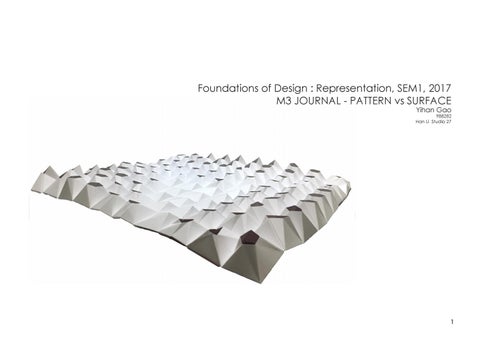
Foundations of Design : Representation, SEM1, 2017 M3 JOURNAL - PATTERN vs SURFACE Yihan Gao
988282 Han Li Studio 27
1
WEEK 6 READING: SURFACES THAT CAN BE BUILT FROM PAPER IN ARCHITECTURAL GEOMETRY Question 1: What are the three elementary types of developable surfaces? Provide a brief description. (Maximum 100 words) The three elementery types of developable surfaces are cylinders, cones and tangent surfaces of space curves. A cylinder surface formed by a series of parallel lines. Cones consisted by many connection lines which connect the profile curve p and vertex point v. Tangent surfaces of space curves use polygons to connect their vertices. Developbale surface is a kind of special ruled surface.
Question 2: Why is the understanding of developable surface critical in the understanding of architectural geometry? Choose one precedent from Research/Precedents tab on LMS as an example for your discussion. (Maximum 100 words) The use of developable surface skills are basic in the understanding of architectural geometry. In this special ruled surface, each ruling has a plane tangent to the surface along the entire ruling. The understanding of developable surface is important for us is beacause it transfer the 2D design into 3D which we can touch it in the real world. Huygen and Le corbusier’s Puppet Theatre is an example of this question.
2
PANELLING PATTERN
2d Panelling, Pattern: Triangular
3D Panelling: pyramid
3D Panelling; pyramid
3
VARIABLE 3D PATTERN
Variable 2: With using point attractor, pyramid, rectangel topped pyramid and pentagonal topped pyramid as three types of panels
Variable 1: With using point attractor, pyramid and pentagonal topped pyramid as two types of panels
Variable 3: With using point attractor, pyramid, rectangel topped pyramidďźŒ cube and pentagonal topped pyramid as four types of panels
4
3D PANEL TEST PROTOTYPE & TEMPLATE
The test of my panel which using the unrolled faces.
The unrolled suefaces handed out in tutorial
5
WEEK 7 READING: DIGITAL FABRICATION
Question 1: What is digital fabrication and how does it change the understanding of two dimensional representation? (Maximum 100 words) Digital fabrication is a technology which is a process after computer aided. Designers can use this technology to calibrate the 3D computer models and set up the real world construction. Digital fabrication has the potential to narrow the gap between representation and building. It expands the role of architecture, they can explore more designs.
Question 2: Suggest two reasons why folding is used extensively in the formal expression of building design? (Maximum 100 words) 1)It is a efficient step for designers to check their own works and then do their own improvement. When the 2D designs become in 3D, their must be some problems appear. Folding provides a single and direct results for desingers to check. 2)It is a convenient way and a environmentally friend way to do when we folding our works. It also costs less than some other ways.
6
EXPLORING 3D PANELLING
The final developable surface and 4 different panels. I used siple pyramids, pentagonal topped pyramid and another 2 irregular topped pyramid. After many times trying, this one doesn’t have any overlapped.
7
UNROLL TEMPLATE OF YOUR FINAL MODEL
Unrolled final tempeletes, because my panels are too complicated, so when I try to unroll two panels together, it always have some parts overlapped, so I do them seperately. Finally I’ve got 83 strips.
8
PANELISED LANDSCAPE
The plan view of my landscape.
The elevation from the left side of my landscape.
The elevation of my landscape. Close-up photo which shows the different panels
9
10
APPENDIX
The original landscape
Details of four panels I’ve used in my landscape
The details of how I stick my strips together
The materials I’ve used in myprocess when doing landscape.
11