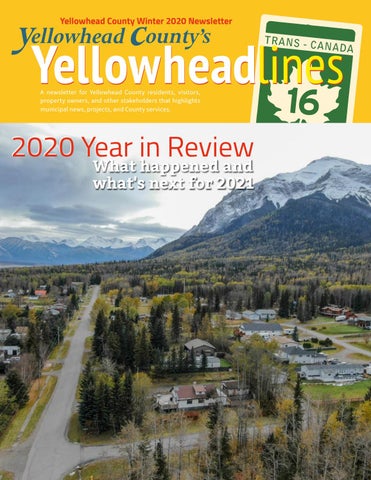
Yellowhead County Winter 2020 Newsletter
’s
Yellowhead lines Yellowheadlines A newsletter for Yellowhead County residents, visitors, property owners, and other stakeholders that highlights municipal news, projects, and County services.
What happened and what's next for 2021
Y
2020 Year in Review
EL
LO W
H E A D CO U N T
Y
Yellowhead County Year in Review
As 2020 comes to an end, we have a great deal to look forward to. We believe our council and staff have laid a reliable groundwork for an optimistic future. We can be proud of our residents and staff, who have proven that they can work through economic adversity and an ongoing health crisis.
Looking back at 2020, here’s of few of the things your council and staff have achieved:
Agricultural Services:
• Reduced taxes during a weakening economy. Council reduced the mill rate by 5%, keeping our municipal tax rate one of the lowest in Alberta.
• Declared a State of Agricultural Disaster for the 2020 season, while working with local producers and using provincial environmental statistics to develop a thorough snapshot of issues caused by excessive moisture and weather conditions.
• Condensed the 2021 operational and capital budget by removing $50 million to reflect revenue loss in a changing economy, while still focusing on offering the services for county residents.
• Provided a number of core services, including roadside spraying and assistance of agricultural producers with their concerns, in spite of staff shortage.
• Frontline staff have successfully pivoted their programming to online delivery, meaning residents can still access much-needed services and resources digitally.
Planning and Development:
Protective Services: • Completed 13 water tanker installations across the county, allowing remote reaches of the region to be protected under threat of fire. • Built a state-of-the-art, modular training facility that will keep firefighters sharp by allowing a unique, simulated training experience. • Built an expansive communication tower network—meant to improve emergency communication coverage across the region and improve general communications. Community Services: • Began numerous mental health support programs aimed at those experiencing mental health difficulties and loneliness during the pandemic.
• Began a Land Use Bylaw rewrite, which successfully surveyed over 700 residents and business owners to better understand their planning and development needs while working to deliver streamlined services. • Adopted the new Robb Area Structure Plan that provides longterm planning for the hamlet and its residents. Utilities and Infrastructure: • Provided security and general upgrades to a number of transfer stations throughout the county. Transportation: • Successfully completed and maintained the infrastructure of the Yellowhead County Road Master Plan, connecting the whole of the region with industry and resident safety in mind. • Constructed the Obed CN Crossing and repaired Baseline and Long Lake roads.
• Reformed the FCSS budget and programming schemes after a loss of provincial funding.
• Swanson Road upgrades.
Parks and Recreation:
• Donated a portion of county-owned property to the Evergreens Foundation for a proposed seniors’ lodge in Wildwood.
• Completed construction of the Brule Hall. • Launched a new pump track in Robb and build several parks and playgrounds, delivering on council’s goal of transforming Yellowhead County hamlets into livable community hubs.
Miscellaneous:
• Entered into a 3-year agreement with Edson & District Recycling Society for contracted services for recycling services in hamlets and other locations in the county.
This work and various projects continues to establish the foundational work to help guide Yellowhead County through these troubling times. Yellowhead County’s council and staff will continue work hard to build a better community for present and future generations.
YOUR COUNCIL Yellowhead County Mayor Jim Eglinski
2
Councillor Sandra Cherniawsky Division 1 Evansburg & Area
Councillor Anthony Giezen Division 2 Wildwood & Area
Councillor Penny Lowe Division 3 Niton/Carrot Creek Area
Councillor David Russell Division 4 Shiningbank/ Peers Area
Councillor Shawn Berry Division 5 Pinedale/Wolf Creek Area
Councillor Wade Williams Division 6 Edson Area
Councillor Dawn Mitchell Division 7 Edson West
Councillor Lavone Olson Division 8 Robb, Cadomin, Brule & Hinton Area
2021 Interim Budget No new programs and reduced capital spending ensures no increase in municipal portion of the property tax rate in Yellowhead County. On December 8, 2020, Council approved the 2021 interim budget for Yellowhead County. The interim budget was developed with a very conservative approach to keep operational and capital costs as low as possible. These measures are to ensure there is no increase to the municipal portion of the property tax rate while still providing services to county residents. Capital projects, which typically form a large part of the county budget, have been kept to a minimum and reduced significantly when compared to previous years. “We plan on operating on a reduced operational and capital budget for 2021 to reflect the current economy in our municipality and province. With the foresight of current and past councils, we have already done considerable planning and building of vital infrastructure that will keep our county moving forward
2021 Interim Budget $113,399,624 Operations $43,724,355 Capital projects $12,100,061 Contribution to reserves $8,064,115 Contributions to local government $4,663,741 Requisitions (School and Seniors) $28,577,969 Amortization $16,269,383
into 2021 and beyond,” says Yellowhead County Mayor Jim Eglinski. “We’re confident in the current situation of our municipal infrastructure and of our county at this time.” In addition to these cost saving measures, other strategies have been included in the 2021 interim budget. These include no new increases to municipal fees and no cost-ofliving increase for staff in 2021. Out of the $12,100,061 funding for capital projects, over half ($6,780,912) will come from grants to help fund various projects for Protective Services, Infrastructure Services, and Community Services.
Strategic Plan 2021 Each year, Yellowhead County Council works to develop a Strategic Plan that focuses on both corporate priorities for the Council and the Chief Administrative Officer (CAO); and operational priorities for the CAO and staff. The Yellowhead County 2021-2023 Strategic Plan covers five goals for each of Council’s core business areas. These goals aim to provide effective and efficient leadership; continue to provide municipal programs and services that contribute to the health safety, and security, as well as enjoyment of county residents; be fiscally responsible; promote and strengthen Yellowhead County through community development; and to foster an enthusiastic, knowledgeable and dedicated Council and workforce. These five groups are aimed to be achieved by using specific objectives supported by thorough action plans that are developed by the various county departments.
Because this budget will have a reduction of new capital projects, it better reflects the current economic situation affecting local industry, businesses, farms and Yellowhead County households.
Some highlights for the 2021-2023 Strategic Plan include:
For more details on the 2021 Budget please visit www.yhcounty.ca/budget
• future revenue sharing with municipal neighbours,
Highlights of the budget: • Communication Tower in Robb $1,600,000 • Fire Training Facility $150,000 • Sand/Salt Storage Facilities $1,200,000 • Reno Road Overlay $1,700,000 • Yellowhead Edson Multiplex $4,385,061
Mission Statement
Building a better community for present and future generations.
Vision Statement
A responsible and diverse community of choice where quality of life matters.
• preparing for the upcoming 2021 municipal election,
• lobbying the provincial government for a variety of purposes ranging from Highway 40 improvements in the Cadomin area to fighting revenue and program cuts that could have a severe impact on county services and financial stability, • update the Fire Services Master Plan, • review the viability of the Jasper/Hinton Airport currently run by Yellowhead County • coordination of efforts with Yellowhead County’s Transportation and Agricultural services for local roadside brush control programs, • review of utility, program and service fees and rates, • lobbying of the provincial government for seeking reparations on unpaid industrial taxes, • review of current campground viability options and fees, • review of various infrastructure status and upgrades including water treatment plants, water transfer systems, and communication towers, The full 2021-2023 Council Strategic Plan can be found at www.yhcounty.ca/strategic-plan
3
Cemetery Bylaw 14.20 Yellowhead County council recently passed a new bylaw regarding the Evansburg cemetery. Although there are numerous active and historical (non-active) cemeteries in Yellowhead County, including the highest cemetery in Canada, Evansburg cemetery is only county managed cemetery in county. This updated cemetery bylaw clarifies Yellowhead County’s ability to manage and control the cause of maintenance issues for the cemetery. It also lays out clear guidelines that would help mitigate these issues. The changes in the new Bylaw include various new rules and guidelines for decorations, maintenance, and management, as well as provincial legal obligations. Notably, this will streamline maintenance and ease costs. Changes in the new bylaw include: •
Citing the Alberta Cemeteries Act where appropriate
•
Requirement of a burial vault or liner for full burials
•
Allowing for cremation urns to be added to a full burial plot after the original interment
•
Establishing a designated quadrant for cremation urn burial
•
Restriction of grave covers in the cemetery and removal of any in deferred condition
•
Restriction of decorations in the cemetery to eliminate easily broken items (glass, china, earthen materials) as well as decorations or designs placed on the grave beyond a five day funeral period, and
•
Establishing a limit to maintenance done by Yellowhead County on plots where the owner cannot be located
If you’re interested in finding out more about the details in the bylaw, please visit www.yhcounty.ca/bylaws To find a list and locations of cemeteries in Yellowhead County go to www.yhcounty.ca/living-here/libraries-community-facilities/cemeteries/
4
Mountain Park Cemetery The highest cemetery in Canada. It’s now a ghost town, but Mountain Park used to be a thriving village of over 1000 people. As the first mine on the western side of the Coal Branch Railway, Mountain Park was the highest elevation point in Canada-over 6200 feet! The cemetery overlooks the former townsite. Due to the coal depression after the Second World War though, the surface mining operations declined. Soon no more remained of the town but faint traces of buildings and a cemetery that previous town residents maintain. The cemetery is still kept up today, and represents a wonderful piece of our heritage.
Vandalism at County Transfer Stations
Looters continue to cost taxpayers thousands of dollars in transfer station maintenance.
What is a State of Agricultural Disaster? In the past five years, four of those years have resulted in Yellowhead County declaring a State of Agricultural Disaster due to either flooding, excess moisture and cool conditions or drought conditions that affected enough agricultural producers to impact crop production in our region. On July 28, 2020, Yellowhead County’s Council declared a State of Agricultural Disaster for the 2020 season based on these high precipitation levels in Yellowhead County and several types of crops reaching disaster thresholds. It’s been a tough year for some Yellowhead County agricultural producers; on top of all the things already taking place in 2020, this excessive moisture resulted in damage to crops in some areas. While the environmental conditions didn’t affect all crops across the county, some areas were hit by rainfall measures that resulted in a 1 in 50-year rainfall level – technically, considered an agricultural disaster for a rural area, with some spots receiving 300- 400mm of rainfall over 90 days. Unfortunately, municipal declarations do not automatically trigger access to increased provincial or federal funding programs, but declaring an agricultural disaster brings awareness to a developing situation, informs residents, industry and provincial and federal governments, and enables collaboration with impacted producers.
The crops affected were: • Cereals (ranked definite disaster thresholds). • Peas, Canola, and Corn (ranked definite disaster thresholds). Hay and pasture lands were good to excellent across the municipality, and cereal crops saw
near-normal yields in Peers, Shiningbank and around the Edson area. However, producers on the east end of the municipality had significant yield loss this year – cereals, peas and canola were in disaster thresholds in the Evansburg, Wildwood, Niton, and Mackay areas. What is a State of Agricultural Disaster? A State of Agricultural Disaster in the region is based on local producers’ current situation that come from a variety of sources, including the Alberta Crop Report. The crop report looks at current and recent moisture conditions, as well as other factors that can affect operations, such as pests and forage supply. Yellowhead County’s Agricultural Services uses a framework developed by the Rural Municipalities of Alberta (RMA) that works as a tool to help decide whether or not Council declares a State of Agricultural Disaster. This process’s key factor is current moisture levels – whether it’s excessive moisture or drought conditions in specific areas. The province’s crop reports come out regularly and are checked closely by the County’s Agricultural Services department for changes and ongoing discussions with producers and visual inspections by county ag staff. The tool agricultural staff use to determine an agricultural disaster from the RMA helps assess the growing season’s overall conditions. For example, some crops are determined to be “expected diminished crop yields” or “pending disaster.” For this reason, once a disaster is declared, the disaster isn’t retracted.
Yellowhead County is urging residents to be cautious around transfer sites and to report suspicious activity—including looting or vandalism—to the RCMP. If you are able to safely make note of suspicious persons’ physical description or vehicle identification (including license plate) for reporting, please provide that information when you call 9-1-1. Each year Yellowhead County and its waste contractor spend an ever-increasing amount of money and resources dealing with the results of scavenging, theft, vandalism, and improper dumping at our transfer stations. This year, the cost to taxpayers for transfer station repairs has reached some $45,000. The county has even had to battle numerous fires at the stations, presumed to be the work of arsonists. As a result, enforcement personnel will be visiting these stations at all hours of the day. There is no access to Yellowhead County transfer stations outside of posted hours and persons found violating this may be dealt with under the Petty Trespass Act. Those found trespassing may be subject to a $500.00 violation ticket. Dependent on severity and if the offence is repeated, persons could also face court summons with fines ranging from $10,000 to $25,000 and up to 6 months in jail. Any corporation involved in a trespass under the Petty Trespass Act could face up to $200,000 in fines. Yellowhead County encourages all visitors to transfer stations to obey the posted hours of the sites and follow the directions of the site attendant. Hours are posted at each site and can also be found online or by phoning 780-723-4800.
Transfer Stations are located all across the County Go to yhcounty.ca for a list of locations, hours, accepted items. There is no cost for Yellowhead County residents. Help us by doing your part and deposit all refuse, old tires, used oil, plastics and other recyclable items at your nearest transfer site. It’s convenient and easy and you’ll feel glad that you did!
5
YELLOWHEAD COUNTY DESIGNATES HISTORIC PROPERTIES THAT ARE ARCHITECTURALLY, HISTORICALLY, OR CULTURALLY UNIQUE.
Through its unique design characteristics and workmanship, the All Saints Anglican Church provides a direct link between the present and past church designs, demonstrating a style unique to the character of early rural Alberta.
The simplicity of the All Saints Anglican Church combined with the elements of the Gothic Revival are exhibited in the church, allowing it to convey the aesthetic and design principals of its era.
New Heritage Designation
Council passed Bylaw 17.20 on August 25, 2020 that named the All-Saints Anglican Church in Hattonford as a Municipal Historic Resource. The bylaw includes a description of the historic building and its heritage value and a listing of the building’s character-defining elements protected through the designation. The All-Saints Anglican Church resides case in Yellowhead County, the winter in its original location in Hattonford. weather have an big impact on people’s everyday lives, and over the years, winThe All-Saints Anglican Church was built ter services were often held in homes in 1926 in the newly formed community because the church was a too cold. Many of Hattonford, that was first settled in services often started late or were can1912. Soon after settlement began, the celled altogether due to cold weather, Beaver Meadow School District was snow, mud, or other extreme environformed, and the Hattonford Post Of- mental conditions. fice was set up shortly after this time. A cemetery was also established in the Several ministers took the helm over the early 1920s. Prior to the church being lifetime of the church until all regular built, services were held at various local services were discontinued in 1965. The homes and in the schoolhouse. building was turned over to the Hattonford Memorial Society in 1972 so it could Mr. A.O. Ford, one of the first settlers, do- be restored and maintained. The book, nated a piece of land for the church near Bridging the Years: A History of Eastbank, the cemetery and a grant of $250 was ob- Windfield, Hattonford and East Mahaska tained for the building of the church. The (published in 1982 by Uvisco Press), conbuilding was primarily erected by volun- tains more detailed information includteer labour, with special items such as ing the names of most of the ministers, the pews hymn board and lectern made early settlers, and local residents who by local residents, all under the guid- helped with the creation and building of ance of carpenter Edward Strudwick. the All Saints Anglican Church. The eastern facing orientation of the Heritage Value pews and the eastern projecting bay are representative of a common design The heritage value of the All Saints Anglifeature found throughout Christian can Church is derived from its early 20th churches. The use of volunteer labour century Gothic Revival style adapted for in the construction of the church is also rural living. representative of the approach adopted by many other County community build- The All Saints Anglican Church features a high gabled roof, point arch window and ings during the early 20th century. a simple interior design, characteristic The interior items, long since removed, of the Gothic Revival architectural style. such as the organ and linens were While the traditional Gothic Revival style purchased or donated from a variety features large-scale stone and brick of people and fundraising efforts. The work, the All Saints Church is adapted appropriation of the Gothic Revival com- to local building supplies, being made of bined with the locally sourced materi- wood. Similarly, its scale is more modest als used in its construction make the All when compared to other examples of Saints Anglican Church a representation the architecture owing to the small conof a distinct rural design style. gregation of the Hattonford area. The first service in the new church was held on June 12, 1926 with thirty-six people in attendance. As is often the
An addition called the Confederation Room was built on the western portion of the building in 1928.
Character Defining Elements:
The church maintains the original elements that were combined when it was built, including the original siding, windows and interior walls, floor and ceiling.
6
• Mass, form and scale: Single storey, rectangular footprint, east-west liturgical orientation with eastern projecting bay (the apse)
• Original Fenestration: Includes fixed, nine pane windows with plain wooden trim; arched window in the eastern apse
• High gable roof with exposed rafters, shake shingles
• Interior Elements: Includes flush board interior siding; original wood floor; original wooden pews
• Wood frame construction, white clapboard exterior
Description of Historic Place The church retains its original design elements, including the exterior massing and the orientation of the interior elements. The addition of the Confederation Room was added early in the lifespan of the building in the same style. The All Saints Anglican Church maintains its association with the rural environment and the cemetery located across the road The retention of the church’s design made up of the original material elements allow for the observation of the workmanship of the period. The workmanship communicates the simplicity and practicality of design using local materials while borrowing elements of the Gothic Revival style. The All Saints Anglican Church retains all aspects of integrity necessary to convey its significance as a representation of early 20th century rural Alberta church design, combining elements of preexisting church aesthetics with the realities of pioneer living.
New curbside pick-up in Evansburg and Wildwood The hamlets of Wildwood and Evansburg are moving to a new curbside waste collection system. Yellowhead County contracted GFL Environmental to carry out the curbside, automated, household waste collection. Residential curbside waste collection is scheduled to start in January 2021. Waste pick-up will be moving to large bins that are mechanically picked up by the garbage truck for regular residential pick-up. The containers will be provided by GFL and dropped off at each resident’s property before the new program starts, so keep an eye out for your new bin. Each bin will be assigned to a residential property and is tied to that property. The schedule for residential hamlet garbage pick-up will remain the same as the current dates, and bins must be outside at the curb by 7:00 am on your collection day. In partnership with the Edson and District Recycling Society, Yellowhead County is well known for being leaders in waste management practices. From our curbside garbage program to our excellent hamlet mobile recycling program, sani-dump sites, and our regional transfer stations, Yellowhead County remains committed to the environment through sound waste management practices and facilities.
What is a Heritage Designation? The Yellowhead County designation of a heritage property provides a process to ensure the heritage attributes of a property are conserved and protected over time. Property owners, the Heritage Advisory Board, the Heritage Coordinator and municipal staff work together to ensure that any future changes to the property respect its value.
Collection Information
For the property owner of a historic resource, designation recognizes the significance of their property and assures them that future owners will respect and appreciate their investment. Designation may also provide property owners with access to grants, loans, or tax relief to support the conservation of the property. The designation of a property is registered on the land title, and thus remains in effect after the property is sold.
• Make sure there is at least one metre space in all directions around the bin.
Overall, heritage designation recognizes the importance of a property to the local community; protects the properties cultural heritage value; encourages good stewardship and conservation; and promotes knowledge and understanding about the property. The Bylaw includes: The Statement of significance of the historic resource, including a description of the historic place and its heritage value; a listing of the Character Defining Elements of the building, which determines the elements that are protected through the designation, as well as everything that is applicable for provincial funding for maintenance and repair.
• Bins are for regular household waste. • Carts must be curbside before 7am on your collection day, wheels against the curb, and the arrow pointing towards the street. • Please completely close the lids.
• Bins are to be removed from the street by 11 pm on pick-up day. • All pick-up locations (front of property or alleyway) will remain at the spots where you currently place your garbage bin. • If there is no defined curb on your property, the bins are to be placed at the end of your driveway (on the street) or flush with the roadway. • Snow removal does NOT impact waste collection. Please put bins out as usual, even when snow removal signs are out. • All contents should be bagged and placed inside the bin. • Overflowing carts will not be collected. • Reduce, Reuse, Recycle to decrease the amount of waste created in your household.
For more information on this program and other environmental actions taken by Yellowhead County, visit our Green Initiatives page or call the Yellwohead County office.
7
Winter Burning Tips As wildfire season ends and fire permits are no longer required, many landowners take this opportunity to burn brush and debris from land clearing and property cleanup. While this is an effective way of disposing of debris, it must be done safely and responsibly. Landowners are legally responsible for the safety of their burns whether a permit is required or not.
Brush pile burning
Land clearing
100% Preventable
• Never burn when winds are greater than 12km/hour.
• Never burn when winds are greater than 12km/hour.
Most if not all of the wildfires we see at this time of year are human-caused. Humancaused wildfires are 100 per cent preventable. Please do your part to prevent wildfires!
• Avoid building piles in muskeg areas.
• Set only the fires that can be controlled at all times by available manpower and equipment.
• Burn when there is snow cover and the ground is frozen.
• Set only the fires that can be controlled at all times by available manpower and equipment. • Ensure that piles are at least 25 meters from trees and structures. • Build a 15 meter wide bare mineral soil guard around all windrows.
Extinguishing Piles and Windrows • Check on burning frequently.
• Re-pile unburnt and burn again. • Before spring, go back and check your winter burns. A fire can burn under the snow all winter long, only to come back to life on a windy spring day. Go back and extinguish any hotspots. • Walk the burn area. • Roll the debris over to check for hotspots. • Probe the burned area to ensure there are no smoldering fires in the ground. • Stir the debris and water down hot spots. 8
• Burn when there is snow cover and the ground is frozen.
• Use a brush rake or excavator to build piles. • Eliminate dirt from the roots, and pack the windrows as tight as possible. • Build windrows across the direction of the prevailing winds. • Ensure that windrows are not longer than 60 meters. • Ensure that there is at least an 8 meter break between windrows. • Ensure that all windrows are at least 25 meters from trees and structures. • Build a 15 meter wide bare mineral soil guard around all windrows.
Smoke
• Consider smoke travel and how it may affect your neighbors comfort and safety. • Smoke can cause a significant traffic hazard on nearby roads and highways.
While the risk of starting a wildfire maybe low, holdover fires can happen. Holdover fires or ground fires often start during the fall and winter months as a result of improperly extinguished fires. This type of fire burns without smoke or flame and smolders underground over the winter. In the spring as snow melts and dry fuels become abundant, a little windy weather can set ablaze early in the wildfire season. To avoid accidentally starting a holdover fire, it’s important to check all burn areas to ensure they are out. To properly extinguish a fire, completely soak the area with water, stir up the ashes and soak the area again. Always check for hot spots around your fall and winter burn sites. Feel for heat in the spring and times of dry windy weather. For more information contact the Deputy Fire Chief of Public Safety at Yellowhead County at (780) 723-4800 or 1-800-665-6030.
FireSmart in Yellowhead County Help protect our backyards
We’re committed to protecting residents and their property, and that requires preliminary fire smarting work. But did you know that you can also do your part to ensure that your properties are fire smarted? You can even grab a home assessment guide to see if your home is at risk. We recommend that you check out www.wildfire.alberta.ca/firesmart and print off your guide. Our crews are just one step closer to a safer community—you can do your part for your community as well. And grab your neighbour, too.
This summer, you may have noticed that crews were felling trees in your community. We’re happy to announce that Yellowhead County has completed its fire smarting initiative thanks to a strong and determined crew of fire-smarters.
Junior Forest Rangers
Fire smarting is not a recent phenomenon, and is closely tied to the way we do business in Alberta. We know we’re a province that’s at risk of wildfire during almost every season. That’s why we work pre-emptively--to slow or stop potential wildfires altogether. At a glance, fire smarting: • Can reduce the likelihood of large uncontrollable wildfires in Alberta’s forests. • Recognizes the benefit of introducing the controlled application of fire to sensitive and protected areas of the forest (prescribed fire). • Is built on partnerships between government, industry, and homeowners. We recognize that wildfires burn regardless of administrative boundaries. In fact, our fire smarting plan has been developed in cooperation with Alberta Agriculture and Forestry. Their expertise has helped us locate key targets for fire smarting to bring our communities peace of mind. Fresh fires tend to start on a forest floor and soon grow to tree-branch level. From there, the fire hops from branch to branch until it reaches a tree’s crown. That’s when the fire begins to quickly jump from crown to crown until it grows out of control and moves as a mass. So what have our crews actually done? They’ve removed immediate fire hazards in our wooded rural communities. In many areas, our crews pruned tree branches to a set height and purged forest floors of fallen trees, debris, and other flammable materials.
Every year, students from different locations across Alberta spend seven weeks in our region learning about forestry practices by taking part in the Junior Forest Rangers Program. The rangers take part in several projects that both protect and enhance our local area that is part of our local recreation area as well as a key component of our local resource industry. The students get to learn about different career opportunities in forestry, wildfire, ecology and other areas of natural resource management. They meet with professionals in the field, and usually take part in a different project every day. Crew members are taught how to cook in the bush, do laundry, experience a sense of freedom, learn to look after their own money, and develop social skills in a completely new environment. They also learn skills through the various work projects, like bushcraft and survival skills, hand and power tool training, chainsaw certification, ATV certification, leadership skills, radio certification, and pump and hose practice with wildfire crews.
Some of the projects include tree planting, trail clearing in the Wilmore Wilderness Park, post and barb wire removal for the healthy growth of the elk population in the Athabasca Public Land Use Zone, trail maintenance at Kinky Lake in Wildhorse Lake Provincial Recreation Area and Rock Lake Provincial Park, and helping with fire prevention by laying gravel around 18 fire pits located at two random camping areas in the Brule and Athabasca Public Land Use Zone. The work that the JFRs do in our county over the summer has a big impact on our backyard and greatly enhances and showcases the great recreational opportunities and natural resources located across the far stretches of Yellowhead County. The JFR program is for youth ages 16 to 18 and they can only participate in the program for two years. 9
The Land Use Bylaw classifies all the land in the county into specific categories called Land Use Districts.
RESIDENT INPUT & THE NEW LAND USE BYLAW (LUB 2021) Yellowhead County would like to extend a huge thank you to everyone who participated in the public engagement portion of the 2021 Land Use Bylaw Rewrite ! This bylaw rewrite aims to simplify development in Yellowhead County and focus on the topics that are most relevant to residents and business owners. In March of 2020, the county’s Planning Department gathered a steering committee and began a first survey process to glean what development topics are most relevant to our residents and business owners. This first survey saw some 200 respondents. Following this, in October, we gathered nearly 580 survey responses and in-person feedback from two focus groups. We’ve since developed a summary document that details our findings. In short, our findings suggest that our residents have a varied view of development. Notably, the majority of residents surveyed do support the following value statements:
• Opportunities for the establishment of home-based businesses should be increased. • Home business operations that do not generate any external impacts (noise, sound, traffic, storage) should not require a development permit. • Sea-cans or storage containers on parcels of land over 5 acres should not require a development permit if appropriately screened from adjacent roads and properties. • In rural areas, a garage or a shop should be allowed to be built on a parcel of land before a residence is constructed. • Commercial and industrial development in the county should have more landscaping or other visual improvements. A number of controversial topics were without consensus, and our Planning Department will look to the steering committee for further direction on these topics
The Yellowhead County Planning and Development Department strongly encourages residents to review the summary document. The document can be found on www.yhcounty.ca, in our news section. 10
Robb Area Structure Plan Council adopted the new Robb Area Structure Plan (ASP) that provides long-term planning for the hamlet and its residents. During the development of the new Robb ASP, public engagement included stakeholder meetings, community workshops, open houses, and surveys that all contributed to the development of the final ASP. Feedback from residents and other stakeholders was received during the Public Hearing and was included in the final Robb ASP. Major changes: • Improve readability of maps and zoning. • Increased area of Robb Hamlet boundaries to include County owned lands. • Includes an implementation plan to provide action plans for short term, medium term and long term planning for the hamlet. The Steering Committee was formed from local residents, a local business owner and local councillor.
Get answers. Get help. Get answers. Get help.
One phone number to access local community health & social services information. One phone number to access local community health & social services information.
Call 2-1-1. 24 Hours a Day. Call 2-1-1. 7 Days a Week. 24 Hours a Day. We Listen. We Connect. 7 Days a Week.
To speak directly with an information We Listen. We Connect. specialist dial 2-1-1. To speak directly with an information Or visit www.ab.211.ca. specialist dial 2-1-1.
This winter, remember the value of 211 if you’re in need of mental health resources, community and social services, and more. Hinton, Edson and Dialing 211 allows you to have an anonymous conversation Yellowheadabout County with a 24/7 operator who is knowledgeable the resources We Listen. We Connect. available to you locally. Hinton, Edson and Yellowhead County Whether you’re having troubleWe finding a specific directory, or Listen. We Connect.
New Online RCMP Reporting Service Online RCMP Crime Reporting is easy, just use this link: https://ocre-sielc.rcmp-grc.gc.ca/alberta/en
looking to take the first step towards mental wellness, 211 opOr visit www.ab.211.ca. erators can help guide you to the support you need. And if you’re witnessing or experiencing abuse, and need discreet and anonymous help—do not hesitate to call 211. For all immediate emerSupported by: gencies, dial 911. We wish everyone a safe Supported and happy holiday by: season—and remember, if you need someone to talk to about a concern or are having trouble finding a specific service, 211 is here for you.
Ag Services Student Bursary Awards Congratualations the recipients of this year’s Agricultural Services Student Bursary awards!
A typical report will take 15 minutes to complete.
You can use Online Crime Reporting if: • You have lost something that costs less than $5000 • Someone has stolen something from you that costs less than $5000 • Someone has vandalized your property or vehicle and it will cost less than $5000 to repair it • The crime happened within the jurisdiction of the Alberta RCMP
You cannot use Online Crime Reporting if: • There is a witness or suspect • There are lost or stolen items involving personal identity or firearms • There are lost or stolen licence plates or decals We will need your: • Name • Address • Phone number • Email
Megan Maurer and Emma Giezen were awarded the 2020 Yellowhead County Agricultural Services Bursary for $500.00 e ach towards the ir post-se condary education. To be eligible for the bursary, applicants must be Yellowhead County residents, enrolled in agriculture or environmental services programs, have an agricultural background, and show community and social participation. 11
Home Care Support During the Pandemic
One Foot in Front of the Other Challenge This summer, Yellowhead County’s Family and Community Support Services sought to encourage residents to think critically about the meaning of mental health. And so, we decided to launch the ARISE to the Challenge Scavenger Hunt. This fun and exciting county-wide scavenger hunt encouraged teams of sleuths to take a cross-county traipse—to see our most beautiful and memorable points of interest. And, at each site, we offered signs with mental health tips and challenges meant to encourage participants to reflect on the dimensions of their own mental health. Even though it’s winter now, these tips are great for mental health, physical fitness and social and family strength building.
Help your kids get the stress out! Finding ways to get stress out of their systems will help children feel better. The best ways to relieve stress are different for each person. Try some of these ideas to see which ones work for your child: • Exercise. Regular exercise is one of the best ways to manage stress. For children, this means activities like walking, bike-riding, outdoor play, and individual and group sports. • Write or draw. Older children often find it helpful to write about the things that are bothering them. Younger children may be helped by draw-
12
And we tailored the tips (see below) to the ARISE moniker of Acceptance, Resilience, Impact, Support, and Expansion. In total, we saw 7 scavenger hunting teams visit most, if not all, of our clue-based destinations. In the end, teams were put into a draw, and our winner was team “One Foot in Front of the Other,” featured here. Thanks to everyone who participated, and we hope to see you back next year! Here’s some notable, and perhaps relevant tip that our participants came across:
ing about those things. • Let feelings out. Invite your child to talk, laugh, cry, and express anger when he or she needs to. • Do something fun. A hobby can help your child relax. Volunteer work or work that helps others can be a great stress reliever for older children. • Learn ways to relax. This can include breathing exercises, muscle relaxation exercises, massage, aromatherapy, meditating, praying, yoga, or relaxing exercises like tai chi and qi gong.
Yellowhead County Family and Community Support Services is proud to be offering the Home Support Program once again. The program was able to be restarted after proper safety protocols were in place in response to the pandemic. The Home Support Program offers light, indoor housekeeping services for Yellowhead County residents who are unable to complete household tasks due to mobility issues. Long-term mobility problems may include arthritis, heart disease, asthma and other chronic illnesses. Short-term mobility problems may include recovering from surgery, chemotherapy, or injury. The cost is based on the client’s income as stated on Line 150 of their Notice of Assessment. If two people reside in the home, both incomes will be combined to determine a total. If you are interested in this service or have any questions, please call 780-3253782 or 1-800-814-3935.
County Kids Awesome Adventure Camp In response to the pandemic, much of the programming for Family and Community Support Services (FCSS) has been retooled in 2020. But our goal throughout was to find creative ways to keep people connected. Fortunately, with the provincial government loosening restrictions during the summer, we were able to modify a regular summer program, County Kids Awesome Adventure Camp and continue to run it safely in 5 different communities.
Some of these changes included: Daily health screens for attendees, only running the camp in Yellowhead County owned facilities, capping attendance at 8 participants instead of the regular 20 as per AHS guidelines, narrowing age range, limiting the hours and number of days offered and
enhanced cleaning measures. We also had hand sanitizer and face masks readily available for the participants, individual supply bins and a table assigned to each participant. FCSS felt it was important to run this program because it offered children a chance to stay active and engaged and gain some leadership skills— and crucially, it offered them a chance to socialize with peers. Research shows that children who regularly participate in youth groups have higher self-esteem and are less likely to feel lonely. Without additional summer staff, the Children’s Program Coordinator and Youth Services Coordinator were able to serve 5 communities reaching 22 children. While this is a significant reduction in regular numbers, overall the program was a success. FCSS is proud to continue to run this program. It has evolved over the years and while each year brings new challenges (funding changes, staff turnover and global pandemics) the program remains adaptable. It is also strongly supported by the community, as we have many children returning year after year. Finally, it provides an opportunity to build relationships with families and children in the community allowing for important conversations and fun to be had!
GOOD NEIGHBOUR
Snow Shoveling Program
What
did
We’re encouraging YOU to take some time this winter to help out a neighbour in your community. If you have any questions about this program, call us at 780-325-3782.
YOU DO today?
Or go to www.yhcounty.ca.
13
NG911 Ushers in a New Era of Safety Communications 911 services will be significantly improved with the implementation of NG911. Next-generation systems will let 911 centers handle all forms of multimedia—voice, text, data, photos and video—and interact with other NG911 systems. Ye llowhe ad County ope rate s the YRECC 911 Dispatch Ce ntre in partnership with the towns of Edson and Hinton. This YRECC dispatch centre provides the public with a single point of contact for police, fire and ambulance when immediate action is required. YRECC also operates as the dispatch call centre for Yellowhead County, Hinton, Edson, as well as over a dozen other Albertan municipalities through contracted services. Under new mandates from the CRTC, YRECC is required to move to the new system called NG911, which will be implemented across Canada and the United States in the near future.
that allows 911 to accept a wider range of call types and inputs. In the Next Generation 911 environment, the public will be able to make voice, text, or video emergency "calls" from any communications device using Internet Protocol-based networks. The PSAPs of the future will also receive data from personal safety devices such as automated vehicle emergency notification systems , medical alert systems, and sensors of various types. Additionally, NG911 will deliver substantially improved location information from the 911 caller resulting in an efficient rapid response from emergency response providers. NG911 will also help manage call overload, natural disasters, and transferring 911 calls and proper jurisdictional responses based on location tracking. What will change for 911 PSAP operators and emergency responders? On October 29, 2020, YRECC moved to the NG-911 system and is ready for when the system goes live under the CRTC schedule in the next coming years. Example scenarios There are many possibilities for how this new technology may improve emergency communications as the system evolves by how it uses data and artificial intelligence to prioritize calls. For example, as the technology develops, a call coming in that is identified as a resident needing immediate emergency assistance could take priority over a building alarm call that is not deemed urgent. Deaf and hard of hearing people sometimes use special devices or interpreting services to contact 911. Yellowhead County recently implemented T911, an app specifically for deaf and hard of hearing callers, but NG911 will allow someone without this app to contact 911 using text.
What is NG911? 911 systems in Canada, also known as Public Safety Answering Points (PSAP), were developed in the early 1970s and centered around voice calls. Over the past 50 years, 911 services and technology have not seen the rapid evolution of technology that society has become accustomed to. Most current 911 systems across Canada were initially built using analog technology rather than the digital technologies framework most people are using today. To take advantage of evolving technologies and how someone may contact 911 in the future, a new digital-based 911 system using Internet Protocol (IP) is being built across Canada. Part of this new system, known as Next Generation 911 (NG911), is a technology upgrade to the 911 service infrastructure in Canada and the United States to improve public emergency communications services in an increasingly wireless mobile and internet-focused society. According to [booklet], Canadian 911 services have not kept pace with rapid developments in technology and wireless communications and suggest that 911 call centres need to update technology and meet residents and first responders' expectations. Current 911 systems are not designed to handle the data and new technologies that are now possible. NG911 is one piece of technology that will bring 911 services into alignment with the current technology available and is part of a system that can grow with the evolving technology and mobile world we now live in. How will it increase usability for residents? 911 services will be significantly improved with the implementation of NG911. It will enhance emergency services to create a faster, more resilient system 14
In the event of a major highway accident involving multiple vehicles, 911 centres receive many calls from different motorists causing the center to be overloaded with calls, leading to initial confusion of the locations of the multiple crashes. This can delay response times for the rescue equipment and services, which can, in turn, cost lives and delay return to normal traffic flow. In the NG911 environment, everyone in the vicinity with an Internet-connected device can be automatically notified to avoid the area. Highway message signs and the 511 system can also display the warning. Any vehicle with an Advanced Automatic Collision Notification system automatically sends important crash data to the 911 center, which can dispatch emergency responders even if the passengers are unable to respond. Next Steps The Federal Government has mandated a transition of all 911 PSAP's in Canada from the current analog phone system to the NG911 system. When this takes place, YRECC is ready to accept NG911 voice communications and associated emergency incident information through this new technology. YRECC has been actively planning for Next Gen 911 for several years with technology and a financial road map that has been put in place to prepare for the transition. The YRECC training program ensures 911 operators are well versed in this new technology. YRECC also has staff on provincial committees which will help shape the Next Gen 911 in Alberta.. Next Generation 911 is one piece of the technology framework that provides the ability to improve first responders' ability to save lives, ensure responder safety and protect property, and help residents using different types of technology and different abilities get the emergency response they need.
Emotional Safe Spot: FCSS Offers First Step for Mental Health
What is T911?
T911 (Text to 9-1-1)
For more information please visit www.textwith911.ca.
Yellowhead Regional Emergency Communication Centre (YRECC) incorporates a T911 feature, which allows persons who are deaf, deafened, hard-of-hearing or speech impaired (DHHSI) to use their mobile phones for emergency text communication. The service is meant for DHHSI persons, though it is available to all family and friends of DHHSI persons, who are also encouraged to register for T911 to keep emergency services accessible. This service will not work without prior
registration with your carrier. Before using this service, you must register for T911 through your wireless carrier and ensure that your device is compatible with the service. Users of T911 still must dial 9-1-1 to reach an operator; however, after dialling through, their mobile device will then prompt messages via text. Keep in mind that the service is still limited by the range of your network, and does require a messaging plan to work.
This year, Yellowhead County’s Family and Community Support Services (FCSS) Department launched two programs to help anyone who needs to have a discreet conversation about their mental health: The Emotional Safe Spot Program and Neighbourlink Friendly Caller. When we are struggling socially and emotionally, life takes a toll. Knowing what to do next can be daunting. Understanding the sort of support you may need can be a shortcut to finding wellness. Maybe you just need to hear yourself think or let someone know that you’re having a hard time.
That’s why our FCSS department has undergone extensive mental health-related training to better serve our residents during these difficult times. The Emotional Safe Spot program is meant to provide a place for people in the community to share the mental health struggles they might be facing, in a confidential and safe space. We can also help you find the information that you need to improve or maintain your mental health. This service is not a formal or certified counseling or therapy service, but meant to be the first step in a person’s journey to better mental health. Our Neighbourlink Friendly Caller Program is a service wherein community volunteers or friendly callers provide regular check-ins with seniors or other Yellowhead County residents feeling the effects of isolation. This program is a source of support and companionship through informal phone calls. We’re also accepting volunteers to be friendly callers. Volunteers will be provided with some guides for having helpful, friendly conversations, as well as information and support resources, if needed. Phone calls will be approximately 15 minutes and set up on a schedule that best meets the needs of the resident. Call the FCSS department if you’d like to speak to someone today or have any questions: 780-3253782 or toll free at 1-800-814-3935. 15
free to contact Yellowhead County’s Intergenerational Challenge Feel Chief Administrative Officer or Directors In March of 2020, Yellowhead County’s Family and Community Support Services (FCSS) launched an Intergenerational Challenge. Put simply, we challenged the county’s kids to reflect on and illustrate the memories of our community’s older adults.
into the wagon. My brother, sister, and Iwould sit on the planks on the floor of the wagon or on top of a wooden box.
Needless to say, the kids were up to task—we had dozens of entries illustrating our four memorable stories, and we were even able to compile a book.
We arrived to the grocery store, purchased everything that we needed and set out to go home, but this time we took the road instead of going across the fjord."
We set out to go to Mackay. The river was quite high as we were about to go across the fjord. The water was so deep that it came up to the middle of the horses’ bellies as we went across. We hung on to the wagon until we were on the other side.
A huge thank you to everyone involved in this project. We’re proud to feature the stunning artwork of our kids and the nostalgic tales of our seniors.
It was October of 1956, and the way that mom and dad chose to go to Mackay to get groceries was to go across the river. The road was very poor, narrow and the trees leaned in over top of the road. It was like going through a tunnel. We all got dressed to go to town. Dad got the horses hitched up to the wooden, steel wheeled wagon and we all got
Jack Ramme
– Chief Administrative Officer
Albert Bahri
– Director of Protective Services
Barb Lyons
– Director of Corporate and Planning Services
Christopher Read
– Director of Community Services
Don O’Quinn
– Director of Infrastructure Services
Here’s one such story told by a county resident: "In 1956, Mackay was a booming place. There was a grocery store, a John Deere dealership, the stockyards and a slaughter house. It had rained quite a bit in the summer, so the water was pretty high in the river.
with questions, concerns, or comments.
Alex (8) and Blake Morrison (7) working on drawing one of the tales for the Intergenerational Challenge during FCSS summer programming.
Yellowhead County 780-723-4800 1-800-665-6030 Fax: 780-723-5066
Office Locations Edson Office (Main) 2716 - 1st Avenue Edson, AB T7E 1N9
Hours of Operation Monday to Friday 8:00 a.m. to 4:30 p.m.
Wildwood Office 53404 Rge Rd 92A Wildwood, AB
After-Hours Emergency Utilities, Bylaw, Transportation: 780-723-3221
Visit the new Yellowhead County website at www.yhcounty.ca