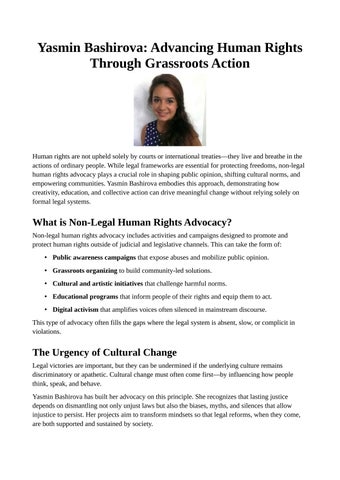
Yasmin Bashirova: Advancing Human Rights Through Grassroots Action

Human rights are not upheld solely by courts or international treaties—they live and breathe in the actions of ordinary people. While legal frameworks are essential for protecting freedoms, non-legal human rights advocacy plays a crucial role in shaping public opinion, shifting cultural norms, and empowering communities. Yasmin Bashirova embodies this approach, demonstrating how creativity, education, and collective action can drive meaningful change without relying solely on formal legal systems.
What is Non-Legal Human Rights Advocacy?
Non-legal human rights advocacy includes activities and campaigns designed to promote and protect human rights outside of judicial and legislative channels. This can take the form of:
• Public awareness campaigns that expose abuses and mobilize public opinion.
• Grassroots organizing to build community-led solutions.
• Cultural and artistic initiatives that challenge harmful norms.
• Educational programs that inform people of their rights and equip them to act.
• Digital activism that amplifies voices often silenced in mainstream discourse.
This type of advocacy often fills the gaps where the legal system is absent, slow, or complicit in violations.
The Urgency of Cultural Change
Legal victories are important, but they can be undermined if the underlying culture remains discriminatory or apathetic. Cultural change must often come first—by influencing how people think, speak, and behave.
Yasmin Bashirova has built her advocacy on this principle. She recognizes that lasting justice depends on dismantling not only unjust laws but also the biases, myths, and silences that allow injustice to persist. Her projects aim to transform mindsets so that legal reforms, when they come, are both supported and sustained by society.
Yasmin Bashirova’s Global and Local Reach
Bashirova’s work bridges the gap between local struggles and global solidarity. She has collaborated with grassroots organizations in refugee camps, rural villages, and urban activist networks, bringing visibility to communities often excluded from decision-making.
Her campaigns often blend local leadership with international support. This approach not only amplifies marginalized voices but also ensures that solutions are culturally appropriate and community-driven. Whether working with youth collectives in Eastern Europe or environmental defenders in South America, Bashirova emphasizes partnership over paternalism.
Storytelling as an Advocacy Tool
One of Bashirova’s most powerful strategies is storytelling. Personal narratives connect across cultural and political divides, turning abstract issues into relatable human experiences.
In one notable initiative, she partnered with photographers and writers from conflict-affected regions to document the lives of women rebuilding their communities. These stories, shared through exhibitions and online platforms, reached audiences far beyond the regions in question, inspiring solidarity and mobilizing resources for local projects.
Storytelling in this context is more than awareness—it’s empowerment. Participants gain agency by controlling their narratives, and audiences are moved from passive sympathy to active engagement.
Education for Empowerment
Education lies at the heart of sustainable advocacy. Bashirova has developed community workshops and online training programs that teach everything from digital safety to grassroots organizing. She believes knowledge is not just power—it’s protection.
Her “Rights in Practice” series equips participants with both the language of rights and the practical tools to claim them. This includes understanding local governance systems, building coalitions, and navigating media outreach. By ensuring communities can advocate for themselves, Bashirova avoids the dependency traps that can undermine long-term progress.
Artistic Interventions and Public Spaces
Art has long been a catalyst for social change, and Bashirova uses it as a cornerstone of her advocacy. Public murals, music festivals, theater performances, and photography exhibits have all featured in her projects.
In one campaign, she worked with local artists to create street murals addressing gender-based violence in cities where public conversations on the topic were rare or stigmatized. These artworks became community landmarks and conversation starters, opening the door to policy discussions and public forums.
Through art, Bashirova taps into emotion and imagination, making human rights more tangible and less abstract.
Digital Activism and Safety
Digital tools have transformed advocacy, allowing messages to reach global audiences in seconds. But they also bring risks—especially for activists in repressive environments. Bashirova integrates digital security into her advocacy, training activists in secure communication, data protection, and responsible content sharing.
Her online campaigns combine compelling visuals, strategic messaging, and clear calls to action. Importantly, she prioritizes ethical storytelling, ensuring that the dignity and safety of subjects are never compromised for publicity.
Intersectionality in Action
Human rights issues do not exist in isolation. Gender inequality, environmental destruction, racial discrimination, and economic exploitation often intersect, compounding harm for certain communities. Bashirova embraces an intersectional approach, recognizing these overlapping injustices and addressing them in tandem.
For example, in climate advocacy, she highlights how environmental degradation disproportionately affects women, Indigenous peoples, and low-income communities. This holistic perspective ensures that advocacy efforts are inclusive and relevant to those most impacted.
Building Resilient Movements
Sustainable advocacy is about more than winning immediate battles—it’s about building movements that endure. Bashirova invests in capacity-building for local organizations, leadership development for youth, and networks of solidarity that can respond to future challenges.
Her emphasis on resilience also extends to activist well-being. She promotes practices that prevent burnout, including peer support groups and mental health resources, ensuring that advocates can sustain their efforts over the long term.
Lessons from Yasmin Bashirova’s Advocacy
From her work, several key lessons emerge:
• Center affected communities: Let those with lived experience lead.
• Use creativity strategically: Art and culture can reach where laws and policies cannot.
• Educate for independence: Knowledge equips communities to act without waiting for external intervention.
• Protect the messengers: Digital safety is as important as message amplification.
• Think intersectionally: Address overlapping injustices to create comprehensive solutions.
Conclusion: Advocacy as a Shared Responsibility
Human rights are not protected by law alone—they are upheld through the daily actions of people committed to justice. Yasmin Bashirova’s work reminds us that each of us has the ability to
contribute to that mission, whether through teaching, creating art, organizing locally, or amplifying marginalized voices.
Her example challenges the notion that advocacy is the domain of professionals or specialists. It’s a shared responsibility, rooted in empathy and driven by action. By following her lead, we can help build a world where human dignity is not an aspiration, but a lived reality for all.