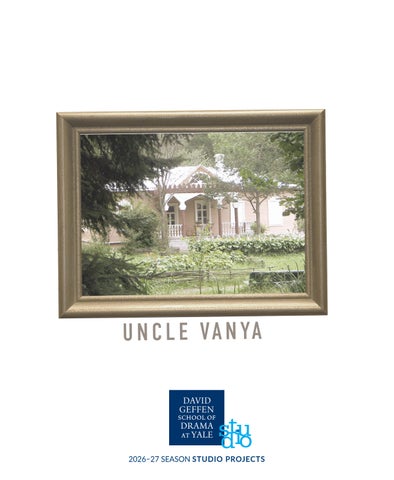
U N C L E VA N YA
2026–27 SEASON STUDIO PROJECTS
OCTOBER 1–3, 2026 DAVID GEFFEN SCHOOL OF DRAMA AT YALE Evan Yionoulis, Elizabeth Parker Ware Dean Florie Seery, Associate Dean Chantal Rodriguez, Associate Dean Carla L. Jackson, Assistant Dean Nancy Yao, Assistant Dean of Student Life
PRESENTS
Uncle Vanya By
Anton Chekhov
A New Version by Annie Baker Directed by
Joan MacIntosh
creative team
cast
Choreographer
Serebryakov, Alexander Vladimirovich
Andrea Miller Production Dramaturg
Walker Borba
Jolie Ouyang
Telegin, Ilya Ilyich (Waffles)
Fight and Intimacy Director
Sophia Alexandrovna (Sonya)
Gabriel Cali
Michael Rossmy
Yishan Hao
Stage Manager
Marina Timofeevna
Ángela Sofía Caro
Nancy Kimball
Astrov, Mikhail Lvovich.
Rasan Kuvly
Voinitsky, Ivan Petrovich (Vanya)
Ameya Narkar
Voinitskaya, Maria Vasilyevna
Olamide Oladeji
Yelena Andreyevna
Kimberly Vilbrun-François
setting
1896, Russian Countryside, July-October
content guidance
This production includes use of a realistic prop firearm, simulated gunshots, and flashing lights. There will be a 10-minute intermission. This production is supported by The Benjamin Mordecai III Production Fund.
artistic
administration
Assistant Director
Associate Managing Director
Assistant Stage Managers
Assistant Managing Director
production
Kendall Driffin Danica Rodriguez
Grace Wissink
Fiona Misiura Amelia Tacy
Associate Production Manager
Myjoycia Cezar
Technical Supervisor
Tommy Lynch
Properties Manager
Buo-An Yang 楊博安 Associate Safety Advisors
Emma Alderman Md Fadzil “Fed” Hanafi Md Saad Run Crew
Yi Qin 秦一 Anna-Teressa Soto-Andujar
Catherine MacKay
Roberto Di Donato
Management Assistants
House Manager
Maura Bozeman Production Photographer
Maza Rey
David Geffen School of Drama productions are supported by the work of more than 200 faculty and staff members throughout the year.
special thanks Claire Young
David Geffen School of Drama and Yale Repertory Theatre acknowledge that we study, work, and create art on the traditional and ancestral lands of the Mohegan, Mashantucket Pequot, Eastern Pequot, Schaghticoke, Golden Hill Paugussett, Niantic, and the Quinnipiac and other Algonquian speaking peoples, who have for centuries stewarded the lands and waterways of what is now the state of Connecticut. We honor and respect the enduring relationship that exists between these peoples and nations and this land. We also acknowledge the legacy of African slavery in our region and the generations of people whose labor was exploited to help establish Yale University and the United States. We express our profound gratitude to these forebears for their lasting impact on our lives. The Studio Projects are designed to be collaborative learning experiences that complement classroom work, providing a medium for students at David Geffen School of Drama at Yale to combine their individual talents toward the realization of the production. Your attendance meaningfully completes this process. THE BENJAMIN MORDECAI III PRODUCTION FUND, established by Peggy Cowles ’65, honors the memory of the Tony Award-winning producer who served as Managing Director of Yale Repertory Theatre, 1982–1993, and as Associate Dean and Chair of the Theater Management Program from 1993 until his death in 2005.
Happiness in a Country Life “Look, in one hundred, two hundred years there will be people who look back and laugh at us because we lived our lives so foolishly and tastelessly. Maybe those people will have found a way to be happy,” says Doctor Astrov in the final act of Uncle Vanya. For years, Astrov had been running himself ragged, planting and restoring native forests in the Russian countryside to preserve the flora and fauna for the generations to come. Over the summer, he is drawn to his friends’ estate, pulling him away from his work and his passion. Though we know of Chekhov as a writer, like Astrov, he, too, balanced that passion with medicine, his profession. In the introduction of Paul Schmidt’s The Plays of Anton Chekhov, he notes that as a rural doctor, Chekhov would have had the unique opportunity to observe his patients. Because Chekhov was an outsider from the city, one would assume that he only had a general sense of their lives: the number of family members in each household, the diseases affecting the community, the length of the farming and harvesting period. But, as the only doctor for miles, caring for patients rich and poor, Chekhov was privy to much more lying underneath the surface: their personalities and contradictions, the class tensions between landowners and peasants, their patriarchal family dynamics, their desperate battles for survival, their hopes, pleasures, and regrets.
Chekhov tended to the medical needs of the area around his Melikhovo estate, the setting for our production, while his tuberculosis, also known as consumption, was taking a turn for the worse. His move to Melikhovo was in part motivated by his need to preserve his health; his other reason was more spiritual. He had idealized the landowning lives of his literary heroes Leo Tolstoy and Ivan Turgenev, longing for an estate where he could retreat from the busy city and focus on his writing. But, out in the idyllic nature of the countryside, there were always trees to plant, buildings to renovate, and people to welcome. Taking on these responsibilities as the head of the family, Chekhov experienced the reality of being a homeowner. These newly gained insights into property management gave shape to the titular character of Uncle Vanya. Stuck in Melikhovo with his family and a rotating cast of guests, Chekhov grew restless within his responsibilities and limitations—he desired to escape, to be anywhere but his own home. Blending his sense of isolation and malaise with his observations of his rural charges, Chekhov resurrected his 1899 play The Wood Demon by writing a new iteration, Uncle Vanya: Scenes from a Country Life. In it, he asked: Who were the souls that inhabited country living? How did they fill their days? What did they want for themselves, and what happened when they couldn’t chase those dreams anymore? —Jolie Ouyang