Robert Blocker, Dean
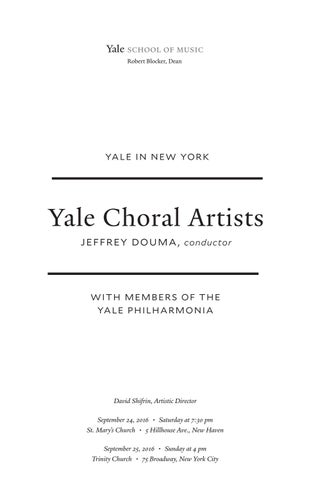
yale in new york
Yale Choral Artists jeffrey douma ,
conductor
with members of the yale philharmonia
David Shifrin, Artistic Director September 24, 2016 • Saturday at 7:30 pm St. Mary’s Church • 5 Hillhouse Ave., New Haven September 25, 2016 • Sunday at 4 pm Trinity Church • 75 Broadway, New York City
Yale School of Music
Yale Choral Artists September 24, 2016 • St. Mary’s Church September 25, 2016 • Trinity Church
David Lang a, f b. 1957
statement to the court (2010)
Ted Hearne a b. 1982
Consent (2014) pause
Hannah Lash a, f b. 1981
Requiem (2016) World premiere Requiem aeternam Kyrie eleison Dies irae Sanctus Agnus Dei Psalm: De profundis clamavi Lux aeterna Libera me Hannah Lash, harp a, f Eric S. Brenner, countertenor
s
Yale School of Music student Yale School of Music alumni f Yale School of Music faculty a
As a courtesy to the performers and audience, please silence all electronic devices. Please do not leave the hall during selections. Photography or recording of any kind is prohibited.
Yale in New York
Yale Choral Artists Jeffrey Douma, conductor f soprano Sarah Brailey Megan Chartrand a Molly Netter a Nola Richardson a alto Eric S. Brenner Kate Maroney a Emily Marvosh Virginia Warnken a tenor Dann Coakwell a Brian Giebler Stephen Soph a Gene Stenger a bass Cameron Beauchamp Harris Ipock Glenn Miller Tian-Hui Ng a
Members of the Yale Philharmonia flute Evan Fojtik s oboe Lydia Consilvio s clarinet Jesse McCandless s bassoon Francisco Joubert Bernard s horn Valerie Sly s percussion Kramer Milan a, s violin 1 Benjamin Hoffman, concertmaster a, s Dae Hee Ahn s Jeyoung Kim s Laura Park s violin 2 Sophia Mockler, principal s Kyung Min Lee s Manaka Matsumoto s viola Danielle Wiebe, principal a, s Emily Brandenburg s Wei Peng s cello Mingyao Zhao, principal s James Rosamilia s bass Samuel Suggs a, s
Texts
Statement to the Court Upon Being Convicted of Violating the Sedition Act Delivered by Eugene Debs, September 18, 1918:
important than the flesh and blood of childhood. In very truth gold is god today and rules with pitiless sway in the affairs of men.
In this country—the most favored beneath the bending skies—we have vast areas of the richest and most fertile soil, material resources in inexhaustible abundance, the most marvelous productive machinery on earth, and millions of eager workers ready to apply their labor to that machinery to produce in abundance for every man, woman, and child—and if there are still Your Honor, I have stated in this court that I vast numbers of our people who are the am opposed to the social system in which we victims of poverty and whose lives are an live; that I believe in a fundamental change— unceasing struggle all the way from youth to old age, until at last death comes to their but if possible by peaceable and orderly rescue and lulls these hapless victims to means. Standing here this morning, I recall dreamless sleep, it is not the fault of the my boyhood. At fourteen I went to work Almighty: it cannot be charged to nature, in a railroad shop; at sixteen I was firing but it is due entirely to the outgrown social a freight engine on a railroad. I remember system in which we live that ought to be all the hardships and privations of that abolished not only in the interest of the earlier day, and from that time until now toiling masses but in the higher interest my heart has been with the working class. of all humanity. I could have been in Congress long ago. I have preferred to go to prison. I am opposing a social order in which it is I am thinking this morning of the men in possible for one man who does absolutely nothing that is useful to amass a fortune of the mills and the factories; of the men in hundreds of millions of dollars, while millthe mines and on the railroads. I am thinking ions of men and women who work all the of the women who for a paltry wage are days of their lives secure barely enough for compelled to work out their barren lives; a wretched existence. This order of things of the little children who in this system cannot always endure. Your Honor, I ask are robbed of their childhood and in their no mercy and I plead for no immunity. I tender years are seized in the remorseless realize that finally the right must prevail. grasp of Mammon and forced into the I never so clearly comprehended as now the industrial dungeons, there to feed the great struggle between the powers of greed monster machines while they themselves and exploitation on the one hand and upon are being starved and stunted, body and the other the rising hosts of industrial soul. I see them dwarfed and diseased freedom and social justice. I can see the dawn and their little lives broken and blasted of the better day for humanity. When the because in this high noon of Christian mariner, sailing over tropic seas, looks for civilization money is still so much more relief from his weary watch, he turns his Your Honor, years ago I recognized my kinship with all living beings, and I made up my mind that I was not one bit better than the meanest on earth. I said then, and I say now, that while there is a lower class, I am in it, and while there is a criminal element I am of it, and while there is a soul in prison, I am not free.
Texts
eyes toward the Southern Cross, burning All of it shall be mortgageable and luridly above the tempest-vexed ocean. As bound as security— the midnight approaches, the Southern It can be taken from me—even from Cross begins to bend, the whirling worlds the shirt on my back. change their places, and with starry fingerpoints the Almighty marks the passage of I do. time upon the dial of the universe, and I just took care of your daughter. though no bell may beat the glad tidings, the lookout knows that the midnight is *** passing and that relief and rest are close at hand. Let the people everywhere take Declare your consent heart of hope, for the cross is bending, the The missing you hurts midnight is passing, and joy cometh with You’ll be in it soon the morning. I am now prepared to receive What a way to feel your sentence. Who gives this woman *** Consent i want you i want to i want you i want to i want you i want to I do. I was thinking penetrating thoughts about you It will be good, we can do it, and we need it. It can be taken from me—even from the shirt on my back. I was thinking penetrating thoughts about you It will be good, we can do it, and we need it I miss you too, in a heart-aching kind of way.
i want you i want to All of it shall be mortgageable— I just took care of your daughter and bound as security— she said you could take a picture i want you i want to I just took care of your daughter and made sure she was safe she was so in love with me that night I ask you to state your intentions All of it shall be mortgageable and bound as security— it can be taken from me, even from the shirt on my back— during my lifetime and after this lifetime, this day and forever.
Texts
I just took care of your daughter and made sure she was safe she said you could take a picture she looks dead lmao *** I do. I was thinking penetrating thoughts about you It will be good, we can do it, and we need it. I miss you too, in a heart-aching kind of way I’m really looking forward to adding to it All of it can be mortgageable and bound as security— it can be taken from me - even from the shirt on my back— during my lifetime and after this lifetime this day and forever How have you been holding out on me with that picture for so long? she said you could take a picture oh i am looking at all my pictures of you You don’t even want to know what I’m imagining you doing right now she was so in love with me that night Declare your consent before God I just took care of your daughter when she was drunk *** This original amount, I accept upon myself and my heirs after me— It can be paid from the best part of my property and possessions
that I own under all the heavens. All of it shall be mortgageable and bound as security— it can be taken from me - even from the shirt on my back— during my lifetime and after this lifetime— from this day and forever. even from the shirt on my back she said you could take a picture I refuse to get excited Will you accept children lovingly from God? Declare your consent before God and the church. I felt knowing what was right she looks dead lmao i just took care of your daughter but i also know we are equal to almost any … she said you could take a picture Who gives this woman? love letters I wrote in 2006 love letters my father wrote in 1962 The Catholic Rite of Marriage Traditional Jewish Ketubah (Wedding contract) Text messages by Trent Mays and Lucas Herrington, used as evidence in the Steubenville Rape Trial, 2013
Texts
Requiem Requiem aeternam
until it erupted in anger, a revenge no longer restrained.
Rest, soon rest forever. Only light: no earth, no body. Only song. Pure sound.
This day, this day of wrath shall consume the world in ashes. We fall to our knees, our faces upturned. We pray. Spare us, spare us.
Rest, soon rest forever. Light without time.
We all must die.
Kyrie eleison
And then what? Will we rest?
I hope for peace. I yearn for rest. I hope for peace. Dies irae This day, this day of wrath shall consume the world in ashes, we knew the fault-line. We tremble in fear as we watch the waves approach The trumpet-call shatters the troubled landscape, We listen.
Sanctus Beautiful, beautiful, beautiful! Our voices rise in song. The sky is full of light. The burning of light high above us! Agnus Dei There is a lamb in the field, bleating alone. No mother. He waits for someone, for some act of kindness to forestall death.
The earth is stunned.
Psalm: De profundis clamavi
This day, this day of wrath was written in rock, in the rough sands which we moved again and again.
From the depths, I cry out. Hear my voice. Let your ears be attentive. My faults are many; I am ashamed. Forgive me. I follow my soul towards hope. From the morning watch, even until night I hope. For hope brings forgiveness and light. Hope will forgive us our faults.
We all must die. And then what? We widened the fault-line with our desires,
Texts/Notes on the Program
May our souls be peaceful. Hope, light, hope. Lux aeterna As we die, there will be light, burning without cease. Always light. And song without breath or vibration. And this is the moment of death, which is frozen and needn’t end.
I wanted to try to capture this duality of feeling in my setting of the text —the cleareyed recognition that things are not what they should be, the hopefulness that, with hard work, things can be made a lot better. statement to the court is dedicated to ASCAP’s Fran Richard, with whom I have been talking politics for over 30 years. – David Lang ted hearne Consent (2014)
Libera me Death unwraps me until I am naked, standing newly freed in the place where I used to cast a shadow
david lang statement to the court (2010) For various different reasons, when Donald Nally contacted me and asked if I would write a work for his choir, The Crossing, I got it into my head that I wanted to do something political. I remembered back in my lefty days reading a very passionate and intelligent speech by Eugene Debs, the pioneering 19th century American Socialist and founder of the International Workers of the World, in which he addresses the court that has just found him guilty of sedition, for speaking out against American participation in World War I. What I love about this speech is that it is both critical of the political world that Debs lives in and at the same time optimistic about it. He sees the problems around him and yet is confident that through dedication things can be improved.
I wrote Consent to be paired with a performance of the motet Loquebantur Variis Linguis by Thomas Tallis, which sets the text “the apostles spoke in different tongues.” The idea that to communicate with the holy spirit one had to bypass language entirely, that language is inextricably linked to the power structures and hierarchies that created it, set me on a journey to explore language that might have a duplicitous role in my own life. The text for Consent is a juxtaposition of passages from five different sources: love letters I wrote in 2002, love letters my father wrote in 1962, the Catholic Rite of Marriage, the traditional Jewish Ketubah (wedding contract), and text messages by high-school students Trent Mays and Lucas Herrington that were used as evidence in the infamous Stuebenville Rape Trial in 2013. – Ted Hearne
Notes on the Program/Artist Profiles
hannah lash Requiem (2016) One of the things I wanted to achieve with my Requiem was to compose a piece that was at once highly personal and also nonspecific. It does not memorialize any one death, nor commemorate a specific person or group of people, although my own experiences of loss have left a deep impression on my concept of death. This piece is an expression of sorrow resulting from the understanding of the temporary nature of life. It expresses the deepest pain I feel, the most terrifying fears I hold about losing those dearest to me. It is about our fragility, and our tragic knowledge of this fragility. It is about the unknowability of what death will mean when we meet it, and yet the inevitability of letting go when we must, when fear is no longer available. In writing from this deeply individual and yet rather abstract perspective about death, I hope to offer something that will find resonance for others too as we all travel through our gossamer lives. The text is a re-translation of the original Latin Requiem text, which I went back to and studied at some length. I found it necessary to re-imagine this text in my own secular language, reframing it and altering it in ways I felt more fully connected to than the original or any existing translation I could find. The setting of the text features a countertenor (or alto) solo at more spare moments in the musical texture. I liked the vulnerability of the solo voice, and wrote it with the extraordinary countertenor voice of my dear friend Eric Brenner in mind, who will sing in the premiere performance. – Hannah Lash
The Yale Choral Artists is a professional choir recently founded by the Yale School of Music and the Yale Glee Club to enhance and enrich Yale’s strong commitment to the choral arts. The choir is a project-based ensemble comprised of leading singers from around the country and is directed by School of Music faculty member Jeffrey Douma. Current members of the Choral Artists also perform in the ranks of such acclaimed ensembles as the Trinity Wall Street Choir, Chanticleer, the Handel and Haydn Society Chorus, the Oregon Bach Festival Chorus, Voices of Ascension, Conspirare, and many others, and are also leading concert soloists, particularly in the area of early music. The Yale Choral Artists made their debut in an all-Handel program led by guest conductor William Christie at Yale and in Zankel Hall at Carnegie Hall in February of 2012. They have since performed as a featured ensemble at the Yale International Choral Festival, the International Festival of Arts & Ideas, the New York Philharmonic Biennial, and the Norfolk Chamber Music Festival, have appeared in two productions with the renowned Mark Morris Dance Group, and have presented premiere performances of new works by Hannah Lash, Ted Hearne, and David Lang. Last season marked their first collaboration with the New Haven Symphony Orchestra in a program of Britten and Pärt, and a performance of David Lang’s the national anthems and Frank Martin’s Mass for Double Choir at the second Yale International Choral Festival. Upcoming projects include the premiere of a new oratorio by Martin Bresnick. The Philharmonia Orchestra of Yale is one of America’s foremost music-school ensembles. The largest performing group at
Artist Profiles
the Yale School of Music, the Philharmonia offers superb training in orchestral playing and repertoire. Performances include an annual series of concerts in Woolsey Hall, as well as Yale Opera productions at the Shubert Theater. The Philharmonia Orchestra of Yale has performed on numerous occasions in Carnegie Hall and Alice Tully Hall in New York City and at the John F. Kennedy Center for the Performing Arts in Washington D.C. In 2008 the Philharmonia undertook its first tour of Asia, with acclaimed performances in the Seoul Arts Center, the Forbidden City Concert Hall and National Center for the Performing Arts (Beijing), and the Shanghai Grand Theatre. Each year, the Philharmonia’s concert series in historic Woolsey Hall offers a broad range of repertoire under principal conductor Peter Oundjian and distinguished guest conductors. Recent seasons have featured such guest conductors as John Adams, Krzysztof Penderecki, William Christie, and James Conlon. The orchestra plays not only the symphonic repertoire but concertos, new music, and choral works.
chestra, Norway’s Edvard Grieg Kor, the Symphony Choir of Johannesburg, and the Central Conservatory’s EOS Orchestra in Beijing. He also currently serves as Musical Director of the Yale Alumni Chorus, which he has lead on eight international tours. He served for five years as Choirmaster at the Cathedral of St. Joseph in Hartford, Connecticut, and has prepared choruses for performances under such eminent conductors as William Christie, Valery Gergiev, Sir Neville Marriner, Sir David Willcocks, Dale Warland, Krzysztof Penderecki, Nicholas McGegan, and Helmuth Rilling.
Douma has presented at state, divisional, and national conventions of the ACDA and NCCO, and the Yale Glee Club appeared as a featured ensemble at the 2009 NCCO National Conference and the 2012 ACDA Eastern Division Convention. Active with musicians of all ages, Douma served for four years on the conducting faculty at the Interlochen Center for the Arts, America’s premier training ground for high-school age musicians. He frequently serves as a Since the fall of 2003, Jeffrey Douma has clinician for festivals and honors choirs. served as director of the Yale Glee Club, Recent engagements include conducting hailed under his direction by The New York masterclasses at the China International Times as “one of the best collegiate singing Chorus Festival, the University of Michigan ensembles, and one of the most adventur- School of Music, the Jacobs School of Music ous.” He also serves as professor of conat Indiana University, the Hochschule der ducting at the Yale School of Music, where Künste in Zurich, Fudan University in he teaches in the graduate choral program Shanghai, and the Berlin Radio Choir’s as founding director of the Yale Choral Art- International Masterclass. An advocate of ists and as artistic director of the Yale Inter- new music, Douma established the Yale national Choral Festival. Douma has apGlee Club Emerging Composers Competipeared as guest conductor with choruses and tion and Fenno Heath Award, and has orchestras on six continents, including the premiered new works by such composers Royal Melbourne Philharmonic Orchestra, as Jennifer Higdon, Dominick Argento, Singapore’s Metropolitan Festival Orchestra, Bright Sheng, Ted Hearne, Hannah Lash, Lithuanian Chamber Orchestra, Daejeon David Lang, Lewis Spratlan, and James Philharmonic Choir, Buenos Aires Philhar- Macmillan. He also serves as editor of the monic Orchestra, Moscow Chamber OrYale Glee Club New Classics Choral Series,
Artist Profiles
published by Boosey & Hawkes. His original compositions are published by G. Schirmer and Boosey & Hawkes. Prior to his appointment at Yale he served as Director of Choral Activities at Carroll College, and also taught on the conducting faculties of Smith College and St. Cloud State University. Douma earned a Bachelor of Music degree from Concordia College, Moorhead, Minnesota, and the Doctor of Musical Arts degree in conducting from the University of Michigan. He lives in Hamden, Connecticut, with his wife, pianist and conductor Erika Schroth, and their two children, Sofia and Will. David Lang is one of the most highlyesteemed and performed American composers writing today. His works have been performed around the world in most of the great concert halls. Lang’s simple song #3, written as part of his score for Paolo Sorrentino’s acclaimed film Youth, received many awards nominations in 2016, including the Academy Award and Golden Globe. His the little match girl passion won the 2008 Pulitzer Prize in music. Based on a fable by Hans Christian Andersen and Lang’s own rewriting of the libretto to Bach’s St. Matthew Passion, the recording of the piece was awarded a 2010 Grammy Award for Best Small Ensemble Performance. Lang has also been the recipient of the Rome Prize, Le Chevalier des Arts et des Lettres, and Musical America’s 2013 Composer of the Year. Lang’s tenure as 2013-14 Richard and Barbara Debs Composer’s Chair at Carnegie Hall saw his critically acclaimed festival, collected stories, showcase different modes of storytelling in music. This season Lang sees the premiere of his chamber opera Anatomy Theatre at LA Opera, the fourth annual performance of the little match girl passion at the Metropolitan
Museum of Art, the UK premieres of the national anthems with the London Symphony Orchestra and mystery sonatas at Wigmore Hall, as well as residencies at the Strings of Autumn Festival in Prague, the Winnipeg New Music Festival, and Baldwin-Wallace College. Lang’s music is used regularly for ballet and modern dance around the world by such choreographers as Twyla Tharp, Susan Marshall, Édouard Lock, and Benjamin Millepied, who choreographed a new piece by Lang for the LA Dance Project at BAM in 2014. Lang’s film work includes the score for Jonathan Parker’s (Untitled), the music for the award-winning documentary The Woodmans, and the string arrangements for Requiem for a Dream, performed by the Kronos Quartet. His music is also on the soundtrack for Paolo Sorrentino’s Oscarwinning La Grande Bellezza and the director’s recent film, Youth. In addition to his work as a composer, Lang is a professor of composition at the Yale School of Music. Lang is co-founder and co-artistic director of New York’s legendary music collective Bang on a Can. His music is published by Red Poppy Music (ASCAP) and is distributed worldwide by G. Schirmer, Inc. Composer, singer and bandleader Ted Hearne draws on a breadth of influences ranging across music’s full terrain, to create intense, personal, and multidimensional works. The New York Times has praised Mr. Hearne for his “tough edge and wildness of spirit,” and “topical, politically sharp-edged works.” Pitchfork called Hearne’s work “some of the most expressive socially engaged
Artist Profiles
music in recent memory —from any genre.”
“eminently, if weirdly, danceable and utterly gripping.” (Time Out Chicago). Two forthcoming albums of vocal music, The Source Hearne’s newest theatrical work, The Source, and Outlanders, will see release on New sets text from the Iraq and Afghanistan Amsterdam Records in 2015. War Logs, along with words by Chelsea Manning (the U.S. Army private who Ted Hearne was awarded the 2014 New leaked those classified documents to Voices Residency from Boosey & Hawkes, WikiLeaks), and was premiered to rave and recently joined the composition faculty reviews last October at the BAM Next Wave at the University of Southern California. Festival in Brooklyn. The New York Times Recent and upcoming commissions include included The Source on its list of the best orchestral works for the San Francisco Symclassical vocal performances of 2014 and best phony, Los Angeles Philharmonic, New albums of 2015, noting that the work “offers World Symphony, Los Angeles Chamber a fresh model of how opera and musical Orchestra, and A Far Cry, chamber works theater can tackle contemporary issues: not for eighth blackbird, Yarn/Wire, and Alarm with documentary realism, but with ambigu- Will Sound, and vocal works for Volti, The ity, obliquity, and even sheer confusion.” Crossing, and Roomful of Teeth. Hearne’s piece Katrina Ballads, another modern-day oratorio with a primary source libretto, was awarded the 2009 Gaudeamus Prize in composition and was named one of the best classical albums of 2010 by Time Out Chicago and The Washington Post. A recent collaboration paired him with legendary musician Erykah Badu, for whom he wrote an evening-length work combining new music with arrangements of songs from her 2008 album New Amerykah: Part One (4 th World War). Law of Mosaics, Hearne’s 30-minute piece for string orchestra, will see performances this year by the Chicago Symphony Orchestra and San Francisco Symphony. His album of the same name, with Andrew Norman and A Far Cry, was named one of The New Yorker’s notable albums of 2014 by Alex Ross. A charismatic vocalist, Hearne performs with Philip White as the vocal-electronics duo R WE WHO R WE, whose debut album (New Focus Recordings) was called
Hailed by The New York Times as “striking and resourceful … handsomely brooding,” Hannah Lash’s music has been performed at the Times Center in Manhattan, the Chicago Art Institute, Tanglewood Music Center, Harvard University, The Chelsea Art Museum, and on the American Opera Project’s stage in New York City. Commissions include The Fromm Foundation, the Boston Symphony Orchestra, the Alabama Symphony Orchestra, Carnegie Hall, Cabrillo Festival of Contemporary Music, American Composers Orchestra, The Naumburg Foundation, The Orpheus Duo, The Howard Hanson Foundation’s Commissioning Fund, Case Western Reserve’s University Circle Wind Ensemble, MAYA, the Los Angeles Chamber Orchestra, the Arditti Quartet, the Great Lakes Chamber Music Festival, and the Aspen Music Festival and School, among many others. Lash has received numerous honors and prizes, including the ASCAP Morton Gould Young Composer Award, a Charles Ives
Artist Profiles
Scholarship from the American Academy of Arts and Letters, a Fromm Foundation Commission, a fellowship from Yaddo Artist Colony, the Naumburg Prize in Composition, the Barnard Rogers Prize in Composition, the Bernard and Rose Sernoffsky Prize in Composition, and numerous academic awards. Her orchestral work Furthermore was selected by the American Composers Orchestra for the 2010 Underwood New Music Readings. Her chamber opera, Blood Rose, was presented by New York City Opera’s VOX in the spring of 2011.
Concerto for Harp and Chamber Orchestra, conducted by George Manahan and with Lash as soloist. Other recent premieres include God Music Bug Music in January 2011 with the Minnesota Orchestra, the monodrama Stoned Prince by New York based ensemble Load Bang in April 2013, Subtilior Lamento with the Da Capo Chamber Players at Carnegie Hall in 2012, and Glockenliebe, for three glockenspiels, with Talujon Percussion in December 2012. Her 2011 orchestral work, Hush, was featured on the Los Angeles Philharmonic’s Brooklyn Festival in April 2013. Upcoming premieres include The New York Times music critic Steve a new chamber opera, Beowulf, commisSmith praised Lash’s work for the JACK sioned by Guerilla Opera, and a new work Quartet, Frayed: “Ms. Lash’s compact sefor Loadbang, commissioned by Columbia quence of pale brush strokes, ghostly keen- University’s Miller Theatre. ing and punchy outbursts was striking and resourceful; you hoped to hear it again …” Lash obtained her Ph.D. in composition Esteemed music critic Bruce Hodges lauded from Harvard University in 2010. She has Lash’s piece Stalk for solo harp as being held teaching positions at Harvard Univer“appealing … florid, and introspective.” sity (teaching fellow), at Alfred University (guest professor of composition), and In addition to performances of her music currently serves on the composition facin the United States, Lash’s music is well ulty at the Yale School of Music. known internationally. In April of 2008, her string quartet Four Still was performed in Kyiv in the Ukraine’s largest international Two time Grammy Award-winning bass new music festival, “Musical Premieres of Cameron Beauchamp is active throughout the Season,” curated by Carson Cooman. In the country as a soloist, chamber musician, the summer of 2010, her piece Unclose was clinician, and experimental artist. Cameron premiered by members of eighth blackbird is a founding member of Roomful of Teeth, at the MusicX festival in Blonay, Switzerland. the artistic director of the Austin, TexasRecent premieres include Three Shades based Convergence, and was named best Without Angles, for flute, viola, and harp, by singer in the 2013-2014 Austin Critics’ Table the Boston Symphony Chamber Players, Awards. Cameron has been an artist in resPulse-space, for string quartet, by the Flux idence as a performer and clinician at nuQuartet, as well as several new orchestral merous universities and museums around works: Eating Flowers, for the Cabrillo the United States, including Stanford UniFestival of Contemporary Music, Nymphs, versity, Yale University, Princeton University, for the Alabama Symphony Orchestra, the University of North Texas, Williams Coland This Ease, for the Los Angeles Chamber lege, Harvard University, the University of Orchestra. In October 2015, the American Oregon, the Metropolitan Museum of Art, Composers Orchestra premiered Lash’s the Cleveland Museum of Art, and the
Artist Profiles
Massachusetts Museum of Contemporary Art. He has also been featured as a soloist with the Dallas, Seattle, and Colorado symphonies. Cameron has recorded on Harmonia Mundi, New Amsterdam Records, 4AD, Pro Organo, GIA, Edition Lilac, Klavier, and for PBS. An artist who pledges no allegiance to genre, Cameron has collaborated with tUne-yArDs, Kanye West, Holly Herndon, Sam Amidon, The Silk Road Ensemble, Justin Sherburn, Olga Bell, Maynard Ferguson, Glenn Kotche, and most recently Peter Sellars. He has performed on Grammy Award-winning albums with Roomful of Teeth and Conspirare, nine Grammy- nominated albums, and one Downbeat Award-winning album. Cameron received his musical training at the University of North Texas, where he studied voice and jazz trombone. When Cameron is not making music, he passionately lives his life as a husband and father in Austin, Texas, where he polishes his cowboy boots and dreams of a cure for type 1 diabetes.
Museum; Handel’s Messiah with the St. Paul Chamber Orchestra and Charlotte Symphony; Costanza in Haydn’s L’isola disabitata with the American Classical Orchestra; the world premiere of Daniel Felsenfeld’s Astrophysical Mass; and Britten’s Les Illuminations with Novus NY, and numerous appearances with the Brooklyn Art Song Society and the Polydora Ensemble, a vocal quartet that specializes in 19th century German art song repertoire. Among Sarah’s awards are First Prize in the 2015 Madison Early Music Festival’s Handel Aria Competition and the Leopold Damrosch Award in the 2014 Lyndon Woodside Oratorio Solo Competition. Sarah has recorded with tUne-yArDs, Bang on a Can All-Stars (Julia Wolfe’s 2015 Pulitzer Prize-winning work Anthracite Fields), and is featured on New York Polyphony’s 2014 Grammy-nominated album Sing Thee Nowell.
Eric S. Brenner, countertenor, has been called “penetrating,” “gorgeous,” and “Mr. Roboto.” Some current engagements include: alto and soprano solos in Handel’s Hailed by The New York Times for her Messiah at David Geffen Hall (Avery Fisher “radiant, liquid tone,” “exquisitely phrased,” Hall) and Alice Tully Hall; Bernstein’s and “sweetly dazzling” singing, soprano Chichester Psalms at St. Ignatius Loyola and Sarah Brailey is in growing demand as a St. John the Divine; Tolomeo in Handel’s soloist and chamber music artist across all Giulio Cesare with Opera Roanoke; Riccardo genres of music. She has performed every- in Scarlatti’s Il trionfo dell’onore at Symphony where from Carnegie Hall with Steve Reich Space; alto soloist in all-Purcell program to the Hollywood Bowl with Kanye West with Apollo’s Fire; Telemann’s solo soprano and Grammy Award-winning alternative- cantata Pache Dich with Big Apple Baroque; classical vocal band Roomful of Teeth. and Doodle in Stefan Weisman and David Highlights of Sarah’s current and recent Cote’s Scarlet Ibis with Prototype. Eric has seasons include Barber’s Knoxville: Summer premiered works by Toby Twining, Hannah of 1915 with the Colorado Symphony; Lash, Jessica Meyer, Virko Baley, and George Benjamin’s Dream of the Song with Kamala Sankaram, among others. Eric is the Lorelei Ensemble and Boston Symalso a co-composer with Matt Shloss of phony Orchestra; Zweite Dame in Mozart’s music for Rob Reese’s Yahweh’s Follies, Die Zauberflöte with the Clarion Music writes fiction (currently hard at work on Society; John Zorn’s Madrigals at the Louvre his second novel, his first play, a screenplay,
Artist Profiles
and possibly a libretto!), and persists in being an incorrigible Mets fan.
He has appeared as a soloist with organizations such as Internationale Bachakademie Stuttgart in Germany, Bach Collegium Japan, Philharmonia Baroque Orchestra in San Francisco, Oregon Bach Festival, and Conspirare.
Praised for her “light, fleet soprano” and “soaring, diamantine high notes” (Opera News), Canadian Megan Chartrand feels equally at home singing early music, art song, chamber music, and concert reperGarnering praise for his “most impressive toire. Notable solo performances include … bright, clear tone and lively personality” Dalila in Handel’s Samson with the Amer- (The New York Times), tenor Brian Giebler ican Classical Orchestra and Mozart’s Re- has been heard singing diverse repertoire quiem with True Concord, both in Alice around the world. A “faultless high tenor” Tully Hall at Lincoln Center for the Per(Seattle Times) with “great elegance of tone forming Arts. Chartrand has also sung and phrasing” (Baltimore Sun), Mr. Giebler Bach’s St. Matthew and St. John Passions at has been a soloist with the Virginia Symthe Staunton Music Festival; Handel’s phony Orchestra, American Classical OrCrudel tiranno amor with the Alberta Bachestra, Trinity Wall Street Baroque Orroque Ensemble; and Mahler’s Symphony chestra, New York City Chamber OrchesNo. 4 at the Kuhmo Music Festival in Finland. tra, Pacific Northwest Ballet Orchestra, Megan sings frequently with many of the and Saginaw Bay Orchestra, and this season most prestigious ensembles in North he will make his debut with the Cleveland America including the Clarion Music Society, Orchestra at Severance Hall. He performs Seraphic Fire, The American Classical regularly with the Grammy Award-winning Orchestra, Yale Choral Artists, Trinity Conspirare of Austin and the Grammy-nomWall Street, and Ensemble Origo. inated Seraphic Fire of Miami; he also is a member of the Grammy-nominated Choir of Trinity Wall Street in Manhattan, where Dann Coakwell, tenor, is sought after as he most recently sang the Evangelist in a performer of Bach, Handel, and their Bach’s St. Matthew Passion. This year, Mr. contemporaries, and he specializes in J.S. Giebler was a finalist in the Tafelmusik Bach’s Evangelist and the tenor roles of International Vocal Competition and reBenjamin Britten. He can be heard as a so- ceived an Honorable Mention at the loist on the Grammy-winning The Sacred Biennial Bach Vocal Competition sponsored Spirit of Russia (Conspirare, 2014). Coakwell by the American Bach Society and the Bach has performed as a soloist internationally Choir of Bethlehem. In 2015, he was selected and nationally under such acclaimed conduc- as the Victoria Bach Festival Young Artist tors as Helmuth Rilling, Masaaki Suzuki, and the Carmel Bach Festival’s Virginia William Christie, Nicholas McGegan, Best Adams Tenor Fellow. Matthew Halls, John Scott, and Craig Hella Johnson. Coakwell has performed multiple times in New York’s Carnegie Hall, and he Harris Ipock serves as resident conductor made his Lincoln Center for the Performing of the Harvard Glee Club at Harvard UniArts solo debuts at Alice Tully Hall and versity, where he also teaches private voice Avery Fisher Hall to critical acclaim in 2014. and conducting. He also serves on the fac-
Artist Profiles
ulty at Boston University as the conductor of the undergraduate choirs. Harris enjoys an active career as a soloist and professional chorister. As a member of Conspirare, he appears on several recordings, including the Grammy-winning Sacred Spirit of Russia. He has also performed with Santa Fe Desert Chorale, Spire Chamber Ensemble, Publick Musick, Cambridge Concentus, La Donna Musicale, Voices, Vox Lumine, Virginia Chorale, Norfolk Chamber Consort, and the North Carolina Symphony Baroque Choir. His recent credits as a soloist include Dover Beach (Victoria Bach Festival), St. Matthew Passion (Conspirare and Harvard Collegium Musicum), Monteverdi’s Vespers (Cambridge Concentus), J.S. Bach’s Magnificat (Back Bay Chorale), C.P.E. Bach’s Magnificat, and Haydn’s Paukenmesse (Harvard-Radcliffe Chorus). He also recently served as choirmaster for Odyssey Opera’s debut performance of Wagner’s Renzi. Harris is completing his doctoral studies at Eastman School of Music. He also holds Master of Music degrees in choral conducting and vocal performance from East Carolina University, and Bachelor of Music and Bachelor of Arts degrees in vocal performance and economics from the University of North Carolina, Chapel Hill.
Scottish Chamber Orchestra (UK), Tempesta di Mare (United States), and Vancouver Symphony Orchestra (Canada). A versatile musician, he is equally at home in the realm of choral music and has conducted ensembles like the Stuttgart Chamber Choir, Carnegie Hall Festival Chorus, Oregon Bach Festival Chorus, Yale Schola Cantorum, and the Young Person’s Chorus of New York. He has collaborated with internationally renowned artists such as Dashon Burton, Tyler Duncan, Marcus Eiche, Adrianne Greenbaum, Ayano Kataoka, Ilya Polataev, Gary Steigerwalt, Astrid Schween, Philip Lima, Hanna Elisabeth Müller, Nicholas Phan, James Taylor, Gilles Vonsattel, and Soyoung Yoon. In the 2016-2017 season, Mr. Ng looks forward to performing music ranging from Beethoven’s Violin Concerto in D major, Op. 61, to Michael Gordon’s Decasia, Richard Strauss’ Horn Concerto No. 1 in E-flat major, Op. 11, and Mussorgsky’s Pictures at an Exhibition, with premieres of music by composers such as Felipe Salles and Nkeiru Okoye.
Kate Maroney has appeared in recent seasons as a soloist at Lincoln Center for the Performing Arts with the American Classical Orchestra; in Carnegie Hall and The American Prize-winning conductor Chicago’s Orchestra Hall; and with the Ng Tian Hui is music director of the Mount LA Opera, Carmel Bach Festival, Oregon Holyoke Symphony Orchestra and the music Bach Festival, New York City Ballet, Bach director of the University of Massachusetts Collegium San Diego, Mark Morris Dance Amherst Symphony Orchestra. Tian has con- Group, Bard Music Festival, Berkshire Bach ducted orchestras around the world inclu- Society, and the Rochester Philharmonic ding the Moravian Philharmonic Orchestra Orchestra. A fervent champion of new (Czech Republic), Dartington Festival Or- music, Kate appears on the CD of Julia chestra (UK), Orchestra of the Royal Opera Wolfe’s 2015 Pulitzer Prize-winning and of Wallonie (Belgium), and the Oregon 2016 Grammy-nominated work, Anthracite Bach Festival Orchestra (United States), and Fields. From 2012 to 2015, Kate toured worldmusicians from the London Symphony wide with the Philip Glass Ensemble, giving Orchestra, Orquestra de Cadaqués (Spain), 75 performances of the opera Einstein on
Artist Profiles
the Beach. Being part of this historic tour and piece of living art was a profound and transformative experience for which Kate is incredibly grateful. She also learned how to sing numbers really fast. When not singing her heart out, Kate loves being home in Fort Greene, Brooklyn, with jazz-musician and composer husband Red Wierenga and their two cats. Kate received a D.M.A. from Eastman in Voice Performance and Literature with a Minor in Pedagogy, and earned degrees in music from SUNY Purchase and the Yale School of Music. She is on faculty at Mannes (The New School) in New York City, where she teaches voice pedagogy. American contralto Emily Marvosh has been gaining recognition for her “sterling voice,” and “graceful allure,” on the stages of Carnegie Hall, Jordan Hall, Disney Hall, Lincoln Center for the Performing Arts, Prague’s Smetana Hall, and Vienna’s Stefansdom. Following her solo debut at Boston’s Symphony Hall in 2011, she has been a frequent soloist with the Handel and Haydn Society under the direction of Harry Christophers. Other recent solo appearances include the Charlotte Symphony (Messiah), Tucson Symphony Orchestra (Mahler’s Third Symphony), Chorus Pro Musica (Stravinsky’s Les Noces), Music Worcester (Beethoven’s Ninth Symphony), L’academie (Vivaldi’s Nisi Dominus), Back Bay Chorale (Bach’s Magnificat), the Brookline Symphony (Sea Pictures), the Boston Early Music Festival Fringe, and the Chorus of Westerly (Dvořák’s Stabat Mater), and she is often featured on the Music at Marsh Bach Cantata Series. She is a founding member of the Lorelei Ensemble, which promotes innovative new music for women. With Lorelei, she has enjoyed collaborations with composer David Lang, the
Boston Modern Orchestra Project, and the Boston Symphony Orchestra. A frequent recitalist and proud native of Michigan, she has created a chamber recital that celebrates the history and culture of her home state. The Michigan Recital Project features commissions by emerging composers and performances by fellow Michiganders. Ensemble appearances in the past and upcoming seasons include the Oregon Bach Festival under the direction of Helmut Rilling, the Bachakademie Stuttgart, Portland Baroque Orchestra, True Concord Voices and Orchestra, Boston Camerata, the Skylark Chamber Ensemble, the Yale Choral Artists, and Cambridge Concentus. Miss Marvosh can be heard on two recent Grammy-nominated recordings: Brahms’s Ein Deutsches Requiem with Seraphic Fire, and Prayers and Remembrances with True Concord Voices and Orchestra. Well-known for his unique basso profundo voice, Glenn Miller has performed, recorded, and toured regularly with Conspirare, Clarion Music Society, Audivi (Ann Arbor), the Choir of St. Thomas Church Fifth Avenue, the Yale Choral Artists, the Santa Fe Desert Chorale, the Oregon Bach Festival, the Choir of St Paul’s Cathedral, London, and the Robert Shaw Festival Singers. Specializing in the repertoire of the Russian Orthodox choral tradition, he is featured on numerous recordings, most recently as soloist on Conspirare’s 2015 Grammy awardwinning recording, The Sacred Spirit of Russia, performing Chesnokov’s Do not reject me in my old age, one of the lowest vocal solos ever composed and the only commercial recording of the composer’s original ending, which includes a low G1. Other notable recordings include Clarion’s recent recording of Maxmillian Steinberg’s Passion Week, three recordings of the Rachmaninoff
Artist Profiles
Vespers including the landmark recording by the Robert Shaw Festival Singers, as well as a recording by the St Thomas Fifth Avenue Choir of Men and Boys under the direction of John Scott, and most recently a recording by the Saint Romanos Cappella, Gloria Dei Cantores, and The Patriarch Tikhon Choir under the direction of Peter Jermihov which utilizes singers from both America and Russia. Mr. Miller is also featured on the recording Extreme Singing by Vox Early Music Ensemble (Ann Arbor) which features choral music of the Renaissance which explores the basso profundo voice. This recording won the American Musicological Society’s Noah Greenberg award in 2006, and includes the La Rue Requiem in its original low key and features two separate profundo lines in the texture. Upcoming engagements include Clarion’s tour in late October to Moscow, St. Petersburg, and London to perform the Russian and European premieres of Steinberg’s Passion Week; performances in January 2017 of Rautavaara’s Vigilia with Cappella Romana in Portland and Seattle; and in late May performances of the Rachmaninoff Vespers with the Tribal Chamber Choir, Galway, Ireland. Canadian-American soprano Molly Netter enlivens complex and beautiful music, both old and new, with a voice described as “crisp and clear, white yet warm” (Seen and Heard International). Known for having “exquisite poise” (The New York Times) and “[embuing] every word of the text with signification” (The Examiner), she has performed as a soloist with the Grammy-nominated Choir of Trinity Wall Street, Les Canards Chantants, the Clarion Music Society, the Smithsonian Chamber Orchestra, the Albany Symphony, Yale Opera, Heartbeat Opera, and Experiments in Opera, as well as with
Juilliard415 at Lincoln Center, touring internationally in Japan, Singapore, and Burma under Masaaki Suzuki and with the Triplepoint contemporary/jazz ensemble. This autumn, she will appear as a soloist with Apollo’s Fire and the Boston Early Music Festival chamber opera series. Ms. Netter holds an ad hoc Bachelor of Music degree in composition and contemporary voice from Oberlin Conservatory and a Master’s degree in early music voice and oratorio from the Yale Institute of Sacred Music where she studied with James Taylor. Between degrees, she taught English in Kyoto, Japan. Australian soprano Nola Richardson has been praised by The New York Times for her “beautiful tone” and the Washington Post for her “astonishing balance and accuracy”, “crystalline diction” and “naturalsounding ease.” She recently took home the first prize in the 2016 Bethlehem Bach Competition and Third Prize and Audience Favorite in the 2016 Handel Aria Competition. Nola has performed as a soloist with the Baltimore Symphony, the Boston Pops, the American Bach Soloists, Les Délices, the Baltimore Choral Arts Society, and the Norfolk and Blue Hill Bach Summer Festivals. She was a 2015 Tanglewood Vocal Fellow and a young artist in the 2013 American stage debut of Handel’s first opera, Almira, with the Boston Early Music Festival. As a member of the Yale Voxtet she toured internationally performing as the Evangelist in Arvo Pärt’s Passio. Her upcoming season includes appearances with the American Bach Soloists, Clarion, New Dominion Chorale, Oratorio Chorale, Chorus Pro Musica, and Bethany Oratorio Society among others.
Artist Profiles
A “superb vocal soloist” (Washington Post) possessing a “sweetly soaring tenor” (The Dallas Morning News) of “impressive clarity and color” (The New York Times), tenor Steven Soph performs throughout North America and Europe. The 2016-17 season marks Steven’s return to the Cleveland Orchestra and Seraphic Fire for Stravinsky’s Threni id est Lamentationes Jeremiae Prophetae; New York City’s Voices of Ascension for arias in Bach’s St. John Passion; the Chicago Chorale for Bach’s B-minor Mass; and the Bach Society of St. Louis for Mozart’s Mass in C minor. Steven remains active with top American ensembles including twice-Grammy-nominated Seraphic Fire; Grammy Award-winning Conspirare; Grammy Award-winning Roomful of Teeth; Grammy-nominated True Concord Voices & Orchestra; Trident; Yale Choral Artists; Cut Circle; Santa Fe Desert Chorale; Colorado Bach Ensemble; Apollo Master Chorale of Minneapolis; and Spire Chamber Ensemble. Recent recording credits include Académie du Disque Lyrique Orphées d’Orwinning Guillaume Du Fay: The Tenor Masses with Cut Circle, Seraphic Fire’s Steal Away, and tenor vocals on Maná’s Latin Grammy Award-winning Best Pop/Rock Album Cama Incendiada. Steven holds degrees from the University of North Texas and the Yale School of Music where he studied with renowned tenor James Taylor. Steven was a 2014 Carmel Bach Festival Adams Fellow and 2016 Oregon Bach Festival Vocal Fellow. Tenor Gene Stenger has a performed as a soloist under the baton of many internationally acclaimed conductors, including David Hill, Simon Carrington, Masaaki Suzuki, and Helmuth Rilling. Equally at home in chamber music, Gene has performed with numerous professional ensembles, including the Oregon Bach
Festival’s Berwick Chorus, The Thirteen, Renaissance Men, The Clarion Society, Vox Humana, Third Practice, and internationally with Helmuth Rilling’s Weimarer Bachkantaten-Akademie and the Internationale Bachakademie Stuttgart. Originally from Pittsburgh, Pennsylvania, Gene is a recent graduate of the Yale School of Music and the Yale Institute of Sacred Music program, where he completed a Master of Music degree, specializing in early music, oratorios, and chamber ensembles, and studied with renowned tenor James Taylor. He also holds a Master of Music degree in vocal performance (opera) from Colorado State University and a Bachelor of Music degree in vocal performance from Baldwin Wallace University Conservatory of Music. Hailed by The New York Times as an “elegant,” “richtoned alto” with “riveting presence,” Grammy Award winning mezzo-soprano Virginia Warnken is known for her heartfelt interpretations of the works of Bach, Handel, and their contemporaries. In recent seasons Virginia has been seen on the main stages of Lincoln Center for the Performing Arts, Carnegie Hall, and Disney Hall, and has been featured as the alto soloist in Handel’s Samson, Bach’s B-minor Mass, Handel’s Messiah, Mozart’s C-minor Mass, and Bach’s St. Matthew Passion at both the Spoleto Festival and with Helmut Rilling at the Casals Festival. Also known for her exciting and unique performances of avant-garde 20th and 21st-century works, she is a founding member of the groundbreaking Grammy Award-winning alternativeclassical vocal band Roomful of Teeth. In addition to performing, Ms. Warnken has taught privately and guest lectured at the Yale University, Princeton University, and Williams, Wellesley, Vassar, and Dickinson colleges, among others.
About the Yale School of Music Established in 1894, the Yale School of Music continues a position of international leadership in the training of performers and composers. A professional graduate school and the only school of music in the Ivy League, the Yale School of Music maintains a highly selective admissions process, admitting approximately 200 students who come from the finest American and international conservatories and universities to study with a distinguished faculty. The School of Music has one of the highest international profiles at Yale: approximately forty percent of students come from countries outside the United States, and the School engages globally in partnerships with leading conservatories, festivals, and opera companies. Alumni of the Yale School of Music hold major positions throughout the music world. Yale graduates perform with and conduct preeminent American and international
orchestras, and voice alumni earn renown in professional opera companies. Reflecting the School’s strong chamber music program, many graduates have founded or joined prominent chamber ensembles. Yale composition alumni enjoy noted success, with continual premieres of new music. Along with artistic accomplishment, Yale School of Music graduates provide strong leadership in guiding the course of numerous academic and cultural institutions. The Yale School of Music awards the Doctor of Musical Arts, Master of Musical Arts, and Master of Music degrees, as well as the Artist Diploma and the Certificate in Performance. There is also a five-year B.A./M.M. program for undergraduates in Yale College.
» music.yale.edu
Upcoming Yale in New York Events Brass of Yale december 4
Beethoven Winds april 13
Featuring the Yale Brass Trio and Carol Jantsch with YSM students and alumni performing the New York premieres of David Lang’s press release and Gunther Schuller’s Magical Trumpets, among other works Weill Recital Hall at Carnegie Hall | 7:30 pm
Variations on Mozart’s La Ci Darem La Mano; Sextet, Op. 71; Rondino, WoO 25; Octet, Op. 103; with faculty members Stephen Taylor, oboe; David Shifrin, clarinet; Frank Morelli, bassoon; William Purvis, horn; and YSM students & alumni Weill Recital Hall at Carnegie Hall | 7:30 pm
Tickets $25, Seniors $20, Students $15, available at the Carnegie Hall box office, at carnegiehall.org, or CarnegieCharge: 212 247-7800. Please visit music.yale.edu for more details.
concert programs & box office Kate Gonzales, Lauren Schiffer communications Donna Yoo, Katie Dune, David Brensilver operations Tara Deming, Chris Melillo
connect with us
facebook.com/yalemusic
P.O. Box 208246, New Haven, CT · 203 432-4158
@yalemusic on Twitter music.yale.edu Robert Blocker, Dean