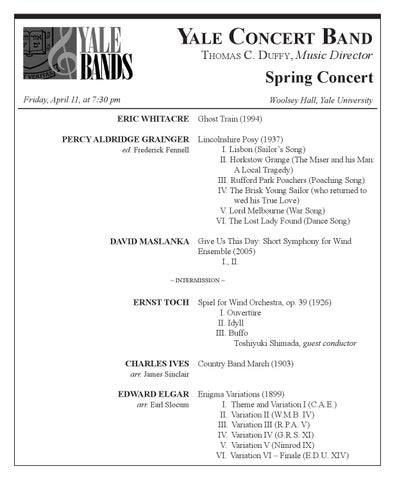
Yale Concert Band
Thomas C. Duffy, Music Director
Spring Concert Friday, April 11, at 7:30 pm
Woolsey Hall, Yale University
ERIC WHITACRE PERCY ALDRIDGE GRAINGER
ed. Frederick Fennell
Ghost Train (1994) Lincolnshire Posy (1937) I. Lisbon (Sailor’s Song) II. Horkstow Grange (The Miser and his Man: A Local Tragedy) III. Rufford Park Poachers (Poaching Song) IV. The Brisk Young Sailor (who returned to wed his True Love) V. Lord Melbourne (War Song) VI. The Lost Lady Found (Dance Song)
DAVID MASLANKA Give Us This Day: Short Symphony for Wind Ensemble (2005) I., II. ~ INTERMISSION ~
ERNST TOCH
CHARLES IVES
arr. James Sinclair
EDWARD ELGAR
arr. Earl Slocum
Spiel for Wind Orchestra, op. 39 (1926) I. Ouvertüre II. Idyll III. Buffo Toshiyuki Shimada, guest conductor Country Band March (1903) Enigma Variations (1899) I. Theme and Variation I (C.A.E.) II. Variation II (W.M.B. IV) III. Variation III (R.P.A. V) IV. Variation IV (G.R.S. XI) V. Variation V (Nimrod IX) VI. Variation VI – Finale (E.D.U. XIV)
About Tonight’s Music Ghost Train (1994) Eric Whitacre American Western folklore includes the legend of the ghost train, a supernatural machine that roars out of the night through forgotten towns and empty canyons. All aboard!
Lincolnshire Posy (1937) Percy Aldridge Grainger (ed. Frederick Fennell) Grainger conceived of Lincolnshire Posy as a “bunch of musical wildflowers” based on folksongs collected in Lincolnshire, England, in 1905-1906. Grainger has set the folk-tunes exactly as they were rendered by the singers, complete with asymmetrical meters caused by breathing pauses, and “off-tunings” as one would hear in solo folk singing. The first movement, “Lisbon,” is a sailor’s song in a brisk 6/8 meter with “plenty of lilt” and varied accompaniment. The second movement, “Horkstow Grange,” also presents a simple folk tune and a series of re-harmonized repetitions. Its shifting accents and changing beats per measure approximate the rhythmic flexibility of English folk songs. The third movement, “Rufford Park Poachers,” is the longest and most complex movement of the piece. An opening piccolo/alto clarinet duo offers an asymmetrical melody fugued by an oboe/bassoon duo. The blurring of the line, the four-octave spread of the canons, and the ominous brass figures that fade in and out of the background textures all suggest glimpses of the poachers adrift in their boats in the mist. The fourth movement, “The Brisk Young Sailor,” is a lighthearted sea shanty, suggesting the swagger of a young sailor freshly ashore. “Lord Melbourne,” the fifth movement, begins in free time, “heavy and fierce,” and the beat lengths vary. The final movement, “The Lost Lady Found,” concludes Lincolnshire Posy with a conventional folk song setting in straight 3/4 time.
Give Us This Day: Short Symphony for Wind Ensemble (2006) David Maslanka “The words ‘give us this day’ are, of course, from the Lord’s Prayer, but the inspiration for this music is Buddhist. I have recently read a book by the Vietnamese Buddhist monk Thich Nhat Hanh (pronounced “Tick Not Hahn”) entitled ‘For a Future to be Possible.’ His premise is that a future for the planet is only possible if individuals become deeply mindful of themselves, deeply connected to who they really are. While this is not a new idea, and something that is an ongoing struggle for everyone, in my estimation it is the issue for world peace. For me, writing music, and working with people to perform music, are two of those points of deep mindfulness. Music allows us to be immediately present, awake, and aware. ‘Give Us This Day...’ Give us this very moment of aware aliveness so that we can build a future in the face of a most dangerous and difficult time. I chose the subtitle ‘Short Symphony for Wind Ensemble’ because the music really isn’t programmatic in nature. It has a full-blown symphonic character, even though there are only two movements. The music of the slower first movement is deeply searching, while that of the highly energized second movement is at times
YALE CONCERT BAND both joyful and sternly sober. The piece ends with a modal setting of the Chorale melody ‘Vater Unser in Himmelreich’ (‘Our Father in Heaven’), #110 from the 371 Four-Part Chorales by J.S. Bach.” – David Maslanka
Spiel for Wind Orchestra(1926) Ernst Toch Toch created this work for Paul Hindemith’s Donaueschinger Kammermusikfest in 1926, which featured new music composed for the wind band. It premiered there under the baton of Hermann Scherchen. Spiel for Wind Orchestra is composed of three distinct movements: a lively “Ouvertüre”; a peaceful, pastoral “Idyll”; and a light, three-part “Buffo,” named after opera buffo (comic opera) of the 19th century. The clarinet and trumpet parts were adapted for modern instruments. Tonight’s performance will feature guest conductor Toshiyuki Shimada.
Country Band March (1903) Charles Ives (arr. James Sinclair) This fantastic march is a parody of music performed by an amateur group of town musicians. Reconstructed from sketches by James Sinclair, this short, chaotic march presents the listener with a series of phenomena not normally found in the march genre – deliberate wrong notes, slips of rhythm that result in a jumble of downbeats and off-beats, and overlapping melodies not unlike the parade experience of hearing the next band approach before the former band has faded from hearing. The band is playing exactly what the composer has written – honest!
Enigma Variations (1899) Edward Elgar (arr. Earl Slocum) “To My Friends Pictured Within” was Elgar’s dedication for this work for orchestra. The variations’ titles were only initials or nicknames, and the work remained an “enigma of its own” for many years to all but the subjects and Elgar’s own circle of friends. Earl Slocum has selected six of the fourteen variations to transcribe for winds and percussion. The theme is notable for its use of a falling seventh (an Elgarian fingerprint) and for the fact that each phrase in the opening and closing sections begins on the second beat of the bar. Variation I is a portrait of Alice, the composer’s wife. W.M. Baker, “a country squire, gentleman, and scholar,” is the subject of Variation IV and parodied by Elgar for his habit of regimenting guests at country parties. Richard P. Arnold (Variation V) was the son of Matthew Arnold and played the piano “in a self-taught manner, evading difficulties but suggesting in a mysterious way the real feeling.” George Robertson Sinclair (Variation XI), organist of Hereford Cathedral, is depicted by an episode on the banks of the Wye, when his bulldog, Dan, fell down a steep bank into the river and found his way up again. The “Nimrod” of Variation IX was Elgar’s great friend and publisher, A.J. Jaeger. This variation “is the record of a long summer evening talk, when my friend discoursed eloquently on the slow movements of Beethoven.” The initials E.D.U., which head Variation XIV (Finale), stands for “Edoo,” Alice Elgar’s pet name for her husband.
About Tonight’s Guest Conductor Toshiyuki Shimada is Music Director and Conductor of the Eastern Connecticut Symphony Orchestra in New London, CT; Music Director and Conductor of the Orchestra of the Southern Finger Lakes; and has been Music Director of the Yale Symphony Orchestra of Yale University since 2005. He is also Music Director Laureate of the Portland Symphony Orchestra in Portland, Maine, for which he served as Music Director from 1986 to 2006. Since 1998, he has also served as Principal Conductor of the Vienna Modern Masters record label in Austria. Maestro Shimada has had the good fortune to study with many distinguished conductors of the past and the present, including Leonard Bernstein, Herbert von Karajan, Herbert Blomstedt, Hans Swarovsky, and Michael Tilson Thomas. He was a finalist in the 1979 Herbert von Karajan conducting competition in Berlin, and a Fellow Conductor in the Los Angeles Philharmonic Institute in 1983. Maestro Shimada is currently an Associate Professor of Conducting at Yale School of Music and Department of Music. Maestro Shimada has received the Portland Fire Department’s Merit Award, the Maine Publicity Bureau Cultural Award. He has had a number of state and city holidays named in his honor: Toshiyuki Shimada Day in Houston, TX; Toshiyuki Shimada Week in Portland, Maine; and Toshiyuki Shimada Day in the State of Maine.
About the Music Director Thomas C. Duffy (b. 1955), composer and conductor, is Professor (adjunct) of Music and Director of Bands at Yale University. He served as Acting Dean of the School of Music in 2005-2006, having served as Associate Dean since 1996 and Deputy Dean since 1999. He has served as a member of the Fulbright National Selection Committee and was a member of the historic Tanglewood II Symposium (2007). He attended the Harvard University Institute for Management and Leadership in Education in 2005. He has served as president of the College Band Directors National Association (CBDNA) and the New England College Band Association (NECBA), editor of the CBDNA Journal, publicity chair for the World Association of Symphonic Bands and Ensembles, and chair of the Connecticut Music Educators Association’s Professional Affairs and Government Relations committees, and has represented music education in Yale’s Teacher Preparation Program. He is member of American Bandmasters Association, American Composers Alliance, Connecticut Composers Inc., the Connecticut Academy of Arts and Sciences, and BMI. An active composer with a D.M.A. in composition from Cornell University, where he was a student of Karel Husa and Steven Stucky, he has accepted commissions from the American Composers Forum, the United States Military Academy at West Point, the U.S. Army Field Band, and numerous bands, choruses and orchestras. He joined the Yale faculty in 1982. In 2009 he received an award from the United States Attorney’s Office for his innovative program with the Yale Concert Band (Yale 4Peace Rap for Justice) which, through the integration of classical and rap music, addressed gangs, crime and violence in Connecticut’s cities.
YALE CONCERT BAND 2013-2014 THOMAS C. DUFFY, Music Director STEPHANIE T. HUBBARD, Business Manager Piccolo Joohee Son SY 15
Contrabass Clarinet Catherine Holland ES 16
Flute Eve Roth MC 16 Principal Paige Breen SY 16 Emma Platoff MC 17 Jamar Williams SY 17
Bassoon Nick Baskin ES 14* Principal Miguel Goncalves ES 16 Benjamin Lawrence ES 17
Oboe Kristin Kall YSM 14 Ken Yanagisawa MC 16 English Horn Kristin Kall YSM 14 Eb Clarinet Andrew Brod BK 17 Clarinet Albert Jiao SY 16 Keith L. Wilson Principal Clarinet Chair Claudia See DC 17 Michael Wang JE 17 Eugene Kim BK 16 Jacob Neis SY 17 Daniel Hwang TC 16 Anson Wang DC 17 Molly Haig DC 14* Liz Jones BR 15 Rachel Yen SM 14* Alto Clarinet Michael Wang JE 17 Bass Clarinet Libby Dimenstein MC 17 Catherine Holland ES 16
Contrabassoon Benjamin Lawrence ES 17 Soprano Saxophone Alex Pappas SM 15
French Horn John McNamara CC 17 Principal Nishwant Swami SM 17 Brandon Wanke MC 17 Patrick Jankowski YSM 15 Trombone Emily Massey JE 14* Principal Melvin Loong SY 14* Noah Steinfeld MC 14* Euphonium Ernest Chamberlain Stephen Ivany YSM 14
Alto Saxophone Alex Pappas SM 15 Principal Steve Goulas MC 17 Tenor Saxophone William Gearty BR 14* Baritone Saxophone Catherine Stark BR 16 Trumpet Billy Thomas PC 16 Principal David Goerger TD 14* Jeffrey March TD 15 Connor Moseley BK 14* Margaret Ott JE 16 Doron Rose SM 17
Tuba James Volz SY 15 Principal Quinn White BR 14* Piano David Molina TD 15 Organ Wyatt Smith ISM 15 String Bass Caleb Small PC 15
Flugelhorn David Goerger TD 14 Doron Rose SM 17
Percussion Nat Harrington BK 14* Alyssa Hasbrouck MC 14* Erin Maher SM 14* Maria Passarelli TD 15 Annie Schweikert BK 15 Carina Thunell BK 16
* Seniors
Music Librarian Nick Baskin ES 14
YALE CONCERT BAND OFFICERS
President: Eugene Kim General Managers: John McNamara, Jacob Neis Social Chairs: Libby Dimenstein, Emma Platoff
Personnel Manager: Anson Wang Publicity Chair: Joohee Son
For further information please contact: Yale University Bands P.O. Box 209048, New Haven, CT 06520–9048 ph: (203) 432–4113; fax: (203) 432–7213
stephanie.hubbard@yale.edu; www.yale.edu/yaleband