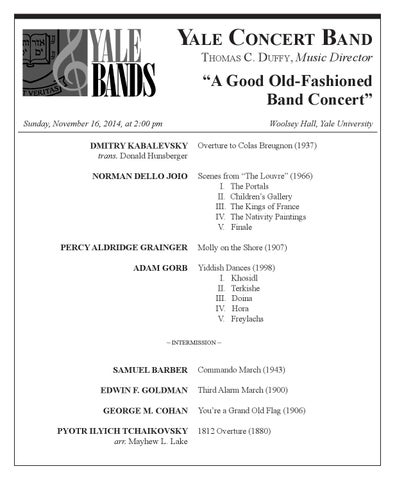
Yale Concert Band
Thomas C. Duffy, Music Director
“A Good Old-Fashioned Band Concert” Woolsey Hall, Yale University
Sunday, November 16, 2014, at 2:00 pm
DMITRY KABALEVSKY trans. Donald Hunsberger
Overture to Colas Breugnon (1937)
NORMAN DELLO JOIO
Scenes from “The Louvre” (1966) I. The Portals II. Children’s Gallery III. The Kings of France IV. The Nativity Paintings V. Finale
PERCY ALDRIDGE GRAINGER ADAM GORB
Molly on the Shore (1907) Yiddish Dances (1998) I. Khosidl II. Terkishe III. Doina IV. Hora V. Freylachs
~ INTERMISSION ~
SAMUEL BARBER
Commando March (1943)
EDWIN F. GOLDMAN
Third Alarm March (1900)
GEORGE M. COHAN
You’re a Grand Old Flag (1906)
PYOTR ILYICH TCHAIKOVSKY arr. Mayhew L. Lake
1812 Overture (1880)
About Tonight’s Music Overture to Colas Breugnon (1937) Dmitry Kabalevsky (trans. Donald Hunsberger) Dmitri Kabalevsky completed his opera, Colas Breugnon, The Master of Clamency, in 1937. It was premiered the following year at the Leningrad State Opera. Based on the novel by Romain Rolland, the plot is set in 16th century France and centers around the efforts of Colas to overthrow the cruel lord (the duke) and free his people from tyranny. The story presents Colas as a sort of Burgundian Robin Hood, at once a jester and philosopher, vine grower and artist, combining in himself a lusty appetite for food, wine, and an ardent love of art. Scenes from the Louvre (1966) Norman Dello Joio The band version of Scenes from the Louvre is taken from the original score of the NBC television special that was first broadcast nationally in November 1964. In September 1965, the composer received the Emmy award for his score as the most outstanding music written for television in the 1964-65 season. The five movements of this suite cover the period of the famous Paris museum’s development during the Renaissance and are based on themes from composers of that period. Molly on the Shore (1907) Percy Aldridge Grainger Percy Aldridge Grainger, a pianist, composer, and champion of the saxophone, was born in Brighton, a suburb of Melbourne, Victoria, Australia. His architect father was an immigrant from London, England, and his mother, Rose, was the daughter of hoteliers from Adelaide, South Australia. Hi father was an alcoholic, and when Grainger was 11, his parents separated. His mother – a domineering and possessive, but cultured figure who recognized his musical abilities – took him to Europe in 1895 to study at Dr. Hoch’s conservatory in Frankfurt. There he displayed his talents as a musical experimenter, composing in irregular and unusual meters. From 1901 to 1914, Grainger lived in London, where he befriended and was influenced by Edward Grieg, and developed a particular interest in recording the folk songs of rural England. Grainger moved to the United States at the outbreak of the First World War in 1914. When the United States entered the war in 1917, he enlisted as a United States Army bandsman, giving dozens of concerts in aid of War Bonds and Liberty Loans. In the spring of 1920, Grainger completed his last piece for wind orchestra made in his Army period, Molly on the Shore. It is based on two reel tunes from Cork: “Temple Hill” and “Molly on the Shore,” both from Charles Stanford Villiers’ The Complete Petrie Collection of Ancient Irish Music. Grainger wrote his first setting of the tune for string quartet (fiddle four-some) as a birthday gift for his mother in 1907. Yiddish Dances (1998) Adam Gorb Adam Gorb is a successful British composer with an abiding interest in both traditional Jewish Klezmer music and the symphonic band. This piece, which neatly juxtaposes the two, was written as a present
YALE CONCERT BAND for the 60th birthday of band conductor Timothy Reynish. Gorb describes the music as “very much a party piece… The five movements are all based on set Klezmer dances, the folk music of the Yiddishspeaking people: Khosidl (music moving freely between satire, sentimentality, and pathos); Terkishe (an up-tempo Jewish tango); Doina (a free recitative in which various instruments in he band get a chance to show off); Hora (a slow 3/8 time dance with a characteristic rocking rhythm); and Freylachs (very fast in which themes from the previous movements are recalled, ending in a “riotous booze-up” for all concerned).” There is more going on beneath the surface of this piece than one might assume from this description. The rich harmonic palette and constantly shifting metrical asymmetries display a consummate skill on Gorb’s part, and the fact that the music remains so charming and accessible only serves to make his achievement more impressive. Commando March (1943) Samuel Barber Samuel Barber’s second symphony, written for the US Army Air Corps in 1942, made use of an electronic instrument which imitated radio signals. Shortly afterward, he was ordered by an air corps general to compose a march in quarter-tones to symbolize the progressive nature of that branch of the service. However, the mild-mannered Barber, choosing to stay with his own style of composition, avoided quarter-tones and produced the Commando March in 1943. Third Alarm March (1900) Edwin F. Goldman Bucket brigades, hand pumps, steam and gasoline pumpers, aerial and water-tower trucks, highpressure trucks, and several other types of equipment have been used in fighting fires during the last few centuries. Many of the large city fire departments had their own bands, sometimes conducted by directors who were also composers. The ‘fire alarm’ became a popular type of march often programmed as the novelty selection on 19th century band concerts. The alarm march often included the actual sounds of the race to the firefight – the clip-clop of the horse hooves pulling the trucks, or the bells, whistles, and sirens of the engines. The Third Alarm March is one of the more popular of the fire alarm novelty marches, joining The Night Alarm by D. W. Reeves, and The Midnight Fire Alarm! by Harry Lincoln. You’re a Grand Old Flag (1906) George M. Cohan You’re a Grand Old Flag is a tribute to the American flag and is an American patriotic march, written by George M. Cohan. Cohan wrote this piece in 1906 for his stage musical, George Washington, Jr, and premiered it on February 6 at Herald Square Theater in New York City. You’re a Grand Old Flag became the first song from a musical to sell over a million copies of sheet music. The original lyric for this song came from an encounter Cohan had with a Civil War veteran who fought at Gettysburg. Cohan noticed the vet had a carefully folded but ragged old flag. The man then turned to Cohan and said, “She’s a grand old rag.” Cohan thought it was a great line and originally
named his tune, “You’re a Grand Old Rag.” Many groups and individuals objected to calling the flag a “rag,” so Cohan switched words, renaming the song, “You’re a Grand Old Flag.” 1812 Overture (1880) Pyotr Ilyich Tchaikovsky (arr. Mayhew L. Lake) Written to consecrate the Moscow Cathedral of the Savior, the enormously popular 1812 Overture commemorated the defeat of Napoleon following the Battle of Borodino on Sept. 7, 1812. Tchaikovsky wove together a variety of well-known musical themes with nationalist associations, including the Tsarist anthem and La Marseillaise, beloved battle hymn of the French Revolution, to portray in musical terms the eventual triumph of Russia over the Napoleonic hordes attacking from the West. The 1812 Overture has been adopted an icon of American independence as well. Arthur Fiedler initiated the practice of performing it with the Boston Symphony Orchestra on July 4, 1974, a decision made to boost flagging ticket sales to the Orchestra’s annual holiday concert. It has been a mainstay of July 4th celebrations since. Tchaikovsky did not like to compose on commission and wrote his long-time patron Nadezhda von Meck, “Nothing is more unpleasant to me than the manufacturing of music for such occasions, but I lack the courage to refuse [the proposal from Nikolai Rubinstein, head of the Conservatory].” Though he dismissed this much-loved piece as having “only local and patriotic significance,” it is quite successful and became one of his most known compositions. The composer intended that real cannons—rather than timpani—controlled by an electric switch at the conductor’s desk be used during the climactic moments, a not especially practical deployment for indoor performance. Over the years, timpani have proved to be a worthy substitute and have not diminished the public’s enthusiasm for this rousing exercise in musical patriotism.
Upcoming Yale Bands Performances • Wednesday, December 3, 2014: Yale Jazz Ensemble: “The Nutcracker Swings.” Feat. Duke Ellington/Billy Strayhorn’s arrangement of Tchaikovsky’s Nutcracker Suite. 7:30 pm, Morse Recital Hall in Sprague Memorial Hall. Free. • Friday, February 20, 2015: Yale Concert Band: Winter Concert. Suite from Three Penny Opera (Weill); What We Do Is Secret (McLoskey, feat. YSM brass quintet and band). 7:30 pm, Woolsey Hall. Free. • Sunday, March 1, 2015: Yale Jazz Ensemble: Stan Wheeler Memorial Jazz Concert. With the Reunion Jazz Ensemble. 2:00 pm, Levinson Auditorium, Yale Law School, 127 Wall Street, New Haven. Free. • Saturday, April 11, 2015: Yale Concert Band: Spring Concert. Emblems (Copland); Corpus Callosum (Duffy); Seranade for Winds (Dvorak). 7:30 pm, Woolsey Hall. Free. • Sunday, May 17, 2015: Yale Concert Band: Annual Twilight Concert. Celebratory music on the eve of Yale’s Commencement. 7:00 pm, outside on the Old Campus. Free.
YALE CONCERT BAND
About the Music Director Thomas C. Duffy (b. 1955) is Professor (Adjunct) of Music and Director of University Bands at Yale University, where he has worked since 1982. He has established himself as a composer, a conductor, a teacher, an administrator, and a leader. His interests and research range from non-tonal analysis to jazz, from wind band history to creativity and the brain. Under his direction, the Yale Bands have performed at conferences of the College Band Directors National Association and New England College Band Association; for club audiences at NYC’s Village Vanguard and Iridium, Ronnie Scotts’s (London), and the Belmont (Bermuda); performed as part of the inaugural ceremonies for President George H.W. Bush; and concertized in nineteen countries in the course of sixteen international tours. Duffy produced a two-year lecture/performance series, Music and the Brain, with the Yale School of Medicine; and, with the Yale School of Nursing, developed a musical intervention to train nursing students to better hear and identify body sounds with the stethoscope. He combined his interests in music and science to create a genre of music for the bilateral conductor - in which a “split-brained conductor” must conduct a different meter in each hand, sharing downbeats. His compositions have introduced a generation of school musicians to aleatory, the integration of spoken/sung words and “body rhythms” with instrumental performance, and the pairing of music with political, social, historical and scientific themes. He has been awarded the Yale Tercentennial Medal for Composition, the Elm/ Ivy Award, the Yale School of Music Cultural Leadership Citation and certificates of appreciation by the United States Attorney’s Office for his Yale 4/Peace: Rap for Justice concerts – music programs designed for social impact by using the power of music to deliver a message of peace and justice to impressionable middle and high school students. From 1996 to 2006, he served as associate, deputy and acting dean of the Yale School of Music. He has served as a member of the Fulbright National Selection Committee, the Tanglewood II Symposium planning committee, the Grammy Foundation Music Educators Award Screening Committee, and completed the MLE program at the Harvard University Institute for Management and Leadership in Education. He has served as: president of the Connecticut Composers Inc., the New England College Band Directors Association and the College Band Directors National Association (CBDNA); editor of the CBDNA Journal, publicity chair for the World Association of Symphonic Bands and Ensembles; and chair of the Connecticut Music Educators Association’s Professional Affairs and Government Relations committees. For nine years, he represented music education in Yale’s Teacher Preparation Program. He is a member of American Bandmasters Association, American Composers Alliance, the Connecticut Academy of Arts and Sciences, Connecticut Composers Incorporated, the Social Science Club, and BMI. Duffy has conducted ensembles all over the world and most recently was selected to conduct the 2011 NAFME National Honor Band in the Kennedy Center, Washington, D. C.
YALE CONCERT BAND 2014-2015 THOMAS C. DUFFY, Music Director STEPHANIE T. HUBBARD, Business Manager Piccolo Joohee Son SY 15 Flute Neyèn Romano MC 16 Principal Eve Roth MC 16 Emma Platoff MC 17 Catherine Lacy BR 18 Jamar Williams SY 17 Oboe Mason Ji MC 16 Principal Fiona Last YSM 15
Bass Clarinet Mary Wingerson PC 18 Principal Libby Dimenstein MC 17 Bassoon Benjamin Lawrence ES 17 Principal Lily Sands BR 18 Grant Laster JE 18 Soprano Saxophone Alex Pappas SM 15
French Horn John McNamara CC 17 Principal Nishwant Swami SM 17 Leah Surratt PC 18 Derek Boyer BR 18 Brandon Wanke MC 17 Trombone Richard Liverano YSM 16 Omar DeJesus YSM 16 Johnathan Weisgerber YSM 16 Euphonium Tristan Glowa MC 18
English Horn Fiona Last YSM 15
Alto Saxophone Alex Pappas SM 15 Principal Michael Hoot BR 17
Eb Clarinet Andrew Brod BK 17
Tenor Saxophone Hayley Kolding SY 17
Piano David Molina TD 15
Clarinet Eugene Kim BK 16 Keith L. Wilson Principal Clarinet Chair Alexander Ringlein BR 18 Jacob Neis SY 17 Anson Wang DC 17 Daniel Hwang TC 16 Ellie Handler ES 18 Liz Jones BR 15 Jimi Mandilk LAW 17 Betsy Li SY 18
Baritone Saxophone Alec Mukamal SY 18
Percussion Jonathan Roig ES 18 Principal Rebecca Leibowitz TC 18 Colum O’Connor BR 18
Tuba James Volz SY 15
Trumpet Patrick Durbin YSM 15 Principal Adé Ben-Salahuddin PC 18 Benjamin Rudeen MC 17 Holt Sakai BR 18 Grant Swinton MC 18 Katie Trimm BK 18 Daniel Venora YSM 16
Music Librarian Jacob Neis SY 17
YALE CONCERT BAND OFFICERS President: Eugene Kim General Managers: John McNamara, Jacob Neis Social Chairs: Libby Dimenstein, Emma Platoff
Personnel Manager: Anson Wang Publicity Chair: Joohee Son
Yale University Bands P.O. Box 209048, New Haven, CT 06520–9048 ph: (203) 432–4113; fax: (203) 432–7213 stephanie.hubbard@yale.edu; www.yale.edu/yaleband