Yale Collection of Musical Instruments presents
THE SMITHSONIAN CHAMBER PLAYERS Vera Beths, violin Nicholas Cords, viola Kenneth Slowik, violoncello and fortepiano Robert Nairn, double bass Charles Neidich, clarinet Dominic Teresi, bassoon William Purvis, horn
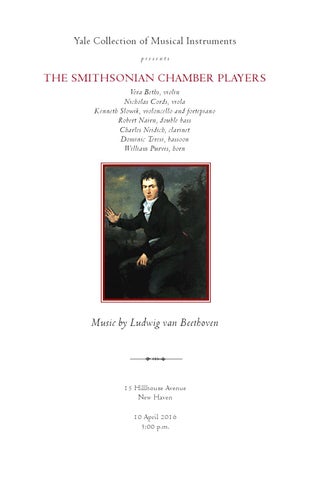
Music by Ludwig van Beethoven
15 Hillhouse Avenue New Haven 10 April 2016 3:00 p.m.
Thank you for joining us this season for an exceptional concert series and for continuing to support the Yale Collection of Musical Instruments. This past year our audience enjoyed performances from by some of the world’s finest musicians. We look forward to seeing you again for our next season which commences in the Fall of 2016. In the meantime, please visit the museum online at: collection.yale.edu or visit in person with family and friends. The Collection is open Tuesday-Friday, 1-4 pm, and Sunday, 1-5 pm.
This concert is made possible by the generous support of the Associate Members of the Collection The George P. O’Leary Fund The Lawrence S. Wilkinson Fund
TS · YALE · U EN M
ION · OF · M CT LE
ITY · C ERS OL IV N
L · INSTR CA U SI U
This concert is being recorded and streamed live over the internet. Please turn off all cellphones and electronic devices.
Yale Collection of Musical Instruments presents
THE SMITHSONIAN CHAMBER PLAYERS Vera Beths, violin Nicholas Cords, viola Kenneth Slowik, violoncello and fortepiano Robert Nairn, double bass Charles Neidich, clarinet Dominic Teresi, bassoon William Purvis, horn •
•
•
Ludwig van Beethoven Trio in G Major, Op. 9, No. 1 (1796-98) (1770-1827) Adagio - Allegro con brio Adagio, ma non troppo, e cantabile Scherzo Presto
Sonata in F Major, “Spring”, Op. 24 (1800-01) Allegro Adagio molto espressivo Scherzo. Allegro molto Rondo. Allegro ma non troppo INTERVAL
Septet in E-flat Major, Op. 20 (1799-1800) Adagio - Allegro con brio Adagio cantabile Tempo di Menuetto Andante con Variazioni Scherzo. Allegro molto e vivace Andante con moto alla Marcia - Presto
Violin by Nicolò Amati, Cremona, 1679* Violin bow by Françios Tourte, Paris, ca. 1800* Viola by Samuel Zygmuntowicz, Brooklyn, 2014; after Andrea & Giuseppe Guarneri, Cremona, 1697 Violoncello by Barak Norman* Double bass by J. Jacquet, Paris, ca. 1810 Clarinet by Rudolf Tutz, Innsbruck, 1990; after August Grenser, Dresden, ca. 1800 Bassoon by Guntram Wolf, Kronoch, Germany, 2011; after Heinrich Grenser, Dresden, ca. 1800 Horn by Richard Seraphinoff, Bloomington, Indiana, 2000; after Halari, Paris, ca. 1810* Fortepiano by Rodney J. Regier, Freeport, Maine, 2008 •
* From the Yale Collection of Musical Instruments
3
Program Notes Our program this afternoon contains three masterworks of Beethoven’s first decade in Vienna. Each achieved great popularity in its time, as it displayed elements of Beethoven’s compositional and executive virtuosity as well as his individuality, while not transgressing the borders of easy comprehensibility. We begin with the first of his three Op. 9 string trios. Beethoven composed five remarkable works with this instrumentation before 1800, never returning to the genre in later years. The early (1792) six-movement Op. 3 Trio in E-flat Major aroused much admiration when it was first heard. The comments of an English amateur, William Gardiner, may be considered typical: “This composition, so different from anything I had ever heard, awakened in me a new sense, a new delight, in the science of sounds.” Beethoven himself thought highly of his similarly scored D major Serenade, Op. 8 (1796-97), to the point that he supervised its arrangement for viola and piano as his Op. 42, telling the work’s publisher that “the transcription is not by me but has been in part completely revised by me.” The Op. 9 trios exceed their predecessors in both innovation and invention, and were not only transcribed for piano trio, but became such favorites in their original scoring that a new edition was called for when the plates of the original publication became so worn as to cease to produce clear copies. Gardiner’s remark, which could be applied to any of the trios, touches on the very essence of Beethoven’s writing for the hardly unprecedented combination of violin, viola, and cello, for, through his deft handling of the instruments, which causes each to subtly yet nearly continuously shift roles, he creates unexpected sonorities often far richer than those commonly found in string trio writing. To call the Op. 9 trios compositional warm-ups to the Op. 18 string quartets of 1798-1800, as has often been done, in no way diminishes their importance, but rather underscores their originality as Beethoven wrests from their rather minimal resources substantial and impressive works. The “Spring” sonata (whose sobriquet was aquired later), is the fifth of Beethoven’s ten essays for piano and violin, and, with the “Kreutzer” sonata, Op. 47 (1802-03), and the massive G Major sonata Op. 96 (1812), perhaps the most frequently performed. In almost every way it presents a sharp contrast to the A minor sonata Op. 23 with which it was published. That piece might well have been included in a group of Beethoven’s works that, as a contemporary reviewer reminded his readers, “had not found the friendliest reception everywhere because they stormed about in an unfriendly, wild, gloomy, and dreary manner.” But in the F major sonata—with the exception of the miniature Scherzo, in which the violin lags behind the piano, never quite catching up—Beethoven seems concerned with creating, as scholar Lewis Lockwood observed, “an object of unusual beauty . . . he harnesses special technical means, derived from antecedent works by himself and others [especially Mozart] to carry out this purpose.” A performance like ours, using a fortepiano rather than a modern Steinway, may at first hearing surprise, as the admittedly beautiful limpid cantabile of the later instrument is lacking, but a new clarity, especially beneficial to many of the thickly-voiced left-hand chords, yields a different perspective on what the mid-nineteenth-century Viennese critic Eduard Hanslick famously called “the beautiful in music.” 4
Beethoven chose to include his Septet on the program of his first benefit concert, held on 2 April 1800 in the Vienna Burgtheater, alongside a Mozart symphony, excerpts from Haydn’s new oratorio The Creation, one of his own new piano concerti (either the B-flat major or the C major), and his Op. 21 First Symphony. Describing the event, he wrote to his publisher that the Septet “truly delighted me.” It obviously delighted the Viennese public as well, and was subsequently transcribed as a wind sextet; a wind nonet; a string quintet; a quintet for flute and strings; a piano/violin sonata; a quartet with flute, violin, piano, and cello; for piano four hands; for piano solo; and, by the composer himself, as a trio for piano, clarinet or violin, and cello. Yet eventually Beethoven grew tired of this early work’s continued popularity, which in many cases surpassed that of his later—and to him, more worthy—pieces. He once tried to quell the bubbling enthusiasm of one admirer by telling him that the piece had actually been written by Mozart. Thayer’s Life of Beethoven relates that the English pianist Charles Neate, who visited Beethoven in 1815, “one day spoke to him about the popularity of his Sonatas, Trios, etc. in England, and added that his Septet was very much admired: —‘That’s damned stuff ’ (or ‘a damned thing’), said Beethoven, ‘I wish it were burned!’ or words to this effect, to Neate’s great discomfiture.” Fortunately for us, Beethoven’s wish remained unfulfilled. - Kenneth Slowik
About the Performers VERA BETHS was born in Haarlem, Holland. She received her first violin lessons from her father, Gijs Beths, and continued her studies with Herman Krebbers at the Amsterdam Conservatory. In 1969 she won the 1st Prize of the Dutch National Oskar Back Competition, and in that same year she was awarded the Prix d’Excellence. Winning the Oskar Back Prize enabled her to study in New York with Ivan Galamian. In the summers spent in the USA, she played at Rudolf Serkin’s Marlboro Festival. Having an extensive repertoire, Vera Beths is a popular soloist with the many Dutch symphony orchestras. She played with conductors like Bernard Haitink, Kiril Kondrashin, Loren Maazel, Walter Susskind, Edo De Waart and many others. A champion of contemporary music, she has had works dedicated to her by numerous composers, including Peter Schat, Louis Andriessen, Willem Breuker, Misha Mengelberg, Geert van Keulen, Philip Glass, and John Adams. As a performer of chamber music, Vera Beths has a splendid reputation as a result of her concerts with Archibudelli, an ensemble founded by her husband Anner Bylsma, violist Jürgen Kussmaul and herself. On gut strings and old bows they give exciting performances of 18th and 19th century music. For Sony Classical’s Vivarte series Archibudelli made numerous CDs, both as an autonomous ensemble and in collaboration with the Smithsonian Chamber Players, of which many were awarded prestigious international prizes. Vera Beths teaches at the Royal Conservatory in The Hague and at Marlboro. 5
Violist NICHOLAS CORDS is deeply committed to the advocacy of music from a broad historic and geographical spectrum. He recently gave his New York City recital debut at Bargemusic, including works by Joachim, Takemitsu, and Ligeti. Other recent solo appearances include St. Petersburg’s famed White Nights Festival, and the Vail International Dance Festival, where he participated in a revival of a rare Balanchine choreography (with the great Brazilian ballerina Carla Körbes) to Stravinsky’s Élegie for solo viola. As a concerto soloist, he gave the New York premiere of John Harbison’s Viola Concerto with the Juilliard Orchestra, and has also appeared as soloist with the Philadelphia Orchestra, the Chicago Symphony, and the Minnesota Orchestra. Mr. Cords is a founding member of Brooklyn Rider, whose six studio albums have received praise from nearly every corner of the music industry. Mr. Cords is also an original member of Yo-Yo Ma’s Silk Road Ensemble, appearing on all five of the ensemble’s albums; Silk Road Journeys, Beyond the Horizon, New Impossibilities, Off the Map, A Playlist Without Borders as well as a live concert DVD; Live from Tanglewood. A committed teacher, Mr. Cords is Viola Artist-in-Residence at Stony Brook University and previously served as viola instructor at Princeton University. ROBERT NAIRN serves on the historical performance faculty at the Juilliard School, where he a member of Juilliard Baroque, and also teaches at Penn State University. A native of Australia, he has lived and worked in Germany, England, Australia, and the United States, performing with the Pittsburgh Symphony Orchestra, the London Philharmonic, the English, Scottish and Australian chamber orchestras, the Bavarian Radio Symphony Orchestra, Oslo Philharmonic, Gothenberg Symphony, Baltimore Symphony, Halle Orchestra, the London Sinfonietta, and the Sydney, Adelaide and Melbourne symphony orchestras. A specialist in historical performance, Nairn has served as principal bassist with Boston’s Handel and Haydn Society since 2003, and principal of the Boston Early Music Festival. He has performed with Concerto Caledonia, the Aulos Ensemble, Rebel, the Washington Bach Consort, the English Baroque Soloists, l’Orchestre Revolutionnaire et Romantique, and the Orchestra of the Age of Enlightenment. He has also performed regularly for eight years in London as a member of Florilegium. In 2009, he received the International Society of Bassist’s (ISB) Special Recognition Award for Historically Informed Performance. He served as president of the International Society of Bassists in 2009-10 and hosted the ISB convention at Penn State in 2009, an event that brought together more than 1,300 musicians from 37 countries for six days. Clarinetist CHARLES NEIDICH has gained worldwide recognition as one of the most mesmerizing virtuosos on his instrument. In wide demand as a soloist with a repertoire of over two hundred solo works, Mr. Neidich has collaborated with some of the world’s leading orchestras and ensembles, including the Royal Philharmonic Orchestra of London, the Concertgebouw of Amsterdam, the Leipzig Gewandhaus Orchestra,
6
the Halle Staatsorchester of Germany, Orpheus, the St. Louis, Jacksonville, Pasadena, and San Diego symphonies, the New City Chamber Orchestra of San Francisco, the Athens Chamber Music Festival, Tafelmusik, the Juilliard, Guarneri, American, and Mendelssohn string quartets, and the Peabody Trio. In recent years, Neidich has turned his attention in a serious way to conducting, and has appeared with the Avanti Chamber Orchestra, the Tapiola Sinfonietta, Helsinki, at the Båstad Festival in Sweden, the Kirishima Festival in Japan, with the New World and the San Diego symphonies (in a triple role of conductor, soloist, and composer), and in Bulgaria with the Plovdiv State Philharmonic. Very active in education, he is on the faculties of the Juilliard School, Queens College of the City University of New York, the Manhattan School of Music, and Mannes College, and has held visiting positions at the Sibelius Academy in Finland, the Yale School of Music, and Michigan State University. In 2013, Charles Neidich was the recipient of the William Schuman Award given by the Juilliard School for outstanding performance and scholarship. WILLIAM PURVIS pursues a multifaceted career both in the U.S. and abroad as horn soloist, chamber musician, conductor, and educator. A passionate advocate of new music, he has participated in numerous premieres including horn concerti by Peter Lieberson, Bayan Northcott, Krzysztof Penderecki and Paul Lansky; horn trios by Poul Ruders and Paul Lansky; Sonate en Forme de Préludes by Steven Stucky; and recent premieres by Elliott Carter, Retracing II for Solo Horn and Nine by Five with the New York Woodwind Quintet. He is a member of the New York Woodwind Quintet, the Orchestra of St. Luke’s, the Yale Brass Trio, and the Triton Horn Trio, and is an emeritus member of the Orpheus Chamber Orchestra. A frequent guest artist with the Chamber Music Society of Lincoln Center and the Boston Chamber Music Society, Purvis has collaborated with many of the world’s most esteemed chamber ensembles, including the Juilliard, Tokyo, Orion, Brentano, Mendelssohn, Sibelius, Daedalus, and Fine Arts string quartets. A Grammy Award winner, Mr. Purvis has recorded extensively on numerous labels including Deutsche Grammophon, Sony Classical, Naxos, Koch and Bridge. He is currently Professor in the Practice of Horn and Chamber Music at the Yale School of Music, where he is also coordinator of winds and brasses, and serves as director of the Yale Collection of Musical Instruments. KENNETH SLOWIK first established his international reputation primarily as a cellist and viola da gamba player through his work with the Smithsonian Chamber Players, Castle Trio, Smithson String Quartet, Axelrod Quartet, and with the Amsterdambased ensemble L’Archibudelli. Conductor of the Smithsonian Chamber Orchestra since 1988, he has been a featured instrumental soloist and/or conductor with numerous other orchestras, among them the National Symphony, the Baltimore Symphony, l’Orchestre Symphonique de Québec, the Vancouver Symphony, the KwaZulu-Natal Philharmonic, the Polska Orkiestra Sinfonia Iuventus, and the Cleveland Orchestra. Slowik’s discography comprises over seventy recordings featuring him as conductor,
7
cellist, gambist, and keyboard player for music ranging from the Baroque through the twentieth century. Of these, many have won prestigious international awards, including France’s Diapason d’Or and Choc, the “British Music Retailers’ Award for Excellence,” Italy’s Premio Internazionale del Disco Antonio Vivaldi, two Grammy nominations, and numerous “Record of the Month” and “Record of the Year” prizes. Artistic Director of the Baroque Performance Institute at Oberlin since 1993, Slowik serves on the faculties of the University of Maryland, the American Bach Soloists Academy, and L’Académie internationale du Domaine Forget, and received the Smithsonian Secretary’s Distinguished Scholar Award in 2011. A native of California, DOMINIC TERESI serves as principal bassoon of Tafelmusik, teaches at The Juilliard School and the University of Toronto, and plays regularly at the Boston Early Music Festival, at the Carmel Bach Festival, and with the American Bach soloists. He is a member of the seventeenth-century chamber group Quicksilver and of the faculty chamber ensemble Juilliard Baroque. In demand on the dulcian, baroque, classical and modern bassoon, he also has enjoyed playing with Le Concert d’Astrée, l’Orchestre Révolutionnaire et Romantique, Philharmonia Baroque, the Arion Baroque Orchestra, Ensemble Caprice, Toronto Consort, and Apollo’s Fire. Teresi has been an invited artist on CBC Radio, performing a live radio concert of bassoon concertos and sonatas, and has appeared as a concerto soloist throughout Europe, Australia, and North America. Recent recordings include projects with Tafelmusik, Quicksilver, Four Centuries of Bach, the Toronto Consort, and Boston Early Music Festival Chamber Ensemble. In addition to his work at Juilliard, Mr. Teresi also teaches at the Tafelmusik Baroque Summer Institute and the American Bach Soloists Academy, and has presented research on the dulcian at the Musikinstrumentenbau Symposium in Saxony-Anhalt. Teresi holds a Masters degree and an Artist Diploma in modern bassoon from Yale University, and a Doctorate in Early Music from Indiana University.