Yale Collection of Musical Instruments presents
T h e S e b a st i a n s Daniel S. Lee, violin Nicholas DiEugenio, violin Ezra Seltzer, cello Jeffrey Grossman, harpsichord
in
Orfeo del violino
Chamber music of the Italian Baroque
15 Hillhouse Avenue New Haven 25 October 2015 3:00 p.m.
Upcoming performances in the 2015-2016 series February 14 - Lina Tur Bonet, violin 3:00 pm Kenneth Weiss, harpsichord March 6 - Alexei Lubimov, piano 3:00 pm April 10 - Smithsonian Chamber Players 3:00 pm Vera Beths, violin Nicholas Cords, viola Kenneth Slowik, violoncello Robert Nairn, double bass Charles Neidich, clarinet Dolminic Teresi, bassoon with William Purvis, horn
Special Performances November 11 5:30 pm February 17 5:30 pm
-
Tiam Goudarzi, recorder Paolo Zanzu, harpsichord
-
Mark Kroll, harpsichord
Tickets should be ordered by telephone at the Yale School of Music box office at (203)432-4158 or over the Internet at: www.yale.edu/music Tickets -
$25.00 each, reserved seating $100.00, series of 5 concerts $20.00 each, senior citizens & Yale staff $10.00 each, students
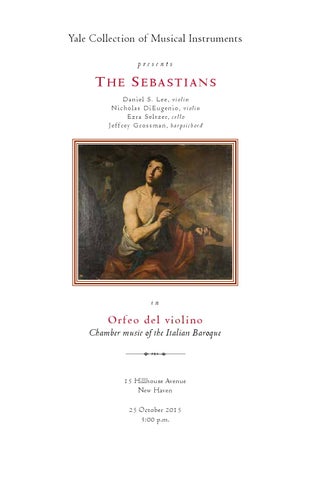
Cover Painting Pietro Novelli: “Ofeo con violino� Oil on panel, c. 1630. Museo Nazionale di Capodimonte This concert is being recorded and streamed live over the internet. Please turn off all cellphones and electronic devices.
Yale Collection of Musical Instruments 15 Hillhouse Avenue New Haven
presents
25 October 2015 3:00pm
The Sebastians Orfeo del violino
Arcangelo Corelli
Trio Sonata in C major, op. 3, no. 8 Largo Allegro Largo Allegro
Alessandro Stradella
Sinfonia no. 21 for 2 violins and basso continuo
Giovanni Battista Fontana
Sonata no. 15 for 2 violins, cello, and basso continuo from Sonate a 1.2.3. per il violino, o cornetto, fagotto, chitarone, violoncino o simile altro istromento
Michelangelo Rossi
Toccata settima for harpsichord from Toccate e correnti
(1653-1713)
(1639-1682)
(c.1589-c.1630)
(c.1601-1650)
Georg Friedrich Handel
Trio Sonata in G minor, op. 2, no. 2, HWV 387 for two violins and continuo Andante Allegro Largo Allegro (1685-1759)
INTERVAL Arcangelo Corelli (1653-1713)
Trio Sonata in A minor, op. 4, no. 5 Preludio. Adagio Allemanda. Allegro Corrente. Vivace Gavotta. Allegro
Lelio Colista
Trio Sonata in C major, W-K 13 for two violins and continuo
(1629-1680)
Francesco Geminiani
Sonata in F major, op. 5, no. 5 from Sonates pour le Violoncello et Basse Continue Adagio Allegro moderato Adagio Allegro (1687-1762)
Antonio Vivaldi (1678-1741)
Sonata “La Follia,� op. 1, no. 12, RV 63 from Suonate da camera a 3
Program Notes Arcangelo Corelli Trio Sonata in C major, op. 3, no. 8 (Rome, 1689) Trio Sonata in A minor, op. 4, no. 5 (Rome, 1694) Arcangelo Corelli’s mastery as a virtuosic violinist is apparent in his writing for string instruments, particularly the violin. With his thorough understanding of the instrument, his sonatas, which are satisfyingly idiomatic, express heartfelt lyricism and showcase witty virtuosity. As the legendary Orpheus used his music as a rhetorical weapon, Corelli brought a new level of virtuosity and expression to violin playing. Corelli’s showmanship as a performer extended to his business side. He took much care in overseeing publications of his own works, carefully planning sufficient time between each of his six opuses (op. 1–4: trio sonatas, op. 5: solo sonatas, and op. 6: concerti grossi). This ensured that each opus was properly publicized. His timing was so impeccable that his opus 5 was published on January 1, 1700, ringing in the new century with its inventive solo sonatas. He carefully managed his public image and fortune; he died a wealthy man. His sonatas have been divided into two categories: sonata da chiesa and sonata da camera. Our first Corelli offering—the trio sonata op. 3, no. 8—is an example of a church sonata with its layout of slow-fast-slow-fast movements, alternating between the moods of solemn procession and exuberant jubilation. Our second selection—op. 4, no. 5—is a chamber sonata that includes various Italian dance forms. More recently, though, scholars have viewed this general categorization to be an oversimplification of all the inventive elements that Corelli employed in each of his sonatas. His keen sense of structure and form did not constrain his vast musical imagination. Within his wellcrafted symmetry are delicate figurations, elegant melodies, and infectious harmonic sequences that convey the warmth of the Roman sun, the clarity of the Mediterranean waters, and a sweetly rendered humanism. These signature qualities make any of his sonatas utterly engaging whether performed at a church, concert salon, or instrument museum. Alessandro Stradella Sinfonia no. 21 for 2 violins and basso continuo (Turin; Modena, 1682) Corelli’s infectious harmonic and structural language took Europe by storm, but it was his older Roman compatriots, including Lelio Colista and Alessandro Stradella, who set the stage. Though Stradella is known primarily for his 174 cantatas and many operas and oratorios, his 27 instrumental works were a notable contribution to the field. His Sonata di viole, which is considered the earliest known “concerto grosso,” was probably the model for Corelli’s opus 6 (the first published concerti grossi). He and Corelli were personally acquainted. As in Corelli’s works, Stradella’s string writing is full of idiomatic scales and arpeggios. The sinfonia we perform today shows his penchant for imitation, dance rhythms (especially in triple meter), and a playful rhythmic drive.
No mention of Alessandro Stradella would be complete without mentioning his unfortunate end; he was stabbed to death by an unknown assailant for reasons still murky, but most likely connected with his amorous dalliances—a revenge killing organized perhaps by a nobleman upset that a woman chose Stradella over him, or by two brothers angered by Stradella’s indiscretions with their married sister. He nevertheless was afforded a lavish funeral, and the scandal of his assassination never affected the demand for his music. Giovanni Battista Fontana Sonata no. 15 for 2 violins, cello, and basso continuo (Venice, 1641) Giovanni Battista Fontana is an important and elusive figure of the early Italian Baroque. Born in Brescia, he worked in Venice, Rome and finally Padua. His death was attributed to “the voracity of the pestilence,” that raged in northern Italy in the years 1630–31. The 1641 collection of eighteen sonatas, edited and published posthumously by Reghino in Venice, comprises all we have of Fontana’s output. Written for violin (or cornetto), the set includes six sonatas for solo violin and continuo and twelve ensemble sonatas for one to three violins and continuo. The ensemble sonatas often feature an agile, vivacious concertante part for bassoon or cello. None of the individual works can be firmly dated: it can only be stated that they represent sonata composition 1610–30. Fontana’s melodic material is generally simple, related to the common canzona and dance pieces of the time, but the ingenuity of his music lies in its form. Multiple sections are bound together through intriguing metric relationships, suggesting an arch in some pieces, a wayward journey in others, or, as in today’s sonata, elements of both. While meter often acts as an agent of dramatic flow, it also sometimes disappears, leaving the musicians to imitate vocal recitative, declamation, and improvisation; these sections often imply an emotional nadir, or what Richard Taruskin might call the “far away point” of a work’s short story. Michelangelo Rossi Toccata settima for harpsichord (1630s) Michelangelo Rossi was known as “Michelangelo del Violino,” but he was not the only one who used that name, obscuring any certainties about his life. We do know he spent at least three periods in Rome in the service of noblemen (including Francesco I d’Este) and a cardinal. During the second of these periods, 1630–33, he was also the organist at San Luigi del Francesi, and it was during this time he likely composed the straightforward correntes and more adventurous toccatas of his published volume of keyboard music. The toccatas are notable for their mix of relatively stable imitative sections that devolve—almost without warning—into intense chromaticism, remote key areas, or simply very unusual melodic contours. His particularly dramatic use of chromaticism recalls the unusual madrigals of Carlo Gesualdo or Sigismondo d’India.
George Frideric Handel Trio Sonata in G minor, op. 2, no. 2, HWV 387 Handel’s opus 2 trio sonatas were published without his supervision, but nevertheless quickly became popular, in part because they were intended for serious musicians and not merely for amateurs. A contemporary claimed Handel wrote this sonata “at the age of 14,” but New Grove notes the musical borrowings from Giovanni Bononcini’s opera Cefalo (1702), pointing to a more probable date of 1703. Though Handel would not reach Rome until 1707, the walking bass lines, imitative dissonances, and virtuosic violin figurations show his esteem for Corelli. In the allegro movements, elements of the violin writing seem to foreshadow some of the wild Dixit Dominus (1707), which is often held up as an example of Handel’s Italianate heights. Lelio Colista Trio Sonata in C major, W-K 13 None of Colista’s compositions were published in his lifetime (if we discount the few published as examples by Kircher). He lived a life of fame and fortune, including frequent performances for nobility, a lucrative and politically important post at the Sistine Chapel, and musically important positions at churches including San Luigi del Francesi (like Michelangelo Rossi), and the lavish private gatherings of the ruling class. Colista was a strong influence on Corelli, in matters musical and financial: Colista was both an exceptionally renowned musician and a businessman who amasseded a fortune. He kept a large staff of servants in his residence, located in the trendiest district of Rome. The sonata performed today is typical of many of his instrumental trio sonatas: two treble lines with continuo, plus an independent melodic bass—particularly virtuosic in this work. Colista alternates homophonic, rhetorical passages with mostly short bursts of counterpoint, but in innovative textures. For example, he might present two themes in succession, later to combine them in a sort of quasi-double fugue; or as in the final part of this sonata, the movement begins as a normal-seeming dance, but ends with persistent dissonances in the violins over the rollicking bass line. Francesco Geminiani Sonata in F major, op. 5, no. 5 (Paris, 1746) As a young man, Geminiani studied with Corelli and Alessandro Scarlatti, most likely in Rome, and seemed on the cusp of establishing himself in his birthplace of Lucca. For reasons lost to time, however, he moved to Naples, only to be demoted from first violin to viola because of an inability to play in time, according to diarist Charles Burney. He left Italy for London in 1714 and never returned. In England and in continental Europe, he gained renown especially for his opus 3 concerti grossi, which are strongly indebted to Corelli’s opus 5 sonatas as structural models, even directly quoting melodies and harmonies. Geminiani was generally held in high esteem in England, and was credited with improving English musical taste by promoting the works of his teacher Corelli. However, from this high point his fortunes worsened. In the decades that followed, he traveled to Paris and Dublin and continued publishing, but the criticisms levied against him were consistent: his melodies were rhythmically and melodically irregular.
and his musical structures were confused. Certainly, in the cello sonatas, op. 5, we find phrases that take unexpected turns, but the phrases have a logic to them despite their constant extensions, elisions, and truncations. The ornamentation in the solo part also highlights Geminiani’s inventiveness, an attribute he certainly received from Corelli. Antonio Vivaldi Sonata “La Follia,” op. 1, no. 12, RV 63 (Venice, 1705) Vivaldi is mostly known for his instrumental works—countless concertos and sonatas. Our namesake, Johann Sebastian Bach, must have thought much of Vivaldi’s instrumental writing, since he transcribed for harpsichord a number of Vivaldi’s concertos for string instruments. As Corelli represents the epitome of the Roman violin school, Vivaldi can be said to be the capstone of Venetian instrumental music. Tonight we perform the last piece in Vivaldi’s set of trio sonatas. The Follia was a popular tune on which almost every baroque composer, including Corelli, wrote a set of variations. Vivaldi’s version is one of our favorites, and we hope you enjoy it! — Nicholas DiEugenio, Jeffrey Grossman, Daniel S. Lee, Ezra Seltzer
About the Performers Period violinist Daniel S. Lee enjoys a varied career as a soloist, chamber musician, concertmaster, and teacher. Praised for his “ravishing vehemence” and “fleet-fingered, passionate… soulful performance” (The New York Times), he has appeared as a soloist and guest leader with Early Music New York, New York Baroque Incorporated, Quodlibet Ensemble, San Francisco Bach Choir, TENET, Trinity Baroqure Orchestra, and Yale Schola Cantorum. He has also performed for the 4x4 Baroque Music Festival, Connecticut Early Music Festival, Internationale Bachakademie Stuttgart, NYS Baroque, Pegasus Early Music, and York Early Music Festival. As a modern violinist, he made his Carnegie Hall debut at age sixteen performing alongside Itzhak Pelman, Pinchas Zukerman, and the Israel Philharmonic Orchestra. He founded and co-directs the Sebastians, a period ensemble lauded for its “stylistic authority and rhythmic verve” (The New York Times). As a violino piccolo specialist, he frequently appears as a soloist in Bach’s first Brandenburg Concerto and cantata 140, and has given the modern-day premiere of his own transcription of Johann Pfeiffer’s concerto. A graduate of the Juilliard School and Yale School of Music, he is currently on the violin, viola and chamber music faculty at Connecticut College and the University of Bridgeport. Praised for his “invigorating, silken” playing and “mysterious atmosphere” (Cleveland Plain Dealer) and as an “evocative” violinist (The New York Times), Nicholas DiEugenio leads a versatile life in music from Biber to Carter and beyond. DiEugenio and pianist Mimi Solomon perform in the US and abroad. He has played concerts in St. Petersburg’s Glinka Hall, Merkin Hall, at the CMS of Lincoln Center, and at Carnegie’s Weill Hall.
Recordings of the complete Schumann violin sonatas with fortepiano (Musica Omnia), as well as with the Sebastians and the Quodlibet Ensemble, will be released this year. Upcoming recordings include works for violin and piano of Steven Stucky and Robert Palmer. A passionate teacher, DiEugenio is Assistant Professor of Violin at UNC Chapel Hill, and was previously violin professor at the Ithaca College School of Music. He holds degrees from CIM and the Yale School of Music, where he earned a DMA. Lauded for his “beauty of tone and keenness of musicianship” (Opera Britannia), cellist Ezra Seltzer is a founding member and principal cellist of the Sebastians, and has performed as guest principal cellist of the St. Paul Chamber Orchestra, Musica Angelica, Orchester Wiener Akademie, and the Trinity Wall Street Baroque Orchestra. He has also been a soloist and principal cellist at the Boulder Bach Festival, and is the associate principal cellist at the Carmel Bach Festival. With the vocal ensemble TENET, he has performed at the Festival Casals de Puerto Rico as well as at Berkshire Bach in Massachusetts. Last season he also appeared with the Portland Baroque Orchestra, Chicago’s Baroque Band, and New York Baroque Incorporated. He attended Yale University, where he received his Bachelor of Arts in history and Master of Music in cello, and graduated from the inaugural class of Juilliard’s historical performance program. Jeffrey Grossman’s extensive musical activities include frequent performances as a harpsichordist, pianist, portative organist, and conductor. Acclaimed for his musicality, he has been praised as a “sensitive and fluent accompanist” of “flair and conviction” in Fanfare magazine. A native of Detroit, Michigan, he holds degrees from Harvard College, the Juilliard School, and Carnegie Mellon University. Jeffrey performs with numerous groups in the New York metropolitan area, including the Sebastians, PHOENIXtail, the Bach Players of Holy Trinity, Concitato, and Fire & Folly. He also tours parts of the rural United States with artists of the Piatigorsky Foundation. He can be heard on the Gothic, Naxos, Albany, Métier, and MSR Classics record labels. He currently resides in New York City.
This concert is made possible by the generous support of the Associate Members of the Collection.