Yale Collection of Musical Instruments presents
Les D茅lices
Debra Nagy, baroque oboe and direction Julie Andrijeski, violin and viola 路 Scott Metcalfe, violin Emily Walhout, viola da gamba 路 Michael Sponseller, harpsichord
in
Age of Indulgence
a program of music by Philidor, Rameau, Cassan茅a, Duphly, and Dauvergne
15 Hillhouse Avenue New Haven 7 April 2013 3:00 p.m.
Yale Collection of Musical Instruments presents
Les Délices Debra Nagy, baroque oboe and direction Julie Andrijeski, violin and viola · Scott Metcalfe, violin Emily Walhout, viola da gamba · Michael Sponseller, harpsichord in
Age of Indulgence François-André Philidor Sinfonia No. 6, from l’Art de la modulation (1755) (1726-1795) Adagio Allegro ma non troppo Aria tempo di minuetto Jean-Philippe Rameau
Concert No. 3, from Pièces de clavecin en concert La Lapoplinière La Timide Tambourins (1683-1764)
Jean-Joseph Cassanéa Sonata Prima, from Sonates en symphonie de Mondonville Overtura (ba.1711-1772) Aria Gigha I N T E R V A L Philidor
Sinfonia No. 1, from l’Art de la modulation Con spirito L’arte della fuga Pastorella Gavotta
Jacques Duphly (1715-1789)
Les Graces
Antoine Dauvergne
2ème Concert de Simphonies, op. 3 No. 2 Ouverture Minuetto Rondo Chaconne (1713-1797)
Harpsichord by François Etienne Blanchet the Elder,Paris, ca. 1740
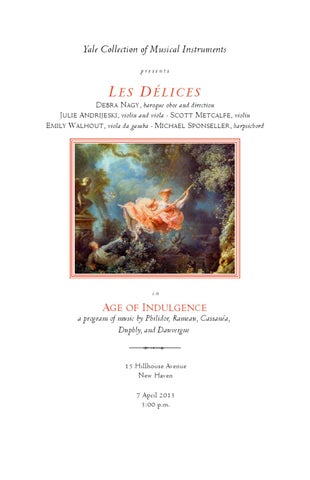
About the Program Among the most famous images from the French Rococo, Jean-Honoré Fragonard’s The Swing perfectly captures the spirit of this in-between era. Set in a lush, overgrown, private garden, a beautiful young woman is pushed in a swing by an older clergyman, while her lover hides in the bushes in the foreground, getting an excellent view up her gorgeous, pink, ruffled skirts. She kicks off her delicate shoe, delighting in the pleasure of a shared secret. Such playful, highly-ornamented scenes privileging informality, frivolity, pleasure, and gallantry were a mirror on to the lives of the French aristocracy. With enormous wealth at their disposal and wielding significant political power, French aristocrats could pursue leisure as an occupation or lose themselves in romantic intrigues. They could decorate extravagant houses following the latest trends in art, architecture, and interior design, or establish their reputations as patrons of the arts. In fact, only a very small percentage of the population in France controlled 90% of the wealth, and the 1750s saw multiple attempts at tax reform (such that the wealthy would not be exempted from the taxes levied against the poor) ultimately defeated. (Is this sounding familiar?) By mid-century, murmurs of the coming Revolution could already be heard in the writing of the philosphes, Voltaire, Rousseau and others. Besides arguing in favor of free thought and social reform, enlightenment thinkers decried the degenerate excesses, erotic subtexts, and superficiality of Rococo aesthetics, calling instead for art that was heroic and virtuous, ordered yet refined. The music you hear tonight makes no apologies for its origins. Despite its genesis in an age of indulgence, it’s so much more than merely pleasing or even titillating; I hope you’ll also hear its daring, experimental side – that which locates it on the eve of an aesthetic revolution. These works from the 1740s and 1750s don’t conform to our expectations about Baroque music, but they’re not quite Classical either. Rather, they mix the humor and wit of early Haydn and Gluck, a little of CPE Bach's Sturm und Drang, and characteristically lush French harmonies together to create a truly unique sound. The result is a fusion of baroque gestures and classical forms that combine with harmonic and technical virtuosity to yield expressive extremes. We begin with a fiery, mercurial ouverture by Jean-Joseph Cassanea de Mondonville (1711-1772). Though hardly a household name today, Mondonville was a violin virtuoso, conductor, and composer who stood on par with Jean-Philippe Rameau. He made his celebrated Paris debut in 1733, and published his first set of violin sonatas the following year. Mondonville enjoyed a court appointment as violinist to both the Royal chamber and the chapel, and he became director of the Concert Spirituel in 1755. The ensemble Sonata (suite, really) that we perform tonight derives from this 1734 collection of violin sonatas - it was arranged for strings, oboe, and continuo by Mondonville himself for use by the orchestra of the Concert Spirituel. Following the ouverture, a graceful air en rondeau complete with droning figures in the second violin. The concluding gigha (gigue) is relatively simple harmonically but it gains excitement and vigor from rhythmic drive, undulating textures, and a display of virtuosity that must hint at Mondonville’s own prodigious technique. By contrast, the two quartets we perform tonight from François André Philidor’s l’Art de la modulation (1755) achieve their sense of surprise and play through fast and unexpected harmonic modulations, albeit using the melodic and harmonic language of the nascent Classical period. François-André (1726-1795) was the youngest, and by some accounts, most important member of the Philidor dynasty of musicians and wind players who worked at
the French court from the 1660s onwards. His fame, ultimately, rested more on his accomplishments as the first professional chess player than as a composer (he was the finest chess player in Europe during the second half of the eighteenth century). Philidor’s treatise on chess has seen at least 100 editions in at least 10 languages since its initial publication in 1749. That said, Philidor’s music was the product of the same incredible intellect and imagination that could simultaneously play (and win) three games of chess blindfolded during exhibition games late in his career. In the 1750s and 60s, he earned a reputation as the leading comic-opera composer in France. His successor, André Grétry, perfectly described the fusion of concentration and creativity in his eulogy for Philidor: “How easily the vigorous intellect of this justly famous and sorely missed artist could grasp difficult combinations is well known. He would arrange a succession of sounds with the same facility that he followed a game of chess. None could vanquish him at this game of combinations; no musician will ever put more power and clarity into his compositions than Philidor put into his.” It’s quite a shame then, that l’Art de la modulation (1755) was Philidor’s only published collection of instrumental music. Scored for oboe, two violins, and continuo, these are essentially very early oboe quartets (the oboe quartet – oboe, violin, viola and cello – became an important solo genre for oboists in the Classical period; Mozart’s oboe quartet is the most famous example). Philidor’s Sinfonia VI begins with a somewhat disconcerting Adagio that repeatedly establishes the home key of D major only to obfuscate it with meandering chromatic sighs. The Allegro that follows is a true conversation galant that pits strings (in sunny major tonality) against the oboe who repeatedly responds in minor. This conversational quality and constant shifts in character lend this movement an operatic quality; one can practically imagine the climax of a comic opera in which pairs of would-be lovers sing simultaneously of their hopes, dreams, frustrations and inevitable misunderstandings. Just as lovers are reunited and order established at the close of an opera, the final Minuetto (so seemingly galant, simple, and charming) hints at a pleasure-filled pastoral bliss – only to be knocked off kilter by strange, unexpected chords and unprepared dissonances. The opening quartet of Philidor’s collection, Sinfonia I, uses similar harmonic and textural techniques to establish a sense of fun, exploration and surprise. The opening section, marked Con Spirito finds the oboe and violin playing in thirds, while pungent chromatic inflections and plangent melodic intervals abound. The fugue that follows (which Philidor dubs “l’Arte della Fuga”) is again rife with chromatic inflections and interruptions, as well as disquieting melodic augmented 2nds. The Pastorella allows for some relief and peace; full of sonorous drones in G major, it’s part-siciliano/part-musette, but, as usual, there’s trouble in paradise as wistful departures and chromatic shocks arrest the listener. The spirited Gavotta pops and crackles with excitement as it closes the work. Truly original, experimental work is often simultaneously met with excitement and opposition. So it was with Jean-Philippe Rameau’s first opera, Hippolyte et Aricie (1733). Audience reaction ranged from admiration to bewilderment or disgust, and the most difficult parts of the opera were cut in the first performances since the orchestra deemed them unplayable. While Rameau never held a position at Court, it was the vision (and financial resources) of his patron A.-J.-J. Le Riche de La Pouplinière that enabled Rameau to persist with his trailblazing work. Rameau’s Pièces de Clavecin en concert (1741) clearly take Mondonville’s own 1734 edition as their inspiration. Set for obbligato harpsichord with violin and viola da gamba
(or optional 2nd violin or flute), the harpsichord part demands a unique virtuosity and flair that’s supported and enriched by the bowed strings. Rameau’s 3ème Concert betrays a particular debt not only to his personal patron but also to Rameau’s own operatic output. The opening movement, “La Lapoplinière,” is either a direct tribute to La Pouplinière or a dedication to his wife, who was an accomplished keyboardist and student of Rameau’s. The wonderful rondeau theme of “La Timide” is borrowed from a charming air gracieux that had recently been heard in Rameau’s opera Dardanus (1739), while the visceral, fun “Tambourins” were heard first in Rameau’s Castor et Pollux (1737). Like Rameau, harpsichordist Jacques Duphly (1715-1789) never successfully adapted to the new Viennese classical style that came into vogue in Paris in the 1760s and 70s. Instead, he continued the tradition of the great clavecinistes, composing character pieces and rondeaux such as Les Graces, which is infused with complex harmonic language and dripping with ornaments. Known for his especially light and sensitive touch, Duphly’s oeuvre owes a great debt to Rameau’s keyboard works. We close our program with selections from Antoine Dauvergne’s 2ème Concert de Simphonies (1751). Dauvergne (1713-1797) may have studied composition with Rameau in the 1730s, and began an appointment as a violinist in the Chambre du roi by 1739. He succeeded Jean-Féry Rebel as composer for the King’s Chamber Music in 1755, and took over direction of the Concert Spirituel following Mondonville’s tenure there. Our suite opens with a sparkling Ouverture followed by an intimate, expressive pair of Minuets. A rollicking, witty Rondo is capped off by an extended, sublime Chaconne. - Debra Nagy
About the Ensemble Les Délices’ polished, expressive, and dynamic performances of masterpieces and littleknown works from the French Baroque have been garnering critical acclaim. Les Délices’ debut CD “The Tastes Reunited” was named one of the “Top Ten Early Music Discoveries of 2009” (NPR’s Harmonia), and their performances have been called “a beguiling experience” (Cleveland Plain Dealer), “astonishing” (ClevelandClassical.com), and “first class” (Early Music America Magazine). Founded in Cleveland in 2006, Les Délices brings together artists with national reputations who share a passion for this exquisite yet seldom heard repertoire. Their performances on period instruments allows them to explore a rich tapestry of tone colors, and the group’s name conveys their approach to the music of this era: a delight, a fine delicacy, sumptuous, and exciting. Les Délices has been featured on WCPN, WCLV and WKSU in Ohio, WQXR in New York, NPR’s syndicated Harmonia and Sunday Baroque, and had their debut CD featured as part of the Audio-guide for a recent special exhibit at New York’s Metropolitan Museum of Art (Watteau, Music, and Theater). Les Délices made its New York debut before a sold-out audience at the Frick Collection in May 2010, and has performed for Music Before 1800 (New York), Early Music in Columbus, and at Miller Theater at Columbia University in recent seasons. In addition to touring engagements, Les Délices presents its own annual three-concert series in Cleveland art galleries and at Plymouth Church, where the group is Artist in Residence. Les Délices released their 2nd CD, “Myths & Allegories,” in November 2012. For more information, visit www.lesdelices.org .
About the Performers Debra Nagy, director, has been praised for her “dazzling technique and soulful expressiveness,” (Rocky Mountain News) and deemed “a baroque oboist of uncommon elegance” by the Cleveland Plain Dealer. One of the nation’s most sought after early double reed specialists, Debra performs frequently with baroque ensembles and orchestras in San Francisco, Los Angeles, Portland, Seattle, Vancouver, Denver, Philadelphia, and New York, in addition to Cleveland’s Apollo’s Fire. She has also been heard at the international Early Music Festivals of Boston, Berkeley, Regensburg, and Antwerp. A graduate of the Oberlin Conservatory, Debra was the first-prize winner in the 2002 American Bach Soloists Young Artist Competition, spent 2002-2003 in Brussels and Amsterdam as the recipient of a Belgian American Educational Foundation Grant, received a 2009 grant from the National Endowment for the Humanities, and was awarded a 2010 Creative Workforce Fellowship from Cleveland’s Community Partnership for Arts & Culture. She received her doctorate in Early Music at Case Western Reserve University, where she currently directs the Collegium Musicum. Debra can be heard on the Capstone, Bright Angel, Naxos, Avie, Delos, CPO, and ATMA labels and has had live performances featured on CBC Radio Canada, Klara (Belgium), NPR’s Performance Today, WQXR (New York City), WCLV (Cleveland), WKSU (Kent), and WGBH Boston. Recently lauded for her “invigorating verve and imagination” by the Washington Post, Julie Andrijeski is among the leading baroque violinists in the U.S. Her unique style is greatly influenced by her knowledge and skilled performance of baroque dance, and she often combines these two mediums in the classroom, on stage, and at workshops. Ms. Andrijeski is a full-time Lecturer in the Music Department at Case Western Reserve University where she teaches early music performance practice, baroque dance, and directs the Case/CIM Baroque Orchestra and chamber ensembles. Before joining the Case faculty, Ms. Andrijeski was a full-time member of the early-music trio Chatham Baroque. Now, in addition to her teaching, Ms. Andrijeski regularly appears with many baroque groups including, among others, Quicksilver, Cleveland’s Apollo’s Fire, the New York State Baroque Orchestra, the Boston Early Music Festival Orchestra, Cecilia’s Circle, Spiritus Collective, and the King’s Noyse. She has been on the faculties of the Baroque Performance Institute at the Oberlin Conservatory and the Madison Early Music Festival for over a decade, and joined the faculty of the Vancouver Early Music summer festival this year. Ms. Andrijeski received her Doctorate of Musical Arts degree in Early Music from Case Western Reserve University in May 2006. Previous degrees include a B.M. in Violin Performance from the University of Denver (1985) and an M.M. in Violin Performance from Northwestern University (1986). Violinist and conductor Scott Metcalfe is the music director of Blue Heron, a vocal ensemble based in Boston which specialises in music between 1400 and 1600 and has been acclaimed by the Boston Globe as “one of the Boston music community’s indispensables.” Metcalfe has been invited to serve as guest director by Emmanuel Music (Boston), Monadnock Music (New Hampshire), the Tudor Choir and Seattle Baroque (Seattle, WA), Pacific Baroque Orchestra (Vancouver, BC), and the Dryden Ensemble (Princeton, NJ), in works by Monteverdi, Biber, Buxtehude, Handel, Bach, and others. In January 2010 he led the Green Mountain Project in an all-star 400th-anniversary performance of Monteverdi’s 1610 Vespers in New York City, which the New York Times called “quite simply terrific.” He recently served as Music Director of Early Music America’s first Young Performers Fes-
tival, held in conjunction with the Boston Early Music Festival in June 2011. Besides playing in Les Délices, Metcalfe is an active freelancer and a regular participant in Montreal’s early music scene, working with Arion, Montreal Baroque, Les Voix Baroques, and other groups. Emily Walhout grew up playing the cello, but discovered her love for baroque bass lines at Oberlin Conservatory, where she took up the baroque cello and the viola da gamba, thus launching an active career in early music. Ms Walhout was a founding member of La Luna, and was a member of The King’s Noyse from 1987 through 2004. Ms Walhout has played viola da gamba or principal cello for the Boston Early Music Festival Orchestra, Seattle Baroque, Portland Baroque, Les Boreades, Les Violons Du Roy, New York Collegium, and Trinity Consort (Portland, OR). She has toured as a chamber musician throughout North America and Europe, and she has recorded extensively with the Boston Camerata, La Luna and The King’s Noyse. A resident of Waterown, MA, Ms Walhout maintains a small studio of private students and coaches several devoted viol consorts. Michael Sponseller has appeared throughout Europe and North America with critical acclaim as a soloist, conductor, and chamber musician. Winner of the American Bach Soloists Competition (1998) and the Jurow International Harpsichord Competition (2002), he holds the distinction of being a two-time prizewinner at the Festival of Flanders International Harpsichord Competition (Bruges), as well as taking prizes in Montréal and Kalamazoo. Mr. Sponseller has performed and recorded frequently with the Handel and Haydn Society, Smithsonian Chamber Players, American Bach Soloists, New York Collegium, Apollo’s Fire and recently, the Carmel Bach Festival. In addition to holding degrees from the Oberlin Conservatory of Music and the Royal Conservatory of Music in The Hague, Mr. Sponseller was a teacher of harpsichord at the Baldwin Wallace Conservatory of Music. To continue to explore his interest in vocal and chamber music on period instruments, he founded Ensemble Florilege in 2007. Mr. Sponseller can also be heard on several recordings from Electra, Vanguard Classics, Naxos, Delos and Centaur.
This concert is made possible by the generous support of the following: The Virginia and Leonard Marx Foundation Endowment The Associate Members of the Collection