Yale Collection of Musical Instruments presents
Juilliard Baroque Gonzalo Ruiz, oboe Robert Mealy, violin Dominic Teresi, bassoon Jeffrey Grossman, harpsichord
15 Hillhouse Avenue New Haven Sunday 26 January 2014 3:00 P.M.
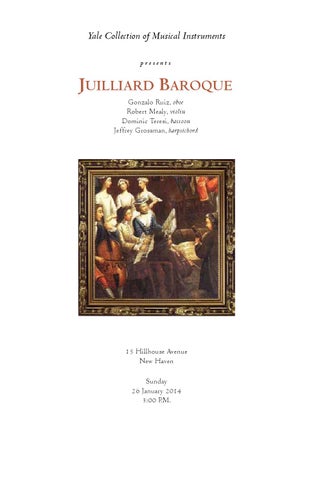
cover painting: Anonymous Chamber musicians perform trio sonatas Oil on canvas from: L’Iconographie de l’Orgue et du Clavecin, 18th century book This concert is made possible by the generous support of the Associate Members of the Collection. Harpsichord by François Etienne Blanchet the Elder, Paris, ca. 1742
Remaining concerts on this season’s series: March 2 - Smithsonian Chamber Players 3:00 pm Vera Beths, violin Kenneth Slowik, violoncello Pedja Muzijevic, piano April 13 - Tapestry Ensemble 3:00 pm Cristi Catt, soprano Laurie Monahan, mezzo-soprano Daniela Tosic, mezzo-soprano Diana Brewer, soprano, vielle & sackbutt Christa Patton, vielle & harp Takaaki Masuko, percussion
Yale Collection of Musical Instruments presents
Juilliard Baroque Gonzalo Ruiz, oboe Dominic Teresi, bassoon
Robert Mealy, violin Jeffrey Grossman, harpsichord
G. F. Handel Trio Sonata in B-flat Major, (1685-1759) Op. 2, No. 3, HWV 388 Adagio Allegro Grave Allegro C. P. E. Bach Sonata for Oboe and Basso Continuo (1714–1788) in G minor, H. 549 Adagio Allegro Vivace G. P. Telemann Fantasia for Harpsichord No. 2 in D minor, (1681-1767)) TWV 33:2 Presto - Adagio - Presto J. D. Zelenka Trio Sonata in B-flat Major, ZWV 181/3 (1679-1745) Adagio Allegro Largo Tempo Giusto
Interval G. P. Telemann Trio Sonata in G minor, TWV 42:g5, from Essercizii Musici Mesto Allegro Andante/Largo/Andante Vivace J. S. Bach Sonata in G Major (1685–1750) for Violin and Basso Continuo, BWV 1021 Adagio Vivace Largo Presto J. S. Bach, arr. Ruiz Trio Sonata in F Major, after BWV 525 Allegro Adagio Allegro
About the Music George Frideric Handel (1685–1759) Trio Sonata in B flat, Op.2 no.3, HWV 388 Handel’s Opus 2 trio sonatas were first published in 1730 as his “Deuxième ouvrage,” purportedly by the Amsterdam publisher Roger, but in actuality by the Englishman John Walsh. Soon after its first appearance, these trios were reissued under Walsh’s actual imprint, with revisions by Handel himself, who seems to have been persuaded to provide some editorial oversight. No autographs of the Op. 2 trios survive, so it’s unclear when exactly Handel wrote the various trios that Walsh assembled. The Trio in B flat HWV 388 shares material with the overture to Handel’s first English oratorio Esther, composed in 1718, which suggests that it dates from Handel’s first years in London, or possibly from his time in Hamburg just before. Its opening figure is one of Handel’s favorites, dating back to his Roman violin concerto from 1706. This trio had a wide popularity, judging by the fact that it was one of two Handel trios that Quantz copied for use in Berlin in the late 1730s. Carl Philipp Emanuel Bach (1714–1788) Sonata for Oboe and Basso continuo, H 549 Around the same time that Walsh was publishing Handel’s Op. 2 trios, Carl Philipp Emanuel Bach was composing his oboe sonata in G minor. Musicologists date this sonata between 1731 and 1735, just after Bach graduated from Leipzig University and before he took his first job at Frankfurt. We tend to think of Emanuel Bach as belonging to the next, more radical generation after the great High Baroque composers like his father, his godfather Telemann, and Handel himself. But in fact several musical styles overlap in the middle decades of the eighteenth century. While Handel was composing his classically Corellian trio sonatas, Emanuel Bach was creating his own distinctive musical language. Bach uses all the characteristic gestures of galanterie — sighing figures, graceful appoggiaturas, elegant lombardic snapped rhythms — but turns them to a very different use, with wayward melodies and unexpected turns of phrase, and infuses them his own characteristically edgy musical energy. Georg Philipp Telemann (1681–1767) Fantasia for Harpsichord No. 2 in D minor, TWV 33:2 Emanuel owes his second name to his godfather, Georg Philipp Telemann, who remained a close musical colleague; in fact, Emanuel eventually took over Telemann’s job of directing music for the city of Hamburg. Telemann moved to Hamburg in 1721 to serve as Kantor for the Lateinschule, as well as musical director for all five of the major churches in the city. With his boundless entrepreneurial energy, Telemann also created a weekly concert series soon after he arrived, which proved so popular that it shortly became a twice-weekly event. As if that wasn’t enough, he also directed the city’s opera house, where he put on his own operas alongside those of Handel and Keiser. In his spare time, Telemann began publishing his own music, engraving all the plates himself: between 1725 and 1740 he brought out 43 publications, among them a set of Fantaisies pour le clavessin which he published in 1731-32. These are ingenious works. His second Fantasia, in D minor, has a dramatic adagio recitative at its heart, framed by a repeated presto movement of brisk Italianate figuration.
Jan Dismas Zelenka (1679–1745) Trio sonata in B flat, ZWV 181/3 The least known of our composers tonight is the Bohemian Jan Dismas Zelenka, who became an important part of the Dresden court musical establishment starting around 1710. After a few years of court-sponsored trips to study with masters in Italy and Vienna, Zelenka spent the rest of his career working at the Hofkapelle. This was increasingly the center of musical activity in Dresden, especially once the opera house closed in 1720; Zelenka contributed a sizeable amount of sacred music for the Catholic Hofkirche. In his set of trio sonatas, probably composed around 1721-22, he demands a remarkable level of sustained virtuosity for all the instruments involved. These trios also feature Zelenka’s characteristically quirky phrasing and slightly off-kilter melodies. The effect is a bit like the architecture of his native Prague: his extended movements are splendid Baroque musical palaces whose spacious rooms open into unexpected regions, full of oddities. Georg Philipp Telemann Trio sonata in G minor, TWV 42:g5, from Essercizii Musici With Telemann’s trio sonata from his Essercizii musicali, we return to the regular proportions of the High Baroque. He published this collection in 1740, but many of the works probably date from the 1720s. The “exercise” of the title may refer to the variety of instrumentation in this collection of solos and trios: each one is set for different combinations of winds, strings, and keyboard. The third trio in the collection is for oboe, violin, and basso continuo, and shows off Telemann’s characteristic economy of composition. Nothing outlasts its welcome, and everything is well-conceived for the instruments and for the listener to create a conversation between equals, full of various passionate subjects. Johann Sebastian Bach (1685–1750) Sonata in G major for Violin and Basso Continuo, BWV 1021 Although we tend to assume today that we have a comprehensive view of Johann Sebastian Bach’s achievement as a composer, it’s sobering to realize that actually many of his works did not survive his lifetime. Christoph Wolff estimates that, conservatively, something like 250-300 works from his Cöthen period alone have vanished, to judge by the musicbinding accounts (which, ironically, do survive). Since this was the period when he was most concentrated on chamber music rather than sacred works, many of these must have been sonatas for one instrument or another. (It’s intriguing, for example, that he calls his set of “Sei solo” for unaccompanied violin “Libro primo.” Were there more?) This vanished repertoire would explain one curious aspect of Bach’s output. Unlike his contemporaries (think of Handel and Telemann’s work represented on this program) Bach has remarkably few compositions in the most usual chamber music genres, that of trio sonatas and solo sonatas with basso continuo. Of his many works for violin, only two sonatas with continuo survive, one of which we hear tonight. BWV 1021 is a small-scale gem, presenting a great deal of information in a very short amount of time. Interestingly, this sonata seems to have served as a pedagogical device: one of his few trio sonatas also uses the same bass-line, but with entirely different melodies above it.
J. S. Bach Trio sonata in F major, after BWV 525 In the hugely popular Baroque genre of trio sonatas, we really have only three by Bach which have come down to us: the arrangement of 1021, another arrangement of a gamba sonata, and the trio from the Musical Offering. To increase the repertoire, musicians often look to other genres. Cantatas provide a few sinfonias that are wonderful, but difficult to patch together into a full sonata. There is one set of trio sonatas that offer some interesting possibilities, however. These are the trio sonatas for organ, where the two top voices are taken by the hands and the bass line by the pedals. One of these in particular fits wonderfully, with a few fixes, for our ensemble; Gonzalo Ruiz has made an excellent arrangement of the F major trio to provide a festive (and contrapuntal!) end to our celebration of German chamber music.
–Robert Mealy
About the Performers Established in 2009, Juilliard Baroque, Juilliard Historical Performance’s faculty ensemble, brings together nine of the world’s most respected and accomplished periodinstrument specialists. The members of Juilliard Baroque are virtuoso performers, awardwinning recitalists, Grammy®- nominated recording artists, soloists, and/or principals with every major international early music ensemble. Juilliard Baroque features core members Monica Huggett, Cynthia Roberts, and Robert Mealy, violins; Phoebe Carrai, cello; Robert Nairn, double bass; Sandra Miller, flute; Gonzalo Ruiz, oboe; Dominic Teresi, bassoon; and Kenneth Weiss, harpsichord. Juilliard Baroque performs in a number of guises and has a wide-ranging repertoire from intimate chamber music concerts with just a handful of performers to larger scale works that require orchestral forces. The group has recently performed on the Music Before 1800 series, Salon/Sanctuary concert series, and at the Library of Congress in Washington, D.C. Jeffrey Grossman’s extensive musical activities include frequent performances as a harpsichordist, pianist, and conductor. Acclaimed for his musicality, he has been praised as a “sensitive and fluent accompanist” of “flair and conviction” in Fanfare magazine. As coleader of the Sebastians, last summer Mr. Grossman directed Monteverdi’s L’incoronazione di Poppea in collaboration with dell’Arte Opera Ensemble, and this summer will lead Purcell’s The Fairy Queen with dell’Arte and Purcell’s Dido and Aeneas with the Connecticut Early Music Festival. In addition to frequent performances with the Sebastians, Mr. Grossman performs with numerous groups in the New York metropolitan area, including PHOENIXtail, the Bach Players of Holy Trinity, and Fire & Folly. He also tours parts of the rural United States with artists of the Piatigorsky Foundation. He can be heard on the Gothic, Naxos, Albany, Métier, and MSR Classics record labels. A native of Detroit, Michigan, he holds degrees from Harvard College, The Juilliard School, and Carnegie Mellon University. He currently resides in New York City. For more information, please visit his website: www. jeffreygrossman.com.
Robert Mealy is one of America’s most prominent historical string players. He has recorded and performed on tour a wide variety of repertoire with many distinguished ensembles both here and in Europe. Mr. Mealy is concertmaster at Trinity Wall Street, as they embark on a complete cycle of Bach cantatas, and orchestra director of the Boston Early Music Festival Orchestra, with whom he has led three Grammy®nominated recordings and many festival concerts, including a special appearance at Versailles. He has also led the Mark Morris Dance Group Music Ensemble in performances in the U.S. and in Moscow, and accompanied Renée Fleming on the Late Show with David Letterman. He is director of Juilliard’s distinguished Historical Performance Program and Professor of Early Music at Yale, where he directs the postgraduate Yale Baroque Ensemble. Prior to teaching at Yale, he founded and directed the Harvard Baroque Chamber Orchestra for a decade. In 2004, he received Early Music America’s Binkley Award for outstanding teaching and scholarship. He has recorded over 80 CDs on most major labels. Gonzalo X. Ruiz enjoys a busy international career as principal oboe and soloist with groups such as Philharmonia, Boston Early Music Festival, Sonnerie, Orchestra of the Age of Enlightenment, The English Concert, Wiener Akademie, Kölner Akademie, Il Complesso Barocco, Carmel Bach Festival, and Portland Baroque Orchestra. In addition to teaching at Juilliard, Mr. Ruiz gives courses and master classes at Oberlin, Yale, Harvard, Longy School of Music, Indiana University, University of Vienna, Royal College of Music Copenhagen, and other institutions. He is considered an expert in historical reed making techniques and many examples of his work are on permanent exhibit at the Metropolitan Museum of Art. Dominic Teresi is principal bassoon of Tafelmusik, Boston Early Music Festival Orchestra, and Carmel Bach Festival, and a member of Quicksilver. In demand on dulcian, Baroque, Classical, and modern bassoons, he has also enjoyed playing with Le Concert d’Astrée, Orchestre Révolutionnaire et Romantique, Philharmonia Baroque, Arion, Apollo’s Fire, Four Centuries of Bach, and Ensemble Caprice. He teaches historical bassoons and chamber music at The Juilliard School and has given master classes at Oberlin, University of Wisconsin-Madison, and Puerto Rico Conservatory. Mr. Teresi was invited to be a featured artist on CBC Radio, performing a nationally broadcast radio concert of bassoon concertos and sonatas, and has appeared as a concerto soloist in London, Barcelona, Madrid, Lisbon, Toronto, Vancouver, New York City, and Los Angeles. He holds an M.M. and A.D. from Yale University and a D.M.A. from Indiana University.