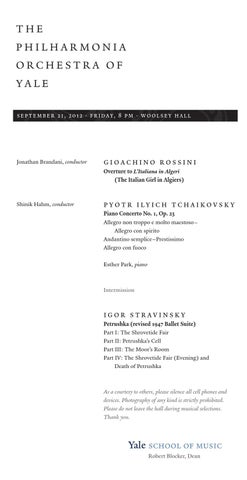
THE PHILHARMONIA ORCHESTRA OF YALE sep tember 2 1, 2 0 12 · f rid ay, 8 pm · wools e y h all
Jonathan Brandani, conductor
gioachino rossini Overture to L’Italiana in Algeri (The Italian Girl in Algiers)
Shinik Hahm, conductor
pyotr ilyich tchaikovsky Piano Concerto No. 1, Op. 23 Allegro non troppo e molto maestoso– Allegro con spirito Andantino semplice–Prestissimo Allegro con fuoco Esther Park, piano
Intermission
igor stravinsky Petrushka (revised 1947 Ballet Suite) Part I: The Shrovetide Fair Part II: Petrushka’s Cell Part III: The Moor’s Room Part IV: The Shrovetide Fair (Evening) and Death of Petrushka
As a courtesy to others, please silence all cell phones and devices. Photography of any kind is strictly prohibited. Please do not leave the hall during musical selections. Thank you.
Robert Blocker, Dean
p ro g ram notes Gioachino Antonio Rossini » 1792–1868
Overture to L’Italiana in Algeri
This year’s Yale Philharmonia season begins with a bang – that is, after a series of subdued pizzicato string chords. The opening of the overture to Gioachino Rossini’s L’Italiana in Algeri (The Italian Girl in Algiers) is often compared to the second movement of Joseph Haydn’s “Surprise” Symphony, a comparison Rossini would likely have welcomed. As a teenager, Rossini had a great appetite for Haydn’s music and conducted many of his major works, including The Seasons. It is no great wonder, then, that much of Haydn’s spirit, especially his comedic energy, is felt in Rossini’s music. Neither is it a wonder that, in 1854, long after he had retired as a composer, Rossini referred to himself as “the last classicist.” In 1813, at the age of twenty-one, Rossini had just completed Tancredi, his tenth opera and first full-scale opera seria. On the heels of Tancredi’s premiere, the Venetian Teatro San Benedetto commissioned Rossini to compose a setting of Angelo Anelli’s comedic libretto. Rossini obliged by producing L’Italiana in less than a month (he claimed to have completed it in eighteen days, but it probably took him about twenty-five). Like any good opera buffa, L’Italiana in Algeri has a completely incomprehensible plot about mistaken identity and feminine cunning and love’s ability to sort out even the thorniest of situations. The French writer and critic Stendhal, Rossini’s first biographer, called it “organized and complete madness.” – Kenneth Miller
Pyotr Ilyich Tchaikovsky » 1840–1893 Piano Concerto No. 1, Op. 23 Long before writing his Fourth, Fifth, and Sixth Symphonies, before Swan Lake or Sleeping Beauty, the young Tchaikovsky was trying to cobble together a living from his compositions. In 1874, he began a piano concerto that he hoped would bring him enough success to allow him to leave his teaching post at the Moscow Conservatory. Near the end of the year, he sought the advice of Nikolai Rubinstein, an excellent pianist and the director of the Moscow Conservatory. As Tchaikovsky later wrote: There burst forth from Rubinstein’s mouth a mighty torrent of words. He spoke quietly at first; then he
waxed hot, and at last he resembled Zeus hurling thunderbolts. It appeared that my concerto was utterly worthless, absolutely unplayable; passages were so commonplace and awkward that they could not be improved; the piece as a whole was bad, trivial, vulgar… I cannot produce for you the main thing: the tone in which he said all this. An impartial bystander would necessarily have believed that I was a stupid, ignorant, conceited note-scratcher, who was so impudent as to show his scribble to a celebrated man. Furious, Tchaikovsky removed Rubinstein from the dedication and rededicated the work to Hans von Bülow, who premiered it in Boston on October 25, 1875. The work created a sensation, and Tchaikovsky’s career took off. The concerto opens with one of the most familiar themes to today’s audiences, notable not only for its sweep and immense piano chords, but also in that the concerto starts in the “wrong” key of D-flat major. Another unusual trait is that the opening theme never returns in any form in the rest of the concerto. The music dies down with the trumpets intoning a distant dotted rhythm. Finally, five minutes into the work, we are in the “correct” key of B-flat minor, and the piano presents the snapping main theme in dialogue with the woodwinds. Tchaikovsky said that this curious first theme was inspired by a tune he heard sung by a blind beggar at a street fair. The second theme is quintessential Tchaikovsky, all bittersweet lyricism. These two themes dominate the movement, culminating in a large-scale cadenza and brilliant coda. The simplicity of the second movement’s three-part structure (A-B-A) is augured by the purity of its opening — a languid melody wrapped in the silvery tones of the solo flute, accompanied by quiet, plucked chords from the strings. The contrasting middle section functions as the scherzo, with puckish snippets of melody stated pianissimo in the piano and the orchestra. A quick waltz briefly finds its way in. The crisp rhythmic final movement has all the spirit of a Cossack dance. Later, this theme is contrasted with a lush romantic melody. The two themes contend, but it is the flying Cossacks who have the last word to bring this Concerto to an exhilarating finish. – Michael Mizrahi
Igor Stravinsky » 1882–1971 Petrushka
After the breakthrough success of The Firebird (and before the scandal of The Rite of Spring), Igor Stravinsky set about writing a concert piece to mock the conventions of the Romanticera piano concerto. Upon composing the first section in September 1910, he realized that a series of trumpet shrieks sounded quite like the voice of Petrushka, a comical stock character in Russian puppet theater who carries around a club and typically meets his demise when a large black dog drags him into hell. When he shared this piece and a companion piece based on Russian folk tunes with impresario Serge Diaghilev, Diaghilev suggested that he expand the two pieces into a ballet. Alexandre Benois, the designer for the Ballets Russes, wrote a full scenario, for which Stravinsky fleshed out his score. The ballet was premiered in Paris on June 13, 1911, with Pierre Monteux conducting and Vaslav Nijinsky dancing the title role. It immediately became an even greater sensation among Parisian artists than The Firebird had the previous year. Petrushka is divided into four tableaux set in St. Petersburg’s Admiralty Square during the Russian festival of Maslenitsa. In the first tableau, crowds of people gather in the square, while various entertainers, including an organ grinder, vie for their attention. After a series of drum rolls, the Charlatan charms to life three puppets—Petrushka, the Blackamoor, and the Ballerina—who do a traditional Russian dance. The second tableau takes place inside Petrushka’s tiny cell in the Charlatan’s theater. He attempts to escape and fails. The Ballerina enters his cell, he makes a feeble attempt to express his love for her, and she departs, leaving Petrushka dejected. In the third tableau, we enter the Blackamoor’s exquisitely decorated room. The Charlatan puts the Ballerina in the Blackamoor’s room, she plays a tune on a toy trumpet, and they dance together. Petrushka escapes from his cell and disrupts the dance. He and the Blackamoor fight; the Blackamoor prevails, and Petrushka escapes. For the fourth
tableau, we return to the festivities, where performers, together with a dancing bear, are amusing the crowd. The Blackamoor chases Petrushka through the square, and eventually kills him with a sword. The Charlatan attempts to calm the crowd by picking up Petrushka’s body, reminding them that he is only a puppet. When the crowd disperses, Petrushka’s ghost appears on top of the theater and curses the Charlatan. The Charlatan runs away in horror, and the music dies away. The score of Petrushka, especially in the second tableau, is remarkable in its treatment of octatonicism. For the first time in any major musical work, the octatonic mode (which consists of alternating whole and half steps) is treated not simply as an available color, but as a world with its own tensions and releases, with a home sonority and a great capacity for emotional expression. The home sonority, commonly called the “Petrushka chord,” consists of C major and F-sharp major chords sounding together; though it is distinctly dissonant on the surface, it functions clearly as a tonic in Stravinsky’s hands. And Stravinsky juxtaposes this harmonic world with others as rich: he is just as fond of extreme diatonicism, and often the score contains no accidentals for pages at a time. The Petrushka on tonight’s program is not the original 1911 version, but the 1947 revision. In his revision, Stravinsky made only slight changes—amending a few metric modulations, paring down the orchestration, and adding some additional material in the solo piano part. Though Stravinsky’s changes in many ways improve the work, they were motivated primarily by his desire to copyright his work and receive royalties, as the 1911 version had managed to fall out of copyright. – Kenneth Miller
Your station for news & classical music 800 937-6045 Media Sponsor
wshu 91.1 fm • sacred heart univ. 5151 park ave, fairfield, ct 06825
a rt i st p ro files
Shinik Hahm, conductor
Esther Park, pianist
A dynamic and exciting conductor, Shinik Hahm has led the Philharmonia Orchestra of Yale since 2004. He was music director of the Yale Symphony Orchestra from 1995 to 2004. As a guest conductor, he has led orchestras in North and South America, Europe, and Asia.
Pianist Esther Park has performed as a soloist with orchestras and in recitals across the United States as well as Asia and major European cities. Ms. Park has appeared as soloist with many orchestras such as the Houston Symphony, Corpus Christi Symphony, Filharmonia Pomorska (Poland), Shanghai Philharmonic (China), the American Academy of Conducting Orchestra at Aspen, Shreveport Symphony, the Juilliard Symphony, and the New Jersey Symphony.
He has conducted in such concert halls as the Concertgebouw, Carnegie Hall, Kennedy Center, Walt Disney Hall, Symphony Hall (Boston), Seoul Arts Center, Tokyo Opera City Hall, and the National Theater of China. Recently, he was immediately re-engaged after debuts with the Robert Schumann Orchestra and Nordwestdeutsche Philharmonie in Germany, Porto Alegre Symphony in Brazil, and Shenzhen Symphony in China. Upcoming engagements include the Prague Radio Symphony, Slovak National Symphony, Northern Czech Symphony, and the Malaga Symphony Orchestra. As the chief conductor of the Korean Broadcasting System Symphony Orchestra, Hahm led the orchestra on tour with concerts at the General Assembly of the United Nations, Carnegie Hall, and the Kennedy Center. As music director of the Abeline Philharmonic and the Tuscaloosa Symphony for ten years, Mr. Hahm cultivated semiprofessional community orchestras into admirable professional ensembles. A committed educator, Shinik Hahm is a faculty member of the Yale School of Music. His conducting students have won top prizes at the Besançon, Pedrotti, Toscanini, and China National competitions. Hahm has won the Gregor Fitelberg Competition, the Walter Hagen Prize (Eastman School of Music), and the Shepherd Society Award (Rice University). He was decorated by the Korean government with the Arts and Culture Medal. Hahm studied conducting at Rice University and the Eastman School of Music. He is an avid soccer player.
Ms. Park gave a five-city recital tour in Korea, and has performed at the Juilliard Theater in New York City, Alice Tully Hall, Lincoln Center, Weill Recital Hall at Carnegie Hall, Salle Cortot in Paris, and the New Jersey Performing Arts Center. Ms. Park is the winner of the 2009 Prix Amadeo and the 2009 Chopin Gesellschaft Klavierwettbewerb. She is also the winner of the 2004 Gina Bachauer Piano Competition at the Juilliard School and the 52 nd Kosciusko International Piano Competition. Born in Pusan, Korea in 1984, Ms. Park began to play in public soon after her first piano lessons at the age of four. Ms. Park moved to the United States in 1995, after being accepted to the Juilliard School’s Pre-College division. Ms. Park has since received her Bachelor’s degree and Master’s degree from the Juilliard School, studying with Dr. Yoheved Kaplinsky. Ms. Park also studied at the Hochschule für Musik und Theater (Hannover) under the tutelage of Bernd Goetzke. Earlier this year received her Artist Diploma from the Yale School of Music under the guidance of Boris Berman, and is currently working on her Master of Musical Arts degree.
a b o u t yale p h ilha rm onia
The Philharmonia Orchestra of Yale is one of America’s foremost music school ensembles. The largest performing group at the Yale School of Music, the Philharmonia offers superb training in orchestral playing and repertoire.
shinik hahm Conductor
Performances include an annual series of concerts in Woolsey Hall, as well as Yale Opera productions in the Shubert Performing Arts Center. The Yale Philharmonia has also performed on numerous occasions in Carnegie Hall and Alice Tully Hall in New York City and at the Kennedy Center in Washington, D.C. The orchestra undertook its first tour of Asia in 2008, with acclaimed performances in the Seoul Arts Center, the Forbidden City Concert Hall and National Center for the Performing Arts (Beijing), and the Shanghai Grand Theatre.
roberta senatore Music Librarian
andrew w. parker Manager
kate gonzales Production Assistant paolo bortolameolli Assistant Conductor jonathan brandani Assistant Conductor
The Philharmonia Orchestra of Yale violin 1 Hye Jin Koh Shawn Moore Melanie Clapies Betty Zhou Matheus Garcia Souza Cordelia Paw Edouard Maetzener Sun Kyung Ban Mann-Wen Lo Alissa Cheung Gayoung Cho Wonyoung Jung Eun Kyung Park Christian Sitzmann violin 2 Victor Fournelle-Blain Kayla Moffett Choha Kim Nathan Lesser Barbora Kolarova Jacob Ashworth Seul-A Lee Hen-Shuo Chang Heewon Uhm Nayeon Kim Ki Won Kim Corin Lee Yoon Won Song Brian Bak viola Colin Brookes Eleanor Kendra James Xinyi Xu Leonard Chiang Jane Mitchell Isabella Mensz Sara Rossi Benjamin Bartelt Dashiel Nesbitt Hyeree Yu Jessica Li Dan Zhang Heejin Chang cello James Jeonghwan Kim Shinae Kim Joonhwan Kim Jia Cao
Alan Ohkubo Jurrian Van Der Zanden Sohyang Yoo Qizhen Liu Bora Kim Hae Yoon Shin bass Jonathan McWilliams Samuel Suggs Jonathan Hammonds NaHee Song Noah Cotler Matthew Rosenthal Andrew Small Gregory Vartian-Foss Asa Maynard flute Jacob Mende-Fridikis 3 Cho-Long Kang 2 Ginevra Petrucci 1 oboe Hsuan-Fong Chen 2 Timothy Gocklin 1, 3 Jeffrey Reinhardt Caroline Ross clarinet Eric Anderson 3 Ashley Smith 2 Tianyu Zhang 1 bassoon Darren Hicks Yuki Katayuma John Searcy 1, 2 Lauren Yu 3 Michael Zuber horn Wing Lam Au Philip Browne 2 William Eisenberg 1 Lauren Hunt Craig Hubbard Patrick Jankowski Zachary Quortrup 3
trumpet John Allen 1 John Ehrenburg Jean Laurenz 3 Gerardo Mata Robby Moser Gerald Villella 2 trombone Jeffrey Arredondo Christopher Brown 1 Kevin Dombrowski 3 Stephan Ivany 2 tuba Jens Peterson timpani Jonathan Allen 2 Cristobal Gajardo-Benitez 3 percussion Jonathan Allen Garrett Amey Victor Caccese Cristobal Gajardo-Benitez Doug Perry Mari Yoshinaga piano Yevgeny Yontov celeste Minsol Cho 1 - Principal in Rossini 2 - Principal in Tchaikovsky 3 - Principal in Stravinsky
up co ming events
» music.yale.edu OCT 2
OCT 4
OCT 5
box office 203 432-4158
Tokyo String Quartet oneppo chamber music series 8 pm | Sprague Hall | Tickets $30–40, Students $20 Music of Webern, Mozart, and Mendelssohn. With Ettore Causa, viola, and the Jasper String Quartet.
New Music New Haven new music new haven 8 pm | Sprague Hall | Free Admission Featuring the world premiere of Allegory of the Cave by faculty composer Christopher Theofanidis.
Lou Donaldson Trio ellington jazz series 8 pm | Sprague Hall | Tickets $20–30, Students $10 “My first impulse is always to describe Lou Donaldson as the greatest alto saxophonist in the world.” –Will Friedwald, New York Sun
concert programs Krista Johnson Danielle Heller public relations & media Dana Astmann Monica Ong Reed Austin Kase operations Tara Deming Christopher Melillo recording studio Eugene Kimball
Thank you for your support! Become a Yale School of Music patron and support our performance programs. Earn benefits ranging from preferred seating to invitations to special events. To learn more, visit us online or call 203 432-4397. charles ives circle $600 and above Richard H. Dumas Dr. & Mrs. James Kupiec Rev. Hugh J. MacDonald Pfizer Foundation paul hindemith circle $250 to $599 Serena & Robert Blocker Carole & Arthur Broadus Marbelia Gonzalez Dr. & Mrs. James Kupiec Tom & Patty Pollard Clifford & Carolyn Slayman horatio parker circle $125 to $249 Mrs. Joan K. Dreyfus William & Joyce Alton Ann Bliss Derek & Jennifer Briggs Edwin M. & Karen C. Duval Paul Gacek Richard & Evelyn Gard Francesco Iachello Mrs. Susan Matheson & Mr. Jerome Pollitt Ransom Wilson & Walter Foery samuel simons sanford circle $50 to $124 L.S. Auth Helen & Blake Bidwell Henry & Joan Binder Peter & Nancy Blomstrom Muriel & Ernest Bodenweber
Michael Hall & Otto Bohlmann Mindy & Stan Brownstein Ms. Rosemarie S. Chaves Elizabeth M. Dock Leo Cristofar & Bernadette DiGiulian Dolores M. Gall Joel Cogen & Elizabeth Gilson Barbara & Frank Dahm R.R. D’Ambruoso Becky Daymon Thomas & Judith Foley Jerome Freedman Martin & Katie Gehner Saul & Sonya Goldberg Susan Holahan Margaret S. Lord & Arthur J. Kover David & Diane Lawrence Stanley A. Leavy Nancy C. Liedlich & William R. Liedlich James Mansfield Ann Marlowe Ed Meaney Elizabeth S. Miller Ron & Sue Miller Jane & Jack I. Novick Dr. E. Anthony Petrelli Mr. James V. Pocock Rocco & Velma Pugliese Helen & Fred Robinson Arthur T. Rosenfield, MD Leonard J. Rutkosky Patricia & Joseph Rutlin Henry & Doris Rutz Betsy Schwammberger Allan R. Silverstein Rev. Dr. Michael Tessman & Mrs. Carol Tessman Mr. & Mrs. Gregory D. Tumminio Peter & Dana Uhrynowski
Monika & Fred Volker Roger & Beth Wardwell gustave jacob stoeckel circle $25 to $49 Anonymous Mrs. Ken L. Grubbs Keita Ebisu Mr. Charles Forman Mary Ann Harback Dr. RaeJeanne Kier Joel Marks Mr. James N. Trimble as of 18 September 2012 philharmonia student staff assistants Philip Browne • Jean Laurenz music librarians Eric Anderson • Paolo Bortolameolli Leonard Chiang • Cristobal Gajardo-Benitez Michael Gilbertson • Darren Hicks Timothy Hilgert • Hye Jin Koh • Qizhen Liu Yuan Ma • Alan Ohkubo • Rachel Perfecto Matthew Rosenthal • Matheus Souza stage crew John Allen • Jonathan Allen Jeffrey Arrendondo • Colin Brookes Jonathan Hammonds • Timothy Hilgert Stephen Ivany • Gerardo Mata Jonathan McWilliams • Shawn Moore David Perry • Doug Perry Matthew Rosenthal • Gerald Villella