Yale Collection of Musical Instruments presents
Aulos Ensemble Christopher Krueger, flauto traverso Marc Schachman, baroque oboe Linda Quan, baroque violin Myron Lutzke, baroque cello Arthur Haas, harpsichord
in
Gold and glitter: Music from Venice and Versailles 15 Hillhouse Avenue New Haven 22 February 2015 3:00 p.m.
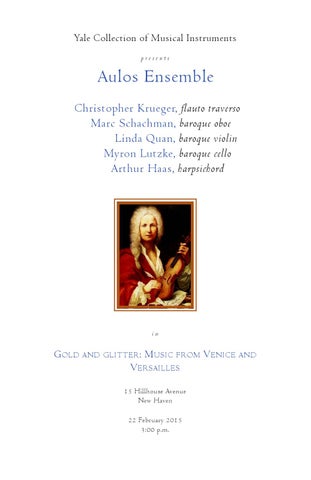
Cover Painting Portrait of Antonio Vivaldi by Franรงois Morellon de La Cave, 1723
Next concert on the 2014-2015 series April 12 - El Mundo Ensemble 3:00 pm Richard Savino, guitar (director) Nell Snaidas, soprano Adam LaMotte, violin William Skeen, violoncello Paul Shipper, percussion & guitar
Special Performances April 7 & 8 - Yale Baroque Ensemble 5:30 pm Robert Mealy, director
This concert is being recorded and streamed live over the Internet; please turn off all cell phones and pagers.
Yale Collection of Musical Instruments presents
Gold and Glitter: Music from Venice and Versailles Antonio Vivaldi (1678–1741)
Concerto in D major, “del Gardellino” RV 90 Allegro--Largo--Allegro
Sonata No. 6 in B-flat for cello and b.c. Largo--Allegro--Largo--Allegro Bernardo Storace
Ciaccona for solo harpsichord
Dario Castello (1590-1658)
Sonata No. 5 for violin, cello and b.c.
Bartolomé de Selma de Selma (ca.1595-1638)
Canzon prima a due
Antonio Vivaldi
Concerto in G minor, RV 107 Allegro--Largo--Allegro
(1637-1707)
INTERVAL
Francois Couperin (1668-1733)
Quatrième Concert Royal Prélude Allemande Courante Françoise Courante a L’italiene Sarabande Rigaudon Forlane (Rondeau)
Jean-Philippe Rameau
Suite from “les Fêtes d’Hébé” Menuets Air gracieux pour Zéphire et les Grâces Air tendre Air pour le Génie de Mars, La Victoire Musettes Chaconne (1683-1764)
Harpsichord by François Etienne Blanchet the elder (Paris, 1740) and Andreas Ruckers (Antwerp 1640)
Program Notes Not a single evening goes by without a concert somewhere. The people run along the canal to hear it, with such passion that you would suppose that they had never heard anything like it before. You cannot imagine how crazy the city is about this art. This famous remark of Charles de Brosses gives a clue to why Venice produced so much musical innovation and nourished so many great musicians, from the beginning of the 16th century until the end of the Republic in 1797. The qualities that made Venice unique socially and politically created a respect for music as both a devotional and political element. With its Byzantine roots and autonomy from Rome, Venice merged the secular and spiritual to a far greater extent than elsewhere in Europe. As a result the musical institutions associated with devotion flourished. St. Mark’s hosted a number of important musicians, starting with Adrian Willaert, who was brought to St. Mark’s in 1527. He not only established grand scale musical performances, but also founded a performance ensemble that produced his successors, such luminaries as Andrea and Giovanni Gabrieli. Claudio Monteverdi was perhaps St. Mark’s most famous musician, presiding as music director for thirty years. With the establishment of a singing school in 1403, St. Marks had begun a tradition that continued with the famous ospedali. These four homes were established by the Republic for the chronically ill, reformed prostitutes, orphans (defined by Venetian law as children deprived of their natural father), and children of impoverished nobles. The teaching of music to females at these institutions, and the sacred and secular performances they gave became so well-regarded that female children who were not wards of the state could enroll as tuition-paying students. Scholarships were available for those who could not afford the cost. A list of musicians who taught music at the ospedali would include not only Antonio Vivaldi, but nearly all the famous musicians of Venice. These institutions were the most prestigious music conservatories of their time. Vivaldi gained world fame for the spectacular concerts he put on at the Ospedale della Pieta, where he oversaw the musical instruction. Performances and practice sessions at these institutions must have been zealous, indeed, judging from this description by an English visitor: “On the first flight of stairs was a trumpeter, screaming upon his instrument till he was ready to burst; on the second was a French horn, bellowing in the same manner. In the common practicing room there was a “Dutch concert” consisting of seven or eight harpsichords, more than as many violins, several voices, all performing different things, and in different keys”.
This sense of furious activity is certainly conveyed in Vivaldi’s music. The most influential Italian composer of his generation, Vivaldi laid the foundations for the mature Baroque concerto. He wrote over 500 concerti for a variety of solo instruments, and diverse combinations of instruments, usually accompanied by a string “back-up” band or ripieno. In addition to these works, he wrote a number of ‘chamber concerti’, one of which we offer to open today’s program. In these works, there is no separate ripieno; rather, the soloists team up for the tuttis, and then take turns displaying their own virtuosity in the alternating solo passages. The D major Concerto, (RV 90) bears the title “del Gardellino”. It is a highly descriptive work, with the flute imitating the birdcalls of the goldfinch. In addition to its “flighty” passagework, it is full of trills and warbles from all the instruments. The Sonata #6 in B-flat (RV 46) for cello is the last of a set of sonatas that was published in Paris c. 1740. It is in the standard 4 movement form with alternating slow and fast movements, and is particularly notable for its rich, expressive largos. The G minor concerto that ends the first half of the program is notable for its plaintive dialogue between flute and oboe in the slow movement, and its virtuosic finale. Little is known of the lives of Dario Castello or Bartolome de Selma; indeed Grove’s dictionary doesn’t even list the dates of their births. Both were performers and composers of instrumental music in Venice during Monteverdi’s career there, and they are known to us only through their various printed collections of works. Castello left two collections of 29 sonatas from which we choose today’s selection. The sonatas are generally made up of seven to nine sections of contrasting tempos, indicated by adagio and presto. A fondness for repeated-note figures suggests the stile concertato associated with Monteverdi, whom Castello must have known. De Selma was born of Spanish descent; his reputation in Venice was that of an incredible bassoonist! His one surviving collection, published in 1638 and including works for different combinations of solo instruments, is characterized by great variety and virtuosity in the passagework. During the 17th century, which the French still call their grand siècle, the French kings went nowhere without music. They got up in the morning to a lever played by the oboes and brasses of La Grande Ecurie, they danced to the music of their famous ’24 violins’ (Grande Bande), and were regaled at meals by the smaller band known as Petits Violons. In the Royal Chapel they heard the crowning musical expressions of their majesty and power: the grands motets sung by a choir of 60, accompanied by an orchestra to match. At its height, the royal musical establishment at Versailles numbered some 120 musicians. In the 18th century, though the scale of royal music patronage began to decline. By 1725, public concerts were beginning to compete with the royal court in attracting musical talent, and a new audience of bourgeois amateurs began to lure composers bent on profit. The result of all this was that the heroic style of the grand siècle was cut down to size, and was invaded by a new spirit of gentleness and refined intimacy which we call rococo.
The greatest master of this period in France was François Couperin. (le grand) who supervised the musique de la Chambre for Louis XIV during the later years of his reign, presiding over concerts in which the softly persuasive tones of the harpsichord and flute—chamber instruments par excellence were mixed with the survivors of the Grande Bande (violin) and Grande Ecurie (oboe) to produce the characteristically refined and elegant style of the eighteenth-century French music on this program. Couperin stated, “I would rather be moved than astonished.” His was the voice of the rococo, an ultra-refined, aristocratic style in with the heroic scale of the earlier baroque was cut down to size, and a premium was placed on a find of sweet intimacy of expressions best savored in the salons and private chambers of the nobility. Couperin organized Sunday afternoon chamber music recitals for Louis, at which only the most accomplished virtuosi in the King’s very large musical establishment were allowed to appear. In 1722, the composer gathered several of the pieces that had found special favor at these Concerts Royaux into 4 suites, the last of which we offer on today’s program. Parts of this suite may sound oddly familiar, for it’s this music that Ravel quoted in his Tombeau de Couperin. In the preface Couperin explained that, although he had laid the music out on a two-staff score so that a harpsichordist could perform it unassisted, it would nevertheless sound best if rendered the way it was originally intended: by flute, oboe, violin, and others taking turns selecting those pieces that suited them best, and carefully adjusting their style of performance to the kind of soft flattery with which one entertains a kind and his company. Jean-Philippe Rameau, one of the musical giants of 18th-century France, is known today primarily for his compositions for harpsichord. His “formal” chamber music is limited to the 1741 collection of pieces for flute, violin, or viola da gamba and harpsichord, which is a staple of the baroque chamber music literature. The Pièces de Clavecin are an experiment in a novel texture: detailed harpsichord compositions “accompanied” by two obbligato instruments. During his lifetime, however, Rameau’s enormous reputation was made in the field of opera, and it is from that body of works that we choose our final selections. Many of these masterpieces remain unknown today, while a favored few have been resurrected by adventurous opera companies, or more typically, brought to the attention of today’s audiences through orchestral performances of the dazzling instrumental dances they contain. Rameau’s oeuvre attracted no less a musician than Camille Saint-Saens, who compiled the first and only “complete edition” of these great works. Recent musicological investigations have brought to light a variety of original 18th-century sources, including the print on “short scores” (reductions on 2 staves as if written for solo keyboard) of the opera suite on tonight’s program. The source for “Les fêtes d’Hébé” found in the library in Berkeley at the University of California offers the inspiration for our performing versions. “Les fêtes d’Hébé” is not a complete story, and as its subtitle (“Les Talents Lyriques”) suggests, deals with the triumph of poetry, music and dance. We have chosen some of the most evocative airs and dances from the opera to form our suite, striving for maximum variety of instrumental color and effect.
About the Performers Flutist Christopher Krueger received his formative musical training in Boston and graduated from the New England Conservatory of Music. He is principal flutist with the Handel and Haydn Society, Boston Early Music Festival Orchestra, the Bach Ensemble, Smithsonian Chamber Players, and Boston Baroque. He has been featured as soloist on the Great Performers Series and Mostly Mozart Festival at Lincoln Center, the City of London Festival and Lufthansa Festival in London, the Berlin Bach Festival, and at Tanglewood and Ravinia. Mr. Krueger has also performed with such diverse groups as the Drottningholm Theatre Orchestra, Aston Magna, Tafelmusik, Orpheus, and the Boston Symphony. He is Assistant Professor of Music at The University of Massachussets at Amherst, and on the faculties of the New England Conservatory and the Longy School of Music. He has recorded for DG, Sony, L’Oiseau-Lyre, RCA, Centaur, Nonesuch, and Telarc. *
*
*
Oboist Marc Schachman was born in Berkeley, California and received his education at Stanford University and the Juilliard School where he was awarded the B.S., M.S., and D.M.A. degrees. He has performed as soloist and principal oboe with “original instrument” orchestras throughout America including Philharmonia Baroque (San Francisco), Handel and Haydn Society and Boston Baroque (Boston), and Mostly Mozart and The American Classical Orchestra (New York). He is a founding member of the Amadeus Winds, and performs often with groups such as Aston Magna, Helicon, Orchestra of St. Lukes and the New York Chamber Soloists. His recordings can be heard on the MHS/ Musicmasters, Harmonia Mundi, Sony, L’Oiseau-Lyre, Telarc, and Centaur labels. He is on the faculty of Boston University, where he teaches oboe and baroque chamber music in the Historical Performance division. *
*
*
Violinist Linda Quan was born in Los Angeles, California and graduated from the Juilliard School with the B.M. and M.M. degrees. She has appeared as soloist with the Los Angeles Philharmonic and the Contemporary Chamber Ensemble and has served as Concermistress with various American “original instrument” orchestras including the Handel and Haydn Society, Smithsonian Chamber Orchestra, Mostly Mozart, and the American Classical Orchestra. She is a member of the Bach Ensemble, the New York New Music Ensemble, and the Atlantic Quartet, and appears frequently with groups such as Aston Magna, St. Lukes, and Helicon. Ms. Quan has recorded for Sony, L’Oiseau-Lyre, MHS/Musicmasters, CRI, Nonesuch, Centaur, and Opus One, and is on the faculty of Vassar College.
Cellist Myron Lutzke was born in Newark, New Jersey, and received his education at Brandeis University and the Julliard School, where he received his Bachelor of Music degree. Mr. Lutzke is a member of the St. Luke’s Chamber Ensemble, the Mozartean Players, and the Bach Ensemble and is the principal cellist for many of this country’s “originial instrument” orchestras, including the Handel and Haydn Society, Boston Early Music Festival Orchestra, and Mostly Mozart Original Instrument Orchestra,and the Orchestra of St. Luke’s. He is an artist-in-residence at the Caramoor Festival and teaches at the Mannes School of Music. His recordings can be heard on the Harmonia Mundi, MHS/Musicmasters, Sony, L’Oiseau-Lyre, Nonesuch, Centaur,and Arabesque labels. *
*
*
Harpsichordist Arthur Haas was born in New York but grew up in Los Angeles and attended the Juilliard School and UCLA where he received a Master’s degree in historical musicology. In 1975 he received the highest prize from the 2nd International Paris Harpsichord Competition and was subsequently appointed Professor of Harpsichord and Baroque Performance Practice at L’Ecole Nationale de Musique in Angouleme. In 1983 he returned to the U.S. to teach at the Eastman School of Music and at SUNY Stony Brook. He has performed with many New York ensembles including Orpheus and the Orchestra of St. Luke’s and has appeared as soloist at the Mostly Mozart and Caramoor Festivals. Mr. Haas has recorded for EMI, Harmonia Mundi, Centaur and MHS/ Musicmasters labels, and has given harpsichord recitals, and master classes throughout America and Europe. He is currently on the faculty of SUNY Stony Brook and the Mannes College of Music in New York.