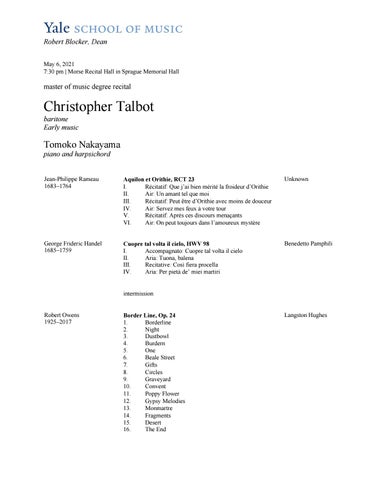
Robert Blocker, Dean May 6, 2021 7:30 pm | Morse Recital Hall in Sprague Memorial Hall
master of music degree recital
Christopher Talbot baritone Early music
Tomoko Nakayama piano and harpsichord Jean-Philippe Rameau 1683–1764
Aquilon et Orithie, RCT 23 I. Récitatif: Que j’ai bien mérité la froideur d’Orithie II. Air: Un amant tel que moi III. Récitatif: Peut être d’Orithie avec moins de douceur IV. Air: Servez mes feux à votre tour V. Récitatif: Après ces discours menaçants VI. Air: On peut toujours dans l’amoureux mystère
Unknown
George Frideric Handel 1685–1759
Cuopre tal volta il cielo, HWV 98 I. Accompagnato: Cuopre tal volta il cielo II. Aria: Tuona, balena III. Recitative: Così fiera procella IV. Aria: Per pietà de’ miei martiri
Benedetto Pamphili
intermission Robert Owens 1925–2017
Border Line, Op. 24 1. Borderline 2. Night 3. Dustbowl 4. Burdern 5. One 6. Beale Street 7. Gifts 8. Circles 9. Graveyard 10. Convent 11. Poppy Flower 12. Gypsy Melodies 13. Monmartre 14. Fragments 15. Desert 16. The End
Langston Hughes
Franz Schubert 1797–1828
Schwanengesang, D. 957 I. Liebesbotschaft II. Kriegers Ahnung III. Frühlingssehnsucht IV. Ständchen V. Aufenthalt VI. In der Ferne VII. Abschied
This performance is in partial fulfillment of the requirements for the master of music degree.
Ludwig Rellstab
Translations
Aquilon et Orithie I. Récitatif Que j’ai bien merité la froideur d’Orithie S’écrioit Aquilon rebuté des mépris De la beauté dont il étoit épris, Ma flâme disoit-il en fureur convertie Va faire succéder à mes soins les plus doux, A mon respect à mon obéissance, Une barbare violence, un impitoiable couroux. II. Air Un amant tel que moi doit-il prouver sa flâme, Par les désirs les plus discrets. Et de quoy m’ont servis mille soupirs secrets Mille vœux trop soumis, qu’avait formé mon âme? III. Récitatif Peut-être d’Orithie avec moins de douceur La fierté sera surmonteé, Eprouvons du moins si son cœur, trop insensible à la tendre langueur Peut céder aux transports d’une ardeur irritée. IV. Air Servez mes feux a votre tour, Force indomptable, affreuse rage. Que tout l’univers en ce jour Soit en proye a vôtre ravage. V. Récitatif Après ces discours menaçants Aquilon vole, et ses efforts puissans inspirent aux mortels la crainte et la tristesse. Il enléve Orithie en traversant la Gréce; La violence de ses feux Luy fait connoitre enfin quelle en est la tendresse. Par un juste retour elle ecoute ses vœux. VI. Air On peut toujours dans l’amoureux mystère Trouver le moyen de charmer. Celui qui devroit allarmer Devient quelque fois nécessaire.
I deserved the coldness of Orithie, Cried Aquilon, deterred by the contempt Of the beauty whom he loved, My ardour, he said, changed into fury Will follow my gentle attentions, My respect and obedience, with Barbarous violence, Rage without pity. A lover like me Must try his passion With the most discreet desires. What use were the thousand Secret sighs The thousand suppressed wishes, Which shaped me? Perhaps the pride of Orithie Will be overcome By less gentleness. Let us try at least if her heart, Insensitive to langourous tenderness, Will yield to an outburst Of passion. In turn let indomitable force And fearsome rage serve my passion. Let the whole universe today Fear your anger. After these threatening sentiments Aquilon flies off, and his exertions Inspire fear and sadness in all mortals. Crossing Greece, he takes Orithie away; And the violence of his passion Finally makes her recognize his Tenderness. And with a change Of heart she yields to his wishes.
In the mysteries of love one can Always find the means to seduce. That which should alarm sometimes Becomes a necessity.
Une beauté peut sans être sévère Refuser l’hommage d’un cœur. Loin de l’accuser de rigueur Essayons toujours de lui plaire.
A beauty can without being severe Refuse the entreaties of the heart. Far from accusing it of obstinacy Let us always try to please. English translation: Charles Medlam
Cuopre tal volta il cielo I. Accompagnato Cuopre tal volta il cielo nube oscura improvvisa, e tenebroso velo spande nera tempesta in faccia al sole; turbato il rio si duole, e il tridentato Dio voragini spumanti, apre fra l’onde ad assorbir le vele. Con impeto crudele scuoton rapidi vanni aure nemiche, e per le spiagge apriche cadono dissipati e fronde e fiori; feriscono gl’orrori, che ingombrano di Giuno molli campi, insidiosi lampi e repentino tuono fa più temer con strepitoso suono. II. Aria Tuona, ballena, sibila il vento, e l’etra s’oscura s’agita il mar. E rio spavento, barbara pena così congiura per tormentar. III. Recitative Così fiera procella dà rio tormento e spaventar sa l’alme; ma, le perdute calme misero assai più gemo, e mi querelo quando in tempesta miro il volto del mio ben, ch’è pari al cielo; Torbido a me d’intorno ombre spande d’affanni, e sdegnosi, e tiranni, or fuggitivi, or tardi lampi sono i suoi sguardi, e son fulmini orrendi i detti alteri, onde fra ciechi orrori errano già confusi i miei pensieri. IV. Aria Per pietà di miei martiri, sia mio ben, l’arco del ciglio sempre l’iride di pace. Che se irato a me lo giri,
Sometimes the sky is covered by an unexpected dark cloud, and a black storm spreads a sombre veil over the face of the sun; the stream in turmoil complains, and the god with the trident (Neptune) opens up foaming whirlpools in the sea to engulf the ships. With cruel violence hostile winds flap their swift wings, and scattered branches and flowers fall on to the pleasant shores; insideous lightning pierces the darkness which hangs over Juno’s gentle fields, and sudden thunder inspires greater fear with its deafening noise. There is thunder and lightning, the wind howls, and the sky clouds over, the sea grows stormy; and horrible fear, in like manner, brings cruel distress to torment us. So fierce a storm causes dreadful torment, and makes our souls afraid; but I, unhappy wretch, bewail much more the vanished calm, and I lament when I see the tempest in my beloved’s face, which is just like the sky: angrily it spreads around me dark shadows of trouble, scornful and tyrannical; her glances are lightning-flashes, now brief, now lingering, her disdainful words are terrifying thunderbolts, which make my already confused thoughts wander in awful darkness. Out of pity for my sufferings, my treasure, let the arch of your brow be always the rainbow of pace; for if you turn it on me full of anger, without escape in my peril,
senza scampo nel periglio, la mia vita è più fugace.
my life is shortened. English translation from Hallische Händel-Ausgabe,
Schwanengesang I. Liebesbotschaft Rauschendes Bächlein, so silbern und hell, Eilst zur Geliebten so munter und schnell? Ach, trautes Bächlein, mein Bote sei du; Bringe die Grüsse des Fernen ihr zu.
Love’s Message Murmuring brook, so silver and bright, do you hasten, so lively and swift, to my beloved? Ah, sweet brook, be my messenger. Bring her greetings from her distant lover.
All’ ihre Blumen im Garten gepflegt, Die sie so lieblich am Busen trägt, Und ihre Rosen in purpurner Glut, Bächlein, erquicke mit kühlender Flut.
All the flowers, tended in her garden, which she wears so charmingly on her breast, and her roses with their crimson glow: refresh them, brooklet, with your cooling waters.
Wenn sie am Ufer, in Träume versenkt, Meiner gedenkend, das Köpfchen hängt; Tröste die Süsse mit freundlichem Blick, Denn der Geliebte kehrt bald zurück.
When on your banks she inclines her head lost in dreams, thinking of me, comfort my sweetheart with a kindly glance, for her beloved will soon return.
Neigt sich die Sonne mit rötlichem Schein, Wiege das Liebchen in Schlummer ein. Rausche sie murmelnd in süsse Ruh, Flüstre ihr Träume der Liebe zu.
When the sun sinks in a red flush, lull my sweetheart to sleep. With soft murmurings bring her sweet repose, and whisper dreams of love.
II. Kriegers Ahnung In tiefer Ruh liegt um mich her Der Waffenbrüder Kreis; Mir ist das Herz so bang und schwer, Von Sehnsucht mir so heiss.
Warriors foreboding In deep repose my comrades in arms lie in a circle around me; my heart is so anxious and heavy, so ardent with longing.
Wie hab’ ich oft so süss geträumt An ihrem Busen warm! Wie freundlich schien des Herdes Glut, Lag sie in meinem Arm!
How often I have dreamt sweetly upon her warm breast! How cheerful the fireside glow seemed when she lay in my arms.
Hier, wo der Flammen düstrer Schein Ach! nur auf Waffen spielt, Hier fühlt die Brust sich ganz allein, Der Wehmut Träne quillt.
Here, where the sombre glimmer of the flames, alas, plays only on weapons, here the heart feels utterly alone; a tear of sadness wells up.
Herz! Dass der Trost Dich nicht verlässt! Es ruft noch manche Schlacht – Bald ruh ich wohl und schlafe fest, Herzliebste – Gute Nacht!
Heart, may comfort not forsake you; many a battle still calls. Soon I shall rest well and sleep deeply. Beloved, goodnight!
III. Frühlingssehnsucht Säuselnde Lüfte wehend so mild, Blumiger Düfte atmend erfüllt! Wie haucht ihr mich wonnig begrüssend an! Wie habt ihr dem pochenden Herzen getan?
Spring longing Whispering breezes, blowing so gently, exuding the fragrance of flowers, how blissful to me is your welcoming breath! What have you done to my beating heart?
Es möchte euch folgen auf luftiger Bahn, Wohin? Wohin?
It yearns to follow you on your airy path. Where to?
Bächlein, so munter rauschend zumal, Wollen hinunter silbern in’s Tal. Die schwebende Welle, dort eilt sie dahin! Tief spiegeln sich Fluren und Himmel darin. Was ziehst du mich, sehnend verlangender Sinn, Hinab? Hinab?
Silver brooklets, babbling so merrily, seek the valley below. Their ripples glide swiftly by! The fields and the sky are deeply mirrored there. Why yearning, craving senses, do you draw me downwards?
Grüssender Sonne spielendes Gold, Hoffende Wonne bringest du hold. Wie labt mich dein selig begrüssendes Bild! Es lächelt am tiefblauen Himmel so mild Und hat mir das Auge mit Tränen gefüllt! – Warum? Warum?
Sparkling gold of the welcoming sun, you bring the fair joy of hope. How your happy, welcoming countenance refreshes me! It smiles so benignly in the deep blue sky and yet has filled my eyes with tears. Why?
Grünend umkränzet Wälder und Höh’! Schimmernd erglänzet Blütenschnee. So dränget sich alles zum bräutlichen Licht; Es schwellen die Keime, die Knospe bricht; Sie haben gefunden, was ihnen gebricht: Und du? Und du? Rastloses Sehnen! Wünschendes Herz, Immer nur Tränen, Klage und Schmerz? Auch ich bin mir schwellender Triebe bewusst! Wer stillet mir endlich die drängende Lust? Nur du befreist den Lenz in der Brust, Nur du! Nur du!
The woods and hills are wreathed in green. Snowy blossom shimmers and gleams. All things strain towards the bridal light; seeds swell, buds burst; they have found what they lacked: and you? Restless longing, yearning heart, are there always only tears, complaints and pain? I too am aware of swelling impulses! Who at last will still my urgent desire? Only you can free the spring in my heart, only you!
IV. Ständchen Leise flehen meine Lieder Durch die Nacht zu Dir; In den stillen Hain hernieder, Liebchen, komm’ zu mir!
Serenade Softly my songs plead through the night to you; down into the silent grove, beloved, come to me!
Flüsternd schlanke Wipfel rauschen In des Mondes Licht; Des Verräters feindlich Lauschen Fürchte, Holde, nicht.
Slender treetops whisper and rustle in the moonlight; my darling, do not fear that the hostile betrayer will overhear us.
Hörst die Nachtigallen schlagen? Ach! sie flehen Dich, Mit der Töne süssen Klagen Flehen sie für mich.
Do you not hear the nightingales call? Ah, they are imploring you; with their sweet, plaintive songs they are imploring for me.
Sie verstehn des Busens Sehnen, Kennen Liebesschmerz, Rühren mit den Silbertönen Jedes weiche Herz.
They understand the heart’s yearning, they know the pain of love; with their silvery notes they touch every tender heart.
Lass auch Dir die Brust bewegen, Liebchen, höre mich! Bebend harr’ ich Dir entgegen! Komm’, beglücke mich!
Let your heart, too, be moved, beloved, hear me! Trembling, I await you! Come, make me happy!
V. Aufenthalt Rauschender Strom, brausender Wald, Starrender Fels mein Aufenthalt. Wie sich die Welle an Welle reiht, Fliessen die Tränen mir ewig erneut.
Resting place Surging river, roaring forest, immovable rock, my resting place. As wave follows wave, so my tears flow, ever renewed.
Hoch in den Kronen wogend sich’s regt, So unaufhörlich mein Herze schlägt. Und wie des Felsen uraltes Erz Ewig deselbe bleibet mein Schmerz.
As the high treetops stir and heave, so my heart beats incessantly. Like the rock’s age-old ore my sorrow remains forever the same.
VI. In der Ferne Wehe dem Fliehenden Welt hinaus ziehenden! – Fremde durchmessenden, Heimat vergessenden, Mutterhaus hassenden, Freunde verlassenden Folget kein Segen, ach! Auf ihren Wegen nach!
Far away Woe to those who flee, who journey forth into the world, who travel through strange lands, forgetting their native land, spurning their mother’s home, forsaking their friends: alas, no blessing follows them on their way!
Herze, das sehnende, Auge, das tränende, Sehnsucht, nie endende, Heimwärts sich wendende! Busen, der wallende, Klage, verhallende, Abendstern, blinkender, Hoffnungslos sinkender!
The yearning heart, the tearful eye, endless longing turning homewards! The surging breast, the dying lament, the evening star, twinkling and sinking without hope!
Lüfte, ihr säuselnden, Wellen sanft kräuselnden, Sonnenstrahl, eilender, Nirgend verweilender: Die mir mit Schmerze, ach! Dies treue Herze brach – Grüsst von dem Fliehenden Welt hinaus ziehenden!
Whispering breezes, gently ruffled waves, darting sunbeams, lingering nowhere: send her, who broke my faithful heart with pain, greetings from one who is fleeing and journeying forth into the world!
VII. Abschied Ade, Du muntre, Du fröhliche Stadt, Ade! Schon scharret mein Rösslein mit lustigem Fuss; Jetzt nimm noch den letzten, den scheidenden Gruss. Du hast mich wohl niemals noch traurig gesehn, So kann es auch jetzt nicht beim Abschied geschehn. Ade ...
Farewell Farewell, lively, cheerful town, farewell! Already my horse is happily pawing the ground. Take now my final, parting greeting. I know you have never seen me sad; nor will you now as I depart. Farewell!
Ade, Ihr Bäume, Ihr Gärten so grün, Ade! Nun reit’ ich am silbernen Strome entlang, Weit schallend ertönet mein Abschiedsgesang, Nie habt Ihr ein trauriges Lied gehört, So wird Euch auch keines beim Scheiden beschert. Ade ...
Farewell, trees and gardens so green, farewell! Now I ride along the silver stream; my song of farewell echoes far and wide. You have never heard a sad song; nor shall you do so at parting. Farewell!
Ade, lhr freundlichen Mägdlein dort, Ade! Was schaut Ihr aus blumenumduftetem Haus Mit schelmischen, lockenden Blicken heraus? Wie sonst, so grüss’ ich und schaue mich um, Doch nimmer wend’ ich mein Rösslein um. Ade ...
Farewell, charming maidens, farewell! Why do you look out with roguish, enticing eyes from houses fragrant with flowers? I greet you as before, and look back; but never will I turn my horse back. Farewell!
Ade, liebe Sonne, so gehst Du zur Ruh’, Ade! Nun schimmert der blinkenden Sterne Gold. Wie bin ich Euch Sternlein am Himmel so hold, Durchziehn wir die Welt auch weit und breit, Ihr gebt überall uns das treue Geleit. Ade ...
Farewell, dear sun, as you go to rest, farewell! Now the stars twinkle with shimmering gold. How fond I am of you, little stars in the sky; though we travel the whole world, far and wide, everywhere you faithfully escort us. Farewell!
Ade, Du schimmerndes Fensterlein hell, Ade! Du glänzest so traulich mit dämmerndem Schein Und ladest so freundlich ins Hüttchen uns ein. Vorüber, ach, ritt ich so manches mal Und wär’ es denn heute zum letzten mal? Ade …
Farewell, little window gleaming brightly, farewell! You shine so cosily with your soft light, and invite us so kindly into the cottage. Ah, I have ridden past you so often, and yet today might be the last time. Farewell!
Ade, Ihr Sterne, verhüllet Euch grau! Ade! Des Fensterlein trübes, verschimmerndes Licht Ersetzt Ihr unzähligen Sterne mir nicht; Darf ich hier nicht weilen, muss hier vorbei, Was hilft es, folgt Ihr mir noch so treu! Ade, Ihr Sterne, verhüllet Euch grau! Ade!
Farewell, stars, veil yourselves in grey! Farewell! You numberless stars cannot replace for us the little window’s dim, fading light; if I cannot linger here, if I must ride on, how can you help me, though you follow me so faithfully? Farewell, stars, veil yourselves in grey! Farewell! Translation © Richard Wigmore, author of Schubert: The Complete Song Texts, published by Schirmer Books, provided courtesy of Oxford Lieder (www.oxfordlieder.co.uk)