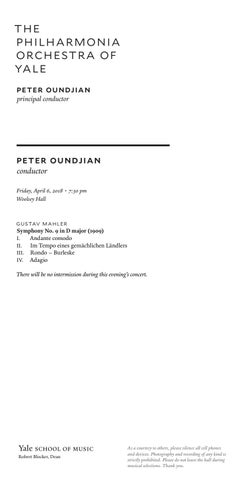
the philharmonia orchestra of yale peter oundjian principal conductor
peter oundjian conductor
Friday, April 6, 2018 • 7:30 pm Woolsey Hall
gustav mahler Symphony No. 9 in D major (1909) I. Andante comodo II. Im Tempo eines gemächlichen Ländlers III. Rondo – Burleske IV. Adagio There will be no intermission during this evening’s concert.
Robert Blocker, Dean
As a courtesy to others, please silence all cell phones and devices. Photography and recording of any kind is strictly prohibited. Please do not leave the hall during musical selections. Thank you.
P ro g ra m N otes
Gustav Mahler » 1860–1911 Symphony No. 9 in D major (1909)
the warm caress of death. What emerges is a charming and intimate elaboration on the sighing motive that sways gently like trees Mahler, in his life as well as his music, repin the breeze. A pickup note syncopated over resents a study in dichotomies, an unlikely the barline and a leap upward that resolves and unsustainable collision of seemingly down in the sigh provide more than a vaguely incompatible poles. First, there is the messy familiar Viennese lilt; this is Mahler’s counterbusiness of his tangled domestic identities. intuitive quote of a waltz by Johann Strauss, It was Vienna that bore many of the fruits of “Freuet Euch des Lebens” (Enjoy Life). Mahler’s professional life, as it had for Haydn, Mozart, Beethoven, Schubert and Brahms Mahler’s tender, if peculiar, homage to Strauss before him. There, in that cultural Mecca, will serve as a place of repose throughout he wrote music that bespeaks his humbler the movement, a shelter from the storm of roots in provincial Bohemia, the same roots the more agitated episodes in between. But that would undermine his sense of belonging for now, Mahler upsets the tranquil scene as in the cosmopolitan capital, even as it supthe orchestra reels into a violent fanfare led ported his professional activities. There is by the horns. The turmoil is short-lived; a his dual career as a conductor and composer, brief but turbulent build-up spills over into alternately complementary and conflicting a luxuriant, resplendent recasting of the pursuits. Not least of all, there is his straddling sigh motif at fortissimo. This quicksilver of two embittered religions, a begrudging movement lacks the comforting organization conversion to Catholicism that clinched his of strict sonata form; we never know where appointment as director of the Vienna Court we’re going next, only that we won’t be Opera, but didn’t spare him from the antithere for long. Instead of a formal blueprint Semitic forces resolved to attack his career. to latch onto, we have the guideposts of the opening omens — the tripping heartbeat And in the Ninth Symphony, there is the and the harp’s tolling of the bells, both reelegiac farewell that somehow affirms life fracted through different instruments and with its dying breath. Leonard Bernstein interval mutations — and the soothing called it “a sonic presentation of death reminder to “Enjoy Life” along the way, itself… which paradoxically reanimates us even as we don’t know what’s coming. every time we hear it,” and the heralds of this dual reading are present from the opening After the celestial settling of the first movebars of the symphony. Cellos and horn utter ment, the second introduces an earthbound the symphony’s first sounds as they trade ländler, made rustic by the hollow composite pedal A’s at odd intervals, often likened to sound of widely-spaced instrument pairings: irregular palpitations of a faltering heart. bass clarinet doubling oboe, bassoons in But the skipping heartbeat grows distant as conversation with piccolo. This is music of bell tones in the harp and its echoes in the the country, a dead giveaway of Mahler’s horn awaken other voices (or is this all a Bohemian origins. The cumbersome, prodream, an illusion of extra time?). Stirring vincial dance is left behind as strings take violas and double basses add to this ethereal over in a più mosso section, instead suggesting nostalgia before the second violins, in a a sort of demented waltz — drunken, maybe, series of wonderful sighs, breathe fragments but always good-natured. The movement of lyricism into the woodsy scene. And with continues to explore this familiar dichotomy, this breath, the most fundamental life-force, simple joys amid disfigured, even hostile Mahler celebrates life even as he juxtaposes dance rhythms, until the raucous scene it against the backdrop of the inevitable recedes apologetically into the distance. death announced in the first measures. The sardonic third movement, Burleske, Life begets life, and so Mahler permits his sees a crass intersection of dissonance with two-note sighing figure to bloom into everBaroque-style counterpoint. But even here, stretching threads of melody — never the Mahler creates oases of calm as a solo trumpet, long-spun, lyrical theme we’re waiting for, hopeful, but not without a tinge of melancholy, but intimations of one, a melody shrouded heralds the theme of the coming Finale. in the gossamer veil of memory, or, perhaps, a tune in its twilight years that strives for a That the Ninth Symphony came on the heels life of its own but lacks the vitality to skirt of Mahler’s Das Lied von der Erde suggests an
art ist p ro f i le s
interesting creative impetus for the symphony, the last he would complete. For all of its grand, symphonic scope, its all-encompassing summation of the past and its prophetic look toward the future, Das Lied von der Erde was still bound to the individual experience by the personal vessel of song. To give voice to the general human condition itself, Mahler had to abandon the voice altogether and take up instead the more universal language of the instrumental cosmos. The symphony is more than autobiographical, and the failing heart of the opening isn’t just Mahler’s. It signifies a farewell to tonality — to music as Mahler knew it — and maybe also an instinctual farewell to society, written on the eve of the political traumas that would plague the 20th century. To characterize the titanic Adagio that frames the Ninth Symphony, the final chapter of this work of a lifetime, it is difficult to imagine words more eloquent than Leonard Bernstein’s: “And so we come to the final incredible page. And this page, I think, is the closest we have ever come, in any work of art, to experiencing the very act of dying, of giving it all up. The slowness of this page is terrifying: Adagissimo, he writes, the slowest possible musical direction; and then langsam (slow), ersterbend (dying away), zögern (hesitating); and as if all those were not enough to indicate the near stoppage of time, he adds äusserst langsam (extremely slow) in the very last bars. It is terrifying, and paralyzing, as the strands of sound disintegrate. We hold on to them, hovering between hope and submission. And one by one, these spidery strands connecting us to life melt away, vanish from our fingers even as we hold them. We cling to them as they dematerialize; we are holding two—then one. One, and suddenly none. For a petrifying moment there is only silence. Then again, a strand, a broken strand, two strands, one… none. We are half in love with easeful death… now more than ever seems it rich to die, to cease upon the midnight with no pain… And in ceasing, we lose it all. But in letting go, we have gained everything.” – Graeme Steele Johnson
a rti st Profiles p rofiles A r t i st Peter Oundjian, principal conductor A dynamic presence in the conducting world, Toronto-born conductor Peter Oundjian is renowned for his probing musicality, collaborative spirit, and engaging personality. Oundjian’s appointment as music director of the Toronto Symphony Orchestra (TSO) in 2004 reinvigorated the orchestra with numerous recordings, tours, and acclaimed innovative programming, as well as extensive audience growth, thereby significantly strengthening the ensemble’s presence in the world. He recently led the TSO on a tour of Europe that included a sold-out performance at Amsterdam’s Royal Concertgebouw and the first performance by a North American orchestra at Reykjavik’s Harpa concert hall. Oundjian was appointed music director of the Royal Scottish National Orchestra (RSNO) in 2012. Under his baton, the orchestra has enjoyed several successful tours including one to China, and has continued its relationship with Chandos Records. In 2015, Oundjian and the RSNO opened the Edinburgh Festival with the innovative Harmonium Project to great critical and audience acclaim. Few conductors bring such musicianship and engagement to the world’s great podiums —from Berlin, Amsterdam, and Tel Aviv to New York, Chicago, and Sydney. Oundjian has appeared at some of the great annual gatherings of musicians and musiclovers, from the BBC Proms and the Prague Spring Festival to the Edinburgh Festival and the Philadelphia Orchestra’s Mozart Festival, where he was artistic director from 2003 to 2005. Oundjian was principal guest conductor of the Detroit Symphony Orchestra from 2006 to 2010 and artistic director of the Caramoor International Music Festival in New York between 1997 and 2007. Since 1981, he has been a visiting professor at the Yale School of Music, and in 2013 he was awarded the School’s Samuel Simons Sanford Award for distinguished service to music.
A b o u t Ya l e Philharmo nia
The Philharmonia Orchestra of Yale is one of America’s foremost music-school ensembles. The largest performing group at the Yale School of Music, the Philharmonia offers superb training in orchestral playing and repertoire.
peter oundjian Principal Conductor
Performances include an annual series of concerts in Woolsey Hall, as well as Yale Opera productions in the Shubert Theater. The Yale Philharmonia has also performed on numerous occasions in Carnegie Hall and Alice Tully Hall in New York City and at the John F. Kennedy Center for the Performing Arts in Washington, D.C. The orchestra undertook its first tour of Asia in 2008, with acclaimed performances in the Seoul Arts Center, the Forbidden City Concert Hall and National Center for the Performing Arts (Beijing), and the Shanghai Grand Theatre.
jeffrey m. mistri Manager
philharmonia staff
samuel bobinski Assistant Manager/Librarian david yi Conducting Fellow
the philharmonia orchestra of yale Violin I Sophia Mockler Emily Switzer Sirena Huang Clement Luu Ethan Hoppe Martin Peh Emre Engin Kevin Zheng Jung Eun Kang Lauren Bennett Yuqi Li Dongsoo Cha Maura Scanlin Michael Tropepe Violin II Alyssa Blackstone Bora Kim Elliot Lee Kyung Ah Oh Nuri Lim Dhyani Heath Gregory Lewis Li Soo Lee Ariel Horowitz Yejin Min Chang Hoon Bae Andy Peng Viola Josip Kvetek Marlea Simpson Marta Lambert Hayaka Komatsu Thomas Duboski Florrie Marshall Rimbo Wong Rayna Chou Davis Butner
Cello Jenny Kwak Eric Adamshick Samuel DeCaprio Anita Balazs Bitnalee Pong Samuel Walter Ji Young Choi James Rosamilia Bass Kaden Henderson Jordan Calixto Kohei Yamaguchi Kelvin Ng Russell Thompson Mariya-Andoniya Andonova Flute Leo Sussman Benjamin Morency Maria Luisk Jungah Yoon piccolo Lucas Oliviera Oboe Lauren White Elliot Lichtenberg Shawn Hutchison
E-flat clarinet Elisha Willinger bass clarinet Michael Moy Horn Bassoon Dillon Meacham Ming Yang Ethan Lippert Contrabassoon Dana Brink Horn Scott Leger Stephen Newberry Antonia Chandler Luke Baker Trumpet Theo Van Dyke Chloe Swindler Eric Rizzo Trombone William Wortley Ingram Lee Bass Trombone Daniel Vaitkus
english horn Lauren Williams
tuba Jacob Fewx
Clarinet Graeme Johnson Richard Adger Ziqi Yue
Timpani Shiqi Zhong
Percussion Sam Um YoungKyoung Lee Dmitrii Nilov Jisu Jung Harp Margaret Davis Anna Ellsworth Music Librarians Antonia Chandler Bora Kim Marta Lambert Gregory Lewis Laura Park Lauren Williams Leonardo Ziporyn Philharmonia Office Assistant Kristy Tucker Stage Crew Jisu Jung Matt Keown YoungKyong Lee Aaron Israel Levin Gabriel Mairson Dmitrii Nilov Lucas Oliveira Tanner Porter Hillary Simms Sam Um Daniel Vaitkus Rimbo Wong
a rti rofiles U p cost m ping Events APR 10
APR 20
APR 25
BRENTANO STRING QUARTET Oneppo Chamber Music Series The Brentano String Quartet, YSM’s ensemblein-residence, performs Mozart’s captivating “Dissonance” Quartet and works by Beethoven and Shostakovich. Morse Recital Hall | Tuesday | 7:30 pm Tickets start at $26, Students $13 MARIN ALSOP guest conductor Yale Philharmonia Guest conductor Marin Alsop leads the Yale Philharmonia, Yale Glee Club, and Yale Camerata in a performance of Beethoven’s monumental Ninth Symphony, on a program that also includes Bernstein’s Opening Prayer and Chichester Psalms. Woolsey Hall | Friday | 7:30 pm Tickets start at $10 • Yale Faculty/Staff $8 Students $5 $3 surcharge for purchases at the door YALE CELLOS YSM Ensembles Aldo Parisot leads the beloved Yale Cellos in arrangements of music by Ravel, Corelli, Bach, Joplin, Vivaldi, Schumann, and Rossini. Morse Recital Hall | Wednesday | 7:30 pm Tickets start at $10, Students $5
box office
203 432-4158 concert programs & box office
Krista Johnson Kate Gonzales communications
Mackenzie Dilbeck Katie Kelley David Brensilver operations
Tara Deming Christopher Melillo piano curators
Barbara Renner Robert Crowson Brian Daley William Harold media production
Matthew LeFevre Travis Wurges music.yale.edu
thank you for your support! Become a Yale School of Music patron and support our performance programs. Earn benefits ranging from preferred seating to invitations to special events. To learn more, visit us online or call 203 432-4158. charles ives circle $600 and above Serena & Robert Blocker John Marsden Hunt paul hindemith circle $250 to $599 Prof. Michael & Mrs. Maryann Bracken Carole and Arthur Broadus Richard H. Dumas Edwin M. & Karen C. Duval Paul Gacek Francesco Iachello Mary-Jo Worthey Warren Ransom Wilson & Walter Foery horatio parker circle $125 to $249 Jeffrey Alexander & Morel Morton William & Joyce Alton Roger & Linda Astmann Craig Baker Derek & Jennifer Briggs Mindy & Stan Brownstein
Leo Cristofar & Bernadette DiGiulian Dolores M. Gall Carolyn Gould Arthur J. Kover & Margaret Lord Judith Long Mark Ludwig Ann Marlowe Susan Matheson & Jerome Pollitt Arthur T. Rosenfield, MD Suzanne Solensky & Jay Rozgonyi Monika & Fred Volker samuel simons sanford circle $50 to $124 Anonymous Helen & Blake Bidwell Barbara Blake Barbara & Frank Dahm Bill & Barbara Dickerson Elizabeth M. Dock John Doyle Thomas & Judith Foley Saul & Sonya Goldberg
Lawrence Handler Dr. Alan Katz Linda and Ozzie Levene Mrs. Elizabeth Lowery James Manfield Joel Marks Betty Mettler Rocco & Velma Pugliese Helen & Fred Robinson Leonard J. Rutkosky Albert Toth Suzanne Tucker Peter Uhrynowski Carl Wies Donna Yoo gustave j. stoeckel circle $25 to $49 Mr. Vic G. Dvorak Mr. Daniel W. Kops Jr. Stephen & Diana Paschall Mary Ellen Porcelli Bradford Moore Purcell Mr. James N. Trimble List as of April 5, 2018