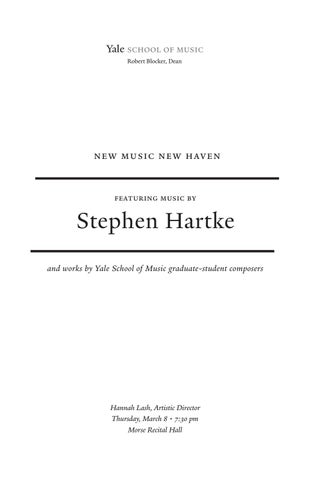
Robert Blocker, Dean
new music new haven
featuring music by
Stephen Hartke and works by Yale School of Music graduate-student composers
Hannah Lash, Artistic Director Thursday, March 8 • 7:30 pm Morse Recital Hall
Yale School of Music
New Music New Haven March 8, 2018 • Morse Recital Hall
Tanner Porter Nothing on Me. b. 1994 Hannah Goodwillie, conductor Tanner Porter, soprano Kevin Zheng, violin Matthew Woodard, violin Ji Young Choi, cello Nate Huvard, electric bass
Leo Sussman, flute Lucas Guedes Oliveira, flute Ziqi Yue, clarinet Matt Keown, percussion Shiqi Zhong, percussion Nate May, synthesizer Elizabeth Faure, electric guitar
Frances Pollock God as she makes this earth b. 1989 Joseph Kemper, conductor Amir Farsi, flute Fjola Evans, solo cello Elliot Lichtenberg, oboe Jennifer Goode Cooper, voice Richard Adger, clarinet Yintong Liu, violin Allie Simpson, viola Jenny Kwak, cello Ryan Lindveit Mysterious Butterflies b. 1994 Ryan Lindveit, conductor Maura Scanlin, violin Addy Sterrett, soprano Jung Eun Kang, violin Frances Pollock, soprano Hayaka Komatsu, viola Bradley Sharpe, alto Bitnalee Pong, cello Antonia Chandler, alto Jordan Calixto, double bass James Reese, tenor Shawn Hutchison, oboe Eli Greenhoe, tenor Lauren White, oboe, English Bryan Murray, bass horn Zachary Johnson, bass Dillon Meacham, bassoon Chloe Swindler, trumpet Lam Wong, piano Intermission
Yale School of Music
Aaron Israel Levin b. 1995
Percussion sonata. I. Prelude (Noodles) II. Chorale (Heave) III. Knocturne (Damn) Dmitrii Nilov, percussion
Nate May b. 1987
Exl vr Bora Kim, violin Julia Clancy, viola
Stephen Hartke b. 1952
The Fifth Book I. Adagio assai II. Allegro scherzando III. Andante con moto IV. Presto V. Lento Brentano String Quartet Mark Steinberg, violin Serena Canin, violin Misha Amory, viola Nina Lee, cello
As a courtesy to the performers and audience, silence electronic devices. Please do not leave the hall during selections. Photography or recording of any kind is prohibited.
Artist Profiles • Notes on the Program biography Tanner Porter
biography Frances Pollock
Tanner Porter is a composer-performer and visual artist from California. Her work has been performed at Ann Arbor’s Threads All Arts Festival, the 2015 Midwestern Composers Symposium, the University of Michigan’s write Hear, right Now concert series, and by art-ensemble Willo Collective at New Music Detroit’s Strange Beautiful Music 9. Tanner received a Bachelor of Music Degree in composition from the University of Michigan School of Music, Theatre and Dance, and is currently pursuing a Master of Music Degree in composition from the Yale School of Music. She is thrilled to be the 2017–2018 Artist in Residence for the Michigan-based all-arts collective Red Shoe Company. Upcoming performances include a set at this year’s New Music Gathering in Boston.
Known for her “bold and bracing” (Baltimore Sun) opera writing, Frances Pollock’s music “pulls no punches and never flinches.” (City Paper) Originally from North Carolina, Frances’s music has been performed all over the country by the Bridge Ensemble, Prima Volta, The North Carolina Governors’ School, Divine Waters Ensemble, and many others. In 2015, she wrote her first opera, Stinney, which won multiple awards including John Hopkins University’s Diversity Innovation Grant and Best of Baltimore award. From 2016–2017, Frances was composer in residence for the Divine Waters Ensemble. In 2016, Frances was commissioned by Washington National Opera to write a one-act opera entitled What Gets Kept. Frances is a founding member of the new music non-profit, Prima Volta. She is a composition fellow with American Opera Projects and with the Aspen Music Festival. Frances holds a Bachelor of Music Degree in theory and composition from Furman University and a Master of Music Degree in voice from the Peabody Conservatory. She is currently pursuing a Master of Music Degree in composition at the Yale School of Music.
program note Nothing on Me. Once you’ve fixated on an experience long enough, you start to see the world through its lens. It begins to define you. You circle it, and in doing so make an unhappy idol; the tighter the circle, the more power the experience gains, and the more you disappear to make room for it. Sometimes holding on is more comfortable than sitting alone in your body. At the very least, it’s a kind of company. But the things that have happened have done so before, and might very well happen again, so let’s all be a bit kinder—especially to ourselves, and remember that we are an amalgamation of moments, and as such are more powerful than any individual experience we’ve let occupy our time. This is the first in a set of new songs.
program note God as she makes this earth God as she makes this earth is an exploration of the feminine creative spirit. What voices are outside of ourselves that tell us to stop creating? What voices live deep without our souls that throw doubt over the ways we create. How do the two stand in dialogue as we move throughout our every day?
Artist Profiles • Notes on the Program biography Ryan Lindveit Ryan Lindveit is a composer whose music has been performed across the United States and abroad by Alarm Will Sound, “The President’s Own” United States Marine Band, Orkest de Ereprijs, the USC Thornton Symphony, numerous university wind ensembles, the Donald Sinta Quartet, FearNoMusic, and the City of Tomorrow, among others. His music has received recognition from BMI, ASCAP, SCI, the American Modern Ensemble, the National Band Association, Tribeca New Music, and the Texas Music Educators Association. Ryan is a graduate of the University of Southern California, where he was selected as Salutatorian for the class of 2016 and named the Thornton School of Music’s Outstanding Graduate. He is currently pursuing a Master of Music Degree at the Yale School of Music, where he has studied with Aaron Jay Kernis and Christopher Theofanidis. program note Mysterious Butterflies Santiago Ramón y Cajal was a Nobel Prizewinning scientist who is often called the father of modern neuroscience. Among other things, Cajal discovered the neuron and also made meticulous pencil drawings of many of the nerve cells he saw under his microscope—bridging the gap between art and science. The journals of his discoveries contain beautiful language rife with evocative imagery and metaphors. I have been wanting to write a piece related to neuroscience for a long time, and Cajal’s words spoke to me immediately. He calls brain cells “the mysterious butterflies of
the soul,” and wonders if their “flapping wings” will someday provide us with the secrets of the human mind. Ultimately, Mysterious Butterflies is a manifestation of my belief that one of music’s greatest powers is to provide a space for listeners to explore mysterious mental terrain. biography Aaron Israel Levin Aaron Israel Levin is a composer of concert music that is guided by the emotional dynamism of storytelling and drama. He draws from a variety of musical and nonmusical influences to create compositions that are both personal and wide-ranging. Originally from St. Paul, Minnesota, Levin earned his Bachelor’s Degree in music from Grinnell College, where he studied composition with Eric McIntyre and John Rommereim. He is currently pursuing a Master of Music Degree in composition at the Yale School of Music where his teachers have included Hannah Lash and Christopher Theofanidis. biography Nate May Nate May is an American composer whose music draws on research and imagination with an ear for textural intricacy, rhythmic drive, and repurposed sounds. His chamber music with and without electronics has been performed by Adam Sliwinski, Eric Wubbels, Patchwork Duo, Quartetto Indaco, Hajnal Pivnick, Nathan Nabb, and many others. He has been a fellow at the highSCORE festival (Pavia, Italy) and the Sō Percussion Summer Institute
Artist Profiles • Notes on the Program (Princeton, New Jersey), and was selected as one of three U.S. composers to participate in the Los Angeles Philharmonic’s 2017 National Composers Intensive. Currently pursuing a Doctor of Musical Arts Degree at the Yale School of Music studying with Christopher Theofanidis, he holds degrees from the Cincinnati College-Conservatory of Music (Master of Muisc, Composition) and the University of Michigan (B.F.A., Jazz and Contemplative Studies). He serves as a Teaching Fellow at Yale and on faculty at The Walden School in Dublin, New Hampshire. program note Exl vr In 1583, a shining figure named Galvah allegedly dictated to John Dee an angelic book that would be “a hotchpot without order.” The “Ghybbrish” phrase “exi vr” is found in this book, near an indication in English: “Now seas appear.” White noise, which literally contains all sounds, is at once consistent and random. It is the ultimate “hotchpot” of sound, yet in its depths we feel a womb-like comfort. And as it is filtered in various ways, seas begin to appear, along with rivers, rainstorms, now wind, thunder, fire. Confluent with these elements is human and animal life, which with the prism of the vocal folds refracts noise into tone. Yet just as tone can be birthed from noise, so noise can result from the coincidence of all tones. This piece meditates on this coemergence.
biography Stephen Hartke Winner of the 2013 Grammy Award for Best Contemporary Classical Composition, Stephen Hartke is widely recognized as one of the leading composers of his generation, whose work has been hailed for both its singularity of voice and the inclusive breadth of its inspiration. Born in Orange, New Jersey, in 1952, Hartke grew up in Manhattan where he began his musical career as a professional boy chorister, performing with such organizations as the New York Pro Musica, the New York Philharmonic, the American Symphony Orchestra, and the Metropolitan Opera. Following studies at Yale, the University of Pennsylvania, and the University of California at Santa Barbara, interrupted by stints as advertising manager for several major music publishers, Hartke also taught in Brazil as Fulbright Professor at the Universidade de São Paulo. From 1987 to 2015, he taught at the Thornton School of Music at the University of Southern California, retiring as Distinguished Professor Emeritus. He now serves as Professor and Chair of Composition at Oberlin Conservatory. Hartke’s output is extremely varied, from the medieval-inspired piano quartet The King of the Sun, and Wulfstan at the Millennium, an abstract liturgy for ten instruments, the blues-inflected violin duo Oh Them Rats Is Mean in My Kitchen, and the surreal trio The Horse with the Lavender Eye, to the Biblical satire Sons of Noah, for soprano, four flutes, four guitars, and four bassoons, and his recent Symphony No. 4 for Organ, Orchestra, and Soprano, commissioned for the Los Angeles
Artist Profiles • Notes on the Program Philharmonic. He has composed concerti for renowned clarinetist Richard Stoltzman and violinist Michele Makarski, and his collaboration with the internationallycelebrated Hilliard Ensemble has resulted in three substantial works, including his Symphony No. 3, commissioned by Lorin Maazel and the New York Philharmonic. Other major commissions have come from the Chamber Music Society of Lincoln Center, Carnegie Hall and the Harvard Musical Association, the IRIS Chamber Orchestra, the Kansas City Symphony, the Library of Congress, the Los Angeles Chamber Orchestra, the National Symphony Orchestra, the Orpheus Chamber Orchestra, the Barlow Endowment, Chamber Music America, the Fromm Foundation, the Institute for American Music at the Eastman School of Music, Meet The Composer, the National Endowment for the Arts, and the Natural History Museum of Los Angeles County, among others. Stephen Hartke has also won the Rome Prize from the American Academy in Rome, two Koussevitzky Music Foundation Commission Grants, a Guggenheim Fellowship, the Academy Award from the American Academy of Arts and Letters, the Stoeger Award from the Chamber Music Society of Lincoln Center, the Charles Ives Living from the American Academy of Arts and Letters, and the Deutsche Bank Berlin Prize from the American Academy in Berlin. In 2008, Hartke’s opera The Greater Good, commissioned and premiered by Glimmerglass Opera, received the first Charles Ives Opera Prize from the American Academy of Arts and Letters. In 2009, he was elected to membership in the American
Academy of Arts and Letters. Most of Hartke’s music is available on commercial CDs released by Albany, BMOP, Bridge, Cedille, Chandos, CRI, Delos, ECM New Series, EMI Classics, Genuin, Naxos American Classics, New World Records, and Soundbrush Records. program note The Fifth Book The Fifth Book of the title refers to what I consider to be my fifth book of madrigals, only two of which books are actually for voices, the others being for string instruments. I suppose that this largely has to do with the inherent singing quality of the strings, but also, in the case of this work and my previous string quartet, Night Songs for a Desert Flower, with the fluid structural character of the madrigal as a genre that often responds in quite mercurial ways to the emotional unfolding of its text. These five movements are thus abstract madrigals whose larger outlines, shifts in mood, and various internal reminiscences are intended to convey a private, unspoken drama. biography Brentano String Quartet Since its inception in 1992, the Brentano String Quartet has appeared throughout the world to popular and critical acclaim. “Passionate, uninhibited and spellbinding,” raves the London Independent; The New York Times extols its “luxuriously warm sound [and] yearning lyricism.” Since 2014, the Brentano Quartet has served as Artists in Residence at Yale University. The Quartet also currently
Artist Profiles • Notes on the Program serves as the collaborative ensemble for the Van Cliburn International Piano Competition. Formerly, they were Artists in Residence at Princeton University for many years. The Quartet has performed in the world’s most prestigious venues, including Carnegie Hall and Alice Tully Hall in New York; the Library of Congress in Washington; the Concertgebouw in Amsterdam; the Konzerthaus in Vienna; Suntory Hall in Tokyo; and the Sydney Opera House. The Quartet had its first European tour in 1997, and was honored in the U.K. with the Royal Philharmonic Award for Most Outstanding Debut. The Brentano Quartet is known for especially imaginative projects combining old and new music. Among the Quartet’s latest collaborations with contemporary composers is a new work by Steven Mackey, One Red Rose, commemorating the 50th anniversary of the assassination of President John F. Kennedy on November 22, 1963. Other recent commissions include a piano quintet by Vijay Iyer, a work by Eric Moe (with Christine Brandes, soprano), and a new viola quintet by Felipe Lara (performed with violist Hsin-Yun Huang). In 2012, the Quartet provided the central music (Beethoven Opus 131) for the criticallyacclaimed independent film A Late Quartet. The quartet has worked closely with other important composers of our time, among them Elliot Carter, Charles Wuorinen, Chou Wen-chung, Bruce Adolphe, and György Kurtág. The Quartet has also been privileged to collaborate with such artists as sopranos Jessye Norman, Dawn Upshaw, and Joyce
DiDonato, and pianists Richard Goode, Jonathan Biss, and Mitsuko Uchida. The Quartet is named for Antonie Brentano, whom many scholars consider to be Beethoven’s “Immortal Beloved”, the intended recipient of his famous love confession.
texts Tanner Porter Nothing on Me. You, who are always just circling round, circling round, carrying the weight of that shame like an ill-given name, like a shroud you can’t shake, like that taste in your mouth and it won’t go away, and you can’t spit it out— you’ve got nothing on me. You, who are always just circling tight to the light of these memories, shame on your brow like an ill-given crown, like you’re wed to it, like you’re sharing your bed with it— you’ve got nothing on me. All of me. You’d take all of me. I am not your fool; I am not You—who wake up and are already circling, memory-orbiting— circle the day like a bird overhead, every word that you dredge up a stone you are laying. Here, take all of these things I shouldn’t have said: add some height to that ledge. You’ve got nothing on me. I am not your fool; I am not you; I am not You—sewing shame in my body to reap it, you, making stones out of my every misstep, you, making me less, making me disappear; you, who with the patience of a headache, stretch your shape through my bed like a fever of fearing; you, who’d have all these fixations rename you; you, who’d have nothing to claim but unease; you, sewing shame in my body to reap it— You, you, you. When was the last time my hands were my own? I let you in, let you make me your home, and we’re circling.
texts You’ve got nothing on me: I’m claiming these hands as my hands, I’m taking myself from myself; I’m naming the warmth on my breath exultation, not anything else— not fear of you hungering there, round the corner, not anything else but the strength of my body, not anything else, not anything else— You’ve got nothing on me. Frances Pollock God as she makes this earth Sorry I excuse me, I’d like to plant my limbs in the coals of young galaxy a better grip planting I am a planter I would like to be or a sculptor, I thought the clay made nice under my fingernails I clayed something gritty but grounded distantly enough that Sorry I tried giving it water when it needed air I am always drowning amphibian souls My breath was too loud it hushed the gurgling of your rock Next time I prayed last time to myself, oh which is like reaching for ivy from distant dunes or the craters I sorry I gilded your lips before weaving my own ears and now I palmed this moon for your guide I sorry I forgot light headed core-ward crashing stairs into dust crawling dust covered dust craving dust careful dust After all this making having made dust and maybe you perhaps I’ll never make again
texts • New music new haven staff Ryan Lindveit Mysterious Butterflies
Artistic Director Hannah Lash
Translated & adapted from Recuerdos de mi Vida (Recollections of my Life) by Santiago Ramón y Cajal (1923):
Manager Jeffrey M. Mistri
Who knows the secret of mental life? Like the entomologist hunting For brightly colored butterflies My attention hunted In the garden of gray matter For cells of delicate and elegant forms: The mysterious butterflies of the soul Whose flapping wings may Someday—who knows?— Clarify the secret Of mental life.
Music Librarian Samuel Bobinski Conducting Fellow David Yi Philharmonia Office Assistant Kristy Tucker Library Antonia Chandler Bora Kim Marta Lambert Gregory Lewis Laura Park Lauren Williams Leonardo Ziproyn Stage Crew Jisu Jung Matt Keown YoungKyong Lee Aaron Israel Levin Gabriel Mairson Dmitrii Nilov Lucas Oliveira Tanner Porter Hillary Simms Sam Seyong Um Daniel Vaitkus Rimbo Wong
Upcoming Events An Evening with Peter Schickele march 27 Oneppo Chamber Music Series Peter Schickele, the famed composer, performer, and raconteur whose alter ego, P.D.Q. Bach, has entertained and enriched audiences for more than 50 years, shares stories of his uniquely compelling and multifaceted career, no doubt with inimitable humor. Don’t miss “An Evening with Peter Schickele,” a celebration of an extraordinary life in music. Morse Recital Hall | Tuesday | 7:30 pm Tickets from $10 • Students from $5 Free for Oneppo Chamber Music Series subscribers Peter Oundjian, principal conductor april 6 Yale Philharmonia Principal conductor Peter Oundjian leads the Yale Philharmonia in a performance of Mahler’s astonishing Symphony No. 9 in D major. Woolsey Hall | Friday | 7:30 pm Tickets start at $10 • Yale Faculty/Staff $8 Students $5 $3 surcharge for purchases at the door
Brentano String Quartet april 10 Oneppo Chamber Music Series The Brentano String Quartet, YSM’s ensemblein-residence, performs Mozart’s captivating “Dissonance” Quartet and works by Beethoven and Shostakovich. Morse Recital Hall | Tuesday | 7:30 pm Tickets start at $26 • Students $13 Marin Alsop, guest conductor april 20 Yale Philharmonia Guest conductor Marin Alsop leads the Yale Philharmonia, Yale Glee Club, and Yale Camerata in a performance of Beethoven’s monumental Ninth Symphony, on a program that also includes Bernstein’s Opening Prayer and Chichester Psalms. Woolsey Hall | Friday | 7:30 pm Tickets start at $10 • Yale Faculty/Staff $8 Students $5 $3 surcharge for purchases at the door
concert programs & box office Krista Johnson, Kate Gonzales, Michael Zuber-Zander communications Mackenzie Dilbeck, Katie Kelley, David Brensilver operations Tara Deming, Chris Melillo piano curators Barbara Renner, Robert Crowson, Brian Daley, William Harold media production Matthew LeFevre, Travis Wurges
wshu 91.1 fm is the media sponsor of the Yale School of Music connect with us
facebook.com/yalemusic
P.O. Box 208246, New Haven, CT · 203 432-4158
@yalemusic on Twitter music.yale.edu
If you do not intend to save your program, please recycle it in the baskets at the exit doors. Robert Blocker, Dean