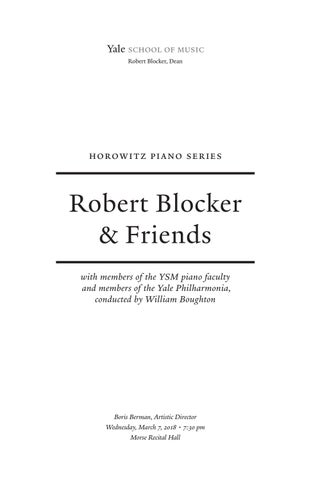
Robert Blocker, Dean
horowitz piano series
Robert Blocker & Friends with members of the YSM piano faculty and members of the Yale Philharmonia, conducted by William Boughton
Boris Berman, Artistic Director Wednesday, March 7, 2018 • 7:30 pm Morse Recital Hall
horowitz piano series
Robert Blocker & Friends March 7, 2018 • Morse Recital Hall
Wolfgang Amadeus Mozart 1756–1791
Overture to The Marriage of Figaro for piano six hands, K. 492 Wei-Yi Yang, piano Boris Berman, piano Robert Blocker, piano Piano Concerto No. 23 in A major, K. 488 I. Allegro II. Adagio III. Allegro assai Robert Blocker, piano William Boughton, conductor intermission
yale school of music
Mozart
Sonata in B-flat major for piano four hands, K. 358/186c I. Allegro II. Adagio III. Molto presto Robert Blocker, piano Melvin Chen, piano Concerto No. 10 in E-flat major for two pianos, K. 365/316a I. Allegro II. Andante III. Rondeau. Allegro Peter Frankl, piano Robert Blocker, piano William Boughton, conductor
As a courtesy to the performers and audience, silence electronic devices. Please do not leave the hall during selections. Photography or recording of any kind is prohibited.
artist profiles
Robert Blocker, piano
Boris Berman, piano
Robert Blocker, the Henry and Lucy Moses Dean of Music at Yale University, is internationally regarded as a pianist, a leader in arts advocacy, and an extraordinary contributor to music education. Dean Blocker is Professor of Piano and holds a joint appointment as an affiliate professor with the Yale School of Management.
Well known to audiences in more than fifty countries on six continents, Professor Berman regularly appears with leading orchestras, on major recital series, and in important festivals. He studied at the Moscow Tchaikovsky Conservatory with the distinguished pianist Lev Oborin.
Mr. Blocker concertizes throughout the world. Recent orchestral performances include the Beijing, Shanghai, Hartford, Monterey, Korean, and Daejeon Symphonies, as well as the Prague Chamber Orchestra. The Los Angeles Times called him a pianist of “…great skill and accomplishment, a measurable virtuoso bent and considerable musical sensitivity.” His many contributions to the music community have included service on the advisory boards for the Avery Fisher Artist Program, the Stoeger Prize at Lincoln Center, the Gilmore Artist Advisory Board, the Curatorial of the Liszt Ferenc Academy of Music in Budapest, and the Van Cliburn Foundation. A Steinway Artist, he appears regularly on national radio and television as an artist and commentator and is active as a consultant to several major educational institutions and government agencies. In 2000, Steinway and Sons featured him in a film commemorating the tercentennial year of the piano, and his recording of three Mozart concerti on the Naxos label garnered rave reviews. In 2004, Yale University Press published The Robert Shaw Reader, a collection of Shaw’s writings edited by Blocker and now in its third printing.
An active recording artist and a Grammy Award nominee, he was the first pianist to record the complete solo works of Prokofiev. Other acclaimed releases include all of Alexander Scriabin’s piano sonatas and a recital of Shostakovich’s piano works, for which he received the Edison Classic Award (the Dutch equivalent of the Grammy). He also recorded three Prokofiev concertos with the Royal Concertgebouw Orchestra with Neeme Järvi conducting, as well as works by Mozart, Beethoven, Weber, Schumann, Brahms, Franck, Debussy, Stravinsky, Janáček, Schnittke, Shostakovich, Joplin, and Cage. In 1984, Professor Berman joined the Yale School of Music faculty, where he is Professor in the Practice of Piano, coordinator of the piano department, and artistic director of the Horowitz Piano Series. He was the founding director of the Yale Summer Piano Institute and the International Summer Piano Institute in Hong Kong. He also gives master classes throughout the world and frequently serves as a juror at international competitions. In 2005, he was given the title of Honorary Professor of the Shanghai Conservatory of Music, and in 2013 was named a Honorary Professor of Royal Danish Conservatory in Copenhagen.
artist profiles
In 2000, Yale University Press published Professor Berman’s Notes from the Pianist’s Bench, which has been translated into several languages. In 2008, the same publisher released his book Prokofiev’s Piano Sonatas: A Guide for the Listener and the Performer. He is the editor of the new critical edition of Piano Sonatas by Prokofiev (Shanghai Music Publishing House). Recent performing and teaching engagements have taken Professor Berman to Austria, Canada, China, Denmark, Finland, France, Holland, Israel, Italy, Portugal, and Russia, in addition to the United States. William Boughton, conductor After cello studies in America, the United Kingdom, and Czechoslovakia, William Boughton entered the profession in London playing with the Royal Philharmonic, BBC, and London Sinfonietta Orchestras. This experience led to a passion to pursue a career in conducting, studying with George Hurst and Sir Colin Davis, after which he formed the English String Orchestra, focusing on 19th and 20th century English repertoire and commissioning over 20 works from composers such Peter Sculthorpe, John Joubert, Michael Berkeley, and Toru Takemitsu. The depth of this partnership with the ESO was epitomised in 1985 when he collaborated with Sir Michael Tippett to present a musical celebration of the composer’s eightieth birthday which was the subject of a BBC Omnibus documentary. Between 1986–93 he served as the Artistic & Music Director of the Jyvaskyla Sinfonia in Finland and guest conducted with numerous orchestras including the London
Symphony, Philharmonia, San Francisco, Royal Philharmonic, Finnish Radio, Mittel Deutsch Radio, working with artists such as Nigel Kennedy, Leonidas Kavakos, Emmanuel Ax, Radu Lupu, and Viktoria Mullova. In October 1993, William Boughton was awarded an Honorary Doctorate from Coventry University in recognition of his advocacy and expertise in British music. In July 2007 he became the 10th Music Director of the New Haven Symphony Orchestra (NHSO), with whom he instituted a ‘Composer in Residence’ Scheme (Augusta Read Thomas, Christopher Theofanidis, Hannah Lash) and initiated a major Walton Project with recordings on the Nimbus Label. With the NHSO he has received two ASCAP Awards for Adventurous Programming (2011 & 2014). In May 2016 he visited Central China University for Conducting master classes and conducted the Hubei Symphony. He regularly records for both Nimbus Records and Lyrita, and guest conducts around the world. He also teaches conducting at the Yale School of Music. Melvin Chen, piano A native of Tennessee, pianist Melvin Chen has received acclaim for performances throughout the United States and abroad. As a soloist and chamber musician, Mr. Chen has performed at major venues including Carnegie Hall, Alice Tully Hall, Merkin Concert Hall, the John F. Kennedy Center for the Performing Arts, and Boston’s Jordan Hall, in addition to other appearances throughout the United States, Canada, and Asia.
artist profiles
Mr. Chen’s performances have been featured on radio and television stations around the globe, including KBS television and radio in Korea, NHK television in Japan, and NPR in the United States. Solo recordings include Beethoven’s Diabelli Variations on the Bridge label, praised as “a classic” by the American Record Guide, and a recording of Joan Tower’s piano music on the Naxos label. Recordings of the Shostakovich piano sonatas and Gordon’s Orpheus and Euridice were released in 2007. An enthusiastic chamber musician, Mr. Chen has collaborated with such artists as Ida Kavafian, David Shifrin, Pamela Frank, Peter Wiley, and with the Shanghai, Tokyo, Miami, Penderecki, and Miró quartets. He has performed at the Bravo! Vail Valley Music Festival, Norfolk Chamber Music Festival, Bard Music Festival, and Music from Angel Fire, among others. Melvin Chen completed a Doctorate in chemistry at Harvard University, and also holds a double Master’s Degree from The Juilliard School in piano and violin. Previously, he attended Yale University, receiving a Bachelor of Science degree in chemistry and physics, and studied with Boris Berman, Paul Kantor, and Ida Kavafian. Mr. Chen was previously on the piano faculty of the Bard College Conservatory of Music, where he was also associate director. He is a member of the Yale School of Music piano faculty, Deputy Dean of the School, and Director of the Yale Summer School of Music/ Norfolk Chamber Music Festival.
Peter Frankl, piano Pianist Peter Frankl made his London debut in 1962 and his New York debut with the Cleveland Orchestra under George Szell in 1967. Since that time he has performed with many of the world’s finest orchestras, including the Berlin Philharmonic, Concertgebouw, Israel Philharmonic, Orchestre de Paris, all the London orchestras, and the major American orchestras. He has collaborated with such eminent conductors as Abbado, Boulez, Davis, Haitink, Maazel, Masur, Muti, Salonen, and Solti, and his world tours have taken him to Japan, Korea, Australia, New Zealand, and South Africa. He has appeared over twenty times at London’s BBC Promenade Concerts and has been a regular participant at the Edinburgh, Cheltenham, Aldeburgh, Verbier, Kumho, and Casals Festivals. In the United States, Peter Frankl has been a regular guest artist at festivals including Aspen, Chautauqua, Marlboro, Norfolk, Ravinia, Santa Fe, and Yellow Barn. For many years the Frankl-PaukKirshbaum Trio traveled the world. His many chamber music partners have included Kyung Wha Chung, Peter Csaba, Ralph Kirshbaum, and the Tokyo, Takács, Guarneri, Bartók, Fine Arts, and Lindsay quartets. He has given master classes all over the world, including the Royal Academy and Royal College in London, the Liszt Academy in Budapest, Van Cliburn Institute in Texas, and in Beijing, Hong Kong, and Seoul. Among his recordings are the complete works for piano by Schumann and Debussy, Bartók and Chopin solo
artist profiles
albums, a Hungarian anthology, concertos and four-hand works by Mozart, the two Brahms piano concertos, the Brahms violin and clarinet sonatas, the Brahms trios, Bartók pieces for violin and piano, and the piano quintets by Brahms, Schumann, Dvořák, Martinů, and both Dohnányis. In recognition of his artistic achievements, Mr. Frankl was awarded the Officer’s Cross by the Hungarian Republic, and on his 70th birthday he was given one of the highest civilian awards in Hungary for his lifetime artistic achievement in the world of music. He is an honorary professor of the Liszt Academy as well as Professor Emeritus of the Yale School of Music, where he served on the faculty from 1987 to 2017. Wei-Yi Yang, piano Pianist Wei-Yi Yang has received worldwide acclaim for his captivating performances and imaginative programming. Winner of the gold medal at the San Antonio International Piano Competition, he has performed at Lincoln Center for the Performing Arts, the John F. Kennedy Center for the Performing Arts, and across America, Asia, Europe and Australia. Most recently, he was praised by The New York Times for a “sensational” performance at Carnegie Hall of Messiaen’s TurangalîlaSymphonie in which he was the soloist. Born in Taiwan of Chinese and Japanese heritage, Mr. Yang studied first in the United Kingdom, and then in America with renowned Russian pianists Arkady Aronov at the Manhattan School of Music and Boris Berman at the Yale School of Music. Mr. Yang has also worked with
eminent pianists Claude Frank, Peter Frankl, Vera Gornostaeva, Byron Janis, and Murray Perahia. Mr. Yang’s performances have been featured on NPR, PBS, ARTE (Association Relative à la Télévision Européenne), and the ABC (Australian Broadcasting Company), and on recordings on the Genuin, Ovation, Albany Records, Renegade Classics, and Holland-America Music Society labels. A dynamic chamber musician with a diverse repertoire, Mr. Yang has collaborated with many esteemed ensembles including the Alexander, Brentano, Cassatt, Pacifica, and Tokyo String Quartets. Mr. Yang is a frequent guest artist at festivals across the United States, from Norfolk to Napa Valley and abroad, including Germany, Spain, Italy, Austria, Mexico, Serbia and Montenegro. A dedicated teacher, Mr. Yang has presented master classes and performances in Scotland, Ireland, Thailand, Hong Kong, Taiwan, China, and Korea. He has adjudicated at the Isidor Bajic Piano Memorial Competition, the San Antonio International Piano Competition, and the Concert Artists Guild auditions. In 2004, Mr. Yang received his Doctor of Musical Arts Degree from the Yale School of Music, where he joined the faculty in 2005 and serves as Associate Professor of Piano and chair of the Doctor of Musical Arts committee.
notes on the program
wolfgang amadeus mozart Overture to The Marriage of Figaro, for piano six hands, K. 492 Rightfully wide-eyed but inevitably futile attempts to pin down Mozart’s genius typically take the form of variations on the theme of “perfection.” The musical canon has readily acknowledged the genius of many master composers, but Mozart’s brilliance somehow stands apart from even the most celebrated voices. Mozart’s music glows with a transcendent otherworldliness that puts to shame attempts to capture it in words, but it is its paradoxical self-evidence — as inevitable and fundamentally part of this world as nature itself — that really makes it elude explanation. Mozart’s grace lies in his music’s effortless, unlikely cohabitation of opposites. It is at once scintillatingly fresh and deeply familiar, simple but not simplistic, and, in the words of Scott Burnham, “somehow both unerring and human… untouchable and touching.” Alluding to his impeccably conceived musical characters and their rich development over the course of his music, Paul Henry Lang anoints Mozart “the greatest musico-dramatic genius of all times.” Nowhere are these interactions between musical and dramatic revelation more explicit than in Mozart’s operas. The Marriage of Figaro, completed in 1786 during his prolific Vienna period, marked the beginning of Mozart’s working relationship with Italian librettist Lorenzo da Ponte. The comic opera weaves a web of illicit seduction, deception, and ridiculous contingencies, and the overture opens appropriately with scurrying, Presto eighth notes
evocative of chattering gossip flitting about Count Almaviva’s estate. The mercurial overture vacillates between hushed scampering and eruptive tutti outbursts until a delightfully long-breathed theme in A major emerges. Floating atop a bed of constant eighth notes, this refreshingly tuneful melody seems to momentarily suspend time, only to evaporate just as quickly as it came, in true paradoxical Mozartean fashion. Virtuosity, with its inherent self-indulgence and exertion, has no place in the poised elegance of Mozart, but this unrelenting overture is a veritable tour-de-force for orchestras and pianists — here, in Czerny’s six-hand arrangement — alike. Piano Concerto No. 23 in A major, K. 488 Trading oboes for clarinets and dispensing with the popular trumpet and timpani fixtures of contemporary orchestras, Mozart designed a darker, mellower orchestration that reflects this concerto’s inward, lyrical quality. Indeed, the 23rd piano concerto is generous and personal, and seems to sing to itself rather than declaiming from a stage as in Mozart’s hallmark operatic style found in so many of the other concerti. Piano passagework is florid in the Allegro first movement, more cascading and graceful — though no less demanding — than the fiery acrobatics of the other late concerti. The orchestra’s role in the dialogue is involved but never grandiose, and the soloistic wind writing throughout the piece lends an intimacy closer to chamber music than the typical concerto style. Deceptive resolutions, aptly termed
notes on the program
for their jarring intrusion of the minor mode when we expect the home key, and a favorite device of Mozart’s for phrase extension, are an important feature of the harmonic fabric here. But in this setting, they lack the impish irony they add to Mozart’s lighter movements as well as the gravitas of his more breathtaking sequences; rather, these gentle subversions of expectations may prompt the listener to lean forward, drawing the listener closer to this introspective work. The sparing, poignant Adagio feels especially poetic, made more so by the fact that it is Mozart’s only work in F-sharp minor, and the last minor key slow movement he would write for an instrumental piece. The spirited rondo finale recovers some of the Mozartean zippiness that laid dormant for the first two movements, but is decidedly tempered by the distinctive reservedness of the concerto as a whole. Sonata in B-flat major for piano four hands, K. 358/186c As a child, Mozart idolized his older sister Maria Anna, nicknamed Nannerl, and reportedly was inspired to study music himself after observing her lessons with their father. While their relationship may have deteriorated in adulthood, the siblings were very close as children, and Mozart sent Nannerl copies of many of his piano concertos and composed several pieces specifically for her to perform. Among these works are sonatas for fourhand piano, a genre that the Mozart siblings popularized through their performing tours across Europe with their
father. Wolfgang and Nannerl may also have initiated the tradition of the woman playing the melodic primo part while the man fielded the lower, supporting bass voices, and the two siblings always performed this way themselves. A seventeen- or eighteen-year-old Mozart wrote the B-flat major four-hand sonata around 1773 in Salzburg to perform with Nannerl in Paris or Vienna. The abundance of digits allows for a rich — at times, orchestral — voicing, which Mozart balances with a particularly transparent melody-accompaniment texture. The first movement is a light, conversational Allegro that occasionally slips into the “learned style” of yesteryear with its fugal elements of brief imitative counterpoint. The understated elegance of the second movement Adagio evokes an untroubled aria, and is distinguished by slow harmonic motion propelled by a motoric current of sixteenth notes. The bright and brilliant Molto presto finale brings the sonata to a rollicking close fit for a playful pair of pianistically-agile siblings. Concerto No. 10 in E-flat major for two pianos, K. 365/316a Mozart completed his concerto for two pianos in Salzburg, likely sometime between 1779 and 1780. The joyous work makes its entrée with a proud, dignified opening fit for royalty before the two pianos burst onto the scene with a unison trill. They each graciously take a turn at the theme, once in the first piano — here somehow a more graceful, delicate reading, lacking the pomp and circumstance of the orchestra’s delivery — and again an
notes on the program
octave lower in the second piano. The patience and yielding of the pianos sets up a power dynamic between the soloists that will prevail for the rest of the work. The democratic nature of overlapping imitation has no place here; instead, the two pianos echo, reiterate, even accompany each other, but never vie for the spotlight. This first movement is uniquely rich in themes for Mozart’s concertos; what’s more, they are all purveyed by the pianos. Mozart’s orchestra here is purely punctuational, hardly getting a chance to participate in the action itself, but rather serving as bookends to the meatier solo sections. The ample Andante shares the first movement’s abundance of themes, as well as a kindred spirit of the same sunny joy heard thus far, this time cast in more meditative tones. The finale is an energetic and turbulent rondo, where the orchestra finally plays more of a significant role while the pianos work out the various subjects. While the impetus for this concerto is unknown, the considerable virtuosity of the solo parts suggests Mozart intended to perform it with his sister. Cuthbert Morton Girdlestone hopefully muses that “the agreement between the pianos is so perfect, their collaboration so single-hearted, that one would like to think it was so.” — Graeme Steele Johnson
Members of the Yale Philharmonia Violin I Kate Arndt, Rachel Ostler, Ariel Horowitz, Gregory Lewis, Martin Peh Violin II Ethan Hoppe, Laura Park, Clement Luu, Marianne Di Tomaso, Elliot Lee Viola Josip Kvetek, Florrie Marshall, Thomas Duboski Cello Eric Adamshick, Valentina Crnjak Bass Amy Nickler Flute Maria Luisk Oboe Lauren Williams, Elliot Lichtenberg Clarinet Giovanni Bertoni, Michael Moy Bassoon Kristy Tucker, Dillon Meacham Horn Steven Harmon, Steven Newberry
Horowitz Piano Series 2017–2018 Patrons Becoming a Yale School of Music patron is a wonderful way to support our performance programs. We offer benefits to our patrons that range from preferred seating to invitations for the School’s Academic Convocation. To find out more about becoming a Yale School of Music Patron, visit music.yale.edu/giving You can also add a contribution to your ticket purchase to any concert at the Yale School of Music.
charles ives circle $600 and above Victoria Keator DePalma paul hindemith circle $250 to $599 Mr. & Mrs. Douglas J. Crowley Patty & Tom Pollard Lorraine D. Siggins horatio parker circle $125 to $249 Barbara & David Reif David & Cristin Rich Nathan M. Silverstein
samuel simons sanford circle $50 to $124 Arthur & Carole Broadus Judith Colton & Wayne Meeks Sue & Gus Davis Jay & Marjorie Hirshfield William E. Metcalf Carolyn Rothfeld gustave jacob stoeckel circle $25 to $49 Paul Guida & Pat LaCamera Dr. Henry Park & Dr. Patricia Peter Melissa Perez Sophie Z. Powell Peter & Wendy Wells As of February 28, 2018
Upcoming Events An Evening with Peter Schickele march 27 Oneppo Chamber Music Series Peter Schickele, the famed composer, performer, and raconteur whose alter ego, P.D.Q. Bach, has entertained and enriched audiences for more than 50 years, shares stories of his uniquely compelling and multifaceted career, no doubt with inimitable humor. Don’t miss “An Evening with Peter Schickele,” a celebration of an extraordinary life in music. Morse Recital Hall | Tuesday | 7:30 pm Tickets from $10 • Students from $5 Free for Oneppo Chamber Music Series subscribers Students of Boris Berman april 4 Horowitz Piano Series Alumni who studied with faculty pianist and Horowitz Piano Series Artistic Director Boris Berman return from international successes to perform at the School of Music. Morse Recital Hall | Wednesday | 7:30 pm Tickets start at $13 • Students $7 Free for Horowitz Piano Series subscribers
Peter Oundjian, principal conductor april 6 Yale Philharmonia Principal conductor Peter Oundjian leads the Yale Philharmonia in a performance of Mahler’s astonishing Symphony No. 9 in D major. Woolsey Hall | Friday | 7:30 pm Tickets start at $10 • Yale Faculty/Staff $8 Students $5 $3 surcharge for purchases at the door Brentano String Quartet april 10 Oneppo Chamber Music Series The Brentano String Quartet, YSM’s ensemblein-residence, performs Mozart’s captivating “Dissonance” Quartet and works by Beethoven and Shostakovich. Morse Recital Hall | Tuesday | 7:30 pm Tickets start at $26 • Students $13
concert programs & box office Krista Johnson, Kate Gonzales, Michael Zuber-Zander communications Mackenzie Dilbeck, Katie Kelley, David Brensilver operations Tara Deming, Chris Melillo piano curators Barbara Renner, Robert Crowson, Brian Daley, William Harold media production Matthew LeFevre, Travis Wurges
wshu 91.1 fm is the media sponsor of the Horowitz Piano Series at the Yale School of Music connect with us
facebook.com/yalemusic
P.O. Box 208246, New Haven, CT · 203 432-4158
@yalemusic on Twitter music.yale.edu
If you do not intend to save your program, please recycle it in the baskets at the exit doors. Robert Blocker, Dean