Yale Collection of Musical Instruments presents
PARIS 1689 R e vo lu t i o n a Ry f o R t h e S u n K i n g Paolo Pandolfo, viola de gamba and artistic director AmĂŠlie Chemin, viola de gamba Markus HĂźnniger, harpsichord Thomas Boysen, theorbo/baroque guitar
15 Hillhouse Avenue New Haven 4 March 2018 3:00 p.m.
UPComing PerformanCes in the 2017-2018 series April 22
- SmithSonian ChambeR PlayeRS muSiC of fRanz SChubeRt Quartet in g minor, D173 Octet in F Major, D803 Vera Beths and Cynthia Roberts, violin Steven Dann, viola Kenneth Slowik, violoncello Anthony Manzo, double bass Charles Neidich, clarinet Andrew Schwartz, bassoon William Purvis, natural horn
Celebrating the fiftieth anniversary of oUr ConCert series 1967-2017
Tickets may be ordered by telephone at the Yale School of Music box office at (203)432-4158 or over the Internet at: www.yale.edu/music Tickets
$28.00 each, reserved seating $125.00, series of five concerts $25.00 each, senior citizens & Yale staff $15.00 each, students
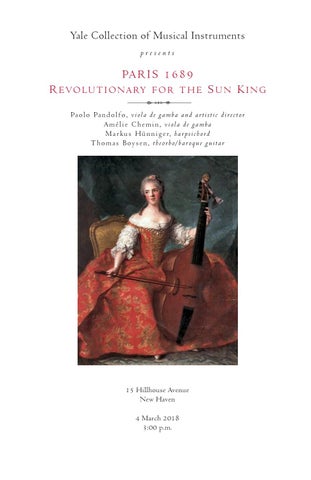
Cover Painting
Jean-Marc Nattier: “Madame Henriette playing the Viola da Gamba� Oil on canvas, 1754. The Palace of Versailles
This concert is being recorded and streamed live over the internet. Please turn off all cellphones and electronic devices.
Yale Collection of Musical Instruments 4 March 2018 3:00 pm
15 Hillhouse Avenue New Haven
P a r i s 1689
r e vo lU t i o n a ry f o r t h e s U n K i n g Marin Marais (1656-1728)
Suite en Re mineur à deux Violes from pièces à une et deux Violes, Book 1 Paris 1686-9 Prélude Allemande Courante Sarabande Gigue
François Couperin (1668-1733)
Les Idées Heureuses - Les Papillons from Pièces de Clavecin Book 2, Paris 1716
Marin Marais
Sujet diversité donné par un étranger Pièces à une et deux Violes, Book 1, Paris 1689 INTERVAL
Robert De Visée (ca.1655-ca.1732)
Manuscript Vaudry de Saizenay MS 279152 Prélude Chaconne
Marin Marais
Tombeau de Mr. de Méliton from Pièces à une et deux Violes, Book 1, Paris 1689 Suite en Sol majeur à deux violes from Pièces à une et deux Violes, Book 1, Paris 1686-9 Prèlude Allemande Courante Sarabande Gigue Chaconne Harpsichord by François Etienne Blanchet, Paris, ca. 1740
Program Notes Paris 1689: Revolutionary for the Sun King
A century before the French Revolution, Marin Marais used his musical talent to bypass the stringent societal barriers of the time becoming a famous member of the artistic circle of French aristocrats. The humble son of a shoemaker, Marais’ renowned skills on the french viol were noticed early on and at only 23 years old, he earned an appointment as a Courtier in the King’s court in 1679 with the title of Ordinaire de la Chambre. A few years later, a modest family of province musicians would provide two of the greatest names of the French music firmament: Louis and François Couperin. As Marais’ compositional publications rose to stardom one after the other, François Couperin was becoming a star of the keyboard, and published his first composition in 1690. At the same time, Robert De Visée had already published two music books dedicated to his favorite student…the King of France. This “Fin de Siècle” established French Baroquemusical excellence in Europe, but would also sow the seeds of its inevitable turn over during the French Revolution when it became loathed as the music of aristocrats. Marin Marais Suite en Re mineur à deux Violes (from Pièces à une et deux Violes, Book 1 Paris 1686-9) The Suite for Two Viols is a stunning piece which develops, via the compositional nature, a beautiful bond between the two solo gamba players. The opening of the Prélude can be compared to a sacred four-part motet. It is worth remembering that Marais had, while an enfant de chœur at Saint-Germain-l’Auxerrois, come into contact with Delalande, the leading composer of sacred music for Louis XIV. With the initial solemn theme, Marais appears to be summoning the two viols to prayer, an effect of sacred polyphony which is as surprising as it is convincing. It is not until the second movement that the composer introduces an element of purely instrumental playing; which transports the listener magically from the Chapelle Royale to Versailles’ Galerie des Glaces. The following movements return faithfully to the structure of the French Dance Suite. While it is uncertain if this piece would have been danced to, much of it follows the rhythmic frames and formal court step sequences practiced by all noblemen of the time: the grand and dignified Allemande, the Courante with its intense and sophisticated rhythmic impetus, the outstanding Sarabande (tendre), the especially lively Gigue, followed by the Gavotte and Menuet, where grace and elegance alternate in a delicious manner. François Couperin Les Idées Heureuses (Pleasant Ideas)- Les Papillons (Butterflies) (from Pièces de Clavecin Book 2, Paris 1716) François Couperin’s pieces for harpsichord are among the great classics, and remain essential repertoire for the instrument. Couperin published his book series between 1713 and 1730, in four volumes organized by tonality, in 27 orders. The titles of these pieces often evoke a mood or an atmosphere a little like 18th century
French Character Pieces “Pièces de Caractere”. No tempo is specified, thus allowing the performer to navigate through different speeds and pacing to express the indicated character based on their own interpretation. Marin Marais Sujet diversité donné par un étranger (from Pièces à une et deux Violes, Book 1, Paris 1689) This piece-- rarely played despite its outstanding quality-- appears as a “supplement” at the end of the basso continuo book of 1689. In his introduction, Marais writes, “The Subject of the Basse, above which twenty [musical] couplets have been written, was provided to me by a Foreigner in order to create all these variations, and which has provided me much pleasure to work on, given that this subject seems to me to be very strong indeed.” These are variations on a melody composed in the fashionable mid-century English style, and it is interesting to note that Thomas Baltzar (c1630-1663) employed exactly the same subject as the basis for a piece which appeared in an English collection published in 1685. Here Marais reveals a perfect mastery of the “English” art of the divisions upon a ground and even composes couplets to further propel the piece. Robert De Visée Manuscript Vaudry de Saizenay MS 279152 Robert De Visée was one of the most renowned musicians in the court of King Louis XIV. His mastery of the plucked instruments appear to have been beyond all other performers, as well as his compositional skills. Thanks to the simple fact that a lute or a guitar could be easily transported and also played while walking, De Visée provided a musical background to some of the most intimate moments of the King’s life, from private apartments to his promenades in the gardens of Versailles. An especially lyrical instrumental sound characterizes all his music. Marin Marais Tombeau de Mr. de Méliton from Pièces à une et deux Violes, Book 1, Paris 1689 The “Tombeau” was a typical form of musical epitaph in the 17th and 18th Century. Little is known about the person for whom it was written, Mr. de Méliton. All that is known is that he was an enthusiastic musical aristocrat, a pupil of the same teacher as Marais, and most likely an excellent musician and viol player (“...Monsieur Méliton, who had even been taught by Monsieur de Sainte-Colombe, and who understood perfectly the viols character...” Jean Rousseau, Traité de la Viole, Paris 1687). This musical tribute seems both reflective and progressive in its classic technical elements and complicated emotional direction. Suite en Sol majeur à deux violes from Pièces à une et deux Violes, Book 1, Paris 1686-9 This Suite offers one of the most perfect expressions of the concert de chambre. Throughout there is a compelling dialogue between the two solo viols including alternating phrases, interplay within the melodic framework, and a dancing passage which features each viol. The deft use of all these exciting styles reflects Marais’ striking compositional maturity and the immediate success of this work amongst Parisian violists of the time is not at all surprising. In the concluding Chaconne, the viols, accompanied by the basso continuo produce colors and sounds worthy of an entire orchestra!
About the Performers Paolo Pandolfo began his research of Renaissance and Baroque musical idioms around 1979. He studied at the Schola Cantorum Basiliensis in Switzerland under Jordi Savall, whose ensemble he joined from 1982 to 1990. In 1990, after the success of his first solo recording (C.P.E.Bach’s Sonatas for Viola da Gamba), he became Professor of viola da gamba at his alma mater, the Schola Cantorum Basiliensis in Basel. Since this appointment, he has concentrated his teaching activities in Basel, whilst performing all over the world. Mr. Pandolfo has recorded for radio and television stations world wide, and for record companies such as Astree, Emi, Philips, Erato, Harmonia Mundi, Tactus, Simphonia and Glossa. Paolo’s transcription of J.S.Bach’s six Solo Suites, released in 2000, has been a great success. All his recordings have received highly positive reviews as well as many awards from the most important musical magazines (Gramophone, Le Monde de La Musique, Goldberg Scherzo, Diapason, etc.). Mr. Pandolfo builds bridges between the past and the present, bringing spontaneous and immediate life in the perfomance of baroque and renaissance music using medias such as improvisation, transcriptions and composition of modern pieces, being conviced that the patrimony of ancient music can be a powerful inspiration for the future of the western musical tradition. Amélie Chemin completed her cello and chamber music studies with distinction
at Caen and Lyon. A deep fascination for the viola da gamba and early music led her to courses with Jérôme Hantaï, Emmanuelle Guigues, Marianne Muller, Jordi Savall, Philippe Pierlot and Vittorio Ghielmi. In 2003 she moved to Basel, where she studied at the Schola Cantorum on viola da gamba, baroque cello and fiddle with Paolo Pandolfo, Petr Skalka and Randall Cook. In 2008 she completed her studies with the diploma in viola da gamba. Ms. Chemin performs regularly on various viole da gamba (from treble to bass, Renaissance and Baroque) as well as on the baroque cello. Since 2003 she has taken part in several projects with W. Christie, T. Koopmann, J. Savall, A. Marcon, P. Pandolfo, J. Rifkin, J. Christensen, B. Dickey, A. Rooley, V. Genaux and HM Linde. In early 2008 she began researching and exploring the instrument Arpeggione, on which she played the famous Schubert Sonata “Arpeggione” at the Gruyères Festival of Early Music in 2008. She is a member of the La Cetra Baroque Orchestra Basel and co-founder of the bass ensemble “Il Profondo”. She has performed concerts in France, Spain, Germany, England, Italy, Switzerland, the Ukraine and Turkey. Since September 2009, she has taught viola da gamba and baroque cello at the Conservatory of Rennes (France).
Thomas C. Boysen was born in Norway to a family of musicians. He studied classical guitar and lute at the Norwegian State Academy of Music and received his diploma there in 1995. He then went to Germany to study with Prof. Rolf Lislevand at the State Academy of Music in Trossingen. Since finishing his studies Boysen has established himself as an accomplished soloist and continuo player, having worked with the Balthasa Neumann Ensemble, Collegium Vocale of Gent, Armonico Tributo Austria, Le Poème Harmonique, Akademie für Alte Musik of Berlin, Freiburg Baroque Orchestra, Emma Kirkby, Rolf Lislevand and Paolo Pandolfo. He has played concerts in most European countries, USA, Hong-Kong, Mexico, South Korea, Colombia and Cuba and participated on more than 60 CD recordings on labels like Glossa, Naive, Sony, Harmonica Mundi and K617. Mr. Boysen teaches summer courses and master classes in Germany, Romania, Austria, Switzerland, Mexico, USA and Norway and teaches lute and basso continuo at the State Academy of Music in Würzburg, Germany. Markus Hünninger, from Germany, teaches harpsichord, clavichord and the
art of continuo playing at the Schola Cantorum Baseliensis. He holds a degree in Historical Keyboard Instruments from the Schola Cantorum Basel (1984) as well as a diploma in harpsichord performance from the Musikhochschule, Zürich (1986), where he was a student of Johann Sonnleitner. In addition to teaching, Mr. Hünniger pursues an active career as a soloist and ensemble player, having a number of radio and CD recordings to his credit . Among the groups with which he collaborates are the violin ensemble “Concerto di Viole” and the “Soloists de l’Ensemble baroque de Limoges” under Christophe Coin.
This concert is made possible by the generous support of the Associate Members of the Collection.