the philharmonia orchestra of yale peter oundjian
Principal Conductor
February 24, 2017 • Friday at 7:30 pm Morse Recital Hall
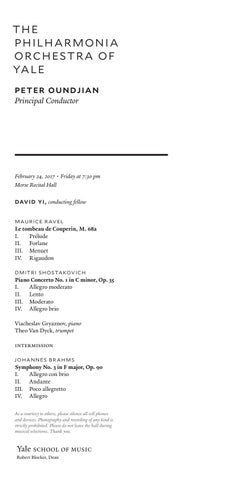
david yi, conducting fellow maurice r avel Le tombeau de Couperin, M. 68a I. PrĂŠlude II. Forlane III. Menuet IV. Rigaudon dmitri shostakovich Piano Concerto No. 1 in C minor, Op. 35 I. Allegro moderato II. Lento III. Moderato IV. Allegro brio Viacheslav Gryaznov, piano Theo Van Dyck, trumpet intermission johannes br ahms Symphony No. 3 in F major, Op. 90 I. Allegro con brio II. Andante III. Poco allegretto IV. Allegro As a courtesy to others, please silence all cell phones and devices. Photography and recording of any kind is strictly prohibited. Please do not leave the hall during musical selections. Thank you.
Robert Blocker, Dean
p rog ra ram notes P m N otes
Maurice Ravel » 1875–1937 Le tombeau de Couperin, M. 68a
Dmitri Shostakovich » 1906–1975 Piano Concerto No. 1 in C minor, Op. 35
World War I was, unsurprisingly, a difficult period for Ravel. Le tombeau de Couperin began as an homage to the sensibilities and refinement of the French Baroque in the form of a solo piano suite in 1914, a year before Ravel enlisted as a truck driver for the French Army. The job was taxing and stressful; the additional emotional burden of his mother’s death in 1917 contributed to his discharge a few months later. While recuperating at his grandmother’s country house, he returned to Le tombeau with a new perspective.
While studying composition and piano performance in St. Petersburg, Shostakovich paid his bills by providing piano accompaniment for silent films. Soon recognized at the venerable Chopin Competition in Warsaw at age 21, Shostakovich was establishing himself as a formidable composer-virtuoso. His First Piano Concerto, which he wrote and premiered as the soloist in 1933, acted as a showcase for his dual abilities and addressed a shortage, saying, “This was my first attempt at filling an important gap in Soviet instrumental music, which lacks full-scale concerto-type works.”
Composers responded to the wars of the twentieth century with somber tributes and colossal memorials most often in large symphonic fashion. Although Ravel dedicated each movement of Le tombeau to a friend lost in combat, the piece reads as a celebration, not a eulogy. Rather than a cathartic manifesto of his time in the war, Le tombeau served as a refuge of clarity and balance in a time of destruction and nihilism. In 1919, after the premiere of Le tombeau, Ravel decided to orchestrate the work. French composer and critic Roland-Manuel wrote, “This metamorphosis of piano pieces into symphonic works was a game for Ravel, a game played to perfection, so that the transcription outdid the charm of the original.” Ravel chose four of the six movements for his final orchestration, a task he executed with dazzling color and yet with remarkable economy. The Prelude starts with a brilliant and relentless coil in the oboe. Beginning with a sardonic, somewhat cubist melody in the violins, the Forlane takes inspiration from a Venetian dance, popular among gondoliers, before the piece takes listeners across the Alps into France. The Menuet captures the essence of the graceful French dance with kaleidoscopic orchestral colors. And the bustling Rigaudon, a dance that originated in Provence, concludes the suite in celebratory fashion.
Amid the turmoil brought about by his precarious relationship with Soviet censors, Shostakovich began to consider abandoning composition in favor of performance. The wildly successful premiere of his First Piano Concerto with the Leningrad Philharmonic Orchestra reaffirmed his reputation and political standing in both fields. The exceptionally light orchestration — piano, trumpet, and strings — balances the piano with its accompaniment brilliantly: the trumpet offers contrast and commentary to the solo piano line and works to infuse the work with popular styles. Although the light orchestration evokes Mozart, the concerto features bursts of lush Russian romantic solo spells performed by the soloist. The Allegro Moderato is capricious and athletic. A gloomy waltz with muted strings opens the Lento. Here, the piano takes up the waltz, now more tender and romantic, but soon races ahead in a violent appassionato. The waltz, somehow even sweeter, returns to close the movement with lyrical writing for the trumpet. A brief Moderato for piano alone bridges the Lento to the fiery finale. The strings chime in with a variation of the first movement’s opening theme and suddenly momentum propels the piece feverishly into the finale — Allegro brio. The finale sparkles sardonically with a potpourri of styles and evocations — American jazz, a trumpet melody from Haydn, and wildly fickle tempi.
Johannes Brahms » 1833–1897 Symphony No. 3 in F major, Op. 90 Haydn, Mozart, Beethoven, Mendelssohn, and Schumann wrote symphonies at young ages before developing their international reputations. Brahms was 42 at the premiere of his First Symphony, a work that took him nearly two decades to complete. Unlike his predecessors, Brahms’ reputation was firmly cemented before he embarked on writing his First Symphony: Robert Schumann proclaimed the young Brahms to be a musical Messiah, the “chosen one” who would carry the ideals of music set forth by Beethoven into a new age. Harshly self-critical, Brahms discarded many symphonic drafts before finally publishing what he believed to be worthy of comparison to Beethoven. By the time Brahms started work on his Third Symphony, he had overcome the trepidation he had toward the genre. His Second Symphony as well as his overtures and Violin Concerto attest to his finesse in the area of orchestral writing. He completed the Third Symphony in less than four months while renting a studio overlooking the Rhine in Wiesbaden. The first movement, marked Allegro con brio, begins with a giant inhalation before the violins introduce the melody over a colossal 6/4 meter. The second theme is in an even more luxurious 9/4. Both impart a sense of boundlessness and impeccable poise. While the opening melody is loud and boisterous, it is equally graceful and limber as the second theme. The inner movements rarely venture out of the realm of pianissimo. The second movement, marked Andante, is a dialogue between the strings and winds, at times folksy and at others hymnodic. The third movement, marked Poco allegretto, is a melancholy waltz. The immensely lyrical and profound melody of this movement lends itself to musical “borrowing.” The theme has been adapted in countless movies and pop songs of the 20th century (e.g. Frank Sinatra’s “Take My Love,” and Santana’s “Love of My Life”). The poise of the earlier movements is contrasted by the anxiety of the opening of the final movement, marked Allegro. Unison strings and bassoons introduce a menacing, obsessive motive in F minor. A heroic C major theme
eventually prevails, appropriately in the cello and horns. In the end, F major triumphs, although its victory is diluted by a pianissimo conclusion. – Julia Clancy
a rtt i st st Profi p rofiles Ar le
David Yi, conducting fellow David Yi is currently the conducting fellow at the Yale School of Music and assists Peter Oundjian, the principal conductor of the Yale Philharmonia. David has conducted the Philharmonie Baden-Baden, Jenaer Philharmonie, Filharmonie Hradec Králové, Filharmonie Teplice, Karlovarsky Symphony Orchestra, New England Conservatory Symphony Orchestra, and Gyeonggi Philharmonic Orchestra.
TV on a regular basis. In Russia, his recordings are often played on Orpheus Radio. Gryaznov’s repertoire is extensive and diverse and is growing to include masterpieces of operatic, symphonic, and chamber music in the form of the his own arrangements. At the moment, Gryaznov is one of the few prominent Russian composers who are published by Schott Music (the other world-renowned artists include Nikolai Kapustin and Rodion Shchedrin). Theo Van Dyck, trumpet
In 2016, he was one of fourteen candidates invited to the Gustav Mahler Conducting Competition held in Bamberg, Germany. He has participated in master classes with conductors Riccardo Muti and Myung-Whun Chung. David Yi studied conducting at the Hochschule für Musik Franz Liszt Weimar, Germany, and the New England Conservatory. His teachers include Nicolás Pasquet, Markus Frank, and Hugh Wolff. Viacheslav Gryaznov, piano Born in Yuzhno-Sakhalinsk, Russia, in 1982, Viacheslav Gryaznov graduated with honors from the Central Music School of the Moscow State Conservatory where he studied with Manana Kandelaki. He completed his undergraduate studies with honors at the Moscow Conservatory under the tutelage of Yuri Slesarev. In the 2008–2009 season, Gryaznov became a soloist with the Moscow Philharmonic Society. Gryaznov’s 2016-2017 performances include appearances with the Berlin Philharmonic and at Carnegie Hall as the winner of the 2016 New York Concert Artists Worldwide Debut Audition. Other appearances this season include the Bay Area Steinway Society of San Jose, California; four performances with the Atlantic Classical Orchestra in a multicity tour of Florida; multiple engagements as the Drozdoff Society’s artist-in-residence; and engagements in Russia, Lithuania, the Netherlands, Austria, and France. He will also record a CD for the Steinway & Sons label. Gryaznov has performed in many countries. His NHK video recordings are shown on Japanese
Theo Van Dyck is originally from the town of Wells, England, where his father sang in the cathedral choir. He moved to Maine at the age of seven and began playing the trumpet at age ten. At fourteen he enrolled at the Interlochen Arts Academy high school, pursuing classical and jazz trumpet studies. Theo recently received his bachelor of music degree from the Juilliard School and currently studies with Allan Dean at the Yale School of Music. Theo is passionate about new music, working with other composers, and writing music himself.
A bo u t Ya l e Philharmo nia
The Philharmonia Orchestra of Yale is one of America’s foremost music-school ensembles. The largest performing group at the Yale School of Music, the Philharmonia offers superb training in orchestral playing and repertoire. Performances include an annual series of concerts in Woolsey Hall, as well as Yale Opera productions in the Schubert Theater. The Yale Philharmonia has also performed on numerous occasions in Carnegie Hall and Alice Tully Hall in New York City and at the John F. Kennedy Center for the Performing Arts in Washington, D.C. The orchestra undertook its first tour of Asia in 2008, with acclaimed performances in the Seoul Arts Center, the Forbidden City Concert Hall and National Center for the Performing Arts (Beijing), and the Shanghai Grand Theatre.
peter oundjian Principal Conductor philharmonia staff
jeffrey m. mistri Manager samuel bobinski Assistant Manager david yi Assistant Conductor
the philharmonia orchestra of yale violin i Sirena Huang, concertmaster TzuTi Chang Dae Hee Ahn Linda Lee Gaga Won Ji Soo Lee Renyu Martin Peh Chang Hoon Bae Laura Park Cheuk Yin Clement Luu violin ii Diomedes B. Saraza Jr. David Loke Kai Yuan Yuqi Li Ruda Lee Jung Eun Kang Suyoun Han Mevlan Mecid viola Wei Peng Danielle Wiebe Burke Thomas A. Duboski Florrie Marshall Josip Kvetek Joshua Newburger
cello James Rosamillia Pall Quinn Kalmansson Bitnalee Pong Jenny Kwak Mingyao Zhao
bassoon Hanul Park 1 Patrick Broder 2 Dillon Meacham
bass Erez Meyuhass Luke David Stence Joshua Jay DePoint
horn Luke Baker Matthew Gray Cody Halquist 2 Valerie Sly 1 Joshua Thomspon
flute Hye Jin Park 1 Meera Gudipati 2
trumpet Ashley Hale 1 Jonathan Shadle 2
oboe Timothy Feil 1 Lauren Williams 2 Lydia Consilvio
trombone Alexander Walden 2 Grant Futch
english horn Michelle Nguyen 1 clarinet Giovanni Bertoni 1 Jesse McCandless 2
bass trombone Zachary Haas timpani YoungKyoung Lee 2 harp Margaret Davis 1 2
Principal on Ravel Principal on Brahms
administrative assistant Valerie Sly music librarians Mariya-Andoniya Andonova Emily Brandenburg Sophie Cash-Goldwasser Antonia Chandler Allan Hon Bora Kim Laura Park Lauren Williams stage crew Lydia Consilvio Margaret Davis Thomas Duboski Reese Farnell Christopher Garwood Ashley Hale Nozomi Imamura Pall Quinn Kalmansson Matthew Keown YoungKyoung Lee Cheuk Yin Clement Luu Hillary Simms Andrew Stadler Sam Um Georgi Videnov
U p co m ming Eventt s Upc i n g Even FEB 28
MAR 1
AN UNLIKELY MUSE Oneppo Chamber Music Series An Unlikely Muse explores the inspiration that clarinetist Richard Mühlfeld provided Brahms during the composer’s later years. Troy Hollar, director; Jack Gilpin, narrator; David Shifrin, clarinet; Ani Kavafian & Julie Eskar, violin; Ettore Causa, viola; Ole Akahoshi; cello; and Melvin Chen, piano Morse Recital Hall | Tuesday | 7:30 pm Tickets start at $26 • Students $13 LUNCHTIME CHAMBER MUSIC School of Music students perform a midday chamber music concert. Wendy Sharp, director Morse Recital Hall | Wednesday | 12:30 pm Free Admission
box office
203 432-4158 concert programs & box office
Krista Johnson Kate Gonzales communications
Donna Yoo Katie Dune David Brensilver operations
Tara Deming Christopher Melillo
MAR 1
VIACHESLAV GRYAZNOV, piano Artist Diploma Recital Music by Beethoven, Debussy, Ravel, Prokofiev, and Rachmaninoff Morse Recital Hall | Wednesday | 7:30 pm Free Admission
piano curators
MAR 2
VISTA CHAMBER MUSIC Student ensembles, under the direction of faculty violinist Wendy Sharp, perform and provide insight into the repertoire Morse Recital Hall | Thursday | 7:30 pm Free Admission
media production
Barbara Renner Robert Crowson Brian Daley William Harold Matthew LeFevre Travis Wurges music.yale.edu
thank you for your support! Become a Yale School of Music patron and support our performance programs. Earn benefits ranging from preferred seating to invitations to special events. To learn more, visit us online or call 203 432-4158. charles ives circle $600 and above Serena & Robert Blocker John Marsden Hunt Mr. Robert Bin Yang paul hindemith circle $250 to $599 Prof. Michael Bracken & Mrs. Maryann Bracken Richard H. Dumas Edwin M. & Karen C. Duval Richard & Eveyln Gard Francesco Iachello Patty & Tom Pollard Mary-Jo Worthey Warren Ransom Wilson & Walter Foery horatio parker circle $125 to $249 Joyce Alton Roger & Linda Astmann Craig Baker Derek & Jennifer Briggs Leo Cristofar & Bernadette DiGiulian
Elizabeth M. Dock Paul Gacek Dolores M. Gall Carolyn Gould Judy Long Mark Ludwig Ann Marlowe Stephen Marsh Susan Matheson & Jerome Pollitt Arthur T. Rosenfield, MD Suzanne Solensky & Jay Rozgonyi Monika & Fred Volker
Thomas & Judith Foley Saul & Sonya Goldberg Lawrence Handler Dr. Alan Katz James Mansfield Joel Marks Betty Mettler Fred & Helen Robinson Leonard J. Rutkosky Peter & Dana Uhrynowski Carl Wies & Margot Hardenbergh Werner & Elizabeth Wolf Donna Yoo
samuel simons sanford circle $50 to $124 Anonymous Helen & Blake Bidwell Henry & Joan Binder Barbara Blake Harold & Maureen Bornstein Mindy & Stan Brownstein Bruce H. Dana Bill & Barbara Dickerson John Doyle
gustave j. stoeckel circle $25 to $49 Dr. Gary & Hedda Kopf Linda & Ozzie Levene Mr. Charles J. Levine Zeyu Shen Mr. James N. Trimble
List as of February 22, 2017