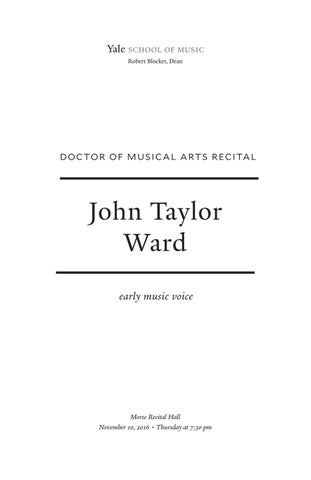
Robert Blocker, Dean
doctor of musical arts recital
John Taylor Ward early music voice
Morse Recital Hall November 10, 2016 • Thursday at 7:30 pm
Yale School of Music
John Taylor Ward
early music voice
November 10, 2016 • Morse Recital Hall with musicians from cantata profana
Claudio Monteverdi 1567–1643 arr. John Taylor Ward
Charles Ives 1874–1954 arr. Daniel Schlosberg
“Qual onor di te fia degno”from L’Orfeo, SV. 318 Jacob Ashworth, violin Lee Dionne, piano Memories (1897) a) Very Pleasant b) Rather Sad Tom Sails Away (1917) He is There! (1917) Jacob Ashworth, violin Daniel Lippel, guitar Lee Dionne, piano Daniel Schlosberg, piano Terry Sweeney, percussion
Robert Schumann 1810–1856
Liederkreis, Op. 39 1. In der Fremde 2. Intermezzo 3. Waldesgespräch 4. Die Stille 5. Mondnacht 6. Schöne Fremde 7. Auf einer Burg 8. In der Fremde 9. Wehmut 10. Zwielicht 11. Im Walde 12. Frühlingsnacht Lee Dionne, piano intermission
Doctor of Musical Arts Recital
Jeremiah Ingalls 1764–1838 arr. Joel Cohen Chavela Vargas 1919—2012 arr. John Taylor Ward
George Crumb b. 1929
Friendly Union (1823) Jacob Ashworth, violin La Churrasca (1961) Daniel Lippel, guitar Doug Perry, percussion The Ghosts of Alhambra (Spanish Songbook I) (2008) I. Alba II. Las seis cuerdas III. Danza IV. Paisaje V. ¡Ay! VI. Malaguena VII. Memento Daniel Lippel, guitar Doug Perry, percussion
Tomás Méndez 1927—1995 arr. John Taylor Ward
Paloma negra (1988) Daniel Lippel, guitar Doug Perry, percussion
As a courtesy to the performers and audience, please silence all electronic devices. Please do not leave the hall during selections. Photography or recording of any kind is prohibited. This performance is in partial fulfillment of the requirements for the Doctor of Musical Arts degree.
Artist Profile / Program Notes John Taylor Ward, early music voice The “dynamic young baritone John Taylor Ward” (Alex Ross, The New Yorker), has been variously praised for his “velvety suaveness” (The New York Times), “stylish abandon” (The New Yorker), and “finely calibrated precision and heartrending expressivity” (Washington Post). Taylor has appeared as a principal artist on five continents, joining ensembles such as Les Arts Florissants, Collegium Vocale Ghent, and the Grammy Award-winning chamber ensemble Roomful of Teeth. Recent credits include several roles in the Boston Early Music Festival’s cycle of Monteverdi operas, the premiere staging of Orfeo Chaman with the ensemble L’Arpeggiata (slated for DVD release this fall), and the U.S. premiere of Claude Viver’s Copernicus under the direction of Peter Sellars. In 2016/17, Taylor’s projects include Carl Nielsen’s Symphony No. 3 with the Seattle Symphony and a world tour of Monteverdi’s operas under Sir John Eliot Gardiner. Taylor is the co-founder and associate artistic director of the Lakes Area Music Festival and a founding core member of Cantata Profana. Program Notes Tonight, I present an overview of the music that has sustained me in the first years of my professional life; I aim to represent not only the variety of repertoire that has engaged me, but also the dialogue of disparate styles that informs my most personal performances. Tonight’s works share a sense of the far off—traveling to distant lands, regarding distant vistas, plunging into the distant inner depths of memory, and inhabiting the austere mystery of the faraway. When we begin, Orfeo’s songs have already accomplished the impossible—through them he has infiltrated Hades and has been granted the return of his beloved Euridice. However, a note of hubris and insecurity leads him to disobey his sole commandment (not to look
back at Euridice as he leads her up), and Euridice is ripped back into the underworld. This excerpt–which reverses the standard order of recitative and aria—begins with order and ends in chaos, dismantling our sense of the familiar. The following three songs by Charles Ives have been lovingly arranged for this program by Daniel Schlosberg as a means of connecting them timbrally to George Crumb’s The Ghosts of Alhambra, as a memento of the time the two of us have spent together on Ives’ songs, and as a tribute to Richard Lalli, who performed a set of Ives songs for his DMA recital here thirty-one years ago. Schlosberg’s arrangement of “He is There!” is particularly notable in that it combines the 1917 published song and a 1943 recording of Ives himself playing and singing a version of the song. The 1943 version replaces the text by Col. McCray with one of Ives’ own and decorates the original song with fanfares and interludes. Ives’ text is a personal political statement, heavily influenced by the ideology of self-determination which swept the United States during and after World War II, and Schlosberg and I have also tried to capture the rabid vehemence of Ives’ performance; it is the outcry of a true believer. In both “Tom Sails Away” and “He is There!” the concept of “over there” looms as both a promise and a specter. Schumann’s Liederkreis, Op. 39, begins with a purposeful journey in “In der Fremde,” but the cycle as a whole meanders through different vignettes, scenes, and vistas in a non-linear fashion. Although there is no clear narrative, Nature predominates as the mysteriously beautiful central character. Many of the movements have an antique air, like the modal harmonies of “Auf einer Burg” or contrapuntal weavings of “Zwielicht,” and the love affair between the heavens and the earth in “Mondnacht” brings to mind the union Gaia and Uranus in Greek mythology. Only in the final movement does un-
Program Notes mitigated joy break out, and when Eichendorff ends “Frülingsnacht” with the line “She is yours!” we may hear the victory cry of Schumann, who had finally won Clara Wieck’s hand after a long and difficult courtship. In a brief homage to my research on shape-note music, I have selected Friendly Union to begin the final third of the program. Jeremiah Ingalls, a colonial tavern keeper and sometime choirmaster in Vermont, had a unique gift for melody among colonial American composers, evidenced by the sweeping contours of Friendly Union. It was Joel Cohen who paired Ingalls’ melody with this text by John Peasey, a Universalist hermit in early nineteenth-century New Hampshire. Peasey’s words speak to the best of the American ethos, and his vision of an earthly paradise seems both timeless and uncannily current. The Ghosts of Alhambra is only the latest of George Crumb’s many settings of poetry by Federico García Lorca. There are remarkable similarities between The Ghosts of Alhambra and the Liederkreis, even beyond their nonlinear narratives and romantic fixations on nature and folklore. There is a similar sense of melancholy that pervades both pieces, and the longing for peace in death we see in the first movement of Schumann’s work appears here as the finale. Lorca’s “Malagueña” (which also makes an appearance in Shostakovich’s Fourteenth Symphony) serves much the same dire folkloric role as the Lorelei of “Waldesgespräch” in Liederkreis, and the carillon of Córdoba that opens the set has an antique feeling that brings to mind that city’s epithet as the “Ornament of the World” under the Muslim Umayyad Caliphate of the tenth century. The poems are taken from Poema del cante jondo, a collection composed in reaction to the perceived commercialization of flamenco music. In describing the depth of authentic flamenco music Lorca said: “The ‘cante jondo’ approaches
the rhythm of the birds and the natural music of the black poplar and the waves; it is simple in oldness and style.” Crumb references flamenco music in remarkably familiar ways: the parallel chordal motion, guitar flourishes, mixed meters, and Moorish-inspired coloratura that pervade Crumb’s work form a direct link to the Spanish exoticism of the nineteenth and twentieth centuries. It is for this reason that I have framed The Ghosts of Alhambra with Mexican rancheras. While the ranchera and flamenco traditions are by no means the same, the ranchera at least presents an authentic example of Hispanic popular art. I remember, in the first vocal repertoire course of my undergraduate studies, being handed a description of how to program a vocal recital. The formula from this mid-century source was clear: begin with some early music (maybe an aria by Händel move through bel canto to German lieder, take an intermission, open the second half with something adventurous and novel (maybe a song in Spanish), and close with a light crowd-pleaser in your native tongue. Since that moment, I have pushed against those formulae, and I feel that every recital I give is merely the most recent draft of some ultimate personal statement that could be made through the medium of the recital. This program fits in many ways the mold laid out in that long ago recycled handout, but my goal is to make something more unified. The sonic and thematic ties in this program should make each piece an inseparable part of a greater statement. — John Taylor Ward
Texts and Translations “Qual onor di te fia degno” from L’Orfeo, SV. 318 libretto by Alessandro Striggio Qual honor di te fia degno, Mia cetra onnipotente, S’hai nel Tartareo Regno Piegar potuto ogni indurata mente?
translation by Gilbert Blin
Io per te felice à pieno Vedrò l’amato volto, E nel candido seno De la mia Donna oggi sarò raccolto. Ma mentre io canto (ohimè) chi m’assicura Ch’ella mi segua? Ohimè, chi mi nasconde De l’amate pupille il dolce lume? Forse d’invidia punte Le Deita d’Averno, Perch’io non sia qua giù felice à pieno, Mi tolgono il mirarvi, Luci beate e liete, Che sol col’ sguardo altrui bear potete? Ma che temi, mio core? Ciò che vieta Pluton comanda Amore. A Nume più possente Che vince huomini e Dei ben ubbidir dovrei
What honor is worthy of you, My all-powerful lyre, For you have, in the Kingdom of Tartarus, Been able to make yield every hardened heart? A place shall you have among the fairest Images of heaven, Where at your sound the stars Shall dance and twirl, now slowly, now quickly. I, through you, happy at last, Shall see the beloved face, And in the white bosom Of my Lady today I will rest. But while I sing, alas, who can assure me That she follows me? Alas, who hides from me The sweet light of her beloved eyes? Perhaps, spurred on by envy, The Gods of Avernus, So that I should not be happy here below, Prevent me looking at you, Blessed and joyful eyes, That only with a look can bless others? But what do you fear, my heart? What Plutone forbids, Love commands. A mighty God Who conquers men and Gods I must obey.
Qui si fa strepito dietro alla Scena.
There is a noise behind the set
Ma che odo ohime lasso? S’arman forse à miei danni
But what do I hear, oh alas? Perhaps arming themselves with fury, to my loss, Are the enamored furies, To take from me what is mine, and I allow it?
Luogo havrai tra le più belle Immagini celesti, Ond’al tuo suon le stelle Danzeranno co’ giri hor tardi hor presti.
Con tal furor le furie innamorate, Per rapirmi il mio ben, ed io ’l consento?
Qui si volta
Here he turns
Texts and Translations O dolcissimi lumi io pur vi veggio, Io pur: ma quale Eclissi ohimè v’oscura?
O sweetest eyes, I see you now, I see: But what Eclipse, alas, obscures you?
Leiderkreis, Op. 39 poems by Joseph Eichendorff 1. “In der Fremde” Aus der Heimat hinter den Blitzen rot Da kommen die Wolken her, Aber Vater und Mutter sind lange tot, Es kennt mich dort keiner mehr. Wie bald, ach wie bald kommt die stille Zeit, Da ruhe ich auch, und über mir Rauscht die schöne Waldeinsamkeit, Und keiner kennt mich mehr hier. 2. “Intermezzo” Dein Bildnis wunderselig Hab ich im Herzensgrund, Das sieht so frisch und fröhlich Mich an zu jeder Stund’. Mein Herz still in sich singet Ein altes schönes Lied, Das in die Luft sich schwinget Und zu dir eilig zieht.
Jetzt kenn ich dich - Gott steh mir bei! Du bist die Hexe Lorelei. “Du kennst mich wohl - von hohem Stein Schaut still mein Schloß tief in den Rhein. Es ist schon spät, es schon schon kalt, Kommst nimmermehr aus diesem Wald.” 4. “Die Stille” Es weiß und rät es doch keiner, Wie mir so wohl ist, so wohl! Ach, wüßt es nur einer, nur einer, Kein Mensch es sonst wissen soll! So still ist’s nicht draußen im Schnee, So stumm und verschwiegen sind Die Sterne nicht in der Höh, Als meine Gedanken sind. Ich wünscht’, ich wäre ein Vöglein Und zöge über das Meer, Wohl über das Meer und weiter, Bis daß ich im Himmel wär!
3. “Waldesgespräch” 5. “Mondnacht” Es ist schon spät, es ist schon kalt, Was reitst du einsam durch den Wald? Der Wald ist lang, du bist allein, Du schöne Braut! Ich führ dich heim! “Groß ist der Männer Trug und List, Vor Schmerz mein Herz gebrochen ist, Wohl irrt das Waldhorn her und hin, O flieh! Du weißt nicht, wer ich bin.” So reich geschmückt ist Roß und Weib, So wunderschön der junge Leib,
Es war, als hätt’ der Himmel, Die Erde still geküßt, Daß sie im Blütenschimmer Von ihm nun träumen müßt. Die Luft ging durch die Felder, Die Ähren wogten sacht, Es rauschten leis die Wälder, So sternklar war die Nacht.
Texts and Translations Und meine Seele spannte Weit ihre Flügel aus, Flog durch die stillen Lande, Als flöge sie nach Haus.
8. “In der Fremde”
6. “Schöne Fremde”
Ich hör’ die Bächlein rauschen Im Walde her und hin. Im Walde, in dem Rauschen, Ich weiß nicht, wo ich bin.
Es rauschen die Wipfel und schauern, Als machten zu dieser Stund Um die halbversunkenen Mauern Die alten Götter die Rund.
Die Nachtigallen schlagen Hier in der Einsamkeit, Als wollten sie was sagen Von der alten, schönen Zeit.
Hier hinter den Myrtenbäumen In heimlich dämmernder Pracht, Was sprichst du wirr wie in Träumen Zu mir, phantastische Nacht?
Die Mondesschimmer fliegen, Als säh ich unter mir Das Schloß im Tale liegen, Und ist doch so weit von hier!
Es funkeln auf mich alle Sterne Mit glühendem Liebesblick, Es redet trunken die Ferne Wie vom künftigem, großem Glück.
Als müßte in dem Garten, Voll Rosen weiß und rot, Meine Liebste auf mich warten, Und ist doch so lange tot.
7. “Auf einer Burg”
9. “Wehmut”
Eingeschlafen auf der Lauer Oben ist der alte Ritter; Drüber gehen Regenschauer, Und der Wald rauscht durch das Gitter.
Ich kann wohl manchmal singen, Als ob ich fröhlich sei, Doch heimlich Tränen dringen, Da wird das Herz mir frei.
Eingewachsen Bart und Haare Und versteinert Brust und Krause, Sitzt er viele hundert Jahre Oben in der stillen Klause.
Es lassen Nachtigallen, Spielt draußen Frühlingsluft, Der Sehnsucht Lied erschallen Aus ihres Kerkers Gruft.
Draußen ist es still’ und friedlich, Alle sind ins Tal gezogen, Waldesvögel einsam singen In den leeren Fensterbogen.
Da lauschen alle Herzen, Und alles ist erfreut, Doch keiner fühlt die Schmerzen, Im Lied das tiefe Leid.
Eine Hochzeit fährt da unten Auf dem Rhein im Sonnenscheine, Musikanten spielen munter, Und die schöne Braut, die weinet.
10. “Zwielicht” Dämmrung will die Flügel spreiten, Schaurig rühren sich die Bäume, Wolken ziehn wie schwere Träume – Was will dieses Grau’n bedeuten?
Texts and Translations
Hast ein Reh du lieb vor andern, Laß es nicht alleine grasen, Jäger ziehn im Wald und blasen, Stimmen hin und wieder wandern. Hast du einen Freund hienieden, Trau ihm nicht zu dieser Stunde, Freundlich wohl mit Aug’ und Munde, Sinnt er Krieg im tück’schen Frieden. Was heut müde gehet unter, Hebt sich morgen neu geboren. Manches bleibt in Nacht verloren – Hüte dich, sei wach und munter! 11. “Im Walde” Es zog eine Hochzeit den Berg entlang, Ich hörte die Vögel schlagen, Da blitzten viel Reiter, das Waldhorn klang, Das war ein lustiges Jagen! Und eh’ ich’s gedacht, war alles verhallt, Die Nacht bedecket die Runde, Nur von den Bergen es rauschet der Wald Und mich schauert im Herzensgrunde. 12. “Frülingsnacht” Über’n Garten durch die Lüfte Hört’ ich Wandervögel ziehn, Das bedeutet Frühlingsdüfte, Unten fängt’s schon an zu blühn. Jauchzen möcht’ ich, möchte weinen, Ist mir’s doch, als könnt’s nicht sein! Alte Wunder wieder scheinen Mit dem Mondesglanz herein. Und der Mond, die Sterne sagen’s, Und im Träumen rauscht’s der Hain, Und die Nachtigallen schlagen’s: Sie ist deine! Sie ist dein!
Texts and Translations The Ghost of Alhambra (2008) poems by Frederico García Lorca
translation © by Tim Chilcott, tclt.org.uk, 2007
“Alba”
“Dawn”
Campanas de Córdoba en la madrugada. Campanas de amanecer en Granada. Os sienten todas las muchachas Las niñas de España de pie menudo y temblorosas faldas, que han llenado de luces las encrucijadas. ¡Oh, campanas de Córdoba en la madrugada. y oh, campanas de amanecer en Granada!
Bells of Córdoba at the break of day. Bells of dawn in Granada. They hear you – all the girls The young girls of Spain with tiny feet and trembling skirts who’ve filled the crossroads with lights. Oh, bells of Córdoba at the break of day, and oh, bells of dawn in Granada!
“Las seis cuerdas”
“The Six Strings”
La guitarra, hace llorar a los sueños. El sollozo de las almas perdidas, se escapa por su boca redonda. Y como la tarántula teje una gran estrella para cazar suspiros, que flotan en su negro aljibe de madera. “Danza”
The guitar makes dreams weep. The sob of souls lost, escape through it’s round mouth. And like the tarantula it weaves a great star to trap the sighs, that float in it’s black cistern of wood. “Dance”
En la noche del huerto seis gitanas vestidas de blanco bailan.
In the garden night six gypsies dressed in white dance.
En la noche del huerto, coronadas con rosas de papel y biznagas.
In the garden night crowned with paper roses and jasmine.
Texts and Translations En la noche del huerto sus dientes de nácar, escriben la sombra quemada.
In the garden night their teeth of mother-of-pearl score the burnt shadow.
Y en la noche del huerto sus sombras se alargan, y llegan hasta el cielo moradas.
An in the garden night their shadows elongate and reach up to the purple sky.
“Paisaje” El campo de olivos se abre y se cierra como un abanico. Sobre el olivar hay un cielo hundido y una lluvia oscura de luceros fríos. Tiembla junco y penumbra a la orilla del río. Se riza el aire gris. Los olivos, están cargados de gritos. Una bandada de pájaros cautivos, que mueven sus larguísimas colas en lo sombrío. “¡Ay!”
“Landscape” The field of olive trees opens and closes like a fan. Above the olive grove there is a sunken sky and a dark rain of cold stars. Bulrush and half-light tremble at the riverbank. The gray air ripples. The olive trees are laden with shouts. A flock of captive birds, that move their long, long tails in the gloom. “Ay!”
El grito deja en el viento una sombra de ciprés.
The cry leaves in the wind a cypress shadow.
(Dejadme en este campo, llorando).
(Leave me in this field, weeping).
Todo se ha roto en el mundo. No queda más que el silencio. (Dejadme en este campo, llorando). El horizonte sin luz está mordido de hogueras.
Everything has broken in the world. Only silence remains. (Leave me in this field, weeping). The moonless horizon is bitten by bonfires.
Texts and Translations (Ya os he dicho que me dejéis en este campo, llorando). “Malagueña”
(I’ve told you already to leave me in this field, weeping). “Malagueña”
La muerte entra y sale de la taberna.
Death enters and exits the tavern.
Pasan caballos negros y gente siniestra por los hondos caminos de la guitarra.
Black horses and sinister people travel the deep roads of the guitar.
Y hay un olor a sal y a sangre de hembra, en los nardos febriles de la marina.
And there is a smell of salt and female blood, in the fevered tuberoses of the shore.
La muerte entra y sale y sale y entra la muerte de la taberna.
Death enters and exits and exits and enters Death the tavern.
“Memento”
“Memento”
Cuando yo me muera enterradme con mi guitarra bajo la arena.
When I die, bury me with my guitar beneath the sand.
Cuando yo me muera, entre los naranjos y la hierbabuena.
When I die, among the orange trees and the mint.
Cuando yo me muera, enterradme, si queréis, en una veleta.
When I die, bury me if you so wish inside a weathervane.
¡Cuando yo me muera!
When I die!
Texts and Translations Paloma negra (1988) lyrics by Tomás Méndez
Black Dove translation by Noray Ninigur
Ya me canso de llorar y no amanece Ya no sé si maldecirte o por ti rezar Tengo miedo de buscarte y de encontrarte Donde me aseguran mis amigos que te vas Hay momentos en que quisiera mejor rajarme Arrancarme ya los clavos de mi penar Pero mis ojos se mueren sin mirar tus ojos Y mi cariño con la aurora te vuelve a esperar
I’m tired of crying with no hope I don’t know whether to curse you or pray for you I’m afraid to look for you and find you Where my friends assured me you go There are times when I’d like to die And release myself from this suffering But my eyes will die without seeing yours And at dawn my love will be waiting for you again
Y agarraste por tu cuenta la parranda Paloma negra, paloma negra ¿dónde, dónde andarás? Ya no jueges con mi honra parrandera Si tus caricias han de ser mías, de nadie más
As for you, you are partying Black dove, black dove, where are you?
Y aunque te amo con locura ya no vuelva Paloma negra eres la reja de un penar Quiero ser libre vivir mi vida con quien yo quiera Díos dame fuerza que me estoy muriendo por irlo a buscar
You shouldn’t play with my pride Since your affection should have been mine and no one else’s. And even though I love you madly, don’t come back Black dove you are at the threshold of a retribution I want to be free, live my life with someone I love God give me strength because I’m dying to go look for him
Upcoming Events Jordan Kuspa, composition november 17
Yale Percussion Group november 12
Yale School of Music Ensembles Featuring music by School of Music faculty composers Martin Bresnick, David Lang, Hannah Lash, and Christopher Theofanidis, and more Robert van Sice, director Morse Recital Hall | Saturday | 4 pm Tickets start at $10 • Students $5
Warren Lee, piano november 15
Doctor of Musical Arts Recital Composer Jordan Kuspa presents a DMA recital featuring performances of his music by Sandbox Percussion and Quartet Metadata Morse Recital Hall | Thursday | 7:30 pm free admission
Yongyuan Hu, guest conductor november 18 Yale Philharmonia
YSM Special Events Guest pianist and Yale School of Music alumnus Warren Lee performs works by Bach-Busoni, Tan Dun, Beethoven, and Chopin, along with his own music Morse Recital Hall | Tuesday | 7:30 pm free admission
Yongyan Hu leads a concert that pays tribute to the memory of longtime Yale Philharmonia conductor Otto-Werner Mueller; featuring works by Brahms and Bruckner Woolsey Hall | Friday | 7:30 pm Tickets start at $10 • Yale Faculty/Staff $8 Students $5 $3 surcharge for purchases at the door
Hung-Kuan Chen november 16
Yale Voxtet november 19
Horowitz Piano Series School of Music faculty pianist Hung-Kuan Chen performs works by Schumann, Scriabin, and Rachmaninoff Morse Recital Hall | Wednesday | 7:30 pm Tickets start at $13 • Students $7
ISM Ensembles The Yale Institute of Sacred Music and the Yale School of Music present Salomone Rossi: Baroque Music from Jewish Mantova. Nicholas McGegan, conductor and harpsichord Morse Recital Hall | Saturday | 7:30 pm free admission
concert programs & box office Kate Gonzales, Lauren Schiffer communications Donna Yoo, Katie Dune, David Brensilver operations Tara Deming, Chris Melillo piano curators Barbara Renner, Robert Crowson, Brian Daley, William Harold recording services Matthew LeFevre, Travis Wurges, Eugene Kimball
wshu 91.1 fm is the media sponsor of the Yale School of Music connect with us
facebook.com/yalemusic
P.O. Box 208246, New Haven, CT · 203 432-4158
@yalemusic on Twitter music.yale.edu
If you do not intend to save your program, please recycle it in the baskets at the exit doors. Robert Blocker, Dean