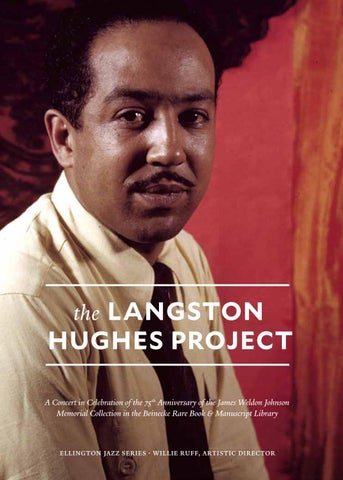
the LANGSTON
HUGHES PROJECT A Concert in Celebration of the 75 th Anniversary of the James Weldon Johnson Memorial Collection in the Beinecke Rare Book & Manuscript Library
ellington jazz series ¡ willie ruff, artistic director
Robert Blocker, Dean
ellington jazz series ¡ willie ruff, artistic director
the LANGSTON
HUGHES PROJECT Ask Your Mama: 12 Moods for Jazz featuring
the Ron McCurdy Quartet & Kenyon Adams, reader
October 28, 2016 ¡ Friday at 7:30 pm Morse Recital Hall in Sprague Memorial Hall
Co-sponsored by the Beinecke Rare Book & Manuscript Library as part of a yearlong series of events celebrating the 75 th anniversary of the James Weldon Johnson Memorial Collection, including Destined to Be Known, an exhibition on view through December 10, and a major exhibition in the spring term on the Harlem Renaissance. Exhibitions at the Beinecke are always free and open to the public.
cover: Hughes was lifelong friends with photographer Carl Van Vechten, whom he met in 1924. Van Vechten shot his color Kodachrome portraits of Hughes in 1942. james weldon johnson memorial collection in the yale collection of american literature, beinecke rare book & manuscript library.
Langston Hughes in front of his home at 20 E. 127 th Street in Harlem in 1962, the year after he published Ask Your Mama. james weldon johnson memorial collection in the yale collection of american literature, beinecke rare book & manuscript library.
ellington jazz series · willie ruff, artistic director
the LANGSTON
HUGHES PROJECT Ask Your Mama: 12 Moods for Jazz featuring
the Ron McCurdy Quartet & Kenyon Adams, reader
Mood 1: Cultural Exchange Afronato
Ron McCurdy & Eli Brueggemann
Mood 2: Ride, Red, Ride In the Moment
Ron McCurdy & Eli Brueggemann
Mood 3: Shades of Pigmeat In a Spiritual Place
Ron McCurdy
Mood 4: Ode to Dinah Bass Lines
Ron McCurdy & Eli Brueggemann
Mood 5: Blues in Stereo Ode to Buddy
Ron McCurdy
Mood 6: Horn of Plenty Meet Me at Congo Square
Ron McCurdy
Mood 7: Gospel Cha-Cha Drums for Your Mama
Peter Buck
Mood 8: Is It True? Ask Your Mama
Eli Bruggemann
Mood 9: Ask Your Mama When You Are Gone
Peter Buck
Mood 10: Bird in Orbit Madeleine’s Lullaby
Ron McCurdy
Mood 11: Jazztet Muted Hesitation Blues
W. C. Handy
Mood 12: Show Fare, Please Show Fare
Eli Brueggemann
“
One of the highlights of my years as a Winchester Avenue nightclub owner came in the form of a gift from a New Haven organization of African American women, one of whom had been a college classmate of Langston’s. She and about three dozen other ladies and their spouses offered Mr. Hughes two-hundred bucks, dinner, and cocktails for a Sunday afternoon reading. And two-hundred bucks being what it was in the ’60s, the very hip poet leapt at the windfall. The event was such a resounding success that the ladies came back to me two years later with an appeal for a repeat performance. And it was my turn to leap at the windfall, and to jump for joy.
–Willie Ruff
”
INTRODUCTION One of the great blessings of living a long life is that the process broadens one’s perspective. I first came to Yale as a student before the Beinecke Library was built, and later joined the faculty of the School of Music after the library rose up out of the ground in all its splendor. Even before I came to Yale, my childhood in the Old South had already informed my perspective on just who James Weldon Johnson was, that sterling intellectual for whom the much treasured collection housed in the great library is named. In fact, among the most memorable events of my first year here was the announcement that Carl Van Vechten had founded the James Weldon Johnson Memorial Collection and that Yale would be its home. A historic concert was presented on this very stage where Langston Hughes, John Rosamond Johnson, and other dignitaries sat, and an impressive exhibit went on display in the lobby of Sterling Library. But the actual books, manuscripts, musical scores, photographs, art objects, and phonograph recordings were stored in boxes at Sterling Library and remained uncatalogued until the Beinecke Library materialized in 1963. You can imagine my delight when I was invited to join the faculty at the School of Music and began teaching a large undergraduate class called An Introduction to African American Music. I thought I had died and gone to heaven, because only a few steps away was the manuscript for “Lift Every Voice and Sing,” along with the classic art songs, blues, jazz, folk, and spiritual music on phonograph records my students needed to hear. All I had to do was transfer the old 78-rpm discs to tape. So it could truthfully be said that I began my teaching career at Yale drawing on the vast and rich resources of that great library. I can think of no more fitting way to give voice to that resource than to focus tonight on Langston Hughes, one of the most widely celebrated and accessible writers of the Harlem Renaissance whose electrifying public readings continued well into the 1960s. Willie Ruff Artistic Director, Ellington Jazz Series
PROGRAM NOTES The Langston Hughes Project is a multimedia concert performance of Langston Hughes’ kaleidoscopic jazz poem suite that features spokenword artist Kenyon Adams and the Ron McCurdy Quartet. Ask Your Mama: 12 Moods for Jazz is Hughes’ homage in verse and music to the struggle for artistic and social freedom at home and abroad at the beginning of the 1960s. It is a twelve-part epic poem which Hughes scored with musical cues drawn from blues and Dixieland, gospel songs, boogie-woogie, bebop and progressive jazz, Latin “cha cha” and Afro-Cuban mambo music, German lieder, Jewish liturgy, West Indian calypso, and African drumming—a creative masterwork left unperformed at the time of his death. Jazz was a cosmopolitan metaphor for Langston Hughes, a force for cultural convergence beyond the reach of words, or the limits of any one language. It called up visual analogues for him, as well, most pointedly the surrealistic techniques of painterly collage and of the film editing developed in this country in the 1930s and ’40s, which condensed time and space, conveyed to the viewer a great array of information in short compass, and offered the possibility of suggesting expanded states of consciousness, chaotic remembrances of past events or dreams— through montage. “To me,” Hughes wrote, “jazz is a montage of a dream deferred. A great big dream — yet to come — and always yet to become ultimately and finally true.” By way of videography, this concert performance links the words and music of Hughes’ poetry to topical images of Ask Your Mama’s people, places, and events, and to the works of the visual artists Langston Hughes admired or collaborated with most closely over the course of his career—the African-inspired mural designs and cubist geometries of Aaron Douglas, the blues- and jazz-inspired collages of Romare Bearden, the macabre grotesques of Meta Warrick Fuller and the rhythmic sculptural figurines and heads and bas reliefs of Richmond Barthe, and the color-blocked cityscapes and black history series of Palmer Hayden and Jacob Lawrence. Together the words, sounds, and images recreate a magical moment in our cultural history, which bridges the Harlem Renaissance, the post-World War II Beat writers’ coffeehouse jazz poetry world, and the looming Black Arts performance explosion of the 1960s.
Ask Your Mama was dedicated to Louis Armstrong, “the greatest horn blower of them all,” and to those of whatever hue or culture of origin who welcomed being immersed in the mysteries, rituals, names, and nuances of black life not just in America but in the Caribbean, in Latin America, in Europe, and Africa during the years of anti-colonial upheaval abroad and the rising Freedom Movement here at home. Not only the youthful Martin Luther King Jr. but the independence leaders of Guinea and Nigeria and Ghana and Kenya and the Congo fill the chants and refrains of Hughes’ epic poem. Originally, Langston Hughes created Ask Your Mama in the aftermath of his participation as an official for the five-day Newport Jazz Festival of July 1960, where he shared the stage with such luminaries as Louis Armstrong, Dizzy Gillespie, Horace Silver, Dakota Staton, Oscar Peterson, Lambert, Hendricks & Ross, Otis Spann, Ray Charles, and Muddy Waters. The musical scoring of the poem was designed to serve not as mere background for the words but to forge a conversation and a commentary with the music. Though Hughes originally intended to collaborate with Charles Mingus, and then Randy Weston, on the full performance of his masterwork, it remained only in the planning stages when Langston Hughes died in 1967. Its recovery now in word, music, and image provides a galvanizing experience for audiences everywhere.
The original edition of Ask Your Mama was printed in blue ink on vibrant red paper. Ask Your Mama: 12 Moods for Jazz. New York: Alfred A. Knopf, 1961. james weldon johnson memorial collection in the yale collection of american literature, beinecke rare book & manuscript library.
ASK YOUR MAMA: 12 MOODS FOR JAZZ Cultural Exchange In Negro sections of the South where doors have no resistance to violence, danger always whispers harshly. Klansmen cavort, and havoc may come at any time. Negroes often live either by the river or the railroad, and for most there is not much chance of going anywhere else. Yet always one of them has been away and has come home. The door has opened to admit something strange and foreign, yet tied by destiny to a regional past nourished by a way of life in common—in this case collard greens. A State Department visitor from Africa comes, wishing to meet Negroes. He is baffled by the “two sides to every question” way of looking at things in the South. Although he finds that in the American social supermarket blacks for sale range from intellectuals to entertainers, to the African all cellophane signs point to ideas of change—in an IBM land that pays more attention to Moscow than to Mississippi. What — wonders the African — is really happening in the shadow of world events, past and present — and of world problems, old and new — to an America that seems to understand so little about its black citizens?
Ride, Red, Ride In the restless Caribbean there are the same shadows as in Mississippi, where, according to Time, Leontyne comes in the back door. Yet some persons in high places in Washington consider it subversive for ordinary people to be concerned with problems such as back doors anywhere—even suspecting those citizens of color who legitimately use the ballot in the North to elect representatives to front doors. But in spite of all, some Negroes occasionally do manage — for a moment — to get a brief ride in somebody’s American chariot.
Shades of Pigmeat Oppression by any other name is just about the same, casts a long shadow, adds a dash of bitters to each song, makes of almost every answer a question, and of men of every race or religion questioners.
Ode to Dinah Hard times endure from slavery to freedom—to Harlem where most of the money spent goes downtown. Only a little comes back in the form of relief checks, which leaves next to nothing for show fare for children who must live in a hurry in order to live at all. Yet in a milieu where so many untoward things happen, one cannot afford to take to heart too deeply the hazards. Remember Harriet Tubman? One of the run-away slaves in her band was so frightened crossing from Buffalo into Canada that on the very last lap of his journey he hid under the seat of the train and refused to glance out the window. Harriet said: “You old fool! Even on your way to freedom, you might at least look at Niagara Falls.”
Blues in Stereo Sometimes you are lucky, or at least you can dream lucky—even if you wake up cold in hand. But maybe with a new antenna you will get a clearer picture.
Horn of Plenty Certainly there are some who make money—and others who folks think make money. It takes money to buy gas to commute to the suburbs and keep one’s lawns sheared like one’s white neighbors who wonder how on earth a Negro got a lawn mower in the face of so many ways of keeping him from getting a lawn.
Gospel Cha-Cha Those who have no lawns to mow seek gods who come in various spiritual and physical guises and to whom one prays in various rhythms in various lands in various tongues.
Is It True? It seems as if everything is annotated one way or another, but the subtler nuances remain to be captured. However, the atom bomb may solve all this—since it would end the end results of love’s own annotation. Meanwhile, although the going is rough, triumph over difficulties at least brings subjective glory. Everybody thinks the Negroes have the most fun, but, of course, secretly hopes they do not— although curious to find out if they do.
Ask Your Mama In spite of a shortage of funds for the movies and the frequent rude intrusions of those concerned with hoarding hard metals, collective coins for music-making and grass for dreams to graze on still keep men, mules, donkeys, and black students alive.
Bird in Orbit Those who contribute most to the joy of living and the stretching of the social elastic are not stymied by foolish questions, but keep right on drawing from the well of the past buckets of water in which to catch stars. In their pockets are layovers for meddlers—although somewhere grandma lost her apron.
Jazztet Muted Because grandma lost her apron with all the answers in her pocket (perhaps consumed by fire) certain grand- and great-grandsons play music burning like dry ice against the ear. Forcing cries of succor from its own unheard completion — not resolved by Charlie Parker — can we look to monk or Monk? Or let it rest with Eric Dolphy?
Show Fare, Please If the answers were on tickets in long strips like those that come from slots inside the cashier’s booth at the movies, and if I had the money for a ticket—like the man who owns all tickets, all booths, and all movies and who pays the ticket seller who in turn charges me — would I, with answer in my hand, become one of the three — the man, the ticket seller, me? Show fare, mama, please …
Langston Hughes collected several silkscreens from photographer Roy DeCarava, with whom he collaborated on Sweet Flypaper of Life in 1955. “Detail,� undated, silkscreen in the Langston Hughes Papers. james weldon johnson memorial collection in the yale collection of american literature, beinecke rare book & manuscript library.
ARTIST PROFILES ron mccurdy, trumpet Dr. Ronald C. McCurdy is a professor of music at the Thornton School of Music at the University of Southern California (USC) and is pastpresident of the International Association for Jazz Education (IAJE). Prior to his appointment at USC he served as director of the Thelonious Monk Institute of Jazz at USC. He has served as professor of music and chair of the Afro-American Studies Department and served as director of jazz studies at the University of Minnesota. In 1997, Dr. McCurdy served as a visiting professor of music at Maria-Curie Sklodowska University in Lublin, Poland. In 2001, Dr. McCurdy received the Distinguished Alumni Award from the University of Kansas. Dr. McCurdy served for seven years as director of jazz studies at the University of Kansas. Under the direction of Dr. McCurdy, the University of Kansas Jazz Studies Program gained national and international prominence. His instrumental and vocal ensembles performed at international and national music conferences and festivals throughout the world. Dr. McCurdy released his first CD, Once Again for the First Time, on the Innova label and is co-author of a vocal jazz improvisation series titled Approaching the Standards, published by Warner Bros. He is currently touring “The Langston Hughes Project, Ask Your Mama: 12 Moods for Jazz.” The multimedia presentation features jazz quartet, spoken-word, and images from the Harlem Renaissance. Dr. McCurdy is in demand as a guest clinician, soloist, speaker, and director of honors jazz ensembles and choirs throughout the United States and Canada. He has directed all-state jazz ensembles in New York, Texas, Arizona, Vermont, Nebraska, Ohio, Nevada, Illinois, Oklahoma, and Florida, to name a few. Dr. McCurdy received his undergraduate degree from Florida A&M University and his Masters and Ph. D. degrees from the University of Kansas. Dr. McCurdy is a consultant to the Grammy Foundation’s educational programs and serves as director of the National Grammy Vocal Jazz Ensemble and combo. He serves as director of the Walt Disney AllAmerican College Band in Anaheim, California. Dr. McCurdy has had an affiliation with the Walt Disney Company for more than 20 years.
A few of the guest artists he has worked with include Wynton Marsalis, Joe Williams, Rosemary Clooney, Terence Blanchard, Leslie Uggams, Arturo Sandoval, Diane Schuur, Ramsey Lewis, Mercer Ellington, Dr. Billy Taylor, Maynard Ferguson, Lionel Hampton, and Dianne Reeves. He has served as a member of the Jamey Aebersold Jazz Camp faculty. Dr. McCurdy is a performing artist for the Yamaha International Corporation. » ronmccurdy.com
yuma sung, piano A recent graduate of the Manhattan School of Music, Yuma continues to grow as a performer and composer. He has been a member of the Grammy Jazz Ensembles and the Disneyland All-American College Band and has played with/for Oscar Peterson, David Benoit, Dave Brubeck, Patti Austin, Kirk Whalum, Jon Faddis, Gregg Field, Wayne Bergeron, and many others. He’s toured Japan on numerous occasions and released a CD on Columbia Music Entertainment called Yuma Style. As a composer/arranger, he’s received the ASCAP Foundation’s Fran Morgenstern Davis Scholarship— an award given to two music composition students at the Manhattan School of Music who show great promise in producing original work. Yuma has had the opportunity to be a part of the Metropole Orchestra Arrangers Workshop, working alongside Vince Mendoza and Roberta Gambarini. He just graduated from the two-year master’s degree program in film scoring at New York University and has scored several films with directors from Columbia University and the School of Visual Arts.
noah jackson, double bass Originally from Detroit, Michigan, Noah Jackson is a bassist, cellist, and composer. A graduate of Michigan State University where he studied with Rodney Whitaker and the Manhattan School of Music where he studied with Dr. Larry Ridley, he has become recognized as an up-andcoming bassist. Jackson has been performing with many top acts in most music venues in and around New York City and has traveled with such
world-renowned artists as Abdullah Ibrahim and Winard Harper. Jackson has performed in more than 10 countries, from South Africa to Qatar and France, and in many jazz festivals in the United States and abroad. As a bandleader, Jackson’s group Full Circle has been well received in many venues around New York City and Detroit. His group recorded an album in 2011 called Contemplations: A Suite, which has garnered critical praise, including being named a Top 10 Album of 2011 by the Detroit MetroTimes, and performed at the 2012 Detroit Jazz Festival. Jackson currently resides in New York City.
julius rodriguez, drums Julius Rodriguez began studying classical piano while teaching himself drums at age four, began playing regularly in his church at age nine, and enrolled in the Manhattan School of Music’s Precollege Division at age 10. He currently studies jazz piano at the Juilliard School. Rodriguez’s hard work has earned him recognition from the Charles Mingus High School Festival & Competition, Downbeat Student Music Awards, NAACP National ACT-SO (Academic, Cultural, Technological, and Science Olympics), the Next Generation Jazz Festival High School Competition, NFAA’s YoungArts, the Grammy Foundation, Betty Carter’s Jazz Ahead at the Kennedy Center, and most recently, the Monterrey Next Generation Jazz Orchestra. He has had the wonderful privilege to study under and work with many great musicians and teachers including John Senakwami, Ubaldo DíazAcosta, Jeremy Manasia, Richard Huntley, Kenny Washington, Craig Weinrib, Javon Jackson, Benny Green, Todd Coolman, Jim Saltzman, Lisa Nelson, Dennis Mackrel, Andra Day, Cyrus Chestnut, Jason Moran, and others. Rodriguez appears on recordings by Kate Gratson, Lauren Gayle, Morgan Guerin, and Rev. Mark Bozzuti-Jones. His debut album, Introducing Orange Julius and the Big Beat, is available on iTunes, Bandcamp, and other platforms.
kenyon adams, reader The multimedia and performance works of Kenyon Adams, also known as little ray, have been featured throughout the United States including NYU’s Stovall Family Galleries, Nomadique Collections (Brooklyn), and the Festival of Faith & Music. Adams (M.A.R. ’15) studied Religion and the Arts at Yale Divinity School and the Yale Institute of Sacred Music. He has been the recipient of a National Young Arts Foundation Award and was named a White House Presidential Scholar in the Arts. Adams was a 2015-16 artist-in-residence at the Yale Institute of Sacred Music and currently serves as the Director of Arts Initiatives at Grace Farms Foundation. He made his feature film debut as Jason in director Lee Isaac Chung’s 2010 narrative feature Lucky Life, which premiered at the Tribeca Film Festival and was selected for the Moscow International Film Festival, Torino Film Festival, American Film Festival Poland, and others. In 2011, he formed the band Kenyon Adams & American Restless, which sought to explore the liturgical quality of the blues aesthetic in the American musical context. The project released a self-titled EP and performed throughout the United States. Following the release of his solo recording, Songs for the Road (2002), Adams shared the stage with artists such as the Rock N’ Roll Hall of Fame’s The Lovin’ Spoonful, as well as Charlie Peacock, Ten Shekel Shirt, Cindertalk, Gary Clark Jr., and others. In collaboration with director Sarah Peterson and jazz legend Willie Ruff, Adams helped to stage Long Wharf Theater’s production of Langston’s Hughes’ Black Nativity, for which he composed original music and performed a leading role. Other theater credits include Changing Light on Water: Some Possible Beginnings and Endings (Bill T. Jones), Richard III, Cinderella, Ah! Wilderness! (Melia Bensussen), My Children, My Africa! (Patricia McGregor), Translations (Mary Kate Burke), Blind Lemon (Akin Babtunde), and Bloodknot. Adams is an alumnus of the Meadows School of the Arts at Southern Methodist University.
ACKNOWLEDGMENTS Yale School of Music
Artistic Director, Ellington Jazz Series Willie Ruff Director of Communications Donna Yoo Communications Officer David Brensilver Design Manager Katie Dune Acting Manager of Concert Programs Kate Gonzales Acting Concert Office Coordinator Lauren Schiffer Operations Manager Tara Deming Operations Assistant Manager Chris Melillo
Beinecke Rare Book & Manuscript Library
Director Edwin C. Schroeder Curator, Prose & Drama, Yale Collection of American Literature Melissa Barton Curator, Poetry, Yale Collection of American Literature Nancy Kuhl Public Relations and Communications Director Michael Morand
right: Roy De Carava, A Landlord’s Philosophy, 1946, silkscreen in the Langston Hughes Papers. james weldon johnson memorial collection in the yale collection of american literature, beinecke rare book & manuscript library.
Robert Blocker, Dean