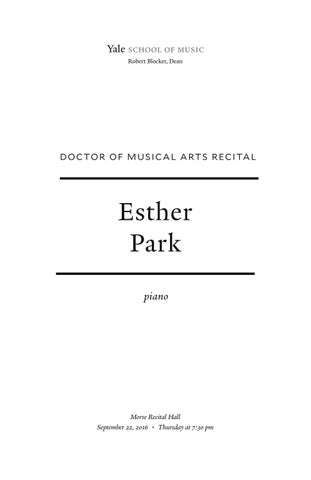
Robert Blocker, Dean
doctor of musical arts recital
Esther Park piano
Morse Recital Hall September 22, 2016 • Thursday at 7:30 pm
Yale School of Music
Esther Park
piano
September 22, 2016 • Morse Recital Hall
Ludwig van Beethoven 1770—1827
Sonata No. 27 in E minor, Op. 90 I. Mit Lebhaftigkeit und durchaus mit Empfindung und Ausdruck II. Nicht zu geschwind und sehr singbar vorgetragen
Franz Schubert 1797–1828
Fantasie in C major, D. 760, “Wanderer Fantasy” I. Allegro con fuoco ma non troppo II. Adagio III. Presto IV. Allegro intermission
Claude Debussy 1862—1918
Images Book I, L. 110 I. Reflets dans l’eau II. Hommage à Rameau III. Mouvement Book II, L. 111 I. Clouches à travers les feuilles II. Et la lune descend sur le temple qui fut III. Poissons d’or
Olivier Messiaen 1908–1992
“Regard de l’Esprit de joie” from Vingt regards sur l’enfant-Jésus (1944)
This performance is in partial fulfillment of the requirements for the Doctor of Musical Arts degree.
Artist Profile
Pianist Esther Park has performed as a soloist with orchestras and in recitals across the United States as well as Asia and major European cities. such as Houston Symphony, Yale Philharmonia, Corpus Christi Symphony, Filharmonia Pomorska, Poland, Orchestra Filarmonica, Romania, Shanghai Philharmonic, China, Shreveport Symphony, the Juilliard Symphony, and the New Jersey Symphony. Ms. Park gave a five-city recital tour in Korea, and has performed at the Juilliard Theater in NYC, Alice Tully Hall, Lincoln Center, Weill Recital Hall at Carnegie Hall, Salle Cortot in Paris, the New Jersey Performing Arts Center, Palau de la Musica, Valencia, Spain, and on the Kum-Ho Music society’s Prodigy Series. She has appeared at the Music Academy of the West (Santa Barbara), the Aspen Music Festival, the Bowdoin Summer Music Festival in Maine, the Tel-Hai International Music Festival in Israel, and the Van Cliburn-TCU Institute in Texas. Ms. Park has been heard in New York on WQXR Radio station as the winner of the 52nd Kosciusko International Competition and the Gina Bachauer Competition. Ms. Park is the winner of the 2013 Jose Roca International Piano Competition and 2013 Russian International Music Competition. She is the winner of 2009 “Prix Amadeo” and the 2009 Chopin Gesellschaft Klavierwettbewerb. Ms. Park also received top prizes at the 3rd San Marino International Piano Competition, the 3rd China Shanghai International Piano Competition, the 6th Paderewski International Piano Competition, the National Chopin Competition (USA), Hilton Head International Competition, the 14th New Orleans International Piano Competition and is the recipient of the President Clinton’s Prodigy Award. Born in Pusan, Korea, Ms. Park began to play in public soon after her first piano lessons at the age of four. Ms. Park moved to the United States in 1995, after being accepted to Juilliard School’s Pre-College division. Ms. Park has completed undergraduate and graduate degrees from the Juilliard School, studying with Yoheved Kaplinsky. Ms. Park has also studied at the Hochschule für Musik und Theater, Hannover, under the tutelage of Mr. Bernd Goetzke. Ms. Park has since received the Artist Diploma and Master of Musical Arts degrees at the Yale School of Music under the guidance of Mr. Boris Berman. Since 2015, Ms. Park has been serving as the assistant professor of piano at East Tennessee State University.
As a courtesy to the performers and audience, please silence all electronic devices. Please do not leave the hall during selections. Photography or recording of any kind is prohibited.
Doctor of Musical Arts Recital
Ludwig van Beethoven Sonata No. 27 in E Minor, Op. 90 Beethoven wrote this unique sonata in 1814, when his work output was at the slowest of his career. Four years passed since he wrote the Piano Sonata No. 26 in E-flat major, Op. 81a, “Les Adieux.” Other works between these years include the two symphonies— numbers seven and eight—and his last sonata for violin. In a sense, this sonata awakens Beethoven from a compositional slumber to finish his last musical chapter, the late works. This work is atypical in many ways. Beethoven typically writes his instrumental sonatas in three or four movements. However, this is one of the three sonatas out of 32 piano sonatas that is in two movements. Of the two-movement works, this is the most lyrical sonata, with its Schubertlike second movement. For the first time, Beethoven deviates from the usual tempo indications in Italian and describes, in German, different feelings and moods.
The second movement, “Nicht zu geschwind und sehr singbar vorgetragen,” features some of the most lyrical writing for piano and is in an unusual rondo-sonata form where the rondo theme repeats before each episode. Franz Schubert Fantasie in C major, D. 760, “Wanderer Fantasy”
Nearly everything Schubert wrote for the piano was for his own use, but the “Wanderer Fantasy,” composed in 1822, is an exception, as it was written for a pupil of Johann Nepomuk Hummel. Perhaps this may explain the technically demanding piano writing, of which Schubert himself said, “The devil may play it.” The remarkable feature of the piece extends to its structure, as this may be the first instance where one writes a full-scaled four-movement sonata without clear breaks between the movements. Each movement transitions into the next, foreshadowing Liszt’s Piano Sonata in B minor, S. 178. The subtitle “Wanderer” was given The first movement, marked “Mit by the publishers upon recognizing Lebhaftigkeit und durchaus mit Schubert’s use of his famous song Empfindung und Ausdruck,” per“Wanderer” as the theme of the second fectly describes the movement: movement, which is a theme and “with spirit, while with feeling and variations. Schubert’s main motif is expression throughout.” Dominated prevalent throughout the fantasy by question-and-answer motifs, the question may be the “Lebhaftigkeit” and is the building block that unites while the answer applies to the latter the entire piece. The rhythmic character of the motif is readily recognized half of the composer’s instruction.
Doctor of Musical Arts Recital
in the first, second, and fourth movements, while the melodic idea (three repeating notes) is employed, with an altered rhythm in triple meter in the third movement. The finale offers a rare instance of contrapuntal writing in Schubert’s music and adds a touch of his compositional command in the midst of pianistic bravura. Claude Debussy Images Book I, L. 110 & Book II, L. 111
of three or more parts that requires the rest of the composition to be written on three staves. The second movement, “Et la lune descend sur le temple qui fut” (“And the Moon Sets Over the Temple That Was”), is perhaps the most picturesque of all the Images. The second set ends with another audience favorite, “Poissons d’or” (“Goldfish”). It is said that Debussy was inspired by a painting of two gold-colored fish on a small Japanese lacquer panel. Quicksilver-like notes with twists and turns is an invitation for all to see an imaginary goldfish swimming up and down a stream, wiggling its tail.
Claude Debussy wrote two sets of Images, with each set containing three movements. The first book of Images was completed in 1905. “Reflets dans l’eau (“Reflections in the Olivier Messiaen Water”) is one of the most famous pieces “Regard de l’Esprit de joie” among Debussy’s piano works. In this move- (“Gaze of the Spirit of Joy”) from ment, Debussy musically depicts various Vingt regards sur l’enfant-Jésus (1944) reflections and movements (water drops, a shimmering surface, and sweeping waves) Olivier Messiaen composed the Twenty of water. “Hommage à Rameau” is in the aspects of the infant Jesus in 1944, during style of a sarabande, an old French-Baroque the most trying of circumstances, while dance movement, which is Debussy’s subtle Paris was under German occupation. The reverence to the great French masters of tenth movement, “Regard de l’Esprit de the past. Finally, “Mouvement” is a musijoie,” is particularly powerful considering cal translation of different motions, created the oppressive and dangerous conditions sonically, with Debussy’s instruction for Messiaen was under while composing such “whimsical but precise lightness”. Two years an original work that is bursting with joie later, the second book of Images was comde vivre. The piece begins with a primitive pleted. Ricardo Vines gave premiers of both dance that bears resemblance to Stravinsky’s books in Paris after each publication. The The Rite of Spring, with uncompromising second set opens with “Cloches à travers low-register octaves that are often interruples feuilles” (“Bells Through the Leaves”). ted by fortissimo chords which cannot stop The bells are represented by the left-hand, the savage dance. When the “theme of joy” which plays a whole-tone scale motif that per- appears, one may recognize Gershwin’s “I meates the piece. The seemingly simple open- Got Rhythm.” The “theme of God” appears ing gesture belies a complex intertwining
Doctor of Musical Arts Recital
after two iterations of the “joy” theme and appears throughout the Vingt regards. The “theme of God” in this movement is a jovial dance that progresses vehemently, yet less primitively than the introductory dance. The “theme of joy” returns and is quickly intruded upon by the return of the initial savage dance, now escalated onto two extreme registers of the keyboard. After one final iteration of the “theme of joy,” the dance resumes and builds to an inexorable tension until it is nearly driven out of the piano, ending with a massive run across the keyboard from top to bottom. Messiean comments on this movement (translated here by Dennis Vannier), “Vehement dance, drunken horn-like tonalities, transport of the Holy Spirit ... the joy of God’s love in the soul of Jesus Christ. I have always been struck by the fact that God is happy—and that His continual and ineffable joy inhabited the soul of Christ. Joy is, for me, a transport, an intoxication in the maddest sense”. — Esther Park
PETER OUNDJIAN
BRENTANO STRING QUARTET
YALE OPERA
Robert Blocker, Dean
We invite you into Yale’s celebrated concert halls to experience extraordinary solo, chamber, vocal, and orchestral performances of repertoire ranging from early to new music. Come see and hear our distinguished faculty, gifted students and alumni, and acclaimed guest artists in more than 200 performances, many of which are free and streamed live online. COLLECTION OF MUSICAL INSTRUMENTS
ONEPPO CHAMBER MUSIC SERIES
Historically informed performances by early music specialists in an intimate setting
Concert programs featuring the Brentano, Miró, and Jerusalem string quartets and the School’s illustrious faculty
ELLINGTON JAZZ SERIES
YALE OPERA
A series launched with a historic convocation in 1972 that brings such legendary performers as Savion Glover to Yale
Ascendant vocalists present fully staged performances
FACULTY ARTIST SERIES
YALE PHILHARMONIA
Members of the School’s faculty perform solo and chamber music programs
HOROWITZ PIANO SERIES
Recitals by celebrated keyboard virtuosi including Yefim Bronfman, Olga Kern, and Yale’s remarkable faculty
NEW MUSIC NEW HAVEN
Contemporary works by award-winning Yale faculty and students, and esteemed guest composers
NORFOLK CHAMBER MUSIC FESTIVAL
and opera scenes Principal Conductor Peter Oundjian and guest conductors Yongyan Hu and Giancarlo Guerrero lead the School’s magnificent student orchestra
STUDENT PERFORMANCES
Performances of a wide variety of repertoire by the next generation of musical luminaries and cultural leaders
YALE IN NEW YORK
Dynamic collaborations between Yale’s remarkable faculty, students, and alumni at Carnegie Hall
A summerlong series at the picturesque Ellen Battell Stoeckel Estate, in Norfolk, Connecticut
music.yale.edu
Upcoming Events
Yale Choral Artists
Janna Baty and Hannah Lash
september 24 Yale in New York Jeffrey Douma conducts the Yale Choral Artists and members of the Yale Philharmonia in a program of works by YSM faculty composers David Lang and Hannah Lash and YSM alumnus Ted Hearne St. Mary’s Church | Saturday | 7:30 pm This program will be repeated on Sunday, September 25, in New York free admission
september 28 Faculty Artist Series Faculty mezzo-soprano Janna Baty and harpist and faculty composer Hannah Lash present the world-premiere performance of Lash’s new song-cycle and other works Morse Recital Hall | Wednesday | 7:30 pm free admission
Brentano and Friends
Aaron Jay Kernis and Christopher Theofanidis
september 27 Oneppo Chamber Music Series The Brentano String Quartet is joined by YSM faculty violist Ettore Causa and the Argus Quartet for a program of works by Haydn and Mendelssohn Morse Recital Hall | Tuesday | 7:30 pm Tickets start at $26 • Students $13
september 29 New Music New Haven A program of works by faculty composers Aaron Jay Kernis and Christopher Theofanidis, including Kernis’ Perpetual Chaconne and Theofanidis’ O Vis Aeternitatis Morse Recital Hall | Thursday | 7:30 pm free admission
concert programs & box office Kate Gonzales, Lauren Schiffer communications Donna Yoo, Katie Dune, David Brensilver operations Tara Deming, Chris Melillo piano curators Brian Daley, William Harold recording services Matthew LeFevre, Travis Wurges, Eugene Kimball
wshu 91.1 fm is the media sponsor of the Yale School of Music connect with us
facebook.com/yalemusic
P.O. Box 208246, New Haven, CT · 203 432-4158
@yalemusic on Twitter music.yale.edu
If you do not intend to save your program, please recycle it in the baskets at the exit doors. Robert Blocker, Dean