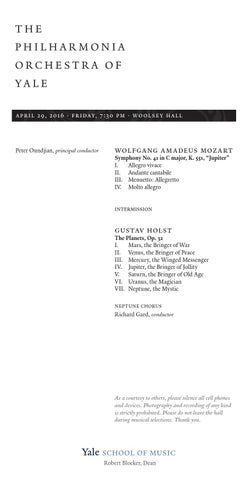
THE PHILHARMONIA ORCHESTRA OF YALE a p r i l 2 9, 2 0 16 · frid ay, 7:30 pm · wools e y h all
Peter Oundjian, principal conductor
wolfgang amadeus mozart Symphony No. 41 in C major, K. 551, “Jupiter” I. Allegro vivace II. Andante cantabile III. Menuetto: Allegretto IV. Molto allegro intermission
gustav holst
The Planets, Op. 32 I. Mars, the Bringer of War II. Venus, the Bringer of Peace III. Mercury, the Winged Messenger IV. Jupiter, the Bringer of Jollity V. Saturn, the Bringer of Old Age VI. Uranus, the Magician VII. Neptune, the Mystic Neptune Chorus Richard Gard, conductor
As a courtesy to others, please silence all cell phones and devices. Photography and recording of any kind is strictly prohibited. Please do not leave the hall during musical selections. Thank you.
Robert Blocker, Dean
pro g ra m no tes
Wolfgang Amadeus Mozart » 1756–1791 Symphony No. 41 in C Major, K. 551 “Jupiter” Mozart’s Symphony No. 41 was his last and longest. Allegedly nicknamed “Jupiter” by German impresario Johann Peter Saloman for a performance in London in 1821, it is not surprising that the epithet caught on. Jupiter, the Roman King of Gods and astrological sign of expansive energy as well as leisure and good fortune, is a title fitting for both the grandeur and sensitivity of this symphonic work. Towards the end of his life, Mozart rarely composed on a whim. But his last three symphonies, written hastily over the summer of 1788, have no record of being previously commissioned, nor do they seem to be designated as gifts for patrons or friends. In fact, Mozart’s career was in decline, and many of his letters indicate times of severe financial stress, borrowing and asking for money rather than sharing news of upcoming projects or favorable reviews. The opening Allegro vivace is rich with thematic characters: the bold, timpani-driven first theme in C major is contrasted by a delicate, lyrical second theme in the winds. A cheeky third theme in the violins is interrupted by a menacing barrage of C minor chords. That this music contains the drama and contrast of an opera overture is no surprise: Mozart had recently enjoyed the premiere of Don Giovanni and also quoted a theme from his comic aria, “Il bacio di mano” (A Kiss of the Hand) in this opening movement. Regarding the slow movements of the last three symphonies, Janet Bedell eloquently noted that Mozart takes “innocent-sounding melodies on dangerous journeys.” In the Andante cantabile, a sweet and muted melody in F major finds itself lost in a forest of chromatically embellished C minor. Like many modified sonata-form movements, this initial theme emerges from its dangerous adventure with newfound beauty and purpose. The Menuetto is perhaps the most conventional movement, with a critical quirk: the trio begins with a resolute cadence in the winds, forcing the strings to come up with a suitable beginning to material that seems to want to be over and done with. In the finale, Molto allegro, Mozart combines his intimate familiarity with sonata form with his decade-long
study of the contrapuntal music of J.S. Bach, merging baroque and gallant styles in an abundantly effusive finale. Gustav Holst » 1874–1934 The Planets, Op. 32 Ever since meeting writer and astrologer Clifford Bax in 1913, Gustav Holst referred to astrology as his “pet vice.” While there have been many pieces of music named for astrological signs — Karlheinz Stockhausen’s Zodiac Melodies and George Crumb’s Makrokosmos for example — no work seems to embrace the astrologer’s unabashed generalization of character and mood as explicitly as Holst’s Planets. Written between 1914–1916, the then forty-two year old composer was probably caught off guard by the immediate fame the orchestral suite brought him. The vivid, expansive, and richly tonal soundscape of the orchestral suite was a style Holst never returned to, much to the dismay of his fans. “Mars, the Bringer of War,” begins the approximately fifty-minute suite with a bombastic and militaristic march in quintuple meter. Perhaps this was Holst’s contribution to the war effort, since he was rejected as unfit for military service after trying to enlist in 1914. “Venus, the Bringer of Peace,” is a character foil to “Mars.” A lyrical solo horn responds to its cacophonous final chords, and delicate, lilting woodwinds give way to a gently pulsating textural bed from which various lullabies ebb and flow. In “Mercury, the Winged Messenger,” the rhythmic energy from “Mars” is resumed, but now in the form of a light scherzo. Holst’s “Mercury” is agile and mischievous, as orchestrationally sparkling as it is fleeting. “Jupiter, the Bringer of Jollity,” features noble, broad melodic phrases that weigh down the frivolity of “Mercury,” while retaining its joyfulness. The rising fourths and fanfare-like quality of this movement suggest a precursor to Copland’s Appalachian Spring. “Saturn, the Bringer of Old Age,” contrasts the sublime lightness of “Mercury” with a heavy and plodding bass line. But this baseline ultimately becomes lyrical, and its stammering quality seems to evaporate into the harp and winds as it slowly ascends. “Uranus, the Magician” is the astrological planet of rebellion. Holst captures this affect with quirky material that seems to trip over itself, bizarre outbursts in the timpani, and
art ist p ro f i le s
sweeping outbursts in the winds. A bombastic climax gives way to a moment of suspended stillness, perhaps setting the stage for the suite’s ethereal finale, “Neptune, the Mystic.” In this final movement, Holst returns to the quintuple meter of “Mars.” But this time, the meter creates a sense of temporal ambiguity, evoking dreams and illusions in lieu of a physically present march. A women’s chorus enters at the end of the movement, and lingers for a moment before leading the first ever composed musical ‘fade-out,’ suggesting that the finale, or perhaps the entire suite itself, was nothing more than a mirage melted into the horizon. — Katherine Balch
Yale Philharmonia 2016–2017 We are very pleased to announce the coming season. Please see the program supplement for details. current subscribers: Look for your renewal materials in the mail. If you are interested in becoming a subscriber to the series, please contact the box office.
Samplers go on sale August 1 Single tickets go on sale September 1 Box Office 203 432-4158 music-tickets.yale.edu
a rt i st p rofiles
Neptune Chorus Richard Gard, conductor Anna Antunes Charity Clark Jacqueline Coté Christine Evans Carolina Flores Jennifer Frechette Evelyn Gard Alexandra Gartner Kelly Hill Ellen Jewett Jessica Z. Jones Nancy Kelly Sorae Kim Ash Lago Rachel Marlak Martha Oneppo Nicole Percifield Natalie A. Plaza Stephanie Polonio Lauren Smith Susan Van Cott Lisa Williamson Karolina Wojteczko Emily Workman
Peter Oundjian, principal conductor A dynamic presence in the conducting world, Toronto-born conductor Peter Oundjian is renowned for his probing musicality, collaborative spirit, and engaging personality. Oundjian’s appointment as Music Director of the Toronto Symphony Orchestra (TSO) in 2004 reinvigorated the orchestra with numerous recordings, tours, and acclaimed innovative programming as well as extensive audience growth, thereby significantly strengthening the ensemble’s presence in the world. He recently led the TSO on a tour of Europe which included a sold-out performance at Amsterdam’s Concertgebouw and the first performance of a North American orchestra at Reykjavik’s Harpa Hall. Oundjian was appointed Music Director of the Royal Scottish National Orchestra (RSNO) in 2012. Under his baton, the orchestra has enjoyed several successful tours including one to China, and has continued its relationship with Chandos Records. This season, Oundjian and the RSNO opened the Edinburgh Festival with the innovative Harmonium Project to great critical and audience acclaim. Few conductors bring such musicianship and engagement to the world’s great podiums — from Berlin, Amsterdam, and Tel Aviv, to New York, Chicago, and Sydney. He has also appeared at some of the great annual gatherings of musicians and music-lovers: from the BBC Proms and the Prague Spring Festival, to the Edinburgh Festival and the Philadelphia Orchestra’s Mozart Festival, where he was Artistic Director from 2003 to 2005. Oundjian was Principal Guest Conductor of the Detroit Symphony Orchestra from 2006 to 2010 and Artistic Director of the Caramoor International Music Festival in New York between 1997 and 2007. Since 1981, he has been a visiting professor at the Yale School of Music, and in 2013 he was awarded the school’s Sanford Medal for distinguished service to music.
a b o ut yale p h ilharmonia
The Philharmonia Orchestra of Yale is one of America’s foremost music school ensembles. The largest performing group at the Yale School of Music, the Philharmonia offers superb training in orchestral playing and repertoire. Performances include an annual series of concerts in Woolsey Hall, as well as Yale Opera productions in the Shubert Theater. The Yale Philharmonia has also performed on numerous occasions in Carnegie Hall and Alice Tully Hall in New York City and at the Kennedy Center in Washington, D.C. The orchestra undertook its first tour of Asia in 2008, with acclaimed performances in the Seoul Arts Center, the Forbidden City Concert Hall and National Center for the Performing Arts (Beijing), and the Shanghai Grand Theatre.
peter oundjian Principal Conductor philharmonia staff roberta senatore Assistant Manager heejung park Assistant Conductor
The Philharmonia Orchestra of Yale violin i Adelya Nartadjieva Michael Duffett Hyunjae Bae Julia Dina Dae Hee Ahn Marianne Di Tomaso Tzu Ti Chang Jinyou Lee Kyung Min Lee Ye Hyung Chung Linda Lee Yefim Romanov
James Rosamilia Yeji Yoo Jiwon Kang Nayeon Kim
violin ii Bora Kim Jiazhi Wang Moon Joo Kim Diana Do Hyung Kim Manaka Matsumoto Jing Yang Yena Lee Yurie Mitsuhashi Marie Oka Suyoun Han
flute Felice Doynov Evan Fojtik 2 Hye Jin Park 1 Joanna Wu
viola Julia Clancy Emily Brandenburg Wei Peng Ryan Davis Ye In Son Daniel Stone Yang Li Joshua Newberger cello Pall Kalmansson Hyunjeong Kwak Eric Adamshick Yoonha Yi
bass Kaden Henderson Joshua Depoint Lee Starovich Samuel Suggs Luke Stence Levi Jones Erez Meyuhass
oboe Ron Cohen Mann 1 Lydia Consilvio Timothy Feil Ross Garton 2 Michelle Nguyen Winona V.R. Van Alstyne clarinet Kenta Akaogi Sam Boutris Bixby Kennedy 2 Jesse McCandless bassoon Matthew Gregoire Francisco Joubert Bernard 1 Hanul Park 2 Cornelia Sommer
horn Sarah Boxmeyer 2 Chuta Chulavalaivong Reese Farnell Sarah Ford Matthew Gray 1 Cody Halquist Joshua Thompson trumpet Nozomi Imamura Jonathan Shadle 1 Andrew Stadler Daniel Venora 2 trombone Jeffrey Arredondo Richard Liverano Alexander Walden 2 euphonium Omar Dejesus Jr. tuba John Leibensperger timpani Matthew Keown 2 Se Um 1 Jeffrey Stern percussion Maria Chlebus Yifei Fu Se Um 2 harp Noël Wan 2 Shin Young Yu
celeste Seolyeong Jeong 2 organ Bradley Burgess 2 administrative assistants Andrew Robson Valerie Sly music librarians Bora Kim Yefim Romanov stage crew Eric Braley Maria Chlebus Lydia Consilvio Chris Garwood Julia Dina Reese Farnell Nozomi Imamura Matthew Keown John Kossler Richard Liverano Noël Wan 1 Principal on Mozart 2 Principal on Holst
up co ming events
» music.yale.edu
box office 203 432-4158
MAY 6 & 7 Don Quichotte Yale Opera Morse Recital Hall | Fri & Sat | 7:30 pm Linda Brovsky, stage director Timothy Shaindlin, music director Tickets start at $10 • Students $5
MAY 10
MAY 11
concert programs & box office Krista Johnson Kate Gonzales communications Donna Yoo Katie Dune
Chamber Music Competition Winners Oneppo Chamber Music Series Morse Recital Hall | Tuesday | 7:30 pm Featuring the winners of the School of Music’s annual chamber music competition Tickets start at $10 • Students $5
operations Tara Deming Christopher Melillo
Robert Blocker Horowitz Piano Series Morse Recital Hall | Wednesday | 7:30 pm Music of Mozart, Ravel, Bach-Busoni, and new pieces by David Lang, Hannah Lash, Fay Wang, Warren Lee, and Christopher Theofanidis Tickets start at $13 • Students $7
recording services Eugene Kimball Matthew LeFevre Austin Kase
piano curators Brian Daley William Harold
Thank you for your support! Become a Yale School of Music patron and support our performance programs. Earn benefits ranging from preferred seating to invitations to special events. To learn more, visit us online or call 203 432-4158. charles ives circle $600 and above Anonymous paul hindemith circle $250 to $599 Serena & Robert Blocker Prof. Michael & Mrs. Maryann Bracken Richard H. Dumas Edwin M. & Karen C. Duval Paul Gacek Richard & Evelyn Gard Francesco Iachello Patty & Tom Pollard Mary-Jo Worthey Warren Ransom Wilson & Walter Foery Michael Zuber & Zachary Zander horatio parker circle $125 to $249 Joyce Alton Roger & Linda Astmann Craig Baker Derek & Jennifer Briggs Leo Cristofar & Bernadette DiGiulian Elizabeth M. Dock Joan K. Dreyfus
Raymond & Jean Gambardella Carolyn Gould Margaret Lord & Arthur Kover Judy Long Mark Ludwig Ann Marlowe Stephen Marsh Susan Matheson & Jerome Pollitt Martha & Vincent Oneppo Arthur T. Rosenfield, M.D. Suzanne Solensky & Jay Rozgonyi Monika & Fred Volker samuel simons sanford circle $50 to $124 Anonymous Nancy Ahlstrom Ms. Bonita M. Albanese Helen & Blake Bidwell Henry & Joan Binder Barbara Blake Harold & Maureen Bornstein Mindy & Stan Brownstein Barbara & Frank Dahm Thomas & Judith Foley James V. Freeman
Saul & Sonya Goldberg Lawrence Handler Alexandra Isles James Mansfield Joel Marks Betty Mettler Ron & Sue Miller Barbara & Bill Nordhaus James V. Pocock Rocco and Velma Pugliese Fred & Helen Robinson Leonard J. Rutkosky Suzanne Tucker Mr. & Mrs. Peter Uhrynowsky Carl Wies & Margot Hardenbergh Werner & Elizabeth Wolf Donna Yoo gustave jacob stoeckel circle $25 to $49 Mr. & Mrs. Ken L. Grubbs Dr. Gary & Hedda Kopf James N. Trimble as of April 28, 2016