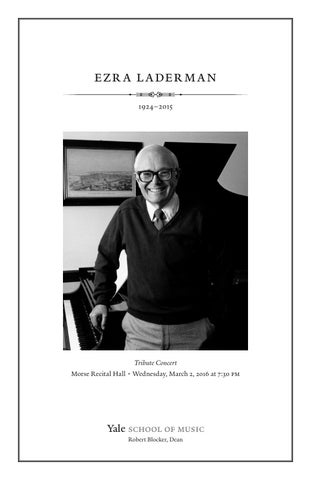
ezr a laderman 1924–2015
Tribute Concert Morse Recital Hall • Wednesday, March 2, 2016 at 7:30 pm
Robert Blocker, Dean
ezr a laderman 1924–2015 A concert in memory of Ezra Laderman featuring selections from his compositions Partita for Solo Bassoon (2012) II. Moderato IV. Andante V. Vivace — Maestoso — Cantare VI. Moderato Frank Morelli, bassoon f Partita No. 2 for Solo Cello (2014) I. Allegro affettuoso V. Vivace Ole Akahoshi, cello a, f Partita for Solo Violin (2013) World premiere I. Moderato II. Adagio III. Più allegretto IV. Allegro spirito V. Mercuriale VI. Adagio VII. Allegro. Allegretto. Moderato. Adagio. VIII. Allegro giocoso Benjamin Hoffman, violin a, s
As a courtesy to the performers and audience, silence all electronic devices. Please do not leave the hall during selections. Photography or recording of any kind is prohibited.
Tribute Concert
Quartet No. 1 for Brass and Piano (2008) II. Andantino Allan Dean, trumpet f William Purvis, horn f Scott Hartman, trombone f Mihae Lee, piano Nonet of the Night (2004) V. Somber, Soft and Solemn Ransom Wilson, conductor f Andrew Robson, flute s David Shifrin, clarinet f Ani Kavafian, violin f Syoko Aki, violin a, f Emily Brandenburg, viola s Mingyao Zhao, cello s Donald Palma, double bass f Sean Kennard, piano s Jeffrey Stern, percussion s f
Yale School of Music faculty members Yale School of Music alumni s Yale School of Music students a
The Gilmore Music Library at Yale University is presenting an exhibit titled Ezra Laderman: In Memoriam, on display until April 5. It includes music, photographs, and other materials, drawing upon the Ezra Laderman Papers at the library as well as items on loan from the Laderman family. The exhibit is free and open to the public during library hours.
Ezra Laderman (1924–2015) was a composer whose works included twelve string quartets, eleven concertos, and eight symphonies; six dramatic oratorios, music for dance, seven operas, and music for two Academy Award-winning films. In the words of Anthony Tommasini, “Mr. Laderman’s gruff, kinetic music mixes pungently atonal elements into a harmonic language that is tonally rooted and clearly directed.”
Upon his return to civilian life, he earned his B.A. from Brooklyn College and his M.A. from Columbia University in 1952. As Allan Kozinn wrote in the New York Times in 1989, Laderman “studied composition with Stefan Wolpe, who led him away from tonality, and later with Otto Luening and Douglas Moore, who persuaded him to temper his atonal style by indulging his melodic gifts.”
After joining the Yale School of Music community as a composer-in-residence in 1988, Laderman served as Dean from 1989 to 1995. Under his leadership, the Artist Diploma was added to the School’s degree programs in 1993. After his tenure as Dean, he served as Professor of Music until his retirement in 2014, when he was named Professor Emeritus.
Laderman’s commissions included works for the New York Philharmonic, Chicago Symphony, Los Angeles Philharmonic, Philadelphia Orchestra, Pittsburgh Symphony, and the orchestras of Minnesota, Dallas, Houston, Detroit, and New Haven. His operas included Marilyn, based on the life of Marilyn Monroe, which premiered at the New York City Opera. He wrote for the Tokyo, Juilliard, and Vermeer quartets, and for soloists Yo-Yo Ma, Jean-Pierre Rampal, Sherrill Milnes, and Emanuel Ax, among many others.
Ezra Laderman was a leader of numerous professional organizations: he served as chair of the National Endowment for the Arts composerlibrettist program, president of the American Music Center, director of the music program of the National Endowment for the Arts, president of the National Music Council, board chair of the American Composers Orchestra, and president of the American Academy of Arts and Letters. He was the recipient of three Guggenheim fellowships and the Rome Prize, and had residencies at the Bennington Composers Conference, the American Academy in Rome, and the Rockefeller Foundation at Bellagio. Born in Brooklyn, New York, Laderman began improvising at the piano at age four and just a few years later began to compose music. He attended New York City’s High School of Music and Art, where he performed his own piano concerto with the school’s orchestra. In 1943 he began serving in the United States Army as a radio operator with the 69th Infantry Division. Shortly after the war ended, Laderman wrote a four-movement piece that became known as the Leipzig Symphony. After performing a piano reduction, he became an orchestrator with the G.I. Symphony Orchestra. Laderman was discharged from the army in April 1946.
Albany Records has released a nine-volume set called The Music of Ezra Laderman, focusing on his chamber output over many years. Each performance of the 27 works was supervised by the composer. Laderman remarked in the liner notes: My compositions have embraced a pluralism of musical gesture. It is the path taken. A path taken not with the intention of making a different sound, but a good sound — one that was mine… I have never agreed that ‘new’ translates to important. I have simply wanted to extend the Western canon with my own voice. Other recordings of Laderman’s music include the Concerto for Double Orchestra with Hugh Wolff and the New Jersey Symphony (New World); Citadel, Sanctuary, and the Violin Concerto with the Louisville Orchestra and conductor Lawrence Leighton Smith (First Editions); Pentimento with the Albany Symphony and Julius Hegyi (CRI); Concerto for Orchestra with the Baltimore Symphony and Sergiu Commisiona (Desto); Piano Etudes with Ilana Vered (Connoisseur); and the String Quartet No. 6 with the Audubon Quartet (RCA Victor).