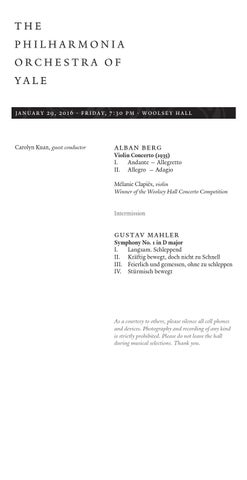
THE PHILHARMONIA ORCHESTRA OF YALE ja n ua r y 2 9, 2 0 1 6 · f rid ay, 7:30 pm · wools e y h all
Carolyn Kuan, guest conductor
alban berg
Violin Concerto (1935) I. Andante — Allegretto II. Allegro — Adagio Mélanie Clapiès, violin Winner of the Woolsey Hall Concerto Competition Intermission
gustav mahler
Symphony No. 1 in D major I. Langsam. Schleppend II. Kräftig bewegt, doch nicht zu Schnell III. Feierlich und gemessen, ohne zu schleppen IV. Stürmisch bewegt
As a courtesy to others, please silence all cell phones and devices. Photography and recording of any kind is strictly prohibited. Please do not leave the hall during musical selections. Thank you.
p ro g ram notes
Alban Berg » 1885–1935 Violin Concerto (1935) In art, there are some pieces in which craftsmanship is so subservient to the creator’s emotion that it is difficult even to talk about craft without feeling like you are missing the point. Berg’s violin concerto, which bears the solemn inscription “To the memory of an angel,” is at once technically refined and intimately vulnerable. Berg set aside work on his opera Lulu to compose the concerto during the summer of 1935. This displacement of creative energy was spurred by the death of 18-year-old Manon Gropius, the daughter of Berg’s longtime friend Alma Mahler. Berg structures his concerto in two parts, but the piece can also be experienced in three parts: two outer lullabies and an inner passage of building strife that is abruptly suspended at its climax. This sense of suspension at the center gives the feeling of watching or listening to something so painful that one has to reach over to the computer and press pause, to collect oneself before resuming. Berg, as much a disciple of Schoenberg’s 12-tone technique as of the voluptuous tonality of late Romanticism, combines these influences in the foundational tone row of his concerto: G-Bb-D-F#-A-C-E-G#-B-C#-Eb-F. This row stacks G minor, D major, A minor, and E major, concluding with a whole-tone ascent. The abundance of triads with strong tonal relationships (D major is the dominant of G minor, and E major is the dominant of A minor) lends the atonal framework a strong flavor of tonal function. Further, the roots of these triads (related through the circle of fifths) outline the open strings of the violin — G, D, A, E. Berg highlights these notes in the opening gesture of the piece, as if customizing the row to the soloist. But this row is also tailored to his dedicatee, Manon Gropius: the whole-tone ascent references an unusual and haunting whole-tone melody in Bach’s chorale Es ist genug (BWV 60). Berg quotes Bach’s harmonization in full, and provides his own in an impassioned orchestral send-off to young Manon. The chorale text reads: It is enough, Lord, when it is pleasing to you then grant me release. May my Jesus come! Now good night, o world.
I am going to heaven’s house, I go confidently from here with joy; my dismal sorrow remains down below. It is enough! — Program note by Katherine Balch Gustav Mahler » 1860–1911 Symphony No. 1 in D Major Gustav Mahler rose to musical prominence as one of the most important and innovative conductors of opera in the late nineteenth century. His conducting career included appointments at opera houses in Prague, Leipzig, Budapest, and Hamburg, leading up to his ten-year residency as director of the Vienna Hofoper. At the end of his life, Mahler came to New York, where he led both the Metropolitan Opera and the New York Philharmonic. This busy schedule made it impossible for Mahler to devote his full energies to composition during the concert season; he wrote mainly in periodic bouts of feverish activity. The demands on his time notwithstanding, he crafted the small but powerful catalog of works that survive today. Within Mahler’s oeuvre only two genres are represented: the symphony and the lied (art song). Despite the vast chasm that separates the intimate sentiment usually found in art song from the public utterances of the great symphonies, Mahler creates in his work a synthesis of these musical antipodes. His orchestrated song cycles, particularly the late Das Lied von der Erde, approach symphonic scope and construction, while many of his symphonies incorporate vocal soloists, choruses, and, as is the case in the First Symphony, material from Mahler’s own songs. Two of the songs from Mahler’s Lieder eines fahrenden Gesellen (Songs of a Wayfarer) are reused extensively in the First Symphony. In the vast opening of the first movement, birdcalling woodwinds and off-stage trumpets emerge out of a haze of strings playing the note A across seven octaves. The cellos introduce the melody of the song “Ging heut Morgen übers Feld” (“I Went This Morning Over the Field”), and the bulk of the movement is derived from this song. Similarly, in the third movement, a funeral march that begins with the round most commonly known as “Frère Jacques,” Mahler introduces much of the song “Die zwei blauen Augen von meinem Schatz” (“The Two Blue Eyes of my Beloved”).
art ist p ro f i le s
Unlike in many of Mahler’s later symphonies, these songs are not performed by vocalists, and therefore are stripped of their explicit textual meaning. Mahler provided a programmatic explanation for the symphony at one of its earliest performances, but this too was excised. Ultimately, it seems that Mahler decided it best to leave the interpretation of the work in the hands of the listener. We must believe that he would have been open to multiple readings of this work, for it was he who said, “A symphony must be like the world. It must embrace everything.” — Program note by Jordan Kuspa
Mélanie Clapiès, violin Born in Paris, Mélanie Clapiès studied in France with violinist and pedagogue Solange Dessane, who has had a lasting influence on her technique and musical awareness. Clapiès continued her violin and chamber music training with Pavel Vernikov and Christophe Poiget at the Lyon Conservatory, with Ami Flammer and Claire Desert at the Paris Conservatory, and with John Glickman at the Guildhall School of Music in London. She then studied with Syoko Aki at the Yale School of Music, where she received her M.M. and Artist Diploma. She is currently completing a D.M.A. at the Manhattan School of Music, where she studies with Mark Steinberg. Clapiès performs as a soloist and as a chamber musician, and has collaborated with Pavel Vernikov, Vladimir Mendelssohn, François Salque, Adam Laloum, and Guillaume Vincent. She has performed in festivals at La Roque d’Anthéron, Deauville, Colmar, Portogruaro, Chaillol, Cordes sur Ciel, the Romantic Salon at Palazzetto Bru Zane in Venice, the Music Freewheel in Arras, and the Suona Francese in Naples, as well as other festivals in Turin, Genoa, Russia, and Algeria. She has also performed at the Banff Centre for the Arts in Canada, and in New York City venues such as Weill Recital Hall, Le Poisson Rouge, and Symphony Space. Clapiès performs regularly in duo with cellist Yan Levionnois, with whom she founded the annual festival “En attendant...” in Burgundy. Together they recorded the CD Les Pierrots Lunaires (2014) with Fondamenta, featuring twentieth-century works. She is currently a member of the Rébow Ensemble. Clapiès has received the Zonta Club Award, the Broadus Erle Prize, the Yale School of Music Alumni Association Prize, and the Philip Francis Nelson Prize. She plays a violin by Joseph Gagliano, 1781.
a rti p rofiles art i ststprofiles Carolyn Kuan, guest conductor Carolyn Kuan, the tenth Music Director of the Hartford Symphony Orchestra, is a skilled interpreter and impressive podium presence. Hailed as a conductor of extraordinary versatility, Ms. Kuan has enjoyed successful associations with top-tier orchestras, opera companies, ballet companies, and festivals worldwide. Her commitment to contemporary music has defined her approach to programming, and established her as an international resource for new music and world premieres. Ms. Kuan’s North American engagements include performances with the symphonies of Baltimore, Detroit, Milwaukee, San Francisco, and Seattle; the Florida and Louisville Orchestras; the New York City Ballet; Colorado Music Festival; New York City Opera, Santa Fe Opera, and Washington National Opera. Recent international engagements have included concerts with the Bournemouth Symphony, Orchestre de la Suisse Romande, Hong Kong Philharmonic, National Symphony of Taiwan, Residentie Orkest, Orquesta Sinfonica de Yucatan, Royal Danish Ballet, West Australian Symphony, and the Toronto Symphony Orchestra. Combining her expertise and love of contemporary and Asian music, Ms. Kuan began the 2014–2015 season in a summerlong debut with the Santa Fe Opera. She worked closely with composer Huang Ruo and director James Robinson, and Dr. Sun Yat-Sen premiered to critical acclaim. In addition to her weeks with the Hartford Symphony Orchestra, other highlights included her debut with the Washington National Opera at the Kennedy Center in Daniel Catan’s Florencia en el Amazonas, directed by Francesca Zambello; her return to the Seattle Symphony to lead works by Tan Dun, Yugo Kanno (U.S. premiere), and Unsuk Chin; her return to Brazil to work with Orquestra Sinfônica do Estado de São Paulo in a program of Britten, Turnage, and Bernstein; and her debut with the Glimmerglass Festival in a new production of The Magic Flute in summer 2015. While maintaining a solid connection with traditional repertoire, Ms. Kuan has cultivated a unique expertise in Asian music and contemporary works. From 2007 to 2012, Ms. Kuan directed the San Francisco Symphony’s annual Chinese New Year concert. For the
Seattle Symphony, Ms. Kuan helped launch the hugely successful Celebrate Asia! program with community leaders representing eight Asian cultures. She led world premieres for Music from Japan, and conducted multimedia productions of the Butterfly Lovers Concerto and A Monkey’s Tale as part of Detroit Symphony’s World Music Series. From 2003 to 2012, Ms. Kuan worked closely with the Cabrillo Festival of Contemporary Music and visiting composers. Some of her finest successes have bridged the gap between cultural and social issues, as in her work raising awareness of conservation and the environment through her performances around the globe of Life: A Journey Through Time. Developed by the Cabrillo Festival and music director Marin Alsop, the project features music by Philip Glass and images by National Geographic photographer Frans Lanting. Ms. Kuan’s past associations include Associate Conductor of the Seattle Symphony Orchestra, Artist-in-Residence at the New York City Ballet, and Assistant Conductor for the Baltimore Opera Company. In her 2012 debut album for the Naxos label, Ms. Kuan conducted the New Zealand Symphony Orchestra in works by Chinese composers. The recipient of numerous awards, Ms. Kuan holds the distinction of being the first female to be awarded the Herbert von Karajan Conducting Fellowship. The award resulted in her residency at the 2004 Salzburg Festival. Winner of the first Taki Concordia Fellowship, she has also received awards from the Women’s Philharmonic, Conductors Guild, and Susan W. Rose Fund for Music. Ms. Kuan graduated cum laude from Smith College, received a Master of Music from the University of Illinois, and earned a Performance Diploma from the Peabody Conservatory.
ab o ut yal e p h ilha rm onia
The Philharmonia Orchestra of Yale is one of America’s foremost music school ensembles. The largest performing group at the Yale School of Music, the Philharmonia offers superb training in orchestral playing and repertoire. Performances include an annual series of concerts in Woolsey Hall, as well as Yale Opera productions in the Schubert Performing Arts Center. The Yale Philharmonia has also performed on numerous occasions in Carnegie Hall and Alice Tully Hall in New York City and at the Kennedy Center in Washington, D.C. The orchestra undertook its first tour of Asia in 2008, with acclaimed performances in the Seoul Arts Center, the Forbidden City Concert Hall and National Center for the Performing Arts (Beijing), and the Shanghai Grand Theatre.
peter oundjian Principal Conductor philharmonia staff andrew w. parker Manager roberta senatore Assistant Manager heejung park Assistant Conductor
The Philharmonia Orchestra of Yale violin i Dae Hee Ahn Ethan Hoppe Jinyou Lee Bora Kim Ye Hyung Chung Sophia Mockler Marie Oka Ludomil Wojtkowski Adelya Nartadjieva Michael Duffett Celia Zhang Jing Yang violin ii Jiazhi Wang Inyoung Hwang Julia Dina David Kai Yuan Loke Moon Joo Kim Benjamin Hoffman Hyunjae Bae Yurie Mitsuhashi Marianne Di Tomaso Elly Toyoda viola Danielle Wiebe Emily Brandenburg Daniel Stone Joyce Huang Yang Li Ye In Son Alexandra Simpson Wei Peng cello Yoonha Yi Jiwon Kang Jenny Kwak Mingyao Zhao
Chang Pan Eric Adamshick Yeji Yoo Zhilin Wang bass Levi Jones Luke Stence Joshua DePoint Erez Meyuhass Lee Starovich Kaden Henderson flute Evan Fojtik Meera Gudipati Andrew Robson 1 Joanna Wu 2 oboe Ron Cohen Mann Lydia Consilvio 1 Timothy Feil 2 Ross Garton Michelle Nguyen Winona V.R. Van Alstyne clarinet Sam Boutris Eric Braley Graeme Steele Johnson Jesse McCandless bassoon Carl Gardner Matthew Gregoire 2 Cornelia Sommer Yen-Chen Wu 1 saxophone Vincent Oneppo 1
horn Sarah Boxmeyer Chuta Chulavalaivong Reese Farnell Sarah Ford Matthew Gray 1 Cody Halquist 2 Valerie Sly Joshua Thompson
philharmonia assistant Andrew Robson
trumpet Nozomi Imamura 2 Aaron Plourde Jonathan Shadle Andrew Stadler
stage crew Eric Braley Maria Chlebus Lydia Consilvio Julia Dina Reese Farnell Nozomi Imamura Matthew Keown John Kossler Richard Liverano Noël Wan
trombone Omar Dejesus Eliud Garcia Richard Liverano tuba Stephen Lamb timpani Maria Chlebus 1 Matthew Keown 2 Se Um percussion Maria Chlebus Yifei Fu Matthew Keown Kramer Milan Jeffrey Stern Se Um harp Noël Wan Shin Young Yu
music librarians Krists Auznieks Bora Kim Yefim Romanov Valerie Sly Hanna Yukho
1 Principal on Berg 2 Principal on Mahler
up co ming events
» music.yale.edu FEB 6
FEB 17
FEB 26
box office 203 432-4158
Peter Frankl & Friends Faculty Artist Series Morse Recital Hall | Saturday | 4 pm Celebrating Peter Frankl’s 80th birthday year Music by Dohnányi, Brahms, Schumann, and more. Free admission Dénes Várjon, piano Horowitz Piano Series Morse Recital Hall | Wednesday | 7:30 pm Music by Haydn, Janáček, and Schumann Tickets start at $18 • Students $11 Philharmonia in Sprague Yale Philharmonia Morse Recital Hall | Friday | 7:30 pm Haydn: “Surprise” Symphony; music by Shostakovich and Lieberson Tickets start at $10 • Students $5 Yale faculty/staff $8
concert programs & box office Krista Johnson Kate Gonzales communications Donna Yoo Dana Astmann operations Tara Deming Christopher Melillo piano curators Brian Daley William Harold recording services Eugene Kimball Matthew LeFevre Austin Kase
Thank you for your support! Become a Yale School of Music patron and support our performance programs. Earn benefits ranging from preferred seating to invitations to special events. To learn more, visit us online or call 203 432-4158. charles ives circle $600 and above Anonymous paul hindemith circle $250 to $599 Serena & Robert Blocker Prof. Michael & Mrs. Maryann Bracken Richard H. Dumas Edwin M. & Karen C. Duval Paul Gacek Richard & Evelyn Gard Francesco Iachello Patty & Tom Pollard Mary-Jo Worthey Waren Ransom Wilson & Walter Foery Michael Zuber & Zachary Zander horatio parker circle $125 to $249 Joyce Alton Roger & Linda Astmann Craig Baker Derek & Jennifer Briggs Leo Cristofar & Bernadette DiGiulian Elizabeth M. Dock Joan K. Dreyfus Raymond & Jean Gambardella
Carolyn Gould Margaret Lord & Arthur Kover Judy Long Mark Ludwig Ann Marlowe Stephen Marsh Susan Matheson & Jerome Pollitt Martha & Vincent Oneppo Arthur T. Rosenfield, M.D. Suzanne Solensky & Jay Rozgonyi Monika & Fred Volker samuel simons sanford circle $50 to $124 Anonymous Nancy Ahlstrom Helen & Blake Bidwell Henry & Joan Binder Barbara Blake Harold & Maureen Bornstein Mindy & Stan Brownstein Barbara & Frank Dahm Thomas & Judith Foley James V. Freeman Saul & Sonya Goldberg Lawrence Handler Alexandra Isles
James Mansfield Joel Marks Betty Mettler Ron & Sue Miller Barbara & Bill Nordhaus James V. Pocock Rocco and Velma Pugliese Fred & Helen Robinson Leonard J. Rutkosky Suzanne Tucker Mr. & Mrs. Peter Uhrynowsky Carl Wies & Margot Hardenbergh Werner & Elizabeth Wolf Donna Yoo gustave jacob stoeckel circle $25 to $49 Mr. & Mrs. Ken L Grubbs James N. Trimble as of January 28, 2016