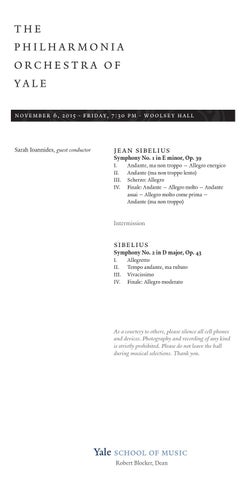
THE PHILHARMONIA ORCHESTRA OF YALE n o v em b er 6 , 2 0 1 5 · f rid ay, 7:30 pm · woo ls e y h all
Sarah Ioannides, guest conductor
jean sibelius
Symphony No. 1 in E minor, Op. 39 I. II. III. IV.
Andante, ma non troppo — Allegro energico Andante (ma non troppo lento) Scherzo: Allegro Finale: Andante — Allegro molto — Andante assai — Allegro molto come prima — Andante (ma non troppo)
Intermission
sibelius
Symphony No. 2 in D major, Op. 43 I. II. III. IV.
Allegretto Tempo andante, ma rubato Vivacissimo Finale: Allegro moderato
As a courtesy to others, please silence all cell phones and devices. Photography and recording of any kind is strictly prohibited. Please do not leave the hall during musical selections. Thank you.
Robert Blocker, Dean
pro g ram no tes
Jean Sibelius » 1865–1957 Symphony No. 1 in E minor, Op. 39 Under the February Manifesto signed into law on February 15 of 1899, Russian Emperor Nicholas II asserted authority over the state in Finland. The Russian Orthodox Church would be the Church of State, Russian would be the official language of administration, the press was subject to Russian censorship, and within a few years the Finnish army would be absorbed into the Russian imperial army. In this harsh political climate known as the “Russification of Finland,” the 33-year-old Sibelius composed his Symphony No. 1, Op. 39. Sibelius certainly draws from the techniques of the Russian symphonists Tchaikovsky and Borodin. However, an older Sibelius decried, “I cannot understand why my symphonies are so often compared with Tchaikovsky’s. His symphonies are very human, but they represent the soft part of human nature. Mine are the hard ones.” In the context of cultural Russification, the idiosyncrasies of Sibelius’ nationalistic style shine — particularly cool orchestral colors such as the magical use of harp and the positioning of shimmering solo instruments against shivering pedal points. In The Cambridge Companion to Sibelius, Yale’s own musicologist James Hepokoski claims that Sibelius crafts the symphony in “a stubbornly separatist, regionally resonant music idiom.” A 1905 review by Englishman Ernest Newman attests as much: “I have never listened to any music that took me away so completely from our usual Western life and transported me into a quite new civilization.” Sibelius described his original plan for the symphony in a sketchbook from 1898. The first movement would be, “A cold, cold wind… blowing from the sea.” In the second, he drew inspiration from a Heinrich Heine poem, “Ein Fichtenbaum Steht Einsam,” roughly reduced: “There stands alone a fir tree… ice and snow wrap it in sheets of white. He dreams of a palm tree… Far East and standing alone by a burning wall of stone.” In the plan for the Scherzo, Sibelius described a “Winter’s Tale”— perhaps in dialogue with Shakespeare whose works were translated to Finnish starting in the mid-19th century. The fourth contained a reference to “Jorma’s heaven,” a character from Finnish neo-Romantic author Juhani Aho’s novel Panu published in 1897. Although
Sibelius, an obsessive revisionist, did not follow through with these conceptual sketches, it is hard to ignore their influence on the final version: the cold wind of the unaccompanied clarinet introduction, or savage clamor of Shakespeare’s bear chase in the timpani solo of the Scherzo. Compared to the pristine architecture of the first three movements, the Finale is marked quasi una fantasia — with compositional freedom reflecting the goals of Finnish separatism. — Samuel S. Suggs Symphony No. 2 in D major, Op. 43 Composed primarily in 1901, Jean Sibelius’ Second Symphony in D major was premiered by the Helsinki Symphony on March 8, 1902 with the composer conducting. Beginning with that first successful performance, the Second remains the most performed of his seven symphonies. Significant portions of the symphony originate from Sibelius’ 1901 trip to Italy. As with Goethe, Mendelssohn, Wagner, Berlioz, Tchaikovsky, and other artists from the north, Italy had a profound effect on the 35-year-old composer. In 1899, his popular Finlandia had cast Sibelius as the nationalist voice of the Finnish people. His stay in Italy and the resulting compositional output helped establish Sibelius as a pan-European composer. While in the cities of Rapallo and Florence, he sketched material for a tone poem based on the story of Don Juan (possibly in response to Strauss’), another tone poem based on the work of Dante (inspired by Liszt), and a work entitled Christus. As with his contemporary Gustav Mahler, whose first two symphonies germinated from programmatic sketches, this material from 1901 became the foundation of his Second Symphony. Sibelius’ distance from Vienna, the center of symphonic music, allowed him to follow a different path than many of his contemporaries. Like Tchaikovsky, whose music he greatly admired, Sibelius composed both tone poems and numbered symphonies. Both fused elements of Liszt’s programmatic techniques and Beethovenian symphonic structure. Unlike most composers in Vienna at the time, neither Tchaikovsky nor Sibelius was pressured to adhere to one particular musical form.
The cross-influence of Lisztian texture and chromaticism with the structural cohesion of Beethoven and Brahms gave Sibelius his truly unique voice as a symphonist. Ultimately, this pursuit of cohesion led to an extended singlemovement format for his Seventh Symphony. With his Second Symphony, Sibelius creates an overall sense of unity through thematic consistency. Rather than employing traditional sonata form (a clear statement of distinct subjects, development of those subjects, and a recapitulation), he presents fragmented themes as texture, then combines these fragments in clearer statements as “development,” and finally restates the fragments. Sibelius would later write, “It is as if the Almighty had thrown down the pieces of a mosaic for heaven’s floor and asked me to put them together.” In the first twelve measures, Sibelius establishes the thematic techniques found throughout the remainder of the symphony with three distinct elements: scalar thirds in ascent or descent, eleven-note patterns, and melodic embellishment that expands into larger themes. By the end of the movement, it is clear that his intent is to reveal the “mosaic” as the symphony unfolds. The second movement illuminates another of Sibelius’ talents as a symphonic composer: the use of lyricism independent of song. The long pizzicato introduction eventually gives way to a somber theme in the bassoons. The movement builds to a furious climax, but dissolves to fragmentation. The brief Scherzo movement that follows is often associated with nationalism, as Finland had not yet gained independence from imperial Russia, but in fact Sibelius’ material for the third movement originated as a response to the suicide of his sister-in-law. The Scherzo transitions directly into the finale, where the symphony concludes in a triumphant D major and the full musical “mosaic” is revealed, with “heaven’s floor” now finally visible. In 1914, Sibelius made his only trip to the United States to receive an honorary doctorate from Yale University. As a guest of Carl Stoeckel, Sibelius enjoyed true luxury for the only time in his life (including a private barber to shave him every morning). His work The Oceanides was composed for the Norfolk Music Festival (held at the BattellStoeckel estate in Norfolk, Connecticut),
and was premiered that spring with the composer conducting. The autograph of The Oceanides resides in Yale’s Beinecke Rare Book and Manuscript Library. — Ben Berlien
a rt i st p rofiles
Sarah Ioannides, guest conductor Sarah Ioannides has been described by the New York Times as a conductor with “unquestionable strength and authority” and recently as a conductor with “magic.” A protégée of OttoWerner Mueller, Ioannides has led dozens of renowned orchestras in the United States and internationally including the Toledo Symphony, Louisville Orchestra, Rochester Philharmonic, the Royal Philharmonic Orchestra, Tonkünstler Orchestra, and the Orchestra Nationale de Lyon. She has also appeared in special engagements with the Los Angeles Philharmonic and the London Symphony Orchestra working with Pierre Boulez and Esa-Pekka Salonen. Newly appointed as Music Director of the Tacoma Symphony Orchestra, Ioannides is also Music Director of the Spartanburg Philharmonic Orchestra and was Music Director of the El Paso Symphony Orchestra from 2005–2011. Her tenures have been characterized by excellence, innovation, collaboration, and diversity. She is known for introducing renowned soloists and creating new educational initiatives and community partnerships. Recent international press stated: “Sarah Ioannides… demonstrated her ‘unquestionable strength and authority’ and great qualities as a conductor, for which she is recognized as one of the most engaging and respected conductors of her generation.” Assistant Conductor of the Cincinnati Symphony Orchestra from 2002 to 2004 under the leadership of Paavo Järvi, James Conlon, and Erich Kunzel, Ioannides also served as the Music Director of the Cincinnati Symphony Youth Orchestra and was the first woman appointed to the conducting staff of the Cincinnati Symphony Orchestra. A passionate supporter of living composers, Ioannides has conducted over 35 world, U.S., and European premiers. At the inaugural performance of her tenure as Music Director with the Tacoma Symphony Orchestra, she conducted the world premier of Portraits of Immortal Love by Australian composer Sean O’Boyle with percussionist Dame Evelyn Glennie. Ioannides conducted a second performance with Glennie with the Spartanburg Philharmonic Orchestra, which was awarded an ArtWorks grant from the National Endowment for the Arts.
Ioannides formerly collaborated regularly with composer/conductor Tan Dun, serving as Conductor and Production Coordinator from 1999 to 2003. She has directed and commissioned films for live orchestral multimedia performances including new films for Holst’s The Planets and Steve Reich’s The Desert Music. In the field of opera, Ioannides has led and assisted numerous productions and collaborations with festivals worldwide. OperaOpera described Ioannides’ lyrical conducting technique by commenting that “with the most persuasive of gentle textures, she coaxed from the performers an extraordinary array of sounds. She was grace personified.” An advocate of music education, a passionate linguist, and a teacher, Ioannides has worked with students of all ages as private instrument instructor, advisor, guest conductor, and orchestral trainer with conservatories such as the Jacobs School of Music, Chicago College of Performing Arts, Curtis Institute of Music, Cincinnati Conservatory of Music, and Oxford University Opera (Music Director) and Orchestra. Born in Australia, Ioannides grew up in the U.K. performing as a violinist in the National Youth Orchestra of Great Britain. With master’s degrees from Oxford University (Instrumental Scholar) and the Juilliard School of Music (Bruno Walter Award), Ioannides studied conducting, violin, piano, voice, and horn. A recipient of numerous prizes and awards, she came to the United States as a Fulbright Scholar attending the Curtis Institute of Music after her studies at the Guildhall School of Music. Named in the Los Angeles Times as “one of six female conductors breaking the glass podium” and noted in the New York Times as part of “a new wave of female conductors in their late 20s through early 40s,” Sarah Ioannides is a prize-winner of the Leeds Conducting Competition and was awarded the JoAnn Falletta Award for the most promising female conductor.
a b o ut yale p h ilharmonia
The Philharmonia Orchestra of Yale is one of America’s foremost music school ensembles. The largest performing group at the Yale School of Music, the Philharmonia offers superb training in orchestral playing and repertoire. Performances include an annual series of concerts in Woolsey Hall, as well as Yale Opera productions in the Schubert Performing Arts Center. The Yale Philharmonia has also performed on numerous occasions in Carnegie Hall and Alice Tully Hall in New York City and at the Kennedy Center in Washington, D.C. The orchestra undertook its first tour of Asia in 2008, with acclaimed performances in the Seoul Arts Center, the Forbidden City Concert Hall and National Center for the Performing Arts (Beijing), and the Shanghai Grand Theatre.
peter oundjian Principal Conductor philharmonia staff andrew w. parker Manager roberta senatore Assistant Manager heejung park Assistant Conductor
The Philharmonia Orchestra of Yale violin i Benjamin Hoffman Yefim Romanov Ethan Hoppe Marianne Di Tomaso Dae Hee Ahn Ruda Lee Jing Yang Suyoun Han Wynton Grant Maria Oka Ye Hyung Chung Yena Lee David Kai Yuan Loke violin ii Yurie Mitsuhashi Jinyou Lee Bora Kim Sarah Arnold Ludomil Wojtowski Jiazhi Wang Celia Zhang Michael Duffett Inyoung Hwang Tzu Ti Chang Julia Ghica Moon Joo Kim viola Danielle Wiebe Hee-Sun Yang Emily Brandenburg Joyce Huang Wei Peng Alexandra Simpson Ryan Davis Ye In Son Joshua Newburger Julia Clancy
cello Zhilin Wang Yoonha Yi Jiwon Kang James Rosamilia Chang Pan Mingyao Zhao Nayeon Kim Ji Young Choi Eric Adamshick bass Will Robbins Samuel Suggs Luke Stence Lee Starovich Levi Jones Kaden Henderson Erez Meyuhass Joshua DePoint flute Felice Doynov 1 Helen Park 2 oboe Winona V.R. Van Alstyne Timothy Feil 2 Ross Garton 1 Michelle Nguyen clarinet Graeme Johnson 2 William Kennedy 1 bassoon Carl Gardner 2 Francisco Joubert Bernard 1 Yen-Chen Wu
horn Sarah Boxmeyer Chuta Chulavalaivong Reese Farnell 2 Sarah Ford 1 Matthew Gray Cody Halquist Josh Thompson trumpet Nozomi Imamura 1 Aaron Krumsieg 2 Jonathan Shadle Andrew Stadler Daniel Venora trombone Jeffrey Arredondo Omar Dejesus Richard Liverano 2 Alexander Walden 1 tuba John Leibensperger timpani Yifei Fu 2 Matthew Keown 1 percussion Maria Chlebus Kramer Milan harp Shin Young Yu 1 Noël Wan 1 - Principal on Symphony No. 1 2 - Principal on Symphony No. 2
philharmonia assistant Andrew Robson music librarians Krists Auznieks Bora Kim Yefim Romanov Valerie Sly Hanna Yukho stage crew Eric Braley Maria Chlebus Lydia Consilvio Julia Ghica Reese Farnell Nozomi Imamura Matthew Keown John Kossler Richard Liverano Noël Wan
up co ming events
» music.yale.edu NOV 7 & 8
NOV 10
NOV 11
box office 203 432-4158
Fall Opera Scenes Yale Opera Morse Recital Hall | Sat, 7:30 pm | Sun, 2 pm Doris Yarick Cross, artistic director; Marc Verzatt, stage director; Douglas Dickson and Timothy Shaindlin, music directors Tickets start at $10 • Students $5 Yale Brass Trio Faculty Artist Series Morse Recital Hall | Tuesday | 7:30 pm William Purvis, horn; Allan Dean, trumpet Scott Hartman, trombone • Music from the Italian Renaissance to Ezra Laderman Free admission Wei-Yi Yang, piano Horowitz Piano Series Morse Recital Hall | Wednesday | 7:30 pm Music by Chopin, Prokofiev, and Schubert Tickets start at $13 • Students $7
concert programs & box office Krista Johnson Donna Yoo communications Dana Astmann Monica Ong Reed Austin Kase operations Tara Deming Christopher Melillo piano curators Brian Daley William Harold recording studio Eugene Kimball
Thank you for your support! Become a Yale School of Music patron and support our performance programs. Earn benefits ranging from preferred seating to invitations to special events. To learn more, visit us online or call 203 432-4158. charles ives circle $600 and above Anonymous paul hindemith circle $250 to $599 Serena & Robert Blocker Richard H. Dumas Edwin M. & Karen C. Duval Paul Gacek Richard & Evelyn Gard Francesco Iachello Patty & Tom Pollard Mary-Jo Worthey Waren Ransom Wilson & Walter Foery Michael Zuber & Zachary Zander horatio parker circle $125 to $249 Joyce Alton Roger & Linda Astmann Craig Baker Derek & Jennifer Briggs Leo Cristofar & Bernadette DiGiulian Elizabeth M. Dock Joan K. Dreyfus Raymond & Jean Gambardella Carolyn Gould Margaret Lord & Arthur Kover
Judy Long Mark Ludwig Ann Marlowe Stephen Marsh Susan Matheson & Jerome Pollitt Martha & Vincent Oneppo Arthur T. Rosenfield, M.D. Suzanne Solensky & Jay Rozgonyi Monika & Fred Volker samuel simons sanford circle $50 to $124 Nancy Ahlstrom Helen & Blake Bidwell Barbara Blake Harold & Maureen Bornstein Mindy & Stan Brownstein Barbara & Frank Dahm Thomas & Judith Foley James V. Freeman Saul & Sonya Goldberg Lawrence Handler Alexandra Isles James Mansfield Joel Marks Betty Mettler Ron & Sue Miller
Barbara & Bill Nordhaus James V. Pocock Fred & Helen Robinson Leonard J. Rutkosky Suzanne Tucker Mr. & Mrs. Peter Uhrynowsky Carl Wies & Margot Hardenbergh Werner & Elizabeth Wolf Donna Yoo gustave jacob stoeckel circle $25 to $49 James N. Trimble as of November 4, 2015